COMERFORD WAY: Patrick Comerford’s online journal on Anglicanism, theology, spirituality, history, architecture, travel, poetry, beach walks ... and more
Traditional Greek folk music, including the bouzouki, celebrated at Raki Ba Raki restaurant on the corner of Radamanthuos and Xanthoudidou streets in Rethymnon (Photograph: Patrick Comerford)
Patrick Comerford
It is now over 30 years since the Swedish Institute and the the Swedish Ministry for Foreign Affairs invited me to take part in the ‘Euro-Islam’ Conference on 15-17 June 1995 in Stockholm and on Lidingö, an island in the Stockholm Archipelago, north-east of Stockholm, once the home of the diplomat Raoul Wallenberg.
The participants included Muhammad Larijani, then a senior Iranian politician and theologian and once a top adviser on foreign affairs to Ayatollah Ali Khamenei. The conference was groundbreaking and became a critical precursor to the launch of the European Union’s wider Euro-Mediterranean Partnership (the Barcelona Process) later that year.
One evening that June as participants we were taken on a cruise on the Stockholm Archipelago, with 24,000 to 30,000 islands and islets 80 km east from Stockholm into the Baltic Sea. The on-board entertainment including a mixed-band that included a Syrian musician playing the bouzouki.
In conversation, I asked him where in Greece he had learned to play the bouzouki. I was surprised to hear that, in fact, he had learned bouzouki under the tutelage of the Irish musician Donal Lunny. I had almost forgotten about this incident for more than 30 years until the news some days ago of the death of Donal Lunny (23 October 2026).
Traditional Greek instruments in a shop on Chimaras Street in Rethymnon (Photograph: Patrick Comerford)
The bouzouki (μπουζούκι, plural μπουζούκια, bouzoukia) is a popular instrument in Greece. It is part of the long-necked lute family and from the family as the mandolin and the lute. It has a round body and a long neck with a fretted fingerboard, and steel strings and it is played with a plectrum, producing a sharp metallic sound, similar to that of a mandolin but pitched lower.
The Irish bouzouki is derived from the Greek bouzouki and other instruments similar to the bouzouki, including the buzuq and the Balkan tambura, are found in Syria, Iraq, Lebanon, Cyprus, Balkans and Turkey.
The Greek bouzouki is a plucked musical instrument of the lute family, called the thabouras or tambouras family. The tambouras were found in ancient Greece as the pandura, and were in different sizes, shapes, depths of body, lengths of neck and number of strings. The bouzouki and the baglamas are direct descendants.
The Mantineia Base, a Greek marble relief now in the National Archaeological Museum in Athens, dates from 330 to 320 BCE, shows a muse playing a variant of the pandoura.
From Byzantine times it was known first as pandoura and then as tambouras.
The name μπουζούκι (bouzouki) is not originally Greek but comes from a Turkish word bozuk, meaning ‘broken’ or ‘modified’. The bouzouki was brought to Greece in the early 1900s by Greek refugees from Anatolia, and quickly became the central instrument to rebetiko and similar music, so that it is now an important element of modern Laïko pop Greek music.
Originally the body was carved from a solid block of wood, similar to the saz, but when the instrument arrived in Greece in the early 1910s it was modified with the addition of a staved back borrowed from the Neapolitan mandola, and the top angled in the manner of a Neapolitan mandolin in order as to increase the strength of the body so it could withstand thicker steel strings. The type of the instrument used in rebetiko music was a three-course instrument with three pairs of strings, but in the 1950s a four-course variety was developed and was made popular by Manolis Chiotis.
A bouzouki can be made with many differences not only in the number of strings but also in other features, such as the neck length, width or height, the depth of the bowl or main body, or the width of the staves. The quality of the wood used in making a bouzouki is of great importance for the sound. Mulberry, apricot, cherry, acacia and elm are said to be the best woods for making the bowl, with walnut, plane, and chestnut seen as slightly inferior. The wood must be solid and sourced from slow-growth trees.
The top or soundboard should be cedar or spruce, cut in one piece. The best varnish is a natural one made of shellac, applied by hand in many layers in a traditional way, for both acoustic and visual effects. The neck must be of very dry hardwood so it does not warp.
Bouzoukia in a shop on Arkadiou street in Rethymnon (Photograph: Patrick Comerford)
The Greek trichordo bouzouki, the classic style of bouzouki, was introduced around 1900 and was the mainstay of most rebetiko music. The bouzouki became more popular in Greece after the 1919-1922 war in Asia Minor and the forced ‘population exchange’ between Greece and Turkey.
The early bouzoukia mostly had three courses (six strings in three pairs, known as trichordo) and were tuned in different ways.
At the end of the 1950s, four-course (tetrachordo) bouzoukia started to gain popularity in Greece. The four-course bouzouki was made popular by the Greek composer, singer and bouzouki virtuoso Manolis Chiotis (Μανώλης Χιώτης, 1921-1970) who also used a tuning akin to standard guitar tuning and he helped make the bouzouki a truly popular instrument capable of a wide range of musical expression.
As well as developing the modern tetrachordo bouzouki, Manolis Chiotis was a pioneer of the use of amplification for the instrument, which he may have been using as early as 1945. However, the earliest documented use of amplification for the bouzouki comes from a 1952 photograph, showing Vasilis Tsitsanis and Yiannis Papaioannou playing bouzoukis, each with an electric guitar-style pick-up attached in the soundhole.
Chiotis collaborated closely with Mikis Theodorakis in the early1960s, and his bouzouki playing was central to the 1960 recording of Theodorakis’s Epitaphios with Grigoris Bithikotsis, a recording widely regarded as a landmark in modern Greek music.
Today, the tetrachordo is the most common bouzouki used in Greek music, though a few traditionalists still prefer the trichordo, particularly for the older rebetiko style of playing.
The five-course bouzouki (pentachordo) has 10 strings arranged in five pairs, which allows for extended chords and versatility. It was popularised by Antonopoulos Giorgos.
The Greek baglamas (μπαγλαμάς) or baglamadaki (μπαγλαμαδάκι) is very different from the Turkish bağlama. It is tuned the same as the trichordo bouzouki but pitched an octave higher, with unison pairs on the four highest strings and an octave pair on the lower D. Musically, the baglamas is most often found supporting the bouzouki in the Piraeus style of rebetiko.
The Irish bouzouki, with four courses, a flatter back, and differently tuned from the Greek bouzouki, is a more recent development, stemming from the introduction of the Greek instrument into Irish music by Johnny Moynihan around 1965. It was later adopted by Andy Irvine, Dónal Lunny, and many others, although some Irish musicians, including Alec Finn, continued to use the Greek-style instruments.
A minute of bouzouki and guitar music in a taverna in the Plaka in Athens (Patrick Comerford)
Stony Last Thursday History Society,
Stony Stratford Library,
29 October 2026 (2:30 pm)
Introduction:
As we were arriving this afternoon, I was playing ‘Zorba’s Dance’ from the 1964 classic Hollywood film Zorba the Great. Today, the dance and the music are regarded as quintessentially Greek, by Greek and non-Greek alike. But back in 1964, both the music and dance were newly composed and newly choreographed. The dance was invented on the film set, and the music was written especially for the film by the composer Mikis Theodorakis.
The film is based on the book, Zorba the Greek, a work of modern Greek literature by Nikos Kazantzakis, one of the great writers of the 20th century. I have tried to read it in the original Greek, with its beautiful opening descriptions of the landscape of Crete. It was first published in Greek 80 years ago, in 1946. I have known the writer’s family for decades, written about him often, and I have visited his grave on the walls above Iraklion.
So, when I moved to Stony Stratford over four years ago, I was surprised to find a link – however distant and tenuous – between Stony Stratford and Zorba the Greek.
This afternoon I want to share with you a ‘Stony Story’ of music, film and dance, of stained glass windows and romance, of love, abandonment and divorce, a story that links Stony Stratford and the stars of Hollywood, and a story that also draws in the Pre-Raphaelite artists of the Victorian age.
But, to put our conversations into context this afternoon, to weave together your memories and my stories, could I begin by tapping into your memories:
• How many of you have seen Zorba the Greek?
• How many of you have seen The Ten Commandments?
• How many of you are familiar with the names of Anthony Quinn … Cecil B DeMille … Nikos Kazantzakis?
• And, are you are familiar with the stained glass windows in Saint Mary and Saint Giles Church?
There are 12 windows in the church, and they include:
• a two-light window at the west end by Charles Eamer Kempe, depicting three archangels;
• a set of three windows in the south gallery, among them important work by John Groome Howe of the Hardman studios;
• two separate windows in the south gallery with fragments from an earlier window;
• and six windows – three below the gallery on the south wall and three below the gallery on the north wall – by NHJ Westlake of Lavers & Westlake.
I want us to concentrate first of all on the three small windows below the gallery on the north wall, which are paired with the three small windows below the gallery on the south wall, all six by Nathaniel Westlake.
Window 1, North side:
The first window at the east end of the north wall in Saint Mary and Saint Giles Church, Stony Stratford, is by NHJ Westlake, in memory of the Revd John William Spark (Photograph: Patrick Comerford)
The first window by Westlake at the east end of the North Wall in Saint Mary and Saint Giles is dated 1889, and is in memory of the Revd John William Spark, who was the assistant curate in Stony Stratford for six years.
This window is of three eyelets and depicts three Biblical scenes: Moses and the Burning Bush; the Annunciation; the Expulsion of Adam and Eve from Eden.
Moses and the Burning Bush, depicted in the first window on the north wall in Saint Mary and Saint Giles Church, Stony Stratford (Photograph: Patrick Comerford)
John William Spark was born in 1858, the son of Peter Spark, a farmer of Meldreth, near Whittlesford, Cambridgeshire, and later of Babraham. He was educated at Saint John’s College, Oxford (BA 1880, MA 1885), and was an assistant curate in Stony Stratford for six years. He left £50 in his will towards providing better vestry accommodation, and this money formed the nucleus of a fund for building the new vestries, designed by Edward Swinfen Harris.
The Annunciation depicted in the first window in the north wall in Saint Mary and Saint Giles Church, Stony Stratford (Photograph: Patrick Comerford)
This window is one of two in the church in Spark’s memory. Each panel in this window depicts an angel speaking the word of God. The first two panels offer images of listening to the message of God: Moses listens to the word of God, depicted as an angel in the Burning Bush; the Virgin Mary listens to the annunciation of the Gospel by the Archangel Gabriel; and an angel tells Adam and Eve to leave the Garden of Eden.
The Expulsion from Eden … a panel in the first window on the north wall in Saint Mary and Saint Giles Church, Stony Stratford (Photograph: Patrick Comerford)
The depiction of the expulsion of Adam and Eve may seem an unusual image in a memorial window. However, it may indicate the early departure of a man who had arrived in a parish he could have expected to be a new Eden, only to be taken away at an early stage.
Window 2, North side:
The second window in the north wall in Saint Mary and Saint Giles Church by NHJ Westlake, in memory of the Revd John William Spark (Photograph: Patrick Comerford)
The second window in the North Wall in Saint Mary and Saint Giles is dated 1889. It is by Westlake and is second of two sets of windows in memory of the Revd John William Spark, who was in Stony Stratford for six years.
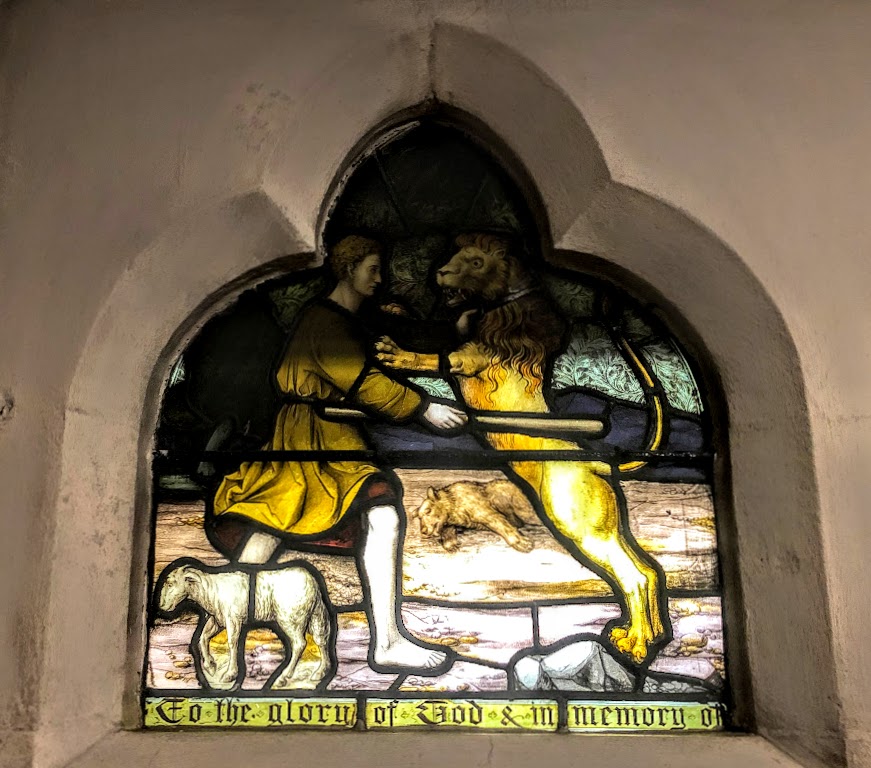
This window is of three eyelets and each panel in this window depicts a good shepherd: David killing a lion (see I Samuel 17: 34-37); Christ the Good Shepherd (John 10: 11-18); and the Sacrifice of Abel (Genesis 4: 2).
David killing a lion (see I Samuel 17: 34-37) depicted in the second window on the north wall in Saint Mary and Saint Giles Church, Stony Stratford (Photograph: Patrick Comerford)
Before going into battle with Goliath, David told Saul how he had risked his life for the sheep in flock, killing lions and bears: ‘… whenever a lion or a bear came, and took a lamb from the flock, I went after it and struck it down, rescuing the lamb from its mouth; and if it turned against me, I would catch it by the jaw, strike it down, and kill it. Your servant has killed both lions and bears … the Lord, who saved me from the paw of the lion and from the paw of the bear, will save me from the hand of this Philistine’ (I Samuel 17: 34-37).
Christ the Good Shepherd (John 10: 11-18) depicted in the second window in the north wall in Saint Mary and Saint Giles Church, Stony Stratford (Photograph: Patrick Comerford)
In Saint John’s Gospel, Christ describes himself twice in one passage as the Good Shepherd: ‘I am the good shepherd. The good shepherd lays down his life for the sheep. … I am the good shepherd. I know my own and my own know me, just as the Father knows me and I know the Father. And I lay down my life for the sheep’ (John 10: 11-15).
The Sacrifice of Abel (Genesis 4: 2) … a panel in the second window on the north wall in Saint Mary and Saint Giles Church, Stony Stratford (Photograph: Patrick Comerford)
The third panel recalls Abel the Shepherd and his sacrifice: ‘Abel was a keeper of sheep, and Cain a tiller of the ground. In the course of time Cain brought to the Lord an offering of the fruit of the ground, and Abel for his part brought of the firstlings of his flock, their fat portions. And the Lord had regard for Abel and his offering’ (Genesis 4: 2-4).
We could summarise these three panels as reminding the parishioners of Stony Stratford that the Revd John William Spark, their curate who died a young man, had risked his life for them, made a perfect sacrifice, and was a faithful shepherd.
Window 3, North Wall:
The third window on the north wall by NHJ Westlake is in memory of Amy (Hunt) Lester, wife of the Revd John Moore Lester (Photograph: Patrick Comerford)
The third window in the North Wall in Saint Mary and Saint Giles, and the one I really want to focus on this afternoon, is dated 1895. It is also by Westlake, who was commissioned by Edward Swinfen Harris (1841-1924). Again, this window depicts three Biblical scenes:
• Enoch taken up to heaven by angels without dying (see Genesis 5: 21-24);
• the Ascension (see Luke 24: 50-53);
• Elijah taken up to heaven in the Chariot of Fire without dying (II King 2: 11-12).
Enoch being taken up to heaven without dying (see Genesis 5: 21-24) … a panel in the third window on the north wall (Photograph: Patrick Comerford)
The Ascension (see Luke 24: 50-53) … a panel in the third window in the north wall in Saint Mary and Saint Giles Church (Photograph: Patrick Comerford)
Elijah is taken up to heaven in the Chariot of Fire without dying (II King 2: 11-12) … a panel in the third window on the north wall in Saint Mary and Saint Giles Church, Stony Stratford (Photograph: Patrick Comerford)
Enoch and Elijah are both said to have been taken into heaven without dying. These images, along with central panel depicting the Ascension, are illustrations of the Christian hope of eternal life.
This window is in memory of Amy (Hunt) Lester (1850-1895), the wife of the Revd John Moore Lester (1851-1884), who was the Vicar of Stony Stratford in 1880-1884. They were married in Christ Church, Lancaster Gate, Westminster, in 1877 and they were the parents of nine children. She died on 30 October 1895.
The Revd John Moore Lester was the Rector of Stony Stratford in 1880-1884. He was born in Mumbai (Bombay), a son of General Sir Frederick Lester, and was educated at Rugby and University College Oxford.
From Stony Stratford, he went on to be the Vicar of Holy Trinity Church, Ayr (1884), Vicar of Shifnal, Shropshire, and a Rural Dean in the Diocese of Lichfield (1891), Vicar of Yarcombe, Devon (1903), Rector of Saint Leonard’s, Bridgnorth (1905), and finally Rector of Litchborough, near Towcester in Northamptonshire, 15 miles north-west of Stony Stratford. He died at Litchborough Rectory on Christmas Eve 24 December 1919.
Lieutenant Edward Gabriel Lester (1887-1917) … died at the Battle of Vimy Ridge in France on 25 June 1917
Amy Lester’s son, Edward Gabriel Lester (1887-1917), was the father of the Canadian-born American actor Katherine Lester DeMille. She was the adopted daughter of the director Cecil B DeMille, she married Anthony Quinn, she was considered Hollywood royalty, she played 25 credited film roles from the mid-1930s to the late 1940s, and she was noted for her dark beauty.
Katherine Lester DeMille was born Katherine Paula Lester in Vancouver on 29 June 1911. Her birth father, Edward Gabriel Lester, was born in Scotland shortly after his father had moved from Stony Stratford to Ayr. He became a teacher, moved to Canada and married Cecile Bianca Bertha Colani, who was of Italian descent and a daughter of the architect Johann Colani. During World War I, Edward Lester became a lieutenant in the Canadian army and was sent to France.
Four days before Katherine’s sixth birthday, her father died of multiple wounds at the Battle of Vimy Ridge in France on 25 June 1917, during World I. Her mother, Cecile Bianca Bertha (Colani), was terminally ill, and travelled to California, supposedly to find Katherine’s paternal grandparents and to leave the little girl with them.
However, the child’s grandmother, who is commemorated in this window in Stony Stratford, had died more than 20 years earlier, in 1895, and the child’s grandfather was then living in Northamptonshire. Katherine’s mother died less than three years later, in a Los Angeles hospital on 18 March 1920, without ever making contact with her husband’s parents, the child’s grandparents.
By then, Katherine had been placed in an orphanage in Los Angeles. Just weeks before her grandfather’s death, when she was eight, she was found in the orphanage by Constance Adams DeMille (1873-1960), the wife of the Hollywood producer and director Cecil B DeMille (Cecil Blount de Mille, 1881-1959). The DeMille family presumed she had no living relatives and adopted her as their third child in 1922.
Katherine Lester DeMille was born Katherine Paula Lester in Vancouver on 29 June 1911
Katherine, still in her late teens, gained experience on stage in 1930, acting as the understudy for the feminine ‘heavy’ of the play ‘Rebound’ in San Francisco. She wanted to begin an acting career on her own and used the stage name Kay Marsh whenever she worked as an extra. Her first credited role was as Rosita Morales, the wife of Wallace Beery’s Pancho Villa, in the MGM film Viva Villa! (1934), the story of the Mexican bandit, Pancho Villa.
She played another Mexican woman that year, a maid named Lupe, in the Paramount production The Trumpet Blows (1934), and her performance brought a contract with Paramount Pictures. Her next role was as Molly Bryant, the nemesis of Mae West’s character in Belle of the Nineties (1934).
Katherine played the second female role in All the King’s Horses (1935) at Paramount, and was loaned to Columbia Pictures for The Black Room (1935) and to 20th Century Fox for Call of the Wild (1935).
The role of Princess Alice of France in The Crusades (1935) was a Christmas gift from her father, Cecil B DeMille. Andre Sennwald of The New York Times said ‘that striking brunette, Katherine De Mille’, was one of the actors who gave ‘excellent performances’ in the film.
She also starred in The Sky Parade (1936). Paramount then cast her in two more leading roles; she was the sister of Buster Crabbe in the Western Drift Fence (1936) and a parachutist and the romantic interest of William Gargan in the aviation drama The Sky Parade (1936). She returned to MGM to play the uncredited role of Rosaline, Romeo’s first love, in the 1936 film adaptation of Shakespeare’s Romeo and Juliet.
The 20th Century Fox studio cast her in the role of Margarita in the 1936 Technicolor film version of the Helen Hunt Jackson novel Ramona, starring Loretta Young as the title character. She was Barbara Stanwyck’s rival for the love of Joel McCrea in Banjo on My Knee (1936) and played the main female role in Charlie Chan at the Olympics (1937).
Katherine married the actor Anthony Quinn (1915-2001), star of Zorba the Greek (1964), in All Saints’ Episcopal Church, Beverly Hills, on 2 October 1937, and they were the parents of five children. She became a naturalised US citizen a year later in 1938.
After their marriage, she continued her career at 20th Century Fox and other studios. She had third billing in The Californian (1937) and played a smaller part in Love Under Fire (1937). She went to Columbia Pictures to co-star as Jack Holt’s leading lady in Under Suspicion (1937). She had a minor role in Walter Wanger’s Blockade (1938), a drama about the Spanish Civil War. Again at Columbia, she had the leading female role in another Jack Holt film, Trapped in the Sky (1939).
Katherine played supporting roles in the Roy Rogers film In Old Caliente (1939), the RKO adventure Isle of Destiny (1940), the Columbia mystery film Ellery Queen, Master Detective (1940), the Universal mystery film Dark Streets of Cairo (1940), and Paramount’s Technicolor adventure Aloma of the South Seas (1941).
She retired from films in 1941 to dedicate her time to her family. But after a six-year absence, she returned to the screen in 1947 when she co-starred with Anthony Quinn, for the first and only time in the Allied Artists drama Black Gold (1947). One critic said she deserved to share Quinn’s ‘highest acting compliment … The tender byplay of their mutual understanding, respect and love provide the refreshingly different romance of the picture.’ Another critic wrote: ‘Katherine DeMille does splendid work as Quinn’s wife, who has had good schooling, but is a loyal, obedient helpmeet.’ And another commended the performances of the couple: ‘As to the acting, both Anthony Quinn and Katherine DeMille rise to the occasion.’
Her father cast her in a supporting role in his epic Unconquered (1947), starring Gary Cooper and Paulette Goddard. Her final credited role was Lucille Strang, the wife of Milburn Stone’s character, in the film noir The Judge (1949), directed by Elmer Clifton.
Her husband Anthony Quinn (1915-2001) was born Manuel Antonio Rodolfo Quinn Oaxaca in Chihuahua, Mexico, and denied being the son of an ‘Irish adventurer.’ He said his mother Nellie had Aztec ancestors, while his father, Frank Quinn, was the Mexican-born son of an Irish immigrant and once rode with Pancho Villa.
The couple were the parents of five children: Christopher (1939-1941), Christina (born 1941), Catalina (born 1942), Duncan (born 1945), and Valentina (born 1952). The eldest child, Christopher, was two when he found drowned in the lily pond in the garden of their next-door neighbour WC Fields.
Katherine accepted the 1953 Academy Award for Best Supporting Actor on behalf of her husband for his portrayal of Eufemio Zapata in Viva Zapata! (1952), when Quinn was not present at the ceremony. At the same ceremony, her father received the Academy Award for Best Picture for his film The Greatest Show on Earth.
Anthony Quinn was not a faithful husband. He wanted a divorce so that he could the children he had with an Italian costume designer Jolanda Addolori. In December 1964, the year Zorba the Greek was made, Quinn sued DeMille for divorce in Ciudad Juárez, Mexico, and ‘listed incompatibility in the suit as grounds for divorce.’ They were divorced on 21 January 1965.
Katherine retained her married name Quinn. Around 1988, she moved from Pacific Palisades to Tucson, Arizona, to live with one of her daughters and grandchildren. She had Alzheimer's disease when she died in Tucson on 27 April 1995 at the age of 83. Her former husband, Anthony Quinn, died in 2001.
In his autobiography, her father wrote that she ‘has carried the name DeMille on for another generation in motion pictures as a talented actress.’ Her brother, Richard de Mille, later remembered: ‘I was wild about Katherine. She was extremely lovable and beautiful, a terrific combination. Was she ill-used by Quinn? Absolutely, but not in a way that she resented. She was always in love with him. Cecil had respected Constance and always treated her fairly; I don’t think Quinn treated Katherine fairly.’
Katherine Lester DeMille, adopted daughter of Cecil B DeMille, was a granddaughter of Amy Lester of Stony Stratford
Nathaniel Hubert John Westlake (1833-1921):
These windows are by NHJ Westlake of Lavers & Westlake, and were probably commissioned by the Stony Stratford architect Edward Swinfen Harris (1841-1924), whose works, mainly in the Arts and Crafts style, can be seen throughout Stony Stratford.
The artist Nathaniel Hubert John Westlake (1833-1921) was born in Romsey in 1833. He worked under William Burges for a while before joining the London-based stained-glass firm of Lavers and Barraud in 1868, having designed for the firm since 1858. The firm was first established by Nathaniel Wood Lavers (1828-1911) in 1855.
Westlake’s knowledge of mediaeval art, his Pre-Raphaelite style and his simplification of previously over-elaborate drawing brought the firm fame and success in the 1860s. A leading designer of the Gothic Revival movement, his works include ‘The Vision of Beatrice’ (1864), commissioned for an exhibition of stained glass at the South Kensington Museum, now the Victoria and Albert Museum.
Westlake later became a partner and eventually, in 1880, the sole proprietor of Lavers, Barraud & Westlake.
Westlake designed windows in in Saint Paul’s Cathedral, London, and Worcester and Peterborough Cathedrals, and in other prominent churches, including Saint Martin le Grand, York. He also designed windows in the college chapel at Saint Patrick’s College, Maynooth, Co Kildare, and the ceiling and Stations of the Cross in the college chapel in Maynooth.
As the Aesthetic movement gathered momentum, the colour of his stained glass became diluted.
Between 1881 and 1894, Westlake published four volumes, A History of Design in Painted Glass. He also contributed an article on mosaics to the Catholic Encyclopaedia.
Lavers & Westlake were commissioned to reglaze two central lights in the great hall windows at Mary Datchelor Girls’ School, Camberwell, in 1896. The subjects were ‘Lady Jane Grey discourses with Roger Ascham’ and ‘By Industry and Perseverance,’ symbolising the importance of female endeavour in higher education. Other windows included ‘On the way to Chapel,’ ‘Physical Exercise,’ ‘The Kindergarten’ and ‘The Classroom.’ The windows were removed from the school in 2010 after it was converted into a series of apartments.
The firm changed its name several times with the arrival and departure of each partner. Francis Barraud (1824-1900) had joined the practice from James Powell & Sons. When he died in 1900, the firm was known as Lavers, Westlake and Co, although Westlake had been the sole proprietor since 1880.
The company became NHJ Westlake after 1909, but it closed after Westlake died in Brighton on 8 May 1921.
Window 1, South Wall:
The first window at the east end of the south wall in Saint Mary and Saint Giles Church, Stony Stratford, is one of a series of windows by NHJ Westlake of Lavers & Westlake (Photograph: Patrick Comerford)
The first window at the east end of the South Wall in Saint Mary and Saint Giles Church below the gallery is of three eyelets and depicts two angels worshipping the Lamb on the Throne, Agnus Dei, an image from the Book of Revelation; the Crucifixion, with the Virgin Mary and Saint John keeping watch with the Crucified Christ as they stand at the foot of the cross; and Moses with Aaron and Hur holding up his arms.
In each of these three panels, the central figure – the Lamb on the Throne, the Crucified Christ and the ageing Moses – have two supporting figures: two angels, the Virgin Mary and Saint John, and Aaron and Hur.
During Joshua’s battle with Amalek at Rephidim, the Book Exodus recalls, ‘Moses’ hands grew weary; so they took a stone and put it under him, and he sat on it. Aaron and Hur held up his hands, one on one side, and the other on the other side; so his hands were steady until the sun set. And Joshua defeated Amalek and his people with the sword’ (Exodus 17: 12-13).
Window 2, south wall:
The second window in the south wall in Saint Mary and Saint Giles Church, Stony Stratford, is one of a series of windows by NHJ Westlake, and is dated 1888 (Photograph: Patrick Comerford)
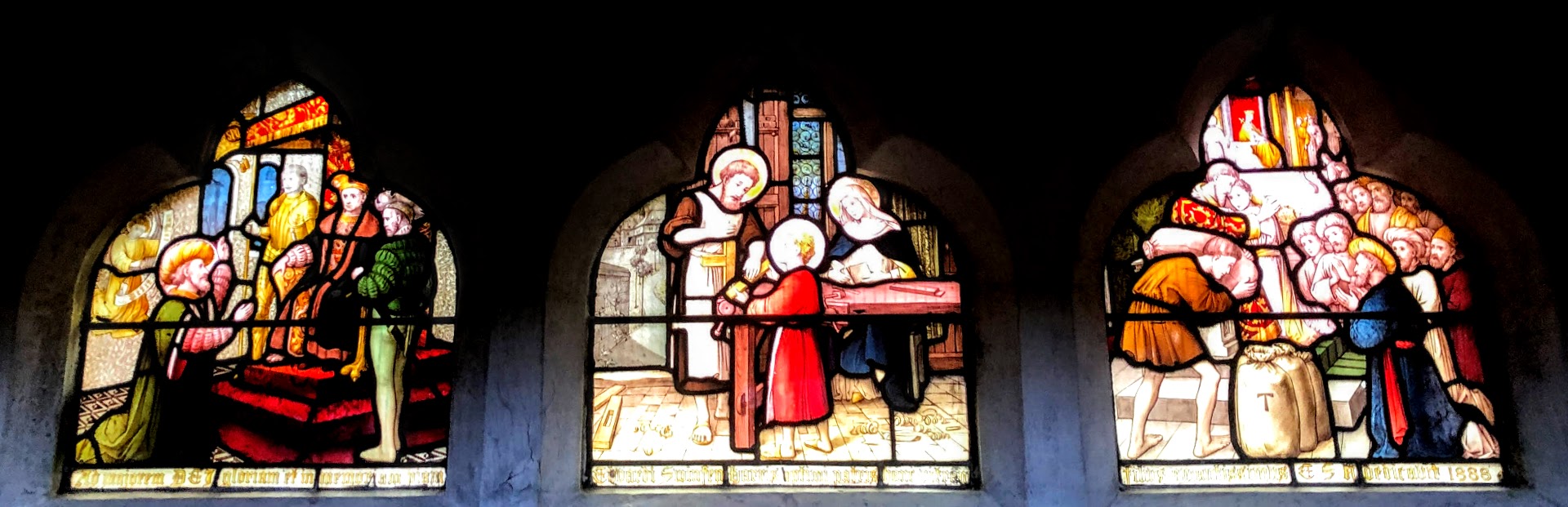
The second window in the South Wall in Saint Mary and Saint Giles Church beneath the gallery is dated 1888. Edward Swinfen Harris commissioned this window in memory of his father, also Edward Swinfen Harris, who was the clerk to the town bench of magistrates, the Board of Guardians and other bodies in the town.
This second depicts three Biblical scenes: Joseph before Pharoah’s throne, interpreting his dreams (Genesis 41: 1-36); Jesus as an apprentice in Joseph the carpenter’s shop, with Joseph and the Virgin Mary (see Luke 2: 39-40); and Joseph’s brothers before him with the silver cup found in Benjamin’s sack (Genesis 44: 1-34).
Each panel depict a Biblical Joseph: Joseph the son sold into slavery in Egypt by his brothers; Joseph with the Christ Child; and Joseph with his brothers.
In the first panel, Joseph stands before Pharoah’s throne, interpreting his dreams (Genesis 41: 1-36). However, the vision he points to in the distance is not the years of plenty, or the years of famine, but Christ Crucified on Calvary.
Jesus as an apprentice in Joseph the carpenter’s shop, with Joseph and the Virgin Mary, depicted in the second window in the south wall in Saint Mary and Saint Giles Church, Stony Stratford (Photograph: Patrick Comerford)
The stories of Christ as an apprentice in the workshop of Joseph the carpenter are popular and pious, but are not found in any Gospel narrative (see Luke 2: 39-40). Nevertheless, this image in the second panel, showing Christ as an apprentice in Joseph the carpenter’s shop, reflects a subject that was popular among the Pre-Raphaelite artists at the time Westlake made this window.
William Holman Hunt (1827-11910) worked on his painting, ‘The Shadow of Death’, in 1870-1873, during his second trip to the Holy Land. It depicts Christ as a young man prior to his ministry, working as a carpenter. He is shown stretching his arms after sawing wood. The shadow of his outstretched arms falls on a wooden spar on which carpentry tools hang, creating a ‘shadow of death’ prefiguring the crucifixion.
Two decades earlier, Holman Hunt’s Pre-Raphaelite colleague John Everett Millais (1829-1896) had portrayed Christ as an apprentice carpenter, helping Joseph as a young boy, in his painting, ‘Christ in the House of his Parents’ (1849-1850).
In the third panel, Joseph’s brothers plead before him with the silver cup found in Benjamin’s sack (Genesis 44: 1-34). In the background, their ageing father with Jacob is being comforted.
In each of these panels, Westlake is suggesting that Edward Swinfen Harris was a loyal and faithful son to his father, the late Edward Swinfen Harris, and that he had learned from him.
Window 3, South Wall:
The third window in the south wall by NHJ Westlake is in memory of Catherine Swinfen Harris (Photograph: Patrick Comerford)
The third window on the South Wall beneath the gallery in Saint Mary and Saint Giles Church is dated 1896. It was commissioned by Edward Swinfen Harris in memory of his mother, Catharine Swinfen Harris, who died on 23 June 1896, at the age of 85.
This third window is of three eyelets and depicts three Biblical scenes: Jacob blesses Joseph’s sons Manasseh and Ephraim with crossed hands (see Genesis 48: 10-22); Christ greets two disciples at night, perhaps James and John, or Peter and Andrew, although this is not indicated on the window.
The story depicted in the first panel recalls how Joseph was Pharoah’s chief minister of Egypt when he took his two sons Manasseh and Ephraim to see his dying father Jacob. Jacob surprised them by deciding to adopt Manasseh and Ephraim as his own sons, and promising them the same inheritance as his other sons, like Reuben and Simeon (verse 5).
It is customary in many Jewish communities for parents to administer a blessing like Jacob’s blessing to Joseph’s sons on Friday nights before the kiddush. As hands are laid on the heads of the boys, the words spoken are: ‘May you be like Ephraim and Manasseh.’
The mother of these two, Asenath, was an Egyptian, and so her family was outside the community of faith. Yet, they are not disqualified from God’s blessings because of their parents’ unconventional marriage.
Traditionally, the eldest son would expect to inherit a double portion, signified by his father blessing him with his right hand. So Joseph placed his firstborn, Manasseh, on Jacob’s right side and Ephraim on his left. However, Jacob crossed his arms and put his right hand on the second born, Ephraim, and his left hand on Manasseh, and then spoke his blessing over both.
This story is a reminder of how God can choose people others think are not qualified or deserving, those who do earn or qualify for a blessing, those you are not next in line. Those who cannot normally expect favour or promotion may receive unexpected blessings.
In this window, Swinfen Harris may be saying that his mother was seen as an outsider but that in life through his parents he found blessings beyond any expectations in his dreams.
The window by Charles Eamer Kempe at the west end of Saint Mary and Saint Giles, Stony Stratford, depicting three archangels: Saint Gabriel above, and Saint Michael and Saint Raphael below (Photograph: Patrick Comerford)
CE Kampe window (west end):
The window at the west end of the church is a two-light depicting three archangels: Saint Gabriel above, and Saint Michael and Saint Raphael below. This window, dated 1903, is by Charles Eamer Kempe (1837-1907).
CE Kempe’s studios produced over 4,000 windows and designed altars and altar frontals, furniture and furnishings, lichgates and memorials that helped to define a later 19th-century Anglican style.
As a student at Pembroke College, Oxford, Kempe was influenced by the Anglo-Catholic Tractarian revival and considered a vocation to the priesthood. Inspired by William Morris’s work, he went to study architecture with the Gothic Revival architect George Frederick Bodley (1827-1907) at a time when Bodley was working on All Saints’ Church, Cambridge. There he learned from both Bodley and William Morris, and Bodley and Kempe became lifelong friends and collaborators.
Kempe’s work was strongly influenced by the Gothic Revival and the Pre-Raphaelite movement. His studios produced over 4,000 windows and designs for altars and altar frontals, furniture and furnishings, lychgates and memorials that helped to define a later 19th century Anglican style.
The English cathedrals with his work include Lichfield, as well as Chester, Gloucester, Hereford, Wells, Winchester and York. I have also written in the past about his windows in the chapel of Saint John’s Hospital, Lichfield and Christ Church, Leomansley, Lichfield.
The Cambridge church historian Owen Chadwick once said Kempe’s work represents ‘the Victorian zenith’ of church decoration and stained glass windows. Kempe was seen by his contemporaries as a Tractarian, but primarily he saw his task ‘to beautify the place in which to celebrate the glory of God.’ His window in Saint Mary and Saint Giles Church offers an interesting illustration of this principle.
Three south gallery windows:
Six apostles, James, Peter, John, Thomas, Andrew and Saint James the Less, seen from inside (above) and outside (below) the church (Photographs: Patrick Comerford)
The first three sets of three-light windows in the south gallery include a window by John Groome Howe of James Powell and Sons (1877).
This first window is dedicated to Josiah Michael and Ann Smith and shows six scenes with themes of the Resurrection or being raised to new life: top, 1, the raising of Jairus’s daughter (Matthew 9: 18-26; Mark 5: 21-43; Luke 8: 40-56); 2, Christ with two disciples on the Road to Emmaus (Luke 24: 13-35); and 3, the raising of the Widow of Nain’s son (see Luke 7: 11-17); below, 1, the raising of Lazarus (John 11:1 -44); 2, the Supper at Emmaus (Luke 24: 13-35); and 3, the healing of Simon Peter’s mother-in-law (Matthew 8: 14-15, Mark 1: 29-31, Luke 4: 38-39).
The firm of James Powell and Sons, also known as Whitefriars Glass, were London-based glassmakers, leadlighters and stained glass window manufacturers. As Whitefriars Glass, the company dated from the 17th century, and it became well-known as a result of the 19th-century Gothic Revival and the demand for stained glass windows.
During the latter part of the 19th century, the firm had close working links with leading architects and designers including TG Jackson, Edward Burne-Jones, William De Morgan and James Doyle, and produced the glass that Philip Webb used in his designs for William Morris. Nathanael Powell’s eldest surviving son, Harry, was an admirer of John Ruskin.
The next two windows in the south gallery are three-light windows depicting 12 apostles, each with six illustrations. Their date and the artist are unknown.
The first depicts: top, Saint James, Saint Peter, Saint John; below, Saint Thomas, Saint Andrew, Saint James the Less. The second depicts (top) Saint Philip, Saint Paul, Saint Bartholomew; and (below) Saint Jude, Saint Simon, Saint Matthew.
A fourth and fifth window in the south gallery show the Risen Christ and the Crucifixion.
The grave of Nikos Kazantzakis on the Martinengo Bastion of the Venetian walls surrounding Iraklion (Photograph: Patrick Comerford)
The old harbour of Chania … George Seferis fled Athens to Chania in 1941 and wrote ‘Days of June ’41’ as he fled from Crete into exile (Photograph: Patrick Comerford)
Patrick Comerford
In recent weeks, I have been a series of occasional blog postings and photographs of a dozen modern sculptures in the streets and parks of Thessaloniki, the second city of Greece. In a posting on Thursday ( October 06), I looked at a marble monument that honours Sokratis Karantinos (1906-1979), a prominent theatre director and critic who was the first artistic director of the National Theatre of Northern Greece (NTNG) in the 1960s.
The inscriptions on the sculpture include a dedication to Sokratis Karantinos and a poignant verse by the Nobel Prize winning poet George Seferis:
Θυμότανε κανείς γέροντες δασκάλους που μας άφησαν ορφανούς
One remembered old teachers who left us orphaned
This haunting quotation is from the closing stanza of ‘The Last Day’, a powerful poem written by Seferis in Athens in February 1939. The line expresses a profound sense of spiritual and cultural abandonment. For Seferis, the ‘old teachers’ (or elders/spiritual leaders) represent the guiding authority of tradition, wisdom, and moral stability. By leaving the younger generation ‘orphaned’ they left them without direction in a broken world.
The poem was written on the brink of World War II and during the oppressive Metaxas dictatorship and captures a pervasive sense of powerlessness, impending doom, and total annihilation. The line quoted on the sculpture highlights a deep disappointment with the previous generation, whose cowardice, political missteps, or silence left ordinary people completely vulnerable to the oncoming historical catastrophe.
George Seferis (1900-1971) was a poet, Nobel laureate and diplomat, and many of his poems became popular throughout the 1960s and 1970s when they were set to music by the composer Mikis Theodorakis and sung by artists like Maria Farantouri, turning his poems into songs of protest and resistance.
In recent days, I have also turned to his poem ‘Days of June ’41’, written by Seferis 85 years ago as he fled first to Crete in 1941 during World War II, and then went into exile in Alexandria and South Africa. This poem, later included in his collection Logbook II (Ημερολόγιο καταστρώματος Β), is datelined ‘Crete – Alexandria – South Africa, May-September ’41’.
The poem is set primarily in Alexandria but in it Seferis expresses his pain for Crete and the longing of an exile:
After the Germans had taken Crete
The new moon came out over Alexandria
with the old moon in her arms
while we were walking towards the Gate of the Sun
in the heart’s darkness – three friends.
However, unlike many other well-known poems by Seferis, ‘Days of June ’41’ was never set to music by Theodorakis and so never recorded by Maria Farantouri. But it is on the curriculum in second level schools and is well-known among many people in Crete because of its references to the island.
Giorgos Seferis is a major figure in Greek literature and in 1963 became the first Greek Nobel laureate for literature
George Seferis (Γιώργος Σεφέρης) was born Giorgos Seferiadis (Γεώργιος Σεφεριάδης) in Smyrna (now Izmir) in Asia Minor in 1900. He went to school in Smyrna and then to the Gymnasium in Athens. When his family moved to Paris in 1918, he studied law at the University of Paris and became interested in literature.
He returned to Athens in 1925 and joined the Foreign Ministry the following year. He had a long and successful diplomatic career, that began with postings in London (1931-1934), where he was introduced to Eliot and Pound, and Albania (1936-1938), where he first met his future wife Marika Zannou.
Seferis moved to Crete with the Free Greek Government during World War II, and then into exile in Egypt, South Africa and Italy. Meanwhile, in 1941 he married Maria (‘Maro’) Zannou, the mother of two young daughters from her previous marriage to Andreas Londos.
He returned to liberated Athens in 1944, and continued to work in the Foreign Ministry, with diplomatic postings in Ankara (1948-1950), London (1951-1953) and Lebanon, Syria, Jordan and Iraq (1953-1956). He was back in London again as the Greek Ambassador from 1957 to 1961, his last post before he retired to Athens.
In 1963, Seferis became the first Greek writer to receive the Nobel Prize for Literature. He is one of the two Greek poets to have been honoured with the Nobel Prize for Literature – the other poet is Odysseas Elytis (1911-1996), who was born in Iraklion in Crete, and together Seferis and Elytis can be credited with the modernisation of Greek literature.He received several honorary doctorates from Cambridge (1960), Oxford (1964), the Aristotle University of Thessaloniki (1964), and Princeton (1965).
After the colonels’ coup in 1967, Seferis went into voluntary seclusion and many of his poems were banned by the regime, including the musical versions written and arranged by Mikis Theodorakis.
His poem ‘Denial’ (Άρνηση), first published in 1931 in his collection Turning Point (Στροφή, Strophe), became an anthem of resistance to the colonels. He died on 20 September 1971, and was buried in the First Cemetery in Athens. ‘Denial’ (Άρνηση) was sung by the crowds lining the streets of Athens at his funeral. He had become a popular hero for his resistance to the regime. His widow Maria cut off her hair and flung it into his grave.
He has commemorative blue plaques on two of his homes in London – the Greek Ambassador’s residence at 51 Upper Brook Street, off Grosvenor Square, and 7 Sloane Avenue.
Seferis’s exclusive use of demotic, or common, Greek as his language of choice earned him a privileged place among his generation of Greek poets, while his wide travels provide the backdrop and colour for much of his writing.
As well as Strophe (1931), his early poems include E Sterna (The Cistern, 1932), and Mythistorema (1935). Later collections include Tetradio Gymnasmaton (Book of Exercises, 1940), Emerologio Katastromatos (Logbook I, 1940), Emerologio Katastromatos B (Logbook II, 1944), Kihle (Thrush, 1947), Emerologio Katastromatos Γ (Logbook III, 1955) and Tria Krypha Poiemata (Three Secret Poems, 1966).
Seferis first became acquainted with TS Eliot in London in Christmas 1931, when he found a copy of the poem ‘Marina’ in a bookshop on Oxford Street and was struck by its Mediterranean feeling. He published his translation of Eliot’s poetry in 1936 in The Waste Land and Other Poems, prefaced by his first essay in print, ‘Introduction to TS Eliot’, itself a major moment in modern Greek literature. Seferis also translated WB Yeats, DH Lawrence, Ezra Pound and WH Auden.
The name of Tsouderon Street in Rethymnon honours a former Greek prime minister who was born in the town (Photograph: Patrick Comerford)
Seferis arrived in Chania from Athens in April 1941 as German Nazi forces were sweeping through the Greek mainland. As the Nazi army advanced towards Athens in 1941, the Greek Prime Minister of the day, Alexandros Koryzis, died by suicide on 18 April. He was succeeded as Prime Minister on 21 April by Emmanuel Tsouderos (Εμμανουήλ Τσουδερός) (1882-1956), who was born in Rethymnon in Crete.
A day later, a newly-married Seferis arrived in Crete on 22 April 1941 as part of the team preparing the way for a Free Greek government that would go into exile. As the army command prepared to capitulate, a defiant and heroic Tsouderos fled from Athens to Crete with King George II on 29 April 1941. Back in his native Crete, Tsouderos reorganised the Greek forces to resist the Germans.
In Chania, Seferis stayed at the Hôtel Ellas (Hotel Hellas). He was the secretary to Tsouderos’s Minister of Press, Emmanouil Nikolaoudis, and supervised the publication of the very first edition of the Government Gazette printed outside mainland Greece.
Just days before arriving in Crete, Seferis married Maria ‘Maro’ Zannou in Athens on 10 April 1941. Their time at the Hotel Hellas in Chania was brief, but Sfereis documented their presence there in a brief, pencil-written note to his close friend, the author Lawrence Durrell, written on the back of a page torn out of the hotel’s guest book.
But Seferis spent only three weeks in Chania. Tsouderos fled again during the Battle of Crete and headed the Greek government in exile until 13 April 1944. Seferis and his wife Maria Zannou escaped Crete by ship to Alexandria on 16 May 1941, four days before the German airborne invasion of Crete and the beginning of the Battle of Crete.
Over 25 years later, Seferis returned to Crete again briefly in April 1967 to read his poems and to give a talk to the Lyceum of Greek Women, founded in in 1911 by Kalliroi Siganou Parren, who was born in Rethymnon. It was one of his last prominent public appearances in Greece before the colonels seized power on 21 April 1967 and forced him into an outspoken, self-imposed public silence and resistance.
Unlike other well-loved and well-known poems by Seferis, such as ‘Arnisi / Sto Perigiali’ or ‘Epiphany’, which were set to music by composers like Mikis Theodorakis, ‘Days of June ’41’ has no popular musical setting.
Seferis wrote ‘Days of June ’41’ while he was fleeing the Nazi invasion of Greece, moving first to Crete, then to Alexandria and moving on to South Africa with the Greek government-in-exile.
Despite spending less than a month on Crete, for Seferis it had become ‘the beautiful island’, ‘the calm island’, ‘the strong, innocent island’, and you can hear his pain as he thinks out loud of how Crete is bleeding, how the people are being killed, their ‘bodies like broken branches, / like roots uprooted’:
… the beautiful island is bleeding,
wounded; the calm island – the strong, innocent island.
And the bodies like broken branches,
like roots uprooted.
The poem reflects displacement, exile, the loss of youth and physical vitality (‘we believed in the omnipotence of the body’), the trauma of war in Crete (‘the beautiful island is bleeding, wounded’), and wandering through blacked-out war-time Alexandria with his close friends.
In the narrow streets of old Chania … ‘the beautiful island is bleeding, / wounded; the calm island – the strong, innocent island’ (Photograph: Patrick Comerford)
Μέρες του Ιουνίου ’41, Γιώργος Σεφέρης
Βγήκε το νέο φεγγάρι στην Αλεξάνδρεια
κρατώντας το παλιό στην αγκαλιά του
κι εμείς πηγαίνοντας κατά την Πόρτα του Ήλιου
μες στο σκοτάδι της καρδιάς — τρεις φίλοι.
Ποιός θέλει τώρα να λουστεί στα νερά του Πρωτέα;
Τη μεταμόρφωση τη γυρέψαμε στα νιάτα μας
με πόθους που έπαιζαν σαν τα μεγάλα ψάρια
σε πέλαγα που φύραναν ξαφνικά·
πιστεύαμε στην παντοδυναμία του κορμιού.
Και τώρα βγήκε το νέο φεγγάρι αγκαλιασμένο
με το παλιό· με τ’ όμορφο νησί ματώνοντας
λαβωμένο· το ήρεμο νησί, το δυνατό νησί, το αθώο.
Και τα κορμιά σαν τσακισμένα κλαδιά
και σαν ξεριζωμένες ρίζες.
Η δίψα μας
ένιππος φύλακας μαρμαρωμένος
στη σκοτεινή πόρτα του Ήλιου
δεν ξέρει να ζητήσει τίποτε: φυλάγεται
ξενιτεμένη εδώ τριγύρω
κοντά στον τάφο του Μεγάλου Αλεξάντρου.
The new moon came out over Alexandria
with the old moon in her arms
while we were walking towards the Gate of the Sun
in the heart’s darkness – three friends.
Who wants to bathe in the waters of Proteus now?
We looked for metamorphosis in our youth
with desires that played like big fish
in seas suddenly shrinking;
we believed in the body’s omnipotence.
And now the new moon has come out embracing
the old; and the beautiful island is bleeding,
wounded; the calm island – the strong, innocent island.
And the bodies like broken branches,
like roots uprooted.
Our thirst
a guard on horseback turned to marble
at the dark Gate of the Sun –
he doesn’t know how to ask or anything: he stands guard
exiled somewhere around here
near the tomb of Alexander the Great.
‘Marathon Runner of Peace’, the monument to Grigoris Lambrakis by Vassilis Doropoulos in Thessaloniki (Photograph: Patrick Comerford)
Patrick Comerford
I have been recalling in recent weeks how I have come across a collection of photographs of modern sculptures in the streets and parks of Thessaloniki and how I realised I had written little about these sculptures over the years.
Rather than leave these photographs and memories in forgotten files on my laptop or in the cloud, I started an occasional series of blog postings on some of those modern sculptures I have rediscovered in Thessaloniki. Over these few weeks, I am inviting you to join me in a minor odyssey of recovery and discovery as my mind wanders through Thessaloniki, looking at these sculptures again.
The sculptures I have looked at in recent weeks include the monumental statues of Aristotle, Alexander the Great and Eleftherios Venizelos, the Jewish Memorial by Konstantinos Lentaris in the campus of the Aristotele University of Thessaloniki, the bust of Admiral Nikolaos Votsis in front of the White Tower, the Monument for the Jewish Holocaust on the edge of Eleftherias Square, ‘The Woman of Pindos’ by Kostas Domboulas in Fanarioton Square, and ‘The Stumbling Stones’ or ‘Stolpersteine’ by Gunter Demnig.
The bronze sculpture of the ‘Marathon Runner of Peace’ or ‘Monument of Peace’ by the painter and sculptor Vassilis Doropoulos (1942-2025) commemorates the murdered peace activist Grigoris Lambrakis (1912-1963). The work stands at the junction of Ermou street, Eleftherios Venizelou street and Spandoni street.
Dr Grigoris Lambrakis (Γρηγόρης Λαμπράκης) was a pacifist, politician, physician, academic, Olympic athlete and marathon runner. At the Berlin Olympics in 1936, he sought out and posed for a photograph with Jesse Owens, the Black athlete whose victories infuriated Hitler and defied Nazi ideology.
Lambrakis took part in peace demonstrations in Greece and across Europe in the 1960s, including the Aldermaston marches organised by CND and the Committee of 100 in 1963. His murder in 1963 is one of the most infamous political assassinations in Greece.
The murder of Grigoris Lambrakis in 1963 is one of the most infamous political assassinations in Greece (Photograph: Patrick Comerford)
The sculpture honouring Lambrakis in the heart of Thessaloniki is a symbol of the strife in Greece after the Civil War and in the run-up to the colonels’ coup in 1967. It shows a pleading and frightening figure reaching for a dove of peace. The sculpture incorporates elements of socialist realism, making a powerful visual statement about the importance of peace.
Grigoris Lambrakis had been at a demonstration in Thessaloniki calling for nuclear disarmament and was returning to the Aigli Hotel when he was attacked by Spyros Gotzamanis and Manolis Emmanouilidis on the evening of 22 May 1963. They were driving a three-wheeled vehicle, struck him fatally on the head with a club, while 180 police officers and the local police leaders were blocking off the area.
Reports later showed, the attackers and the key figures in plotting the murder were linked with the state and. But, despite the fact that the murder caused a political earthquake in Greece with reverberations across Europe, only nine out of the 31 original defendants were sentenced.
As Lambrakis lay dying in hospital in Thessaloniki, hundreds of students gathered in streets along with the poet Yiannis Ritsos and the composer Mikis Theodorakis, singing the poem Epitaphios, written by Ritsos following a political murder in Thessaloniki in 1936 and set to music by Theodorakis.
Lambrakis died on 27 May 1963. His funeral in Athens on 29 May 1963 from the Metropolitan Cathedral to the First Cemetery became a massive demonstration, as more than 500,000 people protested against the right-wing government and the royal court, which was seen to support the right-wing extremists, and the Epitaphios by Theodorakis and Ritsos was sung again throughout the streets.
The murder caused a political earthquake, the Prime minister Constantinos Karamanlis, resigned in 1963 and went into exile in Paris, and there were reverberations across Europe. But only nine of the 31 defendants were sentenced.
The events inspired Vassilis Vassilikos to write his political novel Z: Fictional Documentary of a Crime. The title stands for the first letter of the slogan «Ζει» (‘He Lives!’) became a popular graffito in cities and towns throughout Greece in the 1960s.
The Greek-French film director Costa-Gavras (Κώστας Γαβράς) made the film Z in 1969, starring Yves Montand as Lambrakis, Jean-Louis Trintignant as the investigator Christos Sartzetakis, was also jailed by the colonels, and Irene Papas as the widow of Lambrakis. It was nominated for five Oscars and won two.
The score included a piece first written by Mikis Theodorakis in 1962 for Ένας όμηρος (A Hostage), a Greek performance of The Hostage by Brendan Behan. The piece Το γελαστό παιδί (The Smiling Kid), with Greek lyrics by Vasilis Rotas, was transformed into a tribute to Lambrakis in the film Z.
Some years ago, my friends Paddy Sammon, a former Irish diplomat once based in Athens, and Damian Mac Con Uladh, an Irish journalist from Ballinasloe now based in Corinth, researched the Irish background to what has become a Greek classic of resistance to oppression. As Damian Mac Con Uladh has written, every Greek knows can sing some of the song, which they learned at school commemorations.
Maria Farantouri, who went into exile after the colonels seized power in 1967, sang the song at solidarity concerts across Europe. ‘It became a hymn not only for the Irish liberation movement, but also for every liberation movement in the world, and Greek democracy,’ she told an RTÉ documentary.
When the junta sent in tanks against protesting students at the Athens Polytechnic on 17 November 1973, killing at least 24 people over a number of days, Maria Farantouri added a couple of stanzas to the song, and changed the date from August to November, deliberately linking the song to that event.
After the fall of the military dictatorship in 1974, numerous places, including a football stadium in Kallithea and streets and squares in villages, towns and cities across Greece have been named in honour of Grigoris Lambrakis. The Athens Classic Marathon is run in his memory every November.
A street named in honour of Grigoris Lambrakis in Koutouloufari in the hills above Hersonissos, east of Iraklion in Crete (Photograph: Patrick Comerford)
The Greek sculptor Vassilis Doropoulos (Βασίλης Δωρόπουλος), who created the ‘Marathon Runner of Peace’, the monument to Grigoris Lambrakis in Thessaloniki, was born in Mesopotamia in Kastoria on 13 August 1942.
He moved to Paris with his mother in 1965, and there he studied painting and sculpture at the École Nationale Supérieure des Beaux Arts. He took part in many solo and group exhibitions, received many awards, and produced medals and sculptures for the Paris Mint.
His best-known works include his ‘Monument to National Resistance’ in Korydallos (1986) and his ‘Memorial of National Reconciliation’ (1989), symbolising reconciliation after the Greek Civil War in 1946-1949, at Klafthmonos Square in Athens, which has since become known as National Reconciliation Square or Ethinikis Simfiliosis.
Vassilis Doropoulos died in Athens last year (21 September 2025), having lived for much of his professional life in France.
The Lambrakis sculpture was donated by Apostolos Fokas, proprietor of the Fokas department store on Ermou street. An additional board explains that Lambrakis was assassinated by para-state thugs and the sculpture is not only a tribute to Grigoris Lambrakis but a reminder of the necessity for peace and social justice.
Z is a 1969 political thriller film directed by Costa-Gavras, from a screenplay he co-wrote with Jorge Semprún, adapted from the 1967 novel by Vassilis Vassilikos. Audio in French with English and French subtitles (Click on CC for subtitles)