04 April 2026

At the Chrism Eucharist in
Christ Church, Oxford: both
a cathedral and a college chapel

Christ Church Cathedral, Oxford, is unique in its dual role as a cathedral and a college chapel (Photograph: Patrick Comerford, 2026)

Patrick Comerford

I was at the Chrism Eucharist in Christ Church Cathedral, Oxford, this week, with the renewal of ordination vows by deacons, priests and bishops on Maundy Thursday (2 April 2026).

It was one of the last public services for Bishop Steve Croft before he retires as Bishop of Oxford, and he reminded as sharply of the words in the ordinal that ‘the trust that is now to be committed to your charge. Remember always with thanksgiving that the treasure now to be entrusted to you is Christ’s own flock, bought by the shedding of his blood on the cross. It is to him that you will render account for your stewardship of his people.’

The Diocese of Oxford has more church buildings than any other diocese in the Church of England and has more paid clergy than any other diocese except London. The diocese includes Berkshire, Buckinghamshire and Oxfordshire, with another five churches in nearby counties.

Inside Christ Church Cathedral, Oxford, looking east from the choir towards the High Altar and the Rose Window (Photograph: Patrick Comerford, 2026)

Christ Church Cathedral, Oxford, is both the college chapel of Christ Church and the cathedral church of the Diocese of Oxford. It was founded by Henry VIII with Cardinal Wolsey, and Christ Church is the largest Oxford college.

This was my second time as a priest living in the Diocese of Oxford since 2022 to take part in the Chrism Eucharist. Holy Week and Easter 2022 had been fraught times in the immediate aftermath of a stroke. I was at the Chrism Eucharist in Oxford in 2023, but missed it again in 2024 due to a hospital appointment in Milton Keynes, and in 2025, when I spent Holy Week and Easter in Crete.

I was a teenager when I first visited Christ Church more than 55 years ago. Despite the size of the diocese, this is one of the smallest cathedrals in the Church of England, and its dual role as cathedral and college chapel is unique.

Inside Christ Church Cathedral, Oxford, looking west from the choir towards the organ (Photograph: Patrick Comerford, 2026)

The cathedral was originally the church of Saint Frideswide’s Priory. The site is said to be the location of the nunnery founded by Saint Frideswide, the patron saint of Oxford, and her shrine is now in the Latin Chapel. It once held her relics, brought there in 1180, and it was the focus of pilgrimage from at least the 12th until the early 16th century.

Osney Abbey was surrendered in November 1539 and dissolved at the dissolution of the monastic houses. The last abbot was Robert King, who became the first Bishop of Oxford.

The Diocese of Oxford was formed out of part of the Diocese of Lincoln in 1542, and from September 1542 until June 1544, Osney Abbey was the seat of the bishop of the new diocese.

However, Osney was costly to run as a cathedral and in 1545 the bishop moved to the smaller and cheaper cathedral at Christ Church. Later, during the reign of Queen Mary, Bishop King was one of the judges at the trial of Thomas Cranmer.

Great Tom, described as the ‘loudest thing in Oxford’, now hangs in Tom Tower (Photograph: Patrick Comerford, 2026)

The abbey buildings soon fell into decay and were despoiled for the sake of the new foundation. Much of the stone found its way into local buildings, including Saint Frideswide’s as it was transformed into Christ Church. Osney Abey has been described as the greatest building that Oxford has lost.

Great Tom, the bell described as the ‘loudest thing in Oxford’ and now hanging in Tom Tower at Christ Church, was taken from the tower of Osney Abbey at the dissolution. Much of the monastic property was also transferred to Christ Church.

A statue of Cardinal Wolsey, founder of Christ Church, above the entrance to the Great Hall (Photograph: Patrick Comerford, 2026)

Saint Frideswide’s Priory was surrendered in 1522 to Cardinal Thomas Wolsey, who had selected it as the site for his proposed college. However, in 1529 the foundation was taken over by Henry VIII. Work stopped, but the college was refounded by the king in June 1532. Henry VIII transferred the recently-created See of Oxford from Osney to Christ Church in 1546.

There has been a choir at the cathedral since 1526, when John Taverner was the organist and master of the choristers. The statutes of Wolsey’s original college, initially called Cardinal College, mentioned 16 choristers and 30 singing priests.

The nave, choir, main tower and transepts are late Norman. There are architectural features ranging from Norman to the Perpendicular style and a large rose window of the ten-part or botanical type.

The monument to the Irish philosopher Bishop George Berkeley of Cloyne in Christ Church, Oxford (Photograph: Patrick Comerford)

Visitors to Oxford are often pointed to monuments such as those to the Wesley brothers, John and Charles Wesley, who were ordained in Christ Church, or the memorial to the poet WH Auden.

But this week I also noticed a number of monuments of Irish interest.

The philosopher George Berkeley (1685-1753), who was born in Co Kilkenny, was Bishop of Cloyne when he died in Oxford on 14 January 1753, and he was buried in Christ Church Cathedral.

The monument to William Brouncker, who was almost ruined when he bought an Irish peerage weeks before he died (Photograph: Patrick Comerford, 2026)

A monument in the south transept remembers Colonel William Villiers (1614 -1643), 2nd Viscount Grandison of Limerick, who was killed during the First English Civil War. His father Sir Edward Villiers (1585-1626) was the older half-brother of George Villiers, 1st Duke of Buckingham, a favourite of both James I and Charles I, and was the Lord President of Munster when he died in Cork in 1626.

William Villiers inherited the Irish peerage title of Viscount Grandison from his great-uncle Oliver St John (1559-1630). He fought as a royalist at the Battle of Edgehill and at the Storming of Bristol, where he was wounded in the right leg. He was taken to Oxford and died there he died on 29 September 1643. His daughter Barbara Villiers (1640-1709) was later a mistress of Charles II and Duchess of Cleveland.

Close by, another monument commemorates William Brouncker (1585-1645), 1st Viscount Brouncker of Castle Lyons and Baron Brouncker of Newcastle. His father, Sir Henry Brouncker, was Lord President of Munster (1603-1607). Malicious gossip said William Brouncker paid the then enormous sum of £1,200 for his titles in the Irish peerage, which he given on 12 September 1645, and was almost ruined as a result. He died a few months later.

The 17th century window by Abraham Van Linge shows the prophet Jonah looking over the city of Nineveh (Photograph: Patrick Comerford, 2026)

The cathedral has a fine collection of stained glass, the oldest being the 14th century Becket Window in the Lucy Chapel. It is one of very few images of Thomas Becket to survive the Reformation.

The glass at the west end of the north aisle is by the 17th century Dutch artist Abraham Van Linge. It dates from the period of Laudian Reform, around 1630, and shows the prophet Jonah looking over the city of Nineveh. A second window by Abraham van Linge is dedicated to Bishop King.

The window by Edward Burne-Jones and William Morris in the Latin Chapel is a tribute to Saint Frideswide (Photograph: Patrick Comerford, 2026)

The cathedral also has windows designed by Edward Burne-Jones, best known for his work with William Morris. The east window in the Latin Chapel was designed by Burne-Jones when he was still in his mid-20s and was made in 1859 by James Powell and Sons. It is a bold and colourful tribute to Saint Frideswide, and perhaps the finest of his early works, but also a dramatic contrast to his later work with Morris.

The Vyner window by Edward Burne-Jones (Photograph: Patrick Comerford, 2026)

The Vyner memorial window remembers two undergraduates who were murdered in the late 19th century. This Pre-Raphaelite window is a also pun on their family name, with vine leaves prominent in upper part of window.

The Saint Cecilia Window by Edward Burne-Jones in the North Choir aisle (Photograph: Patrick Comerford, 2026)

The Saint Cecilia Window by Burne-Jones depicting scenes from the life of Saint Cecilia and her martyrdom is the East Window in the North Choir aisle or Saint George’s Chapel. The angels in the tracery at top were designed by William Morris. Malcom Bell was of the opinion in 1895 that the source of the three panels showing the saint’s life was in Chaucer’s ‘Second Nun’s Tale’.

The Saint Michael Window by Clayton and Bell in the north transept (Photograph: Patrick Comerford, 2026)

Clayton and Bell created the dramatic Saint Michael Window in the north transept in 1870.

A window unveiled in 2023 as a memorial to EH Burn. It depicts Saint Francis of Assisi and is by John Reyntiens.

The newest stained-glass window in Christ Church Cathedral is the Prodigal Son Window by the British artist Thomas Denny. It was commissioned through the generosity of an anonymous donor and unveiled last September.

The chrism oils on a side altar in Christ Church Cathedral on Maundy Thursday (Photograph: Patrick Comerford, 2026)

The Dean of Christ Church is both the Dean of Christ Church Cathedral, Oxford, and the head of the governing body of Christ Church, a constituent college of the University of Oxford.

The chapter of canons of the cathedral has formed the governing body of the college since its foundation, with the dean as ex officio head of the chapter and ipso facto head of the college.

The Very Revd Dr Martyn Percy stepped down as the Dean of Christ Church in 2022 after a lengthy and acrimonious dispute. Previously, he had been the principal of Ripon College Cuddesdon (2004-2014). The governing body of Christ Church voted in 2023 to separate the ecclesiastical role of dean from the position of head of house of the college.

The Very Reverend Sarah Foot has been the Dean of Christ Church since 2023. She is also the Regius Professor of Ecclesiastical History at the University of Oxford since 2007, the first woman ever to hold that chair.

The other senior cathedral clergy include the Sub Dean, the Revd Canon Peter Moger, who introduced the Chrism Eucharist on Thursday and welcomed us to Christ Church, and the Archdeacon of Oxford, the Ven Jonathan Chaffey. The university’s four senior theology professors are also ex officio canons residentiary.

Looking towards the North Transept from the font and the pulpit (Photograph: Patrick Comerford, 2026)

In his poem ‘Thyrsis’, the Victorian poet Matthew Arnold called Oxford ‘the city of dreaming spires’, describing the architecture of the university buildings. WB Yeats refers to Christ Church in his poem ‘All Souls’ Night, Oxford’:

Midnight has come and the great Christ Church bell
And many a lesser bell sound through the room;
And it is All Souls’ Night …


The Communion vessels after the Chrism Eucharist on Maundy Thrsday (Photograph: Patrick Comerford, 2026)

• The Easter Vigil with the Confirmations and the First Eucharist of Easter is at 8:05 in Christ Church Cathedral this evening. The Easter Day services tomorrow (Sunday 5 April 2026) are: 8:05 am, Holy Communion (1662 Book of Common Prayer); 9:35 am, Choral Matins for Easter Day; 11:05 am, Choral Eucharist for Easter Day; 6:05 pm, Festal Evensong for Easter Day. Choral Evensong takes place in the Cathedral each evening at 6pm and is open to the public.

Prayers for Peace in Christ Church Cathedral, Oxford, this week (Photograph: Patrick Comerford, 2026)

Daily prayer in Lent 2026:
46, Saturday 4 April 2026,
Easter Eve

The Deposition of Christ from the Cross by Giotto in the Scrovegni Chapel in Padua (Photograph: Patrick Comerford)

Patrick Comerford

We have reached the end of Holy Week and the end of Lent. Today is Easter Eve (4 April 2026), known in the Greek Orthodox Church as Great Holy Saturday. However, Easter comes a week later in the Orthodox calendar this year. Later this morning, I hope to drop in to Το Στεκι Μας, Our Place, the pop-up Greek café which opens every first Saturday of the month at the Swinfen Harris Church Hall beside the Greek Orthodox Church on London Road, Stony Stratford, between 10:30 am and 3 pm.. Today there is an Easter Special ‘Steki’, with a taste of Greek Easter delicacies, with Easter crafts for cildren, including decorating Easter candle, as well as Greek olive oil and honey and, of course, authentic Greek coffee, pastries and cakes.

Later, I hope to find somewhere appropriate to watch the Cambridge v Oxford boat races, although this is the first time in many years that they are not being broadcast by the BBC; the 80th Women’s Boat Race starts at 2:21 pm, the 171st Men’s Boat Race starts at 3:21 pm.

Easter begins in Saint Mary and Saint Giles Church, Stony Stratford, this evening with the Lighting of the New Fire, the Easter Vigil and the Eucharist in Saint Mary and Saint Giles Church at 8 pm, and I hope to sing with the choir and to read one of the lessons.

But, before this day begins, I am taking some quiet time this morning to give thanks, to reflect, to pray and to read in these ways:

1, reading today’s Gospel reading;

2, a short reflection;

3, a prayer from the USPG prayer diary;

4, the Collects of the day.

The Harrowing of Hell, depicted in a fresco on a chancel arch in the Church of the Four Martyrs in Rethymnon (Photograph: Patrick Comerford)

Matthew 27: 57-66 (NRSVA):

57 When it was evening, there came a rich man from Arimathea, named Joseph, who was also a disciple of Jesus. 58 He went to Pilate and asked for the body of Jesus; then Pilate ordered it to be given to him. 59 So Joseph took the body and wrapped it in a clean linen cloth 60 and laid it in his own new tomb, which he had hewn in the rock. He then rolled a great stone to the door of the tomb and went away. 61 Mary Magdalene and the other Mary were there, sitting opposite the tomb.

62 The next day, that is, after the day of Preparation, the chief priests and the Pharisees gathered before Pilate 63 and said, ‘Sir, we remember what that impostor said while he was still alive, “After three days I will rise again.” 64 Therefore command that the tomb be made secure until the third day; otherwise his disciples may go and steal him away, and tell the people, “He has been raised from the dead”, and the last deception would be worse than the first.’ 65 Pilate said to them, ‘You have a guard of soldiers; go, make it as secure as you can.’ 66 So they went with the guard and made the tomb secure by sealing the stone.

‘So Joseph took the body and wrapped it in a clean linen cloth and laid it in his own new tomb’ (Matthew 27: 59-60) … inside the Sarcophagus at the end of the Stations of the Cross in the Garden in Walsingham (Photograph: Patrick Comerford, 2026)

Today’s Reflections:

George Koros (1923-2014) was one of the finest Greek solo violinists of our time. He was born on the island of Evia in 1923, and he started playing the violin at the age of eight, when his father – who was a church cantor and a teacher of Byzantine music – decided to replace the mandolin with a violin and a bow without strings. His professional career began a year later, when he began playing at weddings and feasts with his father.

His mother spurned an opportunity for him to have a classical musical education. But Koros later revolutionised Greek folk music through the introduction of the fiddle as an accepted instrument. He became an acclaimed, self-made musician, who composed about 2,000 songs. But despite his reputation in Greek folk music, for me he stands out for his Byzantine hymns, particularly during this Easter weekend in Crete. In these hymns, Koros returned to his roots in Byzantine music and with his violin he recreates the tradition of the early hymns he learned from his father in church as a boy.

George Koros died in 2014, and was buried in Kiffisia in Athens.

On this Saturday – between Good Friday and Easter Day – many years ago (2008), during a series of Holy Saturday reflections in Whitechurch Parish in Dublin, I invited people to listen to George Koros using his violin to plaintively recall the sorrow of the tomb in two pieces: I see thy resting place (Τον Νυμφωνα Σου Βλεπω) and Life in the Holy Sepulchre (Η Ζωη εν Ταφω).

In the Western tradition of the Church, we seem to have contemplated the cross, and then moved to the empty tomb. At times, the deep joys of the Resurrection have often been overshadowed in the Western Church by the way of the Cross, as though the Cross leads only to death. But we have also neglected Christ’s resting place, his tomb, and given little thought to what was happening in the Holy Sepulchre on this day.

In Greece, Holy and Great Saturday, which falls next Saturday (11 April 2026) is observed solemnly by the Orthodox Church, with hymns and readings that truly explore the theme of the Harrowing of Hell in depth. For this is the day on which Christ’s body lay in the tomb, this is the day on which he visited those who were dead.

The icon of the Harrowing of Hell reminds us that God reaches into the deepest depths to pull forth souls into the kingdom of light. It reminds us how much we are unable to comprehend – let alone take to heart as our own – the creedal statement about Christ’s descent into Hell – ‘He descended into Hell.’

Christ’s descent into Hell is captured in Saint Peter’s Pentecost sermon in Acts 2. In the Petrine letters, we are told that when Christ died he went and preached to the spirits in prison ‘who in former times did not obey … For this is the reason the Gospel was proclaimed even to the dead, so that … they might live in the spirit as God does’ (see I Peter 3: 15b to 4: 8).

In the NRSV, I Peter 4: 6 reads the gospel was ‘proclaimed even to the dead …’, reflecting the original Greek: ‘εἰς τοῦτο γὰρ καὶ νεκροῖς εὐηγγελίσθη …’ The New International Version, however, says the Gospel ‘was preached even to those who are now dead …’ But the word ‘now’ is not in the Greek text. It was inserted to rule out the idea that Christ preached to those who were dead at the time when Christ descended into Hell and preached to them there. Instead, the NIV interpolates and rewrites the text so that it says that Christ brought his good news to people who were dead at the time I Peter was written. If you remove the word ‘now,’ the English becomes ambiguous on that point, just like the Greek is ambiguous there.

The Early Church taught that after his death Christ descended into hell and rescued all the souls, starting with Adam and Eve, who had died under the Fall.

The Harrowing of Hell is intimately bound up with the Resurrection, the Raising from the Dead, for as Christ is raised from the dead he also plummets the depths to bring up, to raise up, those who are dead. The Harrowing of Hell carries us into the gap in time between Christ’s death and resurrection.

In Orthodox icons of the Harrowing of Hell, Christ stands on the shattered doors of Hell. Sometimes, two angels are shown in the pit binding Satan. And we see Christ pulling out of Hell Adam and Eve, imprisoned there since their deaths, imprisoned along with all humanity because of sin. Christ breaks down the doors of Hell and leads the souls of the lost into Heaven.

It is the most radical reversal we can imagine. Death does not have the last word, we need not live our lives entombed in fear. If Adam and Eve are forgiven, and the Sin of Adam is annulled and destroyed, who is beyond forgiveness?

In discussing the ‘Descent into Hell,’ the Swiss theologian Hans Urs von Balthasar (1905-1988) argues that if Christ’s mission did not result in the successful application of God’s love to every intended soul, how then can we think of it as a success. He emphasises Christ’s descent into the fullness of death, so as to be ‘Lord of both the dead and the living’ (Romans 5).

However, in her award-winning book Light in Darkness, Alyssa Lyra Pitstick says that Christ did not descend into the lowest depths of hell, and only stayed in the top levels. She finds untenable his view that Christ’s descent into hell entails experiencing the fullness of alienation, sin and death, which he then absorbs, transfigures, and defeats through the Resurrection. Instead, she claims, Christ descends only to the ‘limbo of the Fathers’ in which the righteous, justified dead of the Old Testament awaited the coming of the Messiah.

Her argument robs the Harrowing of Hell of its soteriological significance. For her, Christ does not descend into hell and experience the depths of alienation between God and humanity opened up by sin. She leaves Christ visiting an already-redeemed and justified collection of Old Testament saints to let them know that he has defeated death.

Archbishop Rowan Williams has written beautifully in The Indwelling of Light on the Harrowing of Hell. Christ is the new Adam who rescues humanity from its past, and who starts history anew. ‘The resurrection … is an introduction – to our buried selves, to our alienated neighbours, to our physical world.’ He says: ‘Adam and Eve stand for wherever it is in the human story that fear and refusal began … (This) icon declares that wherever that lost moment was or is – Christ (is) there to implant the possibility … of another future.’ (Rowan Williams, The Dwelling of the Light: Praying with Icons of Christ, p 38.)

I ask myself once again this morning: what is the difference between the top levels and bottom levels of hell?

Is my hell in my heart of my own creation?

In my mind, in my home, where I live and work, in my society, in this world?

Is hell the nightmares from the past I cannot shake off, or the fears for the future when it looks gloomy and desolate for this planet?

But is anything too hard for Christ?

On this day, the icon of the Harrowing of Hell tells us that there are no limits to God’s ability to search us out and to know us. Where are the depths of your heart and your soul – where darkness prevails, and where you feel even Christ can find no welcome? Those crevices even I am afraid to think about, let alone contemplate, may be beyond my reach. I cannot produce or manufacture my own salvation from that deep, interior hell, hidden from others, and often hidden from myself.

Christ breaks down the gates of Hell, and as the icon powerfully shows, he rips all of sinful humanity from the clutches of death. He descends into the depths of our sin and alienation from God; and by plumbing the depths of hell he suffuses all that is lost and sinful with the radiance of divine goodness, joy and light. If hell is where God is not, and Jesus is God, then his decent into hell pushes back hell’s boundaries. In his descent into hell, Christ reclaims this zone for life, pushing back the gates of death, where God is not, to the farthest limits possible.

The music associated with this day in the Orthodox tradition, the icons and the readings, remind me that Christ plummets even those deepest depths, and that his love and mercy can raise us again to new life.

On this Saturday, as I prepare to take part in this evening’s Easter celebrations of the Resurrection, I have been thinking of Christ lying in the grave, and thinking of how we can ask him to take away all that denies life in us, whether it is a hell of our own making, a hell that has been forced on us, or a hell that surrounds us. Christ reaches down, and lifts us up with him in his Risen Glory.


George Koros used his violin to plaintively recall the sorrow of the tomb in two pieces: ‘I see thy resting place’ (Τον Νυμφωνα Σου Βλεπω) and ‘Life in the Holy Sepulchre’ (Η Ζωη εν Ταφω)

Today’s Prayers (Saturday 4 April 2026, Easter Eve, Great Holy Saturday):

The theme this week (29 March-4 April 2026) in ‘Pray With the World Church’, the Prayer Diary of the Anglican mission agency USPG (United Society Partners in the Gospel), is a ‘Holy Week’ reflection’ (pp 42-43). This theme was introduced on Sunday with reflections by the Revd Kenson Li, Assistant Curate of Manchester Cathedral and a Trustee of USPG.

The USPG Prayer Diary today (Saturday 4 April 2026, Easter Eve, Great Holy Saturday) invites us to pray:

Loving Father, we pray for those to whom Easter brings no joy or hope. Make us a Resurrection People, sensitive to others’ suffering, so that we may spread Easter joy to the glory of your name, not our own.

The Collect:

Grant, Lord,
that we who are baptized into the death
of your Son our Saviour Jesus Christ
may continually put to death our evil desires
and be buried with him;
and that through the grave and gate of death
we may pass to our joyful resurrection;
through his merits,
who died and was buried and rose again for us,
your Son Jesus Christ our Lord.

Additional Collect:

In the depths of our isolation
we cry to you, Lord God:
give light in our darkness
and bring us out of the prison of our despair;
through Jesus Christ our Lord.

Yesterday’s Reflections

Continued Tomorrow

The Sarcophagus at the end of the Stations of the Cross in the Garden in Walsingham (Patrick Comerford, 2026)

Scripture quotations are from the New Revised Standard Version Bible: Anglicised Edition copyright © 1989, 1995 National Council of the Churches of Christ in the United States of America. Used by permission. All rights reserved worldwide. http://nrsvbibles.org

The Epitaphios in the Church of the Four Martyrs, Rethymnon, decorated with flowers symbolising the tomb of Christ (Photograph: Patrick Comerford, 2025)

03 April 2026

Erythema nodosum:
a flare up on my shin
seems to be yet another
attack of sarcoidosis

Patrick Comerford

April is Sarcoidosis Awareness Month. And, having been diagnosed with Sarcoidosis around 2008, I would have thought that after almost 20 years I would know how to recognise fresh symptoms of a new flare up of this pernicious syndrome.

For the last three weeks, since I returned to England from Kuching, I have had a series of symptoms that I was responding to separately. I have had a serious failure in doing the ‘joined-up writing’, not realising that together these symptoms have indicated yet another flare-up of sarcoidosis.

I must have picked up a cough and a cold on one of my recent flights from Kuching, Kuala Lumpur or Muscat. But I ought to have been able to shake that off within a week or ten days. Instead, for almost three weeks now, I have had the uncomfortable symptoms of a heavy head and chest cold, along with pains in my joints, particularly in my hips, legs, knees and ankles and legs, late-night asthma-like breathlessness, a feeling of being tired and listless, and a nasty, red rash across the lower shin on my left leg.

My breathlessness forced me to excuse myself from reading one of the lessons and singing at the Parish Eucharist the Sunday before last and to stay away from the choir rehearsals the following Wednesday.

I went to my GP earlier this week complaining about some of these symptoms, worried that the pain in my lungs might even be pneumonia.

I went to the pharmacist about the rash, and was recommended to use hydrocortisone ointment with a mild steroid.

I had what I thought was a mild but troubling asthma attack when four of us went out for a family dinner in Stony Stratford on Tuesday night and needed extra use of my inhaler.

I was not in full voice when I returned to the choir rehearsals on Wednesday evening.

Then, when more volunteers were being asked to take part in foot-washing at the Maundy Eucharist in Saint Mary and Saint Giles Church last night, I realised I was about to make my excuse, ‘Sorry, I still have a nasty sarcoid rash on one of my shins.’

Subconsciously, I had already made the connection within the last 24 or 48 hours. I now realise that all these symptoms amount to Erythema Nodosum.

I have just learned in recent days that Sarcoidosis often presents on the shins as Erythema Nodosum or tender, red, or purple-blue nodules indicating an acute, often self-limiting, flare-up of this nasty syndrome. These nodules can be accompanied by joint pain, fever and fatigue. Other skin manifestations include chronic, brown or purple papules or plaques. And I just thought it was a nasty, large pimple right beside the rash.

The key characteristics of shin rashes in Sarcoidosis involve Erythema Nodosum, a rash that appears as painful, tender, red-to-blue lumps on nodules, and they are primarily on the shins. This acute but transient symptom of sarcoidosis often resolves on its own within three to six weeks, but as the tender, red nodules fade they often leave behind bruised-looking, purple-blue areas.

Of course, Erythema Nodosum is not solely caused by sarcoidosis and can result from other conditions. But the other associated, common symptoms include flu-like symptoms before or at the same time as the patches on the skin, fever, malaise, and arthralgia or swollen, aching joints.

A full diagnosis often requires a skin biopsy to distinguish this from other conditions. But acute cases of erythema nodosum often resolve themselves without treatment, although ibuprofen or paracetamol can be used for pain and in chronic cases dermatologists may prescribe topical corticosteroids, tacrolimus ointment or oral medications if the lesions are widespread.

Erythema nodosum commonly affects the lower legs, but you can get it in other areas, such as on the arms, thighs and neck. Thankfully, it usually goes away by itself. The skin usually heals on its own within three to eight weeks. But when the affected patches of skin heal and fade, some people are left with marks that look like bruises.

They say some things that can help ease the pain of erythema nodosum include ibuprofen or other anti-inflammatory painkillers, rest with your feet raised on a pillow, avoiding long periods of standing, walking and running, or putting .a cool wet compress, like a damp cloth, on the affected area.

I have heeded little of this advice in recent weeks. If only I had known. I walked and walked, quite a lot, when I was in Walsingham a few weeks ago. I walked and walked, quite a lot, around Oxford yesterday, before and after the Christ Eucharist in Christ Church Cathedral yesterday.

If only I had realised that my subconscious mind was telling me all this. Already there have been warning signs that as well as my lungs sarcoidosis may have have left some traces on my heart and a kidney.

It has been a tough reminder over these past three weeks that we should all liisten to what our body is instinctively telling us about our health.

Hopefully I’ll be as right as rain within a few days.

As I have said so often in the past, I may have sarcoidosis, but sarcoidosis does not have me.

Had I realised what my inner instincts were telling me, I would not have walked so much around Oxford yesterday (Photograph: Patrick Comerford, 2026)

Daily prayer in Lent 2026:
45, Friday 3 April 2026,
Good Friday

An icon of the Crucifixion by Hanna-Leena Ward in her recent exhibition in Lichfield Cathedral (Photograph: Patrick Comerford, 2026)

Patrick Comerford

We are at the climax of Holy Week, the last week in Lent. Today is Good Friday (3 April 2026), known as Great Friday in the Greek Orthodox Church.

We were in Oxford yesterday for the Chrism Eucharist in Christ Church and the renewal of ordination vows, and I was back in Stony Stratford last night for the Eucharist of the Last Supper and the Watch of the Passion in Saint Mary and Saint Giles Church. I hope to sing with the choir this afternoon when the Watch of the Passion continues (12 noon to 2 pm), followed by the Veneration of the Cross from 2 pm.

But, before this day begins, I am taking some quiet time this morning to give thanks, to reflect, to pray and to read in these ways:

1, reading today’s Gospel reading;

2, a short reflection;

3, a prayer from the USPG prayer diary;

4, the Collects of the day.

A Byzantine-style crucifix by Αλεξανδρα Καουκι, icon writer in Rethymnon, Crete

John 18: 1 to 19: 42 (NRSVA):

1 After Jesus had spoken these words, he went out with his disciples across the Kidron valley to a place where there was a garden, which he and his disciples entered. 2 Now Judas, who betrayed him, also knew the place, because Jesus often met there with his disciples. 3 So Judas brought a detachment of soldiers together with police from the chief priests and the Pharisees, and they came there with lanterns and torches and weapons. 4 Then Jesus, knowing all that was to happen to him, came forward and asked them, ‘For whom are you looking?’ 5 They answered, ‘Jesus of Nazareth.’ Jesus replied, ‘I am he.’ Judas, who betrayed him, was standing with them. 6 When Jesus said to them, ‘I am he’, they stepped back and fell to the ground. 7 Again he asked them, ‘For whom are you looking?’ And they said, ‘Jesus of Nazareth.’ 8 Jesus answered, ‘I told you that I am he. So if you are looking for me, let these men go.’ 9 This was to fulfil the word that he had spoken, ‘I did not lose a single one of those whom you gave me.’ 10 Then Simon Peter, who had a sword, drew it, struck the high priest’s slave, and cut off his right ear. The slave’s name was Malchus. 11 Jesus said to Peter, ‘Put your sword back into its sheath. Am I not to drink the cup that the Father has given me?’

12 So the soldiers, their officer, and the Jewish police arrested Jesus and bound him. 13 First they took him to Annas, who was the father-in-law of Caiaphas, the high priest that year. 14 Caiaphas was the one who had advised the Jews that it was better to have one person die for the people.

15 Simon Peter and another disciple followed Jesus. Since that disciple was known to the high priest, he went with Jesus into the courtyard of the high priest, 16 but Peter was standing outside at the gate. So the other disciple, who was known to the high priest, went out, spoke to the woman who guarded the gate, and brought Peter in. 17 The woman said to Peter, ‘You are not also one of this man’s disciples, are you?’ He said, ‘I am not.’ 18 Now the slaves and the police had made a charcoal fire because it was cold, and they were standing round it and warming themselves. Peter also was standing with them and warming himself.

19 Then the high priest questioned Jesus about his disciples and about his teaching. 20 Jesus answered, ‘I have spoken openly to the world; I have always taught in synagogues and in the temple, where all the Jews come together. I have said nothing in secret. 21 Why do you ask me? Ask those who heard what I said to them; they know what I said.’ 22 When he had said this, one of the police standing nearby struck Jesus on the face, saying, ‘Is that how you answer the high priest?’ 23 Jesus answered, ‘If I have spoken wrongly, testify to the wrong. But if I have spoken rightly, why do you strike me?’ 24 Then Annas sent him bound to Caiaphas the high priest.

25 Now Simon Peter was standing and warming himself. They asked him, ‘You are not also one of his disciples, are you?’ He denied it and said, ‘I am not.’ 26 One of the slaves of the high priest, a relative of the man whose ear Peter had cut off, asked, ‘Did I not see you in the garden with him?’ 27 Again Peter denied it, and at that moment the cock crowed.

28 Then they took Jesus from Caiaphas to Pilate’s headquarters. It was early in the morning. They themselves did not enter the headquarters, so as to avoid ritual defilement and to be able to eat the Passover. 29 So Pilate went out to them and said, ‘What accusation do you bring against this man?’ 30 They answered, ‘If this man were not a criminal, we would not have handed him over to you.’ 31 Pilate said to them, ‘Take him yourselves and judge him according to your law.’ The Jews replied, ‘We are not permitted to put anyone to death.’ 32 (This was to fulfil what Jesus had said when he indicated the kind of death he was to die.)

33 Then Pilate entered the headquarters again, summoned Jesus, and asked him, ‘Are you the King of the Jews?’ 34 Jesus answered, ‘Do you ask this on your own, or did others tell you about me?’ 35 Pilate replied, ‘I am not a Jew, am I? Your own nation and the chief priests have handed you over to me. What have you done?’ 36 Jesus answered, ‘My kingdom is not from this world. If my kingdom were from this world, my followers would be fighting to keep me from being handed over to the Jews. But as it is, my kingdom is not from here.’ 37 Pilate asked him, ‘So you are a king?’ Jesus answered, ‘You say that I am a king. For this I was born, and for this I came into the world, to testify to the truth. Everyone who belongs to the truth listens to my voice.’ 38 Pilate asked him, ‘What is truth?’

After he had said this, he went out to the Jews again and told them, ‘I find no case against him. 39 But you have a custom that I release someone for you at the Passover. Do you want me to release for you the King of the Jews?’ 40 They shouted in reply, ‘Not this man, but Barabbas!’ Now Barabbas was a bandit.

1 Then Pilate took Jesus and had him flogged. 2 And the soldiers wove a crown of thorns and put it on his head, and they dressed him in a purple robe. 3 They kept coming up to him, saying, ‘Hail, King of the Jews!’ and striking him on the face. 4 Pilate went out again and said to them, ‘Look, I am bringing him out to you to let you know that I find no case against him.’ 5 So Jesus came out, wearing the crown of thorns and the purple robe. Pilate said to them, ‘Here is the man!’ 6 When the chief priests and the police saw him, they shouted, ‘Crucify him! Crucify him!’ Pilate said to them, ‘Take him yourselves and crucify him; I find no case against him.’ 7 The Jews answered him, ‘We have a law, and according to that law he ought to die because he has claimed to be the Son of God.’

8 Now when Pilate heard this, he was more afraid than ever. 9 He entered his headquarters again and asked Jesus, ‘Where are you from?’ But Jesus gave him no answer. 10 Pilate therefore said to him, ‘Do you refuse to speak to me? Do you not know that I have power to release you, and power to crucify you?’ 11 Jesus answered him, ‘You would have no power over me unless it had been given you from above; therefore the one who handed me over to you is guilty of a greater sin.’ 12 From then on Pilate tried to release him, but the Jews cried out, ‘If you release this man, you are no friend of the emperor. Everyone who claims to be a king sets himself against the emperor.’

13 When Pilate heard these words, he brought Jesus outside and sat on the judge’s bench at a place called The Stone Pavement, or in Hebrew Gabbatha. 14 Now it was the day of Preparation for the Passover; and it was about noon. He said to the Jews, ‘Here is your King!’ 15 They cried out, ‘Away with him! Away with him! Crucify him!’ Pilate asked them, ‘Shall I crucify your King?’ The chief priests answered, ‘We have no king but the emperor.’ 16 Then he handed him over to them to be crucified.

So they took Jesus; 17 and carrying the cross by himself, he went out to what is called The Place of the Skull, which in Hebrew is called Golgotha. 18 There they crucified him, and with him two others, one on either side, with Jesus between them. 19 Pilate also had an inscription written and put on the cross. It read, ‘Jesus of Nazareth, the King of the Jews.’ 20 Many of the Jews read this inscription, because the place where Jesus was crucified was near the city; and it was written in Hebrew,[o] in Latin, and in Greek. 21 Then the chief priests of the Jews said to Pilate, ‘Do not write, “The King of the Jews”, but, “This man said, I am King of the Jews.”’ 22 Pilate answered, ‘What I have written I have written.’ 23 When the soldiers had crucified Jesus, they took his clothes and divided them into four parts, one for each soldier. They also took his tunic; now the tunic was seamless, woven in one piece from the top. 24 So they said to one another, ‘Let us not tear it, but cast lots for it to see who will get it.’ This was to fulfil what the scripture says,

‘They divided my clothes among themselves,
and for my clothing they cast lots.’

25 And that is what the soldiers did.

Meanwhile, standing near the cross of Jesus were his mother, and his mother’s sister, Mary the wife of Clopas, and Mary Magdalene. 26 When Jesus saw his mother and the disciple whom he loved standing beside her, he said to his mother, ‘Woman, here is your son.’ 27 Then he said to the disciple, ‘Here is your mother.’ And from that hour the disciple took her into his own home.

28 After this, when Jesus knew that all was now finished, he said (in order to fulfil the scripture), ‘I am thirsty.’ 29 A jar full of sour wine was standing there. So they put a sponge full of the wine on a branch of hyssop and held it to his mouth. 30 When Jesus had received the wine, he said, ‘It is finished.’ Then he bowed his head and gave up his spirit.

31 Since it was the day of Preparation, the Jews did not want the bodies left on the cross during the sabbath, especially because that sabbath was a day of great solemnity. So they asked Pilate to have the legs of the crucified men broken and the bodies removed. 32 Then the soldiers came and broke the legs of the first and of the other who had been crucified with him. 33 But when they came to Jesus and saw that he was already dead, they did not break his legs. 34 Instead, one of the soldiers pierced his side with a spear, and at once blood and water came out. 35 (He who saw this has testified so that you also may believe. His testimony is true, and he knows that he tells the truth.) 36 These things occurred so that the scripture might be fulfilled, ‘None of his bones shall be broken.’ 37 And again another passage of scripture says, ‘They will look on the one whom they have pierced.’

38 After these things, Joseph of Arimathea, who was a disciple of Jesus, though a secret one because of his fear of the Jews, asked Pilate to let him take away the body of Jesus. Pilate gave him permission; so he came and removed his body. 39 Nicodemus, who had at first come to Jesus by night, also came, bringing a mixture of myrrh and aloes, weighing about a hundred pounds. 40 They took the body of Jesus and wrapped it with the spices in linen cloths, according to the burial custom of the Jews. 41 Now there was a garden in the place where he was crucified, and in the garden there was a new tomb in which no one had ever been laid. 42 And so, because it was the Jewish day of Preparation, and the tomb was nearby, they laid Jesus there.

Venerating the Cross in Church of the Four Martyrs in Rethymnon at the beginning of the commemorations of Great and Good Friday (Photograph: Patrick Comerford)

Today’s Reflections:

Throughout this week, the Holy Week prayers and devotions in many churches have included the Stations of the Cross. The verse and response at each station is:

We adore you, O Christ, and we bless you,
Because by your holy cross
you have redeemed the world.


And then, following a meditation:

Lord Jesus crucified,
Have mercy on us!

The Stations of the Cross are not usually found in Greek Orthodox Churches, but the Good Friday processions through the streets of cities, towns and villages in Greece on the evening of Good Friday are unmatched in northern Europe. Because of the differences in calculating the date of Easter, Great and Good Friday is taking place in Greece next week. It is marked with the Veneration of the Cross, sombre tolling of church bells, and procession of the Epitaphios or bier of Christ through the streets.

This morning, my reflections on today’s Gospel reading (John 18: 1 to 19: 42) are assisted by images of the Stations of the Cross in Saint Mary and Saint Giles Church in Stony Stratford:

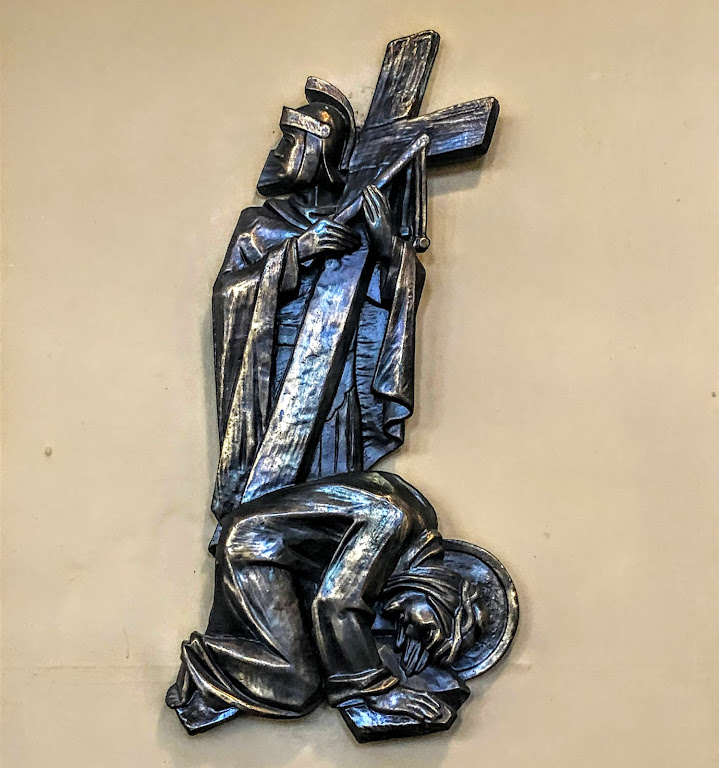
Jesus is condemned to Death … Station 1 in the Stations of the Cross in Saint Mary and Saint Giles Church in Stony Stratford (Photograph: Patrick Comerford)

Jesus is made to carry his Cross … Station 2 in Stony Stratford (Photograph: Patrick Comerford)

Jesus falls the First Time … Station 3 in Stony Stratford (Photograph: Patrick Comerford)

Jesus meets his Sorrowful Mother … Station 4 in Stony Stratford (Photograph: Patrick Comerford)

Simon of Cyrene Helps Jesus carry his Cross … Station 5 in Stony Stratford (Photograph: Patrick Comerford)

Veronica wipes the Face of Jesus … Station 6 in Stony Stratford (Photograph: Patrick Comerford)

Jesus falls The Second Time … Station 7 in Stony Stratford (Photograph: Patrick Comerford)

The Women Of Jerusalem weep over Jesus … Station 8 in the Stations of the Cross in Stony Stratford (Photograph: Patrick Comerford)

Jesus falls The Third Time … Station 9 in Stony Stratford (Photograph: Patrick Comerford)

Jesus Is stripped of his garments … Station 10 in Stony Stratford (Photograph: Patrick Comerford)

Jesus Is nailed To The Cross … Station 11 in Stony Stratford (Photograph: Patrick Comerford)

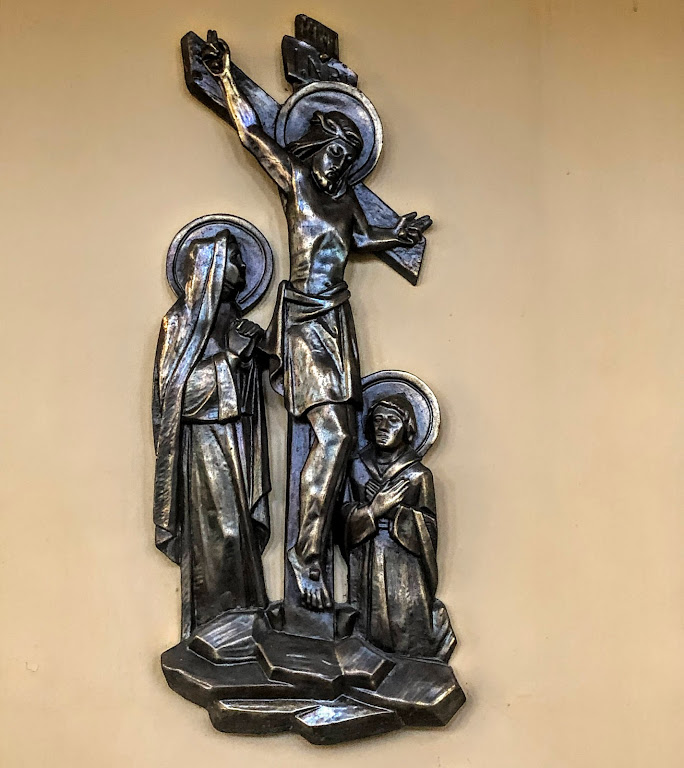
Jesus Is Raised Upon the Cross And Dies … Station 12 in Stony Stratford (Photograph: Patrick Comerford)

Jesus Is taken down from the Cross and placed In the arms of his Mother … Station 13 in Stony Stratford (Photograph: Patrick Comerford)

Jesus is laid In the Sepulchre … Station 14 in Stony Stratford (Photograph: Patrick Comerford)

Today’s Prayers (Friday 3 April 2026, Good Friday):

The theme this week (29 March-4 April 2026) in ‘Pray With the World Church’, the Prayer Diary of the Anglican mission agency USPG (United Society Partners in the Gospel), is a ‘Holy Week’ reflection’ (pp 42-43). This theme was introduced on Sunday with reflections by the Revd Kenson Li, Assistant Curate of Manchester Cathedral and a Trustee of USPG.

The USPG Prayer Diary today (Friday 4 April 2026, Good Friday) invites us to pray:

Jesus, Saviour of the world, who rested in the tomb and sanctified the grave as a bed of hope: help us to know the depth of our need for forgiveness, and the greater power of your everlasting love.

The Collect:

Almighty Father,
look with mercy on this your family
for which our Lord Jesus Christ was content to be betrayed
and given up into the hands of sinners
and to suffer death upon the cross;
who is alive and glorified with you and the Holy Spirit,
one God, now and for ever.

Additional Collect:

Eternal God,
in the cross of Jesus
we see the cost of our sin
and the depth of your love:
in humble hope and fear
may we place at his feet
all that we have and all that we are,
through Jesus Christ our Lord.

Yesterday’s Reflections

Continued Tomorrow


The processions arriving at the Church of the Four Martyrs in Rethymnon on Good Friday last year (Patrick Comerford)

Scripture quotations are from the New Revised Standard Version Bible: Anglicised Edition copyright © 1989, 1995 National Council of the Churches of Christ in the United States of America. Used by permission. All rights reserved worldwide. http://nrsvbibles.org

02 April 2026

Saint Peter’s Church on
Saffron Hill is at the heart
of ‘Little Italy’ and the oldest
Italian church in London

Looking out on Clerkenwell Road and Hatton Garden from the loggia and portico of Saint Peter’s Italian Church (Photograph: Patrick Comerford, 2026)

Patrick Comerford

When I was in Holborn and the Hatton Garden area recently for an event in Saint Alban’s Church, Holborn, organised by USPG and SPCK, I visited a number of churches in the area, including Saint Alban’s, Saint Etheldreda’s Church on Ely Place, the City Temple, and Saint Peter’s Church on Saffron Hill on Clerkenwell Road, facing the top end of Hatton Garden.

Saint Peter’s Italian Church has been described as one of the most beautiful churches in London and is the oldest church for Italians in London. It just within the boundaries of the London Borough of Camden, but it is the spiritual home of the Italian community in Clerkenwell (‘Little Italy’), with its hub in the Borough of Islington.

The church has a modest outer appearance and seems to be hemmed in between the neighbouring tall buildings, including an Italian restaurant to the left, and the Bryson Hotel to the right, so that only the later, narrow entrance front and loggia can be seen from the street. But inside the church has a large and splendid interior.

Saint Peter’s Italian Church has been described is the oldest church for Italians in London and is the spiritual heart of ‘Little Italy’ (Photograph: Patrick Comerford, 2026)

In the early 19th century, Saffron Hill was a poor neighbourhood with crowded and decadent streets, known for pickpockets and fences. By 1850, about 2,000 Italian immigrants were living there, many working as street musicians, artisans, framers, and makers of mirrors, barometers and scientific instruments. These Italians did not have their own church and so used in the Capella Reale Sarda in Lincoln’s Inn Fields.

Saint Vincent Pallotti (1795-1850), an Italian priest and founder of the Union of the Catholic Apostolate or Pallotine Fathers, decided in 1845 to build a church for Italian emigrants in London. After the restoration of the Catholic hierarchy in England, sensitivities about the ‘papal aggression’ were still high. Saint Vincent Pallotti was supported by the prominent Italian politician and activist Giuseppe Mazzini (1805-1872), who was living in exile in London at the time.

Inside Saint Peter’s Church, designed by the Dublin-born Irish architect Sir John Miller-Bryson and consecrated on 16 April 1863 (Photograph: Patrick Comerford, 2026)

The church was designed by the Dublin-born Irish architect Sir John Miller-Bryson (1822-1864), whose name is recalled in the Bryson Hotel to the right of the church. Bryson worked from plans drawn up by Francesco Gualandi of Bologna and modelled on the Basilica of San Crisogono in Trastevere in Rome. At first, the new church was to hold 3,400 people, but the original grand designs were never fully realised due to a shortage of funds.

In the course of work, as the church was built in 1862-1863, its size was greatly reduced. Yet, it was the largest Catholic church in Britain for the next 40 years and the only church the built in Britain in the style of a Roman basilica style.

The church was consecrated on 16 April 1863 as the Church of Saint Peter for All Nations, and was the first Italian church outside Italy. The architect Bryson died the following year (3 October 1864) and was buried in Brompton Cemetery.

The statues of Christ, Saint Bede and Saint George and the mosaics depicting scenes in the life of Saint Peter (Photograph: Patrick Comerford, 2026)

Saint Peter’s Church is 19 metre high church with a capacity for 2,000 people. The front section has a loggia and portico with twin arches. Above them are three niches: the central alcove has a statue of Christ, while the side alcoves have statues of Saint Bede and Saint George. Between the alcoves, two large mosaics depict two scenes in the life and ministry of Saint Peter: the first miraculous draught of fish (see Luke 5: 1-11), which results in Peter, James and John following Jesus; and Christ giving the keys of the Kingdom to Saint Peter (see Matthew 16: 19).

Above the façade, a 33-metre-high bell tower built in 1891 houses a bell known as the ‘Steel Monster’. The great bell was cast in 1862 by Naylor Vickers of Sheffield and was one of several bells exhibited at the International Exhibition that year. At the time, the only other large bell in London, apart from Big Ben in Westminster, was Great Tom in Saint Paul’s Cathedral.

The ‘Steel Monster’ remains one of the largest bells in England, though there are larger Roman Catholic bells at Downside, Ampleforth and in Liverpool Roman Catholic Cathedral.

The organ is part of the original organ built by the Belgian company Annaesens in 1886 and at the time it was considered one of the best in the country.

The organ is part of the original organ built by the Belgian company Annaesens in 1886 (Photograph: Patrick Comerford, 2026)

There are two wall memorials in the loggia: one, installed in 1927, remembers veterans, mostly Italian Britons of World War I; the other, installed in 1960, commemorates the 446 Italians who died on the SS Arandora Star in 1940.

Mussolini declared war on Britain on 10 June 1940, and after Churchill’s famous outburst, ‘Collar the lot!’, many Italians were interned. The SS Arandora Star sailed from Liverpool for Canada on 1 July 1940 with 712 Italian internees on board. The remaining passengers included 479 interned German men, among them a number of Jewish refugees, and 86 German prisoners of war – 1,216 detainees in total – and there was a crew of almost 400 British military guards and merchant sailors.

The SS Arandora Star was without escort and had no Red Cross insignia. On 2 July 1940, it was sunk by a German U-boat about 75 miles west of Bloody Foreland, Co Donegal, with great loss of life. One of the internees on board, the German Captain Otto Burfeind, went down with the ship having organised the lifeboat evacuation of British, German and Italian men alike. Over 800 people – British, Italian and German – were lost. It was the worst mass loss of life of any foreign-based Italian community.

During World War II, when many Italian immigrants were interned, the Irish Pallottine fathers took care of the church. During the war, Polish Catholics were permitted to worship and hold services in Polish in the church, as they had no other church. The church returned to the Italian Pallottines in 1953, and since then it has been substantially remodelled. Today it is a Grade II listed building.

Two memorials in the loggia recall the tragedies of World War I and World War II (Photograph: Patrick Comerford, 2026)

Little Italy’s core historical borders are usually placed at Clerkenwell Road, Farringdon Road and Rosebery Avenue, comprising the Saffron Hill part of Clerkenwell. The Clerkenwell area spans the London boroughs of Camden and Islington. Today, the Italian community in London is more dispersed, but the church remains a major venue for the community of Little Italy.

A highlight in the community calendar is the annual processione in mid-July. The annual procession began in the 1880s, and is believed to be the first of its kind in England since the Reformation. It remains a focal point of the calendar in Little Italy.

Sunday Masses in Saint Peter’s are at 7 pm on Saturdays, and 9:30 am, 11 am (Sung), 12: 30 and 7 pm. Masses on Holy Days are at 10 am, 12:15 pm and 7:30 pm. Weekday Masses are at 12:15 pm, Monday to Friday.

Saint Peter’s remains a major venue for the community of Little Italy (Photograph: Patrick Comerford, 2026)