Big Ben and the Palace of Westminster … the UK has a target to welcome 50 million international visitors annually by the year 2030 (Photograph: Patrick Comerford)
Patrick Comerford
Yet again I am overwhelmed by the viewing and reading figures for this blog. These figures reached a total of 50 million before dawn early this morning (4 September 2026). This comes soon after reaching the 49 million mark four days ago (31 August 2026), and passing the million mark on three other days last month: 48 million (24 August), 47 million (17 August) and 46 million (9 August).
I continue to find these viewing and reading figures overpowering at times, and this blog continues to reach volumes of readers I never expected when I first started blogging 16 years ago. At the end of last year, this blog had 21 million hits (31 December 2025). So far this year, there have been more than 29 million hits or visitors in 2026 alone.
Half of all hits or reader figures have been in little more than six months, with 25 million hits since 25 February 2026. I first began blogging in 2010, and it took almost two years until July 2012 to reach half a million readers. Throughout this year and last, the daily figures are overwhelming on many occasions. Of the 10 days of busiest traffic on this blog, one was this month (1 September 2026), three were in May (1, 6 and 14 May 2026), three were the previous month (26, 29 and 30 April 2026), two in March, and one in February:
• 1,124,925 (1 May 2026)
• 525,719 (14 May 2026)
• 509,644 (29 April 2026)
• 356,335 (1 September 2026)
• 344,003 (30 April 2026)
• 323,156 (27 March 2026)
• 322,038 (26 April 2026)
• 318,835 (6 May 2026)
• 318,307 (1 March 2026)
• 314,018 (28 February 2026)
The daily average was about 118,700 hits a day throughout August. Yet, I recall how 10 years ago, back in 2016, the daily average was around 1,000, or 30,000 a month.
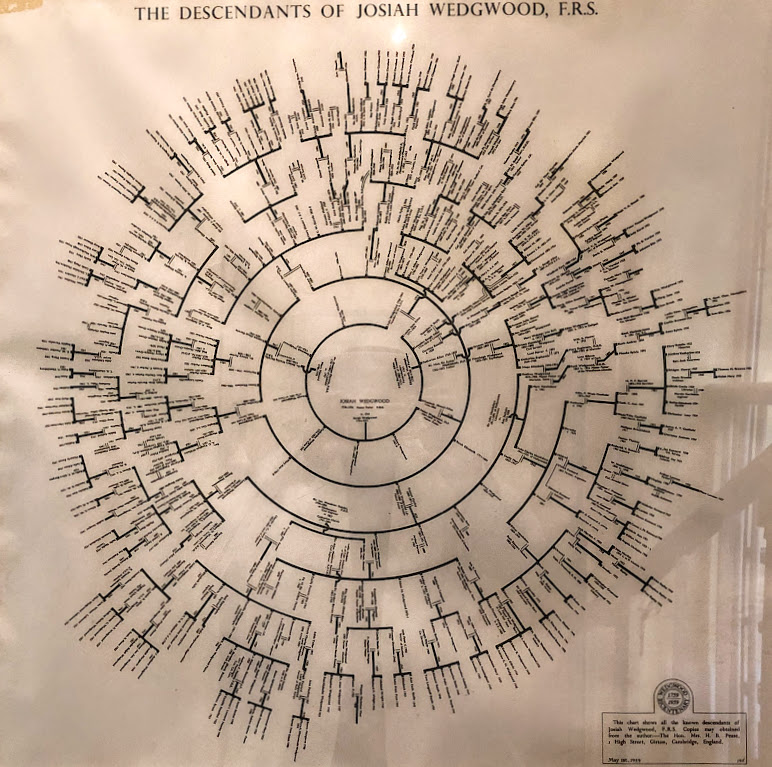
A large family tree of the Wedgwood and Darwin families in Erasmus Darwin House, Lichfield … mathematical projections in genealogy show how we are all related (Photograph: Patrick Comerford)
To put this new figure of 50 million into context:
Modern slavery entraps 50 million people on any given day: about 28 million people are working under duress in private economies, state projects or commercial exploitation, 22 million are living in forced marriages without consent, and one in four victims of modern slavery is a child.
Around 50 million people worldwide have epilepsy, making it one of the most common neurological diseases globally.
The UK government has set an official target to welcome 50 million international visitors annually by the year 2030. Greece too aims to attract 50 million annual tourist arrivals by 2030, according to a strategic target set by the Greek Tourism Confederation.
There are 29 countries with a population of more than 50 million. The population of the UK reached 50 million by 1948 and has been growing ever since: the population was 40 million in 1898, it reached 50 million by 1948 and 60 million by 2005, and is probably at 70 million this year (2026).
The Black Death killed 50 million people, or 60 per cent of Europe’s entire population, between 1346 and 1353. As a proportion of the population that lost their lives, the Black Death caused unrivalled mortality. It overshadows the horrors of World War II, and is twice the number murdered by Stalin’s regime in the Soviet Union.
In the year 1000, Europe had a population of ~50 million. Some simple maths shows that everyone who was alive in Europe around the year 1000 is either an ancestor of everyone in Europe today, or the ancestor of no one. This means that someone in Sweden, Norway or Italy has the same set of ancestors as someone who thinks their family is 100% British, Irish, French or Spanish.
At times I have used mathematical projections to help my genealogical projects, and the maths are quite simple. Every person has two parents, four grandparents and so on. Going just 30 generations back, say around 1066, that means I have one billion direct ancestors (2 to the power of 30), even though there were not one billion humans alive at that time.
A white paper published by FamilyTreeDNA used an example of a Swedish man with 8.5 billion genealogical ancestors (2^33) living in the year 1000. ‘Genealogical ancestors’ does not mean actual ancestors, as there were not even one billion living humans alive at that time, meaning many ancestors will appear multiple times across various branches.
The paper notes: ‘Think about that for a moment. If you have a single European ancestor, you are genealogically descended from every European from the year 1000 who has living descendants now.’
The population of ~50 million people in Europe in the year 1000 means we are all related in more ways than we imagine.
50 million minutes is 95 years, 24 days, 4 hours and 22 minutes. This means that if this blog was receiving just one hit a minute, I would need to have started blogging back in late September 1931.
I retired from active parish ministry about 4½ years ago, on 31 March 2022. These days, though, about 150 people on average are reading my daily prayer diary posted on this blog each morning, or more than 1,000 people each week.
This evening, as this blog passes 50 million hits, I am truly grateful to the real readers among those 50 million hits. In particular I am thankful for the faithful core group of people who join me in prayer, scripture reading and reflections each day.
William de Comberford’s monument in the Comberford Chapel, Tamworth … he died in 1349, a year after the Black Death killed one-third of Tamworth, at a time when the Black Death killed 50 million in Europe (Photograph: Patrick Comerford, 2026)
▼
04 September 2026
Daily prayer in Ordinary Time 2026:
119, Friday 4 September 2026
The banquet with Levi included the questions and answers – and the drinking – associated with a Greek symposium … pottery in a shop in Rethymnon in Crete (Photograph: Patrick Comerford)
Patrick Comerford
We are continuing in Ordinary Time in the Church Calendar and the week began with the Thirteenth Sunday after Trinity (Trinity XIII, 30 August 2026). The Season of Creation began on Tuesday (1 September 2026), and it continues until 4 October.
Today, the Calendar of the Church of England in Common Worship remembers Saint Birinus (650), Bishop of Dorchester (Oxon) and Apostle of Wessex. Before today begins, I am taking some quiet time this morning to give thanks, for reflection, prayer and reading in these ways:
1, today’s Gospel reading;
2, a reflection on the Gospel reading;
3, a prayer from the USPG prayer diary;
4, the Collects and Post-Communion prayer of the day.
After the symposium … an end-of-term dinner with the Institute for Orthodox Christian Studies at Sidney Sussex College, Cambridge (Photograph: Patrick Comerford)
Luke 5: 33-39 (NRSVA):
33 Then they said to him [Jesus], ‘John’s disciples, like the disciples of the Pharisees, frequently fast and pray, but your disciples eat and drink.’ 34 Jesus said to them, ‘You cannot make wedding-guests fast while the bridegroom is with them, can you? 35 The days will come when the bridegroom will be taken away from them, and then they will fast in those days.’ 36 He also told them a parable: ‘No one tears a piece from a new garment and sews it on an old garment; otherwise the new will be torn, and the piece from the new will not match the old. 37 And no one puts new wine into old wineskins; otherwise the new wine will burst the skins and will be spilled, and the skins will be destroyed. 38 But new wine must be put into fresh wineskins. 39 And no one after drinking old wine desires new wine, but says, “The old is good”.’
‘You cannot make wedding-guests fast while the bridegroom is with them, can you?’ (Luke 5: 34) … preparing for a wedding in Southwark (Photograph: Patrick Comerford)
Today’s Reflections:
Jesus has called the tax-collector Levi, and then dines with him in his house that evening (Luke 5: 27-31). Levi celebrates not just with dinner, or even a lavish dinner, but a ‘great banquet’ in his house that is attended by a large crowd.
Banquets were not merely lavish meals but also a setting for teaching and instruction, and the word for banquet here δοχή (dochē) suggests a formal Greek banquet known as a symposium (συμπόσιον, sympósion, from συμπίνειν, sympínein, ‘to drink together’).
In classical Greece, the symposium was the part of a banquet that took place after the meal, when drinking for pleasure was accompanied by music, dancing, recitals, or conversation. Literary works that describe or take place at a symposium include two Socratic dialogues, Plato’s Symposium and Xenophon’s Symposium, as well as a number of Greek poems.
If we read Levi’s banquet as a symposium, then, of course, it is going to be associated, culturally, in those days with drinking, and with questions and answers.
Some people ask why Jesus eats and drinks with tax collectors and sinners. Now, in this morning’s Gospel reading (Luke 5: 33-39), the same people ask why, unlike John’s disciples or the disciples of the Pharisees, who frequently fast and pray, the disciples of Jesus eat and drink.
Similar complaints were made about Socrates. In Plato’s Symposium, Alcibiades claims that Socrates, despite allegedly drinking heavily just like the others, never got drunk and that alcohol never has any effect on Socrates: ‘Observe, my friends, said Alcibiades, that this ingenious trick of mine will have no effect on Socrates, for he can drink any quantity of wine and not be at all nearer being drunk.’
Christ responds to his detractors by comparing the invitation into the Kingdom with an invitation to a wedding, and speaks of his followers as guests at a wedding banquet. The feast is in progress, so this is a time for joy, while after his death it will be a time for fasting.
He insists that the old way of being and the new way he brings are separate, even if both are to be valued. New material stretches more than old. When wine ferments, it expands. Soft new wineskins expand with the wine, but old ones do not.
And so, in a way, I find myself thinking this morning of two other banquets where the wine must have been flowing freely.
The first of these is the Wedding at Cana, the banquet before Christ’s ministry begins. There the wine runs out, and then the wine runs freely.
The second banquet is at the end of Christ’s ministry, the meal at the Last Supper. Not only must the wine have been flowing freely at that meal, it is the meal of the New Covenant, in which bread and wine are freely given, just as Christ gives himself freely, body and blood.
In this in-between time, this Ordinary Time in the Church Calendar, ordinary meals offer a promise of what the heavenly banquet is like. And constantly, as in this morning’s Gospel reading, Jesus uses the image of the wedding banquet to convey how sacred, how loving, how caring, how beautiful, how full of promise, is the heavenly banquet.
Just as the wedding banquet is not the wedding itself, but a celebration of the wedding and the promise of the wedding, the meals in the Gospel in the in-between times are foretastes of, promises of, the great heavenly banquet.
And, at those banquets, Christ dines with tax-collectors like tax-collectors like Levi, Pharisees like Simon, those who are rejected by polite society like Zacchaeus, just as he is going to dine at the Last Supper with those who are going to betray him like Judas, those who are going to deny him like Peter, just as he is going to insist on dining with those who fail to recognise him after the Resurrection, like the disciples at Emmaus.
No matter how wayward others may think we are, no matter how wayward we may think we have been, Christ calls us back to dine with him, to have a new and intimate relationship with, wants to dine with us, so that, as we say in the Prayer of Humble Access, so that ‘that we may evermore dwell in him and he in us.’
Levi’s banquet has parallels with the symposia associated with Socrates, including the drinking and the questions … Socrates bar in Piskopianó in Crete (Photograph: Patrick Comerford)
Today’s Prayers (Friday 4 September 2026):
In Pray with the World Church, the prayer diary of the Anglican mission agency USPG (United Society Partners in the Gospel), the theme this week, from 30 August to 5 September 2026 (pp 34-35), is ‘Anglican Youth Tackle Waste in Madagascar’. This theme was introduced on Sunday with a Programme Update by Ialy Tongasoa, Community Development Lead, Diocese of Toliara, Madagascar.
The USPG Prayer Diary today (Friday 4 September 2026) invites us to pray:
Gracious God, thank you for the skills young people are gaining and for how even small acts of recycling and composting are big signs of caring for your creation.
The Collect:
Almighty God,
who called your Church to bear witness
that you were in Christ reconciling the world to yourself:
help us to proclaim the good news of your love,
that all who hear it may be drawn to you;
through him who was lifted up on the cross,
and reigns with you in the unity of the Holy Spirit,
one God, now and for ever.
The Post Communion Prayer:
God our creator,
you feed your children with the true manna,
the living bread from heaven:
let this holy food sustain us through our earthly pilgrimage
until we come to that place
where hunger and thirst are no more;
through Jesus Christ our Lord.
Additional Collect:
Almighty God,
you search us and know us:
may we rely on you in strength
and rest on you in weakness,
now and in all our days;
through Jesus Christ our Lord.
Yesterday’s reflections
Continued tomorrow
‘No one tears a piece from a new garment and sews it on an old garment’ (Luke 5: 36) … colourful new fabrics in a shop in Seville (Photograph: Patrick Comerford)
Scripture quotations are from the New Revised Standard Version Bible: Anglicised Edition copyright © 1989, 1995, National Council of the Churches of Christ in the United States of America. Used by permission. All rights reserved worldwide. http://nrsvbibles.org
Socrates is regarded as the founder of western philosophy … a street name in Koutouloufári in Crete (Photograph: Patrick Comerford)
Patrick Comerford
We are continuing in Ordinary Time in the Church Calendar and the week began with the Thirteenth Sunday after Trinity (Trinity XIII, 30 August 2026). The Season of Creation began on Tuesday (1 September 2026), and it continues until 4 October.
Today, the Calendar of the Church of England in Common Worship remembers Saint Birinus (650), Bishop of Dorchester (Oxon) and Apostle of Wessex. Before today begins, I am taking some quiet time this morning to give thanks, for reflection, prayer and reading in these ways:
1, today’s Gospel reading;
2, a reflection on the Gospel reading;
3, a prayer from the USPG prayer diary;
4, the Collects and Post-Communion prayer of the day.
After the symposium … an end-of-term dinner with the Institute for Orthodox Christian Studies at Sidney Sussex College, Cambridge (Photograph: Patrick Comerford)
Luke 5: 33-39 (NRSVA):
33 Then they said to him [Jesus], ‘John’s disciples, like the disciples of the Pharisees, frequently fast and pray, but your disciples eat and drink.’ 34 Jesus said to them, ‘You cannot make wedding-guests fast while the bridegroom is with them, can you? 35 The days will come when the bridegroom will be taken away from them, and then they will fast in those days.’ 36 He also told them a parable: ‘No one tears a piece from a new garment and sews it on an old garment; otherwise the new will be torn, and the piece from the new will not match the old. 37 And no one puts new wine into old wineskins; otherwise the new wine will burst the skins and will be spilled, and the skins will be destroyed. 38 But new wine must be put into fresh wineskins. 39 And no one after drinking old wine desires new wine, but says, “The old is good”.’
‘You cannot make wedding-guests fast while the bridegroom is with them, can you?’ (Luke 5: 34) … preparing for a wedding in Southwark (Photograph: Patrick Comerford)
Today’s Reflections:
Jesus has called the tax-collector Levi, and then dines with him in his house that evening (Luke 5: 27-31). Levi celebrates not just with dinner, or even a lavish dinner, but a ‘great banquet’ in his house that is attended by a large crowd.
Banquets were not merely lavish meals but also a setting for teaching and instruction, and the word for banquet here δοχή (dochē) suggests a formal Greek banquet known as a symposium (συμπόσιον, sympósion, from συμπίνειν, sympínein, ‘to drink together’).
In classical Greece, the symposium was the part of a banquet that took place after the meal, when drinking for pleasure was accompanied by music, dancing, recitals, or conversation. Literary works that describe or take place at a symposium include two Socratic dialogues, Plato’s Symposium and Xenophon’s Symposium, as well as a number of Greek poems.
If we read Levi’s banquet as a symposium, then, of course, it is going to be associated, culturally, in those days with drinking, and with questions and answers.
Some people ask why Jesus eats and drinks with tax collectors and sinners. Now, in this morning’s Gospel reading (Luke 5: 33-39), the same people ask why, unlike John’s disciples or the disciples of the Pharisees, who frequently fast and pray, the disciples of Jesus eat and drink.
Similar complaints were made about Socrates. In Plato’s Symposium, Alcibiades claims that Socrates, despite allegedly drinking heavily just like the others, never got drunk and that alcohol never has any effect on Socrates: ‘Observe, my friends, said Alcibiades, that this ingenious trick of mine will have no effect on Socrates, for he can drink any quantity of wine and not be at all nearer being drunk.’
Christ responds to his detractors by comparing the invitation into the Kingdom with an invitation to a wedding, and speaks of his followers as guests at a wedding banquet. The feast is in progress, so this is a time for joy, while after his death it will be a time for fasting.
He insists that the old way of being and the new way he brings are separate, even if both are to be valued. New material stretches more than old. When wine ferments, it expands. Soft new wineskins expand with the wine, but old ones do not.
And so, in a way, I find myself thinking this morning of two other banquets where the wine must have been flowing freely.
The first of these is the Wedding at Cana, the banquet before Christ’s ministry begins. There the wine runs out, and then the wine runs freely.
The second banquet is at the end of Christ’s ministry, the meal at the Last Supper. Not only must the wine have been flowing freely at that meal, it is the meal of the New Covenant, in which bread and wine are freely given, just as Christ gives himself freely, body and blood.
In this in-between time, this Ordinary Time in the Church Calendar, ordinary meals offer a promise of what the heavenly banquet is like. And constantly, as in this morning’s Gospel reading, Jesus uses the image of the wedding banquet to convey how sacred, how loving, how caring, how beautiful, how full of promise, is the heavenly banquet.
Just as the wedding banquet is not the wedding itself, but a celebration of the wedding and the promise of the wedding, the meals in the Gospel in the in-between times are foretastes of, promises of, the great heavenly banquet.
And, at those banquets, Christ dines with tax-collectors like tax-collectors like Levi, Pharisees like Simon, those who are rejected by polite society like Zacchaeus, just as he is going to dine at the Last Supper with those who are going to betray him like Judas, those who are going to deny him like Peter, just as he is going to insist on dining with those who fail to recognise him after the Resurrection, like the disciples at Emmaus.
No matter how wayward others may think we are, no matter how wayward we may think we have been, Christ calls us back to dine with him, to have a new and intimate relationship with, wants to dine with us, so that, as we say in the Prayer of Humble Access, so that ‘that we may evermore dwell in him and he in us.’
Levi’s banquet has parallels with the symposia associated with Socrates, including the drinking and the questions … Socrates bar in Piskopianó in Crete (Photograph: Patrick Comerford)
Today’s Prayers (Friday 4 September 2026):
In Pray with the World Church, the prayer diary of the Anglican mission agency USPG (United Society Partners in the Gospel), the theme this week, from 30 August to 5 September 2026 (pp 34-35), is ‘Anglican Youth Tackle Waste in Madagascar’. This theme was introduced on Sunday with a Programme Update by Ialy Tongasoa, Community Development Lead, Diocese of Toliara, Madagascar.
The USPG Prayer Diary today (Friday 4 September 2026) invites us to pray:
Gracious God, thank you for the skills young people are gaining and for how even small acts of recycling and composting are big signs of caring for your creation.
The Collect:
Almighty God,
who called your Church to bear witness
that you were in Christ reconciling the world to yourself:
help us to proclaim the good news of your love,
that all who hear it may be drawn to you;
through him who was lifted up on the cross,
and reigns with you in the unity of the Holy Spirit,
one God, now and for ever.
The Post Communion Prayer:
God our creator,
you feed your children with the true manna,
the living bread from heaven:
let this holy food sustain us through our earthly pilgrimage
until we come to that place
where hunger and thirst are no more;
through Jesus Christ our Lord.
Additional Collect:
Almighty God,
you search us and know us:
may we rely on you in strength
and rest on you in weakness,
now and in all our days;
through Jesus Christ our Lord.
Yesterday’s reflections
Continued tomorrow
‘No one tears a piece from a new garment and sews it on an old garment’ (Luke 5: 36) … colourful new fabrics in a shop in Seville (Photograph: Patrick Comerford)
Scripture quotations are from the New Revised Standard Version Bible: Anglicised Edition copyright © 1989, 1995, National Council of the Churches of Christ in the United States of America. Used by permission. All rights reserved worldwide. http://nrsvbibles.org
Socrates is regarded as the founder of western philosophy … a street name in Koutouloufári in Crete (Photograph: Patrick Comerford)


