Saint Mary’s Church stands in its own large close in the centre of Stafford (Photograph: Patrick Comerford, 2026)
Patrick Comerford
I was discussing Peter Walker’s sculpture of Izaak Walton by the River Sow in Stafford in a blog posting last night (11 April 2026). Walton’s The Compleat Angler makes him the most celebrated literary figure born in Stafford, but the town has many other interesting literary associations.
The Poet Laureate Carol Ann Duffy, who was born in Glasgow to Irish parents, grew up in Stafford and many of her poems describe her experiences and memories there. JRR Tolkien, author of The Lord of the Rings, lived near Stafford in 1916, and the area around Little Haywood inspired some of his works. The Dublin-born playwright Richard Brinsley Sheridan (1751-1816) was once MP for Stafford (1780-1806). He was said to have paid the voters of Stafford five guineas each at the election in 1780, so his first speech in the House of Commons was a defence against the charge of bribery.
Stafford stands in the marshy valley of the River Sow, a tributary of the Trent. Saint Bertelin, a Mercian prince, is said to have built a hermitage there ca 700, close to the site of the present Collegiate Church of Saint Mary. But the town’s civic history dates from 913, when Alfred the Great’s daughter Æthelflæd founded a new town as she and her brother, King Edward the Elder of Wessex, continued their father’s push to unify England in a single kingdom.
Prince Rupert fired two shots from the Ancient High House through the weather vane of Saint Mary’s in 1643 (Photograph: Patrick Comerford, 2026)
After the Norman Conquest, Stafford and the surrounding countryside were acquired by Robert de Tonei, ancestor of the Stafford family, who built the castle and took their new family name from the town. But Stafford Castle is now in ruins, and the most impressive civic building in the heart of Stafford today is the Tudor-style Ancient High House in Greengate Street, the main street. The house, now a local museum, was built in 1594 and is the largest timber-framed townhouse in England.
Immediately after the outbreak of the Civil War, Charles I visited Stafford in 1643 and he made the High House the temporary headquarters of his royalists. As the civil war unfolded, Colonel William Comberford was appointed High Sheriff of Staffordshire. On 2 February 1643, he wrote from a besieged Stafford to his kinsman Ralph Weston of Rugeley, asking him to send ‘with all speed to Lichfield’ for muskets and fowling pieces to help in the defence of Stafford.
King Charles and his nephew, Prince Rupert of the Rhine, were guests of Captain Richard Sneyd in the Ancient High House, and the king attended nearby Saint Mary’s Church. Local lore recalls that when the king and Prince Rupert were walking in the garden of the High House, Prince Rupert fired two shots through the weather vane of Saint Mary’s to prove the accuracy of his pistol, hitting the tail of the cockerel twice.
The east end of Saint Mary’s Church in the heart of Stafford (Photograph: Patrick Comerford, 2026)
Although Saint Mary’s is in the centre of Stafford, it stands in its own large close, reached through a narrow passage from Greengate Street, the main shopping thoroughfare with the Ancient High House and Saint Chad’s Church.
Saint Mary’s was once linked with Saint Bertelin’s Chapel, and the foundations of the early chapel can be seen at the west end of the church. Saint Mary’s was rebuilt in the 13th and 14th centuries in a cruciform layout with an aisled nave, transepts, chancel and clerestory.
The church became a Royal Peculiar in the 13th century, exempt from the jurisdiction of the Bishop of Lichfield. Early Deans of Stafford included Henry de Loundres (1207-1213), later Archbishop of Dublin (1213-1228).
A faded bishop’s head at the south porch … Saint Mary’s became a Royal Peculiar in the 13th century, outside the jurisdiction of the Bishops of Lichfield (Photograph: Patrick Comerford, 2026)
This ‘peculiar’ status caused conflict that culminated in December 1258 when the new Bishop of Lichfield, Roger de Meyland, came to Stafford with armed men who broke open the doors of Saint Mary’s and the bishop entered with an armed troop to assert his authority. A pitched battle was fought inside the church, blood was shed and some of the canons were wounded.
By 1281, Saint Mary’s, Stafford, was one of the seven royal free chapels within the Diocese of Lichfield that the bishop recognised were exempt from his ordinary jurisdiction and subject directly to the king.
The other royal peculiars in the Diocese of Lichfield, identified by Anne Elizabeth Jenkins in her MPhil thesis for the University of Birmingham (1988), are: Saint Michael and All Angels, Penkridge, Saint Michael’s, Tettenhall, Saint Peter’s, Wolverhampton, Saint Laurence’s, Gnosall, and Saint Editha’s, Tamworth, all in Staffordshire, and Quatford in Shropshire. Others add the Royal Free Chapel of Saint Mary, Shrewsbury, and the Royal Free Chapel, Bridgnorth.
Symon Semeonis, a Franciscan friar from Clonmel, Co Tipperary and one of the early Irish travel writers, records a visit to Stafford in 1321 as he made his pilgrimage to Rome and Jerusalem.
A statue of the Virgin Mary above the south porch of Saint Mary’sChurch … until the Reformation Saint Mary’s was two churches in one, divided by a screen (Photograph: Patrick Comerford, 2026)
Until the Reformation, Saint Mary’s was two churches in one, divided by a screen. The nave served as the parish church of Stafford, while the chancel was used by the dean and the 13 canons of the College of Saint Mary whose duty was to say Mass daily for living and dead members of the royal family.
The church survived as a collegiate institution until the dissolution of colleges and chantries in 1548 during the reign of Edward VI. The dividing screens survived the dissolution of the college in 1548 and remained until 1841.
Until 1593, the octagonal tower was topped by a spire said to be one of the tallest in England. A storm that year blew it down, causing major damage to the south transept and the spire was never rebuilt. That year too, Izaak Walton was baptised in the church on 21 September 1593.
A storm in 1593 blew down the spire on the octagonal tower and it was never rebuilt (Photograph: Patrick Comerford, 2026)
For several generations the Aston family were the patrons, although the entire family became Roman Catholics in the 1620s. When Stafford fell to the Parliamentarians in 1642, Saint Mary’s became a barracks and stables.
By 1777, the church was in such a poor state that it was closed. Some repairs were carried out on the tower, roof, parapets and windows, but by 1837 the church was in a dilapidated condition once again.
Archdeacon George Hodson demanded a full report from the churchwardens and George Gilbert Scott (1811-1878) was commissioned to restore the church in 1840. Scott was deeply influenced by AWN Pugin’s articles on church architecture in the Dublin Review. Pugin was working on Alton Towers and at Saint Giles in Cheadle at the time. When Scott’s restoration was completed in 1844, Pugin described it as ‘the best restoration which has been effected in modern times.’
The Revd Lionel Lambert (1869-1948) challenged the authority of the Bishop of Lichfield in 1929, claiming the church was still the Royal Free Chapel of Saint Mary. The legal battle was not as bruising as the pitched battle in 1254, but the Bishop of Lichfield was victorious this time, although Lambert remained rector of Stafford until he retired in 1944.
Inside Saint Mary’s Church, Stafford … restored by George Gilbert Scott in 1841-1844 (Photograph: StaffordChurches, Facebook)
Today, Saint Mary’s serves as the civic church of Stafford and is a Grade I listed parish church. It is a large cruciform church with transepts and an octagonal crossing tower that once had a spire until 1594. The chancel has five-bay aisles. The north is largely given over to the organ and the vestry, and the Lady Chapel is in the south aisle.
According to the architectural historian Sir Niklaus Pevsner, the nave and its arcades are early 13th century work, although the crocket capitals are Scott’s. The west doorway and a plain north doorway are also early 13th century, while the west window belongs to the later 13th century. The south aisle windows are 14th century and the north aisle windows and clerestorey are Perpendicular. The south doorway and porch are Scott’s.
Scott’s work is more apparent in the south transept and chancel. The north transept was not restored, and retains an early 14thc century north doorway and window, and a perpendicular clerestory. Scott removed the clerestories in the chancel and the south transept. Some 13th century windows survive in these parts of the church, but most of the windows are Scott’s.
The south doorway and porch are part of Scott’s restoration in the 1840s (Photograph: Patrick Comerford, 2026)
Saint Mary’s Church has a superbly carved 12th century Italianate font at the west end. The design is unusual for an English church, with four semi-circular bowls joined together like a huge four-leaf clover.
The underside of the font bowl is carved with unusual, grotesque figures. Strange beasts like monkeys climb the sides of the bowl, while lions curve around the base of the bowl, whose base is carved with peculiar creatures with one head for two bodies.
The style of the font is almost unknown in England, and has more in common with Byzantine art than British tradition. Pevsner describes it as ‘Norman and under Italian influence’. Others say it is ‘undoubtedly foreign’ but possibly carved by foreign workers in Stafford. There is nothing to relate the font to the present church, and it has been suggested that it may have come from Saint Chad’s Church, where the present font is a neo-Romanesque piece made in 1856.
The carved 12th century Italianate font at the west end (Photograph: Facebook)
A wall memorial dating from 1878 commemorates Izaak Walton (1593-1683), who was baptised in the church on 21 September 1593. Other memorials in the church commemorate William Palmer (d 1683), Humphrey Hodgetts (d 1730), Thomas Clifford (d 1787) and his wife Barbara (d 1786).
The chest tomb of Sir Edward Aston (d 1568) and his wife Joan is in the north transept. Their effigies have been badly damaged, and he is without his head, but the carvings of weepers and heraldic shields remain around the. Local lore says that the tomb was damaged when it was used to support a wooden jury box when Saint Mary’s was used as an assize court in the 18th century.
The carved pew ends date from Scott’s restoration in 1841. The figures include a crowned head, a mitred bishop, winged angels, eagles, a woodpecker, and at least three green men with foliage emerging from their mouths.
The church has large four manual organ built by Harrison and Harrison in 1909. The second organ dates from 1790 when it was installed by John Geib. It was rebuilt in 1844 by John Banfield, and then Hill, Norman & Beard in 1974.
I never got inside Saint Mary’s Church when I was in Stafford last week. But mor eduring the days to come, hopefully, about Saint Bertelin’s Chapel and some of the other places I saw and visited in Stafford.
The wall memorial commemorating Izaak Walton, who was baptised in Saint Mary’s in 1593 (Photograph: StaffordChurches, Facebook)
• The Collegiate Church of Saint Mary is a town centre church in Stafford and part of Stafford Churches. The associate priest and town centre chaplain is the Revd John Davis. The other associate priests include Canon Michael Newman and the Revd Pam Merriott. The Sunday services are: 8:30 am, Eucharist, Saint Chad’s, Greengate Street; 10 am, Sung Eucharist, Saint Mary’s; 10 am, Eucharist, Saint Leonard’s, Marston (first Sunday of the month only).
Church Lane on the south side of Saint Mary’s Church, Stafford (Photograph: Patrick Comerford, 2026)
▼
12 April 2026
Daily prayer in Easter 2026:
8, Sunday 12 April 2026,
the Second Sunday of Easter
The doors of the house … were locked … Jesus came and stood among them and said, ‘Peace be with you’ (John 20: 19) … an icon in Saint Mary and All Saints Church, Walsingham (Photograph: Patrick Comerford, 2026)
Patrick Comerford
Our Easter celebrations continue in the Church Calendar, and today is the Second Sunday of Easter (Easter II). In the calendar of the Greek Orthodox Church, however, today is Easter Day.
I was at the celebrations of Easter Eve in the Greek Orthodox Church in Stony Stratford late last night, and they continued until after 3 am this morning. Later this morning, I hope to be at the Parish Eucharist in Saint Mary and Saint Giles Church, Stony Stratford, and to read one of the lessons. Then, at lunchtime today, there is a Greek community barbeque in the grounds of the Greek Orthodox Church in Stony Stratford.
But, before today begins, I am taking some quiet time this morning to give thanks, to reflect, to pray and to read in these ways:
1, reading today’s Gospel reading;
2, a short reflection;
3, a prayer from the USPG prayer diary;
4, the Collects and Post-Communion prayer of the day.
An icon of the Incredulity of Saint Thomas in the Greek Orthodox Church in Stony Stratford (Photograph: Patrick Comerford)
John 20: 19-31 (NRSVA):
19 When it was evening on that day, the first day of the week, and the doors of the house where the disciples had met were locked for fear of the Jews, Jesus came and stood among them and said, ‘Peace be with you.’ 20 After he said this, he showed them his hands and his side. Then the disciples rejoiced when they saw the Lord. 21 Jesus said to them again, ‘Peace be with you. As the Father has sent me, so I send you.’ 22 When he had said this, he breathed on them and said to them, ‘Receive the Holy Spirit. 23 If you forgive the sins of any, they are forgiven them; if you retain the sins of any, they are retained.’
24 But Thomas (who was called the Twin), one of the twelve, was not with them when Jesus came. 25 So the other disciples told him, ‘We have seen the Lord.’ But he said to them, ‘Unless I see the mark of the nails in his hands, and put my finger in the mark of the nails and my hand in his side, I will not believe.’
26 A week later his disciples were again in the house, and Thomas was with them. Although the doors were shut, Jesus came and stood among them and said, ‘Peace be with you.’ 27 Then he said to Thomas, ‘Put your finger here and see my hands. Reach out your hand and put it in my side. Do not doubt but believe.’ 28 Thomas answered him, ‘My Lord and my God!’ 29 Jesus said to him, ‘Have you believed because you have seen me? Blessed are those who have not seen and yet have come to believe.’
30 Now Jesus did many other signs in the presence of his disciples, which are not written in this book. 31 But these are written so that you may come to believe that Jesus is the Messiah, the Son of God, and that through believing you may have life in his name.
Saint Thomas and the Risen Christ depicted in a fresco in a church in Athens (Photograph: Patrick Comerford)
Today’s Reflections:
This Second Sunday of Easter (Easter II) is traditionally known as Low Sunday. In the past this has also been known as Saint Thomas Sunday, because of the Gospel reading (John 20: 19-31) recalling the story of ‘Doubting Thomas.’
Some people say this Sunday was called ‘Low Sunday’ because today’s liturgy is something of an anti-climax after the solemn Easter liturgy and celebrations a week ago. Some even joke that today is known as Low Sunday because this is the Sunday choirs take off after their hard work during Holy Week and Easter.
In these difficult times, with a continuing conflict in the Middle East and an unsteady ceasefire in the Gul, with between Russia and Ukraine, and global tensions exacerbated by the actions of the Trump regime, many people are feeling low, feeling isolated and looking for hope. Like the disciples in the Gospel reading, they may feel they are living locked away in fear. But the Gospel reading is not just a reminder, but a triple reminder, that the primary message of the Risen Christ is ‘Peace be with you.’ In Saint John’s Gospel, this phrase has the same impact as the message of the Risen Christ in Saint Matthew’s Gospel, ‘Be not afraid.’
In the Gospels, Saint Thomas is named ‘Thomas, also called the Twin (Didymus)’. But the name ‘Thomas’ comes from the Aramaic word for twin, T'oma (תאומא), so there is a tautological wordplay going on here.
Syrian tradition says the apostle’s full name was Judas Thomas, or Jude Thomas, but who was his twin brother (or sister)?
I have often visited Didyma on the southern Anatolian coast. There the Didymaion was one of the most important shrines and temples in the classical world to Apollo and his twin sister Artemis. Apollo was the sun-god, the sun of Zeus; he was the patron of shepherds and the guardian of truth, and in Greek and Roman mythology he died and rose again.
Is the story of Saint Thomas’s doubts an invitation to the followers of the cult of Apollo to turn to Christ, the true Son of God the Father, who is the Good Shepherd, who is the way, the truth and the light, who has died and who is truly risen?
We can never be quite sure about Saint Thomas in Saint John’s Gospel. After the death of Lazarus, the disciples resist Christ’s decision to return to Judea, where there had been an attempt to stone Jesus. But Thomas shows he has no idea of the real meaning of death and resurrection when he suggests that the disciples should go to Bethany with Jesus: ‘Let us also go, that we may die with him’ (John 11: 16).
And while Thomas saw the raising of Lazarus, what did he believe in?
Could seeing ever be enough for a doubting Thomas to believe?
The Apostle Thomas also speaks at the Last Supper (John 14: 5). When Christ assures his disciples that they know where he is going, Thomas protests that they do not know at all. He has been with Christ now for three years, and still he does not believe or understand. Seeing and explanations are not enough for him. Christ replies to this and to Philip’s requests with a detailed exposition of his relationship to God the Father.
In the Resurrection story in Saint John’s Gospel, Mary does not recognise the Risen Christ at first. For her, appearances could be deceiving, and she thinks he is the gardener. But when he speaks to her, she recognises his voice, and then wants to hold on to him. From that moment of seeing and believing, she rushes off to tell the Disciples: ‘I have seen the Lord.’
Two of the disciples, John the Beloved and Simon Peter, have already seen the empty tomb, but they fail to make the vital connection between seeing and believing. When they hear Mary’s testimony, they still fail to believe fully. They only believe when they see the Risen Lord standing among them, when he greets them, ‘Peace be with you,’ and when he shows them his pierced hands and side.
They had to see and to hear, they had to have the Master stand over them in their presence, before they could believe.
On the first Easter Day, the Disciples locked themselves away out of fear. But where is Thomas? Is he fearless? Or is he foolish?
For a full week, Thomas is absent and does not join in the Easter experience of the remaining disciples. He has not seen and so he refuses to believe. When they tell him what has happened, Thomas refuses to accept their stories of the Resurrection. For him hearing, even seeing, are not enough.
Thomas wants to see, hear and touch. He wants to use all his learning faculties before he can believe this story. He has heard, but he wants to see. When he sees, he wants to touch … he demands not only to touch the Risen Christ, but to touch his wounds too before being convinced.
And so for a second time within eight days, Christ comes and stands among his disciples, and says: ‘Peace be with you.’
Mary was asked in the garden on Easter morning not to cling on to Christ. But Thomas is invited to touch him in the most intimate way. He is told to place his finger in Christ’s wounded hands and his hand in Christ’s pierced side.
Caravaggio has depicted this scene in his painting, The Incredulity of Saint Thomas. Yet we are never told whether Thomas actually touched those wounds with his fingers. All we are told is that once he has seen the Risen Christ, Thomas simply professes his faith in Jesus: ‘My Lord and my God!’
In that moment, we hear the first expression of faith in the two natures of Christ, that he is both divine and human. For all his doubts, Saint Thomas provides us with an exquisite summary of the apostolic faith.
Too often, perhaps, we talk about ‘Doubting Thomas.’ Instead, we might better call him ‘Believing Thomas.’ His doubting leads him to question. But his questioning leads to listening. And when he hears, he sees, perhaps he even touches. Whatever he does, he learns in his own way, and he comes not only to faith but to faith that for this first time is expressed in that eloquent yet succinct acknowledgment of Christ as both ‘My Lord and My God.’
In our society today, are we easily deceived by appearances?
Do we confuse what pleases me with beauty and with truth?
Do we allow those who have power to define the boundaries of trust and integrity merely to serve their own interests?
Too often, in this world, we are deceived easily by the words of others and deceived by what they want us to see. Seeing is not always believing today. Hearing does not always mean we have heard the truth, as we know with the decline in honesty and integrity in political life in the US in the past three months. It is easy to deceive and to be deceived by a good presentation and by clever words.
Too often, we accept or judge people by their appearances, and we are easily deceived by the words of others because of their office or their privilege. But there are times when our faith, however simple or sophisticated, must lead us to ask appropriate questions, not to take everything for granted, and not to confuse what looks like being in our own interests with real beauty and truth.
The Second Sunday of Easter is traditionally called ‘Low Sunday.’ But we need not be low in spirit; instead, we can be in high spirits because of the Risen Christ. ‘Peace be with you!’
Χριστὸς ἀνέστη!
Christ is Risen!
The Temple of Apollo in Didyma … one of the most important shrines and temples in the classical world to Apollo and his twin sister Artemis (Photograph: Patrick Comerford)
Today’s Prayers (Sunday 12 April 2026, Easter II):
‘Stocked with Hope’ provides the theme this week in ‘Pray With the World Church’, the Prayer Diary of the Anglican mission agency USPG (United Society Partners in the Gospel), pp 46-47. This theme is introduced today with a Programme Update by Mayank Thomas, Programme Manager, the Synodical Board of Social Services, Church of North India:
Many women in North India face economic and social barriers due to long-standing inequalities. The Church of North India believes in the dignity of all and is therefore responding by supporting skills development, income opportunities, and community advocacy, helping women gain economic independence and a stronger voice in decision-making.
Shaila*, a resident of a remote village, lives with her husband and their eight-year-old daughter. With her husband’s income coming from irregular daily wage labour and her own small grocery shop bringing in only limited earnings, the family often struggles to make ends meet. Shaila’s greatest worry is her daughter’s education, which she fears could be interrupted by financial constraints. In December, a ray of hope arrived when the Church of North India extended financial support through its social services programme. Shaila used this support to expand her grocery shop, increasing both the variety and quantity of goods on offer, which in turn began attracting more customers.
As her income grew, Shaila gained more than financial relief – it brought dignity, confidence, and purpose. She can now send her daughter to school and manage her shop with pride, knowing she is securing her family’s future. Shaila expresses her heartfelt appreciation to the Church of North India, saying, “Thanks to their support, women like me are slowly becoming economically stronger. I’m truly thankful.” Her story is one of quiet strength and transformation, shaped by a Church that notices, cares, and acts.
*name changed.
The USPG Prayer Diary today (Sunday 12 April 2026, Easter II) invites us to pray as we read and meditate on John 20: 19-31.
The Collect:
Almighty Father,
you have given your only Son to die for our sins
and to rise again for our justification:
grant us so to put away the leaven of malice and wickedness
that we may always serve you
in pureness of living and truth;
through the merits of your Son Jesus Christ our Lord,
who is alive and reigns with you,
in the unity of the Holy Spirit,
one God, now and for ever.
The Post-Communion Prayer:
Lord God our Father,
through our Saviour Jesus Christ
you have assured your children of eternal life
and in baptism have made us one with him:
deliver us from the death of sin
and raise us to new life in your love, in the fellowship of the Holy Spirit,
by the grace of our Lord Jesus Christ.
Additional Collect:
Risen Christ,
for whom no door is locked, no entrance barred:
open the doors of our hearts,
that we may seek the good of others
and walk the joyful road of sacrifice and peace,
to the praise of God the Father.
Yesterday’s Reflections
Continued Tomorrow
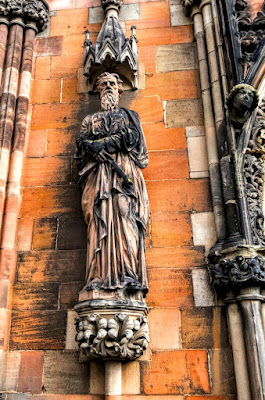
Saint Thomas the Apostle … a sculpture on the west façade of Lichfield Cathedral (Photograph: Patrick Comerford)
Scripture quotations are from the New Revised Standard Version Bible: Anglicised Edition copyright © 1989, 1995 National Council of the Churches of Christ in the United States of America. Used by permission. All rights reserved worldwide. http://nrsvbibles.org
The Easter celebrations come to a conclusion in the Greek Orthodox Church in Stony Stratford early this morning … today is Easter Day in the Orthodox calendar (Patrick Comerford, 2026)
Patrick Comerford
Our Easter celebrations continue in the Church Calendar, and today is the Second Sunday of Easter (Easter II). In the calendar of the Greek Orthodox Church, however, today is Easter Day.
I was at the celebrations of Easter Eve in the Greek Orthodox Church in Stony Stratford late last night, and they continued until after 3 am this morning. Later this morning, I hope to be at the Parish Eucharist in Saint Mary and Saint Giles Church, Stony Stratford, and to read one of the lessons. Then, at lunchtime today, there is a Greek community barbeque in the grounds of the Greek Orthodox Church in Stony Stratford.
But, before today begins, I am taking some quiet time this morning to give thanks, to reflect, to pray and to read in these ways:
1, reading today’s Gospel reading;
2, a short reflection;
3, a prayer from the USPG prayer diary;
4, the Collects and Post-Communion prayer of the day.
An icon of the Incredulity of Saint Thomas in the Greek Orthodox Church in Stony Stratford (Photograph: Patrick Comerford)
John 20: 19-31 (NRSVA):
19 When it was evening on that day, the first day of the week, and the doors of the house where the disciples had met were locked for fear of the Jews, Jesus came and stood among them and said, ‘Peace be with you.’ 20 After he said this, he showed them his hands and his side. Then the disciples rejoiced when they saw the Lord. 21 Jesus said to them again, ‘Peace be with you. As the Father has sent me, so I send you.’ 22 When he had said this, he breathed on them and said to them, ‘Receive the Holy Spirit. 23 If you forgive the sins of any, they are forgiven them; if you retain the sins of any, they are retained.’
24 But Thomas (who was called the Twin), one of the twelve, was not with them when Jesus came. 25 So the other disciples told him, ‘We have seen the Lord.’ But he said to them, ‘Unless I see the mark of the nails in his hands, and put my finger in the mark of the nails and my hand in his side, I will not believe.’
26 A week later his disciples were again in the house, and Thomas was with them. Although the doors were shut, Jesus came and stood among them and said, ‘Peace be with you.’ 27 Then he said to Thomas, ‘Put your finger here and see my hands. Reach out your hand and put it in my side. Do not doubt but believe.’ 28 Thomas answered him, ‘My Lord and my God!’ 29 Jesus said to him, ‘Have you believed because you have seen me? Blessed are those who have not seen and yet have come to believe.’
30 Now Jesus did many other signs in the presence of his disciples, which are not written in this book. 31 But these are written so that you may come to believe that Jesus is the Messiah, the Son of God, and that through believing you may have life in his name.
Saint Thomas and the Risen Christ depicted in a fresco in a church in Athens (Photograph: Patrick Comerford)
Today’s Reflections:
This Second Sunday of Easter (Easter II) is traditionally known as Low Sunday. In the past this has also been known as Saint Thomas Sunday, because of the Gospel reading (John 20: 19-31) recalling the story of ‘Doubting Thomas.’
Some people say this Sunday was called ‘Low Sunday’ because today’s liturgy is something of an anti-climax after the solemn Easter liturgy and celebrations a week ago. Some even joke that today is known as Low Sunday because this is the Sunday choirs take off after their hard work during Holy Week and Easter.
In these difficult times, with a continuing conflict in the Middle East and an unsteady ceasefire in the Gul, with between Russia and Ukraine, and global tensions exacerbated by the actions of the Trump regime, many people are feeling low, feeling isolated and looking for hope. Like the disciples in the Gospel reading, they may feel they are living locked away in fear. But the Gospel reading is not just a reminder, but a triple reminder, that the primary message of the Risen Christ is ‘Peace be with you.’ In Saint John’s Gospel, this phrase has the same impact as the message of the Risen Christ in Saint Matthew’s Gospel, ‘Be not afraid.’
In the Gospels, Saint Thomas is named ‘Thomas, also called the Twin (Didymus)’. But the name ‘Thomas’ comes from the Aramaic word for twin, T'oma (תאומא), so there is a tautological wordplay going on here.
Syrian tradition says the apostle’s full name was Judas Thomas, or Jude Thomas, but who was his twin brother (or sister)?
I have often visited Didyma on the southern Anatolian coast. There the Didymaion was one of the most important shrines and temples in the classical world to Apollo and his twin sister Artemis. Apollo was the sun-god, the sun of Zeus; he was the patron of shepherds and the guardian of truth, and in Greek and Roman mythology he died and rose again.
Is the story of Saint Thomas’s doubts an invitation to the followers of the cult of Apollo to turn to Christ, the true Son of God the Father, who is the Good Shepherd, who is the way, the truth and the light, who has died and who is truly risen?
We can never be quite sure about Saint Thomas in Saint John’s Gospel. After the death of Lazarus, the disciples resist Christ’s decision to return to Judea, where there had been an attempt to stone Jesus. But Thomas shows he has no idea of the real meaning of death and resurrection when he suggests that the disciples should go to Bethany with Jesus: ‘Let us also go, that we may die with him’ (John 11: 16).
And while Thomas saw the raising of Lazarus, what did he believe in?
Could seeing ever be enough for a doubting Thomas to believe?
The Apostle Thomas also speaks at the Last Supper (John 14: 5). When Christ assures his disciples that they know where he is going, Thomas protests that they do not know at all. He has been with Christ now for three years, and still he does not believe or understand. Seeing and explanations are not enough for him. Christ replies to this and to Philip’s requests with a detailed exposition of his relationship to God the Father.
In the Resurrection story in Saint John’s Gospel, Mary does not recognise the Risen Christ at first. For her, appearances could be deceiving, and she thinks he is the gardener. But when he speaks to her, she recognises his voice, and then wants to hold on to him. From that moment of seeing and believing, she rushes off to tell the Disciples: ‘I have seen the Lord.’
Two of the disciples, John the Beloved and Simon Peter, have already seen the empty tomb, but they fail to make the vital connection between seeing and believing. When they hear Mary’s testimony, they still fail to believe fully. They only believe when they see the Risen Lord standing among them, when he greets them, ‘Peace be with you,’ and when he shows them his pierced hands and side.
They had to see and to hear, they had to have the Master stand over them in their presence, before they could believe.
On the first Easter Day, the Disciples locked themselves away out of fear. But where is Thomas? Is he fearless? Or is he foolish?
For a full week, Thomas is absent and does not join in the Easter experience of the remaining disciples. He has not seen and so he refuses to believe. When they tell him what has happened, Thomas refuses to accept their stories of the Resurrection. For him hearing, even seeing, are not enough.
Thomas wants to see, hear and touch. He wants to use all his learning faculties before he can believe this story. He has heard, but he wants to see. When he sees, he wants to touch … he demands not only to touch the Risen Christ, but to touch his wounds too before being convinced.
And so for a second time within eight days, Christ comes and stands among his disciples, and says: ‘Peace be with you.’
Mary was asked in the garden on Easter morning not to cling on to Christ. But Thomas is invited to touch him in the most intimate way. He is told to place his finger in Christ’s wounded hands and his hand in Christ’s pierced side.
Caravaggio has depicted this scene in his painting, The Incredulity of Saint Thomas. Yet we are never told whether Thomas actually touched those wounds with his fingers. All we are told is that once he has seen the Risen Christ, Thomas simply professes his faith in Jesus: ‘My Lord and my God!’
In that moment, we hear the first expression of faith in the two natures of Christ, that he is both divine and human. For all his doubts, Saint Thomas provides us with an exquisite summary of the apostolic faith.
Too often, perhaps, we talk about ‘Doubting Thomas.’ Instead, we might better call him ‘Believing Thomas.’ His doubting leads him to question. But his questioning leads to listening. And when he hears, he sees, perhaps he even touches. Whatever he does, he learns in his own way, and he comes not only to faith but to faith that for this first time is expressed in that eloquent yet succinct acknowledgment of Christ as both ‘My Lord and My God.’
In our society today, are we easily deceived by appearances?
Do we confuse what pleases me with beauty and with truth?
Do we allow those who have power to define the boundaries of trust and integrity merely to serve their own interests?
Too often, in this world, we are deceived easily by the words of others and deceived by what they want us to see. Seeing is not always believing today. Hearing does not always mean we have heard the truth, as we know with the decline in honesty and integrity in political life in the US in the past three months. It is easy to deceive and to be deceived by a good presentation and by clever words.
Too often, we accept or judge people by their appearances, and we are easily deceived by the words of others because of their office or their privilege. But there are times when our faith, however simple or sophisticated, must lead us to ask appropriate questions, not to take everything for granted, and not to confuse what looks like being in our own interests with real beauty and truth.
The Second Sunday of Easter is traditionally called ‘Low Sunday.’ But we need not be low in spirit; instead, we can be in high spirits because of the Risen Christ. ‘Peace be with you!’
Χριστὸς ἀνέστη!
Christ is Risen!
Today’s Prayers (Sunday 12 April 2026, Easter II):
‘Stocked with Hope’ provides the theme this week in ‘Pray With the World Church’, the Prayer Diary of the Anglican mission agency USPG (United Society Partners in the Gospel), pp 46-47. This theme is introduced today with a Programme Update by Mayank Thomas, Programme Manager, the Synodical Board of Social Services, Church of North India:
Many women in North India face economic and social barriers due to long-standing inequalities. The Church of North India believes in the dignity of all and is therefore responding by supporting skills development, income opportunities, and community advocacy, helping women gain economic independence and a stronger voice in decision-making.
Shaila*, a resident of a remote village, lives with her husband and their eight-year-old daughter. With her husband’s income coming from irregular daily wage labour and her own small grocery shop bringing in only limited earnings, the family often struggles to make ends meet. Shaila’s greatest worry is her daughter’s education, which she fears could be interrupted by financial constraints. In December, a ray of hope arrived when the Church of North India extended financial support through its social services programme. Shaila used this support to expand her grocery shop, increasing both the variety and quantity of goods on offer, which in turn began attracting more customers.
As her income grew, Shaila gained more than financial relief – it brought dignity, confidence, and purpose. She can now send her daughter to school and manage her shop with pride, knowing she is securing her family’s future. Shaila expresses her heartfelt appreciation to the Church of North India, saying, “Thanks to their support, women like me are slowly becoming economically stronger. I’m truly thankful.” Her story is one of quiet strength and transformation, shaped by a Church that notices, cares, and acts.
*name changed.
The USPG Prayer Diary today (Sunday 12 April 2026, Easter II) invites us to pray as we read and meditate on John 20: 19-31.
The Collect:
Almighty Father,
you have given your only Son to die for our sins
and to rise again for our justification:
grant us so to put away the leaven of malice and wickedness
that we may always serve you
in pureness of living and truth;
through the merits of your Son Jesus Christ our Lord,
who is alive and reigns with you,
in the unity of the Holy Spirit,
one God, now and for ever.
The Post-Communion Prayer:
Lord God our Father,
through our Saviour Jesus Christ
you have assured your children of eternal life
and in baptism have made us one with him:
deliver us from the death of sin
and raise us to new life in your love, in the fellowship of the Holy Spirit,
by the grace of our Lord Jesus Christ.
Additional Collect:
Risen Christ,
for whom no door is locked, no entrance barred:
open the doors of our hearts,
that we may seek the good of others
and walk the joyful road of sacrifice and peace,
to the praise of God the Father.
Yesterday’s Reflections
Continued Tomorrow
Saint Thomas the Apostle … a sculpture on the west façade of Lichfield Cathedral (Photograph: Patrick Comerford)
Scripture quotations are from the New Revised Standard Version Bible: Anglicised Edition copyright © 1989, 1995 National Council of the Churches of Christ in the United States of America. Used by permission. All rights reserved worldwide. http://nrsvbibles.org
The Easter celebrations come to a conclusion in the Greek Orthodox Church in Stony Stratford early this morning … today is Easter Day in the Orthodox calendar (Patrick Comerford, 2026)