Patrick Comerford
April is Sarcoidosis Awareness Month. And, having been diagnosed with Sarcoidosis around 2008, I would have thought that after almost 20 years I would know how to recognise fresh symptoms of a new flare up of this pernicious syndrome.
For the last three weeks, since I returned to England from Kuching, I have had a series of symptoms that I was responding to separately. I have had a serious failure in doing the ‘joined-up writing’, not realising that together these symptoms have indicated yet another flare-up of sarcoidosis.
I must have picked up a cough and a cold on one of my recent flights from Kuching, Kuala Lumpur or Muscat. But I ought to have been able to shake that off within a week or ten days. Instead, for almost three weeks now, I have had the uncomfortable symptoms of a heavy head and chest cold, along with pains in my joints, particularly in my hips, legs, knees and ankles and legs, late-night asthma-like breathlessness, a feeling of being tired and listless, and a nasty, red rash across the lower shin on my left leg.
My breathlessness forced me to excuse myself from reading one of the lessons and singing at the Parish Eucharist the Sunday before last and to stay away from the choir rehearsals the following Wednesday.
I went to my GP earlier this week complaining about some of these symptoms, worried that the pain in my lungs might even be pneumonia.
I went to the pharmacist about the rash, and was recommended to use hydrocortisone ointment with a mild steroid.
I had what I thought was a mild but troubling asthma attack when four of us went out for a family dinner in Stony Stratford on Tuesday night and needed extra use of my inhaler.
I was not in full voice when I returned to the choir rehearsals on Wednesday evening.
Then, when more volunteers were being asked to take part in foot-washing at the Maundy Eucharist in Saint Mary and Saint Giles Church last night, I realised I was about to make my excuse, ‘Sorry, I still have a nasty sarcoid rash on one of my shins.’
Subconsciously, I had already made the connection within the last 24 or 48 hours. I now realise that all these symptoms amount to Erythema Nodosum.
I have just learned in recent days that Sarcoidosis often presents on the shins as Erythema Nodosum or tender, red, or purple-blue nodules indicating an acute, often self-limiting, flare-up of this nasty syndrome. These nodules can be accompanied by joint pain, fever and fatigue. Other skin manifestations include chronic, brown or purple papules or plaques. And I just thought it was a nasty, large pimple right beside the rash.
The key characteristics of shin rashes in Sarcoidosis involve Erythema Nodosum, a rash that appears as painful, tender, red-to-blue lumps on nodules, and they are primarily on the shins. This acute but transient symptom of sarcoidosis often resolves on its own within three to six weeks, but as the tender, red nodules fade they often leave behind bruised-looking, purple-blue areas.
Of course, Erythema Nodosum is not solely caused by sarcoidosis and can result from other conditions. But the other associated, common symptoms include flu-like symptoms before or at the same time as the patches on the skin, fever, malaise, and arthralgia or swollen, aching joints.
A full diagnosis often requires a skin biopsy to distinguish this from other conditions. But acute cases of erythema nodosum often resolve themselves without treatment, although ibuprofen or paracetamol can be used for pain and in chronic cases dermatologists may prescribe topical corticosteroids, tacrolimus ointment or oral medications if the lesions are widespread.
Erythema nodosum commonly affects the lower legs, but you can get it in other areas, such as on the arms, thighs and neck. Thankfully, it usually goes away by itself. The skin usually heals on its own within three to eight weeks. But when the affected patches of skin heal and fade, some people are left with marks that look like bruises.
They say some things that can help ease the pain of erythema nodosum include ibuprofen or other anti-inflammatory painkillers, rest with your feet raised on a pillow, avoiding long periods of standing, walking and running, or putting .a cool wet compress, like a damp cloth, on the affected area.
I have heeded little of this advice in recent weeks. If only I had known. I walked and walked, quite a lot, when I was in Walsingham a few weeks ago. I walked and walked, quite a lot, around Oxford yesterday, before and after the Christ Eucharist in Christ Church Cathedral yesterday.
If only I had realised that my subconscious mind was telling me all this. Already there have been warning signs that as well as my lungs sarcoidosis may have have left some traces on my heart and a kidney.
It has been a tough reminder over these past three weeks that we should all liisten to what our body is instinctively telling us about our health.
Hopefully I’ll be as right as rain within a few days.
As I have said so often in the past, I may have sarcoidosis, but sarcoidosis does not have me.
Had I realised what my inner instincts were telling me, I would not have walked so much around Oxford yesterday (Photograph: Patrick Comerford, 2026)
03 April 2026
Daily prayer in Lent 2026:
45, Friday 3 April 2026,
Good Friday
An icon of the Crucifixion by Hanna-Leena Ward in her recent exhibition in Lichfield Cathedral (Photograph: Patrick Comerford, 2026)
Patrick Comerford
We are at the climax of Holy Week, the last week in Lent. Today is Good Friday (3 April 2026), known as Great Friday in the Greek Orthodox Church.
We were in Oxford yesterday for the Chrism Eucharist in Christ Church and the renewal of ordination vows, and I was back in Stony Stratford last night for the Eucharist of the Last Supper and the Watch of the Passion in Saint Mary and Saint Giles Church. I hope to sing with the choir this afternoon when the Watch of the Passion continues (12 noon to 2 pm), followed by the Veneration of the Cross from 2 pm.
But, before this day begins, I am taking some quiet time this morning to give thanks, to reflect, to pray and to read in these ways:
1, reading today’s Gospel reading;
2, a short reflection;
3, a prayer from the USPG prayer diary;
4, the Collects of the day.
A Byzantine-style crucifix by Αλεξανδρα Καουκι, icon writer in Rethymnon, Crete
John 18: 1 to 19: 42 (NRSVA):
1 After Jesus had spoken these words, he went out with his disciples across the Kidron valley to a place where there was a garden, which he and his disciples entered. 2 Now Judas, who betrayed him, also knew the place, because Jesus often met there with his disciples. 3 So Judas brought a detachment of soldiers together with police from the chief priests and the Pharisees, and they came there with lanterns and torches and weapons. 4 Then Jesus, knowing all that was to happen to him, came forward and asked them, ‘For whom are you looking?’ 5 They answered, ‘Jesus of Nazareth.’ Jesus replied, ‘I am he.’ Judas, who betrayed him, was standing with them. 6 When Jesus said to them, ‘I am he’, they stepped back and fell to the ground. 7 Again he asked them, ‘For whom are you looking?’ And they said, ‘Jesus of Nazareth.’ 8 Jesus answered, ‘I told you that I am he. So if you are looking for me, let these men go.’ 9 This was to fulfil the word that he had spoken, ‘I did not lose a single one of those whom you gave me.’ 10 Then Simon Peter, who had a sword, drew it, struck the high priest’s slave, and cut off his right ear. The slave’s name was Malchus. 11 Jesus said to Peter, ‘Put your sword back into its sheath. Am I not to drink the cup that the Father has given me?’
12 So the soldiers, their officer, and the Jewish police arrested Jesus and bound him. 13 First they took him to Annas, who was the father-in-law of Caiaphas, the high priest that year. 14 Caiaphas was the one who had advised the Jews that it was better to have one person die for the people.
15 Simon Peter and another disciple followed Jesus. Since that disciple was known to the high priest, he went with Jesus into the courtyard of the high priest, 16 but Peter was standing outside at the gate. So the other disciple, who was known to the high priest, went out, spoke to the woman who guarded the gate, and brought Peter in. 17 The woman said to Peter, ‘You are not also one of this man’s disciples, are you?’ He said, ‘I am not.’ 18 Now the slaves and the police had made a charcoal fire because it was cold, and they were standing round it and warming themselves. Peter also was standing with them and warming himself.
19 Then the high priest questioned Jesus about his disciples and about his teaching. 20 Jesus answered, ‘I have spoken openly to the world; I have always taught in synagogues and in the temple, where all the Jews come together. I have said nothing in secret. 21 Why do you ask me? Ask those who heard what I said to them; they know what I said.’ 22 When he had said this, one of the police standing nearby struck Jesus on the face, saying, ‘Is that how you answer the high priest?’ 23 Jesus answered, ‘If I have spoken wrongly, testify to the wrong. But if I have spoken rightly, why do you strike me?’ 24 Then Annas sent him bound to Caiaphas the high priest.
25 Now Simon Peter was standing and warming himself. They asked him, ‘You are not also one of his disciples, are you?’ He denied it and said, ‘I am not.’ 26 One of the slaves of the high priest, a relative of the man whose ear Peter had cut off, asked, ‘Did I not see you in the garden with him?’ 27 Again Peter denied it, and at that moment the cock crowed.
28 Then they took Jesus from Caiaphas to Pilate’s headquarters. It was early in the morning. They themselves did not enter the headquarters, so as to avoid ritual defilement and to be able to eat the Passover. 29 So Pilate went out to them and said, ‘What accusation do you bring against this man?’ 30 They answered, ‘If this man were not a criminal, we would not have handed him over to you.’ 31 Pilate said to them, ‘Take him yourselves and judge him according to your law.’ The Jews replied, ‘We are not permitted to put anyone to death.’ 32 (This was to fulfil what Jesus had said when he indicated the kind of death he was to die.)
33 Then Pilate entered the headquarters again, summoned Jesus, and asked him, ‘Are you the King of the Jews?’ 34 Jesus answered, ‘Do you ask this on your own, or did others tell you about me?’ 35 Pilate replied, ‘I am not a Jew, am I? Your own nation and the chief priests have handed you over to me. What have you done?’ 36 Jesus answered, ‘My kingdom is not from this world. If my kingdom were from this world, my followers would be fighting to keep me from being handed over to the Jews. But as it is, my kingdom is not from here.’ 37 Pilate asked him, ‘So you are a king?’ Jesus answered, ‘You say that I am a king. For this I was born, and for this I came into the world, to testify to the truth. Everyone who belongs to the truth listens to my voice.’ 38 Pilate asked him, ‘What is truth?’
After he had said this, he went out to the Jews again and told them, ‘I find no case against him. 39 But you have a custom that I release someone for you at the Passover. Do you want me to release for you the King of the Jews?’ 40 They shouted in reply, ‘Not this man, but Barabbas!’ Now Barabbas was a bandit.
1 Then Pilate took Jesus and had him flogged. 2 And the soldiers wove a crown of thorns and put it on his head, and they dressed him in a purple robe. 3 They kept coming up to him, saying, ‘Hail, King of the Jews!’ and striking him on the face. 4 Pilate went out again and said to them, ‘Look, I am bringing him out to you to let you know that I find no case against him.’ 5 So Jesus came out, wearing the crown of thorns and the purple robe. Pilate said to them, ‘Here is the man!’ 6 When the chief priests and the police saw him, they shouted, ‘Crucify him! Crucify him!’ Pilate said to them, ‘Take him yourselves and crucify him; I find no case against him.’ 7 The Jews answered him, ‘We have a law, and according to that law he ought to die because he has claimed to be the Son of God.’
8 Now when Pilate heard this, he was more afraid than ever. 9 He entered his headquarters again and asked Jesus, ‘Where are you from?’ But Jesus gave him no answer. 10 Pilate therefore said to him, ‘Do you refuse to speak to me? Do you not know that I have power to release you, and power to crucify you?’ 11 Jesus answered him, ‘You would have no power over me unless it had been given you from above; therefore the one who handed me over to you is guilty of a greater sin.’ 12 From then on Pilate tried to release him, but the Jews cried out, ‘If you release this man, you are no friend of the emperor. Everyone who claims to be a king sets himself against the emperor.’
13 When Pilate heard these words, he brought Jesus outside and sat on the judge’s bench at a place called The Stone Pavement, or in Hebrew Gabbatha. 14 Now it was the day of Preparation for the Passover; and it was about noon. He said to the Jews, ‘Here is your King!’ 15 They cried out, ‘Away with him! Away with him! Crucify him!’ Pilate asked them, ‘Shall I crucify your King?’ The chief priests answered, ‘We have no king but the emperor.’ 16 Then he handed him over to them to be crucified.
So they took Jesus; 17 and carrying the cross by himself, he went out to what is called The Place of the Skull, which in Hebrew is called Golgotha. 18 There they crucified him, and with him two others, one on either side, with Jesus between them. 19 Pilate also had an inscription written and put on the cross. It read, ‘Jesus of Nazareth, the King of the Jews.’ 20 Many of the Jews read this inscription, because the place where Jesus was crucified was near the city; and it was written in Hebrew,[o] in Latin, and in Greek. 21 Then the chief priests of the Jews said to Pilate, ‘Do not write, “The King of the Jews”, but, “This man said, I am King of the Jews.”’ 22 Pilate answered, ‘What I have written I have written.’ 23 When the soldiers had crucified Jesus, they took his clothes and divided them into four parts, one for each soldier. They also took his tunic; now the tunic was seamless, woven in one piece from the top. 24 So they said to one another, ‘Let us not tear it, but cast lots for it to see who will get it.’ This was to fulfil what the scripture says,
‘They divided my clothes among themselves,
and for my clothing they cast lots.’
25 And that is what the soldiers did.
Meanwhile, standing near the cross of Jesus were his mother, and his mother’s sister, Mary the wife of Clopas, and Mary Magdalene. 26 When Jesus saw his mother and the disciple whom he loved standing beside her, he said to his mother, ‘Woman, here is your son.’ 27 Then he said to the disciple, ‘Here is your mother.’ And from that hour the disciple took her into his own home.
28 After this, when Jesus knew that all was now finished, he said (in order to fulfil the scripture), ‘I am thirsty.’ 29 A jar full of sour wine was standing there. So they put a sponge full of the wine on a branch of hyssop and held it to his mouth. 30 When Jesus had received the wine, he said, ‘It is finished.’ Then he bowed his head and gave up his spirit.
31 Since it was the day of Preparation, the Jews did not want the bodies left on the cross during the sabbath, especially because that sabbath was a day of great solemnity. So they asked Pilate to have the legs of the crucified men broken and the bodies removed. 32 Then the soldiers came and broke the legs of the first and of the other who had been crucified with him. 33 But when they came to Jesus and saw that he was already dead, they did not break his legs. 34 Instead, one of the soldiers pierced his side with a spear, and at once blood and water came out. 35 (He who saw this has testified so that you also may believe. His testimony is true, and he knows that he tells the truth.) 36 These things occurred so that the scripture might be fulfilled, ‘None of his bones shall be broken.’ 37 And again another passage of scripture says, ‘They will look on the one whom they have pierced.’
38 After these things, Joseph of Arimathea, who was a disciple of Jesus, though a secret one because of his fear of the Jews, asked Pilate to let him take away the body of Jesus. Pilate gave him permission; so he came and removed his body. 39 Nicodemus, who had at first come to Jesus by night, also came, bringing a mixture of myrrh and aloes, weighing about a hundred pounds. 40 They took the body of Jesus and wrapped it with the spices in linen cloths, according to the burial custom of the Jews. 41 Now there was a garden in the place where he was crucified, and in the garden there was a new tomb in which no one had ever been laid. 42 And so, because it was the Jewish day of Preparation, and the tomb was nearby, they laid Jesus there.
Venerating the Cross in Church of the Four Martyrs in Rethymnon at the beginning of the commemorations of Great and Good Friday (Photograph: Patrick Comerford)
Today’s Reflections:
Throughout this week, the Holy Week prayers and devotions in many churches have included the Stations of the Cross. The verse and response at each station is:
We adore you, O Christ, and we bless you,
Because by your holy cross
you have redeemed the world.
And then, following a meditation:
Lord Jesus crucified,
Have mercy on us!
The Stations of the Cross are not usually found in Greek Orthodox Churches, but the Good Friday processions through the streets of cities, towns and villages in Greece on the evening of Good Friday are unmatched in northern Europe. Because of the differences in calculating the date of Easter, Great and Good Friday is taking place in Greece next week. It is marked with the Veneration of the Cross, sombre tolling of church bells, and procession of the Epitaphios or bier of Christ through the streets.
This morning, my reflections on today’s Gospel reading (John 18: 1 to 19: 42) are assisted by images of the Stations of the Cross in Saint Mary and Saint Giles Church in Stony Stratford:
Jesus is condemned to Death … Station 1 in the Stations of the Cross in Saint Mary and Saint Giles Church in Stony Stratford (Photograph: Patrick Comerford)
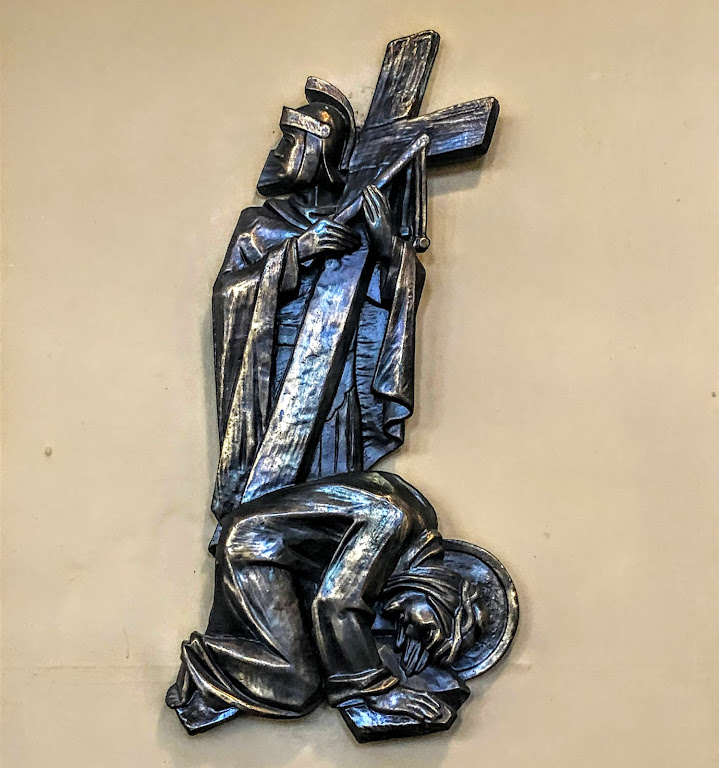
Jesus is made to carry his Cross … Station 2 in Stony Stratford (Photograph: Patrick Comerford)
Jesus falls the First Time … Station 3 in Stony Stratford (Photograph: Patrick Comerford)
Jesus meets his Sorrowful Mother … Station 4 in Stony Stratford (Photograph: Patrick Comerford)
Simon of Cyrene Helps Jesus carry his Cross … Station 5 in Stony Stratford (Photograph: Patrick Comerford)
Veronica wipes the Face of Jesus … Station 6 in Stony Stratford (Photograph: Patrick Comerford)
Jesus falls The Second Time … Station 7 in Stony Stratford (Photograph: Patrick Comerford)
The Women Of Jerusalem weep over Jesus … Station 8 in the Stations of the Cross in Stony Stratford (Photograph: Patrick Comerford)
Jesus falls The Third Time … Station 9 in Stony Stratford (Photograph: Patrick Comerford)
Jesus Is stripped of his garments … Station 10 in Stony Stratford (Photograph: Patrick Comerford)
Jesus Is nailed To The Cross … Station 11 in Stony Stratford (Photograph: Patrick Comerford)
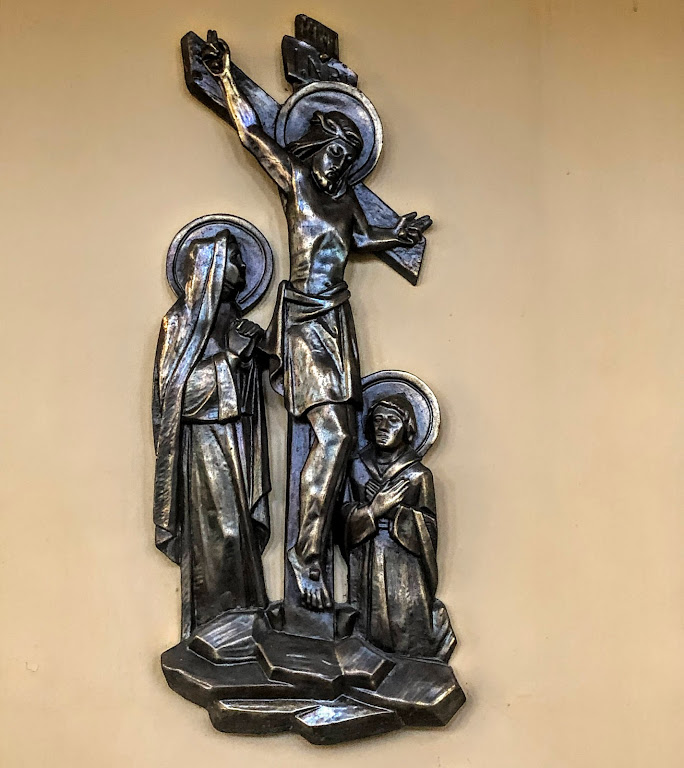
Jesus Is Raised Upon the Cross And Dies … Station 12 in Stony Stratford (Photograph: Patrick Comerford)
Jesus Is taken down from the Cross and placed In the arms of his Mother … Station 13 in Stony Stratford (Photograph: Patrick Comerford)
Jesus is laid In the Sepulchre … Station 14 in Stony Stratford (Photograph: Patrick Comerford)
Today’s Prayers (Friday 3 April 2026, Good Friday):
The theme this week (29 March-4 April 2026) in ‘Pray With the World Church’, the Prayer Diary of the Anglican mission agency USPG (United Society Partners in the Gospel), is a ‘Holy Week’ reflection’ (pp 42-43). This theme was introduced on Sunday with reflections by the Revd Kenson Li, Assistant Curate of Manchester Cathedral and a Trustee of USPG.
The USPG Prayer Diary today (Friday 4 April 2026, Good Friday) invites us to pray:
Jesus, Saviour of the world, who rested in the tomb and sanctified the grave as a bed of hope: help us to know the depth of our need for forgiveness, and the greater power of your everlasting love.
The Collect:
Almighty Father,
look with mercy on this your family
for which our Lord Jesus Christ was content to be betrayed
and given up into the hands of sinners
and to suffer death upon the cross;
who is alive and glorified with you and the Holy Spirit,
one God, now and for ever.
Additional Collect:
Eternal God,
in the cross of Jesus
we see the cost of our sin
and the depth of your love:
in humble hope and fear
may we place at his feet
all that we have and all that we are,
through Jesus Christ our Lord.
Yesterday’s Reflections
Continued Tomorrow
The processions arriving at the Church of the Four Martyrs in Rethymnon on Good Friday last year (Patrick Comerford)
Scripture quotations are from the New Revised Standard Version Bible: Anglicised Edition copyright © 1989, 1995 National Council of the Churches of Christ in the United States of America. Used by permission. All rights reserved worldwide. http://nrsvbibles.org
Patrick Comerford
We are at the climax of Holy Week, the last week in Lent. Today is Good Friday (3 April 2026), known as Great Friday in the Greek Orthodox Church.
We were in Oxford yesterday for the Chrism Eucharist in Christ Church and the renewal of ordination vows, and I was back in Stony Stratford last night for the Eucharist of the Last Supper and the Watch of the Passion in Saint Mary and Saint Giles Church. I hope to sing with the choir this afternoon when the Watch of the Passion continues (12 noon to 2 pm), followed by the Veneration of the Cross from 2 pm.
But, before this day begins, I am taking some quiet time this morning to give thanks, to reflect, to pray and to read in these ways:
1, reading today’s Gospel reading;
2, a short reflection;
3, a prayer from the USPG prayer diary;
4, the Collects of the day.
A Byzantine-style crucifix by Αλεξανδρα Καουκι, icon writer in Rethymnon, Crete
John 18: 1 to 19: 42 (NRSVA):
1 After Jesus had spoken these words, he went out with his disciples across the Kidron valley to a place where there was a garden, which he and his disciples entered. 2 Now Judas, who betrayed him, also knew the place, because Jesus often met there with his disciples. 3 So Judas brought a detachment of soldiers together with police from the chief priests and the Pharisees, and they came there with lanterns and torches and weapons. 4 Then Jesus, knowing all that was to happen to him, came forward and asked them, ‘For whom are you looking?’ 5 They answered, ‘Jesus of Nazareth.’ Jesus replied, ‘I am he.’ Judas, who betrayed him, was standing with them. 6 When Jesus said to them, ‘I am he’, they stepped back and fell to the ground. 7 Again he asked them, ‘For whom are you looking?’ And they said, ‘Jesus of Nazareth.’ 8 Jesus answered, ‘I told you that I am he. So if you are looking for me, let these men go.’ 9 This was to fulfil the word that he had spoken, ‘I did not lose a single one of those whom you gave me.’ 10 Then Simon Peter, who had a sword, drew it, struck the high priest’s slave, and cut off his right ear. The slave’s name was Malchus. 11 Jesus said to Peter, ‘Put your sword back into its sheath. Am I not to drink the cup that the Father has given me?’
12 So the soldiers, their officer, and the Jewish police arrested Jesus and bound him. 13 First they took him to Annas, who was the father-in-law of Caiaphas, the high priest that year. 14 Caiaphas was the one who had advised the Jews that it was better to have one person die for the people.
15 Simon Peter and another disciple followed Jesus. Since that disciple was known to the high priest, he went with Jesus into the courtyard of the high priest, 16 but Peter was standing outside at the gate. So the other disciple, who was known to the high priest, went out, spoke to the woman who guarded the gate, and brought Peter in. 17 The woman said to Peter, ‘You are not also one of this man’s disciples, are you?’ He said, ‘I am not.’ 18 Now the slaves and the police had made a charcoal fire because it was cold, and they were standing round it and warming themselves. Peter also was standing with them and warming himself.
19 Then the high priest questioned Jesus about his disciples and about his teaching. 20 Jesus answered, ‘I have spoken openly to the world; I have always taught in synagogues and in the temple, where all the Jews come together. I have said nothing in secret. 21 Why do you ask me? Ask those who heard what I said to them; they know what I said.’ 22 When he had said this, one of the police standing nearby struck Jesus on the face, saying, ‘Is that how you answer the high priest?’ 23 Jesus answered, ‘If I have spoken wrongly, testify to the wrong. But if I have spoken rightly, why do you strike me?’ 24 Then Annas sent him bound to Caiaphas the high priest.
25 Now Simon Peter was standing and warming himself. They asked him, ‘You are not also one of his disciples, are you?’ He denied it and said, ‘I am not.’ 26 One of the slaves of the high priest, a relative of the man whose ear Peter had cut off, asked, ‘Did I not see you in the garden with him?’ 27 Again Peter denied it, and at that moment the cock crowed.
28 Then they took Jesus from Caiaphas to Pilate’s headquarters. It was early in the morning. They themselves did not enter the headquarters, so as to avoid ritual defilement and to be able to eat the Passover. 29 So Pilate went out to them and said, ‘What accusation do you bring against this man?’ 30 They answered, ‘If this man were not a criminal, we would not have handed him over to you.’ 31 Pilate said to them, ‘Take him yourselves and judge him according to your law.’ The Jews replied, ‘We are not permitted to put anyone to death.’ 32 (This was to fulfil what Jesus had said when he indicated the kind of death he was to die.)
33 Then Pilate entered the headquarters again, summoned Jesus, and asked him, ‘Are you the King of the Jews?’ 34 Jesus answered, ‘Do you ask this on your own, or did others tell you about me?’ 35 Pilate replied, ‘I am not a Jew, am I? Your own nation and the chief priests have handed you over to me. What have you done?’ 36 Jesus answered, ‘My kingdom is not from this world. If my kingdom were from this world, my followers would be fighting to keep me from being handed over to the Jews. But as it is, my kingdom is not from here.’ 37 Pilate asked him, ‘So you are a king?’ Jesus answered, ‘You say that I am a king. For this I was born, and for this I came into the world, to testify to the truth. Everyone who belongs to the truth listens to my voice.’ 38 Pilate asked him, ‘What is truth?’
After he had said this, he went out to the Jews again and told them, ‘I find no case against him. 39 But you have a custom that I release someone for you at the Passover. Do you want me to release for you the King of the Jews?’ 40 They shouted in reply, ‘Not this man, but Barabbas!’ Now Barabbas was a bandit.
1 Then Pilate took Jesus and had him flogged. 2 And the soldiers wove a crown of thorns and put it on his head, and they dressed him in a purple robe. 3 They kept coming up to him, saying, ‘Hail, King of the Jews!’ and striking him on the face. 4 Pilate went out again and said to them, ‘Look, I am bringing him out to you to let you know that I find no case against him.’ 5 So Jesus came out, wearing the crown of thorns and the purple robe. Pilate said to them, ‘Here is the man!’ 6 When the chief priests and the police saw him, they shouted, ‘Crucify him! Crucify him!’ Pilate said to them, ‘Take him yourselves and crucify him; I find no case against him.’ 7 The Jews answered him, ‘We have a law, and according to that law he ought to die because he has claimed to be the Son of God.’
8 Now when Pilate heard this, he was more afraid than ever. 9 He entered his headquarters again and asked Jesus, ‘Where are you from?’ But Jesus gave him no answer. 10 Pilate therefore said to him, ‘Do you refuse to speak to me? Do you not know that I have power to release you, and power to crucify you?’ 11 Jesus answered him, ‘You would have no power over me unless it had been given you from above; therefore the one who handed me over to you is guilty of a greater sin.’ 12 From then on Pilate tried to release him, but the Jews cried out, ‘If you release this man, you are no friend of the emperor. Everyone who claims to be a king sets himself against the emperor.’
13 When Pilate heard these words, he brought Jesus outside and sat on the judge’s bench at a place called The Stone Pavement, or in Hebrew Gabbatha. 14 Now it was the day of Preparation for the Passover; and it was about noon. He said to the Jews, ‘Here is your King!’ 15 They cried out, ‘Away with him! Away with him! Crucify him!’ Pilate asked them, ‘Shall I crucify your King?’ The chief priests answered, ‘We have no king but the emperor.’ 16 Then he handed him over to them to be crucified.
So they took Jesus; 17 and carrying the cross by himself, he went out to what is called The Place of the Skull, which in Hebrew is called Golgotha. 18 There they crucified him, and with him two others, one on either side, with Jesus between them. 19 Pilate also had an inscription written and put on the cross. It read, ‘Jesus of Nazareth, the King of the Jews.’ 20 Many of the Jews read this inscription, because the place where Jesus was crucified was near the city; and it was written in Hebrew,[o] in Latin, and in Greek. 21 Then the chief priests of the Jews said to Pilate, ‘Do not write, “The King of the Jews”, but, “This man said, I am King of the Jews.”’ 22 Pilate answered, ‘What I have written I have written.’ 23 When the soldiers had crucified Jesus, they took his clothes and divided them into four parts, one for each soldier. They also took his tunic; now the tunic was seamless, woven in one piece from the top. 24 So they said to one another, ‘Let us not tear it, but cast lots for it to see who will get it.’ This was to fulfil what the scripture says,
‘They divided my clothes among themselves,
and for my clothing they cast lots.’
25 And that is what the soldiers did.
Meanwhile, standing near the cross of Jesus were his mother, and his mother’s sister, Mary the wife of Clopas, and Mary Magdalene. 26 When Jesus saw his mother and the disciple whom he loved standing beside her, he said to his mother, ‘Woman, here is your son.’ 27 Then he said to the disciple, ‘Here is your mother.’ And from that hour the disciple took her into his own home.
28 After this, when Jesus knew that all was now finished, he said (in order to fulfil the scripture), ‘I am thirsty.’ 29 A jar full of sour wine was standing there. So they put a sponge full of the wine on a branch of hyssop and held it to his mouth. 30 When Jesus had received the wine, he said, ‘It is finished.’ Then he bowed his head and gave up his spirit.
31 Since it was the day of Preparation, the Jews did not want the bodies left on the cross during the sabbath, especially because that sabbath was a day of great solemnity. So they asked Pilate to have the legs of the crucified men broken and the bodies removed. 32 Then the soldiers came and broke the legs of the first and of the other who had been crucified with him. 33 But when they came to Jesus and saw that he was already dead, they did not break his legs. 34 Instead, one of the soldiers pierced his side with a spear, and at once blood and water came out. 35 (He who saw this has testified so that you also may believe. His testimony is true, and he knows that he tells the truth.) 36 These things occurred so that the scripture might be fulfilled, ‘None of his bones shall be broken.’ 37 And again another passage of scripture says, ‘They will look on the one whom they have pierced.’
38 After these things, Joseph of Arimathea, who was a disciple of Jesus, though a secret one because of his fear of the Jews, asked Pilate to let him take away the body of Jesus. Pilate gave him permission; so he came and removed his body. 39 Nicodemus, who had at first come to Jesus by night, also came, bringing a mixture of myrrh and aloes, weighing about a hundred pounds. 40 They took the body of Jesus and wrapped it with the spices in linen cloths, according to the burial custom of the Jews. 41 Now there was a garden in the place where he was crucified, and in the garden there was a new tomb in which no one had ever been laid. 42 And so, because it was the Jewish day of Preparation, and the tomb was nearby, they laid Jesus there.
Venerating the Cross in Church of the Four Martyrs in Rethymnon at the beginning of the commemorations of Great and Good Friday (Photograph: Patrick Comerford)
Today’s Reflections:
Throughout this week, the Holy Week prayers and devotions in many churches have included the Stations of the Cross. The verse and response at each station is:
We adore you, O Christ, and we bless you,
Because by your holy cross
you have redeemed the world.
And then, following a meditation:
Lord Jesus crucified,
Have mercy on us!
The Stations of the Cross are not usually found in Greek Orthodox Churches, but the Good Friday processions through the streets of cities, towns and villages in Greece on the evening of Good Friday are unmatched in northern Europe. Because of the differences in calculating the date of Easter, Great and Good Friday is taking place in Greece next week. It is marked with the Veneration of the Cross, sombre tolling of church bells, and procession of the Epitaphios or bier of Christ through the streets.
This morning, my reflections on today’s Gospel reading (John 18: 1 to 19: 42) are assisted by images of the Stations of the Cross in Saint Mary and Saint Giles Church in Stony Stratford:
Jesus is condemned to Death … Station 1 in the Stations of the Cross in Saint Mary and Saint Giles Church in Stony Stratford (Photograph: Patrick Comerford)
Jesus is made to carry his Cross … Station 2 in Stony Stratford (Photograph: Patrick Comerford)
Jesus falls the First Time … Station 3 in Stony Stratford (Photograph: Patrick Comerford)
Jesus meets his Sorrowful Mother … Station 4 in Stony Stratford (Photograph: Patrick Comerford)
Simon of Cyrene Helps Jesus carry his Cross … Station 5 in Stony Stratford (Photograph: Patrick Comerford)
Veronica wipes the Face of Jesus … Station 6 in Stony Stratford (Photograph: Patrick Comerford)
Jesus falls The Second Time … Station 7 in Stony Stratford (Photograph: Patrick Comerford)
The Women Of Jerusalem weep over Jesus … Station 8 in the Stations of the Cross in Stony Stratford (Photograph: Patrick Comerford)
Jesus falls The Third Time … Station 9 in Stony Stratford (Photograph: Patrick Comerford)
Jesus Is stripped of his garments … Station 10 in Stony Stratford (Photograph: Patrick Comerford)
Jesus Is nailed To The Cross … Station 11 in Stony Stratford (Photograph: Patrick Comerford)
Jesus Is Raised Upon the Cross And Dies … Station 12 in Stony Stratford (Photograph: Patrick Comerford)
Jesus Is taken down from the Cross and placed In the arms of his Mother … Station 13 in Stony Stratford (Photograph: Patrick Comerford)
Jesus is laid In the Sepulchre … Station 14 in Stony Stratford (Photograph: Patrick Comerford)
Today’s Prayers (Friday 3 April 2026, Good Friday):
The theme this week (29 March-4 April 2026) in ‘Pray With the World Church’, the Prayer Diary of the Anglican mission agency USPG (United Society Partners in the Gospel), is a ‘Holy Week’ reflection’ (pp 42-43). This theme was introduced on Sunday with reflections by the Revd Kenson Li, Assistant Curate of Manchester Cathedral and a Trustee of USPG.
The USPG Prayer Diary today (Friday 4 April 2026, Good Friday) invites us to pray:
Jesus, Saviour of the world, who rested in the tomb and sanctified the grave as a bed of hope: help us to know the depth of our need for forgiveness, and the greater power of your everlasting love.
The Collect:
Almighty Father,
look with mercy on this your family
for which our Lord Jesus Christ was content to be betrayed
and given up into the hands of sinners
and to suffer death upon the cross;
who is alive and glorified with you and the Holy Spirit,
one God, now and for ever.
Additional Collect:
Eternal God,
in the cross of Jesus
we see the cost of our sin
and the depth of your love:
in humble hope and fear
may we place at his feet
all that we have and all that we are,
through Jesus Christ our Lord.
Yesterday’s Reflections
Continued Tomorrow
The processions arriving at the Church of the Four Martyrs in Rethymnon on Good Friday last year (Patrick Comerford)
Scripture quotations are from the New Revised Standard Version Bible: Anglicised Edition copyright © 1989, 1995 National Council of the Churches of Christ in the United States of America. Used by permission. All rights reserved worldwide. http://nrsvbibles.org
Labels:
Crete 2026,
Good Friday,
Greece 2026,
Holy Week,
Icons,
Lent 2026,
Mission,
Orthodoxy,
Oxford,
Prayer,
Rethymnon,
Saint John's Gospel,
Stations of the Cross,
Stony Stratford,
USPG
02 April 2026
Saint Peter’s Church on
Saffron Hill is at the heart
of ‘Little Italy’ and the oldest
Italian church in London
Looking out on Clerkenwell Road and Hatton Garden from the loggia and portico of Saint Peter’s Italian Church (Photograph: Patrick Comerford, 2026)
Patrick Comerford
When I was in Holborn and the Hatton Garden area recently for an event in Saint Alban’s Church, Holborn, organised by USPG and SPCK, I visited a number of churches in the area, including Saint Alban’s, Saint Etheldreda’s Church on Ely Place, the City Temple, and Saint Peter’s Church on Saffron Hill on Clerkenwell Road, facing the top end of Hatton Garden.
Saint Peter’s Italian Church has been described as one of the most beautiful churches in London and is the oldest church for Italians in London. It just within the boundaries of the London Borough of Camden, but it is the spiritual home of the Italian community in Clerkenwell (‘Little Italy’), with its hub in the Borough of Islington.
The church has a modest outer appearance and seems to be hemmed in between the neighbouring tall buildings, including an Italian restaurant to the left, and the Bryson Hotel to the right, so that only the later, narrow entrance front and loggia can be seen from the street. But inside the church has a large and splendid interior.
Saint Peter’s Italian Church has been described is the oldest church for Italians in London and is the spiritual heart of ‘Little Italy’ (Photograph: Patrick Comerford, 2026)
In the early 19th century, Saffron Hill was a poor neighbourhood with crowded and decadent streets, known for pickpockets and fences. By 1850, about 2,000 Italian immigrants were living there, many working as street musicians, artisans, framers, and makers of mirrors, barometers and scientific instruments. These Italians did not have their own church and so used in the Capella Reale Sarda in Lincoln’s Inn Fields.
Saint Vincent Pallotti (1795-1850), an Italian priest and founder of the Union of the Catholic Apostolate or Pallotine Fathers, decided in 1845 to build a church for Italian emigrants in London. After the restoration of the Catholic hierarchy in England, sensitivities about the ‘papal aggression’ were still high. Saint Vincent Pallotti was supported by the prominent Italian politician and activist Giuseppe Mazzini (1805-1872), who was living in exile in London at the time.
Inside Saint Peter’s Church, designed by the Dublin-born Irish architect Sir John Miller-Bryson and consecrated on 16 April 1863 (Photograph: Patrick Comerford, 2026)
The church was designed by the Dublin-born Irish architect Sir John Miller-Bryson (1822-1864), whose name is recalled in the Bryson Hotel to the right of the church. Bryson worked from plans drawn up by Francesco Gualandi of Bologna and modelled on the Basilica of San Crisogono in Trastevere in Rome. At first, the new church was to hold 3,400 people, but the original grand designs were never fully realised due to a shortage of funds.
In the course of work, as the church was built in 1862-1863, its size was greatly reduced. Yet, it was the largest Catholic church in Britain for the next 40 years and the only church the built in Britain in the style of a Roman basilica style.
The church was consecrated on 16 April 1863 as the Church of Saint Peter for All Nations, and was the first Italian church outside Italy. The architect Bryson died the following year (3 October 1864) and was buried in Brompton Cemetery.
The statues of Christ, Saint Bede and Saint George and the mosaics depicting scenes in the life of Saint Peter (Photograph: Patrick Comerford, 2026)
Saint Peter’s Church is 19 metre high church with a capacity for 2,000 people. The front section has a loggia and portico with twin arches. Above them are three niches: the central alcove has a statue of Christ, while the side alcoves have statues of Saint Bede and Saint George. Between the alcoves, two large mosaics depict two scenes in the life and ministry of Saint Peter: the first miraculous draught of fish (see Luke 5: 1-11), which results in Peter, James and John following Jesus; and Christ giving the keys of the Kingdom to Saint Peter (see Matthew 16: 19).
Above the façade, a 33-metre-high bell tower built in 1891 houses a bell known as the ‘Steel Monster’. The great bell was cast in 1862 by Naylor Vickers of Sheffield and was one of several bells exhibited at the International Exhibition that year. At the time, the only other large bell in London, apart from Big Ben in Westminster, was Great Tom in Saint Paul’s Cathedral.
The ‘Steel Monster’ remains one of the largest bells in England, though there are larger Roman Catholic bells at Downside, Ampleforth and in Liverpool Roman Catholic Cathedral.
The organ is part of the original organ built by the Belgian company Annaesens in 1886 and at the time it was considered one of the best in the country.
The organ is part of the original organ built by the Belgian company Annaesens in 1886 (Photograph: Patrick Comerford, 2026)
There are two wall memorials in the loggia: one, installed in 1927, remembers veterans, mostly Italian Britons of World War I; the other, installed in 1960, commemorates the 446 Italians who died on the SS Arandora Star in 1940.
Mussolini declared war on Britain on 10 June 1940, and after Churchill’s famous outburst, ‘Collar the lot!’, many Italians were interned. The SS Arandora Star sailed from Liverpool for Canada on 1 July 1940 with 712 Italian internees on board. The remaining passengers included 479 interned German men, among them a number of Jewish refugees, and 86 German prisoners of war – 1,216 detainees in total – and there was a crew of almost 400 British military guards and merchant sailors.
The SS Arandora Star was without escort and had no Red Cross insignia. On 2 July 1940, it was sunk by a German U-boat about 75 miles west of Bloody Foreland, Co Donegal, with great loss of life. One of the internees on board, the German Captain Otto Burfeind, went down with the ship having organised the lifeboat evacuation of British, German and Italian men alike. Over 800 people – British, Italian and German – were lost. It was the worst mass loss of life of any foreign-based Italian community.
During World War II, when many Italian immigrants were interned, the Irish Pallottine fathers took care of the church. During the war, Polish Catholics were permitted to worship and hold services in Polish in the church, as they had no other church. The church returned to the Italian Pallottines in 1953, and since then it has been substantially remodelled. Today it is a Grade II listed building.
Two memorials in the loggia recall the tragedies of World War I and World War II (Photograph: Patrick Comerford, 2026)
Little Italy’s core historical borders are usually placed at Clerkenwell Road, Farringdon Road and Rosebery Avenue, comprising the Saffron Hill part of Clerkenwell. The Clerkenwell area spans the London boroughs of Camden and Islington. Today, the Italian community in London is more dispersed, but the church remains a major venue for the community of Little Italy.
A highlight in the community calendar is the annual processione in mid-July. The annual procession began in the 1880s, and is believed to be the first of its kind in England since the Reformation. It remains a focal point of the calendar in Little Italy.
Sunday Masses in Saint Peter’s are at 7 pm on Saturdays, and 9:30 am, 11 am (Sung), 12: 30 and 7 pm. Masses on Holy Days are at 10 am, 12:15 pm and 7:30 pm. Weekday Masses are at 12:15 pm, Monday to Friday.
Saint Peter’s remains a major venue for the community of Little Italy (Photograph: Patrick Comerford, 2026)
Patrick Comerford
When I was in Holborn and the Hatton Garden area recently for an event in Saint Alban’s Church, Holborn, organised by USPG and SPCK, I visited a number of churches in the area, including Saint Alban’s, Saint Etheldreda’s Church on Ely Place, the City Temple, and Saint Peter’s Church on Saffron Hill on Clerkenwell Road, facing the top end of Hatton Garden.
Saint Peter’s Italian Church has been described as one of the most beautiful churches in London and is the oldest church for Italians in London. It just within the boundaries of the London Borough of Camden, but it is the spiritual home of the Italian community in Clerkenwell (‘Little Italy’), with its hub in the Borough of Islington.
The church has a modest outer appearance and seems to be hemmed in between the neighbouring tall buildings, including an Italian restaurant to the left, and the Bryson Hotel to the right, so that only the later, narrow entrance front and loggia can be seen from the street. But inside the church has a large and splendid interior.
Saint Peter’s Italian Church has been described is the oldest church for Italians in London and is the spiritual heart of ‘Little Italy’ (Photograph: Patrick Comerford, 2026)
In the early 19th century, Saffron Hill was a poor neighbourhood with crowded and decadent streets, known for pickpockets and fences. By 1850, about 2,000 Italian immigrants were living there, many working as street musicians, artisans, framers, and makers of mirrors, barometers and scientific instruments. These Italians did not have their own church and so used in the Capella Reale Sarda in Lincoln’s Inn Fields.
Saint Vincent Pallotti (1795-1850), an Italian priest and founder of the Union of the Catholic Apostolate or Pallotine Fathers, decided in 1845 to build a church for Italian emigrants in London. After the restoration of the Catholic hierarchy in England, sensitivities about the ‘papal aggression’ were still high. Saint Vincent Pallotti was supported by the prominent Italian politician and activist Giuseppe Mazzini (1805-1872), who was living in exile in London at the time.
Inside Saint Peter’s Church, designed by the Dublin-born Irish architect Sir John Miller-Bryson and consecrated on 16 April 1863 (Photograph: Patrick Comerford, 2026)
The church was designed by the Dublin-born Irish architect Sir John Miller-Bryson (1822-1864), whose name is recalled in the Bryson Hotel to the right of the church. Bryson worked from plans drawn up by Francesco Gualandi of Bologna and modelled on the Basilica of San Crisogono in Trastevere in Rome. At first, the new church was to hold 3,400 people, but the original grand designs were never fully realised due to a shortage of funds.
In the course of work, as the church was built in 1862-1863, its size was greatly reduced. Yet, it was the largest Catholic church in Britain for the next 40 years and the only church the built in Britain in the style of a Roman basilica style.
The church was consecrated on 16 April 1863 as the Church of Saint Peter for All Nations, and was the first Italian church outside Italy. The architect Bryson died the following year (3 October 1864) and was buried in Brompton Cemetery.
The statues of Christ, Saint Bede and Saint George and the mosaics depicting scenes in the life of Saint Peter (Photograph: Patrick Comerford, 2026)
Saint Peter’s Church is 19 metre high church with a capacity for 2,000 people. The front section has a loggia and portico with twin arches. Above them are three niches: the central alcove has a statue of Christ, while the side alcoves have statues of Saint Bede and Saint George. Between the alcoves, two large mosaics depict two scenes in the life and ministry of Saint Peter: the first miraculous draught of fish (see Luke 5: 1-11), which results in Peter, James and John following Jesus; and Christ giving the keys of the Kingdom to Saint Peter (see Matthew 16: 19).
Above the façade, a 33-metre-high bell tower built in 1891 houses a bell known as the ‘Steel Monster’. The great bell was cast in 1862 by Naylor Vickers of Sheffield and was one of several bells exhibited at the International Exhibition that year. At the time, the only other large bell in London, apart from Big Ben in Westminster, was Great Tom in Saint Paul’s Cathedral.
The ‘Steel Monster’ remains one of the largest bells in England, though there are larger Roman Catholic bells at Downside, Ampleforth and in Liverpool Roman Catholic Cathedral.
The organ is part of the original organ built by the Belgian company Annaesens in 1886 and at the time it was considered one of the best in the country.
The organ is part of the original organ built by the Belgian company Annaesens in 1886 (Photograph: Patrick Comerford, 2026)
There are two wall memorials in the loggia: one, installed in 1927, remembers veterans, mostly Italian Britons of World War I; the other, installed in 1960, commemorates the 446 Italians who died on the SS Arandora Star in 1940.
Mussolini declared war on Britain on 10 June 1940, and after Churchill’s famous outburst, ‘Collar the lot!’, many Italians were interned. The SS Arandora Star sailed from Liverpool for Canada on 1 July 1940 with 712 Italian internees on board. The remaining passengers included 479 interned German men, among them a number of Jewish refugees, and 86 German prisoners of war – 1,216 detainees in total – and there was a crew of almost 400 British military guards and merchant sailors.
The SS Arandora Star was without escort and had no Red Cross insignia. On 2 July 1940, it was sunk by a German U-boat about 75 miles west of Bloody Foreland, Co Donegal, with great loss of life. One of the internees on board, the German Captain Otto Burfeind, went down with the ship having organised the lifeboat evacuation of British, German and Italian men alike. Over 800 people – British, Italian and German – were lost. It was the worst mass loss of life of any foreign-based Italian community.
During World War II, when many Italian immigrants were interned, the Irish Pallottine fathers took care of the church. During the war, Polish Catholics were permitted to worship and hold services in Polish in the church, as they had no other church. The church returned to the Italian Pallottines in 1953, and since then it has been substantially remodelled. Today it is a Grade II listed building.
Two memorials in the loggia recall the tragedies of World War I and World War II (Photograph: Patrick Comerford, 2026)
Little Italy’s core historical borders are usually placed at Clerkenwell Road, Farringdon Road and Rosebery Avenue, comprising the Saffron Hill part of Clerkenwell. The Clerkenwell area spans the London boroughs of Camden and Islington. Today, the Italian community in London is more dispersed, but the church remains a major venue for the community of Little Italy.
A highlight in the community calendar is the annual processione in mid-July. The annual procession began in the 1880s, and is believed to be the first of its kind in England since the Reformation. It remains a focal point of the calendar in Little Italy.
Sunday Masses in Saint Peter’s are at 7 pm on Saturdays, and 9:30 am, 11 am (Sung), 12: 30 and 7 pm. Masses on Holy Days are at 10 am, 12:15 pm and 7:30 pm. Weekday Masses are at 12:15 pm, Monday to Friday.
Saint Peter’s remains a major venue for the community of Little Italy (Photograph: Patrick Comerford, 2026)
Daily prayer in Lent 2026:
44, Thursday 2 April 2026,
Maundy Thursday
An icon depicting the Last Supper or Mystical Supper seen in a shop on Ethnikis Antistaseos street in Rethymnon in Crete (Photograph: Patrick Comerford)
Patrick Comerford
We are reaching the climax of Holy Week, the last week in Lent. Today is Maundy Thursday (2 April 2026), and we preparing for Good Friday tomorrow and Easter Day.
Later this morning, I hope to be present at the Chrism Eucharist in Christ Church, Oxford, when the bishops, priest and deacons in the diocese opportunity to renew our ordination vows. I missed this moving service last year, when I spent much of Holy Week and Easter in Rethymnon in Crete.
Later this evening, I hope to take part in the Maundy Eucharist at 7 pm in Saint Mary and Saint Giles Church, Stony Stratford, followed by the Watch of the Passion from 8 to 9 pm. The music this evening includes Byrd’s Ave Verum and Vidi Aquam. But, before this day begins, before we catch the bus to Oxford, I am taking some quiet time this morning to give thanks, to reflect, to pray and to read in these ways:
1, reading today’s Gospel reading;
2, a short reflection;
3, a prayer from the USPG prayer diary;
4, the Collects and Post-Communion prayer of the day.
An icon depicting the Last Supper or Mystical Supper seen in Rethymnon in Crete (Photograph: Patrick Comerford)
John 13: 1-17, 31b-35 (NRSVA):
1 Now before the festival of the Passover, Jesus knew that his hour had come to depart from this world and go to the Father. Having loved his own who were in the world, he loved them to the end. 2 The devil had already put it into the heart of Judas son of Simon Iscariot to betray him. And during supper 3 Jesus, knowing that the Father had given all things into his hands, and that he had come from God and was going to God, 4 got up from the table, took off his outer robe, and tied a towel around himself. 5 Then he poured water into a basin and began to wash the disciples’ feet and to wipe them with the towel that was tied around him. 6 He came to Simon Peter, who said to him, ‘Lord, are you going to wash my feet?’ 7 Jesus answered, ‘You do not know now what I am doing, but later you will understand.’ 8 Peter said to him, ‘You will never wash my feet.’ Jesus answered, ‘Unless I wash you, you have no share with me.’ 9 Simon Peter said to him, ‘Lord, not my feet only but also my hands and my head!’ 10 Jesus said to him, ‘One who has bathed does not need to wash, except for the feet, but is entirely clean. And you are clean, though not all of you.’ 11 For he knew who was to betray him; for this reason he said, ‘Not all of you are clean.’
12 After he had washed their feet, had put on his robe, and had returned to the table, he said to them, ‘Do you know what I have done to you? 13 You call me Teacher and Lord—and you are right, for that is what I am. 14 So if I, your Lord and Teacher, have washed your feet, you also ought to wash one another’s feet. 15 For I have set you an example, that you also should do as I have done to you. 16 Very truly, I tell you, servants[d] are not greater than their master, nor are messengers greater than the one who sent them. 17 If you know these things, you are blessed if you do them.
31b ‘Now the Son of Man has been glorified, and God has been glorified in him. 32 If God has been glorified in him, God will also glorify him in himself and will glorify him at once. 33 Little children, I am with you only a little longer. You will look for me; and as I said to the Jews so now I say to you, “Where I am going, you cannot come.” 34 I give you a new commandment, that you love one another. Just as I have loved you, you also should love one another. 35 By this everyone will know that you are my disciples, if you have love for one another.’
The Last Supper depicted in a window in Saint Mary’s Church, Watford (Photograph: Patrick Comerford)
Today’s Reflections:
During Holy Week, we have a series of readings from Saint John’s Gospel, in which Jesus has a very different set of encounters or exchanges each evening.
This evening, the Water for Washing the Disciples feet continues a theme we find throughout Saint John’s Gospel:
• The waters of the River Jordan, at the Baptism of Christ (see John 1: 19-34);
• The water that is turned into wine at the wedding in Cana (John 2: 1-11);
• The Water of Life that the Samaritan Woman asks for at Jacob’s well in Sychar (John 4: 5-42);
• The water of the pool in Jerusalem where the paralysed man is healed after 38 years (John 5: 1-18);
• The water of the Sea of Galilee by which the 5,000 are fed (John 6: 1-14);
• The water by Capernaum where Jesus calms the storm (John 6: 16-21);
• The Rivers of Living Water (John 7: 37-39);
• The healing waters of the Pool of Siloam (John 9: 1-12);
• The water Christ cries out for on the Cross when he says: ‘I am thirsty’ (John 19: 28);
• The water that mingles with the blood from Christ’s side when it is pierced after his death (John 19: 32-35);
• The waters of the Sea of Tiberias, where the Risen Christ appears for a third time, after daybreak, and from which the disciples haul in 153 fish (John 21: 1-14).
Why then, in Saint John’s Gospel, does Pilate not wash his hands when he denies all responsibility on his part for the events that are to unfold that Good Friday (see John 18: 38)?
The Russian writer Mikhail Bulgakov (1891-1940) is best known for his posthumous novel The Master and Margarita, a masterpiece of the 20th century. Here Bulgakov portrays Pilate as a man who is ruthless, yet complex in his humanity. When Pilate meets Christ, he is reluctant but resigned and passively hands him over to those who wanted to kill him.
In this novel, Pilate exemplifies the statement ‘Cowardice is the worst of vices,’ and so he serves as a model of all the people who have washed their hands by silently or actively taking part in the Stalin’s crimes.
The actor Richard Boone plays a calm and stern, though, slightly guilt-ridden Pilate in the 1953 film The Robe (1953). There is an interesting touch when Pilate asks again for water to wash his hands, forgetting he has already washed those hands at the conclusion of the trial of Jesus.
When do we forget that we are complicit in the sufferings of others, and when do we deny we are complicit in the sufferings of others?
As Christ washes the feet of his disciples this evening, he calls us out from our complacency and our cosy forgetfulness, and challenges us once again to renew the promises made in the waters of our Baptism, to come again with forgiveness to living and healing waters, to dine and drink with him at the banquet, to have him calm the waters in the storms in our lives, to accept the miracle, to be cleansed by the waters from his side, to walk with him afresh and to join the Disciples in the new promises of the Resurrection.
Christ washes the feet of the Disciples … a fresco on a pillar in a church in Thessaloniki (Photograph: Patrick Comerford)
Today’s Prayers (Thursday 2 April 2026, Maundy Thursday):
The theme this week (29 March-4 April 2026) in ‘Pray With the World Church’, the Prayer Diary of the Anglican mission agency USPG (United Society Partners in the Gospel), is a ‘Holy Week’ reflection’ (pp 42-43). This theme was introduced on Sunday with reflections by the Revd Kenson Li, Assistant Curate of Manchester Cathedral and a Trustee of USPG.
The USPG Prayer Diary today (Thursday 2 April 2026, Maundy Thursday) invites us to pray:
My Lord and my God, who for love of the world gave us the eucharistic mystery, teach us to see you in broken bread and outpoured wine, and so to recognise you in the faces of those neglected by society.
The Collect:
God our Father,
you have invited us to share in the supper
which your Son gave to his Church
to proclaim his death until he comes:
may he nourish us by his presence,
and unite us in his love;
who is alive and reigns with you,
in the unity of the Holy Spirit,
one God, now and for ever.
The Post-Communion Prayer:
Lord Jesus Christ,
we thank you that in this wonderful sacrament
you have given us the memorial of your passion:
grant us so to reverence the sacred mysteries
of your body and blood
that we may know within ourselves
and show forth in our lives
the fruit of your redemption,
for you are alive and reign, now and for ever.
Additional Collect:
God our Father,
your Son Jesus Christ was obedient to the end
and drank the cup prepared for him:
may we who share his table
watch with him through the night of suffering
and be faithful.
Yesterday’s Reflections
Continued Tomorrow
Inside Christ Church Cathedral, Oxford, the venue for today’s Maundy Thursday Chrism Eucharist (Photograph: Patrick Comerford)
Scripture quotations are from the New Revised Standard Version Bible: Anglicised Edition copyright © 1989, 1995 National Council of the Churches of Christ in the United States of America. Used by permission. All rights reserved worldwide. http://nrsvbibles.org
Patrick Comerford
We are reaching the climax of Holy Week, the last week in Lent. Today is Maundy Thursday (2 April 2026), and we preparing for Good Friday tomorrow and Easter Day.
Later this morning, I hope to be present at the Chrism Eucharist in Christ Church, Oxford, when the bishops, priest and deacons in the diocese opportunity to renew our ordination vows. I missed this moving service last year, when I spent much of Holy Week and Easter in Rethymnon in Crete.
Later this evening, I hope to take part in the Maundy Eucharist at 7 pm in Saint Mary and Saint Giles Church, Stony Stratford, followed by the Watch of the Passion from 8 to 9 pm. The music this evening includes Byrd’s Ave Verum and Vidi Aquam. But, before this day begins, before we catch the bus to Oxford, I am taking some quiet time this morning to give thanks, to reflect, to pray and to read in these ways:
1, reading today’s Gospel reading;
2, a short reflection;
3, a prayer from the USPG prayer diary;
4, the Collects and Post-Communion prayer of the day.
An icon depicting the Last Supper or Mystical Supper seen in Rethymnon in Crete (Photograph: Patrick Comerford)
John 13: 1-17, 31b-35 (NRSVA):
1 Now before the festival of the Passover, Jesus knew that his hour had come to depart from this world and go to the Father. Having loved his own who were in the world, he loved them to the end. 2 The devil had already put it into the heart of Judas son of Simon Iscariot to betray him. And during supper 3 Jesus, knowing that the Father had given all things into his hands, and that he had come from God and was going to God, 4 got up from the table, took off his outer robe, and tied a towel around himself. 5 Then he poured water into a basin and began to wash the disciples’ feet and to wipe them with the towel that was tied around him. 6 He came to Simon Peter, who said to him, ‘Lord, are you going to wash my feet?’ 7 Jesus answered, ‘You do not know now what I am doing, but later you will understand.’ 8 Peter said to him, ‘You will never wash my feet.’ Jesus answered, ‘Unless I wash you, you have no share with me.’ 9 Simon Peter said to him, ‘Lord, not my feet only but also my hands and my head!’ 10 Jesus said to him, ‘One who has bathed does not need to wash, except for the feet, but is entirely clean. And you are clean, though not all of you.’ 11 For he knew who was to betray him; for this reason he said, ‘Not all of you are clean.’
12 After he had washed their feet, had put on his robe, and had returned to the table, he said to them, ‘Do you know what I have done to you? 13 You call me Teacher and Lord—and you are right, for that is what I am. 14 So if I, your Lord and Teacher, have washed your feet, you also ought to wash one another’s feet. 15 For I have set you an example, that you also should do as I have done to you. 16 Very truly, I tell you, servants[d] are not greater than their master, nor are messengers greater than the one who sent them. 17 If you know these things, you are blessed if you do them.
31b ‘Now the Son of Man has been glorified, and God has been glorified in him. 32 If God has been glorified in him, God will also glorify him in himself and will glorify him at once. 33 Little children, I am with you only a little longer. You will look for me; and as I said to the Jews so now I say to you, “Where I am going, you cannot come.” 34 I give you a new commandment, that you love one another. Just as I have loved you, you also should love one another. 35 By this everyone will know that you are my disciples, if you have love for one another.’
The Last Supper depicted in a window in Saint Mary’s Church, Watford (Photograph: Patrick Comerford)
Today’s Reflections:
During Holy Week, we have a series of readings from Saint John’s Gospel, in which Jesus has a very different set of encounters or exchanges each evening.
This evening, the Water for Washing the Disciples feet continues a theme we find throughout Saint John’s Gospel:
• The waters of the River Jordan, at the Baptism of Christ (see John 1: 19-34);
• The water that is turned into wine at the wedding in Cana (John 2: 1-11);
• The Water of Life that the Samaritan Woman asks for at Jacob’s well in Sychar (John 4: 5-42);
• The water of the pool in Jerusalem where the paralysed man is healed after 38 years (John 5: 1-18);
• The water of the Sea of Galilee by which the 5,000 are fed (John 6: 1-14);
• The water by Capernaum where Jesus calms the storm (John 6: 16-21);
• The Rivers of Living Water (John 7: 37-39);
• The healing waters of the Pool of Siloam (John 9: 1-12);
• The water Christ cries out for on the Cross when he says: ‘I am thirsty’ (John 19: 28);
• The water that mingles with the blood from Christ’s side when it is pierced after his death (John 19: 32-35);
• The waters of the Sea of Tiberias, where the Risen Christ appears for a third time, after daybreak, and from which the disciples haul in 153 fish (John 21: 1-14).
Why then, in Saint John’s Gospel, does Pilate not wash his hands when he denies all responsibility on his part for the events that are to unfold that Good Friday (see John 18: 38)?
The Russian writer Mikhail Bulgakov (1891-1940) is best known for his posthumous novel The Master and Margarita, a masterpiece of the 20th century. Here Bulgakov portrays Pilate as a man who is ruthless, yet complex in his humanity. When Pilate meets Christ, he is reluctant but resigned and passively hands him over to those who wanted to kill him.
In this novel, Pilate exemplifies the statement ‘Cowardice is the worst of vices,’ and so he serves as a model of all the people who have washed their hands by silently or actively taking part in the Stalin’s crimes.
The actor Richard Boone plays a calm and stern, though, slightly guilt-ridden Pilate in the 1953 film The Robe (1953). There is an interesting touch when Pilate asks again for water to wash his hands, forgetting he has already washed those hands at the conclusion of the trial of Jesus.
When do we forget that we are complicit in the sufferings of others, and when do we deny we are complicit in the sufferings of others?
As Christ washes the feet of his disciples this evening, he calls us out from our complacency and our cosy forgetfulness, and challenges us once again to renew the promises made in the waters of our Baptism, to come again with forgiveness to living and healing waters, to dine and drink with him at the banquet, to have him calm the waters in the storms in our lives, to accept the miracle, to be cleansed by the waters from his side, to walk with him afresh and to join the Disciples in the new promises of the Resurrection.
Christ washes the feet of the Disciples … a fresco on a pillar in a church in Thessaloniki (Photograph: Patrick Comerford)
Today’s Prayers (Thursday 2 April 2026, Maundy Thursday):
The theme this week (29 March-4 April 2026) in ‘Pray With the World Church’, the Prayer Diary of the Anglican mission agency USPG (United Society Partners in the Gospel), is a ‘Holy Week’ reflection’ (pp 42-43). This theme was introduced on Sunday with reflections by the Revd Kenson Li, Assistant Curate of Manchester Cathedral and a Trustee of USPG.
The USPG Prayer Diary today (Thursday 2 April 2026, Maundy Thursday) invites us to pray:
My Lord and my God, who for love of the world gave us the eucharistic mystery, teach us to see you in broken bread and outpoured wine, and so to recognise you in the faces of those neglected by society.
The Collect:
God our Father,
you have invited us to share in the supper
which your Son gave to his Church
to proclaim his death until he comes:
may he nourish us by his presence,
and unite us in his love;
who is alive and reigns with you,
in the unity of the Holy Spirit,
one God, now and for ever.
The Post-Communion Prayer:
Lord Jesus Christ,
we thank you that in this wonderful sacrament
you have given us the memorial of your passion:
grant us so to reverence the sacred mysteries
of your body and blood
that we may know within ourselves
and show forth in our lives
the fruit of your redemption,
for you are alive and reign, now and for ever.
Additional Collect:
God our Father,
your Son Jesus Christ was obedient to the end
and drank the cup prepared for him:
may we who share his table
watch with him through the night of suffering
and be faithful.
Yesterday’s Reflections
Continued Tomorrow
Inside Christ Church Cathedral, Oxford, the venue for today’s Maundy Thursday Chrism Eucharist (Photograph: Patrick Comerford)
Scripture quotations are from the New Revised Standard Version Bible: Anglicised Edition copyright © 1989, 1995 National Council of the Churches of Christ in the United States of America. Used by permission. All rights reserved worldwide. http://nrsvbibles.org
01 April 2026
The City Temple, a church
on Holborn Viaduct
with a reputation for
having radical preachers
The City Temple on Holborn Viaduct, which has sometimes been described as ‘the nonconformist cathedral’ in London (Photograph: Patrick Comerford, 2026)
Patrick Comerford
While I was visiting a number of churches in the Holborn area of London recently, including Saint Alban’s Church, Holborn, where I was attending an event hosted by both USPG and SPCK, and Saint Etheldreda’s Church on Ely Place, I stopped for a while also at the City Temple on Holborn Viaduct, which has sometimes been described as ‘the nonconformist cathedral’ in London.
The City Temple, beside Saint Andrew Holborn, should not be confused with the Temple Church, between Fleet Street and the Embankment, a mediaeval church known to many only because it features in both The Da Vinci Code by Dan Brown and the film based on the book.
The church in Holborn is part of the United Reformed Church and one of the oldest Congregational churches in London, with connections with the early Puritans of the mid 16th century. It is famous for its notable preachers, pastors and theologians, especially the Revd Leslie Weatherhead, who led the church from 1936 to 1960, but also Thomas Goodwin, chaplain to Oliver Cromwell, and Joseph Parker, one of the great Victorian preachers.
The City Temple traces its story back to the Puritans and Calvinists of the 1560s (Photograph: Patrick Comerford, 2026)
The first church building on the present site in Holborn was built in 1874, but the congregation was founded much earlier. The traditional date is 1640, when the church possibly started as a nonconformist, congregational church. But evidence suggests it was founded as early as the 1560s by Puritans and Calvinists who refused to conform to the Church of England, to use with the Book of Common Prayer and wanted freedom in their approach to worship.
Throughout its history, the congregation has worshipped in many buildings in London. Since 1874, it has met in its building on Holborn Viaduct, and for long claimed to be the only historic English Free Church in the City of London worshipping in its own building every Sunday.
The City Temple is widely believed to have been founded by Cromwell’s chaplain Thomas Goodwin around 1640. It is the oldest Nonconformist congregation in the City of London, and its first meeting house was on Anchor Lane.
The second minister was Thomas Harrison, who succeeded Goodwin in 1650, when the congregation moved to a meeting house in Lime Street. Harrison remained only until 1655 and a successor was not appointed until 1658, when Thomas Mallory became the pastor. Mallory led the congregation through a difficult period after the restoration of the monarchy in 1660.
The congregation moved several times until it found a more permanent home in the Poultry, Cheapside, in 1819.
When James Spence resigned as the pastor in 1867, the Poultry Chapel offered the position of pastor to Joseph Parker of Cavendish Street Chapel, Manchester, but he did not accept until 1869.
At the same time the congregation was planning to move from its site in Poultry, sold its site for £50,000, and the Poultry Chapel was closed on 16 June 1872. Parker insisted on finding a new site within the City of London and a new site was bought on Holborn Viaduct. Until the new church was ready, the congregation met in Cannon Street Hotel in the morning, in Exeter Hall in the evening, and in the Presbyterian Church, London Wall, for mid-day services on Thursdays.
The City Temple was designed by the architects Henry Francis Lockwood and William Mawson (Photograph: Patrick Comerford, 2026)
The new church was designed by the Bradford architects Lockwood and Mason with an elegant, classical stone-clad façade onto Holborn Viaduct, with a prominent copper cupola-clad tower, providing a glowing beacon in the local community. The Doncaster-born architect Henry Francis Lockwood (1811-1878) and the Leeds-born architect William Mawson (1828-1889) also designed some of the most distinguished buildings in Bradford, including Saint George’s Hall (1851-1852), the Venetian Gothic Wool Exchange (1864-1867), and the Continental Gothic Revival City Hall (1869-1873). They also laid out and designed the mill, model town and church at Saltaire (1851-1876), all in an Italianate Classical style. At the time, Saltaire was one of the most important examples of a philanthropic industrial and housing development in the world.
The memorial stone of the new church, to be called the City Temple, was laid by Thomas Binney (1798-1874), popularly known as the ‘Archbishop of Nonconformity’, on 19 May 1873. The Corporation of the City of London presented a marble pulpit, and the new building was dedicated on 19 May 1874. Because of its location and size, the City Temple soon came to be seen as the nonconformist cathedral, and it became the most important Congregational pulpit in Britain, mainly due to Joseph Parker’s reputation.
As Parker grew older and his health declined, the Revd Reginald John Campbell (1867-1956), a Congregational minister in Brighton, was called as his assistant in 1902. But Parker died suddenly and Campbell became his successor from 1903 to 1915.
Parker had been theologically conservative, but Campbell was a socialist politically and a supporter of the Independent Labour Party, and his theology was as radical as his politics. He introduced Biblical criticism in his preaching, and questioned the traditional authorship of books and the origins of the text.
The theology of Campbell and his friends came to be known as the ‘New Theology’ and he answered his critics in a volume called The New Theology. But Campbell came to a crisis of faith when several New Theologians began to question the deity and even the historicity of Christ.
Campbell preached his last sermon in the City Temple in October 1915 and then resigned from the Congregational Church. A few days later, he was received into the Church of England by Bishop Charles Gore in Cuddesdon, and in October 1916 he was ordained as an Anglican priest. On joining the Church of England, he wrote an account of the development of his thinking in A Spiritual Pilgrimage (1916). He was the Canon Chancellor of Chichester Cathedral when he retired in 1946 at the age of 80. His funeral was conducted by Bishop George Bell.
Campbell’s successor at the City Temple, the Revd Dr Joseph Fort Newton (1880-1950), was an American who was almost as radical theologically. He was educated at the Southern Baptist Seminary, Louisville, and Harvard, and was a theological liberal. He had been asked to the City Temple at first as a temporary appointment after Campbell's resignation, but he was opposed by the deacons and the internal divisions that ensued led to the deacons being dismissed.
Newton asked for an assistant, and the assistant finally called was Maude Royden (1876-1956), an Anglican and radical pacifist. As a woman, she had been prohibited from preaching by the Church of England.
After World War I, Newton returned to the US in 1919 and in 1926 he was ordained a deacon and priest in the Episcopal Church. He was succeeded at the City Temple by FW Norwood, an Australian Baptist who remained until 1935.
Tthe Revd Leslie Weatherhead rebuilt the City Temple after World War II (Photograph: Patrick Comerford, 2026)
When Norwood left the City Temple, there were demands within the congregation for the appointment of a Congregationalist as pastor. In the event, however, the Revd Leslie Weatherhead (1893-1976), a Methodist minister then in Leeds, was appointed in 1936.
Weatherhead was a member of Frank Buchman’s Oxford Group from 1930 to 1939, and wrote several books reflecting the group’s values, including Discipleship and The Will of God. He was often seen as the ‘head’ of the Oxford Group in London.
The City Temple was destroyed by fire caused by German incendiary bombs during the Blitz. Weatherhead was able to continue his ministry thanks to the hospitality of a nearby Anglican church, Saint Sepulchre-without-Newgate.
Weatherhead raised the funds to rebuild the City Temple, which was redesigned by by Seely and Paget and reopened in 1958. The completed design included a new copper and sandstone clad concrete and steel-framed form, book-ended by the original surviving front and rear of the church. The City Temple has been a listed Grade II building since 1977.
Meanwhile, Despite opposition, Weatherhead was elected President of the Methodist Conference in 1955-1956. He retired in 1960 and died in 1976.
The present minister, the Revd Dr Rodney D Woods, was appointed in 2001.
The City Temple is currently completing work on a major redevelopment programme, and I was unable to visit the building, which is covered in hoarding and cladding as the work continues. Sunday services are currently taking place in the Chelsea Community Church on Edith Grove.
The City Temple is currently completing work on a major redevelopment programme (Photograph: Patrick Comerford, 2026)
Patrick Comerford
While I was visiting a number of churches in the Holborn area of London recently, including Saint Alban’s Church, Holborn, where I was attending an event hosted by both USPG and SPCK, and Saint Etheldreda’s Church on Ely Place, I stopped for a while also at the City Temple on Holborn Viaduct, which has sometimes been described as ‘the nonconformist cathedral’ in London.
The City Temple, beside Saint Andrew Holborn, should not be confused with the Temple Church, between Fleet Street and the Embankment, a mediaeval church known to many only because it features in both The Da Vinci Code by Dan Brown and the film based on the book.
The church in Holborn is part of the United Reformed Church and one of the oldest Congregational churches in London, with connections with the early Puritans of the mid 16th century. It is famous for its notable preachers, pastors and theologians, especially the Revd Leslie Weatherhead, who led the church from 1936 to 1960, but also Thomas Goodwin, chaplain to Oliver Cromwell, and Joseph Parker, one of the great Victorian preachers.
The City Temple traces its story back to the Puritans and Calvinists of the 1560s (Photograph: Patrick Comerford, 2026)
The first church building on the present site in Holborn was built in 1874, but the congregation was founded much earlier. The traditional date is 1640, when the church possibly started as a nonconformist, congregational church. But evidence suggests it was founded as early as the 1560s by Puritans and Calvinists who refused to conform to the Church of England, to use with the Book of Common Prayer and wanted freedom in their approach to worship.
Throughout its history, the congregation has worshipped in many buildings in London. Since 1874, it has met in its building on Holborn Viaduct, and for long claimed to be the only historic English Free Church in the City of London worshipping in its own building every Sunday.
The City Temple is widely believed to have been founded by Cromwell’s chaplain Thomas Goodwin around 1640. It is the oldest Nonconformist congregation in the City of London, and its first meeting house was on Anchor Lane.
The second minister was Thomas Harrison, who succeeded Goodwin in 1650, when the congregation moved to a meeting house in Lime Street. Harrison remained only until 1655 and a successor was not appointed until 1658, when Thomas Mallory became the pastor. Mallory led the congregation through a difficult period after the restoration of the monarchy in 1660.
The congregation moved several times until it found a more permanent home in the Poultry, Cheapside, in 1819.
When James Spence resigned as the pastor in 1867, the Poultry Chapel offered the position of pastor to Joseph Parker of Cavendish Street Chapel, Manchester, but he did not accept until 1869.
At the same time the congregation was planning to move from its site in Poultry, sold its site for £50,000, and the Poultry Chapel was closed on 16 June 1872. Parker insisted on finding a new site within the City of London and a new site was bought on Holborn Viaduct. Until the new church was ready, the congregation met in Cannon Street Hotel in the morning, in Exeter Hall in the evening, and in the Presbyterian Church, London Wall, for mid-day services on Thursdays.
The City Temple was designed by the architects Henry Francis Lockwood and William Mawson (Photograph: Patrick Comerford, 2026)
The new church was designed by the Bradford architects Lockwood and Mason with an elegant, classical stone-clad façade onto Holborn Viaduct, with a prominent copper cupola-clad tower, providing a glowing beacon in the local community. The Doncaster-born architect Henry Francis Lockwood (1811-1878) and the Leeds-born architect William Mawson (1828-1889) also designed some of the most distinguished buildings in Bradford, including Saint George’s Hall (1851-1852), the Venetian Gothic Wool Exchange (1864-1867), and the Continental Gothic Revival City Hall (1869-1873). They also laid out and designed the mill, model town and church at Saltaire (1851-1876), all in an Italianate Classical style. At the time, Saltaire was one of the most important examples of a philanthropic industrial and housing development in the world.
The memorial stone of the new church, to be called the City Temple, was laid by Thomas Binney (1798-1874), popularly known as the ‘Archbishop of Nonconformity’, on 19 May 1873. The Corporation of the City of London presented a marble pulpit, and the new building was dedicated on 19 May 1874. Because of its location and size, the City Temple soon came to be seen as the nonconformist cathedral, and it became the most important Congregational pulpit in Britain, mainly due to Joseph Parker’s reputation.
As Parker grew older and his health declined, the Revd Reginald John Campbell (1867-1956), a Congregational minister in Brighton, was called as his assistant in 1902. But Parker died suddenly and Campbell became his successor from 1903 to 1915.
Parker had been theologically conservative, but Campbell was a socialist politically and a supporter of the Independent Labour Party, and his theology was as radical as his politics. He introduced Biblical criticism in his preaching, and questioned the traditional authorship of books and the origins of the text.
The theology of Campbell and his friends came to be known as the ‘New Theology’ and he answered his critics in a volume called The New Theology. But Campbell came to a crisis of faith when several New Theologians began to question the deity and even the historicity of Christ.
Campbell preached his last sermon in the City Temple in October 1915 and then resigned from the Congregational Church. A few days later, he was received into the Church of England by Bishop Charles Gore in Cuddesdon, and in October 1916 he was ordained as an Anglican priest. On joining the Church of England, he wrote an account of the development of his thinking in A Spiritual Pilgrimage (1916). He was the Canon Chancellor of Chichester Cathedral when he retired in 1946 at the age of 80. His funeral was conducted by Bishop George Bell.
Campbell’s successor at the City Temple, the Revd Dr Joseph Fort Newton (1880-1950), was an American who was almost as radical theologically. He was educated at the Southern Baptist Seminary, Louisville, and Harvard, and was a theological liberal. He had been asked to the City Temple at first as a temporary appointment after Campbell's resignation, but he was opposed by the deacons and the internal divisions that ensued led to the deacons being dismissed.
Newton asked for an assistant, and the assistant finally called was Maude Royden (1876-1956), an Anglican and radical pacifist. As a woman, she had been prohibited from preaching by the Church of England.
After World War I, Newton returned to the US in 1919 and in 1926 he was ordained a deacon and priest in the Episcopal Church. He was succeeded at the City Temple by FW Norwood, an Australian Baptist who remained until 1935.
Tthe Revd Leslie Weatherhead rebuilt the City Temple after World War II (Photograph: Patrick Comerford, 2026)
When Norwood left the City Temple, there were demands within the congregation for the appointment of a Congregationalist as pastor. In the event, however, the Revd Leslie Weatherhead (1893-1976), a Methodist minister then in Leeds, was appointed in 1936.
Weatherhead was a member of Frank Buchman’s Oxford Group from 1930 to 1939, and wrote several books reflecting the group’s values, including Discipleship and The Will of God. He was often seen as the ‘head’ of the Oxford Group in London.
The City Temple was destroyed by fire caused by German incendiary bombs during the Blitz. Weatherhead was able to continue his ministry thanks to the hospitality of a nearby Anglican church, Saint Sepulchre-without-Newgate.
Weatherhead raised the funds to rebuild the City Temple, which was redesigned by by Seely and Paget and reopened in 1958. The completed design included a new copper and sandstone clad concrete and steel-framed form, book-ended by the original surviving front and rear of the church. The City Temple has been a listed Grade II building since 1977.
Meanwhile, Despite opposition, Weatherhead was elected President of the Methodist Conference in 1955-1956. He retired in 1960 and died in 1976.
The present minister, the Revd Dr Rodney D Woods, was appointed in 2001.
The City Temple is currently completing work on a major redevelopment programme, and I was unable to visit the building, which is covered in hoarding and cladding as the work continues. Sunday services are currently taking place in the Chelsea Community Church on Edith Grove.
The City Temple is currently completing work on a major redevelopment programme (Photograph: Patrick Comerford, 2026)
Daily prayer in Lent 2026:
43, Wednesday 1 April 2026
Wednesday of Holy Week (‘Spy Wednesday’)
‘The Taking of Christ in the Garden’ by Caravaggio (1598), the National Gallery of Ireland … the betrayal of Christ is a major theme for the Wednesday of Holy WeekPatrick Comerford
We are half-way through Holy Week, the last week in Lent, as we prepare for Good Friday and Easte. Today is the Wednesday of Holy Week (16 April 2025), known in many places as ‘Spy Wednesday’, and in some places 1 April is also ‘April Fools’ Day’. Passover also begins this evening (1 April 2026) and continues until Thursday next week (9 April 2026).
I hope to sing with the choir of Saint Mary and Saint Giles Church today at the funeral of Dave King, who gave so much and so cheerfully to the life of the parish and the community in Stony Stratford. Later in the evening, the choir continues its rehearsals for the rest of Holy Week and for Easter.
But, before today begins, I am taking some quiet time this morning to give thanks, to reflect, to pray and to read in these ways:
1, reading today’s Gospel reading;
2, a short reflection;
3, a prayer from the USPG prayer diary;
4, the Collects and Post-Communion prayer of the day.
‘The Betrayal by Judas’ by Giotto (ca 1304-1306)John 13: 21-32 (NRSVA):
21 After saying this Jesus was troubled in spirit, and declared, ‘Very truly, I tell you, one of you will betray me.’ 22 The disciples looked at one another, uncertain of whom he was speaking. 23 One of his disciples – the one whom Jesus loved – was reclining next to him; 24 Simon Peter therefore motioned to him to ask Jesus of whom he was speaking. 25 So while reclining next to Jesus, he asked him, ‘Lord, who is it?’ 26 Jesus answered, ‘It is the one to whom I give this piece of bread when I have dipped it in the dish.’ So when he had dipped the piece of bread, he gave it to Judas son of Simon Iscariot. 27 After he received the piece of bread, Satan entered into him. Jesus said to him, ‘Do quickly what you are going to do.’ 28 Now no one at the table knew why he said this to him. 29 Some thought that, because Judas had the common purse, Jesus was telling him, ‘Buy what we need for the festival’; or, that he should give something to the poor. 30 So, after receiving the piece of bread, he immediately went out. And it was night.
31 When he had gone out, Jesus said, ‘Now the Son of Man has been glorified, and God has been glorified in him. 32 If God has been glorified in him, God will also glorify him in himself and will glorify him at once.
‘The Ship of Fools’ by Hieronymus Bosch (ca 1450–1516)
Today’s Reflections
Today [1 April] is marked throughout much of the English-speaking world and in many parts of Europe as April Fools’ Day, a day for people play practical jokes and hoaxes on each other, so that victim becomes the April fools.
My long-time friend and former colleague in journalism and history projects in Wexford, the late Nicky Furlong (1929-2022), managed to make me the victim of his April Fool’s prank in the Echo group of newspapers in Co Wexford – the Wexford Echo, the Enniscorthy Echo and the New Ross Echo – back in 2009.
On their front pages on 1 April 2009, the Echo newspapers carried reports and photographs of sharks spotted variously in Wexford Harbour, in the Slaney at Enniscorthy and in the Barrow near New Ross. The sightings were confirmed by no less an expert in large fish than one Mr Ray Whiting.
But I had to turn to page 36 inside the 1 April editions to find a report by Nicky that the Pugin churches of Co Wexford were suffering a unique infestation that threatened the demolition of the Pugin churches – and only the Pugin churches. And right beneath the dateline on the page, Nicky also carried the following preposterous report: ‘Wexford man’s church promotion’, claiming, quite preposterously, that I was to ‘become Dean of St. Patrick’s Cathedral in Dublin’.
He gilded the lily, saying I had spent ‘holidays in Greece, Armenia, Ethiopia and even Soviet Russia when religion of any kind was forbidden’, and that I was the author of a whimsical work The Tower that ‘was a comic delight in Wexford associations’.
Two of my all-time April Fool pranks were the work of the BBC and the Guardian.
In 1957, the BBC staged the Swiss Spaghetti Harvest prank, with a fake news report of Swiss farmers picking freshly-grown spaghetti. The BBC was later flooded with questions about buying spaghetti plants.
The Guardian’s successful April Fool joke was a seven-page travel supplement on the tiny tropical republic of San Serriffe on 1 April 1977. San Serriffe was ‘a small archipelago, its main islands grouped roughly in the shape of a semicolon, in the Indian Ocean,’ and was celebrating 10 years of independence.
The name San Serriffe and the shape of the islands were concocted from printing and typesetting terms. The two main islands were Upper Caisse and Lower Caisse, the indigenous islanders were Flongs, and the Republic is ruled by a dictator General MJ Pica. School subjects included A-level pearl-diving.
The supplement was designed by Philip Davies, the editorial was the work of the Foreign Editor, Geoffrey Taylor, and the advertising agency J Walter Thompson filled the advertising space on four of the seven pages, including one from Kodak running a competition for photographs of San Serriffe,
My mother, who could hold some unusual evangelical opinions, would have nothing to do with April Fool’s Day, insisting it was a continuation of the Gospel stories of Christ being mocked during his sufferings and passion before the crucifixion (see Matthew 27, Mark 15, John 19) and on the Cross (see Matthew 27, Mark 15, Luke: 23).
So, how did 1 April become April Fool’s Day?
The earliest record may be in an ambiguous reference in Chaucer’s Canterbury Tales (1392). The ‘Nun’s Priest’s Tale’ is set Syn March bigan thritty dayes and two. However, many scholars now believe that there is a copying error in the extant manuscripts and that Chaucer actually wrote ‘Syn March was gon.’ If so, then this passage meant 32 days after April, or 2 May, which was the anniversary of the engagement of King Richard II to Anne of Bohemia in 1381.
Readers apparently misunderstood Chaucer’s line to mean ‘32 March,’ or 1 April. In Chaucer’s tale, the vain cock Chauntecleer is tricked by a fox.
For centuries, the mediaeval Christian Feast of Fools took place in January. In the opening passages of The Hunchback of Notre-Dame, Victor Hugo describes ‘rowdy theatricals and underworld parades of lay Parisians ... on the sixth of January 1482’ as a combined celebration ‘of the day of the kings and the Feast of Fools.’
The actual feast was developed in the late 12th and early 13th centuries and was finally forbidden by the Council of Basle in 1435, despite its fictional survival in Victor Hugo’s novel.
‘The Ship of Fools’ by Hieronymus Bosch (ca 1450-1516) is a fragment of the left wing of a triptych, painted ca 1490-1500 in oil on an oak panel. It measures 58 cm x 33 cm, and was given to the Musée du Louvre, Paris, by Camille Benoît of Paris in 1918.
This painting is rich with symbolism and is probably a satirical comment on Albrecht Dürer’s frontispiece of Sebastian Brant’s book of the same name. As it is seen today in the Louvre, it is a fragment of a triptych that was cut into several parts. ‘The Ship of Fools’ was painted on one of the wings of the altarpiece, and is about two thirds of its original length. The bottom third of the panel belongs to Yale University Art Gallery and is exhibited under the title ‘Allegory of Gluttony’.
The wing on the other side, which has more or less retained its full length, is the ‘Death and the Miser’, now in the National Gallery of Art, Washington. The two panels together would have represented the two extremes of the prodigal who is condemned and the miser who is caricatured.
Sebastian Brant’s The Ship of Fools (Das Narrenschiff) is a book of satire published in 1494 in Basel, Switzerland. Brant was a conservative German theologian. In a prologue, 112 brief satires, and an epilogue, all illustrated with woodcuts, the book includes the first commissioned work by Dürer, a great Renaissance artist and engraver. Much of the work was critical of the state of the Church at the time. Brant tackles the weaknesses and vices of his time, and creates the fictional Saint Grobian, who becomes the patron saint of vulgar and coarse people.
The Ship of Fools was inspired by a frequent motif in mediaeval art and literature, particularly in religious satire, due to a pun on the Latin word navis, which means both a boat and the nave of a church.
The theme of foolishness is a frequent literary device for criticism before the Reformation. Examples are provided by Erasmus in his In Praise of Folly, by Martin Luther in his Address to the Christian Nobility, and by the role of court jesters or fools. By writing in the voice of the fool, Brant found an acceptable literary device for his criticism of the Church. Dürer carved many of the woodcuts for the first edition, and the book found immediate popularity. However, it is still debated whether The Ship of Fools is a humanist work or just a late example of this mediaeval genre.
But the association of foolishness, pranks and 1 April may not have developed until the 16th century, after Pope Gregory XIII restored 1 January as New Year’s Day in the Gregorian Calendar. The change was important because the Julian calendar meant the March equinox was occurring well before 21 March, and the date is important to the Church because it is fundamental to the calculation of the date of Easter. To reinstate the association, the reform advanced the date by 10 days: Thursday 4 October 1582 was followed by Friday 15 October 1582.
Before the Gregorian Calendar was introduced, New Year’s Day was celebrated on 25 March, the Feast of the Annunciation, in many parts of Europe. It developed in some places into a week-long holiday ending on 1 April. Perhaps those Catholics who celebrated the New Year on 1 January made fun of those Protestants who continued to celebrate it from 25 March to 1 April. They were seen as foolish, and so became April Fools.
The change was widespread throughout Europe – although Britain, Ireland and what became Canada and the US did not adopt the Gregorian calendar until 1752.
The first unambiguous British reference to April Fools’ Day is by the diarist John Aubrey to ‘Fooles holy day’ in 1686 – although he might have been referring to Germany: ‘We observe it on ye first of April … And so it is kept in Germany everywhere.’
More recently, Ship of Fools has been adapted as the name of a satirical, church-related website that has its roots in a student print magazine, Ship of Fools, first launched in 1977. The print magazine, folded in 1983 after ten issues. It was revived again on April Fools’ Day 1998 as a website, and has quickly grown into an online community as well as a webzine.
‘We’re here for people who prefer their religion disorganised,’ according to Simon Jenkins, editor and designer of the website. ‘Our aim is to help Christians be self-critical and honest about the failings of Christianity, as we believe honesty can only strengthen faith.’
Ship of Fools describes itself as iconoclastic and debunking but also committed to the ultimate value of faith, and aims to attract readers more interested in searching questions than simplistic answers. Regular features include the Mystery Worshipper.
The co-editor of Ship of Fools is Stephen Goddard, who met Simon Jenkins at theological college in London in the late 1970s. ‘As committed Christians ourselves, we can’t help laughing at the crazy things that go wrong with the church, and we’re also drawn to those questions which take us beyond easy believing. In the end, we want to make sense of the Christian faith in today’s complex world.’
The notion of ‘holy fools’ has a long, respected place in Jewish and Christian traditions. Hebrew prophets were often scorned as mad or eccentric for pronouncing unwelcome or uncomfortable truths, the Apostle Paul talked to the Corinthians about becoming ‘fools for Christ’ (I Corinthians 4: 10). Eastern Orthodoxy still sees the ‘holy fool’ as a type of Christian martyr or wise paradoxically and saintly.
The Catholic theologian and priest Professor John Saward is a Senior Research Fellow at Blackfriars in the University of Oxford and the author of Perfect Fools: Folly for Christ's Sake in Catholic and Orthodox Spirituality (1980). He writes: ‘If the wisdom of the world is folly to God, and God’s own foolishness is the only true wisdom, it follows that the worldly wise, to become truly wise, must become foolish and renounce their worldly wisdom.’
The Yale theologian Jaroslav Pelikan (1923-2006) was a Lutheran pastor who joined the Orthodox Church in later life. In Fools for Christ (2001), he looks at various ‘fools’ and explores the motif of fool-for-Christ in relationship to the problem of understanding the numinous: ‘The Holy is too great and too terrible when encountered directly for men of normal sanity to be able to contemplate it comfortably. Only those who cannot care for the consequences run the risk of the direct confrontation of the Holy.’
Dear Lord and Father of mankind,
Forgive our foolish ways!
Reclothe us in our rightful mind,
In purer lives thy service find,
In deeper reverence, praise.
– John Greenleaf Whittier (1807-1892)
The Guardian’s seven-page travel supplement on the tiny tropical republic of San Serriffe was a successful April Fool joke on 1 April 1977
Today’s Prayers (Wednesday 1 April 2026, Wednesday of Holy Week, ‘Spy Wednesday’):
The theme this week (29 March-4 April 2026) in ‘Pray With the World Church’, the Prayer Diary of the Anglican mission agency USPG (United Society Partners in the Gospel), is a ‘Holy Week’ reflection’ (pp 42-43). This theme was introduced on Sunday with reflections by the Revd Kenson Li, Assistant Curate of Manchester Cathedral and a Trustee of USPG.
The USPG Prayer Diary today (Wednesday 1 April 2026, Wednesday of Holy Week, ‘Spy Wednesday’) invites us to pray:
Generous God, we remember how Judas betrayed you for silver. Transform hearts ruled by love of wealth rather than love of you and your people. Give us generous hearts to know that to give is to receive, and to love our neighbour is to love you.
The Collect:
Almighty and everlasting God,
who in your tender love towards the human race
sent your Son our Saviour Jesus Christ
to take upon him our flesh
and to suffer death upon the cross:
grant that we may follow the example of his patience and humility,
and also be made partakers of his resurrection;
through Jesus Christ your Son our Lord,
who is alive and reigns with you,
in the unity of the Holy Spirit,
one God, now and for ever.
The Post Communion Prayer:
Lord Jesus Christ,
you humbled yourself in taking the form of a servant,
and in obedience died on the cross for our salvation:
give us the mind to follow you
and to proclaim you as Lord and King,
to the glory of God the Father.
Additional Collect:
True and humble king,
hailed by the crowd as Messiah:
grant us the faith to know you and love you,
that we may be found beside you
on the way of the cross,
which is the path of glory.
Yesterday’s Reflections
Continued Tomorrow
‘the fools, the fools, the fools!’ … street art depicting O’Donovan Rossa in Skibbereen, Co Cork (Photograph, Patrick Comerford)
Scripture quotations are from the New Revised Standard Version Bible: Anglicised Edition copyright © 1989, 1995 National Council of the Churches of Christ in the United States of America. Used by permission. All rights reserved worldwide. http://nrsvbibles.org
Labels:
Art,
Chaucer,
Giotto,
Guardian,
Holy Week,
Humour,
Hymns,
Lent 2026,
Mission,
Orthodoxy,
Passover,
Prayer,
Saint John's Gospel,
Skibbereen,
Stony Stratford,
Street art,
Theology and Culture,
Thessaloniki,
USPG,
Wexford
Subscribe to:
Comments (Atom)