30 November 2025

Saint Mary the Virgin, a Norman
church in secluded Addington, was
restored by GE Street in the 1850s

Saint Mary-the-Virgin, a Norman and 14th century church in Addington, near Winslow in Buckinghamshire, was rebuilt by George Edmund Street in 1857-1858 (Photograph: Patrick Comerford, 2025)

Patrick Comerford

I was in Addington, a secluded village outside Winslow in Buckinghamshire, a few times recently, searching mainly for the Old School House (1876), a Jacobethan-style school and schoolmaster’s house that was designed by the Stony Stratford architect Edward Swinfen Harris. But I also spent some time visiting Saint Mary-the-Virgin, a Norman and 14th century church that was rebuilt by the architect George Edmund Street in 1857-1858.

There is evidence of Norman origins for the church, but the present building is basically 14th century, with a nave and two aisles, with a tower that was restored in the 15th century and a chancel and aisles were rebuilt by Street in 1857-1858.

Addington is off the main road, about half way between Winslow (3.2 km) and Buckingham (4.8 km), and with a population of 145. It is first referred to in the Domesday Book (1086), when the manor was held by Odo, Bishop of Bayeux, half-brother of William the Conqueror.

The church in Addington was linked to the Priory of Saint John of Jerusalem from 1222 to 1542 (Photograph: Patrick Comerford, 2025)

Bishop Odo, who probably commissioned the Bayeux Tapestry, was later banished from England and died in Palermo. The manor was acquired by the family of Romenel, who had held it under Bishop Odo, and then by the FitzBernard family. The living and the rectory were given by the FitzBernards to the Priory of Saint John of Jerusalem in Clerkenwell in 1222, and the earliest-known rector, Henry de Hogginshall, is named when records began that year, in 1222.

Mediaeval rectors of Addington included John de Bokingham, who became Archdeacon of Nottingham (1349), Dean of Lichfield (1350-1363), Archdeacon of Northampton (1351-1363) and Bishop of Lincoln (1362-1398).The advowson of the rectory continued to be vested in the Prior and Convent of Saint John of Jerusalem until the Dissolution of the Monasteries in 1542. It was annexed to the manor after the Caroline restoration in 1660. The tithes and glebe of this parish were exchanged for certain lands, settled on the rector, by an act of parliament in 1726.

Meanwhile, the manor was sold by the FitzBernard family in 1313 to John Blackett, who soon sold it to Sir John Molins. It then passed through a number of female heirs to the Hungerford and Hastings families before it was sold in 1532 to the Curzons, and by them to John Busby in 1628, marking the start of a long association with the Busby family, who have several monuments in the church.

The monument to Sir John Busby by Nicholas Bigee (Photograph: Patrick Comerford, 2025)

Sir John Busby, who died in 1700, was colonel of the Buckinghamshire militia. His plaque in the church has a cartouche with trophies and a portrait bust above. The sculptor was Nicholas Bigee. The monument was consecrated by his son Revd Thomas Busby, who was both the patron and rector and was responsible for the church restorations in 1710.

The monument to the Revd Thomas Busby by John Michael Rysbrack (Photograph: Patrick Comerford, 2025)

The Revd Thomas Busby was the Rector of Addington from 1693 until he died in 1725; his wife Ann died in 1745. Their monument, erected 28 years after he died by their two daughters and heiress, Anne and Jane.

The monument was made in 1753 by John Michael Rysbrack (1694-1770), a Flemish sculptor who spent most of his career in England. He was one of the foremost sculptors of monuments, architectural decorations and portraits in the mid-18th century, and his works include the monuments to Isaac Newton, John Milton and Ben Jonson in Westminster Abbey, a statue of the Duke of Marlborough, and busts of Robert Walpole, Henry Bolingbroke, and Alexander Pope.

Rysbrack’s monument to Thomas and Ann Busby in Addington shows a cherub with a broken column and an obelisk behind. A putto stands by the broken column, representing the broken Busby line as Thomas Busby had no son, and holds a snake biting its own tail, a symbol of eternal life.

The monument to Anne Busby, Lady Kemyes Tynte, and her sister Jane Busby by Humphrey Hopper (Photograph: Patrick Comerford, 2025)

Anne and Jane, the daughters of the Revd Thomas Busby, died within months of each other in 1798 and 1800. Their monument by the sculptor Humphrey Hopper (1767-1844) shows a weeping woman kneeling beside two urns, representing the two sisters.

Anne Busby married Sir Charles Sir Charles Kemeys Tynte (1710-1785), 5th Baronet, MP for Monmouth (1745-1747) and Somerset (1747-1774), who added the name Kemeys to his own in 1747. His mother, Jane Kemeys, Lady Tynte, who died in 1745, was a first cousin of Philip Wharton (1698–1731), Duke of Wharton, the dissipate ‘Rake of Rathfarnham’ who married Maria Theresa O’Neill, sometimes known as Maria Theresa O’Beirne and Maria Theresa Comerford.

Under the wills of Lady Kemyes Tynte and her sister Jane Busby, Addington Manor was inherited by General the Hon Vere Poulett (1761-1812), a son of Vere Poulett (1710-1788), 3rd Earl Poulett. The general was father-in-law of the Irish peer George Nugent-Grenville (1788-1850, 2nd Baron Nugent of Carlanstown, MP for Buckingham (1810-1812) and Aylesbury (1812-1832, 1847-1850), and Lord High Commissioner for the Ionian Islands (1832-1835), when he lived at the Palace in Corfu. From Vere Poulett, the estate passed to his son, John Poulett (1789-1846).

Inside Saint Mary’s Church, Addington, facing east (Photograph: Patrick Comerford, 2025)

Meanwhile, Addington, like most parishes in Buckinghamshire, was transferred from the Diocese of Lincoln to the Diocese of Oxford in 1845. John Gellibrand Hubbard, a London banker and merchant, bought the Addington Estate in 1854 and initiated a significant building and renovation programme. George Edmund Street, who was the architect for the Diocese of Oxford at the time, was commissioned for several projects by Hubbard, who at the same time was building an imposing mansion nearby as his own residence.

Hubbard, who found the whole estate had fallen into disrepair, rebuilt the Rectory and many of the other buildings. As a consequence, many of the buildings in Addington are of Victorian origin and all the earlier timbered and thatched houses have been lost. Hubbard also built and endowed Saint Alban’s Church, Holborn, and paid for a new chancel aisle in Saint Peter and Saint Paul Church, Buckingham.

Hubbard was an active supporter of the Anglo-Catholic movement and his daughter, the Hon Lucy Marian Hubbard (1845-1893), joined the Community of Saint John Baptist, also known as the Sisters of Mercy or Clewer Sisters, founded in 1852 by the widowed Harriet Monsell and the Revd Thomas Thellusson Carter.

in
The monument to Lucy Marian Hubbard in Saint Mary’s Church includes a depiction of Saint Lucy (Photograph: Patrick Comerford, 2025)

GE Street (1824-1881) was a leading architect in the Victorian Gothic Revival. Although he is best known as the designer of the Royal Courts of Justice on the Strand in London, he worked mainly as a church architect.

Early in his career, Street worked for five years in the London office of the Buckingham-born architect George Gilbert Scott, who was born in Gawcott, and in 1850 he was architect to the Diocese of Oxford by Bishop Samuel Wilberforce.

Street built or restored 113 churches in the Diocese of Oxford, including at least two dozen churches in Buckinghamshire. His other churches include All Saints’ Church, Margaret Street, London, and his major works outside England include the restoration of Christ Church Cathedral, Dublin, and Saint Brigid’s Cathedral, Kildare, and designing Saint Paul’s Within the Walls, Rome, and the American Cathedral in Paris.

Street rebuilt the chancel in Saint Mary’s Church, Addington (Photograph: Patrick Comerford, 2025)

Street’s rebuilding and restoration of Saint Mary’s Church, Addington, included the porch, aisles and chancel and the addition of a vestry.

After Street’s work, the church was reconsecrated on 8 January 1859 by Samuel Wilberforce, Bishop of Oxford. The Revd William Fremantle of the Claydons, had assisted as Rural Dean at the re-consecration. He later complained about the ceremonial practices that day, including a procession with a processional cross, the cross set in the wall above the communion table, the placing of an ‘embroidered cover’ (presumably a burse and veil) over the communion vessels and adding water to the Communion wine.

Hubbard hosted the festivities after the reconsecration in his unfinished mansion. In his sermon, the bishop remarked, ‘It (the church) is a free gift of a good man, one who in God’s providence has come to reside amongst you, and who would not build up his own house without providing for the worship of God and for the souls of his people by building and restoring your parish church.’

Hubbard was an MP first for Buckingham and later for the city of London and became 1st Baron Addington in 1887. His memorial on the north wall, by the sculptor E Roscoe Mullins in 1897, says: ‘His life was devoted to the service of God and of his neighbours. To great business ability he added a fervent piety and an unfailing charity. He rebuilt this church in the year 1857. ‘A counsellor, a good man, and just’ S Luke xxiii 50; the Gospel reference is to Joseph of Arimethea.

John Gellibrand Hubbard’s monumennt in Saint Mary’s Church (Photograph: Patrick Comerford, 2025)

Saint Mary the Virgin Church in Addington has a nave, chancel, north and south aisles, vestry, porch and a crenellated tower. Set into the high altar is a rare ‘Super Altare,’ probably from the 14th century. It was discovered during the 19th century restoration, along with six books walled up in the chancel, placed there 300 years earlier and valuable records of their times.

At the right hand side of the main altar, is a 12th century capital and shaft that has been converted into a piscina. This had originally been stored in the vestry together with the stone slab that has been set into the altar. The date of these two artefacts suggests that a church stood on this site in the 12th century.

The 14th century arcades and chancel arch are the only substantial parts of the interior of the mediaeval church that survive. The west tower, dating from the 14th century and with unusual pillared supports, is the only exterior part of the mediaeval church that survives. The north and south aisles were added at this time and the tower was restored in 1490.

GE Street designed the 19th century font (Photograph: Patrick Comerford, 2025)

The 19th century font was designed by Street, the organ was built in 1857, and the church has three bells in use, by John Warner and Son (1870), Chandler (1656) and RA (1626).

The windows in the chancel are 14th century in style, and on either side of the nave are restored 14th century arcades of three pointed arches supported by octagonal piers. The clerestory windows are circular and have glass contemporary with the 19th century restoration but the openings may be 14th century.

The east window and clerestory glass is Victorian. The East Window by Clayton and Bell (1858) depicts the Ascension, the Annunciation, the Crucifixion with the Virgin Mary and Saint John, Saint John leading the Virgin Mary away, the Nativity, the burial of Christ, and an angel greeting the two Marys at the tomb at the Resurrection.

The west window is of two cinquefoil lights under a four centred head and is probably 15th century and it is likely that it was inserted when the tower was restored.

Saint Mary’s Church, Addington, has the largest collection of Netherlandish glass in any church in England (Photograph: Patrick Comerford, 2025)

The windows, although originally recorded as having plain glass, now have the largest collection of Netherlandish glass in any church in England. They are thought to have been collected by the first Lord Addington, and were inserted when Street rebuilt the church in 1857-1858. In all, there are over 60 small Netherlandish panels, roundels, ovals and rectangles, some of them of high quality. Except for the four in the west wall of the tower, all are clearly visible, and most of them can be seen in detail.

Further restoration was carried out by the architect Sir Charles Nicholson in 1926-1930, when the south aisle and the chancel were refurnished and panelled.

When John Hubbard (1883-1964), 3rd Baron Addington, died in 1964, the Diocesan Board of Patronage became patrons of the living and the Hubbard connection with Addington came to an end.

Inside Saint Mary’s Church, looking from the chancel towards the west end and the tower (Photograph: Patrick Comerford, 2025)

Saint Mary-the-Virgin in Addington is part of the benefice of Winslow, which includes Saint Laurence’s Church, Winslow, Saint James’s Church, Great Horwood and Saint Mary’s Church, Addington. The Revd Dr Stephen O’Connor has been the parish priest since 2023, and the other clergy include Canon Alan Hodgetts, who retired to Winslow in 2020, and the Revd Daphne Preece, a retired hospital chaplain and URC minister.

• Saint Mary’s Church, Addington, is a festival church and does not have a regular Sunday service, although services are held about once a month and for major celebrations and festivals, including Nine Lessons and Carols at 5 pm next Sunday (7 December 2025).

The west tower of Saint Mary’s Church, Addington, dates from the 14th century and is the only exterior part of the mediaeval church that survives (Photograph: Patrick Comerford, 2025)

The east end of Saint Mary’s Church, Addington (Photograph: Patrick Comerford, 2025)

An Advent Calendar with Patrick Comerford: 1, 30 November 2025

The first candle is lit on the Advent Wreath in Saint Mary and Saint Giles Church, Stony Stratford, this morning (Photograph: Patrick Comerford, 2025)

Patrick Comerford

Today is Advent Sunday and the countdown to Christmas truly begins today.

At noon each day in Advent this year, I am offering one image as part of my ‘Advent Calendar’ for 2025, and one Advent or Christmas carol or hymn.

We lit the first of the candles on the Advent Wreath in in Saint Mary and Saint Giles Church in Stony Stratford this morning and sand ‘Lo, He Comes With Clouds Descending’ as we sang as the recessional hymn, is a popular English hymn about Christ’s Second Coming. The text of the hymn, first published in 1760, is a conflation made by Martin Madan of two related texts by Charles Wesley and John Cennick. Madan was the first to print the tune, which is of unknown, probably secular English origin.

The hymn is now generally sung at Advent and remains one of the most sweeping and powerful hymns of its kind. It appeared on John Rutter’s 1993 album Christmas Day in the Morning. It quickly became a Christmas favourite, and is also a favourite during Advent.

The version here is sung by the Choral Scholars of Saint Martin-In-The-Fields at their first ‘Comfort and Joy’ national online service marking the First Sunday of Advent 2020:

Lo! he comes with clouds descending,
Once for favoured sinners slain!
Thousand, thousand saints attending,
Swell the triumph of his train.
Alleluia! Alleluia! Alleluia!
God appears on Earth to reign.

Ev’ry eye shall now behold him,
Robed in dreadful majesty;
Those who set at naught and sold him,
Pierced and nailed him to a tree,
Deeply wailing, deeply wailing, deeply wailing,
Shall the true Messiah see.

The dear tokens of his passion
Still his dazzling body bears,
Cause of endless exultation
To his ransomed worshipers;
With what rapture, with what rapture, with what rapture
Gaze we on those glorious scars.

Yea! Amen! let all adore thee
High on thine eternal throne!
Saviour, take the pow’r and glory,
Claim the kingdom for thine own.
Alleluia! Alleluia! Alleluia!
Everlasting God come down.


Daily prayer in Advent 2025:
1, Sunday 30 November 2025, Advent Sunday

If you had to squeeze onto a small boat, what essentials would you take with you? (Photograph: Patrick Comerford)

Patrick Comerford

The Season of Advent begins today, the First Sunday of Advent (Sunday 30 November 2025), and this also marks the beginning of the Church Year. Later this morning, I hope to be part of the Parish Eucharist in Saint Mary and Saint Giles Church, Stony Stratford.

But, before the day begins, before breakfast, I am taking some quiet time early this morning to give thanks, to reflect, to pray and to read in these ways:

1, today’s Gospel reading;

2, a short reflection;

3, a prayer from the USPG prayer diary;

4, the Collects and Post-Communion prayer of the day.

What are the essential items you pack for a journey? … bags packed at the end of a USPG conference in High Leigh (Photograph: Patrick Comerford)

Matthew 24: 36-44 (NRSVA):

36 [Jesus said:] ‘But about that day and hour no one knows, neither the angels of heaven, nor the Son, but only the Father. 37 For as the days of Noah were, so will be the coming of the Son of Man. 38 For as in those days before the flood they were eating and drinking, marrying and giving in marriage, until the day Noah entered the ark, 39 and they knew nothing until the flood came and swept them all away, so too will be the coming of the Son of Man. 40 Then two will be in the field; one will be taken and one will be left. 41 Two women will be grinding meal together; one will be taken and one will be left. 42 Keep awake therefore, for you do not know on what day your Lord is coming. 43 But understand this: if the owner of the house had known in what part of the night the thief was coming, he would have stayed awake and would not have let his house be broken into. 44 Therefore you also must be ready, for the Son of Man is coming at an unexpected hour.’

Lighting the first candle on the Advent Wreath in Saint Mary and Saint Giles Church, Stony Stratford (Photograph: Patrick Comerford)

Today’s Reflection:

The First Sunday of Advent reminds us of the Patriarchs and Matriarchs, our fathers and mothers or ancestors in the community or family of faith, a reminder that is repeated when we light the first candle on the Advent Wreath in our churches this morning.

Often these were people who were on the move in times of trouble, upheaval and of danger. Think of Abraham and Sarah, Isaac and Rebecca, Jacob and Leah – often on the move, facing long journeys, but always journeying with God.

It is worth asking: ‘If a fire broke out in your house, what three possessions would you grab?’ Many priest colleagues have asked this question as they prepared their sermons on this morning’s Gospel (Matthew 24: 36-44), and the answers they get are interesting.

People include their laptops, their family photographs, their phones, their keys, their wallets or purses, cash or money, plastic cards, passports ... the family pet?

What would you take?

If you were forced to leave your home, or found yourself suddenly forced to abandon all that gives you security, would they really be worth taking?

Laptops are easily damaged, phones need to be charged and don’t always work in other countries, keys to an abandoned home no longer have any use, photographs fade, cash or money from an unstable country quickly loses value.

What would you take with you?

What do we cling to?

Anyone with an interest in old banknotes knows how it became meaningless to be a millionaire or even a multimillionaire in Weimar Germany, war-time Greece or Ceausescu’s Romania. They were in circulation at times when inflation became rampant in times of crisis in Europe. Had they been spent at the time they were issued they might have bought something of value. Had they been given away in their day, they might have helped the poor and the hungry.

But circumstances saw to it that those who became attached to their wealth on paper would lose all they had. Today’s Gospel reading challenges us to think again about what we cling to and what are our true values.

When our prosperity and wealth disappear, like the fast-fading value of old banknotes, are we in danger of feeling abandoned by God?

How would we grab our faith and take it with us if we rushed to escape a crisis?

What do you take with you on a journey?

Christ reminds those who are listening of the story of Noah. What Noah took with him on the ark is a reminder not only to anticipate our own future and our own needs to ensure that security, but to think of the needs of all life, of all creation.

Seasoned travellers know how to pack their bags.

What are the essential items you pack in your case?

Is it a small bag for an overhead cabin on a budget airline flight and a short overnight stay?

Or is it a large suitcase or two for a two-week holiday, filled with towels, sun cream and swimwear?

The list of essentials grows longer and longer as we think about it: passport, toothbrush, plastic cards, phone chargers, presents for hosts and friends, and changes of clothes and sandals, laptop, more than enough reading … so much more than we ever need or use.

Do you then regret having packed too much when you find there is not enough room for them on the way back because of restrictions on overhead bags?

I was supposed to be in Dublin this day two years ago (30 November 2023) for the launch of a new book, Christmas and the Irish: a miscellany, edited by my friend and colleague, Professor Salvador Ryan of Maynooth. I was at Luton Airport that morning when I realised I had left my passport back in Stony Stratford, buy by then it was too late to return to retrieve it. I missed my flight, I lost my hotel booking, and I missed the book launch, all because I had failed to take one essential travel item with me on the journey.

What do you think Mary and Joseph took with them for the journey from Nazareth to Bethlehem?

Did they have essential and appropriate travelling papers?

Did they have enough cash to cope once they found there was no room for them in the inn?

Did they have enough with them when they made the next journey, from Bethlehem to Egypt?

Who helped them to find the missing necessities in Bethlehem, or in Egypt?

Mass migration is a major problem in the world today. Politicians seem to want us to think it is a problem for us here. But the people who suffer most are the people on the move themselves, children, women and men.

They cannot take with them what they need, never mind what they want.

On the journey, they face many threats and dangers, from exploitation and violence to extortion and human trafficking.

Of course, if they were Mary, Joseph and the Christ Child, we would want to reach out and help to meet their needs.

Do I see the faces of Mary, Joseph and the Christ Child in the people being taken across the channel on small boats or rafts, who are the target night-after-night in loud, baying protests outside cheap hotels and shoddy accommodation, who are vilified by far-right politicians and extremists for the sake of votes from the baying mobs?

Where can they find the Advent Hope and the present of Christ’s presence among his people this Christmas?

Did Mary and Joseph have essential and appropriate travelling papers with them as they travelled from Nazareth to Bethlehem or when they fled as refugees from Bethlehem to Egypt? (Photograph: Patrick Comerford)

Today’s Prayers (Sunday 30 November 2025, Advent I):

The theme this week (30 to 6 December 2025) in Pray with the World Church, the prayer diary of the Anglican mission agency USPG (United Society Partners in the Gospel), is ‘The Kingdom is for All’ (pp 6-7). This theme is introduced today with a programme update from the Revd Magela, Vicar of Cristo Redentor Parish in Tocantins, Brazil and coordinator of Casa A+, a place of hope and healing for people living with HIV, who writes:

Read Luke 14: 21-23

Beloved, these words of Jesus are a cry against any policy that excludes, condemns, or silences. When we deny care to those who need it most – people living with HIV/AIDS, homeless populations, sex workers, black youth, trans people, people living in the peripheries – we are denying the Gospel itself.

Our calling as a Church is not to build walls, but to open paths. It is not to feed stigma, but to heal wounds. When laws criminalise the bodies and identities of key populations, the Kingdom is wounded. When funding is cut, Grace is denied. When prejudice decides who lives and who dies, we must rise up with spiritual and pastoral authority.

I have witnessed many people come to Casa A+ after suffering through years of misdiagnoses and severe health deterioration. People like Sinval and Sinair come to us after facing rapid decline in their health, but thankfully we are still able to help them. Our ultimate aim is not just to prevent deaths from AIDS, but also to combat the social stigma and isolation it causes. At Casa A+, we strive to offer life, dignity, and empowerment to those affected – transforming despair into hope.

As Christians in the Global South, we say with faith and courage:

We will not go back. We will not return to indifference.

We will not return to omission.

We will not return to complicit silence.

We will remain steadfast in our mission to proclaim a God who heals, welcomes, and transforms. A God who does not discriminate. A God who is in the trenches of public health, in shelters, in the voices that resist.

Because the Kingdom is for all people. And life is our liturgy.

The USPG Prayer Diary today invites us to pray as we read and meditate on Matthew 24: 36-44.

The Collect:

Almighty God,
give us grace to cast away the works of darkness
and to put on the armour of light,
now in the time of this mortal life,
in which your Son Jesus Christ came to us in great humility;
that on the last day,
when he shall come again in his glorious majesty
to judge the living and the dead,
we may rise to the life immortal;
through him who is alive and reigns with you,
in the unity of the Holy Spirit, one God, now and for ever.

The Post Communion Prayer:

O Lord our God,
make us watchful and keep us faithful
as we await the coming of your Son our Lord;
that, when he shall appear,
he may not find us sleeping in sin
but active in his service
and joyful in his praise;
through Jesus Christ our Lord.

Additional Collect:

Almighty God,
as your kingdom dawns,
turn us from the darkness of sin
to the light of holiness,
that we may be ready to meet you
in our Lord and Saviour, Jesus Christ.

Collect on the Eve of Saint Andrew:

Almighty God,
who gave such grace to your apostle Saint Andrew
that he readily obeyed the call of your Son Jesus Christ
and brought his brother with him:
call us by your holy word,
and give us grace to follow you without delay
and to tell the good news of your kingdom;
through Jesus Christ your Son our Lord,
who is alive and reigns with you,
in the unity of the Holy Spirit,
one God, now and for ever.

Yesterday’s Reflections

Continued Tomorrow

The first candle on the Advent wreath is a reminder of the Patriarchs and Matriarchs, our ancestors in faith (Photograph: Patrick Comerford)

Scripture quotations are from the New Revised Standard Version Bible: Anglicised Edition copyright © 1989, 1995 National Council of the Churches of Christ in the United States of America. Used by permission. All rights reserved worldwide. http://nrsvbibles.org

29 November 2025

A missed opportunity to
visit Barack Obama at
the launch of a history
journal in Moneygall

A visit to the Barack Obama Plaza near Moneygall and Dunkerrin some years ago

Patrick Comerford

I had an invitation to the Barack Obama last night but couldn’t get there.

No, it was not an invitation to meet Barack Obama. But it was invitation to the launch of the latest issue of Under Crimblin Hill, the Historical Journal of the Dunkerrin Parish History Society, edited by my friend and colleague, Professor Salvador Ryan of Maynooth.

The Barack Obama Plaza is a motorway service area at Junction 23 on the M7 motorway in Co Tipperary, and beside the village of Moneygall, just across the county border in Co Offaly. For the five years I was living in Askeaton, Co Limerick, as priest-in-charge of the Rathkeale Group of Parishes, this had been a regular ‘pit stop’ on the road to and frame Dublin.

The Barack Obama Plaza is named after President Barack Obama, whose great-great-great-grandfather, Falmouth Kearney, lived in Moneygall and emigrated to the US in 1850. The plaza opened in 2014, and includes an Obama museum-visitor centre, a bronze bust of Barack Obama by Mark Rhodes, and life-sized bronze sculptures of Barack and Michelle Obama, also by Mark Rhodes.

When Barack Obama visited Moneygall in 2011, he met distant relatives and drank a pint in Ollie Hayes’s Pub, where Michelle Obama tried her hand at pouring a pint.

The nearby village of Dunkerrin, Co Offaly, is just south of Roscrea and near the Co Tipperary border and junction 23 at Moneygall. Dunkerrin Parish History Society was revived in 2014 after a 25-year lapse, and launched its journal Under Crimblin Hill that year.

So, the Barack Obama Plaza was an appropriate and convenient venue for the launch of the latest edition of Under Crimblin Hill last night, when the guest speaker was local artist Philip Ryan, who launched this latest edition (volume 5, 2026).

Salvador Ryan invited me to contribute to this edition of the journal with a paper on the ‘Comerford Crown’ or ‘Ikerrin Crown’, a long-lost archaeological artefact probably dating from the Bronze Age. It was discovered in the Devil’s Bit, near Ikerrin. Co Tipperary, in 1692 and was taken to France by the Comerford family who owned it for over a century, until the mid-1790s, when it was lost during the ‘Reign of Terror’ in the aftermath of the French Revolution.

Although it has not been seen for almost 2½ centuries – perhaps even 3½ centuries – the ‘Comerford Crown’ or ‘Ikerrin Crown’ remains an object of fascination. Although its function was never ascertained and remains uncertain, it became a symbol of Irish identity in the early 19th century, and is said to informed the design in 1843 of Daniel O’Connell’s green velvet ‘Repeal Cap’.

The crown is sometimes referred to by archaeologists as the ‘Devil’s Bit Mountain gold cap.’ The ‘Milesian Crown’ was a more popular term in the 19th century because of the symbol that was based on this crown or inspired by it. Yet, despite all the speculation about the crown, it remains an enigma.

I was so sorry to miss the launch of the journal last night, but I hope to receive a copy when I meet Salvador at the launch of his latest book, Childhood and the Irish, in Dublin next week.

Meanwhile, more about the journal, the Comerford Crown, and that new book in the days or weeks to come, hopefully.


Daily prayer in the Kingdom Season:
29, Saturday 29 November 2025

‘The cross is the only path to resurrection. There is no other path’ (Nikos Kazantzakis) … the grave of Kazantzakis on the Martinengo Bastion in Iraklion (Photograph: Patrick Comerford, 2025)

Patrick Comerford

We come to the end of this year’s Kingdom Season in the Church Calendar today, and Advent begins tomorrow is the First Sunday of Advent (Sunday 30 November 2025). In the Church of England, today is set aside as a ‘Day of Intercession and Thanksgiving for the Missionary Work of the Church’.

Today promises to be a funday in Stony Stratford, with street music, dancing, craft sales and the Lantern Parade, all leading up to switching on the Christmas lights in the town at a traditional gathering at the Christmas Tree in the Market Square.

Before the day begins, before breakfast, I am taking some quiet time early this morning to give thanks, to reflect, to pray and to read in these ways:

1, today’s Gospel reading;

2, a short reflection;

3, a prayer from the USPG prayer diary;

4, the Collects and Post-Communion prayer of the day.

‘Praying that you may have the strength … to stand before the Son of Man’ (Luke 21: 34) … a damaged Byzantine fresco in the Museum of Christian Art in Iraklion, Crete (Photograph: Patrick Comerford)

Luke 21: 34-36 (NRSVA):

34 [Jesus said:] ‘Be on guard so that your hearts are not weighed down with dissipation and drunkenness and the worries of this life, and that day does not catch you unexpectedly, 35 like a trap. For it will come upon all who live on the face of the whole earth. 36 Be alert at all times, praying that you may have the strength to escape all these things that will take place, and to stand before the Son of Man.’

‘Be on guard so that your hearts are not weighed down with dissipation and drunkenness’ … flowers in a window at Peskesi restaurant in Iraklion (Photograph: Patrick Comerford)

Today’s Reflections:

The scene for the Gospel reading at the Eucharist today (Luke 21: 34-36) has been set in the verses that immediately precede this reading. Christ is sitting in the Temple precincts, where he speaks about the Temple, the Nation, and the looming future.

Today’s Gospel reading continues in this apocalyptic theme, urging us to be ‘alert at all times’, praying that we may have the strength to ‘to stand before the Son of Man’ – an appropriate admonition as we enter the season of Advent.

This morning, I find myself asking both ‘what is the divine mission of Christ?’ and, in our response, what does it mean to ‘stand before the Son of Man’?

In The Last Temptation of Christ (1955), the Greek writer Nikos Kazantzakis (1883-1957) presents a tragic Christ wrestling all his life with the conflicting claims of his divine mission and duty and his human desire to live a normal life, to love and be loved, and to have a family. In this book, Christ summarises his purpose and mission: ‘I said only one word, brought only one message: “Love. Love – nothing else”.’

Writing about this book, Kazantzakis said: ‘I am certain that every free man who reads this book, so filled as it is with love, will more than ever before, love Christ.’

When the Church of Greece condemned Kazantzakis in 1955 and anathematised him, his response was prompt and clear: ‘You gave me a curse, Holy fathers, I give you a blessing: may your conscience be as clear as mine and may you be as moral and religious as I.’ («Μου δώσατε μια κατάρα, Άγιοι πατέρες, σας δίνω κι εγώ μια ευχή: Σας εύχομαι να ‘ναι η συνείδηση σας τόσο καθαρή, όσο είναι η δική μου και να ‘στε τόσο ηθικοί και θρήσκοι όσο είμαι εγώ.»).

I have had lunch in the past with friends in Peskesi, a restored historical mansion in Iraklion. It was once the home of Captain Polyxigkis, a Cretan freedom fighter from the 1860s who features in Freedom and Death (Ο Καπετάν Μιχάλης, Captain Michalis), the 1953 semi-historical novel by Kazantzakis.

The name of Peskesi (Πεσκέσι, ‘Gift’) is inspired by his semi-autobiographical Report to Greco (Αναφορά στον Γκρέκο), where Kazantzakis addresses his Cretan ‘grandfather,’ Domenikos Theotokopoulos, El Greco:

«Μὰ εἶχες γίνει φλόγα. Ποῦ νὰ σὲ βρῶ, πῶς νὰ σὲ δῶ, τί πεσκέσι νὰ σοῦ φέρω νὰ θυμηθεῖς τὴν Κρήτη καὶ ν’ ἀνέβεις ἀπὸ τὰ μνήματα; Μονάχα ἡ φλόγα μπορεῖ νὰ βρεῖ μπροστά σου ἔλεος· ἄχ, νὰ μποροῦσα νὰ γίνω φλόγα νὰ σμίξω μαζί σου». ‘But you had turned into a flame. Where shall I find you, how shall I see you, what gift shall I bring you to make you remember Crete, to make you raise from the dead? Only the flame can be at your mercy; oh, if only I could become a flame to meet you.’

In his introduction to Report to Greco, Kazantzakis says ‘My entire soul is a cry, and all my work the commentary on that cry.’

He goes on to say: ‘Every man worthy of being called a son of man bears his cross and mounts his Golgotha. Many, indeed most, reach the first or second step, collapse pantingly in the middle of the journey, and do not attain the summit of Golgotha, in other words the summit of their duty: to be crucified, resurrected, and to save their souls. Afraid of crucifixion, they grow fainthearted; they do not know that the cross is the only path to resurrection. There is no other path.’

Later in that book, he writes: ‘Whoever climbed the Lord’s mountain had to possess clean hands and an innocent heart; otherwise the Summit would kill him. Today the doorway is deserted. Soiled hands and sinful hearts are able to pass by without fear, for the Summit kills no longer.’

And he paraphrases the Prophet Elijah: ‘Tomorrow, go forth and stand before the Lord. A great and strong wind will blow over you and rend the mountains and break in pieces the rocks, but the Lord will not be in the wind. And after the wind and earthquake, but the Lord will not be in the earthquake. And after the earthquake a fire, but the Lord will not be in the fire. And after the fire a gentle, cooling breeze. That is where the Lord will be. This is how the spirit comes. After the gale, the earthquake, and fire: a gentle, cooling breeze. This is how it will come in our own day as well. We are passing through the period of earthquake, the fire is approaching, and eventually (when? after how many generations?) the gentle, cool breeze will blow.’ (see I Kings 19: 11-13).

Doménikos Theotokópoulos or ‘El Greco’ … a marble bust by Nikos Sofialakis in the centre of Iraklion (Photograph: Patrick Comerford, 2025)

Today’s Prayers (Saturday 29 November 2025):

Saint Andrew is celebrated in the Church Calendar on 30 November. However, because tomorrow is the First Sunday in Advent, Saint Andrew’s Day has been transferred to Monday in the Church of England.

The Thronal Feast of the Apostle Andrew is being celebrated in the Ecumenical Patriarchate this weekend, and in my prayers this morning I am keeping in mind Pope Leo XIV’s visit to the Phanar this weekend. Patriarch Bartholomew will welcome the Pope this afternoon, and Patriarch Theodoros II of Alexandria will also be present. These celebrations and this visit are part of the continuing events marking the 1700th anniversary of the Nicene Creed and the Council of Nicaea in the year 325.

The theme this week (23 to 29 November) in Pray with the World Church, the prayer diary of the Anglican mission agency USPG (United Society Partners in the Gospel), has been ‘Gender Justice’ (pp 58-59). This theme was introduced last Sunday with Reflections by Rachael Anderson, former Senior Communications and Engagement Manager, USPG.

The USPG Prayer Diary today invites us to pray:

We look forward to the age of peace, when violence is banished, both women and men can love and be loved, and the work and wealth of our world is justly shared.

The Collect:

Eternal Father,
whose Son Jesus Christ ascended to the throne of heaven
that he might rule over all things as Lord and King:
keep the Church in the unity of the Spirit
and in the bond of peace,
and bring the whole created order to worship at his feet;
who is alive and reigns with you,
in the unity of the Holy Spirit,
one God, now and for ever.

Post Communion Prayer:

Stir up, O Lord,
the wills of your faithful people;
that they, plenteously bringing forth the fruit of good works,
may by you be plenteously rewarded;
through Jesus Christ our Lord.

Additional Collect:

God the Father,
help us to hear the call of Christ the King
and to follow in his service,
whose kingdom has no end;
for he reigns with you and the Holy Spirit,
one God, one glory.

Collect on the Eve of Advent I:

Almighty God,
give us grace to cast away the works of darkness
and to put on the armour of light,
now in the time of this mortal life,
in which your Son Jesus Christ came to us in great humility;
that on the last day,
when he shall come again in his glorious majesty
to judge the living and the dead,
we may rise to the life immortal;
through him who is alive and reigns with you,
in the unity of the Holy Spirit,
one God, now and for ever.

Yesterday’s Reflections

Continued Tomorrow

‘Be on guard so that your hearts are not weighed down with dissipation and drunkenness …’ (Luke 21: 34) … a sign behind the bar in a pub in Foynes, Co Limerick (Photograph: Patrick Comerford)

Scripture quotations are from the New Revised Standard Version Bible: Anglicised Edition copyright © 1989, 1995 National Council of the Churches of Christ in the United States of America. Used by permission. All rights reserved worldwide. http://nrsvbibles.org

28 November 2025

Norwich Cathedral withdraws
a leaflet linked to the ‘ritual
murder’ of William of Norwich
and mediaeval ‘blood libels’

Norwich Cathedral … information leaflets dated about the murder William of Norwich in 1144 have been removed (Photograph: Patrick Comerford)

Patrick Comerford

The dean and chapter of Norwich Cathedral have decided to remove information leaflets dated from the 1990s on the murder of William of Norwich in 1144. The leaflets have been removed from the Chapel of the Holy Innocents in Norwich Cathedral following a new documentary film that explores the history of the Jewish blood libel in mediaeval Norwich.

The murder of 12-year-old William of Norwich in 1144 was blamed on the Jewish community. The myth gained ground when a Benedictine monk, Thomas of Monmouth, accused the Jewish people of murdering Christian boys so that they could use their blood in ritual ceremonies. The libel spread to Europe, leading to the persecution and massacre of the Jewish people.

Norwich Cathedral had a shrine to William, whose body was said to have been buried beneath the altar. It was destroyed at the Reformation and the Chapel of the Innocents was rededicated in the 1990s to victims of abuse, persecution, and intolerance. The leaflets linked William’s murder with the story of slaughter of the innocents in Saint Matthew’s Gospel.

The documentary The Innocents – funded by the Jewish Small Communities Network (JSCN) – is about two small English cities in the shadow of the blood libel and is to be screened in Norwich next Thursday (4 December 2025) as part of the British Jewish Life on Film event. A coda has been added to include a section on the start of the conversation with the cathedral.

The Dean of Norwich, the Very Revd Dr Andrew Braddock, said last week that the documentary film had brought long-held concerns to the surface. He said that putting the story of William into the context of a chapel dedicated to the Holy Innocents was really troubling and created ‘a parallel between William as an innocent boy who was killed allegedly by the Jews, with the story of the boys under two years old in Bethlehem being killed by a Jewish king, Herod.’

Norwich Hebrew Congregation Synagogue on Earlham Road (Photograph: Patrick Comerford)

The events in Norwich in 1144 mark the beginning of the mediaeval ‘blood libel’, and, according to a report in the Church Times last week, Dean Braddock concedes: ‘We just need to own it as part of our history – but in a way which makes it clear that today we work together as synagogue and cathedral, both committed to taking a shared stand against antisemitism in our own time.’

The cult of William of Norwich developed into a particularly virulent strain of antisemitism, and the story of the tragic death of a boy was exploited to incite antisemitic persecution.

By the mid-12th century, there were nine Jewish communities across England, including 200 Jews living in Norwich. In the days before Easter 1144, a 12-year-old boy named William, a tanner’s apprentice, disappeared. When his body was discovered under suspicious circumstances in woods outside Norwich, it was clear he had suffered a violent death. His mother and uncle alleged local Jews were responsible were responsible for his death, and local gossip spoke of anti-Christian Jewish conspiracies.

One story claimed the Jews had crucified William. However, the local sheriff could find no evidence for any of this, and further investigations did not shed any further light on the events. Despite the rumours of Jewish involvement, no arrests were ever made, the Jews of Norwich were provided with shelter in Norwich Castle, and William’s death remained unsolved.

The mediaeval synagogue in Norwich was in the city centre close to the castle (Photograph: Patrick Comerford)

Several years later, when a monk named Thomas de Monmouth arrived in Norwich he noticed that Norwich Cathedral was dedicated to the Holy Trinity but not to any named saint. Thomas of Monmouth said the lack of a local saint’s cult was a glaring omission, and missed out on the opportunity to increase revenue from visiting pilgrims. In 1150, he published The Life and Passions of Saint William, the Martyr of Norwich.

Thomas claimed his detailed research had uncovered the lurid details of in the murder and martyrdom of 12-year-old William. He claimed William had been abducted, subjected to ritual torture and crucified before his body was dumped in the woods.

Bishop William de Turbeville and several monks in Norwich were eager to support William’s saintly candidacy, although the new cult was not without its detractors. The local sheriff, John de Chesney, refused to support the cult, pointing out that neither Thomas nor the local Bishop had the authority to declare people saints.

When the body of the newly-proclaimed Saint William was moved to a place near the Priory’s high altar, tales of miracles spread quickly. By 1154 William’s body was moved to the chapel of martyrs in Norwich Cathedral.

The story of William of Norwich set a precedent. It was the first known time a Jewish community had been accused of ritual child murder in England. Similar accusations of child murder by Jews followed: Gloucester (1168), Bury Saint Edmunds (1181), Winchester (1192), Norwich again (1235) and Lincoln (1255).

The accusations in Lincoln in 1255 led to the hanging of 19 Jews and, were it not for the intervention of the king’s brother, 90 more would have followed them. Similar accusations appeared in continental Europe from the mid-12th century on, and accusations of Jewish child murder featured in around 150 different trials in the 12th and 13th centuries.

What began as a local antisemitic rumour evolved into a conspiracy theory that became known as ‘Blood Libel’. Within a century it was being claimed that Jews harvested a child’s blood and distributed it to other Jewish communities. These ideas spread across Europe, and the ‘Blood Libel’ became firmly established in western European.

When the bodies of five dead boys were discovered in Fulda in Germany in 1225, local Jews were accused of murdering them in Blood Libel rituals; 34 Jews were rounded up and burnt at the stake, despite the lack of any solid evidence.

Although William of Norwich was venerated locally throughout the Middle Ages, he was never officially recognised as a saint. His cult finally disappeared during the Reformations in the 16th century. The ritual nature of William’s death became part of the narrative long after the event. Other possibilities include an accidental death or killing, or the killer transferring the blame to local Jews in Norwich.

One of the earliest references to The Life and Miracles of St William of Norwich by Thomas of Monmouth is from John Bale (1495-1563), Bishop of Ossory, who went to school in Norwich.

The stories became the pretext for a lie that travelled across Europe, was evoked by the Nazis and endures today. The legacy of the ‘Blood Libel’ stories that spread from Norwich continues in antisemitic language and claims across Europe.

In the film, the Masorti rabbi in Norwich, Rabbi Roderick Young, says he wants to focus on the thriving Jewish history of the city. ‘Let’s not concentrate so much on William of Norwich, let’s concentrate on what was great about the time that Jews were living in Norwich.’

Two years ago, the Mayor of Norwich apologised for the city’s part in the spread of blood libel. Now Norwich Cathedral is taking a step in the right direction.

Shabbat Shalom, שבת שלום‎

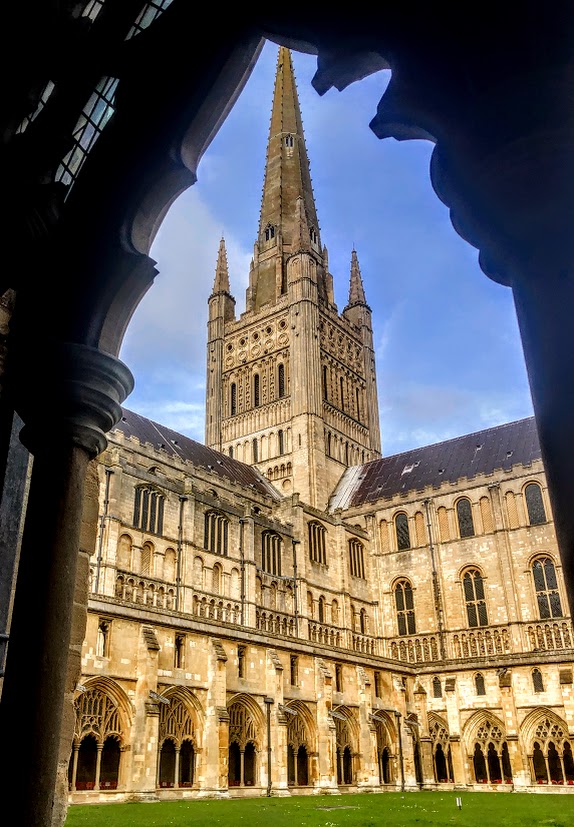
The cloisters Norwich Cathedral, built in 1297-1430 (Photograph: Patrick Comerford)

For the history of the Jewish community in Norwich, visit HERE

Daily prayer in the Kingdom Season:
28, Friday 28 November 2025

‘Look at the fig tree and all the trees; as soon as they sprout leaves you can see for yourselves and know that summer is already near’ (Luke 21: 29-30) … a fig tree in Platanias near Rethymnon in Crete (Photograph: Patrick Comerford, 2025)

Patrick Comerford

We are in the Kingdom Season, the time between All Saints’ Day and Advent, and this week began with the Sunday next before Advent and the Feast of Christ the King (23 November 2025).

Before the day begins, before breakfast, I am taking some quiet time early this morning to give thanks, to reflect, to pray and to read in these ways:

1, today’s Gospel reading;

2, a short reflection;

3, a prayer from the USPG prayer diary;

4, the Collects and Post-Communion prayer of the day.

A fig tree coming into fruit in Stony Stratford (Photograph: Patrick Comerford)

Luke 21: 29-33 (NRSVA):

29 Then he told them a parable: ‘Look at the fig tree and all the trees; 30 as soon as they sprout leaves you can see for yourselves and know that summer is already near. 31 So also, when you see these things taking place, you know that the kingdom of God is near. 32 Truly I tell you, this generation will not pass away until all things have taken place. 33 Heaven and earth will pass away, but my words will not pass away.’

Figs on sale in a supermarket near Rethymnon in Crete (Photograph: Patrick Comerford)

Today’s Reflections:

The scene for the Gospel reading at the Eucharist today (Luke 21: 29-33) has been set in the verses that immediately precede this reading. Christ is sitting in the Temple precincts, where he speaks about the Temple, the Nation, and the looming future.

Today’s Gospel reading continues in this apocalyptic theme with a comparison of the fig tree coming to fruit and the signs of the coming of the Kingdom of God.

The fig tree has more potential than just the figs and fruit it produces. Fig trees are planted in vineyards to shelter the weaker vines. An old and elegant fig tree is a common site in many Mediterranean vineyards and has its own intrinsic value. It may even have vines wrapped around it, bearing their own fruit.

It takes much tender care and many years – at least three years – for a fig tree to bear fruit. And even then, in a vineyard, the figs are not a profit – they are a bonus.

When a tree bears fruit, the Mosaic Law said it could not be harvested for three years, and the fruit gathered in the fourth year was to be offered as the first fruits. Only in the fifth year, then, could the fruit be eaten.

The observations by Jesus on the fruiting fig tree are in sharp contrast to a short parable earlier in this Gospel (Luke 13) where a man wanted to tear up a freshly-planted fig tree:

Then he told this parable: ‘A man had a fig tree planted in his vineyard; and he came looking for fruit on it and found none. So he said to the gardener, “See here! For three years I have come looking for fruit on this fig tree, and still I find none. Cut it down! Why should it be wasting the soil?” He replied, “Sir, let it alone for one more year, until I dig round it and put manure on it. If it bears fruit next year, well and good; but if not, you can cut it down”.’ (Luke 13: 6-9).

If this tree had been chopped down, and another put its place, it would take longer still to get fruit that could be eaten or sold. In his hasty desire for a quick profit, the owner of the vineyard shows little knowledge about the reality of economics.

The gardener, who has nothing at stake, turns out to be the one not only has compassion, but has deep-seated wisdom too.

Three years, and three more years, and then the fruit.

The fruit is only going to be profitable in its seventh year. Then, between Chapter 13 and Chapter 21, the fig tree becomes a sign ‘that the kingdom of God is near.’

What do we dismiss in life because it is too young and without fruit, or too old and gnarled, only to realise when it is too late that we are failing to see signs ‘that the kingdom of God is near’?

In the parable of the fig tree, we are called on to wait, we are urged not to be too hasty to pass judgment on those who seem in our eyes to do nothing to improve their lot.

But I can decide where I place my trust – in the values that I think serve me but serve the rich, the powerful and the oppressor, or in the God who sees our plight, who hears our cry, and who comes in Christ to deliver us.

Figs for breakfast in the Garden Taverna in Platanias near Rethymnon (Photograph: Patrick Comerford)

Today’s Prayers (Friday 28 November 2025):

The theme this week (23 to 29 November) in Pray with the World Church, the prayer diary of the Anglican mission agency USPG (United Society Partners in the Gospel), is ‘Gender Justice’ (pp 58-59). This theme was introduced on Sunday with Reflections by Rachael Anderson, former Senior Communications and Engagement Manager, USPG.

The USPG Prayer Diary today invites us to pray:

Give thanks for the lives of women throughout the world, many whose steady presence is often unacknowledged.

The Collect:

Eternal Father,
whose Son Jesus Christ ascended to the throne of heaven
that he might rule over all things as Lord and King:
keep the Church in the unity of the Spirit
and in the bond of peace,
and bring the whole created order to worship at his feet;
who is alive and reigns with you,
in the unity of the Holy Spirit,
one God, now and for ever.

Post Communion Prayer:

Stir up, O Lord,
the wills of your faithful people;
that they, plenteously bringing forth the fruit of good works,
may by you be plenteously rewarded;
through Jesus Christ our Lord.

Additional Collect:

God the Father,
help us to hear the call of Christ the King
and to follow in his service,
whose kingdom has no end;
for he reigns with you and the Holy Spirit,
one God, one glory.

Yesterday’s Reflections

Continued Tomorrow

Figs ripening on a fig tree in Platanias, east of Rethymnon in Crete (Photograph: Patrick Comerford, 2025)

Scripture quotations are from the New Revised Standard Version Bible: Anglicised Edition copyright © 1989, 1995 National Council of the Churches of Christ in the United States of America. Used by permission. All rights reserved worldwide. http://nrsvbibles.org

27 November 2025

18.5 million people in Beijing,
€18.5 million at Crete’s sites,
18.5 million metres in Corfu,
18.5 million blog readers

The Minoan palace of Knoss near Iraklion … the museums and archaeological sites in Crete bring in more than €18.5 million a year (Photograph: Patrick Comerford)

Patrick Comerford

This blog continues to reach more and more readers, and has reached yet another staggering today, with 18.5 million hits by shortly after 12 noon today (27 November 2025) and more than half a million readers so far this month, with over 550,000 hits before lunchtime today.

I first began blogging back in 2010, and the 18 million was reached earlier this month (2 November 2025), having passed the 17.5 million mark last month (18 October) and the 17 million mark less than three weeks earlier (30 September 2025).

The latest figure of 18.5 million is all the more staggering because half of all those hits have been within the past 12 months, since November 2024. The rise in the number of readers has been phenomenal throughout this year, and the daily figures have been overwhelming at times. With this latest landmark figure of 18.5 million readers today, I once again find myself asking questions such as:

• What do 18.5 million people look like?
• Where do we find 18.5 million people?
• What does £18.5 million, €18.5 million or $18.5 million mean?
• What would it buy, how far would it stretch, how much of a difference would that much make to people’s lives?

Inside the Forbidden City in Beijing … Beijing has an estimated population of about 18.5 million people (Photograph: Patrick Comerford)

Senegal in west Africa and Chile in South America have 18.5 million inhabitants. Cities with a population of around 18.5 million – depending on who is doing the counting – include the urban area of Beijing and Bangkok, as well as the New York-Newark area and Cairo, each with about 18.5 million inhabitants.

By mid-2024, India was the leading country of origin for international migrants, with a diaspora of 18.5 million people living abroad.

The US is the third-most populated country in the world, with over 330 million people, and its population is expected to grow by another 18.5 million in the next 10 years.

Knossos, the Minoan palace near Iraklion, is the most lucrative archaeological site in Crete, contributing 60% of the overall income from all of Crete’s museums and archaeological sites. Statistics for 2023 show ticket sales there have reached all-time highs, and the island’s museums and archaeological sites brought in more than €18.5 million. Knossos is the most valuable cultural asset in Crete, bringing in €11 million from 1 million tourists, the second-highest annual visitor total behind the Acropolis in Athens.

A record-breaking 18.5 million pilgrims performed Hajj and Umrah in Saudi Arabia last year. Of these 18.5 million pilgrims, about 16.9 million performed Umrah and 1.6 million performed Hajj.

Wetherspoon’s project to convert a row of derelict houses in Camden Street, Dublin, into the Keavan’s Port hotel and pub was estimated to cost €18.5 million.

Aston Villa announced the signing of Bertrand Traore from Lyon in September. The deal is worth €18.5 million in transfer fees, plus a further €2 million in add-ons.

The Spanish enclave of Ceuta in North Africa has an area of 18.5 million square metres or 18.5 sq km.

The Agios Georgios to Notos Beach trail in Corfu is an 18.5 km (18.5 million metres) out-and-back hiking route and takes about 3.5 hours to complete.

Issos Beach on the Agios Georgios to Notos Beach trail on Corfu … an 18.5 km (18.5 million metres) out-and-back hiking route (Photograph: Patrick Comerford)

18.5 million minutes adds up to 35.174500 years, so if this blog had one hit a minute, it would take over 35 years to reach today’s landmark figure of 18.5 million hits.

Once again, this blog has reached another humbling statistic and a sobering figure, and once more I am left with a feeling of gratitude to all who read and support this blog and my writing.

A continuing and warming figure in the midst of all these statistics continues to be the one that shows my morning prayer diary continues to reach up to 80-90 people each day. It is over 3½ years now since I retired from active parish ministry, but I think many of my priest-colleagues would be prayerfully thankful if the congregations in their churches averaged or totalled 560 to 630 people a week.

Today, I am very grateful to all the 18.5 million readers of this blog to date, and in particular I am grateful for the small and faithful core group among you who join me in prayer, reading and reflection each morning.

Wetherspoons transformed eight derelict houses on Camden Street Dublin, into Keavan’s Port pub and hotel in a €18.5 million project (Photograph: Patrick Comerford,)