Showing posts with label Church History. Show all posts

12 November 2026

A half-hidden memorial
in Stony Stratford recalls
an 18th century vicar and
a Cambridge theologian

The mural to Canon Leonard Sedgwick beneath the tower in Saint Mary and Saint Giles Church, Stony Stratford (Photograph: Patrick Comerford, 2026)

Patrick Comerford

I imagine few parishioners in Stony Stratford give even a fleeting glance to the 18th century memorial tablet on the wall beneath the tower in Saint Mary and Saint Giles Church commemorating a former vicar, Canon Leonard Sedgwick, who died in 1747, and erected by his son, the Revd William Sedgwick, a leading theologian and academic in Cambridge in the mid-18th century.

The bulging tablet was once at the east end of the south aisle, but is now on the south wall in the tower, almost hidden in a corner behind the entrance door. It is one of the few memorials to have survived in the disastrous fire in the church on 26 December 1964, and its wording paints a picture of a pious vicar who had a large family and exercised a lengthy ministry:

Near this place
rest the Remains
of the Reverend Leonard Sedgwick MA,
above 43 Years Minister of the Town.
He was likewise Rector of Thornton and Prebendary of Lincoln
Whilst his Health & Strength would permit
he was faithfull & diligent in the Discharge
of all the branches of his Pastoral Office:
He was charitable to the poor, affable & friendly to all
for which reasons he lived beloved & esteemed
by his Parishioners.
In the Relations of private Life, he was a dutifull Son,
an affectionate Brother, a most tender Husband,
and properly indulgent Parent.
By his wife Elizabeth
(a Woman of great Piety & many Virtues) he had nine Sons and four
Daughters all who (one excepted) died in his Life time without issue.
It pleased God to call him to the Reward of his Labours
April ye 17th in ye Year of our Lord 1747. his age 74.
The only surviving Son William B.D. Master
of Queens’ College in Cambridge erects this Monument
in testimony of his Piety & Gratitude
to the Memory of so good a Father.


Sedgwick appears to have been the son of the Revd Thomas Sedgwick, who was educated at Saint John’s College, Cambridge, and the Vicar of Church Brampton, Northamptonshire. The family originally came from Dent in West Yorkshire.

Leonard Sedgwick was probably educated at Cambridge, and was the Perpetual Curate or Vicar of Stony Stratford, Buckinghamshire, from 1703, Rector of Thornton, near Buckingham, from 1710 and Prebendary of Moreton and Whaddon in the Chapter of Lincoln Cathedral from 1728 until he died 1747.

The Mathematical Bridge at Queens’ College, Cambridge … William Sedgwick was the President of Queens’ College in 1732-1760 (Photograph: Patrick Comerford)

Three of Sedgwick’s sons – Charles, Thomas and William – were educated at Cambridge and were ordained in the Church of England, and one was a prominent Cambridge theologian and academic in his day.

The Revd Charles Sedgwick went from Eton to King’s College, Cambridge, as a scholar in 1715 and graduated BA (1720) and MA (1723), and became a Fellow of King’s College in 1719. He was ordained deacon in the Diocese of London in 1721 and priest in the Diocese of Norwich in 1722. But he died in London in December 1723, while his father was still living in Stony Stratford.

The Revd Thomas Sedgwick studied at Queens’ College, Cambridge, from 1724 and graduated BA (1728) and MA (1731). He was ordained deacon in the Diocese of Lincoln in 1730, and priest on Christmas Eve 24 December 1732. He was the curate in Cranfield, Bedfordshire , in 1731, but appears to have died while his father was still alive.

The Revd William Sedgwick, who erected the monument to his father that is now below the tower in Saint Mary and Saint Giles Church, Stony Stratford, also went to Eton before studying at Queens’ College, Cambridge, from 1718. He graduated BA (1722), MA (1725) and BD (1732), and was a Fellow of Queens’ College from 1723 until he died in 1760.

William Sedgwick was ordained deacon by the Bishop of Ely in 1724 and priest in 1726. He was Dean of Chapel and Catechist in Queens’ College. The unusual title of one of the post held by William Sedgwick was that of Censor Philosophicus (Censor of Philosophy), an academic and administrative office at Queens’ College in the 17th and 18th centuries. The role was not a ‘censor’ in the modern sense of suppressing information; instead, the censor acted as a college examiner and moderator of philosophical disputes and educational instruction.

The position was an internal college office that typically rotated among the Fellowship on an annual basis. It was often held alongside other specialised titles such as Censor Theologicus (Censor of Theology), Hebrew Lecturer, Dean of Chapel, and Bursar. The primary duties involved mentoring undergraduate students, overseeing their progress in the classical curriculum, and ensuring the logical and academic rigour of philosophical disputations.

Several influential theologians and scholars held the office, including John Smith (1618-1652), a prominent Cambridge Platonist and mathematician who held the office in 1644. His philosophical teachings heavily integrated the works of René Descartes into the university curriculum.

Anthony Sparrow (1612-1685), a prominent theologian, was Censor Philosophicus in 1642-1643. He was also Dean and Bursar before being ejected during the Parliamentarian purges. After the Restoration he was President of the College until 1667 and Vice-Chancellor of the university in 1664-1665. He eventually became Bishop of Exeter and then Bishop of Norwich.

William Sedgwick went on to become the President of Queens’ College in 1732-1760. The monument in Stony Stratford incorrectly refers to him as the Master, and the heads of most colleges are called masters, but the head of Queens’ has been called the president since 1448. William Sedgwick was the Vice-Chancellor of Cambridge University in 1741-1742, while his father was still living in Stony Stratford. During those years he was also the Vicar of Oakington, Cambridgeshire, and the Rector of Saint Clement’s, Eastcheap, in London (1738-1760). He died on 4 November 1760.

The monument to Canon Leonard Sedgwick is almost hidden in a corner behind the door into Saint Mary and Saint Giles Church, Stony Stratford. But had it not survived the fire in 1964 and been placed there, I might not have been reminded of these Cambridge theologians in the mid 18th century.

William Sedgwick was President of Queens’ College, Cambridge, for almost 30 years and Vice-Chancellor of Cambridge University

08 November 2026

Rethymnon and the people
of Crete remember the tragedy
of the siege of Arkadi 160 years
ago on 8 November 1866

The Monastery of Arkadi has a special place in the heart of all Cretans (Photograph: Patrick Comerford)

Patrick Comerford

Today has been a solemn day in Crete, marking the 160th anniversary of the tragic and cataclysmic destruction of the Monastery of Arkadi on 8 November 1866, which became a pivotal event in the Cretan Revolt against Ottoman rule.

On this day 160 years ago, 966 Cretans – mostly unarmed women children, and monks, alongside fewer than 260 resistance fighters – died tragically while they were seeking refuge within the monastery walls from a 15,000-strong Ottoman army.

Every year on 8 November, the people of Rethymnon solemnly commemorate this anniversary. After a three-day battle, the besieged Cretan rebels, women and children who sought shelter in the monastery blew up barrels of gunpowder in a store on 8 November 1866,, choosing death rather than surrender.

Ever since, the Monastery of Arkadi people in Crete have closely identified the monastery with the struggle for Greek Independence. The day is a regional holiday and a memorial, not a festival, marked with a series of events, including a memorial service at the monastery mausoleum, as well as speeches, wreath-laying and the raising of the flag at the Monument to the Unknown Soldier in Rethymnon.

The monastery is the focal point of these commemorations. The ossuary and museum are open to visitors throughout the year, and visitors are welcome at the public ceremonies this.

Skulls in the ossuary in Arkadi Monastery from a battle in 1866 during the Turkish occupation of Crete, when hundreds of people died (Photograph: Patrick Comerford)

Arkadi stands on a fertile plateau in the foothills of Psilorítis, 23 km south-east of Rethymnon. I have regularly visited this monastery since I first started staying in Rethymnon almost 40 years ago. It is a pleasant journey through Platanias up through the bright mountain villages of Adele, Pigi, Loutra, Pigi and Kirianna, taking about half an hour through olive groves and vineyards, and along the side of the Arkadi Gorge.

The main church or katholikon dates back to the 16th century but shows Roman, Venetian, Renaissance and Baroque elements in its architecture. This church is unusual with its two aisles, and is dedicated to both the Transfiguration and to Saint Constantine and Saint Helen.

Since the 16th century, the monastery has been a centre for the sciences, art and learning. The church was built in 1587, replacing a smaller church dating from the 13th century. The façade, which was designed in renaissance style, was influenced by the work of the architects Sebastiano Serlio and Andrea Palladio.

Today there only seven monks living in the monastery. But despite the constant arrival of tourists and visitors and the dwindling number of monks, it remains a working monastery.

Inside the new museum in Arkadi (Photograph: Patrick Comerford)

A new museum opened in Arkadi in 2016. Although most visitors want to see display items that tell the story of the horrific events over a century and a half ago, the museum includes books from the monastery library, icons, the liturgical items, vestments, stoles, patens, chalices and crosses.

Most of the items come from smaller monastic houses (metochia) and chapels that were once dependencies of Arkadi. They date from 1629 to the mid-19th century, and the earliest are fine examples of the Late Cretan School.

Embroidered inscriptions on the liturgical vestments include the names of abbots, priests and deacons. They show an interesting mixture of western and eastern traditions: the monks used purple silk textiles as the background for Byzantine-style flat embroidery and western-style relief embroidery created with gold and silver wire and thread and gold or silver-wrapped cord. The iconography followed the Byzantine tradition, while the decorative motifs and details were inspired by western art.

The main church in Arkadi is unusual for its double-aisled interior (Photograph: Patrick Comerford)

Arkadi once had a rich monastic library, but only a fragment of this collection have survived. Some of the volumes on display have elaborate covers, and many were produced on printing presses in Venice, which shows how the connection between Crete and Venice continued long after the Ottoman Turks captured Crete in the 17th century.

The museum is housed on the ground floor of the south-west wing of the monastery. This is one of the oldest parts of the monastery buildings, and was originally used for storing wine and olive oil.

In the monastic cloisters in Arkadi (Photograph: Patrick Comerford)

Arkadi once featured on the Greek 100 Drachmai banknote, and the monastery’s image was restored to popular currency with the issue of 750,000 new €2 coins in Greece in 2016 to commemorate the 150th anniversary of the destruction of Arkadi.

One side of the coin shows the monastery with inscriptions bearing its name and the name of Greece in Greek, along with the monogram of the artist George Stamatopoulos.

The journey back down from Arkadi often takes me through the villages of Roupes and Nea Magnisia, which takes its name from the classical Greek city near Ephesus in western Anatolia. The village was founded by Greek-speaking refugees, expelled from present-day Manisa, about 65 km north-east of Smyrna in Turkey in the 1920s – a reminder that the conflicts that almost destroyed Arkadia in 1866 continued for more than half a century after.

The garden in the cloisters in Arkadi Monastery in the mountains above Rethymnon in Crete (Photograph: Patrick Comerford)

Arkadi is an enduring symbol of Crete (Images: Patrick Comerford)

Somerville College Chapel has
values and traditions that are
unique in Oxford, and also has
an unusual inscription in Greek

The Greek inscription over the entrance to the chapel in Somerville College, Oxford (Photograph: Patrick Comerford, 2026)

Patrick Comerford

One day in Oxford recently, I went in search of the Greek inscription over the Wren Door on the north side of the Divinity School in Bodleian Library. This has been described by some sources as the only public inscription in Greek in Oxford. However, later that day I found another public inscription in Greek at the chapel in Somerville College on Woodstock Road.

The Greek inscription in capital letters above the west door or entrance to the chapel reads, Οικοσ Προσευχησ Πασι Τοισ Εθνεσιν. This translates as ‘A House of Prayer for all People’, and is quotation from Isaiah 56: 7. This verse is quoted by Jesus when he enters the Temple in Jerusalem on Palm Sunday and says, ‘It is written, “My house shall be called a house of prayer”; but you are making it a den of robbers’ (Matthew 21: 13).

Somerville College was founded in 1879 as Somerville Hall, one of the first two women’s colleges in Oxford – the Anglican-founded Lady Margaret Hall opened the same year. The non-denominational and liberal values of Somerville College date from its founding by political and social liberals. It was among the first colleges to end locking up at night to stop students staying out late, no gowns are worn at formal halls, and it first admitted men in 1994. The alumnae include Margaret Thatcher, Indira Gandhi, Dorothy Hodgkin, Iris Murdoch, Philippa Foot, Vera Brittain, Shirley Williams and Dorothy L Sayers.

The main entrance and the Porters’ Lodge of Somerville College on the south end of Woodstock Road, Oxford (Photograph: Patrick Comerford, 2026)

Somerville Hall opened with 12 students, aged from 17 to 36, and the first 21 students from Somerville and Lady Margaret Hall attended lectures in rooms above a baker’s shop on Little Clarendon Street. Just two of the original 12 students remained in Oxford for three years, the time required for male students to attain a bachelor’s degree.

Somerville appointed Lilla Haigh as its first in-house tutor in 1882, and by the end of the 1890s female students were attending lectures in almost all colleges. In 1891 it became the first women’s hall to introduce entrance exams, and in 1894 it changed its name to Somerville College. The traditionally all-male colleges in Oxford began to admit female students in the 1970s, but Somerville did not admit men until 1992.

The main entrance and the Porters’ Lodge are at the south end of Woodstock Road, with Little Clarendon Street to the south, Walton Street to the west and the Radcliffe Observatory Quarter to the north. The front of the college is between the Oxford Oratory and the Faculty of Philosophy, and five buildings are Grade II listed.

Somerville College Chapel is unique for an Oxford college because it has no religious affiliation (Photograph: Patrick Comerford, 2026)

Somerville College Chapel is unique as an Oxford college because it has no religious affiliation – reflecting the non-sectarian foundation of the college as place for the higher education of women. It is seen as both a manifestation of the aspirations of liberal Christianity in the inter-war years, including the advancement of women and ecumenism, and a response to the role of religion in higher education at the time.

The architectural historian Sir Nikolaus Pevsner has described the chapel as ‘bleakly classical, ashlar, of three windows with narrower altar and lobby protections, bleak also inside – unloved-looking somehow.’ But the chapel embodies the college’s commitment to religious freedom, and was built in as a plain, neutral space with no cross or crucifix. It is built of dimension stone ashlar masonry and stands opposite Somerville College Library, on the south side of the main quad.

The creation of the chapel was made possible with a generous and, at the time, anonymous donation from a former student, Emily Georgiana Kemp (1860-1939), in 1932. She was an adventurer, writer and artist, and came from a wealthy Baptist family. Through her extensive travels, she developed an inclusive vision of Christianity, an interest in world religions and a wide, inclusive vision of faith.

Kemp wanted the chapel to be a place where members of all nationalities and religions could pray. Like the college, the chapel would be nondenominational, and this is unique within the University of Oxford.

Inside the chapel in Somerville College, Oxford, facing the east end (Photograph: Patrick Comerford, 2026)

However, the beginnings of the chapel were not without problems. Despite Emily Kemp’s request for a building to promote ‘the spiritual life, mainly by prayer and meditation, for those of all creeds and nations’, there was strong resistance. The Association of Senior Members (ASM), representing former students, was determined to maintain Somerville’s non-sectarian character and Helen Darbishire (1881-1961), the then Principal of Somerville College (1931-1945), described one meeting with the ASM in 1932 as ‘lively’.

A compromise was eventually agreed: the chapel was carefully located so as not to dominate the grounds and the architecture and interior were designed to avoid conventional religious archetypes.

Emily Kemp, who donated the chapel to Somerville during her own lifetime, would recall how her ‘imagination was fired with stories of adventure’ by accounts of missionary work she heard as a child. She was one of the first students at Somerville and went on to lead an adventurous life, writing a number of travel books about her journeys in Asia.

Inside the chapel in Somerville College, facing the entrance and the west end (Photograph: Patrick Comerford, 2026)

Between leaving Somerville and setting off on her first trip to China, Emily Kemp studied Fine Art with Alphonse Legros (1837-1911), who was Slade Professor of Art at University College London. She documented her travels and adventures with her watercolours and in her books, including: The Face of China (1909), The Face of Manchuria, Korea and Russian Turkestan (1910), Wanderings in Chinese Turkestan (1914), and Chinese Mettle (1921). She also translated a book on Buddhism from German in 1910.

Her books show her fascination with the religions she encountered and the places of worship she visited, and show her dedication to the welfare and education of women.

She also wrote two books about missionaries: a biography of her sister, Reminiscences of a Sister, S Florence Edwards (1919), and an account of women Baptist missionaries, There followed Him, women (1927). Her belief in the importance of women in Christianity is expressed in her last book, Mary, with her son, Jesus (1930).

The chapel in Somerville College was designed by the architect Courtenay Theobald (Photograph: Patrick Comerford, 2026)

The chapel in Somerville was designed by the architect Courtenay Theobald, who later redesigned the Lumen Church in Tavistock Place, London, in the 1960s.

The chapel opened in 1935 and was dedicated to God, and only the stained glass window, designed by George Bell, is dedicated to Christ explicitly.

Kemp also donated a 19th century Italian terracotta derived from the ‘Annunciation lunette’ in the Ospedale degli Innocenti in Florence, by Andrea della Robbia. The subject symbolic got her the special importance of women in serving God.

Emily Kemp died in 1939. Her memorial plaque in the chapel calls her a ‘friend of China’ and not a ‘missionary’.

She left a significant bequest of western and eastern art to the Ashmolean Museum in Oxford, along with three oil paintings, including a number of works by Alphonse Legros, ‘The Holy Family’ by Ambrosius Benson (ca 1550), and a collection of her own watercolours painted in Asia.

Notable alumnae of Somerville College are commemorated on the chapel walls (Photograph: Patrick Comerford, 2026)

Notable Somerville alumnae commemorated on the chapel walls include the Revd Constance (Todd) Coltman (1889-1969), Britain’s first ordained female minister in a mainstream church. Other names include the novelist and Christian apologist Dorothy L Sayers, Dorothy Hodgkin, Margaret Thatcher, and Dame Emily Penrose (1858-1942), the third principal (1907-1926).

The chapel organ was made in 1937 by Harrison & Harrison in Durham. Kemp’s friend, the Nobel laureate Albert Schweitzer (1875-1965), was the chapel’s organ adviser and recommended a Neo-Baroque organ, as this style was popular in the organ reform movement. However, the college voted for an organ voiced in the style of the Romantic era. The organ case is made of oak, designed by the architect Courtenay Theobald, and was renovated in 2012. The organ is used regularly for recitals, concerts and recordings.

The chapel also has a Steinway grand piano, a two-manual harpsichord by Robert Goble and a portable digital piano.

The stained glass window designed by George Bell is dedicated to Christ and is the only explicitly Christian image in Somerville College Chapel (Photograph: Patrick Comerford, 2026)

In keeping with the non-denominational tradition of Somerville College, the chapel has a chapel director rather than a dean or chaplain. The current chapel director, Dr Joel Clarkson, hosts the choral contemplation events at 5:30 pm each Sunday in term time, combining choral music from the college choir with readings and reflections from speakers of a variety of backgrounds. He also helps connects members of the Somerville community with wellbeing resources.

Clarkson is also a composer for film, concert, and sacred music, with a research interest in interdisciplinary studies between music and theology. His PhD in theology is from the Institute of Theology, Imagination and the Arts at the University of St Andrews, Scotland. His doctoral thesis examined how 20th century Catholic metaphysics impacted musical and liturgical reform in the Catholic Church. He has written on the Scottish Catholic composer James MacMillan, and on theological content in the music of composers such as Arvo Pärt, Henryk Górecki and Olivier Messiaen.

He began his musical career in Los Angeles as a composer and orchestrator for film and TV. After his doctorate, he specialised in composing for vocal music, drawing on the English choral tradition. His music has been premiered and performed by vocal ensembles such as Grammy-nominated VOCES8 and the Vicars Choral of Saint Paul’s Cathedral, London.

The chapel in Somerville College hosts the choral contemplation events at 5:30 pm each Sunday in term time (Photograph: Patrick Comerford, 2026)

Somerville College Choir is young by Oxford standards, yet has released several albums with commercial labels, undertaken international tours and performed live on national radio. The real strength of the choir is found in its freedom from convention, enabling a diverse repertoire. There are regular concerts, cathedral visits, recitals and tours, and the choir has released two CDs. True to the spirit of the college founders, the choir is also non-denominational in its practice and vision.

The choir is mixed voice and led by the Director of Chapel Music, Will Dawes. He was appointed in 2017 and has also been Director of Music at Saint Mary Magdalen Church, Oxford, since 2011.

As well as providing opportunities for traditional Christian worship and in keeping with its liberal, inclusive tradition, the chapel hosts speakers with a range of religious perspectives. Past speakers have include the Belfast-born Oxford theologian Alister McGrath, Shirley Williams, Metropolitan Kallistos Ware, the humanist Andrew Copson and the writer Rosamund Bartlett.

An annual service commemorates past members of the Somerville community who have died in the previous year.

The Somerville Remembrance Garden, with the chapel in the background (Photograph: Patrick Comerford, 2026)

Today, the chapel in Somerville College continues to reflect the non-sectarian values at the foundation of the college as a place for the higher education of women. It is seen as both a manifestation of the aspirations of liberal Christianity in the inter-war years, including the advancement of women and ecumenism, and a response to the role of religion in higher education at that time.

The motto carved in Greek above the entrance to the chapel reads ‘A house of prayer for all people’, and so it has proved.

True to the vision of its founder, Emily Kemp, the chapel remains a place where people of all nationalities and religions can pray, discuss, meditate and celebrate their spiritual lives.

The chapel in Somerville College continues to reflect the non-sectarian values at the foundation of the college as a place for the higher education of women (Photograph: Patrick Comerford, 2026)

For my guide to churches, chapels and religious buildings and sites in Oxford, visit here

04 November 2026

Daily prayer in the Kingdom Season 2026:
4, Wednesday 4 November 2026

‘Whoever does not carry the cross and follow me cannot be my disciple’ (Luke 14: 27) … Jesus takes the Cross upon his shoulders, Station 2, the Stations of the Cross in the Church of the Annunciation, Marble Arch, London (Photograph: Patrick Comerford)

Patrick Comerford

We are in the Kingdom Season, the time between All Saints and Advent. Later this evening, I hope to take part in the choir rehearsals in Saint Mary and Saint Giles Church, Stony Stratford.

I have been awake most of the night watching results come in with the BBC coverage of the mid-term elections in the US. Now, before today begins, before having breakfast, I am taking some quiet time early this morning to give thanks, and for reflection, prayer and reading in these ways:

1, today’s Gospel reading;

2, a short reflection;

3, a prayer from the USPG prayer diary;

4, the Collects and Post-Communion prayer of the day.

‘Whoever does not carry the cross and follow me cannot be my disciple’ (Luke 14: 27) … the reredos by Sir Ninian Comper above the altar in the south aisle in Saint Mary and Saint Giles Church, Stony Stratford (Photograph: Patrick Comerford)

Luke 14: 25-33 (NRSVA):

25 Now large crowds were travelling with him; and he turned and said to them, 26 ‘Whoever comes to me and does not hate father and mother, wife and children, brothers and sisters, yes, and even life itself, cannot be my disciple. 27 Whoever does not carry the cross and follow me cannot be my disciple. 28 For which of you, intending to build a tower, does not first sit down and estimate the cost, to see whether he has enough to complete it? 29 Otherwise, when he has laid a foundation and is not able to finish, all who see it will begin to ridicule him, 30 saying, “This fellow began to build and was not able to finish.” 31 Or what king, going out to wage war against another king, will not sit down first and consider whether he is able with ten thousand to oppose the one who comes against him with twenty thousand? 32 If he cannot, then, while the other is still far away, he sends a delegation and asks for the terms of peace. 33 So therefore, none of you can become my disciple if you do not give up all your possessions.’

Dietrich Bonhoeffer distinguishes between cheap grace and costly grace, and reminds us of the ‘Cost of Discipleship’

Today’s reflection:

This week began with celebrating All Saints’ Day (1 November) and commemorating All Souls’ Day (2 November). At the All Saints’ Day Eucharist in Saint Mary and Saint Giles Church, Stony Stratford, on Sunday morning, the Offertory Hymn we sang was ‘Rejoice in God’s saints, today and all days!’ by the Revd Fred Pratt Green (1903-2000). In verse 3, we sang:

Rejoice in those saints, unpraised and unknown,
who bear someone’s cross, or shoulder their own:
they share our complaining, our comforts, our cares:
what patience in caring, what courage, is theirs!

What does it mean to ‘bear someone’s cross’ or to shoulder our own cross in life?

In the various editions of the NRSV translations of the Bible, the heading or sub-heading for the passage that is today’s Gospel reading (Luke 14: 25-33) at the Eucharist is ‘The Cost of Discipleship’.

The Cost of Discipleship is the title of one of the best-known books by the German theologian Dietrich Bonhoeffer who was executed on 9 April 1945, in a German concentration camp before even reaching the age of 40, and just weeks before the end of World War II.

This youthful pastor was one of the greatest theologians of the 20th century, and he is widely regarded as a modern saint and martyr. His statue by the sculptor Tim Crawley above the West Door of Westminster Abbey places him among the 10 martyrs of the 20th century.

Dietrich Bonhoeffer was born on 4 February 1906 in Wroclaw (formerly Breslau), now in Poland, and grew up in a comfortable professional German home, where his family was nominally Lutheran. When he was 13, he decided to study for ordination.

He studied at the University of Berlin, at the age of 18 visited Rome, and studied at Union Theological Seminary, New York (1930-1931).

Following the rise of the Nazis in 1933, Bonhoeffer saw Nazism as a counter-religion and a danger to Christianity. In October 1933, he became the pastor of two German-speaking parishes in the London area, and began his friendship with Bishop George Bell of Chichester.

On his return to Germany, Bonhoeffer ran the seminary of the Confessing Church at Finkenwalde, which was shut down by the police in 1937. He went to New York in 1939 but chose to return to Germany, aware of the cost of discipleship that lay before him and fearing a Nazi victory would destroy Christian civilisation. For Bonhoeffer, true discipleship now demanded political resistance against the criminal state.

He was arrested in March 1943 and survived as a prisoner until he was executed on 9 April 1945.

For my generation, Bonhoeffer was one of the most influential theologians on our reading lists. We drew endlessly on such books as The Cost of Discipleship, as well as No Rusty Swords and Ethics. We bandied around phrases such as ‘religionless Christianity’ and the ‘man for others,’ perhaps without fully grasping their meaning and implications.

We were quick to dismiss any church activity we deemed unfashionable as purveying ‘cheap grace.’ And we saw Bonhoeffer as a role model for our resistance to racism and apartheid, nuclear weapons and modern warfare, and even the very political and economic foundations of capitalist societies.

Like all great theologians, like all great thinkers, philosophers and writers who are now dead, it was easy to quote him and to use him for our own ends: he could hardly answer back and say ‘I have been misunderstood’, ‘you have misquoted me’ or ‘you have quoted me out of context.’

Bonhoeffer has been claimed in recent years, on the one hand, by so-called ‘conservative evangelicals,’ who are happy with his theological method but unwilling to take his radical discipleship to the point of challenging social and corporate sin in our society; and, on the other hand, by radical reformers who would tear down all our received wisdom and traditions in their vain attempts to construct their own brand of ‘religionless Christianity.’

Unhappily, in recent years, theological rigour has gone out of fashion in many centres of learning. Where once students were happy to explore how faith could find understanding, many have slipped into the cold comfort of position-taking, relying on their own protestations of faith instead of rising to the challenge of new thinking and exploration. Theologians are no longer great names; even among the general public today, people are less likely to take their questions about faith and belief from the theological giants of the last century, such as Bultmann, Barth and Bonhoeffer to Küng, Kasper and Moltmann, and more likely to be detracted by the silly, peripheral questions about truth and religion raised by Dan Browne in his Da Vinci Code, on the one hand, or Richard Dawkins in his The God Delusion on the other.

So, over 80 years after his death and 120 years after he was born, we might reflect today on who Bonhoeffer was, and why his writings and thoughts continue to have relevance for us in our society today.

Dietrich Bonhoeffer had the potential to become a great musician or poet and playwright. Instead, he studied theology in Tubingen, Rome and Berlin, travelled through Rome and North Africa, and later spent time in Barcelona, New York, Cuba, Mexico and London, giving him an experience of the world church that would make a leading contributor to the foundation of the modern ecumenical movement.

He was still in his 20s when Hitler came to power. In a radio address two days after Hitler assumed office in 1933, Bonhoeffer warned against the idolatry of the ‘Fuhrer’ principle. He went on to become involved in the Pastors’ Emergency League, was closely associated with those who signed the Barmen Declaration, helped to form the Confessing Church, and, outside Germany, became a close friend of the saintly Anglican bishop, George Bell.

The Barmen Declaration declared that the Church must not be allowed to become an instrument of political ideology, and rejected ‘the false doctrine that the Church should acknowledge, as the source of its message over and above God’s word, any other events, powers, figures and truths as divine revelation.’

Bonhoeffer paid the price for speaking out. His licence to teach was withdrawn, he was dismissed from his university, and eventually the Confessing Church seminary at Finkenwalde was closed. However, at Finkenwalde, he produced his two best-known books, The Cost of Discipleship (1937) and Life Together (1939).

In The Cost of Discipleship, Bonhoeffer argues that cheap grace is the deadly enemy of the Church. The sacraments and forgiveness are thrown away at cut price. We offer grace without price and grace without cost, instead of offering costly grace, which calls us to follow Jesus Christ.

When synagogues throughout Germany were set on fire in 1938, Bonhoeffer told the Church: ‘Only those who cry out for the Jews may sing Gregorian chant.’ In his Bible, he underlined two passages in the Psalms that read: ‘They are burning the houses of God in the land,’ and, ‘No prophet speaks any longer.’ He marked the date in his Bible and wrote later: ‘The church was silent when she should have cried out.’

When World War II broke out, he became involved in the resistance, making contacts in Switzerland, Norway and Sweden. And yet he found time to write his book Ethics. His contacts with George Bell failed to stop Britain’s policy of obliteration bombing and demanding ‘unconditional surrender.’ The German opposition was left without hope, and a disappointed Bell wrote his hymn ‘Christ is the King’:

Let Love’s unconquerable might
God’s people everywhere unite
In service to the Lord of Light. Alleluia.


In prison, Bonhoeffer worked on his Letters and Papers from Prison and wrote: ‘What is bothering me incessantly is the question what Christianity really is, or indeed, who Christ really is, for us today … We are moving to a completely religionless time … if therefore man becomes radically religionless – and I think that is already more or less the case … what does that mean for Christianity? How can Christ become Lord of the religionless as well?’

The final chapter of his last, unfinished book begins: ‘The Church is only her true self when she exists for humanity … She must take her part in the social life of the world, not lording it over men, but helping and serving them. She must tell men, whatever their calling, what it means to live in Christ, to exist for others.’

He was hanged at Flossenburg at dawn on 9 April 1945. An oft-quoted line from The Cost of Discipleship foreshadowed his death: ‘When Christ calls a man, he bids him come and die.’ His last recorded words as he was led to the scaffold were a message for George Bell: ‘Tell him that for me this is the end, but also the beginning.’

It was not the end, it was only the beginning. By the 1950s and the 1960s, he was the theologians’ theologian, and his influence was immeasurable. In recent years, he was ‘canonised’ by having his statue placed on the west front of Westminster Abbey. More recently, he has been the subject of a made-for-television movie in America. But what is his relevance today?

‘Bonhoeffer is one of the great examples of moral courage in the face of conflict,’ says Martin Doblmeier, director of Bonhoeffer, a recent 90-minute film. ‘Many of the issues Bonhoeffer faced – the role of the church in the modern world, national loyalty and personal conscience, what the call to being a ‘peacemaker’ really means – are issues we continue to struggle with today.’

1 Firstly, Bonhoeffer reminds us that faith assumptions and presumptions are no substitute in the seminary and the theological college for intellectual rigour and questioning. Indeed, he shows us that this is a more effective way of building faith than by trying to impose our individual views on others, and impose them judgmentally.

2 Secondly, in this post-modern world, Bonhoeffer continues to challenge us when we find new ways to make our Christian faith subject to, and relevant to, the overarching fashionable political and social ideologies of our day. Is the ‘Fuhrer principle’ reflected in the calls and slogans at Trump’s rallies or in the campaigns of far-right leaders rising across Europe today? How often have the different brands of Christianity been called on in recent decades to justify the nation-state as it embarked on disastrous wars of pride, one after another, whether it was the Falklands War, or the wars in Afghanistan and Iraq, or indeed whether it was Catholic Croats or Orthodox Serbs indulging in ethnic cleansing to create nation states with a single religious identity.

3 Thirdly, Bonhoeffer’s story of the Church remaining silent when it should have spoken out as the synagogues were burned down in 1938 is a challenge to us today. Once again synagogues and mosques too are being attacked and burned down, this time in the US and the UK, and being daubed and attacked across Europe. The stranger is not being welcomed, the refugee is being turned back, many of our new immigrants are the victims of pernicious racism, migrants are left isolated and in cramped, dehumanising conditions. The Cross, in this case the Cross of Saint George, is being abused as a weapon in the hands of bigots and hatemongers. Civilians – including children, the elderly, hospital patients and staff, journalists – have been slaughtered in Gaza, children have been bombed at school in Iran. Hostages were held by Hamas for two years after they were abducted, and the last body was not returned until early this year. Are we speaking out, speaking out now, before our silence becomes complicity in something even worse?

4 Fourthly, in his concern with growing secularisation, a concern so well articulated in his Letters and Papers from Prison, Bonhoeffer tells us we need to face up to the growing secularisation of society and of humanity. If he could see in the 1940s our need to speak about God in a secular way, how much more pressing is that need today? We are so obsessed with maintaining not so much our Church structures but our Church pomp and sense of self-importance, leaving us unable to reach out to a secular world with a ‘religionless Christianity.’ We often use Christianity as a garment to cloak and protect us and to ringfence our prejudices about others and their sexuality, class, ethnicity and background, rather than asking, like Christ, what they need and accepting Christ’s charge to go out into the world. How can we find the language that enables us to speak in a secular way about God, and how can we live up to our missionary charge in the world today by being able to present to postmodern humanity Jesus who is ‘the man for others’?

5 Fifth and finally, how as a Church can we resist the temptation to continue dispensing cheap grace? So often, success in the Church is measured by how well we fill the pews, and whether we send people out happy and clapping. But sometimes prophetic voices can be isolated and left speaking to empty pews. A congregation that goes out into the world feeling uncomfortable but challenged may be better prepared to take the light of Christ into the world of darkness. Dispensing cheap grace should never be the task of the truly prophetic priest.

It is not easy to rejoice in these challenges. But we can accept them as blessings, and must give thanks for prophetic life and witness of Dietrich Bonhoeffer, martyr priest and prophet, who challenged us to consider ‘the Cost of Discipleship’.

‘Receives Cross’ (Station 2 in the chapel, Saint John’s Hospital, Lichfield) … Dietrich Bonhoeffersays, ‘When Christ calls a man, he bids him come and die’ (Photograph: Patrick Comerford)

Today’s Prayers (Wednesday 4 November 2026):

The theme this week (1 to 7 November 2026) in Pray with the World Church, the prayer diary of the Anglican mission agency USPG (United Society Partners in the Gospel), is ‘All Saints’ Day’ (pp 52-53). This theme was introduced on Sunday with a Reflection by Matthew Anns, Senior Communications and Engagement Manager, USPG.

The USPG Prayer Diary today (Wednesday 4 November 2026) invites us to pray:

Spirit, help us to pray for those who have mistreated us in our own lives. That they come to know the Father, and forgive them for sinning against both us and you.

The Collect:

Almighty and eternal God,
you have kindled the flame of love
in the hearts of the saints:
grant to us the same faith and power of love,
that, as we rejoice in their triumphs,
we may be sustained by their example and fellowship;
through Jesus Christ your Son our Lord,
who is alive and reigns with you,
in the unity of the Holy Spirit,
one God, now and for ever.

Post Communion Prayer:

Lord of heaven,
in this eucharist you have brought us near
to an innumerable company of angels
and to the spirits of the saints made perfect:
as in this food of our earthly pilgrimage
we have shared their fellowship,
so may we come to share their joy in heaven;
through Jesus Christ our Lord.

Additional Collect:

God of glory,
touch our lips with the fire of your Spirit,
that we with all creation
may rejoice to sing your praise;
through Jesus Christ our Lord.

Yesterday’s Reflections

Continued Tomorrow

Dietrich Bonhoeffer (seventh from left) among the ten martyrs of the 20th century above the West Door of Westminster Abbey (Photograph: Patrick Comerford)

Scripture quotations are from the New Revised Standard Version Bible: Anglicised Edition copyright © 1989, 1995, National Council of the Churches of Christ in the United States of America. Used by permission. All rights reserved worldwide. http://nrsvbibles.org

Patrick Comerford’s sermon in Saint Patrick’s Cathedral, Dublin, on 5 February 2006, marking the 100th anniversary of the birth of Dietrich Bonhoeffer, was published in ‘A Year of Sermons at Saint Patrick’s, Dublin’ (pp 19-22)

01 November 2026

A ‘Virtual Tour’ on All Saints’ Day
of a dozen churches dedicated
to All Saints, one in Greece
and 11 throughout England

Varlaam is the second largest monastery in Meteora … the main church or katholikon is dedicated to All Saints, Άγιοι Πάντες (Photograph: Patrick Comerford)

Patrick Comerford

During the Covid-19 pandemic and lockdown, when I could not travel in ways I had become used too, I offered a number of ‘virtual tours’, many of them of churches I knew and was familiar with, not only in England, Ireland and Greece.

I continued these ‘virtual tour’ after the pandemic lockdown ended, and this afternoon, as All Saints’ Day continues, I am offering a ‘virtual tour’ of a dozen churches dedicated to All Saints, including a monastery church in Greece, and churches in Bedfordshire, Buckinghamshire, Hertfordshire, London, Norfolk, Northamptonshire and Oxford.

Two of these churches – one on Stepney, the other in Walsingham – have double dedications, but their original dedication in each case was to All Saints, while the katholikon in the monastery in the monastery is Meteora is dedicated to All Saints although the monastery bears the name of Saint Varlaam.

The majority of the churches I am looking at today are or were parish churches in the Church of England, but the two Greek Orthodox examples are a monastery church in Greece and a cathedral in London that was originally a Church of England parish church.

1, All Saints’ Church, Varlaam Monastery, Meteora:

A modern icon of Christ in a ceiling in Varlaam Monastery (Photograph: Patrick Comerford)

The Monastery of Saint Varlaam (Μονή Βαρλαάμ) in Meteora is a Greek Orthodox monastery at the top of a rocky precipice 373 metres above the valley below. Founded in 1517, it is one of 24 monasteries that were originally built at Meteora, and one of the six living monasteries there today are UNESCO World Heritage site.

The main church or katholikon in Varlaam is dedicated to All Saints (Άγιοι Πάντες, Agioi Pantes). It is built in the Athonite style, in the shape of a cross-in-square with a dome and choirs, and spacious exonarthex is surrounded by a dome.

The monastery of Varlaam, built by Theophanes in 1517, is reputed to house the finger of Saint John and the shoulder blade of Saint Andrew. The church dedicated to All Saints was built in 1541-1542 and decorated in 1548, while the exonarthex was decorated in 1566.

The early ropes and pulleys used by the monks still survive in the monastery of Varlaam (Photograph: Patrick Comerford)

The old refectory is used as a museum while north of the church is the parekklesion of the Three Hierarchs, built in 1627 and decorated in 1637.

The monastery became more accessible in 1923 when 195 steps were cut into rockface, allowing monks and visitors to walk to the top.

Unlike Mount Athos, visitors to Meteora need no permits issued in advance, women as well as men are welcome as visitors, and all the monasteries display notices outside advising when they are open and when the Divine Liturgy is served.

2, All Saints Greek Orthodox Cathedral, Camden Street, London:

All Saints’ Greek Orthodox Cathedral, on the corner of Camden Street and Pratt Street, London (Photograph: Patrick Comerford)

The Greek Orthodox Cathedral in Camden Town, London, is a ten-minute walk from Euston Road. All Saints is both a cathedral and a parish church in the Archdiocese of Thyateira and Great Britain under the Ecumenical Patriarchate. Although the cathedral was first designed as an Anglican church, its architectural design displays interesting Greek inspiration.

The church was built as a Church of England church, All Saints’ Church, Camden Town, within Saint Pancras Parish. The church was designed by the father and son team, William and Henry Inwood, who also designed Saint Pancras New Church. In both cases, they were inspired by Classical Greek architecture. At All Saints, their inspiration for the tower was the Monument of Lysicrates in the Plaka in Athens.

The Choragic Monument of Lysicrates near the Acropolis was built by the choregos Lysicrates, a wealthy patron of musical performances in the Theatre of Dionysus. Lysicrates was the liturgist of the performance in 335/334 BCE. The monument, also known as Diogenes’ Lantern, is the first known use of the Corinthian order on the exterior of a building. It became part of a French Capuchin monastery in the 1650s and 1660s, and Lord Byron stayed at the monastery during his second visit to Greece.

A large Greek-speaking community, mostly from Cyprus, moved into the Camden area in the decades after World War II. All Saints’ Church became a Greek Orthodox church in 1948. The Greek Orthodox Church of All Saints was formed after a request to Metropolitan Germanos (Strenopoulos) by a group of Greek-Cypriots for the creation of a second Greek Orthodox church in London. The existing dedication of All Saints’ was retained, and the patronal feast is celebrated on the first Sunday after Pentecost.

The Monument of Lysicrates in Athens inspired the Inwoods’ design of the tower at All Saints (Photograph: Patrick Comerford)

The first Orthodox liturgy was served at All Saints’ Church on Palm Sunday 25 April 1948, with Archbishop Germanos of Thyateira and Great Britain and Archimandrite Parthenios officiating.

The church was later bought by the community and was raised to cathedral status. It was consecrated as a cathedral by Archbishop Gregorios of Thyateira, a former parish priest, in 1991. The church has been renovated a number of times, and it is a Grade I listed building.

The galleried interior is dominated by the icon screen that separates the apse and east end portion from the main body of the church. It was carved in 1974 by Chrysanthos K Taliadorou of Nicosia, who was also responsible for the Holy Table and the ciborium. The main icons on the screen are attributed to a Russian artist living in France, while the icons of the upper range reflect the style of painting in Cyprus.

3, All Saints’ Church, Berkhamsted, Hertfordshire:

All Saints’ Church in Kitsbury, Berkhamsted … built in 1905 and designed by Charles Henry Rew and his son Noel Ackroyd Rew (Photograph: Patrick Comerford)

All Saints’ Church is an early 20th-century red brick church and Grade II listed building on the corner of Cross Oak Road and Shrublands Road, in the Kitsbury area of Berkhamsted. It is a Local Ecumenical Partnership (LEP) between the Church of England and the Methodist Church and in the Diocese of St Albans.

The Revd Arthur Johnson, the Rector of Saint Peter’s (1883-1902), and Adelbert Wellington Brownlow-Cust (1844-1921), 3rd Earl Brownlow, then the patron of the parish, obtained permission to build a ‘chapel-of-ease’ to meet the needs of local churchgoers in Saint Peter’s Parish Church.

The foundation stone of All Saints’ Church was laid in 1905 by the Suffragan Bishop of Colchester, Bishop Henry Frank Johnson (1834-1908). The new church was designed by the architect Charles Henry Rew (1842-1912), who also designed Berkhamsted School Chapel, and his son Noel Ackroyd Rew (1881-1971).

The Rews designed All Saints’ Church in the Early English style. It is built in red brick, with a large tall nave, aisles and an apsidal chancel. However, the church was never completed as planned: the original plans included twin towers at an extended west end that might have rivalled even those of Westminster Abbey.

Christ the King and the saints on the panels of the altar in All Saints’ Church, Berkhamsted (Photograph: Patrick Comerford)

All Saints’ Church closed in 1923 due to a lack of funds, but re-opened in 1938. By the 1970s, All Saints’ church hall, then a separate building, needed repairs, and the Methodists were outgrowing their church on the High Street. It was agreed that All Saints should be a shared building, modernised and enlarged.

All Saints’ Church was reordered in 1974, the main altar was moved and the direction of worship was reversed, giving the church a west-east liturgical orientation rather than the traditional and original east-west alignment. The original chancel area at the east end of the church is now at the back of the church, while a small worship area at the back of the church has replaced the former Lady Chapel.

4, All Saints’ Church, Lamport, Northamptonshire:

All Saints’ Church, Lamport, dates from the 12th century (Photograph: Patrick Comerford)

Lamport is nestled in the Northamptonshire countryside midway between Northampton and Market Harborough. Lamport Hall faces out onto the Church of All Saints, a Grade I listed building on the north side of the High Street in the village.

All Saints’ Church was first built in the 12th and 13th centuries. It has a mediaeval tower but the remainder was rebuilt and added to in the 17th, 18th and 19th centuries. The church has many monuments to members of the Isham family who lived at Lamport Hall from 1560 to 1976.

The earliest part of All Saints’ Church is the stocky mediaeval tower, but the remainder of the church was built in the 17th, 18th and 19th centuries. There is no reference to a church or priest in the entry for the parish in the Domesday Book (1086). All Saints’ Church dates from the 12th century, with additions in the 13th century and major alterations from the 17th to the 19th century.

Much of the church interior was commissioned by Sir Justinian Isham (1610-1675) of Lamport Hall, who added the chancel in 1652 and 20 years later added the north chapel in 1672 as a place of burial for members of the Isham family. It was built by a local mason, Henry Jones, probably using plans first drafted by John Webb, Inigo Jones’s principal assistant.

Another Sir Justinian Isham (1687-1737), the fifth baronet, travelled extensively in Italy and was heavily influenced by the classical architecture he saw there. When he died in 1737, he left bequests to remodel the 17th century interiors in the Italianate style. The result is elegant without being overpowering, although it overshadows the mediaeval elements of All Saints’ Church.

The Lamport Crucifix … once on display in All Saints’ Church, Lamport (Photograph: Patrick Comerford)

The church also has a delicate Georgian plastered ceiling in the nave, created by John Woolston. It has three large roundels, the centre one depicting an ‘eye of God’ with doves. The pulpit dates from the 18th century.

The 19th century south vestry, dating from 1879, was designed by the Gothic Revival architect George Frederick Bodley (1827-1907), who was also closely associated with William Morris and the Pre-Raphaelites and a lifelong friend of Charles Eamer Kempe. Bodley also designed the font and its Victorian wooden cover, and the small organ chamber.

All Saints’ Church has a series of memorials to members of the Isham family, who lived at Lamport Hall from 1560 to 1976.

The Lamport Crucifix dates from ca 1475 and was found when alterations were made to the dairy at Lamport Hall in 1674. It was preserved by the Isham family until 1905, when Sir Vere Isham presented it to the parish of Lamport in thanksgiving for his recovery from illness earlier that year. At some point, the cross was moved to Peterborough Cathedral for safekeeping, and it has been on display there for several decades.

5, All Saints’ Church, Leighton Buzzard, Bedfordshire:

The spire of All Saints’ Church, Leighton Buzzard, at 190 ft can be seen for miles around (Photograph: Patrick Comerford)

All Saints’ Church at the end of Church Square in Leighton Buzzard, Bedfordshire, stands on a site where there has been a church for about 1,000 years. The present church was built in the early 13th century and its 190 ft spire is a dominant feature in the town that can be seen for miles around.

Leighton became a prebendal ‘peculiar’ in 1189. The Prebendary of Leighton Buzzard was a canon of Lincoln Cathedral and received his income from a prebendal manor in Leighton. One explanation for the name of Leighton Buzzard suggests an early prebendary, Theobald de Busar, gave his name to Leighton, which became Leighton de Busar, and later Leighton Buzzard.

Former prebendaries included William de Packington (1389), who was also Archdeacon of Canterbury and Dean of Lichfield (1380-1390). Former vicars included Christopher Sclater, who was Vicar from 1624 until he died in 1642. A petition from local people shows that he was not popular. He was described as ‘a promoter of superstitious innovations and of a scandalous life’.

The parish was transferred to the Diocese of Ely in 1837, and then to St Albans in 1914. There is still a prebendal stall for Leighton Buzzard in Lincoln Cathedral.

The Simon and Nellie graffiti in Leighton Buzzard, linked locally with the origin of the Simnel Cake or ‘Sim and Nell’ cake (Photograph: Patrick Comerford)

The church is large, and of cruciform shape, with a central tower and spire, and with a long chancel that is only slightly shorter than the nave. Most of the walls, tower, spire and nave arcading date from the 13th century, and the ground plan remains basically the same with some later additions, such as porches and the coffee shop.

There are 25 15th century gargoyles around the outside of the church, dating from the 15th century. Five sundials are fixed to the outside of the church, including one on the north transept wall that only catches the sun soon after sunrise or just before sunset. The great West Door has hinges made by Thomas of Leighton, a 13th century ironsmith who made the iron grill on the tomb of Queen Eleanor of Castile in Westminster Abbey.

All Saints’ Church has many windows by Charles Eamer Kempe (1837-1907), including 12 at lower levels and 16 in the clerestory. The windows depict various saints, and the great west window depicts Saint George, Saint Etheldreda, Saint Michael, Saint Hugh and Saint Alban.

Mediaeval graffiti or scratchings can be seen throughout the church, on the pillars and walls. They include crosses, birds, a king’s head, strange beasts, coats of arms, names and initials and geometric designs. The best-known is the Simon and Nellie graffiti, on the south-west pier of the tower. It is linked locally with the origin of the Simnel Cake or ‘Sim and Nell’ cake. It dates from ca 1400.

6, All Saints’ Church, Margaret Street, London:

All Saints’ Church, Margaret Street, London, is known for its architecture, liturgy, interior, rich decoration and music (Photograph: Patrick Comerford)

All Saints’ Church, Margaret Street, off Oxford Street, is an Anglo-Catholic church in the heart of London’s West End. It is known for its architecture, its style of liturgy, its interior, rich decoration and beautiful fittings, for its musical tradition. Many regard it as one of the foremost examples of High Victorian Gothic architecture, and it is a Grade I listed building.

All Saints’ Church was designed in 1850 by William Butterfield (1814-1900), an architect strongly associated with the Gothic revival in church architecture and the Oxford Movement. The church owes it building to the Cambridge Camden Society, which in 1841 proposed building a ‘model church on a large and splendid scale’ that would embody the society’s values.

It was to be in late 13th and early 14th century Gothic style and built of solid materials. Its ornament should decorate its construction, and its artist should be ‘a single, pious and laborious artist alone, pondering deeply over his duty to do his best for the service of God’s Holy Religion.’ Above all, the church was to be built so that the ‘Rubricks and Canons of the Church of England may be consistently observed, and the Sacraments rubrically and decently administered.’

The foundation stone was laid on All Saints’ Day 1850 by Edward Bouverie Pusey, a key figure in the Oxford Movement, and the church was consecrated on 28 May 1859.

All Saints’ Church is particularly celebrated for its interior decoration. Every surface is richly patterned or decorated: the floor in diaper patterned tiles, wall surfaces in geometrical patterned brick, tile, and marble, as well as tiles with painted decoration, large friezes executed in painted tiles, a painted ceiling, and painted and gilded timberwork behind the altar.

John Betjeman declared, ‘It was here, in the 1850s, that the revolution in architecture began … It led the way, All Saints Margaret Street, in church building’ (Photograph: Patrick Comerford)

After seeing All Saints, John Ruskin wrote: ‘Having done this, we may do anything … and I believe it to be possible for us, not only to equal, but far to surpass, in some respects, any Gothic yet seen in Northern countries.’ However, Ruskin did not ‘altogether like the arrangements of colour in the brickwork.’

The author and columnist Simon Jenkins says All Saints is ‘architecturally England’s most celebrated Victorian church.’ The architectural historian Simon Thurley lists All Saints among the 10 most important buildings in Britain.

In the 1970 BBC Television programme, Four With Betjeman – Victorian Architects and Architecture, the poet Sir John Betjeman visited All Saints. In his view, ‘It was here, in the 1850s, that the revolution in architecture began … It led the way, All Saints Margaret Street, in church building.’

The architectural historian Sir Nikolaus Pevsner described the interior as ‘dazzling, though in an eminently High Victorian ostentatiousness or obtrusiveness … No part of the walls is left undecorated. From everywhere the praise of the Lord is drummed into you.’

7, All Saints’ Church, Milton Keynes, Buckinghamshire:

All Saints’ Church, Milton Keynes Village … one of the largest and most attractive mediaeval churches in Buckinghamshire (Photograph: Patrick Comerford)

All Saints’ Church in Milton Keynes Village – or Middleton, as it is sometimes called – is one of the largest and most attractive mediaeval churches Buckinghamshire, in a forgotten corner hidden in the midst of modern Milton Keynes.

In John Betjeman’s Guide to English Parish Churches (1958), long before Milton Keynes was developed, Clive Rouse describes All Saints’ Church as ‘text-book 14th century.’ This attractive church, with its roofs and north tower, is said to be one of the best examples in the area of the Decorated period of architecture.

The first church in the village may have stood at the Saxon burial ground discovered in 1992 close to the Old Rectory. On All Saints’ Day 1995, 100 Saxon bodies were reburied in the churchyard at All Saint Saints’ Church.

All Saints’ Church was mainly built ca 1330, although the chancel arch remains from an earlier building on the site and dates from ca 1200. All Saints’ Church consists of a chancel, north chapel, north tower and south porch. The layout is unusual, with a chancel offset from the centre-line of the nave so that a chapel could be accommodated on the north side of the church. The tower is also in an unusual position on the north side of the nave.

The earliest-known church on the present site dates from ca1200. The church was first mentioned in 1221, when Luke de Kaynes presented Ralph de Kaynes to the rectory. The only remains of the original structure are the east wall of the nave, the fine chancel arch, and a lancet reset in the south wall of the nave.

The present church dates from an extensive rebuilding ca 1330 by Philip de Aylesbury, then lord of the manor. The nave was widened towards the north and probably lengthened, the chancel enlarged, and the chapel, tower, and porch added.

On All Saints’ Day 1995, 100 Saxon bodies were reburied at All Saints’ Churchyard (Photograph: Patrick Comerford)

Extensive restorations were carried out in 1864 by George Edmund Street, the Oxford diocesan architect, who also restored Christ Church Cathedral, Dublin, at this time. He was sensitive to the decorated period features of the church, and eliminated some of the later alterations to bring it more into line with his ideas of how it would have been ca 1330.

The Revd Francis Babington, who was the Rector of Milton Keynes in 1559-1565, appears to have been a son of Humphrey Babington (1489-1544) and his wife Eleanor Beaumont; she was a co-heir with her sisters Dorothy who married Humphrey Comberford of Comberford Hall and Jane who married William Babington of Teremore.

Francis Babington was also Lady Margaret Professor of Divinity at Oxford University and Master of Balliol College, Oxford (1559-1560), but he was forced to flee overseas because of his Catholic sympathies and died in exile ca 1569.

8, All Saints’ Church, Northampton:

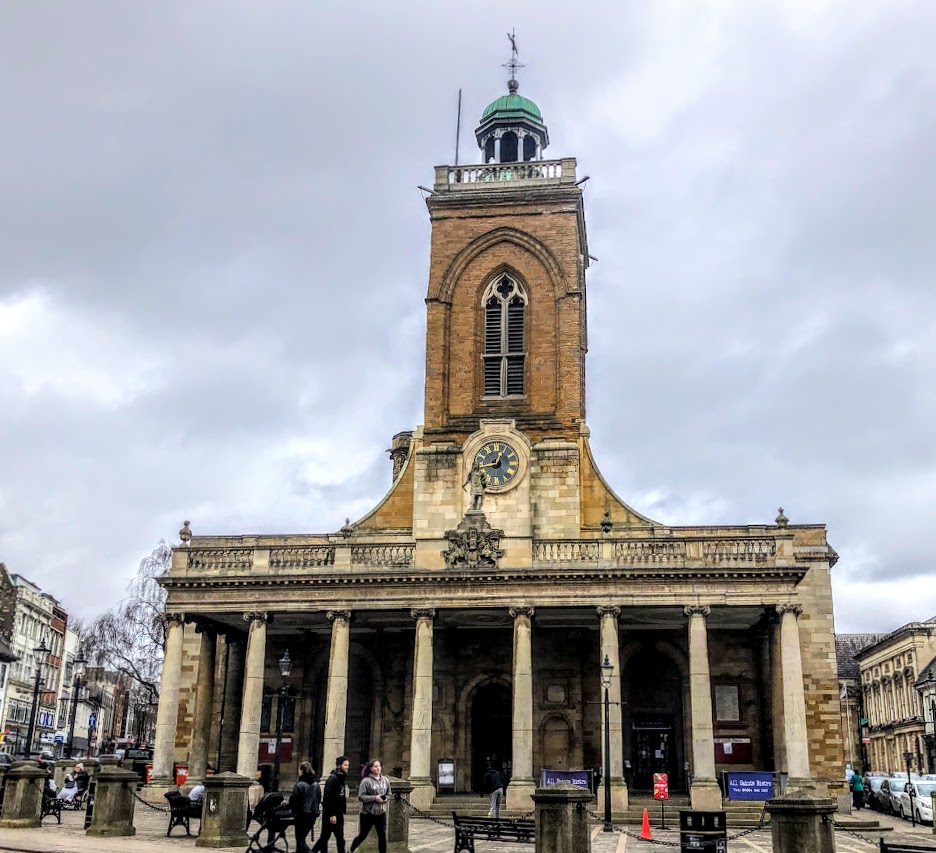
All Saints’ Church is the parish church in the centre of Northampton (Photograph: Patrick Comerford)

All Saints’ Church is the parish church in the centre of Northampton. The church was largely built after a fire and was consecrated in 1680 and is a Grade I listed building. Outside London, it is one of the foremost examples of 17th century church architecture in England.

From the earliest times, the church on this site has been associated with the life of the borough and the county. There has been a church on the site since the Church of All Hallows was built by Simon de Senlis or Simon de St Liz, the first Norman Earl of Northampton, who had built Northampton Castle and the town walls in the 1080s and 1090s.

Simon de Senlis took part in the First Crusade in 1094, and it is likely that after his return he built the Church of the Holy Sepulchre in Northampton ca 1100, and the Church of All Hallows.

Inside All Saints’ Church, Northampton, facing the east end (Photograph: Patrick Comerford)

All Hallows’ Church with its mediaeval alterations continued until 20 September 1675, when the collegiate church and much of the old town were destroyed by the Great Fire of Northampton.

The Parliamentarian leanings of Northampton had resulted in the razing of the castle by King Charles II after his invitation to reclaim the throne in 1660. Despite this, the Earl of Northampton, a friend and confidant of the King, persuaded Charles II to contribute 1,000 tons of timber from the royal forests of Salcey and Rockingham. This gesture, along with the repeal of the ‘chimney tax’ endeared the king to the people of Northamptonshire.

One tenth of the money collected for rebuilding the town was allocated to rebuilding All Hallows’ Church under the architect Henry Bell from King’s Lynn and Edward Edwards. Bell, who was living in Northampton at the time, rebuilt the church in a manner similar to Sir Christopher Wren’s designs.

The rebuilt All Saints’ Church was consecrated and opened in 1680. A large portico was added to the west end in 1701, in front of the narthex, in the style of the Inigo Jones portico added to Old Saint Paul’s Cathedral in the 1630s. The portico was added as a memorial to Charles II’s contribution after the fire, and a statue of him above the portico shows him dressed in a Roman tunic.

All Saints’ is one of the few parish churches in England to have a Consistory Court. The principal role of Consistory Courts is dispensing faculties dealing with churchyards and church property, and hearing the trials of clergy accused of immoral acts or misconduct.

The Patrons of All Saints are the Bishop of Peterborough and the Royal Foundation of Saint Katharine in Radcliffe. All Saints’ Church is in the Catholic tradition of the Church of England. The parochial church council passed Resolutions A, B and C in 1993. The parish rejects the ordination of women and receives alternative episcopal oversight from Bishop Luke Irvine-Capel of Richborough.

9, (former) All Saints’ Church, High Street, Oxford:

The former All Saints’ Church on the the High Street, Oxford … now the library of Lincoln College (Photograph: Patrick Comerford)

All Saints’ Church is a former parish church on the north side of the High Street in central Oxford, on the corner of the High Street and Turl Street, with the Mitre on the facing side of the corner. The former church is now the library of Lincoln College and is a Grade I listed building.

The original All Saints’ Church was founded on the site in 1122. However, the spire of the church collapsed on 8 March 1700, destroying most of the building. After an appeal for funds, the present building, with a seating capacity of 350, was completed in 1720.

The church was designed by Henry Aldrich (1648-1710), the Dean of Christ Church, Oxford, who was also a theologian, philosopher, architect and composer. Evidence of his skill as an architect is seen in the church and campanile of All Saints’ Church and in three sides of the Peckwater Quadrangle of Christ Church, which were built to his designs. Nicholas Hawksmoor is thought to be responsible for the tower and spire of All Saints’ Church.

Nicholas Hawksmoor is said to have designed the tower and spire of the former All Saints’ Church, Oxford (Photograph: Patrick Comerford)

The altar piece, which was of stone, coloured in imitation of marble, was donated by Nathaniel Crew (1633-1721), 3rd Lord Crew, who was the Rector of Lincoln College from 1668, Bishop of Oxford (1671-1674) and Bishop of Durham (1674-1721). Bishop Crew’s arms as Bishop of Durham are still visible on the south wall of the church, close to the south porch.

Bishop Samuel Wilberforce in 1857 and 1860 described the Vicar of All Saints’ Church, the Revd WW West, as ‘a clever man. Strong head & not apparently religious or a pleasant man.’

When Saint Martin’s Church at Carfax was demolished, except for its tower, in 1896, All Saints’ Church became the official City Church in Oxford, where the Mayor and Corporation were expected to attend church services.

When All Saints’ Church was declared redundant in 1971, the City Church moved to Saint Michael at the North Gate. All Saints was then deconsecrated and offered to Lincoln College, immediately to the north of the church. The church was converted by Robert Potter, the architect also responsible for refurbishing the Radcliffe Camera in 1969. Since 1975, the building has been Lincoln College’s library.

The dedication to All Saints can still be found in Oxford at All Saints’ Mission Chapel (1870), Piper Street, Headington, now used as a scout hall; All Saints’ Church, Lime Walk, Headington (1909-1910); and at Upton Chapel (2017), Magdalen Road, Cowley, which is the chapel of the All Saints Sisters of the Poor, one of the oldest Anglican sisterhoods.

10, All Saints’ Church, Yelvertoft, Northamptonshire:

All Saints’ Church in Yelvertoft, Northamptonshire, was connected with the Comberford family for about a century and Henry Comberford was the rector in 1546-1560 (Photograph: Patrick Comerford)

All Saints’ Church in the village of Yelvertoft, Northamptonshire was connected with the Comberford family for about a century, and Henry Comberford was the rector from 1546 to 1560. The advosom, or the right to nominate the rector, was held by the Combeford family from some time after the 1460s, when John Comberford married Joan Parles, the heiress of Watford Manor and Shutlanger.

All Saints’ Church, Yelvertoft, is an attractive country church, with an interesting mediaeval tomb niche, a series of carved heraldic shields on the outside north wall of the chancel, a surviving mediaeval sedilia and piscina, a double south aisle and mediaeval carvings on the south porch.

There has probably been a church on this site in Yelvertoft since Saxon times, and a church is mentioned in the Domesday Book (1086).

The lofty chancel and a slightly taller nave were built of local cobblestones in the early 12th century in Norman style. The east chancel wall was rebuilt towards the end of the 13th century, when the west tower was added. The north and south aisles were added ca 1330 and an unusual second south aisle was added in the 15th century, making the interior of the church almost as broad as it is long. When the second south aisle was built, the south door and porch were moved and reinserted in south side of the new, second aisle.

The most intriguing feature of the church is in the chancel, where half the north wall is taken up by an elaborate tomb in Perpendicular style, probably dating from the 15th century. Within the tomb niche is the alabaster effigy of a priest, thought to be the Revd John Dycson or Dixon, who was the Rector in 1439-1445.

On the opposite wall in the sanctuary is a three-seat sedilia, where clergy – priest, deacon and sub-deacon – were seated during the liturgy. The columns separating the seats are worn or eroded, as if they had been badly damaged by weathering. A local story says the incisions were caused by Cromwell’s soldiers who used the sedilia to sharpen their swords before the Battle of Naseby, about 5 miles from Yelvertoft.

Inside All Saints’ Church, Yelvertoft, facing east (Photograph: Patrick Comerford)

When John Comberford died in 1508, Cumberford Manor in Watford and his estates near Tamworth and Lichfield were inherited by his son Thomas Comberford (1472-1532), along with the advowsom of Yelvertoft. Many of the Rectors of Yelvertoft appointed by the Comberford family were either drawn from church life in the Diocese of Lichfield or were part of a nexus of families that included the Comberford, Fitzherbert, Babington and Beaumont families.

The priests nominated to Yelvertoft by the Comberford family included William Smith, Rector of Yelvertoft in 1507-1510, a nephew of Bishop William Smith (1460-1514), Bishop of Lichfield and later Bishop of Lincoln, who re-founded Saint John’s Hospital, Lichfield, in 1495.

Smith was succeeded in Yelvertoft in 1510 by Thomas Babington, who was presented to the parish by his wife’s uncle, Thomas Comberford (1472-1532) of Comberford. He was the Rector of Yelvertoft for only a short time, and died in Cambridge in 1511.

Yelvertoft was transferred to the Diocese of Peterborough when it was formed in 1541. Henry Comberford (1499-1586) was appointed Rector of Yelvertoft by his brother Humphrey Comberford in 1546. With his brothers, Humphrey and Richard, Henry Comberford was educated at Cambridge. He went on to become a Fellow of Saint John’s College and a Proctor of Cambridge University. His brother Richard Comberford was also a Fellow and Senior Bursar of Saint John’s College, Cambridge, and is sometimes said, confusingly, to be the ancestor of the Comerford family of Co Kilkenny and Co Wexford.

Like many of his clerical contemporaries, Henry Comberford was a careerist and a pluralist. After ordination, he was the Rector of Saint Mary’s, Polstead, near Colchester, Suffolk, a Proctor of Cambridge University, Rector of All Saints’, Earsham, near Bunbay, Norfolk, All Saints’, Hethel, near Norwich, Norbury in Derbyshire, and Yelvertoft, and also the Precentor of Lichfield, Prebendary of Bishop’s Itchington, and perhaps also the Archdeacon of Coventry, although this is disputed.

Henry was soon deprived of all his church appointments because of his Catholic sympathies. Thomas Comberford sold his manor in Watford to Sir John Spencer in 1563, and the Comberford family interest in Yelvertoft came to an end after a century of patronage and appointing the rectors of the parish.

11, Saint Dunstan and All Saints’, Stepney:

Saint Dunstan and All Saints’ Church, Stepney … dates back to long before 952 (Photograph: Patrick Comerford)

Saint Dunstan and All Saints’ Church on Stepney High Street dates back to long before 952, when Saint Dunstan, Bishop of London, replaced the then wooden structure with a stone church dedicated to All Saints. When Saint Dunstan was canonised in 1029, the church was rededicated to Saint Dunstan and All Saints.

The church served the whole of Middlesex east of the City of London until the early 14th century, when new churches were built at Whitechapel and Bow. The existing church is the third on the site and was built of Kentish ragstone in the 15th century.

The Church of Saint Dunstan and All Saints is regarded as ‘the mother church of the East End.’ The church has a long traditional link with the sea and many sailors were buried here. It was once known as the ‘Church of the High Seas,’ and until recently births, marriages and deaths at sea were registered there. The red ensign, the flag flown by British passenger and merchant ships, is still flown from the tower. The church also has long connections with three City livery companies: the Mercers, the Vintners and the Coopers.

The High Altar and East Window in Saint Dunstan and All Saints’ Church, Stepney (Photograph: Patrick Comerford)

The present building is essentially a mediaeval Gothic church, with a 13th century chancel and a 15th century nave, aisles and tower. The existing building is the third on the site and was built of Kentish ragstone mainly in the 15th century, although the chancel dates from 200 years earlier. The chancel has a triple sedilia.

The church has an Anglo-Saxon stone relief panel of the Crucifixion dating from the early 11th century and a relief of the Annunciation ca 1400 over north chancel door. There are two carvings above the main entrance door: the carving on the left of a ship refers to the long association of the church with the sea and sailors; the carving on the right of the devil and tongs refers to a story about Saint Dunstan pulling the nose of the devil with red hot tongs.

Nicholas Comberford the 17th century map maker and Mary Kithen were married in the church on 10 June 1624, and many members of the Comberford or Comerford family were baptised there from the 16th to the 18th century.

12, Saint Mary and All Saints’ Church, Little Walsingham, Norfolk:

Inside Saint Mary and All Saints’ Church, the Church of England parish church in Walsingham, rebuilt after a fire in 1964 (Photograph: Patrick Comerford, 2026)

Saint Mary and All Saints’ Church, the parish church of Little Walsingham in Norfolk, is dedicated to the Virgin Mary and All Saints. The Anglican shrine was revived by Father Alfred Hope Patten (1885-1958), the Vicar of Little Walsingham, in 1922, and an image of Our Lady of Walsingham was in the church until its translation to the new priory in 1931.

The original dedication was to All Saints; when Father Hope Patten became the vicar in 1921 he changed the dedication to the present double dedication of Saint Mary and All Saints.

The church dates from the 14th and 15th century, built from flint with stone dressings. In addition to the nave and chancel, there are north and south aisles and north and south transepts. The tower is at the west, with a lead needle spire. The church was gutted by fire in 1961; only the tower and north porch remain from the original, and the rest of the church has been rebuilt. The church is Grade I listed, while the churchyard walls and gates are separately listed Grade II.

Saint Mary and All Saints’ Church dates from the 14th and 15th centuries and is built from flint with stone dressings (Photograph: Patrick Comerford, 2026)

The church has a 15th-century font that illustrate the Seven Sacraments and the Crucifixion. The font survived the fire in 1961, but the 17th-century font cover did not, and the 1964 font cover is a replica of the original.

The church was destroyed in a fire on 14 July 1961, probably arson. The porch, tower and spire survived, as well as the church plate and Father Edgar Reeves’s statue of Our Lady, but everything else was lost. The then vicar, Father Alan Arthur Roe (1958-1977), appealed in the Church Times for ‘unwanted vestments of all kinds, cassocks, cottas, hassocks, and copies of the English Hymnal’.

The church was rebuilt by the church architect Laurence King (1907-1981), whose work is characterised by his engagement with 1960s liturgical reforms, which often emphasised a central altar and light, open spaces. His work is considered a significant part of post-war English church architecture, and he worked closely with artists such as John Hayward for glass and sculpture.

Commemorating All Saints and All Souls in All Saints’ Church, Margaret Street, London, today and tomorrow

I last offered a ‘virtual tour’ of a dozen churches dedicated to All Saints and All Hallows four years ago on All Saints’ Eve, 31 October 2022. But I was snared by own numeracy problems, I listed two churches with number 11, so that there were 13 churches in all in that list, with churches in Calverton, Cambridge, London and York in England, Dublin, Co Westmeath, Co Limerick, and Co Wexford in Ireland, and in Rome and Bucharest:

1, All Saints’ Church, Calverton, Buckinghamshire; 2, All Saints’ Church, Jesus Lane, Cambridge; 3, All Saints’ Church, North Street, York; 4, All Saints’ Church, Pavement, York; 5, All Saints’ Church, Blackrock, Co Dublin; 6, All Saints’ Church, Grangegorman, Dublin; 7, All Saints’ Church, Mullingar, Co Westmeath; 8, All Saints’ Church, Stradbally, Co Limerick; 9, All Saints’ Church, Templetown, Co Wexford; 10, All Saints’ Church, Rome; 11, All Saints’ Church, Bucharest; 11, All Hallows by the Tower, London; and 12, All Hallows’ Church, Bread Street, London.

All Saints Day, celebrated on 1 November by Enid Chadwick in ‘My Book of the Church’s Year’