COMERFORD WAY: Patrick Comerford’s online journal on Anglicanism, theology, spirituality, history, architecture, travel, poetry, beach walks ... and more
Gabriele Keenaghan escaped from Vienna on the eve of World War II and is returning there this week to mark her 100th birthday
Patrick Comerford
Gabriele Keenaghan is a Holocaust survivor and former Kindertransport child who escaped from Vienna on the eve of World War II. She has been decorated for her services to Holocaust education and regularly tells her story in the hope of bringing ‘kindness, tolerance and acceptance of diversity’ to others.
The retired head teacher now lives in North Shields and is one of the oldest survivors of the Shoah to have been evacuated from Nazi-occupied Europe by the Kindertransport. This week she is marking the approach of her 100th birthday by returning to Vienna where she was born in 1926.
I began this occasional blog series, ‘Tales of the Viennese Jews,’ in November 2019. I last returned to this theme earlier this year (16 January 2026) following the death of Eva Schloss, a Holocaust survivor, author, and step-sister of Anne Frank. A year earlier (7 February 2025), I told the stories of Marianne Faithfull (1946-2025), the archetypal ‘wild child’ of the 1960s, and of her mother, Eva Hermine von Sacher-Masoch (1912-1991), a self-styled baroness who resisted the Nazis in Austria.
This occasional series takes its title from the Tales from the Vienna Woods, a waltz by the composer Johann Strauss II (1825-1899), written more than a century and a half ago in 1868. Although Strauss was baptised a Roman Catholic, he was born into a prominent Jewish family. Because the Nazis had a particular penchant for his music, they tried to conceal and even deny the Strauss family’s Jewish identity.
However, the stories of Vienna’s Jews cannot be hidden, and many of these stories are told in the exhibits in the Jewish Museum in its two locations, at the Palais Eskeles on Dorotheergasse and in the Misrachi-Haus in Judenplatz. Rather than describe both museums in detail in one or two postings, I decided after visiting Vienna to re-tell some of these stories through this series, celebrating a culture and a community whose stories should never be forgotten.
A family photograph of the young Gabriele Weiss with her parents, Hildegard and Josef Weiss, in Berlin
The Guardian and the Jewish Chronicle reported earlier this week how Gabriele Keenaghan, a Kindertransport centenarian, is returning to Vienna. She was born Gabriele Franziska Maria Weiss in Vienna on 10 November 1926, an only child who did not even know she was Jewish until after the Nazis invaded Austria.
Her father Josef Weiss was Jewish and manufactured heating stoves. Her mother Hildegard was a Catholic. Family photographs show her as an only child with her parents, and include photographs with her parents in Berlin and visits to the Vienna Woods with her great-aunt Maria who was also her godmother.
After her mother died suddenly in 1935, Gabriele was brought up by her grandmother, also called Gabriele. She never knew her father was Jewish until after Austria was annexed by Nazi Germany in the Anschluss on 12 March 1938. She was a boarder at a Catholic convent school when the Nazis came and told the girls they would all be moving.
She was labelled a mischling, a pejorative term meaning ‘mixed’. ‘I was the only one left standing,’ she recalled in an interview with Mark Brown of the Guardian, and she wondered: ‘What’s happening to me?’ She was told she would have to go to a Jewish school and have a yellow star of David sewn on to her coat.
‘They called me “a dirty little Jew” … it was upsetting.’ But, she recalls, ‘I hadn’t realised that my father was a Jew. I didn’t know. I don’t think I even knew what being a Jew meant.’
From then, she was verbally and physically assaulted on her way to and from school, and she was now forbidden from entering the park to play with her friends by a sign declaring ‘Jude Verboten’.
The events of Kristallnacht on 9-10 November 1938 came on the eve of her 12th birthday. Gabriele never saw her father again: he was deported to Łódź in Poland and she believes he either died in the ghetto or was sent to be murdered in Auschwitz.
Her grandmother made arrangements for her to be taken out of Austria on a Kindertransport, the scheme that brought about 10,000 Jewish children to Britain as refugees.
She was still only 12 when she said goodbye to her grandmother and left on a train with 150 other children. They arrived the Netherlands, and from there they were sent by boat to Harwich and on to Liverpool Street station in London.
Gabriele quickly learned English and in January 1940 the Catholic Committee for Refugees moved her from Aldershot to Ashford, where she boarded at the Convent of Notre Dame. When she turned 16 In 1942, she was classified as an ‘enemy alien’ because of her Austrian nationality. She was moved again to a convent in Mill Hill, north London, and then trained in nursery nursing and Montessori education.
One of her first jobs was as a nanny to the Richardson family in Woldingham, Surrey. She has vivid memories of sheltering in air raid shelters during the Blitz in 1940 and 1941 and of VE Day, standing in front of Buckingham Palace.
After World War II, she studied at a teacher training college, and later became headmistress of a school in Newcastle. She met her husband, John ‘Ken’ Keenaghan, an RAF navigator with an Irish Catholic background and stationed in Bedford. They married in 1953 and raised their family in Wallsend. Later she became a middle-school head teacher and has fond memories of her career, the children and her teacher colleagues.
She returned to Austria each year to see relatives, especially her grandmother, who died in 1974.
She is now 99 and her actual 100th birthday is not until November. But she is marking her birthday a little early this year, returning this week with several generations of her family, including her daughters Pat and Christine to Westbahnhof, the train station she left Vienna from almost 90 years ago.
She continues to share her frightening and terrifying childhood experiences and has spoken many times to children about her experiences. ‘I hope they have learned something from it,’ she said this week. ‘But do we ever learn? Look at the world, look at the state it is in now.’
Gabriele Keenaghan told her story in a short book, My Story Gabriele Keenaghan BEM, published by the Association of Jewish Refugees (AJR) in 2021 (here).
Shabbat Shalom, שבת שלום
Gabriele Keenaghan in her childhood visiting the Vienna Woods with her great aunt Maria
‘Arbeit macht frei’ … the gate at Auschwitz … today is Holocaust Memorial Day (Photograph: Patrick Comerford)
Patrick Comerford
Today is Holocaust Memorial Day, marking the anniversary of the liberation of Auschwitz in 1945 and the beginning of the liberation of the concentration camps in Europe.
In a ‘virtual tour’ today, I visit Holocaust memorials in a dozen European countries: Austria, Czech Republic, England, France, Germany, Greece, Hungary, Ireland, Italy, Poland, Slovakia and Slovenia.
Looking back on many visits over the years, my images today include monuments, memorials, plaques, sculptures, shattered grave stones and Stolpersteine or ‘stumbling stones’, in cemeteries, libraries, museums, parks, schools, squares, streets, synagogues, railway stations, and bridges.
There are photographs from the concentration camps in Auschwitz, Birkenau and Sachsenhausen. There are Jewish families and individuals, mothers and children, the murdered and the survivors, resistance fighters and the ‘Righteous Among the Nations’.
Austria:
Rachel Whiteread’s Holocaust Memorial in Judenplatz in Vienna (Photograph: Patrick Comerford)
Czech Republic:
The walls of the Pinkas Synagogue in Prague are covered with the names of 78,000 victims of the Holocaust (Photograph: Patrick Comerford)
The names of the concentration camps surround the Aron haKodesh or Holy Ark in the Pinkas Synagogue, Prague (Photograph: Patrick Comerford)
England:
The Holocaust Memorial Stone at the east end of Bourton Park, Buckingham, was installed in 2021 (Photograph: Patrick Comerford)
France:
The Mur des Names or Wall of Names in the Mémorial de la Shoah lists 76,000 French Jews deported and murdered by the Nazis (Photograph: Patrick Comerford)
A plaque on a school in the Marais in Paris recalling the children of the Shoah (Photograph: Patrick Comerford)
Germany:
The Memorial to the Murdered Jews of Europe in Berlin (Photograph: Patrick Comerford)
A memorial to Jewish children at the Jewish Cemetery in Berlin (Photograph: Patrick Comerford)
The memorial to the victims of the Sachsenhausen Concentration Camp 1936-1945 … the victims included gays, Gypsies, political prisoners and disabled people (Photograph: Patrick Comerford)
Greece:
The Jewish Holocaust Memorial at Plateia Eleftherias (Liberty Square) in Thessaloniki (Photograph: Patrick Comerford)
Chief Rabbi Gabriel Negrin places candles in the Holocaust memorial in Etz Hayyim Synagogue in Chania (Photograph: Patrick Comerford)
The Holocaust Memorial by Georgios Karahalios (2001) in Corfu remembers the 2,000 Jews of Corfu who were murdered in Auschwitz in 1944 (Photograph: Patrick Comerford)
The monument in the Nuova or New Synagogue in Corfu to families who died in the Holocaust (Photograph: Patrick Comerford)
Hungary:
The Memorial of the Hungarian Jewish Martyrs by Imre Varga at the Dohány Street Synagogue in Budapest (Photograph: Patrick Comerford)
The Holocaust Memorial Park at the Dohány Street Synagogue in Budapest (Photograph: Patrick Comerford)
Italy:
A monument in Bologna commemorating victims of the Holocaust (Photograph: Patrick Comerford)
The Holocaust Memorial outside the railway station in Gorizia, a town that straddles the border of Italy and Slovenia (Photograph: Patrick Comerford)
The Holocaust Memorial at the Synagogue in Padua (Photograph: Patrick Comerford)
A monument to Jewish partisans and resistance to the Nazis and Fascists in Rome (Photograph: Patrick Comerford)
The memorial wall to victims of the Holocaust in the Ghetto in Venice (Photograph: Patrick Comerford)
The Holocaust memorial in the Ghetto in Venice (Photograph: Patrick Comerford)
Poland:
Multilingual memorials in Birkenau … a reminder of the many nationalities of the victims of the Holocaust (Photographs: Patrick Comerford)
Shattered gravestones make a Holocaust memorial in a Jewish cemetery in Kraków (Photograph: Patrick Comerford)
The Empty Chairs Memorial in Ghetto Heroes Square in Kazimierz , symbolising abandoned homes and mass deportations from the Kraków Ghetto in 1943 (Photograph: Patrick Comerford)
Slovakia:
The Holocaust Memorial in the centre of Bratislava on the site of the former Neolog Synagogue (Photograph: Patrick Comerford)
Stolpersteine or ‘stumbling stones’
Berlin:
Stolpersteine or Stumbling stones on Rosenthaler Straße 39, Berlin-Mitte, remembering members of the Salinger family murdered by the Nazis in Auschwtiz and Riga (Photograph: Patrick Comerford)
Dublin:
Dublin’s first Stolpersteine or ‘stumbling stones’, recalling six Irish Holocaust victims, at Saint Catherine’s National School on Donore Avenue (photograph: Patrick Comerford)
Prague:
‘Stolpersteine’ or ‘Stumbling Stones’ on the streets of Prague remember members of the Bergmann family deported to Terezín during the Holocaust (Photograph: Patrick Comerford)
Thessaloniki:
‘Stolpersteine’ or ‘Stumbling Stones’ on the pavement on Vassilisis Olgas Avenue in Thessaloniki commemorate Greek Jews deported to Auschwitz (Photograph: Patrick Comerford)
Venice:
Stolpersteine or stumbling stones (Pietre d’inciampo) in Venice recall victims of the Holocaust (Photograph: Patrick Comerford)
Remembering individuals:
Remembering Anne Frank in street art in Berlin (Photograph: Patrick Comerford)
The sculpture of Anne Frank by Doreen Kern in the British Library, London (Photograph: Patrick Comerford)
The Kindertransport monument at Liverpool Street Station … a reminder in the heart of London of the Holocaust (Photograph: Patrick Comerford)
A plaque on Heydukova Street in Bratislava marks the former home of Aron Grünhut (1895-1974), involved in heroic rescues during the Holocaust (Photograph: Patrick Comerford)
Monuments to ‘Righteous Among the Nations’:
Philip Jackson’s monument of the Swedish diplomat Raoul Wallenberg at Wallenberg Place, near Hyde Park, London (Photograph: Patrick Comerford)
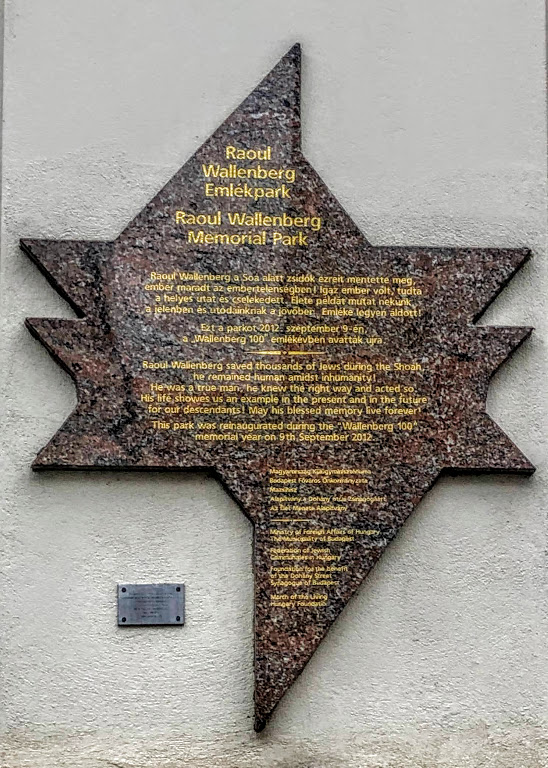
A memorial to Raoul Wallenberg in the Raoul Wallenberg Holocaust Memorial Park at the Dohány Street Synagogue, Budapest (Photograph: Patrick Comerford)
The Mary Elmes Bridge in Cork … the centrepiece of the bridge is designed to look like a menorah (Photograph: Patrick Comerford)
The Wall of the Righteous in Paris lists 3,300 French people who have been recognised as ‘Righteous Among the Nations’ (Photograph: Patrick Comerford)
These images are reminders not only of the Holocaust and its victims, but of real individuals who suffered and were humiliated, whose lives were shattered and who were murdered.
They are reminders of why we must never forget. The Holocaust happened not just because of one evil man but because many good people stood by and remained silent.
Over 80 years after the end of the Holocaust, antisemitism is on the rise once again. We are seeing the rise of the far-right in Britain across Europe and a resurgence of the far-right in Latin America, far-right ideology and vocabulary has become part and parcel of the language of the Trump regime, its spokespersons and those who support street murders by ICE in Minneapolis.
We must never forget.
The Eternal Flame in the Mémorial de la Shoah, Paris (Patrick Comerford)
‘The Ballad of Mauthausen’, the Holocaust cantata written by Iakovos Kambanellis and Mikis Theodorakis … Mauthausen was the last of the concentration camps to be liberated, on 3 May 1945
Patrick Comerford
The Victory in Europe Day (VE Day) commemorations next week mark Germany's unconditional surrender on 8 May 1945 and the end of all German military operations. Yom haShoah, the Jewish world’s annual day of remembrance of the Holocaust, was marked last week (24 April 2025). Wednesday marked the 80th anniversary of Ravenruck (30 April 1945), and the 80th anniversary of the liberation of Bergen-Belsen was marked two weks earlier (15 April 1945).
This weekend also marks the liberation of the concentration camps at Mauthausen and Gusen. The last members of the SS fled the camps on 3 May 1945, and a US Army reconnaissance unit arrived in Gusen and Mauthausen on 5 May. On the following day, the US army finally liberated around 40,000 prisoners in the camps. In both camps they found the bodies of hundreds of detainees who had died in the days before liberation.
Mauthausen was the last of the concentration camps to be liberated at the end of the Holocaust. Mauthausen-Gusen was about 20 km east of Linz in Upper Austria. Unlike Auschwitz, it was not an extermination camp, but countless people were murdered and died there in horrific circumstances. There the Nazis forced their victims to work in a stone quarry, hauling large pieces of rock and stone up the ‘Stairs of Death’ along steep and uneven ramps.
The Jewish prisoners there included Simon Wiesenthal (1908-2005), who is remembered for his tireless efforts to bring those responsible for the Holocaust to justice. He survived the Lwów ghetto, concentration camps in Janowska (1941-1944), Kraków-Płaszów (1944) and Gross-Rosen, a death march to Chemnitz, and the concentration camps at Buchenwald and Mauthausen (1945).
After World War II, Wiesenthal dedicated his life to tracking down and gathering information on fugitive Nazi war criminals so that they could be brought to trial. He played a role in capturing Adolf Eichmann in Buenos Aires in 1960. He died in Vienna at the age of 96 on 20 September 2005.
Other prisoners or detainees in Mauthausen included Jehovah’s Witnesses, Romanies and Spanish republicans. Between 240,000 and 320,000 people, including Jews, intellectuals, and people classified as political ‘undesirables,’ were murdered in Mauthausen.
The Greek playwright Iakovos Kambanellis, author of ‘Mauthausen’ … is regarded by many as the greatest Greek playwright of the 20th century
Over the past week, I have been listening once again to the words and the music of The Ballad of Mauthausen, a cantata written by Iakovos Kambanellis and Mikis Theodorakis 60 years ago in 1965, 20 years after the end of World War II.
The Ballad of Mauthausen (Η Μπαλάντα του Μαουτχάουζεν) is based on the experiences of the Greek playwright Iakovos Kambanellis (Ιάκωβος Καμπανέλλης, 1922-2011), who wrote four poems that Mikis Theodorakis (Μίκης Θεοδωράκης) set to music.
Kambanellis was a poet, playwright, screenwriter, lyricist, and novelist, best known as a screenwriter for films, including Stella (1955), directed by Michael Cacoyannis. It was first written the script as a play, Stella With the Red Gloves, based on Carmen, but was never produced on the Greek stage because of its sexual frankness. The film, shot in the streets of Athens, follows a singer (Melina Mercouri) who refuses to marry her lover and begins a passionate affair with a football player. The film made a star of Melina Mercouri and boosted Greek cinema’s international reputation.
Kambanellis was born on 2 December 1922 in Hora on the island of Naxos. He was forced to leave school at an early age and to find work after the family moved to Athens, but he continued his studies at an evening technical school. He was arrested in 1942 after attempting to flee Nazi-occupied Greece, and was sent to Mauthausen in Austria, where he spent the rest of World War II.
The ‘Stairs of Death’ in Mauthausen
Kambanellis owed his survival in Mauthausen to the protection of a philhellenic German prisoner who assigned him to the architectural drafting office, where additions to the camp were designed.
Mauthausen was the last of the concentration camps to be liberated in May 1945. Kambanellis was not a Jew, and he was free to return with the other Greek prisoners to Greece. But knowing there were Greek Jews who dreamed of reaching Palestine, he elected to stay on in the camp until the last Greek Jew left.
Interviewed later in life, he said: ‘I don’t want to make myself into a hero. What could I do? I saw the eyes of the sick, of the weak, of the abandoned; could I have said okay, fine, I’m leaving now? I was their friend.” He admitted he was deeply envious of them “because we all went back to an old world and we were scared of it. We couldn’t, after those three years, go back to the world of the past, of before the war. And they went to a new, virgin, country and started a new world in Palestine.’
On his return to Greece, Kambanellis began writing a newspaper column in Athens before turning to the theatre and film.
A recurring feature of his work is the use of multiple, often unexpected voices. He attributed this to the years he spent in Mauthausen, listening to the voices of nameless sufferers. His success as a writer seemed miraculous to him and perhaps contributed to his unique blend of realism and mysticism.
His most successful play, Our Grand Circus, was staged in 1973 at the height of the colonels’ dictatorship in Greece. Weaving history, myth, and the traditional shadow puppet theatre with folk motifs, the play ridicules the heroic view of Greek history favoured by the colonels, rewriting Greek history from a left-wing perspective.
By calling the performances a circus and transforming his bleak view of the regime and of Greek history into a series of amusing vignettes, he escaped the strict censorship of the time. Our Grand Circus broke all box-office records and made Kambanellis a popular symbol of resistance.
He wrote the scripts for about a dozen films and directed two of them. He died in Athens on 29 March 2011. He is regarded by many as the greatest Greek playwright of the 20th century.
Mauthausen, his only novel, is a memoir recalling his experiences in the concentration camp. It was first published 60 years ago in Athens in 1965 and has been translated into English and German. At the same time, he wrote the Mauthausen cantata with a setting by his close friend Mikis Theodorakis, when his publisher suggested that they publish their works together.
The book and the music were born in an incendiary political and cultural milieu in Greece. Two days after its first performance, all music by Theodorakis was banned from Greek state radio. Within two years, the military had seized power and the colonels silenced Theodorakis and many other voices for seven long years.
Kambanellis was inspired by a photograph of an unknown girl which he found in the camp and which he kept with him.
The memoir begins in the camp and the neighbouring villages in the weeks immediately after their liberation. The horrors the inmates have seen and have suffered are recalled by the author and the woman he falls in love with, a Lithuanian Jew, in merciless detail as the lovers exorcise their demons by revisiting the sites of the atrocities they witnessed. When the inmates are gradually repatriated, many of the Jews there wait to find a way to get to Palestine.
The best-known song of all, performed by Maria Farantouri, is the first song, Άσμα Ασμάτων (Asma Asmaton, ‘Song of Songs’), which opens with the words:
Τι ωραία που είν’ η αγάπη μου
με το καθημερνό της φόρεμα
κι ένα χτενάκι στα μαλλιά.
Κανείς δεν ήξερε πως είναι τόσο ωραία.
‘My love, how beautiful she is in her everyday dress’.
This first song recalls the poignant questioning of a man who describes how beautiful his beloved is and asks the other inmates if they have seen her. They tell him they have seen her on a long march, standing on large square with a number on her arm and a yellow star on her heart. Maria Farantouri hauntingly sings the repeated line: ‘No-one knows how beautiful my beloved was.’<’br />
This song maintains the poetic structure of the Biblical Song of Songs, until the chilling line, coming as if in response to ‘have you seen him whom my soul loves,’ echoes with the question: ‘Young girls of Mauthausen, Young girls of Belsen, Have you seen my love?’ and the answer ‘We saw her in the frozen square, A number in her white hand And a yellow star on her heart.’
The second song, O Αντώνης (O Antonis, ‘Adonis’) is also known from the score of the film Z. This song tells the story of a Jew who collapses on the ‘Stairs of Death’ at the base of the quarry and is shot by the guard who then orders the Greek prisoner Antonis to lift a double burden or he too will be shot.
Antonis lifts this second rock and defiantly walks on with it. In this song we also hear the stairs being depicted in the introduction to every couplet.
The third song, Ο Δραπέτης (O Drapetis, The Fugitive), is the story of a prisoner who escapes the camp but cannot find refuge in the hostile surroundings. He is captured again and is shot.
The introduction to this song depicts the landscape of Austria with a Mozart-like melody.
In the last song, Όταν τελειώσει Ο Πόλεμος (Otan Teliossi O Polemos, When the War Ends), the poet addresses one of the girls he sees standing by the fence of the female camp and asks whether they can come together when the war is finally over, kiss at the gate, make love in the quarry and in the gas chamber until the shadow of death is driven away.
The song ends with an epilogue, returning to the first song and ending with the plaintive words that no-one knows how beautiful my beloved was.
The instrumentation includes bouzoukis, spinet, electric guitar, baglamas, flute, bass and percussion, all helping to create a desolate yet beautiful atmosphere.
Greek popular music in the 1960s became known all over the world thanks to the scores by two composers in particular, Manos Hadjidakis and Mikis Theodorakis, for two popular movies, Never on Sunday and Zorba the Greek. Both worked in the laika tradition of Greek popular music influenced by European melodic form. Each had his own muse or angel in a female singer who interpreted his music – for Hadjidakis she was Nana Mouskouri, for Theodorakis she was Maria Farandouri.
The recording of The Ballad of Mauthausen marked the beginning of one of the most fruitful collaborations in Greek music. Mikis Theodorakis discovered the singer Maria Farantouri when she was a 16-year-old young singer. He is said to have told her at the time: ‘You will be my high priestess.’ Her unique dramatic voice and style complements his music, and it is so productive a partnership that it has lasted for half a century.
Listening to The Ballad of Mauthausen, it is difficult to grasp that this is the voice of a teenager who has just left school, for she sings with a raw force and energy that reaches into the heart and soul with intensity.
Farandouri and Theodorakis had a life-long musical collaboration, intensified by their shared political activism. This album is both a classic and the high point of that collaboration.
Farandouri’s voice is a marvel of depth and beauty, and the songs are among the best by Theodorakis. The power and majesty of his music combined and the soaring beauty of her voice make The Ballad of Mauthausen a profound testament to the power of human resistance to tyranny and oppression.
The most accessible recording by Maria Farantouri (Μαρία Φαραντούρη) is complemented by a cycle of six songs for Farantouri, named ‘Farantouri’s Cycle’:
5, Κουράστηκα να σε κρατώ (Kourastika na se Krato, ‘I Am Tired of Holding Your Hand’).
6, Ο ίσκιος έπεσε βαρύς (O Iskios Epesse Varis, ‘The Shadow is so heavy’).
7, Πήρα τους δρόμους τ' ουρανού (Tous Thromous T’Ouranou, ‘I Took to the Streets of Heaven’).
8, Στου κόσμου την ανηφοριά (Stou Kosmou Tin Aniforya, ‘The Uphill Road’).
9, Το Εκκρεμές (To Ekremes, ‘The Pendulum’).
10, Τ' όνειρο καπνός (Tóniro Kapnos, ‘Dreams Go up in Smoke’).
The Ballad of Mauthausen is a difficult poem to read and a difficult cantata to listen to, and yet is compelling.
It is difficult to realise how a poet could be inspired to write about love in the all-encompassing atmosphere of evil and death in a concentration camp.
Yet this is the dream of love, and love is the way a great soul not only survives such terror, but finds meaning and triumphs over it.
A sketch by Simon Wiesenthal in Mauthausen for ‘Café As’ … part of a recent exhibition in the Jewish Museum, Vienna (Photograph: Patrick Comerford)
Άσμα Ασμάτων
Τι ωραία που είν’ η αγάπη μου
με το καθημερνό της φόρεμα
κι ένα χτενάκι στα μαλλιά.
Κανείς δεν ήξερε πως είναι τόσο ωραία.
Κοπέλες του Άουσβιτς,
του Νταχάου κοπέλες,
μην είδατε την αγάπη μου;
Την είδαμε σε μακρινό ταξίδι,
δεν είχε πια το φόρεμά της
ούτε χτενάκι στα μαλλιά.
Τι ωραία που είν’ η αγάπη μου,
η χαϊδεμένη από τη μάνα της
και τ’ αδελφού της τα φιλιά.
Κανείς δεν ήξερε πως είναι τόσο ωραία.
Κοπέλες του Μαουτχάουζεν,
κοπέλες του Μπέλσεν,
μην είδατε την αγάπη μου;
Την είδαμε στην παγερή πλατεία
μ’ ένα αριθμό στο άσπρο της το χέρι,
με κίτρινο άστρο στην καρδιά.
Τι ωραία που είν’ η αγάπη μου,
η χαϊδεμένη από τη μάνα της
και τ’ αδελφού της τα φιλιά.
Κανείς δεν ήξερε πως είναι τόσο ωραία.
Ο Αντώνης
Εκεί στη σκάλα την πλατιά
στη σκάλα των δακρύων
στο Βίνερ Γκράμπεν το βαθύ
το λατομείο των θρήνων
Εβραίοι κι αντάρτες περπατούν
Εβραίοι κι αντάρτες πέφτουν,
βράχο στη ράχη κουβαλούν
βράχο σταυρό θανάτου.
Εκεί ο Αντώνης τη φωνή
φωνή, φωνή ακούει
ω καμαράντ, ω καμαράντ
βόηθα ν’ ανέβω τη σκάλα.
Μα κει στη σκάλα την πλατιά
και των δακρύων τη σκάλα
τέτοια βοήθεια είναι βρισιά
τέτοια σπλαχνιά είν’ κατάρα.
Ο Εβραίος πέφτει στο σκαλί
και κοκκινίζει η σκάλα
κι εσύ λεβέντη μου έλα εδω
βράχο διπλό κουβάλα.
Παίρνω διπλό, παίρνω τριπλό
μένα με λένε Αντώνη
κι αν είσαι άντρας, έλα εδώ
στο μαρμαρένιο αλώνι.
Ο Δραπέτης
Ο Γιάννος Μπερ απ’ το βοριά
το σύρμα δεν αντέχει.
Κάνει καρδιά, κάνει φτερά,
μες στα χωριά του κάμπου τρέχει.
«Δώσε, κυρά, λίγο ψωμί
και ρούχα για ν’ αλλάξω.
Δρόμο να κάνω έχω μακρύ,
πάν’ από λίμνες να πετάξω.»
Όπου διαβεί κι όπου σταθεί
φόβος και τρόμος πέφτει.
Και μια φωνή, φριχτή φωνή
«κρυφτείτε απ’ τον δραπέτη.»
«Φονιάς δεν είμαι, χριστιανοί,
θεριό για να σας φάω.
Έφυγα από τη φυλακή
στο σπίτι μου να πάω.»
Α, τι θανάσιμη ερημιά
στου Μπέρτολτ Μπρεχτ τη χώρα.
Δίνουν το Γιάννο στους Ες Ες,
για σκότωμα τον πάνε τώρα.
Όταν τελειώσει Ο Πόλεμος
Κορίτσι με τα φοβισμένα μάτια
κορίτσι με τα παγωμένα χέρια,
άμα τελειώσει ο πόλεμος
μη με ξεχάσεις.
Χαρά του κόσμου, έλα στην πύλη
να φιληθούμε μες στο δρόμο
ν’ αγκαλιαστούμε στην πλατεία.
Κορίτσι με τα φοβισμένα μάτια
κορίτσι με τα παγωμένα χέρια,
άμα τελειώσει ο πόλεμος
μη με ξεχάσεις.
Στο λατομείο ν’ αγαπηθούμε
στις κάμαρες των αερίων
στη σκάλα, στα πολυβολεία.
Κορίτσι με τα φοβισμένα μάτια
κορίτσι με τα παγωμένα χέρια,
άμα τελειώσει ο πόλεμος
μη με ξεχάσεις.
Έρωτα μες στο μεσημέρι
σ’ όλα τα μέρη του θανάτου
ώσπου ν’ αφανιστεί η σκιά του.
Κορίτσι με τα φοβισμένα μάτια
κορίτσι με τα παγωμένα χέρια,
άμα τελειώσει ο πόλεμος
μη με ξεχάσεις.
The Song of Songs
How beautiful she is, my love
in her everyday dress
and the little comb on her hair
Nobody ever knew that she is so beautiful
Girls of Auschwitz
Dachau’s girls
have you seen by chance my love?
We saw her leaving on a long voyage
she was no longer wearing her dress
nor a little comb on her hair.
How beautiful she is, my love
the one pampered by her mother
and her brother’s kisses
Nobody ever knew that she is so beautiful
Girls of Auschwitz
Dachau’s girls
have you seen by chance my love?
We saw her in the frigid town square
with a number stamped on her white hand
with a yellow star pinned by her heart
How beautiful she is, my love
the one pampered by her mother
and her brother’s kisses
Nobody ever knew that she is so beautiful
Adonis
There on the wide staircase
the staircase of tears
in Wiener Graben’s deep stone-
quarry of cries and lamentation
Jews and partisans stroll by
Jews and partisans fall down
a rock they carry on their back
a rock a burden cross of death
There comes Adonis and a voice
a voice, a voice he hears
oh comrade, oh comrade,
help me to climb these stairs
But there on the wide staircase
that staircase of tears
such help is taken as insult
such a compassion is a curse
The Jewish man falls on the step
and red bleeds through the staircase
and you young lad come over here
a double rock you’ll carry
A double rock I’ll take, a triple
my name, they call me Adonis
come and meet me if you are a man
at the marble threshing circle.
The Fugitive
Janos Ber from the North
can’t stand the barbed wire.
He takes heart, takes wing
runs through the villages of the valley.
Ma’am, give me a piece of bread
and clothes to change into –
I have a long way to go
and lakes to fly across.
Wherever he goes or stops
fear and terror strike
and a cry, a terrible cry:
Hide from the fugitive!
Christians, I’m no murderer,
no beast come to eat you.
I left the prison
to go back to my home.
Ah, what deathly loneliness
in this land of Berthold Brecht!
They hand Janos over to the SS
They’re taking him, now, to be killed.
When the War is Over
Girl with the weeping eyes,
Girl with the frozen hands.
Forget me not when the war is over.
Joy of the world. come to the gate
So that we could embrace in the street.
So that we could kiss in the square.
So that we could make love in the quarry.
In the gas chambers,
On the staircase, in the observation post.
Love in the middle of noon
In all the corners of death
’Til its shadow will be no more.
Girl with the weeping eyes,
Girl with the frozen hands.
Forget me not when the war is over.
• Maria Farantouri, who is on a tour marking the 100th anniversary of the death of Mikis Theodorakis, is taking part in a concert in Schauspielhaus in Bochum, Germany next Friday (9 May 2025). The programme that includes ‘The Ballad of Mauthausen’, other songs, readings and a talk. The concert marks the 80th anniversary of the end of World War II, and she is accompanied by the pianist Henning Schmiedt.
Marianne Faithfull, who died last week at the age of 78, had a strong Jewish family background in Austria, Hungary, Romania, Serbia, Ukraine and Germany
Patrick Comerford
Marianne Faithfull, the singer, muse and actor who helped write and inspired some of the Rolling Stones’ greatest songs, died last week at the age of 78. She was 17 and I had just started secondary school when she took every teenage boy’s world by storm with her hit version of ‘As Tears Go By.’
The story of Marianne Faithfull’s disturbing early life, her brave efforts at recovery, and her death last week brought back so many of my teenage and school years. They reminded me too of the amazing story of her mother, Eva von Sacher-Masoch, who styled herself Baroness Erisso, and called me back again to a blog series, ‘Tales of the Viennese Jews,’ which I began in November 2019, although I had not returned to it since the story of Max Perutz almost for four years ago (18 May 2021).
The Tales from the Vienna Woods is a waltz by the composer Johann Strauss II (1825-1899), written just over a century and a half ago, in 1868. Although Strauss was baptised in the Roman Catholic Church, he was born into a prominent Jewish family. Because the Nazis had a particular penchant for Strauss’s music, they tried to conceal and even deny the Jewish identity of the Strauss family.
However, the stories of Vienna’s Jews cannot be hidden, and many of those stories from Vienna are told in the exhibits in the Jewish Museum in its two locations, at the Palais Eskeles on Dorotheergasse and in the Misrachi-Haus in Judenplatz.
Rather than describe both museums in detail in one or two blog postings, I decided after a visit to Vienna in November 2019 to post occasional blog postings that re-tell some of these stories, celebrating a culture and a community whose stories should never be forgotten.
The newspaper obituaries last week focussed on Marianne Faithfull as a singer, actor, her brave battle for recovery from addiction and against cancer, and her short relationship with Mick Jagger, and portrayed her as the archetypal wild child of the 1960s.
She had a convent school education, and was often described as the daughter of an aristocratic baroness who had survived the Nazi occupation of Austria. Both details added to the media attention to her lifestyle in the 1960s and 1970s.
Marianne Faithfull’s mother, Eva von Sacher-Masoch, who called herself Baroness Erisso
In recent years, the singer also explored her Jewish background and her Jewish ancestry featured in the BBC series Who Do You Think You Are?. She once declared she had to thank her Jewish roots for her renditions of the songs of Bertholt Brecht and Kurt Weill and for an innate flair for their music.
Recent genealogical research reveals that, despite her Catholic background and schooling, Marianne Faithfull was Jewish by all rabbinical definitions. Although she never practised Judaism, her mother, her maternal grandmother, and all her ancestors on that side of her family are Jewish, which meets the definition of being Jewish according to halacha or Jewish traditional law.
Her mother, Eva von Sacher-Masoch, who called herself Baroness Erisso, was a dancer in Weimar Berlin and was then living in Vienna when World War II began. Eva’s mother Flora was born into a well-known Jewish family; she converted to Christianity when she married an Austrian aristocrat Artur Wolfgang Ritter von Sacher-Masoch (1875-1953), but she still attended synagogue on High Holy Days.
Marianne Faithfull’s father, Major Robert Glynn Faithfull, was a British intelligence officer during World War II and later Professor of Italian Literature at Bedford College, London University. He met Eva in Vienna after the defeat of the Nazis.
Marianne Faithfull’s mother was known as Eva but was born Hermine von Sacher-Masoch (1912-1991) on 4 December 1912 in Budapest, then the second city in the Austro-Hungarian Empire.
Eva’s father, Artur Wolfgang von Sacher-Masoch, was an Austrian writer who used the pseudonym Michael Zorn. His family was descended from central European minor nobility through Leopold Johann Nepomuk Ritter von Sacher – the title ritter indicates an hereditary knight, and is somewhat equivalent to the title of baronet. Leopold combined his own family name with that of von Masoch, to keep alive the name of the family of his wife, who was the last descendant of a Slovak family of minor aristocrats. He did this when the Habsburg emperor gave him the title of ritter to recognise his work as the imperial police commissioner in Lemberg, present-day Lviv in Ukraine.
Another family member was the writer Leopold von Sacher-Masoch (1836-1895), whose last name and scandalous novel Venus in Furs gave rise to the word ‘masochism’.
Eva’s mother, Flora Ziprisz (1881-1955), was born into a central European Jewish family whose members included many prominent medical doctors. She was known in her family as Flora but was born Elisabeth Rosa Ziprisz on 29 September 1881 in Karánsebes, then in Hungary and now Caransebeș in the Banat region in south-west Romania. Flora’s mother, Therese (Deutsch) Ziprisz, was also born in Caransebeş.
Flora’s father, Eva’s grandfather, Dr Wilhelm ‘Vilmos’ Ziprisz (1844-1922), was born in the Banat region on 23 November 1844 in Neusatz or Novi Sad, once known as the ‘Serbian Athens’. It was then an important city on the Danube in the Hungarian part of the Austro-Hungarian. Today it is the second largest city in Serbia.
He was a son of Salamon Ziprisz, a member of a leading Jewish family from Bač, now in Vojvodina in Serbia. He studied medicine in Vienna under Dr Ignaz Semmelweis, and later became a doctor battling the diphtheria and cholera in the Austro-Hungarian Empire. He publicly vaccinated his daughter Flora with the smallpox vaccine to show villagers that it would not poison them. He died in Vienna at the age of 78 on 28 April 1922.
Despite strong disapproval from both their families, Flora married Artur Wolfgang Sacher-Masoch in Caransebeș on 9 January 1901 when she was 18. She converted to Christianity – not an uncommon experience at the time – but continued to attended synagogue on High Holy days.
The main building of the Jewish community in Vienna, housing the Stadttempel or City Synagogue at Seitenstettengasse 4 … Eva Sacher-Masoch moved with her family to Vienna in 1918 (Photograph: Patrick Comerford)
After the collapse of the Hapsburg empire, Austrian abolished and outlawed all aristocratic titles. As a child, Eva was known as Eva Sacher-Masoch. She spent her early childhood living on her family’s estates near Caransebeș, and moved with her family to Vienna in 1918. Her brother was the novelist Alexander Sacher-Masoch (1901-1972), author of Die Parade.
As a young woman, Eva moved to Berlin where she studied ballet at the Max Reinhardt Company. She danced in productions by the German theatrical duo Bertolt Brecht and Kurt Weill, as well as in the cabaret scene of Weimar Berlin, depicted in the film Cabaret. In one anecdote, she recalled how she was befriended by a prostitute on the Kurfurstendamm who would see her home safely at night.
As World War II loomed, Eva returned to her parents’ home in Vienna and lived with them throughout the war. The family opposed Hitler since the Anschluss or forced annexation of Austria by Nazi Germany. Flora thought of herself as a Hungarian patriot, first and foremost, but was as shocked as any other Jew by the Nazi racial laws.
Despite their Jewish ancestry, Flora and Eva were protected to a degree because of Artur’s World War I military record, his standing as the writer Michael Zorn, and perhaps his aristocratic claims. This may have saved Flora from having to wear a yellow star and from being sent to the death camps but did not remove the constant fear, and Eva was officially labelled a mischling or ‘a mongrel’.
At times, the family secretly helped Jews fleeing Austria, and hid socialist pamphlets in their home. Artur joined the anti-Nazi resistance, and ended up being arrested and hung by his hands in torture chambers in his 60s.
Soviet troops liberated Vienna in April 1945, but Eva and Flora were among 100,000 or so women in Vienna who were raped by Red Army troops. A Russian soldier found Eva and Flora hiding in a room. He raped Eva, but she then picked up a gun and shot him before he could do the same to Flora; later Eva had an abortion.
In post-war Vienna, Eva met a British intelligence officer, Major Robert Glynn Faithfull (1912-1998), a lecturer in Italian at Liverpool University. They married in 1946, moved to England and were the parents of a daughter Marianne, born Marian Evelyn Gabrielle Faithfull in Hampstead, London, on 29 December 1946.
The family lived for a time in Ormskirk, Lancashire while the father completed his PhD at Liverpool University. Marianne then spent part of her childhood in Braziers Park, a commune in Oxfordshire formed by John Norman Glaister in which Robert Faithfull played an instrumental role.
The couple divorced in 1952. Despite Austrian law, Eva chose to style herself Eva von Sacher-Masoch, Baroness Erisso, despite Austrian constitutional laws. Research for Who Do You Think You Are? revealed Eva’s claim to a title was exaggerated though rooted in reality.
To help support her daughter, Eva taught dance at Bylands School, a private boarding school near Basingstoke, Hampshire. She later lived in Reading, Berkshire, where she worked as a waitress at a Sally’s Café on Friar Street. Eva’s mother Flora came to live with them and died in Reading at the age of 74 in July 1955.
Eva and Marianne seem to have lived in straitened circumstances, and Marianne’s childhood included bouts of tuberculosis. She went to a primary school in Brixton, London, and had a bursary to attend Saint Joseph’s Convent School, Reading, where she was a weekly boarder and part of the Progress Theatre’s student group.
Eva died on 22 May 1991. Dr Robert Glyn Faithfull died on 5 February 1998, aged 85.
Marianne Fathfull’s mother Eva von Sacher-Masoch, who was half-Jewish, and her mother Flora, who was a Hungarian Jew (Photo courtesy of http://www.cabaret-berlin.com)
Despite Eva’s bohemian past, Marianne Faithfull said she broke her mother’s heart when she embarked on her own wild time. As a singer, she was discovered at 17 by the Rolling Stones manager Andrew Oldham. Her first single, ‘As Tears Go By’, was written by Mick Jagger and Keith Richards and made her a star. She would dismiss any rumours that she had had a hand in writing the song.
Her life quickly became a whirlwind. By 18, she was married to the artist John Dunbar and the mother of a son, Nicholas. Her affair with Mick Jagger ended in 1970, and that same year she lost custody of her son. She survived a suicide attempt and spiralled downwards, spending two years sleeping rough in Soho and addicted to heroin. Later in life, she was seen as the rock ’n’ roll casualty who had survived to tell her tale.
She acted in films including The Girl On A Motorcycle with French actor Alain Delon, as well as theatre productions. She entered a new phase with an understated performance as Maggie in Sam Garbaski’s film comedy-drama Irina Palm that was lauded by critics at the Berlin Film Festival in 2007.
She also fought anorexia, hepatitis and breast cancer, broke her hip in a fall and was in hospital with Covid-19. Her final album was an experimental collaboration in 2021 with the Australian multi-instrumentalist Warren Ellis, She Walks In Beauty.
Although Marianne Faithfull was raised a Catholic, she was proud of her Jewish heritage through her mother and grandmother and once said music by Kurt Weill, a cantor’s son, was ‘very much the tonic scale from the temple.’ She had never been to a synagogue nor heard the music there. ‘But I think there must really be some genetic memory of my Jewish background,’ she once told the Jewish Chronicle.
Marianne Faithfull would say she had lived out her dreams and her nightmares. She died on 30 January 2025.