COMERFORD WAY: Patrick Comerford’s online journal on Anglicanism, theology, spirituality, history, architecture, travel, poetry, beach walks ... and more
Sid James on the wall of the Old George in Stony Stratford … undisturbed by this week’s Hallowe’en decorations (Photograph: Patrick Comerford, 2026)
Patrick Comerford
Hallowe’en is tomorrow and shops and pubs in Stony Stratford are decorated with spiders and skulls, pumpkins and brooms, cobwebs and coffin lids, white sheets and black cats, spiders and witches.
But in the Old George, where I like to drop in for a drink occasionally, the framed photographs of Sid James on a wall between the door and a window, have been left untouched, alongside other memorabilia from the Carry On films and actors. It’s as though the East End comedian and actor who died half a century ago is being left in peace, considering the unusual circumstances of his death on stage 50 years ago in 1976.
Sidney James (1913-1976) was born Solomon Joel Cohen in South Africa on 8 May 1913. But his family were deeply rooted in the Jewish East End of London, and became a very typecast British actor, with a career in radio, television, stage and screen, best known for his top billing in 19 Carry On films, his part alongside Alec Guinness in The Lavender Hill Mob (1951), his role in Tony Hancock’s co-star in Hancock's Half Hour and his distinctive laugh.
Sid James was born Solomon Joel Cohen in in Newcastle, Natal, on 8 May 1913. His parents were two London-born Jewish vaudeville performers, Reina (Solomon) Cohen (1892-1965) and Lazarus Joel ‘Lew’ Cohen (1884-1948) from Mile End. His paternal grandparents, Solomon Cohen (1835-1911) and Rahle (Davidoff) Cohen (1836-1936), were born in Latvia, and nine of their ten children were born in the Russian Empire before they fled the Tsarist pogroms and arrived in London in the early 1880s. The family lived in the East End in Horsley Buildings, a lane with small houses on either side, and their home was at the extreme end facing the entrance to the lane, near Sidney Street in Stepney.
The Siege of Sidney Street – also known as the Battle of Stepney – began on 16 December 1910 and came to an end on 3 January 1911, and was one of the most notorious events at the time in the East End. It was one of the worst days in the history of British policing and was considered to be the biggest criminal event in the East End since ‘Jack the Ripper’.
As a child, Sid James was known as Sollie. He later changed his name to Sidney James following confusion with a similarly-named cousin at school. The name Sidney may have come from the area in Stepney where his grandparents had lived, the new surname James came from the stage names his parents used. During his childhood, his parents travelled abroad, were divorced in Australia, and he spent part of his childhood in the care of an uncle and aunt, Abraham and Esther Cohen. His family were not members of a local synagogue, and it is said that 100 years ago he prepared for his Bar Mitzvah at the age of 13 in 1926 by learning prayers from an elderly Lithuanian immigrant to recite at a house party.
In his early adult years, he claimed, he had been a diamond cutter, dance tutor, and boxer. In fact, he had been a hairdresser before beginning to work as an actor. He was a lieutenant in the South African army during World War II, but he returned to the stage after the war and had moved to London by the end of 1946.
His early film career included roles in The Lavender Hill Mob (1951) alongside Alec Guinness, The Buccaneers, The Galloping Major (1951), The Titfield Thunderbolt (1953), Father Brown(1956), and The Adventures of Robin Hood and, as well as parts in television comedies.
He starred with Miriam Karlin in East End, West End (1958) by Wolf Mankowitz, a half-hour comedy series set in the Jewish community in the East End.
He began working with Tony Hancock in 1954, and Sid James played a character called Sid James but with the invented middle name Balmoral, a petty criminal who would con Hancock in one way or another. Tony Hancock and Sid James were seen as a double act until the series ended in 1960.
James became a leading member of the Carry On team with Carry On Teacher in 1959, and in all made 19 Carry On films, with top billing in 17. His characters were often wise-cracking, sly, lecherous Cockneys, sometimes with the name Sid or Sidney, such as Sir Sidney Ruff-Diamond or Sid Boggle, all with his distinctive laugh and his catchphrase ‘Cor, blimey!’
He first appeared on The Eamonn Andrews Show in 1964. He starred in the 1970s sitcom Bless This House until he died in 1976. He had major problems with alcohol and gambling, and lost tens of thousands of pounds as a compulsive gambler. After a severe heart attack in 1967, he gave up cigarettes, lost weight, ate only one main meal a day, and limited himself to two or three alcoholic drinks in the evening.
Sid James was married three times: his first marriage in 1936 ended in divorce in 1940, his second marriage in 1943 ended in divorce in 1952, and he married a third time later that year. He also fathered three or four children in other relationships, and during his third marriage he had a three-year affair with his Carry On co-star Barbara Windsor (1937-2000).
He had a notoriously antagonistic relationship with Carry On co-star Kenneth Williams. Williams was particularly scathing and personal about James’s acting ability, while James found Williams’s loud and attention-seeking behaviour annoying.
Sid James was on stage on 26 April 1976 when he suffered a heart attack at the Sunderland Empire Theatre. The other actors thought he was playing a practical joke when he failed to reply to their dialogue. They ad-libbed but when he still failed to respond, the curtains closed and they called for a doctor. The audience laughed, believing it was all part of the show. He was pronounced dead at Sunderland General Hospital. He was 62.
Sid James was cremated and his ashes were scattered at Golders Green Crematorium in London, directly opposite Golders Green Jewish Cemetery, but without any Jewish prayers or rituals. Dying on stage as a famous comic actor to the sound of laughter might be seen by some as the way to go. But fame and celebrity had never brought him fortune or inner happiness, and he had gambled away most of his earnings.
Many fans thought he was from the East End but were not aware of his Jewish background, nor that he was born and raised in Johannesburg. His Jewish heritage rarely defined his public persona or roles, and he rarely played Jewish characters on screen, apart from the mini sitcom series East End, West End (1958), in which he was Sid, a small-time Jewish businessman from the East End always on the look-out for a scheme that could make him rich. Instead, he seemed to fit in seamlessly into general British working-class character roles.
May his memory be a blessing, ז״ל.
Shabbat Shalom, שבת שלום
Siege House on Sidney Street recalls the Siege of Sidney Street … did Sidney James take his stage name from Sidney Street, where his grandparents lived? (Photograph: Patrick Comerford)
The new Mapstone sculpture by Broadbent Studios … installed in the Market Square in Stony Stratford this week (Photograph: Patrick Comerford, 2026)
Patrick Comerford
I was singing with the Choir at the Autumn Concert in Saint Mary and Saint Giles Church in Stony Stratford this afternoon (10 October) with a full programme that involved the parish choir, the parish band and the handbell-ringers.
It has been a busy, enriching week for me culturally, including this afternoon’s concert, watching the installation of a new sculpture in the Market Square in Stony Stratford, and seeing the use of two of my photographs in a local news magazine.
The choir in Saint Mary and Saint Giles Church is directed by Jacob Collins and as contribution to the programme this afternoon included John Rutter’s setting of ‘For the Beauty of the Earth’ by the poet and hymnwriter Folliott Sandford Pierpoint (1835-1917); ‘My Beloved Spake’ by Becky McGlade, based on the Song of Songs 2: 10-12; and the ever-popular South African hymn ‘Siyahamba’.
The composer and conductor Sir John Rutter founded the Cambridge Singers who have recorded many of his works for his own label Collegium Records. His compositions, extended pieces for choir and orchestra, such as Requiem and Magnificat, and his many choral works include For the beauty of the earth, Christmas Carol and A Clare Benediction. He is known for Christmas carols and his Carols for Choirs anthology series compiled with David Willcocks.
FS Pierpoint was a classics schoolmaster and a devout Tractarian, and he wrote ‘For the Beauty of the Earth’ in 1864 at age of 29. He was born in, Bath, was educated at Queens’ College, Cambridge, taught at Somersetshire College, and spent most of his life in Bath.
Becky McGlade studied music at Royal Holloway, University of London and leads a busy musical life as a composer, cellist and teacher. Her music has been performed throughout the UK, including by the Choir of St John’s College, Cambridge, the London Oriana Choir, the Choir of Ely Cathedral, and the BBC Symphony Chorus.
‘Siyahamba’ or ‘We are marching’ dates back to 1952. It became an anti-apartheid liberation song during the struggle against racism and segregation in South Africa and its worldwide popularity grew after it was published in 1984 in a collection Freedom is Coming: Songs of Protest and Praise from South Africa arranged by Anders Nyberg.
This afternoon’s autumn concert also included the church band, conducted by Fiona Collins, the church handbell ringers, directed by Kath Hindley, and children from Saint Mary and Saint Giles School.
Detail of the Map of Stony Stratford on the new sculpture in Market Square (Photograph: Patrick Comerford, 2026)
During the week I have also been watching the installation of Mapstone, a new sculpture by Broadbent Studios in the Market Square in Stony Stratford. The sculpture was commissioned by Stony Stratford Town Council and I was involved in this project from the beginning through the Town Centre Working Group, including the choice of location, the community engagement meetings, the commissioning and the tendering process.
Stony Stratford has a strong civic identity with a long history with a vibrant town centre that looks to the future, all celebrated in this new artwork by Stephen Broadbent and Peter Davidson and the stonemason Ade Wright. They conceived it as a symbol for Stony Stratford and have divided it into three zones expressing the past, present and future.
Stony’s origins as a fording point are reflected in the choice a river stone, suggesting endurance across changing times and standing upright so it might be seen from some distance.
The bottom zone represents Stony’s past. It is often said that the past is ‘mapped out’ or ‘carved in stone’, so a map of Stony is carved in this bottom zone, reflecting many maps of Stony from the Middle Ages up to today.
The top zone represents Stony’s future. The future has yet to be written, so nothing is carved into the stone there. Instead, slices of stone have been removed and replace them with translucent resin that refracts the light in different ways.
In between these two zones, the middle zone represents Stony’s present. That zone is very thin because the present is so fleeting. Yet the present is life, the beating heart of Stony. Here Stony speaks with its own voice in the words of a poem written by schoolchildren of the town, with the final line reading like a continuous loop.
The Mapstone was installed in the Market Square by Broadbent Studio this week, and is being officially unveiled next Saturday (17 October).
The Mapstone is being officially unveiled next Saturday, 17 October 2026 (Photograph: Patrick Comerford, 2026)
In addition, I have made the front page of the Autumn edition of the local news magazine Town Crier, published and distributed by Stony Stratford Town Council.
My front-page photograph, and a second photograph inside on page 5 are of York House, and illustrate a report on how York House, a Grade II listed building and a part of community life in Stony Stratford for generations, is trying to raise £20,000 by December 2026 to secure its future.
The centre’s stable block, dating back to the 1850s, is unsafe and must be removed before it causes damage to York House itself and to make York House more accessible and useful for the whole community. A programme of fundraising events in the coming weeks include quizzes and playreading evenings.
Visiting Quemerford Road in Islington this week in search of links with the Quemerford and Comerford family names (Photograph: Patrick Comerford, 2026)
Patrick Comerford
Islington, an inner-city area in north London, is a mainly residential district of Inner London, extending from Islington High Street to Highbury Fields and Regent’s Canal, and encompassing the area around the busy High Street, Upper Street, Essex Road and Southgate Road to the east.
Islington is known for left-wing and radical politics, and the local MPs are Jeremy Corbyn ( Islington North) and Emily Thornberry (Islington South and Finsbury).
I was in Islington briefly earlier this week because I have long been intrigued by the name of Quemerford Road. Despite the strong links over the centuries between the Comerford family in Kilkenny, Wexford and Waterford and the Comberford family of Comberford family of Comberford Hall near Lichfield and Tamworth in Staffordshire, the name Comerford actually derives from Quemerford, a small village that is now part of Calne in Wiltshire.
The first member of the family using the name of Quemerford village was Bartholomew de Quemerford, who was living 800 years ago, ca 1230-1240. By the early 14th century, Philip of Cummerford or Philip de Quemerford and his family were living in Co Kilkenny, and the spelling Quemerford continued to be used in the family in Kilkenny, Wexford and Waterford until the late 16th century.
As I caught the underground from King’s Cross to Caledonian Road to visit Islington earlier this week, I wanted to find out whether the name of Quemerford Road was linked with the early family members or was associated with Quemerford in Wiltshire.
Quemerford Road in Islington … given its name by Lord Islington in December 1911 (Photograph: Patrick Comerford, 2026)
Mediaeval Islington was a part of the estates of the Bishop of London and the Dean and Chapter of Saint Paul’s Cathedral. The first recorded church, Saint Mary’s, was built in the 12th century and was replaced in the 15th century. A greatest expansion in housing transformed the whole parish the 19th century. The population was 10,000 in 1801, but by 1891 it had expanded to almost 320,000.
At first, large well-built houses and fashionable squares attracted clerks, artisans and professionals to Islington. However, from the mid-19th century the poor were being displaced by clearances in inner London to build new railway stations and goods yards. Many of the displaced people moved to Islington, where houses became homes to many families, and Islington moved from being attractive for the ‘better off’ and became ‘unfashionable’.
Locations in Islington appear in many works by Charles Dickens, including: Oliver Twist (1837-1839), where Mr Brownlow’s house is in Pentonville, and several scenes are set in Islington; David Copperfield (1849-1850), in which Wilkins Micawber lives in City Road; and Bleak House (1852-1853), where William Guppy lives in Pentonville.
The completion of the Victoria line and the redevelopment of Angel tube station created the conditions for developers to renovate many early Victorian and Georgian townhouses in Islington and to build new developments. But Islington fell into a long decline, and by the mid-20th century it was largely run-down and a by-word for urban poverty.
The remaining Georgian terraces were rediscovered by middle-class families from the 1960s on. Many houses were rehabilitated, and the area became newly fashionable with gentrification. The new residents included people who were central in the New Labour movement, including Tony Blair before his 1997 general election victory. According to The Guardian in 2006, ‘Islington is widely regarded as the spiritual home of Britain's left-wing intelligentsia.’
Islington is the most densely populated borough in the UK, with a density of 138.7 people per hectare, compared to an average of 52.0 for London. It is a diverse district with private houses and apartments not far from social housing in neighbouring wards such as Finsbury and Clerkenwell to the south, Bloomsbury and King’s Cross to the west, and Highbury to the north-west, and the Hackney districts of De Beauvoir and Old Street to the north-east.
Quemerford Road in Islington takes its name from Quemerford Gate Farm, sold by Lord Islington in 1914 (Photograph: Patrick Comerford, 2026)
Quemerford Road, Islington, is a small, quiet residential road in London N7, near the Holloway area. It was formed and named at the end of 1911 from a section of what was previously Widdenham Road, which in turn dates from 1906. The street was named after Quemerford, a small village on the outskirts of Calne in West Wiltshire.
According to local records and local history, this specific portion of Widdenham Road was re-designated as Quemerford Road in December 1911. It connects Biddestone Road, Stock Orchard Crescent and Widdenham Road, all of which were part of the wider residential development of the Holloway and Barnsbury fringes of Islington in the early 20th century.
The name of Quemerford Road was formalised when the local council approved an order of the London County Council to rename ‘the street leading out of Stock Orchard Crescent.’
But I learned that the cluster of names of Quemerford Road, Stock Orchard Crescent, Widdenham Road, Hillmarton Road, Beacon Hill and Biddestone Road all come from places in Wiltshire and all were suggested by John Poynder Dickson Poynder (1866-1936), 1st Baron Islington, who was MP for Chippenham (1892-1910) in Wiltshire and owned much property in both Chippenham and Islington.
Widdenham Road in Islington once extended through to Quemerford Road (Photograph: Patrick Comerford, 2026)
Quemerford Gate Farm belonged to the Street family in the 18th century. It was bought by 1774 by the Revd James Mayo, Vicar of Avebury, and by the early 19th century it belonged to Thomas Poynder, lord of Hilmarton Manor. Quemerford Gate Farm descended with Hilmarton Manor and Upper Whitley farm in the Poynder family until 1914, when it was sold by John Dickson Poynder, Lord Islington.
Hilmarton is a village in North Wiltshire, between the towns of Calne and Wootton Bassett.
Stock and Stockley are immediately west of Quemerford and the Poynder family owned Stock Orchard Farm from 1822 or 1823. By 1885, the farmhouse at Stock Orchard had been demolished and all the buildings of Stock Orchard Farm had been demolished by the late 20th century.
Biddestone is a village 3 or 4 miles west of Chippenham. Widdenham is a small, isolated rural locality within the civil parish of Colerne and near Box in the Wiltshire.
Biddestone Road off Quemerford Road in Islington takes its name from Biddestone, a village near Chippenham (Photograph: Patrick Comerford, 2026)
Lord Islington, John Poynder Dickson-Poynder (1866-1936), who gave the names of Quemerford and other places in Wiltshire to these streets in Islington, was a Conservative and then a Liberal politician, and was the Governor of New Zealand in 1910-1912.
He was born John Poynder Dickson on the Isle of Wight 160 years ago on 31 October 1866, the son of Rear Admiral John Bourmaster Dickson and Sarah Matilda (née Poynder) Dickson, and was educated at Harrow and Christ Church, Oxford. He was still only 17 In 1884 when he succeeded to the title of baronet given to the Dickson family in 1802 for their naval exploits.
When he succeeded to his maternal uncle’s property four years later, he added the additional surname of Poynder in 1888 and became known as Sir John Poynder Dickson-Poynder. The Poynder estates in Wiltshire included a farm in Quemerford, Hilmarton near Calne, and Hartham near Corsham.
His wife Anne Beauclerk Dundas (1869-1958), was a granddaughter of Robert Cornelis Napier (1810-1890), Baron Napier of Magdala, Viceroy of India and Governor of Gibraltar, whose military career included the Anglo-Sikh wars and the Indian Mutiny in India, the Opium Wars in China, and British invasions of Abyssinia (Ethiopia).
Dickson-Poynder became High Sheriff of Wiltshire in 1890. He was MP for Chippenham in 1892-1910 elected first as Conservative, but then joining the Liberals in 1905. He also was a member of London County Council (1898-1904). As a captain in the Royal Wiltshire Yeomanry, he went to South Africa in March 1900 during the Second Boer War. Later he was aide-de-camp to Lord Methuen, who lived at Corsham Court in Wiltshire. He was decorated with the Distinguished Service Order (DSO) in 1900, and later was an honorary major in the Royal Wiltshire Yeomanry.
Dickson was Governor of New Zealand in 1910-1912. On his appointment he was made a peer with the title of Baron Islington of Islington, and as Lord Islington he was asked to name some of the streets in Islington, including Quemerford Road, drawing on the names of his properties near Calne in Wiltshire.
Lord Islington was the last Governor of New Zealand to hold the title before it was changed to Governor-General. He was made a KCMG and Privy Counsellor in 1911, and in 1912 became President of the Royal Commission on the Public Services of India.
During World War I, he held minor government positions as Under-Secretary of State for the Colonies (1914-1915), and Under-Secretary of State for India (1915-1918). He was given higher grades of knighthood in 1913 (GCMG) and 1926 (GBE).
Lord Islington died 90 years ago on 6 December 1936 aged 70 at Hyde Park Gardens, London, and was buried at Hilmarton, Wiltshire. His titles of baron and baronet died out with his death, but the names he gave to tree-lined suburban streets in Islington, including Quemerford Road, survive to this day.
The name of Quemerford Road still survives 90 years after Lord Islington died in 1936 (Photograph: Patrick Comerford, 2026)
‘On another sabbath he entered the synagogue and taught, and there was a man there whose right hand was withered’ (Luke 6: 6) … ‘Healing Hands’, a sculpture by Shane Gilmore in Ennis, Co Clare (Photograph: Patrick Comerford)
Patrick Comerford
We are continuing in Ordinary Time in the Church Calendar and the week began with the Festival of Creation in Christ or the Fourteenth Sunday after Trinity (Trinity XIV, 6 September 2026).
Before today begins, I am taking some quiet time this morning to give thanks, for reflection, prayer and reading in these ways:
1, today’s Gospel reading;
2, a reflection on the Gospel reading;
3, a prayer from the USPG prayer diary;
4, the Collects and Post-Communion prayer of the day.
A Hamsa Hand from the Old Jewish Quarter in Prague with a prayer attributed to Rabbi Yehuda ben Bezalel Lewa ‘Maharal’ (Photograph: Patrick Comerford)
Luke 6: 6-11 (NRSVA):
6 On another sabbath he entered the synagogue and taught, and there was a man there whose right hand was withered. 7 The scribes and the Pharisees watched him to see whether he would cure on the sabbath, so that they might find an accusation against him. 8 Even though he knew what they were thinking, he said to the man who had the withered hand, ‘Come and stand here.’ He got up and stood there. 9 Then Jesus said to them, ‘I ask you, is it lawful to do good or to do harm on the sabbath, to save life or to destroy it?’ 10 After looking around at all of them, he said to him, ‘Stretch out your hand.’ He did so, and his hand was restored. 11 But they were filled with fury and discussed with one another what they might do to Jesus.
Father Michael Lapsley standing at the altar and presiding at the Eucharist in Saint George the Martyr, Silvertown, Cape Town, last month
Today’s Reflections:
This morning’s Gospel reading (Luke 6: 6-11) tells another story of healing in a synagogue and on the Sabbath.
At one time, not having two functioning hands was an impediment to ordination to the priesthood in the Roman Catholic Church. A priest without hands was regarded as unable to take the bread and wine in his hands at the words of institution, to raise them at the elevation, to distribute them at the Eucharist, to pronounce absolution, or to give a blessing.
In a similar way, not being able to stand on one’s own two legs was also an impediment, seen as stopping a priest from standing at the altar and presiding at the Eucharist.
Father Michael Lapsley, a Facebook friend, is a New Zealand-born Anglican priest in South Africa. At the height of apartheid, he was a university chaplain in Durban. At the time of the Soweto uprising and killings 50 years ago in 1976, he began to speak out on behalf of schoolchildren who were being shot, detained and tortured. His activism resulted in his expulsion from South Africa. He continued his studies in exile in in Lesotho, and became a chaplain to the African National Congress.
He moved to Zimbabwe in 1982, and there in 1990, three months after Nelson Mandela’s release from prison, he was sent a letter bomb. He lost both hands and the sight in one eye in the blast, and was seriously burnt. He was about to become a parish priest in Bulawayo. Instead, he spent months on end in hospitals first in Harare and then in Australia.
When he returned to Zimbabwe, his bishop had given the parish to someone else. ‘He looked at me and said, But you are disabled now. What can you do?’ He replied: ‘I think I can be more of a priest with no hands than I ever was with two hands.’
Archbishop Desmond Tutu invited him to work in his diocese, telling him, ‘I have a priest who’s deaf, one who’s blind, now one with no hands, come and work in my diocese.’
Father Michael has continued as a priest, working with the Truth and Reconciliation Commission, helping to set up the Institute for Healing of Memories in Cape Town, and creating the International Network for Peace to promote effective and nonviolent solutions to terrorism.
He has been a canon of the cathedral in both Cape Town and Edmonton, Canada, vice-president of the South African Council of Churches (2014-2017), and has been honoured with honorary doctorates and medals. Nelson Mandela said of him, ‘Michael’s life … is part of the tapestry of the many long journeys and struggles of our people.’
‘I can’t shake hands,’ he once told Chris Chivers of The Tablet, ‘but I do love hugs.’
I have a Hamsa Hand from Josefov, the Old Jewish Quarter in Prague, hanging above the kitchen door in Stony Stratford. The small Hamsa Hand points down and is decorated with an eye and some fish.
Some years ago, in Hamsa, a kosher and Middle Eastern restaurant in Kraków, I learned how the Hamsa is a popular talisman throughout the Middle East, a sign of protection and blessing. An introductory leaflet said the Hamsa hand ‘helps you make the right choices, find friends and in times of doubt gives us hope that everything will work out.’
The Hamsa Hand is used as a symbol throughout the Middle East, among Jews, Muslims and some Christians as a protective sign. The Hamsa Hand, particularly the open right hand, also represents blessings, power and strength. It is a common symbol in jewellery in the Middle East and is also painted on the walls of houses or on the doorways of rooms.
The Hamsa Hand has a wide variety of names and variant spellings, including hamesh, hamsa, chamsa, and khamsa. Different Jewish traditions identify it as the ‘Hand of Miriam,’ the sister of Aaron and Moses, while many Muslims refer to it as the ‘Hand of Fatima.’
The Hamsa Hand has two main styles. One is shaped like a regular hand, the other has two symmetrical thumbs. The second style is the most popular, and the hamsa can be worn facing up or down.
It is difficult to pinpoint when the Hamsa Hand emerged in Jewish culture, although it is clearly a symbol that is Sephardic in nature. Jews might have used the hamsa to invoke the hand of God, or to counteract the Evil Eye with the eye embedded in the palm of the hand. It is often worn as a pendant on a necklace but also is found on key chains, house decorations, baby carriages, and other jewellery items.
Some hamsa hands contain images of fish, referring to a saying in the Talmud by Rabbi Yose son of Hanina that the descendants of Joseph, who received Jacob’s blessing of multiplying like fish in Genesis 48: 16, are protected from the Evil Eye like fish. He explains: ‘the water covers the fish of the sea so the eye has no power over them’ (Berakhot 55b).
Other images that have found their way into the hamsa include the Star of David, prayers for travellers, the Shema, the blessing over the house, and the colours red and blue.
The meaning of the Hamsa Hand has a variety of interpretations, but the name hamsa seems to come from the five fingers of the hand. In Hebrew, the number five is hamesh and the fifth letter of the Hebrew alphabet, Hē (ה), is one of God’s holy names, an abbreviation for Hashem, which means ‘The Name’ and is a way of saying God without actually saying the name of God.
It can also represent the five books of the Torah or the five senses used to praise God.
The symbol of the hand appears in Kabbalistic manuscripts and amulets, doubling also as the Hebrew letter Shin (ש), the first letter of Shaddai, one of the names referring to God. In these variations of the hamsa, the index and middle fingers, and the ring and small finger, are joined, giving three upward strokes and the shape of the letter shin (ש). This calls on the all-sufficiency of Shaddai, ‘the Almighty,’ a name for God, to impart the blessing.
Some writers say the Hamsa has been present in Judaism since Biblical times, and cite Deuteronomy 5: 15, where it refers to the ‘strong hand’ of God who led the people out of slavery in Egypt.
Later, in late antiquity, the Byzantine period, and even in mediaeval Europe, including mediaeval Spain, the Hamsa Hand is seen in Jewish art as God’s hand reaching down from heaven.
In the Middle Ages, the Hamsa Hand became associated particularly with the medical arts, and was displayed by Maimonides as a token of the healings he sought to obtain from God and the orderly Creation. It has also been traditionally combined with the eye symbol, but this does not add any potency to either symbol used separately.
One of the most prominent early appearances of the Hamsa Hand is the image of a large open hand that appears on the Puerta Judiciaria (Gate of Judgment) of the Alhambra in southern Spain.
Some historians, including Shalom Sabar, argue that after the Jewish expulsion from Spain in 1492, exiled Jews used the hamsa as a sign of protection and ‘as a distinctive sign of the priesthood, especially when they wished to show that a person was of priestly descent ...’
The use of the hamsa in Jewish culture has been intermittent. It was often used by Sephardic Jews in the late 19th and early 20th centuries, but it was used less and less over time into the mid-20th century.
Among Jewish people, the hamsa has become a respected, holy and common symbol. It is used in the ketubot or marriage contracts, as well as items that dress the Torah such as pointers, and the Passover Haggadah.
In the kabbalah, the hamsa is the symbol of an extended hand and literally means ‘fivefold,’ from chamesh, five. It is usually depicted in an artificially stylised form, with the thumb and the small finger at identical lengths and the hand in a symmetrical shape rather than a left or right or right.
The first meaning is extending one’s hand towards another in a gesture of peace, blessing and fellowship. From this meaning is derived its symbolism for communal prayer, one for another, and particularly the two prayers of initiation and restoration.
From these meanings are derived its use as a symbol of welcome and of healing, including physical healing. It is said, therefore, that anyone who displays the Hamsa Hand has a responsibility to pray continually for those who may view it.
However, the power of the universal gesture is that the universal energy field, which works through order rather than force, is most easily transmitted through the hands. From this fact is derived the principle that smikhah (the ‘laying on of hands’) can physically confer benefits. It takes from what belongs to the giver, including status, authority, and leadership among others, health, vitality, and peace within oneself, and gives it to the receiver.
Some interpretations say the hands are depicted with the fingers spread apart to ward off evil, or closed together to bring good luck, that fingers point up to ward off evil and down to bestow blessings.
The left hand is often regarded as unclean in Middle Eastern cultures because of its function in personal cleanliness. The man in this morning’s Gospel reading is not merely ‘down on his luck’ but he is constantly forced into a state of ritual uncleanliness because of his withered right hand.
In his gestures to this man in the synagogue, Jesus uses his hand as a symbol of welcome and of healing, including physical healing.In his invitation to this man, ‘Come and stand here,’ Jesus calls him from the margins into a full place in the heart of the community of faith. Jesus has status, authority, and leadership among others, health, vitality, and peace within himself, and he gives these to those he heals and restore. Through taking his full place, the man finds healing and restoration.
A hand as a decorative door knocker on Souliou Street in Rethymnon, Crete (Photograph: Patrick Comerford)
Today’s Prayers (Monday 7 September 2026):
In Pray with the World Church, the prayer diary of the Anglican mission agency USPG (United Society Partners in the Gospel), the theme this week, from 6-12 September 2026 (pp 36-37), is ‘Turning Pain into Glory’. This theme was introduced yesterday with a Reflection by Nolene Sheppard, Leader of a Women’s Empowerment Group, Magnificat, and Ukraine Aid Project Support Lead at Saint Thomas à Becket, Hamburg, Germany.
The USPG Prayer Diary today (Monday 7 September 2026) invites us to pray:
Father in heaven, giver of life, I thank you for my breath and for making me in your image and likeness. Walk with me today and help me to live in the strength and wisdom you give.
The Collect of the Day:
Almighty God,
whose only Son has opened for us
a new and living way into your presence:
give us pure hearts and steadfast wills
to worship you in spirit and in truth;
through Jesus Christ your Son our Lord,
who is alive and reigns with you,
in the unity of the Holy Spirit,
one God, now and for ever.
The Post-Communion Prayer:
Lord God, the source of truth and love,
keep us faithful to the apostles’ teaching and fellowship,
united in prayer and the breaking of bread,
and one in joy and simplicity of heart,
in Jesus Christ our Lord.
Additional Collect:
Merciful God:
your Son came to save us
and bore our sins on the cross:
may we trust in your mercy
and know your love,
rejoicing in the righteousness
that is ours through Jesus Christ our Lord.
He said to him, ‘Stretch out your hand.’ He did so, and his hand was restored (Luke 6: 10) … the ‘Wishing Hand’ sculpture by Linda Brunker at the Department of Education on Marlborough Street, Dublin (Photograph: Patrick Comerford)
The Syro-Phoenician or Canaanite Woman … a modern icon by Brother Robert Lentz OFM
Patrick Comerford
We are in Ordinary Time in the Church Calendar and today is the Eleventh Sunday after Trinity (Trinity XI, 16 August 2026). Later this morning, I hope to take part in the Parish Eucharist in Saint Mary and Saint Giles Church, Stony Stratford.
But, before today begins, I am taking some quiet time this morning to give thanks, to reflect, to pray and to read in these ways:
1, reading today’s Gospel reading;
2, a short reflection;
3, a prayer from the USPG prayer diary;
4, the Collects and Post-Communion prayer of the day.
The Crying Women of Sidon … a sarcophagus from Sidon now in the Istanbul Archaeological Museum
Matthew 15: [10-20] 21-24 (NRSVA):
[10 Then he called the crowd to him and said to them, ‘Listen and understand: 11 it is not what goes into the mouth that defiles a person, but it is what comes out of the mouth that defiles.’ 12 Then the disciples approached and said to him, ‘Do you know that the Pharisees took offence when they heard what you said?’ 13 He answered, ‘Every plant that my heavenly Father has not planted will be uprooted. 14 Let them alone; they are blind guides of the blind. And if one blind person guides another, both will fall into a pit.’ 15 But Peter said to him, ‘Explain this parable to us.’ 16 Then he said, ‘Are you also still without understanding? 17 Do you not see that whatever goes into the mouth enters the stomach, and goes out into the sewer? 18 But what comes out of the mouth proceeds from the heart, and this is what defiles. 19 For out of the heart come evil intentions, murder, adultery, fornication, theft, false witness, slander. 20 These are what defile a person, but to eat with unwashed hands does not defile.’]
21 Jesus left that place and went away to the district of Tyre and Sidon. 22 Just then a Canaanite woman from that region came out and started shouting, ‘Have mercy on me, Lord, Son of David; my daughter is tormented by a demon.’ 23 But he did not answer her at all. And his disciples came and urged him, saying, ‘Send her away, for she keeps shouting after us.’ 24 He answered, ‘I was sent only to the lost sheep of the house of Israel.’ 25 But she came and knelt before him, saying, ‘Lord, help me.’ 26 He answered, ‘It is not fair to take the children’s food and throw it to the dogs.’ 27 She said, ‘Yes, Lord, yet even the dogs eat the crumbs that fall from their masters’ table.’ 28 Then Jesus answered her, ‘Woman, great is your faith! Let it be done for you as you wish.’ And her daughter was healed instantly.
Iokasti, a restaurant in Koutouloufari in Crete … are there comparisons between Iocasta and her daughter in ‘The Phoenician Women’ and the Greek-speaking Syro-Phoenician or Canaanite woman in Tyre and Sidon? (Photograph: Patrick Comerford)
Today’s Reflections:
The Gospel reading at the Eucharist today comes in two parts: an optional prelude in Matthew 15: 10-20; and then Matthew 15: 21-24. We have read much of both parts in recent weeks: part of Matthew 15: 10-20 when we read Matthew 15: 1-2, 10-14 on 4 August; and Matthew 15: 21-28 as the reading on 5 August.
The second part of today’s Gospel reading (Matthew 15: 21-28) recalls how one of the first decisions of Jesus on his visit to Tyre and Sidon is to hear the cry for mercy from a Canaanite or Syro-Phoenician woman, to heal her daughter, and to commend their faith. The outsiders are counted in, and judgement is experienced as love and mercy, compassion and inclusion.
Can you recall a moment, a place, or an occasion when you felt rejected? To be rejected I do not need to be an outsider. We can be rejected by our own brothers or sisters, by those who live around us, by those who share our religious or cultural values.
We can be rejected because of our lifestyle, our family background, our political and social values, our ethnic or religious backgrounds, our personal habits, our family circumstances, our sexuality, or marital status or lack of marital status … the list is endless.
Can you think of how you feel when you are made to feel rejected, an outsider, sent away?
And, have you found yourself blaming yourself rather than those who reject or marginalise you?
If so, then you know what it is like to become a double victim: a victim of the prejudices of others, and a victim of the perceptions that are projected onto you.
The disciples reject the Canaanite woman who is pleading for mercy, seeing her as unclean and an outsider, and bring judgement down on this woman and her daughter in Tyre and Sidon.
Having heard the Pharisees suggest Jesus should reject them, they now say to Jesus, ‘send her away’ (verse 23).
But there is a paradox in their rejection of her, for they use a word (ἀπόλυσον, apoluson) that also means to set free, to let go, to give liberty to, to release.
The same verb is used to set a debtor free of debts, or to allow a woman to divorce her husband, setting her free from the bonds that tie husband and wife. In wanting to be free from her demanding calls, they – ironically – call for mother and daughter to be freed from their torments.
In our feelings of rejection and marginalisation, how do we find acceptance, liberation, and a place in God’s unfolding plan for his people, for all people, God’s future for us?
The disciples want to turn her away. They see her as a pest, a nuisance, a pushy woman, breaking into their closed space, their private area.
Christ and the Disciples are in the coastal area of Tyre and Sidon, an area of small villages, perhaps looking for a quiet break for a few days. But if they are planning to get away for a few quiet days, those plans are frustrated when this woman arrives with her pressing demands.
This is foreign territory, inhabited by Canaanites or Phoenicians, who were culturally Hellenised and mainly Greek-speaking. It is also the territory associated with Elijah, who raised the widow’s child from death (I Kings 17: 9-24) and who ‘was markedly open to foreigners.’
So, Christ could expect to find himself among a large number of Greek-speaking ‘Gentiles.’ Would the Disciples expect him to behave like Elijah and break all the rules in being open to them, taking miraculous care of a lone mother and her child?
In the classical world, Phoenician women were pushy women. About 400 years earlier, the great Greek playwright Euripides wrote his tragedy The Phoenician Women (Φοίνισσαι, Phoenissae).
The title of the play, The Phoenician Women, refers to the Greek chorus, which is composed of Phoenician women on their way to Delphi and who are trapped in Thebes by war.
The two key women in the play are Jocasta and her daughter Antigone, who have survived against all odds. They challenge the accepted concepts in Classical times of fate and free-will.
In the face of death, they refuse to accept what others see as their destiny, they refuse to be pushed aside, marginalised and dismissed as the men around then compete for power.
So, in Christ’s time, educated people could expect a Phoenician woman and her daughter to be pushy in the face of what appears to be a cruel fate, even if this involves confronting successful or ambitious men: they are prepared to stand up to kings and rulers, prepared to challenge them, and prepared to risk judgement that means rejection and exile.
Faced with her daughter’s needs, this woman ignores the disciples: she is direct and aggressive in demanding healing and justice. And in demanding justice and healing for her daughter, she is, of course, demanding these for herself too.
Nothing is said about the response of the disciples to the woman. They had been trying to push her away, despite her crying, her tears, her distress, her plight over her daughter.
Perhaps nothing is said about the response of the disciples … because we are the disciples. How do you and I respond to encounters like this?
As a social response, for example, we might consider that the confrontation is an illustration of how we might respond to the needs of strangers and foreigners.
Do we find them pushy and demanding?
How do we respond when the foreign woman in our society wants the same treatment in hospital for her child as a child born here?
How do we respond when foreigners who are more open and joyful in conversation, appear to be encroaching on our privacy on the bus, on the street or in a shop?
Are we like the Disciples, and want to send them away? Or are we like Jesus, and engage in conversation with them?
Do we think we have some privileges that should not be shared with the outsider and the stranger?
How do we respond to people who are pushy and continue to demand care for their children in the face of society’s decision to say no?
The parents who want teaching support for children with learning disabilities, the parents who want to know why children’s hospitals are so badly funded that they have to raise funds with charity events while their children wait for treatment.
But this Gospel story also raises questions at a personal, spiritual level too, when it comes to matters of faith.
How many people do you know who give up when they turn to God in prayer and find those who are supposed to represent Jesus appear to turn them away?
How many times have I dismissed the needs and prayers of others because they appear to be outside the community of faith as I understand it?
This woman is insistent, she is persistent; she refuses to accept what other people regard as her fate and destiny.
In the end, she receives the mercy and help she asks for, and much, much more … she is commended in front of the disciples for her faith, and her daughter is healed instantly.
We do not have to accept misery and rejection, especially when others see them as our fate or our destiny. And, in simple prayers, we may find more in the answer than we ever ask for.
‘What overwhelms us?’
‘What can we do about being overwhelmed?’
These questions were put to us some years ago by Bishop Margaret Vertue of the Diocese of False Bay in South Africa, at the USPG conference in High Leigh.
Bishop Margaret, who was the second woman to become a bishop in Africa, was leading that morning’s Bible study in 2017 on Matthew 11: 20-24.
She challenged us to think of how we respond in love and not in judgement. And, drawing on the wisdom of the Carthusian monks of Grand Chartreuse, she asked: ‘I became human for you, will you become God with me?’
To illustrate how we might respond in love and not in judgement, she shared ‘The Story of a Sign’ by Alonso Alvarez Barreda, with music by Giles Lamb. This short film from Purplefeather illustrates the power of words to radically change our message and our effect upon the world.
She challenged us that morning to consider our own contexts and to discuss: ‘What overwhelms us? What can we do about being overwhelmed?’
And she asked, in the words of the wisdom of the Carthusian monks of Grand Chartreuse: ‘I became human for you, will you become God with me?’
‘The Story of a Sign’ by Alonso Alvarez Barreda / Purplefeather, music by Giles Lamb
Today’s Prayers (Sunday 16 August 2026):
In Pray with the World Church, the prayer diary of the Anglican mission agency USPG (United Society Partners in the Gospel), the theme this week, from 16 to 22 August 2026 (pp 30-31), is ‘Hope in the Making’. This theme is introduced today with a reflection by Grace Murray, a USPG volunteer:
Last summer was my second time at Greenbelt. Volunteering on the USPG stand felt like a natural extension of the things that already shape my life. In my work at a small social impact consultancy, and at the UK Youth Climate Coalition, I spend a lot of time thinking about justice and how change happens. So, the chance to bring together faith, justice and creativity was a big part of what drew me to volunteer.
Being on the stand was a real gift, giving me the chance to learn more about USPG’s work and to have meaningful conversations with festivalgoers about faith, creativity, justice and mission. Getting to know the brilliant USPG staff was also a lot of fun!
One of the highlights for me was meeting Jocabed Solano, whose work with Memoria Indígena I had followed for some time. Hearing her speak alongside Dr Paulo Ueti in Prophetic Voices from the Earth and its Peoples was both grounding and challenging. They shared wisdom from Indigenous theological traditions, reminding us that we are deeply connected to the Earth and to one another. It was a powerful call to listen more closely - to creation, and to voices too often ignored. Back at the stall, we shared the work of the Diocese of Amazonia and invited festivalgoers to write their own prayers for creation.
I walked away with a deeper appreciation for the conversations USPG is willing to host, and a broader view of social, racial and environmental justice from a faith perspective.
Thanks to the team for bringing me along!
Contact volunteer@uspg.org.uk if you’d like to find out more about volunteering at a summer festival or event.
The USPG prayer diary today (Sunday 16 August 2026, Trinity XI) invites us to pray as we read and meditate on Matthew 15: (10-20), 21-28.
The Collect of the Day:
O God, you declare your almighty power
most chiefly in showing mercy and pity:
mercifully grant to us such a measure of your grace,
that we, running the way of your commandments,
may receive your gracious promises,
and be made partakers of your heavenly treasure;
through Jesus Christ your Son our Lord,
who is alive and reigns with you,
in the unity of the Holy Spirit,
one God, now and for ever.
The Post Communion Prayer:
Lord of all mercy,
we your faithful people have celebrated that one true sacrifice
which takes away our sins and brings pardon and peace:
by our communion
keep us firm on the foundation of the gospel
and preserve us from all sin;
through Jesus Christ our Lord.
Additional Collect:
God of glory,
the end of our searching,
help us to lay aside
all that prevents us from seeking your kingdom,
and to give all that we have
to gain the pearl beyond all price,
through our Saviour Jesus Christ.
The Theatre of Dionysus, beneath the slopes of the Acropolis in Athens … plays by the great playwrights, Euripides, Aeschylus and Sophocles were first performed there (Photograph: Patrick Comerford)
The Crying Women of Sidon … a sarcophagus from Sidon now in the Istanbul Archaeological Museum
Patrick Comerford
We are in Ordinary Time in the Church Calendar and the week began with the Fourth Sunday after Trinity (Trinity VI, 12 July 2026), and last night in Saint Mary and Saint Giles Church, the Revd Dr David Jarratt was welcomed as the new Rector of Stony Stratford and Calverton.
The Calendar of the Church of England in Common Worship today remembers John Keble (1792-1866), priest, Tractarian and poet. Later today, I hope to take part in a meeting of the Town Centre Working Group, a working committee of Stony Stratford Town Council. But, before today begins, I am taking some quiet time this morning to give thanks, to reflect, to pray and to read in these ways:
1, reading today’s Gospel reading;
2, a short reflection;
3, a prayer from the USPG prayer diary;
4, the Collects and Post-Communion prayer of the day.
The Syro-Phoenician or Canaanite Woman … a modern icon by Brother Robert Lentz OFM
Matthew 11: 20-24 (NRSVA):
20 Then he began to reproach the cities in which most of his deeds of power had been done, because they did not repent. 21 ‘Woe to you, Chorazin! Woe to you, Bethsaida! For if the deeds of power done in you had been done in Tyre and Sidon, they would have repented long ago in sackcloth and ashes. 22 But I tell you, on the day of judgement it will be more tolerable for Tyre and Sidon than for you. 23 And you, Capernaum,
will you be exalted to heaven?
No, you will be brought down to Hades.
For if the deeds of power done in you had been done in Sodom, it would have remained until this day. 24 But I tell you that on the day of judgement it will be more tolerable for the land of Sodom than for you.’
Iokasti, a restaurant in Koutouloufari in Crete … are there comparisons between Iocasta and her daughter in ‘The Phoenician Women’ and the Greek-speaking Syro-Phoenician or Canaanite woman in Tyre and Sidon? (Photograph: Patrick Comerford)
Today’s Reflections:
The short Gospel reading at the Eucharist today (Matthew 11: 20-24) seems to threaten judgement and doom for two pairs of cities – Chorazin and Bethsaida, and Tyre and Sidon – and links Capernaum with Hades, but not Sodom with Gomorrah.
But what deeds of power are going to be done in Tyre and Sidon? What signs of the day of judgement are going to be seen in Tyre and Sidon?
Perhaps this passage should not be read without also skipping forward a few chapters to Matthew 15: 21-28:
21 Jesus left that place and went away to the district of Tyre and Sidon. 22 Just then a Canaanite woman from that region came out and started shouting, ‘Have mercy on me, Lord, Son of David; my daughter is tormented by a demon.’ 23 But he did not answer her at all. And his disciples came and urged him, saying, ‘Send her away, for she keeps shouting after us.’ 24 He answered, ‘I was sent only to the lost sheep of the house of Israel.’ 25 But she came and knelt before him, saying, ‘Lord, help me.’ 26 He answered, ‘It is not fair to take the children’s food and throw it to the dogs.’ 27 She said, ‘Yes, Lord, yet even the dogs eat the crumbs that fall from their masters’ table.’ 28 Then Jesus answered her, ‘Woman, great is your faith! Let it be done for you as you wish.’ And her daughter was healed instantly.
One of the first decisions of Jesus on that visit to Tyre and Sidon is to hear the cry for mercy from a Canaanite or Syro-Phoenician woman, to heal her daughter, and to commend their faith. The outsiders are counted in, and judgement is experienced as love and mercy, compassion and inclusion.
Can you recall a moment, a place, or an occasion when you felt rejected? To be rejected I do not need to be an outsider. We can be rejected by our own brothers or sisters, by those who live around us, by those who share our religious or cultural values.
We can be rejected because of our lifestyle, our family background, our political and social values, our ethnic or religious backgrounds, our personal habits, our family circumstances, our sexuality, or marital status or lack of marital status … the list is endless.
Can you think of how you feel when you are made to feel rejected, an outsider, sent away?
And, have you found yourself blaming yourself rather than those who reject or marginalise you?
If so, then you know what it is like to become a double victim: a victim of the prejudices of others, and a victim of the perceptions that are projected onto you.
The disciples reject the Canaanite woman who is pleading for mercy, seeing her as unclean and an outsider, and bring judgement down on this woman and her daughter in Tyre and Sidon.
Having heard the Pharisees suggest Jesus should reject them, they now say to Jesus, ‘send her away’ (verse 23).
But there is a paradox in their rejection of her, for they use a word (ἀπόλυσον, apoluson) that also means to set free, to let go, to give liberty to, to release.
The same verb is used to set a debtor free of debts, or to allow a woman to divorce her husband, setting her free from the bonds that tie husband and wife. In wanting to be free from her demanding calls, they – ironically – call for mother and daughter to be freed from their torments.
In our feelings of rejection and marginalisation, how do we find acceptance, liberation, and a place in God’s unfolding plan for his people, for all people, God’s future for us?
The disciples want to turn her away. They see her as a pest, a nuisance, a pushy woman, breaking into their closed space, their private area.
Christ and the Disciples are in the coastal area of Tyre and Sidon, an area of small villages, perhaps looking for a quiet break for a few days. But if they are planning to get away for a few quiet days, those plans are frustrated when this woman arrives with her pressing demands.
This is foreign territory, inhabited by Canaanites or Phoenicians, who were culturally Hellenised and mainly Greek-speaking. It is also the territory associated with Elijah, who raised the widow’s child from death (I Kings 17: 9-24) and who ‘was markedly open to foreigners.’
So, Christ could expect to find himself among a large number of Greek-speaking ‘Gentiles.’ Would the Disciples expect him to behave like Elijah and break all the rules in being open to them, taking miraculous care of a lone mother and her child?
In the classical world, Phoenician women were pushy women. About 400 years earlier, the great Greek playwright Euripides wrote his tragedy The Phoenician Women (Φοίνισσαι, Phoenissae).
The title of the play, The Phoenician Women, refers to the Greek chorus, which is composed of Phoenician women on their way to Delphi and who are trapped in Thebes by war.
The two key women in the play are Jocasta and her daughter Antigone, who have survived against all odds. They challenge the accepted concepts in Classical times of fate and free-will.
In the face of death, they refuse to accept what others see as their destiny, they refuse to be pushed aside, marginalised and dismissed as the men around then compete for power.
So, in Christ’s time, educated people could expect a Phoenician woman and her daughter to be pushy in the face of what appears to be a cruel fate, even if this involves confronting successful or ambitious men: they are prepared to stand up to kings and rulers, prepared to challenge them, and prepared to risk judgement that means rejection and exile.
Faced with her daughter’s needs, this woman ignores the disciples: she is direct and aggressive in demanding healing and justice. And in demanding justice and healing for her daughter, she is, of course, demanding these for herself too.
Nothing is said about the response of the disciples to the woman. They had been trying to push her away, despite her crying, her tears, her distress, her plight over her daughter.
Perhaps nothing is said about the response of the disciples … because we are the disciples. How do you and I respond to encounters like this?
As a social response, for example, we might consider that the confrontation is an illustration of how we might respond to the needs of strangers and foreigners.
Do we find them pushy and demanding?
How do we respond when the foreign woman in our society wants the same treatment in hospital for her child as a child born here?
How do we respond when foreigners who are more open and joyful in conversation, appear to be encroaching on our privacy on the bus, on the street or in a shop?
Are we like the Disciples, and want to send them away? Or are we like Jesus, and engage in conversation with them?
Do we think we have some privileges that should not be shared with the outsider and the stranger?
How do we respond to people who are pushy and continue to demand care for their children in the face of society’s decision to say no?
The parents who want teaching support for children with learning disabilities, the parents who want to know why children’s hospitals are so badly funded that they have to raise funds with charity events while their children wait for treatment.
But this Gospel story also raises questions at a personal, spiritual level too, when it comes to matters of faith.
How many people do you know who give up when they turn to God in prayer and find those who are supposed to represent Jesus appear to turn them away?
How many times have I dismissed the needs and prayers of others because they appear to be outside the community of faith as I understand it?
This woman is insistent, she is persistent; she refuses to accept what other people regard as her fate and destiny.
In the end, she receives the mercy and help she asks for, and much, much more … she is commended in front of the disciples for her faith, and her daughter is healed instantly.
We do not have to accept misery and rejection, especially when others see them as our fate or our destiny. And, in simple prayers, we may find more in the answer than we ever ask for.
‘What overwhelms us?’
‘What can we do about being overwhelmed?’
These questions were put to us some years ago by Bishop Margaret Vertue of the Diocese of False Bay in South Africa, at the USPG conference in High Leigh.
Bishop Margaret, who was the second woman to become a bishop in Africa, was leading that morning’s Bible study in 2017 on Matthew 11: 20-24.
She challenged us to think of how we respond in love and not in judgement. And, drawing on the wisdom of the Carthusian monks of Grand Chartreuse, she asked: ‘I became human for you, will you become God with me?’
To illustrate how we might respond in love and not in judgement, she shared ‘The Story of a Sign’ by Alonso Alvarez Barreda, with music by Giles Lamb. This short film from Purplefeather illustrates the power of words to radically change our message and our effect upon the world.
She challenged us that morning to consider our own contexts and to discuss: ‘What overwhelms us? What can we do about being overwhelmed?’
And she asked, in the words of the wisdom of the Carthusian monks of Grand Chartreuse: ‘I became human for you, will you become God with me?’
‘The Story of a Sign’ by Alonso Alvarez Barreda / Purplefeather, music by Giles Lamb
Today’s Prayers (Tuesday 14 July 2026):
In Pray with the World Church, the prayer diary of the Anglican mission agency USPG (United Society Partners in the Gospel), the theme this week, from 12 to 18 July 2026 (pp 18-19), is ‘The Land of the Highlanders’. This theme was introduced on Sunday with a reflection by the Most Revd Mark Strange, Primus of the Scottish Episcopal Church.
The USPG prayer diary today (Tuesday 14 July 2026) invites us to pray
Heavenly Father, we remember those displaced from ancestral lands during the Highland Clearances and all who continue to suffer the effects of dispossession. Grant justice, restoration, and dignity to communities longing to return and remain.
The Collect of the Day:
Father of the eternal Word,
in whose encompassing love
all things in peace and order move:
grant that, as your servant John Keble
adored you in all creation,
so we may have a humble heart of love
for the mysteries of your Church
and know your love to be new every morning,
in Jesus Christ your Son our Lord,
who is alive and reigns with you,
in the unity of the Holy Spirit,
one God, now and for ever.
The Post Communion Prayer:
God, shepherd of your people,
whose servant John Keble revealed the loving service of Christ
in his ministry as a pastor of your people:
by this eucharist in which we share
awaken within us the love of Christ
and keep us faithful to our Christian calling;
through him who laid down his life for us,
but is alive and reigns with you, now and for ever.
The Theatre of Dionysus, beneath the slopes of the Acropolis in Athens … plays by the great playwrights, Euripides, Aeschylus and Sophocles were first performed there (Photograph: Patrick Comerford)
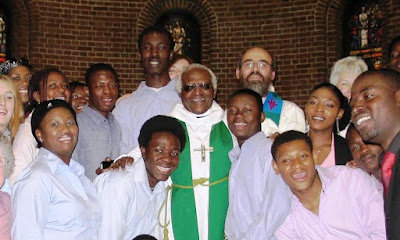
‘But you know, death is not the worst thing that could happen to a Christian’ … with Archbishop Desmond Tutu and members of the Discovery Gospel Choir in Dublin in 2005
Patrick Comerford
We are in Ordinary Time in the Church Calendar and tomorrow is the Sixth Sunday after Trinity (Trinity VI, 12 July 2026). The Calendar of the Church of England in Common Worship today remembers the life and witness of Saint Benedict of Nursia (550), Abbot of Monte Cassino and Father of Western Monasticism.
I may not venture out to the festival in the cricket club later today. But, before I make any decisions about what to do today, I am taking some quiet time this morning to give thanks, to reflect, to pray and to read in these ways:
1, reading today’s Gospel reading;
2, a short reflection;
3, a prayer from the USPG prayer diary;
4, the Collects and Post-Communion prayer of the day.
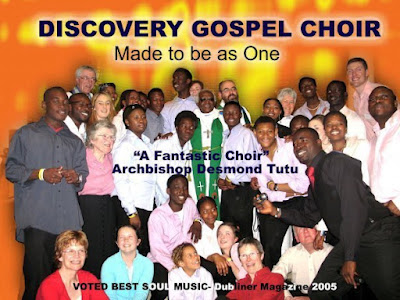
‘But you know, death is not the worst thing that could happen to a Christian’ … with Archbishop Desmond Tutu on the cover of a Discovery Gospel Choir CD
Matthew 10: 24-33 (NRSVA):
[Jesus said:] 24 ‘A disciple is not above the teacher, nor a slave above the master; 25 it is enough for the disciple to be like the teacher, and the slave like the master. If they have called the master of the house Beelzebul, how much more will they malign those of his household!
26 ‘So have no fear of them; for nothing is covered up that will not be uncovered, and nothing secret that will not become known. 27 What I say to you in the dark, tell in the light; and what you hear whispered, proclaim from the housetops. 28 Do not fear those who kill the body but cannot kill the soul; rather fear him who can destroy both soul and body in hell. 29 Are not two sparrows sold for a penny? Yet not one of them will fall to the ground unperceived by your Father. 30 And even the hairs of your head are all counted. 31 So do not be afraid; you are of more value than many sparrows.
32 ‘Everyone therefore who acknowledges me before others, I also will acknowledge before my Father in heaven; 33 but whoever denies me before others, I also will deny before my Father in heaven.’
‘What I say to you in the dark, tell in the light …’ (Matthew 10: 27) … 30 seconds of calm at Platanias in Rethymnon, Crete (Patrick Comerford)
Today’s Reflections:
When the late Archbishop Desmond Tutu (1931-2021) received the Nobel Peace Prize in 1984, I profiled him for The Irish Times. We had met previously, at events co-hosted by AfrI and Christian CND and at dinner in Roebuck House, Seán MacBride’s house in Clonskeagh, Dublin.
I asked him about the death threats he faced in South Africa at the height of apartheid. He engaged me with that look that confirmed his deep hope, commitment and faith, and said: ‘But you know, death is not the worst thing that could happen to a Christian.’
He must have been tempted at times to give up being a thorn in the side of the regime, to stop being a ‘turbulent priest,’ and to live a comfortable life. But his conscience would never have been comfortable.
While apartheid was still in force, Desmond Tutu became Dean of Saint Mary’s Cathedral, Johannesburg, and when I first met him he was the secretary general of the South African Council of Churches.
I was worried about the many death threats he was receiving, and I asked him how he lived with those threats. Was he worried about them? Did he ever consider modifying what he had to say because of them? His answer was similar to the one he gave when he was facing tough questioning before the regime’s Eloff Commission. He told that inquiry:
‘There is nothing the government can do to me that will stop me from being involved in what I believe God wants me to do. I do not do it because I like doing it. I do it because I am under what I believe to be the influence of God’s hand. I cannot help it. When I see injustice, I cannot keep quiet, for, as Jeremiah says, when I try to keep quiet, God’s Word burns like a fire in my breast. But what is it that they can ultimately do? The most awful thing that they can do is to kill me, and death is not the worst thing that could happen to a Christian.’
In 1987, Veritas invited me to write a short, 36-page biography of Archbishop Tutu, published as Desmond Tutu: Black Africa’s Man of Destiny. It was launched by the then Minister for Foreign Affairs, Brian Lenihan. It was a small book, hardly more than a pamphlet, but it came at an important time when both the Irish Government and the Irish Churches were becoming increasingly vocal about the evils of apartheid. It was republished in the US by Citadel (1988) and Hyperion Books (1989).
When I visited South Africa in 1990 with The Irish Times and Christian Aid, I met Archbishop Tutu in Cape Town, where once again he spoke powerfully about the changes that were beginning to take place.
Then, when my colleague Patsy McGarry was organising a monumental series of features in The Irish Times in 2000 to mark the millennium, Archbishop Tutu was one of the international contributors, along with Hans Küng, Andrew Greeley and Mary Robinson. The complete series was published by Veritas the following year as a book, Christianity, in which Part Two was my ‘Brief History of Christianity.’
I last met Archbishop Tutu when he visited Dublin in 2005, and he preached in Saint George’s and Saint Thomas’s Church in the inner city, where Canon (now Archdeacon) Katharine Poulton was then the Rector, as part of the Discovery Gospel Choir services.
His unforgettable words to me echo Christ’s words to the disciples in today’s Gospel reading: ‘Do not fear those who kill the body but cannot kill the soul; rather fear him who can destroy both soul and body in hell’ (Matthew 10: 28).
The Gospel reading at the Eucharist today (Matthew 10: 24-33) continues our readings from the commission and mission of the Twelve, as the Twelve continue to receive their instructions and commission for mission, even in the most hostile of environments.
‘What I say to you in the dark, tell in the light …’ (Matthew 10: 27) … walking through Galley Hill in Stony Stratford at night (Photograph: Patrick Comerford)
Today’s Prayers (Saturday 11 July 2026):
In Pray with the World Church, the prayer diary of the Anglican mission agency USPG (United Society Partners in the Gospel), the theme this week, from 5 to 11 July 2026 (pp 16-17), has been ‘Faith in the Midst of Fractures’. This theme was introduced last Sunday with a reflection by the Revd Godfrey Owino Adera, Anglican priest, theologian, and lecturer at Saint Paul’s University, Limuru, Kenya.
The USPG prayer diary today (Saturday 11 July 2026) invites us to pray:
God of truth and reconciliation, grant us courage to engage in difficult but necessary conversations. Where there is fear, give us boldness; where there is injustice, stir us to action; where there is brokenness, lead us toward healing and unity.
The Collect of the Day:
Eternal God,
who made Benedict a wise master
in the school of your service
and a guide to many called into community
to follow the rule of Christ:
grant that we may put your love before all else
and seek with joy the way of your commandments;
through Jesus Christ your Son our Lord,
who is alive and reigns with you,
in the unity of the Holy Spirit,
one God, now and for ever.
The Post-Communion Prayer:
Merciful God,
who gave such grace to your servant Benedict
that he served you with singleness of heart
and loved you above all things:
help us, whose communion with you
has been renewed in this sacrament,
to forsake all that holds us back from following Christ
and to grow into his likeness from glory to glory;
through Jesus Christ our Lord.
Collect on the Eve of Trinity VI:
Merciful God,
you have prepared for those who love you
such good things as pass our understanding:
pour into our hearts such love toward you
that we, loving you in all things and above all things,
may obtain your promises,
which exceed all that we can desire;
through Jesus Christ your Son our Lord,
who is alive and reigns with you,
in the unity of the Holy Spirit,
one God, now and for ever.
Collect on the Eve of Trinity VI:
O God, the protector of all who trust in you,
without whom nothing is strong, nothing is holy:
increase and multiply upon us your mercy;
that with you as our ruler and guide
we may so pass through things temporal
that we lose not our hold on things eternal;
grant this, heavenly Father,
for our Lord Jesus Christ’s sake,
who is alive and reigns with you,
in the unity of the Holy Spirit,
one God, now and for ever.
‘So do not be afraid; you are of more value than many sparrows’ (Matthew 10: 31) … Watching a mother sparrow feed her chicks in a nest in the ceiling of Aghias Anna Church, Maroulas, near Rethymnon in Crete (Patrick Comerford)