Santa on his rounds along the High Street in Stony Stratford earlier today
Patrick Comerford
I spent all morning today as Santa Claus at the Christmas Market in Stony Stratford, inviting people to come from the High Street with their children to the market in Market Square.
I was looking very Christmassy indeed this morning – there was no need for a false cotton-wool beard over my truly Santa-length white beard. And Stony Stratford is looking very Christmassy too, with the Christmas Tree lit up in the centre of the Market Square, Christmas lights everywhere on the High Street, Church Street, Market Square and the churchyard, and the shops, pubs and cafés vying competitively with one another with the decorated windows.
This is Middle England at its best. This is community spirit in England at its best. And, I can assure you – despite the scaremongering and the hatred the bigots are trying to stir up – no-one here is trying to cancel Christmas.
‘The UK is fundamentally a Christian country and we will always stand up for Christians and their values, especially at this special time of year’, Sarah Pochin, the Reform UK MP for Runcorn and Helsby, claimed in a Christmas message posted on social media this week.
She alleges employers are stopping employees from coming to work in Christmas jumpers. But in every shop and café I went into in Stony Stratford today, and in the shops I visited in central Milton Keynes yesterday, I was almost blinded by the array and colours of the Christmas jumpers worn by staff and shoppers alike.
She also claims, in the same video clip or reel, that Tesco is selling evergreen trees rather than Christmas trees. However, there is abundant evidence – alongside my own experience – that Tesco has not stopped celebrating Christmas. Instead, dozens of products are marked as Christmas trees on its website, its 2025 Christmas advert and a campaign to encourage shoppers to give Christmas presents to under-privileged children.
‘We are proudly celebrating Christmas at Tesco and have a range of real and artificial Christmas trees in store as part of a wide selection of Christmas products to help our customers celebrate Christmas this year,’ a Tesco spokesperson told Reuters long before Sarah Pochin made and posted her incredulous but provocative claims on Facebook and elsewhere.
Tesco could not have been clearer: ‘This product is described as an 'evergreen tree' to make it clear which type of Christmas tree is inside the box and help customers to distinguish between the many Christmas trees in the range. Elsewhere on the box it is clearly marked that this product is part of our Christmas category.’
But Sarah Pochin has never let the unvarnished truth or the verifiable facts get in the way of the views she wants to foist on others. This is the same Sarah Pochin who was reprimanded in 2018 by the Judicial Conduct Investigations Office for misconduct when she was a magistrate and was told her actions ‘fell below the standards expected of a magistrate’; who was called ‘dumb’ by Reform’s Zia Yusuf for using PMQs to call for a ban on the burka; whose claims about anti-social behaviour by immigrants in her constituency were dismissed as untrue by the Cheshire Constabulary; and whose remarks about black people and Asian people in TV advertising were described by Nigel Farage as ‘wrong and ugly’.
She accuses her critics of ‘virtue signalling’. But she’s got it wrong, yet again.
She may be dreaming of a white Christmas, like so many of her party colleagues in Reform, perhaps even an exclusively white Christmas. She’s certainly not talking about the Christian Christmas.
The Christmas tree is not a Christian symbol, nor does it have British origins. Christmas trees have their roots (excuse the pun) in Germanic pagan folklore, and they were first introduced to Britain in 1800 by George III’s German wife Queen Charlotte. The Christmas tree might have been forgotten but for its reintroduced by another German, Prince Albert, Queen Victoria’s husband, who brought one to Windsor Castle in 1841. It was only thanks to an illustration in The Illustrated London News in 1846 that Christmas trees fashionable in Britain in the 1850s.
Nor is there anything particularly Christian or particularly offensive about Christmas jumpers – apart from taste. Until recent decades, Christmas jumpers were mainly sported by skiers and seen as symbols of luxury. They only became mainstream fashion and evolved into the garish garments and novelty items we know today when the Christmas jumper was popularised first by television presenters and singers in the 1980s and 1990s and then in films like Bridget Jones’s Diary (2001) – think of Mark Darcy’s reindeer jumper.
As for all those politicians on the far-right who claim they are going to put Christ back into Christmas, they need to ask when Christ was never in Christmas. English, Greek (Χριστούγεννα) and Albanian (Krishtlindja) are the only European languages I know of that include the name of Christ in the name of Christmas.
The Greek Χριστούγεννα (Christougenna) means ‘Christ’s birth’ and is a combiation of Χριστός (Christos), Christ, and γέννα (génna), meaning birth. Anyone who complains about the abbreviation of Xmas excluding Christ shows an illiteracy beyond belief, and reveals a complete ignorance of both classical Greek and Biblical Greek.
Christmas is Noël in French, Natale in Italian, Natal in Portuguese, Nollaig in Irish, and Navidad in Spanish, all words related to birth or nativity; Jul in Norwegian, Swedish and Danish; Crăciun in Romanian; and Vánoce in Czech, Ziemassvētki in Latvian, Kalėdos in Lithuanian and Weihnachten in German. There is no mention of Christ in any of these names, so there no far-right chants about the equivalent of putting Christ.
Given the affinity some of the loudest far-right voices have with a certain brand of German politician in the 1930s and 1940s, it’s a wonder they don’t advocate a phrase similar to Weihnachten instead of talking about putting Christ back into Christmas. But demanding to put the ‘Holy’ back into Holy Night might be too sobering a thought, too pious an idea for the sort of people who dismiss all talk of peace and love in this world as being ‘woke’.
Sarah Pochin claims in that social media reel that ‘the UK is fundamentally a Christian country.’ Why is it that when some people link the word Christian with words such as fundamental and fundamentalist, I expect there to be more emphasis on things that are ‘mental’ than on the ‘fun’? I then remind myself that was the 17th century equivalent our present-day fundamentalists, those over-zealous and judgmental Puritans, who outlawed Christmas, not Muslims or immigrants.
But if we are going to go back to fundamentals, we might begin with an early Biblical passage: ‘When an alien resides with you in your land, you shall not oppress the alien. The alien who resides with you shall be to you as the citizen among you; you shall love the alien as yourself, for you were aliens in the land of Egypt: I am the Lord your God’ (Leviticus 19: 33-34).
Or, perhaps, we might talk of putting the message of Christ and Christian values back into Christmas. We could start by wishing for peace on earth and good will to all, by remembering that Christ was born into a migrant family began life as a refugee as a young child. We could remind ourselves how he said, ‘I was hungry and you gave me food, I was thirsty and you gave me something to drink, I was a stranger and you welcomed me’ (Matthew 25: 35), that he calls us to love our neighbour as we love ourselves, and that the best answer to who is my neighbour is found in an outsider, from another ethnic group with different religious beliefs.
And while we’re at it, we could even bring ‘Mass’ back into ‘Christ-Mass’ too. Instead of criticising the labelling and pricing of Christmas or evergreen trees, putting on silly Christmas jumpers, or snogging under the mistletoe at the office party, it would be good to see these people in Church, and taking to heart the Christmas sermons that put Christ and Christian values back into daily life.
The Christmas Tree in the centre of the Market Square in Stony Stratford (Photograph: Patrick Comerford, 2025)
23 December 2025
An Advent Calendar with Patrick Comerford: 24, 23 December 2025
‘Snow had fallen, snow on snow … in the bleak midwinter’ … snow in Cloister Court, Sidney Sussex College, Cambridge, some years ago (Photograph: Patrick Comerford)
Patrick Comerford
We are in the last days of Advent, and tomorrow is Christmas Eve. At noon each day this Advent, I am offering an image or two as part of my own ‘Advent Calendar’ for 2025, and an Advent or Christmas carol, hymn or song.
I have been involved all morning with Santa's visit to the Christmas Market in Stony Stratford. It is great fun, and I am thankful it is not snowing. But in this cold winter weather and this costume, it feels like the bleak mid-winter despite all the warm responses of children and adults alike. So, my images for my Advent Calendar at noon today are of snow some years ago in Sidney Sussex College, Cambridge, on a bleak mid-winter morning during a weekend when I had been invited to preach in the college chapel.
My choice of a carol or hymn today is ‘In the Bleak Mid-Winter,’ by Christina Rossetti (1830-1894). For many it is closely associated with the Service of Nine Lessons with Carols, broadcast each Christmas Eve from the Chapel of King’s College, Cambridge.
Christina Rossetti’s poem, ‘In the Bleak Mid-Winter,’ became popular among choirs after it was included it in the BBC broadcasts of the Service of Nine Lessons with Carols by the Choir of King’s College, Cambridge, using the 1911 setting by Harold Edwin Darke (1888-1976). He had once been the conductor of the choir, and his setting of the poem as a carol included his beautiful and delicate organ accompaniment.
But the tune most often associated with ‘In the Bleak Midwinter’ is Cranham, composed in 1906 by Gustav Holst (1874-1934).
The poem had been published for the first time seven years earlier in Christina Rossetti’s Poetic Works, 10 years after her death. It was republished in 1906 The English Hymnal, edited by Percy Dearmer and Ralph Vaughan Williams, with Holst’s setting, and it quickly became a popular Christmas carol. Today ‘In the Bleak Midwinter’ is one of the most popular and best-loved carols.
Christina Rossetti was part of the Victorian arts-and-crafts movement and the pre-Raphaelite movement. She was a leading advocate of women’s rights, a campaigner against slavery and war, and a prominent member of the Anglo-Catholic movement. She wrote ‘In the Bleak Midwinter’ in 1872 in answer to a request from a magazine. But, like a lot of writers, she must have been frustrated that she never saw its publication.
So it took over 30 years, more than a generation, before this poem was first sung as a Christmas carol. Ever since then, though, it has been a firm Christmas favourite, and has been recorded by the King’s Singers, Julie Andrews, the Moody Blues, the Pet Shop Boys, James Taylor, Alison Crowe, Moya Brennan, Celtic Woman, Sarah McLachlan, Sarah Brightman and Loreena McKennitt.
But I still find this popularity surprising, because this is no popular, cosy, comfortable Christmas carol. Instead its images are harsh and bleak, and in the uncomfortable political climate in the world today tey are challenging and demanding once again.
‘In the bleak midwinter … snow had fallen, snow on snow’ … snow on Sidney Street, Cambridge, in front of the chapel of Sidney Sussex College (Photograph: Patrick Comerford)
In the bleak midwinter
frosty wind made moan,
earth stood hard as iron,
water like a stone:
snow had fallen, snow on snow,
snow on snow,
in the bleak midwinter,
long ago.
Our God, heav’n cannot hold him,
nor earth sustain;
heav’n and earth shall flee away
when he comes to reign:
in the bleak midwinter
a stable place sufficed
the Lord God almighty,
Jesus Christ.
Enough for him, whom cherubim
worship night and day,
a breast full of milk
and a manger-ful of hay;
enough for him, whom angels
fall down before,
the ox and ass and camel
which adore.
Angels and archangels
May have gathered there,
cherubim and seraphim
thronged the air;
but his mother only,
in her maiden bliss,
worshipped the beloved
with a kiss.
What can I give him,
poor as I am?
If I were a shepherd,
I would bring a lamb;
if I were a wise man
I would do my part;
yet what I can I give him —
give my heart.
Patrick Comerford
We are in the last days of Advent, and tomorrow is Christmas Eve. At noon each day this Advent, I am offering an image or two as part of my own ‘Advent Calendar’ for 2025, and an Advent or Christmas carol, hymn or song.
I have been involved all morning with Santa's visit to the Christmas Market in Stony Stratford. It is great fun, and I am thankful it is not snowing. But in this cold winter weather and this costume, it feels like the bleak mid-winter despite all the warm responses of children and adults alike. So, my images for my Advent Calendar at noon today are of snow some years ago in Sidney Sussex College, Cambridge, on a bleak mid-winter morning during a weekend when I had been invited to preach in the college chapel.
My choice of a carol or hymn today is ‘In the Bleak Mid-Winter,’ by Christina Rossetti (1830-1894). For many it is closely associated with the Service of Nine Lessons with Carols, broadcast each Christmas Eve from the Chapel of King’s College, Cambridge.
Christina Rossetti’s poem, ‘In the Bleak Mid-Winter,’ became popular among choirs after it was included it in the BBC broadcasts of the Service of Nine Lessons with Carols by the Choir of King’s College, Cambridge, using the 1911 setting by Harold Edwin Darke (1888-1976). He had once been the conductor of the choir, and his setting of the poem as a carol included his beautiful and delicate organ accompaniment.
But the tune most often associated with ‘In the Bleak Midwinter’ is Cranham, composed in 1906 by Gustav Holst (1874-1934).
The poem had been published for the first time seven years earlier in Christina Rossetti’s Poetic Works, 10 years after her death. It was republished in 1906 The English Hymnal, edited by Percy Dearmer and Ralph Vaughan Williams, with Holst’s setting, and it quickly became a popular Christmas carol. Today ‘In the Bleak Midwinter’ is one of the most popular and best-loved carols.
Christina Rossetti was part of the Victorian arts-and-crafts movement and the pre-Raphaelite movement. She was a leading advocate of women’s rights, a campaigner against slavery and war, and a prominent member of the Anglo-Catholic movement. She wrote ‘In the Bleak Midwinter’ in 1872 in answer to a request from a magazine. But, like a lot of writers, she must have been frustrated that she never saw its publication.
So it took over 30 years, more than a generation, before this poem was first sung as a Christmas carol. Ever since then, though, it has been a firm Christmas favourite, and has been recorded by the King’s Singers, Julie Andrews, the Moody Blues, the Pet Shop Boys, James Taylor, Alison Crowe, Moya Brennan, Celtic Woman, Sarah McLachlan, Sarah Brightman and Loreena McKennitt.
But I still find this popularity surprising, because this is no popular, cosy, comfortable Christmas carol. Instead its images are harsh and bleak, and in the uncomfortable political climate in the world today tey are challenging and demanding once again.
‘In the bleak midwinter … snow had fallen, snow on snow’ … snow on Sidney Street, Cambridge, in front of the chapel of Sidney Sussex College (Photograph: Patrick Comerford)
In the bleak midwinter
frosty wind made moan,
earth stood hard as iron,
water like a stone:
snow had fallen, snow on snow,
snow on snow,
in the bleak midwinter,
long ago.
Our God, heav’n cannot hold him,
nor earth sustain;
heav’n and earth shall flee away
when he comes to reign:
in the bleak midwinter
a stable place sufficed
the Lord God almighty,
Jesus Christ.
Enough for him, whom cherubim
worship night and day,
a breast full of milk
and a manger-ful of hay;
enough for him, whom angels
fall down before,
the ox and ass and camel
which adore.
Angels and archangels
May have gathered there,
cherubim and seraphim
thronged the air;
but his mother only,
in her maiden bliss,
worshipped the beloved
with a kiss.
What can I give him,
poor as I am?
If I were a shepherd,
I would bring a lamb;
if I were a wise man
I would do my part;
yet what I can I give him —
give my heart.
Daily prayer in Advent 2025:
24, Tuesday 23 December 2025
Saint John the Baptist with his parents, Saint Zechariah and Saint Elizabeth, in a mosaic at the Monastery of Saint John the Baptist in Tolleshunt Knights, Essex (Photograph: Patrick Comerford)
Patrick Comerford
We are drawing near to the end of Advent and tomorrow is Christmas Eve. Later this morning I am involved in Santa’s visit to the Christmas Fayre and Farmers’ Market in Stoy Stratford. But, before today begins, I am taking some quiet time this morning to give thanks, to reflect, to pray and to read in these ways:
1, today’s Gospel reading;
2, a short reflection;
3, a prayer from the USPG prayer diary;
4, the Collects and Post-Communion prayer of the day.
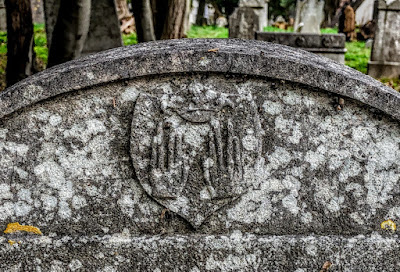
A priest’s hands raised for the blessing of the cohanim … a gravestone in the new Jewish cemetery on the Lido in Venice (Photograph: Patrick Comerford)
Luke 1: 57-66 (NRSVA):
57 Now the time came for Elizabeth to give birth, and she bore a son. 58 Her neighbours and relatives heard that the Lord had shown his great mercy to her, and they rejoiced with her.
59 On the eighth day they came to circumcise the child, and they were going to name him Zechariah after his father. 60 But his mother said, ‘No; he is to be called John.’ 61 They said to her, ‘None of your relatives has this name.’ 62 Then they began motioning to his father to find out what name he wanted to give him. 63 He asked for a writing-tablet and wrote, ‘His name is John.’ And all of them were amazed. 64 Immediately his mouth was opened and his tongue freed, and he began to speak, praising God. 65 Fear came over all their neighbours, and all these things were talked about throughout the entire hill country of Judea. 66 All who heard them pondered them and said, ‘What then will this child become?’ For, indeed, the hand of the Lord was with him.
Dreidels in a synagogue in Prague, part of children’s games at Hanukkah … did John the Baptist and Jesus spin dredels together at Hanukkah? (Photograph: Patrick Comerford)
Today’s Reflections:
In the Gospel reading at the Eucharist today (Luke 1: 57-66), we continue a series of readings before Christmas that draw on the two nativity narratives found in Matthew 1: 1-24 and Luke 1: 5-79.
During the week before Christmas, the great canticle Magnificat at Evensong traditionally has a refrain or antiphon attached to it proclaiming the ascriptions or ‘names’ given to God through the Old Testament. Each name develops into a prophecy of the coming of the Messiah.
O Sapientia, or O Wisdom, is the first of these days, and was marked on Wednesday (17 December). It was followed on Thursday (18 December) by O Adonai, by O Root of Jesse on Friday (19 December), O Key of David on Saturday (20 December), O Dayspring on Sunday (21 December), O King of the Nations yesterday (22 December), and, finally O Emmanuel today (23 December).
The seven majestic Messianic titles for Christ are based on Biblical prophecies, and they help the Church to recall the variety of the ills of humanity before the coming of the Redeemer as each antiphon in turn pleads with mounting impatience for Christ to save his people.
The Gospel reading at the Eucharist today (Luke 1: 57-66) continues on from the story of the Visitation of the Virgin Mary to her cousin Saint Elizabeth, with the only Gospel account of the birth, circumcision and naming of Saint John the Baptist.
Zechariah (זְכַרְיָה or Ζαχαρίας), also named in translations as Zacharias, Zachariah and Zachary, the husband of Elizabeth and the father of John the Baptist, is a priest, one of the cohanim descended from the sons of Aaron. Origen suggests that the Zechariah mentioned in Matthew 23: 35 as being killed between the temple and the altar may be the father of John the Baptist.
His name means ‘remember Yah’ or ‘remember God’ or ‘God remembers’. There are several Biblical figures with the name, including the Prophet Zachariah in Judah, a martyred son of a high priest, a king who reigned in Judah for six months, and several minor characters.
On the other hand, the Greek name Ἰωάννης (Ioannes) is a rendering of the Hebrew name Yohanan (יוֹחָנָן), a shorter form of the name Yəhôḥānān (יְהוֹחָנָן), which means ‘God is gracious’.
In the Hebrew Bible, Yohanan was the son of King Josiah of Judah (7th century BCE); Yohanan, son of Kareah, was a leader of the army who led the remnant of the population of Judah to Egypt for safety after the Babylonian dismantling of the kingdom in 586 BCE; Yohanan ben Yehoyada is a high priest named in the Book of Nehemiah and was the fourth in the line of high priests after Joshua the High Priest, who returned from the Babylonian captivity with Zerubbabel.
During the Hasmonean or Maccabean period, Yohanan was the father of Matityahu; John Gaddi, the eldest of the sons of Mattathias and brother of Judas Maccabeus, was one of the leaders of the revolt of the Maccabees in the 2nd century BCE; John Hyrcanus was a Maccabean leader and Jewish high priest from 134 BCE until his death in 104 BCE; and John Hyrcanus II (1st century BCE) was a member of the Hasmonean dynasty, High Priest, King, and ethnarch of Judea.
So, the name John, in its variant forms, was both a priestly and a royal name, and was associated with the leaders of resistance to occupation and resistance.
In idle moments, I sometimes wonder whether Jesus and John grew up knowing each other.
Did Mary and Joseph regularly visit Zechariah and Elizabeth?
Was Zechariah present as a priest in the Temple at the Presentation, or when the teenage Jesus was lost in the Temple?
Did Jesus and John send birthday greetings to one another?
Did they go to each other’s bar mitzvah?
Did they celebrate and major holidays of Holy Days together … Purim, Passover, Shavuot, Sukkot, Rosh Hashanah, Yom Kippur, Simchat Torah, Hanukkah … ?
Did they dress up together at Purim?
Did they spin dreidels with each other and play games together at Hanukkah? – Incidentally, yesterday (Monday) was the last day of Hanukkah this year, but Christmas Day and the first day of Hanukkah fell on the same day last year, for the first time in 19 years.
Did John the Baptist ever take up his duties and responsibilities as a priest in the Temple before going out into the Wilderness?
Was he in the Temple when Jesus visited, healed, taught, debated Caesar’s coins, or overturned the tables of the moneychangers?
Did John offer Jesus the priestly blessing that the cohanim alone impart?
The priestly blessing (Numbers 6: 24-26) that Zechariah and John would have pronounced, with their hands outstretched in the traditional way, is:
May the Lord bless and protect you.
May the Lord make his face shine on you and be gracious to you
May the Lord turn his face toward you, and give you peace.
The Priestly Blessing (ברכת כהנים, birkat cohanim) is known in rabbinic literature as raising the hands or rising to the platform because the blessing is given from a raised rostrum.
The Jewish Sages stressed that although the priests are the ones carrying out the blessing, it is not them or the ceremonial practice of raising their hands that results in the blessing, but rather it is God’s desire that his blessing should be symbolised by the hands of the cohanim.
The former Chief Rabbi, the late Lord (Jonathan) Sacks, says the Torah explicitly says that while the cohanim say the words, it is God who sends the blessing: ‘When the cohanim bless the people, they are not doing anything in and of themselves. Instead they are acting as channels through which God’s blessing flows into the world and into our lives.’
He adds, ‘Only love does this. Love means that we are focused not on ourselves but on another. Love is selflessness. And only selflessness allows us to be a channel through which flows a force greater than ourselves, the love that as Dante said, “moves the sun and the other stars”, the love that brings new life into the world.’
Hands raised in the priestly blessing on a gravestone in the Jewish cemetery in Kraków (Photograph: Patrick Comerford)
Today’s Prayers (Tuesday 23 December 2025):
The theme this week (21 to 27 December 2025) in Pray with the World Church, the prayer diary of the Anglican mission agency USPG (United Society Partners in the Gospel), is ‘Love Brings Life in Tanzania’ (pp 12-13). This theme was introduced on Sunday with a Programme Update by Imran Englefield, Individual Giving Manager, USPG.
The USPG Prayer Diary today (Tuesday 23 December 2025) invites us to pray:
Gracious Lord, we give thanks for the success of the Prevention of Mother-to-Child Transmission programme. Strengthen those who care, comfort those who suffer, and let hope, healing, and life flourish in this place.
The Collect:
God our redeemer,
who prepared the Blessed Virgin Mary
to be the mother of your Son:
grant that, as she looked for his coming as our saviour,
so we may be ready to greet him
when he comes again as our judge;
who is alive and reigns with you,
in the unity of the Holy Spirit,
one God, now and for ever.
The Post-Communion Prayer:
Heavenly Father,
who chose the Blessed Virgin Mary
to be the mother of the promised saviour
: fill us your servants with your grace,
that in all things we may embrace your holy will
and with her rejoice in your salvation;
through Jesus Christ our Lord.
Additional Collect:
Eternal God,
as Mary waited for the birth of your Son,
so we wait for his coming in glory;
bring us through the birth pangs of this present age
to see, with her, our great salvation
in Jesus Christ our Lord.
Yesterday’s Reflections
Continued Tomorrow
Hands raised in the priestly blessing on a Holocaust memorial in Berlin (Photograph: Patrick Comerford)
Scripture quotations are from the New Revised Standard Version Bible: Anglicised Edition copyright © 1989, 1995 National Council of the Churches of Christ in the United States of America. Used by permission. All rights reserved worldwide. http://nrsvbibles.org
Patrick Comerford
We are drawing near to the end of Advent and tomorrow is Christmas Eve. Later this morning I am involved in Santa’s visit to the Christmas Fayre and Farmers’ Market in Stoy Stratford. But, before today begins, I am taking some quiet time this morning to give thanks, to reflect, to pray and to read in these ways:
1, today’s Gospel reading;
2, a short reflection;
3, a prayer from the USPG prayer diary;
4, the Collects and Post-Communion prayer of the day.
A priest’s hands raised for the blessing of the cohanim … a gravestone in the new Jewish cemetery on the Lido in Venice (Photograph: Patrick Comerford)
Luke 1: 57-66 (NRSVA):
57 Now the time came for Elizabeth to give birth, and she bore a son. 58 Her neighbours and relatives heard that the Lord had shown his great mercy to her, and they rejoiced with her.
59 On the eighth day they came to circumcise the child, and they were going to name him Zechariah after his father. 60 But his mother said, ‘No; he is to be called John.’ 61 They said to her, ‘None of your relatives has this name.’ 62 Then they began motioning to his father to find out what name he wanted to give him. 63 He asked for a writing-tablet and wrote, ‘His name is John.’ And all of them were amazed. 64 Immediately his mouth was opened and his tongue freed, and he began to speak, praising God. 65 Fear came over all their neighbours, and all these things were talked about throughout the entire hill country of Judea. 66 All who heard them pondered them and said, ‘What then will this child become?’ For, indeed, the hand of the Lord was with him.
Dreidels in a synagogue in Prague, part of children’s games at Hanukkah … did John the Baptist and Jesus spin dredels together at Hanukkah? (Photograph: Patrick Comerford)
Today’s Reflections:
In the Gospel reading at the Eucharist today (Luke 1: 57-66), we continue a series of readings before Christmas that draw on the two nativity narratives found in Matthew 1: 1-24 and Luke 1: 5-79.
During the week before Christmas, the great canticle Magnificat at Evensong traditionally has a refrain or antiphon attached to it proclaiming the ascriptions or ‘names’ given to God through the Old Testament. Each name develops into a prophecy of the coming of the Messiah.
O Sapientia, or O Wisdom, is the first of these days, and was marked on Wednesday (17 December). It was followed on Thursday (18 December) by O Adonai, by O Root of Jesse on Friday (19 December), O Key of David on Saturday (20 December), O Dayspring on Sunday (21 December), O King of the Nations yesterday (22 December), and, finally O Emmanuel today (23 December).
The seven majestic Messianic titles for Christ are based on Biblical prophecies, and they help the Church to recall the variety of the ills of humanity before the coming of the Redeemer as each antiphon in turn pleads with mounting impatience for Christ to save his people.
The Gospel reading at the Eucharist today (Luke 1: 57-66) continues on from the story of the Visitation of the Virgin Mary to her cousin Saint Elizabeth, with the only Gospel account of the birth, circumcision and naming of Saint John the Baptist.
Zechariah (זְכַרְיָה or Ζαχαρίας), also named in translations as Zacharias, Zachariah and Zachary, the husband of Elizabeth and the father of John the Baptist, is a priest, one of the cohanim descended from the sons of Aaron. Origen suggests that the Zechariah mentioned in Matthew 23: 35 as being killed between the temple and the altar may be the father of John the Baptist.
His name means ‘remember Yah’ or ‘remember God’ or ‘God remembers’. There are several Biblical figures with the name, including the Prophet Zachariah in Judah, a martyred son of a high priest, a king who reigned in Judah for six months, and several minor characters.
On the other hand, the Greek name Ἰωάννης (Ioannes) is a rendering of the Hebrew name Yohanan (יוֹחָנָן), a shorter form of the name Yəhôḥānān (יְהוֹחָנָן), which means ‘God is gracious’.
In the Hebrew Bible, Yohanan was the son of King Josiah of Judah (7th century BCE); Yohanan, son of Kareah, was a leader of the army who led the remnant of the population of Judah to Egypt for safety after the Babylonian dismantling of the kingdom in 586 BCE; Yohanan ben Yehoyada is a high priest named in the Book of Nehemiah and was the fourth in the line of high priests after Joshua the High Priest, who returned from the Babylonian captivity with Zerubbabel.
During the Hasmonean or Maccabean period, Yohanan was the father of Matityahu; John Gaddi, the eldest of the sons of Mattathias and brother of Judas Maccabeus, was one of the leaders of the revolt of the Maccabees in the 2nd century BCE; John Hyrcanus was a Maccabean leader and Jewish high priest from 134 BCE until his death in 104 BCE; and John Hyrcanus II (1st century BCE) was a member of the Hasmonean dynasty, High Priest, King, and ethnarch of Judea.
So, the name John, in its variant forms, was both a priestly and a royal name, and was associated with the leaders of resistance to occupation and resistance.
In idle moments, I sometimes wonder whether Jesus and John grew up knowing each other.
Did Mary and Joseph regularly visit Zechariah and Elizabeth?
Was Zechariah present as a priest in the Temple at the Presentation, or when the teenage Jesus was lost in the Temple?
Did Jesus and John send birthday greetings to one another?
Did they go to each other’s bar mitzvah?
Did they celebrate and major holidays of Holy Days together … Purim, Passover, Shavuot, Sukkot, Rosh Hashanah, Yom Kippur, Simchat Torah, Hanukkah … ?
Did they dress up together at Purim?
Did they spin dreidels with each other and play games together at Hanukkah? – Incidentally, yesterday (Monday) was the last day of Hanukkah this year, but Christmas Day and the first day of Hanukkah fell on the same day last year, for the first time in 19 years.
Did John the Baptist ever take up his duties and responsibilities as a priest in the Temple before going out into the Wilderness?
Was he in the Temple when Jesus visited, healed, taught, debated Caesar’s coins, or overturned the tables of the moneychangers?
Did John offer Jesus the priestly blessing that the cohanim alone impart?
The priestly blessing (Numbers 6: 24-26) that Zechariah and John would have pronounced, with their hands outstretched in the traditional way, is:
May the Lord bless and protect you.
May the Lord make his face shine on you and be gracious to you
May the Lord turn his face toward you, and give you peace.
The Priestly Blessing (ברכת כהנים, birkat cohanim) is known in rabbinic literature as raising the hands or rising to the platform because the blessing is given from a raised rostrum.
The Jewish Sages stressed that although the priests are the ones carrying out the blessing, it is not them or the ceremonial practice of raising their hands that results in the blessing, but rather it is God’s desire that his blessing should be symbolised by the hands of the cohanim.
The former Chief Rabbi, the late Lord (Jonathan) Sacks, says the Torah explicitly says that while the cohanim say the words, it is God who sends the blessing: ‘When the cohanim bless the people, they are not doing anything in and of themselves. Instead they are acting as channels through which God’s blessing flows into the world and into our lives.’
He adds, ‘Only love does this. Love means that we are focused not on ourselves but on another. Love is selflessness. And only selflessness allows us to be a channel through which flows a force greater than ourselves, the love that as Dante said, “moves the sun and the other stars”, the love that brings new life into the world.’
Hands raised in the priestly blessing on a gravestone in the Jewish cemetery in Kraków (Photograph: Patrick Comerford)
Today’s Prayers (Tuesday 23 December 2025):
The theme this week (21 to 27 December 2025) in Pray with the World Church, the prayer diary of the Anglican mission agency USPG (United Society Partners in the Gospel), is ‘Love Brings Life in Tanzania’ (pp 12-13). This theme was introduced on Sunday with a Programme Update by Imran Englefield, Individual Giving Manager, USPG.
The USPG Prayer Diary today (Tuesday 23 December 2025) invites us to pray:
Gracious Lord, we give thanks for the success of the Prevention of Mother-to-Child Transmission programme. Strengthen those who care, comfort those who suffer, and let hope, healing, and life flourish in this place.
The Collect:
God our redeemer,
who prepared the Blessed Virgin Mary
to be the mother of your Son:
grant that, as she looked for his coming as our saviour,
so we may be ready to greet him
when he comes again as our judge;
who is alive and reigns with you,
in the unity of the Holy Spirit,
one God, now and for ever.
The Post-Communion Prayer:
Heavenly Father,
who chose the Blessed Virgin Mary
to be the mother of the promised saviour
: fill us your servants with your grace,
that in all things we may embrace your holy will
and with her rejoice in your salvation;
through Jesus Christ our Lord.
Additional Collect:
Eternal God,
as Mary waited for the birth of your Son,
so we wait for his coming in glory;
bring us through the birth pangs of this present age
to see, with her, our great salvation
in Jesus Christ our Lord.
Yesterday’s Reflections
Continued Tomorrow
Hands raised in the priestly blessing on a Holocaust memorial in Berlin (Photograph: Patrick Comerford)
Scripture quotations are from the New Revised Standard Version Bible: Anglicised Edition copyright © 1989, 1995 National Council of the Churches of Christ in the United States of America. Used by permission. All rights reserved worldwide. http://nrsvbibles.org
Labels:
Advent 2025,
Berlin,
Christmas 2025,
Hanukkah,
Kraków,
Lido,
Mission,
Prague,
Prayer,
Saint John the Baptist,
Saint Luke's Gospel,
Stony Stratford,
Tanzania,
Tolleshunt Knights,
USPG,
Venice
Subscribe to:
Comments (Atom)