Showing posts with label Los Angeles. Show all posts

27 June 2025

What does the present conflict
mean for the Jews of Iran, who
have lived there for 30 centuries?

In synagogues in Isfahan and Tehran (Photographs: Tel Aviv Universoty)

Patrick Comerford

The recent Israeli and US attacks on Iran have made day-to-day life even more precarious for Jews living in Iran today. Since the Islamic Revolution in 1979, Iran has not been an easy place for Jews to live in, nor is it for Christians either. Both minorities seem to have been lost in the news coverage in recent days, yet Iran has Jewish and Christian communities that have called Iran, and before that Persia, their home for centuries.

After Israel, Iran has the largest number of Jewish people in a Middle East country. According to estimates, between 17,000 and 25,000 Iranian Jews are living mostly in larger cities such as Tehran, Isfahan, Shiraz, Hamedan and Tabriz. Iran's parliament, the Majlis, has one reserved seat for the Jewish community, currently held by Dr Homayoun Sameyah Najafabadi (61), a Tehran-born pharmacist first elected in 2020.

Iranian immigrants in Israel are referred to as Parsim, meaning Persian. In Iran, Persian Jews and Jewish people in general are both described with four common terms: Kalīmī, the most proper term; Yahūdī, which is less formal but correct; Yīsrael, the term Jewish people use to refer to themselves as descendants of the Children of Israel; and Johūd a term with highly negative connotations that many Jews find offensive.

Iranian or Persian Jews, or Parsim, are one of the oldest communities of the Jewish diaspora. According to one Jewish legend, the first Jew to enter Persia was Sarah bat Asher, granddaughter of the Patriarch Jacob.

Jews have been living in Persia continuously since ca 727 BCE, having arrived in the region as slaves captured by the Assyrian and Babylonian kings. The biblical books of Isaiah, Daniel, Ezra, Nehemiah, Chronicles and Esther refer to the lives of Jews in Persia and their relations with the Persian kings. The historic Jewish sites in Iran include the tomb of Esther and Mordechai in Hamadan, and the tombs of Daniel and Habakkuk, as well as the tombs of several outstanding Jewish scholars.

The Book of Esther are set entirely in Persia. Haman, a senior official in the court of King Ahasuerus, identified as Xerxes the Great, plotted in the 6th century BCE to kill all the Jews in ancient Persia. The plot was foiled by Esther, the Jewish Queen of Persia, Haman and his sons were hanged. The events are celebrated in the holiday of Purim.

Cyrus the Great led the Achaemenid conquest of the Neo-Babylonian Empire and later freed the the Jewish exiles rom the Babylonian captivity. According to the biblical account, Cyrus the Great was ‘God’s anointed’, and he granted all the Jews citizenship. Various biblical accounts say over 40,000 Jews returned ca 537 BCE, but many chose to remain in Persia. Scholars believe that Jews may have comprised as much as 20% of the population at the peak of the Persian Empire.

The Second Temple was rebuilt in Jerusalem, ‘according to the decree of Cyrus, and Darius, and Artaxerxes king of Persia’ (Ezra 6: 14). The prophets Haggai and Zechariah encouraged this work, and the Temple was ready for consecration in the spring of 515 BCE, more than 20 years after the Jews returned to Jerusalem.
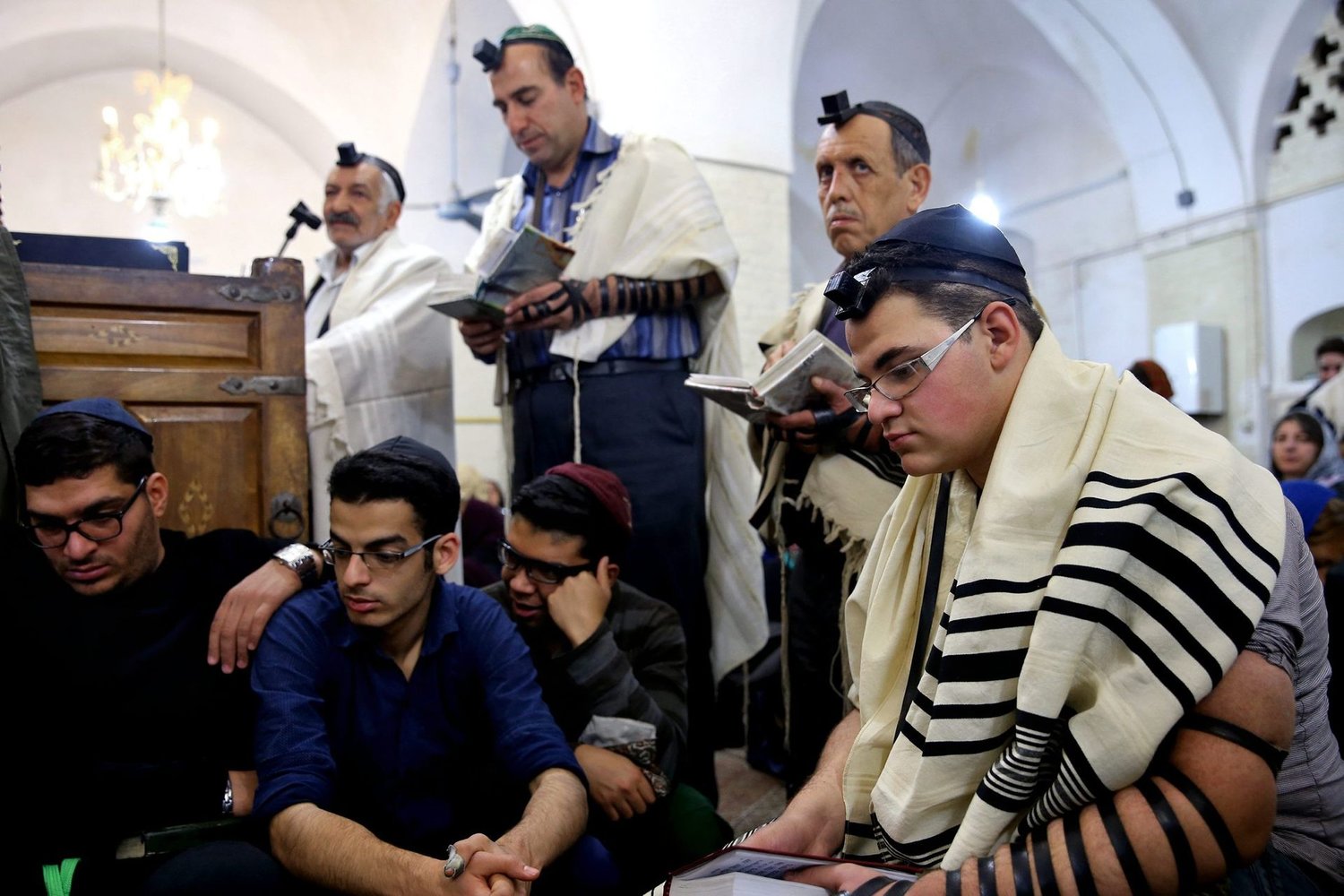
After Israel, Iran has the largest number of Jewish people in a Middle East country

Persian loan words in Hebrew include: pardes (פַּרְדֵּס), orchard, from which we get the word for Paradise; Etrog (אֶתְרוֹג), a green-yellow fruit; lilach (לִילָךְ), lilac, a lighter shade of purple; shoshana (שׁוֹשַׁנָּה), rose, from the name of the former capital of the Persian Empire, Shushan; sukar (סֻכָּר), sugar, from the Persian word shakar); and bazar (בָּזָאר), from bāzār in Persian.

The Pharisees were one of the most important Jewish groups in the late inter-testamental and New Testament periods, and their name is said to come from Hebrew word that means ‘to separate,’ indicating a ‘separatist’ or a separated person. But a plausible alternative finds the origin of the name in the Aramaic word for Persian, and some scholars claim the Pharisees adapted some Zoroastrianism ideas, such as their ideas about resurrection and the future life, and their angelology and demonology, making them ‘Persianisers.’

With the fall of Jerusalem, Babylonia became a kind of bulwark of Judaism, and the number of Jewish refugees in Babylon increased after the collapse of the Bar Kochba revolt.

In the third century CE, Zoroastrianism became the official state religion and other religions, including Judaism, were suppressed. But later Shapur I was friendly to the Jews, Shapur II’s mother was half-Jewish, and this gave the Jewish community relative freedom of religion and many advantages.

After the Islamic conquest of Persia, Jews, Christians and Zoroastrians lived with a number of discriminations. At times, they even enjoyed significant economic and religious freedom compared with Jews in Europe, and many were doctors, scholars and craftsman, or held positions of influence.

During Mongol rule in the late 13th century, Arghun Khan appointed Sa’d al-Daula a Jew as his vizier. But al-Daula was murdered in 1291 and Persian Jews in Tabriz suffered such violent persecutions that the Syriac Orthodox historian Bar Hebraeus wrote that ‘neither tongue can utter, nor the pen write down’ how violent the events were. Synagogues were destroyed, there were forced conversions and Jews were forced a distinctive mark on their heads.

Under the Safavid dynasty (1502-1794), Shi’a Islam became the state religion, Isfahan became a new capital, and Jews were forced to wear distinctive badges, clothing and headgear. But many Jews were traders, and they prospered through trade along the Silk Road with Central Asia and China.

The persecution of Jews in Persia resumed under the Qajar dynasty in 1794, and many Jews were confronted with two options: conversion to Islam or death. Throughout the 19th century, the European powers noted numerous forced conversions and massacres. However, European travellers reported that many Jews in Tabriz and Shiraz continued to practice Judaism in secret.

By the late 19th century, Jews were the most significant minority in Tehran. The Jewish quarter of Shiraz was looted and plundered in 1901, and 12 Jews murdered. Thousands of Iranian Jews emigrated in the late 19th and early 20th centuries to what is now Israel but then in the Ottoman Empire and to present-day Afghanistan, Pakistan and India.

The Pahlavi dynasty improved the life of Jews and many of the restrictions on Jews and other religious minorities were abolished. During the Allied occupation of Iran in World War II, some Polish and Jewish refugees who escaped Nazi-occupied Poland settled in Iran. After World II, the state of Israel was formed in 1948 and about 140,000 to 150,000 Jews were living in Iran, but over 95% of them have since migrated abroad.

About 70,000 Jews, or one-third of Iranian Jews, most of them poor, emigrated to Israel between 1948 and 1953. But many Jews who remained in Iran prospered during the reign of Shah Mohammad Reza Pahlavi. Until the Islamic Revolution in 1979, there were 80,000 to 100,000 Jews in Iran, mostly in Tehran (60,000), Shiraz (18,000), Kermanshah (4,000) and Isfahan (3,000).

Ayatollah Khomeini met Jewish community leaders in Qom when he returned from exile in Paris, and issued a fatwa decreeing that the Jews were to be protected. But since 1979, 13 Jews have been executed in Iran, accused of connections with Israel, and Jewish emigration increased dramatically: 20,000 Jews left within months of the revolution, and 60,000 more emigrated in the aftermath.

Jews have become more religious in recent years. Families that had been secular in the 1970s started following kosher dietary laws, observed the Shabbat and made the synagogue the focal point of their social lives.

Outside Iran, the largest group of Persian Jews is found in Israel, with an estimated 135,000 people

Some estimates say there are still 60,000 to 85,000 Jews in Iran; other sources put the figure at 25,000, and even as low as 8,500. But, after Israel, Iran is home to the second-largest Jewish population in the Middle East, with large Jewish communities in Tehran, Isfahan and Shiraz. President Mohammad Khatami visited Yusef Abad Synagogue in 2000, the first time a President of Iran had visited a synagogue since the revolution.

There are 25 synagogues in Iran, and most Jews live in Tehran, where there are 11 active synagogues, some Hebrew schools, two kosher restaurants, a Jewish library, an old-age home and a cemetery. Dr Sapir Jewish Hospital is Iran’s largest charity hospital of any religious minority community. It caters for all patients regardless of religious affiliation and most of the patients and staff are Muslim.

Traditionally, Shiraz, Hamedan, Isfahan, Tabriz, Nahawand and Babol have been home to large Jewish populations. Isfahan has a Jewish population of about 1,500 and 13 synagogues.

Rabbi Yehuda Gerami has been the Chief Rabbi of Iran and the spiritual leader of the Jewish community of Iran since 2011. Following the assassination of Qassem Soleimani, a senior Iranian military intelligence figure, in 2020, the Chief Rabbi visited his family and condemned Israeli attacks, saying the attacks had stoked tensions in the Jewish community in Iran.

Opinions about the condition of Jews in Iran are divided. Some reports say the majority of Iranian Jews prefer to stay in Iran. Other sources say that while Jews are allowed to practice their religion, they live in fear of being accused of spying for Israel and that they distance themselves from Israel and Zionism to ensure their own security.

Privately, it is said, many Jews complain of ‘discrimination, much of it of a social or bureaucratic nature.’ The last remaining newspaper in the Iranian Jewish community closed in 1991 after criticising government control of Jewish schools.

Jewish emigration from Iran increased dramatically after the Islamic Revolution in 1979 and the fall of the last Shah. Today, the vast majority of Iranian Jews live in Israel and the US, with Iranian Jewish communities in Paris, London, Australia, Canada and South America.

Outside Iran, the largest group of Persian Jews is found in Israel, with an estimated 135,000 people. In Israel, Persian Jews are classified as Mizrahim, and they include former President Moshe Katsav and former Minister of Defence Shaul Mofaz.

The US is home to 60,000-80,000 Iranian Jews, most of them in the Greater Los Angeles area, Great Neck, New York and Baltimore, Maryland. In particular, Persian Jews make up a sizeable proportion of the population of Beverly Hills. The community is credited with revitalising Beverly Hills, where Jimmy Delshad, a Persian Jew who emigrated to the US in 1958, has been the Mayor in 2007 and 2010.

Iranian-born Jews or Jews of Iranian descent include: David Alliance, Baron Alliance, a British businessman and Liberal Democrat politician; the US politician, Anna Kaplan; Moshe Katsav, former President of Israel; the peace activist Abie Nathan; the co-founders of Tinder Justin Mateen and Sean Rad; and the actor Sarah Solemani.

One prominent Jew in Iran said in recent years, ‘We are not tenants in this country. We are Iranians, and we have been for 30 centuries.’

Shabbat Shalom, שבת שלום


09 May 2025

Lyela Brandeis Comerford (1880-1946),
grand-daughter of Los Angeles rabbi
and wife of Judge Frank Comerford

Lyela Julia Edelman Brandeis Comerford (1880-1946), the descendant of an interesting and pioneering Jewish family in Los Angeles and wife of Judge Frank D Comerford (1879-1929)

Patrick Comerford

In the past, I have written about Judge Frank D Comerford (1879-1929), the Chicago judge, Democratic politician, journalist and author, and his nephew, the Very Revd Professor Comerford Joseph O’Malley (1902-1991)who was President and Chancellor of DePaul University, Chicago.

They were members of an interesting branch of the Comerford family which once had homes in Kinvara, Co Galway, and Ballykeel House, Kilfenora, Co Clare.

In my research in recent days, I have also come across the story of Judge Frank Comerford’s wife, Lyela Julia Edelman Brandeis Comerford (1880-1946), the descendant of an interesting and pioneering Jewish family in Los Angeles.

Lyela Comerford was a granddaughter of the first resident rabbi in Los Angeles, a niece of both the architect and a president of the best-known synagogue in Los Angeles, Wilshire Boulevard Temple, and she was a sister-in-law of one of the passengers who died on the Titanic in 1912.

With her family background, and Hollywood connections, and life on Park Avenue in Manhattan, many may have thought Lyela Comerford was born to a glamorous society or star-filled life. Instead, she was widowed twice, and was swindled and defrauded by another husband.

Her first husband was a member of a prominent Jewish business and legal family who gave their name to a ‘Hidden Ivies’ university; her second husband was a fraudster who swindled her out of her immense widow’s fortune; and her third husband, Judge Frank Comerford, was the descendant of a prominent branch of the Comerford family in Co Galway.

Rabbi Abraham Wolf Edelman (1832-1907), grandfather of Lyela Julia Edelman Brandeis Comerford

Lyela Julia Edelman was born on 2 March 1880 in Los Angeles, California. She was the daughter of Benjamin W Edelman (1853-1922) and Laura Morris Studebaker (1863-1939). Benjamin Edelman’s father and Lyela Comerford’s grandfather was Rabbi Abraham Wolf Edelman (1832-1907), the pioneer rabbi of Los Angeles. He was born in Poland in 1832, he married Hannah Pessah Cohn in Warsaw in 1851, and they then moved to the US. Eight years later, they were living in San Francisco, where Abraham continued his Hebrew studies, teaching Hebrew, and for a time acting as a dry goods salesman.

When Rabbi Edelman arrived in the pueblo of Los Angles, it was still a wild west frontier town. Joseph Newmark (1799-1881), the founder of the first Ashkenazic congregation in New York and then the organiser of the Jewish community in Los Angeles, persuaded Abraham Edelman to come to Los Angeles as its first full-time rabbi and Jewish spiritual leader. He served Congregation B’nai B’rith from its beginnings in 1862 until 1885, and for more than two decades he was the Jewish spiritual leader of Los Angeles.

Rabbi Edelman is said to have been a ‘traditional’ Orthodox rabbi – although this was not quite accurate. There were two good reasons for his move to Los Angeles: the children needed a teacher to help them maintain their Jewish identity and spiritual heritage, and the adults wanted a Jewish spokesman and ambassador. Edelman fulfilled both roles and combined the offices of rabbi and cantor. But he never claimed ordination, and before coming to Los Angeles he had never held a pulpit.

Rabbi Edelman eventually became the victim of his own success and the growth of the Jewish community in Los Angeles. He retired in 1886, although, in reality, he had been eased out in a way calculated to spare the rabbi’s feelings and to protect the congregation.

Joseph Newmark’s nephew, Harris Newmark, who was President of B’nai B’rith Congregation in 1881-1887, claimed Edelman felt he had to resign when the synagogue wanted a more Reform or liberal ritual. But the evidence suggests that Edelman was never part of a truly Orthodox establishment. He had shown signs of non-Orthodox leanings, and allowed mixed seating for men and women, a mixed choir, conformation ceremonies, and English prayers and sermons.

Congregation B’nai B’rith developed a type of Reform Judaism that was grounded in tradition yet committed to contemporary relevance. However, despite the community’s growth, Rabbi Edelman lacked the glamour desired in a new era. Los Angeles still loved ‘old Edelman,’ but they decided to sideline him. From June 1885 to June 1886, he served Congregation Ahavai Sholom in Portland, Oregon, but he resigned after a year, citing the ‘dampness of the Oregon climate,’ and returned to Los Angeles.

Abraham and Hannah Edelman were the parents of six children, two daughters and four sons, including: Benjamin W Edelman (1853-1922), the father of Lyela Julia (Edelman) Comerford; Abram M Edelman (1863-1941), a prolific architect in Los Angeles; and Dr David W Edelman. Congregation B’nai B’rith was rebuilt in the Moorish style in 1929 and soon after was renamed the Wilshire Boulevard Temple; its president at the time was Dr David W Edelman and its architect was Abram M Edelman, sons of the founding rabbi and uncles of Lyela Brandeis Comerford.

The Wilshire Boulevard Temple, formerly Congregation B’nai B’rith, is a Reform congregation and synagogue and the oldest and one of the largest Jewish congregations in Los Angeles. The main building has a large Byzantine Revival dome modelled on the Pantheon in Rome, and the interior murals were commissioned by the Warner Brothers, Jack Harry and Albert.

Wilshire Boulevard Temple has been led by several influential rabbis, including Edgar Magnin, described as the ‘John Wayne’ of rabbis and the ‘rabbi to the stars’, who served for 69 years, from 1915 to 1984. It was designated as a City of Los Angeles Historic Cultural Monument in 1973 and was listed on the National Register of Historic Places in 1981.

Wilshire Boulevard Temple, closely linked with Lyela Brandeis Comerford’s family

Lyela Julia (Edelman) Comerford was born in Los Angeles on 2 March 1880. She was 20 in 1900 when she married her first husband, H Hugo Brandeis (1868-1912), at the Los Angeles home of her aunt, Rachel L Barnett (1857-1950), and uncle William G Barnet (1852-1930). The wedding was performed by her grandfather, Rabbi Abraham Edelman, assisted by Rabbi Sigmund Hecht (1849-1925), who had become the senior rabbi in Los Angeles in 1899.

Hugo Brandeis was born in Wisconsin in January 1868. His family owned a large department store chain in Omaha, Nebraska. He was the son of Jonas Leopold Brandeis (1836-1903), a dry goods merchant, and Francesca Teweles (1845-1905), both were Jewish immigrants.

The Brandeis family was once a prominent rabbinic family in Prague. The extended Brandeis family included the Dante scholar Irma Brandeis (1905-1999); and Louis Dembitz Brandeis (1856-1941), an associate justice on the US Supreme Court ( 1916-1939), who gave his name to Brandeis University.

Judge Louis Brandeis was the first Jew to be named to the Supreme Court. During his career, he fought railroad monopolies, defended workplace and labour laws, challenged antisemitism and helped create the Federal Reserve System. He criticised the power of large banks, money trusts, powerful corporations, monopolies, public corruption, and mass consumerism. He was a courageous and militant advocate of social justice. He was seen as being incorruptible, was known as the ‘People’s Lawyer’, and The Economist called him ‘A Robin Hood of the law.’

Jonas Leopold Brandeis was from Libeň in Prague, then in the Austrian empire and now the capital of the Czech Republic. Franciska ‘Fannie’ Teweles was born in Prague. They emigrated to the US around 1856 and were married in Milwaukee, Wisconsin, around 1862.

Jonas Leopold Brandeis was the founder of the successful dry goods business, JL Brandeis & Sons. His wife was a wealthy patron of the arts and was a founder of the Wise Memorial Hospital in Omaha and its president from 1901 until she died in 1905. They are buried in Pleasant Hill Jewish Cemetery in North Omaha, also known as Temple Israel Cemetery, the oldest Jewish Cemetery in Nebraska.

Hugo Brandeis was one of four children, and his siblings were: Arthur Donoen Brandeis (1862-1916); Sarah (1867-1936), who married Herman Cohn; and Emil Franklin Brandeis (1864-1912). Emil Brandeis died on the Titanic on 14/15 April 1912. It was falsely rumoured that he tried to sneak onto one of the life boats by putting on a dress. When his body was recovered, he was buried in Pleasant Hill Jewish Cemetery, Omaha.

Hugo Brandeis was the youngest partner in JL Brandeis with his brother and was a prominent dry goods merchant in Omaha. He died at the age of 44 on 21 July 1912 in hospital in Omaha, Nebraska, after an operation, and was buried in Pleasant Hill Jewish Cemetery. He left Leyla a widow with a substantial fortune.

Two years later, Lyela married her second husband, Charles Wesley Turner jr (1885-1941), in London on 27 August 1914. He managed the Brandeis Theatre in Omaha and was also a stockbroker. He had previously been married in 1909 to Etta May Schneider (1886-1969), and when Charles and Etta divorced she returned to live with her parents in Dodge, Nebraska.

In a dramatic turn of events less than four years of their marriage, Charles Wesley Turner was convicted on 26 May 1918 in New York of theft from his wife through a securities fraud of $35,000 – in all, Lyela claimed, he had defrauded her of $325,000. He was later drafted into the US army, and they were divorced in 1919. Turner later married his third wife, Janet Megrew (1904-1988), but they had divorced by 1940, and he died in Chester, New Jersey, on 18 June 1941.

Judge Frank D Comerford (1879-1929) … a judge in Chicago, a Democratic politician, a journalist and an author

Lyela married her third husband, Frank D Comerford (1879-1929), in the Municipal Building in Manhattan, New York, on 10 November 1926. She gave her name as Leyla Studebaker Brandeis, and was living at 570 Park Avenue, a remarkable 13-storey building designed in the Georgian style by the architect Emery Roth (1870-1948).

Frank Comerford was a judge in Illinois, a Democratic politician, a journalist and an author. Their wedding came as a surprise to their friends and was attended only by Lyela’s mother, Laura Morris Studebaker, and ‘a few intimate friends’.

Frank D Comerford was born on 25 September 1879 in Chicago. He was the son of Isaac Comerford (1829-1900) of Kinvara, Co Galway, and Mary ‘Jane’ (Linnane) Comerford (1841-1914). Isaac Comerford of Kinvara was a younger brother of Henry Comerford (1827-1861), a prominent Galway merchant and magistrate who lived at Merchant’s Road, Galway, and Ballykeel House, Kilfenora, Co Clare. Henry bought up the Gregory estate in Kinvara in the 1850s and his post-Famine efforts to impose exorbitant rent increases in the town brought financial ruin to Kinvara and brought the Comerford family to the brink of social and economic disaster.

Isaac Comerford remained in Kinvara as a shopkeeper for about a decade, and married Mary Jane Linnane. Their first seven children were born in Kinvara: Henry (1858), John Henry (1859), Mary (1860), Bridget (1861), Michael (1862), Alice ‘Ella’ (1863) and George Henry (1865). Isaac and Mary Jane Comerford emigrated to the US around 1866, and settled in Chicago, Illinois, and five more children were born there: Elizabeth (1867), Jane (1871), Thomas Joseph (1877), Anne (1878) and Frank (1879).

Frank D Comerford studied at Northwestern University and the Illinois College of Law in Chicago. After graduation, he was admitted to the Illinois State Bar in 1904. Later that year, at the age of 24, Comerford was elected to the Illinois State Senate in November 1904 from the 2nd District, representing part of Cook County, Illinois.

Three months later, Frank D Comerford was expelled from the Illinois State Senate in February 1905 for allegedly besmirching the name of the Senate at a lecture in Chicago in which he accused the Senate of corruption. He was the first elected official expelled from the Illinois legislature.

In a speech at the Illinois College of Law, he claimed the state senate was merely ‘a great public auction, where special privileges are sold to the highest corporation bidders.’ He made specific accusations of wrongdoing, named names, and gave dates and financial details. He tried to protect himself by saying these stories were ‘in common circulation at the Capitol.’

The Illinois legislature quickly passed a resolution that accused Comerford of spreading ‘assertions, slanders, insinuations and incriminations’ that called into question ‘the honour and integrity of the Illinois General Assembly.’ A special committee of the Illinois House of Representatives was hastily established and took extensive testimony before deciding Comerford’s allegations were unfounded.

The report of the special committee was placed before the House on 8 February 1905, and the newly-elected Senator was expelled on a 121-13 vote. Unbowed, Comerford ran for the seat again – this time as an independent – and was re-elected. He was unsuccessful in his bid for re-election in 1906, however, and later accepted a position as police attorney of Chicago under the Democratic mayor, Edward Fitzsimmons Dunne. Comerford set up his own private practice as an attorney in 1917, and after the US entered World War I in 1917 he spent the rest of the war as a public speaker selling bonds on behalf of the Liberty Loan programme.

After World War I, Comerford travelled to London and Paris for six months in 1919. He witnessed at first hand the rapidly changing social and political situation and contributed news reports to the Chicago Tribune. He was a vocal advocate of the US joining the League of Nations, warning that ‘the failure to establish a League of Nations would be a world tragedy and in its wake may come revolution.’

Comerford was the special prosecutor in the 1920 case of William Bross Lloyd and members of the Communist Labor Party of America. The defence attorney Clarence Darrow later defended the teacher John T Scopes in the 1925 Scopes ‘Monkey’ Trial, in which he opposed the statesman and orator William Jennings Bryan. Comerford was elected to the bench as a Superior Court judge in Chicago in June 1926.

Frank D Comerford was twice married. On 19 March 1906, he married in Saint Joseph’s Church, Berrien, Michigan, Jean Cowgill (1875-1948). They later divorced, and on 10 November 1926 in Manhattan, he married the widowed Lyela Edelman Brandeis (1880-1946) from Omaha, Nebraska.

The widowed Lyela Brandeis married Frank Comerford in Manhattan on 10 November 1926

Lyela and Frank Comerford spent their honeymoon in Cuba, and then returned to Chicago to live at the Lake Shore Drive Hotel.

Frank Comerford complained of chest pain while visiting his brother’s home in Chicago on 29 August 1929. Two of his nephews, Dr Francis Xavier O’Malley (1895-1974) and Dr John Gabriel O’Malley (1888-1935), were called to the house. Neither doctor found anything obviously wrong, however, and he was not taken to hospital. At 8:55 pm, however, Comerford suffered a massive heart attack and died five minutes later. He was 49 years old. He was buried at Rosehill Cemetery and Mausoleum in Chicago.

After Frank Comerford died, Lyela continued to live in Chicago until 1940, and later lived in Paolo Alto, California. She had been widowed twice, divorced once, and defrauded by one of those hubans. She had no children. Lyela died on 30 July 1946 at the age of 66 in Los Angeles, and she was buried not with Frank Comerford but alongside her first husband, Hugo Brandeis, in Pleasant Hill Jewish Cemetery, Omaha, Nebraska.

Her gravestone names her as Lyela Brandeis Comerford, without any reference to her second husband, Charles Wesley Turner jr.

זכרונה לברכה, May her memory be a blessing.

Lyela Brandeis Comerford’s gravestone in Pleasant Hill Jewish Cemetery, Omaha, Nebraska (Photograph: Mike Hughbanks, Find a Grave)

11 January 2025

Camerford Avenue in
Hollywood, the street
that was supposed to be
named Comerford Avenue

Comerford McLoughlin (1891-1945) was a publishing heir and a World War I battle hero … his grandfather gave his (misspelled) name to Camerford Avenue in Hollywood

Patrick Comerford

The wildfires in California have devastated large areas of Los Angeles and Hollywood in the past week or so and have dominated television news and newspaper reports in the US and around the world.

Many of the street names in Hollywood and Los Angeles in these reports have drawn my attention to the name of Camerford Avenue in Hollywood, and have reminded me that this street was originally supposed to be named Comerford Avenue, and how this is a misspelling.

The street is in a plush residential part in Los Angeles, just west of Paramount Pictures and close to Sunset Boulevard and the heart of old Hollywood. Many of the street names there, including Camerford Avenue, were created at the turn of the 19th and 20th centuries by Senator Cornelius Cole in honour of the members of his extended family, including his grandson, Comerford McLoughlin (1891-1945).

The story of Comerford McLoughlin, Camerford Avenue and the street names of West Hollywood is the story of a family network in which the Comerford name continues for four or five generations, and that includes a senator who was a friend of Abraham Lincoln and who once owned much of Hollywood; a publishing empire that pioneered children’s books and colour printing; an artist’s wife who had been a ‘society girl’ but whose tragic death by suicide became a nationwide sensation; her daughter who became a princess through her marriage to a Russian exile; and a publishing executive with Time and Fortune magazines.

Senator Cornelius Cole named Camerford Avenue in Hollywood after his grandson Comerford McLoughlin

Senator Cornelius Cole (1822-1945) was the founder of Colegrove, and named the area after himself. As he subdivided and developed the area at the beginning of the 20th century, Cole decided to name many of the streets after members of his own family.

In 1902, Cole decided to name one of these streets after his grandson, Comerford McLoughlin (1891-1945). But it is not clear whether Granddad Cole did not know how to spell his own grandson’s name correctly or that the people who first put up the street signs got the spelling wrong. In either case, no-one every corrected the mistake, and Camerford Avenue, home to the stars, never became Comerford Avenue, as it was intended to be.

Senator Cornelius Cole was a New York lawyer. He was admitted to the bar in 1948 and moved to California in 1849 at the height of gold rush. He first practised law in San Francisco and then in Sacramento.

Cole was a friend of Abraham Lincoln and soon became involved in politics. He founded the California Republican Party, and served on the Republican National Committee (1856-1860). He was District Attorney (1859-1862), and moved to Santa Cruz in 1862.

In 1863, Cole became the commander of a Santa Cruz cavalry troop raised for the Union Army during the Civil War and he was commissioned as a captain. He was a member of the US Congress for one term (1863-1865) and of the US Senate for one term (1867-1873), and chaired the Senate Appropriations Committee (1871-1873).

As an attorney, Cole helped the brothers Henry and John Hancock secure their title to Rancho La Brea, and in payment received 483 acres of the ranch. He retired to his ranch in 1880, and in 1887, he began subdividing it as the town of Colegrove. The name was a reference to his own family name but also the family name of his wife Olive (1833-1918), which was also Colegrove.

Cornelius Cole intended to name Camerford Avenue in Hollywood after his grandson Comerford McLoughlin (Google Maps)

Cornelius Cole honoured many of his relatives with street names in Hollywood, including Gregory Avenue, named after his grandson, the artist Gregory Van Sicklin McLoughlin (1889-1954) and Camerford Avenue, which he intended to name after his 11-year-old grandson Comerford McLoughlin (1891-1945).

The town of Colegrove was annexed by the City of Los Angeles in 1909, and was renamed Hollywood. Some of Cole’s original street names were lost in renaming in the years that followed.

Olive Avenue, named after his wife, is now Romaine Street; Schuyler Avenue, named after one of his sons Schuyler Colfax Cole (1865-1926), is now La Mirada Avenue; Emelita Avenue, recalling his daughter Emma Cole Brown (1854-1926), became Lexington Avenue; while Townsend Street, named after Cole’s mother, is now Cahuenga Boulevard, the ‘heart of old Hollywood’, connecting Sunset Boulevard in the heart of old Hollywood to the Hollywood Hills and North Hollywood in the San Fernando Valley.

On the other hand, many of Cole’s original street names have survived: Cole Street, Cole Avenue and Cole Place; Seward Street and Willoughby Avenue, for two more sons; Waring Avenue for Cole’s daughter Lucretia Cole Waring (1860-1953); Eleanor Avenue for his daughter-in-law and granddaughter; and the misspelled Camerford Avenue, as well as Barton Avenue and Gregory Avenue, named after his grandsons.

Oher original names that have survived from Cole’s naming system include El Centro Avenue, for the centre of his ranch; Lodi Place, for his hometown of Lodi in New York; and Hollywood’s famous Vine Street, for his vineyard.

Comerford McLoughlin (1891-1945) and his sister Cornelia in the 1920s … his grandfather gave his (misspelled) name to Camerford Avenue in Hollywood

Camerford Avenue in Hollywood, despite its incorrect spelling, was named in 1902 after one of Cole’s grandsons, Comerford McLoughlin (1891-1945), the second son of Cole’s daughter Cornelia (‘Nellie’), and his son-in-law, James Gregory McLoughlin (1860-1918).

Comerford McLoughlin was a publishing heir who was born in New York on 20 February 1891. As a lieutenant in World War I, he helped command the all-black 369th Infantry – the ‘Harlem Hellfighters’ – and received the Distinguished Service Cross in 1923 for saving his men’s lives on the battlefield.

The citation said that while serving with 369th Infantry Regiment, 93d Division, American Expeditionary Forces, at Ripont, France, on 26 September 1918, Comerford McLoughlin was in command of a company during an assault on the enemy’s position. He ‘voluntarily exposed himself to a concentration of enemy machine-gun and artillery fire, made his way with great difficulty over rough and broken ground, and rescued his wounded battalion commander and his battalion adjutant and several wounded enlisted men, all of whom he carried to a dressing station, thus undoubtedly saving their lives.’ His ‘undaunted courage and devotion to duty’ inspired the men of his regiment ‘to great endeavours.’

Comerford McLoughlin lived in Rye, Westchester, New York. He drilled for oil around San Antonio, Texas, in the 1930s and returned to the US army during World War II, when he was posted to Germany. He died in the Bronx, New York, at the age of 54, on 20 August 1945, and was buried in Ferncliff Cemetery, Hartsdale, Greenburgh, Westchester. So far, I can find no records for any children of Comerford McLoughlin and his wife Catherine.

Gregory Avenue in Hollywood was similarly named by their grandfather after Comerford McLoughlin’s brother, Gregory Van Sicklin McLoughlin (1889-1954). Their sister, Cornelia Beekman Rylee (1893-1938), was the first woman in California to obtain a pilot’s license. But she missed out on having a Hollywood street named after her by her grandfather, and ‘Cornelia Street’, a track on Taylor Swift’s album Lover (2019) refers to a street in Greenwich Village, New York.

Gregory Avenue in Hollywood was named after Comerford McLoughlin’s brother, Gregory Van Sicklin McLoughlin

In the case of this family and the frequent use of the name Comerford is successive generations, so far I can only trace the use of use of the Comerford name in the McLoughlin family back to John Comerford McLoughlin (1827-1905), and can only trace the McLoughlin family back to his parents.

John McLoughlin (1790-1870) was born in Ireland, and it appears his mother may have been a member of the Comerford family. He emigrated to New York, perhaps though Scotland. He was an unemployed coachmaker when he entered the New York publishing industry in March 1819. While working with the Sterling Iron Company, he met Robert Hoe, who manufactured printing presses. He became interested in printing and began working for the New York Times in 1827. He bought a used printing press and type in 1828 and set up his own business, writing and published McLoughlin’s Books for Children, a collection of semi-religious tracts.

McLoughlin formed a partnership with Robert H Elton, a wood engraver, in 1840 to publish toy books, comic almanacs, and valentines under the name Elton and Co.

John McLoughlin and his wife […] Swaine were the parents of:

1, John Comerford McLoughlin (1827-1905).
2, Edmund McLoughlin (1833-1889). He married Martha E Gouldy (1832-1897) and died in New York on 17 October 1889. They were the parents of one son, Edmund McLoughlin jr.

The elder son:

John Comerford McLoughlin (1827-1905) was born in New York on 29 November 1827. As John McLoughlin jr, he was an apprentice to the firm of Robert H Elton. When the senior partners for Elton and Company retired in 1850, the son took over the firm. He changed the company name to John McLoughlin, Successor to Elton & Co.

He obtained the printing blocks of Edward Dunigan, a successful New York toy book publisher, and reissued Dunigan’s titles as the ‘Uncle Frank’ series. The books contained stories of British origin, mostly from Walter Crane and Randolph Caldecott. McLoughlin eventually became the leading publisher of brightly hand-coloured paper toy books as well as games, alphabet cards, and valentines.

The company moved after the original factory burned, John McLoughlin’s brother, Edmund, became a partner in 1855, and the company expanded. The McLoughlin brothers had opened the largest colour printing factory in the US by 1870, and they introduced American children to Kate Greenaway, Randolph Caldecott and Walter Crane.

Edmund McLoughlin retired from the company in 1885 and died on 17 October 1889. John McLoughlin carried on the business with his sons, James Gregory and Charles. When John McLoughlin died in 1905, the firm the loss of his artistic and commercial leadership. His sons Charles and James Gregory took over the company. The company was sold to Milton Bradley, their chief competitor, in 1920. Today, McLoughlin books, games, Valentines, and other products are highly valued by collectors.

John Comerford McLoughlin married Ann Elizabeth Gregory (1835-1903). She was born on 24 January 1835 in Danbury, Connecticut, and died aged 68 on 15 May 1903 in New York; he died in New York aged 77 on 27 April 1905. They are buried in Wooster Cemetery, Danbury, Connecticut. They were the parents of at least three sons and four daughters, of whom three children survived into adulthood:

1, Susan McLoughlin (born 1849).
2, Thomas McLoughlin (born 1851).
3, Mary McLoughlin (born 1854).
4, James Gregory McLoughlin (1860-1918), of Philadelphia, of whom next.
5, Mary McLoughlin (1861-1887), of New York; she was born on 5 March 1861, and died aged 26 on 11 December 1887.
6, Charles Swaine McLoughlin (1863-1913), of New York; he was born on 6 July 1863, died aged 50 on 8 November 1913, and is buried in Wooster Cemetery, Danbury, Connecticut.
7, Katie McLoughlin (1870-1870), died in infancy.

The eldest surviving son was:

James Gregory McLoughlin (1860-1918), of Philadelphia. He was born on 28 March 1860 in Morrisania, a residential area in the Bronx, New York, and died aged 47 on 4 February 1918 in Philadelphia, Pennsylvania. He was described as a publishing heir when he married Cornelia Cole (1863-1932) in Los Angeles on 3 October 1888. She was a daughter of Senator Cornelius Cole (1822-1924) and Olive A (Colegrove) Cole (1833-1888), of Hollywood, California. She was born on 1 June 1863, in Santa Cruz, California, and died in Los Angeles aged 69 on 19 October 1932.

James and Cornelia McLoughlin are buried in Wooster Cemetery, Danbury, Connecticut. They were the parents of four children, two sons and two daughter, who grew up wealthy New Yorkers who could have peopled the novels of F Scott Fitzgerald:

1, Olive Cole McLoughlin (born 1885), named after her maternal grandmother.
2, Gregory Van Sicklin McLoughlin (1889-1954), of whom next.
3, Comerford McLoughlin (1891-1945), was born New York on 20 February 1891. He married Catherine […] before 1945. He gave his name to Camerford Avenue in Hollywood, but lived in Rye, Westchester, New York, and Manhattan. He died in the Bronx aged 54 on 20 August 1945, and was buried in Ferncliff Cemetery, Greenburgh, Westchester.
4, Cornelia Cole Beekman Rylee (1894-1938), was born in Manhattan, New York, on 22 February 1894.

Gregory McLoughlin and Edwina Whitehouse at their wedding in Rye, New York, on 11 June 1913

The elder son of James and Cornelia McLoughlin was:

Gregory Van Sicklin McLoughlin (1889-1954), a landscape and still-life artist. He was born in Santa Monica on 27 September 1889, and educated at Harvard. He married Edwina Worthington Whitehouse (1894-1923) in Rye, New York, on 11 June 1913. Edwina was born on 5 January 1894, a daughter of Edward Whitehouse (1866-1899) and Constance Josephine Cozzens Sewell (1872-1957). She was 19 when she married and she was described at the time as a ‘society girl’.

Ten years after her marriage, on 2 November 1923, Edwina shot herself dead in Mount Kisco, Westchester. She was still not 30 and was the mother of three young children aged 9, 7 and 5. She left notes suggesting that, as a devotee of the Theosophical Society, she hoped to advance toward Nirvana, and that she believed her husband and his art career would be better off without her.

The tragic circumstances of her suicide made sensational news nationwide. The headline in the New York Times on 4 November 1923 declared: ‘Artist’s Wife Dies In Religious Mania; Mrs McLoughlin, Student of Theosophy, Thought She Was a Burden to Her Husband.’

Edwina and Gregory McLoughlin were the parents of three children:

1, (Princess) Kathleen Comerford McLoughlin (1914-1999). She was born in Briarcliff, New York, on 18 September 1914. She married Prince Alexis Pavlovich Scherbatow (1910-2003), a history professor, in 1941 and became Princess Kathleen Comerford McLoughlin or Принцесса Щербатов Кэтлин (Комерфорд Маклейфлин). She died aged 85 on 5 December 1999 and is buried at Holy Trinity Orthodox Monastery, Jordanville, New York. She is the subject of a separate profile on the Comerford Family History site (26 June 2009).
2, Comerford Whitehouse McLoughlin (1916-1987), of whom next.
3, Cornelia Edwina Whitehouse McLoughlin (1918-2006). She was born on 10 October 1918 in Colorado Springs. She married Edgar Beach Van Winkle II (1916-2002) at Christ Episcopal Church in Rye, New York, on 12 January 1939. They were the parents of two children, including a daughter Edwina Whitehouse Van Winkle who married William Hall Lewis III in Fifth Avenue Presbyterian Church, New York, on 13 March 1971. Edgar Beach Van Winkle died on Hilton Head Island, South Carolina, on 31 July 2002; Cornelia died aged 87 on 15 August 2006 in Oxford, Connecticut.

Edwina (Whitehouse) McLoughlin (1894-1923) with her children Kathleen Comerford McLoughlin (1914-1999), Comerford Whitehouse McLoughlin (1916-1987) and Cornelia Edwina McLoughlin (1918-1987) in a 1920s photograph

Gregory McLoughlin married his second wife Hope Patterson (1907-1983) in Manhattan on 5 May 1931. He died aged 64 in New York on 13 February 1954, and she died in Santa Monica on 29 April 1983. Although the censuses in 1940 and 1950 show Gregory and Hope living separately, her obituary named her as his widow. They were the parents of one daughter:

4, Hope McLoughlin, who died in 1997.

Gregory and his first wife Edwina are buried in Wooster Cemetery in Danbury, Connecticut. The Comerford name continued with their only son:

Comerford Whitehouse McLoughlin (1916-1987), of Southbury, Connecticut. He was born in Colorado Springs, Colorado, on 27 January 1916. He joined the staff of Time magazine in 1939. During World War II, he was a captain in the US army (1941-1945). He took part in the campaigns in Northern France, Rhineland, and Central Europe, and was decorated with the Bronze Star.

He was market merchandising manager with Fortune magazine. He retired from Time after 35 years with the organisation, and lived in retirement in Southbury, Connecticut.

He married Elizabeth Merrill (1918-1983), daughter of (Judge) Maurice P Merrill of Skowhegan, Maine, in 1942, and they were the parents of three children, including a daughter Cornelia Whitehouse McLoughlin, who married Stephen Edward Post in the Episcopal Church of the Epiphany, Southbury, in 1977.

Comerford McLoughlin died at the Westerley Hospital, Rhode Island, on 26 June 1987.

Prince Alexis Pavlovich Scherbatow (1910-2003), a Russian exile and history professor, married Princess Kathleen Comerford McLoughlin (1914-1999) in 1941