Showing posts with label Theology and Culture. Show all posts

28 October 2026

The Divinity School in Oxford,
built in 1427-1483, is now part
of the Bodleian Library, with
an unusual Greek inscription

A glimpse of the Divinity School beyond from the entrance to the Bodleian Library in Oxford (Photograph: Patrick Comerford, 2026)

Patrick Comerford

I have been blogging about the cathedral, churches and chapels in Oxford since I moved to this part of England almost five years. But no accounts of Church life in Oxford would be complete without taking account of the academic theology in Oxford, of the theological colleges that are found in Oxford, and of the Divinity School, which is integral to the story of the teaching of theology in Oxford over the past nine centuries or more, and which I have visited twice in recent weeks.

Tourists crowding into the Bodleian probably want to visit the Divinity School because it has been a location in many Harry Potter films, rather that its role in theological education and church history. But the study of theology and religion has been part and parcel of academic life in the University of Oxford since its origins in the 12th century, or even as early as 1096, which makes it the oldest university in the English-speaking world.

The Ashmolean Museum is the world’s oldest university museum, Oxford University Press is the largest university press in the world, and Oxford has the largest academic library system nationwide. Early teaching was conducted by priests, the early curriculum focused on theology and canon law, reflecting its ecclesiastical roots, and most scholars were members of the clergy until the Reformation.

The entrance to the Divinity School … today it is part of the Bodleian Library and schools complex in the heart of Oxford (Photograph: Patrick Comerford, 2026)

The Regius Professorships of Divinity are among the oldest professorships at Oxford and Cambridge, and for a time there was third chair at Trinity College Dublin. The Oxford and Cambridge chairs were founded by Henry VIII, but the Divinity School is even older than those chairs. It is the oldest purpose-built teaching and examination room in the University of Oxford, and it was built in the Perpendicular Gothic style between 1427 and 1483. It was first built for lectures, oral exams and theological debates and later served as a meeting place for Parliament and the House of Commons.

Today the Divinity School is part of the Bodleian Library and schools complex on Broad Street and Radcliffe Square in Oxford, sitting directly beneath Duke Humfrey’s Library and linked to Convocation House.

When the Divinity School was being built in 1424-1490, the master-masons were Richard Winchcombe in 1429 and Thomas Elkyn in 1439. The upper storey was added by 1489 as Duke Humphrey’s Library. The elaborate stone-vaulted ceiling was designed by William Orchard in the 1480s. The ceiling has very elaborate lierne vaulting and is adorned with 455 carved bosses.

Duke Humfrey’s Library is on the first floor above the Divinity School … the upper storey was added by 1489 (Photograph: Patrick Comerford, 2026)

The building is physically attached to the Bodleian Library, with Duke Humfrey’s Library on the first floor above, and it is opposite the Sheldonian Theatre where students matriculate and graduate. At the far end from the Bodleian Library entrance, a door leads to Convocation House, built in 1634-1637.

The building was restored and altered in 1598-1602. The whole building was partially restored, again using Headington stone, in 1660. William Byrd was paid for the insertion in 1669 of the north doorway designed by Sir Christopher Wren. The building was also repaired in 1701-1702.

All the buildings in Radcliffe Square form a group of the highest architectural importance at the heart of the University of Oxford. The west range of the complex, built in 1610-1612, contains the Arts End of the library on the upper storey and the Proscholium on the ground floor. The other three ranges were built in Headington freestone in 1613-1624, with John Akroyd and John and Michael Bently, being master-masons. The west cross-wing was built in 1634-1636 and its west window was rebuilt in 1877.

The tower at the Eastern Entrance has columns on each level representing the five orders of classical architecture (Photograph: Patrick Comerford, 2026)

Extensive restorations were made in Clipsham stone in 1878-1885 to the upper storey, pinnacles and the whole tower of the Five Orders.

The Magnificent Tower forms the Eastern Entrance to the Schools Quadrangle and was built in 1613-1619. The columns on each level represent the five orders of classical architecture (from bottom): Tuscan, Doric, Ionic, Corinthian and Composite.

Further refacing of the interior and of the quadrangle on the south were made in 1949. The upper storey forms the Sheldonoian Theatre end of the library and the lower storey contains the Convocation House and the Chancellor’s Court.

The Greek text in the arch above Sir Christopher Wren’s 1669 doorway … ‘they found him [in the temple], sitting among the teachers’ (Photograph: Hybrid Magazine/Greek City Times)

A Greek text carved onto a stone ‘open book’ on the soffit of the arch above Sir Christopher Wren’s 1669 doorway on the north side of the Divinity School, facing the Sheldonian Theatre, is said by some sources to be the only Greek inscription in Oxford, although there is a Greek insciption abover the west door of the chapel in Somerville College. The inscription at the Wren door in the Divinity School reads: εὗρον αὐτὸν καθεζόμενον ἐν μέσῳ τῶν διδασκάλων, an abbreviated form of: εὗρον αὐτὸν ἐν τῷ ἱερῷ καθεζόμενον ἐν μέσῳ τῶν διδασκάλων, ‘they found him in the Temple, sitting among the teachers’ (Luke 2: 46), a reference to Jesus at the age of 12 debating with the doctors or teachers in the Temple in Jerusalem.

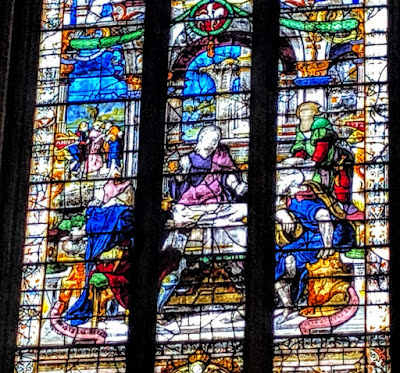
I went back to the Divinity School yesterday to see that Greek quotation. Despite its abbreviated form and with idiosyncratic lettering, is apposite given the building’s original function in teaching theology. The words were added during structural renovations in 1669, when a beautiful window was removed from the Divinity School amid controversy to build a new doorway designed by Christopher Wren, intended for academic processions.

The Vice-Chancellor’s accounts for 1666-1697 document renovations that included Wren’s doorway in 1669. However, despite detailed records of the doorway’s construction, there is no record of who requested the Greek inscription, who provided it or why it was placed there.

The Sir Thomas Bodley plaque above the doors leading into the Divinity School and Bodleian complex has a plaque with the Latin inscription: Quod feliciter vortat (‘May it turn out happily’), a wish for good fortune for the library.

The bronze statue of William Herbert, Earl of Pembroke, is often mistakenly identified as King Charles I (Photograph: Patrick Comerford, 2026)

Above the middle doorway on the north face is a panel with an elaborate coat-of-arms for the Earl of Pembroke, including a colourful shield, garter, helm, mantling, motto and two leopards as heraldic supporters. A second panel above has the painted inscription: Guil. Herbert Pembrochiæ comes, Regii hospitii Camerarius, honoratissimus Academiæ Cancellarius.

The prominent bronze statue standing in the Old Schools Quadrangle facing the Divinity School and the entrance of the Bodleian Library is often mistaken for King Charles I, but is actually a statue of William Herbert (1580-1630), 3rd Earl of Pembroke and Chancellor of the University of Oxford from 1617 until he died.

The sculptor Hubert Le Sueur also sculpted the equestrian statue of Charles I in London. The statue is cast in bronze, and weighs about 1,600 lb. It was originally placed at Wilton House, the family seat of the Earls of Pembroke, until it was moved to the Bodleian Library in 1723. It was moved to its current outdoor position in 1950.

Despite this mistaken identity, Charles I had links with this part of Oxford: he used the Convocation House and the Divinity School as a meeting place for his parliament during the English Civil War, and there are busts of him in Saint John’s College.

The elaborate coat-of-arms of William Herbert, Earl of Pembroke and Chancellor of Oxford University (Photograph: Patrick Comerford, 2026)

The Divinity School is no longer used for its original purposes, but Oxford continues to offer degrees in Theology and Religion taught by the Faculty of Theology and Religion. The Faculty of Theology and Religion is housed in the state-of-the-art Schwarzman Centre at the Radcliffe Observatory Quarter on Woodstock Road and spans Oxford’s many colleges and private halls. The faculty brings together more than 120 members with expertise in Christianity, Judaism, Islam, Buddhism, Hinduism and other world religions, as well as in comparative, interdisciplinary and cross-cultural approaches to the study of religion.

The statutory professorships in theology in Oxford are held in conjunction with a canonry of Christ Church. The professor must be an ordained priest in the Church of England or in an Anglican church in communion with the Church of England, or eligible for and accept ordination. These positions are: Regius Professor of Divinity (Andrew Davison), Lady Margaret Professor of Divinity (Carol Harrison), Regius Professor of Moral and Pastoral Theology (vacant, previously Nigel Biggar), and Regius Professor of Ecclesiastical History (vacant).

The other professors of theology include the Regius Professor of Ecclesiastical History, the Oriel and Laing Professor of the Interpretation of Holy Scripture, Dean Ireland’s Professor of the Exegesis of Holy Scripture, Nolloth Professor of the Philosophy of the Christian Religion; Andreas Idreos Professor of Science and Religion, Professor of the Study of the Abrahamic Religions, Professor of Systematic Theology and Professor of Jewish Studies.

The Revd Dr Francis Babington, who was Lady Margaret Professor of Divinity from 1561, was a first cousin once removed Henry Comberford, Precentor of Lichfield Cathedral, and Richard Comberford, often said, confusingly, to be the direct ancestor of the Comerford family of Kilkenny and Wexford. Babington was also Proctor of Oxford University (1557), a Fellow of All Souls College, Rector of Milton Keynes, Master of Balliol College (1559-1560), Rector of Lincoln College (1560-1563), and Vice-Chancellor of Oxford University (1560-1562). He survived much of the Tudor Reformation and Marian turmoils, but who was finally forced out of office and into exile in 1565, during the reign of Elizabeth I.

The Divinity School appeared as the Hogwarts Infirmary in several Harry Potter films. It is open for self-guided visitor tours, special exhibitions, university events and for weddings.

As for the Greek inscription above the chapel door in Somerville College, that, hopefully, is a story for another day.

All the buildings in Radcliffe Square form a group of the highest architectural importance at the heart of the University of Oxford (Photograph: Patrick Comerford, 2026)

For my guide to churches, chapels and religious buildings and sites in Oxford, visit here

16 October 2026

Reading ‘The Cocktail Party’ by TS Eliot with the Stony Stratford Playreaders

The TS Eliot Theatre at Merton College, Oxford … the Stony Stratford Playreaders have been reading TS Eliot’s play ‘The Cocktail Party’ (Photograph: Patrick Comerford, 2026)

Patrick Comerford

I have been part of the Stony Stratford Playreaders group for about two years now, and we are now rehearsing our contributions to the Stony Words Festival next January.

Last night, on my suggestion, we also read The Cocktail Party, a three-act verse drama written by TS Eliot in 1948 that focuses on the themes of modern existence, identity and spiritual yearning, told through intricate dialogue and drama.

The Cocktail Party tells of a troubled married couple who, through the intervention of a mysterious stranger, settle their problems and move on with their lives. The play was first performed at the Edinburgh Festival in 1949 and first published in 1950. It was the most popular of Eliot’s seven plays in his lifetime, although his 1935 play, Murder in the Cathedral, is better remembered today.

The Cocktail Party was written while Eliot was a visiting scholar in Princeto, where he received word that he had reveived that year’s Nobel Prize for literature. The play went on to have successful runs in theatres in London and New York in 1950, with the Broadway production receiving the 1950 Tony Award for Best Play.

At its debut in Edinburgh: critics acclaimed the play as ‘the most advanced and original point yet reached in Mr Eliot’s dramatic writing.’ Reviewers delighted in the subtlety of Eliot’s verse, and the ‘spirit of early Shaw’ which elicited a ‘high-pitched intellectual giggle … frequently drowned by the full-throated roar’. Some reviewers, however, found the play ‘insufficiently poetic’ and ‘perhaps the weakest poetry that Eliot has yet written.’

The Cocktail Party draws on the play Alcestis by Euripides and the Orpheus and Eurydice legend, and it has been described as ‘a play on two planes’: the level of the divine, and a drawing-room comedy.

The characters are: Edward Chamberlayne, Lavinia Chamberlayne, Celia Coplestone, with whom Edward has had an affair, Peter Quilpe, who yearns for Celia, Julia Shuttlethwaite, Alexander MacColgie Gibbs, an Unidentified Guest, later identified as Sir Henry Harcourt-Reilly, a Nurse-Secretary, who is secretary to Sir Henry, and two caterer’s men.

The characters Reilly, Julia, and Alexender are not, in fact, humans but angelic beings dedicated to the transhumanisation of the human soul. Two paths lie open to humans: the first is the way of companionable self-deception (‘the hearth’) embraced by the vast majority – as epitomised in the relationship between Edward and Lavinia; and the second is that of the saint, embraced by a few.

The Faber and Faber office at 24 Russell Square in Bloomsbury, where TS Eliot was working when he was writing ‘The Cocktail Pary’ (Photograph: Patrick Comerford)

The drama of the first act revolves around Edward Chamberlayne, who is hosting a cocktail party, all the while disguising the fact that his wife Lavinia has left him.

In the course of the play a mysterious guest, originally played by Alec Guinness, turns out to be a Harley Street psychologist, Sir Henry Harcourt-Reilly. He returns Lavinia to Edward, and teaches the two that their lives are better together, though superficial.

Simultaneous to the main drama of the play is the story of Edward’s mistress, Celia, who has been described as ‘Eliot’s most moving character’. She journeys beyond the drawing room and leaves to become a missionary in the East. At a second cocktail party, two years later, it is revealed that she died horribly, crucified in the service of God and eaten by ants on a cross in a far-off land.

Eliot may have based the character of Julia on a woman who was born in Stony Stratford and who helped Eliot when he was writing the play. Mary Trevelyan (1897-1983), who was born in Stony Stratford, was the eldest of six children of the Revd George Philip Trevelyan (1858-1937), Vicar of Saint Mary’s, Wolverton (1885-1897).

They had first met in Swanwick, Derbyshire, at a conference of the Student Christian Movement (SCM). She helped Eliot to transcribe the song ‘One-eyed Reilly’, a song he had heard in his youth. Eliot sometimes referred to Mary as Jullia, and it is said he modelled the character Julia in The Cocktail Party on her.

The name of Celia Coplestone seems to be Eliot’s homage to Father Frederick Coplestone (1907-1994), the Jesuit philosopher who had recently referred to Eliot’s Murder in the Cathedral in a celebrated BBC broadcast debate with Bertrand Russell on the existence of God. Celia’s choice of a missionary life may be an oblique reference to Copleston’s two uncles who were SPG-supported Anglican missionaries: Reginald Stephen Copleston, who was Bishop of Calcutta and Ernest Copleston, was Bishop of Colombo.

Celia’s choice of missionary destination, Kinkanja, may also refer to Mary Trevelyan’s work in North Borneo (today’s Sabah), with a terrifying description of the indigenous culture that was still circulating at the time in England.

In The Cocktail Party, Eliot reconciles the drawing room and divinity, bringing the play its most praise, with one review describing Eliot as both ‘a literary craftsman and a moral prophet.’

There is a sense too in which Eliot seems to have used the play to exorcise his own personal demons, including his own questioning of his ability and recognition as a poet. The way Edward and Lavinia sett;e for a passionless coexistence, their marital spats and Edward’s guilty remorse echo Eliot’s anguished relationship with his wife Vivienne, who had died in 1947. In addition to exploring his private hell, Eliot suggests that the only alternative to the bleak materialism of the post-war world is some form of ecstatic sacrifice.

I was intrigued many years ago by the way a production of the play was part of the assessment of a module at the Episcopal Divinity School in Cambridge, Massachusetts, and thought at one time (albeit momentarily) of borrowing the idea in one module I taught at the Church of Ireland Theological College.

Barry Spurr, in Anglo-Catholic in Religion: TS Eliot and Christianity, recalls that when an Episcopalian priest suggested to Eliot that The Cocktail Party was ‘covertly all about the Mass, Eliot responded: ‘I really wanted to write a damn good play, and I hope I did.’

One critic summarised the play succinctly: ‘know yourself; choose, come to terms with your insignificance, or, if you happen to be one of the saintly few, face the full consequences of your choice.’

‘The best of a bad job is all any of us make of it’, Sir Henry says in his final lines, ‘Except of course, the saints.’


11 October 2026

Holy Trinity Church, a Gothic
church in Headington Quarry,
Oxford, designed by Gilbert Scott
and with links with CS Lewis

Holy Trinity Church in Headington Quarry, Oxford, was designed by Sir George Gilbert Scott and was built in 1848-1849 (Photograph: Patrick Comerford, 2026)

Patrick Comerford

During two recent visits to Headington in Oxford, I visited some of the churches in the area, including Saint Andrew’s Church, Headington, Headington Baptist Church, Corpus Christi Catholic Church, and Saint Michael and All Angels, New Marston.

But, perhaps, the best-known church in the area is Holy Trinity Church in Headington Quarry, known particularly for its associations with the Belfast-born writer CS Lewis (1898-1963), who lived and worked for most of his life in Oxford, and who was a regular parishioner in Holy Trinity Church for more than 30 years.

Inside Holy Trinity Church, Headington Quarry, facing the east end (Photograph: Patrick Comerford, 2026)

At first sight, Holy Trinity Church may look like a mediaeval church. But, in fact, it only dates back less than 200 years to April 1849. It is built in the 15th century decorated style, with a nave, north aisle, south porch, and a gable bell-cote with two bells at the west end.

The church was designed by the prolific Gothic Revival architect, Sir George Gilbert Scott (1811-1878), who is known for designing, building and renovating churches and cathedrals in the Gothic style. He was born in Gawcott, on the outskirts of Buckingham, and designed he Midland Grand Hotel at St Pancras Station, the Albert Memorial, and the Foreign and Commonwealth Office in London, Saint Mary’s Cathedral, Glasgow, Glasgow University, Saint Mary’s Cathedral, Edinburgh, and King’s College Chapel, London. His work in Oxford includes the Martyrs’ Memorial and Exeter College Chapel.

Holy Trinity Church, Headington Quarry, was built in 1848-1849 to serve the needs of people living and working in the then-active quarry.

Inside Holy Trinity Church, Headington Quarry, looking west from the chancel and east end (Photograph: Patrick Comerford, 2026)

Samuel Wilberforce, Bishop of Oxford (1845-1869), was instrumental in getting the church built in Quarry, which he described in a sermon on 9 June 1847 as a ‘hamlet’ in a ‘wild, rural district’. He claimed Headington Quarry had been ‘long cursed by the neighbourhood of Oxford vice’ and said its ‘peculiar circumstances’ demanded ‘the sympathy and assistance of … Christian neighbours’.

Early subscriptions towards building the church included £50 from Charles Tawney, who also gave the site for Headington National School. There were large donations too from the Revd Thomas Henry Whorwood, Vicar of Saint Andrew’s, Headington, and Lord of the Manor of Headington (£25); John Matthews of Headington Manor House (£21); George Ballachey of Bury Knowle House (£20); and Digby Latimer of Headington House (£20).

Other contributors included the heads of Worcester College, University College, New College, Queen’s College, Trinity College, All Souls’ College and Exeter College, the Vice-Chancellor of Oxford University, and the Revd Edward Pusey. Later subscribers included Magdalen College (£200) and Queen Victoria (£20), as well as Oriel College, Brasenose College, Corpus Christi College, Lincoln College, Merton College, Wadham College and Worcester College.

The stone was quarried from Quarry Farm Pit, and the contractors were Wyatt’s of Oxford.

The chancel, High Altar and East Window in Holy Trinity Church, Headington Quarry (Photograph: Patrick Comerford, 2026)

Bishop Samuel Wilberforce laid the foundation stone of the church on 19 June 1848, and consecrated the new church on 22 November 1849. The first Vicar was the Revd Thomas Masterman in 1849-1851. The vicarage house at 42 Quarry Road was built in 1868 for the Revd Arthur Dalton. It was designed by the architect Arthur Blomfield, who designed Saint Barnabas’s Church, Jericho, the following year. The vicarage was converted into flats in 1992.

Holy Trinity Church is a Grade II listed building, with a nave that includes an east window by Sir Ninian Comper, a chancel, a north aisle with the Lady Chapel, a large double bellcote and diagonal buttresses. It is built in coursed rubble limestone with ashlar detailing and stone locally quarried at Quarry Farm Pit, and has red tile roofs.

There are two-light, three-light and lancet windows and a tall south-west porch with two windows. The low north aisle has squat, square-headed windows in a late mediaeval style.

The East Window designed by Sir Ninian Comper (1864-1960) depicts Christ in Glory and was installed in 1951 (Photograph: Patrick Comerford, 2026)

Inside, the chancel is the same height as the nave, there is a stone arcade, a chancel arch, and a stone pulpit and font, with plain benches in the nave and aisle. Above the altar, the East Window was designed by Sir Ninian Comper (1864-1960) and depicts Christ in Glory. The window was installed in 1951 as a memorial to parishioners who died in World War II.

The symbol at the top of the East Window is that of the Holy Trinity with the heraldic symbols of the Diocese of Oxford and the Oxford industrialist Lord Nuffield below. Comper’s distinguishing strawberry mark is in the bottom right-hand corner of the window.

The first piece of stained glass in the church, a window depicting the Crucifixion, was placed in the East Window by the Revd Arthur Dalton, vicar of the parish in 1867-1870. The centrepiece has since been installed in the Lady Chapel.

The tapestry behind the altar was designed by Father Elias Polomski and is inspired by Andrei Rublev’s icon of the Holy Trinity (Photograph: Patrick Comerford, 2026)

The church was refurbished and redecorated in the early 1990s, at the initiative of the vicar, the Revd Christopher Hewetson. The altar area and the chancel were remodelled, when the old curtain that hung in front of the east window was swept away, the stone work was cleaned, much of the floor was renewed, new lighting was installed, and the bosses were regilded. Two clergy stalls were added, and the roof was boarded because of the decay of the original plaster.

At the same time, the altar was moved from the east wall in the chancel, allowing west-facing celebrations of the Eucharist.

During the refurbishment and redecoration, old and decaying curtains were removed, and a new tapestry was hung behind the altar in 1994. It was designed by Father Elias Polomski, curate of the parish in 1990-1994. It is inspired by Andrei Rublev’s icon of the Holy Trinity and depicts the three angels who visited Abraham in Genesis 18. The other panels of the tapestry depict the rocks, oak trees and ponds of Shotover, to the east of the parish, with a scattering of Greek long-necked sheep.

It took volunteers from the parish over 2,000 hours and two years to complete the tapestry. The completed tapestry was dedicated by the Bishop of Oxford on 17 July 1994.

The chancel window depicting Saint Andrew and Saint Philip confuses the Gospel scenes associated with each saint (Photograph: Patrick Comerford, 2026)

The chancel two-light window depicting Saint Andrew, the patron saint of Headington, and Saint Philip, are in memory of a former vicar, the Revd Philip Doyne (1916-1924). But the windows were assembled incorrectly in the workshop, so that each saint has the Gospel scene associated with the other.

The chancel organ was built by Kenneth Tickell of Northampton and was installed in 1992. The colours and pipe shades were also designed by Father Elias Polomski.

The chancel also has a credence table in memory of a former vicar, the Revd Eric Bleiben, and a piscina in memory of a former sacristan, Anne Kimber.

The Lady Chapel at the east end of the north aisle was added in the 1990s (Photograph: Patrick Comerford, 2026)

The Lady Chapel at the east end of the north aisle was added in the 1990s as a memorial to the Revd Ronald Heald, vicar in 1956-1990. The altar and chairs were also designed by Father Elias Polomski and made by Hugh Croft of Devon. Other furnishings include the carpet, chandelier, icon from Athens, and an antique Persian lamp and chain.

The Athens icon was bought by Father Charles Smith of Corpus Christi Church when he was in Athens in May 1994 for the Greek Orthodox Easter. The Trinity icon was a gift from Bishop Malkhaz Songulashvili of the Georgian Baptist Church, who had studied in Oxford, and was blessed by him on Trinity Sunday 2010. The statue of the Virgin Mary and Christ Child is a copy of a French Gothic statue in the Victoria and Albert Museum.

The iconof the Theotokos was bought in Athens in May 1994 (Photograph: Patrick Comerford, 2026)

The stained glass by the pulpit depicts the Archangel Gabriel and was installed in 1910 in memory of the Revd Charles Longland, who died in 1908 and his daughter Mary Elizabeth who had died in her teens. The scroll has Gothic script with the words ‘God so loved the world that he gave his only begotten Son’ (John 3:16).

The Baptistry window shows the Holy Spirit descending on the font. It was installed in 1916 in memory of Kate Johnston, wife of the Revd Charles Johnston (Vicar in 1891-1916).

The Narnia window in the north aisle by Sally Scott in the north aisle includes images from CS Lewis’s Chronicles of Narnia and was installed in 1991.

The vestry, which is a 20th century addition, is single-storeyed with a flat roof and extends north from the east end of the aisle.

The Narnia window by Sally Scott in the north aisle was installed in 1991 (Photograph: Patrick Comerford, 2026)

Holy Trinity Church, Headington Quarry, is still remembered today for its associations with the writer CS Lewis, who was a regular parishioner for more than three decades. He is commemorated in the Narnia window and in his simple grave is in the churchyard. CS Lewis and his brother Warren Lewis, began attending the church in 1930 and remained active in this church until their deaths, CS Lewis in 1963 and WH Lewis in 1973. But more about CS Lewis and Headington Quarry in the days to come, hopefully.

• The Revd Martin Little is the Vicar of Holy Trinity, Headington Quarry. Sunday services are 8 am, Holy Communion (Book of Common Prayer); 10 am, Parish Communion; 6 pm, evening service once a month, varying from Choral Evensong to seasonal celebrations, to informal worship. Midweek services include Holy Communion at 10 am, Wednesday, and Morning Prayer at 9 am, Monday, Tuesday, Thursday and Saturday.

Holy Trinity Church, Headington Quarry, was built in the 15th century decorated style (Photograph: Patrick Comerford, 2026)

For my guide to churches, chapels and religious buildings and sites in Oxford, visit here

Daily prayer in Ordinary Time 2026:
156, Sunday 11 October 2026,
Nineteenth Sunday after Trinity (Trinity XIX)

Waiting for guests at the Tai Tai restaurant in Kuching … we are all invited to the heavenly banquet, but are we ready to accept the invitation? (Photograph: Patrick Comerford, 2026)

Patrick Comerford

We are continuing in Ordinary Time in the Church Calendar and today is the Nineteenth Sunday after Trinity (Trinity XIX, 11 October 2026). In Saint Mary and Saint Giles Parish, Stony Stratford, we celebrating the Harvest Festival at the Parish Eucharist later this morning. The Calendar of the Orthodox Church today celebrates the Sunday of the Holy Fathers of the Seventh Ecumenical or Second Council of Nicaea in the year 787, with the restoration of the veneration of holy icons and the formal rejection of the Iconoclast heresy.

Before today begins, I am taking some quiet time this morning to give thanks, for reflection, prayer and reading in these ways:

1, today’s Gospel reading;

2, a reflection on the Gospel reading;

3, a prayer from the USPG prayer diary;

4, the Collects and Post-Communion prayer of the day.

‘Go therefore into the … streets, and invite everyone you find to the … banquet’ (Matthew 22: 9) … empty tables at restaurants in the side streets in Rethymnon in Crete (Photograph: Patrick Comerford, 2025)

Matthew 22: 1-14 (NRSVA):

1 Once more Jesus spoke to them in parables, saying: 2 ‘The kingdom of heaven may be compared to a king who gave a wedding banquet for his son. 3 He sent his slaves to call those who had been invited to the wedding banquet, but they would not come. 4 Again he sent other slaves, saying, “Tell those who have been invited: Look, I have prepared my dinner, my oxen and my fat calves have been slaughtered, and everything is ready; come to the wedding banquet.” 5 But they made light of it and went away, one to his farm, another to his business, 6 while the rest seized his slaves, maltreated them, and killed them. 7 The king was enraged. He sent his troops, destroyed those murderers, and burned their city. 8 Then he said to his slaves, “The wedding is ready, but those invited were not worthy. 9 Go therefore into the main streets, and invite everyone you find to the wedding banquet.” 10 Those slaves went out into the streets and gathered all whom they found, both good and bad; so the wedding hall was filled with guests.

11 ‘But when the king came in to see the guests, he noticed a man there who was not wearing a wedding robe, 12 and he said to him, “Friend, how did you get in here without a wedding robe?” And he was speechless. 13 Then the king said to the attendants, “Bind him hand and foot, and throw him into the outer darkness, where there will be weeping and gnashing of teeth.” 14 For many are called, but few are chosen.’

‘Look, I have prepared my dinner … and everything is ready’ (Matthew 22: 3) … waiting for diners at the Black Horse in Great Linford, Buckinghamshire (Photograph: Patrick Comerford)

Today’s Reflection:

‘For many are called, but few are chosen.’

Sometimes, the ways I can behave as a snob can catch me off-guard and unexpectedly, and I shame myself.

When I was growing up, the snobberies and class distinctions of previous generations were challenged over 60 years ago in an old-fashioned way in the film My Fair Lady (1964), based on George Bernard Shaw’s earlier play, Pygmalion (1913).

But Pygmalion also inspired what I think is a much funnier film, Hoi Polloi (1935), with the Three Stooges, Larry, Curly and Moe.

Two professors are arguing about whether our social behaviour is caused by environment or heredity. It is a very funny take on the old Nature v Nurture argument.

To settle a bet, the two professors take three binmen – Larry, Curly and Moe – train and coach them for three months, dress them up, and send them off to a posh society dinner.

Their behaviour descends into farce, and it looks as if one professor has won his bet: our social behaviour is dictated by inherited class.

But then the tables are turned – literally. Everyone else at the party descends to the same riotous behaviour. At a base level, we are all the same, even if some refuse to accept it.

Nature or nurture? It was an important statement that we all share the same humanity, coming as racism and the Nazis were on the rise in the 1930s.

The title of the film, Hoi Polloi, is a way of expressing class-based social prejudice. It is a Greek phrase, meaning ‘the many’ and it was used in Victorian England by people who had the benefit of a classical education in English public schools and the universities, to describe the masses, who they presumed did not understand the phrase.

Gilbert and Sullivan use the phrase to mock those who used it in their comic opera Iolanthe. Later, it was used by English public schoolboys in the 1950s and the 1960s, when they referred to ‘oips’ and ‘oiks’.

The term hoi polloi also appears in a scene in the film Dead Poets Society (1989). Professor John Keating, played by Robin Williams, speaks negatively about the use of the definite article ‘the’ in front of the phrase.

Steven Meeks (Allelon Ruggiero) raises his hands and speaks: ‘The hoi polloi. Doesn’t it mean the herd?’

Keating replies: ‘Precisely, Meeks. Greek for the herd. However, be warned that, when you say “the hoi polloi” you are actually saying “the the herd.” Indicating that you too are “hoi polloi”.’

This morning’s Gospel reading (Matthew 22: 1-14) begins with a very joyful occasion – a posh nosh, a planned wedding, and generous invitations to a lavish banquet. But, instead of the farce in that film with the Three Stooges, it quickly descends into very difficult images: slaves who are kidnapped, mistreated and killed; cities that are burned down; a man who is bound hand and feet and thrown into outer darkness.

The images of the wedding banquet and the wedding covenant are important ways of describing our relationship with God.

But the parable in this morning’s Gospel reading is particularly difficult.

The king has invited a long list of guests, but even after being repeatedly sought out, none of these guests comes to the banquet.

To refuse to come, to refuse a king’s command, is treason; to kill his slaves amounts to insurrection. So the king sends out troops to put down the rebellion.

The king then sends his slaves into the streets to find enough people to sit at the tables at the wedding banquet. The phrase translated as ‘the main streets’ (διεξόδους τῶν ὁδῶν, verse 9), means not the main fashionable, shopping streets in a chic part of a city centre. It refers to dirty, gritty, street corners and junctions, perhaps the main junctions outside the city gates.

This is the place where those who want to be hired as labour gather, where those who are refused entry wait without hope, this is where those who are on margins are found. Other translations catch these images when they talk about the highways and the byways.

And the king’s invitation, in verse 10, goes out to all people, ‘both good and bad.’

Yet, when the king sees that a man is not dressed appropriately for the event, the king throws him into the outer darkness. In this case, the robe probably symbolises the white robe worn for baptism.

Do we wear that robe all the time? In other words, do we live up to our promises of discipleship made at Baptism – summarised in the call to love God and to love others?

If you were to imagine yourself as one of the characters in this parable, who would you be?

And would you behave that way?

Are you the king, throwing a lavish wedding banquet?

Are you a wedding guest who has denied the generosity of the king?

Are you the bride or groom, sidelined and marginalised at our own wedding, incidental to all the power playing and role playing?

Are you one of the people brought in from the streets, but not prepared for the celebration about to take place?

Where do you find Good News in this parable?

What is meant by the many and the few here?

In our western way of thinking, the word many is a quantity much more than the majority, while few is many less than the majority. But in eastern thought, one less than 100% would be considered few.

We could put the Greek use of ‘few’ and ‘many’ by Christ in this parable in its cultural context. Pericles, in his ‘Funeral Oration’ in Athens, according to Thucydides in his History of the Peloponnesian War, uses ‘the many,’ οἱ πολλοί (hoi polloi), in a positive way when he extols democracy in Athens.

He contrasts ‘the many’ with ‘the few’ (οἱ ὀλίγοι, hoi oligoi), the few who abuse power and create an oligarchy, rule by the few. Pericles demands equal justice for ‘the many’, ‘the all’, before the law, against the selfish interests of the few.

When we celebrate the Eucharist, we remember that Christ is the victim, and that he said his blood is shed ‘for you and for many.’ The word ‘you’ here means us, the Church, the few in this parable. But the phrase ‘the many’ here, οἱ πολλοί (hoi polloi), refers to the masses, the multitude, the great unwashed, who are called to the banquet too.

Christ’s invitation is not just to you and me, who know we are invited to the banquet. It is also for the many, the lumpen masses, all people, the ones who are not usually invited to the posh nosh, the Larry, Curly and Moe in our midst.

The invitation to come in, to celebrate at the banquet, symbolised in the Eucharist this morning, is not just for the few, the oligarchs. The many are invited to this banquet this morning.

Who are we to behave like a tyrannical despot and exclude them? For if we exclude them, we are in danger of excluding Christ himself.

A grave in Kerameikós, Athens, where Pericles delivered his funeral oration (Photograph: Patrick Comerford)

Today’s Prayers (Sunday 11 October 2026, Trinity XIX):

In Pray with the World Church, the prayer diary of the Anglican mission agency USPG (United Society Partners in the Gospel), the theme this week, 11-17 October 2026 (pp 46-47), is ‘The Lord Has Done Great Things’. This theme is introduced today with a programme update by Guilherme Moura Bejo, candidate for Holy Orders in the Anglican Diocese of São Paulo, and co-ordinator of the Diocesan Youth Group:

‘The Lord has done great things for us, and we are filled with joy’ (Psalm 126:3).

Here’s an update on my experience since the Emerging Leaders Academy in Kenya, organised by USPG and the Anglican Communion Youth Network, where I met young people from across the Anglican Communion and was inspired by how the Kingdom of God is being expressed through their ministries.

Since returning to Brazil, I have been applying both the practical and theoretical learning from the programme in my daily life, especially in my relationships. A key practice has been active listening, helping me to be more attentive to others’ voices, understand their struggles, and build deeper connections.

We are also developing a training course for young leaders in the Anglican Diocese of São Paulo, aiming to share what was learned during the formation and strengthen leadership rooted in Christian principles and the Five Marks of Mission of the Anglican Communion. This will include online sessions throughout the year, alongside an in-person course to deepen leadership practice.

This journey has been made possible through the support of Bishop Cézar and the Igreja Episcopal Anglicana do Brasil. Praise be to God for all who continue to support this work.

For more on Anglicanism – its history, saints, and liturgy – you can find thoughtful content on Guilherme’s Instagram @discipuladoanglicano (in Portuguese).

The USPG Prayer Diary today (Sunday 11 October 2026, Trinity XIX) invites us to pray as we read and meditate on Matthew 22: 1-14.

The Collect of the Day:

O God, forasmuch as without you
we are not able to please you;
mercifully grant that your Holy Spirit
may in all things direct and rule our hearts
; through Jesus Christ your Son our Lord,
who is alive and reigns with you,
in the unity of the Holy Spirit,
one God, now and for ever.

The Post-Communion Prayer:

Holy and blessed God,
you have fed us with the body and blood of your Son
and filled us with your Holy Spirit:
may we honour you,
not only with our lips
but in lives dedicated to the service
of Jesus Christ our Lord.

Additional Collect:

Faithful Lord,
whose steadfast love never ceases
and whose mercies never come to an end:
grant us the grace to trust you
and to receive the gifts of your love,
new every morning,
in Jesus Christ our Lord.

Yesterday’s reflections

Continued tomorrow

‘Those who had been invited to the wedding banquet … would not come’ (Matthew 22: 3) … empty tables at the Moat House, the former Comberford family home on Lichfield Street, Tamworth (Photograph: Patrick Comerford)

Scripture quotations are from the New Revised Standard Version Bible: Anglicised Edition copyright © 1989, 1995, National Council of the Churches of Christ in the United States of America. Used by permission. All rights reserved worldwide. http://nrsvbibles.org

The Orthodox Church today celebrates the Sunday of the Holy Fathers of the Seventh Ecumenical or Second Council of Nicaea in 787, with the restoration of the veneration of holy icons and the formal rejection of the Iconoclast heresy

06 October 2026

Daily prayer in Ordinary Time 2026:
151, Tuesday 6 October 2026

Christ in the home of Mary, Martha and Lazarus … a panel in the Herkenrode glass windows in the Lady Chapel in Lichfield Cathedral (Photograph: Patrick Comerford)

Patrick Comerford

We are continuing in Ordinary Time in the Church Calendar, and this week began with the Eighteenth Sunday after Trinity (Trinity XVIII, 4 October). The calendar of the Church of England in Common Worship remembers William Tyndale (1494-1536), Translator of the Scriptures and Reformation Martyr. The exhibition ‘A Dangerous Calling: 500 years of William Tyndale’s New Testament’ is in Saint Paul’s Cathedral, London, until February 2027 stpauls.co.uk/tyndale

Before today begins, however, I am taking some quiet time this morning to give thanks, and for reflection, prayer and reading in these ways:

1, today’s Gospel reading;

2, a reflection on the Gospel reading;

3, a prayer from the USPG prayer diary;

4, the Collects and Post-Communion prayer of the day.

Christ in the home of Mary and Martha … the East Window in Saint Peter and Saint Paul Church, Watford, Northamptonshire (Photograph: Patrick Comerford)

Luke 10: 38-42 (NRSVA):

38 Now as they went on their way, he entered a certain village, where a woman named Martha welcomed him into her home. 39 She had a sister named Mary, who sat at the Lord’s feet and listened to what he was saying. 40 But Martha was distracted by her many tasks; so she came to him and asked, ‘Lord, do you not care that my sister has left me to do all the work by myself? Tell her then to help me.’ 41 But the Lord answered her, ‘Martha, Martha, you are worried and distracted by many things; 42 there is need of only one thing. Mary has chosen the better part, which will not be taken away from her.’

Christ in the House of Martha and Mary by Diego Velázquez (1630)

Today’s Reflections:

Saint Luke’s story of the meal that Jesus has with his friends Mary and Martha is not found in the other synoptic gospels, and the only other parallel is in the Fourth Gospel, where Jesus visits Mary and Martha after the death of Lazarus.

So the meals Jesus has with Mary and Martha must be understood in the light of the Resurrection, which is prefigured by the raising of Lazarus from the dead.

For many women, and for many men too, the story of the meal with Martha and Mary raises many problems, often created by insights that may not have been possible to have at the time when Saint Luke’s Gospel was written.

Our approach to understanding and explaining this meal very often depends on the way in which I understand Martha and the busy round of activities that have her distracted, and that cause her to complain to Jesus about her sister’s apparent lack of zeal and activity.

These activities in the Greek are described as Martha’s service – she is the deacon at the table: where the NRSV says ‘But Martha was distracted by her many tasks,’ the Greek says: ἡ δὲ Μάρθα περιεσπᾶτο περὶ πολλὴν διακονίαν (‘But Martha was being distracted by much diaconal work, service at the table’).

Quite often, when this story is told, over and over, again and again, it is told as if Martha is getting stroppy about having to empty the dishwasher while Mary is lazing, sitting around, making small talk with Jesus.

Does Martha see that Mary should only engage in kitchen work too?

Does she think, perhaps, that only Lazarus should be out at the front of the house, keeping Jesus engaged in lads’ banter about the latest league match between Bethany United and Jerusalem City?

Is Jesus being too dismissive of Martha’s complaints?

Or is he defending Mary’s right to engage in a full discussion of the Word, to engage in an alive ministry of the Word?

Martha is presented in this story as the dominant, leading figure. It is she who takes the initiative and who welcomes Jesus into her home (verse 38); it is she who offers the hospitality, who is the host at the meal, who is the head of the household – in fact, Lazarus is not even on the stage for this scene, and Mary is merely ‘her sister’ – very much the junior partner in the household.

Yet it is Mary, the figure on the margins, who offers the sort of hospitality that Jesus commends and praises.

Mary simply listens to Jesus, sitting at his feet, like a student would sit at the feet of a great rabbi or teacher, waiting and willing to learn what is being taught.

Martha is upset about this, and comes out from the back and asks Jesus to pack off Mary to the kitchen where she can help Martha.

But perhaps Martha was being too busy with her household tasks.

I was once invited to dinner by people I knew as good friends. And for a long time I was left on my own with the other guest as the couple busied themselves with things in the kitchen – they had decided to do the washing up before bringing out the coffee … the wife knew that if she left the washing up until later, the husband would shirk his share of the task.

But being left on our own was a little embarrassing. Part of the joy of being invited to someone’s home for dinner is the conversation around the table.

When I have been on retreats, at times, in Greek Orthodox and Benedictine monasteries, conversation at the table has been discouraged by a monk reading, usually from the writings of the Early Fathers, from the Patristic writings.

A good meal, good table fellowship, good hospitality, are not just about the food that is served, but about the ideas and words shared, heard and listened to around the table too.

One commentator suggests that Martha has gone overboard in her duties of hospitality. She has spent too much time preparing the food, and has failed to pay real attention to her guest.

On the other hand, Mary has chosen her activity (verse 42). It does not just happen by accident. Mary has chosen to offer Jesus the real hospitality that a guest should receive. She talks to Jesus, and real conversation is about both talking and listening.

If she is sent back into the kitchen, then – in the absence of Lazarus, indeed, in the notable absence of the disciples – Jesus would be left without hospitality, without words of welcome, without conversation.

Perhaps Martha might have been better off if she had a more simple lifestyle, if she prepared just one dish for her guest and for her family – might I be bold enough to suggest, if she had been content for them to sup on bread and wine alone.

She could have joined Mary in her hospitality, in welcoming Jesus to their home and to their table; they could have been in full communion with one another.

In this way, Martha will experience what her sister is experiencing, but which she is too busy to notice – their visitor’s invitation into the hospitality of God.

One commentator, Brendan Byrne, points out the subtle point being made in this story:

‘Frenetic service, even service of the Lord, can be a deceptive distraction from what the Lord really wants. Luke has already warned that the grasp of the word can be choked by the cares and worries of life … Here the cares and worries seem well justified – are they not in the service of the Lord? But precisely therein lies the power of the temptation, the great deceit. True hospitality – even that given directly to the Lord – attends to what the guest really wants.’

‘Christ at the home of Martha and Mary,’ Georg Friedrich Stettner (1639)

Today’s Prayers (Tuesday 6 October 2026):

In Pray with the World Church, the prayer diary of the Anglican mission agency USPG (United Society Partners in the Gospel), the theme this week, 4-10 October 2026 (pp 44-45), is ‘The Gun, The Sword, and The Bible’. This theme was introduced on Sunday with a reflection by the Revd Les Isaac OBE, founder and President of Ascension Trust and co-founder of Street Pastors.

The USPG Prayer Diary today (Tuesday 6 October 2026) invites us to pray:

We pray for healing where faith has been entangled with harm and injustice. Bring repentance where it is needed and restore hearts towards your righteousness.

The Collect of the Day:

Lord, give to your people grace to hear and keep your word
that, after the example of your servant William Tyndale,
we may not only profess your gospel
but also be ready to suffer and die for it,
to the honour of your name;
through Jesus Christ your Son our Lord,
who is alive and reigns with you,
in the unity of the Holy Spirit,
one God, now and for ever.

The Post-Communion Prayer:

Eternal God,
who gave us this holy meal
in which we have celebrated the glory of the cross
and the victory of your martyr William Tyndale:
by our communion with Christ
in his saving death and resurrection,
give us with all your saints the courage to conquer evil
and so to share the fruit of the tree of life;
through Jesus Christ our Lord.

Yesterday’s Reflections

Continued Tomorrow

The Risen Christ with Mary of Bethany (left) and Mary Magdalene (right) … a stained glass window in Saint Nicholas’s Church, Adare, Co Limerick (Photograph: Patrick Comerford)

Scripture quotations are from the New Revised Standard Version Bible: Anglicised Edition copyright © 1989, 1995 National Council of the Churches of Christ in the United States of America. Used by permission. All rights reserved worldwide. http://nrsvbibles.org

29 September 2026

Saint Michael and All Angels,
New Marston: a 1950s church
in suburban Oxford with
important works of modern art

The Church of Saint Michael and All Angels on the corner of Jack Straw’s Lane and Marston Road, Oxford … today is the Feast of Saint Michael and All Angels (Photograph: Patrick Comerford, 2026)

Patrick Comerford

Today is the Feast Day of Saint Michael and All Angels (29 September), and in anticipation of this feast day, I visited the Church of Saint Michael and All Angels in New Marston in suburban Oxford last week when I was visiting churches in the Headington area last week.

During my two visits to Headington last week, and in between appointments in the John Radcliffe Hospital, Oxford, I visited some of the churches in the area, including Saint Andrew’s Church, Headington, Holy Trinity Church, Headington Quarry, Headington Baptist Church, Corpus Christi Catholic Church, and Saint Michael and All Angels, New Marston.

I found Saint Michael’s Church, which was built as a chapel of ease for Saint Andrew’s Church, Headington, at the bottom of Jack Straw’s Lane on the corner with Marston Road.

Inside Saint Michael and All Angels Church, New Marston, facing the High Altar, chancel and east end (Photograph: Patrick Comerford, 2026)

New Marston is a suburb about 2 km (1.25 miles) north-east of the centre of Oxford. The area is built on land that was originally part of the Manor of Headington, and it was rural until the 19th century, when housing began to develop along Marston Road from St Clement’s towards the village of Marston.

Saint Michael and All Angels Church was built 70 years ago in 1954-1956 on the corner of Marston Road and Jack Straw’s Lane as a chapel of ease for the parish of Saint Andrew, Headington. New Marston’s early Anglican needs were first met by a mission hall built on Ferry Road in 1919 until the new church was consecrated in September 1955.

Saint Michael and All Angels Church was designed in an Italianate style by the architect Thomas Lawrence Dale (1884-1959), who was the Oxford Diocesan Surveyor for 23 years. At first, Dale specialised in designing houses for private clients. From the 1930s, he was the Oxford Diocesan Surveyor and he was noted for designing, restoring and furnishing Church of England parish churches.

Like Charles Ponting (1850-1932) to whom he had been articled, Dale’s church architecture was strongly Anglo-Catholic. However, whereas Ponting continued to work in the Gothic Revival idiom long after it had passed out of fashion, Dale adopted Italianate architecture for his churches.

Inside Saint Michael and All Angels Church, New Marston, facing the west end … the church was designed in an Italianate style by the architect Thomas Lawrence Dale (Photograph: Patrick Comerford, 2026)

Dale was born in London and was educated at University College School, Hampstead. He began trained at the Architectural Association School of Architecture in 1900, was articled to Charles Ponting in Marlborough, Wiltshire (1901-1904), was assistant to the architect Edmund Buckle (1904-1906), and qualified as an architect in 1906.

He was a captain in the Army Cyclist Corps during World War I and was mentioned in despatches. After World War I, Dale moved to Banbury and designed a series of council houses in several villages. Two of his earlier works are Edwardian houses in Hampstead Garden Suburb, one of which has been described as ‘an excellent house of the Lutyens school’. Dale later moved to Oxford, where he designed his own house on Woodstock Road, and later moved again to Bradmore Road.

As Oxford Diocesan Surveyor, Dale designed at least four parish churches in the Oxford area, and also designed restoration work or new furnishings for a number of parish churches. His churches in the Diocese of Oxford include: Saint Francis of Assisi (1930-1931), Cowley, built on a site provided by Morris Motors as a temporary daughter church of Saint James, Cowley; Saint Alban the Martyr (1933), Oxford, replacing a chapel of ease built for Saint Mary and Saint John Church in 1889; Saint Michael and All Angels (1954-1956), New Marston, built as a chapel of ease for Saint Andrew’s Church, Headington; and Saint Swithun (1956-1958), Kennington.

The sculpted reliefs on the main front include a small figure of Saint Michael and two large reliefs of angels, by John Bunting and Michael Groser (Photograph: Patrick Comerford, 2026)

Dale died in 1959 and was buried in Wolvercote Cemetery, Oxford. His son Simon Dale (1919-1987) was also an architect. He was beaten to death at The Heath, the house he and Susan had restored at Hopton Castle, Herefordshire.

The only suspect, Dale’s former wife, Baroness Susan de Stempel, was cleared of his murder due to insufficient physical evidence. The case remains ‘one of West Mercia Constabulary’s relatively few unsolved murders’. But that’s a story for another evening, perhaps.

TL Dale’s churches reflect the various brands of classicism popular in church architecture in England in the mid-20th century and Saint Michael and All Angels, New Marston, is perhaps his most ambitious. It is an interesting essay in a sort of stripped Italian baroque manner, typical of Anglo-Catholic taste from the 1920s on.

The statue of Saint Michael by the sculptor Michael Groser (Photograph: Patrick Comerford, 2026)

Saint Michael’s was built as a chapel of ease for Saint Andrew’s Church, Headington. Although the building is slightly limited by its corner site, it is substantial in scale and has been described as being in a ‘vaguely Italian renaissance style’. Its notable features include its campanile, its elliptical windows and its tall, box-like chancel.

The sculpted reliefs on the main front include a small figure of Saint Michael in a niche at the top of the gable, and two large reliefs of angels flanking the oval window, by John Bunting (1927-2002) and Michael Groser (1918-2009). The Latin wording above the west door says: Gloria in Altissimis Deo et in Terra Pax (‘Glory to God in the Highest and on Earth Peace’).

Bunting and Groser were probably responsible for the carvings inside the church, including a suspended rood with the Crucified Christ flanked by figures of the Virgin Mary and Saint John, the frontal to the altar and the Stations of the Cross. The statue of Saint Michael is by Groser, the painting of the Annunciation and a series of reliefs are by Bunting, and the reredos above the High Altar was painted by Leon Underwood (1890-1975).

The suspended rood, with figures of the Crucified Christ, the Virgin Mary and Saint John, is by John Bunting and Michael Groser (Photograph: Patrick Comerford, 2026)

John Bunting was one of Leon Underwood’s students. He later taught for many decades at Ampleforth College in Yorkshire, where his students included Antony Gormley, creator of the ‘Angel of the North’, Martin Jennings, whose works include the statue of John Betjeman at St Pancras station and the statue of Philip Larkin in Hull, and the painter Andrew Festing.

Michael Groser was born in his grandfather’s rectory in St Winnow, Cornwall. His father, the Revd St John Beverley Groser (1890-1966), was an Anglican priest and a prominent Christian socialist. He was said to be ‘the best-known priest in the East End’ and Kenneth Leech said that he was ‘one of the most significant Christian socialist figures in 20th century Britain’. He was present at the Battle of Cable Street in 1936. He was appointed the Warden of the Royal Foundation of Saint Katharine in 1948. He played Thomas Becket, Archbishop of Canterbury, in the 1951 film adaptation of TS Eliot’s Murder in the Cathedral, produced and directed by George Hoellering.

Michael Groser moved to London with his parents in the 1920s and attended the Mercers’ School. After a degree in English Literature at Leeds University, he studied for the priesthood at the College of the Resurrection in Mirfield, Yorkshire, where his father had once been a student. As a conscientious objector during World War II, he was sent to a coalmine near Huddersfield, but managed to study sculpture part-time at Leeds School of Art.

He later moved to Kirtlington, Oxfordshire, and then to Banbury, and sang occasionally with the choir at New College, Oxford. As an actor, he played the Third Priest in Murder in the Cathedral (1951), alongside his father. He moved to Co Cork in 2004, and when he died in Bantry in 2009, he was buried at Church Cross, near Skibbereen.

The painting of the Annunciation by John Bunting above the altar in the Lady Chapel (Photograph: Patrick Comerford, 2026)

Saint Michael's Church, New Marston, was consecrated in September 1955 and superseded the Ferry Road mission hall, which was then deconsecrated and sold for secular use.

Saint Michael’s became a parish church in its own right in the Diocese of Oxford in 1963, with a new parish formed from parts of Headington, Marston and Saint Clement’s parishes.

The church built by Kingerlee & Sons. The ground for the new vicarage in Jack Straw’s Lane was bought in 1952, but the vicarage was not built until 1966-1967.

In recent years, a problem with subsidence has left the church needing extensive repairs and when I visited the church last week much of the south side of the building was covered in scaffolding.

The campanile at the Church of Saint Michael and All Angels, New Marston (Photograph: Patrick Comerford, 2026)

• The Revd Elaine Bardwell has been the Vicar of Saint Michael and All Angels, New Marston since 1996. Saint Michael’s uses modern Catholic worship and has a smallish congregation that welcomes all comers. The main Sunday service is the Parish Eucharist at 10 am, and there is a short said Eucharist on Wednesday mornings at 10:30 am.

The tall, box-like chancel and south side of Saint Michael’s Church seen from Jack Straw’s Lane (Photograph: Patrick Comerford, 2026)

For my guide to churches, chapels and religious buildings and sites in Oxford, visit here