The Great Hospital in Norwich was founded as Saint Giles’s Hospital in 1249 and is now a retirement home (Photograph: Patrick Comerford, 2026; click on images for full-screen viewing)
Patrick Comerford
The Great Hospital is a mediaeval hospital or almshouse with a continuous presence in Norwich since the 13th century, and the Great Hospital, with Saint Helen’s Church on Bishopgate, it is one of the historical sites we visited during our recent overnight stay in Norwich. The Great Hospital stands on a 2.8 ha (7 acres) site at a bend on the River Wensum, and close to Norwich Cathedral and the Cathedral Close.
Over 1,000 hospitals of this kind were founded in medieval England, including also Saint John’s Hospital in Lichfield. Yet very few of these hospitals survived the upheavals of the English Reformations. Indeed, only the Great Hospital in Norwich, also known as Saint Giles’s Hospital, now a retirement home for the elderly, has retained both its mediaeval fabric and a major archive.
The archive is said to have no rival anywhere in Britain, and it has been described as the ‘fullest and by far the most important set of British mediaeval hospital records to survive the English Reformation.’ It has a lengthy record of continuous care and most of the extensive mediaeval buildings in the hospital grounds are still in use to this day.
The original beneficiaries of the hospital were aged priests, poor scholars and sick and hungry paupers (Photograph: Patrick Comerford, 2026)
The Great Hospital in Norwich was founded in 1249 by Bishop Walter de Suffield. It was originally known as Saint Giles’s Hospital, and the first Master was Hamon de Calthorpe, who was appointed in 1256.
The original beneficiaries of the new hospital were aged priests, poor scholars and sick and hungry paupers. At the time, priests were unmarried, so they had no families to support them in their old age. The poor scholars – boys chosen on merit from local song schools – were to receive a daily meal during term times, and this was to continue until the boy had achieved a good grasp of Latin. With this help, bright but poor boys were given the chance to train as choristers or even to enter the priesthood.
Thirty beds at the west end of the church were allocated for the sick poor, and 13 paupers were to be fed at the hospital gates each day. As well as the Master of Saint Giles’s, the foundation had four chaplains, a deacon and a sub-deacon.
The hospital was modelled on the Rule of Saint Augustine, which discouraged excessive liturgical ritual so more time could be devoted to charitable works. Nevertheless, the master and the chaplains were bound to sing three Masses a day, including one for Bishop Suffield’s soul, as well as a weekly mass in honour of Saint Giles.
The chancel ceiling in the hospital was lavishly decorated in the late 14th century with 252 panels, each depicting a black eagle. The ceiling was thought to have been painted in honour of Anne of Bohemia, who visited Norwich in 1383 with her husband, King Richard II, and it now forms the ceiling of Eagle Ward which has been preserved.
The internal appearance of the church was radically altered in the 16th century when the east and west ends were partitioned off and divided horizontally to provide two wards at either end. The central area of the church was retained and used for worship as it still is today, being both the chapel of the Great Hospital and the Parish Church of Saint Helen.
The central area of the meidiaeval church is both the chapel of the Great Hospital and the Parish Church of Saint Helen (Photograph: Patrick Comerford, 2026)
Since the mid 19th century, living accommodation has been constantly improved to meet residents’ needs. Five cottages were built in 1849; a sick ward followed in 1889; a further 12 cottages in 1906; and another 17 dwellings in 1937. The 17 cottages built in 1937, now called Suffield Court, were later changed to single-person dwellings.
Substantial changes were initiated by Jack Davies Shaw, Master from 1965 to 1980, when the Great Hospital was modernised, ensuring it was a model community for the elderly going into the 21st century.
The old sick ward was replaced in 1972 by Elaine Herbert House, where an improved form of nursing care was provided. The lodge was finally demolished in 1975. Prior Court opened in 1980 and has 18 single and six double flats designed to accommodate people who need regular support. Saint Helen’s House was converted into eight residential flats in 1986. A new group of cottages were built behind Suffield Court in 1999.
Plans were made to demolish the 12 cottages built in 1906 and replace them with a new two-storey block with 18 flats, Holme Terrace, and six additional flats were added to Prior Court. Saint Helen’s House is currently used as the nursing home, but is not part of the Great Hospital as it was originally a residence separate from the Hospital.
The Great Hospital has one of the smallest monastic cloisters in England; a fine mediaeval refectory; Saint Helen’s House, with excellent examples of Georgian decorated ceilings said to be the work of Angelica Kauffman; an 18th century swan pit; and a large Victorian hall.
In all, the Great Hospital has nine listed buildings: Birkbeck Hall; the Cloisters and West Wall of the former Chapter House; the former Chaplain’s House; the former Master’s House; part of the former Master’s House; the Refectory and part of the former Master’s House; the Lodge; the East Wards; and the White Cottages.
The hospital has had 64 Masters. The first female Master was Dorothy North in 2000-2007, and Gina Dormer is the current Master. The charity nurtures a vibrant and peaceful community of over 60s, supporting the residents to live independently.
The Great Hospital is included in the ‘Norwich 12’, one of the finest collections of individually outstanding heritage buildings in the UK, spanning the Norman, mediaeval, Georgian, Victorian and modern eras.
The Great Hospital encompasses nine listed buildings (Photograph: Patrick Comerford, 2026)
Further reading:
Carole Rawcliffe, Medicine for the Soul: The life, death and resurrection of an English Medieval Hospital, St Giles, Norwich, c1249-1550 (1999)
Elaine Phillips, A Short History of the Great Hospital, Norwich (1999)
27 January 2026
A ‘virtual tour’ of Holocaust
memorials on Holocaust
Memorial Day, a reminder
that we must never forget
‘Arbeit macht frei’ … the gate at Auschwitz … today is Holocaust Memorial Day (Photograph: Patrick Comerford)
Patrick Comerford
Today is Holocaust Memorial Day, marking the anniversary of the liberation of Auschwitz in 1945 and the beginning of the liberation of the concentration camps in Europe.
In a ‘virtual tour’ today, I visit Holocaust memorials in a dozen European countries: Austria, Czech Republic, England, France, Germany, Greece, Hungary, Ireland, Italy, Poland, Slovakia and Slovenia.
Looking back on many visits over the years, my images today include monuments, memorials, plaques, sculptures, shattered grave stones and Stolpersteine or ‘stumbling stones’, in cemeteries, libraries, museums, parks, schools, squares, streets, synagogues, railway stations, and bridges.
There are photographs from the concentration camps in Auschwitz, Birkenau and Sachsenhausen. There are Jewish families and individuals, mothers and children, the murdered and the survivors, resistance fighters and the ‘Righteous Among the Nations’.
Austria:
Rachel Whiteread’s Holocaust Memorial in Judenplatz in Vienna (Photograph: Patrick Comerford)
Czech Republic:
The walls of the Pinkas Synagogue in Prague are covered with the names of 78,000 victims of the Holocaust (Photograph: Patrick Comerford)
The names of the concentration camps surround the Aron haKodesh or Holy Ark in the Pinkas Synagogue, Prague (Photograph: Patrick Comerford)
England:
The Holocaust Memorial Stone at the east end of Bourton Park, Buckingham, was installed in 2021 (Photograph: Patrick Comerford)
France:
The Mur des Names or Wall of Names in the Mémorial de la Shoah lists 76,000 French Jews deported and murdered by the Nazis (Photograph: Patrick Comerford)
A plaque on a school in the Marais in Paris recalling the children of the Shoah (Photograph: Patrick Comerford)
Germany:
The Memorial to the Murdered Jews of Europe in Berlin (Photograph: Patrick Comerford)
A memorial to Jewish children at the Jewish Cemetery in Berlin (Photograph: Patrick Comerford)
The memorial to the victims of the Sachsenhausen Concentration Camp 1936-1945 … the victims included gays, Gypsies, political prisoners and disabled people (Photograph: Patrick Comerford)
Greece:
The Jewish Holocaust Memorial at Plateia Eleftherias (Liberty Square) in Thessaloniki (Photograph: Patrick Comerford)
Chief Rabbi Gabriel Negrin places candles in the Holocaust memorial in Etz Hayyim Synagogue in Chania (Photograph: Patrick Comerford)
The Holocaust Memorial by Georgios Karahalios (2001) in Corfu remembers the 2,000 Jews of Corfu who were murdered in Auschwitz in 1944 (Photograph: Patrick Comerford)
The monument in the Nuova or New Synagogue in Corfu to families who died in the Holocaust (Photograph: Patrick Comerford)
Hungary:
The Memorial of the Hungarian Jewish Martyrs by Imre Varga at the Dohány Street Synagogue in Budapest (Photograph: Patrick Comerford)
The Holocaust Memorial Park at the Dohány Street Synagogue in Budapest (Photograph: Patrick Comerford)
Italy:
A monument in Bologna commemorating victims of the Holocaust (Photograph: Patrick Comerford)
The Holocaust Memorial outside the railway station in Gorizia, a town that straddles the border of Italy and Slovenia (Photograph: Patrick Comerford)
The Holocaust Memorial at the Synagogue in Padua (Photograph: Patrick Comerford)
A monument to Jewish partisans and resistance to the Nazis and Fascists in Rome (Photograph: Patrick Comerford)
The memorial wall to victims of the Holocaust in the Ghetto in Venice (Photograph: Patrick Comerford)
The Holocaust memorial in the Ghetto in Venice (Photograph: Patrick Comerford)
Poland:
Multilingual memorials in Birkenau … a reminder of the many nationalities of the victims of the Holocaust (Photographs: Patrick Comerford)
Shattered gravestones make a Holocaust memorial in a Jewish cemetery in Kraków (Photograph: Patrick Comerford)
The Empty Chairs Memorial in Ghetto Heroes Square in Kazimierz , symbolising abandoned homes and mass deportations from the Kraków Ghetto in 1943 (Photograph: Patrick Comerford)
Slovakia:
The Holocaust Memorial in the centre of Bratislava on the site of the former Neolog Synagogue (Photograph: Patrick Comerford)
Stolpersteine or ‘stumbling stones’
Berlin:
Stolpersteine or Stumbling stones on Rosenthaler Straße 39, Berlin-Mitte, remembering members of the Salinger family murdered by the Nazis in Auschwtiz and Riga (Photograph: Patrick Comerford)
Dublin:
Dublin’s first Stolpersteine or ‘stumbling stones’, recalling six Irish Holocaust victims, at Saint Catherine’s National School on Donore Avenue (photograph: Patrick Comerford)
Prague:
‘Stolpersteine’ or ‘Stumbling Stones’ on the streets of Prague remember members of the Bergmann family deported to Terezín during the Holocaust (Photograph: Patrick Comerford)
Thessaloniki:
‘Stolpersteine’ or ‘Stumbling Stones’ on the pavement on Vassilisis Olgas Avenue in Thessaloniki commemorate Greek Jews deported to Auschwitz (Photograph: Patrick Comerford)
Venice:
Stolpersteine or stumbling stones (Pietre d’inciampo) in Venice recall victims of the Holocaust (Photograph: Patrick Comerford)
Remembering individuals:
Remembering Anne Frank in street art in Berlin (Photograph: Patrick Comerford)
The sculpture of Anne Frank by Doreen Kern in the British Library, London (Photograph: Patrick Comerford)
The Kindertransport monument at Liverpool Street Station … a reminder in the heart of London of the Holocaust (Photograph: Patrick Comerford)
A plaque on Heydukova Street in Bratislava marks the former home of Aron Grünhut (1895-1974), involved in heroic rescues during the Holocaust (Photograph: Patrick Comerford)
Monuments to ‘Righteous Among the Nations’:
Philip Jackson’s monument of the Swedish diplomat Raoul Wallenberg at Wallenberg Place, near Hyde Park, London (Photograph: Patrick Comerford)
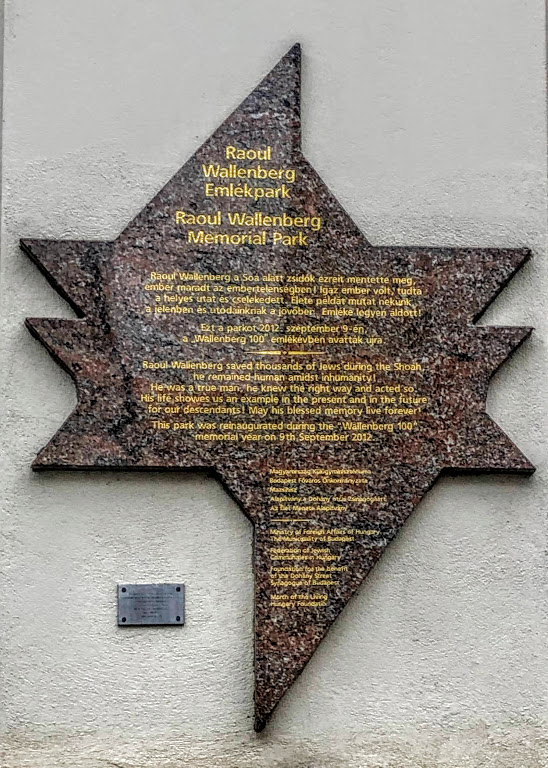
A memorial to Raoul Wallenberg in the Raoul Wallenberg Holocaust Memorial Park at the Dohány Street Synagogue, Budapest (Photograph: Patrick Comerford)
The Mary Elmes Bridge in Cork … the centrepiece of the bridge is designed to look like a menorah (Photograph: Patrick Comerford)
The Wall of the Righteous in Paris lists 3,300 French people who have been recognised as ‘Righteous Among the Nations’ (Photograph: Patrick Comerford)
These images are reminders not only of the Holocaust and its victims, but of real individuals who suffered and were humiliated, whose lives were shattered and who were murdered.
They are reminders of why we must never forget. The Holocaust happened not just because of one evil man but because many good people stood by and remained silent.
Over 80 years after the end of the Holocaust, antisemitism is on the rise once again. We are seeing the rise of the far-right in Britain across Europe and a resurgence of the far-right in Latin America, far-right ideology and vocabulary has become part and parcel of the language of the Trump regime, its spokespersons and those who support street murders by ICE in Minneapolis.
We must never forget.
The Eternal Flame in the Mémorial de la Shoah, Paris (Patrick Comerford)
Patrick Comerford
Today is Holocaust Memorial Day, marking the anniversary of the liberation of Auschwitz in 1945 and the beginning of the liberation of the concentration camps in Europe.
In a ‘virtual tour’ today, I visit Holocaust memorials in a dozen European countries: Austria, Czech Republic, England, France, Germany, Greece, Hungary, Ireland, Italy, Poland, Slovakia and Slovenia.
Looking back on many visits over the years, my images today include monuments, memorials, plaques, sculptures, shattered grave stones and Stolpersteine or ‘stumbling stones’, in cemeteries, libraries, museums, parks, schools, squares, streets, synagogues, railway stations, and bridges.
There are photographs from the concentration camps in Auschwitz, Birkenau and Sachsenhausen. There are Jewish families and individuals, mothers and children, the murdered and the survivors, resistance fighters and the ‘Righteous Among the Nations’.
Austria:
Rachel Whiteread’s Holocaust Memorial in Judenplatz in Vienna (Photograph: Patrick Comerford)
Czech Republic:
The walls of the Pinkas Synagogue in Prague are covered with the names of 78,000 victims of the Holocaust (Photograph: Patrick Comerford)
The names of the concentration camps surround the Aron haKodesh or Holy Ark in the Pinkas Synagogue, Prague (Photograph: Patrick Comerford)
England:
The Holocaust Memorial Stone at the east end of Bourton Park, Buckingham, was installed in 2021 (Photograph: Patrick Comerford)
France:
The Mur des Names or Wall of Names in the Mémorial de la Shoah lists 76,000 French Jews deported and murdered by the Nazis (Photograph: Patrick Comerford)
A plaque on a school in the Marais in Paris recalling the children of the Shoah (Photograph: Patrick Comerford)
Germany:
The Memorial to the Murdered Jews of Europe in Berlin (Photograph: Patrick Comerford)
A memorial to Jewish children at the Jewish Cemetery in Berlin (Photograph: Patrick Comerford)
The memorial to the victims of the Sachsenhausen Concentration Camp 1936-1945 … the victims included gays, Gypsies, political prisoners and disabled people (Photograph: Patrick Comerford)
Greece:
The Jewish Holocaust Memorial at Plateia Eleftherias (Liberty Square) in Thessaloniki (Photograph: Patrick Comerford)
Chief Rabbi Gabriel Negrin places candles in the Holocaust memorial in Etz Hayyim Synagogue in Chania (Photograph: Patrick Comerford)
The Holocaust Memorial by Georgios Karahalios (2001) in Corfu remembers the 2,000 Jews of Corfu who were murdered in Auschwitz in 1944 (Photograph: Patrick Comerford)
The monument in the Nuova or New Synagogue in Corfu to families who died in the Holocaust (Photograph: Patrick Comerford)
Hungary:
The Memorial of the Hungarian Jewish Martyrs by Imre Varga at the Dohány Street Synagogue in Budapest (Photograph: Patrick Comerford)
The Holocaust Memorial Park at the Dohány Street Synagogue in Budapest (Photograph: Patrick Comerford)
Italy:
A monument in Bologna commemorating victims of the Holocaust (Photograph: Patrick Comerford)
The Holocaust Memorial outside the railway station in Gorizia, a town that straddles the border of Italy and Slovenia (Photograph: Patrick Comerford)
The Holocaust Memorial at the Synagogue in Padua (Photograph: Patrick Comerford)
A monument to Jewish partisans and resistance to the Nazis and Fascists in Rome (Photograph: Patrick Comerford)
The memorial wall to victims of the Holocaust in the Ghetto in Venice (Photograph: Patrick Comerford)
The Holocaust memorial in the Ghetto in Venice (Photograph: Patrick Comerford)
Poland:
Multilingual memorials in Birkenau … a reminder of the many nationalities of the victims of the Holocaust (Photographs: Patrick Comerford)
Shattered gravestones make a Holocaust memorial in a Jewish cemetery in Kraków (Photograph: Patrick Comerford)
The Empty Chairs Memorial in Ghetto Heroes Square in Kazimierz , symbolising abandoned homes and mass deportations from the Kraków Ghetto in 1943 (Photograph: Patrick Comerford)
Slovakia:
The Holocaust Memorial in the centre of Bratislava on the site of the former Neolog Synagogue (Photograph: Patrick Comerford)
Stolpersteine or ‘stumbling stones’
Berlin:
Stolpersteine or Stumbling stones on Rosenthaler Straße 39, Berlin-Mitte, remembering members of the Salinger family murdered by the Nazis in Auschwtiz and Riga (Photograph: Patrick Comerford)
Dublin:
Dublin’s first Stolpersteine or ‘stumbling stones’, recalling six Irish Holocaust victims, at Saint Catherine’s National School on Donore Avenue (photograph: Patrick Comerford)
Prague:
‘Stolpersteine’ or ‘Stumbling Stones’ on the streets of Prague remember members of the Bergmann family deported to Terezín during the Holocaust (Photograph: Patrick Comerford)
Thessaloniki:
‘Stolpersteine’ or ‘Stumbling Stones’ on the pavement on Vassilisis Olgas Avenue in Thessaloniki commemorate Greek Jews deported to Auschwitz (Photograph: Patrick Comerford)
Venice:
Stolpersteine or stumbling stones (Pietre d’inciampo) in Venice recall victims of the Holocaust (Photograph: Patrick Comerford)
Remembering individuals:
Remembering Anne Frank in street art in Berlin (Photograph: Patrick Comerford)
The sculpture of Anne Frank by Doreen Kern in the British Library, London (Photograph: Patrick Comerford)
The Kindertransport monument at Liverpool Street Station … a reminder in the heart of London of the Holocaust (Photograph: Patrick Comerford)
A plaque on Heydukova Street in Bratislava marks the former home of Aron Grünhut (1895-1974), involved in heroic rescues during the Holocaust (Photograph: Patrick Comerford)
Monuments to ‘Righteous Among the Nations’:
Philip Jackson’s monument of the Swedish diplomat Raoul Wallenberg at Wallenberg Place, near Hyde Park, London (Photograph: Patrick Comerford)
A memorial to Raoul Wallenberg in the Raoul Wallenberg Holocaust Memorial Park at the Dohány Street Synagogue, Budapest (Photograph: Patrick Comerford)
The Mary Elmes Bridge in Cork … the centrepiece of the bridge is designed to look like a menorah (Photograph: Patrick Comerford)
The Wall of the Righteous in Paris lists 3,300 French people who have been recognised as ‘Righteous Among the Nations’ (Photograph: Patrick Comerford)
These images are reminders not only of the Holocaust and its victims, but of real individuals who suffered and were humiliated, whose lives were shattered and who were murdered.
They are reminders of why we must never forget. The Holocaust happened not just because of one evil man but because many good people stood by and remained silent.
Over 80 years after the end of the Holocaust, antisemitism is on the rise once again. We are seeing the rise of the far-right in Britain across Europe and a resurgence of the far-right in Latin America, far-right ideology and vocabulary has become part and parcel of the language of the Trump regime, its spokespersons and those who support street murders by ICE in Minneapolis.
We must never forget.
The Eternal Flame in the Mémorial de la Shoah, Paris (Patrick Comerford)
Labels:
#HolocaustMemorialDay,
antisemitism,
Austria,
Crete 2026,
Czech Republic,
France,
Germany,
Greece,
Greece 2026,
Holocaust,
Hungary,
Jewish history,
Poland,
Sculpture,
Slovakia,
Slovenia,
Street art,
Synagogues,
Virtual Tours
Daily prayer in Christmas 2025-2026:
34, Tuesday 27 January 2026
‘Here are my mother and my brothers! Whoever does the will of God is my brother and sister and mother’ (Mark 3: 34-35)
Patrick Comerford
This is the last week in the 40-day season of Christmas, which continues until Candlemas or the Feast of the Presentation next Monday (2 February 2026). This week began with the Third Sunday of Epiphany (Epiphany III, 25 January 2026), and today is Holocaust Memorial Day. this year's Holocaust Memorial Day event in Milton Keynes takes place this morning at the MK Rose at 11 am, and the theme is: ‘Building generations’.
Before today begins, I am taking some quiet time this morning to give thanks, to reflect, to pray and to read in these ways:
1, today’s Gospel reading;
2, a short reflection;
3, a prayer from the USPG prayer diary;
4, the Collects and Post-Communion prayer of the day.
‘A crowd was sitting around him … And looking at those who sat around him, he said, ‘Here are my mother and my brothers!’ (Mark 3: 32-35) … the crowd on Good Friday in Tsesmes near Rethymnon in Crete (Photograph: Patrick Comerford)
Mark 3: 31-35 (NRSVA):
31 Then his mother and his brothers came; and standing outside, they sent to him and called him. 32 A crowd was sitting around him; and they said to him, ‘Your mother and your brothers and sisters are outside, asking for you.’ 33 And he replied, ‘Who are my mother and my brothers?’ 34 And looking at those who sat around him, he said, ‘Here are my mother and my brothers! 35 Whoever does the will of God is my brother and sister and mother.’
A crowd was sitting around him; and they said to him, ‘Your mother and your brothers and sisters are outside, asking for you’ (Mark 3: 32) … a crowd on the streets at a Ukrainian religious celebration (Photograph: Patrick Comerford)
Today’s Reflection:
Saint Mark’s Gospel is very sparse in its account of the story of Christ’s temptations in the wilderness – just two verses (see Mark 1: 12-13). In the much fuller accounts given by Saint Matthew (Matthew 4: 1-11) and Saint Luke (Luke 4: 1-13), Christ is tempted to do the right things for the wrong reason.
In our recent Gospel readings, Christ is challenged in two fundamental ways: he is challenged about whether his work is the work of God or the work of the Devil (Mark 3: 22); and he is challenged to think about what his family thinks about what he is doing (Mark 3: 32).
The Gospels name the brothers of Jesus as James, Jude, Simon and Joses or Joseph (Matthew 13: 55; Mark 6: 3; see also Galatians 1: 19).
Saint James is described in the New Testament as a ‘brother of the Lord.’ Josephus in his Jewish Antiquities (20.9.1) describes James as ‘the brother of Jesus who is called Christ.’ In the Liturgy of Saint James, he is described as ‘the brother of God’ (Iάκωβος ο Αδελφόθεος, Iácobos ho Adelphótheos).
Some say Jesus and James could have been cousins, saying ‘brothers’ and ‘sisters’ in the Aramaic spoken by Jesus also applied to cousins, and that the Greek words ἀδελφός (adelphos) and ἀδελφή (adelphe) were not restricted to their literal meaning of a full brother or full sister. However, in the classical Greek from the time of Homer on, these words convey an idea about being ‘from the same womb.’
The Letter of James can be compared with some of the wonderful Wisdom Literature in the Hebrew Scriptures, with, for example, its challenging words of wisdom on true worship (James 1: 19-20), on discrimination and respect for the poor (2: 1-13), on the false dichotomy of faith and works (2: 14-26), on truth and careful speech (3: 1-12), on godliness and worldliness (4: 1 to 5:6), on putting love at the heart of all our relationships in the Christian community … and so on.
They are words of wisdom that we can all take to heart in any community or society – how we speak about one another, how we respect one another, how we hold up one another, how we love each other, in spite of our failings towards one another.
We are to value one another, but not because of wealth or status or intellect. We are to listen to one another, to be slow to speak and equally slow to anger; to bridle our tongues and not to speak loosely about one another. We are not just called to be Christians, but we must do Christianity too.
How many of us would like to be so close to Christ that we could be called brothers or sisters of the Lord, still more ‘the brother of God’ (Iάκωβος ο Αδελφόθεος Iákobos o Adelphótheos)?
To be a real brother or sister of Christ, to be a real brother or sister of God, is to be brothers and sisters to one another in Christ. And when we do that we are true brothers and sisters of Christ, true witnesses to the Risen Christ, and worthy to share the name ‘Christian.’
Saint James the Brother of the Lord … an icon written by Tobias Stanislas Haller, BSG, for Saint James Episcopal Church, Parkton, Maryland, in 2008
Today’s Prayers (27 January 2026):
The theme this week (25-31 January 2026) in Pray with the World Church, the prayer diary of the Anglican mission agency USPG (United Society Partners in the Gospel), is ‘Connections That Last’ (pp 22-23). This theme was introduced on Sunday with Reflections from Paula de Mello Alves, a Brazilian lawyer and theologian, Executive Secretary of the Southern Diocese, and former co-leader of the Anglican Communion Youth Network (ACYN).
The USPG Prayer Diary today (27 January 2026) invites us to pray:
We pray for the Anglican Communion Youth Network, that it may continue to nurture young leaders and foster understanding across cultures and communities.
The Collect:
Almighty God,
whose Son revealed in signs and miracles
the wonder of your saving presence:
renew your people with your heavenly grace,
and in all our weakness
sustain us by your mighty power;
through Jesus Christ your Son our Lord,
who is alive and reigns with you,
in the unity of the Holy Spirit,
one God, now and for ever.
The Post-Communion Prayer:
Almighty Father,
whose Son our Saviour Jesus Christ is the light of the world:
may your people,
illumined by your word and sacraments,
shine with the radiance of his glory,
that he may be known, worshipped, and obeyed
to the ends of the earth;
for he is alive and reigns, now and for ever.
Additional Collect:
God of all mercy,
your Son proclaimed good news to the poor,
release to the captives,
and freedom to the oppressed:
anoint us with your Holy Spirit
and set all your people free
to praise you in Christ our Lord.
Yesterday’s Reflections
Continued Tomorrow
The crowds at the Good Friday processions in Rethymnon (Patrick Comerford)
Scripture quotations are from the New Revised Standard Version Bible: Anglicised Edition copyright © 1989, 1995 National Council of the Churches of Christ in the United States of America. Used by permission. All rights reserved worldwide. http://nrsvbibles.org
Patrick Comerford
This is the last week in the 40-day season of Christmas, which continues until Candlemas or the Feast of the Presentation next Monday (2 February 2026). This week began with the Third Sunday of Epiphany (Epiphany III, 25 January 2026), and today is Holocaust Memorial Day. this year's Holocaust Memorial Day event in Milton Keynes takes place this morning at the MK Rose at 11 am, and the theme is: ‘Building generations’.
Before today begins, I am taking some quiet time this morning to give thanks, to reflect, to pray and to read in these ways:
1, today’s Gospel reading;
2, a short reflection;
3, a prayer from the USPG prayer diary;
4, the Collects and Post-Communion prayer of the day.
‘A crowd was sitting around him … And looking at those who sat around him, he said, ‘Here are my mother and my brothers!’ (Mark 3: 32-35) … the crowd on Good Friday in Tsesmes near Rethymnon in Crete (Photograph: Patrick Comerford)
Mark 3: 31-35 (NRSVA):
31 Then his mother and his brothers came; and standing outside, they sent to him and called him. 32 A crowd was sitting around him; and they said to him, ‘Your mother and your brothers and sisters are outside, asking for you.’ 33 And he replied, ‘Who are my mother and my brothers?’ 34 And looking at those who sat around him, he said, ‘Here are my mother and my brothers! 35 Whoever does the will of God is my brother and sister and mother.’
A crowd was sitting around him; and they said to him, ‘Your mother and your brothers and sisters are outside, asking for you’ (Mark 3: 32) … a crowd on the streets at a Ukrainian religious celebration (Photograph: Patrick Comerford)
Today’s Reflection:
Saint Mark’s Gospel is very sparse in its account of the story of Christ’s temptations in the wilderness – just two verses (see Mark 1: 12-13). In the much fuller accounts given by Saint Matthew (Matthew 4: 1-11) and Saint Luke (Luke 4: 1-13), Christ is tempted to do the right things for the wrong reason.
In our recent Gospel readings, Christ is challenged in two fundamental ways: he is challenged about whether his work is the work of God or the work of the Devil (Mark 3: 22); and he is challenged to think about what his family thinks about what he is doing (Mark 3: 32).
The Gospels name the brothers of Jesus as James, Jude, Simon and Joses or Joseph (Matthew 13: 55; Mark 6: 3; see also Galatians 1: 19).
Saint James is described in the New Testament as a ‘brother of the Lord.’ Josephus in his Jewish Antiquities (20.9.1) describes James as ‘the brother of Jesus who is called Christ.’ In the Liturgy of Saint James, he is described as ‘the brother of God’ (Iάκωβος ο Αδελφόθεος, Iácobos ho Adelphótheos).
Some say Jesus and James could have been cousins, saying ‘brothers’ and ‘sisters’ in the Aramaic spoken by Jesus also applied to cousins, and that the Greek words ἀδελφός (adelphos) and ἀδελφή (adelphe) were not restricted to their literal meaning of a full brother or full sister. However, in the classical Greek from the time of Homer on, these words convey an idea about being ‘from the same womb.’
The Letter of James can be compared with some of the wonderful Wisdom Literature in the Hebrew Scriptures, with, for example, its challenging words of wisdom on true worship (James 1: 19-20), on discrimination and respect for the poor (2: 1-13), on the false dichotomy of faith and works (2: 14-26), on truth and careful speech (3: 1-12), on godliness and worldliness (4: 1 to 5:6), on putting love at the heart of all our relationships in the Christian community … and so on.
They are words of wisdom that we can all take to heart in any community or society – how we speak about one another, how we respect one another, how we hold up one another, how we love each other, in spite of our failings towards one another.
We are to value one another, but not because of wealth or status or intellect. We are to listen to one another, to be slow to speak and equally slow to anger; to bridle our tongues and not to speak loosely about one another. We are not just called to be Christians, but we must do Christianity too.
How many of us would like to be so close to Christ that we could be called brothers or sisters of the Lord, still more ‘the brother of God’ (Iάκωβος ο Αδελφόθεος Iákobos o Adelphótheos)?
To be a real brother or sister of Christ, to be a real brother or sister of God, is to be brothers and sisters to one another in Christ. And when we do that we are true brothers and sisters of Christ, true witnesses to the Risen Christ, and worthy to share the name ‘Christian.’
Saint James the Brother of the Lord … an icon written by Tobias Stanislas Haller, BSG, for Saint James Episcopal Church, Parkton, Maryland, in 2008Today’s Prayers (27 January 2026):
The theme this week (25-31 January 2026) in Pray with the World Church, the prayer diary of the Anglican mission agency USPG (United Society Partners in the Gospel), is ‘Connections That Last’ (pp 22-23). This theme was introduced on Sunday with Reflections from Paula de Mello Alves, a Brazilian lawyer and theologian, Executive Secretary of the Southern Diocese, and former co-leader of the Anglican Communion Youth Network (ACYN).
The USPG Prayer Diary today (27 January 2026) invites us to pray:
We pray for the Anglican Communion Youth Network, that it may continue to nurture young leaders and foster understanding across cultures and communities.
The Collect:
Almighty God,
whose Son revealed in signs and miracles
the wonder of your saving presence:
renew your people with your heavenly grace,
and in all our weakness
sustain us by your mighty power;
through Jesus Christ your Son our Lord,
who is alive and reigns with you,
in the unity of the Holy Spirit,
one God, now and for ever.
The Post-Communion Prayer:
Almighty Father,
whose Son our Saviour Jesus Christ is the light of the world:
may your people,
illumined by your word and sacraments,
shine with the radiance of his glory,
that he may be known, worshipped, and obeyed
to the ends of the earth;
for he is alive and reigns, now and for ever.
Additional Collect:
God of all mercy,
your Son proclaimed good news to the poor,
release to the captives,
and freedom to the oppressed:
anoint us with your Holy Spirit
and set all your people free
to praise you in Christ our Lord.
Yesterday’s Reflections
Continued Tomorrow
The crowds at the Good Friday processions in Rethymnon (Patrick Comerford)
Scripture quotations are from the New Revised Standard Version Bible: Anglicised Edition copyright © 1989, 1995 National Council of the Churches of Christ in the United States of America. Used by permission. All rights reserved worldwide. http://nrsvbibles.org
Labels:
#HolocaustMemorialDay,
Brazil,
Christmas 2025,
Crete 2026,
Epiphany 2026,
family,
Greece 2026,
Holocaust,
Icons,
Mission,
Prayer,
Rethymnon,
Saint James,
Saint Mark's Gospel,
Tsesmes,
Ukraine,
USPG
Subscribe to:
Comments (Atom)