Five participants in talks in Gracehill between the Church of Ireland and the Moravian Church (from left): Bishop Michael Burrows, Bishop John McOwat (Moravian Church), the Revd Paul Holdsworth (Moravian Church), Patrick Comerford, and (in the background) Bishop Graham Rights (Photograph: Sarah Groves)
Patrick Comerford
A special service took place in two churches in Co Antrim yesterday (Monday 18 March 2024) to celebrate the deepening relationship between the Church of Ireland and the Moravian Church.
In recent years, the two Churches have been developing a closer formal relationship that allows for clergy from both denominations to serve in either.
To celebrate this, a special service took place yesterday, starting in Saint Patrick’s Church (Church of Ireland), Ballymena, Co Antrim, at 1:30 pm and continuing in Gracehill Moravian Church at 3:30. Archbishop John McDowell of Armagh preached in Saint Patrick’s Church, with Bishop Sarah Groves of the Moravian Church, leading Holy Communion in Gracehill. Trees were planted in the grounds of each church to mark the celebrations, with a reception in Gracehill.
Bishop Sarah has expressed her joy at what has become known as the ‘Armagh Agreement’ between the two Churches. She says she is sure this will ‘bring increased vitality to both denominations enriching their worship and enabling them to share the resources of people, faith and service.’ Bishop Michael Burrows and Bishop Sarah Groves also talk about the relationship between the Moravian Church and the Church of Ireland in a new video.
Ballymena and Gracehill were appropriate venues for these celebrations on Saint Patrick’s weekend. Gracehill is at the heart of the Moravian presence in Ireland. Both are close to Slemish Mountain, where Saint Patrick is said to have spent six years as a shepherd slave, from the age of 16 to 22.
I was involved with Archbishop John, Bishop Michael, Bishop Sarah and others in the talks between the two churches in 2012-2014, so it is a particular, personal pleasure to see these talks have resulted in the ‘Armagh Agreement.’
Ministry of Word and Sacrament ... the altar and carved ‘tulip pulpit’ in Gracehill Moravian Church (Photograph: Patrick Comerford)
The talks began in response to a request from the Standing Committee of the Church of Ireland in 2012, asking the Anglican Affairs Working Group of the Commission for Christian Unity and Dialogue to consider the relationship between the Church of Ireland and the Moravian Church.
The request also asked us to bear in mind the continuing possibilities of the Fetter Lane Agreement, between the Church of England and the Moravian Church, and also asked the group to consider the report Finding our delight in the Lord, which has brought about full communion between Moravians and Episcopalians in the US and later in Canada.
The group members were asked too, ‘if appropriate, to make suggestions … concerning the possibility of similar developments in Ireland.’
While the Moravian Church in Britain and Ireland is structured as a single province, the discussions with the Church of Ireland took place as a bilateral conversation and the participants include bishops of both traditions.
The talks began at a two-day meeting of representatives of both Churches in Kilkenny in January 2013. The delegates from the Church of Ireland that year were: the Right Revd Michael Burrows, then Bishop of Cashel and Ossory and now Bishop of Tuam, Limerick and Killaloe; the Right Revd John McDowell, then Bishop of Clogher and now Archbishop of Armagh; Canon Ian Ellis, then the editor of the Church of Ireland Gazette; Canon Helene Steed of Clones, Co Monaghan; and myself.
The delegates from the Moravian Church were: Bishop Graham Rights, the Revd Sarah Groves (now Bishop Sarah Groves), the Revd Philip Cooper, Ecumenical Officer and Provincial Elder of the Moravian Church; and the Revd Paul Holdsworth, then chair of the Irish District of the Moravian Church.
Bishop Graham Rights had travelled from North Carolina for the talks in Kilkenny. Bishop Burrows described the talks as ‘a warm, thorough and fruitful examination of the issues facing our Churches if a relationship of full communion is to be achieved between.’
The talks continued in Gracehill and Ballymena, Co Antrim, the following January (2014), when they also involved representatives from the Moravian Churches in England and the US, the Episcopal Church (USA) and the Church of England. During our discussions, we explored the two traditions’ understanding of sacramental life, the ordained ministry and Church membership.
The participants in the talks also involved the Revd Dr Callan Slliper, representing the Church of England’s Council for Christian Unity; the Revd Dr Tom Ferguson, Dean of Bexley Hall Theological Seminary, Columbus, Ohio; and Bishop John McOwat of the Moravian Church.
In our talks, we explored what we mean by sacraments, ministry and mission, we shared our stories and tradition, and we dined together. We were taken on a walking tour of Gracehill, and later that day we took part in the Holy Communion in the village church.
The Moravian settlement at Gracehill, 3 km outside Ballymena, was founded in 1765. The first group of Moravians arrived in the area 10 years earlier in 1746, the church was founded in 1759, and the name of the village reflects their religious convictions. A plaque on the church wall commemorates John Cennick (1718-1755), the first Moravian evangelist in mid-Antrim, who arrived in Ballymena in 1746, and the meetings were held in the Cennick Hall behind the church.
A communiqué said: ‘We enjoyed the hospitality of the Gracehill congregation and we were introduced to the history of the community in Gracehill. We also shared and enjoyed Eucharistic hospitality. We agreed to report back to the relevant bodies in the Church of Ireland and the Moravian Church. Meanwhile, we continue to work on advancing this process of dialogue.’
Pictured at the launch of the new booklet on the Moravian Burial Ground at Whitechurch are Canon Horace McKinley, Professor Patricia Lysaght, Dr Rosemary Power (author), Bishop Sarah Groves and Canon Patrick Comerford
Later, in May 2014, I was the speaker at the launch of a booklet on the history of the Moravian Burial Ground at Whitechurch, Co Dublin. Dr Rosemary Power’s publication, The Moravian Burial Ground at Whitechurch, County Dublin, looks at the burial ground where over 700 people of the Moravian tradition had been buried since 1764. It also provides a brief guide to the Moravians and a history of some of the people buried there.
Speaking at the launch, I paid tribute to Dr Power’s work as a historian and folklorist, but also as a pioneering ecumenist. Bishop Sarah Groves, who was also part of the talks, also spoke that evening. She paid tribute to the then Rector of Whitechurch, Canon Horace McKinley, who had been the ‘unofficial custodian’ of the Moravian Burial Ground for many years.
The Moravian Church or Unitas Fratrum (the ‘Unity of the Brethren’) is one of the earliest Protestant traditions, with a story that dates back long before the Reformation. Their story can be traced to the Hussite movement and Jan Hus (1366-1415), a reforming priest and theologian at Charles University in Prague who wanted the church in Bohemia and Moravia to return to early practices, including celebrating the liturgy in the language of the people, receiving Holy Communion in both kinds and ending clerical celibacy.
His teachings lead many to see the Hussites as the first Protestant church. The movement gained royal support in Bohemia – then an autonomous kingdom in the Holy Roman Empire and now a part of the Czech Republic. The Unitas Fratrum became known as the Moravian Church after exiles who fled persecution in Moravia arrived in Saxony in 1722.
The Moravians are a tiny church in Ireland. They came to Ireland in the mid-18th century through the mission work of the Revd John Cennick (1718-1755). His best-known hymn, ‘Lo! he comes with clouds descending’, was first sung by Moravians in Dublin 1750. The present version is a mixture of verses by John Cennick and Charles Wesley.
The best-known Moravian hymn writer, James Montgomery (1771-1854), spent part of his childhood in Gracehill, where his father was the Moravian minister. His hymns include ‘Spirit of the Living God’ and ‘Hail to the Lord’s Anointed’.
The Moravian Church values the dictum: ‘In essentials, unity; in non-essentials, liberty; and in all things, love.’
At the talks between the Church of Ireland and the Moravian Church in Kilkenny in 2013
Showing posts with label Whitechurch. Show all posts
19 March 2024
12 March 2024
A Mulberry tree at
the Open University
recalls a Cambridge tree
that inspired Milton
The Mulberry tree, thought to be the oldest tree on the Walton Hall estate, gives the Mulberry Lawn at the Open University its name (Photograph: Patrick Comerford, 2024)
Patrick Comerford
I was back on the campus of the Open University in Milton Keynes late last week for lunch with an old friend, Dr Fidèle Mutwarasibo, Director of the Centre for Voluntary Sector Leadership and Lecturer in Work-Based Learning in the Department of Public Leadership and Social Enterprise.
We had lunch in the Hub, and later had coffee looking out onto the Mulberry Lawn, on the west side of Walton Hall. The Mulberry Lawn is named after the large Mulberry tree that is thought to be the oldest tree on the Walton Hall estate. It is believed to have been planted in 1908 to commemorate the birth of the painter Primrose Harley (1908-1978), a year after her father, Professor Vaughan Harley (1864-1923), bought Walton Hall.
The tree is over 100 years old. But there is also a 400-year tradition linking mulberry trees with universities and colleges. One of the best-known veteran mulberry trees in England is the ‘Milton Mulberry’ in the Fellows’ Garden at Christ’s College in Cambridge.
The tree was planted in 1609 and I first saw it virtually 400 years later in 2008 when I was a student on a course at Sidney Sussex College on a course organised by the Institute for Orthodox Christian Studies. A former student at the Church of Ireland Theological College, the Revd Christopher Woods, who was then the chaplain, invited me to dinner in the Fellows’ dining room at Christ’s College. That year, Christ’s College was marking the 400th anniversary of Milton’s birth.
Christopher is now the Vicar of Saint Barnabas in Jericho, Oxford. He invited me back to Christ’s College in 2009, to preach at the Solemn Orchestral Mass for the Eve of Candlemas and as part of the Lent Term series, ‘The ears of the heart.’ That year, Christ’s College marked the bicentenary of Charles Darwin’s birth and the 400th anniversary of the planting of the ‘Milton Mulberry’ in the Fellows’ Garden in 1609.
I stayed in Christ’s College again in 2010 for a weekend and saw Milton’s Mulberry once again before moving into rooms in Sidney Sussex College, where I was taking part in the IOCS annual summer school. Throughout that year, Christ’s College Chapel celebrated the 500th anniversary of its consecration in 1510.
Milton’s Mulberry was planted at the same time as several other Cambridge colleges, including Emmanuel College, Jesus College and Corpus Christi College, planted mulberry trees as part of James I’s project to start an English silk industry, with mulberry groves feeding the silkworms.
The tree at Christ’s has long associations with the poet John Milton (1608-1674), who was a student at Christ’s from 1625 and graduated in 1629, receiving his master’s degree in 1632. The tree would have been at least 20 years old when the young poet knew it and already a decent size, but hardly impressive enough to inspire poetry.
It is said Milton spent hours creating many of his greatest works while writing in the shade of this mulberry tree, and that he composed Lycidas under the tree. But most of his major works, including Paradise Lost, are from a much later date.
John Milton was a student at Christ’s College Cambridge from 1625 (Photograph: Patrick Comerford, 2024)
James I’s silk project soon ran out of steam, but its legacy is found in a number of veteran mulberries throughout England that have survived from the 17th century and that produce copious quantities of jam.
The tree in Christ’s College is not the only mulberry associated with Milton. In the early 17th century, he was a regular guest of his former schoolboy tutor, the Revd Thomas Young, after Young became Vicar of Stowmarket in Suffolk in 1628. Young was part of a group of controversial Puritan clergy who were later defended by Milton in his pamphlets.
The garden of the Old Vicarage in Stowmarket, now known as Milton House, has a splendid black mulberry tree said to date back to Milton’s visits. The tree was blown over in 1939, but mulberries are great survivors and are able to grow again from flattened trunks and branches that touch the ground.
To escape the plague in London in 1665, Milton moved with his wife and daughter to a cottage in Chalfont St Giles in Buckinghamshire. There he wrote his major works, Paradise Lost and Paradise Regained.
The late 16th century cottage is now known as Milton’s Cottage. Until recently, the Grade II listed historic garden had an old mulberry tree, grown from a cutting from the tree in Christ’s College, Cambridge. The tree was felled some years ago, but a cutting was taken from it and planted nearby.
Another celebrated offspring of the Milton Mulberry is the ‘Queen’s Mulberry’ in Preacher’s Court at Charterhouse in London. The tree is thought to have been planted around 1840, and is one of seven mulberries at Charterhouse.
As part of celebrations of the 400th anniversary of Milton’s birth in 2008, a cutting from the mulberry in Christ’s College was given to the Woodland Trust for planting at Drovers Wood, in Upper Breinton, Hereford, as part of the Hay Literary Festival.
Walton Hall and the campus of the Open University in Milton Keynes (Photographs: Patrick Comerford, 2024)
Fidèle and I have known each other for almost 25 years, since I was a curate in Whitechurch Parish, Rathfarnham, Dublin. He and I were also involved in the Discovery project in inner-city Dublin.
We had lunch in the Hub, first built in 1970 as the ‘Catering Building.’ Later it was called the Refectory, and was rebuilt and rebranded as ‘The Hub’ in 2010. The Hub complex also houses the Hub Theatre, the Mulberry Suite and the Medlar and Juniper Suites, frequent venues for functions and events.
After lunch, we sat over coffee for some time at a large window in the Hub, looking out at the old Mulberry Tree and enjoying the sunshine on the lawn beside Walton Hall.
There is no connection between John Milton and the name of Milton Keynes, yet it is interesting that the Mulberry Tree was planted in 1908, the year that marked the 300th anniversary of the birth of John Milton.
The old tree is now banked up and propped up. I wonder whether it still produces fruit. And I wonder – given the year it was planted – whether it is a ‘descendant’ of the Milton Mulberry in Christ’s College, Cambridge.
The Mulberry Tree was planted beside Walton Hall in 1908, the year that marked the 300th anniversary of the birth of John Milton (Photograph: Patrick Comerford, 2024)
22 May 2023
Saint Peter’s Church
in Harrogate town
centre is part of the
Major Churches Network
Saint Peter’s Church is a landmark building in the centre of Harrogate (Photograph: Patrick Comerford, 2023)
Patrick Comerford
Saint Peter’s Church is a landmark building in the centre of Harrogate, on the corner of Cambridge Street, Cambridge Crescent and Cambridge Road, a short stroll from the war memorial and Betty’s Tearoom in the heart of Harrogate.
During our week in Yorkshire earlier this month, two of us visited Saint Peter’s Church, which is an excellent example of Victorian Gothic architecture, and boasts exceptional 19th-century stained glass. The tall striking tower is a prominent sight and makes it impossible to miss this church.
Harrogate became a popular spa town in the 18th and 19th centuries, and the growth in population was stimulated by the arrival of the railway in the 1860s. The Victoria Park Company began to develop the open agricultural land between High and Low Harrogate in 1860 to provide the town with a new centre.
It became obvious that a new church was needed in this part of Harrogate, to serve both the growing population and the needs of the town’s authority. A new parish was formed out of the parish of Christ Church, High Harrogate.
Mary Anne Fielde offered her house as a vicarage, with a garden large enough for building a new a church and school too. The school was the first part of the building project, beginning in the mid-1860s. The school was also a place of worship until the new church building was built.
Sadly, Mary Anne Fielde died before the foundation stone was laid on 21 April 1870. The church was then built in stages as funds became available.
Inside Saint Peter’s Church, Harrogate, designed by the Yorkshire-born architect John Henry Hirst (Photograph: Patrick Comerford, 2023)
Saint Peter’s Church was designed by the Yorkshire-born architect John Henry Hirst (1827-1882) of Bristol, who also designed Cambridge Crescent and Prospect Crescent in Harrogate. Hirst designed the new church in the Decorated Gothic style, with elements from mediaeval French architecture. The design was executed by the architect George Frederick Bodley (1827-1907), who was born in Hull. Bodley also gave the Golden Gates in the church.
Bodley was influenced by George Gilbert Scott and William Morris, and his work includes All Saints’ Church, Jesus Lane, Cambridge, Queens’ College Chapel, Cambridge, and repairs to Jesus College Chapel, Cambridge.
The chancel and temporary nave of Saint Peter’s were opened on 7 September 1871, and the new church was consecrated on 3 October 1876.
Further important additions were made in 1885, 1890, 1910, 1921 and in 1926, when the great tower was completed to a design by AA Gibson, who respected Hirst’s original concept.
A carving of the head of an archbishop by William Pashley (Photograph: Patrick Comerford, 2023)
Inside, Saint Peter’s displays much of beauty and high craftsmanship. The splendidly broad nave contains stone carving by two outstanding Victorian sculptors, Harry Hems and William Pashley of Harrogate and Leeds.
The eight carved heads by Pashley in the nave depict Archbishops of York and of Canterbury. Pashley also designed the roundels over the front and rear doors. Pashley’s other works at Lichfield Cathedral and Leeds Minster are widely admired.
However, the stained and painted glass is Saint Peter’s greatest decorative glory, and is both rich and artistic.
This glass, made by the London firm of Burlison and Grylls, who also designed the rose window in Westminster Abbey, embellishes the chancel, transepts, chapel and aisles of Saint Peter’s, and is a glorious sight. The large east window above the altar was given by Mary Anne Fielde.
The stained and painted glass by Burlison and Grylls is Saint Peter’s greatest decorative glory (Photograph: Patrick Comerford, 2023)
A striking three-light stained glass window by Burlison and Grylls depicts the Army of Heaven in the Book of Revelation. A man wearing a red cloak and a papal tiara is carrying an upright sword and is seated on a white horse that is trampling a dragon in flames. They are surrounded by knights mounted on horseback carrying tilting spears. The knight at the left in the front row knight looks directly at the viewer and is a photographic likeness of Aubrey Coombes.
In the tracery, five angels carry ribbons with a quotation: ‘He was called Faithful and True, and in righteousness He doth judge and make war’ (see Revelation 19: 11).
The inscription below reads: ‘To the glory of God and in loving memory of Aubrey Cecil James Coombes 19th (Public Schools Batt) Royal Fusiliers who fell at Cuinichy, France,/ 28th December 1915, in the Great War, 1914-18, aged 24 years. This window is the gift of his parents, James and Edith Coombes, Harrogate.’
Much of the interior woodwork as produced by the Robert ‘Mouseman’ Thompson studio of Kilburn, with his trademark carved mice adorning surfaces in the Lady Chapel, the entrance porch, and at the altar rail.
The bronze war memorial was designed by William Walker. It include the names of Captain Donald Simpson Bell (1880-1916) and Private Charles Hull (1890-1953), both from Harrogate and awarded the Victoria Cross for valour during World War I.
The great organ was built by the internationally celebrated German organ builder Heinrich Edmund Schulze (1824-1878).
The first vicar of Saint Peter’s, the Revd Lundy Foote (1842-1925), served for 50 years before retiring in 1922. Three of his sons are depicted in the south aisle window nearest the entrance.
The ornate reredos behind the high altar designed by Bodley is a memorial to Canon Foote, and there is a bronze memorial in his honour under the right-hand angel, behind the gilded gates
The High Altar and Bodley’s reredos in Saint Peter’s Church, Harrogate (Photograph: Patrick Comerford, 2023)
Foote provides an interesting link with many places I know in Ireland. The Foote or Foot family were descended from John Foot who settled in Dublin after the Battle of the Boyne. His son, Geoffrey Foot (1704-1773), a custom’s officer in Ringsend, married Jane Lundy and their son, Lundy Foot (1735-1805), bought the land at Footmount, at the foot of the Dublin Mountains, in 1766. Later this was the Augustinian retreat at Orlagh, at the top of Ballycullen Road.
Lundy Foot established a business as a tobacconist and snuff maker in Dublin. One enthusiastic author claimed that in 1800 Lundy Foot’s snuff was as famous in Dublin as Guinness is today. The business was later acquired by PJ Carroll.
Lundy Foot’s eldest son, Geoffrey Foot, lived in Hollymount, now the core of the old building at Saint Columba’s College, Rathfarnham, and died in 1824. One of his sons, Canon Lundy Foot (1793-1873), was the first Rector of Whitechurch (1824-1828), where I was once an NSM, and established Whitechurch National School. Later he was a canon of Salisbury Cathedral until his death.
A younger son, the Revd Frederick Foot (1808-1871), worked in a number of parishes in the south-east of Ireland, including Rathdrum, Co Wicklow, Redcross, Co Wicklow, Cappoquin, Co Waterford, Carrick-on-Suir, Co Tipperary, and Fethard, Co Tipperary.
Geoffrey Foot’s younger brother, also named Lundy Foot, built Footmount, the first house on the lands at Orlagh in 1790. He surrounded the house with choice plantations, including tulip trees – one of which survived behind the apse of the Augustinian chapel – and laid out the road from Ballycullen House to the entrance at the Orlagh Estate, past Saint Colmcille’s Well.
Lundy Foot was seen as a ruthless magistrate. In 1816, he brought to trial the three Kearneys – a father and his two sons – for the murder of a gamekeeper. They were hanged on the banks of the River Dodder at Old Bawn, a ten-minute walk from Foot’s house. Local anger was high, and Lundy Foot was afterwards fired at and seriously injured. He recovered and went to live in Rosbercon Castle, near New Ross, Co Wexford, selling Footmount to his son’s father-in-law, Nathaniel Callwell.
Lundy Foot lived at Rosbercon Castle for almost 20 years until 2 January 1835, when he was stoned and hacked to death while planting trees on his estate. His murder followed a dispute over the eviction by the Tottenham family of a tenant named Murphy from a small holding of five acres that had been bought by Foot. He is buried in the family vault in Saint Matthew’s Church, Irishtown.
Inside Saint Peter’s Church, Harrogate, facing west (Photograph: Patrick Comerford, 2023)
A series of improvements to the exterior and interior of Saint Peter’s Church was carried out in 2009-2011. These greatly enhanced the mission of this church at the heart of Harrogate Community.
Saint Peter’s is a member of the Major Churches Network, founded as the Greater Churches Network and representing about 300 of the largest, most significant and well-loved churches in England.
Saint Peter’s Church is open from 9:30 am to 3:30 pm from Monday to Saturday.
The daily food ministry in the church is reflected in the motto on the church logo, ‘Feeding Hungry People.’
The Army of Heaven in the Book of Revelation depicted in the Coombes window by Burlison and Grylls (Photograph: Patrick Comerford, 2023)
Revelation 19: 11-16 (NRSVA):
11 Then I saw heaven opened, and there was a white horse! Its rider is called Faithful and True, and in righteousness he judges and makes war. 12 His eyes are like a flame of fire, and on his head are many diadems; and he has a name inscribed that no one knows but himself. 13 He is clothed in a robe dipped in blood, and his name is called The Word of God. 14 And the armies of heaven, wearing fine linen, white and pure, were following him on white horses. 15 From his mouth comes a sharp sword with which to strike down the nations, and he will rule them with a rod of iron; he will tread the wine press of the fury of the wrath of God the Almighty. 16 On his robe and on his thigh he has a name inscribed, ‘King of kings and Lord of lords.’
Five loaves and two fish … ‘St Peter’s Harrogate Feeding Hungry People’ (Photograph: Patrick Comerford, 2023)
Labels:
Architecture,
Bodley,
Cappoquin,
Church History,
Harrogate,
Local History,
Mission,
Rathdrum,
Rathfarnham,
Revelation,
Stained Glass,
Theology and Culture,
War and peace,
Whitechurch,
Yorkshire
24 January 2023
Praying through the Week of
Christian Unity and with USPG:
24 January 2023
‘He has scattered the proud in the thoughts of their hearts. He has brought down the powerful from their thrones, and lifted up the lowly; he has filled the hungry with good things’ (Luke 1: 51-53) … an image of the Virgin Mary in a quiet corner at the High Leigh Conference Centre in Hoddesdon, Hertfordshire (Photograph: Patrick Comerford)
Patrick Comerford
Christmas is not a season of 12 days, despite the popular Christmas song. Christmas is a 40-day season that lasts from Christmas Day (25 December) to Candlemas or the Feast of the Presentation (2 February).
Throughout the 40 days of this Christmas Season, I have been reflecting in these ways:
1, Reflecting on a seasonal or appropriate poem;
2, a prayer from the USPG prayer diary, ‘Pray with the World Church.’
However, the Week of Prayer for Christian Unity began last Wednesday (18 January 2023), and until tomorrow my morning reflections look at this year’s readings and prayers.
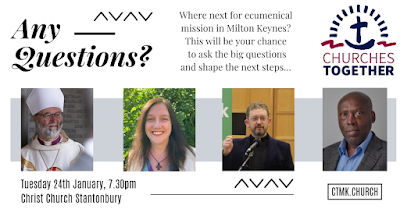
Later today, Churches Together in Milton Keynes continues to mark the Week of Prayer for Christian Unity this evening at 7:30 in Christ Church, Stantonbury, with an evening billed as ‘Any Questions?’
This has been a powerful week with great music, challenging ideas and powerful speakers. But, where next for ecumenical mission in Milton Keynes? This evening provides an opportunity to ask the big (or silly) questions? There may be a few answers, but this will definitely be a chance to shape the next steps.
The panellists include: the Right Revd Revd Alan Wilson, Bishop of Buckingham; Dorel Hayes, the Principal Officer for Ecumenical Development and Relations, Churches Together in England; Dr Fidèle Mutwarasibo, Lecturer in Work-Based Learning in the Faculty of Business and Law and Director of the Open University Centre for Voluntary Sector Leadership – Fidèle was a parishioner in Whitechurch Parish, Rathfarnham (Dublin), when I was a NSM curate there after ordination, and he has been a commissioner on the Irish Human Rights and Equality Commission; and the Revd Tim Norwood, Area Dean of Milton Keynes in the Diocese of Oxford and chair of Churches Together in Milton Keynes, who led Choral Evensong in Saint Mary and Saint Giles Church, Stony Stratford, last Thursday.
The words of the canticle Magnificat carved on the wooden screen at the west end of the monastic church in Mount Melleray Abbey, Cappoquin, Co Waterford (Photograph: Patrick Comerford)
Day 7: ‘What is now does not have to be’
Readings:
Job 5: 11-16:
So the poor have hope, and injustice shuts its mouth.
Luke 1: 46-55:
He has brought down the powerful from their thrones, and lifted up the lowly.
Reflection:
Job was living the good life and unexpectedly suffered the loss of his livestock and servants, and endured the devastation of the death of his children. He was suffering in his mind, body, and spirit. We all have suffering that is manifested in our minds, bodies, and spirits. We may pull away from God and others. We may lose hope. Yet, as Christians, we are unified in our belief that God is with us in the midst of our suffering.
On 11 April 2021 in Minnesota, Daunte Wright, a 20-year old, unarmed African-American man, was fatally shot by a white police officer during a routine traffic stop. This incident occurred during the Derek Chauvin trial for the killing of George Floyd.
It is easy to feel hopeless when we are once again reminded that we live in a fractured society that does not fully recognise, honour, and protect the human dignity and freedom of all human beings. According to Father Bryan Massingale, a leading Catholic social ethicist and scholar in racial justice, ‘Social life is made by human beings. The society we live in is the result of human choices and decisions. This means that human beings can change things. What human beings break, divide and separate, we can with God’s help, also heal, unite and restore. What is now does not have to be, therein lies the hope and the challenge.’
In prayer, Christians align their hearts to the heart of God, to love what he loves and to love as he loves. Prayer with integrity therefore aligns the hearts of all Christians beyond their divisions, to love what, whom and how God loves, and to express this love in our actions.
Christian Unity:
The Magnificat is Mary’s song of joy for all that she sees God is doing: restoring balance by raising up the lowly; righting injustice by feeding the hungry; and remembering Israel, his servant. The Lord never forgets his promises or abandons his people. It is easy to overlook or undervalue the faith of those who belong to other Christian communities, particularly if those communities are small. But the Lord makes his people whole by raising up the lowly so that the value of each is recognised. We are called to see as he sees and to value each of our Christian brothers and sisters as He values them.
Challenge:
How can we come together in Christ with hope and faith that God will ‘shut injustice’s mouth?’
Prayer:
God of Hope,
Help us to remember that you are with us in our suffering.
Help us to embody hope for one another when hopelessness is a frequent unwelcomed guest in our hearts.
Grant us the gift of being grounded in your loving Spirit as we work together to eradicate all forms of oppression and injustice.
Give us the courage to love what, whom and how you love, and to express this love in our actions.
Through Christ Our Lord. Amen.
‘They meet with darkness in the daytime, and grope at noonday as in the night’ (Job 5: 14) … at night in Cosgrove, Northamptonshire (Photograph: Patrick Comerford, 2023)
USPG Prayer Diary:
The Week of Prayer for Christian Unity began last Wednesday (18 January), and the theme in the USPG Prayer Diary last week was the Week of Prayer for Christian Unity. The theme this week is the ‘Myanmar Education Programme.’ This theme was introduced on Sunday with a reflection from a report from the Church of the Province of Myanmar.
The USPG Prayer Diary invites us to pray today in these words:
Let us pray for religious minorities persecuted for their faith. May their human rights be recognised and all forms of discrimination cease.
Yesterday’s reflection
Continued Tomorrow
18 March 2021
Two Monsell monuments
in Co Limerick are links
to the Oxford Movement
The crucifixion depicted at the top of the Monsell monument in Tervoe village, near Clarina, Co Limerick (Photograph: Patrick Comerford, 2021)
Patrick Comerford
While I was visiting the church site at Kilkeedy and Saint Joseph’s Church in Ballybrown, near Clarina, Co Limerick, recently, I came across two interesting monuments to the Monsell family. Both monuments are intimately linked to the decision of the Monsell family to move from Anglicanism to the Church of Ireland, following in the steps of Cardinal John Henry Newman.
The Monsell Monument in Tervoe village is a memorial to Lady Anna Maria Charlotte Wyndham Quinn (1814-1855), wife of William Monsell of Tervoe, and daughter of Windham Henry Quin (1782-1850), 2nd Earl of Dunraven.
She was 21 when she married William Monsell on 11 August 1836. They had two children, both died in infancy. He became a Roman Catholic in 1850, and when she died on 7 January 1855, she was buried in the Monsell vault in the mediaeval ruins attached to Killkeedy Church.
Monsell he seems to have been heart-broken and grief-stricken. Within weeks, he had erected memorial crosses to her above the vault and in Tervoe village near Clarina, and set up a charity in her memory to assist 20 ‘poor widows’ each year on the anniversary of her death.
The cross at Tervoe carries the inscription, ‘On the seventh day of January, in each year, at the foot of this cross, an alms will be given to twenty poor widows in memory of Anna Maria Monsell January 7th 1855.’
This carved limestone monument has a square-plan stepped base supporting central monument with a square-plan inscribed plinth. A carved octagonal shaft supports a square frieze with foliate motifs at the base, carved in the round with pointed arch niches that have gable-fronted canopies and inset relief figural sculptures surmounted by a carved crucifix.
This monument displays a wealth of high-quality carved details and decoration, including Gothic Revival devices such as the gable-fronted canopies. These details create an ornate and striking piece of sculpture, with craft work of a very high order.
The Monsell monument in Tervoe is a memorial to Lady Anna Maria Monsell (Photograph: Patrick Comerford, 2021)
Anna’s husband, William Monsell (1812-1894), who later became the 1st Baron Emly, was a prominent Co Limerick landowner and politician who held a number of ministerial positions from 1852 to 1873. His father, William ‘Black Billy’ Monsell (1778-1822), of Tervoe, was MP for Dunleer and Dingle; his mother Olivia was a daughter of Sir John Johnson-Walsh, a former MP for Baltinglass.
The Monsell family sold their estates in Somerset, and John Monsell (1581-1637) first bought lands in the Askeaton area in 1612. He returned to England, but the family bought further lands in Co Limerick. At the end of the 17th century, the family also acquired the ruined Carrigogunnell Castle and the lands around it, and they lived at Tervoe from then on, with a townhouse in Saint John’s Square, Limerick.
The family was involved in the wine trade from Cadiz in the 18th century, and many members of the family were ordained in the Church of Ireland. One member of the family, the Revd Charles Monsell (1815-1851), married William Smith O’Brien’s sister Harriet, who, as a widow and as Mother Harriet Monsell, was instrumental in reviving the tradition of women’s religious communities in the Anglican Communion.
The decorative work on the cross above the Monsell vault at Kilkeedy church, near Clarina, Co Limerick (Photograph: Patrick Comerford, 2021)
William Monsell was educated at Winchester and Oriel College, Oxford, where John Henry Newman was his tutor and intellectual guide. Although Monsell left Oxford in 1833 without a degree, he was already identified with the Oxford Movement and High Church Anglicanism, and he and Newman had become lifelong friends.
Molnsell’s father had died in an accident 1824, and William succeeded to his grandfather’s estates near Clarina at the age of 21.
Monsell was a resident and improving landlord and – unlike his father – was popular with his tenants and neighbours. He was the Sheriff of Co Limerick in 1835. He helped found Saint Columba’s College, now in Whitechurch, near Rathfarnham, in 1843. The founders included the Revd William Sewell, who later founded Radley College in England, the Archbishop of Dublin, and Monsell’s brother-in-law, Lord Adare, later Earl of Dunraven. At its foundation, the school was identified with the High Church tradition in Anglicanism.
Monsell was elected a Liberal MP for Co Limerick in 1847, and continued to hold the seat until 1874, when he was made a member of the House of Lords as Lord Emly.
The cross above the Monsell vault at Kilkeedy church, near Clarina, Co Limerick (Photograph: Patrick Comerford, 2021)
Meanwhile, Newman became a Roman Catholic in 1845, and through his influence Monsell became a Roman Catholic in 1850. Other prominent landlords in Co Limerick took a similar decision, including some of the de Veres of Curraghchase, the Windham Quins of Adare Manor and the Southwells of Castle Matrix, Rathkeale.
Monsell took a prominent part in Catholic affairs, especially in Parliament as a Catholic Whig. As a friend of Wiseman, Newman and other prominent, public Catholics, his position in parliament was often an advantage to his Church. He was involved in introducing the Redemptorists to Limerick in 1851, introduced the Sisters of Mercy to Limerick, and made generous donations towards building Saint John’s Cathedral in Limerick and Saint Mary’s Church, Rathkeale.
Monsell joined the government in 1852, a post he held until 1857, and became a member of the Privy Council in 1855. Later government positions included President of the Board of Health (1857), Paymaster-General and Vice-President of the Board of Trade (1866), Under-Secretary of State for the Colonies (1868-1871), and Postmaster-General (1871-1873). He was Lord Lieutenant of Co Limerick in 1871-1894 and Vice-Chancellor of the Royal University of Ireland in 1885-1894.
Monsell became a member of the House of Lords in 1874 with the title of Baron Emly of Tervoe in Co Limerick. The name Emly was suggested by his friend Stephen de Vere, and reflected his interest in the Church and Church history. There may have been an element of ‘Catholic triumphalism’ in this choice too: the Church of Ireland cathedral at Emly had fallen into disuse, and was pulled down in 1877; a new Roman Catholic parish church, dedicated to Saint Ailbe, was built on a site beside the grounds of the cathedral in 1880-1883.
However, Lord Emly lost much of his popularity in Ireland during his later years because of his opposition to the Land League and to Home Rule.
Two years after Lady Anna’s death, Monsell married a French Catholic aristocrat, Bertha de Montigny (1835-1890), in 1857. She was the youngest daughter of the Comte de Montigny of the house of Montigny de Perreux, and there was a 23-year ago gap. The couple were parents of one son, Gaston Thomas William Monsell (1858-1932), later the 2nd Lord Emly, and one daughter, the Hon Mary Olivia Augusta Monsell (1860-1942), who in 1881 married Edmund de la Poer (1841-1915), de jure 18th Lord le Power and Count de la Poer, a papal count, an Irish peer and Liberal MP for Co Waterford (1866-1873).
Lord Emly also erected a Lourdes Grotto in the townland of Tervoe. This grotto is on the lands of Cooperhill Farm, north of Tervoe, in an enclosure in a wooded area of the farm, where a stream runs around the grotto. It is believed to be the first Lourdes Grotto in Ireland.
The inscription on the Monsell vault beside Kilkeedy Church, near Clarina, Co Limerick (Photograph: Patrick Comerford, 2021)
In his old age, Lord Emly took a prominent role in founding Mungret College, near his home in Co Limerick. He died on 20 April 1894, aged 81, and was buried in the family vault in Kilkeedy. His estates included 2,246 acres at Clarina, Athlacca and Kilmallock in Co Limerick, 466 acres at Cratloe, Co Clare, and 700 acres in Co Kerry. His papers are in the National Library of Ireland and in the National Archives.
The Emly title then passed to his only son Thomas as the 2nd Lord Emly, who was educated at the Oratory School in Edgbaston, the school established by Newman, and at Beaumont College, Windsor. He married his sister’s sister-in-law, Frances Vincent de la Poer. This Lord Emly was a supporter of Irish labour and nationalism, and when he died on 24 November 1932, the direct line of the Monsells at Tervoe came to an end and the Emly title died out.
The estates passed to his nephew, Edmund Alan Tremeur de Poher de la Poer (1883-1964). He took the additional surname of Monsell. The last member of the family to live at Tervoe was his son, John Humphrey Arnold de Poher de la Poer (1916-1989).
The contents of Tervoe House were sold at auction in 1953, and the house was demolished. One recent afternoon, two of us went in search of Lady Emly’s ‘Lourdes Grotto’ near the banks of the Shannon. We saw its location in the distance, but we failed to find it.
The shrine to John Henry Newman in Saint Joseph’s Church, Ballybrown (Photograph: Patrick Comerford, 2021)
26 February 2021
Praying in Lent and Easter 2021:
10, Whitechurch Church, Rathfarnham
With Canon Horace McKinley at Whitechurch parish church, Rathfarnham, Co Dublin … I was a curate in Whitechurch from my ordination in 2000
Patrick Comerford
During Lent and Easter this year, I am taking some time each morning to reflect in these ways:
1, a photograph of a church or place of worship that has been significant in my spiritual life;
2, the day’s Gospel reading;
3, a prayer from the prayer diary of the Anglican mission agency USPG (United Society, Partners in the Gospel).
This week I am offering photographs from seven churches in which I have served during my ministry. My photographs this morning (26 February 2021) are of Whitechurch Parish Church, Rathfarnham, Co Dublin. I was a curate there from 2000, when I was ordained, until 2006, when I was appointed to the staff of the Church of Ireland Theological College (later the Church of Ireland Theological Institute). During that time, I was also invited to preach in the Chapel of Saint Columba’s College, which was within the bounds of the parish.
Matthew 5: 20-26 (NRSVA):
[Jesus said:] 20 ‘For I tell you, unless your righteousness exceeds that of the scribes and Pharisees, you will never enter the kingdom of heaven.
21 ‘You have heard that it was said to those of ancient times, “You shall not murder”; and “whoever murders shall be liable to judgement.” 22 But I say to you that if you are angry with a brother or sister, you will be liable to judgement; and if you insult a brother or sister, you will be liable to the council; and if you say, “You fool”, you will be liable to the hell of fire. 23 So when you are offering your gift at the altar, if you remember that your brother or sister has something against you, 24 leave your gift there before the altar and go; first be reconciled to your brother or sister, and then come and offer your gift. 25 Come to terms quickly with your accuser while you are on the way to court with him, or your accuser may hand you over to the judge, and the judge to the guard, and you will be thrown into prison. 26 Truly I tell you, you will never get out until you have paid the last penny.’
Prayer in the USPG Prayer Diary:
The USPG Prayer Diary today (26 February 2021) invites us to pray:
Let us pray that we might care for our natural resources and safeguard them from destruction that causes long-term damage.
Yesterday’s reflection
Continued tomorrow
The chapel of Saint Columba’s College, Rathfarnham, Co Dublin … I preached in the chapel regularly when I was a curate in Whitechurch Parish (Photograph: Patrick Comerford)
Scripture quotations are from the New Revised Standard Version Bible: Anglicised Edition copyright © 1989, 1995, National Council of the Churches of Christ in the United States of America. Used by permission. All rights reserved worldwide. http://nrsvbibles.org
25 June 2020
20 years in ordained
ministry and some of
my guiding challenges
At my ordination as deacon in Christ Church Cathedral, Dublin, on 25 June 2000 with (from left) Canon Roy Byrne, who was ordained priest that day, and the Revd Avril Bennett and the Revd Tim Close, who were ordained deacons (Photograph: Valerie Jones, 2000)
Patrick Comerford
I was ordained deacon 20 years ago today [25 June 2000], and priest 19 years ago yesterday on the Feast of the Birth of Saint John the Baptist [24 June 2001].
At the ordination of deacons, bishops recall that deacons ‘remind the whole Church that serving others is at the heart of all ministry.’
They go on to say: ‘Deacons have a special responsibility to ensure that those in need are cared for with compassion and humility. They are to strengthen the faithful, search out the careless [those with no-one to care for them] and the indifferent, and minister to the sick, the needy, the poor and those in trouble.’
Deacons are asked at ordination: ‘Will you be faithful in visiting the sick, in caring for the poor and needy, and in helping the oppressed? Will you promote unity, peace and love …?’
In today’s world, with the rise of racism, anti-Semitism and far-right populism, who needs compassion that is extended with humility?
How do I care for the sick, the poor and the needy, and speak up for the oppressed today?
How do we promote unity, peace and love among all?
I hope these challenges have guided me through 20 years of ordained ministry, and that continue to challenge me in the years ahead.
I recalled yesterday how my path to ordination began 49 years ago when I was a 19-year-old in Lichfield, following very personal and special experiences in a chapel dedicated to Saint John the Baptist – the Chapel of Saint John’s Hospital, Lichfield.
Later that same day, after Choral Evensong in Lichfield Cathedral, I was challenged by, I think, Canon John Yates (1925-1980), then the Principal of Lichfield Theological College (1966-1972) and later Bishop of Gloucester and Bishop at Lambeth. He amusingly asked me whether a young man like me had decided to start going back to church because I was thinking of ordination.
As I said yesterday, I had taken the scenic route to ordination. Eventually I was ordained deacon by Archbishop Walton Empey in Christ Church Cathedral, Dublin on 25 June 2000 along with the Revd Averill Bennett and the Revd Tim Close – Canon Roy Byrne was ordained priest that day too – and I was ordained priest a year later on 24 June 2001.
With Archbishop Walton Empey at my ordination as deacon in Christ Church Cathedral, Dublin, on 25 June 2000 (Photograph: Valerie Jones, 2000)
I had been in reader ministry in Saint Maelruian’s Parish, since 1994, and was ordained for Whitechurch Parish, Rathfarnham. I remained there as a curate until 2006, when I joined the full-time staff of the Church of Ireland Theological College.
This morning, I pray for those preparing for ordination and recall and pray too for the 13 other men and women who were ordained deacons that same summer 20 years ago:
● The Revd Avril Bennett, a resource teacher at Kildare Place School, was ordained for the Parishes of Crumlin and Chapelizod (Dublin). She is now an NSM curate in Saint Maelruain’s, Tallaght (Dublin).
● The Revd Christopher Bennett was ordained for the parish of Larne and Inver (Connor). He is now curate assistant, Belvoir (Down).
● The Revd Tim Close was ordained for Glenageary (Dublin), and is now priest-in-charge of the Church of the Ascension, Cloughfern, Newtownabbey (Connor).
● The Revd Hilary Dungan was ordained for Saint Mark’s Parish (Armagh). She retired as Rector of Maryborough in 2011, and she has been an interim, part-time Dean of Residence and Chaplain in Trinity College Dublin.
● Canon Michael Johnston became Bishop’s Vicar and curate assistant in Kilkenny (Ossory). He was the Rector of Shinrone (Killaloe) the Prebendary of Saint Munchin’s and Tulloh (Limerick and Killaloe) until he recently retired from ministry.
● The Revd Melanie Lacy, ordained for Saint Comgall’s, Bangor (Down). She was the Ireland team leader at the Crosslinks mission agency and today she is Director of the Theology and Praxis for Children’s and Youth Ministry stream at Oak Hill College, London.
● The Revd David Luckman, a former RE teacher in Poole, Dorset, was ordained for Saint Mark’s, Portadown (Armagh), and has been the Ireland team leader at Crosslinks since 2015.
● The Revd Alan Millar, once in ordained ministry in the United Church of Canada, was ordained for Drumglass, Dungannon (Armagh). He was the Rector of Rathcoole (Connor) from 2006 until he retired in 2011.
● The Revd Willie Nixon, who had worked on the family farm, was ordained for Saint Paul’s, Lisburn (Connor), and has been the Rector of Drumbeg (Down) since 2012.
● The Revd Daniel Owen, who had worked in an outdoor activity centre in Sligo and in the RCB offices in Dublin, was ordained for Saint Donard’s Parish, Belfast (Down). Since 2015, he has been the chaplain at Saint Columba’s College, Rathfarnham.
● The Revd David Somerville, a former RE teacher in Rathfriland, was ordained for Shankill Parish, Lurgan (Dromore). He was the Rector of Richhill Parish (Armagh) and had been appointed a Vicar Choral in Armagh Cathedral when he died suddenly in 2016.
● The Revd Alice Stewart was ordained for the Church of the Ascension, Cloughfern (Connor).
● The Revd Louise Stewart was ordained for Saint John’s Church, Malone Road, Belfast (Connor). Since 2011, she has been the Rector of Finaghy (Connor).
Letters of ordination as deacon on 25 June 2000 by Archbishop Walton Empey
The Collect for vocations to Holy Orders:
Almighty God,
you have entrusted to your Church
a share in the ministry of your Son our great High Priest:
Inspire by your Holy Spirit the hearts of many
to offer themselves for ordination in your Church,
that strengthened by his power,
they may work for the increase of your kingdom
and set forward the eternal praise of your name;
through Jesus Christ our Lord.
Inside the Chapel of Saint John’s Hospital in Lichfield … the beginning of the road to ordination (Photograph: Patrick Comerford)
10 April 2020
Seven Last Words (6):
‘It is finished’
‘It is finished’ … Christ is taken down from the Cross … a painting in Valencia Cathedral (Photograph: Patrick Comerford, 2020)
Patrick Comerford
Good Friday, 10 April 2020
6, John 19: 30
Reading: John 19: 30-37.
The words: ‘It is finished.’
Reflection: (6) Triumph
‘It is finished’
This statement is traditionally called ‘The Word of Triumph,’ and it is interpreted as the announcement of the end of the earthly life of Jesus, in anticipation of the Resurrection.
For many years, I led a service of reflection on Holy Saturday in Whitechurch Parish, Rathfarnham, contemplating the Tomb of Christ.
So often we move too quickly from the afternoon of Good Friday to the morning of Easter Day, without thinking of what has been accomplished.
When I first suggested such a service, the Rector of Whitechurch, Canon Horace McKinley, pointed out that there is no provision in the Book of Common Prayer for anything on Holy Saturday, until the Easter Eve Eucharist, which is the beginning of Easter itself.
On Holy Saturday, we use our churches for children’s clubs, or to decorate the church with eggs and little fluffy yellow chickens.
But do we allow Christ’s Crucifixion to come to its proper end – in the tomb?
Do we contemplate what has been finished, what has been accomplished?
For some years, in Whitechurch Parish, at that Holy Saturday service, we reflected on great works of music, art and poetry that allow us to wait by the tomb.
One year, I chose for that reflection Mozart’s Requiem. This composition, written at the end of Mozart’s life when he was pressed with other work and in poor health, contains some of his most sublime music. Yet he did not complete it. He died leaving instructions to his friend to finish it off.
On the Cross, now that his life is coming to a close, Christ knows that all has been completed. ‘It is finished!’ he cries out before he dies.
What is finished? What has been completed?
After his conversation with Samaritan woman at the Well of Sychar, Christ tells the Disciples: ‘My food is to do the will of him who has sent me and to complete his work’ (John 4: 34). Later, after his great final discourse at the Last Supper, Christ lifts his eyes up to heaven and prays to his Father: ‘… this is eternal life, that they may know you, the only true God, and Jesus Christ whom you have sent. I glorified you on earth by finishing the work that you gave me to do’ (John 17: 4).
What was this work which the Father gave his Son to do?
In the New Testament, seven principal titles are given to Christ:
● 1, Son of Man;
● 2, The Lamb of God;
● 3, The New Adam;
● 4, The Son of God;
● 5, Lord;
● 6, Prophet;
● 7, Messiah.
But when it comes to his own self-description, Christ constantly talks about himself in terms of his relationship with us. There are seven ‘I AM’ sayings in Saint John’s Gospel, seven ways in which he talks about who he is, gives himself a self-description, but always in terms of relationship:
He says he is
● 1, Bread: ‘I AM the bread of life. Whoever comes to me shall will never be hungry’ (John 6: 35).
● 2, The Light: ‘I AM the light of the world. Whoever follows me will never walk in darkness, but will have the light of life’ (John 8: 12).
● 3, The Gate: ‘I AM the gate. Whoever enters by me will be saved, and will come in and go out and find pasture’ (John 10: 9).
● 4, The Good Shepherd: ‘I AM the good shepherd. The good shepherd lays down his life for the sheep’ (John 10: 11).
● 5, The Resurrection and the Life: ‘I AM the resurrection and the life. Those who believe in me, even though they die, will live’ (John 11: 25).
● 6, The Way, the Truth, and the Life: ‘I AM the way, and the truth, and the life. No one comes to the Father except through me’ (John 14: 6).
● 7, The True Vine: ‘I AM the true vine, and my Father is the vinegrower’ (John 15: 1).
It is no wonder that at his death, Christ cries out: ‘It is finished!’ His death makes those relationships complete, brings his work to completion.
His death shows not just that these were poetic or literary devices on the part of Christ; he totally identifies with us, in life, in death, and in the grave. Death shows us how completely his identification with us is.
It is finished. Not that it is over, but is complete. His relationship with us has not come to end. It has come to its God-planned fulfilment.
‘It is finished’ … an image of Christ in the tomb in Saint Mary Moorfields, London (Photograph: Patrick Comerford, 2020)
There is a popular story from the Mexico Olympics and how at 7 p.m. on 20 October 1968, a few thousand spectators were left in the Olympic Stadium. It was cool and dark. The last of the marathon runners, each exhausted, were being carried off to first-aid stations. More than an hour earlier, Mamo Wolde of Ethiopia – looking as fresh as when he started the race – crossed the finish line, the winner of the 26-mile, 385-yard event.
As the remaining spectators prepared to leave, those sitting near the marathon gates suddenly heard the sound of sirens and police whistles. All eyes turned to the gate. A lone figure wearing number 36 and the colours of Tanzania entered the stadium.
This was John Stephen Akhwari, the last man to finish the marathon. He had fallen during the race and injured his knee and ankle. Now, with his leg bloodied and bandaged, he grimaced with each step as he hobbled around the 400-meter track.
The spectators rose in applause.
After crossing the finish line, Akhwari slowly walked off the field. Later, a reporter asked him the question on everyone’s mind: ‘Why did you continue the race after you were so badly injured?’
He replied: ‘My country did not send me 7,000 miles to start the race. They sent me 7,000 miles to finish it.’
There is a prayer ascribed to Sir Walter Raleigh that says: ‘O Lord God, when you give your servants to endeavour any great matter, grant us also to know that it is not the beginning, but the continuing of the same to the end, until it be thoroughly finished, which yields the true glory; through him who for the finishing of your work, laid down his life, our redeemer, Jesus Christ.’
The Incarnation makes no sense without the crucifixion. In Christ God fully identifies with the plight of suffering humanity. Birth is not enough, there must be death too.
‘It is finished’ is not a death gurgle.
‘It is finished’ is not ‘I am done for.’
‘It is finished’ is the last words of Christ on the cross.
‘It is finished’ is a cry of victory.
‘It is finished’ is the triumphant cry that what Christ has come to do has been done.
All is accomplished, completed, fulfilled.
Archbishop Rowan Williams reminds us of Pascal’s stark remark that ‘Jesus will be in agony until the end of the world.’
Of course, we live in the time between the times – the kingdom is begun in Christ but will not be seen in its perfection until the end of the world.
The former Archbishop of Canterbury observes that Pascal’s comment on Christ’s continuing agony is an exhortation to us not to become nostalgic for a supposedly less compromised past or to take refuge in some imagined purified future, but to dwell in the tension-filled time between times, to remain awake to our inability ‘to stay in the almost unbearable present moment where Jesus is.’
‘It is finished’ … the Cross on a sandbank between the sea and the church in Laytown, Co Meath (Photograph: Patrick Comerford, 2018)
Saint John’s Gospel makes explicit what all the Gospels assume – the cross is not a defeat but the victory of God.
The Crucifixion is kingdom come. This is the great long-awaited apocalyptic moment. Here the powers of this world are forever subverted. Time is now redeemed through the raising up of Christ on his cross. A new age has begun. The kingdom is here a-born, a new regime is inaugurated, creating a new way of life for those who worship and follow Christ.
God’s work, the work of the Trinity, is consummated in Christ’s great declaration from the cross: ‘It is finished.’
His life, his death, his resurrection, as Irenaeus insists, recapitulates creation, recapitulates God’s covenant with his people, unites creation and redemption in the Incarnation. The new creation is complete.
As Richard Neuhaus puts it in his reflections on the seven last words in his Death on a Friday Afternoon: ‘“It is finished.” But it is not over.’ God remains at work making us, his creatures, divine.
Now it is possible for us to live at peace, to be God’s agents of reconciliation, in a violent world. We are able so to live not because we have answers to all the world’s troubles, but because God has given us a way to live without answers.
Our sins have been consumed, making possible lives that glow with the beauty of God’s Spirit. What wonderful news: ‘“It is finished.” But it is not over.’ It is not over because God made us, the Church, the ‘not over.’
We are made witnesses so the world – a world that has no time for a crucified God – may know we have all the time of God's kingdom to live in peace with one another.
Prayer:
Lord Jesus Christ,
you were obedient to the very end,
and completed on the cross
the plan of our salvation.
Help us to rejoice in the victory
of your finished work,
and to live out your will and purpose
to the end of our days,
for your mercy’s sake. Amen.
Christ in Majesty … John Piper’s window in the Chapel of the Hospital of Saint John Without the Barrs, Lichfield … the Cross illustrates the Triumph of God
(Revd Canon Professor) Patrick Comerford is priest-in-charge, the Rathkeale and Kilnaughtin Group of Parishes. This is the sixth of seven reflections on ‘the Seven Last Words’ prepared for Good Friday, 10 April 2020.
Previous reflection
Next reflection
Patrick Comerford
Good Friday, 10 April 2020
6, John 19: 30
Reading: John 19: 30-37.
The words: ‘It is finished.’
Reflection: (6) Triumph
‘It is finished’
This statement is traditionally called ‘The Word of Triumph,’ and it is interpreted as the announcement of the end of the earthly life of Jesus, in anticipation of the Resurrection.
For many years, I led a service of reflection on Holy Saturday in Whitechurch Parish, Rathfarnham, contemplating the Tomb of Christ.
So often we move too quickly from the afternoon of Good Friday to the morning of Easter Day, without thinking of what has been accomplished.
When I first suggested such a service, the Rector of Whitechurch, Canon Horace McKinley, pointed out that there is no provision in the Book of Common Prayer for anything on Holy Saturday, until the Easter Eve Eucharist, which is the beginning of Easter itself.
On Holy Saturday, we use our churches for children’s clubs, or to decorate the church with eggs and little fluffy yellow chickens.
But do we allow Christ’s Crucifixion to come to its proper end – in the tomb?
Do we contemplate what has been finished, what has been accomplished?
For some years, in Whitechurch Parish, at that Holy Saturday service, we reflected on great works of music, art and poetry that allow us to wait by the tomb.
One year, I chose for that reflection Mozart’s Requiem. This composition, written at the end of Mozart’s life when he was pressed with other work and in poor health, contains some of his most sublime music. Yet he did not complete it. He died leaving instructions to his friend to finish it off.
On the Cross, now that his life is coming to a close, Christ knows that all has been completed. ‘It is finished!’ he cries out before he dies.
What is finished? What has been completed?
After his conversation with Samaritan woman at the Well of Sychar, Christ tells the Disciples: ‘My food is to do the will of him who has sent me and to complete his work’ (John 4: 34). Later, after his great final discourse at the Last Supper, Christ lifts his eyes up to heaven and prays to his Father: ‘… this is eternal life, that they may know you, the only true God, and Jesus Christ whom you have sent. I glorified you on earth by finishing the work that you gave me to do’ (John 17: 4).
What was this work which the Father gave his Son to do?
In the New Testament, seven principal titles are given to Christ:
● 1, Son of Man;
● 2, The Lamb of God;
● 3, The New Adam;
● 4, The Son of God;
● 5, Lord;
● 6, Prophet;
● 7, Messiah.
But when it comes to his own self-description, Christ constantly talks about himself in terms of his relationship with us. There are seven ‘I AM’ sayings in Saint John’s Gospel, seven ways in which he talks about who he is, gives himself a self-description, but always in terms of relationship:
He says he is
● 1, Bread: ‘I AM the bread of life. Whoever comes to me shall will never be hungry’ (John 6: 35).
● 2, The Light: ‘I AM the light of the world. Whoever follows me will never walk in darkness, but will have the light of life’ (John 8: 12).
● 3, The Gate: ‘I AM the gate. Whoever enters by me will be saved, and will come in and go out and find pasture’ (John 10: 9).
● 4, The Good Shepherd: ‘I AM the good shepherd. The good shepherd lays down his life for the sheep’ (John 10: 11).
● 5, The Resurrection and the Life: ‘I AM the resurrection and the life. Those who believe in me, even though they die, will live’ (John 11: 25).
● 6, The Way, the Truth, and the Life: ‘I AM the way, and the truth, and the life. No one comes to the Father except through me’ (John 14: 6).
● 7, The True Vine: ‘I AM the true vine, and my Father is the vinegrower’ (John 15: 1).
It is no wonder that at his death, Christ cries out: ‘It is finished!’ His death makes those relationships complete, brings his work to completion.
His death shows not just that these were poetic or literary devices on the part of Christ; he totally identifies with us, in life, in death, and in the grave. Death shows us how completely his identification with us is.
It is finished. Not that it is over, but is complete. His relationship with us has not come to end. It has come to its God-planned fulfilment.
‘It is finished’ … an image of Christ in the tomb in Saint Mary Moorfields, London (Photograph: Patrick Comerford, 2020)
There is a popular story from the Mexico Olympics and how at 7 p.m. on 20 October 1968, a few thousand spectators were left in the Olympic Stadium. It was cool and dark. The last of the marathon runners, each exhausted, were being carried off to first-aid stations. More than an hour earlier, Mamo Wolde of Ethiopia – looking as fresh as when he started the race – crossed the finish line, the winner of the 26-mile, 385-yard event.
As the remaining spectators prepared to leave, those sitting near the marathon gates suddenly heard the sound of sirens and police whistles. All eyes turned to the gate. A lone figure wearing number 36 and the colours of Tanzania entered the stadium.
This was John Stephen Akhwari, the last man to finish the marathon. He had fallen during the race and injured his knee and ankle. Now, with his leg bloodied and bandaged, he grimaced with each step as he hobbled around the 400-meter track.
The spectators rose in applause.
After crossing the finish line, Akhwari slowly walked off the field. Later, a reporter asked him the question on everyone’s mind: ‘Why did you continue the race after you were so badly injured?’
He replied: ‘My country did not send me 7,000 miles to start the race. They sent me 7,000 miles to finish it.’
There is a prayer ascribed to Sir Walter Raleigh that says: ‘O Lord God, when you give your servants to endeavour any great matter, grant us also to know that it is not the beginning, but the continuing of the same to the end, until it be thoroughly finished, which yields the true glory; through him who for the finishing of your work, laid down his life, our redeemer, Jesus Christ.’
The Incarnation makes no sense without the crucifixion. In Christ God fully identifies with the plight of suffering humanity. Birth is not enough, there must be death too.
‘It is finished’ is not a death gurgle.
‘It is finished’ is not ‘I am done for.’
‘It is finished’ is the last words of Christ on the cross.
‘It is finished’ is a cry of victory.
‘It is finished’ is the triumphant cry that what Christ has come to do has been done.
All is accomplished, completed, fulfilled.
Archbishop Rowan Williams reminds us of Pascal’s stark remark that ‘Jesus will be in agony until the end of the world.’
Of course, we live in the time between the times – the kingdom is begun in Christ but will not be seen in its perfection until the end of the world.
The former Archbishop of Canterbury observes that Pascal’s comment on Christ’s continuing agony is an exhortation to us not to become nostalgic for a supposedly less compromised past or to take refuge in some imagined purified future, but to dwell in the tension-filled time between times, to remain awake to our inability ‘to stay in the almost unbearable present moment where Jesus is.’
‘It is finished’ … the Cross on a sandbank between the sea and the church in Laytown, Co Meath (Photograph: Patrick Comerford, 2018)
Saint John’s Gospel makes explicit what all the Gospels assume – the cross is not a defeat but the victory of God.
The Crucifixion is kingdom come. This is the great long-awaited apocalyptic moment. Here the powers of this world are forever subverted. Time is now redeemed through the raising up of Christ on his cross. A new age has begun. The kingdom is here a-born, a new regime is inaugurated, creating a new way of life for those who worship and follow Christ.
God’s work, the work of the Trinity, is consummated in Christ’s great declaration from the cross: ‘It is finished.’
His life, his death, his resurrection, as Irenaeus insists, recapitulates creation, recapitulates God’s covenant with his people, unites creation and redemption in the Incarnation. The new creation is complete.
As Richard Neuhaus puts it in his reflections on the seven last words in his Death on a Friday Afternoon: ‘“It is finished.” But it is not over.’ God remains at work making us, his creatures, divine.
Now it is possible for us to live at peace, to be God’s agents of reconciliation, in a violent world. We are able so to live not because we have answers to all the world’s troubles, but because God has given us a way to live without answers.
Our sins have been consumed, making possible lives that glow with the beauty of God’s Spirit. What wonderful news: ‘“It is finished.” But it is not over.’ It is not over because God made us, the Church, the ‘not over.’
We are made witnesses so the world – a world that has no time for a crucified God – may know we have all the time of God's kingdom to live in peace with one another.
Prayer:
Lord Jesus Christ,
you were obedient to the very end,
and completed on the cross
the plan of our salvation.
Help us to rejoice in the victory
of your finished work,
and to live out your will and purpose
to the end of our days,
for your mercy’s sake. Amen.
Christ in Majesty … John Piper’s window in the Chapel of the Hospital of Saint John Without the Barrs, Lichfield … the Cross illustrates the Triumph of God(Revd Canon Professor) Patrick Comerford is priest-in-charge, the Rathkeale and Kilnaughtin Group of Parishes. This is the sixth of seven reflections on ‘the Seven Last Words’ prepared for Good Friday, 10 April 2020.
Previous reflection
Next reflection
27 April 2019
Waiting between Good Friday
and Easter Day in Rethymnon
The Harrowing of Hell and the Resurrection in a fresco in the Church of the Four Martyrs in Rethymnon (Photograph: Patrick Comerford, 2019)
Patrick Comerford
George Koros (1923-2014) was one of the finest Greek solo violinists of our time. He was born on the island of Evia in 1923, and he started playing the violin at the age of eight, when his father – who was a church cantor and a teacher of Byzantine music – decided to replace the mandolin with a violin and a bow without strings.
His professional career began a year later, when he began playing at weddings and feasts with his father.
His mother spurned an opportunity for him to have a classical musical education. But Koros later revolutionised Greek folk music through the introduction of the fiddle as an accepted instrument. He became an acclaimed, self-made musician, who composed about 2,000 songs. But despite his reputation in Greek folk music, for me he stands out for his Byzantine hymns, particularly during this Easter weekend in Crete.
In these hymns, Koros returned to his roots in Byzantine music and with his violin he recreates the tradition of the early hymns he learned from his father in church as a boy.
George Koros died in 2014, and was buried in Kiffisia in Athens.
As I was reflecting here in Crete on this Saturday in the Greek calendar – between Good Friday and Easter Day – I recalled how many years ago (2008), during a series of Saturday reflections in Whitechurch parish in Dublin, I invited people to listed to Koros using his violin to plaintively recall the sorrow of the tomb in two pieces: I see thy resting place (Τον Νυμφωνα Σου Βλεπω) and Life in the Holy Sepulchre (Η Ζωη εν Ταφω).
In the Western tradition of the Church, we seem to have contemplated the cross, and then moved to the empty tomb. At times, the deep joys of the Resurrection have often been overshadowed in the Western Church by the way of the Cross, as though the Cross leads only to death. But we have also neglected Christ’s resting place, his tomb, and given little thought to what was happening in the Holy Sepulchre on this day.
Here in Greece, this day, Holy and Great Saturday, is observed solemnly by the Orthodox Church, with hymns and readings that truly explore the theme of the Harrowing of Hell in depth. For this is the day on which Christ’s body lay in the tomb, this is the day on which he visited those who were dead.
The icon of the Harrowing of Hell reminds us that God reaches into the deepest depths to pull forth souls into the kingdom of light. It reminds us how much we are unable to comprehend – let alone take to heart as our own – the creedal statement about Christ’s descent into Hell – ‘He descended into Hell.’
Christ’s descent into Hell is captured in Saint Peter’s Pentecost sermon in Acts 2. In the Petrine letters, we are told that when Christ died he went and preached to the spirits in prison ‘who in former times did not obey … For this is the reason the Gospel was proclaimed even to the dead, so that … they might live in the spirit as God does’ (see I Peter 3: 15b to 4: 8).
In the NRSV, I Peter 4: 6 reads the gospel was ‘proclaimed even to the dead …’, reflecting the original Greek: “εἰς τοῦτο γὰρ καὶ νεκροῖς εὐηγγελίσθη …’ The New International Version, however, says the Gospel ‘was preached even to those who are now dead …’ But the word ‘now’ is not in the Greek text. It was inserted to rule out the idea that Christ preached to those who were dead when they were preached to, and instead it says that he brought his good news to people who were dead at the time I Peter was written. If you remove the word ‘now,’ the English becomes ambiguous on that point, just like the Greek is ambiguous there.
The Early Church taught that after his death Christ descended into hell and rescued all the souls, starting with Adam and Eve, who had died under the Fall.
The Harrowing of Hell is intimately bound up with the Resurrection, the Raising from the Dead, for as Christ is raised from the dead he also plummets the depths to bring up, to raise up, those who are dead. The Harrowing of Hell carries us into the gap in time between Christ’s death and resurrection.
In Orthodox icons of the Harrowing of Hell, Christ stands on the shattered doors of Hell. Sometimes, two angels are shown in the pit binding Satan. And we see Christ pulling out of Hell Adam and Eve, imprisoned there since their deaths, imprisoned along with all humanity because of sin. Christ breaks down the doors of Hell and leads the souls of the lost into Heaven.
It is the most radical reversal we can imagine. Death does not have the last word, we need not live our lives entombed in fear. If Adam and Eve are forgiven, and the Sin of Adam is annulled and destroyed, who is beyond forgiveness?
In discussing the ‘Descent into Hell,’ Hans Urs von Balthasar argues that if Christ’s mission did not result in the successful application of God’s love to every intended soul, how then can we think of it as a success. He emphasises Christ’s descent into the fullness of death, so as to be ‘Lord of both the dead and the living’ (Romans 5).
However, in her book Light in Darkness, Alyssa Lyra Pitstick, says that Christ did not descend into the lowest depths of hell, and only stayed in the top levels. She finds untenable his view that Christ’s descent into hell entails experiencing the fullness of alienation, sin and death, which he then absorbs, transfigures, and defeats through the Resurrection. Instead, she claims, Christ descends only to the ‘limbo of the Fathers’ in which the righteous, justified dead of the Old Testament awaited the coming of the Messiah.
Her argument robs the Harrowing of Hell of its soteriological significance. For her, Christ does not descend into hell and experience the depths of alienation between God and humanity opened up by sin. She leaves Christ visiting an already-redeemed and justified collection of Old Testament saints to let them know that he has defeated death.
However, Archbishop Rowan Williams has written beautifully in The Indwelling of Light on the Harrowing of Hell. Christ is the new Adam who rescues humanity from its past, and who starts history anew. ‘The resurrection … is an introduction – to our buried selves, to our alienated neighbours, to our physical world.’ He says: ‘Adam and Eve stand for wherever it is in the human story that fear and refusal began … (This) icon declares that wherever that lost moment was or is – Christ (is) there to implant the possibility … of another future.’ [Rowan Williams, The Dwelling of the Light: Praying with Icons of Christ, p 38.]
I ask myself: what is the difference between the top levels and bottom levels of hell? Is my hell in my heart of my own creation? In my mind, in my home, where I live and work, in my society, in this world? Is hell the nightmares from the past I cannot shake off, or the fears for the future when it looks gloomy and desolate for this planet?
But is anything too hard for Christ?
On this day, the icon of the Harrowing of Hell tells us that there are no limits to God’s ability to search us out and to know us. Where are the depths of your heart and your soul – where darkness prevails, and where you feel even Christ can find no welcome? Those crevices even I am afraid to think about, let alone contemplate, may be beyond my reach. I cannot produce or manufacture my own salvation from that deep, interior hell, hidden from others, and often hidden from myself.
Christ breaks down the gates of Hell, and as the icon powerfully shows, he rips all of sinful humanity from the clutches of death. He descends into the depths of our sin and alienation from God; and by plumbing the depths of hell he suffuses all that is lost and sinful with the radiance of divine goodness, joy and light. If hell is where God is not, and Jesus is God, then his decent into hell pushes back hell’s boundaries. In his descent into hell, Christ reclaims this zone for life, pushing back the gates of death, where God is not, to the farthest limits possible.
The music associated with today in the Orthodox tradition, the icons and the reading, remind me that Christ plummets even those deepest depths, and that his love and mercy can raise us again to new life.
On this Saturday in Crete, as I prepared to take part in this evening's Easter celebrations of the Resurrection in the parish church in Tsesmes, in the eastern suburbs of Rethymnon, I have been thinking of Christ lying in the grave, and thin of how we can ask him to take away all that denies life in us, whether it is a hell of our own making, a hell that has been forced on us, or a hell that surrounds us. Christ reaches down, and lifts us up with him in his Risen Glory. Christ is Risen. Χριστός Ανέστη.
Subscribe to:
Posts (Atom)