03 July 2026

The Shrewsbury peerage
case and how branches of
the Talbot family fought
over old titles and lands

The Talbot Arms in Rugeley became the Shrewsbury Arms after Lord Talbot became the Earl of Shrewsbury in 1860 … it is now called ‘The Shrew’ (Photograph: Patrick Comerford, 2026)

Patrick Comerford

I was saying in a posting yesterday how the intricacies in the family trees of the Talbot and Chetwynd families are difficult to untangle, and produce many obstacles and problems for genealogists and family historians.

The Shrewsbury Peerage Case (1858-1860) was a landmark case before the House of Lords in a dispute over the succession to prestigious titles in both England and Ireland and to vast estates in Staffordshire and other parts of England. The decision by the House of Lords in the case established legal precedents in peerage law and estate inheritance.

The Earls of Shrewsbury were the premier earls in both England and Ireland, and their string of titles include Earl of Shrewsbury, Earl of Waterford and Earl of Wexford. The titles dated back to mid-15th century, when the celebrated warrior John Talbot was made the first Earl of Shrewsbury in 1442 and first Earl of Waterford and Wexford in 1445. The earls also held the hereditary title of Lord High Steward of Ireland, an office that traditionally allowed them to carry bear a white staff at the coronation of the monarch.

John Talbot, 1st Earl of Shrewsbury, in 1445 … a detail from the Talbot Shrewsbury Book … note the white talbot at his feet to the left

George Talbot (1719-1787), 14th Earl of Shrewsbury, had succeeded his uncle in 1743. George had no children, and when he died, he was succeeded by his nephew, Charles Talbot, as the 15th Earl of Shrewsbury. In 1812, Charles Talbot to lay out the extensive gardens at Alveton Lodge, Staffordshire, which had been in the Talbot family since the 15th century and would become Alton Towers.

When the 15th earl died, the titles were inherited by his nephew John Talbot as the 16th earl. When the principal home of the Talbot family at Heythrop, near Chipping Norton in Oxfordshire, was destroyed by fire in 1831, he moved to Alton Towers.

John Talbot, 16th Earl of Shrewsbury, who lived at Alton Towers, commissioned AWN Pugin to build many churches in Staffordshire, including Saint Giles’s Church, Cheadle (Photograph: Patrick Comerford)

The 16th earl was a noted patron of the architect AWN Pugin. This John Talbot married Maria Theresa Talbot (1795-1856), daughter of William Talbot of Castle Talbot, Co Wexford, Mary (O’Toole) in Bath on 27 June 1814, and both branches of the Talbot family were patrons of Pugin and his church building programmes in Staffordshire and Co Wexford.

Maria died on 6 June 1856, in Paris, France, at the age of 61, and was buried at Alton Towers. Maria and John were the parents of three children, a son who died in infancy, and two daughters:

1, Lady Mary Althea Beatrix Talbot (1815-1858), born on 29 May 1815, married Prince Filippo Andrea Doria-Pamphili-Landi, and died in Rome on 18 December 1858, aged 43.

2, John Talbot (1816-1817), their only son, born 27 November 1816, died 20 March 1817 in Paris.

3, Lady Gwendoline Catherine Talbot (1817-1840), born on 5 December 1817 in Cheltenham, married Prince Marcantonio Borghese, and died in Rome on 27 October 1840.

John Talbot, 16th Earl of Shrewsbury, died from malaria in Naples on 9 November 1852. Because he had no surviving sons, he was succeeded as the 17th Earl of Shrewsbury by his second cousin once removed and his adopted heir, Bertram Arthur Talbot, according to the rules of male-preference primogeniture. Bertram was the great-grandson of George Talbot, a younger son of Gilbert Talbot (died 1711), second son of the 10th Earl of Shrewsbury.

The Tame of the Talbot family and the Earls of Shrewsbury has gives name to pubs and inns throughout England (Photograph: Patrick Comerford)

Bertram, who has been described as having a mild disposition, was an invalid with delicate health. He had been informally adopted by the 16th earl and he was a Knight Commander of Malta, and a Knight Grand Cross of the Order of Pope Pius IX. He was also about to be nominated a knight of the Order of Saint Patrick.

When Bertram succeeded to the title in 1852, he was still under age, and when he. Having reached the age of 21, he took his seat in the House of Lords in February 1854, and he began proceedings to claim the office of Hereditary Lord High Steward of Ireland, a claim that was referred to the Committee of Privileges of the House of Lords.

Bertram arrived at Lisbon hoping to travel on to Cintra, and accompanied on the trip by Anne Talbot from Castle Talbot, Co Wexford, a sister the late Mary Talbot, Countess of Shrewsbury, Father Charles Brierley Garside (1818-1876), his domestic chaplain, and Dr Mervyn Crawford, his personal doctor. But their plans were delayed by an outbreak of cholera in Lisbon. Bertram moved into the Hotel Braganza, where his symptoms deteriorated rapidly. Bertram died on 10 August 1856 in Lisbon at the age of 23; he was unmarried and childless, and left no direct Catholic successor.

The arms of the Talbot family, Earls of Shrewsbury, represented on the doors of Saint Giles’s Church in Cheadle, Staffordshire (Photograph: Patrick Comerford)

The Talbot family tree is widespread, with many branches, and when Bertram died it became difficult to disentangle the tree and to identify clearly the heir to the family estates and titles. His will reflected his staunch Catholicism by making the inheritance of the Talbot family estates conditional on the heir being a Roman Catholic.

The 17th earl believed he was the last descendant in the male line of the first Earl of Shrewsbury and so he tried to leave much of his extensive property to a younger son of the Duke of Norfolk. Without a Catholic heir, the terms of Bertram’s will devolved the properties were to devolve to two prominent Catholics, Ambrose Lisle March Phillipps de Lisle (1809-1878) and Lord Edmund Bernard FitzAlan-Howard (1855-1947), a son of the Duke of Norfolk. To conform to the terms of Bertram’s will, Edmund later changed his name by royal licence and was known from 1876 to 1922 as Lord Edmund Talbot.

But Bertram’s will was contested by relatives, and there were four separate contenders for the title of Earl of Shrewsbury, the associated titles and the Talbot family estates:

1, Henry John Chetwynd-Talbot, 3rd Earl Talbot, the primary contender for the titles and estates, who also held the titles of Viscount of Ingestre and Baron Talbot. Bertram Talbot and Henry John Chetwynd-Talbot were so distantly related that their shared ancestor was nine generations back: John Talbot, who died in 1549. He was a descendant in the male line of Sir Gilbert Talbot (died 1518), third son of the 2nd Earl of Shrewsbury.

2, The Duke of Norfolk, as guardian of the interests of his infant son, to whom Bertram Talbot had tried to bequeath Alton Towers.

3, Lady Mary Althea Beatrix Talbot (1815-1858), known as Princess Doria-Pamphili-Landi, the only surviving child of John Talbot, 16th Earl of Shrewsbury.

4, Major William Talbot (JP (1789-1861) of Castle Talbot, Co Wexford, who traced his ancestry back to William Talbot, fourth son of George Talbot, 4th Earl of Shrewsbury. His sister, Maria Theresa Talbot (1795-1856), had married John Talbot, 16th Earl of Shrewsbury, in 1814, and he was an uncle of Princess Doria-Pamphili-Landi.

The ‘Great Shrewsbury Case’ was heard by the House of Lords, and hearings began in 1857.

The Shrewsbury Chapel in Sheffield Cathedral was built in the 16th century to house the Tudor monuments of the Earls of Shrewsbury (Photograph: Patrick Comerford)

When Earl Talbot’s printed document formally asserting his claims to the earldoms of Shrewsbury, Waterford and Wexford was laid on the table of the House of Lords it ran to 41 pages of genealogical and other matters. The House of Lords referred it to the committee of privileges on 9 May 1857.

After a long and expensive legal case, the Committee for Privileges of the House of Lords ruled in 1860 in favour of Henry John Chetwynd-Talbot, 3rd Earl Talbot, who then became the 18th Earl of Shrewsbury, Waterford and Wexford. He was also awarded much of the family estates. The Committee of Privileges rejected the rival petitions from Major Talbot, the Duke of Norfolk on behalf of his infant son, and Princess Doria Pamphili, who was dead by then, having died in Rome on 18 December 1858.

A further suit was heard in the Court of Chancery for possession of the Talbot estates at Alton Towers and other places in Staffordshire, Oxfordshire, Worcestershire and Berkshire. Legal costs depleted the intended legacies, reducing Phillipps de Lisle’s share to £11,000, and so thwarting the 16th Earl's efforts to preserve Catholic control over his family patrimony.

Saint Michael’s Church, Brereton, was Saint Michael’s Church was built on a site donated by Charles Chetwynd Chetwynd-Talbot, 2nd Earl Talbot, father of Henry John Chetwynd-Talbot, 3rd Earl Talbot and 18th Earl of Shrewsbury (Photograph: Patrick Comerford, 2026)

The protracted litigation, lasting many months, resulted in exorbitant costs that eroded intended bequests. Phillipps de Lisle eventually received only £11,000 of his £40,000 legacy after legal expenses.

The other beneficiary, Edmund Bernard FitzAlan-Howard, was the second son of the 14th Duke of Norfolk. He was known as the Hon Edmund Fitzalan-Howard and later as Lord Edmund Fitzalan-Howard until 1876, and then as Lord Edmund Talbot from 1876 and 1921. He was the principal beneficiary in Bertram Talbot’s will, provided he took the surname and arms of Talbot, which he did in 1876. However, the legal litigation and contests over the titles and the terms of the wills, eventually left Edmund with only scattered minor lands.

He was the Conservative MP for Chichester from 1894 to 1921. On 27 April 1921, he was appointed Lord Lieutenant of Ireland, the first Roman Catholic to hold the office since 1685 during the reign of James II. His appointment was made possible through the Government of Ireland Act 1920.

He returned to the use of his paternal name in 1921, shortly after being made a peer in his own right with the title of Viscount FitzAlan of Derwent, a day after his appointment as Lord Lieutenant. However, he was in office for only a year and a half. The post was abolished when the Irish Free State came into existence in 1922, and he was replaced by the Governor-General of the Irish Free State and the Governor of Northern Ireland. He died on 18 May 1947 at 91, and was succeeded in his titles by his only son, Henry.

Dublin Castle … Lord Edmund Talbot, later Lord Derwent, was the last Lord Lieutenant of Ireland (Photograph: Patrick Comerford)

The Shrewsbury peerage case drew attention to the tensions the creation of religious stipulations in wills and statutory inheritance rules that seemed to continue to favour Protestant lines of descent in the decades immediately after Catholic Emancipation. The verdict also served to emphasise underscored the legal primacy of bloodline inheritance over testamentary conditions favouring religious affiliation in 19th-century peerage law.

The 18th Earl of Shrewsbury had an eventful naval career. He had been a senior naval office, commanding the Philomel at the battle of Navarino on 20 October 1827, and eventually became an Admiral in 1865 and naval ADC to Queen Victoria. He was also MP for South Staffordshire (1837-1849). With his new titles he also became Hereditary High Steward of Ireland, and took part in the installation of the Prince of Wales as a Knight of Saint Patrick in Saint Patrick’s Cathedral, Dublin, in 1868. As Earl of Shrewsbury, he was also Earl of Waterford, while, interestingly, his wife Lady Sarah Elizabeth Beresford (1807-1884), was a daughter of the Marquess of Waterford.

When the 18th earl died, he was succeeded by his eldest son, Charles John Chetwynd-Talbot (1830-1877), as the 19th earl. This was the first time in over 200 years, since the death of the 11th earl in 1667, that the title of Earl of Shrewsbury had passed from father to son.

The 20th earl created a scandal in Victorian England by eloping with a married woman, Ellen Miller-Mundy. They were later married, but after he died in 1921, another bitter court battle over the estate was fought by his widow Ellen and his grandson, John Talbot, 21st Earl of Shrewsbury, who claimed his grandfather was not of sound mind when writing his will and won a court settlement.

Today, the titles are held by Charles Chetwynd-Talbot, 22nd Earl of Shrewsbury, who succeeded his father in 1980. He was suspended from the House of Lords for his part in a lobbying scandal in 2022, and was barred from carrying out his family’s role at the coronation of King Charles in May 2023. Since then, he was suspended again for making false travel expenses claims and using a House of Lords rail season ticket for non-parliamentary business.

Ironically, the present Earl of Shrewsbury is also known for selling off alluring but meaningless titles such as ‘deputy lord high stewardship of Ireland’. Some years ago, Manorial Auctioneers were offering the title of the ‘Barony of Dungarvan,’ Co Waterford. Later, this supposed feudal barony was back on the market again with an online business known as nobility.co.uk. Although the Barony of Dungarvan was granted to the Earl of Shrewsbury in 1446, it is doubtful that the title still survives as any kind of legal entity.

There is no territorial Barony of Dungarvan in Co Waterford, yet the site was offering the ‘Barony of Dungarvan, Ireland,’ along with the titles of ‘Baron and Baroness,’ and said it was ‘once held by Earl of Shrewsbury, Premier Earl of England and High Steward of Ireland.’ Potential buyers were told that ‘the list price’ for this title was once £45,000, but the selling price had been reduced to £20,000.

Lord Shrewsbury also called in recent years for a change of law so daughters can inherit hereditary titles from their parents. If such a change had been made before the ruling in the Shrewsbury case in 1860, Lord Shrewsbury would not hold his present titles, and they might be held by some Italian prince or princess, or by a member of the Talbot family in Co Wexford.

The Talbot Hotel, Wexford, … remembering the link between two branches of the Talbot family (Photograph: Patrick Comerford)

Daily prayer in Ordinary Time 2026:
57, Friday 3 July 2026,
Saint Thomas the Apostle

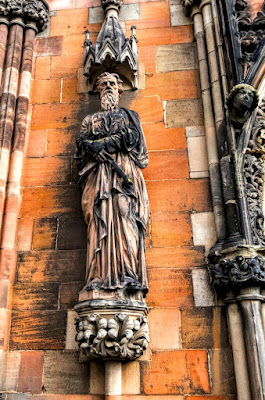
Saint Thomas the Apostle … a sculpture on the west façade of Lichfield Cathedral (Photograph: Patrick Comerford)

Patrick Comerford

We are in Ordinary Time in the Church Calendar and the week began with the Fourth Sunday after Trinity (Trinity IV, 28 June 2025) and the Feast of Saint Peter and Saint Paul (29 June 2026). Today (3 July), the Calendar of the Church of England celebrates Saint Thomas the Apostle.

Before today begins, though, I am taking some quiet time this morning to give thanks, to reflect, to pray and to read in these ways:

1, reading today’s Gospel reading;

2, a short reflection;

3, a prayer from the USPG prayer diary;

4, the Collects and Post-Communion prayer of the day.

An icon of the Incredulity of Saint Thomas in the iconostasis in the Greek Orthodox Church in Stony Stratford (Photograph: Patrick Comerford, 2024)

John 20: 24-29 (NRSVA):

24 But Thomas (who was called the Twin), one of the twelve, was not with them when Jesus came. 25 So the other disciples told him, ‘We have seen the Lord.’ But he said to them, ‘Unless I see the mark of the nails in his hands, and put my finger in the mark of the nails and my hand in his side, I will not believe.’

26 A week later his disciples were again in the house, and Thomas was with them. Although the doors were shut, Jesus came and stood among them and said, ‘Peace be with you.’ 27 Then he said to Thomas, ‘Put your finger here and see my hands. Reach out your hand and put it in my side. Do not doubt but believe.’ 28 Thomas answered him, ‘My Lord and my God!’ 29 Jesus said to him, ‘Have you believed because you have seen me? Blessed are those who have not seen and yet have come to believe.’

Saint Thomas and the Risen Christ depicted in a fresco in a church in Athens (Photograph: Patrick Comerford)

Today’s Reflection:

The Calendar of the Church of England commemorates Saint Thomas today (3 July), while the Orthodox Church remembers the doubting of the Apostle Thomas on the first Sunday after Easter; this year Thomas Sunday was on Sunday 19 April 2026.

In the Gospels, Saint Thomas is named ‘Thomas, also called the Twin (Didymus).’ But the name ‘Thomas’ comes from the Aramaic word for twin, T'oma (תאומא), so there is a tautological wordplay going on here.

Syrian tradition says the apostle’s full name was Judas Thomas, or Jude Thomas. But, who was his twin brother – or sister?

I have often visited Didyma on the south coast of Anatolia. There, the Didymaion was one of the most important shrines and temples in the classical world to Apollo and his twin sister Artemis. Apollo was the sun-god, the son of Zeus; he was the patron of shepherds and the guardian of truth, and in Greek and Roman mythology he died and rose again.

Is the story of Saint Thomas’s doubts an invitation to the followers of the cult of Apollo to turn to Christ, the true Son of God the Father, who is the Good Shepherd, who is the way, the truth and the light, who has died and who is truly risen?

We can never be quite sure about Saint Thomas in Saint John’s Gospel. After the death of Lazarus, the disciples resist Christ’s decision to return to Judea, where there had been an attempt to stone Jesus. But Thomas shows he has no idea of the real meaning of death and resurrection when he suggests that the disciples should go to Bethany with Jesus: ‘Let us also go, that we may die with him’ (John 11: 16).

And, while Thomas saw the raising of Lazarus, what did he believe in?

Could seeing ever be enough for a doubting Thomas to believe?

The Apostle Thomas also speaks at the Last Supper (John 14: 5). When Christ assures the disciples that they know where he is going, Thomas protests that they do not know at all. He has been with Christ for three years, and still he does not believe or understand. Seeing and explanations are not enough for him. Christ replies to his remarks and to Philip’s requests with a detailed exposition of his relationship to God the Father.

In the Resurrection story in Saint John’s Gospel, Saint Mary Magdalene – who is commemorated later this month on 22 July – does not recognise the Risen Christ at first. For her, appearances could be deceptive, and she thinks he is the gardener. But when he speaks to her, she recognises his voice, and then wants to hold on to him. From that moment of seeing and believing, she rushes off to tell the Disciples: ‘I have seen the Lord.’

Two of the disciples, John the Beloved and Simon Peter, have already seen the empty tomb, but they fail to make the vital connection between seeing and believing. When they hear Mary’s testimony, they still fail to believe fully. They only believe when they see the Risen Lord standing among them, when he greets them, ‘Peace be with you,’ and when he shows them his pierced hands and side.

They had to see and to hear, they had to have the Master stand over them in their presence, before they could believe.

On the first Easter Day, the Disciples locked themselves away out of fear. But where is Thomas? Is he fearless? Or is he foolish?

For a full week, Thomas is absent and does not join in the Easter experience of the remaining disciples. He has not seen and so he refuses to believe. When they tell him what has happened, Thomas refuses to accept their stories of the Resurrection. For him hearing, even seeing, are not enough.

Thomas wants to see, hear and touch. He wants to use all his learning faculties before he can believe this story. He has heard, but he wants to see. When he sees, he wants to touch … he demands not only to touch the Risen Christ, but to touch his wounds too before being convinced.

And so, for a second time within eight days, Christ comes and stands among his disciples, and says: ‘Peace be with you.’

The traditional icon depicting the event recalled in John 20: 19-31 emphasises the closed door, a significant part of the narrative: ‘the doors were locked’ (verse 19). After Christ’s arrest, the disciples tried to hide from the authorities out of fear. They returned to the last place where they had seen him alive, the upper room, around the same table where they had shared that last meal.

The young Thomas was not present the first time round and had said to the others: ‘Unless I see the mark of the nails in his hands and put my finger in the mark of the nails and my hand in his side, I will not believe’ (John 20: 25).

Christ appears within the disciples’ hiding place, where the door is firmly shut. His presence is real, and he invites Thomas: ‘Put your finger here and see my hands. Reach out your hand and put it in my side. Do not doubt but believe’ (John 20: 27).

In this icon, Christ’s right arm is raised not so much in blessing but revealing his right side with its open wound. Saint Thomas is raising his right hand, about to touch the wounded side, but not actually placing his finger in the open wound.

The wounds from the nails on the Cross can also be seen in Christ’s hand and feet. The traditional icons following Byzantine iconography and style show Christ standing in front of the closed door of a large domed building, with his right arm raised; we can see the signs of the nails on his hands. In many icons, Christ holds a scroll in his left hand.

The Apostles, divided in two groups, watch Thomas touch Christ’s side.

The familiar term ‘doubting Thomas’, referring to the Apostle, is used to describe someone who unreasonably doubts someone’s word. Where Orthodox icons depicting this scene have inscriptions, they do not refer to the doubts of Saint Thomas. Instead, the usual Greek inscription reads Η ψηλάφηση του Θωμά (I Psilafisi tou Thoma), ‘the Assurance of Thomas.’ Often English icons are inscribed ‘The Belief of Thomas.’ The icons show not a ‘Doubting Thomas,’ but a reassured Thomas. This is the Thomas who bends before the Risen Christ to touch his wounds and exclaims: ‘My Lord and my God!’ (John 20: 28).

The Church Fathers recognised that although Saint Thomas doubted, his doubt was not unreasonable. Christ responded, spurring Saint Thomas to a confession of Christ’s Divinity that is more explicit than anywhere else in the Gospels.

Looking out from the scene, Christ’s response to Thomas is also for us: ‘Have you believed because you have seen me? Blessed are those who have not seen and yet have come to believe’ (John 20: 29).

Mary was asked in the garden on Easter morning not to cling on to Christ. But Thomas is invited to touch him in the most intimate way. He is told to place his finger in Christ’s wounded hands and his hand in Christ’s pierced side.

Yet we are never told whether Thomas actually touches those wounds with his fingers. All we are told is that once he has seen the Risen Christ, Thomas simply professes his faith in Christ: ‘My Lord and my God!’

In that moment, we hear the first expression of faith in the two natures of Christ, that he is both divine and human. For all his doubts, Saint Thomas provides us with an exquisite summary of the apostolic faith, contained within the Nicene Creed, whose 1,700th anniversary we are commemorating this year.

Too often, perhaps, we talk about ‘Doubting Thomas,’ when we might better call him ‘Believing Thomas.’ His doubting leads him to questions. But his questioning leads to listening. And when he hears, he sees, perhaps he even touches. Whatever he does, he learns in his own way, and he comes not only to faith but to faith that for this first time is expressed in that eloquent yet succinct acknowledgment of Christ as both ‘My Lord and My God.’

In our society today, are we easily deceived by appearances?

Do we confuse what pleases me with beauty and with truth?

Do we allow those who have power to define the boundaries of trust and integrity merely to serve their own interests?

Too often, in this world, we are deceived easily by the words of others and deceived by what they want us to see. Seeing is not always believing today. Hearing does not always mean we have heard the truth, as we know in politics today. It is easy to deceive and to be deceived by a good presentation and by clever words.

Too often, we accept or judge people by their appearances, and we are easily deceived by the words of others because of their office or their privilege. But there are times when our faith, however simple or sophisticated, must lead us to ask appropriate questions, not to take everything for granted, and not to confuse what looks like being in our own interests with real beauty and truth.

Although the doors were shut, Jesus came and stood among them and said, ‘Peace be with you’ (John 20: 26) … an icon in Saint Mary and All Saints Church, Walsingham (Photograph: Patrick Comerford, 2026)

Today’s Prayers (Friday 3 July 2026, Saint Thomas the Apostle):

In Pray with the World Church, the prayer diary of the Anglican mission agency USPG (United Society Partners in the Gospel), the theme this week, from 28 June to 4 July 2026 (pp 14-15), is ‘Living Stones’. This theme was introduced on Sunday with a reflection by the Very Revd Lydia Kelsey Bucklin, President and Dean of Episcopal Divinity School.

The USPG prayer diary today (Friday 3 July 2026, Saint Thomas the Apostle) invites us to pray:

Faithful God, as we remember Saint Thomas, we pray for those who doubt the myths of Christian nationalism. Give us courage to question and resist the use of faith to harm, and to see Christ more clearly.

The Collect:

Almighty and eternal God,
who, for the firmer foundation of our faith,
allowed your holy apostle Thomas
to doubt the resurrection of your Son
till word and sight convinced him:
grant to us, who have not seen, that we also may believe
and so confess Christ as our Lord and our God;
who is alive and reigns with you,
in the unity of the Holy Spirit,
one God, now and for ever.

The Post-Communion Prayer:

Almighty God,
who on the day of Pentecost
sent your Holy Spirit to the apostles
with the wind from heaven and in tongues of flame,
filling them with joy and boldness to preach the gospel:
by the power of the same Spirit
strengthen us to witness to your truth
and to draw everyone to the fire of your love;
through Jesus Christ our Lord.

Yesterday’s reflections

Continued tomorrow

The Temple of Apollo in Didyma … one of the most important shrines and temples in the classical world to Apollo and his twin sister Artemis (Photograph: Patrick Comerford)

Scripture quotations are from the New Revised Standard Version, Anglicised Edition copyright © 2021, National Council of the Churches of Christ in the United States of America. Used by permission. All rights reserved worldwide.

02 July 2026

The Chetwynd divorce trial
that was a society sensation
and scandal beyond Lichfield
and Staffordshire in the 1860s

Longdon Hall, between Lichfield and Rugeley … at the centre of a sensational divorce case in 1864-1865 (Photograph: Longdon Hall School)

Patrick Comerford

With my recent return visits to Rugeley, Brereton, Stafford, Wolseley, Lichfield, Tamworth and other parts of Staffordshire, I have written about the Chetwynd family, the supposed murder by Dorothy Chetwynd of Sir Walter Smyth, the elderly husband who was three times her age, and the complete lack of historical evidence or primary sources for the stories in local lore of that murder or of Dorothy’s alleged execution by being burned at the stake.

Those stories of the Chetwynd family also led me to further genealogical and historical research into other family stories, and I came across stories of one branch of the Chetwynd family in Rugeley who were direct descendants of the Comberford family of Comberford Hall and the Moat House on Lichfield Street, Tamworth.

This branch of the Chetwynd family included another Dorothy Chetwynd who was a nun in Bruges, a 17th century; a 17th century MP for Stafford; and an 18th century MP for Lichfield who ran up heavy debts and whose funeral was delayed for weeks by his creditors.

Another branch of the Talbot family were given the title Earl Talbot, donated land for Saint Michael’s Church in Brereton, and gave their name to many places in the Rugeley area, including the Talbot Arms, associated with the ‘Poisoner of Rugeley’ William Palmer. After one Earl Tabot also became Earl of Shrewsbury, the pub became the Shrewsbury Arms, and is now known as ‘The Shrew’.

When I was writing about these stories of the Chetwynd and Talbot families, I referred to another marriage involving the Chetwynd and Talbot families that resulted in a sensational divorce case in 1865, and promised then to tell that story another evening.

William Henry Chetwynd (1811-1890) is remembered as one of the parties in the sensational Chetwynd v Chetwynd divorce case in 1864-1865, a case that highlighted Victorian attitudes to marriage, divorce, morals scandal, women’s rights and roles, children’s protection and family law.

William lived at Longdon Hall, halfway between Lichfield and Rugeley, where his income came from his family’s large landed estates and farms and from horse trading. The family estates were centred on Brocton Hall, their ancestral seat with 700 acres in Staffordshire, but also included Grendon Hall in Warwickshire, and the Bishton Hall estate inherited through the Sparrow family.

William was born on 17 September 1811 at Brocton Hall, Staffordshire, the family seat of the Chetwynd baronets. He was the second son of Sir George Chetwynd (1783-1850), 2nd baronet, and his wife Hannah Maria Sparrow of Bishton Hall, Staffordshire. Sir George succeeded to his father’s title and estates in 1824, and William Henry Chetwynd’s elder brother, Sir George Chetwynd (1809-1869), succeeded as the third baronet when their father died in 1850.

William Henry Chetwynd spent his childhood at Brocton Hall, which was largely rebuilt around 1815. He married the aristocratic Blanche Mary Talbot (1836-1898) at Saint George’s Church, Hanover Square, then a fashionable venue for society weddings in London, on 15 August 1854.

Blanche was born on 14 November 1836, a daughter of the Revd Hon Arthur Chetwynd-Talbot (1805-1884) and Harriet Elizabeth Frances Hervey-Aston (1815-1845) and a niece of Henry Chetwynd-Talbot, 18th Earl of Shrewsbury, and a granddaughter of Charles Talbot, 2nd Earl Talbot. She was baptised on 4 January 1837 in Ingestre by her father, who was the Rector of Ingestre, and later Rector of Church Eaton and a rural dean in the Diocese of Lichfield. Blanche and William were distantly related: a distant ancestor, Charles Talbot (1685-1737) had married Catherine Chetwynd, and inherited the estates of the Ingestre branch of the Chetwynd family.

William Henry Chetwynd and Blanche Mary Talbot were married in Saint George’s Church, Hanover Square, London, on 15 August 1854 (Photograph: Patrick Comerford)

At the time of their wedding, William was 42 and Blanche was 17, an age difference of 25 years. William later alleged that at the time of their marriage Blanche was two months pregnant by another man. He claimed in court during their divorce hearings that he knew this, but that he had gone ahead with the wedding regardless, claiming he had saved her from social disgrace.

Despite these repeated allegations, I have found no records of a child born within seven months of their marriage, although they were the parents of two children:

1, Florence Chetwynd (1856-1936), born in February 1856. She married her distant cousin Lord Berkeley Charles Sydney Paget, a son of Henry Paget 2nd Marquess Anglesey, on 5 June 1877.

2, Arthur Chetwynd (1857-1926), born on 22 July 1857, died on 15 August 1926.

As their relationship deteriorated , there were allegations of mutual infidelity, cruelty and financial mismanagement, exacerbated by Blanche’s secret decision to become a Roman Catholicism in 1862 and her independent dealings in horses and loans.

In December 1864, Blanche petitioned the Divorce Court for the dissolution of their marriage on grounds of her husband’s adultery with servants and cruelty, including claims that he forced her to perform menial tasks, used abusive language, and ill-treated animals and children in her presence.

William denied the charges and filed a recriminatory suit, accusing her of adultery with a prominent barrister Henry Matthews and a theology student named Nichols. The only evidence for these alleged infidelities were entries in her private diary revealing intimate feelings toward Matthews and criticisms of her husband.

Due to its complexity and the Christmas season, the trial lasted for many days, and because of its lurid details it attracted widespread press coverage. The evidence included anonymous insulting letters written by William Chetwynd and intercepted correspondence.

The judgment, delivered in Chetwynd v Chetwynd (1865), granted the divorce despite recrimination, finding William Chetwynd guilty of adultery and Blanche Chetwynd guilty of adultery based on the entries in her diary. In a landmark decision on child welfare, the court deemed both parents unfit and awarded custody of the children to third parties, reflecting shift in the Victorian era towards prioritising minors' moral protection over parental rights.

The divorce case heard how Blanche Chetwynd slept on the stairs or was forced to flee Longdon Hall

The case heard how early discord was reflected in petty arguments, such as a dispute in 1854 over Blanche's supposed tardiness at breakfast and another following her late return from a hunt at Beaudesert, where Chetwynd accused her of disrespecting him and suggested she find another place to live.

The rift to deepened by the late 1850s, with further financial pressures. Blanche was accumulating debts over £2,000 against William’s annual income of £1,200 through buying and selling horses at fairs, often borrowing from dealers at high interest rates secured by her family connections.

Rumours of mutual infidelities were supported by periods of separation and temporary relocation, including Blanche’s secretive departure from Longdon Hall. A pivotal escalation came in 1862, when Blanche became a Roman Catholic without her husband’s knowledge. She fled in distress to the home of the Revd James William Knight (1820-1878), Headmaster of Lichfield Grammar School (1859-1866).

Henry John Chetwynd-Talbot, Earl of Shrewsbury and Earl Talbot … negotiations on behalf of the Talbot and Shrewsbury interests facilitated a brief reconciliation

Negotiations involving her family solicitor, Mr Nicholson, acting for the Talbot and Shrewsbury interests, facilitated a brief reconciliation, but trust was eroded once more by anonymous harassing letters, later shown to have been written by William. Blanche finally filed for divorce in late 1864 on grounds of her husband’s alleged adultery and cruelty. William countered with claims of his wife’s infidelity.

The case of Chetwynd v Chetwynd began in late 1864 in the Divorce Court, presided over by Sir James Wilde, and continued into February 1865. Evidence was heard over several days, drawing extensive media attention for their salacious details.

Blanche claimed her husband had been guilty of great cruelty, had taught their children to spit in her face and to call her foul names, had locked her out of the house or forced her to sleep on the stairs, threatened her with a horsewhip and a pitchfork, had been guilty of repeated acts of adultery with his female servants and had lived with the children’s governess, Helen Booth.

Servants who were called to court alleged William’s repeated adultery with female domestic staff at Longdon Hall, as well as acts of cruelty such as teaching the children to insult their mother and spit in her face, and locking her out of the house at night.

The witnesses who gave evidence on her behalf included the Revd James Knight, a family acquaintance and master of the Grammar School, Lichfield. He had known Blanche since she was a child and William since 1856. Knight recalled Blanche’s distressed state during visits to his home in 1863. She sought safety at night in Knight’s house in Lichfield before returning to Longdon Hall. But she returned to Lichfield to seek safety in Knight’s home a second time.

Detectives and hotel staff corroborated William’s extramarital liaisons, detailing a pattern of infidelity and domestic abuse.

William’s defence, was led by Sir Henry Hawkins, a prominent barrister and later a controversial judge. William sought to bar the divorce under the doctrine of recrimination. When he took the stand, he refuted allegations of violence, cruelty and neglect and claimed his wife had left home without notice for religious reasons and managed independent horse dealings that incurred debts exceeding his annual income.

He alleged Blanche was pregnant when they married, and that he was not the father of the child but that he ‘removed her from disgrace’. Excerpts from Blanche’s private diary were read into evidence, revealing her intimate feelings for Henry Matthews, a family friend. These including passages on unrequited love, passionate encounters, and moral turmoil, which Hawkins argued demonstrated her own adulterous intent.

Witnesses, including hotel proprietors, placed Blanche with Matthews, and separately with Nichols, in compromising situations, including sharing a bed at the Falcon Hotel in Birmingham in December 1863.

Cross-examinations highlighted inconsistencies in witness accounts, with William portraying himself as a victim of Blanche’s extravagance. He accused his wife of associating with what he saw as low company, including ‘horse dealers’ and ‘pig jobbers’ at fairs. Part of William’s evidence included claims that his wife had called him ‘Dear Old Billy.’ There was laughter in the court when lines were quoted from a ballad well-known in Staffordshire, ‘The Wednesbury Cock’ but that William had confused with Saint Paul’s Epistle to the Ephesians.

The co-respondent in William Chetwynd's counter-petition, Henry Matthews, was implicated through letters and diary entries suggesting improper intimacy, although there was no direct testimony from him.

Despite the mutual accusations, the court found Chetwynd’s adultery proven beyond doubt, while his recriminatory claims against his wife were deemed insufficient to bar relief, as her journal was evidence of intent but not of consummated acts.

On 25 February 1865, Sir James Wilde granted a decree nisi to Blanche, awarding costs against her husband, and ordering alimony payments to Blanche. The court also deemed both parents unfit and awarded custody of their children to third parties, reflecting emerging child welfare principle. They were put in the care of William’s elder brother, Sir George Chetwynd.

The Schoolmaster’s House (left) at the old Grammar School on Saint John Street, Lichfield … it is now the home Lichfield Discovered (Photograph: Patrick Comerford)

Following the case, William Henry Chetwynd returned to live at Longdon Hall, between Lichfield and Rugeley. There he lived a more secluded lifestyle without his children, and was a Deputy Lieutenant and Justice of the Peace for Staffordshire. He married a second wife, Mary Parkin, on 7 December 1875 at Saint George’s Church, Hanover Square, the same church where William and Blanche were married 21 years earlier. William died at Longdon Hall on 5 July 1890, aged 78, and was buried at Saint Michael and All Angels Church, Colwich, near Longdon Hall.

The Chetwynd case was an early instance where the Divorce Court exercised broad discretion in fault-based proceedings. The finding of mutual culpability led to a rare outcome where neither party was deemed the ‘innocent spouse’, resulting in the denial of custody to both parents and placing their children with third-party guardians, illustrating an emphasis on marital fault extending to parental rights.

The case also reflects the privileges afforded to the upper classes in accessing the divorce court, while families with limited resources often endured marital discord without formal dissolution because of financial barriers. The case highlights entrenched gender and class norms, with women’s private thoughts subject to more rigorous scrutiny and questioning than men’s actions, and reinforcing the patriarchal double standards of the time in family law.

Because of the development of a popular media and cheaper newspapers, the case acquired popular notoriety and was a greater source of gossip not just in Staffordshire, but across the world, compared, for example with another divorce case in the same part of Staffordshire a century earlier, involving Sir William Wolseley who married Ann Whitby in 1752, a sad story I recounted in recent weeks.

Brocton Hall, near Rugeley and Stafford … home to generations of the Chetwynd family of Rugeley

Whatever happened to the principal characters in the Chetwynd divorce drama?

William Chetwynd died at home in Longdon Hall, in 1890, and was buried nearby in Colwich. His property, including Longdon Hall, passed to the children of Blanche and William, Florence and Arthur. Arthur Chetwynd continued to live at Longdon Hall and to manage the estate; Lord Berkeley Paget died at Longdon Hall on 25 November 1913, and Florence died there on 26 May 1936. The family title and Brocton Hall were eventually inherited in 1938 by Arthur’s son, Sir Arthur Henry Talbot Chetwynd (1877-1972).

Blanche never married again, and died on 15 July 1898. Her half-brother, Canon Arthur Henry Chetwynd-Talbot (1855-1927), was later a Prebendary of Lichfield, Provost of Denstone College, Uttoxeter, and the Rector of Edgmond, Newport, Shropshire. Her uncle, Henry John Chetwynd-Talbot (1803-1868), 3rd Earl Talbot, eventually succeeded as 18th Earl of Shrewsbury in 1856, and those titles have continued with his descendants. Those descendants included John George Chetwynd-Talbot (1914-1980), 21st Earl of Shrewsbury and 6th Earl Talbot. He sued for divorce in 1958, but Judge Charles A Collingwood refused the application in 1959, and he did not get a divorce until a subsequent case in 1963.

The Revd James William Knight, the kindly and concerned Master of Lichfield Grammar School who offered Blanche refuge on at least two occasions, was later Sub-Warden of Saint Paul’s College, Stony Stratford (1873-1875). He died on 26 August 1878, at Car-Colston Vicarage, Nottinghamshire. The Schoolmaster’s House at the old Grammar School on Saint John Street, Lichfield, where he lived is now home to the local history group Lichfield Discovered.

William Chetwynd’s counsel, Sir Henry Hawkins (1817-1907), later 1st Baron Brampton, became a controversial judge and was known as a severe ‘hanging judge’. His sisters included Susanna Hawkins who married William Comerford Casey of Cork and Liverpool. He was a cousin of the Revd Edwards Comerford Hawkins (1827-1906), of Saint Bride’s Church, Fleet Street, London, father of the writer Sir Anthony Hope Hawkins, author of The Prisoner of Zenda.

I have yet to identify the theology student or seminarian named as a theology student named simply as Nichols.

The co-respondent, Henry Matthews (1826-1913), was a prominent Roman Catholic and a Conservative politician. Matthews never took the stand at the Chetwynd case, and so it seems ironic that he made his name at the Bar for his examination of witnesses, especially Sir Charles Dilke in a sensational divorce case in 1885. He was MP for Dungarvan, Co Waterford (1868-1874), and later for Birmingham East (1886-1892), and he was the Home Secretary (1886-1892) throughout the Whitechapel Murders, some of which are attributed to Jack the Ripper. He was given the title of 1st Viscount Llandaff in 1895 and died unmarried in 1913 at the age of 87.

The intricate and puzzling details of the Chetwynd and Talbot family trees in Staffordshire and Wexford is a tangled web that continues to fascinate me. The story of how the Chetwynd-Talbot branch of the family in Rugeley and Brereton managed to convince their peers that they were the rightful heirs to the titles of Earl of Shrewsbury, Earl of Waterford and Earl of Wexford is another genealogical riddle that I hope to try to unravel or disentangle on another evening.

Henry Matthews (1826-1913), the co-respondent in William Chetwynd's counter-petition, later become Home Secretary and Viscount Llandaff … he never married

Further Reading:

HE Chetwynd-Stapylton, The Chetwynds of Ingestre, being a history of that family from a very early date (London: Longman & Green, 1892)

The memorial stone in Saint Mary’s Church, Ingestre, for Blanche’s uncle, Henry Chetwynd-Talbot (1803-1868), 18th Earl of Shrewsbury and 3rd Earl Talbot

Daily prayer in Ordinary Time 2026:
56, Thursday 2 July 2026

The healing of the paralytic man … a fresco in Analipsi Church in Georgioupoli in Crete (Photograph: Patrick Comerford)

Patrick Comerford

We are in Ordinary Time in the Church Calendar and the week began with the Fourth Sunday after Trinity (Trinity IV, 28 June 2026) and the Feast of Saint Peter and Saint Paul (29 June 2026). We are still in the time known as Peter-tide, a time when many ordinations to the diaconate and priesthood take place.

Later this evening, I hope to take part in the rehearsals with a playreading group in the Library in Stony Stratford. But, before this day begins, I am taking some quiet time this morning to give thanks, to reflect, to pray and to read in these ways:

1, reading today’s Gospel reading;

2, a short reflection;

3, a prayer from the USPG prayer diary;

4, the Collects and Post-Communion prayer of the day.

A blessing in the Chapel of the John Radcliffe Hospital, Oxford (Photograph: Patrick Comerford)

Matthew 9: 1-8 (NRSVA):

1 And after getting into a boat he crossed the water and came to his own town.

2 And just then some people were carrying a paralysed man lying on a bed. When Jesus saw their faith, he said to the paralytic, ‘Take heart, son; your sins are forgiven.’ 3 Then some of the scribes said to themselves, ‘This man is blaspheming.’ 4 But Jesus, perceiving their thoughts, said, ‘Why do you think evil in your hearts? 5 For which is easier, to say, “Your sins are forgiven”, or to say, “Stand up and walk”? 6 But so that you may know that the Son of Man has authority on earth to forgive sins’ – he then said to the paralytic – ‘Stand up, take your bed and go to your home.’ 7 And he stood up and went to his home. 8 When the crowds saw it, they were filled with awe, and they glorified God, who had given such authority to human beings.

Inside the Chapel in the John Radcliffe Hospital, Oxford (Photograph: Patrick Comerford)

Today’s Reflections:

This morning’s Gospel reading at the Eucharist (Matthew 9: 1-8) is a healing story that has its synoptic parallels in Mark 2: 1-12 and Luke 5: 18-26.

I have regular appointments with my local GP practice for injections for my B12 deficiency, and I continue to have regular hospital appointments monitoring my pulmonary sarcoidosis and as part of the care and attention I continue to receive as a follow-up to my stroke almost over four years ago in March 2022.

I remain truly grateful for the caring and attentive treatment I receive in hospitals in Milton Keynes, Oxford and Sheffield, and I am even more grateful for the way Charlotte Hunter recognised I was having a stroke, brought me to hospital, ensured I received the attention I needed, visited me every day, and brought me back to Stony Stratford.

Some years ago, at an event in Saint Martin-in-the-Fields Church, Trafalgar Square, when people were asked to bring along their favourite poems, Charlotte brought Seamus Heaney’s poem ‘Miracle’, from his collection Human Chain (2010).

In these poems, written after his stroke in 2005, Seamus Heaney speaks of suffering and mortality. This poem ‘Miracle’ retells the story of the miraculous healing of the man variously described as a paralytic man and a man with palsy. The story is told in all three synoptic Gospels, including this morning’s Gospel reading (Matthew 9: 1-8), and – like Seamus Heaney, I suppose – my situation makes me wonder whether this man was also suffering after a stroke.

It is interesting how Seamus Heaney tells the story of this man’s healing from the perspective of the man’s friends. In this way, his poem becomes an expression of gratitude by the poet to all who helped his recovery after his stroke.

When Jesus looks at the paralysed man brought to him by his friends, he sees not just the faith of the man, but the faith of his friends too. In other words, this is a story of the blessing of friendship and the miracle of community as much as it is a story of miraculous healing.

The poet’s focus is on neither Christ as the healer nor the invalid, but on the friends who in the other synoptic accounts helped this sick man to reach Jesus by lowering him through a skylight in the roof. The title of the poem refers to the miracle in the Gospel story, but for the poet the miracle is found in the opening lines:

Not the one who takes up his bed and walks
But the ones who have known him all along
And carry him in
.

The friends of this man love him and seek his healing, no matter what it takes for them to do, and so they become the true miracle in this moment. They are there when no one else is, they care for their friend, and they give him the priceless gift of friendship.

When they hear in Capernaum that Jesus is healing the sick, they give their friend one more gift. They carry him to Jesus. And when they cannot get him through the door, they then lower him through the roof.

What persistent love they show their friend, like the persistent love of one who calls a taxi, packs all my bags, brings me to the A&E unit, stays with me while I am admitted, as I am transferred to the emergency unit, and then, late at night, when I am moved to a ward.

This poem sees the Gospel story through the eyes of this man’s faithful friends. So often, I read this story through the eyes of the paralysed man, through the eyes of the crowd, or even through the eyes of the Pharisees and teachers. But Seamus Heaney invites me to join the man’s friends, who stand with

their shoulders numb, the ache and stoop deeplocked
In their backs, the stretcher handles
Slippery with sweat
.

We are invited to stand with those friends, with the hope and the faith and the love that brings them there, to stand with them on behalf of all who hurt, to feel the burns in their hands from the paid-out rope, the ache in their backs from the burden they have carried, to see the gift of this miracle, this grace, that was all gift, but that required something extra of them.

There are many miracles in this story and many lessons. This poem reminds us how sometimes we need to be carried by our friends, while at other times we are the ones who need to help ‘bear one another’s burdens’ (Galatians 6: 2).

Miracle, by Seamus Heaney (1939-2013)

Not the one who takes up his bed and walks
But the ones who have known him all along
And carry him in —

Their shoulders numb, the ache and stoop deeplocked
In their backs, the stretcher handles
Slippery with sweat. And no let up

Until he’s strapped on tight, made tiltable
and raised to the tiled roof, then lowered for healing.
Be mindful of them as they stand and wait

For the burn of the paid out ropes to cool,
Their slight lightheadedness and incredulity
To pass, those who had known him all along.

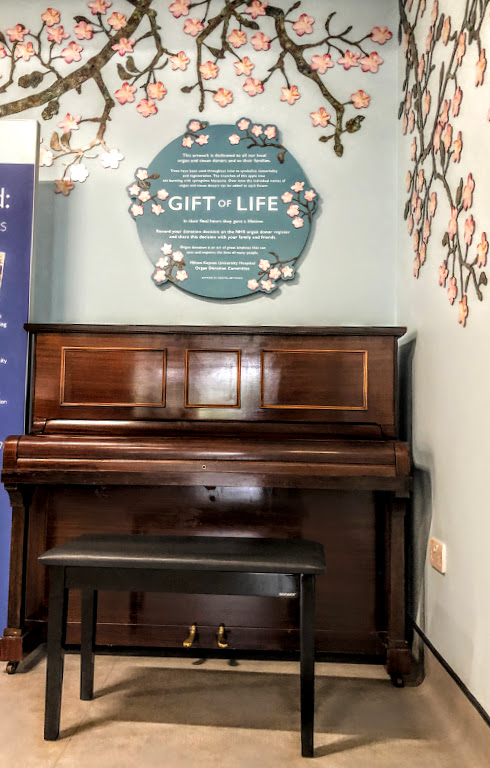
‘The Gift of Life’ … art and music in the outpatients reception area in Milton Keynes University Hospital (Photograph: Patrick Comerford)

Today’s Prayers (Thursday 2 July 2026):

In Pray with the World Church, the prayer diary of the Anglican mission agency USPG (United Society Partners in the Gospel), the theme this week, from 28 June to 4 July 2026 (pp 14-15), is ‘Living Stones’. This theme was introduced on Sunday with a reflection by the Very Revd Lydia Kelsey Bucklin, President and Dean of Episcopal Divinity School.

The USPG prayer diary today (Thursday 2 July 2026) invites us to pray:

Creator God, remind us of our deep interconnection. Strengthen us to seek the liberation of all people, knowing none of us are free while violence and injustice persist.

The Collect of the Day:

O God, the protector of all who trust in you,
without whom nothing is strong, nothing is holy:
increase and multiply upon us your mercy;
that with you as our ruler and guide
we may so pass through things temporal
that we lose not our hold on things eternal;
grant this, heavenly Father,
for our Lord Jesus Christ’s sake,
who is alive and reigns with you,
in the unity of the Holy Spirit,
one God, now and for ever.

The Post-Communion Prayer:

Eternal God,
comfort of the afflicted and healer of the broken,
you have fed us at the table of life and hope:
teach us the ways of gentleness and peace,
that all the world may acknowledge
the kingdom of your Son Jesus Christ our Lord.

Additional Collect:

Gracious Father,
by the obedience of Jesus
you brought salvation to our wayward world:
draw us into harmony with your will,
that we may find all things restored in him,
our Saviour Jesus Christ.

The Collect on the Eve of Saint Thomas:

Almighty and eternal God,
who, for the firmer foundation of our faith,
allowed your holy apostle Thomas
to doubt the resurrection of your Son
till word and sight convinced him:
grant to us, who have not seen, that we also may believe
and so confess Christ as our Lord and our God;
who is alive and reigns with you,
in the unity of the Holy Spirit,
one God, now and for ever.

Yesterday’s reflections

Continued tomorrow

The magnolia tree in a courtyard in the hospital in Milton Keynes (Photograph: Patrick Comerford)

Scripture quotations are from the New Revised Standard Version Bible: Anglicised Edition copyright © 1989, 1995 National Council of the Churches of Christ in the United States of America. Used by permission. All rights reserved worldwide. http://nrsvbibles.org

01 July 2026

Holy Trinity Church, Oxford,
the church on Blackfriars Road
lost in 1950s slum clearances

Blackfriars Road, Oxford … Holy Trinity Church was built in 1845 and demolished in 1957 (Photograph: Patrick Comerford, 2026)

Patrick Comerford

As I made my way from the Grandpont area of south Oxford, crossing the River Thames and Gasworks Pipe Bridge to search for the site of the former Greyfriars at Westgate, I could not but notice the ecclesiastical tone to many of the street names between the river and Westgate Oxford: Friars Wharf, Preachers Lane, Blackfriars Road, Trinity Street …

This southern part of Saint Ebbe’s parish was once known as the Friars, recalling the Greyfriars or Franciscans and Blackfriars or Dominicans who settled in Saint Ebbe’s in the early decades of the 13th century.

The two friaries were abolished in the 1530s at the dissolution of the monastic houses during the Tudor Reformation, and most of their buildings were demolished. But their memory lived on in the local placenames such as Greyfriars, Friars Wharf, Preachers Lane, Trinity Street and Blackfriars Road.

That part of Saint Ebbe’s parish changed dramatically in the early decades of the 19th century when the gasworks opened on the north bank of the River Thames in 1818. As the population of Saint Ebbe’s increased, a schoolroom was licensed for services in 1842 and a new parish – Holy Trinity – was formed from the southern part of Saint Ebbe’s parish, with a stipend of £150 provided for the incumbent.

Holy Trinity, Blackfriars Road, Oxford ca 1910 … opened in 1845 and closed in 1954 (Photograph © Oxfordshire History Centre, Oxfordshire County Council)

The new parish church, Holy Trinity Church, was designed in Early English style by the Oxford-based architect Henry Jones Underwood (1804-1852). It was built on the corner of Blackfriars Road and Trinity Street in 1844-1845 and opened in 1845.

Around the same time, a similarly-named Holy Trinity Church was being built in the village of Headington Quarry, Oxford, in 1848-1849. That church was designed by the architect George Gilbert Scott and later became known for its associations with CS Lewis.

Henry Jones Underwood, the architect of Holy Trinity Church, Blackfriars Road, was a brother of the architects Charles Underwood and George Allen Underwood, and spent most of his career in Oxford. He trained in London as a pupil of Henry Hake Seward and then joined the office of Sir Robert Smirke.

Underwood moved to Oxford in 1830 to work on alterations to the Bodleian Library. Much of his subsequent work involved designing churches and educational buildings as the city and the university expanded and the Oxford Movement increased in influence. He designed the library of the Oxford Botanic Garden (1835), and Saint Paul’s Church, Walton Street (1836), the first new parish to be created in Oxford and the first new church to be built in Oxford since the Reformation. Both were built in the Greek Revival style, but Underwood is best known for his work in the Gothic Revival style.

Underwood also designed Saint Mary and Saint Nicholas Church in Littlemore for John Henry Newman in 1835, and it became a model for his other churches. The church was originally built as a chapel of ease to the parish of the University Church of Saint Mary the Virgin, Oxford. Littlemore became its own parish in 1847 and in time the church became a centre of Anglo-Catholicism.

Underwood’s other works in Oxford included Saint John the Baptist Church, Summertown (1831, demolished 1924); buildings for Exeter College on Turl Street and Broad Street (1833-1834); rebuilding Cardinal Wolsey’s Almshouses to make a grander entrance for Pembroke College (1834); and the north aisle of Saint Thomas’s Church (1846). Underwood died by suicide in 1852 at the White Hart Hotel, Bath, and JC Buckler completed his extension to Oxford Prison, now the Malmaison Hotel.

A legacy photograph of the interior of Holy Trinity Church, Blackfriars Road (Photograph: Patrick Comerford, 2026)

Holy Trinity parish was in one of the poorest quarters of Oxford and the church was built from cheap materials. There were two services each Sunday in 1854 and a monthly Communion service. The parish was a densely populated and very poor area to the south of the city centre. Great poverty, many beer shops, Sunday work in the colleges, ‘unbelieving masters’, and people tainted with ‘Calvinism and infidelity’ were blamed for what were regarded at the time as small church attendance figures.

By 1869, there were four Sunday services, with Holy Communion every Sunday and on holy days, and daily Morning and Evening Prayer. At the request of the churchwardens and ‘principal parishioners’ a surpliced choir had been introduced, all indicating the influence of the Tractarian movement and early Anglo-Catholicism.

Daily Morning Prayer was abandoned in 1872, but the number of Easter communicants rose steadily from 135 in 1872 to 199 in 1884. The patronage of Holy Trinity belonged alternately to the Crown and the Bishop of Oxford until 1881, when the Revd Edward Penrose Hathaway (1818-1897) bought the advowson and vested it in the Oxford Churches Trust.

Hathaway was a former barrister and ‘an austere old-fashioned evangelical’ who founded the Oxford Churches Trust in 1864 to appoint evangelical clergy to local parishes and to counter the increasing influence of the Tractarian movement and early Anglo-Catholicism. Through his zeal, he played a central role in establishing a strong evangelical tradition at several Oxford churches, including Saint Ebbe’s, Saint Aldate’s, Saint Clement’s, Holy Trinity, and Saint Peter-le-Bailey, and his trust appointed him the Rector of Saint Ebbe’s from 1868 to 1874.

Hathaway paid £1,000 for the advowson of Holy Trinity in 1881 and this was used to increase the stipend. A further augmentation was made in 1890 to meet the gift of a house for the living. The net income of the benefice in 1898 was £228.

Attendance figures at Holy Trinity remained steady or even increased until World War I, when most of the adult parishioners were either in the army or employed in war work. During World War I, 90 men from the parish died in the war and they were later commemorated on the Holy Trinity War Memorial.

The Oxford Churches Trust, founded by Hathaway in 1864, exchanged the advowson of Holy Trinity with Simeon’s Trustees in 1914 for that of Saint Matthew’s, Grandpont, and Simeon’s Trustees remained patrons of Holy Trinity until Holy Trinity was united with Saint Aldate’s in 1956.

Photographs of Holy Trinity Church, inside and outside, ‘appear to be rarer than rocking horse droppings’

Some of the poorer houses in the area were cleared in the 1930s, but a major redevelopment plan was delayed by World War II.

By 1951, the fabric of Holy Trinity Church was in poor condition. Meanwhile, the population of the area was declining as slum clearance programmes gathered pace. Holy Trinity Church was closed in 1954 and the parish of Holy Trinity was united with Saint Ebbe’s in 1956. The building was deemed unsafe, and with encroaching urban clearance the church was demolished in 1957.

The 1914-1918 war memorial was removed from the church during demolition. It was later discovered in the 1980s resting against a wall in the rear garden of the former Holy Trinity Rectory. The memorial was eventually moved to Saint Aldate’s Parish Centre in Pembroke Street, and was later stored in a wooden case at Saint Ebbe’s Church. The memorial has since been removed from its rotten mounting and is said to be in a poor condition, covered in patina or crust.

Eventually, over 900 properties in the area were demolished, the last – 84 Blackfriars Road – in 1978. Many streets were wiped from the map or renamed. The records of Holy Trinity Church were deposited with the Bodleian Library in 1975 by the then Rector of Saint Aldate’s, and were transferred to Oxfordshire Archives in the 1980s. Further records were deposited in 2019.

No trace remains today of what was perhaps one of the shortest-lived churches in Oxford. One site says photographs of Holy Trinity Church, inside and outside, ‘appear to be rarer than rocking horse droppings’. The name of the church survives in the full name of Saint Ebbe’s Parish, which is formally Saint Ebbe with Holy Trinity and Saint Peter le Bailey, while the names of Friars Wharf, Preachers Lane – once known as Gas Street – Blackfriars Road and Trinity Street are reminders of the ecclesiastical communities that were once part of life the area.

Preachers Lane … a reminder of the ecclesiastical presence in the area in the past (Photograph: Patrick Comerford, 2026)

Daily prayer in Ordinary Time 2026:
55, Wednesday 1 July 2026

‘Now a large herd of swine was feeding at some distance from them’ (Matthew 8: 30) … sculptures of pigs throughout Tamworth celebrate the political achievements of Sir Robert Peel (Photograph: Patrick Comerford, 2025)

Patrick Comerford

We are in Ordinary Time in the Church Calendar and the week began with the Fourth Sunday after Trinity (Trinity IV, 28 June 2026) and the Feast of Saint Peter and Saint Paul (29 June 2026). We are still in the time known as Peter-tide, a time when many ordinations take place, and in the calendar in Common Worship the Church of England today remembers Henry Venn (1797), John Venn (1813), and Henry Venn the younger (1873), priests and evangelical divines.

Today we also the second half of this year – half the year 2026 is now behind us. Later this evening, I hope to take part in the choir rehearsals in Stony Stratford. But, before this day begins, I am taking some quiet time this morning to give thanks, to reflect, to pray and to read in these ways:

1, reading today’s Gospel reading;

2, a short reflection;

3, a prayer from the USPG prayer diary;

4, the Collects and Post-Communion prayer of the day.

‘Two demoniacs coming out of the tombs met him’ (Matthew 8: 28) … in the graveyard between Koutouloufari and Piskopiano in Crete (Photograph: Patrick Comerford)

Matthew 8: 28-34 (NRSVA):

28 When he came to the other side, to the country of the Gadarenes, two demoniacs coming out of the tombs met him. They were so fierce that no one could pass that way. 29 Suddenly they shouted, ‘What have you to do with us, Son of God? Have you come here to torment us before the time?’ 30 Now a large herd of swine was feeding at some distance from them. 31 The demons begged him, ‘If you cast us out, send us into the herd of swine.’ 32 And he said to them, ‘Go!’ So they came out and entered the swine; and suddenly, the whole herd rushed down the steep bank into the lake and perished in the water. 33 The swineherds ran off, and on going into the town, they told the whole story about what had happened to the demoniacs. 34 Then the whole town came out to meet Jesus; and when they saw him, they begged him to leave their neighbourhood.

A cartoonist’s take on the pigs in the Gospel accounts of the herd of swine the swine who rush down the steep bank into the lake

Today’s Reflection:

This morning’s reading at the Eucharist (Matthew 8: 28-34) comes after yesterday’s account of Christ calming the storm as he and the disciples are in a boat crossing the lake or sea. In today’s reading, they arrive at the other side, where Jesus heals the Gadarene demoniacs.

This story appears in all three synoptic Gospels: Matthew 8: 28-34; Mark 5: 1-20; and Luke 8: 26-39.

After Jesus calms the storm on the Sea of Galilee, he and his disciples arrive on the other side of the lake in the countryside surrounding Gerasa, present-day Jerash. This city, also known as Antioch on the Chrysorrhoas or the Golden River, was founded by Alexander the Great. It is 50 km south-east of the Sea of Galilee and 30 km north of Philadelphia, modern-day Amman. However, Saint Matthew sets this story in Gadara (present-day Umm Qais), about 10 km from the coast of the Sea of Galilee.

Either location poses questions, for neither Gadara nor Gerasa is near to the coast of the Sea of Galilee: Gadara was about a three-hour walking distance, while Gerasa was well over twice that distance.

The differing geographical references to Gadara and Gerasa can be understood in light of the social, economic, and political influence each city exerted over the region. In this light, Saint Matthew identifies the exorcism with Gadara as the local centre of power, while the city of Gerasa was a major urban centre and one of the 10 cities of the Decapolis.

Whatever the location and setting of this story, it takes place deep inside Gentile territory. From the very moment they get off the boat, this story involves a place and people regarded as unclean by the standards among the disciples: this is Gentile territory, the people are ritually ‘unclean,’ the two men have unclean spirits, they men of visible and public shame living among the tombs, which are ritually unclean, and the pigs are unclean too.

Prisoners or people who had been deprived of their liberty lost the right to wear clothes. Tombs were ritually unclean places. Swine were a symbol of pagan religion and of Roman rule, but even they are subject to Christ’s authority.

This episode plays a key role in the theory of the ‘Scapegoat’ put forward by the French literary critic René Girard (1923-2015). In his analysis, the opposition of the entire city to the two men possessed by demons is the typical template for a scapegoat.

Which is more self-destructive:

the tormented lives of two demoniacs living among the tombs?

the herd of pigs rushing headlong over the precipice to certain drowning in the lake?

the swineherds who abandon their herd and rush back into the town?

the townspeople who placed all their collective guilt on these two men and forced them to live on the edges of the town or the margins of society?

Or, the people of the town when they demand that Jesus should leave immediately?

And we might ask ourselves this morning:

Who do you think we see as scapegoats today, as outsiders to be pushed to the margins, so that we can maintain the purity of our family, church or society?

Who do we expose and shame so that we can maintain the appearance of our own purity?

Are these the very people who might bring the good news to people on the margins, inviting them into the household of God?

‘Now a large herd of swine was feeding at some distance from them’ (Matthew 8: 30) … free-range pigs grazing in fields at Packington Farm, between Lichfield and Tamworth (Photograph: Patrick Comerford)

Today’s Prayers (Wednesday 1 July 2026):

In Pray with the World Church, the prayer diary of the Anglican mission agency USPG (United Society Partners in the Gospel), the theme this week, from 28 June to 4 July 2026 (pp 14-15), is ‘Living Stones’. This theme was introduced on Sunday with a reflection by the Very Revd Lydia Kelsey Bucklin, President and Dean of Episcopal Divinity School.

The USPG prayer diary today (Wednesday 1 July 2026) invites us to pray:

Gracious God, bless Episcopal Divinity School and all who are placing justice at the centre of theological education. May all who learn there be living stones.

The Collect of the Day:

O God, the protector of all who trust in you,
without whom nothing is strong, nothing is holy:
increase and multiply upon us your mercy;
that with you as our ruler and guide
we may so pass through things temporal
that we lose not our hold on things eternal;
grant this, heavenly Father,
for our Lord Jesus Christ’s sake,
who is alive and reigns with you,
in the unity of the Holy Spirit,
one God, now and for ever.

The Post-Communion Prayer:

Eternal God,
comfort of the afflicted and healer of the broken,
you have fed us at the table of life and hope:
teach us the ways of gentleness and peace,
that all the world may acknowledge
the kingdom of your Son Jesus Christ our Lord.

Additional Collect:

Gracious Father,
by the obedience of Jesus
you brought salvation to our wayward world:
draw us into harmony with your will,
that we may find all things restored in him,
our Saviour Jesus Christ.

Yesterday’s reflections

Continued tomorrow

A boot scrapers at the main entrance to Westcott House, Cambridge, in the shape of a pig is an heraldic pun on the surname of the former principal, Bertram Cunningham (Photographs: Patrick Comerford)

Scripture quotations are from the New Revised Standard Version, Anglicised Edition copyright © 2021, National Council of the Churches of Christ in the United States of America. Used by permission. All rights reserved worldwide.