Lumen United Reformed Church, close to the corner of Tavistock Place and Wakefield Street in Bloomsbury, is on the site of the former Regent Square Presbyterian Church (Photograph: Patrick Comerford, 2026)
Patrick Comerford
Lumen United Reformed Church, formerly known as Regent Square United Reformed Church, is in the heart of Bloomsbury, close to the corner of Tavistock Place and Wakefield Street. The church is a prize-winning building, recognised for its innovative architectural design, and has important works of art, including its windows and the details in its courtyard design, and has an interesting place in early 19th century church history in London. But the future of the church now seems uncertain, and there are many doubts and unanswered questions about its future use.
Until recently, Lumen Church had a small congregation worshipping in the Reformed tradition and part of the United Reformed Church, which brings together formerly separate Presbyterian, Congregational and Church of Christ traditions.
In 200 years, Lumen has had three buildings, belonged to four different churches – the Church of Scotland, the Free Church of Scotland, the Presbyterian Church of England, and the United Reformed Church – has had five different names and 17 ministers, and the building is the work of several architects who have worked in very different times and styles.
Looking out onto Tavistock Place and Regent Square though Rona Smith’s window in the café (Photograph: Patrick Comerford, 2026)
Regent Square Church was a Presbyterian Church first founded to serve a scattered, mainly Scots, congregation. The church has its beginnings back in 1808, when the Highland Society of London began a Gaelic-speaking Presbyterian mission and a Gaelic-speaking chapel for migrant workers from Scotland who had arrived in London.
The congregation first met in rented accommodation in Westminster, three miles from the later Regent Square site, and was first led by the Revd Duncan Robertson (1766-1825). In 1813, he took the church to larger premises, the New Jerusalem Chapel in Cross Street, Hatton Garden, built in 1797 for followers of Emanuel Swedenborg. However, a rupture between Robertson and the members led to ‘an almost total dispersal of the congregation’.
The Revd Edward Irving (1792-1834), the minister of the Gaelic church from 1822, received an invitation from the Caledonian Church, Hatton Garden, in the winter of 1821, and with that call he was ordained in the Church of Scotland in July 1822.
Irving was so popular a preacher that services had to be ticketed, with people standing in the aisles and even on the pulpit steps. Those who came to hear him included the Prime Minister, Lord Liverpool, and the future Prime Minister William Gladstone.
Saint Columba in a Maile stained glass window … the church began as a mission to migrant Scottish workers in London (Photograph: Patrick Comerford, 2026)
To accommodate the larger congregations, a newer and larger church, the Scotch National Church, was built in 1827 at what was then the very edge of London, at the corner of Regent Square and Tavistock Place. The regency gothic church was the first major commission for the architect Sir William Tite (1798-1873), who designed a miniature version of York Minster, including the miniature versions of the twin towers.
Tite’s greatest undertaking later was rebuilding the Royal Exchange, which opened in 1844, and he designed many of the early railway stations in Britain.
Regent Square Presbyterian Church was consecrated in 1827, and began as a sister church of the established Church of Scotland. It was formed to work among young people from Scotland who had moved to London to work and who ‘in the end are cast away among the manifold temptations of this busy and alluring city’. Prominent figures associated who visited the church during the 19th century included John Ruskin, George Canning, Thomas Carlyle and Sir Robert Peel.
An internal dispute erupted in 1832, when the church doors closed against Edward Irving for allowing members of the lay congregation to interrupt the services by ‘speaking in tongues’. In response, 800 people left Regent Square to form a new church nearby.
Irving and his followers, describing themselves as of the Holy Catholic Apostolic Church, moved to a new building in Newman Street in 1832, and in March 1833 he was deposed from the ministry of the Church of Scotland on a charge of heresy. He was re-ordained in the church in Newman Street and died on 7 December 1834.
Saint Luke the Beloved Physician in a Maile stained-glass window … many of the early church leaders included medical staff at local hospitals (Photograph: Patrick Comerford, 2026)
Regent Square Church followed the Revd Thomas Chalmers (1780-1847) in the Disruption of 1843, when 450 ministers and their congregations, as well as probation ministers, teachers and missionaries seceded from the Church of Scotland to form the Free Church of Scotland.
At first, the church was surrounded by open field. But the industrial revolution soon brought the railways. When the more prosperous residents moved away, they were replaced by poor and working class families in a built-up area, alongside university students, medical staff at local hospitals and overseas visitors. As a result, many elders and members came from districts that were more affluent than the locality of the church.
The Presbyterian Church of England was formed in the 1876 with the merger of the English congregations of the mainly Scottish United Presbyterian Church with other Presbyterian congregations in England.
The Young Men’s Bible Class at Regent Square Church was founded in 1877 by an elder, Robert Whyte, with Christian teaching, cultural pursuits such as a literary society and an orchestra, facilities for cycling, football, rambling and swimming, and its own magazine, The Thistle.
Regent Square Presbyterian Church acquired an adjoining, abandoned Baptist chapel in 1911, repaired it and altered it to become the Regent Square Institute, with a hall, gymnasium and reading room that were was used by groups such as Sunday school, the Boys Brigade and evening concerts. The club continued until October 1923, when The Thistle ceased publication, the class closed and the society amalgamated with the young people’s group. By the 1930s, the harsh economic and social climates were reflected in the Regent Square Magazine, which devoted two pages in February 1933 to unemployment. A recreational centre in the church provided games, newspapers, magazines and writing materials, giving local unemployed men somewhere to go and something to do.
During the inter-war years, John Charles Walsham Reith (1889-1971), 1st Baron Reith, attended the church, where his parents had been married. He was inspired to apply for the new post of Director-General of the BBC by a sermon on Ezekiel he heard in the church in 1922.
Lumen Church hopes to become home to a new congregation in the near future (Photograph: Patrick Comerford, 2026)
During World War II, the Regent Square Institute was hit by a bomb on 21 September 1940. Evening meetings were discontinued, the institute activities were moved to the Wakefield Street halls, and the monthly church magazine was reduced to four pages.
A V2 rocket destroyed Presbyterian Church House on the afternoon of 9 February 1945, with loss of life, including four senior church officials. The church and halls still stood, but there was considerable damage, the structure was unsafe, and the church was unusable. For the next 15 years, the lecture hall served as a ‘temporary’ church, and another smaller hall served as ‘temporary’ accommodation for yet another six years.
Church House on the corner of Wakefield Street was rebuilt by 1956, and it was agreed to dismantle the old church and build a new but smaller one. The War Damage Commission’s offered a grant of £44,300 and the plans for a new church were approved in 1964.
The dalle de verre stained glass window by Pierre Fourmaintraux depicts the Resurrection (Photograph: Patrick Comerford, 2026)
The new church was designed by the architect Courtenay Theobald, who also built 50 bridges. The distinctive concrete arches used for the roof trusses probably owe their inspiration to his many bridges. The new church was opened on the 11 June 1966 with about 300 people present, including representatives from other local churches.
The church featured a dalle de verre stained glass window by Pierre Fourmaintraux (1896-1974) depicting the Resurrection. The window includes over 1,000 pieces of one inch thick glass in 21 panels. Each piece was expertly cut by hand, by scoring the glass on the surface and hitting it with a hammer on a small anvil so the piece would break cleanly. The surface of the glass was chipped, so that sunlight striking the glass goes in all directions.
Pierre Fourmaintraux was born in France, and first worked in his father’s ceramics factory, where he first worked. He married the English impressionist painter Rachel Winslow (1880-1974) and they moved to England. He worked for James Powell & Sons (Whitefriars Glass Studio) in 1956-1969 as chief designer of slab glass and abstract designs.
His windows were especially popular in Roman Catholic churches and those he trained in the dalle de verre technique included Dom Charles Norris, who became one of its most prolific British proponents and whose work I have seen in Saint Bernardine’s Church in Buckingham.
The 11-metre-high conical ‘sacred space’ reaches through the full height of the building (Photograph: Patrick Comerford, 2026)
Regent Square Church joined the newly formed United Reformed Church (URC) in 1972, when the Presbyterian and Congregational traditions merged and the church later adopted the name Lumen United Reformed Church.
The institute and the halls were sold in 2007 to finance a major remodelling of the church, and they are now used by the Soka Gakkai International Buddhists. Church House on the corner of Wakefield Street and Tavistock Place, is now United Reformed Church House, the main offices of the URC.
The church was remodelled in 2008 by Theis and Khan Architects, who redesigned and extended it into a multi-faith community hub. It was their first church project and they completely remodelled the building. Their redesign retained the original building’s volume and coherence, and the 1966 window by Fourmaintraux was moved from the west side wall to make it central to the church.
The RIBA award-winning renovation added an 11-metre-high conical ‘sacred space’ that reaches through the full height of the building to penetrate the church roof, receiving direct natural light. The light inside alters with weather and seasons, and was intended to convey a sense of peace and separation from the bustle of the outside world. The position of this sacred space at the heart of Lumen provides a secluded area for contemplation.
The renovation of Lumen Church has won awards from the RIBA (Photograph: Patrick Comerford, 2026)
New amenities including an entrance, lift, toilets, offices and multi-use spaces. A community café has a north window overlooking Regent Square with geometric metalwork designed by the artist Rona Smith. This is an 8 metre tall bronze screen suspended within the alcove of the window, gently arcing into the interior space.
A garden courtyard is planted with herbs and silver birch trees, providing a modern form of a cloister with an arcade around the courtyard. Alison Wilding created a new font, a drinking fountain and a garden fountain, drawing on the themes of ‘living water’ and light.
Lumen also has a small gallery that has showcased the work of local artists, photographers and students.
Lumen’s small worshipping community included people of different backgrounds who continued to worship there until 2020, when Covid-19 brought services to an end for a group that was already struggling. Although regular Sunday services have ended, the venue continues as an active community space that is home to several community church groups and it continues its links with Gaelic cultural events. Today Lumen says it hopes to become home to a new congregation in the near future.
United Reformed Church House beside Lumen Church is the main offices of the United Reformed Church (Photograph: Patrick Comerford, 2026)
25 October 2026
Daily prayer in Ordinary Time 2026:
170, Sunday 25 October 2026,
Last Sunday after Trinity, Bible Sunday
The Lichfield Gospels or Saint Chad’s Gospel, dating from 730, is the greatest treasure in the mediaeval library at Lichfield Cathedral (Photograph: Patrick Comerford)
Patrick Comerford
We are continuing in Ordinary Time in the Church Calendar, we returned to ordinary time in the secular time too when the clocks went back overnight, and today is the Last Sunday after Trinity (25 October 2026). Dare I say it, but we are also just two months from Christmas.
Later this morning, I am reading one of the readings and leading the intercessions at the Parish Eucharist in Saint Mary and Saint Giles Church, Stony Stratford.
In many parishes this morning, the Gospel reading in the lectionary is Matthew 22: 34-46. But in places, including Stony Stratford, where this Sunday is being marked as Bible Sunday, the readings are: Nehemiah 8: 1-4a [5-6] 8-12; Psalm 119: 9-16; Colossians 3: 12-17; Matthew 24: 30-35.
Before today begins, meanwhile, I am taking some quiet time early this morning to give thanks, and for reflection, prayer and reading in these ways:
1, today’s Gospel reading;
2, a short reflection;
3, a prayer from the USPG prayer diary;
4, the Collects and Post-Communion prayer of the day.
‘Give thanks for those whose inspiration is the Law, the Prophets and the Writings of Holy Scripture’ … pages from a hand-made copy of Saint John’s Gospel in the ‘Holy Writ’ exhibition in Lichfield Cathedral some years ago (Photograph: Patrick Comerford)
Matthew 24: 30-35 (NRSVA):
[Jesus said:] 30 ‘Then the sign of the Son of Man will appear in heaven, and then all the tribes of the earth will mourn, and they will see “the Son of Man coming on the clouds of heaven” with power and great glory. 31 And he will send out his angels with a loud trumpet call, and they will gather his elect from the four winds, from one end of heaven to the other.
32 ‘From the fig tree learn its lesson: as soon as its branch becomes tender and puts forth its leaves, you know that summer is near. 33 So also, when you see all these things, you know that he is near, at the very gates. 34 Truly I tell you, this generation will not pass away until all these things have taken place. 35 Heaven and earth will pass away, but my words will not pass away.’
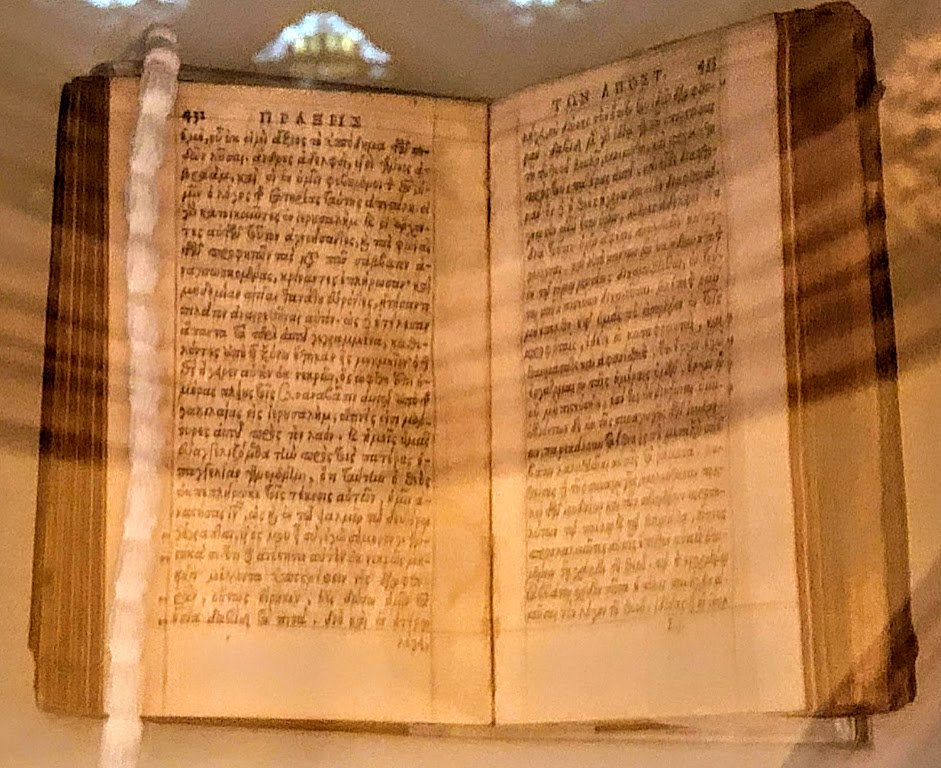
A Greek New Testament in the library in Lichfield Cathedral was published in Paris in 1569 (Photograph: Patrick Comerford)
Today’s Reflections:
My idea of indulgence is spending hours on end in the bookshops – new and second-hand – in Dublin, in Cambridge and in Oxford, and I still miss the old Staffs Bookshop in Lichfield, once my favourite second-hand bookshop.
But, as I navigate my way through the aisles and shelves of bookshops, I find I cannot help noticing the very limited versions of Bibles on many shelves. I seldom set out to buy a new Bible – my bookshelves have been stacked with a variety of translations and versions, usually known by their Initials (NRSV, NRSVA, JB, RSV, NIV, AV … ), and with Bibles in many languages, including English, Irish, Greek, Hebrew, French, Italian, Latin and Chinese – bought in Shanghai … I once had a version in Xhosa, bought in South Africa.
For a long-time I I clung onto some of these Bibles, even when they were bruised and battered, torn and dog-eared. I still have a King James Version that I think I was given during my school days.
There was a Living Bible, paraphrased by Kenneth Taylor … this version was printed in 1972 and sold for £1. It was heavily marked and stained, having endured being packed into rucksacks and travelling with me as I hitch-hikeded around Ireland and England at the age of 20.
My copy of the New English Bible had a note of where and when it was bought over 50 years ago: ‘Lichfield, 10.9.1973’ … I still remember that day, because the coup against Allende was staged in Chile the following day. The art nouveau illustrations by Horace Knowles are still a pleasure to come across.
I bought my first version of the Common Bible, with its ecumenical presentation of western and eastern canonical books, when I was working in Wexford in 1974. It was a paperback edition that fell apart through years of use, and was replaced over time with a later edition.
My many copies of the NRSVA have been lost, misplaced, borrowed or lent over the years, and the latest copy was found in the basement of the Oxfam bookshop on St Giles in Oxford.
A range of translations and commentaries is important for anyone who is interested in Biblical scholarship. And so, I was a little surprised at the very limited range of Bibles available on the shelves of one bookshop recently: four stacks of the King James Version, and one copy of the English Standard Version … and that was it.
The translations of the Bible we favour indicate a theological bias even before we start reading it.
The beauty of the English language in the King James Version is beyond question. Its influence on literary English places it alongside the works of Chaucer and Shakespeare and the Book of Common Prayer.
But, apart from historical, dramatic, poetic or comparative reasons, there are limited reasons for using the King James Version today, and if this was given to someone today as their first Bible, I would not expect them to continue reading it for very long.
The single, sole alternative of the English Standard Version in that bookshop that particular day took me aback.
There is a saying in Italian that I learned in Ealing Abbey while studying patristic and liturgical Latin: Traduttore, traditore – ‘The translator is a traitor.’
Every translation of the Bible is an interpretation as well as a translation, and the new text always betrays the old prejudices of the translators.
There was an interesting debate in the letters columns of the The Tablet some years ago when the Roman Catholic bishops of England and Wales approved the English Standard Version for a revised Lectionary.
The Irish-born historian Eamon Duffy, Emeritus Professor of the History of Christianity at Cambridge and author of The Stripping of the Altars, finds the ESV reflects ‘a deep-rooted dimension of Anglophone culture.’
He finds the Jerusalem Bible ‘is often woefully flat-footed, most painfully-obvious in Passiontide and at Christmas, when what is read in our churches falls so far short of versions given familiarity and valence by their presence in cultural touch-points like Handel’s Messiah or the Festival of Nine Lessons and Carols.’
Dr Sara Parvis of the University of Edinburgh was generously kind when she described the ESV as a ‘low-church evangelical Protestant translation.’ Neil Xavier O’Donoghue of Saint Patrick’s College, Maynooth, conceded that the ESV ‘was produced by conservative Evangelical scholars in the United States and is often described as Calvinist in philosophy.’
In fact, the ESV is deeply ‘fundamentalist,’ unnecessarily imposing the translators’ extreme ‘conservative evangelical’ views and dogmas on the text and on the reader.
The ESV’s general editor, Wayne Grudem, argued in paper published in 2016 ‘Why Voting for Donald Trump Is a Morally Good Choice.’
In recent years, Grudem and his colleagues have challenged the consensus on the Trinity, arguing that Christ is eternally subordinate to God the Father and that this provides a pattern for how men and women should relate to each other – that is, women should be subordinate to men.
This is a radical departure from what the Church has taught for more than 1,500 years, and a serious misunderstanding of a core Christian belief that needs to be rejected by anyone concerned for biblical orthodoxy.
The concept of the Eternal Subordination of the Son (ESS) has been created by Grudem and the Neo-Calvinists. Grudem, Bruce Ware of Southern Baptist Theological Seminary, Owen Strachen, and other Neo-Calvinists believe that Christ submitted to God for all eternity, a concept that reflects the teachings of Arius of Alexandria. Arianism is the belief that the Father, and the Son, and the Holy Spirit are not equal, instead Jesus was created by God and is eternally subordinate to the Father.
Grudem and his supporters have been challenged by some leading evangelicals, including Carl Trueman and Liam Goligher, who have asked whether he is creating a new deity. They have contrasted statements from Grudem and Ware with quotations from the historic creeds.
One critic concluded: ‘It comes down to this; if they are right we have been worshipping an idol since the beginning of the church; and if they are wrong they are constructing a new deity – a deity in whom there are degrees of power, differences of will, and diversity of thought. Because, mark this, to have an eternally subordinate Son intrinsic to the Godhead creates the potential of three minds, wills and powers. What they have done is to take the passages referring to the economic Trinity and collapse them into the ontological Trinity.’
Grudem also drafted the ‘Guidelines’ of the Council of Biblical Manhood and Womanhood (1997) that reject gender-inclusive approaches. This is due to their patriarchy-based objective of excluding women from leadership in the Church. But it may explain why the ESV, again and again, uses masculine pronouns and male gender-specific words that are absent from the Greek original, where other translations do not.
For example, although the ESV in its preface claims that ‘people rather than men is regularly used where the original languages refer to both men and women,’ this is not so. A good example would be when the generic Greek ἄνθρωποι (anthropoi), ‘human beings,’ is used to refer to a mixed group containing both women and men. To translate the term ‘men’ in such a case is in fact to misrepresent the meaning of the word since women were also present and were not mere ciphers or appendages of the men present.
But there are at least 100 instances in the ESV New Testament where ‘men’ translates the Greek ἄνθρωποι.
In some places the word ‘men’ is even added unnecessarily. For example, πρῶτοι τοῦ λαοῦ (protoi tou lao), ‘leaders of the people’ (NRSV and RNJB) or, more literally, ‘the first in rank among the people,’ in Luke 19: 47, becomes ‘principal men of the people’ in the ESV.
Earlier, the ESV translate Luke 18: 27, ‘What is impossible with man is possible with God.’ The NRSV renders this as, ‘What is impossible for mortals is possible for God.’ The original Greek says, Τὰ ἀδύνατα παρὰ ἀνθρώποις δυνατὰ παρὰ τῷ θεῷ ἐστιν.
The ESV translates I Corinthians 1: 25 as ‘For the foolishness of God is wiser than men, and the weakness of God is stronger than men.’ The NRSV says, ‘For God’s foolishness is wider than human wisdom, and God’s weakness is stronger than human strength.’ The RNJB says, ‘God’s folly is wiser than human wisdom, and God’s weakness is stronger than human strength.’ The original Greek says, ὅτι τὸ μωρὸν τοῦ θεοῦ σοφώτερον τῶν ἀνθρώπων ἐστίν, καὶ τὸ ἀσθενὲς τοῦ θεοῦ ἰσχυρότερον τῶν ἀνθρώπων.
When I am asked to recommend ‘versions’ of the Bible, I say without hesitation, ‘read the original.’ There is nothing to compare with wrestling with the original texts in Hebrew and Greek. But if I must recommend a translation to students and readers then it is the RSV and NRSV, for their scholarship and despite all their weaknesses.
Have I ever recommended the ESV?
Never.
Why?
Traduttore, traditore.
Bibles on a shelf in a bookshop … which translation would you recommend? (Photograph: Patrick Comerford)
Today’s Prayers (Sunday 25 October 2026, Bible Sunday):
The theme this week (25 to 31 October) in Pray with the World Church, the prayer diary of the Anglican mission agency USPG (United Society Partners in the Gospel), is ‘Update from Myanmar’ (pp 50-51). This theme was introduced today with a programme update from the Revd Davidson Solanki, Senior Regional Manager for Asia and the Middle East, USPG:
On 28 March 2025, a 7.7-magnitude earthquake hit central Myanmar, destroying homes, churches, and important infrastructure. Many communities were already struggling because of ongoing conflict and displacement since the 2021 military coup. The Church in Myanmar (CPM), together with USPG, responded quickly with emergency relief, putting faith into action by supporting those most in need.
Since then, CPM has been strengthening its longer-term development work. Church staff and leaders have met in workshops and discussions to reflect on what they have learned in the field, look at the impact of their programmes, and agree on shared priorities. This has helped ensure that work across dioceses is better coordinated and shaped by local communities.
This teamwork between leaders and practitioners is helping CPM move from short-term crisis response to more planned and sustainable programmes. Bishops have affirmed that development is a key part of the Church’s mission and have committed to supporting staff, improving systems, and reducing reliance on outside funding.
The aim is simple but important: to help communities be better prepared not only for emergencies like earthquakes, but also for ongoing social and economic challenges. Faith, experience, and leadership are coming together to build stronger, more resilient communities.
The USPG Prayer Diary today (Sunday 25 October 2026, Bible Sunday) invites us to pray:
Bible Sunday in the Anglican Church is a day to celebrate Scripture as God’s living Word, shaping our faith, worship, and daily life.
Consider: how would you summarise the Gospel in 60 seconds? Perhaps you could take inspiration from the lectionary reading for today, Matthew 22: 34-46, where Jesus teaches the greatest commandments: to love God and love our neighbour.
A copy of William Bedell’s Bible in Irish in a bookshop window in Camden Street, Dublin (Photograph: Patrick Comerford)
The Collect of the Day:
Blessed Lord,
who caused all holy Scriptures to be written for our learning:
help us so to hear them,
to read, mark, learn and inwardly digest them
that, through patience, and the comfort of your holy word,
we may embrace and for ever hold fast
the hope of everlasting life,
which you have given us in our Saviour Jesus Christ,
who is alive and reigns with you,
in the unity of the Holy Spirit,
one God, now and for ever.
The Post Communion Prayer:
God of all grace,
your Son Jesus Christ fed the hungry
with the bread of his life
and the word of his kingdom:
renew your people with your heavenly grace,
and in all our weakness
sustain us by your true and living bread;
who is alive and reigns, now and for ever.
Additional Collect:
Merciful God,
teach us to be faithful in change and uncertainty,
that trusting in your word
and obeying your will
we may enter the unfailing joy of Jesus Christ our Lord.
Yesterday’s Reflections
Continued Tomorrow:
I always recommend reading the Bible in the original texts … bookshelves in the synagogue in Porto (Photograph: Patrick Comerford)
Scripture quotations are from the New Revised Standard Version Bible: Anglicised Edition copyright © 1989, 1995, National Council of the Churches of Christ in the United States of America. Used by permission. All rights reserved worldwide. http://nrsvbibles.org
Subscribe to:
Posts (Atom)