COMERFORD WAY: Patrick Comerford’s online journal on Anglicanism, theology, spirituality, history, architecture, travel, poetry, beach walks ... and more
Good Habit, a new café opened last month by Blackfriars at 32 St Giles, Oxford (Photograph: Patrick Comerford, 2026)
Patrick Comerford
I think I may have found my new favourite café in Oxford – and it only opened last month.
Good Habit is a new café that was opened by Blackfriars at 32 St Giles in September 2026. It is now open seven days a week, and it was a good place to have lunch earlier this week immediately after spending a little time browsing through the religions and theology section in the basement of the nearby Oxfam bookshop on the corner of St Giles and Pusey Street.
Good Habit is at the top of St Giles, near Little Clarendon Street, and opposite Saint Giles Church. It has a stylish façade with large picture windows, and the elegant and spacious interior has décor that is inspired by Blackfriars Priory.
Good Habit is managed independently from Blackfriars Priory, and has been created to serve both the general public and the Dominican community at Blackfriars, providing meals and other social events for the student body and the academic staff of Blackfriars, and sometimes you can even bump into one of the Dominican friars there.
Good Habit is run on a profit-sharing basis, meaning that if the café is successful as a business, then this brings a financial benefit to Blackfriars, supporting its work as an educational institution within Oxford University.
Good Habit is a stylish café and events space in a former bank (Photograph: Patrick Comerford, 2026)
Good Habit was created with the generous support of alumni of Blackfriars, friends and grant-makers. The unit, at 33 St Giles was a bank until 2018 and has been transformed into a stylish café and events space billing itself as a spot for ‘coffee and bakery’. Planning permission was secured by the Dominican Order earlier this year, and permission to display signs and install a canopy with café followed soon after.
When it opened, café staff posted on Facebook: ‘Come and visit us at the north end of St Giles in Oxford, just opposite Saint Giles churchyard – we recommend the Guinness cake!’
In the summer, Father John O’Connor, Regent of Blackfriars Priory, said: ‘At long last we have planning permission, we have the workers on site, and things are moving really quickly with a view to an opening during the summer. It’s a great project, it’s going to be a retail café during the day, buzzing with lots of activity, and then in the evening there’ll be opportunities for Blackfriars Hall events, events for the community, and also events for the wider public as well, in what I think is a wonderful part of Oxford that is buzzing in so many different ways.’
The fare at Good Habit … ‘a great café and a great space for everybody’ (Photograph: Patrick Comerford, 2026)
Rich Sewell, manager of the new café, said he had been looking forward to opening Good Habit: ‘I’ve been working with Blackfriars now for the last couple of years and it’s really great to see how this project has been developing.’
He promised ‘a great café and a great space for everybody – the public and for Blackfriars students to enjoy.’
The vegetarian and vegan options are many, the coffee is as could as I expected, and I enjoyed an early lunch this week before heading off to look at some college and hospital chapels and their stained glass windows.
Dropping into Good Habit for coffee or lunch could become a good habit in the weeks and months to come each time I visit Oxford.
Good Habit is run on a profit-sharing basis, supporting the work of Blackfriars as an educational institution within Oxford University (Photograph: Patrick Comerford, 2026)
Stony Last Thursday History Society,
Stony Stratford Library,
29 October 2026 (2:30 pm)
Introduction:
As we were arriving this afternoon, I was playing ‘Zorba’s Dance’ from the 1964 classic Hollywood film Zorba the Great. Today, the dance and the music are regarded as quintessentially Greek, by Greek and non-Greek alike. But back in 1964, both the music and dance were newly composed and newly choreographed. The dance was invented on the film set, and the music was written especially for the film by the composer Mikis Theodorakis.
The film is based on the book, Zorba the Greek, a work of modern Greek literature by Nikos Kazantzakis, one of the great writers of the 20th century. I have tried to read it in the original Greek, with its beautiful opening descriptions of the landscape of Crete. It was first published in Greek 80 years ago, in 1946. I have known the writer’s family for decades, written about him often, and I have visited his grave on the walls above Iraklion.
So, when I moved to Stony Stratford over four years ago, I was surprised to find a link – however distant and tenuous – between Stony Stratford and Zorba the Greek.
This afternoon I want to share with you a ‘Stony Story’ of music, film and dance, of stained glass windows and romance, of love, abandonment and divorce, a story that links Stony Stratford and the stars of Hollywood, and a story that also draws in the Pre-Raphaelite artists of the Victorian age.
But, to put our conversations into context this afternoon, to weave together your memories and my stories, could I begin by tapping into your memories:
• How many of you have seen Zorba the Greek?
• How many of you have seen The Ten Commandments?
• How many of you are familiar with the names of Anthony Quinn … Cecil B DeMille … Nikos Kazantzakis?
• And, are you are familiar with the stained glass windows in Saint Mary and Saint Giles Church?
There are 12 windows in the church, and they include:
• a two-light window at the west end by Charles Eamer Kempe, depicting three archangels;
• a set of three windows in the south gallery, among them important work by John Groome Howe of the Hardman studios;
• two separate windows in the south gallery with fragments from an earlier window;
• and six windows – three below the gallery on the south wall and three below the gallery on the north wall – by NHJ Westlake of Lavers & Westlake.
I want us to concentrate first of all on the three small windows below the gallery on the north wall, which are paired with the three small windows below the gallery on the south wall, all six by Nathaniel Westlake.
Window 1, North side:
The first window at the east end of the north wall in Saint Mary and Saint Giles Church, Stony Stratford, is by NHJ Westlake, in memory of the Revd John William Spark (Photograph: Patrick Comerford)
The first window by Westlake at the east end of the North Wall in Saint Mary and Saint Giles is dated 1889, and is in memory of the Revd John William Spark, who was the assistant curate in Stony Stratford for six years.
This window is of three eyelets and depicts three Biblical scenes: Moses and the Burning Bush; the Annunciation; the Expulsion of Adam and Eve from Eden.
Moses and the Burning Bush, depicted in the first window on the north wall in Saint Mary and Saint Giles Church, Stony Stratford (Photograph: Patrick Comerford)
John William Spark was born in 1858, the son of Peter Spark, a farmer of Meldreth, near Whittlesford, Cambridgeshire, and later of Babraham. He was educated at Saint John’s College, Oxford (BA 1880, MA 1885), and was an assistant curate in Stony Stratford for six years. He left £50 in his will towards providing better vestry accommodation, and this money formed the nucleus of a fund for building the new vestries, designed by Edward Swinfen Harris.
The Annunciation depicted in the first window in the north wall in Saint Mary and Saint Giles Church, Stony Stratford (Photograph: Patrick Comerford)
This window is one of two in the church in Spark’s memory. Each panel in this window depicts an angel speaking the word of God. The first two panels offer images of listening to the message of God: Moses listens to the word of God, depicted as an angel in the Burning Bush; the Virgin Mary listens to the annunciation of the Gospel by the Archangel Gabriel; and an angel tells Adam and Eve to leave the Garden of Eden.
The Expulsion from Eden … a panel in the first window on the north wall in Saint Mary and Saint Giles Church, Stony Stratford (Photograph: Patrick Comerford)
The depiction of the expulsion of Adam and Eve may seem an unusual image in a memorial window. However, it may indicate the early departure of a man who had arrived in a parish he could have expected to be a new Eden, only to be taken away at an early stage.
Window 2, North side:
The second window in the north wall in Saint Mary and Saint Giles Church by NHJ Westlake, in memory of the Revd John William Spark (Photograph: Patrick Comerford)
The second window in the North Wall in Saint Mary and Saint Giles is dated 1889. It is by Westlake and is second of two sets of windows in memory of the Revd John William Spark, who was in Stony Stratford for six years.
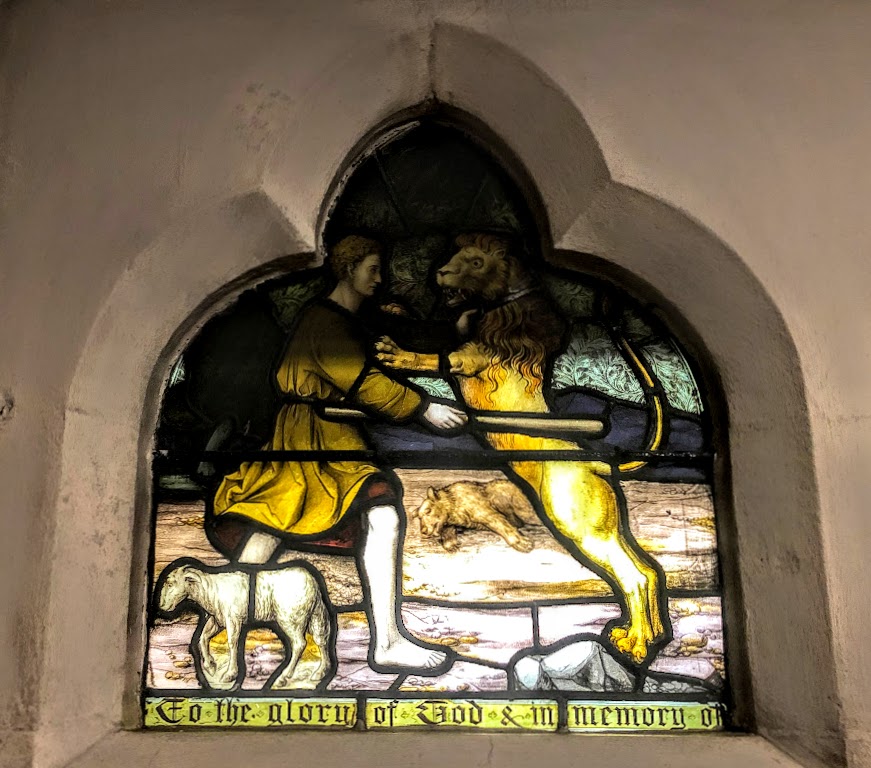
This window is of three eyelets and each panel in this window depicts a good shepherd: David killing a lion (see I Samuel 17: 34-37); Christ the Good Shepherd (John 10: 11-18); and the Sacrifice of Abel (Genesis 4: 2).
David killing a lion (see I Samuel 17: 34-37) depicted in the second window on the north wall in Saint Mary and Saint Giles Church, Stony Stratford (Photograph: Patrick Comerford)
Before going into battle with Goliath, David told Saul how he had risked his life for the sheep in flock, killing lions and bears: ‘… whenever a lion or a bear came, and took a lamb from the flock, I went after it and struck it down, rescuing the lamb from its mouth; and if it turned against me, I would catch it by the jaw, strike it down, and kill it. Your servant has killed both lions and bears … the Lord, who saved me from the paw of the lion and from the paw of the bear, will save me from the hand of this Philistine’ (I Samuel 17: 34-37).
Christ the Good Shepherd (John 10: 11-18) depicted in the second window in the north wall in Saint Mary and Saint Giles Church, Stony Stratford (Photograph: Patrick Comerford)
In Saint John’s Gospel, Christ describes himself twice in one passage as the Good Shepherd: ‘I am the good shepherd. The good shepherd lays down his life for the sheep. … I am the good shepherd. I know my own and my own know me, just as the Father knows me and I know the Father. And I lay down my life for the sheep’ (John 10: 11-15).
The Sacrifice of Abel (Genesis 4: 2) … a panel in the second window on the north wall in Saint Mary and Saint Giles Church, Stony Stratford (Photograph: Patrick Comerford)
The third panel recalls Abel the Shepherd and his sacrifice: ‘Abel was a keeper of sheep, and Cain a tiller of the ground. In the course of time Cain brought to the Lord an offering of the fruit of the ground, and Abel for his part brought of the firstlings of his flock, their fat portions. And the Lord had regard for Abel and his offering’ (Genesis 4: 2-4).
We could summarise these three panels as reminding the parishioners of Stony Stratford that the Revd John William Spark, their curate who died a young man, had risked his life for them, made a perfect sacrifice, and was a faithful shepherd.
Window 3, North Wall:
The third window on the north wall by NHJ Westlake is in memory of Amy (Hunt) Lester, wife of the Revd John Moore Lester (Photograph: Patrick Comerford)
The third window in the North Wall in Saint Mary and Saint Giles, and the one I really want to focus on this afternoon, is dated 1895. It is also by Westlake, who was commissioned by Edward Swinfen Harris (1841-1924). Again, this window depicts three Biblical scenes:
• Enoch taken up to heaven by angels without dying (see Genesis 5: 21-24);
• the Ascension (see Luke 24: 50-53);
• Elijah taken up to heaven in the Chariot of Fire without dying (II King 2: 11-12).
Enoch being taken up to heaven without dying (see Genesis 5: 21-24) … a panel in the third window on the north wall (Photograph: Patrick Comerford)
The Ascension (see Luke 24: 50-53) … a panel in the third window in the north wall in Saint Mary and Saint Giles Church (Photograph: Patrick Comerford)
Elijah is taken up to heaven in the Chariot of Fire without dying (II King 2: 11-12) … a panel in the third window on the north wall in Saint Mary and Saint Giles Church, Stony Stratford (Photograph: Patrick Comerford)
Enoch and Elijah are both said to have been taken into heaven without dying. These images, along with central panel depicting the Ascension, are illustrations of the Christian hope of eternal life.
This window is in memory of Amy (Hunt) Lester (1850-1895), the wife of the Revd John Moore Lester (1851-1884), who was the Vicar of Stony Stratford in 1880-1884. They were married in Christ Church, Lancaster Gate, Westminster, in 1877 and they were the parents of nine children. She died on 30 October 1895.
The Revd John Moore Lester was the Rector of Stony Stratford in 1880-1884. He was born in Mumbai (Bombay), a son of General Sir Frederick Lester, and was educated at Rugby and University College Oxford.
From Stony Stratford, he went on to be the Vicar of Holy Trinity Church, Ayr (1884), Vicar of Shifnal, Shropshire, and a Rural Dean in the Diocese of Lichfield (1891), Vicar of Yarcombe, Devon (1903), Rector of Saint Leonard’s, Bridgnorth (1905), and finally Rector of Litchborough, near Towcester in Northamptonshire, 15 miles north-west of Stony Stratford. He died at Litchborough Rectory on Christmas Eve 24 December 1919.
Lieutenant Edward Gabriel Lester (1887-1917) … died at the Battle of Vimy Ridge in France on 25 June 1917
Amy Lester’s son, Edward Gabriel Lester (1887-1917), was the father of the Canadian-born American actor Katherine Lester DeMille. She was the adopted daughter of the director Cecil B DeMille, she married Anthony Quinn, she was considered Hollywood royalty, she played 25 credited film roles from the mid-1930s to the late 1940s, and she was noted for her dark beauty.
Katherine Lester DeMille was born Katherine Paula Lester in Vancouver on 29 June 1911. Her birth father, Edward Gabriel Lester, was born in Scotland shortly after his father had moved from Stony Stratford to Ayr. He became a teacher, moved to Canada and married Cecile Bianca Bertha Colani, who was of Italian descent and a daughter of the architect Johann Colani. During World War I, Edward Lester became a lieutenant in the Canadian army and was sent to France.
Four days before Katherine’s sixth birthday, her father died of multiple wounds at the Battle of Vimy Ridge in France on 25 June 1917, during World I. Her mother, Cecile Bianca Bertha (Colani), was terminally ill, and travelled to California, supposedly to find Katherine’s paternal grandparents and to leave the little girl with them.
However, the child’s grandmother, who is commemorated in this window in Stony Stratford, had died more than 20 years earlier, in 1895, and the child’s grandfather was then living in Northamptonshire. Katherine’s mother died less than three years later, in a Los Angeles hospital on 18 March 1920, without ever making contact with her husband’s parents, the child’s grandparents.
By then, Katherine had been placed in an orphanage in Los Angeles. Just weeks before her grandfather’s death, when she was eight, she was found in the orphanage by Constance Adams DeMille (1873-1960), the wife of the Hollywood producer and director Cecil B DeMille (Cecil Blount de Mille, 1881-1959). The DeMille family presumed she had no living relatives and adopted her as their third child in 1922.
Katherine Lester DeMille was born Katherine Paula Lester in Vancouver on 29 June 1911
Katherine, still in her late teens, gained experience on stage in 1930, acting as the understudy for the feminine ‘heavy’ of the play ‘Rebound’ in San Francisco. She wanted to begin an acting career on her own and used the stage name Kay Marsh whenever she worked as an extra. Her first credited role was as Rosita Morales, the wife of Wallace Beery’s Pancho Villa, in the MGM film Viva Villa! (1934), the story of the Mexican bandit, Pancho Villa.
She played another Mexican woman that year, a maid named Lupe, in the Paramount production The Trumpet Blows (1934), and her performance brought a contract with Paramount Pictures. Her next role was as Molly Bryant, the nemesis of Mae West’s character in Belle of the Nineties (1934).
Katherine played the second female role in All the King’s Horses (1935) at Paramount, and was loaned to Columbia Pictures for The Black Room (1935) and to 20th Century Fox for Call of the Wild (1935).
The role of Princess Alice of France in The Crusades (1935) was a Christmas gift from her father, Cecil B DeMille. Andre Sennwald of The New York Times said ‘that striking brunette, Katherine De Mille’, was one of the actors who gave ‘excellent performances’ in the film.
She also starred in The Sky Parade (1936). Paramount then cast her in two more leading roles; she was the sister of Buster Crabbe in the Western Drift Fence (1936) and a parachutist and the romantic interest of William Gargan in the aviation drama The Sky Parade (1936). She returned to MGM to play the uncredited role of Rosaline, Romeo’s first love, in the 1936 film adaptation of Shakespeare’s Romeo and Juliet.
The 20th Century Fox studio cast her in the role of Margarita in the 1936 Technicolor film version of the Helen Hunt Jackson novel Ramona, starring Loretta Young as the title character. She was Barbara Stanwyck’s rival for the love of Joel McCrea in Banjo on My Knee (1936) and played the main female role in Charlie Chan at the Olympics (1937).
Katherine married the actor Anthony Quinn (1915-2001), star of Zorba the Greek (1964), in All Saints’ Episcopal Church, Beverly Hills, on 2 October 1937, and they were the parents of five children. She became a naturalised US citizen a year later in 1938.
After their marriage, she continued her career at 20th Century Fox and other studios. She had third billing in The Californian (1937) and played a smaller part in Love Under Fire (1937). She went to Columbia Pictures to co-star as Jack Holt’s leading lady in Under Suspicion (1937). She had a minor role in Walter Wanger’s Blockade (1938), a drama about the Spanish Civil War. Again at Columbia, she had the leading female role in another Jack Holt film, Trapped in the Sky (1939).
Katherine played supporting roles in the Roy Rogers film In Old Caliente (1939), the RKO adventure Isle of Destiny (1940), the Columbia mystery film Ellery Queen, Master Detective (1940), the Universal mystery film Dark Streets of Cairo (1940), and Paramount’s Technicolor adventure Aloma of the South Seas (1941).
She retired from films in 1941 to dedicate her time to her family. But after a six-year absence, she returned to the screen in 1947 when she co-starred with Anthony Quinn, for the first and only time in the Allied Artists drama Black Gold (1947). One critic said she deserved to share Quinn’s ‘highest acting compliment … The tender byplay of their mutual understanding, respect and love provide the refreshingly different romance of the picture.’ Another critic wrote: ‘Katherine DeMille does splendid work as Quinn’s wife, who has had good schooling, but is a loyal, obedient helpmeet.’ And another commended the performances of the couple: ‘As to the acting, both Anthony Quinn and Katherine DeMille rise to the occasion.’
Her father cast her in a supporting role in his epic Unconquered (1947), starring Gary Cooper and Paulette Goddard. Her final credited role was Lucille Strang, the wife of Milburn Stone’s character, in the film noir The Judge (1949), directed by Elmer Clifton.
Her husband Anthony Quinn (1915-2001) was born Manuel Antonio Rodolfo Quinn Oaxaca in Chihuahua, Mexico, and denied being the son of an ‘Irish adventurer.’ He said his mother Nellie had Aztec ancestors, while his father, Frank Quinn, was the Mexican-born son of an Irish immigrant and once rode with Pancho Villa.
The couple were the parents of five children: Christopher (1939-1941), Christina (born 1941), Catalina (born 1942), Duncan (born 1945), and Valentina (born 1952). The eldest child, Christopher, was two when he found drowned in the lily pond in the garden of their next-door neighbour WC Fields.
Katherine accepted the 1953 Academy Award for Best Supporting Actor on behalf of her husband for his portrayal of Eufemio Zapata in Viva Zapata! (1952), when Quinn was not present at the ceremony. At the same ceremony, her father received the Academy Award for Best Picture for his film The Greatest Show on Earth.
Anthony Quinn was not a faithful husband. He wanted a divorce so that he could the children he had with an Italian costume designer Jolanda Addolori. In December 1964, the year Zorba the Greek was made, Quinn sued DeMille for divorce in Ciudad Juárez, Mexico, and ‘listed incompatibility in the suit as grounds for divorce.’ They were divorced on 21 January 1965.
Katherine retained her married name Quinn. Around 1988, she moved from Pacific Palisades to Tucson, Arizona, to live with one of her daughters and grandchildren. She had Alzheimer's disease when she died in Tucson on 27 April 1995 at the age of 83. Her former husband, Anthony Quinn, died in 2001.
In his autobiography, her father wrote that she ‘has carried the name DeMille on for another generation in motion pictures as a talented actress.’ Her brother, Richard de Mille, later remembered: ‘I was wild about Katherine. She was extremely lovable and beautiful, a terrific combination. Was she ill-used by Quinn? Absolutely, but not in a way that she resented. She was always in love with him. Cecil had respected Constance and always treated her fairly; I don’t think Quinn treated Katherine fairly.’
Katherine Lester DeMille, adopted daughter of Cecil B DeMille, was a granddaughter of Amy Lester of Stony Stratford
Nathaniel Hubert John Westlake (1833-1921):
These windows are by NHJ Westlake of Lavers & Westlake, and were probably commissioned by the Stony Stratford architect Edward Swinfen Harris (1841-1924), whose works, mainly in the Arts and Crafts style, can be seen throughout Stony Stratford.
The artist Nathaniel Hubert John Westlake (1833-1921) was born in Romsey in 1833. He worked under William Burges for a while before joining the London-based stained-glass firm of Lavers and Barraud in 1868, having designed for the firm since 1858. The firm was first established by Nathaniel Wood Lavers (1828-1911) in 1855.
Westlake’s knowledge of mediaeval art, his Pre-Raphaelite style and his simplification of previously over-elaborate drawing brought the firm fame and success in the 1860s. A leading designer of the Gothic Revival movement, his works include ‘The Vision of Beatrice’ (1864), commissioned for an exhibition of stained glass at the South Kensington Museum, now the Victoria and Albert Museum.
Westlake later became a partner and eventually, in 1880, the sole proprietor of Lavers, Barraud & Westlake.
Westlake designed windows in in Saint Paul’s Cathedral, London, and Worcester and Peterborough Cathedrals, and in other prominent churches, including Saint Martin le Grand, York. He also designed windows in the college chapel at Saint Patrick’s College, Maynooth, Co Kildare, and the ceiling and Stations of the Cross in the college chapel in Maynooth.
As the Aesthetic movement gathered momentum, the colour of his stained glass became diluted.
Between 1881 and 1894, Westlake published four volumes, A History of Design in Painted Glass. He also contributed an article on mosaics to the Catholic Encyclopaedia.
Lavers & Westlake were commissioned to reglaze two central lights in the great hall windows at Mary Datchelor Girls’ School, Camberwell, in 1896. The subjects were ‘Lady Jane Grey discourses with Roger Ascham’ and ‘By Industry and Perseverance,’ symbolising the importance of female endeavour in higher education. Other windows included ‘On the way to Chapel,’ ‘Physical Exercise,’ ‘The Kindergarten’ and ‘The Classroom.’ The windows were removed from the school in 2010 after it was converted into a series of apartments.
The firm changed its name several times with the arrival and departure of each partner. Francis Barraud (1824-1900) had joined the practice from James Powell & Sons. When he died in 1900, the firm was known as Lavers, Westlake and Co, although Westlake had been the sole proprietor since 1880.
The company became NHJ Westlake after 1909, but it closed after Westlake died in Brighton on 8 May 1921.
Window 1, South Wall:
The first window at the east end of the south wall in Saint Mary and Saint Giles Church, Stony Stratford, is one of a series of windows by NHJ Westlake of Lavers & Westlake (Photograph: Patrick Comerford)
The first window at the east end of the South Wall in Saint Mary and Saint Giles Church below the gallery is of three eyelets and depicts two angels worshipping the Lamb on the Throne, Agnus Dei, an image from the Book of Revelation; the Crucifixion, with the Virgin Mary and Saint John keeping watch with the Crucified Christ as they stand at the foot of the cross; and Moses with Aaron and Hur holding up his arms.
In each of these three panels, the central figure – the Lamb on the Throne, the Crucified Christ and the ageing Moses – have two supporting figures: two angels, the Virgin Mary and Saint John, and Aaron and Hur.
During Joshua’s battle with Amalek at Rephidim, the Book Exodus recalls, ‘Moses’ hands grew weary; so they took a stone and put it under him, and he sat on it. Aaron and Hur held up his hands, one on one side, and the other on the other side; so his hands were steady until the sun set. And Joshua defeated Amalek and his people with the sword’ (Exodus 17: 12-13).
Window 2, south wall:
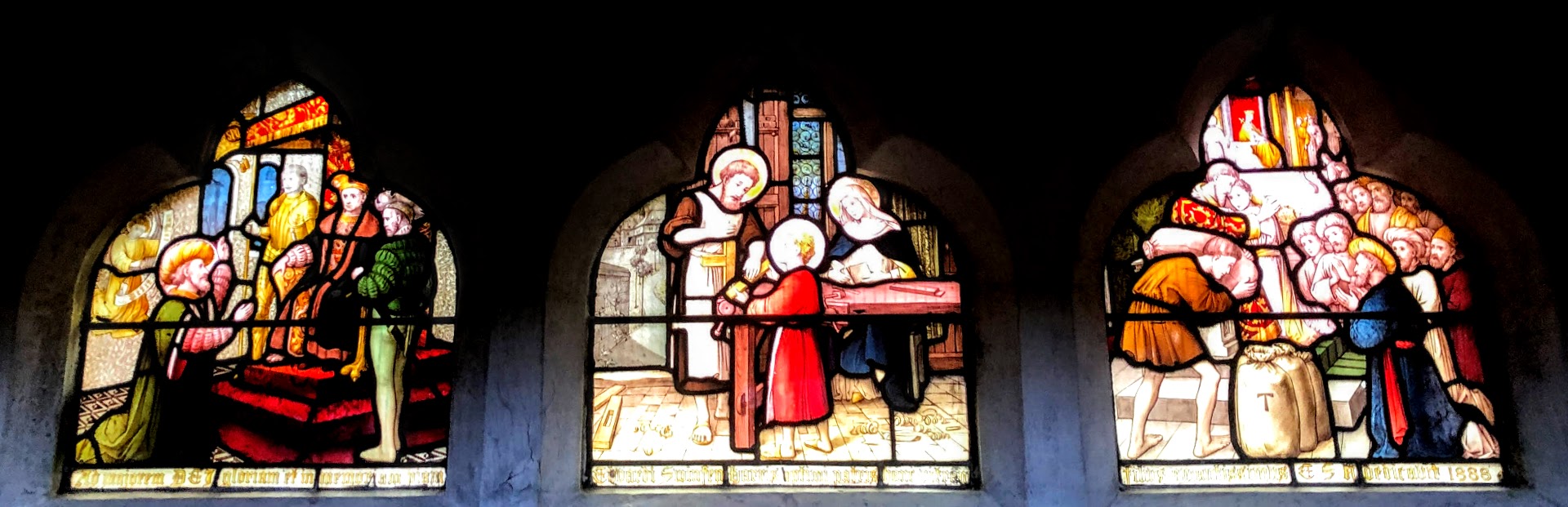
The second window in the south wall in Saint Mary and Saint Giles Church, Stony Stratford, is one of a series of windows by NHJ Westlake, and is dated 1888 (Photograph: Patrick Comerford)
The second window in the South Wall in Saint Mary and Saint Giles Church beneath the gallery is dated 1888. Edward Swinfen Harris commissioned this window in memory of his father, also Edward Swinfen Harris, who was the clerk to the town bench of magistrates, the Board of Guardians and other bodies in the town.
This second depicts three Biblical scenes: Joseph before Pharoah’s throne, interpreting his dreams (Genesis 41: 1-36); Jesus as an apprentice in Joseph the carpenter’s shop, with Joseph and the Virgin Mary (see Luke 2: 39-40); and Joseph’s brothers before him with the silver cup found in Benjamin’s sack (Genesis 44: 1-34).
Each panel depict a Biblical Joseph: Joseph the son sold into slavery in Egypt by his brothers; Joseph with the Christ Child; and Joseph with his brothers.
In the first panel, Joseph stands before Pharoah’s throne, interpreting his dreams (Genesis 41: 1-36). However, the vision he points to in the distance is not the years of plenty, or the years of famine, but Christ Crucified on Calvary.
Jesus as an apprentice in Joseph the carpenter’s shop, with Joseph and the Virgin Mary, depicted in the second window in the south wall in Saint Mary and Saint Giles Church, Stony Stratford (Photograph: Patrick Comerford)
The stories of Christ as an apprentice in the workshop of Joseph the carpenter are popular and pious, but are not found in any Gospel narrative (see Luke 2: 39-40). Nevertheless, this image in the second panel, showing Christ as an apprentice in Joseph the carpenter’s shop, reflects a subject that was popular among the Pre-Raphaelite artists at the time Westlake made this window.
William Holman Hunt (1827-11910) worked on his painting, ‘The Shadow of Death’, in 1870-1873, during his second trip to the Holy Land. It depicts Christ as a young man prior to his ministry, working as a carpenter. He is shown stretching his arms after sawing wood. The shadow of his outstretched arms falls on a wooden spar on which carpentry tools hang, creating a ‘shadow of death’ prefiguring the crucifixion.
Two decades earlier, Holman Hunt’s Pre-Raphaelite colleague John Everett Millais (1829-1896) had portrayed Christ as an apprentice carpenter, helping Joseph as a young boy, in his painting, ‘Christ in the House of his Parents’ (1849-1850).
In the third panel, Joseph’s brothers plead before him with the silver cup found in Benjamin’s sack (Genesis 44: 1-34). In the background, their ageing father with Jacob is being comforted.
In each of these panels, Westlake is suggesting that Edward Swinfen Harris was a loyal and faithful son to his father, the late Edward Swinfen Harris, and that he had learned from him.
Window 3, South Wall:
The third window in the south wall by NHJ Westlake is in memory of Catherine Swinfen Harris (Photograph: Patrick Comerford)
The third window on the South Wall beneath the gallery in Saint Mary and Saint Giles Church is dated 1896. It was commissioned by Edward Swinfen Harris in memory of his mother, Catharine Swinfen Harris, who died on 23 June 1896, at the age of 85.
This third window is of three eyelets and depicts three Biblical scenes: Jacob blesses Joseph’s sons Manasseh and Ephraim with crossed hands (see Genesis 48: 10-22); Christ greets two disciples at night, perhaps James and John, or Peter and Andrew, although this is not indicated on the window.
The story depicted in the first panel recalls how Joseph was Pharoah’s chief minister of Egypt when he took his two sons Manasseh and Ephraim to see his dying father Jacob. Jacob surprised them by deciding to adopt Manasseh and Ephraim as his own sons, and promising them the same inheritance as his other sons, like Reuben and Simeon (verse 5).
It is customary in many Jewish communities for parents to administer a blessing like Jacob’s blessing to Joseph’s sons on Friday nights before the kiddush. As hands are laid on the heads of the boys, the words spoken are: ‘May you be like Ephraim and Manasseh.’
The mother of these two, Asenath, was an Egyptian, and so her family was outside the community of faith. Yet, they are not disqualified from God’s blessings because of their parents’ unconventional marriage.
Traditionally, the eldest son would expect to inherit a double portion, signified by his father blessing him with his right hand. So Joseph placed his firstborn, Manasseh, on Jacob’s right side and Ephraim on his left. However, Jacob crossed his arms and put his right hand on the second born, Ephraim, and his left hand on Manasseh, and then spoke his blessing over both.
This story is a reminder of how God can choose people others think are not qualified or deserving, those who do earn or qualify for a blessing, those you are not next in line. Those who cannot normally expect favour or promotion may receive unexpected blessings.
In this window, Swinfen Harris may be saying that his mother was seen as an outsider but that in life through his parents he found blessings beyond any expectations in his dreams.
The window by Charles Eamer Kempe at the west end of Saint Mary and Saint Giles, Stony Stratford, depicting three archangels: Saint Gabriel above, and Saint Michael and Saint Raphael below (Photograph: Patrick Comerford)
CE Kampe window (west end):
The window at the west end of the church is a two-light depicting three archangels: Saint Gabriel above, and Saint Michael and Saint Raphael below. This window, dated 1903, is by Charles Eamer Kempe (1837-1907).
CE Kempe’s studios produced over 4,000 windows and designed altars and altar frontals, furniture and furnishings, lichgates and memorials that helped to define a later 19th-century Anglican style.
As a student at Pembroke College, Oxford, Kempe was influenced by the Anglo-Catholic Tractarian revival and considered a vocation to the priesthood. Inspired by William Morris’s work, he went to study architecture with the Gothic Revival architect George Frederick Bodley (1827-1907) at a time when Bodley was working on All Saints’ Church, Cambridge. There he learned from both Bodley and William Morris, and Bodley and Kempe became lifelong friends and collaborators.
Kempe’s work was strongly influenced by the Gothic Revival and the Pre-Raphaelite movement. His studios produced over 4,000 windows and designs for altars and altar frontals, furniture and furnishings, lychgates and memorials that helped to define a later 19th century Anglican style.
The English cathedrals with his work include Lichfield, as well as Chester, Gloucester, Hereford, Wells, Winchester and York. I have also written in the past about his windows in the chapel of Saint John’s Hospital, Lichfield and Christ Church, Leomansley, Lichfield.
The Cambridge church historian Owen Chadwick once said Kempe’s work represents ‘the Victorian zenith’ of church decoration and stained glass windows. Kempe was seen by his contemporaries as a Tractarian, but primarily he saw his task ‘to beautify the place in which to celebrate the glory of God.’ His window in Saint Mary and Saint Giles Church offers an interesting illustration of this principle.
Three south gallery windows:
Six apostles, James, Peter, John, Thomas, Andrew and Saint James the Less, seen from inside (above) and outside (below) the church (Photographs: Patrick Comerford)
The first three sets of three-light windows in the south gallery include a window by John Groome Howe of James Powell and Sons (1877).
This first window is dedicated to Josiah Michael and Ann Smith and shows six scenes with themes of the Resurrection or being raised to new life: top, 1, the raising of Jairus’s daughter (Matthew 9: 18-26; Mark 5: 21-43; Luke 8: 40-56); 2, Christ with two disciples on the Road to Emmaus (Luke 24: 13-35); and 3, the raising of the Widow of Nain’s son (see Luke 7: 11-17); below, 1, the raising of Lazarus (John 11:1 -44); 2, the Supper at Emmaus (Luke 24: 13-35); and 3, the healing of Simon Peter’s mother-in-law (Matthew 8: 14-15, Mark 1: 29-31, Luke 4: 38-39).
The firm of James Powell and Sons, also known as Whitefriars Glass, were London-based glassmakers, leadlighters and stained glass window manufacturers. As Whitefriars Glass, the company dated from the 17th century, and it became well-known as a result of the 19th-century Gothic Revival and the demand for stained glass windows.
During the latter part of the 19th century, the firm had close working links with leading architects and designers including TG Jackson, Edward Burne-Jones, William De Morgan and James Doyle, and produced the glass that Philip Webb used in his designs for William Morris. Nathanael Powell’s eldest surviving son, Harry, was an admirer of John Ruskin.
The next two windows in the south gallery are three-light windows depicting 12 apostles, each with six illustrations. Their date and the artist are unknown.
The first depicts: top, Saint James, Saint Peter, Saint John; below, Saint Thomas, Saint Andrew, Saint James the Less. The second depicts (top) Saint Philip, Saint Paul, Saint Bartholomew; and (below) Saint Jude, Saint Simon, Saint Matthew.
A fourth and fifth window in the south gallery show the Risen Christ and the Crucifixion.
The grave of Nikos Kazantzakis on the Martinengo Bastion of the Venetian walls surrounding Iraklion (Photograph: Patrick Comerford)
‘We are not worthy so much as to gather up the crumbs under your table’ (the Prayer of Humble Access) … preparing bread in Ouranoupolis on Saturday for the Liturgy in a monastery in Mount Athos on a Sunday morning (Photograph: Patrick Comerford)
Patrick Comerford
We are continuing in Ordinary Time in the Church Calendar, and this week leads us into Kingdom-time or the Kingdom Season. This week began with the Last Sunday after Trinity (26 October 2026). The calendar of the Church of England in Common Worship today remembers James Hannington (1847-1885), Bishop of Eastern Equatorial Africa, Martyr in Uganda.
Later this afternoon (2:30 pm), I am speaking at the Stony Last Thursday History Society in Stony Stratford Library on ‘Hollywood Royalty discovered in a stained glass window in Stony Stratford’. In my talk, I am looking at windows by Nathaniel Westlake in Saint Mary and Saint Giles Church, and telling the story of Katherine Lester DeMille, adopted daughter of Cecil B DeMille (The Ten Commandments) and wife of Anthony Quinn, star of Zorba the Greek.
But, before the day begins, before having breakfast, I am taking some quiet time early this morning to give thanks, and for reflection, prayer and reading in these ways:
1, today’s Gospel reading;
2, a short reflection;
3, a prayer from the USPG prayer diary;
4, the Collects and Post-Communion prayer of the day.
‘How often have I desired to gather your children together as a hen gathers her brood under her wings’ (Luke 13: 34) … a painting of Grey’s Guest House on Achill Island, Co Mayo (Photograph: Patrick Comerford)
Luke 13: 31-35 (NRSVA):
31 At that very hour some Pharisees came and said to him, ‘Get away from here, for Herod wants to kill you.’ 32 He said to them, ‘Go and tell that fox for me, “Listen, I am casting out demons and performing cures today and tomorrow, and on the third day I finish my work. 33 Yet today, tomorrow, and the next day I must be on my way, because it is impossible for a prophet to be killed away from Jerusalem.” 34 Jerusalem, Jerusalem, the city that kills the prophets and stones those who are sent to it! How often have I desired to gather your children together as a hen gathers her brood under her wings, and you were not willing! 35 See, your house is left to you. And I tell you, you will not see me until the time comes when you say, “Blessed is the one who comes in the name of the Lord”.’
‘Jerusalem, Jerusalem … How often have I desired to gather your children together’ (Luke 13: 34) … the city of Jerusalem depicted on a tile in a restaurant in Dublin (Photograph: Patrick Comerford)
Today’s Reflection:
As I was preparing for this afternoon’s history talk, I turned back to reading Zorba the Greek, the novel by Nikos Kazantzakis, first published 80 years ago in 1946 as Βίος και Πολιτεία του Αλέξη Ζορμπά (Life and Times of Alexis Zorbas). The narrator, who becomes Basil in the film adaptation film adaptation by Michael Cacoyannis, describes waking one morning and seeing Zorba ‘absorbed in deep meditation … The whole universe of earth, water, thoughts and men was slowly drifting towards a distant sea, and Zorba was drifting away with it, unresistingly, unquestioningly, and happy.’
In another place in the Zorba, Kazantzakis says: ‘We sense happiness with difficulty experiencing it. Only when it has passed and we look back do we suddenly comprehend, while sometimes with astonishment, how happy we have been. I, however, on this Cretan shore, was experiencing happiness while being simultaneously aware of my happiness.’
Zorba has been described as ‘one of the greatest life-affirming novels of our time’. It is the story of God and man, the Devil and the saints, of the struggle of humans to find our souls and purpose in life, and it is about love, courage and faith. Zorba’s life is rich with all the joys and sorrows that life brings and his example awakens in the unnamed narrator an understanding of the true meaning of humanity. It is a lesson in how to find the beauty of life and to discover awe in small things.
Sometimes, when I have stood presiding at or celebrating the Holy Communion or the Eucharist, or when I was preparing the bread for the Eucharist, I found I was taken aback by intense feelings of the love of God.
On one memorable occasion, this happened to me as I was using the ‘Prayer of Humble Access’ at the fraction, when we were breaking the Bread of Communion at the invitation.
It is a prayer that has gone out of fashion in many parishes, but it is a reminder that we come to the Table or the Altar not because of our own goodness, not in spite of our own sinfulness, but because of the overflowing mercy and grace that God gives us freely and with unlimited bounty:
We do not presume to come to this your table,
merciful Lord,
trusting in our own righteousness
but in your manifold and great mercies.
We are not worthy so much as to gather up the crumbs under your table.
But you art the same Lord,
whose nature is always to have mercy.
Grant us, therefore, gracious Lord,
so to eat the flesh of your dear Son Jesus Christ,
and to drink his blood,
that our sinful bodies may be made clean by his body,
and our souls washed through his most precious blood,
and that we may evermore dwell in him, and he in us. Amen.
I was taken aback and was conscious of the love of God unexpectedly that day as I came to those words: ‘We are not worthy so much as to gather up the crumbs under your table.’
What flashed across my mind was a video clip that had gone viral at that time on YouTube and social media, of two small, frail abandoned children caught up in Syria’s bloody civil war, fending for themselves by picking up crumbs of bread from the street to eat.
These two homeless mites, braver than any groups fighting or waging war in Syria, told the camera crew: ‘We go to sleep hungry, we wake up hungry.’
They had been separated from their parents. At the time, the Anglican mission agency, USPG, was working with the plight of Syrian refugees in Lesvos and Athens and other parts of Greece.
In that video clip, the 10-year-old girl said she had been collecting bread crumbs off the street with her brother because their area of Damascus, al-Hajar, has been under siege for more than 15 months.
‘If we had food, you wouldn’t have seen us here,’ she said.
But their final message to the world that had abandoned them was: ‘May you be happy and blessed with what God has given you!’
Europe takes pity on children like this when we see them on YouTube or on the 10 o’clock news. But when they land on our shores in the Aegean Islands in Greece, or make their way up through central Europe and cross the Channel into England, we deem them not worthy to gather up the crumbs under our table.
I have looked at this video clip again and again since then. And I think of the image of Christ in our Gospel reading this morning: ‘How often have I desired to gather your children together as a hen gathers her brood under her wings, and you were not willing!’ (Luke 13: 34)
The children of the world are the future of the world. It does not matter whose children they are. It does not matter how many of them there are: whether they are two children searching for crumbs that I am not worthy to gather up, or small enough to be gathered in by a loving parent, or are countless in numbers like the stars, they are all embraced in the love of the loving and living God. They are all heirs to God’s promises.
And how we respond to them, how I respond to them, shows them what I think, what we think, of God and how much we believe in his promises.
‘Blessed is the one who comes in the name of the Lord’ (Luke 13: 35).
Today’s Prayers (Thursday 29 October 2026):
The theme this week (25 to 31 October) in Pray with the World Church, the prayer diary of the Anglican mission agency USPG (United Society Partners in the Gospel), is ‘Update from Myanmar’ (pp 50-51). This theme was introduced on Sunday with a programme update from the Revd Davidson Solanki, Senior Regional Manager for Asia and the Middle East, USPG.
The USPG Prayer Diary today (Thursday 29 October 2026) invites us to pray:
Gracious God, guide the Church in Myanmar as it moves from emergency relief to sustainable programmes. Let its work reflect your love for those most affected by disaster.
The Collect:
Most merciful God,
who strengthened your Church by the steadfast courage
of your martyr James Hannington:
grant that we also,
thankfully remembering his victory of faith,
may overcome what is evil
and glorify your holy name;
through Jesus Christ your Son our Lord,
who is alive and reigns with you,
in the unity of the Holy Spirit,
one God, now and for ever.
The Post Communion Prayer:
Eternal God,
who gave us this holy meal
in which we have celebrated the glory of the cross
and the victory of your martyr James Hannington:
by our communion with Christ
in his saving death and resurrection,
give us with all your saints the courage to conquer evil
and so to share the fruit of the tree of life;
through Jesus Christ our Lord.
‘We are not worthy so much as to gather up the crumbs under your table’ (the Prayer of Humble Access) … preparing bread for the Eucharist early on a Sunday morning in the Rectory in Askeaton, Co Limerick (Photograph: Patrick Comerford)