Showing posts with label Maroulas. Show all posts

11 July 2026

Daily prayer in Ordinary Time 2026:
65, Saturday 11 July 2026

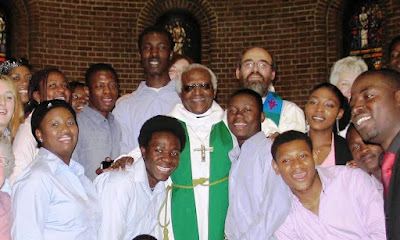
‘But you know, death is not the worst thing that could happen to a Christian’ … with Archbishop Desmond Tutu and members of the Discovery Gospel Choir in Dublin in 2005

Patrick Comerford

We are in Ordinary Time in the Church Calendar and tomorrow is the Sixth Sunday after Trinity (Trinity VI, 12 July 2026). The Calendar of the Church of England in Common Worship today remembers the life and witness of Saint Benedict of Nursia (550), Abbot of Monte Cassino and Father of Western Monasticism.

I may not venture out to the festival in the cricket club later today. But, before I make any decisions about what to do today, I am taking some quiet time this morning to give thanks, to reflect, to pray and to read in these ways:

1, reading today’s Gospel reading;

2, a short reflection;

3, a prayer from the USPG prayer diary;

4, the Collects and Post-Communion prayer of the day.
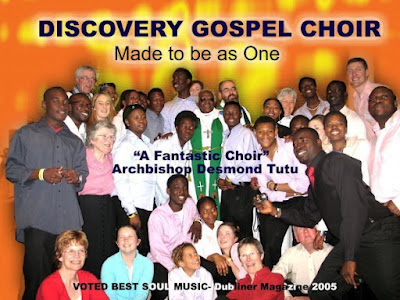
‘But you know, death is not the worst thing that could happen to a Christian’ … with Archbishop Desmond Tutu on the cover of a Discovery Gospel Choir CD

Matthew 10: 24-33 (NRSVA):

[Jesus said:] 24 ‘A disciple is not above the teacher, nor a slave above the master; 25 it is enough for the disciple to be like the teacher, and the slave like the master. If they have called the master of the house Beelzebul, how much more will they malign those of his household!

26 ‘So have no fear of them; for nothing is covered up that will not be uncovered, and nothing secret that will not become known. 27 What I say to you in the dark, tell in the light; and what you hear whispered, proclaim from the housetops. 28 Do not fear those who kill the body but cannot kill the soul; rather fear him who can destroy both soul and body in hell. 29 Are not two sparrows sold for a penny? Yet not one of them will fall to the ground unperceived by your Father. 30 And even the hairs of your head are all counted. 31 So do not be afraid; you are of more value than many sparrows.

32 ‘Everyone therefore who acknowledges me before others, I also will acknowledge before my Father in heaven; 33 but whoever denies me before others, I also will deny before my Father in heaven.’


‘What I say to you in the dark, tell in the light …’ (Matthew 10: 27) … 30 seconds of calm at Platanias in Rethymnon, Crete (Patrick Comerford)

Today’s Reflections:

When the late Archbishop Desmond Tutu (1931-2021) received the Nobel Peace Prize in 1984, I profiled him for The Irish Times. We had met previously, at events co-hosted by AfrI and Christian CND and at dinner in Roebuck House, Seán MacBride’s house in Clonskeagh, Dublin.

I asked him about the death threats he faced in South Africa at the height of apartheid. He engaged me with that look that confirmed his deep hope, commitment and faith, and said: ‘But you know, death is not the worst thing that could happen to a Christian.’

He must have been tempted at times to give up being a thorn in the side of the regime, to stop being a ‘turbulent priest,’ and to live a comfortable life. But his conscience would never have been comfortable.

While apartheid was still in force, Desmond Tutu became Dean of Saint Mary’s Cathedral, Johannesburg, and when I first met him he was the secretary general of the South African Council of Churches.

I was worried about the many death threats he was receiving, and I asked him how he lived with those threats. Was he worried about them? Did he ever consider modifying what he had to say because of them? His answer was similar to the one he gave when he was facing tough questioning before the regime’s Eloff Commission. He told that inquiry:

‘There is nothing the government can do to me that will stop me from being involved in what I believe God wants me to do. I do not do it because I like doing it. I do it because I am under what I believe to be the influence of God’s hand. I cannot help it. When I see injustice, I cannot keep quiet, for, as Jeremiah says, when I try to keep quiet, God’s Word burns like a fire in my breast. But what is it that they can ultimately do? The most awful thing that they can do is to kill me, and death is not the worst thing that could happen to a Christian.’

In 1987, Veritas invited me to write a short, 36-page biography of Archbishop Tutu, published as Desmond Tutu: Black Africa’s Man of Destiny. It was launched by the then Minister for Foreign Affairs, Brian Lenihan. It was a small book, hardly more than a pamphlet, but it came at an important time when both the Irish Government and the Irish Churches were becoming increasingly vocal about the evils of apartheid. It was republished in the US by Citadel (1988) and Hyperion Books (1989).

When I visited South Africa in 1990 with The Irish Times and Christian Aid, I met Archbishop Tutu in Cape Town, where once again he spoke powerfully about the changes that were beginning to take place.

Then, when my colleague Patsy McGarry was organising a monumental series of features in The Irish Times in 2000 to mark the millennium, Archbishop Tutu was one of the international contributors, along with Hans Küng, Andrew Greeley and Mary Robinson. The complete series was published by Veritas the following year as a book, Christianity, in which Part Two was my ‘Brief History of Christianity.’

I last met Archbishop Tutu when he visited Dublin in 2005, and he preached in Saint George’s and Saint Thomas’s Church in the inner city, where Canon (now Archdeacon) Katharine Poulton was then the Rector, as part of the Discovery Gospel Choir services.

His unforgettable words to me echo Christ’s words to the disciples in today’s Gospel reading: ‘Do not fear those who kill the body but cannot kill the soul; rather fear him who can destroy both soul and body in hell’ (Matthew 10: 28).

The Gospel reading at the Eucharist today (Matthew 10: 24-33) continues our readings from the commission and mission of the Twelve, as the Twelve continue to receive their instructions and commission for mission, even in the most hostile of environments.

‘What I say to you in the dark, tell in the light …’ (Matthew 10: 27) … walking through Galley Hill in Stony Stratford at night (Photograph: Patrick Comerford)

Today’s Prayers (Saturday 11 July 2026):

In Pray with the World Church, the prayer diary of the Anglican mission agency USPG (United Society Partners in the Gospel), the theme this week, from 5 to 11 July 2026 (pp 16-17), has been ‘Faith in the Midst of Fractures’. This theme was introduced last Sunday with a reflection by the Revd Godfrey Owino Adera, Anglican priest, theologian, and lecturer at Saint Paul’s University, Limuru, Kenya.

The USPG prayer diary today (Saturday 11 July 2026) invites us to pray:

God of truth and reconciliation, grant us courage to engage in difficult but necessary conversations. Where there is fear, give us boldness; where there is injustice, stir us to action; where there is brokenness, lead us toward healing and unity.

The Collect of the Day:

Eternal God,
who made Benedict a wise master
in the school of your service
and a guide to many called into community
to follow the rule of Christ:
grant that we may put your love before all else
and seek with joy the way of your commandments;
through Jesus Christ your Son our Lord,
who is alive and reigns with you,
in the unity of the Holy Spirit,
one God, now and for ever.

The Post-Communion Prayer:

Merciful God,
who gave such grace to your servant Benedict
that he served you with singleness of heart
and loved you above all things:
help us, whose communion with you
has been renewed in this sacrament,
to forsake all that holds us back from following Christ
and to grow into his likeness from glory to glory;
through Jesus Christ our Lord.

Collect on the Eve of Trinity VI:

Merciful God,
you have prepared for those who love you
such good things as pass our understanding:
pour into our hearts such love toward you
that we, loving you in all things and above all things,
may obtain your promises,
which exceed all that we can desire;
through Jesus Christ your Son our Lord,
who is alive and reigns with you,
in the unity of the Holy Spirit,
one God, now and for ever.

Collect on the Eve of Trinity VI:

O God, the protector of all who trust in you,
without whom nothing is strong, nothing is holy:
increase and multiply upon us your mercy;
that with you as our ruler and guide
we may so pass through things temporal
that we lose not our hold on things eternal;
grant this, heavenly Father,
for our Lord Jesus Christ’s sake,
who is alive and reigns with you,
in the unity of the Holy Spirit,
one God, now and for ever.

Yesterday’s reflections

Continued tomorrow


‘So do not be afraid; you are of more value than many sparrows’ (Matthew 10: 31) … Watching a mother sparrow feed her chicks in a nest in the ceiling of Aghias Anna Church, Maroulas, near Rethymnon in Crete (Patrick Comerford)

Scripture quotations are from the New Revised Standard Version Bible: Anglicised Edition copyright © 1989, 1995, National Council of the Churches of Christ in the United States of America. Used by permission. All rights reserved worldwide. http://nrsvbibles.org

21 June 2026

Daily prayer in Ordinary Time 2026:
45, Sunday 21 June 2026,
Third Sunday after Trinity (Trinity III)

‘Whoever does not take the cross and follow me is not worthy of me’ (Matthew 10: 38) … the Byzantine-style crucifix by Laurence King (1907-1981) in the crypt of Saint Mary le Bow on Cheapside in London (Photograph: Patrick Comerford)

Patrick Comerford

We are in Ordinary Time in the Church Calendar, and this is the Third Sunday after Trinity (Trinity III, 21 June 2026). Tomorrow is also Father’s Day and the Summer Solstice, although next Wednesday (24 June) is officially Midsummer’s Day.

I hope to be involved in the Parish Eucharist in Saint Mary and Saint Giles Church later this morning. Meanwhile, before today begins, I am taking some quiet time this morning to give thanks, to reflect, to pray and to read in these ways:

1, reading today’s Gospel reading;

2, a short reflection;

3, a prayer from the USPG prayer diary;

4, the Collects and Post-Communion prayer of the day.

‘Whoever does not take up the cross and follow me is not worthy of me’ (Matthew 10: 37) … Station 5 in the Chapel at Saint John’s Hospital, Lichfield, Simon of Cyrene helps Jesus carry the Cross (Photograph: Patrick Comerford)

Matthew 10: 24-39 (NRSVA):

[Jesus said:] 24 ‘A disciple is not above the teacher, nor a slave above the master; 25 it is enough for the disciple to be like the teacher, and the slave like the master. If they have called the master of the house Beelzebul, how much more will they malign those of his household!

26 ‘So have no fear of them; for nothing is covered up that will not be uncovered, and nothing secret that will not become known. 27 What I say to you in the dark, tell in the light; and what you hear whispered, proclaim from the housetops. 28 Do not fear those who kill the body but cannot kill the soul; rather fear him who can destroy both soul and body in hell. 29 Are not two sparrows sold for a penny? Yet not one of them will fall to the ground unperceived by your Father. 30 And even the hairs of your head are all counted. 31 So do not be afraid; you are of more value than many sparrows.

32 ‘Everyone therefore who acknowledges me before others, I also will acknowledge before my Father in heaven; 33 but whoever denies me before others, I also will deny before my Father in heaven.

34 ‘Do not think that I have come to bring peace to the earth; I have not come to bring peace, but a sword.
35 For I have come to set a man against his father,
and a daughter against her mother,
and a daughter-in-law against her mother-in-law;
36 and one’s foes will be members of one’s own household.
37 Whoever loves father or mother more than me is not worthy of me; and whoever loves son or daughter more than me is not worthy of me; 38 and whoever does not take up the cross and follow me is not worthy of me. 39 Those who find their life will lose it, and those who lose their life for my sake will find it.’

‘What I say to you in the dark, tell in the light …’ (Matthew 10: 27) … a moment of prayer in Saint Titus Church, Iraklion (Photograph: Patrick Comerford, 2025)

Today’s Reflections:

In the Gospel reading last Sunday (Matthew 9: 35 to 10: 8 or 10: 23, Sunday 14 June 2026), Christ calls the Twelve together to prepare them for their ministry and mission. In today’s Gospel reading (Matthew 10: 24-39), Christ continues to prepare the Twelve for this mission, as both their teacher and their master. They are his students, and they are to be like him, they are told, and they receive their instructions and commission for mission, even in the most hostile of environments.

When the late Archbishop Desmond Tutu (1931-2021) received the Nobel Peace Prize in 1984, I profiled him for The Irish Times. We had met previously, at events co-hosted by AfrI and Christian CND and at dinner in Roebuck House, Seán MacBride’s house in Clonskeagh, Dublin.

I asked him about the death threats he faced in South Africa at the height of apartheid. He engaged me with that look that confirmed his deep hope, commitment and faith, and said: ‘But you know, death is not the worst thing that could happen to a Christian.’

He must have been tempted at times to give up being a thorn in the side of the regime, to stop being a ‘turbulent priest,’ and to live a comfortable life. But his conscience would never have been comfortable.

While apartheid was still in force, Desmond Tutu became Dean of Saint Mary’s Cathedral in Johannesburg, and when I first met him, he was the secretary general of the South African Council of Churches.

I was worried about the many death threats he was receiving, and I asked him how he lived with those threats. Was he worried about them? Did he ever consider modifying what he had to say because of them? His answer was similar to the one he gave when he was facing tough questioning before the regime’s Eloff Commission. He told that inquiry:

‘There is nothing the government can do to me that will stop me from being involved in what I believe God wants me to do. I do not do it because I like doing it. I do it because I am under what I believe to be the influence of God’s hand. I cannot help it. When I see injustice, I cannot keep quiet, for, as Jeremiah says, when I try to keep quiet, God’s Word burns like a fire in my breast. But what is it that they can ultimately do? The most awful thing that they can do is to kill me, and death is not the worst thing that could happen to a Christian.’

In 1987, Veritas invited me to write a short, 36-page biography of Archbishop Tutu, published as Desmond Tutu: Black Africa’s Man of Destiny. It was launched by the then Minister for Foreign Affairs, Brian Lenihan. It was a small book, hardly more than a pamphlet, but it came at an important time when both the Irish Government and the Irish Churches were becoming increasingly vocal about the evils of apartheid. It was republished in the US by Citadel (1988) and Hyperion Books (1989).

When I visited South Africa in 1990 with The Irish Times and Christian Aid, I met Archbishop Tutu in Cape Town, where once again he spoke powerfully about the changes that were beginning to take place.

Then, when my colleague Patsy McGarry was organising a monumental series of features in The Irish Times in 2000 to mark the millennium, Archbishop Tutu was one of the international contributors, along with Hans Küng, Andrew Greeley and Mary Robinson. The complete series was published by Veritas the following year as a book, Christianity, in which Part Two was my ‘Brief History of Christianity.’

I last met Archbishop Tutu when he visited Dublin in 2005, and he preached in Saint George’s and Saint Thomas’s Church in the inner city, where Canon Katharine Poulton was then the Rector, as part of the Discovery Gospel Choir services.

His unforgettable words to me echo Christ’s words to the disciples in today’s Gospel reading: ‘Do not fear those who kill the body but cannot kill the soul; rather fear him who can destroy both soul and body in hell’ (Matthew 10: 28).

‘The most awful thing that they can do is to kill me, and death is not the worst thing that could happen to a Christian’ … Archbishop Desmond Tutu visiting Saint George’s and Saint Thomas’s Church, Dublin, and the Discovery Gospel Choir

Today’s Prayers (Sunday 21 June 2026, Trinity III, Fathers Day):

In Pray with the World Church, the prayer diary of the Anglican mission agency USPG (United Society Partners in the Gospel), the theme this week, from 21 to 27 June 2026 (pp 12-13), is ‘Land Taken, Land Remembered’. This theme is introduced today with a reflection by the Venerable Rosalyn Kantlaht’ant Elm, Director of Indigenous Ministries, Anglican Church of Canada:

When I think about how land was taken from Indigenous communities in Canada, I see that it was not the work of one person or a single event. It happened slowly, over more than four hundred years. In the early days of European settlement, Indigenous peoples and settlers often lived and worked alongside one another. Though imperfect, there was a time of coexistence.

As Canada developed, laws such as the Civilization Act and the Indian Act enabled the government to take Indigenous lands and move our people onto reserves – fenced-in areas often far from our traditional territories, languages, medicines, ceremonies, and rituals. This process unfolded over generations. Today, Indigenous peoples occupy only a small fraction of our original lands. Much of the rest remains under treaty dispute or is unceded territory, often threatened by mining, forestry, and oil and gas development.

Churches also played a significant role. In partnership with the government, they sought to ‘civilise’ Indigenous children, attempting to erase our cultures. In doing so, they became complicit in what can rightly be described as a legislative form of cultural genocide.

These truths are difficult to speak and to hear. But just as Christians cannot have Easter without Good Friday, we cannot skip the hard history and move straight to celebration. Facing these truths together allows us to lament, to pray, and to understand ourselves not by what we own, but as people created by God, called to care for one another and for the land.

The USPG prayer diary today (Sunday 21 June 2026, Trinity III, Fathers Day, National Indigenous Peoples Day, Canada) invites us to pray:

Creator God, from you every family in heaven and earth takes its name. Rooted and grounded in your covenant love, empowered by your Spirit, help us speak the truth in love and walk in your way towards justice and wholeness. (Anglican Church of Canada)

The Collect of the Day:

Almighty God,
you have broken the tyranny of sin
and have sent the Spirit of your Son into our hearts
whereby we call you Father:
give us grace to dedicate our freedom to your service,
that we and all creation may be brought
to the glorious liberty of the children of God;
through Jesus Christ your Son our Lord,
who is alive and reigns with you,
in the unity of the Holy Spirit,
one God, now and for ever.

The Post-Communion Prayer:

O God, whose beauty is beyond our imagining
and whose power we cannot comprehend:
show us your glory as far as we can grasp it,
and shield us from knowing more than we can bear
until we may look upon you without fear;
through Jesus Christ our Saviour.

Additional Collect:

God our saviour,
look on this wounded world
in pity and in power;
hold us fast to your promises of peace
won for us by your Son,
our Saviour Jesus Christ.

Yesterday’s Reflections

Continued Tomorrow

‘Whoever does not take up the cross and follow me is not worthy of me’ (Matthew 10: 37) … Christ is given his cross, a fresco in Analipsi Church in Georgioupoli, Crete (Photograph: Patrick Comerford)

Scripture quotations are from the New Revised Standard Version Bible: Anglicised Edition copyright © 1989, 1995, National Council of the Churches of Christ in the United States of America. Used by permission. All rights reserved worldwide. http://nrsvbibles.org


‘Are not two sparrows sold for a penny? … you are of more value than many sparrows’ (Matthew 10: 29-30) … a mother sparrow feds her chicks in a church in the ceiling of Aghias Anna Church, Maroulas, near Rethymnon in Crete (Patrick Comerford)

08 February 2026

Daily prayer in Ordinary Time 2026:
6, Sunday 8 February 2026,
Second Sunday before Lent

‘Look at the birds of the air …’ (Matthew 6: 26) … birds in the air at sunset at Malahide Castle, Co Dublin (Photograph: Patrick Comerford)

Patrick Comerford

We are in Ordinary Time in the Church Calendar, Ash Wednesday and the beginning of Lent are ten days away (18 February 2026), and today is the Second Sunday before Lent. Later this morning, I hope to be involved in the Parish Eucharist in Saint Mary and Saint Giles Church, Stony Stratford, reading one of the lessons.

But, before my day begins, I am taking some quiet time this morning to give thanks, to reflect, to pray and to read in these ways:

1, today’s Gospel reading;

2, a short reflection;

3, a prayer from the USPG prayer diary;

4, the Collects and Post-Communion prayer of the day.

‘Do not worry about your life, what you will eat or what you will drink’ (Matthew 6: 25) … tables set for dinner at Pigadi restaurant in Rethymnon (Photograph: Patrick Comerford, 2025)

Matthew 6: 25-34 (NRSVA):

25 [Jesus said:] ‘Therefore I tell you, do not worry about your life, what you will eat or what you will drink, or about your body, what you will wear. Is not life more than food, and the body more than clothing? 26 Look at the birds of the air; they neither sow nor reap nor gather into barns, and yet your heavenly Father feeds them. Are you not of more value than they? 27 And can any of you by worrying add a single hour to your span of life? 28 And why do you worry about clothing? Consider the lilies of the field, how they grow; they neither toil nor spin, 29 yet I tell you, even Solomon in all his glory was not clothed like one of these. 30 But if God so clothes the grass of the field, which is alive today and tomorrow is thrown into the oven, will he not much more clothe you – you of little faith? 31 Therefore do not worry, saying, “What will we eat?” or “What will we drink?” or “What will we wear?” 32 For it is the Gentiles who strive for all these things; and indeed your heavenly Father knows that you need all these things. 33 But strive first for the kingdom of God and his righteousness, and all these things will be given to you as well.

34 ‘So do not worry about tomorrow, for tomorrow will bring worries of its own. Today’s trouble is enough for today.’

‘In the beginning God created the heavens and the earth’ (Genesis 1: 1) … ‘on the seventh day he rested from all his work’ (Genesis 2: 2) … sunrise at Igoumenitsa in northern Greece (Photograph: Patrick Comerford)

Today’s Reflections

The three Sundays before Lent once had special Latin names in the Book of Common Prayer, names that were shared in most traditions in the Western Church. These Sundays were known as Septuagesima, Sexagesima and Quinquagesima. The names were based on counting up seventy days to Easter, perhaps in some ways paralleling the seven days of creation.

This Sunday, the Second Sunday before Lent, was known as Sexagesima Sunday – a bit of a tongue twister, even for those of us who did Latin at school. I find it much easier that in many parts of the Anglican Communion, including the Church of Ireland and the Church in Wales this is known as ‘Creation Sunday.’ It is so appropriate, with our growing awareness about climate change and the threats to God’s creation – emphasised by recent weather fluctuations, including the storms and floods in recent weeks in both England and Ireland, and the debates about carbon emission and climate change.

Care for the creation is not a marginal concern for the Church, nor a matter of the Church keeping up with current social and political trends and fashions. The fifth of the Five Marks of Mission accepted throughout the Anglican Communion is:

• To strive to safeguard the integrity of creation, and sustain and renew the life of the earth.

The first reading this morning (Genesis 1: 1 to 2: 3) is a celebration of creation, a poetic description of God’s creation, reaching its climax or fulfilment in the creation of humanity and God’s relationship with us.

Like all good stories, this story begins at the beginning: ‘In the beginning when God created the heavens and the earth’ (Genesis 1: 1).

At first, there was chaos, ‘an empty, formless void’ (verse 2). However, the life-giving power of God, the ‘wind’ or Spirit ‘from God’, sweeps over this chaos. The creation story is then told in the form of a poem or hymn, with a refrain, ‘And God saw that it was good’ (verses 4, 10, 12, 18, 20, 25).

God then says, ‘Let us’ (26), invoking the royal plural. The creation of humanity is the climax of the creation story. We are made in God’s image and likeness: the Hebrew words used here are צֶלֶם (Tselem), referring to a shadow, outline, or representative figure, emphasising the functional role of humans representing God on earth and דְּמוּת (demuth), suggests a resemblance in form or character. The Greek word in the Septuagint (LXX) is εἰκόνα (eikona, accusative of eikon), ‘image’, denoting es a likeness, portrait, or representation, and implies an exact copy or reproduction.

Because of God’s blessings, we have procreative power, we are to be fruitful and to multiply, and to have dominion over the earth, acting as God’s regents, taking responsibility for a just rule in and care for the creation.

And we are told not only that ‘God saw that it was good’ – as on the other days of creation – but, ‘indeed, it was very good’ (verse 31).

The seventh day is then the day of rest, a reminder of the Sabbath. God blesses the seventh day, and God sets it apart or makes it holy. There is no evening at the end of this day – this relationship between God and humanity is to continue for ever, to the end of the story (see Revelation 21 and 22).

The late Chief Rabbi, Lord (Jonathan) Sacks has pointed out that few texts have had a deeper influence on Western civilisation than the first chapter of Genesis, with its momentous vision of the universe coming into being as the work of God. Set against the grandeur of the narrative, what stands out is the smallness yet uniqueness of humans, vulnerable but also undeniably set apart from all other beings.

The psalm (Psalm 136) this morning echoes the wonder and humility we might feel as we realise the splendour of creation and know and find the love of God in this creation.

God who made the heavens and the earth, who spread out the waters, who made the great lights, the sun, moon and stars, is the loving God whose steadfast love endures for ever.

The honour and glory that crowns the human race is possession of the earth, which is the culmination of God’s creative work: ‘Be fruitful and multiply, and fill the earth and subdue it; and have dominion over [it]’ (Genesis 1: 28).

While the creation narrative in Genesis clearly establishes God as the Master of the Universe, it is humanity who is appointed master or guardian of the earth.

But this raises fundamental questions about our place in creation and our responsibility for it. A literal interpretation suggests a world in which people cut down forests, slaughter animals, and dump waste into the seas at our leisure, much as we see in our world today.

On the other hand, Rav Kook (1865-1935), the first Ashkenazi Chief Rabbi of Israel, says any intelligent person should know that Genesis 1: 28, ‘does not mean the domination of a harsh ruler, who afflicts his people and servants merely to fulfil his personal whim and desire, according to the crookedness of his heart.’

Could God have really created such a complex and magnificent world solely for the caprice of humans?

Genesis 1 is only one side of the complex biblical equation. It is balanced by the narrative of Genesis 2, which features a second creation narrative that focuses on humans and their place in the Garden of Eden. The first person is set in the Garden ‘to till it and keep it’ or ‘to work it and take care of it’ (Genesis 2: 15).

The two Hebrew verbs used here are significant. The first verb – le’ovdah (לעובדח) – literally means ‘to serve it.’ The human being is thus both master and servant of nature.

The second verb – leshomrah (לשמרח) – means ‘to guard it.’ This is the same verb used later in the Bible to describe the responsibilities of a guardian of property that belongs to someone else. This guardian must exercise vigilance while protecting and is personally liable for losses that occur through negligence.

This is, perhaps, the best short definition of humanity’s responsibility for nature as the Bible presents it.

We do not own nature; ‘The earth is the Lord’s and all that is in it’ (Psalm 24: 1) We are its stewards on behalf of God, who created and owns everything. As guardians of the earth, we are duty-bound to respect its integrity.

Rabbi Samson Raphael Hirsch (1808-1888) put this rather well in an original interpretation of Genesis 1: 26, ‘Let us make humankind in our image according to our likeness.’ Us? Who would God consult in the process of creating humans?

Rabbi Hirsch suggests the ‘us’ in this verse refers to the rest of creation. Before creating us as humans, destined to develop the capacity to alter and possibly endanger the natural world, God sought the approval of nature itself. This interpretation implies that we would use nature only in such a way that is faithful to the purposes of the Creator and acknowledges nature’s consent to the existence of humanity.

The mandate in Genesis 1 to exercise dominion is, therefore, not technical, but moral: humanity would control, within our means, the use of nature towards the service of God. This mandate is limited by the requirement to serve and guard as seen in Genesis 2. The famous story of Genesis 2-3 – the eating of the forbidden fruit and the subsequent exile of Adam and Eve – supports this point.

Not everything is permitted. There are limits to how we interact with the earth. When we do not treat creation according to God’s will, disaster can follow.

We see this today, Rabbi Sacks says, as scientists predict more intense and destructive storms, floods, and droughts due to human-induced changes in the atmosphere. If we do not take action now, we risk the very survival of civilisation.

In the Gospel reading (Matthew 6: 25-34) this morning, we continue reading from the Sermon on the Mount. In verse 24, Christ tells us not to be anxious, to be troubled with cares, in a way that gives priorities to my own interests, that is preoccupied with or absorbed by my own self-interest.

Our self-preoccupation and self-absorption cannot lengthen our lives (verse 27). And he points to examples from nature, simple examples from creation, like lilies on the hillsides, grass in the fields, and the birds of the air, to illustrate God’s care for all creation.

‘Do not worry about tomorrow, for tomorrow will bring worries of its own. Today’s trouble is enough for today’ (verse 34).

I have been musing on recent evenings about the way we use the word tomorrow, both in Greek, where the word αύριο (avrio) seldom conveys a sense of immediacy or urgency, and in Irish folklore, where the word tomorrow is sometimes deployed to advantage against malign or even evil forces.

In today’s Gospel reading, Christ is saying that being self-absorbed about our own petty needs will not give us a new tomorrow. But caring for the little details of nature, like God cares for the little details of creation, will ensure that our tomorrows reflect God's plans for the creation.

The Midrash says that God showed Adam around the Garden of Eden and said, ‘Look at my works! See how beautiful they are – how excellent! For your sake I created them all. See to it that you do not spoil and destroy my world; for if you do, there will be no one else to repair it.’

Creation has its own dignity, and while we have the mandate to use it, we have none to destroy or despoil it. Rabbi Hirsch says that Shabbat was given to humanity ‘in order that he should not grow overbearing in his dominion’ of God’s creation. On the Day of Rest, ‘he must, as it were, return the borrowed world to its Divine Owner in order to realise that it is but lent to him.’

If we see how we have a unique opportunity to truly serve and care for the planet, its creatures, and its resources, then we can reclaim our status as stewards of the world, and all these things will be given to us as well.


‘Even Solomon in all his glory was not clothed like one of these’ (Matthew 6: 29) … watching a mother sparrow feed her chicks in a nest in the ceiling of Aghias Anna Church, Maroulas, near Rethymnon in Crete (Patrick Comerford)

Today’s Prayers (Sunday 8 February 2026, Second Sunday before Lent):

The theme this week in ‘Pray With the World Church,’ the Prayer Diary of the Anglican mission agency USPG (United Society Partners in the Gospel), is: ‘Safe Routes’ (pp 26-27). This theme is introduced today with a Programme Update by Bradon Muilenburg, Anglican Refugee Support Lead, who writes:

‘I’m writing from Calais, where I have spent five years working with refugees. Many people ask me, “What can be done about the small boats?” From what I’ve seen, the only real answer is to create safe routes across the English Channel – ways for people to claim asylum without having to risk their lives. The Channel is one of the world’s busiest shipping lanes, with freezing waters and dangerous currents. Lifejackets for the crossing are hard to obtain and often confiscated by authorities. When legal pathways are available – like family reunion visas or humanitarian corridors – people use them, because they are safer and cheaper.

‘The right to seek sanctuary was hard-won after World War II. We must remember that history, because if we forget it, we risk repeating the same mistakes.

‘One of the most important parts of justice is keeping families together. It is deeply painful when children are separated from their parents for years, even after asylum is granted. This is not right, and it can be changed. There is hope on the horizon: the Refugee Family Reunion Bill currently in the House of Lords. While it is only a first step, it is a crucial step toward a more just world, the world Jesus calls us to pursue.

‘I want to encourage everyone to take action – not only through donations, but by standing with families, writing to MPs, and advocating for safe and humane policies. Together, we can ensure that hope, justice, and compassion guide the choices we make. Every small act of advocacy brings us closer to a world where families are safe, reunited, and valued.

‘As a first step, watch and share the video Victims of the Border: A Memorial on YouTube @USPGglobal. Hear some of the stories of those who journeyed in hope.’

The USPG Prayer Diary today (Sunday 8 February 2026) invites us to pray as we read and meditate today’s Gospel reading.

The Collect of the Day:

Almighty God,
you have created the heavens and the earth
and made us in your own image:
teach us to discern your hand in all your works
and your likeness in all your children;
through Jesus Christ your Son our Lord,
who with you and the Holy Spirit reigns supreme over all things,
now and for ever.

The Post-Communion Prayer:

God our creator,
by your gift
the tree of life was set at the heart of the earthly paradise,
and the bread of life at the heart of your Church:
may we who have been nourished at your table on earth
be transformed by the glory of the Saviour’s cross
and enjoy the delights of eternity;
through Jesus Christ our Lord.

Additional Collect:

Almighty God,
give us reverence for all creation
and respect for every person,
that we may mirror your likeness
in Jesus Christ our Lord.

Yesterday's Reflections

Continued Tomorrow

‘But if God so clothes the grass of the field, which is alive today …’ (Matthew 6: 30) … green fields and countryside at Cross in Hand Lane, north of Lichfield (Photograph: Patrick Comerford)

Scripture quotations are from the New Revised Standard Version Bible: Anglicised Edition copyright © 1989, 1995, National Council of the Churches of Christ in the United States of America. Used by permission. All rights reserved worldwide. http://nrsvbibles.org

11 January 2026

Daily prayer in Christmas 2025-2026:
18, Sunday 11 January 2026,
First Sunday of Epiphany (Epiphany I)

The Baptism of Christ by Saint John the Baptist … an icon cross by Alexandra Kaouki for last Tuesday’s celebrations of Theophany or Epiphany in Rethymnon in Crete (© Αλεξανδρα Καουκι, 2026)

Patrick Comerford

The 40-day season of Christmas continues until Candlemas or the Feast of the Presentation (2 February), and today is the First Sunday of Epiphany (Epiphany I). Later this morning, I hope to sing with the choir at the Parish Eucharist in Saint Mary and Saint Giles Church, Stony Stratford.

Before today begins, I am taking some quiet time this morning to give thanks, to reflect, to pray and to read in these ways:

1, today’s Gospel reading;

2, a short reflection;

3, a prayer from the USPG prayer diary;

4, the Collects and Post-Communion prayer of the day.

An icon of the Baptism of Christ, worked on a cut of olive wood by Eleftheria Syrianoglou, in an exhibition in the Fortezza in Rethymnon in Crete (Photograph: Patrick Comerford)

Matthew 3: 13-17 (NRSVA):

13 Then Jesus came from Galilee to John at the Jordan, to be baptized by him. 14 John would have prevented him, saying, ‘I need to be baptized by you, and do you come to me?’ 15 But Jesus answered him, ‘Let it be so now; for it is proper for us in this way to fulfil all righteousness.’ Then he consented. 16 And when Jesus had been baptized, just as he came up from the water, suddenly the heavens were opened to him and he saw the Spirit of God descending like a dove and alighting on him. 17 And a voice from heaven said, ‘This is my Son, the Beloved, with whom I am well pleased.’


‘Will you strive for justice and peace … and respect the dignity of every human being?’ … a reminder of the Baptismal Covenant in the Episcopal Church during a protest in the US

Today’s Reflections:

The three traditional events in the life of Christ that are associated with Epiphany are:

1, The visit of the Magi (Matthew 2: 1-12), which we recalled on Tuesday (6 January), and which was read in many churches last Sunday (4 January).

2, The Baptism of Christ by Saint John the Baptist in the River Jordan, which we read about today (Epiphany I, 11 January 2026, Matthew 3: 13-17) and next Sunday (Epiphany II, John 1: 29-42, 18 January 2026).

3, The miracle at the Wedding at Cana, which we read about in two weeks time (Epiphany IV, 1 February 2026, John 2: 1-11).

Today’s Gospel reading this morning (Matthew 3: 13-17) tells us of the Baptism of Christ in the River Jordan by Saint John the Baptist. It marks the beginning of Christ’s public ministry, but it also presents Christ as the fulfilment of the Law and the prophets and presenting this Epiphany event as a new creation.

This is a Sunday that is also an appropriate opportunity, at the beginning of a new year, to think about the meaning of our own Baptismal promises, and many churches and parishes include the renewal of these Baptismal promises in today’s services.

Saint John the Baptist is at the River Jordan, calling the people to repentance, to turn back to God’s ways, to return the way of life to which the people committed themselves in the Covenant with God.

And this leads us to the Baptism of Christ, which is an Epiphany or Theophany moment, and it is a Trinitarian moment.

At first, Saint John tries to dissuade Christ from being baptised. But Christ insists, he wishes to fulfil the Father’s will; this Baptism shows Christ’s continuity with God’s will that has been revealed through the Law and the Prophets.

The words spoken by the voice from heaven, ‘This is my Son, the Beloved, with whom I am well pleased’ (verse 17), sound like the words of Isaiah at the opening of the first reading (Isaiah 42: 1-9): ‘Here is my servant, whom I uphold, my chosen, in whom my soul delights’ (Isaiah 42: 1).

Christ is the Suffering Servant, the messenger of God, who will suffer for others. He is God’s Son, chosen for ministry to God’s people, and he prepares his people for the coming crisis.

In this Gospel story, the Father, Son and Holy Spirit come together, acting as one, with distinctive personal roles: when Christ is baptised, heaven opens, the Holy Spirit descends upon Christ ‘in bodily form like a dove.’ And the voice of the Father comes from heaven declaring: ‘This is my Son, the Beloved; with whom I am well pleased’ (Matthew 3: 17).

This Gospel reading is also the story of a new beginning in every sense of the meaning.

After the waters are parted, and Christ emerges, just as the waters are separated, earth and water are separated, and then human life emerges as in the Creation story in Genesis (see Genesis 1: 1 to 2: 3).

Here too the Holy Spirit appears over the waters (see Genesis 1: 2), and God says ‘I am well pleased,’ just as God sees that every moment of creation is good (see Genesis 1: 4, 10, 12, 18, 21, 25) and with the creation of humanity it becomes ‘very good.’

Saint John tells the people that the Kingdom of God is near, that the time has come for the fulfilment of God’s promises to people. A new era is arriving, when God rules.

This morning’s Gospel story is also a reminder of our own Baptisms, and it is the story of a new creation.

The Baptism of Christ is about new beginnings for each of us individually and for us collectively as members of the Body of Christ, the Church.

But this Gospel reading also poses two sets of questions for me.

My first set of questions begins by asking:

• What would a parting of the waters and the promise of a new beginning, a new creation, mean for us today?

• Do we believe that what God has made is ‘very good’?

• Are we responsible when it comes to the care of the creation that has been entrusted to us?

And my second set of questions begins:

• What would a parting of the waters and the promise of a new beginning mean for people caught as refugees in the English Channel between France and England in this winter weather or in the cold waters of the Mediterranean?

• Would they be able to believe in the hope that is offered at Epiphany?

It is at the very end of the creation cycle, after the creation and separation of the waters, when God has created us in human form, that God pronounces not just that all is good, but that all is very good.

In our Baptism promises, we not only affirm our faith in God, Father, Son, and Holy Spirit, but we also promise to be faithful in our prayer life, in our sacramental life, as members of the Church and the Body of Christ, to resist evil, to show our faith in word and deed, to serve all people, to love our neighbours as ourselves, to pray for the world and its leaders, to defend the weak and to seek peace and justice.

In our promises at Baptism, we take responsibility for creation and for humanity. Those responsibilities are inseparable. They are at the heart of the Epiphany stories if we show that we truly believe that the best is yet to come.

The Baptism of Christ by Saint John the Baptist … a fifth century mosaic in the Neonian Baptistry in Ravenna (Photograph: Patrick Comerford)

Today’s Prayers (Sunday 11 January 2026, Epiphany I):

The theme this week (11-17 January 2026) in Pray with the World Church, the prayer diary of the Anglican mission agency USPG (United Society Partners in the Gospel), is ‘Gaza Crisis Response’ (pp 18-19). This theme is introduced today with a Programme Update from the Diocese of Jerusalem:

Walid, a young man from Tubas, a small village near Nablus, arrived at Saint Luke’s Hospital in visible distress. He was suffering from intense abdominal pain and laboured breathing. On clinical examination, signs pointed to an urgent and serious condition.

But Walid’s struggle wasn’t only medical. Due to the ongoing war in Gaza, he had recently lost his job. He came not just in need of medical care, but also seeking mercy – pleading for exemption from the costs of the life-saving surgery he could not afford. Moved by his situation, the hospital administration waived the fees, an operation was provided free of charge. Thanks to timely intervention and the dedication of our surgical team, Walid made a swift recovery.

In the words of one of the doctors: ‘The patients in need know that this Christian hospital will give them support without discrimination. This is our Christian mission. We never send any patient away.’ This story, like many others that USPG receives through our partners in the Diocese of Jerusalem, is a sign of the power of a simple act of humanity.

USPG is part of an Anglican coalition supporting hospitals like Al Ahli in Gaza and Saint Luke’s in the West Bank. We invite you to join us in prayerful solidarity or consider giving at uspg.org.uk

The USPG Prayer Diary today (Sunday 11 January 2026, Epiphany I) invites us to read and meditate on Matthew 3: 13-17.

The Collect of the Day:

Eternal Father,
who at the baptism of Jesus
revealed him to be your Son,
anointing him with the Holy Spirit:
Grant to us, who are born of water and the Spirit,
that we may be faithful to our calling as your adopted children;
through Jesus Christ our Lord,
who is alive and reigns with you,
in the unity of the Holy Spirit,
one God, now and for ever.

The Post-Communion Prayer:

Lord of all time and eternity,
you opened the heavens and revealed yourself as Father
in the baptism of Jesus your beloved Son:
by the power of your Spirit
complete the heavenly work of our rebirth
through the waters of the new creation;
through Jesus Christ our Lord.

Additional Collect:

Heavenly Father,
at the Jordan you revealed Jesus as your Son:
may we recognize him as our Lord
and know ourselves to be your beloved children;
through Jesus Christ our Saviour.

Yesterday’s Reflections

Continued Tomorrow

When Jesus had been baptized … the heavens were opened to him and he saw the Spirit of God descending like a dove and alighting on him (Matthew 3: 16) … a fresco in a church in Maroulas, near Rethymnon in Crete (Photograph: Patrick Comerford)

Scripture quotations are from the New Revised Standard Version Bible: Anglicised Edition copyright © 1989, 1995, National Council of the Churches of Christ in the United States of America. Used by permission. All rights reserved worldwide. http://nrsvbibles.org

24 October 2025

Daily prayer in Ordinary Time 2025:
165, Friday 24 October 2025

‘When you see a cloud rising in the west, you immediately say, “It is going to rain”; and so it happens’ (Luke 12: 54) … clouds above Saint Paul’s Cathedral and the River Thames in London (Photograph: Patrick Comerford, 2025)

Patrick Comerford

We are continuing in Ordinary Time in the Church Calendar, and the week began with the Eighteenth Sunday after Trinity (Trinity XVIII). Today is United Nations Day and the Irish Presidential election takes place today. In my prayers this morning I am giving thanks for the benefits of democracy, for the strong social witness of President Michael D Higgins during his 14 years in office, and for UN agencies that bring hope for peace and an end to conflicts and sufferings throughout the world.

But, before the day begins, before having breakfast, I am taking some quiet time early this morning to give thanks, and for reflection, prayer and reading in these ways:

1, today’s Gospel reading;

2, a short reflection;

3, a prayer from the USPG prayer diary;

4, the Collects and Post-Communion prayer of the day.

Which way to Maroulas? Confusing street signs in Tsesmes near Rethymnon … but do we know how to read the signs of the end of the times? (see Luke 12: 54-56) (Photograph: Patrick Comerford)

Luke 12: 54-59 (NRSVA):

54 He also said to the crowds, ‘When you see a cloud rising in the west, you immediately say, “It is going to rain”; and so it happens. 55 And when you see the south wind blowing, you say, “There will be scorching heat”; and it happens. 56 You hypocrites! You know how to interpret the appearance of earth and sky, but why do you not know how to interpret the present time?

57 ‘And why do you not judge for yourselves what is right? 58 Thus, when you go with your accuser before a magistrate, on the way make an effort to settle the case, or you may be dragged before the judge, and the judge hand you over to the officer, and the officer throw you in prison. 59 I tell you, you will never get out until you have paid the very last penny.’

‘I tell you, you will never get out until you have paid the very last penny’ (Luke 12: 59) … old pennies on a table in a bar in Lichfield (Photograph: Patrick Comerford)

Today’s Reflections:

This morning’s Gospel reading continues on from the difficult images we had yesterday of division and strife, shattering all our expectations of Gospel values that emphasise domestic bliss and harmony.

We heard warnings of fire on earth (verse 49), and of families and households divided and fighting each other to the death (verses 52-53). The verses that follow today include images of people being blown about by the storms and tempests of the day (verses 54-56).

Christ chides those who are listening for not recognising the signs he bears. They know how to forecast the weather, but they cannot forecast, watch for the signs of, the coming Kingdom of God.

There is a fashion in the Church today for ‘fresh expressions of Church’ that blow where the wind blows. They seek to be fashionable and claim that they are relevant.

Sometimes, you may not know whether you are in a coffee shop or in a church, whether you are in the guiding hands of a barista or of a priest. The old forms of church have been abandoned, and with it we may ask whether they have thrown out the core content too.

I visited one of these churches a few years ago. Yes, there was a rambling sermon of 35 or more minutes. Yes, there was a time of ‘fellowship’ where people turned around their chairs and were chummy with one another, in a clumsy sort of way.

There was one reading, but no Gospel reading. There was no confession and absolution, no Credal statement, no Trinitarian formula in the prayers. The prayers prayed for those present and those like them, but there were no prayers for those outside, no prayers for a world that is divided and suffering, no challenge or judgment for those who have created the plight and sufferings of wars, refugees, racism, homelessness, economic injustice and climate change.

In this smug self-assurance, without any reference to the world outside, there was no challenge to discipleship, to live up to the promises and challenges of Baptism.

And, needless to say, there was no Sacrament, and no hint of there ever being a sacramental ministry.

Content had been abandoned for the sake of form. But the form had become a charade. For the sake of relevance, the church had become irrelevant.

The challenge of our Baptism is a challenge for the Church to be a sign of, a sacrament of, the Kingdom of God.

We can be distracted by the demands and fashions of what pass as ‘fresh expressions of Church’ and never meet the needs of a divided and suffering world.

Or we can be nourished by Word and Sacrament and respond to the demands of our Baptism in a discipleship that seeks to challenge and confront a suffering and divided world with the values and promises of the Kingdom of God.

But it is costly. And in that struggle, like Simeon warns Mary when she brings the Christ Child to the Temple, we may find ‘a sword will pierce your own soul too.’

Fresh espresso in street art in Coffee Hall, Milton Keynes … some experiences of church today seem to be in the guiding hands of a barista rather than a priest (Photograph: Patrick Comerford)

Today’s Prayers (Friday 24 October 2024):

The theme this week (19 to 25 October) in Pray with the World Church, the prayer diary of the Anglican mission agency USPG (United Society Partners in the Gospel), is ‘Advancing Theological Education for Young Women in Africa’ (pp 48-49). This theme was introduced on Sunday with reflections from Esmeralda (Essie) Pato, Chair of the Communion-Wide Advisory Group for USPG; she is based in Johannesburg, South Africa.

The USPG Prayer Diary today (Friday 24 October 2025, United Nations Day) invites us to pray:

Lord God, today we thank you for the United Nations and its essential role in advancing peace, sustainable development and human rights. Guide the leaders and nations towards cooperation, compassion, and understanding.

The Collect:

Almighty and everlasting God,
increase in us your gift of faith
that, forsaking what lies behind
and reaching out to that which is before,
we may run the way of your commandments
and win the crown of everlasting joy;
through Jesus Christ your Son our Lord,
who is alive and reigns with you,
in the unity of the Holy Spirit,
one God, now and for ever.

The Post Communion Prayer:

We praise and thank you, O Christ, for this sacred feast:
for here we receive you,
here the memory of your passion is renewed,
here our minds are filled with grace,
and here a pledge of future glory is given,
when we shall feast at that table where you reign
with all your saints for ever.

Additional Collect:

God, our judge and saviour,
teach us to be open to your truth
and to trust in your love,
that we may live each day
with confidence in the salvation which is given
through Jesus Christ our Lord.

Yesterday’s Reflections

Continued Tomorrow

‘When you go with your accuser before a magistrate, on the way make an effort to settle the case’ (Luke 12: 58) … judges and barristers at the Judges’ Service in Liverpool Cathedral (Photograph: Patrick Comerford)

Scripture quotations are from the New Revised Standard Version Bible: Anglicised Edition copyright © 1989, 1995 National Council of the Churches of Christ in the United States of America. Used by permission. All rights reserved worldwide. http://nrsvbibles.org

17 October 2025

Daily prayer in Ordinary Time 2025:
158, Friday 17 October 2025

‘Yet not one of them is forgotten in God’s sight’ (Luke 12: 6) … a mural in the Old Bath House, Wolverton, by Timothy B Layden and Luke McDonnell shows Ella Jones-Seal creating music for the birds (Photograph: Patrick Comerford)

Patrick Comerford

We are continuing in Ordinary Time in the Church Calendar, and this week began with the Seventeenth Sunday after Trinity (Trinity XVII, 12 October 2025). Today the Calendar of the Church of England in Common Worship and Exciting Holiness remembers Saint Ignatius (ca 107), Bishop of Antioch, Martyr.

Before the day begins, I am taking some quiet time this morning to give thanks, and for reflection, prayer and reading in these ways:

1, today’s Gospel reading;

2, a short reflection;

3, a prayer from the USPG prayer diary;

4, the Collects and Post-Communion prayer of the day.

‘Like a bird on the wire, Like a drunk in a midnight choir, I have tried in my way to be free’ (Leonard Cohen) … birds on the wires in Skerries, Co Dublin (Photograph: Patrick Comerford)

Luke 12: 1-7 (NRSVA):

1 Meanwhile, when the crowd gathered in thousands, so that they trampled on one another, he began to speak first to his disciples, ‘Beware of the yeast of the Pharisees, that is, their hypocrisy. 2 Nothing is covered up that will not be uncovered, and nothing secret that will not become known. 3 Therefore whatever you have said in the dark will be heard in the light, and what you have whispered behind closed doors will be proclaimed from the housetops.

4 ‘I tell you, my friends, do not fear those who kill the body, and after that can do nothing more. 5 But I will warn you whom to fear: fear him who, after he has killed, has authority to cast into hell. Yes, I tell you, fear him! 6 Are not five sparrows sold for two pennies? Yet not one of them is forgotten in God’s sight. 7 But even the hairs of your head are all counted. Do not be afraid; you are of more value than many sparrows.’

The portrait of Mao Zedong overlooking the entrance to the Forbidden City and Tiananmen Square in Beijing … Mao called off the Great Sparrow Campaign when it was too late (Photograph: Patrick Comerford)

Today’s Reflections:

There is story from China in the 1950s of how Mao ordered the extermination of several pests, including sparrows. But it was a campaign that led to an environmental disaster.

It all seems to have started off with what looked like a good idea. Mao argued that nature should be fully exploited for production, and building up industry would not only modernise China but also build up an urban proletariat that would provide a solid support base for the Chinese Communist Party.

The Eurasian Tree Sparrow was singled out in particular because in was eating grain seeds. Chinese scientists calculated that for every million sparrows killed, there would be enough food to feed 60,000 people.

Chinese people took to the streets in great numbers, clanging their pots and pans or beating drums to terrorise the birds and prevent them from landing. Nests were torn down from trees, eggs were smashed, chicks were killed, and sparrows were shot down from the branches.

School children, civil servants, factory workers, farmers and soldiers were all mobilised in the campaign, along with hundreds of thousands of scarecrows and colourful, fluttering flags.

Young people trapped, poisoned and attacked the sparrows, children and old people kept watch, and free-fire zones were set up for shooting the sparrows.

Hundreds of millions of sparrows were killed in this campaign of destruction, and the sparrow almost became extinct in China.

But as well as eating grain, the sparrows also ate insects in great numbers. Without the sparrows to eat the insects, the insects gobbled the crops that the sparrows had nibbled at. Crop yields dropped to an all-time low and rice growing faced a disaster.

When Mao called off the Great Sparrow Campaign, it was too late. The situation got progressively worse, locusts swarmed the countryside, and the loss of the sparrow contributed to widespread famine from 1958 to 1961, when 30 million people or more died of hunger.

It still remains a chilling reminder of the dangers that can be created by any changes to an ecosystem.

The sparrow in this morning’s Gospel reading (Luke 12: 1-7), is, in the original Greek, στρουθίον (strouthíon), any small bird, especially a sparrow (verses 6, 7; see also Matthew 10: 29). The Hebrew word צִפּוֹר (tzippor) comes from a root signifying to chirp or twitter, a phonetic representation of the call-note of any passerine or sparrow-like bird.

This word occurs more than 40 times in the Hebrew Bible. In English translations, it is often rendered as ‘bird’ or ‘fowl’ and denotes any small bird, both of the sparrow-like species and such as the starling, chaffinch, greenfinch, linnet, goldfinch, corn-bunting, pipits, blackbird and song-thrush.

However the name is translated from the Hebrew or the Greek, these birds are found in great numbers in the East Mediterranean and are of very little value, selling for the merest trifle.

The blue thrush is probably the bird to which the psalmist alludes to – ‘I lie awake; I am like a lonely bird on the housetop’ (Psalm 102: 7) – is a solitary bird, setting itself apart from the company of its own species, and rarely more than a pair are seen together. The English tree-sparrow is also very common, and may be seen in numbers on Mount Olivet and about the sacred enclosure of the Mosque of Omar.

There are great numbers of house-sparrows and field-sparrows who make their nests just where people do not want them: they block stoves and water-pipes with their rubbish, and build in the windows and under the beams of roofs.

The sparrow mentioned several times in the Bible often symbolises insignificance and the providential care of God. The sparrow represents the humble and the lowly. Despite their perceived insignificance, their nuisance value, and the cheap price they sell for, the Bible uses sparrows to illustrate God’s attentive care for all his creation. And without them, without each and every one of us, the whole ecosystem of God’s beautiful creation is severely threatened and endangered.

Even the sparrow finds a home,
and the swallow a nest for herself,
where she may lay her young,
at your altars, O Lord of hosts, my King and my God (Psalm 84: 3).


Watching a mother bird feed her chick at Pavlos Beach in Platanias, east of Rethymnon (Patrick Comerford)

Today’s Prayers (Friday 17 October 2025):

The theme this week (12 to 18 October) in Pray with the World Church, the prayer diary of the Anglican mission agency USPG (United Society Partners in the Gospel), is ‘A Life Dedicated to Care’ (pp 46-47). This theme was introduced on Sunday with a programme update on Sister Gillian Rose of the Bollobhpur Mission Hospital, Church of Bangladesh.

The USPG Prayer Diary today (Friday 17 October 2025, International Day for the Eradication of Poverty) invites us to pray:

Lord God, poverty is not your plan. We pray for an end to poverty in all its forms, that every person may live with dignity and hope.

The Collect of the Day:

Feed us, O Lord, with the living bread
and make us drink deep of the cup of salvation
that, following the teaching of your bishop Ignatius
and rejoicing in the faith
with which he embraced a martyr’s death,
we may be nourished for that eternal life
for which he longed;
through Jesus Christ your Son our Lord,
who is alive and reigns with you,
in the unity of the Holy Spirit,
one God, now and for ever.

The Post Communion Prayer:

God our redeemer,
whose Church was strengthened by the blood of your martyr Ignatius:
so bind us, in life and death, to Christ’s sacrifice
that our lives, broken and offered with his,
may carry his death and proclaim his resurrection in the world;
through Jesus Christ our Lord.

Collect on the Eve of Saint Luke:

Almighty God,
you called Luke the physician,
whose praise is in the gospel,
to be an evangelist and physician of the soul:
by the grace of the Spirit
and through the wholesome medicine of the gospel,
give your Church the same love and power to heal;
through Jesus Christ your Son our Lord,
who is alive and reigns with you,
in the unity of the Holy Spirit,
one God, now and for ever.

Yesterday’s Reflections

Continued Tomorrow


Watching a mother swallow feed her chicks in a nest in the ceiling of Aghias Anna Church, Maroulas, 10 km south-east of Rethymnon (Patrick Comerford)

Scripture quotations are from the New Revised Standard Version Bible: Anglicised Edition copyright © 1989, 1995 National Council of the Churches of Christ in the United States of America. Used by permission. All rights reserved worldwide. http://nrsvbibles.org

23 March 2025

Daily prayer in Lent 2025:
19, Sunday 23 March 2025,
Third Sunday in Lent (Lent III)

‘A man had a fig tree planted in his vineyard …’ (Luke 13: 6) … a fig tree growing in shallow soil by the beach on the island of Gramvousa off the north-west coast of Crete (Photograph: Patrick Comerford)

Patrick Comerford

We are in the middle of Lent, which began on Ash Wednesday (5 March 2025), and today is the Third Sunday in Lent (Lent III), known in some places as Oculi Sunday (meaning ‘eyes’) or Scrutiny Sunday.

Later this morning, I hope to be at the Parish Eucharist in Saint Mary and Saint Giles Church, Stony Stratford. But before today begins, I am taking some quiet time this morning to give thanks, to reflect, to pray and to read in these ways:

1, reading today’s Gospel reading;

2, a short reflection;

3, a prayer from the USPG prayer diary;

4, the Collects and Post-Communion prayer of the day.

Looking across the countryside in Crete from an old Venetian tower in Maroulas … why were the workers killed accidentally in the Tower of Siloam? (Photograph: Patrick Comerford)

Luke 13: 1-9 (NRSVA):

1 At that very time there were some present who told him about the Galileans whose blood Pilate had mingled with their sacrifices. 2 He asked them, ‘Do you think that because these Galileans suffered in this way they were worse sinners than all other Galileans? 3 No, I tell you; but unless you repent, you will all perish as they did. 4 Or those eighteen who were killed when the tower of Siloam fell on them—do you think that they were worse offenders than all the others living in Jerusalem? 5 No, I tell you; but unless you repent, you will all perish just as they did.’

6 Then he told this parable: ‘A man had a fig tree planted in his vineyard; and he came looking for fruit on it and found none. 7 So he said to the gardener, “See here! For three years I have come looking for fruit on this fig tree, and still I find none. Cut it down! Why should it be wasting the soil?” 8 He replied, “Sir, let it alone for one more year, until I dig round it and put manure on it. 9 If it bears fruit next year, well and good; but if not, you can cut it down”.’

A small vineyard in Platanias near Rethymnon in Crete … fig trees at either end help to protect the vines against winds from the sea and mountain and to hold the soil and water (Photograph: Patrick Comerford)

Today’s Reflection:

‘Oculi’ is the Latin name for the Third Sunday in Lent, meaning ‘eyes' because this Sunday was associated with Psalm 25: 15: ‘My eyes are ever toward the Lord, for he will pluck my feet out of the net.’ Today’s Bible readings encourage us to look and search, seek and find, taste and discover. They raise questions about some of the choices we make, inviting us to look more closely at how we live and to exercise scrutiny.

We are almost half-way through Lent, and by now, at this half-way point, we probably need encouragement and affirmation.

Encouragement and affirmation are found in good measure in the lectionary readings this morning. But these readings also urge us to hunger and thirst for the real food and drink that God offers us.

The Old Testament reading (Isaiah 55: 1-9) this morning tells us God is to be found among all who seek him:

Seek the Lord while he may be found,
call upon him while he is near …
(verse 6).

In the Psalm too (Psalm 63: 1-8), we hear what it is to thirst for the Lord. But the same mouths that thirst for God in the wilderness, also praise him with joyful lips.

That thirsting in the wilderness provides the Apostle Paul with an illustration in the Epistle reading (I Corinthians 10: 1-13), in which he urges us to thirst for the true ‘spiritual food,’ for the true ‘spiritual drink.’

Emphasising the spiritual without understanding the world we live in leads to us being irrelevant. On the other hand, actively doing good, without any deep and truly spiritual foundations, leads to burn-out and disillusion.

Some years ago, in an address at the Pontifical University in Saint Patrick’s College, Maynooth, Bishop John Kirby spoke of the way many people ask why we are relatively prosperous while so many people live in poverty. But, he said, we need to realise instead that we are relatively prosperous in rich countries in the northern hemisphere precisely because so many people live in poverty and hunger and thirst in the two-thirds world.

Of course, we are called to hunger and thirst for righteousness (Matthew 5: 6). But wishing is not enough. Christ reminds us in today’s Gospel reading that we are called to bear fruit too … and he is patient in waiting for faith to produce fruit.

In the middle of the recent economic crisis in Greece, the Greek Prime Minister accused other European leaders of failing to put compassion into action, and warned of the danger of Greece becoming ‘a warehouse of souls.’

These thoughts are interesting preludes to today’s Gospel reading (Luke 13: 1-9), where we hear of the chilling and horrific deaths of two groups of people that made headline news at the time.

We all know that people often ask why God allows bad things to happen to good people. In this reading there are two examples. In the first case, it was Galileans at prayer in the Temple who were slaughtered in their innocence, and who then, sacrilegiously, had their blood mixed with the Temple sacrifices. In the second case, innocent building workers, working on the Tower of Siloam near the Temple, died when the work collapsed on top of them.

In those days, it was a common belief that pain and premature death were signs of God’s adverse judgment. We think like that today: how often do people think those who are sick, suffer infirmities, have injuries, die because they cannot afford health care? They do not die because they cannot afford healthcare – they die because governments prefer to spend money on weapons and wars or in giving tax breaks to the rich, rather than spending money on health care for those who need it.

The first group in this Gospel reading, a group of Galileans, from Christ’s own home province, believed they were doing God’s will as they worshipped in the Temple. But they were killed intentionally as they sacrificed to God in the Temple. Even in death, they were degraded further when, on Pilate’s orders, their blood was mixed with the blood of the Temple sacrifices.

Think of the horror we feel when people are murdered at worship in attacks on churches, synagogues or mosques, or Oscar Romero saying Mass 45 years ago in San Salvador (24 March 1980).

The second group in the Gospel reading, numbering 18 in all, were building workers who were killed accidentally as they were building the Tower of Siloam.

Think of our horror today at people who die randomly or accidentally, not because of their own mistakes or sinfulness: people who die sleeping in their own homes at night during Russian attacks on Ukrainian cities; children who die in attacks on hospitals or schools in Gaza; people who die daily of hunger and poverty; children born to die because they are HIV +, because their parents live in poverty, or other circumstances not of their choosing such as Trump’s capricious cancellation of US financial support; the children who die in treacherous sea crossings in the English Channel or in the Mediterranean …

How easy it is to talk about ‘innocent victims’ – of wars, of AIDS, of gangland killings – as though some people are ‘guilty victims’ who deserve to die like that anyway.

But in both cases in our Gospel reading – in all these cases – Christ says no, there is no link between an early and an unjust death and the sins of the past or the sins of past generations.

In both stories, we could explain away what we might otherwise see as the inexplicable way God allows other people to suffer and die by saying they brought it on themselves by their sins, or the sins of their ancestors … or, in today’s language, by saying they cannot afford to pay for health care, or they bring it upon themselves by their lifestyle, or they need to pull themselves up by their bootstraps, or they ought to stay in their own countries.

My compassion is the victim of my hidden values, and so others become the victims.

Many may have expected Christ to say that their deaths were in punishment for their rebellious behaviour, in the case of the Galilean rebels, or collaborative behaviour, in the case of the workers who were building a water supply system for the Roman occupiers.

Is Christ indifferent to political and environmental disasters?

Instead of meeting those expectations, Christ teaches that death comes to everyone, regardless of how sinful I am, regardless of my birth, politics or social background, or – even more certainly – my smug sense of religious pride and righteousness. And he goes on to teach how we each need to repent – even when, in the eyes of others, we do not appear to need repentance.

Seek the Lord while he may be found,
call upon him while he is near …


It is so tempting to excuse or dismiss the sufferings of others. To say they brought it on themselves offers us an opt-out: we can claim to have compassion, but need not respond to it, nor need to do anything to challenge the injustices that are the underlying causes of this suffering.

Yet, in the parable of the fig tree, we are called on to wait, we are urged not to be too hasty in our judgment on those who seem in our eyes to do nothing to improve their lot.

It makes logical, economic and financial sense for the owner to want to chop down the fig tree – after all, not only is it taking up space, but it also costs in terms of time, tending, feeding, caring and nurturing. The owner knows what it is to make a quick profit, and if the quick profit is not coming soon enough he wants to cut his losses.

It takes much tender care and many years – at least three years – for a fig tree to bear fruit. And even then, in a vineyard, the figs are not a profit – they are a bonus.

Even if a fig tree bears early fruit, the Mosaic Law said it could not be harvested for three years, and the fruit gathered in the fourth year was going to offered as the first fruits. Only in the fifth year, then, could the fruit be eaten.

So, if this tree was chopped down, and another put its place, it would take longer still to get fruit that could be eaten or sold. In his quest for a quick profit, the owner of the vineyard shows little knowledge about the reality of economics.

The gardener, who has nothing at stake, turns out to be the one who not only has compassion, but has deep-seated wisdom too. The gardener, who is never going to benefit from the owner’s profits, can see the tree’s potential, is willing to let be and wait, knowing what the fig tree is today and what it can do in the future.

But we can decide where we place our trust – in the values that I think serve me but serve the rich, the powerful and the oppressor, or in the God who sees our plight, who hears our cry, and who comes in Christ to deliver us.

Seek the Lord while he may be found,
call upon him while he is near …


Figs on sale in a supermarket near Rethymnon in Crete (Photograph: Patrick Comerford)

Today’s Prayers (Sunday 23 March 2025, Lent III):

The theme this week in ‘Pray With the World Church’, the Prayer Diary of the Anglican mission agency USPG (United Society Partners in the Gospel), is ‘Towards Reconciliation and Renewal’. This theme is introduced today with a programme update by the Revd Canon Dr Carlton J Turner, Anglican Tutor in Contextual Theology and Mission Studies and Deputy Director of Research at the Queen’s Foundation, Birmingham:

7 September 2024 will forever be a significant date in the life of USPG and the Caribbean region. The launch of the joint project seeking to bring reparative justice for the legacies of plantation slavery on the Codrington Estates, Barbados, is the first of its kind for the region. As one of the Church of England’s earliest mission agencies, USPG (then SPG) owned two slave plantations in Barbados as per the bequest of Barbadian planter, Sir Christopher Codrington III in 1710. Between 1710 and 1838, USPG benefitted from the labour of enslaved persons on the Codrington Estate. This is deeply disturbing history that has legacies into the present day, not only for the life of the descendants of the slaves in the community of St John, but for the Church of England generally as it grapples with its deep ties and involvement in human trafficking and enslavement.

In thinking about how the subject of reparations is handled, I’m grateful for the three things that have been placed at the centre of the project. Firstly, there is honesty, acknowledgement, and repentance. Secondly, the project seeks to model partnership and collaboration, but with a key emphasis letting those on the ground take the lead. Finally, there is an insistence on openness and transparency. Being held accountable is a primary aim in the partnership. With these three thoughts in mind, USPG is carrying out the gospel mandate about reconciliation and renewal.

The USPG Prayer Diary today (Sunday 23 March 2025, Lent III) invites us to pray reflecting on these words:

There is no longer Jew or Greek, there is no longer slave or free, there is no longer male and female; for all of you are one in Christ Jesus (Galatians 3: 28).

Figs on a fig tree in Stony Stratford (Photograph: Patrick Comerford)

The Collect:

Almighty God,
whose most dear Son went not up to joy but first he suffered pain,
and entered not into glory before he was crucified:
mercifully grant that we, walking in the way of the cross,
may find it none other than the way of life and peace;
through Jesus Christ your Son our Lord,
who is alive and reigns with you,
in the unity of the Holy Spirit,
one God, now and for ever.

The Post Communion Prayer:

Merciful Lord,
grant your people grace to withstand the temptations
of the world, the flesh and the devil,
and with pure hearts and minds to follow you, the only God;
through Jesus Christ our Lord.

Additional Collect:

Eternal God,
give us insight
to discern your will for us,
to give up what harms us,
and to seek the perfection we are promised
in Jesus Christ our Lord.

Yesterday’s Reflection

Continued Tomorrow

Figs for breakfast in the Garden Taverna in Platanias near Rethymnon (Photograph: Patrick Comerford)

Scripture quotations are from the New Revised Standard Version Bible: Anglicised Edition copyright © 1989, 1995 National Council of the Churches of Christ in the United States of America. Used by permission. All rights reserved worldwide. http://nrsvbibles.org