Showing posts with label General Synod 2011. Show all posts

14 May 2011

Caught between the Scylla of repression and the Charybdis of oppression

Visiting a Hindu temple in Leicester ... one of the images presented during the Inter-Faith debate at General Synod in Armagh (Photograph: Patrick Comerford, 2011)

Patrick Comerford

On the third day of the General Synod of the Church of Ireland in Armagh this morning [Saturday], I seconded the report of the Commission for Christian Unity and Dialogue, and as secretary of the Inter-Faith Working Group, seconded Motion No 10:

“General Synod welcomes the work of the Inter-Faith Working Group and encourages each diocese to appoint an Inter-Faith resource person to foster and encourage Inter-Faith initiatives at diocesan and parochial level.”

The motion was proposed by the Archbishop of Dublin, the Most Revd Dr Michael Jackson. As we spoke, a collection of images from two conferences – the Inter-Faith Conference in the Church of Ireland Theological Institute last September, and the Inter-Faith Conference in Leicester earlier this year – were projected on the main screens behind us.

Seconding the report and the motion, I said:


Over the past few weeks, I have followed with fascination the news from the Middle East and the Islamic world – the Arab Spring that has gripped Tunisia, Libya, Egypt, Yemen, Syria, Qatar, the Emirates …

And as I’ve watched, like you, I have found I am reacting with a mixture of hope and fear, joy and anxiety, wonder and heartbreak.

There are up to 10 million Christians in Egypt … twice the population of Ireland. There are 2 million Christians in Syria … greater in number than the membership of the Church of Ireland.

In both countries, these people have joined the calls for democracy … knowing that the price of demanding democracy risks being caught between the Scylla of an even more repressive regime that clamps down any lingering liberties, and a Charybdis of a new order controlled largely by the Muslim Brotherhood.

The bravery of these Christian communities, the willingness of their Muslim neighbours to stand guard as they prayed, and of Christians to stand protectively by their Muslim neighbours as they bowed in prayer, is an example of how good Christian-Muslim relations produce fruits that are for the benefit of the whole of society.

Last February and March some of us heard similar heart-warming stories – how Muslims and Christians have stood together in the face of hatred and in the face of provocation.

But whether we are talking about these islands or the Middle East, good relations cannot be created at a moment of crisis. They come about only through hard work, honesty and commitment, from communities that respect themselves while respecting others.

Events in the Middle East and the Islamic world are a sharp reminder that the world is changing rapidly, and that the agenda the context for Inter-Faith relations is changing faster than we can grasp.

The time is now to prepare for this on this island. We need people in each diocese who are resourced so they can answer and advise us at all levels in the Church about the difficult questions about school prayers, community prayers, shared events, marriage, family tensions, community opportunities …

That is why the Inter-Faith Working Group believes there is a need for a commitment in each diocese to have an Inter-Faith resource person.

All of us who went to Leicester a few weeks ago were impressed not so much about the theoretical under-pinning of dialogue in that city and that diocese but more by the stories that underlined the value of pastoral and personal encounters, that were built on the church, in the diocese, in parishes, in schools, engages with community and society.

At times of crisis, the church in Leicester was able to offer solidarity with those who were targeted by those with violence in their hearts, violence stirred and provoked by media caricature and images.

Our images from Leicester are positive and encouraging. And we hope that these images, and other positive images from our conference last September, encourage each diocese – more than this resolution – to appoint an Inter-Faith resource person to foster and encourage Inter-Faith initiatives at diocesan and parochial level.

Canon Patrick Comerford is Director of Spiritual Formation, the Church of Ireland Theological Institute, and a canon of Christ Church Cathedral, Dublin.

A decisive day for the House of Bishops at the General Synod in Armagh

The Central Tower of Saint Patrick’s Cathedral, Armagh (Photograph: Patrick Comerford, 2011)

Patrick Comerford

The General Synod of the Church of Ireland enters its third day today [Saturday] in Armagh. As I blogged yesterday morning, I wondered what our ecumenical guests and the visitor from other churches made of our laborious and tedious way of dealing with synodical leadership.

Then, yesterday three of those guests had an opportunity to speak for themselves. Father Sean Dooley of the Roman Catholic Diocese of Armagh brought greetings from Mellifont in south Co Louth, and from Bishop Gerry Clifford. He spoke of working and praying with Dean Patrick Rooke, Canon John McKegney, the Red Grace Clunie and others throughout the Diocese of Armagh, standing together publicly in troubled times.

Father George Zavershinsky brought greetings on behalf of the Archbishop of Sourozh and the Russian Orthodox Church in Britain and Ireland, which has parishes in Scotland, Northern Ireland and the Republic of Ireland. His church is using Church of Ireland churches in Galway, Harold’s Cross in Dublin, and Saint George’s in Belfast.

The former Moderator of the Presbyterian Church in Ireland, Very Revd Dr Stafford Carson, said the General Assembly, like the General Synod, could be filled with moments of “fizz and passion” and moments that are gruelling and tedious. He spoke of a changing ecclesiastical landscape in Ireland, and said it called on us to express “passion for Christ and compassion for people.”

Patrick Comerford with Geoffrey Perrin of the Representative Church Body at the General Synod of the Church of Ireland in Armagh (Photograph: David Wynne, 2011)

But I wondered if they realised the ground-breaking and unprecedented moment they witnessed as the House of Bishops for the first time voted publicly at a sitting of the General Synod. Nine bishops stood on the platform to vote publicly in favour of the Church of Ireland subscribing to the Anglican Covenant. The Bishop of Cork – a noted canon lawyer – was alone when he stood to vote against the motion.

Moments earlier, the General Synod voted 235-52 – an overwhelming majority – for the motion. The motion said: “Seeing that the Anglican Covenant is consonant with the doctrine and formularies of the Church of Ireland, the General Synod hereby subscribes the Covenant.”

As I sat at the press table, some people there observed that the public nature of bishop’s vote was unprecedented, and they asked whether it opened the possibility of public and open voting by the House of Bishops in future synods. Others noted the Bishop of Cork’s courageous if lonely stand.

Proposing the motion, Bishop Michael Burrows (Cashel and Ossory) said the Anglican Covenant was the one available remedy at the moment. It would not become part of the formularies of the Church of Ireland, nor would it change the Church of Ireland’s self-understanding. Subscribing to the covenant would reserve the right to walk away or to seek other possibilities.

The motion did not mean adopting the Anglican Covenant, he said. There is no walking away from adoption, while subscribing means honourably aligning with the Anglican Covenant, living up to what it asks of us. “We are not giving away our sovereignty,” he stressed.

Bishop Harold Miller (Down and Dromore) answered arguments that the covenant was too restrictive or punitive. Seconding the motion, he said the Preamble and Declaration remained foundational for the Church of Ireland.

Revd Canon Michael Kennedy (Armagh) said this was one of the most serious theological documents the General Synod had been asked to vote on. “The sting in the tail” was the way the Standing Committee of the Anglican Communion could make recommendations that amounted to excommunication, and he warned of the danger of deepening divisions.

Mr Eimhin Walsh (Dublin) said the proposed grievance procedure was based on the language of threat rather than love, offering legalistic solutions and limiting potential prophetic actions, and creating a two-tier communion, rather than honouring and respecting differences.

Revd Brian O’Rourke (Cork) described the Anglican Covenant as an attack on traditional Anglican pluralism, redefining what it means to be an Anglican, and threatening Anglican diversity. He suggested it is a covenant of exclusion.

Revd Patricia Hanna (Limerick and Killaloe) recalled how she was impressed by a recent lecture by Canon Paul Avis in Trinity College Dublin, and his emphasis on koinonia. She gave images of the Covenant as a way forward and a process of enabling communication without opposing sides being expected to become the same.

Mr Dermot O’Callaghan said the covenant arose from a clash of world views. He claimed the majority of the Anglican world had lost confidence in the covenant process. He feared the covenant may be a valiant failure and was voting against it.

Canon Paul Willoughby (Cork) called for prayer before we do anything that is radical. He found no love and no healing in the covenant. “We want to walk together as God’s people.” He pleaded for a “loving rejection.”

Canon Norman Jardine (Down and Dromore) described the covenant as an attempt to celebrate the good things of being a world-wide church, open to all sorts of people and places, being part of their suffering and sharing, so that we could be a blessing not just to ourselves but to the world.

Miss Cate Turner (Connor), a member of the Anglican Consultative Council for the past ten years, described the difficult divisions she had experienced in the Anglican Communion. She said that they way the Church of Ireland handles division is an important voice to bring to the Anglican Communion,

The Dean of Cork, Very Revd Nigel Dunne, said the first three sections of the covenant are among the best statements of Anglican doctrine. He had problems with section 4, which lead us to being a confessional church rather than a communion, and which had serious implications. The Church in Wales had said Section 4 introduced the formal means for dividing the Anglican Communion rather than nurturing the unity of the church. He warned of the danger of Anglicanism imploding on itself, and cautioned that the narrowing of boundaries leads to destruction.

Earlier, Revd Andrew Foster (Armagh) said the Anglican Covenant “has a strong Church of Ireland DNA, having been born out of the Windsor Report chaired by Lord Eames and the close involvement of Archbishop John Neill “in its drafting and inception” – a point repeated by Bishop Burrows when he responded to the debate. If the Church of Ireland rejected the covenant, the Anglican Communion would face failure, he said.

Responding to Canon Willoughby’s suggestion, Archbishop Harper asked for a time of quiet prayer.

Friday’s debate has delayed our debates on the Covenant with the Methodist Church and ecumenical and Inter-Faith dialogue. I expect to have an opportunity to speak on the Inter-Faith work of the Church of Ireland during the closing day of the General Synod today [Saturday].

Canon Patrick Comerford is Director of Spiritual Formation, the Church of Ireland Theological Institute, and a canon of Christ Church Cathedral, Dublin

13 May 2011

Popping a little fizz into the debates at General Synod

The choir rehearsing in Saint Patrick’s Cathedral, Armagh, before last night’s Synod Eucharist (Photograph: Patrick Comerford, 2011)

Patrick Comerford

The General Synod of the Church of Ireland enters its second day today at the Armagh City Hotel. Despite a very good address by Archbishop Alan Harper on the need to bring more passion back into the debates of the General Synod, we ended up with a very tedious morning running through the legalities of a number of bills being introduced this year.

Much of the work yesterday morning was probably being done in the corridors, over cups of coffee and in small talk at the stalls and exhibitions. Nevertheless, I still wonder what our guests made of it all.

I am one of the synod members asked to act as hosts to our ecumenical guests and visitors from other churches this year.

These guests and visitors include: Father Kieran McDemott and Father Sean Dooley from the Roman Catholic Church; Dr Philip Giddings from the Church of England; the Revd Pail Kingston, President of the Methodist Church in Ireland and Mrs Joy Graham from the Methodist Church in Ireland; the Very Revd Dr Stafford Carson, a former moderator, and Mr George Russell from the Presbyterian Church in Ireland; the Revd Dr George Zavershinsky of the Russian Orthodox Church; the Revd Patsy Holdsworth from the Moravian Church in Ireland; and the Revd Tony Davidson, Vice-President of the Irish Council of Churches.

Hope fully they were more informed of our concerns as a church this afternoon when it came to debates on education, youth work and liturgical reform.

Bishop Ken Clarke of Kilmore was the preacher last night at the Synod Eucharist in Saint Patrick’s Cathedral. Earlier in the afternoon, during the discussion of the report of the Liturgical Advisory Committee, Bishop Michael Burrowes tried to bring a bit of “fizz” into the discussions as he recalled his experiences of using champagne for the Easter Eucharist in Cashel Cathedral and how in popping champagne corks he had broken the chandeliers. Bishop Ken joked that all he could offer was Fanta.

But there was more on offer, along with this challenging and well-crafted sermon. The setting for the Eucharist was Haydn’s Missa Brevis Sancti Joannis de Deo. The choir was directed by Dr Joe McKee, and the Revd Peter Thompson was the organist.

The hymns included All my hope on God is founded to music by Hebert Howells, Charles Wood’s Expectans Expectavi, Egan’s moving setting of The Lord is my shepherd, Bi, a Íosa, sung by the boys’ voices in the choir, Fred Kaan’s hymn Now let us from this table rise, sung to a very interesting adaptation of a Swiss melody by Vaughan Williams.

For the Very Revd Patrick Rooke, this was his last Synod Eucharist as Dean of Armagh – later this year he will be consecrated in the same cathedral as Bishop of Tuam, Killala and Achonry. The two ordinands who led the intercessions will also be ordained in this cathedral in September.

Recently, the cathedral opened a new attraction at No 5 Vicars’ Hill, the former Diocesan Registry, where the display of “Collectibles and Curiosities” includes legacies from 18th and 19th century Archbishops of Armagh.

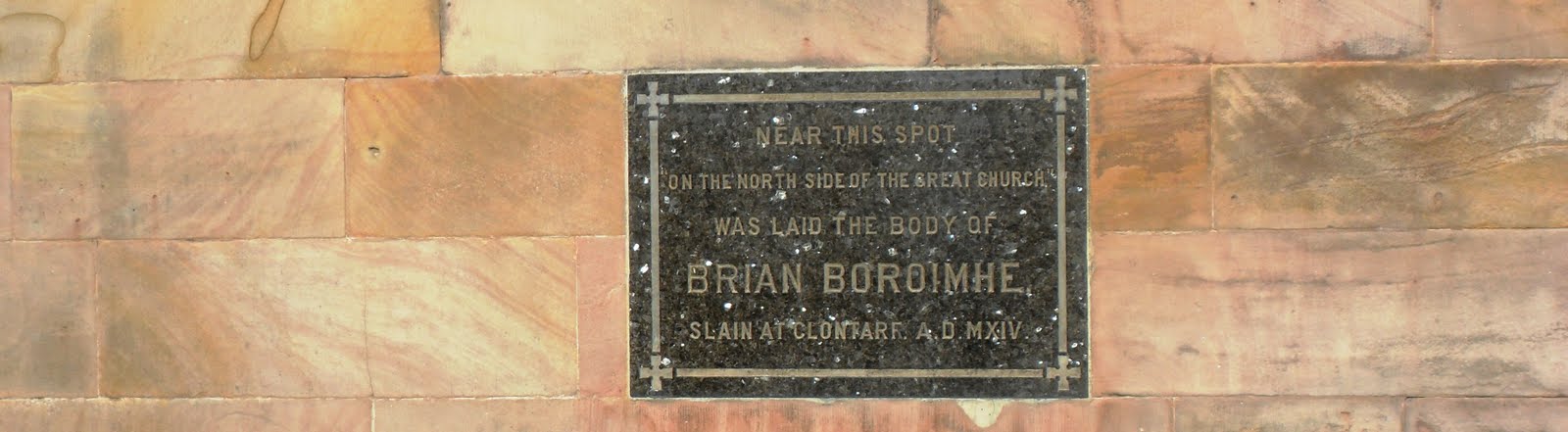
Brian Boru ... a royal burial in Armagh almost a thousand years ago (Photograph: Patrick Comerford, 2011)

But the cathedral itself has many interesting monuments and windows – including “Tandragee Man,” monuments to Archbishop William Alexander and Dean Peter Drelincourt, and a plaque on the outside north wall reminding us that this is the burial place of King Brian Boru, who was killed at the Battle of Clontarf in 1014. Now, there’s an anniversary that is in danger of being forgotten in the midst of competing centenaries over the next few decade or so.

As I headed back down the hill to dinner, and strolled through the streets of this beautiful Georgian cathedral city, I was left asking myself: has the chapter of Armagh more beards than any other cathedral chapter in the Church of Ireland?

Today promises interesting debates on the Anglican Covenant and ecumenical and Inter-Faith dialogue.

Canon Patrick Comerford is Director of Spiritual Formation, the Church of Ireland Theological Institute, and a canon of Christ Church Cathedral, Dublin

12 May 2011

Staying in the Charlemont Arms in Armagh

The Charlemont Arms Hotel ... three and a half centuries of history in Armagh (Photograph: Patrick Comerford, 2011)

Patrick Comerford

I am in Armagh for the rest of the week, taking part in the General Synod of the Church of Ireland, which is meeting in the Armagh City Hotel from today [Thursday 12 May] until Saturday [14 May].

Much of the time at this year’s General Synod will be spent debating reports from committees, councils, commissions and boards. There will be debates too on a prayer for Northern Ireland in the Book of Common Prayer, regulations for local ecumenical partnerships, committee membership, stipends and the chapter of Saint Patrick’s Cathedral, Armagh, and motions for debate on education in Northern Ireland, a code of conduct for clergy, and the implementation of the Hard Gospel project.

However, the most considerable matter for debate is likely to be the Anglican Covenant and whether or not the Church of Ireland should subscribe to it.

Changing Attitude Ireland is hosting a lunchtime talk tomorrow [Friday] by Paul Rowlandson on “Parents Speak: My Child is Gay.” At the same time, Archbishop Alan Harper is launching a new on-line publication from Church of Ireland Publishing. The Book of Common Prayer (2004) Commentaries by Canon Michael Kennedy, is a comprehensive treatment of all the authorised services in The Book of Common Prayer and is intended as an aid, especially for those in training for ministry, to deepen understanding of the Church’s liturgical heritage.

Another new publication is The Extra Mile, a guide to community engagement and development for churches, written by the Revd Earl Storey and the Revd Robert Miller for the Diocese of Derry and Raphoe.

During these three days, I am staying at the Charlemont Arms Hotel in English Street, a third-generation, family-run hotel in the centre of this historical city. The motto on the Earl of Charlemont’s coat-of-arms, over the hotel front door, which gives its name to the hotel, proclaims boldly: Deo Duce Ferro Comitante, “God is my leader, the sword is my companion.” The first part of the motto is appropriate for synod members staying in Armagh – but I would have serious problems about the second part.

The hotel, which has thrived throughout the centuries, was originally home to a Dr Atkinson. By the 1760s, it had become a hostelry known as “The Caulfeild Arms.” It was renamed in 1763, when James Caulfeild (1728-1799), fourth Viscount Caulfeild, was given the title Earl of Charlemont.

In 1746, at the age of 18 year, he was sent on a Grand Tour of Europe, accompanied by the Revd Edward Murphy him as his tutor. During his Grand Tour, which lasted nine years, he travelled to Holland and Germany, and spent a year in Rome and Naples before travelling on to Greece, where he was totally fascinated by the Parthenon in Athens and made drawings of the building long before it was destroyed by Lord Elgin.

He visited Turkey and Egypt too before returning to Rome in 1750, where he met many famous people, including the architect William Chambers, the sculptors Simon Vierpyl and Joseph Wilton and the artist and decorator Giovanni Battista Cipriani. He spent vast sums of money collecting paintings, sculptures and books and shipping them home.

He returned to Ireland in 1755, and went on to build both the Casino in Marino and Charlemont House in Dublin, now home to the Hugh Lane Gallery of Modern Art.

Although bestowed with titles and honours, he disregarded court favours and formed a political alliance with Henry Flood and Henry Grattan. In 1780, as Lord Charlemont, he became the commander-in-chief of the Irish Volunteers and in 1783 presided at the Volunteer Convention in Dublin. From then on was known as the Volunteer Earl. In the heyday of the Volunteers, there was a Charlemont Arms in every Irish town of note. However, this hotel may be the only one to survive – something that makes the current proprietors very proud.

Records show that John Hughes became the proprietor in 1852. He retained ownership until 1892, when a J.H. Mann was listed as its owner. Two years later, it was known as “Mann’s Hotel and Hydropathic Establishment,” and the facilities on offer included Turkish, plunge and other baths.

The hotel had a number of different proprietors from 1906 to 1933. Then, in 1934, it passed into the ownership of Robert and Elizabeth Forster. Their son, Robin Forster, and his wife Gretta were also at the forefront of the family business for many years and now the third generation is involved in running the hotel.

As owners, the Forster family has made a significant investment in the hotel. It was largely rebuilt in 1976-1979 after bomb damage, and major renovations in May 1999 incorporated two adjacent derelict buildings. These renovations have enhanced the hotel, providing 18 more bedrooms and a larger foyer and reception area.

The hotel is perfectly located between Armagh’s two cathedrals and close to the beautiful Mall, the theatre, city centre shops, the Armagh Planetarium and Observatory, the Armagh County Museum, the old Armagh Women’s Gaol.

And, of course, it’s a short stroll from the synod venue and many synod members are staying here – maybe this is where a lot of the synod work is going to be done.

Canon Patrick Comerford is Director of Spiritual Formation, the Church of Ireland Theological Institute, and a canon of Christ Church Cathedral, Dublin