Showing posts with label Famine. Show all posts

13 September 2026

55 million bottles of Champagne,
55 million famine deaths in China,
55 million displaced people,
55 million blog readers to date

Glasses at a reception in a Cambridge college … Champagne sales dropped by 55 million bottles in a two-year period (Photograph: Patrick Comerford)

Patrick Comerford

This month continues to be an exceptionally busy time on this blog. There is a continuing, steady and frankly overwhelming rise in figures for viewing and reading.

These figures reached 55 million around 10:30 last night (12 September), passing the million mark for the seventh time since the end of last month. The figures reached a total of 54 million two nights before that (10 September 2026), 53 million hits four days ago (9 September 2026), 52 million hits two days before that (7 September), 51 million on 5 September, 50 million the day before (4 September) and 49 million four days previously (31 August).

These viewing and readership figures are still overpowering, and this blog continues to reach volumes of readers I never expected when I first started blogging 16 years ago. At the end of last year, this blog had 21 million hits (31 December 2025). So far this year, there have been more than 34 million hits or visitors in 2026 alone.

This means half of all hits or reader figures have been within the past six months, with 27.5 million hits since 16 March 2026. I first began blogging in 2010, and it took almost two years until July 2012 to reach half a million readers. Throughout this year, the daily figures have often been overwhelming. Although we are less than half way through September, this is already the busiest month for traffic on this blog with over 6.3 million hits by late this afternoon.

Of the 10 days of busiest traffic on this blog, seven of them were in this month alone (1, 5, 7, 8, 9, 11 and 12 September), two were in May (1 and 14 May) and one was in April (29 April):

• 1,124,925 (1 May 2026)
• 671,341 (10 September 2026)
• 647,187 (5 September 2026)
• 618,234 (8 September 2026)
• 583,320 (11 September 2026)

• 563,301 (9 September 2026)
• 557,448 (12 September 2026)
• 525,719 (14 May 2026)
• 513,725 (7 September 2026)
• 509,644 (29 April 2026)

The daily average so far this month is almost 500,000 hits a day. Yet, I recall how 10 years ago, back in 2016, the daily average was around 1,000, or 30,000 a month.

Outside the courts in Chichester Street, Belfast … £55 million has been paid out in the Troubles victims payment scheme in Northern Ireland (Photograph: Patrick Comerford)

Some curious though random statistics help to put this new figure of 55 million into perspective:

The Great Leap Forward was an industrialisation campaign in China from 1958 to 1962, led by the Chinese Communist Party. Chairman Mao Zedong launched the campaign to transform China from an agrarian society into an industrialised society through the formation of people’s communes. The Great Leap Forward led to between 15 and 55 million deaths in mainland China during the 1959-1961 Great Chinese Famine it caused, making it the largest or second-largest famine in human history.

Kenya has a population of about 55 million people. By 2100, Dhaka in Bangladesh is projected to be the largest city in the world, with 55 million people.

According to the Internal Displacement Monitoring Centre (IDMC), the global total of internally displaced people has hit a record 55 million. Of these 55 million, 48 million were displaced due to conflict and violence, while seven million were displaced by natural disasters. Over 23 million of those displaced individuals were children under the age of 18.

About 55 million people face acute food insecurity, including 13 million malnourished children and 3 million facing emergency-level hunger. The food crisis is driven by severe humanitarian aid funding collapses and regional conflict rather than drought or poor harvests. Nigeria, Chad, Cameroon and Niger account for 77% of the food insecurity, with parts of northern Nigeria facing catastrophic conditions.

£55 million has been paid out so far in the Troubles victims payment scheme in Northern Ireland. The scheme offers financial support for people who suffered physical injury or psychological trauma during the conflict, but there are concerns over the length of time it takes to process applications.

After three consecutive years of declining shipments, Champagne closed 2025 with a further 2% drop, totalling 266 million bottles – the lowest level in two decades outside the pandemic year of 2020. The decline from the recent peak of 326 million bottles in 2022 has been steep, with the region losing 55 million bottles in just two years.

Individual Harry Potter novels, including titles such as Harry Potter and the Prisoner of Azkaban, Harry Potter and the Goblet of Fire, and Harry Potter and the Order of the Phoenix, have each sold about 55 million copies. Terry Pratchett, the English fantasy author behind the Discworld series, sold more than 55 million books during his lifetime.

The Northern White Rhino subspecies survived for around 55 million years, weathering everything from ice ages to meteor strikes – but not human hunters and poachers. The Northern White Rhino is now functionally extinct, representing a devastating loss for global biodiversity. Decades of intensive poaching for their horns, valued in traditional medicine and as status symbols, combined with civil war and habitat destruction in their native regions of Central and Eastern Africa, drove the population to collapse.

The crisis peaked in March 2018 when the last male, Sudan, died in Kenya. Today, only two females remain alive, leaving the subspecies unable to reproduce naturally. This loss is deeply sad for the world and underscores the destructive impact of human greed on the planet.

55 million minutes is equal to 104 years, 6 months, 25 days, 19 hours, and 40 minutes, calculated using a standard calendar average. This means that if this blog was receiving just one hit a minute, I would need to have started blogging back in February 1922.

I retired from active parish ministry about 4½ years ago, on 31 March 2022. These days, though, about 150 people on average are reading my daily prayer diary posted on this blog each morning, or more than 1,000 people each week. As this blog moves beyond 55 million hits, I am truly grateful to the real readers among that 55 million. In particular, I am thankful for the faithful core group of people who join me in prayer, scripture reading and reflections each day.

Livraria Lello is said have inspired JK Rowling while she was living in Porto … Harry Potter books have each sold about 55 million copies (Photograph: Patrick Comerford)

09 September 2026

53 million unfinished books,
53 million at risk from floods,
53 million famine deaths, and
53 million blog readers or hits

About 53 million people across Europe live in regions that are at risk from floods (Photograph: Patrick Comerford)

Patrick Comerford

This month is proving to be exceptionally busy time on this blog, with an overwhelming rise in figures for viewing and reading. These figures reached a total of 53 million hits by late this afternoon (9 September 2026), passing the million mark for the fifth time since the end of last month. The figures reached 52 million hits two days ago (7 September), only two days after reaching 51 million late on Saturday (5 September), 50 million the day before (4 September) and 49 million four days previously (31 August).

I continue to find these viewing and readership figures overpowering, and this blog continues to reach volumes of readers I never expected when I first started blogging 16 years ago. At the end of last year, this blog had 21 million hits (31 December 2025). So far this year, there have been more than 32 million hits or visitors in 2026 alone.

This means two-thirds of readers or hits have been this year alone (32 million out of a total of 53 million), and half of all hits or reader figures have been in little more than six months, with 26.5 million since 3 March 2026. I first began blogging in 2010, and it took almost two years until July 2012 to reach half a million readers. Throughout this year and last, the daily figures have often been overwhelming. Of the 10 days of busiest traffic on this blog, six or more than half of them were in this month alone (1, 4, 5, 7, 8 and 9 September), two were in May (1 and 14 May) and two were the previous month (29 and 30 April):

• 1,124,925 (1 May 2026)
• 647,187 (5 September 2026)
• 618,234 (8 September 2026)
• 563,301 (9 September 2026)*
• 525,719 (14 May 2026)

• 513,725 (7 September 2026)
• 509,644 (29 April 2026)
• 407,835 (4 September 2026)
• 356,335 (1 September 2026)
• 344,003 (30 April 2026)

The daily average has been about 490,000 a day so far this month. Yet, I recall how 10 years ago, back in 2016, the daily average was around 1,000, or 30,000 a month.

Floods in Saint Mark’s Square, Venice … about 53 million people across Europe live in regions identified as being at risk from floods (Photograph: Patrick Comerford)

Some curious though random statistics help to put this new figure of 53 million into perspective:

The richest 1% of the population in the United Kingdom holds wealth equivalent to the combined bottom 80%, or 53 million people.

According to Professor Alex de Waal of Tufts University, five men – Mao Zedong, Adolf Hitler, Josef Stalin, King Leopold II of Belgium and Pol Pot – each deliberately made famines that killed more than a million people, with a total of 53 million deaths, almost 40 per cent of aggregate global famine mortality since 1870.

The Securitas depot robbery in Tonbridge 20 years ago was the largest cash heist in the UK. It began with a kidnapping on the evening of 21 February 2006 and ended in the early hours of 22 February, when seven criminals stole almost £53 million. The gang left behind another £154 million because they did not have the means to move it.

About 53 million people across Europe live in regions identified as being at risk for floods.

Calculations earlier this year show that the EU population will fall by 11.7 per cent by 2100, losing approximately 53 million people. Japan’s population is projected to fall from a peak of 128 million in 2017 to less than 53 million by the end of the century.

About 53 million books are left unfinished in the UK each year because busy readers run out of time. Research shows that roughly 53,094,541 books are abandoned annually before reaching the final chapter.

53 million minutes is equal to 100 years, 9 months and 7 days. This means that if this blog was receiving just one hit a minute, I would need to have started blogging back at the turn of 1925 and 1926.

I retired from active parish ministry about 4½ years ago, on 31 March 2022. These days, though, about 150 people on average are reading my daily prayer diary posted on this blog each morning, or more than 1,000 people each week.

This evening, as this blog moves beyond 53 million hits, I am truly grateful to the real readers among that 53 million. In particular, I am thankful for the faithful core group of people who join me in prayer, scripture reading and reflections each day.

*Figure update at midnight to give the total figure for 9 September 2026

About 53 million books are left unfinished in the UK every year, abandoned before readers reach the final chapter (Photograph: Patrick Comerford)

10 November 2025

As President Michael D Higgins
steps down after 14 years, he
has earned the nation’s gratitude

With President Michael D Higgins and Brendan Howlin during the 2011 Presidential election campaign at the Wexford Ambassadors initiative in Iveagh House, Dublin

Patrick Comerford

President Michael D Higgins formally relinquishes office as President of Ireland at midnight tonight (Monday 10 November 2025), and Catherine Connolly becomes president at an inauguration ceremony in Dublin Castle tomorrow (Tuesday 11 November 2025).

In her inauguration speech, she is expected to indicate some of the themes and priorities of her presidency and the projects she hopes to undertake. After her election victory, she spoke in Dublin Castle of a new-style Republic, so tomorrow she may touch on that and on her plans to revisit communities across the country she visited during her campaign.

As President Michael D Higgins prepares to step down tonight, I find it appropriate to look back on my memories of his commitment to peace and social justice, and some of the many achievements of this president, poet, politician, academic and campaigner.

I first got to know Michael Higgins over 50 years ago. We were both delegates at the Labour Party conference in Cork in 1973, when he slept on the floor in the rooms I was sharing with Philip orish, another Wexford constituency delegate in Moore’s Hotel.

Both as a senator (1973-1977, 1983-1987) and as a TD (1981-1982, 1987-2011), he was an active supporter of the Irish Campaign for Nuclear Disarmament (CND), took part in the protests against President Ronald Reagan’s visit to Ireland in 1984 and later against the war in Iraq, and was also deeply committed to campaign groups focussed on Latin American issues, particularly in El Salvador and Nicaragua.

In those years, we took part together in many protests outside the US Embassy in Dublin. I was among his guests in the Mansion House in Dublin in 1992 when he was presented with the Sean MacBride Peace Prize by the International Peace Prize – Sean MacBride had been president of both Irish CND and the IPB.

The measure of the man’s international acclaim as a poet, a key figure in shaping cultural policies across Europe and his reputation internationally was edident when I was writing regularly for The Irish Times on Greek politics and culture in the 1990s. Once when I was interviewing the Greek Minister of Culture, Professor Evangelos Venizelos, in Athens, the first person he asked about was Michael D Higgins, and he asked me to convey much he appreciated both his poetry and his standing among politicians in Pasok and other European socialist parties.

With President Michael D Higgins at a Pax Christi seminar on cluster munitions in Dublin in 2008

I was invited, unexpectedly, in 2008 to chair a seminar organised by Pax Christi, the International Catholic Peace Movement, on the topic: ‘Towards a Comprehensive Ban on Cluster Bombs.’ The seminar also saw the launch of Pax Christi’s campaign, ‘Make Cluster Bombs History.’

The speakers included Michael D Higgins, then President of the Labour Party and Labour spokesperson on Foreign Affairs, the President of Pax Christi Ireland, Bishop Raymond Field, and Joe Little of RTÉ, who spoke on the effects of cluster munitions in Lebanon.

When Mr Higgins was elected President in 2011, peace and anti-war groups, including PANA, the Irish Anti-War Movement (IAWM), Shannonwatch and Galway Alliance Against War (GAAW), expressed the hope that his time as President would further the cause of peace and bring a renewed focus on the importance of Irish neutrality, causes he has passionately defended throughout his political career.

He consistently opposed the use of Shannon, a civilian airport, for the invasions and occupations of Iraq and Afghanistan. He was critical of the apparent Irish collusion with the US government in relation to suspected rendition flights through Shannon, and he once called on the government to withdraw Irish military personnel from Afghanistan. Hundreds of armed US troops passed through Shannon Airport each day without any oversight or inspection of planes suspected of carrying illegally kidnapped prisoners, CIA assassination crews or dangerous munitions.

President McAleese opened the doors of Áras an Uachtaráin to people working for peace, development and human rights

When his presidential election campaign began in June 2011, Michael D Higgins was one of the speakers at the launch of the Wexford Ambassadors programme in Iveagh House, Dublin. The programme was launched by the Minister for Public Expenditure, Brendan Howlin, Labour TD for Wexford, and the chair of Wexford County Council, Councillor Michael Kavangh. The first four appointed Wexford Ambassadors that evening were the writers Colm Tóibín and Eoin Colfer, the rugby international Gordon D’Arcy and the soccer international Kevin Doyle. His predecessor as President, President Mary McAleese, opened the doors of Áras an Uachtaráin to those she encouraged in work for peace, development, human rights and interfaith dialogue.

She warmly welcomed me to Áras an Uachtaráin on Sean MacBride’s 100th birthday; when she publicly thanked and affirmed Development and Mission workers and agencies for work in Africa; and when an interfaith group of Christians and Muslims from Egypt were visiting Ireland in 2006.

President Higgins was in office during the difficult ‘decade of centenaries’, including those of the Ulster Solemn League and Covenant, the 1913 Lock-Out, World War I and its many battles, the 1916 Rising, the First Dail and the Irish War of Independence, and he lived up to his pledge that in office he would continue President McAleese’s work to help heal the wounds of the Troubles in Ireland.

His first official engagement as President of Ireland was attending the Remembrance Sunday service in Saint Patrick’s Cathedral in Dublin, and he was there again as President for the last time yesterday. His second inauguration ceremony in 2018 was held in the evening so that he could attend the Armistice Day commemorations in the morning – two opportunities that President-elect Connolly should not miss when she is in office and seeks to demonstrate that she is the President for all the people.

Bruce Kent and President Michael D Higgins at the presentation of the Sean MacBride Peace Prize medals in All Hallows College, Drumcondra in 2012 (Photograph: Patrick Comerford)

A year after his inauguration, and 20 years after he received the Sean MacBride Peace Prize, President Higgins was invited by the International Peace Bureau to present the 2012 Sean MacBride Peace Prize to two Arab activists, Dr Lina Ben Mhenni from Tunisia and Dr Nawal El-Sadaawi from Egypt, for their courage and contributions to the ‘Arab Spring.’ I was present as President of Irish CND at the ceremony and his address in All Hallows’ College, Drumcondra, that evening.

The ceremony marked the opening of the annual conference of the International Peace Bureau, and it was the first time the IPB council ever met in Ireland in over 100 years of its history. Old friends and fellow campaigners who were there that night included Caitriona Lawlor, who worked for many years with Sean MacBride, Brendan Butler, a long-time activist on Central American rights, David Hutchinson-Edgar of Irish CND, Roger Cole of the Peace and Neutrality Alliance, Joe Murray of Afri, Tony D’Souza of Pax Christi, and Rob Farmichael, the nonviolence activist.

The evening ended in conversation with President Higgins and the veteran international peace activist, the late Bruce Kent, who had been a personal friend since the mid-1970s.

Canon Patrick Comerford speaking at the National Famine Commemoration in Glasnevin Cemetery with President Michael D Higgins in 2016 (Photograph: Church Review)

President Higgins and I both spoke at the annual National Famine Commemoration in Glasnevin Cemetery, Dublin, in 2016, when he accused European nations failing to respond to their humanitarian obligations to refugees and said they should learn the lessons of the Great Famine in Ireland. He compared some of the rhetoric used today about people crossing the Mediterranean ‘marine grave’ to media reports during the worst period of Ireland’s 19th century catastrophe. Between 1845 and 1849, over a million people died of hunger and related diseases, and two million fled a country ‘with no hope.’ Many who emigrated faced fresh marginalisation on arrival on foreign shores.

President Higgins asked: ‘Is there not a lesson for all of us, as we are faced in our own time with the largest number of displaced people since World War II, as the Mediterranean becomes, for many, a marine grave, as European nations fail to respond to their humanitarian obligations?’

I was at that commemorative service on behalf of the Church of Ireland and said in my prayers: ‘As we remember those who were driven from this land in their hunger, in their thirst, and in their quest for justice and mercy, and how they left on the high seas, let us pray for those who are driven from their own lands as they hungered and thirsted for justice and mercy.’

I added: ‘Let us pray in particular for the people of Syria, for those who are on the high seas in the Aegean and the Mediterranean, and those who flee places where climate change and our inaction deprives them of justice and forces them to choose between, on the one hand, hunger and thirst at home, and short measures of justice and mercy in the countries they reach.’

Another speaker that Sunday was the then Minister for the Arts, Heritage, Regional, Rural and Gaeltacht Affairs, Ms Heather Humphreys, the other candidate in last month’s Presidential election.

Ireland has been well served by Michael D Higgins as President of Ireland, and he has used the office to keep reminding everyone of important values both at home and internationally.

President Michael D Higgins at the presentation of the Sean MacBride Peace Prize in All Hallows’ College, Drumcondra, in 2012

23 January 2023

Praying through the Week of
Christian Unity and with USPG:
23 January 2023

‘I will seek the lost, and I will bring back the strayed, and I will bind up the injured, and I will strengthen the weak’ (Ezekiel 34: 16) … part of Rowan Gillespie’s ‘Famine’ memorial on Custom House Quay, Dublin (Photograph: Patrick Comerford)

Patrick Comerford

Christmas is not a season of 12 days, despite the popular Christmas song. Christmas is a 40-day season that lasts from Christmas Day (25 December) to Candlemas or the Feast of the Presentation (2 February).

Throughout the 40 days of this Christmas Season, I have been reflecting in these ways:

1, Reflecting on a seasonal or appropriate poem;

2, a prayer from the USPG prayer diary, ‘Pray with the World Church.’

However, the Week of Prayer for Christian Unity began last Wednesday (18 January 2023), and until Wednesday my morning reflections look at this year’s readings and prayers.

Later today, Churches Together in Milton Keynes continues to mark the Week of Prayer for Christian Unity with an evening devoted to ‘Climate Unity’ at the Quaker Centre in Milton Keynes at 7:30.

The Climate Crisis is the single biggest issue facing the planet in this century. The Society of Friends has a strong tradition of working for justice through creative action and will help us address the challenge. They will bring people together this evening in a Meeting for Worship in the Quaker tradition, with a mixture of silence, spoken word and song.

‘All the nations will be gathered before him, and he will separate people one from another as a shepherd separates the sheep from the goats’ (Matthew 25: 32) … sheep and goats grazing together in a field in Platanias near Rethymnon in Crete (Photograph: Patrick Comerford)

Day 6: Just as you did it to one of the least of these … you did it to me.

Readings:

Ezekiel 34: 15-20

I will seek the lost, and I will bring back the strayed, and I will bind up the injured, and I will strengthen the weak.

Matthew 25: 31-40:

I tell you, just as you did it to one of the least of these who are members of my family, you did it to me.

Reflection:

In the Gospel of Matthew, we are reminded that we cannot separate our love for God from our love for others. We love God when we feed the hungry, give the thirsty something to drink, welcome the stranger, clothe the naked, care for the sick and visit the prisoner. When we care for and serve ‘one of the least of these,’ we are caring for and serving Christ himself.

The years 2020 and 2021 made visible the immense suffering among God’s family members. The world-wide Covid-19 pandemic, along with economic, educational and environmental disparities, impacted us in ways that will take decades to repair. It exposed individual and collective suffering throughout the world and brought Christians together in love, empathy and solidarity. Meanwhile, in Minnesota, the murder of George Floyd by police officer Derek Chauvin exposed continued racial injustice. Floyd’s cry of ‘I can’t breathe’ was also the cry of many suffering under the weight of both the pandemic and oppression.

God calls us to honour the sacredness and dignity of each member of God’s family. Caring for, serving and loving others reveals not who they are, but who we are. As Christians, we must be unified in our responsibility to love and care for others, as we are cared for and loved by God. In so doing, we live out our shared faith through our actions in service to the world.

Christian Unity:

The prophet Ezekiel describes the Lord God as a shepherd who makes the flock whole by gathering in those who have strayed and binding up those who are injured. Unity is the Father’s desire for his people and he continues to bring about this unity, to make the flock whole, through the action of his Holy Spirit. Through prayer we open ourselves to receive the Spirit which restores the unity of all the baptised.

Challenge:

How are the ‘least of these’ invisible to you or your church? How can our churches work together to care for and serve ‘the least of these?’

Prayer:

God of Love,
We thank you for your unending care and love for us.
Help us to sing redemption songs.
Open wide our hearts to receive your love
and to extend your compassion
to the whole of the human family.
We pray in Jesus’ name. Amen.

‘I was ill and you visited me’ … ‘I was sick and you took care of me, I was in prison and you visited me’ (Matthew 25: 36) … a sculpture by Timothy Schmalz on the steps of Santo Spirito Hospital near the Vatican in Rome (Photograph: Patrick Comerford)

USPG Prayer Diary:

The Week of Prayer for Christian Unity began last Wednesday (18 January), and the theme in the USPG Prayer Diary last week was the Week of Prayer for Christian Unity. The theme this week is the ‘Myanmar Education Programme.’ This theme was introduced yesterday with a reflection from a report from the Church of the Province of Myanmar.

The USPG Prayer Diary invites us to pray today in these words:

Let us pray to be good listeners. May we learn to pay attention and hear what is being said, and so seek to understand.

Yesterday’s reflection

Continued Tomorrow


28 December 2022

Calverton Limes and one
family’s links with the Irish
Famine and social reform

Calverton Limes on London Road, Stony Stratford, was designed by the local architect Edward Swinfen Harris (Photograph: Patrick Comerford, 2022)

Patrick Comerford

Calverton Limes is one of the many major houses in Stony Stratford designed by the local architect Edward Swinfen Harris. Until recently, this landmark building at 18 and 20 London Road was known to many as the Working Men’s Social Club, but it also has interesting links with the Trevelyan family, who lived for a time in the house.

The story of the Trevelyan family has links with the Irish Famine, colonialism in India, and social and educational reforms in Stony Stratford and Wolverton.

Calverton Limes is dated 1870, and was designed in an ornate and mannered Victorian ‘vernacular’ style. It was built in two and three storeys in three irregular blocks, faced in cobbled, herringbone and upright-laid limestones divided by rubble lacing courses.

The brick dressings and quoins are offset by a low plinth, there are scallop tiles laid in horizontal colour bands, and a crested ridge, with a ridged chimney on No 18.

The left-hand block, No 20, has a gable end to the street. The architectural features include a bargeboard, a bay window with sash windows.

The recessed central block has raised top-lighting. There are two high windows with terracotta shafts and slightly pointed heads. The ground floor projects with a lean-to roof. The central ornamental entrance has a pointed arch, roof shafts, buttresses and raised gable, and there are panelled double doors.

No 18, the right hand block, breaks forward again. This part of the building is of two storeys, with two attic windows with pointed relieving arches.

There are light sashes on the first floor, with a brick mullion on the left. The ground floor has a five-light rectangular bay to the right. There are three light sashes in the attic with half-timbered gables.

The return on the north-west side has much decorative brick work and a half-timbered gable with a moulded wood bargeboard.

The Revd William Pitt Trevelyan (1812-1905) lived for a time at Calverton Limes (Photograph: Patrick Comerford, 2022)

Calverton Limes was built for William Cole Daniell, a local surgeon. Later, the Revd William Pitt Trevelyan (1812-1905) lived there. Subsequently, it became the home of Colonel LC Hawkins, a local magistrate. In more recent decades, this was the Working Men’s Club. It has since been converted into apartments.

But Calverton Limes also provides an introduction to the interesting story of the Revd William Pitt Trevelyan, who was the Rector of both Old Wolverton and Calverton.

William Pitt Trevelyan was born on 31 March 1812, the youngest of nine children of the Ven George Trevelyan (1764-1827), Archdeacon of Taunton, and Harriet (née Neave). Four of those sons were priests in the Church of England, although the most famous son was undoubtedly Sir Charles Edward Trevelyan (1807-1886), a prominent civil servant and colonial administrator who was instrumental in reforming the Civil Service in the 1850s.

However, Charles Trevelyan’s reforming legacy is largely overshadowed by his controversial role in the government response to the potato blight in Ireland and the subsequent Great Famine in the 1840s, when he expressed anti-Irish racist sentiments while administrating Famine relief.

Trevelyan, who was Assistant Secretary to the Treasury (1840-1859), was slow to disburse direct government food and monetary aid because of his strong belief in laissez-faire economics and the free hand of the market. He wrote highly disparagingly about Irish people, claiming ‘the judgement of God sent the calamity to teach the Irish a lesson.’

He is named in the song ‘The Fields of Athenry’ written in 1979 by Pete St John, a popular anthem for all Irish sports fans. The lyrics say the convict’s crime was that he ‘stole Trevelyan’s corn.’

The Revd William Pitt Trevelyan (1812-1905) of Stony Stratford was the Vicar of Wolverton (1856-1872) and of Calverton (1859-1881)

Charles Trevelyan’s youngest brother, the Revd William Pitt Trevelyan (1812-1905) of Stony Stratford, had very different social and economic values. He was born in Nettlecombe, Somerset, where his father was rector, and was educated at Eton and Worcester College, Oxford (BA 1855, MA 1857). He was the perpetual curate or vicar of Broomfield, Somerset (1853-1856), before becoming the Vicar of Wolverton (1856-1872) and of Calverton (1859-1881), both in Buckinghamshire and in the Diocese of Oxford.

Before coming to Stony Stratford, Trevelyan married Maria Pleydell-Bouverie, daughter of the Hon Philip Pleydell-Bouverie and Maria à Court, in 1852. She was closely related to one of the leading figures in the Oxford Movement, the Revd Edward Bouverie Pusey (1800-1882): her grandfather was his first cousin.

When Trevelyan came to Calverton, it covered the west side of Stony Stratford and was known as one of the first Tractarian parishes in this part of Buckinghamshire. Many of the Tracts for the Times were planned in the old vicarage, where the regular visitors included Cardinal Henry Manning; both Newman and Pusey preached from the pulpit and Pusey celebrated at the altar in All Saints’ Church.

The neighbouring Parish of Wolverton covered much of the east and south sides of Stony Stratford, and in 1868 the parish established Saint Mary the Virgin on London Road as a daughter church. The church was designed by the architect Sir George Gilbert Scott, and a vicarage, two curate’s houses, now known as Jesuan House, and a Parish Hall were built also.

Saint Mary’s became a parish in its own right, and its priests were supporters of the Tractarian and Anglo-Catholic movements in the Church of England. Some of the priests were persecuted for what were regarded as ‘ritual offences’ and one was deprived of his living for these practices.

Wolverton Saint Mary Church on London Road, Stony Stratford … now the Greek Orthodox Parish Church of Saint Ambrosios and Saint Stylianos (Photograph: Patrick Comerford, 2022)

In Stony Stratford, Trevelyan began to develop the lower end of London Road, part of the new parish of Wolverton Saint Mary, and contributed to building Saint Mary’s Church and the church schools. With Lady Mary Russell and the Radcliffe Trust, he was one of the principal benefactors in building Saint Mary’s Church on London Road in 1864.

Trevelyan was instrumental, alongside John Worley and others, in inaugurating the Stony Stratford Dispensary and the Cottage Hospital, although the cottage hospital later closed and was replaced by a hospital fund.

Maria (Pleydell-Bouverie) Trevelyan died on 9 October 1903; William Pitt Trevelyan was 93 when he died on 22 December 1905 in Potterspury, Northamptonshire. Three of their four children were priests in the Church of England.

Calverton Limes was built in 1870 and designed by Edward Swinfen Harris (Photograph: Patrick Comerford, 2022)

Trevelyan’s eldest son, the Revd William Bouverie Trevelyan (1853-1929), was born in Calverton. He was educated at Trinity College, Cambridge (BA 1876, MA 1879), and was ordained deacon in 1877 and priest in 1878. He was his father’s curate in Calverton and then Vice-Principal of Ely Theological College, before becoming Vicar of Saint Matthew’s, Westminster, for 23 years (1884-1907).

His incumbency marked a period of much development at Saint Matthew’s and he built on the foundations laid by his two predecessors. CB Mortlock in Famous London Churches (1934) says it was Trevelyan ‘who was to make Saint Matthew’s famous.’

Trevelyan’s curate there from 1896 to 1898 was Frank Weston, who would become Bishop of Zanzibar and one of the foremost leaders of the Anglo-Catholic movement and an inspirational figure in the Universities’ Mission to Central Africa (UMCA), now part of the Anglican mission agency USPG (United Society Partners in the Gospel).

Weston’s combination of incarnational and sacramental theology with radical social concerns formed the keynote of his address to the Anglo-Catholic Congress in 1923. He believed that the sacramental focus gave a reality to Christ’s presence and power that nothing else could.

A Bishop of London said: ‘Trevelyan was a true saint, if ever there was one, I always felt even to look at him did one good.’ He was an Anglo-Catholic, but he was tolerant of other views in the Church, and once said: ‘I have always recognised that the Prayer Book is capable of two interpretations and if I am allowed scope for mine, I cheerfully allow other people to have theirs.’

After leaving Saint Matthew’s, Westminster, Trevelyan was Warden of Liddon House and warden of the retreat house at Beaconsfield, Kidlington, Oxford (1914-1927). He died in 1929.

Saint Matthew’s Church, Westminster, and the Clergy House … an integral part of inner-city mission for 170 years (Photograph: Patrick Comerford)

William Pitt Trevelyan’s second son, the Revd John Charles Trevelyan (1857-1944), was born in Old Wolverton and was educated at Trinity Hall, Cambridge. He was curate of Saint Philip and Saint James, Oxford (1889-1891), curate of Christ Church, Luton, Bedfordshire (1891-1893), Vicar of Saint Saviour’s, Luton (1893-1915), Rector of Yaxham, Norfolk (1915-1927), and Vicar of Saint Veep’s, Kennington, Berkshire (1929-1937).

Throughout their lives, John Charles Trevelyan and his brothers were in correspondence with their cousin the historian George Macaulay Trevelyan (1876-1962), Regius Professor of History at Cambridge (1927-1943), Master of Trinity College, Cambridge (1940-1951), and Chancellor of Durham University. Their correspondence is archived in Trinity College, Cambridge.

William Pitt Trevelyan’s third son, the Revd George Philipp Trevelyan (1858-1937), was born in Wolverton. He was also Vicar of Wolverton Saint Mary’s in Stony Stratford from 1885. Later, he was Vicar of Saint Alban’s, Hindhead, in Surrey, and Saint Stephen’s, an Anglo-Catholic parish in the centre of Bournemouth (1911-1928).

His son, Humphrey Trevelyan (1905-1985), Baron Trevelyan, was a leading colonial administrator, diplomat and writer. He began his career in India, and moved to the Diplomatic Service at Indian independence in 1947, and had a distinguished career during which he was ambassador in Beijing after the Revolution, Egypt during the Suez crisis, Iraq during the attempt to annex Kuwait in 1961, and the Soviet Union, and the last high commissioner of Aden.

The members of the Trevelyan family in the 19th and 20th centuries provided interesting links between church life in Stony Stratford, Calverton and Wolverton not only with ‘Trevelyan’s Corn’ and the Irish Famine, but also with political, social and economic life across the globe.

Calverton Limes and the Trevelyan family offer interesting links between church life in Stony Stratford and global changes over the last two centuries (Photograph: Patrick Comerford, 2022)

20 October 2022

Praying for World Peace and with USPG:
Thursday 20 October 2022

The Killing of the Holy Innocents, by Giotto (ca 1304-1306), in the Scrovegni Chapel in Padua … the Week of Prayer for World Peace invites prayers today on the theme of ‘Effects on Children’ (Photograph: Patrick Comerford)

Patrick Comerford

Before today gets busy, I am taking some time this morning for reading, prayer and reflection.

This year, the Week of Prayer for World Peace is from 16 to 23 October. In my prayer diary from last Sunday until next Sunday, I am reflecting in these ways:

1, One of the readings for the morning;

2, A reflection from the programme for the Week of Prayer for World Peace (16 to 23 October);

3, a prayer from the USPG prayer diary, ‘Pray with the World Church.’

‘Do you think that I have come to bring peace to the earth?’ (Luke 12: 51) … the Reconciliation monument in the ruins of Coventry Cathedral (Photograph: Patrick Comerford)

Luke 12: 49-53 (NRSVA):

[Jesus said:] 49 ‘I came to bring fire to the earth, and how I wish it were already kindled! 50 I have a baptism with which to be baptized, and what stress I am under until it is completed! 51 Do you think that I have come to bring peace to the earth? No, I tell you, but rather division! 52 From now on, five in one household will be divided, three against two and two against three; 53 they will be divided:

father against son
and son against father,
mother against daughter
and daughter against mother,
mother-in-law against her daughter-in-law
and daughter-in-law against mother-in-law.’

The Week of Prayer for World Peace takes place this year from Sunday 16 October 2022 to Sunday 23 October 2022

Week of Prayer for World Peace 2022, Day 5:

The week of Prayer for World Peace takes place from the second to third Sunday in October each year, which this year is from last Sunday (Sunday 16 October 2022) to next Sunday (23 October 2022).

The Week of Prayer for World Peace is supported by a wide range of organisations, many of which I have engaged with over the years, including the Anglican Pacifist Fellowship, Christian CND, the Fellowship of Reconciliation, Pax Christi, and Quaker Peace and Social Witness.

Day 5: Effects on Children:

Let us pray for all children who suffer because of the decisions of others, including children who suffer physical or mental injuries and those who are bereaved.

‘Pray for all victims of war, for all those innocent children who have been objects of these vicious wars. Pray for the children who never got to experience what the joy of childhood was really like. Pray for those who struggle to find a loaf of bread to feed their loved ones.’
– Adapted from a Muslim prayer

‘O Great Spirit of our Ancestors, I raise my pipe to you.
To your messengers the four winds, and to Mother Earth who
provides for your children,
Give us the wisdom to teach our children to love, to respect and to be
kind to each other so that they may grow with peace in mind.

Let us learn to share all the good things that you provide for us on This Earth.’
– Appalachian Cherokee Nation Prayer

Hungry, the world’s poor children cry,
In tragic millions doomed to die,
We care not why or how;
While wealth beyond all bounds is spent
On vast destructive armament,
Where is compassion now?
– Extracted from a poem by Stanley Finch

May God bless you and keep you.
May God shine light on you and be gracious to you.
May God turn toward you and grant you peace.
– Hebrew blessing for children

A detail from The Killing of the Holy Innocents, by Giotto (ca 1304-1306), in the Scrovegni Chapel in Padua … the Week of Prayer for World Peace invites prayers today on the theme of ‘Effects on Children’ (Photograph: Patrick Comerford)

Today’s Prayer (Thursday 20 October 2022):

The Collect:

Almighty and everlasting God,
increase in us your gift of faith
that, forsaking what lies behind
and reaching out to that which is before,
we may run the way of your commandments
and win the crown of everlasting joy;
through Jesus Christ your Son our Lord,
who is alive and reigns with you,
in the unity of the Holy Spirit,
one God, now and for ever.

The Post Communion Prayer:

We praise and thank you, O Christ, for this sacred feast:
for here we receive you,
here the memory of your passion is renewed,
here our minds are filled with grace,
and here a pledge of future glory is given,
when we shall feast at that table where you reign
with all your saints for ever.

The theme in the USPG Prayer Diary this week is ‘World Food Day.’ This theme was introduced on Sunday.

The USPG Prayer Diary invites us to pray today in these words:

We pray for people around the world who cannot afford to eat. May we work for a future where no one goes hungry.

Yesterday's reflection

Continued tomorrow

May God bless you and keep you. May God shine light on you and be gracious to you. May God turn toward you and grant you peace. – Hebrew blessing for children (Photograph: Kevin Martin)

Scripture quotations are from the New Revised Standard Version Bible: Anglicised Edition copyright © 1989, 1995, National Council of the Churches of Christ in the United States of America. Used by permission. All rights reserved worldwide. http://nrsvbibles.org

Children of the Holocaust … a Holocaust memorial at the Jewish cemetery in Berlin (Photograph: Patrick Comerford)

12 June 2022

Praying with the Psalms on Trinity Sunday:
12 June 2022 (Psalm 109)

‘Do not be silent, O God of my praise’ (Psalm 109: 1) … ‘A Thoughtful Silence’ by Eleanor Swan, in Glazed Stoneware, the Kildare Gallery at Carton House (Photograph: Patrick Comerford)

Patrick Comerford

Today is Trinity Sunday (12 June 2022). Later this morning, I am reading one of the lessons in a short broadcast service recorded for Clare FM, and I plan to attend the Parish Eucharist in Saint Mary and Saint Giles Church in Stony Stratford.

But, before today begins, I am taking some time this morning to continue my reflections from the seasons of Lent and Easter, including my morning reflections drawing on the Psalms.

In my blog, I am reflecting each morning in this Prayer Diary in these ways:

1, Short reflections on a psalm or psalms;

2, reading the psalm or psalms;

3, a prayer from the USPG prayer diary.

Psalm 109:

Psalm 109 is sometimes known by the Latin name Deus, laudem, from its opening words, Deus, laudem meam ne tacueris (‘Do not be silent, O God of my praise’). In the slightly different numbering system in the Greek Septuagint and the Latin Vulgate, this is Psalm 108.

This is one of the Imprecatory Psalms, invoking judgment, calamity or curses on one’s enemies or those perceived as the enemies of God. The major imprecatory Psalms include Psalm 69 and Psalm 109, while Psalms 5, 6, 11, 12, 35, 37, 40, 52, 54, 56, 57, 58, 59, 79, 83, 94, 137, 139 and 143 are also considered imprecatory.

Psalm 109 is attributed to King David and noted for containing some of the most severe curses in the Bible, such as verses 12 and 13.

This Psalm opens with the psalmist’s plea (verses 1-5), followed by an extensive imprecation (verses 6-19, concluded or summed up in verse 20). The renewed pleading in verse 21 is made with appeals on the grounds of God’s steadfast love, the details of the psalmist’s own misery, and the request for vengeance on the enemies. But the lament ends with the vow to offer praise, which is common in this type of psalm (verses 30-31).

In verses 8-14, the curse by the psalmist extends through three generations: on the person (verse 8), on the person’s children (verses 9-13), and on the person’s parents (verse 14). The extinction of a family and its name was considered the most extreme calamity.

In verse 4, there is evil given ‘in return for my love.’ The curses here are consistent with Proverbs 17: 13, where ‘if evil is given for good then evil will not depart from their house.’ Returning evil for good is also seen in other psalms, namely 41, 69 and here in 109.

In verses 2 and 30, there is an inclusio near the opening and closing of the Psalm: in the opening, the Psalmist is facing the lies of accusers mouths, while in the close his own mouth greatly praises God.

In verse 12 (‘May there be no one to do him a kindness, nor anyone to pity his orphaned children’), the Hebrew phrase (משך חסד, mō-šêḵ chā-seḏ) can also mean ‘to draw out mercy’ in the sense of ‘causing it to continue and last’ (see Psalm 36: 11, Jeremiah 31: 3).

The close of Psalm 109 has God at the right hand of the poor man, in striking contrast with the opening of Psalm 110, where God calls a man to sit at his right hand, made forever like the priest king, Melchizedek.

Psalm 109 was used by Thomas Hardy in his novel The Mayor of Casterbridge. Michael Henchard, the protagonist of the novel, is drinking with the choir after practice when he sees his rival, Donald Farfrae, whom he hates. He later persuades the choir to sing Psalm 109. The choir master remarks of this psalm that, ‘Twasn’t made for singing. We chose it once when the gypsy stole the parson’s mare, thinking to please him, but parson were quite upset. Whatever Servant David were thinking about when he made a Psalm that nobody can sing without disgracing himself, I can’t fathom.’

‘May his children wander about and beg; may they be driven out of the ruins they inhabit’ (Psalm 109: 10) … the Famine Memorial by the sculptor Rowan Gillespie on Custom House Quay, Dublin (Photograph: Patrick Comerford)

Psalm 109 (NRSVA)

To the leader. Of David. A Psalm.

1 Do not be silent, O God of my praise.
2 For wicked and deceitful mouths are opened against me,
speaking against me with lying tongues.
3 They beset me with words of hate,
and attack me without cause.
4 In return for my love they accuse me,
even while I make prayer for them.
5 So they reward me evil for good,
and hatred for my love.

6 They say, ‘Appoint a wicked man against him;
let an accuser stand on his right.
7 When he is tried, let him be found guilty;
let his prayer be counted as sin.
8 May his days be few;
may another seize his position.
9 May his children be orphans,
and his wife a widow.
10 May his children wander about and beg;
may they be driven out of the ruins they inhabit.
11 May the creditor seize all that he has;
may strangers plunder the fruits of his toil.
12 May there be no one to do him a kindness,
nor anyone to pity his orphaned children.
13 May his posterity be cut off;
may his name be blotted out in the second generation.
14 May the iniquity of his father be remembered before the Lord,
and do not let the sin of his mother be blotted out.
15 Let them be before the Lord continually,
and may his memory be cut off from the earth.
16 For he did not remember to show kindness,
but pursued the poor and needy
and the broken-hearted to their death.
17 He loved to curse; let curses come on him.
He did not like blessing; may it be far from him.
18 He clothed himself with cursing as his coat,
may it soak into his body like water,
like oil into his bones.
19 May it be like a garment that he wraps around himself,
like a belt that he wears every day.’

20 May that be the reward of my accusers from the Lord,
of those who speak evil against my life.
21 But you, O Lord my Lord,
act on my behalf for your name’s sake;
because your steadfast love is good, deliver me.
22 For I am poor and needy,
and my heart is pierced within me.
23 I am gone like a shadow at evening;
I am shaken off like a locust.
24 My knees are weak through fasting;
my body has become gaunt.
25 I am an object of scorn to my accusers;
when they see me, they shake their heads.

26 Help me, O Lord my God!
Save me according to your steadfast love.
27 Let them know that this is your hand;
you, O Lord, have done it.
28 Let them curse, but you will bless.
Let my assailants be put to shame; may your servant be glad.
29 May my accusers be clothed with dishonour;
may they be wrapped in their own shame as in a mantle.
30 With my mouth I will give great thanks to the Lord;
I will praise him in the midst of the throng.
31 For he stands at the right hand of the needy,
to save them from those who would condemn them to death.

Today’s Prayer:

The theme this week in the prayer diary of the Anglican mission agency USPG (United Society Partners in the Gospel) is ‘Focus 9/99,’ which is introduced today by the Revd M Benjamin Inbaraj, Director of the Church of South India’s SEVA department. He writes:

‘Focus 9/99 is a programme in which one local church in each of the 99 districts of the five southern states of India, where the Church of South India is based, is trained along with representatives of the community on the promotion of child rights. They learn to identify and report instances of violation and abuse of the girl child to the respective State Commissioners for the Protection of Child Rights and to the National Commissioner.

‘The campaign is focused on rights and justice issues concerning the education, food, nutrition, and health of the girl child that will secure her future. Care providers and significant others are trained in legislation that will protect and enhance the dignity and rights of the girl child. A child protection policy is drawn up during the course of the campaign to demonstrate the Church of South India’s commitment to protect the children from harm and abuse. Joining with the global initiative of the World Council of Churches and UNICEF, the Church of South India is also working on the ‘principles for child-friendly churches.’

Sunday 12 June 2022 (Trinity Sunday, World Day Against Child Labour):

‘Let the little children come to me,
And do not hinder them.’
Almighty God,
You teach us to care for children.
Help us to prevent their exploitation.

Yesterday’s reflection

Continued tomorrow

Today is Trinity Sunday … a sign on the notice board at Holy Trinity Church, Old Wolverton (Photograph: Patrick Comerford, 2022)

Scripture quotations are from the New Revised Standard Version Bible: Anglicised Edition copyright © 1989, 1995, National Council of the Churches of Christ in the United States of America. Used by permission. All rights reserved worldwide. http://nrsvbibles.org

11 January 2022

In search of the ruins
of a former famine and
fever hospital in Askeaton

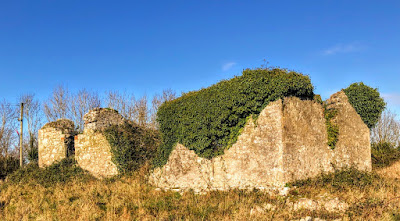
The former famine or fever hospital in Askeaton was set up to take care of the dying and the very ill during the Great Famine (Photograph: Patrick Comerford, 2022)

Patrick Comerford

I was invited this week to be part of a group working on a new brochure and tourist guide to Askeaton, Co Limerick. During a meeting in the Civic Trust offices earlier this week, I learned about the ruins of the famine hospital, and went in search of them mid-week.

After hearing about the Famine Hospital, I went in search mid-week for the hospital ruins in Cloonreask townland, where they are fenced off behind the Deel Manor estate.

Askeaton suffered through the Great Famine, although there are few tell tales of famine times apart from the memory of the old hospital where patients were treated during the famine. The famine or fever hospital was set up to take care of the dying and the very ill.

It is said locally that before the Famine, this building was a treatment centre and a home for people suffering from leprosy. It seems that leprosy may have occurred in the Askeaton area, and a stream near the four roads also refers to leprosy – Lochan Lobhar, or the ‘Lepers’ Pond.’

The population of Askeaton in 1841, four years before the Great Famine, was 1,862. However, 40 years later, the population in 1881 was 804, and today it is about 1,137. The figures tell ting graphically how Askeaton, once a walled borough electing two MPs to the Irish Parliament, has never fully recovered from the impact of the Great Famine.

The ruins of the Famine hospital can still be seen on the main Askeaton bypass, opposite the turn off to the Wyeth plant and they are fenced off from the Deel Manor estate.

25 July 2021

The sad role played by
the Comerford family
in famine-era Kinvara

Delamaine Lodge, on the west side of Kinvara Bay, was owned by the Comerford family in the mid-19th century (Photograph: Patrick Comerford, 2021)

Patrick Comerford

The summer ‘road trip’ brought me to Spanish Point on the west coast of Clare, where I visited Comerford Lodge, a former Comerford family home now known as ‘Clare Cottage.’

I promised myself then I would return to the area to see some more houses once associated with the Comerford family, including Delamaine Lodge in Kinvara, Ballykeel House in Kilfernora, and some Comerford houses in Ennistymon.

Delamaine Lodge takes its name from the de la Maine or Delamaine family, although it is said the house was built on or from the remains of the 16th century Kinvara Castle. Kinvara Castle and Dunguaire Castle have been referred to by some writers as the ‘twin towers of Kinvara.’

Kinvara Castle, or Ballybranaghan, was one of several castles in the area once owned by the O’Heyne family. Kinvara Castle is said to have been destroyed in the 17th century conflicts, although its destruction may date from the tsunami caused by the Lisbon earthquake in 1755. By the early 1850s, Kinvara Castle was said to be on the verge of complete decay.

Delamaine Lodge, built ca 1775, takes its name from the de la Maine or Delamain family (Photograph: Patrick Comerford, 2021)

Delamaine Lodge is a villa-style house with a strong sense of symmetry, established by its central doorway, sidelights and associated steps. Other details, such as its unusual chimney pots and the retention of timber sash windows add further interest. This five-bay, single-storey house over half-basement, was built ca1775, with a gabled return at the rear or west elevation.

Captain William Delamain (1713-1793) was involved in contraband trade in Kinvara. His son, James Delamain, was sent to France in 1751 at the age of 13, to learn French and the Cognac trade. He married Marie Ranson and established the Jarnac cognac firm, known today as Delamain and Co.

Captain William Delamain also moved to France in 1788 and lived with his son’s French family until he died in 1793. The lease of Delamaine Lodge, with its furniture, was sold by auction on 25 March 1793.

There was another important connection linking Kinvara and France at that time: The French family of Doorus Demesne were the landlords of Kinvara in the 18th century. James French conformed to the Church of Ireland in 1762, but he lived most of his life in his chateau at Chaillot near Paris. While he was living in France, his daughter Frances married Bartholomew de Basterot in 1770.

At the end of the 18th century, James French sold part of his large estate at Doorus and Kinvara to Robert Gregory (1727-1810) of Coole, who became the new landlord of Kinvara. French’s great-great grandson, Count Florimond de Basterot, observed, ‘In this way, the splendours of Chaillot were financed by a sale in Kinvara.’

Robert Gregory’s grandson, Robert Gregory (1790-1847), worked to improve the town of Kinvara. He made substantial improvements to the pier in 1807 and 1808, and probably built the large grain store that faces the quay. According to Samuel Lewis, in his Topographical Dictionary (1837), some of the stone used in the pier was taken from the ruined Kinvara Castle near the quay.

The stone used in building Kinavra Pier in 1807-1808 may have come from the ruins of Kinvara Castle (Photograph: Patrick Comerford, 2021)

Sir William Henry Gregory (1817-1892) was the only son of Robert Gregory and his wife Elizabeth O’Hara. Gregory was heavily addicted to gambling and horseracing, and he was so heavily indebted after the Famine that his portions of the Kinvara estate were sold in the Encumbered Estates Court in 1857. Kinvara was reported to be on the verge of complete decay, and the Kinvara estate was bought by Henry Comerford (1795-1861), a Clare-born Galway merchant who had inherited Ballykeel House, Kilfenora, Co Clare, after his marriage to Margaret McDonagh in 1824.

Henry Comerford was born in Co Clare, the son of George Comerford, and lived in Galway. He was a merchant, landowner and magistrate. He is also remembered as the proprietor of the St John, a Galway brig whose shipwreck was one of the most tragic events during the mass exodus from Galway and Clare in the aftermath of the Great Famine. The St John left Galway on 7 September 1849, was wrecked near Cohasset off the coast of Massachusetts on Sunday 7 October 1849, with almost 100 deaths.

Henry Comerford’s purchase in 1857 included the Tolls and Customs of Kinvara, Delamaine Lodge, the area known as Town Parks, the Fair Green, the gatehouse and the animal pound, totalling 331 acres. By then, he was also leasing the house and demesne at Doorus to Count de Bastertot, and he had acquired property in the surrounding area, including Rineen, Kilcummin, Killannin, and Kilmoylan. He paid over £35,000 for 4,440 acres of land in Co Galway in the 1850s, and also owned lands in Drumcreehy and Kilfenora in the Burren, Co Clare.

Henry Comerford raised a bank loan in Dublin to buy the Kinvara estate on the strength of raising the rents paid by the tenants. The mortgage was arranged with Messrs Cobb & Moore of Dublin on the strength of increased rentals.

Henry Comerford bought the Gregory estates in Kinvara in 1857 (Photograph: Patrick Comerford, 2021)

The former tenants of the Gregory estate in Kinvara had no security of tenure when Henry Comerford increased their rents drastically. As soon as he took possession of the estate, he started to double and even treble existing rents.

According to Jerome Fahy, in his History and Antiquities of the Diocese of Kilmacduagh, the results were disastrous: ‘the comparatively short interval of about twenty years witnessed the ruin of over a thousand homesteads in one parish’ on Comerford property. The parish priest, Father Arthur observed, ‘The change of landlords for the greatest portion of this place has rendered this one of the most wretched and deplorable parishes in Ireland.’ It was, he said, impossible to obtain aid even from the merchants of Kinvara because, as a result of Comerford’s actions, they were ‘bereft of all hope.’

Henry Comerford died on 6 December 1861. His brother, Isaac Comerford, a merchant in Galway and a draper and general shopkeeper in Kinvara, was adjudged a bankrupt, and his assets were seized on behalf of Todd Burns & Company, Mary Street, Dublin.

Henry Comerford and his wife Margaret McDonagh were the parents of a large family of 12 children. One daughter, Mary Josephine, married Captain Francis Blake Forster of Forster Street, Galway. Another daughter, Henrietta Emily (1837-1881), had first married Isaac Breen Daly (1835-1871) of Dalysfort, Galway, and they seem to have lived at Delamaine Lodge for a time. Isaac Breen Daly also owned 1,225 acres in Co Clare.

The Galway Vindicator in 1855 named Daly ‘among the good and charitable landlords of the parish,’ along with Henrietta’s brother-in-law, Captain Francis Blake Forster, who had bought the Doorus Demesne house and estate and later also portions of Kinvara to the west of the glebe lands.

Henrietta (Comerford) and Isaac Daly were the parents of three children, Henry J O’Daly (1858-1903) of Corrib Castle, Galway; Michael Joseph Daly (1860-1894) of Castleblakeney, Co Galway; and Ida Elizabeth (Walsh).

Delaiane Lodge overlooking Kinvara Bay (Photograph: Patrick Comerford, 2021)

When Isaac Breen Daly died at Sea Road, Salthill, on 16 December 1871, his estate was declared bankrupt and was sold by at auction court order in 1873. The Daly Estate was bought for £13,000 by William Henry Sharpe and Henrietta Sharpe. But they never lived in Kinvara, and the property was almost immediately leased to Henrietta’s brother-in-law, Captain Francis Blake Forster of Doorus Demesne, who also acquired the Tolls and Customs and Fairgreen fees.

By then, the widowed Henrietta (Comerford) Breen had married the younger John Joseph Ireland (1849-1876) in Galway on 28 November 1872: he was 23 and living at Dominick Street; she was 30 and living at Montpelier Terrace, Sea Road, Galway, and at their wedding she was described as ‘Lady.’

John Ireland died in 1876 at the age of 27, and the widowed Henrietta moved to live with her sister Mary Josephine (Comerford) and her brother-in-law Captain Francis Blake Forster in Forster Street, Galway. These two Comerford sisters, Henrietta and Mary, handed on many of the Comerford family legends to Mary’s son, the antiquarian and genealogist, Charles ffrench Blake Forster (1851-1874).

Henrietta Emily (Comerford) Ireland, formerly Breen, died on 20 April 1881 at the age of 43 in Forster Street, Galway.

The ground rents of Kinvara were finally bought by the tenants in the 1940s.

As for Delamaine Lodge, it was leased to Roman Catholic Church in mid-19th century, and served as the parish presbytery in Kinvara. Father Francis Arthur lived there while he was Parish Priest of Kinvara (1847-1866). Canon Fahy, Parish Priest of Kinvara in 1918, replaced the thatch roof with a slate roof and raised the gables, installed the first back door, and added a small extension that included the first bathroom.

Canon Mulkerrrin was the last parish priest to live in the house. Bishop Michael Browne sold the house in 1976 to Galway business interests. By 1979, the house was owned by the Branick family from California.

The next Comerford family home to search for in the area was Ballykeel House, Kilfenora, Co Clare, once the home of Henry Comerford.

Kinvara and Delamaine Lodge, seen from Dunguaire Castle, on the east side of Kinvara Bay (Photograph: Patrick Comerford, 2021)

26 June 2021

Abbeystrewry, the church at
the heart of Skibbereen

Abbeystrewry Church, the Church of Ireland parish church in Skibbereen, Co Cork (Photograph: Patrick Comerford, 2021)

Patrick Comerford

One of the most beautiful places in Skibbereen in West Cork is known locally as the Church Meadow, an oasis of tranquillity in the centre of the town. But this is not a meadow at all – this is the site of Abbeystrewry Church, the Church of Ireland parish church in Skibbereen, and Parish Hall.

The name Abbeystrewry means the ‘Abbey on the Stream,’ and the parish takes its name from a Cistercian house that stood on the banks of the River Ilen a mile or so north of the town. The Cistercian house was attached to the larger abbey at Timoleague, but is now in ruins and its grounds are used as a cemetery.

There has been a church on the site on Bridge Street since 1827, and the present church, which I visited during last week’s ‘staycation’ or road trip in West Cork and Co Kerry, was built there in 1890.

Inside Abbeystrewry Church, facing the liturgical east end (Photograph: Patrick Comerford, 2021)

The earliest reference to the parish of Abbeystrewry is in 1634, according to the church historian William Maziere Brady, and there was a church in Abbeystrewry in the early 17th century.

Lionel Boyle (1671-1703), 3rd Earl of Orrery, leased the parish in 1699 to a Mr Goodkin, who allowed the curate £18 a year.

A key figure in shaping the parish in the early decades of the 19th century was the Revd Richard Boyle Townsend (1795-1850), a son of Commander John Townsend (1764-1849), Recorder of Clonakilty.

Townsend was ordained deacon in 1818 and priest in 1819, and was immediately appointed Vicar of Abbeystrewry in succession to the Revd William Robinson (1781-1819) and, before him, the Rev Horatio Townsend (1770-1781). He remained in Skibbereen for almost 32 years, until he died in 1850.

Inside Abbeystrewry Church, facing the liturgical west end (Photograph: Patrick Comerford, 2021)

For his first few years in Skibbereen, Townsend held services in an old church on the quay on the River Ilen behind Bridge Street. But under his guidance the first church on the present site in the town centre was built in 1827. Townsend also built a new school in 1825 at his own expense.

Abbeystrewry Church cost almost £1,200 to build and was partly funded by a loan from the Board of First Fruits. It was described as a plain oblong building, in the old English style of architecture, with a tower or belfry, but without the spire that was to be added later when funds allowed.

The new church in Abbeystrewry was licenced for divine services on 11 April 1827. It was a substantial building that could seat 360 people, and the Church of Ireland population of the parish of was 246 in 1834.

Samuel Lewis in his Topographical Dictionary of Ireland (1837) said Abbeystrewry Church was ‘a large edifice in the early English style of architecture, with a lofty square tower at the east end. It cost £1,181. 10s. 9d.’

But, in many ways, it was not a practical church building, and by 1842 it was unable to meet the needs of the parish. Townsend added a wing that provided extra accommodation, but this threw the church out of all architectural order. The addition made the church appear so ridiculous that Dean Madden described it as ‘a bundle of absurdities.’

Townsend also built a new rectory on a 15-acre site, spending a considerable amount of his own money. The Rectory on Baltimore Road remained in use until the early 1960s when it became unsuitable and a new rectory was bought on Cork Road.

The Baptistry in the transept or original east end of the church (Photograph: Patrick Comerford, 2021)

The Bishop of Cork and 77 clergy in the diocese, including Richard Townsend and his brother, the Revd Chambre Corker Townsend, signed a ‘Petition of the Protestant Clergy of the United Dioceses of Cork and Ross against Catholic Emancipation’ that which was submitted to the House of Commons on 2 March 1827.

Nevertheless, Richard Townsend is remembered as a saintly man who was devoted to the care of the poor, and he played a prominent role in Skibbereen during the Great Famine (1845-1852). He was a member of the Relief Committee and did heroic work to relieve the suffering of destitute people in the area.

He founded a temporary hospital in Skibbereen and spent much of his time personally caring for people with typhus.

Townsend travelled to London in December 1846 to meet government members to appeal for help for Skibbereen. He was disappointed with the reception he received in London, but his efforts led to setting up the British Relief Association, which raised £400,000 for Famine relief in Ireland.

The Famine memorial at Abbeystrewry Church (Photograph: Patrick Comerford, 2021)

He reported that in one month there were 140 deaths in the Skibbereen workhouse. The people had entered the workhouse ‘that they might be able to die decently under a roof and be sure of a coffin.’ He recalled that at one time 14 funerals were waiting in his churchyard while the burial of a fifteenth body was being completed. In the next parish to his, there were nine funerals at once in the churchyard, and in two other adjoining ones there were six funerals together in each.

During one visit to the Workhouse in Skibbereen, Townsend contracted Famine Fever and died on 7 May 1850.

Richard Boyle Townsend married Elizabeth Hungerford of Glandore. They had no children and Eliza have moved into Zion Cottage shortly after he died. There is a plaque to his memory in Abbeystrewry Church.

He was succeeded in the parish by his brother, the Revd Horace Thomas Townsend, who remained there until 1867 – in all, Townsend or Townsend connections with the parish totalled 96 years.

The plaque in Abbeystrewry Church to the memory of the Revd Richard Boyle Townsend (Photograph: Patrick Comerford, 2021)

Canon James Goodman was born in Ventry, near Dingle, Co Kerry, in 1828, into a clerical family. His father, the Revd Thomas Goodman, was Rector of Dingle (1824-1864), as was his grandfather, the Revd John Goodman (1787-1824), while his brother, the Revd John Goodman, was the curate in Ventry in the 1860s and 1880s.

James Goodman was educated at Trinity College Dublin. He was ordained priest in 1853 and was appointed to Creagh Parish, between Skibbereen. He was appointed curate of Killaconagh in the Beara peninsula in 1858. While living in Ardgroom, he compiled much of his great collection of Irish music. He became Rector of Abbeystrewry in 1866 and a canon of Ross in 1867.

Canon Goodman was appointed Professor of Irish in Trinity College Dublin in 1879. He would spend six months in Dublin and six months in Skibbereen with curates to help in Skibbereen. His students at TCD included the future President Douglas Hyde and the playwright John Millington Synge.

Canon Goodman decided to build a new parish church in Skibbereen. The old building of 1827 was taken down, with the exception of the tower, and a church was built on a present north-south axis. The new church opened on 18 December 1890.

£3,500 had been spent on the new church by 1891, yet by September that year the debt had been completely wiped out. The final fundraising effort was a Church Bazaar on 26, 27 and 28 August that raised £308, allowing the outstanding balance to be cleared.

The church was designed by the Cork architect William Henry Hill (1837-1911). It was built on a limited budget, and cleverly retains the older simpler church, incorporated as the transepts of the new church. A coherence between the two phases of the building has been maintained with the use of similar stonework and the repetition of decorative motifs and finishes.

The attention to detailing and skilled workmanship evident on the exterior continues through to the interior, notably in the carpentry of the roof bracing and carved timber reredos.

The Resurrection window above the porch (Photograph: Patrick Comerford, 2021)

The church has a four-bay nave elevation, side aisles, a projecting chancel at the south-west and a gable-fronted porch at the north-east. It incorporates the Board of First Fruits church built in 1827, which is integrated as the transepts.

Two weeks after Canon Goodman announced that the debt on the church had been cleared, the roof was badly damaged. The ‘Cutting’ in Skibbereen was being cut to allow for the expansion of the Skibbereen to Baltimore railway line. Some houses were also damaged by the blasting to clear the rock. After this, it was deemed too dangerous to continue using explosives to clear the rock and much of the ‘Cutting’ was cleared by manual labour.

Canon Goodman was devoted to Irish music. He played the flute and uillean pipes, and was one of the great collectors of Irish music. He married Charlotte King and their three children were born at Creagh.

Canon James Goodman died at Abbeystrewry Rectory, Baltimore Road, on 18 January 1896 and is buried at Creagh churchyard. The Irish Times noted, ‘The death of this popular, esteemed and well-known clergyman will be received with feelings of deep and sincere regret far outside the limits of West Cork, where he was so well known and universally respected by all creeds and classes of society.’

The Skibbereen Eagle reported: ‘The funeral … was of enormous dimensions, the procession, composed of all classes and creeds in the community, being a singularly sad and imposing one. Signs of universal grief were everywhere observable, all the shops being shut and shuttered, as a mark of respect to the memory of the venerated deceased, who had endeared himself to all by his charity, humanity and kind disposition.’

The ornamental archway over the entrance to Abbeystrewry Church from Bridge Street is dedicated to Canon Goodman. A statue of him was unveiled inside the gates in 2006.

The ornamental archway over the entrance to Abbeystrewry Church from Bridge Street is dedicated to Canon Goodman (Photograph: Patrick Comerford, 2021)

The Revd Horace Webb Townsend, who was the Rector of Abbeystrewry in 1896-1915, extended the Glebe House.

A Famine memorial plaque dating from 1847 is fixed to the exterior wall of the church. This plaque was erected by ‘British munificence … in token of their gratitude of His Divine and Sparing Mercy for their rescue from the horrors and sufferings of the Famine and Pestilence.’

However, the Famine continued to take its toll, with people dying of hunger and disease in Skibbereen until 1852.

The pulpit in Abbeystrewry is dedicated to the memory of John Francis Levis (Photograph: Patrick Comerford, 2021)

The pulpit in Abbeystrewry is dedicated to the memory of John Francis Levis, the man who saved the name of Skibbereen.

Timothy McCarthy Downing (1814-1879) of Prospect House, Skibbereen, was MP for Co Cork and chair of Skibbereen Town Council. He proposed in 1876 that the name of Skibbereen should be changed to Ilenmore or Ilentown.

Initially, it appeared that no one was going to go against his wishes. However, John Francis Levis for the old name ‘Skibbereen’ to be retained. After an acrimonious debate, McCarthy Downing relented and John Francis Levis was successful in saving the name of ‘Skibbereen.’

The parish hall in the grounds of Abbeystrewry Church (Photograph: Patrick Comerford, 2021)

A major programme of restoration work was carried out at Abbeystrewry in the early 2000s. This included substantial work on the three-stage bell tower and casting a new ring of six bells.

Initially, it was hoped to house the eight bells from Saint Nicholas’s Church in Cork city when that church was de-consecrated. However, the bells were too big, and a new peal was cast by Whitechapel in July 2002. These were hung by Matthew Higby, church bellhangers, in November 2002 and a first 1/4 peal was rung on 8 November 2002.

There are four churches in Abbeystrewry Union: Abbeystrewry Church, Skibbereen; Saint Barrahane’s Church, Castletownshend, Castlehaven; and Saint Matthew’s Church, Tullagh (Baltimore).

Recent Rectors of Abbeystrewry have included the Ven Vivian William Darling (1951), Archdeacon of Cloyne and father of Bishop Edward Darling of Limerick; Oliver AP Peare (1963); Terence McKenna (1972); John Neill (1974), later Archbishop of Dublin; the Ven Robin Bantry White (1979), later Archdeacon of Cork, Cloyne and Ross; Richard Henderson (1989), later Bishop of Tuam; Canon Trevor Lester (1996); and Bruce Hayes (2004), now Rector of Dalkey. Since 2013, the Revd John Ardis has been the rector of Abbeystrewry.

The statue of Canon James Goodman was unveiled in 2006 (Photograph: Patrick Comerford, 2021)