Showing posts with label Kempe. Show all posts
29 October 2026
Hollywood Royalty
discovered in
a stained glass window
in Stony Stratford
Stony Last Thursday History Society,
Stony Stratford Library,
29 October 2026 (2:30 pm)
Introduction:
As we were arriving this afternoon, I was playing ‘Zorba’s Dance’ from the 1964 classic Hollywood film Zorba the Great. Today, the dance and the music are regarded as quintessentially Greek, by Greek and non-Greek alike. But back in 1964, both the music and dance were newly composed and newly choreographed. The dance was invented on the film set, and the music was written especially for the film by the composer Mikis Theodorakis.
The film is based on the book, Zorba the Greek, a work of modern Greek literature by Nikos Kazantzakis, one of the great writers of the 20th century. I have tried to read it in the original Greek, with its beautiful opening descriptions of the landscape of Crete. It was first published in Greek 80 years ago, in 1946. I have known the writer’s family for decades, written about him often, and I have visited his grave on the walls above Iraklion.
So, when I moved to Stony Stratford over four years ago, I was surprised to find a link – however distant and tenuous – between Stony Stratford and Zorba the Greek.
This afternoon I want to share with you a ‘Stony Story’ of music, film and dance, of stained glass windows and romance, of love, abandonment and divorce, a story that links Stony Stratford and the stars of Hollywood, and a story that also draws in the Pre-Raphaelite artists of the Victorian age.
But, to put our conversations into context this afternoon, to weave together your memories and my stories, could I begin by tapping into your memories:
• How many of you have seen Zorba the Greek?
• How many of you have seen The Ten Commandments?
• How many of you are familiar with the names of Anthony Quinn … Cecil B DeMille … Nikos Kazantzakis?
• And, are you are familiar with the stained glass windows in Saint Mary and Saint Giles Church?
There are 12 windows in the church, and they include:
• a two-light window at the west end by Charles Eamer Kempe, depicting three archangels;
• a set of three windows in the south gallery, among them important work by John Groome Howe of the Hardman studios;
• two separate windows in the south gallery with fragments from an earlier window;
• and six windows – three below the gallery on the south wall and three below the gallery on the north wall – by NHJ Westlake of Lavers & Westlake.
I want us to concentrate first of all on the three small windows below the gallery on the north wall, which are paired with the three small windows below the gallery on the south wall, all six by Nathaniel Westlake.
Window 1, North side:
The first window at the east end of the north wall in Saint Mary and Saint Giles Church, Stony Stratford, is by NHJ Westlake, in memory of the Revd John William Spark (Photograph: Patrick Comerford)
The first window by Westlake at the east end of the North Wall in Saint Mary and Saint Giles is dated 1889, and is in memory of the Revd John William Spark, who was the assistant curate in Stony Stratford for six years.
This window is of three eyelets and depicts three Biblical scenes: Moses and the Burning Bush; the Annunciation; the Expulsion of Adam and Eve from Eden.
Moses and the Burning Bush, depicted in the first window on the north wall in Saint Mary and Saint Giles Church, Stony Stratford (Photograph: Patrick Comerford)
John William Spark was born in 1858, the son of Peter Spark, a farmer of Meldreth, near Whittlesford, Cambridgeshire, and later of Babraham. He was educated at Saint John’s College, Oxford (BA 1880, MA 1885), and was an assistant curate in Stony Stratford for six years. He left £50 in his will towards providing better vestry accommodation, and this money formed the nucleus of a fund for building the new vestries, designed by Edward Swinfen Harris.
The Annunciation depicted in the first window in the north wall in Saint Mary and Saint Giles Church, Stony Stratford (Photograph: Patrick Comerford)
This window is one of two in the church in Spark’s memory. Each panel in this window depicts an angel speaking the word of God. The first two panels offer images of listening to the message of God: Moses listens to the word of God, depicted as an angel in the Burning Bush; the Virgin Mary listens to the annunciation of the Gospel by the Archangel Gabriel; and an angel tells Adam and Eve to leave the Garden of Eden.
The Expulsion from Eden … a panel in the first window on the north wall in Saint Mary and Saint Giles Church, Stony Stratford (Photograph: Patrick Comerford)
The depiction of the expulsion of Adam and Eve may seem an unusual image in a memorial window. However, it may indicate the early departure of a man who had arrived in a parish he could have expected to be a new Eden, only to be taken away at an early stage.
Window 2, North side:
The second window in the north wall in Saint Mary and Saint Giles Church by NHJ Westlake, in memory of the Revd John William Spark (Photograph: Patrick Comerford)
The second window in the North Wall in Saint Mary and Saint Giles is dated 1889. It is by Westlake and is second of two sets of windows in memory of the Revd John William Spark, who was in Stony Stratford for six years.
This window is of three eyelets and each panel in this window depicts a good shepherd: David killing a lion (see I Samuel 17: 34-37); Christ the Good Shepherd (John 10: 11-18); and the Sacrifice of Abel (Genesis 4: 2).
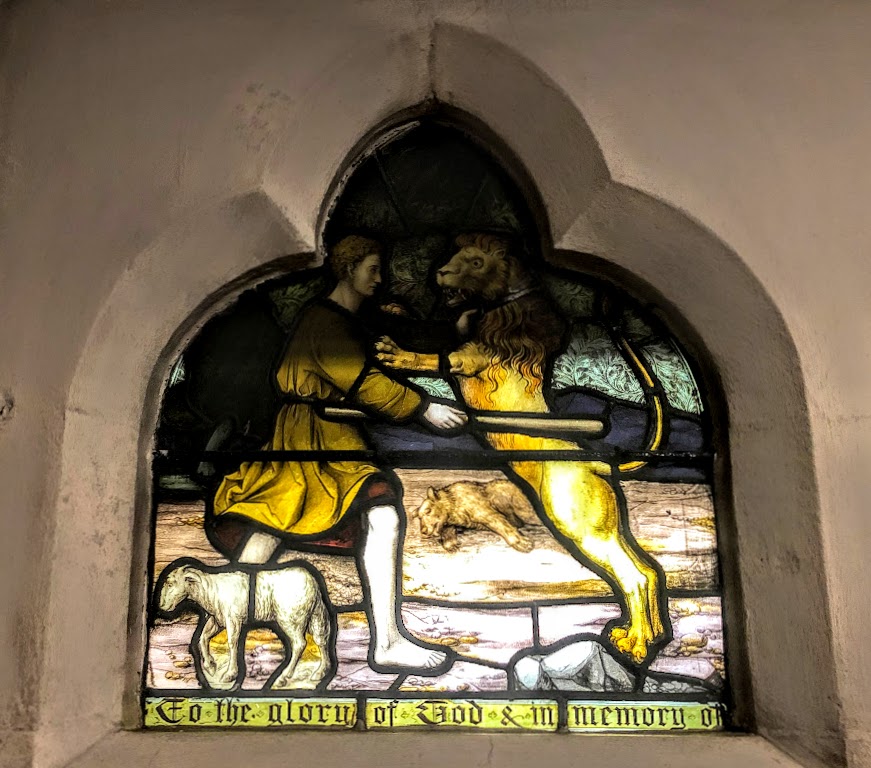
David killing a lion (see I Samuel 17: 34-37) depicted in the second window on the north wall in Saint Mary and Saint Giles Church, Stony Stratford (Photograph: Patrick Comerford)
Before going into battle with Goliath, David told Saul how he had risked his life for the sheep in flock, killing lions and bears: ‘… whenever a lion or a bear came, and took a lamb from the flock, I went after it and struck it down, rescuing the lamb from its mouth; and if it turned against me, I would catch it by the jaw, strike it down, and kill it. Your servant has killed both lions and bears … the Lord, who saved me from the paw of the lion and from the paw of the bear, will save me from the hand of this Philistine’ (I Samuel 17: 34-37).
Christ the Good Shepherd (John 10: 11-18) depicted in the second window in the north wall in Saint Mary and Saint Giles Church, Stony Stratford (Photograph: Patrick Comerford)
In Saint John’s Gospel, Christ describes himself twice in one passage as the Good Shepherd: ‘I am the good shepherd. The good shepherd lays down his life for the sheep. … I am the good shepherd. I know my own and my own know me, just as the Father knows me and I know the Father. And I lay down my life for the sheep’ (John 10: 11-15).
The Sacrifice of Abel (Genesis 4: 2) … a panel in the second window on the north wall in Saint Mary and Saint Giles Church, Stony Stratford (Photograph: Patrick Comerford)
The third panel recalls Abel the Shepherd and his sacrifice: ‘Abel was a keeper of sheep, and Cain a tiller of the ground. In the course of time Cain brought to the Lord an offering of the fruit of the ground, and Abel for his part brought of the firstlings of his flock, their fat portions. And the Lord had regard for Abel and his offering’ (Genesis 4: 2-4).
We could summarise these three panels as reminding the parishioners of Stony Stratford that the Revd John William Spark, their curate who died a young man, had risked his life for them, made a perfect sacrifice, and was a faithful shepherd.
Window 3, North Wall:
The third window on the north wall by NHJ Westlake is in memory of Amy (Hunt) Lester, wife of the Revd John Moore Lester (Photograph: Patrick Comerford)
The third window in the North Wall in Saint Mary and Saint Giles, and the one I really want to focus on this afternoon, is dated 1895. It is also by Westlake, who was commissioned by Edward Swinfen Harris (1841-1924). Again, this window depicts three Biblical scenes:
• Enoch taken up to heaven by angels without dying (see Genesis 5: 21-24);
• the Ascension (see Luke 24: 50-53);
• Elijah taken up to heaven in the Chariot of Fire without dying (II King 2: 11-12).
Enoch being taken up to heaven without dying (see Genesis 5: 21-24) … a panel in the third window on the north wall (Photograph: Patrick Comerford)
The Ascension (see Luke 24: 50-53) … a panel in the third window in the north wall in Saint Mary and Saint Giles Church (Photograph: Patrick Comerford)
Elijah is taken up to heaven in the Chariot of Fire without dying (II King 2: 11-12) … a panel in the third window on the north wall in Saint Mary and Saint Giles Church, Stony Stratford (Photograph: Patrick Comerford)
Enoch and Elijah are both said to have been taken into heaven without dying. These images, along with central panel depicting the Ascension, are illustrations of the Christian hope of eternal life.
This window is in memory of Amy (Hunt) Lester (1850-1895), the wife of the Revd John Moore Lester (1851-1884), who was the Vicar of Stony Stratford in 1880-1884. They were married in Christ Church, Lancaster Gate, Westminster, in 1877 and they were the parents of nine children. She died on 30 October 1895.
The Revd John Moore Lester was the Rector of Stony Stratford in 1880-1884. He was born in Mumbai (Bombay), a son of General Sir Frederick Lester, and was educated at Rugby and University College Oxford.
From Stony Stratford, he went on to be the Vicar of Holy Trinity Church, Ayr (1884), Vicar of Shifnal, Shropshire, and a Rural Dean in the Diocese of Lichfield (1891), Vicar of Yarcombe, Devon (1903), Rector of Saint Leonard’s, Bridgnorth (1905), and finally Rector of Litchborough, near Towcester in Northamptonshire, 15 miles north-west of Stony Stratford. He died at Litchborough Rectory on Christmas Eve 24 December 1919.
Lieutenant Edward Gabriel Lester (1887-1917) … died at the Battle of Vimy Ridge in France on 25 June 1917
Amy Lester’s son, Edward Gabriel Lester (1887-1917), was the father of the Canadian-born American actor Katherine Lester DeMille. She was the adopted daughter of the director Cecil B DeMille, she married Anthony Quinn, she was considered Hollywood royalty, she played 25 credited film roles from the mid-1930s to the late 1940s, and she was noted for her dark beauty.
Katherine Lester DeMille was born Katherine Paula Lester in Vancouver on 29 June 1911. Her birth father, Edward Gabriel Lester, was born in Scotland shortly after his father had moved from Stony Stratford to Ayr. He became a teacher, moved to Canada and married Cecile Bianca Bertha Colani, who was of Italian descent and a daughter of the architect Johann Colani. During World War I, Edward Lester became a lieutenant in the Canadian army and was sent to France.
Four days before Katherine’s sixth birthday, her father died of multiple wounds at the Battle of Vimy Ridge in France on 25 June 1917, during World I. Her mother, Cecile Bianca Bertha (Colani), was terminally ill, and travelled to California, supposedly to find Katherine’s paternal grandparents and to leave the little girl with them.
However, the child’s grandmother, who is commemorated in this window in Stony Stratford, had died more than 20 years earlier, in 1895, and the child’s grandfather was then living in Northamptonshire. Katherine’s mother died less than three years later, in a Los Angeles hospital on 18 March 1920, without ever making contact with her husband’s parents, the child’s grandparents.
By then, Katherine had been placed in an orphanage in Los Angeles. Just weeks before her grandfather’s death, when she was eight, she was found in the orphanage by Constance Adams DeMille (1873-1960), the wife of the Hollywood producer and director Cecil B DeMille (Cecil Blount de Mille, 1881-1959). The DeMille family presumed she had no living relatives and adopted her as their third child in 1922.
Katherine Lester DeMille was born Katherine Paula Lester in Vancouver on 29 June 1911
Katherine, still in her late teens, gained experience on stage in 1930, acting as the understudy for the feminine ‘heavy’ of the play ‘Rebound’ in San Francisco. She wanted to begin an acting career on her own and used the stage name Kay Marsh whenever she worked as an extra. Her first credited role was as Rosita Morales, the wife of Wallace Beery’s Pancho Villa, in the MGM film Viva Villa! (1934), the story of the Mexican bandit, Pancho Villa.
She played another Mexican woman that year, a maid named Lupe, in the Paramount production The Trumpet Blows (1934), and her performance brought a contract with Paramount Pictures. Her next role was as Molly Bryant, the nemesis of Mae West’s character in Belle of the Nineties (1934).
Katherine played the second female role in All the King’s Horses (1935) at Paramount, and was loaned to Columbia Pictures for The Black Room (1935) and to 20th Century Fox for Call of the Wild (1935).
The role of Princess Alice of France in The Crusades (1935) was a Christmas gift from her father, Cecil B DeMille. Andre Sennwald of The New York Times said ‘that striking brunette, Katherine De Mille’, was one of the actors who gave ‘excellent performances’ in the film.
She also starred in The Sky Parade (1936). Paramount then cast her in two more leading roles; she was the sister of Buster Crabbe in the Western Drift Fence (1936) and a parachutist and the romantic interest of William Gargan in the aviation drama The Sky Parade (1936). She returned to MGM to play the uncredited role of Rosaline, Romeo’s first love, in the 1936 film adaptation of Shakespeare’s Romeo and Juliet.
The 20th Century Fox studio cast her in the role of Margarita in the 1936 Technicolor film version of the Helen Hunt Jackson novel Ramona, starring Loretta Young as the title character. She was Barbara Stanwyck’s rival for the love of Joel McCrea in Banjo on My Knee (1936) and played the main female role in Charlie Chan at the Olympics (1937).
Katherine married the actor Anthony Quinn (1915-2001), star of Zorba the Greek (1964), in All Saints’ Episcopal Church, Beverly Hills, on 2 October 1937, and they were the parents of five children. She became a naturalised US citizen a year later in 1938.
After their marriage, she continued her career at 20th Century Fox and other studios. She had third billing in The Californian (1937) and played a smaller part in Love Under Fire (1937). She went to Columbia Pictures to co-star as Jack Holt’s leading lady in Under Suspicion (1937). She had a minor role in Walter Wanger’s Blockade (1938), a drama about the Spanish Civil War. Again at Columbia, she had the leading female role in another Jack Holt film, Trapped in the Sky (1939).
Katherine played supporting roles in the Roy Rogers film In Old Caliente (1939), the RKO adventure Isle of Destiny (1940), the Columbia mystery film Ellery Queen, Master Detective (1940), the Universal mystery film Dark Streets of Cairo (1940), and Paramount’s Technicolor adventure Aloma of the South Seas (1941).
She retired from films in 1941 to dedicate her time to her family. But after a six-year absence, she returned to the screen in 1947 when she co-starred with Anthony Quinn, for the first and only time in the Allied Artists drama Black Gold (1947). One critic said she deserved to share Quinn’s ‘highest acting compliment … The tender byplay of their mutual understanding, respect and love provide the refreshingly different romance of the picture.’ Another critic wrote: ‘Katherine DeMille does splendid work as Quinn’s wife, who has had good schooling, but is a loyal, obedient helpmeet.’ And another commended the performances of the couple: ‘As to the acting, both Anthony Quinn and Katherine DeMille rise to the occasion.’
Her father cast her in a supporting role in his epic Unconquered (1947), starring Gary Cooper and Paulette Goddard. Her final credited role was Lucille Strang, the wife of Milburn Stone’s character, in the film noir The Judge (1949), directed by Elmer Clifton.
Her husband Anthony Quinn (1915-2001) was born Manuel Antonio Rodolfo Quinn Oaxaca in Chihuahua, Mexico, and denied being the son of an ‘Irish adventurer.’ He said his mother Nellie had Aztec ancestors, while his father, Frank Quinn, was the Mexican-born son of an Irish immigrant and once rode with Pancho Villa.
The couple were the parents of five children: Christopher (1939-1941), Christina (born 1941), Catalina (born 1942), Duncan (born 1945), and Valentina (born 1952). The eldest child, Christopher, was two when he found drowned in the lily pond in the garden of their next-door neighbour WC Fields.
Katherine accepted the 1953 Academy Award for Best Supporting Actor on behalf of her husband for his portrayal of Eufemio Zapata in Viva Zapata! (1952), when Quinn was not present at the ceremony. At the same ceremony, her father received the Academy Award for Best Picture for his film The Greatest Show on Earth.
Anthony Quinn was not a faithful husband. He wanted a divorce so that he could the children he had with an Italian costume designer Jolanda Addolori. In December 1964, the year Zorba the Greek was made, Quinn sued DeMille for divorce in Ciudad Juárez, Mexico, and ‘listed incompatibility in the suit as grounds for divorce.’ They were divorced on 21 January 1965.
Katherine retained her married name Quinn. Around 1988, she moved from Pacific Palisades to Tucson, Arizona, to live with one of her daughters and grandchildren. She had Alzheimer's disease when she died in Tucson on 27 April 1995 at the age of 83. Her former husband, Anthony Quinn, died in 2001.
In his autobiography, her father wrote that she ‘has carried the name DeMille on for another generation in motion pictures as a talented actress.’ Her brother, Richard de Mille, later remembered: ‘I was wild about Katherine. She was extremely lovable and beautiful, a terrific combination. Was she ill-used by Quinn? Absolutely, but not in a way that she resented. She was always in love with him. Cecil had respected Constance and always treated her fairly; I don’t think Quinn treated Katherine fairly.’
Katherine Lester DeMille, adopted daughter of Cecil B DeMille, was a granddaughter of Amy Lester of Stony Stratford
Nathaniel Hubert John Westlake (1833-1921):
These windows are by NHJ Westlake of Lavers & Westlake, and were probably commissioned by the Stony Stratford architect Edward Swinfen Harris (1841-1924), whose works, mainly in the Arts and Crafts style, can be seen throughout Stony Stratford.
The artist Nathaniel Hubert John Westlake (1833-1921) was born in Romsey in 1833. He worked under William Burges for a while before joining the London-based stained-glass firm of Lavers and Barraud in 1868, having designed for the firm since 1858. The firm was first established by Nathaniel Wood Lavers (1828-1911) in 1855.
Westlake’s knowledge of mediaeval art, his Pre-Raphaelite style and his simplification of previously over-elaborate drawing brought the firm fame and success in the 1860s. A leading designer of the Gothic Revival movement, his works include ‘The Vision of Beatrice’ (1864), commissioned for an exhibition of stained glass at the South Kensington Museum, now the Victoria and Albert Museum.
Westlake later became a partner and eventually, in 1880, the sole proprietor of Lavers, Barraud & Westlake.
Westlake designed windows in in Saint Paul’s Cathedral, London, and Worcester and Peterborough Cathedrals, and in other prominent churches, including Saint Martin le Grand, York. He also designed windows in the college chapel at Saint Patrick’s College, Maynooth, Co Kildare, and the ceiling and Stations of the Cross in the college chapel in Maynooth.
As the Aesthetic movement gathered momentum, the colour of his stained glass became diluted.
Between 1881 and 1894, Westlake published four volumes, A History of Design in Painted Glass. He also contributed an article on mosaics to the Catholic Encyclopaedia.
Lavers & Westlake were commissioned to reglaze two central lights in the great hall windows at Mary Datchelor Girls’ School, Camberwell, in 1896. The subjects were ‘Lady Jane Grey discourses with Roger Ascham’ and ‘By Industry and Perseverance,’ symbolising the importance of female endeavour in higher education. Other windows included ‘On the way to Chapel,’ ‘Physical Exercise,’ ‘The Kindergarten’ and ‘The Classroom.’ The windows were removed from the school in 2010 after it was converted into a series of apartments.
The firm changed its name several times with the arrival and departure of each partner. Francis Barraud (1824-1900) had joined the practice from James Powell & Sons. When he died in 1900, the firm was known as Lavers, Westlake and Co, although Westlake had been the sole proprietor since 1880.
The company became NHJ Westlake after 1909, but it closed after Westlake died in Brighton on 8 May 1921.
Window 1, South Wall:
The first window at the east end of the south wall in Saint Mary and Saint Giles Church, Stony Stratford, is one of a series of windows by NHJ Westlake of Lavers & Westlake (Photograph: Patrick Comerford)
The first window at the east end of the South Wall in Saint Mary and Saint Giles Church below the gallery is of three eyelets and depicts two angels worshipping the Lamb on the Throne, Agnus Dei, an image from the Book of Revelation; the Crucifixion, with the Virgin Mary and Saint John keeping watch with the Crucified Christ as they stand at the foot of the cross; and Moses with Aaron and Hur holding up his arms.
In each of these three panels, the central figure – the Lamb on the Throne, the Crucified Christ and the ageing Moses – have two supporting figures: two angels, the Virgin Mary and Saint John, and Aaron and Hur.
During Joshua’s battle with Amalek at Rephidim, the Book Exodus recalls, ‘Moses’ hands grew weary; so they took a stone and put it under him, and he sat on it. Aaron and Hur held up his hands, one on one side, and the other on the other side; so his hands were steady until the sun set. And Joshua defeated Amalek and his people with the sword’ (Exodus 17: 12-13).
Window 2, south wall:
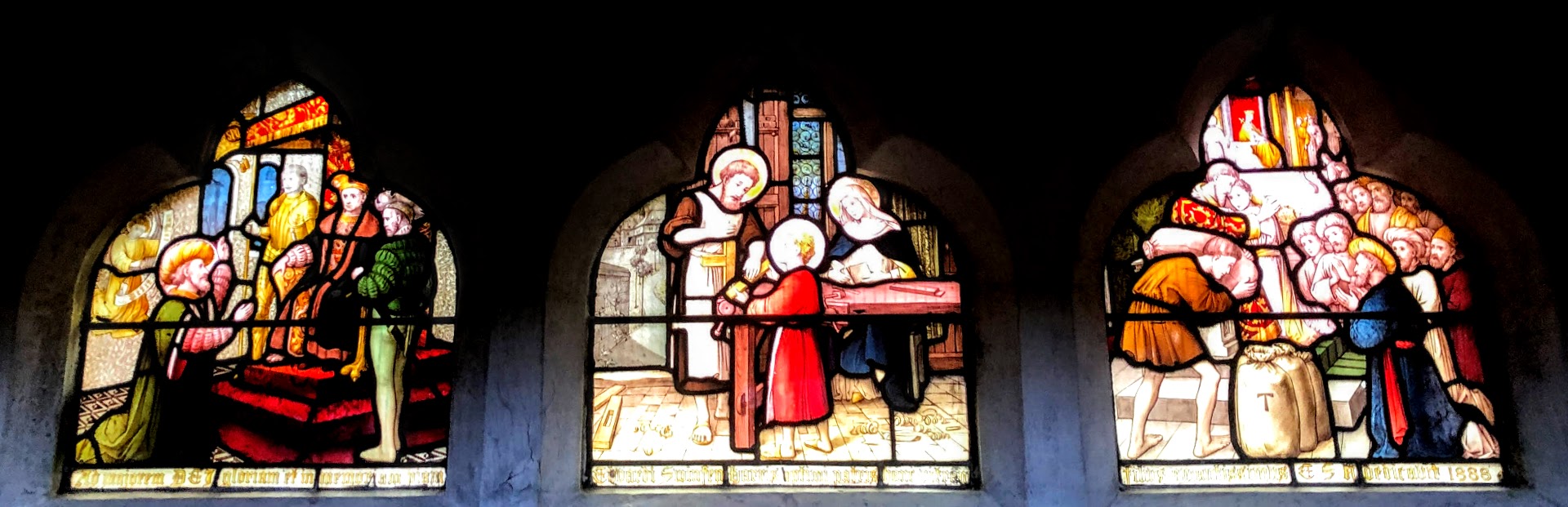
The second window in the south wall in Saint Mary and Saint Giles Church, Stony Stratford, is one of a series of windows by NHJ Westlake, and is dated 1888 (Photograph: Patrick Comerford)
The second window in the South Wall in Saint Mary and Saint Giles Church beneath the gallery is dated 1888. Edward Swinfen Harris commissioned this window in memory of his father, also Edward Swinfen Harris, who was the clerk to the town bench of magistrates, the Board of Guardians and other bodies in the town.
This second depicts three Biblical scenes: Joseph before Pharoah’s throne, interpreting his dreams (Genesis 41: 1-36); Jesus as an apprentice in Joseph the carpenter’s shop, with Joseph and the Virgin Mary (see Luke 2: 39-40); and Joseph’s brothers before him with the silver cup found in Benjamin’s sack (Genesis 44: 1-34).
Each panel depict a Biblical Joseph: Joseph the son sold into slavery in Egypt by his brothers; Joseph with the Christ Child; and Joseph with his brothers.
In the first panel, Joseph stands before Pharoah’s throne, interpreting his dreams (Genesis 41: 1-36). However, the vision he points to in the distance is not the years of plenty, or the years of famine, but Christ Crucified on Calvary.
Jesus as an apprentice in Joseph the carpenter’s shop, with Joseph and the Virgin Mary, depicted in the second window in the south wall in Saint Mary and Saint Giles Church, Stony Stratford (Photograph: Patrick Comerford)
The stories of Christ as an apprentice in the workshop of Joseph the carpenter are popular and pious, but are not found in any Gospel narrative (see Luke 2: 39-40). Nevertheless, this image in the second panel, showing Christ as an apprentice in Joseph the carpenter’s shop, reflects a subject that was popular among the Pre-Raphaelite artists at the time Westlake made this window.
William Holman Hunt (1827-11910) worked on his painting, ‘The Shadow of Death’, in 1870-1873, during his second trip to the Holy Land. It depicts Christ as a young man prior to his ministry, working as a carpenter. He is shown stretching his arms after sawing wood. The shadow of his outstretched arms falls on a wooden spar on which carpentry tools hang, creating a ‘shadow of death’ prefiguring the crucifixion.
Two decades earlier, Holman Hunt’s Pre-Raphaelite colleague John Everett Millais (1829-1896) had portrayed Christ as an apprentice carpenter, helping Joseph as a young boy, in his painting, ‘Christ in the House of his Parents’ (1849-1850).
In the third panel, Joseph’s brothers plead before him with the silver cup found in Benjamin’s sack (Genesis 44: 1-34). In the background, their ageing father with Jacob is being comforted.
In each of these panels, Westlake is suggesting that Edward Swinfen Harris was a loyal and faithful son to his father, the late Edward Swinfen Harris, and that he had learned from him.
Window 3, South Wall:
The third window in the south wall by NHJ Westlake is in memory of Catherine Swinfen Harris (Photograph: Patrick Comerford)
The third window on the South Wall beneath the gallery in Saint Mary and Saint Giles Church is dated 1896. It was commissioned by Edward Swinfen Harris in memory of his mother, Catharine Swinfen Harris, who died on 23 June 1896, at the age of 85.
This third window is of three eyelets and depicts three Biblical scenes: Jacob blesses Joseph’s sons Manasseh and Ephraim with crossed hands (see Genesis 48: 10-22); Christ greets two disciples at night, perhaps James and John, or Peter and Andrew, although this is not indicated on the window.
The story depicted in the first panel recalls how Joseph was Pharoah’s chief minister of Egypt when he took his two sons Manasseh and Ephraim to see his dying father Jacob. Jacob surprised them by deciding to adopt Manasseh and Ephraim as his own sons, and promising them the same inheritance as his other sons, like Reuben and Simeon (verse 5).
It is customary in many Jewish communities for parents to administer a blessing like Jacob’s blessing to Joseph’s sons on Friday nights before the kiddush. As hands are laid on the heads of the boys, the words spoken are: ‘May you be like Ephraim and Manasseh.’
The mother of these two, Asenath, was an Egyptian, and so her family was outside the community of faith. Yet, they are not disqualified from God’s blessings because of their parents’ unconventional marriage.
Traditionally, the eldest son would expect to inherit a double portion, signified by his father blessing him with his right hand. So Joseph placed his firstborn, Manasseh, on Jacob’s right side and Ephraim on his left. However, Jacob crossed his arms and put his right hand on the second born, Ephraim, and his left hand on Manasseh, and then spoke his blessing over both.
This story is a reminder of how God can choose people others think are not qualified or deserving, those who do earn or qualify for a blessing, those you are not next in line. Those who cannot normally expect favour or promotion may receive unexpected blessings.
In this window, Swinfen Harris may be saying that his mother was seen as an outsider but that in life through his parents he found blessings beyond any expectations in his dreams.
The window by Charles Eamer Kempe at the west end of Saint Mary and Saint Giles, Stony Stratford, depicting three archangels: Saint Gabriel above, and Saint Michael and Saint Raphael below (Photograph: Patrick Comerford)
CE Kampe window (west end):
The window at the west end of the church is a two-light depicting three archangels: Saint Gabriel above, and Saint Michael and Saint Raphael below. This window, dated 1903, is by Charles Eamer Kempe (1837-1907).
CE Kempe’s studios produced over 4,000 windows and designed altars and altar frontals, furniture and furnishings, lichgates and memorials that helped to define a later 19th-century Anglican style.
As a student at Pembroke College, Oxford, Kempe was influenced by the Anglo-Catholic Tractarian revival and considered a vocation to the priesthood. Inspired by William Morris’s work, he went to study architecture with the Gothic Revival architect George Frederick Bodley (1827-1907) at a time when Bodley was working on All Saints’ Church, Cambridge. There he learned from both Bodley and William Morris, and Bodley and Kempe became lifelong friends and collaborators.
Kempe’s work was strongly influenced by the Gothic Revival and the Pre-Raphaelite movement. His studios produced over 4,000 windows and designs for altars and altar frontals, furniture and furnishings, lychgates and memorials that helped to define a later 19th century Anglican style.
The English cathedrals with his work include Lichfield, as well as Chester, Gloucester, Hereford, Wells, Winchester and York. I have also written in the past about his windows in the chapel of Saint John’s Hospital, Lichfield and Christ Church, Leomansley, Lichfield.
The Cambridge church historian Owen Chadwick once said Kempe’s work represents ‘the Victorian zenith’ of church decoration and stained glass windows. Kempe was seen by his contemporaries as a Tractarian, but primarily he saw his task ‘to beautify the place in which to celebrate the glory of God.’ His window in Saint Mary and Saint Giles Church offers an interesting illustration of this principle.
Three south gallery windows:
Six apostles, James, Peter, John, Thomas, Andrew and Saint James the Less, seen from inside (above) and outside (below) the church (Photographs: Patrick Comerford)
The first three sets of three-light windows in the south gallery include a window by John Groome Howe of James Powell and Sons (1877).
This first window is dedicated to Josiah Michael and Ann Smith and shows six scenes with themes of the Resurrection or being raised to new life: top, 1, the raising of Jairus’s daughter (Matthew 9: 18-26; Mark 5: 21-43; Luke 8: 40-56); 2, Christ with two disciples on the Road to Emmaus (Luke 24: 13-35); and 3, the raising of the Widow of Nain’s son (see Luke 7: 11-17); below, 1, the raising of Lazarus (John 11:1 -44); 2, the Supper at Emmaus (Luke 24: 13-35); and 3, the healing of Simon Peter’s mother-in-law (Matthew 8: 14-15, Mark 1: 29-31, Luke 4: 38-39).
The firm of James Powell and Sons, also known as Whitefriars Glass, were London-based glassmakers, leadlighters and stained glass window manufacturers. As Whitefriars Glass, the company dated from the 17th century, and it became well-known as a result of the 19th-century Gothic Revival and the demand for stained glass windows.
During the latter part of the 19th century, the firm had close working links with leading architects and designers including TG Jackson, Edward Burne-Jones, William De Morgan and James Doyle, and produced the glass that Philip Webb used in his designs for William Morris. Nathanael Powell’s eldest surviving son, Harry, was an admirer of John Ruskin.
The next two windows in the south gallery are three-light windows depicting 12 apostles, each with six illustrations. Their date and the artist are unknown.
The first depicts: top, Saint James, Saint Peter, Saint John; below, Saint Thomas, Saint Andrew, Saint James the Less. The second depicts (top) Saint Philip, Saint Paul, Saint Bartholomew; and (below) Saint Jude, Saint Simon, Saint Matthew.
A fourth and fifth window in the south gallery show the Risen Christ and the Crucifixion.
The grave of Nikos Kazantzakis on the Martinengo Bastion of the Venetian walls surrounding Iraklion (Photograph: Patrick Comerford)
Anecdotes for discussion
1, Nikos Kazantzakis and Kathleen Forde;
2, The other Anthony Quinn: meeting Patrick Quinn or AP of AP in Greece 30 years ago (1996);
3, Meeting the writer’s widow Eleni Kazantzakis in Athens, February 2004;
4, The funeral and grave of Nikos Kazanzakis;
5, Zorba’s dance, and how it was invented
6, The legends about the Irish ancestry of Anthony Quinn
05 October 2026
Daily prayer in Ordinary Time 2026:
150, Monday 5 October 2026
An Orthodox icon of the Parable of the Good Samaritan, interpreting the parable according to Patristic and Orthodox traditions (Click on image for full-screen viewing)
Patrick Comerford
We are continuing in Ordinary Time in the Church Calendar, and this week began with the Eighteenth Sunday after Trinity (Trinity XVIII, 4 October).
Before today begins, however, I am taking some quiet time this morning to give thanks, and for reflection, prayer and reading in these ways:
1, today’s Gospel reading;
2, a reflection on the Gospel reading;
3, a prayer from the USPG prayer diary;
4, the Collects and Post-Communion prayer of the day.
The Good Samaritan … a stained glass window by Charles Eamer Kempe in Saint Andrew’s Church, Great Linford, Buckinghamshire (Photograph: Patrick Comerford)
Luke 10: 25-37 (NRSVA):
25 Just then a lawyer stood up to test Jesus. ‘Teacher,’ he said, ‘what must I do to inherit eternal life?’ 26 He said to him, ‘What is written in the law? What do you read there?’ 27 He answered, ‘You shall love the Lord your God with all your heart, and with all your soul, and with all your strength, and with all your mind; and your neighbour as yourself.’ 28 And he said to him, ‘You have given the right answer; do this, and you will live.’
29 But wanting to justify himself, he asked Jesus, ‘And who is my neighbour?’ 30 Jesus replied, ‘A man was going down from Jerusalem to Jericho, and fell into the hands of robbers, who stripped him, beat him, and went away, leaving him half dead. 31 Now by chance a priest was going down that road; and when he saw him, he passed by on the other side. 32 So likewise a Levite, when he came to the place and saw him, passed by on the other side. 33 But a Samaritan while travelling came near him; and when he saw him, he was moved with pity. 34 He went to him and bandaged his wounds, having poured oil and wine on them. Then he put him on his own animal, brought him to an inn, and took care of him. 35 The next day he took out two denarii, gave them to the innkeeper, and said, “Take care of him; and when I come back, I will repay you whatever more you spend.” 36 Which of these three, do you think, was a neighbour to the man who fell into the hands of the robbers?’ 37 He said, ‘The one who showed him mercy.’ Jesus said to him, ‘Go and do likewise.’
The Good Samaritan … a modern icon
Today’s Reflection:
We are all very familiar with the parable of the Good Samaritan, so familiar and so used to it that we are probably comfortable with the explanations and sermons we have heard over the years about this episode in today’s Gospel reading (Luke 10: 25-37), leaving very little to our own imaginations.
But the Early Fathers offered another interpretation of this parable.
The man who goes down from Jerusalem to Jericho is Adam, or humanity, or each and every one of us.
What does it mean that he goes down from Jerusalem to Jericho?
Jerusalem is the holy city of God, the place where God is served in worship and in public prayer. It is an impregnable stronghold, but it is located in a hill country, where the soil is stony and barren.
On the other hand, Jericho lies below the sea level in the Jordan Valley, in an area that is very fertile and rich in vegetation.
Jerusalem signifies the Divine Commandments. These commandments, like the walls of a city, limit us and our desires, but also create a safe living space where we can live unharmed by sin.
A man being seduced by earthly pleasures, represented by Jericho, goes out from Jerusalem, the stronghold of Divine Commandments. Here, we might think of Adam and Eve, leaving the Garden and going out into the world.
But the robbers control this way. Who are the robbers?
When people abandon God and seek pleasures in other places, the way of bodily desires first appears to be full of joy. But as time passes, indulging in passions becomes a heavy burden on the soul; in place of pleasure it becomes endless slavery. A man realises that he has lost his freedom and has become a captive of his passions. A soul blinded by passions and wounded by sin becomes incapable of any spiritual activity.
Before God, such a man is half-dead. On the way, the man has been stripped of his raiment, deprived of the raiment of virtues and of the cover of God’s grace and protection.
In this patristic approach to reading the parable, the robbers are demons who act through our own passions. The man wounded by robbers represents fallen humanity before the coming of Christ.
Who then were the Priest and Levite who saw the wounded man and passed by without providing him any help?
The Priest and the Levite are ministers of God. They represent the saints and prophets sent by God from the beginning of time.
Why then is it said that they passed by without helping that man?
Did they not fulfil the ministry of preaching?
Yes, they did. They came to that place, they stopped, they saw the man and they passed by. But wounded humanity remained lying on the road. Moses came and passed away, Elijah came and passed away, other prophets came and passed away, but the illness of humanity remained without being healed.
Only God who has created us can recreate us.
This is how Isaiah speaks on the incurable disease of the humanity:
Why do you seek further beatings?
Why do you continue to rebel?
The whole head is sick,
and the whole heart faint.
From the sole of the foot even to the head,
there is no soundness in it,
but bruises and sores
and bleeding wounds;
they have not been drained, or bound up,
or softened with oil. (Isaiah 1: 5-6)
Who then is the Samaritan who goes down on the same road?
The Samaritans were the descendants of Israelites and the nations who migrated to Palestine under Assyrian rule after the destruction of Jerusalem. They lived to the south of Judea, between Judea and Galilee. Samaritans believed in the One God of Israel and kept the Law of Moses, but they developed their own traditions. For the Jews, they were heretics, and so Jews kept their distance from Samaritans.
Why then does Christ represent himself as a Samaritan?
The Pharisees mockingly labelled Christ a Samaritan, saying, ‘Are we not right in saying that you are a Samaritan and have a demon?’ (John 8: 48).
Christ humbly attributes to himself the name given to him by his detractors.
In addition, Greek Orthodox hymns note a similarity between the phrases ‘from Samaria’ and ‘from Mary,’ for in Greek these phrases sound similar. (For example, the Samarian Gorge in Crete takes its name not from Samaria but from the abandoned village and church of Óssia María or Saint Mary).
The Samaritan, moved with compassion, approaches the wounded man. He binds his wounds, pouring oil and wine on them. The oil symbolises mercy and the wine the true teaching of God. Then he brings the man to an inn where he can be taken care of.
This Gospel readings says that the Good Samaritan ‘put him on his own animal, brought him to an inn, and took care of him.’ However, in traditional icons, Christ carries the man on his back. Christ in the incarnation takes on our human nature, our soul and body. That is why in the parable he ‘set him on his own beast,’ interpreted by the Early Fathers that Christ makes us members of his own body.
There is a similar image in the parable of the Lost Sheep (see Luke 15). The Good Shepherd left 99 sheep in the desert and went after the lost sheep, representing humanity. When he found the lost sheep, he put it on his shoulders, rejoicing.
The inn in this parable represents the Church. The innkeeper represents bishops and priests. Christ establishes his Church which, like an inn, accepts and provides shelter for all. The wounded man should stay here to be taken care of. The Samaritan has to leave, however. He takes out two silver coins and gave them to the innkeeper, saying: ‘Take care of him; and when I come back, I will repay you whatever more you spend.’
Christ indicates his second coming when he will come not to heal our infirmities, but to judge the living and the dead, and to reward each one according to his works.
The silver the Samaritan gives to the innkeeper is the divine grace Christ gives to the Church; it heals and saves souls through the sacraments. Bishops and priests, the ministers of the sacraments of the Church, are the distributors of God’s gifts. They offer to others what they have received: the sacraments and the teaching of Christ. Are they able to spend more? What can they add from themselves to the gift of the Divine Grace? Their labour, their cares, their zeal, which Christ shall recompense them on the day of the Last Judgment.
In this interpretation of the parable of the Good Samaritan, Christ offers himself as the prime example of mercy and compassion. Through his compassion, he takes on our sufferings and becomes the true neighbour of all fallen humanity.
This is a reading of this parable that connects with the assertion in the New Testament reading that God through Christ ‘has rescued us from the power of darkness and transferred us into the kingdom.
The Good Samaritan window in Saint George’s Church, Belfast (Photograph: Patrick Comerford)
Today’s Prayers (Monday 5 October 2026):
In Pray with the World Church, the prayer diary of the Anglican mission agency USPG (United Society Partners in the Gospel), the theme this week, 4-10 October 2026 (pp 44-45), is ‘The Gun, The Sword, and The Bible’. This theme was introduced yesterday with a reflection by the Revd Les Isaac OBE, founder and President of Ascension Trust and co-founder of Street Pastors.
The USPG Prayer Diary today (Monday 5 October 2026) invites us to pray:
Lord, give us courage to face the complexities of your Church’s history with honesty and humility. Help us to seek truth without fear and to grow in understanding and grace.
The Collect of the Day:
Almighty and everlasting God,
increase in us your gift of faith
that, forsaking what lies behind
and reaching out to that which is before,
we may run the way of your commandments
and win the crown of everlasting joy;
through Jesus Christ your Son our Lord,
who is alive and reigns with you,
in the unity of the Holy Spirit,
one God, now and for ever.
The Post-Communion Prayer:
We praise and thank you, O Christ, for this sacred feast:
for here we receive you,
here the memory of your passion is renewed,
here our minds are filled with grace,
and here a pledge of future glory is given,
when we shall feast at that table where you reign
with all your saints for ever.
Additional Collect:
God, our judge and saviour,
teach us to be open to your truth
and to trust in your love,
that we may live each day
with confidence in the salvation which is given
through Jesus Christ our Lord.
Yesterday’s Reflections
Continued Tomorrow
The Good Samaritan … a stained glass window in Saint Mary’s Cathedral, Limerick (Photograph: Patrick Comerford)
Scripture quotations are from the New Revised Standard Version Bible: Anglicised Edition copyright © 1989, 1995 National Council of the Churches of Christ in the United States of America. Used by permission. All rights reserved worldwide. http://nrsvbibles.org
Patrick Comerford
We are continuing in Ordinary Time in the Church Calendar, and this week began with the Eighteenth Sunday after Trinity (Trinity XVIII, 4 October).
Before today begins, however, I am taking some quiet time this morning to give thanks, and for reflection, prayer and reading in these ways:
1, today’s Gospel reading;
2, a reflection on the Gospel reading;
3, a prayer from the USPG prayer diary;
4, the Collects and Post-Communion prayer of the day.
The Good Samaritan … a stained glass window by Charles Eamer Kempe in Saint Andrew’s Church, Great Linford, Buckinghamshire (Photograph: Patrick Comerford)
Luke 10: 25-37 (NRSVA):
25 Just then a lawyer stood up to test Jesus. ‘Teacher,’ he said, ‘what must I do to inherit eternal life?’ 26 He said to him, ‘What is written in the law? What do you read there?’ 27 He answered, ‘You shall love the Lord your God with all your heart, and with all your soul, and with all your strength, and with all your mind; and your neighbour as yourself.’ 28 And he said to him, ‘You have given the right answer; do this, and you will live.’
29 But wanting to justify himself, he asked Jesus, ‘And who is my neighbour?’ 30 Jesus replied, ‘A man was going down from Jerusalem to Jericho, and fell into the hands of robbers, who stripped him, beat him, and went away, leaving him half dead. 31 Now by chance a priest was going down that road; and when he saw him, he passed by on the other side. 32 So likewise a Levite, when he came to the place and saw him, passed by on the other side. 33 But a Samaritan while travelling came near him; and when he saw him, he was moved with pity. 34 He went to him and bandaged his wounds, having poured oil and wine on them. Then he put him on his own animal, brought him to an inn, and took care of him. 35 The next day he took out two denarii, gave them to the innkeeper, and said, “Take care of him; and when I come back, I will repay you whatever more you spend.” 36 Which of these three, do you think, was a neighbour to the man who fell into the hands of the robbers?’ 37 He said, ‘The one who showed him mercy.’ Jesus said to him, ‘Go and do likewise.’
Today’s Reflection:
We are all very familiar with the parable of the Good Samaritan, so familiar and so used to it that we are probably comfortable with the explanations and sermons we have heard over the years about this episode in today’s Gospel reading (Luke 10: 25-37), leaving very little to our own imaginations.
But the Early Fathers offered another interpretation of this parable.
The man who goes down from Jerusalem to Jericho is Adam, or humanity, or each and every one of us.
What does it mean that he goes down from Jerusalem to Jericho?
Jerusalem is the holy city of God, the place where God is served in worship and in public prayer. It is an impregnable stronghold, but it is located in a hill country, where the soil is stony and barren.
On the other hand, Jericho lies below the sea level in the Jordan Valley, in an area that is very fertile and rich in vegetation.
Jerusalem signifies the Divine Commandments. These commandments, like the walls of a city, limit us and our desires, but also create a safe living space where we can live unharmed by sin.
A man being seduced by earthly pleasures, represented by Jericho, goes out from Jerusalem, the stronghold of Divine Commandments. Here, we might think of Adam and Eve, leaving the Garden and going out into the world.
But the robbers control this way. Who are the robbers?
When people abandon God and seek pleasures in other places, the way of bodily desires first appears to be full of joy. But as time passes, indulging in passions becomes a heavy burden on the soul; in place of pleasure it becomes endless slavery. A man realises that he has lost his freedom and has become a captive of his passions. A soul blinded by passions and wounded by sin becomes incapable of any spiritual activity.
Before God, such a man is half-dead. On the way, the man has been stripped of his raiment, deprived of the raiment of virtues and of the cover of God’s grace and protection.
In this patristic approach to reading the parable, the robbers are demons who act through our own passions. The man wounded by robbers represents fallen humanity before the coming of Christ.
Who then were the Priest and Levite who saw the wounded man and passed by without providing him any help?
The Priest and the Levite are ministers of God. They represent the saints and prophets sent by God from the beginning of time.
Why then is it said that they passed by without helping that man?
Did they not fulfil the ministry of preaching?
Yes, they did. They came to that place, they stopped, they saw the man and they passed by. But wounded humanity remained lying on the road. Moses came and passed away, Elijah came and passed away, other prophets came and passed away, but the illness of humanity remained without being healed.
Only God who has created us can recreate us.
This is how Isaiah speaks on the incurable disease of the humanity:
Why do you seek further beatings?
Why do you continue to rebel?
The whole head is sick,
and the whole heart faint.
From the sole of the foot even to the head,
there is no soundness in it,
but bruises and sores
and bleeding wounds;
they have not been drained, or bound up,
or softened with oil. (Isaiah 1: 5-6)
Who then is the Samaritan who goes down on the same road?
The Samaritans were the descendants of Israelites and the nations who migrated to Palestine under Assyrian rule after the destruction of Jerusalem. They lived to the south of Judea, between Judea and Galilee. Samaritans believed in the One God of Israel and kept the Law of Moses, but they developed their own traditions. For the Jews, they were heretics, and so Jews kept their distance from Samaritans.
Why then does Christ represent himself as a Samaritan?
The Pharisees mockingly labelled Christ a Samaritan, saying, ‘Are we not right in saying that you are a Samaritan and have a demon?’ (John 8: 48).
Christ humbly attributes to himself the name given to him by his detractors.
In addition, Greek Orthodox hymns note a similarity between the phrases ‘from Samaria’ and ‘from Mary,’ for in Greek these phrases sound similar. (For example, the Samarian Gorge in Crete takes its name not from Samaria but from the abandoned village and church of Óssia María or Saint Mary).
The Samaritan, moved with compassion, approaches the wounded man. He binds his wounds, pouring oil and wine on them. The oil symbolises mercy and the wine the true teaching of God. Then he brings the man to an inn where he can be taken care of.
This Gospel readings says that the Good Samaritan ‘put him on his own animal, brought him to an inn, and took care of him.’ However, in traditional icons, Christ carries the man on his back. Christ in the incarnation takes on our human nature, our soul and body. That is why in the parable he ‘set him on his own beast,’ interpreted by the Early Fathers that Christ makes us members of his own body.
There is a similar image in the parable of the Lost Sheep (see Luke 15). The Good Shepherd left 99 sheep in the desert and went after the lost sheep, representing humanity. When he found the lost sheep, he put it on his shoulders, rejoicing.
The inn in this parable represents the Church. The innkeeper represents bishops and priests. Christ establishes his Church which, like an inn, accepts and provides shelter for all. The wounded man should stay here to be taken care of. The Samaritan has to leave, however. He takes out two silver coins and gave them to the innkeeper, saying: ‘Take care of him; and when I come back, I will repay you whatever more you spend.’
Christ indicates his second coming when he will come not to heal our infirmities, but to judge the living and the dead, and to reward each one according to his works.
The silver the Samaritan gives to the innkeeper is the divine grace Christ gives to the Church; it heals and saves souls through the sacraments. Bishops and priests, the ministers of the sacraments of the Church, are the distributors of God’s gifts. They offer to others what they have received: the sacraments and the teaching of Christ. Are they able to spend more? What can they add from themselves to the gift of the Divine Grace? Their labour, their cares, their zeal, which Christ shall recompense them on the day of the Last Judgment.
In this interpretation of the parable of the Good Samaritan, Christ offers himself as the prime example of mercy and compassion. Through his compassion, he takes on our sufferings and becomes the true neighbour of all fallen humanity.
This is a reading of this parable that connects with the assertion in the New Testament reading that God through Christ ‘has rescued us from the power of darkness and transferred us into the kingdom.
The Good Samaritan window in Saint George’s Church, Belfast (Photograph: Patrick Comerford)
Today’s Prayers (Monday 5 October 2026):
In Pray with the World Church, the prayer diary of the Anglican mission agency USPG (United Society Partners in the Gospel), the theme this week, 4-10 October 2026 (pp 44-45), is ‘The Gun, The Sword, and The Bible’. This theme was introduced yesterday with a reflection by the Revd Les Isaac OBE, founder and President of Ascension Trust and co-founder of Street Pastors.
The USPG Prayer Diary today (Monday 5 October 2026) invites us to pray:
Lord, give us courage to face the complexities of your Church’s history with honesty and humility. Help us to seek truth without fear and to grow in understanding and grace.
The Collect of the Day:
Almighty and everlasting God,
increase in us your gift of faith
that, forsaking what lies behind
and reaching out to that which is before,
we may run the way of your commandments
and win the crown of everlasting joy;
through Jesus Christ your Son our Lord,
who is alive and reigns with you,
in the unity of the Holy Spirit,
one God, now and for ever.
The Post-Communion Prayer:
We praise and thank you, O Christ, for this sacred feast:
for here we receive you,
here the memory of your passion is renewed,
here our minds are filled with grace,
and here a pledge of future glory is given,
when we shall feast at that table where you reign
with all your saints for ever.
Additional Collect:
God, our judge and saviour,
teach us to be open to your truth
and to trust in your love,
that we may live each day
with confidence in the salvation which is given
through Jesus Christ our Lord.
Yesterday’s Reflections
Continued Tomorrow
The Good Samaritan … a stained glass window in Saint Mary’s Cathedral, Limerick (Photograph: Patrick Comerford)
Scripture quotations are from the New Revised Standard Version Bible: Anglicised Edition copyright © 1989, 1995 National Council of the Churches of Christ in the United States of America. Used by permission. All rights reserved worldwide. http://nrsvbibles.org
08 August 2026
An afternoon visit to
Saint Gabriel’s Church,
one of the listed churches
in Victorian Pimlico
Saint Gabriel’s Church on Warwick Square, Pimlico, was designed by the younger Thomas Cundy and was consecrated in 1852 (Photograph: Patrick Comerford, 2026)
Patrick Comerford
Pimlico has more than 350 Grade II–listed buildings and many Grade II* listed churches. The churches I visited during my stroll around Pimlico and Belgravia this week include Saint Gabriel’s Church on Warwick Square, Saint Saviour’s Church on Saint George’s Square, and Saint Barnabas Church, Saint Barnabas Street, as well as Saint Peter’s Church on Eaton Square, Belgravia, known as Saint Peter’s Pimlico until the 1870s.
Saint Gabriel’s Church on Warwick Square is a parish church in the Anglo-Catholic tradition in the Deanery of Westminster (Saint Margaret) and the Diocese of London. The Grade II* listed church was designed by Thomas Cundy (junior) and was built in 1851-1853 as part of Thomas Cubitt’s development of the area on behalf of the Grosvenor Estate.
I wanted to visit Saint Gabriel’s Church to see its Decorated Gothic architecture, the windows by Charles Eamer Kempe, the mosaics by Antonio Salvati of Venice, the stalls designed by Bridgeman of Lichfield, and because of its social mission and witness within the Anglican tradition. Sadly, it was not open when I arrived on Thursday afternoon, and I only caught a glimpse, albeit a somewhat but static satisfactory glimpse, through the doors in the narthex at the west end.
Inside Saint Gabriel’s Church, Warwick Square, Pimlico, designed by the younger Thomas Cundy and with additions by James Piers St Aubyn (Photograph: Patrick Comerford, 2026)
In the early 19th century, Pimlico was part of the Parish of Saint George, Hanover Square, formed in 1725. The development of Belgravia, and subsequently Pimlico, by Thomas Cubitt, employed by the Grosvenor family began in the 1820s and gathered momentum. In 1827, the Parish of Saint Peter, Pimlico, was created out of which Saint Gabriel, Warwick Square, was carved in 1850.
Pimlico was rapidly expanding as a residential area between the 1840s to 1860s. Private legislation in 1850 provided that the new parish church would generate sufficient revenue from pew-rents to provide a repair fund, administrative expenses of the new parish, and a stipend for the incumbent. The principal local landlord, the Marquess of Westminster, granted £5,000 and the freehold of a plot at the south-west end of Warwick Square for building the new church.
The church was designed by the younger Thomas Cundy (1790-1867), who joined his father’s practice and succeeded him as surveyor of the Grosvenor Estate, working in that role during Thomas Cubitt’s development of Belgravia and Pimlico.
In later years Cundy worked mostly on building churches on the west side of London, including Holy Trinity Church, Paddington, Saint Paul’s Church, Knightsbridge, Saint Michael’s Church, Chester Square, and Saint Barnabas’s, Saint Saviour’s and Saint Gabriel’s in Pimlico.
The High Altar in Saint Gabriel’s Church was designed by John Francis Bentley and the East Window is by Charles Eamer Kempe (Photograph: Patrick Comerford, 2026)
Cundy designed Saint Gabriel’s in the Decorated Gothic style, and John Kelk was the building contractor. The cost of building the new church was partly raised by subscription, with £5,000 from the Marquess of Westminster, who also gave the freehold of the site.
The church originally had galleries on three sides around the nave and could seat 1,150 people. It was consecrated by Charles James Blomfield, Bishop of London, on 12 May 1852.
The spire was rebuilt and the choir vestry was added in 1887-1888 by the architect James Piers St Aubyn (1815-1895) and the chancel was substantially reordered and embellished in 1890-1897.
The pulpit in Saint Gabriel’s Church was designed by JP St Aubyn (Photograph: Patrick Comerford, 2026)
The church has a five-bay nave with clerestory, double aisles, the inner taller as lean-tos, the outer with individual gables bays. There is a lower, three-bay chancel, a gabled south-east chapel with a polygonal apse against south chancel wall, and a gabled vestry to north, with a taller gabled choir vestry beyond. There is also a south gabled porch, a west gabled porch or narthex, and a north porch below the south-west tower and spire.
The High Altar was designed by John Francis Bentley (1839-1902), the architect of Westminster Cathedral, and dedicated in 1890. It is of mahogany, with a carved panelled, painted and gilded frontal. The central panel shows Christ the King, flanked by Saint Gabriel and Saint Michael, and the outer panels angels against a gilded background.
The improvements in the chancel were funded mainly by Lord Edward Pelham-Clinton (1836-1907) as a memorial to his wife Matilda. They Including the reredos, chancel wall decoration, sedilia, communion rails, sanctuary and chancel paving. The floor is of red and white marble squares with solid marble steps, and the alabaster and Italianate mosaic designs are by James Powell and Company.
A statue of Saint Gabriel above the west porch of Saint Gabriel’s Church (Photograph: Patrick Comerford, 2026)
The East Window (1896) by Charles Eamer Kempe depicts Christ in Majesty surrounded by angels, apostles, saints and kings.
The Lady Chapel was added to the south of the chancel and some of the original reredos from the original high altar, thought to be by George Gilbert Scott, was installed there. The south-east chapel also includes former flanking panels from east chancel wall in stone and mosaic, by Salvati, and reset against the south wall.
The panel above the arch to the south-east chapel apse shows Christ with the Doctors, in coloured and gilded opus sectile and in a moulded and carved alabaster frame. The south chancel window (1896) with a nativity scene is also by Kempe.
The pulpit (1875) on the north side of the chancel arch was designed by JP St Aubyn. The organ case (1892-1893) is attributed to Arthur Bloomfield. The vicar’s stall and choir stalls (1897) are by Bridgeman of Lichfield. The elaborately carved foliated corbels are attributed to Samuel Cundy, Thomas Cundy’s nephew.
The outer aisles, west porch and south-east chapel were added in 1896-1897 by the architects Baker and Turrill.
The south side of Saint Gabriel’s Church on Warwick Square, Pimlico (Photograph: Patrick Comerford, 2026)
Few alterations have taken place since then, although the church suffered damage from a World War II flying bomb on 29 July 1944.
Father Owen Higgs is the Vicar of Saint Gabriel’s, Pimlico. The regular Sunday services are: 8 am, Holy Communion (traditional language); 10:30 am, Sung Mass; 6 pm, Choral Evensong and Benediction. Choral Evensong is at 5:30 on Wednesdays.
Meanwhile, more in the days to come, hopefully, about my visits to Saint Saviour’s and Saint Peter’s during my stroll around Pimlico.
Saint Gabriel’s Church on Warwick Square, Pimlico, is in the Anglo-Catholic tradition, with said Holy Communion at 8 am and Sung Mass at 10:30 on Sundays (Photograph: Patrick Comerford, 2026)
23 May 2026
Daily prayer in Easter 2026:
49, Saturday 23 May 2026
‘If it is my will that he remain until I come, what is that to you? Follow me!’ (John 21: 21) … Saint John with the poisoned chalice, a statue on the Great Gate of Saint John’s College, Cambridge (Photograph: Patrick Comerford)
Patrick Comerford
Easter is a 50-day season, beginning on Easter Day (5 April 2026) and continuing through Ascension Day until the Day of Pentecost or Whit Sunday tomorrow (24 May 2026).
Before today begins, I am taking some quiet time this morning to give thanks, to reflect, to pray and to read in these ways:
1, reading today’s Gospel reading;
2, a short reflection;
3, a prayer from the USPG prayer diary;
4, the Collects and Post-Communion prayer of the day.
Saint John in a window by CE Kempe in Saint Leonard’s Church, Wigginton, Staffordshire (Photograph: Patrick Comerford, 2026)
John 21: 20-25 (NRSVA):
20 Peter turned and saw the disciple whom Jesus loved following them; he was the one who had reclined next to Jesus at the supper and had said, ‘Lord, who is it that is going to betray you?’ 21 When Peter saw him, he said to Jesus, ‘Lord, what about him?’ 22 Jesus said to him, ‘If it is my will that he remain until I come, what is that to you? Follow me!’ 23 So the rumour spread in the community that this disciple would not die. Yet Jesus did not say to him that he would not die, but, ‘If it is my will that he remain until I come, what is that to you?’
24 This is the disciple who is testifying to these things and has written them, and we know that his testimony is true. 25 But there are also many other things that Jesus did; if every one of them were written down, I suppose that the world itself could not contain the books that would be written.
The symbol of the serpent and the chalice, a carving by Eric Gill in the capstone at Saint John’s College, Cambridge (Photograph: Patrick Comerford)
Today’s Reflection:
The Gospel reading (John 21: 20-25) at the Eucharist today brings us to the last of the post-Resurrection appearances and the conclusion of Saint John’s Gospel. Today’s reading challenges us to consider whether we are going to follow Jesus to the end, no matter how, when or where death may come.
In this reading, we have an insight into the rumours that persisted in the community that the Beloved Disciple would not die (verse 23). But death comes to us all.
Over the past four years, I have spent a lot of time in hospitals in Oxford, Milton Keynes, London and Sheffield, following a stroke, and for tests, scans and consultations on my pulmonary sarcoidosis and the traces of sarcoidosis in my heart. Waiting between one set of consultations and tests and for further appointments, I have realised, time and again, how we all depend on the NHS here, and how vulnerable and fragile we are.
At 73, I may not quite be in rude health. But my distant ‘cousin’ Kevin Martin, who died three years ago (14 June 2023), would greet me on my birthdays with the traditional Jewish greeting of ‘ad meah v’esrim’, ‘may you live until 120!’ (עד מאה ועשרים שנה).
I may not live to be 120, despite everyone’s good wishes. I am certainly not going to live for ever. Are the other disciples in today’s reading engaging in humorous banter or hyperbole when they suggest the youngest among them is going to outlive the rest of them so that it appears as if he is going to live for ever?
Surely they realise everyone is going to die – including Lazarus who was raised from the dead after three days (John 11), including the son of the widow of Nairn (Luke 7: 11-17), the daughter of Jairus (Luke 8: 40-56), the centurion’s slave (Matthew 8: 5-13; Luke 7: 1-10), the official’s son in Capernaum (John 4: 46-54), Peter’s mother-in-law (Matthew 8: 14-15; Mark 1: 29-31; Luke 4: 38-39) …
Saint John too lived a life of service and suffering: he was exiled on Patmos, and although he died in old age in Ephesus, there were numerous attempts to make him a martyr.
Saint Paul names John as one of the pillars of the Church in Jerusalem (see Galatians 2: 9). Later, tradition says, he takes over the position of leadership Paul once had in the Church in Ephesus and is said to have lived there and to have been buried there.
According to a tradition mentioned by Saint Jerome, in the second general persecution, in the year 95, Saint John was arrested and sent to Rome, where he was thrown into a vat or cauldron of boiling oil but miraculously was preserved from death.
During the reign of the Emperor Domitian, it is said, Saint John was once given a cup of poisoned wine, but he blessed the cup and the poison rose out of the cup in the form of a serpent. Saint John then drank the wine with no ill effect. A chalice with a serpent signifying the powerless poison became one of his symbols.
Domitian then banished Saint John to the isle of Patmos. It was there in the year 96 he had the heavenly visions recorded in the Book of Revelation. After the death of Domitian, it is said, he returned to Ephesus in the year 97, and there tradition says he wrote his gospel about the year 98. He is also identified with the author of the three Johannine letters.
According to Eusebius, Saint John died in peace at Ephesus, in the third year of Trajan, that is, the year 100, when he was about 94 years old. According to Saint Epiphanius, he was buried on a mountain outside the town. The Basilica of Saint John the Theologian gave the later name of Aysoluk to the hill above the town of Selçuk, beside Ephesus.
The story of the poisoned chalice may be a pious myth, but it seeks to tell us that Saint John too took up the challenge to drink the cup that Christ drinks (Mark 10: 38-39).
For there is another poison that can damage the Church today – we can fail to love.
It is in sharing and serving with those who are most like Christ in his suffering that the world becomes united with the Christ we meet in Word and Sacrament, and there too we find eternal life.
Christ is risen!
The Lord is risen indeed. Alleluia!
‘If it is my will that he remain until I come, what is that to you? Follow me!’ (John 21: 21) … Saint John the Evangelist with the poisoned chalice depicted in a window in Saint John’s Church, Monkstown, Cork (Photograph: Patrick Comerford)
Today’s Prayers (Saturday 23 May 2026):
The theme this week (17-23 May 2026) in ‘Pray With the World Church’, the Prayer Diary of the Anglican mission agency USPG (United Society Partners in the Gospel) has been ‘Breaking Barriers: Gender Justice in Malawi’ (pp 56-57). This theme was introduced last Sunday with Reflections from Tamara Khismisi, Projects Coordinator, Anglican Church in Malawi.
The USPG prayer diary invites us to pray today (Saturday 23 May 2026):
Heavenly Father, we thank you for the partnership between USPG and the Anglican Church in Malawi. May this collaboration continue to provide education, health care, and advocacy that mirrors your transforming love and heart for justice.
The Collect:
O God the King of glory,
you have exalted your only Son Jesus Christ
with great triumph to your kingdom in heaven:
we beseech you, leave us not comfortless,
but send your Holy Spirit to strengthen us
and exalt us to the place where our Saviour Christ is gone before,
who is alive and reigns with you,
in the unity of the Holy Spirit,
one God, now and for ever.
The Post-Communion Prayer:
Eternal God, giver of love and power,
your Son Jesus Christ has sent us into all the world
to preach the gospel of his kingdom:
confirm us in this mission,
and help us to live the good news we proclaim;
through Jesus Christ our Lord.
Additional Collect:
Risen, ascended Lord,
as we rejoice at your triumph,
fill your Church on earth with power and compassion,
that all who are estranged by sin
may find forgiveness and know your peace,
to the glory of God the Father.
Collect on the Eve of Pentecost (Whit Sunday):
God, who as at this time
taught the hearts of your faithful people
by sending to them the light of your Holy Spirit:
grant us by the same Spirit
to have a right judgement in all things
and evermore to rejoice in his holy comfort;
through the merits of Christ Jesus our Saviour,
who is alive and reigns with you,
in the unity of the Holy Spirit,
one God, now and for ever.
Yesterday’s Reflections
Continued Tomorrow
The site of Saint John’s tomb near Ephesus is marked by a marble plaque and four Byzantine pillars (Photograph: Patrick Comerford)
Scripture quotations are from the New Revised Standard Version Bible: Anglicised Edition copyright © 1989, 1995 National Council of the Churches of Christ in the United States of America. Used by permission. All rights reserved worldwide. http://nrsvbibles.org
Patrick Comerford
Easter is a 50-day season, beginning on Easter Day (5 April 2026) and continuing through Ascension Day until the Day of Pentecost or Whit Sunday tomorrow (24 May 2026).
Before today begins, I am taking some quiet time this morning to give thanks, to reflect, to pray and to read in these ways:
1, reading today’s Gospel reading;
2, a short reflection;
3, a prayer from the USPG prayer diary;
4, the Collects and Post-Communion prayer of the day.
Saint John in a window by CE Kempe in Saint Leonard’s Church, Wigginton, Staffordshire (Photograph: Patrick Comerford, 2026)
John 21: 20-25 (NRSVA):
20 Peter turned and saw the disciple whom Jesus loved following them; he was the one who had reclined next to Jesus at the supper and had said, ‘Lord, who is it that is going to betray you?’ 21 When Peter saw him, he said to Jesus, ‘Lord, what about him?’ 22 Jesus said to him, ‘If it is my will that he remain until I come, what is that to you? Follow me!’ 23 So the rumour spread in the community that this disciple would not die. Yet Jesus did not say to him that he would not die, but, ‘If it is my will that he remain until I come, what is that to you?’
24 This is the disciple who is testifying to these things and has written them, and we know that his testimony is true. 25 But there are also many other things that Jesus did; if every one of them were written down, I suppose that the world itself could not contain the books that would be written.
The symbol of the serpent and the chalice, a carving by Eric Gill in the capstone at Saint John’s College, Cambridge (Photograph: Patrick Comerford)
Today’s Reflection:
The Gospel reading (John 21: 20-25) at the Eucharist today brings us to the last of the post-Resurrection appearances and the conclusion of Saint John’s Gospel. Today’s reading challenges us to consider whether we are going to follow Jesus to the end, no matter how, when or where death may come.
In this reading, we have an insight into the rumours that persisted in the community that the Beloved Disciple would not die (verse 23). But death comes to us all.
Over the past four years, I have spent a lot of time in hospitals in Oxford, Milton Keynes, London and Sheffield, following a stroke, and for tests, scans and consultations on my pulmonary sarcoidosis and the traces of sarcoidosis in my heart. Waiting between one set of consultations and tests and for further appointments, I have realised, time and again, how we all depend on the NHS here, and how vulnerable and fragile we are.
At 73, I may not quite be in rude health. But my distant ‘cousin’ Kevin Martin, who died three years ago (14 June 2023), would greet me on my birthdays with the traditional Jewish greeting of ‘ad meah v’esrim’, ‘may you live until 120!’ (עד מאה ועשרים שנה).
I may not live to be 120, despite everyone’s good wishes. I am certainly not going to live for ever. Are the other disciples in today’s reading engaging in humorous banter or hyperbole when they suggest the youngest among them is going to outlive the rest of them so that it appears as if he is going to live for ever?
Surely they realise everyone is going to die – including Lazarus who was raised from the dead after three days (John 11), including the son of the widow of Nairn (Luke 7: 11-17), the daughter of Jairus (Luke 8: 40-56), the centurion’s slave (Matthew 8: 5-13; Luke 7: 1-10), the official’s son in Capernaum (John 4: 46-54), Peter’s mother-in-law (Matthew 8: 14-15; Mark 1: 29-31; Luke 4: 38-39) …
Saint John too lived a life of service and suffering: he was exiled on Patmos, and although he died in old age in Ephesus, there were numerous attempts to make him a martyr.
Saint Paul names John as one of the pillars of the Church in Jerusalem (see Galatians 2: 9). Later, tradition says, he takes over the position of leadership Paul once had in the Church in Ephesus and is said to have lived there and to have been buried there.
According to a tradition mentioned by Saint Jerome, in the second general persecution, in the year 95, Saint John was arrested and sent to Rome, where he was thrown into a vat or cauldron of boiling oil but miraculously was preserved from death.
During the reign of the Emperor Domitian, it is said, Saint John was once given a cup of poisoned wine, but he blessed the cup and the poison rose out of the cup in the form of a serpent. Saint John then drank the wine with no ill effect. A chalice with a serpent signifying the powerless poison became one of his symbols.
Domitian then banished Saint John to the isle of Patmos. It was there in the year 96 he had the heavenly visions recorded in the Book of Revelation. After the death of Domitian, it is said, he returned to Ephesus in the year 97, and there tradition says he wrote his gospel about the year 98. He is also identified with the author of the three Johannine letters.
According to Eusebius, Saint John died in peace at Ephesus, in the third year of Trajan, that is, the year 100, when he was about 94 years old. According to Saint Epiphanius, he was buried on a mountain outside the town. The Basilica of Saint John the Theologian gave the later name of Aysoluk to the hill above the town of Selçuk, beside Ephesus.
The story of the poisoned chalice may be a pious myth, but it seeks to tell us that Saint John too took up the challenge to drink the cup that Christ drinks (Mark 10: 38-39).
For there is another poison that can damage the Church today – we can fail to love.
It is in sharing and serving with those who are most like Christ in his suffering that the world becomes united with the Christ we meet in Word and Sacrament, and there too we find eternal life.
Christ is risen!
The Lord is risen indeed. Alleluia!
‘If it is my will that he remain until I come, what is that to you? Follow me!’ (John 21: 21) … Saint John the Evangelist with the poisoned chalice depicted in a window in Saint John’s Church, Monkstown, Cork (Photograph: Patrick Comerford)
Today’s Prayers (Saturday 23 May 2026):
The theme this week (17-23 May 2026) in ‘Pray With the World Church’, the Prayer Diary of the Anglican mission agency USPG (United Society Partners in the Gospel) has been ‘Breaking Barriers: Gender Justice in Malawi’ (pp 56-57). This theme was introduced last Sunday with Reflections from Tamara Khismisi, Projects Coordinator, Anglican Church in Malawi.
The USPG prayer diary invites us to pray today (Saturday 23 May 2026):
Heavenly Father, we thank you for the partnership between USPG and the Anglican Church in Malawi. May this collaboration continue to provide education, health care, and advocacy that mirrors your transforming love and heart for justice.
The Collect:
O God the King of glory,
you have exalted your only Son Jesus Christ
with great triumph to your kingdom in heaven:
we beseech you, leave us not comfortless,
but send your Holy Spirit to strengthen us
and exalt us to the place where our Saviour Christ is gone before,
who is alive and reigns with you,
in the unity of the Holy Spirit,
one God, now and for ever.
The Post-Communion Prayer:
Eternal God, giver of love and power,
your Son Jesus Christ has sent us into all the world
to preach the gospel of his kingdom:
confirm us in this mission,
and help us to live the good news we proclaim;
through Jesus Christ our Lord.
Additional Collect:
Risen, ascended Lord,
as we rejoice at your triumph,
fill your Church on earth with power and compassion,
that all who are estranged by sin
may find forgiveness and know your peace,
to the glory of God the Father.
Collect on the Eve of Pentecost (Whit Sunday):
God, who as at this time
taught the hearts of your faithful people
by sending to them the light of your Holy Spirit:
grant us by the same Spirit
to have a right judgement in all things
and evermore to rejoice in his holy comfort;
through the merits of Christ Jesus our Saviour,
who is alive and reigns with you,
in the unity of the Holy Spirit,
one God, now and for ever.
Yesterday’s Reflections
Continued Tomorrow
Scripture quotations are from the New Revised Standard Version Bible: Anglicised Edition copyright © 1989, 1995 National Council of the Churches of Christ in the United States of America. Used by permission. All rights reserved worldwide. http://nrsvbibles.org
21 May 2026
Daily prayer in Easter 2026:
47, Thursday 21 May 2026
The Empress Helena depicted in a fresco in the Church of Saint Constantine and Saint Helen in Rethymnon, Crete … she is commemorated on 21 May (Photograph: Patrick Comerford)
Patrick Comerford
Easter is a 50-day season, beginning on Easter Day (5 April 2026) and continuing through Ascension Day until the Day of Pentecost or Whit Sunday next Sunday (24 June 2026). This week began with the Seventh Sunday of Easter (Easter VII, 17 May 2026), and today the Church calendar remembers Saint Helena (330), Protector of the Holy Places.
A local tradition in Essex claims Saint Helena was from Colchester. Her son Constantine, who is associated with York, became Emperor in the year 306 and raised her to the position of Empress. Helena visited the Holy Land as a pilgrim in the year 326. There, it is said, she found Christ’s cross. She is commemorated in the Orthodox Church on this day with her son Constantine, so today is the name day for everyone named Eleni, Dina, Kostas or Konstantinos.
Before today begins, I am taking some quiet time this morning to give thanks, to reflect, to pray and to read in these ways:
1, reading today’s Gospel reading;
2, a short reflection;
3, a prayer from the USPG prayer diary;
4, the Collects and Post-Communion prayer of the day.
‘I desire that those also, whom you have given me, may … see my glory’ (John 17: 24) … the south transept window by CE Kempe in Lichfield Cathedral depicts Christ in Glory (Photograph: Photograph: Patrick Comerford)
John 17: 20-26 (NRSVA):
[Jesus said:] 20 ‘I ask not only on behalf of these, but also on behalf of those who will believe in me through their word, 21 that they may all be one. As you, Father, are in me and I am in you, may they also be in us, so that the world may believe that you have sent me. 22 The glory that you have given me I have given them, so that they may be one, as we are one, 23 I in them and you in me, that they may become completely one, so that the world may know that you have sent me and have loved them even as you have loved me. 24 Father, I desire that those also, whom you have given me, may be with me where I am, to see my glory, which you have given me because you loved me before the foundation of the world.
25 ‘Righteous Father, the world does not know you, but I know you; and these know that you have sent me. 26 I made your name known to them, and I will make it known, so that the love with which you have loved me may be in them, and I in them.’
‘Christ in Glory’ … Graham Sutherland’s powerful tapestry in Coventry Cathedral (Photograph: Patrick Comerford)
Today’s Reflections:
As I was saying in my reflections on Sunday (17 May 2026), we are, in some ways, caught in the church calendar in an in-between time, between Ascension Day last Thursday [14 May 2026], and the Day of Pentecost on Sunday next [24 May 2026].
The Gospel reading at the Eucharist today (John 17: 20-26) follows Christ’s ‘Farewell Discourse’ at the Last Supper (John 14: 1 to 16: 33), and Christ has just ended his instructions to his disciples, which conclude with the advice, ‘In the world you face persecution But take courage; I have conquered the world!’ (John 16: 33).
We are now coming to the end of his prayer to the Father (John 17: 1-26), in which he summarises the significance of his life as the time for his glory – his Crucifixion, Resurrection and Ascension – has arrived.
This prayer is often referred to as the High Priestly Prayer, as it includes many of the elements of prayer a priest offers when a sacrifice is about to be made: glorification (verses 3-5, 25), remembrance of God’s work (verses 2, 6-8, 22, 23), intercession on behalf of others (verses 9, 11, 15, 20, 21, 24), and a declaration of the offering itself (verses 1, 5).
In the Orthodox Church, this passage is also read on the Seventh Sunday of Easter (1 June 2025), a day remembering the Fathers of the First Ecumenical Council at Nicaea in the year 325. We were celebrating the 1,700th anniversary of that council last year and its formulation of the Nicene Creed. That council condemned the heresy of Arianism that taught that the Son of God was created by the Father and that there was a time when the Son of God did not exist. Christ’s words here bear witness to his divinity and to his filial relationship with the Father.
In his time alone in the Garden of Gethsemane, Christ looks up to heaven and prays to the Father, asking him ‘that they may all be one. As you, Father, are in me and I am in you, may they also be in us, so that the world may believe.’ (verse 21).
In this reading, Christ prays for the Church of all times. He looks beyond those who follow him now, to those who will come to believe through their witness. May the Church be rooted in the oneness he shares with the Father (verse 21), which is a relationship of mutual love (verse 23).
He prays that his followers may attain the ultimate goal: to share in Christ’s glory, which is founded in love that has been there before time began (verse 24).
His followers know that Christ has been sent by the Father (verse 25). Now he prays that as we are sent out into the world that ‘the love with which you have loved me may be in them, and I in them.’
Meanwhile, our reading tomorrow returns to the post-Resurrection appearances.
Christ is risen!
The Lord is risen indeed. Alleluia!
‘I ask … that they may all be one’ (John 17: 20-21) … the former Bea House on Pembroke Park, Dublin, the home of the Irish School of Ecumenics in my student days in the 1980s (Photograph: Patrick Comerford)
Today’s Prayers (Thursday 21 May 2026):
The theme this week (17-23 May 2026) in ‘Pray With the World Church’, the Prayer Diary of the Anglican mission agency USPG (United Society Partners in the Gospel) has been ‘Breaking Barriers: Gender Justice in Malawi’ (pp 56-57). This theme was introduced on Sunday with Reflections from Tamara Khismisi, Projects Coordinator, Anglican Church in Malawi.
The USPG prayer diary invites us to pray today (Thursday 21 May 2026):
Lord, we lift up mission hospitals such as St Peter’s, St Luke’s and St Anne’s in Malawi. We pray that doctors, nurses, and staff are provided with the strength, resources, and wisdom to care for mothers, children, and families in rural communities.
The Collect of the Day:
O God the King of Glory,
you have exalted your only Son Jesus Christ
with great triumph to your kingdom in heaven:
Mercifully give us faith to know
that, as he promised,
he abides with us on earth to the end of time;
who is alive and reigns with you and the Holy Spirit,
one God, now and for ever.
The Post-Communion Prayer:
Eternal Giver of love and power,
your Son Jesus Christ has sent us into all the world
to preach the gospel of his kingdom.
Confirm us in this mission,
and help us to live the good news we proclaim;
through Jesus Christ our Lord.
Additional Collect:
Risen, ascended Lord,
as we rejoice at your triumph,
fill your Church on earth with power and compassion,
that all who are estranged by sin
may find forgiveness and know your peace,
to the glory of God the Father.
Yesterday’s Reflections
Continued Tomorrow
The Emperor Constantine and Saint Helena hold the Holy Cross … an icon in Panormos, east of Rethymnon in Crete (Photograph: Patrick Comerford)
Scripture quotations are from the New Revised Standard Version Bible: Anglicised Edition copyright © 1989, 1995 National Council of the Churches of Christ in the United States of America. Used by permission. All rights reserved worldwide. http://nrsvbibles.org
Subscribe to:
Posts (Atom)


