Showing posts with label Didyma. Show all posts

03 July 2026

Daily prayer in Ordinary Time 2026:
57, Friday 3 July 2026,
Saint Thomas the Apostle

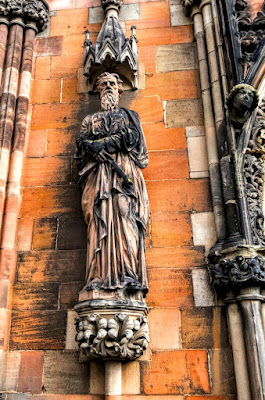
Saint Thomas the Apostle … a sculpture on the west façade of Lichfield Cathedral (Photograph: Patrick Comerford)

Patrick Comerford

We are in Ordinary Time in the Church Calendar and the week began with the Fourth Sunday after Trinity (Trinity IV, 28 June 2025) and the Feast of Saint Peter and Saint Paul (29 June 2026). Today (3 July), the Calendar of the Church of England celebrates Saint Thomas the Apostle.

Before today begins, though, I am taking some quiet time this morning to give thanks, to reflect, to pray and to read in these ways:

1, reading today’s Gospel reading;

2, a short reflection;

3, a prayer from the USPG prayer diary;

4, the Collects and Post-Communion prayer of the day.

An icon of the Incredulity of Saint Thomas in the iconostasis in the Greek Orthodox Church in Stony Stratford (Photograph: Patrick Comerford, 2024)

John 20: 24-29 (NRSVA):

24 But Thomas (who was called the Twin), one of the twelve, was not with them when Jesus came. 25 So the other disciples told him, ‘We have seen the Lord.’ But he said to them, ‘Unless I see the mark of the nails in his hands, and put my finger in the mark of the nails and my hand in his side, I will not believe.’

26 A week later his disciples were again in the house, and Thomas was with them. Although the doors were shut, Jesus came and stood among them and said, ‘Peace be with you.’ 27 Then he said to Thomas, ‘Put your finger here and see my hands. Reach out your hand and put it in my side. Do not doubt but believe.’ 28 Thomas answered him, ‘My Lord and my God!’ 29 Jesus said to him, ‘Have you believed because you have seen me? Blessed are those who have not seen and yet have come to believe.’

Saint Thomas and the Risen Christ depicted in a fresco in a church in Athens (Photograph: Patrick Comerford)

Today’s Reflection:

The Calendar of the Church of England commemorates Saint Thomas today (3 July), while the Orthodox Church remembers the doubting of the Apostle Thomas on the first Sunday after Easter; this year Thomas Sunday was on Sunday 19 April 2026.

In the Gospels, Saint Thomas is named ‘Thomas, also called the Twin (Didymus).’ But the name ‘Thomas’ comes from the Aramaic word for twin, T'oma (תאומא), so there is a tautological wordplay going on here.

Syrian tradition says the apostle’s full name was Judas Thomas, or Jude Thomas. But, who was his twin brother – or sister?

I have often visited Didyma on the south coast of Anatolia. There, the Didymaion was one of the most important shrines and temples in the classical world to Apollo and his twin sister Artemis. Apollo was the sun-god, the son of Zeus; he was the patron of shepherds and the guardian of truth, and in Greek and Roman mythology he died and rose again.

Is the story of Saint Thomas’s doubts an invitation to the followers of the cult of Apollo to turn to Christ, the true Son of God the Father, who is the Good Shepherd, who is the way, the truth and the light, who has died and who is truly risen?

We can never be quite sure about Saint Thomas in Saint John’s Gospel. After the death of Lazarus, the disciples resist Christ’s decision to return to Judea, where there had been an attempt to stone Jesus. But Thomas shows he has no idea of the real meaning of death and resurrection when he suggests that the disciples should go to Bethany with Jesus: ‘Let us also go, that we may die with him’ (John 11: 16).

And, while Thomas saw the raising of Lazarus, what did he believe in?

Could seeing ever be enough for a doubting Thomas to believe?

The Apostle Thomas also speaks at the Last Supper (John 14: 5). When Christ assures the disciples that they know where he is going, Thomas protests that they do not know at all. He has been with Christ for three years, and still he does not believe or understand. Seeing and explanations are not enough for him. Christ replies to his remarks and to Philip’s requests with a detailed exposition of his relationship to God the Father.

In the Resurrection story in Saint John’s Gospel, Saint Mary Magdalene – who is commemorated later this month on 22 July – does not recognise the Risen Christ at first. For her, appearances could be deceptive, and she thinks he is the gardener. But when he speaks to her, she recognises his voice, and then wants to hold on to him. From that moment of seeing and believing, she rushes off to tell the Disciples: ‘I have seen the Lord.’

Two of the disciples, John the Beloved and Simon Peter, have already seen the empty tomb, but they fail to make the vital connection between seeing and believing. When they hear Mary’s testimony, they still fail to believe fully. They only believe when they see the Risen Lord standing among them, when he greets them, ‘Peace be with you,’ and when he shows them his pierced hands and side.

They had to see and to hear, they had to have the Master stand over them in their presence, before they could believe.

On the first Easter Day, the Disciples locked themselves away out of fear. But where is Thomas? Is he fearless? Or is he foolish?

For a full week, Thomas is absent and does not join in the Easter experience of the remaining disciples. He has not seen and so he refuses to believe. When they tell him what has happened, Thomas refuses to accept their stories of the Resurrection. For him hearing, even seeing, are not enough.

Thomas wants to see, hear and touch. He wants to use all his learning faculties before he can believe this story. He has heard, but he wants to see. When he sees, he wants to touch … he demands not only to touch the Risen Christ, but to touch his wounds too before being convinced.

And so, for a second time within eight days, Christ comes and stands among his disciples, and says: ‘Peace be with you.’

The traditional icon depicting the event recalled in John 20: 19-31 emphasises the closed door, a significant part of the narrative: ‘the doors were locked’ (verse 19). After Christ’s arrest, the disciples tried to hide from the authorities out of fear. They returned to the last place where they had seen him alive, the upper room, around the same table where they had shared that last meal.

The young Thomas was not present the first time round and had said to the others: ‘Unless I see the mark of the nails in his hands and put my finger in the mark of the nails and my hand in his side, I will not believe’ (John 20: 25).

Christ appears within the disciples’ hiding place, where the door is firmly shut. His presence is real, and he invites Thomas: ‘Put your finger here and see my hands. Reach out your hand and put it in my side. Do not doubt but believe’ (John 20: 27).

In this icon, Christ’s right arm is raised not so much in blessing but revealing his right side with its open wound. Saint Thomas is raising his right hand, about to touch the wounded side, but not actually placing his finger in the open wound.

The wounds from the nails on the Cross can also be seen in Christ’s hand and feet. The traditional icons following Byzantine iconography and style show Christ standing in front of the closed door of a large domed building, with his right arm raised; we can see the signs of the nails on his hands. In many icons, Christ holds a scroll in his left hand.

The Apostles, divided in two groups, watch Thomas touch Christ’s side.

The familiar term ‘doubting Thomas’, referring to the Apostle, is used to describe someone who unreasonably doubts someone’s word. Where Orthodox icons depicting this scene have inscriptions, they do not refer to the doubts of Saint Thomas. Instead, the usual Greek inscription reads Η ψηλάφηση του Θωμά (I Psilafisi tou Thoma), ‘the Assurance of Thomas.’ Often English icons are inscribed ‘The Belief of Thomas.’ The icons show not a ‘Doubting Thomas,’ but a reassured Thomas. This is the Thomas who bends before the Risen Christ to touch his wounds and exclaims: ‘My Lord and my God!’ (John 20: 28).

The Church Fathers recognised that although Saint Thomas doubted, his doubt was not unreasonable. Christ responded, spurring Saint Thomas to a confession of Christ’s Divinity that is more explicit than anywhere else in the Gospels.

Looking out from the scene, Christ’s response to Thomas is also for us: ‘Have you believed because you have seen me? Blessed are those who have not seen and yet have come to believe’ (John 20: 29).

Mary was asked in the garden on Easter morning not to cling on to Christ. But Thomas is invited to touch him in the most intimate way. He is told to place his finger in Christ’s wounded hands and his hand in Christ’s pierced side.

Yet we are never told whether Thomas actually touches those wounds with his fingers. All we are told is that once he has seen the Risen Christ, Thomas simply professes his faith in Christ: ‘My Lord and my God!’

In that moment, we hear the first expression of faith in the two natures of Christ, that he is both divine and human. For all his doubts, Saint Thomas provides us with an exquisite summary of the apostolic faith, contained within the Nicene Creed, whose 1,700th anniversary we are commemorating this year.

Too often, perhaps, we talk about ‘Doubting Thomas,’ when we might better call him ‘Believing Thomas.’ His doubting leads him to questions. But his questioning leads to listening. And when he hears, he sees, perhaps he even touches. Whatever he does, he learns in his own way, and he comes not only to faith but to faith that for this first time is expressed in that eloquent yet succinct acknowledgment of Christ as both ‘My Lord and My God.’

In our society today, are we easily deceived by appearances?

Do we confuse what pleases me with beauty and with truth?

Do we allow those who have power to define the boundaries of trust and integrity merely to serve their own interests?

Too often, in this world, we are deceived easily by the words of others and deceived by what they want us to see. Seeing is not always believing today. Hearing does not always mean we have heard the truth, as we know in politics today. It is easy to deceive and to be deceived by a good presentation and by clever words.

Too often, we accept or judge people by their appearances, and we are easily deceived by the words of others because of their office or their privilege. But there are times when our faith, however simple or sophisticated, must lead us to ask appropriate questions, not to take everything for granted, and not to confuse what looks like being in our own interests with real beauty and truth.

Although the doors were shut, Jesus came and stood among them and said, ‘Peace be with you’ (John 20: 26) … an icon in Saint Mary and All Saints Church, Walsingham (Photograph: Patrick Comerford, 2026)

Today’s Prayers (Friday 3 July 2026, Saint Thomas the Apostle):

In Pray with the World Church, the prayer diary of the Anglican mission agency USPG (United Society Partners in the Gospel), the theme this week, from 28 June to 4 July 2026 (pp 14-15), is ‘Living Stones’. This theme was introduced on Sunday with a reflection by the Very Revd Lydia Kelsey Bucklin, President and Dean of Episcopal Divinity School.

The USPG prayer diary today (Friday 3 July 2026, Saint Thomas the Apostle) invites us to pray:

Faithful God, as we remember Saint Thomas, we pray for those who doubt the myths of Christian nationalism. Give us courage to question and resist the use of faith to harm, and to see Christ more clearly.

The Collect:

Almighty and eternal God,
who, for the firmer foundation of our faith,
allowed your holy apostle Thomas
to doubt the resurrection of your Son
till word and sight convinced him:
grant to us, who have not seen, that we also may believe
and so confess Christ as our Lord and our God;
who is alive and reigns with you,
in the unity of the Holy Spirit,
one God, now and for ever.

The Post-Communion Prayer:

Almighty God,
who on the day of Pentecost
sent your Holy Spirit to the apostles
with the wind from heaven and in tongues of flame,
filling them with joy and boldness to preach the gospel:
by the power of the same Spirit
strengthen us to witness to your truth
and to draw everyone to the fire of your love;
through Jesus Christ our Lord.

Yesterday’s reflections

Continued tomorrow

The Temple of Apollo in Didyma … one of the most important shrines and temples in the classical world to Apollo and his twin sister Artemis (Photograph: Patrick Comerford)

Scripture quotations are from the New Revised Standard Version, Anglicised Edition copyright © 2021, National Council of the Churches of Christ in the United States of America. Used by permission. All rights reserved worldwide.

12 April 2026

Daily prayer in Easter 2026:
8, Sunday 12 April 2026,
the Second Sunday of Easter

The doors of the house … were locked … Jesus came and stood among them and said, ‘Peace be with you’ (John 20: 19) … an icon in Saint Mary and All Saints Church, Walsingham (Photograph: Patrick Comerford, 2026)

Patrick Comerford

Our Easter celebrations continue in the Church Calendar, and today is the Second Sunday of Easter (Easter II). In the calendar of the Greek Orthodox Church, however, today is Easter Day.

I was at the celebrations of Easter Eve in the Greek Orthodox Church in Stony Stratford late last night, and they continued until after 3 am this morning. Later this morning, I hope to be at the Parish Eucharist in Saint Mary and Saint Giles Church, Stony Stratford, and to read one of the lessons. Then, at lunchtime today, there is a Greek community barbeque in the grounds of the Greek Orthodox Church in Stony Stratford.

But, before today begins, I am taking some quiet time this morning to give thanks, to reflect, to pray and to read in these ways:

1, reading today’s Gospel reading;

2, a short reflection;

3, a prayer from the USPG prayer diary;

4, the Collects and Post-Communion prayer of the day.

An icon of the Incredulity of Saint Thomas in the Greek Orthodox Church in Stony Stratford (Photograph: Patrick Comerford)

John 20: 19-31 (NRSVA):

19 When it was evening on that day, the first day of the week, and the doors of the house where the disciples had met were locked for fear of the Jews, Jesus came and stood among them and said, ‘Peace be with you.’ 20 After he said this, he showed them his hands and his side. Then the disciples rejoiced when they saw the Lord. 21 Jesus said to them again, ‘Peace be with you. As the Father has sent me, so I send you.’ 22 When he had said this, he breathed on them and said to them, ‘Receive the Holy Spirit. 23 If you forgive the sins of any, they are forgiven them; if you retain the sins of any, they are retained.’

24 But Thomas (who was called the Twin), one of the twelve, was not with them when Jesus came. 25 So the other disciples told him, ‘We have seen the Lord.’ But he said to them, ‘Unless I see the mark of the nails in his hands, and put my finger in the mark of the nails and my hand in his side, I will not believe.’

26 A week later his disciples were again in the house, and Thomas was with them. Although the doors were shut, Jesus came and stood among them and said, ‘Peace be with you.’ 27 Then he said to Thomas, ‘Put your finger here and see my hands. Reach out your hand and put it in my side. Do not doubt but believe.’ 28 Thomas answered him, ‘My Lord and my God!’ 29 Jesus said to him, ‘Have you believed because you have seen me? Blessed are those who have not seen and yet have come to believe.’

30 Now Jesus did many other signs in the presence of his disciples, which are not written in this book. 31 But these are written so that you may come to believe that Jesus is the Messiah, the Son of God, and that through believing you may have life in his name.

Saint Thomas and the Risen Christ depicted in a fresco in a church in Athens (Photograph: Patrick Comerford)

Today’s Reflections:

This Second Sunday of Easter (Easter II) is traditionally known as Low Sunday. In the past this has also been known as Saint Thomas Sunday, because of the Gospel reading (John 20: 19-31) recalling the story of ‘Doubting Thomas.’

Some people say this Sunday was called ‘Low Sunday’ because today’s liturgy is something of an anti-climax after the solemn Easter liturgy and celebrations a week ago. Some even joke that today is known as Low Sunday because this is the Sunday choirs take off after their hard work during Holy Week and Easter.

In these difficult times, with a continuing conflict in the Middle East and an unsteady ceasefire in the Gul, with between Russia and Ukraine, and global tensions exacerbated by the actions of the Trump regime, many people are feeling low, feeling isolated and looking for hope. Like the disciples in the Gospel reading, they may feel they are living locked away in fear. But the Gospel reading is not just a reminder, but a triple reminder, that the primary message of the Risen Christ is ‘Peace be with you.’ In Saint John’s Gospel, this phrase has the same impact as the message of the Risen Christ in Saint Matthew’s Gospel, ‘Be not afraid.’

In the Gospels, Saint Thomas is named ‘Thomas, also called the Twin (Didymus)’. But the name ‘Thomas’ comes from the Aramaic word for twin, T'oma (תאומא), so there is a tautological wordplay going on here.

Syrian tradition says the apostle’s full name was Judas Thomas, or Jude Thomas, but who was his twin brother (or sister)?

I have often visited Didyma on the southern Anatolian coast. There the Didymaion was one of the most important shrines and temples in the classical world to Apollo and his twin sister Artemis. Apollo was the sun-god, the sun of Zeus; he was the patron of shepherds and the guardian of truth, and in Greek and Roman mythology he died and rose again.

Is the story of Saint Thomas’s doubts an invitation to the followers of the cult of Apollo to turn to Christ, the true Son of God the Father, who is the Good Shepherd, who is the way, the truth and the light, who has died and who is truly risen?

We can never be quite sure about Saint Thomas in Saint John’s Gospel. After the death of Lazarus, the disciples resist Christ’s decision to return to Judea, where there had been an attempt to stone Jesus. But Thomas shows he has no idea of the real meaning of death and resurrection when he suggests that the disciples should go to Bethany with Jesus: ‘Let us also go, that we may die with him’ (John 11: 16).

And while Thomas saw the raising of Lazarus, what did he believe in?

Could seeing ever be enough for a doubting Thomas to believe?

The Apostle Thomas also speaks at the Last Supper (John 14: 5). When Christ assures his disciples that they know where he is going, Thomas protests that they do not know at all. He has been with Christ now for three years, and still he does not believe or understand. Seeing and explanations are not enough for him. Christ replies to this and to Philip’s requests with a detailed exposition of his relationship to God the Father.

In the Resurrection story in Saint John’s Gospel, Mary does not recognise the Risen Christ at first. For her, appearances could be deceiving, and she thinks he is the gardener. But when he speaks to her, she recognises his voice, and then wants to hold on to him. From that moment of seeing and believing, she rushes off to tell the Disciples: ‘I have seen the Lord.’

Two of the disciples, John the Beloved and Simon Peter, have already seen the empty tomb, but they fail to make the vital connection between seeing and believing. When they hear Mary’s testimony, they still fail to believe fully. They only believe when they see the Risen Lord standing among them, when he greets them, ‘Peace be with you,’ and when he shows them his pierced hands and side.

They had to see and to hear, they had to have the Master stand over them in their presence, before they could believe.

On the first Easter Day, the Disciples locked themselves away out of fear. But where is Thomas? Is he fearless? Or is he foolish?

For a full week, Thomas is absent and does not join in the Easter experience of the remaining disciples. He has not seen and so he refuses to believe. When they tell him what has happened, Thomas refuses to accept their stories of the Resurrection. For him hearing, even seeing, are not enough.

Thomas wants to see, hear and touch. He wants to use all his learning faculties before he can believe this story. He has heard, but he wants to see. When he sees, he wants to touch … he demands not only to touch the Risen Christ, but to touch his wounds too before being convinced.

And so for a second time within eight days, Christ comes and stands among his disciples, and says: ‘Peace be with you.’

Mary was asked in the garden on Easter morning not to cling on to Christ. But Thomas is invited to touch him in the most intimate way. He is told to place his finger in Christ’s wounded hands and his hand in Christ’s pierced side.

Caravaggio has depicted this scene in his painting, The Incredulity of Saint Thomas. Yet we are never told whether Thomas actually touched those wounds with his fingers. All we are told is that once he has seen the Risen Christ, Thomas simply professes his faith in Jesus: ‘My Lord and my God!’

In that moment, we hear the first expression of faith in the two natures of Christ, that he is both divine and human. For all his doubts, Saint Thomas provides us with an exquisite summary of the apostolic faith.

Too often, perhaps, we talk about ‘Doubting Thomas.’ Instead, we might better call him ‘Believing Thomas.’ His doubting leads him to question. But his questioning leads to listening. And when he hears, he sees, perhaps he even touches. Whatever he does, he learns in his own way, and he comes not only to faith but to faith that for this first time is expressed in that eloquent yet succinct acknowledgment of Christ as both ‘My Lord and My God.’

In our society today, are we easily deceived by appearances?

Do we confuse what pleases me with beauty and with truth?

Do we allow those who have power to define the boundaries of trust and integrity merely to serve their own interests?

Too often, in this world, we are deceived easily by the words of others and deceived by what they want us to see. Seeing is not always believing today. Hearing does not always mean we have heard the truth, as we know with the decline in honesty and integrity in political life in the US in the past three months. It is easy to deceive and to be deceived by a good presentation and by clever words.

Too often, we accept or judge people by their appearances, and we are easily deceived by the words of others because of their office or their privilege. But there are times when our faith, however simple or sophisticated, must lead us to ask appropriate questions, not to take everything for granted, and not to confuse what looks like being in our own interests with real beauty and truth.

The Second Sunday of Easter is traditionally called ‘Low Sunday.’ But we need not be low in spirit; instead, we can be in high spirits because of the Risen Christ. ‘Peace be with you!’

Χριστὸς ἀνέστη!
Christ is Risen!


The Temple of Apollo in Didyma … one of the most important shrines and temples in the classical world to Apollo and his twin sister Artemis (Photograph: Patrick Comerford)

Today’s Prayers (Sunday 12 April 2026, Easter II):

‘Stocked with Hope’ provides the theme this week in ‘Pray With the World Church’, the Prayer Diary of the Anglican mission agency USPG (United Society Partners in the Gospel), pp 46-47. This theme is introduced today with a Programme Update by Mayank Thomas, Programme Manager, the Synodical Board of Social Services, Church of North India:

Many women in North India face economic and social barriers due to long-standing inequalities. The Church of North India believes in the dignity of all and is therefore responding by supporting skills development, income opportunities, and community advocacy, helping women gain economic independence and a stronger voice in decision-making.

Shaila*, a resident of a remote village, lives with her husband and their eight-year-old daughter. With her husband’s income coming from irregular daily wage labour and her own small grocery shop bringing in only limited earnings, the family often struggles to make ends meet. Shaila’s greatest worry is her daughter’s education, which she fears could be interrupted by financial constraints. In December, a ray of hope arrived when the Church of North India extended financial support through its social services programme. Shaila used this support to expand her grocery shop, increasing both the variety and quantity of goods on offer, which in turn began attracting more customers.

As her income grew, Shaila gained more than financial relief – it brought dignity, confidence, and purpose. She can now send her daughter to school and manage her shop with pride, knowing she is securing her family’s future. Shaila expresses her heartfelt appreciation to the Church of North India, saying, “Thanks to their support, women like me are slowly becoming economically stronger. I’m truly thankful.” Her story is one of quiet strength and transformation, shaped by a Church that notices, cares, and acts.

*name changed.

The USPG Prayer Diary today (Sunday 12 April 2026, Easter II) invites us to pray as we read and meditate on John 20: 19-31.

The Collect:

Almighty Father,
you have given your only Son to die for our sins
and to rise again for our justification:
grant us so to put away the leaven of malice and wickedness
that we may always serve you
in pureness of living and truth;
through the merits of your Son Jesus Christ our Lord,
who is alive and reigns with you,
in the unity of the Holy Spirit,
one God, now and for ever.

The Post-Communion Prayer:

Lord God our Father,
through our Saviour Jesus Christ
you have assured your children of eternal life
and in baptism have made us one with him:
deliver us from the death of sin
and raise us to new life in your love, in the fellowship of the Holy Spirit,
by the grace of our Lord Jesus Christ.

Additional Collect:

Risen Christ,
for whom no door is locked, no entrance barred:
open the doors of our hearts,
that we may seek the good of others
and walk the joyful road of sacrifice and peace,
to the praise of God the Father.

Yesterday’s Reflections

Continued Tomorrow

Saint Thomas the Apostle … a sculpture on the west façade of Lichfield Cathedral (Photograph: Patrick Comerford)

Scripture quotations are from the New Revised Standard Version Bible: Anglicised Edition copyright © 1989, 1995 National Council of the Churches of Christ in the United States of America. Used by permission. All rights reserved worldwide. http://nrsvbibles.org


The Easter celebrations come to a conclusion in the Greek Orthodox Church in Stony Stratford early this morning … today is Easter Day in the Orthodox calendar (Patrick Comerford, 2026)

03 July 2025

Daily prayer in Ordinary Time 2025:
55, Thursday 3 July 2025,
Saint Thomas the Apostle

Saint Thomas the Apostle … a sculpture on the west façade of Lichfield Cathedral (Photograph: Patrick Comerford)

Patrick Comerford

We are in Ordinary Time in the Church Calendar and the week began with the Second Sunday after Trinity (Trinity II, 29 June 2025) and the Feast of Saint Peter and Saint Paul. Today, the Calendar of the Church of England celebrates Saint Thomas the Apostle.

Before today begins, I am taking some quiet time this morning to give thanks, to reflect, to pray and to read in these ways:

1, reading today’s Gospel reading;

2, a short reflection;

3, a prayer from the USPG prayer diary;

4, the Collects and Post-Communion prayer of the day.

The icon of the Incredulity of Saint Thomas in the iconostasis in the Greek Orthodox Church in Stony Stratford (Photograph: Patrick Comerford, 2024)

John 20: 24-29 (NRSVA):

24 But Thomas (who was called the Twin), one of the twelve, was not with them when Jesus came. 25 So the other disciples told him, ‘We have seen the Lord.’ But he said to them, ‘Unless I see the mark of the nails in his hands, and put my finger in the mark of the nails and my hand in his side, I will not believe.’

26 A week later his disciples were again in the house, and Thomas was with them. Although the doors were shut, Jesus came and stood among them and said, ‘Peace be with you.’ 27 Then he said to Thomas, ‘Put your finger here and see my hands. Reach out your hand and put it in my side. Do not doubt but believe.’ 28 Thomas answered him, ‘My Lord and my God!’ 29 Jesus said to him, ‘Have you believed because you have seen me? Blessed are those who have not seen and yet have come to believe.’

A detail in the icon of the Incredulity of Saint Thomas in the iconostasis in the Greek Orthodox Church in Stony Stratford (Photograph: Patrick Comerford, 2024)

Today’s Reflection:

The Calendar of the Church of England commemorates Saint Thomas today (3 July), while the Orthodox Church remembers the doubting of the Apostle Thomas on the first Sunday after Easter; this year Thomas Sunday was on Sunday 27 April 2025.

In the Gospels, Saint Thomas is named ‘Thomas, also called the Twin (Didymus).’ But the name ‘Thomas’ comes from the Aramaic word for twin, T'oma (תאומא), so there is a tautological wordplay going on here.

Syrian tradition says the apostle’s full name was Judas Thomas, or Jude Thomas. But, who was his twin brother – or sister?

I have often visited Didyma on the south coast of Anatolia. There, the Didymaion was one of the most important shrines and temples in the classical world to Apollo and his twin sister Artemis. Apollo was the sun-god, the son of Zeus; he was the patron of shepherds and the guardian of truth, and in Greek and Roman mythology he died and rose again.

Is the story of Saint Thomas’s doubts an invitation to the followers of the cult of Apollo to turn to Christ, the true Son of God the Father, who is the Good Shepherd, who is the way, the truth and the light, who has died and who is truly risen?

We can never be quite sure about Saint Thomas in Saint John’s Gospel. After the death of Lazarus, the disciples resist Christ’s decision to return to Judea, where there had been an attempt to stone Jesus. But Thomas shows he has no idea of the real meaning of death and resurrection when he suggests that the disciples should go to Bethany with Jesus: ‘Let us also go, that we may die with him’ (John 11: 16).

And, while Thomas saw the raising of Lazarus, what did he believe in?

Could seeing ever be enough for a doubting Thomas to believe?

The Apostle Thomas also speaks at the Last Supper (John 14: 5). When Christ assures the disciples that they know where he is going, Thomas protests that they do not know at all. He has been with Christ for three years, and still he does not believe or understand. Seeing and explanations are not enough for him. Christ replies to his remarks and to Philip’s requests with a detailed exposition of his relationship to God the Father.

In the Resurrection story in Saint John’s Gospel, Saint Mary Magdalene – who is commemorated later this month on 22 July – does not recognise the Risen Christ at first. For her, appearances could be deceptive, and she thinks he is the gardener. But when he speaks to her, she recognises his voice, and then wants to hold on to him. From that moment of seeing and believing, she rushes off to tell the Disciples: ‘I have seen the Lord.’

Two of the disciples, John the Beloved and Simon Peter, have already seen the empty tomb, but they fail to make the vital connection between seeing and believing. When they hear Mary’s testimony, they still fail to believe fully. They only believe when they see the Risen Lord standing among them, when he greets them, ‘Peace be with you,’ and when he shows them his pierced hands and side.

They had to see and to hear, they had to have the Master stand over them in their presence, before they could believe.

On the first Easter Day, the Disciples locked themselves away out of fear. But where is Thomas? Is he fearless? Or is he foolish?

For a full week, Thomas is absent and does not join in the Easter experience of the remaining disciples. He has not seen and so he refuses to believe. When they tell him what has happened, Thomas refuses to accept their stories of the Resurrection. For him hearing, even seeing, are not enough.

Thomas wants to see, hear and touch. He wants to use all his learning faculties before he can believe this story. He has heard, but he wants to see. When he sees, he wants to touch … he demands not only to touch the Risen Christ, but to touch his wounds too before being convinced.

And so, for a second time within eight days, Christ comes and stands among his disciples, and says: ‘Peace be with you.’

The traditional icon depicting the event recalled in John 20: 19-31 emphasises the closed door, a significant part of the narrative: ‘the doors were locked’ (verse 19). After Christ’s arrest, the disciples tried to hide from the authorities out of fear. They returned to the last place where they had seen him alive, the upper room, around the same table where they had shared that last meal.

The young Thomas was not present the first time round and had said to the others: ‘Unless I see the mark of the nails in his hands and put my finger in the mark of the nails and my hand in his side, I will not believe’ (John 20: 25).

Christ appears within the disciples’ hiding place, where the door is firmly shut. His presence is real, and he invites Thomas: ‘Put your finger here and see my hands. Reach out your hand and put it in my side. Do not doubt but believe’ (John 20: 27).

In this icon, Christ’s right arm is raised not so much in blessing but revealing his right side with its open wound. Saint Thomas is raising his right hand, about to touch the wounded side, but not actually placing his finger in the open wound.

The wounds from the nails on the Cross can also be seen in Christ’s hand and feet. The traditional icons following Byzantine iconography and style show Christ standing in front of the closed door of a large domed building, with his right arm raised; we can see the signs of the nails on his hands. In many icons, Christ holds a scroll in his left hand.

The Apostles, divided in two groups, watch Thomas touch Christ’s side.

The familiar term ‘doubting Thomas’, referring to the Apostle, is used to describe someone who unreasonably doubts someone’s word. Where Orthodox icons depicting this scene have inscriptions, they do not refer to the doubts of Saint Thomas. Instead, the usual Greek inscription reads Η ψηλάφηση του Θωμά (I Psilafisi tou Thoma), ‘the Assurance of Thomas.’ Often English icons are inscribed ‘The Belief of Thomas.’ The icons show not a ‘Doubting Thomas,’ but a reassured Thomas. This is the Thomas who bends before the Risen Christ to touch his wounds and exclaims: ‘My Lord and my God!’ (John 20: 28).

The Church Fathers recognised that although Saint Thomas doubted, his doubt was not unreasonable. Christ responded, spurring Saint Thomas to a confession of Christ’s Divinity that is more explicit than anywhere else in the Gospels.

Looking out from the scene, Christ’s response to Thomas is also for us: ‘Have you believed because you have seen me? Blessed are those who have not seen and yet have come to believe’ (John 20: 29).

Mary was asked in the garden on Easter morning not to cling on to Christ. But Thomas is invited to touch him in the most intimate way. He is told to place his finger in Christ’s wounded hands and his hand in Christ’s pierced side.

Yet we are never told whether Thomas actually touches those wounds with his fingers. All we are told is that once he has seen the Risen Christ, Thomas simply professes his faith in Christ: ‘My Lord and my God!’

In that moment, we hear the first expression of faith in the two natures of Christ, that he is both divine and human. For all his doubts, Saint Thomas provides us with an exquisite summary of the apostolic faith, contained within the Nicene Creed, whose 1,700th anniversary we are commemorating this year.

Too often, perhaps, we talk about ‘Doubting Thomas,’ when we might better call him ‘Believing Thomas.’ His doubting leads him to questions. But his questioning leads to listening. And when he hears, he sees, perhaps he even touches. Whatever he does, he learns in his own way, and he comes not only to faith but to faith that for this first time is expressed in that eloquent yet succinct acknowledgment of Christ as both ‘My Lord and My God.’

In our society today, are we easily deceived by appearances?

Do we confuse what pleases me with beauty and with truth?

Do we allow those who have power to define the boundaries of trust and integrity merely to serve their own interests?

Too often, in this world, we are deceived easily by the words of others and deceived by what they want us to see. Seeing is not always believing today. Hearing does not always mean we have heard the truth, as we know in politics today. It is easy to deceive and to be deceived by a good presentation and by clever words.

Too often, we accept or judge people by their appearances, and we are easily deceived by the words of others because of their office or their privilege. But there are times when our faith, however simple or sophisticated, must lead us to ask appropriate questions, not to take everything for granted, and not to confuse what looks like being in our own interests with real beauty and truth.

A detail in the icon of the Incredulity of Saint Thomas in the iconostasis in the Greek Orthodox Church in Stony Stratford (Photograph: Patrick Comerford, 2024)

Today’s Prayers (Thursday 3 July 2025, Saint Thomas the Apostle):

I am sorry to miss the USPG Annual Conference which is taking place over three days this week at the Hayes Conference Centre in Swanwick, Derbyshire. The theme of the conference this year is ‘We Believe, We Belong?’ and centres around the 1,700th anniversary of the Nicene Creed (AD 325). Updates of the conference as it happens are available by following USPG on social media @USPGglobal.’

‘We Believe, We Belong?’ is the theme this week (29 June to 5 July) in Pray with the World Church, the prayer diary of the Anglican mission agency USPG (United Society Partners in the Gospel). This theme was introduced on Sunday with reflections by Rachael Anderson, former Senior Communications and Engagement Manager, USPG.

The USPG prayer diary today (Thursday 3 July 2025, Saint Thomas the Apostle) invites us to pray:

Lord God, on this Feast of St Thomas the Apostle, please deepen our faith and renew our calling to serve you. As the USPG conference concludes, may all go forth with courage, conviction, and a spirit of unity.

The Collect:

Almighty and eternal God,
who, for the firmer foundation of our faith,
allowed your holy apostle Thomas
to doubt the resurrection of your Son
till word and sight convinced him:
grant to us, who have not seen, that we also may believe
and so confess Christ as our Lord and our God;
who is alive and reigns with you,
in the unity of the Holy Spirit,
one God, now and for ever.

The Post-Communion Prayer:

Almighty God,
who on the day of Pentecost
sent your Holy Spirit to the apostles
with the wind from heaven and in tongues of flame,
filling them with joy and boldness to preach the gospel:
by the power of the same Spirit
strengthen us to witness to your truth
and to draw everyone to the fire of your love;
through Jesus Christ our Lord.

Yesterday’s reflections

Continued tomorrow

The Temple of Apollo in Didyma … one of the most important shrines and temples in the classical world to Apollo and his twin sister Artemis (Photograph: Patrick Comerford)

Scripture quotations are from the New Revised Standard Version, Anglicised Edition copyright © 2021, National Council of the Churches of Christ in the United States of America. Used by permission. All rights reserved worldwide.

01 June 2025

Daily prayer in Easter 2025:
43, Sunday 1 June 2025,
Seventh Sunday of Easter

The head of Medusa, depicted with snakes in her hair, at the Temple of Apollo in Didyma (Photograph: Patrick Comerford)

Patrick Comerford

Easter is a 50-day season, beginning on Easter Day (20 April 2025) and continuing through Ascension Day until the Day of Pentecost or Whit Sunday next Sunday (8 June 2025). Today is the Seventh Sunday of Easter (Easter VII).

The Ecumenical Patriarch Bartholomew is presiding at a Patriarchal and Synodal Divine Liturgy at the Patriarchal Church of Saint George in the Phanar today commemorating the Holy Fathers of the First Ecumenical Council of Nicaea, and the 1,700th anniversary of the Council of Nicaea and the Nicene Creed. During the Divine Liturgy, a special Patriarchal Encyclical will be read aloud.

In the Jewish calendar, the holiday of Shavuot or Shavuos (שָׁבוּעוֹת‎, ‘Weeks’), or the Festival of Weeks, begins at sunset this evening.

Later this morning, I am singing with the choir at the Parish Eucharist in Saint Mary and Saint Giles Church, Stony Stratford. The Stony Live Festival, which began yesterday, has a number of events I am looking forward to later in today, including Classic Stony.

But, before today begins, I am taking some quiet time this morning to give thanks, to reflect, to pray and to read in these ways:

1, reading today’s Gospel reading;

2, a short reflection;

3, a prayer from the USPG prayer diary;

4, the Collects and Post-Communion prayer of the day.

Delphi and the ruins of the Temple of Apollo … the slave-girl in Philippi was part of the cult of Apollo (Photograph: Patrick Comerford)

John 17: 20-26 (NRSVA):

[Jesus said:] 20 ‘I ask not only on behalf of these, but also on behalf of those who will believe in me through their word, 21 that they may all be one. As you, Father, are in me and I am in you, may they also be in us, so that the world may believe that you have sent me. 22 The glory that you have given me I have given them, so that they may be one, as we are one, 23 I in them and you in me, that they may become completely one, so that the world may know that you have sent me and have loved them even as you have loved me. 24 Father, I desire that those also, whom you have given me, may be with me where I am, to see my glory, which you have given me because you loved me before the foundation of the world.

25 ‘Righteous Father, the world does not know you, but I know you; and these know that you have sent me. 26 I made your name known to them, and I will make it known, so that the love with which you have loved me may be in them, and I in them.’

An icon of the Mystical Supper or the Last Supper in a shop window on Eth Antistaseos street in Rethymnon (Photograph: Patrick Comerford)

Today’s Reflection:

This is the Seventh Sunday of Easter, or the Sunday after Ascension Day. We are, I suppose, in some ways, caught in an in-between time, between Ascension Day, last Thursday, and the Day of Pentecost, next Sunday [8 June 2025].

In this ‘in-between time,’ the disciples and other followers of Jesus and their family members are gathered together in an upper room, devoting themselves to prayer (see Acts 1: 13-14), and there Matthias is chosen to join the Twelve (see Acts 1: 23-26).

The Gospel reading this morning (John 17: 20-26) is part of Christ’s great prayer at the Last Supper for his disciples and for the future Church after his departure, after the Ascension. All the readings this morning are a call to look forward to being with Christ in glory, which is an appropriate preparation for the Day of Pentecost, next Sunday.

Today’s reading from the Book of Revelation (Revelation 22: 12-14, 16-17, 20-21) is the promise that Christ is coming, and that with him he brings the New Jerusalem, the new Heaven and the New Earth. He is our Beginning and our End.

But how do we respond to him in this in-between time?

In the reading from the Acts of the Apostles (Acts 16: 16-34), Saint Paul has arrived on European soil for the first time, and he is in Philippi. We heard last Sunday how he and his companions were welcomed by Lydia, a prosperous businesswoman who becomes a Christian.

Now we hear of two miracles: the curing of a slave-girl who is possessed, which puts Paul and Silas in prison (verses 16-24), and the miraculous earthquake that leads to the conversion and baptism of the jailer and his family (verses 25-34).

The slave-girl’s cry when she realises who Saint Paul is and the response of Saint Paul to her plight are reminders of the stories of the exorcisms carried out by Christ himself. There too evil spirits recognised God and spoke the truth. Saint Paul continues what Christ began; it is Christ who cures (‘in the name of Jesus Christ,’ verse 18).

The slave-girl’s owners bring two false charges against Paul and Silas. They stir up the crowd and justice follows swiftly: Saint Paul and his companions quickly find themselves in jail.

But even this has interesting consequences, for instead of killing himself, the jailer and his family are baptised too, and they join the heavenly banquet, they share the meal, rejoicing (verses 32-34), and so they come into Communion with the whole Church.

Taken out of context, this first reading is quite stark and raises many questions.

The first woman Saint Paul meets in Europe is Lydia. She is from Thyatira, a city in the area of Lydia that was a centre of the cult of Apollo and Artemis, and one of the great Lydian temples to these twins was at Didyma, near the Lydian city of Sardis.

Lydia’s wealth, social standing and independence are unusual for a woman of her time. She and her household are baptised, and she provides lengthy hospitality for Saint Paul and his travelling companions.

Lydia’s freedom of choice when it comes to religious matters contrasts with the plight of the second woman Saint Paul meets in Europe. She is an unnamed woman, a slave-girl who is described in some translations as a ‘damsel’ (e.g. KJV). Unlike Lydia, she has no name, no wealth, no independence from men, and no freedom of religious choice.

This poor girl is possessed – the translation we read this morning says she has ‘a spirit of divination.’ And other people make money out of that. The Greek here is much more specific than this English translation: she ‘has the spirit of Python’ (εχουσαν πνευμα πυθωνος).

No, she is not possessed by the humour of Monty Python. Nor has she swallowed a snake. Πύθων in Greek mythology was the name of the Pythian serpent or dragon that guarded the oracle at Delphi and was slain by Apollo.

And so, Python became one of the names of Apollo, the Greek god of light and the sun, the fine arts, music, poetry, medicine, eloquence and prophecy, the patron of shepherds and the guardian of truth. He is the son of Zeus, and in Greek mythology he dies and rises again.

The oracle at Delphi, the priestess of Apollo, was said to be inspired by Apollo. Her words about the future were regarded as the oracles of the god.

This possessed young woman is a minor oracle of the cult of Apollo. She is exploited by a group of men who make a pretty income from her utterances, what the reading describes as her ‘fortune-telling.’ The original word to describe her (μαντεύομαι) tells us she is not just some ‘Mystic Meg’ in a red-top tabloid or a fortune teller with a turban in a circus tent looking at the palms of hands. She is a seer, she delivers an oracle, she is a priestess of the cult of Apollo.

The priestesses of Apollo were said to give their answers from their bellies – the seat of emotions – while their mouths were closed.

How does this oracle of Apollo behave when she is confronted with the disciples of the good shepherd, the one who is the way the truth and the light, the Son of God who died and rises again?

But there is a contradiction here: if she is an oracle and slave of Apollo, why is she proclaiming that Saint Paul and his companions are the slaves of the Most High, proclaiming the way of salvation?

And I find myself asking, why does she keep on doing this, for days and days on end (see verse 18)?

Why is Saint Paul so annoyed with what she says?

Was he right to ignore her for the first few days?

Or has he come to realise her plight, the full enormity of her religious enslavement?

If she is already proclaiming, for many days, the God that Paul and Silas proclaim as the Most High God, and she is acknowledging that they are preaching salvation, surely she has already lost her value to her owners before they start blaming Saint Paul and his exorcism?

She may be stating the truth, but she is not serving the truth. How often are we deceived by people who claim to speak the truth but whose intentions are so contrary to what is truthful and wholesome?

And if the financial dependence and the religious slavery of this girl are in contrast to the financial independence and religious freedom of the more mature Lydia, then her slavery to exploitative religion, her imprisonment to those who make a fortune out the cult of Apollo, is in contrast with the subsequent imprisonment for Christ’s sake suffered by Paul and Silas.

The story comes between two sets of conversions and baptisms – those of Lydia and her household and of the jailer and his entire family.

Of course, later, when Saint Paul challenges the cult of Artemis in Ephesus, he is jailed by those facing financial loss, just as he is jailed in Philippi for challenging the exploitative cult of Apollo.

But this reading raises a number of questions:

Are there appropriate and inappropriate times, means and places for proclaiming the Gospel?

Is there an appropriate time or place to be annoyed or irritated by what other people are saying in the name of Christianity?

Are we aware of times when religion is used as a way of trapping and abusing vulnerable people because of their social status, their gender, their sexuality, their marital status or their ethnic background?

Are there times when religion is used for making a great deal of money for others?

Do we appreciate and pray for those who suffer for the faith, sometimes in hidden and unseen circumstances, perhaps even in the silence of their own homes?

Apart from acknowledging God most high and preaching the way of salvation, which even this oracle of Apollo can acknowledge, how do we show our faith and our life in Christ in the way we live our own lives?

Is Christ’s prayer at the Last Supper for his Church, which we hear in the Gospel reading, brought to life in the way we live as the Church, in this parish, in this diocese, in this land?

Christ is risen!
The Lord is risen indeed. Alleluia!

The Temple of Apollo in Didyma … one of the most important shrines and temples in the classical world to Apollo and his twin sister Artemis (Photograph: Patrick Comerford)

Today’s Prayers (Sunday 1 June 2025, Easter VII):

I am one of the contributors to the new edition of Pray with the World Church, the prayer diary of the Anglican mission agency USPG (United Society Partners in the Gospel), covering the period from 1 July to 20 November 2025.

My contribution, for the week 20-26 July, reflects on ‘Diversity in Sarawak’ (pp 20-21).

The theme in the prayer diary this week (1-7 June) is ‘Volunteers’ Week’ and is introduced today by Carol Miller, Church Engagement Manager, USPG. She writes:

‘Read I Corinthians 1: 1-3.

‘I grew up in the Southern American states of Tennessee and Virginia. My five sisters may not have agreed, but according to our local Associate Reformed Presbyterian Church I was considered a saint. Saved by grace, yes, but a saint!

‘There are saints in your local church, too. Individuals who offer rides home from church each week, or offer to hand out service sheets and make visitors feel welcome, or organise collections for the local foodbank. They do these things out of compassion and kindness, or a desire to meet basic needs and to see justice done. USPG’s partners across the Anglican Communion are no different. Within provinces, dioceses, deaneries, mission areas, benefices and local parish churches, there are the saints “in every place” sharing God’s love.

‘Saint Martin and Saint Jane in the Diocese of Bath and Wells host a curry night each year to raise funds for USPG. Saint James ran a half marathon to raise awareness and support for the Churches of South Asia. Saint Richard in Derby organises a 20-mile sponsored walk each year to benefit USPG’s church partners around the world.

‘There are so many more saints, hosting bake sales, plant sales, blind raffles, canal walks and wine and cheese nights. All for sisters and brothers they’ve never met, but with whom they stand together against injustice and believe together for a world where individuals are loved, accepted and thriving.

‘From 2-8 June, we’re celebrating Volunteers’ Week. A chance to say a huge thank you to all our wonderful USPG ambassadors.’

The USPG Prayer Diary today (Sunday 1 June 2025, Easter VII) invites us to pray in this way:

Read and meditate on Ephesians 1: 15-19. Lord God, we thank you for the ambassadors of USPG who inspire local churches and communities to support mission around the globe through prayer, worship and financial support. Strengthen and bless their work, we pray.

The Collect:

O God the King of glory,
you have exalted your only Son Jesus Christ
with great triumph to your kingdom in heaven:
we beseech you, leave us not comfortless,
but send your Holy Spirit to strengthen us
and exalt us to the place where our Saviour Christ is gone before,
who is alive and reigns with you,
in the unity of the Holy Spirit,
one God, now and for ever.

Post Communion Prayer:

Eternal God, giver of love and power,
your Son Jesus Christ has sent us into all the world
to preach the gospel of his kingdom:
confirm us in this mission,
and help us to live the good news we proclaim;
through Jesus Christ our Lord.

Additional Collect:

Risen, ascended Lord,
as we rejoice at your triumph,
fill your Church on earth with power and compassion,
that all who are estranged by sin
may find forgiveness and know your peace,
to the glory of God the Father.

Yesterday’s Reflections

Continued Tomorrow

An icon of the first Council of Nicaea in 325 ... the 1,700th anniversary is being commemorated throughout the Orthodox Church today

Scripture quotations are from the New Revised Standard Version Bible: Anglicised Edition copyright © 1989, 1995 National Council of the Churches of Christ in the United States of America. Used by permission. All rights reserved worldwide. http://nrsvbibles.org

27 April 2025

Daily prayer in Easter 2025:
8, Sunday 27 April 2025,
the Second Sunday of Easter

The icon of the Incredulity of Saint Thomas in the iconostasis in the Greek Orthodox Church in Stony Stratford (Photograph: Patrick Comerford, 2024)

Patrick Comerford

Our Easter celebrations continue in the Church Calendar, and today is the Second Sunday of Easter (Easter II).

Later this morning, I hope to be at the Parish Eucharist in Saint Mary and Saint Giles Church, Stony Stratford. But, before today begins, I am taking some quiet time this morning to give thanks, to reflect, to pray and to read in these ways:

1, reading today’s Gospel reading;

2, a short reflection;

3, a prayer from the USPG prayer diary;

4, the Collects and Post-Communion prayer of the day.

A detail in the icon of the Incredulity of Saint Thomas in the iconostasis in the Greek Orthodox Church in Stony Stratford (Photograph: Patrick Comerford, 2024)

John 20: 19-31 (NRSVA):

19 When it was evening on that day, the first day of the week, and the doors of the house where the disciples had met were locked for fear of the Jews, Jesus came and stood among them and said, ‘Peace be with you.’ 20 After he said this, he showed them his hands and his side. Then the disciples rejoiced when they saw the Lord. 21 Jesus said to them again, ‘Peace be with you. As the Father has sent me, so I send you.’ 22 When he had said this, he breathed on them and said to them, ‘Receive the Holy Spirit. 23 If you forgive the sins of any, they are forgiven them; if you retain the sins of any, they are retained.’

24 But Thomas (who was called the Twin), one of the twelve, was not with them when Jesus came. 25 So the other disciples told him, ‘We have seen the Lord.’ But he said to them, ‘Unless I see the mark of the nails in his hands, and put my finger in the mark of the nails and my hand in his side, I will not believe.’

26 A week later his disciples were again in the house, and Thomas was with them. Although the doors were shut, Jesus came and stood among them and said, ‘Peace be with you.’ 27 Then he said to Thomas, ‘Put your finger here and see my hands. Reach out your hand and put it in my side. Do not doubt but believe.’ 28 Thomas answered him, ‘My Lord and my God!’ 29 Jesus said to him, ‘Have you believed because you have seen me? Blessed are those who have not seen and yet have come to believe.’

30 Now Jesus did many other signs in the presence of his disciples, which are not written in this book. 31 But these are written so that you may come to believe that Jesus is the Messiah, the Son of God, and that through believing you may have life in his name.

A detail in the icon of the Incredulity of Saint Thomas in the iconostasis in the Greek Orthodox Church in Stony Stratford (Photograph: Patrick Comerford, 2024)

Today’s Reflection:

This Second Sunday of Easter (Easter II) is traditionally known as Low Sunday. In the past this has also been known as Saint Thomas Sunday, because of the Gospel reading (John 20: 19-31) recalling the story of ‘Doubting Thomas.’

In the Orthodox Church, the Sunday after Easter is known as Thomas Sunday, because of this Gospel reading.

Some people say this Sunday was called ‘Low Sunday’ because today’s liturgy is something of an anti-climax after the solemn Easter liturgy and celebrations a week ago. Some even joke that today is known as Low Sunday because this is the Sunday choirs take off after their hard work during Holy Week and Easter.

In these difficult times, with wars in the Middle East and between Russia and Ukraine, and global tensions exacerbated by the actions of the Trump regime, many people are feeling low, feeling isolated and looking for hope. Like the disciples in the Gospel reading, they may feel they are living locked away in fear. But the Gospel reading is not just a reminder, but a triple reminder, that the primary message of the Risen Christ is ‘Peace be with you.’ In Saint John’s Gospel, this phrase has the same impact as the message of the Risen Christ in Saint Matthew’s Gospel, ‘Be not afraid.’

In the Gospels, Saint Thomas is named ‘Thomas, also called the Twin (Didymus).’ But the name ‘Thomas’ comes from the Aramaic word for twin, T'oma (תאומא), so there is a tautological wordplay going on here.

Syrian tradition says the apostle’s full name was Judas Thomas, or Jude Thomas, but who was his twin brother (or sister)?

I have often visited Didyma on the southern Anatolian coast. There the Didymaion was one of the most important shrines and temples in the classical world to Apollo and his twin sister Artemis. Apollo was the sun-god, the sun of Zeus; he was the patron of shepherds and the guardian of truth, and in Greek and Roman mythology he died and rose again.

Is the story of Saint Thomas’s doubts an invitation to the followers of the cult of Apollo to turn to Christ, the true Son of God the Father, who is the Good Shepherd, who is the way, the truth and the light, who has died and who is truly risen?

We can never be quite sure about Saint Thomas in Saint John’s Gospel. After the death of Lazarus, the disciples resist Christ’s decision to return to Judea, where there had been an attempt to stone Jesus. But Thomas shows he has no idea of the real meaning of death and resurrection when he suggests that the disciples should go to Bethany with Jesus: ‘Let us also go, that we may die with him’ (John 11: 16).

And while Thomas saw the raising of Lazarus, what did he believe in?

Could seeing ever be enough for a doubting Thomas to believe?

The Apostle Thomas also speaks at the Last Supper (John 14: 5). When Christ assures his disciples that they know where he is going, Thomas protests that they do not know at all. He has been with Christ now for three years, and still he does not believe or understand. Seeing and explanations are not enough for him. Christ replies to this and to Philip’s requests with a detailed exposition of his relationship to God the Father.

In the Resurrection story in Saint John’s Gospel, Mary does not recognise the Risen Christ at first. For her, appearances could be deceiving, and she thinks he is the gardener. But when he speaks to her, she recognises his voice, and then wants to hold on to him. From that moment of seeing and believing, she rushes off to tell the Disciples: ‘I have seen the Lord.’

Two of the disciples, John the Beloved and Simon Peter, have already seen the empty tomb, but they fail to make the vital connection between seeing and believing. When they hear Mary’s testimony, they still fail to believe fully. They only believe when they see the Risen Lord standing among them, when he greets them, ‘Peace be with you,’ and when he shows them his pierced hands and side.

They had to see and to hear, they had to have the Master stand over them in their presence, before they could believe.

On the first Easter Day, the Disciples locked themselves away out of fear. But where is Thomas? Is he fearless? Or is he foolish?

For a full week, Thomas is absent and does not join in the Easter experience of the remaining disciples. He has not seen and so he refuses to believe. When they tell him what has happened, Thomas refuses to accept their stories of the Resurrection. For him hearing, even seeing, are not enough.

Thomas wants to see, hear and touch. He wants to use all his learning faculties before he can believe this story. He has heard, but he wants to see. When he sees, he wants to touch … he demands not only to touch the Risen Christ, but to touch his wounds too before being convinced.

And so for a second time within eight days, Christ comes and stands among his disciples, and says: ‘Peace be with you.’

Mary was asked in the garden on Easter morning not to cling on to Christ. But Thomas is invited to touch him in the most intimate way. He is told to place his finger in Christ’s wounded hands and his hand in Christ’s pierced side.

Caravaggio has depicted this scene in his painting, The Incredulity of Saint Thomas. Yet we are never told whether Thomas actually touched those wounds with his fingers. All we are told is that once he has seen the Risen Christ, Thomas simply professes his faith in Jesus: ‘My Lord and my God!’

In that moment, we hear the first expression of faith in the two natures of Christ, that he is both divine and human. For all his doubts, Saint Thomas provides us with an exquisite summary of the apostolic faith.

Too often, perhaps, we talk about ‘Doubting Thomas.’ Instead, we might better call him ‘Believing Thomas.’ His doubting leads him to question. But his questioning leads to listening. And when he hears, he sees, perhaps he even touches. Whatever he does, he learns in his own way, and he comes not only to faith but to faith that for this first time is expressed in that eloquent yet succinct acknowledgment of Christ as both ‘My Lord and My God.’

In our society today, are we easily deceived by appearances?

Do we confuse what pleases me with beauty and with truth?

Do we allow those who have power to define the boundaries of trust and integrity merely to serve their own interests?

Too often, in this world, we are deceived easily by the words of others and deceived by what they want us to see. Seeing is not always believing today. Hearing does not always mean we have heard the truth, as we know with the decline in honesty and integrity in political life in the US in the past three months. It is easy to deceive and to be deceived by a good presentation and by clever words.

Too often, we accept or judge people by their appearances, and we are easily deceived by the words of others because of their office or their privilege. But there are times when our faith, however simple or sophisticated, must lead us to ask appropriate questions, not to take everything for granted, and not to confuse what looks like being in our own interests with real beauty and truth.

The Second Sunday of Easter is traditionally called ‘Low Sunday.’ But we need not be low in spirit; instead, we can be in high spirits because of the Risen Christ. ‘Peace be with you!’

Χριστὸς ἀνέστη!
Christ is Risen!


Saint Thomas and the Risen Christ depicted in a fresco in a church in Athens (Photograph: Patrick Comerford)

Today’s Prayers (Sunday 27 April 2025, Easter II):

‘Become Like Children’ provides the theme this week in ‘Pray With the World Church’, the Prayer Diary of the Anglican mission agency USPG (United Society Partners in the Gospel). This theme is introduced today with a Programme Update by Rachel Weller, Communications Officer, USPG:

The FeAST webinar series is a chance for all to get inspired, learn from and share ideas with theologians around the world. In a recent webinar, The Revd Dr Rohan P Gideon presented his work on the ‘Agency of the Child and Child-focused Theologies’, exploring the intersection of children’s rights and Christian theology. The Revd Dr Rohan, a Professor of Christian Theology at the United Theological College in Bengaluru, India, combined his expertise on child rights, and theological methods, with a biblical framework.

The Revd Dr Rohan emphasised that children are created in the image of God and serve as signs of God’s covenant, deserving of dignity and respect. He highlighted the importance of recognising the agency of children as they have much to teach us about the nature of faith. The Revd Dr Rohan advocated for child-centred theologies or activities that empower children as active participants in the church. What might this look like in your church?

The webinar was also thought-provoking because it challenged participants to reflect on how they use power. The Revd Dr Rohan invited attendees to consider whether they suffer from ‘selective amnesia’ – forgetting the vulnerability they once had as children, now replaced by power and privilege. Instead, he called for a deep-rooted sense of solidarity with the powerless, including children.

The webinar served as a compelling reminder of the theological imperative to honour and uplift children’s voices in the church and beyond.

Find out more at www.uspg.org.uk/get_involved/Feast.

The USPG Prayer Diary today (Sunday 27 April 2025, Easter II) invites us to pray reflecting on these words:

‘Truly I tell you, unless you change and become like children, you will never enter the kingdom of heaven’ (Matthew 18: 3).

The Collect:

Almighty Father,
you have given your only Son to die for our sins
and to rise again for our justification:
grant us so to put away the leaven of malice and wickedness
that we may always serve you
in pureness of living and truth;
through the merits of your Son Jesus Christ our Lord,
who is alive and reigns with you,
in the unity of the Holy Spirit,
one God, now and for ever.

The Post-Communion Prayer:

Lord God our Father,
through our Saviour Jesus Christ
you have assured your children of eternal life
and in baptism have made us one with him:
deliver us from the death of sin
and raise us to new life in your love, in the fellowship of the Holy Spirit,
by the grace of our Lord Jesus Christ.

Additional Collect:

Risen Christ,
for whom no door is locked, no entrance barred:
open the doors of our hearts,
that we may seek the good of others
and walk the joyful road of sacrifice and peace,
to the praise of God the Father.

Yesterday’s Reflections

Continued Tomorrow

Saint Thomas the Apostle … a sculpture on the west façade of Lichfield Cathedral (Photograph: Patrick Comerford)

Scripture quotations are from the New Revised Standard Version Bible: Anglicised Edition copyright © 1989, 1995 National Council of the Churches of Christ in the United States of America. Used by permission. All rights reserved worldwide. http://nrsvbibles.org

The Temple of Apollo in Didyma … one of the most important shrines and temples in the classical world to Apollo and his twin sister Artemis (Photograph: Patrick Comerford)

02 July 2024

Daily prayer in Ordinary Time 2024:
54, Tuesday 2 July 2024

The icon of the Incredulity of Saint Thomas in the iconostasis in the Greek Orthodox Church in Stony Stratford (Photograph: Patrick Comerford, 2024)

Patrick Comerford

This week began with the Fifth Sunday after Trinity (Trinity V). Later today I have a hospital appointment in Milton Keynes for a pulmonary test regarding my sarcoidosis. But, before today begins, I am taking some quiet time this morning to give thanks, for reflection, prayer and reading in these ways:

1, today’s Gospel reading;

2, a reflection on the icons in the new iconostasis or icon stand in the Greek Orthodox Church in Stony Stratford.

3, a prayer from the USPG prayer diary;

4, the Collects and Post-Communion prayer of the day.

The icon depicting the Incredulity of Saint Thomas is eighth from the left among the 12 feasts depicted in the upper tier of the new iconostasis in Stony Stratford (Photograph: Patrick Comerford, 2024; click on images to view full screen)

Matthew 8: 23-27 (NRSVUE):

23 And when he got into the boat, his disciples followed him. 24 A windstorm suddenly arose on the sea, so great that the boat was being swamped by the waves, but he was asleep. 25 And they went and woke him up, saying, “Lord, save us! We are perishing!” 26 And he said to them, “Why are you afraid, you of little faith?” Then he got up and rebuked the winds and the sea, and there was a dead calm. 27 They were amazed, saying, “What sort of man is this, that even the winds and the sea obey him?”

A detail in the icon of the Incredulity of Saint Thomas in the iconostasis in the Greek Orthodox Church in Stony Stratford (Photograph: Patrick Comerford, 2024)

The Stony Stratford iconostasis 17: the Assurance of Thomas (Η ψηλάφηση του Θωμά):

In recent weeks, I have been watching the building and installation of the new iconostasis or icon screen in the Greek Orthodox Church in Stony Stratford. In my prayer diary over these weeks, I am reflecting on this new iconostasis, and the theological meaning and liturgical significance of its icons and decorations.

The lower, first tier of a traditional iconostasis is sometimes called Sovereign. On the right side of the Beautiful Gates or Royal Doors facing forward is an icon of Christ, often as the Pantokrator, representing his second coming, and on the left is an icon of the Theotokos (the Virgin Mary), symbolising the incarnation. It is another way of saying all things take place between Christ’s first coming and his second coming.

The six icons on the lower, first tier of the iconostasis in Stony Stratford depict Christ to the right of the Royal Doors, as seen from the nave of the church, and the Theotokos or the Virgin Mary to the left. All six icons depict (from left to right): the Dormition, Saint Stylianos, the Theotokos, Christ Pantocrator, Saint John the Baptist and Saint Ambrosios.

Traditionally, the upper tier has an icon of the Mystical Supper in the centre, with icons of the Twelve Great Feasts on either side, in two groups of six: the Nativity of the Theotokos (8 September), the Exaltation of the Cross (14 September), the Presentation of the Theotokos (21 November), the Nativity of Christ (25 December), the Baptism of Christ (6 January), the Presentation of Christ in the Temple (2 February), the Annunciation (25 March), the Entry into Jerusalem (Palm Sunday), the Ascension, Pentecost, the Transfiguration (6 August) and the Dormition (15 August).

In Stony Stratford, these 12 icons in the top tier, on either side of the icon of the Mystical Supper, are (from left): the Ascension, the Nativity, the Baptism of Christ, the Entry into Jerusalem on Palm Sunday, the Raising of Lazarus and the Crucifixion; and the Harrowing of Hell or the Resurrection, the Incredulity of Saint Thomas, Pentecost, the Transfiguration, the Presentation and the Annunciation.

The eighth in this top tier of 12 icons in Stony Stratford is the icon of the Incredulity of Saint Thomas, or Η ψηλάφηση του Θωμά (I Psilafisi tou Thoma), ‘the Assurance of Thomas.’

The Calendar of the Church of England commemorates Saint Thomas tomorrow (3 July), while the Orthodox Church remembers the doubting of the Apostle Thomas on the first Sunday after Easter; this year Thomas Sunday was on Sunday 12 May 2024.

In the Gospels, Saint Thomas is named ‘Thomas, also called the Twin (Didymus).’ But the name ‘Thomas’ comes from the Aramaic word for twin, T'oma (תאומא), so there is a tautological wordplay going on here.

Syrian tradition says the apostle’s full name was Judas Thomas, or Jude Thomas. But, who was his twin brother – or sister?

I have often visited Didyma on the south coast of Anatolia. There, the Didymaion was one of the most important shrines and temples in the classical world to Apollo and his twin sister Artemis. Apollo was the sun-god, the son of Zeus; he was the patron of shepherds and the guardian of truth, and in Greek and Roman mythology he died and rose again.

Is the story of Saint Thomas’s doubts an invitation to the followers of the cult of Apollo to turn to Christ, the true Son of God the Father, who is the Good Shepherd, who is the way, the truth and the light, who has died and who is truly risen?

We can never be quite sure about Saint Thomas in Saint John’s Gospel. After the death of Lazarus, the disciples resist Christ’s decision to return to Judea, where there had been an attempt to stone Jesus. But Thomas shows he has no idea of the real meaning of death and resurrection when he suggests that the disciples should go to Bethany with Jesus: ‘Let us also go, that we may die with him’ (John 11: 16).

And, while Thomas saw the raising of Lazarus, what did he believe in?

Could seeing ever be enough for a doubting Thomas to believe?

The Apostle Thomas also speaks at the Last Supper (John 14: 5). When Christ assures the disciples that they know where he is going, Thomas protests that they do not know at all. He has been with Christ for three years, and still he does not believe or understand. Seeing and explanations are not enough for him. Christ replies to his remarks and to Philip’s requests with a detailed exposition of his relationship to God the Father.

In the Resurrection story in Saint John’s Gospel, Saint Mary Magdalene – who is commemorated later this month on 22 July – does not recognise the Risen Christ at first. For her, appearances could be deceiving, and she thinks he is the gardener. But when he speaks to her, she recognises his voice, and then wants to hold on to him. From that moment of seeing and believing, she rushes off to tell the Disciples: ‘I have seen the Lord.’

Two of the disciples, John the Beloved and Simon Peter, have already seen the empty tomb, but they fail to make the vital connection between seeing and believing. When they hear Mary’s testimony, they still fail to believe fully. They only believe when they see the Risen Lord standing among them, when he greets them, ‘Peace be with you,’ and when he shows them his pierced hands and side.

They had to see and to hear, they had to have the Master stand over them in their presence, before they could believe.

On the first Easter Day, the Disciples locked themselves away out of fear. But where is Thomas? Is he fearless? Or is he foolish?

For a full week, Thomas is absent and does not join in the Easter experience of the remaining disciples. He has not seen and so he refuses to believe. When they tell him what has happened, Thomas refuses to accept their stories of the Resurrection. For him hearing, even seeing, are not enough.

Thomas wants to see, hear and touch. He wants to use all his learning faculties before he can believe this story. He has heard, but he wants to see. When he sees, he wants to touch … he demands not only to touch the Risen Christ, but to touch his wounds too before being convinced.

And so, for a second time within eight days, Christ comes and stands among his disciples, and says: ‘Peace be with you.’

This icon depicts that event recalled in John 20: 19-31. The icon emphasises the closed door, a significant part of the narrative: ‘the doors were locked’ (verse 19). After Christ’s arrest, the disciples tried to hide from the authorities out of fear. They returned to the last place where they had seen him alive, the upper room, around the same table where they had shared that last meal.

The young Thomas was not present the first time round and had said to the others: ‘Unless I see the mark of the nails in his hands and put my finger in the mark of the nails and my hand in his side, I will not believe’ (John 20: 25).

Christ appears within the disciples’ hiding place, where the door is firmly shut. His presence is real, and he invites Thomas: ‘Put your finger here and see my hands. Reach out your hand and put it in my side. Do not doubt but believe’ (John 20: 27).

In this icon, Christ’s right arm is raised not so much in blessing but revealing his right side with its open wound. Saint Thomas is raising his right hand, about to touch the wounded side, but not actually placing his finger in the open wound.

The wounds from the nails on the Cross can also be seen in Christ’s hand and feet. The icon in Stony Stratford follows traditional Byzantine iconography and style. Christ stands in front of the closed door of a large domed building, with his right arm raised; we can see the signs of the nails on his hands. In many icons, Christ holds a scroll in his left hand.

The Apostles, divided in two groups, watch Thomas touch Christ’s side.

The familiar term ‘doubting Thomas’, referring to the Apostle, is used to describe someone who unreasonably doubts someone’s word. There is no inscription on this icon in Stony Stratford. However, where Orthodox icons depicting this scene have inscriptions, this is not how they refer to Saint Thomas. Instead, the usual Greek inscription reads Η ψηλάφηση του Θωμά (I Psilafisi tou Thoma), ‘the Assurance of Thomas.’ Often English icons are inscribed ‘The Belief of Thomas.’

The icon shows not a ‘Doubting Thomas,’ but a reassured Thomas. This is the Thomas who bends before the Risen Christ to touch his wounds and exclaims: ‘My Lord and my God!’ (John 20: 28).

The Church Fathers recognised that although Saint Thomas doubted, his doubt was not unreasonable. Christ responded, spurring Saint Thomas to a confession of Christ’s Divinity that is more explicit than anywhere else in the Gospels.

Looking out from the scene, Christ’s response to Thomas is also for us: ‘Have you believed because you have seen me? Blessed are those who have not seen and yet have come to believe’ (John 20: 29).

Mary was asked in the garden on Easter morning not to cling on to Christ. But Thomas is invited to touch him in the most intimate way. He is told to place his finger in Christ’s wounded hands and his hand in Christ’s pierced side.

Yet we are never told whether Thomas actually touched those wounds with his fingers. All we are told is that once he has seen the Risen Christ, Thomas simply professes his faith in Christ: ‘My Lord and my God!’

In that moment, we hear the first expression of faith in the two natures of Christ, that he is both divine and human. For all his doubts, Saint Thomas provides us with an exquisite summary of the apostolic faith.

Too often, perhaps, we talk about ‘Doubting Thomas,’ when we might better call him ‘Believing Thomas.’ His doubting leads him to question. But his questioning leads to listening. And when he hears, he sees, perhaps he even touches. Whatever he does, he learns in his own way, and he comes not only to faith but to faith that for this first time is expressed in that eloquent yet succinct acknowledgment of Christ as both ‘My Lord and My God.’

In our society today, are we easily deceived by appearances?

Do we confuse what pleases me with beauty and with truth?

Do we allow those who have power to define the boundaries of trust and integrity merely to serve their own interests?

Too often, in this world, we are deceived easily by the words of others and deceived by what they want us to see. Seeing is not always believing today. Hearing does not always mean we have heard the truth, as we know in Irish life and politics today. It is easy to deceive and to be deceived by a good presentation and by clever words.

Too often, we accept or judge people by their appearances, and we are easily deceived by the words of others because of their office or their privilege. But there are times when our faith, however simple or sophisticated, must lead us to ask appropriate questions, not to take everything for granted, and not to confuse what looks like being in our own interests with real beauty and truth.

A detail in the icon of the Incredulity of Saint Thomas in the iconostasis in the Greek Orthodox Church in Stony Stratford (Photograph: Patrick Comerford, 2024)

Today’s Prayers (Tuesday 2 July 2024):

The theme this week in ‘Pray With the World Church,’ the Prayer Diary of the Anglican mission agency USPG (United Society Partners in the Gospel), is ‘Saint Luke’s Hospital, Nablus.’ This theme was introduced on Sunday with a programme update.

The USPG Prayer Diary today (Tuesday 2 July 2024) invites us to pray:

Heavenly Father, we pray for the healthcare providers at Saint Luke’s Hospital and other healthcare facilities. Bless them with wisdom and discernment as they attend to the needs of the sick and suffering. May they embody your love and compassion in their every action.

The Collect:

Almighty and everlasting God,
by whose Spirit the whole body of the Church
is governed and sanctified:
hear our prayer which we offer for all your faithful people,
that in their vocation and ministry
they may serve you in holiness and truth
to the glory of your name;
through our Lord and Saviour Jesus Christ,
who is alive and reigns with you,
in the unity of the Holy Spirit,
one God, now and for ever.

Post Communion Prayer:

Grant, O Lord, we beseech you,
that the course of this world may be so peaceably ordered
by your governance,
that your Church may joyfully serve you in all godly quietness;
through Jesus Christ our Lord.

Additional Collect:

Almighty God,
send down upon your Church
the riches of your Spirit,
and kindle in all who minister the gospel
your countless gifts of grace;
through Jesus Christ our Lord.

Collect on the Eve of Saint Thomas:

Almighty and eternal God,
who, for the firmer foundation of our faith,
allowed your holy apostle Thomas
to doubt the resurrection of your Son
till word and sight convinced him:
grant to us, who have not seen, that we also may believe
and so confess Christ as our Lord and our God;
who is alive and reigns with you,
in the unity of the Holy Spirit,
one God, now and for ever.

The new iconostasis or icon stand installed in the Greek Orthodox Church in Stony Stratford in recent weeks (Photograph: Patrick Comerford, 2024)

An introduction to the Stony Stratford iconostasis (15 June 2024)

Yesterday’s reflection

Continued tomorrow

Saint Thomas and the Risen Christ depicted in a fresco in a church in Athens (Photograph: Patrick Comerford)

Scripture quotations are from the New Revised Standard Version, Updated Edition copyright © 2021, National Council of the Churches of Christ in the United States of America. Used by permission. All rights reserved worldwide.

Saint Thomas and the Risen Christ in a fresco in Saint John’s Monastery, Tolleshunt Knights (Photograph: Patrick Comerford)