COMERFORD WAY: Patrick Comerford’s online journal on Anglicanism, theology, spirituality, history, architecture, travel, poetry, beach walks ... and more
A drum playing workshop for children … ‘The Little Drummer Boy’in a song written 80 years ago in 1941 (Photograph: Patrick Comerford)
Patrick Comerford
We have arrived at the Advent this morning, and our Christmas celebrations begin this evening. I am celebrating the first Eucharist of Christmas this evening (24 December 2021) in Saint Brendan’s Church, Tarbert, Co Kerry, at 6 p.m. and in Castleton Church, Pallaskenry, Co Limerick, at 8 p.m.
Christmas Eve is going to be yet another busy day in a busy week. But, before this day begins, I am taking some time early this morning for prayer, reflection and reading.
Each morning in my ‘Advent Calendar’ this year, I have been reflecting in these ways:
1, Reflections on a saint remembered in the calendars of the Church during Advent;
2, the day’s Gospel reading;
3, a prayer from the USPG prayer diary.
This year’s ‘Advent Calendar’ this year comes to an end this morning [24 December]. Of course, there are no major saints in the principal calendars of the Church today, so I thought I would look at the story of ‘The Little Drummer Boy’.
In the current edition of the Church Times (17/24 December 2021), Bishop Gregory Cameron of St Asaph continues his Advent series with a reflection on the stories associated with ‘The Little Drummer Boy’.
Of course, as he points out, there is no mention of this little boy in either of the two Gospel nativity narratives, Saint Matthew and Saint Luke. Yet, while this particular character is a newcomer to Christmas traditions, music already appears in the Nativity story with the song of the angels.
The story goes that the Little Drummer Boy was left behind by the Magi when ‘they left for their own country by another road’ (see Matthew 2: 12). He first appears 80 years ago, in a song written in 1941 by an American songwriter, Katherine Kennicott Davis.
The song draws on an old Czech story. After the Wise Men had visited, it recounts, they left their gifts and departed. Only then do the Virgin Mary and Saint Joseph become aware of a small figure crying in the stable corner. He is the little drummer boy, part of the entourage, who has been left behind.
The Virgin Mary invites the boy to play for the Infant Jesus, who then rewards him with a smile.
Her song was made popular when it was recorded in 1951 by the Trapp Family Singers – who were later popularised in the film The Sound of Music. For many years after, the song featured in different versions at the top of the Christmas charts, and today ‘The Little Drummer Boy’ is part of the list of favourite Christmas carols.
Bishop Gregory Cameron admits that ‘for some,’ the story of the Little Drummer Boy ‘may be pure schmaltz. For others, the most humble of gifts sincerely given are part of what makes Christmas truly Christmas.’
‘Shall I play for you, pa rum pum pum pum, On my drum?’ … drums in a parade in Rethymnon in Crete (Photograph: Patrick Comerford)
Luke 1: 67-79 (NRSVA):
67 Then his father Zechariah was filled with the Holy Spirit and spoke this prophecy:
68 ‘Blessed be the Lord God of Israel,
for he has looked favourably on his people and redeemed them.
69 He has raised up a mighty saviour for us
in the house of his servant David,
70 as he spoke through the mouth of his holy prophets from of old,
71 that we would be saved from our enemies and from the hand of all who hate us.
72 Thus he has shown the mercy promised to our ancestors,
and has remembered his holy covenant,
73 the oath that he swore to our ancestor Abraham,
to grant us 74 that we, being rescued from the hands of our enemies,
might serve him without fear, 75 in holiness and righteousness
before him all our days.
76 And you, child, will be called the prophet of the Most High;
for you will go before the Lord to prepare his ways,
77 to give knowledge of salvation to his people
by the forgiveness of their sins.
78 By the tender mercy of our God,
the dawn from on high will break upon us,
79 to give light to those who sit in darkness and in the shadow of death,
to guide our feet into the way of peace.’
The Prayer in the USPG Prayer Diary today (24 December 2021) invites us to pray:
Let us pray for the Church of the Province of Central Africa, comprised of dioceses across Botswana, Malawi, Zambia and Zimbabwe.
‘I played my drum for Him, pa rum pum pum pum played my best for Him’ … lining up for a religious parade in Thessaloniki (Photograph: Patrick Comerford)
Frederick Temple (1821-1902), Archbishop of Canterbury (1896-1902) … died on this day in 1902 (Portrait in Exeter Palace)
Patrick Comerford
We are in the last few days of Advent, and there are Christmas sermons and the details of Christmas services to finalise. Today (23 December 2021) is going to be yet another busy day, but before the day begins, I am taking some time early this morning for prayer, reflection and reading.
Each morning in my Advent calendar this year, I have been reflecting in these ways:
1, Reflections on a saint remembered in the calendars of the Church during Advent;
2, the day’s Gospel reading;
3, a prayer from the USPG prayer diary.
As we come to the end of Advent today [23 December], there are no major saints in the principal calendars of the Church, and Frederick Temple (1821-1902), with his liberal views on theology and Biblical criticism, would hardly have been regarded as a saint by many of his Victorian contemporaries in the Victorian Church of England.
Yet, Archbishop Temple’s own life span in some way symbolises our journey through Advent: he was born 200 years ago on Saint Andrew’s Day (30 November 1821), and he died on this day, the day before Christmas Eve, 23 December 1902.
He took costly and risky efforts to reconcile science and religion in his day, faced down harsh criticism from his fellow bishops and clergy, was outspoken in his efforts to promote women’s education, and sided with the working class in their demands for industrial justice.
Although he was initially attracted to Tractarianism as an undergraduate at Oxford, he was unloved by High Church Anglicans for many of his decisions as a bishop and archbishop, yet he continuously sought to maintain Anglican unity and diversity.
During his long and active ecclesiastical career, Frederick Temple held some of the most important posts in the Church of England during critical periods for the Victorian Church. Temple was an undergraduate and fellow of Balliol College during the Oxford Movement, a close friend of Matthew Arnold, Benjamin Jowett, and Archbishop Archibald Tait, a noted educational reformer and headmaster of Rugby, the contributor of the lead article to the controversial Essays and Reviews, Bishop of Exeter, Bishop of London and finally Archbishop of Canterbury from 1897 to 1902.
He was involved in many crucial events in education, theology, and Church politics in the second half of the 19th century. One of his last acts as Archbishop of Canterbury was to crown Edward VII.
William Temple was born on 30 November 1821 in Lefkada in the Greek Ionian Islands, where his father, Major Octavius Temple (1784-1834), was a colonial administrator. Major Temple was transferred to Corfu in 1828 as Administrator of the ecclesiastical and municipal revenues, and in 1833 he became lieutenant-governor of Sierra Leone. When he retired, he moved to Devon. The archbishop’s grandfather, the Revd William Johnson Temple (1739-1796), was known for his radical views and was a friend of both Samuel Johnson (see 13 December) and James Boswell.
He was baptised in Lefkada by the Revd George Winort, a British military chaplain, on 8 December 1822. As a child in Lefkada, the young Frederick Temple became fluent in modern Greek and Italian. When the family returned to England, he was sent to Blundell’s School, Tiverton, where he earned a Blundell scholarship to Balliol College. Oxford. When he arrived at Oxford, the Oxford Movement was already under way, although Tract XC had yet to be written.
When he graduated in 1842, he was elected a fellow of Balliol, and was appointed lecturer in mathematics and logic. He was ordained priest in 1847 four years later, and was appointed head of Kneller Hall, a college for training masters of workhouses and penal schools.
The college was not a success, and in 1855 he became a school inspector. He could be considered the real designer of the Oxford and Cambridge Examination Board in the 1850s. In 1856 he was appointed a chaplain to Queen Victoria, in 1857 he was the select preacher at Oxford University, and in 1858 he took the degrees BD and DD at Oxford.
From 1857 to 1869, Temple was the Dean of the Chapel Royal and Headmaster of Rugby. At Rugby, he strengthened the school’s reputation in classics, set up scholarships in natural science, built a laboratory and reformed the sporting activities. His school sermons emphasised loyalty, faith and duty.
Temple had a lifelong interest in science and religion. In 1860, at the famous meeting of the British Association when Thomas Huxley and Bishop Samuel Wilberforce engaged in a famous debate, Temple preached a sermon welcoming the insights of evolution.
The publication of the volume Essays and Reviews in 1860, a year after the publication of Charles Darwin’s Origin of the Species, stirred controversy. In the book’s opening essay, ‘The Education of the World,’ Temple discussed the intellectual and spiritual growth of humanity, and pointed out the contributions made by the Hebrews, Egyptians, Greeks, Romans and others.
Many people called for the collection of liberal essays to be banned, and Bishop Samuel Wilberforce of Oxford led demands that the headmaster of Rugby should also dissociate himself from his colleagues. However, Temple refused to repudiate his associates, and it was ten years before he decided to withdraw his essay. In the meantime, he published a volume of his Rugby sermons to put forward his own religious views.
Politically, Temple was associated with Gladstone, and supported educational reforms and the disestablishment of the Church of Ireland. In 1869, Gladstone offered him an appointment as Dean of Durham Cathedral, but Temple wanted to stay at Rugby and declined. Later that year, however, the Bishop of Exeter, Henry Phillpotts, died, and once again Gladstone turned again to Temple, who accepted the nomination.
Temple’s appointment to Exeter caused a fresh controversy. Archdeacon George Denison of Taunton, Lord Shaftesbury, and others led the protests. Edward Pusey said ‘the choice was the most frightful enormity ever perpetrated by a Prime Minister.’
When it came to the confirmation of Temple’s election, the chapter of Exeter Cathedral was divided in its vote. But Gladstone stood firm, and Temple was consecrated on 21 December 1869. In his 16 years as Bishop of Exeter, Temple overcame the prejudices of his opponents.
He was Bampton Lecturer at Oxford University in 1884, taking for his subject ‘The Relations between Religion and Science.’ In his eight Brampton Lectures, he states clearly that the ‘doctrine of Evolution is in no sense whatever antagonistic to the teachings of religion.’ His Bampton lectures made the theory of evolution respectable and also addressed the origin and nature of scientific, and of religious belief and the apparent conflicts between science and religion on free will and supernatural power.
He was elected an honorary fellow of Exeter College, Oxford, in 1885, and he was appointed Bishop of London that year.
As Bishop of London, Temple often worked 14 or 15 hours a day, even in the face of the rapid onset of blindness. He was demanding when it came to standards of diligence and preaching among his clergy, and he was a tireless temperance worker. He became known as a friend of the working class, and he attempted to mediate in the London dock strike in 1889.
As his sight continued to deteriorate, he offered to resign as Bishop of London, but when Archbishop Edward Benson died suddenly in 1896, Temple was appointed Archbishop of Canterbury at the age of 76.
Temple presided at the 1897 Lambeth Conference. In the same year, Temple and Archbishop William Maclagan issued a joint response to the papal encyclical Apostolicae Curae, in which the Pope denied the validity of Anglican orders.
In 1899, Temple and Maclagan acted together again, when they responded to an appeal from the bishops of the Church of England and ruled against the use of incense in the liturgy and against carrying candles in liturgical processions. After hearing the arguments the two archbishops decided against both practices.
As Archbishop of Canterbury, Temple was deeply distressed by the divisions within Anglicanism, and in his sermons he called repeatedly for unity.
He was a keen supporter of missionary causes, and in a sermon to mark the opening of the 20th century he said Britain had a supreme obligation to seek to evangelise all nations. He presided over the World Temperance Congress in London in 1900, and also preached on the need for women’s education.
He crowned Edward VII as king in 1902, but by then the strain of advanced age was telling on his health. While he was speaking in the House of Lords on 2 December 1902 on education, he was taken ill. He was revived sufficiently to finish his speech, but he never fully recovered. He died on this day, 23 December 1902, and was buried in Canterbury Cathedral.
He was succeeded as Archbishop of Canterbury by Randall Davidson. Over 100 volumes of Temple’s official papers are kept at Lambeth Palace.
Frederick Temple married Beatrice Blanche Lascelles, daughter of William Sebright Lascelles MP, on 24 August 1876 and they had two sons. His second son, William Temple, was later Archbishop of Canterbury from 1942 to 1944.
Archbishop Frederick Temple’s monument in Canterbury Cathedral
Prayers of Frederick Temple:
O Lord Jesus Christ,
take us to thyself,
draw us with cords to the foot of thy cross;
for we have no strength to come,
and we know not the way.
Thou art mighty to save, and none can separate us from thy love.
Bring us home to thyself, for we are gone astray.
We have wandered: do thou seek us.
Under the shadow of thy cross let us live all the rest of our lives,
and there we shall be safe. Amen.
Let us take all our wishes, all our longings….to the feet of our Father.
God does not require you to be sinless when you come before him, but he does require you to be unceasing in your perseverance. He does not require that you shall never have fallen; but he does require unwearied efforts. He does not require you to win, but he does require you to fight.
Frederick Temple in his own words:
Am I really what I ought to be? Am I what, in the bottom of my heart, I honestly wish to be? Am I living a life at all like what I myself approve? My secret nature, the true complexion of my character, is hidden from all men, and only I know it. Is it such as I should be willing to show? Is my soul at all like what my kindest and most intimate friends believe? Is my heart at all such as I should wish the Searcher of Hearts to judge me by? Is every year adding to my devotion, to my unselfishness, to my conscientiousness, to my freedom from the hypocrisy of seeming so much better than I am? When I compare myself with last year, am I more ready to surrender myself at the call of duty? Am I more alive to the commands of conscience? Have I shaken off my besetting sins?” These are the questions which this season of Lent ought to find us putting fairly and honestly to our hearts. – Frederick Temple, Biography
We often make our duties harder by thinking them hard. We dwell on the things we do not like till they grow before our eyes, and, at last, perhaps shut out heaven itself. But this is not following our Master, and he, we may be sure, will value little the obedience of a discontented heart. The moment we see that anything to be done is a plain duty, we must resolutely trample out every rising impulse of discontent. We must not merely prevent our discontent from interfering with the duty itself; we must not merely prevent it from breaking out into murmuring; we must get rid of the discontent itself. Cheerfulness in the service of Christ is one of the first requisites to make that service Christian. – Frederick Temple, Biography
In return for the love which brought the Son of Man down from heaven, in return for the love which led him to die for us on the cross, we cannot give him holy lives, for we are not holy; we cannot give him pure souls, for our souls are not pure; but this one thing we can give, and this is what he asks, hearts that shall never cease from this day forward, till we reach the grave, to strive to be more like him; to come nearer to him; to root out from within us the sin that keeps us from him. To such a battle I call you in his name. And even if at the last day you shall not be able to show any other service, yet be sure that when thousands of his saints go forth to meet him, and to show his triumph, he will turn to embrace with arms of tenderness the poor penitent who has nothing to offer but a life spent in one never-ceasing struggle with oneself, an unwearied battle with the faults that had taken possession of his soul. – Frederick Temple, Biography
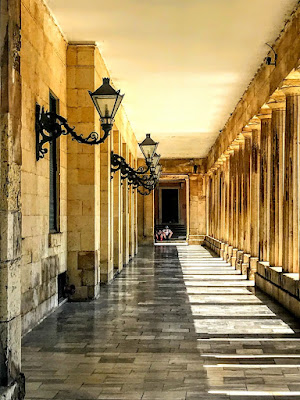
The Palace of Saint Michael and Saint George in Corfu was once home to British administration in the Ionian Islands … the Temple family lived in Corfu in 1828-1833 (Photograph: Patrick Comerford)
Luke 1: 57-66 (NRSVA):
57 Now the time came for Elizabeth to give birth, and she bore a son. 58 Her neighbours and relatives heard that the Lord had shown his great mercy to her, and they rejoiced with her.
59 On the eighth day they came to circumcise the child, and they were going to name him Zechariah after his father. 60 But his mother said, ‘No; he is to be called John.’ 61 They said to her, ‘None of your relatives has this name.’ 62 Then they began motioning to his father to find out what name he wanted to give him. 63 He asked for a writing-tablet and wrote, ‘His name is John.’ And all of them were amazed. 64 Immediately his mouth was opened and his tongue freed, and he began to speak, praising God. 65 Fear came over all their neighbours, and all these things were talked about throughout the entire hill country of Judea. 66 All who heard them pondered them and said, ‘What then will this child become?’ For, indeed, the hand of the Lord was with him.
The Prayer in the USPG Prayer Diary today (23 December 2021) invites us to pray:
We give thanks for the power of creativity to raise awareness of complex issues and break taboos.
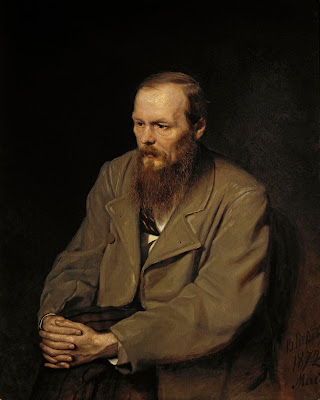
Fyodor Dostoevsky (1821-1881) by Vasily Perov … Dostoevsky faced a firing squad on 22 December 1849
Patrick Comerford
We are in the final days week of Advent, and there are Christmas sermon, the details of Christmas services to finalise, and Home Communions to organise. Today (22 December2021) is going to be a busy day, but before this busy day begins, I am taking some time early this morning for prayer, reflection and reading.
Each morning in my Advent calendar this year, I have been reflecting in these ways:
1, Reflections on a saint remembered in the calendars of the Church during Advent;
2, the day’s Gospel reading;
3, a prayer from the USPG prayer diary.
There is no commemoration in the Church Calendar today [21 December]. But this morning I am reflecting on the life and work of the great Russian writer Fyodor Mikhailovich Dostoevsky (1821-1881), who was born 200 years ago in 1821, died 140 years ago in 1881, and who has inspired the work and writings of many great theologians.
Dostoevsky’s literary works explore the human condition in the troubled political, social, and spiritual atmospheres of 19th-century Russia, and engage with a variety of philosophical and religious themes. His best-known novels include Crime and Punishment (1866), The Idiot (1869), Demons (1872), and The Brothers Karamazov (1880).
Many regard him as one of the greatest novelists in all of literature, and he is also regarded as a philosopher and the theologian. His work includes some of the most influential literary masterpieces. Notes from Underground (1864) is one of the first works of existentialist literature.
The former Archbishop of Canterbury, Archbishop Rowan Williams, writing in the current edition of The New Statesman (10 December 2021 to 6 January 2022), honestly discusses Dostoevsky’s many ambiguities and weaknesses, including his ‘prejudices and obsessions’ which remain ‘repugnant.’ Yet, he says, Dostoevsky ‘does not have to be a saint or an infallible moral guide’ for us to see the significance of his legacy at the present time.
Dostoevsky was born in Moscow on 11 November 1821 into a Russian Orthodox family of noble ancestry that included many priests, while his father was a military doctor. After graduating, he worked as an engineer and briefly enjoyed a lavish lifestyle, translating books to earn extra money. He wrote his first novel, Poor Folk, in the mid-1840s.
He was arrested in 1849 as part of a literary group that discussed banned books critical of Tsarist Russia. He was sentenced to death, and on this day, 22 December 1849, he and his friends were paraded before a firing squad. Then, as Rowan Williams describes, ‘in a piece of sadistic official theatre, their reprieve was announced at the very last moment.’
His death sentence was commuted, and he spent four years in a Siberian labour camp, followed by six years of compulsory military service in exile. The trauma haunts of almost-execution haunts many pages of his work, and his experience in the prison camp was what Archbishop Williams describes as ‘the seedbed of the most formidable changes in his thinking and sensibility.’
Shortly after his release from prison, Dostoevsky wrote to Natalya Fonvizinia in 1854, ‘If someone were to prove to me that Christ was outside the truth, and it was really the case that the truth lay outside Christ, then I should choose to stay with Christ rather than with the truth.’
In the years that followed years, he worked as a journalist, publishing and editing several magazines and later A Writer’s Diary. He began to travel around western Europe and he developed a gambling addiction that led to financial hardship. For a time, he had to beg for money, but he became the greatst of Russian writers.
His writings influenced a great number of later writers including Russians such as Aleksandr Solzhenitsyn and Anton Chekhov, the philosophers Friedrich Nietzsche and Jean-Paul Sartre, theologians from Karl Barth to Rowan Williams, and the emergence of Existentialism.
Dostoevsky’s work is profoundly and explicitly religious, framed in the context of his deep Russian Orthodox faith. By the time of his death, he had developed a unique approach to theology, religious anthropology, and spirituality that continues to exert a profound influence on the Orthodox Church and the Christian world more broadly. He has been described as ‘a prophet forewarned of the politicised humanistic delusions of the 20th century: a prophet crying out in the wilderness.’
His dying wish was to have the Parable of the Prodigal Son be read to his children. The profound meaning of this request is pointed out by Joseph Frank in his biography of Dostoevsky: ‘It was this parable of transgression, repentance, and forgiveness that he wished to leave as a last heritage to his children, and it may well be seen as his own ultimate understanding of the meaning of his life and the message of his work.’
Among Dostoevsky's last words was his quotation of Matthew 3: 14-15: ‘John would have prevented him, saying, “I need to be baptized by you, and do you come to me?” But Jesus answered him, “Let it be so now; for it is proper for us in this way to fulfil all righteousness.” Then he consented.’
He died on 9 February 1881 and was buried in the Tikhvin Cemetery at the Alexander Nevsky Convent. His gravestone is inscribed with lines from Saint John’s Gospel: ‘Very truly, I tell you, unless a grain of wheat falls into the earth and dies, it remains just a single grain; but if it dies, it bears much fruit’ (John 12: 24).
His largest work, The Brothers Karamazov, is his magnum opus. It tells the story of the novice Alyosha Karamazov, the non-believer Ivan Karamazov, and the soldier Dmitri Karamazov.
The most famous chapter is ‘The Grand Inquisitor,’ a parable told by Ivan to Alyosha about Christ’s Second Coming in Seville, where Christ is imprisoned by a 90-year-old Grand Inquisitor. Instead of answering the Inquisitor, Christ gives him a kiss, and the Inquisitor subsequently releases him, telling him not to return. Most contemporary critics and scholars agree that Dostoevsky is attacking socialist atheism, represented by the Inquisitor.
The former Archbishop of Canterbury, Archbishop Rowan Williams, took three months off to write his comprehensive book on Dostoevsky’s faith and influence on theology in Dostoevsky: Language, Faith and Fiction (Continuum 2009). In the current edition of The New Statesman, Archbishop Williams, Dostoevsky’s work point to the ‘signs of the transcendent divine stranger whose voice summons everything and everyone into existence.’
Luke 1: 46-56 (NRSVA):
46 And Mary said,
‘My soul magnifies the Lord,
47 and my spirit rejoices in God my Saviour,
48 for he has looked with favour on the lowliness of his servant.
Surely, from now on all generations will call me blessed;
49 for the Mighty One has done great things for me,
and holy is his name.
50 His mercy is for those who fear him
from generation to generation.
51 He has shown strength with his arm;
he has scattered the proud in the thoughts of their hearts.
52 He has brought down the powerful from their thrones,
and lifted up the lowly;
53 he has filled the hungry with good things,
and sent the rich away empty.
54 He has helped his servant Israel,
in remembrance of his mercy,
55 according to the promise he made to our ancestors,
to Abraham and to his descendants for ever.’
56 And Mary remained with her for about three months and then returned to her home.
The Prayer in the USPG Prayer Diary today (22 December 2021) invites us to pray:
We pray for the Anglican Council of Zimbabwe and the work they are doing to reduce stigma around HIV/AIDS.
We are in the last week of Advent, and there are Christmas sermons and the details of Christmas services to attend to. Today (21 December2021) is going to be a busy day, but before this busy day begins, I am taking some time early this morning for prayer, reflection and reading.
Each morning in my Advent calendar this year, I am reflecting in these ways:
1, Reflections on a saint remembered in the calendars of the Church during Advent;
2, the day’s Gospel reading;
3, a prayer from the USPG prayer diary.
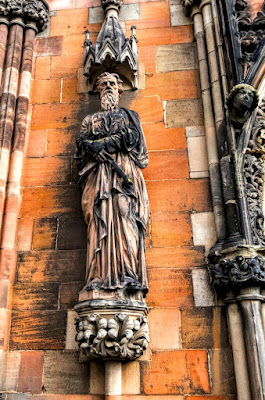
Saint Thomas the Apostle … a sculpture on the west façade of Lichfield Cathedral (Photograph: Patrick Comerford, 2021)
This day in Advent [21 December] was once marked in the calendars of the Western Church, including the Book of Common Prayer, as the feast day of Saint Thomas the Apostle and was once a major feast day in the Church.
This commemoration was moved long ago to 3 July, the date given in the Martyrology of Saint Jerome and the day on which his relics are said to have been moved from Mylapore, near Madras, on the coast of India, to Edessa in Mesopotamia. After a short stay on the Greek island of Chios, the relics were moved in September 1258 to the West, and are now said to be in Ortona in Italy.
In the Orthodox Churches, Saint Thomas is remembered each year on Saint Thomas Sunday, or the Sunday after Easter, and on 6 October. He is now celebrated on 3 July in the Book of Common Prayer (2004) in the Church of Ireland and Common Worship in the Church of England, although he is still commemorated on 21 December in the Episcopal Church (TEC).
I think of Saint Thomas as an appropriate apostle to recall in Advent, for he reminds us that all our Christmas celebrations are meaningless without faith in the Resurrection.
In the Gospels, Saint Thomas is named ‘Thomas, also called the Twin (Didymus).’ But the name ‘Thomas’ comes from the Aramaic word for twin, T'oma (תאומא), so there is a tautological wordplay going on here.
Syrian tradition says the apostle’s full name was Judas Thomas, or Jude Thomas, but who was his twin brother (or sister)?
The Temple of Apollo in Didyma … one of the most important shrines and temples in the classical world to Apollo and his twin sister Artemis (Photograph: Patrick Comerford)
I have often visited Didyma on the southern Anatolian coast. There the Didymaion was one of the most important shrines and temples in the classical world to Apollo and his twin sister Artemis. Apollo was the sun-god, the sun of Zeus; he was the patron of shepherds and the guardian of truth, and in Greek and Roman mythology he died and rose again.
Is the story of Saint Thomas’s doubts an invitation to the followers of the cult of Apollo to turn to Christ, the true Son of God the Father, who is the Good Shepherd, who is the way, the truth and the light, who has died and who is truly risen?
We can never be quite sure about Saint Thomas in Saint John’s Gospel. After the death of Lazarus, the disciples resist Christ’s decision to return to Judea, where there had been an attempt to stone Jesus. But Thomas shows he has no idea of the real meaning of death and resurrection when he suggests that the disciples should go to Bethany with Jesus: ‘Let us also go, that we may die with him’ (John 11: 16).
And while Thomas saw the raising of Lazarus, what did he believe in?
Could seeing ever be enough for a doubting Thomas to believe?
The Apostle Thomas also speaks at the Last Supper (John 14: 5). When Christ assures his disciples that they know where he is going, Thomas protests that they do not know at all. He has been with Christ now for three years, and still he does not believe or understand. Seeing and explanations are not enough for him. Christ replies to this and to Philip’s requests with a detailed exposition of his relationship to God the Father.
In the Resurrection story in Saint John’s Gospel, Mary does not recognise the Risen Christ at first. For her, appearances could be deceiving, and she thinks he is the gardener. But when he speaks to her, she recognises his voice, and then wants to hold on to him. From that moment of seeing and believing, she rushes off to tell the Disciples: ‘I have seen the Lord.’
Two of the disciples, John the Beloved and Simon Peter, have already seen the empty tomb, but they fail to make the vital connection between seeing and believing. When they hear Mary’s testimony, they still fail to believe fully. They only believe when they see the Risen Lord standing among them, when he greets them, ‘Peace be with you,’ and when he shows them his pierced hands and side.
They had to see and to hear, they had to have the Master stand over them in their presence, before they could believe.
On the first Easter Day, the Disciples locked themselves away out of fear. But where is Thomas? Is he fearless? Or is he foolish?
For a full week, Thomas is absent and does not join in the Easter experience of the remaining disciples. He has not seen and so he refuses to believe. When they tell him what has happened, Thomas refuses to accept their stories of the Resurrection. For him hearing, even seeing, are not enough.
Thomas wants to see, hear and touch. He wants to use all his learning faculties before he can believe this story. He has heard, but he wants to see. When he sees, he wants to touch … he demands not only to touch the Risen Christ, but to touch his wounds too before being convinced.
And so for a second time within eight days, Christ comes and stands among his disciples, and says: ‘Peace be with you.’
Mary was asked in the garden on Easter morning not to cling on to Christ. But Thomas is invited to touch him in the most intimate way. He is told to place his finger in Christ’s wounded hands and his hand in Christ’s pierced side.
Caravaggio has depicted this scene in his painting, The Incredulity of Saint Thomas. Yet we are never told whether Thomas actually touched those wounds with his fingers. All we are told is that once he has seen the Risen Christ, Thomas simply professes his faith in Jesus: ‘My Lord and my God!’
In that moment, we hear the first expression of faith in the two natures of Christ, that he is both divine and human. For all his doubts, Saint Thomas provides us with an exquisite summary of the apostolic faith.
Too often, perhaps, we talk about ‘Doubting Thomas.’ Instead, we might better call him ‘Believing Thomas.’ His doubting leads him to question. But his questioning leads to listening. And when he hears, he sees, perhaps he even touches. Whatever he does, he learns in his own way, and he comes not only to faith but to faith that for this first time is expressed in that eloquent yet succinct acknowledgment of Christ as both ‘My Lord and My God.’
In our society today, are we easily deceived by appearances?
Do we confuse what pleases me with beauty and with truth?
Do we allow those who have power to define the boundaries of trust and integrity merely to serve their own interests?
Too often, in this world, we are deceived easily by the words of others and deceived by what they want us to see. Seeing is not always believing today. Hearing does not always mean we have heard the truth, as we know in Irish life and politics today. It is easy to deceive and to be deceived by a good presentation and by clever words.
Too often, we accept or judge people by their appearances, and we are easily deceived by the words of others because of their office or their privilege. But there are times when our faith, however simple or sophisticated, must lead us to ask appropriate questions, not to take everything for granted, and not to confuse what looks like being in our own interests with real beauty and truth.
Saint Thomas is a reminder that Christmas points to Easter. His story reminds us that the incarnation is not just a nice occasion for a winter festival and giving thanks after the Winter Solstice that the sun is returning and the days lengthening. It reminds us that Christmas Day has no meaning without Good Friday and Easter Day. Christmas faith is only meaningful when it is faith in the Resurrection.
Saint Thomas’s Church, Dugort, Achill Island (Photograph: Patrick Comerford)
Luke 1: 39-45 (NRSVA):
39 In those days Mary set out and went with haste to a Judean town in the hill country, 40 where she entered the house of Zechariah and greeted Elizabeth. 41 When Elizabeth heard Mary’s greeting, the child leapt in her womb. And Elizabeth was filled with the Holy Spirit 42 and exclaimed with a loud cry, ‘Blessed are you among women, and blessed is the fruit of your womb. 43 And why has this happened to me, that the mother of my Lord comes to me? 44 For as soon as I heard the sound of your greeting, the child in my womb leapt for joy. 45 And blessed is she who believed that there would be a fulfilment of what was spoken to her by the Lord.’
The Prayer in the USPG Prayer Diary today (21 December 2021) invites us to pray:
Let us pray for everyone living with HIV/AIDS. May we help and support them rather than stigmatise them.
For Saint Ignatius of Antioch, the Incarnation is not just one doctrine among others … the Incarnation is the Christian faith
Patrick Comerford
We are in the last week of Advent, and there are Christmas sermons and the details of Christmas services to attend to. Today (20 December 2021) is going to be a busy day, but before this busy day begins, I am taking some time early this morning for prayer, reflection and reading.
Each morning in my Advent calendar this year, I am reflecting in these ways:
1, Reflections on a saint remembered in the calendars of the Church during Advent;
2, the day’s Gospel reading;
3, a prayer from the USPG prayer diary.
The view of the Coliseum from the Basilica of San Clemente … Saint Ignatius of Antioch was martyred in the Coliseum and his relics were moved to San Clemente in the year 637 (Photograph: Patrick Comerford)
Today [20 December] is without commemoration in most calendars of the Western Churches. But in the Eastern Orthodox Church 20 December is observed as the feast day of Saint Ignatius of Antioch.
With less than a week to Christmas Day, it is worth remembering this great Patristic saint, for whom the Incarnation is not just one doctrine among others. For Saint Ignatius, the Incarnation is the Christian faith.
According to Saint Ignatius, a denial of the Eucharistic presence flows from a denial of the incarnation (Smyrnaeans 6-7):
But look at the men who have these perverted notions about the grace of Jesus Christ which has come down to us, and see how contrary to the mind of God they are ... They even absent themselves from the Eucharist and the public prayers because they will not admit that the Eucharist is the self-same body of our Saviour Jesus Christ which suffered for our sins, and which that Father in his goodness afterwards raised up again. Consequently, since they reject God’s good gifts, they are doomed in their disputatiousness. (Smyrnaeans, 6-7, Andrew Louth.)
In the same passage, Saint Ignatius draws clear connections between this rejection of the Incarnation of Christ and their shunning of the social obligations of Christian faithfulness:
But look at the men who have those perverted notions about the grace of Jesus Christ which has come down to us, and see how contrary to the mind of God they are. They have no care for love, no thought for the widow and orphan, none at all for the afflicted, the captive, the hungry or the thirsty (Smyrnaeans, 6.2, Andrew Louth.)
Saint Ignatius of Antioch (ca 35-ca 98/117), who is honoured as an apostle, bishop and martyr, is said to have known Saint John the Evangelist personally and converted to Christianity at an early age. A mediaeval legend claimed he was the child Christ took up in his arms (see Mark 9: 35). Earlier traditions say he succeeded Peter and Evodius ca 68 as the third Bishop or Patriarch of Antioch.
He is one of the Apostolic Fathers, the earliest authoritative group of the Church Fathers, and it is argued that his understanding of the nature of the Church and the Eucharist was close to the Apostles and the Apostolic Church.
He was arrested during the reign of the Emperor Trajan, was condemned to death, and was sent to Rome for execution.
On his way to martyrdom in Rome, Saint Ignatius was accompanied by his companions, Philo, a deacon of Tarsus, and Rheus Agathopus, a Syrian. Despite all this, his journey was a kind of triumph. News of his fate, his destination, and his probable itinerary had gone swiftly before. At several places along the road his fellow-Christians greeted him with words of comfort and reverential homage.
On that journey, he was taken from Antioch through Tarsus or Attalia, Laodicea, Philadelphia and Sardis, and finally to Smyrna, where the bishop was Saint Polycarp, his fellow-disciple in the school of Saint John the Divine.
His time in Smyrna was protracted, and the representatives of Churches throughout Asia Minor came to meet him and to comfort him. They included representatives of the churches in Ephesus, Magnesia and Tralles. Saint Ignatius addressed letters from Smyrna to each of these communities and to the Church in Rome, exhorting them to obedience to their bishops, and warning them to avoid heresy.
His principal concerns in the letters include the importance of maintaining Christian unity in love and sound doctrine; warnings against factionalism and against the heresy of Docetism – the belief that Christ was not fully human and did not have a material body or really suffer and die; the role of the bishop as the focus of Christian unity; and Christian martyrdom as a a glorious privilege, to be grasped eagerly.
From Smyrna, Saint Ignatius was taken to Troas, where he wrote letters to the Churches of Philadelphia and Smyrna and to Saint Polycarp.
Shortly after his arrival in Rome, Saint Ignatius was martyred in the Coliseum. His remains were carried back to Antioch by his companions, Philo of Tarsus and Rheus Agathopus, and were buried outside the city gates. They were moved by the Emperor Theodosius II to the Tychaeum, or Temple of Tyche, which had been converted into a church dedicated to Saint Ignatius.
His relics were moved to the Basilica of San Clemente in Rome in the year 637.
At times, Patristic scholars have debated the authenticity of the Ignatian letters. Each particular letter has had its apologists and its opponents. Each has been favoured to the exclusion of all the others, and all, in turn, have been collectively rejected, especially by Calvin. In violent language (Institutes, 1-3), Calvin repudiates all the letters, which completely contradict his own views on ecclesiology and church government. However, their authenticity was defended by the leading Anglican theologians, including John Whitgift, Richard Hooker and Lancelot Andrewes.
In general, Roman Catholic and Anglican scholars accept his letters to the Ephesians, Magnesia, Tralles, Rome, Philadelphia and Smyrna and to Saint Polycarp. Joseph Lightfoot’s five-volume edition of the Apostolic Fathers remains the definitive work on the provenance and text of the writings of Saint Ignatius of Antioch. He writes:
The Ignatian Epistles are exceptionally good training ground for the student of early Christian literature and history. They present in typical and instructive forms the most varied problems, textual, exegetical, doctrinal and historical. One who has thoroughly grasped these problems will be placed in possession of a master key which will open to him vast storehouses of knowledge.
In his letters, Saint Ignatius discusses ecclesiology, the sacraments, and the role and authority of bishops.
He identifies a local church structure of bishops, priest and deacons, with the bishop in the place of God, the priests in the place of Apostles, and the deacons serving as Christ served:
Let the bishop preside in the place of God, and his clergy in the place of the Apostolic conclave, and let my special friends the deacons be entrusted with the service of Jesus Christ, who was with the Father from all eternity and in these last days has been made manifest. – To the Magnesians, 6 (Andrew Louth).
In his letter to the Magnesians, Saint Ignatius weaves together his Trinitarian faith and his understanding of the threefold order of bishop, priest and deacon, and links his Christology with his ecclesiology:
Do your utmost to stand firm in the precepts of the Lord and the Apostles, so that everything you do, worldly or spiritual, may go prosperously from beginning to end in faith and love, in the Son and the Father and the Spirit, together with your most reverend bishop and that beautifully woven spiritual chaplet, your clergy and godly minded deacons. Be as submissive to the bishop and to one another as Jesus Christ was to his Father, and as the Apostles were to Christ and the Father; so that there may be complete unity, in the flesh as well as the spirit. – To the Magnesians, 13 (Andrew Louth)
Saint Ignatius claims to have spoken in some of the Churches through the inspiration of the Holy Spirit. In an early Patristic poem, he teaches the deity of Christ and his human and divine natures:
‘There is only one Physician –
Very Flesh, yet Spirit too;
Uncreated and yet born;
God-and-Man in One agreed;
Very-Life-in-Death indeed;
Fruit of God and of Mary’s seed;
At once impassible and torn
By pain and suffering here below:
Jesus Christ, whom as Lord we know.’ – To the Ephesians, 7 (Andrew Louth).
He refers to the Church as the ‘Eucharistic community’ which realises its true nature when it celebrates the Eucharist, and he defines the Church as the local community gathered around its bishop, celebrating the Eucharist. He is the second writer after Clement to mention Saint Paul’s Epistles, and he is also responsible for the first known use of the Greek word katholikos (καθολικός), meaning ‘universal,’ ‘complete’ and ‘whole,’ to describe the Church:
The sole Eucharist you should consider valid is the one that is celebrated by the bishop himself, or by some person authorized by him. Where the bishop is to be seen, there let all his people be; just as wherever Jesus Christ is present, we have the catholic Church. Nor is it permissible to conduct baptisms or love-feasts [the Eucharist] without the bishop. On the other hand, whatever does have his sanction can be sure of God’s approval too. This is the way to make certain of the soundness and validity of anything you do. – To the Smyrnaeans 8 (Andrew Louth).
Saint Ignatius, therefore, is the first known Christian writer to emphasise loyalty to a single bishop in each city, who is assisted by both presbyters (priests) and deacons. He also stressed the value of the Eucharist, calling it ‘a medicine to immortality.’ Saint Ignatius ‘thought of the Church as a Eucharistic society which only realised its true nature when it celebrated the Supper of the Lord, receiving His Body and Blood in the Sacrament.’ [Ignatius, quoted in Metropolitan Kallistos (Timothy) Ware, The Orthodox Church, p 21.]
In all the reports on the conflicts in Syria, it passes unnoticed that the Greek Orthodox Church of Antioch is one of the oldest in the world, and that the name ‘Christian’ was first used in Antioch (Acts 11: 26).
The Patriarch of Antioch is the third most senior figure in the Orthodox Church, following the Patriarchs of Constantinople and Alexandria. Patriarch John X (Yazigi) of Antioch and All The East, who was elected nine years ago [17 December 2012], was Abbot of Balamand before becoming Metropolitan of Europe in one of the fasting-growing Orthodox Churches that traces its history back to the Apostle Peter and Saint Ignatius of Antioch.
In the calendars of the Western Churches, including the Roman Catholic Church, the Episcopal Church (TEC) and Common Worship of the Church of England, Saint Ignatius of Antioch is generally commemorated on 17 October.
A colonnade of 14 Corinthian columns on the west side of the Stoa of Smyrna, the only surviving classical site in Izmir … Saint Ignatius of Antioch wrote four of his letters, including one to the Church in Smyrna, while he was a prisoner in Smyrna (Photograph: Patrick Comerford)
Luke 1: 26-38 (NRSVA):
26 In the sixth month the angel Gabriel was sent by God to a town in Galilee called Nazareth, 27 to a virgin engaged to a man whose name was Joseph, of the house of David. The virgin’s name was Mary. 28 And he came to her and said, ‘Greetings, favoured one! The Lord is with you.’ 29 But she was much perplexed by his words and pondered what sort of greeting this might be. 30 The angel said to her, ‘Do not be afraid, Mary, for you have found favour with God. 31 And now, you will conceive in your womb and bear a son, and you will name him Jesus. 32 He will be great, and will be called the Son of the Most High, and the Lord God will give to him the throne of his ancestor David. 33 He will reign over the house of Jacob for ever, and of his kingdom there will be no end.’ 34 Mary said to the angel, ‘How can this be, since I am a virgin?’ 35 The angel said to her, ‘The Holy Spirit will come upon you, and the power of the Most High will overshadow you; therefore the child to be born will be holy; he will be called Son of God. 36 And now, your relative Elizabeth in her old age has also conceived a son; and this is the sixth month for her who was said to be barren. 37 For nothing will be impossible with God.’ 38 Then Mary said, ‘Here am I, the servant of the Lord; let it be with me according to your word.’ Then the angel departed from her.
The Prayer in the USPG Prayer Diary today (20 December 2021, International Human Solidarity Day) invites us to pray:
Today we think of our common humanity and stand in solidarity with marginalised people across the world.
The 42-hectare Kültürpark was laid out on the ruins of the Greek quarter of Smyrna … while Saint Ignatius was in Smyrna as a prisoner, representatives of Churches throughout Asia Minor came to meet him and to comfort him (Photograph: Patrick Comerford)
‘The holly in the windy hedge … / will soon be stripped to deck the ledge, / the altar, font and arch and pew, / … The church looks nice’ (John Betjeman) … the Christmas pulpit in Saint Mary’s Church, Askeaton, Co Limerick (Photograph: Patrick Comerford, 2021)
SERVICE of NINE LESSONS and CAROLS
Saint Mary’s Church, Askeaton,
3 p.m. Sunday 19 December 2021
The Fourth Sunday of Advent
Welcome (and important notes):
1, Please wear your facemask throughout this service; 2, Please leave your name and number (to be used for contact and tracing purposes only); 3, Please listen to, but do not join the hymns; 4, Please leave from the back seats first, without gathering in the church.
Opening Hymn: 177,
‘Once in royal David’s city’
(CF Alexander; melody, HJ Gauntlett).
Bidding Prayer:
(Canon Patrick Comerford)
Beloved, be it this Christmas Time our care and delight to prepare ourselves to hear again the message of the angels; in heart and mind to go even unto Bethlehem and see this thing which is come to pass, and the Babe lying in a manger.
Let us read and mark in Holy Scripture the tale of the loving purposes of God from the first days of our disobedience unto the glorious Redemption brought us by this Holy Child; and let us make this Church, dedicated to Mary, his most blessed Mother, glad with our carols of praise:
But first let us pray for the needs of his whole world; for peace and goodwill over all the earth; for unity and brotherhood within the Church he came to build, and especially in this our land, Ireland:
And because this of all things would rejoice his heart, let us at this time remember in his name the poor and the helpless, the cold, the hungry and the oppressed; the sick in body and in mind and those who mourn; the lonely and the unloved; the aged and the little children; all who know not the Lord Jesus, or who love him not, or who by sin have grieved his heart of love.
Lastly, let us remember before God all those who rejoice with us, but upon another shore and in a greater light, that multitude which no one can number, whose hope was in the Word made flesh, and with whom, in this Lord Jesus, we for evermore are one.
These prayers and praises let us humbly offer up to the throne of heaven, in the words which Christ himself has taught us:
Our Father …
Carol 1: 155, Ding Dong! merrily on high (George Ratcliffe Woodward; melody Thoinot Arbeau).
Lesson 1: Genesis 3: 8-19
Carol 2: 135, O come, O come, Emmanuel (tr John Mason Neale; melody, Thomas Helmore).
Lesson 2: Genesis 22: 15-18
While they were there, the time came for her to deliver her child. And she gave birth to her firstborn son and wrapped him in bands of cloth, and laid him in a manger, because there was no place for them in the inn.
Carol 3: 133, Long ago, prophets knew
(F Pratt Green; melody, Piae Cantiones).
Lesson 3: Isaiah 9: 2, 6-7
Carol 4: 174, O little town of Bethlehem (Philips Brooks, melody arranged by Vaughan Williams).
Lesson 4: Michah 5: 2-5a
Carol 5: 160, Hark! the herald-angels sing (Charles Wesley and George Whitefield; music, Felix Mendelssohn).
Lesson 5: Luke 1: 26-35, 38
Carol 6: 164, It came upon the midnight clear (EH Sears, traditional melody, Arthur Sullivan).
Lesson 6: Luke 2: 8-16
Carol 7: 158, God rest you merry gentlemen (English traditional).
Lesson 7: Luke 2: 8-16
Carol 8: 152, ‘Come and join the celebration’ (Valerie Collison).
Lesson 8: Matthew 2: 1-11
Carol 9: 149, Away in a manger
(WJ Kirkpatrick).
Lesson 9: John 1: 1-14
Hymn: 162, In the bleak mid-winter
(Christina Rossetti; music, Gustav Holst).
Collect and Blessing:
The Lord be with you. And also with you.
Let us pray.
O God, who makes us glad with the yearly remembrance of the birth of your only son, Jesus Christ: Grant that as we joyfully receive him for our redeemer, so we may with sure confidence behold him, when he shall come to be our judge; who lives and reigns with you and the Holy Spirit, one God, world without end. Amen.
Christ, who by his incarnation gathered into one things earthly and heavenly,
grant you the fullness of inward peace and goodwill, and make you partakers of the divine nature;
and the blessing of God Almighty,
+ the Father, the Son and the Holy Spirit, be with you and remain with you always. Amen.
Hymn: 172, O come, all ye faithful (Adeste Fideles), translated, Frederick Oakeley; melody John F Wade.
Part of this afternoon’s retiring collection is being divided among a number of agencies and funds supported by the parish. They include: The Church of Ireland Bishops’ Appeal Fund, Christian Aid, the Leprosy Mission, Limerick Protestant Orphan Society, Church Street National School, Rathkeale, and the United Society Partners in the Gospel (USPG).
Christmas Eucharist 2021:
Friday 24 December: 6 p.m., Saint Brendan’s Church, Kilnaughtin (Tarbert); 8 p.m., Castletown Church (please note revised times).
11 a.m., United Parish Service, Rathkeale (Morning Prayer with Siobhán Wheeler, Parish Reader; this is the only service in this Group of Parishes this Sunday)
The Visitation … a panel in the 19th Century neo-Gothic altarpiece from Oberammergau in the Lady Chapel in Lichfield Cathedral (Photograph: Patrick Comerford)
Let us pray:
‘My soul magnifies the Lord, and my spirit rejoices in God my Saviour’ (Luke 1: 46):
Heavenly Father,
As we wait in Advent for the coming of the Kingdom,
let us give thanks to Lord … make known your deeds among the nations …
May those in power and in government
hear the cry of all in who ‘sit in darkness and in the shadow of death,’
especially refugees, asylum seekers, migrants,
prisoners of conscience, the victims of people trafficking,
that they may be met with mercy and justice,
and know love and peace.
Lord have mercy, Lord have mercy.
‘He has looked with favour on the lowliness of his servant’ (Luke 1: 48):
Lord Jesus Christ,
as we wait in Advent for your coming,
we pray for the Church,
that we may eagerly prepare the way for your coming among us …
In the Church of Ireland this month,
we pray for this Diocese of Tuam, Limerick and Killaloe,
the Archbishop’s Commissaries,
Archdeacon Stephen McWhirter and Dean Niall Sloane,
and for the Episcopal Electoral College called to fill the vacant see.
In the Anglican Cycle of Prayer,
we pray for the Church of the Province of Central Africa,
and the Primate, Archbishop Albert Chama.
In the Diocesan Cycle of Prayer,
we pray for the Kenmare and Dromod Union of parishes,
the Revd Michael Kavanagh and the congregations of
Saint Patrick’s Church, Kenmare, the Church of the Transfiguration, Sneem,
Saint Michael and All Angels, Waterville, and Saint John the Baptist, Valentia.
In our community,
we pray for our schools,
we pray for our parishes and people …
we pray for our neighbouring churches and parishes …
and people of faith everywhere,
that we may be blessed in our variety and diversity.
Christ have mercy, Christ have mercy.
‘His mercy is for those who fear him from generation to generation’ (Luke 1: 50):
Holy Spirit, we pray for one another …
We remember those who are remembered and mourned by parishioners,
May their memories be a blessing to us.
We pray for all who are sick or isolated,
at home, in hospital …
Ruby … Daphne … Sylvia … Ajay …
Cecil … Pat … Mary … Ann … Vanessa …
We pray for those who feel pain and loss …
for those who are bewildered and without answers …
for those we love and those who love us …
for our families, friends and neighbours …
We pray for all who feel rejected and discouraged …
we pray for all in need and who seek healing …
and we pray for those we promised to pray for …
and we pray for one another and for ourselves …
May your generosity and love to us be reflected in our love and generosity to others.
Lord have mercy, Lord have mercy.
The Prayer in the USPG Prayer Diary today (19 December 2021, the Fourth Sunday of Advent) invites us to pray:
Almighty Lord,
you bless us with unexpected joys.
May we suspend our disbelief,
and listen to your will.
Merciful Father …
‘Mary meets Elizabeth’ (1996), by Dinah Roe Kendall, in ‘Allegories of Heaven: an artist explores the greatest story ever told’ (Carlisle: Piquant, 2002)
‘The Visitation’ in a stained-glass window in Saint John’s Church, Pallaskenry, Co Limerick (Photograph: Patrick Comerford, 2021)
May I speak to you in the name of God, + Father, Son and Holy Spirit, Amen
This Advent has been a time of waiting, a time of preparation, a time of anticipation. For the past three Sundays, in our time of waiting, preparation and anticipation, we have been preparing ourselves in the liturgy and the music, with carol services and quiet days, with the Christmas Market and Santa’s grotto, with the Advent Wreath and the Crib.
The four candles on the Advent wreath have reminded us, week-after-week, of those who prepared us in the past for the Coming of the Christ Child: first the Patriarchs and Matriarchs, our ancestors in faith, including Abraham and Sarah, Isaac and Jacob; then the prophets of the Old Testament, including Isaiah, Jeremiah, and Micah, who we heard from this morning; then, last week it was Saint John the Baptist.
This Sunday, the fourth and final candle reminds us of the Virgin Mary. This connects with the Canticle Magnificat, which we heard instead of a Psalm, and our Gospel reading, telling the story of her visit to her cousin Saint Elizabeth.
The Canticle Magnificat (Luke 1: 46-55) is normally heard during Evening Prayer and not on Sunday mornings.
The great German theologian and martyr, Dietrich Bonhoeffer (1906-1945), in an Advent sermon in London almost 90 years ago (17 December 1933), said Magnificat ‘is the oldest Advent hymn,’ and he spoke of how she knows better than anyone else what it means to wait for Christ’s coming:
‘In her own body she is experiencing the wonderful ways of God with humankind: that God does not arrange matters to suit our opinions and views, does not follow the path that humans would like to prescribe. God’s path is free and original beyond all our ability to understand or to prove.’
The Gospel reading (Luke 1: 39-55), also tells the story of the Virgin Mary’s visit to her cousin, Saint Elizabeth.
When she visits, they are both pregnant – one with the Christ Child, the other with Saint John the Baptist.
Immediately after the Annunciation, the Virgin Mary leaves Nazareth and travels south to an unnamed ‘Judean town in the hill country,’ perhaps Hebron outside Jerusalem, to visit Elizabeth. When she arrives, although he is still in his mother’s womb, Saint John the Baptist is aware of the presence of Christ, and the unborn child leaps for joy.
Saint Elizabeth too recognises that Christ is present, and declares to Mary with a loud cry: ‘Blessed are you among women, and blessed is the fruit of your womb. And why has this happened to me, that the mother of my Lord comes to me? For as soon as I heard the sound of your greeting, the child in my womb leaped for joy’ (Luke 1: 42-44).
The Virgin Mary responds to Saint Elizabeth immediately with the words that we now know as the canticle Magnificat.
So we see, side-by-side, two women, one seemingly too old to have a child, but destined to bear the last prophet of the age that is passing away; and the other woman, seemingly too young to have a child, but about to give birth to him who is the beginning of the age that is not going to pass away.
The Virgin Mary of the canticle Magnificat and of the Visitation is a strong and revolutionary woman, unlike the Virgin Mary of the plaster-cast statues and the Rosary.
The Mary I see as a role model for belief and discipleship is the Mary who sets off in a hurry and a flurry to visit her cousin Elizabeth, the Mary with a gob on her who speaks out of turn when she comes out with those wonderful words we hear in this Gospel reading, the Mary who sings the Canticle Magnificat.
What a contrasting pair these two cousins, Mary and Elizabeth, are!
How much they speak to so many of the dilemmas we have in Irish society today!
Elizabeth is the older woman. She has been married for years. Because of social and family pressures, she had started to become embarrassed that after all those years of marriage she has not become pregnant.
In those days, even in many places to this day, this was an embarrassing social stigma. She had no son to inherit her husband’s lands, his family position, the place of Zechariah as a priest in the Temple in Jerusalem.
She reminds us too of Sarah, who is so embarrassed at the thought of becoming pregnant in her old age that she laughs in the face of the three visitors, she laughs in the face of the living Triune God.
Today, a woman who became pregnant at her stage in life might not laugh. She might quake with fear. She might ask for amniocentesis or an amniotic fluid test.
And yet Elizabeth takes control of her situation. She turns a predicament into an opportunity, a crisis of a pregnancy so late in life into a blessing for us all.
She is so filled with joy when Mary arrives that as soon as she hears the knock on the door, as soon as she hears the sound of Mary on her doorstep, her joy is infectious, so infectious that even the child in her womb – the child who would grow up to be Saint John the Baptist – leaps with joy in her womb.
Elizabeth’s action is radical. Life is tough enough for her. Her husband has been struck dumb. A dumb priest was unlikely to be able to continue to earn a liturgical living in the Temple in Jerusalem. How was she now going to provide for her child when he was born?
But Elizabeth’s actions are more radical than that.
How many women of her age, and her respectable background, would have been so quick to rush out and welcome her much younger, single and pregnant cousin?
How many women would have been worried: ‘What if she stays here and has the child here? Would we ever live with the shame?’
How many women might have suggested instead that Mary goes off and finds a home where they can find someone else to take care of her child when he is born?
Instead, Elizabeth welcomes Mary with open arms. Elizabeth’s joyful greeting, ‘Blessed are you among women …,’ echoes the greeting of the Archangel Gabriel (see Luke 1: 28), ‘Blessed are you among women, and blessed is the fruit of your womb.’
It is almost as if Elizabeth is saying: ‘It doesn’t matter what others think of you. It doesn’t matter how other people are going to judge you. I love you.’
Which is precisely what God is saying in the Incarnation, in the precious gift of the Christmas Child: ‘It doesn’t matter what others think of you. It doesn’t matter how other people are going to judge you. I love you.’
Mary for her part is such a wonderful, feisty person. She is, what might be described in the red-top tabloid newspapers today as ‘a gymslip Mum.’ But, instead of hiding herself away from her family, from her cousins, from the woman in her family who is married to a priest, she rushes off to her immediately, to share her good news with her.
And she challenges so many of our prejudices and our values and our presumptions today. Not just about gymslip mums and unexpected or unplanned pregnancies, but about what the silent and the marginalised have to say about our values in society today.
And Mary declares:
He has shown strength with his arm;
he has scattered the proud in the thoughts of their hearts.
He has brought down the powerful from their thrones,
and lifted up the lowly;
he has filled the hungry with good things,
and sent the rich away empty.
He has helped his servant Israel,
in remembrance of his mercy,
according to the promise he made to our ancestors,
to Abraham and to his descendants for ever.’
It is almost like this is the programme or the agenda we can expect when the Christ Child is born.
And so, may all we think, say and do be to the praise, honour and glory of God, + Father, Son and Holy Spirit, Amen.
The words of the canticle Magnificat carved on the wooden screen at the west end of the monastic church in Mount Melleray Abbey, Cappoquin, Co Waterford (Photograph: Patrick Comerford, 2020)
Luke 1: 39-45 (46-55) (NRSVA):
39 In those days Mary set out and went with haste to a Judean town in the hill country, 40 where she entered the house of Zechariah and greeted Elizabeth. 41 When Elizabeth heard Mary’s greeting, the child leapt in her womb. And Elizabeth was filled with the Holy Spirit 42 and exclaimed with a loud cry, ‘Blessed are you among women, and blessed is the fruit of your womb. 43 And why has this happened to me, that the mother of my Lord comes to me? 44 For as soon as I heard the sound of your greeting, the child in my womb leapt for joy. 45 And blessed is she who believed that there would be a fulfilment of what was spoken to her by the Lord.’
[46 And Mary said,
‘My soul magnifies the Lord,
and my spirit rejoices in God my Saviour,
for he has looked with favour on the lowliness of his servant.
Surely, from now on all generations will call me blessed;
for the Mighty One has done great things for me,
and holy is his name.
His mercy is for those who fear him
from generation to generation.
He has shown strength with his arm;
he has scattered the proud in the thoughts of their hearts.
He has brought down the powerful from their thrones,
and lifted up the lowly;
he has filled the hungry with good things,
and sent the rich away empty.
He has helped his servant Israel,
in remembrance of his mercy,
according to the promise he made to our ancestors,
to Abraham and to his descendants for ever.’]
‘The Visitation’, by James B Janknegt
Liturgical colour: Violet (Purple), Advent Year C.
Penitential Kyries:
Turn to us again, O God our Saviour,
and let your anger cease from us.
Lord, have mercy. Lord, have mercy.
Show us your mercy, O Lord,
and grant us your salvation.
Christ, have mercy. Christ, have mercy.
Your salvation is near for those that fear you,
that glory may dwell in our land.
Lord, have mercy. Lord, have mercy.
The Collect:
God our redeemer,
who prepared the blessed Virgin Mary
to be the mother of your Son:
Grant that, as she looked for his coming as our saviour,
so we may be ready to greet him
when he comes again as our judge;
who is alive and reigns with you and the Holy Spirit,
one God, now and for ever.
The Advent Collect:
Almighty God,
Give us grace to cast away the works of darkness
and to put on the armour of light
now in the time of this mortal life
in which your Son Jesus Christ came to us in great humility;
that on the last day
when he shall come again in his glorious majesty
to judge the living and the dead,
we may rise to the life immortal;
through him who is alive and reigns with you and the Holy Spirit,
one God, now and for ever.
Introduction to the Peace:
In the tender mercy of our God,
the dayspring from on high shall break upon us,
to give light to those who dwell in darkness
and in the shadow of death,
and to guide our feet into the way of peace. (Luke 1: 78, 79)
Preface:
Salvation is your gift
through the coming of your Son our Saviour Jesus Christ,
and by him you will make all things new
when he returns in glory to judge the world:
The Post-Communion Prayer:
Heavenly Father,
you have given us a pledge of eternal redemption.
Grant that we may always eagerly celebrate
the saving mystery of the incarnation of your Son.
We ask this through him whose coming is certain,
whose day draws near,
your Son Jesus Christ our Lord.
Blessing:
Christ the sun of righteousness shine upon you,
gladden your hearts
and scatter the darkness from before you:
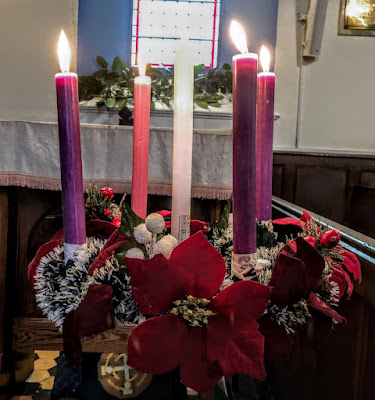
The Advent Wreath:
The Anglican mission agency USPG (United Society Partners in the Gospel) offers this prayer for lighting the Fourth (Purple) candle on the Advent Wreath:
Lord Jesus, your mother Mary
carried you with tender determination
on the dangerous road to Bethlehem.
May the same flame of love
that drove her on, now bring
courage and hope
to all who carry and nurture children today.
Hymns:
158, God rest you merry, gentlemen (CD 9) Canticle:Magnificat, Luke 1: 46-55 as Hymn 712 (CD 40) 174, O little town of Bethlehem (CD 11) 198, The first Nowell the angel did say (CD 12)
Lillian Trasher with children at her orphanage in Egypt
Patrick Comerford
We are in the last week of Advent, with the Christmas preparations building up. Today (19 December2021) is going to be a busy day, with the Parish Eucharist in Saint Brendan’s Church, Tarbert, Co Kerry, and the Service of Nine Lessons and Carols in Saint Mary’s Church, Askeaton, Co Limerick, this afternoon.
Before this busy day begins, however, I am taking some time early this morning for prayer, reflection and reading.
Each morning in my Advent calendar this year, I am reflecting in these ways:
1, Reflections on a saint remembered in the calendars of the Church during Advent;
2, the day’s Gospel reading;
3, a prayer from the USPG prayer diary.
With less than a week to go to Christmas Day, Lillian Trasher, who is honoured on this day [19 December] in the calendar of the Episcopal Church is an appropriate figure to recall for many reasons, including:
● She is an ecumenical missionary figure who brings together Roman Catholic, Episcopal, Quaker and Pentecostal threads in her life.
● She was a pioneer in women’s ministry, having been ordained over a century ago in 1912.
● She is a reminder at this Christmas-time that the Christ Child spent his first years as a vulnerable refugee in Egypt.
Lillian Hunt Trasher (1887-1961), who is still known as the ‘Nile Mother’ of Egypt, was one of the most famous missionaries of the 20th century. She was a missionary in Asyut and the founder of the first orphanage in Egypt.
Lillian Trasher was born in Jacksonville, Florida, on 27 September 1887. Her mother was originally a Quaker from Boston, but Lillian was raised as a Roman Catholic in Brunswick, Georgia.
When she was still a teenager and taking part in Bible studies in a friend’s house, she decided to make a personal commitment of her life to Christ.
She attended God’s Bible School in Cincinnati, Ohio, for one term, and then worked at an orphanage in North Carolina. She later said that at a second Bible school, Altamont Bible and Missionary Institute, in Greenville, South Carolina, she experienced ‘the infilling of the Holy Spirit.’
After a short time as the pastor of a Pentecostal church, she travelled with an evangelist, and then returned to work again at the orphanage.
She was engaged to the Revd Tom Jordan and they were 10 days away from marrying in 1910 when she heard a missionary from India speaking at a meeting. She immediately broke off their engagement because she felt called to Africa but he did not.
Not knowing where she would go, she opened her Bible and read: ‘I have seen, I have seen the affliction of my people which is in Egypt, and I have heard their groaning and am come down to deliver them. And now come, I will send thee to Egypt’ (Acts 7: 34).
Defying her family’s wishes, she sailed to Africa. She arrived in Alexandria with less than $100 in her pocket. Her sister Jenny was with her, and the two continued to work together for decades.
A few months after her arrival in Egypt, while Lillian was staying at a mission house in Asyut, 230 miles south of Cairo, a man came to the house with news of a dying woman nearby. Lillian and Sela, an older woman, went to see the woman who died soon after. A translator told Lillian the child’s grandmother was planning to throw the baby into the Nile.
Lillian took the baby girl and named her Fareida. She rented a small house and some furniture and nursed the child back to health. And so she began her work among orphans.
The Church of God of Cleveland, Tennessee, ordained her in 1912. By 1918, her orphanage family had grown to 50 children and eight widows.
The British Administration ordered Lillian to leave Egypt on 27 March 1919. Back in the US, she joined the Assemblies of God, which continued to support her work for the rest of her life. She returned to Egypt in 192, and continued to work there until 1961 without a break. She once told this story:
My work reminds me of the fable of a little boy who was crossing the desert alone. He became very thirsty so he was obliged to dig in the ground with bleeding fingers until he came to water. He drank and went on his weary way.
Each time he became thirsty he dug holes and his hands became more torn and bleeding. At last he reached the other side, exhausted and fainting, his clothes hanging in dusty rags.
Some months later he looked across the desert and saw a happy little boy coming with his hands full of fresh flowers. The child was coming the very same way he had travelled. He looked at the strange sight in perfect amazement. When the little boy arrived, he asked him how it could be that he had crossed the awful desert and looked so fresh and cool. The child answered, saying, ‘Oh, the way is beautiful. There are many small wells out of which spring lovely cool water, and around each of these wells there are flowers and shady bushes and soft green grass. I had no trouble at all in crossing.’
The first boy looked down at his own scarred fingers and knew that it was his suffering which had made the desert bloom and had made the way easy for other little boys to cross. But no one would ever know to thank him or to ask who had dug the wells. But, he knew, and was satisfied.
By the time she died on 17 December 1961, the Lillian Trasher Orphanage was supporting 1,200 children. She had cared for nearly 25,000 Egyptian children in all, and her orphanage continues its work to this day.
Although Lillian Trasher died on 17 December, she is honoured with a feast day on 19 December in the calendar of the Episcopal Church.
Luke 1: 39-45 (46-55) (NRSVA):
39 In those days Mary set out and went with haste to a Judean town in the hill country, 40 where she entered the house of Zechariah and greeted Elizabeth. 41 When Elizabeth heard Mary’s greeting, the child leapt in her womb. And Elizabeth was filled with the Holy Spirit 42 and exclaimed with a loud cry, ‘Blessed are you among women, and blessed is the fruit of your womb. 43 And why has this happened to me, that the mother of my Lord comes to me? 44 For as soon as I heard the sound of your greeting, the child in my womb leapt for joy. 45 And blessed is she who believed that there would be a fulfilment of what was spoken to her by the Lord.’
[46 And Mary said,
‘My soul magnifies the Lord,
and my spirit rejoices in God my Saviour,
for he has looked with favour on the lowliness of his servant.
Surely, from now on all generations will call me blessed;
for the Mighty One has done great things for me,
and holy is his name.
His mercy is for those who fear him
from generation to generation.
He has shown strength with his arm;
he has scattered the proud in the thoughts of their hearts.
He has brought down the powerful from their thrones,
and lifted up the lowly;
he has filled the hungry with good things,
and sent the rich away empty.
He has helped his servant Israel,
in remembrance of his mercy,
according to the promise he made to our ancestors,
to Abraham and to his descendants for ever.’]
The Prayer in the USPG Prayer Diary today (19 December 2021, Advent IV) invites us to pray:
Almighty Lord,
you bless us with unexpected joys.
May we suspend our disbelief,
and listen to your will.