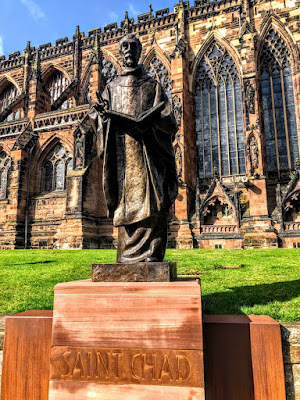
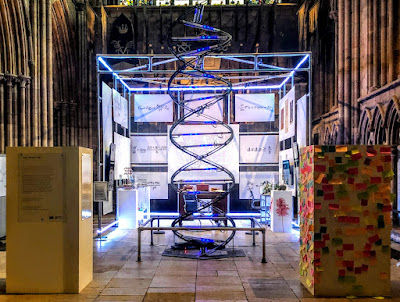
Christ Church Cathedral, Oxford, is unique in its dual role as a cathedral and a college chapel (Photograph: Patrick Comerford, 2026)
Patrick Comerford
I was at the Chrism Eucharist in Christ Church Cathedral, Oxford, this week, with the renewal of ordination vows by deacons, priests and bishops on Maundy Thursday (2 April 2026).
It was one of the last public services for Bishop Steve Croft before he retires as Bishop of Oxford, and he reminded as sharply of the words in the ordinal that ‘the trust that is now to be committed to your charge. Remember always with thanksgiving that the treasure now to be entrusted to you is Christ’s own flock, bought by the shedding of his blood on the cross. It is to him that you will render account for your stewardship of his people.’
The Diocese of Oxford has more church buildings than any other diocese in the Church of England and has more paid clergy than any other diocese except London. The diocese includes Berkshire, Buckinghamshire and Oxfordshire, with another five churches in nearby counties.
Inside Christ Church Cathedral, Oxford, looking east from the choir towards the High Altar and the Rose Window (Photograph: Patrick Comerford, 2026)
Christ Church Cathedral, Oxford, is both the college chapel of Christ Church and the cathedral church of the Diocese of Oxford. It was founded by Henry VIII with Cardinal Wolsey, and Christ Church is the largest Oxford college.
This was my second time as a priest living in the Diocese of Oxford since 2022 to take part in the Chrism Eucharist. Holy Week and Easter 2022 had been fraught times in the immediate aftermath of a stroke. I was at the Chrism Eucharist in Oxford in 2023, but missed it again in 2024 due to a hospital appointment in Milton Keynes, and in 2025, when I spent Holy Week and Easter in Crete.
I was a teenager when I first visited Christ Church more than 55 years ago. Despite the size of the diocese, this is one of the smallest cathedrals in the Church of England, and its dual role as cathedral and college chapel is unique.
Inside Christ Church Cathedral, Oxford, looking west from the choir towards the organ (Photograph: Patrick Comerford, 2026)
The cathedral was originally the church of Saint Frideswide’s Priory. The site is said to be the location of the nunnery founded by Saint Frideswide, the patron saint of Oxford, and her shrine is now in the Latin Chapel. It once held her relics, brought there in 1180, and it was the focus of pilgrimage from at least the 12th until the early 16th century.
Osney Abbey was surrendered in November 1539 and dissolved at the dissolution of the monastic houses. The last abbot was Robert King, who became the first Bishop of Oxford.
The Diocese of Oxford was formed out of part of the Diocese of Lincoln in 1542, and from September 1542 until June 1544, Osney Abbey was the seat of the bishop of the new diocese.
However, Osney was costly to run as a cathedral and in 1545 the bishop moved to the smaller and cheaper cathedral at Christ Church. Later, during the reign of Queen Mary, Bishop King was one of the judges at the trial of Thomas Cranmer.
Great Tom, described as the ‘loudest thing in Oxford’, now hangs in Tom Tower (Photograph: Patrick Comerford, 2026)
The abbey buildings soon fell into decay and were despoiled for the sake of the new foundation. Much of the stone found its way into local buildings, including Saint Frideswide’s as it was transformed into Christ Church. Osney Abey has been described as the greatest building that Oxford has lost.
Great Tom, the bell described as the ‘loudest thing in Oxford’ and now hanging in Tom Tower at Christ Church, was taken from the tower of Osney Abbey at the dissolution. Much of the monastic property was also transferred to Christ Church.
A statue of Cardinal Wolsey, founder of Christ Church, above the entrance to the Great Hall (Photograph: Patrick Comerford, 2026)
Saint Frideswide’s Priory was surrendered in 1522 to Cardinal Thomas Wolsey, who had selected it as the site for his proposed college. However, in 1529 the foundation was taken over by Henry VIII. Work stopped, but the college was refounded by the king in June 1532. Henry VIII transferred the recently-created See of Oxford from Osney to Christ Church in 1546.
There has been a choir at the cathedral since 1526, when John Taverner was the organist and master of the choristers. The statutes of Wolsey’s original college, initially called Cardinal College, mentioned 16 choristers and 30 singing priests.
The nave, choir, main tower and transepts are late Norman. There are architectural features ranging from Norman to the Perpendicular style and a large rose window of the ten-part or botanical type.
The monument to the Irish philosopher Bishop George Berkeley of Cloyne in Christ Church, Oxford (Photograph: Patrick Comerford)
Visitors to Oxford are often pointed to monuments such as those to the Wesley brothers, John and Charles Wesley, who were ordained in Christ Church, or the memorial to the poet WH Auden.
But this week I also noticed a number of monuments of Irish interest.
The philosopher George Berkeley (1685-1753), who was born in Co Kilkenny, was Bishop of Cloyne when he died in Oxford on 14 January 1753, and he was buried in Christ Church Cathedral.
The monument to William Brouncker, who was almost ruined when he bought an Irish peerage weeks before he died (Photograph: Patrick Comerford, 2026)
A monument in the south transept remembers Colonel William Villiers (1614 -1643), 2nd Viscount Grandison of Limerick, who was killed during the First English Civil War. His father Sir Edward Villiers (1585-1626) was the older half-brother of George Villiers, 1st Duke of Buckingham, a favourite of both James I and Charles I, and was the Lord President of Munster when he died in Cork in 1626.
William Villiers inherited the Irish peerage title of Viscount Grandison from his great-uncle Oliver St John (1559-1630). He fought as a royalist at the Battle of Edgehill and at the Storming of Bristol, where he was wounded in the right leg. He was taken to Oxford and died there he died on 29 September 1643. His daughter Barbara Villiers (1640-1709) was later a mistress of Charles II and Duchess of Cleveland.
Close by, another monument commemorates William Brouncker (1585-1645), 1st Viscount Brouncker of Castle Lyons and Baron Brouncker of Newcastle. His father, Sir Henry Brouncker, was Lord President of Munster (1603-1607). Malicious gossip said William Brouncker paid the then enormous sum of £1,200 for his titles in the Irish peerage, which he given on 12 September 1645, and was almost ruined as a result. He died a few months later.
The 17th century window by Abraham Van Linge shows the prophet Jonah looking over the city of Nineveh (Photograph: Patrick Comerford, 2026)
The cathedral has a fine collection of stained glass, the oldest being the 14th century Becket Window in the Lucy Chapel. It is one of very few images of Thomas Becket to survive the Reformation.
The glass at the west end of the north aisle is by the 17th century Dutch artist Abraham Van Linge. It dates from the period of Laudian Reform, around 1630, and shows the prophet Jonah looking over the city of Nineveh. A second window by Abraham van Linge is dedicated to Bishop King.
The window by Edward Burne-Jones and William Morris in the Latin Chapel is a tribute to Saint Frideswide (Photograph: Patrick Comerford, 2026)
The cathedral also has windows designed by Edward Burne-Jones, best known for his work with William Morris. The east window in the Latin Chapel was designed by Burne-Jones when he was still in his mid-20s and was made in 1859 by James Powell and Sons. It is a bold and colourful tribute to Saint Frideswide, and perhaps the finest of his early works, but also a dramatic contrast to his later work with Morris.
The Vyner window by Edward Burne-Jones (Photograph: Patrick Comerford, 2026)
The Vyner memorial window remembers two undergraduates who were murdered in the late 19th century. This Pre-Raphaelite window is a also pun on their family name, with vine leaves prominent in upper part of window.
The Saint Cecilia Window by Edward Burne-Jones in the North Choir aisle (Photograph: Patrick Comerford, 2026)
The Saint Cecilia Window by Burne-Jones depicting scenes from the life of Saint Cecilia and her martyrdom is the East Window in the North Choir aisle or Saint George’s Chapel. The angels in the tracery at top were designed by William Morris. Malcom Bell was of the opinion in 1895 that the source of the three panels showing the saint’s life was in Chaucer’s ‘Second Nun’s Tale’.
The Saint Michael Window by Clayton and Bell in the north transept (Photograph: Patrick Comerford, 2026)
Clayton and Bell created the dramatic Saint Michael Window in the north transept in 1870.
A window unveiled in 2023 as a memorial to EH Burn. It depicts Saint Francis of Assisi and is by John Reyntiens.
The newest stained-glass window in Christ Church Cathedral is the Prodigal Son Window by the British artist Thomas Denny. It was commissioned through the generosity of an anonymous donor and unveiled last September.
The chrism oils on a side altar in Christ Church Cathedral on Maundy Thursday (Photograph: Patrick Comerford, 2026)
The Dean of Christ Church is both the Dean of Christ Church Cathedral, Oxford, and the head of the governing body of Christ Church, a constituent college of the University of Oxford.
The chapter of canons of the cathedral has formed the governing body of the college since its foundation, with the dean as ex officio head of the chapter and ipso facto head of the college.
The Very Revd Dr Martyn Percy stepped down as the Dean of Christ Church in 2022 after a lengthy and acrimonious dispute. Previously, he had been the principal of Ripon College Cuddesdon (2004-2014). The governing body of Christ Church voted in 2023 to separate the ecclesiastical role of dean from the position of head of house of the college.
The Very Reverend Sarah Foot has been the Dean of Christ Church since 2023. She is also the Regius Professor of Ecclesiastical History at the University of Oxford since 2007, the first woman ever to hold that chair.
The other senior cathedral clergy include the Sub Dean, the Revd Canon Peter Moger, who introduced the Chrism Eucharist on Thursday and welcomed us to Christ Church, and the Archdeacon of Oxford, the Ven Jonathan Chaffey. The university’s four senior theology professors are also ex officio canons residentiary.
Looking towards the North Transept from the font and the pulpit (Photograph: Patrick Comerford, 2026)
In his poem ‘Thyrsis’, the Victorian poet Matthew Arnold called Oxford ‘the city of dreaming spires’, describing the architecture of the university buildings. WB Yeats refers to Christ Church in his poem ‘All Souls’ Night, Oxford’:
Midnight has come and the great Christ Church bell
And many a lesser bell sound through the room;
And it is All Souls’ Night …
The Communion vessels after the Chrism Eucharist on Maundy Thursday (Photograph: Patrick Comerford, 2026)
• The Easter Vigil with the Confirmations and the First Eucharist of Easter is at 8:05 in Christ Church Cathedral this evening. The Easter Day services tomorrow (Sunday 5 April 2026) are: 8:05 am, Holy Communion (1662 Book of Common Prayer); 9:35 am, Choral Matins for Easter Day; 11:05 am, Choral Eucharist for Easter Day; 6:05 pm, Festal Evensong for Easter Day. Choral Evensong takes place in the Cathedral each evening at 6pm and is open to the public.
Prayers for Peace in Christ Church Cathedral, Oxford, this week (Photograph: Patrick Comerford, 2026)
Showing posts with label WB Yeats. Show all posts
04 April 2026
At the Chrism Eucharist in
Christ Church, Oxford: both
a cathedral and a college chapel
Labels:
Architecture,
Cathedrals,
Chaucer,
Christ Church Cathedral,
Church History,
Easter 2026,
Lent 2026,
Liturgy,
Local History,
Maundy Thursday,
Ministry,
Oxford,
Pre-Raphaelites,
Stained Glass,
WB Yeats
13 February 2026
Bethel Solomons, the prominent
Jewish doctor who won ten caps
in international rugby for Ireland
A portrait of Dr Bethel Solomons by his sister Estella Solomons (Irish Jewish Museum, ©The Trustees of the Estate of Estella Solomons)
Patrick Comerford
This is another weekend of wall-to-wall, back-to-back rugby in the Six Nations Championship, with Ireland playing Italy tomorrow (2:10 pm) and England playing Scotland (4:40 pm), and then Wales and France on Sunday afternoon (15:10).
Despite a disappointing 36-14 defeat by France in the Stade de France last week, my fervour for Irish rugby is undimmed, and my hopes, however unfounded, remain high this weekend.
Few Jewish players have played at the highest levels in Irish rugby history. Bethel Solomons (1885-1965) is the most prominent Jewish Irish rugby international, capped as a forward for Ireland in the early 20th century, and also a noted doctor. Later, another former Irish rugby international, Tony Ward, discovered his Jewish heritage with dramatic revelations in recent years.
Dr Bethel Solons was the Master of the Rotunda Hospital, an actor at the Abbey Theatre and President of the Dublin Jewish Progressive Congregation. In addition, he was an international rugby player.
Bethel Albert Herbert Solomons was born on 27 February 1885 into a prominent Jewish family who are one of the oldest continuous Jewish families in Ireland. The Solomons family came to Ireland from England in 1824, when Elias Solomons opened his optician’s shop in Nassau Street, close to Trinity College Dublin. His son, Maurice Solomons (1832-1922), continued the optician’s practice at 19 Nassau Street, on the corner with South Frederick Street. He is mentioned by James Joyce in Ulysses, and was also a JP and the honorary consul in Ireland of the Austro-Hungarian Empire.
James Joyce in street art in Nassau Street … Maurice Solomons (is mentioned by James Joyce in ‘Ulysses’ (Photograph: Patrick Comerford)
Bethel’s elder brother Edwin Solomons (1879-1964) was a stockbroker and prominent member of the Dublin Jewish community. Their sister Estella Solomons (1882-1968) was a leading artist; she married the poet and publisher James Sullivan Starkey (1879-1958), a Methodist, who wrote under the penname Seumas O’Sullivan. Their younger sister Sophie trained as an opera singer.
Bethel Solomons went to Saint Andrew’s School, Dublin, and studied medicine in Trinity College Dublin, where he enjoyed the social life, theatre and rugby. He captained Trinity to the Leinster Senior Cup (1908), also played for Wanderers, and played on the Hospitals’ Cup winning team in the 1903-1904 and 1904-1905 seasons. He became the first Jew to play Test rugby when, on 8 February 1908, he lined up as Ireland’s number 8 in a 13-3 defeat by England at the Richmond Athletic Ground. In all, he won ten caps for Ireland (1908-1910).
In The Oval World: A Global History of Rugby' by Tony Collins, an account is given of Solomons taking a taxi to ensure he would be in time to run on to the pitch for a rugby international: ‘Fearing he would be late for Ireland’s 1909 home match against England, he hailed a cab in the centre of Dublin. He told the cabbie he wanted to go to Lansdowne Road. “It’s for the Ireland rugby international” explained Solomons. “Ireland?” snorted the driver dismissively “it’s nothing but fourteen Prods and a Jew”.’
Ireland were defeated 11-5 by England that day, 13 February 1909.
The stadium at Lansdowne Road, the home ground of Ireland and of Wanderers … Bethel Solomons was capped ten times for Ireland (Photograph: Patrick Comerford)
He acted at the Abbey Theatre, under the stage name Thomas Thornhill, in 1913 in August Strindberg’s There are Crimes and Crimes, and James Stephens dedicated The Charwoman’s Daughter to him.
Although his rugby and theatrical ambitions were limited by the demands and successful medical career, he went on to become a selector for the Irish team and was vice-president of the Irish Rugby Football Union (IRFU) in later years.
After his experience as an extern maternity assistant at the Rotunda Hospital, attending home births in the Dublin slums, he became devoted to obstetrics and gynaecology, also studied in Paris, Vienna, Berlin, Leipzig, Dresden and Munich, and started to teach medical students.
Bethel Solomons was a supporter of the suffrage movement and an advocate of women’s equality. He opened the Jewish Medical Dispensary in Stamer Street in Dublin’s ‘Little Jerusalem’ in 1913 and ran it with Ada Shillman, a midwife who attended most of the Jewish women in Dublin during her career.
He married Gertrude Levy in 1916 at the Liberal Synagogue in London in a wedding conducted by Claude Montefiore. Gertrude was a friend of his sister Sophie since they were students at the Royal Academy of Music in London.
Gertrude and Bethel lived in 42 Fitzwilliam Square, where he ran a successful practice (1916-1926). His patients included George Yeats and Iseult Gonne, and they later rented the upstairs of 42 Fitzwilliam Square to WB Yeats and his wife George. He later practiced from 30 Lower Baggot Street.
Bethel Solomons was the Master of the Rotunda Hospital from 1926 to 1933, and as Master he is mentioned by James Joyce in Finnegans Wake: ‘in my bethel of Solyman’s I accouched my rotundaties.’
He inherited considerable financial challenges at a hospital that needed to modernise and to maintain its reputation as one of the world’s leading maternity hospitals. His improvements included a new nurses’ home, new out-patient department, theatre block and sick babies ward, the introduction of X-ray facilities and incubators and a revival of the pathology laboratory.
As World War II approached, Solomons took an increased role in Jewish affairs. He wrote to the British Medical Journal in 1937 warning against the choice of Berlin as the location for an international medical academy of postgraduate work and research to ‘further international fellowship and friendship’.
The Dublin Jewish Progressive Congregation on Leicester Avenue, Rathgar (Photograph: Patrick Comerford)
From 1939, he worked to raise funds for the Jewish Refugee Aid Committee, which was chaired by Leonard Abrahamson and had among its vice-chairs, his brother Edwin, who was the President of the Dublin Hebrew Congregation at Adelaide Road Synagogue. At the end of the war, he became chair of the Jewish Children’s Refugee fund, raising funds to bring refugee children to Clonyn Castle, Co Westmeath or to Millisle Farm in Northern Ireland.
Solomons chaired a meeting in the Mansion House in Dublin in 1946 addressed by Rabbi Israel Mattuck of the Liberal Synagogue in London. The meeting led to the formation of the Dublin Jewish Progressive Congregation (DJPC), with Bethel Solomons as president from 1946 to 1965. The former Chief Rabbi of Ireland, Yitzhak Herzog (1888-1959), by then the Chief Rabbi of the Holy Land, denounced the new synagogue as an ‘open, active, organised rebellion against the Torah’, but Bethel Solomons refuted this in the Jewish Chronicle in 1946.
Solomons received many international honours and was President of the Royal College of Physicians of Ireland in 1946-1949. He died on 11 September 1965 at his home, Laughton Beg, Rochestown Avenue, Dún Laoghaire. Bethel and Gertrude Solomons were the parents of three children. Their second son, Dr Michael Solomons (1919-2007) was a distinguished gynaecologist, a pioneer of family planning in Ireland, and a veteran of the bitter and divisive 1983 constitutional amendment referendum campaign.
Another Irish rugby international, Tony Ward, found out late in life that his father, Danny Ward, was from a Jewish family that fled Poland to escape Nazi persecution. In a peculiar accident or coincidence in history, his paternal ancestors too had Solomons as their original family name.
Tony Ward was only five years old when his father died, leaving him with ‘precious few early memories of him’ so that he ‘knew very little about him or his family.’ It was only in later life he discovered his father’s story as a Jewish refugee from Poland later, partly through research initiated by his daughters, Nikki and Lynn, as a Christmas present. Through a professional genealogical agency, Ancestry Made Easy, they came across findings he had never known for the best part of six decades.
His father, known as Danny Ward, was born Saul Solomons on 16 August 1909. The Solomons family were victims of their time, and following the assassination of Tsar Alexander II in 1881, they fled the persecution of Jews in Russia, Poland and Finland.
Harris Solomons and Jane Cohen were the parents of Saul (Danny). Harris was a tailor and he and Jane lived at Great Garden Street, Whitechapel, in the East End of London. Saul Solomons, or Danny Ward, had three siblings: Sadie, Sydney and another sister, Sarah, who died soon after birth. The three surviving children were all born in London, but the census return listed them as Russians.
Saul Solomons and Lily Gross were married in Philpot Street Synagogue in the East End in 1934. They both worked in London as hairdressers and their son Derek, who was born in 1935, is Tony Ward’s half-brother.
That first marriage was later dissolved, and Saul Solomons then moved to Ireland and settled in Dublin in the late 1940s. He met June Connolly, a Catholic, around 1952 and there was an 18-year age gap between them. Gor them to marry, he reportedly had to give up his Jewish religion. By late November 1953, he had changed his name from Saul Solomons to Daniel Ward, had become a Catholic, and they married in Cardiff Registry Office.
The couple lived for a time in Leeds, where Tony Ward was born. Danny Ward had a heart attack and died in Leeds General Infirmary on Saint Patrick’s Day, 17 March 1960. Tony was only five, and June returned to Dublin almost immediately. Yet, having spent part of his childhood in Leeds, Tony Ward is still a committed Leeds United supporter.
There are other Jewish sports figures who have played cricket and football for Ireland, including Louis ‘Abraham’ Bookman and Finn Isaac Azaz. But more about them, perhaps, on another and appropriate Friday evening.
Shabbat Shalom, שבת שלום
Dr Bethel Solons was the Master of the Rotunda Hospital, an actor at the Abbey Theatre, President of the Dublin Jewish Progressive Congregation, and was capped then times for Ireland in international rugby
Patrick Comerford
This is another weekend of wall-to-wall, back-to-back rugby in the Six Nations Championship, with Ireland playing Italy tomorrow (2:10 pm) and England playing Scotland (4:40 pm), and then Wales and France on Sunday afternoon (15:10).
Despite a disappointing 36-14 defeat by France in the Stade de France last week, my fervour for Irish rugby is undimmed, and my hopes, however unfounded, remain high this weekend.
Few Jewish players have played at the highest levels in Irish rugby history. Bethel Solomons (1885-1965) is the most prominent Jewish Irish rugby international, capped as a forward for Ireland in the early 20th century, and also a noted doctor. Later, another former Irish rugby international, Tony Ward, discovered his Jewish heritage with dramatic revelations in recent years.
Dr Bethel Solons was the Master of the Rotunda Hospital, an actor at the Abbey Theatre and President of the Dublin Jewish Progressive Congregation. In addition, he was an international rugby player.
Bethel Albert Herbert Solomons was born on 27 February 1885 into a prominent Jewish family who are one of the oldest continuous Jewish families in Ireland. The Solomons family came to Ireland from England in 1824, when Elias Solomons opened his optician’s shop in Nassau Street, close to Trinity College Dublin. His son, Maurice Solomons (1832-1922), continued the optician’s practice at 19 Nassau Street, on the corner with South Frederick Street. He is mentioned by James Joyce in Ulysses, and was also a JP and the honorary consul in Ireland of the Austro-Hungarian Empire.
James Joyce in street art in Nassau Street … Maurice Solomons (is mentioned by James Joyce in ‘Ulysses’ (Photograph: Patrick Comerford)
Bethel’s elder brother Edwin Solomons (1879-1964) was a stockbroker and prominent member of the Dublin Jewish community. Their sister Estella Solomons (1882-1968) was a leading artist; she married the poet and publisher James Sullivan Starkey (1879-1958), a Methodist, who wrote under the penname Seumas O’Sullivan. Their younger sister Sophie trained as an opera singer.
Bethel Solomons went to Saint Andrew’s School, Dublin, and studied medicine in Trinity College Dublin, where he enjoyed the social life, theatre and rugby. He captained Trinity to the Leinster Senior Cup (1908), also played for Wanderers, and played on the Hospitals’ Cup winning team in the 1903-1904 and 1904-1905 seasons. He became the first Jew to play Test rugby when, on 8 February 1908, he lined up as Ireland’s number 8 in a 13-3 defeat by England at the Richmond Athletic Ground. In all, he won ten caps for Ireland (1908-1910).
In The Oval World: A Global History of Rugby' by Tony Collins, an account is given of Solomons taking a taxi to ensure he would be in time to run on to the pitch for a rugby international: ‘Fearing he would be late for Ireland’s 1909 home match against England, he hailed a cab in the centre of Dublin. He told the cabbie he wanted to go to Lansdowne Road. “It’s for the Ireland rugby international” explained Solomons. “Ireland?” snorted the driver dismissively “it’s nothing but fourteen Prods and a Jew”.’
Ireland were defeated 11-5 by England that day, 13 February 1909.
The stadium at Lansdowne Road, the home ground of Ireland and of Wanderers … Bethel Solomons was capped ten times for Ireland (Photograph: Patrick Comerford)
He acted at the Abbey Theatre, under the stage name Thomas Thornhill, in 1913 in August Strindberg’s There are Crimes and Crimes, and James Stephens dedicated The Charwoman’s Daughter to him.
Although his rugby and theatrical ambitions were limited by the demands and successful medical career, he went on to become a selector for the Irish team and was vice-president of the Irish Rugby Football Union (IRFU) in later years.
After his experience as an extern maternity assistant at the Rotunda Hospital, attending home births in the Dublin slums, he became devoted to obstetrics and gynaecology, also studied in Paris, Vienna, Berlin, Leipzig, Dresden and Munich, and started to teach medical students.
Bethel Solomons was a supporter of the suffrage movement and an advocate of women’s equality. He opened the Jewish Medical Dispensary in Stamer Street in Dublin’s ‘Little Jerusalem’ in 1913 and ran it with Ada Shillman, a midwife who attended most of the Jewish women in Dublin during her career.
He married Gertrude Levy in 1916 at the Liberal Synagogue in London in a wedding conducted by Claude Montefiore. Gertrude was a friend of his sister Sophie since they were students at the Royal Academy of Music in London.
Gertrude and Bethel lived in 42 Fitzwilliam Square, where he ran a successful practice (1916-1926). His patients included George Yeats and Iseult Gonne, and they later rented the upstairs of 42 Fitzwilliam Square to WB Yeats and his wife George. He later practiced from 30 Lower Baggot Street.
Bethel Solomons was the Master of the Rotunda Hospital from 1926 to 1933, and as Master he is mentioned by James Joyce in Finnegans Wake: ‘in my bethel of Solyman’s I accouched my rotundaties.’
He inherited considerable financial challenges at a hospital that needed to modernise and to maintain its reputation as one of the world’s leading maternity hospitals. His improvements included a new nurses’ home, new out-patient department, theatre block and sick babies ward, the introduction of X-ray facilities and incubators and a revival of the pathology laboratory.
As World War II approached, Solomons took an increased role in Jewish affairs. He wrote to the British Medical Journal in 1937 warning against the choice of Berlin as the location for an international medical academy of postgraduate work and research to ‘further international fellowship and friendship’.
The Dublin Jewish Progressive Congregation on Leicester Avenue, Rathgar (Photograph: Patrick Comerford)
From 1939, he worked to raise funds for the Jewish Refugee Aid Committee, which was chaired by Leonard Abrahamson and had among its vice-chairs, his brother Edwin, who was the President of the Dublin Hebrew Congregation at Adelaide Road Synagogue. At the end of the war, he became chair of the Jewish Children’s Refugee fund, raising funds to bring refugee children to Clonyn Castle, Co Westmeath or to Millisle Farm in Northern Ireland.
Solomons chaired a meeting in the Mansion House in Dublin in 1946 addressed by Rabbi Israel Mattuck of the Liberal Synagogue in London. The meeting led to the formation of the Dublin Jewish Progressive Congregation (DJPC), with Bethel Solomons as president from 1946 to 1965. The former Chief Rabbi of Ireland, Yitzhak Herzog (1888-1959), by then the Chief Rabbi of the Holy Land, denounced the new synagogue as an ‘open, active, organised rebellion against the Torah’, but Bethel Solomons refuted this in the Jewish Chronicle in 1946.
Solomons received many international honours and was President of the Royal College of Physicians of Ireland in 1946-1949. He died on 11 September 1965 at his home, Laughton Beg, Rochestown Avenue, Dún Laoghaire. Bethel and Gertrude Solomons were the parents of three children. Their second son, Dr Michael Solomons (1919-2007) was a distinguished gynaecologist, a pioneer of family planning in Ireland, and a veteran of the bitter and divisive 1983 constitutional amendment referendum campaign.
Another Irish rugby international, Tony Ward, found out late in life that his father, Danny Ward, was from a Jewish family that fled Poland to escape Nazi persecution. In a peculiar accident or coincidence in history, his paternal ancestors too had Solomons as their original family name.
Tony Ward was only five years old when his father died, leaving him with ‘precious few early memories of him’ so that he ‘knew very little about him or his family.’ It was only in later life he discovered his father’s story as a Jewish refugee from Poland later, partly through research initiated by his daughters, Nikki and Lynn, as a Christmas present. Through a professional genealogical agency, Ancestry Made Easy, they came across findings he had never known for the best part of six decades.
His father, known as Danny Ward, was born Saul Solomons on 16 August 1909. The Solomons family were victims of their time, and following the assassination of Tsar Alexander II in 1881, they fled the persecution of Jews in Russia, Poland and Finland.
Harris Solomons and Jane Cohen were the parents of Saul (Danny). Harris was a tailor and he and Jane lived at Great Garden Street, Whitechapel, in the East End of London. Saul Solomons, or Danny Ward, had three siblings: Sadie, Sydney and another sister, Sarah, who died soon after birth. The three surviving children were all born in London, but the census return listed them as Russians.
Saul Solomons and Lily Gross were married in Philpot Street Synagogue in the East End in 1934. They both worked in London as hairdressers and their son Derek, who was born in 1935, is Tony Ward’s half-brother.
That first marriage was later dissolved, and Saul Solomons then moved to Ireland and settled in Dublin in the late 1940s. He met June Connolly, a Catholic, around 1952 and there was an 18-year age gap between them. Gor them to marry, he reportedly had to give up his Jewish religion. By late November 1953, he had changed his name from Saul Solomons to Daniel Ward, had become a Catholic, and they married in Cardiff Registry Office.
The couple lived for a time in Leeds, where Tony Ward was born. Danny Ward had a heart attack and died in Leeds General Infirmary on Saint Patrick’s Day, 17 March 1960. Tony was only five, and June returned to Dublin almost immediately. Yet, having spent part of his childhood in Leeds, Tony Ward is still a committed Leeds United supporter.
There are other Jewish sports figures who have played cricket and football for Ireland, including Louis ‘Abraham’ Bookman and Finn Isaac Azaz. But more about them, perhaps, on another and appropriate Friday evening.
Shabbat Shalom, שבת שלום
Dr Bethel Solons was the Master of the Rotunda Hospital, an actor at the Abbey Theatre, President of the Dublin Jewish Progressive Congregation, and was capped then times for Ireland in international rugby
08 October 2025
Thame was once the home
of William Butler Yeats and
has a large number of old
timber framed buildings
William Butler Yeats once lived at Cuttle Brook House in Thame, where his son Senator Michael was born in 1921 (Photograph: Patrick Comerford, 2025)
Patrick Comerford
I caught the bus to Thame from Aylesbury recently, mainly because I wanted to see Saint Mary’s Church, which I had glimpsed from the bus before, an impressive sight looking across Church Meadow and the grounds of Thame Cricket Club.
But I had also heard of its connections with the poet William Butler Yeats and a peculiar link with Evelyn Waugh, and on previous bus journeys I had noticed a larger number of timber framed pubs and other buildings, many dating back to the 15th century, including the old almshouses.
Thame is a market town in south Oxfordshire, about 21 km (13 miles) east of Oxford and 16 km (10 miles) south-west of Aylesbury It takes its name from the River Thame o the north side of the town, marking the county boundary of Buckinghamshire and Oxfordshire. The town has population of about 12,000.
The Tithe Barn was once the Court Barn belonging to the now demolished Manorial Court House (Photograph: Patrick Comerford, 2025)
Thame dates from the Anglo-Saxon era and appears in the Domesday Book as belonging to the Bishop of Lincoln.
Thame Abbey was founded by the Cistercians in 1138, the parish church of Saint Mary the Virgin dates from the 13th century, and the nearby Prebendal House was there by 1234.
The Tithe Barn in front of the church gate is a long low building where a brick base supports a timber frame with herring-bone brick filling and was used for the storage of the church dues or tithes. It was called the Court Barn in the 15th century and belonged to the now demolished Court House, where the manorial court was held.
The Bird Cage dates from the 14th century and was first built as the Market House (Photograph: Patrick Comerford, 2025)
The Bird Cage pub on the High Street is a picturesque double-jettied pub that dates from the 14th century. It was built originally as the Market House with an open lower storey. It sits at the centre of the old market place and would have dominated the view from the western entrance to the town. It has been as an inn since the 16th century.
The Six Bells, despite its mock-Tudor exterior, has a 15th century timber-frame structure. It faces the former almshouses and Church Road leading up to Saint Mary’s Church.
The Thatch pub, also on High Street, dates from ca 1550 and is made up from a charming group of cottages. It was developed into a tea room many years ago, and became a popular restaurant and hotel, yet managed to preserve its 16th century origins. It became more popular in 2007 as the prize in the television programme ‘The Restaurant’.
The almshouses were founded by Richard Quatremain in 1447 and re-founded by John Williams in 1559 (Photograph: Patrick Comerford, 2025)
In Tudor times, a prominent local magnate and courtier, John Williams, 1st Baron Williams of Thame, became the lord of the Manor of Thame, and the long-time links with the Bishops of Lincoln and Lincoln Cathedral came to an end. His tomb dominates the chancel of Saint Mary’s Church.
Williams re-founded the almshouses on Church Road, originally a foundation of Richard Quatremain in 1447, when he founded the chantry or guild of Saint Christopher.
Williams re-founded the almshouses in 1559 for five poor men and one poor woman. They are now privately owned and have turned their backs to Church Road. Opposite the almshouses is an attractive row of 18th century cottages.
Williams died in 1559, and his will established the local grammar school, built in 1569-1571 next to the almshouses. The school moved to Oxford Road in 1880 and in 1971 it became a comprehensive school, now known as Lord Williams’s School.
The Grammar School was endowed by John Williams and built in 1569-1571 (Photograph: Patrick Comerford, 2025)
During the English Civil War in the 1640s, Thame was occupied in turn by Royalists and by the Parliamentarians.
The Old Nag’s Head, a High Street pub with a timber frame west elevation dating from the 15th century, was known as the King’s Head until, during the Civil War, a supporter of Charles I was hanged from the sign by Parliamentary soldiers.
After the Battle of Chalgrove Field in 1643, Colonel John Hampden, who had attended the grammar school, died of his wounds at the house of Ezekiel Browne, later to become the Greyhound Inn.
A royalist was hanged by Parliamentarians at the the King’s Head, now the Old Nag’s Head (Photograph: Patrick Comerford, 2025)
The bare-knuckle prize-fighter James Figg was born in Thame in 1684 and had his early prize fights in the former Greyhound Inn on High Street. He had become the world’s first boxing champion by 1719, winning many fights in his booth at Marylebone Fields, London. The Greyhound Inn was renamed the James Figg in his honour in the 21st century.
Many of the buildings in the boat-shaped High Street were re-faced in the 18th century with modern façades built of locally produced salt glazed bricks. Lancastrian Cottage at No 22 Upper High Street is a reminder of what lies behind many of the grand façades in the town.
When John Wesley preached in Thame in the late 18th century, the congregation was so large that the floor of the building gave way, and the crowd fell to the lower floor.
The Town Hall was built in 1888 and is the third on the site (Photograph: Patrick Comerford, 2025)
There has been a Market Hall on the site of Thame Town Hall since 1509, and the present Town Hall is the third building on this site. It was built in 1888, funded by public subscriptions to commemorate Queen Victoria’s Diamond Jubilee in 1887.
The Victorian bandstand behind the former almshouses is a legacy of a grand ballroom from the 19th century.
The War Memorial in the Memorial Gardens was unveiled by the former Prime Minister David Lloyd George in 1921.
The Six Bells, faces the former almshouses, has its Tudor exterior, but has a 15th century timber-frame structure (Photograph: Patrick Comerford, 2025)
The Irish poet and playwright William Butler Yeats (1865-1939) lived for a short time at Cuttle Brook House, 42 High Street, a good example of an 18th century town house. The poet returned to Ireland, became an Irish senator in 1922, and was awarded the Nobel Prize for Literature in 1923. His son, the late Senator Michael Yeats (1921-1973), was born in Cuttle Brook House on 22 August 1921.
Another resident of Thame with literary association from that time was the writer John Fothergill (1876-1957), who owned and managed the Spread Eagle Hotel in 1922-1931. Evelyn Waugh, who was a regular visitor, described Fothergill as ‘Oxford's only civilising influence’ and named the Spread Eagle in Brideshead Revisited.
A small hoard of late mediaeval coins and rings found near the Prebendal House and beside the River Thame in 1940, including an ornate ecclesiastical ring with a small reliquary and a cross with two horizontal sections, similar to the Cross of Lorraine. Thame Town Council has incorporated the cross into the town emblem.
The Greyhound Inn on High Street has been renamed after James Figg (Photograph: Patrick Comerford, 2025)
Robin Gibb of the Bee Gees and his wife Dwina Murphy-Gibb lived in Prebendal House in Thame until he died in 2012. His brother Andy Gibb also lived in Prebendal House before he died in 1988.
The Robin Gibb Gallery opened in Thame Museum in 2022. The museum was originally built as the town’s county court house in 1861, and it was bought by Thame Town Council in 2005 to house Thame Museum.
Thame has featured many times as a location in episodes of the Midsomer Murders television drama series as the fictional town of Causton. The Tuesday market still takes place in the High Street, as do the annual fairs, rooted in medieval tradition.
I also visited Saint Joseph’s Roman Catholic Church and some of the other church buildings in Thame – but more about these in the days to come, hopefully.
The Main Street in Thame, a market town on the boundary of Oxfordshire and Buckinghamshire (Photograph: Patrick Comerford, 2025)
Patrick Comerford
I caught the bus to Thame from Aylesbury recently, mainly because I wanted to see Saint Mary’s Church, which I had glimpsed from the bus before, an impressive sight looking across Church Meadow and the grounds of Thame Cricket Club.
But I had also heard of its connections with the poet William Butler Yeats and a peculiar link with Evelyn Waugh, and on previous bus journeys I had noticed a larger number of timber framed pubs and other buildings, many dating back to the 15th century, including the old almshouses.
Thame is a market town in south Oxfordshire, about 21 km (13 miles) east of Oxford and 16 km (10 miles) south-west of Aylesbury It takes its name from the River Thame o the north side of the town, marking the county boundary of Buckinghamshire and Oxfordshire. The town has population of about 12,000.
The Tithe Barn was once the Court Barn belonging to the now demolished Manorial Court House (Photograph: Patrick Comerford, 2025)
Thame dates from the Anglo-Saxon era and appears in the Domesday Book as belonging to the Bishop of Lincoln.
Thame Abbey was founded by the Cistercians in 1138, the parish church of Saint Mary the Virgin dates from the 13th century, and the nearby Prebendal House was there by 1234.
The Tithe Barn in front of the church gate is a long low building where a brick base supports a timber frame with herring-bone brick filling and was used for the storage of the church dues or tithes. It was called the Court Barn in the 15th century and belonged to the now demolished Court House, where the manorial court was held.
The Bird Cage dates from the 14th century and was first built as the Market House (Photograph: Patrick Comerford, 2025)
The Bird Cage pub on the High Street is a picturesque double-jettied pub that dates from the 14th century. It was built originally as the Market House with an open lower storey. It sits at the centre of the old market place and would have dominated the view from the western entrance to the town. It has been as an inn since the 16th century.
The Six Bells, despite its mock-Tudor exterior, has a 15th century timber-frame structure. It faces the former almshouses and Church Road leading up to Saint Mary’s Church.
The Thatch pub, also on High Street, dates from ca 1550 and is made up from a charming group of cottages. It was developed into a tea room many years ago, and became a popular restaurant and hotel, yet managed to preserve its 16th century origins. It became more popular in 2007 as the prize in the television programme ‘The Restaurant’.
The almshouses were founded by Richard Quatremain in 1447 and re-founded by John Williams in 1559 (Photograph: Patrick Comerford, 2025)
In Tudor times, a prominent local magnate and courtier, John Williams, 1st Baron Williams of Thame, became the lord of the Manor of Thame, and the long-time links with the Bishops of Lincoln and Lincoln Cathedral came to an end. His tomb dominates the chancel of Saint Mary’s Church.
Williams re-founded the almshouses on Church Road, originally a foundation of Richard Quatremain in 1447, when he founded the chantry or guild of Saint Christopher.
Williams re-founded the almshouses in 1559 for five poor men and one poor woman. They are now privately owned and have turned their backs to Church Road. Opposite the almshouses is an attractive row of 18th century cottages.
Williams died in 1559, and his will established the local grammar school, built in 1569-1571 next to the almshouses. The school moved to Oxford Road in 1880 and in 1971 it became a comprehensive school, now known as Lord Williams’s School.
The Grammar School was endowed by John Williams and built in 1569-1571 (Photograph: Patrick Comerford, 2025)
During the English Civil War in the 1640s, Thame was occupied in turn by Royalists and by the Parliamentarians.
The Old Nag’s Head, a High Street pub with a timber frame west elevation dating from the 15th century, was known as the King’s Head until, during the Civil War, a supporter of Charles I was hanged from the sign by Parliamentary soldiers.
After the Battle of Chalgrove Field in 1643, Colonel John Hampden, who had attended the grammar school, died of his wounds at the house of Ezekiel Browne, later to become the Greyhound Inn.
A royalist was hanged by Parliamentarians at the the King’s Head, now the Old Nag’s Head (Photograph: Patrick Comerford, 2025)
The bare-knuckle prize-fighter James Figg was born in Thame in 1684 and had his early prize fights in the former Greyhound Inn on High Street. He had become the world’s first boxing champion by 1719, winning many fights in his booth at Marylebone Fields, London. The Greyhound Inn was renamed the James Figg in his honour in the 21st century.
Many of the buildings in the boat-shaped High Street were re-faced in the 18th century with modern façades built of locally produced salt glazed bricks. Lancastrian Cottage at No 22 Upper High Street is a reminder of what lies behind many of the grand façades in the town.
When John Wesley preached in Thame in the late 18th century, the congregation was so large that the floor of the building gave way, and the crowd fell to the lower floor.
The Town Hall was built in 1888 and is the third on the site (Photograph: Patrick Comerford, 2025)
There has been a Market Hall on the site of Thame Town Hall since 1509, and the present Town Hall is the third building on this site. It was built in 1888, funded by public subscriptions to commemorate Queen Victoria’s Diamond Jubilee in 1887.
The Victorian bandstand behind the former almshouses is a legacy of a grand ballroom from the 19th century.
The War Memorial in the Memorial Gardens was unveiled by the former Prime Minister David Lloyd George in 1921.
The Six Bells, faces the former almshouses, has its Tudor exterior, but has a 15th century timber-frame structure (Photograph: Patrick Comerford, 2025)
The Irish poet and playwright William Butler Yeats (1865-1939) lived for a short time at Cuttle Brook House, 42 High Street, a good example of an 18th century town house. The poet returned to Ireland, became an Irish senator in 1922, and was awarded the Nobel Prize for Literature in 1923. His son, the late Senator Michael Yeats (1921-1973), was born in Cuttle Brook House on 22 August 1921.
Another resident of Thame with literary association from that time was the writer John Fothergill (1876-1957), who owned and managed the Spread Eagle Hotel in 1922-1931. Evelyn Waugh, who was a regular visitor, described Fothergill as ‘Oxford's only civilising influence’ and named the Spread Eagle in Brideshead Revisited.
A small hoard of late mediaeval coins and rings found near the Prebendal House and beside the River Thame in 1940, including an ornate ecclesiastical ring with a small reliquary and a cross with two horizontal sections, similar to the Cross of Lorraine. Thame Town Council has incorporated the cross into the town emblem.
The Greyhound Inn on High Street has been renamed after James Figg (Photograph: Patrick Comerford, 2025)
Robin Gibb of the Bee Gees and his wife Dwina Murphy-Gibb lived in Prebendal House in Thame until he died in 2012. His brother Andy Gibb also lived in Prebendal House before he died in 1988.
The Robin Gibb Gallery opened in Thame Museum in 2022. The museum was originally built as the town’s county court house in 1861, and it was bought by Thame Town Council in 2005 to house Thame Museum.
Thame has featured many times as a location in episodes of the Midsomer Murders television drama series as the fictional town of Causton. The Tuesday market still takes place in the High Street, as do the annual fairs, rooted in medieval tradition.
I also visited Saint Joseph’s Roman Catholic Church and some of the other church buildings in Thame – but more about these in the days to come, hopefully.
The Main Street in Thame, a market town on the boundary of Oxfordshire and Buckinghamshire (Photograph: Patrick Comerford, 2025)
15 August 2025
Harry Kernoff, a radical artist,
is still remembered in the streets
of ‘Little Jerusalem’ in Dublin
Harry Kernoff (1900-1974) lived and worked at 13 Stamer Street, between Lennox Street and the South Circular Road in ‘Little Jerusalem’ in Dublin (Photograph: Patrick Comerford,2025)
Patrick Comerford
During my quick, overnight and all-too-short visit to Dublin this week, I spent a few hours on a sunny, summer afternoon, and again on a sunny August morning, strolling around the narrow streets of ‘Little Jerusalem’, between the South Circular Road and the Grand Canal. I even had coffee in the Bretzel on Lennox Street, until recently the last kosher bakery in Dublin.
Over the space of a number of generations, many cousins of my grandfather and my father lived in the rebrick houses on these narrow street in ‘Little Jerusalem’.
I have written in the past about the many members of the extended Comerford family who lived on Clanbrassil Street, which I remember as the beating heart of the Jewish community in even well into the 1960s, and which is recalled so winsomely by Sonia Harris Pope in The Irish Times last Friday (8 August 2025). [For replies, see here]
Comerford family homes in the streets of ‘Little Jerusalem’ over the past century or more: 43 Warren Street and 1 Kingsland Parade, top; 17 Martin Street and 46 Lennox Street, below (Photographs: Patrick Comerford,2025)
But over the past century or more, there were Comerford family members living in other streets in Little Jerusalem too, including: James and Belinda Comerford who were living at 43 Warren Street at the time of the 1901 census, and Robert Comerford (1856-1925), who lived at 17 Martin Street around the same time. Patrick Comerford (1899-1939) lived at 46 Lennox Street until he died in 1939. His brother Jack Comerford lived across the street at 1 Kingsland Parade until he died in 1949. Stephen Comerford (1924-1982) lived at 39 St Kevin’s Parade. Indeed, there were Comerfords living on Lennox Street up to at least 2011.
Although my father was born in Rathmines and grew up in Terenure, he knew these streets well as a child, where many of his cousins and schoolfriends lived. Many of these side streets had their own small synagogues, including those I have written about in the past on Lennox Street, Walworth Road, Saint Kevin’s Parade and Heytesbury Street, and some that I still remember with fondness.
I have been working on contributions to a new book on the theme of ‘childhood and the Irish’ being put together by my friend and colleague Professor Salvador Ryan of Maynooth. In one paper I have offered for this collection, I look at the fascinating childhood of the Levitas brothers, Maurice, Max and Sol, heroes of the Battle of Cable Street, the Spanish Civil War and radical politics in the East End of London. During their childhood, the Levitas family lived in a series of houses in Little Jerusalem, including 15 Longwood Avenue (1915), 8 Warren Street (1916-1925) and 13 St Kevins Parade (1925-1927).
A portrait of Harry Kernoff in 1931 in the Irish Jewish Museum on Walworth Road in Dublin
Another interesting neighbour in the streets of Portobello was the artist Harry Aaron Kernoff (1900-1974). On that same afternoon stroll around Little Jerusalem this week, I went to see the house at 13 Stamer Street, between Lennox Street and the South Circular Road, where I remember the Kernoff family living until the 1970s.
Harry Aaron Kernoff was born in London in London on 9 January 1900. His parents were an interesting mixture of Jewish traditions and backgrounds: his father Isaac Karnov or Kernoff was a furniture maker from Vitebsk in present-day Belarus; his mother, Katherine Abarbanel or Bardanelle, was descended from a Sephardic family who traced their ancestry to Spain.
The family moved to Dublin when Harry was 14 in May 1914. He spent his early days as an apprentice in his father’s furniture business. An example of Isaac Kernoff's fine work is the Arun haKodesh or holy Ark for the Torah scrolls in Walworth Road synagogue, now part of the Irish jewish Museum.
He was still an apprentice to his father when Harry took night classes at the Dublin Metropolitan School of Art under Sean Keating, Patrick Tuohy and Harry Clarke. He was the first night student and the first Jew to win the Taylor Art Scholarship in 1923, when Jack B Yeats was the judge for the award. The scholarship allowed him to he became a full-time day student.
Throughout his career, Kernoff worked from his studio in the attic of the family home at 13 Stamer Street. He refused to romanticise his work and was one of the few artists in Dublin at the time whose work showed a social conscience and an awareness of the plight of the unemployed, seen in paintings such as ‘Dublin Kitchen’ (1923).
He first exhibited at the Royal Hibernian Academy (RHA) in 1926, he become a full member of the RHA in 1935, and he continued to exhibit there until he died in 1974. He also joined the Dublin Society of Painters in 1927 and had many solo exhibitions at their studio at 7 Saint Stephen’s Green. His work was part of the painting event in the art competition at the 1928 Summer Olympics.
Harry Kernoff’s design for a Jewish New Year card showing a rabbi blowing the shofar
A strong independence of style marked his work, reflected in his one-man exhibitions in Dublin yearly between 1926 and 1958. He developed an interest in the avant-garde and modern movements in the 1920s, but seemed more comfortable with realism and became one of the main artistic chroniclers of social life in urban and rural Ireland. His work chronicled both urban and rural life, with paintings of Dublin landmarks, pubs, shops and houses, as well as paintings of Killarney, Dún Chaoin and the Blasket Islands in Co Kerry, and Foynes, Co Limerick.
Some of his works also have Jewish themes, such as ‘Old Rabbi’, ‘Moses’ and ‘Wise Men of the East’ or ‘Rabbinical Conference’ in the National Gallery of Ireland, or his designs over the year for Jewish New Year cards.
He became ‘one of the main artistic chroniclers of social life’ in urban 20th century Ireland, according to Sarah McAuliffe, curator of post-1900 Irish art at the National Gallery of Ireland. His work is often compared to that of LS Lowry, and she says the two were ‘drawn to representing daily life as it was, without embellishment.’ She suggests Kernoff, as an immigrant, immersed himself in the bustle of Dublin’s city life to ‘feel as though he was an insider.’
‘A Bird Never Flew On One Wing’ by Harry Kernoff celebrates Dublin pub life
A cartoon in the Palace Bar from 1940, ‘Dublin Culture’, shows Kernoff with the elite of Ireland’s art and literary scene in the bar that became an informal gallery for his work.
His work includes theatre sets and costume designs, portraits of literary figures and actors, illustrations, woodcuts and paintings of literary pubs and their characters. In his studio in Stamer Street he painted a range of portraits of leading Dublin figures, including WB Yeats, Flann O’Brien, Sean O’Casey, Hilton Edwards, Frederick Robert Higgins, Brendan Behan, James Joyce and Cyril Cusack, and other promnent figures such as Archbishop William Alexander.
A popular, humorous, and sociable man, he had a fondness for swimming and satiric verse, and he was often seen in the Palace Bar in Fleet Street and Bewley’s café on Grafton Street or scouring other pubs for suitable subjects.
One well-known painting, ‘A Bird Never Flew On One Wing’, depicts two drunken betting men with pints raised and, in the background, the names of Dublin pubs carefully and lovingly written out. There are many versions and prints that show two men cradling pints. One of the men, said to be modelled on a character known as ‘the Toucher Doyle’, has pointed ears and high cheekbones, leading to speculation that he inspired a visiting Hollywood designer to create the character of Spock in Star Trek, according to Kevin O’Connor’s biography Harry Kernoff: The Little Genius.
The plaque commemorating Harry Kernoff was unveiled at 13 Stamer Street in 2013 (Photograph: Patrick Comerford, 2025)
Kernoff created the decorative scheme at the Little Theatre in South William Street, and designed the sets for Dublin productions of Sean O’Casey’s ‘The Shadow of a Gunman’ and Lord Dunsany’s ‘The Glittering Gate’.
He was a member of the Radical Club, a group of artists and that met in an era that Kernoff referred to as Dublin’s own ‘jazz age’, and of the Studio Art Club. Like the Levitas brothers, he was also actively involved in left-wing politics, and was involved in anti-fascist campaigns in Dublin.
Years spent as an apprentice to his cabinet-maker father taught him how to skilfully carve woodcuts for block printing. His woodcuts were often used in republican and labour newspapers in the 1930s and 1940s, and he designed the masthead of the communist weekly the Irish Workers’ Voice.
He was a member of the Friends of Soviet Russia, and was part of a delegation to visit Leningrad, Moscow, Baku, Tiflis and Vladikavkaz in 1930. His travelling companions included Hanna Sheehy Skeffington, Charlotte Despard, David Fitzgerald and George Gilmore. During that visit, he was so influenced by revolutionary artists in pre-Stalinist Russia that he lectured about his trip when he returned to Dublin and organised a Soviet Poster exhibition.
He visited Paris in 1931 and exhibited ‘Metro’, ‘Paris’, and ‘Place de Tertre’, and had a sole show that year in Gieve’s Gallery, London, where he displayed ‘Ukraine peasant’. He had three solo shows at the Victor Waddington Galleries in 1935, 1937 and 1940, and. He exhibited at world fairs in Glasgow (1938) and New York (1939).
‘The Only Way’ or ‘Peace Scroll’ … a design for a Jewish New Year card 5734 (1973)
He began painting on a smaller scale on canvases in the 1940s and produced hundreds of miniature oil paintings. The first of his three publications of woodcuts appeared in 1942, followed by A Storyteller’s Childhood in 1946.
He was represented at the contemporary Irish art exhibition at Aberystwyth in Wales in 1953. He spent a year painting at Novia Scotia in 1957, and exhibited small watercolours in Lugano and Toronto in 1964 and 1965. His portraits were part of the WB Yeats centenary exhibition in the National Gallery of Ireland in 1965.
For many years he was a member of the arts advisory committee of the Municipal Gallery of Modern Art, and in 1974, shortly before he died he was made a life member of the United Arts Club, Dublin.
He was predeceased by his parents: Isaac Kernoff died at 13 Stamer Street at 71 on 11 August 1948; Kate Kernoff died there at 89, on 26 November 1969. His brother, Hyman Kernoff, who also lived in the house, died at 59 on 2 December 1960.
Despite being prolific in his work, Kernoff died a poor man. He never married, and he died in the Meath Hospital, Dublin, at the age of 74 on 25 December 1974. He was survived by his sister Lena Kernoff, who also shared the house in Stamer Street. She deposited his papers in the National Library of Ireland in 1975. The Irish Jewish Museum unveiled a plaque in memory of Harry Kernoff at 13 Stamer Street in 2013.
May his memory be a blessing ז״ל
Shabbat Shalom, שבת שלום
The Levitas family homes in the side streets of Little Jerusalem: 8 Warren Street (left), 15 Longwood Avenue (top right) and 13 St Kevin's Parade (lower right) (Photographs: Patrick Comerford, 2025)
Patrick Comerford
During my quick, overnight and all-too-short visit to Dublin this week, I spent a few hours on a sunny, summer afternoon, and again on a sunny August morning, strolling around the narrow streets of ‘Little Jerusalem’, between the South Circular Road and the Grand Canal. I even had coffee in the Bretzel on Lennox Street, until recently the last kosher bakery in Dublin.
Over the space of a number of generations, many cousins of my grandfather and my father lived in the rebrick houses on these narrow street in ‘Little Jerusalem’.
I have written in the past about the many members of the extended Comerford family who lived on Clanbrassil Street, which I remember as the beating heart of the Jewish community in even well into the 1960s, and which is recalled so winsomely by Sonia Harris Pope in The Irish Times last Friday (8 August 2025). [For replies, see here]
Comerford family homes in the streets of ‘Little Jerusalem’ over the past century or more: 43 Warren Street and 1 Kingsland Parade, top; 17 Martin Street and 46 Lennox Street, below (Photographs: Patrick Comerford,2025)
But over the past century or more, there were Comerford family members living in other streets in Little Jerusalem too, including: James and Belinda Comerford who were living at 43 Warren Street at the time of the 1901 census, and Robert Comerford (1856-1925), who lived at 17 Martin Street around the same time. Patrick Comerford (1899-1939) lived at 46 Lennox Street until he died in 1939. His brother Jack Comerford lived across the street at 1 Kingsland Parade until he died in 1949. Stephen Comerford (1924-1982) lived at 39 St Kevin’s Parade. Indeed, there were Comerfords living on Lennox Street up to at least 2011.
Although my father was born in Rathmines and grew up in Terenure, he knew these streets well as a child, where many of his cousins and schoolfriends lived. Many of these side streets had their own small synagogues, including those I have written about in the past on Lennox Street, Walworth Road, Saint Kevin’s Parade and Heytesbury Street, and some that I still remember with fondness.
I have been working on contributions to a new book on the theme of ‘childhood and the Irish’ being put together by my friend and colleague Professor Salvador Ryan of Maynooth. In one paper I have offered for this collection, I look at the fascinating childhood of the Levitas brothers, Maurice, Max and Sol, heroes of the Battle of Cable Street, the Spanish Civil War and radical politics in the East End of London. During their childhood, the Levitas family lived in a series of houses in Little Jerusalem, including 15 Longwood Avenue (1915), 8 Warren Street (1916-1925) and 13 St Kevins Parade (1925-1927).
A portrait of Harry Kernoff in 1931 in the Irish Jewish Museum on Walworth Road in Dublin
Another interesting neighbour in the streets of Portobello was the artist Harry Aaron Kernoff (1900-1974). On that same afternoon stroll around Little Jerusalem this week, I went to see the house at 13 Stamer Street, between Lennox Street and the South Circular Road, where I remember the Kernoff family living until the 1970s.
Harry Aaron Kernoff was born in London in London on 9 January 1900. His parents were an interesting mixture of Jewish traditions and backgrounds: his father Isaac Karnov or Kernoff was a furniture maker from Vitebsk in present-day Belarus; his mother, Katherine Abarbanel or Bardanelle, was descended from a Sephardic family who traced their ancestry to Spain.
The family moved to Dublin when Harry was 14 in May 1914. He spent his early days as an apprentice in his father’s furniture business. An example of Isaac Kernoff's fine work is the Arun haKodesh or holy Ark for the Torah scrolls in Walworth Road synagogue, now part of the Irish jewish Museum.
He was still an apprentice to his father when Harry took night classes at the Dublin Metropolitan School of Art under Sean Keating, Patrick Tuohy and Harry Clarke. He was the first night student and the first Jew to win the Taylor Art Scholarship in 1923, when Jack B Yeats was the judge for the award. The scholarship allowed him to he became a full-time day student.
Throughout his career, Kernoff worked from his studio in the attic of the family home at 13 Stamer Street. He refused to romanticise his work and was one of the few artists in Dublin at the time whose work showed a social conscience and an awareness of the plight of the unemployed, seen in paintings such as ‘Dublin Kitchen’ (1923).
He first exhibited at the Royal Hibernian Academy (RHA) in 1926, he become a full member of the RHA in 1935, and he continued to exhibit there until he died in 1974. He also joined the Dublin Society of Painters in 1927 and had many solo exhibitions at their studio at 7 Saint Stephen’s Green. His work was part of the painting event in the art competition at the 1928 Summer Olympics.
Harry Kernoff’s design for a Jewish New Year card showing a rabbi blowing the shofar
A strong independence of style marked his work, reflected in his one-man exhibitions in Dublin yearly between 1926 and 1958. He developed an interest in the avant-garde and modern movements in the 1920s, but seemed more comfortable with realism and became one of the main artistic chroniclers of social life in urban and rural Ireland. His work chronicled both urban and rural life, with paintings of Dublin landmarks, pubs, shops and houses, as well as paintings of Killarney, Dún Chaoin and the Blasket Islands in Co Kerry, and Foynes, Co Limerick.
Some of his works also have Jewish themes, such as ‘Old Rabbi’, ‘Moses’ and ‘Wise Men of the East’ or ‘Rabbinical Conference’ in the National Gallery of Ireland, or his designs over the year for Jewish New Year cards.
He became ‘one of the main artistic chroniclers of social life’ in urban 20th century Ireland, according to Sarah McAuliffe, curator of post-1900 Irish art at the National Gallery of Ireland. His work is often compared to that of LS Lowry, and she says the two were ‘drawn to representing daily life as it was, without embellishment.’ She suggests Kernoff, as an immigrant, immersed himself in the bustle of Dublin’s city life to ‘feel as though he was an insider.’
‘A Bird Never Flew On One Wing’ by Harry Kernoff celebrates Dublin pub life
A cartoon in the Palace Bar from 1940, ‘Dublin Culture’, shows Kernoff with the elite of Ireland’s art and literary scene in the bar that became an informal gallery for his work.
His work includes theatre sets and costume designs, portraits of literary figures and actors, illustrations, woodcuts and paintings of literary pubs and their characters. In his studio in Stamer Street he painted a range of portraits of leading Dublin figures, including WB Yeats, Flann O’Brien, Sean O’Casey, Hilton Edwards, Frederick Robert Higgins, Brendan Behan, James Joyce and Cyril Cusack, and other promnent figures such as Archbishop William Alexander.
A popular, humorous, and sociable man, he had a fondness for swimming and satiric verse, and he was often seen in the Palace Bar in Fleet Street and Bewley’s café on Grafton Street or scouring other pubs for suitable subjects.
One well-known painting, ‘A Bird Never Flew On One Wing’, depicts two drunken betting men with pints raised and, in the background, the names of Dublin pubs carefully and lovingly written out. There are many versions and prints that show two men cradling pints. One of the men, said to be modelled on a character known as ‘the Toucher Doyle’, has pointed ears and high cheekbones, leading to speculation that he inspired a visiting Hollywood designer to create the character of Spock in Star Trek, according to Kevin O’Connor’s biography Harry Kernoff: The Little Genius.
The plaque commemorating Harry Kernoff was unveiled at 13 Stamer Street in 2013 (Photograph: Patrick Comerford, 2025)
Kernoff created the decorative scheme at the Little Theatre in South William Street, and designed the sets for Dublin productions of Sean O’Casey’s ‘The Shadow of a Gunman’ and Lord Dunsany’s ‘The Glittering Gate’.
He was a member of the Radical Club, a group of artists and that met in an era that Kernoff referred to as Dublin’s own ‘jazz age’, and of the Studio Art Club. Like the Levitas brothers, he was also actively involved in left-wing politics, and was involved in anti-fascist campaigns in Dublin.
Years spent as an apprentice to his cabinet-maker father taught him how to skilfully carve woodcuts for block printing. His woodcuts were often used in republican and labour newspapers in the 1930s and 1940s, and he designed the masthead of the communist weekly the Irish Workers’ Voice.
He was a member of the Friends of Soviet Russia, and was part of a delegation to visit Leningrad, Moscow, Baku, Tiflis and Vladikavkaz in 1930. His travelling companions included Hanna Sheehy Skeffington, Charlotte Despard, David Fitzgerald and George Gilmore. During that visit, he was so influenced by revolutionary artists in pre-Stalinist Russia that he lectured about his trip when he returned to Dublin and organised a Soviet Poster exhibition.
He visited Paris in 1931 and exhibited ‘Metro’, ‘Paris’, and ‘Place de Tertre’, and had a sole show that year in Gieve’s Gallery, London, where he displayed ‘Ukraine peasant’. He had three solo shows at the Victor Waddington Galleries in 1935, 1937 and 1940, and. He exhibited at world fairs in Glasgow (1938) and New York (1939).
‘The Only Way’ or ‘Peace Scroll’ … a design for a Jewish New Year card 5734 (1973)
He began painting on a smaller scale on canvases in the 1940s and produced hundreds of miniature oil paintings. The first of his three publications of woodcuts appeared in 1942, followed by A Storyteller’s Childhood in 1946.
He was represented at the contemporary Irish art exhibition at Aberystwyth in Wales in 1953. He spent a year painting at Novia Scotia in 1957, and exhibited small watercolours in Lugano and Toronto in 1964 and 1965. His portraits were part of the WB Yeats centenary exhibition in the National Gallery of Ireland in 1965.
For many years he was a member of the arts advisory committee of the Municipal Gallery of Modern Art, and in 1974, shortly before he died he was made a life member of the United Arts Club, Dublin.
He was predeceased by his parents: Isaac Kernoff died at 13 Stamer Street at 71 on 11 August 1948; Kate Kernoff died there at 89, on 26 November 1969. His brother, Hyman Kernoff, who also lived in the house, died at 59 on 2 December 1960.
Despite being prolific in his work, Kernoff died a poor man. He never married, and he died in the Meath Hospital, Dublin, at the age of 74 on 25 December 1974. He was survived by his sister Lena Kernoff, who also shared the house in Stamer Street. She deposited his papers in the National Library of Ireland in 1975. The Irish Jewish Museum unveiled a plaque in memory of Harry Kernoff at 13 Stamer Street in 2013.
May his memory be a blessing ז״ל
Shabbat Shalom, שבת שלום
The Levitas family homes in the side streets of Little Jerusalem: 8 Warren Street (left), 15 Longwood Avenue (top right) and 13 St Kevin's Parade (lower right) (Photographs: Patrick Comerford, 2025)
Labels:
Art,
Blasket Islands,
Dublin Streets,
Dublin Synagogues,
Family History,
Foynes,
Harry Clarke,
James Joyce,
Jewish history,
Judaism,
Museums,
Portobello,
Sabbath,
Synagogues,
Theatre,
WB Yeats
06 August 2023
The journalists are gone,
but poets and writers
live on in Fleet Street in
Ye Olde Cheshire Cheese
Ye Olde Cheshire Cheese in the labyrinthine courts and confusing crooked alleyways off Fleet Street (Photograph: Patrick Comerford, 2023)
Patrick Comerford
‘Sir,’ said Dr Johnson, ‘if you wish to have a just notion of the magnitude of this great City, you must not be satisfied with seeing its great streets and squares but must survey the innumerable little lanes and courts.’
Earlier this week, two of us found ourselves exploring and getting lost on the labyrinthine courts and confusing crooked alleyways along Fleet Street.
Johnson lived at 17 Gough Square, while Oliver Goldsmith lived nearby in Wine Office Court, which connects Shoe Lane and Fleet Street, and wrote part of ‘The Vicar of Wakefield’ in his lodgings at No 6.
Wine Office Court takes its name from the Excise Office that was there up to 1665, granting licences to sell wine. The alley is first documented in a map in 1676 by John Ogilby, the cartographer who owned a shop on this passage.
Today, at first, the alley appears largely unremarkable, apart from some of its past residents and – of course – Ye Olde Cheshire Cheese. Charlotte introduced me to this celebrated pub at the south end of Wine Office Court, close to the Fleet Street entrance.
The valted cellars are thought to have been part of the Carmelite monastery on the site in the 13th century. There has been a pub at the site since 1538, previously named ‘The Horn.’ It was rebuilt immediately after the Great Fire of London in 1666. Several older pubs which have survived because they were beyond the reach of the fire, or like the Tipperary on the opposite side of Fleet Street because they were made of stone.
The valted cellars of Ye Olde Cheshire Cheese are thought to date back to a 13th century Carmelite monastery (Photograph: Patrick Comerford, 2023)
The Tipperary on the south side of Fleet Street is now boarded up, dilapidated, and falling into decay. I knew it well when I frequently visited the London offices of The Irish Times in the PA Building on Fleet Street.
The newspapers and journalists have all left Fleet Street: the last journalists left seven years ago when the Sunday Post moved its editorial staff out. Ye Olde Cheshire Cheese continues to thrive, however, and attracts interest because of its celebrated literary connections and because there is no natural lighting inside.
The entrance in the narrow alleyway is unassuming. Once inside, however, I realise how the pub occupies a lot of floor space and has numerous bars and gloomy rooms. Some of the interior wood panelling dates back to the 19th century, and charred beams left from the Great Fire are still visible in the basement.
As you step into Wine Office Court, a plaque on the ground beneath the arch is a reminder that Charles Dickens, pen-name ‘Boz’, operated out of Ye Olde Cheshire Cheese Pub while producing his journal All the Year Round.
Ye Olde Cheshire Cheese is a grade II listed building and is known for its literary associations, and it claims its regular patrons in the past have included Dr Johnson, Charles Dickens, Mark Twain and GK Chesterton.
Voltaire visited, and, says tradition, so did Congreve and Pope. Samuel Johnson lived in Gough Square, at the end of the court on the left, and finished his Dictionary there in 1755. He saved Goldsmith from eviction by selling The Vicar of Wakefield for him.
There is no evidence that Samuel Johnson ever visited Ye Olde Cheshire Cheese, although he it is said to have been frequented by Johnson’s friends, including Reynolds, Gibbon, Garrick, Dr Burney, Boswell and others.
Visitors in the 19th century included Carlyle, Macaulay, Alfred Lord Tennyson, Dickens – who mentions Wine Office Court in A Tale of Two Cities – Forster, Hood, Thackeray, Cruikshank, Leech and Wilkie Collins.
The Cheshire Cheese pub appears in Anthony Trollope’s novel Ralph the Heir, where one of the characters, Ontario Moggs, speaks ‘with vigour at the debating club at the Cheshire Cheese in support of unions and the rights of man …’
A reminder of Charles Dickens as you step into Wine Office Court (Photograph: Patrick Comerford, 2023)
More recent visitors have included Mark Twain, Theodore Roosevelt, Sir Arthur Conan Doyle, Beerbohm, GK Chesterton, PG Wodehouse, Dowson, Le Galeiene, Symons, WB Yeats – and many others in search of Dr Johnson, or in search of ‘The Cheese.’
The Rhymers’ Club was a group of London-based poets, founded in 1890 by WB Yeats and Ernest Rhys, who met at the Cheshire Cheese and in the Domino Room of the Café Royal. Yeats refers to Ye Olde Cheshire Cheese in the opening lines of his poem ‘The Grey Rock’ (1914):
Poets with whom I learned my trade,
Companions of the Cheshire Cheese,
Here’s an old story I’ve re-made,
Imagining ’twould better please
Your ears than stories now in fashion,
Though you may think I waste my breath
Pretending that there can be passion
That has more life in it than death,
And though at bottling of your wine
Old wholesome Goban had no say;
The moral’s yours because it’s mine.
An arch leads from Fleet Street into Wine Office Court and Ye Olde Cheshire Cheese (Photograph: Patrick Comerford, 2023)
Patrick Comerford
‘Sir,’ said Dr Johnson, ‘if you wish to have a just notion of the magnitude of this great City, you must not be satisfied with seeing its great streets and squares but must survey the innumerable little lanes and courts.’
Earlier this week, two of us found ourselves exploring and getting lost on the labyrinthine courts and confusing crooked alleyways along Fleet Street.
Johnson lived at 17 Gough Square, while Oliver Goldsmith lived nearby in Wine Office Court, which connects Shoe Lane and Fleet Street, and wrote part of ‘The Vicar of Wakefield’ in his lodgings at No 6.
Wine Office Court takes its name from the Excise Office that was there up to 1665, granting licences to sell wine. The alley is first documented in a map in 1676 by John Ogilby, the cartographer who owned a shop on this passage.
Today, at first, the alley appears largely unremarkable, apart from some of its past residents and – of course – Ye Olde Cheshire Cheese. Charlotte introduced me to this celebrated pub at the south end of Wine Office Court, close to the Fleet Street entrance.
The valted cellars are thought to have been part of the Carmelite monastery on the site in the 13th century. There has been a pub at the site since 1538, previously named ‘The Horn.’ It was rebuilt immediately after the Great Fire of London in 1666. Several older pubs which have survived because they were beyond the reach of the fire, or like the Tipperary on the opposite side of Fleet Street because they were made of stone.
The valted cellars of Ye Olde Cheshire Cheese are thought to date back to a 13th century Carmelite monastery (Photograph: Patrick Comerford, 2023)
The Tipperary on the south side of Fleet Street is now boarded up, dilapidated, and falling into decay. I knew it well when I frequently visited the London offices of The Irish Times in the PA Building on Fleet Street.
The newspapers and journalists have all left Fleet Street: the last journalists left seven years ago when the Sunday Post moved its editorial staff out. Ye Olde Cheshire Cheese continues to thrive, however, and attracts interest because of its celebrated literary connections and because there is no natural lighting inside.
The entrance in the narrow alleyway is unassuming. Once inside, however, I realise how the pub occupies a lot of floor space and has numerous bars and gloomy rooms. Some of the interior wood panelling dates back to the 19th century, and charred beams left from the Great Fire are still visible in the basement.
As you step into Wine Office Court, a plaque on the ground beneath the arch is a reminder that Charles Dickens, pen-name ‘Boz’, operated out of Ye Olde Cheshire Cheese Pub while producing his journal All the Year Round.
Ye Olde Cheshire Cheese is a grade II listed building and is known for its literary associations, and it claims its regular patrons in the past have included Dr Johnson, Charles Dickens, Mark Twain and GK Chesterton.
Voltaire visited, and, says tradition, so did Congreve and Pope. Samuel Johnson lived in Gough Square, at the end of the court on the left, and finished his Dictionary there in 1755. He saved Goldsmith from eviction by selling The Vicar of Wakefield for him.
There is no evidence that Samuel Johnson ever visited Ye Olde Cheshire Cheese, although he it is said to have been frequented by Johnson’s friends, including Reynolds, Gibbon, Garrick, Dr Burney, Boswell and others.
Visitors in the 19th century included Carlyle, Macaulay, Alfred Lord Tennyson, Dickens – who mentions Wine Office Court in A Tale of Two Cities – Forster, Hood, Thackeray, Cruikshank, Leech and Wilkie Collins.
The Cheshire Cheese pub appears in Anthony Trollope’s novel Ralph the Heir, where one of the characters, Ontario Moggs, speaks ‘with vigour at the debating club at the Cheshire Cheese in support of unions and the rights of man …’
A reminder of Charles Dickens as you step into Wine Office Court (Photograph: Patrick Comerford, 2023)
More recent visitors have included Mark Twain, Theodore Roosevelt, Sir Arthur Conan Doyle, Beerbohm, GK Chesterton, PG Wodehouse, Dowson, Le Galeiene, Symons, WB Yeats – and many others in search of Dr Johnson, or in search of ‘The Cheese.’
The Rhymers’ Club was a group of London-based poets, founded in 1890 by WB Yeats and Ernest Rhys, who met at the Cheshire Cheese and in the Domino Room of the Café Royal. Yeats refers to Ye Olde Cheshire Cheese in the opening lines of his poem ‘The Grey Rock’ (1914):
Poets with whom I learned my trade,
Companions of the Cheshire Cheese,
Here’s an old story I’ve re-made,
Imagining ’twould better please
Your ears than stories now in fashion,
Though you may think I waste my breath
Pretending that there can be passion
That has more life in it than death,
And though at bottling of your wine
Old wholesome Goban had no say;
The moral’s yours because it’s mine.
An arch leads from Fleet Street into Wine Office Court and Ye Olde Cheshire Cheese (Photograph: Patrick Comerford, 2023)
19 July 2023
‘The Formation of Poetry’
is Peter Walker’s tribute
to Samuel Johnson in
the City of Sculpture
‘The Formation of Poetry’ is Peter Walker’s tribute to Samuel Johnson in Lichfield (Photograph: Patrick Comerford, 2023)
Patrick Comerford
The sculptor and artist Peter Walker’s work can be seen in towns, cities and cathedrals throughout England and around the world. His art includes large-scale sculpture, commissioned and bespoke sculptural works, as well as paintings, drawings, film, sound and light installations.
He has had a major impact in recent decades on Lichfield and Lichfield Cathedral, and is singularly responsible for transforming Lichfield into the City of Sculpture.
Each time I go back to Lichfield, I take the opportunity to appreciate another aspect of his sculpture and work.
Earlier this month, I spent time with ‘The Formation of Poetry’ (2010), his sculpture at Greenhill Mews in Lichfield, at the entrance to the Tesco car park. This work was unveiled in 2010. My only excuse for not seeing this work is I don’t drive and I only found myself in the Tesco car park as I was walking from Saint Michael’s Churchyard on Greenhill to Stowe Pool.
‘The Formation of Poetry’ was created by Peter Walker to celebrate the tercentenary of the birth of Dr Samuel Johnson, who was born in Lichfield on 18 September 1709. It is a 3 metre long bronze artwork, designed as a tribute to Samuel Johnson who compiled the first English dictionary.
The sculpture was designed with the help of students of the Friary School, who worked with the artist through a design project in 2008 to develop their own ideas on art on the city’s streets.
This was Lichfield’s first new public sculpture for over 50 years and it was unveiled on 18 September 2010 by the Mayor of Lichfield, Christopher Spruce, and Peter Barrett, chair of the Samuel Johnson Society. The sculpture was made at Chasewater Innovation Centre and was funded by Tesco as part of a major investment in local arts.
The project related to four famous figures in the cultural life of Lichfield – Samuel Johnson, Erasmus Darwin, Anna Seward and David Garrick – and involved 104 workshops in all.
The sculpture was inspired by the way Samuel Johnson used poetry in his dictionary to establish the true nature of the English language. This bronze sculpture, with its clever engineering and unique design, allows the artwork to appear fragile and gentle, as though the pages fold, curve and curl up in the breeze. And yet it stands firm and solid to last the test of time, just as words might in a piece of poetry.
The sculpture imagines pages of Samuel Johnson’s Dictionary of the English Language being blown about in the breeze, each with a poignant word and its poetic definition, depicting creativity both through abstraction and through text.
The words chosen and the writers quoted include: Art (Pope), Beauty (Byron), Cloud (Wordsworth), Dictionary (Johnson), Distant (Tennyson), Forever (Brooke), Fruit (Milton), Heart (Dryden), Modern (Wilde), Moon (Housman), Mortal (Coleridge), Poppies (McCrae), Power (Seward), Rose (Shakespeare), Secret (Brontë), Sleep (Shelley), Time (Erasmus Darwin), Tread (Yeats), and Walk (Blake).
Peter Walker’s exhibition ‘A City as Sculpture’ was at Lichfield Cathedral in 2015 (Photograph: Patrick Comerford)
Peter Walker has undertaken, developed and commissioned artistic projects in Lichfield since 2006, the majority in the public sphere, and many were completed in collaboration with Lichfield Cathedral since 2015.
He made Lichfield City an artwork in its own right in 2014, turning the streets into an art gallery and establishing Lichfield as ‘The City of Sculpture’. This involved creating and developing a City Sculpture Trail, 52 weeks of art working with schools and community groups, creating three modern bronze statues, and creating and establishing sustainability for the arts in the area.
The exhibition ‘A City as Sculpture’ was at Lichfield Cathedral from August to October 2015. It featured eight artworks by Peter Walker in the Cathedral Close, and over 50 other artworks inside the cathedral.
‘E Conchis Omnia’ … Peter Walker’s statue of Erasmus Darwin (2012) in the Beacon Park Museum Gardens, Lichfield (Photograph: Patrick Comerford)
‘E Conchis Omnia’, his statue of Erasmus Darwin in the Beacon Park Museum Gardens, Lichfield, was unveiled on 12 December 2012.
Erasmus Darwin (1731-1802), who is seen perched on the edge of his seat, was a founding member of the Lunar society, a physician, philosopher, poet and inventor and the grandfather of Charles Darwin. The 7 ft Bronze shows Erasmus holding a shell in his left hand in recognition of his theoretical discovery – E Conchis Omnia, ‘Everything from shells’ – and under his right arm he grasps his Commonplace book, full of inventions, scientific knowledge and ideas. This marked the beginning of the theory of evolution which he was developed by his grandson Charles Darwin.
Darwin’s pose in this sculpture is similar to the pose of Michelangelo’s Moses, who similarly holds under his right arm and the tablets of the Ten Commandments as proof of belief. However, in Lichfield, Darwin holds new evidence of ideas and thoughts and change.
Walker depicts Darwin with his flaws and his large personality. The ripples of his jacket seem like waves upon the ocean, and the vines around his legs acknowledge Darwin’s poetic works and links to nature. ‘It is as though he is part of nature as well as showing humanities independence and desire to move forward,’ Peter Walker explains.
Through Darwin and the members of the Lunar Society, Britain’s Renaissance gave way to industrialisation. The plinth reflects this and is an acknowledgement of industry.
Yarn Front, an installation at the ‘Consequence of War’ exhibition by Lichfield Cathedral’s artist in residence Peter Walker (Photograph: Patrick Comerford)
‘The Pity of War’ is an artwork created to give recognition and invoke contemplation over the many lives lost due to war. It has been seen by thousands at locations such as the Royal Navy Museum in Portsmouth and the cathedrals in Chester, Salisbury, Coventry, Oxford, Lichfield, and St Albans.
The Peace Woodland is a living artwork created by Peter Walker in Lichfield in 2018. To commemorate 100 years since the Armistice in 1918, he created the Peace Woodland, planting 1918 trees as a symbol of hope and peace for future generations. The living artwork is the only Peace Woodland outside Jerusalem. He worked closely with Lichfield District Council Historic Parks Team and Lichfield Cathedral to source 1,918 trees around Lichfield and District that would otherwise have been culled.
Lichfield Cathedral hosted ‘The Great Exhibition 2018: Imagine Peace’ in August 2018. During the large-scale event, Peter Walker created a labyrinth as an installation at the west front of Lichfield Cathedral. It was made up of the 1,918 trees in pots. Over 11 nights, the trees were lit and accompanied by a sound piece composed by David Harper as part of the Luxmuralis artistic collaboration producing the exhibition.
The trees were then planted in Beacon Park with many volunteers and community groups helping to plant the trees in a Labyrinth style shape. The central circle included a single Cedar tree representing the cross of the Crucifixion cross and as a symbol of peace and hope for new life.
On Easter Day 2019, Lichfield Cathedral invited people to walk from Lichfield Cathedral to the Peace Woodland for a blessing by Bishop Michael Ipgrave and Dean Adrian Dorber, and the Peace Woodland was opened officially on 4 June 2019. The Peace Woodland was later recreated in 2020 in Limburg, Lichfield’s twin city in Germany.
The Peace Woodland features in the City Sculpture trail as a permanent living artwork. It will grow and be a symbol of Hope and a place for Peace for future generations.
‘One Small Step’ marked the 50th anniversary of the Lunar Landing (Photograph: Patrick Comerford)
‘One Small Step’ (2019), representing the moon surface with real NASA imagery, marked the 50th anniversary of the Moon Landing in 1969. Visitors in the cathedral naves in Lichfield and Peterborough were invited walk on the moon and take their own one small step in the footsteps of Armstrong and Aldrin.
He created ‘Light of Hope’ in 2020 as an installation at seven cathedrals and a church, with simultaneous beams of light cast into the sky at Carlisle, Exeter, Salisbury, Ely, Lichfield, Liverpool and Wellington as a sign of Hope for All Saints-tide during the pandemic.
The Hope Garden is a living artwork and a gift to the city of Lichfield, created at the same time as the Saint Chad statue for Lichfield Cathedral. It comprises of 50,000 spring flowers, planted as a gift of hope and delight for all who see it. The flowers bloom every year around Saint Chad’s Day, 2 March.
The Hope Garden was designed to remember all who were victims of the pandemic and how life has been altered by the effects of the virus.
Peter Walker’s statue of Saint Chad at Lichfield Cathedral (Photograph: Patrick Comerford)
His new statue of Saint Chad was dedicated by Bishop Michael Ipgrave on 26 June 2021. This major new sculpture of Lichfield’s patron saint was commissioned by Lichfield Cathedral. Saint Chad now stands at the south-east corner of the cathedral, facing down Dam Street, with Stowe Pool to his left and Minster Pool to his right, his hand raised in blessing and welcoming all who visit Lichfield.
‘The Laboratory’ (2021) was a free and contemporary installation artwork in Lichfield Cathedral by Peter Walker, with sound compositions by David Harper. It offered an opportunity to explore the fascinating world around us through the eyes of a scientist.
After almost seven years working in collaboration with Lichfield Cathedral, his time as Artist in Residence and Artistic Director at the Cathedral came to a completion at the end of 2021. The last performance of the Luxmuralis ‘The Cathedral Illuminated, 2021, The Manger,’ was the last night of his work at Lichfield Cathedral.
‘The Laboratory’ was an installation by Peter Walker in the South Transept of Lichfield Cathedral (Photograph: Patrick Comerford)
Time:
Roll on, ye Stars!
Exult in youthful prime,
Mark with bright curves
The printless steps of time
– Erasmus Darwin
Dictionary:
Dictionaries are like watches.
The worst is better than none
And the best cannot be expected to go quite true
– Samuel Johnson
Tread:
But I, being poor, have only my dreams;
I have spread my dreams under your feet;
Tread softly because you tread on my dreams
– WB Yeats
Power:
Love and the muse can boast superior power
Indelible the letters they shall frame
– Anna Seward
Secret:
The human heart has hidden treasures,
In secret kept, in silence sealed
– Charlotte Brontë
‘Dictionaries are like watches. The worst is better than none and the best cannot be expected to go quite true’ – Samuel Johnson (Photograph: Patrick Comerford, 2023)
Patrick Comerford
The sculptor and artist Peter Walker’s work can be seen in towns, cities and cathedrals throughout England and around the world. His art includes large-scale sculpture, commissioned and bespoke sculptural works, as well as paintings, drawings, film, sound and light installations.
He has had a major impact in recent decades on Lichfield and Lichfield Cathedral, and is singularly responsible for transforming Lichfield into the City of Sculpture.
Each time I go back to Lichfield, I take the opportunity to appreciate another aspect of his sculpture and work.
Earlier this month, I spent time with ‘The Formation of Poetry’ (2010), his sculpture at Greenhill Mews in Lichfield, at the entrance to the Tesco car park. This work was unveiled in 2010. My only excuse for not seeing this work is I don’t drive and I only found myself in the Tesco car park as I was walking from Saint Michael’s Churchyard on Greenhill to Stowe Pool.
‘The Formation of Poetry’ was created by Peter Walker to celebrate the tercentenary of the birth of Dr Samuel Johnson, who was born in Lichfield on 18 September 1709. It is a 3 metre long bronze artwork, designed as a tribute to Samuel Johnson who compiled the first English dictionary.
The sculpture was designed with the help of students of the Friary School, who worked with the artist through a design project in 2008 to develop their own ideas on art on the city’s streets.
This was Lichfield’s first new public sculpture for over 50 years and it was unveiled on 18 September 2010 by the Mayor of Lichfield, Christopher Spruce, and Peter Barrett, chair of the Samuel Johnson Society. The sculpture was made at Chasewater Innovation Centre and was funded by Tesco as part of a major investment in local arts.
The project related to four famous figures in the cultural life of Lichfield – Samuel Johnson, Erasmus Darwin, Anna Seward and David Garrick – and involved 104 workshops in all.
The sculpture was inspired by the way Samuel Johnson used poetry in his dictionary to establish the true nature of the English language. This bronze sculpture, with its clever engineering and unique design, allows the artwork to appear fragile and gentle, as though the pages fold, curve and curl up in the breeze. And yet it stands firm and solid to last the test of time, just as words might in a piece of poetry.
The sculpture imagines pages of Samuel Johnson’s Dictionary of the English Language being blown about in the breeze, each with a poignant word and its poetic definition, depicting creativity both through abstraction and through text.
The words chosen and the writers quoted include: Art (Pope), Beauty (Byron), Cloud (Wordsworth), Dictionary (Johnson), Distant (Tennyson), Forever (Brooke), Fruit (Milton), Heart (Dryden), Modern (Wilde), Moon (Housman), Mortal (Coleridge), Poppies (McCrae), Power (Seward), Rose (Shakespeare), Secret (Brontë), Sleep (Shelley), Time (Erasmus Darwin), Tread (Yeats), and Walk (Blake).
Peter Walker’s exhibition ‘A City as Sculpture’ was at Lichfield Cathedral in 2015 (Photograph: Patrick Comerford)
Peter Walker has undertaken, developed and commissioned artistic projects in Lichfield since 2006, the majority in the public sphere, and many were completed in collaboration with Lichfield Cathedral since 2015.
He made Lichfield City an artwork in its own right in 2014, turning the streets into an art gallery and establishing Lichfield as ‘The City of Sculpture’. This involved creating and developing a City Sculpture Trail, 52 weeks of art working with schools and community groups, creating three modern bronze statues, and creating and establishing sustainability for the arts in the area.
The exhibition ‘A City as Sculpture’ was at Lichfield Cathedral from August to October 2015. It featured eight artworks by Peter Walker in the Cathedral Close, and over 50 other artworks inside the cathedral.
‘E Conchis Omnia’ … Peter Walker’s statue of Erasmus Darwin (2012) in the Beacon Park Museum Gardens, Lichfield (Photograph: Patrick Comerford)
‘E Conchis Omnia’, his statue of Erasmus Darwin in the Beacon Park Museum Gardens, Lichfield, was unveiled on 12 December 2012.
Erasmus Darwin (1731-1802), who is seen perched on the edge of his seat, was a founding member of the Lunar society, a physician, philosopher, poet and inventor and the grandfather of Charles Darwin. The 7 ft Bronze shows Erasmus holding a shell in his left hand in recognition of his theoretical discovery – E Conchis Omnia, ‘Everything from shells’ – and under his right arm he grasps his Commonplace book, full of inventions, scientific knowledge and ideas. This marked the beginning of the theory of evolution which he was developed by his grandson Charles Darwin.
Darwin’s pose in this sculpture is similar to the pose of Michelangelo’s Moses, who similarly holds under his right arm and the tablets of the Ten Commandments as proof of belief. However, in Lichfield, Darwin holds new evidence of ideas and thoughts and change.
Walker depicts Darwin with his flaws and his large personality. The ripples of his jacket seem like waves upon the ocean, and the vines around his legs acknowledge Darwin’s poetic works and links to nature. ‘It is as though he is part of nature as well as showing humanities independence and desire to move forward,’ Peter Walker explains.
Through Darwin and the members of the Lunar Society, Britain’s Renaissance gave way to industrialisation. The plinth reflects this and is an acknowledgement of industry.
Yarn Front, an installation at the ‘Consequence of War’ exhibition by Lichfield Cathedral’s artist in residence Peter Walker (Photograph: Patrick Comerford)
‘The Pity of War’ is an artwork created to give recognition and invoke contemplation over the many lives lost due to war. It has been seen by thousands at locations such as the Royal Navy Museum in Portsmouth and the cathedrals in Chester, Salisbury, Coventry, Oxford, Lichfield, and St Albans.
The Peace Woodland is a living artwork created by Peter Walker in Lichfield in 2018. To commemorate 100 years since the Armistice in 1918, he created the Peace Woodland, planting 1918 trees as a symbol of hope and peace for future generations. The living artwork is the only Peace Woodland outside Jerusalem. He worked closely with Lichfield District Council Historic Parks Team and Lichfield Cathedral to source 1,918 trees around Lichfield and District that would otherwise have been culled.
Lichfield Cathedral hosted ‘The Great Exhibition 2018: Imagine Peace’ in August 2018. During the large-scale event, Peter Walker created a labyrinth as an installation at the west front of Lichfield Cathedral. It was made up of the 1,918 trees in pots. Over 11 nights, the trees were lit and accompanied by a sound piece composed by David Harper as part of the Luxmuralis artistic collaboration producing the exhibition.
The trees were then planted in Beacon Park with many volunteers and community groups helping to plant the trees in a Labyrinth style shape. The central circle included a single Cedar tree representing the cross of the Crucifixion cross and as a symbol of peace and hope for new life.
On Easter Day 2019, Lichfield Cathedral invited people to walk from Lichfield Cathedral to the Peace Woodland for a blessing by Bishop Michael Ipgrave and Dean Adrian Dorber, and the Peace Woodland was opened officially on 4 June 2019. The Peace Woodland was later recreated in 2020 in Limburg, Lichfield’s twin city in Germany.
The Peace Woodland features in the City Sculpture trail as a permanent living artwork. It will grow and be a symbol of Hope and a place for Peace for future generations.
‘One Small Step’ marked the 50th anniversary of the Lunar Landing (Photograph: Patrick Comerford)
‘One Small Step’ (2019), representing the moon surface with real NASA imagery, marked the 50th anniversary of the Moon Landing in 1969. Visitors in the cathedral naves in Lichfield and Peterborough were invited walk on the moon and take their own one small step in the footsteps of Armstrong and Aldrin.
He created ‘Light of Hope’ in 2020 as an installation at seven cathedrals and a church, with simultaneous beams of light cast into the sky at Carlisle, Exeter, Salisbury, Ely, Lichfield, Liverpool and Wellington as a sign of Hope for All Saints-tide during the pandemic.
The Hope Garden is a living artwork and a gift to the city of Lichfield, created at the same time as the Saint Chad statue for Lichfield Cathedral. It comprises of 50,000 spring flowers, planted as a gift of hope and delight for all who see it. The flowers bloom every year around Saint Chad’s Day, 2 March.
The Hope Garden was designed to remember all who were victims of the pandemic and how life has been altered by the effects of the virus.
Peter Walker’s statue of Saint Chad at Lichfield Cathedral (Photograph: Patrick Comerford)
His new statue of Saint Chad was dedicated by Bishop Michael Ipgrave on 26 June 2021. This major new sculpture of Lichfield’s patron saint was commissioned by Lichfield Cathedral. Saint Chad now stands at the south-east corner of the cathedral, facing down Dam Street, with Stowe Pool to his left and Minster Pool to his right, his hand raised in blessing and welcoming all who visit Lichfield.
‘The Laboratory’ (2021) was a free and contemporary installation artwork in Lichfield Cathedral by Peter Walker, with sound compositions by David Harper. It offered an opportunity to explore the fascinating world around us through the eyes of a scientist.
After almost seven years working in collaboration with Lichfield Cathedral, his time as Artist in Residence and Artistic Director at the Cathedral came to a completion at the end of 2021. The last performance of the Luxmuralis ‘The Cathedral Illuminated, 2021, The Manger,’ was the last night of his work at Lichfield Cathedral.
‘The Laboratory’ was an installation by Peter Walker in the South Transept of Lichfield Cathedral (Photograph: Patrick Comerford)
Time:
Roll on, ye Stars!
Exult in youthful prime,
Mark with bright curves
The printless steps of time
– Erasmus Darwin
Dictionary:
Dictionaries are like watches.
The worst is better than none
And the best cannot be expected to go quite true
– Samuel Johnson
Tread:
But I, being poor, have only my dreams;
I have spread my dreams under your feet;
Tread softly because you tread on my dreams
– WB Yeats
Power:
Love and the muse can boast superior power
Indelible the letters they shall frame
– Anna Seward
Secret:
The human heart has hidden treasures,
In secret kept, in silence sealed
– Charlotte Brontë
‘Dictionaries are like watches. The worst is better than none and the best cannot be expected to go quite true’ – Samuel Johnson (Photograph: Patrick Comerford, 2023)
Subscribe to:
Posts (Atom)