Showing posts with label Kilnaughtin. Show all posts

18 February 2023

Profiles in Catholicism:
An Interview with Father Patrick Comerford
by Gordon Nary

‘Comforting the Afflicted
and Afflicting the Comfortable’


In the run-up to Saint Patrick’s Day on March 17, Patrick Comerford, an Irish-born Anglican priest, writer and theologian, spoke to ‘Profiles in Catholicism’ about his life and his commitment to ‘comforting the afflicted and afflicting the comfortable’

Gordon: Please share with our readers your experience as a journalist and what were some of most memorable articles that you wrote?

Father Patrick: I was training as a chartered surveyor when I began working as a freelance journalist, contributing features to local, provincial newspapers in England. I soon became a staff journalist with the Wexford People group of newspapers in south-east Ireland, and then moved to The Irish Times, the leading daily newspaper in Ireland.

I worked as a journalist for about 30 years, and spent eight years as Foreign Desk Editor of The Irish Times. I travelled the world, from the Far East to South Africa, the Middle East and North America, but, of course, I had my particular interests, including politics and life in Greece, Christian-Muslim dialogue, and the impact of faith on the lives of people in the public sphere.

Journalists don’t always get it right when we are analysing the present or looking at the future. I left Israel just as the first Intifada was breaking out in 1987, and I left South Africa just days before Nelson Mandela was released from prison.

It is dangerous for journalists to become involved in the news they are working with. But I was primarily a desk journalist and page editor, and I became what some people call a campaigning journalist. I was involved in the Campaign for Nuclear Disarmament and the Anti-Apartheid Movement, for example, and wrote extensively in the 1980s and 1990s about the ordination of women.

My first book was on the nuclear arms race, and I also wrote a short biography of Archbishop Desmond Tutu.

But my faith and my work as a journalist were always interwoven. As a former colleague who was ordained a few years before me told me, journalists and priests have the same task: to afflict the comfortable and to comfort the afflicted.

While I was working with The Irish Times, I returned to college, completed my degrees in theology, trained for ordination, and was ordained deacon (2000) and priest (2001) in the Church of Ireland, a member Church of the Anglican Communion.

Gordon: Tell me a little about your work with Anglican mission agencies, including CMS and USPG?

Father Patrick: I working as a journalist and a part-time, unpaid curate in a suburban parish in Dublin when I was ‘head-hunted’ to join the staff of the Church Mission Society Ireland.

All my adult life I had been a supporter of the Anglican mission agency USPG (United Society Partners in the Gospel). But my four years with CMS gave me opportunities to work with a programme on Christian-Muslim dialogue, and to work in partnership with the churches in Romania and China.

I wrote a short book on cultural and religious diversity in Ireland, and advised the bishops of the Church of Ireland when they were drawing up their guidelines for interfaith dialogue and engagement.

During that time, I also chaired the Association of Mission Societies and the Dublin University Far Eastern Mission, and served on the board of the National Bible Society of Ireland. Later, I served on USPG’s boards in Ireland, and I have recently completed six years as a Trustee of USPG.

Gordon: When did you join the staff of the Church of Ireland Theological Institute and what are some of your favourite memories when you were there?

Father Patrick: While I was working with CMS, I was a visiting lecturer at what was then the Church of Ireland Theological College, teaching social theology on a BTh programme and on adult education programmes.

I joined the full-time staff of what later became the Church of Ireland Theological Institute in 2006, first as Director of Spiritual Formation, working as the college chaplain. I was there until 2017, teaching Liturgy, Anglicanism, Church History and Patristics on the BTh and MTh degree courses leading to ordination.

I supervised dissertations and research, and also became an Adjunct Assistant Professor at Trinity College Dublin, Ireland’s oldest university.

At the same time, Archbishop John Neill appointed me a canon of Christ Church Cathedral, Dublin, and for ten years I was a member of the cathedral chapter, taking a full part in the life and liturgy of the cathedral.

Like many academics, I was invited to be a visiting lecturer in other, similar colleges and institutes, including the Mater Dei Institute of Education, All Hallows College and Saint Patrick’s College, Drumcondra, which have since become parts of Dublin City, and outside Dublin at Maynooth University, the University of Limerick and Edgehill College Belfast. Of course, I continued to pursue my own educational interests at the same time, taking courses in patristics and Orthodoxy at Cambridge.

Gordon: When did you move to Co Limerick?

Father Patrick: The university expected me to retire after reaching the age of 65, and I wanted to spend a few years in parish ministry before fully retiring. I was considering a move to the Diocese of Lichfield, in the Church of England, when the Bishop of Limerick persuaded me to move to his diocese instead.

I spent five years from 2017 to 2022 as Priest-in-Charge of the Rathkeale and Kilnaughtin Group of Parishes in south-west Ireland, a collection of four small parishes in a beautiful rural part of West Limerick and North Kerry.

The parishioners were mainly farmers and involved in small-town businesses. The parishes were on the banks of the River Shannon, and faced onto the west coast of Ireland, in an area known as the ‘Wild Atlantic Way.’ There were four churches, with small but faithful congregations, and the usual rounds of Sunday services, baptisms, weddings and funerals.

I had often told my students that they were preparing not to be bishops or exalted church leaders, but to be ordinary priests with ordinary people in ordinary parishes, and now I was putting this into practice, enjoying the ordinariness of people and places as reflections of the beauty and majesty of God, in whose image and likeness we are created.

Parish ministry was a half-time commitment, and I spent the other half of that time as Director of Ministerial Education, providing resources and continuing ministerial education for priests across the western seaboard of Ireland. In that role, I was also asked to be Canon Precentor of the cathedrals in the diocese, in Limerick, Killaloe and Clonfert.

Gordon: Now that you are retired, what you enjoy doing most?

Father Patrick: A stroke at the age of 70 last year brought me to decide to retire from parish ministry earlier than I expected. But as priests we never retire. I am now living in retirement in Milton Keynes, half-way between London and Birmingham, in the Diocese of Oxford.

I am continuing to write for newspapers and magazines and to write chapters for books in theology and history. My latest contributions include chapters for a book on ‘Christmas and the Irish’ and co-authoring a book in Greece on Irish figures involved in the Greek War of Independence in the early 19th century.

I continue to take an active role in interfaith dialogue, particularly Jewish-Christian dialogue, and in the work of USPG. In recent weeks, I have visited Hungary and Finland, to see at first-hand the work of Anglican churches in Budapest and Helsinki with Ukrainian refugees. These have been moving experiences of how the church can work ecumenically and have an impact on the lives of people in need and in desperation. This is the challenge to continue afflicting the comfortable and comforting the afflicted.

Gordon: Thank you for a fascinating interview and I ask our readers to pray for your health.

This interview with Gordon Nary was published online by ‘Profiles in Catholicism’ in February 2023.

31 March 2022

Praying with the Psalms in Lent:
31 March 2022 (Psalms 51)

‘Wash me and I shall be whiter than snow’ (Psalm 51: 7) … snow at Sidney Sussex College, Cambridge (Photograph: Patrick Comerford)

Patrick Comerford

I am still in the John Radcliffe Hospital in Oxford this morning after yesterday’s angiogram and other tests following my recent stroke. Later today (31 March 2022), I am retiring after five years as the Priest-in-Charge of the Rathkeale and Kilnaughtin Group of Parishes in the Diocese of Limerick, and as Canon Precentor of Saint Mary’s Cathedral, Limerick, Saint Flannan’s Cathedral, Killaloe, Co Clare, and Saint Brendan’s Cathedral, Clonfert, Co Galway.

But, before this day begins, I am taking some time early this morning for prayer, reflection and reading.

During Lent this year, in this Prayer Diary on my blog each morning, I am reflecting in these ways:

1, Short reflections on a psalm or psalms;

2, reading the psalm or psalms;

3, a prayer from the USPG prayer diary.

Psalm 51:

Psalm 51 is one of the penitential psalms. In Latin and in its many musical settings it is known as Miserere, and in Greek as Ἐλεήμων, from its opening words in Greek, ἐλέησόν με ὁ θεός, which is reflected in part of the Jesus Prayer.

In the slightly different numbering system in the Greek Septuagint and Latin Vulgate translations, this is Psalm 50.

The introduction to the text says this psalm it was composed by King David as a confession to God after he sinned with Bathsheba. Psalm 51 is based on an incident recalled in II Samuel 11-12. David’s confession is regarded as a model for repentance in both Judaism and Christianity.

The Midrash Tehillim says that one who acknowledges that he has sinned and is fearful and prays to God about it, as David did, will be forgiven. But one who tries to ignore his sin will be punished by God. The Talmud (Yoma 86b) cites verse 5 in the Hebrew version (verse 3 in English versions), ‘My sin is always before me,’ as a reminder to the penitent to maintain continual vigilance in the area in which he transgressed, even after he has confessed and been absolved.

In Patristic time, Saint Athanasius recommend some of his disciples to recite this psalm each night by some of his disciples. It is said both Thomas More and Lady Jane Grey recited this psalm at their executions. Charles Spurgeon calls Psalm 51 ‘The Sinner’s Guide’, as it shows the sinner how to return to God’s grace.

Verse 17 says: ‘The sacrifice acceptable to God is a broken spirit; a broken and contrite heart, O God, you will not despise.’ This verse (Verse 19 in the Hebrew) suggests that God desires a ‘broken and contrite heart’ more than he does sacrificial offerings.

The idea of using broken-heartedness as a way to reconnect to God was emphasised in many teachings by Rebbe Nachman of Breslov. In Sichot HaRan 41, he taught: ‘It would be very good to be broken-hearted all day. But for the average person, this can easily degenerate into depression. You should therefore set aside some time each day for heartbreak. You should isolate yourself with a broken heart before God for a given time. But the rest of the day you should be joyful.’

Several verses from Psalm 51 are regular parts of Jewish liturgy. Verses 3, 4, 9, 13, 19, 20 and 21 in the Hebrew numbering are said in Selichot. Verses 9, 12 and 19 are said during Tefillat Zakkah before the Kol Nidrei service on Yom Kippur eve. Verse 17 (verse 15 in English), ‘O Lord, open my lips,’ is recited as a preface to the Amidah in all prayer services. Verse 20 is said by Ashkenazi Jews before the removal of the Sefer Torah from the ark on Shabbat and on Yom Tov morning. It is also said in the Atah Horaisa (‘You have been shown’) prayer recited before opening the ark on Simchat Torah. In the Sephardi liturgy, Psalm 51 is one of the additional psalms recited on Yom Kippur night.

The entire psalm is part of Tikkun Chatzot. It is also recited as a prayer for forgiveness.

Verses 12-13 have been set to music as a popular Jewish inspirational song, Lev Tahor (‘A pure heart’), commonly sung at Seudah Shlishit, the third Shabbat meal.

This is the most frequently used psalm in the Orthodox Church, in which it is known in as ‘Ἥ Ἐλεήμων He Eleḯmon,’ and begins in Greek Ἐλέησόν με, ὁ Θεός (Eléïsón me, o Theós). This psalm is also used liturgically in Western Christianity, and the Miserere was a frequent text in Catholic liturgical music before the Second Vatican Council.

In Anglican liturgy, themes in this psalm are incorporated into the Versicles and Responses in Morning Prayer and Evening Prayer:

Show us your mercy,
O Lord, and grant us your salvation …

O God, make clean our hearts within us
and renew us by your Holy Spirit.

The mediaeval application of the concept of mercy in cathedral liturgy is also reflected the original mediaeval misericords or mercy seats in Saint Mary’s Cathedral, Limerick, where I retire as canon precentor today. These stalls were called misericords or mercy seats because each of the 23 seats had a ledge or lip that allowed the priest using it to tip up the seat and still rest on it, appearing to stand throughout lengthy choral services while still remaining seated.

These misericords are the only surviving examples in Ireland of this type of late mediaeval ecclesiastical furnishing. They were carved from oak from Cratloe in Co Clare, the same woods provided the oak beams for the roofs of both Westminster Hall and Saint Mary’s Cathedral.

In English Common Law, the Miserere was used for centuries as a judicial test of reading ability. This practice began as a way for a defendant to claim to be a clergyman, and so subject only to ecclesiastical courts and not to the power of civil courts. This was called pleading the benefit of clergy.

Psalm 51: 1 was traditionally used for the literacy test. An illiterate person who memorised this psalm could also claim the benefit of clergy, and Psalm 51 became known as the ‘neck-verse.’ Knowing it could save one’s neck by transferring a case from a secular court, where hanging was a likely sentence, to an ecclesiastical court, where trials and sentences were more lenient, with a sentence of penance instead of a death penalty.

At first, to claim the benefit of clergy, one had to appear before the court tonsured and wearing ecclesiastical dress. Over time, this proof was replaced by a literacy test: defendants showed their clerical status by reading from the Latin Bible. This opened the door to literate lay defendants also claiming the benefit of clergy.

Unofficially, the loophole was even larger, because the Biblical passage traditionally used for the literacy test was Psalm 51: 1, Miserere mei, Deus, secundum misericordiam tuam (‘Have mercy on me, O God, according to your abundant mercy).

During the reign of Edward III, this loophole was formalised in statute in 1351, and the benefit of clergy was extended to all who could read. The English dramatist Ben Jonson avoided hanging by pleading benefit of clergy in 1598 when charged with manslaughter.

Most settings of Psalm 51, often used at Tenebrae, are in a simple falsobordone style. Many composers wrote settings during the Renaissance. The earliest known polyphonic setting, probably dating from the 1480s, is by Johannes Martini, working in the Este court in Ferrara. The extended polyphonic setting by Josquin des Prez, written in Ferrara ca 1503-1504, may been inspired by the prison meditation Infelix ego by Girolamo Savonarola, who was burned at the stake five years earlier.

Later in the 16th century, Orlande de Lassus wrote an elaborate setting as part of his Penitential Psalms, and Palestrina, Andrea Gabrieli, Giovanni Gabrieli, and Carlo Gesualdo also wrote settings. Antonio Vivaldi may have written a setting or settings, but they have been lost.

One of the best-known settings of the Miserere is the 17th century version by Gregorio Allegri. It is said that at the age of 14 Mozart heard Allegri’s Misere performed once, on 11 April 1770, and after going back to his lodging for the night was able to write out the entire score from memory. He went back a day or two later with his draft to correct some errors. The final chorus has a ten-part harmony, showing how the young Mozart was a musical genius and prodigy.

Other settings have been written by Johann Sebastian Bach, Giovanni Battista Pergolesi and Arvo Pärt.

Allegri’s ‘Miserere’ advertised as an Easter Choral Concert at the Guards Chapel at Wellington Barracks, London (Photograph: Patrick Comerford)

Psalm 51 (NRSVA):

To the leader. A Psalm of David, when the prophet Nathan came to him, after he had gone in to Bathsheba.

1 Have mercy on me, O God,
according to your steadfast love;
according to your abundant mercy
blot out my transgressions.
2 Wash me thoroughly from my iniquity,
and cleanse me from my sin.

3 For I know my transgressions,
and my sin is ever before me.
4 Against you, you alone, have I sinned,
and done what is evil in your sight,
so that you are justified in your sentence
and blameless when you pass judgement.
5 Indeed, I was born guilty,
a sinner when my mother conceived me.

6 You desire truth in the inward being;
therefore teach me wisdom in my secret heart.
7 Purge me with hyssop, and I shall be clean;
wash me, and I shall be whiter than snow.
8 Let me hear joy and gladness;
let the bones that you have crushed rejoice.
9 Hide your face from my sins,
and blot out all my iniquities.

10 Create in me a clean heart, O God,
and put a new and right spirit within me.
11 Do not cast me away from your presence,
and do not take your holy spirit from me.
12 Restore to me the joy of your salvation,
and sustain in me a willing spirit.

13 Then I will teach transgressors your ways,
and sinners will return to you.
14 Deliver me from bloodshed, O God,
O God of my salvation,
and my tongue will sing aloud of your deliverance.

15 O Lord, open my lips,
and my mouth will declare your praise.
16 For you have no delight in sacrifice;
if I were to give a burnt-offering, you would not be pleased.
17 The sacrifice acceptable to God is a broken spirit;
a broken and contrite heart, O God, you will not despise.

18 Do good to Zion in your good pleasure;
rebuild the walls of Jerusalem,
19 then you will delight in right sacrifices,
in burnt-offerings and whole burnt-offerings;
then bulls will be offered on your altar.

Today’s Prayer:

The USPG Prayer Diary this week, under the heading ‘Let my people go,’ focuses on the approximately 230 million Dalits living in India. Considered outcasts, these communities suffer systematic exclusion and discrimination under the caste system, a system of social stratification. The USPG Prayer Diary this morning (31 March 2022) invites us to pray:

We pray for the Church of North India’s ‘Let My People Go’ programme. May the programme participants be liberated from discrimination and oppression.

Yesterday’s reflection

Continued tomorrow

The carved wyvern biting his tail under the seat in the precentor’s stall in Saint Mary’s Cathedral, Limerick … one of mediaeval ‘misericords’ or ‘mercy seats’ (Photograph: Patrick Comerford)

Scripture quotations are from the New Revised Standard Version Bible: Anglicised Edition copyright © 1989, 1995, National Council of the Churches of Christ in the United States of America. Used by permission. All rights reserved worldwide. http://nrsvbibles.org

27 March 2022

Rathkeale and Kilnaughtin
Group of Parishes: a statement

This statement was read out this morning and was circulated in the diocese this afternoon:

The United Dioceses of Tuam, Limerick and Killaloe

27th March 2022

To: Rathkeale & Kilnaughtin Group of Parishes


Dear Parishioner,

As you are aware Canon Comerford has been on leave for the last number of weeks for personal and private reasons. This situation has not changed and in addition recent health reasons has led Canon Comerford to tender his retirement from the Rathkeale & Kilnaughtin Group of Parishes and other diocesan positions. This is with effect from 31st March 2022.

Whilst this may come as a surprise, I (as Commissary) have been offering what support I can to Patrick and Barbara over the last number of weeks and will endeavour to do so in the weeks ahead. Furthermore, I along with diocesan colleagues will help and support the parish in whatever way we can over the next period.

We thank Patrick and Barbara for their loyal and dedicated service to the parish and diocese over the last number of years and wish them every blessing.

On behalf of Patrick, Barbara and myself, I want to thank everyone, in particular the parishioners of the Rathkeale & Kilnaughtin Group of Parishes for their prayerful support.

Service cover will be organized by the diocese and communicated to the parish as soon as possible (with the service schedule remaining as it is already established). Pastoral emergencies will be covered by the Limerick Ministry Area Team (in the first instance please contact Canon Liz Beasley).

With every good wish

Niall

The Very Rev’d Niall J. Sloane
Dean of Limerick and Archbishop’s Commissary

06 February 2022

Sunday intercessions, 6 February 2022,
the Fourth Sunday before Lent

‘The fishermen had gone out of them and were washing their nets’ (Luke 5: 2) … fishing boats and nets in the harbour in Rethymnon, Crete (Photograph: Patrick Comerford)

Let us pray:

‘Holy, holy, holy is the Lord of hosts; the whole earth is full of his glory’ (Isaiah 6: 3):

Heavenly Father,
we pray for the nations of the world and for own country…
we pray for all who make decisions about our health …
we pray for the poor, the captives,
the blind, and all who need freedom …
for all who feel at sea and adrift …
may they know God’s favour and God’s blessing.

Lord have mercy,
Lord have mercy.

By the grace of God we are what we are, and his grace towards me has not been in vain (see I Corinthians 15: 10):

We pray for the Church,
that we may find God’s grace towards us
in ordinary lives, in ordinary places, in ordinary time…

In the Church of Ireland this month,
we pray for the Diocese of Clogher and Bishop Ian Ellis …

We pray too for the Diocese of Tuam, Limerick and Killaloe,
and the new bishop, Bishop Michael Burrows …

In the Anglican Cycle of Prayer,
we pray this week for the Church of Ireland.

In the Diocesan Cycle of Prayer,
we pray for all in our dioceses suffering
from despair, depression and addiction.

In our community,
we pray for our parishes and people …
we pray for our neighbouring churches and parishes …
and people of faith everywhere,
that we may be blessed in our variety and diversity.

Christ have mercy,
Christ have mercy.

‘Though I walk in the midst of trouble, you will preserve me; your loving-kindness, O Lord, endures for ever’ (Psalm 138: 7-8):

Holy Spirit, help us to bring good news to all who suffer …

We pray for all who are sick or isolated,
at home, in hospital …
Ruby … Daphne … Sylvia … Ajay …
Cecil … Pat … Mary … Ann … Vanessa …

We pray for all who feel pain and loss …
We pray for all we love and all who love us …
We pray for our families, friends and neighbours …

We remember all who have died recently …
and all whose anniversaries are at this time,
including Kevin Doyle, Lynda Smith, Maurice and Pamela Hewson …

May their memories be a blessing to us.

Lord have mercy,
Lord have mercy.

The Prayer in the USPG Prayer Diary today (6 February 2022, the Fourth Sunday before Lent) invites us to pray:

King of Kings,
May you guide us in our calling.
Stir us to go where you send us,
With hope and faith in our hearts.

Merciful Father …

The fish or Ichthus symbol is a symbol of Christ … this one remains discreetly unnoticed in the pebble mosaic of the former church courtyard in Kaş in Turkey (Photograph: Patrick Comerford)

03 February 2022

Rathkeale and Kilnaughtin
Group parish notes in
‘Newslink’ February 2022

The Baptism of Ella Roseline Hilary Delbarry in Saint Mary’s Church, Askeaton

Rathkeale and Kilnaughtin Group of Parishes

Rathkeale, Askeaton, Castletown and Kilnaughtin

Priest-in-Charge: Revd Canon Patrick Comerford,
The Rectory, Askeaton, Co Limerick.

Parish Facebook page: https://www.facebook.com/RathkealeGroup/

Welcoming the new Bishop:

Congratulations to Bishop Michael Burrows on his election as the Bishop of Tuam, Limerick and Killaloe. Patrick and the new bishop have worked together on many projects, including the Decade of Evangelism, USPG and USPG Ireland, and the talks between the Church of Ireland and the Moravian Church.

Christmas and Carol services:

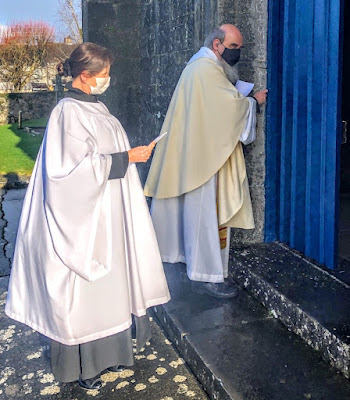
Christmas celebrations included the Carols and lighting the Christmas tree at the Old Abbey, in Rathkeale, the Service of Nine Lessons and Carols in Askeaton, and the Epiphany chalking of the church and rectory doors in Askeaton. Thanks to Michael Holly for the generous gift of flowers and candles in Tarbert, and to our Parish Reader, Siobhán Wheeler, for looking after Sunday services on Saint Stephen’s Day.

Baptism:

Ella Roseline Hilary Delbarry, daughter of Elizabeth (Ebie) Delbarry and Emanuel (Manu) Delbarry, was baptised on 27 December in Saint Mary’s Church, Askeaton. The sponsors were Samantha Bowen, Wendy Mullins and Rob Foley. Ella is a granddaughter of Hilary and Simon White of Nantenan.

Parish services in February 2022:

Sunday 6 February 2022 (Fourth Sunday before Lent):

9.30, Askeaton, the Parish Eucharist; 11.30, Saint Brendan’s Church, Tarbert, Morning Prayer.

Sunday 13 February 2022 (Third Sunday before Lent): 9.30, Castletown Church, Parish Eucharist; 11.30, Holy Trinity Church, Rathkeale, Morning Prayer.

Sunday 20 February 2022 (Second Sunday before Lent): 9.30, Askeaton, Morning Prayer; 11.30, Tarbert, Parish Eucharist.

Sunday 27 February 2022 (The Sunday before Lent): 9.30, Castletown, Morning Prayer; 11.30, Rathkeale, Parish Eucharist.

Wednesday 2 March 2022 (Ash Wednesday): 11 a.m., the Ash Wednesday Eucharist, with traditional Ash Wednesday distribution of ashes, Saint Mary’s Church, Askeaton.

Lent 2022: ‘Living Stones, Living Hope’

‘Living Stones, Living Hope’ is the title of the new course for Lent 2022produced by the Anglican mission agency USPG (United Society Partners in the Gospel). The title of this course comes from I Peter 2, the epistle for the Bible study at the Lambeth Conference later this year.

We, the Church, are the living stones, and we are called to bring living hope though faith in Christ, who is the cornerstone of our faith. ‘Living Stones, Living Hope’ explores this from the perspective of five partner churches around the world, inviting us to reflect on our own experience of being ‘living stones’ bringing ‘living hope’ in our own situations, in the light of the experiences of others.

Canon Patrick Comerford is one of the international theologians invited by USPG to contribute one of the five studies in this new Lent course. In his Bible study and video, he draws on his experiences in ministry and mission in the Rathkeale area, including ecumenical engagement with the Traveller community.

It is planned to use this USPG course during Lent in this group of parishes. Subject to COVID regulations, dates and details will be announced in the coming weeks.

The Epiphany chalking of the church doors in Askeaton

This is an edited version of the Rathkeale and Kilnaughtin Group parish notes in the February 2022 edition of ‘Newslink’, the Limerick and Killaloe diocesan magazine

16 January 2022

Sunday intercessions, 16 January 2022,
Epiphany II (the Wedding at Cana)

Jesus said to them, ‘Fill the jars with water.’ And they filled them up to the brim (John 2: 7) … two large jars or pithoi at the Minoan palace in Knossos, Crete (Photograph: Patrick Comerford)

Let us pray:

‘Your love, O Lord, reaches to the heavens and your faithfulness to the clouds’ (Psalm 36: 5):

Heavenly Father,
we pray for the nations of the world and for own country…
that ‘the nations shall see your vindication’ (Isaiah 62: 2)
This morning, we pray especially for the family, friends and pupils of Ashling Murphy,
for women who fear to be on their own,
for an end to gender-based violence,
and for the safety of all.

Lord have mercy,
Lord have mercy.

‘Jesus did this, the first of his signs … and revealed his glory; and his disciples believed in him’ (John 2: 11):

Lord Jesus Christ,
we thank you for your presence among us,
in word and sacrament, in one another,
we thank you for inviting us to the banquet.

We pray for the Church,
that we may do what you tell us (see John 2: 5) …

In the Church of Ireland this month,
we pray for the Diocese of Armagh and Archbishop John McDowell.
We pray too for the Diocese of Tuam, Limerick and Killaloe,
the Bishop-Elect, Bishop Michael Burrows,
and we give thanks for the work of the Archbishop’s Commissaries,
Archdeacon Stephen McWhirter and Dean Niall Sloane,
and for the Episcopal Electoral College called to fill the vacant see.

In the Anglican Cycle of Prayer,
we pray this week for the Church of England,
the Archbishop of Canterbury, Justin Welby,
and the Archbishop of York, Stephen Cottrell.

In the Diocesan Cycle of Prayer,
we pray for the Birr Group of parishes,
the newly-appointed rector, Canon Arthur Minion,
the Priest-in-Charge, the Revd Denis Sandes,
and the congregations of Saint Brendan’s Birr,
Saint Ruadhan’s, Lorrha, and Lougheen and Dorra churches.

In our community,
we pray for our schools,
we pray for our parishes and people …
we pray for our neighbouring churches and parishes …
and people of faith everywhere,
that we may be blessed in our variety and diversity.

Christ have mercy,
Christ have mercy.

‘There are varieties of gifts, but the same Spirit’ (I Corinthians 12: 4):

Holy Spirit, we pray for one another …

We pray for all who are sick or isolated,
at home, in hospital …
Ruby … Daphne … Sylvia … Ajay …
Cecil … Pat … Mary … Ann … Vanessa …

We pray for those who feel pain and loss …
for those who are bewildered and without answers …
for those we love and those who love us …
for our families, friends and neighbours …

We remember those who are remembered and mourned by parishioners,
those who have died recently, including Louise Corbett …
and those whose anniversaries are at this time,
including Cathy Casey-Byrne, Dorothy Bracken, and Kathleen Shire …

May their memories be a blessing to us.

Lord have mercy,
Lord have mercy.

The Prayer in the USPG Prayer Diary today (16 January 2022, the Second Sunday after the Epiphany) invites us to pray:

God of all things,
help us to discern our gifts
and to use them for the common good.
Let us rejoice in the diversity of creation.

Merciful Father …

Empty tables waiting for the wedding banquet … the miracle at Cana is the third great Epiphany theme (Photograph: Patrick Comerford)

The generous miracle at
Cana is an invitation to
the heavenly banquet

The Wedding at Cana, depicted by Giotto in a fresco panel in the Scrovegni Chapel in Padua (Photograph: Patrick Comerford, 2021)

Patrick Comerford

Sunday 16 January 2022,

The Second Sunday after Epiphany (Epiphany II):


9.30: Saint Mary’s Church, Askeaton, Morning Prayer;

11.30: Saint Brendan’s Church, Tarbert, the Parish Eucharist.

Readings: Isaiah 62: 1-5; Psalm 36: 5-10; I Corinthians 12: 1-11; John 2: 1-11

There is a link to the readings HERE.

‘The Wedding at Cana’ (John 2: 1-11) … one of 20 white porcelain ceramic panels by Helena Brennan at the Oblate Church in Inchicore, Dublin (Photograph: Patrick Comerford, 2021)

May I speak to you in the name of God, + Father, Son and Holy Spirit, Amen

I was surprised that the Christmas lights were still up in the city centre in Limerick all last week. But, of course, we are still in the Season of Christmas and Epiphany until 2 February. The Greek word ἐπιφάνεια (epipháneia) means ‘manifestation,’ or ‘striking appearance.’ It is an experience of sudden and striking realisation, and in the classics it often describes the visit of a god to earth.

This morning’s Gospel reading, the story of the Wedding at Cana (John 2: 1-11), is one of the three great Epiphany themes, along with the Visit of the Magi (Matthew 2: 1-12, 6 January 2022, The Epiphany), and last Sunday’s story of the Baptism of Christ by Saint John the Baptist (Luke 3: 17-17, 21-22, 9 January 2022). These three themes at Epiphany tell us who Christ truly is: truly God and truly human.

In each of these three events, Christ is manifest as God-incarnate at a point that marks the beginning of his ministry or his presence among us. It is the moment when we are caught off guard as we realise that this seemingly helpless new-born child, or this one among many in the team of visitors to John the Baptist at the Jordan, or this anonymous guest among many at a provincial wedding, is in fact the omnipotent God, the King and Ruler of the universe.

The star of the Epiphany, the light the three wise men have the courage to follow on a hazardous journey, is the same light that enlightens us at the Epiphany so that we realise who Christ is – for us and for the world.

The water in which Christ is baptised is the very same as the water that becomes wine at Cana, and the water that flows from Christ’s side when his life comes to an end on the Cross.

But the Epiphany stories also have a built-in thread or reminder of journey and return:

● The three kings return to their own country, albeit by another road, yet carrying their new revelation to all they return to (see Matthew 2: 12).

● After his Baptism, Christ goes into wilderness (see Matthew 4: 1) and then withdraws to Galilee to begin his ministry (see Matthew 4: 12; Mark 1: 14; Luke 3: 23; John 1: 43).

● After the wedding at Cana, Jesus goes down to Capernaum with his mother, his brothers, and his disciples (see John 2: 12).

So, the feast of the Epiphany is linked with the call to return to the world with the message of the kingdom of God.

The wise men represent not only the three Magi adoring the Christ Child over 2,000 years ago in Bethlehem, but they also represent the Gentile world hurrying to the wedding feast at the end of time, when humanity’s wedding with the divine Bridegroom is celebrated. The gold, frankincense and myrrh they bring are not only presents for the Child-King, but royal wedding gifts for the mystical marriage feast of heaven.

The lectionary readings take a diversion this morning, away from this year’s cycle of readings in Saint Luke’s Gospel, to tell us the story of the Wedding at Cana (John 2: 1-11), a story unique to Saint John’s Gospel.

In the beginning, Saint John’s Gospel introduces us to a new creation, a new creation that is in Christ. After the Prologue, there are six days in this new creation, and now we come to Day Seven.

What did God do on the Seventh Day in the account of creation in Genesis? God rested. And now that we have arrived at Day Seven in the opening week of Saint John’s Gospel, we come to the Day that Christ rests with his disciples, and to a foretaste of the Heavenly Banquet, which is the completion of God’s creation. ‘Blessed are those who are invited to the marriage supper of the Lamb’ (Revelation 19: 9).

Seven has a symbolic meaning or significance in this Gospel. This is the first of the seven miraculous signs by which Saint John attests to Christ’s divine status. This Gospel is structured around these signs, and the word used by John is unique.

Turning Water into Wine at Cana is the first of the Seven Signs in Saint John’s Gospel, followed by healing a royal official’s son at Cana (4: 46-54), healing the paralysed man at Bethesda (5: 1-9), feeding the 5,000 (6: 1-14); walking on water (6: 15-24); healing the blind man (9: 1-7); and raising Lazarus from the dead (11: 17-45).

These are completed then by the Greatest Sign, the Resurrection (see 2:18-22).

So, the first of the seven signs comes on the seventh of the seven days that introduce the Gospel.

And it seems so right that this Epiphany moment this morning takes place in a very divine and a very human moment: at a family weekend wedding, which is as earthy as you can get, I suppose; and on the seventh day, when God rests in the creation story, when Christ rests in his grave after his passion.

We are now invited into the eighth day. We are invited to be God’s partner in creation after the creation story in Genesis; we are invited by Christ to the heavenly banquet; we are invited in the Eucharist, at Holy Communion, to eat and drink with him. He offers us food and drink that shall never run out.

Throughout the Bible, we have promises that there will be an abundance of wine in the time of the Messiah (Genesis 27: 27-28; 49: 10-12; Amos 9: 13-14), especially at the wedding feasts (see Isaiah 62: 4-5).

The six stone jars at Cana contain water for rites of purification. These are ceremonial rites, not hygienic rites. But each jar contains 20 or 30 gallons, so we are talking about 180 gallons of wine – roughly speaking, in today’s terms, 1,091 bottles of wine. And because the wine was so good (see 9-10) in those days, water was added to it. This may have double the amount – so perhaps up to 1,500 or 2,000 bottles of wine by today’s reckoning. It is enough to ensure they party for days. It is a joyful and generous miracle.

The wine in this story represents the overflowing and abundant blessings of God coming to fruition, to fulfilment.

Of course, I imagine the Kingdom of God is just like a big wedding. Those who are invited are going to include people I at first may be uncomfortable to sit with at the same table. But I am not the host, I am the guest. As it says in the Book of Revelation, ‘Blessed are those who are invited to the marriage supper of the Lamb’ (Revelation 19: 9).

I cannot choose who is invited to the wedding, but I can accept the invitation to the meal, and the invitation to be part of the new family, the kingdom.

And if we accept the invitation, we have no right to pick and choose, to discriminate against my fellow guests, to cheat them out of their place at the table, to refuse to eat and drink with them.

We don’t know who the bride and groom were at the wedding in Cana. But we know we are invited to the banquet, not as spectators but as family members, as members of Christ’s own family, as full members of God’s family. We are loved abundantly, we are loved generously, we are loved truly, and there is a place for each and every one of us at God’s banquet of love.

And so, may all we think say and do be to the praise, honour and glory of God, + Father, Son and Holy Spirit, Amen

Waiting for the banquet at sunset on the beach in Rethymnon in Crete … in the Kingdom of God, ‘the best is yet to come’ (Photograph: Patrick Comerford)

John 2: 1-11 (NRSVA):

1 On the third day there was a wedding in Cana of Galilee, and the mother of Jesus was there. 2 Jesus and his disciples had also been invited to the wedding. 3 When the wine gave out, the mother of Jesus said to him, ‘They have no wine.’ 4 And Jesus said to her, ‘Woman, what concern is that to you and to me? My hour has not yet come.’ 5 His mother said to the servants, ‘Do whatever he tells you.’ 6 Now standing there were six stone water-jars for the Jewish rites of purification, each holding twenty or thirty gallons. 7 Jesus said to them, ‘Fill the jars with water.’ And they filled them up to the brim. 8 He said to them, ‘Now draw some out, and take it to the chief steward.’ So they took it. 9 When the steward tasted the water that had become wine, and did not know where it came from (though the servants who had drawn the water knew), the steward called the bridegroom 10 and said to him, ‘Everyone serves the good wine first, and then the inferior wine after the guests have become drunk. But you have kept the good wine until now.’ 11 Jesus did this, the first of his signs, in Cana of Galilee, and revealed his glory; and his disciples believed in him.

Finding good wine to serve at the end of the meal (Photograph: Patrick Comerford)

Liturgical Colour: White

The Penitential Kyries:

God be merciful to us and bless us,
and make his face to shine on us.

Lord, have mercy.
Lord, have mercy.

May your ways be known on earth,
your saving power to all nations.

Christ, have mercy.
Christ, have mercy.

You, Lord, have made known your salvation,
and reveal your justice in the sight of the nations.

Lord, have mercy.
Lord, have mercy.

The Collect:

Almighty God,
in Christ you make all things new:
Transform the poverty of our nature
by the riches of your grace,
and in the renewal of our lives
make known your heavenly glory;
through Jesus Christ our Lord.

The Collect of the Word:

Bountiful God,
whose Son revealed his glory at Cana of Galilee:
help us to believe and obey,
so that, as our Saviour promised,
we may be filled with the wine of new life
and show forth his joy and love;
who lives and reigns with you
in the unity of the Holy Spirit,
one God, for ever and ever.

Introduction to the Peace:

Our Saviour Christ is the Prince of Peace.
Of the increase of his government and of peace
there shall be no end. (cf Isaiah 9: 6, 7)

Preface:

For Jesus Christ our Lord
who in human likeness revealed your glory,
to bring us out of darkness
into the splendour of his light:

The Post-Communion Prayer:

God of glory,
you nourish us with bread from heaven.
Fill us with your Holy Spirit
that through us the light of your glory
may shine in all the world.
We ask this in the name of Jesus Christ our Lord.

The Blessing:

Christ the Son be manifest to you,
that your lives may be a light to the world:

The Wedding at Cana … a modern icon

Hymns:

553, Jesu, lover of my soul (CD 32)
52, Christ whose glory fills the skies (CD 4)
445, Soul, array thyself with gladness (CD 26)

‘On the third day there was a wedding in Cana of Galilee’ (John 2: 1) (Photograph: Patrick Comerford)

Scripture quotations are from the New Revised Standard Version Bible: Anglicised Edition copyright © 1989, 1995, National Council of the Churches of Christ in the United States of America. Used by permission. All rights reserved worldwide. http://nrsvbibles.org

Material from the Book of Common Prayer is copyright © 2004, Representative Body of the Church of Ireland.


03 January 2022

Epiphany and January 2022
in the Rathkeale and
Kilnaughtin Group of Parishes

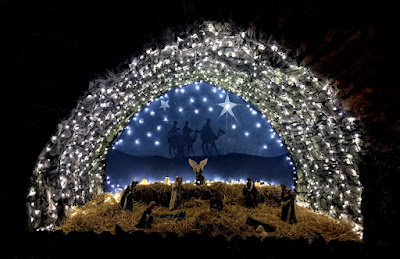
The Magi arrive at the Community Crib at the Old Abbey in Rathkeale (Photograph: Patrick Comerford)

Sunday 2 January 2022 (Christmas 2):

9.30: Saint Mary’s Church, Askeaton, the Parish Eucharist;

11.30: Saint Brendan’s Church, Tarbert, Morning Prayer.

Readings: Numbers 6: 22-27, Psalm 8; Galatians 4: 4-7; Luke 2: 15-21.

Hymns:

166, Joy to the world, the Lord is come! (CD 10)
133, Long ago, prophets knew (CD 8)
152, Come and join the celebration (CD 9)

Thursday 6 January 2022 (The Epiphany):

11 am: Saint Mary’s Church, Askeaton, the Epiphany Eucharist, followed by traditional Epiphany ‘chalking’ of the church doors and the doors of the Rectory.

Readings: Isaiah 60: 1-6; Psalm 72: 1-7, 10-15; Ephesians 3: 1-12; Matthew 2: 1-12.

Hymns:

202, What child is this, who laid to rest (CD 13)
201, We three kings of Orient are (CD 13)
189, As with gladness men of old (CD 12)

Sunday 9 January (Epiphany 1):

9.30: Castletown Church, the Parish Eucharist;

11.30: Holy Trinity Church, Rathkeale, Morning Prayer.

Readings: Isaiah 43: 1-7; Psalm 29; Acts 8: 14-17; Luke 3: 15-17, 21-22

Hymns:

22, You shall cross the barren desert (#2, CD 1, Love of God, Life of Faith)
(Alternative, 204, When Jesus came to Jordan, CD 13)
136, On Jordan’s bank, the Baptist’s cry (CD 8)
294, Come down, O love divine (CD 18)

Sunday 16 January (Epiphany 2):

9.30: Saint Mary’s Church, Askeaton, Morning Prayer;

11.30: Saint Brendan’s Church, Tarbert, the Parish Eucharist.

Readings: Isaiah 62: 1-5; Psalm 36: 5-10; I Corinthians 12: 1-11; John 2: 1-11

Hymns:

553, Jesu, lover of my soul (CD 32)
52, Christ whose glory fills the skies (CD 4)
445, Soul, array thyself with gladness (CD 26)

Sunday 23 January (Epiphany 3):

9.30: Castletown Church, Morning Prayer;

11.30: Holy Trinity Church, Rathkeale, the Parish Eucharist.

Readings: Nehemiah 8: 1-3, 5-6, 8-10; Psalm 19; I Corinthians 12: 12-31a; Luke 4: 14-21 [22-30]

Hymns:

381, God has spoken – by his prophets (CD 23)
218, And can it be (CD 14)
494, Beauty for brokenness (CD 29)

Saturday 29 January: afternoon ‘Muddy Church’ in Curraghchase for the Limerick, Adare and Rathkeale groups of parishes, organised by the Revd Dr Leonard Madden, Cathedral Curate. Postponed

Sunday 30 January (Epiphany 4, the Presentation):

11 a.m.: United Parish Eucharist, Holy Trinity Church, Rathkeale.

Readings: Malachi 3: 1-5; Psalm 24: 1-10 or Psalm 24: 7-10 or Psalm 84; Hebrews 2: 14-18; Luke 2: 22-40

Hymns:

52, Christ, whose glory fills the skies (CD 4)
119, Come, thou long-expected Jesus (CD 8)
691, Faithful vigil ended (CD 39)

Saints Days and Holy Days in January:

6 January: The Epiphany
25 January: The Conversion of Saint Paul

02 January 2022

Sunday intercessions, 2 January 2022,
Christmas II, the Naming of Christ

‘Will you strive for justice and peace … and respect the dignity of every human being’ … a reminder of the Baptismal questions and promises during a recent protest in the US
Let us pray:

Let us join together in the Covenant Prayer:

I am no longer my own but yours.
Put me to what you will,
rank me with whom you will;
put me to doing,
put me to suffering;
let me be employed for you,
or laid aside for you,
exalted for you,
or brought low for you;
let me be full,
let me be empty,
let me have all things,
let me have nothing:
I freely and wholeheartedly yield all things
to your pleasure and disposal.
And now, glorious and blessed God,
Father, Son and Holy Spirit,
you are mine and I am yours. So be it.
And the covenant now made on earth, let it be ratified in heaven.
Amen.

A prayer in the prayer diary of the Anglican mission agency USPG (United Society Partners in the Gospel) for this morning:

Loving Father,
help us to weather earthly rejection,
and accept that we are
accepted by you.
Strengthen our convictions,
inspire hope in us.

Merciful Father …

‘You have … crowned them with glory and honour’ (Psalm 8: 7) … a crown above a priest’s hands raised in blessing on a gravestone in the Jewish cemetery in Kraków (Photograph: Patrick Comerford)

24 December 2021

‘Do not be afraid; for see –
I am bringing you good news
of great joy for all the people’

‘The Nativity of Christ’ by Francesco Bassano (1549-1592) in the Church of Il Redentore in Venice (Photograph: Patrick Comerford, 2021)

Patrick Comerford

Christmas Night, Friday 24 December:

6 p.m., Saint Brendan’s Church, Kilnaughtin (Tarbert), Co Kerry

8 p.m., Castletown Church, Co Limerick

The Christmas Eucharist (Holy Communion 2)

Readings: Isaiah 9: 2-7; Psalm 96; Titus 2: 11-14; Luke 2: 1-14

May I speak to you in the name of God, + Father, Son and Holy Spirit, Amen.

On the first Christmas night, the angels announce to the frightened shepherds in the fields: ‘Do not be afraid; for see – I am bringing you good news of great joy for all the people’ (Luke 2: 10).

In a fearful and fretful world facing so many crises, where are people going to find ‘good news of great joy for all people’ this night?

Instead of preaching a sermon this Christmas night, I thought – as I have done in previous years – that I should read an adaptation of the editorial published in The Irish Times this morning to mark Christmas Eve. It is a reminder of the message of Christmas, the message of the Incarnation, the message that God has come among us.

It is headed, ‘Inspiring the hopeless,’ and it reads:

In the opening lines of TS Eliot’s poem The Journey of the Magi, one of the three wise men recalls his visit many years earlier to the Christmas Crib and the Christ Child in Bethlehem:

A cold coming we had of it,
Just the worst time of the year
For a journey, and such a long journey:
The ways deep and the weather sharp,
The very dead of winter.


Eliot’s poem recalls that first Christmas as a time of conflict and death, set in a severe climate. The old man recalls “the night-fires going out”, “the lack of shelters”, and “the cities hostile and the towns unfriendly”. It is a poem set in a hostile climate and a violent-ridden atmosphere, written in 1927, in the inter-war years, as a looming financial crisis would soon lead to the Wall Street collapse. It speaks more of death than of birth and is without any hint of the sentimentality found almost a generation later in Eliot’s poem The Cultivation of Christmas Trees (1954), the “accumulated memories of annual emotion … concentrated into a great joy”.

A sanitised story

This year, Christmas is without sentimentality or great joy for an accumulating number of people across the world. It is a Christmas marked by too many crises that are replacing joy with fear and hope with terror: the Christmas crises of Covid, climate change and conflict. Trócaire launched its Christmas appeal this year saying: “The climate crisis, along with Covid-19 and conflict, has resulted in 30 million people currently facing life-threatening food shortages”.

The interconnected nature of this triple-lock crisis was underlined by Minister for Foreign Affairs Simon Coveney when he responded to the Russian veto of the Irish motion on climate change at the Security Council, saying, “It is telling that 80 per cent of UN peacekeepers are deployed in countries that are the most exposed to climate change … Where climate change is a factor in exacerbating instability and undermining peace and security, the Security Council should use the tools at its disposal to tackle it”.

Poverty, rather than problems of supply and distribution, explains why so many people in Asia, sub-Saharan Africa and Latin America remain unvaccinated as the Covid-19 virus continues to mutate and spread. Poverty, climate change and conflict explain why so many migrants have been willing to risk their lives and the lives of their children in the English Channel or the borders of Belarus. Yet, governments with the responsibility and the resources to respond, continue to address the presenting problem rather than tackling its underlying causes.

The Christmas story has been sanitised in its telling and retelling over the centuries. It is set in a cold climate, at a time of oppression and discrimination, corruption and conflict, migration and mass murder. The Christ Child is born in Bethlehem because his parents have been forced to leave Nazareth; Herod’s horrid schemes become known to the visiting Magi and force the family to seek refuge in neighbouring Egypt. Even then, children were the innocent victims of the power games of capricious rulers and despots, unaware or unwilling to face the global consequences of their self-centred decision-making.

Comforting the afflicted

It is a story of rejection, discrimination and marginalisation, of violence without restraint, of poverty caused by the priorities of those who also had the power to change. The victims in the first Christmas story include a single mother and a homeless child. But, in that story, those who are awake to the potential the birth of a child has to change the world are simple shepherds and visitors from afar. As the American theologian Nadia Bolz-Weber says: “The birth of Jesus was not elegantly staged. It is how we experience life – messy, surprising, unexpected, imperfect”. With her innate irreverence, she continues to challenge all who would make Christianity too comfortable and too cosy at Christmas-time, saying, “People don’t leave Christianity because they stop believing in the teachings of Jesus. People leave Christianity because they believe in the teachings of Jesus so much, they can’t stomach being part of an institution that claims to be about that and clearly isn’t”.

In a time of crisis, marked by conflict, Covid and climate change, marked by the plight of refugees, migrants and the homeless, the Churches can put Christ back at the heart of Christmas not by worrying about declining churchgoing figures and finances, but by returning to the priorities of feeding the hungry, comforting the afflicted, loving the outcast, forgiving the wrongdoer, inspiring the hopeless, and emphasising time and again Christ’s core message of loving one another. Then, in the words of TS Eliot,

The accumulated memories of annual emotion
May be concentrated into a great joy …
Because the beginning shall remind us of the end
And the first coming of the second coming.


And so, may all we think, say and so be to the praise, honour and glory of God, + Father, Son and Holy Spirit, Amen.

The Nativity Christmas Card, Gwen Raverat (© The Raverat Archive)

Luke 2: 1-14 (NRSVA):

1 In those days a decree went out from Emperor Augustus that all the world should be registered. 2 This was the first registration and was taken while Quirinius was governor of Syria. 3 All went to their own towns to be registered. 4 Joseph also went from the town of Nazareth in Galilee to Judea, to the city of David called Bethlehem, because he was descended from the house and family of David. 5 He went to be registered with Mary, to whom he was engaged and who was expecting a child. 6 While they were there, the time came for her to deliver her child. 7 And she gave birth to her firstborn son and wrapped him in bands of cloth, and laid him in a manger, because there was no place for them in the inn.

8 In that region there were shepherds living in the fields, keeping watch over their flock by night. 9 Then an angel of the Lord stood before them, and the glory of the Lord shone around them, and they were terrified. 10 But the angel said to them, ‘Do not be afraid; for see – I am bringing you good news of great joy for all the people: 11 to you is born this day in the city of David a Saviour, who is the Messiah, the Lord. 12 This will be a sign for you: you will find a child wrapped in bands of cloth and lying in a manger.’ 13 And suddenly there was with the angel a multitude of the heavenly host, praising God and saying,

14 ‘Glory to God in the highest heaven,
and on earth peace among those whom he favours!’

The Nativity depicted in the reredos in Saint Mary’s Church, Lichfield (Photograph: Patrick Comerford)

Liturgical Colour: White, or Gold.

Penitential Kyries:

Lord God, mighty God,
you are the creator of the world.
Lord, have mercy.
Lord, have mercy.

Lord Jesus, Son of God and Son of Mary,
you are the Prince of Peace.
Christ, have mercy.
Christ, have mercy.

Holy Spirit,
by your power the Word was made flesh
and came to dwell among us.
Lord, have mercy.
Lord, have mercy.

The Collect:

Eternal God,
who made this most holy night
to shine with the brightness of your one true light:
Bring us, who have known the revelation
of that light on earth,
to see the radiance of your heavenly glory;
through Jesus Christ our Lord.

Introduction to the Peace:

Unto us a child is born, unto us a son is given,
and his name shall be called the Prince of Peace. (Isaiah 9: 6)

Preface:

You have given Jesus Christ your only Son
to be born of the Virgin Mary,
and through him you have given us power
to become the children of God:

The Post Communion Prayer:

God our Father,
in this night you have made known to us again
the power and coming of our Lord Jesus Christ:
Confirm our faith and fix our eyes on him
until the day dawns
and Christ the Morning Star rises in our hearts.
To him be glory both now and for ever.

Blessing:

Christ, who by his incarnation gathered into one
all things earthly and heavenly,
fill you with his joy and peace:

Hymns:

174, O little town of Bethlehem (CD 11)
160, Hark! the herald angels sing (CD 9)
182, Silent night, holy night (CD 11)


Scripture quotations are from the New Revised Standard Version Bible: Anglicised Edition copyright © 1989, 1995, National Council of the Churches of Christ in the United States of America. Used by permission. All rights reserved worldwide. http://nrsvbibles.org

Material from the Book of Common Prayer is copyright © 2004, Representative Body of the Church of Ireland.

19 December 2021

Sunday intercessions, 19 December 2021,
the Fourth Sunday of Advent

The Visitation … a panel in the 19th Century neo-Gothic altarpiece from Oberammergau in the Lady Chapel in Lichfield Cathedral (Photograph: Patrick Comerford)

Let us pray:

‘My soul magnifies the Lord, and my spirit rejoices in God my Saviour’ (Luke 1: 46):

Heavenly Father,
As we wait in Advent for the coming of the Kingdom,
let us give thanks to Lord … make known your deeds among the nations …
May those in power and in government
hear the cry of all in who ‘sit in darkness and in the shadow of death,’
especially refugees, asylum seekers, migrants,
prisoners of conscience, the victims of people trafficking,
that they may be met with mercy and justice,
and know love and peace.

Lord have mercy,
Lord have mercy.

‘He has looked with favour on the lowliness of his servant’ (Luke 1: 48):

Lord Jesus Christ,
as we wait in Advent for your coming,
we pray for the Church,
that we may eagerly prepare the way for your coming among us …

In the Church of Ireland this month,
we pray for this Diocese of Tuam, Limerick and Killaloe,
the Archbishop’s Commissaries,
Archdeacon Stephen McWhirter and Dean Niall Sloane,
and for the Episcopal Electoral College called to fill the vacant see.

In the Anglican Cycle of Prayer,
we pray for the Church of the Province of Central Africa,
and the Primate, Archbishop Albert Chama.

In the Diocesan Cycle of Prayer,
we pray for the Kenmare and Dromod Union of parishes,
the Revd Michael Kavanagh and the congregations of
Saint Patrick’s Church, Kenmare, the Church of the Transfiguration, Sneem,
Saint Michael and All Angels, Waterville, and Saint John the Baptist, Valentia.

In our community,
we pray for our schools,
we pray for our parishes and people …
we pray for our neighbouring churches and parishes …
and people of faith everywhere,
that we may be blessed in our variety and diversity.

Christ have mercy,
Christ have mercy.

‘His mercy is for those who fear him from generation to generation’ (Luke 1: 50):

Holy Spirit, we pray for one another …

We remember those who are remembered and mourned by parishioners,
May their memories be a blessing to us.

We pray for all who are sick or isolated,
at home, in hospital …
Ruby … Daphne … Sylvia … Ajay …
Cecil … Pat … Mary … Ann … Vanessa …

We pray for those who feel pain and loss …
for those who are bewildered and without answers …
for those we love and those who love us …
for our families, friends and neighbours …

We pray for all who feel rejected and discouraged …
we pray for all in need and who seek healing …
and we pray for those we promised to pray for …
and we pray for one another and for ourselves …

May your generosity and love to us be reflected in our love and generosity to others.

Lord have mercy,
Lord have mercy.

The Prayer in the USPG Prayer Diary today (19 December 2021, the Fourth Sunday of Advent) invites us to pray:

Almighty Lord,
you bless us with unexpected joys.
May we suspend our disbelief,
and listen to your will.

Merciful Father …

‘Mary meets Elizabeth’ (1996), by Dinah Roe Kendall, in ‘Allegories of Heaven: an artist explores the greatest story ever told’ (Carlisle: Piquant, 2002)


05 December 2021

Sunday intercessions, 5 December 2021,
the Second Sunday of Advent

‘The dawn from on high shall break upon us. To shine on those who dwell in darkness and the shadow of death and to guide our feet into the way of peace’ (Benedictus) … a winter sunrise at the Rectory in Askeaton, Co Limerick (Photograph: Patrick Comerford, 2021)

Let us pray:

‘In the tender compassion of our God the dawn from on high shall break upon us, to give light to those who sit in darkness and in the shadow of death, to guide our feet into the way of peace’ (Luke 3: 14):

Heavenly Father,
As we wait in Advent for the coming of the Kingdom,
guide the feet of the leaders of the nations into the way of peace,
may those in power and in government
hear the cry of all in who ‘sit in darkness and in the shadow of death,’
especially refugees, asylum seekers, migrants,
prisoners of conscience, the victims of people trafficking,
that they may be met with mercy and justice,
and know love and peace.

Lord have mercy,
Lord have mercy.

‘Prepare the way of the Lord, make his paths straight’ (Luke 3: 4):

Lord Jesus Christ,
as we wait in Advent for your coming,
we pray for the Church,
that we may eagerly prepare the way for your coming among us …

In the Church of Ireland this month,
we pray for the Diocese of Tuam, Limerick & Killaloe,
the Archbishop’s Commissaries,
Archdeacon Stephen McWhirter and Dean Niall Sloane,
and for the Episcopal Electoral College called to fill the vacant see.

In the Anglican Cycle of Prayer,
we pray for the Anglican Church of Burundi,
and Archbishop Sixbert Macumi.

In the Diocesan Cycle of Prayer,
we pray for the victims of abuse and all engaged in Safeguarding.

The Mothers Union continues to mark 16 Days of Activism
against gender-based violence:
forgive us our ignorance, forgive us our blindness,
forgive us our lack of awareness.

In our community,
we pray for our schools,
we pray for our parishes and people …
we pray for our neighbouring churches and parishes,
and people of faith everywhere,
that we may be blessed in our variety and diversity.

And we pray for ourselves …

Christ have mercy,
Christ have mercy.

‘Take off the garment of your sorrow and affliction, O Jerusalem, and put on for ever the beauty of the glory from God’ (Baruch 5: 1):

Holy Spirit, we pray for one another …

We remember those who are remembered and mourned by parishioners,

May their memories be a blessing to us.

We pray for all who are sick or isolated,
at home, in hospital …
Ruby … Daphne … Sylvia … Ajay …
Cecil … Pat … Mary … Ann … Vanessa …

We pray for those who feel pain and loss …
for those who are bewildered and without answers …
for those we love and those who love us …
for our families, friends and neighbours …

We pray for all who feel rejected and discouraged …
we pray for all in need and who seek healing …
and we pray for those we promised to pray for …
and we pray for one another and for ourselves …

May your generosity and love to us be reflected in our love and generosity to others.

Lord have mercy,
Lord have mercy.

A prayer today in the Prayer Diary of the Anglican mission agency USPG (United Society Partners in the Gospel):

Righteous God,
may we overflow with love,
and know what is good.
Lead us down the straight path,
that we may find salvation.

Merciful Father …

‘Make way, make way for Christ the King’ (Hymn 134) … a straight pathway lined with trees in Kilmore, near Nenagh, Co Tipperary (Photograph: Patrick Comerford)

01 December 2021

December and Christmas 2021
in the Rathkeale and
Kilnaughtin Group of Parishes

The Christmas Crib in Holy Trinity Church, Rathkeale (Photograph: Patrick Comerford)

Sunday 5 December (The Second Sunday of Advent, Advent II):

9.30: The Parish Eucharist, Saint Mary’s Church, Askeaton;
11.30: Morning Prayer, Saint Brendan’s Church, Tarbert;

Readings: Baruch 5: 1-9; the Canticle Benedictus (Luke 1: 68-79); Philippians 1: 3-11; Luke 3: 1-6.

Hymns:
119, Come, thou long-expected Jesus (CD 8)
Canticle: Benedictus as Hymn 685 (CD 39)
134, Make way, make way, for Christ the King (CD 8)
204, When Jesus came to Jordan (CD 13)

5 p.m.: Carols and Lighting the Christmas tree, the Old Abbey, Rathkeale.

Sunday 12 December 2021 (The Third Sunday of Advent, Advent III):

9.30: The Parish Eucharist, Castletown;
11.30:, Morning Prayer, Holy Trinity Church, Rathkeale.

Readings: Zephaniah 3: 14-20; Canticle Song of Isaiah (CD 43, No 6), Philippians 4: 4-7; Luke 3: 7-18.

Hymns:
281, Rejoice, the Lord is King! (CD 17)
Canticle: Song of Isaiah (CD 43, No 6)
135, O come, O come, Emmanuel (CD 8)
136, On Jordan’s bank the Baptist’s cry (CD 8)

Sunday 19 December 2021 (The Fourth Sunday of Advent, Advent IV):

9.30: no morning service, Saint Mary’s Church, Askeaton;
11.30: The Parish Eucharist, Saint Brendan’s Church, Tarbert

Readings: Micah 5: 2-5a; the Canticle Magnificat (Luke 1: 46-55; Hymn 712, CD 40); Hebrews 10: 5-10; Luke 1: 39-45.

Hymns:
158, God rest you merry, gentlemen (CD 9)
Canticle: Magnificat, Luke 1: 46-55 as Hymn 712 (CD 40)
174, O little town of Bethlehem (CD 11)
198, The first Nowell the angel did say (CD 12)

3 p.m.: Carol Service, Askeaton, followed by refreshments (subject to Covid restrictions at the time).

Processional Hymn: 177, Once in royal David’s city

Carol 1: 155, Ding Dong! merrily on high

Lesson 1: Genesis 3: 8-19 (Adam has Paradise but his progeny will bruise the serpent’s head)

Carol 2: 135, O come, O come, Emmanuel

Lesson 2: Genesis 22: 15-18 (God promises to faithful Abraham that in his seed all nations shall be blessed)

Carol 3: 133, Long ago, prophets knew

Lesson 3: Isaiah 9: 2, 6-7 (The prophet foretells the coming of the Saviour)

Carol 4: 174, O little town of Bethlehem

Lesson 4: Micah 5: 2-5a (The place of the Redeemer’s birth is Bethlehem)

Carol 5: 160, Hark! the herald-angels sing

Lesson 5: Luke 1: 26-35, 38 (The angel Gabriel salutes the Blessed Virgin Mary)

Carol 6: 164, It came upon the midnight clear

Lesson 6: Luke 2: 1, 3-7 (Saint Luke tells of the birth of Jesus)

Carol 7: 158, God rest you merry gentlemen

Lesson 7: Luke 2: 8-16 (The shepherds go to the manger)

Carol 8: 152, ‘Come and join the celebration’

Lesson 8: Matthew 2: 1-11 (The wise men are led by the star to the Christ Child)

Carol 9: 149, Away in a manger

Lesson 9: John 1: 1-14 (Saint John unfolds the great mystery of the Incarnation)

Hymn: 162, In the bleak mid-winter (Christina Rossetti; music, Gustav Holst)

Collect and Blessing

Hymn: 172, O come, all ye faithful (Adeste Fideles)

Christmas Eve, Friday 24 December 2021:

6 p.m.: The Christmas Eucharist, Saint Brendan’s Church, Tarbert (please note revised time)
8 p.m.:, The Christmas Eucharist, Castletown Church (please note revised time)

Readings: Isaiah 9: 2-7; Psalm 96; Titus 2: 11-14; Luke 2: 1-14.

Hymns:
174, O little town of Bethlehem (CD 11)
160, Hark! the herald angels sing (CD 9)
182, Silent night, holy night (CD 11)

Christmas Day, Saturday 25 December 2021:

9.30 am:, The Christmas Eucharist, Saint Mary’s Church, Askeaton
11 am: The Christmas Eucharist; Holy Trinity Church, Rathkeale

Readings: Isaiah 9: 2-7; Psalm 96; Titus 2: 11-14; Luke 2: 1-14.


Hymns:
177, Once in royal David’s city (CD 11)
184, Unto us is born a Son (CD 11)
172, O come, all ye faithful (CD 10)

26 December 2021, Saint Stephen’s Day, Christmas 1:

11 a.m.: Morning Prayer, Rathkeale (note the time; this is the only service in this group of parishes on this Sunday).

The Readings: II Chronicles 24: 20-22; Psalm 119: 161-168; Acts 7: 51-60; Matthew 10: 17-22.

Hymns:
459, For all the saints, who from their labours rest (CD 27)
170, Love came down at Christmas (CD 10)

Sunday 2 January 2022 (Christmas 2):

9.30: The Parish Eucharist, Saint Mary’s Church, Askeaton
11.30:, Morning Prayer, Saint Brendan’s Church, Tarbert

Readings: I Samuel 2: 18-20, 26; Psalm 148; Colossians 3: 12-17; Luke 2: 41-52.

Hymns:
166, Joy to the world, the Lord is come! (CD 10)
162, Infant holy, infant lowly (CD 9)
152, Come and join the celebration (CD 9)

Thursday 6 January 2022 (The Epiphany):

11 a.m.: Askeaton, the Epiphany Eucharist, followed by traditional Epiphany ‘chalking’.

Readings: Isaiah 60: 1-6; Psalm 72: 1-7, 10-14; Ephesians 3: 1-12; Matthew 2: 1-12.

Hymns:
202, What child is this, who laid to rest (CD 13)
201, We three kings of Orient are (CD 13)
189, As with gladness men of old (CD 12)

‘Star of Bethlehem’ (1887-1890) by Edward Burn-Jones (1833-1898) … the largest watercolour of the 19th century, and now in Birmingham Museum and Art Gallery

21 November 2021

Sunday intercessions, 21 November 2021,
the Sunday before Advent,
the Kingship of Christ

Christ the King … a carving on a family grave in the cemetery in the Lido of Venice (Photograph: Patrick Comerford, 2021)

Let us pray:


‘One who rules over people justly, ruling in the fear of God, is like the light of morning, like the sun rising on a cloudless morning’ (II Samuel 23: 3-4):

Heavenly Father,
Listen to our prayers for the world,
that those who rule and govern the nations of the world
may do so not through violence, coercion and subjugation,
but with mercy, peace and justice.

Lord have mercy,
Lord have mercy.

‘Look! He is coming with the clouds; every eye will see him’ (Revelation 1: 7):

Lord Jesus Christ,
we pray for the Church,
that we may eagerly await your coming among us …

In our diocese we pray this morning for
the members of the Episcopal Electoral College,
that they may be guided wisely and think prayerfully
in their choice of a new bishop for this diocese.

We pray this morning for the Adare and Kilmallock Group of Parishes,
for their Rector, Canon Liz Beasley,
and the congregations of Saint Nicholas’ Church, Adare, Croom Church,
Saint Peter and Saint Paul, Kilmallock, and Saint Beacon, Kilpeacon.

In the Church of Ireland this month,
we pray for the Diocese of Cork, Cloyne and Ross
and for Bishop Paul Colton.

In the Anglican Cycle of Prayer,
we pray this week for the Church of Bangladesh,
and the Primate, Bishop Samuel Mankhin.

In our community,
we pray for our schools,
we pray for our parishes and people …
we pray for our neighbouring churches and parishes,
and people of faith everywhere,
that we may be blessed in our variety and diversity.

And we pray for ourselves …

Christ have mercy,
Christ have mercy.

‘I am the Alpha and the Omega’, says the Lord God, who is and who was and who is to come, the Almighty’ (Revelation 1: 8):

Holy Spirit, we pray for one another …

We pray this morning for all in our dioceses who have been bereaved in the last year,
that the Lord may comfort them.

Throughout November in this group of parishes,
we remember with thanks all who have died in the past year,

including: Alan Fitzell; Arthur Gilliard; Ena Downes; Gill Killick; Joe Smyth; Kenneth Smyth; Linda Smyth;

We remember those who are remembered and mourned by parishioners this month, including:

Jack and Eileen Ryall …
Jack Shorten …
Marian Locke …
Lil Gilliard …
Alan’s sister Hazel …
Brendan Quinlan …
William, Kathleen and Dorothy …
Robert and Lynda Gardiner …
Kathy Casey-Byrne …
Mary Cagney (nee Shanahan) …

May their memories be a blessing to us.

We pray for all who are sick or isolated,
at home, in hospital …
Ruby … Daphne … Sylvia … Ajay …
Cecil … Pat … Mary … Ann … Vanessa …

We pray for those who feel pain and loss …
for those who are bewildered and without answers …
for those we love and those who love us …
for our families, friends and neighbours …

We pray for all who feel rejected and discouraged …
we pray for all in need and who seek healing …
and we pray for those we promised to pray for …
and we pray for one another and for ourselves …

Lord have mercy,
Lord have mercy.

A prayer in the USPG Prayer Diary for this Sunday:

‘The Lord is King, he is robed in majesty.’
King of kings,
We wonder in Your majesty.
May we worship You
For evermore.

Merciful Father …

The large sculpture of Christ the King by John Maguire above the entrance to the Church of Christ the King in Turner’s Cross, Cork (Photograph: Patrick Comerford, 2020)