William Palmer, the ‘Rugeley Poisoner’ or the ‘Prince of Poisoners’, depicted in the Illustrated Times
Patrick Comerford
In recent days, I have been recalling two tales of murder involving residents of Rugeley, although when I looked deeper into both stories they were not substantiated by the records or by contemporary evidence.
Dorothy Chatwynd was said to have strangled her husband Sir Walter Smyth, three times her age, and to have been executed by being burned to death. Dorthy was an aunt of Thomas Chetwynd, who married Dorothy Coleman, a granddaughter of William Comberford of Comberford Hall and the Moat House, Tamworth.
But when I looked into this story in greater depth, it turned out there is no primary evidence nor are there contemporary records of either the murder or of the supposed execution on Wolvey Heath in Warwickshire.
The second tale involves the sisters Elizabeth Cuting and Emma Hollinhurst, said to have been buried alive in the old churchyard in Rugeley on the capricious orders of Oliver Cromwell. But it takes only a little probing to realise how impossible this was: Cromwell died in 1658 and the sisters died in Rugeley almost 40 years later: Elizabeth in 1695 and Emma in 1696.
However, across the road from the ‘Old Chancel’ and the shared tomb of the two sisters Elizabeth and Emma, two headstones in Saint Augustine’s churchyard tell real stories of Victorian murders in Rugeley. One headstone, on the southside of the churchyard, is to Christina Collins, who was murdered on a canal boat near the church in 1839. Fresh flowers are still laid on her grave regularly.
The grave of Christina Collins, murdered on a canal boat in 1839 … fresh flowers are laid on her grave regularly (Photograph: Patrick Comerford, 2026)
Nearby, under the yew trees at the west end of the church, is the grave of John Parsons Cook, murdered by Dr William Palmer (1824-1856). Undoubtedly Palmer had many other victims, but Cook’s murder was the only one for which he was convicted, and he was executed 170 years ago, in 1856.
Palmer is known as the ‘Rugeley Poisoner’ or the ‘Prince of Poisoners’. He poisoned his friend with strychnine, but he was also suspected of poisoning several other people, including his brother, his mother-in-law and four of his infant children – and there may have been many more. Charles Dickens called him ‘the greatest villain that ever stood in the Old Bailey’.
But why did he do it? Palmer made large sums of money from the deaths of his wife and brother by collecting on life insurance, he had defrauded his wealthy mother, and may have murdered his own children rather than bearing the expense of feeding and clothing them. And, it seems, it was all to feed an insatiable gambling addiction.
William Palmer was born at Church Croft House in Rugeley, between the canal and the ‘Old Chancel’ on 6 August 1824, the sixth of eight children of Joseph and Sarah Palmer. His father, a sawyer who made his fortunes in coalmining and collieries, died when William was 12, leaving his widow Sarah with a legacy of £70,000, the equivalent today of about £9.5 million.
At 17, Palmer was apprenticed to a chemist in Liverpool, but after three months he was dismissed amid allegations of theft and embezzlement. He was then taken on as a ‘walking pupil’ at Stafford Infirmary, went to London to study medicine at Saint Bartholomew’s Hospital, and received a diploma from the Royal College of Surgeons. He returned to Rugeley at the age of 22 in August 1846, styling himself Dr Palmer and setting up practice as a local GP.
Palmer met a plumber and glazier George Abley at the Lamb and Flag public house in Little Haywood, near Wolseley Bridge and half-way between Rugeley and Stafford. There Palmer challenged Abley to a drinking contest; Abley was carried home and died in bed. Nothing was ever proved, but local people noted how Palmer showed an interest in Abley’s attractive wife.
A year later, Palmer married 20-year-old Ann Thornton, also known as Ann Brookes, in Saint Nicholas Church, Abbot’s Bromley, on 7 October 1847. Her mother, also called Ann Thornton, was the mistress of Colonel William Brookes, a former East India Company office who had lived in Stafford. After Brookes died by suicide in 1834, she had inherited a fortune of £8,000, worth about £1.35 million today.
The elder Anne Thornton had lent Palmer money, and she died on 18 January 1849, two weeks after she came to stay with him. An elderly Dr Bamford recorded a verdict of apoplexy while Palmer, for his part, was disappointed with the smaller-than-expected inheritance he and his wife gained from the death.
Palmer became interested in horse racing and borrowed money from Leonard Bladen. They had met at the races, Bladen lent him £600, and then he died at Palmer’s house on Anson Street on 10 May 1850. Bladen’s wife was surprised to find that he died with little money on him despite having recently won a large sum at the races, that his betting books were missing, and there was no evidence that he had ever lent money to Palmer. The death certificate said Palmer was ‘present at the death’ and the cause of death was an ‘injury of the hip joint, 5 or 6 months; abscess in the pelvis’.
Palmer’s first son, William Brookes Palmer (1848-1926), outlived his father. But his four other children all died in infancy, and the cause of death for each child was given as ‘convulsions’. At the time, no one seems to have suspected anything untoward about these deaths, but after Palmer's conviction many suggested he had poisoned them to avoid the cost of feeding them.
An image of William Palmer on a tourist notice board on Market Street in Rugeley (Photograph: Patrick Comerford, 2026)
By 1854, Palmer was heavily in debt and was forging his mother’s signature to pay off creditors. He took out life insurance on his wife, paying a premium of £750 for a policy of £13,000. She died soon after, on 29 September 1854, at 27.
Palmer was still heavily in debt, owing £12,500 and £10,400 to two creditors, who threatened to speak to his mother and expose his fraud. He then took out life insurance on his alcoholic brother Walter, paying a premium of £780 for a policy of £14,000, and then plied Walter with several bottles of gin and brandy a day until he died on 16 August 1855. The insurance company refused to pay out, sent two inspectors to investigate the policy and demanded a further inquiry into Walter’s death.
By then, Palmer was having an affair with his 18-year-old housemaid, Eliza Tharme. Nine months after Anne’s death she gave birth on 26 or 27 June 1855 to a son Alfred, only adding to the doctor’s financial burdens. Palmer’s life and debts were spiralling out of control and he set about plotting the murder of his friend John Parsons Cook, a sickly young man who had inherited a fortune of £12,000.
Palmer and Cook went to the races in Shrewsbury in November 1855, where they bet on a number of horses. Cook won £3,000 but Palmer lost heavily. The pair had a party to celebrate but Cook began to complain that his gin had burnt his throat, fell violently ill and told two friends: ‘I believe that damn Palmer has been dosing me.’ The two men returned to Rugeley on 15 November, and Cook booked a room at the Talbot Arms. A day earlier, Palmer received a letter from a creditor named Pratt, who threatened to visit his mother to demand repayments.
By then, five-month-old Alfred was unwell and he died of erysipelas, a bacterial infection, on 17 November 1855. That same day, Cook thought he had recovered from his illness, met Palmer again for a drink, but became sick yet again.
At this point Palmer assumed responsibility for Cook. Cook’s solicitor, Jeremiah Smith, sent over a bottle of gin, and when a chambermaid took a sip she became ill. Cook was given the rest of the gin, and his vomiting became worse. A day later, Palmer bought three grains of strychnine from a Dr Salt, put them in two pills and gave them to Cook along with two ammonia pills. Cook died in agony at about 1 am on 21 November, screaming that he was suffocating.
When Cook’s stepfather, William Stevens, arrived in Rugeley on 23 November, Palmer told him Cook had lost his betting books, that all bets were cancelled and that Cook had £4,000 in outstanding debts. When Stevens demanded an inquest, Palmer produced a death certificate from an 80-year-old Dr Bamford giving the cause of death as ‘apoplexy’.
The Talbot Arms on the left and Palmer’s house to the right … an image of Market Street, Rugeley, at the time of Palmer’s trialin 1856
At a post mortem in the Talbot Arms on 26 November, Palmer interfered and took away the stomach contents in a jar, supposedly for ‘safekeeping’. When a second post mortem was held three days later on 29 November, the local postmaster Samuel Cheshire intercepted letters to the coroner and gave them to Palmer, and was later jailed for interfering with the mail. Palmer wrote directly to the coroner, asking for a verdict of death due to natural causes and enclosing a £10 note.
The jury delivered a verdict on 15 December saying Cook had ‘died of poison wilfully administered to him by William Palmer’. Palmer was arrested for murder and forgery, was held in Stafford Gaol, and put on trial at the Old Bailey in London on the grounds that a fair jury could not be found in Staffordshire. When the bodies of Ann and Walter Palmer were exhumed and reexamined, Walter was too badly decomposed to make any new findings but antimony was found in all the organs in Ann’s body.
Palmer’s was defended by Sir William Shee (1804-1868). The chemist Dr Salt and another chemist, Charles Roberts, admitted selling Palmer strychnine, believing he was going to poison a dog, but both had failed to record the sales in their poisons books. At the trial, Palmer’s finances and debts were detailed, showing he had only £9 in the bank on 3 November 1855. A man desperately in need of money to avoid the debtors’ prison at all costs had murdered his friend for his money and tried to cover his tracks by sabotaging the post-mortem.
It is said 30,000 people gathered at Stafford Gaol on 14 June 1856 to see Palmer’s public hanging. As he stepped onto the gallows, he looked at the trapdoor and exclaimed, ‘Are you sure it’s safe?’ He was not yet 32. He was buried beside the prison chapel in a grave filled with quicklime. After his execution, his mother is said to have cried out: ‘They have hanged my saintly Billy.’ Her words inspired the title of Robert Graves's final historical novel, They Hanged My Saintly Billy (1957).
The grave of John Parsons Cook in the churchyard of Saint Augustine’s Church, Rugeley (Photograph: Patrick Comerford, 2026)
The only victim for whose murder Palmer was convicted, John Parsons Cook, was buried in Saint Augustine’s churchyard, close to the grave of Christina Collins, who was murdered on a canal boat in 1839, close to the house where Palmer was born and was living as a child, and across the street from the ‘Old Chancel’ and the tomb shared by Elizabeth Cuting and Emma Hollinhurst, with effigies depicting them in tied, linen shrouds.
The Vicar of Rugeley had so many people visiting the churchyard to see where Cook was buried that he paid for a gravestone with two lines of Scripture: ‘Enter not into the path of the wicked. Avoid it, pass not by it, turn from it, and pass away’ (Proverbs 4: 14-15).
As for the Talbot Arms, where Palmer murdered Cook and where the sabotaged post-mortem had taken place, it took its name from the Talbot family, a local family of titled magnates who were descended from John Chetwynd, a first cousin of Dorothy Chetwynd, the alleged husband-killer.
John Chetwynd’s great-granddaughter, Catherine Chetwynd, who inherited Ingestre Hall and 10,500 acres in Staffordshire, married John Talbot (1710-1756) in 1748. The Talbot family owned coalmines, collieries and large tracts of land in Rugeley, Brereton and Cannock, and the Crown, a coaching inn on Market Street in Rugeley, was renamed the Talbot Arms.
It is part of the local lore in Rugeley that the name of the Talbot Arms was changed to the Shrewsbury Arms after Palmer’s hanging because of the embarrassing associations with Palmer’s murder of Cook and the subsequent inquest.
However, once again, this is probably another example of myth trumping history. The pub had been known as the Crown until 1810, when its name was changed to the Talbot Arms in honour of the grandson of Catherine Chetwynd and John Talbot, Charles Chetwynd Chetwynd-Talbot (1777-1849), 2nd Earl Talbot and later Lord Lieutenant of Ireland (1817-1821).
In the next generation, his son Henry John Chetwynd-Talbot (1803-1868) was Conservative MP for Armagh (1831), Dublin (1831-1833) and South Staffordshire (1837-1849). He succeeded his father as the 3rd Earl Talbot and 3rd Viscount Ingestre on 10 January 1849. Then, on 19 August 1856, a mere two months after Palmer’s execution, Talbot succeeded a distant cousin in the Talbot family as the 18th Earl of Shrewsbury and 18th Earl of Waterford.
The line of succession was not clear or obvious, and there were other claimants to fend off, including distant Talbot Irish kinsmen in Co Wexford and in Malahide. The House of Lords eventually ruled in favour of the Rugeley claimant, and the Talbot Arms in Market Street celebrated the occasion, changing its name to the Shrewsbury Arms.
Today the pub boasts the more trendy but less classy name of ‘The Shrew’ … possibly in the hope that the name will tame any future potential imitators of William Palmer.
Palmer is less well-known than Dr Hawley Harvey Crippen (1862-1910) nor is he as notorious as Dr Harold Shipman (1946-2004). But he remains the most prolific murderer in Rugeley and part of local lore and history.
The Talbot Arms, where Palmer murdered Cook, later became the Shrewsbury Arms and is now called ‘The Shrew’ (Photograph: Patrick Comerford, 2026)
Showing posts with label death. Show all posts
28 April 2026
22 March 2026
Daily prayer in Lent 2026:
33, Sunday 22 March 2026,
Fifth Sunday in Lent (Lent V)
An icon of the Raising of Lazarus in the Greek Orthodox Church in Stony Stratford (Photograph: Patrick Comerford)
Patrick Comerford
We enter the last two weeks of Lent today, and this is the Fifth Sunday in Lent (Lent V), sometimes still known as Passion Sunday. Later this morning, I hope to take part in the Parish Eucharist in Saint Mary and Saint Giles Church, Stony Stratford.
Before today begins, I am taking some quiet time this morning to give thanks, to reflect, to pray and to read in these ways:
1, reading today’s Gospel reading;
2, a short reflection;
3, a prayer from the USPG prayer diary;
4, the Collects and Post-Communion prayer of the day.
Lazarus is raised from the Dead … a fresco in the Church of the Four Martyrs in Rethymnon, Crete (Photograph: Patrick Comerford)
John 11: 1-45 (NRSVA):
1 Now a certain man was ill, Lazarus of Bethany, the village of Mary and her sister Martha. 2 Mary was the one who anointed the Lord with perfume and wiped his feet with her hair; her brother Lazarus was ill. 3So the sisters sent a message to Jesus, ‘Lord, he whom you love is ill.’ 4 But when Jesus heard it, he said, ‘This illness does not lead to death; rather it is for God’s glory, so that the Son of God may be glorified through it.’ 5 Accordingly, though Jesus loved Martha and her sister and Lazarus, 6 after having heard that Lazarus was ill, he stayed two days longer in the place where he was.
7 Then after this he said to the disciples, ‘Let us go to Judea again.’ 8 The disciples said to him, ‘Rabbi, the Jews were just now trying to stone you, and are you going there again?’ 9 Jesus answered, ‘Are there not twelve hours of daylight? Those who walk during the day do not stumble, because they see the light of this world. 10 But those who walk at night stumble, because the light is not in them.’ 11 After saying this, he told them, ‘Our friend Lazarus has fallen asleep, but I am going there to awaken him.’ 12 The disciples said to him, ‘Lord, if he has fallen asleep, he will be all right.’ 13 Jesus, however, had been speaking about his death, but they thought that he was referring merely to sleep. 14 Then Jesus told them plainly, ‘Lazarus is dead. 15 For your sake I am glad I was not there, so that you may believe. But let us go to him.’ 16 Thomas, who was called the Twin, said to his fellow-disciples, ‘Let us also go, that we may die with him.’
17 When Jesus arrived, he found that Lazarus had already been in the tomb for four days. 18 Now Bethany was near Jerusalem, some two miles away, 19 and many of the Jews had come to Martha and Mary to console them about their brother. 20 When Martha heard that Jesus was coming, she went and met him, while Mary stayed at home. 21 Martha said to Jesus, ‘Lord, if you had been here, my brother would not have died. 22 But even now I know that God will give you whatever you ask of him.’ 23 Jesus said to her, ‘Your brother will rise again.’ 24 Martha said to him, ‘I know that he will rise again in the resurrection on the last day.’ 25 Jesus said to her, ‘I am the resurrection and the life. Those who believe in me, even though they die, will live, 26 and everyone who lives and believes in me will never die. Do you believe this?’ 27 She said to him, ‘Yes, Lord, I believe that you are the Messiah, the Son of God, the one coming into the world.’
28 When she had said this, she went back and called her sister Mary, and told her privately, ‘The Teacher is here and is calling for you.’ 29 And when she heard it, she got up quickly and went to him. 30 Now Jesus had not yet come to the village, but was still at the place where Martha had met him. 31 The Jews who were with her in the house, consoling her, saw Mary get up quickly and go out. They followed her because they thought that she was going to the tomb to weep there. 32 When Mary came where Jesus was and saw him, she knelt at his feet and said to him, ‘Lord, if you had been here, my brother would not have died.’ 33 When Jesus saw her weeping, and the Jews who came with her also weeping, he was greatly disturbed in spirit and deeply moved. 34 He said, ‘Where have you laid him?’ They said to him, ‘Lord, come and see.’ 35 Jesus began to weep. 36 So the Jews said, ‘See how he loved him!’ 37 But some of them said, ‘Could not he who opened the eyes of the blind man have kept this man from dying?’
38 Then Jesus, again greatly disturbed, came to the tomb. It was a cave, and a stone was lying against it. 39 Jesus said, ‘Take away the stone.’ Martha, the sister of the dead man, said to him, ‘Lord, already there is a stench because he has been dead for four days.’ 40 Jesus said to her, ‘Did I not tell you that if you believed, you would see the glory of God?’ 41 So they took away the stone. And Jesus looked upwards and said, ‘Father, I thank you for having heard me. 42 I knew that you always hear me, but I have said this for the sake of the crowd standing here, so that they may believe that you sent me.’ 43 When he had said this, he cried with a loud voice, ‘Lazarus, come out!’ 44 The dead man came out, his hands and feet bound with strips of cloth, and his face wrapped in a cloth. Jesus said to them, ‘Unbind him, and let him go.’
45 Many of the Jews therefore, who had come with Mary and had seen what Jesus did, believed in him.
Lazarus is unbound from his grave clothes … a detail in the icon of the Raising of Lazarus in the Greek Orthodox Church in Stony Stratford (Photograph: Patrick Comerford)
Today’s Reflections:
This Sunday is often known as Passion Sunday, marking the beginning of the two-week period of Passiontide. In Passiontide, the crosses and images in churches were often covered from this Sunday until the end of Good Friday, building up our anticipation for the story of Christ’s Passion, death and Resurrection.
The Gospel reading (John 11: 1-45) this morning is particularly long, yet it is one of the best-known passages in Saint John’s Gospel for a number of reasons:
1, In the Authorised Version or King James Bible, it contains what is popularly known as the shortest verse in the Bible: ‘Jesus wept’ (verse 35). Later translations fail to provide the same dramatic impact as these crisp, short two words, ‘Jesus wept.’
2, The command, ‘Lazarus, come forth!’ has given rise to a number of childish, schoolboy jokes about athletic performance and not even winning a bronze medal. There is hardly the same potential in the NRSV’s: ‘Lazarus, come out!’
3, Lazarus himself is an interesting dramatis persona. He is often confused with the Lazarus in Saint Luke’s Gospel, the poor man at the gate, who is the only character to be named in any of the parables. But he has also given his name to hospitals and isolation units. He has inspired a corpus of mediaeval songs and poetry. More recently, he inspired Paul Spicer’s great modern composition, Come out, Lazar, commissioned by Bishop Tom Wright when he was the Dean of Lichfield Cathedral.
It is difficult to consider any Gospel story without bringing to it a whole repository of cultural baggage. But the first readers of this story in the Early Church also had their expectations, built up slowly but thoughtfully, with care and with dramatic intent.
The name Lazarus means ‘God helps,’ the Greek Λάζαρος (Lazaros) being derived from the Hebrew Eleazar, ‘God’s assistance,’ or: ‘God has helped.’ So, already the name of the principal character in this story introduces us to expectations of God’s actions, God’s deliverance.
Jesus tarries. He waits four days – like the children of Israel wait 40 years in the wilderness before reaching the climax of their liberation.
But then this is an Exodus story. Lazarus is called forth with the word: Exo (ἔξω), and he goes out (ἐξῆλθεν, exelthen, verse 44). Exodus leads to true liberation, to the fulfilment of God’s promise. And so, when Christ commands the onlookers to ‘let him go!’ (verse 44), it has the same force as Moses telling Pharaoh: ‘Let my people go!’ (see Exodus 9: 1, &c).
Jesus tarries and he resists the temptation to be merely a miracle worker, to put on a show, to convince by sleight of hand.
But when he calls for the rock to be rolled back, like the rock that is struck in the wilderness, new life comes forth.
And so this morning, I want to look at this Gospel story and to ask three questions:
1, What is unique about this story?
2, Why do we have this story at this time in Lent?
3, What does it say about Christ, and his call to us?
1, So, what is unique about this story?
This story is not in the other three Gospels. In the Gospel according to Saint John, the raising of Lazarus from the dead is the last – and the greatest – of the seven Signs performed by Christ.
This seventh Sign is the crowning miracle or Sign in Saint John’s Gospel, what John Marsh calls the crux interpretationis of the whole Gospel, for it reveals Christ as the giver of life, holding together his two natures, his humanity and his divinity.
And this reading also contains the fifth of Christ’s ‘I AM’ sayings in this Gospel: ‘I am the resurrection and the life. Those who believe in me, even though they die, will live’ (John 11: 25).
2, Then, why do we have this story at this time in Lent?
Today, the Fifth Sunday in Lent, is known in traditional Anglican calendars as Passion Sunday and marks the beginning of Passiontide, the final two weeks in Lent.
Next Saturday – the Saturday before Palm Sunday – is known in the Orthodox Church as Lazarus Saturday, with Lazarus Saturday and Palm Sunday marked as days of joy and triumph between the penitence of Great Lent and the mourning of Holy Week, but looking forward to Christ’s resurrection on Easter Day.
This Sign is the Sign that precipitates the death of Jesus, for this is the Sign that convinces the religious leaders in Jerusalem that they must get rid of Jesus.
And so, the raising of Lazarus from the dead by Christ is an appropriate Sign to recall as a prelude to Holy Week, as a prelude to our preparations for the climax of Lent and to mark the death and resurrection of Christ.
3, What does it say about Christ, and his call to us?
This seventh Sign holds together the two natures of Christ, his humanity and his divinity.
It shows his humanity as he weeps at the death of his friend and asks: ‘Where have you laid him?’ (verse 35).
Jesus loved Lazarus, who had died in Bethany. When he is told of his death, his response is enigmatic (verse 4). But the tenderness he shows counters any possibility of a harsh interpretation of that reply – Jesus loves … he loves Mary, he loves Martha, he loves Lazarus … he loves you, he loves me.
And we have a revelation of Christ’s divinity. In him we see the love of God, the tender love of God. And he alone can command Lazarus to come forth from the dead (verse 43).
Humanity and divinity. The death, burial and shroud of Lazarus represent our own sinful state. And the raising of Lazarus is a foreshadowing of the Resurrection of Christ and of the General Resurrection.
Here too we engage with two recurring Johannine themes. There is the contrast between light and dark, a theme in recent weeks, as in the stories about Nicodemus and the blind man healed at the pool of Siloam.
And there is the contrast between seeing and believing. Think of Thomas’s apparent faith at this point, how it turns to folly, anticipating the drama in Bethany but not yet having seen for himself that Lazarus is dead (verse 16). And compare this with his refusal later to believe that Christ is risen from the dead until he sees for himself after the Resurrection (John 20: 24-25).
Or compare Thomas’s reluctant faith after the Resurrection, with Martha’s trusting faith after the death of her brother.
Martha addresses Christ twice as ‘Lord’ (verses 21, 27). But she then uses three distinct titles in affirming her faith in Christ.
Her confession of faith before Lazarus is raised from the dead is an unconditional faith: ‘Yes, Lord, I believe that you are the Messiah, the Son of God, the one coming into the world’ (verse 27). It is like Mary’s ecstatic confession to the disciples after meeting the Risen Christ in the Garden on Easter morning: ‘I have seen the Lord’ (John 20: 18). It is the promise at the very end of the Book of Revelation: ‘Surely I am coming.’ Amen. Come Lord Jesus (Revelation 22: 20).
When Martha then speaks of Christ as the Teacher (verse 28), she is using the same title Mary uses when she speaks to him on Easter morning, ‘Rabbouni! … Teacher’ (John 20: 16).
When Jesus asks: ‘Where have you laid him?’ (verse 34), he uses the same phrase used by the women at the empty tomb on Easter morning (John 20: 2), the same phrase Mary uses when she approaches Jesus in the garden (John 20: 13).
Martha’s free confession, her unconditional faith, her passion, are so unlike Thomas’s confession of faith, which only comes after he gets to see what he demands, even if eventually he confesses: ‘My Lord and my God’ (John 20: 28).
Martha moves beyond personal interest in seeking for her brother; now she moves beyond even that wider but limited circle of want and need to accepting God’s will.
Do we believe because God answers our shopping-list requests for favours?
Or do we believe because of the totality of God’s liberating acts, God’s loving acts, God’s faithful acts for us?
Do we set conditions and terms for our belief, our faith, our commitment?
Death was not the end for Lazarus … this time around. There is no further mention of him in the Bible. His first tomb in Bethany remains empty. According to tradition, he was 30 years old when he was raised from the dead. But, of course, he had to die a second (and final) time. And, at that death, it is said, Lazarus was buried in Larnaka in Cyprus.
Death comes to us all. We all end in the grave. No miracles, no wishing, no praying, can avoid that inevitability. So what was wrong with the fact that Lazarus had died? That he was too young? We will all find when death comes that we are too young.
Perhaps what the Gospel writer is saying here, in a deep and profound way, is that death without the comfort of knowing the presence of Christ is distressing for anyone who seeks to be a follower of Christ.
In the Litany in the Book of Common Prayer, we are invited to pray: ‘from dying unprepared, save us, good Lord’. For we know that death is not the end. In his death, Christ breaks through the barriers of time and space, bringing life to those who are dead. Those who hear the voice of Christ live.
I once interviewed the late Archbishop Desmond Tutu and asked him about the death threats he faced in South Africa at the height of apartheid. He engaged me with that look that confirms his deep hope, commitment and faith, and said: ‘But you know, death is not the worst thing that could happen to a Christian.’
When Christ looks up and says: ‘Father, I thank you for having heard me,’ the Greek conveys more of the prayerful action that is taking place: And Jesus lifted up his eyes and said, «Πάτερ, εὐχαριστῶ σοι» (Páter, efcharisto soi, ‘Father, I am giving thanks to you’). Lifting up his eyes is a prayerful action in itself, and combined with his giving thanks to the Father has actions and words that convey Eucharistic resonances.
Comfort for the living, comfort for the dying and comfort for those who mourn.
In the Eucharist, we remember not just Christ’s passion and death, but also his Resurrection, and we look for his coming again.
Christ in his life points us to what it is to be truly human. In the grave, he proves he is truly human. He has died. He is dead. Yet, unlike Lazarus the beggar, he can bridge the gap between earth and heaven, even between hell and heaven. But, like Lazarus of Bethany, he too is raised from death not by human power but by the power of God.
‘But you know, death is not the worst thing that could happen to a Christian.’ We know this with confidence because of the death and resurrection of Christ. Death is not the end.
TS Eliot opens the third of his Four Quartets, East Coker, with the words:
In my beginning is my end.
But he concludes with these lines:
Love is most nearly itself
When here and now cease to matter.
Old men ought to be explorers
Here and now does not matter
We must be still and still moving
Into another intensity
For a further union, a deeper communion
Through the dark cold and the empty desolation,
The wave cry, the wind cry, the vast waters
Of the petral and the porpoise. In my end is my beginning.
Let us give thanks to God for life, for death, and for the coming fulfilment of Christ’s promises, which is the hope of the Resurrection, our Easter faith.
‘Come out, Lazar’ … Paul Spicer and the Chapel Choir of Selwyn College, Cambridge
Today’s Prayers (Sunday 22 March 2026, Lent V):
The theme this week (22-28 March 2026) in ‘Pray With the World Church,’ the Prayer Diary of the Anglican mission agency USPG (United Society Partners in the Gospel), is ‘Myanmar Earthquake: One Year On’ (pp 40-41). This theme is introduced today with a programme update by the Revd Davidson Solanki, the USPG Senior Regional Manager for Asia and the Middle East:
‘This time last year, a devastating 7.7 magnitude earthquake struck central Myanmar, leaving over 3,000 dead and 4,500 injured. In response, the Church of the Province of Myanmar (CPM), a longstanding USPG partner, has demonstrated Christ’s love, courageous leadership, and compassion.
‘Significant progress has been made across the Dioceses of Mandalay and Taungoo. Many churches have completed reconstruction, while others have had to wait longer whilst official authorisations are granted. Church leaders actively organised materials amid rising costs, whilst CPM raised funds to support the rebuilding of damaged churches, alongside short-term assistance to affected households. These efforts have helped communities move from emergency relief toward lasting recovery and restoration.
‘One such community member shared: “I am so happy because I can truly feel the love our church is showing us. Through this support, I am even more thankful to God. Although our house was severely damaged, I am grateful and would like to sincerely thank all the donors.” Another added: “During this difficult time, I truly feel God’s love through the support we have received. It has come to us regardless of race or religion, and that means so much to me.”
‘Stella, the Director of Provincial Department, concluded: “Seeing the smiles on their faces, their relief and hope being restored, gives me strength. Their needs and concerns were real and urgent, and I am thankful we can be part of addressing them.”
‘Thanks to your generosity, CPM’s support is restoring dignity, security, and hope to those who have suffered so much.’
The USPG Prayer Diary today (Sunday 22 March 2026, Lent V) invites us to pray by reading and meditate on John 11: 1-45.
Skulls in the ossuary in Arkadi Monastery from a battle in 1866 during the Turkish occupation of Crete, when hundreds of people died (Photograph: Patrick Comerford)
The Collect:
Most merciful God,
who by the death and resurrection of your Son Jesus Christ
delivered and saved the world:
grant that by faith in him who suffered on the cross
we may triumph in the power of his victory;
through Jesus Christ your Son our Lord,
who is alive and reigns with you,
in the unity of the Holy Spirit,
one God, now and for ever.
The Post Communion Prayer:
Lord Jesus Christ,
you have taught us
that what we do for the least of our brothers and sisters
we do also for you:
give us the will to be the servant of others
as you were the servant of all,
and gave up your life and died for us,
but are alive and reign, now and for ever.
Additional Collect:
Gracious Father,
you gave up your Son
out of love for the world:
lead us to ponder the mysteries of his passion,
that we may know eternal peace
through the shedding of our Saviour’s blood,
Jesus Christ our Lord.
Yesterday’s Reflections
Continued Tomorrow
Mary and Martha at the feet of Jesus … a detail in the icon of the Raising of Lazarus in the Greek Orthodox Church in Stony Stratford (Photograph: Patrick Comerford)
Scripture quotations are from the New Revised Standard Version Bible: Anglicised Edition copyright © 1989, 1995, National Council of the Churches of Christ in the United States of America. Used by permission. All rights reserved worldwide. http://nrsvbibles.org
Patrick Comerford
We enter the last two weeks of Lent today, and this is the Fifth Sunday in Lent (Lent V), sometimes still known as Passion Sunday. Later this morning, I hope to take part in the Parish Eucharist in Saint Mary and Saint Giles Church, Stony Stratford.
Before today begins, I am taking some quiet time this morning to give thanks, to reflect, to pray and to read in these ways:
1, reading today’s Gospel reading;
2, a short reflection;
3, a prayer from the USPG prayer diary;
4, the Collects and Post-Communion prayer of the day.
Lazarus is raised from the Dead … a fresco in the Church of the Four Martyrs in Rethymnon, Crete (Photograph: Patrick Comerford)
John 11: 1-45 (NRSVA):
1 Now a certain man was ill, Lazarus of Bethany, the village of Mary and her sister Martha. 2 Mary was the one who anointed the Lord with perfume and wiped his feet with her hair; her brother Lazarus was ill. 3So the sisters sent a message to Jesus, ‘Lord, he whom you love is ill.’ 4 But when Jesus heard it, he said, ‘This illness does not lead to death; rather it is for God’s glory, so that the Son of God may be glorified through it.’ 5 Accordingly, though Jesus loved Martha and her sister and Lazarus, 6 after having heard that Lazarus was ill, he stayed two days longer in the place where he was.
7 Then after this he said to the disciples, ‘Let us go to Judea again.’ 8 The disciples said to him, ‘Rabbi, the Jews were just now trying to stone you, and are you going there again?’ 9 Jesus answered, ‘Are there not twelve hours of daylight? Those who walk during the day do not stumble, because they see the light of this world. 10 But those who walk at night stumble, because the light is not in them.’ 11 After saying this, he told them, ‘Our friend Lazarus has fallen asleep, but I am going there to awaken him.’ 12 The disciples said to him, ‘Lord, if he has fallen asleep, he will be all right.’ 13 Jesus, however, had been speaking about his death, but they thought that he was referring merely to sleep. 14 Then Jesus told them plainly, ‘Lazarus is dead. 15 For your sake I am glad I was not there, so that you may believe. But let us go to him.’ 16 Thomas, who was called the Twin, said to his fellow-disciples, ‘Let us also go, that we may die with him.’
17 When Jesus arrived, he found that Lazarus had already been in the tomb for four days. 18 Now Bethany was near Jerusalem, some two miles away, 19 and many of the Jews had come to Martha and Mary to console them about their brother. 20 When Martha heard that Jesus was coming, she went and met him, while Mary stayed at home. 21 Martha said to Jesus, ‘Lord, if you had been here, my brother would not have died. 22 But even now I know that God will give you whatever you ask of him.’ 23 Jesus said to her, ‘Your brother will rise again.’ 24 Martha said to him, ‘I know that he will rise again in the resurrection on the last day.’ 25 Jesus said to her, ‘I am the resurrection and the life. Those who believe in me, even though they die, will live, 26 and everyone who lives and believes in me will never die. Do you believe this?’ 27 She said to him, ‘Yes, Lord, I believe that you are the Messiah, the Son of God, the one coming into the world.’
28 When she had said this, she went back and called her sister Mary, and told her privately, ‘The Teacher is here and is calling for you.’ 29 And when she heard it, she got up quickly and went to him. 30 Now Jesus had not yet come to the village, but was still at the place where Martha had met him. 31 The Jews who were with her in the house, consoling her, saw Mary get up quickly and go out. They followed her because they thought that she was going to the tomb to weep there. 32 When Mary came where Jesus was and saw him, she knelt at his feet and said to him, ‘Lord, if you had been here, my brother would not have died.’ 33 When Jesus saw her weeping, and the Jews who came with her also weeping, he was greatly disturbed in spirit and deeply moved. 34 He said, ‘Where have you laid him?’ They said to him, ‘Lord, come and see.’ 35 Jesus began to weep. 36 So the Jews said, ‘See how he loved him!’ 37 But some of them said, ‘Could not he who opened the eyes of the blind man have kept this man from dying?’
38 Then Jesus, again greatly disturbed, came to the tomb. It was a cave, and a stone was lying against it. 39 Jesus said, ‘Take away the stone.’ Martha, the sister of the dead man, said to him, ‘Lord, already there is a stench because he has been dead for four days.’ 40 Jesus said to her, ‘Did I not tell you that if you believed, you would see the glory of God?’ 41 So they took away the stone. And Jesus looked upwards and said, ‘Father, I thank you for having heard me. 42 I knew that you always hear me, but I have said this for the sake of the crowd standing here, so that they may believe that you sent me.’ 43 When he had said this, he cried with a loud voice, ‘Lazarus, come out!’ 44 The dead man came out, his hands and feet bound with strips of cloth, and his face wrapped in a cloth. Jesus said to them, ‘Unbind him, and let him go.’
45 Many of the Jews therefore, who had come with Mary and had seen what Jesus did, believed in him.
Lazarus is unbound from his grave clothes … a detail in the icon of the Raising of Lazarus in the Greek Orthodox Church in Stony Stratford (Photograph: Patrick Comerford)
Today’s Reflections:
This Sunday is often known as Passion Sunday, marking the beginning of the two-week period of Passiontide. In Passiontide, the crosses and images in churches were often covered from this Sunday until the end of Good Friday, building up our anticipation for the story of Christ’s Passion, death and Resurrection.
The Gospel reading (John 11: 1-45) this morning is particularly long, yet it is one of the best-known passages in Saint John’s Gospel for a number of reasons:
1, In the Authorised Version or King James Bible, it contains what is popularly known as the shortest verse in the Bible: ‘Jesus wept’ (verse 35). Later translations fail to provide the same dramatic impact as these crisp, short two words, ‘Jesus wept.’
2, The command, ‘Lazarus, come forth!’ has given rise to a number of childish, schoolboy jokes about athletic performance and not even winning a bronze medal. There is hardly the same potential in the NRSV’s: ‘Lazarus, come out!’
3, Lazarus himself is an interesting dramatis persona. He is often confused with the Lazarus in Saint Luke’s Gospel, the poor man at the gate, who is the only character to be named in any of the parables. But he has also given his name to hospitals and isolation units. He has inspired a corpus of mediaeval songs and poetry. More recently, he inspired Paul Spicer’s great modern composition, Come out, Lazar, commissioned by Bishop Tom Wright when he was the Dean of Lichfield Cathedral.
It is difficult to consider any Gospel story without bringing to it a whole repository of cultural baggage. But the first readers of this story in the Early Church also had their expectations, built up slowly but thoughtfully, with care and with dramatic intent.
The name Lazarus means ‘God helps,’ the Greek Λάζαρος (Lazaros) being derived from the Hebrew Eleazar, ‘God’s assistance,’ or: ‘God has helped.’ So, already the name of the principal character in this story introduces us to expectations of God’s actions, God’s deliverance.
Jesus tarries. He waits four days – like the children of Israel wait 40 years in the wilderness before reaching the climax of their liberation.
But then this is an Exodus story. Lazarus is called forth with the word: Exo (ἔξω), and he goes out (ἐξῆλθεν, exelthen, verse 44). Exodus leads to true liberation, to the fulfilment of God’s promise. And so, when Christ commands the onlookers to ‘let him go!’ (verse 44), it has the same force as Moses telling Pharaoh: ‘Let my people go!’ (see Exodus 9: 1, &c).
Jesus tarries and he resists the temptation to be merely a miracle worker, to put on a show, to convince by sleight of hand.
But when he calls for the rock to be rolled back, like the rock that is struck in the wilderness, new life comes forth.
And so this morning, I want to look at this Gospel story and to ask three questions:
1, What is unique about this story?
2, Why do we have this story at this time in Lent?
3, What does it say about Christ, and his call to us?
1, So, what is unique about this story?
This story is not in the other three Gospels. In the Gospel according to Saint John, the raising of Lazarus from the dead is the last – and the greatest – of the seven Signs performed by Christ.
This seventh Sign is the crowning miracle or Sign in Saint John’s Gospel, what John Marsh calls the crux interpretationis of the whole Gospel, for it reveals Christ as the giver of life, holding together his two natures, his humanity and his divinity.
And this reading also contains the fifth of Christ’s ‘I AM’ sayings in this Gospel: ‘I am the resurrection and the life. Those who believe in me, even though they die, will live’ (John 11: 25).
2, Then, why do we have this story at this time in Lent?
Today, the Fifth Sunday in Lent, is known in traditional Anglican calendars as Passion Sunday and marks the beginning of Passiontide, the final two weeks in Lent.
Next Saturday – the Saturday before Palm Sunday – is known in the Orthodox Church as Lazarus Saturday, with Lazarus Saturday and Palm Sunday marked as days of joy and triumph between the penitence of Great Lent and the mourning of Holy Week, but looking forward to Christ’s resurrection on Easter Day.
This Sign is the Sign that precipitates the death of Jesus, for this is the Sign that convinces the religious leaders in Jerusalem that they must get rid of Jesus.
And so, the raising of Lazarus from the dead by Christ is an appropriate Sign to recall as a prelude to Holy Week, as a prelude to our preparations for the climax of Lent and to mark the death and resurrection of Christ.
3, What does it say about Christ, and his call to us?
This seventh Sign holds together the two natures of Christ, his humanity and his divinity.
It shows his humanity as he weeps at the death of his friend and asks: ‘Where have you laid him?’ (verse 35).
Jesus loved Lazarus, who had died in Bethany. When he is told of his death, his response is enigmatic (verse 4). But the tenderness he shows counters any possibility of a harsh interpretation of that reply – Jesus loves … he loves Mary, he loves Martha, he loves Lazarus … he loves you, he loves me.
And we have a revelation of Christ’s divinity. In him we see the love of God, the tender love of God. And he alone can command Lazarus to come forth from the dead (verse 43).
Humanity and divinity. The death, burial and shroud of Lazarus represent our own sinful state. And the raising of Lazarus is a foreshadowing of the Resurrection of Christ and of the General Resurrection.
Here too we engage with two recurring Johannine themes. There is the contrast between light and dark, a theme in recent weeks, as in the stories about Nicodemus and the blind man healed at the pool of Siloam.
And there is the contrast between seeing and believing. Think of Thomas’s apparent faith at this point, how it turns to folly, anticipating the drama in Bethany but not yet having seen for himself that Lazarus is dead (verse 16). And compare this with his refusal later to believe that Christ is risen from the dead until he sees for himself after the Resurrection (John 20: 24-25).
Or compare Thomas’s reluctant faith after the Resurrection, with Martha’s trusting faith after the death of her brother.
Martha addresses Christ twice as ‘Lord’ (verses 21, 27). But she then uses three distinct titles in affirming her faith in Christ.
Her confession of faith before Lazarus is raised from the dead is an unconditional faith: ‘Yes, Lord, I believe that you are the Messiah, the Son of God, the one coming into the world’ (verse 27). It is like Mary’s ecstatic confession to the disciples after meeting the Risen Christ in the Garden on Easter morning: ‘I have seen the Lord’ (John 20: 18). It is the promise at the very end of the Book of Revelation: ‘Surely I am coming.’ Amen. Come Lord Jesus (Revelation 22: 20).
When Martha then speaks of Christ as the Teacher (verse 28), she is using the same title Mary uses when she speaks to him on Easter morning, ‘Rabbouni! … Teacher’ (John 20: 16).
When Jesus asks: ‘Where have you laid him?’ (verse 34), he uses the same phrase used by the women at the empty tomb on Easter morning (John 20: 2), the same phrase Mary uses when she approaches Jesus in the garden (John 20: 13).
Martha’s free confession, her unconditional faith, her passion, are so unlike Thomas’s confession of faith, which only comes after he gets to see what he demands, even if eventually he confesses: ‘My Lord and my God’ (John 20: 28).
Martha moves beyond personal interest in seeking for her brother; now she moves beyond even that wider but limited circle of want and need to accepting God’s will.
Do we believe because God answers our shopping-list requests for favours?
Or do we believe because of the totality of God’s liberating acts, God’s loving acts, God’s faithful acts for us?
Do we set conditions and terms for our belief, our faith, our commitment?
Death was not the end for Lazarus … this time around. There is no further mention of him in the Bible. His first tomb in Bethany remains empty. According to tradition, he was 30 years old when he was raised from the dead. But, of course, he had to die a second (and final) time. And, at that death, it is said, Lazarus was buried in Larnaka in Cyprus.
Death comes to us all. We all end in the grave. No miracles, no wishing, no praying, can avoid that inevitability. So what was wrong with the fact that Lazarus had died? That he was too young? We will all find when death comes that we are too young.
Perhaps what the Gospel writer is saying here, in a deep and profound way, is that death without the comfort of knowing the presence of Christ is distressing for anyone who seeks to be a follower of Christ.
In the Litany in the Book of Common Prayer, we are invited to pray: ‘from dying unprepared, save us, good Lord’. For we know that death is not the end. In his death, Christ breaks through the barriers of time and space, bringing life to those who are dead. Those who hear the voice of Christ live.
I once interviewed the late Archbishop Desmond Tutu and asked him about the death threats he faced in South Africa at the height of apartheid. He engaged me with that look that confirms his deep hope, commitment and faith, and said: ‘But you know, death is not the worst thing that could happen to a Christian.’
When Christ looks up and says: ‘Father, I thank you for having heard me,’ the Greek conveys more of the prayerful action that is taking place: And Jesus lifted up his eyes and said, «Πάτερ, εὐχαριστῶ σοι» (Páter, efcharisto soi, ‘Father, I am giving thanks to you’). Lifting up his eyes is a prayerful action in itself, and combined with his giving thanks to the Father has actions and words that convey Eucharistic resonances.
Comfort for the living, comfort for the dying and comfort for those who mourn.
In the Eucharist, we remember not just Christ’s passion and death, but also his Resurrection, and we look for his coming again.
Christ in his life points us to what it is to be truly human. In the grave, he proves he is truly human. He has died. He is dead. Yet, unlike Lazarus the beggar, he can bridge the gap between earth and heaven, even between hell and heaven. But, like Lazarus of Bethany, he too is raised from death not by human power but by the power of God.
‘But you know, death is not the worst thing that could happen to a Christian.’ We know this with confidence because of the death and resurrection of Christ. Death is not the end.
TS Eliot opens the third of his Four Quartets, East Coker, with the words:
In my beginning is my end.
But he concludes with these lines:
Love is most nearly itself
When here and now cease to matter.
Old men ought to be explorers
Here and now does not matter
We must be still and still moving
Into another intensity
For a further union, a deeper communion
Through the dark cold and the empty desolation,
The wave cry, the wind cry, the vast waters
Of the petral and the porpoise. In my end is my beginning.
Let us give thanks to God for life, for death, and for the coming fulfilment of Christ’s promises, which is the hope of the Resurrection, our Easter faith.
‘Come out, Lazar’ … Paul Spicer and the Chapel Choir of Selwyn College, CambridgeToday’s Prayers (Sunday 22 March 2026, Lent V):
The theme this week (22-28 March 2026) in ‘Pray With the World Church,’ the Prayer Diary of the Anglican mission agency USPG (United Society Partners in the Gospel), is ‘Myanmar Earthquake: One Year On’ (pp 40-41). This theme is introduced today with a programme update by the Revd Davidson Solanki, the USPG Senior Regional Manager for Asia and the Middle East:
‘This time last year, a devastating 7.7 magnitude earthquake struck central Myanmar, leaving over 3,000 dead and 4,500 injured. In response, the Church of the Province of Myanmar (CPM), a longstanding USPG partner, has demonstrated Christ’s love, courageous leadership, and compassion.
‘Significant progress has been made across the Dioceses of Mandalay and Taungoo. Many churches have completed reconstruction, while others have had to wait longer whilst official authorisations are granted. Church leaders actively organised materials amid rising costs, whilst CPM raised funds to support the rebuilding of damaged churches, alongside short-term assistance to affected households. These efforts have helped communities move from emergency relief toward lasting recovery and restoration.
‘One such community member shared: “I am so happy because I can truly feel the love our church is showing us. Through this support, I am even more thankful to God. Although our house was severely damaged, I am grateful and would like to sincerely thank all the donors.” Another added: “During this difficult time, I truly feel God’s love through the support we have received. It has come to us regardless of race or religion, and that means so much to me.”
‘Stella, the Director of Provincial Department, concluded: “Seeing the smiles on their faces, their relief and hope being restored, gives me strength. Their needs and concerns were real and urgent, and I am thankful we can be part of addressing them.”
‘Thanks to your generosity, CPM’s support is restoring dignity, security, and hope to those who have suffered so much.’
The USPG Prayer Diary today (Sunday 22 March 2026, Lent V) invites us to pray by reading and meditate on John 11: 1-45.
Skulls in the ossuary in Arkadi Monastery from a battle in 1866 during the Turkish occupation of Crete, when hundreds of people died (Photograph: Patrick Comerford)
The Collect:
Most merciful God,
who by the death and resurrection of your Son Jesus Christ
delivered and saved the world:
grant that by faith in him who suffered on the cross
we may triumph in the power of his victory;
through Jesus Christ your Son our Lord,
who is alive and reigns with you,
in the unity of the Holy Spirit,
one God, now and for ever.
The Post Communion Prayer:
Lord Jesus Christ,
you have taught us
that what we do for the least of our brothers and sisters
we do also for you:
give us the will to be the servant of others
as you were the servant of all,
and gave up your life and died for us,
but are alive and reign, now and for ever.
Additional Collect:
Gracious Father,
you gave up your Son
out of love for the world:
lead us to ponder the mysteries of his passion,
that we may know eternal peace
through the shedding of our Saviour’s blood,
Jesus Christ our Lord.
Yesterday’s Reflections
Continued Tomorrow
Mary and Martha at the feet of Jesus … a detail in the icon of the Raising of Lazarus in the Greek Orthodox Church in Stony Stratford (Photograph: Patrick Comerford)
Scripture quotations are from the New Revised Standard Version Bible: Anglicised Edition copyright © 1989, 1995, National Council of the Churches of Christ in the United States of America. Used by permission. All rights reserved worldwide. http://nrsvbibles.org
Labels:
Arkadi,
Cambridge,
Crete 2026,
death,
Greece 2026,
Icons,
Lazarus,
Lent 2026,
Mission,
Music,
Myanmar,
Prayer,
Rethymnon,
Saint John's Gospel,
South Africa,
Stony Stratford,
TS Eliot,
USPG
11 May 2023
Visiting the unhappy
grave of Sylvia Plath
in ‘Happy Valley’
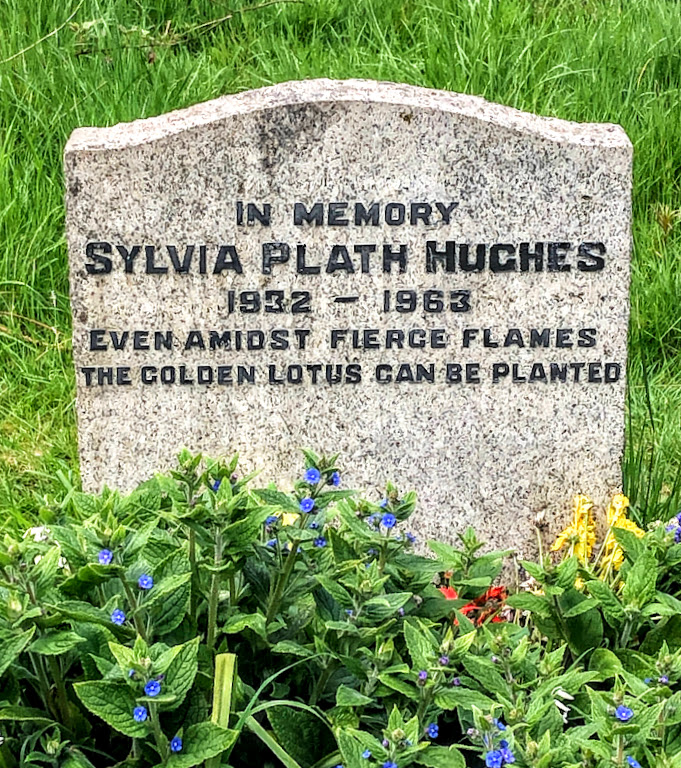
‘Even amidst fierce flames, the golden lotus can be planted’ … the grave of Sylvia Plath in Heptonstall (Photograph: Patrick Comerford, 2023)
Patrick Comerford
The Calder Valley is now known to many as ‘Happy Valley’ following the success of the recent television drama series. Two of us took the train from York through Leeds and Halifax to Hebden Bridge on Tuesday and spent much of the day enjoying the warm sunshine in these tranquil settings beneath the Pennines in West Yorkshire.
Hebden Bridge has steep hills, fast-flowing streams, and canal-side walks, and is beloved by artists, writers, photographers and musicians. Before lunch in Bridge Gate, we climbed the steep cobbled street leading up to the original settlement and hilltop village of Heptonstall.
The original church in Heptonstall was dedicated to Saint Thomas Becket and was founded around 1260. But the church was damaged by a gale in 1847, and is now only a shell. It was replaced by a new church, Saint Thomas the Apostle, built in the same churchyard.
The oldest remaining marked graves in the churchyard are thought to predate 1500. It is said there are more than 100,000 bodies in the churchyard, and many graves have been used again and again.
The American poet Sylvia Plath is buried in the graveyard across the lane from the churchyard. The epitaph on her grave reads: ‘Even amidst fierce flames, the golden lotus can be planted’ – a citation from the Bhagavad Gita.
She was married to the poet Ted Hughes, who was from nearby Mytholmryd, and she is named on the gravestone as Sylvia Plath Hughes. Her headstone is regularly vandalised by visitors who remove his surname, because some of her fans – particularly women, and American women – believe Ted Hughes was responsible for her death. But when we visited her grave this week, the black lettering seemed to have been freshly restored.
Sylvia Plath was born in Boston in 1932 and published her first poem in the Boston Herald at the age of eight. Her German-born father Otto had been alienated from his family because of his decision not to be ordained a Lutheran minister. His death nine days after her eighth birthday had a deeply profound and lasting influence on her and shaped her personality and her writing. Raised as a Unitarian, she experienced a loss of faith after his death, and remained ambivalent about religion for the rest of her life.
While she was a student at Smith College in Massachusetts in the 1950s, she wrote over 400 poems. In 1955, she was awarded a Fulbright scholarship to study at Newnham College, Cambridge. She was enchanted with the groomed courts and crooked streets of Cambridge, and was often seen pedalling furiously around the town, her black gown billowing out behind.
In Cambridge, she met the English poet Ted Hughes. Through his mother, Hughes claimed direct descent from Nicholas Ferrar, the founder of the Little Gidding community. When he met Sylvia Plath, Hughes had already graduated from Cambridge, where he had been an undergraduate at Pembroke College, and he was living between London and Cambridge:
I am here;
I wait;
and he plays on the banks of the river Cam
like a casual faun.
They were married in the same year, on 16 June 1956, in Saint George the Martyr Church, Holborn, on the south end of Queen Square, just a short stroll from the Bloomsbury offices of TS Eliot. They had chosen the day because it was Bloomsday. She returned to Cambridge in October to begin her second year at Newnham. After some time in the US and Canada, they returned to England, and in 1960, at the age of 28, she published her first book, The Colossus, in England. Her only novel, The Bell Jar, was published in 1963.
For a while, Sylvia Plath and Ted Hughes lived in North Tawton, a country village in Devon, but their marriage began to break up less than two years after the birth of her first child.
In the cold winter of 1962-1963, she lived in poverty in a small flat in London, with her two small children – Frieda Rebecca, who is now a poet and children’s writer, and the late Nicholas Farrar Hughes, named after his ancestor, Nicholas Farrar of Little Gidding. Her flat in 23 Fitzroy Road was in a house where WB Yeats once lived. There that winter, the flat was cold, the pipes froze, there was no telephone, and the children were often ill with flu. But there she continued to write, often working between 4 and 8 a.m. before the children awoke, and at times finishing a poem a day. In those poems, death is given a cruel, physical allure and psychic pain becomes almost tactile.
Early in the morning of 11 February 1963, Sylvia Plath succeeded in killing herself with cooking gas at the age of 30, while her children slept in the next room. She was buried in the churchyard in Heptonstall, beside Saint Thomas Becket Church.
Her collection Ariel was published two years after her death. It includes many of her well-known poems and was edited by Ted Hughes. Her two other collections, Crossing the Water and Winter Trees, were also published after her death and edited by Ted Hughes.
Plath frequently wrote about child birth, hospitals and suicide and employed disturbing and distorted imagery. Philip Larkin called her the ‘Horror Poet.’ But in 1982 she was the first poet to receive a Pulitzer Prize posthumously.
Ted Hughes had left Sylvia Plath for Assia Wevill. Tragically, Assia also died by suicide,, in the same manner as Sylvia Plath, and killed their daughter Shura too .
The Collected Poems of Sylvia Plath, published in 1981, was edited by Ted Hughes. He succeeded John Betjeman as Poet Laureate in 1984. In 1998, Hughes published Birthday Letters, a collection of 88 poems about their relationship. The book caused a sensation.
Sylvia Plath’s relationship with Ted Hughes was the subject of the 2003 feature film Ted and Sylvia, starring Gwyneth Paltrow and Daniel Craig.
Sylvia Plath’s poem ‘Edge’ is among the display boards in Saint Thomas’s Church in Heptonstall:
The woman is perfected.
Her dead
Body wears the smile of accomplishment,
The illusion of a Greek necessity
Flows in the scrolls of her toga,
Her bare
Feet seem to be saying:
We have come so far, it is over.
Each dead child coiled, a white serpent,
One at each little
Pitcher of milk, now empty.
She has folded
Them back into her body as petals
Of a rose close when the garden
Stiffens and odors bleed
From the sweet, deep throats of the night flower.
The moon has nothing to be sad about,
Staring from her hood of bone.
She is used to this sort of thing.
Her blacks crackle and drag.
Looking down onto Hebden Bridge from Heptonstall (Photograph: Patrick Comerford, 2023)
If Sylvia Plath would likely not have chosen to be buried in Heptonstall, the American poet Asa Benveniste definitely chose this churchyard for his own grave, having spent the final years of his life in Hebden Bridge, below Heptonstall.
Asa Benveniste (1925-1990) was a poet, typographer and publisher and a co-founder in London of the publisher Trigram Press. He and his partner Agnetha Falk ran a second-hand bookshop in Hebden Bridge in the 1980s. His gravestone reads: ‘Foolish Enough to Have Been a Poet.’
Asa Benveniste, who has been described as ‘a Turkish Jew,’ was born in New York on 25 August 1925. He moved to Paris after World War II, and settled in England in the 1950s. He moved to London, then later to Cornwall and Kent.
He moved to Hebden Bridge in the 1980s after leading a course at the Arvon Foundation at the same rambling mill owner’s house that Ted Hughes considered as a possible home for himself and Sylvia Plath and himself. Asa and Agnetha ran a second-hand bookshop in Hebden Bridge, stocked mostly with the library he had collected over the years.
When he died in 1990, he was buried in the graveyard in Heptonstall. His gravestone, a few feet away from Sylvia Plath’s grave, reads: ‘Foolish Enough to Have Been a Poet.’ His grave is often marked in the traditional Jewish way with pebbles and stones.
‘Foolish Enough to Have Been a Poet’ … the grave of Asa Benveniste in Heptonstall is often marked with pebbles and stones, following Jewish tradition (Photograph: Patrick Comerford, 2023)
Patrick Comerford
The Calder Valley is now known to many as ‘Happy Valley’ following the success of the recent television drama series. Two of us took the train from York through Leeds and Halifax to Hebden Bridge on Tuesday and spent much of the day enjoying the warm sunshine in these tranquil settings beneath the Pennines in West Yorkshire.
Hebden Bridge has steep hills, fast-flowing streams, and canal-side walks, and is beloved by artists, writers, photographers and musicians. Before lunch in Bridge Gate, we climbed the steep cobbled street leading up to the original settlement and hilltop village of Heptonstall.
The original church in Heptonstall was dedicated to Saint Thomas Becket and was founded around 1260. But the church was damaged by a gale in 1847, and is now only a shell. It was replaced by a new church, Saint Thomas the Apostle, built in the same churchyard.
The oldest remaining marked graves in the churchyard are thought to predate 1500. It is said there are more than 100,000 bodies in the churchyard, and many graves have been used again and again.
The American poet Sylvia Plath is buried in the graveyard across the lane from the churchyard. The epitaph on her grave reads: ‘Even amidst fierce flames, the golden lotus can be planted’ – a citation from the Bhagavad Gita.
She was married to the poet Ted Hughes, who was from nearby Mytholmryd, and she is named on the gravestone as Sylvia Plath Hughes. Her headstone is regularly vandalised by visitors who remove his surname, because some of her fans – particularly women, and American women – believe Ted Hughes was responsible for her death. But when we visited her grave this week, the black lettering seemed to have been freshly restored.
Sylvia Plath was born in Boston in 1932 and published her first poem in the Boston Herald at the age of eight. Her German-born father Otto had been alienated from his family because of his decision not to be ordained a Lutheran minister. His death nine days after her eighth birthday had a deeply profound and lasting influence on her and shaped her personality and her writing. Raised as a Unitarian, she experienced a loss of faith after his death, and remained ambivalent about religion for the rest of her life.
While she was a student at Smith College in Massachusetts in the 1950s, she wrote over 400 poems. In 1955, she was awarded a Fulbright scholarship to study at Newnham College, Cambridge. She was enchanted with the groomed courts and crooked streets of Cambridge, and was often seen pedalling furiously around the town, her black gown billowing out behind.
In Cambridge, she met the English poet Ted Hughes. Through his mother, Hughes claimed direct descent from Nicholas Ferrar, the founder of the Little Gidding community. When he met Sylvia Plath, Hughes had already graduated from Cambridge, where he had been an undergraduate at Pembroke College, and he was living between London and Cambridge:
I am here;
I wait;
and he plays on the banks of the river Cam
like a casual faun.
They were married in the same year, on 16 June 1956, in Saint George the Martyr Church, Holborn, on the south end of Queen Square, just a short stroll from the Bloomsbury offices of TS Eliot. They had chosen the day because it was Bloomsday. She returned to Cambridge in October to begin her second year at Newnham. After some time in the US and Canada, they returned to England, and in 1960, at the age of 28, she published her first book, The Colossus, in England. Her only novel, The Bell Jar, was published in 1963.
For a while, Sylvia Plath and Ted Hughes lived in North Tawton, a country village in Devon, but their marriage began to break up less than two years after the birth of her first child.
In the cold winter of 1962-1963, she lived in poverty in a small flat in London, with her two small children – Frieda Rebecca, who is now a poet and children’s writer, and the late Nicholas Farrar Hughes, named after his ancestor, Nicholas Farrar of Little Gidding. Her flat in 23 Fitzroy Road was in a house where WB Yeats once lived. There that winter, the flat was cold, the pipes froze, there was no telephone, and the children were often ill with flu. But there she continued to write, often working between 4 and 8 a.m. before the children awoke, and at times finishing a poem a day. In those poems, death is given a cruel, physical allure and psychic pain becomes almost tactile.
Early in the morning of 11 February 1963, Sylvia Plath succeeded in killing herself with cooking gas at the age of 30, while her children slept in the next room. She was buried in the churchyard in Heptonstall, beside Saint Thomas Becket Church.
Her collection Ariel was published two years after her death. It includes many of her well-known poems and was edited by Ted Hughes. Her two other collections, Crossing the Water and Winter Trees, were also published after her death and edited by Ted Hughes.
Plath frequently wrote about child birth, hospitals and suicide and employed disturbing and distorted imagery. Philip Larkin called her the ‘Horror Poet.’ But in 1982 she was the first poet to receive a Pulitzer Prize posthumously.
Ted Hughes had left Sylvia Plath for Assia Wevill. Tragically, Assia also died by suicide,, in the same manner as Sylvia Plath, and killed their daughter Shura too .
The Collected Poems of Sylvia Plath, published in 1981, was edited by Ted Hughes. He succeeded John Betjeman as Poet Laureate in 1984. In 1998, Hughes published Birthday Letters, a collection of 88 poems about their relationship. The book caused a sensation.
Sylvia Plath’s relationship with Ted Hughes was the subject of the 2003 feature film Ted and Sylvia, starring Gwyneth Paltrow and Daniel Craig.
Sylvia Plath’s poem ‘Edge’ is among the display boards in Saint Thomas’s Church in Heptonstall:
The woman is perfected.
Her dead
Body wears the smile of accomplishment,
The illusion of a Greek necessity
Flows in the scrolls of her toga,
Her bare
Feet seem to be saying:
We have come so far, it is over.
Each dead child coiled, a white serpent,
One at each little
Pitcher of milk, now empty.
She has folded
Them back into her body as petals
Of a rose close when the garden
Stiffens and odors bleed
From the sweet, deep throats of the night flower.
The moon has nothing to be sad about,
Staring from her hood of bone.
She is used to this sort of thing.
Her blacks crackle and drag.
Looking down onto Hebden Bridge from Heptonstall (Photograph: Patrick Comerford, 2023)
If Sylvia Plath would likely not have chosen to be buried in Heptonstall, the American poet Asa Benveniste definitely chose this churchyard for his own grave, having spent the final years of his life in Hebden Bridge, below Heptonstall.
Asa Benveniste (1925-1990) was a poet, typographer and publisher and a co-founder in London of the publisher Trigram Press. He and his partner Agnetha Falk ran a second-hand bookshop in Hebden Bridge in the 1980s. His gravestone reads: ‘Foolish Enough to Have Been a Poet.’
Asa Benveniste, who has been described as ‘a Turkish Jew,’ was born in New York on 25 August 1925. He moved to Paris after World War II, and settled in England in the 1950s. He moved to London, then later to Cornwall and Kent.
He moved to Hebden Bridge in the 1980s after leading a course at the Arvon Foundation at the same rambling mill owner’s house that Ted Hughes considered as a possible home for himself and Sylvia Plath and himself. Asa and Agnetha ran a second-hand bookshop in Hebden Bridge, stocked mostly with the library he had collected over the years.
When he died in 1990, he was buried in the graveyard in Heptonstall. His gravestone, a few feet away from Sylvia Plath’s grave, reads: ‘Foolish Enough to Have Been a Poet.’ His grave is often marked in the traditional Jewish way with pebbles and stones.
‘Foolish Enough to Have Been a Poet’ … the grave of Asa Benveniste in Heptonstall is often marked with pebbles and stones, following Jewish tradition (Photograph: Patrick Comerford, 2023)
05 May 2023
End of week reflections
on Biblical passages in
an exhibition in Prague
Biblical passage on display in the Jewish Ceremonial Hall in Prague (Photograph: Patrick Comerford, 2023)
Patrick Comerford
Throughout this week, in my prayer diary on my blog each morning my reflections have been drawing on my visits last month to the synagogues of Prague: the Old-New Synagogue, the High Synagogue, the Maisel Synagogue, the Klausen Synagogue, the Spanish Synagogue and the Pinkas Synagogue, and concluding tomorrow morning with the Jerusalem Synagogue.
The ticket system in the Jewish Museum also encourages people to visit the Ceremonial Hall, beside the Klausen Synagogue, where the exhibition looks at Jewish burial customs and the topic of the end of life.
The Jewish Ceremonial Hall was designed by the architect J Gerstl for the Jewish Burial Society, Hevrah Kaddishah, and was built in the neo-Romanesque style in 1906-1908.
The ceremonial hall is at the entrance to the Old Jewish Cemetery, founded in the early 15th century and one of the oldest and best-preserved Jewish cemeteries in Europe. There are about 12,000 tombstones in the cemetery, but the number of burials is far higher. Burials there ended in 1787.
On this Friday evening, at the end of the week rather than the end of life, I find myself reflecting on some of the Biblical passages I found displayed in the exhibition rooms of the Jewish Ceremonial Hall:
The angel said to those who were standing before him, ‘Take off his filthy clothes.’ And to him he said, ‘See, I have taken your guilt away from you, and I will clothe you in festal apparel.’ (Zechariah 3: 4)
A garden fountain, a well of living water, and flowing streams from Lebanon. (Song of Songs 4: 15)
Once the Lord has washed away the filth of the daughters of Zion and cleansed the bloodstains of Jerusalem from its midst by a spirit of judgement and by a spirit of burning. (Isaiah 4: 4)
I will sprinkle clean water upon you, and you shall be clean from all your uncleannesses, and from all your idols I will cleanse you. (Ezekiel 36: 25)
His head is the finest gold;
his locks are wavy,
black as a raven.
His eyes are like doves
beside springs of water,
bathed in milk,
fitly set.
His cheeks are like beds of spices,
yielding fragrance.
His lips are lilies,
distilling liquid myrrh.
His arms are rounded gold,
set with jewels.
His body is ivory work,
encrusted with sapphires.
His legs are alabaster columns,
set upon bases of gold.
His appearance is like Lebanon,
choice as the cedars.
His speech is most sweet,
and he is altogether desirable.
This is my beloved and this is my friend,
O daughters of Jerusalem. (Song of Songs 5: 11-16)
O hope of Israel,
its saviour in time of trouble,
why should you be like a stranger in the land,
like a traveller turning aside for the night? (Jeremiah 14: 8)
Sanctify yourselves therefore, and be holy, for I am holy. (Leviticus 11: 44)
No weapon that is fashioned against you shall prosper,
and you shall confute every tongue that rises against you in judgement.
This is the heritage of the servants of the Lord
and their vindication from me, says the Lord. (Isaiah 54: 17)
Shabbat Shalom
The Jewish Ceremonial Hall at the entrance to the Old Jewish Cemetery in Prague (Photograph: Patrick Comerford, 2023)
Scripture quotations are from the New Revised Standard Version Bible: Anglicised Edition copyright © 1989, 1995, National Council of the Churches of Christ in the United States of America. Used by permission. All rights reserved worldwide. http://nrsvbibles.org
Patrick Comerford
Throughout this week, in my prayer diary on my blog each morning my reflections have been drawing on my visits last month to the synagogues of Prague: the Old-New Synagogue, the High Synagogue, the Maisel Synagogue, the Klausen Synagogue, the Spanish Synagogue and the Pinkas Synagogue, and concluding tomorrow morning with the Jerusalem Synagogue.
The ticket system in the Jewish Museum also encourages people to visit the Ceremonial Hall, beside the Klausen Synagogue, where the exhibition looks at Jewish burial customs and the topic of the end of life.
The Jewish Ceremonial Hall was designed by the architect J Gerstl for the Jewish Burial Society, Hevrah Kaddishah, and was built in the neo-Romanesque style in 1906-1908.
The ceremonial hall is at the entrance to the Old Jewish Cemetery, founded in the early 15th century and one of the oldest and best-preserved Jewish cemeteries in Europe. There are about 12,000 tombstones in the cemetery, but the number of burials is far higher. Burials there ended in 1787.
On this Friday evening, at the end of the week rather than the end of life, I find myself reflecting on some of the Biblical passages I found displayed in the exhibition rooms of the Jewish Ceremonial Hall:
The angel said to those who were standing before him, ‘Take off his filthy clothes.’ And to him he said, ‘See, I have taken your guilt away from you, and I will clothe you in festal apparel.’ (Zechariah 3: 4)
A garden fountain, a well of living water, and flowing streams from Lebanon. (Song of Songs 4: 15)
Once the Lord has washed away the filth of the daughters of Zion and cleansed the bloodstains of Jerusalem from its midst by a spirit of judgement and by a spirit of burning. (Isaiah 4: 4)
I will sprinkle clean water upon you, and you shall be clean from all your uncleannesses, and from all your idols I will cleanse you. (Ezekiel 36: 25)
His head is the finest gold;
his locks are wavy,
black as a raven.
His eyes are like doves
beside springs of water,
bathed in milk,
fitly set.
His cheeks are like beds of spices,
yielding fragrance.
His lips are lilies,
distilling liquid myrrh.
His arms are rounded gold,
set with jewels.
His body is ivory work,
encrusted with sapphires.
His legs are alabaster columns,
set upon bases of gold.
His appearance is like Lebanon,
choice as the cedars.
His speech is most sweet,
and he is altogether desirable.
This is my beloved and this is my friend,
O daughters of Jerusalem. (Song of Songs 5: 11-16)
O hope of Israel,
its saviour in time of trouble,
why should you be like a stranger in the land,
like a traveller turning aside for the night? (Jeremiah 14: 8)
Sanctify yourselves therefore, and be holy, for I am holy. (Leviticus 11: 44)
No weapon that is fashioned against you shall prosper,
and you shall confute every tongue that rises against you in judgement.
This is the heritage of the servants of the Lord
and their vindication from me, says the Lord. (Isaiah 54: 17)
Shabbat Shalom
The Jewish Ceremonial Hall at the entrance to the Old Jewish Cemetery in Prague (Photograph: Patrick Comerford, 2023)
Scripture quotations are from the New Revised Standard Version Bible: Anglicised Edition copyright © 1989, 1995, National Council of the Churches of Christ in the United States of America. Used by permission. All rights reserved worldwide. http://nrsvbibles.org
19 March 2023
Some reflections on the death
of Canon Anna Matthews,
a priest friend in Cambridge
Canon Anna Matthews … she was ‘a priest’s priest
Patrick Comerford
The death of Canon Anna Matthews in Cambridge ten days ago (8 March) is tragic and sad, and has come as a shock to all her friends and all who knew her.
Even among those who did not know her, there has been an outpouring of grief on social media by clergy and theologians trying to wrestle with the meaning of the death by suicide of a much-loved, caring and pastoral friend.
I cannot say I knew Anna well, but that was because of distance. I think we first met when she was an ordinand in Westcott House, and we got to know each other better when she returned to Cambridge as the priest at Saint Bene’t’s Church. When I was a student on courses at Sidney Sussex College organised by the Institute for Orthodox Christian Studies, Saint Bene’t’s became effectively my parish church: I would slip in there for the early Eucharist each morning before breakfast and lectures, and occasionally I was there on Sunday mornings on my way to the USPG conference in High Leigh.
We kept in touch, we have a high number of mutual friends on Facebook, and there was an invitation to return and preach in Saint Bene’t’s, an invitation that is now going to remain unanswered.
Anna was a priest’s priest, and her death leaves many of us with pain and dealing with many unanswered questions.
The language surrounding suicide has changed in recent years, so we no longer use the word ‘committed.’ No crime has been committed, and all involved and caught up in the tragedy are victims and are suffering.
There has been a parallel change in attitudes in the church too. Until recently, people who died by suicide were refused a proper funeral services and burial in consecrated ground. A rubric preceding the burial services in the Book of Common Prayer declared in stern, harsh, judgmental and unloving words: ‘Here is to be noted, That the Office ensuing is not to be used for any that die unbaptized, or excommunicate, or have laid violent hands upon themselves.’
The rubric was repeated in part by Canon 68 of 1603, which denied Church funerals and burials to those who ‘being of sound mind have laid violent hands upon themselves’. Roger Beckwith reflected many evangelical Anglican theologians of his age when he declared that a person who died by suicide ‘is a person who has committed so grievous and notorious an offence that, if he could have been, he ought to have been excommunicated for it. He is, therefore, as it were, excommunicated posthumously, being denied Christian burial.’
For centuries, the lack of understanding of suicide was reflected in the English civil law, which condemned suicide as homicide. But Canon 37, as it became, was often ignored sensibly by pastorally sensitive priests, who knew that funerals are for the comfort of family members, loved ones and friends. What was ‘sound mind’? What was meant by ‘violent hands’?
This canon came under increasing scrutiny in recent years as society's attitudes towards suicide became more understanding and compassionate, and the General Synod of the Church of England voted to amend this canon in 2017.
A report from the Board for Social Responsibility in 1959 noted that most people believed that anyone who attempted suicide must have been experiencing a degree of mental distress and deserved special sympathy and understanding. The canon was honoured more in the breach than in the observance.
Of course these were restrictions that were never found in the Bible in the first place. Indeed, the word suicide is not found in the Bible either.
I remember a tragic funeral for a teenager, where the evangelical preacher in his sermon, in presence of the bishop and the grieving parents referred to suicide as the unpardonable sin.
In the Bible, the Hebrew Scriptures refer to five events that are often interpreted as suicide:
1, When Abimelech was mortally wounded by a woman who dropped a millstone on his head, he cried to his armour-bearer to kill him so his death would not be credited to the woman (Judges 9: 54). But this is about male dignity in battle and, as death was inevitable, it was not a case of suicide.
2, The mortally wounded King Saul fell upon his own sword lest the Philistines abuse him further (I Samuel 31: 4). But, once again, this is about male dignity in battle.
3, Saul’s armour-bearer then took his own life as well (I Samuel 31: 5).
4, Ahithophel hanged himself after his advice was no longer followed by King David’s son Absalom (II Samuel 17: 23).
5, Zimri set himself afire after his rebellion failed (I Kings 16: 18). These three examples are also about male dignity and pride.
Additionally, some commentators ask whether Jonah attempted suicide (Jonah 1: 11-15).
When Samson destroyed the Philistine temple, he killed himself and all those with him (Judges 16: 29-30). Many see this as an act of military bravery rather than suicide as such.
The death of Judas is regarded as the only example of suicide in the New Testament. But there are two different, conflicting accounts of his death (see Matthew 27: 1-10, and Acts 1: 16-20).
Later, Saint Paul prevents the suicide of the Philippian jailer (see Acts 16: 27-28).
Looking out onto the world from Saint Bene’t’s Church, Cambridge (Photograph: Patrick Comerford)
The word suicide is never used in the Bible, and is only found in cross-headings inserted by translators and editors. Indeed, the word did not exist in the English language until the 17th century, and tortured phrases, such as referring to people who ‘have laid violent hands upon themselves,’ failed to grasp or understand what was happening.
Before becoming Dean of Saint Paul’s, the poet-priest John Donne, wrote Biathanatos, an extended essay on suicide, in 1608.
One school of interpretation sees Biathanatos as an epiphenomenon of Donne’s morbid condition, others see in it an attempt by Donne to overcome temptation.
Biathanatos is a long and extremely difficult work with a challenging and, Donne says, ‘paradoxical’ thesis. It undertakes an exhaustive analysis of both secular and religious arguments against suicide, and argues that suicide is ‘not so naturally sin, that it may never be otherwise.’ He argues that suicide is justified when, like submission to martyrdom, it is done with charity or done for the glory of God.
In Donne’s unconventional view, Christ, in allowing himself to be crucified and in voluntarily emitting his last breath on the cross, was in fact a suicide.
Donne recognised that his unconventional thesis was ‘misinterpretable,’ and probably for this reason did not allow Biathanatos to be published during his lifetime. It was not published until a decade later, in 1647, after his death, by his son.
The word Biathanatos comes from the Greek Βιαθανατος, meaning ‘violent death’. The word suicide meaning ‘deliberate killing of oneself’ does not enter the English language until 1651 and is coined from Modern Latin. The timing of its first use is crucial to understanding its place in English culture: Charles I had been executed two years earlier; when his execution and those who signed his death warrant were condemned, the words used were ‘regicide’ and ‘regicides.’
The word suicide entered the English language alongside words such as regicide, fratricide and patricide. The word suicide had become established as a noun and a verb in the English language by the mid-18th century, when it was included by Samuel Johnson in his Dictionary.
The word is not, and has never been a Biblical term.
‘The Passion,’ a sculpture by Enzo Plazzotta in Saint Bene’t’s Church, Cambridge (Photograph: Patrick Comerford)
In the classical world, what we now know as suicide was often associated with personal dignity or accepting personal responsibility.
Socrates was put on trial in the year 399 BC, charged with corrupting the youth and with impiety. The primary sources for his trial are provided by his friends Plato and Xenophon. His accusers cited two impious acts: ‘failing to acknowledge the gods that the city acknowledges’ and ‘introducing new deities.’
These two charges arose from Socrates asking philosophical questions. Citizens of Athens were chosen by lot to serve as jurors, and a majority voted to convict him. They took another vote to decide on his punishment and Socrates was sentenced to death by drinking hemlock. Instead of fleeing when he has the opportunity, Socrates, uses his death as a final lesson for his pupils, and faces the end calmly.
In the painting, ‘The Death of Socrates’ (1787) by Jacques-Louis David, Socrates is seen as an old man in a white robe who sits upright on a bed, one hand extended over a cup, the other gesturing in the air. He is surrounded by other men of varying ages, most showing emotional distress, unlike the stoic old man.
Socrates is being handed the cup by a young man who looks the other way, with his face in his free hand. Another young man clutches the thigh of the old man. An elderly man sits at the end of the bed, slumped over and looking in his lap. To the left of the painting, the wall becomes an arch, with more men in the background.
However, this depiction of the death of Socrates contains many historical inaccuracies. For simplicity, David removed many characters, including the wife of Socrates. On the other hand, he included Apollodorus, the man leaning against the wall just within the arch. But Apollodorus was sent away by Socrates for showing too much grief.
In his painting, David examines a philosopher’s approach to death. Socrates is stoic and calm because he sees death as a separate, actual realm, a different state of being from life but not an end to being.
In Plato’s Phaedo, Socrates seems to be more concerned with how Crito will handle his death than with his own wellbeing. In the painting, the gesture of Socrates indicates he is still teaching, even in the moment before his death.
The only words Christ is recorded as writing are words in the sand when a woman is about to be stoned to death. When he was asked why he did not commit his words to writing, Socrates replied: ‘I would rather write on the hearts of living men than on the skins of dead sheep.’
Like Christ, Socrates left behind no great writings. We know of Christ’s words from the Gospels and the other writings in the New Testament, we know of Socrates’ thoughts through Plato’s works.
Many writers have compared Socrates with Christ, and some of the early Church Fathers even considered Socrates a pre-Christian saint or something of a prophet. Yet Tertullian asked: ‘What has Athens to do with Jerusalem, or the Academy with the Church?’ (De praescriptione, vii).
Do Christ and Socrates share any ethical precepts? Or are those similarities shared by all great teachers of the past?
Is there a similarity between the way Christ and Socrates sought out the common people to teach them?
Christ and Socrates were both accused of ‘corrupting society’ and were put on trial. Do Socrates and Christ pose similar challenges to the prevailing religiosity and idolatries of the age?
Can you find similarities between the two in Socrates’ claims to be just a humble person trying to figure things out?
In Plato’s Crito, Crito visits Socrates on the night before his death, he questions why Socrates is content with remaining in prison and he offers him an escape route that would allow Socrates and his followers to leave the country and live in exile. Does Crito pinteracts with Socrates in a role similar to that of Judas with Christ?
Can we draw parallels between the dialogue between Socrates and Meletus, the judge at the trial, and the dialogue between Christ and Pilate?
Is there a similarity or a difference between the way Socrates is willing to accept his trial and sentencing, and the way Christ faces his trial and crucifixion?
Some consider Jesus’ death to have been a kind of suicide, as suggested by John Donne. Could we even talk about his willing acceptance of death as the ‘Suicide of God’?
After death, the person who dies by suicide continues to need the pastoral care of the church. That includes allowing that person to rest in peace. The dead person continues to retain human rights, and the right to respect, privacy and personal dignity.
There is, perhaps, too much speculation by people who did not know Anna Matthews about her and about how she died.
In a statement shared at St Bene’t’s in Cambridge last Sunday, her husband Stephen said: ‘Having received Communion at the 12:30 service on Thursday, as I prayed for Anna, I was given an image that has been of great comfort to me: Even as she fell, God lifted Anna up. She was shining in the light of the resurrection as the hurt that overcame her fell away, along with her body. So, I pray to merciful God with hope that she was spared the final anguish, and in death she was cleansed and resurrected with Christ, rising in his glory.’
And that is probably all that needs to be said for now.
Canon Anna Matthews offered a warm welcome at Saint Bene’t’s Church, Cambridge (Photograph: Patrick Comerford)
Patrick Comerford
The death of Canon Anna Matthews in Cambridge ten days ago (8 March) is tragic and sad, and has come as a shock to all her friends and all who knew her.
Even among those who did not know her, there has been an outpouring of grief on social media by clergy and theologians trying to wrestle with the meaning of the death by suicide of a much-loved, caring and pastoral friend.
I cannot say I knew Anna well, but that was because of distance. I think we first met when she was an ordinand in Westcott House, and we got to know each other better when she returned to Cambridge as the priest at Saint Bene’t’s Church. When I was a student on courses at Sidney Sussex College organised by the Institute for Orthodox Christian Studies, Saint Bene’t’s became effectively my parish church: I would slip in there for the early Eucharist each morning before breakfast and lectures, and occasionally I was there on Sunday mornings on my way to the USPG conference in High Leigh.
We kept in touch, we have a high number of mutual friends on Facebook, and there was an invitation to return and preach in Saint Bene’t’s, an invitation that is now going to remain unanswered.
Anna was a priest’s priest, and her death leaves many of us with pain and dealing with many unanswered questions.
The language surrounding suicide has changed in recent years, so we no longer use the word ‘committed.’ No crime has been committed, and all involved and caught up in the tragedy are victims and are suffering.
There has been a parallel change in attitudes in the church too. Until recently, people who died by suicide were refused a proper funeral services and burial in consecrated ground. A rubric preceding the burial services in the Book of Common Prayer declared in stern, harsh, judgmental and unloving words: ‘Here is to be noted, That the Office ensuing is not to be used for any that die unbaptized, or excommunicate, or have laid violent hands upon themselves.’
The rubric was repeated in part by Canon 68 of 1603, which denied Church funerals and burials to those who ‘being of sound mind have laid violent hands upon themselves’. Roger Beckwith reflected many evangelical Anglican theologians of his age when he declared that a person who died by suicide ‘is a person who has committed so grievous and notorious an offence that, if he could have been, he ought to have been excommunicated for it. He is, therefore, as it were, excommunicated posthumously, being denied Christian burial.’
For centuries, the lack of understanding of suicide was reflected in the English civil law, which condemned suicide as homicide. But Canon 37, as it became, was often ignored sensibly by pastorally sensitive priests, who knew that funerals are for the comfort of family members, loved ones and friends. What was ‘sound mind’? What was meant by ‘violent hands’?
This canon came under increasing scrutiny in recent years as society's attitudes towards suicide became more understanding and compassionate, and the General Synod of the Church of England voted to amend this canon in 2017.
A report from the Board for Social Responsibility in 1959 noted that most people believed that anyone who attempted suicide must have been experiencing a degree of mental distress and deserved special sympathy and understanding. The canon was honoured more in the breach than in the observance.
Of course these were restrictions that were never found in the Bible in the first place. Indeed, the word suicide is not found in the Bible either.
I remember a tragic funeral for a teenager, where the evangelical preacher in his sermon, in presence of the bishop and the grieving parents referred to suicide as the unpardonable sin.
In the Bible, the Hebrew Scriptures refer to five events that are often interpreted as suicide:
1, When Abimelech was mortally wounded by a woman who dropped a millstone on his head, he cried to his armour-bearer to kill him so his death would not be credited to the woman (Judges 9: 54). But this is about male dignity in battle and, as death was inevitable, it was not a case of suicide.
2, The mortally wounded King Saul fell upon his own sword lest the Philistines abuse him further (I Samuel 31: 4). But, once again, this is about male dignity in battle.
3, Saul’s armour-bearer then took his own life as well (I Samuel 31: 5).
4, Ahithophel hanged himself after his advice was no longer followed by King David’s son Absalom (II Samuel 17: 23).
5, Zimri set himself afire after his rebellion failed (I Kings 16: 18). These three examples are also about male dignity and pride.
Additionally, some commentators ask whether Jonah attempted suicide (Jonah 1: 11-15).
When Samson destroyed the Philistine temple, he killed himself and all those with him (Judges 16: 29-30). Many see this as an act of military bravery rather than suicide as such.
The death of Judas is regarded as the only example of suicide in the New Testament. But there are two different, conflicting accounts of his death (see Matthew 27: 1-10, and Acts 1: 16-20).
Later, Saint Paul prevents the suicide of the Philippian jailer (see Acts 16: 27-28).
Looking out onto the world from Saint Bene’t’s Church, Cambridge (Photograph: Patrick Comerford)
The word suicide is never used in the Bible, and is only found in cross-headings inserted by translators and editors. Indeed, the word did not exist in the English language until the 17th century, and tortured phrases, such as referring to people who ‘have laid violent hands upon themselves,’ failed to grasp or understand what was happening.
Before becoming Dean of Saint Paul’s, the poet-priest John Donne, wrote Biathanatos, an extended essay on suicide, in 1608.
One school of interpretation sees Biathanatos as an epiphenomenon of Donne’s morbid condition, others see in it an attempt by Donne to overcome temptation.
Biathanatos is a long and extremely difficult work with a challenging and, Donne says, ‘paradoxical’ thesis. It undertakes an exhaustive analysis of both secular and religious arguments against suicide, and argues that suicide is ‘not so naturally sin, that it may never be otherwise.’ He argues that suicide is justified when, like submission to martyrdom, it is done with charity or done for the glory of God.
In Donne’s unconventional view, Christ, in allowing himself to be crucified and in voluntarily emitting his last breath on the cross, was in fact a suicide.
Donne recognised that his unconventional thesis was ‘misinterpretable,’ and probably for this reason did not allow Biathanatos to be published during his lifetime. It was not published until a decade later, in 1647, after his death, by his son.
The word Biathanatos comes from the Greek Βιαθανατος, meaning ‘violent death’. The word suicide meaning ‘deliberate killing of oneself’ does not enter the English language until 1651 and is coined from Modern Latin. The timing of its first use is crucial to understanding its place in English culture: Charles I had been executed two years earlier; when his execution and those who signed his death warrant were condemned, the words used were ‘regicide’ and ‘regicides.’
The word suicide entered the English language alongside words such as regicide, fratricide and patricide. The word suicide had become established as a noun and a verb in the English language by the mid-18th century, when it was included by Samuel Johnson in his Dictionary.
The word is not, and has never been a Biblical term.
‘The Passion,’ a sculpture by Enzo Plazzotta in Saint Bene’t’s Church, Cambridge (Photograph: Patrick Comerford)
In the classical world, what we now know as suicide was often associated with personal dignity or accepting personal responsibility.
Socrates was put on trial in the year 399 BC, charged with corrupting the youth and with impiety. The primary sources for his trial are provided by his friends Plato and Xenophon. His accusers cited two impious acts: ‘failing to acknowledge the gods that the city acknowledges’ and ‘introducing new deities.’
These two charges arose from Socrates asking philosophical questions. Citizens of Athens were chosen by lot to serve as jurors, and a majority voted to convict him. They took another vote to decide on his punishment and Socrates was sentenced to death by drinking hemlock. Instead of fleeing when he has the opportunity, Socrates, uses his death as a final lesson for his pupils, and faces the end calmly.
In the painting, ‘The Death of Socrates’ (1787) by Jacques-Louis David, Socrates is seen as an old man in a white robe who sits upright on a bed, one hand extended over a cup, the other gesturing in the air. He is surrounded by other men of varying ages, most showing emotional distress, unlike the stoic old man.
Socrates is being handed the cup by a young man who looks the other way, with his face in his free hand. Another young man clutches the thigh of the old man. An elderly man sits at the end of the bed, slumped over and looking in his lap. To the left of the painting, the wall becomes an arch, with more men in the background.
However, this depiction of the death of Socrates contains many historical inaccuracies. For simplicity, David removed many characters, including the wife of Socrates. On the other hand, he included Apollodorus, the man leaning against the wall just within the arch. But Apollodorus was sent away by Socrates for showing too much grief.
In his painting, David examines a philosopher’s approach to death. Socrates is stoic and calm because he sees death as a separate, actual realm, a different state of being from life but not an end to being.
In Plato’s Phaedo, Socrates seems to be more concerned with how Crito will handle his death than with his own wellbeing. In the painting, the gesture of Socrates indicates he is still teaching, even in the moment before his death.
The only words Christ is recorded as writing are words in the sand when a woman is about to be stoned to death. When he was asked why he did not commit his words to writing, Socrates replied: ‘I would rather write on the hearts of living men than on the skins of dead sheep.’
Like Christ, Socrates left behind no great writings. We know of Christ’s words from the Gospels and the other writings in the New Testament, we know of Socrates’ thoughts through Plato’s works.
Many writers have compared Socrates with Christ, and some of the early Church Fathers even considered Socrates a pre-Christian saint or something of a prophet. Yet Tertullian asked: ‘What has Athens to do with Jerusalem, or the Academy with the Church?’ (De praescriptione, vii).
Do Christ and Socrates share any ethical precepts? Or are those similarities shared by all great teachers of the past?
Is there a similarity between the way Christ and Socrates sought out the common people to teach them?
Christ and Socrates were both accused of ‘corrupting society’ and were put on trial. Do Socrates and Christ pose similar challenges to the prevailing religiosity and idolatries of the age?
Can you find similarities between the two in Socrates’ claims to be just a humble person trying to figure things out?
In Plato’s Crito, Crito visits Socrates on the night before his death, he questions why Socrates is content with remaining in prison and he offers him an escape route that would allow Socrates and his followers to leave the country and live in exile. Does Crito pinteracts with Socrates in a role similar to that of Judas with Christ?
Can we draw parallels between the dialogue between Socrates and Meletus, the judge at the trial, and the dialogue between Christ and Pilate?
Is there a similarity or a difference between the way Socrates is willing to accept his trial and sentencing, and the way Christ faces his trial and crucifixion?
Some consider Jesus’ death to have been a kind of suicide, as suggested by John Donne. Could we even talk about his willing acceptance of death as the ‘Suicide of God’?
After death, the person who dies by suicide continues to need the pastoral care of the church. That includes allowing that person to rest in peace. The dead person continues to retain human rights, and the right to respect, privacy and personal dignity.
There is, perhaps, too much speculation by people who did not know Anna Matthews about her and about how she died.
In a statement shared at St Bene’t’s in Cambridge last Sunday, her husband Stephen said: ‘Having received Communion at the 12:30 service on Thursday, as I prayed for Anna, I was given an image that has been of great comfort to me: Even as she fell, God lifted Anna up. She was shining in the light of the resurrection as the hurt that overcame her fell away, along with her body. So, I pray to merciful God with hope that she was spared the final anguish, and in death she was cleansed and resurrected with Christ, rising in his glory.’
And that is probably all that needs to be said for now.
Canon Anna Matthews offered a warm welcome at Saint Bene’t’s Church, Cambridge (Photograph: Patrick Comerford)
09 March 2023
A journey through Lent 2023
with Samuel Johnson (16)
‘We soon must lie down in the grave with the forgotten multitudes of former ages’ … the Martyrs’ Plaque in Lichfield, dating from the 1740s and now in Beacon Park (Photograph: Patrick Comerford)
Patrick Comerford
During Lent this year, I am taking time each morning to reflect on words from Samuel Johnson (1709-1784), the Lichfield-born lexicographer and writer who compiled the first authoritative English-language dictionary.
Samuel Johnson wrote in the Rambler (No 203) on 25 February 1752:
Every period of life is obliged to borrow its happiness from the time to come. In youth we have nothing to entertain us, and in age we derive little from retrospect but hopeless sorrow. Yet the future likewise has its limits, which the imagination dreads to approach, but which we see to be not far distant. The loss of our friends and companions impresses hourly upon the necessity of our own departure; we know that the schemes of man are quickly at an end, that we soon must lie down in the grave with the forgotten multitudes of former ages, and yield our place to others, who, like us, shall be driven awhile by hope and fear about the surface of the earth, and then like us be lost in the shades of death. Beyond this termination of our material existence, we are therefore obliged to extend our hopes …
Continued tomorrow
Yesterday’s reflection
Patrick Comerford
During Lent this year, I am taking time each morning to reflect on words from Samuel Johnson (1709-1784), the Lichfield-born lexicographer and writer who compiled the first authoritative English-language dictionary.
Samuel Johnson wrote in the Rambler (No 203) on 25 February 1752:
Every period of life is obliged to borrow its happiness from the time to come. In youth we have nothing to entertain us, and in age we derive little from retrospect but hopeless sorrow. Yet the future likewise has its limits, which the imagination dreads to approach, but which we see to be not far distant. The loss of our friends and companions impresses hourly upon the necessity of our own departure; we know that the schemes of man are quickly at an end, that we soon must lie down in the grave with the forgotten multitudes of former ages, and yield our place to others, who, like us, shall be driven awhile by hope and fear about the surface of the earth, and then like us be lost in the shades of death. Beyond this termination of our material existence, we are therefore obliged to extend our hopes …
Continued tomorrow
Yesterday’s reflection
08 March 2023
A journey through Lent 2023
with Samuel Johnson (15)
‘And all our yesterdays have lighted fools / The way to dusty death’ … the Johnson family memorial in Saint Michael’s Church, Lichfield, with the inscription commissioned by Samuel Johnson (Photograph: Patrick Comerford)
Patrick Comerford
I have a mdeical appointment later this morning to check my Vitamin B12 levels, and later in the day I hope to take part in a Zoom meeting of local clergy in the Milton Keynes area. But before this becomes a busy day, I am taking some time this morning for prayer and reflection.
During Lent this year, I am taking time each morning to reflect on words from Samuel Johnson (1709-1784), the Lichfield-born lexicographer and writer who compiled the first authoritative English-language dictionary.
So often, in Lent as in every other time of the year, we live in our yesterdays, rather than living in today and hoping for tomorrow.
Yesterday was defined by Johnson defined in his Dictionary in these words:
Day last past; day next before to-day.
To-morrow, and to-morrow, and to-morrow,
Creeps in this petty pace from day to day,
To the last syllable of recorded time;
And all our yesterdays have lighted fools
The way to dusty death.
Yesterday’s reflection
Continued tomorrow
Patrick Comerford
I have a mdeical appointment later this morning to check my Vitamin B12 levels, and later in the day I hope to take part in a Zoom meeting of local clergy in the Milton Keynes area. But before this becomes a busy day, I am taking some time this morning for prayer and reflection.
During Lent this year, I am taking time each morning to reflect on words from Samuel Johnson (1709-1784), the Lichfield-born lexicographer and writer who compiled the first authoritative English-language dictionary.
So often, in Lent as in every other time of the year, we live in our yesterdays, rather than living in today and hoping for tomorrow.
Yesterday was defined by Johnson defined in his Dictionary in these words:
Day last past; day next before to-day.
To-morrow, and to-morrow, and to-morrow,
Creeps in this petty pace from day to day,
To the last syllable of recorded time;
And all our yesterdays have lighted fools
The way to dusty death.
Yesterday’s reflection
Continued tomorrow
03 March 2023
A journey through Lent 2023
with Samuel Johnson (10)
‘Art is long, and life is short’ … a saddleback tomb in Saint Michael’s churchyard, Lichfield, where generations of Samuel Johnson’s family are buried (Photograph: Patrick Comerford)
Patrick Comerford
During Lent this year, I am taking time each morning to reflect on words from Samuel Johnson (1709-1784), the Lichfield-born lexicographer and writer who compiled the first authoritative English-language dictionary.
In his biography, James Boswell recalls how Johnson said famously and wittily:
Depend upon it, sir, when a man knows he is to be hanged in a fortnight, it concentrates his mind wonderfully.
But Johnson also wrote in the Rambler (No 17), on 15 May 1750:
The uncertainty of our duration ought at once to set bounds to our designs, and add incitements to our industry; and when we find ourselves inclined either to immensity in our schemes, or sluggishness in our endeavours, we may either check or animate ourselves, by recollecting, with the father of physic, that art is long, and life is short.
Continued tomorrow
Yesterday’s reflection
Patrick Comerford
During Lent this year, I am taking time each morning to reflect on words from Samuel Johnson (1709-1784), the Lichfield-born lexicographer and writer who compiled the first authoritative English-language dictionary.
In his biography, James Boswell recalls how Johnson said famously and wittily:
Depend upon it, sir, when a man knows he is to be hanged in a fortnight, it concentrates his mind wonderfully.
But Johnson also wrote in the Rambler (No 17), on 15 May 1750:
The uncertainty of our duration ought at once to set bounds to our designs, and add incitements to our industry; and when we find ourselves inclined either to immensity in our schemes, or sluggishness in our endeavours, we may either check or animate ourselves, by recollecting, with the father of physic, that art is long, and life is short.
Continued tomorrow
Yesterday’s reflection
24 September 2022
The mediaeval Jewish graves
and cemetery found at a car
park in York 40 years ago
The cemetery in Jewbury, York, one of only 10 Jewish cemeteries in mediaeval England, was discovered at the site of Sainsbury’s car park (Photograph: Patrick Comerford, 2022)
Patrick Comerford
I have been writing in recent days about the Jewish community in mediaeval York, the horrific massacre at Clifford’s Tower in 1190, and the synagogues in mediaeval and contemporary York.
One of the most interesting insights into life and death in the Jewish community in mediaeval York was provided at Jewbury almost 40 years ago when archaeologists from the York Archaeological Trust discovered the lost cemetery of York’s mediaeval Jews at the site of what is now the multi-level car park at Sainsbury’s.
The cemetery in Jewbury is one of only 10 Jewish cemeteries in mediaeval England and the only one to be extensively excavated. It offers a glimpse into the lives and deaths of a what was once the largest and most prosperous Jewish community in England.
The site at Jewbury is outside the city walls, on a street leading from Monk Bar and Saint Maurice’s Road to Layerthorpe and Foss Bank and Foss Island’s Road.
The site of a mediaeval Jewish cemetery was unearthed in Jewbury almost 40 years ago. There were just a few documents suggesting that there was once a cemetery where holes were to be dug as part of new building in Jewbury. Archaeologists were called in to investigate the site before builders moved in.
Despite the lack of gravestones and the lack of traditionally nail-less Jewish coffins, the care that had been taken in the lay-out of the graves confirmed for archaeologists and modern religious Jewish authorities to agree this was a Jewish cemetery.
The cemetery was in use from around 1177 until the expulsion of the Jews from England in 1290. However, it does not appear that any of the victims of the massacre at Clifford’s Tower in 1190 were buried there.
Almost 500 skeletons were excavated in 1983, although it is estimated that the entire cemetery held over 1,000 burials.
Jewbury is outside York’s city walls, on a street leading from Monk Bar and Saint Maurice’s Road to Layerthorpe and Foss Bank and Foss Island’s Road (Photograph: Patrick Comerford, 2022)
Most of the burials were in wooden coffins, and there were few personal items, in keeping with Jewish tradition of simple burials. Surprisingly, the burials were aligned to the north-west, unlike the modern Jewish practice of orienting cemeteries east towards Jerusalem.
Mediaeval writers often refer to Jewish cemeteries as being the ‘Gardens of the Jews’ – hortus iudeorum – immaculately kept by a garden keeper. The York burial ground maintained these high standards. Unlike the haphazard burials in mediaeval Christian cemeteries in York, the graves in Jewbury were evenly spaced. It is thought the graves were have been marked in some way, but there is no evidence of tombstones or other grave markers.
One man, aged between 20 and 30, bears evidence of surgery in response to a deep wound to the front of his skull. Unfortunately, the injury was too severe and the man did not live long after the procedure.
In all, the archaeologists discovered about 500 mediaeval graves and the skeletons in them. They considered digging further to carry out tests on the bones and teeth and to discover more about the diet and health of the times.
The archaeologists felt they should do as the Chief Rabbi wished. However, this ended their research, as the advice they received was: ‘Whatever the scientific and historical loss … the dignity shown to humans even centuries after their death can contribute more than any scientific enquiry … to the respect in which human beings hold each other.’
The skeletons were removed to a Jewish mortuary and then returned to Jewbury for a burial supervised by the Chief Rabbi, Dr Immanuel Jakobovits, and members of York’s modern Jewish community in 1984, seven centuries after they were first buried.
The archaeologists had excavated only parts of the cemetery that were threatened by the car park construction. The remaining 500 or more burials of the Jewish cemetery in Jewbury continue to lie undisturbed under the Sainsbury’s car park in York.
As one of only 10 Jewish cemeteries in mediaeval England and the only one to be extensively excavated, the cemetery in Jewbury offered a glimpse into the lives and deaths of the Jewish community in mediaeval York.
Thursday: The massacre at Clifford’s Tower
Yeserday: The mediaeval and modern synagogues of York
A plaque recalls the site of the mediaeval Jewish cemetery in Jewbury (Photograph: Patrick Comerford, 2022)
Patrick Comerford
I have been writing in recent days about the Jewish community in mediaeval York, the horrific massacre at Clifford’s Tower in 1190, and the synagogues in mediaeval and contemporary York.
One of the most interesting insights into life and death in the Jewish community in mediaeval York was provided at Jewbury almost 40 years ago when archaeologists from the York Archaeological Trust discovered the lost cemetery of York’s mediaeval Jews at the site of what is now the multi-level car park at Sainsbury’s.
The cemetery in Jewbury is one of only 10 Jewish cemeteries in mediaeval England and the only one to be extensively excavated. It offers a glimpse into the lives and deaths of a what was once the largest and most prosperous Jewish community in England.
The site at Jewbury is outside the city walls, on a street leading from Monk Bar and Saint Maurice’s Road to Layerthorpe and Foss Bank and Foss Island’s Road.
The site of a mediaeval Jewish cemetery was unearthed in Jewbury almost 40 years ago. There were just a few documents suggesting that there was once a cemetery where holes were to be dug as part of new building in Jewbury. Archaeologists were called in to investigate the site before builders moved in.
Despite the lack of gravestones and the lack of traditionally nail-less Jewish coffins, the care that had been taken in the lay-out of the graves confirmed for archaeologists and modern religious Jewish authorities to agree this was a Jewish cemetery.
The cemetery was in use from around 1177 until the expulsion of the Jews from England in 1290. However, it does not appear that any of the victims of the massacre at Clifford’s Tower in 1190 were buried there.
Almost 500 skeletons were excavated in 1983, although it is estimated that the entire cemetery held over 1,000 burials.
Jewbury is outside York’s city walls, on a street leading from Monk Bar and Saint Maurice’s Road to Layerthorpe and Foss Bank and Foss Island’s Road (Photograph: Patrick Comerford, 2022)
Most of the burials were in wooden coffins, and there were few personal items, in keeping with Jewish tradition of simple burials. Surprisingly, the burials were aligned to the north-west, unlike the modern Jewish practice of orienting cemeteries east towards Jerusalem.
Mediaeval writers often refer to Jewish cemeteries as being the ‘Gardens of the Jews’ – hortus iudeorum – immaculately kept by a garden keeper. The York burial ground maintained these high standards. Unlike the haphazard burials in mediaeval Christian cemeteries in York, the graves in Jewbury were evenly spaced. It is thought the graves were have been marked in some way, but there is no evidence of tombstones or other grave markers.
One man, aged between 20 and 30, bears evidence of surgery in response to a deep wound to the front of his skull. Unfortunately, the injury was too severe and the man did not live long after the procedure.
In all, the archaeologists discovered about 500 mediaeval graves and the skeletons in them. They considered digging further to carry out tests on the bones and teeth and to discover more about the diet and health of the times.
The archaeologists felt they should do as the Chief Rabbi wished. However, this ended their research, as the advice they received was: ‘Whatever the scientific and historical loss … the dignity shown to humans even centuries after their death can contribute more than any scientific enquiry … to the respect in which human beings hold each other.’
The skeletons were removed to a Jewish mortuary and then returned to Jewbury for a burial supervised by the Chief Rabbi, Dr Immanuel Jakobovits, and members of York’s modern Jewish community in 1984, seven centuries after they were first buried.
The archaeologists had excavated only parts of the cemetery that were threatened by the car park construction. The remaining 500 or more burials of the Jewish cemetery in Jewbury continue to lie undisturbed under the Sainsbury’s car park in York.
As one of only 10 Jewish cemeteries in mediaeval England and the only one to be extensively excavated, the cemetery in Jewbury offered a glimpse into the lives and deaths of the Jewish community in mediaeval York.
Thursday: The massacre at Clifford’s Tower
Yeserday: The mediaeval and modern synagogues of York
A plaque recalls the site of the mediaeval Jewish cemetery in Jewbury (Photograph: Patrick Comerford, 2022)
04 June 2022
How Dr De’Ath died working
to reduce mortality rates
in Victorian Buckingham
Hamilton House was the home of Dr George De’Ath (1861-1901), a pioneering doctor who worked to reduce the high incidence of early mortality in Buckingham in the late 19th century (Photograph: Patrick Comerford, 2022)
Patrick Comerford
The former British Foreign Secretary, Lord (David) Owen, was one of the ‘Gang of Four’ who left the Labour Party to form the Social Democratic Party. A medical doctor, his saturnine countenance led him to be dubbed ‘Doctor Death’ by the veteran Labour politicians Dennis Skinner and by the satirical magazine Private Eye.
But Buckingham had its own Dr De’Ath over 100 years ago, who was a pioneering doctor who worked to reduce the high incidence of early mortality in the town at the end of the 19th century.
Are people pushed towards careers that reflect their names? The term for this idea is nominative determinism, a phrase popularised by a recurring column in the New Scientist. This refers specifically to the theory that people are drawn to jobs that match their names.
This is part of what researchers call ‘implicit egotism’ – the idea that we are attracted to things that remind us of ourselves, whether it is marrying a person who shares the same birthday, or moving to a place with a phonetically similar name.
Hamilton House on West Street, Buckingham, is a late 19th century architect-designed house, built in 1898 for a local doctor and now used as a nursing home.
The west end of West Street is dominated by Castle House and Hamilton House, both substantial buildings set within sizable grounds beside each other on the north side of West Street.
The other historic properties at the west end of West Street are primarily residential. Many are detached, and are relatively widely spaced apart and situated within spacious grounds. At this end of the street, limestone as well as brick is used for the buildings and boundary walls. This create a very different character from the brick and render dominated elevations at West Street’s east end with built frontages of buildings close to the back edge of the pavement.
Hamilton House is one such example of a large, detached, late 19th century building situated back from the road behind a stone wall with brick coping.
The house, which is now used as a nursing home, has been heavily extended in more recent years, but the original range is quite a flamboyant building, built of brick with applied decorative timber.
The original house has an attractive entrance which is emphasised by a flat lintel porch resting on wooden corbels and supported from above by wrought iron braces. Above the porch is a large arched window ornamented with decorative and coloured glass.
Hamilton House is important because it was the home of Dr George De’Ath (1861-1901), a pioneering doctor who worked to reduce the high incidence of early mortality in Buckingham in the latter half of the 19th century.
Dr De’Ath was a son of Robert Death, later De’Ath, a surgeon in Buckingham. Dr De’Ath worked with Florence Nightingale, to improve hygiene and sanitary conditions in peoples’ homes and cottages and he established the first ever Conference of Rural Health Visitors at Buckingham Nursing Home in 1892.
He established the town’s first sewage farm, and it paid for itself by growing mangel-wurzels.
Tragically, Dr De’Ath died prematurely in 1901 at the age of 39, possibly of overwork; Florence Nightingale died the same year at the age of 90. When Dr De’Ath died, the Royal Latin School in Buckingham created the De’Ath Memorial Prize, still awarded today.
Despite the addition of modern extensions, Hamilton House contributes to the character of the Conservation Area in this part of Buckingham by virtue of its associations with Dr De’Ath, the attractive boundary wall enclosing its grounds, the trees and vegetation in its gardens and the views afforded across the grounds of Castle House.
Patrick Comerford
The former British Foreign Secretary, Lord (David) Owen, was one of the ‘Gang of Four’ who left the Labour Party to form the Social Democratic Party. A medical doctor, his saturnine countenance led him to be dubbed ‘Doctor Death’ by the veteran Labour politicians Dennis Skinner and by the satirical magazine Private Eye.
But Buckingham had its own Dr De’Ath over 100 years ago, who was a pioneering doctor who worked to reduce the high incidence of early mortality in the town at the end of the 19th century.
Are people pushed towards careers that reflect their names? The term for this idea is nominative determinism, a phrase popularised by a recurring column in the New Scientist. This refers specifically to the theory that people are drawn to jobs that match their names.
This is part of what researchers call ‘implicit egotism’ – the idea that we are attracted to things that remind us of ourselves, whether it is marrying a person who shares the same birthday, or moving to a place with a phonetically similar name.
Hamilton House on West Street, Buckingham, is a late 19th century architect-designed house, built in 1898 for a local doctor and now used as a nursing home.
The west end of West Street is dominated by Castle House and Hamilton House, both substantial buildings set within sizable grounds beside each other on the north side of West Street.
The other historic properties at the west end of West Street are primarily residential. Many are detached, and are relatively widely spaced apart and situated within spacious grounds. At this end of the street, limestone as well as brick is used for the buildings and boundary walls. This create a very different character from the brick and render dominated elevations at West Street’s east end with built frontages of buildings close to the back edge of the pavement.
Hamilton House is one such example of a large, detached, late 19th century building situated back from the road behind a stone wall with brick coping.
The house, which is now used as a nursing home, has been heavily extended in more recent years, but the original range is quite a flamboyant building, built of brick with applied decorative timber.
The original house has an attractive entrance which is emphasised by a flat lintel porch resting on wooden corbels and supported from above by wrought iron braces. Above the porch is a large arched window ornamented with decorative and coloured glass.
Hamilton House is important because it was the home of Dr George De’Ath (1861-1901), a pioneering doctor who worked to reduce the high incidence of early mortality in Buckingham in the latter half of the 19th century.
Dr De’Ath was a son of Robert Death, later De’Ath, a surgeon in Buckingham. Dr De’Ath worked with Florence Nightingale, to improve hygiene and sanitary conditions in peoples’ homes and cottages and he established the first ever Conference of Rural Health Visitors at Buckingham Nursing Home in 1892.
He established the town’s first sewage farm, and it paid for itself by growing mangel-wurzels.
Tragically, Dr De’Ath died prematurely in 1901 at the age of 39, possibly of overwork; Florence Nightingale died the same year at the age of 90. When Dr De’Ath died, the Royal Latin School in Buckingham created the De’Ath Memorial Prize, still awarded today.
Despite the addition of modern extensions, Hamilton House contributes to the character of the Conservation Area in this part of Buckingham by virtue of its associations with Dr De’Ath, the attractive boundary wall enclosing its grounds, the trees and vegetation in its gardens and the views afforded across the grounds of Castle House.
Subscribe to:
Posts (Atom)