Showing posts with label Ballybur. Show all posts

19 May 2026

Comerford Library opens
at University of Virginia and
honours the memory of leading
lawyer James D Comerford

The Comerford Library opened last week at the Center for Politics in the University of Virginia, Charlottesville

Patrick Comerford

The Comerford Library opened last week at the Center for Politics in the University of Virginia, Charlottesville, and honours the memory of a leading lawyer James D (Jim) Comerford of Atlanta, Georgia, who died two years ago (21 April 2024) at the age of 64.

Jim Comerford was vice-chair of the Board of Advisors of the Center for Politics, actively engaging with the development of teaching resources for students at the University of Virginia and working tirelessly to strengthen its programmes and operations.

Because of his philanthropic support of the centre and its building expansion, the centre has named the Comerford Library in his honour and memory. He often described his support of the centre as ‘an act of patriotism,’ supporting it as a means of strengthening democracy and civic institutions.

Jim loved politics and the history of politics, and his recollection of campaign and political history was second to none. He donated his large collections of political and campaign memorabilia, including pamphlets, buttons, stickers and posters, to the centre’s archives.

Inside the Comerford Library at the Center for Politics in the University of Virginia

Jim was born in Ann Arbor, Michigan, on 6 June 1959, the only son of Neil Dexter Comerford Jr and Margaret (née Dower) Comerford (1920-2016), a former navy nurse. He was seven when his father died suddenly. Margaret soon moved them to Atlanta, where Jim grew up. She later married physician Dr Mark Lindsey, who considered Jim a son.

Jim attended Marist High School, Atlanta, where he was President of the Student Council and developed a lifelong Catholic faith. He then attended the University of Virginia. There he was a member of Kappa Sigma fraternity; a Student Council representative; and a guest pundit for student weekly The Declaration, where he predicted the 1980 Reagan landslide state-by-state.

He majored in history and government and graduated with the class of 1981. He counted Professor Boots Mead and Professor Irby Cauthen as his mentors and he remained a life-long friend of the political analyst Professor Larry Sabato.

After earning his law degree at the University of Georgia in 1984, Jim began a legal career with a small law firm in Marietta, Georgia, and went on to practice in some of the south-east’s leading firms, specialising in government affairs. Eventually he went out on his own, creating a group of successful investment partnerships and business ventures.

When we met, he was a practicing lawyer or attorney in Atlanta, Georgia, and a counsel with Hunton and Williams LLP, a law firm with offices in 19 cities across the US, including Atlanta, and in Europe and Asia.

Jim remained close to the University of Virginia throughout his life. He was an early supporter and long-serving board member of Professor Sabato’s nationally renowned Center for Politics. He was also a member of the Atlanta selection board for the Jefferson Scholars Foundation, the most prestigious scholarship at the University of Virginia.

Jim was also involved in the economic development of Sandy Springs, Georgia, and was engaged in the efforts leading to the incorporation of Sandy Springs as a city.

Jim loved being the father of three children and encouraging their successes at Blessed Trinity, Marist, Oglethorpe University, Mercer University Atlanta, Auburn University and Georgia Institute of Technology. He had a love of story-telling and had a passion for his family, his home state of Georgia and his Irish heritage.

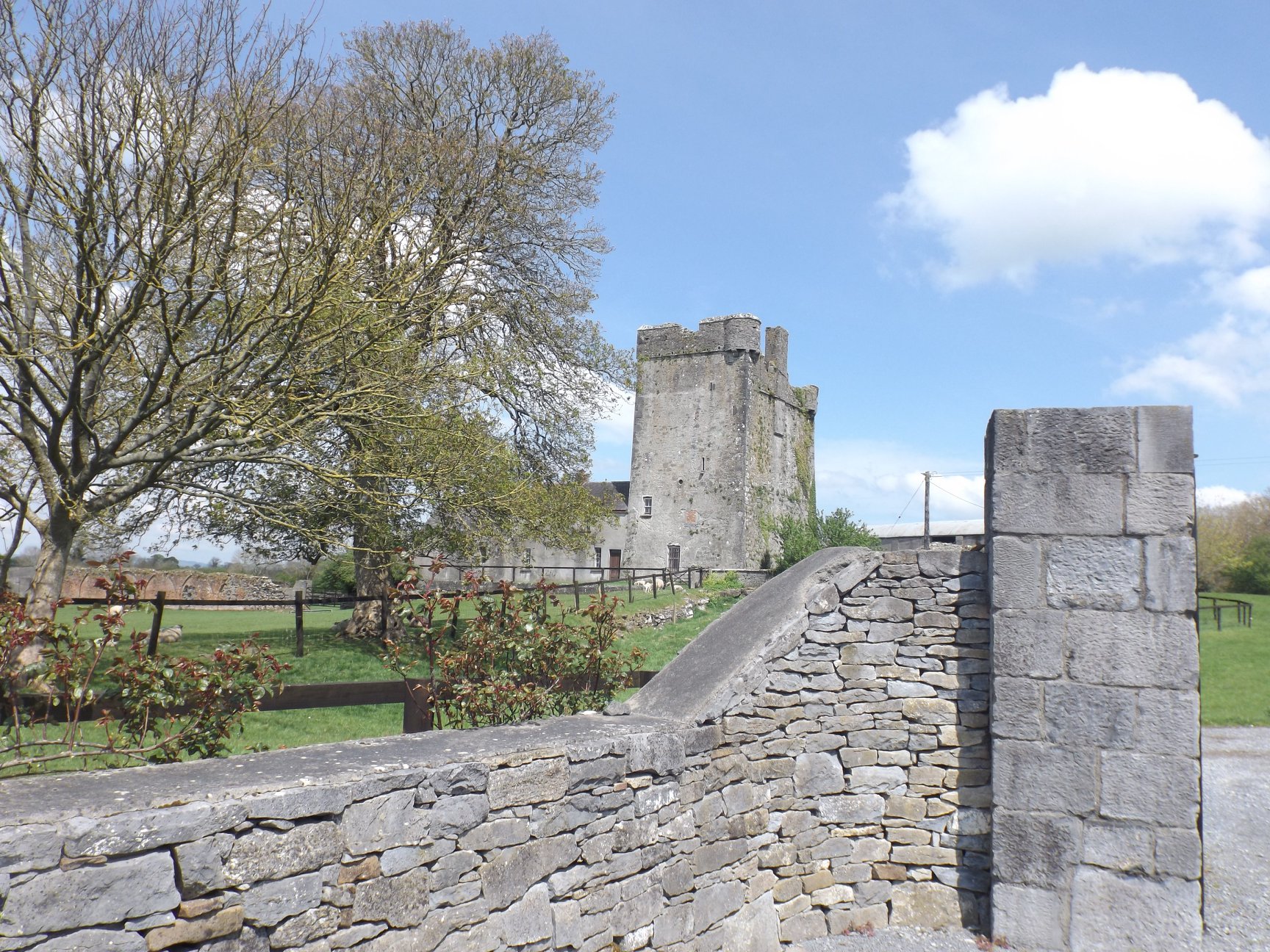
On the battlements of Ballybur Castle, Co Kilkenny, with Jim and Camilla Comerford, Jimmy Comerford and Frank Gray

When Camilla and Jim Comerford visited Ireland with their son Jimmy 14 years ago (May 2012), I hosted them on a genealogical tour that brought them to Christ Church Cathedral, Dublin and the Comerford ancestral home at Ballybur Castle at Cuffesgrange, near Callan, Co Kilkenny.

They had been in London and Oxford the previous week. On a warm sunny, early summer afternoon in Dublin, after a thorough tour of the cathedral and the crypt, we sat for an hour or more outside the Bull and Castle on Christchurch Place and had lengthy conversations that ranged from Handel to Pugin, liturgy to architecture, and through politics and music to travel and politics.

We were guests the next day of the late Frank Gray, who bought Ballybur Castle from the Marnell family for £20,000 in 1979 and spent over three decades lovingly restoring the 16th century tower house, bringing it back to its Tudor glory.

In Cuffesgrange, I showed them the remains of a Comerford memorial from the early 17th century, rescued in the 19th century by Bishop Michael Comerford and placed in the corner wall of the parish church. Back in Kilkenny, we visited Kilkenny Castle, had lunch in the Kilkenny Design Centre, and met members of Camilla’s extended family.

Jim Comerford died on 21 April 2024 after a six-year battle with cancer. He is survived by his wife of 36 years, Camilla (Corrigan), their sons James ‘Jimmy’ Dower Comerford Jr and Joseph ‘Joey’ Corrigan Comerford of Atlanta, their daughter Margaret ‘Margeaux’ Eileen Comerford of Seattle, and their granddaughter Abigail Genevieve. His funeral Mass took place in the Cathedral of Christ the King, Atlanta, on 24 April 2024, and he was buried at Arlington Memorial Park.

Jim and Jimmy Comerford visiting the baptistery in Christ Church Cathedral, Dublin, in 2012 (Photograph: Patick Comerford)

14 November 2025

Daily prayer in the Kingdom Season:
14, Friday 14 November 2025

‘On that day, anyone on the housetop who has belongings in the house must not come down to take them away’ (Luke 17: 31) … the rooftops of Saint Mark’s Basilica and Venice (Photograph: Patrick Comerford)

Patrick Comerford

We are in the Kingdom Season, the time between All Saints and Advent, and this week began with the Third Sunday before Advent, which was also Remembrance Sunday. The Calendar of the Church of England in Common Worship today (14 November) remembers Samuel Seabury (1729-1796), the first Anglican Bishop in North America.

Before today begins, I am taking some quiet time early this morning to give thanks, and for reflection, prayer and reading in these ways:

1, today’s Gospel reading;

2, a short reflection;

3, a prayer from the USPG prayer diary;

4, the Collects and Post-Communion prayer of the day.

‘Likewise anyone in the field must not turn back’ (Luke 17: 31) … winter fields along Cross in Hand Lane, Lichfield (Photograph: Patrick Comerford, 2025)

Luke 17: 26-37 (NRSVA):

[Jesus said:] 26 ‘Just as it was in the days of Noah, so too it will be in the days of the Son of Man. 27 They were eating and drinking, and marrying and being given in marriage, until the day Noah entered the ark, and the flood came and destroyed all of them. 28 Likewise, just as it was in the days of Lot: they were eating and drinking, buying and selling, planting and building, 29 but on the day that Lot left Sodom, it rained fire and sulphur from heaven and destroyed all of them 30 – it will be like that on the day that the Son of Man is revealed. 31 On that day, anyone on the housetop who has belongings in the house must not come down to take them away; and likewise anyone in the field must not turn back. 32 Remember Lot’s wife. 33 Those who try to make their life secure will lose it, but those who lose their life will keep it. 34 I tell you, on that night there will be two in one bed; one will be taken and the other left. 35 There will be two women grinding meal together; one will be taken and the other left.’ 37 Then they asked him, ‘Where, Lord?’ He said to them, ‘Where the corpse is, there the vultures will gather.’

‘Just as it was in the days of Noah, so too it will be in the days of the Son of Man’ (Luke 17: 26) … ‘Noah and the Dove’ (2006), a sculpture by Simon Manby in the courtyard of Saint John’s Hospital, Lichfield (Photograph: Patrick Comerford)

Today’s reflection:

The Gospel reading at the Eucharist today (Luke 17: 26-37) is one of the stories about preparing for the kingdom of God and the arrival of the Son of God on earth, not only as the incarnate Christ Child at Christmas in nativity story or in a decorative crib, but also as Christ the King.

As we prepare for the Feast of Christ the King in nine days’ time (Sunday 23 November 2025) and for Advent, we should expect many of our readings to have apocalyptic themes, looking forward to that Coming of Christ the King at his second coming.

The apocalyptic images in today’s Gospel reading anticipate some of these themes, looking back at unexpected terrors in the past and with apocalyptic warnings about what the future may hold.

TS Eliot’s poem East Coker, the second of his Four Quartets, is set in late November and ends:

In my end is my beginning.

But it opens:

In my beginning is my end.

The radical author, professor, preacher and peace activist, the Revd Robin Meyers, once described by the late Archbishop Desmond Tutu as ‘scholarly, pastoral, prophetic, and eloquent,’ has written: ‘Life itself passes daily judgment on the idea that [God is in control], that good deeds and righteous living exempt us from mindless tragedy, or that the meek will inherit anything other than a crushing debt and a dead planet.’

But in a sermon some years ago in the First [Congregational] Church in Harvard Square, Cambridge, Massachusetts, on the First Sunday of Advent, his former colleague, the church historian, the Revd Dr J Mary Luti of Andover Newton Theological School, responded: ‘Nonetheless, and hoping against hope, today’s scriptures emphatically encourage us to stand firm, to refuse to throw in the towel. God really is in charge, they assert, and one day you won’t have to take that on faith.’

She says: ‘Advent intends to make a pre-emptive strike on despair as the Church sets out on another year of following Christ from manger to grave, and beyond.’

As we approach Advent, we find ourselves in a unique position, standing both at the beginning and at the end, at the turning–point of the liturgical year. This peculiar experience of living within a paradox is a characteristic of the Christian faith. However, perhaps the greatest paradox of Advent, we shall find, is the tension between the joyous anticipation of the birth of Jesus and the inevitability of the cross.

In a true sense, Advent does not end at Christmas. The nativity, the Incarnation, cannot be separated from the crucifixion, the Atonement and the Resurrection. The purpose of Christ’s coming into the world, of the ‘Word made flesh’ and dwelling among us, is to reveal God and his grace to the world through Jesus’ life and teaching, but also through his suffering, death, and resurrection.

So, at the beginning of things, we think about the end of things. The Gospel reading today reflects this emphasis on Christ’s second coming and include themes of accountability, judgment, but also prompts us to renew our hope of eternal life. In the words of TS Eliot,

What we call the beginning is often the end
and to make an end is to make a beginning.
The end is where we start from
. (TS Eliot, Little Gidding)

‘I tell you, on that night there will be two in one bed; one will be taken and the other left’ (Luke 17: 34) … a corner bedroom in Ballybur Castle, once the home of the Comerford family in Co Kilkenny (Photograph: Patrick Comerford)

Today’s Prayers (Friday 14 November 2025):

Samuel Seabury, who is remembered in the church calendar in Common Worship today (14 November), was born in Connecticut in 1729 and, after graduating from Yale, was ordained priest in England and assigned by SPG (the Society for the Propagation of the Gospel, now USPG) to a church in New Brunswick, in New Jersey.

During the American War of Independence, he was a chaplain in the British army. After the war, at a meeting of the clergy in Connecticut, he was chosen to seek consecration as bishop. However, after a year of fruitless negotiations with the Church of England, he was ordained bishop by the nonjuring bishops in the Scottish Episcopal Church on 14 November 1784.

Returning to America, he held his first Convention in Connecticut in August 1785 and the first General Convention of the Episcopal Church in 1789. The church adopted a version of the Scottish Eucharist. Samuel Seabury died on 25 February 1796.

The theme this week (9 to 15 November) in Pray with the World Church, the prayer diary of the Anglican mission agency USPG (United Society Partners in the Gospel), is ‘Hope for the Future’ (pp 54-55). This theme was introduced on Sunday with Reflections from Laura D’Henin-Ivers, Chief Executive Officer at Hope for the Future, to mark COP30 in Brazil this week.

The USPG Prayer Diary today (Friday 14 November 2025) invites us to pray:

God of wisdom, we pray for those in positions of authority making decisions at COP30 and beyond. May their hearts attune to the cries of the earth and its people. May they pursue policies that protect the most vulnerable and honour the integrity of creation.

The Collect:

Almighty Father,
whose will is to restore all things
in your beloved Son, the King of all:
govern the hearts and minds of those in authority,
and bring the families of the nations,
divided and torn apart by the ravages of sin,
to be subject to his just and gentle rule;
who is alive and reigns with you,
in the unity of the Holy Spirit,
one God, now and for ever.

Post Communion Prayer:

God of peace,
whose Son Jesus Christ proclaimed the kingdom
and restored the broken to wholeness of life:
look with compassion on the anguish of the world,
and by your healing power
make whole both people and nations;
through our Lord and Saviour Jesus Christ.

Additional Collect:

God, our refuge and strength,
bring near the day when wars shall cease
and poverty and pain shall end,
that earth may know the peace of heaven
through Jesus Christ our Lord.

Yesterday’s Reflections

Continued Tomorrow

Samuel Seabury in a stained-glass window in Saint Giles Church, Cambridge … he is remembered in Common Worship on 14 November (Photograph: Patrick Comerford)

Scripture quotations are from the New Revised Standard Version Bible: Anglicised Edition copyright © 1989, 1995 National Council of the Churches of Christ in the United States of America. Used by permission. All rights reserved worldwide. http://nrsvbibles.org

10 October 2025

Daily prayer in Ordinary Time 2025:
151, Friday 10 October 2025

‘If it is by the finger of God that I cast out the demons, then the kingdom of God has come to you’ (Luke 11: 20) … the finger of God touches Adam in Michelangelo’s ceiling in the Sistine Chapel (1508-1512)

Patrick Comerford

We are continuing in Ordinary Time in the Church Calendar, with the Sixteenth Sunday after Trinity (Trinity XVI, 5 October).

The calendar of the Church of England in Common Worship today remembers Saint Paulinus (644), Bishop of York, Missionary, and Thomas Traherne (1636-1674), Poet and Spiritual Writer.

Before today begins, I am taking some quiet time this morning to give thanks, and for reflection, prayer and reading in these ways:

1, today’s Gospel reading;

2, a reflection on the Gospel reading;

3, a prayer from the USPG prayer diary;

4, the Collects and Post-Communion prayer of the day.

‘He casts out demons by Beelzebul, the ruler of the demons’ (Luke 11: 15) … a gargoyle at Lichfield Cathedral (Photograph: Patrick Comerford)

Luke 11: 15-26 (NRSVA):

15 But some of them said, ‘He casts out demons by Beelzebul, the ruler of the demons.’ 16 Others, to test him, kept demanding from him a sign from heaven. 17 But he knew what they were thinking and said to them, ‘Every kingdom divided against itself becomes a desert, and house falls on house. 18 If Satan also is divided against himself, how will his kingdom stand? – for you say that I cast out the demons by Beelzebul. 19 Now if I cast out the demons by Beelzebul, by whom do your exorcists cast them out? Therefore they will be your judges. 20 But if it is by the finger of God that I cast out the demons, then the kingdom of God has come to you. 21 When a strong man, fully armed, guards his castle, his property is safe. 22 But when one stronger than he attacks him and overpowers him, he takes away his armour in which he trusted and divides his plunder. 23 Whoever is not with me is against me, and whoever does not gather with me scatters.

24 ‘When the unclean spirit has gone out of a person, it wanders through waterless regions looking for a resting-place, but not finding any, it says, “I will return to my house from which I came.” 25 When it comes, it finds it swept and put in order. 26 Then it goes and brings seven other spirits more evil than itself, and they enter and live there; and the last state of that person is worse than the first.’

‘When a strong man, fully armed, guards his castle, his property is safe’ (Luke 11: 21) … Ballybur Castle, the former seat of the Comerford family near Callan, Co Kilkenny (Photograph: Patrick Comerford)

Today’s reflection:

In this morning’s Gospel reading, Christ is challenged about whether his work is the work of God or the work of the Devil.

Too often, when I am offered the opportunity to do the right thing, to make a difference in this society, in this world, I ask: ‘What’s in this for me?’ And how often do I challenge others when they are doing the right thing, questioning their motives and wondering ‘Wat’s in it for them?’

When I am asked to speak up for those who are marginalised or oppressed, this should be good enough reason in itself. But then I wonder how others are going to react – react not to the marginalised or oppressed, but to me, and then jealous or feeling hubris when others are seeing to do the right thing when I failed to respond?

How often have I seen what is the right thing to do, but have found an excuse that I pretend is not of my own making?

How often do I think of doing the right thing only if it is going to please my family members or please my neighbours?

How often do I use the Bible to justify not extending civil rights to others?

How often do I use the Bible to condemn others when I know, deep down, that they are doing the right thing for other people?

How often do I use obscure Bible texts to prop up my own prejudices, forgetting that any text in the Bible, however clear or obscure it may be, depends, in Christ’s own words, on the two greatest commandments, to love God and to love one another.

We can convince ourselves that we are doing the right thing when we are doing it for the wrong reason. A wrong decision taken once, thinking it is doing the right thing, but for the wrong reason, is not just an action in the present moment. It forms habits and it shapes who we are, within time and eternity.

The Revd Martin Niemöller (1892-1984), a prominent German Lutheran pastor and an outspoken opponent of Hitler, spent the last seven years of Nazi rule in concentration camps. He once said:

First they came for the socialists, and I did not speak out –
Because I was not a socialist.
Then they came for the trade unionists, and I did not speak out –
Because I was not a trade unionist.
Then they came for the Jews, and I did not speak out –
Because I was not a Jew.
Then they came for me – and there was no one left to speak for me.


What we do today or fail to do today, even if we think it is the right thing to do but we do it for the wrong reasons, reflects how we have formed ourselves habitually in the past, is an image of our inner being in the present, and has consequences for the future we wish to shape.

As TS Eliot writes:

Time present and time past
Are both perhaps present in time future
And time future contained in time past
(‘Burnt Norton’).

How is the Church to recover its voice and speak up for the oppressed and the marginalised, not because it is fashionable or politically correct today, but because it is the right thing to do today and for the future?

Surely all our actions must depend on those two great commandments – to love God and to love one another.

‘Now if I cast out the demons by Beelzebul, by whom do your exorcists cast them out?’ (Luke 11: 19) … an image at La Lonja de la Seda in Valencia (Photograph: Patrick Comerford)

Today’s Prayers (Friday 10 October 2025):

The theme this week (5 to 11 October) in Pray with the World Church, the prayer diary of the Anglican mission agency USPG (United Society Partners in the Gospel), is ‘Disability inclusion in Zimbabwe’ (pp 44-45). This theme was introduced on Sunday with Reflections from Makomborero Bowa, Lecturer in the Department of Philosophy Religion and Ethics in the University of Zimbabwe.

The USPG Prayer Diary today (Friday 10 2025) invites us to pray:

Thank you, Lord Jesus, for the way you perfectly modelled care and compassion.

The Collect:

God our Saviour,
who sent Paulinus to preach and to baptize,
and so to build up your Church in this land:
grant that, inspired by his example,
we may tell all the world of your truth,
that with him we may receive the reward
you prepare for all your faithful servants;
through Jesus Christ your Son our Lord,
who is alive and reigns with you,
in the unity of the Holy Spirit,
one God, now and for ever.

The Post Communion Prayer:

Holy Father,
who gathered us here around the table of your Son
to share this meal with the whole household of God:
in that new world where you reveal
the fullness of your peace,
gather people of every race and language
to share with Paulinus and all your saints
in the eternal banquet of Jesus Christ our Lord.

Yesterday’s Reflections

Continued Tomorrow

‘Time present and time past / Are both perhaps present in time future / And time future contained in time past’ (TS Eliot, ‘Burnt Norton’) … the clock on Donegall House in Lichfield (Photograph: Patrick Comerford)

Scripture quotations are from the New Revised Standard Version Bible: Anglicised Edition copyright © 1989, 1995 National Council of the Churches of Christ in the United States of America. Used by permission. All rights reserved worldwide. http://nrsvbibles.org

27 May 2025

Kilbline Castle, near
Bennetsbridge, built
in the 16th century by
the Comerford family

Kilbline Castle, near Bennettsbridge, Co Kilkenny … built by the Comerford family ca 1539, but confiscated in the 1560s (Photograph © The Irish Antiquarian, 2020)

Patrick Comerford

On a recent question on the Facebook group Comerford Genealogy, after I posted an up-to-date photograph, one member asked: ‘Weren't there initially 4 owned by the Comerford family? Ballybur, Inchohologan, Danganmore, and Kilbline’.

I thought it would be interesting to start a new, occasional series on the castles and ancestral homes of the Comerford family, beginning with the story of Kilbline Castle, Co Kilkenny, although, when this is migrated to the Comerford Genealogy site, it shall eventually become No 4 in the series.

Kilbline Castle is a fortified 16th century tower house in Co Kilkenny. It is set on the Kilbline Estate in the parish of Tullaherin, in the Barony of Gowran, about a mile south-east of Bennettsbridge.

The historian of the Diocese of Ossory, Canon William Carrigan, suggested the name of Kilbline came from Saint Blaan, an early seventh century Irish saint and the first bishop of the See of Dunblane in Scotland.

Kilbline Castle is a typical example of the tower houses that are distinctive features of the Irish landscape. It is estimated that about 3,000 tower houses were built in Ireland between 1400 and 1650. Kilbline Castle is sometimes dated to the 14th or 15th centuries, while other sources say the castle was built in 1539 and was originally owned by the Comerford family.

If the castle was first built by the Comerford family in 1539, then the most likely original proprietor was James Quemerford or Comerford (ca 1493 – post 1560) of Ballymack, Co Kilkenny, a younger brother of Richard ‘Roe’ Comerford, ancestor of the Comerford family of Ballybur.

James Comerford was Attorney for the Earl of Ormond in counties Kilkenny, Wexford, Carlow and Tipperary, from 1531. He was presented with his brother Richard ‘Roe’ Quemerford of Ballybur and the rest of the gentry of Co Kilkenny in 1537 for ‘charging of coyne and livery’.

He was in possession of Ballymartown in 1543, and held Ballymack, immediately south of Ballybur, and halfway between Kilkenny and Callan. On 26 March 1549, he was pardoned along with his brothers, Richard Comerford of Ballybur, and Patrick Quemerford and Nicholas Quemerford, who were living at Ballymack.

James Comerford was the Queen’s Attorney for Waterford in 1558, and the Sheriff of Co Kilkenny in 1549, 1555-1559, and was killed in office. Elizabeth I’s letter to Perrot in January 1585 implies he had been attainted for rebellion, but this may be a mistake for his elder son, Thomas Quemerford (ca 1523-ca 1583).

Thomas Comerford inherited both Ballymack and Kilbline Castle from his father James Comerford ca 1560. In 1566, he had a commission with his cousin, Richard ‘Oge’ Comerford of Ballybur Castle, and others to make war on Piers Grace. However, Thomas Comerford was attainted soon after, and he lost Ballymack briefly to Patrick Sherlock of Waterford, who also acquired Mothel Abbey, near Carrick-on-Suir, and also lost the townland of Kilbline.

Thomas Comerford, who was to become known as a ‘perpetual rebel and traitor,’ was pardoned on 1 March 1569. However, that summer he joined the first Desmond rebellion led by James FitzMaurice FitzGerald. The rebellion lasted for two years, and Thomas Comerford was attainted again in 1571. All his lands were granted to John Prescott in 1575, but in 1580 they were granted to Francis Lovell, and this was confirmed in 1583.

Thomas Comerford married Margaret Cowley, but they had children and his claims and interests passed to his brother, Henry Quemerford or Comerford (ca 1525-1590) of Ballymack. Henry’s family managed to hold on to Ballymack for another century, but never recovered Kilbline Castle.

Henry Comerford’s descendants included: the Revd Thomas Comerford (ca 1596/1598-1635) of Ballymack, his grandson, who was Vicar of Attanagh and Vicar of The Rower, Co Kilkenny; Thomas Comerford (died ca 1627/1629), who is commemorated in Saint Mary’s Church, Callan, with a monument that includes the coat-of-arms of the Comberford family of Comberford, Staffordshire; Edward ‘Ned’ Comerford (ca 1600-(ca1660), MP for Callan; Major-General John Comerford (ca 1665-1725) of Madrid and Badajoz; Enrique Comerfort, Conde de Bryas; and Doña Josefa Eugenia Maria Francisca de Sales (‘Josefina’) de Comerford (1794-1865) of Barcelona and Seville, a femme fatale in the Spanish revolutionary politics of the 19th century.

Kilbline Castle was never recovered by the Comerford family after it was confiscated in the 1560s (Photograph © The Irish Antiquarian, 2020)

As for Kilbline Castle, it was never recovered by the Comerford family, and the subsequent owners were members of the Shortall family who also owned Rathardmore Castle, Co Kilkenny. A large limestone chimneypiece on the first floor carries the date 1580 so it is possible this is when the building was completed, after it had been lost by the Comerford family.

Thomas Shortall of Rathardmore died in 1628 and soon after his son and heir Peter Shortall moved to Kilbline Castle and lived there. His estates, extending to 1,500 acres, were forfeited by the Cromwellians in 1653 and his sons ordered to be sent to Connaught. After the restoration of Charles II in 1660, it is said, one of the sons of Peter Shortall seems to have returned to Kilbline.

William Candler, from Newcastle, Northumberland, was as a colonel in Cromwell’s army in Ireland in 1649-1653. He received grants of land in counties Wexford, Offaly (King’s County) and Kilkenny. His principal grants of land in Co Kilkenny included 620 acres in Dunamaggin Parish, 70 acres in Kilbeacon Parish, near Mullinavat, and Kilbline Castle. He and his wife, the widowed Anne Villiers, were the parents of two sons, and their youngest son, John Candler, lived at Kilbline.

William Candler’s second son, Thomas Candler, was an officer in the Williamite Wars in 1690-1691 and later lived at Callan Castle. He was the father of four sons, the youngest of whom Daniel who left Ireland with his wife Hannah ca 1735. They first moved to North Carolina before moving to Bedford, Virginia. Daniel died in 1765 and is buried in the Quaker cemetery at South River Meeting, near his home; Hanna lived to the age of 105, outliving her husband by 40 years – she died in 1800 and is buried with her husband. Their great, great, great-grandson was Asa Griggs Candler, who in 1888 bought the formula for Coca Cola.

Meanwhile, back in Ireland, William Candler’s two eldest sons were ordained in the Church of Ireland: the eldest, the Ven Henry Candler, became Archdeacon of Ossory; the second son, the Revd Dr William Candler, was Rector of Eirke, lived in Castlecomer and died in 1753. The third son, Thomas Candler, lived in Kilbline Castle until he died in 1740.

Kilbline Castle was owned by the Shortall, Cadler, Ryan and Lannon families (Photograph © The Irish Antiquarian, 2020)

Kilbline Castle continued to be occupied with a Ryan family living in the castle until 1840, before it passed by marriage into the Lannon family, who lived there until 1979. The castle remains in private ownership.

In many ways, Kilbline Castle is a typical Irish tower house. It is five storeys high, with round bartizans or wall-mounted turrets at each corner of the east front and a slender chimney-stack between them.

A chimney-piece in the tower is dated 1580 and there is an oak-panelled room on the south-east corner of the ground floor. However, the most significant feature of Kilbline Castle architecturally is a wonderful panelled room on the south-east corner of the ground floor, with oak that may date from the late 17th or early 18th century. All the wall panelling is intact and in remarkably good condition, although the ceiling is now covered in tongue-and-groove boards. The old chimneypiece is marred only by a shelf added at a later date.

The surrounding bawn wall survives in part, with early brick walls with blank arches. But some sections were demolished as late as the 20th century when modern farm sheds were being erected.

Kilbline Castle continued to be lived in up to a few decades ago. At some point, a two storey three-bay house was added at the west end of the tower house and a further single storey structure adjoining it.

The present owners do not live in the castle and it has been empty for some time, but they are aware of its importance. Although they have are no plans to restore the castle, the interior is said to be relatively intact and in remarkably good condition.

Kilbline Castle is a protected or listed structure with Kilkenny County Council. However, it is not open to or accessible to the public.

Kilbline Castle is about a mile south-east of Bennetsbridge, Co Kilkenny (Photograph © Irish Tower Houses, 2022)

Castles and Houses in this series:

1, Ballybur Castle, Cuffesgrange, Co Kilkenny

2, Ballymack, Co Kilkenny

3, Danganmore Castle, Co Kilkenny

4, Kilbline Castle, Co Kilkenny

5, Castleinch or Inchyolaghan, Co Kilkenny

6, Coolgreany House, near Castlewarren, Co Kilkenny

Kilbline Castle, near Bennettsbridge, Co Kilkenny, is a protected or listed structure but is not open to the public (Photograph: Paddy O’Shea, Irish Castles / Wikipedia CCL)

This illustrated essay was posted on Comerford Way (27 May 2025), and in the occasional series ‘Comerford castles and ancestral homes’ on Comerford Family History (backdated to 18 June 2009)

14 November 2024

Daily prayer in the Kingdom Season:
15, Friday 15 November 2024

‘Just as it was in the days of Noah, so too it will be in the days of the Son of Man’ (Luke 17: 26) … ‘Noah and the Dove’ (2006), a sculpture by Simon Manby in the courtyard of Saint John’s Hospital, Lichfield (Photograph: Patrick Comerford, 2024)

Patrick Comerford

We are in the Kingdom Season, the time between All Saints and Advent, and this week began with the Third Sunday before Advent, which was also Remembrance Sunday.

Before today begins, I am taking some quiet time early this morning to give thanks, and for reflection, prayer and reading in these ways:

1, today’s Gospel reading;

2, a short reflection;

3, a prayer from the USPG prayer diary;

4, the Collects and Post-Communion prayer of the day.

‘There will be two women grinding meal together (Luke 17: 35) … one of the millstones at Bradwell Windmill in Milton Keynes (Photograph: Patrick Comerford)

Luke 17: 26-37 (NRSVA):

[Jesus said:] 26 ‘Just as it was in the days of Noah, so too it will be in the days of the Son of Man. 27 They were eating and drinking, and marrying and being given in marriage, until the day Noah entered the ark, and the flood came and destroyed all of them. 28 Likewise, just as it was in the days of Lot: they were eating and drinking, buying and selling, planting and building, 29 but on the day that Lot left Sodom, it rained fire and sulphur from heaven and destroyed all of them 30 – it will be like that on the day that the Son of Man is revealed. 31 On that day, anyone on the housetop who has belongings in the house must not come down to take them away; and likewise anyone in the field must not turn back. 32 Remember Lot’s wife. 33 Those who try to make their life secure will lose it, but those who lose their life will keep it. 34 I tell you, on that night there will be two in one bed; one will be taken and the other left. 35 There will be two women grinding meal together; one will be taken and the other left.’ 37 Then they asked him, ‘Where, Lord?’ He said to them, ‘Where the corpse is, there the vultures will gather.’

‘Likewise anyone in the field must not turn back’ (Luke 17: 31) … harvest fields south of Lichfield (Photograph: Patrick Comerford, 2024)

Today’s reflection:

The Gospel reading at the Eucharist today (Luke 17: 26-37) is one of the stories about preparing for the kingdom of God and the arrival of the Son of God on earth, not only as the incarnate Christ Child at Christmas in nativity story or in a decorative crib, but also as Christ the King.

As we prepare for the Feast of Christ the King in nine days’ time (Sunday 24 November) and for Advent, we should expect many of our readings to have apocalyptic themes, looking forward to that Coming of Christ the King at his second coming.

The apocalyptic images in today’s Gospel reading anticipate some of these themes, looking back at unexpected terrors in the past and with apocalyptic warnings about what the future may hold.

TS Eliot’s poem East Coker, the second of his Four Quartets, is set in late November and ends:

In my end is my beginning.

But it opens:

In my beginning is my end.

The radical author, professor and preacher, the Revd Robin Meyers, once described by the late Archbishop Desmond Tutu as ‘scholarly, pastoral, prophetic, and eloquent,’ has written: ‘Life itself passes daily judgment on the idea that [God is in control], that good deeds and righteous living exempt us from mindless tragedy, or that the meek will inherit anything other than a crushing debt and a dead planet.’

But in a sermon some years ago in the First [Congregational] Church in Harvard Square, Cambridge, Massachusetts, on the First Sunday of Advent, his colleague, the church historian, the Revd Dr J Mary Luti, of Andover Newton Theological School, responded: ‘Nonetheless, and hoping against hope, today’s scriptures emphatically encourage us to stand firm, to refuse to throw in the towel. God really is in charge, they assert, and one day you won’t have to take that on faith.’

She says: ‘Advent intends to make a pre-emptive strike on despair as the Church sets out on another year of following Christ from manger to grave, and beyond.’

As we approach Advent, we find ourselves in a unique position, standing both at the beginning and at the end, at the turning–point of the liturgical year. This peculiar experience of living within a paradox is a characteristic of the Christian faith. However, perhaps the greatest paradox of Advent, we shall find, is the tension between the joyous anticipation of the birth of Jesus and the inevitability of the cross.

In a true sense, Advent does not end at Christmas. The nativity, the Incarnation, cannot be separated from the crucifixion, the Atonement and the Resurrection. The purpose of Christ’s coming into the world, of the ‘Word made flesh’ and dwelling among us, is to reveal God and his grace to the world through Jesus’ life and teaching, but also through his suffering, death, and resurrection.

So, at the beginning of things, we think about the end of things. The Gospel reading today reflects this emphasis on Christ’s second coming and include themes of accountability, judgment, but also prompts us to renew our hope of eternal life. In the words of TS Eliot,

What we call the beginning is often the end
and to make an end is to make a beginning.
The end is where we start from
. (TS Eliot, Little Gidding)

‘On that day, anyone on the housetop who has belongings in the house must not come down to take them away’ (Luke 17: 31) … the rooftops of Saint Mark’s Basilica and Venice (Photograph: Patrick Comerford)

Today’s Prayers (Friday 15 November 2024):

The theme this week in ‘Pray With the World Church’, the Prayer Diary of the Anglican mission agency USPG (United Society Partners in the Gospel), is ‘A Look at Education in the Church of the Province of Myanmar’. This theme was introduced on Sunday with a Programme Update by Nadia Sanchez, Regional Programme Coordinator, USPG.

The USPG Prayer Diary today (Friday 15 November 2024) invites us to pray:

We pray for clergy and lay people within churches who are always looking outward for ways in which they can serve those around them.

The Collect:

Almighty Father,
whose will is to restore all things
in your beloved Son, the King of all:
govern the hearts and minds of those in authority,
and bring the families of the nations,
divided and torn apart by the ravages of sin,
to be subject to his just and gentle rule;
who is alive and reigns with you,
in the unity of the Holy Spirit,
one God, now and for ever.

Post Communion Prayer:

God of peace,
whose Son Jesus Christ proclaimed the kingdom
and restored the broken to wholeness of life:
look with compassion on the anguish of the world,
and by your healing power
make whole both people and nations;
through our Lord and Saviour Jesus Christ.

Additional Collect:

God, our refuge and strength,
bring near the day when wars shall cease
and poverty and pain shall end,
that earth may know the peace of heaven
through Jesus Christ our Lord.

Yesterday’s Reflection

Continued Tomorrow

‘I tell you, on that night there will be two in one bed; one will be taken and the other left’ (Luke 17: 34) … a corner bedroom in Ballybur Castle, once the home of the Comerford family in Co Kilkenny (Photograph: Patrick Comerford)

Scripture quotations are from the New Revised Standard Version Bible: Anglicised Edition copyright © 1989, 1995 National Council of the Churches of Christ in the United States of America. Used by permission. All rights reserved worldwide. http://nrsvbibles.org

11 October 2024

Daily prayer in Ordinary Time 2024:
153, Friday 11 October 2024

‘If it is by the finger of God that I cast out the demons, then the kingdom of God has come to you’ (Luke 11: 20) … the finger of God touches Adam in Michelangelo’s ceiling in the Sistine Chapel (1508-1512)

Patrick Comerford

We are continuing in Ordinary Time in the Church Calendar, and the week began with the Nineteenth Sunday after Trinity (Trinity XIX).

The calendar of the Church of England in Common Worship today remembers Ethelburga (675), Abbess of Barking, and James the Deacon 7th century), companion of Paulinus.

In the Jewish calendar, Yom Kippur, the Day of Repentance, begins this evening, and I hope to attend the Kol Nidre service in Milton Keynes and District Reform Synagogue this evening. But, before today begins, I am taking some quiet time this morning to give thanks, and for reflection, prayer and reading in these ways:

1, today’s Gospel reading;

2, a reflection on the Gospel reading;

3, a prayer from the USPG prayer diary;

4, the Collects and Post-Communion prayer of the day.

‘He casts out demons by Beelzebul, the ruler of the demons’ (Luke 11: 15) … a gargoyle at Lichfield Cathedral (Photograph: Patrick Comerford)

Luke 11: 15-26 (NRSVA):

15 But some of them said, ‘He casts out demons by Beelzebul, the ruler of the demons.’ 16 Others, to test him, kept demanding from him a sign from heaven. 17 But he knew what they were thinking and said to them, ‘Every kingdom divided against itself becomes a desert, and house falls on house. 18 If Satan also is divided against himself, how will his kingdom stand? – for you say that I cast out the demons by Beelzebul. 19 Now if I cast out the demons by Beelzebul, by whom do your exorcists cast them out? Therefore they will be your judges. 20 But if it is by the finger of God that I cast out the demons, then the kingdom of God has come to you. 21 When a strong man, fully armed, guards his castle, his property is safe. 22 But when one stronger than he attacks him and overpowers him, he takes away his armour in which he trusted and divides his plunder. 23 Whoever is not with me is against me, and whoever does not gather with me scatters.

24 ‘When the unclean spirit has gone out of a person, it wanders through waterless regions looking for a resting-place, but not finding any, it says, “I will return to my house from which I came.” 25 When it comes, it finds it swept and put in order. 26 Then it goes and brings seven other spirits more evil than itself, and they enter and live there; and the last state of that person is worse than the first.’

‘When a strong man, fully armed, guards his castle, his property is safe’ (Luke 11: 21) … Ballybur Castle, the former seat of the Comerford family near Callan, Co Kilkenny (Photograph: Patrick Comerford)

Today’s reflection:

In this morning’s Gospel reading, Christ is challenged about whether his work is the work of God or the work of the Devil.

Too often, when I am offered the opportunity to do the right thing, to make a difference in this society, in this world, I ask: ‘What’s in this for me?’ And how often do I challenge others when they are doing the right thing, questioning their motives and wondering ‘Wat’s in it for them?’

When I am asked to speak up for those who are marginalised or oppressed, this should be good enough reason in itself. But then I wonder how others are going to react – react not to the marginalised or oppressed, but to me, and then jealous or feeling hubris when others are seeing to do the right thing when I failed to respond?

How often have I seen what is the right thing to do, but have found an excuse that I pretend is not of my own making?

How often do I think of doing the right thing only if it is going to please my family members or please my neighbours?

How often do I use the Bible to justify not extending civil rights to others?

How often do I use the Bible to condemn others when I know, deep down, that they are doing the right thing for other people?

How often do I use obscure Bible texts to prop up my own prejudices, forgetting that any text in the Bible, however clear or obscure it may be, depends, in Christ’s own words, on the two greatest commandments, to love God and to love one another.

We can convince ourselves that we are doing the right thing when we are doing it for the wrong reason. A wrong decision taken once, thinking it is doing the right thing, but for the wrong reason, is not just an action in the present moment. It forms habits and it shapes who we are, within time and eternity.

The Revd Martin Niemöller (1892-1984), a prominent German Lutheran pastor and an outspoken opponent of Hitler, spent the last seven years of Nazi rule in concentration camps. He once said:

First they came for the socialists, and I did not speak out –
Because I was not a socialist.
Then they came for the trade unionists, and I did not speak out –
Because I was not a trade unionist.
Then they came for the Jews, and I did not speak out –
Because I was not a Jew.
Then they came for me – and there was no one left to speak for me.


What we do today or fail to do today, even if we think it is the right thing to do but we do it for the wrong reasons, reflects how we have formed ourselves habitually in the past, is an image of our inner being in the present, and has consequences for the future we wish to shape.

As TS Eliot writes:

Time present and time past
Are both perhaps present in time future
And time future contained in time past
(‘Burnt Norton’).

How is the Church to recover its voice and speak up for the oppressed and the marginalised, not because it is fashionable or politically correct today, but because it is the right thing to do today and for the future?

Surely all our actions must depend on those two great commandments – to love God and to love one another.

‘Now if I cast out the demons by Beelzebul, by whom do your exorcists cast them out?’ (Luke 11: 19) … an image at La Lonja de la Seda in Valencia (Photograph: Patrick Comerford)

Today’s Prayers (Friday 11 October 2024):

The theme this week in ‘Pray With the World Church’, the Prayer Diary of the Anglican mission agency USPG (United Society Partners in the Gospel), is the ‘Humanitarian Corridors project in Leuven, Belgium.’ This theme was introduced on Sunday with a programme update by Rebecca Breekveldt, Second Secretary, Central Committee of the Anglican Church in Belgium.

The USPG Prayer Diary today (Friday 11 October 2024) invites us to pray:

We pray for all of the chaplains throughout the Diocese in Europe and for all the projects and work they do to support displaced people.

The Collect:

O God, forasmuch as without you
we are not able to please you;
mercifully grant that your Holy Spirit
may in all things direct and rule our hearts;
through Jesus Christ your Son our Lord,
who is alive and reigns with you,
in the unity of the Holy Spirit,
one God, now and for ever.

The Post Communion Prayer:

Holy and blessed God,
you have fed us with the body and blood of your Son
and filled us with your Holy Spirit:
may we honour you,
not only with our lips
but in lives dedicated to the service
of Jesus Christ our Lord.

Additional Collect:

Faithful Lord,
whose steadfast love never ceases
and whose mercies never come to an end:
grant us the grace to trust you
and to receive the gifts of your love,
new every morning,
in Jesus Christ our Lord.

Yesterday’s reflection

Continued tomorrow

‘Time present and time past / Are both perhaps present in time future / And time future contained in time past’ (TS Eliot, ‘Burnt Norton’) … the clock on Donegall House in Lichfield (Photograph: Patrick Comerford, 2024)

Scripture quotations are from the New Revised Standard Version Bible: Anglicised Edition copyright © 1989, 1995 National Council of the Churches of Christ in the United States of America. Used by permission. All rights reserved worldwide. http://nrsvbibles.org

08 October 2022

DNA research is providing new
challenges to the myths, legends
and past approaches to genealogy

The ‘Journal of the Fitzpatrick Clan Society’ (2021) … Dr Mike Fitzpatrick challenges some myths and legends of the origins of the Brennan families

Patrick Comerford

It is always interesting, in academic terms, to see how other historians and genealogists carry out their research and check their sources. And – setting aside personal vanity – it is always rewarding, in an academic terms, to see how my own research is referenced by other researchers in their papers.

In recent days, my attention has been drawn to ‘The Similar-Sounding Surnames of Haplogroup R-BY140757,’ a paper last year by Dr Mike Fitzpatrick of the University of Auckland, and published in the Journal of the Fitzpatrick Clan Society 2 (2021), pp 1-41.

Y-DNA analysis is a remarkable method that can inform patrilineal genealogies, both ancient, and modern. Applied here to facilitate a critical review of Branan pedigrees, an analysis of haplogroup R-BY140757 results in a deep questioning of the dominant narratives of the O’Braonáin Uí Dhuach (O’Brenan of Idough). What results is a disruption of those narratives that is total.

The O’Braonáin Uí Dhuach were long said by historians of Ossory to share descent from Cearbhall, King of Ossory (843-888 AD). However, the ultimate genealogical authority of Dubhaltach Mac Fhirbhisigh led to the argument that these families are not of Ossory descent, but are an Uí Failghi tribe.

As he set out on his research, Mike Fitzpatrick realised than Y-DNA connections between Branans, or those with similar-sounding surnames such as Brennan, and other connected families, are a false trail for those who claim descent from Cearbhall.

Once Mac Fhirbhisigh is embraced, he found, and the erroneous pedigrees of the O’Braonáin Uí Dhuach are set aside, the origins of men with the name Branan, and similar-sounding surnames, of haplogroup R-BY140757, can be correctly determined.

With an analysis of Y-DNA haplotype research, Dr Fitzpatrick has concluded the origins of these families are not with the O’Braonáin of Uí Dhuach, or any Irish clan. ‘Rather, haplotype R-BY140757 appears to have originated from a family who settled near Braham, in Suffolk, after the Norman conquest of England.’

He identifies the key figure in the appearance of R-BY140757 pedigrees in Ireland as Sir Robert de Braham, who was Sheriff of Kilkenny ca 1250.

Genealogists constantly face a battle of the brains with families who continue to prefer to perpetuate myths about family origins, repeated and retold over the generations and down through time, instead of accepting research that uses the accepted tools of modern historical research that demands primary sources and refuses to accept past genealogical constructs that satisfied the vanities of family members in the past.

All genealogists working on the stories of families know the pitfalls of accepting the family trees and pedigrees confirmed in the past by the Ulster Office of Arms or repeated uncritically by John O’Hart and even in volumes such as Burke’s Peerage and Burke’s Landed Gentry.

Although I have constantly produced evidence for the origins of the Comerford family in Co Kilkenny and south-east Ireland, the old tales keep being peddled on many websites that rely on a ‘copy-and-past’ approach rather than genuine historical research as they sell their cheap name books and tardy mass-produced coats of arms and so-called heraldic scrolls.

In my research, I have had to cast a critical eye on the research and work of even more recent historians, including Canon William Carrigan, despite his often-painstaking work in compiling his four-volume History of the Diocese of Ossory, published in 1905.

Mike Fitzpatrick’s research came to my attention recently because he refers to an earlier paper in 2005 in which I drew attention to the way Carrigan avoided a critical approach to the lives of clergy in his diocese, including Edmund Comerford, Bishop of Ferns and Dean of Ossory, and his son, William Comerford, Dean of Ossory, who is described in many places as the bishop’s newphew rather than son.

Drawing on my paper, published as ‘The last pre-reformation Bishop of Ferns and his ‘nephew’, the Dean of Ossory,’ in the Journal of the Wexford Historical Society, 20 (2005), pp 156-172, Fitzpatrick concedes that Carrigan is ‘excellent in many respects,’ but agrees that he ‘was possibly also subject to conflicts of interest; he was a sidestepper of unbecoming acts by clergy.’

He also says Carrigan ‘avoided an exposition of the clerical lineages of Mac Giolla Phádraig Osraí,’ the FitzPatricks of Ossory, ‘which must have been known to him,’ although he concedes that ‘the suite of Papal records available to Carrigan was not as complete as it is today.’

Dr Fitzpatrick’s methodology and approach are important advances in genealogical research. In a paper this year, co-authored with Dan Fitzpatrick and Ian Fitzpatrick, he develops his scientific approaches to challenging traditional but myth-laden and fact-denying constructions of family trees and pedigrees.

Their latest paper, ‘Mac Giolla Phádraig Dál gCais: an ancient clan rediscovered,’ is published in the Journal of the Fitzpatrick Clan Society 2022 (3), pp 1-45.

They say that Y-DNA analysis of Fitzpatricks has turned traditional historical narratives of how the surname was taken on its head. ‘The attachment of the surname Fitzpatrick to the Barons of Upper Ossory, who were supposedly the descendants of Mac Giolla Phádraig Osraí and, in turn, of an ancient [Leinster] lineage, is no longer sustainable.’

They go on to say that ‘DNA insights and critical assessment of historical records have demonstrated that those who claim to descend from the barons [of Upper Ossory] have a Y-haplotype consistent with them emerging from a line of clerics out of a Norman-Irish origin ca 1200 AD.’

They say that questions now arise ‘regarding the origins of other large Fitzpatrick groups who, based on Y-DNA, can be shown to descend from ancient Irish.’ And they ask, ‘Could any of these lines descend from the Mac Giolla Phádraig Osraí of old, those of Annalistic fame?’

They question the origins of the Mac Giolla Phádraig or Fitzpatrick family that claimed an ancient lineage with origins in Ossory. They say their questions radically disrupt traditional narratives, point how ‘sound historical, genealogical, and name occurrence evidence supports the view’ that there is no need to adhere to a singular patrimony for the Mac Giolla Phádraig Osraí or Fitzpatricks of Ossory.

Instead, they show in their latest paper, the FitzPatricks of Ossory ‘are Dál gCais on a genetic basis since, via their paternal haplotype, they share common ancestry with Brian Bóruma, High King of Ireland.’

The descendants of those Mac Giolla Phádraig Dál gCais feature through ancient records for Co Clare and are still found in the county, yet, they suggest many derive from lines that were dispersed from their ancient Clare homelands in the 17th century.

From Co Clare to the Aran Islands, and Co Galway, and – one way or another – on to Mayo and Roscommon, ‘they are a great and ancient Mac Giolla Phádraig Clan,’ they say, ‘who at times held much wealth, power, and influence. And some were smugglers!’

Their work is a challenge to the way Irish genealogists have worked in the past, and is a pioneering approach to genealogical research in Ireland.

There are some interesting inter-marriages between the Comerford family of Ballybur and the FitzPatricks of Ossory. For example, Richard Comerford (1564-1637), of Ballybur Castle was the father of Ellinor Comerford, who married her second cousin, the Hon Dermot FitzPatrick, son of Thady FitzPatrick, 4th Baron Upper Ossory. Anne Langton, who married James Comerford of the Butterlsip, Kilkenny, was a half-sister of Mary Fitzpatrick, who also lived at the Butterslip.

But for some of the details of Ellinor Comerford and Dermot Fitzpatrick I have relied in the past on Carrigan, and the pedigrees of the FitzPatricks of Gowran and Upper Ossory in Burke’s Extinct Peerage and the Complete Peerage. I may have to revisit some of those sources in time.

The ‘Journal of the Fitzpatrick Clan Society’ (2022) … Dr Mike Fitzpatrick challenges some myths and legends of the origins of the FitzPatrick families of Upper Ossory

01 August 2021

The grave in Kilmallock
of the ‘last White Knight’
and a Comerford family link

When the last White Knight died in 1608, he was buried in the choir of the Dominican Priory in Kilmallock, Co Limerick (Photograph: Patrick Comerford, 2021)

Patrick Comerford

I recently joined an afternoon walking tour of the churches, castles and mediaeval walls of Kilmallock in Co Limerick. The mediaeval ruins of Kilmallock are so extensive that it has been described as ‘the Baalbek of Ireland.’

In the centre of the choir of the ruined Dominican priory church, I was pointed to the grave of Edmund Fitzgibbon, the last ‘White Knight,’ who died in 1608.

Edmund Fitzgibbon was the head of a branch of the FitzGerald dynasty and was known as the 11th White Knight. During his lifetime he fell in and out of favour with the Crown.

When the White Knight died at Castletown, Co Limerick, on 23 April 1608, he was buried in the choir of Saint Saviour’s Dominican Priory in Kilmallock. The top of his tomb is broken in two and there is a small hollow in the tomb, caused by dripping water.

The title of White Knight was one of three mediaeval hereditary knighthoods in branches of the FitzGerald family. The title was first conferred upon Maurice Fitzgibbon in the early 14th century.

There were other two similar titles in the Fitzgerald family. The title of Knight of Glin, also known as the ‘Black Knight,’ became dormant ten years ago after 700 years after the death of Desmond John Villiers FitzGerald, the 29th Knight of Glin, on 14 September 2011. The title of Knight of Kerry, also known as the ‘Green Knight,’ is held by Sir Adrian FitzGerald, 6th Baronet and 24th Knight of Kerry.

The grave of the last White Knight and his son in Kilmallock Priory (Photograph: Patrick Comerford, 2021)

The first White Knight, Maurice FitzGibbon, was knighted in the field by Edward III in 1333, immediately after the defeat of Scottish forces at the Battle of Halidon Hill. The family of the White Knight was regarded as the second branch of the FitzGerald dynasty, after the Earls of Desmond.

After Edmund Fitzgibbon, the 11th White Knight, died in 1608, his estates passed to his daughter Margery, contrary to the rules of descent in Ireland at the time. The male heir was David Fitzgibbon of Kilmore, but Edmund Fitzgibbon had made a special arrangement with the government as one of the conditions for capturing his kinsman, James FitzThomas FitzGerald, 16th Earl of Desmond, during the Desmond rebellion.

Much of Fitzgibbon’s military and political conduct was driven by his desire to recover his family’s properties in Munster. But he was regularly outwitted and betrayed by government officials. When he was arrested in 1587, Sir Anthony St Leger advised he should be made ‘shorter by the length of his head.’

Fitzgibbon became sheriff of Co Cork in 1596, and in this role he attacked and almost destroyed Saint Carthage’s Cathedral in Lismore, Co Waterford.

Doubts about his loyalty were raised at the height of the Desmond Rebellion, when he failed to capture the Súgan Earl of Desmond, James FitzThomas FitzGerald, as he passed through Fitzgibbon’s territory in May 1601.

The ‘Sugan’ Earl had gathered an 8,000-strong force and engaged in a three-year struggle. He took Desmond Hall and Castle in Newcastle West in 1598, but lost them the following year. In 1599, the Earl of Essex also brought to an end the 147-day siege of Askeaton Castle by the ‘Sugan’ Earl. After escaping from Kilmallock, he was finally captured by Fitzgibbon on 29 May 1601 while he was hiding in the caves near Mitchelstown.

FitzGerald was placed in irons and taken to Shandon Castle, where he was found guilty of treason. He was then brought to England, and he was made a prisoner in the Tower of London. Historians suggest he died sometime in 1608, and was buried in the chapel of the Tower.

His younger brother, John FitzThomas FitzGerald, fled to Spain in 1603 with his wife, a daughter of Richard Comerford of Danganmore, Co Kilkenny. In Spain, he was known as the Conde de Desmond, and he died a few years later in Barcelona, probably after 1615.

Meanwhile, Edmund Fitzgibbon was rewarded by the crown and parliament with the full restoration of his lands and title. Fitzgibbon was jailed in 1606 on suspicion of disloyalty, but was released when he promised to fight for the Crown.

King James I made him Baron of Clangibbon, but he died at Castletown, Co Limerick, on 23 April 1608, without statutory confirmation of his lands and titles. He died the day after the death of his son Maurice, and the two were buried together in the choir of the Dominican Priory church in Kilmallock.

The title of the White Knight then passed to Maurice’s son and Edmund’s grandson, Maurice Oge Fitzgibbon, as the 12th White Knight. But he never inherited what remained of the old Fitzgibbon estate, and instead the lands passed to Edmund’s daughter, Margaret. When Maurice Fitzgibbon, the 12th White Knight, died in 1611, he had no sons as immediate heirs, and so his grandfather Edmund Fitzgibbon is often known as the last White Knight.

A mediaeval monument in Kilmallock thought to mark the grave of an earlier White Knight (Photograph: Patrick Comerford, 2021)

George King (1771-1831), 3rd Earl of Kingston, tried to claim the title of the White Knight in 1821. He claimed the title through descent from Margaret (1602-1666), the granddaughter of Edmond Fitzgibbon, the 11th White Knight. But his claim was successfully contested and was refused by the crown.

The last known claimant to title of the White Knight was Maurice Fitzgibbon of Crohana, Kilkenny, who assumed the title in 1858. This Maurice Fitzgibbon was also a descendant of the Comerford family of Ballybur Castle, Co Kilkenny.

Richard Comerford ‘fitzThomas’ (1564-1637) was 24 when he inherited Ballybur Castle and other family estates in Co Kilkenny, following the death of father, Thomas Comerford, in 1589. He was also a first cousin of the Comerford from Danganmore who married the Sugan Earl’s younger brother, John FitzThomas FitzGerald, and fled into exile in Spain.

This Richard Comerford is reputed to be the builder of Ballybur Castle. In October 1601, he was a Justice of the Queen’s Bench, then the highest court in Ireland. He was also one of the figures involved in securing the title to of the Earls of Ormond to large tracts of land in Co Mayo, including Achill Island and Burrishoole.

Richard was married twice. His first wife, Joanna Sweetman, was the daughter of John Sweetman of Castle Eve, Co Kilkenny. They had no children, and Richard’s second wife Mary was a daughter of Thomas Purcell of Loughmoe and Crannagh Castle, Co Tipperary.

Richard and Mary Comerford were the parents of three sons and 11 daughters. Their eldest surviving son, John Comerford (1598-1667), who inherited Ballybur and the other family estates, and was the director ancestor of the Comerford family of Bunclody, Co Wexford.

The youngest surviving daughter of Richard and Mary Comerford, Ellen, married Theobald Butler of Rouskagh, Co Tipperary, and of Enniscorthy, Co Wexford, in 1640. Their children included a daughter Joanna who married David FitzGibbon, who was the Governor of Ardfinnan Castle, Co Tipperary, when Cromwell besieged Clonmel.

Joanna and David FitzGibbon were the direct ancestors of Maurice FitzGibbon (1818-1881), of Crohana, near Stoneyford, Co Kilkenny. He was born in Kilworth, Co Cork, and in 1858 he assumed the title of the White Knight.

Although the Kilkenny branch of the Fitzgibbon family has since died out, there is a still a Limerick branch with many members, and some members of the Fitzgibbon family of Limerick held the title of Earls of Clare from 1794 until 1864.

The remains of the cloisters in Kilmallock Priory (Photograph: Patrick Comerford, 2021)

18 July 2021

Revisiting Comerford family
houses and sites in Kilkenny

The Langton House in The Butterslip, Kilkenny, was home to at least three generations of the Comerford family (Photograph: Patrick Comerford, 2021)

Patrick Comerford

This summer’s ‘road trip’ arrived in Kilkenny earlier this month, and two of us stayed overnight in the River Court Hotel, overlooking the river, and beneath the walls of Kilkenny Castle.

Kilkenny is one of those places you have to peel me out of it, and I get lost easily in its streets and narrow alleys, wallowing in its rich mediaeval heritage, or browsing in the bookshops.

I can never resist revisiting sites in Kilkenny associated with the Comerford. This month, they included the Butterslip, where the Langton House was home to at least three generations of the Comerford family; the Canal beneath the castle ramparts, once the location of the Comerford and Murray enterprise that tried – and failed – to open up Kilkenny to commercial traffic at the end of the 18th century; and the peculiarly named ‘Hole in the Wall,’ now run by the colourful Dr Michael Conway.

The Langton House beside the Tholsel was built by Nicholas Langton in 1616 in Butterslip, which takes its name from the stalls of butter vendors that flanked this narrow lane on market days. The Butterslip ran underneath two houses, with its arched entry and stone steps along a narrow and dark walkway linking High Street and Saint Kieran’s Street, once known as Low Lane.

The dark and cool climate of the Butterslip was ideal for displaying butter in those days. Today, this is the most picturesque of Kilkenny’s many narrow medieval slips or corridors, lined with small shops, including a bookshop, a gift shop and a well-known sports shop, and the delightful Petronella restaurant.

Leading down into Saint Kieran Street, the limestone steps are imbued with a picturesque quality enhanced by inscribed patterns. This flight of 15 tooled cut-limestone steps date from the 1750s, around the time James Comerford and Anne Langton were married. These steps are arranged in groups of five (east), six (central) and four (west), with limestone flagged landings.

Nicholas Langton, Mayor of Kilkenny, built his townhouse in the Butterslip around 1606 (Photograph: Patrick Comerford, 2021)

Nicholas Langton (1562-1632), who built the house at the Butterslip as his Kilkenny townhouse, was the Sovereign (Mayor) of Kilkenny in 1606. He was sent to London to renegotiate the terms of Kilkenny’s Charter, resulting in the City Charter of 1609 that made Kilkenny a city with a mayor and aldermen. He was MP for Kilkenny (1613-1615) and Mayor of Kilkenny (1613).

When Nicholas died at his country house in Grenan, near Durrow, in 1632, his body was brought by boat from Thomastown to Kilkenny, and he was buried in the ‘great quire’ of Saint John’s Church, Kilkenny.

Nicholas Langton’s descendant, Silvester Langton (1680-1749), who inherited the Langton House in the Butterslip, married Mary Sexton, widow of Edmund Tobin – and this is where the Comerford family link comes in. Their daughter Anne Langton married James Comerford (1720-1808) in 1754, and the couple moved into the Langton House in the Butterslip.

A restored doorway at Petronella’s restaurant in The Butterslip (Photograph: Patrick Comerford, 2021)

James Comerford was the son of William Comerford (ca 1692-post 1765), a direct descendant of the Ballybur branch of the family. Barney Comerford says William and his father, Richard Comerford, lived at Coolgreany, Co Kilkenny; however, Prim and other authorities show William lived in Kilkenny City and he moved into the Langton House in the Butterslip soon after his son James married Anne Langton.

William’s grandson, Michael Comerford, later recalled how William took an oaken chest of title deeds with him to the Butterslip, and on sunny days would take them out and unfold them. Family members believed these were the title deeds to Ballybur Castle. After his death, they were inherited by his elder son James Comerford, but are believed to have been destroyed by James Comerford’s wife, Anne.

William Comerford was still living in the Butterslip some years after the birth of his grandson Michael Comerford in 1765. William’s other children included Edmund Comerford (1722-1788), ancestor of the Comerford family of Newtownbarry (Bunclody), Co Wexford.

James Comerford and Anne Langton were married by the Revd Patrick Molloy, Parish Priest of Saint Mary’s, Kilkenny, on 27 November 1754. After their marriage, James and Anne lived in the Langton House in The Butterslip and continued her father’s business. Until at least 1773, James and Anne Comerford continued to update her father’s pocketbook with details of family births, baptisms, marriages and deaths.

Other members of the extended family who lived with James and Anne Comerford at The Butterslip, included Anne’s half-sister, Mary Fitzpatrick, and her first cousin, Margaret Langton, who died in the house of a ‘dropsical complaint’ on 15 February 1774, aged 52. Margaret’s brother, John Langton, who died of the smallpox at the age of two in 1717, was a godson of Catherine (Comerford) Nagle, sister of Joseph Comerford, Marquis d’Anglure.

The Canal Walk stretches below the walls of Kilkenny Castle (Photograph: Patrick Comerford, 2021)

James Comerford also formed the partnership of Comerford and Murray with his brother-in-law, Emmanuel Murray (1734-1802), who had married Anne’s sister, Eleanor Langton (1734-1772). Comerford and Murray loaded the first and only boat to navigate the Kilkenny Canal from the tidewater to the city, and the vessel discharged its cargo at New Quay.

The failure, despite many efforts – including those of Comerford and Murray – to build a canal that would make the city accessible from the sea had an enduring impact on Kilkenny. It led to the development of rival marketplaces, notably Bagenalstown, Co Carlow, on the River Barrow, and Clonmel, Co Tipperary, on the River Suir. By the late 1840s, when the railways arrived, most of Kilkenny’s industries were in decline.

In 1771 or 1772, as ‘Mr James Commerford,’ he subscribed £5.13.9 towards building a new church on the site of the present Saint Mary’s Cathedral, Kilkenny.

On 7 December 1775, James Comerford took the Test Oath along with Walter Butler, de jure 16th Earl of Ormond, the Revd Patrick Molloy of Saint Mary’s, and other leading Roman Catholic citizens at the Tholsel in Kilkenny.

James and Anne were painted by the Kilkenny-born miniaturist, John Comerford (1770-1832), when he was their guest in the Butterslip in 1794, and they were painted by him again in 1797 and 1808.

James died shortly after that third portrait was painted in 1808, and his will, as the will of James Cummerford of Knockanure, near Newtownbarry (Bunclody), Co Wexford, went to probate in Ferns Diocesan Court in 1809.

The disused canal in Kilkenny … Comerford and Murray loaded the first and only boat that navigated the Kilkenny Canal (Photograph: Patrick Comerford, 2021)

James and Anne (Langton) Comerford were the parents of 17 children. Their fifth child, Michael Comerford (1764-1851) of King Street, was seven when he saw the removal of the Market Cross in High Street, Kilkenny. He rented the Langton house in the Butterslip from his mother’s brother, Michael Langton of Danville. Prim records the people around Ballybur ‘always looked upon’ him as ‘the lineal representative’ of the Comerfords of Ballybur Castle.

Michael Comerford died unmarried on 20 April 1851 and was buried in Saint Mary’s Churchyard, Kilkenny. His executor was the Kilkenny writer, Michael Banim (1796-1864). Michael Comerford was also an uncle of Jeremiah Scully of Freshford, who inherited the great Irish seal of Charles I from one of the Ballybur title deeds.

When Michael Comerford died in 1851, the Langton House in the Butterslip and the Comerford family portraits by John Comerford passed to his grand-nephew, Father Edmund Madden, who erected his gravestone.

The ‘Hole in the Wall’ stood on this site in Kilkenny … Judith Madden, the proprietor, was mother of Edmund Madden who married Jane Comerford in 1781 (Photograph: Patrick Comerford, 2021)

Jane Comerford, the eldest daughter of James and Anne (Langton) Comerford, was born in 1760, and she married Edmund Madden in Saint Mary’s (Church of Ireland) Church, Kilkenny in 1781. He was the son of Matthew and Judith Madden of High Street, and Judith Madden is said to have been the proprietor of the ‘Hole in the Wall.’

Their son, the Revd Edmund Madden (1818-1865), who was educated at the Sorbonne, Paris, was later a chaplain in Wales to Colonel John Francis Vaughan, father of Cardinal Herbert Vaughan (1832-1903), Archbishop of Westminster. Father Madden inherited the family portraits of James and Anne Comerford, and bought the Langton family interest in the Butterslip, Kilkenny. He died on 28 March 1865 and is buried in Kilkenny.

His brother, James Comerford Madden, inherited John Comerford’s portraits of James and Anne Comerford, and later moved to Kogarah, near Sydney.

The Langton house in the Butterslip was sold by the Madden family to the Wall family in 1866. The Langton and Comerford portraits were later inherited by descendants of the Madden family, Monsignor Robert F Hayburn of Saint Mary’s Cathedral, San Francisco, and his brother, Father Edmund Langton Hayburn (1916-2006), of Freemount, California, who presented copies of the Langton and Comerford portraits to the Kilkenny Archaeological Society.

Other descendants of James and Anne Comerford of the Butterslip include Father James Edmund Delany (1843-1901) of Carlow, Parish Priest of Rosenalis, Co Laois; Father Canice Bourke (1890-1969), a Capuchin friar; Elizabeth O’Rourke who married John Buggy, of High Street, who became the first Roman Catholic Mayor of Kilkenny in 1867; and the Manning family who founded Manning’s travel agency in Kilkenny.

The Butterslip retains much of its charm since it was built 400 years ago (Photograph: Patrick Comerford, 2021)