The Headington Shark is a sculpture of a large shark embedded head-first in the roof of a terraced house at 2 New High Street (Photograph: Patrick Comerford, 2026)
Patrick Comerford
Headington is a suburb in east Oxford, at the top of Headington Hill overlooking the city in the Thames valley below, with Marston to the north-west, Cowley to the south, and Barton and Risinghurst to the east. When I first visited Oxford in my teens, around 1969 or 1970, I stayed in Headington at the youth hostel in Cowley House on Jack Straw’s Lane, which closed in 2001.
I have been through Headington many times in recent years, on my way to and from the hospitals. But an appointment earlier this week at John Radcliffe Hospital and a follow-up visitlater in the week, offered opportunities and time to walk around Headington, and to see the ‘Headington Shark’, the area’s most celebrated landmark and an anti-war protest. There was time too to see Saint Andrew’s Church, Holy Trinity Church and some other churches in the area; to see the ‘Black Booy’ – a pub with a controversial name; and to look into some of Headington’s literary, academic and cultural connections, including links with CS Lewis and Isaiah Berlin.
The commercial and shopping life of Headington and traffic through the area focuses on London Road, the main road between London and Oxford. But Headington also has not one but two High Streets, New High Street and Old High Street. And it was on one of those streets that I found the ‘Headington Shark’ and other noticeable sites.
The Headington Clock in the centre of commercial and shopping life and traffic on London Road in Headington (Photograph: Patrick Comerford, 2026)
The Headington Shark – properly named ‘Untitled 1986’ – is a sculpture of a large shark embedded head-first in the roof of a terraced house at 2 New High Street. It began as protest art, installed 40 years ago by Bill Heine and John Buckley, without planning permission and as an anti-war protest, symbolising bombs crashing into homes and buildings.
The shark was installed on 9 August 1986 on the roof of the home of Bill Heine, an American-born radio presenter. Heine and Buckley came up with the idea of the shark while they were drinking wine on the street, and imagined the shark as a metaphor for bombs falling from the US warplanes that flew overhead on their way to bomb Libya.
The shark is in deliberate contrast with its ordinary suburban location. It was designed, created and installed by the Leeds-born sculptor John Buckley with his friend Anton Castiau, a local carpenter. ‘The shark was to express someone feeling totally impotent and ripping a hole in their roof out of a sense of impotence and anger and desperation’, Heine said. ‘It is saying something about CND, nuclear power, Chernobyl and Nagasaki’.
The painted fibreglass sculpture weighs 200 kg (450 lb), is 7.6 metre (25 ft) long, and the title ‘Untitled 1986’ is written on the gate. It took three months to build the installation, and it was put in place on the 41st anniversary of the atomic bombing of Nagasaki on 9 August 1945.
The Headington Shark began as anti-war and nuclear statement by John Buckley and Bill Hein (Photograph: Patrick Comerford, 2026)
Over time, there were complaints about the conditions of the sculpture and the house, so to mark the shark’s 21st anniversary it was renovated by Buckley in 2007. Magnus Hanson-Heine, bought the house in 2016 to preserve the shark, before his father Bill Heine died on 2 April 2019. The house has been an Airbnb guesthouse since 2018.
The shark was controversial and was the subject of a six-year battle between Oxford City Council and Bill Heine. The council tried to remove the shark on the grounds of safety and because it did not have proper planning permission. However, the shark had much local support. The Department of the Environment ruled on planning grounds in 1992 that the shark could remain in place because it did not harm a visual amenity.
Oxford City Council had the shark listed with Historic England in 2016 and designated the sculpture a heritage site in 2022, despite objection from Magnus Hanson-Heine, who said, ‘Using the planning apparatus to preserve a historical symbol of planning law defiance is absurd.’
Saint Andrew’s Lane in Old Headington … people have lived in Headington ever since the Stone Age (Photograph: Patrick Comerford, 2026)
People have lived in Headington ever since the Stone Age, and excavations in Barton Lane suggest a date in the 11th century BCE, while pottery found on the Manor Ground is evidence of an Iron Age settlement in the 7th century BCE. The site of a Roman villa and Roman kilns from about 300 CE have been found, and Anglo-Saxon burial remains from about 500 CE have been discovered.
The name Headington comes from the Old English Hedena’s dun, meaning ‘Hedena’s hill’, and it was the site of a palace or hunting lodge of the Kings of Mercia. Æthelred the Unready, in a charter in 1004, gave land in Headington to Saint Frideswide’s Priory, including the quarry and the area around it.
Henry I granted a chapel at Headington to the Augustinians of Saint Frideswide’s Priory when the priory was founded in 1122. Saint Andrew’s Church, the oldest surviving building in Headington, was built in the mid-12th century, enlarged in the 13th century, the bell tower dates from the 13th or 14th century and the Gothic Revival architect JC Buckler restored the church and lengthened the nave in 1862-1864.
Stone from Headington Quarry was used to build Magdalen College, Oxford, in 1474, and was later used to build Cardinal College, later Christ Church.
Headington Football Club, later Headington United, was formed in 1893 and eventually became Oxford United.
Headington developed rapidly in the early 20th century, with new housing around the mediaeval village, now known as Old Headington, around Saint Andrew’s Church. New Headington, south side of London Road, dates from the late 19th century, and other neighbourhoods include Highfield, Quarry and Headington Hill.
Today the main employment sectors are medicine, education and research. The area includes the main campus of Oxford Brookes University, Ruskin College, which moved to Headington in 2012, and Oxford’s main hospitals, including the John Radcliffe, Nuffield and Churchill.
A plaque at the gate of the Headington House commemorates Sir Isaiah Berlin, who lived there from 1956 until he died in 1997 (Photograph: Patrick Comerford, 2026)
Headington’s notable residents have included the poet Elizabeth Jennings; CS Lewis, author of The Chronicles of Narnia, who lived in the area until he died in 1963 and who is buried at Holy Trinity Church, Headington Quarry; JRR Tolkien, author of The Hobbit and The Lord of the Rings, who lived in Headington from 1953 to 1968; the author Elizabeth Bowen; the newspaper publisher Robert Maxwell; and Lord Nuffield (William Morris).
Oxford academics who have lived in Headington include Sir Anthony Kenny, who died earlier last month (3 August 2026), and Sir Isaiah Berlin, who married Mrs Aline Halban of Headington House in 1956, and lived there until he died in 1997. The comedian David Mitchell, star of the BBC series Ludwig, grew up in Headington.
Salvador de Madariaga y Rojo (1886-1978), a Spanish writer, diplomat, writer, historian and pacifist and Professor of Spanish at Oxford University, lived in Headington before and after the Spanish Civil War, in 1929-1931 and 1940-1973. He was nominated for the Nobel Prize in Literature and the Nobel Peace Prize, received the Charlemagne Prize in 1973.
The house in Headington where Salvador de Madariaga y Rojo lived before and after the Spanish Civil War (Photograph: Patrick Comerford, 2026)
The original, 17th century Black Boy stood from 1667 or earlier at the corner of Barton Lane and Old High Street. The board above the door showed a black boy-servant, a sign commonly hung outside coffee houses in the 17th century. The pub was rebuilt on the site as the present Black Boy on Old High Street in 1937.
The rebuilt pub used to have a sculpted figure of a black servant in the niche above the entrance, but this was smashed in 1990 and was replaced by the painting of a chimney-sweep’s boy, which was supposedly more politically correct. Even so, in 1997 there was an unsuccessful attempt by Oxford students to get the pub’s name changed on the grounds that it was offensive.
The niche remained empty from about 2008, but now a black horse decorates the façade as a new story is told about the pub taking its name from a racehorse. Watching school children walk by in the afternoon September sunshine, I wondered what any black child in Headington would think of the name of the pub, no matter what explanation or excuse is offered.
The Black Boy at the corner of Barton Lane and Old High Street was rebuilt on the site in 1937 (Photograph: Patrick Comerford, 2026)
I have yet to be convinced by those explanations or excuses. Instead, I visited the White Hart at 12 St Andrew’s Road, across the street from Saint Andrew’s Church. The White Hart dates from the late 17th century, and is believed to have been the inn once known as ‘Joan of Headington’s’. It is a listed building, and retains some of its original panelling and doors.
In the 17th century, Headington was a favourite destination of Oxford academics taking a walk into the country. As the present main road through the centre did not exist at the time, after reaching the top of Headington Hill they would continue along Cuckoo Lane to the alehouse where the Joan of Headington apparently offered more than ale. By 1750, the inn had become more respectable and it was given a new name as the White Hart.
The White Hart was the annual meet for the South Oxfordshire Hounds, and was also a centre for the mummers. A 26 ft-deep well was discovered in the courtyard in 1976, but was covered for safety reasons.
As for the former youth hostel, which I stayed in when I was 17 or 18, it was renamed Dorothea Beale House after one of the founders of St Hilda’s College, its address is now 32B Jack Straw’s Lane, and it is a children’s nursery.
But more about Saint Andrew’s Church and some other churches in Headington, Jack Straw’s Lane and the connections with CS Lewis in the days to come, hopefully.
The White Hart at 12 St Andrew’s Road, across the street from Saint Andrew’s Church (Photograph: Patrick Comerford, 2026)
Showing posts with label CND. Show all posts
26 September 2026
19 August 2026
A reminder in Bloomsbury
of the ‘Russell Paradox’
and a reminder to visit
the barber for a haircut
Russell Chambers on Bury Street in Bloomsbury … Bertrand Russell lived in flat No 34 from 1911 to 1916 (Photograph: Patrick Comerford, 2026)
Patrick Comerford
I think I need a haircut, and there is no shortage of barbers in Stony Stratford to pick and choose from. But when I was thinking about the Hotel Russell and Russell Square in a blog posting yesterday (18 August 2026), I was reminded of the ‘Barber’s Paradox’.
I ask you to imagine a village that has only one barber who shaves all men, and only those men, who do not shave themselves.
At first glance, this seems like a perfectly reasonable way to run a business in a small town. The men who want to save money shave themselves at home, and the rest go to the barber. But the scenario begins to fall apart when you ask: ‘Who shaves the barber?’
If the barber shaves himself, he violates the communal understanding that he only shaves people who do not shave themselves. Therefore, he cannot shave himself. But if he does not shave himself, he falls into the category of the men in the village who do not shave themselves.
According to the principle, the barber must shave everyone in this category. Therefore, he must shave himself. He needs to shave himself if – and only if – he does not shave himself. This creates a conundrum and an infinite, unbreakable loop of contradiction.
The reason a village with these rules cannot exist in real life has nothing to do with physics, geography, or human behaviour. It cannot exist because the rule itself is a logical contradiction.
Asking me to find such a village is like asking me to draw a four-sided triangle, to square the circle, to find a married bachelor, or to calculate the square root of -1. The words in the definition cancel each other out. The barber who is defined by such an exact, unbending parameter is a mathematical impossibility masquerading as a physical person. As soon as I define the parameters of the village, I have defined a place that cannot logically exist in the universe.
Epimenidou Street in Rethymnon … a reminder of the ‘Epimenides Paradox’ and a philosopher from Crete (Photograph: Patrick Comerford)
The ‘barber’s paradox’ reminds me of Epimenides (Ἐπιμενίδης) of Knossos, the semi-mythical philosopher and poet from Crete who is said to have lived in the 7th or 6th century BCE, who gives his name to the ‘Epimenides Paradox’, a variation of the ‘Liar Paradox’.
It is said that while Epimenides was tending his father’s sheep, he fell asleep for 57 years in a cave in Crete that was sacred to Zeus. When he awoke after 57 years, Epimenides is said to have found he was endowed the gift of prophecy.
Epimenides is quoted twice in the New Testament. While speaking to a group of Epicurean and Stoic philosophers in front of the Areopagus in Athens (see Acts 17: 22-34), Saint Paul quotes from Epimenides’ Cretica: ‘In him we live and move and have our being’ (verse 28). Saint Paul is citing the fourth line in the Hymn to Zeus of Callimachus, with its reference to one of ‘your own poets’ (Acts 17: 28). In the same address, Saint Paul also quotes from Aratus’ Phaenomena: ‘For we too are his offspring’ (verse 28).
When Saint Paul spoke to Saint Titus about his mission in Crete, he committed a logical fallacy by quoting Epimenides: ‘It was one of them, their very own prophet, who said, ‘Cretans are always liars, vicious brutes, lazy gluttons.’ That testimony is true’ (Titus 1: 12-13a).
The ‘lie’ of the Cretans is that Zeus was mortal, for Epimenides believed that Zeus is dead. The logical inconsistency of a Cretan asserting all Cretans are always liars may not have occurred to Epimenides, nor to Callimachus, who both used the phrase to emphasise their point, without irony.
However, Saint Paul must have thought long about the idea of a dead god and whether the god’s tomb was dead as he sought to preach the Resurrection in Crete.
Epimenides is first identified as the ‘prophet’ in Titus 1: 12 by Clement of Alexandria (Stromata 1, 14). Clement mentions that ‘some say’ Epimenides should be counted among the seven wisest philosophers.
However, it is not clear when Epimenides became associated with the Epimenides paradox, a variation of the liar paradox. Saint Augustine restates the closely related liar paradox in Against the Academicians (III.13.29), but he does so without mentioning Epimenides. In the Middle Ages, many forms of the liar paradox were studied under the heading of insolubilia, but they were not associated with Epimenides.
Epimenides Street is a street I know well in the old town of Rethymnon in Crete. Is it paradoxical that I I have found the restaurateurs and tavern owners of Epimenidou Street, like all their fellow Cretans, to be truthful and honest? Many years ago, back in the 1980s, as I entrusted someone in Rethymnon with my wallet and valuables as I went for a swim, I was advised that it was tourists and foreigners I needed to watch out for.
The British Museum on Great Russell Street (Photograph: Patrick Comerford)
The ‘barber’s paradox’, which retells the ‘liar’s paradox’ or the Epimenides paradox, is also a retelling of ‘Russell’s Paradox’, which was formulated by the philosopher Bertrand Russell (1872-1970) in 1901. Russell articulated a massive flaw he had just discovered in logic, now known as ‘Russell’s Paradox’ and, at the time, it must have seemed to many that he had broken the foundations of mathematics.
Mathematicians in those days believed that a ‘set’ could be defined by any condition you could describe. Russell used the paradox to prove that naive set theory was fundamentally broken. If you can define a set as ‘the set of all sets that do not contain themselves’, you create the exact same mathematical paradox as the barber.
Russell’s thought experiment forced the entire field of mathematics to rewrite its foundational axioms to prevent self-contradicting sets from being formed.
At times I am reminded of ‘Russell’s Paradox’ when I walk along Bury Place, close to the British Museum on Great Russell Street, and see a Blue Plaque that reads: ‘Bertrand Russell 1872-1970 Philosopher and Campaigner for Peace lived here in flat No 34 1911-1916’. The building was originally ‘No 3 Russell Chambers’ and is now labelled ‘Russell Chambers, Flats 25-36’.
Russell moved into an unfurnished flat No 34 at Russell Chambers in November 1911 to be close to Lady Ottoline Morrell (1873-1938), the literary society hostess who lived nearby at 44 Bedford Square in Bloomsbury. Ottoline met Russell for the first time since childhood at his home in Bagley Wood in September 1908, but their affair did not begin until 1911.
Much of the Bloomsbury area of London has been owned by Russell’s cousins, the Dukes of Bedford, for centuries. Russell’s grandfather, Lord John Russell, was a younger son of the sixth duke. The Bedford Estates still own large sections of Bloomsbury, and many of the names of the streets, squares, hotels, apartment buildings and a tube station reflect the family’s names and titles, including Russell, Bedford, Tavistock and Woburn.
Bertrand Russell had lived mainly at Trinity College Cambridge, where he was a fellow. But he took lodgings in Ipsden to be near Ottoline in the Chilterns in July 1911. She helped him to furnish the flat he rented in Bury Street, near the British Museum.
Russell chose the flat himself after looking at flats on Wells Street, off Oxford Street. The fourth floor flat in the red brick building measured 754 sq feet, and had a reception room, a main bedroom, a bathroom, kitchen, and a small room off the kitchen that was used as a study, a sitting room and a bedroom.
Among the guests there was the philosopher Ludwig Wittgenstein who stayed there on 3 October 1913. Russell wrote to Ottoline: ‘Wittgenstein stayed last night and read me bits of work he has done.’
Russell let TS Eliot and his wife Vivien use the room off the kitchen in 1915 because they were ‘desperately poor’. Vivien’s brother Maurice Haigh-Wood (1896-1980) described it as ‘a tiny cupboard room behind the kitchen’ and since Vivien had brought ‘a single cot-bed’ to furnish it, Eliot ‘slept in the hallway in a deck-chair’.
Russell was dismissed from Trinity College Cambridge in 1916 because of his opposition to World War I and so he lost his main source of income. His affair with Ottoline was also ending, and his affair with Constance (Colette) Malleson was beginning. He moved from Russell Chambers in April to rooms in 46 Gordon Square and then in August to 57 Gordon Square. He sub-let his Russell Chambers flat, and eventually went to prison that year as a pacifist.
After World War I, Russell considered keeping on the flat for his own use but concluded he could not afford it. Frank Swinnerton, an author and editor at Chatto and Windus, was a tenant at Russell Chambers until 1923, paying Russell 3 guineas a week for the furnished flat until Russell’s involvement with the first and the last home that was his alone formally came to an end.
Meanwhile, Russell was reinstated by Trinity College Cambridge in 1919, resigned in 1920, was Tarner Lecturer in 1926 and became a Fellow again in 1944-1949. He had succeeded as 3rd Earl Russell in 1931 and many of my age and generation rememember him not only as a philosopher but as active pacifist and a leading figure in CND, the Committee of 100 and the Aldermaston marches. He died on 2 February 1970.
Russell Chambers was selected by English Heritage for a blue plaque commemorating Bertrand Russell. The plaque was unveiled by his son Conrad Russell (1937-2004), 5th Earl Russell, on 6 June 2002.
As for the Barber’s Paradox, the popular retelling of Russell’s Paradox, it collapses with all its presupposition if the only barber in the village is a woman. She can shave as many men – and women – she wants to without any concerns about philosophical parameters.
I never had that haircut today. I must choose one of the barber shops in Stony Stratford to visit tomorrow.
Bertrand Russell (1872-1970), 3rd Earl Russell, philosopher, mathematician and peace campaigner, remembered in the chapel in Trinity College, Cambridge (Photograph: Patrick Comerford)
Patrick Comerford
I think I need a haircut, and there is no shortage of barbers in Stony Stratford to pick and choose from. But when I was thinking about the Hotel Russell and Russell Square in a blog posting yesterday (18 August 2026), I was reminded of the ‘Barber’s Paradox’.
I ask you to imagine a village that has only one barber who shaves all men, and only those men, who do not shave themselves.
At first glance, this seems like a perfectly reasonable way to run a business in a small town. The men who want to save money shave themselves at home, and the rest go to the barber. But the scenario begins to fall apart when you ask: ‘Who shaves the barber?’
If the barber shaves himself, he violates the communal understanding that he only shaves people who do not shave themselves. Therefore, he cannot shave himself. But if he does not shave himself, he falls into the category of the men in the village who do not shave themselves.
According to the principle, the barber must shave everyone in this category. Therefore, he must shave himself. He needs to shave himself if – and only if – he does not shave himself. This creates a conundrum and an infinite, unbreakable loop of contradiction.
The reason a village with these rules cannot exist in real life has nothing to do with physics, geography, or human behaviour. It cannot exist because the rule itself is a logical contradiction.
Asking me to find such a village is like asking me to draw a four-sided triangle, to square the circle, to find a married bachelor, or to calculate the square root of -1. The words in the definition cancel each other out. The barber who is defined by such an exact, unbending parameter is a mathematical impossibility masquerading as a physical person. As soon as I define the parameters of the village, I have defined a place that cannot logically exist in the universe.
Epimenidou Street in Rethymnon … a reminder of the ‘Epimenides Paradox’ and a philosopher from Crete (Photograph: Patrick Comerford)
The ‘barber’s paradox’ reminds me of Epimenides (Ἐπιμενίδης) of Knossos, the semi-mythical philosopher and poet from Crete who is said to have lived in the 7th or 6th century BCE, who gives his name to the ‘Epimenides Paradox’, a variation of the ‘Liar Paradox’.
It is said that while Epimenides was tending his father’s sheep, he fell asleep for 57 years in a cave in Crete that was sacred to Zeus. When he awoke after 57 years, Epimenides is said to have found he was endowed the gift of prophecy.
Epimenides is quoted twice in the New Testament. While speaking to a group of Epicurean and Stoic philosophers in front of the Areopagus in Athens (see Acts 17: 22-34), Saint Paul quotes from Epimenides’ Cretica: ‘In him we live and move and have our being’ (verse 28). Saint Paul is citing the fourth line in the Hymn to Zeus of Callimachus, with its reference to one of ‘your own poets’ (Acts 17: 28). In the same address, Saint Paul also quotes from Aratus’ Phaenomena: ‘For we too are his offspring’ (verse 28).
When Saint Paul spoke to Saint Titus about his mission in Crete, he committed a logical fallacy by quoting Epimenides: ‘It was one of them, their very own prophet, who said, ‘Cretans are always liars, vicious brutes, lazy gluttons.’ That testimony is true’ (Titus 1: 12-13a).
The ‘lie’ of the Cretans is that Zeus was mortal, for Epimenides believed that Zeus is dead. The logical inconsistency of a Cretan asserting all Cretans are always liars may not have occurred to Epimenides, nor to Callimachus, who both used the phrase to emphasise their point, without irony.
However, Saint Paul must have thought long about the idea of a dead god and whether the god’s tomb was dead as he sought to preach the Resurrection in Crete.
Epimenides is first identified as the ‘prophet’ in Titus 1: 12 by Clement of Alexandria (Stromata 1, 14). Clement mentions that ‘some say’ Epimenides should be counted among the seven wisest philosophers.
However, it is not clear when Epimenides became associated with the Epimenides paradox, a variation of the liar paradox. Saint Augustine restates the closely related liar paradox in Against the Academicians (III.13.29), but he does so without mentioning Epimenides. In the Middle Ages, many forms of the liar paradox were studied under the heading of insolubilia, but they were not associated with Epimenides.
Epimenides Street is a street I know well in the old town of Rethymnon in Crete. Is it paradoxical that I I have found the restaurateurs and tavern owners of Epimenidou Street, like all their fellow Cretans, to be truthful and honest? Many years ago, back in the 1980s, as I entrusted someone in Rethymnon with my wallet and valuables as I went for a swim, I was advised that it was tourists and foreigners I needed to watch out for.
The British Museum on Great Russell Street (Photograph: Patrick Comerford)
The ‘barber’s paradox’, which retells the ‘liar’s paradox’ or the Epimenides paradox, is also a retelling of ‘Russell’s Paradox’, which was formulated by the philosopher Bertrand Russell (1872-1970) in 1901. Russell articulated a massive flaw he had just discovered in logic, now known as ‘Russell’s Paradox’ and, at the time, it must have seemed to many that he had broken the foundations of mathematics.
Mathematicians in those days believed that a ‘set’ could be defined by any condition you could describe. Russell used the paradox to prove that naive set theory was fundamentally broken. If you can define a set as ‘the set of all sets that do not contain themselves’, you create the exact same mathematical paradox as the barber.
Russell’s thought experiment forced the entire field of mathematics to rewrite its foundational axioms to prevent self-contradicting sets from being formed.
At times I am reminded of ‘Russell’s Paradox’ when I walk along Bury Place, close to the British Museum on Great Russell Street, and see a Blue Plaque that reads: ‘Bertrand Russell 1872-1970 Philosopher and Campaigner for Peace lived here in flat No 34 1911-1916’. The building was originally ‘No 3 Russell Chambers’ and is now labelled ‘Russell Chambers, Flats 25-36’.
Russell moved into an unfurnished flat No 34 at Russell Chambers in November 1911 to be close to Lady Ottoline Morrell (1873-1938), the literary society hostess who lived nearby at 44 Bedford Square in Bloomsbury. Ottoline met Russell for the first time since childhood at his home in Bagley Wood in September 1908, but their affair did not begin until 1911.
Much of the Bloomsbury area of London has been owned by Russell’s cousins, the Dukes of Bedford, for centuries. Russell’s grandfather, Lord John Russell, was a younger son of the sixth duke. The Bedford Estates still own large sections of Bloomsbury, and many of the names of the streets, squares, hotels, apartment buildings and a tube station reflect the family’s names and titles, including Russell, Bedford, Tavistock and Woburn.
Bertrand Russell had lived mainly at Trinity College Cambridge, where he was a fellow. But he took lodgings in Ipsden to be near Ottoline in the Chilterns in July 1911. She helped him to furnish the flat he rented in Bury Street, near the British Museum.
Russell chose the flat himself after looking at flats on Wells Street, off Oxford Street. The fourth floor flat in the red brick building measured 754 sq feet, and had a reception room, a main bedroom, a bathroom, kitchen, and a small room off the kitchen that was used as a study, a sitting room and a bedroom.
Among the guests there was the philosopher Ludwig Wittgenstein who stayed there on 3 October 1913. Russell wrote to Ottoline: ‘Wittgenstein stayed last night and read me bits of work he has done.’
Russell let TS Eliot and his wife Vivien use the room off the kitchen in 1915 because they were ‘desperately poor’. Vivien’s brother Maurice Haigh-Wood (1896-1980) described it as ‘a tiny cupboard room behind the kitchen’ and since Vivien had brought ‘a single cot-bed’ to furnish it, Eliot ‘slept in the hallway in a deck-chair’.
Russell was dismissed from Trinity College Cambridge in 1916 because of his opposition to World War I and so he lost his main source of income. His affair with Ottoline was also ending, and his affair with Constance (Colette) Malleson was beginning. He moved from Russell Chambers in April to rooms in 46 Gordon Square and then in August to 57 Gordon Square. He sub-let his Russell Chambers flat, and eventually went to prison that year as a pacifist.
After World War I, Russell considered keeping on the flat for his own use but concluded he could not afford it. Frank Swinnerton, an author and editor at Chatto and Windus, was a tenant at Russell Chambers until 1923, paying Russell 3 guineas a week for the furnished flat until Russell’s involvement with the first and the last home that was his alone formally came to an end.
Meanwhile, Russell was reinstated by Trinity College Cambridge in 1919, resigned in 1920, was Tarner Lecturer in 1926 and became a Fellow again in 1944-1949. He had succeeded as 3rd Earl Russell in 1931 and many of my age and generation rememember him not only as a philosopher but as active pacifist and a leading figure in CND, the Committee of 100 and the Aldermaston marches. He died on 2 February 1970.
Russell Chambers was selected by English Heritage for a blue plaque commemorating Bertrand Russell. The plaque was unveiled by his son Conrad Russell (1937-2004), 5th Earl Russell, on 6 June 2002.
As for the Barber’s Paradox, the popular retelling of Russell’s Paradox, it collapses with all its presupposition if the only barber in the village is a woman. She can shave as many men – and women – she wants to without any concerns about philosophical parameters.
I never had that haircut today. I must choose one of the barber shops in Stony Stratford to visit tomorrow.
Bertrand Russell (1872-1970), 3rd Earl Russell, philosopher, mathematician and peace campaigner, remembered in the chapel in Trinity College, Cambridge (Photograph: Patrick Comerford)
Labels:
Acts of the Apostles,
Bloomsbury,
British Museum,
Cambridge,
CND,
Crete 2026,
Humour,
Knossos,
London,
Mathematics,
pacifism,
Philosophy,
Rethymnon,
Titus,
TS Eliot,
Wittgenstein
06 August 2026
Daily prayer in Ordinary Time 2026:
91, Thursday 6 August 2026,
The Transfiguration
The Transfiguration depicted in the Church of the Transfiguration in Piskopianó, in the hills above Hersonissos in Crete (Photograph: Patrick Comerford; click on image for full-screen viewing)
Patrick Comerford
We are continuing in Ordinary Time in the Church Calendar and the week began with the Ninth Sunday after Trinity (Trinity IX, 2 August 2026). The Church Calendar today celebrates the Feast of the Transfiguration (6 August 2026).
Today also marks the 81sh anniversary of the atomic bombing of Hiroshima on 6 August 1945. To mark this anniversary later this evening, Charlotte and I plan to take part in the annual Hiroshima Day commemorations at the Japanese Peace Pagoda beside Willen Lake in Milton Keynes, a ceremony we have been attending for the past five years.
The Anglican Pacifist Fellowship and Christian CND are also marking Hiroshima Day with an online prayer vigil at 8 pm this evening, gathering to remember, pray and renew a shared commitment to peace. Coventry Cathedral is holding its annual Hiroshima Day Remembrance at 6 pm. The evening includes a reflection from CND General Secretary Sophie Bolt, Taiko drumming, an exchange of messages with Hiroshima, and a paper crane workshop.
I visited Hiroshima when I was a student in Japan in 1979, and for over 40 years I took part in Irish CND’s Hiroshima Day commemorations in Merrion Park, Dublin. During the day, I shall be remembering the many victims of the Hiroshima and the survivors, and praying for all who campaign for peace and an end to war throughout the world. But, before today begins, I am taking some quiet time this morning to give thanks, for reflection, prayer and reading in these ways:
1, today’s Gospel reading;
2, a reflection on the Gospel reading;
3, a prayer from the USPG prayer diary;
4, the Collects and Post-Communion prayer of the day.
The Church of the Transfiguration in Piskopianó in the mountains above Hersonissos in Crete was established in 2002, completed in 2008 and dedicated in 2014 (Photograph: Patrick Comerford)
Luke 9: 28-36 (NRSVA):
28 Now about eight days after these sayings Jesus took with him Peter and John and James, and went up on the mountain to pray. 29 And while he was praying, the appearance of his face changed, and his clothes became dazzling white. 30 Suddenly they saw two men, Moses and Elijah, talking to him. 31 They appeared in glory and were speaking of his departure, which he was about to accomplish at Jerusalem. 32 Now Peter and his companions were weighed down with sleep; but since they had stayed awake, they saw his glory and the two men who stood with him. 33 Just as they were leaving him, Peter said to Jesus, ‘Master, it is good for us to be here; let us make three dwellings, one for you, one for Moses, and one for Elijah’ – not knowing what he said. 34 While he was saying this, a cloud came and overshadowed them; and they were terrified as they entered the cloud. 35 Then from the cloud came a voice that said, ‘This is my Son, my Chosen; listen to him!’ 36 When the voice had spoken, Jesus was found alone. And they kept silent and in those days told no one any of the things they had seen.
The Transfiguration (Metamorphosis) … an icon by Hanna-Leena Ward in her recent exhibition in Lichfield Cathedral (Photograph: Patrick Comerford, 2026)
Today’s Reflection:
My mind is focussed this morning on the hoorrors of the Hiroshima bombing on 6 August 1945. I visited Hiroshima when I was on a student fellowship in Japan in 1979, and the sheer horror and terror I tapped into during that visit has never left me. And I continue to fret at the consequences of the world having ignored the lessons we should have learned from Hiroshima over the past 81 years.
In recent days, Trump has warned that the US is still ‘locked and loaded’ and prepared for ‘levels of Military Terror, Strength, and Power not seen since World War II’, that he is considering a massive attack’ on war that will be ‘bigger than ever before’, In other words, in his wicked and vile moments, does he thinks it is his right – please take some moments to ponder this – to threaten to unleash terror that is greater than the bombings of Hiroshima and Nagasaki, than the bombings of Hiroshima and Nagasaki. Does he mean even greater than the Holocaust?
But ever since my visit to Hiroshima, for me, the bright light that vaporised the city and hundreds of thousands of people on 6 August 1945 has been in shap contrast to the hope offered by the Transfiguration, a feast celebrated each year on 6 August.
During my recent return visits to Crete, staying in Rethymnon for the Greek celebrations of Easter, I have also returned to the village of Piskopianó in the hillside above Hersonissos, which I have known for more than 30 years, since the mid-1990s.
The new village church in Piskopianó, which has been renamed the Church of the Transfiguration, was built in 2002-2008 and was dedicated in 2014. A fresco of the Transfiguration in the church shows, on the left, Christ leading the three disciples, Peter, James and John, up the mountain; in the centre, these three disciples are stumbling and falling as they witness and experience the Transfiguration; and then, to the right, Christ is leading these three back down the side of the mountain.
In other words, we are invited to see the Transfiguration not as a static moment but as a dynamic event. It is a living event in which we are invited to move from all in the past that weighs us down, to experience the full life that Christ offers us today, and to bring this into how we live our lives as Disciples in the future, a future that begins here and now.
The Transfiguration is both an event and a process. The original Greek word for Transfiguration in the Gospels is μεταμόρφωσις (metamorphosis), which means ‘to progress from one state of being to another.’ Consider the metamorphosis of the chrysalis into the butterfly. Saint Paul uses the same word (μεταμόρφωσις) when he describes how the Christian is to be transfigured, transformed, into the image of Christ (II Corinthians 3: 18).
This metamorphosis invites us into the event of becoming what we have been created to be. This is what Orthodox writers call deification. Transfiguration is a profound change, by God, in Christ, through the Spirit. And so, the Transfiguration reveals to us our ultimate destiny as Christians, the ultimate destiny of all people and all creation – to be transformed and glorified by the majestic splendour of God himself.
The Transfiguration points to Christ’s great and glorious Second Coming and the fulfilment of the Kingdom of God, when all of creation shall be transfigured and filled with light.
According to Saint Gregory Palamas, the light of the Transfiguration ‘is not something that comes to be and then vanishes.’ It not only prefigures the eternal blessedness that all Christians look forward to, but also the Kingdom of God already revealed, realised and come.
The Transfiguration is described in the three Synoptic Gospels (see Matthew 17: 1-9; Mark 9: 2-8; Luke 9: 28-36), and all three accounts are very similar in wording.
The Transfiguration is an encounter with God as the Trinity; it is a reminder with the presence of Moses and Elijah that Christ is the fulfilment of the Law and the Prophets; it is a meeting of past, present and future; and it is a reminder of how frail is our humanity in the responses of the three Disciples present, Peter, James and John.
The Transfiguration is a reminder that God has created us in God’s image and likeness, that in Christ’s Incarnation, God took on our image and likeness, and that now we are called once again to take on the image and likeness of God.
In a lecture in Cambridge many years ago [2011], I heard the late Metropolitan Kallistos [Ware], who was the pre-eminent Orthodox theologian in England, speak of the Transfiguration as a disclosure not only of what God is but of what we are. It reminds us of our beginning, but also reminds us of the possibilities and the potentials of what it is to become like God once again.
But is the response of the disciples to the Transfiguration one that we should imitate or emulate?
As they hear the voice of God, they fall down in terror, they are overcome by fear, they are made speechless.
They are immobilised and when they think of acting, look at what they want to do: they want to put up three booths, or tents, or dwelling places, in which they can keep Jesus and Moses and Elijah. It is as if, frightened of the new, they want to fall back on the old certainties.
It is as if they want to contain God, to capture God, to keep God in a place where they can be assured of the old certainties, to turn God into a god that they can contain, capture and control. They want to put God in a box, to keep God in a box.
And, so often, instead of wanting to be in the image and likeness of God, people want God to be in our image and likeness, doing our bidding rather than listening to what God wants of us.
Seeking to capture God, to make God a captive and to control God, are strong religious instincts throughout history. In the 20th century, Hitler used the German Churches to control the people of Germany. In more recent years, the simple faith of many American people has been hijacked to support extreme politics in a land that once prided itself on the separation of state and religion.
This is what Professor Rachel S Mikva of Chicago Theological Seminary describes as ‘dangerous religious ideas’ (Dangerous Religious Ideas: The Deep Roots of Self-Critical Faith in Judaism, Christianity, and Islam, Penguin, 2020).
In an ‘Opinion’ column for USA Today in the wake of Donald Trump’s attempt to storm the Capitol in Washington on 6 January 2021, she argued that ‘Religion is a dangerous business.’ In the response to the insurrection and violence in Washington, she tried to go beyond the revulsion all of us must feel when white Christian nationalism turns violent, and she drew attention to the ‘substantial number of Christians who plan to take the country for Jesus another way.’
The Christian right is ‘distorting the very meaning of religious freedom,’ she wrote. There is the obvious danger we have seen recently, with extremists who call themselves Christians ‘ready to bring on the apocalypse.’
But she warns of ‘a more resilient threat’ posed by people who claim the mantle of being Christians and who are ‘embedded throughout the governing institutions in the US – courts, military, legislatures, agencies and the police.’ In her words, they pose a real threat ‘to religious pluralism in the United States.’
She argued cogently for the need for ‘consciousness of the vital self-critical dimensions of faith,’ and said: ‘Whatever one’s spiritual life stance, we are choosing in every moment whether its power will be wielded for harm or for blessing.’
Power for harm; or power for blessing.
Do we want to keep God in a box as a power for harm; or do we really want to see God being God, and empowering us to be a power for blessing in the world?
I see this as the first great challenge posed by the Transfiguration.
And the second is like unto it: to see humanity as Christ in the Transfiguration would see us and would have us see each other.
Do I, so often, put people in a box in a way that denies they are made in the image and likeness of God? That they are called to become, once again, like God in Christ … what the Orthodox call ‘deification’ …?
Every time I dismiss someone because of their social background, where they were born, their gender, sexuality, ethnicity or parentage, I am making these differences more important than the way God sees them: made in God’s image and likeness, and holding, embodying the light of God in Christ.
Because those characteristics, those traits, are not self-chosen; they come at birth, we do not ask for them, you might say they are God-given. For, indeed, God sees us in God’s own image and likeness, God sees in each one of us the potential to reflect the light of Christ in the Transfiguration.
Let’s not box God in, hidden away under a booth or in a tent. Let God be God, and let’s stop trying to control him by using him to our political and social advantage.
Let’s stop categorising people so we marginalise them instead of seeing them in God’s image and likeness.
For, when we love God and love others, we see the light of God in them and, hopefully, they see the light of God in us.
When she was the guest chaplain in the House of Representatives in 1995, Rabbi Rachel Mikva included these thoughts in her prayers:
However passionately we may cling to our vision of truth,
we must never fail to recognise your image, God,
reflected in the face of the other …
Ultimately, we stand before you,
naked of power or possessions,
seeking only to understand your will
and do it with a whole heart …
God, we pray that our words and our deeds
may be for Your sake,
bringing healing to our world
and wholeness to all those whose lives we touch.
Amen. אָמֵן׃
The Transfiguration … an icon in the Lady Chapel in Lichfield Cathedral (Photograph: Patrick Comerford)
Today’s Prayers (Thursday 6 August 2026, The Transfiguration):
In Pray with the World Church, the prayer diary of the Anglican mission agency USPG (United Society Partners in the Gospel), the theme this week (2-8 August 2026, pp 24-25), is ‘Faith Under Pressure in Nicaragua’. This theme was introduced on Sunday with a Reflection by the Most Revd Juan David Alvarado, Bishop of El Salvador and Primate of the Province of the Anglican Church in Central America.
The USPG prayer diary today (Thursday 6 August 2026) invites us to pray:
Almighty God, in the Transfiguration you revealed Christ’s glory to his disciples. Strengthen us as your Church to hear your voice, bear our cross, and reflect your light in the world.
An icon of the Transfiguration in the Church of the Transfiguration in Piskopianó (Photograph: Patrick Comerford)
The Collect:
Father in heaven,
whose Son Jesus Christ was wonderfully transfigured
before chosen witnesses upon the holy mountain,
and spoke of the exodus he would accomplish at Jerusalem:
give us strength so to hear his voice and bear our cross
that in the world to come we may see him as he is;
who is alive and reigns with you,
in the unity of the Holy Spirit,
one God, now and for ever.
The Post Communion Prayer:
Holy God,
we see your glory in the face of Jesus Christ:
may we who are partakers at his table
reflect his life in word and deed,
that all the world may know his power to change and save.
This we ask through Jesus Christ our Lord.
The chapel on the highest peak on Mount Athos, at 2,033 metres, is dedicated to the Transfiguration (Photograph: Patrick Comerford)
Yesterday’s reflections
Continued tomorrow
Scripture quotations are from the New Revised Standard Version Bible: Anglicised Edition copyright © 1989, 1995, National Council of the Churches of Christ in the United States of America. Used by permission. All rights reserved worldwide. http://nrsvbibles.org
The Monastery of Great Meteoro, the largest of the monasteries at Meteora, is dedicated to the Transfiguration (Photograph: Patrick Comerford)
Patrick Comerford
We are continuing in Ordinary Time in the Church Calendar and the week began with the Ninth Sunday after Trinity (Trinity IX, 2 August 2026). The Church Calendar today celebrates the Feast of the Transfiguration (6 August 2026).
Today also marks the 81sh anniversary of the atomic bombing of Hiroshima on 6 August 1945. To mark this anniversary later this evening, Charlotte and I plan to take part in the annual Hiroshima Day commemorations at the Japanese Peace Pagoda beside Willen Lake in Milton Keynes, a ceremony we have been attending for the past five years.
The Anglican Pacifist Fellowship and Christian CND are also marking Hiroshima Day with an online prayer vigil at 8 pm this evening, gathering to remember, pray and renew a shared commitment to peace. Coventry Cathedral is holding its annual Hiroshima Day Remembrance at 6 pm. The evening includes a reflection from CND General Secretary Sophie Bolt, Taiko drumming, an exchange of messages with Hiroshima, and a paper crane workshop.
I visited Hiroshima when I was a student in Japan in 1979, and for over 40 years I took part in Irish CND’s Hiroshima Day commemorations in Merrion Park, Dublin. During the day, I shall be remembering the many victims of the Hiroshima and the survivors, and praying for all who campaign for peace and an end to war throughout the world. But, before today begins, I am taking some quiet time this morning to give thanks, for reflection, prayer and reading in these ways:
1, today’s Gospel reading;
2, a reflection on the Gospel reading;
3, a prayer from the USPG prayer diary;
4, the Collects and Post-Communion prayer of the day.
The Church of the Transfiguration in Piskopianó in the mountains above Hersonissos in Crete was established in 2002, completed in 2008 and dedicated in 2014 (Photograph: Patrick Comerford)
Luke 9: 28-36 (NRSVA):
28 Now about eight days after these sayings Jesus took with him Peter and John and James, and went up on the mountain to pray. 29 And while he was praying, the appearance of his face changed, and his clothes became dazzling white. 30 Suddenly they saw two men, Moses and Elijah, talking to him. 31 They appeared in glory and were speaking of his departure, which he was about to accomplish at Jerusalem. 32 Now Peter and his companions were weighed down with sleep; but since they had stayed awake, they saw his glory and the two men who stood with him. 33 Just as they were leaving him, Peter said to Jesus, ‘Master, it is good for us to be here; let us make three dwellings, one for you, one for Moses, and one for Elijah’ – not knowing what he said. 34 While he was saying this, a cloud came and overshadowed them; and they were terrified as they entered the cloud. 35 Then from the cloud came a voice that said, ‘This is my Son, my Chosen; listen to him!’ 36 When the voice had spoken, Jesus was found alone. And they kept silent and in those days told no one any of the things they had seen.
The Transfiguration (Metamorphosis) … an icon by Hanna-Leena Ward in her recent exhibition in Lichfield Cathedral (Photograph: Patrick Comerford, 2026)
Today’s Reflection:
My mind is focussed this morning on the hoorrors of the Hiroshima bombing on 6 August 1945. I visited Hiroshima when I was on a student fellowship in Japan in 1979, and the sheer horror and terror I tapped into during that visit has never left me. And I continue to fret at the consequences of the world having ignored the lessons we should have learned from Hiroshima over the past 81 years.
In recent days, Trump has warned that the US is still ‘locked and loaded’ and prepared for ‘levels of Military Terror, Strength, and Power not seen since World War II’, that he is considering a massive attack’ on war that will be ‘bigger than ever before’, In other words, in his wicked and vile moments, does he thinks it is his right – please take some moments to ponder this – to threaten to unleash terror that is greater than the bombings of Hiroshima and Nagasaki, than the bombings of Hiroshima and Nagasaki. Does he mean even greater than the Holocaust?
But ever since my visit to Hiroshima, for me, the bright light that vaporised the city and hundreds of thousands of people on 6 August 1945 has been in shap contrast to the hope offered by the Transfiguration, a feast celebrated each year on 6 August.
During my recent return visits to Crete, staying in Rethymnon for the Greek celebrations of Easter, I have also returned to the village of Piskopianó in the hillside above Hersonissos, which I have known for more than 30 years, since the mid-1990s.
The new village church in Piskopianó, which has been renamed the Church of the Transfiguration, was built in 2002-2008 and was dedicated in 2014. A fresco of the Transfiguration in the church shows, on the left, Christ leading the three disciples, Peter, James and John, up the mountain; in the centre, these three disciples are stumbling and falling as they witness and experience the Transfiguration; and then, to the right, Christ is leading these three back down the side of the mountain.
In other words, we are invited to see the Transfiguration not as a static moment but as a dynamic event. It is a living event in which we are invited to move from all in the past that weighs us down, to experience the full life that Christ offers us today, and to bring this into how we live our lives as Disciples in the future, a future that begins here and now.
The Transfiguration is both an event and a process. The original Greek word for Transfiguration in the Gospels is μεταμόρφωσις (metamorphosis), which means ‘to progress from one state of being to another.’ Consider the metamorphosis of the chrysalis into the butterfly. Saint Paul uses the same word (μεταμόρφωσις) when he describes how the Christian is to be transfigured, transformed, into the image of Christ (II Corinthians 3: 18).
This metamorphosis invites us into the event of becoming what we have been created to be. This is what Orthodox writers call deification. Transfiguration is a profound change, by God, in Christ, through the Spirit. And so, the Transfiguration reveals to us our ultimate destiny as Christians, the ultimate destiny of all people and all creation – to be transformed and glorified by the majestic splendour of God himself.
The Transfiguration points to Christ’s great and glorious Second Coming and the fulfilment of the Kingdom of God, when all of creation shall be transfigured and filled with light.
According to Saint Gregory Palamas, the light of the Transfiguration ‘is not something that comes to be and then vanishes.’ It not only prefigures the eternal blessedness that all Christians look forward to, but also the Kingdom of God already revealed, realised and come.
The Transfiguration is described in the three Synoptic Gospels (see Matthew 17: 1-9; Mark 9: 2-8; Luke 9: 28-36), and all three accounts are very similar in wording.
The Transfiguration is an encounter with God as the Trinity; it is a reminder with the presence of Moses and Elijah that Christ is the fulfilment of the Law and the Prophets; it is a meeting of past, present and future; and it is a reminder of how frail is our humanity in the responses of the three Disciples present, Peter, James and John.
The Transfiguration is a reminder that God has created us in God’s image and likeness, that in Christ’s Incarnation, God took on our image and likeness, and that now we are called once again to take on the image and likeness of God.
In a lecture in Cambridge many years ago [2011], I heard the late Metropolitan Kallistos [Ware], who was the pre-eminent Orthodox theologian in England, speak of the Transfiguration as a disclosure not only of what God is but of what we are. It reminds us of our beginning, but also reminds us of the possibilities and the potentials of what it is to become like God once again.
But is the response of the disciples to the Transfiguration one that we should imitate or emulate?
As they hear the voice of God, they fall down in terror, they are overcome by fear, they are made speechless.
They are immobilised and when they think of acting, look at what they want to do: they want to put up three booths, or tents, or dwelling places, in which they can keep Jesus and Moses and Elijah. It is as if, frightened of the new, they want to fall back on the old certainties.
It is as if they want to contain God, to capture God, to keep God in a place where they can be assured of the old certainties, to turn God into a god that they can contain, capture and control. They want to put God in a box, to keep God in a box.
And, so often, instead of wanting to be in the image and likeness of God, people want God to be in our image and likeness, doing our bidding rather than listening to what God wants of us.
Seeking to capture God, to make God a captive and to control God, are strong religious instincts throughout history. In the 20th century, Hitler used the German Churches to control the people of Germany. In more recent years, the simple faith of many American people has been hijacked to support extreme politics in a land that once prided itself on the separation of state and religion.
This is what Professor Rachel S Mikva of Chicago Theological Seminary describes as ‘dangerous religious ideas’ (Dangerous Religious Ideas: The Deep Roots of Self-Critical Faith in Judaism, Christianity, and Islam, Penguin, 2020).
In an ‘Opinion’ column for USA Today in the wake of Donald Trump’s attempt to storm the Capitol in Washington on 6 January 2021, she argued that ‘Religion is a dangerous business.’ In the response to the insurrection and violence in Washington, she tried to go beyond the revulsion all of us must feel when white Christian nationalism turns violent, and she drew attention to the ‘substantial number of Christians who plan to take the country for Jesus another way.’
The Christian right is ‘distorting the very meaning of religious freedom,’ she wrote. There is the obvious danger we have seen recently, with extremists who call themselves Christians ‘ready to bring on the apocalypse.’
But she warns of ‘a more resilient threat’ posed by people who claim the mantle of being Christians and who are ‘embedded throughout the governing institutions in the US – courts, military, legislatures, agencies and the police.’ In her words, they pose a real threat ‘to religious pluralism in the United States.’
She argued cogently for the need for ‘consciousness of the vital self-critical dimensions of faith,’ and said: ‘Whatever one’s spiritual life stance, we are choosing in every moment whether its power will be wielded for harm or for blessing.’
Power for harm; or power for blessing.
Do we want to keep God in a box as a power for harm; or do we really want to see God being God, and empowering us to be a power for blessing in the world?
I see this as the first great challenge posed by the Transfiguration.
And the second is like unto it: to see humanity as Christ in the Transfiguration would see us and would have us see each other.
Do I, so often, put people in a box in a way that denies they are made in the image and likeness of God? That they are called to become, once again, like God in Christ … what the Orthodox call ‘deification’ …?
Every time I dismiss someone because of their social background, where they were born, their gender, sexuality, ethnicity or parentage, I am making these differences more important than the way God sees them: made in God’s image and likeness, and holding, embodying the light of God in Christ.
Because those characteristics, those traits, are not self-chosen; they come at birth, we do not ask for them, you might say they are God-given. For, indeed, God sees us in God’s own image and likeness, God sees in each one of us the potential to reflect the light of Christ in the Transfiguration.
Let’s not box God in, hidden away under a booth or in a tent. Let God be God, and let’s stop trying to control him by using him to our political and social advantage.
Let’s stop categorising people so we marginalise them instead of seeing them in God’s image and likeness.
For, when we love God and love others, we see the light of God in them and, hopefully, they see the light of God in us.
When she was the guest chaplain in the House of Representatives in 1995, Rabbi Rachel Mikva included these thoughts in her prayers:
However passionately we may cling to our vision of truth,
we must never fail to recognise your image, God,
reflected in the face of the other …
Ultimately, we stand before you,
naked of power or possessions,
seeking only to understand your will
and do it with a whole heart …
God, we pray that our words and our deeds
may be for Your sake,
bringing healing to our world
and wholeness to all those whose lives we touch.
Amen. אָמֵן׃
The Transfiguration … an icon in the Lady Chapel in Lichfield Cathedral (Photograph: Patrick Comerford)
Today’s Prayers (Thursday 6 August 2026, The Transfiguration):
In Pray with the World Church, the prayer diary of the Anglican mission agency USPG (United Society Partners in the Gospel), the theme this week (2-8 August 2026, pp 24-25), is ‘Faith Under Pressure in Nicaragua’. This theme was introduced on Sunday with a Reflection by the Most Revd Juan David Alvarado, Bishop of El Salvador and Primate of the Province of the Anglican Church in Central America.
The USPG prayer diary today (Thursday 6 August 2026) invites us to pray:
Almighty God, in the Transfiguration you revealed Christ’s glory to his disciples. Strengthen us as your Church to hear your voice, bear our cross, and reflect your light in the world.
An icon of the Transfiguration in the Church of the Transfiguration in Piskopianó (Photograph: Patrick Comerford)
The Collect:
Father in heaven,
whose Son Jesus Christ was wonderfully transfigured
before chosen witnesses upon the holy mountain,
and spoke of the exodus he would accomplish at Jerusalem:
give us strength so to hear his voice and bear our cross
that in the world to come we may see him as he is;
who is alive and reigns with you,
in the unity of the Holy Spirit,
one God, now and for ever.
The Post Communion Prayer:
Holy God,
we see your glory in the face of Jesus Christ:
may we who are partakers at his table
reflect his life in word and deed,
that all the world may know his power to change and save.
This we ask through Jesus Christ our Lord.
The chapel on the highest peak on Mount Athos, at 2,033 metres, is dedicated to the Transfiguration (Photograph: Patrick Comerford)
Yesterday’s reflections
Continued tomorrow
Scripture quotations are from the New Revised Standard Version Bible: Anglicised Edition copyright © 1989, 1995, National Council of the Churches of Christ in the United States of America. Used by permission. All rights reserved worldwide. http://nrsvbibles.org
The Monastery of Great Meteoro, the largest of the monasteries at Meteora, is dedicated to the Transfiguration (Photograph: Patrick Comerford)
Labels:
CND,
Crete 2026,
Greece 2026,
Hersonissos,
Hiroshima,
Icons,
Iran,
Japan,
Lichfield Cathedral,
Meteora,
Milton Keynes,
Mission,
Mount Athos,
pacifism,
Piskopiano,
Prayer,
Saint Luke's Gospel,
Transfiguration,
USPG,
War and peace
21 June 2026
Daily prayer in Ordinary Time 2026:
45, Sunday 21 June 2026,
Third Sunday after Trinity (Trinity III)
‘Whoever does not take the cross and follow me is not worthy of me’ (Matthew 10: 38) … the Byzantine-style crucifix by Laurence King (1907-1981) in the crypt of Saint Mary le Bow on Cheapside in London (Photograph: Patrick Comerford)
Patrick Comerford
We are in Ordinary Time in the Church Calendar, and this is the Third Sunday after Trinity (Trinity III, 21 June 2026). Tomorrow is also Father’s Day and the Summer Solstice, although next Wednesday (24 June) is officially Midsummer’s Day.
I hope to be involved in the Parish Eucharist in Saint Mary and Saint Giles Church later this morning. Meanwhile, before today begins, I am taking some quiet time this morning to give thanks, to reflect, to pray and to read in these ways:
1, reading today’s Gospel reading;
2, a short reflection;
3, a prayer from the USPG prayer diary;
4, the Collects and Post-Communion prayer of the day.
‘Whoever does not take up the cross and follow me is not worthy of me’ (Matthew 10: 37) … Station 5 in the Chapel at Saint John’s Hospital, Lichfield, Simon of Cyrene helps Jesus carry the Cross (Photograph: Patrick Comerford)
Matthew 10: 24-39 (NRSVA):
[Jesus said:] 24 ‘A disciple is not above the teacher, nor a slave above the master; 25 it is enough for the disciple to be like the teacher, and the slave like the master. If they have called the master of the house Beelzebul, how much more will they malign those of his household!
26 ‘So have no fear of them; for nothing is covered up that will not be uncovered, and nothing secret that will not become known. 27 What I say to you in the dark, tell in the light; and what you hear whispered, proclaim from the housetops. 28 Do not fear those who kill the body but cannot kill the soul; rather fear him who can destroy both soul and body in hell. 29 Are not two sparrows sold for a penny? Yet not one of them will fall to the ground unperceived by your Father. 30 And even the hairs of your head are all counted. 31 So do not be afraid; you are of more value than many sparrows.
32 ‘Everyone therefore who acknowledges me before others, I also will acknowledge before my Father in heaven; 33 but whoever denies me before others, I also will deny before my Father in heaven.
34 ‘Do not think that I have come to bring peace to the earth; I have not come to bring peace, but a sword.
35 For I have come to set a man against his father,
and a daughter against her mother,
and a daughter-in-law against her mother-in-law;
36 and one’s foes will be members of one’s own household.
37 Whoever loves father or mother more than me is not worthy of me; and whoever loves son or daughter more than me is not worthy of me; 38 and whoever does not take up the cross and follow me is not worthy of me. 39 Those who find their life will lose it, and those who lose their life for my sake will find it.’
‘What I say to you in the dark, tell in the light …’ (Matthew 10: 27) … a moment of prayer in Saint Titus Church, Iraklion (Photograph: Patrick Comerford, 2025)
Today’s Reflections:
In the Gospel reading last Sunday (Matthew 9: 35 to 10: 8 or 10: 23, Sunday 14 June 2026), Christ calls the Twelve together to prepare them for their ministry and mission. In today’s Gospel reading (Matthew 10: 24-39), Christ continues to prepare the Twelve for this mission, as both their teacher and their master. They are his students, and they are to be like him, they are told, and they receive their instructions and commission for mission, even in the most hostile of environments.
When the late Archbishop Desmond Tutu (1931-2021) received the Nobel Peace Prize in 1984, I profiled him for The Irish Times. We had met previously, at events co-hosted by AfrI and Christian CND and at dinner in Roebuck House, Seán MacBride’s house in Clonskeagh, Dublin.
I asked him about the death threats he faced in South Africa at the height of apartheid. He engaged me with that look that confirmed his deep hope, commitment and faith, and said: ‘But you know, death is not the worst thing that could happen to a Christian.’
He must have been tempted at times to give up being a thorn in the side of the regime, to stop being a ‘turbulent priest,’ and to live a comfortable life. But his conscience would never have been comfortable.
While apartheid was still in force, Desmond Tutu became Dean of Saint Mary’s Cathedral in Johannesburg, and when I first met him, he was the secretary general of the South African Council of Churches.
I was worried about the many death threats he was receiving, and I asked him how he lived with those threats. Was he worried about them? Did he ever consider modifying what he had to say because of them? His answer was similar to the one he gave when he was facing tough questioning before the regime’s Eloff Commission. He told that inquiry:
‘There is nothing the government can do to me that will stop me from being involved in what I believe God wants me to do. I do not do it because I like doing it. I do it because I am under what I believe to be the influence of God’s hand. I cannot help it. When I see injustice, I cannot keep quiet, for, as Jeremiah says, when I try to keep quiet, God’s Word burns like a fire in my breast. But what is it that they can ultimately do? The most awful thing that they can do is to kill me, and death is not the worst thing that could happen to a Christian.’
In 1987, Veritas invited me to write a short, 36-page biography of Archbishop Tutu, published as Desmond Tutu: Black Africa’s Man of Destiny. It was launched by the then Minister for Foreign Affairs, Brian Lenihan. It was a small book, hardly more than a pamphlet, but it came at an important time when both the Irish Government and the Irish Churches were becoming increasingly vocal about the evils of apartheid. It was republished in the US by Citadel (1988) and Hyperion Books (1989).
When I visited South Africa in 1990 with The Irish Times and Christian Aid, I met Archbishop Tutu in Cape Town, where once again he spoke powerfully about the changes that were beginning to take place.
Then, when my colleague Patsy McGarry was organising a monumental series of features in The Irish Times in 2000 to mark the millennium, Archbishop Tutu was one of the international contributors, along with Hans Küng, Andrew Greeley and Mary Robinson. The complete series was published by Veritas the following year as a book, Christianity, in which Part Two was my ‘Brief History of Christianity.’
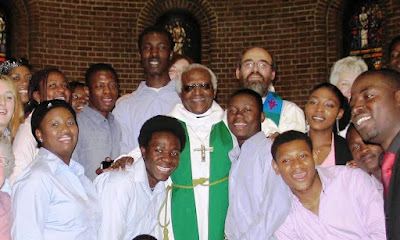
I last met Archbishop Tutu when he visited Dublin in 2005, and he preached in Saint George’s and Saint Thomas’s Church in the inner city, where Canon Katharine Poulton was then the Rector, as part of the Discovery Gospel Choir services.
His unforgettable words to me echo Christ’s words to the disciples in today’s Gospel reading: ‘Do not fear those who kill the body but cannot kill the soul; rather fear him who can destroy both soul and body in hell’ (Matthew 10: 28).
‘The most awful thing that they can do is to kill me, and death is not the worst thing that could happen to a Christian’ … Archbishop Desmond Tutu visiting Saint George’s and Saint Thomas’s Church, Dublin, and the Discovery Gospel Choir
Today’s Prayers (Sunday 21 June 2026, Trinity III, Fathers Day):
In Pray with the World Church, the prayer diary of the Anglican mission agency USPG (United Society Partners in the Gospel), the theme this week, from 21 to 27 June 2026 (pp 12-13), is ‘Land Taken, Land Remembered’. This theme is introduced today with a reflection by the Venerable Rosalyn Kantlaht’ant Elm, Director of Indigenous Ministries, Anglican Church of Canada:
When I think about how land was taken from Indigenous communities in Canada, I see that it was not the work of one person or a single event. It happened slowly, over more than four hundred years. In the early days of European settlement, Indigenous peoples and settlers often lived and worked alongside one another. Though imperfect, there was a time of coexistence.
As Canada developed, laws such as the Civilization Act and the Indian Act enabled the government to take Indigenous lands and move our people onto reserves – fenced-in areas often far from our traditional territories, languages, medicines, ceremonies, and rituals. This process unfolded over generations. Today, Indigenous peoples occupy only a small fraction of our original lands. Much of the rest remains under treaty dispute or is unceded territory, often threatened by mining, forestry, and oil and gas development.
Churches also played a significant role. In partnership with the government, they sought to ‘civilise’ Indigenous children, attempting to erase our cultures. In doing so, they became complicit in what can rightly be described as a legislative form of cultural genocide.
These truths are difficult to speak and to hear. But just as Christians cannot have Easter without Good Friday, we cannot skip the hard history and move straight to celebration. Facing these truths together allows us to lament, to pray, and to understand ourselves not by what we own, but as people created by God, called to care for one another and for the land.
The USPG prayer diary today (Sunday 21 June 2026, Trinity III, Fathers Day, National Indigenous Peoples Day, Canada) invites us to pray:
Creator God, from you every family in heaven and earth takes its name. Rooted and grounded in your covenant love, empowered by your Spirit, help us speak the truth in love and walk in your way towards justice and wholeness. (Anglican Church of Canada)
The Collect of the Day:
Almighty God,
you have broken the tyranny of sin
and have sent the Spirit of your Son into our hearts
whereby we call you Father:
give us grace to dedicate our freedom to your service,
that we and all creation may be brought
to the glorious liberty of the children of God;
through Jesus Christ your Son our Lord,
who is alive and reigns with you,
in the unity of the Holy Spirit,
one God, now and for ever.
The Post-Communion Prayer:
O God, whose beauty is beyond our imagining
and whose power we cannot comprehend:
show us your glory as far as we can grasp it,
and shield us from knowing more than we can bear
until we may look upon you without fear;
through Jesus Christ our Saviour.
Additional Collect:
God our saviour,
look on this wounded world
in pity and in power;
hold us fast to your promises of peace
won for us by your Son,
our Saviour Jesus Christ.
Yesterday’s Reflections
Continued Tomorrow
‘Whoever does not take up the cross and follow me is not worthy of me’ (Matthew 10: 37) … Christ is given his cross, a fresco in Analipsi Church in Georgioupoli, Crete (Photograph: Patrick Comerford)
Scripture quotations are from the New Revised Standard Version Bible: Anglicised Edition copyright © 1989, 1995, National Council of the Churches of Christ in the United States of America. Used by permission. All rights reserved worldwide. http://nrsvbibles.org
‘Are not two sparrows sold for a penny? … you are of more value than many sparrows’ (Matthew 10: 29-30) … a mother sparrow feds her chicks in a church in the ceiling of Aghias Anna Church, Maroulas, near Rethymnon in Crete (Patrick Comerford)
Patrick Comerford
We are in Ordinary Time in the Church Calendar, and this is the Third Sunday after Trinity (Trinity III, 21 June 2026). Tomorrow is also Father’s Day and the Summer Solstice, although next Wednesday (24 June) is officially Midsummer’s Day.
I hope to be involved in the Parish Eucharist in Saint Mary and Saint Giles Church later this morning. Meanwhile, before today begins, I am taking some quiet time this morning to give thanks, to reflect, to pray and to read in these ways:
1, reading today’s Gospel reading;
2, a short reflection;
3, a prayer from the USPG prayer diary;
4, the Collects and Post-Communion prayer of the day.
‘Whoever does not take up the cross and follow me is not worthy of me’ (Matthew 10: 37) … Station 5 in the Chapel at Saint John’s Hospital, Lichfield, Simon of Cyrene helps Jesus carry the Cross (Photograph: Patrick Comerford)
Matthew 10: 24-39 (NRSVA):
[Jesus said:] 24 ‘A disciple is not above the teacher, nor a slave above the master; 25 it is enough for the disciple to be like the teacher, and the slave like the master. If they have called the master of the house Beelzebul, how much more will they malign those of his household!
26 ‘So have no fear of them; for nothing is covered up that will not be uncovered, and nothing secret that will not become known. 27 What I say to you in the dark, tell in the light; and what you hear whispered, proclaim from the housetops. 28 Do not fear those who kill the body but cannot kill the soul; rather fear him who can destroy both soul and body in hell. 29 Are not two sparrows sold for a penny? Yet not one of them will fall to the ground unperceived by your Father. 30 And even the hairs of your head are all counted. 31 So do not be afraid; you are of more value than many sparrows.
32 ‘Everyone therefore who acknowledges me before others, I also will acknowledge before my Father in heaven; 33 but whoever denies me before others, I also will deny before my Father in heaven.
34 ‘Do not think that I have come to bring peace to the earth; I have not come to bring peace, but a sword.
35 For I have come to set a man against his father,
and a daughter against her mother,
and a daughter-in-law against her mother-in-law;
36 and one’s foes will be members of one’s own household.
37 Whoever loves father or mother more than me is not worthy of me; and whoever loves son or daughter more than me is not worthy of me; 38 and whoever does not take up the cross and follow me is not worthy of me. 39 Those who find their life will lose it, and those who lose their life for my sake will find it.’
‘What I say to you in the dark, tell in the light …’ (Matthew 10: 27) … a moment of prayer in Saint Titus Church, Iraklion (Photograph: Patrick Comerford, 2025)
Today’s Reflections:
In the Gospel reading last Sunday (Matthew 9: 35 to 10: 8 or 10: 23, Sunday 14 June 2026), Christ calls the Twelve together to prepare them for their ministry and mission. In today’s Gospel reading (Matthew 10: 24-39), Christ continues to prepare the Twelve for this mission, as both their teacher and their master. They are his students, and they are to be like him, they are told, and they receive their instructions and commission for mission, even in the most hostile of environments.
When the late Archbishop Desmond Tutu (1931-2021) received the Nobel Peace Prize in 1984, I profiled him for The Irish Times. We had met previously, at events co-hosted by AfrI and Christian CND and at dinner in Roebuck House, Seán MacBride’s house in Clonskeagh, Dublin.
I asked him about the death threats he faced in South Africa at the height of apartheid. He engaged me with that look that confirmed his deep hope, commitment and faith, and said: ‘But you know, death is not the worst thing that could happen to a Christian.’
He must have been tempted at times to give up being a thorn in the side of the regime, to stop being a ‘turbulent priest,’ and to live a comfortable life. But his conscience would never have been comfortable.
While apartheid was still in force, Desmond Tutu became Dean of Saint Mary’s Cathedral in Johannesburg, and when I first met him, he was the secretary general of the South African Council of Churches.
I was worried about the many death threats he was receiving, and I asked him how he lived with those threats. Was he worried about them? Did he ever consider modifying what he had to say because of them? His answer was similar to the one he gave when he was facing tough questioning before the regime’s Eloff Commission. He told that inquiry:
‘There is nothing the government can do to me that will stop me from being involved in what I believe God wants me to do. I do not do it because I like doing it. I do it because I am under what I believe to be the influence of God’s hand. I cannot help it. When I see injustice, I cannot keep quiet, for, as Jeremiah says, when I try to keep quiet, God’s Word burns like a fire in my breast. But what is it that they can ultimately do? The most awful thing that they can do is to kill me, and death is not the worst thing that could happen to a Christian.’
In 1987, Veritas invited me to write a short, 36-page biography of Archbishop Tutu, published as Desmond Tutu: Black Africa’s Man of Destiny. It was launched by the then Minister for Foreign Affairs, Brian Lenihan. It was a small book, hardly more than a pamphlet, but it came at an important time when both the Irish Government and the Irish Churches were becoming increasingly vocal about the evils of apartheid. It was republished in the US by Citadel (1988) and Hyperion Books (1989).
When I visited South Africa in 1990 with The Irish Times and Christian Aid, I met Archbishop Tutu in Cape Town, where once again he spoke powerfully about the changes that were beginning to take place.
Then, when my colleague Patsy McGarry was organising a monumental series of features in The Irish Times in 2000 to mark the millennium, Archbishop Tutu was one of the international contributors, along with Hans Küng, Andrew Greeley and Mary Robinson. The complete series was published by Veritas the following year as a book, Christianity, in which Part Two was my ‘Brief History of Christianity.’
I last met Archbishop Tutu when he visited Dublin in 2005, and he preached in Saint George’s and Saint Thomas’s Church in the inner city, where Canon Katharine Poulton was then the Rector, as part of the Discovery Gospel Choir services.
His unforgettable words to me echo Christ’s words to the disciples in today’s Gospel reading: ‘Do not fear those who kill the body but cannot kill the soul; rather fear him who can destroy both soul and body in hell’ (Matthew 10: 28).
‘The most awful thing that they can do is to kill me, and death is not the worst thing that could happen to a Christian’ … Archbishop Desmond Tutu visiting Saint George’s and Saint Thomas’s Church, Dublin, and the Discovery Gospel Choir
Today’s Prayers (Sunday 21 June 2026, Trinity III, Fathers Day):
In Pray with the World Church, the prayer diary of the Anglican mission agency USPG (United Society Partners in the Gospel), the theme this week, from 21 to 27 June 2026 (pp 12-13), is ‘Land Taken, Land Remembered’. This theme is introduced today with a reflection by the Venerable Rosalyn Kantlaht’ant Elm, Director of Indigenous Ministries, Anglican Church of Canada:
When I think about how land was taken from Indigenous communities in Canada, I see that it was not the work of one person or a single event. It happened slowly, over more than four hundred years. In the early days of European settlement, Indigenous peoples and settlers often lived and worked alongside one another. Though imperfect, there was a time of coexistence.
As Canada developed, laws such as the Civilization Act and the Indian Act enabled the government to take Indigenous lands and move our people onto reserves – fenced-in areas often far from our traditional territories, languages, medicines, ceremonies, and rituals. This process unfolded over generations. Today, Indigenous peoples occupy only a small fraction of our original lands. Much of the rest remains under treaty dispute or is unceded territory, often threatened by mining, forestry, and oil and gas development.
Churches also played a significant role. In partnership with the government, they sought to ‘civilise’ Indigenous children, attempting to erase our cultures. In doing so, they became complicit in what can rightly be described as a legislative form of cultural genocide.
These truths are difficult to speak and to hear. But just as Christians cannot have Easter without Good Friday, we cannot skip the hard history and move straight to celebration. Facing these truths together allows us to lament, to pray, and to understand ourselves not by what we own, but as people created by God, called to care for one another and for the land.
The USPG prayer diary today (Sunday 21 June 2026, Trinity III, Fathers Day, National Indigenous Peoples Day, Canada) invites us to pray:
Creator God, from you every family in heaven and earth takes its name. Rooted and grounded in your covenant love, empowered by your Spirit, help us speak the truth in love and walk in your way towards justice and wholeness. (Anglican Church of Canada)
The Collect of the Day:
Almighty God,
you have broken the tyranny of sin
and have sent the Spirit of your Son into our hearts
whereby we call you Father:
give us grace to dedicate our freedom to your service,
that we and all creation may be brought
to the glorious liberty of the children of God;
through Jesus Christ your Son our Lord,
who is alive and reigns with you,
in the unity of the Holy Spirit,
one God, now and for ever.
The Post-Communion Prayer:
O God, whose beauty is beyond our imagining
and whose power we cannot comprehend:
show us your glory as far as we can grasp it,
and shield us from knowing more than we can bear
until we may look upon you without fear;
through Jesus Christ our Saviour.
Additional Collect:
God our saviour,
look on this wounded world
in pity and in power;
hold us fast to your promises of peace
won for us by your Son,
our Saviour Jesus Christ.
Yesterday’s Reflections
Continued Tomorrow
‘Whoever does not take up the cross and follow me is not worthy of me’ (Matthew 10: 37) … Christ is given his cross, a fresco in Analipsi Church in Georgioupoli, Crete (Photograph: Patrick Comerford)
Scripture quotations are from the New Revised Standard Version Bible: Anglicised Edition copyright © 1989, 1995, National Council of the Churches of Christ in the United States of America. Used by permission. All rights reserved worldwide. http://nrsvbibles.org
‘Are not two sparrows sold for a penny? … you are of more value than many sparrows’ (Matthew 10: 29-30) … a mother sparrow feds her chicks in a church in the ceiling of Aghias Anna Church, Maroulas, near Rethymnon in Crete (Patrick Comerford)
Labels:
Apartheid,
Canada,
CND,
Crete 2026,
Father's Day,
Georgioupoli,
Greece 2026,
Iraklion,
Lichfield,
Maroulas,
Mission,
Prayer,
Rethymnon,
Saint Matthew's Gospel,
South Africa,
The Irish Times,
USPG
15 June 2026
Changes in Bloomsbury
reflect how William Penn
is losing his place in
the memory of Quakers
Friends’ House in London … William Penn’s name has been removed from one of the rooms (Photograph: Patrick Comerford)
Patrick Comerford
I was meeting some people in the café in Friends’ House, London, the other day, to discuss shared literary projects, historical research and books. Our conversations over lunch and copious cups of coffee ranged over a wide range of topics, from family history and youth hostelling in Ireland, to the work of the International Atomic Research Agency in Vienna, church architecture and the role of the churches in providing a welcome for refugees and asylum seekers, to football and life in New Zealand, Ireland, Stockton on Tees and Milton Keynes.
It was one of those lingering lunches, where our conversations and imaginations ran apace, and we lost track of time.
But, having arrived at Euston Station a little earlier than I expected, and with a short amount of time on my hands before catching the train back to Milton Keynes, I spent some time strolling through the squares of Bloomsbury and also rummaging in the Quaker bookshop at Friends’ House.
Friends International Centre was once on the corner of Torrington Place and Byng Place, close to Gordon Square (Photograph: Patrick Comerford, 2026)
In the past, on working trips to London when I was a trustee of USPG, I occasionally stayed at the Penn Club in Bedford Place off Russell Square. It was a tradition or habit that dated back to taking part in CND protests and meetings in the 1970s and 1980s, and other members of my family have stayed there too.
So, it was with sadness that I heard a few years ago that the Penn Club was closing at the end of March 2021.
I have vague memories too of staying at another Quaker-run guesthouse in Bloomsbury in the early or mid 1970s. Friends International Centre was in an elegant cluster of houses at the corner of Torrington Place and Byng Place, close to Gordon Square, and a five or seven minute walk from both Friends House and the Penn Club.
The houses at the corner of Torrington Place and Byng Place stand close to the Church of Christ the King on Gordon Square (Photograph: Patrick Comerford, 2026)
Those houses are built right up against the Church of Christ the King on Gordon Square, once the University Church and now shared by Forward in Faith and Euston Church. The houses now seem to have been incorporated into the conglomerate of university buildings around Bloomsbury. But I was reminded of their past Quaker associations a few days ago when I noticed that one of the houses is now known as William Penn House.
That reminder was all the more surprising because the memory of William Penn has been falling out of favour among Quakers in recent years. Shortly after the Penn Club closed on Bedford Place, Britain Yearly Meeting (BYM) announced on 10 April 2021, ‘In a step towards becoming an actively anti-racist church, Quakers will cease to name a room in their London offices after William Penn.
Friends’ House on Euston Road houses contains the central offices of Quakers and has conference space that is available to outside groups. About 20 rooms in the building are named after Quakers who have made a difference in the world as a way to share the Quaker story with hundreds of thousands of visitors to Friends’ House each year.
Following much discussion, the decision to end naming a room in Friends’ House after William Penn was made by the yearly meeting trustees, working with the staff at Friends’ House.
William Penn’s name remains on one of the houses (Photograph: Patrick Comerford, 2026)
The statement in 2021 noted that ‘Penn, born in 1644, founded the state of Pennsylvania. He was an avid writer, defending religious freedom, democracy and pacifism … However, he also owned enslaved people.’
Paul Parker, recording clerk for Quakers in Britain, said, ‘Racism today is rooted in the trade of enslaved people. We are committed to tackle racism and to build an anti-racist culture. Commemorating William Penn by having a room named after him is incompatible with that. Some might say we’re rewriting history. Rather, we’re completing history, by telling the whole story and deciding not to commemorate someone who had a direct involvement in slavery. Part of telling a complete history is to acknowledge how it might previously have been understood from a limited perspective. We owe it to those who live with the legacy of slavery to take steps to redress this.’
Friends in Britain were not alone in thinking again about William Penn and other Quaker historic figures. Friends Committee on National Legislation, in Washington DC decided to rename William Penn House, a Quaker-run hostel, due to Penn’s slaveholding.
Back in Friends’ House, I spent a little time browsing in the bookshop beside the café. Looking at the history shelves, I imagine it may take a little longer to change the way William Penn is remembered among Friends. His name remains on one of the paving slabs in the garden celebrating milestones in Quaker history.
William Penn’s name remains on one of the history paving slabs in the garden at Friends’ House (Photograph: Patrick Comerford)
Patrick Comerford
I was meeting some people in the café in Friends’ House, London, the other day, to discuss shared literary projects, historical research and books. Our conversations over lunch and copious cups of coffee ranged over a wide range of topics, from family history and youth hostelling in Ireland, to the work of the International Atomic Research Agency in Vienna, church architecture and the role of the churches in providing a welcome for refugees and asylum seekers, to football and life in New Zealand, Ireland, Stockton on Tees and Milton Keynes.
It was one of those lingering lunches, where our conversations and imaginations ran apace, and we lost track of time.
But, having arrived at Euston Station a little earlier than I expected, and with a short amount of time on my hands before catching the train back to Milton Keynes, I spent some time strolling through the squares of Bloomsbury and also rummaging in the Quaker bookshop at Friends’ House.
Friends International Centre was once on the corner of Torrington Place and Byng Place, close to Gordon Square (Photograph: Patrick Comerford, 2026)
In the past, on working trips to London when I was a trustee of USPG, I occasionally stayed at the Penn Club in Bedford Place off Russell Square. It was a tradition or habit that dated back to taking part in CND protests and meetings in the 1970s and 1980s, and other members of my family have stayed there too.
So, it was with sadness that I heard a few years ago that the Penn Club was closing at the end of March 2021.
I have vague memories too of staying at another Quaker-run guesthouse in Bloomsbury in the early or mid 1970s. Friends International Centre was in an elegant cluster of houses at the corner of Torrington Place and Byng Place, close to Gordon Square, and a five or seven minute walk from both Friends House and the Penn Club.
The houses at the corner of Torrington Place and Byng Place stand close to the Church of Christ the King on Gordon Square (Photograph: Patrick Comerford, 2026)
Those houses are built right up against the Church of Christ the King on Gordon Square, once the University Church and now shared by Forward in Faith and Euston Church. The houses now seem to have been incorporated into the conglomerate of university buildings around Bloomsbury. But I was reminded of their past Quaker associations a few days ago when I noticed that one of the houses is now known as William Penn House.
That reminder was all the more surprising because the memory of William Penn has been falling out of favour among Quakers in recent years. Shortly after the Penn Club closed on Bedford Place, Britain Yearly Meeting (BYM) announced on 10 April 2021, ‘In a step towards becoming an actively anti-racist church, Quakers will cease to name a room in their London offices after William Penn.
Friends’ House on Euston Road houses contains the central offices of Quakers and has conference space that is available to outside groups. About 20 rooms in the building are named after Quakers who have made a difference in the world as a way to share the Quaker story with hundreds of thousands of visitors to Friends’ House each year.
Following much discussion, the decision to end naming a room in Friends’ House after William Penn was made by the yearly meeting trustees, working with the staff at Friends’ House.
William Penn’s name remains on one of the houses (Photograph: Patrick Comerford, 2026)
The statement in 2021 noted that ‘Penn, born in 1644, founded the state of Pennsylvania. He was an avid writer, defending religious freedom, democracy and pacifism … However, he also owned enslaved people.’
Paul Parker, recording clerk for Quakers in Britain, said, ‘Racism today is rooted in the trade of enslaved people. We are committed to tackle racism and to build an anti-racist culture. Commemorating William Penn by having a room named after him is incompatible with that. Some might say we’re rewriting history. Rather, we’re completing history, by telling the whole story and deciding not to commemorate someone who had a direct involvement in slavery. Part of telling a complete history is to acknowledge how it might previously have been understood from a limited perspective. We owe it to those who live with the legacy of slavery to take steps to redress this.’
Friends in Britain were not alone in thinking again about William Penn and other Quaker historic figures. Friends Committee on National Legislation, in Washington DC decided to rename William Penn House, a Quaker-run hostel, due to Penn’s slaveholding.
Back in Friends’ House, I spent a little time browsing in the bookshop beside the café. Looking at the history shelves, I imagine it may take a little longer to change the way William Penn is remembered among Friends. His name remains on one of the paving slabs in the garden celebrating milestones in Quaker history.
William Penn’s name remains on one of the history paving slabs in the garden at Friends’ House (Photograph: Patrick Comerford)
29 April 2026
Daily prayer in Easter 2026:
25, Wednesday 29 April 2026
‘I have come as light into the world, so that everyone who believes in me should not remain in the darkness’ (John 12: 46) … looking out into the village of Piskopiano in Crete from the Church of the Transfiguration (Photograph: Patrick Comerford)
Patrick Comerford
Easter is a 50-day season, beginning on Easter Day (5 April 2026) and continuing until the Day of Pentecost (24 May 2026), or Whit Sunday. This week began with the Fourth Sunday of Easter (Easter IV, 26 April 2026), sometimes known as ‘Good Shepherd Sunday’.
The calendar of the Church of England in Common Worship today remembers Saint Catherine of Siena (1347-1380), Teacher of the Faith. Today also marks the 75th anniversary of the death of the philsopher Ludwig Wittgenstein, and I hope to say more about that anniversary in a blog posting later today. Later this evening, I hope to take part choir rehearsals in Saint Mary and Saint Giles Church, Stony Stratford. But, before today begins, I am taking some quiet time this morning to give thanks, to reflect, to pray and to read in these ways:
1, reading today’s Gospel reading;
2, a short reflection;
3, a prayer from the USPG prayer diary;
4, the Collects and Post-Communion prayer of the day.
‘Whoever sees me sees him who sent me’ (John 12: 45) … the Ancient of Days depicted in a fresco in the Church of the Transfiguration in Piskopiano in Crete (Photograph: Patrick Comerford)
John 12: 44-50 (NRSVA):
44 Then Jesus cried aloud: ‘Whoever believes in me believes not in me but in him who sent me. 45 And whoever sees me sees him who sent me. 46 I have come as light into the world, so that everyone who believes in me should not remain in the darkness. 47 I do not judge anyone who hears my words and does not keep them, for I came not to judge the world, but to save the world. 48 The one who rejects me and does not receive my word has a judge; on the last day the word that I have spoken will serve as judge, 49 for I have not spoken on my own, but the Father who sent me has himself given me a commandment about what to say and what to speak. 50 And I know that his commandment is eternal life. What I speak, therefore, I speak just as the Father has told me.’
‘The Light of the World’ by William Holman Hunt (1827-1910) in a side chapel in Keble College, Oxford (Photograph: Patrick Comerford)
Today’s Reflections:
In the Gospel reading at the Eucharist today (John 12: 44-50), we come to the end of what is known as the ‘Book of Signs’ in Saint John’s Gospel (chapters 1 to 12). Through these seven signs, Christ clearly indicates who he is and what his mission is.
Today’s reading recapitulates all that Christ has said in the ‘Book of Signs’. We hear how Jesus ‘cried aloud’ and spoke. This gives extra emphasis to what he is proclaiming. It is once again a call to believe in Jesus where ‘believing in’ means much more than mere acceptance of the truth of his words. It implies too a personal commitment to Christ and to his mission.
To believe in Christ is also to believe in, to surrender oneself entirely to, the One who sent him, the Father. All through this Gospel, Jesus emphasises the inseparability of the Father and the Son.
The Father sends Christ as light into the world so that ‘whoever sees me sees him who sent me. I have come as light into the world, so that everyone who believes in me should not remain in the darkness’ (John 12: 45-46).
One of the first images of Christ that I remember being show as a child by my grandmother in her house in Cappoquin, Co Waterford, is Holman Hunt’s ‘The Light of the World’. It remains my favourite image of Christ and my favourite Pre-Raphaelite painting.
Saint Catherine of Siena, the Dominican doctor of the church remembered today, says, ‘It is only through shadows that one comes to know the light.’ Addressing Chrit in The Dialogue of Saint Catherine, where she touches topics on prayer, divine providence, and obedience, she writes, ‘You are the Fire that takes away the cold, illuminates the mind with its light, and causes me to know the truth’.
The ‘word’ of Christ is a challenge. It offers a way of living and of inter-relating with God, with others and with ourselves. Christ tells us that his Father’s commands – which he also observes – mean eternal life. Everything that Jesus did was the carrying out of his Father’s will. We are called to follow the same path, which is the way to total freedom.
But how do we follow that path, how do we walk that path?
During the week, I found myself re-reading the hymn ‘Attend and Keep this Happy Fast’ by the English Roman Catholic theologian and one-time Dominican priest, Roger Ruston. He has been strongly influential in Christian CND and similar movements. He is best known for both his careful critique of the ‘deterrence’ theory and the reliance on nuclear weapons and for his work on human rights, including his book Human Rights and the Image of God (SCM-Canterbury Press, 2004), and the conference with that name organised that year by the Dominican Justice and Peace Commission at Blackfriars, Oxford.
Roger Ruston’s insights have a pressing relevance in today’s dismal global political realities. He has also written a number of hymns that are informed by his theological priorities. His hymn ‘Attend and Keep this Happy Fast’ is based on Isaiah 58: 5-9 and expresses the idea that love is better than fasting, and looks to ‘the dawn your light will break’ and that time when ‘the glory of the Lord will shine’:
Attend and keep this happy fast
I preach to you this day.
Is this the fast that pleases me,
that takes your joy away?
Do I delight in sorrow’s dress,
says God, who reigns above,
the hanging head, the dismal look,
will they attract my love?
But is this not the fast I choose,
that shares the heavy load;
that seeks to bring the poor man in
who’s weary of the road;
that gives the hungry bread to eat,
to strangers gives a home;
that does not let you hide your face
from your own flesh and bone?
Then like the dawn your light will break,
to life you will be raised.
And all will praise the Lord for you;
be happy in your days.
The glory of the Lord will shine,
and in your steps his grace.
And when you call he’ll answer you;
He will not hide his face.
Christ is risen!
The Lord is risen indeed. Alleluia!
Rembering Mika Chrysaki who gave her name to Mika Villas in Piskopiano in Crete (Photograph: Patrick Comerford)
Today’s Prayers (Wednesday 29 April 2026):
I have been recalling my own grandmother in my reflections this morning. In my prayers, I am also remebering a family of dear friends in Crete who are burying a dear mother, mother-in-law and grandmother, in Iraklion this afternoon. Mika was a warm, welcoming member of the family, and her son proudly gave her name to the family hotel in Piskopiano in the hills above Hersonissos. I have stayed in or visited there countless times since the mid-1990s.
‘Prayer and Action in Pakistan’ provides the theme this week (26 April to 2 May 2026) in ‘Pray With the World Church’, the Prayer Diary of the Anglican mission agency USPG (United Society Partners in the Gospel), pp 50-51. This theme was introduced on Sunday with Reflections from the Revd Davidson Solanki, Senior Regional Manager for Asia and the Middle East.
The USPG Prayer Diary today (Wednesday 29 April 2026) invites us to pray:
Lord, bless the Church of Pakistan as they seek to serve all neighbours. Particularly after the devastation of the floods, may their acts of care demonstrate Christ’s love in action even across faiths.
The Collect:
God of compassion,
who gave your servant Catherine of Siena
a wondrous love of the passion of Christ:
grant that your people may be united to him in his majesty
and rejoice for ever in the revelation of his glory;
who is alive and reigns with you,
in the unity of the Holy Spirit,
one God, now and for ever.
The Post-Communion Prayer:
God of truth,
whose Wisdom set her table
and invited us to eat the bread and drink the wine
of the kingdom:
help us to lay aside all foolishness
and to live and walk in the way of insight,
that we may come with Catherine to the eternal feast of heaven;
through Jesus Christ our Lord.
Yesterday’s Reflections
Continued Tomorrow
‘It is only through shadows that one comes to know the light’ … Saint Catherine of Siena seen in a window in Saint Giles Church, Cambridge (Photograph: Patrick Comerford)
Scripture quotations are from the New Revised Standard Version Bible: Anglicised Edition copyright © 1989, 1995 National Council of the Churches of Christ in the United States of America. Used by permission. All rights reserved worldwide. http://nrsvbibles.org
Patrick Comerford
Easter is a 50-day season, beginning on Easter Day (5 April 2026) and continuing until the Day of Pentecost (24 May 2026), or Whit Sunday. This week began with the Fourth Sunday of Easter (Easter IV, 26 April 2026), sometimes known as ‘Good Shepherd Sunday’.
The calendar of the Church of England in Common Worship today remembers Saint Catherine of Siena (1347-1380), Teacher of the Faith. Today also marks the 75th anniversary of the death of the philsopher Ludwig Wittgenstein, and I hope to say more about that anniversary in a blog posting later today. Later this evening, I hope to take part choir rehearsals in Saint Mary and Saint Giles Church, Stony Stratford. But, before today begins, I am taking some quiet time this morning to give thanks, to reflect, to pray and to read in these ways:
1, reading today’s Gospel reading;
2, a short reflection;
3, a prayer from the USPG prayer diary;
4, the Collects and Post-Communion prayer of the day.
‘Whoever sees me sees him who sent me’ (John 12: 45) … the Ancient of Days depicted in a fresco in the Church of the Transfiguration in Piskopiano in Crete (Photograph: Patrick Comerford)
John 12: 44-50 (NRSVA):
44 Then Jesus cried aloud: ‘Whoever believes in me believes not in me but in him who sent me. 45 And whoever sees me sees him who sent me. 46 I have come as light into the world, so that everyone who believes in me should not remain in the darkness. 47 I do not judge anyone who hears my words and does not keep them, for I came not to judge the world, but to save the world. 48 The one who rejects me and does not receive my word has a judge; on the last day the word that I have spoken will serve as judge, 49 for I have not spoken on my own, but the Father who sent me has himself given me a commandment about what to say and what to speak. 50 And I know that his commandment is eternal life. What I speak, therefore, I speak just as the Father has told me.’
‘The Light of the World’ by William Holman Hunt (1827-1910) in a side chapel in Keble College, Oxford (Photograph: Patrick Comerford)
Today’s Reflections:
In the Gospel reading at the Eucharist today (John 12: 44-50), we come to the end of what is known as the ‘Book of Signs’ in Saint John’s Gospel (chapters 1 to 12). Through these seven signs, Christ clearly indicates who he is and what his mission is.
Today’s reading recapitulates all that Christ has said in the ‘Book of Signs’. We hear how Jesus ‘cried aloud’ and spoke. This gives extra emphasis to what he is proclaiming. It is once again a call to believe in Jesus where ‘believing in’ means much more than mere acceptance of the truth of his words. It implies too a personal commitment to Christ and to his mission.
To believe in Christ is also to believe in, to surrender oneself entirely to, the One who sent him, the Father. All through this Gospel, Jesus emphasises the inseparability of the Father and the Son.
The Father sends Christ as light into the world so that ‘whoever sees me sees him who sent me. I have come as light into the world, so that everyone who believes in me should not remain in the darkness’ (John 12: 45-46).
One of the first images of Christ that I remember being show as a child by my grandmother in her house in Cappoquin, Co Waterford, is Holman Hunt’s ‘The Light of the World’. It remains my favourite image of Christ and my favourite Pre-Raphaelite painting.
Saint Catherine of Siena, the Dominican doctor of the church remembered today, says, ‘It is only through shadows that one comes to know the light.’ Addressing Chrit in The Dialogue of Saint Catherine, where she touches topics on prayer, divine providence, and obedience, she writes, ‘You are the Fire that takes away the cold, illuminates the mind with its light, and causes me to know the truth’.
The ‘word’ of Christ is a challenge. It offers a way of living and of inter-relating with God, with others and with ourselves. Christ tells us that his Father’s commands – which he also observes – mean eternal life. Everything that Jesus did was the carrying out of his Father’s will. We are called to follow the same path, which is the way to total freedom.
But how do we follow that path, how do we walk that path?
During the week, I found myself re-reading the hymn ‘Attend and Keep this Happy Fast’ by the English Roman Catholic theologian and one-time Dominican priest, Roger Ruston. He has been strongly influential in Christian CND and similar movements. He is best known for both his careful critique of the ‘deterrence’ theory and the reliance on nuclear weapons and for his work on human rights, including his book Human Rights and the Image of God (SCM-Canterbury Press, 2004), and the conference with that name organised that year by the Dominican Justice and Peace Commission at Blackfriars, Oxford.
Roger Ruston’s insights have a pressing relevance in today’s dismal global political realities. He has also written a number of hymns that are informed by his theological priorities. His hymn ‘Attend and Keep this Happy Fast’ is based on Isaiah 58: 5-9 and expresses the idea that love is better than fasting, and looks to ‘the dawn your light will break’ and that time when ‘the glory of the Lord will shine’:
Attend and keep this happy fast
I preach to you this day.
Is this the fast that pleases me,
that takes your joy away?
Do I delight in sorrow’s dress,
says God, who reigns above,
the hanging head, the dismal look,
will they attract my love?
But is this not the fast I choose,
that shares the heavy load;
that seeks to bring the poor man in
who’s weary of the road;
that gives the hungry bread to eat,
to strangers gives a home;
that does not let you hide your face
from your own flesh and bone?
Then like the dawn your light will break,
to life you will be raised.
And all will praise the Lord for you;
be happy in your days.
The glory of the Lord will shine,
and in your steps his grace.
And when you call he’ll answer you;
He will not hide his face.
Christ is risen!
The Lord is risen indeed. Alleluia!
Rembering Mika Chrysaki who gave her name to Mika Villas in Piskopiano in Crete (Photograph: Patrick Comerford)
Today’s Prayers (Wednesday 29 April 2026):
I have been recalling my own grandmother in my reflections this morning. In my prayers, I am also remebering a family of dear friends in Crete who are burying a dear mother, mother-in-law and grandmother, in Iraklion this afternoon. Mika was a warm, welcoming member of the family, and her son proudly gave her name to the family hotel in Piskopiano in the hills above Hersonissos. I have stayed in or visited there countless times since the mid-1990s.
‘Prayer and Action in Pakistan’ provides the theme this week (26 April to 2 May 2026) in ‘Pray With the World Church’, the Prayer Diary of the Anglican mission agency USPG (United Society Partners in the Gospel), pp 50-51. This theme was introduced on Sunday with Reflections from the Revd Davidson Solanki, Senior Regional Manager for Asia and the Middle East.
The USPG Prayer Diary today (Wednesday 29 April 2026) invites us to pray:
Lord, bless the Church of Pakistan as they seek to serve all neighbours. Particularly after the devastation of the floods, may their acts of care demonstrate Christ’s love in action even across faiths.
The Collect:
God of compassion,
who gave your servant Catherine of Siena
a wondrous love of the passion of Christ:
grant that your people may be united to him in his majesty
and rejoice for ever in the revelation of his glory;
who is alive and reigns with you,
in the unity of the Holy Spirit,
one God, now and for ever.
The Post-Communion Prayer:
God of truth,
whose Wisdom set her table
and invited us to eat the bread and drink the wine
of the kingdom:
help us to lay aside all foolishness
and to live and walk in the way of insight,
that we may come with Catherine to the eternal feast of heaven;
through Jesus Christ our Lord.
Yesterday’s Reflections
Continued Tomorrow
‘It is only through shadows that one comes to know the light’ … Saint Catherine of Siena seen in a window in Saint Giles Church, Cambridge (Photograph: Patrick Comerford)
Scripture quotations are from the New Revised Standard Version Bible: Anglicised Edition copyright © 1989, 1995 National Council of the Churches of Christ in the United States of America. Used by permission. All rights reserved worldwide. http://nrsvbibles.org
Labels:
Cambridge,
Cappoquin,
CND,
Crete 2026,
Dominicans,
Easter 2026,
Funerals,
Greece 2026,
Human Rights,
Iraklion,
Mission,
Oxford,
Pakistan,
Piskopiano,
Prayer,
Pre-Raphaelites,
Saint John's Gospel,
Siena,
USPG,
Wittgenstein
22 April 2026
A return visit to Spode House
and Hawkesyard Esate, with
memories of philosophers
and folk masses in the 1970s
Hawkesyard Hall and Spode House in Armitage, where the Dominicans had a priory until 1988 (Photograph: Patrick Comerford, 2026)
Patrick Comerford
In recent days, I have been visiting a number of churches in the Rugeley area that I first got to know when I was about 19 or 20. They include Saint Michael’s Church in Brereton and the now-closed Brereton Methodist Church; the old and new Saint Augustine’s Church, the ruins of the early mediaeval parish church, now known as the ‘Old Chancel’, and the early 19th century church across the street that replaced it in the 1820s; and Saint Joseph and Saint Etheldreda Catholic Churchin Rugeley, with its many associations with the Wolseley family.
Some of my most cherished memories from those youthful days in the 1970s are of Hawkesyard Hall and Spode House in Armitage, where the Dominicans once had a priory, only ten minutes from Lichfield and five minutes from Brereton and Rugeley, and on the edges of Armitage village. My friends from Rugeley and Brereton often brought me there with them to the Folk Masses on Sundays.
So, when I was on the bus from Brereton to Lichfield last week, I hopped off near Armitage, went for a walk along the canal towpaths, and visited Hawkesyard Hall and Spode House.
Hawkesyard Hall and Spode House were known for the Folk Masses and gatherings of the Philosophical Enquiry Group (Photograph: Patrick Comerford, 2026)
Hawkesyard has been known over the generations by a variety of names, including Hawkesyard Hall, Armitage Park, Spode House and Hawkesyard Priory. The estate dates from the 13th century, and has links to the Rugeley family, the poet and author Nathaniel Lister, Josiah Spode the potter, and Sir Robert Peel – and even some tenuous links in the dim distant past through the Rugeley family with the Comberford family.
The story of the estate dates back to 1270 when the land was used for hunting. Simon de Rugeley commissioned the construction on Hawkesyard Hall in 1337. The first house owned by the Rugeley family was a moated manor closer to the River Trent, about half a mile west of Armitage Church.
Anne Comberford of Comberford, Tamworth and Wednesbury, who was a daughter of William Comberford, and was born in 1609. In 1634, she married Benjamin Rugeley of Dunstall in Tatenhill, a younger brother of Colonel Simon Rugeley, a key leader of the Parliamentarians during the English Civil War.
Benjamin Rugeley was a younger son of Richard Rugeley (1564-1623) of Shenstone and his wife Mary Rugeley, daughter and co-heir of Thomas Rugeley (1539-1623) of Hawkesyard. Benjamin’s father, Richard Rugeley, died at Hawkesyard in 1623 and was buried in Mavesyn Ridware.
Benjamin’s eldest brother, Colonel Simon Rugeley of Shenstone and Tatenhill (1598-1666), was a member of the parliamentary committee at Stafford. He inherited Hawkesyard but sold it to Sir Richard Skeffington of Fisherwick, whose family eventually acquired Comberford Hall. The original Hawkesyard Hall lay in ruins by 1660, and was pulled down in 1665.
The towers and turrets of Hawkesyard Hall and Spode House rising above the canal between Armitage and Rugeley (Photograph: Patrick Comerford, 2026)
The estate was bought in 1759 by Nathaniel Lister (1725-1793), poet and author. Lister renamed the Hawkesyard estate as Armitage Park in 1760, and in 1761 in Lichfield Cathedral he married Martha Fletcher, a Lichfield heiress and daughter of John Fletcher, Senior Proctor of the Diocese of Lichfield. They rebuilt the house in its present location as a Gothic-style mansion in red-brick stuccoed with ashlar and standing on the sandstone hill above the site of the original hall.
Lister also bought a house on Beacon Street in Lichfield in 1780, and in 1791 he acquired the lease on Erasmus Darwin’s house beside the Cathedral Close. When he died in 1793, Armitage Park was inherited by his son, John Fletcher Lister.
Mary Spode, widow of the potter Josiah Spode III, bought the estate in 1839 for her six-year-old son Josiah Spode IV (1823-1893), great-grandson of Josiah Spode and the fourth generation of the pottery dynasty but the first not to work in the family business.
The hall was altered and extended, and the cast-iron orangery was added, as well manicured gardens, statues and other buildings. Cellars and six underground tunnels were cut out of the rock by Richard Benton to allow the estate workers to move quickly around the locality, and two tunnels were said to lead to Lichfield and Armitage.
When the Spode family lived there, the hall was known as Spode House and Josiah Spode was appointed High Sheriff of Staffordshire in 1850. Mary died in 1860, and Josiah’s wife Helen died eight years later. Both are buried at Saint John the Baptist Church, Armitage, where Josiah was the organ player and warden. Josiah Spode of Hawkesyard also gave a new organ to Lichfield Cathedral that was installed in 1860 to complement the restoration of the quire by Sir George Gilbert Scott.
Despite these links with Lichfield Cathedral and Saint John’s Church, Armitage, Josiah Spode became a Roman Catholic in 1885, along with his niece Helen Gulson who lived with him at Hawkesyard. At the beginning of Lent 1886, they attended a parish retreat at Saint Joseph and Saint Etheldreda Catholic Churchin Rugeley given by Father Pius Cavanagh. Father Pius soon became in Gulson’s words ‘our best friend and advisor’. Towards the end of 1888, both Josiah Spode and Helen Gulson were clothed as tertiaries by Father Pius in their private chapel, becoming lay Dominicans.
The elaboratre reredos above the High Altar in the former Domician chapel (Photograph: Dominican Archives)
WhenJosiah Spode died in 1893, he asked that Helen should continue to live at Hawkesyard until she died, after which the estate would pass to the English Dominican Order.
However, Helen decided to move out of the hall in 1894 and into Gulson House on the estate, and work on the new priory and church began immediately. Some accounts say her decision was inspired by an apparition of the Virgin Mary in the grounds of the estate, and that the altar of the new priory church of Saint Thomas Aquinas was placed over the site of her vision.
The Dominicans built a new priory within the grounds in 1898, and the priory church was designed by the architect Edward Goldie (1856-1921). Josiah Spode and Helen Gulson were buried in a small chapel within the priory church, and outside in the gardens simple concrete crosses marked the graves of the Dominican community.
The priory was home to a community of nuns until the early 20th century. The convent then became a priory, and the Dominican monks or friars ran a boarding school for young aspiring Dominicans and a theological college.
The towers and turrets of Hawkesyard Hall and Spode House rising above the canal between Armitage and Rugeley (Photograph: Patrick Comerford, 2026)
I knew Hawkesyard Priory and Spode House well in my late teens and early 20s, when the Philosophical Enquiry Group was still meeting there with Father Columba Ryan and involved the Limerick-born philosopher Elizabeth Anscombe (1919-2001). At the time, the Folk Masses in the priory chapel were popular with many of my friends from Rugeley, Brereton and Lichfield.
The friars there in those heady days in the early 1970s included Father Conrad Pepler (1908-1993), the founding warden of Spode House, where he ran the first Catholic conference centre in England. We did not know then that it was he who provided a Catholic funeral in Cambridge in 1951 for the philosopher Ludwig Wittgenstein, a mentor to both Elizabeth Anscombe and her husband Peter Geach.
The Dominicans at Spode in the early 1970s also included Father Columba Ryan (1916-2009), philosopher, university chaplain and peace activist, who took part in many CND marches and protests in London. He was also the bursar at the Hawkesyard Priory, and in the 1950s and 1960s he set up the Philosophical Enquiry Group at Spode in 1954.
He was born Patrick Ryan, a son of the Cork-born diplomat Sir Andrew Ryan (1876-1949), the last dragoman in Constantinople (1907-1921). He joined the Dominicans at Woodchester Priory, Gloucestershire, in 1935, took the name Columba, was ordained in 25 July 1941, and completed his DPhil at Oxford in 1946.
He was one of the friars who was on the Peace Pilgrimage to Vézelay in Burgundy, selecting ‘30 strong men’ to carry a heavy wooden cross across France in thanksgiving for the end of World War II. On his return he was instrumental in founding Student Cross, the annual Holy Week pilgrimage to Walsingham.
The drive from Armitage Lane leading up to the former Hawkesyard Priory (Photograph: Patrick Comerford, 2026)
Father Columba was teaching philosophy at Hawkesyard Priory when he set up the Philosophical Enquiry Group in 1954. This annual meeting for Catholic philosophers continued to take place at Spode House for 20 years, until 1974.
Elizabeth Anscombe and Peter Geach were among the first philosophers invited to those gatherings at Spode House. They remained leading figures of the group for the 20 years it lasted. They were Wittgenstein’s literary executors and were buried beside him in Cambridge. Other participants the Philosophical Enquiry Group included Sir Anthony Kenny of Oxford and Father Herbert McCabe (1926-2001), editor of New Blackriars. Father Columba had been the novice master of Herbert McCabe, who is attributed with once saying, ‘If you don’t love, you’re dead, and if you do, they’ll kill you.’
Father Columba remained true to his values and joined the hundreds of thousands of people who marched in London on 15 February 2003 in protest at the invasion of Iraq. He continued preaching until shortly before he died at Saint Dominic’s Priory at Haverstock Hill, London, on 4 August 2009, aged 93. It was then the Feast of Saint Dominic, and it was the church in which he had been baptised as an infant; he had just celebrated 68 years of priesthood. His brother John Ryan (1921-2009), who had created the character of Captain Pugwash for the Eagle in 1950, had died two weeks earlier on 22 July 2009 at 88.
Meanwhile, the priory and conference centre at Spode House had closed and the last Dominicans moved out in 1988. When they left Hawkesyard, the hall had fallen into disrepair and had been boarded up. Still, in June 1998, the choristers of Lichfield Cathedral, directed by Andrew Lumsden made a recording, Begone Dull Care (Lammas Records, LAMM 107D), in Hawkesyard Priory.
The emblem of the Dominicans is recalled in the logo of the Hawkesyard Estate (Photograph: Patrick Comerford, 2026)
Hawkesyard was bought in 1999 by Relaine Estates Ltd which was determined to return the building and the estate. The company returned to the original name of Hawkesyard and set about restoring the building, partly relying on photographs from the collection at Shugborough Hall, the seat of the Earls of Lichfield, halfway between Rugeley and Stafford.
The transformation of the hall and other buildings was completed in 2007. The former priory building has been a nursing home since 1989, and the grounds have been turned into Saint Thomas’s Priory Golf Club. Hawkesyard Estate is now a popular venue for civil weddings, golf, conferences, and for three successive years it was the home of the Wolseley National Car Rally.
After visiting Hawkesyard estate, I lingered for a while by the canal towpath, sipping a glass of wine in the April sunshine at the Ash Tree, before continuing on the bus journey to Lichfield, for lunch at the Hedgehog and Evening Prayer in Lichfield Cathedral.
I remember a lengthy lunch in the Hedgehog in Lichfield a few years ago, when some of us recalled so many of our friends who loved Hawkesyard, the folk masses there and the extended Sunday afternoons that inevitably followed.
We talked that afternoon about the underground tunnels at Hawkesyard, including the tunnels said to lead to Lichfield and Armitage. We never seemed to wander down to the canal, as far as I recall. But was I really the one who was so fearless to lead a group of us through those unexplored tunnels and vaults? And are the tunnels still there?
A glass of wine in mid-April sunshine by the canal at the Ash Tree (Photograph: Patrick Comerford, 2026)
Patrick Comerford
In recent days, I have been visiting a number of churches in the Rugeley area that I first got to know when I was about 19 or 20. They include Saint Michael’s Church in Brereton and the now-closed Brereton Methodist Church; the old and new Saint Augustine’s Church, the ruins of the early mediaeval parish church, now known as the ‘Old Chancel’, and the early 19th century church across the street that replaced it in the 1820s; and Saint Joseph and Saint Etheldreda Catholic Churchin Rugeley, with its many associations with the Wolseley family.
Some of my most cherished memories from those youthful days in the 1970s are of Hawkesyard Hall and Spode House in Armitage, where the Dominicans once had a priory, only ten minutes from Lichfield and five minutes from Brereton and Rugeley, and on the edges of Armitage village. My friends from Rugeley and Brereton often brought me there with them to the Folk Masses on Sundays.
So, when I was on the bus from Brereton to Lichfield last week, I hopped off near Armitage, went for a walk along the canal towpaths, and visited Hawkesyard Hall and Spode House.
Hawkesyard Hall and Spode House were known for the Folk Masses and gatherings of the Philosophical Enquiry Group (Photograph: Patrick Comerford, 2026)
Hawkesyard has been known over the generations by a variety of names, including Hawkesyard Hall, Armitage Park, Spode House and Hawkesyard Priory. The estate dates from the 13th century, and has links to the Rugeley family, the poet and author Nathaniel Lister, Josiah Spode the potter, and Sir Robert Peel – and even some tenuous links in the dim distant past through the Rugeley family with the Comberford family.
The story of the estate dates back to 1270 when the land was used for hunting. Simon de Rugeley commissioned the construction on Hawkesyard Hall in 1337. The first house owned by the Rugeley family was a moated manor closer to the River Trent, about half a mile west of Armitage Church.
Anne Comberford of Comberford, Tamworth and Wednesbury, who was a daughter of William Comberford, and was born in 1609. In 1634, she married Benjamin Rugeley of Dunstall in Tatenhill, a younger brother of Colonel Simon Rugeley, a key leader of the Parliamentarians during the English Civil War.
Benjamin Rugeley was a younger son of Richard Rugeley (1564-1623) of Shenstone and his wife Mary Rugeley, daughter and co-heir of Thomas Rugeley (1539-1623) of Hawkesyard. Benjamin’s father, Richard Rugeley, died at Hawkesyard in 1623 and was buried in Mavesyn Ridware.
Benjamin’s eldest brother, Colonel Simon Rugeley of Shenstone and Tatenhill (1598-1666), was a member of the parliamentary committee at Stafford. He inherited Hawkesyard but sold it to Sir Richard Skeffington of Fisherwick, whose family eventually acquired Comberford Hall. The original Hawkesyard Hall lay in ruins by 1660, and was pulled down in 1665.
The towers and turrets of Hawkesyard Hall and Spode House rising above the canal between Armitage and Rugeley (Photograph: Patrick Comerford, 2026)
The estate was bought in 1759 by Nathaniel Lister (1725-1793), poet and author. Lister renamed the Hawkesyard estate as Armitage Park in 1760, and in 1761 in Lichfield Cathedral he married Martha Fletcher, a Lichfield heiress and daughter of John Fletcher, Senior Proctor of the Diocese of Lichfield. They rebuilt the house in its present location as a Gothic-style mansion in red-brick stuccoed with ashlar and standing on the sandstone hill above the site of the original hall.
Lister also bought a house on Beacon Street in Lichfield in 1780, and in 1791 he acquired the lease on Erasmus Darwin’s house beside the Cathedral Close. When he died in 1793, Armitage Park was inherited by his son, John Fletcher Lister.
Mary Spode, widow of the potter Josiah Spode III, bought the estate in 1839 for her six-year-old son Josiah Spode IV (1823-1893), great-grandson of Josiah Spode and the fourth generation of the pottery dynasty but the first not to work in the family business.
The hall was altered and extended, and the cast-iron orangery was added, as well manicured gardens, statues and other buildings. Cellars and six underground tunnels were cut out of the rock by Richard Benton to allow the estate workers to move quickly around the locality, and two tunnels were said to lead to Lichfield and Armitage.
When the Spode family lived there, the hall was known as Spode House and Josiah Spode was appointed High Sheriff of Staffordshire in 1850. Mary died in 1860, and Josiah’s wife Helen died eight years later. Both are buried at Saint John the Baptist Church, Armitage, where Josiah was the organ player and warden. Josiah Spode of Hawkesyard also gave a new organ to Lichfield Cathedral that was installed in 1860 to complement the restoration of the quire by Sir George Gilbert Scott.
Despite these links with Lichfield Cathedral and Saint John’s Church, Armitage, Josiah Spode became a Roman Catholic in 1885, along with his niece Helen Gulson who lived with him at Hawkesyard. At the beginning of Lent 1886, they attended a parish retreat at Saint Joseph and Saint Etheldreda Catholic Churchin Rugeley given by Father Pius Cavanagh. Father Pius soon became in Gulson’s words ‘our best friend and advisor’. Towards the end of 1888, both Josiah Spode and Helen Gulson were clothed as tertiaries by Father Pius in their private chapel, becoming lay Dominicans.
The elaboratre reredos above the High Altar in the former Domician chapel (Photograph: Dominican Archives)
WhenJosiah Spode died in 1893, he asked that Helen should continue to live at Hawkesyard until she died, after which the estate would pass to the English Dominican Order.
However, Helen decided to move out of the hall in 1894 and into Gulson House on the estate, and work on the new priory and church began immediately. Some accounts say her decision was inspired by an apparition of the Virgin Mary in the grounds of the estate, and that the altar of the new priory church of Saint Thomas Aquinas was placed over the site of her vision.
The Dominicans built a new priory within the grounds in 1898, and the priory church was designed by the architect Edward Goldie (1856-1921). Josiah Spode and Helen Gulson were buried in a small chapel within the priory church, and outside in the gardens simple concrete crosses marked the graves of the Dominican community.
The priory was home to a community of nuns until the early 20th century. The convent then became a priory, and the Dominican monks or friars ran a boarding school for young aspiring Dominicans and a theological college.
The towers and turrets of Hawkesyard Hall and Spode House rising above the canal between Armitage and Rugeley (Photograph: Patrick Comerford, 2026)
I knew Hawkesyard Priory and Spode House well in my late teens and early 20s, when the Philosophical Enquiry Group was still meeting there with Father Columba Ryan and involved the Limerick-born philosopher Elizabeth Anscombe (1919-2001). At the time, the Folk Masses in the priory chapel were popular with many of my friends from Rugeley, Brereton and Lichfield.
The friars there in those heady days in the early 1970s included Father Conrad Pepler (1908-1993), the founding warden of Spode House, where he ran the first Catholic conference centre in England. We did not know then that it was he who provided a Catholic funeral in Cambridge in 1951 for the philosopher Ludwig Wittgenstein, a mentor to both Elizabeth Anscombe and her husband Peter Geach.
The Dominicans at Spode in the early 1970s also included Father Columba Ryan (1916-2009), philosopher, university chaplain and peace activist, who took part in many CND marches and protests in London. He was also the bursar at the Hawkesyard Priory, and in the 1950s and 1960s he set up the Philosophical Enquiry Group at Spode in 1954.
He was born Patrick Ryan, a son of the Cork-born diplomat Sir Andrew Ryan (1876-1949), the last dragoman in Constantinople (1907-1921). He joined the Dominicans at Woodchester Priory, Gloucestershire, in 1935, took the name Columba, was ordained in 25 July 1941, and completed his DPhil at Oxford in 1946.
He was one of the friars who was on the Peace Pilgrimage to Vézelay in Burgundy, selecting ‘30 strong men’ to carry a heavy wooden cross across France in thanksgiving for the end of World War II. On his return he was instrumental in founding Student Cross, the annual Holy Week pilgrimage to Walsingham.
The drive from Armitage Lane leading up to the former Hawkesyard Priory (Photograph: Patrick Comerford, 2026)
Father Columba was teaching philosophy at Hawkesyard Priory when he set up the Philosophical Enquiry Group in 1954. This annual meeting for Catholic philosophers continued to take place at Spode House for 20 years, until 1974.
Elizabeth Anscombe and Peter Geach were among the first philosophers invited to those gatherings at Spode House. They remained leading figures of the group for the 20 years it lasted. They were Wittgenstein’s literary executors and were buried beside him in Cambridge. Other participants the Philosophical Enquiry Group included Sir Anthony Kenny of Oxford and Father Herbert McCabe (1926-2001), editor of New Blackriars. Father Columba had been the novice master of Herbert McCabe, who is attributed with once saying, ‘If you don’t love, you’re dead, and if you do, they’ll kill you.’
Father Columba remained true to his values and joined the hundreds of thousands of people who marched in London on 15 February 2003 in protest at the invasion of Iraq. He continued preaching until shortly before he died at Saint Dominic’s Priory at Haverstock Hill, London, on 4 August 2009, aged 93. It was then the Feast of Saint Dominic, and it was the church in which he had been baptised as an infant; he had just celebrated 68 years of priesthood. His brother John Ryan (1921-2009), who had created the character of Captain Pugwash for the Eagle in 1950, had died two weeks earlier on 22 July 2009 at 88.
Meanwhile, the priory and conference centre at Spode House had closed and the last Dominicans moved out in 1988. When they left Hawkesyard, the hall had fallen into disrepair and had been boarded up. Still, in June 1998, the choristers of Lichfield Cathedral, directed by Andrew Lumsden made a recording, Begone Dull Care (Lammas Records, LAMM 107D), in Hawkesyard Priory.
The emblem of the Dominicans is recalled in the logo of the Hawkesyard Estate (Photograph: Patrick Comerford, 2026)
Hawkesyard was bought in 1999 by Relaine Estates Ltd which was determined to return the building and the estate. The company returned to the original name of Hawkesyard and set about restoring the building, partly relying on photographs from the collection at Shugborough Hall, the seat of the Earls of Lichfield, halfway between Rugeley and Stafford.
The transformation of the hall and other buildings was completed in 2007. The former priory building has been a nursing home since 1989, and the grounds have been turned into Saint Thomas’s Priory Golf Club. Hawkesyard Estate is now a popular venue for civil weddings, golf, conferences, and for three successive years it was the home of the Wolseley National Car Rally.
After visiting Hawkesyard estate, I lingered for a while by the canal towpath, sipping a glass of wine in the April sunshine at the Ash Tree, before continuing on the bus journey to Lichfield, for lunch at the Hedgehog and Evening Prayer in Lichfield Cathedral.
I remember a lengthy lunch in the Hedgehog in Lichfield a few years ago, when some of us recalled so many of our friends who loved Hawkesyard, the folk masses there and the extended Sunday afternoons that inevitably followed.
We talked that afternoon about the underground tunnels at Hawkesyard, including the tunnels said to lead to Lichfield and Armitage. We never seemed to wander down to the canal, as far as I recall. But was I really the one who was so fearless to lead a group of us through those unexplored tunnels and vaults? And are the tunnels still there?
A glass of wine in mid-April sunshine by the canal at the Ash Tree (Photograph: Patrick Comerford, 2026)
Labels:
Architecture,
Armitage,
Brereton,
Canals,
Church History,
CND,
Comberford,
Family History,
Hawkesyard,
Lichfield,
Lichfield Cathedral,
Local History,
Philosophy,
Rugeley,
Spode,
Staffordshire,
Staffordshire Churches,
Wittgenstein
Subscribe to:
Posts (Atom)