‘All things came into being through him, and without him not one thing came into being’ (John 1: 3) … Christ the Pantocrator in the dome of the parish church in Panormos in Crete (Photograph: Patrick Comerford)
Patrick Comerford
Sunday 7 February 2021
The Second Sunday before Lent (Creation Sunday)
10 a.m.: The Eucharist
The Readings: Proverbs 8: 1, 22-31; Psalm 104: 26-37; John 1: 1-14
The statue of Pythagoras (1989) by Nikolaos Ikaris (1920-1994) on the harbour front in Pythagóreio on the Greek island of Samos (Photograph: Patrick Comerford)
May I speak to you in the name of God, + Father, Son and Holy Spirit
This is the third time in less than two months that we have heard the Prologue to Saint John’s Gospel. It is the traditional Gospel reading on Christmas morning; we heard it again on the Second Sunday of Christmas (3 January 2021); and now we hear it again this morning (John 1: 1-14), which the Church Calendar marks as Creation Sunday.
These opening verses in Saint John’s Gospel are like the opening verses of the Bible, in the Book of Genesis. They talk of a new creation, and a creation in which God is pleased, God is very pleased.
In this reading, we are introduced to key concepts in Saint John’s thinking: word or logos (λόγος, logos), life (ζωή, zoe), light (φῶς, phos), belief and being sent, testimony or witness, truth, and the cosmos (κόσμος, cosmos).
The word cosmos appears in this passage four times, and later, when Saint John goes on to tell us that ‘God so loved the world …’, he actually says ‘God so loved the cosmos that he sent his only Son …’ (John 3: 16).
The cosmos is the Universe, but the word specifically refers to a complex and orderly system or entity, the very opposite of chaos. The word cosmos gives us words in the English language like: cosmology, trying to understand the reasons for existence and its significance; or, more simply, cosmetics, an equal presence of order and beauty, an attempt to bring order or even beauty to the chaos of our skin, our facial appearance.
The term was first used by the Greek philosopher Pythagoras (ca 570 BCE to ca 495 BCE), the philosopher we remember because everyone in school learned the theorem to which he gives his name: ‘The square on the hypotenuse is equal to the sum of the squares on the other two sides.’
Pythagoras lived on the Greek island of Samos, and he influenced every Greek philosopher who came after him, including Plato and Aristotle. He is said to have been the first to prove that the earth is a sphere; he shaped how we think of numbers and musical notation, the perfect consonances of music; he taught the immortality of the soul; … and he was the first philosopher to develop the concept of the cosmos, the harmony of the created universe.
His followers, the Pythagoreans, believed in a superior divinity, the One God, above all other gods. Because of this belief in one God, and their rejection of the pantheon of mythical Greek gods, Pythagoras and his followers were labelled as atheists.
He was the first philosopher to give the word cosmos to the universe on the basis of his concepts of order and harmony which he believed govern all things.
He said that humanity and the universe are made in the image and likeness of God, and that understanding God, the universe and humanity are inter-connected.
In Pythagorean thinking, the cosmos is not just the whole world, but the whole universe, the whole created order; it is the earth and all that encircles the earth like its skin.
For Pythagoras, all things are related, just as in an ecosystem. In this thinking, the universe is a living organism and not an inanimate machine.
His followers compared a just and well-ordered society to a well-tuned lyre. While each note retains its individuality, all are proportionally linked together in a larger whole to form a musical scale, and all are interdependent in terms of their reliance on one another (Plato, Republic 443 D-444). Justice is present in any well-functioning organism, society, and the soul.
When Saint John the Divine wrote the Book of Revelation, he was in exile on Patmos, the neighbouring island of Samos, where Pythagoras was born, and like Pythagoras, he too was in exile in a cave.
So, is it any wonder that the idea of the cosmos, the harmony of the created universe, is a key concept in the writings of Saint John?
The word cosmos occurs 188 times in the New Testament, and the vast majority of these occurrences (104) are in Saint John’s Gospel and his three letters.
The first use of the word cosmos in the New Testament is in our Gospel reading this morning. When Saint John uses the word here – ‘He was in the cosmos, and the cosmos came into being because of him’ (John 1: 10) – he is referring not to humanity, not to the world as our planet Earth, but to the created universe, the sum total of everything, not here and now but past, present and future, the orderly universe created by God to be in harmony.
When we care for the cosmos, the created order, we reflect the life of Christ. It is not a marginal, side issue for the Church, but it is at the heart of the mission of the Church, because it is at the heart of why the Word has become flesh and dwells among us (John 1: 14).
The fifth of the five marks of mission agreed in the Anglican Communion is: ‘To strive to safeguard the integrity of creation and sustain and re-new the life of the earth.’
These five points of mission are the topics for the shared study course organised for Lent this year by the dean and chapter members of Saint Mary’s Cathedral, Limerick. This is taking place on Zoom on five Tuesday evenings in Lent (8 p.m., 23 February to 23 March).
On Creation Sunday, and throughout Lent, it is good to be reminded that the care of creation, the cosmos, is not an added-on extra to our priorities in mission; rather, it underpins and explains all we do in mission. When we care for the cosmos, the integrity of creation, we are being like Christ.
And so, may all we think, say and do, be to the praise, honour and glory of God, + Father, Son and Holy Spirit, Amen.
‘The light shines in the darkness, and the darkness did not overcome it’ (John 1: 5) … light pours into the darkness in Saint Barbara’s Church, Rethymnon, in Crete (Photograph: Patrick Comerford)
John 1: 1-14 (NRSVA):
1 In the beginning was the Word, and the Word was with God, and the Word was God. 2 He was in the beginning with God. 3 All things came into being through him, and without him not one thing came into being. What has come into being 4 in him was life, and the life was the light of all people. 5 The light shines in the darkness, and the darkness did not overcome it.
6 There was a man sent from God, whose name was John. 7 He came as a witness to testify to the light, so that all might believe through him. 8 He himself was not the light, but he came to testify to the light. 9 The true light, which enlightens everyone, was coming into the world.
10 He was in the world, and the world came into being through him; yet the world did not know him. 11 He came to what was his own, and his own people did not accept him. 12 But to all who received him, who believed in his name, he gave power to become children of God, 13 who were born, not of blood or of the will of the flesh or of the will of man, but of God.
14 And the Word became flesh and lived among us, and we have seen his glory, the glory as of a father’s only son, full of grace and truth.
‘The light shines in the darkness, and the darkness did not overcome it’ (John 1: 5) … a winter sunrise at the Rectory in Askeaton, Co Limerick (Photograph: Patrick Comerford)
Liturgical colour: Green (Ordinary Time).
Collect:
Almighty God,
you have created the heavens and the earth
and made us in your own image:
Teach us to discern your hand in all your works
and your likeness in all your children;
through Jesus Christ our Lord,
who with you and the Holy Spirit
reigns supreme over all things, now and for ever.
Post Communion Prayer:
God our creator,
by your gift the tree of life was set at the heart
of the earthly paradise,
and the Bread of life at the heart of your Church.
May we who have been nourished at your table on earth
be transformed by the glory of the Saviour’s Cross
and enjoy the delights of eternity;
through Jesus Christ our Lord.
‘The light shines in the darkness, and the darkness did not overcome it’ (John 1: 4) … light in the darkness in the courtyard in Marlay Park, Dublin (Photograph: Patrick Comerford)
Hymns:
59, New every morning is the love (CD 4)
52, Christ, whose glory fills the skies (CD 4)
‘The light shines in the darkness, and the darkness did not overcome it’ (John 1: 4) … the River Lee at night in Cork (Photograph: Patrick Comerford)
Scripture quotations are from the New Revised Standard Version Bible: Anglicised Edition copyright © 1989, 1995, National Council of the Churches of Christ in the United States of America. Used by permission. All rights reserved worldwide. http://nrsvbibles.org
Material from the Book of Common Prayer is copyright © 2004, Representative Body of the Church of Ireland.
Showing posts with label Marlay Park. Show all posts
07 February 2021
Care for the universe and
the created order reflects
the mission of Christ
Labels:
Askeaton,
Castletown,
Cork,
Creation,
Creation Sunday,
Lent 2021,
Marlay Park,
Mission,
Panormos,
Philosophy,
Rathkeale,
Rethymnon,
Saint John's Gospel,
Samos,
Sermons 2021,
Tarbert
14 September 2016
Fading summer sunshine and fading
sunflowers in a regency garden
Afternoon sunshine in the Regency Gardens in Marlay Park, Rathfarnham, this afternoon (Photograph: Patrick Comerford, 2016)
Patrick Comerford
It was such a beautiful, sunny afternoon, that it felt like summer was making a brave effort to return despite the autumn winds and rains that have been blowing through every other day in the past week.
It was an opportunity not to be missed.
After a busy working day, two of us decided to leave work a little early, and after mid-afternoon double espressos in the Wicklow Way Café we went for long walks in the afternoon sunshine in Marlay Park.
In the Regency Gardens in Marlay Park this afternoon (Photograph: Patrick Comerford, 2016)
We walked through wooded glades, past ‘Goldilocks Cottage,’ across the open parkland, and by the old La Touche family house, before ending up eventually in the Regency Gardens.
In the walled courtyard behind the café there, a collection of white and multi-coloured peahens and peacocks were playfully distracting and entertaining the coffee-drinkers.
Peacocks providing afternoon distraction in the Regency Gardens in Marlay Park (Photograph: Patrick Comerford, 2016)
In the walled Regency Gardens, the sunflowers were at varying stages: in full bloom, beginning to fed, and turning to seed. The bees were enjoying them, and thought you might like these photographs of them too.
Patrick Comerford
It was such a beautiful, sunny afternoon, that it felt like summer was making a brave effort to return despite the autumn winds and rains that have been blowing through every other day in the past week.
It was an opportunity not to be missed.
After a busy working day, two of us decided to leave work a little early, and after mid-afternoon double espressos in the Wicklow Way Café we went for long walks in the afternoon sunshine in Marlay Park.
In the Regency Gardens in Marlay Park this afternoon (Photograph: Patrick Comerford, 2016)
We walked through wooded glades, past ‘Goldilocks Cottage,’ across the open parkland, and by the old La Touche family house, before ending up eventually in the Regency Gardens.
In the walled courtyard behind the café there, a collection of white and multi-coloured peahens and peacocks were playfully distracting and entertaining the coffee-drinkers.
Peacocks providing afternoon distraction in the Regency Gardens in Marlay Park (Photograph: Patrick Comerford, 2016)
In the walled Regency Gardens, the sunflowers were at varying stages: in full bloom, beginning to fed, and turning to seed. The bees were enjoying them, and thought you might like these photographs of them too.
07 May 2016
Donning a yellow T-shirt to walk
from Darkness into Light
Bringing Hope into Darkness … in Marlay Park before dawn this morning (Photograph: Patrick Comerford, 2016)
Patrick Comerford
Most mornings, I have a blog posting ready to go up by 6.30 a.m. Some mornings –perhaps once a month – I am in the airport long before 6.30, ready to catch an early flight.
Every morning, I enjoy hearing the bird sound as I begin to wake. Every morning, I enjoy the start of the day with an early morning shower that provides the space and the place for the first prayers my day, beginning with prayers that thank God for life and for the waters of my Baptism.
It is not that I am particularly strong, vigorous, or well-organised. This is just the way I am, and this is how I like to start the day. And it was not always so. During the many years I worked as a journalist, there were many late deadlines, late nights, and few early mornings.
But there are many people for whom morning brings dread and foreboding. They cannot face another fresh day, either by themselves or without someone they love.
I was up early this morning, by 3.15, to take part in one of the many ‘Darkness Into Light’ walks that took place throughout Ireland to raise awareness about suicide and self-harm.
I was only one among 4,000-5,000 people in Marlay Park in south Dublin for this event this morning [7 May 2016]. But perhaps over 120,000 people took part in these walks in about 90 venues in Ireland.
About 400 people took part in the first walk seven years ago in the Phoenix Park in Dublin in 2009. This morning, thousands upon thousands of people took part in the walk across about 110 locations and four continents.
Darkness Into Light supports the work of Pieta House, which works with people in suicidal distress and engaging in self-harm. Pieta House and its staff of 180 staff has welcomed over 22,000 people struggling in the shadows into its nine centres across Ireland since first opening its doors a decade ago.
This year, there were about 90 walk venues in Ireland. But the walk also took place in England, Scotland, Iceland, Australia, Canada, New Zealand, the US and Dubai.
Walking through the trees and by the ponds in Marlay Park before dawn this morning (Photograph: Patrick Comerford, 2016)
In the Dublin area, when I was registering, I was spoiled with a choice of locations, from Skerries and Malahide to the Phoenix Park, Marlay Park and Bray, for this 5 km walk.
Little did I realise as I set off from home at about 3.30 this morning that I was facing into one long continual traffic jam from Whitechurch through Balinteer, and that parking was almost an impossibility even half an hour before the walk was due to start.
As I donned my yellow T-shirt, it was obvious that Marlay Park had attracted a coterie of South Dublin walkers. But they came in all sizes, ages and shapes. The enthusiastic runners started first, but the rest of the walkers included parents with children in strollers, couples with their dogs, elderly people with walking sticks, and here and there someone who was carefully minding someone who is still suffering in some way.
Some people say suicide is epidemic in parts of Ireland. Those who complete suicide may think the stigma has been removed in society. Tthose who survive, as family members or as those who never completed suicide, still suffer, and in places this morning I could just see how visible that suffering remains.
A choir sings ‘O Happy Day’ as dawn breaks (Photograph: Patrick Comerford, 2016)
But as the walkers wended our way through the trees, the pathways and the open grassy areas of Marlay Park, over the brooks and pons, by the golf course and by the ‘Fairy Tree,’ there was strong sense of community early this morning.
As we passed one choir, they were singing Amazing Grace. At another place, the choir was singing O Happy Day.
The rain held off throughout most of the walk. Close to the end of the walk, we passed by clumps of blooming blue Forget-me-Nots.
Moving from darkness into light, from night into morning, as the birdsong began to break through the leaves from the boughs of the trees, a thin yellow line processed in front of us through the green shades of the park, living symbols of the hope we can bring to one another.
I was back in bed by 6.30, just when I ought to have thought of getting.
A cluster of ‘Forget-me-Nots’ near the end of the walk (Photograph: Patrick Comerford, 2016)
Patrick Comerford
Most mornings, I have a blog posting ready to go up by 6.30 a.m. Some mornings –perhaps once a month – I am in the airport long before 6.30, ready to catch an early flight.
Every morning, I enjoy hearing the bird sound as I begin to wake. Every morning, I enjoy the start of the day with an early morning shower that provides the space and the place for the first prayers my day, beginning with prayers that thank God for life and for the waters of my Baptism.
It is not that I am particularly strong, vigorous, or well-organised. This is just the way I am, and this is how I like to start the day. And it was not always so. During the many years I worked as a journalist, there were many late deadlines, late nights, and few early mornings.
But there are many people for whom morning brings dread and foreboding. They cannot face another fresh day, either by themselves or without someone they love.
I was up early this morning, by 3.15, to take part in one of the many ‘Darkness Into Light’ walks that took place throughout Ireland to raise awareness about suicide and self-harm.
I was only one among 4,000-5,000 people in Marlay Park in south Dublin for this event this morning [7 May 2016]. But perhaps over 120,000 people took part in these walks in about 90 venues in Ireland.
About 400 people took part in the first walk seven years ago in the Phoenix Park in Dublin in 2009. This morning, thousands upon thousands of people took part in the walk across about 110 locations and four continents.
Darkness Into Light supports the work of Pieta House, which works with people in suicidal distress and engaging in self-harm. Pieta House and its staff of 180 staff has welcomed over 22,000 people struggling in the shadows into its nine centres across Ireland since first opening its doors a decade ago.
This year, there were about 90 walk venues in Ireland. But the walk also took place in England, Scotland, Iceland, Australia, Canada, New Zealand, the US and Dubai.
Walking through the trees and by the ponds in Marlay Park before dawn this morning (Photograph: Patrick Comerford, 2016)
In the Dublin area, when I was registering, I was spoiled with a choice of locations, from Skerries and Malahide to the Phoenix Park, Marlay Park and Bray, for this 5 km walk.
Little did I realise as I set off from home at about 3.30 this morning that I was facing into one long continual traffic jam from Whitechurch through Balinteer, and that parking was almost an impossibility even half an hour before the walk was due to start.
As I donned my yellow T-shirt, it was obvious that Marlay Park had attracted a coterie of South Dublin walkers. But they came in all sizes, ages and shapes. The enthusiastic runners started first, but the rest of the walkers included parents with children in strollers, couples with their dogs, elderly people with walking sticks, and here and there someone who was carefully minding someone who is still suffering in some way.
Some people say suicide is epidemic in parts of Ireland. Those who complete suicide may think the stigma has been removed in society. Tthose who survive, as family members or as those who never completed suicide, still suffer, and in places this morning I could just see how visible that suffering remains.
A choir sings ‘O Happy Day’ as dawn breaks (Photograph: Patrick Comerford, 2016)
But as the walkers wended our way through the trees, the pathways and the open grassy areas of Marlay Park, over the brooks and pons, by the golf course and by the ‘Fairy Tree,’ there was strong sense of community early this morning.
As we passed one choir, they were singing Amazing Grace. At another place, the choir was singing O Happy Day.
The rain held off throughout most of the walk. Close to the end of the walk, we passed by clumps of blooming blue Forget-me-Nots.
Moving from darkness into light, from night into morning, as the birdsong began to break through the leaves from the boughs of the trees, a thin yellow line processed in front of us through the green shades of the park, living symbols of the hope we can bring to one another.
I was back in bed by 6.30, just when I ought to have thought of getting.
A cluster of ‘Forget-me-Nots’ near the end of the walk (Photograph: Patrick Comerford, 2016)
06 May 2016
Moving from Darkness into Light
despite the lack of sunshine
Late evening sunshine on the seafront in Bray (Photograph: Patrick Comerford, 2016)
Patrick Comerford
We have been promised sunshine and high temperatures reaching the low 20s in Dublin this weekend. Earlier today, as I arrived at Christ Church, Taney, for the funeral of a former collague, there was just a hint of the bright sunshine breaking through.
There had been some bright sunshine at Christ Church Cathedral, Dublin, yesterday [5 May 2016], when I climbed the tower to the parapets with the Choir and other cathedral clergy colleagues. As the Choir sang the Ascension Day introit, the cloister garth below appeared to be bathed in a little sunshine, and so my hopes were raised for today.
With the choir on the parapets of the tower in Christ Church Cathedral on Ascension Day (Photograph: Patrick Comerford, 2016)
But by the time I had returned to work after lunch the sunshine had not yet arrived, and I was still waiting for it when I left at 5 p.m.
Two of us went out to Bray for an early evening meal in Carpe Diem, and took a short stroll on the pebbles and the watch later on, and watched the waves in the bright lights at the close of day.
But the promise of an early taste of summer has not materialised … yet.
I rise early tomorrow morning and plan to be in Marlay Park to take part in ‘Darkness Into Light,’ the annual pre-dawn walk in aid of Pieta House and to raise suicide awareness.
But now the forecasts are predicting heavy rains in south Dublin before and at dawn in the morning.
It’s hardly enough to dishearten me, though. The walk starts at 4.15 a.m. in the morning [7 May 2016], crossing the line just as dawn is breaking, which gives the walk its name, ‘Darkness Into Light.’
This is an annual 5km walk or run, and is celebrating its eighth year, with over 100 venues across Ireland and beyond lined up. It is a cause worth supporting, whether it is raining or not, whether it is dark or bright.
Blossom and a hint of sunshine at Christ Church, Taney, this morning (Photograph: Patrick Comerford, 2016)
Patrick Comerford
We have been promised sunshine and high temperatures reaching the low 20s in Dublin this weekend. Earlier today, as I arrived at Christ Church, Taney, for the funeral of a former collague, there was just a hint of the bright sunshine breaking through.
There had been some bright sunshine at Christ Church Cathedral, Dublin, yesterday [5 May 2016], when I climbed the tower to the parapets with the Choir and other cathedral clergy colleagues. As the Choir sang the Ascension Day introit, the cloister garth below appeared to be bathed in a little sunshine, and so my hopes were raised for today.
With the choir on the parapets of the tower in Christ Church Cathedral on Ascension Day (Photograph: Patrick Comerford, 2016)
But by the time I had returned to work after lunch the sunshine had not yet arrived, and I was still waiting for it when I left at 5 p.m.
Two of us went out to Bray for an early evening meal in Carpe Diem, and took a short stroll on the pebbles and the watch later on, and watched the waves in the bright lights at the close of day.
But the promise of an early taste of summer has not materialised … yet.
I rise early tomorrow morning and plan to be in Marlay Park to take part in ‘Darkness Into Light,’ the annual pre-dawn walk in aid of Pieta House and to raise suicide awareness.
But now the forecasts are predicting heavy rains in south Dublin before and at dawn in the morning.
It’s hardly enough to dishearten me, though. The walk starts at 4.15 a.m. in the morning [7 May 2016], crossing the line just as dawn is breaking, which gives the walk its name, ‘Darkness Into Light.’
This is an annual 5km walk or run, and is celebrating its eighth year, with over 100 venues across Ireland and beyond lined up. It is a cause worth supporting, whether it is raining or not, whether it is dark or bright.
Blossom and a hint of sunshine at Christ Church, Taney, this morning (Photograph: Patrick Comerford, 2016)
29 April 2016
Bright flowers and blue waters in
Marlay Park before the thunderstorm
Marlay House reflected in the lake waters in Marlay Park this afternoon (Photograph: Patrick Comerford, 2016)
Patrick Comerford
At the end of a long working week, that included a working day in London, two of us went for double espressos in the gardens of Marlay House, Rathfarnham, this afternoon [29 April 2016], and then for a walk in the grounds.
The Regency Walled Garden was closing but the park was still open and sky was still blue as we set out along the tree-lined avenues, with shafts of sunlight streaming through the trees.
The small lake at the heart of the park was reflecting the bright sunlight of the early afternoon, ducks and mallards were enjoying the Spring weather, and the Georgian house built by the La Touche family in the 18th century was mirrored on the surface of the water.
Enjoying late April sunshine in Marlay Park (Photograph: Patrick Comerford, 2016)
As we criss-crossed the small lake and the rivers in the park with their tiny waterfalls and stepping stones, we came across a pair of nesting swans, unperturbed by the attention they were drawing from stollers taking advantage of an early start to this bank holiday weekend.
By the time we were leaving Marlay Park, dark clouds that had been in distance were menacingly closer. Those clouds soon opened, heavy sleet and hail began to fall, and bright bursts of lighting were followed by loud claps of thunder.
“In like a lion, out like a lamb” is a well-known aphorism about the month of March. It seems however that April, described by TS Eliot in ‘The Waste Land’ as “the cruellest month,” is going out like both a lamb and a lion.
April is the cruellest month, breeding
Lilacs out of the dead land, mixing
Memory and desire, stirring
Dull roots with spring rain.
Winter kept us warm, covering
Earth in forgetful snow, feeding
A little life with dried tubers.
‘Stirring dull roots with spring rain’ … bright April tulips in Marlay Park (Photograph: Patrick Comerford, 2016)
Patrick Comerford
At the end of a long working week, that included a working day in London, two of us went for double espressos in the gardens of Marlay House, Rathfarnham, this afternoon [29 April 2016], and then for a walk in the grounds.
The Regency Walled Garden was closing but the park was still open and sky was still blue as we set out along the tree-lined avenues, with shafts of sunlight streaming through the trees.
The small lake at the heart of the park was reflecting the bright sunlight of the early afternoon, ducks and mallards were enjoying the Spring weather, and the Georgian house built by the La Touche family in the 18th century was mirrored on the surface of the water.
Enjoying late April sunshine in Marlay Park (Photograph: Patrick Comerford, 2016)
As we criss-crossed the small lake and the rivers in the park with their tiny waterfalls and stepping stones, we came across a pair of nesting swans, unperturbed by the attention they were drawing from stollers taking advantage of an early start to this bank holiday weekend.
By the time we were leaving Marlay Park, dark clouds that had been in distance were menacingly closer. Those clouds soon opened, heavy sleet and hail began to fall, and bright bursts of lighting were followed by loud claps of thunder.
“In like a lion, out like a lamb” is a well-known aphorism about the month of March. It seems however that April, described by TS Eliot in ‘The Waste Land’ as “the cruellest month,” is going out like both a lamb and a lion.
April is the cruellest month, breeding
Lilacs out of the dead land, mixing
Memory and desire, stirring
Dull roots with spring rain.
Winter kept us warm, covering
Earth in forgetful snow, feeding
A little life with dried tubers.
‘Stirring dull roots with spring rain’ … bright April tulips in Marlay Park (Photograph: Patrick Comerford, 2016)
18 April 2016
Christ Church Delgany has a story
going back to the sixth century
Inside Christ Church, Delgany, Co Wicklow (Photograph: Patrick Comerford, 2016)
Patrick Comerford
I was preaching in Christ Church, Delgany, Co Wicklow, last week [10 April 2016], at the invitation of the Rector, my riend and colleague the Revd Nigel Waugh. However, I never got around to describing this unique church and its story.
Delgany is about 25 km south of Dublin and is surrounded by wooded hills and the Glen of the Downs. The area traces its story back to Saint Mogoroc or Saint Moghoróg, who is said to have lived a hermit’s life there in a cell in the sixth century. He was a friend of Saint Kevin, and attended Saint Kevin on his deathbed in Glendalough in 618.
There is evidence of an early Christian settlement from the seventh century in a monumental high cross that is now missing its head, but the granite shaft is still standing with an inscribed prayer.
King Ugain of Leinster defeated King Sitric of Dublin at a battle fought at Delgany in 1022. By the Middle Ages, the parish church in Delgany was the principal church in the Barony of Rathdown, and the 13th century church was in use until the end of the 17th century or later.
The mediaeval Rectors of Delgany included Donald Mackanill, who was “illegitimate” and was said to have “no hope of getting justice in the City or Diocese of Dublin.” Later rectors ere also Vicars of Kilcoole and the two parishes have been joined since the 17th century.
Christ Church, Delgany, Co Wicklow, was built by Peter La Touche in 1789 for £5,000 (Photograph: Patrick Comerford, 2016)
The old church had fallen into disrepair, when Peter La Touche offered to a build a new church. Christ Church cost £5,000 and was designed by Whitmore Davis. The church was built at the sole expense of Peter La Touche, was completed in 1789, and was consecrated on 31 July 1789.
This is a light Gothic building with a steeple rising 30 metres over the west entrance, and containing a clock and bell. A stone tablet bearing the La Touche family coat-of-arms is inserted beneath the dial plate of the clock.
The architectural style of the church is later English Gothic. Inside, there is a gallery above the porch at the west end. The church is a very pleasing design, but its orientation is unusual, for the East End contains a lavish white marble monument erected in 1790 to the memory of David La Touche, the father of Peter La Touche.
The marble monument was designed by the Irish sculptor, John Hickey. On top of the monument is a figure of David La Touche, with Peter La Touche’s wife standing to one side, and the figures of David’s sons, David, John and Peter, at the base.
The La Touche monument is such an overpowering presence in the church that it is the first thing you see on entering the church. This is where you would expect the altar and sanctuary, but the church was enlarged in 1832 with a loan of £1200 from the Board of First Fruits, so that the altar and sanctuary are now on the north side. The font of black marble was presented by Chalworth Brabazon.
Remembering a kinsman of the Duke of Wellington, Major Edward Victor Colley William Wellesley, who died 100 years ago (Photograph: Patrick Comerford, 2016)
Because of the overwhelming presence of the La Touche monument, visitors could easily miss some of the other monuments and the beautiful stained-glass windows. There is a brass plate remembering a kinsman of the Duke of Wellington, Major Edward Victor Colley William Wellesley, MC, of the Royal Engineers, who died at home almost 100 years ago on 2 October 1916, presumably of wounds received during World War I.
The Revd James Owen Hannay wrote under the pen-name George A Birmingham (Photograph: Patrick Comerford, 2016)
Another monument remembers the Revd James Owen Hannay (1865-1950). He was a curate of Delgany (1888-1892) before going on to an interesting career in which he was a lecturer in Trinity College Dublin, an army chaplain in World War I, a canon of Saint Patrick’s Cathedral, Dublin, and an embassy chaplain in Budapest, before becoming a vicar in parishes in the Church of England. He was prolific writer and is still remembered for the novels he wrote under the pen name George A Birmingham.
Joseph Stock was Rector of Delgany before becoming Bishop of Killala in 1798 (Photograph: Patrick Comerford, 2016)
The vestry walls are lined with portraits and photographs of former curates and rectors of the parish, including Joseph Stock (1740-1813), who was Rector of Delgany (1789-1798) at the same time as he was Headmaster of Portora Royal School, Enniskillen (1795-1798). He was Bishop of Killala (1798-1810) during the 1798 Rising, and despite being imprisoned in Killala Castle by the French invaders, he was regarded as a sympathiser of the United Irishmen. Later he became Bishop of Waterford and Lismore (1810-1813).
Canon William Cleaver was Rector of Delgany and a son of long-suffering Archbishop Euseby Cleaver (Photograph: Patrick Comerford, 2016)
There is another 1798 connection with Canon William Cleaver (1789-1860), who was Rector of Delgany (1819-1847). His father, Euseby Cleaver, was Bishop of Ferns in 1798, when his palace was plundered by Wexford rebels. Euseby Cleaver later became Archbishop of Dublin (1809-1819), but he was so disturbed by the events in 1798 that he was psychiatrically ill for much of his time as archbishop, and the Archbishop of Cashel was appointed his coadjutor in 1811.
Other previous rectors include the late Noel Willoughby (1959-1969), who later became Bishop of Cashel, Ferns and Ossory (1980-1987), and Archdeacon Cecil Price (1969-1994), uncle of the present rector, the Revd Nigel Waugh.
The La Touche monument is a dominating feature inside Christ Church, Delgany (Photograph: Patrick Comerford, 2016)
The Revd David Digges La Touche, probably a member of the Marlay Park branch of his family, was a curate of Delgany in 1771, almost 20 years before the La Touche family built Christ Church in 1789.
The La Touche monument is a tribute to David La Touche, who in 1752 bought a 300-acre estate at Ballydonagh, which he renamed Bellvue. There he built a new house at a cost of £30,000. Later additions were the work of his son Peter La Touche, who inherited Bellvue in 1785.
In 1766, Peter La Touche married Rebecca Vicars and they had a townhouse in Merrion Square. When Rebecca died in 1786, Peter moved to Bellevue and two years later he married Rebecca’s cousin, Elizabeth Vicars.
Elizabeth La Touche was known both as a hostess and for her charity works. She opened an orphanage and school for girls in the grounds of Bellevue, and she supported the children until they were old enough to look after themselves. She also ran a girls’ orphanage on the North Circular Road, Dublin.
She persuaded the infirm Dean Walter Blake Kirwan (1754-1805) to preach the annual Charity Sermon in Saint Patrick’s Cathedral in 1801. But the dean was so feeble that day he explained to the congregation he was unable to preach, and promptly fainted. Those who were present were so overcome that they donated over £1,100 for the orphans, a huge sum for the time.
In 1790, Peter La Touche acquired the lands of Upper and Lower Rathdown which became the site of present-day Greystones. He improved the houses and grounds at Bellevue and Luggala, a hunting lodge in the Wicklow Mountains. He was active in many charities in Dublin and Wicklow. When he died at the age of 95 in 1828, he directed that he should be buried in the new churchyard in Delgany “with as little expense as decency will allow.”
Peter La Touche had no children and so his estates were inherited by his nephew, Peter La Touche of Marley Park, who died two years later. His eldest son, Peter David La Touche, inherited Bellevue.
During his time, the population of Greystones expanded in the 1850s and 1860s as a result of the extension of the Dublin and Kingstown Railway line to Greystones in 1854-1856. The developments in Greystones meant that Christ Church in Delgany could not meet demands, and so he gave the site for a new church in Greystones, which was built in 1857 as a chapel of ease of Delgany Parish.
When Peter David La Touche died in 1857, the estates passed to his brother William Robert La Touche, who died in 1892, and then to his next brother, Octavius La Touche. But the family finally left Bellevue in 1913, the house fell into decay and it was pulled down in the early l950s.
Patrick Comerford
I was preaching in Christ Church, Delgany, Co Wicklow, last week [10 April 2016], at the invitation of the Rector, my riend and colleague the Revd Nigel Waugh. However, I never got around to describing this unique church and its story.
Delgany is about 25 km south of Dublin and is surrounded by wooded hills and the Glen of the Downs. The area traces its story back to Saint Mogoroc or Saint Moghoróg, who is said to have lived a hermit’s life there in a cell in the sixth century. He was a friend of Saint Kevin, and attended Saint Kevin on his deathbed in Glendalough in 618.
There is evidence of an early Christian settlement from the seventh century in a monumental high cross that is now missing its head, but the granite shaft is still standing with an inscribed prayer.
King Ugain of Leinster defeated King Sitric of Dublin at a battle fought at Delgany in 1022. By the Middle Ages, the parish church in Delgany was the principal church in the Barony of Rathdown, and the 13th century church was in use until the end of the 17th century or later.
The mediaeval Rectors of Delgany included Donald Mackanill, who was “illegitimate” and was said to have “no hope of getting justice in the City or Diocese of Dublin.” Later rectors ere also Vicars of Kilcoole and the two parishes have been joined since the 17th century.
Christ Church, Delgany, Co Wicklow, was built by Peter La Touche in 1789 for £5,000 (Photograph: Patrick Comerford, 2016)
The old church had fallen into disrepair, when Peter La Touche offered to a build a new church. Christ Church cost £5,000 and was designed by Whitmore Davis. The church was built at the sole expense of Peter La Touche, was completed in 1789, and was consecrated on 31 July 1789.
This is a light Gothic building with a steeple rising 30 metres over the west entrance, and containing a clock and bell. A stone tablet bearing the La Touche family coat-of-arms is inserted beneath the dial plate of the clock.
The architectural style of the church is later English Gothic. Inside, there is a gallery above the porch at the west end. The church is a very pleasing design, but its orientation is unusual, for the East End contains a lavish white marble monument erected in 1790 to the memory of David La Touche, the father of Peter La Touche.
The marble monument was designed by the Irish sculptor, John Hickey. On top of the monument is a figure of David La Touche, with Peter La Touche’s wife standing to one side, and the figures of David’s sons, David, John and Peter, at the base.
The La Touche monument is such an overpowering presence in the church that it is the first thing you see on entering the church. This is where you would expect the altar and sanctuary, but the church was enlarged in 1832 with a loan of £1200 from the Board of First Fruits, so that the altar and sanctuary are now on the north side. The font of black marble was presented by Chalworth Brabazon.
Remembering a kinsman of the Duke of Wellington, Major Edward Victor Colley William Wellesley, who died 100 years ago (Photograph: Patrick Comerford, 2016)
Because of the overwhelming presence of the La Touche monument, visitors could easily miss some of the other monuments and the beautiful stained-glass windows. There is a brass plate remembering a kinsman of the Duke of Wellington, Major Edward Victor Colley William Wellesley, MC, of the Royal Engineers, who died at home almost 100 years ago on 2 October 1916, presumably of wounds received during World War I.
The Revd James Owen Hannay wrote under the pen-name George A Birmingham (Photograph: Patrick Comerford, 2016)
Another monument remembers the Revd James Owen Hannay (1865-1950). He was a curate of Delgany (1888-1892) before going on to an interesting career in which he was a lecturer in Trinity College Dublin, an army chaplain in World War I, a canon of Saint Patrick’s Cathedral, Dublin, and an embassy chaplain in Budapest, before becoming a vicar in parishes in the Church of England. He was prolific writer and is still remembered for the novels he wrote under the pen name George A Birmingham.
Joseph Stock was Rector of Delgany before becoming Bishop of Killala in 1798 (Photograph: Patrick Comerford, 2016)
The vestry walls are lined with portraits and photographs of former curates and rectors of the parish, including Joseph Stock (1740-1813), who was Rector of Delgany (1789-1798) at the same time as he was Headmaster of Portora Royal School, Enniskillen (1795-1798). He was Bishop of Killala (1798-1810) during the 1798 Rising, and despite being imprisoned in Killala Castle by the French invaders, he was regarded as a sympathiser of the United Irishmen. Later he became Bishop of Waterford and Lismore (1810-1813).
Canon William Cleaver was Rector of Delgany and a son of long-suffering Archbishop Euseby Cleaver (Photograph: Patrick Comerford, 2016)
There is another 1798 connection with Canon William Cleaver (1789-1860), who was Rector of Delgany (1819-1847). His father, Euseby Cleaver, was Bishop of Ferns in 1798, when his palace was plundered by Wexford rebels. Euseby Cleaver later became Archbishop of Dublin (1809-1819), but he was so disturbed by the events in 1798 that he was psychiatrically ill for much of his time as archbishop, and the Archbishop of Cashel was appointed his coadjutor in 1811.
Other previous rectors include the late Noel Willoughby (1959-1969), who later became Bishop of Cashel, Ferns and Ossory (1980-1987), and Archdeacon Cecil Price (1969-1994), uncle of the present rector, the Revd Nigel Waugh.
The La Touche monument is a dominating feature inside Christ Church, Delgany (Photograph: Patrick Comerford, 2016)
The Revd David Digges La Touche, probably a member of the Marlay Park branch of his family, was a curate of Delgany in 1771, almost 20 years before the La Touche family built Christ Church in 1789.
The La Touche monument is a tribute to David La Touche, who in 1752 bought a 300-acre estate at Ballydonagh, which he renamed Bellvue. There he built a new house at a cost of £30,000. Later additions were the work of his son Peter La Touche, who inherited Bellvue in 1785.
In 1766, Peter La Touche married Rebecca Vicars and they had a townhouse in Merrion Square. When Rebecca died in 1786, Peter moved to Bellevue and two years later he married Rebecca’s cousin, Elizabeth Vicars.
Elizabeth La Touche was known both as a hostess and for her charity works. She opened an orphanage and school for girls in the grounds of Bellevue, and she supported the children until they were old enough to look after themselves. She also ran a girls’ orphanage on the North Circular Road, Dublin.
She persuaded the infirm Dean Walter Blake Kirwan (1754-1805) to preach the annual Charity Sermon in Saint Patrick’s Cathedral in 1801. But the dean was so feeble that day he explained to the congregation he was unable to preach, and promptly fainted. Those who were present were so overcome that they donated over £1,100 for the orphans, a huge sum for the time.
In 1790, Peter La Touche acquired the lands of Upper and Lower Rathdown which became the site of present-day Greystones. He improved the houses and grounds at Bellevue and Luggala, a hunting lodge in the Wicklow Mountains. He was active in many charities in Dublin and Wicklow. When he died at the age of 95 in 1828, he directed that he should be buried in the new churchyard in Delgany “with as little expense as decency will allow.”
Peter La Touche had no children and so his estates were inherited by his nephew, Peter La Touche of Marley Park, who died two years later. His eldest son, Peter David La Touche, inherited Bellevue.
During his time, the population of Greystones expanded in the 1850s and 1860s as a result of the extension of the Dublin and Kingstown Railway line to Greystones in 1854-1856. The developments in Greystones meant that Christ Church in Delgany could not meet demands, and so he gave the site for a new church in Greystones, which was built in 1857 as a chapel of ease of Delgany Parish.
When Peter David La Touche died in 1857, the estates passed to his brother William Robert La Touche, who died in 1892, and then to his next brother, Octavius La Touche. But the family finally left Bellevue in 1913, the house fell into decay and it was pulled down in the early l950s.
02 March 2015
Newbrook House – an abandoned
Georgian gem in Rathfarnham
Newbrook House has a history going back over 250 years (Photograph: Patrick Comerford, 2015)
Patrick Comerford
It was encouraging at the weekend to see the restoration work on Laurelmere Lodge in Marlay Park is almost completed, and the once tumbledown cottage known to generation of children as “Goldilocks Cottage” has received a new lease of life.
But sometimes I wonder whether we truly cherish our architectural heritage in this part of south Dublin. For example, I have written in past about the sorry state of the 18th century “Ely triumphal arch” built on the banks of the Dodder by the Loftus family of Rathfarnham Castle.
On my way back from Marlay Park on Saturday evening, I noticed the sad state of neglect of Newbrook House, an interesting small Georgian on Taylor’s Lane, Rathfarnham.
Newbrook House is on the market as part of the larger site once associated with 'Merchant Meade Builders Providers. The site covers 0.63 ha (1.56 acres) on a prime location fronting Taylor’s Lane, with 80 metres road frontage.
Because Taylor’s Lane is a newly aligned road, linking the suburbs of Sandyford with Knocklyon, Firhouse, Edmondstown and Templeogue, the selling agents suggest the house and site should be of interest to developers, nursing home operators, or potential owner occupiers, subject to planning permission.
But Newbrook House should also attract the attention of local historians and conservations. Newbrook House, is a two-storey detached residential house with an internal area of about 67 sq m (1,798 sq ft).The house dates back to the mid-18th century, when Newbrook House and neighbouring Kingston were built as part of Newbrook Mill on Taylor’s Lane.
The paper mill and manufacturing business that was carried on for many years was started in the mid-18th century by John Mansergh, who died in 1763.
The Manserghs, originally from Barwicke Hall, Yorkshire, came to Ireland in the mid-17th century, and the properties they acquired included Ballybur Castle, which belonged to the Comerford family until the Cromwellian confiscations in the 1650s.
In the 18th century, there was a large number of mills in the area around Rathfarnham and Whitechurch on the banks of the River Dodder and the Owendoher River. Each of these mills had a mill pond and they were fed by the same mill stream, which was taken from the Owendoher River at Edmonstown. The Newbrook stream enters the present site and could still be developed as an attractive feature in any future development of the house and the site.
At the beginning of the 19th century most of them switched to cotton and wool and later to flour mills. However, extensive paper manufacturing continued to be carried on for many years at Newbrook Mill under the name of the Mansergh family until 1846.
The McDonagh family then lived at Newbrook House for most of the Victorian period and ran Newbrook Mill until 1897 as John McDonough & Sons.
James McDonagh, JP, who was a magistrate for Rathfarnham, lived at Kingston House, which has since been demolished but it is remembered in street names nearby. His sons Richard McDonagh, also a Justice of the Peace for Rathfarnham, and Thomas McDonagh lived at Newbrook House.
However, Newbrook later returned to the Irwin family, and from 1901 to 1935 the mill was operated by Sir John Irwin, who lived in Newbrook House.
Soon after Irwin moved into Newbrook, a poem was published in 1904 referring to Newbrook House. ‘The Palm Tree on the Dublin Mountains at Newbrook, Rathfarnham’ was written by Ameenah (Emily) Lincoln, a celebrated Victorian convert to Islam, who lived in both India and Liverpool, and was published on 13 July 1904 in The Crescent, the weekly magazine of the Liverpool Muslim Institute.
She says “Newrbook’s master is good and kind,” and describes how he mourned the death of a palm tree he had brought form India to be planted in his house in Rathfarnham, only to mourn its death in the harsh Irish winter:
In the emerald isle, on a mountain side,
There grew a stately palm.
I saw it in its towering pride,
And I said, “Oh friend, salaam!”
How came you to this climate cold
Where the sun is seldom seen?
Do you miss his reflugent rays of gold
When our winds blow sharp and keen? …
Now, Newbrook’s master mourns the palm,
Its beauty he’ll ne’er forget.
And I for it now write this psalm
To testify regret.
Although Irwin’s mill benefitted from harnessing the power of local streams and rivers, he wrote a letter to The Irish Times in 1925 opposing the planned hydroelectric station on the Shannon at Ardnacrusha. This was the major infrastructural project of the first decade of Irish independence, but it was seen by some as a grandiose waste of money, as Irwin’s letter shows.
He argued that “national capital which is urgently required for housing, road improvement, harbour development and arterial drainage” was about “to be diverted to force a risky enterprise which, in any event, would be more efficiently established upon commercial lines with necessary State supervision.”
He added: “Such an hypothecation of public money and national credit at this moment would be an act of extreme folly ...”
But Irwin’s days at Newbrook were numbered. Newbrook Mill was extensively damaged in a fire in 1942 and it was demolished later.
Later in the 1940s, Newbrook was born Edward ‘Ned’ Meade who founded the business Merchant Meade. He was a natural entrepreneur, and the business continued until at least the 1990s.
The site and Newbrook House are now on the market. I hope that is not yet another historic house that is at risk in this part of south Dublin.
For other postings on the architectural heritage of South Dublin see:
Berwick Hall.
The Bottle Tower, Churchtown.
Brookvale House, Rathfarnham.
Camberley House, Churchtown.
Dartry House, Orwell Park, Rathfarnham.
Ely Arch, Rathfarnham.
Ely House, Nutgrove Avenue, Rathfarnham.
Fernhurst, 14 Orwell Road, Rathgar.
Fortfield House, Hyde Park, Terenure.
No 201 Harold’s Cross Road, the birthplace of Richard Allen.
Homestead, Sandyford Road, Dundrum.
Kilvare House, also known as Cheeverstown House, Templeogue Road.
Knocklyon Castle.
Laurelmere Lodge, Marlay Park.
Marlay Park.
Mountain View House, Beaumont Avenue, Churchtown.
Newbrook House, Taylor’s Lane, Rathfarnham.
Old Bawn House, Tallaght.
Rathfarnham Castle.
Sally Park, Fihouse.
Scholarstown House, Knocklyon.
Silveracre House, off Sarah Curran Avenue, Rathfarnham.
Synge House, Newtwon Villas, Churchtown, and No 4 Orwell Park, Rathgar.
Templeogue House.
Washington House, Butterfield Avenue, Rathfarnham.
Westbourne House, off Rathfarnham Road.
Patrick Comerford
It was encouraging at the weekend to see the restoration work on Laurelmere Lodge in Marlay Park is almost completed, and the once tumbledown cottage known to generation of children as “Goldilocks Cottage” has received a new lease of life.
But sometimes I wonder whether we truly cherish our architectural heritage in this part of south Dublin. For example, I have written in past about the sorry state of the 18th century “Ely triumphal arch” built on the banks of the Dodder by the Loftus family of Rathfarnham Castle.
On my way back from Marlay Park on Saturday evening, I noticed the sad state of neglect of Newbrook House, an interesting small Georgian on Taylor’s Lane, Rathfarnham.
Newbrook House is on the market as part of the larger site once associated with 'Merchant Meade Builders Providers. The site covers 0.63 ha (1.56 acres) on a prime location fronting Taylor’s Lane, with 80 metres road frontage.
Because Taylor’s Lane is a newly aligned road, linking the suburbs of Sandyford with Knocklyon, Firhouse, Edmondstown and Templeogue, the selling agents suggest the house and site should be of interest to developers, nursing home operators, or potential owner occupiers, subject to planning permission.
But Newbrook House should also attract the attention of local historians and conservations. Newbrook House, is a two-storey detached residential house with an internal area of about 67 sq m (1,798 sq ft).The house dates back to the mid-18th century, when Newbrook House and neighbouring Kingston were built as part of Newbrook Mill on Taylor’s Lane.
The paper mill and manufacturing business that was carried on for many years was started in the mid-18th century by John Mansergh, who died in 1763.
The Manserghs, originally from Barwicke Hall, Yorkshire, came to Ireland in the mid-17th century, and the properties they acquired included Ballybur Castle, which belonged to the Comerford family until the Cromwellian confiscations in the 1650s.
In the 18th century, there was a large number of mills in the area around Rathfarnham and Whitechurch on the banks of the River Dodder and the Owendoher River. Each of these mills had a mill pond and they were fed by the same mill stream, which was taken from the Owendoher River at Edmonstown. The Newbrook stream enters the present site and could still be developed as an attractive feature in any future development of the house and the site.
At the beginning of the 19th century most of them switched to cotton and wool and later to flour mills. However, extensive paper manufacturing continued to be carried on for many years at Newbrook Mill under the name of the Mansergh family until 1846.
The McDonagh family then lived at Newbrook House for most of the Victorian period and ran Newbrook Mill until 1897 as John McDonough & Sons.
James McDonagh, JP, who was a magistrate for Rathfarnham, lived at Kingston House, which has since been demolished but it is remembered in street names nearby. His sons Richard McDonagh, also a Justice of the Peace for Rathfarnham, and Thomas McDonagh lived at Newbrook House.
However, Newbrook later returned to the Irwin family, and from 1901 to 1935 the mill was operated by Sir John Irwin, who lived in Newbrook House.
Soon after Irwin moved into Newbrook, a poem was published in 1904 referring to Newbrook House. ‘The Palm Tree on the Dublin Mountains at Newbrook, Rathfarnham’ was written by Ameenah (Emily) Lincoln, a celebrated Victorian convert to Islam, who lived in both India and Liverpool, and was published on 13 July 1904 in The Crescent, the weekly magazine of the Liverpool Muslim Institute.
She says “Newrbook’s master is good and kind,” and describes how he mourned the death of a palm tree he had brought form India to be planted in his house in Rathfarnham, only to mourn its death in the harsh Irish winter:
In the emerald isle, on a mountain side,
There grew a stately palm.
I saw it in its towering pride,
And I said, “Oh friend, salaam!”
How came you to this climate cold
Where the sun is seldom seen?
Do you miss his reflugent rays of gold
When our winds blow sharp and keen? …
Now, Newbrook’s master mourns the palm,
Its beauty he’ll ne’er forget.
And I for it now write this psalm
To testify regret.
Although Irwin’s mill benefitted from harnessing the power of local streams and rivers, he wrote a letter to The Irish Times in 1925 opposing the planned hydroelectric station on the Shannon at Ardnacrusha. This was the major infrastructural project of the first decade of Irish independence, but it was seen by some as a grandiose waste of money, as Irwin’s letter shows.
He argued that “national capital which is urgently required for housing, road improvement, harbour development and arterial drainage” was about “to be diverted to force a risky enterprise which, in any event, would be more efficiently established upon commercial lines with necessary State supervision.”
He added: “Such an hypothecation of public money and national credit at this moment would be an act of extreme folly ...”
But Irwin’s days at Newbrook were numbered. Newbrook Mill was extensively damaged in a fire in 1942 and it was demolished later.
Later in the 1940s, Newbrook was born Edward ‘Ned’ Meade who founded the business Merchant Meade. He was a natural entrepreneur, and the business continued until at least the 1990s.
The site and Newbrook House are now on the market. I hope that is not yet another historic house that is at risk in this part of south Dublin.
For other postings on the architectural heritage of South Dublin see:
Berwick Hall.
The Bottle Tower, Churchtown.
Brookvale House, Rathfarnham.
Camberley House, Churchtown.
Dartry House, Orwell Park, Rathfarnham.
Ely Arch, Rathfarnham.
Ely House, Nutgrove Avenue, Rathfarnham.
Fernhurst, 14 Orwell Road, Rathgar.
Fortfield House, Hyde Park, Terenure.
No 201 Harold’s Cross Road, the birthplace of Richard Allen.
Homestead, Sandyford Road, Dundrum.
Kilvare House, also known as Cheeverstown House, Templeogue Road.
Knocklyon Castle.
Laurelmere Lodge, Marlay Park.
Marlay Park.
Mountain View House, Beaumont Avenue, Churchtown.
Newbrook House, Taylor’s Lane, Rathfarnham.
Old Bawn House, Tallaght.
Rathfarnham Castle.
Sally Park, Fihouse.
Scholarstown House, Knocklyon.
Silveracre House, off Sarah Curran Avenue, Rathfarnham.
Synge House, Newtwon Villas, Churchtown, and No 4 Orwell Park, Rathgar.
Templeogue House.
Washington House, Butterfield Avenue, Rathfarnham.
Westbourne House, off Rathfarnham Road.
28 February 2015
Goldilocks Cottage comes back to life in a
park for Pooh-sticks and a proud peacock
Laurelmere Lodge has been known to children as ‘Goldilocks Cottage’ for over 30 years (Photograph: Patrick Comerford, 2015)
Patrick Comerford
Before the storm blew up this afternoon, two of us went for a stroll in Marlay Park on the edges of Rathfarnham and beneath the slopes of the Dublin Mountains.
I am blessed to live in a part of south Dublin that offers access to so many open areas of parkland, including Airfield, Saint Enda’s Park, the grounds of Rathfarnham Castle, Tymon Park and Marlay Park.
I can understand why so many of the residents of this part of Rathfarnam complain during the summer months about the noise and behaviour connected with late night concerts. But those concerts have paid for the restoration of one of the architectural gems in Marlay Park.
Generations of children have passed by a tumbledown that they have often known as “Goldilocks Cottage,” teased by parents to peer at the windows from a distance to see whether they can catch glimpses of the Three Bears.
Immediately adjoining the courtyard is an enclosed garden of some four acres with a head gardener's house.
A wooden footbridge near ‘Goldilocks Cottage … just the place for Christopher Robin to play Pooh-stick (Photograph: Patrick Comerford, 2015)
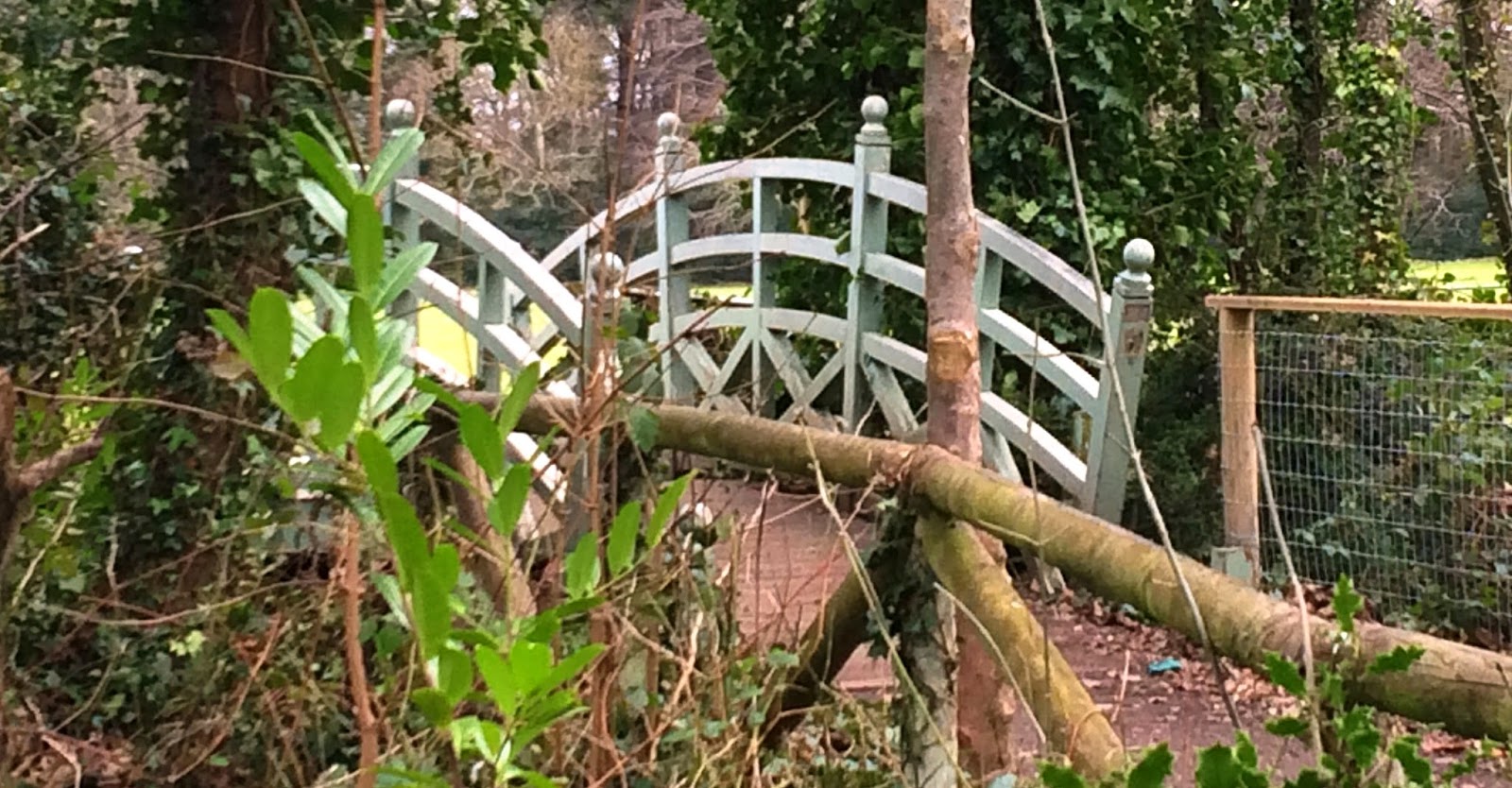
The charming, hidden cottage known as Laurelmere Lodge is in a shaded corner close to a little wooden bridge that easily provide the location for Christopher Robin playing Pooh-Sticks … I can just imagine the children crossing this bridge looking out for Winnie the Pooh and Eeyore.
For years, this two-storey cottage was shaded by overgrown, overhanging trees, and had fallen into a sad state of disrepair.
Marlay House is an 18th century Georgian house once owned by the family of David La Touche, the first governor of the Bank of Ireland. Laurelmere was originally built around 1790 a thatched cottage orné or stylised cottage built in a rustic setting for the La Touche family.
The La Touche family would have used the cottage as a place for picnics, card games and theatricals, according to Pamela O’Connor, a conservation architect with Dún Laoghaire Rathdown County Council.
Arts and crafts tiles and details were added to the cottage in the 1870s (Photograph: Patrick Comerford, 2015)
Later, the cottage was remodelled with a slate roof in the Art and Crafts style around 1875 by its next owner, Robert Tedcastle. Two rooms were added on upstairs and a slate roof in the Arts and Crafts style was added. At the time, the estate manager for the Tedcastle family lived in the house at this time.
Later, it was also known as Tamplin’s Cottage after a one-time resident, Colonel Bob Tamplin, who was the Captain of nearby Grange Golf Club in 1925.
From 1925, Marlay House and estate was owned by the market gardener Phillip Love until it was acquired by Dublin County Council in 1972. The last tenant of Laurelmere Cottage moved out in the mid-1970s, and the cottage remained vacant for another three decades and was falling into ruin. But it continued to hold a fairy-tale, romantic fascination for children – and adults – in the woods of Marlay Park.
“Attempts were made to stop the rot in the 1970s and structural work was done to hold the building in its place in the 1990s, but it was never a priority,” according to Michael Church, the heritage building manager at Dun Laoghaire Rathdown County Council.
The main house at Marlay Park, built by the La Touche family in the 18th century (Photograph: Patrick Comerford, 2015)
The cottage has been restored in recent months by the Architecture Department of Dún Laoghaire-Rathdown County Council as part of the restoration of Marlay Park. The restoration has cost €536,000, and this been funded by the monies raised from the Marlay Park concerts.
Pamela O’Connor and Alyson Carney oversaw the recent restoration works on Laurelmere. This restoration work was carried out by master craftsmen Dunwoody and Dobson, who worked in the Arts and Crafts style, reusing original stone-tiled flooring, wood panelling, tasteful light fittings and cast iron fireplaces.
Now it has become the premises of the Royal Horticultural Society of Ireland, and will be home to the RHSI garden school and a horticultural programme run by gardening lecturer Ciaran Burke.
More than 500 people saw the interior of Laurelmere last October as part of Open House Dublin last year. I walked around the cottage this afternoon, peering through the windows at the two reception rooms downstairs. Upstairs, there is space for a boardroom, a library with more than 1,000 gardening books, and the Garden School office.
The cottage was closed this afternoon, but I understand reproductions of William Morris floral printed wallpapers – popular during the Arts and Crafts movement – have been used throughout the house. Paint colours used during the late 1700s, when the cottage was first built, have also been replicated.
The garden to the front of the house is to be used by the garden school and there are plans for a naturalistic style garden to the back, with seating for adults, play space for children and perhaps sculpture exhibitions.
However, plans to reinstall the original conservatory have been put on hold due to a lack of funding.
A taste of Greece … olive products from Crete on a stall in the courtyard at Marlay Park (Photograph: Patrick Comerford, 2015)
We strolled through the Saturday farmers’ market in the courtyard, where we bought a little taste of Greece in the shape of olive produces from Greece.
Later, we had double espressos in the coffee house beside the walled gardens, before moving into the walled regency gardens, with its hidden delights.
Hidden surprises in the walled regency gardens in Marlay Park (Photograph: Patrick Comerford, 2015)
Before we left, a proud peacock was preening himself on a table in the small walled area behind the coffee shop, obviously used to the attention of customers and visitors and not afraid of their proximity. Back in the main courtyard, the blustering winds were blowing through the stalls, announcing the storm was imminent.
Perhaps the peacock alone would remain unperturbed. But I was reminded that the peacock was a mediaeval symbol of the resurrection.
As we prepare this Lent for Easter, the Gospel reading at the Eucharist tomorrow morning [1 March 2015] is Saint Mark’s account of the Transfiguration (Mark 9: 2-9). After that experience, Christ tells Peter, James and John “to tell no one about what they had seen, until after the Son of Man had risen from the dead.”
Lent finds its climax not on Good Friday but on Easter Morning.
A proud peacock on a table beside the coffee shop in Marlay Park this afternoon (Photograph: Patrick Comerford, 2015)
For other postings on the architectural heritage of South Dublin see:
Berwick Hall.
The Bottle Tower, Churchtown.
Brookvale House, Rathfarnham.
Camberley House, Churchtown.
Dartry House, Orwell Park, Rathfarnham.
Ely Arch, Rathfarnham.
Ely House, Nutgrove Avenue, Rathfarnham.
Fernhurst, 14 Orwell Road, Rathgar.
Fortfield House, Hyde Park, Terenure.
No 201 Harold’s Cross Road, the birthplace of Richard Allen.
Homestead, Sandyford Road, Dundrum.
Kilvare House, also known as Cheeverstown House, Templeogue Road.
Knocklyon Castle.
Laurelmere Lodge, Marlay Park.
Marlay Park.
Mountain View House, Beaumont Avenue, Churchtown.
Newbrook House, Taylor’s Lane, Rathfarnham.
Old Bawn House, Tallaght.
Rathfarnham Castle.
Sally Park, Fihouse.
Scholarstown House, Knocklyon.
Silveracre House, off Sarah Curran Avenue, Rathfarnham.
Synge House, Newtwon Villas, Churchtown, and No 4 Orwell Park, Rathgar.
Templeogue House.
Washington House, Butterfield Avenue, Rathfarnham.
Westbourne House, off Rathfarnham Road.
Patrick Comerford
Before the storm blew up this afternoon, two of us went for a stroll in Marlay Park on the edges of Rathfarnham and beneath the slopes of the Dublin Mountains.
I am blessed to live in a part of south Dublin that offers access to so many open areas of parkland, including Airfield, Saint Enda’s Park, the grounds of Rathfarnham Castle, Tymon Park and Marlay Park.
I can understand why so many of the residents of this part of Rathfarnam complain during the summer months about the noise and behaviour connected with late night concerts. But those concerts have paid for the restoration of one of the architectural gems in Marlay Park.
Generations of children have passed by a tumbledown that they have often known as “Goldilocks Cottage,” teased by parents to peer at the windows from a distance to see whether they can catch glimpses of the Three Bears.
Immediately adjoining the courtyard is an enclosed garden of some four acres with a head gardener's house.
A wooden footbridge near ‘Goldilocks Cottage … just the place for Christopher Robin to play Pooh-stick (Photograph: Patrick Comerford, 2015)
The charming, hidden cottage known as Laurelmere Lodge is in a shaded corner close to a little wooden bridge that easily provide the location for Christopher Robin playing Pooh-Sticks … I can just imagine the children crossing this bridge looking out for Winnie the Pooh and Eeyore.
For years, this two-storey cottage was shaded by overgrown, overhanging trees, and had fallen into a sad state of disrepair.
Marlay House is an 18th century Georgian house once owned by the family of David La Touche, the first governor of the Bank of Ireland. Laurelmere was originally built around 1790 a thatched cottage orné or stylised cottage built in a rustic setting for the La Touche family.
The La Touche family would have used the cottage as a place for picnics, card games and theatricals, according to Pamela O’Connor, a conservation architect with Dún Laoghaire Rathdown County Council.
Arts and crafts tiles and details were added to the cottage in the 1870s (Photograph: Patrick Comerford, 2015)
Later, the cottage was remodelled with a slate roof in the Art and Crafts style around 1875 by its next owner, Robert Tedcastle. Two rooms were added on upstairs and a slate roof in the Arts and Crafts style was added. At the time, the estate manager for the Tedcastle family lived in the house at this time.
Later, it was also known as Tamplin’s Cottage after a one-time resident, Colonel Bob Tamplin, who was the Captain of nearby Grange Golf Club in 1925.
From 1925, Marlay House and estate was owned by the market gardener Phillip Love until it was acquired by Dublin County Council in 1972. The last tenant of Laurelmere Cottage moved out in the mid-1970s, and the cottage remained vacant for another three decades and was falling into ruin. But it continued to hold a fairy-tale, romantic fascination for children – and adults – in the woods of Marlay Park.
“Attempts were made to stop the rot in the 1970s and structural work was done to hold the building in its place in the 1990s, but it was never a priority,” according to Michael Church, the heritage building manager at Dun Laoghaire Rathdown County Council.
The main house at Marlay Park, built by the La Touche family in the 18th century (Photograph: Patrick Comerford, 2015)
The cottage has been restored in recent months by the Architecture Department of Dún Laoghaire-Rathdown County Council as part of the restoration of Marlay Park. The restoration has cost €536,000, and this been funded by the monies raised from the Marlay Park concerts.
Pamela O’Connor and Alyson Carney oversaw the recent restoration works on Laurelmere. This restoration work was carried out by master craftsmen Dunwoody and Dobson, who worked in the Arts and Crafts style, reusing original stone-tiled flooring, wood panelling, tasteful light fittings and cast iron fireplaces.
Now it has become the premises of the Royal Horticultural Society of Ireland, and will be home to the RHSI garden school and a horticultural programme run by gardening lecturer Ciaran Burke.
More than 500 people saw the interior of Laurelmere last October as part of Open House Dublin last year. I walked around the cottage this afternoon, peering through the windows at the two reception rooms downstairs. Upstairs, there is space for a boardroom, a library with more than 1,000 gardening books, and the Garden School office.
The cottage was closed this afternoon, but I understand reproductions of William Morris floral printed wallpapers – popular during the Arts and Crafts movement – have been used throughout the house. Paint colours used during the late 1700s, when the cottage was first built, have also been replicated.
The garden to the front of the house is to be used by the garden school and there are plans for a naturalistic style garden to the back, with seating for adults, play space for children and perhaps sculpture exhibitions.
However, plans to reinstall the original conservatory have been put on hold due to a lack of funding.
A taste of Greece … olive products from Crete on a stall in the courtyard at Marlay Park (Photograph: Patrick Comerford, 2015)
We strolled through the Saturday farmers’ market in the courtyard, where we bought a little taste of Greece in the shape of olive produces from Greece.
Later, we had double espressos in the coffee house beside the walled gardens, before moving into the walled regency gardens, with its hidden delights.
Hidden surprises in the walled regency gardens in Marlay Park (Photograph: Patrick Comerford, 2015)
Before we left, a proud peacock was preening himself on a table in the small walled area behind the coffee shop, obviously used to the attention of customers and visitors and not afraid of their proximity. Back in the main courtyard, the blustering winds were blowing through the stalls, announcing the storm was imminent.
Perhaps the peacock alone would remain unperturbed. But I was reminded that the peacock was a mediaeval symbol of the resurrection.
As we prepare this Lent for Easter, the Gospel reading at the Eucharist tomorrow morning [1 March 2015] is Saint Mark’s account of the Transfiguration (Mark 9: 2-9). After that experience, Christ tells Peter, James and John “to tell no one about what they had seen, until after the Son of Man had risen from the dead.”
Lent finds its climax not on Good Friday but on Easter Morning.
A proud peacock on a table beside the coffee shop in Marlay Park this afternoon (Photograph: Patrick Comerford, 2015)
For other postings on the architectural heritage of South Dublin see:
Berwick Hall.
The Bottle Tower, Churchtown.
Brookvale House, Rathfarnham.
Camberley House, Churchtown.
Dartry House, Orwell Park, Rathfarnham.
Ely Arch, Rathfarnham.
Ely House, Nutgrove Avenue, Rathfarnham.
Fernhurst, 14 Orwell Road, Rathgar.
Fortfield House, Hyde Park, Terenure.
No 201 Harold’s Cross Road, the birthplace of Richard Allen.
Homestead, Sandyford Road, Dundrum.
Kilvare House, also known as Cheeverstown House, Templeogue Road.
Knocklyon Castle.
Laurelmere Lodge, Marlay Park.
Marlay Park.
Mountain View House, Beaumont Avenue, Churchtown.
Newbrook House, Taylor’s Lane, Rathfarnham.
Old Bawn House, Tallaght.
Rathfarnham Castle.
Sally Park, Fihouse.
Scholarstown House, Knocklyon.
Silveracre House, off Sarah Curran Avenue, Rathfarnham.
Synge House, Newtwon Villas, Churchtown, and No 4 Orwell Park, Rathgar.
Templeogue House.
Washington House, Butterfield Avenue, Rathfarnham.
Westbourne House, off Rathfarnham Road.
20 December 2014
‘The people who walked in darkness
have seen a great light’
A peacock walks through the Regency Walled Garden in Marlay Park this evening (Photograph: Patrick Comerford, 2014)
Patrick Comerford
I am not all-carolled-out yet. There’s still five more days to go to Christmas, and quite a few events yet to come at which carols are part of the programme.
This afternoon [20 December 2014], two of us went to the traditional Ecumenical Carol Service in Marlay Park. For years, this carol service has been hosted by the local Roman Catholic and Church of Ireland parishes, and for a long time it was held in the courtyard.
However, the venue has been moved recently because of pressure from the Saturday traders in the courtyard, and the service has been moved to an annex behind the coffee shop and beside the walled garden.
Before the service began, we enjoyed falafel wraps from the ‘Flavours of Palestine’ stall in the courtyard, and couple espressos from Bryan’s Coffee, and then strolled through the Regency Walled Garden as the evening lights were beginning to fade.
In other seasons of the year, this walled garden is riot of colour with its flowers, shrubs, trees and berries.
A strutting, confident peacock was the main colourful attraction in the Regency Walled Garden in Marlay Park this afternoon (Photograph: Patrick Comerford, 2014)
But late this afternoon, the main attraction in colour was a peacock strutting around quite fearlessly, pecking up bits of food dropped in the grass by people from the coffee shop and even confronting children in a cheeky manner, obviously begging for their children.
Early Christians used the peacock as a symbol of resurrection and eternal life because of an ancient belief that the flesh of the peacock never decayed. From the early third century, the walls of the catacombs in Rome were decorated with peacocks in mosaics and paintings, representing the hope that the mortal earthly body of Christians would become glorified bodies in eternal life.
When the peacock displays his pride or tail, it looks like hundreds of eyes are watching us. In this way, the peacock also became a symbol of the all-seeing eye of God and that nothing escapes God’s universal justice.
‘The Adoration of the Magi’ by Fra Angelico and Fra Filippo Lippi (Florence, ca 1440/1460) … notice the peacock on the roof
When Fra Angelico and Fra Filippo Lippi collaborated in a unique work, ‘The Adoration of the Magi,’ in Florence around 1440-1460, produced one of the first examples of a tondo, or circular painting, which in the mid-15th century became popular for domestic religious paintings. But they also included a similar engaging and curious peacock on the roof, observing the whole scene.
In this one work of art, these two Florentine artists linked the Incarnation and the story of the first Christmas with the Resurrection and the story of Easter.
After darkness fell this afternoon, we sang our way through the Christmas story at the carol service which was hosted this year by Marley Parish, with the support of Good Counsel Parish, Ballyboden, Divine Word Parish, Marley Grange, Saint John the Evangelist Parish, Ballinteer, and the Church of Ireland Parish in Whitechurch.
We sang old favourites, including ‘O come all ye faithful,’ Dingdong! Merrily on high,’ ‘Mary’s boy child,’ ‘While shepherds watched,’ ‘Hark the Herald Angels sing,’ Joy to the World,’ and ‘Away in a manger,’ while Catherine Martin of Ballybdoen sang a solo rendition of ‘O Holy Night.’
‘The people who walked in darkness’ … this evening’s carol service in Marlay Park (Photograph: Patrick Comerford, 2014)
I was asked on behalf of Whitechurch Parish to read from the Prophet Isaiah:
The people who walked in darkness have seen a great light; those who lived in a land of deep darkness – on them light has shined. You have multiplied the nation, you have increased its joy; they rejoice before you as with joy at the harvest, as people exult when dividing plunder. For the yoke of their burden, and the bar across their shoulders, the rod of their oppressor, you have broken as on the day of Midian. For all the boots of the tramping warriors and all the garments rolled in blood shall be burned as fuel for the fire. For a child has been born for us, a son given to us; authority rests upon his shoulders; and he is named Wonderful Counsellor, Mighty God, Everlasting Father, Prince of Peace. His authority shall grow continually, and there shall be endless peace for the throne of David and his kingdom. He will establish and uphold it with justice and with righteousness from this time onward and forevermore. The zeal of the Lord of hosts will do this. (Isaiah 9: 2-7).
Again, the connection was made between the first Christmas and the promise of God’s coming ever-lasting justice.
Despite problems with the sound system and the winter cold, we all said the Lord’s Prayer together. I was asked the join the other clergy in the blessing before Dermot McGowan led us in singing Silent Night – as he has done for years.
The people who arrived in afternoon brightness waked out of the walled garden in darkness. From tomorrow the darkness begins to recede and the days begin to get longer once again. But there are still many carols to sing before Christmas arrives with the promise of the coming of God’s justice and eternal life.
Darkness begins to fall in Marlay Park this evening (Photograph: Patrick Comerford, 2014)
Patrick Comerford
I am not all-carolled-out yet. There’s still five more days to go to Christmas, and quite a few events yet to come at which carols are part of the programme.
This afternoon [20 December 2014], two of us went to the traditional Ecumenical Carol Service in Marlay Park. For years, this carol service has been hosted by the local Roman Catholic and Church of Ireland parishes, and for a long time it was held in the courtyard.
However, the venue has been moved recently because of pressure from the Saturday traders in the courtyard, and the service has been moved to an annex behind the coffee shop and beside the walled garden.
Before the service began, we enjoyed falafel wraps from the ‘Flavours of Palestine’ stall in the courtyard, and couple espressos from Bryan’s Coffee, and then strolled through the Regency Walled Garden as the evening lights were beginning to fade.
In other seasons of the year, this walled garden is riot of colour with its flowers, shrubs, trees and berries.
A strutting, confident peacock was the main colourful attraction in the Regency Walled Garden in Marlay Park this afternoon (Photograph: Patrick Comerford, 2014)
But late this afternoon, the main attraction in colour was a peacock strutting around quite fearlessly, pecking up bits of food dropped in the grass by people from the coffee shop and even confronting children in a cheeky manner, obviously begging for their children.
Early Christians used the peacock as a symbol of resurrection and eternal life because of an ancient belief that the flesh of the peacock never decayed. From the early third century, the walls of the catacombs in Rome were decorated with peacocks in mosaics and paintings, representing the hope that the mortal earthly body of Christians would become glorified bodies in eternal life.
When the peacock displays his pride or tail, it looks like hundreds of eyes are watching us. In this way, the peacock also became a symbol of the all-seeing eye of God and that nothing escapes God’s universal justice.
‘The Adoration of the Magi’ by Fra Angelico and Fra Filippo Lippi (Florence, ca 1440/1460) … notice the peacock on the roof
When Fra Angelico and Fra Filippo Lippi collaborated in a unique work, ‘The Adoration of the Magi,’ in Florence around 1440-1460, produced one of the first examples of a tondo, or circular painting, which in the mid-15th century became popular for domestic religious paintings. But they also included a similar engaging and curious peacock on the roof, observing the whole scene.
In this one work of art, these two Florentine artists linked the Incarnation and the story of the first Christmas with the Resurrection and the story of Easter.
After darkness fell this afternoon, we sang our way through the Christmas story at the carol service which was hosted this year by Marley Parish, with the support of Good Counsel Parish, Ballyboden, Divine Word Parish, Marley Grange, Saint John the Evangelist Parish, Ballinteer, and the Church of Ireland Parish in Whitechurch.
We sang old favourites, including ‘O come all ye faithful,’ Dingdong! Merrily on high,’ ‘Mary’s boy child,’ ‘While shepherds watched,’ ‘Hark the Herald Angels sing,’ Joy to the World,’ and ‘Away in a manger,’ while Catherine Martin of Ballybdoen sang a solo rendition of ‘O Holy Night.’
‘The people who walked in darkness’ … this evening’s carol service in Marlay Park (Photograph: Patrick Comerford, 2014)
I was asked on behalf of Whitechurch Parish to read from the Prophet Isaiah:
The people who walked in darkness have seen a great light; those who lived in a land of deep darkness – on them light has shined. You have multiplied the nation, you have increased its joy; they rejoice before you as with joy at the harvest, as people exult when dividing plunder. For the yoke of their burden, and the bar across their shoulders, the rod of their oppressor, you have broken as on the day of Midian. For all the boots of the tramping warriors and all the garments rolled in blood shall be burned as fuel for the fire. For a child has been born for us, a son given to us; authority rests upon his shoulders; and he is named Wonderful Counsellor, Mighty God, Everlasting Father, Prince of Peace. His authority shall grow continually, and there shall be endless peace for the throne of David and his kingdom. He will establish and uphold it with justice and with righteousness from this time onward and forevermore. The zeal of the Lord of hosts will do this. (Isaiah 9: 2-7).
Again, the connection was made between the first Christmas and the promise of God’s coming ever-lasting justice.
Despite problems with the sound system and the winter cold, we all said the Lord’s Prayer together. I was asked the join the other clergy in the blessing before Dermot McGowan led us in singing Silent Night – as he has done for years.
The people who arrived in afternoon brightness waked out of the walled garden in darkness. From tomorrow the darkness begins to recede and the days begin to get longer once again. But there are still many carols to sing before Christmas arrives with the promise of the coming of God’s justice and eternal life.
Darkness begins to fall in Marlay Park this evening (Photograph: Patrick Comerford, 2014)
29 November 2014
A double espresso and an afternoon
visit to the house at Marlay Park
Marlay Park preserves fine original plasterwork by the master stuccodore Michael Stapleton (Photograph: Patrick Comerford, 2014)
Patrick Comerford
AS November draws to a close, and Advent begins tomorrow morning [30 November 2014], the evenings seem shorter and dusk falls earlier and earlier each day.
Before I knew it, it was late afternoon today, with just an hour or so of daylight left in the day, two of headed across to Marlay Park in Rathfarnham, thinking we would get a good coffee in the courtyard, and stroll through the stalls at the Farmers’ Market before darkness fell.
I had forgotten that the Marlay Craft Fair was on all this weekend, from Friday to Sunday [28 to 30 November], and we were about to change our mind and keep going on to Bray when we surprised upon a parking space.
From the car park to the courtyard, the pathway was lined with an array of craft stalls and charity tents. But we dallied only a little, for the stalls were beginning to close in courtyard, and I really needed that double espresso.
The Farmers’ Market in the courtyard at Marlay Park hosts a wealth of local producers each Saturday from 10am-4pm and Sunday from 11am-4pm. There is a broad range of artisan produce, including specialty foods.
Two double espressos resting on a window ledge in the courtyard in Marlay Park (Photograph: Patrick Comerford, 2014)
Spruced up by two double espressos, we ended up buying a rich variety of olives, a tub of pesto-flavoured humous, fresh bread baked with dates and walnuts, and a raspberry and custard pie.
‘Is there anyone at home?’ … a door knocker in the courtyard in Marlay Park (Photograph: Patrick Comerford, 2014)
For some years, the courtyard at Marlay has been home to a number of small craft industries and workshops, including weaving, glass cutting, bookbinding, furniture restoration, copper craft, pottery and embroidery. One of the original artists in residence was Evie Hone, whose stained-glass workshop was located in the library of Marlay House itself.
The courtyard is now being restored, and Dun Laoghaire Rathdown Council hopes to have new tenants in 20 new units by the middle of 2015.
Marlay Park in the dim lights of dusk late this afternoon (Photograph: Patrick Comerford, 2014)
As darkness closed in and the stalls began to fold up in the courtyard this afternoon, we realised the Craft Stalls lining the pathway were just an overflow from the venue in the house itself, and this provided an opportunity to see a fine architectural gem lit up and its best.
The stucco decoration by Michael Stapleton in the Georgian house built by the La Touche family in Marlay Park (Photograph: Patrick Comerford, 2014)
The house built by the La Touche family at Marlay Park is a fine example of Georgian architecture, with many of the original elaborate features still intact, including the decorative plasterwork by the master stuccodore Michael Stapleton (1747-1801).
The crafts on the stall inside the house, all the crafts were made in Ireland by creative crafts people and small craft businesses, all delighted of the chance to sell their wares in such fine Georgian surroundings.
The Marlay Craft Fair continues tomorrow [Sunday, 30 November 2014], from 10 am to 5 pm. But I plan to be in Christ Church Cathedral for most of the day, marking the beginning of Advent, with the Cathedral Eucharist and the Advent Procession.
Design Jeweller Trevor Power at his stall in Marlay Park House this afternoon (Photograph: Patrick Comerford, 2014)
Patrick Comerford
AS November draws to a close, and Advent begins tomorrow morning [30 November 2014], the evenings seem shorter and dusk falls earlier and earlier each day.
Before I knew it, it was late afternoon today, with just an hour or so of daylight left in the day, two of headed across to Marlay Park in Rathfarnham, thinking we would get a good coffee in the courtyard, and stroll through the stalls at the Farmers’ Market before darkness fell.
I had forgotten that the Marlay Craft Fair was on all this weekend, from Friday to Sunday [28 to 30 November], and we were about to change our mind and keep going on to Bray when we surprised upon a parking space.
From the car park to the courtyard, the pathway was lined with an array of craft stalls and charity tents. But we dallied only a little, for the stalls were beginning to close in courtyard, and I really needed that double espresso.
The Farmers’ Market in the courtyard at Marlay Park hosts a wealth of local producers each Saturday from 10am-4pm and Sunday from 11am-4pm. There is a broad range of artisan produce, including specialty foods.
Two double espressos resting on a window ledge in the courtyard in Marlay Park (Photograph: Patrick Comerford, 2014)
Spruced up by two double espressos, we ended up buying a rich variety of olives, a tub of pesto-flavoured humous, fresh bread baked with dates and walnuts, and a raspberry and custard pie.
‘Is there anyone at home?’ … a door knocker in the courtyard in Marlay Park (Photograph: Patrick Comerford, 2014)
For some years, the courtyard at Marlay has been home to a number of small craft industries and workshops, including weaving, glass cutting, bookbinding, furniture restoration, copper craft, pottery and embroidery. One of the original artists in residence was Evie Hone, whose stained-glass workshop was located in the library of Marlay House itself.
The courtyard is now being restored, and Dun Laoghaire Rathdown Council hopes to have new tenants in 20 new units by the middle of 2015.
Marlay Park in the dim lights of dusk late this afternoon (Photograph: Patrick Comerford, 2014)
As darkness closed in and the stalls began to fold up in the courtyard this afternoon, we realised the Craft Stalls lining the pathway were just an overflow from the venue in the house itself, and this provided an opportunity to see a fine architectural gem lit up and its best.
The stucco decoration by Michael Stapleton in the Georgian house built by the La Touche family in Marlay Park (Photograph: Patrick Comerford, 2014)
The house built by the La Touche family at Marlay Park is a fine example of Georgian architecture, with many of the original elaborate features still intact, including the decorative plasterwork by the master stuccodore Michael Stapleton (1747-1801).
The crafts on the stall inside the house, all the crafts were made in Ireland by creative crafts people and small craft businesses, all delighted of the chance to sell their wares in such fine Georgian surroundings.
The Marlay Craft Fair continues tomorrow [Sunday, 30 November 2014], from 10 am to 5 pm. But I plan to be in Christ Church Cathedral for most of the day, marking the beginning of Advent, with the Cathedral Eucharist and the Advent Procession.
Design Jeweller Trevor Power at his stall in Marlay Park House this afternoon (Photograph: Patrick Comerford, 2014)
31 December 2013
How long into the New Year should
Santa and the ‘Fairy Tree’ last for?
The sun sets on 2013 behind the tall bare trees in Marlay Park late this afternoon (Photograph: Patrick Comerford, 2013)
Patrick Comerford
Harold Wilson once said in the 1960s: “A week in politics is a long time back.”
It became an oft-quoted adage among journalists and politicians, and was developed as theme in the political-comedy television series, Yes Minister:
Sir Humphrey: In a week’s time this whole thing will have blown over and in a year’s time we’ll have a safe and successful factory on Merseyside.
Jim Hacker: A week is a long time in politics.
Sir Humphrey: And a year is a short time in Government.
As the year comes to an end, I realised this afternoon how short a year can be in the life of a family.
After lunch in Howard’s Way in Rathgar, some family members gathered together this afternoon. At one stage there were four generations of the family in one room in the house in Grosvenor Road.
My grandfather could say his grandfather, who was born in 1775, was born a year before the American Revolution and could remember the 1798 Rising in Co Wexford. Will my sister’s grandsons remember to say their grandmother’s grandfather could say that his grandfather’s ...?
Grosvenor Road has fine examples of Victorian architecture in its terraced houses and its villas (Photograph: Patrick Comerford, 2013)
Outside on Grosvenor Road, I stopped to admire the villas and terraced houses, which are fine examples of Victorian architecture, with houses designed and built by Edward Henry Carson (father of Sir Edward Carson), George Palmer Beater, and the brothers James and William Beckett – William Beckett was the grandfather of Samuel Beckett.
Grosvenor Road Baptist Church ... an interesting example of Gothic revival architecture that is unusual for Baptists (Photograph: Patrick Comerford, 2013)
Grosvenor Road Baptist Church stands on the corner of Grosvenor Road, Grosvenor Place and Kenilworth Road. It is attributed to Carson, and was built as Rathmines Baptist Church. It is an interesting example of Gothic architecture in the middle of Victorian suburban Rathmines and Rathgar.
The church was built as Rathmines Baptist Church in the 1870s by English Baptists. It was used for a while by the Plymouth Brethren, and returned to use as a Baptist church in 1942. The choice of Gothic is unusual for Baptists in the 1870s. The main entrance to the church has an interesting arrangement of arches, with an attractive towered façade.
As the afternoon came to a close – but before the sun set on 2013 – two of us went for a walk in Marlay Park. Through the tall bare limbs and branches of the trees, the orange glaze left by the setting sun was lighting up the blue winter sky.
The ‘Fairy Tree’ and ‘Fairy Castle’ in the forest in Marlay Park (Photograph: Patrick Comerford, 2013)
In among the tall trees and by the banks of the babbling brooks and the small footbridges, we came across the “Fairy Tree” which has become one of the sights of Marlay Park in recent years, and has been the crowning glory of the bird project at Saint Michael’s House, Templeogue, since 2010.
The bird project involved installing a purpose built “Fairy Castle” on a tree in the forest in Marlay Park. This five-towered castle, built in special weatherproof material, is designed as a nesting and roosting site for small birds and insects.
But the “Fairy Tree,” with its turrets and towers, crenellations and battlements, secret doors and Gothic windows, is also designed to keep the imagination of young children alive, as they wander through the forest and then are surprised to find the small fairy door at the base of the 300-year-old beech tree.
A secret gothic window on the ‘Fairy Castle’ in the ‘Fairy Tree’ (Photograph: Patrick Comerford, 2013)
I came home with an unusual Christmas present – a Chocolate Santa with a best before date of 30 April 2014. Santa has a best-by date that expires before next Christmas? If a Fairy Tree can survive in a 300-year-old tree, surely Santa can last until at least next Christmas?
Have a wonderful and a blessed 2014.
Why does Santa have a best before date of 30 April 2014? (Photograph: Patrick Comerford, 2013)
Patrick Comerford
Harold Wilson once said in the 1960s: “A week in politics is a long time back.”
It became an oft-quoted adage among journalists and politicians, and was developed as theme in the political-comedy television series, Yes Minister:
Sir Humphrey: In a week’s time this whole thing will have blown over and in a year’s time we’ll have a safe and successful factory on Merseyside.
Jim Hacker: A week is a long time in politics.
Sir Humphrey: And a year is a short time in Government.
As the year comes to an end, I realised this afternoon how short a year can be in the life of a family.
After lunch in Howard’s Way in Rathgar, some family members gathered together this afternoon. At one stage there were four generations of the family in one room in the house in Grosvenor Road.
My grandfather could say his grandfather, who was born in 1775, was born a year before the American Revolution and could remember the 1798 Rising in Co Wexford. Will my sister’s grandsons remember to say their grandmother’s grandfather could say that his grandfather’s ...?
Grosvenor Road has fine examples of Victorian architecture in its terraced houses and its villas (Photograph: Patrick Comerford, 2013)
Outside on Grosvenor Road, I stopped to admire the villas and terraced houses, which are fine examples of Victorian architecture, with houses designed and built by Edward Henry Carson (father of Sir Edward Carson), George Palmer Beater, and the brothers James and William Beckett – William Beckett was the grandfather of Samuel Beckett.
Grosvenor Road Baptist Church ... an interesting example of Gothic revival architecture that is unusual for Baptists (Photograph: Patrick Comerford, 2013)
Grosvenor Road Baptist Church stands on the corner of Grosvenor Road, Grosvenor Place and Kenilworth Road. It is attributed to Carson, and was built as Rathmines Baptist Church. It is an interesting example of Gothic architecture in the middle of Victorian suburban Rathmines and Rathgar.
The church was built as Rathmines Baptist Church in the 1870s by English Baptists. It was used for a while by the Plymouth Brethren, and returned to use as a Baptist church in 1942. The choice of Gothic is unusual for Baptists in the 1870s. The main entrance to the church has an interesting arrangement of arches, with an attractive towered façade.
As the afternoon came to a close – but before the sun set on 2013 – two of us went for a walk in Marlay Park. Through the tall bare limbs and branches of the trees, the orange glaze left by the setting sun was lighting up the blue winter sky.
The ‘Fairy Tree’ and ‘Fairy Castle’ in the forest in Marlay Park (Photograph: Patrick Comerford, 2013)
In among the tall trees and by the banks of the babbling brooks and the small footbridges, we came across the “Fairy Tree” which has become one of the sights of Marlay Park in recent years, and has been the crowning glory of the bird project at Saint Michael’s House, Templeogue, since 2010.
The bird project involved installing a purpose built “Fairy Castle” on a tree in the forest in Marlay Park. This five-towered castle, built in special weatherproof material, is designed as a nesting and roosting site for small birds and insects.
But the “Fairy Tree,” with its turrets and towers, crenellations and battlements, secret doors and Gothic windows, is also designed to keep the imagination of young children alive, as they wander through the forest and then are surprised to find the small fairy door at the base of the 300-year-old beech tree.
A secret gothic window on the ‘Fairy Castle’ in the ‘Fairy Tree’ (Photograph: Patrick Comerford, 2013)
I came home with an unusual Christmas present – a Chocolate Santa with a best before date of 30 April 2014. Santa has a best-by date that expires before next Christmas? If a Fairy Tree can survive in a 300-year-old tree, surely Santa can last until at least next Christmas?
Have a wonderful and a blessed 2014.
Why does Santa have a best before date of 30 April 2014? (Photograph: Patrick Comerford, 2013)
Subscribe to:
Posts (Atom)