Gnasher and Gnipper in the ‘Beano’ always seemed ready to gnash their teeth
Patrick Comerford
We are continuing in Ordinary Time in the Church and this week began with the Sixth Sunday after Trinity (Trinity VI, 27 July 2025). The Church Calendar today (29 July 2025) remembers Mary, Martha and Lazarus, Companions of our Lord. Before today begins, I am taking some quiet time this morning to give thanks, to reflect, to pray and to read in these ways:
1, today’s Gospel reading;
2, a reflection on the Gospel reading;
3, a prayer from the USPG prayer diary;
4, the Collects and Post-Communion prayer of the day.
Harvest or weeds? … a field near Cross in Hand on the northern edges of Lichfield last week (Photograph: Patrick Comerford, 2025)
Matthew 13: 36-43 (NRSVA):
36 Then he left the crowds and went into the house. And his disciples approached him, saying, ‘Explain to us the parable of the weeds of the field.’ 37 He answered, ‘The one who sows the good seed is the Son of Man; 38 the field is the world, and the good seed are the children of the kingdom; the weeds are the children of the evil one, 39 and the enemy who sowed them is the devil; the harvest is the end of the age, and the reapers are angels. 40 Just as the weeds are collected and burned up with fire, so will it be at the end of the age. 41 The Son of Man will send his angels, and they will collect out of his kingdom all causes of sin and all evildoers, 42 and they will throw them into the furnace of fire, where there will be weeping and gnashing of teeth. 43 Then the righteous will shine like the sun in the kingdom of their Father. Let anyone with ears listen!’
Fields of green and gold beside Comberford Hall, between Lichfield and Tamworth in rural Staffordshire last week (Photograph: Patrick Comerford, 2025)
This morning’s reflection:
In my imagination, when I was a child, not only were the summers long and sunny, but weekend entertainment was simpler and less complicated. The highlights of the weekend seemed to be Dr Who and Dixon of Dock Green, and the weekly editions of the Eagle and the Beano.
I may have been just a little too old (16) for the first appearance of Gnasher (1968), the pet dog of Dennis the Menace in the Beano. The G- tagged onto the beginning of the name of both Gnasher and his son Gnipper is pronounced silently, just like the silent P at the beginning of Psmith, the Rupert Psmith in so many PG Wodehouse novels.
Most of the Beano speech bubbles for both Gnasher and Gnipper consist of normal English words beginning with the letter ‘N’ with a silent ‘G’ added to the beginning, as in ‘Gnight, Gnight.’
I was a little too old for the introduction of Gnasher, but nonetheless I and my friends in our late teens and early 20s loved Gnasher and Gniper, joked about those silent ‘Gs’ and even recalled how as children we had joked about ‘weeping and G-nashing of teeth.’
There is very little to joke about in today’s Gospel reading (Matthew 13: 36-43). The idea of people being thrown into the furnace of fire is not a very appealing image for children, and so to joke about it is a childhood method of coping.
But throughout history, humanity has stooped to burn what we dislike and what we want to expunge, and we have done it constantly.
We have been burning books as Christians since Saint Athanasius ordered the burning of texts in Alexandria in the year 367. In the Middle Ages, and sometimes even later, we burned heretics at the stake. When that stopped, we burned anything deemed to be an occasions of sin.
They were burned publicly as an accompanying theme for the outdoor sermons of San Bernardino da Siena in the early 15th century. These included mirrors, cosmetics, fine dresses, playing cards … even musical instruments, and, of course, books, song sheets, artworks, paintings and sculpture. In his sermons, the book-burning friar regularly called for Jews and gays to be either isolated from society or eliminated from the human community.
Later in Florence, the supporters of Savonarola collected and publicly burned thousands of objects, including cosmetics, art, and books in 1497.
On the other hand, Franz Kafka’s last request to his friend Max Brod in 1921 was to ‘burn all my diaries, letters, manuscripts … completely and unread'.
But, more recently, the Nazis staged regular book burnings, especially burning books by Jewish writers, including Thomas Mann, Karl Marx and Albert Einstein. Extremists of all religious and political persuasions want to burn the symbols and totems of their opponents, whether it is Pastor Terry Jones burning the Quran and effigies of Bill Clinton and Barack Obama in Florida or jihadists burning the Twin Towers in New York.
Today we are witnessing efforts by the Trump regime to suppress free speech by journalists in the Wall Street Journal and the Associated Press, capriciously excluding journalists from the White House press pool, and threatening to strip NBC and ABC of their licences to broadcast. The hypocrisy of these threats is aggravated by claims from the Trump regime that it was defending free speech when it attacked Britain and other European countries for seeking to curb violence and racism on US-based social media platforms.
The limits of our extremists seem to be defined by their inflammatory words.
But who is being burned in this morning’s Gospel reading?
Who is doing the burning?
And who will be weeping and gnashing their teeth?
Contrary to many shoddy reading of this Gospel reading, Christians are not asked to burn anyone or anything at all. And, if we have enemies, we are called not to burn them but to love them.
Christ has been speaking by the lake first to the crowd, telling them the parable of the wheat and the weeds (verse 24-30). The word that we have traditionally translated as tares or weeds (verses 25, 26, 27, 29, 30, 36, 38, 40) is the Greek word ζιζάνια (zizania), a type of wild rice grass, although Saint Matthew is probably referring to a type of darnel or noxious weed. It looks like wheat until the plants mature and the ears open, and the seeds are a strong soporific poison.
Christ then withdraws into a house, and has a private conversation with the Disciples (verses 36-43), in which he explains he is the sower (verse 37), the good seed is not the Word, but the Children of the Kingdom (verse 38), the weeds are the ‘Children of the Evil One’ (verse 38), and the field is the world (verse 38).
The harvest is not gathered by the disciples or the children of the kingdom, but by angels sent by the Son of Man (verses 39, 41). It is an apocalyptic image, describing poetically and dramatically a future cataclysm, and not an image to describe what should be happening today. It is imagery that draws on the apocalyptic images in the Book of Daniel, where the three young men who are faithful to God are tried in the fires of the furnace, yet come out alive, stronger and firmer in their faith (see Daniel 3: 1-10).
The slaves or δοῦλοι (douloi), the people who want to separate the darnel from the wheat (verse 27-28), are the disciples: Saint Paul introduces himself in his letters with phrases like Παῦλος δοῦλος Χριστοῦ Ἰησοῦ (Paul, a doulos, slave, or servant of Jesus Christ), (see Romans 1: 1, Philippians 1: 1, Titus 1: 1), and the same word is used by James (see James 1: 1), Peter (see II Peter 1: 1) and Jude (see Jude 1) to introduce themselves in their letters.
In the Book of Revelation, this word is used to describe the Disciples and the Church (see Revelation 1: 1; 22: 3).
In other words, the Apostolic writers see themselves as slaves in the field, working at Christ’s command in the world.
This is one of eight parables about the last judgment found only in Saint Matthew’s Gospel, and six of the seven New Testament uses of the phrase ‘weeping and gnashing of teeth’ (ὁ κλαυθμὸς καὶ ὁ βρυγμὸς τῶν ὀδόντων) occur in this Gospel (Matthew 8: 12; 13: 42; 13: 50; 22: 13; 24: 51; and 25: 30; see also Luke 13: 28).
When it comes to explaining the parable to the disciples in today’s reading (verses 36-43), the earlier references to the slaves in the first part (verses 27-28) are no longer there. It is not that the slaves have disappeared – Christ is speaking directly to those who would want to uproot the tares but who would find themselves uprooting the wheat too.
The weeding of the field is God’s job, not ours. The reapers, not the slaves, will gather in both the weeds and the wheat, the weeds first and then the wheat (verse 30).
Farmers are baling the hay and taking in the harvest in many places already. In a few weeks’ time, many farmers will be seen burning off the stubble on their fields to prepare the soil for autumn sowing and the planting of new crops. In this sense, the farmer understands burning as purification and preparation – it is not as harsh as city dwellers think.
It is not for us to decide who is in and who is out in Christ’s field, in the kingdom of God. That is Christ’s task alone.
Christ gently cautions the Disciples against rash decisions about who is in and who is out. Gently, he lets them see that the tares are not damaging the growth of the wheat, they just grow alongside it and amidst it.
But so often we decide to assume God’s role. We do it constantly in society, and we do it constantly in the Church, deciding who should be in and who should be out.
The harvest comes at the end of time, not now, and I should not hasten it even if the reapers seem to tarry.
The weeds we identify and want to uproot may turn out to be wheat, what we presume to be wheat because it looks like us may turn out to be weeds.
We assume the role of the reapers every time we decide we would be better off without someone in our society or in the Church because we disagree with them about issues like sexuality, women bishops and priests, and other issues that we mistake for core values.
The core values, as Christ himself explains, again and again, are loving God and loving others.
It is not without good reason that the Patristic writers warn that schism is worse than heresy (see Saint John Chrysostom, Patrologia Græca, vol. lxii, col. 87, On Ephesians, Homily 11, §5). We do not need to demythologise this morning’s reading. Christ leaves that to the future. This morning we are called to grow and not to worry about the tares. That growth must always emphasise love first.
When some members of the Church have sought to ‘out’ or ‘throw out’ people because of their sexuality they have caused immense personal tragedy for individuals and their families and friends – weeping and gnashing of teeth indeed.
When I want a Church or society that looks like me, I eventually end up living on a desert island or as a member of a sect of one – and there I might just find out too how unhappy I am with myself!
But if I allow myself to grow in faith and trust and love with others, I may, I just may, to my surprise, find that they too are wheat rather than weeds, and hopefullu they may realise the same about me.
‘The field is the world, and the good seed are the children of the kingdom’ (Matthew 13: 38) … harvest fields last week in Fisherwick, between Lichfield and Tamworth (Photograph: Patrick Comerford, 2025)
Today’s Prayers (Tuesday 29 July 2025):
The theme this week (27 to 2 August) in Pray with the World Church, the prayer diary of the Anglican mission agency USPG (United Society Partners in the Gospel), is ‘Reunited at Last’. This theme was introduced yesterday with a programme update from Raja Moses, Programme Coordinator, Diocese of Durgapur, Church of North India.
The USPG prayer diary today (Tuesday 29 July 2025) invites us to pray:
Loving Father, we lift up all survivors of trafficking who have suffered fear, abuse and trauma. Bring healing, restore their dignity, and give hope for the future.
The Collect:
God our Father,
whose Son enjoyed the love of his friends,
Mary, Martha and Lazarus,
in learning, argument and hospitality:
may we so rejoice in your love
that the world may come to know
the depths of your wisdom, the wonder of your compassion,
and your power to bring life out of death;
through the merits of Jesus Christ,
our friend and brother,
who is alive and reigns with you,
in the unity of the Holy Spirit,
one God, now and for ever.
Post Communion Prayer:
Father,
from whom every family in heaven and on earth takes its name,
your servants Mary, Martha and Lazarus revealed your goodness
in a life of tranquillity and service:
grant that we who have gathered in faith around this table
may like them know the love of Christ that surpasses knowledge
and be filled with all your fullness;
through Jesus Christ our Lord.
Franz Kafka’s last wishes … a video in last year’s exhibition, ‘Kafka: Making of an Icon’, in the Weston Library in Oxford (Patrick Comerford)
Yesterday’s reflections
Continued tomorrow
Scripture quotations are from the New Revised Standard Version Bible: Anglicised Edition copyright © 1989, 1995, National Council of the Churches of Christ in the United States of America. Used by permission. All rights reserved worldwide. http://nrsvbibles.org
Showing posts with label #OxfordKafka24. Show all posts
25 December 2024
Daily prayer in Christmas 2024-2025:
1, Wednesday 25 December 2024,
Christmas Day
The first Christmas … a window in Saint Mary’s Church, St Neots, Cambridgeshire (Photograph: Patrick Comerford, 2024)
Patrick Comerford
The Advent waiting and watching has reached its climax, and this is Christmas Day.
I sang with the choir in All Saints’ Church, Calverton, last night, singing carols and then at the ‘Midnight Mass’ . Later this morning, I hope to be part of the choir at the Christmas Eucharist in Saint Mary and Saint Giles Church, Stony Stratford.
For the first time in 19 years, Christmas Day and the first day of Hanukkah also fall on the same day this year.
Before today begins, I am taking some quiet time this morning to give thanks, to reflect, to pray and to read in these ways:
1, today’s Gospel reading;
2, a short reflection;
3, a prayer from the USPG prayer diary;
4, the Collects and Post-Communion prayer of the day.
The first Christmas … a window in the Chapel of Westminster College, Cambridge (Photograph: Patrick Comerford, 2024)
John 1: 1-14 (NRSVA):
1 In the beginning was the Word, and the Word was with God, and the Word was God. 2 He was in the beginning with God. 3 All things came into being through him, and without him not one thing came into being. What has come into being 4 in him was life, and the life was the light of all people. 5 The light shines in the darkness, and the darkness did not overcome it.
6 There was a man sent from God, whose name was John. 7 He came as a witness to testify to the light, so that all might believe through him. 8 He himself was not the light, but he came to testify to the light. 9 The true light, which enlightens everyone, was coming into the world.
10 He was in the world, and the world came into being through him; yet the world did not know him. 11 He came to what was his own, and his own people did not accept him. 12 But to all who received him, who believed in his name, he gave power to become children of God, 13 who were born, not of blood or of the will of the flesh or of the will of man, but of God.
14 And the Word became flesh and lived among us, and we have seen his glory, the glory as of a father’s only son, full of grace and truth.
The statue of Franz Kafka beside the Spanish Synagogue in Prague … his story is a reminder of incarnation, redemption and resurrection, a story of unconditional love, and reminds me that ‘love came down at Christmas’ (Photograph: Patrick Comerford, 2023)
Today’s Reflection:
The lectionary for Christmas today provides three Gospel readings for today: Luke 2: 1-14 (15-20), Luke 2: (1-7) 8-20, and John 1: 1-14. This provides for separate readings of the Nativity narrative in Saint Luke’s Gospel on Christmas Night and on Christmas Day, but there is also a strong recommendation that the Prologue to Saint John’s Gospel ‘should be used at some service during the celebration’.
This year has marked the 100th anniversary of the death of Franz Kafka near Vienna on 3 June 1924. Earlier this year, I visited an exhibition at the Bodleian’s Weston Library in Oxford, ‘Kafka: Making of Icon’, that ran from 30 May until 27 October 2024, marking this centenary.
Franz Kafka (1883-1924) is one of towering literary figures of the 20th century. He was born in Prague, and when he died near Vienna he was buried in Prague. His best-known novels were published after he died, and include his novella, The Metamorphosis, first published in German as Die Verwandlung (1915), The Trial (1925), The Castle (1926), and America (1927).
In Prague, Kafka’s statue in Dusni Street stands beside the ‘Spanish Synagogue,’ there are streets named after him, and I have visited a collection of items associated with Kafka in the ‘Spanish Synagogue,’ close to where he was born.
The Catalan children’s writer Jordi Sierra i Fabra has written the story, ‘Kafka and the Travelling Doll,’ based on a real-life event in Kafka’s life and on the memoirs of Dora Diamant – she had lived with Kafka in Berlin, and he died in her arms.
It may not immediately strike readers as a Christian or Christmas story. But it is a story of incarnation, redemption and resurrection, a story of unconditional love, a story that reminds me of how ‘love came down at Christmas,’ and a story that reminds me why children should take centre stage during our Christmas celebrations.
There are many versions of this story of Kafka, including an adaptation for RTÉ read some years ago by Caitríona Ní Mhurchú:
One year before his death, Franz Kafka sees in one of Berlin’s parks, Steglitz City Park, a girl who is crying because she has lost her doll.
The writer calms her down by telling her that her doll had gone on a trip and that he, a doll postman, would take her a letter the next day.
Over 13 days, he brought a letter to the park every day in which the doll tells of her adventures, which he himself had written the night before.
‘Your doll has gone off on a trip,’ he said. ‘How do you know that?’ the girl asks.
‘Because she’s written me a letter,’ Kafka says.
The girl seems suspicious. ‘Do you have it on you?’ she asks.
‘No, I’m sorry,’ he says. ‘I left it at home by mistake, but I’ll bring it with me tomorrow.’
He’s so convincing, the girl doesn’t know what to think anymore. Can it be possible that this mysterious man is telling the truth?
The next day, Kafka rushes back to the park with the letter. The little girl is waiting for him, and since she hasn’t learned how to read yet, he reads the letter out loud to her.
The doll is very sorry, but she’s grown tired of living with the same people all the time. She needs to get out and see the world, to make new friends. It’s not that she doesn’t love the little girl, but she longs for a change of scenery, and therefore they must separate for a while. The doll then promises to write to the girl every day and keep her abreast of her activities.
‘Please do not mourn me, I have gone on a trip to see the world. I will write you of my adventures.
After a few days, the girl had forgotten about the real toy that she’d lost, and she was only thinking about the fiction that she’d been offered as a replacement.
Kafka wrote every sentence of this story in such detail, and with such humorous precision, that it made the doll’s situation completely understandable: the doll had grown up, gone to school, met other people.
She always reassured the child of her love, but made reference to the complications of her life, her other obligations and interests that prevented her from returning to their shared life right now. She asked the little girl to think about this, and in doing so she prepared her for the inevitable, for doing without her.
By that point, of course, the girl no longer misses the doll. Kafka has given her something else instead, and by the time those two weeks are up, the letters have cured her of her unhappiness. She has the story, and when a person is lucky enough to live inside a story, to live inside an imaginary world, the pains of this world disappear.
For as long as the story goes on, reality no longer exists.
One day the girl got her doll back. It was a different doll of course, bought by Kafka as a last gift for her.
An attached letter explained, ‘My travels have changed me.’
Many years later, long after Kafka’s death, the now grown girl found a letter stuffed into an unnoticed crevice in the cherished replacement doll.
In summary it said:
‘Everything that you love, you will eventually lose, but in the end, love will return in a different form.’
In the end, love will return.
But, there are so many differences … Christ’s love for us is not fiction, but is true; and he is with us, not just at Christmas, but always. And, in the end, he will return.
In the deep mid-winter, Love came down at Christmas. Have a happy and a holy Christmas.
Pages from Saint John’s Gospel, the first complete hand-written and illuminated Bible since the Renaissance, in the Holy Writ exhibition in Lichfield Cathedral (Photograph: Patrick Comerford)
Today’s Prayers (Wednesday 25 December 2024, Christmas Day):
The theme this week in ‘Pray With the World Church’, the Prayer Diary of the Anglican mission agency USPG (United Society Partners in the Gospel), is ‘Love – Advent’. This theme was introduced on Sunday with Reflections by the Revd Lopa Mudra Mistry, Presbyter in the Diocese of Calcutta, the Church of North India (CNI).
The USPG Prayer Diary today (Wednesday 25 December 2024, Christmas Day) invites us to pray:
Loving God who has come to dwell among us, we celebrate with joy that with the coming of Jesus you have made a way for us to become like you. We give thanks that you chose to make yourself known in the birth of a child. Help us to receive the Son with childlike faith.
The Collect:
Almighty God,
you have given us your only-begotten Son
to take our nature upon him
and as at this time to be born of a pure virgin:
grant that we, who have been born again
and made your children by adoption and grace,
may daily be renewed by your Holy Spirit;
through Jesus Christ your Son our Lord,
who is alive and reigns with you,
in the unity of the Holy Spirit,
one God, now and for ever.
The Post-Communion Prayer:
God our Father,
whose Word has come among us
in the Holy Child of Bethlehem:
may the light of faith illumine our hearts
and shine in our words and deeds;
through him who is Christ the Lord.
Additional Collect:
Lord Jesus Christ,
your birth at Bethlehem
draws us to kneel in wonder at heaven touching earth:
accept our heartfelt praise
as we worship you,
our Saviour and our eternal God.
Yesterday’s Reflection
Continued Tomorrow
The first Christmas … a window in Saint Mary’s Church, Bletchley (Photograph: Patrick Comerford, 2024)
Scripture quotations are from the New Revised Standard Version Bible: Anglicised Edition copyright © 1989, 1995 National Council of the Churches of Christ in the United States of America. Used by permission. All rights reserved worldwide. http://nrsvbibles.org
Patrick Comerford
The Advent waiting and watching has reached its climax, and this is Christmas Day.
I sang with the choir in All Saints’ Church, Calverton, last night, singing carols and then at the ‘Midnight Mass’ . Later this morning, I hope to be part of the choir at the Christmas Eucharist in Saint Mary and Saint Giles Church, Stony Stratford.
For the first time in 19 years, Christmas Day and the first day of Hanukkah also fall on the same day this year.
Before today begins, I am taking some quiet time this morning to give thanks, to reflect, to pray and to read in these ways:
1, today’s Gospel reading;
2, a short reflection;
3, a prayer from the USPG prayer diary;
4, the Collects and Post-Communion prayer of the day.
The first Christmas … a window in the Chapel of Westminster College, Cambridge (Photograph: Patrick Comerford, 2024)
John 1: 1-14 (NRSVA):
1 In the beginning was the Word, and the Word was with God, and the Word was God. 2 He was in the beginning with God. 3 All things came into being through him, and without him not one thing came into being. What has come into being 4 in him was life, and the life was the light of all people. 5 The light shines in the darkness, and the darkness did not overcome it.
6 There was a man sent from God, whose name was John. 7 He came as a witness to testify to the light, so that all might believe through him. 8 He himself was not the light, but he came to testify to the light. 9 The true light, which enlightens everyone, was coming into the world.
10 He was in the world, and the world came into being through him; yet the world did not know him. 11 He came to what was his own, and his own people did not accept him. 12 But to all who received him, who believed in his name, he gave power to become children of God, 13 who were born, not of blood or of the will of the flesh or of the will of man, but of God.
14 And the Word became flesh and lived among us, and we have seen his glory, the glory as of a father’s only son, full of grace and truth.
The statue of Franz Kafka beside the Spanish Synagogue in Prague … his story is a reminder of incarnation, redemption and resurrection, a story of unconditional love, and reminds me that ‘love came down at Christmas’ (Photograph: Patrick Comerford, 2023)
Today’s Reflection:
The lectionary for Christmas today provides three Gospel readings for today: Luke 2: 1-14 (15-20), Luke 2: (1-7) 8-20, and John 1: 1-14. This provides for separate readings of the Nativity narrative in Saint Luke’s Gospel on Christmas Night and on Christmas Day, but there is also a strong recommendation that the Prologue to Saint John’s Gospel ‘should be used at some service during the celebration’.
This year has marked the 100th anniversary of the death of Franz Kafka near Vienna on 3 June 1924. Earlier this year, I visited an exhibition at the Bodleian’s Weston Library in Oxford, ‘Kafka: Making of Icon’, that ran from 30 May until 27 October 2024, marking this centenary.
Franz Kafka (1883-1924) is one of towering literary figures of the 20th century. He was born in Prague, and when he died near Vienna he was buried in Prague. His best-known novels were published after he died, and include his novella, The Metamorphosis, first published in German as Die Verwandlung (1915), The Trial (1925), The Castle (1926), and America (1927).
In Prague, Kafka’s statue in Dusni Street stands beside the ‘Spanish Synagogue,’ there are streets named after him, and I have visited a collection of items associated with Kafka in the ‘Spanish Synagogue,’ close to where he was born.
The Catalan children’s writer Jordi Sierra i Fabra has written the story, ‘Kafka and the Travelling Doll,’ based on a real-life event in Kafka’s life and on the memoirs of Dora Diamant – she had lived with Kafka in Berlin, and he died in her arms.
It may not immediately strike readers as a Christian or Christmas story. But it is a story of incarnation, redemption and resurrection, a story of unconditional love, a story that reminds me of how ‘love came down at Christmas,’ and a story that reminds me why children should take centre stage during our Christmas celebrations.
There are many versions of this story of Kafka, including an adaptation for RTÉ read some years ago by Caitríona Ní Mhurchú:
One year before his death, Franz Kafka sees in one of Berlin’s parks, Steglitz City Park, a girl who is crying because she has lost her doll.
The writer calms her down by telling her that her doll had gone on a trip and that he, a doll postman, would take her a letter the next day.
Over 13 days, he brought a letter to the park every day in which the doll tells of her adventures, which he himself had written the night before.
‘Your doll has gone off on a trip,’ he said. ‘How do you know that?’ the girl asks.
‘Because she’s written me a letter,’ Kafka says.
The girl seems suspicious. ‘Do you have it on you?’ she asks.
‘No, I’m sorry,’ he says. ‘I left it at home by mistake, but I’ll bring it with me tomorrow.’
He’s so convincing, the girl doesn’t know what to think anymore. Can it be possible that this mysterious man is telling the truth?
The next day, Kafka rushes back to the park with the letter. The little girl is waiting for him, and since she hasn’t learned how to read yet, he reads the letter out loud to her.
The doll is very sorry, but she’s grown tired of living with the same people all the time. She needs to get out and see the world, to make new friends. It’s not that she doesn’t love the little girl, but she longs for a change of scenery, and therefore they must separate for a while. The doll then promises to write to the girl every day and keep her abreast of her activities.
‘Please do not mourn me, I have gone on a trip to see the world. I will write you of my adventures.
After a few days, the girl had forgotten about the real toy that she’d lost, and she was only thinking about the fiction that she’d been offered as a replacement.
Kafka wrote every sentence of this story in such detail, and with such humorous precision, that it made the doll’s situation completely understandable: the doll had grown up, gone to school, met other people.
She always reassured the child of her love, but made reference to the complications of her life, her other obligations and interests that prevented her from returning to their shared life right now. She asked the little girl to think about this, and in doing so she prepared her for the inevitable, for doing without her.
By that point, of course, the girl no longer misses the doll. Kafka has given her something else instead, and by the time those two weeks are up, the letters have cured her of her unhappiness. She has the story, and when a person is lucky enough to live inside a story, to live inside an imaginary world, the pains of this world disappear.
For as long as the story goes on, reality no longer exists.
One day the girl got her doll back. It was a different doll of course, bought by Kafka as a last gift for her.
An attached letter explained, ‘My travels have changed me.’
Many years later, long after Kafka’s death, the now grown girl found a letter stuffed into an unnoticed crevice in the cherished replacement doll.
In summary it said:
‘Everything that you love, you will eventually lose, but in the end, love will return in a different form.’
In the end, love will return.
But, there are so many differences … Christ’s love for us is not fiction, but is true; and he is with us, not just at Christmas, but always. And, in the end, he will return.
In the deep mid-winter, Love came down at Christmas. Have a happy and a holy Christmas.
Pages from Saint John’s Gospel, the first complete hand-written and illuminated Bible since the Renaissance, in the Holy Writ exhibition in Lichfield Cathedral (Photograph: Patrick Comerford)
Today’s Prayers (Wednesday 25 December 2024, Christmas Day):
The theme this week in ‘Pray With the World Church’, the Prayer Diary of the Anglican mission agency USPG (United Society Partners in the Gospel), is ‘Love – Advent’. This theme was introduced on Sunday with Reflections by the Revd Lopa Mudra Mistry, Presbyter in the Diocese of Calcutta, the Church of North India (CNI).
The USPG Prayer Diary today (Wednesday 25 December 2024, Christmas Day) invites us to pray:
Loving God who has come to dwell among us, we celebrate with joy that with the coming of Jesus you have made a way for us to become like you. We give thanks that you chose to make yourself known in the birth of a child. Help us to receive the Son with childlike faith.
The Collect:
Almighty God,
you have given us your only-begotten Son
to take our nature upon him
and as at this time to be born of a pure virgin:
grant that we, who have been born again
and made your children by adoption and grace,
may daily be renewed by your Holy Spirit;
through Jesus Christ your Son our Lord,
who is alive and reigns with you,
in the unity of the Holy Spirit,
one God, now and for ever.
The Post-Communion Prayer:
God our Father,
whose Word has come among us
in the Holy Child of Bethlehem:
may the light of faith illumine our hearts
and shine in our words and deeds;
through him who is Christ the Lord.
Additional Collect:
Lord Jesus Christ,
your birth at Bethlehem
draws us to kneel in wonder at heaven touching earth:
accept our heartfelt praise
as we worship you,
our Saviour and our eternal God.
Yesterday’s Reflection
Continued Tomorrow
The first Christmas … a window in Saint Mary’s Church, Bletchley (Photograph: Patrick Comerford, 2024)
Scripture quotations are from the New Revised Standard Version Bible: Anglicised Edition copyright © 1989, 1995 National Council of the Churches of Christ in the United States of America. Used by permission. All rights reserved worldwide. http://nrsvbibles.org
Labels:
#OxfordKafka24,
Bletchley,
Cambridge,
Christmas,
Christmas 2024,
Christmas Day,
Kafka,
Lichfield Cathedral,
Mission,
Oxford,
Prague,
Prayer,
Saint John's Gospel,
Sculpture,
St Neots,
Stained Glass,
USPG
30 July 2024
Daily prayer in Ordinary Time 2024:
82, Tuesday 30 July 2024
Gnasher and Gnipper in the ‘Beano’ always seemed ready to gnash their teeth
Patrick Comerford
We are continuing in Ordinary Time in the Church and the week began with the Ninth Sunday after Trinity (Trinity IX). Today (30 July), the calendar of the Church of England in Common Worship remembers William Wilberforce (1833), Social Reformer, Olaudah Equiano (1797) and Thomas Clarkson (1846), Anti–Slavery Campaigners.
Before today begins, I am taking some quiet time this morning to give thanks, for reflection, prayer and reading in these ways:
1, today’s Gospel reading;
2, a reflection on the Gospel reading;
3, a prayer from the USPG prayer diary;
4, the Collects and Post-Communion prayer of the day.
A field ready for the harvest off Cross in Hand near Lichfield (Photograph: Patrick Comerford, 2024)
Matthew 13: 36-43 (NRSVA):
36 Then he left the crowds and went into the house. And his disciples approached him, saying, ‘Explain to us the parable of the weeds of the field.’ 37 He answered, ‘The one who sows the good seed is the Son of Man; 38 the field is the world, and the good seed are the children of the kingdom; the weeds are the children of the evil one, 39 and the enemy who sowed them is the devil; the harvest is the end of the age, and the reapers are angels. 40 Just as the weeds are collected and burned up with fire, so will it be at the end of the age. 41 The Son of Man will send his angels, and they will collect out of his kingdom all causes of sin and all evildoers, 42 and they will throw them into the furnace of fire, where there will be weeping and gnashing of teeth. 43 Then the righteous will shine like the sun in the kingdom of their Father. Let anyone with ears listen!’
Fields of green beside Comberford Hall, between Tamworth and Lichfield in Staffordshire (Photograph: Patrick Comerford, 2024)
This morning’s reflection:
In my imagination, when I was a child, not only were the summers long and sunny, but weekend entertainment was simpler and less complicated. The highlights of the weekend seemed to be Dr Who and Dixon of Dock Green, and the weekly editions of the Eagle and the Beano.
I may have been just a little too old (16) for the first appearance of Gnasher (1968), the pet dog of Dennis the Menace in the Beano. The G- tagged onto the beginning of the name of both Gnasher and his son Gnipper is pronounced silently, just like the silent P at the beginning of Psmith, the Rupert Psmith in so many PG Wodehouse novels.
Most of the Beano speech bubbles for both Gnasher and Gnipper consist of normal English words beginning with the letter ‘N’ with a silent ‘G’ added to the beginning, as in ‘Gnight, Gnight.’
I was a little too old for the introduction of Gnasher, but nonetheless my friends in my late teens and early 20s loved Gnasher and Gniper, joked about those silent ‘Gs’ and even recalled how as children we had joked about ‘weeping and G-nashing of teeth.’
There is very little to joke about in today’s Gospel reading (Matthew 13: 36-43). The idea of people being thrown into the furnace of fire is not a very appealing image for children, and so to joke about it is a childhood method of coping.
But throughout history, humanity has stooped to burn what we dislike and what we want to expunge, and we have done it constantly.
We have been burning books as Christians since Saint Athanasius ordered the burning of texts in Alexandria in the year 367. In the Middle Ages, and sometimes even later, we burned heretics at the stake. When that stopped, we burned anything deemed to be an occasions of sin.
They were burned publicly as an accompanying theme for the outdoor sermons of San Bernardino da Siena in the early 15th century. These included mirrors, cosmetics, fine dresses, playing cards … even musical instruments, and, of course, books, song sheets, artworks, paintings and sculpture. In his sermons, the book-burning friar regularly called for Jews and gays to be either isolated from society or eliminated from the human community.
Later in Florence, the supporters of Savonarola collected and publicly burned thousands of objects, including cosmetics, art, and books in 1497.
On the other hand, Franz Kafka’s last request to his friend Max Brod in 1921 was to ‘burn all my diaries, letters, manuscripts … completely and unread'.
But, more recently, the Nazis staged regular book burnings, especially burning books by Jewish writers, including Thomas Mann, Karl Marx and Albert Einstein.
Extremists of all religious and political persuasions want to burn the symbols and totems of their opponents, whether it is Pastor Terry Jones burning the Quran and effigies of Bill Clinton and Barack Obama in Florida or jihadists burning the Twin Towers in New York.
The limits of our extremists seem to be defined by their inflammatory words.
But who is being burned in this morning’s Gospel reading?
Who is doing the burning?
And who will be weeping and gnashing their teeth?
Contrary to many shoddy reading of this Gospel reading, Christians are not asked to burn anyone or anything at all. And, if we have enemies, we are called not to burn them but to love them.
Christ has been speaks by the lake first to the crowd, telling them the parable of the wheat and the weeds (verse 24-30). The word that we have traditionally translated as tares or weeds (verses 25, 26, 27, 29, 30, 36, 38, 40) is the Greek word ζιζάνια (zizania), a type of wild rice grass, although Saint Matthew is probably referring to a type of darnel or noxious weed. It looks like wheat until the plants mature and the ears open, and the seeds are a strong soporific poison.
Christ then withdraws into a house, and has a private conversation with the Disciples (verses 36-43), in which he explains he is the sower (verse 37), the good seed is not the Word, but the Children of the Kingdom (verse 38), the weeds are the ‘Children of the Evil One’ (verse 38), and the field is the world (verse 38).
The harvest is not gathered by the disciples or the children of the kingdom, but by angels sent by the Son of Man (verses 39, 41).
It is an apocalyptic image, describing poetically and dramatically a future cataclysm, and not an image to describe what should be happening today.
It is imagery that draws on the apocalyptic images in the Book of Daniel, where the three young men who are faithful to God are tried in the fires of the furnace, yet come out alive, stronger and firmer in their faith (see Daniel 3: 1-10).
The slaves or δοῦλοι (douloi), the people who want to separate the darnel from the wheat (verse 27-28), are the disciples: Saint Paul introduces himself in his letters with phrases like Παῦλος δοῦλος Χριστοῦ Ἰησοῦ (Paul, a doulos or slave, or servant of Jesus Christ), (see Romans 1: 1, Philippians 1: 1, Titus 1: 1), and the same word is used by James (see James 1: 1), Peter (see II Peter 1: 1) and Jude (see Jude 1) to introduce themselves in their letters.
In the Book of Revelation, this word is used to describe the Disciples and the Church (see Revelation 1: 1; 22: 3).
In other words, the Apostolic writers see themselves as slaves in the field, working at Christ’s command in the world.
This is one of eight parables about the last judgment that are found only in Saint Matthew’s Gospel, and six of the seven New Testament uses of the phrase ‘weeping and gnashing of teeth’ (ὁ κλαυθμὸς καὶ ὁ βρυγμὸς τῶν ὀδόντων) occur in this Gospel (Matthew 8: 12; 13: 42; 13: 50; 22: 13; 24: 51; and 25: 30; see also Luke 13: 28).
When it comes to explaining the parable to the disciples in today’s reading (verses 36-43), the earlier references to the slaves in the first part (verses 27-28) are no longer there. It is not that the slaves have disappeared – Christ is speaking directly to those who would want to uproot the tares but who would find themselves uprooting the wheat too.
The weeding of the field is God’s job, not ours. The reapers, not the slaves, will gather in both the weeds and the wheat, the weeds first and then the wheat (verse 30).
Farmers are baling the hay and taking in the harvest in many places already. In a few weeks’ time, many farmers will be seen burning off the stubble on their fields to prepare the soil for autumn sowing and the planting of new crops. In this sense, the farmer understands burning as purification and preparation – it is not as harsh as city dwellers think.
It is not for us to decide who is in and who is out in Christ’s field, in the kingdom of God. That is Christ’s task alone.
Christ gently cautions the Disciples against rash decisions about who is in and who is out. Gently, he lets them see that the tares are not damaging the growth of the wheat, they just grow alongside it and amidst it.
But so often we decide to assume God’s role. We do it constantly in society, and we do it constantly in the Church, deciding who should be in and who should be out.
The harvest comes at the end of time, not now, and I should not hasten it even if the reapers seem to tarry.
The weeds we identify and want to uproot may turn out to be wheat, what we presume to be wheat because it looks like us may turn out to be weeds.
We assume the role of the reapers every time we decide we would be better off without someone in our society or in the Church because we disagree with them about issues like sexuality, women bishops and priests, and other issues that we mistake for core values.
The core values, as Christ himself explains, again and again, are loving God and loving others.
It is not without good reason that the Patristic writers warn that schism is worse than heresy (see Saint John Chrysostom, Patrologia Græca, vol. lxii, col. 87, On Ephesians, Homily 11, §5). We do not need to demythologise this morning’s reading. Christ leaves that to the future. This morning we are called to grow and not to worry about the tares. That growth must always emphasise love first.
When some members of the Church have sought to ‘out’ or ‘throw out’ people because of their sexuality they have caused immense personal tragedy for individuals and their families and friends – weeping and gnashing of teeth indeed.
When I want a Church or society that looks like me, I eventually end up living on a desert island or as a member of a sect of one – and there I might just find out too how unhappy I am with myself!
But if I allow myself to grow in faith and trust and love with others, I may, I just may, to my surprise, find that they too are wheat rather than weeds, and they may discover the same about me.
‘The field is the world, and the good seed are the children of the kingdom’ (Matthew 13: 38) … fields of green and gold north of Cambridge (Photograph: Patrick Comerford)
Today’s Prayers (Tuesday 30 July 2024):
The theme this week in ‘Pray With the World Church,’ the Prayer Diary of the Anglican mission agency USPG (United Society Partners in the Gospel), is ‘Fighting and Preventing Human Trafficking in Durgapur.’ This theme was introduced on Sunday with a reflection by the Revd Davidson Solanki, Regional Manager for Asia and Middle East, USPG.
The USPG Prayer Diary today (Tuesday 30 July 2024, World Day Against Trafficking in Persons) invites us to pray:
Heavenly Father, we pray for your Spirit to bring comfort, safety and peace to people who are survivors of trafficking. Please give them means of escape and access to safe havens.
The Collect:
God our deliverer,
who sent your Son Jesus Christ
to set your people free from the slavery of sin:
grant that, as your servants
William Wilberforce, Olaudah Equiano and Thomas Clarkson
toiled against the sin of slavery,
so we may bring compassion to all
and work for the freedom of all the children of God;
through Jesus Christ your Son our Lord,
who is alive and reigns with you,
in the unity of the Holy Spirit,
one God, now and for ever.
Post Communion Prayer:
God our redeemer,
who inspired William Wilberforce, Olaudah Equiano and Thomas Clarkson
to witness to your love
and to work for the coming of your kingdom:
may we, who in this sacrament share the bread of heaven,
be fired by your Spirit to proclaim the gospel in our daily living
and never to rest content until your kingdom come,
on earth as it is in heaven;
through Jesus Christ our Lord.
Franz Kafka's last wishes … a video in the exhibition Kafka: Making of an Icon in the Weston Library in Oxford (Patrick Comerford, 2024)
Yesterday’s reflection
Continued tomorrow
Scripture quotations are from the New Revised Standard Version Bible: Anglicised Edition copyright © 1989, 1995, National Council of the Churches of Christ in the United States of America. Used by permission. All rights reserved worldwide. http://nrsvbibles.org
Patrick Comerford
We are continuing in Ordinary Time in the Church and the week began with the Ninth Sunday after Trinity (Trinity IX). Today (30 July), the calendar of the Church of England in Common Worship remembers William Wilberforce (1833), Social Reformer, Olaudah Equiano (1797) and Thomas Clarkson (1846), Anti–Slavery Campaigners.
Before today begins, I am taking some quiet time this morning to give thanks, for reflection, prayer and reading in these ways:
1, today’s Gospel reading;
2, a reflection on the Gospel reading;
3, a prayer from the USPG prayer diary;
4, the Collects and Post-Communion prayer of the day.
A field ready for the harvest off Cross in Hand near Lichfield (Photograph: Patrick Comerford, 2024)
Matthew 13: 36-43 (NRSVA):
36 Then he left the crowds and went into the house. And his disciples approached him, saying, ‘Explain to us the parable of the weeds of the field.’ 37 He answered, ‘The one who sows the good seed is the Son of Man; 38 the field is the world, and the good seed are the children of the kingdom; the weeds are the children of the evil one, 39 and the enemy who sowed them is the devil; the harvest is the end of the age, and the reapers are angels. 40 Just as the weeds are collected and burned up with fire, so will it be at the end of the age. 41 The Son of Man will send his angels, and they will collect out of his kingdom all causes of sin and all evildoers, 42 and they will throw them into the furnace of fire, where there will be weeping and gnashing of teeth. 43 Then the righteous will shine like the sun in the kingdom of their Father. Let anyone with ears listen!’
Fields of green beside Comberford Hall, between Tamworth and Lichfield in Staffordshire (Photograph: Patrick Comerford, 2024)
This morning’s reflection:
In my imagination, when I was a child, not only were the summers long and sunny, but weekend entertainment was simpler and less complicated. The highlights of the weekend seemed to be Dr Who and Dixon of Dock Green, and the weekly editions of the Eagle and the Beano.
I may have been just a little too old (16) for the first appearance of Gnasher (1968), the pet dog of Dennis the Menace in the Beano. The G- tagged onto the beginning of the name of both Gnasher and his son Gnipper is pronounced silently, just like the silent P at the beginning of Psmith, the Rupert Psmith in so many PG Wodehouse novels.
Most of the Beano speech bubbles for both Gnasher and Gnipper consist of normal English words beginning with the letter ‘N’ with a silent ‘G’ added to the beginning, as in ‘Gnight, Gnight.’
I was a little too old for the introduction of Gnasher, but nonetheless my friends in my late teens and early 20s loved Gnasher and Gniper, joked about those silent ‘Gs’ and even recalled how as children we had joked about ‘weeping and G-nashing of teeth.’
There is very little to joke about in today’s Gospel reading (Matthew 13: 36-43). The idea of people being thrown into the furnace of fire is not a very appealing image for children, and so to joke about it is a childhood method of coping.
But throughout history, humanity has stooped to burn what we dislike and what we want to expunge, and we have done it constantly.
We have been burning books as Christians since Saint Athanasius ordered the burning of texts in Alexandria in the year 367. In the Middle Ages, and sometimes even later, we burned heretics at the stake. When that stopped, we burned anything deemed to be an occasions of sin.
They were burned publicly as an accompanying theme for the outdoor sermons of San Bernardino da Siena in the early 15th century. These included mirrors, cosmetics, fine dresses, playing cards … even musical instruments, and, of course, books, song sheets, artworks, paintings and sculpture. In his sermons, the book-burning friar regularly called for Jews and gays to be either isolated from society or eliminated from the human community.
Later in Florence, the supporters of Savonarola collected and publicly burned thousands of objects, including cosmetics, art, and books in 1497.
On the other hand, Franz Kafka’s last request to his friend Max Brod in 1921 was to ‘burn all my diaries, letters, manuscripts … completely and unread'.
But, more recently, the Nazis staged regular book burnings, especially burning books by Jewish writers, including Thomas Mann, Karl Marx and Albert Einstein.
Extremists of all religious and political persuasions want to burn the symbols and totems of their opponents, whether it is Pastor Terry Jones burning the Quran and effigies of Bill Clinton and Barack Obama in Florida or jihadists burning the Twin Towers in New York.
The limits of our extremists seem to be defined by their inflammatory words.
But who is being burned in this morning’s Gospel reading?
Who is doing the burning?
And who will be weeping and gnashing their teeth?
Contrary to many shoddy reading of this Gospel reading, Christians are not asked to burn anyone or anything at all. And, if we have enemies, we are called not to burn them but to love them.
Christ has been speaks by the lake first to the crowd, telling them the parable of the wheat and the weeds (verse 24-30). The word that we have traditionally translated as tares or weeds (verses 25, 26, 27, 29, 30, 36, 38, 40) is the Greek word ζιζάνια (zizania), a type of wild rice grass, although Saint Matthew is probably referring to a type of darnel or noxious weed. It looks like wheat until the plants mature and the ears open, and the seeds are a strong soporific poison.
Christ then withdraws into a house, and has a private conversation with the Disciples (verses 36-43), in which he explains he is the sower (verse 37), the good seed is not the Word, but the Children of the Kingdom (verse 38), the weeds are the ‘Children of the Evil One’ (verse 38), and the field is the world (verse 38).
The harvest is not gathered by the disciples or the children of the kingdom, but by angels sent by the Son of Man (verses 39, 41).
It is an apocalyptic image, describing poetically and dramatically a future cataclysm, and not an image to describe what should be happening today.
It is imagery that draws on the apocalyptic images in the Book of Daniel, where the three young men who are faithful to God are tried in the fires of the furnace, yet come out alive, stronger and firmer in their faith (see Daniel 3: 1-10).
The slaves or δοῦλοι (douloi), the people who want to separate the darnel from the wheat (verse 27-28), are the disciples: Saint Paul introduces himself in his letters with phrases like Παῦλος δοῦλος Χριστοῦ Ἰησοῦ (Paul, a doulos or slave, or servant of Jesus Christ), (see Romans 1: 1, Philippians 1: 1, Titus 1: 1), and the same word is used by James (see James 1: 1), Peter (see II Peter 1: 1) and Jude (see Jude 1) to introduce themselves in their letters.
In the Book of Revelation, this word is used to describe the Disciples and the Church (see Revelation 1: 1; 22: 3).
In other words, the Apostolic writers see themselves as slaves in the field, working at Christ’s command in the world.
This is one of eight parables about the last judgment that are found only in Saint Matthew’s Gospel, and six of the seven New Testament uses of the phrase ‘weeping and gnashing of teeth’ (ὁ κλαυθμὸς καὶ ὁ βρυγμὸς τῶν ὀδόντων) occur in this Gospel (Matthew 8: 12; 13: 42; 13: 50; 22: 13; 24: 51; and 25: 30; see also Luke 13: 28).
When it comes to explaining the parable to the disciples in today’s reading (verses 36-43), the earlier references to the slaves in the first part (verses 27-28) are no longer there. It is not that the slaves have disappeared – Christ is speaking directly to those who would want to uproot the tares but who would find themselves uprooting the wheat too.
The weeding of the field is God’s job, not ours. The reapers, not the slaves, will gather in both the weeds and the wheat, the weeds first and then the wheat (verse 30).
Farmers are baling the hay and taking in the harvest in many places already. In a few weeks’ time, many farmers will be seen burning off the stubble on their fields to prepare the soil for autumn sowing and the planting of new crops. In this sense, the farmer understands burning as purification and preparation – it is not as harsh as city dwellers think.
It is not for us to decide who is in and who is out in Christ’s field, in the kingdom of God. That is Christ’s task alone.
Christ gently cautions the Disciples against rash decisions about who is in and who is out. Gently, he lets them see that the tares are not damaging the growth of the wheat, they just grow alongside it and amidst it.
But so often we decide to assume God’s role. We do it constantly in society, and we do it constantly in the Church, deciding who should be in and who should be out.
The harvest comes at the end of time, not now, and I should not hasten it even if the reapers seem to tarry.
The weeds we identify and want to uproot may turn out to be wheat, what we presume to be wheat because it looks like us may turn out to be weeds.
We assume the role of the reapers every time we decide we would be better off without someone in our society or in the Church because we disagree with them about issues like sexuality, women bishops and priests, and other issues that we mistake for core values.
The core values, as Christ himself explains, again and again, are loving God and loving others.
It is not without good reason that the Patristic writers warn that schism is worse than heresy (see Saint John Chrysostom, Patrologia Græca, vol. lxii, col. 87, On Ephesians, Homily 11, §5). We do not need to demythologise this morning’s reading. Christ leaves that to the future. This morning we are called to grow and not to worry about the tares. That growth must always emphasise love first.
When some members of the Church have sought to ‘out’ or ‘throw out’ people because of their sexuality they have caused immense personal tragedy for individuals and their families and friends – weeping and gnashing of teeth indeed.
When I want a Church or society that looks like me, I eventually end up living on a desert island or as a member of a sect of one – and there I might just find out too how unhappy I am with myself!
But if I allow myself to grow in faith and trust and love with others, I may, I just may, to my surprise, find that they too are wheat rather than weeds, and they may discover the same about me.
‘The field is the world, and the good seed are the children of the kingdom’ (Matthew 13: 38) … fields of green and gold north of Cambridge (Photograph: Patrick Comerford)
Today’s Prayers (Tuesday 30 July 2024):
The theme this week in ‘Pray With the World Church,’ the Prayer Diary of the Anglican mission agency USPG (United Society Partners in the Gospel), is ‘Fighting and Preventing Human Trafficking in Durgapur.’ This theme was introduced on Sunday with a reflection by the Revd Davidson Solanki, Regional Manager for Asia and Middle East, USPG.
The USPG Prayer Diary today (Tuesday 30 July 2024, World Day Against Trafficking in Persons) invites us to pray:
Heavenly Father, we pray for your Spirit to bring comfort, safety and peace to people who are survivors of trafficking. Please give them means of escape and access to safe havens.
The Collect:
God our deliverer,
who sent your Son Jesus Christ
to set your people free from the slavery of sin:
grant that, as your servants
William Wilberforce, Olaudah Equiano and Thomas Clarkson
toiled against the sin of slavery,
so we may bring compassion to all
and work for the freedom of all the children of God;
through Jesus Christ your Son our Lord,
who is alive and reigns with you,
in the unity of the Holy Spirit,
one God, now and for ever.
Post Communion Prayer:
God our redeemer,
who inspired William Wilberforce, Olaudah Equiano and Thomas Clarkson
to witness to your love
and to work for the coming of your kingdom:
may we, who in this sacrament share the bread of heaven,
be fired by your Spirit to proclaim the gospel in our daily living
and never to rest content until your kingdom come,
on earth as it is in heaven;
through Jesus Christ our Lord.
Franz Kafka's last wishes … a video in the exhibition Kafka: Making of an Icon in the Weston Library in Oxford (Patrick Comerford, 2024)
Yesterday’s reflection
Continued tomorrow
Scripture quotations are from the New Revised Standard Version Bible: Anglicised Edition copyright © 1989, 1995, National Council of the Churches of Christ in the United States of America. Used by permission. All rights reserved worldwide. http://nrsvbibles.org
07 June 2024
Franz Kafka, his Jewish
background in Prague
and his Jewish influences,
100 years after his death
Franza Kafka died 100 years ago … centenary exhibitions in Oxford and Prague offer new opportunities to reassess his Jewish self-understanding (Photograph: Patrick Comerford, 2024)
Patrick Comerford
Today is the 1st of Sivan in the Hebrew calendar, which makes today the 100th anniversary in the Jewish calendar of the death of Franz Kafka, the author of The Metamorphosis, The Trial, The Castle and Amerika. Two major exhibitions have opened in the past week to mark the centenary of the death of Franz Kafka, who died 100 years ago on 3 June 1924, just a month short of his 41st birthday.
Franz Kafka is one of the most influential writers of the 20th century, and the University of Oxford is celebrating his life and work, with a series of academic and public events that explores his global appeal. The #OxfordKafka24 programme includes a new exhibition at the Bodleian’s Weston Library, ‘Kafka: Making of Icon’. The exhibition opened last week (30 May), and continues until 27 October 2024.
‘The vision of Kafka’s shadow’ is a new exhibition in the Jerusalem Synagogue in Prague. It reflects on his work through the work of 11 selected Czech photographers and artists, and offers new perspectives on the complex world of the writer. The exhibition opened on Monday (3 June), and continues until the end of the year (31 December).
The exhibition in Oxford shows Kafka’s original notebooks, drawings, diaries, letters, postcards, glossaries and photographs. The highlights are the manuscripts of two of his unfinished novels, Das Schloss (The Castle) and Der Verschollene (Amerika), as well as a number of short stories.
To encourage students and the public to engage with his work, a new limited-edition imprint of The Metamorphosis from Oxford University Press is being given to every Oxford student and is being distributed to schools and libraries.
Four Oxford professors have created a lecture and events programme exploring Kafka’s legacy from the perspectives of their different disciplines. It is curious that, at this stage, the programmes do not appear to address Kafka’s Jewish background, influences and legacy.
So, to what degree did Kafka’s Jewish background influence his life story, his writing and his thinking?
‘The vision of Kafka’s shadow’ is a new exhibition in the Jerusalem Synagogue in Prague
Franz Kafka was born on 3 July 1883 in Prague, then part of the Austro-Hungarian Empire, into a middle-class Ashkenazi Jewish family. His father Hermann Kafka (1852-1931) was a businessman; his mother, Julie (1856-1934), was a daughter of Jakob Löwy, a brewer in Poděbrady.
Prague was then a cultural crossroads but was also steeped in Jewish learning and writing. The first Jews in Prague are recorded in the tenth century, and among the myths and legends that developed in the centuries that followed, the myth of Rabbi Loew and the Golem is probably the best known.
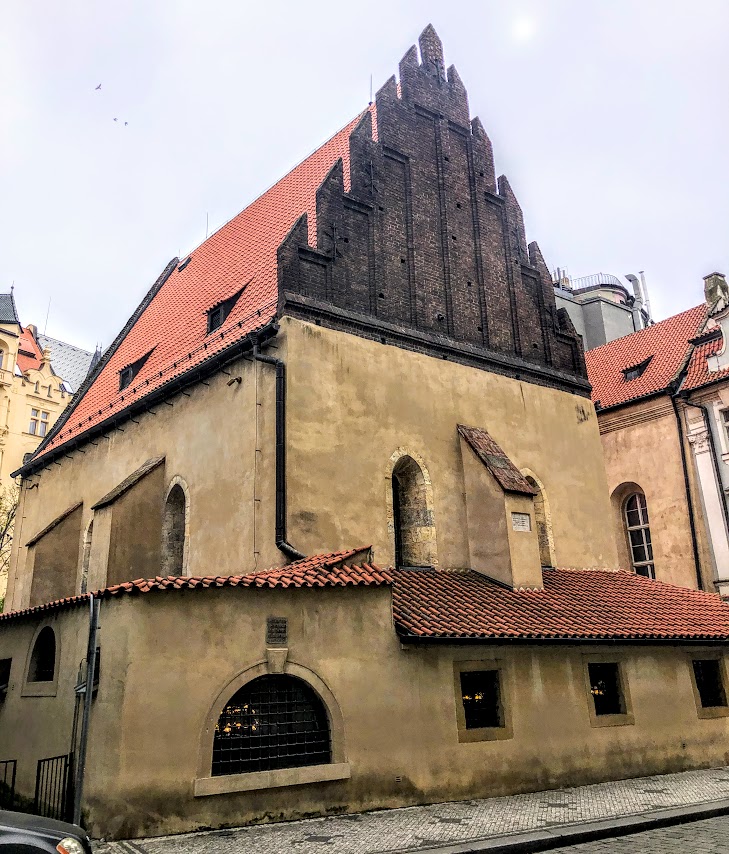
The Golem was said to live in the attic of the Old-New Synagogue, sometimes said to be the place where Franz Kafka had his bar mitzvah (Photograph: Patrick Comerford)
By Kafka’s time, Central European Jewry had become almost wholly assimilated, and the Kafka family clung to Jewish traditions in a merely superficial way. Even Kafka’s mother, who came from a more orthodox background than his father, made no great effort to cherish Jewish ways.
The Kafka family were mainly what were known as ‘four-day Jews’ who went to the synagogue only four times a year: on the major Jewish holidays and on the Emperor Franz Joseph’s birthday. They were not familiar with Hebrew liturgical texts, and wished to conform in every way to their non-Jewish surroundings in Prague, where their complex identity matrix was further complicated by tensions between Czech and German identities.
Franz Kafka was born in U Radnice 5 at the north-east corner of the Old Town Square in Prague. The house, which later burnt down, was on the edge of Josefov, the Jewish quarter in Prague.
Kafka spent much time in the Old Town Square and the neighbouring streets. When he was a ten-year-old age, he took lessons in a German grammar school at the Kinsky Palace, and he also once lived in a house beside the Astronomical Clock.
An old photograph of the Zigeuner Synagogue was where Franz Kafka had his bar mitzvah in 1896 … it was demolished in 1906
Franz Kafka hated the small amounts of Jewish culture he was exposed to at a young age, including his own bar mitzvah. He had his bar mitzvah at the Zigeuner-Synagoge in Prague in June 1896, although many tour guides say it took place in the Old-New Synagogue, or ‘Altneuschul’, which dates from 1270 and is the oldest landmark in the Jewish town in Prague – it is also the supposed haunt of the Golem.
The invitations to the bar mitzvah sent out by Hermann Kafka refer to his son’s ‘confirmation’. The Zigeuner Synagogue (Gypsy Synagogue) was built ca 1613 and named after its founder, Solomon Salkind-Cikán or Salkind Zigeuner. After a fire in 1689, it was rebuilt on a larger scale in 1701. It was destroyed by fire again in 1754, and was rebuilt once more in 1755. It was demolished in 1906, ten years after Kafka’s Bar Mitzvah, during the urban renewal of Prague’s Jewish Town, along with the Velkodvorska and New synagogues. The three older synagogues were replaced by the Jubilee Synagogue, built on Jerusalem Street in 1906.
Franz Kafka Street in the heart of the Old Town in Prague (Photograph: Patrick Comerford)
In his formative and mature years, Franz Kafka developed a growing interest in his Jewish roots. His animosity towards his father and his family may explain the interest he developed in his Jewish heritage. His diaries give a full picture of his complex, contradictory relationship with Judaism.
For a writer known for his depictions of loneliness, alienation and inflexible bureaucracy, Kafka often saw in Judaism an opportunity to forge a shared community.
This interest in his own Jewishness introduced him to Martin Buber (1878-1965), then recognised as an authority on Hasidic legends and Jewish folklore. He felt drawn to Jews who had maintained their cultural identity, among them the leader of a Yiddish acting group from Poland.
Kafka was fascinated by the members of this group with their firm faith and their resistance to absorption or assimilation. The Jewish establishment in Prague despised travelling actors, and the largely assimilated German-speaking Jewish population in Prague tended to look down on poorer, Yiddish-speaking Eastern European Jews.
Kafka argued about this with his father, and in his diary, he records his father’s prejudices towards the company’s lead actor, Jizchak Löwy: ‘My father about him: He who lies down in bed with dogs gets up with bugs.’
He saw the travelling Yiddish theatre troupe perform almost two dozen times in 1911. He developed a close friendship with the company’s lead actor, Jizchak Löwy, and organised evenings of reading Yiddish literature and recitation events where Löwy performed stories of Jewish life in Warsaw.
Later, writing about a Yiddish play he found particularly moving, Kafka reflected on its depiction of ‘people who are Jews in an especially pure form, because they live only in the religion but live in it without effort, understanding or misery.’
Franz Kafka’s Hebrew workbooks among the exhibits in ‘Kafka: Making of Icon’, the current exhibition in the Bodleian’s Weston Library, Oxford (Photograph: Patrick Comerford, 2024)
At that time, Kafka also began studying Hebrew. As late as 1921, however, he still complained about having no firm knowledge of Jewish history and religion. He felt an affinity with the Chassidic tradition, and he admired their ardent faith and the way they cherished their legacy, traditions and customs.
He took a particular interest in Zionism, the movement founded by Theodor Herzl, and supported the formation of a Jewish state, although , but sickness prevented him from pursuing his ideas about emigrating to Palestine and to live the life of a simple artisan there. He wrote for a Zionist magazine, planned several trips to Palestine, although they never materialised, and was most enthusiastic about the new kibbutzim.
Kafka’s friend Max Brod influenced his views on Zionism, but he was also influenced by his Hebrew teacher, the writer Friedrich Thieberger (1888-1958), a friend and student of Martin Buber. Thieberger emphasised Jewish responsibility for the whole world and believed that everybody is witness to everybody else.
A year before his death, he started attending the Berlin Academy of Jewish Studies. That year (1923), he met and fell in love with Dora Diamant, who taught him Hebrew. She was the daughter of an Orthodox rabbi and from a Chassidic background. Their relationship intensified his search for and his love of his Jewish roots.
The Jerusalem Synagogue in Prague is hosting a Kafka centenary exhibition that opened this week (Photograph: Patrick Comerford, 2023)
Growing up, Kafka was ashamed of his own body – thin and too tall, large ears, an aquiline nose, and dark, protruding eyes – which reflected stereotypical images of central European Jews. In one letter, he shared the shame he felt every time he had to undress at the swimming pool and expose his scrawny and frail body.
According to Professor Michael Gluzman, ‘Kafka felt he was a stranger inside in his own body. He saw himself as a corpse floating in the river and felt mortally ill many years before he contracted tuberculosis.’
Kafka’s writings are filled with stories of the human body being transformed into other animals: a man who turns into a dog (Investigations of a Dog), a mouse (Josephine the Singer), a monkey (A Report to an Academy) or a large insect (The Metamorphosis).
The Metamorphosis tells of a man who is transformed into a bug and then is rejected harshly by his family. The opening sentence of The Metamorphosis is one of the most familiar in modern literature: ‘As Gregor Samsa awoke one morning from uneasy dreams he found himself transformed into a gigantic insect.’
Like the Golem, this new creature is a frightful creation of the human imagination, embodying our fears about ourselves and about how others perceive us. But the transformation of Gregor Samsa is not an illusion, allegory or nightmare, but a realistic story, confronting real fears.
The transformed creature is often depicted as a cockroach, but the German word used by Kafka could be translated as insect or vermin. As antisemitism increased in German-speaking states and throughout central Europe in the decades that unfolded, the German words for vermin and cockroach were thrown around by Nazis to refer to Jews.
The creature that becomes the new reality of Gregor’s existence also represents Kafka’s own fears of the responses of his family and wider society as he takes on the mantle of the Jewish identity he is exploring and rediscovering. As Kafka explores his Jewishness, contemplates living within his Jewish body, he faces isolation from his own assimilated family, who go on with their ordinary lives, and rejection from wider society in German-speaking Prague, which he fears is going to see him as a cockroach or vermin.
The film Nosferatu was first screened in Germany a decade later. It is about an ugly vampire with a mouse-like face, crooked nose and dark eyes, dressed in long black outer clothes, who sucks the blood of fair-skinned Aryan girls.
Julius Streicher, later the chief editor of Der Stürmer, the Nazi propaganda newspaper, attended the premiere of the film. Captivated by the Jewish image of the vampire, Streicher went to the cinema every day. His impressions were translated into caricatures of vampires of Jewish origin in his newspaper. The transition to the image of an insect or a vermin did not take long.
Did Kafka see the rise of antisemitism in the central Europe … an image in ‘Kafka: Making of Icon’ in Oxford (Photograph: Patrick Comerford, 2024)
Was Kafka ahead of his time?
Was The Metamorphosis an inadvertent glimpse into the fate of the assimilated Western Jew – the Westjuden?
Did Jewish assimilation and integration into European life cause him to fall into a deep slumber that he woke up one morning perspiring, only to discover that he was regarded as an insect or vermin?
Franz Kafka’s grave in the new Jewish cemetery in Prague … an imagine in the Kafka exhibition in Oxford (Photograph: Patrick Comerford, 2024)
Like so many Jews in Prague, Kafka’s three sisters, Ottla, Elli and Valli, were deported by the Nazis and murdered during the Holocaust.
Ottilie ‘Ottla’ Kafka (1892-1943), his youngest and favourite sister, was probably the relative closest to him and supported him in difficult times. She was sent to the concentration camp at Terezin. From there, Ottla accompanied a group of children from the Bialystock ghetto as a voluntary assistant on 5 October 1943. When the transport reached Auschwitz two days later, all were murdered in the gas chambers.
His other sisters, Gabriele ‘Ellie’ Hermann or Hermannová (1889-1942) and Valerie ‘Valli’ Pollak (1890-1942), were sent with their families to the Łódź Ghetto. Valli was probably murdered in autumn 1942 in the Chełmno extermination camp; Elli was probably murdered in the Kulmhof extermination camp in autumn 1942.
His uncle, Dr Siegfried Löwy, his mother’s brother, lived in Třešt' for 25 years. Kafka visited him regularly, and he may have been the inspiration for Kafka’s short story The Country Doctor (1919). Löwy went to visit Kafka on his sick bed in Berlin in early 1924. In the summer of 1925, a year after Kafka’s death, the doctor retired, left Třešt' and moved to Prague. He died by suicide on 20 October 1942, just before he was to be deported to Terezín.
Other members of the Kafka family who were murdered by the Nazis include his cousin, Georg Kafka (1921-1944), a poet and playwright. He was born in 1921 in Teplitz-Schönau (now Teplice, Czech Republic). In 1942, he was interned at Terezin, where he began writing poetry. There he wrote the poem ‘Segen der Nacht’ (Blessing of the Night) in German in 1943.
Georg Kafka’s father died in Terezin in March 1944, and Georg’s mother was assigned to a transport on 15 May 1944. Not wanting her to be alone, Georg volunteered to join the transport. She was murdered when she arrived at Auschwitz, while Georg was later sent to the camp at Schwarzheide, where he was murdered at the end of 1944.
Jaroslav Rona’s statue of Franz Kafka Street beside the Spanish Synagogue in Prague (Photograph: Patrick Comerford, 2023)
About five minutes away from Old Town Square, a sculpture outside the Spanish Synagogue in Prague is inspired by Kafka’s short story, ‘Description of a Struggle.’ Jaroslav Rona’s sculpture depicts a small man in a suit on the shoulders of a large empty suit. This image represents the narrator of the story riding on the back of the acquaintance.
Today, the Golem and Kafka are the two major tourism attractions in Prague. This year’s centenary promises to heighten the interest not only in Kafka and the Golem, but also of the story and contribution of the Jewish community in Prague.
May his memory be a blessing, זיכרונו לברכה
Shabbat Shalom, שבת שלום
Images from ‘Kafka: Making of Icon’, the current exhibition in the Bodleian’s Weston Library, Oxford (Patrick Comerford, 2024)
Patrick Comerford
Today is the 1st of Sivan in the Hebrew calendar, which makes today the 100th anniversary in the Jewish calendar of the death of Franz Kafka, the author of The Metamorphosis, The Trial, The Castle and Amerika. Two major exhibitions have opened in the past week to mark the centenary of the death of Franz Kafka, who died 100 years ago on 3 June 1924, just a month short of his 41st birthday.
Franz Kafka is one of the most influential writers of the 20th century, and the University of Oxford is celebrating his life and work, with a series of academic and public events that explores his global appeal. The #OxfordKafka24 programme includes a new exhibition at the Bodleian’s Weston Library, ‘Kafka: Making of Icon’. The exhibition opened last week (30 May), and continues until 27 October 2024.
‘The vision of Kafka’s shadow’ is a new exhibition in the Jerusalem Synagogue in Prague. It reflects on his work through the work of 11 selected Czech photographers and artists, and offers new perspectives on the complex world of the writer. The exhibition opened on Monday (3 June), and continues until the end of the year (31 December).
The exhibition in Oxford shows Kafka’s original notebooks, drawings, diaries, letters, postcards, glossaries and photographs. The highlights are the manuscripts of two of his unfinished novels, Das Schloss (The Castle) and Der Verschollene (Amerika), as well as a number of short stories.
To encourage students and the public to engage with his work, a new limited-edition imprint of The Metamorphosis from Oxford University Press is being given to every Oxford student and is being distributed to schools and libraries.
Four Oxford professors have created a lecture and events programme exploring Kafka’s legacy from the perspectives of their different disciplines. It is curious that, at this stage, the programmes do not appear to address Kafka’s Jewish background, influences and legacy.
So, to what degree did Kafka’s Jewish background influence his life story, his writing and his thinking?
‘The vision of Kafka’s shadow’ is a new exhibition in the Jerusalem Synagogue in Prague
Franz Kafka was born on 3 July 1883 in Prague, then part of the Austro-Hungarian Empire, into a middle-class Ashkenazi Jewish family. His father Hermann Kafka (1852-1931) was a businessman; his mother, Julie (1856-1934), was a daughter of Jakob Löwy, a brewer in Poděbrady.
Prague was then a cultural crossroads but was also steeped in Jewish learning and writing. The first Jews in Prague are recorded in the tenth century, and among the myths and legends that developed in the centuries that followed, the myth of Rabbi Loew and the Golem is probably the best known.
The Golem was said to live in the attic of the Old-New Synagogue, sometimes said to be the place where Franz Kafka had his bar mitzvah (Photograph: Patrick Comerford)
By Kafka’s time, Central European Jewry had become almost wholly assimilated, and the Kafka family clung to Jewish traditions in a merely superficial way. Even Kafka’s mother, who came from a more orthodox background than his father, made no great effort to cherish Jewish ways.
The Kafka family were mainly what were known as ‘four-day Jews’ who went to the synagogue only four times a year: on the major Jewish holidays and on the Emperor Franz Joseph’s birthday. They were not familiar with Hebrew liturgical texts, and wished to conform in every way to their non-Jewish surroundings in Prague, where their complex identity matrix was further complicated by tensions between Czech and German identities.
Franz Kafka was born in U Radnice 5 at the north-east corner of the Old Town Square in Prague. The house, which later burnt down, was on the edge of Josefov, the Jewish quarter in Prague.
Kafka spent much time in the Old Town Square and the neighbouring streets. When he was a ten-year-old age, he took lessons in a German grammar school at the Kinsky Palace, and he also once lived in a house beside the Astronomical Clock.
An old photograph of the Zigeuner Synagogue was where Franz Kafka had his bar mitzvah in 1896 … it was demolished in 1906
Franz Kafka hated the small amounts of Jewish culture he was exposed to at a young age, including his own bar mitzvah. He had his bar mitzvah at the Zigeuner-Synagoge in Prague in June 1896, although many tour guides say it took place in the Old-New Synagogue, or ‘Altneuschul’, which dates from 1270 and is the oldest landmark in the Jewish town in Prague – it is also the supposed haunt of the Golem.
The invitations to the bar mitzvah sent out by Hermann Kafka refer to his son’s ‘confirmation’. The Zigeuner Synagogue (Gypsy Synagogue) was built ca 1613 and named after its founder, Solomon Salkind-Cikán or Salkind Zigeuner. After a fire in 1689, it was rebuilt on a larger scale in 1701. It was destroyed by fire again in 1754, and was rebuilt once more in 1755. It was demolished in 1906, ten years after Kafka’s Bar Mitzvah, during the urban renewal of Prague’s Jewish Town, along with the Velkodvorska and New synagogues. The three older synagogues were replaced by the Jubilee Synagogue, built on Jerusalem Street in 1906.
Franz Kafka Street in the heart of the Old Town in Prague (Photograph: Patrick Comerford)
In his formative and mature years, Franz Kafka developed a growing interest in his Jewish roots. His animosity towards his father and his family may explain the interest he developed in his Jewish heritage. His diaries give a full picture of his complex, contradictory relationship with Judaism.
For a writer known for his depictions of loneliness, alienation and inflexible bureaucracy, Kafka often saw in Judaism an opportunity to forge a shared community.
This interest in his own Jewishness introduced him to Martin Buber (1878-1965), then recognised as an authority on Hasidic legends and Jewish folklore. He felt drawn to Jews who had maintained their cultural identity, among them the leader of a Yiddish acting group from Poland.
Kafka was fascinated by the members of this group with their firm faith and their resistance to absorption or assimilation. The Jewish establishment in Prague despised travelling actors, and the largely assimilated German-speaking Jewish population in Prague tended to look down on poorer, Yiddish-speaking Eastern European Jews.
Kafka argued about this with his father, and in his diary, he records his father’s prejudices towards the company’s lead actor, Jizchak Löwy: ‘My father about him: He who lies down in bed with dogs gets up with bugs.’
He saw the travelling Yiddish theatre troupe perform almost two dozen times in 1911. He developed a close friendship with the company’s lead actor, Jizchak Löwy, and organised evenings of reading Yiddish literature and recitation events where Löwy performed stories of Jewish life in Warsaw.
Later, writing about a Yiddish play he found particularly moving, Kafka reflected on its depiction of ‘people who are Jews in an especially pure form, because they live only in the religion but live in it without effort, understanding or misery.’
Franz Kafka’s Hebrew workbooks among the exhibits in ‘Kafka: Making of Icon’, the current exhibition in the Bodleian’s Weston Library, Oxford (Photograph: Patrick Comerford, 2024)
At that time, Kafka also began studying Hebrew. As late as 1921, however, he still complained about having no firm knowledge of Jewish history and religion. He felt an affinity with the Chassidic tradition, and he admired their ardent faith and the way they cherished their legacy, traditions and customs.
He took a particular interest in Zionism, the movement founded by Theodor Herzl, and supported the formation of a Jewish state, although , but sickness prevented him from pursuing his ideas about emigrating to Palestine and to live the life of a simple artisan there. He wrote for a Zionist magazine, planned several trips to Palestine, although they never materialised, and was most enthusiastic about the new kibbutzim.
Kafka’s friend Max Brod influenced his views on Zionism, but he was also influenced by his Hebrew teacher, the writer Friedrich Thieberger (1888-1958), a friend and student of Martin Buber. Thieberger emphasised Jewish responsibility for the whole world and believed that everybody is witness to everybody else.
A year before his death, he started attending the Berlin Academy of Jewish Studies. That year (1923), he met and fell in love with Dora Diamant, who taught him Hebrew. She was the daughter of an Orthodox rabbi and from a Chassidic background. Their relationship intensified his search for and his love of his Jewish roots.
The Jerusalem Synagogue in Prague is hosting a Kafka centenary exhibition that opened this week (Photograph: Patrick Comerford, 2023)
Growing up, Kafka was ashamed of his own body – thin and too tall, large ears, an aquiline nose, and dark, protruding eyes – which reflected stereotypical images of central European Jews. In one letter, he shared the shame he felt every time he had to undress at the swimming pool and expose his scrawny and frail body.
According to Professor Michael Gluzman, ‘Kafka felt he was a stranger inside in his own body. He saw himself as a corpse floating in the river and felt mortally ill many years before he contracted tuberculosis.’
Kafka’s writings are filled with stories of the human body being transformed into other animals: a man who turns into a dog (Investigations of a Dog), a mouse (Josephine the Singer), a monkey (A Report to an Academy) or a large insect (The Metamorphosis).
The Metamorphosis tells of a man who is transformed into a bug and then is rejected harshly by his family. The opening sentence of The Metamorphosis is one of the most familiar in modern literature: ‘As Gregor Samsa awoke one morning from uneasy dreams he found himself transformed into a gigantic insect.’
Like the Golem, this new creature is a frightful creation of the human imagination, embodying our fears about ourselves and about how others perceive us. But the transformation of Gregor Samsa is not an illusion, allegory or nightmare, but a realistic story, confronting real fears.
The transformed creature is often depicted as a cockroach, but the German word used by Kafka could be translated as insect or vermin. As antisemitism increased in German-speaking states and throughout central Europe in the decades that unfolded, the German words for vermin and cockroach were thrown around by Nazis to refer to Jews.
The creature that becomes the new reality of Gregor’s existence also represents Kafka’s own fears of the responses of his family and wider society as he takes on the mantle of the Jewish identity he is exploring and rediscovering. As Kafka explores his Jewishness, contemplates living within his Jewish body, he faces isolation from his own assimilated family, who go on with their ordinary lives, and rejection from wider society in German-speaking Prague, which he fears is going to see him as a cockroach or vermin.
The film Nosferatu was first screened in Germany a decade later. It is about an ugly vampire with a mouse-like face, crooked nose and dark eyes, dressed in long black outer clothes, who sucks the blood of fair-skinned Aryan girls.
Julius Streicher, later the chief editor of Der Stürmer, the Nazi propaganda newspaper, attended the premiere of the film. Captivated by the Jewish image of the vampire, Streicher went to the cinema every day. His impressions were translated into caricatures of vampires of Jewish origin in his newspaper. The transition to the image of an insect or a vermin did not take long.
Did Kafka see the rise of antisemitism in the central Europe … an image in ‘Kafka: Making of Icon’ in Oxford (Photograph: Patrick Comerford, 2024)
Was Kafka ahead of his time?
Was The Metamorphosis an inadvertent glimpse into the fate of the assimilated Western Jew – the Westjuden?
Did Jewish assimilation and integration into European life cause him to fall into a deep slumber that he woke up one morning perspiring, only to discover that he was regarded as an insect or vermin?
Franz Kafka’s grave in the new Jewish cemetery in Prague … an imagine in the Kafka exhibition in Oxford (Photograph: Patrick Comerford, 2024)
Like so many Jews in Prague, Kafka’s three sisters, Ottla, Elli and Valli, were deported by the Nazis and murdered during the Holocaust.
Ottilie ‘Ottla’ Kafka (1892-1943), his youngest and favourite sister, was probably the relative closest to him and supported him in difficult times. She was sent to the concentration camp at Terezin. From there, Ottla accompanied a group of children from the Bialystock ghetto as a voluntary assistant on 5 October 1943. When the transport reached Auschwitz two days later, all were murdered in the gas chambers.
His other sisters, Gabriele ‘Ellie’ Hermann or Hermannová (1889-1942) and Valerie ‘Valli’ Pollak (1890-1942), were sent with their families to the Łódź Ghetto. Valli was probably murdered in autumn 1942 in the Chełmno extermination camp; Elli was probably murdered in the Kulmhof extermination camp in autumn 1942.
His uncle, Dr Siegfried Löwy, his mother’s brother, lived in Třešt' for 25 years. Kafka visited him regularly, and he may have been the inspiration for Kafka’s short story The Country Doctor (1919). Löwy went to visit Kafka on his sick bed in Berlin in early 1924. In the summer of 1925, a year after Kafka’s death, the doctor retired, left Třešt' and moved to Prague. He died by suicide on 20 October 1942, just before he was to be deported to Terezín.
Other members of the Kafka family who were murdered by the Nazis include his cousin, Georg Kafka (1921-1944), a poet and playwright. He was born in 1921 in Teplitz-Schönau (now Teplice, Czech Republic). In 1942, he was interned at Terezin, where he began writing poetry. There he wrote the poem ‘Segen der Nacht’ (Blessing of the Night) in German in 1943.
Georg Kafka’s father died in Terezin in March 1944, and Georg’s mother was assigned to a transport on 15 May 1944. Not wanting her to be alone, Georg volunteered to join the transport. She was murdered when she arrived at Auschwitz, while Georg was later sent to the camp at Schwarzheide, where he was murdered at the end of 1944.
Jaroslav Rona’s statue of Franz Kafka Street beside the Spanish Synagogue in Prague (Photograph: Patrick Comerford, 2023)
About five minutes away from Old Town Square, a sculpture outside the Spanish Synagogue in Prague is inspired by Kafka’s short story, ‘Description of a Struggle.’ Jaroslav Rona’s sculpture depicts a small man in a suit on the shoulders of a large empty suit. This image represents the narrator of the story riding on the back of the acquaintance.
Today, the Golem and Kafka are the two major tourism attractions in Prague. This year’s centenary promises to heighten the interest not only in Kafka and the Golem, but also of the story and contribution of the Jewish community in Prague.
May his memory be a blessing, זיכרונו לברכה
Shabbat Shalom, שבת שלום
Images from ‘Kafka: Making of Icon’, the current exhibition in the Bodleian’s Weston Library, Oxford (Patrick Comerford, 2024)
Labels:
#OxfordKafka24,
antisemitism,
Auschwitz,
Berlin,
Holocaust,
Jewish history,
Jewish Spirituality,
Judaism,
Kafka,
libraries,
Literature,
Museums,
Oxford,
Prague,
Sabbath,
Sculpture,
Synagogues,
Vienna
03 June 2024
Franz Kafka and the
transformation of
a writer in the 100
years since his death
The exhibition ‘Kafka: Making of Icon’ opened at the Bodleian’s Weston Library last Thursday and continues until 27 October 2024 (Photograph: Patrick Comerford, 2024)
Patrick Comerford
While we were staying on the Left Bank in Paris a few months ago, my eye was caught by Les Metamorphoses, a shuttered and closed jewellery shop on Rue du Petit Pont, around the corner from the Shakespeare bookshop, forever associated with James Joyce, and across the river from Notre Dame.
Perhaps this shuttered, closed and forgotten shop, covered in spray paint and graffiti, took its name from the French translation of the Metamorphoses, a Latin narrative poem from 8 CE by Ovid and considered his magnum opus.
The trend-setting name sign was designed to be read in its mirror-like, reversed composition. Now it is part of a grey and deserted building, like part of the landscape of a wasteland. Perhaps, after all, it was named after a French translation of Franz Kafka’s novella, The Metamorphosis, first published in German as Die Verwandlung in 1915.
Les Metamorphoses in Paris … locked up and abandoned like Gregor Samsa? (Photograph: Patrick Comerford, 2024)
Today marks the 100th anniversary of the death of Franz Kafka on 3 June 1924.
Few 20th century writers – apart from, perhaps, James Joyce and TS Eliot – receive as much attention as Kafka. Although he did not live to see his 41st birthday and worked for much of his life as an insurance clerk, Kafka is a giant on the stage of world literature.
His name has given the English language the evocative word ‘kafkaesque’ – a word that has its equivalent in other European languages but has no comparable parallel when it comes to the lives of other major literary figures: the adjectives Orwellian, Joycean, Dickensian, Shakespearean and even Chaucerian do not have quite the same descriptive force as Kafkaesque, which, in a bizarre way implies the dystopian, the verbose, the antiquated, the dramatic and the ribald; and while similar bizarre worlds are created by TS Eliot in The Waste Land and Samuel Beckett in Waiting for Godot, no-one describes them as ‘Eliot-esque' or ‘Beckett-esque’.
‘The Metamorphosis’ and the pandemic lockdown … a cartoon by Tom Gauld in the exhibition ‘Kafka: Making of Icon’ in Oxford (Photograph: Patrick Comerford, 2024)
The Metamorphosis is one of Kafka’s best-known works. It tells of a travelling salesman, Gregor Samsa, who lives ‘in the quiet but completely urban Charlotte Street.’ He could have believed that from his window he was peering out at a featureless wasteland, in which ‘the gray heaven and the gray earth had merged and were indistinguishable.’
Charlotte Street is described as a desert, and Gregor feels less and less like himself as each day goes by. Looking out on Charlotte Street, he can no longer tell the difference between his happiness and his sadness. In his isolation, Gregor has lost his ability to relate to the outside world, bringing about severe loneliness.
He wakes one morning to find himself inexplicably transformed into a huge creature (whether vermin or nsect depends on your translation) and he struggles to adjust to this abject new condition. In popular culture and adaptations of The Metamorphosis, the insect is commonly depicted as a cockroach.
Gregor is locked away by his family in a room on his home, like the Golem was hidden away in the attic of the synagogue. When the starving Gregor hears music, he glimpses the way ‘to the unknown nourishment he longed for’. After his emaciated body is disposed of, his sister stretches her young body into the sun, full of life energy.
The statue of Franz Kafka Street beside the Spanish Synagogue in Prague (Photograph: Patrick Comerford)
Today, Franz Kafka is Prague’s best-known writer, and one of the main selling opportunities for many of the tourist shops and outlets in the Czech capital. The Metamorphosis is one of his best-known novels. But many of his other acclaimed books were not published until after he died, including The Trial (1925), The Castle (1926) and Amerika (1927).
In Prague last year, Charlotte and I went in search of some of the places associated with Kafka’s life story. He was born in Prague on 3 July 1883; when he died near Vienna 100 years ago on 3 June 1924, a month shy of his 41sth birthday, he was buried in Prague.
In Prague, we visited the Kafka Museum and Kafka’s statue in Dusni Street, beside the ‘Spanish Synagogue’, and saw the streets named after him. On previous visits to Prague, I have seen the collection of items associated with Kafka in the Spanish Synagogue, close to where he was born.
The story of Dora Diamant and her tragic life is as intriguing and captivating as any story that Kafka has written (Photograph: Patrick Comerford)
Kafka lived with Dora Diamant (1898-1952) in Berlin. She is best remembered as Kafka’s lover and the woman who kept some of his last writings until they were confiscated by the Gestapo in 1933. She kept his papers against the wishes of Kafka, who had asked shortly before his death that they be destroyed.
The story of Dora Diamant and her tragic life is as intriguing and captivating as any story that Kafka could have written.
She was born Dwojra Diament in Pabianice, Poland, on 4 March 1898. Her father, Herschel Dymant, was a successful small businessman and a devout follower of the Ger Hasidic dynasty from Góra Kalwaria, once the largest and most influential Hasidic group in Poland.
When Dora’s mother died in 1912, her father moved with the family to Będzin, near the German border.
At the end of World War I, after helping to raise her 10 siblings, Dora refused to marry and was sent to Kraków to study to be a kindergarten teacher. But she ran away to Berlin, where she worked in the Jewish community as a teacher and as a seamstress in an orphanage. There she changed the spelling of her name to Diamant.
She was working as a kitchen volunteer in a children’s summer camp run by the Berlin Jewish Peoples’ Homes at the seaside resort of Graal-Müritz on the Baltic Sea in July 1923. There she met Kafka, who years before had commended this work to his first fiancée Felice Bauer.
Dora told Kafka she was 19, but she was 25; he was 40 and suffering from tuberculosis. It was love at first sight, and they spent every day of the next three weeks together, making plans to live together in Berlin.
He had just resigned from his post at the Workers’ Accident Insurance Institute in Prague, his writing career was shaky and his health was precarious. After returning briefly to Prague that September, Kafka moved to Berlin, where Franz and Dora shared three different flats, living through alarming inflation and material hardship.
Their means were minimal: they had no money for newspapers, at the worst of times they used kerosene lamps for lighting as they could not afford electricity, and the food they ate was often sent by his family in Prague. They used candle stubs to heat their meal on New Year’s Eve 1924. But still they had dreams: they thought of emigrating to Palestine, and opening a restaurant in Tel Aviv; she was to be the cook and he the waiter.
They continued to live together until tuberculosis of the larynx meant he had to receive hospital care. Dora stayed with him, and she moved in with him at the sanatorium in Kierling near Klosterneuburg, outside Vienna. At the point of death, Kafka asked Dora’s father for permission to marry her. However, on the advice of the local rabbi, her father refused.
Franz Kafka on the cover of a book in an exhibition in the Spanish Synagogue in Prague (Photograph: Patrick Comerford)
Dora remained with Kafka to the end, making sure he had everything he needed. He died in Dora’s arms in Vienna on 3 June 1924 and was buried in Prague, where he had been born in 1883. She first met Kafka’s parents at his funeral in the New Jewish Cemetery in Prague. As his coffin was lowered into the grave, she let out an unearthly wail, and lay lifeless on the ground. Kafka’s father turned his back on her, disdainfully. No one dared to move and help her up.
In a letter to Kafka’s parents, describing their son’s last hours, Dr Robert Klopstock wrote, ‘Who knows Dora, only he can know what love means.’
Dora died at Plaistow Hospital in east London on 15 August 1952. She was 53 and she was buried in an unmarked grave in the United Synagogue Cemetery on Marlowe Road in East Ham.
Dora had been shunned by Kafka’s family and was all but forgotten until her living relatives from Israel and Germany – including her only living nephew Zvi Diamant, who was born in 1947 in the release camp at Dachau – gathered at her grave in East Ham for a stone-setting 25 years ago in August 1999. Her headstone reads ‘Who knows Dora, knows what love means.’
A ‘Kafkaesque’ experience best avoided with the airlines I usually fly with … part of the Kafka exhibition in Oxford (Photograph: Patrick Comerford, 2024)
One hundred years after the death of Franz Kafka, the University of Oxford is celebrating his life and work, with a series of academic and public events that explores his global appeal.
The #OxfordKafka24 programme includes a new free exhibition at the Bodleian’s Weston Library, ‘Kafka: Making of Icon’. The exhibition opened last Thursday (30 May), and I spent most of that at the exhibition. It continues until 27 October 2024.
The Bodleian Libraries have the world’s largest Kafka archive, and Oxford University is a leading centre for Kafka studies, led by the Oxford Kafka Research Centre.
The Kafka exhibition shows Kafka’s original notebooks, drawings, diaries, letters, postcards, glossaries and photographs. The highlights are the manuscripts of two of his unfinished novels, Das Schloss (The Castle) and Der Verschollene (Amerika), as well as a number of short stories.
To encourage students and the public to engage with his work, a new limited-edition imprint of The Metamorphosis from Oxford University Press is being given to every Oxford student and is being distributed to schools and libraries around Oxfordshire. I was generously given a copy in Pusey House later on Thursday evening.
Since the posthumous publication of most of his work and his ‘rediscovery’ in the middle of the 20th century, Kafka has become a truly global writer who embraced his own multicultural identity. His works offer profound insights into the human condition, alienation, relationships, and transformation, and his novels and short stories have been translated into multiple languages.
His notebooks show how his travels in Western Europe enabled him to practise descriptive writing, while his readings strengthened his fascination with remote spaces and made him aware of European colonialism.
A new collection of Kafkaesque stories, A Cage Went in Search for a Bird, with work by Ali Smith, Naomi Alderman, Helen Oyeyemi, Yiyun Li, Elif Batuman and others, was published last month by Abacus Books in partnership with the Oxford Kafka Research Centre. Other new books this year include Metamorphoses: In Search of Franz Kafka by Dr Karolina Watroba, and Kafka: Making of an Icon edited by Ritchie Robertson to accompany the exhibition at the Weston Library, both published last month (May 2024).
A public reading of The Metamorphosis is taking place in the Sheldonian Theatre today (3 June), engaging renowned literary figures, Oxford civic leaders and student societies. A Kafka street fair on Broad Street today was produced by the Oxford Cultural Programme.
Four Oxford professors have created a lecture and events programme exploring Kafka’s legacy from the perspectives of their different disciplines. Professor Karen Leeder focuses on Kafka’s writing and legacy, questions of race and his sense of humour. Professor Eben Kirksey discusses on Kafka and disability. Professor Tim Coulson looks at Kafka and insects. Professor Helen McShane introduces Kafka as a sufferer of tuberculosis.
It is curious that, at this stage, the programmes do not appear to address Kafka’s Jewish background, influences and legacy.
Professor Carolin Duttlinger, Co-Director of the Oxford Kafka Research Centre, is leading a major new research project, ‘Kafka’s Transformative Communities’, which brings together academics, writers and artists. Later this year (12 October), as part of the Oxford International Song Festival, she is giving a public lecture on ‘Kafka’s Prague’.
Jitterbug was an outdoor event in the University Parks last weekend (31 May to 2 June), created and presented by the award-winning producers Trigger in collaboration with the Cultural Programme. The ‘Jitterbug’ is an enormous 14-metre inflatable bug tent that was the setting for a free programme of activities, from talks, yoga and crafting to storytelling hosted by the Story Museum and a drag cabaret extravaganza.
‘Jitterbug’ was created in conjunction with academics from the University of Oxford, and was designed to highlight the importance of recognising beauty from within a person.
The international conference, Kafka Transformed, at Wadham College on 18-20 September, marks the launch of the newly formed Global Kafka Network, connecting scholars and artists from around the world.
‘Jitterbug’ was created in conjunction with academics from the University of Oxford and designed to highlight the importance of recognising beauty from within a person
Patrick Comerford
While we were staying on the Left Bank in Paris a few months ago, my eye was caught by Les Metamorphoses, a shuttered and closed jewellery shop on Rue du Petit Pont, around the corner from the Shakespeare bookshop, forever associated with James Joyce, and across the river from Notre Dame.
Perhaps this shuttered, closed and forgotten shop, covered in spray paint and graffiti, took its name from the French translation of the Metamorphoses, a Latin narrative poem from 8 CE by Ovid and considered his magnum opus.
The trend-setting name sign was designed to be read in its mirror-like, reversed composition. Now it is part of a grey and deserted building, like part of the landscape of a wasteland. Perhaps, after all, it was named after a French translation of Franz Kafka’s novella, The Metamorphosis, first published in German as Die Verwandlung in 1915.
Les Metamorphoses in Paris … locked up and abandoned like Gregor Samsa? (Photograph: Patrick Comerford, 2024)
Today marks the 100th anniversary of the death of Franz Kafka on 3 June 1924.
Few 20th century writers – apart from, perhaps, James Joyce and TS Eliot – receive as much attention as Kafka. Although he did not live to see his 41st birthday and worked for much of his life as an insurance clerk, Kafka is a giant on the stage of world literature.
His name has given the English language the evocative word ‘kafkaesque’ – a word that has its equivalent in other European languages but has no comparable parallel when it comes to the lives of other major literary figures: the adjectives Orwellian, Joycean, Dickensian, Shakespearean and even Chaucerian do not have quite the same descriptive force as Kafkaesque, which, in a bizarre way implies the dystopian, the verbose, the antiquated, the dramatic and the ribald; and while similar bizarre worlds are created by TS Eliot in The Waste Land and Samuel Beckett in Waiting for Godot, no-one describes them as ‘Eliot-esque' or ‘Beckett-esque’.
‘The Metamorphosis’ and the pandemic lockdown … a cartoon by Tom Gauld in the exhibition ‘Kafka: Making of Icon’ in Oxford (Photograph: Patrick Comerford, 2024)
The Metamorphosis is one of Kafka’s best-known works. It tells of a travelling salesman, Gregor Samsa, who lives ‘in the quiet but completely urban Charlotte Street.’ He could have believed that from his window he was peering out at a featureless wasteland, in which ‘the gray heaven and the gray earth had merged and were indistinguishable.’
Charlotte Street is described as a desert, and Gregor feels less and less like himself as each day goes by. Looking out on Charlotte Street, he can no longer tell the difference between his happiness and his sadness. In his isolation, Gregor has lost his ability to relate to the outside world, bringing about severe loneliness.
He wakes one morning to find himself inexplicably transformed into a huge creature (whether vermin or nsect depends on your translation) and he struggles to adjust to this abject new condition. In popular culture and adaptations of The Metamorphosis, the insect is commonly depicted as a cockroach.
Gregor is locked away by his family in a room on his home, like the Golem was hidden away in the attic of the synagogue. When the starving Gregor hears music, he glimpses the way ‘to the unknown nourishment he longed for’. After his emaciated body is disposed of, his sister stretches her young body into the sun, full of life energy.
The statue of Franz Kafka Street beside the Spanish Synagogue in Prague (Photograph: Patrick Comerford)
Today, Franz Kafka is Prague’s best-known writer, and one of the main selling opportunities for many of the tourist shops and outlets in the Czech capital. The Metamorphosis is one of his best-known novels. But many of his other acclaimed books were not published until after he died, including The Trial (1925), The Castle (1926) and Amerika (1927).
In Prague last year, Charlotte and I went in search of some of the places associated with Kafka’s life story. He was born in Prague on 3 July 1883; when he died near Vienna 100 years ago on 3 June 1924, a month shy of his 41sth birthday, he was buried in Prague.
In Prague, we visited the Kafka Museum and Kafka’s statue in Dusni Street, beside the ‘Spanish Synagogue’, and saw the streets named after him. On previous visits to Prague, I have seen the collection of items associated with Kafka in the Spanish Synagogue, close to where he was born.
The story of Dora Diamant and her tragic life is as intriguing and captivating as any story that Kafka has written (Photograph: Patrick Comerford)
Kafka lived with Dora Diamant (1898-1952) in Berlin. She is best remembered as Kafka’s lover and the woman who kept some of his last writings until they were confiscated by the Gestapo in 1933. She kept his papers against the wishes of Kafka, who had asked shortly before his death that they be destroyed.
The story of Dora Diamant and her tragic life is as intriguing and captivating as any story that Kafka could have written.
She was born Dwojra Diament in Pabianice, Poland, on 4 March 1898. Her father, Herschel Dymant, was a successful small businessman and a devout follower of the Ger Hasidic dynasty from Góra Kalwaria, once the largest and most influential Hasidic group in Poland.
When Dora’s mother died in 1912, her father moved with the family to Będzin, near the German border.
At the end of World War I, after helping to raise her 10 siblings, Dora refused to marry and was sent to Kraków to study to be a kindergarten teacher. But she ran away to Berlin, where she worked in the Jewish community as a teacher and as a seamstress in an orphanage. There she changed the spelling of her name to Diamant.
She was working as a kitchen volunteer in a children’s summer camp run by the Berlin Jewish Peoples’ Homes at the seaside resort of Graal-Müritz on the Baltic Sea in July 1923. There she met Kafka, who years before had commended this work to his first fiancée Felice Bauer.
Dora told Kafka she was 19, but she was 25; he was 40 and suffering from tuberculosis. It was love at first sight, and they spent every day of the next three weeks together, making plans to live together in Berlin.
He had just resigned from his post at the Workers’ Accident Insurance Institute in Prague, his writing career was shaky and his health was precarious. After returning briefly to Prague that September, Kafka moved to Berlin, where Franz and Dora shared three different flats, living through alarming inflation and material hardship.
Their means were minimal: they had no money for newspapers, at the worst of times they used kerosene lamps for lighting as they could not afford electricity, and the food they ate was often sent by his family in Prague. They used candle stubs to heat their meal on New Year’s Eve 1924. But still they had dreams: they thought of emigrating to Palestine, and opening a restaurant in Tel Aviv; she was to be the cook and he the waiter.
They continued to live together until tuberculosis of the larynx meant he had to receive hospital care. Dora stayed with him, and she moved in with him at the sanatorium in Kierling near Klosterneuburg, outside Vienna. At the point of death, Kafka asked Dora’s father for permission to marry her. However, on the advice of the local rabbi, her father refused.
Franz Kafka on the cover of a book in an exhibition in the Spanish Synagogue in Prague (Photograph: Patrick Comerford)
Dora remained with Kafka to the end, making sure he had everything he needed. He died in Dora’s arms in Vienna on 3 June 1924 and was buried in Prague, where he had been born in 1883. She first met Kafka’s parents at his funeral in the New Jewish Cemetery in Prague. As his coffin was lowered into the grave, she let out an unearthly wail, and lay lifeless on the ground. Kafka’s father turned his back on her, disdainfully. No one dared to move and help her up.
In a letter to Kafka’s parents, describing their son’s last hours, Dr Robert Klopstock wrote, ‘Who knows Dora, only he can know what love means.’
Dora died at Plaistow Hospital in east London on 15 August 1952. She was 53 and she was buried in an unmarked grave in the United Synagogue Cemetery on Marlowe Road in East Ham.
Dora had been shunned by Kafka’s family and was all but forgotten until her living relatives from Israel and Germany – including her only living nephew Zvi Diamant, who was born in 1947 in the release camp at Dachau – gathered at her grave in East Ham for a stone-setting 25 years ago in August 1999. Her headstone reads ‘Who knows Dora, knows what love means.’
A ‘Kafkaesque’ experience best avoided with the airlines I usually fly with … part of the Kafka exhibition in Oxford (Photograph: Patrick Comerford, 2024)
One hundred years after the death of Franz Kafka, the University of Oxford is celebrating his life and work, with a series of academic and public events that explores his global appeal.
The #OxfordKafka24 programme includes a new free exhibition at the Bodleian’s Weston Library, ‘Kafka: Making of Icon’. The exhibition opened last Thursday (30 May), and I spent most of that at the exhibition. It continues until 27 October 2024.
The Bodleian Libraries have the world’s largest Kafka archive, and Oxford University is a leading centre for Kafka studies, led by the Oxford Kafka Research Centre.
The Kafka exhibition shows Kafka’s original notebooks, drawings, diaries, letters, postcards, glossaries and photographs. The highlights are the manuscripts of two of his unfinished novels, Das Schloss (The Castle) and Der Verschollene (Amerika), as well as a number of short stories.
To encourage students and the public to engage with his work, a new limited-edition imprint of The Metamorphosis from Oxford University Press is being given to every Oxford student and is being distributed to schools and libraries around Oxfordshire. I was generously given a copy in Pusey House later on Thursday evening.
Since the posthumous publication of most of his work and his ‘rediscovery’ in the middle of the 20th century, Kafka has become a truly global writer who embraced his own multicultural identity. His works offer profound insights into the human condition, alienation, relationships, and transformation, and his novels and short stories have been translated into multiple languages.
His notebooks show how his travels in Western Europe enabled him to practise descriptive writing, while his readings strengthened his fascination with remote spaces and made him aware of European colonialism.
A new collection of Kafkaesque stories, A Cage Went in Search for a Bird, with work by Ali Smith, Naomi Alderman, Helen Oyeyemi, Yiyun Li, Elif Batuman and others, was published last month by Abacus Books in partnership with the Oxford Kafka Research Centre. Other new books this year include Metamorphoses: In Search of Franz Kafka by Dr Karolina Watroba, and Kafka: Making of an Icon edited by Ritchie Robertson to accompany the exhibition at the Weston Library, both published last month (May 2024).
A public reading of The Metamorphosis is taking place in the Sheldonian Theatre today (3 June), engaging renowned literary figures, Oxford civic leaders and student societies. A Kafka street fair on Broad Street today was produced by the Oxford Cultural Programme.
Four Oxford professors have created a lecture and events programme exploring Kafka’s legacy from the perspectives of their different disciplines. Professor Karen Leeder focuses on Kafka’s writing and legacy, questions of race and his sense of humour. Professor Eben Kirksey discusses on Kafka and disability. Professor Tim Coulson looks at Kafka and insects. Professor Helen McShane introduces Kafka as a sufferer of tuberculosis.
It is curious that, at this stage, the programmes do not appear to address Kafka’s Jewish background, influences and legacy.
Professor Carolin Duttlinger, Co-Director of the Oxford Kafka Research Centre, is leading a major new research project, ‘Kafka’s Transformative Communities’, which brings together academics, writers and artists. Later this year (12 October), as part of the Oxford International Song Festival, she is giving a public lecture on ‘Kafka’s Prague’.
Jitterbug was an outdoor event in the University Parks last weekend (31 May to 2 June), created and presented by the award-winning producers Trigger in collaboration with the Cultural Programme. The ‘Jitterbug’ is an enormous 14-metre inflatable bug tent that was the setting for a free programme of activities, from talks, yoga and crafting to storytelling hosted by the Story Museum and a drag cabaret extravaganza.
‘Jitterbug’ was created in conjunction with academics from the University of Oxford, and was designed to highlight the importance of recognising beauty from within a person.
The international conference, Kafka Transformed, at Wadham College on 18-20 September, marks the launch of the newly formed Global Kafka Network, connecting scholars and artists from around the world.
‘Jitterbug’ was created in conjunction with academics from the University of Oxford and designed to highlight the importance of recognising beauty from within a person
Subscribe to:
Posts (Atom)