Showing posts with label Ardfert. Show all posts

26 March 2022

Wexford, Dublin and
Kerry vie for celebrating
Thomas Moore’s ancestry

The Thomas Moore Tavern on Cornmarket, Wexford … the home of Thomas Moore’s mother, Anastasia Codd, until weeks before the poet was born (Photograph: Patrick Comerford, 2022)

Patrick Comerford

Who has the greatest claim to Tom Moore: Wexford or Dublin? Or even Co Kerry?

Sometimes, the ‘Meeting of the Waters’ in Avoca seems to claim Tom Moore all to himself, although he has no family connections with Co Wicklow.

After recent visits to Moore’s ancestral home in Wexford, his birthplace on Aungier Street in Dublin, and the Moore family graves in the ruins of Saint Kevin’s Church on Camden Row, Dublin, I am still wondering whether Wexford or Dublin – or even some unknown place in Co Kerry – has the first and foremost claim on the great poet and songwriter.

Two pubs compete for recognition as his ancestral home: the Thomas Moore Tavern on Cornmarket, Wexford; and the Thomas Moore Inn at 12 Aungier Street, Dublin.

Of course, Thomas Moore was born in Dublin on 28 May 1779, but he had no Dublin ancestry. His father, John Moore (1741-1825), was from Co Kerry, but there is no record of where in Co Kerry; his mother Anastasia Codd was from Cornmarket in Wexford Town, and she only moved to Dublin weeks before her son’s birth.

The bard’s father was born in Co Kerry, but where was he from?

A report in the Kerry People in 1904 recalled how Moore visited Ardfert in 1823, travelling in a party that included the Marquis and Marchioness of Lansdowne. Young and old flocked to see them when they arrived in Ardfert.

Michael Pierce, a local classical teacher in Ardfert, was the guide for the party. They visited Ardfert Cathedral and the graveyard, and also visited the ruined Franciscan Abbey.

The group travelled to Lixnaw and Listowel on the following day, when it was said Moore’s father was from the neighbourhood of Listowel, ‘where a few descendants of the family still reside.’ In Listowel, Moore was met his first cousin, Garrett Moore, a well-to-do farmer who introduced his three sons.

When the Listowel writer Bryan MacMahon (1909-1998) delivered a lecture delivered in 1952 to mark the centenary of Moore’s death, he claimed that Moore’s father came from Newtown Sandes, or Moyvane, and this detail has been narrowed down in more recent times to the townland of Cloonbrane – although it is open to debate whether Cloonbrane might be described as ‘the neighbourhood of Listowel.’

The Thomas Moore Tavern and still claims to be one of Wexford’s oldest bar (Photograph: Patrick Comerford, 2022)

But, while the poet knew little about his paternal ancestors, we can be more certain of his maternal links with Wexford and his family connections with the town.

His father John Moore married the considerably younger Wexford-born Anastasia Codd in 1778. She was the daughter of Thomas Codd, known as ‘Honest Tom Codd,’ of Cornmarket, Wexford. Thomas Codd lived in a three-storey house in Cornmarket in the centre of Wexford. From there he ran a grocery and spirits business. His future grandson Thomas Moore would refer to his grandfather as ‘my gouty old grandfather Tom Codd,’ and Anastasia Jane Codd was born in this house in 1764.

However, we know little about how John Moore met Anastasia, who was 23 years his junior. They married and lived above the shop in Cornmarket for some time before moving in 1779 to then fashionable Aungier Street in Dublin.

In Dublin, John Moore opened a grocery shop of his own on the ground floor in Aungier Street and he was also a barrack master in Islandbridge.

Thomas Moore, who was named after his Wexford grandfather, was born above the shop in Aungier Street in 1779, just weeks after his parents moved from Wexford to Dublin. This means Anastasia was only 15 when Thomas was born and John was 38.

Thomas>Moore’s birthplace at 12 Aungier Street, Dublin, is now the Thomas Moore Inn (Photograph: Patrick Comerford, 2022)

Thomas Moore studied at Trinity College Dublin, where he was a friend of Robert Emmet. He graduated in 1799 and moved to London to study law.

A prolific writer, poet, singer and balladeer, Moore set his poems to ancient Irish melodies. They later became known collectively as ‘Moore’s Melodies’. His works were hugely popular in Britain and Ireland and across Europe and America. They included ‘The Minstrel Boy,’ ‘The Last Rose of Summer,’ ‘The Harp That Once Through Tara’s Halls,’ ‘The Meeting of the Waters’ and ‘Oft in the Stilly Night.’ He became a close friend of the poets Byron and Shelley and .had many friends in inner circles of political life in England.

When he was on the stage in Kilkenny regularly in 1808-1810, Moore met the English actress Bessy Dyke, and they were married in Saint Martin in the Fields in London in 1811. They moved to Wiltshire in 1818 and went on to have five children.

Moore’s visit to his ancestral home in Wexford in 1835 seems to have been more successful than his visit to Co Kerry over a decade earlier, in 1823.

The grave of the Moore Family, the family of the poet songwriter Thomas Moore, in Saint Kevin’s churchyard, near Wexford Street, Dublin (Photograph: Patrick Comerford, 2022)

When Moore came to Wexford on 17 September 1835, he visited his mother's former home in Cornmarket. He also visited his friend Thomas Boyse at his recently completed Bannow House in Grange. On his visit he planted a myrtle tree in the grounds of the Presentation Convent where he played the organ and sang some of his lyrics.

Nicky Rossiter, in his book Wexford – Ireland in Old Photographs, notes how Moore avoided the bustle of the inn by staying at a private house of a Mr N Sparrow in the Bullring that his friend Boyse had sometimes used as lodgings. There he received visitors including the Mayor, a lawyer named Cooper who was an old friend of the family, a musician named PF White, and the editors of the ‘two liberal Wexford newspapers,’ Mr Greene and Mr Devereux.

John Moore was described as a former barrack master of Islandbridge, Co Dublin, when he died on 17 December 1825 aged 84; Anastasia (Codd) Moore died on 8 May 1832 aged 58 or 68; they were buried in nearby Saint Kevin’s Churchyard on Camden Row, off Wexford Street, Dublin.

The family gravestone in Saint Kevin’s churchyard records Moore’s parents and refers to six other children who died young and his sister Helen, who died 18 February 1846, ‘deeply mourned by her brother Thomas Moore, the bard of his much beloved country – Ireland.’

The e plaqueon the the house in Cornmarket, Wexford, where Anastasia Codd was born (Photograph: Patrick Comerford, 2022)

A cut-limestone plaque was erected in 1864 on the first floor of the house in Cornmarket where Anastasia Codd was born to mark the 100th anniversary of her birth.

The inscription reads:

‘In this house was born and lived to within a few weeks of the birth of her illustrious son Anastasia Codd, the wife of John Moore, and mother of the poet Thomas Moore, and to this house, on the 26 August 1836, came the poet in the zenith of his imperishable fame, to render homage to the memory of the mother he venerated and loved. These are his words, ‘one of the noblest-minded as well as most warm-hearted of all God’s creatures was born under that lowly roof.’

‘Erected Dec 27th 1864, John Greene, JP, Mayor of Wexford.

‘Erected by the Uí Ceinnsealaigh Historical Society May 16th 1926, to replace original tablet damaged by weathering.’

Thomas Moore and his wife Bessy (Dyke) were predeceased by all five of their children. This took its toll on Moore’s health and he eventually fell into senile dementia when he was 69 and died on 25 February 1852 aged 72. He is buried in the churchyard of Saint Nicholas’ Church, close to Sloperton Cottage, his country retreat at Bromham in Wiltshire for 35 years. Bessy died at Sloperton Cottage on 4 September 1865.

Because Moore’s children all died in his own lifetime, he had no direct descendants to clarify any recollections of his family origins in Co Kerry. On the other hand, the house where his mother was born and where his parents once lived has survived, and when I lived in Wexford it was known as Molly Mythen’s.

Thomas Moore’s birthplace in Aungier Street is now known as the Thomas Moore Inn. However, this hardly qualifies as an ancestral home. Nor has an ancestral home been identified in Co Kerry either. So, this honour must fall to the house in Wexford where his mother lived even in the months she was pregnant.

The bar on Cornmarket, in the heart of Wexford Town, has been restored in recent years as the Thomas Moore Tavern and still claims to be one of Wexford’s oldest bars.

The middle house is the birthplace of Anastasia Codd in Cornmarket and was known as Molly Mythen’s from the late 19th century (Photograph: Famous Wexford People in History)

16 December 2021

The Crosbies of Ardfert and
illustrating stories of deceit
and complex allegiances

The gate at Ardfert Abbey showing the family crests of the Talbots and the Crosbies … a photograph on p 145 in Chris Keane’s new book (Photograph: Patrick Comerford)

Patrick Comerford

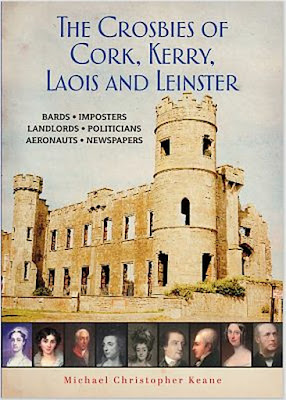
During my book-buying visit to Limerick earlier this week, one of the new books I bought is The Crosbies of Cork, Kerry, Laois and Leinster by Michael Christopher Keane, partly because the author has used two of my photographs to illustrate his book, and partly because this is a fascinating story for anyone interested in genealogy, family history and local history.

Chris Keane is from Tarbert, Co Kerry, and is a retired lecturer in University College Cork. He now lives in Farran, Ovens, Co Cork. This is his third book and has the inviting subtitle: ‘Bards, Imposters, Landlords, Politicians, Aeronauts, Newspapers’. It tells the story of a colourful family that achieved both fame and notoriety through the centuries.

The story begins with the MacCrossans, who were the hereditary bards and poets to Laois’s leading sept, the O’Moores of the Rock of Dunamase, and to the O’Connors of Offaly from ancient times. When Laois and Offaly were planted and renamed Queen’s County and King’s County in the 16th century, two young MacCrossan brothers from the Ballyfin and Clonenagh area, between Mountrath and Portlaoise, were fostered by Francis Cosby of Stradbally Hall, who moved to Ireland in 1546, and the neighbouring Bowen family.

The brothers tried to disguise their Gaelic Irish origins, changed their names to Patrick and John Crosbie and claimed to be descended from mid-ranking English gentry, the Crosbies of Great Crosbie, Lancashire. These changes are described by Chris Keane as a ‘deceit’ and he concludes they were ‘imposters within their own community.’ But the changes helped to advance the standing of the brothers in Elizabethan and Jacobean society. Patrick becoming a leading landlord in both Laois and Kerry, while his brother, John Crosbie, becoming the Church of Ireland Bishop of Ardfert (1601-1620).

Surprisingly, most of Bishop John Crosbie’s children were brought up as Roman Catholics. His descendants became major landlords in Co Kerry for the following three centuries. Their principal residence was Ardfert Abbey and the family accumulated an array of titles and peerages, including baronet (1630), Baron Brandon (1758), Viscount Crosbie of Ardfert (1771) and Earl of Glandore (1776).

When John Crosbie (1753-1815), 2nd Earl of Glandore, died in 1818, there as no immediate male heir to inherit his titles and estates. The Brandon title passed to his cousin, the Revd William Crosbie, Rector of Castleisland. When Lord Brandon realised his wife Elizabeth (La Touche) was having an affair with the Prime Minister, Lord Melbourne, even before the death of Melbourne’s wife, Lady Caroline Lamb, he first tried to blackmail Melbourne into making him a bishop, and then sued unsuccessfully for ‘criminal conversation.’

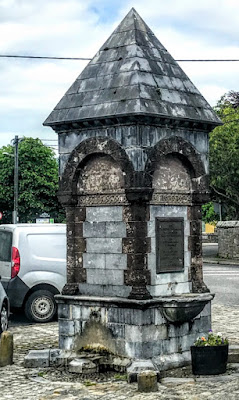
The Talbot-Crosbie Memorial Fountain in Ardfert … a photograph on p 186 in Chris Keane’s new book (Photograph: Patrick Comerford)

Meanwhile, Lord Glandore’s sister, Lady Anne Crosbie, had married John Talbot of Mount Talbot Co Roscommon, and the Ardfert estate passed to their son, the Revd John Talbot-Crosbie, who changed his name to Talbot-Crosbie. He married Jane Lloyd of Beechmount House, Rathkeale, Co Limerick, and they were the ancestors of the Talbot-Crosbie family of Ardfert Abbey.

Patrick Crosbie is best remembered for transplanting substantial numbers of the ‘Seven Septs of Laois’ to his large estate in Co Kerry, with many of these families settling in the Tarbert area, now within the Rathkeale and Kilnaughtin Group of Parishes. Before his death in 1610, he failed in his attempt to grab the estates of the FitzMaurice family of Lixnaw, Co Kerry, and of the FitzGerald family of Glin Castle, Co Limerick.

Sir Pierce Crosbie was both Cupholder and Gentleman of the King’s Bedchamber to two successive monarchs, King James I and King Charles I. He lost his estates and was jailed due to his implacable opposition to the Irish Lord Deputy Wentworth, only to regain them when Wentworth was executed for treason.

He was also closely associated with what is arguably the most notorious sex scandal in British history in which his stepson, the Earl of Castlehaven, was executed for sexual depravity. His remarkable career ended in supporting the Irish Catholic Confederacy in the 1640s.

The Laois Crosbies lost their estates, including Crosbie castle in Ballyfin, when they found themselves on the losing side in the Cromwellian wars. However, this branch of the family later re-established itself at Crosbie Park, near Baltinglass, Co Wicklow and in Co Carlow. A later generation acquired fame in their own different ways. Richard Crosbie of Wicklow, who became popularly known as ‘Mr Balloon,’ achieved fame as Ireland’s first aeronaut with his pioneering hot-air balloon flight in 1785. His brother, Sir Edward Crosbie, the fifth baronet, was executed as a suspected rebel leader in Carlow in the 1798 rebellion, and was denied a Christian burial.

Yet another well-known branch of the extended family includes the Cork Crosbies of the Examiner newspapers. These Crosbies originated with a young journalist Thomas Crosbie who left his home in Co Kerry to build a newspaper dynasty that extended over five generations from the mid-1800s until finally taken over by The Irish Times in 2017.

The stories of the Crosbies provide intriguing insights into the complex allegiances of a prominent Irish family through the centuries to the present time.

● The new book on the Crosbies is available in good local bookshops: Michael Christopher Keane, The Crosbies of Cork, Kerry, Laois and Leinster (2021, viii + 321 pp), ISBN: 9781527297418 €20.


12 July 2021

Praying in Ordinary Time 2021:
44, Ardfert Cathedral, Co Kerry

Saint Brendan’s Cathedral, Ardfert, Co Kerry … a 12th century cathedral with a story dating back to the sixth century (Photograph: Patrick Comerford)

Patrick Comerford

During this time in the Church Calendar known as Ordinary Time, I am taking some time each morning to reflect in these ways:

1, photographs of a church or place of worship;

2, the day’s Gospel reading;

3, a prayer from the prayer diary of the Anglican mission agency USPG (United Society Partners in the Gospel).

This week, my photographs are from seven cathedrals or former cathedrals in the Diocese of Limerick and Killaloe. Earlier in this series, I have looked at Saint Mary’s Cathedral, Limerick, Saint Flannan’s Cathedral, Killaloe, and Saint Brendan’s Cathedral, Clonfert. My photographs this week are from Aghadoe, Ardfert, Emly, Gort, Kilfenora, Kilmacduagh and Roscrea.

The Romanesque west doorway in Saint Brendan’s Cathedral, Ardfert, is flanked by blind arcading (Photograph: Patrick Comerford)

Since my appointment as Precentor of Limerick, Killaloe and Clonfert in 2017, I have tried to visit all the cathedrals and former cathedrals in the diocese. This morning (12 July 2021), my photographs are from Saint Brendan’s Cathedral, Ardfert, Co Kerry.

Saint Brendan the Navigator is said to have founded a monastery in Ardfert in the sixth century, and the site includes three mediaeval churches, two ogham stones and a number of early Christian and mediaeval grave slabs.

Saint Brendan the Navigator was born near Tralee, Co Kerry, in 484. He was ordained by Saint Erc in 512 and established monastic cells at Ardfert, in Killadysert, Co Clare, at the foot of Mount Brandon, and in Clonfert, Co Galway.

It is said that Saint Brendan set off from Kerry on his many voyages. These adventures were called the Navigatio Brendani or The Voyage of Saint Brendan. As the stories of his seven-year voyage grew, pilgrims flocked to the Mount Brandon area and other early Christian sites.

It is also said he travelled to Wales and Scotland. After three years in Britain, he returned to Ireland and founded churches at Inchiquin, Co Galway, and Inishglora, Co Mayo. He also founded the See at Annaghdown in Co Galway, where he died in 577. He was buried at Saint Brendan’s Cathedral in Clonfert, Co Galway.

In the early 12th century, the Synod of Ráth Breasail in 1111 agreed that Ratass Church near Tralee would become the cathedral for the Diocese of Ciarraige or Kerry. However, it was moved to Ardfert by 1117.

The diocese was later renamed Ardfert and Aghadoe, but it is not clear that Aghadoe Cathedral ever operated as a separate cathedral or that there ever was a separate Diocese of Agahdoe.

Saint Brendan’s Cathedral, the earliest building on the site at Ardfert, dates from the 12th century, and the continued to be added to until the 19th century.

Most of the cathedral dates from the 13th century, although parts of the north wall date from the 12th century.

The East Window is a magnificent 13th century, three lancet east window. There is a spectacular row of nine lancet windows in the south wall. Below these windows there is a fine sedilia.

The cathedral has a Romanesque west doorway with outward pointing chevron decoration in the Anglo-Norman style. It is flanked by blind arcading with lozenge-stonework similar to that found in parts of south-west France

The battlements were added to the cathedral in the 15th century, as well as a small transept.

The south transept has been restored and is now being used as the main entrance to the visitor centre. Some of the original carving work has been moved into the south transept. The interesting items are on display, including two carved effigial slabs – said to be a bishop and an abbot – that once stood in the arcades on either side of the east window.

Other exhibits include head carvings and a gargoyle, while other gargoyles remain in their original places still in situ. Close to the main entrance of the south transept stands a 1.22 metre high ogham stone with a small portion of its original inscription: ‘CT (A) N QLOG’.

There are two smaller churches beside the cathedral. One of these smaller churches, Teampall-na-Hoe or the Church of the Virgin, dates from the 12th century. This is a fine example of late Romanesque architecture, although its chancel has long disappeared. It has decorated three-quarter columns instead of antae at each cornerstone, with heads and bird motifs on the capitals. A cornice decorated with spiral bosses supports the roof.

The west doorway is plain, but the south window has floral ornament and the chancel arch has chevron ornament.

The second church, Teampall na Griffin, is a plain 15th century church with an interesting carving of a griffin or wyvern on one of the windows. The corpus of decorated stone is stored in this church, but it is not open to the public.

In the north-east corner, a double rectangular niche contains a grotesque head with lips pulled back to reveal large teeth. This may be a variant of the ‘mouth-puller’ motif often found in Spain and west France.

At one time at the end of the 15th century, there was at least three rival Bishops of Ardfert: John Stack (1458-1488), John Pigge (1461-1475) and Philip Stack (1473-1495). Throughout the Reformation period, James FitzMaurice, a Cistercian monk, was recognised as Bishop of Ardfert (1536-1583) by both the Pope and the Crown.

The cathedral survived the Reformation, but the cathedral roof was destroyed during the Irish Rebellion of 1641.

The south transept was re-roofed and extended later in the 17th century.

The Diocese of Ardfert was united with the Diocese of Limerick from 1663 under Bishop Edward Synge, and Saint Brendan’s Cathedral became a parish church.

A new Church of Ireland parish church opened in 1871, and the cathedral roof was removed once again. After the disestablishment of the Church of Ireland in 1871, like other disused historic sites, Ardfert Cathedral was transferred to the Board of Public Works, now the Office of Public Works.

The three-lancet East Window in Saint Brendan’s Cathedral, Ardfert (Photograph: Patrick Comerford)

Matthew 10: 34 to 11: 1 (NRSVA):

34 ‘Do not think that I have come to bring peace to the earth; I have not come to bring peace, but a sword.

35 For I have come to set a man against his father,
and a daughter against her mother,
and a daughter-in-law against her mother-in-law;
36 and one’s foes will be members of one’s own household.

37 Whoever loves father or mother more than me is not worthy of me; and whoever loves son or daughter more than me is not worthy of me; 38 and whoever does not take up the cross and follow me is not worthy of me. 39 Those who find their life will lose it, and those who lose their life for my sake will find it.

40 ‘Whoever welcomes you welcomes me, and whoever welcomes me welcomes the one who sent me. 41 Whoever welcomes a prophet in the name of a prophet will receive a prophet’s reward; and whoever welcomes a righteous person in the name of a righteous person will receive the reward of the righteous; 42 and whoever gives even a cup of cold water to one of these little ones in the name of a disciple – truly I tell you, none of these will lose their reward.’

1 Now when Jesus had finished instructing his twelve disciples, he went on from there to teach and proclaim his message in their cities.

Inside the former south transept in Saint Brendan’s Cathedral (Photograph: Patrick Comerford)

Prayer in the USPG Prayer Diary:

The Prayer in the USPG Prayer Diary today (12 July 2021) invites us to pray:

We pray for equal distribution of resources across the world. May we think globally in how we manufacture and consume products.

Yesterday’s reflection

Continued tomorrow

The row of nine lancet windows in the south wall of Saint Brendan’s Cathedral, Ardfert (Photograph: Patrick Comerford)

Scripture quotations are from the New Revised Standard Version Bible: Anglicised Edition copyright © 1989, 1995, National Council of the Churches of Christ in the United States of America. Used by permission. All rights reserved worldwide. http://nrsvbibles.org

Two mediaeval gravestone effigies – said to be an abbot and a bishop (Photograph: Patrick Comerford)

23 January 2021

Charles Gray-Stack (1912-1985): a former
Dean of Ardfert and Precentor of Limerick

Nantenan Glebe near Askeaton … Charles Gray-Stack lived there in the 1950s (Photograph: Patrick Comerford)

Patrick Comerford

The death of the Revd Martha Gray-Stack (1935-2021) earlier this week reminded me that her late husband, Dean Charles Gray-Stack (1912-1985), was one of my predecessors as Precentor of Limerick, and long before me he had been in ministry in the Rathkeale Group of Parish in the 1940s and 1950s. He was also a well-known contributor to the The Irish Times in the 1950s and 1960s.

When a project looking at my predecessors as Precentors of Limerick was postponed some months ago due to pandemic limits on public events, I thought it might still be interesting to continue looking at past precentors in a number of blog postings.

In earlier postings, I recalled some previous precentors who had been accused of ‘dissolute living’ or being a ‘notorious fornicator’ (Awly O Lonysigh), or who were killed in battle (Thomas Purcell). There were those who became bishops or archbishops: Denis O’Dea (Ossory), Richard Purcell (Ferns) and John Long (Armagh).

There was the tragic story too of Robert Grave, who became Bishop of Ferns while remaining Precentor of Limerick, but – only weeks after his consecration – drowned with all his family in Dublin Bay as they made their way by sea to their new home in Wexford (read more HERE).

In the 17th century, two members of the Gough family were also appointed Precentors of Limerick. In all, three brothers in this family were priests in the Church of Ireland and two were priests in the Church of England, and the Rathkeale branch of the family was the ancestral line of one of Ireland’s most famous generals (read more HERE).

In the mid to late 18th century, two members of the Maunsell family were Precentors of Limerick: Richard Maunsell (1745-1747) and William Thomas Maunsell (1786-1781) (read more HERE).

They were related to Canon John Warburton who was, perhaps, the longest-ever holder of the office, being Precentor of Limerick for 60 years from 1818 until he died to 1878 (red more HERE).

Earlier this week, I looked at Warburton’ successor, Canon Frederic Charles Hamilton, who provides an interesting links with both this group of parishes, with the Mariners’ Church in Dún Laoghaire and the Anglican mission agency SPG, now USPG (United Society Partners in the Gospel), of which I am a trustee. (see HERE).

As I move to the end of the 19th and the early 20th century, Hamilton’s successor as Precentor, Francis Meredyth, was a published poet and dramatist, and some of the Precentors of Limerick were also among the last Deans of Ardfert, including Robert Archibald Adderley (1870-1946), who also served in Listowel and Ballybunion (see HERE).

Charles Maurice Gray-Stack was born in Armagh, the son of the Revd William Bagot Stack (1878-1953), a grandson of Charles Maurice Stack (1825-1914), Bishop of Clogher (1886-1902), and a descendant of the Stack family of Stackstown and Crotta, Co Kerry.

The Stacks were a prominent clerical family in the Church of Ireland. The bishop’s father, the Revd Edward Stack, and grandfather, Canon Walter Bagot, were both priests, while his brothers included Canon Thomas Stack (1810-1871) was an SPG missionary in New South Wales before moving to Sydney; and the Revd Richard Stack (1815-1851), curate of Saint Peter’s and known for his work as a ‘slum priest’ in Dublin.

The Revd William Bagot Stack (1878-1953) had worked in British colonial administration in Central Africa and was a lieutenant in the Royal Irish Fusiliers before being ordained deacon in 1907 and priest in 1908. Later in life he was the Rector of Dundalk (1934-1941) and Rector of Inistioge, Co Kilkenny (1941-1946) in the Diocese of Ossory.

He was educated at Campbell College Belfast and Trinity College Dublin (BA, MA), and was ordained deacon in 1937 and priest in 1939. He served his first curacies in Birr (1937-1938) and then in the dioceses of Ferns and Ossory – Ardamine (1938-1940), Kilnehue and Kilpipe (1940-1941) and Inistioge (1941-1944), where his father was the rector.

He then moved to the Diocese of Limerick and Ardfert, and for five years was the diocesan curate in Ardfert and Aghadoe and curate of Killarney (1944-1949). While he was there, he obtained a confirmation of the coat of arms of Bishop Charles Maurice Stack for the bishop’s descendants in 1948.

He moved to the Rathkeale and Nantenan Union of Parishes as curate in 1949, when Maurice Talbot, a future Dean of Limerick, was the rector, and lived for five years at Nantenan Glebe. During his time here, he changed his surname from Stack to Gray-Stack, recalling his maternal grandfather, Dr Robert Gray of Armagh.

He moved to Co Kerry as a parish rector in 1953, first in Kilgobbin (1953-1961), which included Dingle from 1957, and then in Kenmare and Sneem (1961-1985), which included Waterville and Valentia from 1984.

In the cathedral chapter, he was Prebendary of Ballycahane (1962-1963), Precentor of Limerick (1963-1966), and Chancellor of Limerick, Prebendary of Kilpeacon and Dean of Ardfert (1966-1985). Of course, the title of Dean of Ardfert was an honour or sinecure, often offered to the most senior rector in the Diocese of Ardfert: the cathedral in Ardfert had ceased to function for a long time, and the church there closed in the 1940s.

He married Martha Mary Stewart-Clarke from Castledawson in Saint George’s Church, Belfast, in 1959.

Charlie Gray-Stack became a national figure for his regular contributions to The Irish Times and to RTÉ. He was known as a liturgist and for his engagement in social affairs. He was prominent in ecumenical activities, especially the Glenstal and Greenhills ecumenical conferences.

When he died on 25 July 1985, he was still Rector of Kenmare and Dean of Ardfert, and his funeral at Saint Patrick’s Church, Kenmare, was featured on the RTÉ news.

His widow, Martha-Gray Stack, was ordained deacon in 1990 and priest in 1991. She was an NSM curate in Saint Mary’s Cathedral and Saint Michael’s Church, Limerick (1990-1993), Rector of Clara (1993-2000), and the chaplain of Kingston College (2000-2010) in Mitchelstown, Co Cork. She died earlier this week (21 January 2021).

Saint Brendan’s Cathedral, Ardfert, Co Kerry … Charles Gray-Stack was the Dean of Ardfert in 1966-1985 (Photograph: Patrick Comerford)

22 January 2021

A Precentor of Limerick who
moved to Listowel and was
one of the last Deans of Ardfert

Saint John’s Church, Listowel … Robert Adderley, former Precentor of Limerick (1908-1918), was the Rector of Listowel in 1918-1946 (Photograph: Patrick Comerford)

Patrick Comerford

When a project looking at my predecessors as Precentors of Limerick was postponed some months ago due to the pandemic limits on public events, I thought it might still be interesting to continue looking at past precentors in a number of blog postings.

In earlier postings, I recalled some previous precentors who had been accused of ‘dissolute living’ or being a ‘notorious fornicator’ (Awly O Lonysigh), or who were killed in battle (Thomas Purcell). There were those who became bishops or archbishops: Denis O’Dea (Ossory), Richard Purcell (Ferns) and John Long (Armagh).

There was the tragic story too of Robert Grave, who became Bishop of Ferns while remaining Precentor of Limerick, but – only weeks after his consecration – drowned with all his family in Dublin Bay as they made their way by sea to their new home in Wexford (read more HERE).

In the 17th century, two members of the Gough family were also appointed Precentors of Limerick. In all, three brothers in this family were priests in the Church of Ireland and two were priests in the Church of England, and the Rathkeale branch of the family was the ancestral line of one of Ireland’s most famous generals (read more HERE).

In the mid to late 18th century, two members of the Maunsell family were Precentors of Limerick: Richard Maunsell (1745-1747) and William Thomas Maunsell (1786-1781) (read more HERE).

They were related to Canon John Warburton who was, perhaps, the longest-ever holder of the office, being Precentor of Limerick for 60 years from 1818 until he died to 1878 (red more HERE).

Earlier this week, I looked at Warburton’ successor, Canon Frederic Charles Hamilton, who provides an interesting links with both this group of parishes, with the Mariner’s Church in Dún Laoghaire and the Anglican mission agency SPG, now USPG (United Society Partners in the Gospel), of which I am a trustee. (see HERE).

As I move to the end of the 19th and the early 20th century, Hamilton’s successor as Precentor, Francis Meredyth, was a published poet and dramatist, and some of the Precentors of Limerick were also among the last Deans of Ardfert, including Robert Archibald Adderley and Charles Gray-Stack.

Robert Archibald Adderley was descended from a branch of the Adderley family who moved to Ireland in the 17th century.

In the 17th, 18th and 19th centuries there were a number of branches of the Adderley family in the English Midlands, all tracing their descent from Thomas Adderley, who was living at Blake Hall in Moreland, Staffordshire, from the early 16th century and died in 1538.

Various branches of this family lived at Blake Hall; Coton Hall at Coton-under-Needwood, Staffordshire, north of Lichfield and east of Uttoxeter; Tunstall Hall in Shropshire; Alrewas, near Lichfield; and Hams Hall, Fillongley Hall and Weddington Hall, all in Warwickshire.

Ralph Adderley, of Coton-under-Needwood, was High Sheriff of Staffordshire (1574-1575), Custos Rotulorum for Staffordshire. He married Margaret, daughter of Thomas Bagot of Blithfield, in 1554, and died in 1598.

Their second son, Thomas Adderley, moved to Ireland at the end of the 16th or beginning of the 17th century.

Edward Adderley and his wife Mary Hale were ancestors of the Adderley family of Innishannon, Co Cork. Francis Adderley of Innishannon, Co Cork, and his wife Elizabeth (Fowkes) were the parents of Thomas Adderley (1713-1791), a politician, landowner, amateur architect, developer of the linen industry and MP.

Thomas Adderley was still a child when he inherited his father’s estate, and was educated at Trinity College Dublin. He built the town of Innishannon, Co Cork, brought 60 Huguenot families to Innishannon in 1747 to establish a linen manufactory, and built a charter school there in 1752.

His first wife, the former Elizabeth Bernard, from Castle Mahon, Co Cork, was the widow of James Caulfeild (1682-1734), 3rd Viscount Charlemont, and MP for Charlemont, Co Armagh. Elizabeth and James had at least six children before he died in 1734. Their eldest surviving son, James Caulfeild (1728-1799, became 4th Viscount Charlemont, and in 1740 the widowed Elizabeth married Thomas Adderley (1713-1791) from Innishannon. They lived in Dublin, and had one more child, Elizabeth Adderley.

Thomas Adderley was an active and involved stepfather to James Caulfeild, providing advice and help to him throughout his transition to adulthood and after. Thomas, who became MP for Charlemont, built Marino House in 1753 on property he had acquired, and presented it to his stepson, Lord Charlemont. While Charlemont was away – in London or travelling through Europe – Thomas Adderley developed and managed the Marino estate on his behalf.

Thomas was appointed one of the Dublin Wide Streets Commissioners in 1757, while his stepson James later became known as the ‘Volunteer’ Earl of Charlemont.

Back in Innishannon, Thomas Adderley’s interests included the silk industry, the linen industry, salt works, a flour mill managed mainly by the Orrs, Courderoy Mill managed by the Baker family, a carpet factory and a cotton factory.

When he died on 28 May 1791, he was buried at Saint Mary’s Church, Mary Street, Dublin. His gravestone is among those leaning against the back wall of what is now Wolfe Tone Park.

The Adderley estate in Innishannon became heavily encumbered with a mortgage of £40,000 during the life of Edward Hale Adderley (1770-1870). It is said locally that Adderley was unable to go outside his private grounds for 12 years, except on Sundays, for fear of being arrested for debt. He built an underground tunnel to Saint Mary’s Church, through his garden, and used this tunnel to move between his house and the church without being arrested.

Finally, under cover of darkness, he left Ireland at night for London, where he died about 40 years later, and the Adderley estate was acquired by Thomas Frewen and his family.

Another member of the Innishannon family, Richard Boyle Adderley, was a friend of the poet Robert Southey (1774-1843) during their time at Westminster School. He later became a barrister and civil servant and died in 1857.

Thomas Adderley of Ballyclough, near Mallow, was the father of Richard Boyle Adderley (1820-1874), a ‘schoolmaster,’ who married Ellen Meade (1831-1905) in Castlemagner,near Kanturk, Co Cork, in 1852, and he died in Douglas, Cork, in 1874.

Their second son, Robert Archibald Adderley (1870-1946), born in Cork on 16 May 1870. He was educated at TCD (BA, MA), and was ordained deacon in 1901 and priest in 1903. He was a curate at Saint Mary’s Cathedral, Tuam (1901-1905), when he married Eva Mary Charlotte Jones from Co Sligo in 1902.

Robert and Eva Adderley were the parents of a daughter Eva Mary (born in 1903) and two sons: Harry Robert Adderley (1906), who died in infancy, and Richard Raymond Folliat Adderley (1909-1975).

Robert moved to Limerick in 1905 and was Curate of Saint Mary’s Cathedral (1905-1908) and Vicar Choral (1905-1918). During that time, he was the Precentor of Limerick for ten years (1908-1918). During World War I, he was also a chaplain to the forces in 1915-1919.

After the war, Canon Adderley spent almost 30 years as Rector of Listowel (1918-1946), which was amalgamated with Ballbunion in 1922, and Brosna and Abbeyfeale in 1928, all now part of the Rathkeale and Kilnaughtin Group of Parishes.

In the cathedral chapter, he was Prebendary of Croagh (1918-1924), Prebendary of Kilpeacon (1924-1940), Treasurer of Limerick (1940-1941), and then Dean of Ardfert (1941-1946). But the position of Dean of Ardfert was a sinecure or nominal appointment: the parish of Ardfert was amalgamated with Tralee in 1921, and the Church of Ireland parish church closed in 1945.

Dean Adderley was still the Rector of Listowel and Dean of Ardfert when he died in hospital in Tralee, Co Kerry, on 12 October 1946.

Saint Brendan’s Cathedral, Ardfert, Co Kerry … Robert Archibald Adderley was the Dean of Ardfert in 1941-1946 (Photograph: Patrick Comerford)

07 October 2020

Aghadoe Cathedral and its
ruins near Killarney … but
was this ever a cathedral?

The ruins of Aghadoe Cathedral, Co Kerry, above the Lakes of Killarney … but was this ever a diocesan cathedral? (Photograph: Patrick Comerford, 2020)

Patrick Comerford

Since being appointed Precentor of Limerick, Killaloe and Clonfert in early 2017, I have tried to visit all the cathedrals and former cathedrals in the diocese.

Last week, on my way back to Askeaton from Sneem and Kenmare, I stopped near Killarney, Co Kerry, to visit the ruins of Aghadoe Cathedral, below the Aghadoe Heights Hotel and about 5 km outside Killarney.

The cathedral ruins stand on a hilltop overlooking Lough Leane and the town and the Lakes of Killarney. Aghadoe may have been the site of a church as early as the seventh century, but the present remains date from a church built in the 11th and 12th centuries.

The name Aghadoe (Achadh Deo) means the ‘field of two yews.’ This may have been a pagan religious site. Although the Church of Ireland diocese in Co Kerry is called the Diocese of Ardfert and Aghadoe, historians continue to debate whether Aghadoe was ever the seat of a bishop or a cathedral, or whether there ever was a separate Diocese of Aghadoe.

The church site at Aghadoe has been associated with the fifth century missionary, Saint Abban, and legend says that Aghadoe was linked to Innisfallen and its island monastery by a causeway across Lough Leane, the largest of the Lakes of Killarney.

A surviving ogham stone cemented into the south wall of the chancel (Photograph: Patrick Comerford, 2020)

Two ogham stones found at Aghadoe suggest that this was an important church site from the mid-seventh century. One stone is now cemented in the south wall of the chancel and bears an inscription transcribed as ‘Brruanann.’ The inscription may have been intended as ‘Brreanann,’ a possible reference to Saint Brendan.

A second ogham stone is now missing, but its inscription was transcribed as ‘Ggvvss Mn.’

Another early Christian artefact, a ‘bullaun,’ is outside the church, at the north-west corner of the nave. It may have been a quern-stone, but was later used as a holy water receptacle and rainwater collected in the hollow of the stone was said to have healing properties.

An early ‘bullaun’ at the north-west corner of the nave (Photograph: Patrick Comerford, 2020)

The Annals of Innisfallen say Saint Finian the Leper, a disciple of Saint Columba, founded a monastery at Aghadoe in the seventh century. Saint Finian was part of the traditionalist party in the debate about the date of Easter. He died ca 635, and his feast-day is on 21 October.

The monastery at Aghadoe had close links with the neighbouring monastery on Innisfallen Island, and the first written record of a monastery at Aghadoe dates is in the Annals of Innisfallen in 939, when Aghadoe monastery is referred to as the ‘Old Abbey.’

Maelsuthain O Carroll, one of the finest scholars at Innisfallen, died in 1010 and was buried at Aghadoe.

The Annals of Innisfallen refer to the first stone building on the site in 1027, with the building of Damh Liag Maenig, Maenach’s house of stone. Building the round tower began that year too. O Cathail, the heir to the local dynasty of Eóganacht Locha Léin, was captured in the church in 1061, taken away and murdered.

Amhlaoibh Mór Ó Donoghue tried forcibly to move the see from Ardfert to Aghadoe (Photograph: Patrick Comerford, 2020)

When the Synod of Ráith Breasail delineated territorial diocese in 1111, the Diocese of Ardfert became the diocese for the Kingdom of Ciarraige (Kerry), but also included the territory of the Eóganacht Locha Léin, the dynastic rulers in the Killarney and south Kerry area.

In the mid-12th century, Amhlaoibh Mór Ó Donoghue, the leader of the Ó Donoghues – the new rulers of Eóganacht Locha Léin – began building a new stone church, later called the ‘Great Church,’ in the Romanesque style and dedicated to the Holy Trinity.

The new church was completed in 1158, and Amhlaoibh Mór Ó Donoghue tried forcibly to move the see from Ardfert to Aghadoe.

The Romanesque doorway at the west end of Aghadoe Cathedral (Photograph: Patrick Comerford, 2020)

The new church incorporated part of the old stone building in its north-west section and it forms the western section of the church that remains standing today. The western doorway is in the Romanesque style, with a three-order arch decorated with geometric patterns on the second and third order while the first is plain.

When Amhlaoibh Mór Ó Donoghue was defeated and killed by the O’Briens of Thomond, his body was carried to Aghadoe and buried in the church in 1166.

The final addition to the church in the 12th century This addition served as a chancel or choir, and was later separated from the rest of the church by a wall.

A detail of the Romanesque doorway at the west end of Aghadoe Cathedral (Photograph: Patrick Comerford, 2020)

The so-called nave is 11 metres long and 7 metres wide, and is entered through a fine, sandstone, Romanesque west doorway of three orders and with the remains of a fourth. It shows signs of rebuilding, and some of the stones have been reset incorrectly.

The arches show geometric patterns, and the shaft of the second order has interesting cut-away designs, while its arch has dog-tooth carving.

The south wall of the nave has been partly demolished, although one window survives, and there is a matching but smaller window in the north wall.

Inside the so-called nave of Aghadoe Cathedral (Photograph: Patrick Comerford, 2020)

The Gothic chancel or choir is 13.6 metres long and 7 metres wide. The east wall has two 13th century round-headed recessed lancet windows with carved head and flower stones at the interior intersection. The north wall is at full height but the south wall is only about chest high and survives in two sections. On one section rests the surviving ogham stone, on the other portion of a weathered red sandstone carving.

References in Papal letters in the 13th century support the notion that there was once a Diocese of Aghadoe. Dionysus, Archdeacon of Aghadoe, is said to have been made Bishop of Aghadoe in 1266. But after that, the clergy associated with Aghadoe are described as archdeacons.

According to the Annals of Innisfallen, Aghadoe Cathedral’s high cross fell in a strong wind in 1282.

Dermit Y’Sylleevayn or O’Sullivan, Archdeacon of Aghadoe and Vicar of Kilcrohane (Sneem) in the late 15th century, was accused of simony in in 1455, but managed to be reappointed to his positions.

Inside the so-called chancel of Aghadoe Cathedral (Photograph: Patrick Comerford, 2020)

From the 16th century, the Church of Ireland referred to the Diocese of Ardfert and Aghadoe, although Aghadoe was only a deanery within the Diocese of Ardfert. The church is mentioned in a 1615 report, but it is excluded from a list of abbeys in the report suggesting it had become only an archdeaconry.

When Richard O’Connell, the Roman Catholic Bishop of Ardfert and Aghadoe, died ca 1650, he was buried in Aghadoe.

The town that survived at Aghadoe was sacked by Cromwellian forces in the 1650s. After the Caroline restoration, the Diocese of Ardfert and Aghadoe was united with the Diocese of Limerick, with Edward Synge as Bishop of Limerick, Ardfert and Aghadoe.

John Smith was Archdeacon of Aghadoe (1664-1680) and Dean of Limerick (1666-1680) until he became Bishop of Killala. His successors, Thomas Hynde or Hinde and Ezekiel Weebe were also Archdeacons of Aghadoe and Deans of Limerick.

A surviving fragment of a red sandstone block with an a 17th or 18th century carving depicting the crucifixion (Photograph: Patrick Comerford, 2020)

The church at Aghadoe may have fallen into ruin in the later 17th century. Mortared onto the top of a portion of the south wall, close to the ogham stone, is a surviving fragment of red sandstone block with a 17th or 18th century carving, depicting the crucifixion, with the Virgin Mary passing a chalice to Christ on the cross and an angel. The survival of this stone suggests Aghadoe was still used as a church site in the 17th century.

Aghadoe is no longer listed as an active parish by 1740, and seems to have ceased functioning. Charles Smith, in The antient and present state of the county of Kerry, says in 1756, ‘The cathedral church of Aghadoe has been in ruins time out of mind.’

The Romanesque doorway was crudely rebuilt in the 18th or 19th century.

The cathedral at Aghadoe was in ruins by the mid-18th century (Photograph: Patrick Comerford, 2020)

Many of the later Archdeacons of Aghadoe were non-resident pluralists, and in 1788 Archdeacon Richard Leslie was deprived for non-residence, and was jailed for debt. He later became Archdeacon of Madras and died in Fort St George, Madras, in 1818.

Sir George Bishopp was Archdeacon of Aghadoe (1816-1834) at the same time as he was Dean of Lismore (1831-1834) and Sub-Dean of the Chapel Royal (1822-1831).

Samuel Lewis, in his Topographical Dictionary in 1837, mentions that another church was being ‘contemplated’ to stand beside the old cathedral ruins. A new parish church for Aghadoe was consecrated on 18 May 1842.

One of the finest artefacts related to Aghadoe is a 12th century crosier found in 1848, now at the National Museum in Dublin. The crosier was carved from walrus ivory and decorated in the Urnes style, most associated with Vikings. It depicts a foliage motif that develops and curves into the shape of a monster with a man in his open jaws. The carvings are similar to those on the jambs of the Romanesque doorway of the cathedral.

Another crosier, possibly associated with Aghadoe, was found in the Lakes of Killarney in 1867 by a fisherman, who thought it was a salmon.

Surviving fragments at the south wall of Aghadoe Cathedral (Photograph: Patrick Comerford, 2020)

Today, Aghadoe Cathedral is a small, roofless, two-chamber building. Tradition says the nave was dedicated to Saint Finian and the chancel to the Holy Trinity. But, despite these traditions and names, it is questionable whether they ever served as a nave and a chancel of a cathedral. The dividing wall shows no traces of a chancel arch, and only a small, blocked connecting doorway on its north side.

The position of Archdeacon of Aghadoe survived in the Church of Ireland until 1922, when it was amalgamated with that of Archdeacon of Ardfert, and the parish of Aghadoe was united with Killarney and Muckross.

The name of the Roman Catholic diocese was changed from Ardfert and Aghadoe to Kerry in 1952.

In the Church of Ireland, since 1972, Ardfert and Aghadoe has been part of the United Dioceses of Limerick, Ardfert, Aghadoe, Killaloe, Clonfert, Kilmacduagh and Emly.

The Victorian church in Aghadoe, which was never called a cathedral, was deconsecrated on 27 February 1992. The priest-in-charge of Killarney, the Ven Simon Lumby, has been Archdeacon of Limerick, Ardfert and Aghadoe since 2016.

The surviving stump of the round tower at Aghadoe Cathedral (Photograph: Patrick Comerford, 2020)

05 June 2018

Walking the long stretch of
beach at Banna Strand

The long stretch of beach on Banna Strand (Photograph: Patrick Comerford, 2018; click on image for full-screen view)

Patrick Comerford

In my sermons on Sunday morning, I had been talking about the number of grains of sand on the beaches of the world, and the number of stars to be seen in the sky. So it seemed only fitting to go for a walk on the beach on Sunday afternoon [3 June 2018].

After visiting Saint Brendan’s Cathedral, Ardfert, and lunch in Ardfert on Sunday afternoon, two of us went for a walk on Banna Strand, also known as Banna Beach, in Tralee Bay, about 12 km north-west of Tralee.

Banns Strand faces the Atlantic Ocean and stretches for miles from Ballyheigue Beach at Blackrock to the north to Barrow Beach to the south. Banna Beach is a beautiful Blue Flag beach with sand that extends for miles, making it a walker’s paradise. It was voted the No 1 beach in Ireland on Trip Advisor in 2017.

From the beach, there are views of the mountains of the Dingle Peninsula on the south-west horizon, Kerry Head and the Maulin Mountain to the north-west, and straight out in the sea I could see Mucklaghmore Rock.

The sand dunes at Banna Strand can rise to heights of up to 12 metres (Photograph: Patrick Comerford, 2018)

The sand dunes here rise to heights of up to 12 metres (40 ft) and are a designated conservation area with rare plants and animals.

The beach is also a popular place for surfing spot, with surfing lessons and summer camps and surfboards and wet suits for hire.

Banna Beach Hotel closed in 2002 and has been replaced by the Banna Beach Leisure Centre. Dotted around the area are numerous holiday homes and mobile homes.

Banna Strand is also associated with Roger Casement, who was captured on 21 April 1916, having landed from a German U-Boat. Casement was involved in an attempt to land arms for Irish Republicans from the German vessel the Aud.

The Casement Monument near the dunes at Banna Beach (Photograph: Patrick Comerford, 2018)

A monument to Casement and Robert Monteith stands near the dunes with the inscription: ‘At a spot on Banna beach adjacent to here Roger Casement – Humanitarian & Irish revolutionary leader – Robert Monteith & a third man came ashore from a German submarine on Good Friday morning 21 April 1916 in furthering the cause of Irish freedom.’

The unnamed ‘third man’ was Daniel Julian Bailey, a soldier in the Royal Irish Rifles who was a Prisoner of War when he was recruited as Daniel Beverley into the ‘Casement Brigade.’

The monument was erected in 1966 to commemorate the 50th anniversary of the landing. The organising committee deliberately omitted the name of the ‘third man’ from the monument because he turned ‘King’s evidence’ after his arrest.

Both Casement and Beverley were captured, while Robert Monteith (1879-1956), from Kilcoole, Co Wicklow, spent the next six months hiding in Kerry, Limerick, and Cork, before travelling back to his family in New York.

When the monument was erected, the sod was turned by Robert Monteith’s daughter, Florrie Monteith Lynch. She was the author of a biography of her father, The Mystery Man of Banna Strand.

Walking along the long stretch of sand on Banna Beach (Photograph: Patrick Comerford, 2018)

04 June 2018

Gates, fountain and
parish rooms are part
of the legacy of Ardfert

The Glandore Gates … all that remains of Ardfert Abbey (Photograph: Patrick Comerford, 2018)

Patrick Comerford

Many of the surviving monuments in the south transept of Ardfert Cathedral, which I visited yesterday afternoon, were to the Talbot Crosbie family.

The Crosbie family were granted land in the Ardfert area by Elizabeth I in the late 16th century, and John Crosbie became Bishop of Kerry in 1600.

So, it seemed obvious that many of the prominent architectural sites I should see in Ardfert as I went to lunch later in the afternoon are legacies of the Talbot Crosbie family, including the Glandore Gates, the Talbot Crosbie Memorial Fountain and the Ardfert Parish Room.

Ardfert Abbey was the seat of the Crosbie family, later the Earls of Glandore. Over the generations, the Crosbie family was influential in local and national politics, including MPs, Privy Councillors and Governors of Kerry.

Maurice Crosbie (1690-1762) became first Baron Brandon (1758). His son, William Crosbie (1716-1781), became Viscount Crosbie (1771) and Earl of Glandore (1776).

When John Crosbie, 2nd Earl of Glandore, died in in 1815 the titles of viscount and earl died out and the title of Lord Brandon passed to his cousin, William Crosbie (1771-1832) as the fourth Baron. He was the son of the Very Revd Maurice Crosbie, Dean of Saint Mary’s Cathedral, Limerick. Lord Brandon was also a priest in the Church of Ireland, and was Rector of Castleisland, Co Kerry. The titles died when he died in 1832.

Ardfert Abbey eventually passed to the descendants of the second earl’s sister, Lady Anne Crosbie, who in 1775 married William John Talbot, a descendant of the Talbot family of Mount Talbot, Co Roscommon, and Templeogue Castle Co Dublin.

In the mid-19th century, William Talbot Crosbie was living at Ardfert Abbey. By the end of that century, it was the home of Colonel John Darnley Talbot Crosbie in 1894. In 1906, it was the property of Lindsay Talbot Crosbie.

The imposing entrance was built ca 1815 by John Crosbie, Earl of Glandore, at one of the entrances to the Crosbie mansion, and was relocated to its present position in the 1880s.

The house was burnt during the Civil War in 1922, but the elaborate entrance gate in the heart of Ardfert is now a private dwelling and remains as a reminder of the influence of the family.

The crests of the Crosbie (left) and Talbot (right) families on the Glandore Gates in Ardfert (Photograph: Patrick Comerford, 2018)

The Glandore Gates comprise a pair of limestone ashlar piers with a lancet arch to the centre that has a battlemented parapet over, and cast-iron gates and a curved screen wall to north.

There is an attached, two-bay, single-storey, flat-roofed Gothic Revival gate lodge to the south, comprising a single-bay linking bay with lancet arch openings and a single-bay advanced end block that has a battlemented parapet and a curved screen wall to south.

The iron double-leaf gates display the crests of the Crosbie family (left) and the Talbot family (right).

the Talbot Crosbie Memorial Fountain in the centre of Ardfert (Photograph: Patrick Comerford, 2018)

Across from the gates, the Talbot Crosbie Memorial Fountain is a free-standing Hiberno-Romanesque memorial fountain, erected in 1901.

This fountain has a limestone ashlar plinth on a square-plan with shaft, with Romanesque sawtooth carving on the red sandstone arches on the corner pillars, and an inscribed cast-iron plaque and pyramidal capping with corbelled eaves. The bronze plaque reads: ‘1901 The Ardfert Water Supply was provided by Lieut Colonel Talbot-Crosbie and this fountain erected to his memory and for the public good by his brother Lindsay Talbot-Crosbie of Ardfert Abbey.’

The Ardfert Parish Room, east of Saint Brendan’s Cathedral (Photograph: Patrick Comerford, 2018)

To the east of Ardfert Cathedral, the Ardfert Parish Room is a detached three-bay single-storey meeting hall with dormer attic, built around 1915. It was built with red-brick English garden bond walls and with a projecting plinth by the local landlord Lindsey Talbot-Crosbie, and it is currently undergoing restoration.

This building has a single-bay single-storey crow-stepped gabled projecting porch to left, crow-stepped gable ends and single-bay single-storey recessed end bay to east.

There is a pedimented limestone name plaque on the west gable. There are timber, multiple-pane, casement windows with limestone sills, lintels and mullions and chamfered brick reveals.

The projecting gabled porch has a round-headed doorway with a brick arch. There is a square-headed doorway at the east end with a limestone lintel.

Has the Precentor a
place in Saint Brendan’s
Cathedral, Ardfert?

Saint Brendan’s Cathedral, Ardfert, Co Kerry … a 12th century cathedral with a story dating back to the sixth century (Photograph: Patrick Comerford, 2018)

Patrick Comerford

As I am the Precentor of the three functioning cathedrals in the diocese – Saint Mary’s, Limerick, Saint Flannan’s, Killaloe, Co Clare, and Saint Brendan’s, Clonfert, Co Galway –I sometimes wonder, if only in idle moments, whether this means I am, nominally at least, also the Precentor of some of the other former cathedrals in this diocese, including Kilfenora, Kilmacduagh, Emly, Aghadoe, and – of course – Saint Brendan’s Cathedral in Ardfert, Co Kerry.

In the warm summer sunshine of Sunday afternoon, after Morning Prayer in Saint Brendan’s Church in Tarbert yesterday [3 June 2018], two of us decided to visit another church linked with Kerry’s own saint, and visited Ardfert, about 10 km north-west of Tralee.

Saint Brendan the Navigator is said to have founded a monastery in Ardfert in the sixth century, and the site includes three mediaeval churches, two ogham stones and a number of early Christian and mediaeval grave slabs.

The Romanesque west doorway in Saint Brendan’s Cathedral, Ardfert, is flanked by blind arcading (Photograph: Patrick Comerford, 2018)

Saint Brendan the Navigator was born near Tralee, Co Kerry, in 484. He was ordained by Saint Erc in 512 and established monastic cells at Ardfert, in Killadysert, Co Clare, at the foot of Mount Brandon, and in Clonfert, Co Galway.

It is said that Saint Brendan set off from Kerry on his many voyages. These adventures were called the Navigatio Brendani or The Voyage of Saint Brendan. As the stories of his seven-year voyage grew, pilgrims flocked to the Mount Brandon area and other early Christian sites.

It is also said he travelled to Wales and Scotland. After three years in Britain, he returned to Ireland and founded churches at Inchiquin, Co Galway, and Inishglora, Co Mayo. He also founded the See at Annaghdown in Co Galway, where he died in 577. He was buried at Saint Brendan’s Cathedral in Clonfert, Co Galway.

The three-lancet East Window in Saint Brendan’s Cathedral, Ardfert (Photograph: Patrick Comerford, 2018)

In the early 12th century, the Synod of Ráth Breasail in 1111 agreed that Ratass Church near Tralee would become the cathedral for the Diocese of Ciarraige or Kerry. However, it was moved to Ardfert by 1117.

The diocese was later renamed Ardfert and Aghadoe, but it is not clear that Aghadoe Cathedral ever operated as a separate cathedral or that there ever was a separate Diocese of Agahdoe.

Saint Brendan’s Cathedral, the earliest building on the site at Ardfert, dates from the 12th century, and the continued to be added to until the 19th century.

Most of the cathedral dates from the 13th century, although parts of the north wall date from the 12th century.

The East Window is a magnificent 13th century, three lancet east window. There is a spectacular row of nine lancet windows in the south wall. Below these windows there is a fine sedilia.

The cathedral has a Romanesque west doorway with outward pointing chevron decoration in the Anglo-Norman style. It is flanked by blind arcading with lozenge-stonework similar to that found in parts of south-west France

The battlements were added to the cathedral in the 15th century, as well as a small transept.

The row of nine lancet windows in the south wall of Saint Brendan’s Cathedral, Ardfert (Photograph: Patrick Comerford, 2018)

The south transept has been restored and is now being used as the main entrance to the visitor centre. Some of the original carving work has been moved into the south transept. The interesting items are on display, including two carved effigial slabs – said to be a bishop and an abbot – that once stood in the arcades on either side of the east window.

Other exhibits include head carvings and a gargoyle, while other gargoyles remain in their original places still in situ. Close to the main entrance of the south transept stands a 1.22 metre high ogham stone with a small portion of its original inscription: ‘CT (A) N QLOG’.

The Ogham Stone in the South Transept in Saint Brendan’s Cathedral, Ardfert (Photograph: Patrick Comerford, 2018)

There are two smaller churches beside the cathedral. One of these smaller churches, Teampall-na-Hoe or the Church of the Virgin, dates from the 12th century. This is a fine example of late Romanesque architecture, although its chancel has long disappeared. It has decorated three-quarter columns instead of antae at each cornerstone, with heads and bird motifs on the capitals. A cornice decorated with spiral bosses supports the roof.

Teampall-na-Hoe or the Church of the Virgin, dates from the 12th century (Photograph: Patrick Comerford, 2018)

The west doorway is plain, but the south window has floral ornament and the chancel arch has chevron ornament.

The second church, Teampall na Griffin, is a plain 15th century church with an interesting carving of a griffin or wyvern on one of the windows. The corpus of decorated stone is stored in this church, but it is not open to the public.

In the north-east corner, a double rectangular niche contains a grotesque head with lips pulled back to reveal large teeth. This may be a variant of the ‘mouth-puller’ motif often found in Spain and west France.

Two mediaeval gravestone effigies – said to be an abbot and a bishop (Photograph: Patrick Comerford, 2018)

At one time at the end of the 15th century, there was at least three rival Bishops of Ardfert: John Stack (1458-1488), John Pigge (1461-1475) and Philip Stack (1473-1495). Throughout the Reformation period, James FitzMaurice, a Cistercian monk, was recognised as Bishop of Ardfert (1536-1583) by both the Pope and the Crown.

The cathedral survived the Reformation, but the cathedral roof was destroyed during the Irish Rebellion of 1641.

The south transept was re-roofed and extended later in the 17th century.

Inside the former south transept in Saint Brendan’s Cathedral (Photograph: Patrick Comerford, 2018)

The Diocese of Ardfert was united with the Diocese of Limerick from 1663 under Bishop Edward Synge, and Saint Brendan’s Cathedral became a parish church.

A new Church of Ireland parish church opened in 1871, and the cathedral roof was removed once again. After the disestablishment of the Church of Ireland in 1871, like other disused historic sites, Ardfert Cathedral was transferred to the Board of Public Works, now the Office of Public Works.

As for the role of the Precentor of Ardfert, I gather this was suspended in 1925 when Canon William John King (1854-1937) retired.

Whether I am Precentor or not, I did not contemplate remaining to sing Evensong. Instead, two of us went in search of lunch in Ardfert, and then went for a walk on the beach at Banna Strand.

A window on the east wall of the south transept in Saint Brendan’s Cathedral (Photograph: Patrick Comerford, 2018)