‘Blessed are the eyes that see what you see!’ (Luke 10: 23) … street art in Plaza de Judería in Malaga (Photograph: Patrick Comerford)
Patrick Comerford
The Season of Advent – and the real countdown to Christmas – began on Sunday with the First Sunday of Advent (1 December 2024). The Calendar of the Church of England in Common Worship today (3 December) remembers Saint Francis Xavier (1552), Missionary, Apostle of the Indies.
Before the day begins, I am taking some quiet time this morning to give thanks, to reflect, to pray and to read in these ways:
1, today’s Gospel reading;
2, a short reflection;
3, a prayer from the USPG prayer diary;
4, the Collects and Post-Communion prayer of the day.
‘Blessed are the eyes that see what you see!’ (Luke 10: 23) … what do we see in our own eyes?
Luke 10: 21-24 (NRSVA):
21 At that same hour Jesus rejoiced in the Holy Spirit and said, ‘I thank you, Father, Lord of heaven and earth, because you have hidden these things from the wise and the intelligent and have revealed them to infants; yes, Father, for such was your gracious will. 22 All things have been handed over to me by my Father; and no one knows who the Son is except the Father, or who the Father is except the Son and anyone to whom the Son chooses to reveal him.’
23 Then turning to the disciples, Jesus said to them privately, ‘Blessed are the eyes that see what you see! 24 For I tell you that many prophets and kings desired to see what you see, but did not see it, and to hear what you hear, but did not hear it.’
‘Blessed are the eyes that see what you see!’ (Luke 10: 23) … street art in Brick Lane in the East End, London (Photograph: Patrick Comerford)
Today’s reflection:
In the Gospel reading provided in the lectionary at the Eucharist today (Luke 10: 21-24), Jesus tells his disciples: ‘Blessed are the eyes that see what you see! For I tell you that many prophets and kings desired to see what you see, but did not see it, and to hear what you hear, but did not hear it’ (verse 23-24).
At 72, my sight and my hearing may not quite be what they once were. But my distant ‘cousin’ the late Kevin Martin, who died last year (14 June 2023), would greet me on my birthdays with the traditional Jewish greeting of ‘ad meah v’esrim’, ‘may you live until 120!’ (עד מאה ועשרים שנה).
Deuteronomy recalls that Moses lived to be 120, at which age ‘his eye had not dimmed, and his vigour had not diminished’ (Deuteronomy 34: 7). Great rabbis of the Talmud, including Hillel, Rabbi Yohanan Ben Zakkai, Rabbi Akiva and Rabbi Yehuda Hanasi, all lived to 120 as well.
The traditional Jewish birthday blessing carries the implication that the receiver should retain full mental and physical faculties to the end of life, still able to see with ears and to hear with ears.
This month marks half century after moving in December 1974 from Wexford, where I lived on High Street and worked on the Wexford People, to Dublin to work on The Irish Times.
But Advent is a time of looking forward rather than back. With those implications, of my eyes not being dimmed, and my vigour not being diminished, living for many more years does not sound so dim or distant a prospect at all. Indeed, it might even be a real blessing not only with what I have seen and heard in life but with the love, care and attention I receive too.
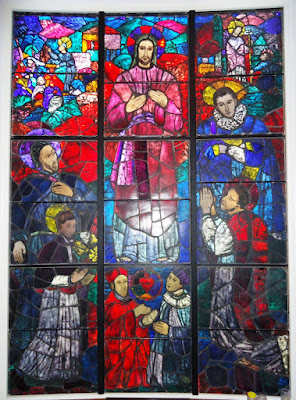
Saint Francis Xavier and the Jesuit saints … a window by Evie Hone in the Jesuit Retreat House at Manresa, Clontarf Road, Dublin (Photograph: Patrick Comerford)
Today’s Prayers (Tuesday 3 December 2024):
The theme this week in ‘Pray With the World Church’, the Prayer Diary of the Anglican mission agency USPG (United Society Partners in the Gospel), is ‘Hope – Advent’. This theme was introduced on Sunday with Reflections by Esmeralda Pato, the Anglican Church of Southern Africa Representative and Chair of USPG’s Communion-Wide Advisory Group.
The USPG Prayer Diary today (Tuesday 3 December 2024) invites us to pray:
God of justice, we pray for an end to gender-based violence. Protect vulnerable people and give strength to survivors. Help us all to stand against violence, working for equality, dignity, and safety for all.
The Collect:
Almighty God,
Give us grace to cast away the works of darkness
and to put on the armour of light
now in the time of this mortal life,
in which your Son Jesus Christ came to us in great humility;
that on the last day,
when he shall come again in his glorious majesty
to judge the living and the dead,
we may rise to the life immortal;
through him who is alive and reigns with you,
in the unity of the Holy Spirit,
one God, now and for ever.
The Post-Communion Prayer:
O Lord our God,
make us watchful and keep us faithful
as we await the coming of your Son our Lord;
that, when he shall appear,
he may not find us sleeping in sin
but active in his service
and joyful in his praise;
through Jesus Christ our Lord.
Additional Collect:
Almighty God,
as your kingdom dawns,
turn us from the darkness of sin
to the light of holiness,
that we may be ready to meet you
in our Lord and Saviour, Jesus Christ.
Yesterday’s Reflection
Continued Tomorrow
I lived on High Street, Wexford, until I moved to Dublin and ‘The Irish Times’ 50 years ago in December 1974 (Photograph: Patrick Comerford)
Scripture quotations are from the New Revised Standard Version Bible: Anglicised Edition copyright © 1989, 1995 National Council of the Churches of Christ in the United States of America. Used by permission. All rights reserved worldwide. http://nrsvbibles.org
Showing posts with label Clontarf. Show all posts
03 December 2024
28 November 2024
George Drumgoole Coleman,
the architect from Drogheda who
shaped the streets of Singapore
Parliament House in Singapore was first designed by George Drumgoole Coleman for John Argyle Maxwell (Photograph: Patrick Comerford, 2024)
Patrick Comerford
During our two recent visits to Singapore, I was interested in how much of Singapore was shaped in the 19th century and early 20th century by some influential Irish figures, including the Governor Sir Orfeur Cavenagh (1820-1891), who had family roots in Co Wexford and Co Kildare, and the architects George Drumgoole Coleman (1795-1844), who was born in Drogheda, and Denis Santry (1879-1960), who was born in Cork.
George Drumgoole Coleman (1795-1844), also known as George Drumgold Coleman, was Singapore’s pioneer colonial architect.
Only a few of Coleman’s buildings in Singapore have survived, including the Armenian Church of Saint Gregory the Illuminator, Maxwell’s House, later the Old Parliament House, Caldwell House and, perhaps, the Jamae Mosque that gives its name to Mosque Street. But he played a key role in designing and building much of early Singapore after it was founded by Sir Stamford Raffles in 1819.
George Drumgoole Coleman was born in Drogheda, Co Louth, in 1795, and returned to Drogheda in 1841-1842
George Drumgoole Coleman was born in Drogheda, Co Louth, in 1795. He was the son of James Coleman, a merchant whose business included building materials. James Coleman had married into the Co Louth merchant family of Drumgold or Drumgoole, and many members of the Dromgold family are buried both at Saint Peter’s Church (Church of Ireland), Drogheda, and in the Cord Cemetery off Cord Road, Drogheda.
I mused at one stage how my great-great-grandfather, James Comerford (1775-1825) of Co Wexford, was a first cousin of Sylvester Comerford (1756-1796), who married Mary Dromgoole of Drogheda in 1779. But any connection would be both conjectural and remote.
There are no records indicating where George Coleman received his architectural education, and his name is not in the registers of the Dublin Society’s Drawing School or the Royal Academy School in London.
However, it has been suggested that he was articled to Francis Johnston (1760-1819), who once had an architectural practice in Paradise Place, off William Street, Drogheda, in in 1786-1793, and who designed Townley Hall and a related row of family houses in Drogheda (1794-1798). Perhaps Johnston’s influence is reflected in Coleman’s Palladian and Georgian designs in Singapore. But Johnston moved from Drogheda to Dublin before Coleman was born, and completed Townley Hall while Coleman was still an infant.
At the age of 19, Coleman left Ireland in 1815 for Calcutta, where he worked as an architect, designing private houses for the merchants of Fort William. In 1819, he was invited through his patron, John Palmer, to build two churches in Batavia (now Jakarta) in the Dutch East Indies. The churches were never built, but Coleman spent two years in Java, where he surveyed large sugar plantations, designed private buildings and sugar mills and built machinery for sugar milling.
The Armenian Church of Saint Gregory the Illuminator on Hill Street was designed by George Coleman in 1835 (Photograph: Patrick Comerford, 2024)
Coleman obtained an introduction to Sir Stamford Raffles from Palmer and arrived in Singapore in June 1822. There he waited four months for Raffles to return from Bencoolen, now Bengkulu, in Sumatra.
In the meantime, he designed the Residency at the top of Bukit Larangan, now Fort Canning Hill, for Raffles. The house, with plank walls, Venetian windows and an attap roof, impressed Raffles. Later, at John Crawfurd’s expense, Coleman extended and redesigned the house as the residence of the Residents and Governors of Singapore.
Meanwhile, Raffles was impressed and commissioned Coleman to design a garrison church – that was never built – and to lay out the streets of Singapore. He planned the town centre, created roads, designed fine buildings, and oversaw the works at the Christian Cemetery on the slope of the hill.
Coleman left for Java in June 1823 and spent the next 2½ years there, but returned to Singapore in 1825 due to conflicts between the Dutch and native Javanese.
He designed a large Palladian house for David Skene Napier, the first magistrate in Singapore, in 1826, and a palatial building for the merchant John Argyle Maxwell. Before Maxwell’s house was completed, it was leased to the government for use as a court house and government offices. Much altered and enlarged, it eventually formed part of the Parliament House. This too was designed in the Palladian style, adapted to the tropical climate by incorporating a veranda and overhanging eaves to provide shade.
As a Revenue Surveyor in 1827, Coleman surveyed land titles that were issued mostly for shophouse lots in the town.
Coleman designed and built his own house in 1828, and it was completed in May 1829. That year, Coleman’s daughter, Meda Elizabeth Coleman, was born to Takouhi (Thagoohi) Manuk, on 10 March 1829, and the girl was baptised in Saint Andrew’s Cathedral on 30 July 1837. The child’s mother, Takouhi Manuk, was a sister of Gvork Manuk, a wealthy Persian-born merchant in India and Java, and Coleman built a mansion for her beside his own.
Takouhi Manuk and her sister Mary Arathoon later inherited the entire wealth of their bachelor brother and in 1854 they funded the rebuilding of Saint John’s Armenian Church in Calcutta. It is possibly because of his relationship with Takouhi Manuk that Coleman came to design the Armenian Church of Saint Gregory the Illuminator on Hill Street in 1835, and she donated much of the silverware and furnishings in the church.
Saint Andrew’s Cathedral, Singapore … Coleman designed the original church on Coleman Street in 1835 (Photograph: Patrick Comerford, 2024)
Meanwhile, in 1829, Coleman surveyed in minute detail the islands that would form the new harbour of the port, including all the shoals, slopes and heights of the hills along the coast for the possible fortification of the harbour. The survey was drawn and printed by JB Tassin as the first comprehensive map of the town and environs of Singapore.
Coleman was appointed the Superintendent of Public Works and Convicts in 1833 and was also the surveyor and overseer of convict labour. He managed building the North Bridge Road and South Bridge Road in 1833-1835.
Coleman built the first Anglican church in Singapore, Saint Andrew’s, which was begun in 1835. However, it was demolished in the 1850s when it became unsafe due to lightning strikes, and it was replaced by Saint Andrew’s Cathedral.
Coleman designed the Telok Ayer market, built on the waterfront in 1835. It was demolished during to land reclamation work in 1879 and was moved to Lau Pa Sat, where it retains the octagonal shape of Coleman’s original market.
Coleman helped found the Singapore Free Press & Mercantile Advertiser with William Napier, Edward Boustead, and Walter Scott Lorrain. The Singapore Free Press was first published in October 1835. Due to this competition, the Singapore Chronicle, the first newspaper in Singapore, closed in 1837, and the Singapore Free Press remained unrivalled until it was succeeded by the Straits Times in 1845.
‘Chijmes’ on Victoria Street incorporates Caldwell House, designed by George Coleman in 1840-1841 (Photograph: Patrick Comerford, 2024)
Although Coleman designed numerous private houses in Singapore, only two that with certainty are his design have survived: the Parliament House, originally Maxwell’s house, although it has undergone considerable changes; and Caldwell House on Victoria Street.
Caldwell House was built in 1840-1841 for Henry Charles Caldwell of the Magistrates Court. The house was bought in 1852 by Father Jean-Marie Beurel to establish the Convent of the Holy Infant Jesus. Today it is part of CHIJMES.
Coleman was also commissioned to finish and extend the Raffles Institution, originally designed by Phillip Jackson. That building was demolished in 1972.
The Istana Kampong Glam is believed to be by Coleman, although there is no definite evidence. Coleman is also said to have designed the green Jamae Mosque (Masjid Chulia), on the corner of South Bridge Road and Mosque Street. The entrance gate is distinctively South Indian, but the two prayer halls are Neo-Classical style, typical of Coleman’s. This unique appearance has made the mosque a prominent landmark.
Coleman is said to have designed the Jamae Mosque on the corner of South Bridge Road and Mosque Street in Singapore (Photograph: Patrick Comerford, 2024)
On his doctor’s advice to return to a more temperate climate, Coleman left for Europe on 25 July 1841 after 15 years of continuous work and 25 years in the East, leaving behind Takouhi Manuk and their daughter Meda Elizabeth Coleman. He visited Drogheda and later married Maria Frances Vernon, youngest daughter of George Vernon of Clontarf Castle, Dublin, in Saint George’s Church, Hanover Square, London, on 17 September 1842.
However, Coleman was unable to settle down in Europe. He returned to Singapore with his wife on 25 November 1843, and they moved into his house on Coleman Street. Their son, George Vernon Coleman, was born on 27 December 1843.
Within three months, Coleman died at the age of 49 at home on 25 March 1844, due to a fever brought on by exposure to the sun. He was buried in an Old Christian Cemetery at the foot of Government Hill, now Fort Canning Hill. His gravestone misspells his name as George Doumgold Coleman.
Within months of Coleman’s death, his widow married William Napier, a conveyancing lawyer and the first law agent in Singapore. Napier adopted Coleman’s infant son George, who would die at sea on board HMS Maeander in 1848 at the age of four. His daughter Meda Elizabeth Coleman died in Singapore in October 1907.
An undated photograph of Coleman’s house at 3 Coleman Street as it originally appeared (Source: Lee Kip Lin, ‘The Singapore House 1819-1942’, Singapore 1988)
After Coleman’s death, the Coleman House at 3 Coleman Street became the London Hotel and then the Hotel de la Paix and the Burlington Hotel. The hotel was frequented by Joseph Conrad during his visits to Singapore.
The house changed hands many times, and at various times it was a boarding house and the Theatre Royal. Up to 1,000 squatters were living there and it was in a dilapidated state when it was demolished in December 1965. It is now the site of the Peninsula Shopping Centre.
Coleman’s grave and other graves were exhumed in 1954-1965 when the cemetery was turned into a park and the gravestones were built into the walls at Fort Canning Park. But his name lives on in a number of places in Singapore, including Coleman Bridge, Coleman Place and Coleman Street.
Looking out onto Coleman Street from the porch of Saint Andrew’s Cathedral (Photograph: Patrick Comerford, 2024)
Coleman Bridge links Hill Street and New Bridge Road, spanning the Singapore River near Clarke Quay. Part of the bridge marks the boundary between the Downtown Core and the Singapore River Planning Area, both within the Central Area of Singapore.
Coleman Bridge was the second bridge built across the Singapore River and the first built in masonry. A brick bridge joining Old Bridge Road and Hill Street over the Singapore River was built in 1840 and named Coleman Bridge. The bridge had nine arches, and was first known as the New Bridge, giving its name to New Bridge Road.
The brick bridge was replaced in 1865 by one of timber, then in 1886 by an iron bridge spanning the Singapore River, and by the present concrete bridge in 1987. Several features of the iron bridge, including the decorative lamp posts and iron railings, have been incorporated in the present Coleman Bridge.
Coleman Bridge, the second bridge built across the Singapore River, has been rebuilt in 1865, 1886 and 1987 (Photograph: Patrick Comerford, 2024)
Patrick Comerford
During our two recent visits to Singapore, I was interested in how much of Singapore was shaped in the 19th century and early 20th century by some influential Irish figures, including the Governor Sir Orfeur Cavenagh (1820-1891), who had family roots in Co Wexford and Co Kildare, and the architects George Drumgoole Coleman (1795-1844), who was born in Drogheda, and Denis Santry (1879-1960), who was born in Cork.
George Drumgoole Coleman (1795-1844), also known as George Drumgold Coleman, was Singapore’s pioneer colonial architect.
Only a few of Coleman’s buildings in Singapore have survived, including the Armenian Church of Saint Gregory the Illuminator, Maxwell’s House, later the Old Parliament House, Caldwell House and, perhaps, the Jamae Mosque that gives its name to Mosque Street. But he played a key role in designing and building much of early Singapore after it was founded by Sir Stamford Raffles in 1819.
George Drumgoole Coleman was born in Drogheda, Co Louth, in 1795, and returned to Drogheda in 1841-1842
George Drumgoole Coleman was born in Drogheda, Co Louth, in 1795. He was the son of James Coleman, a merchant whose business included building materials. James Coleman had married into the Co Louth merchant family of Drumgold or Drumgoole, and many members of the Dromgold family are buried both at Saint Peter’s Church (Church of Ireland), Drogheda, and in the Cord Cemetery off Cord Road, Drogheda.
I mused at one stage how my great-great-grandfather, James Comerford (1775-1825) of Co Wexford, was a first cousin of Sylvester Comerford (1756-1796), who married Mary Dromgoole of Drogheda in 1779. But any connection would be both conjectural and remote.
There are no records indicating where George Coleman received his architectural education, and his name is not in the registers of the Dublin Society’s Drawing School or the Royal Academy School in London.
However, it has been suggested that he was articled to Francis Johnston (1760-1819), who once had an architectural practice in Paradise Place, off William Street, Drogheda, in in 1786-1793, and who designed Townley Hall and a related row of family houses in Drogheda (1794-1798). Perhaps Johnston’s influence is reflected in Coleman’s Palladian and Georgian designs in Singapore. But Johnston moved from Drogheda to Dublin before Coleman was born, and completed Townley Hall while Coleman was still an infant.
At the age of 19, Coleman left Ireland in 1815 for Calcutta, where he worked as an architect, designing private houses for the merchants of Fort William. In 1819, he was invited through his patron, John Palmer, to build two churches in Batavia (now Jakarta) in the Dutch East Indies. The churches were never built, but Coleman spent two years in Java, where he surveyed large sugar plantations, designed private buildings and sugar mills and built machinery for sugar milling.
The Armenian Church of Saint Gregory the Illuminator on Hill Street was designed by George Coleman in 1835 (Photograph: Patrick Comerford, 2024)
Coleman obtained an introduction to Sir Stamford Raffles from Palmer and arrived in Singapore in June 1822. There he waited four months for Raffles to return from Bencoolen, now Bengkulu, in Sumatra.
In the meantime, he designed the Residency at the top of Bukit Larangan, now Fort Canning Hill, for Raffles. The house, with plank walls, Venetian windows and an attap roof, impressed Raffles. Later, at John Crawfurd’s expense, Coleman extended and redesigned the house as the residence of the Residents and Governors of Singapore.
Meanwhile, Raffles was impressed and commissioned Coleman to design a garrison church – that was never built – and to lay out the streets of Singapore. He planned the town centre, created roads, designed fine buildings, and oversaw the works at the Christian Cemetery on the slope of the hill.
Coleman left for Java in June 1823 and spent the next 2½ years there, but returned to Singapore in 1825 due to conflicts between the Dutch and native Javanese.
He designed a large Palladian house for David Skene Napier, the first magistrate in Singapore, in 1826, and a palatial building for the merchant John Argyle Maxwell. Before Maxwell’s house was completed, it was leased to the government for use as a court house and government offices. Much altered and enlarged, it eventually formed part of the Parliament House. This too was designed in the Palladian style, adapted to the tropical climate by incorporating a veranda and overhanging eaves to provide shade.
As a Revenue Surveyor in 1827, Coleman surveyed land titles that were issued mostly for shophouse lots in the town.
Coleman designed and built his own house in 1828, and it was completed in May 1829. That year, Coleman’s daughter, Meda Elizabeth Coleman, was born to Takouhi (Thagoohi) Manuk, on 10 March 1829, and the girl was baptised in Saint Andrew’s Cathedral on 30 July 1837. The child’s mother, Takouhi Manuk, was a sister of Gvork Manuk, a wealthy Persian-born merchant in India and Java, and Coleman built a mansion for her beside his own.
Takouhi Manuk and her sister Mary Arathoon later inherited the entire wealth of their bachelor brother and in 1854 they funded the rebuilding of Saint John’s Armenian Church in Calcutta. It is possibly because of his relationship with Takouhi Manuk that Coleman came to design the Armenian Church of Saint Gregory the Illuminator on Hill Street in 1835, and she donated much of the silverware and furnishings in the church.
Saint Andrew’s Cathedral, Singapore … Coleman designed the original church on Coleman Street in 1835 (Photograph: Patrick Comerford, 2024)
Meanwhile, in 1829, Coleman surveyed in minute detail the islands that would form the new harbour of the port, including all the shoals, slopes and heights of the hills along the coast for the possible fortification of the harbour. The survey was drawn and printed by JB Tassin as the first comprehensive map of the town and environs of Singapore.
Coleman was appointed the Superintendent of Public Works and Convicts in 1833 and was also the surveyor and overseer of convict labour. He managed building the North Bridge Road and South Bridge Road in 1833-1835.
Coleman built the first Anglican church in Singapore, Saint Andrew’s, which was begun in 1835. However, it was demolished in the 1850s when it became unsafe due to lightning strikes, and it was replaced by Saint Andrew’s Cathedral.
Coleman designed the Telok Ayer market, built on the waterfront in 1835. It was demolished during to land reclamation work in 1879 and was moved to Lau Pa Sat, where it retains the octagonal shape of Coleman’s original market.
Coleman helped found the Singapore Free Press & Mercantile Advertiser with William Napier, Edward Boustead, and Walter Scott Lorrain. The Singapore Free Press was first published in October 1835. Due to this competition, the Singapore Chronicle, the first newspaper in Singapore, closed in 1837, and the Singapore Free Press remained unrivalled until it was succeeded by the Straits Times in 1845.
‘Chijmes’ on Victoria Street incorporates Caldwell House, designed by George Coleman in 1840-1841 (Photograph: Patrick Comerford, 2024)
Although Coleman designed numerous private houses in Singapore, only two that with certainty are his design have survived: the Parliament House, originally Maxwell’s house, although it has undergone considerable changes; and Caldwell House on Victoria Street.
Caldwell House was built in 1840-1841 for Henry Charles Caldwell of the Magistrates Court. The house was bought in 1852 by Father Jean-Marie Beurel to establish the Convent of the Holy Infant Jesus. Today it is part of CHIJMES.
Coleman was also commissioned to finish and extend the Raffles Institution, originally designed by Phillip Jackson. That building was demolished in 1972.
The Istana Kampong Glam is believed to be by Coleman, although there is no definite evidence. Coleman is also said to have designed the green Jamae Mosque (Masjid Chulia), on the corner of South Bridge Road and Mosque Street. The entrance gate is distinctively South Indian, but the two prayer halls are Neo-Classical style, typical of Coleman’s. This unique appearance has made the mosque a prominent landmark.
Coleman is said to have designed the Jamae Mosque on the corner of South Bridge Road and Mosque Street in Singapore (Photograph: Patrick Comerford, 2024)
On his doctor’s advice to return to a more temperate climate, Coleman left for Europe on 25 July 1841 after 15 years of continuous work and 25 years in the East, leaving behind Takouhi Manuk and their daughter Meda Elizabeth Coleman. He visited Drogheda and later married Maria Frances Vernon, youngest daughter of George Vernon of Clontarf Castle, Dublin, in Saint George’s Church, Hanover Square, London, on 17 September 1842.
However, Coleman was unable to settle down in Europe. He returned to Singapore with his wife on 25 November 1843, and they moved into his house on Coleman Street. Their son, George Vernon Coleman, was born on 27 December 1843.
Within three months, Coleman died at the age of 49 at home on 25 March 1844, due to a fever brought on by exposure to the sun. He was buried in an Old Christian Cemetery at the foot of Government Hill, now Fort Canning Hill. His gravestone misspells his name as George Doumgold Coleman.
Within months of Coleman’s death, his widow married William Napier, a conveyancing lawyer and the first law agent in Singapore. Napier adopted Coleman’s infant son George, who would die at sea on board HMS Maeander in 1848 at the age of four. His daughter Meda Elizabeth Coleman died in Singapore in October 1907.
An undated photograph of Coleman’s house at 3 Coleman Street as it originally appeared (Source: Lee Kip Lin, ‘The Singapore House 1819-1942’, Singapore 1988)
After Coleman’s death, the Coleman House at 3 Coleman Street became the London Hotel and then the Hotel de la Paix and the Burlington Hotel. The hotel was frequented by Joseph Conrad during his visits to Singapore.
The house changed hands many times, and at various times it was a boarding house and the Theatre Royal. Up to 1,000 squatters were living there and it was in a dilapidated state when it was demolished in December 1965. It is now the site of the Peninsula Shopping Centre.
Coleman’s grave and other graves were exhumed in 1954-1965 when the cemetery was turned into a park and the gravestones were built into the walls at Fort Canning Park. But his name lives on in a number of places in Singapore, including Coleman Bridge, Coleman Place and Coleman Street.
Looking out onto Coleman Street from the porch of Saint Andrew’s Cathedral (Photograph: Patrick Comerford, 2024)
Coleman Bridge links Hill Street and New Bridge Road, spanning the Singapore River near Clarke Quay. Part of the bridge marks the boundary between the Downtown Core and the Singapore River Planning Area, both within the Central Area of Singapore.
Coleman Bridge was the second bridge built across the Singapore River and the first built in masonry. A brick bridge joining Old Bridge Road and Hill Street over the Singapore River was built in 1840 and named Coleman Bridge. The bridge had nine arches, and was first known as the New Bridge, giving its name to New Bridge Road.
The brick bridge was replaced in 1865 by one of timber, then in 1886 by an iron bridge spanning the Singapore River, and by the present concrete bridge in 1987. Several features of the iron bridge, including the decorative lamp posts and iron railings, have been incorporated in the present Coleman Bridge.
Coleman Bridge, the second bridge built across the Singapore River, has been rebuilt in 1865, 1886 and 1987 (Photograph: Patrick Comerford, 2024)
25 May 2023
Morning prayers in Easter
with USPG: (47) 25 May 2023
The Ascension depicted in the East Window in Saint Patrick’s Cathedral (Church of Ireland), Armagh (Photograph: Patrick Comerford)
Patrick Comerford
Eastertide and Ascensiontide continue throughout this week, until the Day of Pentecost next Sunday (28 May 2023).
Today, the calendar of the Church of England in Common Worship remembers the Venerable Bede (735), Monk at Jarrow, Scholar, Historian, and Aldhelm (709), Bishop of Sherborne. Before this day gets busy, I am taking some time this morning for prayer and reflection.
I am reflecting each morning during Ascensiontide in these ways:
1, Looking at a depiction of the Ascension in images or stained glass windows in a church or cathedral I know;
2, the Gospel reading of the day in the Church of England lectionary;
3, a prayer from the USPG prayer diary.
The East window in Saint Patrick’s Cathedral, Armagh, was designed by Sir Thomas Drew and executed by Heaton, Butler and Bayne (Photograph: Patrick Comerford)
The East Window, Saint Patrick’s Cathedral, Armagh:
Saint Patrick’s Cathedral, Armagh, is the seat of the Church of Ireland Archbishop of Armagh and the Diocese of Armagh. The origins of the site are said to date back to the fifth century and the foundation of a monastery by Saint Patrick.
When Brian Boru, High King of Ireland, visited Armagh in 1004, he acknowledging it as the head cathedral of Ireland. He was buried at Armagh cathedral after his death at the Battle of Clontarf in 1014. However, Armagh’s claim to the primacy of Ireland was not formally acknowledged until the Synod of Ráth Breasail in 1111.
Throughout the Middle Ages, the cathedral was one of the most important churches in Ireland, although the archbishops of Armagh sometimes lived, at various time in Dundalk, Drogheda or Termonfeckin in Co Louth.
The East window in Saint Patrick’s Cathedral depicts the Ascension. It was designed by Sir Thomas Drew and executed by Heaton, Butler and Bayne in 1903. It replaced a Warrington window of 1849.
Four of the lower panels with the exception of the centre panel quote Psalm 68: 18 from left to right: ‘Thou art gone up on high’, ‘Thou hast led captivity captive’, ‘and received gifts for men’, ‘yea: even for thine enemies’ – probably a reference to Archbishop Marcus Gervais Beresford’s role in negotiations during the disestablishment of the Church of Ireland.
The centre panel in the lower row depicts Saint Patrick with the coat of arms of the Archbishops of Armagh and a reference to the year 445 when Saint Patrick supposedly built the first church at Armagh.
The window has five lancets, measuring 5580 mm tall, the four side panels 820 mm wide, and the centre panels 920 mm, and 16 tracery-lights.
The window is in memory of Archbishop John George Beresford, Archbishop Marcus Gervais Beresford and Alexander James Beresford-Hope.
Lord John George de la Poer Beresford (1773-1862), a younger son of the 1st Marquess of Waterford, was Archbishop of Armagh for 40 years (1822-1862).
The window also commemorates his immediate successor as archbishop and first cousin once removed, Marcus Gervais Beresford (1801-1885), who was Archbishop of Armagh (1862-1885) at the time of the disestablishment of the Church of Ireland.
Their kinsman, Sir Alexander James Beresford Beresford Hope (1820-1887), was, along with John Mason Neale and Benjamin Webb, a founder of the Cambridge Camden Society, later the Ecclesiological Society. He also supervised the commissioning and construction of All Saints’ Church, Margaret Street, London, to the designs of William Butterfield on behalf of the Ecclesiological Society.
The East Window and the chancel in Saint Patrick’s Cathedral, Armagh (Photograph: Patrick Comerford)
Matthew 9: 35-10: 20 (NRSVA):
35 Then Jesus went about all the cities and villages, teaching in their synagogues, and proclaiming the good news of the kingdom, and curing every disease and every sickness. 36 When he saw the crowds, he had compassion for them, because they were harassed and helpless, like sheep without a shepherd. 37 Then he said to his disciples, ‘The harvest is plentiful, but the labourers are few; 38 therefore ask the Lord of the harvest to send out labourers into his harvest.’
10 Then Jesus summoned his twelve disciples and gave them authority over unclean spirits, to cast them out, and to cure every disease and every sickness. 2 These are the names of the twelve apostles: first, Simon, also known as Peter, and his brother Andrew; James son of Zebedee, and his brother John; 3 Philip and Bartholomew; Thomas and Matthew the tax-collector; James son of Alphaeus, and Thaddaeus; 4 Simon the Cananaean, and Judas Iscariot, the one who betrayed him.
5 These twelve Jesus sent out with the following instructions: ‘Go nowhere among the Gentiles, and enter no town of the Samaritans, 6 but go rather to the lost sheep of the house of Israel. 7 As you go, proclaim the good news, “The kingdom of heaven has come near.” 8 Cure the sick, raise the dead, cleanse the lepers, cast out demons. You received without payment; give without payment. 9 Take no gold, or silver, or copper in your belts, 10 no bag for your journey, or two tunics, or sandals, or a staff; for labourers deserve their food. 11 Whatever town or village you enter, find out who in it is worthy, and stay there until you leave. 12 As you enter the house, greet it. 13 If the house is worthy, let your peace come upon it; but if it is not worthy, let your peace return to you. 14 If anyone will not welcome you or listen to your words, shake off the dust from your feet as you leave that house or town. 15 Truly I tell you, it will be more tolerable for the land of Sodom and Gomorrah on the day of judgement than for that town.
16 ‘See, I am sending you out like sheep into the midst of wolves; so be wise as serpents and innocent as doves. 17 Beware of them, for they will hand you over to councils and flog you in their synagogues; 18 and you will be dragged before governors and kings because of me, as a testimony to them and the Gentiles. 19 When they hand you over, do not worry about how you are to speak or what you are to say; for what you are to say will be given to you at that time; 20 for it is not you who speak, but the Spirit of your Father speaking through you.’
The window is in memory of Archbishop John George Beresford, Archbishop Marcus Gervais Beresford and Alexander Beresford-Hope (Photograph: Patrick Comerford)
Today’s prayer:
The theme in the prayer diary of the Anglican mission agency USPG (United Society Partners in the Gospel) this week is ‘Accountability and Care.’ USPG’s Research and Learning Advisor, Jo Sadgrove, introduced this theme on Sunday, when she reflected on accountability on the anniversary of George Floyd’s death today (25 May 2023).
The USPG Prayer invites us to pray this morning (Thursday 25 May 2023):
Let us pray for the Black Lives Matter movement. May we work towards a world free from prejudice and may all who seek racial justice be upheld by the power of solidarity.
Collect:
God our maker,
whose Son Jesus Christ gave to your servant Bede
grace to drink in with joy the word
that leads us to know you and to love you:
in your goodness
grant that we also may come at length to you,
the source of all wisdom,
and stand before your face;
through Jesus Christ your Son our Lord,
who is alive and reigns with you,
in the unity of the Holy Spirit,
one God, now and for ever.
Post Communion:
Merciful God,
who gave such grace to your servant Bede
that he served you with singleness of heart
and loved you above all things:
help us, whose communion with you
has been renewed in this sacrament,
to forsake all that holds us back from following Christ
and to grow into his likeness from glory to glory;
through Jesus Christ our Lord.
Saint Patrick’s Cathedral, Armagh, is the seat of the Church of Ireland Archbishop of Armagh and the Diocese of Armagh (Photograph: Patrick Comerford)
Yesterday’s reflection
Continued tomorrow
Scripture quotations are from the New Revised Standard Version Bible: Anglicised Edition copyright © 1989, 1995, National Council of the Churches of Christ in the United States of America. Used by permission. All rights reserved worldwide. http://nrsvbibles.org
Patrick Comerford
Eastertide and Ascensiontide continue throughout this week, until the Day of Pentecost next Sunday (28 May 2023).
Today, the calendar of the Church of England in Common Worship remembers the Venerable Bede (735), Monk at Jarrow, Scholar, Historian, and Aldhelm (709), Bishop of Sherborne. Before this day gets busy, I am taking some time this morning for prayer and reflection.
I am reflecting each morning during Ascensiontide in these ways:
1, Looking at a depiction of the Ascension in images or stained glass windows in a church or cathedral I know;
2, the Gospel reading of the day in the Church of England lectionary;
3, a prayer from the USPG prayer diary.
The East window in Saint Patrick’s Cathedral, Armagh, was designed by Sir Thomas Drew and executed by Heaton, Butler and Bayne (Photograph: Patrick Comerford)
The East Window, Saint Patrick’s Cathedral, Armagh:
Saint Patrick’s Cathedral, Armagh, is the seat of the Church of Ireland Archbishop of Armagh and the Diocese of Armagh. The origins of the site are said to date back to the fifth century and the foundation of a monastery by Saint Patrick.
When Brian Boru, High King of Ireland, visited Armagh in 1004, he acknowledging it as the head cathedral of Ireland. He was buried at Armagh cathedral after his death at the Battle of Clontarf in 1014. However, Armagh’s claim to the primacy of Ireland was not formally acknowledged until the Synod of Ráth Breasail in 1111.
Throughout the Middle Ages, the cathedral was one of the most important churches in Ireland, although the archbishops of Armagh sometimes lived, at various time in Dundalk, Drogheda or Termonfeckin in Co Louth.
The East window in Saint Patrick’s Cathedral depicts the Ascension. It was designed by Sir Thomas Drew and executed by Heaton, Butler and Bayne in 1903. It replaced a Warrington window of 1849.
Four of the lower panels with the exception of the centre panel quote Psalm 68: 18 from left to right: ‘Thou art gone up on high’, ‘Thou hast led captivity captive’, ‘and received gifts for men’, ‘yea: even for thine enemies’ – probably a reference to Archbishop Marcus Gervais Beresford’s role in negotiations during the disestablishment of the Church of Ireland.
The centre panel in the lower row depicts Saint Patrick with the coat of arms of the Archbishops of Armagh and a reference to the year 445 when Saint Patrick supposedly built the first church at Armagh.
The window has five lancets, measuring 5580 mm tall, the four side panels 820 mm wide, and the centre panels 920 mm, and 16 tracery-lights.
The window is in memory of Archbishop John George Beresford, Archbishop Marcus Gervais Beresford and Alexander James Beresford-Hope.
Lord John George de la Poer Beresford (1773-1862), a younger son of the 1st Marquess of Waterford, was Archbishop of Armagh for 40 years (1822-1862).
The window also commemorates his immediate successor as archbishop and first cousin once removed, Marcus Gervais Beresford (1801-1885), who was Archbishop of Armagh (1862-1885) at the time of the disestablishment of the Church of Ireland.
Their kinsman, Sir Alexander James Beresford Beresford Hope (1820-1887), was, along with John Mason Neale and Benjamin Webb, a founder of the Cambridge Camden Society, later the Ecclesiological Society. He also supervised the commissioning and construction of All Saints’ Church, Margaret Street, London, to the designs of William Butterfield on behalf of the Ecclesiological Society.
The East Window and the chancel in Saint Patrick’s Cathedral, Armagh (Photograph: Patrick Comerford)
Matthew 9: 35-10: 20 (NRSVA):
35 Then Jesus went about all the cities and villages, teaching in their synagogues, and proclaiming the good news of the kingdom, and curing every disease and every sickness. 36 When he saw the crowds, he had compassion for them, because they were harassed and helpless, like sheep without a shepherd. 37 Then he said to his disciples, ‘The harvest is plentiful, but the labourers are few; 38 therefore ask the Lord of the harvest to send out labourers into his harvest.’
10 Then Jesus summoned his twelve disciples and gave them authority over unclean spirits, to cast them out, and to cure every disease and every sickness. 2 These are the names of the twelve apostles: first, Simon, also known as Peter, and his brother Andrew; James son of Zebedee, and his brother John; 3 Philip and Bartholomew; Thomas and Matthew the tax-collector; James son of Alphaeus, and Thaddaeus; 4 Simon the Cananaean, and Judas Iscariot, the one who betrayed him.
5 These twelve Jesus sent out with the following instructions: ‘Go nowhere among the Gentiles, and enter no town of the Samaritans, 6 but go rather to the lost sheep of the house of Israel. 7 As you go, proclaim the good news, “The kingdom of heaven has come near.” 8 Cure the sick, raise the dead, cleanse the lepers, cast out demons. You received without payment; give without payment. 9 Take no gold, or silver, or copper in your belts, 10 no bag for your journey, or two tunics, or sandals, or a staff; for labourers deserve their food. 11 Whatever town or village you enter, find out who in it is worthy, and stay there until you leave. 12 As you enter the house, greet it. 13 If the house is worthy, let your peace come upon it; but if it is not worthy, let your peace return to you. 14 If anyone will not welcome you or listen to your words, shake off the dust from your feet as you leave that house or town. 15 Truly I tell you, it will be more tolerable for the land of Sodom and Gomorrah on the day of judgement than for that town.
16 ‘See, I am sending you out like sheep into the midst of wolves; so be wise as serpents and innocent as doves. 17 Beware of them, for they will hand you over to councils and flog you in their synagogues; 18 and you will be dragged before governors and kings because of me, as a testimony to them and the Gentiles. 19 When they hand you over, do not worry about how you are to speak or what you are to say; for what you are to say will be given to you at that time; 20 for it is not you who speak, but the Spirit of your Father speaking through you.’
The window is in memory of Archbishop John George Beresford, Archbishop Marcus Gervais Beresford and Alexander Beresford-Hope (Photograph: Patrick Comerford)
Today’s prayer:
The theme in the prayer diary of the Anglican mission agency USPG (United Society Partners in the Gospel) this week is ‘Accountability and Care.’ USPG’s Research and Learning Advisor, Jo Sadgrove, introduced this theme on Sunday, when she reflected on accountability on the anniversary of George Floyd’s death today (25 May 2023).
The USPG Prayer invites us to pray this morning (Thursday 25 May 2023):
Let us pray for the Black Lives Matter movement. May we work towards a world free from prejudice and may all who seek racial justice be upheld by the power of solidarity.
Collect:
God our maker,
whose Son Jesus Christ gave to your servant Bede
grace to drink in with joy the word
that leads us to know you and to love you:
in your goodness
grant that we also may come at length to you,
the source of all wisdom,
and stand before your face;
through Jesus Christ your Son our Lord,
who is alive and reigns with you,
in the unity of the Holy Spirit,
one God, now and for ever.
Post Communion:
Merciful God,
who gave such grace to your servant Bede
that he served you with singleness of heart
and loved you above all things:
help us, whose communion with you
has been renewed in this sacrament,
to forsake all that holds us back from following Christ
and to grow into his likeness from glory to glory;
through Jesus Christ our Lord.
Saint Patrick’s Cathedral, Armagh, is the seat of the Church of Ireland Archbishop of Armagh and the Diocese of Armagh (Photograph: Patrick Comerford)
Yesterday’s reflection
Continued tomorrow
Scripture quotations are from the New Revised Standard Version Bible: Anglicised Edition copyright © 1989, 1995, National Council of the Churches of Christ in the United States of America. Used by permission. All rights reserved worldwide. http://nrsvbibles.org
Labels:
Armagh,
Ascension,
Cathedrals,
Church History,
Clontarf,
Drogheda,
Dundalk,
Easter 2023,
Mission,
Prayer,
Saint Matthew's Gospel,
Saint Patrick,
Saint Patrick’s Cathedral,
Stained Glass,
Termonfeckin,
USPG
03 December 2022
Praying in Advent with Lichfield Cathedral
and USPG: Saturday 3 December 2022
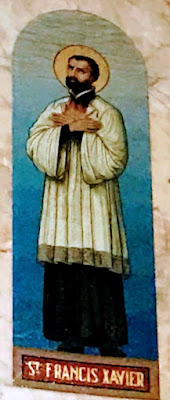
Saint Francis Xavier depicted in the former Jesuit church in the Crescent, Limerick (Photograph: Patrick Comerford)
Patrick Comerford
Advent began on Sunday (27 November 2022), the First Sunday of Advent.
The Calendar of the Church of England in Common Worship today (3 December) recalls Saint Francis Xavier, Missionary, Apostle of the Indies, 1552, with a commemoration.
Francis was born at the castle of Xavier in Spanish Navarre in 1506. He was educated in Paris and, with Ignatius of Loyola, became one of the group of seven who took vows as the first members of the Society of Jesus, or Jesuits.
Since preaching the gospel overseas was an integral part of the Jesuit vocation, Francis sailed for Goa, on the west coast of India, in 1541. He travelled all over the East Indies, evangelizing and establishing the Church in Ceylon, Malacca, Malaya and notably in Japan, where he left behind 2,000 converts. He had just reached China when he died on board ship in December 1552.
I am in London later today. But, before this day gets busy, I am taking some time this morning for reading, prayer and reflection.
During Advent, I am reflecting in these ways:
1, The reading suggested in the Advent and Christmas Devotional Calendar produced by Lichfield Cathedral this year;
2, praying with the Lichfield Cathedral Devotional Calendar;
3, a prayer from the USPG prayer diary, ‘Pray with the World Church.’
Saint Francis Xavier and the Jesuit saints … a window by Evie Hone in the Jesuit Retreat House at Manresa, Clontarf Road, Dublin (Photograph: Patrick Comerford)
Matthew 9: 35-10: 1, 6-8 (NRSVA):
35 Then Jesus went about all the cities and villages, teaching in their synagogues, and proclaiming the good news of the kingdom, and curing every disease and every sickness. 36 When he saw the crowds, he had compassion for them, because they were harassed and helpless, like sheep without a shepherd. 37 Then he said to his disciples, ‘The harvest is plentiful, but the labourers are few; 38 therefore ask the Lord of the harvest to send out labourers into his harvest.’
10 Then Jesus summoned his twelve disciples and gave them authority over unclean spirits, to cast them out, and to cure every disease and every sickness.
6 but go rather to the lost sheep of the house of Israel. 7 As you go, proclaim the good news, “The kingdom of heaven has come near.” 8 Cure the sick, raise the dead, cleanse the lepers, cast out demons. You received without payment; give without payment.’
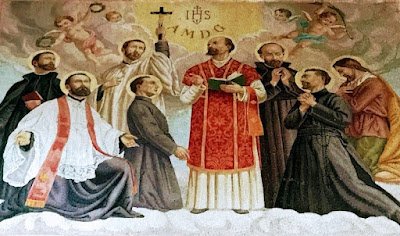
Saint Francis Xavier among the Jesuit saints … a fresco in the former Jesuit church in the Crescent, Limerick (Photograph: Patrick Comerford)
The Lichfield Cathedral Devotional Calendar:
Reflect on how Jesus gives his disciples a share in his work (ministry). Think about the opportunities we have to take up that work. What would it look like? What would my role be? How can we help one another take on a share in Jesus’s work?
Collect:
Almighty God,
give us grace to cast away the works of darkness
and to put on the armour of light,
now in the time of this mortal life,
in which your Son Jesus Christ came to us in great humility;
that on the last day,
when he shall come again in his glorious majesty
to judge the living and the dead,
we may rise to the life immortal;
through him who is alive and reigns with you,
in the unity of the Holy Spirit,
one God, now and for ever.
Post Communion:
O Lord our God,
make us watchful and keep us faithful
as we await the coming of your Son our Lord;
that, when he shall appear,
he may not find us sleeping in sin
but active in his service
and joyful in his praise;
through Jesus Christ our Lord.
Additional Collect:
Almighty God,
as your kingdom dawns,
turn us from the darkness of sin
to the light of holiness,
that we may be ready to meet you
in our Lord and Saviour, Jesus Christ.
Collect on the Eve of Advent 2:
O Lord, raise up, we pray, your power
and come among us,
and with great might succour us;
that whereas, through our sins and wickedness
we are grievously hindered
in running the race that is set before us,
your bountiful grace and mercy
may speedily help and deliver us;
through Jesus Christ your Son our Lord,
to whom with you and the Holy Spirit,
be honour and glory, now and for ever.
USPG Prayer Diary:
The theme in the USPG Prayer Diary this week has been ‘World Aids Day.’ This theme was introduced on Sunday with a report from the Anglican Church in Zimbabwe.
The USPG Prayer Diary invites us to pray today in these words:
Let us give thanks for the Church in Zimbabwe. May its work to address inequality and prejudice strengthen the communities it serves.
Yesterday’s reflection
Continued tomorrow
Saint Francis Xavier Church in Gardiner Street, Dublin
Scripture quotations are from the New Revised Standard Version Bible: Anglicised Edition copyright © 1989, 1995, National Council of the Churches of Christ in the United States of America. Used by permission. All rights reserved worldwide. http://nrsvbibles.org
Patrick Comerford
Advent began on Sunday (27 November 2022), the First Sunday of Advent.
The Calendar of the Church of England in Common Worship today (3 December) recalls Saint Francis Xavier, Missionary, Apostle of the Indies, 1552, with a commemoration.
Francis was born at the castle of Xavier in Spanish Navarre in 1506. He was educated in Paris and, with Ignatius of Loyola, became one of the group of seven who took vows as the first members of the Society of Jesus, or Jesuits.
Since preaching the gospel overseas was an integral part of the Jesuit vocation, Francis sailed for Goa, on the west coast of India, in 1541. He travelled all over the East Indies, evangelizing and establishing the Church in Ceylon, Malacca, Malaya and notably in Japan, where he left behind 2,000 converts. He had just reached China when he died on board ship in December 1552.
I am in London later today. But, before this day gets busy, I am taking some time this morning for reading, prayer and reflection.
During Advent, I am reflecting in these ways:
1, The reading suggested in the Advent and Christmas Devotional Calendar produced by Lichfield Cathedral this year;
2, praying with the Lichfield Cathedral Devotional Calendar;
3, a prayer from the USPG prayer diary, ‘Pray with the World Church.’
Saint Francis Xavier and the Jesuit saints … a window by Evie Hone in the Jesuit Retreat House at Manresa, Clontarf Road, Dublin (Photograph: Patrick Comerford)
Matthew 9: 35-10: 1, 6-8 (NRSVA):
35 Then Jesus went about all the cities and villages, teaching in their synagogues, and proclaiming the good news of the kingdom, and curing every disease and every sickness. 36 When he saw the crowds, he had compassion for them, because they were harassed and helpless, like sheep without a shepherd. 37 Then he said to his disciples, ‘The harvest is plentiful, but the labourers are few; 38 therefore ask the Lord of the harvest to send out labourers into his harvest.’
10 Then Jesus summoned his twelve disciples and gave them authority over unclean spirits, to cast them out, and to cure every disease and every sickness.
6 but go rather to the lost sheep of the house of Israel. 7 As you go, proclaim the good news, “The kingdom of heaven has come near.” 8 Cure the sick, raise the dead, cleanse the lepers, cast out demons. You received without payment; give without payment.’
Saint Francis Xavier among the Jesuit saints … a fresco in the former Jesuit church in the Crescent, Limerick (Photograph: Patrick Comerford)
The Lichfield Cathedral Devotional Calendar:
Reflect on how Jesus gives his disciples a share in his work (ministry). Think about the opportunities we have to take up that work. What would it look like? What would my role be? How can we help one another take on a share in Jesus’s work?
Collect:
Almighty God,
give us grace to cast away the works of darkness
and to put on the armour of light,
now in the time of this mortal life,
in which your Son Jesus Christ came to us in great humility;
that on the last day,
when he shall come again in his glorious majesty
to judge the living and the dead,
we may rise to the life immortal;
through him who is alive and reigns with you,
in the unity of the Holy Spirit,
one God, now and for ever.
Post Communion:
O Lord our God,
make us watchful and keep us faithful
as we await the coming of your Son our Lord;
that, when he shall appear,
he may not find us sleeping in sin
but active in his service
and joyful in his praise;
through Jesus Christ our Lord.
Additional Collect:
Almighty God,
as your kingdom dawns,
turn us from the darkness of sin
to the light of holiness,
that we may be ready to meet you
in our Lord and Saviour, Jesus Christ.
Collect on the Eve of Advent 2:
O Lord, raise up, we pray, your power
and come among us,
and with great might succour us;
that whereas, through our sins and wickedness
we are grievously hindered
in running the race that is set before us,
your bountiful grace and mercy
may speedily help and deliver us;
through Jesus Christ your Son our Lord,
to whom with you and the Holy Spirit,
be honour and glory, now and for ever.
USPG Prayer Diary:
The theme in the USPG Prayer Diary this week has been ‘World Aids Day.’ This theme was introduced on Sunday with a report from the Anglican Church in Zimbabwe.
The USPG Prayer Diary invites us to pray today in these words:
Let us give thanks for the Church in Zimbabwe. May its work to address inequality and prejudice strengthen the communities it serves.
Yesterday’s reflection
Continued tomorrow
Saint Francis Xavier Church in Gardiner Street, Dublin
Scripture quotations are from the New Revised Standard Version Bible: Anglicised Edition copyright © 1989, 1995, National Council of the Churches of Christ in the United States of America. Used by permission. All rights reserved worldwide. http://nrsvbibles.org
08 January 2022
Greek lettering survives on
the last portions of a former
Presbyterian church in Dublin
The ruined former Presbyterian Church on Seán McDermott Street, formerly Lower Gloucester Street, Dublin (Photograph: Patrick Comerford, 2022)
Patrick Comerford
Wandering around the north inner city of Dublin last week, between Gardiner Street and Buckingham Street, I came across a number of former and abandoned church, including the former Presbyterian Church, now in ruins on Seán McDermott Street, formerly Lower Gloucester Street, in the heart of the former ‘Monto’ red light district.
The church is an eye-catching, landmark building in this area, and was designed in a Greek revival style by the architect Duncan Campbell Ferguson and built in 1846 at a cost of £1,800.
Until the early 19th century, there were two Secession congregations among the Presbyterians in Dublin, one at Mary’s Abbey and the other at Mass Lane. They united in 1818 and formed the congregation of Union Chapel.
Then, in 1836, the Secession Synod started a mission to form a second Secession congregation in Dublin. The first minister in this new congregation was the Revd William Wilson. Initially, they worshipped in the German Lutheran Church in Poolbeg Street and later hired a room in the Royal Exchange. Then, in 1837, the congregation bought Ebenezer Chapel on the corner of D’Olier Street and Hawkins Street for £600.
Withing a decade, the congregation moved from the Ebenezer Chapel to a new church building on Gloucester Street.
The church was completed by August 1836, and was the first in the Grecian Doric order that has been built in Dublin. It was built in Irish granite with a prostyle tetrastyle pedimented portico with four fluted Doric columns on a stylobate supporting a frieze. The frieze is inscribed in Greek, Μονο Σοφω Θεω Σωτηρι Ημων Δοξα (Mono Sofo Theo Sotiri Imon Doxa), ‘To the only-wise God, be glory through the Saviour’ (see Romans 16: 27). Above the frieze is a modillioned pediment with acroteria situated at either end and at the apex.
At the time, the Dublin-based architect Duncan Campbell Ferguson was master of the Royal Dublin Society School of Architectural Drawing (1842-1854) in Molesworth Street. Ferguson, who may have been born in Scotland, entered the RDS School of Figure Drawing in 1826, and was awarded prizes in 1828, 1829 and 1830.
He was appointed master of the School of Drawing in Architecture in 1842, and in that year he designed a new range of glasshouses for the RDS gardens in Glasnevin. They were redesigned the following year, after Richard Turner submitted proposals for building the range entirely of iron.
Ferguson won the competition for designing the RDS natural history museum in 1852, and was also involved in the RDS proposal to establish model lodging houses in Dublin.
When responsibility for the RDS academic programme passed to the Department of Science and Art in 1854, Ferguson was retired. He started teaching classes in architecture and engineering from his own house in Westland Row and continued to practise as an architect.
He had married Eliza Singer Ringland on 26 December 1840 in Saint Mark’s Church, Dublin, and they were the parents of at least four sons: Archibald (1843), Duncan Campbell (1845), John (1850) and Donald (1857). He may have moved from Dublin or died ca 1873.
The Revd William Wilson was succeeded by various ministers. The Revd John Love Morrow was ordained to Gloucester Street in 1884, but this was his first and only ministry.
By the 1880s, many members of the congregation were living in the new suburbs of Fairview and Clontarf. A meeting of Gloucester Street congregation in 1888 decided to transfer the congregation to Clontarf.
The request was approved by the General Assembly of the Presbyterian Church in Ireland on 26 July, 1889. A site was found on the corner of Howth Road and Clontarf Road and the new church opened in May 1890. A school was built beside the church and a manse was built on Haddon Road.
The church on Gloucester Street continued to be used for occasional services until 1896, when it became a centre for the work of the Salvation Army among prostitutes in the notorious red light area of ‘Monto’ in inner city Dublin.
The Revd John Love Morrow remained with the congregation through its move to Clontarf and until he died in 1940. He was the Moderator of the General Assembly of the Presbyterian Church in Ireland in 1929.
When the former church in Gloucester Street was converted into a flour mill in the early 1900s, the external appearance remained largely intact. The mill was run by AW Ennis Ltd until a fire in the 1980s forced the business to move to Virginia, Co Cavan, where it remains. The building was later used as a grain store.
This Greek Revival church is now in a ruinous condition and the remaining façade and the side walls now sit at the front of 2000s apartment development. Recent buildings on have greatly compromised the integrity of the structure or its potential for reinstatement.
All that survives of the church today is its front façade and side walls. It has coursed granite ashlar walls, corner Doric piers, a full Doric entablature and a modillioned cornice, a prostyle tetrastyle pedimented portico with four fluted Doric columns on a stylobate supporting frieze with its Greek lettering and a full Doric entablature supporting a modillioned pediment surmounted by acroteria at the apex and at either end.
There is a double-height square-headed principal entrance with a lugged granite architrave surround and cornice. The lower single-bay wings at either side have tapered square-headed door openings, plain granite architrave surrounds and pediments. But all the openings are boarded up with steel sheeting.
The building’s risk status is currently listed as ‘moderate’ by An Taisce and it is listed on the Record of Protected Structures. Nonetheless, the façade remains an exquisite example of an academic exercise in neo-Classical architecture, and remains a highly decorative element on the streetscape and part of the wealth of architectural heritage in the north inner city.
Meanwhile, the congregation in Clontarf welcomed the members of Ormond Quay and Scots Church in 2003 and it now known as Clontarf and Scots Presbyterian Church.
The frieze is inscribed in Greek, Μονο Σοφω Θεω Σωτηρι Ημων Δοξα, Mono Sofo Theo Sotiri Imon Doxa (Photograph: Patrick Comerford, 2022)
Patrick Comerford
Wandering around the north inner city of Dublin last week, between Gardiner Street and Buckingham Street, I came across a number of former and abandoned church, including the former Presbyterian Church, now in ruins on Seán McDermott Street, formerly Lower Gloucester Street, in the heart of the former ‘Monto’ red light district.
The church is an eye-catching, landmark building in this area, and was designed in a Greek revival style by the architect Duncan Campbell Ferguson and built in 1846 at a cost of £1,800.
Until the early 19th century, there were two Secession congregations among the Presbyterians in Dublin, one at Mary’s Abbey and the other at Mass Lane. They united in 1818 and formed the congregation of Union Chapel.
Then, in 1836, the Secession Synod started a mission to form a second Secession congregation in Dublin. The first minister in this new congregation was the Revd William Wilson. Initially, they worshipped in the German Lutheran Church in Poolbeg Street and later hired a room in the Royal Exchange. Then, in 1837, the congregation bought Ebenezer Chapel on the corner of D’Olier Street and Hawkins Street for £600.
Withing a decade, the congregation moved from the Ebenezer Chapel to a new church building on Gloucester Street.
The church was completed by August 1836, and was the first in the Grecian Doric order that has been built in Dublin. It was built in Irish granite with a prostyle tetrastyle pedimented portico with four fluted Doric columns on a stylobate supporting a frieze. The frieze is inscribed in Greek, Μονο Σοφω Θεω Σωτηρι Ημων Δοξα (Mono Sofo Theo Sotiri Imon Doxa), ‘To the only-wise God, be glory through the Saviour’ (see Romans 16: 27). Above the frieze is a modillioned pediment with acroteria situated at either end and at the apex.
At the time, the Dublin-based architect Duncan Campbell Ferguson was master of the Royal Dublin Society School of Architectural Drawing (1842-1854) in Molesworth Street. Ferguson, who may have been born in Scotland, entered the RDS School of Figure Drawing in 1826, and was awarded prizes in 1828, 1829 and 1830.
He was appointed master of the School of Drawing in Architecture in 1842, and in that year he designed a new range of glasshouses for the RDS gardens in Glasnevin. They were redesigned the following year, after Richard Turner submitted proposals for building the range entirely of iron.
Ferguson won the competition for designing the RDS natural history museum in 1852, and was also involved in the RDS proposal to establish model lodging houses in Dublin.
When responsibility for the RDS academic programme passed to the Department of Science and Art in 1854, Ferguson was retired. He started teaching classes in architecture and engineering from his own house in Westland Row and continued to practise as an architect.
He had married Eliza Singer Ringland on 26 December 1840 in Saint Mark’s Church, Dublin, and they were the parents of at least four sons: Archibald (1843), Duncan Campbell (1845), John (1850) and Donald (1857). He may have moved from Dublin or died ca 1873.
The Revd William Wilson was succeeded by various ministers. The Revd John Love Morrow was ordained to Gloucester Street in 1884, but this was his first and only ministry.
By the 1880s, many members of the congregation were living in the new suburbs of Fairview and Clontarf. A meeting of Gloucester Street congregation in 1888 decided to transfer the congregation to Clontarf.
The request was approved by the General Assembly of the Presbyterian Church in Ireland on 26 July, 1889. A site was found on the corner of Howth Road and Clontarf Road and the new church opened in May 1890. A school was built beside the church and a manse was built on Haddon Road.
The church on Gloucester Street continued to be used for occasional services until 1896, when it became a centre for the work of the Salvation Army among prostitutes in the notorious red light area of ‘Monto’ in inner city Dublin.
The Revd John Love Morrow remained with the congregation through its move to Clontarf and until he died in 1940. He was the Moderator of the General Assembly of the Presbyterian Church in Ireland in 1929.
When the former church in Gloucester Street was converted into a flour mill in the early 1900s, the external appearance remained largely intact. The mill was run by AW Ennis Ltd until a fire in the 1980s forced the business to move to Virginia, Co Cavan, where it remains. The building was later used as a grain store.
This Greek Revival church is now in a ruinous condition and the remaining façade and the side walls now sit at the front of 2000s apartment development. Recent buildings on have greatly compromised the integrity of the structure or its potential for reinstatement.
All that survives of the church today is its front façade and side walls. It has coursed granite ashlar walls, corner Doric piers, a full Doric entablature and a modillioned cornice, a prostyle tetrastyle pedimented portico with four fluted Doric columns on a stylobate supporting frieze with its Greek lettering and a full Doric entablature supporting a modillioned pediment surmounted by acroteria at the apex and at either end.
There is a double-height square-headed principal entrance with a lugged granite architrave surround and cornice. The lower single-bay wings at either side have tapered square-headed door openings, plain granite architrave surrounds and pediments. But all the openings are boarded up with steel sheeting.
The building’s risk status is currently listed as ‘moderate’ by An Taisce and it is listed on the Record of Protected Structures. Nonetheless, the façade remains an exquisite example of an academic exercise in neo-Classical architecture, and remains a highly decorative element on the streetscape and part of the wealth of architectural heritage in the north inner city.
Meanwhile, the congregation in Clontarf welcomed the members of Ormond Quay and Scots Church in 2003 and it now known as Clontarf and Scots Presbyterian Church.
The frieze is inscribed in Greek, Μονο Σοφω Θεω Σωτηρι Ημων Δοξα, Mono Sofo Theo Sotiri Imon Doxa (Photograph: Patrick Comerford, 2022)
03 December 2021
Praying in Advent 2021:
6, Saint Francis Xavier
Saint Francis Xavier depicted in the former Jesuit church in the Crescent, Limerick (Photograph: Patrick Comerford)
Patrick Comerford
This is the Season of Advent. Before a busy day begins, I am taking some time early this morning (3 December 2021) for prayer, reflection and reading.
Each morning in the Advent, I am reflecting in these ways:
1, Reflections on a saint remembered in the calendars of the Church during Advent;
2, the day’s Gospel reading;
3, a prayer from the USPG prayer diary.
Today [3 December 2012] is the feast day of Saint Francis Xavier, the patron saint of European missionaries, who is said to have preached to more people than anyone else since Saint Paul. As we journey through Advent with the saints, Saint Francis Xavier is a reminder that this is a time not merely of waiting for but preparing for the coming of Christ and his Kingdom.
Saint Francis Xavier (1506-1552), or Francisco do Yasu y Javier, was was born on 7 April 1506 in his family’s castle at Xavier, near Pamplona in what is now the Basque Country in northern Spain.
He studied at the University of Paris, where he earned his licentiate in 1528. In Paris he also met Ignatius Loyola and they were two of the seven founders of the Society of Jesus of Jesuits at Montmartre in 1534. Together, the seven made the vow of Montmartre on 15 August 1534.
Francis left Paris in 1536 to join Ignatius in Venice. They and their companions hoped to set out from Venice as missionaries to Palestine, but the planned journey never materialised. Instead, Francis Xavier and Ignatius Loyola were ordained in Venice on 24 June 1537.
From Venice, Francis went to Rome in 1538. There in 1540, the Pope formally recognised the Society of Jesus and decided to send Francis Xavier and Father Simon Rodriguez to the Far East as the first Jesuit missionaries. However, King John III of Portugal kept Father Simon in Lisbon.
During a year-long voyage, Francis spent six months in Mozambique, before arriving in Goa, a Portuguese colony on the west coast of India, on 6 May 1542 with two companions, Father Paul of Camerino, an Italian, and Francis Mansihas, from Portugal.
In Goa, Francis began to preach to the local people but also tried to reform his fellow Europeans, He also adopted a lifestyle of living among the local people and adopting their customs on his travels.
He visited prisons and hospitals in Goa, led worship among the lepers, and walked the streets ringing a bell to call the children for religious instruction. His principal method of teaching people was to write verses in their language, setting out the truths of Christianity, and then setting them to music.
He was shocked by the brutal treatment of local people in Goa by the Portuguese settlers and soldiers, and wrote to the King of Portugal, asking: ‘It is possible that when our Lord God calls your highness to his judgment that your highness may hear angry words from him: “Why did you not punish those who were your subjects and owned your authority, and were enemies to me in India?”’
During the next decade, Saint Francis converted tens of thousands of people to Christianity. He visited the Paravas at the tip of India, near Cape Comorin, Tuticorin (1542), Malacca, which was also a Portuguese colony (1545), the Moluccas near New Guinea and Morotai near the Philippines (1546-1547), before arriving in Japan (1549-1551).
In Japan, he learned the language, where he was the first person to preach the Gospel. It is said, he made as many as 2,000 converts in Japan.
Francis set out for China in 1552 and landed on the island of Shangchuan. But he died there on 3 December 1552 without ever reaching the Chinese mainland. He was only 46. His body was brought back to Goa, where he was buried.
The estimates of the number of converts he personally baptised vary, but some put them at six-figures. One biographer says he preached to more people than anyone else since the New Testament period.
He was canonised in 1622 and Pope Pius X later proclaimed him the patron of all foreign missions.
Saint Francis Xavier is also a pre-Reformation saint who can be shared by the universal church – he arrived in Japan even before the first Book of Common Prayer. He is commemorated on this day in the Calendar in Common Worship in the Church of England, in the Calendar of the Episcopal Church in the US, in other Anglican and Lutheran churches, and in the calendar of the Roman Catholic Church.
Saint Francis Xavier and the Jesuit saints … a window by Evie Hone in the Jesuit Retreat House at Manresa, Clontarf Road, Dublin (Photograph: Patrick Comerford)
Matthew 9: 27-31 (NRSVA)
27 As Jesus went on from there, two blind men followed him, crying loudly, ‘Have mercy on us, Son of David!’ 28 When he entered the house, the blind men came to him; and Jesus said to them, ‘Do you believe that I am able to do this?’ They said to him, ‘Yes, Lord.’ 29 Then he touched their eyes and said, ‘According to your faith let it be done to you.’ 30 And their eyes were opened. Then Jesus sternly ordered them, ‘See that no one knows of this.’ 31 But they went away and spread the news about him throughout that district.
The Prayer in the USPG Prayer Diary today (3 December 2021, International Disabilities Day) invites us to pray:
Let us work towards a more accessible world, with inclusion and diversity at its core.
Yesterday: Saint Mungo
Tomorrow: Nicholas Ferrar
Saint Francis Xavier among the Jesuit saints … a fresco in the former Jesuit church in the Crescent, Limerick (Photograph: Patrick Comerford)
Scripture quotations are from the New Revised Standard Version Bible: Anglicised Edition copyright © 1989, 1995, National Council of the Churches of Christ in the United States of America. Used by permission. All rights reserved worldwide. http://nrsvbibles.org
Patrick Comerford
This is the Season of Advent. Before a busy day begins, I am taking some time early this morning (3 December 2021) for prayer, reflection and reading.
Each morning in the Advent, I am reflecting in these ways:
1, Reflections on a saint remembered in the calendars of the Church during Advent;
2, the day’s Gospel reading;
3, a prayer from the USPG prayer diary.
Today [3 December 2012] is the feast day of Saint Francis Xavier, the patron saint of European missionaries, who is said to have preached to more people than anyone else since Saint Paul. As we journey through Advent with the saints, Saint Francis Xavier is a reminder that this is a time not merely of waiting for but preparing for the coming of Christ and his Kingdom.
Saint Francis Xavier (1506-1552), or Francisco do Yasu y Javier, was was born on 7 April 1506 in his family’s castle at Xavier, near Pamplona in what is now the Basque Country in northern Spain.
He studied at the University of Paris, where he earned his licentiate in 1528. In Paris he also met Ignatius Loyola and they were two of the seven founders of the Society of Jesus of Jesuits at Montmartre in 1534. Together, the seven made the vow of Montmartre on 15 August 1534.
Francis left Paris in 1536 to join Ignatius in Venice. They and their companions hoped to set out from Venice as missionaries to Palestine, but the planned journey never materialised. Instead, Francis Xavier and Ignatius Loyola were ordained in Venice on 24 June 1537.
From Venice, Francis went to Rome in 1538. There in 1540, the Pope formally recognised the Society of Jesus and decided to send Francis Xavier and Father Simon Rodriguez to the Far East as the first Jesuit missionaries. However, King John III of Portugal kept Father Simon in Lisbon.
During a year-long voyage, Francis spent six months in Mozambique, before arriving in Goa, a Portuguese colony on the west coast of India, on 6 May 1542 with two companions, Father Paul of Camerino, an Italian, and Francis Mansihas, from Portugal.
In Goa, Francis began to preach to the local people but also tried to reform his fellow Europeans, He also adopted a lifestyle of living among the local people and adopting their customs on his travels.
He visited prisons and hospitals in Goa, led worship among the lepers, and walked the streets ringing a bell to call the children for religious instruction. His principal method of teaching people was to write verses in their language, setting out the truths of Christianity, and then setting them to music.
He was shocked by the brutal treatment of local people in Goa by the Portuguese settlers and soldiers, and wrote to the King of Portugal, asking: ‘It is possible that when our Lord God calls your highness to his judgment that your highness may hear angry words from him: “Why did you not punish those who were your subjects and owned your authority, and were enemies to me in India?”’
During the next decade, Saint Francis converted tens of thousands of people to Christianity. He visited the Paravas at the tip of India, near Cape Comorin, Tuticorin (1542), Malacca, which was also a Portuguese colony (1545), the Moluccas near New Guinea and Morotai near the Philippines (1546-1547), before arriving in Japan (1549-1551).
In Japan, he learned the language, where he was the first person to preach the Gospel. It is said, he made as many as 2,000 converts in Japan.
Francis set out for China in 1552 and landed on the island of Shangchuan. But he died there on 3 December 1552 without ever reaching the Chinese mainland. He was only 46. His body was brought back to Goa, where he was buried.
The estimates of the number of converts he personally baptised vary, but some put them at six-figures. One biographer says he preached to more people than anyone else since the New Testament period.
He was canonised in 1622 and Pope Pius X later proclaimed him the patron of all foreign missions.
Saint Francis Xavier is also a pre-Reformation saint who can be shared by the universal church – he arrived in Japan even before the first Book of Common Prayer. He is commemorated on this day in the Calendar in Common Worship in the Church of England, in the Calendar of the Episcopal Church in the US, in other Anglican and Lutheran churches, and in the calendar of the Roman Catholic Church.
Saint Francis Xavier and the Jesuit saints … a window by Evie Hone in the Jesuit Retreat House at Manresa, Clontarf Road, Dublin (Photograph: Patrick Comerford)
Matthew 9: 27-31 (NRSVA)
27 As Jesus went on from there, two blind men followed him, crying loudly, ‘Have mercy on us, Son of David!’ 28 When he entered the house, the blind men came to him; and Jesus said to them, ‘Do you believe that I am able to do this?’ They said to him, ‘Yes, Lord.’ 29 Then he touched their eyes and said, ‘According to your faith let it be done to you.’ 30 And their eyes were opened. Then Jesus sternly ordered them, ‘See that no one knows of this.’ 31 But they went away and spread the news about him throughout that district.
The Prayer in the USPG Prayer Diary today (3 December 2021, International Disabilities Day) invites us to pray:
Let us work towards a more accessible world, with inclusion and diversity at its core.
Yesterday: Saint Mungo
Tomorrow: Nicholas Ferrar
Saint Francis Xavier among the Jesuit saints … a fresco in the former Jesuit church in the Crescent, Limerick (Photograph: Patrick Comerford)
Scripture quotations are from the New Revised Standard Version Bible: Anglicised Edition copyright © 1989, 1995, National Council of the Churches of Christ in the United States of America. Used by permission. All rights reserved worldwide. http://nrsvbibles.org
27 March 2019
A church in Templetown
that owes more to Pugin
than the Knights Templar
The East End of All Saints’ Church, Templetown, Co Wexford … designed by a local architect, Michael Power, but strongly influenced by AWN Pugin’s church in Barntown (Photograph: Patrick Comerford, 2019)
Patrick Comerford
Templetown on the Hook Peninsula takes its name from the Knights Templar who were granted large sections of land in this remote area of south-west Co Wexford shortly after the arrival of the Anglo-Normans in Ireland.
The Knights Templar were a religious, monastic order formed in 1118 to defend the Kingdom of Jerusalem and to protect Christian pilgrims during the Crusades. Their official name was the Poor Fellow-Soldiers of Christ and of the Temple of Solomon.
The Templars arrived in Ireland in September 1220, and their foundations in Ireland included the Templar church in Templetown, Co Wexford, Clontarf Castle, north of Dublin, Baldongan Castle near Skerries, and, perhaps, Askeaton in Co Limerick.
They continued to hold vast estates across Europe until King Philip IV, who was heavily in debt to the Templars accused them of heresy and sexual misconduct. Many of the Templars were arrested and Pope Clement V disbanded the order.
Like their counterparts across Europe the Templars in Ireland were ruthlessly suppressed amidst bizarre allegations between 1308 and 1310. The Templars in Ireland were arrested on 2 February 1308 and held in Dublin Castle. Their estates were seized by King Edward II, who leased them to close allies and associates.
Five inquisitors, three Dominicans and two Franciscans, arrived in Ireland in September 1309 to oversee the trial. The trial began on 6 February in Saint Patrick’s Cathedral, Dublin, and lasted four months, concluding on 6 June 1310. The historical records of the time do not show any evidence of the use of torture on the Knights Templar in Ireland.
The last Grand Master of the Knights Templar, Jacques de Molay, was burnt at the stake in 1314, on an island in the River Seine, in front of the Cathedral of Notre Dame in Paris.
The estates and property of the Knights Templar were given to the Hospitaller Order of Saint John of Jerusalem, also known as the Knights of Rhodes and later the Knights of Malta.
The West End of All Saints’ Church, Templetown, Co Wexford financed by the parish priest, Canon William Synnott (Photograph: Patrick Comerford, 2019)
During my recent visit to New Ross and the Hook Peninsula, I missed out on the ruins of the Templar Church in Templetown. It was late in the afternoon, but I visited All Saints’ Church, the Roman Catholic parish church nearby.
The church was built through the efforts of and financed by Canon William Synnott (1834-1911), Parish Priest of Templetown (1886-1911) and Precentor of Ferns. The foundation stone was laid on 5 March 1896, and the church was blessed by James Browne, Bishop of Ferns, on 20 May 1899. It was designed by Michael Power, architect and builder, of Saint Kearns, Tintern, Co Wexford, whose other works include nearby churches in Poulfur and Duncannon.
All Saints’ Church can be compared with Saint Alphonsus’s Church, Barntown, designed by Augustus Welby Northmore Pugin (1812-1852) and built in 1844-1851.
Pugin conceived of Saint Alphonsus’s Church, Barntown, in the parish of Glynn, as a complete Catholic parish church and is his only complete expression in Ireland of the small village parish church. Some writers suggest the church in Barntown is a finer version of the simplest of all Pugin’s designs, Saint Augustine’s Church in Solihull. However, most historians say Pugin’s design for Barntown was based on Saint Michael’s Church in Longstanton, 10 km north of Cambridge .
The design of All Saints’ Church in Templetown shows Pugin’s continuing influence on the design of Roman Catholic churches in Co Wexford and the Diocese of Ferns throughout the 19th century.
Inside All Saints’ Church, Templetown, Co Wexford, restored in 1998 through the generosity of Alice Cooney (Photograph: Patrick Comerford, 2019)
This is a six-bay double-height Catholic church, built in 1896-1898 and opened in 1899. It is built on a rectangular plan with a six-bay double-height nave opening into two six-bay single-storey lean-to side aisles.
The architectural features of this church include cut-granite coping to gables on cut-granite gabled corbel kneelers including lichen-covered cut-granite coping, cut-granite gabled corbel kneelers, a cut-granite buttressed gabled bellcote, quatrefoil windows in the clerestories, trefoil-headed lancet windows in the side aisles, an elegant pointed-arch East Window in the chancel, hood mouldings, a pointed-arch entrance door at the west front and timber boarded double doors.
Inside, there is a timber panelled choir gallery at the west end on a half-octagonal plan, a tiled central aisle, timber pews, pointed-arch arcades on cut-granite drum pillars, a white marble stepped dais at the sanctuary and a white marble high altar below the stained-glass East Window.
The elegant, pointed-arch East Window in the chancel in All Saints’ Church, Templetown (Photograph: Patrick Comerford, 2019)
The pointed-arch braced collared timber roof sits on cut-granite beaded corbels with pointed-arch wind braced rafters. There is a stencilled ceiling, carpeted stepped daises to the side altars, timber panelled confessional boxes in the side aisles, Gothic-style timber Stations of the Cross, and ‘cathedral glass’ windows.
The church has well maintained, with the elementary form and massing surviving intact, along with substantial quantities of the original fabric.
It was renovated after the liturgical reformed introduced after Vatican II, when the sanctuary was reordered and the High Altar modified. But since then the church was tastefully restored in 1998 through the generosity of the late Miss Alice Cooney of Killoggan. It forms part of a neat self-contained group with the adjacent parochial house.
Angels above the west door of All Saints’ Church, Templetown (Photograph: Patrick Comerford, 2019)
The nearby Church of Ireland parish church is now in ruins, has been deroofed and is little more than a shell. This three-bay, double-height single-cell Board of First Fruits church, was built in 1827-1828 a T-shaped plan with a single-bay, single-storey porch on the south side. The chancel had an elegant Gothic ‘Trinity Window.’
The church is attributed to John Semple (1801-1882) of Marlborough Street, Dublin. The tower was inscribed with the signature of Edward Lymbery of Fethard Castle and the date 1847.
Nearby too are the ivy-covered ruins of a Roman Catholic chapel built in 1794-1795 and closed in 1899 after All Saints’ Church opened. This chapel, which predated the 1798 Rising in Co Wexford, was built through the efforts of the Parish Priest, Father Anthony Broaders, who died in 1789. A monument to one of his successors, Father Edward O’Flaherty, says he built ‘three chapels, two presbyteries and two schoolhouses’ in Templetown before he died in 1835.
Inside All Saints’ Church, Templetown, Co Wexford (Photograph: Patrick Comerford, 2019)
Patrick Comerford
Templetown on the Hook Peninsula takes its name from the Knights Templar who were granted large sections of land in this remote area of south-west Co Wexford shortly after the arrival of the Anglo-Normans in Ireland.
The Knights Templar were a religious, monastic order formed in 1118 to defend the Kingdom of Jerusalem and to protect Christian pilgrims during the Crusades. Their official name was the Poor Fellow-Soldiers of Christ and of the Temple of Solomon.
The Templars arrived in Ireland in September 1220, and their foundations in Ireland included the Templar church in Templetown, Co Wexford, Clontarf Castle, north of Dublin, Baldongan Castle near Skerries, and, perhaps, Askeaton in Co Limerick.
They continued to hold vast estates across Europe until King Philip IV, who was heavily in debt to the Templars accused them of heresy and sexual misconduct. Many of the Templars were arrested and Pope Clement V disbanded the order.
Like their counterparts across Europe the Templars in Ireland were ruthlessly suppressed amidst bizarre allegations between 1308 and 1310. The Templars in Ireland were arrested on 2 February 1308 and held in Dublin Castle. Their estates were seized by King Edward II, who leased them to close allies and associates.
Five inquisitors, three Dominicans and two Franciscans, arrived in Ireland in September 1309 to oversee the trial. The trial began on 6 February in Saint Patrick’s Cathedral, Dublin, and lasted four months, concluding on 6 June 1310. The historical records of the time do not show any evidence of the use of torture on the Knights Templar in Ireland.
The last Grand Master of the Knights Templar, Jacques de Molay, was burnt at the stake in 1314, on an island in the River Seine, in front of the Cathedral of Notre Dame in Paris.
The estates and property of the Knights Templar were given to the Hospitaller Order of Saint John of Jerusalem, also known as the Knights of Rhodes and later the Knights of Malta.
The West End of All Saints’ Church, Templetown, Co Wexford financed by the parish priest, Canon William Synnott (Photograph: Patrick Comerford, 2019)
During my recent visit to New Ross and the Hook Peninsula, I missed out on the ruins of the Templar Church in Templetown. It was late in the afternoon, but I visited All Saints’ Church, the Roman Catholic parish church nearby.
The church was built through the efforts of and financed by Canon William Synnott (1834-1911), Parish Priest of Templetown (1886-1911) and Precentor of Ferns. The foundation stone was laid on 5 March 1896, and the church was blessed by James Browne, Bishop of Ferns, on 20 May 1899. It was designed by Michael Power, architect and builder, of Saint Kearns, Tintern, Co Wexford, whose other works include nearby churches in Poulfur and Duncannon.
All Saints’ Church can be compared with Saint Alphonsus’s Church, Barntown, designed by Augustus Welby Northmore Pugin (1812-1852) and built in 1844-1851.
Pugin conceived of Saint Alphonsus’s Church, Barntown, in the parish of Glynn, as a complete Catholic parish church and is his only complete expression in Ireland of the small village parish church. Some writers suggest the church in Barntown is a finer version of the simplest of all Pugin’s designs, Saint Augustine’s Church in Solihull. However, most historians say Pugin’s design for Barntown was based on Saint Michael’s Church in Longstanton, 10 km north of Cambridge .
The design of All Saints’ Church in Templetown shows Pugin’s continuing influence on the design of Roman Catholic churches in Co Wexford and the Diocese of Ferns throughout the 19th century.
Inside All Saints’ Church, Templetown, Co Wexford, restored in 1998 through the generosity of Alice Cooney (Photograph: Patrick Comerford, 2019)
This is a six-bay double-height Catholic church, built in 1896-1898 and opened in 1899. It is built on a rectangular plan with a six-bay double-height nave opening into two six-bay single-storey lean-to side aisles.
The architectural features of this church include cut-granite coping to gables on cut-granite gabled corbel kneelers including lichen-covered cut-granite coping, cut-granite gabled corbel kneelers, a cut-granite buttressed gabled bellcote, quatrefoil windows in the clerestories, trefoil-headed lancet windows in the side aisles, an elegant pointed-arch East Window in the chancel, hood mouldings, a pointed-arch entrance door at the west front and timber boarded double doors.
Inside, there is a timber panelled choir gallery at the west end on a half-octagonal plan, a tiled central aisle, timber pews, pointed-arch arcades on cut-granite drum pillars, a white marble stepped dais at the sanctuary and a white marble high altar below the stained-glass East Window.
The elegant, pointed-arch East Window in the chancel in All Saints’ Church, Templetown (Photograph: Patrick Comerford, 2019)
The pointed-arch braced collared timber roof sits on cut-granite beaded corbels with pointed-arch wind braced rafters. There is a stencilled ceiling, carpeted stepped daises to the side altars, timber panelled confessional boxes in the side aisles, Gothic-style timber Stations of the Cross, and ‘cathedral glass’ windows.
The church has well maintained, with the elementary form and massing surviving intact, along with substantial quantities of the original fabric.
It was renovated after the liturgical reformed introduced after Vatican II, when the sanctuary was reordered and the High Altar modified. But since then the church was tastefully restored in 1998 through the generosity of the late Miss Alice Cooney of Killoggan. It forms part of a neat self-contained group with the adjacent parochial house.
Angels above the west door of All Saints’ Church, Templetown (Photograph: Patrick Comerford, 2019)
The nearby Church of Ireland parish church is now in ruins, has been deroofed and is little more than a shell. This three-bay, double-height single-cell Board of First Fruits church, was built in 1827-1828 a T-shaped plan with a single-bay, single-storey porch on the south side. The chancel had an elegant Gothic ‘Trinity Window.’
The church is attributed to John Semple (1801-1882) of Marlborough Street, Dublin. The tower was inscribed with the signature of Edward Lymbery of Fethard Castle and the date 1847.
Nearby too are the ivy-covered ruins of a Roman Catholic chapel built in 1794-1795 and closed in 1899 after All Saints’ Church opened. This chapel, which predated the 1798 Rising in Co Wexford, was built through the efforts of the Parish Priest, Father Anthony Broaders, who died in 1789. A monument to one of his successors, Father Edward O’Flaherty, says he built ‘three chapels, two presbyteries and two schoolhouses’ in Templetown before he died in 1835.
Inside All Saints’ Church, Templetown, Co Wexford (Photograph: Patrick Comerford, 2019)
28 October 2018
We are building up the household of God
upon the foundation of the apostles
‘Christ is our corner-stone’ (Hymn 327) … a cross in a corner of the church in the Monastery of Vlatadon in Thessaloniki (Photograph: Patrick Comerford, 2018)
Patrick Comerford
28 October 2018, the Fifth Sunday before Advent (Proper 25).
Saint Simon and Saint Jude, Apostles.
11.30 a.m.:, the Parish Eucharist (Holy Communion 2), Holy Trinity Church, Rathkeale (with Sunday School).
Readings: Isaiah 28: 14-16; Psalm 119: 89-96; Ephesians 2: 19-22; John 15: 17-27.
May I speak to you in the name of God, + Father, Son and Holy Spirit, Amen.
This morning offers a number of choices. The Gospel reading for the Fifth Sunday before Advent tells the story of Blind Bartimaeus being healed outside the walls of Jericho by Christ on his way to Jerusalem.
This is also being marked in some parish churches as the Bible Sunday, and many of us are familiar with the words of the Collect of the Day:
Blessed Lord,
who caused all holy Scriptures to be written for our learning:
Help us to hear them,
to read, mark, learn and inwardly digest them
that, through patience, and the comfort of your holy word,
we may embrace and for ever hold fast
the blessed hope of everlasting life,
which you have given us in our Saviour Jesus Christ.
But this morning, we are celebrating Saint Simon and Saint Jude, Apostles, whose feast day is celebrated in the Church Calendar today.
Many people on our city streets may associate Saint Simon with the homeless and housing crisis in Ireland, and think of Saint Simon as someone cares for the homeless people on our streets. However, the Simon Community takes its name from Simon of Cyrene who helps Christ carry his cross on the way to Calvary and his Crucifixion.
If you asked who Jude is, you might be told he is ‘Obscure’ – or the Patron of Lost Causes.
These two are little known as apostles, without fame, and that obscurity is almost affirmed by the fact that they have to share one feast day and do not have their own separate, stand-alone celebrations in the Calendar of the Church.
In an age obsessed with reality television, the X-Factor, the Apprentice or celebrities who are celebrities – just because they are – Simon and Jude appear like a pair of misfits: we know little about their lives or how they lived them, they are hardly famous among the disciples, and they certainly are not celebrity apostles.
Simon and Jude are way down the list of the Twelve Apostles, and their names are often confused or forgotten. In the New Testament lists of the Twelve (Matthew 10: 2-4; Mark 3: 16-19; Luke 6: 14-16; Acts 1: 13), they come in near the end, in tenth and eleventh places. Well, with Judas in twelfth place, they just about make it onto the ‘first eleven.’
The ninth name on the lists is James, the James who was remembered last Wednesday [23 October]. Judas or Jude is often referred to as ‘the brother of James,’ and this in turn leads to him being identified with the ‘brothers of the Lord.’ So, on this day, we celebrate Simon the Zealot, one of the original Twelve; and Jude or Judas of James, also one of the Twelve and author of the Epistle of Jude.
But poor Simon is not mentioned by name in the New Testament except on these lists – after all, there is a better-known Simon than this Simon: there is Simon Peter. As for Jude, his name is so close to Judas – in fact, their names are the same (Ιούδας) – is it any wonder that he became known as the patron saint of lost causes? Trying to remember him might have been a lost cause.
After the Last Supper, Jude asked Christ why he chose to reveal himself only to the disciples, and received the reply: ‘Those who love me will keep my word, and my Father will love him, and we will come to them and make our home with them’ (John 14: 22-23).
In his brief Epistle, Jude says he planned to write a different letter, but then heard of the misleading views of some false teachers. He makes a passionate plea to his readers to preserve the purity of the Christian faith and their good reputation.
His Epistle includes a memorable exhortation to ‘contend for the faith that was once for all entrusted to the saints’ (Jude 3), and ends with that wonderful closing: ‘Now to him who is able to keep you from falling, and to make you stand without blemish in the presence of his glory with rejoicing, to the only wise God our Saviour, be glory, majesty, power, and authority, before all time and now and forever. Amen’ (Jude 24-25).
But after that, surprisingly, we know very little about the later apostolic missions of Simon and Jude, where they were missionaries or whether they were martyred.
In truth, we know very little about these two saints, bundled together at the end of a list, like two hopeless causes. There was no danger of them being servants who might want to be greater than their master (John 15: 20). All we can presume is that they laboured on, perhaps anonymously, in building up the Church.
But then the Church does not celebrate celebrities who are famous and public; we honour the saints who labour and whose labours are often hidden.
In the Gospel reading (John 15: 17-27), the Apostles are warned about suffering the hatred of ‘the world.’ Later, as the Gospel was spread around the Mediterranean, isolated Christians may not have realised how quickly the Church was growing. In their persecutions and martyrdom, they may have felt forlorn and that Christianity was in danger of being a lost cause.
But in the Gospel reading, Christ encourages a beleaguered Church to see its afflictions and wounds as his own.
No matter how much we suffer, no matter how others may forget us, no matter how obscure we become, no matter how many people forget our names, no matter how often our faith and discipleship may appear to others to be lost causes, no matter how small our congregations may be, not matter how often we feel our parishes are isolated or even forgotten, we can be assured that we are no longer strangers and aliens, that we are citizens with the saints.
As Saint Paul reminds us in this morning’s Epistle reading, we are building up the household of God upon the foundation of the apostles and prophets, with Christ himself as the cornerstone, and we are being built together spiritually into the dwelling place of God (Ephesians 2: 19-22).
And so, may all we think, say and do be to the praise, honour and glory of God, + Father, Son and Holy Spirit, Amen.
Saint Simon … a stained-glass window in the Church of Saint John the Baptist, Clontarf (Photograph: Patrick Comerford, 2018)
John 15: 17-27 (NRSV):
[Jesus said:] 17 ‘I am giving you these commands so that you may love one another.
18 ‘If the world hates you, be aware that it hated me before it hated you.19 If you belonged to the world, the world would love you as its own. Because you do not belong to the world, but I have chosen you out of the world – therefore the world hates you. 20 Remember the word that I said to you, “Servants are not greater than their master.” If they persecuted me, they will persecute you; if they kept my word, they will keep yours also. 21 But they will do all these things to you on account of my name, because they do not know him who sent me. 22 If I had not come and spoken to them, they would not have sin; but now they have no excuse for their sin. 23 Whoever hates me hates my Father also. 24 If I had not done among them the works that no one else did, they would not have sin. But now they have seen and hated both me and my Father. 25 It was to fulfil the word that is written in their law, “They hated me without a cause.”
26 ‘When the Advocate comes, whom I will send to you from the Father, the Spirit of truth who comes from the Father, he will testify on my behalf. 27 You also are to testify because you have been with me from the beginning.
Saint Jude … a stained glass window in the Church of Saint John the Baptist, Clontarf (Photograph: Patrick Comerford, 2018)
Liturgical Colour: Red.
Collect:
Almighty God, who built your Church upon the foundation
of the apostles and prophets
with Jesus Christ himself as the chief cornerstone:
So join us together in unity of spirit by their doctrine
that we may be made a holy temple acceptable to you;
through Jesus Christ our Lord. Amen.
The Collect (Fifth Sunday before Advent):
Blessed Lord,
who caused all holy Scriptures to be written for our learning:
Help us to hear them,
to read, mark, learn and inwardly digest them
that, through patience, and the comfort of your holy word,
we may embrace and for ever hold fast
the blessed hope of everlasting life,
which you have given us in our Saviour Jesus Christ.
Penitential Kyries:
Lord, you are gracious and compassionate.
Lord, have mercy.
Lord, have mercy.
You are loving to all,
and your mercy is over all your creation.
Christ, have mercy.
Christ, have mercy.
Your faithful servants bless your name,
and speak of the glory of your kingdom.
Lord, have mercy.
Lord, have mercy.
Introduction to the Peace:
We are fellow citizens with the saints
and the household of God,
through Christ our Lord,
who came and preached peace to those who were far off
and those who were near (Ephesians 2: 19, 17).
The Preface:
In the saints
you have given us an example of godly living,
that rejoicing in their fellowship,
we may run with perseverance the race that is set before us,
and with them receive the unfading crown of glory ...
Post Communion Prayer:
Lord God,
the source of truth and love:
Keep us faithful to the apostles’ teaching and fellowship,
united in prayer and the breaking of the bread,
and one in joy and simplicity of heart,
in Jesus Christ our Lord. Amen.
The Blessing:
God give you grace
to share the inheritance of all Saint Simon and Saint Jude
and of his saints in glory ...
Hymns:
327, Christ is our corner-stone (CD 20)
528, The Church’s one foundation (CD 30)
459, For all the saints, who from their labours rest (CD 27)
‘Blessed Lord, who caused all holy Scriptures to be written for our learning’ (the Collect) … pages from Saint John’s Gospel, the first complete hand-written and illuminated Bible since the Renaissance, in a recent exhibition in Lichfield Cathedral; Sunday may also be marked as Bible Sunday (Photograph: Patrick Comerford)
Scripture quotations are from the New Revised Standard Version Bible: Anglicised Edition copyright © 1989, 1995, National Council of the Churches of Christ in the United States of America. Used by permission. All rights reserved worldwide. http://nrsvbibles.org
Patrick Comerford
28 October 2018, the Fifth Sunday before Advent (Proper 25).
Saint Simon and Saint Jude, Apostles.
11.30 a.m.:, the Parish Eucharist (Holy Communion 2), Holy Trinity Church, Rathkeale (with Sunday School).
Readings: Isaiah 28: 14-16; Psalm 119: 89-96; Ephesians 2: 19-22; John 15: 17-27.
May I speak to you in the name of God, + Father, Son and Holy Spirit, Amen.
This morning offers a number of choices. The Gospel reading for the Fifth Sunday before Advent tells the story of Blind Bartimaeus being healed outside the walls of Jericho by Christ on his way to Jerusalem.
This is also being marked in some parish churches as the Bible Sunday, and many of us are familiar with the words of the Collect of the Day:
Blessed Lord,
who caused all holy Scriptures to be written for our learning:
Help us to hear them,
to read, mark, learn and inwardly digest them
that, through patience, and the comfort of your holy word,
we may embrace and for ever hold fast
the blessed hope of everlasting life,
which you have given us in our Saviour Jesus Christ.
But this morning, we are celebrating Saint Simon and Saint Jude, Apostles, whose feast day is celebrated in the Church Calendar today.
Many people on our city streets may associate Saint Simon with the homeless and housing crisis in Ireland, and think of Saint Simon as someone cares for the homeless people on our streets. However, the Simon Community takes its name from Simon of Cyrene who helps Christ carry his cross on the way to Calvary and his Crucifixion.
If you asked who Jude is, you might be told he is ‘Obscure’ – or the Patron of Lost Causes.
These two are little known as apostles, without fame, and that obscurity is almost affirmed by the fact that they have to share one feast day and do not have their own separate, stand-alone celebrations in the Calendar of the Church.
In an age obsessed with reality television, the X-Factor, the Apprentice or celebrities who are celebrities – just because they are – Simon and Jude appear like a pair of misfits: we know little about their lives or how they lived them, they are hardly famous among the disciples, and they certainly are not celebrity apostles.
Simon and Jude are way down the list of the Twelve Apostles, and their names are often confused or forgotten. In the New Testament lists of the Twelve (Matthew 10: 2-4; Mark 3: 16-19; Luke 6: 14-16; Acts 1: 13), they come in near the end, in tenth and eleventh places. Well, with Judas in twelfth place, they just about make it onto the ‘first eleven.’
The ninth name on the lists is James, the James who was remembered last Wednesday [23 October]. Judas or Jude is often referred to as ‘the brother of James,’ and this in turn leads to him being identified with the ‘brothers of the Lord.’ So, on this day, we celebrate Simon the Zealot, one of the original Twelve; and Jude or Judas of James, also one of the Twelve and author of the Epistle of Jude.
But poor Simon is not mentioned by name in the New Testament except on these lists – after all, there is a better-known Simon than this Simon: there is Simon Peter. As for Jude, his name is so close to Judas – in fact, their names are the same (Ιούδας) – is it any wonder that he became known as the patron saint of lost causes? Trying to remember him might have been a lost cause.
After the Last Supper, Jude asked Christ why he chose to reveal himself only to the disciples, and received the reply: ‘Those who love me will keep my word, and my Father will love him, and we will come to them and make our home with them’ (John 14: 22-23).
In his brief Epistle, Jude says he planned to write a different letter, but then heard of the misleading views of some false teachers. He makes a passionate plea to his readers to preserve the purity of the Christian faith and their good reputation.
His Epistle includes a memorable exhortation to ‘contend for the faith that was once for all entrusted to the saints’ (Jude 3), and ends with that wonderful closing: ‘Now to him who is able to keep you from falling, and to make you stand without blemish in the presence of his glory with rejoicing, to the only wise God our Saviour, be glory, majesty, power, and authority, before all time and now and forever. Amen’ (Jude 24-25).
But after that, surprisingly, we know very little about the later apostolic missions of Simon and Jude, where they were missionaries or whether they were martyred.
In truth, we know very little about these two saints, bundled together at the end of a list, like two hopeless causes. There was no danger of them being servants who might want to be greater than their master (John 15: 20). All we can presume is that they laboured on, perhaps anonymously, in building up the Church.
But then the Church does not celebrate celebrities who are famous and public; we honour the saints who labour and whose labours are often hidden.
In the Gospel reading (John 15: 17-27), the Apostles are warned about suffering the hatred of ‘the world.’ Later, as the Gospel was spread around the Mediterranean, isolated Christians may not have realised how quickly the Church was growing. In their persecutions and martyrdom, they may have felt forlorn and that Christianity was in danger of being a lost cause.
But in the Gospel reading, Christ encourages a beleaguered Church to see its afflictions and wounds as his own.
No matter how much we suffer, no matter how others may forget us, no matter how obscure we become, no matter how many people forget our names, no matter how often our faith and discipleship may appear to others to be lost causes, no matter how small our congregations may be, not matter how often we feel our parishes are isolated or even forgotten, we can be assured that we are no longer strangers and aliens, that we are citizens with the saints.
As Saint Paul reminds us in this morning’s Epistle reading, we are building up the household of God upon the foundation of the apostles and prophets, with Christ himself as the cornerstone, and we are being built together spiritually into the dwelling place of God (Ephesians 2: 19-22).
And so, may all we think, say and do be to the praise, honour and glory of God, + Father, Son and Holy Spirit, Amen.
Saint Simon … a stained-glass window in the Church of Saint John the Baptist, Clontarf (Photograph: Patrick Comerford, 2018)
John 15: 17-27 (NRSV):
[Jesus said:] 17 ‘I am giving you these commands so that you may love one another.
18 ‘If the world hates you, be aware that it hated me before it hated you.19 If you belonged to the world, the world would love you as its own. Because you do not belong to the world, but I have chosen you out of the world – therefore the world hates you. 20 Remember the word that I said to you, “Servants are not greater than their master.” If they persecuted me, they will persecute you; if they kept my word, they will keep yours also. 21 But they will do all these things to you on account of my name, because they do not know him who sent me. 22 If I had not come and spoken to them, they would not have sin; but now they have no excuse for their sin. 23 Whoever hates me hates my Father also. 24 If I had not done among them the works that no one else did, they would not have sin. But now they have seen and hated both me and my Father. 25 It was to fulfil the word that is written in their law, “They hated me without a cause.”
26 ‘When the Advocate comes, whom I will send to you from the Father, the Spirit of truth who comes from the Father, he will testify on my behalf. 27 You also are to testify because you have been with me from the beginning.
Saint Jude … a stained glass window in the Church of Saint John the Baptist, Clontarf (Photograph: Patrick Comerford, 2018)
Liturgical Colour: Red.
Collect:
Almighty God, who built your Church upon the foundation
of the apostles and prophets
with Jesus Christ himself as the chief cornerstone:
So join us together in unity of spirit by their doctrine
that we may be made a holy temple acceptable to you;
through Jesus Christ our Lord. Amen.
The Collect (Fifth Sunday before Advent):
Blessed Lord,
who caused all holy Scriptures to be written for our learning:
Help us to hear them,
to read, mark, learn and inwardly digest them
that, through patience, and the comfort of your holy word,
we may embrace and for ever hold fast
the blessed hope of everlasting life,
which you have given us in our Saviour Jesus Christ.
Penitential Kyries:
Lord, you are gracious and compassionate.
Lord, have mercy.
Lord, have mercy.
You are loving to all,
and your mercy is over all your creation.
Christ, have mercy.
Christ, have mercy.
Your faithful servants bless your name,
and speak of the glory of your kingdom.
Lord, have mercy.
Lord, have mercy.
Introduction to the Peace:
We are fellow citizens with the saints
and the household of God,
through Christ our Lord,
who came and preached peace to those who were far off
and those who were near (Ephesians 2: 19, 17).
The Preface:
In the saints
you have given us an example of godly living,
that rejoicing in their fellowship,
we may run with perseverance the race that is set before us,
and with them receive the unfading crown of glory ...
Post Communion Prayer:
Lord God,
the source of truth and love:
Keep us faithful to the apostles’ teaching and fellowship,
united in prayer and the breaking of the bread,
and one in joy and simplicity of heart,
in Jesus Christ our Lord. Amen.
The Blessing:
God give you grace
to share the inheritance of all Saint Simon and Saint Jude
and of his saints in glory ...
Hymns:
327, Christ is our corner-stone (CD 20)
528, The Church’s one foundation (CD 30)
459, For all the saints, who from their labours rest (CD 27)
‘Blessed Lord, who caused all holy Scriptures to be written for our learning’ (the Collect) … pages from Saint John’s Gospel, the first complete hand-written and illuminated Bible since the Renaissance, in a recent exhibition in Lichfield Cathedral; Sunday may also be marked as Bible Sunday (Photograph: Patrick Comerford)
Scripture quotations are from the New Revised Standard Version Bible: Anglicised Edition copyright © 1989, 1995, National Council of the Churches of Christ in the United States of America. Used by permission. All rights reserved worldwide. http://nrsvbibles.org
How Simon and Jude ‘contend
for the faith that was once
for all entrusted to the saints’
‘Christ is our corner-stone’ (Hymn 327) … a cross in a hidden corner among the stones and ruins of Askeaton Friary (Photograph: Patrick Comerford, 2018)
Patrick Comerford
28 October 2018, the Fifth Sunday before Advent (Proper 25).
Saint Simon and Saint Jude, Apostles.
9.30 a.m.: Morning Prayer, Castletown Church, Co Limerick.
Readings: Isaiah 28: 14-16; Psalm 119: 89-96; Ephesians 2: 19-22; John 15: 17-27.
May I speak to you in the name of God, + Father, Son and Holy Spirit, Amen.
This morning offers a number of choices. The Gospel reading for the Fifth Sunday before Advent tells the story of Blind Bartimaeus being healed outside the walls of Jericho by Christ on his way to Jerusalem.
This is also being marked in some parish churches as the Bible Sunday, and many of us are familiar with the words of the Collect of the Day:
Blessed Lord,
who caused all holy Scriptures to be written for our learning:
Help us to hear them,
to read, mark, learn and inwardly digest them
that, through patience, and the comfort of your holy word,
we may embrace and for ever hold fast
the blessed hope of everlasting life,
which you have given us in our Saviour Jesus Christ.
But this morning, we are celebrating Saint Simon and Saint Jude, Apostles, whose feast day is celebrated in the Church Calendar today.
Many people on our city streets may associate Saint Simon with the homeless and housing crisis in Ireland, and think of Saint Simon as someone cares for the homeless people on our streets. However, the Simon Community takes its name from Simon of Cyrene who helps Christ carry his cross on the way to Calvary and his Crucifixion.
If you asked who Jude is, you might be told he is ‘Obscure’ – or the Patron of Lost Causes.
These two are little known as apostles, without fame, and that obscurity is almost affirmed by the fact that they have to share one feast day and do not have their own separate, stand-alone celebrations in the Calendar of the Church.
In an age obsessed with reality television, the X-Factor, the Apprentice or celebrities who are celebrities – just because they are – Simon and Jude appear like a pair of misfits: we know little about their lives or how they lived them, they are hardly famous among the disciples, and they certainly are not celebrity apostles.
Simon and Jude are way down the list of the Twelve Apostles, and their names are often confused or forgotten. In the New Testament lists of the Twelve (Matthew 10: 2-4; Mark 3: 16-19; Luke 6: 14-16; Acts 1: 13), they come in near the end, in tenth and eleventh places. Well, with Judas in twelfth place, they just about make it onto the ‘first eleven.’
The ninth name on the lists is James, the James who was remembered last Wednesday [23 October]. Judas or Jude is often referred to as ‘the brother of James,’ and this in turn leads to him being identified with the ‘brothers of the Lord.‘ So, on this day, we celebrate Simon the Zealot, one of the original Twelve; and Jude or Judas of James, also one of the Twelve and author of the Epistle of Jude.
But poor Simon is not mentioned by name in the New Testament except on these lists – after all, there is a better-known Simon than this Simon: there is Simon Peter. As for Jude, his name is so close to Judas – in fact, their names are the same (Ιούδας) – is it any wonder that he became known as the patron saint of lost causes? Trying to remember him might have been a lost cause.
After the Last Supper, Jude asked Christ why he chose to reveal himself only to the disciples, and received the reply: ‘Those who love me will keep my word, and my Father will love him, and we will come to them and make our home with them’ (John 14: 22-23).
In his brief Epistle, Jude says he planned to write a different letter, but then heard of the misleading views of some false teachers. He makes a passionate plea to his readers to preserve the purity of the Christian faith and their good reputation.
His Epistle includes a memorable exhortation to ‘contend for the faith that was once for all entrusted to the saints’ (Jude 3), and ends with that wonderful closing: ‘Now to him who is able to keep you from falling, and to make you stand without blemish in the presence of his glory with rejoicing, to the only wise God our Saviour, be glory, majesty, power, and authority, before all time and now and forever. Amen’ (Jude 24-25).
But after that, surprisingly, we know very little about the later apostolic missions of Simon and Jude, where they were missionaries or whether they were martyred.
In truth, we know very little about these two saints, bundled together at the end of a list, like two hopeless causes. There was no danger of them being servants who might want to be greater than their master (John 15: 20). All we can presume is that they laboured on, perhaps anonymously, in building up the Church.
But then the Church does not celebrate celebrities who are famous and public; we honour the saints who labour and whose labours are often hidden.
In the Gospel reading (John 15: 17-27), the Apostles are warned about suffering the hatred of ‘the world.’ Later, as the Gospel was spread around the Mediterranean, isolated Christians may not have realised how quickly the Church was growing. In their persecutions and martyrdom, they may have felt forlorn and that Christianity was in danger of being a lost cause.
But in the Gospel reading, Christ encourages a beleaguered Church to see its afflictions and wounds as his own.
No matter how much we suffer, no matter how others may forget us, no matter how obscure we become, no matter how many people forget our names, no matter how often our faith and discipleship may appear to others to be lost causes, no matter how small our congregations may be, not matter how often we feel our parishes are isolated or even forgotten, we can be assured that we are no longer strangers and aliens, that we are citizens with the saints.
As Saint Paul reminds us in this morning’s Epistle reading, we are building up the household of God upon the foundation of the apostles and prophets, with Christ himself as the cornerstone, and we are being built together spiritually into the dwelling place of God (Ephesians 2: 19-22).
And so, may all we think, say and do be to the praise, honour and glory of God, + Father, Son and Holy Spirit, Amen.
Saint Simon … a stained-glass window in the Church of Saint John the Baptist, Clontarf (Photograph: Patrick Comerford, 2018)
John 15: 17-27 (NRSV):
[Jesus said:] 17 ‘I am giving you these commands so that you may love one another.
18 ‘If the world hates you, be aware that it hated me before it hated you. 19 If you belonged to the world, the world would love you as its own. Because you do not belong to the world, but I have chosen you out of the world – therefore the world hates you. 20 Remember the word that I said to you, “Servants are not greater than their master.” If they persecuted me, they will persecute you; if they kept my word, they will keep yours also. 21 But they will do all these things to you on account of my name, because they do not know him who sent me. 22 If I had not come and spoken to them, they would not have sin; but now they have no excuse for their sin. 23 Whoever hates me hates my Father also. 24 If I had not done among them the works that no one else did, they would not have sin. But now they have seen and hated both me and my Father. 25 It was to fulfil the word that is written in their law, “They hated me without a cause.”
26 ‘When the Advocate comes, whom I will send to you from the Father, the Spirit of truth who comes from the Father, he will testify on my behalf. 27 You also are to testify because you have been with me from the beginning.
Saint Jude … a stained glass window in the Church of Saint John the Baptist, Clontarf (Photograph: Patrick Comerford, 2018)
Liturgical Colour: Red.
Collect:
Almighty God, who built your Church upon the foundation
of the apostles and prophets
with Jesus Christ himself as the chief cornerstone:
So join us together in unity of spirit by their doctrine
that we may be made a holy temple acceptable to you;
through Jesus Christ our Lord. Amen.
The Collect (Fifth Sunday before Advent):
Blessed Lord,
who caused all holy Scriptures to be written for our learning:
Help us to hear them,
to read, mark, learn and inwardly digest them
that, through patience, and the comfort of your holy word,
we may embrace and for ever hold fast
the blessed hope of everlasting life,
which you have given us in our Saviour Jesus Christ.
Introduction to the Peace:
We are fellow citizens with the saints
and the household of God,
through Christ our Lord,
who came and preached peace to those who were far off
and those who were near (Ephesians 2: 19, 17).
The Blessing:
God give you grace
to share the inheritance of all Saint Simon and Saint Jude
and of his saints in glory ...
Hymns:
327, Christ is our corner-stone (CD 20)
528, The Church’s one foundation (CD 30)
459, For all the saints, who from their labours rest (CD 27)
‘Blessed Lord, who caused all holy Scriptures to be written for our learning’ (the Collect) … pages from Saint John’s Gospel, the first complete hand-written and illuminated Bible since the Renaissance, in a recent exhibition in Lichfield Cathedral; Sunday may also be marked as Bible Sunday (Photograph: Patrick Comerford)
Scripture quotations are from the New Revised Standard Version Bible: Anglicised Edition copyright © 1989, 1995, National Council of the Churches of Christ in the United States of America. Used by permission. All rights reserved worldwide. http://nrsvbibles.org
Patrick Comerford
28 October 2018, the Fifth Sunday before Advent (Proper 25).
Saint Simon and Saint Jude, Apostles.
9.30 a.m.: Morning Prayer, Castletown Church, Co Limerick.
Readings: Isaiah 28: 14-16; Psalm 119: 89-96; Ephesians 2: 19-22; John 15: 17-27.
May I speak to you in the name of God, + Father, Son and Holy Spirit, Amen.
This morning offers a number of choices. The Gospel reading for the Fifth Sunday before Advent tells the story of Blind Bartimaeus being healed outside the walls of Jericho by Christ on his way to Jerusalem.
This is also being marked in some parish churches as the Bible Sunday, and many of us are familiar with the words of the Collect of the Day:
Blessed Lord,
who caused all holy Scriptures to be written for our learning:
Help us to hear them,
to read, mark, learn and inwardly digest them
that, through patience, and the comfort of your holy word,
we may embrace and for ever hold fast
the blessed hope of everlasting life,
which you have given us in our Saviour Jesus Christ.
But this morning, we are celebrating Saint Simon and Saint Jude, Apostles, whose feast day is celebrated in the Church Calendar today.
Many people on our city streets may associate Saint Simon with the homeless and housing crisis in Ireland, and think of Saint Simon as someone cares for the homeless people on our streets. However, the Simon Community takes its name from Simon of Cyrene who helps Christ carry his cross on the way to Calvary and his Crucifixion.
If you asked who Jude is, you might be told he is ‘Obscure’ – or the Patron of Lost Causes.
These two are little known as apostles, without fame, and that obscurity is almost affirmed by the fact that they have to share one feast day and do not have their own separate, stand-alone celebrations in the Calendar of the Church.
In an age obsessed with reality television, the X-Factor, the Apprentice or celebrities who are celebrities – just because they are – Simon and Jude appear like a pair of misfits: we know little about their lives or how they lived them, they are hardly famous among the disciples, and they certainly are not celebrity apostles.
Simon and Jude are way down the list of the Twelve Apostles, and their names are often confused or forgotten. In the New Testament lists of the Twelve (Matthew 10: 2-4; Mark 3: 16-19; Luke 6: 14-16; Acts 1: 13), they come in near the end, in tenth and eleventh places. Well, with Judas in twelfth place, they just about make it onto the ‘first eleven.’
The ninth name on the lists is James, the James who was remembered last Wednesday [23 October]. Judas or Jude is often referred to as ‘the brother of James,’ and this in turn leads to him being identified with the ‘brothers of the Lord.‘ So, on this day, we celebrate Simon the Zealot, one of the original Twelve; and Jude or Judas of James, also one of the Twelve and author of the Epistle of Jude.
But poor Simon is not mentioned by name in the New Testament except on these lists – after all, there is a better-known Simon than this Simon: there is Simon Peter. As for Jude, his name is so close to Judas – in fact, their names are the same (Ιούδας) – is it any wonder that he became known as the patron saint of lost causes? Trying to remember him might have been a lost cause.
After the Last Supper, Jude asked Christ why he chose to reveal himself only to the disciples, and received the reply: ‘Those who love me will keep my word, and my Father will love him, and we will come to them and make our home with them’ (John 14: 22-23).
In his brief Epistle, Jude says he planned to write a different letter, but then heard of the misleading views of some false teachers. He makes a passionate plea to his readers to preserve the purity of the Christian faith and their good reputation.
His Epistle includes a memorable exhortation to ‘contend for the faith that was once for all entrusted to the saints’ (Jude 3), and ends with that wonderful closing: ‘Now to him who is able to keep you from falling, and to make you stand without blemish in the presence of his glory with rejoicing, to the only wise God our Saviour, be glory, majesty, power, and authority, before all time and now and forever. Amen’ (Jude 24-25).
But after that, surprisingly, we know very little about the later apostolic missions of Simon and Jude, where they were missionaries or whether they were martyred.
In truth, we know very little about these two saints, bundled together at the end of a list, like two hopeless causes. There was no danger of them being servants who might want to be greater than their master (John 15: 20). All we can presume is that they laboured on, perhaps anonymously, in building up the Church.
But then the Church does not celebrate celebrities who are famous and public; we honour the saints who labour and whose labours are often hidden.
In the Gospel reading (John 15: 17-27), the Apostles are warned about suffering the hatred of ‘the world.’ Later, as the Gospel was spread around the Mediterranean, isolated Christians may not have realised how quickly the Church was growing. In their persecutions and martyrdom, they may have felt forlorn and that Christianity was in danger of being a lost cause.
But in the Gospel reading, Christ encourages a beleaguered Church to see its afflictions and wounds as his own.
No matter how much we suffer, no matter how others may forget us, no matter how obscure we become, no matter how many people forget our names, no matter how often our faith and discipleship may appear to others to be lost causes, no matter how small our congregations may be, not matter how often we feel our parishes are isolated or even forgotten, we can be assured that we are no longer strangers and aliens, that we are citizens with the saints.
As Saint Paul reminds us in this morning’s Epistle reading, we are building up the household of God upon the foundation of the apostles and prophets, with Christ himself as the cornerstone, and we are being built together spiritually into the dwelling place of God (Ephesians 2: 19-22).
And so, may all we think, say and do be to the praise, honour and glory of God, + Father, Son and Holy Spirit, Amen.
Saint Simon … a stained-glass window in the Church of Saint John the Baptist, Clontarf (Photograph: Patrick Comerford, 2018)
John 15: 17-27 (NRSV):
[Jesus said:] 17 ‘I am giving you these commands so that you may love one another.
18 ‘If the world hates you, be aware that it hated me before it hated you. 19 If you belonged to the world, the world would love you as its own. Because you do not belong to the world, but I have chosen you out of the world – therefore the world hates you. 20 Remember the word that I said to you, “Servants are not greater than their master.” If they persecuted me, they will persecute you; if they kept my word, they will keep yours also. 21 But they will do all these things to you on account of my name, because they do not know him who sent me. 22 If I had not come and spoken to them, they would not have sin; but now they have no excuse for their sin. 23 Whoever hates me hates my Father also. 24 If I had not done among them the works that no one else did, they would not have sin. But now they have seen and hated both me and my Father. 25 It was to fulfil the word that is written in their law, “They hated me without a cause.”
26 ‘When the Advocate comes, whom I will send to you from the Father, the Spirit of truth who comes from the Father, he will testify on my behalf. 27 You also are to testify because you have been with me from the beginning.
Saint Jude … a stained glass window in the Church of Saint John the Baptist, Clontarf (Photograph: Patrick Comerford, 2018)
Liturgical Colour: Red.
Collect:
Almighty God, who built your Church upon the foundation
of the apostles and prophets
with Jesus Christ himself as the chief cornerstone:
So join us together in unity of spirit by their doctrine
that we may be made a holy temple acceptable to you;
through Jesus Christ our Lord. Amen.
The Collect (Fifth Sunday before Advent):
Blessed Lord,
who caused all holy Scriptures to be written for our learning:
Help us to hear them,
to read, mark, learn and inwardly digest them
that, through patience, and the comfort of your holy word,
we may embrace and for ever hold fast
the blessed hope of everlasting life,
which you have given us in our Saviour Jesus Christ.
Introduction to the Peace:
We are fellow citizens with the saints
and the household of God,
through Christ our Lord,
who came and preached peace to those who were far off
and those who were near (Ephesians 2: 19, 17).
The Blessing:
God give you grace
to share the inheritance of all Saint Simon and Saint Jude
and of his saints in glory ...
Hymns:
327, Christ is our corner-stone (CD 20)
528, The Church’s one foundation (CD 30)
459, For all the saints, who from their labours rest (CD 27)
‘Blessed Lord, who caused all holy Scriptures to be written for our learning’ (the Collect) … pages from Saint John’s Gospel, the first complete hand-written and illuminated Bible since the Renaissance, in a recent exhibition in Lichfield Cathedral; Sunday may also be marked as Bible Sunday (Photograph: Patrick Comerford)
Scripture quotations are from the New Revised Standard Version Bible: Anglicised Edition copyright © 1989, 1995, National Council of the Churches of Christ in the United States of America. Used by permission. All rights reserved worldwide. http://nrsvbibles.org
Subscribe to:
Posts (Atom)