In synagogues in Isfahan and Tehran (Photographs: Tel Aviv Universoty)
Patrick Comerford
The recent Israeli and US attacks on Iran have made day-to-day life even more precarious for Jews living in Iran today. Since the Islamic Revolution in 1979, Iran has not been an easy place for Jews to live in, nor is it for Christians either. Both minorities seem to have been lost in the news coverage in recent days, yet Iran has Jewish and Christian communities that have called Iran, and before that Persia, their home for centuries.
After Israel, Iran has the largest number of Jewish people in a Middle East country. According to estimates, between 17,000 and 25,000 Iranian Jews are living mostly in larger cities such as Tehran, Isfahan, Shiraz, Hamedan and Tabriz. Iran's parliament, the Majlis, has one reserved seat for the Jewish community, currently held by Dr Homayoun Sameyah Najafabadi (61), a Tehran-born pharmacist first elected in 2020.
Iranian immigrants in Israel are referred to as Parsim, meaning Persian. In Iran, Persian Jews and Jewish people in general are both described with four common terms: Kalīmī, the most proper term; Yahūdī, which is less formal but correct; Yīsrael, the term Jewish people use to refer to themselves as descendants of the Children of Israel; and Johūd a term with highly negative connotations that many Jews find offensive.
Iranian or Persian Jews, or Parsim, are one of the oldest communities of the Jewish diaspora. According to one Jewish legend, the first Jew to enter Persia was Sarah bat Asher, granddaughter of the Patriarch Jacob.
Jews have been living in Persia continuously since ca 727 BCE, having arrived in the region as slaves captured by the Assyrian and Babylonian kings. The biblical books of Isaiah, Daniel, Ezra, Nehemiah, Chronicles and Esther refer to the lives of Jews in Persia and their relations with the Persian kings. The historic Jewish sites in Iran include the tomb of Esther and Mordechai in Hamadan, and the tombs of Daniel and Habakkuk, as well as the tombs of several outstanding Jewish scholars.
The Book of Esther are set entirely in Persia. Haman, a senior official in the court of King Ahasuerus, identified as Xerxes the Great, plotted in the 6th century BCE to kill all the Jews in ancient Persia. The plot was foiled by Esther, the Jewish Queen of Persia, Haman and his sons were hanged. The events are celebrated in the holiday of Purim.
Cyrus the Great led the Achaemenid conquest of the Neo-Babylonian Empire and later freed the the Jewish exiles rom the Babylonian captivity. According to the biblical account, Cyrus the Great was ‘God’s anointed’, and he granted all the Jews citizenship. Various biblical accounts say over 40,000 Jews returned ca 537 BCE, but many chose to remain in Persia. Scholars believe that Jews may have comprised as much as 20% of the population at the peak of the Persian Empire.
The Second Temple was rebuilt in Jerusalem, ‘according to the decree of Cyrus, and Darius, and Artaxerxes king of Persia’ (Ezra 6: 14). The prophets Haggai and Zechariah encouraged this work, and the Temple was ready for consecration in the spring of 515 BCE, more than 20 years after the Jews returned to Jerusalem.
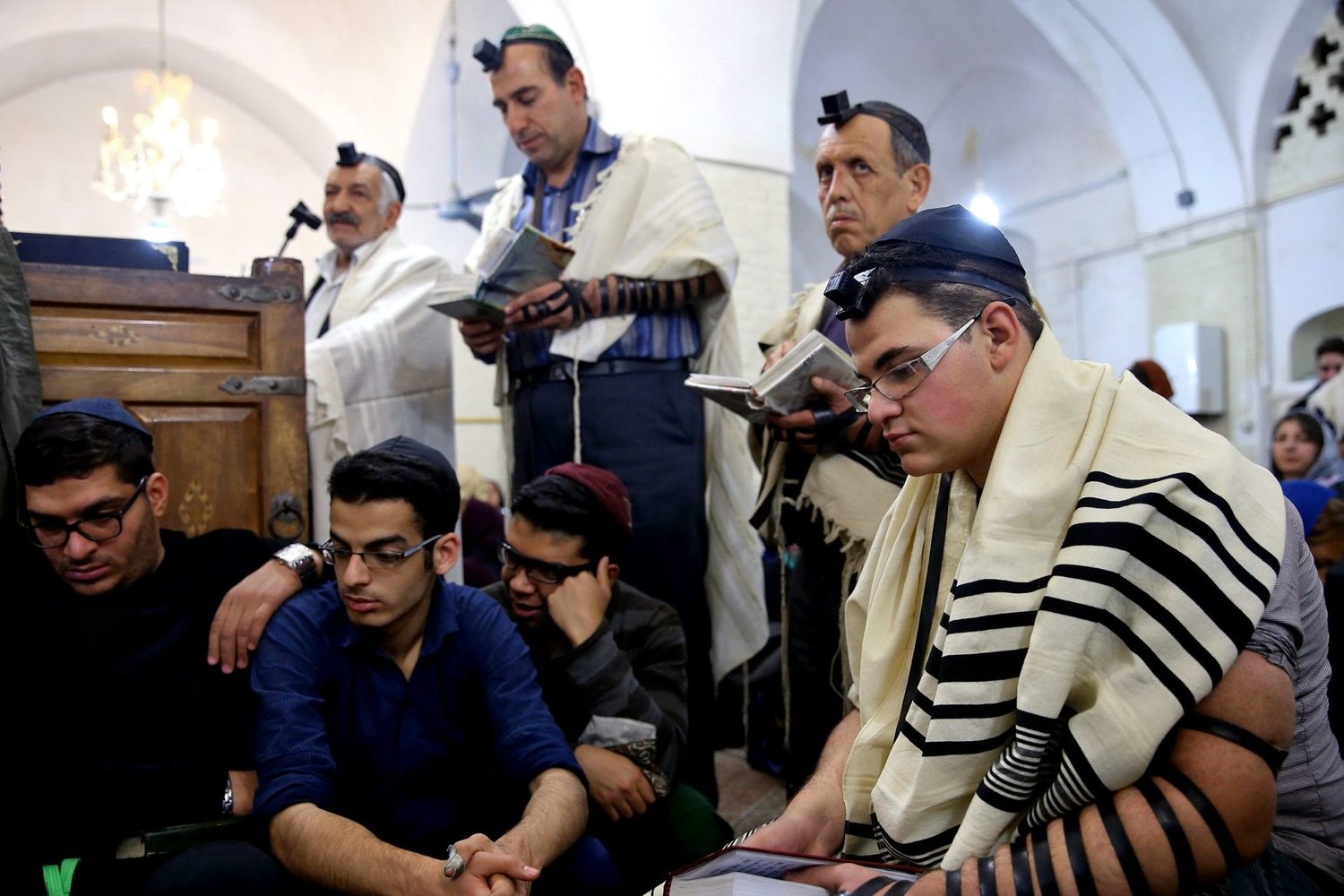
After Israel, Iran has the largest number of Jewish people in a Middle East country
Persian loan words in Hebrew include: pardes (פַּרְדֵּס), orchard, from which we get the word for Paradise; Etrog (אֶתְרוֹג), a green-yellow fruit; lilach (לִילָךְ), lilac, a lighter shade of purple; shoshana (שׁוֹשַׁנָּה), rose, from the name of the former capital of the Persian Empire, Shushan; sukar (סֻכָּר), sugar, from the Persian word shakar); and bazar (בָּזָאר), from bāzār in Persian.
The Pharisees were one of the most important Jewish groups in the late inter-testamental and New Testament periods, and their name is said to come from Hebrew word that means ‘to separate,’ indicating a ‘separatist’ or a separated person. But a plausible alternative finds the origin of the name in the Aramaic word for Persian, and some scholars claim the Pharisees adapted some Zoroastrianism ideas, such as their ideas about resurrection and the future life, and their angelology and demonology, making them ‘Persianisers.’
With the fall of Jerusalem, Babylonia became a kind of bulwark of Judaism, and the number of Jewish refugees in Babylon increased after the collapse of the Bar Kochba revolt.
In the third century CE, Zoroastrianism became the official state religion and other religions, including Judaism, were suppressed. But later Shapur I was friendly to the Jews, Shapur II’s mother was half-Jewish, and this gave the Jewish community relative freedom of religion and many advantages.
After the Islamic conquest of Persia, Jews, Christians and Zoroastrians lived with a number of discriminations. At times, they even enjoyed significant economic and religious freedom compared with Jews in Europe, and many were doctors, scholars and craftsman, or held positions of influence.
During Mongol rule in the late 13th century, Arghun Khan appointed Sa’d al-Daula a Jew as his vizier. But al-Daula was murdered in 1291 and Persian Jews in Tabriz suffered such violent persecutions that the Syriac Orthodox historian Bar Hebraeus wrote that ‘neither tongue can utter, nor the pen write down’ how violent the events were. Synagogues were destroyed, there were forced conversions and Jews were forced a distinctive mark on their heads.
Under the Safavid dynasty (1502-1794), Shi’a Islam became the state religion, Isfahan became a new capital, and Jews were forced to wear distinctive badges, clothing and headgear. But many Jews were traders, and they prospered through trade along the Silk Road with Central Asia and China.
The persecution of Jews in Persia resumed under the Qajar dynasty in 1794, and many Jews were confronted with two options: conversion to Islam or death. Throughout the 19th century, the European powers noted numerous forced conversions and massacres. However, European travellers reported that many Jews in Tabriz and Shiraz continued to practice Judaism in secret.
By the late 19th century, Jews were the most significant minority in Tehran. The Jewish quarter of Shiraz was looted and plundered in 1901, and 12 Jews murdered. Thousands of Iranian Jews emigrated in the late 19th and early 20th centuries to what is now Israel but then in the Ottoman Empire and to present-day Afghanistan, Pakistan and India.
The Pahlavi dynasty improved the life of Jews and many of the restrictions on Jews and other religious minorities were abolished. During the Allied occupation of Iran in World War II, some Polish and Jewish refugees who escaped Nazi-occupied Poland settled in Iran. After World II, the state of Israel was formed in 1948 and about 140,000 to 150,000 Jews were living in Iran, but over 95% of them have since migrated abroad.
About 70,000 Jews, or one-third of Iranian Jews, most of them poor, emigrated to Israel between 1948 and 1953. But many Jews who remained in Iran prospered during the reign of Shah Mohammad Reza Pahlavi. Until the Islamic Revolution in 1979, there were 80,000 to 100,000 Jews in Iran, mostly in Tehran (60,000), Shiraz (18,000), Kermanshah (4,000) and Isfahan (3,000).
Ayatollah Khomeini met Jewish community leaders in Qom when he returned from exile in Paris, and issued a fatwa decreeing that the Jews were to be protected. But since 1979, 13 Jews have been executed in Iran, accused of connections with Israel, and Jewish emigration increased dramatically: 20,000 Jews left within months of the revolution, and 60,000 more emigrated in the aftermath.
Jews have become more religious in recent years. Families that had been secular in the 1970s started following kosher dietary laws, observed the Shabbat and made the synagogue the focal point of their social lives.
Outside Iran, the largest group of Persian Jews is found in Israel, with an estimated 135,000 people
Some estimates say there are still 60,000 to 85,000 Jews in Iran; other sources put the figure at 25,000, and even as low as 8,500. But, after Israel, Iran is home to the second-largest Jewish population in the Middle East, with large Jewish communities in Tehran, Isfahan and Shiraz. President Mohammad Khatami visited Yusef Abad Synagogue in 2000, the first time a President of Iran had visited a synagogue since the revolution.
There are 25 synagogues in Iran, and most Jews live in Tehran, where there are 11 active synagogues, some Hebrew schools, two kosher restaurants, a Jewish library, an old-age home and a cemetery. Dr Sapir Jewish Hospital is Iran’s largest charity hospital of any religious minority community. It caters for all patients regardless of religious affiliation and most of the patients and staff are Muslim.
Traditionally, Shiraz, Hamedan, Isfahan, Tabriz, Nahawand and Babol have been home to large Jewish populations. Isfahan has a Jewish population of about 1,500 and 13 synagogues.
Rabbi Yehuda Gerami has been the Chief Rabbi of Iran and the spiritual leader of the Jewish community of Iran since 2011. Following the assassination of Qassem Soleimani, a senior Iranian military intelligence figure, in 2020, the Chief Rabbi visited his family and condemned Israeli attacks, saying the attacks had stoked tensions in the Jewish community in Iran.
Opinions about the condition of Jews in Iran are divided. Some reports say the majority of Iranian Jews prefer to stay in Iran. Other sources say that while Jews are allowed to practice their religion, they live in fear of being accused of spying for Israel and that they distance themselves from Israel and Zionism to ensure their own security.
Privately, it is said, many Jews complain of ‘discrimination, much of it of a social or bureaucratic nature.’ The last remaining newspaper in the Iranian Jewish community closed in 1991 after criticising government control of Jewish schools.
Jewish emigration from Iran increased dramatically after the Islamic Revolution in 1979 and the fall of the last Shah. Today, the vast majority of Iranian Jews live in Israel and the US, with Iranian Jewish communities in Paris, London, Australia, Canada and South America.
Outside Iran, the largest group of Persian Jews is found in Israel, with an estimated 135,000 people. In Israel, Persian Jews are classified as Mizrahim, and they include former President Moshe Katsav and former Minister of Defence Shaul Mofaz.
The US is home to 60,000-80,000 Iranian Jews, most of them in the Greater Los Angeles area, Great Neck, New York and Baltimore, Maryland. In particular, Persian Jews make up a sizeable proportion of the population of Beverly Hills. The community is credited with revitalising Beverly Hills, where Jimmy Delshad, a Persian Jew who emigrated to the US in 1958, has been the Mayor in 2007 and 2010.
Iranian-born Jews or Jews of Iranian descent include: David Alliance, Baron Alliance, a British businessman and Liberal Democrat politician; the US politician, Anna Kaplan; Moshe Katsav, former President of Israel; the peace activist Abie Nathan; the co-founders of Tinder Justin Mateen and Sean Rad; and the actor Sarah Solemani.
One prominent Jew in Iran said in recent years, ‘We are not tenants in this country. We are Iranians, and we have been for 30 centuries.’
Shabbat Shalom, שבת שלום
Showing posts with label Esther. Show all posts
27 June 2025
13 March 2025
Who is Mordecai and
who is Haman in
the ‘Purim spiel’
in the Oval Office?
A Megillath Ester or Scroll of Esther in the Monastir Synagogue in Thessaloniki (Photograph: Patrick Comerford)
Patrick Comerford
The Jewish holiday of Purim this year begins this evening (Thursday 13 March) and ends at nightfall tomorrow (Friday 14 March). This year is 5782 in the Jewish calendar, and Purim is celebrated on the 14th of the Jewish month of Adar, which falls sometime between February and March, about a month before Passover.
Purim is celebrated with joyous festivities: there are Purim carnivals for children and the young at heart, costumes, masks and plenty of tasty treats, Purim spiels or comic plays that retell the story of the Book of Esther, and dramatic readings of the megillah or Book of Esther, when every mention of the name of the villain Haman is drowned out with noise-making groggers.
The most famous baked treat for Purim is the hamantaschen, with a triangular shape to represent the villain’s hat and stuffed with a filling.
The ‘Purim spiel’ was widely used among Ashkenazi Jews as early as the mid-1500s and is said to be the origin of Yiddish theatre.
The Book of Esther and the Song of Songs are the only books in the Hebrew Bible that do not mention God explicitly. Traditional Judaism views the absence of God’s overt intervention in the story as an example of how God can work through seemingly coincidental events and the actions of individuals. But, in this divided and war-torn world, where are the parallels with Esther and Mordecai, Haman and King Ahasuerus, in global politics today?
In 1941, as Hitler’s army swept through Ukraine, razing towns and massacring Jews by the hundreds of thousands, four Jewish brothers in one village enlisted in the military to fight against the Nazis.
By the end of World War II in 1945, only one of those four brothers, Simon, was still alive. He returned to find that the Nazis had torched his entire village, burning his parents to death. The Nazis had murdered between 1.2 and 1.6 million Ukrainian Jews.
Simon married another Ukrainian Jew who had fled her city, where the Nazis had killed 5,000 Jews, and two years later, their son Oleksandr was born. That Oleksandr was, in turn, the father of Volodymyr Zelensky, now the President of Ukraine, and the survivor of survivors of the Holocaust.
When Volodymyr Zelensky was elected in 2019, Ukraine for the first time in its history had a president and a prime minister, Volodymyr Groysman, who were both open about their Jewish background.
In a paper published on the site ‘Medium’ earlier this week, the American writer Neil Krasnoff discusses ‘Putin and the Purim Spiel in the White House’ and finds recent events including the attempt by Trump and Vance to humiliate Zelensky in the Oval Office are ‘eerily parallel to the Purim story.’
The name of the King of Persia, Achashverosh, is curious and Krasnoff points out that there is no historical Persian ruler by that name. He suggests the king is ‘an archetype of a leader that will again appear in history, and today we have President Trump, who exhibits many of the qualities of King Achashverosh.
He identifies these parallel characteristics as including, and I quote:
· He’s a buffoonish, impulsive, a ruler of an empire at its peak
· He divorces wives and remarries rather quickly
· Many of his advisors/officials/associates are misogynists and antisemites
· The key to getting what you want from him is being on his good side, and if you’re not, you’re doomed
· He switches sides on a dime frequently
The heroes of the Purim story are Esther and her guardian Mordecai. So, Krasnoff asks, ‘who in the modern day situation are Esther and Mordecai?’
‘Personally … I don’t really know who the Esther of our times,’ he writes. ‘However, I do have a firm belief is that Zelensky is our modern Mordecai’.
In the Purim story, Mordecai refuses to bow down to a king’s adviser, Haman, and in response Haman plants an idea in the King’s head to kill Mordecai and all Jews in the kingdom. Krasnoff writes: ‘Effectively JD Vance does this by asking the Ukrainian hero to bow down and when Zelensky refuses to do so, the King’s (Trump’s) anger is now focused on him and his people.’
‘At this moment, things do look grim for Ukraine, but we can find much hope in the Purim story.’
‘In my view, JD Vance fits the villain role perfectly’, Krasnoff asserts confidently. ‘Haman is a secretive, diabolical, scheming antisemite. He manages to frame his plot against the Jews in terms of the interest of the King, appealing to both his ego and sense of the National well-being. JD Vance has openly made his position clear, in that throwing Zelensky under the bus is in the National Interest, but has he revealed himself as an antisemite?’
Krasnoff’s answer to his own question ‘is a resounding yes’. He cites the open support Vance has expressed the far-right antisemitic AfD in Germany that is anti-immigrant, pro-Russia, anti-EU and seeks to wipe the Holocaust from public memory.
He adds that Trump ‘has several other associates and advisors that could also be the modern-day Haman, most obviously Elon Musk, who has endorsed idea that Jews are behind the White Replacement conspiracy and gone as far as giving the Seig Heil salute in public at the Trump inauguration.’
He also cites Steve Bannon’s anti-Jewish feelings and thoughts, Trump’s associations with Proud Boys and individuals such as Nick Fuentes, who are leading a resurgence in White Nationalism that is racist and antisemitic.
‘Today we live in perilous times of uncertainty surrounding the world-order, democracy and human rights. Most liberal thinkers are specifically worried about Donald Trump, but the Purim story offers reassurance.’
He concludes: ‘In Purim, we celebrate survival, victory and defeat of dark forces, and we have done so for thousands of years through all the ups and downs of history. May it be so again.’
Chag Purim Sameach, חג פורים שמח
The holiday of Purim begins at sunset this evening
Patrick Comerford
The Jewish holiday of Purim this year begins this evening (Thursday 13 March) and ends at nightfall tomorrow (Friday 14 March). This year is 5782 in the Jewish calendar, and Purim is celebrated on the 14th of the Jewish month of Adar, which falls sometime between February and March, about a month before Passover.
Purim is celebrated with joyous festivities: there are Purim carnivals for children and the young at heart, costumes, masks and plenty of tasty treats, Purim spiels or comic plays that retell the story of the Book of Esther, and dramatic readings of the megillah or Book of Esther, when every mention of the name of the villain Haman is drowned out with noise-making groggers.
The most famous baked treat for Purim is the hamantaschen, with a triangular shape to represent the villain’s hat and stuffed with a filling.
The ‘Purim spiel’ was widely used among Ashkenazi Jews as early as the mid-1500s and is said to be the origin of Yiddish theatre.
The Book of Esther and the Song of Songs are the only books in the Hebrew Bible that do not mention God explicitly. Traditional Judaism views the absence of God’s overt intervention in the story as an example of how God can work through seemingly coincidental events and the actions of individuals. But, in this divided and war-torn world, where are the parallels with Esther and Mordecai, Haman and King Ahasuerus, in global politics today?
In 1941, as Hitler’s army swept through Ukraine, razing towns and massacring Jews by the hundreds of thousands, four Jewish brothers in one village enlisted in the military to fight against the Nazis.
By the end of World War II in 1945, only one of those four brothers, Simon, was still alive. He returned to find that the Nazis had torched his entire village, burning his parents to death. The Nazis had murdered between 1.2 and 1.6 million Ukrainian Jews.
Simon married another Ukrainian Jew who had fled her city, where the Nazis had killed 5,000 Jews, and two years later, their son Oleksandr was born. That Oleksandr was, in turn, the father of Volodymyr Zelensky, now the President of Ukraine, and the survivor of survivors of the Holocaust.
When Volodymyr Zelensky was elected in 2019, Ukraine for the first time in its history had a president and a prime minister, Volodymyr Groysman, who were both open about their Jewish background.
In a paper published on the site ‘Medium’ earlier this week, the American writer Neil Krasnoff discusses ‘Putin and the Purim Spiel in the White House’ and finds recent events including the attempt by Trump and Vance to humiliate Zelensky in the Oval Office are ‘eerily parallel to the Purim story.’
The name of the King of Persia, Achashverosh, is curious and Krasnoff points out that there is no historical Persian ruler by that name. He suggests the king is ‘an archetype of a leader that will again appear in history, and today we have President Trump, who exhibits many of the qualities of King Achashverosh.
He identifies these parallel characteristics as including, and I quote:
· He’s a buffoonish, impulsive, a ruler of an empire at its peak
· He divorces wives and remarries rather quickly
· Many of his advisors/officials/associates are misogynists and antisemites
· The key to getting what you want from him is being on his good side, and if you’re not, you’re doomed
· He switches sides on a dime frequently
The heroes of the Purim story are Esther and her guardian Mordecai. So, Krasnoff asks, ‘who in the modern day situation are Esther and Mordecai?’
‘Personally … I don’t really know who the Esther of our times,’ he writes. ‘However, I do have a firm belief is that Zelensky is our modern Mordecai’.
In the Purim story, Mordecai refuses to bow down to a king’s adviser, Haman, and in response Haman plants an idea in the King’s head to kill Mordecai and all Jews in the kingdom. Krasnoff writes: ‘Effectively JD Vance does this by asking the Ukrainian hero to bow down and when Zelensky refuses to do so, the King’s (Trump’s) anger is now focused on him and his people.’
‘At this moment, things do look grim for Ukraine, but we can find much hope in the Purim story.’
‘In my view, JD Vance fits the villain role perfectly’, Krasnoff asserts confidently. ‘Haman is a secretive, diabolical, scheming antisemite. He manages to frame his plot against the Jews in terms of the interest of the King, appealing to both his ego and sense of the National well-being. JD Vance has openly made his position clear, in that throwing Zelensky under the bus is in the National Interest, but has he revealed himself as an antisemite?’
Krasnoff’s answer to his own question ‘is a resounding yes’. He cites the open support Vance has expressed the far-right antisemitic AfD in Germany that is anti-immigrant, pro-Russia, anti-EU and seeks to wipe the Holocaust from public memory.
He adds that Trump ‘has several other associates and advisors that could also be the modern-day Haman, most obviously Elon Musk, who has endorsed idea that Jews are behind the White Replacement conspiracy and gone as far as giving the Seig Heil salute in public at the Trump inauguration.’
He also cites Steve Bannon’s anti-Jewish feelings and thoughts, Trump’s associations with Proud Boys and individuals such as Nick Fuentes, who are leading a resurgence in White Nationalism that is racist and antisemitic.
‘Today we live in perilous times of uncertainty surrounding the world-order, democracy and human rights. Most liberal thinkers are specifically worried about Donald Trump, but the Purim story offers reassurance.’
He concludes: ‘In Purim, we celebrate survival, victory and defeat of dark forces, and we have done so for thousands of years through all the ups and downs of history. May it be so again.’
Chag Purim Sameach, חג פורים שמח
The holiday of Purim begins at sunset this evening
23 July 2024
Daily prayer in Ordinary Time 2024:
75, Tuesday 23 July 2024
‘Strengthen for service, Lord, the hands that holy things have taken’ (Post-Communion Prayer) … Communion vessels in the chapel of Westcott House, Cambridge (Photograph: Patrick Comerford)
Patrick Comerford
We are continuing in Ordinary Time in the Church and the week began with the Eighth Sunday after Trinity (Trinity VIII). Today, the Calendar of the Church of England in Common Worship remembers Bridget of Sweden (1373), Abbess of Vadstena.
Before today begins, I am taking some quiet time this morning to give thanks, for reflection, prayer and reading in these ways:
1, today’s Gospel reading;
2, a reflection on the Gospel reading;
3, a prayer from the USPG prayer diary;
4, the Collects and Post-Communion prayer of the day.
A quotation from Thomas Merton shared by Bishop Graham Usher at the USPG conference in 2021
Matthew 12: 46-50 (NRSVA):
46 While he was still speaking to the crowds, his mother and his brothers were standing outside, wanting to speak to him. 47 Someone told him, ‘Look, your mother and your brothers are standing outside, wanting to speak to you.’ 48 But to the one who had told him this, Jesus replied, ‘Who is my mother, and who are my brothers?’ 49 And pointing to his disciples, he said, ‘Here are my mother and my brothers! 50 For whoever does the will of my Father in heaven is my brother and sister and mother.’
‘Strengthen for service, Lord, the hands that holy things have taken’ (Post-Communion Prayer) … bread and wine on the table in a restaurant in Rethymnon (Photograph: Patrick Comerford, 2024)
This morning’s reflection:
These past few days were among the hottest I have ever experienced in England for many years, with temperatures in Milton Keynes hitting 30 on Friday. Yet, this heat in times such as, and this morning’s unseasonably heavy rain, are also sharp reminders that Climate Change threatens the lives of all of us.
Three years ago, the USPG conference in 2021 took as its theme ‘For Such a Time as This’. The title came from the Biblical story of Esther in which Mordecai asks Esther to consider whether she has found herself in her privileged position at ‘such a time as this,’ a time of great crisis, so that she can do God’s will and stop a looming catastrophe (Esther 4: 14).
‘Such a Time as This’ … Mordecai uses the phrase twice in one verse.
In ‘such a time as this’, we are challenged to think whether the Church has a voice that must speak out: this is a time when we are aware of potential catastrophes created by war and violence in Ukraine and Russia and in Gaza, Israel and Palestine, by pandemics, by racism, by political extremism, by gender violence, by climate change, by the rise of the far-right across Europe, by the threats posed by the resurgence of Trump in the US … and so on.
In the Biblical story, Mordecai warns Esther that if she stays silent at such a time as this, she and her family may perish, but God will raise up ‘relief and deliverance … from another quarter.’
At that conference three years ago, we were challenged, day after day, in such a time as this, whether the Church is going to speak out today, or whether we are going to wait silently for God to provide ‘relief and deliverance … from another quarter.’
The Cry of Creation could be heard throughout presentations that invited us to listen to ‘The Cry of Creation.’
Graham Usher, Bishop of Norwich, drew on the opening word of the Rule of Saint Benedict – ‘Listen’ – as he urged us to listen to the groan and cry of creation, to listen to the cry of the dispossessed, and to listen to God’s voice on how we can live more simply so that others might simply live.
Sadly, he quoted a survey that finds eight out of ten young people say they have never heard a sermon on climate change. Yet the Fifth Mark of Mission in the Anglican Communion calls on us ‘To strive to safeguard the integrity of creation, and sustain and renew the life of the earth.’
If the Church engages with climate change, he suggested, then we may find we are evangelising the young.
He quoted from Thomas Merton: ‘From the moment you put a piece of bread in your mouth you are part of the world. Who grew the wheat? Who made the bread? Where did it come from? You are in relationship with all who brought it to the table. We are least separate and most in common when we eat and drink.’
In one of the Bible studies that year, Suchitra Behera, an Indian theologian working with the Diocese of Barishal in the Church of Bangladesh, told a moving story of hearing that ‘Cry of Creation’ in a group of elephants, grieving the death of one elephant killed by a car or a truck on a road. The elephants staged their own protest on the road against the destruction of their habitat, blocking traffic in an organised protest. And she quoted the Prophet Jeremiah on the groaning of creation:
How long will the land mourn,
and the grass of every field wither?
For the wickedness of those who live in it
the animals and the birds are swept away,
and because people said, ‘He is blind to our ways.’
They have made it a desolation;
desolate, it mourns to me.
The whole land is made desolate,
but no one lays it to heart (Jeremiah 12: 4, 11, NRSVA).
Drawing on the liberation theologian Leonardo Boff, she linked the cry of the earth and the cry of the poor.
The cry of creation and the cry of humanity are not separate cries.
And this is closely linked with the Post-Communion Prayer introduced on Sunday and being prayed throughout this week:
Strengthen for service, Lord,
the hands that have taken holy things;
may the ears which have heard your word
be deaf to clamour and dispute;
may the tongues which have sung your praise be free from deceit;
may the eyes which have seen the tokens of your love
shine with the light of hope;
and may the bodies which have been fed with your body
be refreshed with the fullness of your life;
glory to you for ever.
We can be transfixed by fear or paralysed into inaction in ‘such a time as this.’ But if the Church remains silent at such a time as this then, perhaps, as Mordecai tells Esther, God raise up ‘relief and deliverance … from another quarter.’
As that conference in 2021 closed, the Revd Duncan Dormor, general secretary of USPG, reminded us that in the breaking of bread we are one body. Poverty and the assault on the earth challenge us to hear the groaning of creation, he said, and he repeated that there can be no salvation for humanity that does not include creation.
The breaking of the bread and the sharing of the cup takes us to the heart of creation.
Let us break bread together. Amen.
Fresh bread in the window of Hindley’s bakery and café in Tamworth Street, Lichfield (Photograph: Patrick Comerford, 2024)
Today’s Prayers (Tuesday 23 July 2024):
The theme this week in ‘Pray With the World Church,’ the Prayer Diary of the Anglican mission agency USPG (United Society Partners in the Gospel), is ‘Someone called my name – Mary Magdalene Reflection.’ This theme was introduced on Sunday with a reflection by the Revd Cathrine Ngangira, Priest-in-Charge, Benefice of Boughton-under-Blean with Durnkirk, Graveney with Goodnestone and Hernhill.
The USPG Prayer Diary today (Tuesday 23 July 2024) invites us to pray:
Heavenly Father, we pray for you to draw us closer so that we may know the risen Jesus Christ and to make him known.
The Collect:
Almighty Lord and everlasting God,
we beseech you to direct, sanctify and govern
both our hearts and bodies
in the ways of your laws
and the works of your commandments;
that through your most mighty protection, both here and ever,
we may be preserved in body and soul;
through our Lord and Saviour Jesus Christ,
who is alive and reigns with you,
in the unity of the Holy Spirit,
one God, now and for ever.
Post Communion Prayer:
Strengthen for service, Lord,
the hands that have taken holy things;
may the ears which have heard your word
be deaf to clamour and dispute;
may the tongues which have sung your praise be free from deceit;
may the eyes which have seen the tokens of your love
shine with the light of hope;
and may the bodies which have been fed with your body
be refreshed with the fullness of your life;
glory to you for ever.
Additional Collect:
Lord God,
your Son left the riches of heaven
and became poor for our sake:
when we prosper save us from pride,
when we are needy save us from despair,
that we may trust in you alone;
through Jesus Christ our Lord.
‘Strengthen for service, Lord, the hands that holy things have taken’ (Post-Communion Prayer) … bread and wine on the table at lunchtime in Georgioupoli in Crete (Photograph: Patrick Comerford)
Yesterday’s reflection
Continued tomorrow
Scripture quotations are from the New Revised Standard Version Bible: Anglicised Edition copyright © 1989, 1995, National Council of the Churches of Christ in the United States of America. Used by permission. All rights reserved worldwide. http://nrsvbibles.org
Patrick Comerford
We are continuing in Ordinary Time in the Church and the week began with the Eighth Sunday after Trinity (Trinity VIII). Today, the Calendar of the Church of England in Common Worship remembers Bridget of Sweden (1373), Abbess of Vadstena.
Before today begins, I am taking some quiet time this morning to give thanks, for reflection, prayer and reading in these ways:
1, today’s Gospel reading;
2, a reflection on the Gospel reading;
3, a prayer from the USPG prayer diary;
4, the Collects and Post-Communion prayer of the day.
A quotation from Thomas Merton shared by Bishop Graham Usher at the USPG conference in 2021
Matthew 12: 46-50 (NRSVA):
46 While he was still speaking to the crowds, his mother and his brothers were standing outside, wanting to speak to him. 47 Someone told him, ‘Look, your mother and your brothers are standing outside, wanting to speak to you.’ 48 But to the one who had told him this, Jesus replied, ‘Who is my mother, and who are my brothers?’ 49 And pointing to his disciples, he said, ‘Here are my mother and my brothers! 50 For whoever does the will of my Father in heaven is my brother and sister and mother.’
‘Strengthen for service, Lord, the hands that holy things have taken’ (Post-Communion Prayer) … bread and wine on the table in a restaurant in Rethymnon (Photograph: Patrick Comerford, 2024)
This morning’s reflection:
These past few days were among the hottest I have ever experienced in England for many years, with temperatures in Milton Keynes hitting 30 on Friday. Yet, this heat in times such as, and this morning’s unseasonably heavy rain, are also sharp reminders that Climate Change threatens the lives of all of us.
Three years ago, the USPG conference in 2021 took as its theme ‘For Such a Time as This’. The title came from the Biblical story of Esther in which Mordecai asks Esther to consider whether she has found herself in her privileged position at ‘such a time as this,’ a time of great crisis, so that she can do God’s will and stop a looming catastrophe (Esther 4: 14).
‘Such a Time as This’ … Mordecai uses the phrase twice in one verse.
In ‘such a time as this’, we are challenged to think whether the Church has a voice that must speak out: this is a time when we are aware of potential catastrophes created by war and violence in Ukraine and Russia and in Gaza, Israel and Palestine, by pandemics, by racism, by political extremism, by gender violence, by climate change, by the rise of the far-right across Europe, by the threats posed by the resurgence of Trump in the US … and so on.
In the Biblical story, Mordecai warns Esther that if she stays silent at such a time as this, she and her family may perish, but God will raise up ‘relief and deliverance … from another quarter.’
At that conference three years ago, we were challenged, day after day, in such a time as this, whether the Church is going to speak out today, or whether we are going to wait silently for God to provide ‘relief and deliverance … from another quarter.’
The Cry of Creation could be heard throughout presentations that invited us to listen to ‘The Cry of Creation.’
Graham Usher, Bishop of Norwich, drew on the opening word of the Rule of Saint Benedict – ‘Listen’ – as he urged us to listen to the groan and cry of creation, to listen to the cry of the dispossessed, and to listen to God’s voice on how we can live more simply so that others might simply live.
Sadly, he quoted a survey that finds eight out of ten young people say they have never heard a sermon on climate change. Yet the Fifth Mark of Mission in the Anglican Communion calls on us ‘To strive to safeguard the integrity of creation, and sustain and renew the life of the earth.’
If the Church engages with climate change, he suggested, then we may find we are evangelising the young.
He quoted from Thomas Merton: ‘From the moment you put a piece of bread in your mouth you are part of the world. Who grew the wheat? Who made the bread? Where did it come from? You are in relationship with all who brought it to the table. We are least separate and most in common when we eat and drink.’
In one of the Bible studies that year, Suchitra Behera, an Indian theologian working with the Diocese of Barishal in the Church of Bangladesh, told a moving story of hearing that ‘Cry of Creation’ in a group of elephants, grieving the death of one elephant killed by a car or a truck on a road. The elephants staged their own protest on the road against the destruction of their habitat, blocking traffic in an organised protest. And she quoted the Prophet Jeremiah on the groaning of creation:
How long will the land mourn,
and the grass of every field wither?
For the wickedness of those who live in it
the animals and the birds are swept away,
and because people said, ‘He is blind to our ways.’
They have made it a desolation;
desolate, it mourns to me.
The whole land is made desolate,
but no one lays it to heart (Jeremiah 12: 4, 11, NRSVA).
Drawing on the liberation theologian Leonardo Boff, she linked the cry of the earth and the cry of the poor.
The cry of creation and the cry of humanity are not separate cries.
And this is closely linked with the Post-Communion Prayer introduced on Sunday and being prayed throughout this week:
Strengthen for service, Lord,
the hands that have taken holy things;
may the ears which have heard your word
be deaf to clamour and dispute;
may the tongues which have sung your praise be free from deceit;
may the eyes which have seen the tokens of your love
shine with the light of hope;
and may the bodies which have been fed with your body
be refreshed with the fullness of your life;
glory to you for ever.
We can be transfixed by fear or paralysed into inaction in ‘such a time as this.’ But if the Church remains silent at such a time as this then, perhaps, as Mordecai tells Esther, God raise up ‘relief and deliverance … from another quarter.’
As that conference in 2021 closed, the Revd Duncan Dormor, general secretary of USPG, reminded us that in the breaking of bread we are one body. Poverty and the assault on the earth challenge us to hear the groaning of creation, he said, and he repeated that there can be no salvation for humanity that does not include creation.
The breaking of the bread and the sharing of the cup takes us to the heart of creation.
Let us break bread together. Amen.
Fresh bread in the window of Hindley’s bakery and café in Tamworth Street, Lichfield (Photograph: Patrick Comerford, 2024)
Today’s Prayers (Tuesday 23 July 2024):
The theme this week in ‘Pray With the World Church,’ the Prayer Diary of the Anglican mission agency USPG (United Society Partners in the Gospel), is ‘Someone called my name – Mary Magdalene Reflection.’ This theme was introduced on Sunday with a reflection by the Revd Cathrine Ngangira, Priest-in-Charge, Benefice of Boughton-under-Blean with Durnkirk, Graveney with Goodnestone and Hernhill.
The USPG Prayer Diary today (Tuesday 23 July 2024) invites us to pray:
Heavenly Father, we pray for you to draw us closer so that we may know the risen Jesus Christ and to make him known.
The Collect:
Almighty Lord and everlasting God,
we beseech you to direct, sanctify and govern
both our hearts and bodies
in the ways of your laws
and the works of your commandments;
that through your most mighty protection, both here and ever,
we may be preserved in body and soul;
through our Lord and Saviour Jesus Christ,
who is alive and reigns with you,
in the unity of the Holy Spirit,
one God, now and for ever.
Post Communion Prayer:
Strengthen for service, Lord,
the hands that have taken holy things;
may the ears which have heard your word
be deaf to clamour and dispute;
may the tongues which have sung your praise be free from deceit;
may the eyes which have seen the tokens of your love
shine with the light of hope;
and may the bodies which have been fed with your body
be refreshed with the fullness of your life;
glory to you for ever.
Additional Collect:
Lord God,
your Son left the riches of heaven
and became poor for our sake:
when we prosper save us from pride,
when we are needy save us from despair,
that we may trust in you alone;
through Jesus Christ our Lord.
‘Strengthen for service, Lord, the hands that holy things have taken’ (Post-Communion Prayer) … bread and wine on the table at lunchtime in Georgioupoli in Crete (Photograph: Patrick Comerford)
Yesterday’s reflection
Continued tomorrow
Scripture quotations are from the New Revised Standard Version Bible: Anglicised Edition copyright © 1989, 1995, National Council of the Churches of Christ in the United States of America. Used by permission. All rights reserved worldwide. http://nrsvbibles.org
23 March 2024
Purim recalls near-annihilation
and is a chilling warning about
antisemitism and vengeance
A Megillath Ester or Scroll of Esther in the Monastir Synagogue in Thessaloniki (Photograph: Patrick Comerford)
Patrick Comerford
The Jewish holiday of Purim begins at sunset this evening (23 February 2024) and ends at sunset tomorrow (24 March 2024). Purim literally means ‘lots’ and is sometimes known as the Feast of Lots. This holiday commemorates the Jews being saved from persecution in the ancient Persian Empire, but also remembers the hatred and violence involved.
According to the Book of Esther, the Jewish people in Shushan were threatened by the chief minister Haman, who convinces King Ahasuerus or Xerxes to kill all Jews, because Mordecai, a Jew, had refused to bow down to Haman.
Haman casts lots to decide the date for his plan – the 13th day of Adar. But the Jews are saved by Mordecai’s niece and adopted daughter, the heroic Queen Esther. She married Ahasuerus after he banished Vashti, his first, rebellious wife. When Ahasuerus discovers that Esther is Jewish, he reverses Haman’s decree, and instead of the Jews being killed, Haman, his sons, and thousands of other Persians are killed.
Before reading the Megillah, the person who is to read says the following three blessings:
‘Blessed are you, Lord our God, King of the Universe, who has made us holy through his commandments, and has commanded us about reading the Megillah.
‘Blessed are you, Lord our God, King of the Universe, who performed miracles for our ancestors in those days at this time.
‘Blessed are you, Lord our God, King of the Universe, who has given us life, sustained us, and brought us to this time.’
As the story of Purim is read from Megillat Esther (מגילת אסתר, ‘The Scroll of Esther’), it is a custom for everyone to boo and hiss or to make a loud noise with a rattle, known as a ra’ashan (Hebrew) or grager (Yiddish), every time Haman’s name is repeated. The custom fulfils the obligation to blot out Haman’s name.
It is a mitzvah that Jewish people should eat, drink and be merry at Purim. According to the Talmud, a person is required to drink until they cannot tell the difference between ‘Cursed be Haman’ and ‘Blessed be Mordecai’ … although opinions differ as to exactly how drunk that is.
As the story of Esther is read, synagogues are crowded, the adults wearing their best Sabbath clothes, and the children, and some adults too, dressed up in colourful costumes, funny beards and playful masks. They are entertaining and rowdy occasions on Purim.
Children in particular enjoy dressing up as the characters in the Book of Esther, including King Xerxes, the banished queen Vashti, Queen Esther, her cousin Mordecai and the evil, scheming Haman. In some communities, they still burn an effigy of Haman. So for Jewish communities, Purim is like Hallowe’en, Carnival, Mardi Gras and Guy Fawkes Night … all rolled into one, and usually focussed on children.
Many celebrations of Purim this year have been toned down and muted following the attacks in Israel on the Jewish holiday of Simchat Torah over five months ago (7 October 2023), the continuing hostage crisis in Israel and Gaza, and the dreadful violence that has continued in Gaza, Israel and on the West Bank.
Many Jewish communities are reluctant to celebrate openly given these circumstances, and are equally reluctant to be seen to celebrate given the rise of public and naked antisemitism, typified by the attack on a house in Hackney earlier this week.
Plans for the first carnival-style Purim parade in Jerusalem in 42 years were modified and altered this week after an outcry from residents, relatives of hostages held in Gaza and others directly affected by the events of 7 October and the war in Gaza war.
Tel Aviv and other cities in Israel have cancelled their popular parades this year out of deference to the families of hostages, evacuees, bereaved families, parents of combat soldiers and a melancholic national mood throughout Israel.
A Megillath Ester or Scroll of Esther in the Jewish Museum in Venice (Photograph: Patrick Comerford)
Purim and Hanukkah are the two Jewish festivals that are not prescribed in Mosaic law. Yet, the story of Xerxes and Esther, Mordecai and Haman, is relevant not only for Jews today. It is also a reminder that there are always people who plan and plot evil on a grand scale, happy to wallow in the misery and deaths of millions, men, women and children.
At first, the story of Purim might appear sombre with its recollection of the near-annihilation. But it is also a story of bravery, courage and salvation, and it is a reminder that antisemitism has deep roots that long predate contemporary experiences.
Esther is a secret Jew, and her story encouraged secret Jews during the Inquisition in Spain and Portugal, when Saint Esther emerged as a popular figure among the conversos. Many proclaimed their hidden identity to one another by having domestic shrines to Saint Esther … an insider symbol of resistance to prejudice and persecution.
Later, the story of Purim was an abiding comfort and encouragement to European Jews in the mid-20th century.
On Esther’s request, Purim ‘should be remembered and kept throughout every generation, in every family, province, and city, and these days of Purim should never fall into disuse among the Jews, nor should the commemoration of these days cease among their descendants’ (Esther 9: 28).
It is not just a story of courage and action in the face of adversity and the triumph of good over evil; it is not only a holiday and a celebration. Purim is also a startling reminder of how easy it is to turn to feel justified in turning to vengeance, and a chilling warning to future generations that antisemitism will continue to haunt Jews people throughout time.
Esther is a rare biblical text not only because it does not mention God even once – it is a story driven by human agency. It is also unique because it is set in the Diaspora – the events take place in Persia. And it is unusual because a woman becomes the saviour of an oppressed minority, able to summon the courage to move from powerlessness to power.
Since Hamas launched its horrific massacre and hostage-taking on 7 October and Israel retaliated in a brutal, ongoing war, the story of Esther is being read by many as an agonising and troubling story in ways that it has never been read before. For many Jewish people reading the story of Esther this weekend, Haman, Hitler and Hamas are ‘all creepily entwined’, as one commentator has written.
But there is also a disturbing dimension to the story of Esther when it comes to the revenge and vengeance. Not only was Haman executed, but at the request of Esther and with the acquiescence of the king, so were his 10 sons and 500 people in the citadel.
Then Chapter 9 gives the details of a violent episode of state-sanctioned retaliation, when another 75,000 Persian ‘enemies,’ including women and children, were murdered, followed by ‘a day of feasting and gladness’ and rejoiced afterward (Esther 9: 16, 22). The story says that many Persians were so fearful of the newly militarised Jews that they professed to be Jews, too.
For centuries, rabbis and scholars have tried to question or justify this problematic spasm of violence: maybe the death toll was not 75,000; maybe women and children were not killed – even though that was explicitly permitted; maybe all this was necessary self-defence.
However, many scholars today find these rationalisations unsatisfying. Writing in the Los Angeles Times earlier this week (21 March), the Jewish writer Jane Eisner suggests that perhaps Esther 9 may be a warning of the extremes a formerly oppressed people will go to when given a opportunity to exercise political and military might and to retaliate. She says it uncomfortably echoes the Israeli assault on Gaza today, with entire families obliterated, hunger and displacement rampant, thousands of children killed and orphaned, and cities all but destroyed.
Jane Eisner is the former editor in chief of the Forward, a national Jewish news outlet. She asks searching questions this Purim:
Does one trauma justify another?
When does self-defence bleed into revenge?
How is proportionality weighed during what is today an existential crisis for Israelis and Palestinians?
The vengeance sought at Purim is committed by humans and not in God’s name. Jane Eisner says Esther 9 ‘gives voice to a malevolence in the Jewish tradition that makes me wince, spotlighting an unfortunate feature of human behaviour, inviting us even today to beseech God to pursue and destroy our enemies.’
On the other hand, the story of Esther recognise the pain and destruction visited upon enemies and becomes an important and instructive reminder of the need to temper any sense of vindication, a reminder of the need to move from vengeance to empathy.
During my return visits over the past year or two to Prague, the ghetto in Venice and the Marais in Paris, I was reminded that while Haman and Hitler planned and plotted on a grand scale, there are always people who plot and plan evil and the destruction of innocence on varying scales of intensity and application.
We would be naïve to ever underestimate the capacity of people to do evil, nor should we ever undervalue the importance of our contribution to protecting the vulnerable, the frightened and the victimised in our society today.
When we realise that we have been saved from disasters or from our enemies, when sorrow has been turned into gladness and mourning into a holiday, we should not only feast and celebrate among ourselves but also mark these as ‘days for sending gifts of food to one another and presents to the poor’ (Esther 9: 22), and remember all who suffer the consequences.
Megillat Ester or Scroll of Esther, silver with coloured stones and gilded, dated Vienna 1844, in the Jewish Museum, Vienna (Photograph: Patrick Comerford)
Patrick Comerford
The Jewish holiday of Purim begins at sunset this evening (23 February 2024) and ends at sunset tomorrow (24 March 2024). Purim literally means ‘lots’ and is sometimes known as the Feast of Lots. This holiday commemorates the Jews being saved from persecution in the ancient Persian Empire, but also remembers the hatred and violence involved.
According to the Book of Esther, the Jewish people in Shushan were threatened by the chief minister Haman, who convinces King Ahasuerus or Xerxes to kill all Jews, because Mordecai, a Jew, had refused to bow down to Haman.
Haman casts lots to decide the date for his plan – the 13th day of Adar. But the Jews are saved by Mordecai’s niece and adopted daughter, the heroic Queen Esther. She married Ahasuerus after he banished Vashti, his first, rebellious wife. When Ahasuerus discovers that Esther is Jewish, he reverses Haman’s decree, and instead of the Jews being killed, Haman, his sons, and thousands of other Persians are killed.
Before reading the Megillah, the person who is to read says the following three blessings:
‘Blessed are you, Lord our God, King of the Universe, who has made us holy through his commandments, and has commanded us about reading the Megillah.
‘Blessed are you, Lord our God, King of the Universe, who performed miracles for our ancestors in those days at this time.
‘Blessed are you, Lord our God, King of the Universe, who has given us life, sustained us, and brought us to this time.’
As the story of Purim is read from Megillat Esther (מגילת אסתר, ‘The Scroll of Esther’), it is a custom for everyone to boo and hiss or to make a loud noise with a rattle, known as a ra’ashan (Hebrew) or grager (Yiddish), every time Haman’s name is repeated. The custom fulfils the obligation to blot out Haman’s name.
It is a mitzvah that Jewish people should eat, drink and be merry at Purim. According to the Talmud, a person is required to drink until they cannot tell the difference between ‘Cursed be Haman’ and ‘Blessed be Mordecai’ … although opinions differ as to exactly how drunk that is.
As the story of Esther is read, synagogues are crowded, the adults wearing their best Sabbath clothes, and the children, and some adults too, dressed up in colourful costumes, funny beards and playful masks. They are entertaining and rowdy occasions on Purim.
Children in particular enjoy dressing up as the characters in the Book of Esther, including King Xerxes, the banished queen Vashti, Queen Esther, her cousin Mordecai and the evil, scheming Haman. In some communities, they still burn an effigy of Haman. So for Jewish communities, Purim is like Hallowe’en, Carnival, Mardi Gras and Guy Fawkes Night … all rolled into one, and usually focussed on children.
Many celebrations of Purim this year have been toned down and muted following the attacks in Israel on the Jewish holiday of Simchat Torah over five months ago (7 October 2023), the continuing hostage crisis in Israel and Gaza, and the dreadful violence that has continued in Gaza, Israel and on the West Bank.
Many Jewish communities are reluctant to celebrate openly given these circumstances, and are equally reluctant to be seen to celebrate given the rise of public and naked antisemitism, typified by the attack on a house in Hackney earlier this week.
Plans for the first carnival-style Purim parade in Jerusalem in 42 years were modified and altered this week after an outcry from residents, relatives of hostages held in Gaza and others directly affected by the events of 7 October and the war in Gaza war.
Tel Aviv and other cities in Israel have cancelled their popular parades this year out of deference to the families of hostages, evacuees, bereaved families, parents of combat soldiers and a melancholic national mood throughout Israel.
A Megillath Ester or Scroll of Esther in the Jewish Museum in Venice (Photograph: Patrick Comerford)
Purim and Hanukkah are the two Jewish festivals that are not prescribed in Mosaic law. Yet, the story of Xerxes and Esther, Mordecai and Haman, is relevant not only for Jews today. It is also a reminder that there are always people who plan and plot evil on a grand scale, happy to wallow in the misery and deaths of millions, men, women and children.
At first, the story of Purim might appear sombre with its recollection of the near-annihilation. But it is also a story of bravery, courage and salvation, and it is a reminder that antisemitism has deep roots that long predate contemporary experiences.
Esther is a secret Jew, and her story encouraged secret Jews during the Inquisition in Spain and Portugal, when Saint Esther emerged as a popular figure among the conversos. Many proclaimed their hidden identity to one another by having domestic shrines to Saint Esther … an insider symbol of resistance to prejudice and persecution.
Later, the story of Purim was an abiding comfort and encouragement to European Jews in the mid-20th century.
On Esther’s request, Purim ‘should be remembered and kept throughout every generation, in every family, province, and city, and these days of Purim should never fall into disuse among the Jews, nor should the commemoration of these days cease among their descendants’ (Esther 9: 28).
It is not just a story of courage and action in the face of adversity and the triumph of good over evil; it is not only a holiday and a celebration. Purim is also a startling reminder of how easy it is to turn to feel justified in turning to vengeance, and a chilling warning to future generations that antisemitism will continue to haunt Jews people throughout time.
Esther is a rare biblical text not only because it does not mention God even once – it is a story driven by human agency. It is also unique because it is set in the Diaspora – the events take place in Persia. And it is unusual because a woman becomes the saviour of an oppressed minority, able to summon the courage to move from powerlessness to power.
Since Hamas launched its horrific massacre and hostage-taking on 7 October and Israel retaliated in a brutal, ongoing war, the story of Esther is being read by many as an agonising and troubling story in ways that it has never been read before. For many Jewish people reading the story of Esther this weekend, Haman, Hitler and Hamas are ‘all creepily entwined’, as one commentator has written.
But there is also a disturbing dimension to the story of Esther when it comes to the revenge and vengeance. Not only was Haman executed, but at the request of Esther and with the acquiescence of the king, so were his 10 sons and 500 people in the citadel.
Then Chapter 9 gives the details of a violent episode of state-sanctioned retaliation, when another 75,000 Persian ‘enemies,’ including women and children, were murdered, followed by ‘a day of feasting and gladness’ and rejoiced afterward (Esther 9: 16, 22). The story says that many Persians were so fearful of the newly militarised Jews that they professed to be Jews, too.
For centuries, rabbis and scholars have tried to question or justify this problematic spasm of violence: maybe the death toll was not 75,000; maybe women and children were not killed – even though that was explicitly permitted; maybe all this was necessary self-defence.
However, many scholars today find these rationalisations unsatisfying. Writing in the Los Angeles Times earlier this week (21 March), the Jewish writer Jane Eisner suggests that perhaps Esther 9 may be a warning of the extremes a formerly oppressed people will go to when given a opportunity to exercise political and military might and to retaliate. She says it uncomfortably echoes the Israeli assault on Gaza today, with entire families obliterated, hunger and displacement rampant, thousands of children killed and orphaned, and cities all but destroyed.
Jane Eisner is the former editor in chief of the Forward, a national Jewish news outlet. She asks searching questions this Purim:
Does one trauma justify another?
When does self-defence bleed into revenge?
How is proportionality weighed during what is today an existential crisis for Israelis and Palestinians?
The vengeance sought at Purim is committed by humans and not in God’s name. Jane Eisner says Esther 9 ‘gives voice to a malevolence in the Jewish tradition that makes me wince, spotlighting an unfortunate feature of human behaviour, inviting us even today to beseech God to pursue and destroy our enemies.’
On the other hand, the story of Esther recognise the pain and destruction visited upon enemies and becomes an important and instructive reminder of the need to temper any sense of vindication, a reminder of the need to move from vengeance to empathy.
During my return visits over the past year or two to Prague, the ghetto in Venice and the Marais in Paris, I was reminded that while Haman and Hitler planned and plotted on a grand scale, there are always people who plot and plan evil and the destruction of innocence on varying scales of intensity and application.
We would be naïve to ever underestimate the capacity of people to do evil, nor should we ever undervalue the importance of our contribution to protecting the vulnerable, the frightened and the victimised in our society today.
When we realise that we have been saved from disasters or from our enemies, when sorrow has been turned into gladness and mourning into a holiday, we should not only feast and celebrate among ourselves but also mark these as ‘days for sending gifts of food to one another and presents to the poor’ (Esther 9: 22), and remember all who suffer the consequences.
Megillat Ester or Scroll of Esther, silver with coloured stones and gilded, dated Vienna 1844, in the Jewish Museum, Vienna (Photograph: Patrick Comerford)
26 September 2021
Sunday intercessions on
26 September 2021, Trinity XVII
‘And if your eye causes you to stumble’ (Mark 9: 47) … the London Eye (Photograph: Patrick Comerford)
Let us pray:
‘Our help is in the name of the Lord, who has made heaven and earth’ (Psalm 124: 7):
Heavenly Father,
we pray for the world and the nations of the world,
for those nations where rulers and leaders hold onto power
through violence, coercion and subjugation;
that the hearts of those rulers may be changed,
so that the people may know mercy, peace and justice.
We pray for all who face discrimination …
who are denied equal opportunities …
praying this morning for women and minorities in Afghanistan …
Lord have mercy,
Lord have mercy.
May these days be ‘turned … from sorrow into gladness and from mourning into a holiday, days of feasting and gladness, days for sending gifts … to one another and presents to the poor’ (Esther 9: 22):
Lord Jesus Christ,
we pray for the Church,
that we may be signs of the Kingdom of God,
sorrow into gladness and from mourning into a holiday …
promising days of feasting and gladness …
generous in bringing your gifts to the world …
In the Church of Ireland this month,
we pray for the Diocese of Meath and Kildare
and Bishop Pat Storey.
In the Diocesan Cycle of Prayer,
we pray for retired clergy in the diocese …
We pray for our Bishop, Kenneth, as he prepares to retire,
we give thanks for the work of the diocesan synod yesterday …
and pray for the work of the General Synod later this week …
We pray for our neighbouring churches and parishes,
and people of faith everywhere,
that we may be blessed in our variety and diversity.
In the Anglican Cycle of Prayer,
we pray this week for the Episcopal Church …
and the Presiding Bishop, Michael Curry.
In our community,
we pray for our schools,
we pray for all working in the fields at harvest time …
we pray for our parishes and people …
and we pray for ourselves …
Christ have mercy,
Christ have mercy.
‘If the Lord had not been on our side … then would the waters have overwhelmed us and the torrent gone over our soul’ (see Psalm 124: 2-4):
Holy Spirit, we pray for one another …
We pray for those we love and those who love us …
we pray for our families, friends and neighbours …
and we pray for those we promised to pray for …
We pray for those who have been baptised, married and ordained in recent weeks …
We pray for families where children, partners and those who are vulnerable …
all who suffer violence, abuse or neglect …
We pray for all who feel rejected and discouraged …
we pray for all in need and who seek healing …
We pray for all who are sick or isolated,
at home, in hospital …
Ruby … Ann … Daphne … Sylvia … Ajay … Cecil …
We pray for Pakie and Eileen Moloney and family …
We remember all who grieve and mourn at this time …
all who are broken-hearted …
those who have died recently, and those who are about to die …
May their memories be a blessing …
Lord have mercy,
Lord have mercy.
The Anglican mission agency USPG (United Society Partners in the Gospel) in its Prayer Diary this morning, the Seventeenth Sunday after Trinity, invites us to pray:
Holy Father,
We thank you for the gift of prayer.
May we pray when we are suffering,
And when we are cheerful.
Let us pray for ourselves,
For others and the world.
Merciful Father …
‘… they should make … days of feasting and gladness, days for sending gifts of food to one another and presents to the poor’ (Esther 9: 22) … the Megillah or Scroll of Esther in a synagogue in Prague (Photograph: Patrick Comerford)
Let us pray:
‘Our help is in the name of the Lord, who has made heaven and earth’ (Psalm 124: 7):
Heavenly Father,
we pray for the world and the nations of the world,
for those nations where rulers and leaders hold onto power
through violence, coercion and subjugation;
that the hearts of those rulers may be changed,
so that the people may know mercy, peace and justice.
We pray for all who face discrimination …
who are denied equal opportunities …
praying this morning for women and minorities in Afghanistan …
Lord have mercy,
Lord have mercy.
May these days be ‘turned … from sorrow into gladness and from mourning into a holiday, days of feasting and gladness, days for sending gifts … to one another and presents to the poor’ (Esther 9: 22):
Lord Jesus Christ,
we pray for the Church,
that we may be signs of the Kingdom of God,
sorrow into gladness and from mourning into a holiday …
promising days of feasting and gladness …
generous in bringing your gifts to the world …
In the Church of Ireland this month,
we pray for the Diocese of Meath and Kildare
and Bishop Pat Storey.
In the Diocesan Cycle of Prayer,
we pray for retired clergy in the diocese …
We pray for our Bishop, Kenneth, as he prepares to retire,
we give thanks for the work of the diocesan synod yesterday …
and pray for the work of the General Synod later this week …
We pray for our neighbouring churches and parishes,
and people of faith everywhere,
that we may be blessed in our variety and diversity.
In the Anglican Cycle of Prayer,
we pray this week for the Episcopal Church …
and the Presiding Bishop, Michael Curry.
In our community,
we pray for our schools,
we pray for all working in the fields at harvest time …
we pray for our parishes and people …
and we pray for ourselves …
Christ have mercy,
Christ have mercy.
‘If the Lord had not been on our side … then would the waters have overwhelmed us and the torrent gone over our soul’ (see Psalm 124: 2-4):
Holy Spirit, we pray for one another …
We pray for those we love and those who love us …
we pray for our families, friends and neighbours …
and we pray for those we promised to pray for …
We pray for those who have been baptised, married and ordained in recent weeks …
We pray for families where children, partners and those who are vulnerable …
all who suffer violence, abuse or neglect …
We pray for all who feel rejected and discouraged …
we pray for all in need and who seek healing …
We pray for all who are sick or isolated,
at home, in hospital …
Ruby … Ann … Daphne … Sylvia … Ajay … Cecil …
We pray for Pakie and Eileen Moloney and family …
We remember all who grieve and mourn at this time …
all who are broken-hearted …
those who have died recently, and those who are about to die …
May their memories be a blessing …
Lord have mercy,
Lord have mercy.
The Anglican mission agency USPG (United Society Partners in the Gospel) in its Prayer Diary this morning, the Seventeenth Sunday after Trinity, invites us to pray:
Holy Father,
We thank you for the gift of prayer.
May we pray when we are suffering,
And when we are cheerful.
Let us pray for ourselves,
For others and the world.
Merciful Father …
‘… they should make … days of feasting and gladness, days for sending gifts of food to one another and presents to the poor’ (Esther 9: 22) … the Megillah or Scroll of Esther in a synagogue in Prague (Photograph: Patrick Comerford)
‘Our help is in the name of the Lord,
who made heaven and earth’
The Scroll of Esther in a synagogue in Prague … this is the only book in the Bible not to mention God’s name (Photograph: Patrick Comerford)
Patrick Comerford
Sunday 26 September 2021
The Seventeenth Sunday after Trinity (Trinity XVII)
9.30 a.m.: Morning Prayer, Castletown Church
11.30 a.m.: Parish Eucharist, Holy Trinity Church, Rathkeale
Readings: Esther 7: 1-6, 9-10, 9: 20-22; Psalm 124; Mark 9: 38-50.
The Megillah or Scroll of Esther (bottom right) in an exhibition in a synagogue in Thessaloniki (Photograph: Patrick Comerford)
May I speak to you in name of God, + Father, Son and Holy Spirit, Amen.
Our first reading this morning, despite its tragic background, is part of a book that creates entertaining and rowdy occasions in synagogues to this day.
But there is a more serious context to this reading, and both our first reading and our Gospel reading are serious warnings against the consequences of plotting and scheming that could destroy the innocence of children and the quality of life in wider society.
The first reading is one that creates entertaining and rowdy occasions in synagogues to this day. As the story of Esther is read at the festival of Purim, usually in March [16 to 17 March 2022], synagogues are crowded, the adults wearing their best Sabbath clothes, and the children, and some adults too, dressed up in colourful costumes, funny beards and playful masks.
Children in particular enjoy dressing up as the characters in the Book of Esther, including King Xerxes, the banished queen Vashti, Queen Esther, her cousin Mordecai and the evil, scheming Haman.
In some communities, they still burn an effigy of Haman. So for Jewish communities, Purim is like Hallowe’en, Carnival, Mardi Gras and Guy Fawkes Night … all rolled into one, and usually focussed on children.
Purim and Hanukkah are two Jewish festivals that are not prescribed in Mosaic law. Indeed, the Megillah or Scroll of Esther is the only book in the Bible not to mention God’s name. It tells the story of the villain Haman who plots the genocide of the Jews in Persia.
Whenever his name is mentioned during the reading, everyone in the synagogue boos and hisses and stamps their feet, and they make a racket with graggers or rattles and cymbals. We have done this once before. This is the only time we get to read from the Book of Esther, so let’s do it again this morning.
The purpose of all this fun is to blot out the name of Haman. Originally, when his name was read, the congregation would shout ‘Cursed be Haman,’ or ‘May the name of the wicked rot!’
Any noise will do, and it is a mitzvah that Jewish people should eat, drink and be merry at Purim. According to the Talmud, a person is required to drink until they cannot tell the difference between ‘Cursed be Haman’ and ‘Blessed be Mordecai’ … although opinions differ as to exactly how drunk that is.
In this morning’s reading, we can tell the difference, for we have the end of the story: Haman the villain is hanged on the gallows he built for Mordecai, and Mordecai is given Haman’s job.
There is no reference to God at all throughout this book. But a later tradition grew up in Judaism that Esther was protected by the Archangel Michael, whose feast day falls on Wednesday [29 September 2021].
So, why is the story of Esther so important, even though there is no reference to God in this story?
This story of Xerxes and Esther, Mordecai and Haman, is not relevant for Jews alone today. It is a story that reminds us constantly, with or without reference to God, that there are always people who plan and plot evil on a grand scale, happy to wallow in the misery and deaths of millions, men, women and children.
The fate of Haman – and of the 70,000 Persians over three days – may seem unconscionable by today’s standards. But it is not their executions, but rather the plots they planned to execute that faithful Jews are asked to recall at Purim.
During the Spanish and Portuguese Inquisitions, Jews who had been forced to convert to Christianity, proclaimed their hidden identity to one another by having domestic shrines to Saint Esther … an insider symbol of resistance to prejudice and persecution.
On a recent visit to Berlin, I was reminded that while Haman and Hitler planned and plotted on a grand scale, there are always people who plot and plan evil and the destruction of innocence on varying scales of intensity and application.
We would be naïve to ever underestimate the capacity of people to do evil, nor ever undervalue the importance of our contribution to protecting the vulnerable, the frightened and the victimised children in our society today.
When we realise that we have been saved from disasters or from our enemies. When sorrow has been turned into gladness and mourning into a holiday, we should not only feast and celebrate among ourselves but also mark these as ‘days for sending gifts of food to one another and presents to the poor’ (Esther 9: 22).
I sometimes wonder how the story of Esther was read by Jews during the Holocaust, how they could possibly have sung the words of this morning’s Psalm:
If it had not been the Lord who was on our side
– let Israel now say –
if it had not been the Lord who was on our side,
when our enemies attacked us,
then they would have swallowed us up alive,
when their anger was kindled against us … – (Psalm 124: 1-3)
But during that visit to Berlin, I came across a story told by Professor Menachem Rosensaft, who was born in the displaced persons camp at Bergen-Belsen.
He later learned how Janusz Korczak, ‘the Good Doctor of Warsaw,’ had set up an orphanage in Warsaw. When the Nazis came, he had an opportunity to leave the children behind and escape himself. Instead, he stayed with these children on the train to Treblinka and the gas chambers.
Abandoned by the world, Janusz did not want these children to feel they had been abandoned by him too.
At Bergen-Belsen, Menachem Rosensaft’s own mother and several other Jewish women took care of the abandoned children in the concentration camp. She said, ‘We gave them all our love and whatever strength was left within us.’
Many years later, Menachem Rosensaft could write:
‘If God was at Treblinka, I want to believe that he was within Janusz Korczak as he accompanied his children to their death. I feel certain that the mystical divine spark … was within my mother as she and other women in her group rescued 149 Jewish children from almost certain death at Bergen-Belsen.’
The story of Esther is a reminder that even when God’s name is not mentioned or invoked, even when we think God is absent, God can act through the decisions of others and through the ways of the world to protect the rights of the vulnerable, the abused and the violated.
For, as the Psalmist says this morning:
Our help is in the name of the Lord,
who made heaven and earth. (Psalm 124: 8)
In the Gospel reading (Mark 9: 38-50), one of the Twelve, John, complains that someone who is not part of their inner circle has been casting out evil in Christ’s name.
But did the disciples welcome him?
Did they praise him for bringing comfort to distressed people and for restoring them to a good quality of life?
Christ rebukes the disciples for attempting to stop those who challenge evil and who do good. Just as the Book of Esther makes no mention of God, we are reminded in this Gospel reading here that God can work even through those who are not followers of Christ.
And so, may all we think, say and do be to the praise, honour and glory of God, + Father, Son and Holy Spirit, Amen.
‘… the month that had been turned for them from sorrow into gladness and from mourning into a holiday … they should make … days of feasting and gladness, days for sending gifts of food to one another and presents to the poor’ (Esther 9: 22) … trinkets on sale in the Jewish Quarter in Kraków (Photograph: Patrick Comerford)
Mark 9: 38-50 (NRSV):
38 John said to him, ‘Teacher, we saw someone casting out demons in your name, and we tried to stop him, because he was not following us.’ 39 But Jesus said, ‘Do not stop him; for no one who does a deed of power in my name will be able soon afterwards to speak evil of me. 40 Whoever is not against us is for us. 41 For truly I tell you, whoever gives you a cup of water to drink because you bear the name of Christ will by no means lose the reward.
42 ‘If any of you put a stumbling-block before one of these little ones who believe in me, it would be better for you if a great millstone were hung around your neck and you were thrown into the sea. 43 If your hand causes you to stumble, cut it off; it is better for you to enter life maimed than to have two hands and to go to hell, to the unquenchable fire. 45 And if your foot causes you to stumble, cut it off; it is better for you to enter life lame than to have two feet and to be thrown into hell. 47 And if your eye causes you to stumble, tear it out; it is better for you to enter the kingdom of God with one eye than to have two eyes and to be thrown into hell, 48 where their worm never dies, and the fire is never quenched.
49 ‘For everyone will be salted with fire. 50 Salt is good; but if salt has lost its saltiness, how can you season it? Have salt in yourselves, and be at peace with one another.’
‘Salt is good; but if salt has lost its saltiness, how can you season it?’ (Mark 9: 50) … salt on café table in Cobh, Co Cork (Photograph: Patrick Comerford)
Liturgical Colour: Green.
The Collect:
Almighty and everlasting God:
Increase in us your gift of faith
that, forsaking what lies behind,
we may run the way of your commandments
and win the crown of everlasting joy;
through Jesus Christ our Lord.
Collect of the Word:
O God,
your Son has taught us
that those who give a cup of water in his name
will not lose their reward:
open our eyes to see those who are in need,
and teach us to set no store by riches
and earthly rewards,
so that, in surrendering ourselves
to serve you in your children,
we may labour for the treasure that endures;
through Jesus Christ our Lord.
The Post-Communion Prayer:
All praise and thanks, O Christ,
for this sacred banquet,
in which by faith we receive you,
the memory of your passion is renewed,
our lives are filled with grace,
and a pledge of future glory given,
to feast at that table where you reign
with all your saints for ever.
Hymns:
372, Through all the changing scenes of life (CD 22)
553, Jesu, lover of my soul (CD 32)
Scripture quotations are from the New Revised Standard Version Bible: Anglicised Edition copyright © 1989, 1995 National Council of the Churches of Christ in the United States of America. Used by permission. All rights reserved worldwide. http://nrsvbibles.org
Patrick Comerford
Sunday 26 September 2021
The Seventeenth Sunday after Trinity (Trinity XVII)
9.30 a.m.: Morning Prayer, Castletown Church
11.30 a.m.: Parish Eucharist, Holy Trinity Church, Rathkeale
Readings: Esther 7: 1-6, 9-10, 9: 20-22; Psalm 124; Mark 9: 38-50.
The Megillah or Scroll of Esther (bottom right) in an exhibition in a synagogue in Thessaloniki (Photograph: Patrick Comerford)
May I speak to you in name of God, + Father, Son and Holy Spirit, Amen.
Our first reading this morning, despite its tragic background, is part of a book that creates entertaining and rowdy occasions in synagogues to this day.
But there is a more serious context to this reading, and both our first reading and our Gospel reading are serious warnings against the consequences of plotting and scheming that could destroy the innocence of children and the quality of life in wider society.
The first reading is one that creates entertaining and rowdy occasions in synagogues to this day. As the story of Esther is read at the festival of Purim, usually in March [16 to 17 March 2022], synagogues are crowded, the adults wearing their best Sabbath clothes, and the children, and some adults too, dressed up in colourful costumes, funny beards and playful masks.
Children in particular enjoy dressing up as the characters in the Book of Esther, including King Xerxes, the banished queen Vashti, Queen Esther, her cousin Mordecai and the evil, scheming Haman.
In some communities, they still burn an effigy of Haman. So for Jewish communities, Purim is like Hallowe’en, Carnival, Mardi Gras and Guy Fawkes Night … all rolled into one, and usually focussed on children.
Purim and Hanukkah are two Jewish festivals that are not prescribed in Mosaic law. Indeed, the Megillah or Scroll of Esther is the only book in the Bible not to mention God’s name. It tells the story of the villain Haman who plots the genocide of the Jews in Persia.
Whenever his name is mentioned during the reading, everyone in the synagogue boos and hisses and stamps their feet, and they make a racket with graggers or rattles and cymbals. We have done this once before. This is the only time we get to read from the Book of Esther, so let’s do it again this morning.
The purpose of all this fun is to blot out the name of Haman. Originally, when his name was read, the congregation would shout ‘Cursed be Haman,’ or ‘May the name of the wicked rot!’
Any noise will do, and it is a mitzvah that Jewish people should eat, drink and be merry at Purim. According to the Talmud, a person is required to drink until they cannot tell the difference between ‘Cursed be Haman’ and ‘Blessed be Mordecai’ … although opinions differ as to exactly how drunk that is.
In this morning’s reading, we can tell the difference, for we have the end of the story: Haman the villain is hanged on the gallows he built for Mordecai, and Mordecai is given Haman’s job.
There is no reference to God at all throughout this book. But a later tradition grew up in Judaism that Esther was protected by the Archangel Michael, whose feast day falls on Wednesday [29 September 2021].
So, why is the story of Esther so important, even though there is no reference to God in this story?
This story of Xerxes and Esther, Mordecai and Haman, is not relevant for Jews alone today. It is a story that reminds us constantly, with or without reference to God, that there are always people who plan and plot evil on a grand scale, happy to wallow in the misery and deaths of millions, men, women and children.
The fate of Haman – and of the 70,000 Persians over three days – may seem unconscionable by today’s standards. But it is not their executions, but rather the plots they planned to execute that faithful Jews are asked to recall at Purim.
During the Spanish and Portuguese Inquisitions, Jews who had been forced to convert to Christianity, proclaimed their hidden identity to one another by having domestic shrines to Saint Esther … an insider symbol of resistance to prejudice and persecution.
On a recent visit to Berlin, I was reminded that while Haman and Hitler planned and plotted on a grand scale, there are always people who plot and plan evil and the destruction of innocence on varying scales of intensity and application.
We would be naïve to ever underestimate the capacity of people to do evil, nor ever undervalue the importance of our contribution to protecting the vulnerable, the frightened and the victimised children in our society today.
When we realise that we have been saved from disasters or from our enemies. When sorrow has been turned into gladness and mourning into a holiday, we should not only feast and celebrate among ourselves but also mark these as ‘days for sending gifts of food to one another and presents to the poor’ (Esther 9: 22).
I sometimes wonder how the story of Esther was read by Jews during the Holocaust, how they could possibly have sung the words of this morning’s Psalm:
If it had not been the Lord who was on our side
– let Israel now say –
if it had not been the Lord who was on our side,
when our enemies attacked us,
then they would have swallowed us up alive,
when their anger was kindled against us … – (Psalm 124: 1-3)
But during that visit to Berlin, I came across a story told by Professor Menachem Rosensaft, who was born in the displaced persons camp at Bergen-Belsen.
He later learned how Janusz Korczak, ‘the Good Doctor of Warsaw,’ had set up an orphanage in Warsaw. When the Nazis came, he had an opportunity to leave the children behind and escape himself. Instead, he stayed with these children on the train to Treblinka and the gas chambers.
Abandoned by the world, Janusz did not want these children to feel they had been abandoned by him too.
At Bergen-Belsen, Menachem Rosensaft’s own mother and several other Jewish women took care of the abandoned children in the concentration camp. She said, ‘We gave them all our love and whatever strength was left within us.’
Many years later, Menachem Rosensaft could write:
‘If God was at Treblinka, I want to believe that he was within Janusz Korczak as he accompanied his children to their death. I feel certain that the mystical divine spark … was within my mother as she and other women in her group rescued 149 Jewish children from almost certain death at Bergen-Belsen.’
The story of Esther is a reminder that even when God’s name is not mentioned or invoked, even when we think God is absent, God can act through the decisions of others and through the ways of the world to protect the rights of the vulnerable, the abused and the violated.
For, as the Psalmist says this morning:
Our help is in the name of the Lord,
who made heaven and earth. (Psalm 124: 8)
In the Gospel reading (Mark 9: 38-50), one of the Twelve, John, complains that someone who is not part of their inner circle has been casting out evil in Christ’s name.
But did the disciples welcome him?
Did they praise him for bringing comfort to distressed people and for restoring them to a good quality of life?
Christ rebukes the disciples for attempting to stop those who challenge evil and who do good. Just as the Book of Esther makes no mention of God, we are reminded in this Gospel reading here that God can work even through those who are not followers of Christ.
And so, may all we think, say and do be to the praise, honour and glory of God, + Father, Son and Holy Spirit, Amen.
‘… the month that had been turned for them from sorrow into gladness and from mourning into a holiday … they should make … days of feasting and gladness, days for sending gifts of food to one another and presents to the poor’ (Esther 9: 22) … trinkets on sale in the Jewish Quarter in Kraków (Photograph: Patrick Comerford)
Mark 9: 38-50 (NRSV):
38 John said to him, ‘Teacher, we saw someone casting out demons in your name, and we tried to stop him, because he was not following us.’ 39 But Jesus said, ‘Do not stop him; for no one who does a deed of power in my name will be able soon afterwards to speak evil of me. 40 Whoever is not against us is for us. 41 For truly I tell you, whoever gives you a cup of water to drink because you bear the name of Christ will by no means lose the reward.
42 ‘If any of you put a stumbling-block before one of these little ones who believe in me, it would be better for you if a great millstone were hung around your neck and you were thrown into the sea. 43 If your hand causes you to stumble, cut it off; it is better for you to enter life maimed than to have two hands and to go to hell, to the unquenchable fire. 45 And if your foot causes you to stumble, cut it off; it is better for you to enter life lame than to have two feet and to be thrown into hell. 47 And if your eye causes you to stumble, tear it out; it is better for you to enter the kingdom of God with one eye than to have two eyes and to be thrown into hell, 48 where their worm never dies, and the fire is never quenched.
49 ‘For everyone will be salted with fire. 50 Salt is good; but if salt has lost its saltiness, how can you season it? Have salt in yourselves, and be at peace with one another.’
‘Salt is good; but if salt has lost its saltiness, how can you season it?’ (Mark 9: 50) … salt on café table in Cobh, Co Cork (Photograph: Patrick Comerford)
Liturgical Colour: Green.
The Collect:
Almighty and everlasting God:
Increase in us your gift of faith
that, forsaking what lies behind,
we may run the way of your commandments
and win the crown of everlasting joy;
through Jesus Christ our Lord.
Collect of the Word:
O God,
your Son has taught us
that those who give a cup of water in his name
will not lose their reward:
open our eyes to see those who are in need,
and teach us to set no store by riches
and earthly rewards,
so that, in surrendering ourselves
to serve you in your children,
we may labour for the treasure that endures;
through Jesus Christ our Lord.
The Post-Communion Prayer:
All praise and thanks, O Christ,
for this sacred banquet,
in which by faith we receive you,
the memory of your passion is renewed,
our lives are filled with grace,
and a pledge of future glory given,
to feast at that table where you reign
with all your saints for ever.
Hymns:
372, Through all the changing scenes of life (CD 22)
553, Jesu, lover of my soul (CD 32)
Scripture quotations are from the New Revised Standard Version Bible: Anglicised Edition copyright © 1989, 1995 National Council of the Churches of Christ in the United States of America. Used by permission. All rights reserved worldwide. http://nrsvbibles.org
25 July 2021
Who hears the Cry of Creation
and the Cry of the Poor
in ‘Such a Time as This’?
‘The Cry of Creation: Creativity in the Church’ … an image used by some of the speakers at the USPG conference last week
Patrick Comerford
Sunday 25 July 2021
The Eighth Sunday after Trinity (Trinity VIII); Saint James the Apostle
11:30: The Parish Eucharist, Holy Trinity Church, Rathkeale, Co Limerick
The Readings: II Samuel 11: 1-15; Psalm 14; John 6: 1-21
There is a link to the readings HERE.
‘It is I, be not afraid’ (John 6: 20) … the central window above the altar in Christ Church, Spanish Point, Co Clare, shows Christ calming the winds and waves (Photograph: Patrick Comerford, 2021)
May I speak to you in the name of God, + Father, Son and Holy Spirit, Amen
This week has been the hottest I have ever experienced in Ireland. Yet, this week’s heat, and the recent deluge experienced by people in Germany and other parts of Europe, are sharp reminders that Climate Change is posing threats to the lives of all of us.
But, instead of basking in the sunshine in the rectory gardens, I spent three days this week indoors, in front of a computer screen, having an online presence at the annual three-day conference of the Anglican mission agency USPG, United Society Partners in the Gospel.
This year’s conference theme has been ‘For Such a Time as This’: the title comes from the story of Esther in the Bible, where Mordecai asks Esther to consider whether she has found herself in her privileged position at ‘such a time as this,’ a time of great crisis, so that she can do God’s will and stop a looming catastrophe (Esther 4: 14).
‘Such a Times as This’ … Mordecai uses the phrase twice in one verse.
And, in a similar way, we were challenged to think whether the Church has a voice that must speak out at ‘such a time as this’: this time when we are aware of potential catastrophes created by the pandemic, by racism, by political extremism, by gender violence, by climate change … and so on.
But Mordecai warns Esther that she if stays silent at such a time as this, she and her family may perish, but God will raise up ‘relief and deliverance … from another quarter.’
We were challenged, day after day, in such a time as this, whether the Church is going to speak out today, or whether we are going to wait silently for God to provide ‘relief and deliverance … from another quarter.’
The Cry of Creation could be heard all Wednesday morning throughout presentations that invited us to listen to ‘The Cry of Creation.’
Graham Usher, Bishop of Norwich, drew on the opening word of the Rule of Saint Benedict – ‘Listen’ – as he urged us to listen to the groan and cry of creation, to listen to the cry of the dispossessed, and to listen to God’s voice on how we can live more simply so that others might simply live.
Sadly, he quoted a survey that finds eight out of ten young people say they have never heard a sermon on climate change. Yet the Fifth Mark of Mission in the Anglican Communion calls on us ‘To strive to safeguard the integrity of creation, and sustain and renew the life of the earth.’
If the Church engages with climate change, he suggested, then we may find we are evangelising the young.
He quoted from Thomas Merton: ‘From the moment you put a piece of bread in your mouth you are part of the world. Who grew the wheat? Who made the bread? Where did it come from? You are in relationship with all who brought it to the table. We are least separate and most in common when we eat and drink.’
Our Bible study that morning was led by Suchitra Behera, an Indian theologian working with the Diocese of Barishal in the Church of Bangladesh.
She told a moving story of hearing that ‘Cry of Creation’ in a group of elephants, grieving the death of one elephant killed by a car or a truck on a road. The elephants staged their own protest on the road against the destruction of their habitat, blocking traffic in an organised protest. And she quoted the Prophet Jeremiah on the groaning of creation:
How long will the land mourn,
and the grass of every field wither?
For the wickedness of those who live in it
the animals and the birds are swept away,
and because people said, ‘He is blind to our ways.’
They have made it a desolation;
desolate, it mourns to me.
The whole land is made desolate,
but no one lays it to heart (Jeremiah 12: 4, 11, NRSVA).
Drawing on the liberation theologian Leonardo Boff, she linked the cry of the earth and the cry of the poor.
The cry of creation and the cry of humanity are not separate cries.
And this close link between these two cries is clear in our Gospel reading this morning (John 6: 1-21).
Christ hears the cry of the poor, and calls on the disciples, the Church, to share what they have. They are surprised to find they have more than enough in resources they thought too meagre to feed the 5,000 with barley loaves, the bread of the poor.
And immediately after hearing and responding to the cry of the poor, Christ hears the cry of creation. He calms the waves and the waters, he brings his light into their darkest fears.
‘It is I; do not be afraid.’
We can be transfixed by fear or paralysed into inaction in ‘such a time as this.’ But if the Church remains silent at such a time as this then, perhaps, as Mordecai tells Esther, God raise up ‘relief and deliverance … from another quarter.’
As this year’s conference closed, the Revd Duncan Dormor, general secretary of USPG, reminded us that in the breaking of bread we are one body. Poverty and the assault on the earth challenge us to hear the groaning of creation, he said, and he repeated that there can be no salvation for humanity that does not include creation.
The breaking of the bread and the sharing of the cup takes us to the heart of creation.
Let us break bread together. Amen.
A quotation from Thomas Merton shared by Bishop Graham Usher at the USPG conference last week
John 6: 1-21 (NRSVA):
1 After this Jesus went to the other side of the Sea of Galilee, also called the Sea of Tiberias. 2 A large crowd kept following him, because they saw the signs that he was doing for the sick. 3 Jesus went up the mountain and sat down there with his disciples. 4 Now the Passover, the festival of the Jews, was near. 5 When he looked up and saw a large crowd coming towards him, Jesus said to Philip, ‘Where are we to buy bread for these people to eat?’ 6 He said this to test him, for he himself knew what he was going to do. 7 Philip answered him, ‘Six months’ wages would not buy enough bread for each of them to get a little.’ 8 One of his disciples, Andrew, Simon Peter’s brother, said to him, 9 ‘There is a boy here who has five barley loaves and two fish. But what are they among so many people?’ 10 Jesus said, ‘Make the people sit down.’ Now there was a great deal of grass in the place; so they sat down, about five thousand in all. 11 Then Jesus took the loaves, and when he had given thanks, he distributed them to those who were seated; so also the fish, as much as they wanted. 12 When they were satisfied, he told his disciples, ‘Gather up the fragments left over, so that nothing may be lost.’ 13 So they gathered them up, and from the fragments of the five barley loaves, left by those who had eaten, they filled twelve baskets. 14 When the people saw the sign that he had done, they began to say, ‘This is indeed the prophet who is to come into the world.’
15 When Jesus realized that they were about to come and take him by force to make him king, he withdrew again to the mountain by himself.
16 When evening came, his disciples went down to the lake, 17 got into a boat, and started across the lake to Capernaum. It was now dark, and Jesus had not yet come to them. 18 The lake became rough because a strong wind was blowing. 19 When they had rowed about three or four miles, they saw Jesus walking on the lake and coming near the boat, and they were terrified. 20 But he said to them, ‘It is I; do not be afraid.’ 21 Then they wanted to take him into the boat, and immediately the boat reached the land towards which they were going.
‘Strengthen for service, Lord, the hands that holy things have taken’ (Post-Communion Prayer) … Communion vessels in the chapel of Westcott House, Cambridge (Photograph: Patrick Comerford)
Liturgical colour: Green (Ordinary Time, Year B)
Penitential Kyries (Saint James):
Lord, you are gracious and compassionate.
Lord, have mercy.
Lord, have mercy.
You are loving to all,
and your mercy is over all your creation.
Christ, have mercy.
Christ, have mercy.
Your faithful servants bless your name,
and speak of the glory of your kingdom.
Lord, have mercy.
Lord, have mercy.
The Collect of the Day:
Blessed are you, O Lord,
and blessed are those who observe and keep your law:
Help us to seek you with our whole heart,
to delight in your commandments
and to walk in the glorious liberty
given us by your Son, Jesus Christ.
Collect (Saint James the Apostle):
Merciful God,
whose holy apostle Saint James,
leaving his father and all that he had,
was obedient to the calling of your Son Jesus Christ
and followed him even to death:
Help us, forsaking the false attractions of the world,
to be ready at all times to answer your call without delay;
through Jesus Christ our Lord.
The Preface (Saint James):
In the saints
you have given us an example of godly living,
that rejoicing in their fellowship,
we may run with perseverance the race that is set before us,
and with them receive the unfading crown of glory …
The Post-Communion Prayer:
Strengthen for service, Lord,
the hands that holy things have taken;
may the ears which have heard your word
be deaf to clamour and dispute;
may the tongues which have sung your praise be free from deceit;
may the eyes which have seen the tokens of your love
shine with the light of hope;
and may the bodies which have been fed with your body
be refreshed with the fulness of your life;
glory to you for ever.
Post-Communion Prayer (Saint James):
Father,
we have eaten at your table
and drunk from the cup of your kingdom.
Teach us the way of service
that in compassion and humility
we may reflect the glory of Jesus Christ,
Son of Man and Son of God, our Lord.
Blessing:
God give you grace
to share the inheritance of Saint James the Apostle and all his saints in glory …
Bread in the window of Hindley’s Bakery and Café, Tamworth Street, Lichfield (Photograph: Patrick Comerford)
Hymns:
39, For the fruits of his creation (CD 3)
612, Eternal Father, strong to save (CD 35)
Scripture quotations are from the New Revised Standard Version Bible: Anglicised Edition copyright © 1989, 1995, National Council of the Churches of Christ in the United States of America. Used by permission. All rights reserved worldwide. http://nrsvbibles.org
Material from the Book of Common Prayer is copyright © 2004, Representative Body of the Church of Ireland.
Patrick Comerford
Sunday 25 July 2021
The Eighth Sunday after Trinity (Trinity VIII); Saint James the Apostle
11:30: The Parish Eucharist, Holy Trinity Church, Rathkeale, Co Limerick
The Readings: II Samuel 11: 1-15; Psalm 14; John 6: 1-21
There is a link to the readings HERE.
‘It is I, be not afraid’ (John 6: 20) … the central window above the altar in Christ Church, Spanish Point, Co Clare, shows Christ calming the winds and waves (Photograph: Patrick Comerford, 2021)
May I speak to you in the name of God, + Father, Son and Holy Spirit, Amen
This week has been the hottest I have ever experienced in Ireland. Yet, this week’s heat, and the recent deluge experienced by people in Germany and other parts of Europe, are sharp reminders that Climate Change is posing threats to the lives of all of us.
But, instead of basking in the sunshine in the rectory gardens, I spent three days this week indoors, in front of a computer screen, having an online presence at the annual three-day conference of the Anglican mission agency USPG, United Society Partners in the Gospel.
This year’s conference theme has been ‘For Such a Time as This’: the title comes from the story of Esther in the Bible, where Mordecai asks Esther to consider whether she has found herself in her privileged position at ‘such a time as this,’ a time of great crisis, so that she can do God’s will and stop a looming catastrophe (Esther 4: 14).
‘Such a Times as This’ … Mordecai uses the phrase twice in one verse.
And, in a similar way, we were challenged to think whether the Church has a voice that must speak out at ‘such a time as this’: this time when we are aware of potential catastrophes created by the pandemic, by racism, by political extremism, by gender violence, by climate change … and so on.
But Mordecai warns Esther that she if stays silent at such a time as this, she and her family may perish, but God will raise up ‘relief and deliverance … from another quarter.’
We were challenged, day after day, in such a time as this, whether the Church is going to speak out today, or whether we are going to wait silently for God to provide ‘relief and deliverance … from another quarter.’
The Cry of Creation could be heard all Wednesday morning throughout presentations that invited us to listen to ‘The Cry of Creation.’
Graham Usher, Bishop of Norwich, drew on the opening word of the Rule of Saint Benedict – ‘Listen’ – as he urged us to listen to the groan and cry of creation, to listen to the cry of the dispossessed, and to listen to God’s voice on how we can live more simply so that others might simply live.
Sadly, he quoted a survey that finds eight out of ten young people say they have never heard a sermon on climate change. Yet the Fifth Mark of Mission in the Anglican Communion calls on us ‘To strive to safeguard the integrity of creation, and sustain and renew the life of the earth.’
If the Church engages with climate change, he suggested, then we may find we are evangelising the young.
He quoted from Thomas Merton: ‘From the moment you put a piece of bread in your mouth you are part of the world. Who grew the wheat? Who made the bread? Where did it come from? You are in relationship with all who brought it to the table. We are least separate and most in common when we eat and drink.’
Our Bible study that morning was led by Suchitra Behera, an Indian theologian working with the Diocese of Barishal in the Church of Bangladesh.
She told a moving story of hearing that ‘Cry of Creation’ in a group of elephants, grieving the death of one elephant killed by a car or a truck on a road. The elephants staged their own protest on the road against the destruction of their habitat, blocking traffic in an organised protest. And she quoted the Prophet Jeremiah on the groaning of creation:
How long will the land mourn,
and the grass of every field wither?
For the wickedness of those who live in it
the animals and the birds are swept away,
and because people said, ‘He is blind to our ways.’
They have made it a desolation;
desolate, it mourns to me.
The whole land is made desolate,
but no one lays it to heart (Jeremiah 12: 4, 11, NRSVA).
Drawing on the liberation theologian Leonardo Boff, she linked the cry of the earth and the cry of the poor.
The cry of creation and the cry of humanity are not separate cries.
And this close link between these two cries is clear in our Gospel reading this morning (John 6: 1-21).
Christ hears the cry of the poor, and calls on the disciples, the Church, to share what they have. They are surprised to find they have more than enough in resources they thought too meagre to feed the 5,000 with barley loaves, the bread of the poor.
And immediately after hearing and responding to the cry of the poor, Christ hears the cry of creation. He calms the waves and the waters, he brings his light into their darkest fears.
‘It is I; do not be afraid.’
We can be transfixed by fear or paralysed into inaction in ‘such a time as this.’ But if the Church remains silent at such a time as this then, perhaps, as Mordecai tells Esther, God raise up ‘relief and deliverance … from another quarter.’
As this year’s conference closed, the Revd Duncan Dormor, general secretary of USPG, reminded us that in the breaking of bread we are one body. Poverty and the assault on the earth challenge us to hear the groaning of creation, he said, and he repeated that there can be no salvation for humanity that does not include creation.
The breaking of the bread and the sharing of the cup takes us to the heart of creation.
Let us break bread together. Amen.
A quotation from Thomas Merton shared by Bishop Graham Usher at the USPG conference last week
John 6: 1-21 (NRSVA):
1 After this Jesus went to the other side of the Sea of Galilee, also called the Sea of Tiberias. 2 A large crowd kept following him, because they saw the signs that he was doing for the sick. 3 Jesus went up the mountain and sat down there with his disciples. 4 Now the Passover, the festival of the Jews, was near. 5 When he looked up and saw a large crowd coming towards him, Jesus said to Philip, ‘Where are we to buy bread for these people to eat?’ 6 He said this to test him, for he himself knew what he was going to do. 7 Philip answered him, ‘Six months’ wages would not buy enough bread for each of them to get a little.’ 8 One of his disciples, Andrew, Simon Peter’s brother, said to him, 9 ‘There is a boy here who has five barley loaves and two fish. But what are they among so many people?’ 10 Jesus said, ‘Make the people sit down.’ Now there was a great deal of grass in the place; so they sat down, about five thousand in all. 11 Then Jesus took the loaves, and when he had given thanks, he distributed them to those who were seated; so also the fish, as much as they wanted. 12 When they were satisfied, he told his disciples, ‘Gather up the fragments left over, so that nothing may be lost.’ 13 So they gathered them up, and from the fragments of the five barley loaves, left by those who had eaten, they filled twelve baskets. 14 When the people saw the sign that he had done, they began to say, ‘This is indeed the prophet who is to come into the world.’
15 When Jesus realized that they were about to come and take him by force to make him king, he withdrew again to the mountain by himself.
16 When evening came, his disciples went down to the lake, 17 got into a boat, and started across the lake to Capernaum. It was now dark, and Jesus had not yet come to them. 18 The lake became rough because a strong wind was blowing. 19 When they had rowed about three or four miles, they saw Jesus walking on the lake and coming near the boat, and they were terrified. 20 But he said to them, ‘It is I; do not be afraid.’ 21 Then they wanted to take him into the boat, and immediately the boat reached the land towards which they were going.
‘Strengthen for service, Lord, the hands that holy things have taken’ (Post-Communion Prayer) … Communion vessels in the chapel of Westcott House, Cambridge (Photograph: Patrick Comerford)
Liturgical colour: Green (Ordinary Time, Year B)
Penitential Kyries (Saint James):
Lord, you are gracious and compassionate.
Lord, have mercy.
Lord, have mercy.
You are loving to all,
and your mercy is over all your creation.
Christ, have mercy.
Christ, have mercy.
Your faithful servants bless your name,
and speak of the glory of your kingdom.
Lord, have mercy.
Lord, have mercy.
The Collect of the Day:
Blessed are you, O Lord,
and blessed are those who observe and keep your law:
Help us to seek you with our whole heart,
to delight in your commandments
and to walk in the glorious liberty
given us by your Son, Jesus Christ.
Collect (Saint James the Apostle):
Merciful God,
whose holy apostle Saint James,
leaving his father and all that he had,
was obedient to the calling of your Son Jesus Christ
and followed him even to death:
Help us, forsaking the false attractions of the world,
to be ready at all times to answer your call without delay;
through Jesus Christ our Lord.
The Preface (Saint James):
In the saints
you have given us an example of godly living,
that rejoicing in their fellowship,
we may run with perseverance the race that is set before us,
and with them receive the unfading crown of glory …
The Post-Communion Prayer:
Strengthen for service, Lord,
the hands that holy things have taken;
may the ears which have heard your word
be deaf to clamour and dispute;
may the tongues which have sung your praise be free from deceit;
may the eyes which have seen the tokens of your love
shine with the light of hope;
and may the bodies which have been fed with your body
be refreshed with the fulness of your life;
glory to you for ever.
Post-Communion Prayer (Saint James):
Father,
we have eaten at your table
and drunk from the cup of your kingdom.
Teach us the way of service
that in compassion and humility
we may reflect the glory of Jesus Christ,
Son of Man and Son of God, our Lord.
Blessing:
God give you grace
to share the inheritance of Saint James the Apostle and all his saints in glory …
Bread in the window of Hindley’s Bakery and Café, Tamworth Street, Lichfield (Photograph: Patrick Comerford)
Hymns:
39, For the fruits of his creation (CD 3)
612, Eternal Father, strong to save (CD 35)
Scripture quotations are from the New Revised Standard Version Bible: Anglicised Edition copyright © 1989, 1995, National Council of the Churches of Christ in the United States of America. Used by permission. All rights reserved worldwide. http://nrsvbibles.org
Material from the Book of Common Prayer is copyright © 2004, Representative Body of the Church of Ireland.
26 February 2021
The rain falls down on
‘Last Year’s Man’: new
thoughts after Purim
‘Last Year’s Man’ is the second track on Leonard Cohen’s album, ‘Songs of Love and Hate,’ released 50 years ago in 1971
Patrick Comerford
Leonard Cohen released his third studio album, Songs of Love and Hate, 50 years ago on 19 March 1971. The album was recorded the previous September, and all eight songs are written by Cohen: Avalanche, Last Year’s Man, Dress Rehearsal Rag, Diamonds in the Mine, Love Calls You by Your Name, Famous Blue Raincoat, Sing Another Song, Boys, and Joan of Arc. There is a bonus track on the 2007 remastered edition: Dress Rehearsal Rag.
I had already become an avid reader of Leonard Cohen’s poems, and I listened to this album throughout the summer of 1971. I was in my late teens, and it was a summer that became nothing less than life-changing in terms of my spiritual growth and maturity.
Today has been the feast of Purim, a day recalling and celebrating how Esther and her uncle Mordecai overturned the genocidal scheming of the evil Haman and his plot to annihilate the Jews of Persia. It is a true story of Love and Hate.
In my Friday evening reflections this evening, I find myself listening once again to the album Songs of Love and Hate, especially the second track, ‘Last Year’s Man,’ with its images of ‘a lady’ with a secret identity who ‘was playing with her soldiers in the dark’ – perhaps an image of Esther; of Bethlehem being ensnared in the evil plots of Babylon – perhaps an image of the dreadful fate Haman had plotted; and of the murderous schemes of Cain – who represents not only Haman but all who would want to plot the extermination of the people.
This song has remained on the periphery of Cohen’s classic songs, and is often interpreted as a song about an obsessive love that Cohen has experienced, still seeking this unrequited love.
But the song is filled with Biblical images, and like many of Cohen’s songs it can has its parallels with the songs of many of the Biblical prophets, who see God as faithful to people, keeps on loving them, and yearns for their return, and the people as a wayward, unfaithful spouse or lover.
‘Last Year’s Man’ is no-one less than God, who is the great architect, the Creator, who is dismissed too easily in today’s, modern culture as no longer relevant or credible.
In our wars, violence and lifestyles today, we frustrate God’s plans, we spoil and sully his plans for humanity, and we dismiss him as ‘last year’s man.’
We make new gods of power, wealth and war, we invent our own new superstitions. But God still has plans and hopes for his wayward people, and waits like a faithful husband for the lover who has turned away to return.
There is an echo of Isaiah, Jeremiah, Hosea, Joel, Amos, Micah and other prophets in the promise:
And we read from pleasant Bibles that are bound in blood and skin
that the wilderness is gathering
all its children back again.
The relevant passages include Isaiah 64 and 65, Jeremiah 31, Hosea 1 and 2, and Micah 7.
At first hearing, there may be a Jewish reference in the description of ‘a Jew’s harp on the table.’ But a Jew’s harp is not Jewish at all, and we have to search deeper in this song to draw water from the well of Jewish mysticism in which Cohen so often found refreshment.
In Jewish mysticism, it is God the Creator who breaks through the cracks – whether they are in skylights or in unmended drums – to pour his light into the world. ‘There is a crack in everything, that’s how the light gets in,’ as Leonard Cohen sings his song ‘Anthem’ (The Future, 1992).
In their writings, both Leonard Cohen and the late Chief Rabbi Jonathan Sacks have introduced me to the writings of the 16th century Jewish mystic, Rabbi Isaac Luria (1534-1572), whose teachings are known as Lurianic Kabbalah.
According to Isaac Luria, God created vessels into which he poured his holy light. These vessels were not strong enough to contain such a powerful force and they shattered. The sparks of divine light were carried down to earth along with the broken shards.
The Kabbalah of Rav Yitzhak Luria had a notably strong effect on Cohen, and his key ideas are reflected in that line, ‘There is a crack in everything, it’s how the light gets in.’
This divine brokenness is a key to many of Cohen’s poems and songs, according to his rabbi, Mordecai Finley, who says Lurianic Kabbalah gives voice to the impossible brokenness of the human condition. ‘The pain of the Divine breakage permeates reality. We inherit it; it inhabits us. We can deny it. Or we can study and teach it, write it and sing its mournful songs.’
Cohen hints in his songs that redemption – the tikkun olam that will repair the broken world – remains possible.
He returns to the Judaism of his childhood and youth, wraps the tefillin around his upper arm, and finds new insights in the Torah: ‘And we read from pleasant Bibles that are bound in blood and skin.’
Cohen regularly ended his concerts with the Priestly Blessing (ברכת כהנים; birkat Cohanim). It is also known in rabbinic literature as raising the hands or rising to the platform because the blessing is given from a raised rostrum.
The Jewish Sages stressed that although the Cohanim or priests pronounce the blessing, it is not them or the ceremonial practice of raising their hands that results in the blessing, but rather it is God’s desire that his blessing should be symbolised by the hands of the Cohanim.
Lord Sacks says the Torah explicitly says that though the Cohanim say the words, it is God who sends the blessing: ‘When the Cohanim bless the people, they are not doing anything in and of themselves. Instead, they are acting as channels through which God’s blessing flows into the world and into our lives.’
In many communities, it is customary for men in the congregation to spread their tallitot or prayer shawls over their own heads during the blessing and not look at the Cohanim. If a man has children, they come under his tallit to be blessed.
A tradition among Ashkenazim says that during this blessing, the Shekhinah becomes present where the Cohanim have their hands in the shin gesture, so that gazing there would be harmful.
An understanding of how the God’s light is thought to be present through the outstretched fingers of the Cohanim may lie behind Leonard Cohen’s lines in ‘Anthem’:
There is a crack in everything
That’s how the light gets in.
The light of God breaks through in the crack in the skylight, and the rains fall like a blessing on all God’s creation.
Shabbas Shalom
Last Year’s Man by Leonard Cohen:
The rain falls down on last year’s man,
That’s a Jew’s harp on the table,
That’s a crayon in his hand.
And the corners of the blueprint are ruined since they rolled
Far past the stems of thumbtacks
That still throw shadows on the wood.
And the skylight is like skin for a drum I’ll never mend
And all the rain falls down Amen
On the works of last year’s man.
I met a lady, she was playing with her soldiers in the dark
Oh one by one she had to tell them
That her name was Joan of Arc.
I was in that army, yes I stayed a little while;
I want to thank you, Joan of Arc,
For treating me so well.
And though I wear a uniform I was not born to fight;
All these wounded boys you lie beside,
Goodnight, my friends, goodnight.
I came upon a wedding that old families had contrived;
Bethlehem the bridegroom,
Babylon the bride.
Great Babylon was naked, oh she stood there trembling for me,
And Bethlehem inflamed us both
Like the shy one at some orgy.
And when we fell together all our flesh was like a veil
That I had to draw aside to see
The serpent eat its tail.
Some women wait for Jesus, and some women wait for Cain,
So I hang upon my altar
And I hoist my axe again.
And I take the one who finds me back to where it all began,
When Jesus was the honeymoon
And Cain was just the man.
And we read from pleasant Bibles that are bound in blood and skin
That the wilderness is gathering
All its children back again.
The rain falls down on last year’s man,
An hour has gone by
And he has not moved his hand.
But everything will happen if he only gives the word;
The lovers will rise up
And the mountains touch the ground.
But the skylight is like skin for a drum I’ll never mend
And all the rain falls down Amen
On the works of last year’s man.
‘Last Year’s Man’ by Leonard Cohen, Lyrics © Sony/ATV Music Publishing LLC
Patrick Comerford
Leonard Cohen released his third studio album, Songs of Love and Hate, 50 years ago on 19 March 1971. The album was recorded the previous September, and all eight songs are written by Cohen: Avalanche, Last Year’s Man, Dress Rehearsal Rag, Diamonds in the Mine, Love Calls You by Your Name, Famous Blue Raincoat, Sing Another Song, Boys, and Joan of Arc. There is a bonus track on the 2007 remastered edition: Dress Rehearsal Rag.
I had already become an avid reader of Leonard Cohen’s poems, and I listened to this album throughout the summer of 1971. I was in my late teens, and it was a summer that became nothing less than life-changing in terms of my spiritual growth and maturity.
Today has been the feast of Purim, a day recalling and celebrating how Esther and her uncle Mordecai overturned the genocidal scheming of the evil Haman and his plot to annihilate the Jews of Persia. It is a true story of Love and Hate.
In my Friday evening reflections this evening, I find myself listening once again to the album Songs of Love and Hate, especially the second track, ‘Last Year’s Man,’ with its images of ‘a lady’ with a secret identity who ‘was playing with her soldiers in the dark’ – perhaps an image of Esther; of Bethlehem being ensnared in the evil plots of Babylon – perhaps an image of the dreadful fate Haman had plotted; and of the murderous schemes of Cain – who represents not only Haman but all who would want to plot the extermination of the people.
This song has remained on the periphery of Cohen’s classic songs, and is often interpreted as a song about an obsessive love that Cohen has experienced, still seeking this unrequited love.
But the song is filled with Biblical images, and like many of Cohen’s songs it can has its parallels with the songs of many of the Biblical prophets, who see God as faithful to people, keeps on loving them, and yearns for their return, and the people as a wayward, unfaithful spouse or lover.
‘Last Year’s Man’ is no-one less than God, who is the great architect, the Creator, who is dismissed too easily in today’s, modern culture as no longer relevant or credible.
In our wars, violence and lifestyles today, we frustrate God’s plans, we spoil and sully his plans for humanity, and we dismiss him as ‘last year’s man.’
We make new gods of power, wealth and war, we invent our own new superstitions. But God still has plans and hopes for his wayward people, and waits like a faithful husband for the lover who has turned away to return.
There is an echo of Isaiah, Jeremiah, Hosea, Joel, Amos, Micah and other prophets in the promise:
And we read from pleasant Bibles that are bound in blood and skin
that the wilderness is gathering
all its children back again.
The relevant passages include Isaiah 64 and 65, Jeremiah 31, Hosea 1 and 2, and Micah 7.
At first hearing, there may be a Jewish reference in the description of ‘a Jew’s harp on the table.’ But a Jew’s harp is not Jewish at all, and we have to search deeper in this song to draw water from the well of Jewish mysticism in which Cohen so often found refreshment.
In Jewish mysticism, it is God the Creator who breaks through the cracks – whether they are in skylights or in unmended drums – to pour his light into the world. ‘There is a crack in everything, that’s how the light gets in,’ as Leonard Cohen sings his song ‘Anthem’ (The Future, 1992).
In their writings, both Leonard Cohen and the late Chief Rabbi Jonathan Sacks have introduced me to the writings of the 16th century Jewish mystic, Rabbi Isaac Luria (1534-1572), whose teachings are known as Lurianic Kabbalah.
According to Isaac Luria, God created vessels into which he poured his holy light. These vessels were not strong enough to contain such a powerful force and they shattered. The sparks of divine light were carried down to earth along with the broken shards.
The Kabbalah of Rav Yitzhak Luria had a notably strong effect on Cohen, and his key ideas are reflected in that line, ‘There is a crack in everything, it’s how the light gets in.’
This divine brokenness is a key to many of Cohen’s poems and songs, according to his rabbi, Mordecai Finley, who says Lurianic Kabbalah gives voice to the impossible brokenness of the human condition. ‘The pain of the Divine breakage permeates reality. We inherit it; it inhabits us. We can deny it. Or we can study and teach it, write it and sing its mournful songs.’
Cohen hints in his songs that redemption – the tikkun olam that will repair the broken world – remains possible.
He returns to the Judaism of his childhood and youth, wraps the tefillin around his upper arm, and finds new insights in the Torah: ‘And we read from pleasant Bibles that are bound in blood and skin.’
Cohen regularly ended his concerts with the Priestly Blessing (ברכת כהנים; birkat Cohanim). It is also known in rabbinic literature as raising the hands or rising to the platform because the blessing is given from a raised rostrum.
The Jewish Sages stressed that although the Cohanim or priests pronounce the blessing, it is not them or the ceremonial practice of raising their hands that results in the blessing, but rather it is God’s desire that his blessing should be symbolised by the hands of the Cohanim.
Lord Sacks says the Torah explicitly says that though the Cohanim say the words, it is God who sends the blessing: ‘When the Cohanim bless the people, they are not doing anything in and of themselves. Instead, they are acting as channels through which God’s blessing flows into the world and into our lives.’
In many communities, it is customary for men in the congregation to spread their tallitot or prayer shawls over their own heads during the blessing and not look at the Cohanim. If a man has children, they come under his tallit to be blessed.
A tradition among Ashkenazim says that during this blessing, the Shekhinah becomes present where the Cohanim have their hands in the shin gesture, so that gazing there would be harmful.
An understanding of how the God’s light is thought to be present through the outstretched fingers of the Cohanim may lie behind Leonard Cohen’s lines in ‘Anthem’:
There is a crack in everything
That’s how the light gets in.
The light of God breaks through in the crack in the skylight, and the rains fall like a blessing on all God’s creation.
Shabbas Shalom
Last Year’s Man by Leonard Cohen:
The rain falls down on last year’s man,
That’s a Jew’s harp on the table,
That’s a crayon in his hand.
And the corners of the blueprint are ruined since they rolled
Far past the stems of thumbtacks
That still throw shadows on the wood.
And the skylight is like skin for a drum I’ll never mend
And all the rain falls down Amen
On the works of last year’s man.
I met a lady, she was playing with her soldiers in the dark
Oh one by one she had to tell them
That her name was Joan of Arc.
I was in that army, yes I stayed a little while;
I want to thank you, Joan of Arc,
For treating me so well.
And though I wear a uniform I was not born to fight;
All these wounded boys you lie beside,
Goodnight, my friends, goodnight.
I came upon a wedding that old families had contrived;
Bethlehem the bridegroom,
Babylon the bride.
Great Babylon was naked, oh she stood there trembling for me,
And Bethlehem inflamed us both
Like the shy one at some orgy.
And when we fell together all our flesh was like a veil
That I had to draw aside to see
The serpent eat its tail.
Some women wait for Jesus, and some women wait for Cain,
So I hang upon my altar
And I hoist my axe again.
And I take the one who finds me back to where it all began,
When Jesus was the honeymoon
And Cain was just the man.
And we read from pleasant Bibles that are bound in blood and skin
That the wilderness is gathering
All its children back again.
The rain falls down on last year’s man,
An hour has gone by
And he has not moved his hand.
But everything will happen if he only gives the word;
The lovers will rise up
And the mountains touch the ground.
But the skylight is like skin for a drum I’ll never mend
And all the rain falls down Amen
On the works of last year’s man.
‘Last Year’s Man’ by Leonard Cohen, Lyrics © Sony/ATV Music Publishing LLC
25 February 2021
The miracles of Purim
continue in the face of
racism and antisemitism
The holiday of Purim begins at sunset this evening
Patrick Comerford
The holiday of Purim begins at sunset this evening (25 February 2021) and ends at sunset tomorrow evening (26 February 2021). Purim literally means ‘lots’ and is sometimes known as the Feast of Lots. This Jewish holiday commemorates the Jews being saved from persecution in the ancient Persian Empire.
According to the Book of Esther, the Jewish people in Shushan were threatened by the chief minister Haman, who convinces the King Ahasuerus to kill all Jews, because Mordecai, a Jew, had refused to bow down to Haman.
Haman casts lots to decide the date for his plan – the 13th of Adar. But the Jews are saved by Mordecai’s niece and adopted daughter, the heroic Queen Esther. She married Ahasuerus after he banished Vashti, his first, rebellious wife. When Ahasuerus discovers that Esther is Jewish, he reverses Haman’s decree, and instead of the Jews being killed, Haman, his sons, and other enemies are killed.
Purim is the most raucous holiday in the Jewish calendar and occurs today (14 Adar). It begins with people, especially children, dressing up in fancy dress, such as characters from the Purim story, and other costumes. It is Hallowe’en, Carnival, Mardi Gras and Guy Fawkes Night ... all rolled into one, and usually focussed on children.
The Book of Esther is the only book in the Bible that does not mention God. But this book is a story that tells of the triumph of good over evil, and how the clever thinking of one woman saves a whole nation from genocide.
Before reading the Megillah, the person who is to read says the following three blessings:
‘Blessed are you, Lord our God, King of the Universe, who has made us holy through his commandments, and has commanded us about reading the Megillah.
‘Blessed are you, Lord our God, King of the Universe, who performed miracles for our ancestors in those days at this time.
‘Blessed are you, Lord our God, King of the Universe, who has given us life, sustained us, and brought us to this time.’
As the story of Purim is read from Megillat Esther (מגילת אסתר, ‘The Scroll of Esther’), it is a custom to make loud noise with a rattle, known as a ra’ashan (Hebrew) or grager (Yiddish), every time Haman’s name is repeated. The custom is related to the obligation to blot out Haman’s name.
It is a mitzvah that Jewish people should eat, drink and be merry at Purim. According to the Talmud, a person is required to drink until they cannot tell the difference between ‘Cursed be Haman’ and ‘Blessed be Mordecai’ ... although opinions differ as to exactly how drunk that is.
An integral part of Purim is giving gifts to the poor, matanot l’evyonim, with door-to-door charity collections and on the streets.
Purim is a carnival-like festival that includes large amounts of alcohol, family meals, and exchanging food gifts mishloah manot. A special food associated with Purim is hamantaschen, the triangular cookies named after the villainous Haman.
Purim was celebrated last year two weeks before the first Covid-19 lockdown. The ultra-Orthodox or Haredi community in Stamford Hill in north London was particularly hard hit by the virus. This year, rabbis in the community have said the number of people on the streets should be minimised, people should not visit other homes for the festive meal or seudah, and there should be no street collections.
A Megillath Ester or Scroll of Esther in the Monastir Synagogue in Thessaloniki (Photograph: Patrick Comerford)
At first, the story of Purim might appear sombre with its recollection of the near-annihilation. But it is also a story of bravery, courage and salvation, and it is a reminder that antisemitism has deep roots that long predate contemporary experiences.
Esther is a secret Jew, and her story encouraged secret Jews during the Inquisition in Spain and Portugal, when Saint Esther emerged as a popular figure among the conversos. Later, the story of Purim was an abiding comfort encouragement to European Jews in the mid-20th century.
Pinchas Menachem Feivlovitz, who died in 2007, was a Holocaust survivor who devoted much of his life to chronicling and telling the atrocities of the Holocaust. He told of his experiences in the concentration camp of Gross-Rosen in his autobiographical Odeni Zocher (I Still Recall). In this book, he recalls how Purim was marked one year in Gross-Rosen:
‘It was Purim eve, but what was there for us to celebrate …?
‘Suddenly, one of us leaped down from his small space on the bunk and began an impassioned speech that will forever remain in my memory:
‘“My fellow Jews,” he called out, “dear brothers in suffering! Today is our Purim, when we remember the miracles G-d did for our ancestors. He who dwells in Heaven saved our nation from being decimated. The enemy fell into the pit that he himself had dug. Today we once again have a double-edged sword pressed against our necks. Our enemies are trying to destroy us, but do not allow terror into your hearts! The Haman of our day, Hitler and his lackeys, will not be able to overcome G-d’s chosen nation. The eternity of Israel will not lie. The bells of freedom are already ringing in the distance. We will yet live to see justice meted out against our enemies, just like our ancestors in Shushan of old. Be strong, brothers, the Jewish nation lives on!”
‘Beads of sweat appeared on his face. His lips trembled, his eyes glinted, but he said no more.
‘Then another prisoner jumped down from his bunk and took his place next to the orator. Sweetly, with a voice laden with nostalgia and hope, he sang the words of the blessing said after the Megillah reading, in which we thank G-d “Who fights our battles and pays comeuppance to our mortal enemies.”
‘As the rest of us absorbed the last echoes of the tune, the two men lithely climbed back into their spots on the tiered bunking and silence reigned once again.
‘In our minds, we were blissfully transported back to the happy Purims of years past, but we knew the joy would not last.
‘The following morning, the block commander stormed into the barrack: “Cursed Jews!” he shouted. “Last night someone here spoke disparagingly of our Führer. Tell me who it was! If I do not know who it was, you will all be punished before the day is done!”
‘His words were met with defiant silence … Ten minutes passed, and no one uttered a word. “Run, swine, run!” the commander barked, and we Jews began to run as fast as we could, while the guards rained down a shower of rifle butts and whips upon our heads and backs. “Quick, quick,” they shouted as rivers of blood spurted from our heads and our arms.
Our backs sagged and our feet ached. ‘But we had only one fear: that last night’s brave performers, who had gifted us with hope and courage, would give themselves up in order to save us from further suffering. One even tried to run out of line to identify himself, but his neighbours didn’t allow it. “No, no,” they hissed with clenched teeth, “Stay strong. We are all responsible for one another.”
‘I have no way of recalling how long this went on, because every moment felt like eternity. We ran with our last strength, panting, with no air to breathe. Our tongues hung out, and tears mingled with sweat on our cheeks. But no one even considered ratting on the heroes of the previous night.
‘Yes, even the prisoners of Gross-Rosen merited their own Purim miracle – two miracles, actually: That no one dropped dead from the diabolic run we were forced to endure, and that we all had the courage to keep the identity of those two men secret.’
This prayer on Purim, written by Rabbi John Rayner and Rabbi Chaim Stern, is provided in Service of the Heart (1969), the prayer book they edited:
Today, we remember how often our people has had to face prejudice and slander, hatred and oppression. In many lands and ages, Hamans have arisen up against us, and untold suffering has been our lot. We have paid a high price for our loyalty to God and to our ancestral heritage.
But the same heritage has given us courage to bear our suffering with dignity and fortitude, and to remain unshaken in the conviction that in the end good must triumph over evil, truth over falsehood, and love over hate.
We have survived all our oppressors, and can look back upon our history not only with sorrow for its tragedies, but with joy at its deliverances, and pride in its achievements. At this season of rejoicing, O God, inspire us anew with such loyalty to You, to our faith, and to our people, that it may be proof against adversity, and that the heritage it has entrusted to us may be sure in our keeping. Amen.
A Megillath Ester or Scroll of Esther in the Jewish Museum in Venice (Photograph: Patrick Comerford)
Patrick Comerford
The holiday of Purim begins at sunset this evening (25 February 2021) and ends at sunset tomorrow evening (26 February 2021). Purim literally means ‘lots’ and is sometimes known as the Feast of Lots. This Jewish holiday commemorates the Jews being saved from persecution in the ancient Persian Empire.
According to the Book of Esther, the Jewish people in Shushan were threatened by the chief minister Haman, who convinces the King Ahasuerus to kill all Jews, because Mordecai, a Jew, had refused to bow down to Haman.
Haman casts lots to decide the date for his plan – the 13th of Adar. But the Jews are saved by Mordecai’s niece and adopted daughter, the heroic Queen Esther. She married Ahasuerus after he banished Vashti, his first, rebellious wife. When Ahasuerus discovers that Esther is Jewish, he reverses Haman’s decree, and instead of the Jews being killed, Haman, his sons, and other enemies are killed.
Purim is the most raucous holiday in the Jewish calendar and occurs today (14 Adar). It begins with people, especially children, dressing up in fancy dress, such as characters from the Purim story, and other costumes. It is Hallowe’en, Carnival, Mardi Gras and Guy Fawkes Night ... all rolled into one, and usually focussed on children.
The Book of Esther is the only book in the Bible that does not mention God. But this book is a story that tells of the triumph of good over evil, and how the clever thinking of one woman saves a whole nation from genocide.
Before reading the Megillah, the person who is to read says the following three blessings:
‘Blessed are you, Lord our God, King of the Universe, who has made us holy through his commandments, and has commanded us about reading the Megillah.
‘Blessed are you, Lord our God, King of the Universe, who performed miracles for our ancestors in those days at this time.
‘Blessed are you, Lord our God, King of the Universe, who has given us life, sustained us, and brought us to this time.’
As the story of Purim is read from Megillat Esther (מגילת אסתר, ‘The Scroll of Esther’), it is a custom to make loud noise with a rattle, known as a ra’ashan (Hebrew) or grager (Yiddish), every time Haman’s name is repeated. The custom is related to the obligation to blot out Haman’s name.
It is a mitzvah that Jewish people should eat, drink and be merry at Purim. According to the Talmud, a person is required to drink until they cannot tell the difference between ‘Cursed be Haman’ and ‘Blessed be Mordecai’ ... although opinions differ as to exactly how drunk that is.
An integral part of Purim is giving gifts to the poor, matanot l’evyonim, with door-to-door charity collections and on the streets.
Purim is a carnival-like festival that includes large amounts of alcohol, family meals, and exchanging food gifts mishloah manot. A special food associated with Purim is hamantaschen, the triangular cookies named after the villainous Haman.
Purim was celebrated last year two weeks before the first Covid-19 lockdown. The ultra-Orthodox or Haredi community in Stamford Hill in north London was particularly hard hit by the virus. This year, rabbis in the community have said the number of people on the streets should be minimised, people should not visit other homes for the festive meal or seudah, and there should be no street collections.
A Megillath Ester or Scroll of Esther in the Monastir Synagogue in Thessaloniki (Photograph: Patrick Comerford)
At first, the story of Purim might appear sombre with its recollection of the near-annihilation. But it is also a story of bravery, courage and salvation, and it is a reminder that antisemitism has deep roots that long predate contemporary experiences.
Esther is a secret Jew, and her story encouraged secret Jews during the Inquisition in Spain and Portugal, when Saint Esther emerged as a popular figure among the conversos. Later, the story of Purim was an abiding comfort encouragement to European Jews in the mid-20th century.
Pinchas Menachem Feivlovitz, who died in 2007, was a Holocaust survivor who devoted much of his life to chronicling and telling the atrocities of the Holocaust. He told of his experiences in the concentration camp of Gross-Rosen in his autobiographical Odeni Zocher (I Still Recall). In this book, he recalls how Purim was marked one year in Gross-Rosen:
‘It was Purim eve, but what was there for us to celebrate …?
‘Suddenly, one of us leaped down from his small space on the bunk and began an impassioned speech that will forever remain in my memory:
‘“My fellow Jews,” he called out, “dear brothers in suffering! Today is our Purim, when we remember the miracles G-d did for our ancestors. He who dwells in Heaven saved our nation from being decimated. The enemy fell into the pit that he himself had dug. Today we once again have a double-edged sword pressed against our necks. Our enemies are trying to destroy us, but do not allow terror into your hearts! The Haman of our day, Hitler and his lackeys, will not be able to overcome G-d’s chosen nation. The eternity of Israel will not lie. The bells of freedom are already ringing in the distance. We will yet live to see justice meted out against our enemies, just like our ancestors in Shushan of old. Be strong, brothers, the Jewish nation lives on!”
‘Beads of sweat appeared on his face. His lips trembled, his eyes glinted, but he said no more.
‘Then another prisoner jumped down from his bunk and took his place next to the orator. Sweetly, with a voice laden with nostalgia and hope, he sang the words of the blessing said after the Megillah reading, in which we thank G-d “Who fights our battles and pays comeuppance to our mortal enemies.”
‘As the rest of us absorbed the last echoes of the tune, the two men lithely climbed back into their spots on the tiered bunking and silence reigned once again.
‘In our minds, we were blissfully transported back to the happy Purims of years past, but we knew the joy would not last.
‘The following morning, the block commander stormed into the barrack: “Cursed Jews!” he shouted. “Last night someone here spoke disparagingly of our Führer. Tell me who it was! If I do not know who it was, you will all be punished before the day is done!”
‘His words were met with defiant silence … Ten minutes passed, and no one uttered a word. “Run, swine, run!” the commander barked, and we Jews began to run as fast as we could, while the guards rained down a shower of rifle butts and whips upon our heads and backs. “Quick, quick,” they shouted as rivers of blood spurted from our heads and our arms.
Our backs sagged and our feet ached. ‘But we had only one fear: that last night’s brave performers, who had gifted us with hope and courage, would give themselves up in order to save us from further suffering. One even tried to run out of line to identify himself, but his neighbours didn’t allow it. “No, no,” they hissed with clenched teeth, “Stay strong. We are all responsible for one another.”
‘I have no way of recalling how long this went on, because every moment felt like eternity. We ran with our last strength, panting, with no air to breathe. Our tongues hung out, and tears mingled with sweat on our cheeks. But no one even considered ratting on the heroes of the previous night.
‘Yes, even the prisoners of Gross-Rosen merited their own Purim miracle – two miracles, actually: That no one dropped dead from the diabolic run we were forced to endure, and that we all had the courage to keep the identity of those two men secret.’
This prayer on Purim, written by Rabbi John Rayner and Rabbi Chaim Stern, is provided in Service of the Heart (1969), the prayer book they edited:
Today, we remember how often our people has had to face prejudice and slander, hatred and oppression. In many lands and ages, Hamans have arisen up against us, and untold suffering has been our lot. We have paid a high price for our loyalty to God and to our ancestral heritage.
But the same heritage has given us courage to bear our suffering with dignity and fortitude, and to remain unshaken in the conviction that in the end good must triumph over evil, truth over falsehood, and love over hate.
We have survived all our oppressors, and can look back upon our history not only with sorrow for its tragedies, but with joy at its deliverances, and pride in its achievements. At this season of rejoicing, O God, inspire us anew with such loyalty to You, to our faith, and to our people, that it may be proof against adversity, and that the heritage it has entrusted to us may be sure in our keeping. Amen.
A Megillath Ester or Scroll of Esther in the Jewish Museum in Venice (Photograph: Patrick Comerford)
Subscribe to:
Posts (Atom)


