Showing posts with label Talbot family. Show all posts

03 July 2026

The Shrewsbury peerage
case and how branches of
the Talbot family fought
over old titles and lands

The Talbot Arms in Rugeley became the Shrewsbury Arms after Lord Talbot became the Earl of Shrewsbury in 1860 … it is now called ‘The Shrew’ (Photograph: Patrick Comerford, 2026)

Patrick Comerford

I was saying in a posting yesterday how the intricacies in the family trees of the Talbot and Chetwynd families are difficult to untangle, and produce many obstacles and problems for genealogists and family historians.

The Shrewsbury Peerage Case (1858-1860) was a landmark case before the House of Lords in a dispute over the succession to prestigious titles in both England and Ireland and to vast estates in Staffordshire and other parts of England. The decision by the House of Lords in the case established legal precedents in peerage law and estate inheritance.

The Earls of Shrewsbury were the premier earls in both England and Ireland, and their string of titles include Earl of Shrewsbury, Earl of Waterford and Earl of Wexford. The titles dated back to mid-15th century, when the celebrated warrior John Talbot was made the first Earl of Shrewsbury in 1442 and first Earl of Waterford and Wexford in 1445. The earls also held the hereditary title of Lord High Steward of Ireland, an office that traditionally allowed them to carry bear a white staff at the coronation of the monarch.

John Talbot, 1st Earl of Shrewsbury, in 1445 … a detail from the Talbot Shrewsbury Book … note the white talbot at his feet to the left

George Talbot (1719-1787), 14th Earl of Shrewsbury, had succeeded his uncle in 1743. George had no children, and when he died, he was succeeded by his nephew, Charles Talbot, as the 15th Earl of Shrewsbury. In 1812, Charles Talbot to lay out the extensive gardens at Alveton Lodge, Staffordshire, which had been in the Talbot family since the 15th century and would become Alton Towers.

When the 15th earl died, the titles were inherited by his nephew John Talbot as the 16th earl. When the principal home of the Talbot family at Heythrop, near Chipping Norton in Oxfordshire, was destroyed by fire in 1831, he moved to Alton Towers.

John Talbot, 16th Earl of Shrewsbury, who lived at Alton Towers, commissioned AWN Pugin to build many churches in Staffordshire, including Saint Giles’s Church, Cheadle (Photograph: Patrick Comerford)

The 16th earl was a noted patron of the architect AWN Pugin. This John Talbot married Maria Theresa Talbot (1795-1856), daughter of William Talbot of Castle Talbot, Co Wexford, Mary (O’Toole) in Bath on 27 June 1814, and both branches of the Talbot family were patrons of Pugin and his church building programmes in Staffordshire and Co Wexford.

Maria died on 6 June 1856, in Paris, France, at the age of 61, and was buried at Alton Towers. Maria and John were the parents of three children, a son who died in infancy, and two daughters:

1, Lady Mary Althea Beatrix Talbot (1815-1858), born on 29 May 1815, married Prince Filippo Andrea Doria-Pamphili-Landi, and died in Rome on 18 December 1858, aged 43.

2, John Talbot (1816-1817), their only son, born 27 November 1816, died 20 March 1817 in Paris.

3, Lady Gwendoline Catherine Talbot (1817-1840), born on 5 December 1817 in Cheltenham, married Prince Marcantonio Borghese, and died in Rome on 27 October 1840.

John Talbot, 16th Earl of Shrewsbury, died from malaria in Naples on 9 November 1852. Because he had no surviving sons, he was succeeded as the 17th Earl of Shrewsbury by his second cousin once removed and his adopted heir, Bertram Arthur Talbot, according to the rules of male-preference primogeniture. Bertram was the great-grandson of George Talbot, a younger son of Gilbert Talbot (died 1711), second son of the 10th Earl of Shrewsbury.

The Tame of the Talbot family and the Earls of Shrewsbury has gives name to pubs and inns throughout England (Photograph: Patrick Comerford)

Bertram, who has been described as having a mild disposition, was an invalid with delicate health. He had been informally adopted by the 16th earl and he was a Knight Commander of Malta, and a Knight Grand Cross of the Order of Pope Pius IX. He was also about to be nominated a knight of the Order of Saint Patrick.

When Bertram succeeded to the title in 1852, he was still under age, and when he. Having reached the age of 21, he took his seat in the House of Lords in February 1854, and he began proceedings to claim the office of Hereditary Lord High Steward of Ireland, a claim that was referred to the Committee of Privileges of the House of Lords.

Bertram arrived at Lisbon hoping to travel on to Cintra, and accompanied on the trip by Anne Talbot from Castle Talbot, Co Wexford, a sister the late Mary Talbot, Countess of Shrewsbury, Father Charles Brierley Garside (1818-1876), his domestic chaplain, and Dr Mervyn Crawford, his personal doctor. But their plans were delayed by an outbreak of cholera in Lisbon. Bertram moved into the Hotel Braganza, where his symptoms deteriorated rapidly. Bertram died on 10 August 1856 in Lisbon at the age of 23; he was unmarried and childless, and left no direct Catholic successor.

The arms of the Talbot family, Earls of Shrewsbury, represented on the doors of Saint Giles’s Church in Cheadle, Staffordshire (Photograph: Patrick Comerford)

The Talbot family tree is widespread, with many branches, and when Bertram died it became difficult to disentangle the tree and to identify clearly the heir to the family estates and titles. His will reflected his staunch Catholicism by making the inheritance of the Talbot family estates conditional on the heir being a Roman Catholic.

The 17th earl believed he was the last descendant in the male line of the first Earl of Shrewsbury and so he tried to leave much of his extensive property to a younger son of the Duke of Norfolk. Without a Catholic heir, the terms of Bertram’s will devolved the properties were to devolve to two prominent Catholics, Ambrose Lisle March Phillipps de Lisle (1809-1878) and Lord Edmund Bernard FitzAlan-Howard (1855-1947), a son of the Duke of Norfolk. To conform to the terms of Bertram’s will, Edmund later changed his name by royal licence and was known from 1876 to 1922 as Lord Edmund Talbot.

But Bertram’s will was contested by relatives, and there were four separate contenders for the title of Earl of Shrewsbury, the associated titles and the Talbot family estates:

1, Henry John Chetwynd-Talbot, 3rd Earl Talbot, the primary contender for the titles and estates, who also held the titles of Viscount of Ingestre and Baron Talbot. Bertram Talbot and Henry John Chetwynd-Talbot were so distantly related that their shared ancestor was nine generations back: John Talbot, who died in 1549. He was a descendant in the male line of Sir Gilbert Talbot (died 1518), third son of the 2nd Earl of Shrewsbury.

2, The Duke of Norfolk, as guardian of the interests of his infant son, to whom Bertram Talbot had tried to bequeath Alton Towers.

3, Lady Mary Althea Beatrix Talbot (1815-1858), known as Princess Doria-Pamphili-Landi, the only surviving child of John Talbot, 16th Earl of Shrewsbury.

4, Major William Talbot (JP (1789-1861) of Castle Talbot, Co Wexford, who traced his ancestry back to William Talbot, fourth son of George Talbot, 4th Earl of Shrewsbury. His sister, Maria Theresa Talbot (1795-1856), had married John Talbot, 16th Earl of Shrewsbury, in 1814, and he was an uncle of Princess Doria-Pamphili-Landi.

The ‘Great Shrewsbury Case’ was heard by the House of Lords, and hearings began in 1857.

The Shrewsbury Chapel in Sheffield Cathedral was built in the 16th century to house the Tudor monuments of the Earls of Shrewsbury (Photograph: Patrick Comerford)

When Earl Talbot’s printed document formally asserting his claims to the earldoms of Shrewsbury, Waterford and Wexford was laid on the table of the House of Lords it ran to 41 pages of genealogical and other matters. The House of Lords referred it to the committee of privileges on 9 May 1857.

After a long and expensive legal case, the Committee for Privileges of the House of Lords ruled in 1860 in favour of Henry John Chetwynd-Talbot, 3rd Earl Talbot, who then became the 18th Earl of Shrewsbury, Waterford and Wexford. He was also awarded much of the family estates. The Committee of Privileges rejected the rival petitions from Major Talbot, the Duke of Norfolk on behalf of his infant son, and Princess Doria Pamphili, who was dead by then, having died in Rome on 18 December 1858.

A further suit was heard in the Court of Chancery for possession of the Talbot estates at Alton Towers and other places in Staffordshire, Oxfordshire, Worcestershire and Berkshire. Legal costs depleted the intended legacies, reducing Phillipps de Lisle’s share to £11,000, and so thwarting the 16th Earl's efforts to preserve Catholic control over his family patrimony.

Saint Michael’s Church, Brereton, was Saint Michael’s Church was built on a site donated by Charles Chetwynd Chetwynd-Talbot, 2nd Earl Talbot, father of Henry John Chetwynd-Talbot, 3rd Earl Talbot and 18th Earl of Shrewsbury (Photograph: Patrick Comerford, 2026)

The protracted litigation, lasting many months, resulted in exorbitant costs that eroded intended bequests. Phillipps de Lisle eventually received only £11,000 of his £40,000 legacy after legal expenses.

The other beneficiary, Edmund Bernard FitzAlan-Howard, was the second son of the 14th Duke of Norfolk. He was known as the Hon Edmund Fitzalan-Howard and later as Lord Edmund Fitzalan-Howard until 1876, and then as Lord Edmund Talbot from 1876 and 1921. He was the principal beneficiary in Bertram Talbot’s will, provided he took the surname and arms of Talbot, which he did in 1876. However, the legal litigation and contests over the titles and the terms of the wills, eventually left Edmund with only scattered minor lands.

He was the Conservative MP for Chichester from 1894 to 1921. On 27 April 1921, he was appointed Lord Lieutenant of Ireland, the first Roman Catholic to hold the office since 1685 during the reign of James II. His appointment was made possible through the Government of Ireland Act 1920.

He returned to the use of his paternal name in 1921, shortly after being made a peer in his own right with the title of Viscount FitzAlan of Derwent, a day after his appointment as Lord Lieutenant. However, he was in office for only a year and a half. The post was abolished when the Irish Free State came into existence in 1922, and he was replaced by the Governor-General of the Irish Free State and the Governor of Northern Ireland. He died on 18 May 1947 at 91, and was succeeded in his titles by his only son, Henry.

Dublin Castle … Lord Edmund Talbot, later Lord Derwent, was the last Lord Lieutenant of Ireland (Photograph: Patrick Comerford)

The Shrewsbury peerage case drew attention to the tensions the creation of religious stipulations in wills and statutory inheritance rules that seemed to continue to favour Protestant lines of descent in the decades immediately after Catholic Emancipation. The verdict also served to emphasise underscored the legal primacy of bloodline inheritance over testamentary conditions favouring religious affiliation in 19th-century peerage law.

The 18th Earl of Shrewsbury had an eventful naval career. He had been a senior naval office, commanding the Philomel at the battle of Navarino on 20 October 1827, and eventually became an Admiral in 1865 and naval ADC to Queen Victoria. He was also MP for South Staffordshire (1837-1849). With his new titles he also became Hereditary High Steward of Ireland, and took part in the installation of the Prince of Wales as a Knight of Saint Patrick in Saint Patrick’s Cathedral, Dublin, in 1868. As Earl of Shrewsbury, he was also Earl of Waterford, while, interestingly, his wife Lady Sarah Elizabeth Beresford (1807-1884), was a daughter of the Marquess of Waterford.

When the 18th earl died, he was succeeded by his eldest son, Charles John Chetwynd-Talbot (1830-1877), as the 19th earl. This was the first time in over 200 years, since the death of the 11th earl in 1667, that the title of Earl of Shrewsbury had passed from father to son.

The 20th earl created a scandal in Victorian England by eloping with a married woman, Ellen Miller-Mundy. They were later married, but after he died in 1921, another bitter court battle over the estate was fought by his widow Ellen and his grandson, John Talbot, 21st Earl of Shrewsbury, who claimed his grandfather was not of sound mind when writing his will and won a court settlement.

Today, the titles are held by Charles Chetwynd-Talbot, 22nd Earl of Shrewsbury, who succeeded his father in 1980. He was suspended from the House of Lords for his part in a lobbying scandal in 2022, and was barred from carrying out his family’s role at the coronation of King Charles in May 2023. Since then, he was suspended again for making false travel expenses claims and using a House of Lords rail season ticket for non-parliamentary business.

Ironically, the present Earl of Shrewsbury is also known for selling off alluring but meaningless titles such as ‘deputy lord high stewardship of Ireland’. Some years ago, Manorial Auctioneers were offering the title of the ‘Barony of Dungarvan,’ Co Waterford. Later, this supposed feudal barony was back on the market again with an online business known as nobility.co.uk. Although the Barony of Dungarvan was granted to the Earl of Shrewsbury in 1446, it is doubtful that the title still survives as any kind of legal entity.

There is no territorial Barony of Dungarvan in Co Waterford, yet the site was offering the ‘Barony of Dungarvan, Ireland,’ along with the titles of ‘Baron and Baroness,’ and said it was ‘once held by Earl of Shrewsbury, Premier Earl of England and High Steward of Ireland.’ Potential buyers were told that ‘the list price’ for this title was once £45,000, but the selling price had been reduced to £20,000.

Lord Shrewsbury also called in recent years for a change of law so daughters can inherit hereditary titles from their parents. If such a change had been made before the ruling in the Shrewsbury case in 1860, Lord Shrewsbury would not hold his present titles, and they might be held by some Italian prince or princess, or by a member of the Talbot family in Co Wexford.

The Talbot Hotel, Wexford … remembering the link between two branches of the Talbot family (Photograph: Patrick Comerford)

02 July 2026

The Chetwynd divorce trial
that was a society sensation
and scandal beyond Lichfield
and Staffordshire in the 1860s

Longdon Hall, between Lichfield and Rugeley … at the centre of a sensational divorce case in 1864-1865 (Photograph: Longdon Hall School)

Patrick Comerford

With my recent return visits to Rugeley, Brereton, Stafford, Wolseley, Lichfield, Tamworth and other parts of Staffordshire, I have written about the Chetwynd family, the supposed murder by Dorothy Chetwynd of Sir Walter Smyth, the elderly husband who was three times her age, and the complete lack of historical evidence or primary sources for the stories in local lore of that murder or of Dorothy’s alleged execution by being burned at the stake.

Those stories of the Chetwynd family also led me to further genealogical and historical research into other family stories, and I came across stories of one branch of the Chetwynd family in Rugeley who were direct descendants of the Comberford family of Comberford Hall and the Moat House on Lichfield Street, Tamworth.

This branch of the Chetwynd family included another Dorothy Chetwynd who was a nun in Bruges, a 17th century; a 17th century MP for Stafford; and an 18th century MP for Lichfield who ran up heavy debts and whose funeral was delayed for weeks by his creditors.

Another branch of the Talbot family were given the title Earl Talbot, donated land for Saint Michael’s Church in Brereton, and gave their name to many places in the Rugeley area, including the Talbot Arms, associated with the ‘Poisoner of Rugeley’ William Palmer. After one Earl Tabot also became Earl of Shrewsbury, the pub became the Shrewsbury Arms, and is now known as ‘The Shrew’.

When I was writing about these stories of the Chetwynd and Talbot families, I referred to another marriage involving the Chetwynd and Talbot families that resulted in a sensational divorce case in 1865, and promised then to tell that story another evening.

William Henry Chetwynd (1811-1890) is remembered as one of the parties in the sensational Chetwynd v Chetwynd divorce case in 1864-1865, a case that highlighted Victorian attitudes to marriage, divorce, morals scandal, women’s rights and roles, children’s protection and family law.

William lived at Longdon Hall, halfway between Lichfield and Rugeley, where his income came from his family’s large landed estates and farms and from horse trading. The family estates were centred on Brocton Hall, their ancestral seat with 700 acres in Staffordshire, but also included Grendon Hall in Warwickshire, and the Bishton Hall estate inherited through the Sparrow family.

William was born on 17 September 1811 at Brocton Hall, Staffordshire, the family seat of the Chetwynd baronets. He was the second son of Sir George Chetwynd (1783-1850), 2nd baronet, and his wife Hannah Maria Sparrow of Bishton Hall, Staffordshire. Sir George succeeded to his father’s title and estates in 1824, and William Henry Chetwynd’s elder brother, Sir George Chetwynd (1809-1869), succeeded as the third baronet when their father died in 1850.

William Henry Chetwynd spent his childhood at Brocton Hall, which was largely rebuilt around 1815. He married the aristocratic Blanche Mary Talbot (1836-1898) at Saint George’s Church, Hanover Square, then a fashionable venue for society weddings in London, on 15 August 1854.

Blanche was born on 14 November 1836, a daughter of the Revd Hon Arthur Chetwynd-Talbot (1805-1884) and Harriet Elizabeth Frances Hervey-Aston (1815-1845) and a niece of Henry Chetwynd-Talbot, 18th Earl of Shrewsbury, and a granddaughter of Charles Talbot, 2nd Earl Talbot. She was baptised on 4 January 1837 in Ingestre by her father, who was the Rector of Ingestre, and later Rector of Church Eaton and a rural dean in the Diocese of Lichfield. Blanche and William were distantly related: a distant ancestor, Charles Talbot (1685-1737) had married Catherine Chetwynd, and inherited the estates of the Ingestre branch of the Chetwynd family.

William Henry Chetwynd and Blanche Mary Talbot were married in Saint George’s Church, Hanover Square, London, on 15 August 1854 (Photograph: Patrick Comerford)

At the time of their wedding, William was 42 and Blanche was 17, an age difference of 25 years. William later alleged that at the time of their marriage Blanche was two months pregnant by another man. He claimed in court during their divorce hearings that he knew this, but that he had gone ahead with the wedding regardless, claiming he had saved her from social disgrace.

Despite these repeated allegations, I have found no records of a child born within seven months of their marriage, although they were the parents of two children:

1, Florence Chetwynd (1856-1936), born in February 1856. She married her distant cousin Lord Berkeley Charles Sydney Paget, a son of Henry Paget 2nd Marquess Anglesey, on 5 June 1877.

2, Arthur Chetwynd (1857-1926), born on 22 July 1857, died on 15 August 1926.

As their relationship deteriorated , there were allegations of mutual infidelity, cruelty and financial mismanagement, exacerbated by Blanche’s secret decision to become a Roman Catholicism in 1862 and her independent dealings in horses and loans.

In December 1864, Blanche petitioned the Divorce Court for the dissolution of their marriage on grounds of her husband’s adultery with servants and cruelty, including claims that he forced her to perform menial tasks, used abusive language, and ill-treated animals and children in her presence.

William denied the charges and filed a recriminatory suit, accusing her of adultery with a prominent barrister Henry Matthews and a theology student named Nichols. The only evidence for these alleged infidelities were entries in her private diary revealing intimate feelings toward Matthews and criticisms of her husband.

Due to its complexity and the Christmas season, the trial lasted for many days, and because of its lurid details it attracted widespread press coverage. The evidence included anonymous insulting letters written by William Chetwynd and intercepted correspondence.

The judgment, delivered in Chetwynd v Chetwynd (1865), granted the divorce despite recrimination, finding William Chetwynd guilty of adultery and Blanche Chetwynd guilty of adultery based on the entries in her diary. In a landmark decision on child welfare, the court deemed both parents unfit and awarded custody of the children to third parties, reflecting shift in the Victorian era towards prioritising minors' moral protection over parental rights.

The divorce case heard how Blanche Chetwynd slept on the stairs or was forced to flee Longdon Hall

The case heard how early discord was reflected in petty arguments, such as a dispute in 1854 over Blanche's supposed tardiness at breakfast and another following her late return from a hunt at Beaudesert, where Chetwynd accused her of disrespecting him and suggested she find another place to live.

The rift to deepened by the late 1850s, with further financial pressures. Blanche was accumulating debts over £2,000 against William’s annual income of £1,200 through buying and selling horses at fairs, often borrowing from dealers at high interest rates secured by her family connections.

Rumours of mutual infidelities were supported by periods of separation and temporary relocation, including Blanche’s secretive departure from Longdon Hall. A pivotal escalation came in 1862, when Blanche became a Roman Catholic without her husband’s knowledge. She fled in distress to the home of the Revd James William Knight (1820-1878), Headmaster of Lichfield Grammar School (1859-1866).

Henry John Chetwynd-Talbot, Earl of Shrewsbury and Earl Talbot … negotiations on behalf of the Talbot and Shrewsbury interests facilitated a brief reconciliation

Negotiations involving her family solicitor, Mr Nicholson, acting for the Talbot and Shrewsbury interests, facilitated a brief reconciliation, but trust was eroded once more by anonymous harassing letters, later shown to have been written by William. Blanche finally filed for divorce in late 1864 on grounds of her husband’s alleged adultery and cruelty. William countered with claims of his wife’s infidelity.

The case of Chetwynd v Chetwynd began in late 1864 in the Divorce Court, presided over by Sir James Wilde, and continued into February 1865. Evidence was heard over several days, drawing extensive media attention for their salacious details.

Blanche claimed her husband had been guilty of great cruelty, had taught their children to spit in her face and to call her foul names, had locked her out of the house or forced her to sleep on the stairs, threatened her with a horsewhip and a pitchfork, had been guilty of repeated acts of adultery with his female servants and had lived with the children’s governess, Helen Booth.

Servants who were called to court alleged William’s repeated adultery with female domestic staff at Longdon Hall, as well as acts of cruelty such as teaching the children to insult their mother and spit in her face, and locking her out of the house at night.

The witnesses who gave evidence on her behalf included the Revd James Knight, a family acquaintance and master of the Grammar School, Lichfield. He had known Blanche since she was a child and William since 1856. Knight recalled Blanche’s distressed state during visits to his home in 1863. She sought safety at night in Knight’s house in Lichfield before returning to Longdon Hall. But she returned to Lichfield to seek safety in Knight’s home a second time.

Detectives and hotel staff corroborated William’s extramarital liaisons, detailing a pattern of infidelity and domestic abuse.

William’s defence, was led by Sir Henry Hawkins, a prominent barrister and later a controversial judge. William sought to bar the divorce under the doctrine of recrimination. When he took the stand, he refuted allegations of violence, cruelty and neglect and claimed his wife had left home without notice for religious reasons and managed independent horse dealings that incurred debts exceeding his annual income.

He alleged Blanche was pregnant when they married, and that he was not the father of the child but that he ‘removed her from disgrace’. Excerpts from Blanche’s private diary were read into evidence, revealing her intimate feelings for Henry Matthews, a family friend. These including passages on unrequited love, passionate encounters, and moral turmoil, which Hawkins argued demonstrated her own adulterous intent.

Witnesses, including hotel proprietors, placed Blanche with Matthews, and separately with Nichols, in compromising situations, including sharing a bed at the Falcon Hotel in Birmingham in December 1863.

Cross-examinations highlighted inconsistencies in witness accounts, with William portraying himself as a victim of Blanche’s extravagance. He accused his wife of associating with what he saw as low company, including ‘horse dealers’ and ‘pig jobbers’ at fairs. Part of William’s evidence included claims that his wife had called him ‘Dear Old Billy.’ There was laughter in the court when lines were quoted from a ballad well-known in Staffordshire, ‘The Wednesbury Cock’ but that William had confused with Saint Paul’s Epistle to the Ephesians.

The co-respondent in William Chetwynd's counter-petition, Henry Matthews, was implicated through letters and diary entries suggesting improper intimacy, although there was no direct testimony from him.

Despite the mutual accusations, the court found Chetwynd’s adultery proven beyond doubt, while his recriminatory claims against his wife were deemed insufficient to bar relief, as her journal was evidence of intent but not of consummated acts.

On 25 February 1865, Sir James Wilde granted a decree nisi to Blanche, awarding costs against her husband, and ordering alimony payments to Blanche. The court also deemed both parents unfit and awarded custody of their children to third parties, reflecting emerging child welfare principle. They were put in the care of William’s elder brother, Sir George Chetwynd.

The Schoolmaster’s House (left) at the old Grammar School on Saint John Street, Lichfield … it is now the home Lichfield Discovered (Photograph: Patrick Comerford)

Following the case, William Henry Chetwynd returned to live at Longdon Hall, between Lichfield and Rugeley. There he lived a more secluded lifestyle without his children, and was a Deputy Lieutenant and Justice of the Peace for Staffordshire. He married a second wife, Mary Parkin, on 7 December 1875 at Saint George’s Church, Hanover Square, the same church where William and Blanche were married 21 years earlier. William died at Longdon Hall on 5 July 1890, aged 78, and was buried at Saint Michael and All Angels Church, Colwich, near Longdon Hall.

The Chetwynd case was an early instance where the Divorce Court exercised broad discretion in fault-based proceedings. The finding of mutual culpability led to a rare outcome where neither party was deemed the ‘innocent spouse’, resulting in the denial of custody to both parents and placing their children with third-party guardians, illustrating an emphasis on marital fault extending to parental rights.

The case also reflects the privileges afforded to the upper classes in accessing the divorce court, while families with limited resources often endured marital discord without formal dissolution because of financial barriers. The case highlights entrenched gender and class norms, with women’s private thoughts subject to more rigorous scrutiny and questioning than men’s actions, and reinforcing the patriarchal double standards of the time in family law.

Because of the development of a popular media and cheaper newspapers, the case acquired popular notoriety and was a greater source of gossip not just in Staffordshire, but across the world, compared, for example with another divorce case in the same part of Staffordshire a century earlier, involving Sir William Wolseley who married Ann Whitby in 1752, a sad story I recounted in recent weeks.

Brocton Hall, near Rugeley and Stafford … home to generations of the Chetwynd family of Rugeley

Whatever happened to the principal characters in the Chetwynd divorce drama?

William Chetwynd died at home in Longdon Hall, in 1890, and was buried nearby in Colwich. His property, including Longdon Hall, passed to the children of Blanche and William, Florence and Arthur. Arthur Chetwynd continued to live at Longdon Hall and to manage the estate; Lord Berkeley Paget died at Longdon Hall on 25 November 1913, and Florence died there on 26 May 1936. The family title and Brocton Hall were eventually inherited in 1938 by Arthur’s son, Sir Arthur Henry Talbot Chetwynd (1877-1972).

Blanche never married again, and died on 15 July 1898. Her half-brother, Canon Arthur Henry Chetwynd-Talbot (1855-1927), was later a Prebendary of Lichfield, Provost of Denstone College, Uttoxeter, and the Rector of Edgmond, Newport, Shropshire. Her uncle, Henry John Chetwynd-Talbot (1803-1868), 3rd Earl Talbot, eventually succeeded as 18th Earl of Shrewsbury in 1856, and those titles have continued with his descendants. Those descendants included John George Chetwynd-Talbot (1914-1980), 21st Earl of Shrewsbury and 6th Earl Talbot. He sued for divorce in 1958, but Judge Charles A Collingwood refused the application in 1959, and he did not get a divorce until a subsequent case in 1963.

The Revd James William Knight, the kindly and concerned Master of Lichfield Grammar School who offered Blanche refuge on at least two occasions, was later Sub-Warden of Saint Paul’s College, Stony Stratford (1873-1875). He died on 26 August 1878, at Car-Colston Vicarage, Nottinghamshire. The Schoolmaster’s House at the old Grammar School on Saint John Street, Lichfield, where he lived is now home to the local history group Lichfield Discovered.

William Chetwynd’s counsel, Sir Henry Hawkins (1817-1907), later 1st Baron Brampton, became a controversial judge and was known as a severe ‘hanging judge’. His sisters included Susanna Hawkins who married William Comerford Casey of Cork and Liverpool. He was a cousin of the Revd Edwards Comerford Hawkins (1827-1906), of Saint Bride’s Church, Fleet Street, London, father of the writer Sir Anthony Hope Hawkins, author of The Prisoner of Zenda.

I have yet to identify the theology student or seminarian named as a theology student named simply as Nichols.

The co-respondent, Henry Matthews (1826-1913), was a prominent Roman Catholic and a Conservative politician. Matthews never took the stand at the Chetwynd case, and so it seems ironic that he made his name at the Bar for his examination of witnesses, especially Sir Charles Dilke in a sensational divorce case in 1885. He was MP for Dungarvan, Co Waterford (1868-1874), and later for Birmingham East (1886-1892), and he was the Home Secretary (1886-1892) throughout the Whitechapel Murders, some of which are attributed to Jack the Ripper. He was given the title of 1st Viscount Llandaff in 1895 and died unmarried in 1913 at the age of 87.

The intricate and puzzling details of the Chetwynd and Talbot family trees in Staffordshire and Wexford is a tangled web that continues to fascinate me. The story of how the Chetwynd-Talbot branch of the family in Rugeley and Brereton managed to convince their peers that they were the rightful heirs to the titles of Earl of Shrewsbury, Earl of Waterford and Earl of Wexford is another genealogical riddle that I hope to try to unravel or disentangle on another evening.

Henry Matthews (1826-1913), the co-respondent in William Chetwynd's counter-petition, later become Home Secretary and Viscount Llandaff … he never married

Further Reading:

HE Chetwynd-Stapylton, The Chetwynds of Ingestre, being a history of that family from a very early date (London: Longman & Green, 1892)

The memorial stone in Saint Mary’s Church, Ingestre, for Blanche’s uncle, Henry Chetwynd-Talbot (1803-1868), 18th Earl of Shrewsbury and 3rd Earl Talbot

28 April 2026

‘They have hanged my saintly
Billy’ – how Wiiliam Palmer,
the ‘Rugeley Poisoner’,
went on a murder spree

William Palmer, the ‘Rugeley Poisoner’ or the ‘Prince of Poisoners’, depicted in the Illustrated Times

Patrick Comerford

In recent days, I have been recalling two tales of murder involving residents of Rugeley, although when I looked deeper into both stories they were not substantiated by the records or by contemporary evidence.

Dorothy Chatwynd was said to have strangled her husband Sir Walter Smyth, three times her age, and to have been executed by being burned to death. Dorthy was an aunt of Thomas Chetwynd, who married Dorothy Coleman, a granddaughter of William Comberford of Comberford Hall and the Moat House, Tamworth.

But when I looked into this story in greater depth, it turned out there is no primary evidence nor are there contemporary records of either the murder or of the supposed execution on Wolvey Heath in Warwickshire.

The second tale involves the sisters Elizabeth Cuting and Emma Hollinhurst, said to have been buried alive in the old churchyard in Rugeley on the capricious orders of Oliver Cromwell. But it takes only a little probing to realise how impossible this was: Cromwell died in 1658 and the sisters died in Rugeley almost 40 years later: Elizabeth in 1695 and Emma in 1696.

However, across the road from the ‘Old Chancel’ and the shared tomb of the two sisters Elizabeth and Emma, two headstones in Saint Augustine’s churchyard tell real stories of Victorian murders in Rugeley. One headstone, on the southside of the churchyard, is to Christina Collins, who was murdered on a canal boat near the church in 1839. Fresh flowers are still laid on her grave regularly.

The grave of Christina Collins, murdered on a canal boat in 1839 … fresh flowers are laid on her grave regularly (Photograph: Patrick Comerford, 2026)

Nearby, under the yew trees at the west end of the church, is the grave of John Parsons Cook, murdered by Dr William Palmer (1824-1856). Undoubtedly Palmer had many other victims, but Cook’s murder was the only one for which he was convicted, and he was executed 170 years ago, in 1856.

Palmer is known as the ‘Rugeley Poisoner’ or the ‘Prince of Poisoners’. He poisoned his friend with strychnine, but he was also suspected of poisoning several other people, including his brother, his mother-in-law and four of his infant children – and there may have been many more. Charles Dickens called him ‘the greatest villain that ever stood in the Old Bailey’.

But why did he do it? Palmer made large sums of money from the deaths of his wife and brother by collecting on life insurance, he had defrauded his wealthy mother, and may have murdered his own children rather than bearing the expense of feeding and clothing them. And, it seems, it was all to feed an insatiable gambling addiction.

William Palmer was born at Church Croft House in Rugeley, between the canal and the ‘Old Chancel’ on 6 August 1824, the sixth of eight children of Joseph and Sarah Palmer. His father, a sawyer who made his fortunes in coalmining and collieries, died when William was 12, leaving his widow Sarah with a legacy of £70,000, the equivalent today of about £9.5 million.

At 17, Palmer was apprenticed to a chemist in Liverpool, but after three months he was dismissed amid allegations of theft and embezzlement. He was then taken on as a ‘walking pupil’ at Stafford Infirmary, went to London to study medicine at Saint Bartholomew’s Hospital, and received a diploma from the Royal College of Surgeons. He returned to Rugeley at the age of 22 in August 1846, styling himself Dr Palmer and setting up practice as a local GP.

Palmer met a plumber and glazier George Abley at the Lamb and Flag public house in Little Haywood, near Wolseley Bridge and half-way between Rugeley and Stafford. There Palmer challenged Abley to a drinking contest; Abley was carried home and died in bed. Nothing was ever proved, but local people noted how Palmer showed an interest in Abley’s attractive wife.

A year later, Palmer married 20-year-old Ann Thornton, also known as Ann Brookes, in Saint Nicholas Church, Abbot’s Bromley, on 7 October 1847. Her mother, also called Ann Thornton, was the mistress of Colonel William Brookes, a former East India Company office who had lived in Stafford. After Brookes died by suicide in 1834, she had inherited a fortune of £8,000, worth about £1.35 million today.

The elder Anne Thornton had lent Palmer money, and she died on 18 January 1849, two weeks after she came to stay with him. An elderly Dr Bamford recorded a verdict of apoplexy while Palmer, for his part, was disappointed with the smaller-than-expected inheritance he and his wife gained from the death.

Palmer became interested in horse racing and borrowed money from Leonard Bladen. They had met at the races, Bladen lent him £600, and then he died at Palmer’s house on Anson Street on 10 May 1850. Bladen’s wife was surprised to find that he died with little money on him despite having recently won a large sum at the races, that his betting books were missing, and there was no evidence that he had ever lent money to Palmer. The death certificate said Palmer was ‘present at the death’ and the cause of death was an ‘injury of the hip joint, 5 or 6 months; abscess in the pelvis’.

Palmer’s first son, William Brookes Palmer (1848-1926), outlived his father. But his four other children all died in infancy, and the cause of death for each child was given as ‘convulsions’. At the time, no one seems to have suspected anything untoward about these deaths, but after Palmer's conviction many suggested he had poisoned them to avoid the cost of feeding them.

An image of William Palmer on a tourist notice board on Market Street in Rugeley (Photograph: Patrick Comerford, 2026)

By 1854, Palmer was heavily in debt and was forging his mother’s signature to pay off creditors. He took out life insurance on his wife, paying a premium of £750 for a policy of £13,000. She died soon after, on 29 September 1854, at 27.

Palmer was still heavily in debt, owing £12,500 and £10,400 to two creditors, who threatened to speak to his mother and expose his fraud. He then took out life insurance on his alcoholic brother Walter, paying a premium of £780 for a policy of £14,000, and then plied Walter with several bottles of gin and brandy a day until he died on 16 August 1855. The insurance company refused to pay out, sent two inspectors to investigate the policy and demanded a further inquiry into Walter’s death.

By then, Palmer was having an affair with his 18-year-old housemaid, Eliza Tharme. Nine months after Anne’s death she gave birth on 26 or 27 June 1855 to a son Alfred, only adding to the doctor’s financial burdens. Palmer’s life and debts were spiralling out of control and he set about plotting the murder of his friend John Parsons Cook, a sickly young man who had inherited a fortune of £12,000.

Palmer and Cook went to the races in Shrewsbury in November 1855, where they bet on a number of horses. Cook won £3,000 but Palmer lost heavily. The pair had a party to celebrate but Cook began to complain that his gin had burnt his throat, fell violently ill and told two friends: ‘I believe that damn Palmer has been dosing me.’ The two men returned to Rugeley on 15 November, and Cook booked a room at the Talbot Arms. A day earlier, Palmer received a letter from a creditor named Pratt, who threatened to visit his mother to demand repayments.

By then, five-month-old Alfred was unwell and he died of erysipelas, a bacterial infection, on 17 November 1855. That same day, Cook thought he had recovered from his illness, met Palmer again for a drink, but became sick yet again.

At this point Palmer assumed responsibility for Cook. Cook’s solicitor, Jeremiah Smith, sent over a bottle of gin, and when a chambermaid took a sip she became ill. Cook was given the rest of the gin, and his vomiting became worse. A day later, Palmer bought three grains of strychnine from a Dr Salt, put them in two pills and gave them to Cook along with two ammonia pills. Cook died in agony at about 1 am on 21 November, screaming that he was suffocating.

When Cook’s stepfather, William Stevens, arrived in Rugeley on 23 November, Palmer told him Cook had lost his betting books, that all bets were cancelled and that Cook had £4,000 in outstanding debts. When Stevens demanded an inquest, Palmer produced a death certificate from an 80-year-old Dr Bamford giving the cause of death as ‘apoplexy’.

The Talbot Arms on the left and Palmer’s house to the right … an image of Market Street, Rugeley, at the time of Palmer’s trialin 1856

At a post mortem in the Talbot Arms on 26 November, Palmer interfered and took away the stomach contents in a jar, supposedly for ‘safekeeping’. When a second post mortem was held three days later on 29 November, the local postmaster Samuel Cheshire intercepted letters to the coroner and gave them to Palmer, and was later jailed for interfering with the mail. Palmer wrote directly to the coroner, asking for a verdict of death due to natural causes and enclosing a £10 note.

The jury delivered a verdict on 15 December saying Cook had ‘died of poison wilfully administered to him by William Palmer’. Palmer was arrested for murder and forgery, was held in Stafford Gaol, and put on trial at the Old Bailey in London on the grounds that a fair jury could not be found in Staffordshire. When the bodies of Ann and Walter Palmer were exhumed and reexamined, Walter was too badly decomposed to make any new findings but antimony was found in all the organs in Ann’s body.

Palmer’s was defended by Sir William Shee (1804-1868). The chemist Dr Salt and another chemist, Charles Roberts, admitted selling Palmer strychnine, believing he was going to poison a dog, but both had failed to record the sales in their poisons books. At the trial, Palmer’s finances and debts were detailed, showing he had only £9 in the bank on 3 November 1855. A man desperately in need of money to avoid the debtors’ prison at all costs had murdered his friend for his money and tried to cover his tracks by sabotaging the post-mortem.

It is said 30,000 people gathered at Stafford Gaol on 14 June 1856 to see Palmer’s public hanging. As he stepped onto the gallows, he looked at the trapdoor and exclaimed, ‘Are you sure it’s safe?’ He was not yet 32. He was buried beside the prison chapel in a grave filled with quicklime. After his execution, his mother is said to have cried out: ‘They have hanged my saintly Billy.’ Her words inspired the title of Robert Graves's final historical novel, They Hanged My Saintly Billy (1957).

The grave of John Parsons Cook in the churchyard of Saint Augustine’s Church, Rugeley (Photograph: Patrick Comerford, 2026)

The only victim for whose murder Palmer was convicted, John Parsons Cook, was buried in Saint Augustine’s churchyard, close to the grave of Christina Collins, who was murdered on a canal boat in 1839, close to the house where Palmer was born and was living as a child, and across the street from the ‘Old Chancel’ and the tomb shared by Elizabeth Cuting and Emma Hollinhurst, with effigies depicting them in tied, linen shrouds.

The Vicar of Rugeley had so many people visiting the churchyard to see where Cook was buried that he paid for a gravestone with two lines of Scripture: ‘Enter not into the path of the wicked. Avoid it, pass not by it, turn from it, and pass away’ (Proverbs 4: 14-15).

As for the Talbot Arms, where Palmer murdered Cook and where the sabotaged post-mortem had taken place, it took its name from the Talbot family, a local family of titled magnates who were descended from John Chetwynd, a first cousin of Dorothy Chetwynd, the alleged husband-killer.

John Chetwynd’s great-granddaughter, Catherine Chetwynd, who inherited Ingestre Hall and 10,500 acres in Staffordshire, married John Talbot (1710-1756) in 1748. The Talbot family owned coalmines, collieries and large tracts of land in Rugeley, Brereton and Cannock, and the Crown, a coaching inn on Market Street in Rugeley, was renamed the Talbot Arms.

It is part of the local lore in Rugeley that the name of the Talbot Arms was changed to the Shrewsbury Arms after Palmer’s hanging because of the embarrassing associations with Palmer’s murder of Cook and the subsequent inquest.

However, once again, this is probably another example of myth trumping history. The pub had been known as the Crown until 1810, when its name was changed to the Talbot Arms in honour of the grandson of Catherine Chetwynd and John Talbot, Charles Chetwynd Chetwynd-Talbot (1777-1849), 2nd Earl Talbot and later Lord Lieutenant of Ireland (1817-1821).

In the next generation, his son Henry John Chetwynd-Talbot (1803-1868) was Conservative MP for Armagh (1831), Dublin (1831-1833) and South Staffordshire (1837-1849). He succeeded his father as the 3rd Earl Talbot and 3rd Viscount Ingestre on 10 January 1849. Then, on 19 August 1856, a mere two months after Palmer’s execution, Talbot succeeded a distant cousin in the Talbot family as the 18th Earl of Shrewsbury and 18th Earl of Waterford.

The line of succession was not clear or obvious, and there were other claimants to fend off, including distant Talbot Irish kinsmen in Co Wexford and in Malahide. The House of Lords eventually ruled in favour of the Rugeley claimant, and the Talbot Arms in Market Street celebrated the occasion, changing its name to the Shrewsbury Arms.

Today the pub boasts the more trendy but less classy name of ‘The Shrew’ … possibly in the hope that the name will tame any future potential imitators of William Palmer.

Palmer is less well-known than Dr Hawley Harvey Crippen (1862-1910) nor is he as notorious as Dr Harold Shipman (1946-2004). But he remains the most prolific murderer in Rugeley and part of local lore and history.

The Talbot Arms, where Palmer murdered Cook, later became the Shrewsbury Arms and is now called ‘The Shrew’ (Photograph: Patrick Comerford, 2026)

20 April 2026

Saint Michael’s Church,
Brereton: one of the last
churches with work by
Sir George Gilbert Scott

Saint Michael’s Church, Brereton, was designed by James Trubshaw in 1837 and redesigned by Sir George Gilbert Scott in 1878 (Photograph: Patrick Comerford, 2026)

Patrick Comerford

In recent days, I have been visiting a number of churches in the Rugeley area that I first got to know when I was about 19 or 20. They include Saint Michael’s Church in Brereton; the old and new Saint Augustine’s Church, the ruins of the early mediaeval parish church, now known as the ‘Old Chancel’, and the early 19th century church across the street that replaced it in the 1820s; Saint Joseph and Saint Etheldreda Church, Rugeley; and Hawkesyard Hall and Spode House in Armitage, where the Dominicans once had a priory.

Brereton in the Cannock Chase district in Staffordshire, is 1½ miles south-east of Rugeley, half way between Lichfield and Stafford, and with a population of about 6,000.

Brereton was known in 1279 known as Breredon, the ‘hill where the briars grow’. It was once part of a wider mining community, with several mines, and in the 19th century the extensive collieries belonged to two local magnates, Earl Talbot and the Marquis of Anglesey. Today, all the mines are closed.

Until the mid-19th century, Brereton and Rugeley formed one parish, with Brereton as a chapelry in the parish of Rugeley. Later, Brereton formed a civil parish in its own right from 1894 until 1934, when the parish was abolished and merged with Rugeley. A new civil parish was formed in 1988 and was renamed Brereton and Ravenhill.

Saint Michael’s Church stands on an elevated site above the Main Road in Brereton (Photograph: Patrick Comerford, 2026)

I first visited Saint Michael’s Church, the Church of England parish church in Brereton in the early 1970s. It is a listed building and stands on an elevated site above the Main Road, surrounded by a 2.5 acre landscaped churchyard. Brereton Methodist Church, built in 1809, was the first church building in Brereton, and Saint Michael’s Church followed in 1837.

Saint Michael’s Church was built on land and using stone given by Charles Chetwynd Chetwynd-Talbot (1777-1849), 2nd Earl Talbot from 1793, Lord Lieutenant of Ireland in 1817-1821, and father of Henry John Chetwynd-Talbot (1803-1868), later 3rd Earl Talbot and 18th Earl of Shrewsbury.

Elizabeth and Harriet Sneyd of Brereton Hall were among the principal contributors to building Saint Michael’s Church. They also built Brereton’s first school, Saint Michael’s School.

Saint Michael’s was designed in the Early English Gothic style by a local Staffordshire architect, the prolific Staffordshire architect James Trubshaw (1777-1853) of Little Haywood, father-in-law of the Lichfield architect Thomas Johnson (1794-1865). Saint Michael’s Church was opened in 1837, and Brereton became a district chapelry in 1843.

As the population of Brereton expanded, major extensions and alterations to the church were carried out later in the 19th century under the Sir George Gilbert Scott (1811-1878), the most prolific Gothic Revival architect of the 19th century. The church enlargement by Scott in 1878 was one of his last works carried out in the year he died.

These alterations were initiated by the Revd Edward Samson (1845-1921) when he was the Vicar of Brereton (1874-1894), often at his own expense. Samson, who had an artificial leg, came from a family of wealthy London barristers. He had been the curate of Rugeley (1870-1873) before becoming the Vicar of Brereton. Samson retired due to ill health and moved to Armitage Lodge, and became a church warden of Saint John’s, Armitage. When his health recovered, Sansom returned to ministry, and in 1903 he was appointed Rector of Armitage and Vicar of Pipe Ridware.

The west end of Saint Michael’s Church, seen from the churchyard (Photograph: Patrick Comerford, 2026)

Saint Michael’s Church is built in grey sandstone with tile roofs, and consists of a nave with a west porch, north and south transepts towards the west end, aisles to the east of them, a chancel with a south-west vestry and a north-west steeple. The steeple has a tower that becomes octagonal towards the top and it is surmounted by a spire. The windows are lancets.

Scott extended the transepts eastwards, giving the church, in effect, north and south aisles each of three bays. He also formed the chancel by raising the floor level at the east end of the former nave and surrounding it with low stone screens. The sedilia and the treatment of the chancel window internally are part of this scheme.

The font, which has an arcaded bowl on a base of coloured marble on a marble stem with detached corner shafts, is in memory of George Augustus Selwyn (1809-1878), Bishop of Lichfield (1868-1878).

The painted wooden reredos depicting the crucifixion and angels is by Burlison & Grylls and dates from 1883. The stained glass in the church is by Ward & Hughes and Burlison & Grylls.

The upper part of the tower and spire of Saint Michael’s was remodelled in 1887 by Scott’s son, John Oldrid Scott (1841-1913), with the octagonal tower raised to accommodate a clock and four extra bells. The clock was added to commemorate Queen Victoria’s Golden Jubilee in 1887.

The carved oak porch outside the west door was added in 1891 (Photograph: Patrick Comerford, 2026)

The nave west doorway is dated 1837 in the tympanum, and the south-west vestry is dated 1894.

The richly detailed Gothic oak pulpit was given in 1895 by the Revd Edward Samson. The north and south walls of the chancel have sgraffito work from 1897 by Heywood Sumner, and originally continued across the east wall.

The east end of the north aisle was rearranged as the Lady Chapel in 1927-1928.

The churchyard was extended in 1876 and 1894 (Photograph: Patrick Comerford, 2026)

The churchyard was extended in 1876 and 1894, and the roadside lychgate was added to 1884. The stone and brick walls on Main Road and the lychgate were moved back from their original positions during road widening in 1971. The church hall was built by Wood, Goldstraw & Yorath in 1977, and it is linked to the vestry by covered walkway.

Saint Michael’s churchyard remains the one significant area of landscaped green open space in Brereton.

Across the road from the church, the Revd Edward Samson built and endowed four almshouses the Edward Samson Cottage Homes, in 1902. They form a single-storey range, each house having a projecting gabled bay window.

The separate church parishes of Rugeley and Brereton officially became the Parish of Brereton and Rugeley on 1 June 2006, and the union was marked by a day of celebrations on 19 November 2006.

• The Revd Cath Leighton is the Team Rector of the Benefice of Brereton and Rugeley and Armitage with Handsacre, with six churches. Sunday services are held in Saint Michael’s Church, Brereton, at 9:45 am on the second, fourth and fifth Sundays. On the first Sunday of the month, a benefice service is held in one of the churches around the benefice.

The Revd Edward Samson built and endowed the Edward Samson Cottage Homes across the road from Saint Michael’s Church in 1902 (Photograph: Patrick Comerford, 2026)

02 January 2023

Childhood memories
brought to life by classic
cars in Stony Stratford

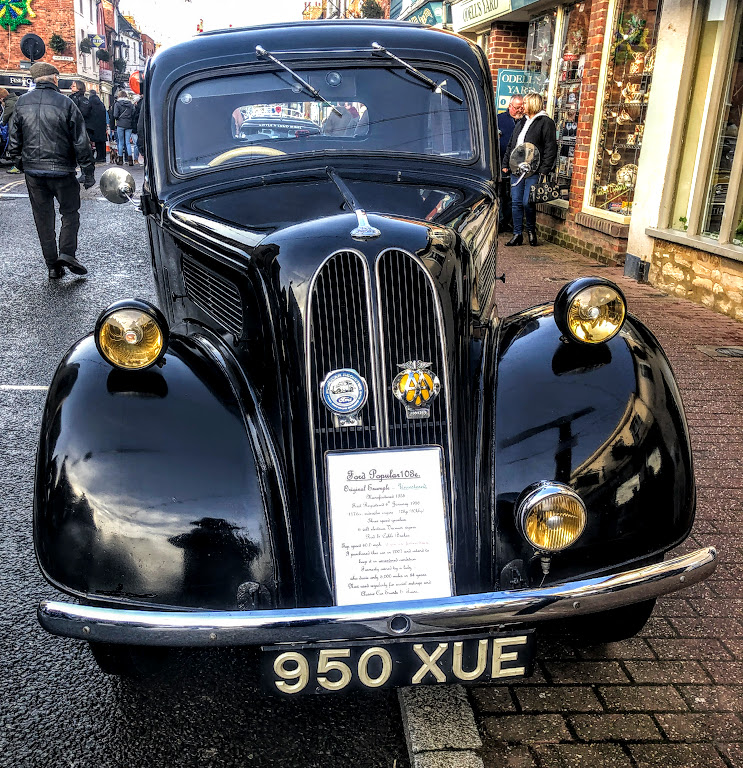
A Ford Popular in the Stony Stratford Vintage and Classic Festival revived many childhood memories (Photograph: Patrick Comerford, 2023)

Patrick Comerford

It baffles how I can remember the telephone numbers in the houses I lived in as a child, and the registration numbers of family cars through my childhood, but I am unfailing in my capacity to remember crucial numbers that are important in life today, such as mobile number, my NHS number and even – especially at times when I am running short of cash – the number of my bank card for ATMs.

Throughout my life I have never learned to drive. But the memories of cars that drove through my childhood remain in my mind.

There was ZL 5776, the Morris Minor that seems to have stood outside my grandmother’s house in Cappoquin, Co Waterford, for many years.

There was the old Ford Popuar that stood in the yard of a neighbours’ house, stripped of its wheels and engines and wheels and packed full of soap boxes and that was always a joy for us to play in as children.

There was the model yellow Austin Mini that I hoped and wished Santa would leave for me under the tree one childhood Christmas. I was about nine, I think, and I crept downstairs in the middle of the night to find it and to play with it in the silence between Christmas Eve and Christmas morning. But from his bedroom above, my father could see the light I had switched on, casting its beams on the front garden. In his characteristic anger, he rushed down, promptly confiscated it, never to be seen again.

There was SZD 634, the Peugeot that seems to have been in the family though much of my childhood and my teens, taking me to school in Gormanston at the beginning of each school term, and only seen again at the end of term – but also taking us on family holidays to Bettystown, Co Meath, Virginia, Co Cavan, and Salthill, Co Galway.

There was the teenage friend in Rugeley who bought a second-hand (or third- or fourth-hand) Merc, just for the fun of it, and another in Lichfield who drove around in a flashy beach buggy. I remember when I was in my late teens training as a chartered surveyor, and Sir Charles Wolseley was then a chartered surveyor with Smith Gore in Lichfield, driving a trademark red sports car around town, commuting daily between Lichfield and Wolseley.

There was Jemmer Murphy’s Capri in Wexford that we all wanted a lift in the early 1970s.

The Wolseley name recalls Frederick York Wolseley (1837-1899), a younger brother of Sir Garnet Wolseley (Photograph: Patrick Comerford, 2023)

I never did learn to drive in my adult years. But many of those cars came to mind on New Year’s Day during the Stony Stratford Vintage and Classic Festival, and many similar cars were there to revive those childhood and teenage memories.

But some of the cars also caught my imagination on Sunday because of the family names associated with them.

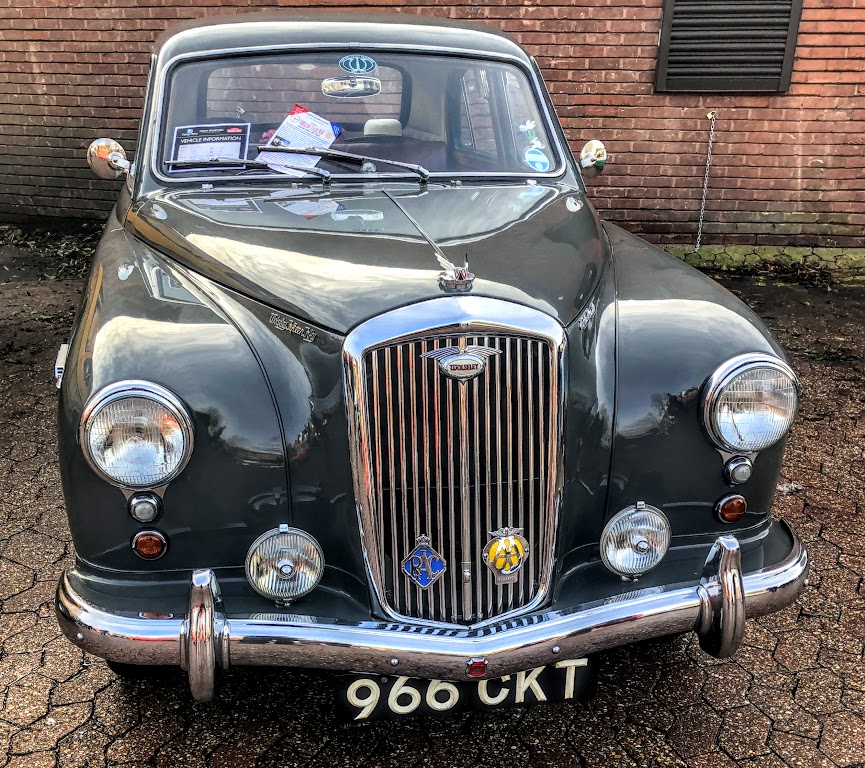
I have long been intrigued by the genealogical connections between the Wolseley and Comberford families. On Sunday, one of the cars on proud display was a Wolseley 15/50 dating from 1958. It was repainted five years ago, but otherwise the car is in its original condition.

Herbert Austin introduced the first British-designed motor car in England in 1895 and adapted the name Wolseley in honour of his long-time employer, Frederick York Wolseley (1837-1899), a younger brother of Sir Garnet Wolseley.

Talbot was a luxury car manufacturer founded in 1903 by the Earl of Shrewsbury (Photograph: Patrick Comerford, 2023)

A 1934 Talbot BA 65/75 has coachwork by the Carlton Carriage Co. The name Talbot also features regularly in Comberford family history, and the talbot is one of the principal figures on the Comberford family coat-of-arms.

Talbot was an English-French luxury car manufacturer founded in 1903 by Charles Chetwynd-Talbot, 20th Earl of Shrewsbury, and Adolphe Clément-Bayard. Their business was based in Barlby Road, Kensington, London. In the depression in the mid-1930s, the business was bought by Rootes Brothers and in 1938, the Company was renamed Sunbeam-Talbot Limited.

The Talbot name died out in the 1950s, but it was revived under the ownership of Peugeot and used between 1978 and 1994.

Cars like this 1930s Talbot were designed by the talented Swiss engineer Georges Roesch. His designs were noted for their excellence of engineering and the use of high quality materials. His cars were considered as the luxury sportscars of the day.

This car was delivered in May 1934 and spent its early years in Yorkshire. It was later bought by Eric Marsden around 1943 when the mileage was about 20,000. Marsden later moved to the Isle of Wight and put the car away in his garage, undriven for 45 years until he sold to it the Talbot specialist lan Polson as a restoration project.

Ian Polson restored the chassis and sold the part-finished project to David Thompson, who carried out a full and very comprehensive restoration in the 1990s. The drophead coupe bodywork was built by the Carlton Carriage Company and has been fully restored to its original conditionAbout 150 Talbots of the 65 and 75 series remain. Originally, three cars built with bodies to this design, but it is believed that this car is the only survivor.

Did the Riley name inspire TS Eliot’s characters? (Photograph: Patrick Comerford, 2023)

A Riley Lynx 12-4 Tower (Registration Plate ACR 308) is a 1937 Special Series model, first registered on 19 October 1936 in Southampton.

Riley was a family firm formed in Coventry in 1903, originally making cycles, having previously been involved in weaving machinery. It was famous for its wheels which were sold to 183 other motor manufacturers, including Rolls Royce.

Riley progressed from wire wheels through motorbikes and tricycles to motorcars in various works around Coventry. Most items were designed and made in house including the engines, for which they became well known when used in ERA racing cars and others. Riley’s won their class in many races around the world including Le Mans, Brooklands and various rallies.

Sadly many company documents were destroyed in the Coventry Blitz in 1940-1941, with the loss of many definitive production records. It is thought that about 500-600 cars like this were produced, and about 120 are still identified and running around the world.

The Riley company was renowned for high-quality engineering and corporate integrity, claiming to be ‘As old as the Industry, as Modern as the Hour’. It succumbed to over production of too many types during the 1930s. Following financial difficulties, Riley was bought out by William Morris, later Lord Nuffield. After World War II, the company was moved to MG at Abingdon, eventually becoming part of BMC then British Leyland where it continued making cars until 1959.

I wonder sometimes whether the name inspired singing of the bawdy song One Eyed Riley in The Cocktail Party by TS Eliot, or the more lavishly named Sir Henry Harcourt-Reilly. The name and IPR is now owned by BMW.

ZL 943, a 1949 version of the MG TD, was first registered in Dublin (Photograph: Patrick Comerford, 2023)

Childhood memories of car number places, of course, also drew my eyes to ZL 943, a 1949 version of the MG TD.

After World War II, MG wanted to bring out a new sports car, and so in 1949, as an interim design, they rebodied the pre-war TC model, with new front suspension and replaced the spoked wheels with solid metal wheels.

They only made a few of these before upgrading the engine unit, and also redesigning the dashboard instruments and piercing pepper-pot holes in the wheels to help cool the brakes. These last two changes are the only obvious sign of difference of this rare early model against the prolific TD made from 1950 onwards.

This MG TD was originally registered in Dublin, and when it was bought in 1967 for £180 it was in a shabby condition. ‘Zulu’ has always been in use, and is showing signs of age. It has e has never been restored, has been kept tidy, roadworthy and MOT’d … and it has been driven many miles round England and France over the years.

With ZL 5776 outside my grandmother’s house in Cappoquin, Co Waterford (Photograph: Patrick Comerford collection)

20 August 2022

Sheffield Cathedral: a former
parish church tells the long
story of England’s fifth city

The Cathedral Church of Saint Peter and Saint Paul has been the cathedral of the Church of England Diocese of Sheffield since the diocese was formed in 1914 (Photograph: Patrick Comerford, 2022)

Patrick Comerford

During my visit to Sheffield this week, I visited the two cathedrals in England’s fifth city: the Cathedral Church of Saint Peter and Saint Paul has been the cathedral of the Church of England Diocese of Sheffield since the diocese was formed in 1914; nearby, the Cathedral Church of Saint Marie is the cathedral of Roman Catholic Diocese of Hallam.

The Cathedral of Saint Peter and Saint Paul, Sheffield, was originally the city’s parish church, and was originally dedicated to Saint Peter. From some time after the Reformation until the 19th century it was dedicated to Holy Trinity, but it is now dedicated to Saint Peter and Saint Paul.

The cathedral is one of five Grade I listed buildings in Sheffield, along with the Town Hall, Abbeydale Industrial Hamlet, and the parish churches at Ecclesfield and Bradfield.

Inside Sheffield Cathedral, facing the East End (Photograph: Patrick Comerford, 2022)

The cathedral stands on Church Street in the city centre, close to the head of Fargate. It is an unusual mixture of mediaeval and modern architecture, and the earliest section of the cathedral dates back to ca 1200.

The site of the cathedral has a long history. The shaft of the Sheffield Cross, dating from the ninth century and now in the British Museum, is believed to be from this site.

The parish church was founded on the site as a minster of Worksop Priory. It was built in the 12th century by William de Lovetot at the opposite end of the town to Sheffield Castle.

Sheffield Castle was destroyed during the English Civil War in the mid-17th century, but the boundaries of Sheffield parish remained unchanged until the 19th century.

Inside Sheffield Cathedral, facing the West End (Photograph: Patrick Comerford, 2022)

The 12th century church was burnt down in 1266 during the Second Barons’ War against King Henry III. Another parish church was built in 1280, but this church was mostly demolished and rebuilt about 1430 on a cruciform floor plan.

The east end is the oldest part of the cathedral. Stones in the east wall of the sanctuary date from the 13th century. The sanctuary and chancel date from the 15th century. The 15th century cruciform church included lofts and a rood chapel, removed during the reign of Elizabeth I, although their scars can be seen on the walls.

The chancel roof is a hammerbeam roof with gilded angels, and probably dates from the 16th century. The outstretched wings were a modern gift from George Bailey in the 1960s.

The Shrewsbury Chapel was built in the 16th century to house the Tudor monuments of the Earls of Shrewsbury (Photograph: Patrick Comerford, 2022)

The Shrewsbury Chapel was built in the 16th century to house the Tudor monuments of the Earls of Shrewsbury, Lords of the Manor of Sheffield. Several members of the Talbot family are buried in the vault, and the altarpiece is mediaeval in date.

On the south wall of the Shrewsbury Chapel, the alabaster monument of George Talbot, 6th Earl of Shrewsbury, has an architectural surround, an armoured effigy and a Latin inscription.

The monument on the left towards the sanctuary is to George Talbot, 4th Earl of Shrewsbury. It is made of fine marble, carved in an Italian style to depict Talbot and his two wives in positions of prayer. Both are fine examples of Tudor monuments.

The monument to George Talbot, 4th Earl of Shrewsbury (Photograph: Patrick Comerford, 2022)

The altar in the Shrewsbury Chapel is a rare pre-Reformation stone ‘Mensa’ marked with carved consecration crosses.

The Reredos behind dates from the restoration of the chapel in 1935 and features Christ and the saints whose chapels were part of the mediaeval church.

Local craft workers built a screen for the Shrewsbury Chapel, but this was modified and moved to the north aisle in the 1900s. During restoration work in 2013, it was discovered that a number of the Shrewsbury coffins were missing from the crypt.

The window of the ‘Six Sheffield Worthies’ by Christopher Webb (Photograph: Patrick Comerford, 2022)

The stained glass window of the ‘Six Sheffield Worthies’ by Christopher Webb was originally installed in the north wall of the original Saint George’s Chapel but was moved to its current location in the 1960s. It depicts soldiers and benefactors of the church throughout the centuries:

• Waltheof was the last Saxon Lord of the Manor of Hallamshire, an ancient boundary including modern-day Sheffield and parts of Rotherham and north Derbyshire.
• William de Lovetot was a Norman Lord of the Manor who built the first Parish Church on this site around 1101, Sheffield's motte and bailey castle and a hospital for the poor at Spital Hill.
• Gerard de Furnivall inherited the Lordship when he married Maud de Lovetot; he fought and died on the Crusades.
• Thomas Nevil gained the Lordship when he married into the de Furnival family and established Sheffield as a market town by Royal Charter in 1386.
• John Talbot (1387-1453), 1st Earl of Shrewsbury , became the Lord of the Manor when he married Maud Nevil, daughter of Thomas Nevill. He is the Talbot of Shakespeare’s Henry IV Part I, and he contributed towards building the 15th century church.
• Colonel Sir John Bright was the Parliamentarian Governor of Sheffield Castle after its surrender in the Civil War in 1644.

The Tudor screen beneath and to the right of the window originally separated the Shrewsbury Chapel from the Lady Chapel and one panel displays some simple carvings of the talbot dog.

Saint George’s Chapel commemorates the York and Lancaster Regiment (Photograph: Patrick Comerford, 2022)

Saint Katharine’s Chapel was added as a vestry chapel in 1777, but it destroyed the cruciform shape of the plan of the church. Today, the chapel celebrates the ministry of women in the Church.

Rebuilding in the 1770s included the addition of tracery to the windows and resurfacing of the walls with moorstone. The north and south walls of the nave were rebuilt in 1790-1793.

The east window is a monument to the poet James Montgomery (1771-1854), who lived in Sheffield.

To the north of the nave, Saint George’s Chapel commemorates the York and Lancaster Regiment. It is furnished with regimental flags and a screen of bayonets and swords.

The ‘Te Deum’ window by Christopher Webb (Photograph: Patrick Comerford, 2022)

Under Saint George’s Chapel are the Chapel of the Holy Spirit and the vaulted crypt chapel of All Saints.

The Chapel of the Holy Spirit is part of the 1930s extension and was planned as a new Lady Chapel of the reoriented Cathedral. The chapel has a four-part vaulting system and a painted screen The is dominated by the great Te Deum stained glass window by Christopher Webb. At the top of the window, inspired by the canticle Te Deum, is the dove of the Holy Spirit, while at the centre Christ in Glory is surrounded by prophets, martyrs and the faithful through the ages.

A Dove can also be seen above the entrance door to the chapel and there are angels around the entrance. The vaulted ceiling is carved with roses, vines, lilies and sunflower motifs. The wooden stalls and canopies were designed by Sir Ninian Comper.

Lorna May Wadsworth’s charcoal cartoon for her monumental altarpiece, ‘A Last Supper’ (Photograph: Patrick Comerford, 2022)

Below the window are the altar and a reredos in memory of Sheffield Freemasons who died during World War I. However, the reredos has been replaced at present by the charcoal cartoon by the Sheffield artist Lorna May Wadsworth for her monumental altarpiece, ‘A Last Supper,’ in Saint George’s Church, Nailsworth.

All Saints’ Chapel is also in the crypt. With its arches and vaulting, it is an intimate and peaceful place for prayer and contemplation. This is the first purpose-built chapel in an English cathedral for the storage of ashes.

A window in a corner of the chapel is by Keith New (1966) in memory of Rowley Hill, Vicar of Sheffield (1873-1877).

The Lantern Tower with its abstract design by Amber Hiscott (Photograph: Patrick Comerford, 2022)

The lantern tower was an earlier addition to improve light but its glass was replaced by an abstract design by Amber Hiscott in 1998-1999. The wooden structure represents Christ’s Crown of Thorns and the coloured glass represents human conflict and struggle (blues and violets) being transformed through the Resurrection and the Holy Spirit (golds and reds), leading to healing (greens).

A major restoration by Flockton and Gibbs, including the addition of new north and south transepts, was completed in 1880.

During this work, the galleries were removed, the organ was moved to the north transept to clear the chancel, and new oak pews were installed, and the north and south transepts and the west end were extended. These additions left the church an awkward shape in plan, but with an impressive south elevation.

Charles Nicholson drafted plans in the 1900s to extend the cathedral. His designs called for a radical realignment of the axis by 90 degrees and to reorient it on its axis. However, funds and two World Wars modified those designs. The changes carried out throughout the 20th century have mainly affected the northern part of the cathedral, which was extensively expanded.

The main entrance to the cathedral is at the expanded west end, added in 1966 when the cathedral was rededicated. The Baptism font is at this end.

The main entrance to the cathedral is at the expanded west end, added in 1966 (Photograph: Patrick Comerford, 2022)

A fire in the belltower on 17 July 1979 began inside the belfry, and spread down the tower to the ground floor and up to the clockroom. Several cathedral bells were destroyed, including one from the 16th century, and much of the clock mechanism. Burst pipes flooded the choir stalls, and all records of the cathedral’s bellringers were destroyed. But the cathedral was back at work within ten days.

The cathedral underwent another interior and exterior refurbishment in 2013-2014.

But another fire broke out in the cathedral on the evening of 14 May 2020. The fire caused damage to the interior and smoke damage in the entire building, including many stained glass windows. The fire also destroyed the rooms of the Cathedral Archer Project, a homelessness charity.

Although it became the cathedral of the new Diocese of Sheffield in 1914, the cathedral remains the parish church of the smaller Parish of Sheffield.

The Diocese of Sheffield was formed in 1914 out of the Diocese of York, along with part of the Diocese of Southwell in the city of Sheffield. It covers most of South Yorkshire, apart from Barnsley, with a small part of the East Yorkshire, one parish in North Yorkshire and one in North Lincolnshire. It covers an area of almost 1,500 sq km (576 square miles).

The Bishop of Sheffield, Dr Pete Wilcox, is a former Canon Chancellor of Lichfield Cathedral (2016-2012) and a former Dean of Liverpool Cathedral (2012-2017). His wife is the novelist Catherine Fox. The Dean of Sheffield is the Very Revd Abi Thompson.

All Saints’ Chapel in the crypt, with its arches and vaulting (Photograph: Patrick Comerford, 2022)