‘Whoever does not take the cross and follow me is not worthy of me’ (Matthew 10: 38) … the Byzantine-style crucifix by Laurence King (1907-1981) in the crypt of Saint Mary le Bow on Cheapside in London (Photograph: Patrick Comerford)
Patrick Comerford
We are in Ordinary Time in the Church Calendar, and this is the Third Sunday after Trinity (Trinity III, 21 June 2026). Tomorrow is also Father’s Day and the Summer Solstice, although next Wednesday (24 June) is officially Midsummer’s Day.
I hope to be involved in the Parish Eucharist in Saint Mary and Saint Giles Church later this morning. Meanwhile, before today begins, I am taking some quiet time this morning to give thanks, to reflect, to pray and to read in these ways:
1, reading today’s Gospel reading;
2, a short reflection;
3, a prayer from the USPG prayer diary;
4, the Collects and Post-Communion prayer of the day.
‘Whoever does not take up the cross and follow me is not worthy of me’ (Matthew 10: 37) … Station 5 in the Chapel at Saint John’s Hospital, Lichfield, Simon of Cyrene helps Jesus carry the Cross (Photograph: Patrick Comerford)
Matthew 10: 24-39 (NRSVA):
[Jesus said:] 24 ‘A disciple is not above the teacher, nor a slave above the master; 25 it is enough for the disciple to be like the teacher, and the slave like the master. If they have called the master of the house Beelzebul, how much more will they malign those of his household!
26 ‘So have no fear of them; for nothing is covered up that will not be uncovered, and nothing secret that will not become known. 27 What I say to you in the dark, tell in the light; and what you hear whispered, proclaim from the housetops. 28 Do not fear those who kill the body but cannot kill the soul; rather fear him who can destroy both soul and body in hell. 29 Are not two sparrows sold for a penny? Yet not one of them will fall to the ground unperceived by your Father. 30 And even the hairs of your head are all counted. 31 So do not be afraid; you are of more value than many sparrows.
32 ‘Everyone therefore who acknowledges me before others, I also will acknowledge before my Father in heaven; 33 but whoever denies me before others, I also will deny before my Father in heaven.
34 ‘Do not think that I have come to bring peace to the earth; I have not come to bring peace, but a sword.
35 For I have come to set a man against his father,
and a daughter against her mother,
and a daughter-in-law against her mother-in-law;
36 and one’s foes will be members of one’s own household.
37 Whoever loves father or mother more than me is not worthy of me; and whoever loves son or daughter more than me is not worthy of me; 38 and whoever does not take up the cross and follow me is not worthy of me. 39 Those who find their life will lose it, and those who lose their life for my sake will find it.’
‘What I say to you in the dark, tell in the light …’ (Matthew 10: 27) … a moment of prayer in Saint Titus Church, Iraklion (Photograph: Patrick Comerford, 2025)
Today’s Reflections:
In the Gospel reading last Sunday (Matthew 9: 35 to 10: 8 or 10: 23, Sunday 14 June 2026), Christ calls the Twelve together to prepare them for their ministry and mission. In today’s Gospel reading (Matthew 10: 24-39), Christ continues to prepare the Twelve for this mission, as both their teacher and their master. They are his students, and they are to be like him, they are told, and they receive their instructions and commission for mission, even in the most hostile of environments.
When the late Archbishop Desmond Tutu (1931-2021) received the Nobel Peace Prize in 1984, I profiled him for The Irish Times. We had met previously, at events co-hosted by AfrI and Christian CND and at dinner in Roebuck House, Seán MacBride’s house in Clonskeagh, Dublin.
I asked him about the death threats he faced in South Africa at the height of apartheid. He engaged me with that look that confirmed his deep hope, commitment and faith, and said: ‘But you know, death is not the worst thing that could happen to a Christian.’
He must have been tempted at times to give up being a thorn in the side of the regime, to stop being a ‘turbulent priest,’ and to live a comfortable life. But his conscience would never have been comfortable.
While apartheid was still in force, Desmond Tutu became Dean of Saint Mary’s Cathedral in Johannesburg, and when I first met him, he was the secretary general of the South African Council of Churches.
I was worried about the many death threats he was receiving, and I asked him how he lived with those threats. Was he worried about them? Did he ever consider modifying what he had to say because of them? His answer was similar to the one he gave when he was facing tough questioning before the regime’s Eloff Commission. He told that inquiry:
‘There is nothing the government can do to me that will stop me from being involved in what I believe God wants me to do. I do not do it because I like doing it. I do it because I am under what I believe to be the influence of God’s hand. I cannot help it. When I see injustice, I cannot keep quiet, for, as Jeremiah says, when I try to keep quiet, God’s Word burns like a fire in my breast. But what is it that they can ultimately do? The most awful thing that they can do is to kill me, and death is not the worst thing that could happen to a Christian.’
In 1987, Veritas invited me to write a short, 36-page biography of Archbishop Tutu, published as Desmond Tutu: Black Africa’s Man of Destiny. It was launched by the then Minister for Foreign Affairs, Brian Lenihan. It was a small book, hardly more than a pamphlet, but it came at an important time when both the Irish Government and the Irish Churches were becoming increasingly vocal about the evils of apartheid. It was republished in the US by Citadel (1988) and Hyperion Books (1989).
When I visited South Africa in 1990 with The Irish Times and Christian Aid, I met Archbishop Tutu in Cape Town, where once again he spoke powerfully about the changes that were beginning to take place.
Then, when my colleague Patsy McGarry was organising a monumental series of features in The Irish Times in 2000 to mark the millennium, Archbishop Tutu was one of the international contributors, along with Hans Küng, Andrew Greeley and Mary Robinson. The complete series was published by Veritas the following year as a book, Christianity, in which Part Two was my ‘Brief History of Christianity.’
I last met Archbishop Tutu when he visited Dublin in 2005, and he preached in Saint George’s and Saint Thomas’s Church in the inner city, where Canon Katharine Poulton was then the Rector, as part of the Discovery Gospel Choir services.
His unforgettable words to me echo Christ’s words to the disciples in today’s Gospel reading: ‘Do not fear those who kill the body but cannot kill the soul; rather fear him who can destroy both soul and body in hell’ (Matthew 10: 28).
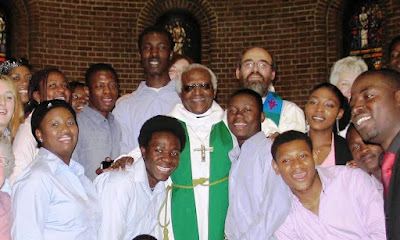
‘The most awful thing that they can do is to kill me, and death is not the worst thing that could happen to a Christian’ … Archbishop Desmond Tutu visiting Saint George’s and Saint Thomas’s Church, Dublin, and the Discovery Gospel Choir
Today’s Prayers (Sunday 21 June 2026, Trinity III, Fathers Day):
In Pray with the World Church, the prayer diary of the Anglican mission agency USPG (United Society Partners in the Gospel), the theme this week, from 21 to 27 June 2026 (pp 12-13), is ‘Land Taken, Land Remembered’. This theme is introduced today with a reflection by the Venerable Rosalyn Kantlaht’ant Elm, Director of Indigenous Ministries, Anglican Church of Canada:
When I think about how land was taken from Indigenous communities in Canada, I see that it was not the work of one person or a single event. It happened slowly, over more than four hundred years. In the early days of European settlement, Indigenous peoples and settlers often lived and worked alongside one another. Though imperfect, there was a time of coexistence.
As Canada developed, laws such as the Civilization Act and the Indian Act enabled the government to take Indigenous lands and move our people onto reserves – fenced-in areas often far from our traditional territories, languages, medicines, ceremonies, and rituals. This process unfolded over generations. Today, Indigenous peoples occupy only a small fraction of our original lands. Much of the rest remains under treaty dispute or is unceded territory, often threatened by mining, forestry, and oil and gas development.
Churches also played a significant role. In partnership with the government, they sought to ‘civilise’ Indigenous children, attempting to erase our cultures. In doing so, they became complicit in what can rightly be described as a legislative form of cultural genocide.
These truths are difficult to speak and to hear. But just as Christians cannot have Easter without Good Friday, we cannot skip the hard history and move straight to celebration. Facing these truths together allows us to lament, to pray, and to understand ourselves not by what we own, but as people created by God, called to care for one another and for the land.
The USPG prayer diary today (Sunday 21 June 2026, Trinity III, Fathers Day, National Indigenous Peoples Day, Canada) invites us to pray:
Creator God, from you every family in heaven and earth takes its name. Rooted and grounded in your covenant love, empowered by your Spirit, help us speak the truth in love and walk in your way towards justice and wholeness. (Anglican Church of Canada)
The Collect of the Day:
Almighty God,
you have broken the tyranny of sin
and have sent the Spirit of your Son into our hearts
whereby we call you Father:
give us grace to dedicate our freedom to your service,
that we and all creation may be brought
to the glorious liberty of the children of God;
through Jesus Christ your Son our Lord,
who is alive and reigns with you,
in the unity of the Holy Spirit,
one God, now and for ever.
The Post-Communion Prayer:
O God, whose beauty is beyond our imagining
and whose power we cannot comprehend:
show us your glory as far as we can grasp it,
and shield us from knowing more than we can bear
until we may look upon you without fear;
through Jesus Christ our Saviour.
Additional Collect:
God our saviour,
look on this wounded world
in pity and in power;
hold us fast to your promises of peace
won for us by your Son,
our Saviour Jesus Christ.
Yesterday’s Reflections
Continued Tomorrow
‘Whoever does not take up the cross and follow me is not worthy of me’ (Matthew 10: 37) … Christ is given his cross, a fresco in Analipsi Church in Georgioupoli, Crete (Photograph: Patrick Comerford)
Scripture quotations are from the New Revised Standard Version Bible: Anglicised Edition copyright © 1989, 1995, National Council of the Churches of Christ in the United States of America. Used by permission. All rights reserved worldwide. http://nrsvbibles.org
‘Are not two sparrows sold for a penny? … you are of more value than many sparrows’ (Matthew 10: 29-30) … a mother sparrow feds her chicks in a church in the ceiling of Aghias Anna Church, Maroulas, near Rethymnon in Crete (Patrick Comerford)
Showing posts with label Father's Day. Show all posts
21 June 2026
Daily prayer in Ordinary Time 2026:
45, Sunday 21 June 2026,
Third Sunday after Trinity (Trinity III)
Labels:
Apartheid,
Canada,
CND,
Crete 2026,
Father's Day,
Georgioupoli,
Greece 2026,
Iraklion,
Lichfield,
Maroulas,
Mission,
Prayer,
Rethymnon,
Saint Matthew's Gospel,
South Africa,
The Irish Times,
USPG
16 June 2024
Daily prayer in Ordinary Time 2024:
38, 16 June 2024, Trinity III
The altar and the holy gifts seen through the central doors of the iconostasis in Stony Stratford, open during the Divine Liturgy (Photograph: Patrick Comerford, 2024)
Patrick Comerford
This is the Third Sunday after Trinity (Trinity III, 16 June 2024) and Father’s Day – and in Dublin today is also being celebrated as Bloomsday, one of the great literary festivals in the English-speaking world. Later this morning I hope to sing with the choir at the Parish Eucharist in Saint Mary and Saint Giles Church in Stony Stratford.
Before today begins, I am taking some quiet time this morning to give thanks, for reflection, prayer and reading in these ways:
1, today’s Gospel reading;
2, a reflection on the icons in the new iconostasis or icon stand in the Greek Orthodox Church in Stony Stratford.
3, a prayer from the USPG prayer diary;
4, the Collects and Post-Communion prayer of the day.
The lower, first tier of the iconostasis in Stony Stratford, with the central doors open during the Divine Liturgy (Photograph: Patrick Comerford, 2024)
Mark 4: 24-37 (NRSVUE):
26 He [Jesus] also said, “The kingdom of God is as if someone would scatter seed on the ground 27 and would sleep and rise night and day, and the seed would sprout and grow, he does not know how. 28 The earth produces of itself first the stalk, then the head, then the full grain in the head. 29 But when the grain is ripe, at once he goes in with his sickle because the harvest has come.”
30 He also said, “With what can we compare the kingdom of God, or what parable will we use for it? 31 It is like a mustard seed, which, when sown upon the ground, is the smallest of all the seeds on earth, 32 yet when it is sown it grows up and becomes the greatest of all shrubs and puts forth large branches, so that the birds of the air can make nests in its shade.”
33 With many such parables he spoke the word to them as they were able to hear it; 34 he did not speak to them except in parables, but he explained everything in private to his disciples.
A circular icon of the Archangel Gabriel in the central doors of the iconostasis in Stony Stratford, one of two icons depicting the Annunciation (Photograph: Patrick Comerford, 2024)
The Stony Stratford iconostasis 1: The Doors
At the Divine Liturgy in the Orthodox Church, the Symbol of Faith or the Creed is traditionally introduced with the exclamation: ‘The Doors! The Doors! In wisdom, let us attend!’
However, the doors referred to here are the doors of the church building, and not the doors of the iconostasis as many think. This is a call to ensure that all catechumens and non-communicants have left, and that no-one enters or leave the liturgical assembly. The historical liturgical expectation was that the Creed would be said only by those who had already officially pronounced it at baptism, and continued to confess it within the life of the Church.
Of course, visitors are now allowed to remain in the church and, because the bread and wine of the liturgy have been brought though the doors of the iconostasis, many people now believe that these are the doors referred to in the call: ‘The Doors! The Doors! In wisdom, let us attend!’
Over the last few weeks, I have been watching the building and installation of the new iconostasis or icon screen in the Greek Orthodox Church in Stony Stratford. In my prayer diary this morning and over the next few weeks, I am reflecting on this new iconostasis, and the theological meaning and liturgical significance of its icons and decorations.
The lower, first tier of a traditional iconostasis is sometimes called Sovereign. On the right side of the Beautiful Gates facing forward is an icon of Christ, often as the Pantokrator, representing his second coming, and on the left is an icon of the Theotokos (the Virgin Mary), symbolising the incarnation. It is another way of saying all things take place between Christ’s first coming and his second coming.
Other icons on this tier usually include depictions of the patron saint or feast day of the church, Saint John the Baptist, one or more of the Four Evangelists, and so on.
The central doors of the iconostasis in Stony Stratford have two round or circular icons, one of the Archangel Gabriel and the other of the Virgin Mary.
When the doors are open during the liturgy, all can seen the altar and above it an iconic representation of the Crucifixion, with images on each side of it of the Virgin Mary and Saint John the Theologian or Saint John the Evangelist.
I am thinking this morning of how many people find the doors of the church are closed to them, and how often we fail to bring Christ out of the church and into the world. Bishop Rosemarie Mallett, in her reflections for the USPG Prayer Diary this morning, also discusses how many in the Windrush generation looked for welcome and hospitality from their Christian brothers and sisters but were turned away from church doors. Who else finds the doors of the church are closed to them?
A circular icon of the Virgin Mary in the central doors of the iconostasis in Stony Stratford, one of two icons depicting the Annunciation (Photograph: Patrick Comerford, 2024)
Today’s Prayers (Sunday 16 June 2024, Trinity III):
The theme this week in ‘Pray With the World Church,’ the Prayer Diary of the Anglican mission agency USPG (United Society Partners in the Gospel), is ‘Windrush Day.’ This theme is introduced today with reflections by the Right Revd Dr Rosemarie Mallett, Bishop of Croydon:
‘On Windrush Day, we remember the Caribbean migrants who, in the same year that Windrush Day was inaugurated (2018), faced deportation. Despite arriving in the UK with British passports and living here for decades, they were told they did not belong and had no right to be in the country.
‘That sense of ‘unbelonging’ and the hostile environment of racism and rejection are felt by many of the original generation and their descendants. There can be no Caribbean-diaspora person who has not personally faced or known someone who has faced overt racism, unconscious bias, and racialised arrogance due to skin colour and cultural differences from white UK society. This was no different for those who looked for welcome and hospitality from Christian brothers and sisters and were turned away from church doors. Thankfully, this did not stop that generation of migrants from envisioning a place for themselves in whatever aspect of society they wished to succeed in.
‘On this and every Windrush Day, we give thanks to those early pioneers, celebrating the successes of those individuals who believed in their talent and skills, and most often, their God. Who often worked hard to overcome prejudice and advance themselves, their families, and their community. Today, we can see the flourishing of leadership and representation of people of colour and those of Caribbean heritage and descent in all aspects of life in this country. However, though much has changed, there is still a way to go before people can truly feel welcome and accepted and that they fully belong.’
The USPG Prayer Diary today (16 June 2024, Trinity III) invites us to reflect on these words:
After this I looked, and there was a great multitude that no one could count, from every nation, from all tribes and peoples and languages, standing before the throne and before the Lamb, robed in white, with palm branches in their hands (Revelation 7: 9).
The Collect:
Almighty God,
you have broken the tyranny of sin
and have sent the Spirit of your Son into our hearts
whereby we call you Father:
give us grace to dedicate our freedom to your service,
that we and all creation may be brought
to the glorious liberty of the children of God;
through Jesus Christ your Son our Lord,
who is alive and reigns with you,
in the unity of the Holy Spirit,
one God, now and for ever.
Post Communion Prayer:
O God, whose beauty is beyond our imagining
and whose power we cannot comprehend:
show us your glory as far as we can grasp it,
and shield us from knowing more than we can bear
until we may look upon you without fear;
through Jesus Christ our Saviour.
Additional Collect:
God our saviour,
look on this wounded world
in pity and in power;
hold us fast to your promises of peace
won for us by your Son,
our Saviour Jesus Christ.
Yesterday’s introduction to the Stony Stratford iconostasis
Yesterday’s reflection
Continued tomorrow
I have watched the iconostasis being built and put in place in Stony Stratford in recent weeks (Photograph: Patrick Comerford, 2024)
Scripture quotations are from the New Revised Standard Version, Updated Edition copyright © 2021, National Council of the Churches of Christ in the United States of America. Used by permission. All rights reserved worldwide.
Patrick Comerford
This is the Third Sunday after Trinity (Trinity III, 16 June 2024) and Father’s Day – and in Dublin today is also being celebrated as Bloomsday, one of the great literary festivals in the English-speaking world. Later this morning I hope to sing with the choir at the Parish Eucharist in Saint Mary and Saint Giles Church in Stony Stratford.
Before today begins, I am taking some quiet time this morning to give thanks, for reflection, prayer and reading in these ways:
1, today’s Gospel reading;
2, a reflection on the icons in the new iconostasis or icon stand in the Greek Orthodox Church in Stony Stratford.
3, a prayer from the USPG prayer diary;
4, the Collects and Post-Communion prayer of the day.
The lower, first tier of the iconostasis in Stony Stratford, with the central doors open during the Divine Liturgy (Photograph: Patrick Comerford, 2024)
Mark 4: 24-37 (NRSVUE):
26 He [Jesus] also said, “The kingdom of God is as if someone would scatter seed on the ground 27 and would sleep and rise night and day, and the seed would sprout and grow, he does not know how. 28 The earth produces of itself first the stalk, then the head, then the full grain in the head. 29 But when the grain is ripe, at once he goes in with his sickle because the harvest has come.”
30 He also said, “With what can we compare the kingdom of God, or what parable will we use for it? 31 It is like a mustard seed, which, when sown upon the ground, is the smallest of all the seeds on earth, 32 yet when it is sown it grows up and becomes the greatest of all shrubs and puts forth large branches, so that the birds of the air can make nests in its shade.”
33 With many such parables he spoke the word to them as they were able to hear it; 34 he did not speak to them except in parables, but he explained everything in private to his disciples.
A circular icon of the Archangel Gabriel in the central doors of the iconostasis in Stony Stratford, one of two icons depicting the Annunciation (Photograph: Patrick Comerford, 2024)
The Stony Stratford iconostasis 1: The Doors
At the Divine Liturgy in the Orthodox Church, the Symbol of Faith or the Creed is traditionally introduced with the exclamation: ‘The Doors! The Doors! In wisdom, let us attend!’
However, the doors referred to here are the doors of the church building, and not the doors of the iconostasis as many think. This is a call to ensure that all catechumens and non-communicants have left, and that no-one enters or leave the liturgical assembly. The historical liturgical expectation was that the Creed would be said only by those who had already officially pronounced it at baptism, and continued to confess it within the life of the Church.
Of course, visitors are now allowed to remain in the church and, because the bread and wine of the liturgy have been brought though the doors of the iconostasis, many people now believe that these are the doors referred to in the call: ‘The Doors! The Doors! In wisdom, let us attend!’
Over the last few weeks, I have been watching the building and installation of the new iconostasis or icon screen in the Greek Orthodox Church in Stony Stratford. In my prayer diary this morning and over the next few weeks, I am reflecting on this new iconostasis, and the theological meaning and liturgical significance of its icons and decorations.
The lower, first tier of a traditional iconostasis is sometimes called Sovereign. On the right side of the Beautiful Gates facing forward is an icon of Christ, often as the Pantokrator, representing his second coming, and on the left is an icon of the Theotokos (the Virgin Mary), symbolising the incarnation. It is another way of saying all things take place between Christ’s first coming and his second coming.
Other icons on this tier usually include depictions of the patron saint or feast day of the church, Saint John the Baptist, one or more of the Four Evangelists, and so on.
The central doors of the iconostasis in Stony Stratford have two round or circular icons, one of the Archangel Gabriel and the other of the Virgin Mary.
When the doors are open during the liturgy, all can seen the altar and above it an iconic representation of the Crucifixion, with images on each side of it of the Virgin Mary and Saint John the Theologian or Saint John the Evangelist.
I am thinking this morning of how many people find the doors of the church are closed to them, and how often we fail to bring Christ out of the church and into the world. Bishop Rosemarie Mallett, in her reflections for the USPG Prayer Diary this morning, also discusses how many in the Windrush generation looked for welcome and hospitality from their Christian brothers and sisters but were turned away from church doors. Who else finds the doors of the church are closed to them?
A circular icon of the Virgin Mary in the central doors of the iconostasis in Stony Stratford, one of two icons depicting the Annunciation (Photograph: Patrick Comerford, 2024)
Today’s Prayers (Sunday 16 June 2024, Trinity III):
The theme this week in ‘Pray With the World Church,’ the Prayer Diary of the Anglican mission agency USPG (United Society Partners in the Gospel), is ‘Windrush Day.’ This theme is introduced today with reflections by the Right Revd Dr Rosemarie Mallett, Bishop of Croydon:
‘On Windrush Day, we remember the Caribbean migrants who, in the same year that Windrush Day was inaugurated (2018), faced deportation. Despite arriving in the UK with British passports and living here for decades, they were told they did not belong and had no right to be in the country.
‘That sense of ‘unbelonging’ and the hostile environment of racism and rejection are felt by many of the original generation and their descendants. There can be no Caribbean-diaspora person who has not personally faced or known someone who has faced overt racism, unconscious bias, and racialised arrogance due to skin colour and cultural differences from white UK society. This was no different for those who looked for welcome and hospitality from Christian brothers and sisters and were turned away from church doors. Thankfully, this did not stop that generation of migrants from envisioning a place for themselves in whatever aspect of society they wished to succeed in.
‘On this and every Windrush Day, we give thanks to those early pioneers, celebrating the successes of those individuals who believed in their talent and skills, and most often, their God. Who often worked hard to overcome prejudice and advance themselves, their families, and their community. Today, we can see the flourishing of leadership and representation of people of colour and those of Caribbean heritage and descent in all aspects of life in this country. However, though much has changed, there is still a way to go before people can truly feel welcome and accepted and that they fully belong.’
The USPG Prayer Diary today (16 June 2024, Trinity III) invites us to reflect on these words:
After this I looked, and there was a great multitude that no one could count, from every nation, from all tribes and peoples and languages, standing before the throne and before the Lamb, robed in white, with palm branches in their hands (Revelation 7: 9).
The Collect:
Almighty God,
you have broken the tyranny of sin
and have sent the Spirit of your Son into our hearts
whereby we call you Father:
give us grace to dedicate our freedom to your service,
that we and all creation may be brought
to the glorious liberty of the children of God;
through Jesus Christ your Son our Lord,
who is alive and reigns with you,
in the unity of the Holy Spirit,
one God, now and for ever.
Post Communion Prayer:
O God, whose beauty is beyond our imagining
and whose power we cannot comprehend:
show us your glory as far as we can grasp it,
and shield us from knowing more than we can bear
until we may look upon you without fear;
through Jesus Christ our Saviour.
Additional Collect:
God our saviour,
look on this wounded world
in pity and in power;
hold us fast to your promises of peace
won for us by your Son,
our Saviour Jesus Christ.
Yesterday’s introduction to the Stony Stratford iconostasis
Yesterday’s reflection
Continued tomorrow
I have watched the iconostasis being built and put in place in Stony Stratford in recent weeks (Photograph: Patrick Comerford, 2024)
Scripture quotations are from the New Revised Standard Version, Updated Edition copyright © 2021, National Council of the Churches of Christ in the United States of America. Used by permission. All rights reserved worldwide.
Labels:
#Bloomsday2024,
Annunciation,
Bloomsday,
Father's Day,
Icons,
Liturgy,
Milton Keynes,
Milton Keynes churches,
Mission,
Orthodoxy,
Prayer,
Racism,
Saint Mark's Gospel,
Stony Stratford,
USPG
18 June 2023
Daily prayers in Ordinary Time
with USPG: (21) 18 June 2023
The Church of Aghia Triada behind the narrow streets of Kalamitsi Alexandrou in Crete (Photograph: Patrick Comerford)
Patrick Comerford
Today is the Second Sunday after Trinity (18 June 2023) and Father’s Day. Later this morning, I hope to be present at the Parish Eucharist in Saint Mary and Saint Giles Church, Stony Stratford. But, before the day begins, I am taking some time for prayer, reading and reflection.
Over these weeks after Trinity Sunday, I am reflecting each morning in these ways:
1, Looking at relevant images or stained glass window in a church, chapel or cathedral I know;
2, the Gospel reading of the day in the Church of England lectionary;
3, a prayer from the USPG prayer diary.
Inside the Church of Aghia Triada in Kalamitsi Alexandrou (Photograph: Patrick Comerford)
Aghia Triada Church, Kalamitsi, Crete:
This week I am reflecting on Orthodox churches named after the Holy Trinity. These Trinity reflections this week begin this morning (18 June 2023) with photographs and images from Aghia Triada Church in Kalamitsi, on the island of Crete.
In reality, there are two villages with this name: Kalamitsi-Amigdali and Kalamitsi-Alexandrou – and they are sometimes referred to as the ‘divided village.’ About 140 people live round the year in Kalamitsis Alexandrou, and about 210 in Kalamitsi Amygdali, or 350 permanent residents between the two.
Where one village stops, the next village begins. On some maps they are simply called Alexandrou and Amigdali, without the name Kalamitsi, while other maps do not make a difference and simply call the both Kalamitsi.
The two villages are also split between two administrations: Kalamitsi Alexandrou is in the municipality of Vamos Kalamitsi, while Kalamitsi Amygdali is in the municipality of Giorgioupolis.
These villages lie in the beautiful green Apokoronas area between Souda Bay and Rethymnon, about 8 km from Vamos and five minutes away from Vrysses, with a drive of less than 15 minutes to Georgioupoli on the coast.
Both Kalamitsi villages are peaceful, traditional, and offer beautiful views of the Lefka Ori or White Mountains. Between them there are two tavernas, a kafenion and a mini-market. Kalamitsi Alexandrou also has an impressive underground reservoir, Softas, constructed during the Turkish occupation of Crete.
The large, modern, cross-shaped Church of Aghia Triada or the Holy Trinity is behind the narrow streets in Kalamitsi Alexandrou.
Although it is not in the centre of the village, the church is impossible not to find at the end of the narrow streets. With its large narthex, and tall dome and belltowers, it can be seen for long distances across the surrounding countryside.
But the church has many other usual features too. Unlike many churches in Greece of this shape, the dome remains undecorated, without any Pantocrator and the usual supporting frescoes.
Indeed, the walls and pillars of the church are largely undecorated too, without frescoes, and the old icons preserved in the church, many predating its building in the last century, are in wooden frames that are seldom seen in Greek churches.
These framed icons include, naturally, an icon of the Holy Trinity, and an icon of the Virgin Mary said to have been found in the foundations of an earlier church when the present church was being built.
The top of the iconostasis or icon screen is crowned with a verse from Saint John’s Gospel that begins: ‘I am the light of the world …’
The central door of the iconostasis has an interesting image portraying Christ present in the Eucharist, with a symbol of the Holy Trinity above.
After visiting the church, I returned to the square in Kalamitsis Alexandrou and enjoyed Greek coffees at the Kafenion Kolymbos before returning to Georgioupoli where I was spending a week during that year’s holiday in Crete.
The dome of the church remains undecorated (Photograph: Patrick Comerford)
Matthew 9: 35 to 10: 8 (NRSVA):
35 Then Jesus went about all the cities and villages, teaching in their synagogues, and proclaiming the good news of the kingdom, and curing every disease and every sickness. 36 When he saw the crowds, he had compassion for them, because they were harassed and helpless, like sheep without a shepherd. 37 Then he said to his disciples, ‘The harvest is plentiful, but the labourers are few; 38 therefore ask the Lord of the harvest to send out labourers into his harvest.’
1 Then Jesus summoned his twelve disciples and gave them authority over unclean spirits, to cast them out, and to cure every disease and every sickness. 2 These are the names of the twelve apostles: first, Simon, also known as Peter, and his brother Andrew; James son of Zebedee, and his brother John; 3 Philip and Bartholomew; Thomas and Matthew the tax-collector; James son of Alphaeus, and Thaddaeus; 4 Simon the Cananaean, and Judas Iscariot, the one who betrayed him.
5 These twelve Jesus sent out with the following instructions: ‘Go nowhere among the Gentiles, and enter no town of the Samaritans, 6 but go rather to the lost sheep of the house of Israel. 7 As you go, proclaim the good news, “The kingdom of heaven has come near.” 8 Cure the sick, raise the dead, cleanse the lepers, cast out demons. You received without payment; give without payment.’
A framed icon of the Virgin Mary said to have been found in the foundations of the earlier church (Photograph: Patrick Comerford)
Today’s Prayer:
The theme this week in ‘Pray With the World Church,’ the Prayer Diary of the Anglican mission agency USPG (United Society Partners in the Gospel) is ‘The snowdrop that never bloomed.’ This theme is introduced these morning:
Almost a year on from the conflict starting in Ukraine, USPG and the Diocese in Europe were able to visit some of the projects funded by the money raised from our joint appeal – including “Ukrainian Space” a Day Centre and Educational Facility in Budapest. The space offers children aged 8 to 16 schooling and a safe space for their parents to chat, support one another and learn new skills.
Ukrainian Space also offers activities for children and parents to do together such as art classes. One child drew her story in the days before she and her mother fled Ukraine.
“One of our students, together with her Mum, would pass a snowdrop on their walk to school every morning. It was in mid-February and this snowdrop was just about to bloom. It was still a bud. Every day the Mum would say to her daughter “You have to wait, maybe tomorrow, maybe tomorrow”.
When they saw that the flower would bloom for sure on the following day, it was on the following day that everything happened. The war began, and the missiles hit their native city in South Ukraine. They had to flee. The girl never saw the snowdrop bloom. It began to appear to her in her dreams, a symbol of the war and the fact that it had prevented her from seeing her favourite flower bloom. Snowdrops are also the first sign of spring. For this girl, spring never happened and winter continued”.
The Prayer in the USPG Prayer Diary today (18 June 2023, the Second Sunday after Trinity, Father’s Day) invites us to pray:
Eternal God,
bless us with the spirit of unity.
May we embrace difference,
and work with each other,
to put our faith into action.
Collect:
Lord, you have taught us
that all our doings without love are nothing worth:
send your Holy Spirit
and pour into our hearts that most excellent gift of love,
the true bond of peace and of all virtues,
without which whoever lives is counted dead before you.
Grant this for your only Son Jesus Christ’s sake,
who is alive and reigns with you,
in the unity of the Holy Spirit,
one God, now and for ever.
Post Communion:
Loving Father,
we thank you for feeding us at the supper of your Son:
sustain us with your Spirit,
that we may serve you here on earth
until our joy is complete in heaven,
and we share in the eternal banquet
with Jesus Christ our Lord.
The top of the icon screen is crowned with a verse from Saint John’s Gospel that begins: ‘I am the light of the world …’ (Photograph: Patrick Comerford)
Yesterday’s reflection
Continued tomorrow
Scripture quotations are from the New Revised Standard Version Bible: Anglicised Edition copyright © 1989, 1995, National Council of the Churches of Christ in the United States of America. Used by permission. All rights reserved worldwide. http://nrsvbibles.org
The central door of the iconostasis has an icon portraying Christ present in the Eucharist (Photograph: Patrick Comerford)
Patrick Comerford
Today is the Second Sunday after Trinity (18 June 2023) and Father’s Day. Later this morning, I hope to be present at the Parish Eucharist in Saint Mary and Saint Giles Church, Stony Stratford. But, before the day begins, I am taking some time for prayer, reading and reflection.
Over these weeks after Trinity Sunday, I am reflecting each morning in these ways:
1, Looking at relevant images or stained glass window in a church, chapel or cathedral I know;
2, the Gospel reading of the day in the Church of England lectionary;
3, a prayer from the USPG prayer diary.
Inside the Church of Aghia Triada in Kalamitsi Alexandrou (Photograph: Patrick Comerford)
Aghia Triada Church, Kalamitsi, Crete:
This week I am reflecting on Orthodox churches named after the Holy Trinity. These Trinity reflections this week begin this morning (18 June 2023) with photographs and images from Aghia Triada Church in Kalamitsi, on the island of Crete.
In reality, there are two villages with this name: Kalamitsi-Amigdali and Kalamitsi-Alexandrou – and they are sometimes referred to as the ‘divided village.’ About 140 people live round the year in Kalamitsis Alexandrou, and about 210 in Kalamitsi Amygdali, or 350 permanent residents between the two.
Where one village stops, the next village begins. On some maps they are simply called Alexandrou and Amigdali, without the name Kalamitsi, while other maps do not make a difference and simply call the both Kalamitsi.
The two villages are also split between two administrations: Kalamitsi Alexandrou is in the municipality of Vamos Kalamitsi, while Kalamitsi Amygdali is in the municipality of Giorgioupolis.
These villages lie in the beautiful green Apokoronas area between Souda Bay and Rethymnon, about 8 km from Vamos and five minutes away from Vrysses, with a drive of less than 15 minutes to Georgioupoli on the coast.
Both Kalamitsi villages are peaceful, traditional, and offer beautiful views of the Lefka Ori or White Mountains. Between them there are two tavernas, a kafenion and a mini-market. Kalamitsi Alexandrou also has an impressive underground reservoir, Softas, constructed during the Turkish occupation of Crete.
The large, modern, cross-shaped Church of Aghia Triada or the Holy Trinity is behind the narrow streets in Kalamitsi Alexandrou.
Although it is not in the centre of the village, the church is impossible not to find at the end of the narrow streets. With its large narthex, and tall dome and belltowers, it can be seen for long distances across the surrounding countryside.
But the church has many other usual features too. Unlike many churches in Greece of this shape, the dome remains undecorated, without any Pantocrator and the usual supporting frescoes.
Indeed, the walls and pillars of the church are largely undecorated too, without frescoes, and the old icons preserved in the church, many predating its building in the last century, are in wooden frames that are seldom seen in Greek churches.
These framed icons include, naturally, an icon of the Holy Trinity, and an icon of the Virgin Mary said to have been found in the foundations of an earlier church when the present church was being built.
The top of the iconostasis or icon screen is crowned with a verse from Saint John’s Gospel that begins: ‘I am the light of the world …’
The central door of the iconostasis has an interesting image portraying Christ present in the Eucharist, with a symbol of the Holy Trinity above.
After visiting the church, I returned to the square in Kalamitsis Alexandrou and enjoyed Greek coffees at the Kafenion Kolymbos before returning to Georgioupoli where I was spending a week during that year’s holiday in Crete.
The dome of the church remains undecorated (Photograph: Patrick Comerford)
Matthew 9: 35 to 10: 8 (NRSVA):
35 Then Jesus went about all the cities and villages, teaching in their synagogues, and proclaiming the good news of the kingdom, and curing every disease and every sickness. 36 When he saw the crowds, he had compassion for them, because they were harassed and helpless, like sheep without a shepherd. 37 Then he said to his disciples, ‘The harvest is plentiful, but the labourers are few; 38 therefore ask the Lord of the harvest to send out labourers into his harvest.’
1 Then Jesus summoned his twelve disciples and gave them authority over unclean spirits, to cast them out, and to cure every disease and every sickness. 2 These are the names of the twelve apostles: first, Simon, also known as Peter, and his brother Andrew; James son of Zebedee, and his brother John; 3 Philip and Bartholomew; Thomas and Matthew the tax-collector; James son of Alphaeus, and Thaddaeus; 4 Simon the Cananaean, and Judas Iscariot, the one who betrayed him.
5 These twelve Jesus sent out with the following instructions: ‘Go nowhere among the Gentiles, and enter no town of the Samaritans, 6 but go rather to the lost sheep of the house of Israel. 7 As you go, proclaim the good news, “The kingdom of heaven has come near.” 8 Cure the sick, raise the dead, cleanse the lepers, cast out demons. You received without payment; give without payment.’
A framed icon of the Virgin Mary said to have been found in the foundations of the earlier church (Photograph: Patrick Comerford)
Today’s Prayer:
The theme this week in ‘Pray With the World Church,’ the Prayer Diary of the Anglican mission agency USPG (United Society Partners in the Gospel) is ‘The snowdrop that never bloomed.’ This theme is introduced these morning:
Almost a year on from the conflict starting in Ukraine, USPG and the Diocese in Europe were able to visit some of the projects funded by the money raised from our joint appeal – including “Ukrainian Space” a Day Centre and Educational Facility in Budapest. The space offers children aged 8 to 16 schooling and a safe space for their parents to chat, support one another and learn new skills.
Ukrainian Space also offers activities for children and parents to do together such as art classes. One child drew her story in the days before she and her mother fled Ukraine.
“One of our students, together with her Mum, would pass a snowdrop on their walk to school every morning. It was in mid-February and this snowdrop was just about to bloom. It was still a bud. Every day the Mum would say to her daughter “You have to wait, maybe tomorrow, maybe tomorrow”.
When they saw that the flower would bloom for sure on the following day, it was on the following day that everything happened. The war began, and the missiles hit their native city in South Ukraine. They had to flee. The girl never saw the snowdrop bloom. It began to appear to her in her dreams, a symbol of the war and the fact that it had prevented her from seeing her favourite flower bloom. Snowdrops are also the first sign of spring. For this girl, spring never happened and winter continued”.
The Prayer in the USPG Prayer Diary today (18 June 2023, the Second Sunday after Trinity, Father’s Day) invites us to pray:
Eternal God,
bless us with the spirit of unity.
May we embrace difference,
and work with each other,
to put our faith into action.
Collect:
Lord, you have taught us
that all our doings without love are nothing worth:
send your Holy Spirit
and pour into our hearts that most excellent gift of love,
the true bond of peace and of all virtues,
without which whoever lives is counted dead before you.
Grant this for your only Son Jesus Christ’s sake,
who is alive and reigns with you,
in the unity of the Holy Spirit,
one God, now and for ever.
Post Communion:
Loving Father,
we thank you for feeding us at the supper of your Son:
sustain us with your Spirit,
that we may serve you here on earth
until our joy is complete in heaven,
and we share in the eternal banquet
with Jesus Christ our Lord.
The top of the icon screen is crowned with a verse from Saint John’s Gospel that begins: ‘I am the light of the world …’ (Photograph: Patrick Comerford)
Yesterday’s reflection
Continued tomorrow
Scripture quotations are from the New Revised Standard Version Bible: Anglicised Edition copyright © 1989, 1995, National Council of the Churches of Christ in the United States of America. Used by permission. All rights reserved worldwide. http://nrsvbibles.org
The central door of the iconostasis has an icon portraying Christ present in the Eucharist (Photograph: Patrick Comerford)
20 June 2021
Sunday intercessions on 20 June 2021,
Trinity III, Father’s Day
A Father’s Day image by Sheba Sultan
Father’s Day: Prayers of Thanksgiving and Intercession
The response to ‘Father of all’ is:
hear your children’s prayer.
Let us pray to God, our heavenly Father.
Father of all
hear your children’s prayer.
Sovereign Lord,
your Son has revealed you as our heavenly Father,
from whom every family in heaven and on earth is named.
Father of all
hear your children’s prayer.
You have made your Church a spiritual family,
a household of faith.
We give thanks for the faithful ministry in this diocese
of our Bishop, Kenneth, as he prepares to retire.
Through Baptism we are reborn as the brothers and sisters of Christ.
Deepen our unity and fellowship in him.
Father of all
hear your children’s prayer.
You sent your Son to give his life
as a ransom for the whole human family.
Give justice, peace and racial harmony
to the world he died to save.
Father of all
hear your children’s prayer.
You gave your Son a share in the life of a family in Nazareth.
Help us to value our families, to be thankful for them,
and to live sensitively within them.
Father of all
hear your children’s prayer.
Your Son drew around him a company of friends.
Bring love and joy to all who are alone.
We pray for all in our parish who sick,
at home or in hospital:
Ruby … Arthur … Ann … Daphne …
Simon … Sylvia … Ajay …
Help us all to find in the brothers and sisters of Christ
a loving family.
Father of all
hear your children’s prayer.
You are the God of the dead as well as of the living.
We pray for all who grieve and mourn at this time …
for all who are broken-hearted and
coming to terms with the loss of loved ones,
for the Downes, Smyth and Doherty families …
In confidence we remember those of the household of
faith who have gone before us.
Bring us with them to the joy of your home in heaven.
Father of all
hear your children’s prayer.
Material for Father’s Day from Common Worship © The Archbishops' Council of the Church of England, 2000-2004
Father’s Day: Prayers of Thanksgiving and Intercession
The response to ‘Father of all’ is:
hear your children’s prayer.
Let us pray to God, our heavenly Father.
Father of all
hear your children’s prayer.
Sovereign Lord,
your Son has revealed you as our heavenly Father,
from whom every family in heaven and on earth is named.
Father of all
hear your children’s prayer.
You have made your Church a spiritual family,
a household of faith.
We give thanks for the faithful ministry in this diocese
of our Bishop, Kenneth, as he prepares to retire.
Through Baptism we are reborn as the brothers and sisters of Christ.
Deepen our unity and fellowship in him.
Father of all
hear your children’s prayer.
You sent your Son to give his life
as a ransom for the whole human family.
Give justice, peace and racial harmony
to the world he died to save.
Father of all
hear your children’s prayer.
You gave your Son a share in the life of a family in Nazareth.
Help us to value our families, to be thankful for them,
and to live sensitively within them.
Father of all
hear your children’s prayer.
Your Son drew around him a company of friends.
Bring love and joy to all who are alone.
We pray for all in our parish who sick,
at home or in hospital:
Ruby … Arthur … Ann … Daphne …
Simon … Sylvia … Ajay …
Help us all to find in the brothers and sisters of Christ
a loving family.
Father of all
hear your children’s prayer.
You are the God of the dead as well as of the living.
We pray for all who grieve and mourn at this time …
for all who are broken-hearted and
coming to terms with the loss of loved ones,
for the Downes, Smyth and Doherty families …
In confidence we remember those of the household of
faith who have gone before us.
Bring us with them to the joy of your home in heaven.
Father of all
hear your children’s prayer.
Material for Father’s Day from Common Worship © The Archbishops' Council of the Church of England, 2000-2004
Praying in Ordinary Time 2021:
22, Saint Mark’s Basilica, Venice
Saint Mark’s Basilica in Venice … first built as the private chapel of the Doge (Photograph: Patrick Comerford)
Patrick Comerford
During this time in the Church Calendar known as Ordinary Time, I am taking some time each morning to reflect in these ways:
1, photographs of a church or place of worship;
2, the day’s Gospel reading;
3, a prayer from the prayer diary of the Anglican mission agency USPG (United Society Partners in the Gospel).
Today is the Third Sunday after Trinity and Father’s Day. Later this morning I am planning to preach at Morning Prayer in Saint Mary’s Church, Askeaton, Co Limerick, and to celebrate the Parish Eucharist in Saint Brendan’s Church, Tarbert, Co Kerry. Later today, I hope to be present as Precentor at the installation of new members of the chapter in Saint Flannan’s Cathedral, Killaloe, Co Clare.
Last week my photographs were of seven cathedrals in Italy. This morning (20 June 2021), my photographs are from Saint Mark’s Basilica, Venice, introducing a week of photographs of churches in Venice.
The west façade of Saint Mark’s, above the main entrance (Photograph: Patrick Comerford)
The Patriarchal Cathedral Basilica of Saint Mark is the cathedral of the Archdiocese of Venice, the most famous church in the city, and one of the finest examples of Italo-Byzantine architecture. Originally, Saint Mark’s was the chapel of the Doges of Venice, and it has been a cathedral only since 1807. Before that, the Patriarchs of Venice were seated at San Pietro di Castello.
Because of its opulent design, its mosaics and the wealth of its decoration, outside and inside, Saint Mark’s has become a symbol of Venetian wealth and power, and it is often known as the Chiesa d’Oro or Church of Gold.
The first Church of Saint Mark on this site beside the Doge’s Palace was built in 828-832, after merchants from Venice stole the body of Saint Mark the Evangelist in Alexandria. The present basilica was built from about 1063 and was completed in stages, and its basic shape includes a mixture of Italian and Byzantine features. The supposed but lost body of Saint Mark is said to have been rediscovered in a pillar by the Doge of Venice, Vitale Faliero, in 1094.
Although the basic structure of the building has not been altered much, its decoration has changed greatly over time. Inside, there is a dazzling display of gold ground mosaics on all the ceilings and upper walls. But there are spoils of classical and Byzantine buildings too, including the ninth-century Pala d’Oro from Constantinople, installed on the high altar in 1105, that were plundered or pilfered during the Crusades and other wars, including mosaics, columns, capitals and friezes.
In the 13th century, the church changed from being the private chapel of the Doge and became the state church and the venue for great state and public ceremonies, including the installation and burial of Doges.
The exterior of the west façade is divided into three registers: lower, upper and domes. In the lower register of the façade, five round-arched portals, enveloped by polychrome marble columns, open into the narthex through bronze-fashioned doors. The upper level of post-Renaissance mosaics in the lunettes of the lateral ogee arches depicts scenes from the Life of Christ, culminating in a 19th century replacement Last Judgment. Mosaics with scenes showing the history of the relics of Saint Mark fill the lunettes of the lateral portals, some of the mosaics dating from the 13th century.
Above the large central window of the façade, under Saint Mark, the Winged Lion who is his symbol and the symbol of Venice, holds a book quoting Pax Tibi Marce Evangelista Meus (‘Peace to you Mark my Evangelist’).
In the centre of the balcony, four bronze horses face the square. They were installed about 1254, but date from Classical Antiquity – some accounts say they once adorned the Arch of Trajan.
The horses were long displayed at the Hippodrome of Constantinople, but in 1204 Doge Enrico Dandolo sent them to Venice as part of the loot sacked from Constantinople in the Fourth Crusade. They were taken to Paris by Napoleon in 1797 but returned to Venice in 1815. Since the 1970s the originals have been kept in Saint Mark’s Museum and the horses on the façade today are bronze replicas.
The narthex or porch, dating from the 13th century, prepares the visitor for the gilded interior, with Old Testament scenes from Genesis and the lives of Noah, Abraham, Joseph and Moses. On the wall above and at the sides of the main doorway, the Four Evangelists and saints are depicted in 11th-century mosaics, the oldest in the building.
The porphyry statue of the Tetrarchs at the south-west corner, removed during restorations, represent the four co-emperors introduced in the third century. This statue too was taken from Constantinople during the Fourth Crusade in 1204.
Inside, Saint Mark’s is based on the design of the Emperor Constantine’s Church of the Holy Apostles in Constantinople.
The lower levels of the walls and pillars are covered with polychrome marble slabs. The upper levels are covered with bright mosaics covering an area of about 8,000 square metres. The earliest surviving work, in the main porch, probably dates from around 1070. The main work on the interior mosaics was complete by the 1270s, but most of the mosaics were replaced in the late 18th and early 19th centuries.
The large mosaic of Christ the Pantocrator, seated above the patron saints of Venice in the main apse, is a 15th-century recreation. The East dome over the high altar has a bust of Christ in the centre surrounded by prophets, the Virgin Mary and the Four Evangelists. The Ascension of Christ is depicted in the central dome and Pentecost in the west dome.
The marble floors of the basilica date from the 12th century.
In Saint Peter’s chapel in the left transept, the Madonna Nicopeia is the best-known Byzantine icon in Venice, also taken to Venice during the Fourth Crusade in 1204. The treasury holds a collection of Byzantine objects looted from Constantinople after the Fourth Crusade and later in 1261.
The walls and domes inside Saint Mark’s Basilica, Venice (Photograph: Patrick Comerford)
Mark 4: 35-41 (NRSVA):
35 When evening had come, Jesus said to his disciples, ‘Let us go across to the other side.’ 36 And leaving the crowd behind, they took him with them in the boat, just as he was. Other boats were with him. 37 A great gale arose, and the waves beat into the boat, so that the boat was already being swamped. 38 But he was in the stern, asleep on the cushion; and they woke him up and said to him, ‘Teacher, do you not care that we are perishing?’ 39 He woke up and rebuked the wind, and said to the sea, ‘Peace! Be still!’ Then the wind ceased, and there was a dead calm. 40 He said to them, ‘Why are you afraid? Have you still no faith?’ 41 And they were filled with great awe and said to one another, ‘Who then is this, that even the wind and the sea obey him?’
Christ and the saints depicted in a dome in Saint Mark’s (Photograph: Patrick Comerford)
Prayer in the USPG Prayer Diary:
The Prayer in the USPG Prayer Diary today (20 June 2021, Trinity III) invites us to pray:
Eternal God,
Bless us with the spirit of unity.
May we embrace difference,
And work with each other,
To put our faith into action.
Yesterday’s reflection
Continued tomorrow
The apse and dome above the high altar in Saint Mark’s (Photograph: Patrick Comerford)
Scripture quotations are from the New Revised Standard Version Bible: Anglicised Edition copyright © 1989, 1995, National Council of the Churches of Christ in the United States of America. Used by permission. All rights reserved worldwide. http://nrsvbibles.org
Patrick Comerford
During this time in the Church Calendar known as Ordinary Time, I am taking some time each morning to reflect in these ways:
1, photographs of a church or place of worship;
2, the day’s Gospel reading;
3, a prayer from the prayer diary of the Anglican mission agency USPG (United Society Partners in the Gospel).
Today is the Third Sunday after Trinity and Father’s Day. Later this morning I am planning to preach at Morning Prayer in Saint Mary’s Church, Askeaton, Co Limerick, and to celebrate the Parish Eucharist in Saint Brendan’s Church, Tarbert, Co Kerry. Later today, I hope to be present as Precentor at the installation of new members of the chapter in Saint Flannan’s Cathedral, Killaloe, Co Clare.
Last week my photographs were of seven cathedrals in Italy. This morning (20 June 2021), my photographs are from Saint Mark’s Basilica, Venice, introducing a week of photographs of churches in Venice.
The west façade of Saint Mark’s, above the main entrance (Photograph: Patrick Comerford)
The Patriarchal Cathedral Basilica of Saint Mark is the cathedral of the Archdiocese of Venice, the most famous church in the city, and one of the finest examples of Italo-Byzantine architecture. Originally, Saint Mark’s was the chapel of the Doges of Venice, and it has been a cathedral only since 1807. Before that, the Patriarchs of Venice were seated at San Pietro di Castello.
Because of its opulent design, its mosaics and the wealth of its decoration, outside and inside, Saint Mark’s has become a symbol of Venetian wealth and power, and it is often known as the Chiesa d’Oro or Church of Gold.
The first Church of Saint Mark on this site beside the Doge’s Palace was built in 828-832, after merchants from Venice stole the body of Saint Mark the Evangelist in Alexandria. The present basilica was built from about 1063 and was completed in stages, and its basic shape includes a mixture of Italian and Byzantine features. The supposed but lost body of Saint Mark is said to have been rediscovered in a pillar by the Doge of Venice, Vitale Faliero, in 1094.
Although the basic structure of the building has not been altered much, its decoration has changed greatly over time. Inside, there is a dazzling display of gold ground mosaics on all the ceilings and upper walls. But there are spoils of classical and Byzantine buildings too, including the ninth-century Pala d’Oro from Constantinople, installed on the high altar in 1105, that were plundered or pilfered during the Crusades and other wars, including mosaics, columns, capitals and friezes.
In the 13th century, the church changed from being the private chapel of the Doge and became the state church and the venue for great state and public ceremonies, including the installation and burial of Doges.
The exterior of the west façade is divided into three registers: lower, upper and domes. In the lower register of the façade, five round-arched portals, enveloped by polychrome marble columns, open into the narthex through bronze-fashioned doors. The upper level of post-Renaissance mosaics in the lunettes of the lateral ogee arches depicts scenes from the Life of Christ, culminating in a 19th century replacement Last Judgment. Mosaics with scenes showing the history of the relics of Saint Mark fill the lunettes of the lateral portals, some of the mosaics dating from the 13th century.
Above the large central window of the façade, under Saint Mark, the Winged Lion who is his symbol and the symbol of Venice, holds a book quoting Pax Tibi Marce Evangelista Meus (‘Peace to you Mark my Evangelist’).
In the centre of the balcony, four bronze horses face the square. They were installed about 1254, but date from Classical Antiquity – some accounts say they once adorned the Arch of Trajan.
The horses were long displayed at the Hippodrome of Constantinople, but in 1204 Doge Enrico Dandolo sent them to Venice as part of the loot sacked from Constantinople in the Fourth Crusade. They were taken to Paris by Napoleon in 1797 but returned to Venice in 1815. Since the 1970s the originals have been kept in Saint Mark’s Museum and the horses on the façade today are bronze replicas.
The narthex or porch, dating from the 13th century, prepares the visitor for the gilded interior, with Old Testament scenes from Genesis and the lives of Noah, Abraham, Joseph and Moses. On the wall above and at the sides of the main doorway, the Four Evangelists and saints are depicted in 11th-century mosaics, the oldest in the building.
The porphyry statue of the Tetrarchs at the south-west corner, removed during restorations, represent the four co-emperors introduced in the third century. This statue too was taken from Constantinople during the Fourth Crusade in 1204.
Inside, Saint Mark’s is based on the design of the Emperor Constantine’s Church of the Holy Apostles in Constantinople.
The lower levels of the walls and pillars are covered with polychrome marble slabs. The upper levels are covered with bright mosaics covering an area of about 8,000 square metres. The earliest surviving work, in the main porch, probably dates from around 1070. The main work on the interior mosaics was complete by the 1270s, but most of the mosaics were replaced in the late 18th and early 19th centuries.
The large mosaic of Christ the Pantocrator, seated above the patron saints of Venice in the main apse, is a 15th-century recreation. The East dome over the high altar has a bust of Christ in the centre surrounded by prophets, the Virgin Mary and the Four Evangelists. The Ascension of Christ is depicted in the central dome and Pentecost in the west dome.
The marble floors of the basilica date from the 12th century.
In Saint Peter’s chapel in the left transept, the Madonna Nicopeia is the best-known Byzantine icon in Venice, also taken to Venice during the Fourth Crusade in 1204. The treasury holds a collection of Byzantine objects looted from Constantinople after the Fourth Crusade and later in 1261.
The walls and domes inside Saint Mark’s Basilica, Venice (Photograph: Patrick Comerford)
Mark 4: 35-41 (NRSVA):
35 When evening had come, Jesus said to his disciples, ‘Let us go across to the other side.’ 36 And leaving the crowd behind, they took him with them in the boat, just as he was. Other boats were with him. 37 A great gale arose, and the waves beat into the boat, so that the boat was already being swamped. 38 But he was in the stern, asleep on the cushion; and they woke him up and said to him, ‘Teacher, do you not care that we are perishing?’ 39 He woke up and rebuked the wind, and said to the sea, ‘Peace! Be still!’ Then the wind ceased, and there was a dead calm. 40 He said to them, ‘Why are you afraid? Have you still no faith?’ 41 And they were filled with great awe and said to one another, ‘Who then is this, that even the wind and the sea obey him?’
Christ and the saints depicted in a dome in Saint Mark’s (Photograph: Patrick Comerford)
Prayer in the USPG Prayer Diary:
The Prayer in the USPG Prayer Diary today (20 June 2021, Trinity III) invites us to pray:
Eternal God,
Bless us with the spirit of unity.
May we embrace difference,
And work with each other,
To put our faith into action.
Yesterday’s reflection
Continued tomorrow
The apse and dome above the high altar in Saint Mark’s (Photograph: Patrick Comerford)
Scripture quotations are from the New Revised Standard Version Bible: Anglicised Edition copyright © 1989, 1995, National Council of the Churches of Christ in the United States of America. Used by permission. All rights reserved worldwide. http://nrsvbibles.org
21 June 2020
‘Nectar of the Angels’ and
a walk on Ballybunion beach
to celebrate Father’s Day
A Father’s Day greeting on Ballybunion Beach this afternoon (Photograph: Patrick Comerford, 2020)
Patrick Comerford
Today is both Midsummer’s Day and Father’s Day.
Despite it being Midsummer’s Day, the summer sunshine gave way to rain in Askeaton for most of this weekend.
I remember a Midsummer’s evening in Cambridge some years ago, watching Shakespeare’s A Midsummer Night’s Dream in the gardens of Saint John’s College, and the lines: ‘So quick bright things come to confusion,’ when Lysander speaks to Hermia of the fragility of happiness.
Or Hermia’s words to Lysander: ‘Belike for want of rain, which I could well Beteem them from the tempest of my eyes.’
I woke this morning to Father’s Day presents of a bottle of Masi Campo Fiorin and a bottle of Cockburn’s Special Reserve Port.
Later, after celebrating the Eucharist in the Rectory, as the clouds opened yet again, two of us went to ring the bell in the Templar Tower at Saint Mary’s Church, Askeaton.
The North Beach at Ballybunion in Midsummer sunshine (Photograph: Patrick Comerford, 2020)
It might have been an afternoon for watching old moves on the television. But the sun came out again at noon, and two of us headed west to Beale Strand to enjoy a walk on the beach, on clear white sands with blue skies above, looking out at the place where the Shannon Estuary flows into the Atlantic.
As the skies brightened and the lingering clouds began to break up, we decided to continue heading west to Ballybunion.
Although the North Beach, below the cliffs at Ballybunion, has lost its Blue Flag, it was sparking in the afternoon summer sunshine. Below, as we walked down the path to the beach, the Railway Bar in Ballybunion had left ‘A Happy Father’s Day’ greeting in the sand. The pubs are not open yet, but they know how to leave their mark.
Despite the red flags, some surfers were taking the risk to enjoy the high Atlantic waves.
Daroka, my favourite restaurant in Ballybunion, closed last autumn. It is sorely missed, and so we had our coffee in the car park opposite Daroka. But, above the South Beach, which still has its Blue Flag, there are many inviting restaurants, waiting to be explored and enjoyed when this lockdown ends.
A colourful terrace of houses and restaurants in Ballybunion above the South Beach in this afternoon (Photograph: Patrick Comerford, 2020)
This evening, to celebrate Father’s Day, I hope to share that bottle of Masi Campofiorin.
Campofiorin, the prototype for a new category of wines made with semi-dried grapes, was born in 1964 in the gentle hills of Verona as the result of an inspired technical experiment: refermentation of the best Veronese wine made of freshly-picked grapes on the lees of Amarone. For many decades now, it has been a benchmark for its territory of origin on the international stage.
The label on Campofiorin bears the motto: Nectar Angelorum Hominibus, ‘Nectar of the Angels for Human.’ I should enjoy that later this evening.
Golden sanda at Beale Beach this afternoon (Photograph: Patrick Comerford, 2020)
Patrick Comerford
Today is both Midsummer’s Day and Father’s Day.
Despite it being Midsummer’s Day, the summer sunshine gave way to rain in Askeaton for most of this weekend.
I remember a Midsummer’s evening in Cambridge some years ago, watching Shakespeare’s A Midsummer Night’s Dream in the gardens of Saint John’s College, and the lines: ‘So quick bright things come to confusion,’ when Lysander speaks to Hermia of the fragility of happiness.
Or Hermia’s words to Lysander: ‘Belike for want of rain, which I could well Beteem them from the tempest of my eyes.’
I woke this morning to Father’s Day presents of a bottle of Masi Campo Fiorin and a bottle of Cockburn’s Special Reserve Port.
Later, after celebrating the Eucharist in the Rectory, as the clouds opened yet again, two of us went to ring the bell in the Templar Tower at Saint Mary’s Church, Askeaton.
The North Beach at Ballybunion in Midsummer sunshine (Photograph: Patrick Comerford, 2020)
It might have been an afternoon for watching old moves on the television. But the sun came out again at noon, and two of us headed west to Beale Strand to enjoy a walk on the beach, on clear white sands with blue skies above, looking out at the place where the Shannon Estuary flows into the Atlantic.
As the skies brightened and the lingering clouds began to break up, we decided to continue heading west to Ballybunion.
Although the North Beach, below the cliffs at Ballybunion, has lost its Blue Flag, it was sparking in the afternoon summer sunshine. Below, as we walked down the path to the beach, the Railway Bar in Ballybunion had left ‘A Happy Father’s Day’ greeting in the sand. The pubs are not open yet, but they know how to leave their mark.
Despite the red flags, some surfers were taking the risk to enjoy the high Atlantic waves.
Daroka, my favourite restaurant in Ballybunion, closed last autumn. It is sorely missed, and so we had our coffee in the car park opposite Daroka. But, above the South Beach, which still has its Blue Flag, there are many inviting restaurants, waiting to be explored and enjoyed when this lockdown ends.
A colourful terrace of houses and restaurants in Ballybunion above the South Beach in this afternoon (Photograph: Patrick Comerford, 2020)
This evening, to celebrate Father’s Day, I hope to share that bottle of Masi Campofiorin.
Campofiorin, the prototype for a new category of wines made with semi-dried grapes, was born in 1964 in the gentle hills of Verona as the result of an inspired technical experiment: refermentation of the best Veronese wine made of freshly-picked grapes on the lees of Amarone. For many decades now, it has been a benchmark for its territory of origin on the international stage.
The label on Campofiorin bears the motto: Nectar Angelorum Hominibus, ‘Nectar of the Angels for Human.’ I should enjoy that later this evening.
Golden sanda at Beale Beach this afternoon (Photograph: Patrick Comerford, 2020)
Sunday intercessions on
21 June 2020 (Trinity II)
‘Hagar and Ishmael at the Well’ (1842) by Marshall Claxton (1813-1881), York Museums Trust
These intercessions were prepared for the Second Sunday after Trinity, 21 June 2020, in the Rathkeale and Kilnaughtin Group of Parishes. However, the churches have been closed temporarily because of the Covid-19 pandemic:
Let us pray:
Hagar lifted up her voice and wept. God heard that voice and the angel of God called to Hagar and said to her, ‘Do not be afraid’ (Genesis 21: 16-17).
Heavenly Father,
on this Father’s Day,
incline your ear, O Lord (Psalm 86: 1),
as we pray for all your children.
We pray for all fathers, our own fathers, those missing their fathers today,
all longing to be fathers, and give thanks those who we were loving father figures to us.
In Refugee Week,
we pray for all refugees, and all who work with them.
Comfort all who are victims of racism;
challenge us when we become too comfortable;
give us hope for all that is wonderful.
Comfort those who are isolated, alone and living in fear;
sustain and protect frontline workers;
Give hope to schools and places of education,
give wisdom to our government,
guide all who make difficult decisions,
help us to protect our communities and ourselves.
Give wisdom to all people
crying for justice,
condemning racism,
seeking peace.
We give thanks for the life and years of service of Detective Garda Colm Horkan,
and pray for all those who mourn his death,
including his family and all members of the Garda Siochana.
Lord have mercy,
Lord have mercy.
Lord Jesus Christ:
you were raised from the dead by the glory of the Father,
so we too might walk in newness of life (Romans 6: 4):
We pray for the Church,
that we may share that life generously and in abundance.
We pray for churches that are closed this morning,
that the hearts of the people may remain open
to the love of God, and to the love of others.
In the Anglican Cycle of Prayer, we pray this week
for the Church of Nigeria (Anglican Communion)
and Most Revd Henry Chukwudum Ndukuba,
Metropolitan and Primate of all Nigeria and Bishop of Abuja.
On Jerusalem Sunday,
we pray for the peace of Jerusalem:
‘May they prosper who love you.
Peace be within your walls’ (Psalm 122: 6-7),
and we pray for people of all faiths who share the city.
In the Church of Ireland, we pray this month for
the Diocese of Kilmore, Elphin and Ardagh,
and for Bishop Ferran Glenfield.
We pray for our Bishop Kenneth;
In the Diocesan Cycle of Prayer,
we pray for the Drumcliffe Union with Kilnasoolagh,
the Revd Kevin O’Brien,
and the congregations of
Saint Columba’s Church, Drumcliffe (Ennis),
Saint Fachtnan’s Cathedral, Kilfenora,
Christ Church Kilfarboy (Spanish Point),
and Kilnasoolagh church.
Christ have mercy,
Christ have mercy.
Holy Spirit,
Help us to be ‘not be afraid,’
for we are ‘of more value than many sparrows’ (Matthew 10: 31):
We pray for ourselves and for our needs,
for healing, restoration and health,
in body, mind and spirit.
We give thanks for new life …
We give thanks for the birth of baby Matilda Dorothy Caroline, born on 4 May …
and ask for your blessings on her parents, William and Karen Langford …
her sister Chloe Dorothy …
her cousins, uncles and aunts …
We pray for one another,
for those who are alone and lonely …
for those who are sick, at home or in hospital …
Alan and Margaret … Ajay … Charles … Tom …
Maria … Niall … Linda … Simon …
We give thanks for Lorraine’s successful treatment.
We pray for those who have broken hearts …
for those who live with disappointment …
We pray for all who are to be baptised …
We pray for all preparing to be married …
We pray for those who are about to die …
We pray for those who mourn and grieve…
we remember those who have died recently …
may their memories be a blessing …
We pray for those who have asked for our prayers …
and for those we have offered to pray for …
Lord have mercy,
Lord have mercy.
A prayer on the Second Sunday after Trinity
in the prayer diary of the Anglican mission agency USPG,
United Society Partners in the Gospel:
Loving God, we thank you for the clinics that are
reopening in Jobarpar, Bangladesh,
and we pray for continued growth
and success for the community health programme.
Merciful Father, …
Saint Fachtnan’s Cathedral, Kilfenora, Co Clare … named in the diocesan cycle of prayer this morning (Photograph: Patrick Comerford)
These intercessions were prepared for the Second Sunday after Trinity, 21 June 2020, in the Rathkeale and Kilnaughtin Group of Parishes. However, the churches have been closed temporarily because of the Covid-19 pandemic:
Let us pray:
Hagar lifted up her voice and wept. God heard that voice and the angel of God called to Hagar and said to her, ‘Do not be afraid’ (Genesis 21: 16-17).
Heavenly Father,
on this Father’s Day,
incline your ear, O Lord (Psalm 86: 1),
as we pray for all your children.
We pray for all fathers, our own fathers, those missing their fathers today,
all longing to be fathers, and give thanks those who we were loving father figures to us.
In Refugee Week,
we pray for all refugees, and all who work with them.
Comfort all who are victims of racism;
challenge us when we become too comfortable;
give us hope for all that is wonderful.
Comfort those who are isolated, alone and living in fear;
sustain and protect frontline workers;
Give hope to schools and places of education,
give wisdom to our government,
guide all who make difficult decisions,
help us to protect our communities and ourselves.
Give wisdom to all people
crying for justice,
condemning racism,
seeking peace.
We give thanks for the life and years of service of Detective Garda Colm Horkan,
and pray for all those who mourn his death,
including his family and all members of the Garda Siochana.
Lord have mercy,
Lord have mercy.
Lord Jesus Christ:
you were raised from the dead by the glory of the Father,
so we too might walk in newness of life (Romans 6: 4):
We pray for the Church,
that we may share that life generously and in abundance.
We pray for churches that are closed this morning,
that the hearts of the people may remain open
to the love of God, and to the love of others.
In the Anglican Cycle of Prayer, we pray this week
for the Church of Nigeria (Anglican Communion)
and Most Revd Henry Chukwudum Ndukuba,
Metropolitan and Primate of all Nigeria and Bishop of Abuja.
On Jerusalem Sunday,
we pray for the peace of Jerusalem:
‘May they prosper who love you.
Peace be within your walls’ (Psalm 122: 6-7),
and we pray for people of all faiths who share the city.
In the Church of Ireland, we pray this month for
the Diocese of Kilmore, Elphin and Ardagh,
and for Bishop Ferran Glenfield.
We pray for our Bishop Kenneth;
In the Diocesan Cycle of Prayer,
we pray for the Drumcliffe Union with Kilnasoolagh,
the Revd Kevin O’Brien,
and the congregations of
Saint Columba’s Church, Drumcliffe (Ennis),
Saint Fachtnan’s Cathedral, Kilfenora,
Christ Church Kilfarboy (Spanish Point),
and Kilnasoolagh church.
Christ have mercy,
Christ have mercy.
Holy Spirit,
Help us to be ‘not be afraid,’
for we are ‘of more value than many sparrows’ (Matthew 10: 31):
We pray for ourselves and for our needs,
for healing, restoration and health,
in body, mind and spirit.
We give thanks for new life …
We give thanks for the birth of baby Matilda Dorothy Caroline, born on 4 May …
and ask for your blessings on her parents, William and Karen Langford …
her sister Chloe Dorothy …
her cousins, uncles and aunts …
We pray for one another,
for those who are alone and lonely …
for those who are sick, at home or in hospital …
Alan and Margaret … Ajay … Charles … Tom …
Maria … Niall … Linda … Simon …
We give thanks for Lorraine’s successful treatment.
We pray for those who have broken hearts …
for those who live with disappointment …
We pray for all who are to be baptised …
We pray for all preparing to be married …
We pray for those who are about to die …
We pray for those who mourn and grieve…
we remember those who have died recently …
may their memories be a blessing …
We pray for those who have asked for our prayers …
and for those we have offered to pray for …
Lord have mercy,
Lord have mercy.
A prayer on the Second Sunday after Trinity
in the prayer diary of the Anglican mission agency USPG,
United Society Partners in the Gospel:
Loving God, we thank you for the clinics that are
reopening in Jobarpar, Bangladesh,
and we pray for continued growth
and success for the community health programme.
Merciful Father, …
Saint Fachtnan’s Cathedral, Kilfenora, Co Clare … named in the diocesan cycle of prayer this morning (Photograph: Patrick Comerford)
Some questions on Father’s Day
for a ‘Sorrowful Mother’s Day’
Hagar and Ishmael abandoned in the wilderness (Source)
Patrick Comerford
Sunday 21 June 2020
The Second Sunday after Trinity (Trinity II), Father’s Day
The Readings: Genesis 21: 8-21; Psalm 86: 1-10, 16-17; Romans 6: 1b-11; Matthew 10: 24-39.
There is a link to the readings HERE
‘Hagar in the Desert’ (1960) by Marc Chagall (1887-1985)
May I speak to you in the name of God, + Father, Son, and Holy Spirit, Amen.
Last Sunday (Genesis 18: 1-15, 21: 1-7, 14 June 2020, Trinity I), we heard how Sarah laughs when she hears from the messengers who visit Abraham at Mamre that she is going to be pregnant and give birth to a child within a year.
But the joy and laughter of those readings is in sharp contrast to what seem to be very sad and gloomy readings, filled with tears, this morning. Although it is Father’s Day, these readings may seem more appropriate for a Sorrowful Mother’s Day.
In our first reading (Genesis 21: 8-21), Hagar and her son are abandoned in the wilderness. It appears to be a story of cruel marginalisation and exclusion of a young mother and her helpless child.
In the Gospel reading (Matthew 10: 24-39), family divisions and the cruelty that only family members can inflict on one another are brought to the fore again. Where do we find the love of God in these Bible readings, and where is the love of God to be found in the Church today?
Following the visit to Abraham, and the promise to Abraham and Sarah of a child, which we read about last week, Isaac has been born to Abraham and Sarah in their old age, and the child has been circumcised as a sign of being one of God’s people.
Sarah has said, ‘God has brought laughter for me’ (verse 6), and the name Isaac means ‘he laughs.’
Now, at the age of three, Isaac is weaned, and a religious feast is called for.
Earlier passages (16: 11 and 16: 16) identify Ishmael as ‘the son of Hagar’ (verse 9). The name Ishmael means ‘God harkens,’ but Ishmael is not named in this reading – an indication that he ranks lower than Isaac. When Sarah did not bear a son for Abraham, he exercised the legal option of producing an heir with a slave woman.
At the feast, Sarah sees Ishmael playing or laughing with Isaac. She sees this as a real threat to her own life, so she asks Abraham to cast out’ Hagar and Ishmael (verses 9-10).
Abraham hesitates, for he loves Ishmael and is forbidden by law to do this. But Abraham hears God telling him to do as Sarah asks, promising Abraham’s line of descent will continue through Isaac, but that Ishmael too will also become the father of a nation (verses 12-13). Abraham gives Hagar bread and water and sends her and her son out into the wilderness of Beer-sheba (verses 14-15).
When the water runs out, Hagar realises death is near, and fears for her child’s survival (verses 15-16). God hears Ishmael’s cry and Hagar sees a well. God is with the boy, he grows up, lives in the wilderness of Paran, in northern Sinai, and marries an Egyptian woman (verses 17-21). All this is seen as his exclusion from God’s plan, and Genesis continues with the story of Isaac.
I imagine this story would be heard with shock, dismay and a sense of cruelty by many women as they think of their children and wonder what has happened to them.
Imagine the plight of this abandoned woman. The man she once had a child for has cast her aside, left her and her child, apparently not caring whether they live or die.
Until recent decades, Irish families, worried about the way a woman in the family conceived, sent her away. But, unlike Hagar, they were often sent away even before they gave birth. They were abandoned in so-called ‘Mother and Baby’ homes, county homes and Magdalene laundries in every county in this land.
So often not just the Church but society at large moralised about these women and sent them into isolation, not worrying how they would survive or about the future facing their children.
Families often remained silent in the face of these great and grave injustices. But silence did not always mean acceptance or acquiescence. It was a shameful time, where shame was transferred unto young and vulnerable women, when the real shame lay with those who exercised control in this way on behalf of all society.
Silently, many sisters, mothers, and to be honest, fathers and brothers too, grieved in their hearts at this harsh judgment, this immoral moralising.
And even today, to speak out about what has happened divides families, communities and societies. A deep, searing division that makes it easy to understand Christ’s apocalyptic warning in the Gospel reading: ‘For I have come to set a man against his father, and a daughter against her mother, and a daughter-in-law against her mother-in-law; and one’s foes will be members of one’s own household’ (Matthew 10: 34-36).
In the history of Judaism and of Christianity, there have been complicated, tortuous efforts to justify Abraham’s gross injustice towards Hagar.
The Apostle Paul makes Hagar’s experience an allegory of the difference between law and grace (see Galatians 4: 21-31). But he is not passing judgment on either Hagar or Sarah; he is simply using them as examples to illustrate a point about law and grace, whether we should live by the letter or live by the spirit of our spiritual and religious values.
Later, Augustine said Hagar symbolises an ‘earthly city,’ or the sinful condition of humanity (see Augustine, City of God 15: 2).
Yet Hagar committed no sin, did nothing wrong, for she only did what Sarah and Abraham had suggested. Certainly, her child Ishmael was innocent beyond doubt when they were both abandoned to seemingly certain death.
Augustine’s view was built on by Thomas Aquinas and by John Wycliffe, who compared the children of Sarah to the redeemed, and those of Hagar to the unredeemed, who are ‘carnal by nature and mere exiles.’
Surely if Hagar was ‘carnal by nature’ then so too were Abraham and Sarah; yet they go without any condemnation.
The rabbis were much kinder when it came to Hagar, and often describe her as Pharaoh’s daughter.
The rabbinic writings (the Midrash Genesis Rabbah) say Hagar was Pharaoh’s daughter but that Sarah treated her harshly, imposing heavy work on her and striking her. It sounds like the forced labour conditions imposed on hundreds if not thousands of women in county homes the length and breadth of Ireland from the 1920s on.
Some rabbinical commentators identify Hagar with Keturah, the woman Abraham marries after Sarah’s death, saying Abraham seeks her out after Sarah’s death. One great mediaeval rabbi suggests Hagar is given the name Keturah to signify that her deeds are as beautiful as incense and that she remains chaste from the time she Abraham abandons her until he returns for her.
So even Abraham can get things wrong, and think that when his family puts pressure on him he is listening to the voice of God.
Two of the most boring passages in the Gospels must be the genealogies of Jesus (see Matthew 1: 1-17; Luke 3: 23-38). Archbishop Rowan Williams reminded a conference in Cambridge many years ago (June 2014) that these genealogies tell us that God cares for each generation, including individuals who are marginalised or forgotten, as part of God’s plans for the future.
Both genealogies are almost exclusively male. But, unlike Saint Luke, Saint Matthew includes five women among the ancestors of Jesus. Saint Matthew is anxious to prove the royal ancestry and lineage of Christ, so we might expect his choice of women to include queens, princesses, or the daughters of mighty warriors or great prophets. Instead, he names five women on the margins of society. Tamar, Rahab, Ruth, Bathsheba and Mary are seen as prostitutes, foreigners, adulterers or single mothers – certainly not the sort of women one might want to boast about in a family tree in some Biblical version of Burke’s Peerage or Burke’s Landed Gentry.
But Tamar, Rahab, Ruth, Bathsheba and Mary challenge the Jewish restrictions on marriage to Gentiles, on socially acceptable marriages and the very definition of Jewish-ness which depends on a mother’s Jewish identity. By those definitions, Perez, Boaz, or Solomon, or for that matter David and the whole line of kings of Israel and Judah could never be acceptable.
God still looks lovingly on the women we would push aside and marginalise in our families and in our society. God ignores the moralising, narrow-minded judgmentalism of society, of the religious authorities of our day, or even in our own families.
Hagar, when she is abandoned in the wilderness and when the water she is left with dries up, expects her child to die, and even begins to mourn his death. Like many unmarried mothers in Ireland must have done, she lifts up her voice and weeps, crying out: ‘Do not let me look on the death of the child’ (verse 16).
But God, not Abraham, is the model of the loving, caring father. ‘Are not two sparrows sold for a penny?’ Christ asks rhetorically in the Gospel reading, and then answers, ‘you are of more value than many sparrows’ (Matthew 10: 29-30).
God sees these two, cast away like two sparrows sold for a penny. God hears the voice of the boy; and the angel of God asks his abandoned mother: ‘What troubles you, Hagar? Do not be afraid; for God has heard the voice of the boy where he is. Come, lift up the boy and hold him fast with your hand, for I will make a great nation of him.’
Then God opens her eyes, and she sees a well of water. She fetches fresh water, and gives the child a drink. She realises now, in that almost baptismal-like moment, that God is with the boy (verses 17-20).
Hagar thirsts not just for water but for justice, truth and mercy. Her parallel in the New Testament is not Mary Magdalene, for there is not a shred of evidence to identify Mary Magdalene with a prostitute or the woman about to be stoned for adultery. Indeed, the Magdalene laundries are not only a shameful blot on our history but, ironically, they were misnamed.
Hagar’s parallel in the Gospels is the Samaritan woman at the well of Sychar (John 4: 5-42), who is also seen as living an immoral life. While the disciples refuse to engage with her or to talk with her, Christ reveals himself to her as the Living Water. In yet another baptismal-like moment, she comes to a fullness of faith and becomes one of the first great missionaries.
How is God working through the horrific narrative of the abandoned mothers and the babies left to die from malnutrition and curable diseases, the unloved women used as slave labour in the Magdalene laundries, Mother and Baby Homes and County Homes across this land, even in my own lifetime, in my generation?
The voice of the Church needs to be heard – not defensively, but speaking out for them. We may have abandoned them as a society, but God never abandons them.
We may have misread the Bible to provide justification for society’s sins, but God never sees them as sinners. And the whole Church, irrespective of denominational boundaries, must speak with one voice saying this was never God’s judgment on these women. This was wrong, it always was, and always will be.
And so, may all we think, say and do be to the praise, honour and glory of God, + Father, Son and Holy Spirit, Amen.
‘Whoever does not take the cross and follow me is not worthy of me’ (Matthew 10: 38) … the Byzantine-style crucifix by Laurence King (1907-1981) in the crypt of Saint Mary le Bow on Cheapside in London (Photograph: Patrick Comerford)
Matthew 10: 24-39 (NRSVA):
[Jesus said:] 24 ‘A disciple is not above the teacher, nor a slave above the master; 25 it is enough for the disciple to be like the teacher, and the slave like the master. If they have called the master of the house Beelzebul, how much more will they malign those of his household!
26 ‘So have no fear of them; for nothing is covered up that will not be uncovered, and nothing secret that will not become known. 27 What I say to you in the dark, tell in the light; and what you hear whispered, proclaim from the housetops. 28 Do not fear those who kill the body but cannot kill the soul; rather fear him who can destroy both soul and body in hell. 29 Are not two sparrows sold for a penny? Yet not one of them will fall to the ground unperceived by your Father. 30 And even the hairs of your head are all counted. 31 So do not be afraid; you are of more value than many sparrows.
32 ‘Everyone therefore who acknowledges me before others, I also will acknowledge before my Father in heaven; 33 but whoever denies me before others, I also will deny before my Father in heaven.
34 ‘Do not think that I have come to bring peace to the earth; I have not come to bring peace, but a sword.
35 For I have come to set a man against his father,
and a daughter against her mother,
and a daughter-in-law against her mother-in-law;
36 and one’s foes will be members of one’s own household.
37 Whoever loves father or mother more than me is not worthy of me; and whoever loves son or daughter more than me is not worthy of me; 38 and whoever does not take up the cross and follow me is not worthy of me. 39 Those who find their life will lose it, and those who lose their life for my sake will find it.’
‘Whoever does not take up the cross and follow me is not worthy of me’ (Matthew 10: 37) … Station 5 in the Chapel at Saint John’s Hospital, Lichfield, Simon of Cyrene helps Jesus carry the Cross (Photograph: Patrick Comerford)
Liturgical Colour: Green (Ordinary time, Year A)
The Collect of the Day:
Lord, you have taught us
that all our doings without love are nothing worth:
Send your Holy Spirit
and pour into our hearts that most excellent gift of love,
the true bond of peace and of all virtues,
without which whoever lives is counted dead before you.
Grant this for your only Son Jesus Christ’s sake.
The Post-Communion Prayer:
Loving Father,
we thank you for feeding us at the supper of your Son.
Sustain us with your Spirit,
that we may serve you here on earth
until our joy is complete in heaven,
and we share in the eternal banquet
with Jesus Christ our Lord.
‘Ibrahim/Abraham/Avraham’ by Stephen Raw in the ‘Holy Writ’ exhibition in Lichfield Cathedral in 2014, bringing together the traditions of the Abrahamic faiths (Photograph: Patrick Comerford)
Hymns:
323, The God of Abraham praise
108, Praise to the Holiest in the height
620, O Lord, hear my prayer
599, ‘Take up thy cross’, the Saviour said
‘Whoever does not take up the cross and follow me is not worthy of me’ (Matthew 10: 37) … Christ is given his cross, a fresco in Analipsi Church in Georgioupoli, Crete (Photograph: Patrick Comerford)
Scripture quotations are from the New Revised Standard Version Bible: Anglicised Edition copyright © 1989, 1995, National Council of the Churches of Christ in the United States of America. Used by permission. All rights reserved worldwide. http://nrsvbibles.org
Material from the Book of Common Prayer is copyright © 2004, Representative Body of the Church of Ireland.
‘Are not two sparrows sold for a penny? … you are of more value than many sparrows’ (Matthew 10: 29-30) … old pennies on a table in a bar in Lichfield (Photograph: Patrick Comerford)
Patrick Comerford
Sunday 21 June 2020
The Second Sunday after Trinity (Trinity II), Father’s Day
The Readings: Genesis 21: 8-21; Psalm 86: 1-10, 16-17; Romans 6: 1b-11; Matthew 10: 24-39.
There is a link to the readings HERE
‘Hagar in the Desert’ (1960) by Marc Chagall (1887-1985)
May I speak to you in the name of God, + Father, Son, and Holy Spirit, Amen.
Last Sunday (Genesis 18: 1-15, 21: 1-7, 14 June 2020, Trinity I), we heard how Sarah laughs when she hears from the messengers who visit Abraham at Mamre that she is going to be pregnant and give birth to a child within a year.
But the joy and laughter of those readings is in sharp contrast to what seem to be very sad and gloomy readings, filled with tears, this morning. Although it is Father’s Day, these readings may seem more appropriate for a Sorrowful Mother’s Day.
In our first reading (Genesis 21: 8-21), Hagar and her son are abandoned in the wilderness. It appears to be a story of cruel marginalisation and exclusion of a young mother and her helpless child.
In the Gospel reading (Matthew 10: 24-39), family divisions and the cruelty that only family members can inflict on one another are brought to the fore again. Where do we find the love of God in these Bible readings, and where is the love of God to be found in the Church today?
Following the visit to Abraham, and the promise to Abraham and Sarah of a child, which we read about last week, Isaac has been born to Abraham and Sarah in their old age, and the child has been circumcised as a sign of being one of God’s people.
Sarah has said, ‘God has brought laughter for me’ (verse 6), and the name Isaac means ‘he laughs.’
Now, at the age of three, Isaac is weaned, and a religious feast is called for.
Earlier passages (16: 11 and 16: 16) identify Ishmael as ‘the son of Hagar’ (verse 9). The name Ishmael means ‘God harkens,’ but Ishmael is not named in this reading – an indication that he ranks lower than Isaac. When Sarah did not bear a son for Abraham, he exercised the legal option of producing an heir with a slave woman.
At the feast, Sarah sees Ishmael playing or laughing with Isaac. She sees this as a real threat to her own life, so she asks Abraham to cast out’ Hagar and Ishmael (verses 9-10).
Abraham hesitates, for he loves Ishmael and is forbidden by law to do this. But Abraham hears God telling him to do as Sarah asks, promising Abraham’s line of descent will continue through Isaac, but that Ishmael too will also become the father of a nation (verses 12-13). Abraham gives Hagar bread and water and sends her and her son out into the wilderness of Beer-sheba (verses 14-15).
When the water runs out, Hagar realises death is near, and fears for her child’s survival (verses 15-16). God hears Ishmael’s cry and Hagar sees a well. God is with the boy, he grows up, lives in the wilderness of Paran, in northern Sinai, and marries an Egyptian woman (verses 17-21). All this is seen as his exclusion from God’s plan, and Genesis continues with the story of Isaac.
I imagine this story would be heard with shock, dismay and a sense of cruelty by many women as they think of their children and wonder what has happened to them.
Imagine the plight of this abandoned woman. The man she once had a child for has cast her aside, left her and her child, apparently not caring whether they live or die.
Until recent decades, Irish families, worried about the way a woman in the family conceived, sent her away. But, unlike Hagar, they were often sent away even before they gave birth. They were abandoned in so-called ‘Mother and Baby’ homes, county homes and Magdalene laundries in every county in this land.
So often not just the Church but society at large moralised about these women and sent them into isolation, not worrying how they would survive or about the future facing their children.
Families often remained silent in the face of these great and grave injustices. But silence did not always mean acceptance or acquiescence. It was a shameful time, where shame was transferred unto young and vulnerable women, when the real shame lay with those who exercised control in this way on behalf of all society.
Silently, many sisters, mothers, and to be honest, fathers and brothers too, grieved in their hearts at this harsh judgment, this immoral moralising.
And even today, to speak out about what has happened divides families, communities and societies. A deep, searing division that makes it easy to understand Christ’s apocalyptic warning in the Gospel reading: ‘For I have come to set a man against his father, and a daughter against her mother, and a daughter-in-law against her mother-in-law; and one’s foes will be members of one’s own household’ (Matthew 10: 34-36).
In the history of Judaism and of Christianity, there have been complicated, tortuous efforts to justify Abraham’s gross injustice towards Hagar.
The Apostle Paul makes Hagar’s experience an allegory of the difference between law and grace (see Galatians 4: 21-31). But he is not passing judgment on either Hagar or Sarah; he is simply using them as examples to illustrate a point about law and grace, whether we should live by the letter or live by the spirit of our spiritual and religious values.
Later, Augustine said Hagar symbolises an ‘earthly city,’ or the sinful condition of humanity (see Augustine, City of God 15: 2).
Yet Hagar committed no sin, did nothing wrong, for she only did what Sarah and Abraham had suggested. Certainly, her child Ishmael was innocent beyond doubt when they were both abandoned to seemingly certain death.
Augustine’s view was built on by Thomas Aquinas and by John Wycliffe, who compared the children of Sarah to the redeemed, and those of Hagar to the unredeemed, who are ‘carnal by nature and mere exiles.’
Surely if Hagar was ‘carnal by nature’ then so too were Abraham and Sarah; yet they go without any condemnation.
The rabbis were much kinder when it came to Hagar, and often describe her as Pharaoh’s daughter.
The rabbinic writings (the Midrash Genesis Rabbah) say Hagar was Pharaoh’s daughter but that Sarah treated her harshly, imposing heavy work on her and striking her. It sounds like the forced labour conditions imposed on hundreds if not thousands of women in county homes the length and breadth of Ireland from the 1920s on.
Some rabbinical commentators identify Hagar with Keturah, the woman Abraham marries after Sarah’s death, saying Abraham seeks her out after Sarah’s death. One great mediaeval rabbi suggests Hagar is given the name Keturah to signify that her deeds are as beautiful as incense and that she remains chaste from the time she Abraham abandons her until he returns for her.
So even Abraham can get things wrong, and think that when his family puts pressure on him he is listening to the voice of God.
Two of the most boring passages in the Gospels must be the genealogies of Jesus (see Matthew 1: 1-17; Luke 3: 23-38). Archbishop Rowan Williams reminded a conference in Cambridge many years ago (June 2014) that these genealogies tell us that God cares for each generation, including individuals who are marginalised or forgotten, as part of God’s plans for the future.
Both genealogies are almost exclusively male. But, unlike Saint Luke, Saint Matthew includes five women among the ancestors of Jesus. Saint Matthew is anxious to prove the royal ancestry and lineage of Christ, so we might expect his choice of women to include queens, princesses, or the daughters of mighty warriors or great prophets. Instead, he names five women on the margins of society. Tamar, Rahab, Ruth, Bathsheba and Mary are seen as prostitutes, foreigners, adulterers or single mothers – certainly not the sort of women one might want to boast about in a family tree in some Biblical version of Burke’s Peerage or Burke’s Landed Gentry.
But Tamar, Rahab, Ruth, Bathsheba and Mary challenge the Jewish restrictions on marriage to Gentiles, on socially acceptable marriages and the very definition of Jewish-ness which depends on a mother’s Jewish identity. By those definitions, Perez, Boaz, or Solomon, or for that matter David and the whole line of kings of Israel and Judah could never be acceptable.
God still looks lovingly on the women we would push aside and marginalise in our families and in our society. God ignores the moralising, narrow-minded judgmentalism of society, of the religious authorities of our day, or even in our own families.
Hagar, when she is abandoned in the wilderness and when the water she is left with dries up, expects her child to die, and even begins to mourn his death. Like many unmarried mothers in Ireland must have done, she lifts up her voice and weeps, crying out: ‘Do not let me look on the death of the child’ (verse 16).
But God, not Abraham, is the model of the loving, caring father. ‘Are not two sparrows sold for a penny?’ Christ asks rhetorically in the Gospel reading, and then answers, ‘you are of more value than many sparrows’ (Matthew 10: 29-30).
God sees these two, cast away like two sparrows sold for a penny. God hears the voice of the boy; and the angel of God asks his abandoned mother: ‘What troubles you, Hagar? Do not be afraid; for God has heard the voice of the boy where he is. Come, lift up the boy and hold him fast with your hand, for I will make a great nation of him.’
Then God opens her eyes, and she sees a well of water. She fetches fresh water, and gives the child a drink. She realises now, in that almost baptismal-like moment, that God is with the boy (verses 17-20).
Hagar thirsts not just for water but for justice, truth and mercy. Her parallel in the New Testament is not Mary Magdalene, for there is not a shred of evidence to identify Mary Magdalene with a prostitute or the woman about to be stoned for adultery. Indeed, the Magdalene laundries are not only a shameful blot on our history but, ironically, they were misnamed.
Hagar’s parallel in the Gospels is the Samaritan woman at the well of Sychar (John 4: 5-42), who is also seen as living an immoral life. While the disciples refuse to engage with her or to talk with her, Christ reveals himself to her as the Living Water. In yet another baptismal-like moment, she comes to a fullness of faith and becomes one of the first great missionaries.
How is God working through the horrific narrative of the abandoned mothers and the babies left to die from malnutrition and curable diseases, the unloved women used as slave labour in the Magdalene laundries, Mother and Baby Homes and County Homes across this land, even in my own lifetime, in my generation?
The voice of the Church needs to be heard – not defensively, but speaking out for them. We may have abandoned them as a society, but God never abandons them.
We may have misread the Bible to provide justification for society’s sins, but God never sees them as sinners. And the whole Church, irrespective of denominational boundaries, must speak with one voice saying this was never God’s judgment on these women. This was wrong, it always was, and always will be.
And so, may all we think, say and do be to the praise, honour and glory of God, + Father, Son and Holy Spirit, Amen.
‘Whoever does not take the cross and follow me is not worthy of me’ (Matthew 10: 38) … the Byzantine-style crucifix by Laurence King (1907-1981) in the crypt of Saint Mary le Bow on Cheapside in London (Photograph: Patrick Comerford)
Matthew 10: 24-39 (NRSVA):
[Jesus said:] 24 ‘A disciple is not above the teacher, nor a slave above the master; 25 it is enough for the disciple to be like the teacher, and the slave like the master. If they have called the master of the house Beelzebul, how much more will they malign those of his household!
26 ‘So have no fear of them; for nothing is covered up that will not be uncovered, and nothing secret that will not become known. 27 What I say to you in the dark, tell in the light; and what you hear whispered, proclaim from the housetops. 28 Do not fear those who kill the body but cannot kill the soul; rather fear him who can destroy both soul and body in hell. 29 Are not two sparrows sold for a penny? Yet not one of them will fall to the ground unperceived by your Father. 30 And even the hairs of your head are all counted. 31 So do not be afraid; you are of more value than many sparrows.
32 ‘Everyone therefore who acknowledges me before others, I also will acknowledge before my Father in heaven; 33 but whoever denies me before others, I also will deny before my Father in heaven.
34 ‘Do not think that I have come to bring peace to the earth; I have not come to bring peace, but a sword.
35 For I have come to set a man against his father,
and a daughter against her mother,
and a daughter-in-law against her mother-in-law;
36 and one’s foes will be members of one’s own household.
37 Whoever loves father or mother more than me is not worthy of me; and whoever loves son or daughter more than me is not worthy of me; 38 and whoever does not take up the cross and follow me is not worthy of me. 39 Those who find their life will lose it, and those who lose their life for my sake will find it.’
‘Whoever does not take up the cross and follow me is not worthy of me’ (Matthew 10: 37) … Station 5 in the Chapel at Saint John’s Hospital, Lichfield, Simon of Cyrene helps Jesus carry the Cross (Photograph: Patrick Comerford)
Liturgical Colour: Green (Ordinary time, Year A)
The Collect of the Day:
Lord, you have taught us
that all our doings without love are nothing worth:
Send your Holy Spirit
and pour into our hearts that most excellent gift of love,
the true bond of peace and of all virtues,
without which whoever lives is counted dead before you.
Grant this for your only Son Jesus Christ’s sake.
The Post-Communion Prayer:
Loving Father,
we thank you for feeding us at the supper of your Son.
Sustain us with your Spirit,
that we may serve you here on earth
until our joy is complete in heaven,
and we share in the eternal banquet
with Jesus Christ our Lord.
‘Ibrahim/Abraham/Avraham’ by Stephen Raw in the ‘Holy Writ’ exhibition in Lichfield Cathedral in 2014, bringing together the traditions of the Abrahamic faiths (Photograph: Patrick Comerford)
Hymns:
323, The God of Abraham praise
108, Praise to the Holiest in the height
620, O Lord, hear my prayer
599, ‘Take up thy cross’, the Saviour said
‘Whoever does not take up the cross and follow me is not worthy of me’ (Matthew 10: 37) … Christ is given his cross, a fresco in Analipsi Church in Georgioupoli, Crete (Photograph: Patrick Comerford)
Scripture quotations are from the New Revised Standard Version Bible: Anglicised Edition copyright © 1989, 1995, National Council of the Churches of Christ in the United States of America. Used by permission. All rights reserved worldwide. http://nrsvbibles.org
Material from the Book of Common Prayer is copyright © 2004, Representative Body of the Church of Ireland.
‘Are not two sparrows sold for a penny? … you are of more value than many sparrows’ (Matthew 10: 29-30) … old pennies on a table in a bar in Lichfield (Photograph: Patrick Comerford)
Subscribe to:
Posts (Atom)


