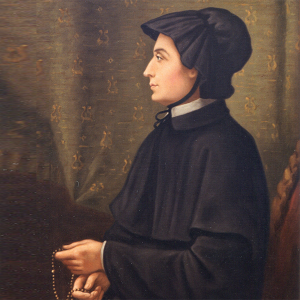
Saint Elizabeth Ann Seton … the first US-born saint canonised by the Roman Catholic Church
Patrick Comerford
Christmas is a season that continues for 40 days until the Feast of the Presentation or Candlemas (2 February).
As a new week begins, and before this day gets busy, I am taking some time early this morning for prayer, reflection and reading.
I have been continuing my Prayer Diary on my blog each morning, reflecting in these ways:
1, Reflections on a saint remembered in the calendars of the Church during Christmas;
2, the day’s Gospel reading;
3, a prayer from the USPG prayer diary.
This morning, I am reflecting on the life of Elizabeth Ann Seton, the first US-born saint to be canonised in the Roman Catholic Church.
She was born Elizabeth Ann Bayley on 28 August 1774, two years before the American Revolution, and grew up in the socially privileged elite in New York society, and grew up in the Episcopal Church.
In spite of her high society background, Elizabeth’s early life was quiet, simple, and often lonely. She was a prolific reader, and read widely from the Bible to contemporary novels. As she grew older, the Bible became her continual instruction, support and comfort, and she continue to loved the Scriptures for the rest of her life.
Elizabeth married the wealthy young William Seton, with whom she was deeply in love. Samuel Provoost, the first Episcopal Bishop of New York, presided at their wedding in 1794. The first years of their marriage were happy and prosperous. Elizabeth wrote in her diary that first autumn, ‘My own home at twenty-the world-that and heaven too-quite impossible.’
Within four years, William’s father died, leaving the young couple in charge of William’s seven half brothers and sisters, as well as the family’s importing business. The family belonged to Trinity Episcopal Church, near Broadway and Wall Street.
But both William’s business and health failed. He was finally forced to file a petition of bankruptcy and, in a final attempt to save William's health, the Setons sailed for Italy, where William had business friends.
Sadly, William died of tuberculosis while they were in Italy.
The deaths of many family members or separation from them by distance drew Elizabeth’s heart to God, and accepting and embracing God’s will – ‘The Will,’ as she called it – became a keynote in her spiritual life.
Elizabeth captivated many people in Italy with her kindness, patience, good sense, wit, and courtesy. Her deep concern for the spiritual welfare of her family and friends eventually led her into the Roman Catholic Church, and over a period of months, her Italian friends guided her in Catholic instruction.
Elizabeth’s desire for the Bread of Life was a strong force in leading her to the Roman Catholic Church, which she officially joined in 1805.
At the suggestion of the president of Saint Mary’s College in Baltimore, Maryland, Elizabeth started a school in Baltimore. However, when news of her new-found Roman Catholicism spread, several girls were removed from the school. It was then Seton, and two other young women who helped her in her work, began plans for a sisterhood. They established the first free Roman Catholic school in the US. When the young community adopted their rule, they made provisions for Elizabeth to continue raising her children.
On 25 March 1809, Elizabeth Seton took vows of poverty, chastity, and obedience, and from then on was known as Mother Seton.
Although Mother Seton suffered from tuberculosis, she continued to guide her children. The Rule of the Sisterhood, formally ratified in 1812, was based on the rule written by Saint Vincent de Paul for the Daughters of Charity in France. By 1818, in addition to their first school, the sisters had established two orphanages and another school. Today, six groups of sisters can trace their origins to Mother Seton’s initial foundation.
For the last three years of her life, Elizabeth felt that God was getting ready to call her, and this gave her great joy. Mother Seton died 201 years ago on 4 January 1821 at the age of 46, 16 years after she became a Roman Catholic. She was beatified by Pope John XXIII on 17 March 1963 and was canonised on 14 September 1975 by Pope Paul VI. She is honoured with a Lesser Feast in the liturgical calendar of the Episcopal Church on this day, 4 January.
Seton Hall College, now known as Seton Hall University, in South Orange, New Jersey, was founded in 1856 by her nephew, Archbishop James Roosevelt Bayley and named after his aunt.
John 1: 35-42 (NRSVA):
35 The next day John again was standing with two of his disciples, 36 and as he watched Jesus walk by, he exclaimed, ‘Look, here is the Lamb of God!’ 37 The two disciples heard him say this, and they followed Jesus. 38 When Jesus turned and saw them following, he said to them, ‘What are you looking for?’ They said to him, ‘Rabbi’ (which translated means Teacher), ‘where are you staying?’ 39 He said to them, ‘Come and see.’ They came and saw where he was staying, and they remained with him that day. It was about four o’clock in the afternoon. 40 One of the two who heard John speak and followed him was Andrew, Simon Peter’s brother. 41 He first found his brother Simon and said to him, ‘We have found the Messiah’ (which is translated Anointed). 42 He brought Simon to Jesus, who looked at him and said, ‘You are Simon son of John. You are to be called Cephas’ (which is translated Peter).
The prayer in the prayer diary of the Anglican mission agency USPG (United Society Partners in the Gospel) invites us to pray this morning (4 January 2022):
Lord, we pray for peace, happiness and stability for the people of India.
Yesterday: Saint Fintan of Doone
Tomorrow: The Desert Mothers
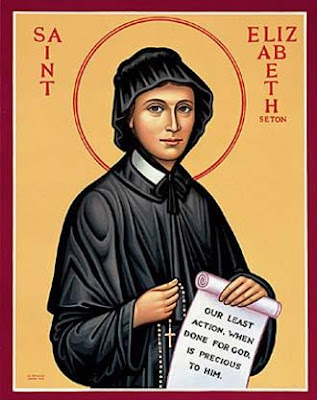
An icon of Saint Elizabeth Seton
Scripture quotations are from the New Revised Standard Version Bible: Anglicised Edition copyright © 1989, 1995, National Council of the Churches of Christ in the United States of America. Used by permission. All rights reserved worldwide. http://nrsvbibles.org
Showing posts with label Baltimore. Show all posts
04 January 2022
22 June 2021
How Baltimore recovered
after being sacked by
the Pirates of Algiers
The Harbour at Baltimore … the Wild Atlantic Way meets the coast of West Cork (Photograph: Patrick Comerford, 2021)
Patrick Comerford
During last week’s road trip or ‘staycation’ in Co Kerry and West Cork, the village of Baltimore was the starting and return point for a visit to Cape Clear Island, at the very southern tip of Ireland.
Baltimore is where the Wild Atlantic Way meets Carbery's Hundred Isles and the beautiful coast of West Cork. It is the main ferry port for Cape Clear Island, Sherkin Island, and the east side of Roaring Water Bay and Carbery’s Hundred Isles.
Baltimore was once the haunt of pirates, but today is a centre for all kinds of waterborne activity. This is a village of about 400 residents, but those numbers swell in the summer months with the arrival of visitors. It is about 100 km west of Cork city and the final stop on the 2,500 km length of the Wild Atlantic Way.
Baltimore’s large natural harbour is formed partly by the islands in the archipelago known as Carbery’s Hundred Isles. Around the pier, charter boats and pleasure craft jostle with fishing vessels and ferries to the islands.
The village ‘Square’ – which is more of a triangle – is at the heart of Baltimore (Photograph: Patrick Comerford, 2021)
The oldest part of the village with its castle and rows of fishermen’s cottages is spread along the east shore of the harbour. At the heart of Baltimore is the village ‘Square’ – more of a triangle – around which are clustered bars and restaurants looking west over the sea and islands.
Baltimore (Dún na Séad, the ‘Fort of the Jewels’) was a seat of one of Ireland’s most ancient dynasties, the Corcu Loígde, ancestors of the O’Driscoll, O’Leary and Hennessy families, and the O’Driscoll castle, Dún na Séad, gave its name to the Irish language name of the town.
The castle was built in 1215 by the Anglo-Norman Sleynie, but later became the principal castle of the O’Driscoll clan.
The name Baltimore is an anglicisation of the Irish Baile an Tí Mhóir, ‘town of the big house’.
The Customs House … the name is a reminder of Baltimore’s trading past (Photograph: Patrick Comerford, 2021)
In the early 1600s, Baltimore had a thriving pilchard industry and wine trade, but was also regarded as a lucrative pirate base and was known in Venice as ‘a nest of pirates.’ English piracy, however, declined, partly due to competition from Barbary pirates.
In the early 17th century, the head of the O’Driscoll clan, Sir Fineen O’Driscoll, an ally of the Crown, leased his lands to Sir Thomas Crooke (1574-1630), who received a Charter from James I for a colony founded ca 1605. Baltimore became a market town in 1607, with a weekly market and two annual fairs.
Baltimore became a borough in 1612 with a town government consisting of a sovereign or mayor, Sir Thomas Crooke, and 12 burgesses, and it sent two MPs to the Irish House of Commons from 1613 to 1801.
The Algiers Inn … Baltimore was sacked by Barbary pirates in 1630 (Photograph: Patrick Comerford, 2021)
When Crooke died in 1630, his claims in Baltimore were contested by Sir Walter Coppinger. But, a year, later, the town was depopulated in 1631 in the Sack of Baltimore, a raid by Barbary pirates from either Ottoman Algeria or Salé in Morocco. Between 100 and 237 people, English settlers and Irish local people, were sold into slavery, of whom only two or three ever saw Ireland again.
On board two ships that left Algiers was a combined force of Dutch, Algerians and Turks, under the command of one of the most successful leaders of Barbary pirates, a renegade Dutch captain, Jan Janszoon van Haarlem, known as Murad Reis the Younger.
By the time they reached the coast of West Cork, they had already seized a number of smaller vessels, imprisoning their crews. The captain of one was a Dungarvan man, John Hackett. Reis’s original target was probably Kinsale, but Hackett declared the harbour there ‘too hot’ to enter and in return for his freedom he offered to pilot Reis to the defenceless village of Baltimore.
Undetected, the pirates anchored outside the harbour of Baltimore, ‘about a musket shot from the shore’ late in the evening of 19/20 June. From there, they launched an attack on the sleeping village before dawn the next day.
The people of Baltimore were taken by surprise. More than 200 armed corsairs landed in the cove, torching the thatched roofs of the houses and carrying off ‘young and old out of their beds.’
Moving on to the main village, the pirates took more captives before musket fire and the beating of a drum alerted the remaining villagers and persuaded Reis to end the raid.
By then, more than 100 men, women and children had been taken. They were herded back to ships that bore them away from West Cork to the slave markets of North Africa.
The Barbary pirates were led by a renegade Dutch captain, Jan Janszoon van Haarlem, known as Murad Reis the Younger (Photograph: Patrick Comerford, 2021)
The raid on Baltimore was the worst-ever attack by Barbary corsairs on the mainland of Ireland or Britain. Most of the names in the official report sound English, but it is likely that there were also a few native Irish among the prisoners.
Very few of these people were ever heard of again. At most, three returned to Ireland: one was ransomed almost at once, and two others in 1646.
However, the fate of the rest is unknown. Many may have ended their days as galley slaves or concubines in the harems of Algiers. For his part, Hackett was arrested and hanged on a clifftop above Baltimore.
The Sack of Baltimore has given rise to many conspiracy theories. They generally point the finger at the rapacious Sir Walter Coppinger, who had been seeking to prise the village away from the O’Driscolls, oust the Crooke family and the settlers and secure it for himself. Whether by accident or design, the pirates carried out part of this plan for him.
Suspicion also points to O’Driscoll’s exiled relatives, who had fled to Spain after the Battle of Kinsale and had no hope of inheriting Baltimore by legal means.
On the other hand, Murad may have planned the raid without any help. The authorities had advance intelligence of a planned raid on the Cork coast, but Kinsale was thought to be a more likely target than Baltimore.
The Sack of Baltimore had an impact on the village for over 200 years (Photograph: Patrick Comerford, 2021)
In the aftermath of the raid, the surviving villagers moved inland to Skibbereen and other places in search of greater security and Coppinger’s designs on the village were realised. The sack marked the end of the 400-year reign of the O’Driscolls as overlords of Baltimore, and Baltimore was almost deserted for generations.
A slow recovery began in the 18th century, and by the early 1800s the village was starting to prosper again, only to suffer further great losses in the Great Famine.
Reminders of the Sack of Baltimore still exist in the form of pub names, like the ‘Algiers Inn.’ It inspired Thomas Davis to write his poem, ‘The Sack of Baltimore.’ A detailed account of the disaster is told by Des Ekin in his book The Stolen Village: Baltimore and the Barbary Pirates.
Saint Matthew’s Church was designed by James Pain and built in 1819 (Photograph: Patrick Comerford, 2021)
Two years ago, in 2019, parishioners celebrated the 200th anniversary of the consecration of Saint Matthew’s Church, the Church of Ireland parish church in Baltimore.
Saint Matthew’s Church was built in 1819 on a site donated by Lord Carbery, with a loan of £600 from Board of Frist Fruits. The church was designed by the Limerick-based architect James Pain and built with sandstone quarried on Cape Clear Island. Saint Matthew’s was consecrated by Thomas St Lawrence, Bishop of Cork and Ross, on 25 September 1819.
Oak panelling, oak fonts and ends to choir seats, mosaic tiling, a marble step to in the sanctuary, and a pavement in the choir aisle were installed in the church in 1918. They were designed by the Cork-born architect Robert Walker (1866-1937) as a gift from Annie Becher in memory of her husband, William Start Becher, who died of war wounds in France in July 1916.
Saint Matthew’s Church stands on a prominent location in Baltimore and is an important focal point in the village. The tower, a classic component of the Board of First Fruit style churches, is a striking feature adding to the architectural diversity of the village.
In the Roman Catholic Diocese of Ross, Baltimore is the main village in the parish of Rathmore and the Islands, the southernmost parish in Ireland, which includes Cape Clear Island.
Baltimore’s castle, Dún na Sead, overlooks the town but was ruined by the mid-17th century. It was restored in 1997-2005, is open to the public and is home to a ‘Pirate Exhibition.’
Dún na Sead was restored in 1997-2005 and is home to a ‘Pirate Exhibition’ (Photograph: Patrick Comerford, 2021)
Despite local claims and persistent lore, the city of Baltimore in Maryland takes its name not from this Baltimore in West Cork but from Baltimore Manor in Drumlish, Co Longford, the ancestral home of the Calvert family who held the title of Lord Baltimore.
Yet, it is a curious coincidence that Frederick Calvert (1731-1771), 6th and last Baron Baltimore, who inherited near feudal rights in the colony of Maryland, was ‘living at Constantinople like a Turk, with his seraglio all around him’ in 1764, according to James Boswell.
Lord Baltimore was said to have ‘lost all physical and moral taste’ and later rebuilt his London home in the style of a Turkish harem.
Street art at the top of steps in Baltimore (Photograph: Patrick Comerford, 2021)
Patrick Comerford
During last week’s road trip or ‘staycation’ in Co Kerry and West Cork, the village of Baltimore was the starting and return point for a visit to Cape Clear Island, at the very southern tip of Ireland.
Baltimore is where the Wild Atlantic Way meets Carbery's Hundred Isles and the beautiful coast of West Cork. It is the main ferry port for Cape Clear Island, Sherkin Island, and the east side of Roaring Water Bay and Carbery’s Hundred Isles.
Baltimore was once the haunt of pirates, but today is a centre for all kinds of waterborne activity. This is a village of about 400 residents, but those numbers swell in the summer months with the arrival of visitors. It is about 100 km west of Cork city and the final stop on the 2,500 km length of the Wild Atlantic Way.
Baltimore’s large natural harbour is formed partly by the islands in the archipelago known as Carbery’s Hundred Isles. Around the pier, charter boats and pleasure craft jostle with fishing vessels and ferries to the islands.
The village ‘Square’ – which is more of a triangle – is at the heart of Baltimore (Photograph: Patrick Comerford, 2021)
The oldest part of the village with its castle and rows of fishermen’s cottages is spread along the east shore of the harbour. At the heart of Baltimore is the village ‘Square’ – more of a triangle – around which are clustered bars and restaurants looking west over the sea and islands.
Baltimore (Dún na Séad, the ‘Fort of the Jewels’) was a seat of one of Ireland’s most ancient dynasties, the Corcu Loígde, ancestors of the O’Driscoll, O’Leary and Hennessy families, and the O’Driscoll castle, Dún na Séad, gave its name to the Irish language name of the town.
The castle was built in 1215 by the Anglo-Norman Sleynie, but later became the principal castle of the O’Driscoll clan.
The name Baltimore is an anglicisation of the Irish Baile an Tí Mhóir, ‘town of the big house’.
The Customs House … the name is a reminder of Baltimore’s trading past (Photograph: Patrick Comerford, 2021)
In the early 1600s, Baltimore had a thriving pilchard industry and wine trade, but was also regarded as a lucrative pirate base and was known in Venice as ‘a nest of pirates.’ English piracy, however, declined, partly due to competition from Barbary pirates.
In the early 17th century, the head of the O’Driscoll clan, Sir Fineen O’Driscoll, an ally of the Crown, leased his lands to Sir Thomas Crooke (1574-1630), who received a Charter from James I for a colony founded ca 1605. Baltimore became a market town in 1607, with a weekly market and two annual fairs.
Baltimore became a borough in 1612 with a town government consisting of a sovereign or mayor, Sir Thomas Crooke, and 12 burgesses, and it sent two MPs to the Irish House of Commons from 1613 to 1801.
The Algiers Inn … Baltimore was sacked by Barbary pirates in 1630 (Photograph: Patrick Comerford, 2021)
When Crooke died in 1630, his claims in Baltimore were contested by Sir Walter Coppinger. But, a year, later, the town was depopulated in 1631 in the Sack of Baltimore, a raid by Barbary pirates from either Ottoman Algeria or Salé in Morocco. Between 100 and 237 people, English settlers and Irish local people, were sold into slavery, of whom only two or three ever saw Ireland again.
On board two ships that left Algiers was a combined force of Dutch, Algerians and Turks, under the command of one of the most successful leaders of Barbary pirates, a renegade Dutch captain, Jan Janszoon van Haarlem, known as Murad Reis the Younger.
By the time they reached the coast of West Cork, they had already seized a number of smaller vessels, imprisoning their crews. The captain of one was a Dungarvan man, John Hackett. Reis’s original target was probably Kinsale, but Hackett declared the harbour there ‘too hot’ to enter and in return for his freedom he offered to pilot Reis to the defenceless village of Baltimore.
Undetected, the pirates anchored outside the harbour of Baltimore, ‘about a musket shot from the shore’ late in the evening of 19/20 June. From there, they launched an attack on the sleeping village before dawn the next day.
The people of Baltimore were taken by surprise. More than 200 armed corsairs landed in the cove, torching the thatched roofs of the houses and carrying off ‘young and old out of their beds.’
Moving on to the main village, the pirates took more captives before musket fire and the beating of a drum alerted the remaining villagers and persuaded Reis to end the raid.
By then, more than 100 men, women and children had been taken. They were herded back to ships that bore them away from West Cork to the slave markets of North Africa.
The Barbary pirates were led by a renegade Dutch captain, Jan Janszoon van Haarlem, known as Murad Reis the Younger (Photograph: Patrick Comerford, 2021)
The raid on Baltimore was the worst-ever attack by Barbary corsairs on the mainland of Ireland or Britain. Most of the names in the official report sound English, but it is likely that there were also a few native Irish among the prisoners.
Very few of these people were ever heard of again. At most, three returned to Ireland: one was ransomed almost at once, and two others in 1646.
However, the fate of the rest is unknown. Many may have ended their days as galley slaves or concubines in the harems of Algiers. For his part, Hackett was arrested and hanged on a clifftop above Baltimore.
The Sack of Baltimore has given rise to many conspiracy theories. They generally point the finger at the rapacious Sir Walter Coppinger, who had been seeking to prise the village away from the O’Driscolls, oust the Crooke family and the settlers and secure it for himself. Whether by accident or design, the pirates carried out part of this plan for him.
Suspicion also points to O’Driscoll’s exiled relatives, who had fled to Spain after the Battle of Kinsale and had no hope of inheriting Baltimore by legal means.
On the other hand, Murad may have planned the raid without any help. The authorities had advance intelligence of a planned raid on the Cork coast, but Kinsale was thought to be a more likely target than Baltimore.
The Sack of Baltimore had an impact on the village for over 200 years (Photograph: Patrick Comerford, 2021)
In the aftermath of the raid, the surviving villagers moved inland to Skibbereen and other places in search of greater security and Coppinger’s designs on the village were realised. The sack marked the end of the 400-year reign of the O’Driscolls as overlords of Baltimore, and Baltimore was almost deserted for generations.
A slow recovery began in the 18th century, and by the early 1800s the village was starting to prosper again, only to suffer further great losses in the Great Famine.
Reminders of the Sack of Baltimore still exist in the form of pub names, like the ‘Algiers Inn.’ It inspired Thomas Davis to write his poem, ‘The Sack of Baltimore.’ A detailed account of the disaster is told by Des Ekin in his book The Stolen Village: Baltimore and the Barbary Pirates.
Saint Matthew’s Church was designed by James Pain and built in 1819 (Photograph: Patrick Comerford, 2021)
Two years ago, in 2019, parishioners celebrated the 200th anniversary of the consecration of Saint Matthew’s Church, the Church of Ireland parish church in Baltimore.
Saint Matthew’s Church was built in 1819 on a site donated by Lord Carbery, with a loan of £600 from Board of Frist Fruits. The church was designed by the Limerick-based architect James Pain and built with sandstone quarried on Cape Clear Island. Saint Matthew’s was consecrated by Thomas St Lawrence, Bishop of Cork and Ross, on 25 September 1819.
Oak panelling, oak fonts and ends to choir seats, mosaic tiling, a marble step to in the sanctuary, and a pavement in the choir aisle were installed in the church in 1918. They were designed by the Cork-born architect Robert Walker (1866-1937) as a gift from Annie Becher in memory of her husband, William Start Becher, who died of war wounds in France in July 1916.
Saint Matthew’s Church stands on a prominent location in Baltimore and is an important focal point in the village. The tower, a classic component of the Board of First Fruit style churches, is a striking feature adding to the architectural diversity of the village.
In the Roman Catholic Diocese of Ross, Baltimore is the main village in the parish of Rathmore and the Islands, the southernmost parish in Ireland, which includes Cape Clear Island.
Baltimore’s castle, Dún na Sead, overlooks the town but was ruined by the mid-17th century. It was restored in 1997-2005, is open to the public and is home to a ‘Pirate Exhibition.’
Dún na Sead was restored in 1997-2005 and is home to a ‘Pirate Exhibition’ (Photograph: Patrick Comerford, 2021)
Despite local claims and persistent lore, the city of Baltimore in Maryland takes its name not from this Baltimore in West Cork but from Baltimore Manor in Drumlish, Co Longford, the ancestral home of the Calvert family who held the title of Lord Baltimore.
Yet, it is a curious coincidence that Frederick Calvert (1731-1771), 6th and last Baron Baltimore, who inherited near feudal rights in the colony of Maryland, was ‘living at Constantinople like a Turk, with his seraglio all around him’ in 1764, according to James Boswell.
Lord Baltimore was said to have ‘lost all physical and moral taste’ and later rebuilt his London home in the style of a Turkish harem.
Street art at the top of steps in Baltimore (Photograph: Patrick Comerford, 2021)
21 June 2021
In search of Ireland’s
most southerly churches
on Cape Clear Island
Cape Clear Island off the coast of Co Cork is intimately linked with the legends surrounding the life Saint Ciarán (Photograph: Patrick Comerford, 2021)
Patrick Comerford
Clear Island or Cape Clear Island ( Cléire or Oileán Chléire), 8 miles off the south-west coast of Co Cork, is the most southerly inhabited part of Ireland. Cape Clear is 3 miles long by 1 mile wide. Most of the 147 residents are bilingual in Irish and English, making this Ireland’s southern-most inhabited Gaeltacht island.
Mizen Head, the mainland’s most southerly point, is to the north-west. The nearest neighbouring island is Sherkin Island, 2 km to the east, and the solitary Fastnet Rock, with its lighthouse, is three miles west of the island. The boat trip from Baltimore took only 40 minutes, with views of the rugged coastline West Cork and occasional sightings of dolphins.
Little did I realise when this island-hopping boat trip was being booked as part of last week’s road trip or ‘staycation’ that I would end up visiting Ireland’s most southerly churches.
The South Harbour on the seaward side is often a berth for yachts and pleasure boats (Photograph: Patrick Comerford, 2021)
The island is divided into east and west by an isthmus called the Waist, with the North Harbour to the landward side and the South Harbour on the seaward side.
Ferries from Schull and Baltimore arrive into the North Harbour, while the South Harbour is often a berth for yachts and pleasure boats.
Arriving on the ferry from Baltimore into the North Harbour the first archaeological and ecclesiastical site the visitor sees are the ruins of a 12th-century church, close to the main pier, with Saint Ciaran’s Well beside it.
Saint Ciarán of Saighir gives his name to the ruined church and holy well at the North Harbour (Photograph: Patrick Comerford, 2021)
Saint Ciarán, the island’s patron saint, is allegedly one of Ireland’s four, early pre-Patrician saints. He is said to have been born on the shoreline beside the harbour, Trá Chiaráin, in front of the well, and the islanders gather there to mark his feast on 5 March each year.
Saint Ciarán of Saighir was one of the ‘Twelve Apostles of Ireland’ and was the founding Bishop of Saighir (Seir-Kieran). He remains the patron saint of its successor, the Diocese of Ossory.
Sometimes he is called Saint Ciarán the Elder, to distinguish him from another sixth century Saint Ciarán, Abbot of Clonmacnoise. He shares the feast date of 5 March with his mother, Saint Liadán, and his disciple and episcopal successor, Saint Carthach the Elder.
The reverence for Saint Ciarán is reflected in the proliferation of his name on the island: Saint Ciarán’s beach (Trá Chiaráin), Saint Ciarán’s Well (Tobar Chiaráin), Saint Ciarán’s Church (Séipéal Chiaráin) and Saint Ciarán’s Graveyard (Reilg Chiaráin); indeed, almost every family includes someone with the name Ciarán.
Saint Ciarán is said to have been born on the shoreline beside the North Harbour (Photograph: Patrick Comerford, 2021)
Saint Ciarán’s life has inspired some colourful stories. Before he was conceived, his mother, Saint Liadán, dreamt a star had fallen into her mouth. She related this dream to the tribal elders, who told her she would give birth to a son whose fame and virtues would spread around the world.
It is said that when Ciarán heard from sailors about a new religion in Rome he went there and embraced Christianity. He was ordained in Rome and after 30 years there returned as Bishop of Ireland. He built his first church on the island, and legends claim the people of Cape Clear were the first in Ireland to accept Christianity.
His first disciples included a boar, a fox, a brock and a wolf: they all became monks and worked together to build the community.
The ruins of the 12th century church beside the North Harbour … Saint Ciarán’s life has inspired colourful stories (Photograph: Patrick Comerford, 2021)
The ruins of Saint Ciaran’s Church, a 12th century rectangular church surrounded by a graveyard, face the North Harbour. The east gable and north and south walls survive to near full height (1.8 metres), but the upper part of west gable is missing.
There is an arched doorway near the west end of the south wall, a lintelled window near the east end, a single-light window in the east gable with an unusual foil or drop in the centre, and small aumbries in the north and south walls near the east gable.
The church was in ruins by 1693, but it remains Ireland’s southern-most church.
Toberkieran or Saint Ciarán’s well is a few steps away from the church ruins and churchyard. Beside the well, a flat-topped standing stone has a cross-like carving in relief. On the north-east face is an incised Latin cross, with expanded shaft terminals. On the south-west face is a very worn Latin cross with expanded terminals. There is a slight trace of another incised cross on the south-east face, with an indecipherable incised carving beneath.
Saint Ciarán’s Church, built in 1839 … the southern-most church still in use in Ireland (Photograph: Patrick Comerford, 2021)
A steep climb leads north-east behind the harbour, with a 15-minute walk to island’s present church. Saint Ciarán’s Roman Catholic Church was built in 1839. It is part of the parish of Skibbereen, Rath and the Islands, and is the southern-most church still in use in Ireland.
This simple church is typical of earlier 19th century churches that are plain in style and modest in scale. Despite replacement windows and doors, it retains notable features, including a bellcote at the west end.
This is a single-cell, double-height church, with a four-bay nave and a recent single-storey sacristy. The pointed arch openings have replacement uPVC windows, a replacement timber battened door and tympanum. Inside, there is a fine open truss roof, polychrome tiles and a carved timber confessional.
Inside Saint Ciarán’s Church … part of the parish of Skibbereen, Rath and the Islands (Photograph: Patrick Comerford, 2021)
The other sites on the island include megalithic standing stones, a 5,000-year-old Neolithic passage grave, the ruins of Dún an Óir, a 14th promontory fort or castle built by the O’Driscolls in the 14th century and destroyed by cannon in the early 1600s, and a signal tower dating from the Napoleonic Wars.
More modern additions to the island include a lighthouse, a bird observatory and two Irish summer colleges for secondary school pupils, Coláiste Phobal Chléire and Coláiste Chiaráin. Students stay in local houses or dorms and improve their spoken Irish as part of their immersion courses.
The island had a population of over 1,052 before the Great Famine, but the current population of is about 140. The primary school was built in 1897. Cape Clear’s electricity was once produced by diesel generators, but these were replaced ca 1995 with a n underwater cable from the mainland. The island has a restaurant, shop and pubs, and a new café overlooking the harbour opened at the beginning of this summer.
The wild scenery contributes to the island’s unspoilt charm (Photograph: Patrick Comerford, 2021)
Since 1994, the island has hosted the Cape Clear Island International Storytelling Festival on the first weekend of September.
Cape Clear’s remote location and its proximity to the continental shelf make the island an important centre for bird watching. Whales, leatherback turtles, sun fish, dolphins and sharks are spotted regularly every year.
The wild scenery, the sparkling harbours, the cliffs, bogs and the lake all contribute to the island’s unspoilt charm. The bird life includes black and common guillemots, cormorants and storm petrels. Heather, gorse and wild flowers cover the rugged hills, while myriad stone walls give a patchwork effect to the landscape.
Cape Clear Island is colourful in the summer sunshine (Photograph: Patrick Comerford, 2021)
Patrick Comerford
Clear Island or Cape Clear Island ( Cléire or Oileán Chléire), 8 miles off the south-west coast of Co Cork, is the most southerly inhabited part of Ireland. Cape Clear is 3 miles long by 1 mile wide. Most of the 147 residents are bilingual in Irish and English, making this Ireland’s southern-most inhabited Gaeltacht island.
Mizen Head, the mainland’s most southerly point, is to the north-west. The nearest neighbouring island is Sherkin Island, 2 km to the east, and the solitary Fastnet Rock, with its lighthouse, is three miles west of the island. The boat trip from Baltimore took only 40 minutes, with views of the rugged coastline West Cork and occasional sightings of dolphins.
Little did I realise when this island-hopping boat trip was being booked as part of last week’s road trip or ‘staycation’ that I would end up visiting Ireland’s most southerly churches.
The South Harbour on the seaward side is often a berth for yachts and pleasure boats (Photograph: Patrick Comerford, 2021)
The island is divided into east and west by an isthmus called the Waist, with the North Harbour to the landward side and the South Harbour on the seaward side.
Ferries from Schull and Baltimore arrive into the North Harbour, while the South Harbour is often a berth for yachts and pleasure boats.
Arriving on the ferry from Baltimore into the North Harbour the first archaeological and ecclesiastical site the visitor sees are the ruins of a 12th-century church, close to the main pier, with Saint Ciaran’s Well beside it.
Saint Ciarán of Saighir gives his name to the ruined church and holy well at the North Harbour (Photograph: Patrick Comerford, 2021)
Saint Ciarán, the island’s patron saint, is allegedly one of Ireland’s four, early pre-Patrician saints. He is said to have been born on the shoreline beside the harbour, Trá Chiaráin, in front of the well, and the islanders gather there to mark his feast on 5 March each year.
Saint Ciarán of Saighir was one of the ‘Twelve Apostles of Ireland’ and was the founding Bishop of Saighir (Seir-Kieran). He remains the patron saint of its successor, the Diocese of Ossory.
Sometimes he is called Saint Ciarán the Elder, to distinguish him from another sixth century Saint Ciarán, Abbot of Clonmacnoise. He shares the feast date of 5 March with his mother, Saint Liadán, and his disciple and episcopal successor, Saint Carthach the Elder.
The reverence for Saint Ciarán is reflected in the proliferation of his name on the island: Saint Ciarán’s beach (Trá Chiaráin), Saint Ciarán’s Well (Tobar Chiaráin), Saint Ciarán’s Church (Séipéal Chiaráin) and Saint Ciarán’s Graveyard (Reilg Chiaráin); indeed, almost every family includes someone with the name Ciarán.
Saint Ciarán is said to have been born on the shoreline beside the North Harbour (Photograph: Patrick Comerford, 2021)
Saint Ciarán’s life has inspired some colourful stories. Before he was conceived, his mother, Saint Liadán, dreamt a star had fallen into her mouth. She related this dream to the tribal elders, who told her she would give birth to a son whose fame and virtues would spread around the world.
It is said that when Ciarán heard from sailors about a new religion in Rome he went there and embraced Christianity. He was ordained in Rome and after 30 years there returned as Bishop of Ireland. He built his first church on the island, and legends claim the people of Cape Clear were the first in Ireland to accept Christianity.
His first disciples included a boar, a fox, a brock and a wolf: they all became monks and worked together to build the community.
The ruins of the 12th century church beside the North Harbour … Saint Ciarán’s life has inspired colourful stories (Photograph: Patrick Comerford, 2021)
The ruins of Saint Ciaran’s Church, a 12th century rectangular church surrounded by a graveyard, face the North Harbour. The east gable and north and south walls survive to near full height (1.8 metres), but the upper part of west gable is missing.
There is an arched doorway near the west end of the south wall, a lintelled window near the east end, a single-light window in the east gable with an unusual foil or drop in the centre, and small aumbries in the north and south walls near the east gable.
The church was in ruins by 1693, but it remains Ireland’s southern-most church.
Toberkieran or Saint Ciarán’s well is a few steps away from the church ruins and churchyard. Beside the well, a flat-topped standing stone has a cross-like carving in relief. On the north-east face is an incised Latin cross, with expanded shaft terminals. On the south-west face is a very worn Latin cross with expanded terminals. There is a slight trace of another incised cross on the south-east face, with an indecipherable incised carving beneath.
Saint Ciarán’s Church, built in 1839 … the southern-most church still in use in Ireland (Photograph: Patrick Comerford, 2021)
A steep climb leads north-east behind the harbour, with a 15-minute walk to island’s present church. Saint Ciarán’s Roman Catholic Church was built in 1839. It is part of the parish of Skibbereen, Rath and the Islands, and is the southern-most church still in use in Ireland.
This simple church is typical of earlier 19th century churches that are plain in style and modest in scale. Despite replacement windows and doors, it retains notable features, including a bellcote at the west end.
This is a single-cell, double-height church, with a four-bay nave and a recent single-storey sacristy. The pointed arch openings have replacement uPVC windows, a replacement timber battened door and tympanum. Inside, there is a fine open truss roof, polychrome tiles and a carved timber confessional.
Inside Saint Ciarán’s Church … part of the parish of Skibbereen, Rath and the Islands (Photograph: Patrick Comerford, 2021)
The other sites on the island include megalithic standing stones, a 5,000-year-old Neolithic passage grave, the ruins of Dún an Óir, a 14th promontory fort or castle built by the O’Driscolls in the 14th century and destroyed by cannon in the early 1600s, and a signal tower dating from the Napoleonic Wars.
More modern additions to the island include a lighthouse, a bird observatory and two Irish summer colleges for secondary school pupils, Coláiste Phobal Chléire and Coláiste Chiaráin. Students stay in local houses or dorms and improve their spoken Irish as part of their immersion courses.
The island had a population of over 1,052 before the Great Famine, but the current population of is about 140. The primary school was built in 1897. Cape Clear’s electricity was once produced by diesel generators, but these were replaced ca 1995 with a n underwater cable from the mainland. The island has a restaurant, shop and pubs, and a new café overlooking the harbour opened at the beginning of this summer.
The wild scenery contributes to the island’s unspoilt charm (Photograph: Patrick Comerford, 2021)
Since 1994, the island has hosted the Cape Clear Island International Storytelling Festival on the first weekend of September.
Cape Clear’s remote location and its proximity to the continental shelf make the island an important centre for bird watching. Whales, leatherback turtles, sun fish, dolphins and sharks are spotted regularly every year.
The wild scenery, the sparkling harbours, the cliffs, bogs and the lake all contribute to the island’s unspoilt charm. The bird life includes black and common guillemots, cormorants and storm petrels. Heather, gorse and wild flowers cover the rugged hills, while myriad stone walls give a patchwork effect to the landscape.
Cape Clear Island is colourful in the summer sunshine (Photograph: Patrick Comerford, 2021)
Subscribe to:
Posts (Atom)