Showing posts with label Cashel. Show all posts

16 May 2026

Finding the other Lady Fitzgerald
who had family roots in Lichfield,
who was married three times, and
whose life was marked by tragedy

Dam Street, Lichfield, where Lady Fitzgerald’s grandfather Christopher Heveningham was a mercer and draper (Photograph: Patrick Comerford)

Patrick Comerford

I was recalling last night (15 May 2026) the social scandal that became a point of gossip in Staffordshire in the mid-18th century when Sir William Wolseley took his supposed second wife Anne Whitby to court in Lichfield seeking a divorce or annulment. The case involved allegations and accusations of greed, manipulation, cheating, forgery, desertion, perjury, bigamy, adultery, bribery, drugged drinks and corrupt and dishonest clergy.

Quite separately, I wrote some time ago (4 June 2020) about Sir James Fitzgerald who lived decades later at Wolseley Hall and in Lichfield and who managed to convincingly persuade people far and wide – and even Burke’s Peerage – that he was the rightful holder of an Irish title of baronet given to a different branch of the Fitzgerald family in Co Limerick.

Fitzgerald’s wife, Augusta Henrietta Fremantle (1803-1863), was known in polite circles as Lady Fitzgerald. They married in 1826 and lived for some years at Maple Hayes Hall near Pipe Hall and Lichfield. When he died in France in 1839, he was described as living at Wolseley Hall, but his widow continued to live at Maple Hayes and in 1841 she was attending Holy Cross Church, Lichfield. She later moved to Castle Ishen, Co Cork, where she died in 1863.

But there was another Lady Fitzgerald, the wife of a real Irish baronet, who also lived in Lichfield in the 19th century, and who had strong connections with Lichfield through her immediate ancestors, her mother and grandparents, her cousins and her grandchildren, and who was a direct descendant of the Comberford family of Comberford Hall.

Margaret (Warner) Fitzgerald was a direct descendant of Margaret Comberford and William Stanley who lived at Comberford Hall 250 years before she was born (Photograph: Patrick Comerford, 2026)

Margaret Warner (1806-1883), who eventually became the other Lady Fitzgerald in Lichfield, was a cousin of a number of prominent clergy in Victorian Lichfield, she was married three times, and the family of her third husband is still remembered in Ireland for the tragedies that befell successive generations, decade after decade, until the family line died out in 1917. Her life is a sad tale that includes drownings, suicide, a child’s death at play, crushing family debts, being widowed three times and her final days lived out in genteel poverty with fading memories of life among minor aristocracy.

This Lady Fitzgerald was born Margaret Warner in 1806, the daughter of Elizabeth Heveningham (1774-1823) from Lichfield and William Warner (1762-1835). They were married in Saint Philip’s Church, Birmingham, now Birmingham Cathedral.

Her mother Elizabeth Heveningham was born in Lichfield on 18 August 1774, the daughter of Charles Heveningham (1737-1782), a mercer and draper of Dam Street, Lichfield. He may have spent part of his childhood at Pipe Hall, the Heveningham ancestral home near Lichfield, and he was a direct descendant of Charles Heveningham (1540-1574) of Pipe Hall and his wife Dorothy Stanley (1530-1587), only daughter of William Stanley of Comberford Hall and Margaret Comberford (1494-1568). I have written last year (23 July 2025) about the Heveningham family and their links with the Comberford family.

Saint Mary’s Church, Lichfield, at night … many members of the Heveningham family were baptised and buried from there (Photograph: Patrick Comerford)

Charles Heveningham’s first cousin Mary married the Revd Daniel William Remington, Vicar of Saint Michael’s (1757-1772) and of Saint Mary’s (1772-1789), Lichfield, and sub-chanter of Lichfield Cathedral; Elizabeth (Heveningham) Warner was a second cousin of two successive Vicars of Saint Mary’s, the Revd William Remington, who founded the first Sunday school in Lichfield, and the Revd Edward Remington; another second cousin Mary Remington married Thomas White, Procurator of the Ecclesiastical Court in Lichfield and a cousin of the poet Anna Seward, the ‘Swan of Lichfield’.

Elizabeth’s daughter Margaret Warner was married three times, and she was 47 and twice widowed when, on 27 April 1854, she married her third husband, Sir John Judkin-Fitzgerald (1787-1860), an Irish baronet, as his third wife.

Margaret was only 20 – perhaps even younger – when she married her first husband, Robert Jones Parry of Aston-juxta-Birmingham and Hendre, Flintshire. They were the parents of three children, a daughter and two sons:

1, Margaret Parry (1827-1894), who married the Revd Evan Pughe (1807-1869); her son-in-law, Major Philip Halliley Carter (1866-1949) of Birmingham, continued the research into the history of the Heveningham family. Some of her descendants returned to live in the Lichfield area.
2, Robert Jones Parry, who died an infant.
3, (the Revd) William Warner Parry, (born 1832), a naval chaplain whose research into the Heveningham family tree is also an important source.

Margaret Warrners’s second husband was Samuel Banks of Rugeley, but he died soon after their marriage.

The Town Hall in Cashel, Co Tipperary … Margaret Warner’s husband, Sir John Judkin-Fitzgerald, was Mayor of Cashel and High Sheriff of Co Tipperary (Photograph: Patrick Comerford)

Margaret was twice widowed and was 47 when she married the widowed 67-year-old Irish baronet, Sir John Judkin-Fitzgerald (1787-1860). He was her third husband and she was his third wife. He was the son of Sir Thomas Judkin-FitzGerald (1754-1810) of Cashel, Co Tipperary, who was given the title of baronet in 1801 as a reward for his role in suppressing the United Irish Rebellion of 1798 in Co Tipperary, his support for the Act of Union, and for his time as High Sheriff of Tipperary (1798-1803).

During the 1798 Rising, he became known as ‘Flogging Fitzgerald’, When he died in 1810, an obituary’ referred to his excessive use of the cat o’ nine tails as a magistrate, saying: ‘The history of his life and loyalty is written in legible characters on the backs of his fellow countrymen.’

Margaret’s husband, Sir John Judkin-Fitzgerald, was born on 27 August 1787. He was 23 when he succeeded to his father’s estates in Cashel and his title as the second baronet in 1810. He lived in Golden, near Cashel, and was the Mayor of Cashel and High Sheriff of Co Tipperary (1819-1820).

Sir John married his first wife, the widowed Elizabeth Moore (née Pennefather), in Cashel Cathedral in 1816. They were the parents of one child, Margaret’s future husband, Sir Thomas Judkin-Fitzgerald (1820-1864). Elizabeth died on 26 April 1835, and Sir John married his second wife, Geraldine Fitzgerald, on 10 November 1837. They were the parents of one child, Geraldine Caroline (1839-1916), and this second Lady Fitzgerald died in childbirth on 11 February 1839.

By the time Margaret Warner married Sir John married on 27 April 1854, he was selling off large tracts of land in furtive attempts to clear his mounting debts. The land he sold between 1852 and 1856 included over 3,800 acres in Co Wexford, Co Waterford, Co Tipperary and Co Cork, and he sold another 1,500 acres in Co Cork in 1857. He was living at Golden Hills, near Golden and Cashel, when that too was advertised for sale in 1858, though it remained unsold.

Less than six years after he married Margaret, and now heavily indebted, Sir John was drowned on 28 February 1860. He was onboard the PS Nimrod, an Irish paddle steamer plying between Cork and Liverpool, when it ran aground at St David’s Head in Wales, smashed into three pieces and sank with the loss of 45 lives, 25 crew and 20 passengers. He was 72, Margaret was 52 and now a widow for the third time.

Sir John’s title, his remaining lands and his crushing debts were inherited by his only son, Margaret’s stepson, Sir Thomas Judkin-FitzGerald (1820-1864), as the third baronet. He was a magistrate and a Deputy Lieutenant for Co Tipperary, and continued to live at Golden Hills, which had not yet been sold off.

Three years before succeeding his father, Sir Thomas’s eldest son and heir, nine-year-old John Judkin Judkin-FitzGerald, died in another family tragedy in 1857 when he accidentally hanged himself in the garden. Two stories try to explain what happened: one account says it was an accident while the boy was playing on a swing; the other version says he was showing his younger siblings how their great-grandfather hanged rebels in 1798 when he slipped and accidentally hanged himself.

Sir Thomas Judkin Fitzgerald drowned himself in the River Suir at Golden on the night of 26/27 April 1864 (Photograph: Patrick Comerford)

But the family tragedies do not end there. Margaret’s stepson, the boy’s father, Sir Thomas Judkin Fitzgerald, drowned himself in the River Suir at Golden on the night of 26/27 April 1864 when he was only 43.

A letter in the Clonmel Chronicle said reports that he was living in ‘greatly embarrassed circumstances’ and ‘greatly in debt’ were ‘much exaggerated’. But he was living with financial difficulties, finding he was liable for the debts of his father, Sir John Judkin Fitzgerald, totalling £7,000, or about £1.1 million today. Sir Thomas had insured his life for several thousand pounds so his family might not suffer from ever-mounting debts.

The jury reached a verdict of death as a result of temporary insanity. But local people tried to stop him being buried in consecrated ground in Ballygriffin churchyard because of his suicide. On the day of his funeral they packed the graveyard in Ballygriffin, filled the fresh-dug grave with stones, and blocked the priest from continuing with the burial. When he was buried eventually, his funeral was guarded by a large police presence.

By then, his step-mother, Margaret (Warner) Fitzgerald, now a widow for the third time, had moved to Moss Side, Manchester, with her son William Warner Parry and her step-daughter Geraldine Fitzgerald. Geraldine married Dr Walter Bourne in 1870 and they lived in Calcutta and later in Bradford. The Revd William Warner Parry, studied at Oxford, became a naval chaplain, and his research into the Heveningham family tree has been an important source.

Margaret died in genteel poverty in Southsea on 8 September 1883 at the age of 77. By then, her step-grandson, Sir Joseph Capel Judkin-FitzGerald (1853-1917), had succeeded to the Fitzgerald title as the fourth baronet as an eight-year-old in 1864. Golden Hills was advertised for sale again in 1878, when it was described as a ‘large castellated building’ with a drawing room opening into a conservatory, dining room and morning room, eight bedrooms and a servants’ hall. Most of the house had disappeared by the early 1940s, or was incorporated into a modern farmyard.

Sir Joseph Capel Judkin-Fitzgerald was the last and final baronet in his family. He lived a sad and dissolute life in England, accused of stealing jewellery, defrauding gullible divorcees, defaulting on loans and debts, leaving unpaid hotel and restaurant bills in London and Paris, and working as an unlicensed cab driver. He was threatened with imprisonment and was eventually declared bankrupt. He outlived his two sons, and when he died in 1917 his family title of baronet died out.

Saint Michael’s Church, Greenhill, Lichfield … many members of the Heveningham family are buried in the churchyard (Photograph: Patrick Comerford)

Meanwhile, some of Margaret Warner’s descendants through her first marriage to Robert Jones Parry would return to live in Lichfield and some of them had interesting roles in Church and academic life.

In 1847, her daughter Margaret Parry (1827-1894) married the Revd Evan Pughe (1807-1869), Vicar of Bangor, and later Rector of Llantrisant. Their large family included: Margaret Constance Pughe (1862-1930), whose family returned to live in Lichfield; and Alice Gertrude Pughe (1869-1892), whose husband Major Philip Halliley Carter (1866-1949) of Birmingham, continued the research into the Heveningham family history.

Margaret Constance Pughe (1862-1930) married the Very Revd Charles Walter Carrington (1859-1941) in Cambridge in 1890. He became the mission chaplain to the Bishop of Lichfield, and some of their children were born in Lichfield before the family moved to West Bromwich and then to New Zealand, where he was the Dean of Christchurch.

Margaret and Charles Carrington were the parents of a large family, including Philip Carrington (1892-1975), who was born in Lichfield and became Bishop of Quebec (1935-1960) and Metropolitan of Canada (1944-1960). Another son, the historian Charles Edmund Carrington (1897-1990), was Professor of History at Cambridge and the biographer of Rudyard Kipling and Graham Greene.

According to Margaret’s great-grandson, CE Carrington, writing in 1966, Lady Fitzgerald had ‘brought up her family to believe that they were the last survivors of one of the most ancient families in England, the Heveninghams of Heveningham, from whom she had inherited some old documents and a great deal of family pride.’

The two women known as Lady Fitzgerald had strong family links with Lichfield in the 19th century and both married Irish baronets. I sometimes wonder whether their paths ever crossed either in Lichfield or in Ireland, whether they knew each other, and whether they were ever confused with one another.

Most of the remains of the Fitzgerald estate in Golden, near Cashel, Co Tipperary, have had disappeared by the early 1940s and are difficult to find (Photograph: Patrick Comerford)

Sources and references include:

The Visitations of Staffordshire and Warwickshire.
Michael Greenslade, Catholic Staffordshire 1500-1850 (Gracewing, 2006).

The Heveningham family tree on Geni (last accessed 21 July 2025).
The Heveningham Family of Staffordshire’ (last accessed 21 July 2025).
The St. Leger-May Family Home Page (last accessed 15 May 2026).
‘Townships: Wall with Pipehill’, in A History of the County of Stafford: Volume 14, Lichfield, ed MW Greenslade (London, 1990), pp 283-294. British History Online http://www.british-history.ac.uk/vch/staffs/vol14/pp283-294 (last accessed 21 July 2025).
‘Burntwood: Manors, local government and public services’, in A History of the County of Stafford: Volume 14, Lichfield, ed MW Greenslade (London, 1990), British History Online https://www.british-history.ac.uk/vch/staffs/vol14/pp205-220 (last accessed 21 July 2025).
Aleyn Lyell Reade, Johnsonian Gleanings, ‘Notes on Dr Johnson’s Ancestors and Connexions’, pp 1-41 (London: 1909).

04 May 2022

Praying with the Psalms in Easter:
4 May 2022 (Psalm 70)

‘Be pleased, O God, to deliver me. O Lord, make haste to help me!’ (Psalm 70: 1) … street art in Cashel, Co Tipperary (Photograph: Patrick Comerford)

Patrick Comerford

Before this day begins, I am continuing my morning reflections in this season of Easter continues, including my morning reflections drawing on the Psalms.

In my blog, I am reflecting each morning in this Prayer Diary in these ways:

1, Short reflections on a psalm or psalms;

2, reading the psalm or psalms;

3, a prayer from the USPG prayer diary.

Psalm 70:

Psalm 70 is known in Latin as Deus, in adiutorium meum intende. In the slightly different numbering system in the Greek Septuagint and in the Latin Vulgate, this psalm is counted as Psalm 69.

The entire psalm is almost identical to the closing verses of Psalm 40 (verses 14-18 in the Hebrew, 13-17 in most English translations). The opening verse in Hebrew identifies this psalm as one of remembrance (להכיר, ‘to remember’). This opening term appears in only one other psalm, Psalm 38.

Meir Leibush ben Yehiel Michel Wisser (1809-1879), from Volochysk in present-day Western Ukraine, was a rabbi, master of Hebrew grammar and Bible commentator and better known as the Malbim (מלבי"ם). He wrote that Psalm 40 was written by King David when he was fleeing from Saul, and David repeated this psalm later when he was fleeing from Absalom.

The Midrash Tehillim notes a slight discrepancy between Psalm 70: 5 (‘But I am poor and needy; hasten to me, O God!’) and Psalm 40: 17 (‘As for me, I am poor and needy, but the Lord takes thought for me’). The Midrash teaches that David was asking God, ‘Think of me in my poverty and in my need, and you will then make haste to deliver me, for You are my help and my deliverer.’

The opening verse says literally ‘God, to deliver me, to my help! Hurry!’ It is a sped up and abbreviated version of Psalm 40: 14. This is consistent with hasten used repeatedly in the opening. In some views, the first verses of Psalm 40 concern the coming messiah and his deliverance, while the later verses concern the desperate in general. It is the later verses of Psalm 40 carried over to Psalm 70.

The beginning of Psalm 70 was often set to music, especially as part of music for vespers. Claudio Monteverdi wrote a six-part setting with orchestra to begin his Vespro della Beata Vergine (1610), using a revised version of the opening Toccata of his opera L’Orfeo. It has been described as a ‘call to attention’ and ‘a piece whose brilliance is only matched by the audacity of its conception.’

Benjamin Britten set this psalm to music as part of the score he wrote for the play This Way to the Tomb (1945).

‘But I am poor and needy; hasten to me, O God!’ (Psalm 70: 5) … a memorial to ‘two friends of the poor’ in Kilcrush, Co Clare (Photograph: Patrick Comerford)

Psalm 70 (NRSVA):

To the leader. Of David, for the memorial offering.

1 Be pleased, O God, to deliver me.
O Lord, make haste to help me!
2 Let those be put to shame and confusion
who seek my life.
Let those be turned back and brought to dishonour
who desire to hurt me.
3 Let those who say, ‘Aha, Aha!’
turn back because of their shame.

4 Let all who seek you
rejoice and be glad in you.
Let those who love your salvation
say evermore, ‘God is great!’
5 But I am poor and needy;
hasten to me, O God!
You are my help and my deliverer;
O Lord, do not delay!

Today’s Prayer:

The theme in this week’s prayer diary of the Anglican mission agency USPG (United Society Partners in the Gospel) is ‘Truth Tellers.’ It was introduced on Sunday morning by Steve Cox, Chair of Christians in the Media.

The USPG Prayer Diary this morning (4 May 2022) invites us to pray:

Lord, let us be truthful to ourselves and to others. May we embrace each other for our authentic selves.

Yesterday’s reflection

Continued tomorrow

Scripture quotations are from the New Revised Standard Version Bible: Anglicised Edition copyright © 1989, 1995, National Council of the Churches of Christ in the United States of America. Used by permission. All rights reserved worldwide. http://nrsvbibles.org

27 March 2022

Praying with the Psalms in Lent:
27 March 2022 (Psalms 47)

A mid-18th century Shofar or ram’s horn in the Jewish Museum in Vienna … Psalm 47 is associated with blowing the Shofar on Rosh Hashanah (Photograph: Patrick Comerford)

Patrick Comerford

This morning is the Fourth Sunday in Lent (Lent IV), and today is also Mothering Sunday. The Fourth Sunday in Lent is also known as Laetare Sunday and, traditionally, this Sunday has been a day of celebration, within Lent. Laetare Sunday gets its name from the first few words or incipit of the traditional Latin liturgical entrance (Introit) on this Sunday: Laetare Jerusalem, ‘Rejoice, O Jerusalem’ (see Isaiah 66: 10).

I am still in Milton Keynes University Hospital since I had a stroke on 18 March, and this is probably the first time in about half a century that I have not been to Church on two successive Sundays, one after another. But, before this day begins, I am taking some time early this morning (27 March 2022) for prayer, reflection and reading.

We are at the halfway point in Lent. During Lent this year, in this Prayer Diary on my blog each morning, I am reflecting in these ways:

1, Short reflections on a psalm or psalms;

2, reading the psalm or psalms;

3, a prayer from the USPG prayer diary.

Psalm 47:

Psalm 47 is known by its opening words in Latin, Omnes gentes plaudite minibus, and in the translation in the Authorised or King James Version, opens with the words: ‘O clap your hands.’ In the slightly different numbering system in the Greek Septuagint and Latin Vulgate, this is Psalm 46.

Psalm 47 is one of 12 psalms attributed to the sons of Korah, and one of 55 psalms addressed to the ‘Chief Musician’ or ‘Conductor.’

This psalm is part of the ‘Elohistic Psalter’ (Psalms 42-83), which includes psalms referring to God as Elohim rather than YHWH. Psalm 47 is also grouped with other psalms that declare God’s kingship (see verse 7).

Psalm 47 is one of seven ‘enthronement psalms’ that refer to the crowning of God as king at a festive occasion. It has also been suggested that the theme of Psalm 47 is ‘universal rejoicing for God's universal reign.’

The phrase ‘God has gone up with a shout’ (verse 5) indicates that the psalm was written when King David brought the Ark of the Covenant to Mount Zion. Alternatively, some Christian scholars understand this as an allusion to the Ascension of Christ.

This psalm is an expansion of the underlying thought in the previous psalm: ‘Be still, and know that I am God! I am exalted among the nations, I am exalted in the earth’ (Psalm 46: 10).

Jewish tradition sees in Psalm 47 allusions to Rosh Hashanah, the day of judgment in Judaism, and references to the shofar blown on Rosh Hashanah: ‘God has gone up with a shout, the Lord with the sound of a trumpet,’ or ‘Elohim ascends amidst shouting, YHWH to the blast of the shofar’ (Psalm 47: 5). This is seen as further hints at God ascending his thrones of judgment and mercy, themes that resonate with the day of judgment.

The Midrash says that God ascends to sit on the throne of judgment to render strict justice, and when God sits on the throne of mercy, God is filled with mercy and transforms justice into mercy for their sake (Leviticus Rabbah 29: 3).

Psalm 47 is recited seven times before the shofar is blown on Rosh Hashanah. These seven repetitions correspond to the seven mentions of Elohim (God) in this psalm, and also allude to the seven heavens God has created.

Verse 5 is one of the 10 verses included in the grouping known as Shofrot (verses related to shofar-blowing), recited during the Mussaf prayer on both days of Rosh Hashanah, and Psalm 47 is recited as the Song of the Day on the second day of Rosh Hashanah.

There are settings of Psalm 47 by Orlando Gibbons, Heinrich Schütz, Marc-Antoine Charpentier and by Johann Sebastian Bach, who began a cantata for the Ascension with three verses from the psalm, Gott fähret auf mit Jauchzen BWV 43, first performed in 1726.

Ralph Vaughan Williams set the psalm in English in 1920 as ‘O clap your hands’, a motet for chorus and orchestra. John Rutter set verses 1 to 7, ‘O clap your hands’, for choir and organ or orchestra in 1973.

A small Shofar on the bimah or reading desk in the Beth El synagogue near Bunclody, Co Wexford (Photograph: Patrick Comerford)

Psalm 47 (NRSVA):

To the leader. Of the Korahites. A Psalm.

1 Clap your hands, all you peoples;
shout to God with loud songs of joy.
2 For the Lord, the Most High, is awesome,
a great king over all the earth.
3 He subdued peoples under us,
and nations under our feet.
4 He chose our heritage for us,
the pride of Jacob whom he loves.
Selah

5 God has gone up with a shout,
the Lord with the sound of a trumpet.
6 Sing praises to God, sing praises;
sing praises to our King, sing praises.
7 For God is the king of all the earth;
sing praises with a psalm.

8 God is king over the nations;
God sits on his holy throne.
9 The princes of the peoples gather
as the people of the God of Abraham.
For the shields of the earth belong to God;
he is highly exalted.

Today’s Prayer:

The USPG Prayer Diary this week, under the heading ‘Let my people go,’ focuses on the approximately 230 million Dalits living in India. Considered outcasts, these communities suffer systematic exclusion and discrimination under the caste system, a system of social stratification. The USPG Prayer Diary this morning (27 March 2022, Lent IV) invites us to pray:

‘Happy are those whose transgression is forgiven’.
Merciful God,
may we forgive those who have wronged us
and ask for forgiveness from those we have wronged.

Laetare Jerusalem et conventum facite omnes qui diligitis eam; gaudete cum laetitia, qui in tristitia fuistis, ut exsultetis et satiemini ab uberibus consolationis vestrae.

Psalm: Laetatus sum in his quae dicta sunt mihi: in domum Domini ibimus.

Yesterday’s reflection

Continued tomorrow

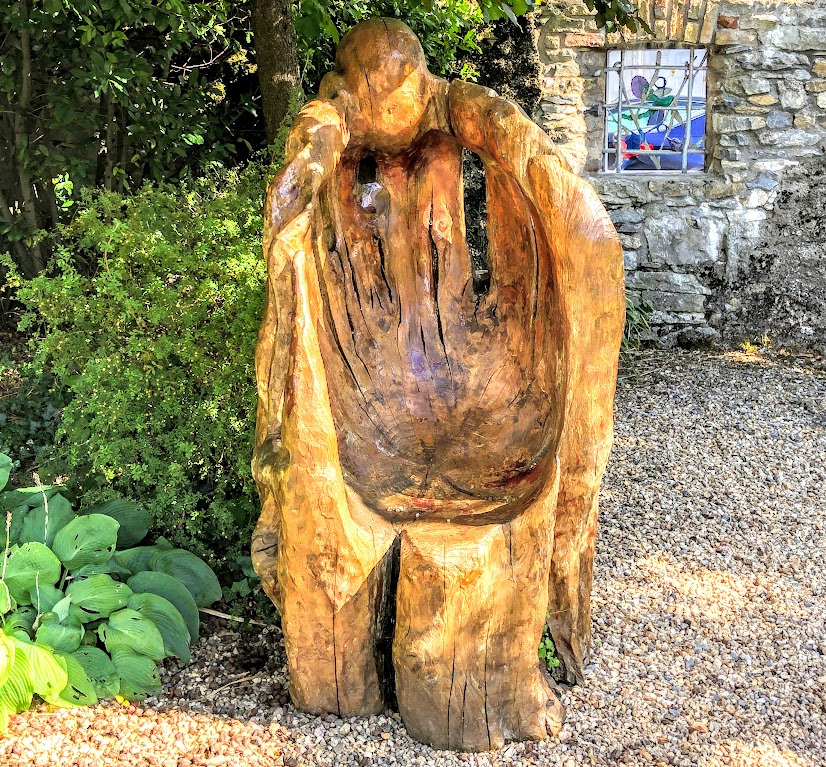
‘God is king over the nations; God sits on his holy throne’ (Psalm 47: 8) … a carved throne in the shape of a hand in Cashel, Co Tipperary (Photograph: Patrick Comerford)

Scripture quotations are from the New Revised Standard Version Bible: Anglicised Edition copyright © 1989, 1995, National Council of the Churches of Christ in the United States of America. Used by permission. All rights reserved worldwide. http://nrsvbibles.org

20 March 2022

Praying with the Psalms in Lent:
20 March 2022 (Psalms 40)

‘Do not, O Lord, withhold your mercy from me; let your steadfast love and your faithfulness keep me safe for ever’ (Psalm 40: 11) … street art in Cashel, Co Tipperary (Photograph: Patrick Comerford)

Patrick Comerford

Despite the extended Saint Patrick’s Day celebrations at the end of the week, I had a minor stroke (totally unconnected) and I have ended up in hospital in Milton Keynes since Friday night. But I am continuing with my Prayer Diary and each day. Today is the Third Sunday in Lent (Lent III, 20 March 2022), and before this day begins, I am taking some time early this morning for prayer, reflection and reading.

During Lent this year, in this Prayer Diary on my blog each morning, I am reflecting in these ways:

1, Short reflections on a psalm or psalms;

2, reading the psalm or psalms;

3, a prayer from the USPG prayer diary.

Psalm 40:

Psalm 40 has given its name to the U2 song 40, the final track on their 1983 album War.

Psalm 40 is ascribed to King David and is described by the Jerusalem Bible as a ‘song of praise and prayer for help.’ In a slightly different numbering system in the Greek Septuagint and the Latin Vulgate, this known as Psalm 39.

The first part of the Psalm (verses 1-11) is one in the series of psalms of thanksgiving of an individual. Verses 13-18, possibly set originally as an independent psalm, is virtually identical to Psalm 70. This part belongs more in the group of psalms of lament.

Psalm 40 may be divides into three sections:

1, Verses 1-5: confidence for deliverance;

2, Verses 6-10, the work of redemption;

3, Verses 11-17, a prayer for mercy and grace or a psalm of lament.

The U2 song 40, also known as 40 (How Long), is the tenth and final track on their 1983 album, War. The song is noted for its live performances. The guitarist the Edge and the bassist Adam Clayton trade instruments during the performances, and as it was commonly played to end their concerts, the band would leave the stage one-by-one as the audience continued to sing the refrain ‘How long to sing this song?’

The song was completed within the last few hours of the recording sessions for War. After working all night in Dublin on the album in Windmill Lane Studios, the band found themselves at 6 a.m. feeling that they were still one song short. Another band, Minor Detail, were due to start their recording session at 8 a.m. and had arrived early, and Adam Clayton had already gone home.

In a moment of inspiration, the remaining members -- Bono, the Edge, and Larry Mullen – decided to revive an abandoned song that they had been unable to translate into a ‘coherent song.’ Producer Steve Lillywhite quickly did a multi-track edit of the song, removing any parts that seemed disconnected from the main musical idea. With Clayton absent, the Edge switched between guitar and bass guitar.

In search of lyrical inspiration, Bono opened the Bible and found Psalm 40, on which he based his words. As soon as his vocals were recorded and the song mixed, the band immediately left the studio, completing the sessions for War.

Bono later recalled: ‘When we were making our third record, the War LP, we were being thrown out of the studio by the studio manager because we had overrun or something and we had one more song to do. We wrote this song in about ten minutes, we recorded it in about ten minutes, we mixed it in about ten minutes and we played it, then, for another ten minutes and that’s nothing to do with why it’s called 40.’

Since its live debut in Dundee on 26 February 1983, ‘40’ has been a staple of U2’s live concerts, having been performed almost 400 times.

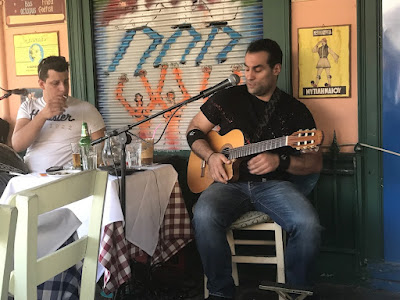
‘He put a new song in my mouth, a song of praise to our God’ (Psalm 40: 3) … Greek singers outside a café in the Plaka in Athens (Photograph: Patrick Comerford)

Psalm 40 (NRSVA):

To the leader. Of David. A Psalm.

1 I waited patiently for the Lord;
he inclined to me and heard my cry.
2 He drew me up from the desolate pit,
out of the miry bog,
and set my feet upon a rock,
making my steps secure.
3 He put a new song in my mouth,
a song of praise to our God.
Many will see and fear,
and put their trust in the Lord.

4 Happy are those who make
the Lord their trust,
who do not turn to the proud,
to those who go astray after false gods.
5 You have multiplied, O Lord my God,
your wondrous deeds and your thoughts towards us;
none can compare with you.
Were I to proclaim and tell of them,
they would be more than can be counted.

6 Sacrifice and offering you do not desire,
but you have given me an open ear.
Burnt-offering and sin-offering
you have not required.
7 Then I said, ‘Here I am;
in the scroll of the book it is written of me.
8 I delight to do your will, O my God;
your law is within my heart.’

9 I have told the glad news of deliverance
in the great congregation;
see, I have not restrained my lips,
as you know, O Lord.
10 I have not hidden your saving help within my heart,
I have spoken of your faithfulness and your salvation;
I have not concealed your steadfast love and your faithfulness
from the great congregation.

11 Do not, O Lord, withhold
your mercy from me;
let your steadfast love and your faithfulness
keep me safe for ever.
12 For evils have encompassed me
without number;
my iniquities have overtaken me,
until I cannot see;
they are more than the hairs of my head,
and my heart fails me.

13 Be pleased, O Lord, to deliver me;
O Lord, make haste to help me.
14 Let all those be put to shame and confusion
who seek to snatch away my life;
let those be turned back and brought to dishonour
who desire my hurt.
15 Let those be appalled because of their shame
who say to me, ‘Aha, Aha!’

16 But may all who seek you
rejoice and be glad in you;
may those who love your salvation
say continually, ‘Great is the Lord!’
17 As for me, I am poor and needy,
but the Lord takes thought for me.
You are my help and my deliverer;
do not delay, O my God.

Today’s Prayer:

The USPG Prayer Diary has a particular focus this week on ‘Lingering Legacies’ and remembering the victims of slavery and the transatlantic slave trade. This theme is introduced this morning by Monique Castle, Adviser to the Anglican Youth Fellowship in the Diocese of Jamaica and the Cayman Islands. The Prayer in the USPG Prayer Diary this morning (20 March 2022, Lent III) invites us to pray:

Welcoming God,
May we offer sanctuary to those in need.
Let no one be a stranger
In the house of the Lord.

Yesterday’s reflection

Continued tomorrow

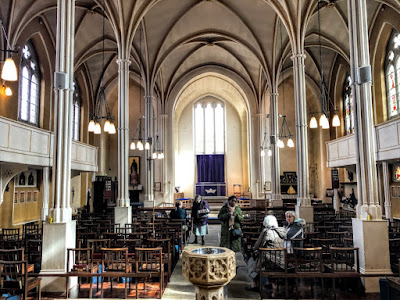
‘Let no one be a stranger in the house of the Lord’ (the USPG Prayer Diary this morning) … inside the parish church of Saint Mary and Saint Giles in Stony Stratford, Milton Keynes (Photograph: Patrick Comerford, 2022)

Scripture quotations are from the New Revised Standard Version Bible: Anglicised Edition copyright © 1989, 1995, National Council of the Churches of Christ in the United States of America. Used by permission. All rights reserved worldwide. http://nrsvbibles.org

08 January 2022

With the Saints through Christmas (14):
8 January 2022, Saint Albert of Cashel

The Rock of Cashel … was there an eighth century Saint Albert who was Bishop of Cashel? (Photograph: Patrick Comerford)

Patrick Comerford

The season of Epiphany continues, and I have some final details for tomorrow’s Sunday services to attend to later this morning.

But before this day gets busy, I am taking some time early this morning for prayer, reflection and reading.

I have been continuing my Prayer Diary on my blog each morning, reflecting in these ways:

1, Reflections on a saint remembered in the calendars of the Church during Christmas;

2, the day’s Gospel reading;

3, a prayer from the USPG prayer diary.

This morning, I am reflecting on Saint Albert of Cashel, an eighth century saint and Patron of Cashel in Co Tipperary.

Saint Albert is said in tradition to have been an Englishman who worked in Ireland and then in Bavaria. Albert went to Jerusalem and died in Regensburg on his return journey.

He was an evangelist working mainly around the city of Cashel, and may have been a bishop there.

In a legendary 12th century biography he is called natione Anglus, conversatione Angelicus – ‘by nationality an Angle, in manners an angel.’ He continued his work as an evangelist in Bavaria with Saint Erhard of Regensburg and is reported to have suffered from arthritis in his back and hips.

He made a pilgrimage to Jerusalem, with Saint Erhard of Regensburg but died in 800 AD at Regensburg on the return journey.

Saint Albert’s grave is in Niedermünster in Regensburg. In the mid-12th century, a life was written at the Benedictine monastery of Schotten in Regensburg at Regensburg.

He was canonised on 19 June 1902 by Pope Leo XIII.

However, his existence has been questioned by some scholar. Others question his role as Bishop of Cashel, pointing out that the diocese did not exist until 1118, and the majority of buildings on the Rock of Cashel date only from the 12th century. The Irish Abbot of Regensburg, Dirmicius of Regensburg, sent two of his carpenters to help build Cormac’s Chapel on the Rock of Cashel in the mid-12th century, and the twin towers on either side of the junction of its nave and chancel are strongly suggestive of their Germanic influence. Others ask whether he has been confused with Saint Ailbe of Emly.

The Cathedral, Tower and Saint Patrick’s Cross on the Rock of Cashel (Photograph: Patrick Comerford)

Mark 6: 34-44 (NRSVA):

34 As he went ashore, he saw a great crowd; and he had compassion for them, because they were like sheep without a shepherd; and he began to teach them many things. 35 When it grew late, his disciples came to him and said, ‘This is a deserted place, and the hour is now very late; 36 send them away so that they may go into the surrounding country and villages and buy something for themselves to eat.’ 37 But he answered them, ‘You give them something to eat.’ They said to him, ‘Are we to go and buy two hundred denarii worth of bread, and give it to them to eat?’ 38 And he said to them, ‘How many loaves have you? Go and see.’ When they had found out, they said, ‘Five, and two fish.’ 39 Then he ordered them to get all the people to sit down in groups on the green grass. 40 So they sat down in groups of hundreds and of fifties. 41 Taking the five loaves and the two fish, he looked up to heaven, and blessed and broke the loaves, and gave them to his disciples to set before the people; and he divided the two fish among them all. 42 And all ate and were filled; 43 and they took up twelve baskets full of broken pieces and of the fish. 44 Those who had eaten the loaves numbered five thousand men.

The prayer in the prayer diary of the Anglican mission agency USPG (United Society Partners in the Gospel) invites us to pray this morning (8 January 2022):

We pray for the World Council of Churches, which seeks to build partnerships across churches, countries and continents.

Yesterday: Saint John the Baptist

Tomorrow: The Black Nazarene, ‘Nuestro Padre Jesús Nazareno’

King Cormac Mac Carthaigh began building Cormac’s Chapel in 1127, and it was consecrated in 1134 (Photograph: Patrick Comerford)

Scripture quotations are from the New Revised Standard Version Bible: Anglicised Edition copyright © 1989, 1995, National Council of the Churches of Christ in the United States of America. Used by permission. All rights reserved worldwide. http://nrsvbibles.org

23 June 2020

The many claimants to
the Cox title in Co Cork:
fact, fantasy or fiction?

Dunmanway, Co Cork … at the heart of the estates once owned by the Cox family (Photograph: Patrick Comerford)

Patrick Comerford

In recent weeks I have written about impoverished and eccentric baronets, claimants to peerages, baronets whose claims to family titles were bogus, the peculiar titles claimed by clergy, from baronet to count and Irish chieftain, and the tangled trees of the Wolseley, Fitzgibbon and Dillon families.

One of the most curious claims was made by the Revd George William Cox (1827-1902), an Anglican priest, classical scholar and historian who assumed the title of baronet first given to the Cox family of Dunmanway, Co Cork, in 1706.

Was George William Cox deceiving himself? Was he deceived by his uncle and father? Was he trying to deceive polite society? Or was he a real baronet? And why did and the many other claimants to this Irish title fail to convince the legal authorities?

The first holder of the title was Sir Richard Cox (1650-1733), an Irish lawyer and judge who was born in Bandon, Co Cork. He was a direct descendant of Richard Cox, Bishop of Ely (1559-1581) and Chancellor of Oxford (1547-1552), who died in 1581. The Cox family arrived in Ireland from Wiltshire about 1600, and they were dispossessed during the Irish Rebellion of 1641.

Richard Cox, the future judge, was orphaned by the age of three, and was raised in Co Cork by his maternal grandparents and his uncle John Bird. He went to school in Clonakilty, and then by his own account he spent ‘three years idling’ before going to England to study law.

He was apprenticed in the manorial courts of the Earl of Cork, built up a lucrative legal practice, became Recorder of Kinsale, and acquired an estate at Clonakilty ca 1687. But he lost his post in Kinsale when James II became king. He moved to Bristol, where he practiced as a barrister. There he got to know the Irish-born diplomat Sir Robert Southwell (1635-1702), kinsman of Sir Thomas Southwell of Rathkeale, Co Limerick, who introduced him to the Duke of Ormonde, who became his patron.

Cox returned to Ireland, and after the Battle of the Boyne he was knighted by William III in 1692 and became a baronet in 1706. He became Recorder of Waterford, second justice of the Court of Common Pleas, military governor of Cork, and a member of the Privy Council of Ireland.

But Cox was dismissed from the Privy Council in 1695 for denouncing the failures to honour the terms of the Treaty of Limerick and respecting offers made to the defeated Jacobites. It was a temporary setback, and in 1701 he became Chief Justice of the Common Pleas (1701-1703), he was reappointed to the Privy Council, and became Lord Chancellor of Ireland (1703-1707) and then Lord Chief Justice of the Queen’s Bench (1711-1714). He escaped impeachment when his great patron Ormonde defected to the Jacobite cause in 1715 and fled to France.

He spent his later years improving the town of Dunmanway. He obtained a royal charter to hold fairs and market days in the town, and did much to encourage the local flax industry.

He lived 20 years in retirement before his death, from apoplexy, in the Great Hall of the Royal Hospital, Kilmainham, on 3 May 1733.

Sir Richard Cox died at the Royal Hospital, Kilmainham, in 1733 (Photograph: Patrick Comerford)

Cox and his wife Mary Bourne had numerous children. He mentions 21, although only 15 can be identified with certainty. Some of these children died in infancy, and of those who reached adulthood, the eldest son, also Richard, predeceased his father.

A younger son, Michael Cox (1691-1779), was the Rector of Callan, Co Kilkenny, Bishop of Ossory (1743-1754) and Archbishop of Cashel (1754-1779). He is remembered for building Castletown Cox, a magnificent Palladian mansion near Carrick-on-Suir.

When Cox died in 1733, his title and his Dunmanway estates were inherited as second baronet by his grandson Sir Richard Cox (1702-1766). He was a son of Richard Cox, a former MP for Tallaght, who married Catherine Evans of Bulgaden Hall, near Kilmallock, Co Limerick, sister of George Evans, 1st Lord Carberry.

This Sir Richard Cox was educated at Oxford University, and was Sheriff of Cork City in 1742. His son and successor, the Ven Sir Michael Cox (1730-1772), was Archdeacon of Cashel (1767-1772) while his uncle was the Archbishop of Cashel.

Archdeacon Michael Cox was educated at Trinity College Dublin and married the widowed Elizabeth Arthur from Limerick, daughter of Hugh Massy, 1st Baron Massy.

The Cathedral Church of Saint John the Baptist and Saint Patrick’s Rock in Cashel … the third baronet was Archdeacon of Cashel while his uncle was Archbishop of Cashel (Photograph: Patrick Comerford, 2019)

Archdeacon Cox was the father of Sir Richard Cox, the 4th Baronet. He married Mary O’Brien, a great-granddaughter of William O’Brien, 3rd Earl of Inchiquin. He died on 17 September 1783 when he drowned accidentally in Dunmanway. His widow remarried William Saurin, the Attorney General for Ireland, and died in 1840.

The title was eventually claimed by Archbishop Cox’s descendants. Sir Richard Cox, the eighth baronet and sheriff of Kilkenny, was a great-grandson of Archbishop Cox.

Following his death in 1838, however, the later history of this title is obscure and difficult to trace because of tangled family trees. In not one instance did the title descend to an eldest son, and in only two instances – the third and fourth baronets – did it ever descend to a son at all. In all other cases, the title passed to brothers or cousins.

The ninth baronet, Sir Francis Cox (1769-1856), was succeeded by his nephew, Sir Ralph Hawtrey Cox (1808-1872), the son of the Revd Richard Cox, said to be the Rector of Caherconlish, Co Limerick, although he is not listed in the diocesan clergy succession lists. Sir Ralph was born in Caherconlish, lived in Borrisokane, and died in Kingstown (Dun Laoghaire).

The eleventh baronet, Sir Michael Francis Hawtrey Cox (1810-1872), was young when he fell from a horse, and it was said he was ‘out of his mind’ for the rest of his life. He succeeded to the title on 12 April 1872 but died in Kilkenny two months later, on 15 June 1872.

The twelfth baronet, Sir Francis Hawtrey Cox (1816-1873), enjoyed the title for just over a year. When he died on 17 April 1873, there were questions about his brother William Saurin Cox: was he, perhaps, an elder brother rather than a younger brother? Was he still alive? Did he become the 13th baronet? Did he have a son who might inherit the title?

The Ulster Office of Arms, the Irish genealogical authority based in Dublin Castle, regarded the title as extinct from 1873. But there was another claimant to the title: Colonel Edmund Cox in Canada claimed he was the 14th baronet, while Lieutenant-General John Hamilton Cox CB, the son of Major-General William Cox, claimed he was a first cousin of Sir Francis Hawtrey Cox and the 13th baronet.

Colonel Edmund Cox, a former officer in the Royal Irish Fusiliers, was living in Canada. He claimed William Saurin Cox had survived, had succeeded to the title, and that the title then devolved on him in 1873, although he only started using it 1876, and died a year later in 1877.

When he died, his claims passed to his nephew, the Revd George William Cox, who became the most persistent of these claimants or soi-disant baronets.

Holy Trinity Cathedral, Gibraltar … George William Cox was the Anglican chaplain in Gibraltar in 1851-1853 (Photograph: Patrick Comerford)

The Revd George William Cox was born at Benares on 10 January 1827, the eldest of six children of Captain George Hamilton Cox (died 1841), of the East India Company. A younger brother, Colonel Edmund Henry Cox, fired the first shot against Sevastopol in the Crimean war.

George was sent to England at the age of nine in 1836, and was admitted to Rugby in 1842 under Archibald Tait, later Archbishop of Canterbury. He then studied classics in Trinity College Oxford, graduating BA and proceeding MA in 1859.

At first, Cox was sympathetic to the Oxford Movement, and in 1850 he was ordained by Bishop Samuel Wilberforce of Oxford. He was a curate at Salcombe Regis, and in 1851 became the English chaplain in Gibraltar. However, Bishop George Tomlinson of Gibraltar did not approve of his High Church views, and Cox left for South Africa with John William Colenso, who became Bishop of Natal in 1853.

On his return to England in 1854, Cox became curate of Saint Paul’s, Exeter, then spent a year (1859-1860) as a teacher in Cheltenham (1859-1860). Meanwhile, his religious principles completely changed, largely under the influence of historical study. In January 1858, he published a paper in the Edinburgh Review on Milman’s History of Latin Christianity that illustrates the development of his views on Broad Church lines.

Cox supported Colenso’s views on biblical criticism and his struggle over his episcopal status in South Africa. He defended Colenso in a long correspondence with FD Maurice, and warmly supported Colenso when he was back in England (1863-1865).

When Colonel Edmund Cox died in 1877, Cox claimed to succeed him in the title of baronet in the Cox family of Dunmanway, and started using the titular prefix, calling himself the Revd Sir George William Cox.

Cox was appointed Vicar of Bekesbourne by Archbishop Tait of Canterbury, in 1880, and from 1881 to 1897, he was rector of the crown living of Scrayingham, Yorkshire. He was chosen as Bishop of Natal in 1886 by Colenso’s followers, but Archbishop Benson refused to consecrate him because his election was unacceptable to the High Church party.

Cox’s friendship with Colenso provided material for The Life of Bishop John William Colenso, DD, Bishop of Natal, which he published as Sir GW Cox in 1888. That year, he also published a short vindication of Colenso’s views in The Church of England and the Teaching of Bishop Colenso.

He received a civil list pension of £120 in 1896, and died at Ivy House, Walmer, on 9 February 1902. His ashes were buried after cremation at Long Cross, Chertsey. Cox married Emily Maria Stirling in 1850. They were the parents of five sons and two daughters.

Cox’s other work includes studies of mythology, and histories of the Greeks and Persians, the Crusades, British India, and a book of ‘family prayer’ based on Jeremy Taylor and other 17th century divines. But many of his works were popular in character, and the most important, the History of Greece, is now regarded as having little value.

However, his two-volume biography is the most valuable source for the life of Colenso and includes a large number of letters from the bishop. A new edition was published by the Cambridge University Press in 2011.

George William Cox published a two-volume biography of Bishop Colenso

When George William Cox died in 1902, his eldest surviving son, Edmund Charles Cox, was the district superintendent of police at Poona. He too claimed the right to the title of baronet and petitioned the committee of the Privy Council for recognition as the next Dunmanway baronet.

However, his petition was opposed by Major John Hawtrey Reginald Cox, who claimed not only that he was the rightful baronet, but that he was in fact descended from the eldest son of the first baronet’s third wife.

The petition by Edmund Charles Cox to the title was disallowed by the Privy Council on 9 November 1911, and attention now turned to the claims of Major John Hawtrey Reginald Cox, published in five volumes as Claim of JHR Cox to the Baronetcy of Cox of Dunmanway, Co Cork (London, 1912-1914).

Major John Hawtrey Reginald Cox of the 13th Middlesex Regiment was born in Co Laois, a son of General John Hamilton Cox who died in 1887. His claims to the title were examined in detail in The Weekly Irish Times on 13 March 1915 after his petition was rejected by the Privy Council on Baronetcies.

Major Cox had presented his claim in November 1912 to the Ulster King-of-Arms, who in turn passed it to the Home Secretary, asking him to place his name on the official roll of baronets. The petition was then referred to the Privy Council on 21 September 1914.

Major Cox pointed out that when the seventh baronet, Sir George Matthias Cox, died in 1838, the elder line of the first baronet died out. But, he argued, the title had ‘descended in error’ to the male descendants of Archbishop Michael Cox, Archbishop of Cashel, until the death of Francis Hawtrey Cox in 1873.

Major Cox now claimed that his great grandfather, John Cox, was a son of Richard Cox, the eldest son of Sir Richard Cox, the first baronet, and his third wife Elinor Jeffreys. He argued that the title should have descended to John Cox’s eldest son, Thomas Cox, in 1838, and then to his brother, General William Cox, in 1853, and afterwards to William’s son, Major-General John Cox CB, in 1857, instead of passing to the descendants of the Archbishop Michael Cox.

He claimed General William Cox never claimed the title, but allowed Richard Cox, of Castletown, to assume the title as the eighth baronet, as he was the son of the general’s guardian and ‘greatest friend,’ Michael Cox, who had brought him up at Castletown.

These were extraordinary claims, and the Ulster Office seems to have wondered why General John Cox made no objection to Dr Michael or Captain Francis Hawtrey, his first cousins, assuming the title.

Major Cox failed to prove the legitimacy of William Cox, and could not produce the marriage certificate of William Cox’s parents. He said they married at a date before marriage registers existed, but he could not say when or where they married.

‘In the end,’ The Weekly Irish Times reported, ‘all of the petitioner’s arguments were in vain.’ The committee of the Privy Council agreed ‘that the name of the petitioner ought not to be entered on the official roll of the baronetcies.’

The first baronet fathered 21 children, and at least 15 of them survived. Undoubtedly, he has many male descendants who are still living today. But the tangled family trees, woven by the many claimants to the title over 100 to 150 years ago, make it unlikely that any successful claimant is ever going to emerge again.

A portrait of Archbishop Michael Cox in the Bishop’s House, Kilkenny … did his descendants usurp the family’s title of baronet? (Photograph: Patrick Comerford)

(Updated 13 November 2023, with typographical corrections)

01 November 2019

Ashmore House typifies
the former Georgian
elegance of Cashel

Ashmore House on John Street, Cashel … an example of the town’s elegant Georgian domestic heritage (Photograph: Patrick Comerford, 2019)

Patrick Comerford

John Street, leading from the former Cashel Palace Hotel on Main Street, Cashel, to the Church of Ireland Cathedral of Saint John the Baptist and Saint Patrick’s Rock, is lined with elegant Georgian townhouses.

Once built as residential homes for the rising professional, middle class of Cashel at the height of town’s prosperity, when the Co Tipperary town had a rich cultural life, many of these Georgian townhouses have been converted into suites of offices and waiting rooms for doctors, lawyers and accountants, while others now offer chic or boutique Bed and Breakfast accommodation.

Ashmore House, on the corner of John Street and William Street, faces the entrance to the Cathedral, and its architectural style epitomises the architectural and cultural elegance of Cashel in the closing decades of the 18th and the opening decades of the 19th century, when Cashel still aspired to the status of a provincial city.

For more than a decade, Ashmore House has been welcoming guests for bed and breakfast accommodation in Cashel Town. It is the home of the Ryan family, although, sadly, Brendan Ryan of Ashmore House died earlier this year [25 July 2019].

Ashmore House is detached, five-bay, two-storey house over a half-basement, built on this corner-site ca 1830 and with extensive gardens at the rear, reached through an elliptical-headed carriage arch.

The façade of the house is enlivened by decorative features, including the frieze, quoins and render surrounds. Its form is enhanced by the sweeping steps and central doorway, whose decorative fanlight and elaborate doorcase make it a very notable feature on John Street.

The house is approached by flight of limestone steps with sweep walls and decorative cast-iron railings that continue to form the boundary of the basement area.

The elliptical-headed door opening has fluted render pilasters and an archivolt. The timber door has decorative panels and is flanked by a pair of decorative render pilasters and has a cornice. There is a frieze, a cornice and an ornate cobweb fanlight.

There are square-headed window openings with six-over-six pane timber sliding sash windows, limestone sills and render surrounds comprising decorative pilasters, consoles and cornices. The house has a pitched roof with rendered chimneystacks.

There are rendered walls with render quoins and a decorative render frieze with a pear-drop motif. An interesting feature north-west gable or William Street side of the house is the render and timber religious plaque showing the Virgin Mary and Christ Child, and with a render hood-moulding.

Ashmore House is a large and a prominently-sited house and it remains an imposing feature on the streetscape of Cashel close to the cathedral.

The plaque on the William Street gable of Ashmore House (Photograph: Patrick Comerford, 2019)

‘The Back of the Pipe’:
a Victorian fountain on
Cashel’s Main Street

‘The Back of the Pipe’ on Main Street, Cashel, was erected by the Town Commissioners in 1842 (Photograph: Patrick Comerford, 2019)

Patrick Comerford

One of the unique and eye-catching features on the streets of Cashel, Co Tipperary, is the 1840s fountain known as ‘The Back of the Pipe’ on Main Street.

The Victorian fountain was erected by the Town Commissioners of Cashel in 1842 to provide a supply of clean water to the town and was one of the first public works by the new Town Commissioners, set up by Act of Parliament in 1840 to replace the old corporation.

When the fountain at the Back of the Pipe was first erected near Moore Lane, it was designed to disgorge clean water through the mouths of the gargoyles or lions into a separate stone trough.

This half-octagonal-plan fountain, built of limestone, is attached to the south-west gable of a building. It has an artificial slate roof with a carved stone cornice and a pedimented date plaque (1842).

The form and function of the fountain adds variety to the streetscape of Cashel and the textures and materials provide further visual interest. It displays fine stone crafting, and the date plaque and cast-iron lion-heads add decorative interest.

The ‘Back of the Pipe’ has a dressed stone base with a cut stone plinth. A cut-stone string course separates the base from the upper snecked stone walling. The walling has roughly dressed stone pilasters and raised rectangular stone panels.

The cast-iron lion-head or gargoyle spouts at the base of the fountain were designed to feed water into the continuous trough reflecting the plan of fountain.

The fountain was restored in 1986, when it was converted into a decorative fountain.

Cashel also has an earlier well that gives its name to Ladyswell Street, and a fountain in the Hiberno-Romanesque style erected at Lower Gate Square by the people of Cashel in 1904 as a tribute to Dean Thomas Kinane (1835-1913).

One of the cast-iron lion-head or gargoyle spouts at the base of the fountain (Photograph: Patrick Comerford, 2019)

31 October 2019

Cashel Town Hall,
a reminder of
a mediaeval city

The Town Hall in Cashel, Co Tipperary … designed by James Edward Rogers (Photograph: Patrick Comerford, 2019)

Patrick Comerford

The Town Hall in Cashel, Co Tipperary, is now the home of Cashel Heritage Centre and is also home to a local museum.

The town of Cashel owes its existence to the Rock of Cashel, which was the seat of the Kings of Munster from the fifth century until it was given to the church in 1101. A round tower, Cormac’s Chapel and the Anglo-Normans Gothic cathedral and tower house were built in the centuries that followed.

However, Cashel is not just the Rock, and the town has mediaeval walls, the ruins of 13th century Dominican abbey, a mediaeval tower house known as Kearney’s Castle that dates from the late 15th century, and many attractive Georgian buildings, including the Church of Ireland cathedral, the former Bishop’s Palace, and elegant Georgian townhouses that line John Street.

Local lore claims that Cashel first became a ‘borough by favour’ in 1216 at the favour Donnchad Ua Lonngargáin I, Archbishop of Cashel (1208-1216), who died that year either in Rome or at Cîteaux Abbey, or his successor, Archbishop Donnchad Ua Lonngargáin II (1216-1223), a Cistercian monk who resigned in 1223 and died in 1232.

Cashel received its first Charter in 1228, when King Henry III granted ‘that vill in frankalmoign to the Archbishop of Cashel and his successors’ with the right to hold an ‘annual fair at Cashel for eight days, namely, on the vigil and feast of the Holy Trinity and six following days.’

Frankalmoign is a tenure in which a religious corporation holds lands given to them and their successors forever, usually on condition of praying for the soul of the donor and his heirs. For a one-off payment of 300 marks to the Crown, the Archbishop of Cashel gained almost exclusive control of the town and its revenues.

Fourteen years later, in 1232, Archbishop Marianus or Mairin O Briain (1223-1237) transferred the borough of Cashel to the Provost (mayor) and burgesses, reserving only the shambles or meat market to his personal jurisdiction. He also granted free pastures and other privileges to the town’s residents.

The rent-paying burgesses of Cashel were entitled to rights and privileges according to their status, and many worked lands in the vicinity granted to them by the archbishops.

Cashel developed as a planned Norman town, with a grid-like street layout, off-set lanes, and a market place. Long narrow plots extend from the street front, and the continuity of many of these from probably the high medieval period is still evident in Cashel.

The new town probably reached the extent marked out by the town wall by about 1265. Despite its early elevation to borough status, Cashel did not receive a murage grant until 1303-1307. Edward Bruce halted his army and held a parliament at Cashel in 1316, making the borough, albeit ever so briefly, the capital of Ireland.

The town walls in Cashel were built in 1319-1324.

The borough privileges of Cashel were confirmed by Richard II in 1378, by Archbishop Roland Baron FitzGerald (1553-1561) in 1557, and by Queen Elizabeth I in 1584.

Cashel received city status in a charter granted by King Charles I in 1637, and a second charter from Charles I in 1639 set out the city system of government.

By the mid-17th century, the town walls were obsolete and were probably of little value after the invention of gun powder. The Rock of Cashel was burned by Murrough O’Brien, Earl of Inchiquin, at the Sack of Cashel in 1647.

At the end of the 17th century, before the Battle of the Boyne, King James II granted a new charter to Cashel, but later, while he was camped nearby at Golden, he issued an edict reverting to the charters of Charles I.

Under Charles I’s charters, Cashel was governed by a mayor, 17 aldermen, and bailiffs, along with the citizens and commons of Cashel. The elections of the Mayor, Recorder and Town Clerk were subject to the approval of the Lord Lieutenant of Ireland and the Privy Council.

The Corporation elected two MPs to the Irish House of Commons until the Act of Union, and Cashel continued to elect one member of the House of Commons in Westminster until the borough was disenfranchised in 1870.

Meanwhile, Cashel Corporation was dissolved by Act of Parliament in 1840, and the landed estates and property of the corporation were transferred to the 21 town commissioners elected on 5 October 1840, with James Heney as the first elected chair.

The Town Hall, built by the Cashel Town Commissioners in 1866, is a three-bay, two-storey building, built on a prominent site in the centre of what was the medieval market place of Cashel.

The town hall was designed by the architect and artist James Edward Rogers (1838-1896).

Rogers was born in Dublin in 1838, a son of James Rogers, QC, of 20 Upper Mount Street. He was educated at Guildford Grammar School and Trinity College Dublin (BA 1861). While he was at TCD, he became a pupil of the architect Benjamin Woodward (1815-1861) who was then was working on the Oxford Museum.

Rogers regularly visited Oxford, where he became friends of the Pre-Raphaelites William Morris and Dante Gabriel Rossetti, who were then decorating Woodward’s debating hall at the Oxford Union with scenes from Arthurian legends. Together, they went ‘hunting in the parish churches on Sunday evenings to find a Guinevere.’

When Woodward was dying of tuberculosis, Rogers visited him in Algiers or the South of France in early 1860. He was later described by his lifelong friend, JP Mahaffy, as ‘Woodward’s favourite pupil.’

Woodward died in May 1861, Rogers graduated from TCD later that year, and probably set up his own practice in 1862, working first form his father’s address, and later from offices at Great Brunswick Street (Nos 205 and 179), now Pearse Street, Dublin.

He worked closely with both William Stirling and James Franklin Fuller, but most of his recorded work was with the Church of Ireland. He was architect to the Diocese of Meath until disestablishment in 1869 and also designed or worked on churches in the Diocese of Dublin and in the Diocese of Limerick.

His works include Saint Mary’s Church, Howth; Kenure Church and Kenure Rectory, Rush, Co Dublin; Holmpatrick Church, Skerries, Co Dublin; Saint Bartholomew’s Vicarage, Ballsbridge; Saint Paul’s Church, Kilfergus (Glin), Co Limerick; Kilkeedy Church, Clarina, Co Limerick; and Saint Patrick’s Church, Kilcock, Co Kildare; as well as No 31 Dame Street, Dublin; and the Carmichael School of Medicine, Brunswick Street, Dublin.

However, Rogers was best known for his drawings and watercolour paintings and as a book illustrator. He moved London in 1876 and does not appear to have practised as an architect in England, although he continued to exhibit his paintings at the Royal Hibernian Academy and at the Royal Academy and at the exhibitions of the Dublin Sketching Club and the Dublin Art Club. He died in London on 18 February 1896.

The Town Hall designed by Rogers in Cashel has a regular form that is enlivened by the varied openings and the gable-fronted addition. The three elevations incorporate myriad classical elements such as arcading, cornices, niches and pilasters, displaying evidence of fine stone-crafting.

Further interest and context are provided by the clock and an armorial date plaque. There is a striking contrast between the ornate limestone front and gable façades and the plain rendered rear façade is striking.

The Town Hall is now used as a tourist information office.

In front of the Town Hall, the Croke Cross was erected in 1895 to mark the jubilee of Thomas Croke (1824-1902), Archbishop of Cashel (1875-1902) and first patron of the Gaelic Athletic Association, which was founded in neighbouring Thurles.

This limestone cross, with echoes of the Celtic Revival, has figurative scenes and interlace in high relief, including a scene at the base of the east side of Saint Patrick baptising King Aengus of Munster on the Rock of Cashel.

The cross was first erected at the junction of Main Street and Friar Street. But it was demolished in a traffic accident. A replica was commissioned and was erected in its present position on Main Street in front of the Town Hall.

The Archbishop Croke Cross in front of the Town Hall in Cashel, Co Tipperary (Photograph: Patrick Comerford, 2019)

Kearney’s Castle, the oldest
surviving tower house and
domestic building in Cashel

Kearney’s Castle is the only known survivor of a group of fortified urban houses in Cashel (Photograph: Patrick Comerford, 2019)

Patrick Comerford

Kearney’s Castle Hotel in Cashel, Co Tipperary, closed almost three years ago [December 2016], but the castle or former tower house, with it battlements and gargoyles, remains a landmark mediaeval building on the Main Street of the heritage town.

The Kearney family lived in the castle for many generations and it has had a chequered past.

The O Cearnaigh or Kearney family were the hereditary keepers of Saint Patrick’s Crozier, and there are Kearney family tombs in the ruins of the cathedral on the Rock of Cashel.

Saint Patrick’s Crozier, or the ‘Staff of Jesus’ (Bacall Íosa), is said to have been used by Saint Patrick to banish the snakes from Ireland. For centuries, it was venerated in Christ Church Cathedral, Dublin. But at the Reformation it was burned in 1538 along with other relics on the orders of Archbishop George Browne.

Kearney’s Castle, on the east side of the Main Street, is a late 15th century tower house, built ca 1480 and was modified ca 1600. It is a six-storey building with two cap-houses, running from west to east.

A member of this family, David Kearney (1568-1625), was Archbishop of Cashel fro 1603 to 1624. In 1611, he was one of only two Roman Catholic bishops in Ireland; the other was Conor O’Devaney a Franciscan and Bishop of Down and Conor, who was arrested that year and executed in 1612.

Archbishop David Kearney died in Rome on 14 August 1624.

Another family member, Thomas Kearney, was an Alderman of Cashel in 1640.

During the Confederate wars in the mid-17th century, the Irish Parliamentarian commander, Murrough O’Brien, Lord Inchiquin, is believed to have used the castle as a garrison in 1647 when he sacked the town and slaughtered 3,000 inhabitants on the Rock of Cashel.

Father John Kearney, a member of the family, is said by some sources to have been hanged inside the castle in 1652, although it is more likely that he was hanged in Clonmel in 1653.

Father John Kearney (1619-1653), son of John Kearney and Elizabeth Creagh was born in Cashel, County Tipperary and joined the Franciscans in Kilkenny. He studied in Leuven and was ordained in Brussels in 1642.

On his way back to Ireland in 1644, he was arrested in London, tortured and condemned to death. But He escaped and made his way to France, finally travelling from Calais to Wexford. He returned to Ireland, taught philosophy in Cashel and preached in Cashel and Waterford. He was appointed the Franciscan novice master in Waterford and the porter or guardian at Carrick-on-Suir.

Kearney lived as a wanted man for nine years until he was arrested in Tipperary by the Parliamentarians in 1653 and was hanged in Clonmel. He was buried in the chapter hall of the suppressed Franciscan friary in Cashel. He was among the Irish martyrs beatified by Pope John Paul II on 27 September 1992.

A later member of the family was John Kearney (1742-1813), Church of Ireland Bishop of Ossory (1806-1813), was a nephew of Joseph Kearney of Moneygall, Co Offaly, was a direct ancestor of President Barack Obama.

Kearney’s Castle may be the oldest standing domestic building in Cashel (Photograph: Patrick Comerford, 2019)

Kearney’s Castle may be the oldest standing domestic building in Cashel, and it is the only known survivor of a group of fortified urban houses in the town. It displays variety in form, style, texture and materials and has fine stone crafting, especially in the parapet coping.

The castle has rubble limestone walls and crenellated parapet walls, with cut-stone coping and quoins and dressed gutter stones.

There are carved stone gargoyles on the upper front wall. The castle has arrow slit openings with cut limestone surrounds. The round-headed window on the top floor has a limestone sill, a moulded limestone surround, and replacement windows.

A square-headed, two-light window dating from ca 1600 has carved limestone label-moulding and a fixed timber lattice window with coloured glass.

High on the west and south walls is a number of drainage spouts, and the three on the west wall, above the arched window, are gargoyles.

There is a pronounced batter at the base of the castle, seen in the alleyway on the south side of the tower house. The ‘Jostle Stones’ were placed on the corners of building in the 19th century to protect them from the jostling wheels of carts and traps.

The round-headed entrance on the ground dates from ca 1990, when the hotel and bar were being modified or modernised. It has a dressed limestone surround and voussoirs, replacement timber doors and windows and a cast-iron portcullis feature.

Until it closed three years ago, Kearney’s Castle, also known locally as Quirke’s Castle and Grants, has been a favourite venue for locals and disco goers.

Kearney’s Castle Hotel closed three years ago (Photograph: Patrick Comerford, 2019)