The crucifixion depicted at the top of the Monsell monument in Tervoe village, near Clarina, Co Limerick (Photograph: Patrick Comerford, 2021)
Patrick Comerford
While I was visiting the church site at Kilkeedy and Saint Joseph’s Church in Ballybrown, near Clarina, Co Limerick, recently, I came across two interesting monuments to the Monsell family. Both monuments are intimately linked to the decision of the Monsell family to move from Anglicanism to the Church of Ireland, following in the steps of Cardinal John Henry Newman.
The Monsell Monument in Tervoe village is a memorial to Lady Anna Maria Charlotte Wyndham Quinn (1814-1855), wife of William Monsell of Tervoe, and daughter of Windham Henry Quin (1782-1850), 2nd Earl of Dunraven.
She was 21 when she married William Monsell on 11 August 1836. They had two children, both died in infancy. He became a Roman Catholic in 1850, and when she died on 7 January 1855, she was buried in the Monsell vault in the mediaeval ruins attached to Killkeedy Church.
Monsell he seems to have been heart-broken and grief-stricken. Within weeks, he had erected memorial crosses to her above the vault and in Tervoe village near Clarina, and set up a charity in her memory to assist 20 ‘poor widows’ each year on the anniversary of her death.
The cross at Tervoe carries the inscription, ‘On the seventh day of January, in each year, at the foot of this cross, an alms will be given to twenty poor widows in memory of Anna Maria Monsell January 7th 1855.’
This carved limestone monument has a square-plan stepped base supporting central monument with a square-plan inscribed plinth. A carved octagonal shaft supports a square frieze with foliate motifs at the base, carved in the round with pointed arch niches that have gable-fronted canopies and inset relief figural sculptures surmounted by a carved crucifix.
This monument displays a wealth of high-quality carved details and decoration, including Gothic Revival devices such as the gable-fronted canopies. These details create an ornate and striking piece of sculpture, with craft work of a very high order.
The Monsell monument in Tervoe is a memorial to Lady Anna Maria Monsell (Photograph: Patrick Comerford, 2021)
Anna’s husband, William Monsell (1812-1894), who later became the 1st Baron Emly, was a prominent Co Limerick landowner and politician who held a number of ministerial positions from 1852 to 1873. His father, William ‘Black Billy’ Monsell (1778-1822), of Tervoe, was MP for Dunleer and Dingle; his mother Olivia was a daughter of Sir John Johnson-Walsh, a former MP for Baltinglass.
The Monsell family sold their estates in Somerset, and John Monsell (1581-1637) first bought lands in the Askeaton area in 1612. He returned to England, but the family bought further lands in Co Limerick. At the end of the 17th century, the family also acquired the ruined Carrigogunnell Castle and the lands around it, and they lived at Tervoe from then on, with a townhouse in Saint John’s Square, Limerick.
The family was involved in the wine trade from Cadiz in the 18th century, and many members of the family were ordained in the Church of Ireland. One member of the family, the Revd Charles Monsell (1815-1851), married William Smith O’Brien’s sister Harriet, who, as a widow and as Mother Harriet Monsell, was instrumental in reviving the tradition of women’s religious communities in the Anglican Communion.
The decorative work on the cross above the Monsell vault at Kilkeedy church, near Clarina, Co Limerick (Photograph: Patrick Comerford, 2021)
William Monsell was educated at Winchester and Oriel College, Oxford, where John Henry Newman was his tutor and intellectual guide. Although Monsell left Oxford in 1833 without a degree, he was already identified with the Oxford Movement and High Church Anglicanism, and he and Newman had become lifelong friends.
Molnsell’s father had died in an accident 1824, and William succeeded to his grandfather’s estates near Clarina at the age of 21.
Monsell was a resident and improving landlord and – unlike his father – was popular with his tenants and neighbours. He was the Sheriff of Co Limerick in 1835. He helped found Saint Columba’s College, now in Whitechurch, near Rathfarnham, in 1843. The founders included the Revd William Sewell, who later founded Radley College in England, the Archbishop of Dublin, and Monsell’s brother-in-law, Lord Adare, later Earl of Dunraven. At its foundation, the school was identified with the High Church tradition in Anglicanism.
Monsell was elected a Liberal MP for Co Limerick in 1847, and continued to hold the seat until 1874, when he was made a member of the House of Lords as Lord Emly.
The cross above the Monsell vault at Kilkeedy church, near Clarina, Co Limerick (Photograph: Patrick Comerford, 2021)
Meanwhile, Newman became a Roman Catholic in 1845, and through his influence Monsell became a Roman Catholic in 1850. Other prominent landlords in Co Limerick took a similar decision, including some of the de Veres of Curraghchase, the Windham Quins of Adare Manor and the Southwells of Castle Matrix, Rathkeale.
Monsell took a prominent part in Catholic affairs, especially in Parliament as a Catholic Whig. As a friend of Wiseman, Newman and other prominent, public Catholics, his position in parliament was often an advantage to his Church. He was involved in introducing the Redemptorists to Limerick in 1851, introduced the Sisters of Mercy to Limerick, and made generous donations towards building Saint John’s Cathedral in Limerick and Saint Mary’s Church, Rathkeale.
Monsell joined the government in 1852, a post he held until 1857, and became a member of the Privy Council in 1855. Later government positions included President of the Board of Health (1857), Paymaster-General and Vice-President of the Board of Trade (1866), Under-Secretary of State for the Colonies (1868-1871), and Postmaster-General (1871-1873). He was Lord Lieutenant of Co Limerick in 1871-1894 and Vice-Chancellor of the Royal University of Ireland in 1885-1894.
Monsell became a member of the House of Lords in 1874 with the title of Baron Emly of Tervoe in Co Limerick. The name Emly was suggested by his friend Stephen de Vere, and reflected his interest in the Church and Church history. There may have been an element of ‘Catholic triumphalism’ in this choice too: the Church of Ireland cathedral at Emly had fallen into disuse, and was pulled down in 1877; a new Roman Catholic parish church, dedicated to Saint Ailbe, was built on a site beside the grounds of the cathedral in 1880-1883.
However, Lord Emly lost much of his popularity in Ireland during his later years because of his opposition to the Land League and to Home Rule.
Two years after Lady Anna’s death, Monsell married a French Catholic aristocrat, Bertha de Montigny (1835-1890), in 1857. She was the youngest daughter of the Comte de Montigny of the house of Montigny de Perreux, and there was a 23-year ago gap. The couple were parents of one son, Gaston Thomas William Monsell (1858-1932), later the 2nd Lord Emly, and one daughter, the Hon Mary Olivia Augusta Monsell (1860-1942), who in 1881 married Edmund de la Poer (1841-1915), de jure 18th Lord le Power and Count de la Poer, a papal count, an Irish peer and Liberal MP for Co Waterford (1866-1873).
Lord Emly also erected a Lourdes Grotto in the townland of Tervoe. This grotto is on the lands of Cooperhill Farm, north of Tervoe, in an enclosure in a wooded area of the farm, where a stream runs around the grotto. It is believed to be the first Lourdes Grotto in Ireland.
The inscription on the Monsell vault beside Kilkeedy Church, near Clarina, Co Limerick (Photograph: Patrick Comerford, 2021)
In his old age, Lord Emly took a prominent role in founding Mungret College, near his home in Co Limerick. He died on 20 April 1894, aged 81, and was buried in the family vault in Kilkeedy. His estates included 2,246 acres at Clarina, Athlacca and Kilmallock in Co Limerick, 466 acres at Cratloe, Co Clare, and 700 acres in Co Kerry. His papers are in the National Library of Ireland and in the National Archives.
The Emly title then passed to his only son Thomas as the 2nd Lord Emly, who was educated at the Oratory School in Edgbaston, the school established by Newman, and at Beaumont College, Windsor. He married his sister’s sister-in-law, Frances Vincent de la Poer. This Lord Emly was a supporter of Irish labour and nationalism, and when he died on 24 November 1932, the direct line of the Monsells at Tervoe came to an end and the Emly title died out.
The estates passed to his nephew, Edmund Alan Tremeur de Poher de la Poer (1883-1964). He took the additional surname of Monsell. The last member of the family to live at Tervoe was his son, John Humphrey Arnold de Poher de la Poer (1916-1989).
The contents of Tervoe House were sold at auction in 1953, and the house was demolished. One recent afternoon, two of us went in search of Lady Emly’s ‘Lourdes Grotto’ near the banks of the Shannon. We saw its location in the distance, but we failed to find it.
The shrine to John Henry Newman in Saint Joseph’s Church, Ballybrown (Photograph: Patrick Comerford, 2021)
Showing posts with label Mungret. Show all posts
06 January 2020
The church in Mungret
was built to cater for
Limerick’s growing suburbs
The Church of Saint Oliver Plunkett in Mungret, Co Limerick … designed by the Limerick architects John and Nuala Kernan (Photograph: Patrick Comerford, 2020)
Patrick Comerford
The new, modern Roman Catholic parish church in Mungret village, on the outskirts of Limerick City, is in sharp contrast to the nearby ruins of the monastic churches and buildings from the monastery founded by Saint Nessan in the sixth century, and the ruins of the former Church of Ireland parish church.
At one time, it is said, the monastery at Mungret had at least six functioning church. But the present parish church, dedicated to Saint Oliver Plunkett, is the newest church in Mungret.
In the Roman Catholic Diocese of Limerick, Mungret, Crecora and Raheen form one parish, which is an interesting mixture of urban, suburban and rural life.
Inside the Church of Saint Oliver Plunkett in Mungret (Photograph: Patrick Comerford, 2020)
At one time, this was very much a rural area, but suburban Limerick expanded rapidly from the 1960s on. The parish grouping stretches from the banks of the River Shannon, near Mungret to beyond the southern edge of the N20 road and reaches out into the Golden Vale in the direction of Adare, Cork and Kerry.
The parish church in Mungret was built in 1981 to cater for the population growing up around Mungret village. The church was dedicated to Saint Oliver Plunkett (1625-1681), the martyred 17th century Archbishop of Armagh.
A stained-glass window in the church depicts Saint Oliver Plunkett (Photograph: Patrick Comerford, 2020)
The parish website describes him as ‘a victim of the Cromwellian persecution in the 17th century.’
In fact, Oliver Plunkett was in Rome throughout the Cromwellian period (1649-1658). He was sent to Rome by his family in 1647 to study at the Irish College, and was ordained priest there in 1654. He remained in Rome as the representative of the Irish bishops throughout the period of the Commonwealth period and during the first decade of the reign of Charles II.
He was consecrated Archbishop of Armagh in Ghent on 30 November 1669, and eventually arrived back in Ireland on 7 March 1670, and was based in Drogheda for most of the nine years that followed.
The reliquary of Saint Oliver Plunkett in Mungret (Photograph: Patrick Comerford, 2020)
He was arrested in Dublin in December 1679, jailed in Dublin Castle, and put on trial in Dundalk. When the trial collapsed, he was moved to Newgate Prison in London, tried at Westminster Hall in the wake of the Titus Oates plot, and was convicted of high treason in June 1681. He was hanged, drawn and quartered at Tyburn on 1 July 1681; he was 55 and the last Catholic martyr to die in England.
He was beatified in 1920 and canonised in 1975, becoming the first new Irish saint for almost 700 years.
His canonisation gave new popularity to the martyred archbishop, and when the new church opened in Mungret in 1981 it was dedicated to Saint Oliver Plunkett.
The church is square shaped with a mansard-style roof (Photograph: Patrick Comerford, 2020)
The church was designed by the Limerick architects John and Nuala Kernan. Their whose other churches in the area include the Church of Christ the King in Caherdavin.
The church was opened by Bishop Jeremiah Newman and Father Eamon Dillane, PP on 20 September 1981.
The church is square-shaped and has a large, dark, mansard-style roof and low white walls with irregularly placed and varied windows, including a stained-glass window on the right-hand side depicting Saint Oliver Plunkett.
Other windows depict the Holy Spirit, the Lamb of God and the Bread and Wine of the Eucharist.
A window depicting the Holy Spirit (Photograph: Patrick Comerford, 2020)
There is shrine and a reliquary containing a relic of Saint Oliver Plunkett close to the stained-glass window with his image.
The church was designed so it could be extended if the growth in population made this necessary.
The architects John and Nuala Kernan were present at the launch of Dr Liam Irwin’s book, The Diocese of Limerick: an illustrated history, published in 2013. John Kernan died in 2016.
The Main Street in Mungret, Co Limerick … the village is fast becoming a suburb of Limerick City (Photograph: Patrick Comerford, 2020)
Patrick Comerford
The new, modern Roman Catholic parish church in Mungret village, on the outskirts of Limerick City, is in sharp contrast to the nearby ruins of the monastic churches and buildings from the monastery founded by Saint Nessan in the sixth century, and the ruins of the former Church of Ireland parish church.
At one time, it is said, the monastery at Mungret had at least six functioning church. But the present parish church, dedicated to Saint Oliver Plunkett, is the newest church in Mungret.
In the Roman Catholic Diocese of Limerick, Mungret, Crecora and Raheen form one parish, which is an interesting mixture of urban, suburban and rural life.
Inside the Church of Saint Oliver Plunkett in Mungret (Photograph: Patrick Comerford, 2020)
At one time, this was very much a rural area, but suburban Limerick expanded rapidly from the 1960s on. The parish grouping stretches from the banks of the River Shannon, near Mungret to beyond the southern edge of the N20 road and reaches out into the Golden Vale in the direction of Adare, Cork and Kerry.
The parish church in Mungret was built in 1981 to cater for the population growing up around Mungret village. The church was dedicated to Saint Oliver Plunkett (1625-1681), the martyred 17th century Archbishop of Armagh.
A stained-glass window in the church depicts Saint Oliver Plunkett (Photograph: Patrick Comerford, 2020)
The parish website describes him as ‘a victim of the Cromwellian persecution in the 17th century.’
In fact, Oliver Plunkett was in Rome throughout the Cromwellian period (1649-1658). He was sent to Rome by his family in 1647 to study at the Irish College, and was ordained priest there in 1654. He remained in Rome as the representative of the Irish bishops throughout the period of the Commonwealth period and during the first decade of the reign of Charles II.
He was consecrated Archbishop of Armagh in Ghent on 30 November 1669, and eventually arrived back in Ireland on 7 March 1670, and was based in Drogheda for most of the nine years that followed.
The reliquary of Saint Oliver Plunkett in Mungret (Photograph: Patrick Comerford, 2020)
He was arrested in Dublin in December 1679, jailed in Dublin Castle, and put on trial in Dundalk. When the trial collapsed, he was moved to Newgate Prison in London, tried at Westminster Hall in the wake of the Titus Oates plot, and was convicted of high treason in June 1681. He was hanged, drawn and quartered at Tyburn on 1 July 1681; he was 55 and the last Catholic martyr to die in England.
He was beatified in 1920 and canonised in 1975, becoming the first new Irish saint for almost 700 years.
His canonisation gave new popularity to the martyred archbishop, and when the new church opened in Mungret in 1981 it was dedicated to Saint Oliver Plunkett.
The church is square shaped with a mansard-style roof (Photograph: Patrick Comerford, 2020)
The church was designed by the Limerick architects John and Nuala Kernan. Their whose other churches in the area include the Church of Christ the King in Caherdavin.
The church was opened by Bishop Jeremiah Newman and Father Eamon Dillane, PP on 20 September 1981.
The church is square-shaped and has a large, dark, mansard-style roof and low white walls with irregularly placed and varied windows, including a stained-glass window on the right-hand side depicting Saint Oliver Plunkett.
Other windows depict the Holy Spirit, the Lamb of God and the Bread and Wine of the Eucharist.
A window depicting the Holy Spirit (Photograph: Patrick Comerford, 2020)
There is shrine and a reliquary containing a relic of Saint Oliver Plunkett close to the stained-glass window with his image.
The church was designed so it could be extended if the growth in population made this necessary.
The architects John and Nuala Kernan were present at the launch of Dr Liam Irwin’s book, The Diocese of Limerick: an illustrated history, published in 2013. John Kernan died in 2016.
The Main Street in Mungret, Co Limerick … the village is fast becoming a suburb of Limerick City (Photograph: Patrick Comerford, 2020)
01 June 2019
Three books for
a pilgrim’s journey
Three books bought in Limerick earlier this week (Photograph: Patrick Comerford, 2019)
Patrick Comerford
I was in Mount Saint Alphonsus, the Redemptorist church in Limerick, earlier this week [27 May 2019] for the launch of a new book by Gladys Ganiel on the life, witness and ministry of Father Gerry Reynolds (1935-2015).
The new book, Unity Pilgrim: The Life of Fr Gerry Reynolds CSsR (Dundalk, 2019), is published by Redemptorist Communications (€13.95). It was launched last month in Belfast by the Revd Ken Newell, Minister Emeritus at Fitzroy Presbyterian Church and a former Moderator of the Presbyterian Church in Ireland, and in Limerick. In Limerick, the book was launched by Ed Petersen, who worked with Gerry for many years in Clonard Monastery’s peace and reconciliation mission.
Gerry was from Mungret, on the edges of Limerick, and went to school in Saint Munchin’s College and Saint Clement’s College. Later, he was the Rector of Mount St Alphonsus in 1975-1978.
The author of this new book, Dr Gladys Ganiel, is a Research Fellow in the Senator George J Mitchell Institute for Global Peace, Security and Justice at the Queen’s University Belfast.
When Gerry first arrived in Belfast in 1983, the city was starkly divided by conflict and violence. Clonard Monastery is on the interface between the Catholic Falls Road and the Protestant Shankill Road.
His instinct to reach out to those who were suffering, on both sides of the community, became a lifelong devotion to the cause of peace and Christian unity.
This book tells about Gerry’s friendships of the Cornerstone Community and the Clonard-Fitzroy Fellowship, how he became involved in secret talks with republican and loyalist paramilitary groups, and how he set up of the ‘Unity Pilgrims.’
Gerry played a crucial role in the Northern Ireland peace process. He believed the Church could be ‘God’s peace process in human history’, and that dialogue and friendship would open hearts to the mutual understanding and trust that are the foundations of true peace.
His role in peace-making is not as well-known as that of his Redemptorist colleague, Father Alec Reid, who was the pivotal broker in the secret Hume-Adams talks. But Gerry assisted Alec behind the scenes and also developed a public ecumenical ministry. Gerry’s diaries reveal how the two Redemptorist priests were sustained during this time by prayer.
Gladys Ganiel says, ‘Faith is what made Reynolds who he was; without his confidence in the absolute goodness of God and his faith-filled friendships, he would not have made such a difference for peace.’
He became a member of the ecumenical Cornerstone Community, which had a house by the peace wall. With its leader, the Revd Sam Burch, a Methodist minister, he visited more than 50 grieving families on both sides of the wall. With the Revd Ken Newell, he developed the Clonard-Fitzroy Fellowship, which received the international Pax Christi Award in 1999.
He also formed the Unity Pilgrims, an initiative in which Catholics associated with Clonard worship with Protestant congregations on Sunday mornings. His last major project was ‘In Joyful Hope,’ in which Christians of all traditions attend each other’s Eucharistic celebrations.
Gerry was also a journalist in Dublin in the 1960s and 1970s on the Redemptorist Record, which later changed its name to Reality, and as the editor of Intercom, the influential priests’ journal.
Gerry believed we were cousins. We met for lunch in Rathgar when he was staying in Marianella, the Redemptorist house, and I was lecturing nearby at the Church of Ireland Theological Institute.
Although I am still not sure how we were related, he spoke of mutual cousins and Millstreet connections, including the Murphy, Crowley, Mahony and Riordan or O’Riordan families, and Clayton Love. I have never tried to untangle this side of the family tree, but the ecumenical generosity that marked his life was came alive in the way he invited me to share with him at the funeral of a mutual cousin, Rose (Walsh) O’Reilly, in 2005.
He truly was an ecumenical pilgrim, the ‘Unity Pilgrim’ that gives this book its title.
It was good to meet members of Gerry’s family on Monday evening, as well as many Redemptorist friends, including Brendan McConvery, Gerard Moloney and Seamus Enright.
On the day of the book launch, I bought two other books in Limerick: Jung, A Very Short Introduction (Oxford, 2001), by Anthony Stevens, and Limerick in 50 Buildings (Stroud: Amberley, 2019). Both should help me in my journeys as a pilgrim in very different ways. But more about them on another day, perhaps.
Patrick Comerford
I was in Mount Saint Alphonsus, the Redemptorist church in Limerick, earlier this week [27 May 2019] for the launch of a new book by Gladys Ganiel on the life, witness and ministry of Father Gerry Reynolds (1935-2015).
The new book, Unity Pilgrim: The Life of Fr Gerry Reynolds CSsR (Dundalk, 2019), is published by Redemptorist Communications (€13.95). It was launched last month in Belfast by the Revd Ken Newell, Minister Emeritus at Fitzroy Presbyterian Church and a former Moderator of the Presbyterian Church in Ireland, and in Limerick. In Limerick, the book was launched by Ed Petersen, who worked with Gerry for many years in Clonard Monastery’s peace and reconciliation mission.
Gerry was from Mungret, on the edges of Limerick, and went to school in Saint Munchin’s College and Saint Clement’s College. Later, he was the Rector of Mount St Alphonsus in 1975-1978.
The author of this new book, Dr Gladys Ganiel, is a Research Fellow in the Senator George J Mitchell Institute for Global Peace, Security and Justice at the Queen’s University Belfast.
When Gerry first arrived in Belfast in 1983, the city was starkly divided by conflict and violence. Clonard Monastery is on the interface between the Catholic Falls Road and the Protestant Shankill Road.
His instinct to reach out to those who were suffering, on both sides of the community, became a lifelong devotion to the cause of peace and Christian unity.
This book tells about Gerry’s friendships of the Cornerstone Community and the Clonard-Fitzroy Fellowship, how he became involved in secret talks with republican and loyalist paramilitary groups, and how he set up of the ‘Unity Pilgrims.’
Gerry played a crucial role in the Northern Ireland peace process. He believed the Church could be ‘God’s peace process in human history’, and that dialogue and friendship would open hearts to the mutual understanding and trust that are the foundations of true peace.
His role in peace-making is not as well-known as that of his Redemptorist colleague, Father Alec Reid, who was the pivotal broker in the secret Hume-Adams talks. But Gerry assisted Alec behind the scenes and also developed a public ecumenical ministry. Gerry’s diaries reveal how the two Redemptorist priests were sustained during this time by prayer.
Gladys Ganiel says, ‘Faith is what made Reynolds who he was; without his confidence in the absolute goodness of God and his faith-filled friendships, he would not have made such a difference for peace.’
He became a member of the ecumenical Cornerstone Community, which had a house by the peace wall. With its leader, the Revd Sam Burch, a Methodist minister, he visited more than 50 grieving families on both sides of the wall. With the Revd Ken Newell, he developed the Clonard-Fitzroy Fellowship, which received the international Pax Christi Award in 1999.
He also formed the Unity Pilgrims, an initiative in which Catholics associated with Clonard worship with Protestant congregations on Sunday mornings. His last major project was ‘In Joyful Hope,’ in which Christians of all traditions attend each other’s Eucharistic celebrations.
Gerry was also a journalist in Dublin in the 1960s and 1970s on the Redemptorist Record, which later changed its name to Reality, and as the editor of Intercom, the influential priests’ journal.
Gerry believed we were cousins. We met for lunch in Rathgar when he was staying in Marianella, the Redemptorist house, and I was lecturing nearby at the Church of Ireland Theological Institute.
Although I am still not sure how we were related, he spoke of mutual cousins and Millstreet connections, including the Murphy, Crowley, Mahony and Riordan or O’Riordan families, and Clayton Love. I have never tried to untangle this side of the family tree, but the ecumenical generosity that marked his life was came alive in the way he invited me to share with him at the funeral of a mutual cousin, Rose (Walsh) O’Reilly, in 2005.
He truly was an ecumenical pilgrim, the ‘Unity Pilgrim’ that gives this book its title.
It was good to meet members of Gerry’s family on Monday evening, as well as many Redemptorist friends, including Brendan McConvery, Gerard Moloney and Seamus Enright.
On the day of the book launch, I bought two other books in Limerick: Jung, A Very Short Introduction (Oxford, 2001), by Anthony Stevens, and Limerick in 50 Buildings (Stroud: Amberley, 2019). Both should help me in my journeys as a pilgrim in very different ways. But more about them on another day, perhaps.
08 October 2018
Westward Ho and memories of
a boy’s swashbuckling books
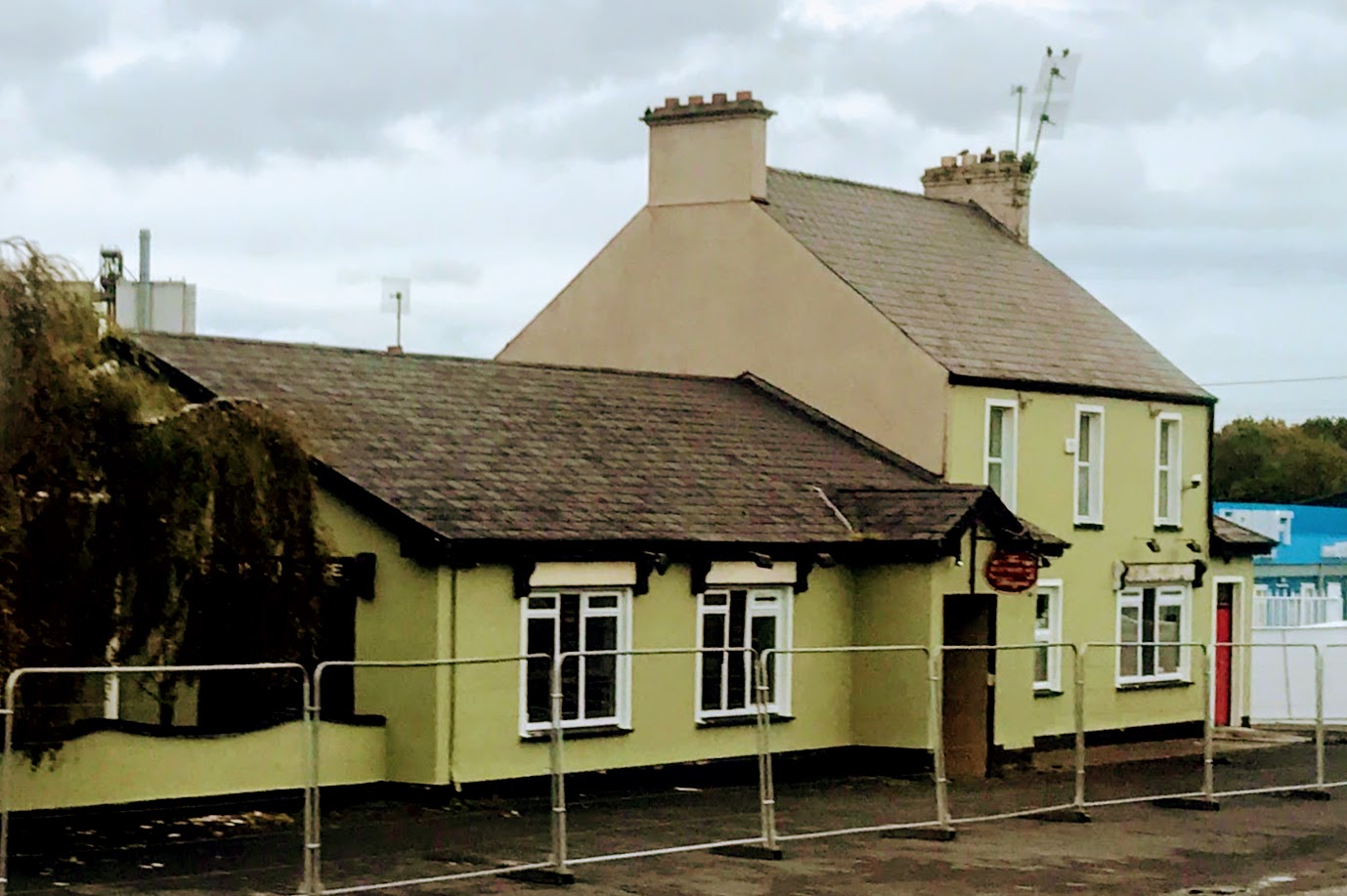
The Westward Ho restaurant-bar in Mungret, Co Limerick (photographs: Patrick Comerford)
Patrick Comerford
On the road from Limerick to Askeaton, Mungret is an attractive village that is quickly being absorbed into the city as a suburb. In recent months, Westward Ho, the only pub is Mungret has been refurbished and reopened as a restaurant bar.
For many people on their way from Limerick heading west to the port at Foynes or the beach at Ballybunion, the name Westward Ho! seems very apposite. But the name is also a reminder of Westward Ho!, the historical novel by Charles Kingsley published in 1855.
I still remember first reading Westward Ho! when I was a boy of 8. I still have a clear memory of the books I read that summer: my first attempted reading of the King James Version of the Bible, as well as Westward Ho! by Charles Kingsley, Kidnapped and Treasure Island by Robert Louis Stevenson, and Foxe’s Book of Martyrs, which was attractive to a boy of my age not because of its religious fervour but because its ghoulish illustrations had a certain hold over a boy’s imagination.
Westward Ho!was published eight years before The Water-Babies (1863), and ten years before Hereward the Wake (1865). If my parents were ever aware of Kingsley’s alleged racism, they never alluded to it, and they never stopped us reading his books. Kingsley wrote to his wife from Ireland in 1860: ‘I am haunted by the human chimpanzees I saw along that hundred miles of horrible country ... to see white chimpanzees is dreadful; if they were black one would not see it so much, but their skins, except where tanned by exposure, are as white as ours.’ These anti-Irish tirades continue in The Water-Babies, with references to ‘pleasant lies’ told by ‘a poor Paddy’ who ‘knows no better.’ In Hereward the Wake, the hero finds refuge in Ireland among the Vikings, who are civilised and live in cities like Dublin, Waterford and Limerick, while the native Irish are deceitful, dishonest and treacherous.
But my childhood excitement at reading Westward Ho! still returns when I pass through Mungret, and I have retained a respect for many of the values of the Revd Charles Kingsley (1819-1875), an Anglican priest, professor, social reformer, historian and novelist. He is particularly associated with Christian Socialism, working men’s colleges, and labour co-operatives. He was a friend of prominent Victorians such as Charles Darwin, John Ruskin, Thomas Carlyle, Charles Dickens and Alfred Lord Tennyson, and was one of the first public figures to welcome Charles Darwin’s On the Origin of Species in 1859.
Westward Ho! is based on the adventures of an Elizabethan corsair and is based a real-life on the events surrounding the Spanish Armada and an expedition in 1595. A prominent theme is the 16th-century fear of Roman Catholics, and the book describes repeatedly an English view of the worst excesses of Spanish Jesuits and the Inquisition.
When I pass Westward Ho in Mungret, I also think of Kingsley’s Irish-born friend and neighbour in Cambridge, the Revd Professor FJA Hort. When Westward Ho! was about to be published, Kingsley sent the printer’s proofs to Fenton Hort, perhaps seeking not just a second opinion but approval too. Hort was particularly engaged with the descriptions of the Desmond rebellion in Limerick and Kerry, including references to Hort’s ancestors in the FitzMaurice family and the destruction of Carrigafoyle Castle on the Kerry coast, between Ballybunion and Tarbert. Hort could hardly suppress his excitement and wrote eagerly to his friend the bibliophile Henry Bradshaw (1831-1886), a master at Saint Columba’s College, Rathfarnham (1854-1856). Hort told Bradshaw he had ‘just been reading in the sheets of Kingsley’s Westward Ho!, a capital description of the attempt of the Spaniards to effect a lodgement in Munster in 1580.’
Rev Charles Kingsley
Westward Ho!
Revd Prof FJA Hort
This full-page feature is published in the October 2018 edition of ‘Newslink,’ the diocesan magazine of the United Dioceses of Limerick, Killaloe and Ardfert [p 20]
Patrick Comerford
On the road from Limerick to Askeaton, Mungret is an attractive village that is quickly being absorbed into the city as a suburb. In recent months, Westward Ho, the only pub is Mungret has been refurbished and reopened as a restaurant bar.
For many people on their way from Limerick heading west to the port at Foynes or the beach at Ballybunion, the name Westward Ho! seems very apposite. But the name is also a reminder of Westward Ho!, the historical novel by Charles Kingsley published in 1855.
I still remember first reading Westward Ho! when I was a boy of 8. I still have a clear memory of the books I read that summer: my first attempted reading of the King James Version of the Bible, as well as Westward Ho! by Charles Kingsley, Kidnapped and Treasure Island by Robert Louis Stevenson, and Foxe’s Book of Martyrs, which was attractive to a boy of my age not because of its religious fervour but because its ghoulish illustrations had a certain hold over a boy’s imagination.
Westward Ho!was published eight years before The Water-Babies (1863), and ten years before Hereward the Wake (1865). If my parents were ever aware of Kingsley’s alleged racism, they never alluded to it, and they never stopped us reading his books. Kingsley wrote to his wife from Ireland in 1860: ‘I am haunted by the human chimpanzees I saw along that hundred miles of horrible country ... to see white chimpanzees is dreadful; if they were black one would not see it so much, but their skins, except where tanned by exposure, are as white as ours.’ These anti-Irish tirades continue in The Water-Babies, with references to ‘pleasant lies’ told by ‘a poor Paddy’ who ‘knows no better.’ In Hereward the Wake, the hero finds refuge in Ireland among the Vikings, who are civilised and live in cities like Dublin, Waterford and Limerick, while the native Irish are deceitful, dishonest and treacherous.
But my childhood excitement at reading Westward Ho! still returns when I pass through Mungret, and I have retained a respect for many of the values of the Revd Charles Kingsley (1819-1875), an Anglican priest, professor, social reformer, historian and novelist. He is particularly associated with Christian Socialism, working men’s colleges, and labour co-operatives. He was a friend of prominent Victorians such as Charles Darwin, John Ruskin, Thomas Carlyle, Charles Dickens and Alfred Lord Tennyson, and was one of the first public figures to welcome Charles Darwin’s On the Origin of Species in 1859.
Westward Ho! is based on the adventures of an Elizabethan corsair and is based a real-life on the events surrounding the Spanish Armada and an expedition in 1595. A prominent theme is the 16th-century fear of Roman Catholics, and the book describes repeatedly an English view of the worst excesses of Spanish Jesuits and the Inquisition.
When I pass Westward Ho in Mungret, I also think of Kingsley’s Irish-born friend and neighbour in Cambridge, the Revd Professor FJA Hort. When Westward Ho! was about to be published, Kingsley sent the printer’s proofs to Fenton Hort, perhaps seeking not just a second opinion but approval too. Hort was particularly engaged with the descriptions of the Desmond rebellion in Limerick and Kerry, including references to Hort’s ancestors in the FitzMaurice family and the destruction of Carrigafoyle Castle on the Kerry coast, between Ballybunion and Tarbert. Hort could hardly suppress his excitement and wrote eagerly to his friend the bibliophile Henry Bradshaw (1831-1886), a master at Saint Columba’s College, Rathfarnham (1854-1856). Hort told Bradshaw he had ‘just been reading in the sheets of Kingsley’s Westward Ho!, a capital description of the attempt of the Spaniards to effect a lodgement in Munster in 1580.’
Rev Charles Kingsley
Westward Ho!
Revd Prof FJA Hort
This full-page feature is published in the October 2018 edition of ‘Newslink,’ the diocesan magazine of the United Dioceses of Limerick, Killaloe and Ardfert [p 20]
08 May 2018
An icon in Listowel
recalls the horrors of
Belsen and the Holocaust
The icon in Saint Mary’s Church, Listowel, Co Kerry, was presented to Father Michael Morrison in Bergen-Belsen (Photograph: Patrick Comerford, 2018)
Patrick Comerford
A discreetly placed icon in Saint Mary’s Church, Listowel, Co Kerry, recalls the Holocaust and the role of a Listowel-born Jesuit priest, Father Michael Morrison was the chaplain with the British and Canadian troops who liberated the Bergen-Belsen concentration camp in 1945.
The wooden icon of the Virgin Mary and the Christ Child is said to have been carved by a concentration camp prisoner during World War II. It was presented to Saint Mary’s Church by the Donal Walsh Live Life Foundation on World Holocaust Day this year [28 January 2018].
The Revd Lieutenant Michael Morrison, SJ (1908-1973), was the liberating chaplain at the Bergen-Belsen concentration camp in 1945, and was the great-uncle of Donal Walsh from Blennerville, who before his death from cancer at the age of 16, had campaigned to help young people struggling with suicidal thoughts.
Father Michael Morrison was born in Listowel in October 1908. He was educated in Limerick by the Christian Brothers at Sexton Street, and from the age of 14 by the Jesuits at Mungret College. At Mungret, he was an excellent student and sportsman, winning the O’Mara cup with his hurling team.
At 18, he decided to become a Jesuit and he entered the novitiate in 1925. As part of his training, he was sent to the Jesuit-run school, Belvedere College, in Dublin to teach Math and Religious Knowledge and to live in the Jesuit Community.
When he was ordained in 1939, he continued to teach in Belvedere College. He was teaching there in 1941 when the British army called on Irish priests to serve as chaplains in World War II. Morrison answered the call, and in 1941 he joined the 2/5th Battalion of the Welsh Regiment.
His first posting was in the Middle East, where he worked with soldiers no matter what their religious affiliation was. In 1943 Morrison was sent to the No13 General Hospital of the Middle Eastern Forces, and in 1944 he was transferred to to the 2/8th Lancashire Fusiliers, Derry Regiment.
In the closing days of the war, British and Canadian troops entered Bergen-Belsen on 15 April 1945. It was the first concentration camp liberated on the Western Front, and the soldiers had little idea of what they would face as they entered.
When Morrison arrived at Belsen, he was confronted with the sight of ‘between 10,000 and 15,000 corpses lying about unburied.’ In his first letter home, he writes about the total desperation of the situation: ‘The CO expects 5,000 to die in the next two weeks. After that he expects the death rate to go down.’ But he admitted later on that this estimate was much smaller than the number who actually died.
Unlike Auschwitz and other camps, Belsen had no gas chambers. It was originally used as a prisoner-of-war camp for French and Belgian captives. From 1943, Jews with foreign passports were kept there to be exchanged for German nationals imprisoned abroad, but very few exchanges were made. About 200 Jews were allowed to emigrate to Palestine and about 1,500 Hungarian Jews were allowed to emigrate to Switzerland.
In time, Belsen became a holding camp for the Jewish prisoners. It was divided into eight sections, including a detention camp, two women’s camps, a special camp, a neutrals camps, a ‘star’ camp for mainly Dutch prisoners who wore a Star of David on their clothing instead of the camp uniform, a Hungarian camp and a tent camp.
Bergen-Belsen was designed to hold 10,000 prisoners, but by the time Morrison arrived with the British and Canadian troops at the end of the war, there were more than 60,000 prisoners, including large numbers who had been moved there from Auschwitz and other camps to the East.
Tens of thousands of prisoners from other camps came to Bergen-Belsen after agonising death marches, and the main causes of death were malnutrition and typhus. More than 50,000 people died at the camp between 1941 and 1945, including Anne Frank, the young Jewish diarist, who died just three weeks before the camp was liberated.
Morrison spent his first 10 days there anointing about 300 dying people a day, stopping only for two short meal breaks a day. In letters home, he describes how ‘what we saw within the first few days is utterly beyond description,’ and describes ‘people crawling on their hands and knees because they have not got the strength to walk.’
Morrison was placed in Camp No 1, ‘Horror Camp,’ where the number of dead was so great that the army had to use bulldozers to push the mounds of dead bodies into large pits that became mass graves. Morrison would stand over these pits, staring at the rotting corpses and praying for the dead. They included Poles, Hungarians, Russians, French, Belgians and Dutch. Photographs show Morrison and a British army Jewish chaplain, Rabbi Leslie Hardman (1913-2008), conducting a joint service over Mass Grave number 2 at Belsen before it was filled in on 25 April 1945.
Morrison found seven fellow Jesuits who had been held in Belsen because of their ethnic origins or political views. Five of these Jesuits died in the first few weeks.
Near the end of 1945, the remaining 11,000 Jews where moved out of ‘Horror Camp’ to better conditions and on a day which Morrison describes as ‘White Monday,’ the camp was burned to the ground.
After World War II, Morrison moved to Australia, where he taught at Riverview College and served as parish priest at Saint Ignatius Church.
He later returned to Dublin to teach maths at Belvedere College. But he spoke little of what he had seen in Belsen. His health was failing, and he collapsed while walking up the steps in Belvedere House. He died in Jervis Street Hospital soon after on 7 April 1973. Father Michael Morrison was buried in Glasnevin Cemetery, Dublin.
Patrick Comerford
A discreetly placed icon in Saint Mary’s Church, Listowel, Co Kerry, recalls the Holocaust and the role of a Listowel-born Jesuit priest, Father Michael Morrison was the chaplain with the British and Canadian troops who liberated the Bergen-Belsen concentration camp in 1945.
The wooden icon of the Virgin Mary and the Christ Child is said to have been carved by a concentration camp prisoner during World War II. It was presented to Saint Mary’s Church by the Donal Walsh Live Life Foundation on World Holocaust Day this year [28 January 2018].
The Revd Lieutenant Michael Morrison, SJ (1908-1973), was the liberating chaplain at the Bergen-Belsen concentration camp in 1945, and was the great-uncle of Donal Walsh from Blennerville, who before his death from cancer at the age of 16, had campaigned to help young people struggling with suicidal thoughts.
Father Michael Morrison was born in Listowel in October 1908. He was educated in Limerick by the Christian Brothers at Sexton Street, and from the age of 14 by the Jesuits at Mungret College. At Mungret, he was an excellent student and sportsman, winning the O’Mara cup with his hurling team.
At 18, he decided to become a Jesuit and he entered the novitiate in 1925. As part of his training, he was sent to the Jesuit-run school, Belvedere College, in Dublin to teach Math and Religious Knowledge and to live in the Jesuit Community.
When he was ordained in 1939, he continued to teach in Belvedere College. He was teaching there in 1941 when the British army called on Irish priests to serve as chaplains in World War II. Morrison answered the call, and in 1941 he joined the 2/5th Battalion of the Welsh Regiment.
His first posting was in the Middle East, where he worked with soldiers no matter what their religious affiliation was. In 1943 Morrison was sent to the No13 General Hospital of the Middle Eastern Forces, and in 1944 he was transferred to to the 2/8th Lancashire Fusiliers, Derry Regiment.
In the closing days of the war, British and Canadian troops entered Bergen-Belsen on 15 April 1945. It was the first concentration camp liberated on the Western Front, and the soldiers had little idea of what they would face as they entered.
When Morrison arrived at Belsen, he was confronted with the sight of ‘between 10,000 and 15,000 corpses lying about unburied.’ In his first letter home, he writes about the total desperation of the situation: ‘The CO expects 5,000 to die in the next two weeks. After that he expects the death rate to go down.’ But he admitted later on that this estimate was much smaller than the number who actually died.
Unlike Auschwitz and other camps, Belsen had no gas chambers. It was originally used as a prisoner-of-war camp for French and Belgian captives. From 1943, Jews with foreign passports were kept there to be exchanged for German nationals imprisoned abroad, but very few exchanges were made. About 200 Jews were allowed to emigrate to Palestine and about 1,500 Hungarian Jews were allowed to emigrate to Switzerland.
In time, Belsen became a holding camp for the Jewish prisoners. It was divided into eight sections, including a detention camp, two women’s camps, a special camp, a neutrals camps, a ‘star’ camp for mainly Dutch prisoners who wore a Star of David on their clothing instead of the camp uniform, a Hungarian camp and a tent camp.
Bergen-Belsen was designed to hold 10,000 prisoners, but by the time Morrison arrived with the British and Canadian troops at the end of the war, there were more than 60,000 prisoners, including large numbers who had been moved there from Auschwitz and other camps to the East.
Tens of thousands of prisoners from other camps came to Bergen-Belsen after agonising death marches, and the main causes of death were malnutrition and typhus. More than 50,000 people died at the camp between 1941 and 1945, including Anne Frank, the young Jewish diarist, who died just three weeks before the camp was liberated.
Morrison spent his first 10 days there anointing about 300 dying people a day, stopping only for two short meal breaks a day. In letters home, he describes how ‘what we saw within the first few days is utterly beyond description,’ and describes ‘people crawling on their hands and knees because they have not got the strength to walk.’
Morrison was placed in Camp No 1, ‘Horror Camp,’ where the number of dead was so great that the army had to use bulldozers to push the mounds of dead bodies into large pits that became mass graves. Morrison would stand over these pits, staring at the rotting corpses and praying for the dead. They included Poles, Hungarians, Russians, French, Belgians and Dutch. Photographs show Morrison and a British army Jewish chaplain, Rabbi Leslie Hardman (1913-2008), conducting a joint service over Mass Grave number 2 at Belsen before it was filled in on 25 April 1945.
Morrison found seven fellow Jesuits who had been held in Belsen because of their ethnic origins or political views. Five of these Jesuits died in the first few weeks.
Near the end of 1945, the remaining 11,000 Jews where moved out of ‘Horror Camp’ to better conditions and on a day which Morrison describes as ‘White Monday,’ the camp was burned to the ground.
After World War II, Morrison moved to Australia, where he taught at Riverview College and served as parish priest at Saint Ignatius Church.
He later returned to Dublin to teach maths at Belvedere College. But he spoke little of what he had seen in Belsen. His health was failing, and he collapsed while walking up the steps in Belvedere House. He died in Jervis Street Hospital soon after on 7 April 1973. Father Michael Morrison was buried in Glasnevin Cemetery, Dublin.
23 April 2018
A visit to the grave of the
‘Scarlet Pimpernel of the
Vatican’ in Cahersiveeen
A mural commemorating Monsignor Hugh O’Flaherty (1898-1963) on a gable end beside the Daniel O’Connel Memorial Church in Cahersiveen (Photograph: Patrick Comerford, 2018)
Patrick Comerford
When I stopped to see the Daniel O’Connel Memorial Church in the centre of Cahersiveen on the way to Ballinskelligs in the Kerry Galetacht late last week, I also visited the grave of Monsignor Hugh O’Flaherty, who is known as the ‘Scarlet Pimpernel of the Vatican.’
Monsignor Hugh O’Flaherty (1898-1963) is buried in the grounds of the church and in my sermons on Sunday morning [22 April 2018] in Castletown and Rathkeale I cited one of the quotation on his grave: ‘God has no country.’
He is proudly portrayed on a gable wall abutting the churchyard, and the story of his heroic life, which involved saving more than 5,000 people, including Jews, children, and prisoners of war, while he was a senior diplomat in the Vatican, is told in the Gregory Peck television film, The Scarlet and the Black (1983).
Monsignor O’Flaherty, who was born in Lisrobin, Kiskeam, Co Cork, on 28 February 1898, and grew up near Killarney, where his father, James O’Flaherty, worked as a green keeper.
He went to the Jesuit-run Mungret College, Co Limerick, at the age of 20 in 1916 to train for the priesthood. He was sent to Rome in 1922 and was ordained on 20 December 1925. He went on to work as a Vatican diplomat in Egypt, Haiti, Santo Domingo and Czechoslovakia. In 1934, he was appointed a papal chamberlain with the title of monsignor.
In the early years of World War II, Monsignor O’Flaherty visited prisoner of war camps in Italy, searching for prisoners who had been reported missing in action. During the German occupation of Italy, the Irish embassy to the Holy See was the only English-speaking embassy to remain open in Rome.
O'Flaherty and his friends hid over 4,000 people, including Allied soldiers and Jews, in flats, farms and convents. SS attempts to arrest or assassinate him failed, and the Germans threatened to kill him should he step across a white line painted on the pavement at the opening of Saint Peter’s Square, signifying the border between the Vatican City and Italy.
During O’ Flaherty’s underground activities, Jewish religious services were held in the Basilica of San Clemente. Of the 9,700 Jews in Rome, 1,007 had been shipped to Auschwitz. The rest were hidden, including 3,000 in Castel Gandolfo, 200 to 400 as ‘members’ of the Palatine Guard and another 1,500 in monasteries, convents and colleges. Another 3,700 were hidden in private homes.
After World War II, Monsignor O'Flaherty received a number of international awards. Britain made him a CBE and the US gave him the Medal of Freedom with Silver Palm. In 1953, the Vatican appointed him a domestic prelate.
Monsignor O’Flaherty was due to take up an appointment as the Papal Nuncio to Tanzania in 1960 when he suffered a serious stroke while celebrating Mass. He was forced to return to Ireland, and moved to Cahersiveen, Co Kerry, to live with his sister.
He died at his sister’s home on 30 October 1963, at the age of 65, and was buried in the churchyard at the Daniel O'Connell Memorial Church in Cahersiveen. There is a also monument to him in Killarney town and a grove of trees dedicated to his memory in the Killarney National Park.
He has been nominated as one of the Righteous Among the Nations at Yad Vashem in Jerusalem, but this has not yet been confirmed.
The grave of Monsignor Hugh O’Flaherty (1898-1963) at the Daniel O’Connel Memorial Church in Cahersiveen (Photograph: Patrick Comerford, 2018)
Patrick Comerford
When I stopped to see the Daniel O’Connel Memorial Church in the centre of Cahersiveen on the way to Ballinskelligs in the Kerry Galetacht late last week, I also visited the grave of Monsignor Hugh O’Flaherty, who is known as the ‘Scarlet Pimpernel of the Vatican.’
Monsignor Hugh O’Flaherty (1898-1963) is buried in the grounds of the church and in my sermons on Sunday morning [22 April 2018] in Castletown and Rathkeale I cited one of the quotation on his grave: ‘God has no country.’
He is proudly portrayed on a gable wall abutting the churchyard, and the story of his heroic life, which involved saving more than 5,000 people, including Jews, children, and prisoners of war, while he was a senior diplomat in the Vatican, is told in the Gregory Peck television film, The Scarlet and the Black (1983).
Monsignor O’Flaherty, who was born in Lisrobin, Kiskeam, Co Cork, on 28 February 1898, and grew up near Killarney, where his father, James O’Flaherty, worked as a green keeper.
He went to the Jesuit-run Mungret College, Co Limerick, at the age of 20 in 1916 to train for the priesthood. He was sent to Rome in 1922 and was ordained on 20 December 1925. He went on to work as a Vatican diplomat in Egypt, Haiti, Santo Domingo and Czechoslovakia. In 1934, he was appointed a papal chamberlain with the title of monsignor.
In the early years of World War II, Monsignor O’Flaherty visited prisoner of war camps in Italy, searching for prisoners who had been reported missing in action. During the German occupation of Italy, the Irish embassy to the Holy See was the only English-speaking embassy to remain open in Rome.
O'Flaherty and his friends hid over 4,000 people, including Allied soldiers and Jews, in flats, farms and convents. SS attempts to arrest or assassinate him failed, and the Germans threatened to kill him should he step across a white line painted on the pavement at the opening of Saint Peter’s Square, signifying the border between the Vatican City and Italy.
During O’ Flaherty’s underground activities, Jewish religious services were held in the Basilica of San Clemente. Of the 9,700 Jews in Rome, 1,007 had been shipped to Auschwitz. The rest were hidden, including 3,000 in Castel Gandolfo, 200 to 400 as ‘members’ of the Palatine Guard and another 1,500 in monasteries, convents and colleges. Another 3,700 were hidden in private homes.
After World War II, Monsignor O'Flaherty received a number of international awards. Britain made him a CBE and the US gave him the Medal of Freedom with Silver Palm. In 1953, the Vatican appointed him a domestic prelate.
Monsignor O’Flaherty was due to take up an appointment as the Papal Nuncio to Tanzania in 1960 when he suffered a serious stroke while celebrating Mass. He was forced to return to Ireland, and moved to Cahersiveen, Co Kerry, to live with his sister.
He died at his sister’s home on 30 October 1963, at the age of 65, and was buried in the churchyard at the Daniel O'Connell Memorial Church in Cahersiveen. There is a also monument to him in Killarney town and a grove of trees dedicated to his memory in the Killarney National Park.
He has been nominated as one of the Righteous Among the Nations at Yad Vashem in Jerusalem, but this has not yet been confirmed.
The grave of Monsignor Hugh O’Flaherty (1898-1963) at the Daniel O’Connel Memorial Church in Cahersiveen (Photograph: Patrick Comerford, 2018)
29 September 2017
Westward Ho! and an
Irish theologian’s plans
to visit the Kerry coast
Fenton Hort … enjoyed ‘Westward Ho!’ but never realised his hopes to visit his ancestral Kerry
Patrick Comerford
Recently I have been putting the finishing touches to a chapter on Fenton Hort for a book to be published next month.
Fenton Hort (1828-1892) was one of the three members of the ‘Cambridge Triumvirate,’ a group of Biblical scholars who worked tirelessly to produce a definitive version of the Greek New Testament that has influenced all subsequent English translations of the Bible.
The other two members of the Cambridge Triumvirate were BF Westcott and JB Lightfoot, but it is often forgotten that Hort was born in Dublin, grew up in Leopardstown, and had strong family connections in Dublin, Kildare and Kerry.
His close friends in Cambridge included the Christian socialists FD Maurice and Charles Kingsley, who strongly influenced his views on working class politics, the hymn writer John Ellerton, who was born to Irish parents and librarian Henry Bradshaw, whose father was from Milecross, Co Down.
Fenton Hort lived at Saint Peter’s Terrace, Cambridge, where his neighbours included Charles Kingsley and FD Maurice (Photograph: Patrick Comerford)
On my way into Limerick for last night’s debate in Saint Mary’s Cathedral, once again I passed Westward Ho!, the landmark pub in Mungret that sadly has been closed for some time and is now surrounded by fencing. Once again, I was reminded of Hort’s friend, Charles Kingsley, who was the author of Westward Ho! (1855), a novel that I found exciting as a schoolboy, although it had been published almost a century before I was born.
Hort and Kingsley were close friends and neighbours in Cambridge, and when Westward Ho! was about to be published Kingsley sent the printer’s proofs to Hort, perhaps seeking not just a second opinion but approval too.
Hort was particularly engaged by Chapter 5, with its descriptions of the Desmond rebellion in Limerick and Kerry, including references to Hort’s ancestors in the FitzMaurice family and the destruction of Carrigafoyle Castle.
Others would later accuse Kingsley of anti-Irish racism, in this book and in The Water Babies. But Hort could hardly suppress his excitement at this pre-publication reading, and wrote eagerly about the new book to his friend the bibliophile Henry Bradshaw (1831-1886), who had moved to Dublin the previous year and had been appointed a master at Saint Columba’s College, Rathfarnham (1854-1856).
Writing to Bradshaw in Rathfarnham from Cambridge in February 1855, Hort said he had ‘just been reading in the sheets of Kingsley’s Westward Ho!, a capital description of the attempt of the Spaniards to effect a lodgement in Munster in 1580, and have been so much interested by it that I daresay I shall some day make an effort to discover what your books may contain about it. Kingsley’s novel is the very thing to come out now, — judging by so much of it as I have read; and I think you will enjoy it thoroughly. The only fault I have to find with it is that he will not leave those poor Stuarts alone.’
Another of Hort’s close friends in Cambridge was the Revd Gerald Blunt (1827-1902), later Rector of Chelsea. In March 1855, Hort wrote to Blunt telling him he was reading ‘a large number of books.’ But the one he was most engrossed in was ‘Kingsley’s Westward Ho! which is published tomorrow.’
He could hardly restrain himself in his praise for the book, believing Kingsley ‘has quite surpassed himself; all his old energy and geniality, tempered with thorough self-restraint and real Christian wisdom. The suffering and anxiety he has endured now for some time have obviously much purified and chastened him, and rather increased than lessened his strength and elasticity.’
He was brimming in his praise for the book: ‘I hardly know a more wholesome book for anyone to read. Personally, I feel deeply indebted to it, though I suppose its lessons, like most others, will prove transitory enough. Don’t smile; but my first impulse, after reading it, was to wish myself chaplain of the Dauntless.’
However, despite his personal enjoyment of the book, Hort had his doubts. He told Blunt: ‘I ought to say that Westward Ho! will very possibly not be popular. Some will say that it is too like a book of travels; others, like a common novel, etc. etc. Its great fault is its dearness, so that I must wait for the cheap edition.’
Soon after these letters and the publication of Westward Ho!, Bradshaw returned to Cambridge to work in the library and as Dean of King’s College (1857-1858 and 1863-1865), and he was appointed the Cambridge University Librarian in 1867.
Many years later, in 1884, Blunt’s daughter Else married the Revd Joseph Newenham Hoare, a son of Archdeacon Edward Hoare (1802-1877) of Trinity Chapel, Limerick. At the time, Joseph Hoare was the curate of Holy Trinity Church, Muckross, a new church in Killarney, Co Kerry.
Hort was her godfather and when he visited Dublin four years later to accept an honorary doctorate in Trinity College Dublin, he was eager to visit Kerry and the Atlantic coast, perhaps because he was descended through Lady Elizabeth FitzMaurice, his great-grandmother, from the Earls of Kerry, perhaps because he wanted to visit Else Hoare in Killarney.
But the weather was inclement that June, and Hort never got out of Dublin beyond Glendalough and the Wicklow Mountains. Last night, as I returned through to Askeaton through Mungret, I wondered whether Hort’s planned journey to Killarney would have brought him out of Limerick on the same road, past Westward Ho!, and whether it would have brought back memories of his first reading of Kingsley’s swashbuckling novel, with its ‘capital description of the attempt of the Spaniards to effect a lodgement in Munster.’
‘Westward Ho!’ in Mungret, Co Limerick … now fenced off but still a landmark heading west from from Limerick (Photograph: Patrick Comerford, 2017)
Patrick Comerford
Recently I have been putting the finishing touches to a chapter on Fenton Hort for a book to be published next month.
Fenton Hort (1828-1892) was one of the three members of the ‘Cambridge Triumvirate,’ a group of Biblical scholars who worked tirelessly to produce a definitive version of the Greek New Testament that has influenced all subsequent English translations of the Bible.
The other two members of the Cambridge Triumvirate were BF Westcott and JB Lightfoot, but it is often forgotten that Hort was born in Dublin, grew up in Leopardstown, and had strong family connections in Dublin, Kildare and Kerry.
His close friends in Cambridge included the Christian socialists FD Maurice and Charles Kingsley, who strongly influenced his views on working class politics, the hymn writer John Ellerton, who was born to Irish parents and librarian Henry Bradshaw, whose father was from Milecross, Co Down.
Fenton Hort lived at Saint Peter’s Terrace, Cambridge, where his neighbours included Charles Kingsley and FD Maurice (Photograph: Patrick Comerford)
On my way into Limerick for last night’s debate in Saint Mary’s Cathedral, once again I passed Westward Ho!, the landmark pub in Mungret that sadly has been closed for some time and is now surrounded by fencing. Once again, I was reminded of Hort’s friend, Charles Kingsley, who was the author of Westward Ho! (1855), a novel that I found exciting as a schoolboy, although it had been published almost a century before I was born.
Hort and Kingsley were close friends and neighbours in Cambridge, and when Westward Ho! was about to be published Kingsley sent the printer’s proofs to Hort, perhaps seeking not just a second opinion but approval too.
Hort was particularly engaged by Chapter 5, with its descriptions of the Desmond rebellion in Limerick and Kerry, including references to Hort’s ancestors in the FitzMaurice family and the destruction of Carrigafoyle Castle.
Others would later accuse Kingsley of anti-Irish racism, in this book and in The Water Babies. But Hort could hardly suppress his excitement at this pre-publication reading, and wrote eagerly about the new book to his friend the bibliophile Henry Bradshaw (1831-1886), who had moved to Dublin the previous year and had been appointed a master at Saint Columba’s College, Rathfarnham (1854-1856).
Writing to Bradshaw in Rathfarnham from Cambridge in February 1855, Hort said he had ‘just been reading in the sheets of Kingsley’s Westward Ho!, a capital description of the attempt of the Spaniards to effect a lodgement in Munster in 1580, and have been so much interested by it that I daresay I shall some day make an effort to discover what your books may contain about it. Kingsley’s novel is the very thing to come out now, — judging by so much of it as I have read; and I think you will enjoy it thoroughly. The only fault I have to find with it is that he will not leave those poor Stuarts alone.’
Another of Hort’s close friends in Cambridge was the Revd Gerald Blunt (1827-1902), later Rector of Chelsea. In March 1855, Hort wrote to Blunt telling him he was reading ‘a large number of books.’ But the one he was most engrossed in was ‘Kingsley’s Westward Ho! which is published tomorrow.’
He could hardly restrain himself in his praise for the book, believing Kingsley ‘has quite surpassed himself; all his old energy and geniality, tempered with thorough self-restraint and real Christian wisdom. The suffering and anxiety he has endured now for some time have obviously much purified and chastened him, and rather increased than lessened his strength and elasticity.’
He was brimming in his praise for the book: ‘I hardly know a more wholesome book for anyone to read. Personally, I feel deeply indebted to it, though I suppose its lessons, like most others, will prove transitory enough. Don’t smile; but my first impulse, after reading it, was to wish myself chaplain of the Dauntless.’
However, despite his personal enjoyment of the book, Hort had his doubts. He told Blunt: ‘I ought to say that Westward Ho! will very possibly not be popular. Some will say that it is too like a book of travels; others, like a common novel, etc. etc. Its great fault is its dearness, so that I must wait for the cheap edition.’
Soon after these letters and the publication of Westward Ho!, Bradshaw returned to Cambridge to work in the library and as Dean of King’s College (1857-1858 and 1863-1865), and he was appointed the Cambridge University Librarian in 1867.
Many years later, in 1884, Blunt’s daughter Else married the Revd Joseph Newenham Hoare, a son of Archdeacon Edward Hoare (1802-1877) of Trinity Chapel, Limerick. At the time, Joseph Hoare was the curate of Holy Trinity Church, Muckross, a new church in Killarney, Co Kerry.
Hort was her godfather and when he visited Dublin four years later to accept an honorary doctorate in Trinity College Dublin, he was eager to visit Kerry and the Atlantic coast, perhaps because he was descended through Lady Elizabeth FitzMaurice, his great-grandmother, from the Earls of Kerry, perhaps because he wanted to visit Else Hoare in Killarney.
But the weather was inclement that June, and Hort never got out of Dublin beyond Glendalough and the Wicklow Mountains. Last night, as I returned through to Askeaton through Mungret, I wondered whether Hort’s planned journey to Killarney would have brought him out of Limerick on the same road, past Westward Ho!, and whether it would have brought back memories of his first reading of Kingsley’s swashbuckling novel, with its ‘capital description of the attempt of the Spaniards to effect a lodgement in Munster.’
‘Westward Ho!’ in Mungret, Co Limerick … now fenced off but still a landmark heading west from from Limerick (Photograph: Patrick Comerford, 2017)
30 July 2017
‘Westward Ho!’ takes me
from Mungret to Kilcoole
and childhood reading
‘Westward Ho!’ in Mungret, Co Limerick … on the road back to memories of early childhood reading (Photograph: Patrick Comerford, 2017)
Patrick Comerford
On the road from Limerick to Askeaton, Mungret is an attractive village that is quickly being absorbed into the city as a suburb. Mungret, Co Limerick, has a large, historic monastic site, and is also known for the former Jesuit college that still dominates the skyline.
But for some years Mungret has had only one pub, known as Westward Ho!, and this is now on the market to lease as ‘a substantial pub/restaurant.’ It includes a large lounge area, bar area, four rooms on the first floor and large afrea suitable for a beer garden.
But it was not the pub or its location that first caught my imagination.
For many people on their way from Limerick heading west to the port at Foynes or the beach at Ballybunion, the name may seem appropriate. But the name is also a reminder of Westward Ho!, the historical novel by Charles Kingsley published in 1855.
I still remember first reading Westward Ho! when I was a boy of 8. We were spending the summer in a house in Kilcoole, Co Wicklow, and I remember the year because it was the year of the Rome Olympics.
It was a house with a sunny veranda, close to the coast, filled with books and the only house my parents ever found that also had a piano. Nearby were the ruins of an old house with bats that provided interesting watching as those summer days came to a close.
I have often tried to locate that house as an adult, but I have never managed to find it. Perhaps it has been rebuilt beyond recognition, or is hidden behind high walls.
The house was close enough to Dublin so that it allowed my father to commute into work during the day, while he seemed to spend the summer evenings and the weekends playing golf. The beach was close by, and we had no fear of crossing the Dublin-Wexford railway line on our way to the shore. On those sunny days, we also enjoyed picking blackberries on the way to and from the beach, so it must have been about this time of the year.
I can still recall playing in the gardens in front of this house, with a small brook running by a tall stone wall. And I still have a clear memory of the books in the house I read that summer as an eight-year-old: Westward Ho! by Charles Kingsley, Kidnapped and Treasure Island by Robert Louis Stevenson, and Foxe’s Book of Martyrs, which was attractive to someone of my age not because of its religious fervour but because its ghoulish illustrations had a certain hold over a boy’s imagination, as had the adventures described by Charles Kingsley in Westward Ho!.
As my sisters and cousins were reading Little Women and The Water Babies, or learning to pick out ‘Chopsticks’ on the piano, I was enthralled by the books in the house, and even ventured into my first reading of the King James Version of the Bible.
Westward Ho! was written by Charles Kingsley eight years before The Water-Babies (1863), a tale about a chimney sweep, and ten years before Hereward the Wake (1865), which was regularly serialised in boys’ comics during my childhood.
If my parents were ever aware of Kingsley’s alleged racism in his descriptions of Irish people, they never alluded to it, and they never stopped us reading his books. Perhaps they had little care about what we read, just as they cared little whether we had any musical education yet never stopped us playing on the piano in the house in Kilcoole.
Kingsley wrote in a letter to his wife from Ireland in 1860, telling her: ‘I am haunted by the human chimpanzees I saw along that hundred miles of horrible country ... to see white chimpanzees is dreadful; if they were black one would not see it so much, but their skins, except where tanned by exposure, are as white as ours.’
The vile anti-Irish images continue in The Water-Babies. There is the fisherman Dennis, who always tells his masters pleasant lies, ‘but, instead of being angry with him, you must remember that he is a poor Paddy, and knows no better.’ There are the ‘wild Irish’ who ‘would not learn to be peaceable Christians,’ but prefer to ‘brew potheen ... and knock each other over the head with shillelaghs, and shoot each other from behind turf-dykes.’
There are the simian-like Doasyoulikes, an indolent and lazy people who ‘lived very much such a life as those jolly old Greeks in Sicily, who you may see painted on the ancient vases.’ But they may be an offensive, thinly-veiled metaphor for the Irish, whose ugliness is explained by their diet, for ‘when people live on poor vegetables instead of roast beef and plum-pudding, their jaws grow large, and their lips grow coarse, like the poor Paddies who eat potatoes.’
In Hereward the Wake, the hero finds refuge in Ireland among the Vikings, who are civilised and live in cities like Dublin, Waterford and Limerick, while the native Irish are deceitful, dishonest and treacherous.
It was only later in life that I realised Westward Ho! was also a lesson in what Kingsley saw as the faults and failings of Roman Catholicism in the Reformation period. Kingsley was also highly critical of Cardinal John Henry Newman, accusing him of untruthfulness and deceit, which prompted Newman to write his Apologia Pro Vita Sua.
And so, given a strong Irish perception of Kingsley as a writer who was prejudiced against Irish people and against Roman Catholics, it surprised me that a popular pub in Ireland could be called ‘Westward Ho!’ It is even more surprising as the pub is so close to a former Jesuit college and the novel repeatedly attacks the worst excesses of the Spanish Jesuits and the Inquisition.
But my childhood excitement at reading Kingsley’s Westward Ho! over half a century ago still returned with joy to my memory when I noticed the name of the pub in Mungret, and I have had a life-long affection and respect for many of the political and theological values of the Revd Charles Kingsley (1819-1875).
Kingsley was an Anglican priest, university professor, social reformer, historian and novelist. He is particularly associated with Christian Socialism, the working men’s college, and labour co-operatives that led to the working reforms of the progressive era.
Kingsley was born in Holne, Devon, the elder son of the Revd Charles Kingsley, and he spent his early childhood in Clovelly, Devon, where his father was the curate (1826-1832) and later the rector (1832-1836). He entered Magdalene College, Cambridge, in 1838 and graduated in 1842.
From 1844, he was Rector of Eversley, Hampshire. In 1860, he became Regius Professor of Modern History at the University of Cambridge. Kingsley resigned from Cambridge in 1869 and from 1870 to 1873 he was a canon of Chester Cathedral. In 1873, he was made a canon of Westminster Abbey. When he died in 1875, he was buried in Saint Mary’s Churchyard, Eversley.
Kinglsey was a friend of prominent Victorians such as Charles Darwin, John Ruskin, Thomas Carlyle, Charles Dickens and Alfred Lord Tennyson. He was one of the first public figures to welcome Charles Darwin’s On the Origin of Species in 1859, and had a lengthy correspondence with Thomas Huxley about Huxley’s early ideas on agnosticism. Darwin added an edited version of Kingsley’s remarks to the next edition of On the Origin of Species, and when a heated dispute developed over human evolution, Kingsley gently satirised the debate, known as the Great Hippocampus Question, as the ‘Great Hippopotamus Question.’
His books include The Heroes (1856), a children’s book about Greek mythology, and several historical novels, including Hypatia (1853), Hereward the Wake (1865) and Westward Ho! (1855).
The Water-Babies (1863), a tale about a chimney sweep, illustrates Kingsley’s concern for social reform. Kingsley’s social and political values were influenced by Frederick Denison Maurice.
Westward Ho! is based on the adventures of an Elizabethan corsair Amyas Preston, who becomes Amyas Leigh in the novel. The book celebrates England’s victories over Spain in the Elizabethan era and is based on the real-life Preston Somers Expedition in 1595. This was a daring raid in which the Spanish inland colonial city of Caracas in South America was captured and plundered by English privateers led by Amyas Preston and George Somers.
In Westward Ho!, Amyas sets sail with Sir Francis Drake, Sir Walter Raleigh and other privateers to the New World, where they battle with the Spanish. Amyas is an unruly child and as a young man he follows Sir Francis Drake to sea. Amyas loves local beauty Rose Salterne, as does almost everyone else, and much of the novel involves the kidnap of Rose by a Spaniard.
Amyas spends time in the Caribbean coasts of Venezuela seeking gold, and eventually returns to England at the time of the Spanish Armada, finding his true love, the beautiful Indian maiden Ayacanora, in the process. Yet fate had blundered and brought misfortune into Amyas’s life, for not only had he been blinded by a freak bolt of lightning at sea, but he also loses his brother Frank Leigh and Rose Salterne, who were caught by the Spaniards and burned at the stake by the Inquisition.
The title of Charles Kingsley’s ‘Westward Ho!’ recalls from the traditional calls of boat taxis on the River Thames (Photograph: Patrick Comerford)
A prominent theme of the novel is the 16th-century fear of Roman Catholics, and it repeatedly shows the Protestant English correcting the worst excesses of the Spanish Jesuits and the Inquisition.
The full title of the book is Westward Ho! Or The Voyages and Adventures of Sir Amyas Leigh, Knight of Burrough, in the County of Devon, in the reign of Her Most Glorious Majesty, Queen Elizabeth, Rendered into Modern English by Charles Kingsley. It is an elaborate title intended to reflect the mock-Elizabethan style of the novel.
But the title also recalls from the traditional call of boat taxis on the River Thames, which would call ‘Eastward Ho!’ and ‘Westward Ho!’ to show their destination and to attract passengers. The title is also recalls the play Westward Ho! (1604) by John Webster and Thomas Dekker, who satirised the perils of the westward expansion of London.
The tomb of Bishop George Augustus Selwyn in Lichfield Cathedral (Photograph: Patrick Comerford)
Kingsley dedicated the novel to Sir James Brooke, Rajah of Sarawak, and Bishop George Selwyn, two leading Victorians he saw as representatives of English heroic values that harkened back to the Elizabethan era.
George Augustus Selwyn (1809-1878) was the first Anglican Bishop of New Zealand. He was Bishop of New Zealand (including Melanesia) from 1841 to 1858, and then Primate of New Zealand from 1858 to 1868. After returning to England, Selwyn was Bishop of Lichfield from 1868 until he died in 1878. He gave his name to Selwyn College in Cambridge. Sir James Brooke (1803-1868), was a born under the British Raj in India, who became the first White Rajah of Sarawak in Borneo.
Westward Ho! is set in Bideford in North Devon during the reign of Elizabeth I, and so became the inspiration for the unusual name of Westward Ho!, a seaside village near Bideford and the only place name in Britain to include an exclamation mark.
Because of the success and popularity of Kingsley’s novel and a growing Victorian fashion for seaside holidays, entrepreneurs in Bideford realised the opportunity to develop tourism in the area. The Northam Burrows Hotel and Villa Building Company was formed in 1863, and was chaired by Isaac Newton Wallop (1825-1891), 5th Earl of Portsmouth and the landlord of Enniscorthy, Co Wexford.
The company prospectus admitted ‘the recent publication of Professor Kingsley’s Westward Ho!’ had ‘excited increased public attention to the western part, more especially, of this romantic and beautiful coast. Nothing but a want of accommodation for visitors has hitherto prevented its being the resort of families seeking the advantages of sea bathing, combined with the invigorating breezes of the Atlantic …’
The hotel built by the company was named the Westward Ho! Hotel, and the adjacent villas were also named after the book. As the development expanded, the settlement also became known as Westward Ho! … with the exclamation mark.
The United Services College was founded in the village in 1874. Rudyard Kipling spent several of his childhood years at Westward Ho!, attending the United Services College, which has since been absorbed by Haileybury College, now in Hertfordshire. His collection of stories, Stalky & Co (1899), is based on his school days there.
The village has become more residential as holiday camps closed and houses and flats were built. Today, Westward Ho! is known for its surfing seas and the long expanse of clean sand. The seaward part of the village lies within the North Devon Coast, an Area of Outstanding Natural Beauty.
So, in some remote way, Westward Ho! not only brings me back to my childhood and early reading, but also has connections with Enniscorthy, Lichfield and Cambridge.
The Westward Ho! pub in Mungret first opened in 1896, and there was widespread concern when it closed its doors two years ago.
However, the management insisted at the time that it was ‘business as usual’ at the bar and that the premises had closed only to carry out renovations. It is the last remaining pub in Mungret village. The only bar facility in Mungret is the local GAA club, but it is often booked out for private events.
Patrick Comerford
On the road from Limerick to Askeaton, Mungret is an attractive village that is quickly being absorbed into the city as a suburb. Mungret, Co Limerick, has a large, historic monastic site, and is also known for the former Jesuit college that still dominates the skyline.
But for some years Mungret has had only one pub, known as Westward Ho!, and this is now on the market to lease as ‘a substantial pub/restaurant.’ It includes a large lounge area, bar area, four rooms on the first floor and large afrea suitable for a beer garden.
But it was not the pub or its location that first caught my imagination.
For many people on their way from Limerick heading west to the port at Foynes or the beach at Ballybunion, the name may seem appropriate. But the name is also a reminder of Westward Ho!, the historical novel by Charles Kingsley published in 1855.
I still remember first reading Westward Ho! when I was a boy of 8. We were spending the summer in a house in Kilcoole, Co Wicklow, and I remember the year because it was the year of the Rome Olympics.
It was a house with a sunny veranda, close to the coast, filled with books and the only house my parents ever found that also had a piano. Nearby were the ruins of an old house with bats that provided interesting watching as those summer days came to a close.
I have often tried to locate that house as an adult, but I have never managed to find it. Perhaps it has been rebuilt beyond recognition, or is hidden behind high walls.
The house was close enough to Dublin so that it allowed my father to commute into work during the day, while he seemed to spend the summer evenings and the weekends playing golf. The beach was close by, and we had no fear of crossing the Dublin-Wexford railway line on our way to the shore. On those sunny days, we also enjoyed picking blackberries on the way to and from the beach, so it must have been about this time of the year.
I can still recall playing in the gardens in front of this house, with a small brook running by a tall stone wall. And I still have a clear memory of the books in the house I read that summer as an eight-year-old: Westward Ho! by Charles Kingsley, Kidnapped and Treasure Island by Robert Louis Stevenson, and Foxe’s Book of Martyrs, which was attractive to someone of my age not because of its religious fervour but because its ghoulish illustrations had a certain hold over a boy’s imagination, as had the adventures described by Charles Kingsley in Westward Ho!.
As my sisters and cousins were reading Little Women and The Water Babies, or learning to pick out ‘Chopsticks’ on the piano, I was enthralled by the books in the house, and even ventured into my first reading of the King James Version of the Bible.
Westward Ho! was written by Charles Kingsley eight years before The Water-Babies (1863), a tale about a chimney sweep, and ten years before Hereward the Wake (1865), which was regularly serialised in boys’ comics during my childhood.
If my parents were ever aware of Kingsley’s alleged racism in his descriptions of Irish people, they never alluded to it, and they never stopped us reading his books. Perhaps they had little care about what we read, just as they cared little whether we had any musical education yet never stopped us playing on the piano in the house in Kilcoole.
Kingsley wrote in a letter to his wife from Ireland in 1860, telling her: ‘I am haunted by the human chimpanzees I saw along that hundred miles of horrible country ... to see white chimpanzees is dreadful; if they were black one would not see it so much, but their skins, except where tanned by exposure, are as white as ours.’
The vile anti-Irish images continue in The Water-Babies. There is the fisherman Dennis, who always tells his masters pleasant lies, ‘but, instead of being angry with him, you must remember that he is a poor Paddy, and knows no better.’ There are the ‘wild Irish’ who ‘would not learn to be peaceable Christians,’ but prefer to ‘brew potheen ... and knock each other over the head with shillelaghs, and shoot each other from behind turf-dykes.’
There are the simian-like Doasyoulikes, an indolent and lazy people who ‘lived very much such a life as those jolly old Greeks in Sicily, who you may see painted on the ancient vases.’ But they may be an offensive, thinly-veiled metaphor for the Irish, whose ugliness is explained by their diet, for ‘when people live on poor vegetables instead of roast beef and plum-pudding, their jaws grow large, and their lips grow coarse, like the poor Paddies who eat potatoes.’
In Hereward the Wake, the hero finds refuge in Ireland among the Vikings, who are civilised and live in cities like Dublin, Waterford and Limerick, while the native Irish are deceitful, dishonest and treacherous.
It was only later in life that I realised Westward Ho! was also a lesson in what Kingsley saw as the faults and failings of Roman Catholicism in the Reformation period. Kingsley was also highly critical of Cardinal John Henry Newman, accusing him of untruthfulness and deceit, which prompted Newman to write his Apologia Pro Vita Sua.
And so, given a strong Irish perception of Kingsley as a writer who was prejudiced against Irish people and against Roman Catholics, it surprised me that a popular pub in Ireland could be called ‘Westward Ho!’ It is even more surprising as the pub is so close to a former Jesuit college and the novel repeatedly attacks the worst excesses of the Spanish Jesuits and the Inquisition.
But my childhood excitement at reading Kingsley’s Westward Ho! over half a century ago still returned with joy to my memory when I noticed the name of the pub in Mungret, and I have had a life-long affection and respect for many of the political and theological values of the Revd Charles Kingsley (1819-1875).
Kingsley was an Anglican priest, university professor, social reformer, historian and novelist. He is particularly associated with Christian Socialism, the working men’s college, and labour co-operatives that led to the working reforms of the progressive era.
Kingsley was born in Holne, Devon, the elder son of the Revd Charles Kingsley, and he spent his early childhood in Clovelly, Devon, where his father was the curate (1826-1832) and later the rector (1832-1836). He entered Magdalene College, Cambridge, in 1838 and graduated in 1842.
From 1844, he was Rector of Eversley, Hampshire. In 1860, he became Regius Professor of Modern History at the University of Cambridge. Kingsley resigned from Cambridge in 1869 and from 1870 to 1873 he was a canon of Chester Cathedral. In 1873, he was made a canon of Westminster Abbey. When he died in 1875, he was buried in Saint Mary’s Churchyard, Eversley.
Kinglsey was a friend of prominent Victorians such as Charles Darwin, John Ruskin, Thomas Carlyle, Charles Dickens and Alfred Lord Tennyson. He was one of the first public figures to welcome Charles Darwin’s On the Origin of Species in 1859, and had a lengthy correspondence with Thomas Huxley about Huxley’s early ideas on agnosticism. Darwin added an edited version of Kingsley’s remarks to the next edition of On the Origin of Species, and when a heated dispute developed over human evolution, Kingsley gently satirised the debate, known as the Great Hippocampus Question, as the ‘Great Hippopotamus Question.’
His books include The Heroes (1856), a children’s book about Greek mythology, and several historical novels, including Hypatia (1853), Hereward the Wake (1865) and Westward Ho! (1855).
The Water-Babies (1863), a tale about a chimney sweep, illustrates Kingsley’s concern for social reform. Kingsley’s social and political values were influenced by Frederick Denison Maurice.
Westward Ho! is based on the adventures of an Elizabethan corsair Amyas Preston, who becomes Amyas Leigh in the novel. The book celebrates England’s victories over Spain in the Elizabethan era and is based on the real-life Preston Somers Expedition in 1595. This was a daring raid in which the Spanish inland colonial city of Caracas in South America was captured and plundered by English privateers led by Amyas Preston and George Somers.
In Westward Ho!, Amyas sets sail with Sir Francis Drake, Sir Walter Raleigh and other privateers to the New World, where they battle with the Spanish. Amyas is an unruly child and as a young man he follows Sir Francis Drake to sea. Amyas loves local beauty Rose Salterne, as does almost everyone else, and much of the novel involves the kidnap of Rose by a Spaniard.
Amyas spends time in the Caribbean coasts of Venezuela seeking gold, and eventually returns to England at the time of the Spanish Armada, finding his true love, the beautiful Indian maiden Ayacanora, in the process. Yet fate had blundered and brought misfortune into Amyas’s life, for not only had he been blinded by a freak bolt of lightning at sea, but he also loses his brother Frank Leigh and Rose Salterne, who were caught by the Spaniards and burned at the stake by the Inquisition.
The title of Charles Kingsley’s ‘Westward Ho!’ recalls from the traditional calls of boat taxis on the River Thames (Photograph: Patrick Comerford)
A prominent theme of the novel is the 16th-century fear of Roman Catholics, and it repeatedly shows the Protestant English correcting the worst excesses of the Spanish Jesuits and the Inquisition.
The full title of the book is Westward Ho! Or The Voyages and Adventures of Sir Amyas Leigh, Knight of Burrough, in the County of Devon, in the reign of Her Most Glorious Majesty, Queen Elizabeth, Rendered into Modern English by Charles Kingsley. It is an elaborate title intended to reflect the mock-Elizabethan style of the novel.
But the title also recalls from the traditional call of boat taxis on the River Thames, which would call ‘Eastward Ho!’ and ‘Westward Ho!’ to show their destination and to attract passengers. The title is also recalls the play Westward Ho! (1604) by John Webster and Thomas Dekker, who satirised the perils of the westward expansion of London.
The tomb of Bishop George Augustus Selwyn in Lichfield Cathedral (Photograph: Patrick Comerford)
Kingsley dedicated the novel to Sir James Brooke, Rajah of Sarawak, and Bishop George Selwyn, two leading Victorians he saw as representatives of English heroic values that harkened back to the Elizabethan era.
George Augustus Selwyn (1809-1878) was the first Anglican Bishop of New Zealand. He was Bishop of New Zealand (including Melanesia) from 1841 to 1858, and then Primate of New Zealand from 1858 to 1868. After returning to England, Selwyn was Bishop of Lichfield from 1868 until he died in 1878. He gave his name to Selwyn College in Cambridge. Sir James Brooke (1803-1868), was a born under the British Raj in India, who became the first White Rajah of Sarawak in Borneo.
Westward Ho! is set in Bideford in North Devon during the reign of Elizabeth I, and so became the inspiration for the unusual name of Westward Ho!, a seaside village near Bideford and the only place name in Britain to include an exclamation mark.
Because of the success and popularity of Kingsley’s novel and a growing Victorian fashion for seaside holidays, entrepreneurs in Bideford realised the opportunity to develop tourism in the area. The Northam Burrows Hotel and Villa Building Company was formed in 1863, and was chaired by Isaac Newton Wallop (1825-1891), 5th Earl of Portsmouth and the landlord of Enniscorthy, Co Wexford.
The company prospectus admitted ‘the recent publication of Professor Kingsley’s Westward Ho!’ had ‘excited increased public attention to the western part, more especially, of this romantic and beautiful coast. Nothing but a want of accommodation for visitors has hitherto prevented its being the resort of families seeking the advantages of sea bathing, combined with the invigorating breezes of the Atlantic …’
The hotel built by the company was named the Westward Ho! Hotel, and the adjacent villas were also named after the book. As the development expanded, the settlement also became known as Westward Ho! … with the exclamation mark.
The United Services College was founded in the village in 1874. Rudyard Kipling spent several of his childhood years at Westward Ho!, attending the United Services College, which has since been absorbed by Haileybury College, now in Hertfordshire. His collection of stories, Stalky & Co (1899), is based on his school days there.
The village has become more residential as holiday camps closed and houses and flats were built. Today, Westward Ho! is known for its surfing seas and the long expanse of clean sand. The seaward part of the village lies within the North Devon Coast, an Area of Outstanding Natural Beauty.
So, in some remote way, Westward Ho! not only brings me back to my childhood and early reading, but also has connections with Enniscorthy, Lichfield and Cambridge.
The Westward Ho! pub in Mungret first opened in 1896, and there was widespread concern when it closed its doors two years ago.
However, the management insisted at the time that it was ‘business as usual’ at the bar and that the premises had closed only to carry out renovations. It is the last remaining pub in Mungret village. The only bar facility in Mungret is the local GAA club, but it is often booked out for private events.
31 March 2017
Enjoying the ‘flawless Greek’ of
the ‘washerwomen’ of Mungret
Mungret Abbey on the outskirts of Limerick is one of the oldest monastic sites in Munster (Photograph: Patrick Comerford, 2017)
Patrick Comerford
In my journeys between Askeaton and Limerick during the week, I regularly pass Mungret and the ruins of Saint Nessan’s Church, about three miles west of the city on the south side of the road between Limerick and Askeaton and Foynes. Because it is near Raheen on the western outskirts of Limerick City, Mungret is rapidly becoming a suburb as the city expands, with its own identity and an estimated population of about 9,000.
Despite its rapid growth in recent years, the church ruins are an indication of the early monastic settlement here that dates back almost 1,500 years, and the site is much older as its name indicates.
The name appears to mean ‘bog or sedgy morass of the sloping hill,’ although some sources say the Irish Muine Gairid, meaning ‘the Short Hill,’ or ‘the Short Thicket or Grove.’
At one time, Mungret was one of the most important Early Christian monasteries in north Munster. The site is said to date back to 551, when a monastery was founded here by Saint Nessan.
Saint Nessan was also known as Saint Nessan the Leper, and he was a disciple of Saint Patrick according to local folklore. However, Saint Nessan died in 551 or 561, which makes it extremely unlikely that he could ever have been a disciple of Saint Patrick. It is also suggested that Saint Nessan may have been a disciple of Saint Ailbe from Emly.
It is said that Mungret once had six churches and abut 1,500 monks. Today the ruins of only four churches survive on the site:
1, Mungret Abbey, the main church, which dates back to at least 1100 AD and continued to be added to into the late Middle Ages.
2, A smaller, possibly pre-Norman church, which is across the road from the main graveyard, and is believed to date from between 800 and 1100.
3, A ruined Church of Ireland parish church, dating from the 1820s.
4, The monastery church or Saint Nessan’s Church, the ruins of a 12th century church next to the Limerick-Foynes road, which is a narrow building with an east window and a flat-headed west doorway.
In addition, there are two graveyards in this large, sprawling monastic site. The largest graveyard surrounds the old abbey church and the ruined Church of Ireland parish church. The second graveyard is located to the east and surrounds the smaller possible pre-Norman church.
The tower at Mungret Abbey was built in the 15th century (Photograph: Patrick Comerford, 2017)
The story is told locally about the ‘Wise Women of Mungret,’ when Mungret was renowned as a monastic school and seat of learning. A contest had been arranged between Mungret and another famous monastic school to decide which monastery had the more learned scholars.
When visiting monks arrived from the Monastery of Saint Carthage at Lismore, Co Waterford, the monks of Mungret did not wish to be defeated in the contest, devised a plan to intimidate the opposition. A number of monks from Mungret dressed up as women on the day of the contest, and began washing clothes near a ford that the other monks had to cross.
One of the visiting monks from Lismore asked a ‘washerwoman’ for directions to the monastery in Irish. The ‘washerwoman’ replied in flawless Latin. A second ‘washerwoman’ gave more information in flawless Greek.
The monks decided that if the washerwomen were fluent in Greek and Latin, then the learned scholars of the monastery would surely defeat them in the contest. They returned to Lismore, leaving the monks of Mungret unchallenged.
The small church at Mungret Abbey is believed to date from between 800 and 1100 (Photograph: Patrick Comerford, 2017)
It is said the 1,500 monks at Mungret were divided into three groups: one-third were preachers, one-third recited the psalms and daily offices, and one-third who spent their days in spiritual exercises.
The Abbots of Mungret were powerful local figures, and one abbot, Bodbgal, was killed in a battle in 757. But the monastery was plundered on several occasions. Although it is said it was raided on three occasions by the Vikings in the ninth century, the only recorded attack was in 834. Despite these Viking raids, the monastery was held in such high repute that King Cormac of Cashel bequeathed three ounces of gold and a satin chasuble to Mungret in 902.
By the early tenth century, the Vikings had settled permanently and peacefully in Limerick City. The accidental burning of the monastery in 1081, or the attack by Domhnall Mac Lochlain of Ulster in 1088, when the monastery was burned again, may have provided the opportunities to rebuild the once timber monastery in stone. Mungret was plundered again by Murtagh O Brien in 1107.
The diocesan system was introduced to the Church in Ireland at the Synod of Rathbreasail in 1111. At the time, Mungret was the largest ecclesiastical centre in Co Limerick, and the monks hoped Mungret would become the centre for a new diocese. Instead, however, Limerick was chosen because of the power and influence of the O Brien family. The decision was resisted by the monks of Mungret, who continued to pace themselves under the jurisdiction of the Archbishops of Cashel.
An artist’s impression of the early monastic settlement at Mungret Abbey (Photograph: Patrick Comerford, 2017)
The power of the monastery was broken in 1179, when the King of Munster, Donal Mor O Brien, granted Mungret Abbey and its lands to the Bishop of Limerick, Brictius. The Bishops of Limerick made Mungret their own manor, and without its own income the monastery soon went into decline.
Although the main church on the site has the proportions and the faded dignity of a mediaeval cathedral, it became a parish church, and from the 12th century onward it was served by Canons Regular of the Order of Saint Augustine. Other local traditions associate the mediaeval monastery with the Dominicans and with the Knights Templar.
The largest church at Mungret, according to a plaque on the north wall, is a pre-Norman church and dates back to least 1100 AD. It was rebuilt between 1251 and 1272. The ruin is divided into three parts, the chancel to the east, which dates from the 13th century, the nave in the centre, the date of which is unknown, and the west part of the ruin, which dates from the 15th century.
There is a lintelled doorway with inclined jambs leading into the nave, the oldest part of the church. The square tower at the west end, added in the 15th century, served as the priests’ living quarters.
The abbey church continued in use as the Church of Ireland parish church until 1822, although by 1780 most of the building was without a roof. There is a number of tombs in the graveyard, with names that include Vokes, Shute, Massey and Beauchamp. Buried here too is Seamus Ó Dálaigh, a Gaelic poet who died in 1810.
The ruins of the Church of Ireland parish church, designed by James Pain, with the tower of Mungret Abbey seen through the surviving arch (Photograph: Patrick Comerford, 2017)
In 1822, the Parish of Mungret received a grant of £300 from the Boartd of First Fruits for building a new parish church on the site. The architect of the new church was James Pain (1779-1877), the Limerick-based architect whose other works include Castletown Church near Pallaskenry, Saint Munchin’s Church, Limerick, and the old Rectory in Askeaton.
Pain’s new parish church in Mungret was consecrated in 1825. The church was designed for a congregation of 100, with box pews and an octagonal tower at the west end. The glebe house, now known as Mount Mungret, was built in 1826.
The floor plan of James Pain’s Church of Ireland parish church at Mungret Abbey
Seventy acres of the neighbouring Bindon estate were bought by the Church of Ireland Bishop of Limerick in 1851 as one of five trustees to establish an agricultural training college and model farm, that opened in 1858.
By 1870, the number of Church of Ireland parishioners in Mungret had fallen to 10, and services were held only four times a year. The parish was amalgamated with Saint Michael’s in Limerick City, the glebe house was sold in 1874, and the church closed in 1877.
The roof was removed from the church in 1900, and in 1929 the stonework of the church was sold and used to build the presbytery in the Roman Catholic parish in Raheen.
Meanwhile, the abbey church and the churches on the site were transferred to the state in 1880. Since then, the site has been maintained by the Board of Works, later the Office of Public Works, which carried out extensive repairs of the ruins in 1932. The surrounding graveyard is still in use and has been extended in the past 25-30 years.
The bell of Mungret was found at Loghmore near the abbey. In the Catholic Directory in 1837, Mungret parish is referred to as Loghmore. That year, the parish name was changed to Mungret.
The monastic ruins and the graveyard are overlooked by the buildings of the former college. It was first an agricultural college and then was a Limerick Roman Catholic diocesan seminary until 1888. Mungret College then became a Jesuit college and secondary school from 1882. The college produced over 1,000 priests, although not quite the 1,500 associated in myth with Mungret Abbey.
Past pupils of Mungret College include Brendan Bracken, a politician closely linked with Winston Churchill; Frank Fahy TD; Monsignor Hugh O’Flaherty, the ‘Scarlet Pimpernel of the Vatican’ in World War II and the hero of the movie The Scarlet and the Black; the author Oliver St John Gogarty; and Vincent O’Brien, celebrated racehorse trainer and breeder.
Mungret College closed for the last time in 1974. The Jesuits have their own section in the graveyard, with a number of plain crosses, although some of the crosses are without names.
The Jesuit graveyard at Mungret Abbey, with the former Mungret College in the background (Photograph: Patrick Comerford, 2017)
Patrick Comerford
In my journeys between Askeaton and Limerick during the week, I regularly pass Mungret and the ruins of Saint Nessan’s Church, about three miles west of the city on the south side of the road between Limerick and Askeaton and Foynes. Because it is near Raheen on the western outskirts of Limerick City, Mungret is rapidly becoming a suburb as the city expands, with its own identity and an estimated population of about 9,000.
Despite its rapid growth in recent years, the church ruins are an indication of the early monastic settlement here that dates back almost 1,500 years, and the site is much older as its name indicates.
The name appears to mean ‘bog or sedgy morass of the sloping hill,’ although some sources say the Irish Muine Gairid, meaning ‘the Short Hill,’ or ‘the Short Thicket or Grove.’
At one time, Mungret was one of the most important Early Christian monasteries in north Munster. The site is said to date back to 551, when a monastery was founded here by Saint Nessan.
Saint Nessan was also known as Saint Nessan the Leper, and he was a disciple of Saint Patrick according to local folklore. However, Saint Nessan died in 551 or 561, which makes it extremely unlikely that he could ever have been a disciple of Saint Patrick. It is also suggested that Saint Nessan may have been a disciple of Saint Ailbe from Emly.
It is said that Mungret once had six churches and abut 1,500 monks. Today the ruins of only four churches survive on the site:
1, Mungret Abbey, the main church, which dates back to at least 1100 AD and continued to be added to into the late Middle Ages.
2, A smaller, possibly pre-Norman church, which is across the road from the main graveyard, and is believed to date from between 800 and 1100.
3, A ruined Church of Ireland parish church, dating from the 1820s.
4, The monastery church or Saint Nessan’s Church, the ruins of a 12th century church next to the Limerick-Foynes road, which is a narrow building with an east window and a flat-headed west doorway.
In addition, there are two graveyards in this large, sprawling monastic site. The largest graveyard surrounds the old abbey church and the ruined Church of Ireland parish church. The second graveyard is located to the east and surrounds the smaller possible pre-Norman church.
The tower at Mungret Abbey was built in the 15th century (Photograph: Patrick Comerford, 2017)
The story is told locally about the ‘Wise Women of Mungret,’ when Mungret was renowned as a monastic school and seat of learning. A contest had been arranged between Mungret and another famous monastic school to decide which monastery had the more learned scholars.
When visiting monks arrived from the Monastery of Saint Carthage at Lismore, Co Waterford, the monks of Mungret did not wish to be defeated in the contest, devised a plan to intimidate the opposition. A number of monks from Mungret dressed up as women on the day of the contest, and began washing clothes near a ford that the other monks had to cross.
One of the visiting monks from Lismore asked a ‘washerwoman’ for directions to the monastery in Irish. The ‘washerwoman’ replied in flawless Latin. A second ‘washerwoman’ gave more information in flawless Greek.
The monks decided that if the washerwomen were fluent in Greek and Latin, then the learned scholars of the monastery would surely defeat them in the contest. They returned to Lismore, leaving the monks of Mungret unchallenged.
The small church at Mungret Abbey is believed to date from between 800 and 1100 (Photograph: Patrick Comerford, 2017)
It is said the 1,500 monks at Mungret were divided into three groups: one-third were preachers, one-third recited the psalms and daily offices, and one-third who spent their days in spiritual exercises.
The Abbots of Mungret were powerful local figures, and one abbot, Bodbgal, was killed in a battle in 757. But the monastery was plundered on several occasions. Although it is said it was raided on three occasions by the Vikings in the ninth century, the only recorded attack was in 834. Despite these Viking raids, the monastery was held in such high repute that King Cormac of Cashel bequeathed three ounces of gold and a satin chasuble to Mungret in 902.
By the early tenth century, the Vikings had settled permanently and peacefully in Limerick City. The accidental burning of the monastery in 1081, or the attack by Domhnall Mac Lochlain of Ulster in 1088, when the monastery was burned again, may have provided the opportunities to rebuild the once timber monastery in stone. Mungret was plundered again by Murtagh O Brien in 1107.
The diocesan system was introduced to the Church in Ireland at the Synod of Rathbreasail in 1111. At the time, Mungret was the largest ecclesiastical centre in Co Limerick, and the monks hoped Mungret would become the centre for a new diocese. Instead, however, Limerick was chosen because of the power and influence of the O Brien family. The decision was resisted by the monks of Mungret, who continued to pace themselves under the jurisdiction of the Archbishops of Cashel.
An artist’s impression of the early monastic settlement at Mungret Abbey (Photograph: Patrick Comerford, 2017)
The power of the monastery was broken in 1179, when the King of Munster, Donal Mor O Brien, granted Mungret Abbey and its lands to the Bishop of Limerick, Brictius. The Bishops of Limerick made Mungret their own manor, and without its own income the monastery soon went into decline.
Although the main church on the site has the proportions and the faded dignity of a mediaeval cathedral, it became a parish church, and from the 12th century onward it was served by Canons Regular of the Order of Saint Augustine. Other local traditions associate the mediaeval monastery with the Dominicans and with the Knights Templar.
The largest church at Mungret, according to a plaque on the north wall, is a pre-Norman church and dates back to least 1100 AD. It was rebuilt between 1251 and 1272. The ruin is divided into three parts, the chancel to the east, which dates from the 13th century, the nave in the centre, the date of which is unknown, and the west part of the ruin, which dates from the 15th century.
There is a lintelled doorway with inclined jambs leading into the nave, the oldest part of the church. The square tower at the west end, added in the 15th century, served as the priests’ living quarters.
The abbey church continued in use as the Church of Ireland parish church until 1822, although by 1780 most of the building was without a roof. There is a number of tombs in the graveyard, with names that include Vokes, Shute, Massey and Beauchamp. Buried here too is Seamus Ó Dálaigh, a Gaelic poet who died in 1810.
The ruins of the Church of Ireland parish church, designed by James Pain, with the tower of Mungret Abbey seen through the surviving arch (Photograph: Patrick Comerford, 2017)
In 1822, the Parish of Mungret received a grant of £300 from the Boartd of First Fruits for building a new parish church on the site. The architect of the new church was James Pain (1779-1877), the Limerick-based architect whose other works include Castletown Church near Pallaskenry, Saint Munchin’s Church, Limerick, and the old Rectory in Askeaton.
Pain’s new parish church in Mungret was consecrated in 1825. The church was designed for a congregation of 100, with box pews and an octagonal tower at the west end. The glebe house, now known as Mount Mungret, was built in 1826.
The floor plan of James Pain’s Church of Ireland parish church at Mungret Abbey
Seventy acres of the neighbouring Bindon estate were bought by the Church of Ireland Bishop of Limerick in 1851 as one of five trustees to establish an agricultural training college and model farm, that opened in 1858.
By 1870, the number of Church of Ireland parishioners in Mungret had fallen to 10, and services were held only four times a year. The parish was amalgamated with Saint Michael’s in Limerick City, the glebe house was sold in 1874, and the church closed in 1877.
The roof was removed from the church in 1900, and in 1929 the stonework of the church was sold and used to build the presbytery in the Roman Catholic parish in Raheen.
Meanwhile, the abbey church and the churches on the site were transferred to the state in 1880. Since then, the site has been maintained by the Board of Works, later the Office of Public Works, which carried out extensive repairs of the ruins in 1932. The surrounding graveyard is still in use and has been extended in the past 25-30 years.
The bell of Mungret was found at Loghmore near the abbey. In the Catholic Directory in 1837, Mungret parish is referred to as Loghmore. That year, the parish name was changed to Mungret.
The monastic ruins and the graveyard are overlooked by the buildings of the former college. It was first an agricultural college and then was a Limerick Roman Catholic diocesan seminary until 1888. Mungret College then became a Jesuit college and secondary school from 1882. The college produced over 1,000 priests, although not quite the 1,500 associated in myth with Mungret Abbey.
Past pupils of Mungret College include Brendan Bracken, a politician closely linked with Winston Churchill; Frank Fahy TD; Monsignor Hugh O’Flaherty, the ‘Scarlet Pimpernel of the Vatican’ in World War II and the hero of the movie The Scarlet and the Black; the author Oliver St John Gogarty; and Vincent O’Brien, celebrated racehorse trainer and breeder.
Mungret College closed for the last time in 1974. The Jesuits have their own section in the graveyard, with a number of plain crosses, although some of the crosses are without names.
The Jesuit graveyard at Mungret Abbey, with the former Mungret College in the background (Photograph: Patrick Comerford, 2017)
Subscribe to:
Posts (Atom)