Showing posts with label All Souls. Show all posts

03 November 2025

Daily prayer in the Kingdom Season 2025:
3, Monday 3 November 2025,
All Souls’ Monday

All Souls College, Oxford … its full, official name is: the Warden and the College of the Souls of All Faithful People deceased in the University of Oxford (Photograph: Patrick Comerford)

Patrick Comerford

The week began with All Saints’ Sunday (2 November), and I imagine few if any parishes or churches marked All Souls’ Day yesterday. On All Saints’ Day on 1 November, we moved in Ordinary Time in the Church Calendar to the Kingdom Season, the time between All Saints’ Day and Advent.

The calendar of the Church of England in Common Worship today (3 November) remembers Richard Hooker (1554-1600), Priest, Anglican Apologist, and Teacher of the Faith; and Saint Martin of Porres (1579-1639), Dominican friar. However, when 2 November is a Sunday, then the Commemoration of the Faithful Departed (All Souls’ Day) may be observed on Monday 3 November.

Charlotte and I are celebrating our wedding anniversary later today. Meanwhile, before the day begins, before having breakfast, I am taking some quiet time early this morning to give thanks, and for reflection, prayer and reading in these ways:

1, today’s Gospel reading;

2, a short reflection;

3, a prayer from the USPG prayer diary;

4, the Collects and Post-Communion prayer of the day.
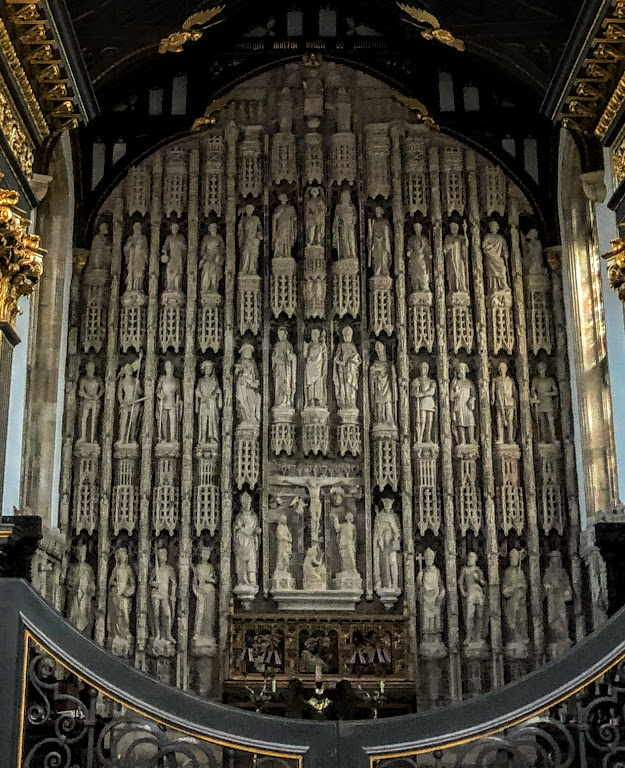
The reredos in the chapel of All Souls College, Oxford … a reminder of the ‘Faithful Departed’ (Photograph: Patrick Comerford)

John 6: 12-14 (NRSVA):

[Jesus said:] 37 ‘Everything that the Father gives me will come to me, and anyone who comes to me I will never drive away; 38 for I have come down from heaven, not to do my own will, but the will of him who sent me. 39 And this is the will of him who sent me, that I should lose nothing of all that he has given me, but raise it up on the last day. 40 This is indeed the will of my Father, that all who see the Son and believe in him may have eternal life; and I will raise them up on the last day.’

‘I will raise them up on the last day’ (John 6: 40) … an unlabelled carving in All Souls College, Oxford (Photograph: Patrick Comerford)

November is a month when we traditionally remember the saints, the Communion of Saints, those who are blessed, those we love and who are now gathered around the throne of God, those who have died and who we still love.

We do that on All Souls’ Day, we do that on Remembrance Day and Remembrance Sunday, and we do that on All Saints’ Day.

November is a month when we traditionally remember the saints, the Communion of Saints, those we love and who are now gathered around the throne of God, those who have died and who we still love.

As the evenings close in, as the last autumn leaves fall from the trees, it is natural to remember the dead and the fallen, with love and affection.

The special days in November include:

• All Saints’ Day (1 November);

• All Souls’ Day or the ‘Commemoration of the Faithful Departed’ (2 November, Common Worship, p 15);

• In Ireland, All Saints of Ireland (6 November);

• Remembrance Sunday (9 November 2025);

• Remembrance Day (11 November).

At this time of the year there are many people in my own family I am remembering, including:

• my mother, Ellen (Murphy) Comerford, who died 11 years ago, on 20 May 2014;

• my father, Stephen Edward Comerford, who died 21 years ago on 27 December 2004;

• my brother, Stephen Edward Comerford, who died in Durham, North Carolina, 55 years ago, on 18 December 1970;

• my foster mother, Peggy Kerr, who died on 27 July 2010, and my foster father George Kerr;

• my grandparents, Stephen Edward Comerford, who died on 21 January 1921, having contracted malaria five years earlier in Thessaloniki, and Bridget (Lynders) Comerford, who died on 25 March 1948;

• my grandparents, Thomas Michael Murphy, who died in Queensland, Australia, on 10 September 1949, and Maria (Crowley) Murphy, who died on 8 July 1957;

• and, at this time of the year, my ‘Gran’, Mary (McCarthy) Hallinan, who died on 6 November 1961; and ‘Granddad’ Edmond Hallinan, who died on 8 March 1963.

Hallowe’en is the day before we remember the Hallowed, not as the dead but as the blessed, the saints, who are model for our lives, our Christian lifestyle today. We believe the dead we love are still caught up in the love of God and are alive in Christ.

Indeed, saints do not need to be dead to be examples of ‘holy living and holy dying’ (Jeremy Taylor). Saint Paul regularly refers in his letters to fellow Christians as ‘saints.’ Saints Alive!

In the past, I have realised how many people and parishes have been shy, reluctant, perhaps even fearful, in the Church of Ireland when it comes to recalling, commemorating and celebrating the saints. A comparison of the calendars of the Church of Ireland and the Church of England is very telling.

Perhaps the people who decided on the calendar in the Church of Ireland were too afraid in the past of being seen to pray to the saints, or to pray for the dead. But, really, these are quite different to finding examples of godly living among Christians from the past, and expressing confidence that the dead we have loved are now committed to God’s love.

Yet the Church of England sees the calendar of saints as a living calendar, something that is added to as we find more appropriate examples of Christian living for today.

Saints do not have to be martyrs. But in recent years Oscar Romero was canonised and there was a major commemoration in Westminster Abbey of Oscar Romero in 2017 to mark his 100th birthday.

Saints do not have to be canonised. Modern martyrs include Dietrich Bonhoeffer and Martin Luther King, or Heather Heyer, the civil rights activist killed by far-right neo-Nazis and racists in Charlottesville, Kentucky, in 2017.

Many of us know people who handed on the faith to us – teachers, grandparents, perhaps neighbours. Even though many may be long dead, they remain part of our vision of the Communion of Saints.

Saints do not have to live a perfect life; as the Book of Common Prayer reminds us, ‘if we say we have no sin we deceive ourselves’ (I John 1: 8) … none of us is without sin, and none of us is beyond redemption. Some of the saints carved on the West Front of Westminster Abbey might have been very surprised to know they were going to appear there. But their lives in sum total are what we are asked to think about.

They are: Maximilian Kolbe, Manche Masemola, Archbishop Janani Luwum, Grand Duchess Elizabeth, Martin Luther King, Oscar Romero, Dietrich Bonhoeffer, Esther John, Lucian Tapiedi, and Wang Zhiming.

Some years ago, I asked students to share stories of their favourite ‘saints and heroes.’ They included an interesting array of people, some who were the still living at the time, including Archbishop Desmond Tutu.

In interviews in the Church Times, people are sometimes asked who they would like to be locked into a church with for a few hours.

Who are your favourite saints?

Who would you like to learn from a little more when it comes to living the Christian life?

This year marks the 1700th anniversary of the Nicene Creed, in which we express our belief in ‘the resurrection of the dead, and the life of the world to come’. In the Apostles’ Creed, we confess our belief in ‘the communion of saints’ and ‘the resurrection of the body.’

In the introduction to the Church Calendar and this in-between time, the time between All Saints and Advent, the resources for Common Worship remind us that ‘No Christian is solitary. Through baptism we become members one of another in Christ, members of a company of saints whose mutual belonging transcends death’. The resources then quote Charles Wesley:

One family, we dwell in him,
one Church, above, beneath;
though now divided by the stream,
the narrow stream of death.

Who are the saints in your life, in your own personal calendars? Who are those you recall whose souls we have committed to God’s love and who are part of ‘the communion of saints’?

Throughout the month of November, there are opportunities to remember their names as we are reminded in the first reading today that ‘The souls of the righteous are in the hand of God, no torment will ever touch them’ (Wisdom 3: 1).

The Library at All Souls College, Oxford, with a sundial designed by Sir Christopher Wren (Photograph: Patrick Comerford)

Today’s Prayers (Monday 3 November 2025, All Souls’):

The theme this week (2 to 8 November) in Pray with the World Church, the prayer diary of the Anglican mission agency USPG (United Society Partners in the Gospel), is ‘From Solitude to Connection’ (pp 52-53). This theme was introduced yesterday with a Programme Update from Ljudmila, a Ukrainian Refugee living in Budapest, Hungary.

The USPG Prayer Diary today (Monday 3 November 2025, All Souls’) invites us to pray:

Lord, as a God of peace, we pray that you will bring peace to Ukraine so families like Ljudmila’s may live without fear, reunited in safety and love.

The Collect:

Eternal God, our maker and redeemer,
grant us, with all the faithful departed,
the sure benefits of your Son’s saving passion
and glorious resurrection
that, in the last day,
when you gather up all things in Christ,
we may with them enjoy the fullness of your promises;
through Jesus Christ your Son our Lord,
who is alive and reigns with you,
in the unity of the Holy Spirit,
one God, now and for ever.

The Post Communion Prayer:

God of love,
may the death and resurrection of Christ
which we have celebrated in this eucharist
bring us, with all the faithful departed,
into the peace of your eternal home.
We ask this in the name of Jesus Christ,
our rock and our salvation,
to whom be glory for time and for eternity.

Yesterday’s Reflections

Continued Tomorrow

All Souls College, Oxford, founded in 1438 by Henry Chichele, Archbishop of Canterbury, with King Henry VI as its formal co-founder (Photograph: Patrick Comerford)

Scripture quotations are from the New Revised Standard Version Bible: Anglicised Edition copyright © 1989, 1995 National Council of the Churches of Christ in the United States of America. Used by permission. All rights reserved worldwide. http://nrsvbibles.org

02 November 2025

Daily prayer in the Kingdom Season 2025:
2, Sunday 2 November 2025,
All Saints’ Sunday

Saints and Martyrs … the ten martyrs of the 20th century above the West Door of Westminster Abbey (Photograph: Patrick Comerford)

Patrick Comerford

Today in the Church Calendar is All Souls’ Day (2 November). However, many churches and parishes are celebrating All Saints’ Day today as All Saints’ Sunday, transferring their All Saints celebrations from yesterday (1 November), including, for example, Saint Mary and Saint Giles Church in Stony Stratford, and All Saints’ Church, Margaret Street, London.

With All Saints’ Day, we move on in Ordinary Time in the Church Calendar to the Kingdom Season, the time between All Saints’ Day and Advent. Meanwhile, before today begins, before having breakfast, I am taking some quiet time early this morning to give thanks, and for reflection, prayer and reading in these ways:

1, today’s Gospel reading;

2, a short reflection;

3, a prayer from the USPG prayer diary;

4, the Collects and Post-Communion prayer of the day.

The 190 ft spire of All Saints’ Church, Leighton Buzzard, Bedfordshire, can be seen for miles around (Photograph: Patrick Comerford, 2025)

Luke 6: 20-31 (NRSVA):

20 Then he looked up at his disciples and said:
‘Blessed are you who are poor,
for yours is the kingdom of God.
21 ‘Blessed are you who are hungry now,
for you will be filled.
‘Blessed are you who weep now,
for you will laugh.

22 ‘Blessed are you when people hate you, and when they exclude you, revile you, and defame you on account of the Son of Man. 23 Rejoice on that day and leap for joy, for surely your reward is great in heaven; for that is what their ancestors did to the prophets.

24 ‘But woe to you who are rich,
for you have received your consolation.
25 ‘Woe to you who are full now,
for you will be hungry.
‘Woe to you who are laughing now,
for you will mourn and weep.

26 ‘Woe to you when all speak well of you, for that is what their ancestors did to the false prophets.

27 ‘But I say to you that listen, Love your enemies, do good to those who hate you, 28 bless those who curse you, pray for those who abuse you. 29 If anyone strikes you on the cheek, offer the other also; and from anyone who takes away your coat do not withhold even your shirt. 30 Give to everyone who begs from you; and if anyone takes away your goods, do not ask for them again. 31 Do to others as you would have them do to you.

Christ the Pantocrator surrounded by the saints in the Dome of the Church of Analipsi in Georgioupoli, Crete (Photograph: Patrick Comerford)

Today’s Reflections:

All Saints’ Day is one of the 12 ‘Principal Holy Days’ of the Church. November is a month when we traditionally remember the saints, the Communion of Saints, those who are blessed, those we love and who are now gathered around the throne of God, those who have died and who we still love.

We do that on All Souls’ Day, we do that on Remembrance Day and Remembrance Sunday, and we do that on All Saints; Day, all at the beginning of this month.

In today’s Gospel reading (Luke 6: 20-31), Saint Luke gives us his version of the beatitudes, with a different emphasis that the way Saint Matthew lists them (see Matthew 5: 3-12).

Christ speaks of four blessings or beatitudes and four parallel woes or warnings of the age to come. Some people are ‘blessed’ or ‘happy’ (μακάριος, makários) by being included in the Kingdom, but they are paired with those who are warned of coming woes:

• those who are poor now (verse 20) and those who are rich now (verse 24)
• those who are hungry now (verse 21) and those who are full now (verse 25)
• those who weep now (verse 21) and those who laugh now (verse 25)
• those who are persecuted, or hated, excluded, reviled and defamed (verse 22) and those who are popular (verse 26)

Who are the poor, the hungry, those who weep and those who are persecuted today? And do we see them as saints?

Bishop William Walsham How (1823-1897) wrote his hymn, ‘For all the saints, who from their labours rest’ (459), as a processional hymn for All Saints’ Day.

The saints recalled in his hymn are ordinary people in their weaknesses and their failings. In its original form, it had 11 verses, although three are omitted from most versions – the verses extolling ‘the glorious company of the Apostles,’ ‘the godly fellowship of the prophets’ and ‘the noble army of martyrs’ were inspired by the 1662 Book of Common Prayer version of the canticle Te Deum.

The tune Sine Nomine (‘Without Name,’ referring to the great multitude of unknown saints) was written for the hymn by Ralph Vaughan Williams (1872-1958) while he was editing the English Hymnal (1906) with Canon Percy Dearmer (1867-1936).

When he wrote this hymn, Walsham How was the Rector of Whittington, Shropshire, and a canon St Asaph Cathedral. He had spent time in Rome as chaplain of the Anglican Church there, All Saints’ Church, before returning to England.

While he was Bishop of Bedford, Walsham How became known as ‘the poor man’s bishop.’ He became the first Bishop of Wakefield, and died in Leenane, Co Mayo, in 1897 while he was on an Irish fishing holiday in Dulough.

The hymn vibrates with images from the Book of Revelation. The saints recalled by ‘the poor man’s bishop’ in this hymn are ordinary people who, in spite of their weaknesses and their failings, are able to respond in faith to Christ’s call to service and love, and who have endured the battle against the powers of evil and darkness.

The heart of the hymn is in the stanza that sings about the unity of the Church in heaven and on earth, ‘knit together in one communion and fellowship, in the mystical body of … Christ our Lord.’ Despite our ‘feeble struggles’ we are united in Christ and with one another in one ‘blest communion’ and ‘fellowship divine.’

It is a hymn that celebrates that there among the saints are the ordinary people, the people who are blessed and happy in Saint Luke’s version of the Beatitudes this morning.

All Saints’ Church, Rome … the Anglican church where the hymn writer Bishop William Walsham How was chaplain (Photograph: Patrick Comerford)

Today’s Prayers (Sunday 2 November 2025, All Saints’ Sunday):

The theme this week (2 to 8 November) in Pray with the World Church, the prayer diary of the Anglican mission agency USPG (United Society Partners in the Gospel), is ‘From Solitude to Connection’ (pp 52-53). This theme is introduced today with a Programme Update from Ljudmila, a Ukrainian Refugee living in Budapest, Hungary:

Next Step Hungary is a refugee-led NGO providing practical, costeffective interventions to support integration in Hungary. It is a partner organisation with Saint Margaret’s, Budapest, who reached out as part of USPG and the Diocese in Europe's joint appeal for Ukraine. Next Step is a lifeline for many like Ljudmila.

‘As a Ukrainian living in Budapest, my life was taken up by responsibilities – caring for my 12-year-old son, my parents, and even my cat – while balancing a demanding career as an architect. Despite my lifelong passion for art and design, the past few years had drained me emotionally and psychologically. Loneliness weighed heavily, and time for creativity felt like a luxury I couldn’t afford.

Then, at the end of summer, I signed up for a beading workshop run by Next Step. I was uncertain of what to expect, but from the very first session it turned out to be more than just a craft class. It was a welcoming community, a vibrant space for women filled with laughter, support, and shared creativity. Under the guidance of a fantastic teacher, I completed my first beaded ring and saw endless possibilities for new projects.

Each class became a highlight of my week, a space where I could reconnect with myself and others. This workshop didn’t just teach me a new skill – it rekindled my joy, creativity, and sense of belonging. For that, I am deeply grateful to Next Step.’

All Saints’ Church is the parish church in the centre of Northampton (Photograph: Patrick Comerford)

ions from the 17th to the 19th century (Photograph: Patrick Comerford, 2024)

The USPG Prayer Diary today (Sunday 2 November 2025, All Saints’ Sunday, All Souls’ Day) invites us to pray:

God of hope, grant that we, with all who have believed in you, may be united in the full knowledge of your love and the unclouded vision of your glory; through Jesus Christ our Lord. Amen (A Prayer Book for Australia, 1995).

The Collect:

Almighty God,
you have knit together your elect
in one communion and fellowship
in the mystical body of your Son Christ our Lord:
grant us grace so to follow your blessed saints
in all virtuous and godly living
that we may come to those inexpressible joys
that you have prepared for those who truly love you;
through Jesus Christ your Son our Lord,
who is alive and reigns with you,
in the unity of the Holy Spirit,
one God, now and for ever.

The Post Communion Prayer:

God, the source of all holiness and giver of all good things:
may we who have shared at this table
as strangers and pilgrims here on earth
be welcomed with all your saints
to the heavenly feast on the day of your kingdom;
through Jesus Christ our Lord.

Additional Collect:

God of holiness,
your glory is proclaimed in every age:
as we rejoice in the faith of your saints,
inspire us to follow their example
with boldness and joy;
through Jesus Christ our Lord.

Yesterday’s Reflections

Continued Tomorrow

Christ the King and the saints on the panels of the altar in All Saints’ Church, Berkhamsted (Photograph: Patrick Comerford)

Scripture quotations are from the New Revised Standard Version Bible: Anglicised Edition copyright © 1989, 1995 National Council of the Churches of Christ in the United States of America. Used by permission. All rights reserved worldwide. http://nrsvbibles.org

All Saints’ Church in Yelvertoft, Northamptonshire, was connected with the Comberford family for about a century … Henry Comberford of Lichfield Cathedral was the rector in 1546-1560 (Photograph: Patrick Comerford)

31 October 2025

Daily prayer in Ordinary Time 2025:
172, Friday 31 October 2025

Liverpool Cathedral, where Justin Welby introduced a Hallowe’en service as ‘Night of the Living Dead’ (Photograph: Patrick Comerford)

Patrick Comerford

We are continuing in Ordinary Time in the Church Calendar, which changes to Kingdom-time or the Kingdom Season tomorrow with All Saints’ Day. In the Calendar of the Church of England in Common Worship and Exciting Holiness, today is not marked as Hallowe’en but, instead, remembers Martin Luther.

Before the day begins, before having breakfast, I am taking some quiet time early this morning to give thanks, and for reflection, prayer and reading in these ways:

1, today’s Gospel reading;

2, a short reflection;

3, a prayer from the USPG prayer diary;

4, the Collects and Post-Communion prayer of the day.

Stony Stratford prepares for Hallowe’en … but does Christ make a Hallowe’en choice between trick or treat? (Photographs: Patrick Comerford, 2025)

Luke 14:1-6 (NRSVA)

1 On one occasion when Jesus was going to the house of a leader of the Pharisees to eat a meal on the sabbath, they were watching him closely. 2 Just then, in front of him, there was a man who had dropsy. 3 And Jesus asked the lawyers and Pharisees, ‘Is it lawful to cure people on the sabbath, or not?’ 4 But they were silent. So Jesus took him and healed him, and sent him away. 5 Then he said to them, ‘If one of you has a child or an ox that has fallen into a well, will you not immediately pull it out on a sabbath day?’ 6 And they could not reply to this.

‘Ars Longa, Vita Brevis’ … words from Hippocrates at the Medical School in the Royal Hallamshire Hospital, Sheffield (Photograph: Patrick Comerford)

Today’s Reflections:

Tomorrow is All Saints’ Day, although this may be celebrated in many parishes and churches on Sunday (2 November 2025) as All Saints’ Sunday.

But if All Saints’ Day is not celebrated properly and appropriately in our churches, with a celebration of the Eucharist, whether that is tomorrow or on Sunday, how do we explain to a younger generation what Hallowe’en is truly about?

Hallowe’en is the ‘Night of the Living Dead’ ... for the saints are alive, and we are part of the Communion of Saints, the Church Triumphant (Ecclesia Triumphans) and the Church Militant (Ecclesia Militans), which are part of the one Church, and we are together.

Hallowe’en, or the Eve of All Hallows, is the evening before celebrating All the Saints, All the Holy Ones in Glory, the Saints of every time and place. This is the Eve of a Great Feast of Light – the Solemnity of All Saints, the saints in glory who have ‘inherited the light’ (Colossians 1: 12-13), whether we are alive or dead, whether we have been canonised or faded into obscurity, whether they have given heroic examples in their lives or are unsung and unknown. We are all with God in endless joy.

When he became Dean of Liverpool in 2007, the former Archbishop of Canterbury, Justin Welby, found himself in one of England’s largest and most deprived cathedrals. He doubled attendances, abseiled from the roof, and allowed John Lennon’s Imagine to be played on the cathedral bells – despite the line ‘imagine there is no heaven.’

He also encouraged a ‘Night of the Living Dead’ service on Hallowe’en, when a coffin was carried into the cathedral and a man rose from a coffin to represent the Resurrection.

If we cannot explain Hallowe’en and All Saints’ Day, how can we hope to explain the greater truths of Christmas and Easter?

In today’s Gospel reading (Luke 14:1-6), we are faced with a ‘trick or treat’ conundrum. It is the sabbath and Jesus is going to eat dinner at the home of a local religious leader: if he ignores the sick man’s plight, does he ignore that love and compassion are the core of true religion? Or, if heals this man, is he going to be accused of breaching religious rules, regulations traditions.

The discussion this prompts is not about whether Christ has the duty or responsibility, he legal right or power, the appropriate qualifications or the authority, to heal the man with dropsy, but whether doing this on the Sabbath shows disdain for the law of God.

This is the sole, lone and only Gospel incident in n which the Greek word ὑδρωπικός (hydropikos) is used to describe a person suffering from dropsy. It is a pathological retention of fluid that causes abnormal swelling. Although it is a medical term, its single New Testament appearance here becomes theologically rich when placed within the Gospel narrative.

In the world of the Biblical Mediterranean, dropsy was seen as incurable and associated with other systemic illnesses. Swelling of the limbs and abdomen visibly marked the sufferer, making him ritually unclean by religious understanding of the ay and socially marginalised.

Physicians such as Hippocrates discussed the malady, yet effective treatment was scarce. A hydropic person embodied chronic suffering and exclusion, providing a stark contrast to the wholeness of life envisioned in God’s covenant promises.

Should this man be left, as it were, among the living dead?

By asking whether it is it lawful to heal on the Sabbath or not (verse 3), Jesus exposes the discrepancy between the Law’s intent and the tradition-bound application of it. When he heals the man and sends him away whole, he affirms the Sabbath as a day ‘for doing good’.

Of course, the man is not dying. Although he has dropsy, his healing could take place on any other day, indeed at any other venue. But, even before they speak, Christ’s response to his potential protagonists is to ask a question: ‘Is it lawful to cure people on the sabbath, or not?’ (verse 4).

If they say no, they show their ignorance of the law and the rabbinical tradition; if they say yes, how could they possibly disagree with what they know he is about to do?

After this healing miracle, Christ goes on to share two parables about humility and the heavenly banquet (Luke 14: 7-24). The hydropic man’s restoration anticipates the inclusive feast of the Kingdom, where the physically and spiritually bloated pride of the self-righteous is contrasted with the humble who accept the invitation.

If mercy towards animals or family members is permitted, how much more should mercy for a suffering image-bearer of God be celebrated?

What better day is there than the Sabbath, a day meant to promote God’s commitment to humanity’s well-being, for the restoration of a man with a debilitating illness?

Trick or Treat?

In his response, Christ allows this man to return to work with dignity, and restores him to his full and rightful place in the community of faith that may have been denied to him by the very people who are present that Sabbath.

The man who must once have thought he might as well have been dead is given new life, and is assured he is a Child of God.

Later this evening, as children go knocking on doors in this town, under the watchful and loving eyes of parents or older siblins, I shall remind myself that in Christ there is no trick, there is only treat. And it would be reflective and approopriate to return to a prayer attributed to Saint Ambrose of Milana has become part of Anglican tradition as part of the office of Compline in the Book of Common Prayer:

Before the ending of the day,
Creator of the world, we pray
That thou with wonted love wouldst keep
Thy watch around us while we sleep.

O let no evil dreams be near,
Or phantoms of the night appear;
Our ghostly enemy restrain,
Lest aught of sin our bodies stain.

Almighty Father, hear our cry
Through Jesus Christ our Lord most high,
Who with the Holy Ghost and thee
Doth live and reign eternally. Amen.

A sign in Lichfield Cathedral this week about the true meaning of Hallowe’en (Photograph: Hugh Ashton, 2025)

Today’s Prayers (Friday 31 October 2025):

The theme this week (26 October to 1 November) in Pray with the World Church, the prayer diary of the Anglican mission agency USPG (United Society Partners in the Gospel), is ‘Bonds of Affection’ (pp 50-51). This theme was introduced on Sunday with reflections from Rachel Weller, Communications Officer, USPG.

The USPG Prayer Diary today (Friday 31 October 2025) invites us to pray:

Father, we pray that one day the group may get to meet in person in order that the bonds of affection might be strengthened.

The Collect:

Blessed Lord,
who caused all holy Scriptures to be written for our learning:
help us so to hear them,
to read, mark, learn and inwardly digest them
that, through patience, and the comfort of your holy word,
we may embrace and for ever hold fast
the hope of everlasting life,
which you have given us in our Saviour Jesus Christ,
who is alive and reigns with you,
in the unity of the Holy Spirit,
one God, now and for ever.

The Post Communion Prayer:

God of all grace,
your Son Jesus Christ fed the hungry
with the bread of his life
and the word of his kingdom:
renew your people with your heavenly grace,
and in all our weakness
sustain us by your true and living bread;
who is alive and reigns, now and for ever.

Additional Collect:

Merciful God,
teach us to be faithful in change and uncertainty,
that trusting in your word
and obeying your will
we may enter the unfailing joy of Jesus Christ our Lord.

Collect on the Eve of All Saints’ Day:

Almighty God,
you have knit together your elect
in one communion and fellowship
in the mystical body of your Son Christ our Lord:
grant us grace so to follow your blessed saints
in all virtuous and godly living
that we may come to those inexpressible joys
that you have prepared for those who truly love you;
through Jesus Christ your Son our Lord,
who is alive and reigns with you,
in the unity of the Holy Spirit,
one God, now and for ever.

Yesterday’s Reflections

Continued Tomorrow

A carvwd Hallowe’en pumpkin in Stony Stratford (Photograph: Patrick Comerford)

Scripture quotations are from the New Revised Standard Version Bible: Anglicised Edition copyright © 1989, 1995 National Council of the Churches of Christ in the United States of America. Used by permission. All rights reserved worldwide. http://nrsvbibles.org

06 November 2024

Catching the sunset
over the South China Sea
and walking the beaches
at the resorts in Damai

A walk on the beach at sunset at Damai Beach Resort (Photograph: Patrick Comerford, 2024)

Patrick Comerford

Although Kuching stands on the banks of the Sarawak River, and for decades served as a working port and harbour, it is quite a distance from the sea. Kuching is built on a coastal plain with lots of rivers flowing into the sea, but it is about 15 km inland from the sea.

So, although we have been here since mid-October, I only had my first walk on a beach in Sarawak last weekend.

We had watched one or two races during the closing hours of the Sarawak Regatta on Sunday afternoon. But a long and steady shower of tropical rain throughout later in the afternoon, accompanied by a showcase thunderstorm, brought a dampening end to the regatta that had been going on all weekend.

It was our first wedding anniversary, and we thought we might celebrate with a romantic dinner in a nearby restaurant without walking too far or getting too wet.

But suddenly, later in the afternoon, the rains stopped, and it was possible to catch just a tiny glimpse of the skies between the dark and brooding clouds. On the spur of the moment, we decided to head north to the Santubong Peninsula and the slopes of Mount Santubong, and to go for walks in the sunset along the shores by the resort hotels facing out onto the South China Sea.

By the shores of the South China Sea at Damai Lagoon Resort (Photograph: Patrick Comerford, 2024)

The Santubong Peninsula is cut off from Kuching by the Santubong River, and I had been in the area a few days earlier visiting the Sarawak Cultural Village. It took us 40 or 50 minutes to get back there late on Sunday afternoon, and we first stopped at the Damai Lagoon Resort.

Damai Lagoon Resort is a five-star resort between Damai Bay and Damai Beach and describes itself as the ‘Jewel of Sarawak.’ It was previously known as Damai Puri Resort and Spa, and before that as Holiday Inn Damai Lagoon, and it went through a major renovation and rebranding before reopening last year.

The tide was in and we walked along the hotel terrace and by the waves, looking out to the South China Sea. Although the cloud cover left us without a clear view of the sunset, we could see the Talang Talang islands off the coast and wondered about the marine park with its turtles – but it was getting dark and we would have needed a permit too, and lot more planning.

We then walked through Damai Central Permai Rainforest Resort, an eco-resort by the sea and under the rainforest covered foothills of Mount Santubong. The treehouses there mean guests can sleep among the rustling trees and wake to the sound of the sea lapping against the shore.

By the waves in front of the Damai Central Permai Rainforest Resort (Photograph: Patrick Comerford, 2024)

It was a five-minute walk from Damai Central to the Damai Beach Resort, with 90 acres of grounds by the sandy beach of Teluk Bandung, also facing the South China Sea.

It seemed like a long time since I had a walk by a beach or by the sea. My last beach walks had been during a short visit to Bray, Co Wicklow, last June, and before that when I was back in Crete in April, when I stayed in Rethymnon and also visited the beaches at Platanias, Panormos and Hersonissos and the sea at Iraklion.

Now I had not just one but two walks by beaches north of Kuching and facing out onto the South China Sea.

As dusk turned to darkness we decided to linger a little longer over dinner at the Damai Beach Resort before calling a taxi for the 45-minute drive back into Kuching.

On the previous evening, during the Eucharist in Saint Thomas’s Cathedral, Kuching, commemorating All Souls’ Day, one of the hymns we sang was ‘The day thou gavest, Lord, is ended’, written in 1870 by the Revd John Ellerton (1826-1893).

As we were returning to Kuching in darkness on Sunday evening, I kept thinking of one particular verse in that hymn:

The sun that bids us rest is waking
our brethren ’neath the western sky,
and hour by hour fresh lips are making
thy wondrous doings heard on high.


Two minutes on the beach at Damai Beach Resort at dusk (Patrick Comerford, 2024)

01 November 2024

Daily prayer in the Kingdom Season:
2, Saturday 2 November 2024,
All Souls’ Day

The reredos in the chapel of All Souls College, Oxford … a reminder of the ‘Faithful Departed’ on 2 November (Photograph: Patrick Comerford)

Patrick Comerford

We have moved in the Church Calendar from Ordinary Time to the Kingdom Season, the time between All Saints and Advent, and tomorrow is the Fourth Sunday before Advent (3 November 2024). Today in the Church Calendar is All Souls’ Day (2 November), or the Commemoration of the Faithful Departed.

All Souls’ Day is being marked later today in Saint Thomas’s Cathedral, Kuching, with an All Souls’ Day service this evening (7:30), when the celebrant is Canon Roannie W Cannidy, canon precentor of Saint Thomas’s Cathedral, and the preacher is the Revd Peter Augustine, one of the cathedral priests.

People have been invited to write the name or names of their faithful departed and drop them into a special box at the front of the chancel steps in the cathedral. Although only the names of past bishops and clergy will be read out during the intercessions this evening, all submitted names will be shown on the screens during the service. In addition, many people are expected to visit the graves and tombs of family members during the day.

Before today begins, before having breakfast, I am taking some quiet time early this morning to give thanks, and for reflection, prayer and reading in these ways:

1, today’s Gospel reading;

2, a short reflection;

3, a prayer from the USPG prayer diary;

4, the Collects and Post-Communion prayer of the day.

All Souls College, Oxford … its full, official name is: the Warden and the College of the Souls of All Faithful People deceased in the University of Oxford (Photograph: Patrick Comerford)

John 6: 37-40 (NRSVA):

[Jesus said:] 37 ‘Everything that the Father gives me will come to me, and anyone who comes to me I will never drive away; 38 for I have come down from heaven, not to do my own will, but the will of him who sent me. 39 And this is the will of him who sent me, that I should lose nothing of all that he has given me, but raise it up on the last day. 40 This is indeed the will of my Father, that all who see the Son and believe in him may have eternal life; and I will raise them up on the last day.’

‘I will raise them up on the last day’ (John 6: 40) … an unlabelled carving in All Souls College, Oxford (Photograph: Patrick Comerford)

Today’s Reflection:

November is a month when we traditionally remember the saints, the Communion of Saints, those we love and who are now gathered around the throne of God, those who have died and who we still love.

As the evenings close in, as the last autumn leaves fall from the trees, it is natural to remember the dead and the fallen, with love and affection.

All Saints’ Day yesterday (1 November) is one of the 12 Principal Feasts of the Church. In many parts of the Anglican Communion, today (2 November) is All Souls’ Day or the ‘Commemoration of the Faithful Departed’ (Common Worship, p 15). In Ireland, 6 November traditionally recalls ‘All Saints of Ireland.’ This year we mark Remembrance Sunday next Sunday (10 November), and Remembrance Day is on 11 November.

In recent days, Charlotte and I have wandered through some of the Chinese graveyards in the Kuching area, but have yet to find the place where her grandparents are buried.

At this time of the year – especially this year – there are a number of people in my own family I am remembering, including: my mother, Ellen (Murphy) Comerford, who died 10 years ago, on 20 May 2014;
my father, Stephen Edward Comerford, who died 20 years ago on 27 December 2004; my brother, Stephen Edward Comerford, who died on 18 December 1970;
my foster mother, Peggy Kerr, who died on 27 July 2010, and my foster father George Kerr;
and, at this time of the year, my ‘Gran’, Mary (McCarthy) Hallinan, who died on 6 November 1961; and ‘Granddad’ Edmond Hallinan, who died on 8 March 1963.

Hallowe’en, which was even marked in many places in Kuching this week, is the day before we remember the Hallowed, not as the dead but as the blessed, the saints, who are models for our lives, our Christian lifestyle today.

When he was Dean of Liverpool, Archbishop Justin Welby organised a Hallowe’en service he labelled ‘Night of the Living Dead’. At first, it sounds ghoulish. But that’s what it is … the ‘Night of the Living Dead’. We believe the dead we love are still caught up in the love of God and are alive in Christ.

Indeed, saints do not need to be dead to be examples of ‘holy living and holy dying’ (Jeremy Taylor).

Saint Paul regularly refers in his letters to fellow Christians as ‘saints.’ Saints Alive!

In the past, I have realised how many people and parishes have been shy, reluctant, perhaps even fearful, in the Church of Ireland when it comes to recalling, commemorating and celebrating the saints. A comparison of the calendars of the Church of Ireland and the Church of England is very telling.

Perhaps the people who decided on the calendar in the Church of Ireland were too afraid in the past of being seen to pray to the saints, or to pray for the dead. But, really, these are quite different to finding examples of godly living among Christians from the past, and expressing confidence that the dead we have loved are now committed to God’s love.

Yet the Church of England sees the calendar of saints as a living calendar, something that is added to as we find more appropriate examples of Christian living for today.

Saints do not have to be martyrs. But in recent years Oscar Romero was canonised and there was a major commemoration in Westminster Abbey of Oscar Romero in 2017 to mark his 100th birthday.

Saints do not have to be canonised. Modern martyrs may include Dietrich Bonhoeffer and Martin Luther King, or Heather Heyer, the civil rights activist killed by far-right neo-Nazis and racists in Charlottesville, Kentucky, in 2017.

Many of us we know people who handed on the faith to us – teachers, grandparents, perhaps neighbours. Even though many may be long dead, they remain part of our vision of the Communion of Saints.

Saints do not have to live a perfect life … none of us is without sin, and none of us is beyond redemption. Some of the saints carved on the West Front of Westminster Abbey might have been very surprised to know they were going to appear there. But their lives in sum total are what we are asked to think about.

They are: Maximilian Kolbe, Manche Masemola, Archbishop Janani Luwum, Grand Duchess Elizabeth, Martin Luther King, Oscar Romero, Dietrich Bonhoeffer, Esther John, Lucian Tapiedi, and Wang Zhiming.

Some years ago, I asked students to share stories of their favourite ‘saints and heroes.’ They included an interesting array of people, some who were the still living at the time, including Archbishop Desmond Tutu.

In the back-page interviews in the Church Times, people are sometimes asked who they would like to be locked into a church with for a few hours.

Who are your favourite saints?

Who would you like to learn from a little more when it comes to living the Christian life?

In the Apostles’ Creed, we confess our faith which includes our belief in ‘the communion of saints’ and ‘the resurrection of the body.’ In Nicene Creed, we express our belief in ‘the resurrection of the dead, and the life of the world to come.

In the introduction to the Church Calendar and this in-between time, the time between All Saints and Advent, the resources for Common Worship remind us that ‘No Christian is solitary. Through baptism we become members one of another in Christ, members of a company of saints whose mutual belonging transcends death’. The resources then quote Charles Wesley:

One family, we dwell in him,
one Church, above, beneath;
though now divided by the stream,
the narrow stream of death.

Who are the saints in your life, in your own personal calendars? Who are those you recall whose souls we have committed to God’s love and who are part of ‘the communion of saints’?

Throughout the month of November, there are opportunities to remember their names as we are reminded in the first reading today that ‘The souls of the righteous are in the hand of God, no torment will ever touch them’ (Wisdom 3: 1).

The Library at All Souls College, Oxford, with a sundial designed by Sir Christopher Wren (Photograph: Patrick Comerford)

Today’s Prayers (Saturday 2 November 2024, All Souls’ Day):

The theme this week in ‘Pray With the World Church’, the Prayer Diary of the Anglican mission agency USPG (United Society Partners in the Gospel), has been ‘All Saints’ Day’. This theme was introduced last Sunday with a programme update by the Revd Dr Duncan Dormor, General Secretary, USPG.

The USPG Prayer Diary today (Saturday 2 November 2024, All Souls’ Day) invites us to pray:

We give thanks for those who gone before us in the faith, may they rest in the mercy of God.

The Collect:

Eternal God, our maker and redeemer,
grant us, with all the faithful departed,
the sure benefits of your Son’s saving passion
and glorious resurrection
that, in the last day,
when you gather up all things in Christ,
we may with them enjoy the fullness of your promises;
through Jesus Christ your Son our Lord,
who is alive and reigns with you,
in the unity of the Holy Spirit,
one God, now and for ever.

Post Communion Prayer:

God of love,
may the death and resurrection of Christ,
which we have celebrated in this Eucharist,
bring us, with all the faithful departed,
into the peace of your eternal home.
We ask this in the name of Jesus Christ,
our rock and our salvation,
to whom be glory for time and for eternity.

Collect on the Eve of the Fourth Sunday before Advent:

Almighty and eternal God,
you have kindled the flame of love
in the hearts of the saints:
grant to us the same faith and power of love,
that, as we rejoice in their triumphs,
we may be sustained by their example and fellowship;
through Jesus Christ your Son our Lord,
who is alive and reigns with you,
in the unity of the Holy Spirit,
one God, now and for ever.

Yesterday’s Reflection

Continued Tomorrow

All Souls College, Oxford, founded in 1438 by Henry Chichele, Archbishop of Canterbury, with King Henry VI as its formal co-founder (Photograph: Patrick Comerford)

Scripture quotations are from the New Revised Standard Version Bible: Anglicised Edition copyright © 1989, 1995 National Council of the Churches of Christ in the United States of America. Used by permission. All rights reserved worldwide. http://nrsvbibles.org

02 November 2023

Daily prayers in Ordinary Time
with USPG: (152) 2 November 2023,
All Souls’ Day

All Souls’ Church, Langham Place, is the only surviving church in London built by the Regency architect John Nash (Photograph: Patrick Comerford, 2023)

Patrick Comerford

We are in Ordinary Time in the Church Calendar, and this week began with the Last Sunday after Trinity (Trinity XXI, 29 October 2023). The Church Calendar (2 November 2023) remembers All Souls’ Day, which is a Lesser Festival in the calendar of the Church of England.

Before today begins, I am taking some time for prayer and reflection early this morning.

Throughout this week, with the exceptions of All Saints’ Day (yesterday 1 November) and All Souls’ Day (today 2 November), my reflections each morning this week are following this pattern:

1, A reflection on a church or cathedral in Southwark;

2, the Gospel reading of the day in the Church of England lectionary;

3, a prayer from the USPG prayer diary.

A bust of the architect John Nash in the portico of All Souls’ Church, Langham Place (Photograph: Patrick Comerford, 2023)

All Souls’ Church, Langham Place, London:

All Souls’ Day is observed in many parts of the Western Church today [2 November]. It is particularly associated with the Roman Catholic Church, and while it does not feature in the calendar of the Church of Ireland, it is marked in the calendar of the Church of England which has restored its place in Common Worship as the ‘Commemoration of the Faithful Departed (All Souls’ Day)’ (Common Worship, p 15).

A few weeks ago, I visited All Saints’ Church, Margaret Street, and All Souls’ Church, Langham Place, London. All Souls’ Day follows the commemoration of All Saints’ Day on 1 November, and these two churches are five minutes apart (450 metres) in walking distance, but as far apart theologically as any two Anglican churches could be.

I find it interesting that All Souls is the name of one of the leading evangelical churches in London, All Souls’ Church, Langham Place. Yet the history of the church on the parish website gives no explanation for the choice of the name of All Souls’ Church.

All Souls’ Church is in the West End, across the street from Broadcasting House and has often been used by the BBC for broadcasting, as well as for occasional organ recitals.

All Souls is the only surviving church in London built by the Regency architect John Nash (1752-1835). This neo-classical church was built in part in a celebration of thanks for Wellington’s victory over Napoleon at the Battle of Waterloo in 1815. It was built in 1822-1824, and was part of John Nash’s grand vision for developing Regent Street. There is a bust of Nash in the portico.

Nash had the support of the Prince Regent for a grand redevelopment scheme in central London, involving a broad route from Regents Park to Carlton House in The Mall. The scheme, which included plans for parks, villas, crescents, a canal, and terraced houses for the nobility, included All Souls’ Church.

Nash’s vision involved buying up over 700 shops and houses in Soho and creating a broad avenue to act as a boundary between the ‘narrow streets and mean homes’ of Soho and the ‘streets of the Nobility and Gentry’ of Mayfair. He placed All Souls at Langham Place at a bend in the road between Portland Place and Oxford Circus, so it would act as a punctuation to the grand vista looking north.

However, very little of Nash’s plan for Regent Street was rever ealised. The 40 or more villas planned for the nobility were never built, nor was the Prince Regent’s own villa that was to be the focal point of the design. On the other hand, Nash succeeded in building rows of elegant terraced houses along the perimeter of the park, and most of these still survive.

Nash was criticised for the design, particularly the slender conical spire, which rises above the circular classical ‘wedding cake’ peristyle and circular portico. One critic said the church was ‘one of the most miserable structures in the metropolis.’ Political cartoons showed Nash impaled on the tip of the slender spire.

All Souls’ was built with a grant from the Church Building Commission. The Commission was set up by the Church Buildings Acts of 1818 and 1824 to create new churches and reorganise existing parishes. The commission granted £12,819 for All Souls’, but the cost eventually rose to over £18,000. The church was consecrated in November 1824, and celebrates its bicentenary next year.

All Souls’ is the only surviving Nash church in London. He was designed Saint Mary Haggerston in Hackney, but this is now demolished. Saint Paul’s Church in Cahir, Co Tipperary, is one of a handful of churches in Ireland designed by Nash.

All Souls’ Church is built of warm-coloured Bath stone. The circular portico is raised on a flight of steps and has giant Ionic columns carrying an entablature and balustraded parapet. The circular tower, with an architraved and corniced entrance at its foot, rises above the portico to the open peristyle with Corinthian columns screening the base of the 12-sided stone spire. A sedate rectangular block encloses the body of the church.

The church suffered bomb damage during World War II, when a parachute mine detonated in Portland Place. The church roof was destroyed, the spire was badly damaged, and the portico was declared unsafe. The church was closes for worship for a decade while repairs were carried out, and most of the furnishings are modern.

The gilded false-marble columns inside the church support a gallery on three sides. Over the west entrance to the nave is a gilded and painted royal coat of arms of Nash’s patron, George IV.

One surviving feature is the large-scale landscape painting, ‘Ecce Homo – Behold the Man,’ by the Victorian artist Richard Westall. All Souls has remarkably few memorials. The organ with gilded pipes is in a case of Spanish mahogany designed by Nash.

The Rector of All Souls is appointed not through the normal system in the Church of England, but by the Prime Minister, through the Crown Appointments Commission. Previous rectors have included John Stott, one of the best-known evaneglical leaders in Anglicanism, who was there for 30 years, first as a curate (1945-1950) and then as the Rector (1950-1975). and Michael Baughen (1975-1982), later Bishop of Chester. The present Rector of All Souls is the Revd Charlie Skrine.

A sign in the church porch says ‘Whoever you are, wherever you are from, you are welcome here.’ All Souls’ runs one of the largest church-based ministries for homeless people in London, All Souls Local Action Network (ASLAN). The range of activities include feeding people sleeping rough on the streets, evening meals for homeless or vulnerably housed people, a day centre for homeless and vulnerably housed people, regular befriending meetings, a winter shelter, and an addiction recovery programme.

All Souls’ and Holy Trinity Brompton (HTB) have been described as the two Anglican megachurches in London. Both are evangelical in their theology, with HTB having a more overtly charismatic spirituality. All Souls’ is a ‘conservative evangelical’ church that rejects the ordination and leadership of women, and it receives alternative episcopal oversight from the Bishop of Ebbsfleet, Rob Munro, who holds ‘complementarian’ opinions.

Earlier this year, the PCC of All Souls’, Langham Place, and of another large ‘conservative evangelical’ church in central London, Saint Helen’s, Bishopsgate, said they would pause payments to the diocesan common fund until they knew the outcome of the General Synod’s deliberations on ‘Living in Love and Faith’.

All Souls’ Church is open most days. However, on the afternoon I tried to visit it, All Souls’ was closed – while All Saints’ Church five minutes away on nearby Margaret Street was open. The parish website is confusing about when or how often the Eucharist is celebrated in All Souls’ on Sundays. And, while the online calendar says there is a ‘Prayer Meeting’ at 8 am this morning and a ‘Living and Telling Course’ online at 7 pm this evening, I cannot find any events in All Souls’ Church today to mark the patronal festival of All Souls’ Day.

‘Whoever you are, wherever you are from, you are welcome here’ … a sign in the porch of All Souls’ Church (Photograph: Patrick Comerford, 2023)

John 5: 19-25 (NRSVA):

19 Jesus said to them, ‘Very truly, I tell you, the Son can do nothing on his own, but only what he sees the Father doing; for whatever the Father does, the Son does likewise. 20 The Father loves the Son and shows him all that he himself is doing; and he will show him greater works than these, so that you will be astonished. 21 Indeed, just as the Father raises the dead and gives them life, so also the Son gives life to whomsoever he wishes. 22 The Father judges no one but has given all judgement to the Son, 23 so that all may honour the Son just as they honour the Father. Anyone who does not honour the Son does not honour the Father who sent him. 24 Very truly, I tell you, anyone who hears my word and believes him who sent me has eternal life, and does not come under judgement, but has passed from death to life.

25 ‘Very truly, I tell you, the hour is coming, and is now here, when the dead will hear the voice of the Son of God, and those who hear will live.’

All Souls’ runs one of the largest church-based ministries for homeless people in London (Photograph: Patrick Comerford, 2023)

Today’s Prayers (Thursday 2 November 2023, All Saints’ Day):

The theme this week in ‘Pray With the World Church,’ the Prayer Diary of the Anglican mission agency USPG (United Society Partners in the Gospel), is inspired by a Reflection – ‘He restores my soul’ – by Revd Dale R Hanson, introduced on Sunday.

The USPG Prayer Diary today (2 November 2023, All Souls’ Day) invites us to pray in these words:

We pray for all those who have gone before us. May we cherish our memories of family and friends who are no longer with us.

The Collect:

Eternal God, our maker and redeemer,
grant us, with all the faithful departed,
the sure benefits of your Son’s saving passion
and glorious resurrection
that, in the last day,
when you gather up all things in Christ,
we may with them enjoy the fullness of your promises;
through Jesus Christ your Son our Lord,
who is alive and reigns with you,
in the unity of the Holy Spirit,
one God, now and for ever.

Post Communion Prayer:

God of love,
may the death and resurrection of Christ,
which we have celebrated in this Eucharist,
bring us, with all the faithful departed,
into the peace of your eternal home.
We ask this in the name of Jesus Christ,
our rock and our salvation,
to whom be glory for time and for eternity.

Yesterday’s Reflection

Continued Tomorrow

All Souls’ Church, Langham Place, is across the street from BBC Broadcasting House (Photograph: Patrick Comerford, 2023)

Scripture quotations are from the New Revised Standard Version Bible: Anglicised Edition copyright © 1989, 1995, National Council of the Churches of Christ in the United States of America. Used by permission. All rights reserved worldwide. http://nrsvbibles.org
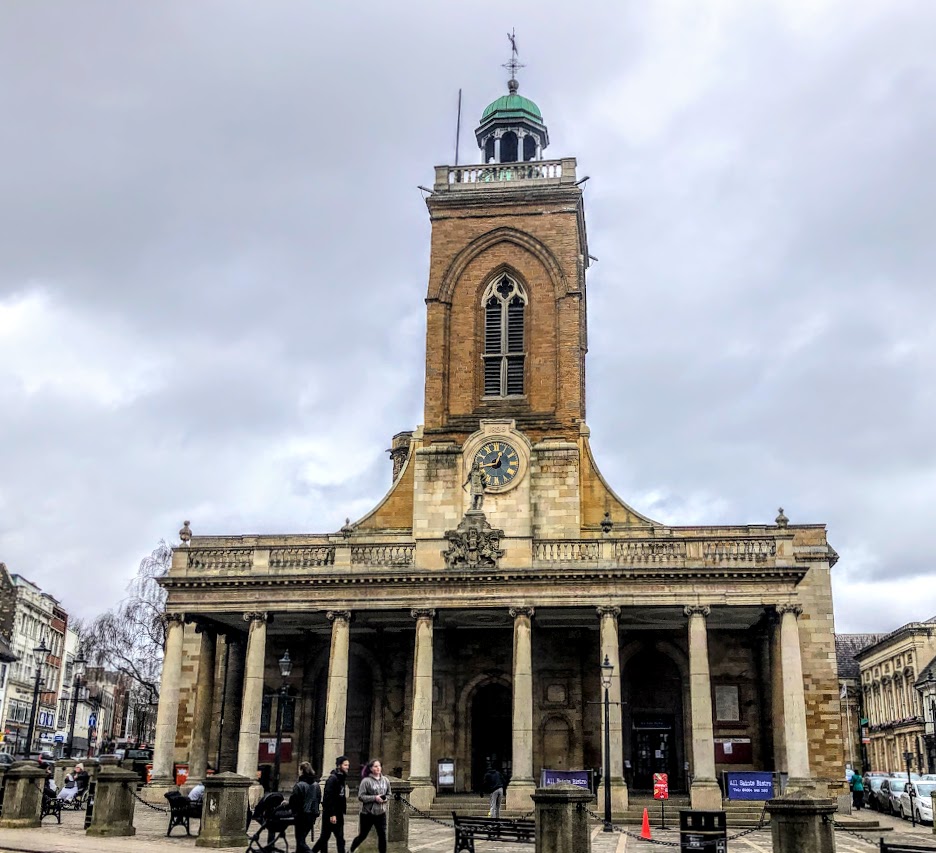
Political cartoons showed John Nash impaled on the tip of the slender spire of All Souls’ Church (Photograph: Patrick Comerford, 2023)

31 October 2023

Three ghost stories
with family links
and an old school link
for this Halloween

A tower in the Moat House, the former Comberford home on Lichfield Street, Tamworth … who was Emily in the tower and did she die in a fire? (Photograph: Patrick Comerford, 2023)

Patrick Comerford

This evening is Halloween, and I have fond memories of the Halloween games we played as children.

But, frankly, I am a sceptic when it comes to ghost stories. I am much more in fear of the real spectres that haunt our world today, from wars and mass killings in the Middle East, Ukraine, Russia and Yemen, the rise of the far-right across Europe and racism and antisemitism around the world, and the prospect of Donald Trump returning as President in the US, to the run-down and neglect of the NHS, the institutional lack of compassion for refugees and asylum seekers, and the drip-drip feed, day by day, of sleaze and corruption in the Tory Party.

These are the real, living ghosts in my world today.

On the other hand, I have never been afraid of the day. I look forward to All Saints’ Day tomorrow and All Souls’ Day the day after, and the vestry prayer I always used after services when I was in parish ministry prays: May the divine assistance remain always with us, and may the souls of the faithful departed rest in peace and rise in glory.’

However, there are three ‘ghost stories’ that remain with me from childhood, two from family stories – the three knocks at the door at Comberford Hall, and the ghost of Emily in the Moat House, Tamworth, and one from school days – the foxes baying at night on the lawn in front of Gormanston Castle.

‘Three knocks are always heard at Comberford Hall before the death of a family member’ … family lore recorded by Robert Plot in the 17th century (Photograph: Patrick Comerford)

1, Three knocks at Comberford Hall:

One of the vignettes and stories in history and folklore recorded by Kate Gomez in her book The Little Book of Staffordshire (Stroud: The History Press) is the belief or superstition: ‘Three knocks are always heard at Comberford Hall before the death of a family member.’

It is a story that was first recorded, as far as I know, by the 17th century historian, Robert Plot (1640-1696), the first Keeper of the Ashmolean Museum in Oxford.

Robert Plot was born in Sutton Barne in Borden, Kent, in 1640 and was educated at Magdalen Hall, Oxford (BA, 1661, MA, 1664, DCL, 1671). He became the first Keeper of the Ashmolean Museum and Professor of Chemistry in 1683, after Elias Ashmole (1617-1692) persuaded Oxford University to design a museum around and for his collection. The museum was first located on Broad Street.

Although Plot’s beliefs about alchemy have been discredited, his views and values are stereotypical for his time. He was an early historian of Staffordshire, and he published The Natural History of Staffordshire in Oxford in 1686. It was Plot’s second book, following The Natural History of Oxfordshire, published in 1677.

Plot began to work in earnest on Staffordshire in 1679. His studies of Staffordshire were instigated at the invitation of Walter Chetwynd of Ingestre Hall. But Plot’s principal reason for selecting Staffordshire was in honour of his patron, Elias Ashmole, founder of the Ashmolean Museum, who was born in Lichfield in 1617.

Plot travelled throughout Staffordshire. By early 1681, and had prepared an accurate map of the county. He received extensive support and co-operation from local landowners. The book was progressing well, the illustrations were in hand, publication was imminent, and there were many illustrious subscribers, including Sir Christopher Wren. The chapter layout was similar to that for The Natural History of Oxfordshire, although the content was treated in more detail.

This detailed research led to a delay, however, and that delay was extended by Plot’s appointments as Keeper of the Ashmolean Museum and as Professor of Chemistry. The book was finally published in April 1686. Critics say the book was more philosophically based than his first book and to be his greatest achievement during this period.

Plot’s work on Staffordshire combines scientific enquiry with local folklore to provide an intriguing account not merely of the county’s natural history, but also its geology, pre-industrial manufacturing and culture during the 17th century, and Plot details the natural curiosities he found in Staffordshire.

In his Natural History of Staffordshire, Plot records this superstition about ‘the knocking before the death of any of … the family of Cumberford of Cumberford in this County; three knocks being always heard at Cumberford-Hall before the decease of any of that family, tho’ the party dyeing be at never so great a distance’ – Robert Plot, The Natural History of Staffordshire (Oxford, 1686), pp 329-330.

Plot also recalls that when a burbot, a rare fish, was caught at Fazeley Bridge in August 1656, Colonel William Comberford had it drawn from life and placed the drawing in Comberford Hall.

In his Natural History of Staffordshire, Plot describes a double sunset viewable from Leek, the Abbots Bromley Horn Dance, well dressing, and, for the first time, the Polish swan, a pale morph of the mute swan. His description of pottery-manufacture in Burslem, North Staffordshire, is also of interest.

Plot dedicated his Natural History of Staffordshire to James II and in 1688 he was named Historiographer Royal. His ambition to continue the multi-volume series for all England was, however, never realised. He died in 1696.

His story about the three knocks on the door of Comberford Hall became a popular about 100 years later in journals, magazines and history books. But by then the Comberford family had long left Comberford Hall.

The Moat House, the former Comberford home on Lichfield Street, Tamworth … who is the girl in ‘Emily’s Room’? (Photograph: Patrick Comerford, 2023)

2, Emily in the Moat House:

Some people claim the former Comberford family home at the Moat House in Tamworth is a truly haunted house, with there are claims in some circles that house of a long history of paranormal activity and reports of ghostly encounters.

The Moat House on Lichfield Street was built by the Comberford family of Comberford Hall in 1572. The family entertained Charles I in the Tudor-style house in August 1619 while he was Prince of Wales. Since then, the house has been an asylum for local middle-class women, a night club, a restaurant, a bar and wedding venue.

Legend has it that the Moat House has a resident ghost called Emily, a young girl who has spooked many staff and customers over the years. A room on the third floor is known as ‘Emily’s Room’ and local lore identifies her as a young girl.

Those who are interested in ‘ghost hunts’ and the ‘paranormal’ claim there are documented reports of ghostly figures, slamming doors and poltergeist activity.’ These claims led to the Tamworth Herald reporting that ‘Tamworth is haunted according to TV’s Yvette Fielding and her team of paranormal investigators on Most Haunted.’

In Part 1 of the programme on the Really channel, they investigated the stories of a knife narrowly missing someone in a kitchen and of a little girl being kept in the house. Part 2 continued their investigation into unexplained activity at the Moat House.

In some accounts, Emily is known instead as Amelia. It is said that her ghost walks the third floor corridors in the Moat House. These stories say she was locked in the tower by her father and died in a fire started by a burning candle.

There is evidence of a fire, but there no evidence that it was in that location, or that anybody died in it. Although the girl is said to have died in a fire, the stories vary about whether she was killed in the blaze or she jumped to her death.

But then, death, fires and unusual family stories are normal in a house that is more than 450 years, such as the Moat House, and in families as long-tailed and as old as the Comberford family. But why should they be interpreted as ‘paranormal’?

Certainly, there is no genealogical or historical evidence in any source of a girl named Emily in the Comberford family, or that she was locked away in the Moat House by her father.

3, The foxes at Gormanston Castle:

The carved coat of arms of Lord Gormanston in the great hall in Gormanston Castle includes a fox as the crest and as a supporter (Photograph: Patrick Comerford)

When my brother and I were at school in Gormanston in the 1950s and 1960s, we were warned not to go into the Yew Tree Walk. The Yew Tree Walk, which is over 300 years old, probably dates from the late 17th century, when the Gormanston lands were restored to the Preston family after the Caroline restoration.

Local legend and popular tales given currency in my schooldays say one Lord Gormanston created this sculpted yew walk as a triangular-shaped cloister in the late 17th century to appease his daughter and to persuade not to become a nun.

We were warned against going into the yew trees not because anyone feared we might see the ghost of the would-be nun, but because some monks were afraid schoolboys would smoke there and set the dry ancient trees on fire.

On the other hand, as schoolboys we were fascinated by the story of the Gormanston foxes, and dared each other to listen out for their baying.

Georgina Jane Connellan, second wife of the 14th Viscount Gormanston, carved the large oak piece on the chimney breast in the Great Hall, decorated with the coats-of-arms of the families who were intermarried with the Prestons of Gormanston. The shield immediately above the Gormanston coat-of-arms is flanked with her initials, ‘GG.’

The coat of arms of Lord Gormanston she scarved in the great hall includes a fox as the crest and as one of the supporters.

According to legend, when the head of the family is in his final hours, the foxes of Co Meath, except for nursing vixens, make their way to the door of Gormanston Castle to keep vigil until he has died, in thanksgiving for the deliverance and protection from marauding predators of a vixen and her young by an earlier Lord Gormanston in the 17th century.

They are said to have made their appearance on the castle lawns prior to the deaths of Jenico Preston, 12th Viscount Gormanston, in 1860, Edward Preston, 13th Viscount Gormanston, in 1876, and Jenico Preston, 14th Viscount Gormanston in 1907.

The legend was so popular that the student magazine was named Tally Ho!

It is curious then that the second wife of Nicholas Present, the present Lord Gormanston, is named Lucy Arabella Fox, daughter of the English actor Edward Fox. An earlier Lord Gormanston’s care for foxes led to the story of the Gormanston foxes, but, ironically, Edward Fox has marched in support hunting rights. Even more spooky and more frightening than any ghost stories are his support for UKIP and his involvement in the Brexit campaign – and UKIP and Brexit are going to haunt generations to come.

One Lord Gormanston is said to have created the sculpted yew walk as a triangular-shaped cloister to appease his daughter and dissuade her from becoming a nun (Photograph: Patrick Comerford)