The fountain and the gardens at the Hedgehog Vintage Inn in Lichfield this afternoon … 37 million people visit Staffordshire each year (Photograph: Patrick Comerford, 2026)
Patrick Comerford
The viewing and reading figures for this blog continue to overwhelm me. These figures reached the 37 million mark today shortly before noon this morning (8 May 2026), having reached 36 million six days ago (2 May 2026) and 35 million last Friday (1 May 2026). The figures have passed the million mark three times so far this month, having passed that mark four times last month: 34 million (29 April), 33 million (25 April), 32 million (19 April) and 31 million (8 April).
These viewing and reading figures have been overwhelming in these recent weeks and months and this blog continues to reach a volume of readers that I could never have expected when I first started blogging 16 years ago. Half the total hits (18.5 million) have been within less than six months, since 27 November 2025. The total hits in March 2026 were the highest monthly total ever (4,523,648), followed by 4,365,464 hits for last month (April 2026).
At the end of last year, this blog had 21 million hits (31 December 2025). So far this year, there have been more than 16 million hits or visitors in 2026.
I first began blogging in 2010, and it took almost two years until July 2012 to reach half a million readers. Throughout this year and last, the daily figures continue to be overwhelming on many occasions. Of the 12 days of busiest traffic on this blog, two were this month (1 and 6 May 2026), three were last month (26, 29 and 30 April 2026), three were in March, two were in February, and two were in January 2025:
• 1,124,925 (1 May 2026)
• 509,644 (29 April 2026)
• 344,003 (30 April 2026)
• 323,156 (27 March 2026)
• 322,038 (26 April 2026)
• 318,835 (6 May 2026)
• 318,307 (1 March 2026)
• 314,018 (28 February 2026)
• 301,449 (2 March 2026)
• 289,076 (11 January 2025)
• 285,366 (12 January 2025)
• 280,802 (26 February 2026)
The daily averages were about 145,000 or more hits a day last month; ten years ago, in 2016, the daily average was around 1,000.
As a student in Tokyo in 1979, I stayed at Asia Bunka Kaikan … today Tokyo has a population of 37 million
To put this figure of 37 million into perspective:
Greece broke all its tourism records last year (2025), with almost nearly 37 million visitors (over 36.7 million) and generating €23 billion in revenue. The surge was driven by strong demand, with 14 regional airports managed by Fraport Greece handling over 37 million passengers. Germany and the UK were the top source markets, and the record figures highlight a successful move to promote year-round tourism in Greece.
Of the 37 million people who came to Staffordshire in 2024, around four million stayed overnight.
The Japanese capital Tokyo, where I was a student in 1979, is now the largest city on Earth, with a population of 37.4 million people. This makes Tokyo which is over four times the population of New York City, and it means that around one-third of Japan's population live in the Tokyo region.
Last year Donald Trump said he had received a contribution of steel worth $37 million from a ‘great steel company’ as a gift to him to use in his project to build a $400 million ballroom at the White House. A senior executive at the steelmaker ArcelorMittal in Luxembourg has confirmed in recent weeks that the company made this gift of steel.
At the time, a White House official denied that ArcelorMittal received anything in return for the donation. But days after the president’s remarks, made at a White House event for donors to the ballroom project, the US adjusted its tariffs in a way that could benefit ArcelorMittal, according to a report in The New York Times, by slashing by half tariffs applied to automotive steel exports from its Canadian plant.
The use of a foreign steel company to provide materials for the White House flies in the face of Trump’s pledges to support the US steel industry and his boasts about ‘saving’ the industry.
The Iranian regime’s crackdown, internet shutdowns, digital blackouts and instability are causing Iran’s economy an estimated $37 million per day in losses.
The Empire State Building has an internal volume of 37 million cubic ft.
37 million minutes is about 70 years, 4 months, and 5 days. In other words, if this blog was getting only one hit a minute, it would take more than 70 years, from early January 1956, to reach today’s latest figure of 37 million.
I retired from active parish ministry over four years ago, on 30 March 2022. These days, though, about 120-140 people on average are reading my daily prayer diary posted on this blog each morning. A similar number have been reading my current series of postings on churches and local history in Staffordshire, and were reading my recent series of postings on the churches and chapels of Walsingham. I imagine many of my priest-colleagues would be prayerfully thankful if the congregations in their churches totalled 800-1,000 or more people each week.
This afternoon, I am truly grateful to the real readers among those 37 million hits on this blog to date, and in particular I am thankful for the faithful core group of 120-140 people who join me in prayer, reading and reflections each morning.
Vicars Close beside Lichfield Cathedral this afternoon … 37 million people visit Staffordshire each year (Photograph: Patrick Comerford, 2025)
Showing posts with label Tokyo. Show all posts
08 May 2026
24 May 2022
The Peace Pagoda at
Willen Lake is a symbol
of peace and disarmament
The Peace Pagoda on the shores of Willen Lake was built in 1980 (Photograph: Patrick Comerford, 2022)
Patrick Comerford
The Peace Pagoda on the shores of Willen Lake strikes many people as an unusual building in an unlikely location in English parkland on the fringes of Milton Keynes.
There are more than 80 peace pagodas across Europe, Asia, and the US today. But the first peace pagoda in any Western country was built in Milton Keynes.
Recently, two of us vsited the Milton Keynes Peace Pagoda, which is striking and sits at the western edge of Willen Lake. It was built in 1980 as a symbol of world peace and harmony by the monks and nuns of the Nipponzan Myohoji Sangha, a small Japanese Buddhist order in the Nichiren tradition.
The peace pagoda at Willen Lake was completed in September 1980, with an inauguration ceremony attended by religious leaders and world peace activists from across the globe. The ceremony was led by the Most Ven Nichidatsu Fujii, founder and teacher of the Order of Nipponzan Myohoji.
Four white lions guard the entrances of the Peace Pagoda (Photograph: Patrick Comerford, 2022)
I first met monks from the order when they visited Ireland in 1980 to protest against proposals for uranium mining in Co Donegal and to visit the Department of Foreign Affairs in Dublin. Two monks were my guests in Dublin, and they met many members of the Irish Campaign for Nuclear Disarmament (CND).
Members of the order are dedicated to building peace pagodas worldwide and to chanting and drumming the Daimoku (Nam-myoho-renge-kyo ) from the Lotus Sutra to pray for world peace and social justice, especially for nuclear disarmament.
A year after the pagoda opened in Milton Keynes, I was a guest of the order in Tokyo when I was a panellist and speaker at the three-day World Assembly of Religious Workers for General and Nuclear Disarmament, which they sponsored in Tokyo in 1981. I was representing Irish CND, Christian CND and peace activists in the churches, and had been nominated by the Irish Nobel Peace laureate Sean MacBride (1904-1988), who was president of Irish CND and of the International Peace Bureau.
Sean MacBride was a personal friend of the Ven Gyotsu Sato (1918-2018), a Buddhist monk of Nipponzan Myohoji, the kwy organiser of the conference, a lifelong peace activist and vice-president of the International Peace Bureau.
A former air force pilot and army major during World War II, he became a monk and dedicated his life for the development of the Japanese peace movement. Among others, he played an essential role in linking the Japanese movement with those in Europe and the US and with the United Nations. He was later forced to leave the honour, and died of pneumonia at the age of 99 on 1 March 2018.
A frieze on the pagoda tells the story of the Buddha (Photograph: Patrick Comerford, 2022)
The order’s peace pagodas around the world have been built as symbols of world peace and to promote unity among all the peoples, regardless of race, creed or border.
Peace pagodas have been built in places that seem to be most in need of healing, such as the cities of Hiroshima and Nagasaki where US atomic bombs killed more than 150,000 people on 6 and 9 August at the end of World War II.
Four white lions guard the entrances of the Peace Pagoda. Inside, the Peace Pagoda enshrines sacred relics of the Buddha presented from Nepal, Sri Lanka and Berlin.
The pagoda also has a frieze, between the architrave and the cornice, with a traditional design. It tells the story of the Buddha from his birth 2,500 years ago at the foot of the Himalayas to his death at Kusinagara after 50 years of teaching.
The Buddhist Temple beside Milton Keynes Peace Pagoda (Photograph: Patrick Comerford, 2022)
The Peace Pagoda on the shores of Willen Lake sits next to the Buddhist Temple that regularly hosts services and visitors. Members of the public are welcome inside or to visit the grounds and their gardens.
Surrounding the temple and the peace pagoda, 1,000 cedar and cherry trees have been planted in remembrance of all victims of all wars. They were donated by the ancient Japanese city of Yoshino, famous for the beauty of its cherry blossoms.
The cherry tree was the first tree to blossom in Hiroshima after the atomic bombing in 1945. At the top of the hill between the pagoda and the temple stands the One World Tree, with prayers, messages of hope and small ornaments attached to it.
A highlight at the pagoda each year is the anniversary of the Hiroshima bombing on 6 August, which we are looking forward to attending this summer.
The shores of Willen Lake seen from the Peace Pagoda (Photograph: Patrick Comerford, 2022)
Patrick Comerford
The Peace Pagoda on the shores of Willen Lake strikes many people as an unusual building in an unlikely location in English parkland on the fringes of Milton Keynes.
There are more than 80 peace pagodas across Europe, Asia, and the US today. But the first peace pagoda in any Western country was built in Milton Keynes.
Recently, two of us vsited the Milton Keynes Peace Pagoda, which is striking and sits at the western edge of Willen Lake. It was built in 1980 as a symbol of world peace and harmony by the monks and nuns of the Nipponzan Myohoji Sangha, a small Japanese Buddhist order in the Nichiren tradition.
The peace pagoda at Willen Lake was completed in September 1980, with an inauguration ceremony attended by religious leaders and world peace activists from across the globe. The ceremony was led by the Most Ven Nichidatsu Fujii, founder and teacher of the Order of Nipponzan Myohoji.
Four white lions guard the entrances of the Peace Pagoda (Photograph: Patrick Comerford, 2022)
I first met monks from the order when they visited Ireland in 1980 to protest against proposals for uranium mining in Co Donegal and to visit the Department of Foreign Affairs in Dublin. Two monks were my guests in Dublin, and they met many members of the Irish Campaign for Nuclear Disarmament (CND).
Members of the order are dedicated to building peace pagodas worldwide and to chanting and drumming the Daimoku (Nam-myoho-renge-kyo ) from the Lotus Sutra to pray for world peace and social justice, especially for nuclear disarmament.
A year after the pagoda opened in Milton Keynes, I was a guest of the order in Tokyo when I was a panellist and speaker at the three-day World Assembly of Religious Workers for General and Nuclear Disarmament, which they sponsored in Tokyo in 1981. I was representing Irish CND, Christian CND and peace activists in the churches, and had been nominated by the Irish Nobel Peace laureate Sean MacBride (1904-1988), who was president of Irish CND and of the International Peace Bureau.
Sean MacBride was a personal friend of the Ven Gyotsu Sato (1918-2018), a Buddhist monk of Nipponzan Myohoji, the kwy organiser of the conference, a lifelong peace activist and vice-president of the International Peace Bureau.
A former air force pilot and army major during World War II, he became a monk and dedicated his life for the development of the Japanese peace movement. Among others, he played an essential role in linking the Japanese movement with those in Europe and the US and with the United Nations. He was later forced to leave the honour, and died of pneumonia at the age of 99 on 1 March 2018.
A frieze on the pagoda tells the story of the Buddha (Photograph: Patrick Comerford, 2022)
The order’s peace pagodas around the world have been built as symbols of world peace and to promote unity among all the peoples, regardless of race, creed or border.
Peace pagodas have been built in places that seem to be most in need of healing, such as the cities of Hiroshima and Nagasaki where US atomic bombs killed more than 150,000 people on 6 and 9 August at the end of World War II.
Four white lions guard the entrances of the Peace Pagoda. Inside, the Peace Pagoda enshrines sacred relics of the Buddha presented from Nepal, Sri Lanka and Berlin.
The pagoda also has a frieze, between the architrave and the cornice, with a traditional design. It tells the story of the Buddha from his birth 2,500 years ago at the foot of the Himalayas to his death at Kusinagara after 50 years of teaching.
The Buddhist Temple beside Milton Keynes Peace Pagoda (Photograph: Patrick Comerford, 2022)
The Peace Pagoda on the shores of Willen Lake sits next to the Buddhist Temple that regularly hosts services and visitors. Members of the public are welcome inside or to visit the grounds and their gardens.
Surrounding the temple and the peace pagoda, 1,000 cedar and cherry trees have been planted in remembrance of all victims of all wars. They were donated by the ancient Japanese city of Yoshino, famous for the beauty of its cherry blossoms.
The cherry tree was the first tree to blossom in Hiroshima after the atomic bombing in 1945. At the top of the hill between the pagoda and the temple stands the One World Tree, with prayers, messages of hope and small ornaments attached to it.
A highlight at the pagoda each year is the anniversary of the Hiroshima bombing on 6 August, which we are looking forward to attending this summer.
The shores of Willen Lake seen from the Peace Pagoda (Photograph: Patrick Comerford, 2022)
02 December 2021
Spiritual Communion in
Lichfield Cathedral and
praying alone in Askeaton
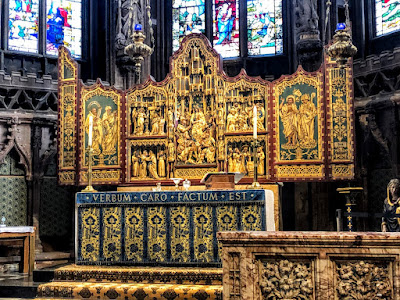
‘The Word was made Flesh’ … the Altar in the Lady Chapel in Lichfield Cathedral … the Prayer of Spiritual Communion is said at the mid-day Eucharist (Photograph: Patrick Comerford, 2021)
Patrick Comerford
As new pandemic restrictions are introduced this week, I am sure many priests may wonder what sort of Christmas we are facing.
It is difficult to describe the spiritual loneliness of a priest presiding at the Eucharist in an all-but empty church on Christmas Day and on Easter morning, recording reflections for Holy Week or school assemblies alone, or planning the choice of hymns weeks in advance for carol services that may never take place.
But then, priests ought to have the daily experience of praying the daily office alone without feeling spiritually lonely.
The Revd Dr Thomas Plant, chaplain at Rikkyo University in Tokyo and formerly chaplain at Lichfield Cathedral School, tweeted earlier this week: ‘… priestly prayer, especially the Liturgy of the Hours, is authentic priestly ministry. This conviction will help priests avoid the tendency to reduce it to a mere private devotion as if time devoted to prayer … were somehow time robbed from the ministry.’
I blog early each morning about my own morning prayers, reflections and readings. These are not private personal prayers, but part of my ministry too, and a fulfilment of the vows a priest takes at ordination. So, I have the morning habit of sharing these with parishioners through the parish Facebook page.
Often, in the middle of a busy working day in the Rectory, before taking a break for lunch, I also take time to watch the celebration of the mid-day Eucharist in the Lady Chapel of Lichfield Cathedral.
At this daily celebration, the priests habitually use the Prayer of Spiritual Communion on behalf of those who are watching but who cannot receive the Eucharist in person. This prayer, which I was made aware of in Lichfield Cathedral seven weeks ago, and which was used again at the mid-day Eucharist today, is based on the Prayer of Saint Richard of Chichester:
Thanks be to you, Lord Jesus Christ,
for all the benefits you have given me,
for all the pains and insults you have borne for me.
Since I cannot now receive you sacramentally,
I ask you to come spiritually into my heart.
O most merciful redeemer, friend and brother,
may I know you more clearly,
love you more dearly,
and follow you more nearly, day by day. Amen.
So, priestly ministry is never exercised on its own, and should never truly be a solitary, isolated, or lonely experience for me or any other priest.
Prayerful thoughts in the Lady Chapel in Lichfield Cathedral (Photograph: Patrick Comerford, 2021)
Patrick Comerford
As new pandemic restrictions are introduced this week, I am sure many priests may wonder what sort of Christmas we are facing.
It is difficult to describe the spiritual loneliness of a priest presiding at the Eucharist in an all-but empty church on Christmas Day and on Easter morning, recording reflections for Holy Week or school assemblies alone, or planning the choice of hymns weeks in advance for carol services that may never take place.
But then, priests ought to have the daily experience of praying the daily office alone without feeling spiritually lonely.
The Revd Dr Thomas Plant, chaplain at Rikkyo University in Tokyo and formerly chaplain at Lichfield Cathedral School, tweeted earlier this week: ‘… priestly prayer, especially the Liturgy of the Hours, is authentic priestly ministry. This conviction will help priests avoid the tendency to reduce it to a mere private devotion as if time devoted to prayer … were somehow time robbed from the ministry.’
I blog early each morning about my own morning prayers, reflections and readings. These are not private personal prayers, but part of my ministry too, and a fulfilment of the vows a priest takes at ordination. So, I have the morning habit of sharing these with parishioners through the parish Facebook page.
Often, in the middle of a busy working day in the Rectory, before taking a break for lunch, I also take time to watch the celebration of the mid-day Eucharist in the Lady Chapel of Lichfield Cathedral.
At this daily celebration, the priests habitually use the Prayer of Spiritual Communion on behalf of those who are watching but who cannot receive the Eucharist in person. This prayer, which I was made aware of in Lichfield Cathedral seven weeks ago, and which was used again at the mid-day Eucharist today, is based on the Prayer of Saint Richard of Chichester:
Thanks be to you, Lord Jesus Christ,
for all the benefits you have given me,
for all the pains and insults you have borne for me.
Since I cannot now receive you sacramentally,
I ask you to come spiritually into my heart.
O most merciful redeemer, friend and brother,
may I know you more clearly,
love you more dearly,
and follow you more nearly, day by day. Amen.
So, priestly ministry is never exercised on its own, and should never truly be a solitary, isolated, or lonely experience for me or any other priest.
Prayerful thoughts in the Lady Chapel in Lichfield Cathedral (Photograph: Patrick Comerford, 2021)
06 August 2021
We need to take note
of all the warning signs
and rekindle our hope
Yoshinori Sakai, who ran the final leg of the torch relay for the 1964 Tokyo Olympics, at the Olympic torch in Tokyo shortly before he died
Patrick Comerford
President, Irish Campaign for Nuclear Disarmament (Irish CND)
1 p.m., Friday 6 August 2021
Annual Hiroshima Day Commemoration
Merrion Square, Dublin
I think we are all proud of the medals our Olympic athletes have brought home from Tokyo. Personally, I am particularly proud of our rowers and scullers.
I am old enough now to also recall the first Olympics in Tokyo, back in 1964.
But how many of us remember the opening ceremony in Tokyo on 10 October 1964 … 57 years ago, but just 19 years after the bombing of Hiroshima?
Yoshinori Sakai (1945-2014) was the Olympic flame torchbearer who lit the cauldron at the Tokyo Olympics in 1964. He was born on the day of the atomic bombing of Hiroshima, two hours after the bombing. The Hiroshima bomb exploded so close to his hometown of Miyoshi, 60 km away, that his father saw the flash.
At the age of 19, Yoshinori Sakai was chosen to light the flame to symbolise Japan’s post-war reconstruction and commitment to peace. At the time, sports commentators labelled him ‘the Hiroshima Boy.’
While the nations compete at the Tokyo games this summer, there are four clear indicators that the world is not safe while we sit and watch.
1, It is now estimated that the Covid-19 pandemic will kill well over two million people around the globe. Nuclear weapons have failed to protect the world – have failed to protect us – against this mass killer. We may yet find we are facing wave after wave of pandemics, but the world’s nuclear powers have learned nothing and continue to spend money needed for health care and research on weapons that are useless against this global threat to our security and our survival.
Indeed, the mishandling of this grave global health crisis is a ‘wake-up call’ that governments, institutions, and a misled public remain unprepared to handle the even greater threats posed by nuclear war and climate change.
2, The failure of the world powers to deal with climate change and global warming show the folly of using the world’s scarce resources for the pleasure of the rich of this generation. Fires continue to rage across Greece and Turkey as I speak, and no amount of spending on nuclear weapons can ever protect us against climate change and global warming, against the folly of world leaders who have brought this crisis to a head in our generation.
3, Cyber security has shown how vulnerable, how weak, every country in the world is today. It was Ireland’s hospitals and health service that were targeted in recent weeks. But it was also oil supplies on the east coast of the US, trains in Britain, Iran and Australia, cabinet offices in Poland and Japan, Dutch police, the supply chains of major food suppliers in Australia, Brazil, Canada and the US … all in recent weeks.
Nuclear weapons are no protection against people who are waging a new, low-level, cold war that is warning us that everything is vulnerable, everything can collapse, everything can grind to halt. And if the para-state hackers get into the command and control systems of nuclear arsenals, all guided missiles become mass killers with the capacity to destroy all life as we know it.
4, Nuclear weapons cannot protect the victims of human rights abuses, the migrants caught in the waters of the Mediterranean or between Calais and Dover, or the people increasingly denied access to clean water, food or affordable medical care.
Nuclear weapons cannot protect girls denied access to education, the victims of gender-based violence, or stop the rise of racism, anti-Semitism, Islamophobia and hate crime.
Nuclear weapons cannot open the eyes of a blinkered Priti Patel or roll back the folly of Brexit in Boris Johnson’s Britain, where £205 billion is being spent on replacing Trident, Britain’s nuclear weapons system – money that public morality says must be spent instead on meeting genuine security needs: providing a properly-funded NHS and a sustainable energy sector.
This year, the Doomsday Clock of the Bulletin of the Atomic Scientists remains as close to midnight as it has ever been – just 100 seconds to midnight.
Dr Rachel Bronson of the Bulletin of the Atomic Scientists says the ‘lethal and fear-inspiring’ Covid-19 pandemic is as a ‘wake-up call,’ a vivid illustration that national governments and international organisations are ‘unprepared to manage the truly civilisation-ending threats of nuclear weapons and climate change.’
But Yoshinori Sakai was like so many hibakusha. He too succumbed as a victim of the bomb, and he died of cerebral bleeding in Tokyo at the age 69, 50 years after the first Tokyo Olympics, on 10 September 2014.
Before this year’s Tokyo Olympics began on 23 July, the Olympic torch relay passed through Hiroshima on Monday 17 May. There were few participants because of the pandemic. But one of the torchbearers was Yoshinori Sakai’s younger brother, Takayuki Sakai. He was part of the group who brought the Olympic flame to the city’s Peace Memorial Park, near the epicentre of the atomic bombing.
There should be no more Yoshinori Sakais, no more hibakusha.
It is time to listen to the wake-up call of the Doomsday Clock. Nuclear weapons protect us against none of the threats we face in the world today. They never protected us against the threats the world faced in the past. And they have no place in the world as face the challenges of the future.
(Revd Canon Professor) Patrick Comerford is President of the Irish Campaign for Nuclear Disarmament (Irish CND). He was speaking at Irish CND’s annual Hiroshima Day commemoration at the Hiroshima Memorial in Merrion Square, Dublin.
Patrick Comerford
President, Irish Campaign for Nuclear Disarmament (Irish CND)
1 p.m., Friday 6 August 2021
Annual Hiroshima Day Commemoration
Merrion Square, Dublin
I think we are all proud of the medals our Olympic athletes have brought home from Tokyo. Personally, I am particularly proud of our rowers and scullers.
I am old enough now to also recall the first Olympics in Tokyo, back in 1964.
But how many of us remember the opening ceremony in Tokyo on 10 October 1964 … 57 years ago, but just 19 years after the bombing of Hiroshima?
Yoshinori Sakai (1945-2014) was the Olympic flame torchbearer who lit the cauldron at the Tokyo Olympics in 1964. He was born on the day of the atomic bombing of Hiroshima, two hours after the bombing. The Hiroshima bomb exploded so close to his hometown of Miyoshi, 60 km away, that his father saw the flash.
At the age of 19, Yoshinori Sakai was chosen to light the flame to symbolise Japan’s post-war reconstruction and commitment to peace. At the time, sports commentators labelled him ‘the Hiroshima Boy.’
While the nations compete at the Tokyo games this summer, there are four clear indicators that the world is not safe while we sit and watch.
1, It is now estimated that the Covid-19 pandemic will kill well over two million people around the globe. Nuclear weapons have failed to protect the world – have failed to protect us – against this mass killer. We may yet find we are facing wave after wave of pandemics, but the world’s nuclear powers have learned nothing and continue to spend money needed for health care and research on weapons that are useless against this global threat to our security and our survival.
Indeed, the mishandling of this grave global health crisis is a ‘wake-up call’ that governments, institutions, and a misled public remain unprepared to handle the even greater threats posed by nuclear war and climate change.
2, The failure of the world powers to deal with climate change and global warming show the folly of using the world’s scarce resources for the pleasure of the rich of this generation. Fires continue to rage across Greece and Turkey as I speak, and no amount of spending on nuclear weapons can ever protect us against climate change and global warming, against the folly of world leaders who have brought this crisis to a head in our generation.
3, Cyber security has shown how vulnerable, how weak, every country in the world is today. It was Ireland’s hospitals and health service that were targeted in recent weeks. But it was also oil supplies on the east coast of the US, trains in Britain, Iran and Australia, cabinet offices in Poland and Japan, Dutch police, the supply chains of major food suppliers in Australia, Brazil, Canada and the US … all in recent weeks.
Nuclear weapons are no protection against people who are waging a new, low-level, cold war that is warning us that everything is vulnerable, everything can collapse, everything can grind to halt. And if the para-state hackers get into the command and control systems of nuclear arsenals, all guided missiles become mass killers with the capacity to destroy all life as we know it.
4, Nuclear weapons cannot protect the victims of human rights abuses, the migrants caught in the waters of the Mediterranean or between Calais and Dover, or the people increasingly denied access to clean water, food or affordable medical care.
Nuclear weapons cannot protect girls denied access to education, the victims of gender-based violence, or stop the rise of racism, anti-Semitism, Islamophobia and hate crime.
Nuclear weapons cannot open the eyes of a blinkered Priti Patel or roll back the folly of Brexit in Boris Johnson’s Britain, where £205 billion is being spent on replacing Trident, Britain’s nuclear weapons system – money that public morality says must be spent instead on meeting genuine security needs: providing a properly-funded NHS and a sustainable energy sector.
This year, the Doomsday Clock of the Bulletin of the Atomic Scientists remains as close to midnight as it has ever been – just 100 seconds to midnight.
Dr Rachel Bronson of the Bulletin of the Atomic Scientists says the ‘lethal and fear-inspiring’ Covid-19 pandemic is as a ‘wake-up call,’ a vivid illustration that national governments and international organisations are ‘unprepared to manage the truly civilisation-ending threats of nuclear weapons and climate change.’
But Yoshinori Sakai was like so many hibakusha. He too succumbed as a victim of the bomb, and he died of cerebral bleeding in Tokyo at the age 69, 50 years after the first Tokyo Olympics, on 10 September 2014.
Before this year’s Tokyo Olympics began on 23 July, the Olympic torch relay passed through Hiroshima on Monday 17 May. There were few participants because of the pandemic. But one of the torchbearers was Yoshinori Sakai’s younger brother, Takayuki Sakai. He was part of the group who brought the Olympic flame to the city’s Peace Memorial Park, near the epicentre of the atomic bombing.
There should be no more Yoshinori Sakais, no more hibakusha.
It is time to listen to the wake-up call of the Doomsday Clock. Nuclear weapons protect us against none of the threats we face in the world today. They never protected us against the threats the world faced in the past. And they have no place in the world as face the challenges of the future.
(Revd Canon Professor) Patrick Comerford is President of the Irish Campaign for Nuclear Disarmament (Irish CND). He was speaking at Irish CND’s annual Hiroshima Day commemoration at the Hiroshima Memorial in Merrion Square, Dublin.
25 April 2021
Sunday intercessions on
25 April 2021, Easter IV
The Good Shepherd window in All Saints’ Church, Mullingar (Photograph: Patrick Comerford)
Christ is risen!
The Lord is risen indeed. Alleluia!
Let us pray:
‘I am the Good Shepherd … I have received this command from my Father’ (John 10: 11, 18):
Heavenly Father,
we pray for the nations of the world,
and for our own country Ireland, north and south.
We give thanks for all who are involved in responding to the present pandemic crisis …
for all in vaccination centres, in health centres and in medical practices …
for all volunteers, medical professionals and administrators …
for all who make decisions and seek to influence public opinion for the good …
for all who behave like shepherds of the people, holding out hope and promise for our future …
Lord have mercy,
Lord have mercy.
‘Little children, let us love, not in word or speech, but in truth and action’ (I John 3: 18):
Lord Jesus Christ,
we pray for the Church,
that we may always set the Good Shepherd before us
as the pattern of our calling,
caring for one another.
We pray for our bishop Kenneth, our neighbouring churches and parishes
and people of faith everywhere,
that we may be blessed in their variety and diversity.
In the Anglican Cycle of Prayer,
we pray for the Nippon Sei Ko Kai,
the Anglican Church of Japan,
and the Primate, Bishop Nathaniel Makoto Uematsu,
Bishop of Hokkaido.
In the Church of Ireland this month,
we pray for the Diocese of Down and Dromore
and Bishop David McClay.
In the Diocesan Cycle of Prayer this week,
we pray for members of Select Vestries throughout the diocese,
and those preparing for Confirmation.
We pray for our own parishes and people,
and we pray for ourselves …
Christ have mercy,
Christ have mercy.
‘The stone that was rejected by you, the builders; it has become the cornerstone’ (Acts 4: 11):
Holy Spirit,
we pray for one another …
we pray for those we love and those who love us …
we pray for family, friends and neighbours …
and we pray for those we promised to pray for …
We pray for those who feel rejected and discouraged …
we pray for all in need and those who seek healing …
for all who work for healing …
for all waiting for healing …
for all being vaccinated and those administering vaccinations …
We pray for those who are sick or isolated,
at home or in hospital …
Ann … Valerie … Daphne … Sylvia … Ajay …
Joey … Ena … George … Louise …
We pray for those we have offered to pray for …
and we pray for those who pray for us …
We pray for all who grieve and mourn at this time …
for Ruby and the Shorten family …
for Jimmy, Cian, Fiachra and Saedhbh …
Joey, Kenneth, Victor, and their families …
Louie, Trevor, David, and their families …
We remember and give thanks for those who have died …
especially for Walter Long … Ernest Gardiner … Una Kerr …
Val Tomkins … Linda Smyth … Nora Hawkes …
the Rev John Anderson, priest in the Diocese of Connor
and rector of Billy and Derrykeighan for almost 16 years,
and who died suddenly from Covid–19 on Saturday 17 April …
and for those whose anniversaries are at this time …
May their memories be a blessing to us …
Lord have mercy,
Lord have mercy.
A prayer from the Anglican mission agency USPG (United Society Partners in the Gospel) on the Fourth Sunday of Easter:
Almighty Lord,
As Jesus laid down his life for us,
May we devote our lives to you.
Let us rejoice in the promise of new life.
Christ is risen!
The Lord is risen indeed. Alleluia!
Bishop Joseph Sakunoshin Motoda (1862-1928), the first Japanese-born Bishop of Tokyo, in a window in the chapel at the USPG offices … the Nippon Sei Ko Kai is named in our intercessions this morning (Photograph: Patrick Comerford)
These intercessions were prepared for use in the Rathkeale and Kilnaughtin Group of Parishes on the Fourth Sunday of Easter, Sunday 25 April 2021
Christ is risen!
The Lord is risen indeed. Alleluia!
Let us pray:
‘I am the Good Shepherd … I have received this command from my Father’ (John 10: 11, 18):
Heavenly Father,
we pray for the nations of the world,
and for our own country Ireland, north and south.
We give thanks for all who are involved in responding to the present pandemic crisis …
for all in vaccination centres, in health centres and in medical practices …
for all volunteers, medical professionals and administrators …
for all who make decisions and seek to influence public opinion for the good …
for all who behave like shepherds of the people, holding out hope and promise for our future …
Lord have mercy,
Lord have mercy.
‘Little children, let us love, not in word or speech, but in truth and action’ (I John 3: 18):
Lord Jesus Christ,
we pray for the Church,
that we may always set the Good Shepherd before us
as the pattern of our calling,
caring for one another.
We pray for our bishop Kenneth, our neighbouring churches and parishes
and people of faith everywhere,
that we may be blessed in their variety and diversity.
In the Anglican Cycle of Prayer,
we pray for the Nippon Sei Ko Kai,
the Anglican Church of Japan,
and the Primate, Bishop Nathaniel Makoto Uematsu,
Bishop of Hokkaido.
In the Church of Ireland this month,
we pray for the Diocese of Down and Dromore
and Bishop David McClay.
In the Diocesan Cycle of Prayer this week,
we pray for members of Select Vestries throughout the diocese,
and those preparing for Confirmation.
We pray for our own parishes and people,
and we pray for ourselves …
Christ have mercy,
Christ have mercy.
‘The stone that was rejected by you, the builders; it has become the cornerstone’ (Acts 4: 11):
Holy Spirit,
we pray for one another …
we pray for those we love and those who love us …
we pray for family, friends and neighbours …
and we pray for those we promised to pray for …
We pray for those who feel rejected and discouraged …
we pray for all in need and those who seek healing …
for all who work for healing …
for all waiting for healing …
for all being vaccinated and those administering vaccinations …
We pray for those who are sick or isolated,
at home or in hospital …
Ann … Valerie … Daphne … Sylvia … Ajay …
Joey … Ena … George … Louise …
We pray for those we have offered to pray for …
and we pray for those who pray for us …
We pray for all who grieve and mourn at this time …
for Ruby and the Shorten family …
for Jimmy, Cian, Fiachra and Saedhbh …
Joey, Kenneth, Victor, and their families …
Louie, Trevor, David, and their families …
We remember and give thanks for those who have died …
especially for Walter Long … Ernest Gardiner … Una Kerr …
Val Tomkins … Linda Smyth … Nora Hawkes …
the Rev John Anderson, priest in the Diocese of Connor
and rector of Billy and Derrykeighan for almost 16 years,
and who died suddenly from Covid–19 on Saturday 17 April …
and for those whose anniversaries are at this time …
May their memories be a blessing to us …
Lord have mercy,
Lord have mercy.
A prayer from the Anglican mission agency USPG (United Society Partners in the Gospel) on the Fourth Sunday of Easter:
Almighty Lord,
As Jesus laid down his life for us,
May we devote our lives to you.
Let us rejoice in the promise of new life.
Christ is risen!
The Lord is risen indeed. Alleluia!
Bishop Joseph Sakunoshin Motoda (1862-1928), the first Japanese-born Bishop of Tokyo, in a window in the chapel at the USPG offices … the Nippon Sei Ko Kai is named in our intercessions this morning (Photograph: Patrick Comerford)
These intercessions were prepared for use in the Rathkeale and Kilnaughtin Group of Parishes on the Fourth Sunday of Easter, Sunday 25 April 2021
09 March 2021
Praying in Lent and Easter 2021:
21, Friends’ Metting House, Tokyo
The Quaker Meeting House in Tokyo … I went to church here as a student in Tokyo in 1979 (Photograph: Patrick Comerford)
Patrick Comerford
During Lent and Easter this year, I am taking some time each morning to reflect in these ways:
1, a photograph of a church or place of worship that has been significant in my spiritual life;
2, the day’s Gospel reading;
3, a prayer from the prayer diary of the Anglican mission agency USPG (United Society Partners in the Gospel).
This week I am offering photographs from seven churches that have connections with my education. My photographs this morning (9 March 2021) are from Friends’ Meeting House in Tokyo.
In 1979, while I was still in my 20s and a journalist on the Foreign Desk of The IrishTimes, the editor, Douglas Gageby, secured a fellowship for me through the Fondation Journalistes en Europe (Paris) and Nihon Shimbum Kyokai (the Japanese Newspaper Publishers Association) that allowed me to spend a full term in Tokyo, from May to August, studying journalism and economics. I stayed in the Asia Bunka Kaikan, a student hostel in Tokyo. Each Sunday, two of us crossed the city and went to church in the Quaker meeting house.
Matthew 18: 21-35 (NRSVA):
21 Then Peter came and said to him, ‘Lord, if another member of the church sins against me, how often should I forgive? As many as seven times?’ 22 Jesus said to him, ‘Not seven times, but, I tell you, seventy-seven times.
23 ‘For this reason the kingdom of heaven may be compared to a king who wished to settle accounts with his slaves. 24 When he began the reckoning, one who owed him ten thousand talents was brought to him; 25 and, as he could not pay, his lord ordered him to be sold, together with his wife and children and all his possessions, and payment to be made. 26 So the slave fell on his knees before him, saying, “Have patience with me, and I will pay you everything.” 27 And out of pity for him, the lord of that slave released him and forgave him the debt. 28 But that same slave, as he went out, came upon one of his fellow-slaves who owed him a hundred denarii; and seizing him by the throat, he said, “Pay what you owe.” 29 Then his fellow-slave fell down and pleaded with him, “Have patience with me, and I will pay you.” 30 But he refused; then he went and threw him into prison until he should pay the debt. 31 When his fellow-slaves saw what had happened, they were greatly distressed, and they went and reported to their lord all that had taken place. 32 Then his lord summoned him and said to him, “You wicked slave! I forgave you all that debt because you pleaded with me. 33 Should you not have had mercy on your fellow-slave, as I had mercy on you?” 34 And in anger his lord handed him over to be tortured until he should pay his entire debt. 35 So my heavenly Father will also do to every one of you, if you do not forgive your brother or sister from your heart.’
Prayer in the USPG Prayer Diary:
The Prayer in the USPG Prayer Diary today (9 March 2021) prays:
Let us pray for all countries that depend on tourism for a healthy economy, and which have been affected by the Covid-19 pandemic.
Yesterday’s reflection
Continued tomorrow
The Quaker Meeting House in Tokyo provided a warm welcome in 1979 (Photograph: Patrick Comerford)
Scripture quotations are from the New Revised Standard Version Bible: Anglicised Edition copyright © 1989, 1995, National Council of the Churches of Christ in the United States of America. Used by permission. All rights reserved worldwide. http://nrsvbibles.org
Patrick Comerford
During Lent and Easter this year, I am taking some time each morning to reflect in these ways:
1, a photograph of a church or place of worship that has been significant in my spiritual life;
2, the day’s Gospel reading;
3, a prayer from the prayer diary of the Anglican mission agency USPG (United Society Partners in the Gospel).
This week I am offering photographs from seven churches that have connections with my education. My photographs this morning (9 March 2021) are from Friends’ Meeting House in Tokyo.
In 1979, while I was still in my 20s and a journalist on the Foreign Desk of The IrishTimes, the editor, Douglas Gageby, secured a fellowship for me through the Fondation Journalistes en Europe (Paris) and Nihon Shimbum Kyokai (the Japanese Newspaper Publishers Association) that allowed me to spend a full term in Tokyo, from May to August, studying journalism and economics. I stayed in the Asia Bunka Kaikan, a student hostel in Tokyo. Each Sunday, two of us crossed the city and went to church in the Quaker meeting house.
Matthew 18: 21-35 (NRSVA):
21 Then Peter came and said to him, ‘Lord, if another member of the church sins against me, how often should I forgive? As many as seven times?’ 22 Jesus said to him, ‘Not seven times, but, I tell you, seventy-seven times.
23 ‘For this reason the kingdom of heaven may be compared to a king who wished to settle accounts with his slaves. 24 When he began the reckoning, one who owed him ten thousand talents was brought to him; 25 and, as he could not pay, his lord ordered him to be sold, together with his wife and children and all his possessions, and payment to be made. 26 So the slave fell on his knees before him, saying, “Have patience with me, and I will pay you everything.” 27 And out of pity for him, the lord of that slave released him and forgave him the debt. 28 But that same slave, as he went out, came upon one of his fellow-slaves who owed him a hundred denarii; and seizing him by the throat, he said, “Pay what you owe.” 29 Then his fellow-slave fell down and pleaded with him, “Have patience with me, and I will pay you.” 30 But he refused; then he went and threw him into prison until he should pay the debt. 31 When his fellow-slaves saw what had happened, they were greatly distressed, and they went and reported to their lord all that had taken place. 32 Then his lord summoned him and said to him, “You wicked slave! I forgave you all that debt because you pleaded with me. 33 Should you not have had mercy on your fellow-slave, as I had mercy on you?” 34 And in anger his lord handed him over to be tortured until he should pay his entire debt. 35 So my heavenly Father will also do to every one of you, if you do not forgive your brother or sister from your heart.’
Prayer in the USPG Prayer Diary:
The Prayer in the USPG Prayer Diary today (9 March 2021) prays:
Let us pray for all countries that depend on tourism for a healthy economy, and which have been affected by the Covid-19 pandemic.
Yesterday’s reflection
Continued tomorrow
The Quaker Meeting House in Tokyo provided a warm welcome in 1979 (Photograph: Patrick Comerford)
Scripture quotations are from the New Revised Standard Version Bible: Anglicised Edition copyright © 1989, 1995, National Council of the Churches of Christ in the United States of America. Used by permission. All rights reserved worldwide. http://nrsvbibles.org
Subscribe to:
Posts (Atom)