COMERFORD WAY: Patrick Comerford’s online journal on Anglicanism, theology, spirituality, history, architecture, travel, poetry, beach walks ... and more
The ‘Emperor Heads’ decorate the railings at the Sheldonian Theatre, looking down on Broad Street in Oxford (Photograph: Patrick Comerford, 2026)
Patrick Comerford
When I was in Oxford a few days ago, checking out the peculiar Greek inscription above the Wren Door in the Divinity School, I found myself looking once again looking at the ‘Emperor Heads’ at the Sheldonian Theatre and trying, fruitlessly, to figure out which emperors or philosophers they are supposed to depict or represent, and that are certainly more impressive than any Hallowe’en masks you may see this evening.
These heads are imposing figures at the east end of Broad Street, where the cluster of and they are one of the imposing or eye-catching features at a cluster of buildings in the heart of the city that includes the Sheldonian Theatre (1669), the Old Ashmolean Building (1683), now the History of Science Museum, the Clarendon Building (1715), originally home to Oxford University Press, and the Weston Library, redeveloped in 2015.
The so-called ‘Emperor Heads’ are 17 large stone herm busts or sculpted heads and as a collection they form one of Oxford’s most peculiar historic attractions. Each head shows a different type of beard, and they gaze down on tourists and students alike from the top of pillars that are part of the wall and fence surrounding the Sheldonian Theatre and the adjacent Museum of the History of Science or Old Ashmolean.
For 360 years or so, these characterful heads have featured in poetry, literature and art, and they remain one of the most photographed and well-recognised cultural landmarks in the city. The busts are more precisely called ‘herms’, as they depict the head and shoulders of each man.
Despite being known popularly as the ‘Emperors’, they do not represent any emperors, nor, indeed, anyone in particular. It has been suggest they represent bearded philosophers or sages, and they are bedecked with ivy wreaths, symbolising wisdom, rather than imperial laurel wreaths. It has even been suggested they were designed to compose a history of beards.
Sir Christopher Wren commissioned the bearded stone busts when the Sheldonian Theatre was completed in 1669 (Photograph: Patrick Comerford, 2026)
The Sheldonian Theatre was designed by Sir Christopher Wren (1632-1723) and was built between 1664 and 1669. The building is named after the project’s principal financial backer, Gilbert Sheldon (1598-1677), twice Warden of All Souls College (1636-1648, 1660-1661), Bishop of London (1660-1663), Chancellor of Oxford University (1667-1669) and Archbishop of Canterbury (1663-1677).
Wren was educated at Wadham College, had been a Fellow of All Souls College (1653-1657) – Monday is All Souls’ Day – and he was based in Oxford from 1661 to 1668 when he was Savilian Professor of Astronomy. His design of the Sheldonian was based on Serlio’s 16th century engraving of the Theatre of Marcellus built in Rome in the first century BCE.
When Wren completed Sheldonian Theatre in 1669, he commissioned 14 bearded stone busts to be placed around the perimeter. He asked the sculptor William Byrd ( (1624-1691) to create 13 busts for the northern boundary, where the theatre jutted out into Broad Street. Though at first glance they appear similar, each bust is unique, and each ‘emperor’ has a completely different expression and a different type of beard.
Wren is said to have asked Byrd to carve each bust with a wide-eyed expression of shock as a not-too-subtle dig at his patron, Gilbert Sheldon, whose penny-pinching budget made Wren’s task in designing the theatre very difficult. Byrd carved the busts from Clipsham stone, an oolite limestone quarried near the village of Clipsham in Rutland. The stone is coarsely grained and hard-wearing, and remains a popular stone for building and sculpture to this day.
When the Old Ashmolean building, now the Museum of the History of Science, was built beside the Sheldonian Theatre in 1679-1683, four more heads were added to the building frontage, bringing the total number of busts to 17. In time, one was removed around 1713 to make way for the Clarendon Building.
The bearded heads in place today are the third generation of bearded heads outside the Sheldonian Theatre and the Old Ashmolean (Photographs: Patrick Comerford, 2026)
But the heads we see today are not the original ones – nor are they even the original replacements. The heads in place today are, in fact, the third generation of bearded heads to sit there.
The first, original figures were carved in local Taynton limestone and they lasted for almost 200 years before Victorian replacements were put in their place in 1869.
The second set of heads was made from softer Milton limestone, and suffered miserably as a result. The heads soon became blackened by soot and disfigured by acid rain, worsened by the coal fires that burned in students’ college rooms. As Oxford’s air filled with thick smoke, its buildings and the heads were becoming more dirty and were decaying.
These 17 busts of men became known as the Emperor Heads, the Oxford Emperors, the philosophers, or, sometimes the Twelve Apostles. The first reference to them as ‘Emperor Heads’ is found in 1911 in the novel Zuleika Dobson, by Max Beerbohm.
But this second generation did not use the same hard-wearing stone as the first set. They were so badly weathered only 57 years after their installation that when the poet John Betjeman came up to Oxford in 1925, he saw them as ‘the mouldering busts round the Sheldonian’ and ‘unknown bearded guards’. In his verse autobiography Summoned by Bells (1960), Betjeman compared them to ‘illustrations of skin diseases in a medical textbook’.
The Victorian busts also became a focal point for undergraduate pranks so that they were often painted, given lipstick smiles and had traffic cones placed on their heads like hats. They were worn away by the combination of weathering, the polluted air of Victorian Oxford, harsh cleaning and vandalism, and were left in a poor state of repair.
Michael Black modelled the third generation of Emperor Heads on the originals by Wren and Byrd, including their shocked expressions (Photographs: Patrick Comerford, 2026)
With the help of the Historic Buildings Fund, a widespread effort was made to clean-up, repair and replace the stone fabric of Oxford. After fruitless conservation attempts of three heads of the second generation, Michael Black, a local sculptor, was commissioned to make the new set that still stand today. The heads now looking down on on Broad Street are the third set of Emperor Heads.
But, despite their historical and cultural value, the first two sets of heads were never fully recorded and the whereabouts of many of them remains largely unknown. Black tracked down seven of the original heads, five scattered around Oxford as garden ornaments and two in a house in Herefordshire. One original head is in the Fellows Garden at Wadham College, which Wren had attended.
From 1970 to 1972, Black and his two assistants carved 13 new heads for the Sheldonian from Lincolnshire Clipsham stone. They later carved four more heads for the Museum of the History of Science. Each head took a minimum of 30 hours to complete.
Black modelled his heads on the originals by Wren and Byrd, including their shocked expressions, and also drew on 17th century engravings by David Loggan as templates to make the heads relatively true to the originals. Black made each beard different and added amusing touches, such as the small figure of a bird in the hair of one head, an allusion to the fact that the originals were designed by a man named Wren and carved by a man called Byrd.
The small figure of a bird in the hair of one head is an allusion to the surnames of Christopher Wren and William Byrd (Photograph: Patrick Comerford, 2026)
A recent project investigated the heads from the perspective of heritage science, seeking to unravel their history and mysteries and looking at any implications they may have for the sustainable management of built heritage, collective memory and identity. An exhibition on the heads at the Weston Library in 2019 was the culmination of over five years of research by the School of Geography and the Environment team. The display reconstructed the history of the heads and first, second, and third generation heads came face-to-face for the first time.
The 17 carved heads at the Sheldonian Theatre and the Old Ashmolean are now the third generation of Emperor Heads. As a collection, they have become an iconic feature of Oxford, almost like a 360-year record of urban architectural decay, conservation, environmental change and changing attitudes and perceptions.
The Clarendon Building beside the Sheldonian Theatre was designed by Nicholas Hawksmoor and built in 1711-1715 to house the Oxford University Press. It was known as the Printing House or the Clarendon Printing House until the University Press moved to Walton Street in 1832.
Lead figures of the nine Muses were placed on top of the building in 1717 and a lead statue of Lord Clarendon was placed in a clamshell niche on the first floor of the south side in 1721 and moved to the west side of the building in 1947.
All ten statues at the Clarendon Building are undergoing extensive renovation, with Lord Clarendon and four of the original muses temporarily removed and the two fibreglass ones being replaced. They will all be painted in the stone colour they would have had originally. Part of the Clarendon Building is now covered in cladding and scaffolding, but I hope to see the renovated statues in time and to blog about them then.
The heads at the Sheldonian Theatre now looking down on on Broad Street are the third set of Emperor Heads, and date from 1970-1972 (Photograph: Patrick Comerford, 2026)
‘When you are invited, go and sit down at the lowest place’ (Luke 14: 10) … tables waiting for evening guests at the Sunset Taverna in Rethymnon (Photograph: Patrick Comerford)
Patrick Comerford
We have come to the end of Ordinary Time in the Church Calendar and the Kingdom Season beings tomorrow with All Saints’ Day (1 November), one of the 12 Principal Feasts of the Church. The calendar of the Church of England in Common Worship today remembers the Reformer Martin Luther.
Before today begins, before having breakfast, I am taking some quiet time early this morning to give thanks, and for reflection, prayer and reading in these ways:
1, today’s Gospel reading;
2, a short reflection;
3, a prayer from the USPG prayer diary;
4, the Collects and Post-Communion prayer of the day.
‘When you are invited … to a … banquet, do not sit down at the place of honour ... (Luke 14: 8) … waiting for guests at Tai Tai restaurant in Kuching (Photograph: Patrick Comerford)
Luke 14: 1, 7-11 (NRSVA):
1 On one occasion when Jesus was going to the house of a leader of the Pharisees to eat a meal on the sabbath, they were watching him closely.
7 When he noticed how the guests chose the places of honour, he told them a parable. 8 ‘When you are invited by someone to a wedding banquet, do not sit down at the place of honour, in case someone more distinguished than you has been invited by your host; 9 and the host who invited both of you may come and say to you, “Give this person your place”, and then in disgrace you would start to take the lowest place. 10 But when you are invited, go and sit down at the lowest place, so that when your host comes, he may say to you, “Friend, move up higher”; then you will be honoured in the presence of all who sit at the table with you. 11 For all who exalt themselves will be humbled, and those who humble themselves will be exalted.’
‘When you are invited by someone to a wedding banquet, do not sit down at the place of honour’ (Luke 14: 8) … preparing for a wedding meal in Southwark (Photograph: Patrick Comerford)
Today’s Reflections:
Today’s Gospel reading is part of one the longest accounts in Saint Luke’s Gospel of a meal with Jesus. This meal begins with Jesus’ invitation to the house of a leader of the Pharisees to eat a meal on the sabbath.
As he arrives, he heals a man with dropsy (verses 2-6), which we read about yesterday. In today’s reading, Jesus then discusses the ways in which guests like to be given the place of honour at a dinner, a wedding or a banquet (verses 7-11), and theme continues by discussing with his host who should be on our invitations lists (verses 12-14). As the meal goes on, Jesus is prompted to tell the Parable of the Great Dinner (verses 15-24). These conversations at the dinner continue in the lectionary readings next week.
Jesus is accused at times of eating with publicans and sinners, and his detractors point to him saying: ‘Look, a glutton and a drunkard, a friend of tax collectors and sinners!’ (Luke 7: 34). But Jesus also eats with Pharisees too. Indeed, he may have had many meals with Pharisees, although the Gospel writers simply make a passing reference to the host without naming him (see Luke 14: 1-24), or perhaps ignore the meals altogether.
However, at this meal, I imagine an evening when Jesus is found eating with an eminently respectable member of society, a Pharisee, and a leading Pharisee at that too.
Jesus is invited to dinner on Saturday evening by a leading Pharisee, yet we do not know the name of the host that evening, nor is it clear which city he lives in. Although, I am not sure whether either really matters.
Have you ever been at a dinner where you know some of the guests were invited simply to boost the ego of those who had invited them? The Pharisee in today’s reading may have been a genial host who thought he was doing the decent thing.
A Pharisee inviting a visiting rabbi and preacher to dinner would have been common courtesy and a common experience. Nor is there is anything unusual, anything offensive, about the behaviour of Jesus at this meal. He takes his allotted or allocated place at the table, and he probably enjoys the conversation and the company with the people beside him and opposite him.
But it’s not who were prepared to welcome that tells a lot about us; rather, it’s who we forget to count in, or even those we consciously decide to exclude.
The definitions of identity, of English-ness or Irish-ness, are being hotly debated, and flags that ought to be symbols of unity and inclusion have become symbols of division and exclusion.
The far-right Reform MP Sarah Pochin recently threw in her tuppence worth, saying, ‘it drives me mad when I see adverts full of black people, full of Asian people’. Earlier, she had used Prime Minister’s Question Time to suggest women in Britain should be banned from wearing the burqa.
Who we want to sit with, who we want to eat with, who we want to count in, and who want to count out, says more about us than about them. But in Christ there is no us and them, and ‘all who exalt themselves will be humbled, and those who humble themselves will be exalted’ (verse 11).
Waiting for a meal at a summer street party in Stony Stratford (Photograph: Patrick Comerford)
Today’s Prayers (Saturday 31 October 2026):
The theme this week (25 to 31 October) in Pray with the World Church, the prayer diary of the Anglican mission agency USPG (United Society Partners in the Gospel), has been ‘Update from Myanmar’ (pp 50-51). This theme was introduced on Sunday with a programme update from the Revd Davidson Solanki, Senior Regional Manager for Asia and the Middle East, USPG.
The USPG Prayer Diary today (Saturday 31 October 2026) invites us to pray:
Lord, may the lessons learned in Myanmar’s emergency response strengthen the Church’s mission. Help all involved to turn insight into action, bringing hope and stability to communities in need.
The Collect of the Day:
Blessed Lord,
who caused all holy Scriptures to be written for our learning:
help us so to hear them,
to read, mark, learn and inwardly digest them
that, through patience, and the comfort of your holy word,
we may embrace and for ever hold fast
the hope of everlasting life,
which you have given us in our Saviour Jesus Christ,
who is alive and reigns with you,
in the unity of the Holy Spirit,
one God, now and for ever.
The Post Communion Prayer:
God of all grace,
your Son Jesus Christ fed the hungry
with the bread of his life
and the word of his kingdom:
renew your people with your heavenly grace,
and in all our weakness
sustain us by your true and living bread;
who is alive and reigns, now and for ever.
Additional Collect:
Merciful God,
teach us to be faithful in change and uncertainty,
that trusting in your word
and obeying your will
we may enter the unfailing joy of Jesus Christ our Lord.
Collect on the Eve of All Saints’ Day:
Almighty God,
you have knit together your elect
in one communion and fellowship
in the mystical body of your Son Christ our Lord:
grant us grace so to follow your blessed saints
in all virtuous and godly living
that we may come to those inexpressible joys
that you have prepared for those who truly love you;
through Jesus Christ your Son our Lord,
who is alive and reigns with you,
in the unity of the Holy Spirit,
one God, now and for ever.
‘He noticed how the guests chose the places of honour’ (Luke 14: 7) … waiting for diners at a restaurant in Milton Keynes (Photograph: Patrick Comerford)
Sid James on the wall of the Old George in Stony Stratford … undisturbed by this week’s Hallowe’en decorations (Photograph: Patrick Comerford, 2026)
Patrick Comerford
Hallowe’en is tomorrow and shops and pubs in Stony Stratford are decorated with spiders and skulls, pumpkins and brooms, cobwebs and coffin lids, white sheets and black cats, spiders and witches.
But in the Old George, where I like to drop in for a drink occasionally, the framed photographs of Sid James on a wall between the door and a window, have been left untouched, alongside other memorabilia from the Carry On films and actors. It’s as though the East End comedian and actor who died half a century ago is being left in peace, considering the unusual circumstances of his death on stage 50 years ago in 1976.
Sidney James (1913-1976) was born Solomon Joel Cohen in South Africa on 8 May 1913. But his family were deeply rooted in the Jewish East End of London, and became a very typecast British actor, with a career in radio, television, stage and screen, best known for his top billing in 19 Carry On films, his part alongside Alec Guinness in The Lavender Hill Mob (1951), his role in Tony Hancock’s co-star in Hancock's Half Hour and his distinctive laugh.
Sid James was born Solomon Joel Cohen in in Newcastle, Natal, on 8 May 1913. His parents were two London-born Jewish vaudeville performers, Reina (Solomon) Cohen (1892-1965) and Lazarus Joel ‘Lew’ Cohen (1884-1948) from Mile End. His paternal grandparents, Solomon Cohen (1835-1911) and Rahle (Davidoff) Cohen (1836-1936), were born in Latvia, and nine of their ten children were born in the Russian Empire before they fled the Tsarist pogroms and arrived in London in the early 1880s. The family lived in the East End in Horsley Buildings, a lane with small houses on either side, and their home was at the extreme end facing the entrance to the lane, near Sidney Street in Stepney.
The Siege of Sidney Street – also known as the Battle of Stepney – began on 16 December 1910 and came to an end on 3 January 1911, and was one of the most notorious events at the time in the East End. It was one of the worst days in the history of British policing and was considered to be the biggest criminal event in the East End since ‘Jack the Ripper’.
As a child, Sid James was known as Sollie. He later changed his name to Sidney James following confusion with a similarly-named cousin at school. The name Sidney may have come from the area in Stepney where his grandparents had lived, the new surname James came from the stage names his parents used. During his childhood, his parents travelled abroad, were divorced in Australia, and he spent part of his childhood in the care of an uncle and aunt, Abraham and Esther Cohen. His family were not members of a local synagogue, and it is said that 100 years ago he prepared for his Bar Mitzvah at the age of 13 in 1926 by learning prayers from an elderly Lithuanian immigrant to recite at a house party.
In his early adult years, he claimed, he had been a diamond cutter, dance tutor, and boxer. In fact, he had been a hairdresser before beginning to work as an actor. He was a lieutenant in the South African army during World War II, but he returned to the stage after the war and had moved to London by the end of 1946.
His early film career included roles in The Lavender Hill Mob (1951) alongside Alec Guinness, The Buccaneers, The Galloping Major (1951), The Titfield Thunderbolt (1953), Father Brown(1956), and The Adventures of Robin Hood and, as well as parts in television comedies.
He starred with Miriam Karlin in East End, West End (1958) by Wolf Mankowitz, a half-hour comedy series set in the Jewish community in the East End.
He began working with Tony Hancock in 1954, and Sid James played a character called Sid James but with the invented middle name Balmoral, a petty criminal who would con Hancock in one way or another. Tony Hancock and Sid James were seen as a double act until the series ended in 1960.
James became a leading member of the Carry On team with Carry On Teacher in 1959, and in all made 19 Carry On films, with top billing in 17. His characters were often wise-cracking, sly, lecherous Cockneys, sometimes with the name Sid or Sidney, such as Sir Sidney Ruff-Diamond or Sid Boggle, all with his distinctive laugh and his catchphrase ‘Cor, blimey!’
He first appeared on The Eamonn Andrews Show in 1964. He starred in the 1970s sitcom Bless This House until he died in 1976. He had major problems with alcohol and gambling, and lost tens of thousands of pounds as a compulsive gambler. After a severe heart attack in 1967, he gave up cigarettes, lost weight, ate only one main meal a day, and limited himself to two or three alcoholic drinks in the evening.
Sid James was married three times: his first marriage in 1936 ended in divorce in 1940, his second marriage in 1943 ended in divorce in 1952, and he married a third time later that year. He also fathered three or four children in other relationships, and during his third marriage he had a three-year affair with his Carry On co-star Barbara Windsor (1937-2000).
He had a notoriously antagonistic relationship with Carry On co-star Kenneth Williams. Williams was particularly scathing and personal about James’s acting ability, while James found Williams’s loud and attention-seeking behaviour annoying.
Sid James was on stage on 26 April 1976 when he suffered a heart attack at the Sunderland Empire Theatre. The other actors thought he was playing a practical joke when he failed to reply to their dialogue. They ad-libbed but when he still failed to respond, the curtains closed and they called for a doctor. The audience laughed, believing it was all part of the show. He was pronounced dead at Sunderland General Hospital. He was 62.
Sid James was cremated and his ashes were scattered at Golders Green Crematorium in London, directly opposite Golders Green Jewish Cemetery, but without any Jewish prayers or rituals. Dying on stage as a famous comic actor to the sound of laughter might be seen by some as the way to go. But fame and celebrity had never brought him fortune or inner happiness, and he had gambled away most of his earnings.
Many fans thought he was from the East End but were not aware of his Jewish background, nor that he was born and raised in Johannesburg. His Jewish heritage rarely defined his public persona or roles, and he rarely played Jewish characters on screen, apart from the mini sitcom series East End, West End (1958), in which he was Sid, a small-time Jewish businessman from the East End always on the look-out for a scheme that could make him rich. Instead, he seemed to fit in seamlessly into general British working-class character roles.
May his memory be a blessing, ז״ל.
Shabbat Shalom, שבת שלום
Siege House on Sidney Street recalls the Siege of Sidney Street … did Sidney James take his stage name from Sidney Street, where his grandparents lived? (Photograph: Patrick Comerford)
‘Ars Longa, Vita Brevis’ … words from Hippocrates at the Medical School in the Royal Hallamshire Hospital, Sheffield (Photograph: Patrick Comerford)
Patrick Comerford
We are continuing in Ordinary Time in the Church Calendar, which changes to Kingdom-time or the Kingdom Season on Sunday with All Saints’ Day. My school year (Gormanston 1969) is meeting for lunch in Roly’s Bistro in Ballsbridge, Dublin, today, and I am sorry to miss this gatering. It’s 57 years since we left school, but many of us are still keep in contact with one another. I have been at most of our gatherings down through the years, so I am disappointed about missing today’s get-together.
Before the day begins, before having breakfast, I am taking some quiet time early this morning to give thanks, and for reflection, prayer and reading in these ways:
1, today’s Gospel reading;
2, a short reflection;
3, a prayer from the USPG prayer diary;
4, the Collects and Post-Communion prayer of the day.
An Orthodox fresco depicting Christ’s healing of the man with dropsy (see Luke 14: 1-6)
Luke 14: 1-6 (NRSVA)
1 On one occasion when Jesus was going to the house of a leader of the Pharisees to eat a meal on the sabbath, they were watching him closely. 2 Just then, in front of him, there was a man who had dropsy. 3 And Jesus asked the lawyers and Pharisees, ‘Is it lawful to cure people on the sabbath, or not?’ 4 But they were silent. So Jesus took him and healed him, and sent him away. 5 Then he said to them, ‘If one of you has a child or an ox that has fallen into a well, will you not immediately pull it out on a sabbath day?’ 6 And they could not reply to this.
Hippocrates and the Hippocratic Oath on the wall of a Greek restaurant (Photograph: Patrick Comerford)
Today’s Reflections:
Over the past four or five years, following a stroke and due to various health conditions, I have been in a number of hospitals, including one in Milton Keynes, two in Oxford, one in London, and one in Sheffield. While I was staying in Sheffield I noticed words from Hippocrates, Ars Longa, Vita Brevis, inscribed at the Medical School in the Royal Hallamshire Hospital, Sheffield. The saying means ‘art is long, life is short’ and the phrase is a Latin translation of the opening line of the Aphorisms by the ancient Greek physician Hippocrates: Ὁ βίος βραχύς, ἡ δὲ τέχνη μακρή (Ho bíos brakhús, hē dè tékhnē makrḗ).
The familiar Latin translation reverses the order of the original lines in Greek, but still expresses the same principle, life is short and it takes a long time to develop a craft or technical skill, such as the skill of medicine. Perhaps Hippocrates, who is known as the ‘Father of Medicine’, was saying that learning and mastering the practice of medicine takes a lifetime, but a doctor’s life is too brief to learn everything.
Hippocrates of Kos (ca 460 – ca 370 BCE) wrote this pithy saying as the preface of his medical text: ‘The physician must not only be prepared to do what is right himself, but also to make the patient, the attendants, and externals cooperate’.
The Roman philosopher Seneca and later Latin writers adapted it into the famous order: Ars longa, vita brevis, occasio praeceps, experimentum periculosum, iudicium difficile, ‘Life is short, craft long, opportunity fleeting, experimentation perilous, judgment difficult’.
In today’s Gospel reading (Luke 14:1-6), Jesus is faced with a conundrum. It is the sabbath and he is going to eat dinner at the home of a local religious leader: if he ignores the sick man’s plight and delays his opportunity for healing, does he ignore that love and compassion are the core of true religion? Or, if heals this man, is he going to be accused of breaching religious rules, regulations traditions.
How is he going to do not only what is right for himself and the patient, but also win over the co-operation or goodwill of those who are present, those who are also attending the dinner in the Pharisee’s house and those outside three circles, his own, that of the man seeking healing, and the people who may not be oart of the Pharisee’s circle of guests and friends but who are onlookers?
The discussion that arises is not about whether Christ has the moral duty or responsibility, the legal right or power, the appropriate qualifications or the authority, to heal the man with dropsy, but whether doing this on the Sabbath shows disdain for the law of God.
Life is short, but is it so short that it is compelling to heal this man on this day? Is his life so short that he cannot wait until another day to be healed? Could he not healed just as well on, say, Sunday or Monday?
This is the sole, lone and only Gospel incident in which the Greek word ὑδρωπικός (hydropikos) is used to describe a person suffering from dropsy. It is a pathological retention of fluid that causes abnormal swelling. Although it is a medical term, its single New Testament appearance in this reading becomes theologically rich when placed within the Gospel narrative.
In the world of the Biblical Mediterranean, dropsy was seen as incurable and associated with other systemic illnesses. Swelling of the limbs and abdomen visibly marked the sufferer, making him ritually unclean by the religious understanding of the day and socially marginalised.
Physicians such as Hippocrates discussed the malady, yet effective treatment was scarce. A hydropic person embodied chronic suffering and exclusion, providing a stark contrast to the wholeness of life envisioned in God’s covenant promises.
Should this man be left, as it were, among the living dead?
By asking whether it is it lawful to heal on the Sabbath or not (verse 3), Jesus exposes the discrepancy between the Law’s intent and the tradition-bound application of it. When he heals the man and sends him away whole, he affirms the Sabbath as a day ‘for doing good’.
Of course, the man is not dying. Although he has dropsy, his healing could take place on any other day, indeed at any other venue. But, even before they speak, Christ’s response to his potential protagonists is to ask a question: ‘Is it lawful to cure people on the sabbath, or not?’ (verse 4).
If they say no, they show their ignorance of the law and the rabbinical tradition; if they say yes, how could they possibly disagree with what they know he is about to do?
After this healing miracle, Christ goes on to share two parables about humility and the heavenly banquet (Luke 14: 7-24). The hydropic man’s restoration anticipates the inclusive feast of the Kingdom, where the physically and spiritually bloated pride of the self-righteous is contrasted with the humble who accept the invitation.
If mercy towards animals or family members is permitted, how much more should mercy for a suffering image-bearer of God be celebrated?
What better day is there than the Sabbath, a day meant to promote God’s commitment to humanity’s well-being, for the restoration of a man with a debilitating illness?
In his response, Christ allows this man to return to work with dignity, and restores him to his full and rightful place in the community of faith that may have been denied to him by the very people who are present that Sabbath.
The man who must once have thought that his life is very short indeed is given new life, and is assured he is a Child of God.
Life is too short to delay the opportunity to assure others of the love and healing mercy of God and their place in the Kingdom of God.
Hippocrates of Kos applied his teachings at the Asklepieion in Kos, which became an important place of pilgrimage
Today’s Prayers (Friday 30 October 2026):
The theme this week (25 to 31 October) in Pray with the World Church, the prayer diary of the Anglican mission agency USPG (United Society Partners in the Gospel), is ‘Update from Myanmar’ (pp 50-51). This theme was introduced on Sunday with a programme update from the Revd Davidson Solanki, Senior Regional Manager for Asia and the Middle East, USPG.
The USPG Prayer Diary today (Friday 30 October 2026) invites us to pray:
Almighty God, we thank you for CPM’s faithrooted and sustainable development work. Uphold the bishops’ commitment to strengthening systems and local ownership.
The Collect of the Day:
Blessed Lord,
who caused all holy Scriptures to be written for our learning:
help us so to hear them,
to read, mark, learn and inwardly digest them
that, through patience, and the comfort of your holy word,
we may embrace and for ever hold fast
the hope of everlasting life,
which you have given us in our Saviour Jesus Christ,
who is alive and reigns with you,
in the unity of the Holy Spirit,
one God, now and for ever.
The Post Communion Prayer:
God of all grace,
your Son Jesus Christ fed the hungry
with the bread of his life
and the word of his kingdom:
renew your people with your heavenly grace,
and in all our weakness
sustain us by your true and living bread;
who is alive and reigns, now and for ever.
Additional Collect:
Merciful God,
teach us to be faithful in change and uncertainty,
that trusting in your word
and obeying your will
we may enter the unfailing joy of Jesus Christ our Lord.
Hippocrates of Kos: ‘The physician must not only be prepared to do what is right himself, but also to make the patient, the attendants, and externals cooperate’
Good Habit, a new café opened last month by Blackfriars at 32 St Giles, Oxford (Photograph: Patrick Comerford, 2026)
Patrick Comerford
I think I may have found my new favourite café in Oxford – and it only opened last month.
Good Habit is a new café that was opened by Blackfriars at 32 St Giles in September 2026. It is now open seven days a week, and it was a good place to have lunch earlier this week immediately after spending a little time browsing through the religions and theology section in the basement of the nearby Oxfam bookshop on the corner of St Giles and Pusey Street.
Good Habit is at the top of St Giles, near Little Clarendon Street, and opposite Saint Giles Church. It has a stylish façade with large picture windows, and the elegant and spacious interior has décor that is inspired by Blackfriars Priory.
Good Habit is managed independently from Blackfriars Priory, and has been created to serve both the general public and the Dominican community at Blackfriars, providing meals and other social events for the student body and the academic staff of Blackfriars, and sometimes you can even bump into one of the Dominican friars there.
Good Habit is run on a profit-sharing basis, meaning that if the café is successful as a business, then this brings a financial benefit to Blackfriars, supporting its work as an educational institution within Oxford University.
Good Habit is a stylish café and events space in a former bank (Photograph: Patrick Comerford, 2026)
Good Habit was created with the generous support of alumni of Blackfriars, friends and grant-makers. The unit, at 33 St Giles was a bank until 2018 and has been transformed into a stylish café and events space billing itself as a spot for ‘coffee and bakery’. Planning permission was secured by the Dominican Order earlier this year, and permission to display signs and install a canopy with café followed soon after.
When it opened, café staff posted on Facebook: ‘Come and visit us at the north end of St Giles in Oxford, just opposite Saint Giles churchyard – we recommend the Guinness cake!’
In the summer, Father John O’Connor, Regent of Blackfriars Priory, said: ‘At long last we have planning permission, we have the workers on site, and things are moving really quickly with a view to an opening during the summer. It’s a great project, it’s going to be a retail café during the day, buzzing with lots of activity, and then in the evening there’ll be opportunities for Blackfriars Hall events, events for the community, and also events for the wider public as well, in what I think is a wonderful part of Oxford that is buzzing in so many different ways.’
The fare at Good Habit … ‘a great café and a great space for everybody’ (Photograph: Patrick Comerford, 2026)
Rich Sewell, manager of the new café, said he had been looking forward to opening Good Habit: ‘I’ve been working with Blackfriars now for the last couple of years and it’s really great to see how this project has been developing.’
He promised ‘a great café and a great space for everybody – the public and for Blackfriars students to enjoy.’
The vegetarian and vegan options are many, the coffee is as could as I expected, and I enjoyed an early lunch this week before heading off to look at some college and hospital chapels and their stained glass windows.
Dropping into Good Habit for coffee or lunch could become a good habit in the weeks and months to come each time I visit Oxford.
Good Habit is run on a profit-sharing basis, supporting the work of Blackfriars as an educational institution within Oxford University (Photograph: Patrick Comerford, 2026)
Stony Last Thursday History Society,
Stony Stratford Library,
29 October 2026 (2:30 pm)
Introduction:
As we were arriving this afternoon, I was playing ‘Zorba’s Dance’ from the 1964 classic Hollywood film Zorba the Great. Today, the dance and the music are regarded as quintessentially Greek, by Greek and non-Greek alike. But back in 1964, both the music and dance were newly composed and newly choreographed. The dance was invented on the film set, and the music was written especially for the film by the composer Mikis Theodorakis.
The film is based on the book, Zorba the Greek, a work of modern Greek literature by Nikos Kazantzakis, one of the great writers of the 20th century. I have tried to read it in the original Greek, with its beautiful opening descriptions of the landscape of Crete. It was first published in Greek 80 years ago, in 1946. I have known the writer’s family for decades, written about him often, and I have visited his grave on the walls above Iraklion.
So, when I moved to Stony Stratford over four years ago, I was surprised to find a link – however distant and tenuous – between Stony Stratford and Zorba the Greek.
This afternoon I want to share with you a ‘Stony Story’ of music, film and dance, of stained glass windows and romance, of love, abandonment and divorce, a story that links Stony Stratford and the stars of Hollywood, and a story that also draws in the Pre-Raphaelite artists of the Victorian age.
But, to put our conversations into context this afternoon, to weave together your memories and my stories, could I begin by tapping into your memories:
• How many of you have seen Zorba the Greek?
• How many of you have seen The Ten Commandments?
• How many of you are familiar with the names of Anthony Quinn … Cecil B DeMille … Nikos Kazantzakis?
• And, are you are familiar with the stained glass windows in Saint Mary and Saint Giles Church?
There are 12 windows in the church, and they include:
• a two-light window at the west end by Charles Eamer Kempe, depicting three archangels;
• a set of three windows in the south gallery, among them important work by John Groome Howe of the Hardman studios;
• two separate windows in the south gallery with fragments from an earlier window;
• and six windows – three below the gallery on the south wall and three below the gallery on the north wall – by NHJ Westlake of Lavers & Westlake.
I want us to concentrate first of all on the three small windows below the gallery on the north wall, which are paired with the three small windows below the gallery on the south wall, all six by Nathaniel Westlake.
Window 1, North side:
The first window at the east end of the north wall in Saint Mary and Saint Giles Church, Stony Stratford, is by NHJ Westlake, in memory of the Revd John William Spark (Photograph: Patrick Comerford)
The first window by Westlake at the east end of the North Wall in Saint Mary and Saint Giles is dated 1889, and is in memory of the Revd John William Spark, who was the assistant curate in Stony Stratford for six years.
This window is of three eyelets and depicts three Biblical scenes: Moses and the Burning Bush; the Annunciation; the Expulsion of Adam and Eve from Eden.
Moses and the Burning Bush, depicted in the first window on the north wall in Saint Mary and Saint Giles Church, Stony Stratford (Photograph: Patrick Comerford)
John William Spark was born in 1858, the son of Peter Spark, a farmer of Meldreth, near Whittlesford, Cambridgeshire, and later of Babraham. He was educated at Saint John’s College, Oxford (BA 1880, MA 1885), and was an assistant curate in Stony Stratford for six years. He left £50 in his will towards providing better vestry accommodation, and this money formed the nucleus of a fund for building the new vestries, designed by Edward Swinfen Harris.
The Annunciation depicted in the first window in the north wall in Saint Mary and Saint Giles Church, Stony Stratford (Photograph: Patrick Comerford)
This window is one of two in the church in Spark’s memory. Each panel in this window depicts an angel speaking the word of God. The first two panels offer images of listening to the message of God: Moses listens to the word of God, depicted as an angel in the Burning Bush; the Virgin Mary listens to the annunciation of the Gospel by the Archangel Gabriel; and an angel tells Adam and Eve to leave the Garden of Eden.
The Expulsion from Eden … a panel in the first window on the north wall in Saint Mary and Saint Giles Church, Stony Stratford (Photograph: Patrick Comerford)
The depiction of the expulsion of Adam and Eve may seem an unusual image in a memorial window. However, it may indicate the early departure of a man who had arrived in a parish he could have expected to be a new Eden, only to be taken away at an early stage.
Window 2, North side:
The second window in the north wall in Saint Mary and Saint Giles Church by NHJ Westlake, in memory of the Revd John William Spark (Photograph: Patrick Comerford)
The second window in the North Wall in Saint Mary and Saint Giles is dated 1889. It is by Westlake and is second of two sets of windows in memory of the Revd John William Spark, who was in Stony Stratford for six years.
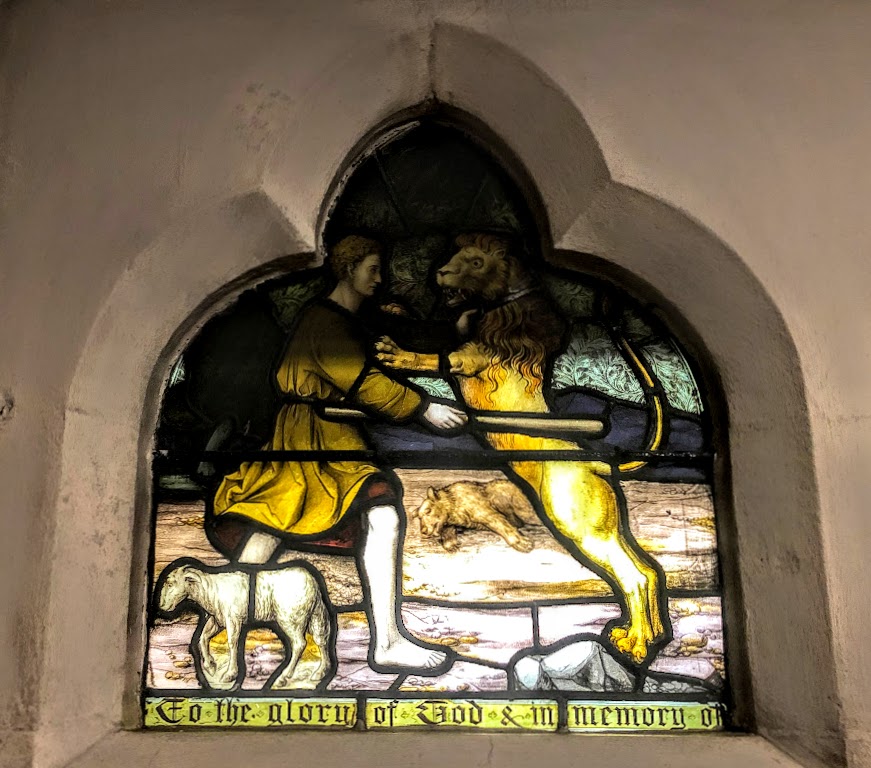
This window is of three eyelets and each panel in this window depicts a good shepherd: David killing a lion (see I Samuel 17: 34-37); Christ the Good Shepherd (John 10: 11-18); and the Sacrifice of Abel (Genesis 4: 2).
David killing a lion (see I Samuel 17: 34-37) depicted in the second window on the north wall in Saint Mary and Saint Giles Church, Stony Stratford (Photograph: Patrick Comerford)
Before going into battle with Goliath, David told Saul how he had risked his life for the sheep in flock, killing lions and bears: ‘… whenever a lion or a bear came, and took a lamb from the flock, I went after it and struck it down, rescuing the lamb from its mouth; and if it turned against me, I would catch it by the jaw, strike it down, and kill it. Your servant has killed both lions and bears … the Lord, who saved me from the paw of the lion and from the paw of the bear, will save me from the hand of this Philistine’ (I Samuel 17: 34-37).
Christ the Good Shepherd (John 10: 11-18) depicted in the second window in the north wall in Saint Mary and Saint Giles Church, Stony Stratford (Photograph: Patrick Comerford)
In Saint John’s Gospel, Christ describes himself twice in one passage as the Good Shepherd: ‘I am the good shepherd. The good shepherd lays down his life for the sheep. … I am the good shepherd. I know my own and my own know me, just as the Father knows me and I know the Father. And I lay down my life for the sheep’ (John 10: 11-15).
The Sacrifice of Abel (Genesis 4: 2) … a panel in the second window on the north wall in Saint Mary and Saint Giles Church, Stony Stratford (Photograph: Patrick Comerford)
The third panel recalls Abel the Shepherd and his sacrifice: ‘Abel was a keeper of sheep, and Cain a tiller of the ground. In the course of time Cain brought to the Lord an offering of the fruit of the ground, and Abel for his part brought of the firstlings of his flock, their fat portions. And the Lord had regard for Abel and his offering’ (Genesis 4: 2-4).
We could summarise these three panels as reminding the parishioners of Stony Stratford that the Revd John William Spark, their curate who died a young man, had risked his life for them, made a perfect sacrifice, and was a faithful shepherd.
Window 3, North Wall:
The third window on the north wall by NHJ Westlake is in memory of Amy (Hunt) Lester, wife of the Revd John Moore Lester (Photograph: Patrick Comerford)
The third window in the North Wall in Saint Mary and Saint Giles, and the one I really want to focus on this afternoon, is dated 1895. It is also by Westlake, who was commissioned by Edward Swinfen Harris (1841-1924). Again, this window depicts three Biblical scenes:
• Enoch taken up to heaven by angels without dying (see Genesis 5: 21-24);
• the Ascension (see Luke 24: 50-53);
• Elijah taken up to heaven in the Chariot of Fire without dying (II King 2: 11-12).
Enoch being taken up to heaven without dying (see Genesis 5: 21-24) … a panel in the third window on the north wall (Photograph: Patrick Comerford)
The Ascension (see Luke 24: 50-53) … a panel in the third window in the north wall in Saint Mary and Saint Giles Church (Photograph: Patrick Comerford)
Elijah is taken up to heaven in the Chariot of Fire without dying (II King 2: 11-12) … a panel in the third window on the north wall in Saint Mary and Saint Giles Church, Stony Stratford (Photograph: Patrick Comerford)
Enoch and Elijah are both said to have been taken into heaven without dying. These images, along with central panel depicting the Ascension, are illustrations of the Christian hope of eternal life.
This window is in memory of Amy (Hunt) Lester (1850-1895), the wife of the Revd John Moore Lester (1851-1884), who was the Vicar of Stony Stratford in 1880-1884. They were married in Christ Church, Lancaster Gate, Westminster, in 1877 and they were the parents of nine children. She died on 30 October 1895.
The Revd John Moore Lester was the Rector of Stony Stratford in 1880-1884. He was born in Mumbai (Bombay), a son of General Sir Frederick Lester, and was educated at Rugby and University College Oxford.
From Stony Stratford, he went on to be the Vicar of Holy Trinity Church, Ayr (1884), Vicar of Shifnal, Shropshire, and a Rural Dean in the Diocese of Lichfield (1891), Vicar of Yarcombe, Devon (1903), Rector of Saint Leonard’s, Bridgnorth (1905), and finally Rector of Litchborough, near Towcester in Northamptonshire, 15 miles north-west of Stony Stratford. He died at Litchborough Rectory on Christmas Eve 24 December 1919.
Lieutenant Edward Gabriel Lester (1887-1917) … died at the Battle of Vimy Ridge in France on 25 June 1917
Amy Lester’s son, Edward Gabriel Lester (1887-1917), was the father of the Canadian-born American actor Katherine Lester DeMille. She was the adopted daughter of the director Cecil B DeMille, she married Anthony Quinn, she was considered Hollywood royalty, she played 25 credited film roles from the mid-1930s to the late 1940s, and she was noted for her dark beauty.
Katherine Lester DeMille was born Katherine Paula Lester in Vancouver on 29 June 1911. Her birth father, Edward Gabriel Lester, was born in Scotland shortly after his father had moved from Stony Stratford to Ayr. He became a teacher, moved to Canada and married Cecile Bianca Bertha Colani, who was of Italian descent and a daughter of the architect Johann Colani. During World War I, Edward Lester became a lieutenant in the Canadian army and was sent to France.
Four days before Katherine’s sixth birthday, her father died of multiple wounds at the Battle of Vimy Ridge in France on 25 June 1917, during World I. Her mother, Cecile Bianca Bertha (Colani), was terminally ill, and travelled to California, supposedly to find Katherine’s paternal grandparents and to leave the little girl with them.
However, the child’s grandmother, who is commemorated in this window in Stony Stratford, had died more than 20 years earlier, in 1895, and the child’s grandfather was then living in Northamptonshire. Katherine’s mother died less than three years later, in a Los Angeles hospital on 18 March 1920, without ever making contact with her husband’s parents, the child’s grandparents.
By then, Katherine had been placed in an orphanage in Los Angeles. Just weeks before her grandfather’s death, when she was eight, she was found in the orphanage by Constance Adams DeMille (1873-1960), the wife of the Hollywood producer and director Cecil B DeMille (Cecil Blount de Mille, 1881-1959). The DeMille family presumed she had no living relatives and adopted her as their third child in 1922.
Katherine Lester DeMille was born Katherine Paula Lester in Vancouver on 29 June 1911
Katherine, still in her late teens, gained experience on stage in 1930, acting as the understudy for the feminine ‘heavy’ of the play ‘Rebound’ in San Francisco. She wanted to begin an acting career on her own and used the stage name Kay Marsh whenever she worked as an extra. Her first credited role was as Rosita Morales, the wife of Wallace Beery’s Pancho Villa, in the MGM film Viva Villa! (1934), the story of the Mexican bandit, Pancho Villa.
She played another Mexican woman that year, a maid named Lupe, in the Paramount production The Trumpet Blows (1934), and her performance brought a contract with Paramount Pictures. Her next role was as Molly Bryant, the nemesis of Mae West’s character in Belle of the Nineties (1934).
Katherine played the second female role in All the King’s Horses (1935) at Paramount, and was loaned to Columbia Pictures for The Black Room (1935) and to 20th Century Fox for Call of the Wild (1935).
The role of Princess Alice of France in The Crusades (1935) was a Christmas gift from her father, Cecil B DeMille. Andre Sennwald of The New York Times said ‘that striking brunette, Katherine De Mille’, was one of the actors who gave ‘excellent performances’ in the film.
She also starred in The Sky Parade (1936). Paramount then cast her in two more leading roles; she was the sister of Buster Crabbe in the Western Drift Fence (1936) and a parachutist and the romantic interest of William Gargan in the aviation drama The Sky Parade (1936). She returned to MGM to play the uncredited role of Rosaline, Romeo’s first love, in the 1936 film adaptation of Shakespeare’s Romeo and Juliet.
The 20th Century Fox studio cast her in the role of Margarita in the 1936 Technicolor film version of the Helen Hunt Jackson novel Ramona, starring Loretta Young as the title character. She was Barbara Stanwyck’s rival for the love of Joel McCrea in Banjo on My Knee (1936) and played the main female role in Charlie Chan at the Olympics (1937).
Katherine married the actor Anthony Quinn (1915-2001), star of Zorba the Greek (1964), in All Saints’ Episcopal Church, Beverly Hills, on 2 October 1937, and they were the parents of five children. She became a naturalised US citizen a year later in 1938.
After their marriage, she continued her career at 20th Century Fox and other studios. She had third billing in The Californian (1937) and played a smaller part in Love Under Fire (1937). She went to Columbia Pictures to co-star as Jack Holt’s leading lady in Under Suspicion (1937). She had a minor role in Walter Wanger’s Blockade (1938), a drama about the Spanish Civil War. Again at Columbia, she had the leading female role in another Jack Holt film, Trapped in the Sky (1939).
Katherine played supporting roles in the Roy Rogers film In Old Caliente (1939), the RKO adventure Isle of Destiny (1940), the Columbia mystery film Ellery Queen, Master Detective (1940), the Universal mystery film Dark Streets of Cairo (1940), and Paramount’s Technicolor adventure Aloma of the South Seas (1941).
She retired from films in 1941 to dedicate her time to her family. But after a six-year absence, she returned to the screen in 1947 when she co-starred with Anthony Quinn, for the first and only time in the Allied Artists drama Black Gold (1947). One critic said she deserved to share Quinn’s ‘highest acting compliment … The tender byplay of their mutual understanding, respect and love provide the refreshingly different romance of the picture.’ Another critic wrote: ‘Katherine DeMille does splendid work as Quinn’s wife, who has had good schooling, but is a loyal, obedient helpmeet.’ And another commended the performances of the couple: ‘As to the acting, both Anthony Quinn and Katherine DeMille rise to the occasion.’
Her father cast her in a supporting role in his epic Unconquered (1947), starring Gary Cooper and Paulette Goddard. Her final credited role was Lucille Strang, the wife of Milburn Stone’s character, in the film noir The Judge (1949), directed by Elmer Clifton.
Her husband Anthony Quinn (1915-2001) was born Manuel Antonio Rodolfo Quinn Oaxaca in Chihuahua, Mexico, and denied being the son of an ‘Irish adventurer.’ He said his mother Nellie had Aztec ancestors, while his father, Frank Quinn, was the Mexican-born son of an Irish immigrant and once rode with Pancho Villa.
The couple were the parents of five children: Christopher (1939-1941), Christina (born 1941), Catalina (born 1942), Duncan (born 1945), and Valentina (born 1952). The eldest child, Christopher, was two when he found drowned in the lily pond in the garden of their next-door neighbour WC Fields.
Katherine accepted the 1953 Academy Award for Best Supporting Actor on behalf of her husband for his portrayal of Eufemio Zapata in Viva Zapata! (1952), when Quinn was not present at the ceremony. At the same ceremony, her father received the Academy Award for Best Picture for his film The Greatest Show on Earth.
Anthony Quinn was not a faithful husband. He wanted a divorce so that he could the children he had with an Italian costume designer Jolanda Addolori. In December 1964, the year Zorba the Greek was made, Quinn sued DeMille for divorce in Ciudad Juárez, Mexico, and ‘listed incompatibility in the suit as grounds for divorce.’ They were divorced on 21 January 1965.
Katherine retained her married name Quinn. Around 1988, she moved from Pacific Palisades to Tucson, Arizona, to live with one of her daughters and grandchildren. She had Alzheimer's disease when she died in Tucson on 27 April 1995 at the age of 83. Her former husband, Anthony Quinn, died in 2001.
In his autobiography, her father wrote that she ‘has carried the name DeMille on for another generation in motion pictures as a talented actress.’ Her brother, Richard de Mille, later remembered: ‘I was wild about Katherine. She was extremely lovable and beautiful, a terrific combination. Was she ill-used by Quinn? Absolutely, but not in a way that she resented. She was always in love with him. Cecil had respected Constance and always treated her fairly; I don’t think Quinn treated Katherine fairly.’
Katherine Lester DeMille, adopted daughter of Cecil B DeMille, was a granddaughter of Amy Lester of Stony Stratford
Nathaniel Hubert John Westlake (1833-1921):
These windows are by NHJ Westlake of Lavers & Westlake, and were probably commissioned by the Stony Stratford architect Edward Swinfen Harris (1841-1924), whose works, mainly in the Arts and Crafts style, can be seen throughout Stony Stratford.
The artist Nathaniel Hubert John Westlake (1833-1921) was born in Romsey in 1833. He worked under William Burges for a while before joining the London-based stained-glass firm of Lavers and Barraud in 1868, having designed for the firm since 1858. The firm was first established by Nathaniel Wood Lavers (1828-1911) in 1855.
Westlake’s knowledge of mediaeval art, his Pre-Raphaelite style and his simplification of previously over-elaborate drawing brought the firm fame and success in the 1860s. A leading designer of the Gothic Revival movement, his works include ‘The Vision of Beatrice’ (1864), commissioned for an exhibition of stained glass at the South Kensington Museum, now the Victoria and Albert Museum.
Westlake later became a partner and eventually, in 1880, the sole proprietor of Lavers, Barraud & Westlake.
Westlake designed windows in in Saint Paul’s Cathedral, London, and Worcester and Peterborough Cathedrals, and in other prominent churches, including Saint Martin le Grand, York. He also designed windows in the college chapel at Saint Patrick’s College, Maynooth, Co Kildare, and the ceiling and Stations of the Cross in the college chapel in Maynooth.
As the Aesthetic movement gathered momentum, the colour of his stained glass became diluted.
Between 1881 and 1894, Westlake published four volumes, A History of Design in Painted Glass. He also contributed an article on mosaics to the Catholic Encyclopaedia.
Lavers & Westlake were commissioned to reglaze two central lights in the great hall windows at Mary Datchelor Girls’ School, Camberwell, in 1896. The subjects were ‘Lady Jane Grey discourses with Roger Ascham’ and ‘By Industry and Perseverance,’ symbolising the importance of female endeavour in higher education. Other windows included ‘On the way to Chapel,’ ‘Physical Exercise,’ ‘The Kindergarten’ and ‘The Classroom.’ The windows were removed from the school in 2010 after it was converted into a series of apartments.
The firm changed its name several times with the arrival and departure of each partner. Francis Barraud (1824-1900) had joined the practice from James Powell & Sons. When he died in 1900, the firm was known as Lavers, Westlake and Co, although Westlake had been the sole proprietor since 1880.
The company became NHJ Westlake after 1909, but it closed after Westlake died in Brighton on 8 May 1921.
Window 1, South Wall:
The first window at the east end of the south wall in Saint Mary and Saint Giles Church, Stony Stratford, is one of a series of windows by NHJ Westlake of Lavers & Westlake (Photograph: Patrick Comerford)
The first window at the east end of the South Wall in Saint Mary and Saint Giles Church below the gallery is of three eyelets and depicts two angels worshipping the Lamb on the Throne, Agnus Dei, an image from the Book of Revelation; the Crucifixion, with the Virgin Mary and Saint John keeping watch with the Crucified Christ as they stand at the foot of the cross; and Moses with Aaron and Hur holding up his arms.
In each of these three panels, the central figure – the Lamb on the Throne, the Crucified Christ and the ageing Moses – have two supporting figures: two angels, the Virgin Mary and Saint John, and Aaron and Hur.
During Joshua’s battle with Amalek at Rephidim, the Book Exodus recalls, ‘Moses’ hands grew weary; so they took a stone and put it under him, and he sat on it. Aaron and Hur held up his hands, one on one side, and the other on the other side; so his hands were steady until the sun set. And Joshua defeated Amalek and his people with the sword’ (Exodus 17: 12-13).
Window 2, south wall:
The second window in the south wall in Saint Mary and Saint Giles Church, Stony Stratford, is one of a series of windows by NHJ Westlake, and is dated 1888 (Photograph: Patrick Comerford)
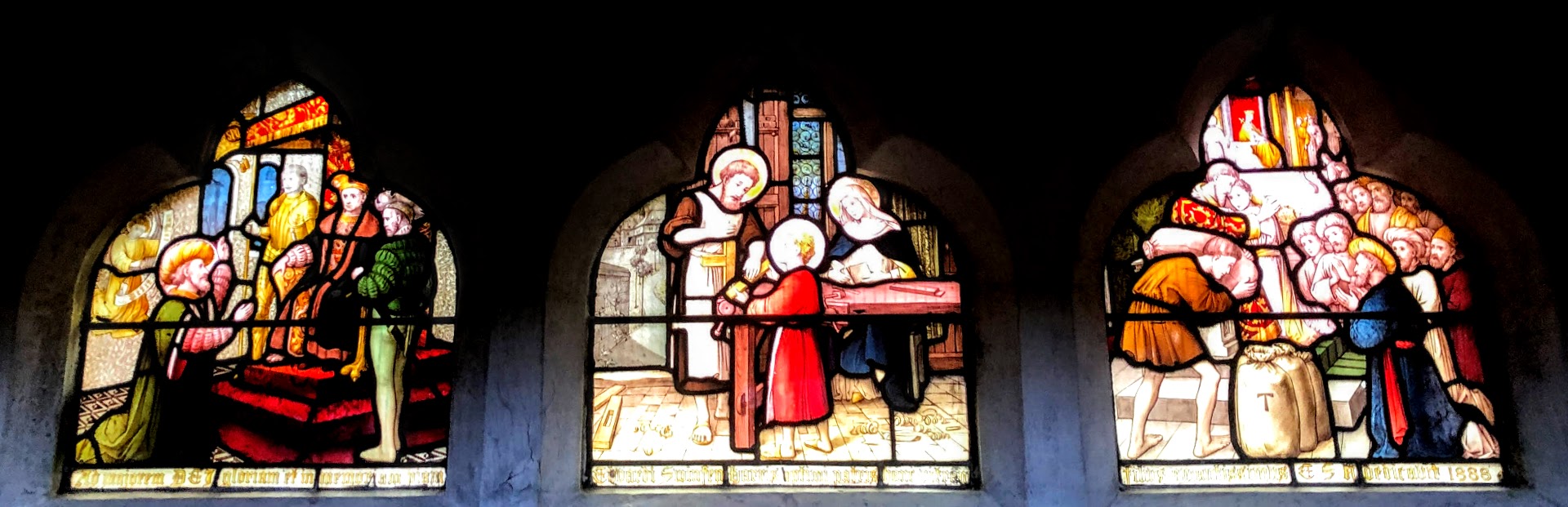
The second window in the South Wall in Saint Mary and Saint Giles Church beneath the gallery is dated 1888. Edward Swinfen Harris commissioned this window in memory of his father, also Edward Swinfen Harris, who was the clerk to the town bench of magistrates, the Board of Guardians and other bodies in the town.
This second depicts three Biblical scenes: Joseph before Pharoah’s throne, interpreting his dreams (Genesis 41: 1-36); Jesus as an apprentice in Joseph the carpenter’s shop, with Joseph and the Virgin Mary (see Luke 2: 39-40); and Joseph’s brothers before him with the silver cup found in Benjamin’s sack (Genesis 44: 1-34).
Each panel depict a Biblical Joseph: Joseph the son sold into slavery in Egypt by his brothers; Joseph with the Christ Child; and Joseph with his brothers.
In the first panel, Joseph stands before Pharoah’s throne, interpreting his dreams (Genesis 41: 1-36). However, the vision he points to in the distance is not the years of plenty, or the years of famine, but Christ Crucified on Calvary.
Jesus as an apprentice in Joseph the carpenter’s shop, with Joseph and the Virgin Mary, depicted in the second window in the south wall in Saint Mary and Saint Giles Church, Stony Stratford (Photograph: Patrick Comerford)
The stories of Christ as an apprentice in the workshop of Joseph the carpenter are popular and pious, but are not found in any Gospel narrative (see Luke 2: 39-40). Nevertheless, this image in the second panel, showing Christ as an apprentice in Joseph the carpenter’s shop, reflects a subject that was popular among the Pre-Raphaelite artists at the time Westlake made this window.
William Holman Hunt (1827-11910) worked on his painting, ‘The Shadow of Death’, in 1870-1873, during his second trip to the Holy Land. It depicts Christ as a young man prior to his ministry, working as a carpenter. He is shown stretching his arms after sawing wood. The shadow of his outstretched arms falls on a wooden spar on which carpentry tools hang, creating a ‘shadow of death’ prefiguring the crucifixion.
Two decades earlier, Holman Hunt’s Pre-Raphaelite colleague John Everett Millais (1829-1896) had portrayed Christ as an apprentice carpenter, helping Joseph as a young boy, in his painting, ‘Christ in the House of his Parents’ (1849-1850).
In the third panel, Joseph’s brothers plead before him with the silver cup found in Benjamin’s sack (Genesis 44: 1-34). In the background, their ageing father with Jacob is being comforted.
In each of these panels, Westlake is suggesting that Edward Swinfen Harris was a loyal and faithful son to his father, the late Edward Swinfen Harris, and that he had learned from him.
Window 3, South Wall:
The third window in the south wall by NHJ Westlake is in memory of Catherine Swinfen Harris (Photograph: Patrick Comerford)
The third window on the South Wall beneath the gallery in Saint Mary and Saint Giles Church is dated 1896. It was commissioned by Edward Swinfen Harris in memory of his mother, Catharine Swinfen Harris, who died on 23 June 1896, at the age of 85.
This third window is of three eyelets and depicts three Biblical scenes: Jacob blesses Joseph’s sons Manasseh and Ephraim with crossed hands (see Genesis 48: 10-22); Christ greets two disciples at night, perhaps James and John, or Peter and Andrew, although this is not indicated on the window.
The story depicted in the first panel recalls how Joseph was Pharoah’s chief minister of Egypt when he took his two sons Manasseh and Ephraim to see his dying father Jacob. Jacob surprised them by deciding to adopt Manasseh and Ephraim as his own sons, and promising them the same inheritance as his other sons, like Reuben and Simeon (verse 5).
It is customary in many Jewish communities for parents to administer a blessing like Jacob’s blessing to Joseph’s sons on Friday nights before the kiddush. As hands are laid on the heads of the boys, the words spoken are: ‘May you be like Ephraim and Manasseh.’
The mother of these two, Asenath, was an Egyptian, and so her family was outside the community of faith. Yet, they are not disqualified from God’s blessings because of their parents’ unconventional marriage.
Traditionally, the eldest son would expect to inherit a double portion, signified by his father blessing him with his right hand. So Joseph placed his firstborn, Manasseh, on Jacob’s right side and Ephraim on his left. However, Jacob crossed his arms and put his right hand on the second born, Ephraim, and his left hand on Manasseh, and then spoke his blessing over both.
This story is a reminder of how God can choose people others think are not qualified or deserving, those who do earn or qualify for a blessing, those you are not next in line. Those who cannot normally expect favour or promotion may receive unexpected blessings.
In this window, Swinfen Harris may be saying that his mother was seen as an outsider but that in life through his parents he found blessings beyond any expectations in his dreams.
The window by Charles Eamer Kempe at the west end of Saint Mary and Saint Giles, Stony Stratford, depicting three archangels: Saint Gabriel above, and Saint Michael and Saint Raphael below (Photograph: Patrick Comerford)
CE Kampe window (west end):
The window at the west end of the church is a two-light depicting three archangels: Saint Gabriel above, and Saint Michael and Saint Raphael below. This window, dated 1903, is by Charles Eamer Kempe (1837-1907).
CE Kempe’s studios produced over 4,000 windows and designed altars and altar frontals, furniture and furnishings, lichgates and memorials that helped to define a later 19th-century Anglican style.
As a student at Pembroke College, Oxford, Kempe was influenced by the Anglo-Catholic Tractarian revival and considered a vocation to the priesthood. Inspired by William Morris’s work, he went to study architecture with the Gothic Revival architect George Frederick Bodley (1827-1907) at a time when Bodley was working on All Saints’ Church, Cambridge. There he learned from both Bodley and William Morris, and Bodley and Kempe became lifelong friends and collaborators.
Kempe’s work was strongly influenced by the Gothic Revival and the Pre-Raphaelite movement. His studios produced over 4,000 windows and designs for altars and altar frontals, furniture and furnishings, lychgates and memorials that helped to define a later 19th century Anglican style.
The English cathedrals with his work include Lichfield, as well as Chester, Gloucester, Hereford, Wells, Winchester and York. I have also written in the past about his windows in the chapel of Saint John’s Hospital, Lichfield and Christ Church, Leomansley, Lichfield.
The Cambridge church historian Owen Chadwick once said Kempe’s work represents ‘the Victorian zenith’ of church decoration and stained glass windows. Kempe was seen by his contemporaries as a Tractarian, but primarily he saw his task ‘to beautify the place in which to celebrate the glory of God.’ His window in Saint Mary and Saint Giles Church offers an interesting illustration of this principle.
Three south gallery windows:
Six apostles, James, Peter, John, Thomas, Andrew and Saint James the Less, seen from inside (above) and outside (below) the church (Photographs: Patrick Comerford)
The first three sets of three-light windows in the south gallery include a window by John Groome Howe of James Powell and Sons (1877).
This first window is dedicated to Josiah Michael and Ann Smith and shows six scenes with themes of the Resurrection or being raised to new life: top, 1, the raising of Jairus’s daughter (Matthew 9: 18-26; Mark 5: 21-43; Luke 8: 40-56); 2, Christ with two disciples on the Road to Emmaus (Luke 24: 13-35); and 3, the raising of the Widow of Nain’s son (see Luke 7: 11-17); below, 1, the raising of Lazarus (John 11:1 -44); 2, the Supper at Emmaus (Luke 24: 13-35); and 3, the healing of Simon Peter’s mother-in-law (Matthew 8: 14-15, Mark 1: 29-31, Luke 4: 38-39).
The firm of James Powell and Sons, also known as Whitefriars Glass, were London-based glassmakers, leadlighters and stained glass window manufacturers. As Whitefriars Glass, the company dated from the 17th century, and it became well-known as a result of the 19th-century Gothic Revival and the demand for stained glass windows.
During the latter part of the 19th century, the firm had close working links with leading architects and designers including TG Jackson, Edward Burne-Jones, William De Morgan and James Doyle, and produced the glass that Philip Webb used in his designs for William Morris. Nathanael Powell’s eldest surviving son, Harry, was an admirer of John Ruskin.
The next two windows in the south gallery are three-light windows depicting 12 apostles, each with six illustrations. Their date and the artist are unknown.
The first depicts: top, Saint James, Saint Peter, Saint John; below, Saint Thomas, Saint Andrew, Saint James the Less. The second depicts (top) Saint Philip, Saint Paul, Saint Bartholomew; and (below) Saint Jude, Saint Simon, Saint Matthew.
A fourth and fifth window in the south gallery show the Risen Christ and the Crucifixion.
The grave of Nikos Kazantzakis on the Martinengo Bastion of the Venetian walls surrounding Iraklion (Photograph: Patrick Comerford)