Showing posts with label Advent 2024. Show all posts

24 December 2024

Daily prayer in Advent 2024:
24, Tuesday 24 December 2024,
Christmas Eve

‘By the tender mercy of our God, the dawn from on high will break upon us’ (Luke 1: 78) … sunrise on the River Slaney at Ferrycarrig, near Wexford (Photograph: Patrick Comerford)

Patrick Comerford

We come to the end of Advent today, and this evening is Christmas Eve. Later this evening, I hope to join the choir of Saint Mary and Saint Giles Church, Stony Stratford, singing carols in All Saints’ Church, Calverton, at 8:30 and at ‘Midnight Mass’ there at 9 pm.

Before today begins, I am taking some quiet time this morning to give thanks, to reflect, to pray and to read in these ways:

1, today’s Gospel reading;

2, a short reflection;

3, a prayer from the USPG prayer diary;

4, the Collects and Post-Communion prayer of the day.

‘By the tender mercy of our God, the dawn from on high will break upon us’ (Luke 1: 78) … a winter sunrise in Stony Stratford (Photograph: Patrick Comerford, 2024)

Luke 1: 67-79 (NRSVA):

67 Then his father Zechariah was filled with the Holy Spirit and spoke this prophecy:

68 ‘Blessed be the Lord God of Israel,
for he has looked favourably on his people and redeemed them.
69 He has raised up a mighty saviour for us
in the house of his servant David,
70 as he spoke through the mouth of his holy prophets from of old,
71 that we would be saved from our enemies and from the hand of all who hate us.
72 Thus he has shown the mercy promised to our ancestors,
and has remembered his holy covenant,
73 the oath that he swore to our ancestor Abraham,
to grant us 74 that we, being rescued from the hands of our enemies,
might serve him without fear, 75 in holiness and righteousness
before him all our days.
76 And you, child, will be called the prophet of the Most High;
for you will go before the Lord to prepare his ways,
77 to give knowledge of salvation to his people
by the forgiveness of their sins.
78 By the tender mercy of our God,
the dawn from on high will break upon us,
79 to give light to those who sit in darkness and in the shadow of death,
to guide our feet into the way of peace.’

‘To give light to those who sit in darkness’ (Luke 1: 79) … Christmas lights in winter darkness at Magdalene Bridge and the Backs in Cambridge (Photograph: Patrick Comerford, 2024 )

Today’s Reflection:

In the Gospel reading at the Eucharist today (Luke 1: 67-79), we conclude a series of readings before Christmas that draw on the two nativity narratives found in Matthew 1: 1-24 and Luke 1: 5-79.

This reading continues on from the stories of the Visitation of the Virgin Mary to her cousin Saint Elizabeth and the account of the birth of Saint John the Baptist.

After the birth and naming of his son, Zechariah finds his speech is restored, and prophesies in a poetic speech that we have come to know as the canticle Benedictus.

The canticle naturally falls into two parts. Part 1 (verses 68-75) is a song of thanksgiving for the realisation of the Messianic hopes. In Part 2 (verses 76-79), Zechariah addresses his own son, who is to be a prophet, who will go before the Lord to prepare his ways, who will tell people of the good news of their salvation and forgiveness:

‘By the tender mercy of our God,
the dawn from on high will break upon us,
to give light to those who sit in darkness and in the shadow of death,
to guide our feet into the way of peace.’

How many parents could say this with confidence, joy and love about their own children on this Christmas Eve?

The English Catholic theologian and writer Tina Beattie last week made a plea to parents, priests, teachers and anyone who has dealings with children in the build-up to Christmas. In a posting on Facebook, she asked them: ‘please never tell children that Santa only comes to good children, or that Santa won’t come if they’re naughty.’

‘There are thousands of good children to whom Santa won’t come because they live in poverty, dereliction or neglect,’ she pointed out. ‘But also, children so easily internalise a sense of blame and shame – for parental squabbles and separations, for bad things that happen to their families and friends. They don’t need to be threatened into good behaviour or made fearful that Santa won’t come because they misbehaved.’

And she concluded: ‘If you want them to have a sense of why gifts are given at Christmas, tell them that this is a time of gifts not because we’re good, but because God is good and loves them, whatever they do and whoever they are.’

The theologian Tina Beattie has pointed out that children ‘don’t need to be threatened into good behaviour or made fearful that Santa won’t come’ (Photograph: Patrick Comerford)

Today’s Prayers (Tuesday 24 December 2024, Christmas Eve):

The theme this week in ‘Pray With the World Church’, the Prayer Diary of the Anglican mission agency USPG (United Society Partners in the Gospel), is ‘Love – Advent’. This theme was introduced on Sunday with Reflections by the Revd Lopa Mudra Mistry, Presbyter in the Diocese of Calcutta, the Church of North India (CNI).

The USPG Prayer Diary today (Tuesday 24 December 2024, Christmas Eve) invites us to pray:

Thank you for the gift of salvation and the love that you have shown us through Jesus Christ.

The Collect:

Almighty God,
you make us glad with the yearly remembrance
of the birth of your Son Jesus Christ:
grant that, as we joyfully receive him as our redeemer,
so we may with sure confidence behold him
when he shall come to be our judge;
who is alive and reigns with you,
in the unity of the Holy Spirit,
one God, now and for ever.

The Post-Communion Prayer:

Eternal God, for whom we wait,
you have fed us with the bread of eternal life:
keep us ever watchful,
that we may be ready to stand before the Son of man,
Jesus Christ our Lord.

Additional Collect:

Almighty God,
as we prepare with joy
to celebrate the gift of the Christ-child,
embrace the earth with your glory
and be for us a living hope
in Jesus Christ our Lord.

Yesterday’s Reflection

Continued Tomorrow

‘To give light to those who sit in darkness’ (Luke 1: 79) … darkness and light in Kenilworth Square, Dublin, last week (Photograph: Patrick Comerford, 2024)

Scripture quotations are from the New Revised Standard Version Bible: Anglicised Edition copyright © 1989, 1995 National Council of the Churches of Christ in the United States of America. Used by permission. All rights reserved worldwide. http://nrsvbibles.org

23 December 2024

Daily prayer in Advent 2024:
23, Monday 23 December 2024

Saint John the Baptist with his parents, Saint Zechariah and Saint Elizabeth, in a mosaic at the Monastery of Saint John the Baptist in Tolleshunt Knights, Essex (Photograph: Patrick Comerford)

Patrick Comerford

We are drawing near to the end of Advent, yesterday was the Fourth Sunday of Advent (Advent IV) and tomorrow is Christmas Eve.

Before today begins, I am taking some quiet time this morning to give thanks, to reflect, to pray and to read in these ways:

1, today’s Gospel reading;

2, a short reflection;

3, a prayer from the USPG prayer diary;

4, the Collects and Post-Communion prayer of the day.

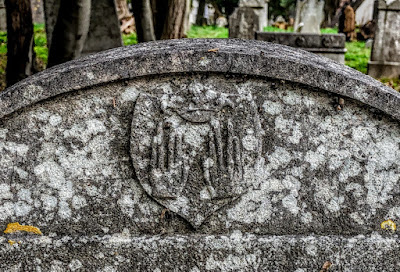
A priest’s hands raised for the blessing of the cohanim … a gravestone in the new Jewish cemetery on the Lido in Venice (Photograph: Patrick Comerford)

Luke 1: 57-66 (NRSVA):

57 Now the time came for Elizabeth to give birth, and she bore a son. 58 Her neighbours and relatives heard that the Lord had shown his great mercy to her, and they rejoiced with her.

59 On the eighth day they came to circumcise the child, and they were going to name him Zechariah after his father. 60 But his mother said, ‘No; he is to be called John.’ 61 They said to her, ‘None of your relatives has this name.’ 62 Then they began motioning to his father to find out what name he wanted to give him. 63 He asked for a writing-tablet and wrote, ‘His name is John.’ And all of them were amazed. 64 Immediately his mouth was opened and his tongue freed, and he began to speak, praising God. 65 Fear came over all their neighbours, and all these things were talked about throughout the entire hill country of Judea. 66 All who heard them pondered them and said, ‘What then will this child become?’ For, indeed, the hand of the Lord was with him.

Dreidels in a synagogue in Prague, part of children’s games at Hanukkah … did John the Baptist and Jesus spin dredels together at Hanukkah? (Photograph: Patrick Comerford)

Today’s Reflection:

In the Gospel reading at the Eucharist today (Luke 1: 57-66), we continue a series of readings before Christmas that draw on the two nativity narratives found in Matthew 1: 1-24 and Luke 1: 5-79.

During the week before Christmas, the great canticle Magnificat at Evensong traditionally has a refrain or antiphon attached to it proclaiming the ascriptions or ‘names’ given to God through the Old Testament. Each name develops into a prophecy of the coming of the Messiah.

O Sapientia, or O Wisdom, is the first of these days, and was marked on Tuesday (17 December). It was followed on Wednesday (18 December) by O Adonai, by O Root of Jesse on Thursday (19 December), O Key of David on Friday (20 December), O Dayspring on Saturday (21 December), O King of the Nations yesterday (22 December), and, finally O Emmanuel today (23 December).

The seven majestic Messianic titles for Christ are based on Biblical prophecies, and they help the Church to recall the variety of the ills of humanity before the coming of the Redeemer as each antiphon in turn pleads with mounting impatience for Christ to save his people.

The Gospel reading at the Eucharist today (Luke 1: 57-66) continues on from the story of the Visitation of the Virgin Mary to her cousin Saint Elizabeth, with the only Gospel account of the birth, circumcision and naming of Saint John the Baptist.

Zechariah (זְכַרְיָה‎ or Ζαχαρίας), also named in translations as Zacharias, Zachariah and Zachary, the husband of Elizabeth and the father of John the Baptist, is a priest, one of the cohanim descended from the sons of Aaron. Origen suggests that the Zechariah mentioned in Matthew 23:35 as being killed between the temple and the altar may be the father of John the Baptist.

His name means ‘remember Yah’ or ‘remember God’ or ‘God remembers’. There are several Biblical figures with the name, including the Prophet Zachariah in Judah, a martyred son of a high priest, a king who reigned in Judah for six months, and several minor characters.

On the other hand, the Greek name Ἰωάννης (Ioannes) is a rendering of the Hebrew name Yohanan (יוֹחָנָן‎), a shorter form of the name Yəhôḥānān (יְהוֹחָנָן‎), which means ‘God is gracious’.

In the Hebrew Bible, Yohanan was the son of King Josiah of Judah (7th century BCE); Yohanan, son of Kareah, was a leader of the army who led the remnant of the population of Judah to Egypt for safety after the Babylonian dismantling of the kingdom in 586 BCE; Yohanan ben Yehoyada is a high priest named in the Book of Nehemiah and was the fourth in the line of high priests after Joshua the High Priest, who returned from the Babylonian captivity with Zerubbabel.

During the Hasmonean or Maccabean period, Yohanan was the father of Matityahu; John Gaddi, oldest of the sons of Mattathias and brother of Judas Maccabeus, was one of the leaders of the revolt of the Maccabees in the 2nd century BCE; John Hyrcanus was a Maccabean leader and Jewish high priest from 134 BCE until his death in 104 BCE; and John Hyrcanus II (1st century BCE) was a member of the Hasmonean dynasty, High Priest, King, and ethnarch of Judea.

So, the name John, in its variant forms, was both a priestly and a royal name, and was associated with the leaders of resistance to occupation and resistance.

In idle moments, I sometimes wonder whether Jesus and John grew up knowing each other.

Did Mary and Joseph regularly visit Zechariah and Elizabeth?

Was Zechariah present as a priest in the Temple at the Presentation, or when the teenage Jesus was lost in the Temple?

Did Jesus and John send birthday greetings to one another?

Did they go to each other’s bar mitzvah?

Did they celebrate and major holidays of Holy Days together … Purim, Passover, Shavuot, Sukkot, Rosh Hashanah, Yom Kippur, Simchat Torah, Hanukkah … ?

Did they dress up together at Purim?

Did they spin dreidels with each other and play games together at Chanukah? – Incidentally, Christmas Day and the first day of Hanukkah fall on the same day this year, for the first time in 19 years.

Did John the Baptist ever take up his duties and responsibilities as a priest in the Temple before going into the Wilderness?

Was he in the Temple when Jesus visited, healed, taught, debated Caesar’s coins, or overturned the tables of the moneychangers?

Did John offer Jesus the priestly blessing that the cohanim alone impart?

The priestly blessing (Numbers 6: 24-26) that Zechariah and John would have pronounced, with their hands outstretched in the traditional way, is:

May the Lord bless and protect you.
May the Lord make his face shine on you and be gracious to you
May the Lord turn his face toward you, and give you peace.


The Priestly Blessing (ברכת כהנים‎, birkat cohanim) is known in rabbinic literature as raising the hands or rising to the platform because the blessing is given from a raised rostrum.

The Jewish Sages stressed that although the priests are the ones carrying out the blessing, it is not them or the ceremonial practice of raising their hands that results in the blessing, but rather it is God’s desire that his blessing should be symbolised by the hands of the cohanim.

The former Chief Rabbi, the late Lord (Jonathan) Sacks, says the Torah explicitly says that though the cohanim say the words, it is God who sends the blessing: ‘When the cohanim bless the people, they are not doing anything in and of themselves. Instead they are acting as channels through which God’s blessing flows into the world and into our lives.’

He adds, ‘Only love does this. Love means that we are focused not on ourselves but on another. Love is selflessness. And only selflessness allows us to be a channel through which flows a force greater than ourselves, the love that as Dante said, “moves the sun and the other stars”, the love that brings new life into the world.’

Hands raised in the priestly blessing on a gravestone in the Jewish cemetery in Kraków (Photograph: Patrick Comerford)

Today’s Prayers (Monday 23 December 2024):

The theme this week in ‘Pray With the World Church’, the Prayer Diary of the Anglican mission agency USPG (United Society Partners in the Gospel), is ‘Love – Advent’. This theme was introduced yesterday with Reflections by the Revd Lopa Mudra Mistry, Presbyter in the Diocese of Calcutta, the Church of North India (CNI).

The USPG Prayer Diary today (Monday 23 December 2024) invites us to pray:

Father, as we await your coming, may today be filled with peace and free of any distractions that lead our heart away from you.

The Collect:

God our redeemer,
who prepared the Blessed Virgin Mary
to be the mother of your Son:
grant that, as she looked for his coming as our saviour,
so we may be ready to greet him
when he comes again as our judge;
who is alive and reigns with you,
in the unity of the Holy Spirit,
one God, now and for ever.

The Post-Communion Prayer:

Heavenly Father,
who chose the Blessed Virgin Mary
to be the mother of the promised saviour
: fill us your servants with your grace,
that in all things we may embrace your holy will
and with her rejoice in your salvation;
through Jesus Christ our Lord.

Additional Collect:

Eternal God,
as Mary waited for the birth of your Son,
so we wait for his coming in glory;
bring us through the birth pangs of this present age
to see, with her, our great salvation
in Jesus Christ our Lord.

Yesterday’s Reflection

Continued Tomorrow

Hands raised in the priestly blessing on a Holocaust memorial in Berlin (Photograph: Patrick Comerford)

Scripture quotations are from the New Revised Standard Version Bible: Anglicised Edition copyright © 1989, 1995 National Council of the Churches of Christ in the United States of America. Used by permission. All rights reserved worldwide. http://nrsvbibles.org
22 December 2024

Daily prayer in Advent 2024:
22, Sunday 22 December 2024,
the Fourth Sunday of Advent

An image of the Virgin Mary in a quiet corner at the High Leigh Conference Centre in Hoddesdon, Hertfordshire (Photograph: Patrick Comerford)

Patrick Comerford

We are in the final days of the Season of Advent, today is the Fourth Sunday of Advent (Advent IV, 22 December 2024) and Christmas Day is just a few days away.

Later this morning, I hope to sing with the choir at the Parish Eucharist in Saint Mary and Saint Giles Church at 9:30, Stony Stratford, and at the Advent Carol Service this evening at 6:30 pm. But, before today begins, I am taking some quiet time this morning to give thanks, to reflect, to pray and to read in these ways:

1, today’s Gospel reading;

2, a short reflection;

3, a prayer from the USPG prayer diary;

4, the Collects and Post-Communion prayer of the day.

The words of the canticle Magnificat carved on a wooden screen in Mount Melleray Abbey, Cappoquin, Co Waterford (Photograph: Patrick Comerford)

Luke 1: 39-55 (NRSVA):

39 In those days Mary set out and went with haste to a Judean town in the hill country, 40 where she entered the house of Zechariah and greeted Elizabeth. 41 When Elizabeth heard Mary’s greeting, the child leapt in her womb. And Elizabeth was filled with the Holy Spirit 42 and exclaimed with a loud cry, ‘Blessed are you among women, and blessed is the fruit of your womb. 43 And why has this happened to me, that the mother of my Lord comes to me? 44 For as soon as I heard the sound of your greeting, the child in my womb leapt for joy. 45 And blessed is she who believed that there would be a fulfilment of what was spoken to her by the Lord.’

46 And Mary said,

‘My soul magnifies the Lord,
47 and my spirit rejoices in God my Saviour,
48 for he has looked with favour on the lowliness of his servant.
Surely, from now on all generations will call me blessed;
49 for the Mighty One has done great things for me,
and holy is his name.
50 His mercy is for those who fear him
from generation to generation.
51 He has shown strength with his arm;
he has scattered the proud in the thoughts of their hearts.
52 He has brought down the powerful from their thrones,
and lifted up the lowly;
53 he has filled the hungry with good things,
and sent the rich away empty.
54 He has helped his servant Israel,
in remembrance of his mercy,
55 according to the promise he made to our ancestors,
to Abraham and to his descendants for ever.’

The Virgin Mary with the Crown of Thorns in a church window in Bansha, Co Tipperary (Photograph: Patrick Comerford)

Today’s Reflection:

In the Gospel reading at the Eucharist today (Luke 1: 39-55), we continue a series of readings before Christmas that draw on the two nativity narratives found in Matthew 1: 1-24 and Luke 1: 5-79.

During the week before Christmas, the great canticle Magnificat at Evensong traditionally has a refrain or antiphon attached to it proclaiming the ascriptions or ‘names’ given to God through the Old Testament. Each name develops into a prophecy of the coming of the Messiah.

O Sapientia, or O Wisdom, is the first of these days, and was marked on Tuesday (17 December). It was followed on Wednesday (18 December) by O Adonai, by O Root of Jesse on Thursday (19 December), O Key of David on Friday (20 December), O Dayspring yesterday (21 December), and by O King of the Nations today (22 December), and, finally O Emmanuel tomorrow (23 December).

The seven majestic Messianic titles for Christ are based on Biblical prophecies, and they help the Church to recall the variety of the ills of humanity before the coming of the Redeemer as each antiphon in turn pleads with mounting impatience for Christ to save his people.

The Gospel reading at the Eucharist today continues yesterday’s reading (Luke 1: 39-45), telling the story of the Visitation of the Virgin Mary to her cousin Saint Elizabeth.

This Advent has been a time of waiting, a time of preparation, a time of anticipation. For the past three Sundays, in our time of waiting, preparation and anticipation, we have been preparing ourselves in the liturgy and the music, with carol services and quiet days, with Christmas Markets and Santa’s grotto, with the Advent Wreath and the Crib.

The four candles on the Advent wreath have reminded us, week-after-week, of those who prepared us in the past for the Coming of the Christ Child: first the Patriarchs and Matriarchs, our ancestors in faith, including Abraham and Sarah, Isaac and Jacob; then the prophets of the Old Testament, including Isaiah, Jeremiah, and Micah, who we heard from this morning; then, last week it was Saint John the Baptist.

This Sunday, the fourth and final candle reminds us of the Virgin Mary. This connects with the Canticle Magnificat, which we hear instead of a Psalm, and our Gospel reading, telling the story of her visit to her cousin Saint Elizabeth.

The Canticle Magnificat (Luke 1: 46-55) is normally heard during Evening Prayer and not on Sunday mornings.

The great German theologian and martyr, Dietrich Bonhoeffer (1906-1945), in an Advent sermon in London over 90 years ago (17 December 1933), said Magnificat ‘is the oldest Advent hymn,’ and he spoke of how she knows better than anyone else what it means to wait for Christ’s coming:

‘In her own body she is experiencing the wonderful ways of God with humankind: that God does not arrange matters to suit our opinions and views, does not follow the path that humans would like to prescribe. God’s path is free and original beyond all our ability to understand or to prove.’

The Virgin Mary of the Visitation and of the canticle Magnificat is a strong and revolutionary woman, unlike the Virgin Mary of the plaster-cast statues and the Rosary.

The Mary I see as a role model for belief and discipleship is the Mary who sets off in a hurry and a flurry to visit her cousin Elizabeth, the Mary with a gob on her who speaks out of turn when she comes out with those wonderful words we hear in this Gospel reading, the Mary who sings the Canticle Magnificat.

This Mary is a wonderful, feisty person. She is what the red-top tabloid newspapers today might describe ‘a gymslip Mum.’ But, instead of hiding herself away from her family, from her cousins, from the woman in her family who is married to a priest, she rushes off to her immediately, to share her good news with her.

And she challenges so many of our prejudices and our values and our presumptions today. Not just about gymslip mums and unexpected or unplanned pregnancies, but about what the silent and the marginalised have to say about our values in society today.

And Mary declares:

He has shown strength with his arm;
he has scattered the proud in the thoughts of their hearts.
He has brought down the powerful from their thrones,
and lifted up the lowly;
he has filled the hungry with good things,
and sent the rich away empty.
He has helped his servant Israel,
in remembrance of his mercy,
according to the promise he made to our ancestors,
to Abraham and to his descendants for ever.’

It is almost like this is the programme or the agenda we can expect when the Christ Child is born.

An icon of the Virgin Mary found in an antique shop in Rethymnon … the fourth candle on the advent wreath recalls the Virgin Mary (Photograph: Patrick Comerford)

Today’s Prayers (Sunday 22 December 2024, Advent IV):

The theme this week in ‘Pray With the World Church’, the Prayer Diary of the Anglican mission agency USPG (United Society Partners in the Gospel), is ‘Love – Advent’. This theme is introduced today with Reflections by the Revd Lopa Mudra Mistry, Presbyter in the Diocese of Calcutta, the Church of North India (CNI):

Read Micah 5: 2-5a

The Synodical Board of Social Service (SBSS) Kolkata of CNI has been serving the 11 villages of West Bengal's South 24 Parganas region for over 25 years, focusing on improving malnutrition and increasing family income.

To combat malnutrition issues, a series of nutrition camps, organised by SBSS Kolkata CNI, recently took place in each of the villages. The community gained valuable knowledge about healthy diets and the benefits of local foods. To boost family income, participants learned multi-layer farming techniques and how to create organic fertilisers and pesticides.

Through these camps, the SBSS Kolkata CNI has been able to display God’s love in action and has demonstrated to the community as in Micah 5:2-5a, that God cares for the least and left behind and does not leave them out. God is concerned for them so that they can live in security, the security that food will be available to them from their own fields and that the produce of the Earth will render to them the security of finance from the sale of their produce which is tastier, healthier and locally grown.

God’s love translated into action when he made us in his own image to have communion with Him. The sacrifice of our time and energy cannot compare to the sacrifice of Christ. But in this season of Advent, we can reflect on big and small ways to share the love of Christ.

The USPG Prayer Diary today (Sunday 22 December 2024, Advent IV) invites us to pray:

Almighty God, help us to show love through actions, caring for all regardless of their background or beliefs. Help us to define ourselves by love of others, and not of self. May our actions, not only our words, reflect true love.

The Collect:

God our redeemer,
who prepared the Blessed Virgin Mary
to be the mother of your Son:
grant that, as she looked for his coming as our saviour,
so we may be ready to greet him
when he comes again as our judge;
who is alive and reigns with you,
in the unity of the Holy Spirit,
one God, now and for ever.

The Post-Communion Prayer:

Heavenly Father,
who chose the Blessed Virgin Mary
to be the mother of the promised saviour
: fill us your servants with your grace,
that in all things we may embrace your holy will
and with her rejoice in your salvation;
through Jesus Christ our Lord.

Additional Collect:

Eternal God,
as Mary waited for the birth of your Son,
so we wait for his coming in glory;
bring us through the birth pangs of this present age
to see, with her, our great salvation
in Jesus Christ our Lord.

Yesterday’s Reflection

Continued Tomorrow


Scripture quotations are from the New Revised Standard Version Bible: Anglicised Edition copyright © 1989, 1995 National Council of the Churches of Christ in the United States of America. Used by permission. All rights reserved worldwide. http://nrsvbibles.org

21 December 2024

Daily prayer in Advent 2024:
21, Saturday 21 December 2024

The Visitation (Luke 1: 39-45) … a panel from the 19th century Oberammergau altarpiece in the Lady Chapel in Lichfield Cathedral (Photograph: Patrick Comerford)

Patrick Comerford

We are in the final days of the Season of Advent, today is the Winter Solstice (21 December), tomorrow is the Fourth Sunday of Advent (Advent IV, 22 December 2024) and Christmas Day is now just a few days away.

Before today begins, I am taking some quiet time this morning to give thanks, to reflect, to pray and to read in these ways:

1, today’s Gospel reading;

2, a short reflection;

3, a prayer from the USPG prayer diary;

4, the Collects and Post-Communion prayer of the day.

‘The Visitation’ in a stained-glass window in Saint John’s Church, Pallaskenry, Co Limerick (Photograph: Patrick Comerford)

Luke 1: 39-45 (NRSVA):

39 In those days Mary set out and went with haste to a Judean town in the hill country, 40 where she entered the house of Zechariah and greeted Elizabeth. 41 When Elizabeth heard Mary’s greeting, the child leapt in her womb. And Elizabeth was filled with the Holy Spirit 42 and exclaimed with a loud cry, ‘Blessed are you among women, and blessed is the fruit of your womb. 43 And why has this happened to me, that the mother of my Lord comes to me? 44 For as soon as I heard the sound of your greeting, the child in my womb leapt for joy. 45 And blessed is she who believed that there would be a fulfilment of what was spoken to her by the Lord.’

‘The Visitation’ in a stained-glass window in Great Saint Mary’s Church in Saffron Walden (Photograph: Patrick Comerford)

Today’s Reflection:

In the Gospel reading at the Eucharist today (Luke 1: 39-45), we continue a series of readings before Christmas that draw on the two nativity narratives found in Matthew 1: 1-24 and Luke 1: 5-79.

During the week before Christmas, the great canticle Magnificat at Evensong traditionally has a refrain or antiphon attached to it proclaiming the ascriptions or ‘names’ given to God through the Old Testament. Each name develops into a prophecy of the coming of the Messiah.

O Sapientia, or O Wisdom, is the first of these days, and was marked on Tuesday (17 December). It was followed on Wednesday (18 December) by O Adonai, by O Root of Jesse on Thursday (19 December), O Key of David yesterday (20 December), and O Dayspring today (21 December), followed by O King of the Nations tomorrow (22 December), and, finally on 23 December, O Emmanuel.

In the old Sarum rite, these were sung one day earlier, beginning on 16 December, requiring another ascription for 23 December, this being O Virgin of Virgins. Since this was clearly apposite to the Blessed Virgin Mary, and not a ‘title’ of God, it was not adopted much beyond Sarum and, with the revision of the Calendar, Anglicans have adopted the more widely-used formulæ and dating.

The seven majestic Messianic titles for Christ are based on Biblical prophecies, and they help the Church to recall the variety of the ills of humanity before the coming of the Redeemer as each antiphon in turn pleads with mounting impatience for Christ to save his people.

The Gospel reading at the Eucharist today (Luke 1: 39-45), tells the story of the Visitation of the Virgin Mary to her cousin Saint Elzabeth, a feast we usually celebrate six or seven months before Christmas, on 31 May 2023.

Just as Saint Luke sees Saint John the Baptist as the last of the prophets of the old covenant, he uses Saint John’s leaping in Saint Elizabeth’s womb as the first time Saint John bears witness to Christ as the promised Messiah. In this way, he links the old covenant with the new. He seems to be saying that just as the old covenant clearly points to Jesus, so does its last prophet, yet to be born.

Immediately after the Annunciation, the Virgin Mary leaves Nazareth and travels south to an unnamed ‘Judean town in the hill country,’ perhaps Hebron outside Jerusalem, to visit Elizabeth. When she arrives, although he is still in his mother’s womb, Saint John the Baptist is aware of the presence of Christ, and the unborn child leaps for joy.

Saint Elizabeth too recognises that Christ is present, and declares to Mary with a loud cry: ‘Blessed are you among women, and blessed is the fruit of your womb. And why has this happened to me, that the mother of my Lord comes to me? For as soon as I heard the sound of your greeting, the child in my womb leaped for joy’ (Luke 1: 42-44).

The Virgin Mary responds to Saint Elizabeth immediately with the words that we now know as the canticle Magnificat, which we hear in tomorrow’s readings.

So we see, side-by-side, two women, one seemingly too old to have a child, but destined to bear the last prophet of the age that is passing away; and the other woman, seemingly too young to have a child, but about to give birth to him who is the beginning of the age that is not going to pass away.

The Virgin Mary of the canticle Magnificat and of the Visitation is a strong and revolutionary woman, unlike the Virgin Mary of the plaster-cast statues and the Rosary.

The Mary I see as a role model for belief and discipleship is the Mary who sets off in a hurry and a flurry to visit her cousin Elizabeth, the Mary with a gob on her who speaks out of turn when she comes out with those wonderful words we hear in this Gospel reading, the Mary who sings the Canticle Magnificat.

What a contrasting pair these two cousins, Mary and Elizabeth, are!

How much they speak to so many of the dilemmas we have in life today!

Elizabeth is the older woman. She has been married for years. Because of social and family pressures, she had started to become embarrassed that after all those years of marriage she has not become pregnant.

In those days, even in many places to this day, this was an embarrassing social stigma. She had no son to inherit her husband’s lands, his family position, the place of Zechariah as a priest in the Temple in Jerusalem.

She reminds us too of Sarah, who is so embarrassed at the thought of becoming pregnant in her old age that she laughs in the face of the three visitors, she laughs in the face of the living Triune God.

Today, a woman who became pregnant at her stage in life might not laugh. She might quake with fear. She might ask for amniocentesis or an amniotic fluid test.

And yet Elizabeth takes control of her situation. She turns a predicament into an opportunity, a crisis of a pregnancy so late in life into a blessing for us all.

She is so filled with joy when Mary arrives that as soon as she hears the knock on the door, as soon as she hears the sound of Mary on her doorstep, her joy is infectious, so infectious that even the child in her womb – the child who would grow up to be Saint John the Baptist – leaps with joy in her womb.

Elizabeth’s action is radical. Life is tough enough for her. Her husband has been struck dumb. A dumb priest was unlikely to be able to continue to earn a liturgical living in the Temple in Jerusalem. How was she now going to provide for her child when he was born?

But Elizabeth’s actions are more radical than that.

How many women of her age, and her respectable background, would have been so quick to rush out and welcome her much younger, single and pregnant cousin?

How many women would have been worried: ‘What if she stays here and has the child here? Would we ever live with the shame?’

How many women might have suggested instead that Mary goes off and finds a home where they can find someone else to take care of her child when he is born?

Instead, Elizabeth welcomes Mary with open arms. Elizabeth’s joyful greeting, ‘Blessed are you among women …,’ echoes the greeting of the Archangel Gabriel (see Luke 1: 28), ‘Blessed are you among women, and blessed is the fruit of your womb.’

It is almost as if Elizabeth is saying: ‘It doesn’t matter what others think of you. It doesn’t matter how other people are going to judge you. I love you.’

Which is precisely what God is saying in the Incarnation, in the precious gift of the Christmas Child: ‘It doesn’t matter what others think of you. It doesn’t matter how other people are going to judge you. I love you.’

The Visitation depicted in a window in Saint Ailbe’s Church, Emly, Co Tipperary (Photograph: Patrick Comerford)

Today’s Prayers (Saturday 21 December 2024):

The theme this week in ‘Pray With the World Church’, the Prayer Diary of the Anglican mission agency USPG (United Society Partners in the Gospel), has been ‘Joy – Advent’. This theme was introduced last Sunday with Reflections by the Revd Sonja Hunter, Priest at All Saints’ Anglican Church in Samoa, Diocese of Polynesia.

The USPG Prayer Diary today (Saturday 21 December 2024) invites us to pray:

Gracious God, we thank you for the gift of Jesus. As we near Christmas, fill every home and church with thankfulness and worship.

The Collect:

O Lord Jesus Christ,
who at your first coming sent your messenger
to prepare your way before you:
grant that the ministers and stewards of your mysteries
may likewise so prepare and make ready your way
by turning the hearts of the disobedient to the wisdom of the just,
that at your second coming to judge the world
we may be found an acceptable people in your sight;
for you are alive and reign with the Father
in the unity of the Holy Spirit,
one God, now and for ever.

The Post-Communion Prayer:

We give you thanks, O Lord, for these heavenly gifts;
kindle in us the fire of your Spirit
that when your Christ comes again
we may shine as lights before his face;
who is alive and reigns now and for ever.

Additional Collect:

God for whom we watch and wait,
you sent John the Baptist to prepare the way of your Son:
give us courage to speak the truth,
to hunger for justice,
and to suffer for the cause of right,
with Jesus Christ our Lord.

Collect on the Eve of Advent IV:

God our redeemer,
who prepared the Blessed Virgin Mary
to be the mother of your Son:
grant that, as she looked for his coming as our saviour,
so we may be ready to greet him
when he comes again as our judge;
who is alive and reigns with you,
in the unity of the Holy Spirit,
one God, now and for ever.

Yesterday’s Reflection

Continued Tomorrow

‘The Visitation’, by James B Janknegt

Scripture quotations are from the New Revised Standard Version Bible: Anglicised Edition copyright © 1989, 1995 National Council of the Churches of Christ in the United States of America. Used by permission. All rights reserved worldwide. http://nrsvbibles.org

20 December 2024

Daily prayer in Advent 2024:
20, Friday 20 December 2024

The ‘angel Gabriel was sent by God to a town in Galilee called Nazareth, to a virgin [whose] name was Mary’ (Luke : 26-27) … the Annunciation depicted in a window in Saint Mary’s Church, St Neots, Cambridgeshire (Photograph: Patrick Comerford, 2024)

Patrick Comerford

We are in the final days of the Season of Advent, and Christmas Day is less than a week away. The week began with the Third Sunday of Advent (Advent III, 15 December 2024), also known as Gaudete Sunday.

As we prepare for Christmas and our carol services, the choir of Saint Mary and Saint Giles Church, Stony Stratford, is rehearsing once again this afternoon. But, before today begins, I am taking some quiet time this morning to give thanks, to reflect, to pray and to read in these ways:

1, today’s Gospel reading;

2, a short reflection;

3, a prayer from the USPG prayer diary;

4, the Collects and Post-Communion prayer of the day.

The icon of the Annunciation in the iconostasis in the Greek Orthodox Church in Stony Stratford (Photograph: Patrick Comerford, 2024)

Luke 1: 26-38 (NRSVA):

26 In the sixth month the angel Gabriel was sent by God to a town in Galilee called Nazareth, 27 to a virgin engaged to a man whose name was Joseph, of the house of David. The virgin’s name was Mary. 28 And he came to her and said, ‘Greetings, favoured one! The Lord is with you.’ 29 But she was much perplexed by his words and pondered what sort of greeting this might be. 30 The angel said to her, ‘Do not be afraid, Mary, for you have found favour with God. 31 And now, you will conceive in your womb and bear a son, and you will name him Jesus. 32 He will be great, and will be called the Son of the Most High, and the Lord God will give to him the throne of his ancestor David. 33 He will reign over the house of Jacob for ever, and of his kingdom there will be no end.’ 34 Mary said to the angel, ‘How can this be, since I am a virgin?’ 35 The angel said to her, ‘The Holy Spirit will come upon you, and the power of the Most High will overshadow you; therefore the child to be born will be holy; he will be called Son of God. 36 And now, your relative Elizabeth in her old age has also conceived a son; and this is the sixth month for her who was said to be barren. 37 For nothing will be impossible with God.’ 38 Then Mary said, ‘Here am I, the servant of the Lord; let it be with me according to your word.’ Then the angel departed from her.

The Annunciation depicted in a window in Saint Mary and Saint Giles Church, Stony Stratford (Photograph: Patrick Comerford)

Today’s Reflection:

In the Gospel reading at the Eucharist today (Luke 1: 26-38), we continue a series of readings before Christmas that draw on the two nativity narratives found in Matthew 1: 1-24 and Luke 1: 5-79.

During the week before Christmas, the great canticle Magnificat at Evensong traditionally has a refrain or antiphon attached to it proclaiming the ascriptions or ‘names’ given to God through the Old Testament. Each name develops into a prophecy of the coming of the Messiah.

O Sapientia, or O Wisdom, is the first of these days, and was marked on Tuesday (17 December). It was followed on Wednesday (18 December) by O Adonai, by O Root of Jesse yesterday (19 December), and O Key of David today (20 December), and then O Dayspring tomorrow (21 December), O King of the Nations, and, finally on 23 December, O Emmanuel.

In the old Sarum rite, these were sung one day earlier, beginning on 16 December, requiring another ascription for 23 December, this being O Virgin of Virgins. Since this was clearly apposite to the Blessed Virgin Mary, and not a ‘title’ of God, it was not adopted much beyond Sarum and, with the revision of the Calendar, Anglicans have adopted the more widely-used formulæ and dating.

The seven majestic Messianic titles for Christ are based on Biblical prophecies, and they help the Church to recall the variety of the ills of humanity before the coming of the Redeemer as each antiphon in turn pleads with mounting impatience for Christ to save his people.

The Gospel reading at the Eucharist today (Luke 1: 26-38), tells the story of the Annunciation to the Virgin Mary, a feast we usually celebrate nine months before Christmas, on 25 March. This year, however, the Annunciation was transferred from 25 March to 8 April because it fell within Holy Week.

The icon of the Annunciation presents the joy of the announcement of the coming of Christ. It is an icon of bright colours, depicting the Archangel Gabriel (left), who has come from heaven, and the Virgin Mary, who has been chosen to be the Mother of God.

The Archangel Gabriel presents the good news of the coming of Christ to Mary. He is shown with his feet spread apart as if he is running to share the good news with Mary. In his left hand is a staff, the symbol of a messenger. His right hand is extended toward Mary as he delivers the message and announces the blessing bestowed on her by God.

On the right side of the icon, the Virgin Mary sits on an elevated seat, indicating that as the Mother of God she is ‘greater in honour than the cherubim, and beyond compare more glorious than the seraphim, who without corruption gave birth to God the Word.’

In her left hand she holds a spindle of scarlet or crimson yarn that depicts the task she is engaged in of making the purple and scarlet material used in making the veil for the Temple in Jerusalem.

Her right hand is raised in a gesture of acceptance in response to the Archangel Gabriel’s message. Her posture expresses willing co-operation with God’s plan of salvation.

The three stars on the garments of the Theotokos represent that she is a Virgin before, during and after the birth of Christ.

At the top of the icon, the segment of a circle represents the divine realm from which three rays emerge. This demonstrates the action of the Holy Spirit coming upon her. In other depictions of the same icon, Christ himself – as a man – is shown in this semi-circle.

Images of the Pieta might remind us that the Virgin Mary was a mother who knew the fears and lost hopes of so many women: the women who see the death of their own children; the women who hope to be mothers and grandmothers, but never are; the women who see, experience and feel violence and violation at first-hand in their own lives; the women whose own grief is hijacked by others for their own agendas; the women of Ukraine and Russia, the women of Gaza, Israel and Palestine, the women of Lebanon and Syria.

But the Virgin Mary’s ‘Yes’ at the Annunciation is her yes, is our yes, is the ‘Yes’ of humanity and of creation, not only to the Incarnation, but also to the Crucifixion on Good Friday, and to the Resurrection on Easter Day, and all the hope for the future that Christmas and Easter bring.

The Archangel Gabriel and the Virgin Mary in icons of the Annunciation in Lichfield Cathedral (Photographs: Patrick Comerford, 2024)

Today’s Prayers (Friday 20 December 2024):

The theme this week in ‘Pray With the World Church’, the Prayer Diary of the Anglican mission agency USPG (United Society Partners in the Gospel), is ‘Joy – Advent’. This theme was introduced on Sunday with Reflections by the Revd Sonja Hunter, Priest at All Saints’ Anglican Church in Samoa, Diocese of Polynesia.

The USPG Prayer Diary today (Friday 20 December 2024) invites us to pray:

God, we thank you that the Anglican Church in Samoa is investing in initiatives that tell people about who you are. Please bless their boldness and openness to people of other or no faiths, that many may come to know of your saving grace.

The Collect:

O Lord Jesus Christ,
who at your first coming sent your messenger
to prepare your way before you:
grant that the ministers and stewards of your mysteries
may likewise so prepare and make ready your way
by turning the hearts of the disobedient to the wisdom of the just,
that at your second coming to judge the world
we may be found an acceptable people in your sight;
for you are alive and reign with the Father
in the unity of the Holy Spirit,
one God, now and for ever.

The Post-Communion Prayer:

We give you thanks, O Lord, for these heavenly gifts;
kindle in us the fire of your Spirit
that when your Christ comes again
we may shine as lights before his face;
who is alive and reigns now and for ever.

Additional Collect:

God for whom we watch and wait,
you sent John the Baptist to prepare the way of your Son:
give us courage to speak the truth,
to hunger for justice,
and to suffer for the cause of right,
with Jesus Christ our Lord.

Yesterday’s Reflection

Continued Tomorrow

The Annunciation depicted in a large window by William Earley in the Church of the Annunciation in Clonard, Wexford (Photograph: Patrick Comerford)

Scripture quotations are from the New Revised Standard Version Bible: Anglicised Edition copyright © 1989, 1995 National Council of the Churches of Christ in the United States of America. Used by permission. All rights reserved worldwide. http://nrsvbibles.org

19 December 2024

Daily prayer in Advent 2024:
19, Thursday 19 December 2024

‘O Radix Jesse’ … the Tree of Jesse (1703), an icon in the Museum of Christian Art in Iraklion, Crete (Photograph: Patrick Comerford)

Patrick Comerford

We are in the final days of the Season of Advent, and Christmas Day is less than a week away. The week began with the Third Sunday of Advent (Advent III, 15 December 2024), also known as Gaudete Sunday.

Before today begins, I am taking some quiet time this morning to give thanks, to reflect, to pray and to read in these ways:

1, today’s Gospel reading;

2, a short reflection;

3, a prayer from the USPG prayer diary;

4, the Collects and Post-Communion prayer of the day.

The Birth of Saint the Baptist (see Luke 1: 57-66) … an icon from the Monastery of Anopolis in the Museum of Christian Art in Iraklion, Crete (Photograph: Patrick Comerford)

Luke 1: 5-25 (NRSVA):

5 In the days of King Herod of Judea, there was a priest named Zechariah, who belonged to the priestly order of Abijah. His wife was a descendant of Aaron, and her name was Elizabeth. 6 Both of them were righteous before God, living blamelessly according to all the commandments and regulations of the Lord. 7 But they had no children, because Elizabeth was barren, and both were getting on in years.

8 Once when he was serving as priest before God and his section was on duty, 9 he was chosen by lot, according to the custom of the priesthood, to enter the sanctuary of the Lord and offer incense. 10 Now at the time of the incense-offering, the whole assembly of the people was praying outside. 11 Then there appeared to him an angel of the Lord, standing at the right side of the altar of incense. 12 When Zechariah saw him, he was terrified; and fear overwhelmed him. 13 But the angel said to him, ‘Do not be afraid, Zechariah, for your prayer has been heard. Your wife Elizabeth will bear you a son, and you will name him John. 14 You will have joy and gladness, and many will rejoice at his birth, 15 for he will be great in the sight of the Lord. He must never drink wine or strong drink; even before his birth he will be filled with the Holy Spirit. 16 He will turn many of the people of Israel to the Lord their God. 17 With the spirit and power of Elijah he will go before him, to turn the hearts of parents to their children, and the disobedient to the wisdom of the righteous, to make ready a people prepared for the Lord.’ 18 Zechariah said to the angel, ‘How will I know that this is so? For I am an old man, and my wife is getting on in years.’ 19 The angel replied, ‘I am Gabriel. I stand in the presence of God, and I have been sent to speak to you and to bring you this good news. 20 But now, because you did not believe my words, which will be fulfilled in their time, you will become mute, unable to speak, until the day these things occur.’

21 Meanwhile, the people were waiting for Zechariah, and wondered at his delay in the sanctuary. 22 When he did come out, he could not speak to them, and they realized that he had seen a vision in the sanctuary. He kept motioning to them and remained unable to speak. 23 When his time of service was ended, he went to his home.

24 After those days his wife Elizabeth conceived, and for five months she remained in seclusion. She said, 25 ‘This is what the Lord has done for me when he looked favourably on me and took away the disgrace I have endured among my people.’

Saint John the Baptist as a child with his mother Saint Elizabeth … a stained-glass window in Saint Mary’s Church, Dingle, Co Kerry (Photograph: Patrick Comerford)

Today’s Reflection:

In the Gospel reading at the Eucharist today (Luke 1: 5-25), we continue in a series of readings before Christmas that draw on the two nativity narratives found in Matthew 1: 1-24 and Luke 1: 5-79.

During the week before Christmas, the great canticle Magnificat at Evensong traditionally has a refrain or antiphon attached to it proclaiming the ascriptions or ‘names’ given to God through the Old Testament. Each name develops into a prophecy of the coming of the Messiah.

O Sapientia, or O Wisdom, is the first of these days, and was marked on Tuesday (17 December). It was followed yesterday (18 December) by O Adonai, and then O Root of Jesse today (19 December), O Key of David tomorrow (20 December), and then O Dayspring, O King of the Nations, and, finally on 23 December, O Emmanuel.

In the old Sarum rite, these were sung one day earlier, beginning on 16 December, requiring another ascription for 23 December, this being O Virgin of Virgins. Since this was clearly apposite to the Blessed Virgin Mary, and not a ‘title’ of God, it was not adopted much beyond Sarum and, with the revision of the Calendar, Anglicans have adopted the more widely-used formulæ and dating.

The seven majestic Messianic titles for Christ are based on Biblical prophecies, and they help the Church to recall the variety of the ills of humanity before the coming of the Redeemer as each antiphon in turn pleads with mounting impatience for Christ to save his people.

The Gospel reading at the Eucharist today (Luke 1: 5-25), tells the story of the birth of Saint John the Baptist.

The story of Saint John the Baptist is central to the Nativity narrative, but it is interesting to note that Saint John the Baptist is also revered as a prophet in Islam and that, as Yaḥyā ibn Zakariyā, he is mentioned five times in the Qur’an.

The passages on Yāhya in the Qur’an describe his God-given gift of wisdom which he acquires in youth, as well as his parallels with Jesus. The Qur’an frequently mentions Zechariah (Zakariya) and his continuous praying for the birth of a son. Zakariya's wife Elizabeth (Isha') was barren and therefore the birth of a child seemed impossible. As a gift from God, Zakariya was given a son named Yāhya.

Islamic tradition says John the Baptist or Yāhya greeted Muhammad on the night of the Al-Isra al-Mi’raj, along with Jesus (Isa), on the second heaven. His story was also told to the Abyssinian king during the Muslim migration to Abyssinia. According to the Qur’an, Yahya was one on whom God sent peace on the day that he was born and the day that he died.

Although most Muslims do not celebrate Christmas, the birth of Jesus is also described in two places in the Qur’an: Sura 3 (Al Imram) and Sura 19 (Maryam), and in popular Muslim belief the second coming or return of Jesus is to take place at the Umayyad Mosque in Damascus.

The Minaret of Jesus is the tallest of the three minarets of the Umayyad Mosque, also known as the Great Mosque of Damascus mosque. Muslims and Christians alike also revere that mosque as the burial place of the head of John the Baptist.

Syria itself is a central location in understanding the beginnings of Christianity: in his popular hymn ‘Dear Lord and Father of Mankind’, John Greenleaf Whittier locates Christ’s ministry and miracles ‘by the Syrian Sea’; Saint Luke’s Gospel dates the first Christmas to the time ‘while Quirinius was governor of Syria’ (Luke 2: 2); later, Saint Paul experiences his dramatic conversion on the road to Damascus (Acts 9: 1-22); and it was in Antioch, long a part of Syria, that the disciples are first called ‘Christians’ (Acts 11: 25).

Recent events in Syria are a reminder that the Christmas story is a story shared by all people in that region. When Syrians celebrated the fall of the Assad regime at Friday prayers last week (13 December), they converged in their thousands on the Umayyad Mosque.

Saint John the Baptist remains a key figure for all who are engaged in Christian-Muslim dialogue.

The Chapel and the Hospital of Saint John Baptist without the Barrs, Lichfield (Photograph: Patrick Comerford, 2024)

Today’s Prayers (Thursday 19 December 2024):

The theme this week in ‘Pray With the World Church’, the Prayer Diary of the Anglican mission agency USPG (United Society Partners in the Gospel), is ‘Joy – Advent’. This theme was introduced on Sunday with Reflections by the Revd Sonja Hunter, Priest at All Saints’ Anglican Church in Samoa, Diocese of Polynesia.

The USPG Prayer Diary today (Thursday 19 December 2024) invites us to pray:

Father, we pray for the Anglican Church in Samoa and all dioceses across the Communion who welcome many to church over the Christmas period. We pray that churches may be places of welcome, and the services may glorify you and be moments of great joy.

The Collect:

O Lord Jesus Christ,
who at your first coming sent your messenger
to prepare your way before you:
grant that the ministers and stewards of your mysteries
may likewise so prepare and make ready your way
by turning the hearts of the disobedient to the wisdom of the just,
that at your second coming to judge the world
we may be found an acceptable people in your sight;
for you are alive and reign with the Father
in the unity of the Holy Spirit,
one God, now and for ever.

The Post-Communion Prayer:

We give you thanks, O Lord, for these heavenly gifts;
kindle in us the fire of your Spirit
that when your Christ comes again
we may shine as lights before his face;
who is alive and reigns now and for ever.

Additional Collect:

God for whom we watch and wait,
you sent John the Baptist to prepare the way of your Son:
give us courage to speak the truth,
to hunger for justice,
and to suffer for the cause of right,
with Jesus Christ our Lord.

Yesterday’s Reflection

Continued Tomorrow

Saint John the Baptist depicted in a window in the Chapel of Saint John’s Hospital, Lichfield (Photograph: Patrick Comerford, 2024)

Scripture quotations are from the New Revised Standard Version Bible: Anglicised Edition copyright © 1989, 1995 National Council of the Churches of Christ in the United States of America. Used by permission. All rights reserved worldwide. http://nrsvbibles.org

Saint John the Baptist depicted in the east window in the south chapel of the Church of Saint John the Baptist, Spon Street, Coventry (Photograph: Patrick Comerford, 2023)

18 December 2024

A return visit to
the chapel of
the Mageough Home
in Rathmines, Dublin

The Mageough Home and its chapel on Cowper Road, Rathmines, Dublin (Photograph: Patrick Comerford, 2024)

Patrick Comerford

My visit to Dublin this week was little more than 24 hours, and involved a handful of family visits, with little time to meet friends, do any Christmas shopping or visit any of my favourite churches, buildings or places.

I was staying in Rathmines, which gave me time for strolls through parts of Rathmines, Ranelagh and Rathgar, including a short visit to Kenilworth Square. But how I would have enjoyed coffee or a meal with friends or a walk on one of my favourite beaches near Dublin.

When I was visiting my brother in Rathmines yesterday afternoon, I also had the opportunity to have a short visit to the Chapel at the Mageough Home, a Victorian ‘almshouse’ or retirement home on Cowper Road, Rathmines, built as the ‘Mageough Home for Aged Females’ in the late 19th century.

The chapel was the venue for one of my pre-ordination retreats almost 25 years ago. I celebrated the Christmas Eucharist and preached there on Christmas Day 2012, and I celebrated and preached there again during Lent in 2013. So it was a personal pleasure to visit the chapel once again in the days immediately before Christmas.

Inside the chapel of the Mageough Home, facing the liturgical east (Photograph: Patrick Comerford, 2024)

The Mageough Home was built thanks to a bequest from Miss Elizabeth Mageough. When she died in 1869, she left a small fortune to fund ‘a suitable place for elderly ladies of the Protestant faith to live.’

The home was built to the designs of James Rawson Carroll on land bought from William Cowper-Temple (1811-1888), 1st Baron Mount Temple, a nephew of one Prime Minister, Lord Melbourne, and the stepson of another, Lord Palmerston.

When his mother died in 1869 – the same year as Elizabeth Mageough died – William Cowper inherited a number of estates under his stepfather’s will, and changed his surname to Cowper-Temple. Those properties included land in Rathmines and a 10,000-acre estate on the Mullaghmore peninsula in Co Sligo, with its unfinished Classiebawn Castle.

His family connections give many streets in Rathmines their names, including Palmerston Road and Palmerston Park, Cowper Road and Temple Road.

Facing the liturgical west in the chapel, which is built on a north/south axis (Photograph: Patrick Comerford, 2024)

The site in Rathmines bought by the Mageough Trustees was known locally as ‘The Bloody Fields’. It is said to be the burial place of 2,000 Royalist and Catholic troops who were killed by Roundheads at the Battle of Rathmines in 1649 during the Irish Confederate Wars. Cowper Road is close to Palmerston Road, and the Mageough Home is beside the Cowper Luas station.

Elizabeth Mageough had lived at a house known as Richview at 1 Cowper Road in Rathmines. She died in 1869, and her will revealed the extent of her personal wealth. Her will included a number of personal bequests, but after that the residue was to go to charity.

The ‘residue’ of her estate turned out to be the equivalent of €6.25 million today. Her will stipulated that this bequest was to be spent for ‘the habitation, support and clothing of aged females of good character and sobriety.’

The Advent waiting … a crib beside the altar in the Mageough Chapel (Photograph: Patrick Comerford, 2024)

The initial trustees included the Revd Dr Charles Marlay Fleury, the Revd Edward Metcalf, the Revd Dr Maurice Hodson Neligan, the Revd James Hewitt, Archdeacon Latham Coddington Warren, Francis Low, John Wright Hobart Seymour and Samuel Bewley.

The Mageough trustees bought the site known as ‘The Bloody Fields’ in Rathmines from William Cowper-Temple. Through Neligan’s influence and contacts, the trustees appointed as their architect James Rawson Carroll (1830-1911), who was the personal architect to both Lord Palmerston and William Cowper-Temple, and had been commissioned by them to design the baronial Classiebawn Castle at Mullaghmore, later the home of Lord Mountbatten, who was murdered there by the IRA on 27 August 1979.

Christmas decorations on a window ledge in the Mageough Chapel (Photograph: Patrick Comerford, 2024)

James Rawson Carroll was a younger son of Thomas Carroll, a writing and English master, of Leinster Street and Waterloo Road, Dublin, and a brother of three other architects, Thomas Henry Carroll, Howard Carroll and Charles Owens Carroll. He was born in 1830 and educated at Delamere’s school, near Delgany, Co Wicklow, and he is probably the James R Carroll who was admitted to study architecture at the Royal Dublin Society’s School of School of Drawing in 1846.

Later, Carroll was articled to George Fowler Jones (1817-1905) of York and worked with him for seven years.

Jones’s work can be seen throughout York, and he was also the architect of Castle Oliver or Cloghanadfoy Castle, Co Limerick, built in 1845-1852, for which Thomas Carroll was the contractor for stonework.

The pulpit in the Mageough Chapel (Photograph: Patrick Comerford, 2024)

James Rawson Carroll also worked in the office of the Gothic revival architect John Raphael Rodrigues Brandon (1817-1877). Thomas Hardy, who also worked briefly for Brandon, based his description of Henry Knight’s chambers in A Pair of Blue Eyes (1873) on Brandon’s office at Clement’s Inn.

Carroll had returned to Dublin by 1857 to set up his own practice at 180 Great Brunswick Street, an address he shared with his brother Charles. He exhibited at the RDS Exhibition of the Fine Arts in 1861. By the end of 1870, he had become architect to the United Diocese of Kilmore, Elphin and Ardagh.

The value of land was increasing as Ireland recovered from the famine years, and Carroll built up a considerable country house practice as well as designing several churches and other public buildings. He acted as assessor in selecting the design for the Church of Ireland Glebe House at Rathmines, in 1875, deciding in favour of Thomas Drew.

Carroll and Drew represented Ireland at the General Conference of Architects at the RIBA in London in June 1876, and Carol and John Lanyon represented Ireland in June 1878, when Carroll spoke on the subjects of the rusting of ironwork and the new model by-law.

The bell tower above the entrance to the Mageough Chapel (Photograph: Patrick Comerford, 2024)

Carroll was a member of the Architectural Association of Ireland, a Fellow of the Royal Institute of Architects of Ireland (FRIAI, 1863), a council member (1864-1901), and vice-president (1875); a Fellow of the Royal Institute of British Architects (FRIBA, 1876), proposed by James Joseph McCarthy, William Henry Lynn, Thomas Drew and George Fowler Jones; and an active member of the Architects’ Club in Dublin.

Carroll took his nephew and pupil John Howard Pentland into partnership in 1882. Pentland left the practice to work for the Office of Public Works at the end of 1884, and some years later, ca 1892, Carroll formed a new partnership with his chief assistant, Frederick Batchelor, which lasted until his retirement in 1905. Carroll’s other pupils and assistants included Frederick George Hicks.

Carroll’s works include the Molyneux Church (later Christ Church and now a Romanian Orthodox parish church) and Asylum (1859-1862, 1871), Leeson Street, Dublin; Saint John the Baptist Church (1860), Clontarf; Saint John’s Church (1869-1870), Abington, Co Limerick; Ardagh House, the village clocktower, school and many houses and buildings in Ardagh, Co Longford; Classiebawn House (1874-1877), Mullaghmore, Co Sligo; the town hall and court house in Sligo; and the Royal Victoria Eye and Ear Hospital, Dublin.

A plaque on the chapel wall remembers the legacy of Elizabeth Mageough (Photograph: Patrick Comerford, 2024)

The Mageough trustees appointed Carroll as their architect in 1871. His first design was costed at £23,000. After a long argument between Carroll and the trustees, changes were made to bring the building costs within budget, a quote of £16,770 from Moyers Builders of Portobello was accepted, and the Mageough Home was built in 1875-1878 to provide ‘the habitation, support and clothing of aged females professing the Protestant faith.’

Initially, the rector of the local Church of Ireland parish, Saint Philip’s on Temple Road, Milltown, and at least one of the trustees objected to a chapel being built as an integral part of the home. But when the chapel was built, with its clock tower and foundation plaque, it became a central feature of the Mageough, built like the court or quad of a Cambridge or Oxford college.

Because of the site, the chapel was built on a north/south axis rater than the traditional east/west liturgical axis. The chapel was consecrated by Archbishop Richard Chenevix Trench of Dublin on the day the home opened, 28 November 1878. The first residents moved into the Mageough that month. They were required to be ‘of good character and sobriety.’ Carroll may also have designed the new infirmary at the Mageough in 1890. The chapel reopened after a complete renovation in December 1894.

Carroll was unmarried and lived at 56 Mount Street with two unmarried sisters. He died on 30 November 1911 at the age of 81 and was buried in Mount Jerome Cemetery, Harold’s Cross. His obituary in the Irish Builder said he was a ‘kindly, upright, courteous gentleman’, whose ‘clients were in a real sense his friends, no trouble was too great for him to take; indeed, his attention to detail was extraordinary, and therein lay the secret of much of his success.’

The chapel of the Mageough Home was consecrated by Archbishop Richard Chenevix Trench of Dublin on 28 November 1878 (Photograph: Patrick Comerford, 2024)

Later alterations at the Mageough Home in 1928 were designed by the architect Richard Francis Caulfeild Orpen (1863-1938), a grandson of Bishop Charles Caulfeild of Nassau and a brother of the painter William Orpen (1878-1931). Orpen was also the architect to Christ Church Cathedral, Dublin, in succession to Drew.

He was also the architect to Saint Patrick’s Cathedral, Dublin, Saint Canice’s Cathedral, Kilkenny, Trinity College Dublin and Saint Columba’s College, Rathfarnham, a guardian of the National Gallery of Ireland, and honorary secretary of the Municipal Gallery.

The Mageough is still run today as a residential complex for older people with 36 small homes. The complex is built of red brick and slate in a Gothic Revival style. It includes 37 houses, an infirmary, a Church of Ireland chapel and towers that surround a central green, forming three sides of a square. The houses, chapel, infirmary, gate lodge, stone boundary walls, gate piers and gates are all protected structures.

The first regular Sunday service in the chapel was held on 1 December 1878. The 13 chaplains of the Mageough have included the Revd Henry Alured Alcock, the Revd Benjamin Gibson, the Revd Thomas Skipton, Canon Richard Neville Somerville, the Revd Reginald Adams Orchard, the Revd William Herbert Charles Walford Turl, Canon John Richards Goff, the Revd Matthew Tobias, Canon William Henry Coulter, Archdeacon Desmond Hilton Patton, Canon Edward Austin Carry (who played international rugby for Ireland in the 1940s), Archdeacon William Butler Heney, and the Revd Robert Kingston.

The present chaplain, the Revd Robert Kingston, is a former Rector of Tallaght and of Mallow, Co Cork. He has written a history of the Mageough Home, which is available online HERE. Services in the Chapel take place on Sundays and Wednesdays.

The houses, chapel and other buildings of the Mageough Home are all protected structures (Photograph: Patrick Comerford, 2024; click on image for full-screen viewing)