Showing posts with label Lent 2025. Show all posts
19 April 2025
The Epitaphios processions
make their way through the
streets of Rethymnon on
Great Friday or Good Friday
Good Friday evening 2025 in Rethymnon, Part 1: the procession of the Epitaphios leaves the Cathedral (Patrick Comerford, 2025)
Good Friday evening 2025 in Rethymnon, Part 2: the procession of the Epitaphios reaches the Church of the Four Martyrs (Patrick Comerford, 2025)
Patrick Comerford
I spent three or four hours last night (18 April 2025) at the Cathedral in Rethymnon, following the Great Friday or Good Friday prayers and services, presided over by Metropolitan Prodromos of Rethymnon.
The cathedral was packed inside, and there was as many people waiting patiently outside as a military detachment stood ready to provide a guard of honour.
Towards the end of the service, Metropolitan Prodromos came to the steps at the front of the cathedral to cense and bless the throng outside.
Acolytes had their candles lighting, and a group of young women and teenage girls were stood with their baskets of petals to be strewn before the Epitaphios.
As the Epitaphios came down the steps of the cathedral, with a large number of intoning and chanting priests, deacons, readers and cantors, people in the crowd jostled for positions to join the procession.
From the cathedral, we pushed and heaved our way through the narrow streets of Rethmynon, through the Porta Guora, the city’s old Venetian gate, and into the square in front of the Church of the Four Martyrs.
Similar processions from churches throughout Rethymnon, each with its own decorated bier and Epitaphios, were converging in the square, as they do on Good Friday each year. There a choir was singing traditional solemn Great Friday hymns to a square that was packed with thousands of people, many only able to cram into the side streets and alleyways.
From the steps of the church, Metropolitan Prodromos delivered his Great Friday address, and blessed the massed crowd.
As each Epitaphios was carried away solemnly, back to its own waiting church, the choir resumed singing on the steps of the Church of the Four Martyrs.
The Easter celebrations begin tonight with the first Eucharist of Easter beginning before Midnight.
Metroplitan Prodromos censes the people outside the cathedral in Rethymnon (Photograph: Patrick Comerford, 2025)
Acolytes wait patiently for the procession of the Epitaphios outside the Cathedral in Rethymnon last night (Photograph: Patrick Comerford, 2025)
Daily prayer in Lent 2025:
46, Saturday 19 April 2025,
Easter Eve
The Deposition of Christ from the Cross by Giotto in the Scrovegni Chapel in Padua (Photograph: Patrick Comerford)
Patrick Comerford
We have reached the end of Holy Week and the end of Lent. Today is Easter Eve (19 April 2025), known as Great Holy Saturday in the Greek Orthodox Church.
I am spending these closing days of Holy Week and Easter in Rethymnon, and I spent much of yesterday at the Good Friday services and processions here, and also had coffee during the day with friends in Rethymnon. I hope to have lunch in Iraklion later today with an old friend I have known for the best part of 20 years, and plan to be back in Rethymnon this evening for the Easter Eve liturgies.
But, before this day begins, I am taking some quiet time this morning to give thanks, to reflect, to pray and to read in these ways:
1, reading today’s Gospel reading;
2, a short reflection;
3, a prayer from the USPG prayer diary;
4, the Collects of the day.
The Harrowing of Hell, depicted in a fresco on a chancel arch in the Church of the Four Martyrs in Rethymnon (Photograph: Patrick Comerford, 2025)
Matthew 27: 57-66 (NRSVA):
57 When it was evening, there came a rich man from Arimathea, named Joseph, who was also a disciple of Jesus. 58 He went to Pilate and asked for the body of Jesus; then Pilate ordered it to be given to him. 59 So Joseph took the body and wrapped it in a clean linen cloth 60 and laid it in his own new tomb, which he had hewn in the rock. He then rolled a great stone to the door of the tomb and went away. 61 Mary Magdalene and the other Mary were there, sitting opposite the tomb.
62 The next day, that is, after the day of Preparation, the chief priests and the Pharisees gathered before Pilate 63 and said, ‘Sir, we remember what that impostor said while he was still alive, “After three days I will rise again.” 64 Therefore command that the tomb be made secure until the third day; otherwise his disciples may go and steal him away, and tell the people, “He has been raised from the dead”, and the last deception would be worse than the first.’ 65 Pilate said to them, ‘You have a guard of soldiers; go, make it as secure as you can.’ 66 So they went with the guard and made the tomb secure by sealing the stone.
‘So Joseph took the body and wrapped it in a clean linen cloth and laid it in his own new tomb’ (Matthew 27: 59-60) … a 16th century sarcophagus of the Kallergis family in the Archaeological Museum in Rethymnon (Photograph: Patrick Comerford, 2025)
Today’s Reflection:
George Koros (1923-2014) was one of the finest Greek solo violinists of our time. He was born on the island of Evia in 1923, and he started playing the violin at the age of eight, when his father – who was a church cantor and a teacher of Byzantine music – decided to replace the mandolin with a violin and a bow without strings. His professional career began a year later, when he began playing at weddings and feasts with his father.
His mother spurned an opportunity for him to have a classical musical education. But Koros later revolutionised Greek folk music through the introduction of the fiddle as an accepted instrument. He became an acclaimed, self-made musician, who composed about 2,000 songs. But despite his reputation in Greek folk music, for me he stands out for his Byzantine hymns, particularly during this Easter weekend in Crete. In these hymns, Koros returned to his roots in Byzantine music and with his violin he recreates the tradition of the early hymns he learned from his father in church as a boy.
George Koros died in 2014, and was buried in Kiffisia in Athens.
As I reflect here in Crete on this Saturday – between Good Friday and Easter Day – I recall how many years ago (2008), during a series of Holy Saturday reflections in Whitechurch parish in Dublin, I invited people to listen to George Koros using his violin to plaintively recall the sorrow of the tomb in two pieces: I see thy resting place (Τον Νυμφωνα Σου Βλεπω) and Life in the Holy Sepulchre (Η Ζωη εν Ταφω).
In the Western tradition of the Church, we seem to have contemplated the cross, and then moved to the empty tomb. At times, the deep joys of the Resurrection have often been overshadowed in the Western Church by the way of the Cross, as though the Cross leads only to death. But we have also neglected Christ’s resting place, his tomb, and given little thought to what was happening in the Holy Sepulchre on this day.
Here in Greece, this day, Holy and Great Saturday, is observed solemnly by the Orthodox Church, with hymns and readings that truly explore the theme of the Harrowing of Hell in depth. For this is the day on which Christ’s body lay in the tomb, this is the day on which he visited those who were dead.
The icon of the Harrowing of Hell reminds us that God reaches into the deepest depths to pull forth souls into the kingdom of light. It reminds us how much we are unable to comprehend – let alone take to heart as our own – the creedal statement about Christ’s descent into Hell – ‘He descended into Hell.’
Christ’s descent into Hell is captured in Saint Peter’s Pentecost sermon in Acts 2. In the Petrine letters, we are told that when Christ died he went and preached to the spirits in prison ‘who in former times did not obey … For this is the reason the Gospel was proclaimed even to the dead, so that … they might live in the spirit as God does’ (see I Peter 3: 15b to 4: 8).
In the NRSV, I Peter 4: 6 reads the gospel was ‘proclaimed even to the dead …’, reflecting the original Greek: ‘εἰς τοῦτο γὰρ καὶ νεκροῖς εὐηγγελίσθη …’ The New International Version, however, says the Gospel ‘was preached even to those who are now dead …’ But the word ‘now’ is not in the Greek text. It was inserted to rule out the idea that Christ preached to those who were dead at the time when Christ descended into Hell and preached to them there. Instead, the NIV interpolates and rewrites the text so that it says that Christ brought his good news to people who were dead at the time I Peter was written. If you remove the word ‘now,’ the English becomes ambiguous on that point, just like the Greek is ambiguous there.
The Early Church taught that after his death Christ descended into hell and rescued all the souls, starting with Adam and Eve, who had died under the Fall.
The Harrowing of Hell is intimately bound up with the Resurrection, the Raising from the Dead, for as Christ is raised from the dead he also plummets the depths to bring up, to raise up, those who are dead. The Harrowing of Hell carries us into the gap in time between Christ’s death and resurrection.
In Orthodox icons of the Harrowing of Hell, Christ stands on the shattered doors of Hell. Sometimes, two angels are shown in the pit binding Satan. And we see Christ pulling out of Hell Adam and Eve, imprisoned there since their deaths, imprisoned along with all humanity because of sin. Christ breaks down the doors of Hell and leads the souls of the lost into Heaven.
It is the most radical reversal we can imagine. Death does not have the last word, we need not live our lives entombed in fear. If Adam and Eve are forgiven, and the Sin of Adam is annulled and destroyed, who is beyond forgiveness?
In discussing the ‘Descent into Hell,’ the Swiss theologian Hans Urs von Balthasar (1905-1988) argues that if Christ’s mission did not result in the successful application of God’s love to every intended soul, how then can we think of it as a success. He emphasises Christ’s descent into the fullness of death, so as to be ‘Lord of both the dead and the living’ (Romans 5).
However, in her award-winning book Light in Darkness, Alyssa Lyra Pitstick says that Christ did not descend into the lowest depths of hell, and only stayed in the top levels. She finds untenable his view that Christ’s descent into hell entails experiencing the fullness of alienation, sin and death, which he then absorbs, transfigures, and defeats through the Resurrection. Instead, she claims, Christ descends only to the ‘limbo of the Fathers’ in which the righteous, justified dead of the Old Testament awaited the coming of the Messiah.
Her argument robs the Harrowing of Hell of its soteriological significance. For her, Christ does not descend into hell and experience the depths of alienation between God and humanity opened up by sin. She leaves Christ visiting an already-redeemed and justified collection of Old Testament saints to let them know that he has defeated death.
Archbishop Rowan Williams has written beautifully in The Indwelling of Light on the Harrowing of Hell. Christ is the new Adam who rescues humanity from its past, and who starts history anew. ‘The resurrection … is an introduction – to our buried selves, to our alienated neighbours, to our physical world.’ He says: ‘Adam and Eve stand for wherever it is in the human story that fear and refusal began … (This) icon declares that wherever that lost moment was or is – Christ (is) there to implant the possibility … of another future.’ (Rowan Williams, The Dwelling of the Light: Praying with Icons of Christ, p 38.)
I ask myself once again this morning: what is the difference between the top levels and bottom levels of hell? Is my hell in my heart of my own creation? In my mind, in my home, where I live and work, in my society, in this world? Is hell the nightmares from the past I cannot shake off, or the fears for the future when it looks gloomy and desolate for this planet?
But is anything too hard for Christ?
On this day, the icon of the Harrowing of Hell tells us that there are no limits to God’s ability to search us out and to know us. Where are the depths of your heart and your soul – where darkness prevails, and where you feel even Christ can find no welcome? Those crevices even I am afraid to think about, let alone contemplate, may be beyond my reach. I cannot produce or manufacture my own salvation from that deep, interior hell, hidden from others, and often hidden from myself.
Christ breaks down the gates of Hell, and as the icon powerfully shows, he rips all of sinful humanity from the clutches of death. He descends into the depths of our sin and alienation from God; and by plumbing the depths of hell he suffuses all that is lost and sinful with the radiance of divine goodness, joy and light. If hell is where God is not, and Jesus is God, then his decent into hell pushes back hell’s boundaries. In his descent into hell, Christ reclaims this zone for life, pushing back the gates of death, where God is not, to the farthest limits possible.
The music associated with this day in the Orthodox tradition, the icons and the readings, remind me that Christ plummets even those deepest depths, and that his love and mercy can raise us again to new life.
On this Saturday in Crete, as I prepare to take part in this evening’s Easter celebrations of the Resurrection in Rethymnon, I am thinking of Christ lying in the grave, and thinking of how we can ask him to take away all that denies life in us, whether it is a hell of our own making, a hell that has been forced on us, or a hell that surrounds us. Christ reaches down, and lifts us up with him in his Risen Glory.
George Koros used his violin to plaintively recall the sorrow of the tomb in two pieces: ‘I see thy resting place’ (Τον Νυμφωνα Σου Βλεπω) and ‘Life in the Holy Sepulchre’ (Η Ζωη εν Ταφω)
Today’s Prayers (Saturday 19 April 2025, Easter Eve, Great Holy Saturday):
A ‘Holy Week Reflection’ has provided the theme this week in ‘Pray With the World Church’, the Prayer Diary of the Anglican mission agency USPG (United Society Partners in the Gospel).’ This theme was introduced last Sunday with reflections by Bishop David Walker of Manchester, who is the chair of USPG trustees.
The USPG Prayer Diary today (Saturday 19 April 2025, Easter Eve, Great Holy Saturday) invites us to pray:
Heavenly Father, we pray for those who have newly come to faith in the past year. May this Holy Week be especially blessed for them as they experience the depths of your love and the joy of salvation for the first time. Guide them in their spiritual journey and surround them with supportive community.
The Collect:
Grant, Lord,
that we who are baptized into the death
of your Son our Saviour Jesus Christ
may continually put to death our evil desires
and be buried with him;
and that through the grave and gate of death
we may pass to our joyful resurrection;
through his merits,
who died and was buried and rose again for us,
your Son Jesus Christ our Lord.
Additional Collect:
In the depths of our isolation
we cry to you, Lord God:
give light in our darkness
and bring us out of the prison of our despair;
through Jesus Christ our Lord.
Yesterday’s Reflection
Continued Tomorrow
The Harrowing of Hell depicted on a 16th century sarcophagus from Skouloufia in the Archaeological Museum in Rethymnon (Patrick Comerford, 2025)
Scripture quotations are from the New Revised Standard Version Bible: Anglicised Edition copyright © 1989, 1995 National Council of the Churches of Christ in the United States of America. Used by permission. All rights reserved worldwide. http://nrsvbibles.org
The Epitaphios in the Church of the Four Martyrs, Rethymnon, decorated with flowers symbolising the tomb of Christ (Photograph: Patrick Comerford, 2025)
Patrick Comerford
We have reached the end of Holy Week and the end of Lent. Today is Easter Eve (19 April 2025), known as Great Holy Saturday in the Greek Orthodox Church.
I am spending these closing days of Holy Week and Easter in Rethymnon, and I spent much of yesterday at the Good Friday services and processions here, and also had coffee during the day with friends in Rethymnon. I hope to have lunch in Iraklion later today with an old friend I have known for the best part of 20 years, and plan to be back in Rethymnon this evening for the Easter Eve liturgies.
But, before this day begins, I am taking some quiet time this morning to give thanks, to reflect, to pray and to read in these ways:
1, reading today’s Gospel reading;
2, a short reflection;
3, a prayer from the USPG prayer diary;
4, the Collects of the day.
The Harrowing of Hell, depicted in a fresco on a chancel arch in the Church of the Four Martyrs in Rethymnon (Photograph: Patrick Comerford, 2025)
Matthew 27: 57-66 (NRSVA):
57 When it was evening, there came a rich man from Arimathea, named Joseph, who was also a disciple of Jesus. 58 He went to Pilate and asked for the body of Jesus; then Pilate ordered it to be given to him. 59 So Joseph took the body and wrapped it in a clean linen cloth 60 and laid it in his own new tomb, which he had hewn in the rock. He then rolled a great stone to the door of the tomb and went away. 61 Mary Magdalene and the other Mary were there, sitting opposite the tomb.
62 The next day, that is, after the day of Preparation, the chief priests and the Pharisees gathered before Pilate 63 and said, ‘Sir, we remember what that impostor said while he was still alive, “After three days I will rise again.” 64 Therefore command that the tomb be made secure until the third day; otherwise his disciples may go and steal him away, and tell the people, “He has been raised from the dead”, and the last deception would be worse than the first.’ 65 Pilate said to them, ‘You have a guard of soldiers; go, make it as secure as you can.’ 66 So they went with the guard and made the tomb secure by sealing the stone.
‘So Joseph took the body and wrapped it in a clean linen cloth and laid it in his own new tomb’ (Matthew 27: 59-60) … a 16th century sarcophagus of the Kallergis family in the Archaeological Museum in Rethymnon (Photograph: Patrick Comerford, 2025)
Today’s Reflection:
George Koros (1923-2014) was one of the finest Greek solo violinists of our time. He was born on the island of Evia in 1923, and he started playing the violin at the age of eight, when his father – who was a church cantor and a teacher of Byzantine music – decided to replace the mandolin with a violin and a bow without strings. His professional career began a year later, when he began playing at weddings and feasts with his father.
His mother spurned an opportunity for him to have a classical musical education. But Koros later revolutionised Greek folk music through the introduction of the fiddle as an accepted instrument. He became an acclaimed, self-made musician, who composed about 2,000 songs. But despite his reputation in Greek folk music, for me he stands out for his Byzantine hymns, particularly during this Easter weekend in Crete. In these hymns, Koros returned to his roots in Byzantine music and with his violin he recreates the tradition of the early hymns he learned from his father in church as a boy.
George Koros died in 2014, and was buried in Kiffisia in Athens.
As I reflect here in Crete on this Saturday – between Good Friday and Easter Day – I recall how many years ago (2008), during a series of Holy Saturday reflections in Whitechurch parish in Dublin, I invited people to listen to George Koros using his violin to plaintively recall the sorrow of the tomb in two pieces: I see thy resting place (Τον Νυμφωνα Σου Βλεπω) and Life in the Holy Sepulchre (Η Ζωη εν Ταφω).
In the Western tradition of the Church, we seem to have contemplated the cross, and then moved to the empty tomb. At times, the deep joys of the Resurrection have often been overshadowed in the Western Church by the way of the Cross, as though the Cross leads only to death. But we have also neglected Christ’s resting place, his tomb, and given little thought to what was happening in the Holy Sepulchre on this day.
Here in Greece, this day, Holy and Great Saturday, is observed solemnly by the Orthodox Church, with hymns and readings that truly explore the theme of the Harrowing of Hell in depth. For this is the day on which Christ’s body lay in the tomb, this is the day on which he visited those who were dead.
The icon of the Harrowing of Hell reminds us that God reaches into the deepest depths to pull forth souls into the kingdom of light. It reminds us how much we are unable to comprehend – let alone take to heart as our own – the creedal statement about Christ’s descent into Hell – ‘He descended into Hell.’
Christ’s descent into Hell is captured in Saint Peter’s Pentecost sermon in Acts 2. In the Petrine letters, we are told that when Christ died he went and preached to the spirits in prison ‘who in former times did not obey … For this is the reason the Gospel was proclaimed even to the dead, so that … they might live in the spirit as God does’ (see I Peter 3: 15b to 4: 8).
In the NRSV, I Peter 4: 6 reads the gospel was ‘proclaimed even to the dead …’, reflecting the original Greek: ‘εἰς τοῦτο γὰρ καὶ νεκροῖς εὐηγγελίσθη …’ The New International Version, however, says the Gospel ‘was preached even to those who are now dead …’ But the word ‘now’ is not in the Greek text. It was inserted to rule out the idea that Christ preached to those who were dead at the time when Christ descended into Hell and preached to them there. Instead, the NIV interpolates and rewrites the text so that it says that Christ brought his good news to people who were dead at the time I Peter was written. If you remove the word ‘now,’ the English becomes ambiguous on that point, just like the Greek is ambiguous there.
The Early Church taught that after his death Christ descended into hell and rescued all the souls, starting with Adam and Eve, who had died under the Fall.
The Harrowing of Hell is intimately bound up with the Resurrection, the Raising from the Dead, for as Christ is raised from the dead he also plummets the depths to bring up, to raise up, those who are dead. The Harrowing of Hell carries us into the gap in time between Christ’s death and resurrection.
In Orthodox icons of the Harrowing of Hell, Christ stands on the shattered doors of Hell. Sometimes, two angels are shown in the pit binding Satan. And we see Christ pulling out of Hell Adam and Eve, imprisoned there since their deaths, imprisoned along with all humanity because of sin. Christ breaks down the doors of Hell and leads the souls of the lost into Heaven.
It is the most radical reversal we can imagine. Death does not have the last word, we need not live our lives entombed in fear. If Adam and Eve are forgiven, and the Sin of Adam is annulled and destroyed, who is beyond forgiveness?
In discussing the ‘Descent into Hell,’ the Swiss theologian Hans Urs von Balthasar (1905-1988) argues that if Christ’s mission did not result in the successful application of God’s love to every intended soul, how then can we think of it as a success. He emphasises Christ’s descent into the fullness of death, so as to be ‘Lord of both the dead and the living’ (Romans 5).
However, in her award-winning book Light in Darkness, Alyssa Lyra Pitstick says that Christ did not descend into the lowest depths of hell, and only stayed in the top levels. She finds untenable his view that Christ’s descent into hell entails experiencing the fullness of alienation, sin and death, which he then absorbs, transfigures, and defeats through the Resurrection. Instead, she claims, Christ descends only to the ‘limbo of the Fathers’ in which the righteous, justified dead of the Old Testament awaited the coming of the Messiah.
Her argument robs the Harrowing of Hell of its soteriological significance. For her, Christ does not descend into hell and experience the depths of alienation between God and humanity opened up by sin. She leaves Christ visiting an already-redeemed and justified collection of Old Testament saints to let them know that he has defeated death.
Archbishop Rowan Williams has written beautifully in The Indwelling of Light on the Harrowing of Hell. Christ is the new Adam who rescues humanity from its past, and who starts history anew. ‘The resurrection … is an introduction – to our buried selves, to our alienated neighbours, to our physical world.’ He says: ‘Adam and Eve stand for wherever it is in the human story that fear and refusal began … (This) icon declares that wherever that lost moment was or is – Christ (is) there to implant the possibility … of another future.’ (Rowan Williams, The Dwelling of the Light: Praying with Icons of Christ, p 38.)
I ask myself once again this morning: what is the difference between the top levels and bottom levels of hell? Is my hell in my heart of my own creation? In my mind, in my home, where I live and work, in my society, in this world? Is hell the nightmares from the past I cannot shake off, or the fears for the future when it looks gloomy and desolate for this planet?
But is anything too hard for Christ?
On this day, the icon of the Harrowing of Hell tells us that there are no limits to God’s ability to search us out and to know us. Where are the depths of your heart and your soul – where darkness prevails, and where you feel even Christ can find no welcome? Those crevices even I am afraid to think about, let alone contemplate, may be beyond my reach. I cannot produce or manufacture my own salvation from that deep, interior hell, hidden from others, and often hidden from myself.
Christ breaks down the gates of Hell, and as the icon powerfully shows, he rips all of sinful humanity from the clutches of death. He descends into the depths of our sin and alienation from God; and by plumbing the depths of hell he suffuses all that is lost and sinful with the radiance of divine goodness, joy and light. If hell is where God is not, and Jesus is God, then his decent into hell pushes back hell’s boundaries. In his descent into hell, Christ reclaims this zone for life, pushing back the gates of death, where God is not, to the farthest limits possible.
The music associated with this day in the Orthodox tradition, the icons and the readings, remind me that Christ plummets even those deepest depths, and that his love and mercy can raise us again to new life.
On this Saturday in Crete, as I prepare to take part in this evening’s Easter celebrations of the Resurrection in Rethymnon, I am thinking of Christ lying in the grave, and thinking of how we can ask him to take away all that denies life in us, whether it is a hell of our own making, a hell that has been forced on us, or a hell that surrounds us. Christ reaches down, and lifts us up with him in his Risen Glory.
George Koros used his violin to plaintively recall the sorrow of the tomb in two pieces: ‘I see thy resting place’ (Τον Νυμφωνα Σου Βλεπω) and ‘Life in the Holy Sepulchre’ (Η Ζωη εν Ταφω)
Today’s Prayers (Saturday 19 April 2025, Easter Eve, Great Holy Saturday):
A ‘Holy Week Reflection’ has provided the theme this week in ‘Pray With the World Church’, the Prayer Diary of the Anglican mission agency USPG (United Society Partners in the Gospel).’ This theme was introduced last Sunday with reflections by Bishop David Walker of Manchester, who is the chair of USPG trustees.
The USPG Prayer Diary today (Saturday 19 April 2025, Easter Eve, Great Holy Saturday) invites us to pray:
Heavenly Father, we pray for those who have newly come to faith in the past year. May this Holy Week be especially blessed for them as they experience the depths of your love and the joy of salvation for the first time. Guide them in their spiritual journey and surround them with supportive community.
The Collect:
Grant, Lord,
that we who are baptized into the death
of your Son our Saviour Jesus Christ
may continually put to death our evil desires
and be buried with him;
and that through the grave and gate of death
we may pass to our joyful resurrection;
through his merits,
who died and was buried and rose again for us,
your Son Jesus Christ our Lord.
Additional Collect:
In the depths of our isolation
we cry to you, Lord God:
give light in our darkness
and bring us out of the prison of our despair;
through Jesus Christ our Lord.
Yesterday’s Reflection
Continued Tomorrow
The Harrowing of Hell depicted on a 16th century sarcophagus from Skouloufia in the Archaeological Museum in Rethymnon (Patrick Comerford, 2025)
Scripture quotations are from the New Revised Standard Version Bible: Anglicised Edition copyright © 1989, 1995 National Council of the Churches of Christ in the United States of America. Used by permission. All rights reserved worldwide. http://nrsvbibles.org
The Epitaphios in the Church of the Four Martyrs, Rethymnon, decorated with flowers symbolising the tomb of Christ (Photograph: Patrick Comerford, 2025)
Labels:
archaeology,
Crete 2025,
Easter 2025,
Giotto,
Greece 2025,
Icons,
Iraklion,
Lent 2025,
Mission,
Museums,
Music,
Orthodoxy,
Padua,
Prayer,
Rethymnon,
Saint Matthew's Gospel,
Theology and Culture,
USPG
18 April 2025
A solemn commemoration
of Great and Good Friday in
the cathedral in Rethymnon on
the most solemn day in Crete
People queue to venerate the Epitaphios in the cathedral in Rethymnon this afternoon (Photograph: Patrick Comerford, 2025)
Patrick Comerford
Today is known in the Orthodox Church as Great Friday rather than Good Friday, and I have spent much of the morning at the morning services in the Cathedral in Rethymnon (18 April 2025).
This is the most solemn day in the calendar of the Orthodox Church, and, despite the sunshine and the large throngs of tourists, many of the shops and cafés in Rethymnon closed for a few hours this morning.
People who remember the solemnity of Good Friday commemorations in Ireland that continued into the 1970s, perhaps even the 1980s, will understand the solemnity with which this day is marked in Greece.
The commemorations in the cathedral today were presided over by the Metropolitan of Rethymnon, Bishop Prodromos (Xenakis), who has been in office for the past three years. He is a former Bishop of Knossos, and I got to know him when he was a post-graduate student in Maynooth in 2010-2012. He was following a programme in Biblical studies leading to the MTh degree, and was attached to the Greek Orthodox Church in Dublin.
During those post-graduate student days in Maynooth, we took part together in Greek community events in Dublin, a broadcast service on RTÉ, and he came to the Church of Ireland Theological Institute when I was presiding at the Community Eucharist on the day the Church Calendar remembers Saint Polycarp of Smyrna.
After meeting a good friend for coffee this afternoon, I went to this morning’s main service in the cathedral, which included the veneration of the Cross and the Bier and Christ, and the Epitaphios (Ἐπιτάφιον), the large, embroidered and richly adorned cloth that is woven with the image of the dead Christ.
The priests and deacons had already places the Epitaphios on the Holy Table or altar, had anointed the Epitaphios with perfumed oil, and had placed a chalice veil and the Gospel Book on top of it.
During the reading of the Gospel accounts of the death and burial of Christ, the icon depicting the body of Christ was taken down from the cross, wrapped in a white cloth and taken into the sanctuary.
As the service was drawing to its end, the priest and deacon, accompanied by acolytes with candles and incense, carried the Epitaphios in procession from the Holy Table the church, placed it on the bier, richly decorated with white, red, and purple flowers, beneath the kouvouklion, an elaborately carved canopy, and laid the Gospel Book on the Epitaphios. In some Greek churches. Finally, Metropolitan Prodromos, scattered more petals on bier and the Epitaphios, and sprinkled the congregation with holy water.
The largest commemorations take place this evening so that the largest number of people can attend. The Epitaphios will vary be processed through the streets, with bands and solemn music. Sometimes, young people crawl under the bier, perhaps representing that they too are entering into death with Christ.
This evening’s procession ends with drama and solemnity at the steps at the steps leading up to the Church of the Four Martyrs.
As I was leaving the cathedral this afternoon, people were still joining a long queue to venerate the Epitaphios as the choir chanted. The bells of the cathedral and the neighbouring churches are continuing to toll this afternoon, and there is a constant stream of people coming to venerate the Epitaphios in the cathedral and churches in Rethymnon.
The hustle and bustle of daily life has resumed in the city, and few tourists have probably glimpsed this dimension of Greek life and piety today. But everything grinds to a halt this evening to mark the climax of this, the most solemn day in Crete.
The Epitaphios is placed in the bier in the cathedral in Rethymnon this afternoon (Photograph: Patrick Comerford, 2025)
Patrick Comerford
Today is known in the Orthodox Church as Great Friday rather than Good Friday, and I have spent much of the morning at the morning services in the Cathedral in Rethymnon (18 April 2025).
This is the most solemn day in the calendar of the Orthodox Church, and, despite the sunshine and the large throngs of tourists, many of the shops and cafés in Rethymnon closed for a few hours this morning.
People who remember the solemnity of Good Friday commemorations in Ireland that continued into the 1970s, perhaps even the 1980s, will understand the solemnity with which this day is marked in Greece.
The commemorations in the cathedral today were presided over by the Metropolitan of Rethymnon, Bishop Prodromos (Xenakis), who has been in office for the past three years. He is a former Bishop of Knossos, and I got to know him when he was a post-graduate student in Maynooth in 2010-2012. He was following a programme in Biblical studies leading to the MTh degree, and was attached to the Greek Orthodox Church in Dublin.
During those post-graduate student days in Maynooth, we took part together in Greek community events in Dublin, a broadcast service on RTÉ, and he came to the Church of Ireland Theological Institute when I was presiding at the Community Eucharist on the day the Church Calendar remembers Saint Polycarp of Smyrna.
After meeting a good friend for coffee this afternoon, I went to this morning’s main service in the cathedral, which included the veneration of the Cross and the Bier and Christ, and the Epitaphios (Ἐπιτάφιον), the large, embroidered and richly adorned cloth that is woven with the image of the dead Christ.
The priests and deacons had already places the Epitaphios on the Holy Table or altar, had anointed the Epitaphios with perfumed oil, and had placed a chalice veil and the Gospel Book on top of it.
During the reading of the Gospel accounts of the death and burial of Christ, the icon depicting the body of Christ was taken down from the cross, wrapped in a white cloth and taken into the sanctuary.
As the service was drawing to its end, the priest and deacon, accompanied by acolytes with candles and incense, carried the Epitaphios in procession from the Holy Table the church, placed it on the bier, richly decorated with white, red, and purple flowers, beneath the kouvouklion, an elaborately carved canopy, and laid the Gospel Book on the Epitaphios. In some Greek churches. Finally, Metropolitan Prodromos, scattered more petals on bier and the Epitaphios, and sprinkled the congregation with holy water.
The largest commemorations take place this evening so that the largest number of people can attend. The Epitaphios will vary be processed through the streets, with bands and solemn music. Sometimes, young people crawl under the bier, perhaps representing that they too are entering into death with Christ.
This evening’s procession ends with drama and solemnity at the steps at the steps leading up to the Church of the Four Martyrs.
As I was leaving the cathedral this afternoon, people were still joining a long queue to venerate the Epitaphios as the choir chanted. The bells of the cathedral and the neighbouring churches are continuing to toll this afternoon, and there is a constant stream of people coming to venerate the Epitaphios in the cathedral and churches in Rethymnon.
The hustle and bustle of daily life has resumed in the city, and few tourists have probably glimpsed this dimension of Greek life and piety today. But everything grinds to a halt this evening to mark the climax of this, the most solemn day in Crete.
The Epitaphios is placed in the bier in the cathedral in Rethymnon this afternoon (Photograph: Patrick Comerford, 2025)
Daily prayer in Lent 2025:
45, Friday 18 April 2025,
Great and Good Friday
A Byzantine-style crucifix by Αλεξανδρα Καουκι, icon writer in Rethymnon, Crete
Patrick Comerford
We are at the climax of Holy Week, the last week in Lent. Today is Good Friday (18 April 2025), known as Great Friday in the Greek Orthodox Church.
I awoke once this morning to the sound of the church bells from the Cathedral and the Church of the Four Martyrs in Rethymnon. I am spending these closing days of Holy Week and Easter in Rethymnon. I spent part of yesterday the villages of Tsesems and Platanias, east of Rethymnon, with a short time for swimming at Pavlos Beach – my first time to swim in the sea this year. I am meeting friends for coffee later during the day, but I plan to spend much of the day at church events in Rethymnon, and I am looking forward to the processions of the Epitaphios through the streets of Rethymnon this evening.
But, before this day begins, I am taking some quiet time this morning to give thanks, to reflect, to pray and to read in these ways:
1, reading today’s Gospel reading;
2, a short reflection;
3, a prayer from the USPG prayer diary;
4, the Collects of the day.
The Crucifixion depicted on a 16th century sarcophagus from Skouloufia in the Archaeological Museum in Rethymnon; the symbols includes the moon, stars and sun, with Adam and the Tree of Life on the left and the Harrowing of Hell on the right (Photograph: Patrick Comerford, 2025)
John 18: 1 to 19: 42 (NRSVA):
1 After Jesus had spoken these words, he went out with his disciples across the Kidron valley to a place where there was a garden, which he and his disciples entered. 2 Now Judas, who betrayed him, also knew the place, because Jesus often met there with his disciples. 3 So Judas brought a detachment of soldiers together with police from the chief priests and the Pharisees, and they came there with lanterns and torches and weapons. 4 Then Jesus, knowing all that was to happen to him, came forward and asked them, ‘For whom are you looking?’ 5 They answered, ‘Jesus of Nazareth.’ Jesus replied, ‘I am he.’ Judas, who betrayed him, was standing with them. 6 When Jesus said to them, ‘I am he’, they stepped back and fell to the ground. 7 Again he asked them, ‘For whom are you looking?’ And they said, ‘Jesus of Nazareth.’ 8 Jesus answered, ‘I told you that I am he. So if you are looking for me, let these men go.’ 9 This was to fulfil the word that he had spoken, ‘I did not lose a single one of those whom you gave me.’ 10 Then Simon Peter, who had a sword, drew it, struck the high priest’s slave, and cut off his right ear. The slave’s name was Malchus. 11 Jesus said to Peter, ‘Put your sword back into its sheath. Am I not to drink the cup that the Father has given me?’
12 So the soldiers, their officer, and the Jewish police arrested Jesus and bound him. 13 First they took him to Annas, who was the father-in-law of Caiaphas, the high priest that year. 14 Caiaphas was the one who had advised the Jews that it was better to have one person die for the people.
15 Simon Peter and another disciple followed Jesus. Since that disciple was known to the high priest, he went with Jesus into the courtyard of the high priest, 16 but Peter was standing outside at the gate. So the other disciple, who was known to the high priest, went out, spoke to the woman who guarded the gate, and brought Peter in. 17 The woman said to Peter, ‘You are not also one of this man’s disciples, are you?’ He said, ‘I am not.’ 18 Now the slaves and the police had made a charcoal fire because it was cold, and they were standing round it and warming themselves. Peter also was standing with them and warming himself.
19 Then the high priest questioned Jesus about his disciples and about his teaching. 20 Jesus answered, ‘I have spoken openly to the world; I have always taught in synagogues and in the temple, where all the Jews come together. I have said nothing in secret. 21 Why do you ask me? Ask those who heard what I said to them; they know what I said.’ 22 When he had said this, one of the police standing nearby struck Jesus on the face, saying, ‘Is that how you answer the high priest?’ 23 Jesus answered, ‘If I have spoken wrongly, testify to the wrong. But if I have spoken rightly, why do you strike me?’ 24 Then Annas sent him bound to Caiaphas the high priest.
25 Now Simon Peter was standing and warming himself. They asked him, ‘You are not also one of his disciples, are you?’ He denied it and said, ‘I am not.’ 26 One of the slaves of the high priest, a relative of the man whose ear Peter had cut off, asked, ‘Did I not see you in the garden with him?’ 27 Again Peter denied it, and at that moment the cock crowed.
28 Then they took Jesus from Caiaphas to Pilate’s headquarters. It was early in the morning. They themselves did not enter the headquarters, so as to avoid ritual defilement and to be able to eat the Passover. 29 So Pilate went out to them and said, ‘What accusation do you bring against this man?’ 30 They answered, ‘If this man were not a criminal, we would not have handed him over to you.’ 31 Pilate said to them, ‘Take him yourselves and judge him according to your law.’ The Jews replied, ‘We are not permitted to put anyone to death.’ 32 (This was to fulfil what Jesus had said when he indicated the kind of death he was to die.)
33 Then Pilate entered the headquarters again, summoned Jesus, and asked him, ‘Are you the King of the Jews?’ 34 Jesus answered, ‘Do you ask this on your own, or did others tell you about me?’ 35 Pilate replied, ‘I am not a Jew, am I? Your own nation and the chief priests have handed you over to me. What have you done?’ 36 Jesus answered, ‘My kingdom is not from this world. If my kingdom were from this world, my followers would be fighting to keep me from being handed over to the Jews. But as it is, my kingdom is not from here.’ 37 Pilate asked him, ‘So you are a king?’ Jesus answered, ‘You say that I am a king. For this I was born, and for this I came into the world, to testify to the truth. Everyone who belongs to the truth listens to my voice.’ 38 Pilate asked him, ‘What is truth?’
After he had said this, he went out to the Jews again and told them, ‘I find no case against him. 39 But you have a custom that I release someone for you at the Passover. Do you want me to release for you the King of the Jews?’ 40 They shouted in reply, ‘Not this man, but Barabbas!’ Now Barabbas was a bandit.
1 Then Pilate took Jesus and had him flogged. 2 And the soldiers wove a crown of thorns and put it on his head, and they dressed him in a purple robe. 3 They kept coming up to him, saying, ‘Hail, King of the Jews!’ and striking him on the face. 4 Pilate went out again and said to them, ‘Look, I am bringing him out to you to let you know that I find no case against him.’ 5 So Jesus came out, wearing the crown of thorns and the purple robe. Pilate said to them, ‘Here is the man!’ 6 When the chief priests and the police saw him, they shouted, ‘Crucify him! Crucify him!’ Pilate said to them, ‘Take him yourselves and crucify him; I find no case against him.’ 7 The Jews answered him, ‘We have a law, and according to that law he ought to die because he has claimed to be the Son of God.’
8 Now when Pilate heard this, he was more afraid than ever. 9 He entered his headquarters again and asked Jesus, ‘Where are you from?’ But Jesus gave him no answer. 10 Pilate therefore said to him, ‘Do you refuse to speak to me? Do you not know that I have power to release you, and power to crucify you?’ 11 Jesus answered him, ‘You would have no power over me unless it had been given you from above; therefore the one who handed me over to you is guilty of a greater sin.’ 12 From then on Pilate tried to release him, but the Jews cried out, ‘If you release this man, you are no friend of the emperor. Everyone who claims to be a king sets himself against the emperor.’
13 When Pilate heard these words, he brought Jesus outside and sat on the judge’s bench at a place called The Stone Pavement, or in Hebrew Gabbatha. 14 Now it was the day of Preparation for the Passover; and it was about noon. He said to the Jews, ‘Here is your King!’ 15 They cried out, ‘Away with him! Away with him! Crucify him!’ Pilate asked them, ‘Shall I crucify your King?’ The chief priests answered, ‘We have no king but the emperor.’ 16 Then he handed him over to them to be crucified.
So they took Jesus; 17 and carrying the cross by himself, he went out to what is called The Place of the Skull, which in Hebrew is called Golgotha. 18 There they crucified him, and with him two others, one on either side, with Jesus between them. 19 Pilate also had an inscription written and put on the cross. It read, ‘Jesus of Nazareth, the King of the Jews.’ 20 Many of the Jews read this inscription, because the place where Jesus was crucified was near the city; and it was written in Hebrew,[o] in Latin, and in Greek. 21 Then the chief priests of the Jews said to Pilate, ‘Do not write, “The King of the Jews”, but, “This man said, I am King of the Jews.”’ 22 Pilate answered, ‘What I have written I have written.’ 23 When the soldiers had crucified Jesus, they took his clothes and divided them into four parts, one for each soldier. They also took his tunic; now the tunic was seamless, woven in one piece from the top. 24 So they said to one another, ‘Let us not tear it, but cast lots for it to see who will get it.’ This was to fulfil what the scripture says,
‘They divided my clothes among themselves,
and for my clothing they cast lots.’
25 And that is what the soldiers did.
Meanwhile, standing near the cross of Jesus were his mother, and his mother’s sister, Mary the wife of Clopas, and Mary Magdalene. 26 When Jesus saw his mother and the disciple whom he loved standing beside her, he said to his mother, ‘Woman, here is your son.’ 27 Then he said to the disciple, ‘Here is your mother.’ And from that hour the disciple took her into his own home.
28 After this, when Jesus knew that all was now finished, he said (in order to fulfil the scripture), ‘I am thirsty.’ 29 A jar full of sour wine was standing there. So they put a sponge full of the wine on a branch of hyssop and held it to his mouth. 30 When Jesus had received the wine, he said, ‘It is finished.’ Then he bowed his head and gave up his spirit.
31 Since it was the day of Preparation, the Jews did not want the bodies left on the cross during the sabbath, especially because that sabbath was a day of great solemnity. So they asked Pilate to have the legs of the crucified men broken and the bodies removed. 32 Then the soldiers came and broke the legs of the first and of the other who had been crucified with him. 33 But when they came to Jesus and saw that he was already dead, they did not break his legs. 34 Instead, one of the soldiers pierced his side with a spear, and at once blood and water came out. 35 (He who saw this has testified so that you also may believe. His testimony is true, and he knows that he tells the truth.) 36 These things occurred so that the scripture might be fulfilled, ‘None of his bones shall be broken.’ 37 And again another passage of scripture says, ‘They will look on the one whom they have pierced.’
38 After these things, Joseph of Arimathea, who was a disciple of Jesus, though a secret one because of his fear of the Jews, asked Pilate to let him take away the body of Jesus. Pilate gave him permission; so he came and removed his body. 39 Nicodemus, who had at first come to Jesus by night, also came, bringing a mixture of myrrh and aloes, weighing about a hundred pounds. 40 They took the body of Jesus and wrapped it with the spices in linen cloths, according to the burial custom of the Jews. 41 Now there was a garden in the place where he was crucified, and in the garden there was a new tomb in which no one had ever been laid. 42 And so, because it was the Jewish day of Preparation, and the tomb was nearby, they laid Jesus there.
Venerating the Cross in Church of the Four Martyrs in Rethymnon last night marked the beginning of the commemorations of Great and Good Friday (Photograph: Patrick Comerford, 2025)
Today’s Reflection:
Throughout this week, the Holy Week prayers and devotions in Saint Mary and Saint Giles Church in Stony Stratford have included the Stations of the Cross in the evening. The verse and response at each station has been:
We adore you, O Christ, and we bless you,
Because by your holy cross
you have redeemed the world.
And then, following a meditation:
Lord Jesus crucified,
Have mercy on us!
The Stations of the Cross are not usually found in Greek Orthodox Churches, but the Good Friday processions through the streets of cities, towns and villages in Greece on the evening of Good Friday are unmatched in northern Europe. The Great and Good Friday commemorations began in Greece last night, and I attended the Vespers with the Veneration of the Cross in the Church of the Four Martyrs in Rethymnon late into the evening, with sombre tolling of the church bells, echoing the solemn tolling of the bells of the cathedral a few metres away.
This morning, my reflections on today’s Gospel reading (John 18: 1 to 19: 42) are assisted by images of the Stations of the Cross in Saint Mary and Saint Giles Church in Stony Stratford:
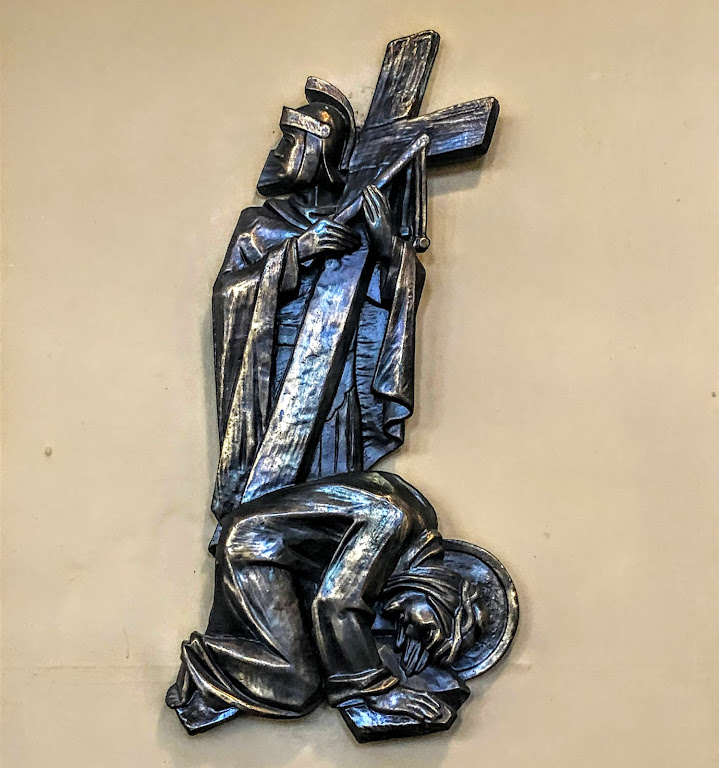
Jesus is Condemned to Death … Station 1 in the Stations of the Cross in the Church of Saint Mary and Saint Giles in Stony Stratford (Photograph: Patrick Comerford)
Jesus is Made to Carry His Cross … Station 2 in Stony Stratford (Photograph: Patrick Comerford)
Jesus Falls The First Time … Station 3 in Stony Stratford (Photograph: Patrick Comerford)
Jesus Meets His Sorrowful Mother … Station 4 in Stony Stratford (Photograph: Patrick Comerford)
Simon of Cyrene Helps Jesus Carry His Cross … Station 5 in Stony Stratford (Photograph: Patrick Comerford)
Veronica Wipes The Face Of Jesus … Station 6 in Stony Stratford (Photograph: Patrick Comerford)
Jesus Falls The Second Time … Station 7 in Stony Stratford (Photograph: Patrick Comerford)
The Women Of Jerusalem Weep over Jesus … Station 8 in the Stations of the Cross in the Church of Saint Mary and Saint Giles in Stony Stratford (Photograph: Patrick Comerford)
Jesus Falls The Third Time … Station 9 in Stony Stratford (Photograph: Patrick Comerford)
Jesus Is Stripped Of His Garments … Station 10 in Stony Stratford (Photograph: Patrick Comerford)
Jesus Is Nailed To The Cross … Station 11 in Stony Stratford (Photograph: Patrick Comerford)
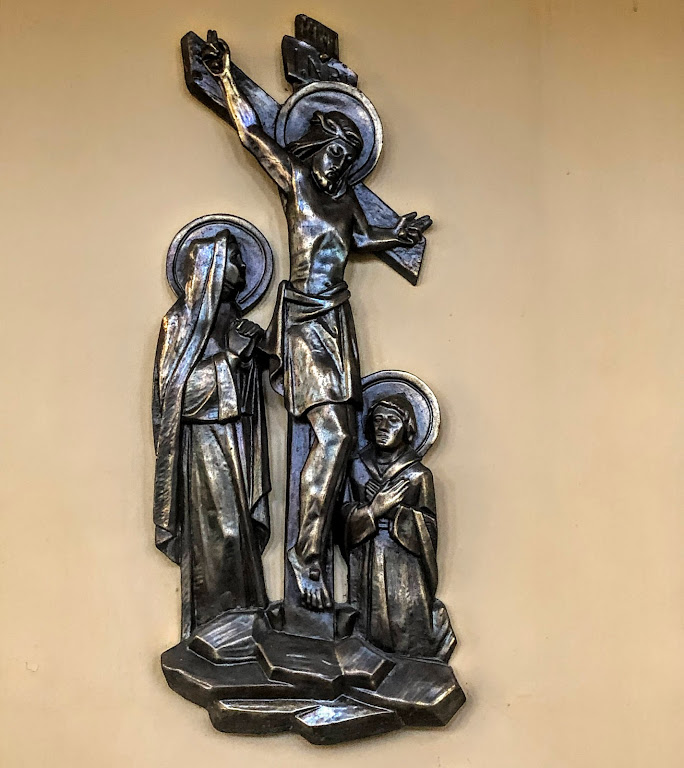
Jesus Is Raised Upon the Cross And Dies … Station 12 in Stony Stratford (Photograph: Patrick Comerford)
Jesus Is Taken Down From The Cross And Placed In The Arms Of His Mother … Station 13 in Stony Stratford (Photograph: Patrick Comerford)
Jesus Is Laid In The Sepulchre … Station 14 in Stony Stratford (Photograph: Patrick Comerford)
Today’s Prayers (Friday 18 April 2025, Good Friday):
A ‘Holy Week Reflection’ provides the theme this week in ‘Pray With the World Church’, the Prayer Diary of the Anglican mission agency USPG (United Society Partners in the Gospel).’ This theme was introduced on Sunday with reflections by Bishop David Walker of Manchester, who is the chair of USPG trustees.
The USPG Prayer Diary today (Friday 18 April 2025, Good Friday) invites us to pray:
O Suffering Saviour, we lament the weight of our sin you bore. And yet, by the miracle of grace, we find healing and peace in your wounds.
The Collect:
Almighty Father,
look with mercy on this your family
for which our Lord Jesus Christ was content to be betrayed
and given up into the hands of sinners
and to suffer death upon the cross;
who is alive and glorified with you and the Holy Spirit,
one God, now and for ever.
Additional Collect:
Eternal God,
in the cross of Jesus
we see the cost of our sin
and the depth of your love:
in humble hope and fear
may we place at his feet
all that we have and all that we are,
through Jesus Christ our Lord.
Yesterday’s Reflection
Continued Tomorrow
The processions arriving at the Church of the Four Martyrs in Rethymnon on a recent Good Friday (Patrick Comerford)
Scripture quotations are from the New Revised Standard Version Bible: Anglicised Edition copyright © 1989, 1995 National Council of the Churches of Christ in the United States of America. Used by permission. All rights reserved worldwide. http://nrsvbibles.org
Patrick Comerford
We are at the climax of Holy Week, the last week in Lent. Today is Good Friday (18 April 2025), known as Great Friday in the Greek Orthodox Church.
I awoke once this morning to the sound of the church bells from the Cathedral and the Church of the Four Martyrs in Rethymnon. I am spending these closing days of Holy Week and Easter in Rethymnon. I spent part of yesterday the villages of Tsesems and Platanias, east of Rethymnon, with a short time for swimming at Pavlos Beach – my first time to swim in the sea this year. I am meeting friends for coffee later during the day, but I plan to spend much of the day at church events in Rethymnon, and I am looking forward to the processions of the Epitaphios through the streets of Rethymnon this evening.
But, before this day begins, I am taking some quiet time this morning to give thanks, to reflect, to pray and to read in these ways:
1, reading today’s Gospel reading;
2, a short reflection;
3, a prayer from the USPG prayer diary;
4, the Collects of the day.
The Crucifixion depicted on a 16th century sarcophagus from Skouloufia in the Archaeological Museum in Rethymnon; the symbols includes the moon, stars and sun, with Adam and the Tree of Life on the left and the Harrowing of Hell on the right (Photograph: Patrick Comerford, 2025)
John 18: 1 to 19: 42 (NRSVA):
1 After Jesus had spoken these words, he went out with his disciples across the Kidron valley to a place where there was a garden, which he and his disciples entered. 2 Now Judas, who betrayed him, also knew the place, because Jesus often met there with his disciples. 3 So Judas brought a detachment of soldiers together with police from the chief priests and the Pharisees, and they came there with lanterns and torches and weapons. 4 Then Jesus, knowing all that was to happen to him, came forward and asked them, ‘For whom are you looking?’ 5 They answered, ‘Jesus of Nazareth.’ Jesus replied, ‘I am he.’ Judas, who betrayed him, was standing with them. 6 When Jesus said to them, ‘I am he’, they stepped back and fell to the ground. 7 Again he asked them, ‘For whom are you looking?’ And they said, ‘Jesus of Nazareth.’ 8 Jesus answered, ‘I told you that I am he. So if you are looking for me, let these men go.’ 9 This was to fulfil the word that he had spoken, ‘I did not lose a single one of those whom you gave me.’ 10 Then Simon Peter, who had a sword, drew it, struck the high priest’s slave, and cut off his right ear. The slave’s name was Malchus. 11 Jesus said to Peter, ‘Put your sword back into its sheath. Am I not to drink the cup that the Father has given me?’
12 So the soldiers, their officer, and the Jewish police arrested Jesus and bound him. 13 First they took him to Annas, who was the father-in-law of Caiaphas, the high priest that year. 14 Caiaphas was the one who had advised the Jews that it was better to have one person die for the people.
15 Simon Peter and another disciple followed Jesus. Since that disciple was known to the high priest, he went with Jesus into the courtyard of the high priest, 16 but Peter was standing outside at the gate. So the other disciple, who was known to the high priest, went out, spoke to the woman who guarded the gate, and brought Peter in. 17 The woman said to Peter, ‘You are not also one of this man’s disciples, are you?’ He said, ‘I am not.’ 18 Now the slaves and the police had made a charcoal fire because it was cold, and they were standing round it and warming themselves. Peter also was standing with them and warming himself.
19 Then the high priest questioned Jesus about his disciples and about his teaching. 20 Jesus answered, ‘I have spoken openly to the world; I have always taught in synagogues and in the temple, where all the Jews come together. I have said nothing in secret. 21 Why do you ask me? Ask those who heard what I said to them; they know what I said.’ 22 When he had said this, one of the police standing nearby struck Jesus on the face, saying, ‘Is that how you answer the high priest?’ 23 Jesus answered, ‘If I have spoken wrongly, testify to the wrong. But if I have spoken rightly, why do you strike me?’ 24 Then Annas sent him bound to Caiaphas the high priest.
25 Now Simon Peter was standing and warming himself. They asked him, ‘You are not also one of his disciples, are you?’ He denied it and said, ‘I am not.’ 26 One of the slaves of the high priest, a relative of the man whose ear Peter had cut off, asked, ‘Did I not see you in the garden with him?’ 27 Again Peter denied it, and at that moment the cock crowed.
28 Then they took Jesus from Caiaphas to Pilate’s headquarters. It was early in the morning. They themselves did not enter the headquarters, so as to avoid ritual defilement and to be able to eat the Passover. 29 So Pilate went out to them and said, ‘What accusation do you bring against this man?’ 30 They answered, ‘If this man were not a criminal, we would not have handed him over to you.’ 31 Pilate said to them, ‘Take him yourselves and judge him according to your law.’ The Jews replied, ‘We are not permitted to put anyone to death.’ 32 (This was to fulfil what Jesus had said when he indicated the kind of death he was to die.)
33 Then Pilate entered the headquarters again, summoned Jesus, and asked him, ‘Are you the King of the Jews?’ 34 Jesus answered, ‘Do you ask this on your own, or did others tell you about me?’ 35 Pilate replied, ‘I am not a Jew, am I? Your own nation and the chief priests have handed you over to me. What have you done?’ 36 Jesus answered, ‘My kingdom is not from this world. If my kingdom were from this world, my followers would be fighting to keep me from being handed over to the Jews. But as it is, my kingdom is not from here.’ 37 Pilate asked him, ‘So you are a king?’ Jesus answered, ‘You say that I am a king. For this I was born, and for this I came into the world, to testify to the truth. Everyone who belongs to the truth listens to my voice.’ 38 Pilate asked him, ‘What is truth?’
After he had said this, he went out to the Jews again and told them, ‘I find no case against him. 39 But you have a custom that I release someone for you at the Passover. Do you want me to release for you the King of the Jews?’ 40 They shouted in reply, ‘Not this man, but Barabbas!’ Now Barabbas was a bandit.
1 Then Pilate took Jesus and had him flogged. 2 And the soldiers wove a crown of thorns and put it on his head, and they dressed him in a purple robe. 3 They kept coming up to him, saying, ‘Hail, King of the Jews!’ and striking him on the face. 4 Pilate went out again and said to them, ‘Look, I am bringing him out to you to let you know that I find no case against him.’ 5 So Jesus came out, wearing the crown of thorns and the purple robe. Pilate said to them, ‘Here is the man!’ 6 When the chief priests and the police saw him, they shouted, ‘Crucify him! Crucify him!’ Pilate said to them, ‘Take him yourselves and crucify him; I find no case against him.’ 7 The Jews answered him, ‘We have a law, and according to that law he ought to die because he has claimed to be the Son of God.’
8 Now when Pilate heard this, he was more afraid than ever. 9 He entered his headquarters again and asked Jesus, ‘Where are you from?’ But Jesus gave him no answer. 10 Pilate therefore said to him, ‘Do you refuse to speak to me? Do you not know that I have power to release you, and power to crucify you?’ 11 Jesus answered him, ‘You would have no power over me unless it had been given you from above; therefore the one who handed me over to you is guilty of a greater sin.’ 12 From then on Pilate tried to release him, but the Jews cried out, ‘If you release this man, you are no friend of the emperor. Everyone who claims to be a king sets himself against the emperor.’
13 When Pilate heard these words, he brought Jesus outside and sat on the judge’s bench at a place called The Stone Pavement, or in Hebrew Gabbatha. 14 Now it was the day of Preparation for the Passover; and it was about noon. He said to the Jews, ‘Here is your King!’ 15 They cried out, ‘Away with him! Away with him! Crucify him!’ Pilate asked them, ‘Shall I crucify your King?’ The chief priests answered, ‘We have no king but the emperor.’ 16 Then he handed him over to them to be crucified.
So they took Jesus; 17 and carrying the cross by himself, he went out to what is called The Place of the Skull, which in Hebrew is called Golgotha. 18 There they crucified him, and with him two others, one on either side, with Jesus between them. 19 Pilate also had an inscription written and put on the cross. It read, ‘Jesus of Nazareth, the King of the Jews.’ 20 Many of the Jews read this inscription, because the place where Jesus was crucified was near the city; and it was written in Hebrew,[o] in Latin, and in Greek. 21 Then the chief priests of the Jews said to Pilate, ‘Do not write, “The King of the Jews”, but, “This man said, I am King of the Jews.”’ 22 Pilate answered, ‘What I have written I have written.’ 23 When the soldiers had crucified Jesus, they took his clothes and divided them into four parts, one for each soldier. They also took his tunic; now the tunic was seamless, woven in one piece from the top. 24 So they said to one another, ‘Let us not tear it, but cast lots for it to see who will get it.’ This was to fulfil what the scripture says,
‘They divided my clothes among themselves,
and for my clothing they cast lots.’
25 And that is what the soldiers did.
Meanwhile, standing near the cross of Jesus were his mother, and his mother’s sister, Mary the wife of Clopas, and Mary Magdalene. 26 When Jesus saw his mother and the disciple whom he loved standing beside her, he said to his mother, ‘Woman, here is your son.’ 27 Then he said to the disciple, ‘Here is your mother.’ And from that hour the disciple took her into his own home.
28 After this, when Jesus knew that all was now finished, he said (in order to fulfil the scripture), ‘I am thirsty.’ 29 A jar full of sour wine was standing there. So they put a sponge full of the wine on a branch of hyssop and held it to his mouth. 30 When Jesus had received the wine, he said, ‘It is finished.’ Then he bowed his head and gave up his spirit.
31 Since it was the day of Preparation, the Jews did not want the bodies left on the cross during the sabbath, especially because that sabbath was a day of great solemnity. So they asked Pilate to have the legs of the crucified men broken and the bodies removed. 32 Then the soldiers came and broke the legs of the first and of the other who had been crucified with him. 33 But when they came to Jesus and saw that he was already dead, they did not break his legs. 34 Instead, one of the soldiers pierced his side with a spear, and at once blood and water came out. 35 (He who saw this has testified so that you also may believe. His testimony is true, and he knows that he tells the truth.) 36 These things occurred so that the scripture might be fulfilled, ‘None of his bones shall be broken.’ 37 And again another passage of scripture says, ‘They will look on the one whom they have pierced.’
38 After these things, Joseph of Arimathea, who was a disciple of Jesus, though a secret one because of his fear of the Jews, asked Pilate to let him take away the body of Jesus. Pilate gave him permission; so he came and removed his body. 39 Nicodemus, who had at first come to Jesus by night, also came, bringing a mixture of myrrh and aloes, weighing about a hundred pounds. 40 They took the body of Jesus and wrapped it with the spices in linen cloths, according to the burial custom of the Jews. 41 Now there was a garden in the place where he was crucified, and in the garden there was a new tomb in which no one had ever been laid. 42 And so, because it was the Jewish day of Preparation, and the tomb was nearby, they laid Jesus there.
Venerating the Cross in Church of the Four Martyrs in Rethymnon last night marked the beginning of the commemorations of Great and Good Friday (Photograph: Patrick Comerford, 2025)
Today’s Reflection:
Throughout this week, the Holy Week prayers and devotions in Saint Mary and Saint Giles Church in Stony Stratford have included the Stations of the Cross in the evening. The verse and response at each station has been:
We adore you, O Christ, and we bless you,
Because by your holy cross
you have redeemed the world.
And then, following a meditation:
Lord Jesus crucified,
Have mercy on us!
The Stations of the Cross are not usually found in Greek Orthodox Churches, but the Good Friday processions through the streets of cities, towns and villages in Greece on the evening of Good Friday are unmatched in northern Europe. The Great and Good Friday commemorations began in Greece last night, and I attended the Vespers with the Veneration of the Cross in the Church of the Four Martyrs in Rethymnon late into the evening, with sombre tolling of the church bells, echoing the solemn tolling of the bells of the cathedral a few metres away.
This morning, my reflections on today’s Gospel reading (John 18: 1 to 19: 42) are assisted by images of the Stations of the Cross in Saint Mary and Saint Giles Church in Stony Stratford:
Jesus is Condemned to Death … Station 1 in the Stations of the Cross in the Church of Saint Mary and Saint Giles in Stony Stratford (Photograph: Patrick Comerford)
Jesus is Made to Carry His Cross … Station 2 in Stony Stratford (Photograph: Patrick Comerford)
Jesus Falls The First Time … Station 3 in Stony Stratford (Photograph: Patrick Comerford)
Jesus Meets His Sorrowful Mother … Station 4 in Stony Stratford (Photograph: Patrick Comerford)
Simon of Cyrene Helps Jesus Carry His Cross … Station 5 in Stony Stratford (Photograph: Patrick Comerford)
Veronica Wipes The Face Of Jesus … Station 6 in Stony Stratford (Photograph: Patrick Comerford)
Jesus Falls The Second Time … Station 7 in Stony Stratford (Photograph: Patrick Comerford)
The Women Of Jerusalem Weep over Jesus … Station 8 in the Stations of the Cross in the Church of Saint Mary and Saint Giles in Stony Stratford (Photograph: Patrick Comerford)
Jesus Falls The Third Time … Station 9 in Stony Stratford (Photograph: Patrick Comerford)
Jesus Is Stripped Of His Garments … Station 10 in Stony Stratford (Photograph: Patrick Comerford)
Jesus Is Nailed To The Cross … Station 11 in Stony Stratford (Photograph: Patrick Comerford)
Jesus Is Raised Upon the Cross And Dies … Station 12 in Stony Stratford (Photograph: Patrick Comerford)
Jesus Is Taken Down From The Cross And Placed In The Arms Of His Mother … Station 13 in Stony Stratford (Photograph: Patrick Comerford)
Jesus Is Laid In The Sepulchre … Station 14 in Stony Stratford (Photograph: Patrick Comerford)
Today’s Prayers (Friday 18 April 2025, Good Friday):
A ‘Holy Week Reflection’ provides the theme this week in ‘Pray With the World Church’, the Prayer Diary of the Anglican mission agency USPG (United Society Partners in the Gospel).’ This theme was introduced on Sunday with reflections by Bishop David Walker of Manchester, who is the chair of USPG trustees.
The USPG Prayer Diary today (Friday 18 April 2025, Good Friday) invites us to pray:
O Suffering Saviour, we lament the weight of our sin you bore. And yet, by the miracle of grace, we find healing and peace in your wounds.
The Collect:
Almighty Father,
look with mercy on this your family
for which our Lord Jesus Christ was content to be betrayed
and given up into the hands of sinners
and to suffer death upon the cross;
who is alive and glorified with you and the Holy Spirit,
one God, now and for ever.
Additional Collect:
Eternal God,
in the cross of Jesus
we see the cost of our sin
and the depth of your love:
in humble hope and fear
may we place at his feet
all that we have and all that we are,
through Jesus Christ our Lord.
Yesterday’s Reflection
Continued Tomorrow
The processions arriving at the Church of the Four Martyrs in Rethymnon on a recent Good Friday (Patrick Comerford)
Scripture quotations are from the New Revised Standard Version Bible: Anglicised Edition copyright © 1989, 1995 National Council of the Churches of Christ in the United States of America. Used by permission. All rights reserved worldwide. http://nrsvbibles.org
Labels:
archaeology,
Crete 2025,
Good Friday,
Greece 2025,
Icons,
Iraklion,
Lent 2025,
Mission,
Museums,
Prayer,
Rethymnon,
Saint John's Gospel,
Stations of the Cross,
Stony Stratford,
Tsesmes,
USPG
17 April 2025
Listening to the poetry of
Elytis and the songs of
Theodorakis on the road
from Iraklion to Rethymnon
‘But where did you wander / All day long in the hard reverie of stone and sea?’ (Odysseas Elytis, Marina on the Rocks) … rocks and the sea at sunset behind the Fortezza in Rethymnon (Photograph: Patrick Comerford; click on images for full-screen viewing)
Patrick Comerford
The journey to Rethymnon from Iraklion last night, along the north coast of the Crete, with its rocky coves, sandy beaches and cliffs, was almost like a home-coming, bringing with it hopes of seeing the sun setting in the west behind the Fortezza over the next few evenings. Although last night's journey was in total darkness, this is one of the most beautiful and scenic routes I know. It is a journey that has never ceased to captivate me since I first arrived in Crete early one morning almost 40 years ago in the mid-1980s.
As I was planning and arranging last night’s journey from Iraklion to Rethymnon, I found myself once again reading Marina on the Rocks, one of my favourite poems by Odysseas Elytis (1911-1996), who was born in Iraklion, and listening to a setting by Mikis Theodorakis, sung by one of Greece’s most loved singers, Maria Farantouri.
Both Elytis and Theodorakis have been major figures in Greek culture throughout the second half of the 20th century. The only other Greek poet to receive the Nobel Prize for Literature was George Seferis in 1967. Nikos Kazantzakis (1883-1957), who was also born in Crete, received Nobel nominations on nine separate occasions, but never received the prize.
Odysseus Elytis is one of the poets who revived Greek poetry in the last century. Several of his poems have been set to music and his collections have been translated into dozens of languages. These poems are written in rich language, filled with images from history and myths. His lines are long and musical, inspired by the Greek light, the sea, and the air. The autobiographical elements of his poetry are coloured by allusions to the history of Greece, and his poems express a contemporary consciousness fully resonant with those echoes of the past that have shaped the modern Greek experience.
Mikis Theodorakis (1925-2021) was born 100 years ago on 29 July 1925, and is best remembered outside Greece as the composer of the scores for Zorba the Greek and Z. In Greece, he is the great national composer, who collaborated with some of the most prominent Greek singers and film makers. He is the composer of the Left, whose songs became anthems of the resisance during the colonels’ junta in 1967-1974. He was especially drawn to the work of Elytis, whose writings were a mirror to the revolutionary music of Theodorakis.
Odysseus Elytis (Οδυσσέας Ελύτης) was his pen name, but he was born Odysseus Alepoudellis (Οδυσσέας Αλεπουδέλλης) in Iraklion on 2 November 1911, into the Alepoudelis family, an old industrial family from Lesbos.
When he was three, his family moved to Athens, where he later studied law at the University of Athens. He published his first poem in 1935 in the journal New Letters (Νέα Γράμματα) at the prompting of friends such as George Seferis. His entry with a distinctively earthy and original form assisted to inaugurate a new era in Greek poetry and its subsequent reform after World War II.
He was a lieutenant in the Greek army during World War II, and fought on the Albanian frontline, resisting the Italian invasion. After World War II, he was twice Programme Director of ERT, the Greek National Radio Foundation (1945-1946, 1953-1954). In between, he studied philosophy at the Sorbonne in Paris and worked for the BBC in London. He moved in literary and artistic circles that included Matisse, Picasso, Chagall and Sartre, but was private and solitary in pursuing his poetry.
His great epic poem, Το Άξιον Εστί (To Axion Esti, It is Worthy) was published in 1959, after a period of more than 10 years of poetic silence. It became one of the most widely read volumes of poetry published in Greece since World War II, and it remains a classic to this day. His Axion Esti , widely regarded as his chef d’oeuvre, is a poetic cycle of alternating prose and verse patterned after the ancient Byzantine liturgy.
As in his other writings, Elytis depicts Greek reality through an intensely personal tone. It is a hymn to creation inspired by the Greek Orthodox liturgy and the 17th century epic poetry of Crete, including the Erotokritos (Ἐρωτόκριτος) by Vikentios Kornaros. It is a composition of song and praise that explores the essence of his being and the identity of his country and people. Theodorakis set the Axion Esti to music in 1964, and it became immensely popular throughout Greece. This setting by Theodorakis later contributed to Elytis receiving the Nobel Prize.
During the colonels’ junta, Elytis lived in exile in Paris (1969-1972). He returned to Greece, and in 1975 was awarded an honorary PhD by Thessaloniki University and received the honorary citizenship of Mytilene. He received the Nobel Prize for Literature in 1979. He died of a heart attack in Athens on 18 March 1996, at the age of 84, and was buried at the First National Cemetery.
Odysseus Elytis was born in Iraklion in 1911 (Photograph: Patrick Comerford)
Marina of the Rocks is a poem by Elytis that explores the relationship between a woman, the sea and the summer months, evoking a sense of natural beauty and freedom, suggesting a love that is both intense and fleeting, like the sun itself, and observing the fleeting nature of time and memory.
In his poetry, Elytis often focuses on the senses, and in Marina of the Rocks he evokes the heat, light and textures of the summer landscape. For the poet, the sea, rocks, and sun are central symbols of summer and the natural world, emphasising the powerful and liberating aspects of the environment as he explores the passionate relationship between the woman and the summer and the idea of memory and the passage of time, suggesting that even as the summer fades, its impact on the woman’s soul remains.
Marina of the Rocks celebrates the beauty and power of nature, the sensual experience of summer. Vivid imagery and symbolism create a sense of place and time, inviting the reader to experience the joy and melancholy of the summer months.
Every Greek above a certain age, and certainly every Greek of my age, is able to sing the adaptation of this poem as the song Marina by Theodorakis and sung by Maria Farantouri with her plaintive and haunting voice.
One version I came on across YouTube earlier this week has edited images from the 1977 film Iphigenia (Ιφιγένεια) by Michael Cacoyannis, the third in his Greek Tragedy trilogy, following Electra (1962) and The Trojan Women (1971).
When Theodorakis died in Athens on 2 September 2021 at the age of 96, he was brought back to Crete to be buried in his hometown, Galatas, near Chania. Maria Farantouri is currently on a tour that pays tribute to Theodorakis, marking his 100th birthday. The tour with Manolis Mitsias began in Thessaloniki in January and includes two concerts in Crete, in Iraklion on 13 June and in Chania on 14 June.
Δώσε μου δυόσμο να μυρίσω,
Λουίζα και βασιλικό
Μαζί μ'αυτά να σε φιλήσω,
και τι να πρωτοθυμηθώ
Τη βρύση με τα περιστέρια,
των αρχαγγέλων το σπαθί
Το περιβόλι με τ' αστέρια,
και το πηγάδι το βαθύ
Τις νύχτες που σε σεργιανούσα,
στην άλλη άκρη τ' ουρανού Και ν' ανεβαίνεις σε θωρούσα,
σαν αδελφή του αυγερινού
Μαρίνα πράσινο μου αστέρι
Μαρίνα φως του αυγερινού
Μαρίνα μου άγριο περιστέρι
Και κρίνο του καλοκαιριού
Give me mint to smell
Verbena and basil
Together with them, I will kiss you
What to remember first?
The spring with the doves
The archangel’s sword
The orchard with the stars
And the deep well
The nights when I took you for walks
To the other end of the sky
And I watched you rising,
Like a sister of the morning star
Marina, my green star,
Marina, light of the morning star,
Marina, my wild dove
And summer’s lily.
Marina of the Rocks, by Odysseus Elytis:
You have a taste of tempest on your lips —
But where did you wander
All day long in the hard reverie of stone and sea?
An eagle-bearing wind stripped the hills
Stripped your longing to the bone
And the pupils of your eyes received the message of chimera
Spotting memory with foam!
Where is the familiar slope of short September
On the red earth where you played, looking down
At the broad rows of the other girls
The corners where your friends left armfuls of rosemary.
But where did you wander
All night long in the hard reverie of stone and sea?
I told you to count in the naked water its luminous days
On your back to rejoice in the dawn of things
Or again to wander on yellow plains
With a clover of light on your breast, iambic heroine.
You have a taste of tempest on your lips
And a dress red as blood
Deep in the gold of summer
And the perfume of hyacinths —
But where did you wander
Descending toward the shores, the pebbled bays?
There was cold salty seaweed there
But deeper a human feeling that bled
And you opened your arms in astonishment naming it
Climbing lightly to the clearness of the depths
Where your own starfish shone.
Listen. Speech is the prudence of the aged
And time is a passionate sculptor of men
And the sun stands over it, a beast of hope
And you, closer to it, embrace a love
With a bitter taste of tempest on your lips.
It is not for you, blue to the bone, to think of another summer,
For the rivers to change their bed
And take you back to their mother
For you to kiss other cherry trees
Or ride on the northwest wind.
Propped on the rocks, without yesterday or tomorrow,
Facing the dangers of the rocks with a hurricane hairstyle
You will say farewell to the riddle that is yours.
Η Μαρίνα των βράχων, Ο ποιητής, Οδυσσέας Ελύτης
Έχεις μια γεύση τρικυμίας στα χείλη – Μα πού γύριζες
Ολημερίς τη σκληρή ρέμβη της πέτρας και της θάλασσας
Αετοφόρος άνεμος γύμνωσε τους λόφους
Γύμνωσε την επιθυμία σου ως το κόκαλο
Κι οι κόρες των ματιών σου πήρανε τη σκυτάλη της Χίμαιρας
Ριγώνοντας μ’ αφρό τη θύμηση!
Πού είναι η γνώριμη ανηφοριά του μικρού Σεπτεμβρίου
Στο κοκκινόχωμα όπου έπαιζες θωρώντας προς τα κάτω
Τους βαθιούς κυαμώνες των άλλων κοριτσιών
Τις γωνιές όπου οι φίλες σου άφηναν αγκαλιές τα δυοσμαρίνια
– Μα πού γύριζες;
Ολονυχτίς τη σκληρή ρέμβη της πέτρας και της θάλασσας
Σου ‘λεγα να μετράς μες στο γδυτό νερό τις φωτεινές του μέρες
Ανάσκελη να χαίρεσαι την αυγή των πραγμάτων
Ή πάλι να γυρνάς κίτρινους κάμπους
Μ’ ένα τριφύλλι φως στο στήθος σου ηρωίδα ιάμβου
Έχεις μια γεύση τρικυμίας στα χείλη
Κι ένα φόρεμα κόκκινο σαν το αίμα
Βαθιά μες στο χρυσάφι του καλοκαιριού
Και τ’ άρωμα των γυακίνθων –Μα πού γύριζες
Κατεβαίνοντας προς τους γιαλούς τους κόλπους με τα βότσαλα
Ήταν εκεί ένα κρύο αρμυρό θαλασσόχορτο
Μα πιο βαθιά ένα ανθρώπινο αίσθημα που μάτωνε
Κι άνοιγες μ’ έκπληξη τα χέρια σου λέγοντας τ’ όνομά του
Ανεβαίνοντας ανάλαφρα ως τη διαύγεια των βυθών
Όπου σελάγιζε ο δικός σου ο αστερίας.
Άκουσε ο λόγος είναι των στερνών η φρόνηση
Κι ο χρόνος γλύπτης των ανθρώπων παράφορος
Κι ο ήλιος στέκεται από πάνω του θηρίο ελπίδας
Κι εσύ πιο κοντά του σφίγγεις έναν έρωτα
Έχοντας μια πικρή γεύση τρικυμίας στα χείλη.
Δεν είναι για να λογαριάζεις γαλανή ως το κόκαλο
άλλο καλοκαίρι,
Για ν’ αλλάξουνε ρέμα τα ποτάμια
Και να σε πάνε πίσω στη μητέρα τους,
Για να ξαναφιλήσεις άλλες κερασιές
Ή για να πας καβάλα στο μαΐστρο
Στυλωμένη στους βράχους δίχως χτες και αύριο.
Στους κινδύνους των βράχων με τη χτενισιά της θύελλας
Θ’ αποχαιρετήσεις το αίνιγμά σου.
Patrick Comerford
The journey to Rethymnon from Iraklion last night, along the north coast of the Crete, with its rocky coves, sandy beaches and cliffs, was almost like a home-coming, bringing with it hopes of seeing the sun setting in the west behind the Fortezza over the next few evenings. Although last night's journey was in total darkness, this is one of the most beautiful and scenic routes I know. It is a journey that has never ceased to captivate me since I first arrived in Crete early one morning almost 40 years ago in the mid-1980s.
As I was planning and arranging last night’s journey from Iraklion to Rethymnon, I found myself once again reading Marina on the Rocks, one of my favourite poems by Odysseas Elytis (1911-1996), who was born in Iraklion, and listening to a setting by Mikis Theodorakis, sung by one of Greece’s most loved singers, Maria Farantouri.
Both Elytis and Theodorakis have been major figures in Greek culture throughout the second half of the 20th century. The only other Greek poet to receive the Nobel Prize for Literature was George Seferis in 1967. Nikos Kazantzakis (1883-1957), who was also born in Crete, received Nobel nominations on nine separate occasions, but never received the prize.
Odysseus Elytis is one of the poets who revived Greek poetry in the last century. Several of his poems have been set to music and his collections have been translated into dozens of languages. These poems are written in rich language, filled with images from history and myths. His lines are long and musical, inspired by the Greek light, the sea, and the air. The autobiographical elements of his poetry are coloured by allusions to the history of Greece, and his poems express a contemporary consciousness fully resonant with those echoes of the past that have shaped the modern Greek experience.
Mikis Theodorakis (1925-2021) was born 100 years ago on 29 July 1925, and is best remembered outside Greece as the composer of the scores for Zorba the Greek and Z. In Greece, he is the great national composer, who collaborated with some of the most prominent Greek singers and film makers. He is the composer of the Left, whose songs became anthems of the resisance during the colonels’ junta in 1967-1974. He was especially drawn to the work of Elytis, whose writings were a mirror to the revolutionary music of Theodorakis.
Odysseus Elytis (Οδυσσέας Ελύτης) was his pen name, but he was born Odysseus Alepoudellis (Οδυσσέας Αλεπουδέλλης) in Iraklion on 2 November 1911, into the Alepoudelis family, an old industrial family from Lesbos.
When he was three, his family moved to Athens, where he later studied law at the University of Athens. He published his first poem in 1935 in the journal New Letters (Νέα Γράμματα) at the prompting of friends such as George Seferis. His entry with a distinctively earthy and original form assisted to inaugurate a new era in Greek poetry and its subsequent reform after World War II.
He was a lieutenant in the Greek army during World War II, and fought on the Albanian frontline, resisting the Italian invasion. After World War II, he was twice Programme Director of ERT, the Greek National Radio Foundation (1945-1946, 1953-1954). In between, he studied philosophy at the Sorbonne in Paris and worked for the BBC in London. He moved in literary and artistic circles that included Matisse, Picasso, Chagall and Sartre, but was private and solitary in pursuing his poetry.
His great epic poem, Το Άξιον Εστί (To Axion Esti, It is Worthy) was published in 1959, after a period of more than 10 years of poetic silence. It became one of the most widely read volumes of poetry published in Greece since World War II, and it remains a classic to this day. His Axion Esti , widely regarded as his chef d’oeuvre, is a poetic cycle of alternating prose and verse patterned after the ancient Byzantine liturgy.
As in his other writings, Elytis depicts Greek reality through an intensely personal tone. It is a hymn to creation inspired by the Greek Orthodox liturgy and the 17th century epic poetry of Crete, including the Erotokritos (Ἐρωτόκριτος) by Vikentios Kornaros. It is a composition of song and praise that explores the essence of his being and the identity of his country and people. Theodorakis set the Axion Esti to music in 1964, and it became immensely popular throughout Greece. This setting by Theodorakis later contributed to Elytis receiving the Nobel Prize.
During the colonels’ junta, Elytis lived in exile in Paris (1969-1972). He returned to Greece, and in 1975 was awarded an honorary PhD by Thessaloniki University and received the honorary citizenship of Mytilene. He received the Nobel Prize for Literature in 1979. He died of a heart attack in Athens on 18 March 1996, at the age of 84, and was buried at the First National Cemetery.
Odysseus Elytis was born in Iraklion in 1911 (Photograph: Patrick Comerford)
Marina of the Rocks is a poem by Elytis that explores the relationship between a woman, the sea and the summer months, evoking a sense of natural beauty and freedom, suggesting a love that is both intense and fleeting, like the sun itself, and observing the fleeting nature of time and memory.
In his poetry, Elytis often focuses on the senses, and in Marina of the Rocks he evokes the heat, light and textures of the summer landscape. For the poet, the sea, rocks, and sun are central symbols of summer and the natural world, emphasising the powerful and liberating aspects of the environment as he explores the passionate relationship between the woman and the summer and the idea of memory and the passage of time, suggesting that even as the summer fades, its impact on the woman’s soul remains.
Marina of the Rocks celebrates the beauty and power of nature, the sensual experience of summer. Vivid imagery and symbolism create a sense of place and time, inviting the reader to experience the joy and melancholy of the summer months.
Every Greek above a certain age, and certainly every Greek of my age, is able to sing the adaptation of this poem as the song Marina by Theodorakis and sung by Maria Farantouri with her plaintive and haunting voice.
One version I came on across YouTube earlier this week has edited images from the 1977 film Iphigenia (Ιφιγένεια) by Michael Cacoyannis, the third in his Greek Tragedy trilogy, following Electra (1962) and The Trojan Women (1971).
When Theodorakis died in Athens on 2 September 2021 at the age of 96, he was brought back to Crete to be buried in his hometown, Galatas, near Chania. Maria Farantouri is currently on a tour that pays tribute to Theodorakis, marking his 100th birthday. The tour with Manolis Mitsias began in Thessaloniki in January and includes two concerts in Crete, in Iraklion on 13 June and in Chania on 14 June.
Δώσε μου δυόσμο να μυρίσω,
Λουίζα και βασιλικό
Μαζί μ'αυτά να σε φιλήσω,
και τι να πρωτοθυμηθώ
Τη βρύση με τα περιστέρια,
των αρχαγγέλων το σπαθί
Το περιβόλι με τ' αστέρια,
και το πηγάδι το βαθύ
Τις νύχτες που σε σεργιανούσα,
στην άλλη άκρη τ' ουρανού Και ν' ανεβαίνεις σε θωρούσα,
σαν αδελφή του αυγερινού
Μαρίνα πράσινο μου αστέρι
Μαρίνα φως του αυγερινού
Μαρίνα μου άγριο περιστέρι
Και κρίνο του καλοκαιριού
Give me mint to smell
Verbena and basil
Together with them, I will kiss you
What to remember first?
The spring with the doves
The archangel’s sword
The orchard with the stars
And the deep well
The nights when I took you for walks
To the other end of the sky
And I watched you rising,
Like a sister of the morning star
Marina, my green star,
Marina, light of the morning star,
Marina, my wild dove
And summer’s lily.
Marina of the Rocks, by Odysseus Elytis:
You have a taste of tempest on your lips —
But where did you wander
All day long in the hard reverie of stone and sea?
An eagle-bearing wind stripped the hills
Stripped your longing to the bone
And the pupils of your eyes received the message of chimera
Spotting memory with foam!
Where is the familiar slope of short September
On the red earth where you played, looking down
At the broad rows of the other girls
The corners where your friends left armfuls of rosemary.
But where did you wander
All night long in the hard reverie of stone and sea?
I told you to count in the naked water its luminous days
On your back to rejoice in the dawn of things
Or again to wander on yellow plains
With a clover of light on your breast, iambic heroine.
You have a taste of tempest on your lips
And a dress red as blood
Deep in the gold of summer
And the perfume of hyacinths —
But where did you wander
Descending toward the shores, the pebbled bays?
There was cold salty seaweed there
But deeper a human feeling that bled
And you opened your arms in astonishment naming it
Climbing lightly to the clearness of the depths
Where your own starfish shone.
Listen. Speech is the prudence of the aged
And time is a passionate sculptor of men
And the sun stands over it, a beast of hope
And you, closer to it, embrace a love
With a bitter taste of tempest on your lips.
It is not for you, blue to the bone, to think of another summer,
For the rivers to change their bed
And take you back to their mother
For you to kiss other cherry trees
Or ride on the northwest wind.
Propped on the rocks, without yesterday or tomorrow,
Facing the dangers of the rocks with a hurricane hairstyle
You will say farewell to the riddle that is yours.
Η Μαρίνα των βράχων, Ο ποιητής, Οδυσσέας Ελύτης
Έχεις μια γεύση τρικυμίας στα χείλη – Μα πού γύριζες
Ολημερίς τη σκληρή ρέμβη της πέτρας και της θάλασσας
Αετοφόρος άνεμος γύμνωσε τους λόφους
Γύμνωσε την επιθυμία σου ως το κόκαλο
Κι οι κόρες των ματιών σου πήρανε τη σκυτάλη της Χίμαιρας
Ριγώνοντας μ’ αφρό τη θύμηση!
Πού είναι η γνώριμη ανηφοριά του μικρού Σεπτεμβρίου
Στο κοκκινόχωμα όπου έπαιζες θωρώντας προς τα κάτω
Τους βαθιούς κυαμώνες των άλλων κοριτσιών
Τις γωνιές όπου οι φίλες σου άφηναν αγκαλιές τα δυοσμαρίνια
– Μα πού γύριζες;
Ολονυχτίς τη σκληρή ρέμβη της πέτρας και της θάλασσας
Σου ‘λεγα να μετράς μες στο γδυτό νερό τις φωτεινές του μέρες
Ανάσκελη να χαίρεσαι την αυγή των πραγμάτων
Ή πάλι να γυρνάς κίτρινους κάμπους
Μ’ ένα τριφύλλι φως στο στήθος σου ηρωίδα ιάμβου
Έχεις μια γεύση τρικυμίας στα χείλη
Κι ένα φόρεμα κόκκινο σαν το αίμα
Βαθιά μες στο χρυσάφι του καλοκαιριού
Και τ’ άρωμα των γυακίνθων –Μα πού γύριζες
Κατεβαίνοντας προς τους γιαλούς τους κόλπους με τα βότσαλα
Ήταν εκεί ένα κρύο αρμυρό θαλασσόχορτο
Μα πιο βαθιά ένα ανθρώπινο αίσθημα που μάτωνε
Κι άνοιγες μ’ έκπληξη τα χέρια σου λέγοντας τ’ όνομά του
Ανεβαίνοντας ανάλαφρα ως τη διαύγεια των βυθών
Όπου σελάγιζε ο δικός σου ο αστερίας.
Άκουσε ο λόγος είναι των στερνών η φρόνηση
Κι ο χρόνος γλύπτης των ανθρώπων παράφορος
Κι ο ήλιος στέκεται από πάνω του θηρίο ελπίδας
Κι εσύ πιο κοντά του σφίγγεις έναν έρωτα
Έχοντας μια πικρή γεύση τρικυμίας στα χείλη.
Δεν είναι για να λογαριάζεις γαλανή ως το κόκαλο
άλλο καλοκαίρι,
Για ν’ αλλάξουνε ρέμα τα ποτάμια
Και να σε πάνε πίσω στη μητέρα τους,
Για να ξαναφιλήσεις άλλες κερασιές
Ή για να πας καβάλα στο μαΐστρο
Στυλωμένη στους βράχους δίχως χτες και αύριο.
Στους κινδύνους των βράχων με τη χτενισιά της θύελλας
Θ’ αποχαιρετήσεις το αίνιγμά σου.
Daily prayer in Lent 2025:
44, Thursday 17 April 2025,
Maundy Thursday
An icon depicting the Last Supper or Mystical Supper seen in a shop on Ethnikis Antistaseos street in Rethymnon in Crete (Photograph: Patrick Comerford)
Patrick Comerford
We are reaching the climax of Holy Week, the last week in Lent. Today is Maundy Thursday (17 April 2025), known in the Orthodox Church as Great Holy Thursday, and we preparing for Good Friday tomorrow and Easter Day.
I awoke this morning to the sound of the church bells from the Cathedral and the Church of the Four Martyrs in Rethymnon, having arrived in the Hotel Brascos late last night after a flight from Luton to Iraklion. I am spending these closing days of Holy Week and Easter in Rethymnon, and I am thinking of visiting the villages of Tsesmes and Platanias, on the eastern fringes of Rethymnon later today.
My Easter visit to Crete this year means, of course, I am going to miss the Chrism Eucharist in Christ Church, Oxford, today when the bishops, priest and deacons in the diocese have the opportunity to renew our ordination vows. But I may visit the cathedral and some churches in Rethymnon, Platanias and Tsesmes during the day. Before this day begins, though, I am taking some quiet time this morning to give thanks, to reflect, to pray and to read in these ways:
1, reading today’s Gospel reading;
2, a short reflection;
3, a prayer from the USPG prayer diary;
4, the Collects and Post-Communion prayer of the day.
An icon depicting the Last Supper or Mystical Supper seen in Rethymnon in Crete (Photograph: Patrick Comerford)
John 13: 1-17, 31b-35 (NRSVA):
1 Now before the festival of the Passover, Jesus knew that his hour had come to depart from this world and go to the Father. Having loved his own who were in the world, he loved them to the end. 2 The devil had already put it into the heart of Judas son of Simon Iscariot to betray him. And during supper 3 Jesus, knowing that the Father had given all things into his hands, and that he had come from God and was going to God, 4 got up from the table, took off his outer robe, and tied a towel around himself. 5 Then he poured water into a basin and began to wash the disciples’ feet and to wipe them with the towel that was tied around him. 6 He came to Simon Peter, who said to him, ‘Lord, are you going to wash my feet?’ 7 Jesus answered, ‘You do not know now what I am doing, but later you will understand.’ 8 Peter said to him, ‘You will never wash my feet.’ Jesus answered, ‘Unless I wash you, you have no share with me.’ 9 Simon Peter said to him, ‘Lord, not my feet only but also my hands and my head!’ 10 Jesus said to him, ‘One who has bathed does not need to wash, except for the feet, but is entirely clean. And you are clean, though not all of you.’ 11 For he knew who was to betray him; for this reason he said, ‘Not all of you are clean.’
12 After he had washed their feet, had put on his robe, and had returned to the table, he said to them, ‘Do you know what I have done to you? 13 You call me Teacher and Lord—and you are right, for that is what I am. 14 So if I, your Lord and Teacher, have washed your feet, you also ought to wash one another’s feet. 15 For I have set you an example, that you also should do as I have done to you. 16 Very truly, I tell you, servants[d] are not greater than their master, nor are messengers greater than the one who sent them. 17 If you know these things, you are blessed if you do them.
31b ‘Now the Son of Man has been glorified, and God has been glorified in him. 32 If God has been glorified in him, God will also glorify him in himself and will glorify him at once. 33 Little children, I am with you only a little longer. You will look for me; and as I said to the Jews so now I say to you, “Where I am going, you cannot come.” 34 I give you a new commandment, that you love one another. Just as I have loved you, you also should love one another. 35 By this everyone will know that you are my disciples, if you have love for one another.’
The Last Supper depicted in a window in Saint Mary’s Church, Watford (Photograph: Patrick Comerford, 2025)
Today’s Reflection:
During Holy Week, we have a series of readings from Saint John’s Gospel, in which Jesus has a very different set of encounters or exchanges each evening.
This evening, the Water for Washing the Disciples feet continues a theme we find throughout Saint John’s Gospel:
• The waters of the River Jordan, at the Baptism of Christ (see John 1: 19-34);
• The water that is turned into wine at the wedding in Cana (John 2: 1-11);
• The Water of Life that the Samaritan Woman asks for at Jacob’s well in Sychar (John 4: 5-42);
• The water of the pool in Jerusalem where the paralysed man is healed after 38 years (John 5: 1-18);
• The water of the Sea of Galilee by which the 5,000 are fed (John 6: 1-14);
• The water by Capernaum where Jesus calms the storm (John 6: 16-21);
• The Rivers of Living Water (John 7: 37-39);
• The healing waters of the Pool of Siloam (John 9: 1-12);
• The water Christ cries out for on the Cross when he says: ‘I am thirsty’ (John 19: 28);
• The water that mingles with the blood from Christ’s side when it is pierced after his death (John 19: 32-35);
• The waters of the Sea of Tiberias, where the Risen Christ appears for a third time, after daybreak, and from which the disciples haul in 153 fish (John 21: 1-14).
Why then, in Saint John’s Gospel, does Pilate not wash his hands when he denies all responsibility on his part for the events that are to unfold that Good Friday (see John 18: 38)?
The Russian writer Mikhail Bulgakov (1891-1940) is best known for his posthumous novel The Master and Margarita, a masterpiece of the 20th century. Here Bulgakov portrays Pilate as a man who is ruthless, yet complex in his humanity. When Pilate meets Christ, he is reluctant but resigned and passively hands him over to those who wanted to kill him.
In this novel, Pilate exemplifies the statement ‘Cowardice is the worst of vices,’ and so he serves as a model of all the people who have washed their hands by silently or actively taking part in the Stalin’s crimes.
The actor Richard Boone plays a calm and stern, though, slightly guilt-ridden Pilate in the 1953 film The Robe (1953). There is an interesting touch when Pilate asks again for water to wash his hands, forgetting he has already washed those hands at the conclusion of the trial of Jesus.
When do we forget that we are complicit in the sufferings of others, and when do we deny we are complicit in the sufferings of others?
As Christ washes the feet of his disciples this evening, he calls us out from our complacency and our cosy forgetfulness, and challenges us once again to renew the promises made in the waters of our Baptism, to come again with forgiveness to living and healing waters, to dine and drink with him at the banquet, to have him calm the waters in the storms in our lives, to accept the miracle, to be cleansed by the waters from his side, to walk with him afresh and to join the Disciples in the new promises of the Resurrection.
Christ washes the feet of the Disciples … a fresco on a pillar in a church in Thessaloniki (Photograph: Patrick Comerford)
Today’s Prayers (Thursday 17 April 2025, Maundy Thursday):
A ‘Holy Week Reflection’ provides the theme this week in ‘Pray With the World Church’, the Prayer Diary of the Anglican mission agency USPG (United Society Partners in the Gospel).’ This theme was introduced on Sunday with reflections by Bishop David Walker of Manchester, who is the chair of USPG trustees.
The USPG Prayer Diary today (Thursday 17 April 2025, Maundy Thursday) invites us to pray:
Lord, on this sacred night, we remember your great love and sacrifice. As you took the bread and broke it, and shared the cup, you gave us the gift of yourself. We thank you.
The Collect:
God our Father,
you have invited us to share in the supper
which your Son gave to his Church
to proclaim his death until he comes:
may he nourish us by his presence,
and unite us in his love;
who is alive and reigns with you,
in the unity of the Holy Spirit,
one God, now and for ever.
The Post-Communion Prayer:
Lord Jesus Christ,
we thank you that in this wonderful sacrament
you have given us the memorial of your passion:
grant us so to reverence the sacred mysteries
of your body and blood
that we may know within ourselves
and show forth in our lives
the fruit of your redemption,
for you are alive and reign, now and for ever.
Additional Collect:
God our Father,
your Son Jesus Christ was obedient to the end
and drank the cup prepared for him:
may we who share his table
watch with him through the night of suffering
and be faithful.
Yesterday’s Reflection
Continued Tomorrow
The Church of the Four Martyrs in Rethynnon late last night (Photograph: Patrick Comerford, 2025)
Scripture quotations are from the New Revised Standard Version Bible: Anglicised Edition copyright © 1989, 1995 National Council of the Churches of Christ in the United States of America. Used by permission. All rights reserved worldwide. http://nrsvbibles.org
Patrick Comerford
We are reaching the climax of Holy Week, the last week in Lent. Today is Maundy Thursday (17 April 2025), known in the Orthodox Church as Great Holy Thursday, and we preparing for Good Friday tomorrow and Easter Day.
I awoke this morning to the sound of the church bells from the Cathedral and the Church of the Four Martyrs in Rethymnon, having arrived in the Hotel Brascos late last night after a flight from Luton to Iraklion. I am spending these closing days of Holy Week and Easter in Rethymnon, and I am thinking of visiting the villages of Tsesmes and Platanias, on the eastern fringes of Rethymnon later today.
My Easter visit to Crete this year means, of course, I am going to miss the Chrism Eucharist in Christ Church, Oxford, today when the bishops, priest and deacons in the diocese have the opportunity to renew our ordination vows. But I may visit the cathedral and some churches in Rethymnon, Platanias and Tsesmes during the day. Before this day begins, though, I am taking some quiet time this morning to give thanks, to reflect, to pray and to read in these ways:
1, reading today’s Gospel reading;
2, a short reflection;
3, a prayer from the USPG prayer diary;
4, the Collects and Post-Communion prayer of the day.
An icon depicting the Last Supper or Mystical Supper seen in Rethymnon in Crete (Photograph: Patrick Comerford)
John 13: 1-17, 31b-35 (NRSVA):
1 Now before the festival of the Passover, Jesus knew that his hour had come to depart from this world and go to the Father. Having loved his own who were in the world, he loved them to the end. 2 The devil had already put it into the heart of Judas son of Simon Iscariot to betray him. And during supper 3 Jesus, knowing that the Father had given all things into his hands, and that he had come from God and was going to God, 4 got up from the table, took off his outer robe, and tied a towel around himself. 5 Then he poured water into a basin and began to wash the disciples’ feet and to wipe them with the towel that was tied around him. 6 He came to Simon Peter, who said to him, ‘Lord, are you going to wash my feet?’ 7 Jesus answered, ‘You do not know now what I am doing, but later you will understand.’ 8 Peter said to him, ‘You will never wash my feet.’ Jesus answered, ‘Unless I wash you, you have no share with me.’ 9 Simon Peter said to him, ‘Lord, not my feet only but also my hands and my head!’ 10 Jesus said to him, ‘One who has bathed does not need to wash, except for the feet, but is entirely clean. And you are clean, though not all of you.’ 11 For he knew who was to betray him; for this reason he said, ‘Not all of you are clean.’
12 After he had washed their feet, had put on his robe, and had returned to the table, he said to them, ‘Do you know what I have done to you? 13 You call me Teacher and Lord—and you are right, for that is what I am. 14 So if I, your Lord and Teacher, have washed your feet, you also ought to wash one another’s feet. 15 For I have set you an example, that you also should do as I have done to you. 16 Very truly, I tell you, servants[d] are not greater than their master, nor are messengers greater than the one who sent them. 17 If you know these things, you are blessed if you do them.
31b ‘Now the Son of Man has been glorified, and God has been glorified in him. 32 If God has been glorified in him, God will also glorify him in himself and will glorify him at once. 33 Little children, I am with you only a little longer. You will look for me; and as I said to the Jews so now I say to you, “Where I am going, you cannot come.” 34 I give you a new commandment, that you love one another. Just as I have loved you, you also should love one another. 35 By this everyone will know that you are my disciples, if you have love for one another.’
The Last Supper depicted in a window in Saint Mary’s Church, Watford (Photograph: Patrick Comerford, 2025)
Today’s Reflection:
During Holy Week, we have a series of readings from Saint John’s Gospel, in which Jesus has a very different set of encounters or exchanges each evening.
This evening, the Water for Washing the Disciples feet continues a theme we find throughout Saint John’s Gospel:
• The waters of the River Jordan, at the Baptism of Christ (see John 1: 19-34);
• The water that is turned into wine at the wedding in Cana (John 2: 1-11);
• The Water of Life that the Samaritan Woman asks for at Jacob’s well in Sychar (John 4: 5-42);
• The water of the pool in Jerusalem where the paralysed man is healed after 38 years (John 5: 1-18);
• The water of the Sea of Galilee by which the 5,000 are fed (John 6: 1-14);
• The water by Capernaum where Jesus calms the storm (John 6: 16-21);
• The Rivers of Living Water (John 7: 37-39);
• The healing waters of the Pool of Siloam (John 9: 1-12);
• The water Christ cries out for on the Cross when he says: ‘I am thirsty’ (John 19: 28);
• The water that mingles with the blood from Christ’s side when it is pierced after his death (John 19: 32-35);
• The waters of the Sea of Tiberias, where the Risen Christ appears for a third time, after daybreak, and from which the disciples haul in 153 fish (John 21: 1-14).
Why then, in Saint John’s Gospel, does Pilate not wash his hands when he denies all responsibility on his part for the events that are to unfold that Good Friday (see John 18: 38)?
The Russian writer Mikhail Bulgakov (1891-1940) is best known for his posthumous novel The Master and Margarita, a masterpiece of the 20th century. Here Bulgakov portrays Pilate as a man who is ruthless, yet complex in his humanity. When Pilate meets Christ, he is reluctant but resigned and passively hands him over to those who wanted to kill him.
In this novel, Pilate exemplifies the statement ‘Cowardice is the worst of vices,’ and so he serves as a model of all the people who have washed their hands by silently or actively taking part in the Stalin’s crimes.
The actor Richard Boone plays a calm and stern, though, slightly guilt-ridden Pilate in the 1953 film The Robe (1953). There is an interesting touch when Pilate asks again for water to wash his hands, forgetting he has already washed those hands at the conclusion of the trial of Jesus.
When do we forget that we are complicit in the sufferings of others, and when do we deny we are complicit in the sufferings of others?
As Christ washes the feet of his disciples this evening, he calls us out from our complacency and our cosy forgetfulness, and challenges us once again to renew the promises made in the waters of our Baptism, to come again with forgiveness to living and healing waters, to dine and drink with him at the banquet, to have him calm the waters in the storms in our lives, to accept the miracle, to be cleansed by the waters from his side, to walk with him afresh and to join the Disciples in the new promises of the Resurrection.
Christ washes the feet of the Disciples … a fresco on a pillar in a church in Thessaloniki (Photograph: Patrick Comerford)
Today’s Prayers (Thursday 17 April 2025, Maundy Thursday):
A ‘Holy Week Reflection’ provides the theme this week in ‘Pray With the World Church’, the Prayer Diary of the Anglican mission agency USPG (United Society Partners in the Gospel).’ This theme was introduced on Sunday with reflections by Bishop David Walker of Manchester, who is the chair of USPG trustees.
The USPG Prayer Diary today (Thursday 17 April 2025, Maundy Thursday) invites us to pray:
Lord, on this sacred night, we remember your great love and sacrifice. As you took the bread and broke it, and shared the cup, you gave us the gift of yourself. We thank you.
The Collect:
God our Father,
you have invited us to share in the supper
which your Son gave to his Church
to proclaim his death until he comes:
may he nourish us by his presence,
and unite us in his love;
who is alive and reigns with you,
in the unity of the Holy Spirit,
one God, now and for ever.
The Post-Communion Prayer:
Lord Jesus Christ,
we thank you that in this wonderful sacrament
you have given us the memorial of your passion:
grant us so to reverence the sacred mysteries
of your body and blood
that we may know within ourselves
and show forth in our lives
the fruit of your redemption,
for you are alive and reign, now and for ever.
Additional Collect:
God our Father,
your Son Jesus Christ was obedient to the end
and drank the cup prepared for him:
may we who share his table
watch with him through the night of suffering
and be faithful.
Yesterday’s Reflection
Continued Tomorrow
The Church of the Four Martyrs in Rethynnon late last night (Photograph: Patrick Comerford, 2025)
Scripture quotations are from the New Revised Standard Version Bible: Anglicised Edition copyright © 1989, 1995 National Council of the Churches of Christ in the United States of America. Used by permission. All rights reserved worldwide. http://nrsvbibles.org
Labels:
Crete 2025,
Holy Week,
Icons,
Iraklion,
Lent 2025,
Luton,
Maundy Thursday,
Mission,
Oxford,
Platanias,
Prayer,
Rethymnon,
Saint John's Gospel,
Thessaloniki,
Tsesmes,
USPG,
Watford
16 April 2025
Daily prayer in Lent 2025:
43, Wednesday 16 April 2025,
Wednesday of Holy Week (‘Spy Wednesday’)
‘This Wednesday dazzles us with gift and newness and possibility’ … sunset seen this week on the Grand Union Canal in Cosgrove, Northamptonshire (Photograph: Patrick Comerford, 2025)
Patrick Comerford
We are half-way through Holy Week, the last week in Lent, as we prepare for Good Friday and Easter, and today is the Wednesday of Holy Week (16 April 2025), known in many places as ‘Spy Wednesday’. Passover also continues until next Sunday evening (20 April 2025), which is also Easter Day.
A parish retreat on the theme of ‘I will you rest’ is taking place in Saint Mary and Saint Giles Church, Stony Stratford, this week, with three days of prayer and reflection on Monday, yesterday and today, including Readings and Morning Prayer at 8:15, the Angelus and Mid-Day Prayer at 12 noon, Confessions at 5 pm, Daily Prayers at 6 pm, a talk at 6:30, Stations of the Cross at 7 pm, and Mass at 7:30 pm.
Later this afternoon, I am catching a flight from Luton to Iraklion, planning to spend the closing days of Holy Week and Easter in Rethymnon. I hope to follow the liturgies and cycle of daily prayer in both the Cathedral and the Church of the Four Martyrs, and perhaps to visit a monastery and meet some friends. But, before today begins and before I pack my bags and catch the bus to the airport, I am taking some quiet time this morning to give thanks, to reflect, to pray and to read in these ways:
1, reading today’s Gospel reading;
2, a short reflection;
3, a prayer from the USPG prayer diary;
4, the Collects and Post-Communion prayer of the day.
Caravaggio, ‘The Taking of Christ in the Garden’ (1598), the National Gallery of Ireland … the betrayal of Christ is a major theme for the Wednesday of Holy Week
John 13: 21-32 (NRSVA):
21 After saying this Jesus was troubled in spirit, and declared, ‘Very truly, I tell you, one of you will betray me.’ 22 The disciples looked at one another, uncertain of whom he was speaking. 23 One of his disciples – the one whom Jesus loved – was reclining next to him; 24 Simon Peter therefore motioned to him to ask Jesus of whom he was speaking. 25 So while reclining next to Jesus, he asked him, ‘Lord, who is it?’ 26 Jesus answered, ‘It is the one to whom I give this piece of bread when I have dipped it in the dish.’ So when he had dipped the piece of bread, he gave it to Judas son of Simon Iscariot. 27 After he received the piece of bread, Satan entered into him. Jesus said to him, ‘Do quickly what you are going to do.’ 28 Now no one at the table knew why he said this to him. 29 Some thought that, because Judas had the common purse, Jesus was telling him, ‘Buy what we need for the festival’; or, that he should give something to the poor. 30 So, after receiving the piece of bread, he immediately went out. And it was night.
31 When he had gone out, Jesus said, ‘Now the Son of Man has been glorified, and God has been glorified in him. 32 If God has been glorified in him, God will also glorify him in himself and will glorify him at once.
‘The Betrayal by Judas’, Giotto, ca 1304-1306
Today’s Reflection:
In our Gospel reading today (John 13: 21-32), we are at the Last Supper, and Jesus has finished washing his disciples’ feet.
He now tells them that one of them is about to betray him. He then tells Judas Iscariot to go and do quickly what he is planning to do.
On this final Wednesday in Lent, I am reading once again a poem by Walter Brueggemann, ‘Marked by Ashes,’ in which he says:
This Wednesday is a long way from Ash Wednesday,
but all our Wednesdays are marked by ashes
This poem is included in his book Prayers for a Privileged People (Nashville: Abingdon, 2008), pp 27-28. This is a poem, not only for Ash Wednesday, but for every Wednesday in Lent:
We are able to ponder our ashness with
some confidence, only because our every Wednesday of ashes
anticipates your Easter victory over that dry, flaky taste of death
Walter Brueggemann, who born in Nebraska in 1933, is a distinguished Old Testament scholar and theologian. An ordained minister of the United Church of Christ, he is Professor Emeritus of Old Testament Studies at Columbia Theological Seminary in Decatur, Georgia, and now lives in retirement in Cincinnati, Ohio.
He is the author of over 100 books, hundreds of articles, and several Biblical commentaries, and is known for his brilliant method of combining literary and sociological modes in reading the Bible.
Throughout his academic and writing career and a life of ministry, Walter Brueggemann has combined the best of critical scholarship with his love for the local church and its service to the kingdom of God. His experience as a long-standing member of his local church gave rise to his book Prayers for a Privileged People, which includes this poem.
The Very Revd Simon Cowling, who retires soon as the Dean of Wakefield (31 July 2025), wrote in a blog posting some years ago while he was Canon Precentor of Sheffield Cathedral: ‘At first reading the prayer, with its striking and insistent use of ‘Easter’ as an imperative verb, appears to be less about Lenten penitence and fasting than about Resurrection joy and feasting. Digging more deeply, we begin to understand that the prayer is an exploration of an archetypal, perhaps the archetypal, New Testament theme: the mysterious space between the ‘now’ and the ‘not yet’; between Christ’s resurrection victory and his coming again at the consummation of all things.’
In Brueggemann’s prayer, it is Ash Wednesday, or just ‘Wednesday’, that stands for this space. And God’s ‘eastering’ of this space continually reminds us that, even in the midst of our Lenten disciplines, the fruits of Christ’s resurrection continue to be known in our lives and the life of the Church.
Marked by Ashes by Walter Brueggemann
Ruler of the Night, Guarantor of the day …
This day – a gift from you.
This day – like none other you have ever given, or we have ever received.
This Wednesday dazzles us with gift and newness and possibility.
This Wednesday burdens us with the tasks of the day, for we are already halfway home
halfway back to committees and memos,
halfway back to calls and appointments,
halfway on to next Sunday,
halfway back, half frazzled, half expectant,
half turned toward you, half rather not.
This Wednesday is a long way from Ash Wednesday,
but all our Wednesdays are marked by ashes –
we begin this day with that taste of ash in our mouth:
of failed hope and broken promises,
of forgotten children and frightened women,
we ourselves are ashes to ashes, dust to dust;
we can taste our mortality as we roll the ash around on our tongues.
We are able to ponder our ashness with
some confidence, only because our every Wednesday of ashes
anticipates your Easter victory over that dry, flaky taste of death.
On this Wednesday, we submit our ashen way to you —
you Easter parade of newness.
Before the sun sets, take our Wednesday and Easter us,
Easter us to joy and energy and courage and freedom;
Easter us that we may be fearless for your truth.
Come here and Easter our Wednesday with
mercy and justice and peace and generosity.
We pray as we wait for the Risen One who comes soon.
Christ washes the feet of the Disciples … a fresco on a pillar in a church in Thessaloniki (Photograph: Patrick Comerford)
Today’s Prayers (Wednesday 16 April 2025, Wednesday of Holy Week, ‘Spy Wednesday’):
A ‘Holy Week Reflection’ provides the theme this week in ‘Pray With the World Church’, the Prayer Diary of the Anglican mission agency USPG (United Society Partners in the Gospel).’ This theme was introduced on Sunday with reflections by Bishop David Walker of Manchester, who is the chair of USPG trustees.
The USPG Prayer Diary today (Wednesday 16 April 2025, Wednesday of Holy Week, ‘Spy Wednesday’) invites us to pray:
Lord, we remember our sisters and brothers in Christ who are marking this Holy Week in lands where their faith subjects them to persecution. Surround them with your protection and give them courage and strength. May they feel your presence and know they are not alone.
The Collect:
Almighty and everlasting God,
who in your tender love towards the human race
sent your Son our Saviour Jesus Christ
to take upon him our flesh
and to suffer death upon the cross:
grant that we may follow the example of his patience and humility,
and also be made partakers of his resurrection;
through Jesus Christ your Son our Lord,
who is alive and reigns with you,
in the unity of the Holy Spirit,
one God, now and for ever.
The Post Communion Prayer:
Lord Jesus Christ,
you humbled yourself in taking the form of a servant,
and in obedience died on the cross for our salvation:
give us the mind to follow you
and to proclaim you as Lord and King,
to the glory of God the Father.
Additional Collect:
True and humble king,
hailed by the crowd as Messiah:
grant us the faith to know you and love you,
that we may be found beside you
on the way of the cross,
which is the path of glory.
Yesterday’s Reflection
Continued Tomorrow
Ashes (1894), by Edvard Munch (1863-1944)
Scripture quotations are from the New Revised Standard Version Bible: Anglicised Edition copyright © 1989, 1995 National Council of the Churches of Christ in the United States of America. Used by permission. All rights reserved worldwide. http://nrsvbibles.org
Patrick Comerford
We are half-way through Holy Week, the last week in Lent, as we prepare for Good Friday and Easter, and today is the Wednesday of Holy Week (16 April 2025), known in many places as ‘Spy Wednesday’. Passover also continues until next Sunday evening (20 April 2025), which is also Easter Day.
A parish retreat on the theme of ‘I will you rest’ is taking place in Saint Mary and Saint Giles Church, Stony Stratford, this week, with three days of prayer and reflection on Monday, yesterday and today, including Readings and Morning Prayer at 8:15, the Angelus and Mid-Day Prayer at 12 noon, Confessions at 5 pm, Daily Prayers at 6 pm, a talk at 6:30, Stations of the Cross at 7 pm, and Mass at 7:30 pm.
Later this afternoon, I am catching a flight from Luton to Iraklion, planning to spend the closing days of Holy Week and Easter in Rethymnon. I hope to follow the liturgies and cycle of daily prayer in both the Cathedral and the Church of the Four Martyrs, and perhaps to visit a monastery and meet some friends. But, before today begins and before I pack my bags and catch the bus to the airport, I am taking some quiet time this morning to give thanks, to reflect, to pray and to read in these ways:
1, reading today’s Gospel reading;
2, a short reflection;
3, a prayer from the USPG prayer diary;
4, the Collects and Post-Communion prayer of the day.
Caravaggio, ‘The Taking of Christ in the Garden’ (1598), the National Gallery of Ireland … the betrayal of Christ is a major theme for the Wednesday of Holy WeekJohn 13: 21-32 (NRSVA):
21 After saying this Jesus was troubled in spirit, and declared, ‘Very truly, I tell you, one of you will betray me.’ 22 The disciples looked at one another, uncertain of whom he was speaking. 23 One of his disciples – the one whom Jesus loved – was reclining next to him; 24 Simon Peter therefore motioned to him to ask Jesus of whom he was speaking. 25 So while reclining next to Jesus, he asked him, ‘Lord, who is it?’ 26 Jesus answered, ‘It is the one to whom I give this piece of bread when I have dipped it in the dish.’ So when he had dipped the piece of bread, he gave it to Judas son of Simon Iscariot. 27 After he received the piece of bread, Satan entered into him. Jesus said to him, ‘Do quickly what you are going to do.’ 28 Now no one at the table knew why he said this to him. 29 Some thought that, because Judas had the common purse, Jesus was telling him, ‘Buy what we need for the festival’; or, that he should give something to the poor. 30 So, after receiving the piece of bread, he immediately went out. And it was night.
31 When he had gone out, Jesus said, ‘Now the Son of Man has been glorified, and God has been glorified in him. 32 If God has been glorified in him, God will also glorify him in himself and will glorify him at once.
‘The Betrayal by Judas’, Giotto, ca 1304-1306Today’s Reflection:
In our Gospel reading today (John 13: 21-32), we are at the Last Supper, and Jesus has finished washing his disciples’ feet.
He now tells them that one of them is about to betray him. He then tells Judas Iscariot to go and do quickly what he is planning to do.
On this final Wednesday in Lent, I am reading once again a poem by Walter Brueggemann, ‘Marked by Ashes,’ in which he says:
This Wednesday is a long way from Ash Wednesday,
but all our Wednesdays are marked by ashes
This poem is included in his book Prayers for a Privileged People (Nashville: Abingdon, 2008), pp 27-28. This is a poem, not only for Ash Wednesday, but for every Wednesday in Lent:
We are able to ponder our ashness with
some confidence, only because our every Wednesday of ashes
anticipates your Easter victory over that dry, flaky taste of death
Walter Brueggemann, who born in Nebraska in 1933, is a distinguished Old Testament scholar and theologian. An ordained minister of the United Church of Christ, he is Professor Emeritus of Old Testament Studies at Columbia Theological Seminary in Decatur, Georgia, and now lives in retirement in Cincinnati, Ohio.
He is the author of over 100 books, hundreds of articles, and several Biblical commentaries, and is known for his brilliant method of combining literary and sociological modes in reading the Bible.
Throughout his academic and writing career and a life of ministry, Walter Brueggemann has combined the best of critical scholarship with his love for the local church and its service to the kingdom of God. His experience as a long-standing member of his local church gave rise to his book Prayers for a Privileged People, which includes this poem.
The Very Revd Simon Cowling, who retires soon as the Dean of Wakefield (31 July 2025), wrote in a blog posting some years ago while he was Canon Precentor of Sheffield Cathedral: ‘At first reading the prayer, with its striking and insistent use of ‘Easter’ as an imperative verb, appears to be less about Lenten penitence and fasting than about Resurrection joy and feasting. Digging more deeply, we begin to understand that the prayer is an exploration of an archetypal, perhaps the archetypal, New Testament theme: the mysterious space between the ‘now’ and the ‘not yet’; between Christ’s resurrection victory and his coming again at the consummation of all things.’
In Brueggemann’s prayer, it is Ash Wednesday, or just ‘Wednesday’, that stands for this space. And God’s ‘eastering’ of this space continually reminds us that, even in the midst of our Lenten disciplines, the fruits of Christ’s resurrection continue to be known in our lives and the life of the Church.
Marked by Ashes by Walter Brueggemann
Ruler of the Night, Guarantor of the day …
This day – a gift from you.
This day – like none other you have ever given, or we have ever received.
This Wednesday dazzles us with gift and newness and possibility.
This Wednesday burdens us with the tasks of the day, for we are already halfway home
halfway back to committees and memos,
halfway back to calls and appointments,
halfway on to next Sunday,
halfway back, half frazzled, half expectant,
half turned toward you, half rather not.
This Wednesday is a long way from Ash Wednesday,
but all our Wednesdays are marked by ashes –
we begin this day with that taste of ash in our mouth:
of failed hope and broken promises,
of forgotten children and frightened women,
we ourselves are ashes to ashes, dust to dust;
we can taste our mortality as we roll the ash around on our tongues.
We are able to ponder our ashness with
some confidence, only because our every Wednesday of ashes
anticipates your Easter victory over that dry, flaky taste of death.
On this Wednesday, we submit our ashen way to you —
you Easter parade of newness.
Before the sun sets, take our Wednesday and Easter us,
Easter us to joy and energy and courage and freedom;
Easter us that we may be fearless for your truth.
Come here and Easter our Wednesday with
mercy and justice and peace and generosity.
We pray as we wait for the Risen One who comes soon.
Christ washes the feet of the Disciples … a fresco on a pillar in a church in Thessaloniki (Photograph: Patrick Comerford)
Today’s Prayers (Wednesday 16 April 2025, Wednesday of Holy Week, ‘Spy Wednesday’):
A ‘Holy Week Reflection’ provides the theme this week in ‘Pray With the World Church’, the Prayer Diary of the Anglican mission agency USPG (United Society Partners in the Gospel).’ This theme was introduced on Sunday with reflections by Bishop David Walker of Manchester, who is the chair of USPG trustees.
The USPG Prayer Diary today (Wednesday 16 April 2025, Wednesday of Holy Week, ‘Spy Wednesday’) invites us to pray:
Lord, we remember our sisters and brothers in Christ who are marking this Holy Week in lands where their faith subjects them to persecution. Surround them with your protection and give them courage and strength. May they feel your presence and know they are not alone.
The Collect:
Almighty and everlasting God,
who in your tender love towards the human race
sent your Son our Saviour Jesus Christ
to take upon him our flesh
and to suffer death upon the cross:
grant that we may follow the example of his patience and humility,
and also be made partakers of his resurrection;
through Jesus Christ your Son our Lord,
who is alive and reigns with you,
in the unity of the Holy Spirit,
one God, now and for ever.
The Post Communion Prayer:
Lord Jesus Christ,
you humbled yourself in taking the form of a servant,
and in obedience died on the cross for our salvation:
give us the mind to follow you
and to proclaim you as Lord and King,
to the glory of God the Father.
Additional Collect:
True and humble king,
hailed by the crowd as Messiah:
grant us the faith to know you and love you,
that we may be found beside you
on the way of the cross,
which is the path of glory.
Yesterday’s Reflection
Continued Tomorrow
Ashes (1894), by Edvard Munch (1863-1944)Scripture quotations are from the New Revised Standard Version Bible: Anglicised Edition copyright © 1989, 1995 National Council of the Churches of Christ in the United States of America. Used by permission. All rights reserved worldwide. http://nrsvbibles.org
Labels:
Art,
Canals,
Cosgrove,
Crete 2025,
Giotto,
Holy Week,
Iraklion,
Lent 2025,
Mission,
Northamptonshire,
Poetry,
Prayer,
Rethymnon,
Saint John's Gospel,
Stony Stratford,
Theology and Culture,
Thessaloniki,
USPG
Subscribe to:
Posts (Atom)