Patrick Comerford
It is interesting how many prints or posters or photographs or paintings no longer fit or match when a room has been repainted.
I just suppose some old but once favourite images will have to find somewhere else to hang.
The house was repainted recently, and some walls just needed a fresh look. A new print here, a new poster there ...
But some parts of the house were just not getting the right touch.
And so, in the last few days, I had three of my own favourite photographs, taken in the last year or two, printed on stretched canvas and mounted:
1, Looking across Stowe Pool at Lichfield Cathedral
Easter arrives at Stowe Pool and Lichfield Cathedral (Photograph: Patrick Comerford, 2013)
I took this photograph at the end of March. It was late evening, and we had walked half-way around Stowe Pool, past Saint Chad’s Church and Stowe House, once the home of Richard Lovell Edgeworth.
It was Easter Eve, the sun had set, and I thought it was just too dark to catch anything on my camera. We were about to walk on towards Tamworth Street and look for a table at the Olive, when my eyes were caught by the deep blue colours in the water, and reflections of the clouds, the cathedral and the trees in the water. If you look carefully, you can see where some lights have come on.
We went on to eat in Sorrento on Bird Street instead.
Easter Morning the next day was wonder-filled and full of joy.
2, A lake on the Farnham Estate, Co Cavan
‘In my beginning is my end’ (TS Eliot) ... a lake view on the Farnham Estate in Co Cavan (Photograph: Patrick Comerford, 2011)
This photograph is deceptive, for the clear blue sky makes this look like a summer scene. But it was early November 2011, and I was staying in the hotel on the Farnham Estate in Co Cavan.
There are beautiful walks through the trees and by the lakes. It was a bright clear day, and when we arrived at this small lake the reflections in the water were so sharp and deceptive, it was difficult to know where the lakeside ended and the lake water began. As I looked out into the lake, I stopped and wondered for a moment where did this tree emerge from the water, and where did its reflection begin.
And I thought of TS Eliot’s opening words in ‘East Coker’:
In my beginning is my end.
3, A house near the Fortezza in Rethymnon, Crete
Reflecting the deflated state of the Greek economy (Photograph: Patrick Comerford, 2012)
On and off, since the mid-1980s, I have been enjoying holidays in Crete, where my favourite town is Rethymnon. Last July, for the umpteenth time, I climbed the steep hills up to the Venetian Fortezza to enjoy the views across the town and out to the sea.
Clustered around the base of the Fortezza, there are warrens of back streets with houses, each pretty and charming in its own self-contained way. This house is typical of the charm of these back streets. This house has pretty colours, with its potted flowers.
At the time, the wheels on the bicycle reminded me of the deflated state of the Greek economy.
I shall be back again later this summer, hopefully.
Meanwhile, thanks to Shauna Moggan for organising the printing and framing.
Showing posts with label Crete 2012. Show all posts
12 June 2013
12 October 2012
Finding hope in Greece in the midst of economic and financial crises
Patrick Comerford
The political and economic crises that are besetting Greece have dominated European news for the past 12 months.
There have been two general elections so far this year, three governments have fallen, and a third is on the brink. The political parties that once dominated Greek politics are in a state of flux, the extreme right has become more visible and violent, and populist left has become more appealing as the International Monetary Fund (IMF), the European Union (EU) and the European Central Bank (ECB) demand increasingly harsh cuts in public spending.
As I write, the fears and prospects of a Greek exit from the single European currency, the Euro, continue to gather steam, and ordinary Greeks on the streets, fearing the prospect of being reduced to penury, wonder whether they have any friends left in Europe.
Ordinary Greeks are hard-working, family oriented, loyal and – by the standards of many European societies – disarmingly honest and trustworthy in their one-to-one encounters and personal relationships.
For those ordinary Greeks, the blame for their present distress lies not with politicians in the past who engaged in widespread graft and favouritism as they allowed public spending to escalate out of control, or with the business and professional classes, who have often avoided tax paying as if it were a summer game. Instead, popular Greek feeling blames northern European in general, German politicians in particular, and the German Chancellor, Angela Merkel individually, for the present crisis.
Greeks need no reminding that democracy has been their gift to civilisation. This is no idle replay of the scene in My Big Fat Greek Wedding, where everything is said to have Greek roots. But Greeks are constantly conscious that they have given the world philosophy, drama, theatre, comedy, architecture, arithmetic, and many and other concepts without which we could not regard ourselves as civilised.
On the other hand, in the popular press, Greeks are reminded constantly that the outstanding German contributions to Europe in the 20th century are the Nazis, the holocaust and the death camps.
It has been a difficult message for German tourists to hear in Greece this summer. After all, the sins of the grandparents ought not to be rained down on the grandchildren. Germans count for high proportion of sun-package-holiday tourists in Greece, and those who have come this year are most likely to be Germans who are most sympathetic to the plight of ordinary Greeks.
On the other hand, a close friend who is politically very astute, points out to me that many of the people in Crete who voted for the extreme-right party, Golden Dawn, in this year’s elections, were the grandchildren of people who lived in island villages that suffered brutally at the hands of the German invaders in the 1940s.
Crete has a strong and honourable tradition of resistance to oppression that dates back to the War of Independence in the 19th century. Crete was later than many other islands in being incorporated into the modern Hellenic state and this has heightened Cretan sensitivity to injustice and oppression, particularly during World War II, the Greek Civil War, and resistance to the colonels’ dictatorship.
But despite their pride in their culture, philosophy and democracy, Greeks seldom talk about their country a Biblical land. Yet the New Testament is written in Greek, and much of it is addressed to Greeks-peaking people. Readers of the Bible tend to forget that most of Paul’s missionary journeys involved lengthy stays in places that are now part of the modern Greek state – Thessaloniki, Athens, Corinth, and of course Crete.
I have been a regular visitor to Greece since the 1980s, and I have recently visited Greece three times in the space of 12 months: Kastellorizo, which is the most easterly and most remote Greek island, accessible only through Turkey; Thessaloniki, where my grandfather’s infection with malaria in 1916 led to his death but also, ironically, is one of the reasons why my father was born and therefore why I am here today; and Crete, which is almost like a second home with the frequency of my visits.
My friends in Crete reassure me that there island has been cushioned by the present recession in the Greek economy because of the foreign earnings that tourism brings in. But they have awoken to the reality that this tourism is not a bottomless well from which they can continue to draw from and drink liberally.
Hotels that I once stayed in were open for the high season, but one had only six guests in one week, while maintaining a full staff at reception, in the kitchen, in the bar, by the pool, for cleaning and housekeeping and for security. Other hotels have simply closed in the face of the downturn in tourist numbers.
Outside the tourist areas, shops are closing every day because of the combined effects of a drastic drop in custom and an inability to pay ever-increasing taxes and charges. I was told sadly that every family has a story of someone whose life has ended in suicide.
The head of Saint Titus is revered in a shrine in the church with his name in Iraklion (Photograph: Patrick Comerford)
In the midst of all this despair, I still find Crete a deeply spiritual island, and my stays there have always included regular visits to churches with lengthy, historical associations, and monasteries that continue to maintain a life of prayer and spirituality that dates back to the Apostolic Church.
In Iraklion, the principal city of the island, one of the oldest churches is dedicated to Saint Titus, the companion of the Apostle Paul and the recipient of two of his pastoral letters. During the Ottoman occupation of Crete, the church was converted into a mosque, although its dome and square shape are part of the inheritance from that era, it is once again a living, thriving centre of liturgy and worship, and the head of Saint Titus has been returned as a revered and treasured relic.
But few tourists stay long enough in Iraklion. They are passing through on their way to the Minoan site at Knossos or to the package holiday destinations to east, such as Hersonissos and Malia, but they seldom explore the quieter side streets and squares.
Nestling beneath the rococo delights of the Cathedral of Aghios Minas, in one of those quieter squares is a Church dedicated to Saint Catherine of Mount Sinai, which was once the centre of intellectual and cultural life in Crete. The scholars here included the greatest poets, writers, artists and icon writers of the 15th and 16th centuries, and they were the lively interface between Byzantine culture and the Italian Renaissance. One of their best known students was the artist Domenikos Theotokopoulos, who moved to Italy and Spain where he was celebrated simply as El Greco.
Rethymnon, where I was staying once again this year, dates back to antiquity and classical times, but is fundamentally a Venetian city, with its churches and towers, palazzos and piazzas. Many of the churches date to the Venetian period, but even the modern ones too are decorated with fine Byzantine-style frescoes and icons.
During my week there I also visited three Greek Orthodox monasteries in the mountains above Rethymnon.
The first was in Adele, a small village with a population of fewer than 450 people, where the Church of the Monastery of Aghios Panteleimon (feast day 27 July) is one of the principal sights.
In the neighbouring village of Pagalohori, Moni Arsanios dates from the 16th century. Below, there were panoramic views out to the Cretan Sea; above me there were views up to Mount Psiloritis, the island’s highest mountain. The katholikon or main church in the monastery is dedicated to Aghios Georghios (Saint George), and a smaller church is named after Saint Mark the Deaf. But the monastery probably takes its name from a monk called Arsenios, who built the monastery in the 16th century.
The icon screen in the Church of Saint Catherine of Mount Sinai in Iraklion (Photograph: Patrick Comerford)
The katholikon was dedicated to Saint George in 1600. When The Turks occupied Rethymnon in 1646, the monastery may have been deserted. In 1655, Bishop Neophytos Patelaros put the monastery under the protection of the Ecumenical Patriarchate, and the Stavropegic and Patriarchal status of Arsaniou was reconfirmed in 1778 and again in 1850.
But the Stavropegic status which the protection of the Patriarch of Constantinople gave to the monastery did not protect it from natural and political calamities. Many of the cells of the monastery collapsed under a strong earthquake in 1856, and ten years later, in 1866, the Turks destroyed what they could in the monastery to punish the monks for their revolutionary activities.
A new Church of Saint George was built in 1888 on the ruins of the old church, but the Turks returned in 1896 to burn and plunder the monastery. A year later, they murdered the monk Father Gabriel Klados, hanging his head on a tree in Rethymnon to use for target practice.
By 1900, it looked as though the monastery could not survive, but it was reconstituted in 1903. Further woes came with World War II, when the Germans executed Abbot Damianos Kallergis in 1941 for the support the monks gave to the Greek partisans and the resistance to the Nazis. But the monastery survived. It was renovated in 1970, the katholikon was decorated with frescoes in 1988-1990, and a museum and conference centre were founded.
Along with the visitors who come to the conference centre and museum, the monastery has a steady daily trickle of tourists. But the future of Moni Arsanios must be a matter of faith today as there are only three monks living permanently there. The two I met during my visit are in their mid-80s, the third monk is in his mid-40s.
The Church at Arkadi once featured on the Greek 100 drachma note (Photograph: Patrick Comerford)
Further up into the mountains above Rethymnon, following the corkscrew roads that weave their ways through olive groves and vineyards, across deep gorges and through pine-clad rocky outcrops and tiny villages, is Arkadi, one of the best-loved monasteries in Greece.
The first impression is of arriving at a fortress, with strong, thick, square fortified walls that can be entered only through one narrow gate that leads into a large square courtyard. Local lore says it was founded in the fifth century by the Byzantine Emperors Heraclius and Arcadius. By the time the principal church or katholikon was built in the 16th century, the monastery was celebrated as a centre of science and art, with a school and a well-stocked library.
When the Ottoman Turks captured Rethymnon in 1648, the monastery was pillaged. But the monks soon returned and the monastery continued to prosper, so that 18th century travellers and writers described it as the richest and most beautiful monastery in Crete.
In 1866, Arkadi became a centre of a rebellion against the Turks and almost 1,000 besieged people – many of them women and children – huddled together and died there on 8 November in one of the most horrifying stories of Crete’s struggle for independence and union with Greece.
The massacre was the ultimate expression of the rallying cry of the Greek War of Independence: “Ελευθερία ή θάνατος, Freedom or Death.” The deaths of so many women and children provoked international outrage, and the monastery remains a symbol of the struggle for independence in Crete.
Arkadi is a national shrine, and for many years it featured on Greece’s 100 drachma note. But Arkadi is also a working monastery, although there are only three monks there today. If the survival of the Greek economy is perilous, then the future of Greek monasticism is a matter for prayer too.
Keep Greece in your prayers (Photograph: Patrick Comerford)
Canon Patrick Comerford is Lecturer in Anglicanism and Liturgy, the Church of Ireland Theological Institute, and a canon of Christ Church Cathedral, Dublin.
This essay was first published in Koinonia, Volume 5, No 19, Trinity 2, 2002 (October 2012), Kansas City MO, pp 8-11.
The political and economic crises that are besetting Greece have dominated European news for the past 12 months.
There have been two general elections so far this year, three governments have fallen, and a third is on the brink. The political parties that once dominated Greek politics are in a state of flux, the extreme right has become more visible and violent, and populist left has become more appealing as the International Monetary Fund (IMF), the European Union (EU) and the European Central Bank (ECB) demand increasingly harsh cuts in public spending.
As I write, the fears and prospects of a Greek exit from the single European currency, the Euro, continue to gather steam, and ordinary Greeks on the streets, fearing the prospect of being reduced to penury, wonder whether they have any friends left in Europe.
Ordinary Greeks are hard-working, family oriented, loyal and – by the standards of many European societies – disarmingly honest and trustworthy in their one-to-one encounters and personal relationships.
For those ordinary Greeks, the blame for their present distress lies not with politicians in the past who engaged in widespread graft and favouritism as they allowed public spending to escalate out of control, or with the business and professional classes, who have often avoided tax paying as if it were a summer game. Instead, popular Greek feeling blames northern European in general, German politicians in particular, and the German Chancellor, Angela Merkel individually, for the present crisis.
Greeks need no reminding that democracy has been their gift to civilisation. This is no idle replay of the scene in My Big Fat Greek Wedding, where everything is said to have Greek roots. But Greeks are constantly conscious that they have given the world philosophy, drama, theatre, comedy, architecture, arithmetic, and many and other concepts without which we could not regard ourselves as civilised.
On the other hand, in the popular press, Greeks are reminded constantly that the outstanding German contributions to Europe in the 20th century are the Nazis, the holocaust and the death camps.
It has been a difficult message for German tourists to hear in Greece this summer. After all, the sins of the grandparents ought not to be rained down on the grandchildren. Germans count for high proportion of sun-package-holiday tourists in Greece, and those who have come this year are most likely to be Germans who are most sympathetic to the plight of ordinary Greeks.
On the other hand, a close friend who is politically very astute, points out to me that many of the people in Crete who voted for the extreme-right party, Golden Dawn, in this year’s elections, were the grandchildren of people who lived in island villages that suffered brutally at the hands of the German invaders in the 1940s.
Crete has a strong and honourable tradition of resistance to oppression that dates back to the War of Independence in the 19th century. Crete was later than many other islands in being incorporated into the modern Hellenic state and this has heightened Cretan sensitivity to injustice and oppression, particularly during World War II, the Greek Civil War, and resistance to the colonels’ dictatorship.
But despite their pride in their culture, philosophy and democracy, Greeks seldom talk about their country a Biblical land. Yet the New Testament is written in Greek, and much of it is addressed to Greeks-peaking people. Readers of the Bible tend to forget that most of Paul’s missionary journeys involved lengthy stays in places that are now part of the modern Greek state – Thessaloniki, Athens, Corinth, and of course Crete.
I have been a regular visitor to Greece since the 1980s, and I have recently visited Greece three times in the space of 12 months: Kastellorizo, which is the most easterly and most remote Greek island, accessible only through Turkey; Thessaloniki, where my grandfather’s infection with malaria in 1916 led to his death but also, ironically, is one of the reasons why my father was born and therefore why I am here today; and Crete, which is almost like a second home with the frequency of my visits.
My friends in Crete reassure me that there island has been cushioned by the present recession in the Greek economy because of the foreign earnings that tourism brings in. But they have awoken to the reality that this tourism is not a bottomless well from which they can continue to draw from and drink liberally.
Hotels that I once stayed in were open for the high season, but one had only six guests in one week, while maintaining a full staff at reception, in the kitchen, in the bar, by the pool, for cleaning and housekeeping and for security. Other hotels have simply closed in the face of the downturn in tourist numbers.
Outside the tourist areas, shops are closing every day because of the combined effects of a drastic drop in custom and an inability to pay ever-increasing taxes and charges. I was told sadly that every family has a story of someone whose life has ended in suicide.
The head of Saint Titus is revered in a shrine in the church with his name in Iraklion (Photograph: Patrick Comerford)
In the midst of all this despair, I still find Crete a deeply spiritual island, and my stays there have always included regular visits to churches with lengthy, historical associations, and monasteries that continue to maintain a life of prayer and spirituality that dates back to the Apostolic Church.
In Iraklion, the principal city of the island, one of the oldest churches is dedicated to Saint Titus, the companion of the Apostle Paul and the recipient of two of his pastoral letters. During the Ottoman occupation of Crete, the church was converted into a mosque, although its dome and square shape are part of the inheritance from that era, it is once again a living, thriving centre of liturgy and worship, and the head of Saint Titus has been returned as a revered and treasured relic.
But few tourists stay long enough in Iraklion. They are passing through on their way to the Minoan site at Knossos or to the package holiday destinations to east, such as Hersonissos and Malia, but they seldom explore the quieter side streets and squares.
Nestling beneath the rococo delights of the Cathedral of Aghios Minas, in one of those quieter squares is a Church dedicated to Saint Catherine of Mount Sinai, which was once the centre of intellectual and cultural life in Crete. The scholars here included the greatest poets, writers, artists and icon writers of the 15th and 16th centuries, and they were the lively interface between Byzantine culture and the Italian Renaissance. One of their best known students was the artist Domenikos Theotokopoulos, who moved to Italy and Spain where he was celebrated simply as El Greco.
Rethymnon, where I was staying once again this year, dates back to antiquity and classical times, but is fundamentally a Venetian city, with its churches and towers, palazzos and piazzas. Many of the churches date to the Venetian period, but even the modern ones too are decorated with fine Byzantine-style frescoes and icons.
During my week there I also visited three Greek Orthodox monasteries in the mountains above Rethymnon.
The first was in Adele, a small village with a population of fewer than 450 people, where the Church of the Monastery of Aghios Panteleimon (feast day 27 July) is one of the principal sights.
In the neighbouring village of Pagalohori, Moni Arsanios dates from the 16th century. Below, there were panoramic views out to the Cretan Sea; above me there were views up to Mount Psiloritis, the island’s highest mountain. The katholikon or main church in the monastery is dedicated to Aghios Georghios (Saint George), and a smaller church is named after Saint Mark the Deaf. But the monastery probably takes its name from a monk called Arsenios, who built the monastery in the 16th century.
The icon screen in the Church of Saint Catherine of Mount Sinai in Iraklion (Photograph: Patrick Comerford)
The katholikon was dedicated to Saint George in 1600. When The Turks occupied Rethymnon in 1646, the monastery may have been deserted. In 1655, Bishop Neophytos Patelaros put the monastery under the protection of the Ecumenical Patriarchate, and the Stavropegic and Patriarchal status of Arsaniou was reconfirmed in 1778 and again in 1850.
But the Stavropegic status which the protection of the Patriarch of Constantinople gave to the monastery did not protect it from natural and political calamities. Many of the cells of the monastery collapsed under a strong earthquake in 1856, and ten years later, in 1866, the Turks destroyed what they could in the monastery to punish the monks for their revolutionary activities.
A new Church of Saint George was built in 1888 on the ruins of the old church, but the Turks returned in 1896 to burn and plunder the monastery. A year later, they murdered the monk Father Gabriel Klados, hanging his head on a tree in Rethymnon to use for target practice.
By 1900, it looked as though the monastery could not survive, but it was reconstituted in 1903. Further woes came with World War II, when the Germans executed Abbot Damianos Kallergis in 1941 for the support the monks gave to the Greek partisans and the resistance to the Nazis. But the monastery survived. It was renovated in 1970, the katholikon was decorated with frescoes in 1988-1990, and a museum and conference centre were founded.
Along with the visitors who come to the conference centre and museum, the monastery has a steady daily trickle of tourists. But the future of Moni Arsanios must be a matter of faith today as there are only three monks living permanently there. The two I met during my visit are in their mid-80s, the third monk is in his mid-40s.
The Church at Arkadi once featured on the Greek 100 drachma note (Photograph: Patrick Comerford)
Further up into the mountains above Rethymnon, following the corkscrew roads that weave their ways through olive groves and vineyards, across deep gorges and through pine-clad rocky outcrops and tiny villages, is Arkadi, one of the best-loved monasteries in Greece.
The first impression is of arriving at a fortress, with strong, thick, square fortified walls that can be entered only through one narrow gate that leads into a large square courtyard. Local lore says it was founded in the fifth century by the Byzantine Emperors Heraclius and Arcadius. By the time the principal church or katholikon was built in the 16th century, the monastery was celebrated as a centre of science and art, with a school and a well-stocked library.
When the Ottoman Turks captured Rethymnon in 1648, the monastery was pillaged. But the monks soon returned and the monastery continued to prosper, so that 18th century travellers and writers described it as the richest and most beautiful monastery in Crete.
In 1866, Arkadi became a centre of a rebellion against the Turks and almost 1,000 besieged people – many of them women and children – huddled together and died there on 8 November in one of the most horrifying stories of Crete’s struggle for independence and union with Greece.
The massacre was the ultimate expression of the rallying cry of the Greek War of Independence: “Ελευθερία ή θάνατος, Freedom or Death.” The deaths of so many women and children provoked international outrage, and the monastery remains a symbol of the struggle for independence in Crete.
Arkadi is a national shrine, and for many years it featured on Greece’s 100 drachma note. But Arkadi is also a working monastery, although there are only three monks there today. If the survival of the Greek economy is perilous, then the future of Greek monasticism is a matter for prayer too.
Keep Greece in your prayers (Photograph: Patrick Comerford)
Canon Patrick Comerford is Lecturer in Anglicanism and Liturgy, the Church of Ireland Theological Institute, and a canon of Christ Church Cathedral, Dublin.
This essay was first published in Koinonia, Volume 5, No 19, Trinity 2, 2002 (October 2012), Kansas City MO, pp 8-11.
07 October 2012
Where stories in canvas and stone illustrate our shared diversity and past
‘The Levy of Christian Children’ by Nicholas Ghyzis (1842-1901) in the National Gallery in Athens
Patrick Comerford
One of the best-known works in the collection of 19th century Greek paintings in the National Gallery of Greece in Athens is The Levy of Christian Children by Nicholas Ghyzis (1842-1901).
The Janissaries were introduced to the Turkish army in the 14th century as a permanent component in an army raised by feudal levies. The best of Christian boys, both in brain and brawn, were taken from their families as tribute in the levy known as the devsirme. The Janissaries were feared even by the sultans: Osman II in 1622, and Selim III in 1807 were killed by Janissaries, and it was not until 1826 that Mahmut II had the power and the strength to disband the Janissaries.
However, the blood of Greeks flowed through the veins of Janissaries, the viziers, and even the sultans. Despite claims by Ataturk in the 20th century to a pure Turkish identity, forced conversions, the wholesale transfer of villages and communities, and the families of the Janissaries and even the sultans themselves are guarantees that many Turks have Greek ancestry.
Scattered Turkish gravestones at a former mosque in Rethymnon ... is it possible to erase the memory of a once-pluralist society? (Photograph: Patrick Comerford, 2012)
While a significant proportion of Turks are of Greek (and Christian) descent, a significant number of Greeks are of Anatolian origin too. This conflict of identities may help to understand the way interfaith dialogue can contribute imaginatively to debates about European identity and the role of the European Union in conflict resolution.
If Turkey and Greece have been forced to play the role of protagonists, it is partly due to the fact that Christianity and Islam played similar roles in defining Greek and Turkish identities as the new Greek and Turkish societies emerged in the 19th and early 20th centuries.
But if religion, poetry, music and art played roles in setting the limits of those identities, it was more difficult to erase the monumental memories left behind in stone and architecture.
Memories in stone
Inside the Nerantze Mosque in Rethymnon ... built as the Church of Santa Maria, and in the style of Saint Mark’s in Venice (Photograph: Patrick Comerford, 2012)
Travelling through Crete this summer, I found how it was impossible to erase the memory of a once-pluralist society with a variety of religious buildings surviving in towns such as Rethymnon and Chania, although many churches had been converted into mosques by the Ottoman Turks and many mosques had been converted into churches after Crete became part of the modern Greek state.
During over three centuries of Turkish presence in Crete, churches and public buildings were converted into mosques: in Rethymnon, for example, the Loggia became the Kucuk Haci Ibrahim Agca mosque, the Church of Santa Maria the Nerantze mosque, Santa Sophia the Ibrahim mosque, Santa Barbara Monastery the Kara Musa Pasha Mosque, Saint Onofrio’s the Veli Pasa Mosque, and Saint Nicholas Cathedral in the Venetian Fortezza the Ibrahim Han Mosque.
The minaret of the Valide Sultana Mosque in Rethymnon ... named after the Valide Sultana Kosem, mother of the Sultan Ibrahim Han and the daughter of a priest from Tinos (Photograph: Patrick Comerford, 2012)
When Crete became part of Greece, the Turkish population was expelled and the mosques became churches once again, sometimes with new dedications, so that the Nerantze Mosque became the Church of Saint Nicholas.
Later, those mosques that could not continue to sustain a life as churches became museums or public buildings: the Nerantze mosque later housed the Music School, the Loggia the Civic Museum and the Kara Musa Pasha Mosque became home to the Inspectorate of Byzantine Antiquities.
Although there are no Turkish Muslims living in Rethymnon today, the town still has many Turkish antiquities, including fountains, hamans, Ottoman balconies, and the substantial remains of eight mosques – seven in the town and an eighth mosque on the Fortezza. A ninth mosque once stood on the corner of Koronaíou Street and Riga Feraíou Street, but this was badly damaged by bombing in 1941 during World War II and was demolished. They are reminders of almost 300 years of a Turkish presence.
The Roman Catholic church in Rethymnon, which is run by Capuchin friars based in Chania and was built in the closing days of the Ottoman presence in Crete. It too is a reminder of the diversity once found in the town’s Christian population and a tolerance and pluralism that the Ottomans could exercise at times.
Jig-saw identities
Chania’s Greek Orthodox Cathedral stands in the square where Daskalogiannis was tortured and executed (Photograph: Patrick Comerford, 2012)
On a sunny Sunday afternoon, I strolled through Chania, the former capital of Crete when it was an autonomous island in the 19th century, caught between the competing claims of the Ottoman Turks and the new Greek state. There I was reminded of the diversity and the jig-saw identities that go to make up the full story of Greece and its inheritance.
The Greek Orthodox Cathedral of the Three Martyrs, was built a century and half ago in 1862 on the site of a former church that had been converted into a soap factory by the Turks. It stands in a square where the Greek freedom fighter Ioannis Vlachos, known as Daskalogiannis, was tortured, skinned alive and executed in 1770.
The bells of the elegant Capuchin Church and Friary in Chania (Photograph: Patrick Comerford, 2012) (Photograph: Patrick Comerford, 2012)
Across the street are two reminders that even the Christians of Chania had a diverse background and identity. The Archaeological Museum is housed in the former Venetian church of San Francesco. It too had been converted into a mosque by the Turks, and its campanile has long vanished, but an alleyway next door leads into a courtyard the elegant Capuchin Church and Friary.
A collection of domes over an old Turkish haman or bathhouse in Chania (Photograph: Patrick Comerford, 2012)
A few steps down the hill, a collection of domes over a fashionable boutique look at first like a former mosque. But this is an old Turkish haman or bathhouse.
A fashionable boutique inside an old Turkish haman in Chania (Photograph: Patrick Comerford, 2012)
A harbour-front mosque
The Mosque of the Janissaries on the Venetian harbour front in Chania was built in 1645 and is the oldest Ottoman building in Crete (Photograph: Patrick Comerford, 2012)
As I arrived at the harbour that afternoon, I was reminded once again of those Greek children who became the Janissaries and heartbreak of the devsirme depicted in The Levy of Christian Children by Nicholas Ghyzis as I visited the Mosque of the Janissaries on the old Venetian harbour front.
With nearby restaurants and horse-drawn carriages, the Mosque of the Janissaries is a major tourist attraction (Photograph: Patrick Comerford, 2012)
The Küçük Hassan Pasha Mosque, also known as Yali Mosque (the Seaside Mosque) and the Mosque of the Janissaries, is the oldest Ottoman building in Crete. It was built shortly after the Ottoman conquest of Chania in 1645, when the city became the Turkish capital of Crete.
The building stopped functioning as a mosque in 1923 when the last Muslims of Chania were transported to Turkey, and the minaret was later destroyed during the bombings of World War II.
The former mihrab in the Mosque of the Janissaries, now used as a centre for arts and crafts (Photograph: Patrick Comerford, 2012)
But the mosque, its dome and its mihrab or prayer niche have been restored since then, and it has become a major attraction for tourists, with restaurants clustered around its walls and horse-drawn coaches making it one of the major sites on their tours. It once housed the Chania museum, and now hosts small art exhibitions and craft stalls.
The Athena Hotel claims to be one of the oldest in Chania, founded by a local Turk in 1659 (Photograph: Patrick Comerford, 2012)
Lost in the narrow backstreets and alleyways behind the harbour, we came across more archaeological and architectural legacies from the Ottoman era, including fountains, old mansions and the hint of minaret here, an overhanging Ottoman balcony above, or what may have been a haman over there. The Athena Hotel claims to be one of the oldest in Chania, founded by a local Turk in 1659.
A restored synagogue
The former mediaeval Jewish quarter in Chania is still known as Evraiki (Photograph: Patrick Comerford, 2012)
As we strolled through the backstreets behind the harbour, we soon found ourselves in the former mediaeval Jewish quarter, still known as Evraiki or the Hebrews’ Area Here there are narrow alleys and old charming buildings, many restored as hotels, restaurants, shops and bars, and there is even a bar called the Synagogue.
A bar called the Synagogue in the old Jewish quarter of Chania (Photograph: Patrick Comerford, 2012)
We strolled on a little further and found Etz Hayyim, the 15th century synagogue. It is the only surviving synagogue on the island and has been restored in recent decades. On 29 May 1944, the entire Jewish Community in Chania was arrested and held in Aghia Prison, before being transported to Iraklion. There they were forced onto a ship that was to take them to Athens and certain transportation to Auschwitz. Tragically, the Tanais was torpedoed by a British submarine near the island of Milos, and the 276 Jews from Chania were drowned, along with 500 Italian and Greek prisoners and partisans.
The Jewish cemetery in Chania was destroyed too as the Nazis set about obliterating 2,300 years of Jewish life on Crete. For over half a century, the desecrated and deserted Etz Hayyim was the sole Jewish monument on Crete. But from 1996, the synagogue was painstakingly restored, thanks to the vision and determination of Dr Nikos Stavroulakis, a Jewish art historian, museum designer and curator whose father was from Chania.
The synagogue was rededicated in 1999, and continues to function, although very rarely is there a minyan or quorum of the 10 Jewish males required for formal prayer. The names of the 276 Jews who perished are inscribed on a plaque in a garden cemetery behind the synagogue.
It is a sign of the times – and a sad reminder of the dangers brought by the rise of the far-right in Greece today – that there is a permanent police presence outside the synagogue, even when it is closed. Yet, despite two recent arson attacks, the notices outside offer an inclusive welcome and Etz Hayyim symbolises the vitality of Jewish life in Crete.
A 20th century catastrophe
The Greek flag and an inscription in Hebrew over the entrance to the Etz Hayyim synagogue in Chania (Photograph: Patrick Comerford, 2012)
Commenting on the bitter irony of the forced removal of the Turks of Crete, the Cretan historians Alkmini Malagari and Haris Stratidakis have said “it came at a time when there was no longer any cause of division between the two communities.”
The basis of the exchange was religion rather than language or national consciousness. Greeks were defined not as Greek-speakers, for many of them still spoke Turkish as their first language, but as members of the Greek Orthodox Church; Turks did not include those Greeks who had arrived in recent waves from Anatolia and who spoke Turkish, but instead were defined by their Muslim faith, and included, for example, Greek-speaking Muslims from Crete.
The survival of mosques and synagogues in Crete illustrates how buildings call tell our shared stories (Photograph: Patrick Comerford, 2012)
It is remarkable that the two principals in the Asia Minor Catastrophe after World War I, Eleftherios Venizelos and Mustafa Kemal Ataturk, should have been born where they were: Venizelos was born in 1864 in Chania when Crete was still part of the Ottoman Empire; Ataturk was born in 1881 in Thessaloniki, and spent his childhood and his early military days in what would become the second city of Greece.
Could Venizelos have remained a Turkish citizen? Could Ataturk, who enjoyed wearing suits cut by the best Armenian and Greek tailors of the day, have become a Greek citizen had he stayed in the city of his birth?
The survival of Turkish mosques and Jewish synagogues in Crete may raise questions about whether, in telling the story of how modern Greek identity was shaped, there is a place for the contribution of Muslims and Jews to the life and culture of Greece.
But they also illustrate in stone how buildings from the past call tell the story of our shared European heritage, and can contribute too to interfaith dialogue and political reconciliation.
Canon Patrick Comerford is Lecturer in Anglicanism and Church History, the Church of Ireland Theological Institute, and a canon of Christ Church Cathedral, Dublin. This essay was first published in October 2012 in the Church Review (Dublin and Glendalough) and the Diocesan Magazine (Cashel and Ossory).
Patrick Comerford
One of the best-known works in the collection of 19th century Greek paintings in the National Gallery of Greece in Athens is The Levy of Christian Children by Nicholas Ghyzis (1842-1901).
The Janissaries were introduced to the Turkish army in the 14th century as a permanent component in an army raised by feudal levies. The best of Christian boys, both in brain and brawn, were taken from their families as tribute in the levy known as the devsirme. The Janissaries were feared even by the sultans: Osman II in 1622, and Selim III in 1807 were killed by Janissaries, and it was not until 1826 that Mahmut II had the power and the strength to disband the Janissaries.
However, the blood of Greeks flowed through the veins of Janissaries, the viziers, and even the sultans. Despite claims by Ataturk in the 20th century to a pure Turkish identity, forced conversions, the wholesale transfer of villages and communities, and the families of the Janissaries and even the sultans themselves are guarantees that many Turks have Greek ancestry.
Scattered Turkish gravestones at a former mosque in Rethymnon ... is it possible to erase the memory of a once-pluralist society? (Photograph: Patrick Comerford, 2012)
While a significant proportion of Turks are of Greek (and Christian) descent, a significant number of Greeks are of Anatolian origin too. This conflict of identities may help to understand the way interfaith dialogue can contribute imaginatively to debates about European identity and the role of the European Union in conflict resolution.
If Turkey and Greece have been forced to play the role of protagonists, it is partly due to the fact that Christianity and Islam played similar roles in defining Greek and Turkish identities as the new Greek and Turkish societies emerged in the 19th and early 20th centuries.
But if religion, poetry, music and art played roles in setting the limits of those identities, it was more difficult to erase the monumental memories left behind in stone and architecture.
Memories in stone
Inside the Nerantze Mosque in Rethymnon ... built as the Church of Santa Maria, and in the style of Saint Mark’s in Venice (Photograph: Patrick Comerford, 2012)
Travelling through Crete this summer, I found how it was impossible to erase the memory of a once-pluralist society with a variety of religious buildings surviving in towns such as Rethymnon and Chania, although many churches had been converted into mosques by the Ottoman Turks and many mosques had been converted into churches after Crete became part of the modern Greek state.
During over three centuries of Turkish presence in Crete, churches and public buildings were converted into mosques: in Rethymnon, for example, the Loggia became the Kucuk Haci Ibrahim Agca mosque, the Church of Santa Maria the Nerantze mosque, Santa Sophia the Ibrahim mosque, Santa Barbara Monastery the Kara Musa Pasha Mosque, Saint Onofrio’s the Veli Pasa Mosque, and Saint Nicholas Cathedral in the Venetian Fortezza the Ibrahim Han Mosque.
The minaret of the Valide Sultana Mosque in Rethymnon ... named after the Valide Sultana Kosem, mother of the Sultan Ibrahim Han and the daughter of a priest from Tinos (Photograph: Patrick Comerford, 2012)
When Crete became part of Greece, the Turkish population was expelled and the mosques became churches once again, sometimes with new dedications, so that the Nerantze Mosque became the Church of Saint Nicholas.
Later, those mosques that could not continue to sustain a life as churches became museums or public buildings: the Nerantze mosque later housed the Music School, the Loggia the Civic Museum and the Kara Musa Pasha Mosque became home to the Inspectorate of Byzantine Antiquities.
Although there are no Turkish Muslims living in Rethymnon today, the town still has many Turkish antiquities, including fountains, hamans, Ottoman balconies, and the substantial remains of eight mosques – seven in the town and an eighth mosque on the Fortezza. A ninth mosque once stood on the corner of Koronaíou Street and Riga Feraíou Street, but this was badly damaged by bombing in 1941 during World War II and was demolished. They are reminders of almost 300 years of a Turkish presence.
The Roman Catholic church in Rethymnon, which is run by Capuchin friars based in Chania and was built in the closing days of the Ottoman presence in Crete. It too is a reminder of the diversity once found in the town’s Christian population and a tolerance and pluralism that the Ottomans could exercise at times.
Jig-saw identities
Chania’s Greek Orthodox Cathedral stands in the square where Daskalogiannis was tortured and executed (Photograph: Patrick Comerford, 2012)
On a sunny Sunday afternoon, I strolled through Chania, the former capital of Crete when it was an autonomous island in the 19th century, caught between the competing claims of the Ottoman Turks and the new Greek state. There I was reminded of the diversity and the jig-saw identities that go to make up the full story of Greece and its inheritance.
The Greek Orthodox Cathedral of the Three Martyrs, was built a century and half ago in 1862 on the site of a former church that had been converted into a soap factory by the Turks. It stands in a square where the Greek freedom fighter Ioannis Vlachos, known as Daskalogiannis, was tortured, skinned alive and executed in 1770.
The bells of the elegant Capuchin Church and Friary in Chania (Photograph: Patrick Comerford, 2012) (Photograph: Patrick Comerford, 2012)
Across the street are two reminders that even the Christians of Chania had a diverse background and identity. The Archaeological Museum is housed in the former Venetian church of San Francesco. It too had been converted into a mosque by the Turks, and its campanile has long vanished, but an alleyway next door leads into a courtyard the elegant Capuchin Church and Friary.
A collection of domes over an old Turkish haman or bathhouse in Chania (Photograph: Patrick Comerford, 2012)
A few steps down the hill, a collection of domes over a fashionable boutique look at first like a former mosque. But this is an old Turkish haman or bathhouse.
A fashionable boutique inside an old Turkish haman in Chania (Photograph: Patrick Comerford, 2012)
A harbour-front mosque
The Mosque of the Janissaries on the Venetian harbour front in Chania was built in 1645 and is the oldest Ottoman building in Crete (Photograph: Patrick Comerford, 2012)
As I arrived at the harbour that afternoon, I was reminded once again of those Greek children who became the Janissaries and heartbreak of the devsirme depicted in The Levy of Christian Children by Nicholas Ghyzis as I visited the Mosque of the Janissaries on the old Venetian harbour front.
With nearby restaurants and horse-drawn carriages, the Mosque of the Janissaries is a major tourist attraction (Photograph: Patrick Comerford, 2012)
The Küçük Hassan Pasha Mosque, also known as Yali Mosque (the Seaside Mosque) and the Mosque of the Janissaries, is the oldest Ottoman building in Crete. It was built shortly after the Ottoman conquest of Chania in 1645, when the city became the Turkish capital of Crete.
The building stopped functioning as a mosque in 1923 when the last Muslims of Chania were transported to Turkey, and the minaret was later destroyed during the bombings of World War II.
The former mihrab in the Mosque of the Janissaries, now used as a centre for arts and crafts (Photograph: Patrick Comerford, 2012)
But the mosque, its dome and its mihrab or prayer niche have been restored since then, and it has become a major attraction for tourists, with restaurants clustered around its walls and horse-drawn coaches making it one of the major sites on their tours. It once housed the Chania museum, and now hosts small art exhibitions and craft stalls.
The Athena Hotel claims to be one of the oldest in Chania, founded by a local Turk in 1659 (Photograph: Patrick Comerford, 2012)
Lost in the narrow backstreets and alleyways behind the harbour, we came across more archaeological and architectural legacies from the Ottoman era, including fountains, old mansions and the hint of minaret here, an overhanging Ottoman balcony above, or what may have been a haman over there. The Athena Hotel claims to be one of the oldest in Chania, founded by a local Turk in 1659.
A restored synagogue
The former mediaeval Jewish quarter in Chania is still known as Evraiki (Photograph: Patrick Comerford, 2012)
As we strolled through the backstreets behind the harbour, we soon found ourselves in the former mediaeval Jewish quarter, still known as Evraiki or the Hebrews’ Area Here there are narrow alleys and old charming buildings, many restored as hotels, restaurants, shops and bars, and there is even a bar called the Synagogue.
A bar called the Synagogue in the old Jewish quarter of Chania (Photograph: Patrick Comerford, 2012)
We strolled on a little further and found Etz Hayyim, the 15th century synagogue. It is the only surviving synagogue on the island and has been restored in recent decades. On 29 May 1944, the entire Jewish Community in Chania was arrested and held in Aghia Prison, before being transported to Iraklion. There they were forced onto a ship that was to take them to Athens and certain transportation to Auschwitz. Tragically, the Tanais was torpedoed by a British submarine near the island of Milos, and the 276 Jews from Chania were drowned, along with 500 Italian and Greek prisoners and partisans.
The Jewish cemetery in Chania was destroyed too as the Nazis set about obliterating 2,300 years of Jewish life on Crete. For over half a century, the desecrated and deserted Etz Hayyim was the sole Jewish monument on Crete. But from 1996, the synagogue was painstakingly restored, thanks to the vision and determination of Dr Nikos Stavroulakis, a Jewish art historian, museum designer and curator whose father was from Chania.
The synagogue was rededicated in 1999, and continues to function, although very rarely is there a minyan or quorum of the 10 Jewish males required for formal prayer. The names of the 276 Jews who perished are inscribed on a plaque in a garden cemetery behind the synagogue.
It is a sign of the times – and a sad reminder of the dangers brought by the rise of the far-right in Greece today – that there is a permanent police presence outside the synagogue, even when it is closed. Yet, despite two recent arson attacks, the notices outside offer an inclusive welcome and Etz Hayyim symbolises the vitality of Jewish life in Crete.
A 20th century catastrophe
The Greek flag and an inscription in Hebrew over the entrance to the Etz Hayyim synagogue in Chania (Photograph: Patrick Comerford, 2012)
Commenting on the bitter irony of the forced removal of the Turks of Crete, the Cretan historians Alkmini Malagari and Haris Stratidakis have said “it came at a time when there was no longer any cause of division between the two communities.”
The basis of the exchange was religion rather than language or national consciousness. Greeks were defined not as Greek-speakers, for many of them still spoke Turkish as their first language, but as members of the Greek Orthodox Church; Turks did not include those Greeks who had arrived in recent waves from Anatolia and who spoke Turkish, but instead were defined by their Muslim faith, and included, for example, Greek-speaking Muslims from Crete.
The survival of mosques and synagogues in Crete illustrates how buildings call tell our shared stories (Photograph: Patrick Comerford, 2012)
It is remarkable that the two principals in the Asia Minor Catastrophe after World War I, Eleftherios Venizelos and Mustafa Kemal Ataturk, should have been born where they were: Venizelos was born in 1864 in Chania when Crete was still part of the Ottoman Empire; Ataturk was born in 1881 in Thessaloniki, and spent his childhood and his early military days in what would become the second city of Greece.
Could Venizelos have remained a Turkish citizen? Could Ataturk, who enjoyed wearing suits cut by the best Armenian and Greek tailors of the day, have become a Greek citizen had he stayed in the city of his birth?
The survival of Turkish mosques and Jewish synagogues in Crete may raise questions about whether, in telling the story of how modern Greek identity was shaped, there is a place for the contribution of Muslims and Jews to the life and culture of Greece.
But they also illustrate in stone how buildings from the past call tell the story of our shared European heritage, and can contribute too to interfaith dialogue and political reconciliation.
Canon Patrick Comerford is Lecturer in Anglicanism and Church History, the Church of Ireland Theological Institute, and a canon of Christ Church Cathedral, Dublin. This essay was first published in October 2012 in the Church Review (Dublin and Glendalough) and the Diocesan Magazine (Cashel and Ossory).
10 July 2012
The doorways of Rethymnon open into the story of a town
The impressive Venetian doorway at No 12 Tsouderon Street (Photograph: Patrick Comerford, 2012)
Patrick Comerford
The streets of Rethymnon have such a rich architectural heritage that familiarity almost makes it possible to walk under Venetian archways and Ottoman kiosks or sahnisia and art noveau balconies or to pass by the doorways of once impressive mansions without casting a second glance.
The doorways and doorframes of Rethymnon are among the most characteristic features of the architecture of the old town, with their arched or straight lintels, integrated capitals, bases and cornices of porous stone, all part of the rich Renaissance heritage of this Greek island city. In no other city in Greece is it possible to see such a rich treasury of forms and decorative carving.
Much of the old town was rebuilt after the great fire of 1571, and so most of the older doorways have disappeared. Those that have survived are mainly from the last quarter of the 16th century or later. It is possible to see isolated examples of Gothic in a number of doorways, as well as the first four of the five orders of Italian Renaissance architecture – Corinthian, Ionic, Doric, Compound and Tuscan.
Details on the pillars at No 12 Tsouderon Street (Photograph: Patrick Comerford, 2012)
A few paces down from the Pepi Studios, where I was staying until the end of last week, No 12 Tsouderon Street has an impressive Venetian doorway, flanked by a pair of Doric doorposts.
Details on the pillars at No 12 Tsouderon Street (Photograph: Patrick Comerford, 2012)
The space between is filled with horizontal layers of relief showing leaves, fruit and honeycombs or honey bees.
Bees or honeycombs on the doorway at No 12 Tsouderon Street (Photograph: Patrick Comerford, 2012)
The rounded triangles are filled with slender stalks and flowers in relief, and the lintel is decorated in a similar way.
The elaborate door at No 154 Arkadiou Street, once the largest private residence in Rethymnon (Photograph: Patrick Comerford, 2012)
Around the corner from Tsouderon Street, Arkadiou Street has a rich collection of Venetian mansions and doorways. The three-story palazzo at No 154 Arkadiou Street is a Venetian building of outstanding beauty, and once the largest private residence in the old town.
The elaborate doorframe has columns extending from octagonal bases that support the architrave and the triangular pediment.
The bilingual inscription on the doorway, in both Greek and Turkish, has the date 25 November 1844 but this is clearly much later than the rest of the building, dating perhaps from renovations almost 180 years ago.
The doorway is all that remains of No 48 Arkadiou Street, yet it is one of the most richly decorated doorways in the old town (Photograph: Patrick Comerford, 2012)
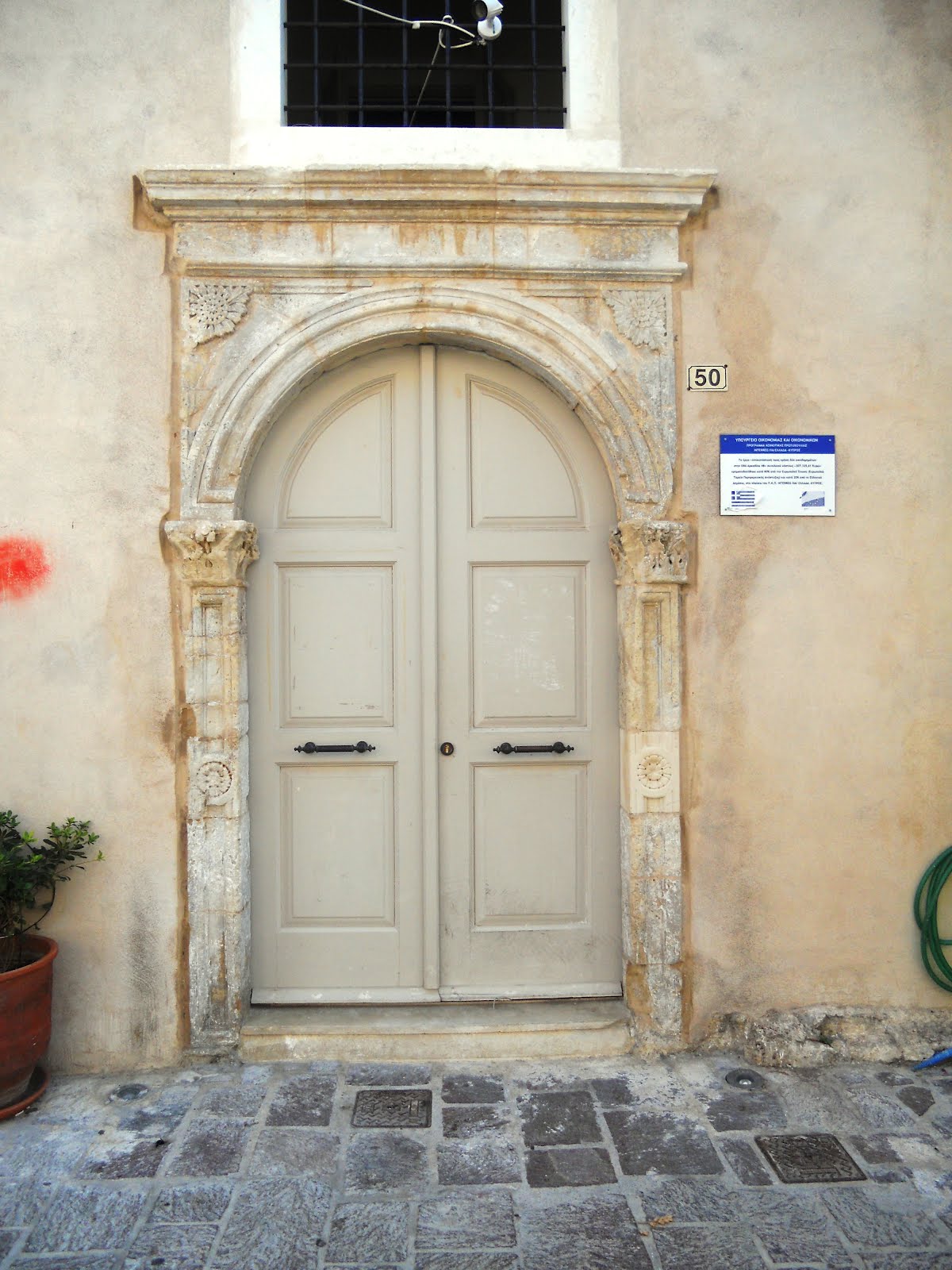
Further east along the street, Pattakou Hani at No 48 Arkadiou Street, and Botonis Hani at No 50 Arkadiou Street, date from the last years of the Venetian era. They were used as saddlers’ shops until they were bought by the Ministry of Culture, but they still await restoration.
All that remains at No 48 is doorway. It is one of the most richly decorated doorways in the old town, but is almost hidden in the corner formed by a protruding building built next door. The capitals on the jambs are Corinthian, while those on the columns are of an individualistic nature, with strong Gothic elements.
The tall doorposts end in a semicircular lintel, and the rounded triangles are filled with winged cherubim in relief. The keystone takes the rich shape of an acanthus.
Until about a century ago or perhaps even later, there was a Greek-language inscription on the frieze, and a square fanlight between the porous stone lions which are now in a ruinous condition.
No 50 Arkadiou Street may have been the most impressive small Renaissance mansion in (Photograph: Patrick Comerford, 2012)
Next door, the Botonis Hani at No 50 Arkadiou Street may once have been one of the most impressive of the small Renaissance mansions – not only in Rethymnon, but in all of Greece. This house was built in the late 16th or early 17th century.
The Turkish doorway at No 198 Arkadiou Street (Photograph: Patrick Comerford, 2012)
Back west along the street, No 198 Arkadiou Street has a Turkish doorway, with plants carved on the capitals and blossom in low relief, clearly symbolic of the alem – the symbol of the Ottoman Empire – in the rounded triangles.
The Turkish doorway at No 12 Aghia Barbara Street (Photograph: Patrick Comerford, 2012)
There is another Turkish doorway too at No 12 Aghia Barbara Street, with blossoms in the rounded triangles curving into a crescent at the bottom.
The Venetian doorframe at No 30 Vernardou Street (Photograph: Patrick Comerford, 2012)
The Venetian doorframe at No 30 Vernardou Street is one of the richest in Rethymnon, with a Latin inscription: Virtutue fulcida domus MCCIX Kal Iunii, ‘Virtue illuminates the house, Calends of June 1609.’
The doorway is unique in the town, ending with a pediment with rich carved decorations. The coat-of-arms of the Clodio family can still be seen in the in the centre of the tympanum. The remaining space is filled with leaves and flowers in relief.
The entrance to the Turkish bath or hamam at No 25 Radamanthyos Street (Photograph: Patrick Comerford, 2012)
The decaying doorway at No 25 Radamanthyos Street is closed and locked. But hidden behind it is town’s only surviving Trkish bath or hamam.
The doorway at No 47 Rhadamanthyos Street is one of the oldest in the town (Photograph: Patrick Comerford, 2012)
No 47 Rhadamanthyos Street is a fine example of plain doorposts and an arched doorway – the simplest style of doorway in Rethymnon and perhaps one of the oldest surviving doorways in the old town.
The simple doorway at No 56 Niki Foka Street (Photograph: Parick Comerford, 2012)
At No 56 Niki Foka Street, there is a simple doorway with a straight lintel .
The restored house at Nos 66 and 68 Niki Foka Street has a doorway with Corinthian pillars (Photograph: Patrick Comerford, 2012)
The restored Venetian private house at Nos 66 and 68 Niki Foka Street has a doorway with Corinthian pillars rising to well-made capitals. The two rounded triangles are filled with the heads of warriors in relief.
Part of the frieze of the classical-style composition has survived with the last three letters of a lost Latin inscription: “...lus.”
The Corinthian capitals of the doorway at No 61 Tombazi Street (Photograph: Patrick Comerford, 2012)
The capitals of the doorway at No 61 Tombazi Street are Corinthian and there are heads of warriors in relief in the triangles.
This theme, which is heraldic rather than military, helps to date the building because it first featured in Italian architecture in the late 16th century
No 12 Koronaiou Street has one of the more interesting Turkish doorways in Rethymnon (Photograph: Patrick Comerford, 2012)
The doorway at No 12 Koronaiou Street is one of the more interesting Turkish doorways in Rethymnon. It consists of pairs of jambs and columns, and is richly-decorated with plant designs. There are flower pots in the rounded triangles and above the capitals, and there is a vine with grapes in the frieze.
This kind of decoration was not common in Renaissance architecture. Instead, it shows the Turkish love of nature.
The Corinthian doorway of the Church of Saint Francis ... Rethymnon’s only example in of compound capitals (Photograph: Patrick Comerford, 2012)
The excessive decorations of the Corinthian doorway of the Church of Saint Francis could almost be described as ostentatiously vulgar. But the doorway has the only example in Rethymnon of compound capitals – one of the five orders of Italian Renaissance architecture that I referred to earlier.
The architrave is in a number of overlapping levels, and the large acanthus flower on the keystone is worked in the direction of the ground, which is worth comparing with the keystone at No 48 Arkadiou Street.
The monumental doorway at Santa Maria Church indicates the splendour of the former Augustinian church (Photograph: Patrick Comerford, 2012)
Finally, the monumental doorway at Santa Maria Church – which the Turks converted into the Nerantzes Mosque – has survived intact and is an indication of the splendour of the former Augustinian friary church.
The door may have been modelled on the style of a Roman triumphal arch, which inspired many Italian renaissance architects. A pair of columns, of semi-circular section, with Corinthian capitals, flanks the wide entrance, with tall and narrow recesses in the intervening gaps.
The semi-circular arch is supported on a pair of pillars with simple capitals, and leads up to an emphasised corbel, which takes the place of a keystone. Unlike the pillars, which have no bases of their own, the columns stand on their own plinths. Above the capitals is the entablature, with architrave, dividing band and horizontal cornice, which is not a single unit but has two small recesses above the niches.
Patrick Comerford
The streets of Rethymnon have such a rich architectural heritage that familiarity almost makes it possible to walk under Venetian archways and Ottoman kiosks or sahnisia and art noveau balconies or to pass by the doorways of once impressive mansions without casting a second glance.
The doorways and doorframes of Rethymnon are among the most characteristic features of the architecture of the old town, with their arched or straight lintels, integrated capitals, bases and cornices of porous stone, all part of the rich Renaissance heritage of this Greek island city. In no other city in Greece is it possible to see such a rich treasury of forms and decorative carving.
Much of the old town was rebuilt after the great fire of 1571, and so most of the older doorways have disappeared. Those that have survived are mainly from the last quarter of the 16th century or later. It is possible to see isolated examples of Gothic in a number of doorways, as well as the first four of the five orders of Italian Renaissance architecture – Corinthian, Ionic, Doric, Compound and Tuscan.
Details on the pillars at No 12 Tsouderon Street (Photograph: Patrick Comerford, 2012)
A few paces down from the Pepi Studios, where I was staying until the end of last week, No 12 Tsouderon Street has an impressive Venetian doorway, flanked by a pair of Doric doorposts.
Details on the pillars at No 12 Tsouderon Street (Photograph: Patrick Comerford, 2012)
The space between is filled with horizontal layers of relief showing leaves, fruit and honeycombs or honey bees.
Bees or honeycombs on the doorway at No 12 Tsouderon Street (Photograph: Patrick Comerford, 2012)
The rounded triangles are filled with slender stalks and flowers in relief, and the lintel is decorated in a similar way.
The elaborate door at No 154 Arkadiou Street, once the largest private residence in Rethymnon (Photograph: Patrick Comerford, 2012)
Around the corner from Tsouderon Street, Arkadiou Street has a rich collection of Venetian mansions and doorways. The three-story palazzo at No 154 Arkadiou Street is a Venetian building of outstanding beauty, and once the largest private residence in the old town.
The elaborate doorframe has columns extending from octagonal bases that support the architrave and the triangular pediment.
The bilingual inscription on the doorway, in both Greek and Turkish, has the date 25 November 1844 but this is clearly much later than the rest of the building, dating perhaps from renovations almost 180 years ago.
The doorway is all that remains of No 48 Arkadiou Street, yet it is one of the most richly decorated doorways in the old town (Photograph: Patrick Comerford, 2012)
Further east along the street, Pattakou Hani at No 48 Arkadiou Street, and Botonis Hani at No 50 Arkadiou Street, date from the last years of the Venetian era. They were used as saddlers’ shops until they were bought by the Ministry of Culture, but they still await restoration.
All that remains at No 48 is doorway. It is one of the most richly decorated doorways in the old town, but is almost hidden in the corner formed by a protruding building built next door. The capitals on the jambs are Corinthian, while those on the columns are of an individualistic nature, with strong Gothic elements.
The tall doorposts end in a semicircular lintel, and the rounded triangles are filled with winged cherubim in relief. The keystone takes the rich shape of an acanthus.
Until about a century ago or perhaps even later, there was a Greek-language inscription on the frieze, and a square fanlight between the porous stone lions which are now in a ruinous condition.
No 50 Arkadiou Street may have been the most impressive small Renaissance mansion in (Photograph: Patrick Comerford, 2012)
Next door, the Botonis Hani at No 50 Arkadiou Street may once have been one of the most impressive of the small Renaissance mansions – not only in Rethymnon, but in all of Greece. This house was built in the late 16th or early 17th century.
The Turkish doorway at No 198 Arkadiou Street (Photograph: Patrick Comerford, 2012)
Back west along the street, No 198 Arkadiou Street has a Turkish doorway, with plants carved on the capitals and blossom in low relief, clearly symbolic of the alem – the symbol of the Ottoman Empire – in the rounded triangles.
The Turkish doorway at No 12 Aghia Barbara Street (Photograph: Patrick Comerford, 2012)
There is another Turkish doorway too at No 12 Aghia Barbara Street, with blossoms in the rounded triangles curving into a crescent at the bottom.
The Venetian doorframe at No 30 Vernardou Street (Photograph: Patrick Comerford, 2012)
The Venetian doorframe at No 30 Vernardou Street is one of the richest in Rethymnon, with a Latin inscription: Virtutue fulcida domus MCCIX Kal Iunii, ‘Virtue illuminates the house, Calends of June 1609.’
The doorway is unique in the town, ending with a pediment with rich carved decorations. The coat-of-arms of the Clodio family can still be seen in the in the centre of the tympanum. The remaining space is filled with leaves and flowers in relief.
The entrance to the Turkish bath or hamam at No 25 Radamanthyos Street (Photograph: Patrick Comerford, 2012)
The decaying doorway at No 25 Radamanthyos Street is closed and locked. But hidden behind it is town’s only surviving Trkish bath or hamam.
The doorway at No 47 Rhadamanthyos Street is one of the oldest in the town (Photograph: Patrick Comerford, 2012)
No 47 Rhadamanthyos Street is a fine example of plain doorposts and an arched doorway – the simplest style of doorway in Rethymnon and perhaps one of the oldest surviving doorways in the old town.
The simple doorway at No 56 Niki Foka Street (Photograph: Parick Comerford, 2012)
At No 56 Niki Foka Street, there is a simple doorway with a straight lintel .
The restored house at Nos 66 and 68 Niki Foka Street has a doorway with Corinthian pillars (Photograph: Patrick Comerford, 2012)
The restored Venetian private house at Nos 66 and 68 Niki Foka Street has a doorway with Corinthian pillars rising to well-made capitals. The two rounded triangles are filled with the heads of warriors in relief.
Part of the frieze of the classical-style composition has survived with the last three letters of a lost Latin inscription: “...lus.”
The Corinthian capitals of the doorway at No 61 Tombazi Street (Photograph: Patrick Comerford, 2012)
The capitals of the doorway at No 61 Tombazi Street are Corinthian and there are heads of warriors in relief in the triangles.
This theme, which is heraldic rather than military, helps to date the building because it first featured in Italian architecture in the late 16th century
No 12 Koronaiou Street has one of the more interesting Turkish doorways in Rethymnon (Photograph: Patrick Comerford, 2012)
The doorway at No 12 Koronaiou Street is one of the more interesting Turkish doorways in Rethymnon. It consists of pairs of jambs and columns, and is richly-decorated with plant designs. There are flower pots in the rounded triangles and above the capitals, and there is a vine with grapes in the frieze.
This kind of decoration was not common in Renaissance architecture. Instead, it shows the Turkish love of nature.
The Corinthian doorway of the Church of Saint Francis ... Rethymnon’s only example in of compound capitals (Photograph: Patrick Comerford, 2012)
The excessive decorations of the Corinthian doorway of the Church of Saint Francis could almost be described as ostentatiously vulgar. But the doorway has the only example in Rethymnon of compound capitals – one of the five orders of Italian Renaissance architecture that I referred to earlier.
The architrave is in a number of overlapping levels, and the large acanthus flower on the keystone is worked in the direction of the ground, which is worth comparing with the keystone at No 48 Arkadiou Street.
The monumental doorway at Santa Maria Church indicates the splendour of the former Augustinian church (Photograph: Patrick Comerford, 2012)
Finally, the monumental doorway at Santa Maria Church – which the Turks converted into the Nerantzes Mosque – has survived intact and is an indication of the splendour of the former Augustinian friary church.
The door may have been modelled on the style of a Roman triumphal arch, which inspired many Italian renaissance architects. A pair of columns, of semi-circular section, with Corinthian capitals, flanks the wide entrance, with tall and narrow recesses in the intervening gaps.
The semi-circular arch is supported on a pair of pillars with simple capitals, and leads up to an emphasised corbel, which takes the place of a keystone. Unlike the pillars, which have no bases of their own, the columns stand on their own plinths. Above the capitals is the entablature, with architrave, dividing band and horizontal cornice, which is not a single unit but has two small recesses above the niches.
09 July 2012
What can we do about the problems in Greece this summer?
Have the wheels come off the Greek economy … or does it just need a push start? (Photograph: Patrick Comerford, 2012)
Patrick Comerford
I am just back a few days after spending eight days in Crete on a wonderful and very enjoyable holiday.
But already I am being asked questions like these:
● Is it safe to go to Greece on holidays this year?
● Is poverty visible on the streets?
● Can you notice the rise in unemployment?
● Did you see many protests?
● Did you use the banks?
I have visited Greece over 30 times since the mid-1980s; this has been my tenth or twelfth time to stay in Crete, and I have visited or stayed in Rethymnon on most of those occasions.
I can honestly say the welcome I received in the past week in Crete has been as warm as ever, friendships have been deepened, and my own sense of being comfortable there has been enhanced immensely. I never once felt a foreigner, except when friends insisted on paying for meals and then used my nationality to stop the waiters from accepting my payment.
As ever, people were curious and wanted to know why I had come to Greece this year. But when conversations carried on, it was obvious how hurt Greeks are about the present financial and political instability.
Everyone has a story about a suicide they know of, if not in their own family then among their neighbours. Many businesses, shops, hotels and restaurants I have known in the past have closed. Others are struggling with higher tax demands, trying to pay staff and pay rent while seeing custom drop rapidly.
The Pasok offices in Rethymnon … signs that the party is in freefall in a former stronghold (Photograph: Patrick Comerford, 2012)
Despite the formation of an apparently stable coalition government, the political future is uncertain. Crete has always been such a strong base for the centre-left Pasok party founded by the late Andreas Papandreou that this was the heartland of his Panhellenic Socialist Movement. But Pasok may be in freefall and the party looks like breaking up. There is considerable speculation that the remnants of the party will form a new grouping, the Democratic Party, before the end of the year.
People I know in Crete who voted consistently for either the centre-right New Democracy or the centre-left Pasok in the past voted not just once but twice this year for the new left Syriza. Other friends have expressed shock that people whose parents or grandparents suffered during the German occupation in 1941-1945 have voted for the neo-Nazi thugs in Golden Dawn.
German tourist numbers are dramatically down in Crete and throughout Greece this summer, and many of the German tourists who have come this year are genuinely sensitive and know what they love about Greece.
Greek pride is still flying high (Photograph: Patrick Comerford, 2012)
But the Germans are the main targets for blame and for fear in Greece this summer. I overheard German tourists making a ham-fisted effort to joke about paying the bill in a very fine restaurant a few evenings ago. Another waiter said, without any sense of either humour or reserve: “The Germans sent us the Nazis, we gave the world democracy, and now they want us out of Europe.”
Yet, despite all the uncertainty, the statistics show there have been fewer strikes in Greece so far this year that by this time last year, and fewer strikes in Greece than in Italy or in Spain.
The three cities I have visited during the past week or so – Rethymnon, Chania and Iraklion – are very different from Athens and Thessaloniki. They know they depend on tourism and there are fewer strikes or street protests.
Tourism cushions the local people against cuts in public spending, and there is less visible poverty on the streets – although this may be partly because beggars are routinely pushed off the streets in tourist areas, and the first victims of economic cuts in tourist areas were Albanian casual workers who have returned to Albania.
But the effect of tourism on the economy is like an efficient export industry. It brings in foreign earnings without having to pay to ship the produce. It sees foreigners buy local produce without having to export it. And it boosts the country’s balance of payments deficits.
Buy local produce … it helps the local economy (Photograph: Patrick Comerford, 2012)
So, should you go to Greece if you are thinking of a holiday there this year?
Yes.
It’s good for the local economy.
And it’s good for local people.
So, do I have any hints or tips?
Go on holiday. Greece is as welcoming and as friendly as it has ever been.
Eating out is good for tourists and is good for local business (Photograph: Patrick Comerford, 2012)
Eat out, instead of cooking for yourself in your studio or apartment. The food is good, healthy and locally produced. Eating out keeps local farmers, food producers, waiters, restaurateurs, vineyards and accountants in work.
Pay in cash. I totally agree everyone should pay their taxes, and would never advocate tax avoidance or tax evasion. But paying in cash reduces bank charges for everyone, and means wages and local producers will be paid first before German banks and pension funds.
Buy local produce. Buy in local shops and buy locally-produced goods to bring home as presents. Remember you could buy from the big multinational chains at home. If you buy from them in Greece of course you help local employment. But local manufacturers will be squeezed a little more.
Talk to people and listen to them. Greeks quickly empathise when you say you are from Ireland. They understand our problems, but they deserve understanding too. Learn from their story and their experiences. They not only feel hurt, they are hurt, and they expect and need empathy.
Travel on local buses. It’s a good way of meeting local people. The staff in the local bus stations are helpful and they go out of their way to help tourists. And people talk to you on the buses.
Talk politics, talk sport. It is polite in Greece to talk about politics. Everyone has a political opinion, and even if you don’t agree with them, talking about it assures those you meet of their place in Europe. And remember that Greeks are proud of their national team, which did better than Ireland in European football this summer.
You can keep informed and up-to-date. The Athens News looks like a tabloid, but it is a serious political and financial newspaper, published every week in English … and with remarkably good arts and culture coverage too.
Greeks speak my language when it comes to coffee … I’ve enjoyed trying to speak their language too (Photograph: Patrick Comerford, 2012)
Try to learn a little Greek. Saying Good Morning and Thank You in Greek can bring a smile to many people in Greece, and they will encourage you rather than laugh at you.
Travel out, take a local tour. There is more to Greece than the resorts. Local tour operators have short, half-day and one-day tours to local villages, monasteries, archaeological sites and neighbouring islands. You’ll meet the people, and hear their stories in context. And you’ll realise how beautiful the villages and the countryside truly are.
Greek churches are open to visitors and are open for prayer (Photograph: Patrick Comerford, 2012)
Visit churches and monasteries. Unlike many Irish churches, Greek churches tend to be open all day, and people drop in casually to pray and light a candle. Visiting Greek churches and praying in them lets local people know that we care beyond what we can say. If you go to Church on Sunday, non-Orthodox visitors will not be invited to receive Communion. But wait until the end and prayerfully receive the antidoron, the blessed bread which has not been consecrated.
The National Bank of Greece in Tsouderon Street in Rethymnon … better access than the Ulster Bank in recent weeks (Photograph: Patrick Comerford, 2012)
And don’t be afraid to use the banks. There is no need to fear a Greek exit from the Euro at the moment, and the ATM machines are working well. Use cash in shops and restaurants and for any services, and keep your plastic for the ATMS, which are easy to find on almost every street. The National Bank of Greece next door in Tsouderon Street gave me better access to my account and a better service in these recent weeks than I have received in recent weeks from the Ulster Bank, where I have had my accounts since 1970.
Is any of this going to make a difference?
If the only differences that truly matter are the differences we make to each other’s lives, then, in a word, Yes!
Patrick Comerford
I am just back a few days after spending eight days in Crete on a wonderful and very enjoyable holiday.
But already I am being asked questions like these:
● Is it safe to go to Greece on holidays this year?
● Is poverty visible on the streets?
● Can you notice the rise in unemployment?
● Did you see many protests?
● Did you use the banks?
I have visited Greece over 30 times since the mid-1980s; this has been my tenth or twelfth time to stay in Crete, and I have visited or stayed in Rethymnon on most of those occasions.
I can honestly say the welcome I received in the past week in Crete has been as warm as ever, friendships have been deepened, and my own sense of being comfortable there has been enhanced immensely. I never once felt a foreigner, except when friends insisted on paying for meals and then used my nationality to stop the waiters from accepting my payment.
As ever, people were curious and wanted to know why I had come to Greece this year. But when conversations carried on, it was obvious how hurt Greeks are about the present financial and political instability.
Everyone has a story about a suicide they know of, if not in their own family then among their neighbours. Many businesses, shops, hotels and restaurants I have known in the past have closed. Others are struggling with higher tax demands, trying to pay staff and pay rent while seeing custom drop rapidly.
The Pasok offices in Rethymnon … signs that the party is in freefall in a former stronghold (Photograph: Patrick Comerford, 2012)
Despite the formation of an apparently stable coalition government, the political future is uncertain. Crete has always been such a strong base for the centre-left Pasok party founded by the late Andreas Papandreou that this was the heartland of his Panhellenic Socialist Movement. But Pasok may be in freefall and the party looks like breaking up. There is considerable speculation that the remnants of the party will form a new grouping, the Democratic Party, before the end of the year.
People I know in Crete who voted consistently for either the centre-right New Democracy or the centre-left Pasok in the past voted not just once but twice this year for the new left Syriza. Other friends have expressed shock that people whose parents or grandparents suffered during the German occupation in 1941-1945 have voted for the neo-Nazi thugs in Golden Dawn.
German tourist numbers are dramatically down in Crete and throughout Greece this summer, and many of the German tourists who have come this year are genuinely sensitive and know what they love about Greece.
Greek pride is still flying high (Photograph: Patrick Comerford, 2012)
But the Germans are the main targets for blame and for fear in Greece this summer. I overheard German tourists making a ham-fisted effort to joke about paying the bill in a very fine restaurant a few evenings ago. Another waiter said, without any sense of either humour or reserve: “The Germans sent us the Nazis, we gave the world democracy, and now they want us out of Europe.”
Yet, despite all the uncertainty, the statistics show there have been fewer strikes in Greece so far this year that by this time last year, and fewer strikes in Greece than in Italy or in Spain.
The three cities I have visited during the past week or so – Rethymnon, Chania and Iraklion – are very different from Athens and Thessaloniki. They know they depend on tourism and there are fewer strikes or street protests.
Tourism cushions the local people against cuts in public spending, and there is less visible poverty on the streets – although this may be partly because beggars are routinely pushed off the streets in tourist areas, and the first victims of economic cuts in tourist areas were Albanian casual workers who have returned to Albania.
But the effect of tourism on the economy is like an efficient export industry. It brings in foreign earnings without having to pay to ship the produce. It sees foreigners buy local produce without having to export it. And it boosts the country’s balance of payments deficits.
Buy local produce … it helps the local economy (Photograph: Patrick Comerford, 2012)
So, should you go to Greece if you are thinking of a holiday there this year?
Yes.
It’s good for the local economy.
And it’s good for local people.
So, do I have any hints or tips?
Go on holiday. Greece is as welcoming and as friendly as it has ever been.
Eating out is good for tourists and is good for local business (Photograph: Patrick Comerford, 2012)
Eat out, instead of cooking for yourself in your studio or apartment. The food is good, healthy and locally produced. Eating out keeps local farmers, food producers, waiters, restaurateurs, vineyards and accountants in work.
Pay in cash. I totally agree everyone should pay their taxes, and would never advocate tax avoidance or tax evasion. But paying in cash reduces bank charges for everyone, and means wages and local producers will be paid first before German banks and pension funds.
Buy local produce. Buy in local shops and buy locally-produced goods to bring home as presents. Remember you could buy from the big multinational chains at home. If you buy from them in Greece of course you help local employment. But local manufacturers will be squeezed a little more.
Talk to people and listen to them. Greeks quickly empathise when you say you are from Ireland. They understand our problems, but they deserve understanding too. Learn from their story and their experiences. They not only feel hurt, they are hurt, and they expect and need empathy.
Travel on local buses. It’s a good way of meeting local people. The staff in the local bus stations are helpful and they go out of their way to help tourists. And people talk to you on the buses.
Talk politics, talk sport. It is polite in Greece to talk about politics. Everyone has a political opinion, and even if you don’t agree with them, talking about it assures those you meet of their place in Europe. And remember that Greeks are proud of their national team, which did better than Ireland in European football this summer.
You can keep informed and up-to-date. The Athens News looks like a tabloid, but it is a serious political and financial newspaper, published every week in English … and with remarkably good arts and culture coverage too.
Greeks speak my language when it comes to coffee … I’ve enjoyed trying to speak their language too (Photograph: Patrick Comerford, 2012)
Try to learn a little Greek. Saying Good Morning and Thank You in Greek can bring a smile to many people in Greece, and they will encourage you rather than laugh at you.
Travel out, take a local tour. There is more to Greece than the resorts. Local tour operators have short, half-day and one-day tours to local villages, monasteries, archaeological sites and neighbouring islands. You’ll meet the people, and hear their stories in context. And you’ll realise how beautiful the villages and the countryside truly are.
Greek churches are open to visitors and are open for prayer (Photograph: Patrick Comerford, 2012)
Visit churches and monasteries. Unlike many Irish churches, Greek churches tend to be open all day, and people drop in casually to pray and light a candle. Visiting Greek churches and praying in them lets local people know that we care beyond what we can say. If you go to Church on Sunday, non-Orthodox visitors will not be invited to receive Communion. But wait until the end and prayerfully receive the antidoron, the blessed bread which has not been consecrated.
The National Bank of Greece in Tsouderon Street in Rethymnon … better access than the Ulster Bank in recent weeks (Photograph: Patrick Comerford, 2012)
And don’t be afraid to use the banks. There is no need to fear a Greek exit from the Euro at the moment, and the ATM machines are working well. Use cash in shops and restaurants and for any services, and keep your plastic for the ATMS, which are easy to find on almost every street. The National Bank of Greece next door in Tsouderon Street gave me better access to my account and a better service in these recent weeks than I have received in recent weeks from the Ulster Bank, where I have had my accounts since 1970.
Is any of this going to make a difference?
If the only differences that truly matter are the differences we make to each other’s lives, then, in a word, Yes!
Subscribe to:
Posts (Atom)