Showing posts with label Dylan Thomas. Show all posts

31 December 2025

Daily prayer in Christmas 2025-2026:
7, Wednesday 31 December 2025,
New Year’s Eve

‘On the Seventh Day of Christmas … seven swans-a-swimming’ on the Grand Canal at Inchicore, Dublin (Photograph: Patrick Comerford)

Patrick Comerford

On the seventh day of Christmas my true love sent to me … ‘seven swans a-swimming, six geese a-laying, five golden rings, four colly birds, three French hens, two turtle doves, and a partridge in a pear tree’.

We have come to the end of December, the end of the year, the end of 2025. This is New Year’s Eve, the seventh day of Christmas and tomorrow is New Year’s Day.

Today, the Calendar of the Church of England in Common Worship remembers John Wyclif (1384), an early, pre-Reformation reformer. Before today begins, before I even begin to look back on the past year or to start thinking of any New Year’s resolutions, I am taking some quiet time this morning to give thanks, to reflect, to pray and to read in these ways:

1, today’s Gospel reading;

2, a short reflection;

3, a prayer from the USPG prayer diary;

4, the Collects and Post-Communion prayer of the day.

‘Christ in Majesty’ by Sir Ninian Comper in Southwark Cathedral, surrounded by seven doves, symbolising the seven gifts of the Holy Spirit (Photograph: Patrick Comerford)

John 1: 1-18 (NRSVA):

1 In the beginning was the Word, and the Word was with God, and the Word was God. 2 He was in the beginning with God. 3 All things came into being through him, and without him not one thing came into being. What has come into being 4 in him was life, and the life was the light of all people. 5 The light shines in the darkness, and the darkness did not overcome it.

6 There was a man sent from God, whose name was John. 7 He came as a witness to testify to the light, so that all might believe through him. 8 He himself was not the light, but he came to testify to the light. 9 The true light, which enlightens everyone, was coming into the world.

10 He was in the world, and the world came into being through him; yet the world did not know him. 11 He came to what was his own, and his own people did not accept him. 12 But to all who received him, who believed in his name, he gave power to become children of God, 13 who were born, not of blood or of the will of the flesh or of the will of man, but of God.

14 And the Word became flesh and lived among us, and we have seen his glory, the glory as of a father’s only son, full of grace and truth. 15 (John testified to him and cried out, ‘This was he of whom I said, “He who comes after me ranks ahead of me because he was before me”.’) 16 From his fullness we have all received, grace upon grace. 17 The law indeed was given through Moses; grace and truth came through Jesus Christ. 18 No one has ever seen God. It is God the only Son, who is close to the Father’s heart, who has made him known.

The Four Cardinal Virtues and the Three Theological Virtues … windows in the Church of Sant Jaume in Barcelona (Photographs: Patrick Comerford)

Today’s Reflections:

‘To begin at the beginning’ – these are the opening lines of Under Milk Wood by Dylan Thomas (1954).

Or I might begin with words from Alice in Wonderland by Lewis Carrol. In Chapter 12, the White Rabbit puts on his spectacles.

‘Where shall I begin, please your Majesty?’ he asked.

‘Begin at the beginning,’ the King said gravely, ‘and go on till you come to the end: then stop.’

TS Eliot’s ‘East Coker,’ the second of his Four Quartets, is set at the end of the year and opens:

In my beginning is my end.

It is December, and he goes on to say:

In my beginning is my end. Now the light falls
Across the open field, leaving the deep lane
Shuttered with branches, dark in the afternoon …


The opening words at the beginning of a play, a novel or a poem – or for that matter, a sermon – can be important for holding the reader’s or the listener’s attention and telling me what to expect. Begin as you mean to go on.

So it is surprising to some that Charles Dickens waits until the second sentence in David Copperfieldto say: ‘To begin my life with the beginning of my life …’

At the very end of the year, the Gospel reading at the Eucharist is the beginning of Saint John’s Gospel: ‘In the beginning was the Word, and the Word was with God, and the Word was God …’

The Christian interpretation of the song ‘The 12 Days of Christmas’ often sees the seven swans a-swimming on this day as figurative representations of the seven gifts of the Holy Spirit or the seven virtues – Wisdom, Understanding, Counsel, Fortitude, Knowledge, Piety and Fear of the Lord – or they might even represent the seven churches of the Book of Revelation.

Sir Ninian Comper’s East Window in Southwark Cathedral shows Christ in Majesty in the centre light, with the Virgin Mary on the left and Saint John the Evangelist on the right. Christ sits enthroned above the world surrounded by seven doves, symbolising the seven gifts of the Holy Spirit: Wisdom, Understanding, Counsel, Fortitude, Knowledge, Piety and Fear of the Lord.

Christ is depicted in the window as a youthful figure, with a globe or the world below his feet bearing seven stars representing the seven churches in the Book of Revelation:

• Ephesus (Revelation 2: 1-7): known for toil and not patient endurance, and separating themselves from the wicked; admonished for having abandoned their first love (2: 4).

• Smyrna (Revelation 2: 8-11): admired for its affliction and poverty; about to suffer persecution (2: 10).

• Pergamum (Revelation 2: 12-17): living where ‘Satan’s throne is; needs to repent of allowing heretics to teach (2: 16).

• Thyatira (Revelation 2: 18-29): known for its love, faith, service, and patient endurance; tolerates the teachings of a beguiling and prophet who refuses to repent (2: 20).

• Sardis (Revelation 3: 1-6): admonished for being spiritually dead, despite its reputation; told to wake up and repent (3: 2-3).

• Philadelphia (Revelation 3: 7-13): known for its patient endurance and keeping God’s word (3: 10).

• Laodicea (Revelation 3: 14-22): is neither cold nor hot, but lukewarm, called on to be earnest and repent (3: 19).

The cardinal virtues comprise a set of four virtues recognised in Classical writings and are usually paired with the three theological virtues.

The cardinal virtues are the four principal moral virtues on which all other virtues hinge: prudence, justice, fortitude, and temperance. The three theological virtues are: faith, hope and love. Together, the cardinal virtues and the theological virtues comprise what are known as the seven virtues.

Plato is the first philosopher to discuss the cardinal virtues when he discusses them in the Republic. In his Rhetoric, Aristotle writes: ‘The forms of Virtue are justice, courage, temperance, magnificence, magnanimity, liberality, gentleness, prudence, wisdom.’ Cicero, like Plato, limits the list to four virtues.

Saint Ambrose, Saint Augustine of Hippo and Saint Thomas Aquinas adapted them, and Saint Ambrose was the first to use the term ‘cardinal virtues.’

The three Theological Virtues are: Faith, Hope and Love (see I Corinthians 13).

In his King’s Speech on Christmas Day this year, King Charles pondered the state of the world today and referred to the ways of living that ‘are treasured by all the great faiths and provide us with deep wells of hope: of resilience in the face of adversity; peace through forgiveness; simply getting to know our neighbours and, by showing respect to one another, creating new friendships.

‘Indeed, as our world seems to spin ever faster, our journeying may pause, to quieten our minds – in TS Eliot’s words “At the still point of the turning world” – and allow our souls to renew.

‘In this, with the great diversity of our communities, we can find the strength to ensure that right triumphs over wrong.’

As we step into the New Year, we know that our world is a deeply uncertain place. Few of us predicted the events of the last few years – the return of Covid-19 in many new strains, a major land war in Europe, the conflicts on many fronts in the Middle East, the unresolved refugee crises, the rise of the far-right across Europe, the return of Donald Trump to a second term of office … Where shall I begin to imagine what lies ahead in 2025?

King Charles was quoting from TS Eliot’s Burnt Norton. But once again I call to mind East Coker:

O dark dark dark. They all go into the dark …
I said to my soul, be still, and let the dark come upon you
Which shall be the darkness of God …


Yet, in this apocalyptic, visionary, poem, Eliot is neither all doom nor all gloom. He talks about Faith

… pointing to the agony
Of death and birth.


And he concludes East Coker:

Old men ought to be explorers
Here and there does not matter
We must be still and still moving
Into another intensity
For a further union, a deeper communion
Through the dark cold and empty desolation,
The wave cry, the wind cry, the vast waters
Of the petrel and the porpoise. In my end is my beginning.


‘On the Seventh Day of Christmas … seven swans-a-swimming’ on the Grand Canal at Harold’s Cross, Dublin (Photograph: Patrick Comerford)

Today’s Prayers (Wednesday 31 December 2025):

The theme this week (28 December 2025 to 3 January 2026) in Pray with the World Church, the prayer diary of the Anglican mission agency USPG (United Society Partners in the Gospel), is ‘Mother and Child’ (pp 14-15). This theme was introduced on Sunday with a Programme Update by Imran Englefield, Individual Giving Manager, USPG.

The USPG Prayer Diary today (Wednesday 31 December 2025) invites us to pray:

Gracious God, we give thanks for the work of USPG over the past year. For every life touched, every family supported, and every community strengthened, we give thanks and pray that your love continues to shine throughout the world.

The Collect:

Almighty God,
who wonderfully created us in your own image
and yet more wonderfully restored us
through your Son Jesus Christ:
grant that, as he came to share in our humanity,
so we may share the life of his divinity;
who is alive and reigns with you,
in the unity of the Holy Spirit,
one God, now and for ever.

The Post-Communion Prayer:

Heavenly Father,
whose blessed Son shared at Nazareth the life of an earthly home:
help your Church to live as one family,
united in love and obedience,
and bring us all at last to our home in heaven;
through Jesus Christ our Lord.

Additional Collect:

God in Trinity,
eternal unity of perfect love:
gather the nations to be one family,
and draw us into your holy life
through the birth of Emmanuel,
our Lord Jesus Christ.

Collect on the Eve of the Naming and Circumcision of Jesus:

Almighty God,
whose blessed Son was circumcised
in obedience to the law for our sake
and given the Name that is above every name:
give us grace faithfully to bear his Name,
to worship him in the freedom of the Spirit,
and to proclaim him as the Saviour of the world;
who is alive and reigns with you,
in the unity of the Holy Spirit,
one God, now and for ever.

Happy New Year

Yesterday’s Reflections

Continued Tomorrow

The Swan … once claimed to be the oldest pub in Lichfield, but has since been turned into a restaurant and apartments (Photograph: Patrick Comerford)

Scripture quotations are from the New Revised Standard Version Bible: Anglicised Edition copyright © 1989, 1995 National Council of the Churches of Christ in the United States of America. Used by permission. All rights reserved worldwide. http://nrsvbibles.org

21 July 2025

The Fitzrovia Mural at
Whitefield Gardens shows
life in the 1970s and 1980s
on Tottenham Court Road

The Fitzrovia Mural fills a gable end facing onto the Whitefield Gardens and Tottenham Court Road (Photograph: Patrick Comerford, 2025)

Patrick Comerford

I was discussing yesterday a recent visit to the Whitefield Memorial Church and the American International Church on Tottenham Court Road, London, with the colourful food stalls lining the footpaths in front of the church.

On the south side of the church, the Fitzrovia Mural is a huge mural that fills the gable end of a building at the east end of Whitefield Road, off Tottenham Court Road and faces onto the Whitefield Gardens.

The former graveyard the Whitefield Memorial Church is now an open plaza, and has been left as an open space for the past 80 years, ever since the last V2 bomb in World War II destroyed many buildings in the area on Palm Sunday, 25 March 1945.

Today, Whitefield Gardens is a popular place to sit and relax on these sunny summer days for shoppers strolling between Euston Road and Oxford Street or between Bloomsbury and Fitzrovia and Soho and for people enjoying the fast food stalls that line the stretch of Tottenham Court Road in front of the church.

Simone the charismatic Italian waiter says the Fitzrovia Mural was painted in 1980 by Mick Jones and Simon Barber, working as the Art-Workers Co-Op (Photograph: Patrick Comerford, 2025)

The Fitzrovia Mural was commissioned by Camden Council for the Fitzrovia community and was painted in 1980 by Mick Jones and Simon Barber, working together as the Art-Workers Co-Op. It was financed by the Greater London Artists’ Association and Camden Town Council.

The two split the work between them, with Mick Jones working on the top half and Simon Barber creating the images lower down. Inspired by local life and people, as well as wider themes in the area, they took six months to plan out the mural, and another 10 weeks to execute.

They used highly-figurative, narrative, cartoon-style humour, and acknowledge the influence of the Mexican muralist Diego Rivera (1886-1957). Their work comes together as one whole cohesive work of art, with a montage of scenes frozen in time, all telling the story of this part of Central London half a century ago. All of Fitzrovia life is there, from bars and restaurants to local market workers.

There to be seen are building sites, the Post Office Tower, now the BT Tower, an angry cat, a television ad for cigarettes, footballers, and people around a table, others ironing, reading a newspaper named Tower, reading a book or writing. Here too is the Welsh poet Dylan Thomas, who lived in Fitzrovia and drank regularly in the pubs. He died in 1953, long before the mural was painted, and is seen with his wife Caitlin Macnamara (1913-1994), whose family were from Ennistymon, Co Clare.

Horace Cutler is dressed like Dracula, while Dylan Thomas sits to dinner, bills are churned out and an architect plans more buildings (Photograph: Patrick Comerford, 2025)

Horace Cutler was the leader of the Greater London Council (1977-1981) before it was abolished when Ken Livingstone was in office. The mural depicts Cutler dressed like Dracula, as though he was a vampire sucking the life out of London, dangling from a crane, pointing at Council Hall plans for skyscrapers and clutching blueprints for even more tower blocks.

There are many references to people with money riding roughshod over the common people: a greedy developer is worshipping his pile of money, which looks like a tower block; a clockwork architect on roller-skates at a drawing board churns out new plans; and a man in a fur coat reaches for a stack of bank notes with dice and cards nearby.

Office workers using early computer-like machines may be council workers or civil servants, churning out bills, rent demands and final notices.

Memories of the Middlesex Hospital, once part of life in Fitzrovia (Photograph: Patrick Comerford, 2025)

There are scenes that refer to the Middlesex Hospital, where Peter Sellers died in 1980, the same year the mural was painted, and there is a nurse holding an umbrella for a pregnant woman as she gets into an ambulance.

For 260 years, the Middlesex Hospital was part of life in central Fitzrovia, and in 1747 it was the first hospital in England to provide maternity beds. The hospital was closed in 2005, and the site has been redeveloped as office and hospitality complex, with the former hospital chapel, the Fitzrovia Chapel, at its heart.

There is an array of men and women in non-European clothes such as saris: Fitzrovia and neighbouring parts of Camden have long been home to a thriving South Asian community and some of the best Indian and Bangladeshi restaurants in London.

Fitzrovia is known for its restaurants, especially around Charlotte Street and Goodge Street. Food is well represented on the mural with diners and waiting staff. The bow-tied epicure to the right of the mural shows how the area was increasingly attracting a more affluent clientele.

There some drinkers in a pub, there is a man mixing cocktails, and there is a central section of rush-hour traffic in the rain with taxis, buses, motorbikes and a cyclist.

Rush-hour traffic in the rain on Tottenham Court Road, with taxis, buses, motorbikes and a cyclist (Photograph: Patrick Comerford, 2025)

If you click on my images, they come up in full-screen size. See if you can spot Simone the charismatic Italian waiter, an ace window-cleaner behaving like a Peeping Tom as he catches a glimpse of a woman in the shower, the disk jockey, the innocent-looking boy, or the tailor who is part of a trade that has long been part of life in the area.

Over time, the mural suffered damage and had problems with mould, bleaching from the sun, peeling paint peeling and graffiti on parts of the lower section. But the mural has been rescued and restored recently, with help from Global Street Art, and its vivid colours have been refreshed.

The Fitzrovia Mural at Whitefield Gardens on Tottenham Court Road is a short walk from Goodge Street station and it continues to offer a window onto life in the area in 1980s and earlier decades.

The Fitzrovia Mural has been refreshed and continues to offer a window onto life almost half a century ago (Photograph: Patrick Comerford, 2025)

05 June 2025

From Karl Marx to Groucho Marx,
the ‘Spirit of Soho’ is a mural with
a tour of Soho’s streets and people

The ‘Spirit of Soho’ mural on the corner of Broadwick Street and Carnaby Street in London (Photograph: Patrick Comerford, 2025)

Patrick Comerford

I was recalling yesterday the benefits of having my head in the air while I am walking on the streets of London, and contrasting the benefits of seeing art above on the walls and buildings with the risks of tripping and falling on the street below.

It had been many years since I had walked through Carnaby Street, but Charlotte and I were there last week and we took time to enjoy the ‘Spirit of Soho’, a mural on the corner of Broadwick Street and Carnaby Street.

Towering over the whole scene is a woman in an outstretched skirt that becomes all that makes Soho so full of life. This bright, colourful mural shows Soho, bordered by the shops of Oxford Street and Regent Street with the theatres of Shaftesbury Avenue bisecting it, and China Town in the bottom south-east corner.

There are tributes to the Soho of yesterday and today with a mixture the old and the new, from Ronnie Scott’s and the Gay Hussar to chain restaurants and coffee shops.

Soho was a green hunting ground favoured by royalty and the aristocracy in the 16th and 17th centuries – Soho either gave its name to or took its name from the hunting cry ‘Soho’. The hunting grounds gave way in the 18th century to grand houses that hosted parties for the fashionable and the elite in London society.

As migrants moved in, Soho was transformed with workshops and restaurants and becoming a creative hub for poets, writers, artists, designers, jewellers, and musicians – and the mural pays tribute to all of them.

The mural is on a gable end at on a street corner and faces onto Broadwick Street, a narrow street. It is filled with activity but because of its location, I had to look at it from close range and from a number of angles in an effort to see everything crowded into this creative composition.

Saint Anne holds out her skirt to give shape to a map of Soho, with its streets and lanes and their landmarks spreading out beneath her (Photograph: Patrick Comerford, 2025)

Crowning the mural is Saint Anne, who gives her name to Saint Anne’s Church in Dean Street, Soho. The Spirit of Soho has a distracted expression on her face, with a dragon entangled in her tresses and a street parade dancing down her arm, and her skirts are open, as if to let a bustle of activity tumble onto the street below.

The flame-haired Saint Anne holds out her skirt to give shape to a map of Soho, with its streets and lanes and their landmarks spreading out beneath her. Crowded together under the fruit-laden hem of her skirt is an eclectic collection of some of the musicians, craftsmen, writers and other creative people who have lived or worked in the area.

Shaftesbury Avenue and the theatres along it can be seen on her skirt, there too is Oxford Street, and one whole corner contains China Town, including the pagoda and Lee Fung supermarket. At the west fringe stands Liberty’s department store with its Tudor-style timber frame.

There is a host of pubs, restaurants and coffee shops and an overflowing abundance of fruit and vegetables. The books and magazines woven into her skirt pay tribute to the writing and publishing industries in Soho. Here too are film makers, clothes traders, recording studios and the makers of musical instrument. Dotted around are dogs and hares, harking back to the time when Soho was a royal hunting ground in the 16th and 17th centuries.

The huddled residents of Soho include Karl Marx reading Das Kapital behind Mozart’s shoulder (Photograph: Patrick Comerford, 2025)

At the bottom of the mural, a huddle of notable Soho residents and clientele includes Karl Marx (1818-1883), reading Das Kapital, behind Mozart’s shoulder, and the artist William Blake (1757-1827).

Marx lived in Dean Street in the 1850s with his family, above what became the Quo Vadis restaurant. During his time in Soho, Marx and his wife suffered the death of three of their infant children. He wrote his proposal for the Communist Manifesto in a room above the Red Lion on Great Windmill Street.

The actress and opera singer Teresa Cornelys (1723-1797) is depicted winking at her former lover, the Italian playboy Casanova (1725-1798), who in turn blows her a kiss. Her parties in the mid-1700s at her home, Carlisle House in Soho Square, were legendary, and she had a daughter Sophia during her affair with Casanova.

To the left and right are six scenes depicting cultural life in Soho. The three panels on the left feature a film animator in his studio, believed to be the late Bob Godfrey, the fashion trade, and international restaurants. The three on the right show the Palladium, Carnaby Street and Ronnie Scott’s, replete with Ronnie Scott, jazz musician George Melly (1926-2007), the poet Welsh Dylan Thomas (1914-1953) and the Irish writer Brendan Behan (1923-1964).

A green border at the bottom carries small images of Soho parish school, a dog and hare standing on a Union Jack, a Willow Pattern dish, and Soho Street Theatre. Blue plaques name the sponsors and some of the traditional trades of Soho.

A night at Ronnie Scott’s with Ronnie Scott, George Melly, Dylan Thomas and Brendan Behan (Photograph: Patrick Comerford, 2025)

The mural was created by the Soho community in 1991 and was co-ordinated by the Free Form Arts Trust, who designed and executed the work, and Alternative Arts, who co-ordinated the workshops and public programme that were part of the project.

The mural was restored in 2006 by Shaftesbury PLC and the Soho Society, and the clock was reactivated by the Lord Mayor of Westminster. Now, when the clock strikes the hour, it looks as though Karl Marx is sipping a can of Coca-Cola while Theresa Cornelys winks at Casanova and he blows kisses back to her.

In among the streets of Soho I also spotted Groucho Marx of the Marx brothers, an allusion to the Groucho Club on Dean Street … so this is a work of street art that brings us through the streets of Soho, not only from Casanova to Brendan Behan but also from Karl Marx to Groucho Mark.

• The Spirit of Soho is on the Berwick Street side of 9 Carnaby Street, Soho, London W1F 9PB. The nearest stations are Oxford Circus and Piccadilly Circus.

The Spirit of Soho is on the Berwick Street side of 9 Carnaby Street, Soho (Photograph: Patrick Comerford, 2025)

10 February 2022

The judge from a Co Clare
family who was once sacked
from ‘The Irish Times’

Drumcreehy Churchyard, near Ballyvaughan, Co Clare … the burial place of many members of the Comerford, Blake-Forster and Comyn families (Photograph: Patrick Comerford, 2022)

Patrick Comerford

During last weekend’s visit to Ballyvaughan, Co Clare, and Kinvara, Co Galway, I was searching for the mausoleum in Drumcreehy churchyard of Henry Comerford (1796-1861), JP, of Merchant’s Road, Galway, and Ballykeel House, Kilfenora, Co Clare.

Henry Comerford is buried in Drumcreehy churchyard in Bishop’s Quarter, near Ballyvaughan, overlooking Galway Bay on one side, and overlooked by the Burren on the other side.

He is buried in the Comerford mausoleum with his grandson, Captain Francis O’Donnellan Blake Forster (1853-1912), and Francis’s wife, Marcella (Johnson), the eldest daughter of Robert Johnson of Arran View, Doolin, Co Clare, and the heiress of Admiral Sir Burton Macnamara.

Marcella Comerford’s fascinating descent from the Macnama family of Ennistymon House – now the Falls Hotel in Ennistymon – led me to yesterday’s story about the distant yet fascinating family links with the Welsh poet Dylan Thomas through his wife Caitlin Macnamara.

But as I explored the stories of the Blake Forster family and other related families in this part of north Clare, I also came across some interesting stories about the Comyn family, who were intermarried on many occasions over the generations with the Macnamara family, as I pointed out yesterday, and were related too to the Comerford and Blake Forster families. And here lies another fascinating family story that also has a humorous link with The Irish Times.

Francis O’Donnellan Blake Forster died in on 27 June 1912, Marcella died on 26 June 1917, and they are buried in the Comerford mausoleum in Drumcreehy churchyard. Their daughter, Marcella Margaret (1894-1961), married Judge Michael Comyn KC (1871-1952). They met when he stood for election for Sinn Fein in 1919, and they married in 1924. He was a former civil servant, a barrister, a Fianna Fáil Senator (1928-1936) and a Circuit Court judge. When Michael died in 1952 and Marcella died in 1961, they too were buried in Drumcreehy churchyard.

They were the parents of two daughters, Marcella and Eleanor Rose. But this evening’s family tale is about their nephew, Sir James Peter Comyn (1921-1997), the Dublin-born barrister who was drummed out of The Irish Times and later became an English High Court judge.

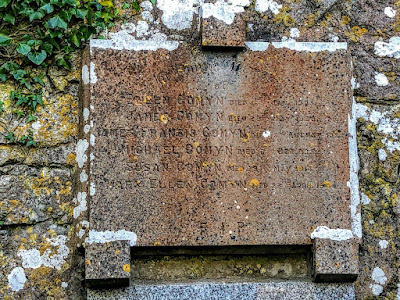
Members of the Comyn family commemorated on a plaque inside Drumcreehy Church, near Ballyvaughan, Co Clare (Photograph: Patrick Comerford, 2022)

Marcella’s husband, Michael Comyn, and his brother James Comyn were both prominent barristers and nationalists in Co Clare in the early decades of the 20th century. The two brothers were once political and legal advisers to Éamon de Valera, who at one point used James Comyn’s home in Dublin, Beaufield House, as a safe house.

However, the Comyn brothers fell out with de Valera shortly before he came to office in 1932, and Michael Comyn was passed over for appointment as Attorney-General of the Iris Free State

James Comyn’s son, Sir James Comyn, was later considered by many to be ‘the finest all-round advocate at the English bar,’ and was became a judge in the High Court of Justice in 1978, serving on the bench until he retired in 1985.

He was born at Beaufield House in Stillorgan, later the Beaufield Mews, a celebrated restaurant in south Dublin, on 8 March 1921. When the Comyn brothers fell out with Eamon de Valera, young James Comyn was taken out of school at Belvedere College in Dublin, and was sent by his father to the Oratory School in England.

He later recalled his father taking him to visit Edward Carson in London shortly before his death in 1936 and hearing from Carson’s own lips that he had never wanted partition and was still against it. He also recalled how Éamon de Valera sent for him in 1939 while he was an undergraduate at Oxford to question him on British attitudes and to suggest that he might consider joining the Irish diplomatic service.

Comyn read law at New College, Oxford. During his undergraduate days, he spent six months as a trainee journalist with The Irish Times, when RM Smyllie was the editor. However, he was obliged to abandon journalism when an obituary Comyn wrote of a cardinal concluded: ‘His Eminence was unmarried.

Comyn was demoted to the racing department. ‘God knows how you'll ever turn out, Comyn,’ said an enraged Smyllie as they eventually parted company.

At Oxford, Comyn defeated Roy Jenkins for the presidency of the Oxford Union in 1940, winning by four votes. After suffering the first of several breakdowns through his life, he briefly worked for the BBC’s Empire Service during World War II.

He was called to the English bar by the Inner Temple in 1942, the Irish Bar in 1947, and the Hong Kong Bar in 1969.

He began his pupillage in 1944 with Edward Holroyd Pearce KC, later a law lord, and joined his chambers at Fountain Court. Comyn practised in London and on the Western circuit, supplementing his earnings by teaching banking, a subject of which he knew nothing. On one occasion, he rose in Lambeth County Court to cross-examine a female defendant in an eviction case. Just as Comyn began by saying ‘Madam,’ the defendant opened her bag, took out a dead cat, and threw it at him. The judge’s reaction was to tell the defendant: ‘Madam, if you do that again, I’ll commit you.’ Comyn won the case.

Comyn took silk in 1961, and acquired a large practice as a senior, appearing in many high-profile cases. In 1964, he won damages for libel for the former safe-breaker Alfie Hinds against a Scotland Yard inspector by convincing the jury that Hinds was in fact innocent. In 1970, he successfully defended the Labour MP Will Owen, who was accused of providing information to the Czechoslovak intelligence services.

He defeated the government’s attempt in 1975 to obtain an injunction against the publication by The Times of the ‘Crossman Diaries,’ the diaries of a former minister, Richard Crossman.

Comyn was Recorder of Andover in 1964-1971, commissioner of assize for the Western Circuit in 1971, and a Recorder of the Crown Court in 1972-1977. He was elected a bencher of the Inner Temple in 1968, and chaired the Bar Council in 1973-1974.

Comyn refused an invitation by Lord Hailsham to join the bench, but was nominated again by Lord Elwyn-Jones in 1977. He was appointed a High Court judge in 1978, and was knighted. He was assigned to the Family Division, and moved to the Queen’s Bench Division in 1979. He had a reputation for leniency in sentencing, and was nicknamed ‘Probation Comyn.’

A plaque in Drumcreehy Church, near Ballyvaughan, Co Clare, commemorates Sir James Comyn (Photograph: Patrick Comerford, 2022)

Comyn presided over an unsuccessful libel action by a member of the Unification Church (‘the Moonies’) against the Daily Mailin 1980-1981, the longest libel trial in England up to that time. His Irish background made him the target of the IRA, and in 1981 the Provisional IRA burnt his house in Tara. Recurring bouts of depression led to his early retirement, on grounds of ill health, in 1985.

In retirement, he divided his time between England and Ireland, wrote a number of books, including memoirs, light verse, and books on famous trials. He also bred Friesian cattle. He died of pneumonia in Navan Hospital on 5 January 1997 at age 75, and was buried in the old family plot in Drumcreehy churchyard. He married Anne Chaundler, a solicitor, in 1967, and they were the parents of two children, Rory and Kate.

Lady Comyn died in 2018, aged 92, and she too is buried in Drumcreehy churchyard.

Sir James Comyn … once an Irish Times journalist who knew the wrath of RM Smylie

09 February 2022

Searching for more family
links in Co Clare, and finding
another link with Dylan Thomas

The Falls Hotel in Ennistymon … once the family home of the Macnamara family, who laid out the streets of Enistymon, Co Clare (Photograph: Patrick Comerford)

Patrick Comerford

In my search last weekend for some more Comerford houses and graves in Co Galway and Co Clare last weekend, I came across some distant but interesting links between the Comerfords of Kinvara and Kilfenora with the Comyn and Macnamara families of Co Clare, and stories that link the Macnamara family with Dylan Thomas, one of the greatest poets of the 20th century.

Henry Comerford (1796-1861), JP, of Merchant’s Road, Galway, and Ballykeel House, Kilfenora, Co Clare, is buried in Drumcreehy churchyard at Bishop’s Quarters, Ballyvaughan, Co Clare. His grandson, Captain Francis O’Donnellan Blake Forster (1853-1912), married Marcella Johnson (1852-1917), in Saint Andrew’s Church, Dublin, on 2 August 1879. She was the eldest daughter of Robert Johnson of Arran View, Doolin, Co Clare, and was described as the heiress of Sir Burton Macnamara.

So I started looking for the links with the Macnamara family, and came across stories about the origins of the Falls Hotel in Ennistymon, gold and silver salvaged from the Spanish Armada, and the writer from Co Clare who married the poet Dylan Thomas.

Quin Abbey, founded by the Macnamara family (Photograph: Patrick Comerford)

The Macnamara family is among the oldest families in Co Clare and they presided at the inauguration of the O’Brien Kings of Thomond. The Macnamara territory once included almost all that part of Co Clare east of the River Fergus and south of a line from Ruan to the Shannon. Those Macnamara chiefs were Lords of Clancullen, they founded Quin Abbey for the Franciscan friars, and in 1580 the family had no fewer than 42 castles in Co Clare.

The Macnamaras of Doolin and Ennistymon arrived in North Clare in the mid-17th century, when Teige Macnamara of Ballynacraggy settled in Drumcreehy (Ballyvaughan) in 1659. He married Ann Nugent and Teige and Ann were the parents of seven sons.

Their youngest son, Bartholomew Macnamara (1685-1761), was the ancestor of the Macnamaras of Doolin and Ennistymon. He married Dorothy Brock, daughter of a Mayor of Galway, and their youngest child, Ann, married Laurence Comyn of Kilcorney.

Bartholomew Macnamara was buried in the old church of Rathbourney, near Ballyvaughan. His eldest son, William Macnamara (1714-1762), married Catherine Sarsfield of Doolin, and so the Sarsfield estate eventually passed to the Macnamara family. After William Macnamara died in 1762, his widow Catherine married her second husband, Nicholas Comyn of Kilcorney, ca 1772, continuing the links with the Comyn family.

Dorothy, the youngest daughter of William and Catherine Macnamara, married her cousin David Comyn JP of Kilcorney and afterwards of Bishop’s Quarter. Their son, Peter Comyn of Scotland Lodge, New Quay, caused a political storm when he was hanged at Ennis in 1830 for burning down his house following a dispute with his landlord, Bindon Scott of Cahercon.

Francis Macnamara, the eldest son of William Macnamara and Catherine (Sarsfield), was born in Doolin in 1750. In 1774, Francis married Jane Stamer of Carnelly House, Clarecastle, grand-daughter of Christopher O’Brien of Ennistymon. Jane is said to have ruled over her husband and family with an iron fist. They built Doolin House, but in 1806 moved to Wellpark, near Galway, where he died in 1821.

Francis and Jane Macnamara were the parents of a large family, including: William Nugent Macnamara; George Macnamara; Francis Macnamara of Aran View; and Admiral Sir Burton Macnamara.

Sir Burton Macnamara, the seventh son, had a distinguished career in the Royal Navy. He took part in the Great Lakes campaign in Canada in 1812, and was present in the Ionian islands during the Greek War of Independence in the 1820s. He was a knighted in 1839. Later, he was appointed a vice-admiral, and then a full admiral of the reserve list. In the 1850s, Sir Burton bought a 732-acre estate at Tromora, near Miltown Malbay, and was a popular landlord. He married Jane Gabbett of Limerick, but they had no children.

Three weeks before his death, he had been appointed Deputy Lieutenant for Co Clare in succession to his nephew, Colonel Francis Macnamara who had died earlier that year. Sir Burton died at Merrion Square, Dublin, on 12 December 1876.

A memorial to the Spanish Armada in Spanish Point … Marcella Blake-Forster is said to have inherited gold and silver salvaged from a wreck of the Spanish Armada (Photograph: Patrick Comerford)

Sir Burton’s brother, Francis Macnamara, was given a farm at Glasha by his father and a sum of £1,000 when he married Marcella O’Flaherty from Aran. Francis and Marcella built a house at Glasha that they named Aran View. Aran View House is now a Georgian country house hotel in Doolin run by the Linnane family.

Marcella is said to have inherited fine gold and silver ornaments salvaged from a wreck of the Spanish Armada. When she died in 1856, they were inherited by her daughter Catherine Macnamara, wife of Robert Johnson JP, who married into Aran View. After Catherine’s death in 1867 the objects passed once more to her daughter – another Marcella – who married Henry Comerford’s grandson, Francis Blake-Foster of Ballykeale House near Kilfenora.

Major William Nugent Macnamara (1775-1856) was the eldest son and heir of Francis Macnamara and Jane Stamer. It was said, ‘He is a Protestant in religion a Catholic in politics, and a Milesian in descent.’ He was born at Doolin and educated at Trinity College Dublin.

Major Macnamara was a major in the Clare militia, a justice of the peace (JP) and in 1799 High Sheriff of Co Clare. He became something of a national figure after Daniel O’Connell selected him as his second in his duel with John d’Esterre in 1816. He was elected MP for Co Clare in 1830 and sat as a Liberal MP for 17 years.

He married Susannah Finucane, daughter and co-heiress of Judge Matthias Finucane (1737-1814) of Lifford House, Ennis, in 1779. Susannah’s mother, Ann O’Brien, was the only daughter of Edward O’Brien of Ennistymon House, and Ennistymon House passed to the Finucane family and later to William Nugent Macnamara’s son, Colonel Francis Macnamara, in 1843.

Major William Nugent Macnamara died in 1856 at the age of 81. His funeral in Doolin was described as the largest ever seen in Co Clare and extended for two miles.

Colonel Francis Macnamara (1802-1873), the major’s only son, was MP for Ennis (1832-1835), and High Sheriff of Co Clare (1839). When he married Helen Mc Dermott, the daughter of a Dublin solicitor, in 1860, he was 58 and she was 35. They moved into Ennistymon House in 1863 and made it their family home. He also carried out an ambitious building scheme in Ennistymon, laying out the streetscape that largely survives to this day.

The Macnamara estate extended to 15,000 acres in 1876, including large swathes of North Clare, some property near Ennis, 16 acres near Galway, and houses in Dublin, Galway, Ennis and Doolin. Francis Macnamara died in London on 26 June 1873.

Colonel Macnamara’s eldest son, Henry Valentine (Henry ‘Vee’) Macnamara (1861-1925), was educated at Harrow and Trinity College Cambridge (BA 1882). He was a justice of the peace (JP) and High Sheriff of Clare (1885). In 1883, Henry Vee married Edith Elizabeth Cooper, an Englishwoman of Australian descent who was described as ‘a formidable and capable woman who knew her rights and exercised them.’

Henry Vee lived at the height of the ‘Land War.’ In the ‘Doolin Cattle Drive’ on 22 September 1908, about 400 people watched as cattle and sheep were driven off his estate and through the streets of Lisdoonvarna. Later, 40 people appeared in court in Ennistymon.

During the War of Independence, Henry Vee and some friends were ambushed near Leamaneh Castle by the IRA in December 1919. During the Irish Civil War, a letter was sent to Henry Vee on 27 April 1922, telling him he was a ‘marked man’ and ordering him to leave Ennistymon House. Doolin House, still used as a Macnamara family holiday home, was burned down.

Henry Vee left, never to return to Ennistymon House. He died in London on 30 October 1925. By then, Ennistymon House had become a temporary barracks for the Garda Siochána.

The Cascades at Ennistymon … inspired by the Cascades, Francis Macnamara renamed Ennistymon House the Falls Hotel (Photograph: Patrick Comerford, 2022)

Henry Vee Macnamara was the father of three sons and four daughters. Francis Macnamara (1884-1946), the eldest son, was educated at Harrow and Magdalen College, Oxford. In London, he was friends with Augustus John, George Bernard Shaw and WB Yeats, and published a book of poems. In 1907, he married Yvonne Majolier (20), the daughter of a French father and an Irish mother from Co Limerick. They spent part of their honeymoon at Doolin and at Coole Park with Lady Gregory and WB Yeats.

They were the parents of a son, John, and three daughters, Nicolette, Brigit and Caitlin, and Francis was also the father of another daughter named Katherine Patricia (‘Pat’), who was part of the family all her life.

Francis owned a converted Galway hooker, Mary Anne, and is said to have sailed from Doolin to Greece with some of Augustus John’s family as crew. After 10 years of marriage, he left Yvonne and their children for Augustus John’s sister-in-law, Edie Mac Neil, and they were married in 1928.

Francis recovered Ennistymon House in the 1930s, and began to convert it into the Falls Hotel, named after the nearby cascades on the Inagh River. This project was interrupted by Edie’s death, but by 1935 Francis had married his third wife, Geraldine Iris O’Callaghan (22), daughter of Colonel George O’Callaghan-Westropp (1864-1944), a woman less than half his age.

Within a few years, Francis had given up his plans for the Falls Hotel. He moved to a small house in the grounds, and leased the hotel to the O’Regan family, parents of Brendan O’Regan, later identified with Shannon Airport and Duty Free. Francis Macnamara then moved to Dublin, finally living at Sorrento Terrace, Dalkey. He died in Dalkey on 8 March 1946.

Francis Macnamara’s eldest son, Major John Macnamara (1908-1962), married Henriette Buffard, a French woman, and they had no children. After World War II, they moved to the US, where John worked as a civil engineer until Henriette’s death in 1962. He returned to England and died within a month. With his death, the Macnamaras of Doolin and Ennistymon became extinct in the male line.

Nicolette Macnamara (1911-1987) was the eldest of Francis Macnamara’s daughters. She painted under the name Nicolette Macnamara and also wrote six books. In 1931, she married Anthony Devas, who died in 1958. Seven years later, Nicolette married the widowed Rupert Sheppard, Professor of Fine Art in Cape Town University.

Brigit Macnamara (1912-1994) was the second of Francis Macnamara’s daughters. She has been described by friends as ‘a little eccentric,’ and changed her name by deed poll from Macnamara to Marnier. Brigit, who never married, was the mother of two sons, Tobias and Edward. She died in August 1994, just days after her younger sister Caitlin.

Caitlin Macnamara (1913-1994) was the third of Francis Macnamara’s daughters. Caitlin married the Welsh poet Dylan Thomas in Penzance in 1937. They later settled at Laugharne in Carmarthenshire in the ‘Boat House’ overlooking the estuary. This was their home until Dylan Thomas died in New York in 1953 at the age of 39.

Four years after Dylan’s death, Caitlin and their children moved to Rome. There she met Giuseppe Fazio, a Sicilian, in 1957. They never married, and their son Francesco was born in 1963. They moved from Rome to Sicily and lived in a house in Catania owned by Giuseppe’s mother. Their relationship lasted four decades until they died. When Caitlin died in July 1994 at the age of 80, she was brought back to Wales and buried beside Dylan in Laugharne.

Caitlin Thomas was also a published writer. She and Dylan were the parents of two sons, Llewellyn (‘Wellie’) Edouard Thomas (1939-2000) and Colm Garan Hart Thomas (1949-2012), and a daughter Aeronwy Thomas-Ellis (1943-2009), who was a writer and poet in her own right.

After visiting the Comerford, Blake-Forster and Comyn family graves, I returned through Lisdoonvarna to Ennistymon to see the Falls Hotel and the Cascades once again, stopped for coffee in Lahinch, and then watched the sunset at the pier in Fintramore, the ancestral home of Henry Comerford near Spanish Point and Milltown Malbay.

Sunset at the pier in Fintramore, the ancestral home of Henry Comerford near Spanish Point and Milltown Malbay, Co Clare (Photograph: Patrick Comerford, 2022)

Further reading: Michael Mac Mahon, ‘The Macnamaras of Doolin & Ennistymon’, https://www.clarelibrary.ie/eolas/coclare/genealogy/don_tran/fam_his/TheMacnamarasofDoolinEnnistymon.pdf

15 August 2019

When window shopping
is simply not enough
on Charing Cross Road

Enticed and invited by the bookshops in London this week (Photograph: Patrick Comerford, 2019)

Patrick Comerford

I was staying earlier this week in the Saint Giles Hotel on Bedford Avenue in Bloomsbury, near the junction of Tottenham Court Road and Oxford Street, and around the corner from the British Museum.

This is the heart of literary London, and within a few minutes’ walking distance – if not less there are blue plaques and monuments remembering great literary figures who lived and worked in this part of London in the 19th and 20th centuries.

An unexpected plaque in Great Russell Street marks the place where Charles Kitterbell lived, as related by Charles Dickens in sketches by Boz, ‘The Bloomsbury Christening.’

Anthony Hope lived at 41 Bedford Square … and had a Comerford family connection (Photograph: Patrick Comerford, 2019)

On the south side of Bedford Square, a blue plaque at No 41 recalls that Sir Anthony Hope Hawkins (1863-1933) lived there in 1903-1917. As Anthony Hope, he was the author of The Prisoner of Zenda … and there was a distant family connection there too, for his father was the Revd Edwards Comerford Hawkins (1827-1906) of Saint Bride’s Church, Fleet Street.

On the west side of Bedford Square, Thomas Wakely (1795-1862), founder of the Lancet and Thomas Hodgkin (1798-1866), who gave the first account of Hodgkin’s Disease, have plaques, one above another, on the same wall at No 35.

TS Eliot worked with Faber and Faber at the corner of Russell Square for 40 years (Photograph: Patrick Comerford, 2019)

At the north-west corner of Russell Square, close to the University of London and the School of Oriental and African Studies, TS Eliot worked for Faber and Faber for 40 years from 1925 to 1965. The Faber Building is now part of SOAS.

But an additional pleasure earlier this week, despite the rain, was window shopping in the bookshops as I walked along Charing Cross Road.

The American writer Helene Hanff immortalised this street in 1970 with 84 Charing Cross Road, which tells of her 20-year correspondence with Frank Doel, a buyer at the antiquarian booksellers Marks & Co that began in 1949.

But long before that book, Charing Cross Road has had an interesting collection of bookshops and second-hand bookshops. Decades ago, the street was part and parcel of London’s literary scene and the book trade.

Famous bookshops on the street include Foyles at No 107, which first opened its doors in 1907.

William Foyle’s daughter Christina launched the Foyle’s Literary Luncheons in 1930. They featured speakers as diverse as HG Wells, George Bernard Shaw, Barbara Cartland, Kingsley Amis and Doris Lessing.

Legends say that in the 1950s, writers like Dylan Thomas and Auberon Waugh would emerge from basement clubs and hidden drinking places in Soho and stagger from shop to shop, scanning the heaving shelves.

Window shopping at Quinto and Francis Edwards (Photograph: Patrick Comerford, 2019)

Quinto has been selling second-hand and rare books for decades. Its labyrinthine Charing Cross Road branch moved up the street in 2010 from No 48A to No 72, and is in the basement of Francis Edwards, their rare and antiquarian booksellers dating back to 1855.

Francis Edwards has its best-known outlet in Hay-on-Wye, the ‘Town of Books.’ Quinto is in the basement at Charing Cross Road, and sells all kinds of second-hand books. They completely refresh their stock for the first Tuesday of each month so there is always something new to discover. They also buy books from people with large collections to sell, but also offer to supply books in quantity for use as props or interior decoration.

Part of this month’s stock, for example, comes from the library of Anthony Lejeune, the writer, editor and literary critic who died last year at the age of 89. Lejeune had a great taste for books, from first editions Wodehouse and Edgar Rice Burroughs to vintage crime and horror stories.

In addition to Lejeune’s library, they have a few other large buys of literature and the performing arts: books about music from the rock-n-roll and football writer Paolo Hewitt, as well as large sections on classical music and opera.

Marks and Co is long gone, but Charing Cross Road still has that special atmosphere beloved of every booklover. I spent some time window shopping at Quinto and Francis Edwards on that rainy afternoon earlier this week, and it took great determination, personal resolve and self-discipline to move on and return to my hotel.

More on offer than can be seen in the window (Photograph: Patrick Comerford, 2019)

24 April 2019

Falls Hotel in Ennistymon
holds stories of family
feuds and poets’ dreams

The Falls Hotel in Ennistymon, Co Clare, hides within its walls an 18th century mansion, a late medieval castle, and a history of four or five centuries(Photograph: Patrick Comerford, 2019)

Patrick Comerford

Nestled in a wooded vale in Co Clare beside the tumbling waters of the River Inagh in Ennistymon, it is difficult to visualise how the Falls Hotel hides within its walls an 18th century mansion, a late medieval castle, and a history of four or five centuries that tells of clans and warfare, disputes between landlords and tenants, and visiting poets, dreamers and entrepreneurs.

Ennistymon Castle may have been built ca 1560 by Sir Domhnall O’Brien, although there is a suggestion that an earlier castle may have been built by Donough MacDonall O’Conor of Corcomroe, who also built Dough Castle in nearby Lahinch.

It seems all the O’Connor properties in the area passed to Turlough O’Brien in 1582, although Ennistymon may have remained an O’Connor castle for a short time after. However, Sir Domhnall is O’Brien founded the branch of the O’Brien family at Ennistymon Castle.

Sir Domhnall was Governor of Clare in 1576 and died in 1579. His son, Sir Turlough O’Brien, became High Sheriff of Clare. Another son, also Domhnall O’Brien, was nominated as Church of Ireland Bishop of Killaloe, but never took office.

At one time, Sir Turlough O’Brien owned over 2,000 acres in the area, including the castle at Ennistymon. In 1588, at the height of the Spanish Armada, he was given permission to arrest and torture any Spaniards found in the country. On the other hand, his son Tadhg O’Brien joined the rebel forces of Red Hugh O’Donnell, and was mortally wounded after a large-scale local skirmish.

By 1619, the Earl of Thomond was recorded as holding ‘the castle, town and three quarters [about 360 acres] called Innisdyman.’

During the Confederate War, in 1645, Sir Daniel O’Brien of Ennistymon Castle was appointed to organise an exchange of prisoners with the commanders of English troops in Connacht. After that war, the Earl of Thomond leased Ennistymon Castle to Neptune Blood in 1656. Three years later it was let to Edward Fitzgerald.

Thomas Moland’s survey in 1703 describes Inishtimond as having a manor, a good castle and a two-storey house, all in good repair.

The farm of "Inishtymond" was granted in 1712 to a John O’Brien of Dublin, who was probably acting on behalf of his relative Christopher O’Brien. According to the lease, the tenant was required ‘… for the preservation of the public peace and Protestant interest … to find, set out, and maintain a man of the Protestant religion, sufficiently fitted and furnished with a horse, sword and case of pistols …’

Christopher O’Brien died in 1743 and was succeeded by his eldest surviving son, Edward O’Brien. He became a member of the Church of Ireland in 1755. In 1764, Edward O’Brien, a descendant of the original Domhnall O’Brien, demolished much of the old castle building. By the late 19th century, few traces of the castle could still be seen.

The castle was rebuilt as Ennistymon House, a Georgian-style building with large sash windows, fine panelling and rococo decoration inside. It was a two-storey, seven bay house over a basement, on a mound facing east towards the Ennistymon falls, with a central one-bay pedimented breakfront, containing a side and fan-lit front door, and a lunette above the second storey window. A yard and stabling stood some distance to the north-west.

The house passed to Ann O’Brien and her husband, Matthias Finucane, in 1792. A year later, Ann was divorced by her husband by a special Act of Parliament. But because she was deemed to be the ‘guilty party,’ Ennistymon House remained in the Finucane family.

The Cascades at Ennistymon, between the bridge and the Falls Hotel (Photograph: Patrick Comerford, 2019)

The Finucane family continued to live at Ennistymon House throughout the early 1800s. When Andrew Finucane died without heirs in 1843, the house passed to his brother-in-law, Major William Nugent Macnamara (1775-1856) of Doolin, who had married Susannah Finucane in 1798. She, in turn, was a granddaughter of Edward O’Brien, formerly of the Ennistymon House. Susannah died at the age of 39 years after giving birth to six children.

William Nugent Macnamara had a distinguished career. He was a major in the Clare Militia, a Justice of the Peace and High Sheriff of Co Clare. He was also a noted marksman and duellist, and he acted as second to Daniel O’Connell in his duel with John d’Esterre in 1816.

The Catholic Association had originally selected Major Macnamara as its candidate for the Clare byelection of 1828. However, he declined for family reasons, and it was only then that Daniel O’Connell was chosen and in turn enjoyed a famous victory that would prove a turning point in Irish history.

Major Macnamara was elected Liberal MP for Clare in 1830 and held the seat for 22 years until 1852. He was described as ‘a Protestant in religion, a Catholic in politics, and a Milesian in descent.’

Perhaps unusually for his time, Macnamara never remarried, and he died in 1856 at the age of 81. His obituary described him as ‘the poor man’s magistrate,’ and his funeral to the family vault in Doolin was one of the largest ever seen in Co Clare.

Colonel Francis Macnamara (1802-1873) was the only son and heir of William Nugent Macnamara, was born in 1802. He was a captain in the 8th Hussars and a lieutenant-colonel in the Clare Militia. He was MP for Ennis (1832-1835) and was also High Sheriff of Co Clare. His uncle was Admiral Sir Burton Macnamara, who died in 1876.

He married Helen McDermott of Dublin in 1860 and they lived between London and Ennis until 1863, when they made their home at Ennistymon House. They added a west wing to the house to accommodate guests who came to enjoy the shooting and fishing.

Colonel Francis Macnamara renovated Ennistymon House, developed parts of the town, and was responsible for giving Ennistymon its distinctive appearance. In 1876, the Macnamara estate included 15,000 statute acres in Ennistymon, Liscannor, Doolin, Fanore, Ballyvaughan and Carron, with about 700 tenants paying a yearly rent of almost £10,000.

Colonel Francis Macnamara’s eldest son, Henry Valentine Macnamara (1864-1925), was born two years before his parents moved into Ennistymon House. He was educated at Harrow and Trinity College Cambridge, where he graduated BA in 1882. He was a captain in the Royal Carmarthen Artillery Militia and later a lieutenant in the Clare Militia. He also became a justice of the peace, and High Sheriff of Clare in 1885.

In 1883 ‘Henry Vee’ (as he was commonly known) married Edith Elizabeth Cooper, an Englishwoman of Australian descent. He lived at Ennistymon House during the Land War, and relations between landlord and tenant were not always amicable. Later, during the War of Independence, Henry Vee and others were ambushed near Leamaneh Castle in 1919, and he suffered gunshot wounds to his face and arms.

Three years later, in 1922, the IRA told Henry Vee that it was ‘confiscating’ Ennistymon House. The family home in Doolin was burned to the ground. Henry Vee reluctantly left Ennistymon and never returned. He died in London in 1925 at the age of 64. A short time after Henry Macnamara left, Ennistymon House became a temporary barracks for the new police force, the Garda Siochana.

An archway off Main Street leads to the riverside walk to the Falls Hotel (Photograph: Patrick Comerford, 2019)

Henry Valentine Macnamara’s eldest son, Francis Macnamara (1884-1946), was responsible for turning Ennistymon House into a commercial property for the first time.

At an early stage in his life, he turned his back on a career in law for the bohemian lifestyle of London and in 1909 published a collection of poems, Marionettes, some inspired by his home in Ennistymon.

He secretly married Yvonne Majolier in 1911 and they lived together in London. They were the parents of a son, John Macnamara, and three daughters, Nicolette, Brigit and Caitlin.

One daughter, Nicolette Devas (1911-1987), described her unusual childhood in Two Flamboyant Fathers (1966), a memoir full of anecdotes about celebrated figures such as WB Yeats and TE Lawrence. Her sister, Caitlín (1913-1994), married the Welsh poet Dylan Thomas (1914-1953), with whom she had a fiery alcohol-fuelled relationship in London, Ireland, Wales and the USA, spending her last years in Italy.

Francis and Yvonne spent some of their honeymoon in Doolin, and returned many times with other writers and artists, including Augustus John, George Bernard Shaw, JM Synge and Oliver St John Gogarty.

The marriage of Francis and Yvonne broke down and in 1928 he married Augustus John’s sister-in-law, Edie McNeil. At the time, he had plans o turn the family home at Ennistymon House into a country hotel.

After Edie died, Francis married his third wife, Iris O’Callaghan-Westropp of O’Callaghan’s Mills, in 1936. He was then 52, some 30 years her senior, and shortly after they both returned to Ennistymon House which they opened as the Falls Hotel.

Although guests appreciated Francis Macnamara’s, generosity, his hotel management skills were unprofessional. At the end of the 1930s, he leased the hotel for five years to Brendan O’Regan, who later pioneered catering and sales services at Shannon International Airport.

O’Regan ran the hotel during World War II, and Francis and Iris moved into a small house – known as the ‘Henrun’ or the ‘Chateau’ – behind the hotel.

When Brendan O’Regan’s lease ran out, Francis decided to sell the hotel, bringing to an end an almost unbroken connection that stretched back over 400 years to the original O’Briens of Ennistymon Castle. Francis later died in 1946 at the age of 62.

The new owner of the Falls Hotel was a retired Welshman, Gerard Henry Williams-Owen, but he and his family only ran the hotel during the summer months.

When John F Wood and his wife Bridget acquired the hotel in 1955, they added a hydroelectric plant that for many years provided power to the building, and the plant can still be seen a short distance upstream, just below the cascades.

Later, John F Wood’s son Tony and his wife Meg ran the hotel for some years. The current owners of the Falls Hotel are Dan and Eileen McCarthy. The hotel has been extended and improved, and now has 150 bedrooms, a restaurant and bar, and a 400-seat conference and banqueting room.

The Cascades or the Falls are one of the finest features in Ennistymon. They can be viewed from the bridge or from the footpath walk that can be entered through the archway leading off Main Street and along the riverside walk to the Falls Hotel.

This stretch of the river, from the bridge to the deep water near the Falls Hotel, is a popular trout and salmon fishing beat, especially when the river is in flood. Favourite pools by the Cascades were known as Tuneys, the House, the Big Rock, the Salmon Hole and the Eel Hole.

The Bridge at Ennistymon is a seven-arch rubble stone road bridge built over the river ca 1790. The Board of Fisheries built a fish pass on the river in 1961 to allow salmon to migrate upstream to breed.

The Bridge at Ennistymon is a seven-arch rubble stone road bridge built over the river around 1790(Photograph: Patrick Comerford, 2019)

22 May 2014

‘And death shall have no dominion’

‘Where blew a flower may a flower no more / Lift its head to the blows of the rain’ … wisteria flowering in the rain at the Castle Golf Club in Rathfarnham this afternoon (Photograph: Patrick Comerford, 2014)

Patrick Comerford

After writing last night about Dylan Thomas and his poem Do not go gently into that good night, I was pondering another of his poems on death as a family funeral continued today.

When Dylan Thomas wrote And death shall have no dominion in 1933, he took the title of the poem from a verse in Saint Paul’s Letter to the Romans: “We know that Christ, being raised from the dead, will never die again; death no longer has dominion over him” (Romans 6: 9).

Last night, I sat in the garden long after dusk had turned to dark, watching a young bat flitting in the fading lights and listening to the flow of water from the lion’s mouth of the fountain.

As the funeral today moved between the rain and the never-to-be-realised promises of sunshine, from the church to the graveyard to a family reception in the Castle Golf Club in Rathfarnham, I contemplated the wisteria below where we were gathered, and thought of how Dylan Thomas spoke in this poem of how:

Where blew a flower may a flower no more
Lift its head to the blows of the rain;


And I thought too how in this poem the poet weaves together the deepest questions of faith and life as he wrestles with the meanings of life, death and existence.

Dylan Thomas speaks in the very male language of the 1930s. Yet, poignantly, in the 2003 movie Rosenstrasse, this poem is quoted as two Jewish women await deportation to Auschwitz.

In early 1933, Dylan Thomas became friends with Bert Trick, a grocer who worked in the Uplands area of Swansea. Trick was a would-be poet and had several poems published in local newspapers. In the spring of 1933, Trick had the idea that he and Dylan Thomas should write a poem on the subject of “immortality.”

Trick’s poem was published in a local newspaper the following year, and included the refrain “For death is not the end.”

Meanwhile, in April 1933, Dylan Thomas wrote his poem And death shall have no dominion. Trick persuaded him to seek a publisher, and the poem was published the next month (May 1933) in the New English Weekly.

On 10 September 1936, two years after the publication of his first volume of poems, 18 Poems, Dylan Thomas published Twenty-five Poems, in which he wrote about his personal beliefs and the forces of nature. The poems in that collection And death shall have no dominion.

The poem celebrates the undying and eternal strength of the human spirit. It is because of this strength that death does not claim ultimate victory over humanity. The dead are never truly lost to us but live on through the beauty of their memory and spirit. The struggle continues.

Three unrhymed verses make up the work. Beautiful universal imagery focuses on the sea, bones, and burial. Each verse starts and ends with the phrase: “And death shall have no dominion.”

Even as Dylan Thomas brings the reader face to face with the physical reality of death, he disarms it. He gives death meaning by allowing the reader to see the beauty behind it, especially the beauty of human courage and dignity. Timeless values live on in the stories of those who have died, for to live on in the memory of loved ones is to never die.

In the first verse, the poet shows that in death all are one. Race and skin colour have no more meaning when skin is no more. After death, the body is united with nature:

Dead men naked they shall be one
With the man in the wind and the west moon.


In death, we shall all be naked, as we are from our mothers’ wombs. In death, the innocence of Eden is restored. It is here that we become the stuff of legends. Here one person becomes part of a constellation, part of a grand design bigger than myself.

Though his bones are naked, they may become clothed in eternal glory instead of mortal skin:

When their bones are picked clean and the clean bones gone,
They shall have stars at elbows and foot


Their foibles will be forgotten and their glories remembered. Their confusion forgotten, they will attain an eternal perspective of clarity. Those who have drowned in a universal sea of human sorrow shall be restored and taste joy again. Lovers will be reunited:

Though they go mad they shall be sane,
Though they sink through the sea they shall rise again;
Though lovers be lost love shall not;
And death shall have no dominion.


In the second verse, Dylan Thomas takes us to a graveyard on the sea floor. The dead here appear to be either sailors or other souls lost at sea. These dead died bravely, having suffered in their lives. The wheel of time has tested, tortured, and tried, but not broken them:

Strapped to a wheel, yet they shall not break;
Faith in their hands shall snap in two,
And the unicorn evils run them through;
Split all ends up they shan’t crack;
And death shall have no dominion.


The unicorn is an old, symbolic motif often used to symbolise Christ and God. Has God or religion let these souls down? Unicorns’ horns were said to be harder than diamonds and to be able to neutralise poisons. Unicorn tears could heal both physical wounds and sorrows of the heart. The refrain And death shall have no dominion symbolises this triumph.

In the final verse, the poem wraps up on land, by the seashore. He draws out the fact that the dead are no longer aware of the physical elements that once made up their home with the words:

No more may gulls cry at their ears
Or waves break loud on the seashores
.

Yet new life may spring up in their place, an intrepid life like a flower that may “lift its head to the blows of the rain.”

Their innocence shall burst through like daisies. This innocence ultimately wins over even the sun, breaking it down. To break down the sun is to steal death’s power. The phrase “Heads of the characters hammer through daisies” implies that it is the character of those dead that hammers through the pain until innocence breaks through. The daisy flower, pure and childlike, pushes stubbornly through the hard earth of the grave to rise defiantly and bloom:

Break in the sun till the sun breaks down,
And death shall have no dominion.


The daisy blooms as dawn breaks, symbolising the burst of innocence or day star as the night loses out. In the same way, death starts to lose its power as humanity regains purity and embraces hope, thus discarding pain and hate. To break in implies breaking in a horse until it serves the master, instead of the other way around. In this way, death can be made to serve humanity.

Listening to the water spouting from the lion’s mouth in the fountain in the garden last night (Photograph: Patrick Comerford, 2014)

And death shall have no dominion

And death shall have no dominion.
Dead man naked they shall be one
With the man in the wind and the west moon;
When their bones are picked clean and the clean bones gone,
They shall have stars at elbow and foot;
Though they go mad they shall be sane,
Though they sink through the sea they shall rise again;
Though lovers be lost love shall not;
And death shall have no dominion.

And death shall have no dominion.
Under the windings of the sea
They lying long shall not die windily;
Twisting on racks when sinews give way,
Strapped to a wheel, yet they shall not break;
Faith in their hands shall snap in two,
And the unicorn evils run them through;
Split all ends up they shan’t crack;
And death shall have no dominion.

And death shall have no dominion.
No more may gulls cry at their ears
Or waves break loud on the seashores;
Where blew a flower may a flower no more
Lift its head to the blows of the rain;
Though they be mad and dead as nails,
Heads of the characters hammer through daisies;
Break in the sun till the sun breaks down,
And death shall have no dominion.