Saint John the Baptist with his parents, Saint Zechariah and Saint Elizabeth, in a mosaic at the Monastery of Saint John the Baptist in Tolleshunt Knights, Essex (Photograph: Patrick Comerford)
Patrick Comerford
We are drawing near to the end of Advent and tomorrow is Christmas Eve. Later this morning I am involved in Santa’s visit to the Christmas Fayre and Farmers’ Market in Stoy Stratford. But, before today begins, I am taking some quiet time this morning to give thanks, to reflect, to pray and to read in these ways:
1, today’s Gospel reading;
2, a short reflection;
3, a prayer from the USPG prayer diary;
4, the Collects and Post-Communion prayer of the day.
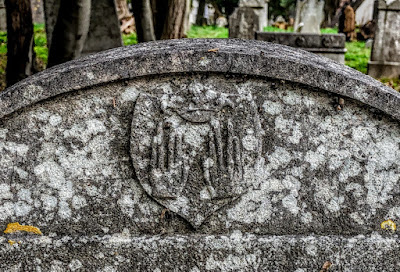
A priest’s hands raised for the blessing of the cohanim … a gravestone in the new Jewish cemetery on the Lido in Venice (Photograph: Patrick Comerford)
Luke 1: 57-66 (NRSVA):
57 Now the time came for Elizabeth to give birth, and she bore a son. 58 Her neighbours and relatives heard that the Lord had shown his great mercy to her, and they rejoiced with her.
59 On the eighth day they came to circumcise the child, and they were going to name him Zechariah after his father. 60 But his mother said, ‘No; he is to be called John.’ 61 They said to her, ‘None of your relatives has this name.’ 62 Then they began motioning to his father to find out what name he wanted to give him. 63 He asked for a writing-tablet and wrote, ‘His name is John.’ And all of them were amazed. 64 Immediately his mouth was opened and his tongue freed, and he began to speak, praising God. 65 Fear came over all their neighbours, and all these things were talked about throughout the entire hill country of Judea. 66 All who heard them pondered them and said, ‘What then will this child become?’ For, indeed, the hand of the Lord was with him.
Dreidels in a synagogue in Prague, part of children’s games at Hanukkah … did John the Baptist and Jesus spin dredels together at Hanukkah? (Photograph: Patrick Comerford)
Today’s Reflections:
In the Gospel reading at the Eucharist today (Luke 1: 57-66), we continue a series of readings before Christmas that draw on the two nativity narratives found in Matthew 1: 1-24 and Luke 1: 5-79.
During the week before Christmas, the great canticle Magnificat at Evensong traditionally has a refrain or antiphon attached to it proclaiming the ascriptions or ‘names’ given to God through the Old Testament. Each name develops into a prophecy of the coming of the Messiah.
O Sapientia, or O Wisdom, is the first of these days, and was marked on Wednesday (17 December). It was followed on Thursday (18 December) by O Adonai, by O Root of Jesse on Friday (19 December), O Key of David on Saturday (20 December), O Dayspring on Sunday (21 December), O King of the Nations yesterday (22 December), and, finally O Emmanuel today (23 December).
The seven majestic Messianic titles for Christ are based on Biblical prophecies, and they help the Church to recall the variety of the ills of humanity before the coming of the Redeemer as each antiphon in turn pleads with mounting impatience for Christ to save his people.
The Gospel reading at the Eucharist today (Luke 1: 57-66) continues on from the story of the Visitation of the Virgin Mary to her cousin Saint Elizabeth, with the only Gospel account of the birth, circumcision and naming of Saint John the Baptist.
Zechariah (זְכַרְיָה or Ζαχαρίας), also named in translations as Zacharias, Zachariah and Zachary, the husband of Elizabeth and the father of John the Baptist, is a priest, one of the cohanim descended from the sons of Aaron. Origen suggests that the Zechariah mentioned in Matthew 23: 35 as being killed between the temple and the altar may be the father of John the Baptist.
His name means ‘remember Yah’ or ‘remember God’ or ‘God remembers’. There are several Biblical figures with the name, including the Prophet Zachariah in Judah, a martyred son of a high priest, a king who reigned in Judah for six months, and several minor characters.
On the other hand, the Greek name Ἰωάννης (Ioannes) is a rendering of the Hebrew name Yohanan (יוֹחָנָן), a shorter form of the name Yəhôḥānān (יְהוֹחָנָן), which means ‘God is gracious’.
In the Hebrew Bible, Yohanan was the son of King Josiah of Judah (7th century BCE); Yohanan, son of Kareah, was a leader of the army who led the remnant of the population of Judah to Egypt for safety after the Babylonian dismantling of the kingdom in 586 BCE; Yohanan ben Yehoyada is a high priest named in the Book of Nehemiah and was the fourth in the line of high priests after Joshua the High Priest, who returned from the Babylonian captivity with Zerubbabel.
During the Hasmonean or Maccabean period, Yohanan was the father of Matityahu; John Gaddi, the eldest of the sons of Mattathias and brother of Judas Maccabeus, was one of the leaders of the revolt of the Maccabees in the 2nd century BCE; John Hyrcanus was a Maccabean leader and Jewish high priest from 134 BCE until his death in 104 BCE; and John Hyrcanus II (1st century BCE) was a member of the Hasmonean dynasty, High Priest, King, and ethnarch of Judea.
So, the name John, in its variant forms, was both a priestly and a royal name, and was associated with the leaders of resistance to occupation and resistance.
In idle moments, I sometimes wonder whether Jesus and John grew up knowing each other.
Did Mary and Joseph regularly visit Zechariah and Elizabeth?
Was Zechariah present as a priest in the Temple at the Presentation, or when the teenage Jesus was lost in the Temple?
Did Jesus and John send birthday greetings to one another?
Did they go to each other’s bar mitzvah?
Did they celebrate and major holidays of Holy Days together … Purim, Passover, Shavuot, Sukkot, Rosh Hashanah, Yom Kippur, Simchat Torah, Hanukkah … ?
Did they dress up together at Purim?
Did they spin dreidels with each other and play games together at Hanukkah? – Incidentally, yesterday (Monday) was the last day of Hanukkah this year, but Christmas Day and the first day of Hanukkah fell on the same day last year, for the first time in 19 years.
Did John the Baptist ever take up his duties and responsibilities as a priest in the Temple before going out into the Wilderness?
Was he in the Temple when Jesus visited, healed, taught, debated Caesar’s coins, or overturned the tables of the moneychangers?
Did John offer Jesus the priestly blessing that the cohanim alone impart?
The priestly blessing (Numbers 6: 24-26) that Zechariah and John would have pronounced, with their hands outstretched in the traditional way, is:
May the Lord bless and protect you.
May the Lord make his face shine on you and be gracious to you
May the Lord turn his face toward you, and give you peace.
The Priestly Blessing (ברכת כהנים, birkat cohanim) is known in rabbinic literature as raising the hands or rising to the platform because the blessing is given from a raised rostrum.
The Jewish Sages stressed that although the priests are the ones carrying out the blessing, it is not them or the ceremonial practice of raising their hands that results in the blessing, but rather it is God’s desire that his blessing should be symbolised by the hands of the cohanim.
The former Chief Rabbi, the late Lord (Jonathan) Sacks, says the Torah explicitly says that while the cohanim say the words, it is God who sends the blessing: ‘When the cohanim bless the people, they are not doing anything in and of themselves. Instead they are acting as channels through which God’s blessing flows into the world and into our lives.’
He adds, ‘Only love does this. Love means that we are focused not on ourselves but on another. Love is selflessness. And only selflessness allows us to be a channel through which flows a force greater than ourselves, the love that as Dante said, “moves the sun and the other stars”, the love that brings new life into the world.’
Hands raised in the priestly blessing on a gravestone in the Jewish cemetery in Kraków (Photograph: Patrick Comerford)
Today’s Prayers (Tuesday 23 December 2025):
The theme this week (21 to 27 December 2025) in Pray with the World Church, the prayer diary of the Anglican mission agency USPG (United Society Partners in the Gospel), is ‘Love Brings Life in Tanzania’ (pp 12-13). This theme was introduced on Sunday with a Programme Update by Imran Englefield, Individual Giving Manager, USPG.
The USPG Prayer Diary today (Tuesday 23 December 2025) invites us to pray:
Gracious Lord, we give thanks for the success of the Prevention of Mother-to-Child Transmission programme. Strengthen those who care, comfort those who suffer, and let hope, healing, and life flourish in this place.
The Collect:
God our redeemer,
who prepared the Blessed Virgin Mary
to be the mother of your Son:
grant that, as she looked for his coming as our saviour,
so we may be ready to greet him
when he comes again as our judge;
who is alive and reigns with you,
in the unity of the Holy Spirit,
one God, now and for ever.
The Post-Communion Prayer:
Heavenly Father,
who chose the Blessed Virgin Mary
to be the mother of the promised saviour
:
fill us your servants with your grace,
that in all things we may embrace your holy will
and with her rejoice in your salvation;
through Jesus Christ our Lord.
Additional Collect:
Eternal God,
as Mary waited for the birth of your Son,
so we wait for his coming in glory;
bring us through the birth pangs of this present age
to see, with her, our great salvation
in Jesus Christ our Lord.
Yesterday’s Reflections
Continued Tomorrow
Hands raised in the priestly blessing on a Holocaust memorial in Berlin (Photograph: Patrick Comerford)
Scripture quotations are from the New Revised Standard Version Bible: Anglicised Edition copyright © 1989, 1995 National Council of the Churches of Christ in the United States of America. Used by permission. All rights reserved worldwide. http://nrsvbibles.org
Showing posts with label Hanukkah. Show all posts
23 December 2025
Daily prayer in Advent 2025:
24, Tuesday 23 December 2025
Labels:
Advent 2025,
Berlin,
Christmas 2025,
Hanukkah,
Kraków,
Lido,
Mission,
Prague,
Prayer,
Saint John the Baptist,
Saint Luke's Gospel,
Stony Stratford,
Tanzania,
Tolleshunt Knights,
USPG,
Venice
22 December 2025
Daily prayer in Advent 2025:
23, Monday 22 December 2025
An image of the Virgin Mary in a quiet corner at the High Leigh Conference Centre in Hoddesdon, Hertfordshire (Photograph: Patrick Comerford)
Patrick Comerford
We are in the final days of the Season of Advent, yesterday was the Fourth Sunday of Advent (Advent IV, 21 December 2025), today is the last of the eight days of Hanukkah this year, and Christmas Day is just a few days away.
Before today begins, I am taking some quiet time this morning to give thanks, to reflect, to pray and to read in these ways:
1, today’s Gospel reading;
2, a short reflection;
3, a prayer from the USPG prayer diary;
4, the Collects and Post-Communion prayer of the day.
The words of the canticle Magnificat carved on a wooden screen in Mount Melleray Abbey, Cappoquin, Co Waterford (Photograph: Patrick Comerford)
Luke 1: 46-56 (NRSVA):
46 And Mary said,
‘My soul magnifies the Lord,
47 and my spirit rejoices in God my Saviour,
48 for he has looked with favour on the lowliness of his servant.
Surely, from now on all generations will call me blessed;
49 for the Mighty One has done great things for me,
and holy is his name.
50 His mercy is for those who fear him
from generation to generation.
51 He has shown strength with his arm;
he has scattered the proud in the thoughts of their hearts.
52 He has brought down the powerful from their thrones,
and lifted up the lowly;
53 he has filled the hungry with good things,
and sent the rich away empty.
54 He has helped his servant Israel,
in remembrance of his mercy,
55 according to the promise he made to our ancestors,
to Abraham and to his descendants for ever.’
56 And Mary remained with her for about three months and then returned to her home.
The Virgin Mary with the Crown of Thorns depicted in a church window in Bansha, Co Tipperary (Photograph: Patrick Comerford)
Today’s Reflections:
In the Gospel reading at the Eucharist today (Luke 1: 46-56), we continue a series of readings before Christmas that draw on the two nativity narratives found in Matthew 1: 1-24 and Luke 1: 5-79.
During the days before Christmas, the great canticle Magnificat at Evensong traditionally has a refrain or antiphon attached to it proclaiming the ascriptions or ‘names’ given to God through the Old Testament. Each name develops into a prophecy of the coming of the Messiah.
O Sapientia, or O Wisdom, is the first of these days, and was marked on Wednesday (17 December). It was followed on Thursday (18 December) by O Adonai, by O Root of Jesse on Friday (19 December), O Key of David on Saturday (20 December), O Dayspring yesterday (21 December), and by O King of the Nations today (22 December), and, finally O Emmanuel tomorrow (23 December).
The seven majestic Messianic titles for Christ are based on Biblical prophecies, and they help the Church to recall the variety of the ills of humanity before the coming of the Redeemer as each antiphon in turn pleads with mounting impatience for Christ to save his people.
The Gospel reading at the Eucharist today is set withing the story of the Visitation of the Virgin Mary to her cousin Saint Elizabeth.
This Advent has been a time of waiting, a time of preparation, a time of anticipation. Since 30 November, in our time of waiting, preparation and anticipation, we have been preparing ourselves in the liturgy and the music, with carol services and quiet days, with Christmas Markets and Santa’s grotto, with the Advent Wreath and the Crib.
The four candles on the Advent wreath have reminded us, week-after-week, of those who prepared us in the past for the Coming of the Christ Child: first the Patriarchs and Matriarchs, our ancestors in faith, including Abraham and Sarah, Isaac and Jacob; then the prophets, including Isaiah, Jeremiah, and Micah; then Saint John the Baptist; and yesterday, the fourth and final candle reminded us of the Virgin Mary. This fourth candle connects with the Gospel reading yesterday, telling the story of Joseph’s response to Mary’s pregnancy, and today’s reading from the Canticle Magnificat (Luke 1: 46-55), so often heard at Evening Prayer.
The great German theologian and martyr, Dietrich Bonhoeffer (1906-1945), in an Advent sermon in London 92 years ago (17 December 1933), said Magnificat ‘is the oldest Advent hymn,’ and he spoke of how Mary knows better than anyone else what it means to wait for Christ’s coming:
‘In her own body she is experiencing the wonderful ways of God with humankind: that God does not arrange matters to suit our opinions and views, does not follow the path that humans would like to prescribe. God’s path is free and original beyond all our ability to understand or to prove.’
The Virgin Mary of the Visitation and of the canticle Magnificat is a strong and revolutionary woman, unlike the Virgin Mary of the plaster-cast statues and the Rosary.
The Mary I see as a role model for belief and discipleship is the Mary who sets off in a hurry and a flurry to visit her cousin Elizabeth, the Mary with a gob on her who speaks out of turn when she comes out with those wonderful words we hear in this Gospel reading, the Mary who sings the Canticle Magnificat.
This Mary is a wonderful, feisty person. She is what the red-top tabloid newspapers today might describe ‘a gymslip Mum.’ But, instead of hiding herself away from her family, from her cousins, from the woman in her family who is married to a priest, she rushes off to her immediately, to share her good news with her.
And she challenges so many of our prejudices and our values and our presumptions today. Not just about gymslip mums and unexpected or unplanned pregnancies, but about what the silent and the marginalised have to say about our values in society today.
And Mary declares:
He has shown strength with his arm;
he has scattered the proud in the thoughts of their hearts.
He has brought down the powerful from their thrones,
and lifted up the lowly;
he has filled the hungry with good things,
and sent the rich away empty.
He has helped his servant Israel,
in remembrance of his mercy,
according to the promise he made to our ancestors,
to Abraham and to his descendants for ever.’
It is almost like this is the programme or the agenda we can expect when the Christ Child is born, a programme and agenda that the world so desparately needs to hear the promise of today.
An icon of the Virgin Mary in an antique shop in Rethymnon (Photograph: Patrick Comerford)
Today’s Prayers (Monday 22 December 2024):
The theme this week (21 to 27 December 2025) in Pray with the World Church, the prayer diary of the Anglican mission agency USPG (United Society Partners in the Gospel), is ‘Love Brings Life in Tanzania’ (pp 12-13). This theme was introduced yesterday with a Programme Update by Imran Englefield, Individual Giving Manager, USPG.
The USPG Prayer Diary today (Monday 22 December 2025) invites us to pray:
Loving God, we give thanks for Dr Chalinzee and his devoted service at Mvumi Hospital. Strengthen him with wisdom, patience, and compassion as he cares for mothers and children.
The Collect:
God our redeemer,
who prepared the Blessed Virgin Mary
to be the mother of your Son:
grant that, as she looked for his coming as our saviour,
so we may be ready to greet him
when he comes again as our judge;
who is alive and reigns with you,
in the unity of the Holy Spirit,
one God, now and for ever.
The Post-Communion Prayer:
Heavenly Father,
who chose the Blessed Virgin Mary
to be the mother of the promised saviour:
fill us your servants with your grace,
that in all things we may embrace your holy will
and with her rejoice in your salvation;
through Jesus Christ our Lord.
Additional Collect:
Eternal God,
as Mary waited for the birth of your Son,
so we wait for his coming in glory;
bring us through the birth pangs of this present age
to see, with her, our great salvation
in Jesus Christ our Lord.
Yesterday’s Reflections
Continued Tomorrow
Scripture quotations are from the New Revised Standard Version Bible: Anglicised Edition copyright © 1989, 1995 National Council of the Churches of Christ in the United States of America. Used by permission. All rights reserved worldwide. http://nrsvbibles.org
Patrick Comerford
We are in the final days of the Season of Advent, yesterday was the Fourth Sunday of Advent (Advent IV, 21 December 2025), today is the last of the eight days of Hanukkah this year, and Christmas Day is just a few days away.
Before today begins, I am taking some quiet time this morning to give thanks, to reflect, to pray and to read in these ways:
1, today’s Gospel reading;
2, a short reflection;
3, a prayer from the USPG prayer diary;
4, the Collects and Post-Communion prayer of the day.
The words of the canticle Magnificat carved on a wooden screen in Mount Melleray Abbey, Cappoquin, Co Waterford (Photograph: Patrick Comerford)
Luke 1: 46-56 (NRSVA):
46 And Mary said,
‘My soul magnifies the Lord,
47 and my spirit rejoices in God my Saviour,
48 for he has looked with favour on the lowliness of his servant.
Surely, from now on all generations will call me blessed;
49 for the Mighty One has done great things for me,
and holy is his name.
50 His mercy is for those who fear him
from generation to generation.
51 He has shown strength with his arm;
he has scattered the proud in the thoughts of their hearts.
52 He has brought down the powerful from their thrones,
and lifted up the lowly;
53 he has filled the hungry with good things,
and sent the rich away empty.
54 He has helped his servant Israel,
in remembrance of his mercy,
55 according to the promise he made to our ancestors,
to Abraham and to his descendants for ever.’
56 And Mary remained with her for about three months and then returned to her home.
The Virgin Mary with the Crown of Thorns depicted in a church window in Bansha, Co Tipperary (Photograph: Patrick Comerford)
Today’s Reflections:
In the Gospel reading at the Eucharist today (Luke 1: 46-56), we continue a series of readings before Christmas that draw on the two nativity narratives found in Matthew 1: 1-24 and Luke 1: 5-79.
During the days before Christmas, the great canticle Magnificat at Evensong traditionally has a refrain or antiphon attached to it proclaiming the ascriptions or ‘names’ given to God through the Old Testament. Each name develops into a prophecy of the coming of the Messiah.
O Sapientia, or O Wisdom, is the first of these days, and was marked on Wednesday (17 December). It was followed on Thursday (18 December) by O Adonai, by O Root of Jesse on Friday (19 December), O Key of David on Saturday (20 December), O Dayspring yesterday (21 December), and by O King of the Nations today (22 December), and, finally O Emmanuel tomorrow (23 December).
The seven majestic Messianic titles for Christ are based on Biblical prophecies, and they help the Church to recall the variety of the ills of humanity before the coming of the Redeemer as each antiphon in turn pleads with mounting impatience for Christ to save his people.
The Gospel reading at the Eucharist today is set withing the story of the Visitation of the Virgin Mary to her cousin Saint Elizabeth.
This Advent has been a time of waiting, a time of preparation, a time of anticipation. Since 30 November, in our time of waiting, preparation and anticipation, we have been preparing ourselves in the liturgy and the music, with carol services and quiet days, with Christmas Markets and Santa’s grotto, with the Advent Wreath and the Crib.
The four candles on the Advent wreath have reminded us, week-after-week, of those who prepared us in the past for the Coming of the Christ Child: first the Patriarchs and Matriarchs, our ancestors in faith, including Abraham and Sarah, Isaac and Jacob; then the prophets, including Isaiah, Jeremiah, and Micah; then Saint John the Baptist; and yesterday, the fourth and final candle reminded us of the Virgin Mary. This fourth candle connects with the Gospel reading yesterday, telling the story of Joseph’s response to Mary’s pregnancy, and today’s reading from the Canticle Magnificat (Luke 1: 46-55), so often heard at Evening Prayer.
The great German theologian and martyr, Dietrich Bonhoeffer (1906-1945), in an Advent sermon in London 92 years ago (17 December 1933), said Magnificat ‘is the oldest Advent hymn,’ and he spoke of how Mary knows better than anyone else what it means to wait for Christ’s coming:
‘In her own body she is experiencing the wonderful ways of God with humankind: that God does not arrange matters to suit our opinions and views, does not follow the path that humans would like to prescribe. God’s path is free and original beyond all our ability to understand or to prove.’
The Virgin Mary of the Visitation and of the canticle Magnificat is a strong and revolutionary woman, unlike the Virgin Mary of the plaster-cast statues and the Rosary.
The Mary I see as a role model for belief and discipleship is the Mary who sets off in a hurry and a flurry to visit her cousin Elizabeth, the Mary with a gob on her who speaks out of turn when she comes out with those wonderful words we hear in this Gospel reading, the Mary who sings the Canticle Magnificat.
This Mary is a wonderful, feisty person. She is what the red-top tabloid newspapers today might describe ‘a gymslip Mum.’ But, instead of hiding herself away from her family, from her cousins, from the woman in her family who is married to a priest, she rushes off to her immediately, to share her good news with her.
And she challenges so many of our prejudices and our values and our presumptions today. Not just about gymslip mums and unexpected or unplanned pregnancies, but about what the silent and the marginalised have to say about our values in society today.
And Mary declares:
He has shown strength with his arm;
he has scattered the proud in the thoughts of their hearts.
He has brought down the powerful from their thrones,
and lifted up the lowly;
he has filled the hungry with good things,
and sent the rich away empty.
He has helped his servant Israel,
in remembrance of his mercy,
according to the promise he made to our ancestors,
to Abraham and to his descendants for ever.’
It is almost like this is the programme or the agenda we can expect when the Christ Child is born, a programme and agenda that the world so desparately needs to hear the promise of today.
An icon of the Virgin Mary in an antique shop in Rethymnon (Photograph: Patrick Comerford)
Today’s Prayers (Monday 22 December 2024):
The theme this week (21 to 27 December 2025) in Pray with the World Church, the prayer diary of the Anglican mission agency USPG (United Society Partners in the Gospel), is ‘Love Brings Life in Tanzania’ (pp 12-13). This theme was introduced yesterday with a Programme Update by Imran Englefield, Individual Giving Manager, USPG.
The USPG Prayer Diary today (Monday 22 December 2025) invites us to pray:
Loving God, we give thanks for Dr Chalinzee and his devoted service at Mvumi Hospital. Strengthen him with wisdom, patience, and compassion as he cares for mothers and children.
The Collect:
God our redeemer,
who prepared the Blessed Virgin Mary
to be the mother of your Son:
grant that, as she looked for his coming as our saviour,
so we may be ready to greet him
when he comes again as our judge;
who is alive and reigns with you,
in the unity of the Holy Spirit,
one God, now and for ever.
The Post-Communion Prayer:
Heavenly Father,
who chose the Blessed Virgin Mary
to be the mother of the promised saviour:
fill us your servants with your grace,
that in all things we may embrace your holy will
and with her rejoice in your salvation;
through Jesus Christ our Lord.
Additional Collect:
Eternal God,
as Mary waited for the birth of your Son,
so we wait for his coming in glory;
bring us through the birth pangs of this present age
to see, with her, our great salvation
in Jesus Christ our Lord.
Yesterday’s Reflections
Continued Tomorrow
Scripture quotations are from the New Revised Standard Version Bible: Anglicised Edition copyright © 1989, 1995 National Council of the Churches of Christ in the United States of America. Used by permission. All rights reserved worldwide. http://nrsvbibles.org
Labels:
Advent 2025,
Bansha,
Bonhoeffer,
Canticles,
Cappoquin,
Christmas 2025,
Crete 2025,
Greece 2025,
Hanukkah,
High Leigh,
Icons,
Mission,
Mount Melleray,
Prayer,
Rethymnon,
Saint Luke's Gospel,
Tanzania,
USPG
19 December 2025
A reminder that even in darkness
resilience and hope can shine and
bring light into the darkest places
The Chanukiah from the Jewish Museum at the Museum of the Home in London yesterday (Photograph: Patrick Comerford, 2025)
Patrick Comerford
We had intended to go to the Chanukah lighting ceremony in Bletchley Park last Sunday. But circumstances changed last weekend, events caught up with us, and we never got there along with a friend who was visiting us. Then, as Sunday afternoon unfolded, any intentions, any plans, or any notions of being in Bletchley were forgotten as news broke of the attack at Bondi Beach in Sydney, which has become a tragedy for Jewish communities around the world.
Chanukah continues until next Sunday evening. But this year it has become an especially personally poignant and deeply painful Chanukah for many people in England, with the Bondi Beach attack coming so soon after the attack on the Heaton Park Synagogue in Manchester. It is a stark reminder too that antisemitism is a global threat and of how widespread and dangerous hatred has become.
It was an act of violence that highlights the urgent need for all to unite against hatred and to continue collectively all efforts to pursue safety, tolerance, and understanding. But Chanukah symbolises hope, perseverance and endurance, a reminder that even in darkness, resilience and hope can shine the brightest, and for many it is a challenge to bring light into even the darkest times and places.
Having missed the lighting of the Chanukiah in Bletchley Park last Sunday evening, we found ourselves unexpectedly with an opportunity to join a celebration of Chanukah in London yesterday in a collaboration between the Jewish Museum and the Museum of the Home.
After lighting five of the the candles and reciting the blessings we sang the first verse of Ma’oz Tzur (מָעוֹז צוּר) a liturgical poem or piyyut in Hebrew sung at Hanukkah after lighting the festival lights:
My Refuge, my Rock of Salvation!
’Tis pleasant to sing your praises.
Let our house of prayer be restored.
And there we will offer you our thanks.
When you will have slaughtered the barking foe.
Then we will celebrate with song and psalm
the altar’s dedication.
It is a hymn that tells Jewish history in a poetic form and celebrates deliverance from four ancient enemies, Pharaoh, Nebuchadnezzar, Haman and Antiochus. It is named for its Hebrew incipit, which means ‘Strong Rock (of my Salvation)’, a name or epithet for God. It may have been written in the 13th century, although recent research suggests the 12th century. It was sung only at home originally, but has been sung in the synagogue since at least the 19th century.
The Museum of the Home in Hoxton is in 18th-century former almshouses founded in 1714 (Photograph: Patrick Comerford, 2025)
Three of us were visiting the Museum of the Home, formerly the Geffrye Museum, which is housed in the 18th-century Grade I-listed former almshouses on Kingsland Road in Hoxton. The almshouses was first built in 1714 with a bequest ln a legacy from Sir Robert Geffrye (1613-1704).
A special all-day event in the Museum of the Home yesterday (18 December 2025) was ‘Object Handling with the Jewish Museum’ from 11 am to 4 pm. This was a free, drop-in day, with an invitation to get up close and personal with handling objects from the Jewish Museum’s collection at the recreation in the Museum of the Home of the 1913 tenement flat, where the Delinsky family will be preparing for a Hanukkah feast.
The day included doughnuts from Rinkoff’s Bakery for sale in their shop and dreidels to play outside their 1913 room, and ended with lighting a special Chanukiah in the atrium at 4 pm.
Sir Robert Geffrye had been a merchant, slave trader, Lord Mayor of London and Master of the Ironmongers’ Company. The almshouses were built to house the widows of ironmongers, and had 14 four-room houses, housing up to 56 pensioners, with a large garden. The Ironmongers' Company decided by 1911 the area had become too dangerous for pensioners and moved to new premises.
The Geffrye Almshouse and its gardens were bought by the London County Council in 1911. The gardens represented 14% of the open space in Shoreditch, a densely populated area, and the Geffrye Museum opened in 1914. The museum was run in the late 20th century by the Inner London Education Authority (ILEA), before becoming a charitable trust in 1991.
The museum closed in 2018 for 2½ years for an £18 million development project and reopened as the Museum of the Home in 2021. The museum explores home and home life from 1600 to the present day with galleries that ask questions about ‘home’, present diverse lived experiences, and examine the psychological and emotional relationships people have with the idea of ‘home’ alongside a series of period room displays.
The museum hosts exhibitions that exploring the meaning of home to diverse communities. The main museum building is Grade I listed, and several buildings connected with the museum are listed Grade II* and Grade II.
The Tenement Flat recreates a Friday night in 1913 when the Delinsky family prepares to welcome in Shabbos (Photograph: Patrick Comerford, 2025)
The Tenement Flat in 1913 is a permanent exhibition in the museum that recreates a Friday night when the Delinsky family prepares to welcome in Shabbos. Their flat is in the Rothschild Buildings, among dozens of tenement blocks built in the late 1800s in an effort to clear inner London of notorious slums and raise the standard of living for working-class Londoners.
By the 1980s, these blocks had come symbols of east London’s poverty, and the Rothschild Buildings were among many that were demolished.
In the museum exhibition, the Delinsky family welcomes in Shabbos on Friday nights. Ray’s famous lokshen soup is simmering on the stove as she prepares the chicken to be roasted in the oven. Ray’s daughter Bessie has spent most of the day tirelessly cleaning the flat and has just sent her brother Nathan to Brick Lane for some last-minute needs. Their father Israel has finished a long week of work and has gone to the local synagogue to pray, before returning home to begin dinner with a blessing.
The room was curated with the help of members of Jewish community groups and was funded by the Shoresh Trust. The objects in the room include religious silverware from ca 1900-1910, and The Economical Jewish Cook by May Henry and Edith B Cohen (1897).
Shabbat Mikets or the Shabbat in Chanukah begins this evening (19 December 2025) at 3:38 pm and the time for lighting the Chanukah candles at home is some time between 3:03 pm and 3:38 pm.
Shabbat Shalom, שבת שלום
Chag Sameach Chanukah, חג חנוכה שמח
Lighting the Chanukiah with the Jewish Museum at the Museum of the Home in London last night (Patrick Comerford, 2025)
Patrick Comerford
We had intended to go to the Chanukah lighting ceremony in Bletchley Park last Sunday. But circumstances changed last weekend, events caught up with us, and we never got there along with a friend who was visiting us. Then, as Sunday afternoon unfolded, any intentions, any plans, or any notions of being in Bletchley were forgotten as news broke of the attack at Bondi Beach in Sydney, which has become a tragedy for Jewish communities around the world.
Chanukah continues until next Sunday evening. But this year it has become an especially personally poignant and deeply painful Chanukah for many people in England, with the Bondi Beach attack coming so soon after the attack on the Heaton Park Synagogue in Manchester. It is a stark reminder too that antisemitism is a global threat and of how widespread and dangerous hatred has become.
It was an act of violence that highlights the urgent need for all to unite against hatred and to continue collectively all efforts to pursue safety, tolerance, and understanding. But Chanukah symbolises hope, perseverance and endurance, a reminder that even in darkness, resilience and hope can shine the brightest, and for many it is a challenge to bring light into even the darkest times and places.
Having missed the lighting of the Chanukiah in Bletchley Park last Sunday evening, we found ourselves unexpectedly with an opportunity to join a celebration of Chanukah in London yesterday in a collaboration between the Jewish Museum and the Museum of the Home.
After lighting five of the the candles and reciting the blessings we sang the first verse of Ma’oz Tzur (מָעוֹז צוּר) a liturgical poem or piyyut in Hebrew sung at Hanukkah after lighting the festival lights:
My Refuge, my Rock of Salvation!
’Tis pleasant to sing your praises.
Let our house of prayer be restored.
And there we will offer you our thanks.
When you will have slaughtered the barking foe.
Then we will celebrate with song and psalm
the altar’s dedication.
It is a hymn that tells Jewish history in a poetic form and celebrates deliverance from four ancient enemies, Pharaoh, Nebuchadnezzar, Haman and Antiochus. It is named for its Hebrew incipit, which means ‘Strong Rock (of my Salvation)’, a name or epithet for God. It may have been written in the 13th century, although recent research suggests the 12th century. It was sung only at home originally, but has been sung in the synagogue since at least the 19th century.
The Museum of the Home in Hoxton is in 18th-century former almshouses founded in 1714 (Photograph: Patrick Comerford, 2025)
Three of us were visiting the Museum of the Home, formerly the Geffrye Museum, which is housed in the 18th-century Grade I-listed former almshouses on Kingsland Road in Hoxton. The almshouses was first built in 1714 with a bequest ln a legacy from Sir Robert Geffrye (1613-1704).
A special all-day event in the Museum of the Home yesterday (18 December 2025) was ‘Object Handling with the Jewish Museum’ from 11 am to 4 pm. This was a free, drop-in day, with an invitation to get up close and personal with handling objects from the Jewish Museum’s collection at the recreation in the Museum of the Home of the 1913 tenement flat, where the Delinsky family will be preparing for a Hanukkah feast.
The day included doughnuts from Rinkoff’s Bakery for sale in their shop and dreidels to play outside their 1913 room, and ended with lighting a special Chanukiah in the atrium at 4 pm.
Sir Robert Geffrye had been a merchant, slave trader, Lord Mayor of London and Master of the Ironmongers’ Company. The almshouses were built to house the widows of ironmongers, and had 14 four-room houses, housing up to 56 pensioners, with a large garden. The Ironmongers' Company decided by 1911 the area had become too dangerous for pensioners and moved to new premises.
The Geffrye Almshouse and its gardens were bought by the London County Council in 1911. The gardens represented 14% of the open space in Shoreditch, a densely populated area, and the Geffrye Museum opened in 1914. The museum was run in the late 20th century by the Inner London Education Authority (ILEA), before becoming a charitable trust in 1991.
The museum closed in 2018 for 2½ years for an £18 million development project and reopened as the Museum of the Home in 2021. The museum explores home and home life from 1600 to the present day with galleries that ask questions about ‘home’, present diverse lived experiences, and examine the psychological and emotional relationships people have with the idea of ‘home’ alongside a series of period room displays.
The museum hosts exhibitions that exploring the meaning of home to diverse communities. The main museum building is Grade I listed, and several buildings connected with the museum are listed Grade II* and Grade II.
The Tenement Flat recreates a Friday night in 1913 when the Delinsky family prepares to welcome in Shabbos (Photograph: Patrick Comerford, 2025)
The Tenement Flat in 1913 is a permanent exhibition in the museum that recreates a Friday night when the Delinsky family prepares to welcome in Shabbos. Their flat is in the Rothschild Buildings, among dozens of tenement blocks built in the late 1800s in an effort to clear inner London of notorious slums and raise the standard of living for working-class Londoners.
By the 1980s, these blocks had come symbols of east London’s poverty, and the Rothschild Buildings were among many that were demolished.
In the museum exhibition, the Delinsky family welcomes in Shabbos on Friday nights. Ray’s famous lokshen soup is simmering on the stove as she prepares the chicken to be roasted in the oven. Ray’s daughter Bessie has spent most of the day tirelessly cleaning the flat and has just sent her brother Nathan to Brick Lane for some last-minute needs. Their father Israel has finished a long week of work and has gone to the local synagogue to pray, before returning home to begin dinner with a blessing.
The room was curated with the help of members of Jewish community groups and was funded by the Shoresh Trust. The objects in the room include religious silverware from ca 1900-1910, and The Economical Jewish Cook by May Henry and Edith B Cohen (1897).
Shabbat Mikets or the Shabbat in Chanukah begins this evening (19 December 2025) at 3:38 pm and the time for lighting the Chanukah candles at home is some time between 3:03 pm and 3:38 pm.
Shabbat Shalom, שבת שלום
Chag Sameach Chanukah, חג חנוכה שמח
Lighting the Chanukiah with the Jewish Museum at the Museum of the Home in London last night (Patrick Comerford, 2025)
16 December 2025
Daily prayer in Advent 2025:
17, Tuesday 16 December 2025
‘Which of the two did the will of his father?’ (Matthew 21: 31) Vines in a small abandoned vineyard near the bus top in Platanias, east of Rethymnon (Photograph: Patrick Comerford, 2025)
Patrick Comerford
We have passed the half-way mark in the Season of Advent, and the countdown to Christmas continues gathered pace. The week began with the Third Sunday of Advent (Advent III, 14 December 2025), also known as Gaudete Sunday, and we are also in the eight-day Jewish holiday of Hanukkah.
Before today begins, I am taking some quiet time this morning to give thanks, to reflect, to pray and to read in these ways:
1, today’s Gospel reading;
2, a short reflection;
3, a prayer from the USPG prayer diary;
4, the Collects and Post-Communion prayer of the day.
‘Son, go and work in the vineyard today’ (Matthew 21: 28) … vines at the Hedgehog Vintage Inn on Cross in Hand Lane, Lichfield (Photograph: Patrick Comerford, 2025)
Matthew 21: 28-32 (NRSVA):
[Jesus said:] 28 ‘What do you think? A man had two sons; he went to the first and said, “Son, go and work in the vineyard today.” 29 He answered, “I will not”; but later he changed his mind and went. 30 The father went to the second and said the same; and he answered, “I go, sir”; but he did not go. 31 Which of the two did the will of his father?’ They said, ‘The first.’ Jesus said to them, ‘Truly I tell you, the tax-collectors and the prostitutes are going into the kingdom of God ahead of you. 32 For John came to you in the way of righteousness and you did not believe him, but the tax-collectors and the prostitutes believed him; and even after you saw it, you did not change your minds and believe him.’
‘Which of the two did the will of his father?’ (Matthew 21: 31) … vines in Panormos, east of Rethymnon in Crete (Photograph: Patrick Comerford)
Today’s Reflections:
We begin this week reflecting in the Sunday readings and in our prayers at lighting the third, pink candle on the Advent Wreath, on the life and ministry of Saint John the Baptist, and this continues in our Gospel readings yesterday and today.
Today’s Gospel reading at the Eucharist (Matthew 21: 28-32) follows immediately from yesterday’s reading (Matthew 21: 23-27), when the authority of Jesus was called into question.
In today’s reading, Jesus offers the religious leaders of the day a parable. He tells of two sons who are asked by their father to go and work in his vineyard. One refuses to go, but later repents and goes. The other son says he is going, but does not go. Jesus then asks: ‘Which of the two did the will of his father?’ (Matthew 21: 31).
Doing is more important than saying, deeds are more important than words, throughout the Gospels. As Jesus says earlier in this Gospel: ‘Not everyone who says to me, ‘Lord, Lord,’ will enter the kingdom of heaven …’ (Matthew 7: 21).
The important thing is actually to carry out the will of God in our daily lives.
Today’s parable points to the situation Jesus is facing. The religious leaders of the day and many of the apparently religious people, believe they are following God’s ways, but refuse to believe in John the Baptist or, after him, in Jesus. On the other hand, people who are perceived as sinful and as violators of the Law – tax collectors and prostitutes, for example – respond to John’s call to repentance. They were deeply moved by John’s preaching, changed their ways, and were baptised by him in the Jordan.
Even after that, the religious leaders still make no move. When Jesus comes, the religious leaders once again refuse to see God’s hand in all he is doing, while huge crowds gather round him.
The religious leaders of the day are like the son who says ‘Yes’ to his father’s word but does not follow this out in day-to-day life. They are experts in the wording and the interpretation of the Law. The sinners, tax collectors and prostitutes, who have constantly violated the Law of God, repent and change their way. It is clear which group is finding its way into the Kingdom.
Am I proud and arrogant like the priests and religious leaders in today’s Gospel reading?
Do I think arrogantly that because I am a practising Christian, I am in a privileged and untouchable position?
Do I spend too much time praying and not enough time showing God’s love?
Do I find myself speaking in critical or condescending ways of less devout Christians, or of people who do not seem to be very moral by my standards?
I have said yes to God in my baptism, in my Church membership and in my ordination vows. But do I continue to carry out what God is asking me to do?
Perhaps I need to realise that I am in no position to judge others. Perhaps I am not doing so well compared with others who have never had the support of a Christian faith and a Christian environment.
As Christmas approaches, I need to strive to be a follower of Christ in deeds as well as in words.
‘Which of the two did the will of his father?’ (Matthew 21: 31) … grapes ready for picking at the Hedgehog Vintage Inn in Lichfield (Photograph: Patrick Comerford, 2025)
Today’s Prayers (Tuesday 16 December 2025):
The theme this week (14 to 20 December 2025) in Pray with the World Church, the prayer diary of the Anglican mission agency USPG (United Society Partners in the Gospel), is ‘The Floating Church’ (pp 10-11). This theme was introduced on Sunday with a Programme Update by Sister Veronica of the Community of the Sisters of the Church in Melanesia.
The USPG Prayer Diary today (Tuesday 16 December 2025) invites us to pray:
We pray for the school at Tetete Ni Kolivuti, for the Sisters who teach, and for the children who attend. Protect them during the monsoon season and grant gentle rains so learning may continue safely. May the children grow in knowledge, faith, and hope.
The Collect:
O Lord Jesus Christ,
who at your first coming sent your messenger
to prepare your way before you:
grant that the ministers and stewards of your mysteries
may likewise so prepare and make ready your way
by turning the hearts of the disobedient to the wisdom of the just,
that at your second coming to judge the world
we may be found an acceptable people in your sight;
for you are alive and reign with the Father
in the unity of the Holy Spirit,
one God, now and for ever.
The Post-Communion Prayer:
We give you thanks, O Lord, for these heavenly gifts;
kindle in us the fire of your Spirit
that when your Christ comes again
we may shine as lights before his face;
who is alive and reigns now and for ever
Additional Collect:
God for whom we watch and wait,
you sent John the Baptist to prepare the way of your Son:
give us courage to speak the truth,
to hunger for justice,
and to suffer for the cause of right,
with Jesus Christ our Lord.
Yesterday’s Reflections
Continued Tomorrow
‘Son, go and work in the vineyard today’ (Matthew 21: 28) … grapes ready for harvesting in Tsesmes, near Rethymnon in Crete (Photograph: Patrick Comerford, 2025)
Scripture quotations are from the New Revised Standard Version Bible: Anglicised Edition copyright © 1989, 1995 National Council of the Churches of Christ in the United States of America. Used by permission. All rights reserved worldwide. http://nrsvbibles.org
Patrick Comerford
We have passed the half-way mark in the Season of Advent, and the countdown to Christmas continues gathered pace. The week began with the Third Sunday of Advent (Advent III, 14 December 2025), also known as Gaudete Sunday, and we are also in the eight-day Jewish holiday of Hanukkah.
Before today begins, I am taking some quiet time this morning to give thanks, to reflect, to pray and to read in these ways:
1, today’s Gospel reading;
2, a short reflection;
3, a prayer from the USPG prayer diary;
4, the Collects and Post-Communion prayer of the day.
‘Son, go and work in the vineyard today’ (Matthew 21: 28) … vines at the Hedgehog Vintage Inn on Cross in Hand Lane, Lichfield (Photograph: Patrick Comerford, 2025)
Matthew 21: 28-32 (NRSVA):
[Jesus said:] 28 ‘What do you think? A man had two sons; he went to the first and said, “Son, go and work in the vineyard today.” 29 He answered, “I will not”; but later he changed his mind and went. 30 The father went to the second and said the same; and he answered, “I go, sir”; but he did not go. 31 Which of the two did the will of his father?’ They said, ‘The first.’ Jesus said to them, ‘Truly I tell you, the tax-collectors and the prostitutes are going into the kingdom of God ahead of you. 32 For John came to you in the way of righteousness and you did not believe him, but the tax-collectors and the prostitutes believed him; and even after you saw it, you did not change your minds and believe him.’
‘Which of the two did the will of his father?’ (Matthew 21: 31) … vines in Panormos, east of Rethymnon in Crete (Photograph: Patrick Comerford)
Today’s Reflections:
We begin this week reflecting in the Sunday readings and in our prayers at lighting the third, pink candle on the Advent Wreath, on the life and ministry of Saint John the Baptist, and this continues in our Gospel readings yesterday and today.
Today’s Gospel reading at the Eucharist (Matthew 21: 28-32) follows immediately from yesterday’s reading (Matthew 21: 23-27), when the authority of Jesus was called into question.
In today’s reading, Jesus offers the religious leaders of the day a parable. He tells of two sons who are asked by their father to go and work in his vineyard. One refuses to go, but later repents and goes. The other son says he is going, but does not go. Jesus then asks: ‘Which of the two did the will of his father?’ (Matthew 21: 31).
Doing is more important than saying, deeds are more important than words, throughout the Gospels. As Jesus says earlier in this Gospel: ‘Not everyone who says to me, ‘Lord, Lord,’ will enter the kingdom of heaven …’ (Matthew 7: 21).
The important thing is actually to carry out the will of God in our daily lives.
Today’s parable points to the situation Jesus is facing. The religious leaders of the day and many of the apparently religious people, believe they are following God’s ways, but refuse to believe in John the Baptist or, after him, in Jesus. On the other hand, people who are perceived as sinful and as violators of the Law – tax collectors and prostitutes, for example – respond to John’s call to repentance. They were deeply moved by John’s preaching, changed their ways, and were baptised by him in the Jordan.
Even after that, the religious leaders still make no move. When Jesus comes, the religious leaders once again refuse to see God’s hand in all he is doing, while huge crowds gather round him.
The religious leaders of the day are like the son who says ‘Yes’ to his father’s word but does not follow this out in day-to-day life. They are experts in the wording and the interpretation of the Law. The sinners, tax collectors and prostitutes, who have constantly violated the Law of God, repent and change their way. It is clear which group is finding its way into the Kingdom.
Am I proud and arrogant like the priests and religious leaders in today’s Gospel reading?
Do I think arrogantly that because I am a practising Christian, I am in a privileged and untouchable position?
Do I spend too much time praying and not enough time showing God’s love?
Do I find myself speaking in critical or condescending ways of less devout Christians, or of people who do not seem to be very moral by my standards?
I have said yes to God in my baptism, in my Church membership and in my ordination vows. But do I continue to carry out what God is asking me to do?
Perhaps I need to realise that I am in no position to judge others. Perhaps I am not doing so well compared with others who have never had the support of a Christian faith and a Christian environment.
As Christmas approaches, I need to strive to be a follower of Christ in deeds as well as in words.
‘Which of the two did the will of his father?’ (Matthew 21: 31) … grapes ready for picking at the Hedgehog Vintage Inn in Lichfield (Photograph: Patrick Comerford, 2025)
Today’s Prayers (Tuesday 16 December 2025):
The theme this week (14 to 20 December 2025) in Pray with the World Church, the prayer diary of the Anglican mission agency USPG (United Society Partners in the Gospel), is ‘The Floating Church’ (pp 10-11). This theme was introduced on Sunday with a Programme Update by Sister Veronica of the Community of the Sisters of the Church in Melanesia.
The USPG Prayer Diary today (Tuesday 16 December 2025) invites us to pray:
We pray for the school at Tetete Ni Kolivuti, for the Sisters who teach, and for the children who attend. Protect them during the monsoon season and grant gentle rains so learning may continue safely. May the children grow in knowledge, faith, and hope.
The Collect:
O Lord Jesus Christ,
who at your first coming sent your messenger
to prepare your way before you:
grant that the ministers and stewards of your mysteries
may likewise so prepare and make ready your way
by turning the hearts of the disobedient to the wisdom of the just,
that at your second coming to judge the world
we may be found an acceptable people in your sight;
for you are alive and reign with the Father
in the unity of the Holy Spirit,
one God, now and for ever.
The Post-Communion Prayer:
We give you thanks, O Lord, for these heavenly gifts;
kindle in us the fire of your Spirit
that when your Christ comes again
we may shine as lights before his face;
who is alive and reigns now and for ever
Additional Collect:
God for whom we watch and wait,
you sent John the Baptist to prepare the way of your Son:
give us courage to speak the truth,
to hunger for justice,
and to suffer for the cause of right,
with Jesus Christ our Lord.
Yesterday’s Reflections
Continued Tomorrow
‘Son, go and work in the vineyard today’ (Matthew 21: 28) … grapes ready for harvesting in Tsesmes, near Rethymnon in Crete (Photograph: Patrick Comerford, 2025)
Scripture quotations are from the New Revised Standard Version Bible: Anglicised Edition copyright © 1989, 1995 National Council of the Churches of Christ in the United States of America. Used by permission. All rights reserved worldwide. http://nrsvbibles.org
15 December 2025
Daily prayer in Advent 2025:
16, Monday 15 December 2025
‘Did the baptism of John come from heaven, or was it of human origin?’ (Matthew 21: 25) … Saint John the Baptist in a statue beside the Chapel of Saint John’s Hospital, Lichfield (Photograph: Patrick Comerford, 2025)
Patrick Comerford
We have passed the half-way mark in the Season of Advent, and the countdown to Christmas continues gathered pace. The week began with the Third Sunday of Advent (Advent III, 14 December 2025), also known as Gaudete Sunday, and last night was also the first night of the Jewish holiday of Hanukkah.
Before today begins, I am taking some quiet time this morning to give thanks, to reflect, to pray and to read in these ways:
1, today’s Gospel reading;
2, a short reflection;
3, a prayer from the USPG prayer diary;
4, the Collects and Post-Communion prayer of the day.
An icon of Saint John the Baptist in the Greek Orthodox Church in Stony Stratford (Photograph: Patrick Comerford)
Matthew 21: 23-27 (NRSVA):
23 When he entered the temple, the chief priests and the elders of the people came to him as he was teaching, and said, ‘By what authority are you doing these things, and who gave you this authority?’ 24 Jesus said to them, ‘I will also ask you one question; if you tell me the answer, then I will also tell you by what authority I do these things. 25 Did the baptism of John come from heaven, or was it of human origin?’ And they argued with one another, ‘If we say, “From heaven”, he will say to us, “Why then did you not believe him?” 26 But if we say, “Of human origin”, we are afraid of the crowd; for all regard John as a prophet.’ 27 So they answered Jesus, ‘We do not know.’ And he said to them, ‘Neither will I tell you by what authority I am doing these things.
‘Did the baptism of John come from heaven, or was it of human origin?’ (Matthew 21: 25) … a window in Saint Mary's Church (the Hub), Lichfield (Photograph: Patrick Comerford)
Today’s Reflection:
We are two-thirds of the way through Advent, and yesterday was the Third Sunday of Advent, Gaudete Sunday (14 December 2025), a day when the readings and prayers recall Saint John the Baptist.
The liturgical colour on Gaudete Sunay is rose or pink, adding a note of joyful anticipation, and we lit the third, pink-coloured candle on the Advent Wreath. In many churches and cathedrals yesterday, naturally, choirs sang Gaudete! gaudete! Christus est natus, an Advent carol that was a hit in the charts in England for Steeleye Span over 50 years ago at Christmas 1973.
Saint John the Baptist is recalled again in the Gospel reading at the Eucharist today (Matthew 21: 23-27), when Jesus speaks once again about Saint John the Baptist and his authority to baptise and teach.
The religious leaders of the time approach Jesus one day in the Temple and ask him: ‘By what authority are you doing these things, and who gave you this authority?’ (verse 23).
Jesus seldom directly answers provocative questions when they are put to him, and in this case, as so often, he answers with a question of his own: ‘Did the baptism of John come from heaven, or was it of human origin?’ (verse 25).
His questioners find themselves in a quandary. If they answer ‘from heaven’ or with divine authority, they may well be asked why they did not receive John’s baptism even though had come to see John baptising. Did they feel they had no need to be baptised themselves? If they had allowed themselves to be baptised, did they accept they were then sinful and the unclean?
On the other hand, if they answer ‘human’, they run the risk of offending the people who had no doubts about all this and who respected John as a prophet. They answer lamely, ‘We do not know’ (verse 27). And so Jesus refuses to reply to their question.
The Greek word for authority used here is ἐξουσία (exousia), which comes from the verb ἔξεστι (exesti) and refers to something that is lawful, may be done, is permitted or permissible.
The English word ‘authority’ comes from the Latin auctoritas, an abstract noun from the verb augere, to increase or to make bigger. The same verb gives us the word author.
A person with ‘authority’ is not merely someone who wields coercive power over others. The exercise of genuine authority is not to control or keep in line. Exercised properly, authority is being an agent in releasing the potential that is in people, to be an empowering agent.
Jesus does not wield coercive authority. He invites people to follow him; he came to serve, not be served, he came to lead people into the full development of all they could be and were meant to be. His authority is the authority of outreaching love.
How have I exercised authority in my own life – as a parent, a priest, a teacher, as a writer or journalist who may influence the thinking, the decisions and the actions of others? Is the world a little better, a little more loving because of what I say or do?
‘Did the baptism of John come from heaven, or was it of human origin?’ (Matthew 21: 25) … a detail in an icon in the Greek Orthodox Church in Stony Stratford (Photograph: Patrick Comerford, 2024)
Today’s Prayers (Monday 15 December 2025):
The theme this week (14 to 20 December 2025) in Pray with the World Church, the prayer diary of the Anglican mission agency USPG (United Society Partners in the Gospel), is ‘The Floating Church’ (pp 10-11). This theme was introduced yesterday with a Programme Update by Sister Veronica of the Community of the Sisters of the Church in Melanesia.
The USPG Prayer Diary today (Monday 15 December 2025) invites us to pray:
We pray for all those seeking retreat at Tetete Ni Kolivuti. May they find rest, guidance, and renewal of spirit as they reflect and draw closer to God.
The Collect:
O Lord Jesus Christ,
who at your first coming sent your messenger
to prepare your way before you:
grant that the ministers and stewards of your mysteries
may likewise so prepare and make ready your way
by turning the hearts of the disobedient to the wisdom of the just,
that at your second coming to judge the world
we may be found an acceptable people in your sight;
for you are alive and reign with the Father
in the unity of the Holy Spirit,
one God, now and for ever.
The Post-Communion Prayer:
We give you thanks, O Lord, for these heavenly gifts;
kindle in us the fire of your Spirit
that when your Christ comes again
we may shine as lights before his face;
who is alive and reigns now and for ever
Additional Collect:
God for whom we watch and wait,
you sent John the Baptist to prepare the way of your Son:
give us courage to speak the truth,
to hunger for justice,
and to suffer for the cause of right,
with Jesus Christ our Lord.
Yesterday’s Reflections
Continued Tomorrow
Saint John the Baptist baptises Christ … one of the windows by Alfred Bell of Clayton and Bell in Saint John-at-Hampstead (Photograph: Patrick Comerford, 2024)
Scripture quotations are from the New Revised Standard Version Bible: Anglicised Edition copyright © 1989, 1995 National Council of the Churches of Christ in the United States of America. Used by permission. All rights reserved worldwide. http://nrsvbibles.org
Patrick Comerford
We have passed the half-way mark in the Season of Advent, and the countdown to Christmas continues gathered pace. The week began with the Third Sunday of Advent (Advent III, 14 December 2025), also known as Gaudete Sunday, and last night was also the first night of the Jewish holiday of Hanukkah.
Before today begins, I am taking some quiet time this morning to give thanks, to reflect, to pray and to read in these ways:
1, today’s Gospel reading;
2, a short reflection;
3, a prayer from the USPG prayer diary;
4, the Collects and Post-Communion prayer of the day.
An icon of Saint John the Baptist in the Greek Orthodox Church in Stony Stratford (Photograph: Patrick Comerford)
Matthew 21: 23-27 (NRSVA):
23 When he entered the temple, the chief priests and the elders of the people came to him as he was teaching, and said, ‘By what authority are you doing these things, and who gave you this authority?’ 24 Jesus said to them, ‘I will also ask you one question; if you tell me the answer, then I will also tell you by what authority I do these things. 25 Did the baptism of John come from heaven, or was it of human origin?’ And they argued with one another, ‘If we say, “From heaven”, he will say to us, “Why then did you not believe him?” 26 But if we say, “Of human origin”, we are afraid of the crowd; for all regard John as a prophet.’ 27 So they answered Jesus, ‘We do not know.’ And he said to them, ‘Neither will I tell you by what authority I am doing these things.
‘Did the baptism of John come from heaven, or was it of human origin?’ (Matthew 21: 25) … a window in Saint Mary's Church (the Hub), Lichfield (Photograph: Patrick Comerford)
Today’s Reflection:
We are two-thirds of the way through Advent, and yesterday was the Third Sunday of Advent, Gaudete Sunday (14 December 2025), a day when the readings and prayers recall Saint John the Baptist.
The liturgical colour on Gaudete Sunay is rose or pink, adding a note of joyful anticipation, and we lit the third, pink-coloured candle on the Advent Wreath. In many churches and cathedrals yesterday, naturally, choirs sang Gaudete! gaudete! Christus est natus, an Advent carol that was a hit in the charts in England for Steeleye Span over 50 years ago at Christmas 1973.
Saint John the Baptist is recalled again in the Gospel reading at the Eucharist today (Matthew 21: 23-27), when Jesus speaks once again about Saint John the Baptist and his authority to baptise and teach.
The religious leaders of the time approach Jesus one day in the Temple and ask him: ‘By what authority are you doing these things, and who gave you this authority?’ (verse 23).
Jesus seldom directly answers provocative questions when they are put to him, and in this case, as so often, he answers with a question of his own: ‘Did the baptism of John come from heaven, or was it of human origin?’ (verse 25).
His questioners find themselves in a quandary. If they answer ‘from heaven’ or with divine authority, they may well be asked why they did not receive John’s baptism even though had come to see John baptising. Did they feel they had no need to be baptised themselves? If they had allowed themselves to be baptised, did they accept they were then sinful and the unclean?
On the other hand, if they answer ‘human’, they run the risk of offending the people who had no doubts about all this and who respected John as a prophet. They answer lamely, ‘We do not know’ (verse 27). And so Jesus refuses to reply to their question.
The Greek word for authority used here is ἐξουσία (exousia), which comes from the verb ἔξεστι (exesti) and refers to something that is lawful, may be done, is permitted or permissible.
The English word ‘authority’ comes from the Latin auctoritas, an abstract noun from the verb augere, to increase or to make bigger. The same verb gives us the word author.
A person with ‘authority’ is not merely someone who wields coercive power over others. The exercise of genuine authority is not to control or keep in line. Exercised properly, authority is being an agent in releasing the potential that is in people, to be an empowering agent.
Jesus does not wield coercive authority. He invites people to follow him; he came to serve, not be served, he came to lead people into the full development of all they could be and were meant to be. His authority is the authority of outreaching love.
How have I exercised authority in my own life – as a parent, a priest, a teacher, as a writer or journalist who may influence the thinking, the decisions and the actions of others? Is the world a little better, a little more loving because of what I say or do?
‘Did the baptism of John come from heaven, or was it of human origin?’ (Matthew 21: 25) … a detail in an icon in the Greek Orthodox Church in Stony Stratford (Photograph: Patrick Comerford, 2024)
Today’s Prayers (Monday 15 December 2025):
The theme this week (14 to 20 December 2025) in Pray with the World Church, the prayer diary of the Anglican mission agency USPG (United Society Partners in the Gospel), is ‘The Floating Church’ (pp 10-11). This theme was introduced yesterday with a Programme Update by Sister Veronica of the Community of the Sisters of the Church in Melanesia.
The USPG Prayer Diary today (Monday 15 December 2025) invites us to pray:
We pray for all those seeking retreat at Tetete Ni Kolivuti. May they find rest, guidance, and renewal of spirit as they reflect and draw closer to God.
The Collect:
O Lord Jesus Christ,
who at your first coming sent your messenger
to prepare your way before you:
grant that the ministers and stewards of your mysteries
may likewise so prepare and make ready your way
by turning the hearts of the disobedient to the wisdom of the just,
that at your second coming to judge the world
we may be found an acceptable people in your sight;
for you are alive and reign with the Father
in the unity of the Holy Spirit,
one God, now and for ever.
The Post-Communion Prayer:
We give you thanks, O Lord, for these heavenly gifts;
kindle in us the fire of your Spirit
that when your Christ comes again
we may shine as lights before his face;
who is alive and reigns now and for ever
Additional Collect:
God for whom we watch and wait,
you sent John the Baptist to prepare the way of your Son:
give us courage to speak the truth,
to hunger for justice,
and to suffer for the cause of right,
with Jesus Christ our Lord.
Yesterday’s Reflections
Continued Tomorrow
Saint John the Baptist baptises Christ … one of the windows by Alfred Bell of Clayton and Bell in Saint John-at-Hampstead (Photograph: Patrick Comerford, 2024)
Scripture quotations are from the New Revised Standard Version Bible: Anglicised Edition copyright © 1989, 1995 National Council of the Churches of Christ in the United States of America. Used by permission. All rights reserved worldwide. http://nrsvbibles.org
14 December 2025
Daily prayer in Advent 2025:
15, Sunday 14 December 2025
‘Outsiders Welcome … Whatever your story, Christmas starts with Christ’ … one of the posters in the Advent resources from Joy for All
Patrick Comerford
We are more half-way into the Season of Advent, and the countdown to Christmas is gathering pace. Today is the Third Sunday of Advent (Advent III, 14 December 2025), or Gaudete Sunday. In addition, tonight in the Jewish calendar is also the first night in Hanukkah, which continues until next Sunday night (21 December 2025).
Later this morning, I hope to be involved in the Parish Eucharist, reading one of the lessons in Saint Mary and Saint Giles Church, Stony Stratford. Before today begins, I am taking some quiet time this morning to give thanks, to reflect, to pray and to read in these ways:
1, today’s Gospel reading;
2, a short reflection;
3, a prayer from the USPG prayer diary;
4, the Collects and Post-Communion prayer of the day.
Saint John the Baptist in a fresco by the Cretan iconographer, Alexandra Kaouki, in Rethymnon
Matthew 11: 2-11 (NRSVA):
2 When John heard in prison what the Messiah was doing, he sent word by his disciples 3 and said to him, ‘Are you the one who is to come, or are we to wait for another?’ 4 Jesus answered them, ‘Go and tell John what you hear and see: 5 the blind receive their sight, the lame walk, the lepers are cleansed, the deaf hear, the dead are raised, and the poor have good news brought to them. 6 And blessed is anyone who takes no offence at me.’
7 As they went away, Jesus began to speak to the crowds about John: ‘What did you go out into the wilderness to look at? A reed shaken by the wind? 8 What then did you go out to see? Someone dressed in soft robes? Look, those who wear soft robes are in royal palaces. 9 What then did you go out to see? A prophet? Yes, I tell you, and more than a prophet. 10 This is the one about whom it is written,
“See, I am sending my messenger ahead of you,
who will prepare your way before you.”
11 Truly I tell you, among those born of women no one has arisen greater than John the Baptist; yet the least in the kingdom of heaven is greater than he.’
Saint John the Baptist with his mother, Saint Elizabeth, in a stained glass window in Dingle, Co Kerry (Photograph: Patrick Comerford)
The Third Sunday of Advent is often known as Gaudete Sunday and is traditionally associated with Saint John the Baptist. The third, pink candle we light on the Advent Wreath this morning is a reminder of Saint John the Baptist.
We already met Saint John the Baptist by the banks of the River Jordan in the Gospel reading last Sunday, the Second Sunday of Advent (Matthew 3: 1-12, 7 December 2025).
Do you remember how Saint John is taken aback when he first meets Christ? He comes across full of confidence and certainty. He announces the coming of Christ with great hope and expectation, bursting with energy. Yet, when Christ comes to him to be baptised, is there even a hint that John is a little reluctant to baptise him?
Have you ever wondered why John does not know who Jesus is? After all, not only has he baptised him and hailed him, he is also his cousin. Considering how close to one another their mothers Mary and Elizabeth have been in life, why would John now not know who Jesus is?
Is this not the same John who leapt with joy in his mother’s womb when he realised he was in the presence of the unborn Christ (see Luke 1: 44)?
Have you ever wondered why John was not one of the disciples?
We move on quite a bit by the Third Sunday of Advent. It is a week later in the lectionary readings, but many months after Christ’s baptism in the River Jordan. Saint John the Baptist has preached himself hoarse about looking forward to one who is more powerful than he is. However, since then Jesus has not been wielding power in the way John may have hoped for or may have been expecting.
Now, as John waits in prison, about to lose his head, perhaps he wonders whether he made a mistake in thinking Jesus is the Messiah. Perhaps he is feeling discouraged and doubtful as he sends messengers to ask Jesus: ‘Are you the one who is to come, or are we to wait for another?’
The simple answer for Christ might have been: ‘Yes.’
Instead, however, Christ points Saint John, the messengers and the crowd to the signs of the Kingdom. Echoing the Prophet Isaiah, he points out that the blind see, the deaf hear, the lame walk, the lepers are healed, the dead are raised and the poor receive good news.
These are not mere claims, but incontrovertible proof. Yet, apparently, there are some who take offence at Christ. Perhaps even Saint John the Baptist has been disappointed because his expectations of the Messiah are not being fulfilled by Christ. He is hardly the king of the coming kingdom – after all, he is not ‘dressed in soft robes’. The term ‘soft robes,’ used twice in verse 8, has resonances of self-indulgence, perhaps even selfish and sexual indulgence.
Is this what gives rise to Saint John’s doubts?
Is Jesus the one John the Baptist has been expecting?
When Saint John’s disciples return and tell him what Christ has told them, does Saint John conclude that Jesus is not the Messiah he has been waiting for?
Does John think he has been waiting for the wrong kind of Messiah?
How often have you waited expectantly – for Christmas, for a Christmas present, for a new job, for a major family milestone, for the move to a new home – only to face the realisation that your expectations have not been fulfilled? Yet another pair of socks? The wrong job with low pay, high expectations and bad conditions? The family milestone overturned by a family crisis? The new home has horrid neighbours or no access to appropriate schools and public transport?
Picture Vladimir and Estragon in Samuel Beckett’s Waiting for Godot, lonely and empty by the side of the road, waiting forever for Godot who never arrives.
Picture Eleanor Rigby in the lyrics of the Beatles, waiting alone at the window, alone among the lonely people.
Picture Saint John the Baptist, waiting in the cell where he has been imprisoned by Herod the Great.
Now he is tired. He has grown discouraged. He is questioning. He is like us. He jumps to hope with power and aggressiveness. But later, when he is dispirited, he has questions, and he has doubts. Is Jesus really the Christ he is looking for?
What happened to the John the Baptist who said Jesus would chop down fruitless trees and throw chaff into the fire?
Has Jesus spent his ministry throwing chaff into the fire?
No, it seems not. And so Saint John sends his own disciples, to ask: ‘Are you the one who is to come, or shall we wait for another?’
Has Jesus come in a way that John does not expect? Should he and his disciples look for another?
Christ refers to the signs of the Kingdom in Isaiah. Saint John is ‘more than a prophet’, for he heralds the dawn of the final era of history and he announces the coming of the Kingdom. Now Christ validates John’s ministry as a true prophet, quoting a prophecy from Malachi in verse 10, and then equating John’s ministry with the returned Elijah.
Christ criticises the people who went out to see John the Baptist in the wilderness with the wrong expectations. What they actually saw was greater than they could ever imagine. Yet even John, great as he is, only points the way to an even greater reality. Now the fulfilment of this promise is beginning to be worked out and to be seen.
When we are disappointed, when our expectations of the coming Kingdom are dashed, is it because we are not looking for the signs of the Kingdom that are all around us?
The gift of Christ is precious, but does this gift always meet my expectations, your expectations?
Are we prepared to look around and notice new places where Jesus is working and living? If you were told: ‘Go and tell John what you see and hear,’ where would you say you see and hear Christ at work today?
I am not blind, lame, leprous, deaf, poor, downtrodden, dead … surely? Am I?
Christ comes in humility for the humble. He comes for those who do not have it all worked out for themselves. These, he tells John’s messengers, of his Advent, of the coming Kingdom of Justice and Mercy.
We have an opportunity to echo that yes this Advent.
As a sign, as a symbol, of how we can join in that ‘Yes,’ the Church of England and other churches are displaying posters at bus stops across the country that say ‘Yes’ to the people who are being targeted and victimised by the far-right. The slogans on the posters include ‘Outsiders Welcome’ and ‘Christ has always been in Christmas’.
This is a part of the response of the Joint Public Issues Team, a partnership that also involves the Baptist Union, the Methodist Church and the United Reformed Church, offering a ‘rapid response resource’ for local churches trying to navigate the complexities of Christian nationalism and the co-option of Christian language and symbols – including Christmas – for a nationalist agenda.
These posters say ‘Yes’ to the people who cross borders, who face a dangerous ‘No’ along the way, who face violence and the dangers of human trafficking, who find themselves in the wilderness or are imprisoned in their present circumstances and living conditions. They offer words of comfort and challenge the words of hatred by the hard-right protesters seeking to hijack the labels and messages of Christmas.
This is one way we can share our hope for, our belief in, the coming Christ and the coming Christmas this Advent. We too can be signs of faith, or hope, in the promises of the coming kingdom and the promises of Christ’s coming in Advent.
‘The Beheading of Saint John the Baptist’ (1608) by Caravaggio in Saint John’s Co-cathedral in Valletta, the capital of Malta (Photograph: Patrick Comerford)
Today’s Prayers:
The theme this week (14 to 20 December 2025) in Pray with the World Church, the prayer diary of the Anglican mission agency USPG (United Society Partners in the Gospel), is ‘The Floating Church’ (pp 10-11). This theme is introduced today with a Programme Update by Sister Veronica of the Community of the Sisters of the Church in Melanesia:
‘I have the privilege of serving a large and diverse mission field. As Provincial Sister of the Community of the Sisters of the Church, my fellow sisters and I serve the Anglican Church of Melanesia (ACOM), sometimes called ‘the floating church,’ which stretches across more than 1,000 islands in Vanuatu and the Solomon Islands.
‘Our ministry takes many forms. At our community headquarters, Tetete Ni Kolivuti, we offer retreats and hospitality. In 2025, ACOM hosted its General Synod there, but we also welcome staff from the local university, Roman Catholic leaders, and anyone in need of rest, reflection, or a space for collaboration.
‘We run a school for children living on coconut and cocoa plantations near Tetete Ni Kolivuti, many of whom would otherwise have no access to education.
‘In Honiara, at the Christian Care Centre, we support women and children who have experienced domestic violence, offering safe accommodation, community meals, and prayer ministry. This is the only institution of its kind in the country.
‘We also undertake mission trips to islands for up to three months, travelling village to village to visit the elderly and sick, lead Bible studies and worship, and share the Sisters’ way of life. It is a life of service, rooted in faith and guided by the needs of the communities we are privileged to serve.’
The USPG Prayer Diary invites us to pray today (the Third Sunday of Advent) as we read and meditate on Matthew 11: 2-11.
The Collect:
O Lord Jesus Christ,
who at your first coming sent your messenger
to prepare your way before you:
grant that the ministers and stewards of your mysteries
may likewise so prepare and make ready your way
by turning the hearts of the disobedient to the wisdom of the just,
that at your second coming to judge the world
we may be found an acceptable people in your sight;
for you are alive and reign with the Father
in the unity of the Holy Spirit,
one God, now and for ever.
The Post-Communion Prayer:
We give you thanks, O Lord, for these heavenly gifts;
kindle in us the fire of your Spirit
that when your Christ comes again
we may shine as lights before his face;
who is alive and reigns now and for ever.
Additional Collect:
God for whom we watch and wait,
you sent John the Baptist to prepare the way of your Son:
give us courage to speak the truth,
to hunger for justice,
and to suffer for the cause of right,
with Jesus Christ our Lord.
Yesterday’s Reflections
Continued Tomorrow
‘The Baptism of Christ’ by Paolo Veronese in the Church of Il Redentore in Venice (Photograph: Patrick Comerford)
Scripture quotations are from the New Revised Standard Version Bible: Anglicised Edition copyright © 1989, 1995, National Council of the Churches of Christ in the United States of America. Used by permission. All rights reserved worldwide. http://nrsvbibles.org
Patrick Comerford
We are more half-way into the Season of Advent, and the countdown to Christmas is gathering pace. Today is the Third Sunday of Advent (Advent III, 14 December 2025), or Gaudete Sunday. In addition, tonight in the Jewish calendar is also the first night in Hanukkah, which continues until next Sunday night (21 December 2025).
Later this morning, I hope to be involved in the Parish Eucharist, reading one of the lessons in Saint Mary and Saint Giles Church, Stony Stratford. Before today begins, I am taking some quiet time this morning to give thanks, to reflect, to pray and to read in these ways:
1, today’s Gospel reading;
2, a short reflection;
3, a prayer from the USPG prayer diary;
4, the Collects and Post-Communion prayer of the day.
Saint John the Baptist in a fresco by the Cretan iconographer, Alexandra Kaouki, in Rethymnon
Matthew 11: 2-11 (NRSVA):
2 When John heard in prison what the Messiah was doing, he sent word by his disciples 3 and said to him, ‘Are you the one who is to come, or are we to wait for another?’ 4 Jesus answered them, ‘Go and tell John what you hear and see: 5 the blind receive their sight, the lame walk, the lepers are cleansed, the deaf hear, the dead are raised, and the poor have good news brought to them. 6 And blessed is anyone who takes no offence at me.’
7 As they went away, Jesus began to speak to the crowds about John: ‘What did you go out into the wilderness to look at? A reed shaken by the wind? 8 What then did you go out to see? Someone dressed in soft robes? Look, those who wear soft robes are in royal palaces. 9 What then did you go out to see? A prophet? Yes, I tell you, and more than a prophet. 10 This is the one about whom it is written,
“See, I am sending my messenger ahead of you,
who will prepare your way before you.”
11 Truly I tell you, among those born of women no one has arisen greater than John the Baptist; yet the least in the kingdom of heaven is greater than he.’
Saint John the Baptist with his mother, Saint Elizabeth, in a stained glass window in Dingle, Co Kerry (Photograph: Patrick Comerford)
The Third Sunday of Advent is often known as Gaudete Sunday and is traditionally associated with Saint John the Baptist. The third, pink candle we light on the Advent Wreath this morning is a reminder of Saint John the Baptist.
We already met Saint John the Baptist by the banks of the River Jordan in the Gospel reading last Sunday, the Second Sunday of Advent (Matthew 3: 1-12, 7 December 2025).
Do you remember how Saint John is taken aback when he first meets Christ? He comes across full of confidence and certainty. He announces the coming of Christ with great hope and expectation, bursting with energy. Yet, when Christ comes to him to be baptised, is there even a hint that John is a little reluctant to baptise him?
Have you ever wondered why John does not know who Jesus is? After all, not only has he baptised him and hailed him, he is also his cousin. Considering how close to one another their mothers Mary and Elizabeth have been in life, why would John now not know who Jesus is?
Is this not the same John who leapt with joy in his mother’s womb when he realised he was in the presence of the unborn Christ (see Luke 1: 44)?
Have you ever wondered why John was not one of the disciples?
We move on quite a bit by the Third Sunday of Advent. It is a week later in the lectionary readings, but many months after Christ’s baptism in the River Jordan. Saint John the Baptist has preached himself hoarse about looking forward to one who is more powerful than he is. However, since then Jesus has not been wielding power in the way John may have hoped for or may have been expecting.
Now, as John waits in prison, about to lose his head, perhaps he wonders whether he made a mistake in thinking Jesus is the Messiah. Perhaps he is feeling discouraged and doubtful as he sends messengers to ask Jesus: ‘Are you the one who is to come, or are we to wait for another?’
The simple answer for Christ might have been: ‘Yes.’
Instead, however, Christ points Saint John, the messengers and the crowd to the signs of the Kingdom. Echoing the Prophet Isaiah, he points out that the blind see, the deaf hear, the lame walk, the lepers are healed, the dead are raised and the poor receive good news.
These are not mere claims, but incontrovertible proof. Yet, apparently, there are some who take offence at Christ. Perhaps even Saint John the Baptist has been disappointed because his expectations of the Messiah are not being fulfilled by Christ. He is hardly the king of the coming kingdom – after all, he is not ‘dressed in soft robes’. The term ‘soft robes,’ used twice in verse 8, has resonances of self-indulgence, perhaps even selfish and sexual indulgence.
Is this what gives rise to Saint John’s doubts?
Is Jesus the one John the Baptist has been expecting?
When Saint John’s disciples return and tell him what Christ has told them, does Saint John conclude that Jesus is not the Messiah he has been waiting for?
Does John think he has been waiting for the wrong kind of Messiah?
How often have you waited expectantly – for Christmas, for a Christmas present, for a new job, for a major family milestone, for the move to a new home – only to face the realisation that your expectations have not been fulfilled? Yet another pair of socks? The wrong job with low pay, high expectations and bad conditions? The family milestone overturned by a family crisis? The new home has horrid neighbours or no access to appropriate schools and public transport?
Picture Vladimir and Estragon in Samuel Beckett’s Waiting for Godot, lonely and empty by the side of the road, waiting forever for Godot who never arrives.
Picture Eleanor Rigby in the lyrics of the Beatles, waiting alone at the window, alone among the lonely people.
Picture Saint John the Baptist, waiting in the cell where he has been imprisoned by Herod the Great.
Now he is tired. He has grown discouraged. He is questioning. He is like us. He jumps to hope with power and aggressiveness. But later, when he is dispirited, he has questions, and he has doubts. Is Jesus really the Christ he is looking for?
What happened to the John the Baptist who said Jesus would chop down fruitless trees and throw chaff into the fire?
Has Jesus spent his ministry throwing chaff into the fire?
No, it seems not. And so Saint John sends his own disciples, to ask: ‘Are you the one who is to come, or shall we wait for another?’
Has Jesus come in a way that John does not expect? Should he and his disciples look for another?
Christ refers to the signs of the Kingdom in Isaiah. Saint John is ‘more than a prophet’, for he heralds the dawn of the final era of history and he announces the coming of the Kingdom. Now Christ validates John’s ministry as a true prophet, quoting a prophecy from Malachi in verse 10, and then equating John’s ministry with the returned Elijah.
Christ criticises the people who went out to see John the Baptist in the wilderness with the wrong expectations. What they actually saw was greater than they could ever imagine. Yet even John, great as he is, only points the way to an even greater reality. Now the fulfilment of this promise is beginning to be worked out and to be seen.
When we are disappointed, when our expectations of the coming Kingdom are dashed, is it because we are not looking for the signs of the Kingdom that are all around us?
The gift of Christ is precious, but does this gift always meet my expectations, your expectations?
Are we prepared to look around and notice new places where Jesus is working and living? If you were told: ‘Go and tell John what you see and hear,’ where would you say you see and hear Christ at work today?
I am not blind, lame, leprous, deaf, poor, downtrodden, dead … surely? Am I?
Christ comes in humility for the humble. He comes for those who do not have it all worked out for themselves. These, he tells John’s messengers, of his Advent, of the coming Kingdom of Justice and Mercy.
We have an opportunity to echo that yes this Advent.
As a sign, as a symbol, of how we can join in that ‘Yes,’ the Church of England and other churches are displaying posters at bus stops across the country that say ‘Yes’ to the people who are being targeted and victimised by the far-right. The slogans on the posters include ‘Outsiders Welcome’ and ‘Christ has always been in Christmas’.
This is a part of the response of the Joint Public Issues Team, a partnership that also involves the Baptist Union, the Methodist Church and the United Reformed Church, offering a ‘rapid response resource’ for local churches trying to navigate the complexities of Christian nationalism and the co-option of Christian language and symbols – including Christmas – for a nationalist agenda.
These posters say ‘Yes’ to the people who cross borders, who face a dangerous ‘No’ along the way, who face violence and the dangers of human trafficking, who find themselves in the wilderness or are imprisoned in their present circumstances and living conditions. They offer words of comfort and challenge the words of hatred by the hard-right protesters seeking to hijack the labels and messages of Christmas.
This is one way we can share our hope for, our belief in, the coming Christ and the coming Christmas this Advent. We too can be signs of faith, or hope, in the promises of the coming kingdom and the promises of Christ’s coming in Advent.
‘The Beheading of Saint John the Baptist’ (1608) by Caravaggio in Saint John’s Co-cathedral in Valletta, the capital of Malta (Photograph: Patrick Comerford)
Today’s Prayers:
The theme this week (14 to 20 December 2025) in Pray with the World Church, the prayer diary of the Anglican mission agency USPG (United Society Partners in the Gospel), is ‘The Floating Church’ (pp 10-11). This theme is introduced today with a Programme Update by Sister Veronica of the Community of the Sisters of the Church in Melanesia:
‘I have the privilege of serving a large and diverse mission field. As Provincial Sister of the Community of the Sisters of the Church, my fellow sisters and I serve the Anglican Church of Melanesia (ACOM), sometimes called ‘the floating church,’ which stretches across more than 1,000 islands in Vanuatu and the Solomon Islands.
‘Our ministry takes many forms. At our community headquarters, Tetete Ni Kolivuti, we offer retreats and hospitality. In 2025, ACOM hosted its General Synod there, but we also welcome staff from the local university, Roman Catholic leaders, and anyone in need of rest, reflection, or a space for collaboration.
‘We run a school for children living on coconut and cocoa plantations near Tetete Ni Kolivuti, many of whom would otherwise have no access to education.
‘In Honiara, at the Christian Care Centre, we support women and children who have experienced domestic violence, offering safe accommodation, community meals, and prayer ministry. This is the only institution of its kind in the country.
‘We also undertake mission trips to islands for up to three months, travelling village to village to visit the elderly and sick, lead Bible studies and worship, and share the Sisters’ way of life. It is a life of service, rooted in faith and guided by the needs of the communities we are privileged to serve.’
The USPG Prayer Diary invites us to pray today (the Third Sunday of Advent) as we read and meditate on Matthew 11: 2-11.
The Collect:
O Lord Jesus Christ,
who at your first coming sent your messenger
to prepare your way before you:
grant that the ministers and stewards of your mysteries
may likewise so prepare and make ready your way
by turning the hearts of the disobedient to the wisdom of the just,
that at your second coming to judge the world
we may be found an acceptable people in your sight;
for you are alive and reign with the Father
in the unity of the Holy Spirit,
one God, now and for ever.
The Post-Communion Prayer:
We give you thanks, O Lord, for these heavenly gifts;
kindle in us the fire of your Spirit
that when your Christ comes again
we may shine as lights before his face;
who is alive and reigns now and for ever.
Additional Collect:
God for whom we watch and wait,
you sent John the Baptist to prepare the way of your Son:
give us courage to speak the truth,
to hunger for justice,
and to suffer for the cause of right,
with Jesus Christ our Lord.
Yesterday’s Reflections
Continued Tomorrow
‘The Baptism of Christ’ by Paolo Veronese in the Church of Il Redentore in Venice (Photograph: Patrick Comerford)
Scripture quotations are from the New Revised Standard Version Bible: Anglicised Edition copyright © 1989, 1995, National Council of the Churches of Christ in the United States of America. Used by permission. All rights reserved worldwide. http://nrsvbibles.org
Labels:
#ChurchesTogether,
#joyforall,
Advent 2025,
Crete 2025,
Dingle,
Greece 2025,
Hanukkah,
Icons,
Malta,
Mission,
Prayer,
Racism,
refugees,
Rethymnon,
Saint John the Baptist,
Saint Matthew's Gospel,
USPG,
Valletta,
Venice
13 May 2025
Daily prayer in Easter 2025:
24, Tuesday 13 May 2025
‘My sheep hear my voice. I know them, and they follow me’ (John 10: 27) … street art in Carlingford, Co Louth (Photograph: Patrick Comerford)
Patrick Comerford
Easter is a 50-day season, beginning on Easter Day (20 April 2025) and continuing until the Day of Pentecost (8 June 2025), or Whit Sunday. This week began with the Fourth Sunday of Easter (Easter IV, 11 May 2025), sometimes known as ‘Good Shepherd Sunday’.
Later this evening, I hope to take part in a meeting of the Town Centre Working Group in Stony Stratford. But, before today begins, I am taking some quiet time this morning to give thanks, to reflect, to pray and to read in these ways:
1, reading today’s Gospel reading;
2, a short reflection;
3, a prayer from the USPG prayer diary;
4, the Collects and Post-Communion prayer of the day.
‘Jesus was walking in the temple, in the portico of Solomon’ (John 10: 23) … the Temple-like portico at Plassey House in the University of Limerick (Photograph: Patrick Comerford)
John 10: 22-30 (NRSVA):
22 At that time the festival of the Dedication took place in Jerusalem. It was winter, 23 and Jesus was walking in the temple, in the portico of Solomon. 24 So the Jews gathered around him and said to him, ‘How long will you keep us in suspense? If you are the Messiah, tell us plainly.’ 25 Jesus answered, ‘I have told you, and you do not believe. The works that I do in my Father’s name testify to me; 26 but you do not believe, because you do not belong to my sheep. 27 My sheep hear my voice. I know them, and they follow me. 28 I give them eternal life, and they will never perish. No one will snatch them out of my hand. 29 What my Father has given me is greater than all else, and no one can snatch it out of the Father’s hand. 30 The Father and I are one.’
‘Jesus was walking in the Temple, in the portico of Solomon’ (John 10: 23) … the portico of the Duomo di Sant’Andrea in Amalfi (Photograph: Patrick Comerford)
Today’s Reflection:
This week’s theme in the lectionary of the Good Shepherd in the ‘Good Shepherd Discourse’ (John 10: 1-42) continues in the Gospel reading at the Eucharist today. We read verses 1-10 yesterday, and today we return to verses 22-30, which we also read on Sunday.
Saint John’s Gospel focuses on major biblical festivals, such as Passover and Sukkot or the Feast of Tabernacles (which this year begins on 1 June 2025), and Jesus is seen to connect his mission with each of the these major festivals.
In Saint John’s Gospel, Jesus celebrates Hanukkah or the Festival of Lights in Jerusalem: At that time the festival of the Dedication took place in Jerusalem. It was winter, and Jesus was walking in the temple, in the portico of Solomon (John 10: 22-23, NRSVA).
Hanukkah is not one of the major Jewish festivals. It is not included in the Torah, nor is it referred to in the writings of the Prophets. It is a feast of dedication, remembering the Maccabees who recaptured the Temple from Antiochus Epiphanius after it had been captured and desecrated more than 150 years before Jesus was born (see I Maccabees 3-4; II Maccabees 8: 1 to 10: 18).
The Books of Maccabees describe the events over eight days that Hanukkah commemorates. The requirements for the rededication of the Temple seemed impossible, with only one day’s supply of oil for the temple menorah or lampstand remaining. According to these accounts, God miraculously allowed the oil to last the full eight days so that the dedication would be complete.
The name of Antiochus Epiphanes means ‘god manifest’. He was one of the successors of Alexander the Great and sought to unify his empire by establishing a single religion. Judaism and its practices, including Sabbath observance, scripture reading and the circumcision of eight-day-old boys, were outlawed, and the Temple was desecrated when a pig was sacrificed to Zeus there.
Under the leadership of Judas Maccabeus, a nickname meaning ‘hammer’, the Jewish people fought a guerrilla-style war against the forces of Antiochus Epiphanes. Although greatly outnumbered, the Jewish rebels were victorious and retook the Temple. On the 25th day of the month Kislev 164 BCE, the defiled Temple was reconsecrated and sacrifices were offered to God.
The people joyfully celebrated the rededication of the Temple for eight days. At the conclusion of the festivities, it was decreed that a similar festival be held each year beginning on 25 Kislev (I Maccabees 4: 36-39).
Hanukkah was not one of the required pilgrimage festivals (see Exodus 23), but those who attended celebrated the days with great rejoicing.
According to Saint John’s Gospel, Jesus is in Jerusalem during Hanukkah or the Festival of Lights, a celebration of hope and justice against dark oppression and tyranny. The account in John 10: 22-42 concludes a festival cycle in John 5: 1 to 10: 42: Sabbath (John 5), Passover (John 6), Tabernacles (John 7: 1 to 10: 21), and Dedication (John 10: 22-42).
In other places, Jesus tells his followers that they are the light of the world and should not be hidden away but to be like a lamp stand (or menorah), and to ‘let your light shine before others, so that they may see your good works and give glory to your Father in heaven’ (Matthew 5: 14-16).
Hanukkah continues to be celebrated in Jewish homes and communities. Hanukkah and Christmas are not the same, nor are they equivalent. But, during both festivals, we are called to be lights in the midst of darkness.
With all the evil, division, oppression and injustice that is taking place in the world today, it is important for us too to be the lights of this world for all around us who desperately need light in their darkness.
Christ is risen!
The Lord is risen indeed. Alleluia!
‘Jesus was walking in the temple, in the portico of Solomon’ (John 10: 23) … the Temple-like portico built by the Williamson brothers at Emo Court in Co Laois (Photograph: Patrick Comerford)
Today’s Prayers (Tuesday 13 May 2025):
‘Health and Hope in the Manyoni District’ provides the theme this week in ‘Pray With the World Church’, the Prayer Diary of the Anglican mission agency USPG (United Society Partners in the Gospel). This theme was introduced on Sunday with a programme update from Dr Frank Mathew Haji of the Integrated Child Health and End Mother-to-Child Transmission of HIV Programme in Tanzania.
The USPG Prayer Diary today (Tuesday 13 May 2025) invites us to pray:
Lord, we pray that this project contributes to lowering the national rate of mother and child mortality in the Manyoni district. May lives be saved, and families strengthened as husbands and relatives all gain a greater knowledge and understanding of the issue.
The Collect:
Almighty God,
whose Son Jesus Christ is the resurrection and the life:
raise us, who trust in him,
from the death of sin to the life of righteousness,
that we may seek those things which are above,
where he reigns with you
in the unity of the Holy Spirit,
one God, now and for ever.
The Post-Communion Prayer:
Merciful Father,
you gave your Son Jesus Christ to be the good shepherd,
and in his love for us to lay down his life and rise again:
keep us always under his protection,
and give us grace to follow in his steps;
through Jesus Christ our Lord.
Additional Collect:
Risen Christ,
faithful shepherd of your Father’s sheep:
teach us to hear your voice
and to follow your command,
that all your people may be gathered into one flock,
to the glory of God the Father.
Collect on the Eve of Saint Matthias:
Almighty God,
who in the place of the traitor Judas
chose your faithful servant Matthias
to be of the number of the Twelve:
preserve your Church from false apostles
and, by the ministry of faithful pastors and teachers,
keep us steadfast in your truth;
through Jesus Christ your Son our Lord,
who is alive and reigns with you,
in the unity of the Holy Spirit,
one God, now and for ever.
Yesterday’s Reflections
Continued Tomorrow
A Hanukkiah or Hanukkah menorah in Murano glass in Venice (Photograph: Patrick Comerford)
Scripture quotations are from the New Revised Standard Version Bible: Anglicised Edition copyright © 1989, 1995 National Council of the Churches of Christ in the United States of America. Used by permission. All rights reserved worldwide. http://nrsvbibles.org
Patrick Comerford
Easter is a 50-day season, beginning on Easter Day (20 April 2025) and continuing until the Day of Pentecost (8 June 2025), or Whit Sunday. This week began with the Fourth Sunday of Easter (Easter IV, 11 May 2025), sometimes known as ‘Good Shepherd Sunday’.
Later this evening, I hope to take part in a meeting of the Town Centre Working Group in Stony Stratford. But, before today begins, I am taking some quiet time this morning to give thanks, to reflect, to pray and to read in these ways:
1, reading today’s Gospel reading;
2, a short reflection;
3, a prayer from the USPG prayer diary;
4, the Collects and Post-Communion prayer of the day.
‘Jesus was walking in the temple, in the portico of Solomon’ (John 10: 23) … the Temple-like portico at Plassey House in the University of Limerick (Photograph: Patrick Comerford)
John 10: 22-30 (NRSVA):
22 At that time the festival of the Dedication took place in Jerusalem. It was winter, 23 and Jesus was walking in the temple, in the portico of Solomon. 24 So the Jews gathered around him and said to him, ‘How long will you keep us in suspense? If you are the Messiah, tell us plainly.’ 25 Jesus answered, ‘I have told you, and you do not believe. The works that I do in my Father’s name testify to me; 26 but you do not believe, because you do not belong to my sheep. 27 My sheep hear my voice. I know them, and they follow me. 28 I give them eternal life, and they will never perish. No one will snatch them out of my hand. 29 What my Father has given me is greater than all else, and no one can snatch it out of the Father’s hand. 30 The Father and I are one.’
‘Jesus was walking in the Temple, in the portico of Solomon’ (John 10: 23) … the portico of the Duomo di Sant’Andrea in Amalfi (Photograph: Patrick Comerford)
Today’s Reflection:
This week’s theme in the lectionary of the Good Shepherd in the ‘Good Shepherd Discourse’ (John 10: 1-42) continues in the Gospel reading at the Eucharist today. We read verses 1-10 yesterday, and today we return to verses 22-30, which we also read on Sunday.
Saint John’s Gospel focuses on major biblical festivals, such as Passover and Sukkot or the Feast of Tabernacles (which this year begins on 1 June 2025), and Jesus is seen to connect his mission with each of the these major festivals.
In Saint John’s Gospel, Jesus celebrates Hanukkah or the Festival of Lights in Jerusalem: At that time the festival of the Dedication took place in Jerusalem. It was winter, and Jesus was walking in the temple, in the portico of Solomon (John 10: 22-23, NRSVA).
Hanukkah is not one of the major Jewish festivals. It is not included in the Torah, nor is it referred to in the writings of the Prophets. It is a feast of dedication, remembering the Maccabees who recaptured the Temple from Antiochus Epiphanius after it had been captured and desecrated more than 150 years before Jesus was born (see I Maccabees 3-4; II Maccabees 8: 1 to 10: 18).
The Books of Maccabees describe the events over eight days that Hanukkah commemorates. The requirements for the rededication of the Temple seemed impossible, with only one day’s supply of oil for the temple menorah or lampstand remaining. According to these accounts, God miraculously allowed the oil to last the full eight days so that the dedication would be complete.
The name of Antiochus Epiphanes means ‘god manifest’. He was one of the successors of Alexander the Great and sought to unify his empire by establishing a single religion. Judaism and its practices, including Sabbath observance, scripture reading and the circumcision of eight-day-old boys, were outlawed, and the Temple was desecrated when a pig was sacrificed to Zeus there.
Under the leadership of Judas Maccabeus, a nickname meaning ‘hammer’, the Jewish people fought a guerrilla-style war against the forces of Antiochus Epiphanes. Although greatly outnumbered, the Jewish rebels were victorious and retook the Temple. On the 25th day of the month Kislev 164 BCE, the defiled Temple was reconsecrated and sacrifices were offered to God.
The people joyfully celebrated the rededication of the Temple for eight days. At the conclusion of the festivities, it was decreed that a similar festival be held each year beginning on 25 Kislev (I Maccabees 4: 36-39).
Hanukkah was not one of the required pilgrimage festivals (see Exodus 23), but those who attended celebrated the days with great rejoicing.
According to Saint John’s Gospel, Jesus is in Jerusalem during Hanukkah or the Festival of Lights, a celebration of hope and justice against dark oppression and tyranny. The account in John 10: 22-42 concludes a festival cycle in John 5: 1 to 10: 42: Sabbath (John 5), Passover (John 6), Tabernacles (John 7: 1 to 10: 21), and Dedication (John 10: 22-42).
In other places, Jesus tells his followers that they are the light of the world and should not be hidden away but to be like a lamp stand (or menorah), and to ‘let your light shine before others, so that they may see your good works and give glory to your Father in heaven’ (Matthew 5: 14-16).
Hanukkah continues to be celebrated in Jewish homes and communities. Hanukkah and Christmas are not the same, nor are they equivalent. But, during both festivals, we are called to be lights in the midst of darkness.
With all the evil, division, oppression and injustice that is taking place in the world today, it is important for us too to be the lights of this world for all around us who desperately need light in their darkness.
Christ is risen!
The Lord is risen indeed. Alleluia!
‘Jesus was walking in the temple, in the portico of Solomon’ (John 10: 23) … the Temple-like portico built by the Williamson brothers at Emo Court in Co Laois (Photograph: Patrick Comerford)
Today’s Prayers (Tuesday 13 May 2025):
‘Health and Hope in the Manyoni District’ provides the theme this week in ‘Pray With the World Church’, the Prayer Diary of the Anglican mission agency USPG (United Society Partners in the Gospel). This theme was introduced on Sunday with a programme update from Dr Frank Mathew Haji of the Integrated Child Health and End Mother-to-Child Transmission of HIV Programme in Tanzania.
The USPG Prayer Diary today (Tuesday 13 May 2025) invites us to pray:
Lord, we pray that this project contributes to lowering the national rate of mother and child mortality in the Manyoni district. May lives be saved, and families strengthened as husbands and relatives all gain a greater knowledge and understanding of the issue.
The Collect:
Almighty God,
whose Son Jesus Christ is the resurrection and the life:
raise us, who trust in him,
from the death of sin to the life of righteousness,
that we may seek those things which are above,
where he reigns with you
in the unity of the Holy Spirit,
one God, now and for ever.
The Post-Communion Prayer:
Merciful Father,
you gave your Son Jesus Christ to be the good shepherd,
and in his love for us to lay down his life and rise again:
keep us always under his protection,
and give us grace to follow in his steps;
through Jesus Christ our Lord.
Additional Collect:
Risen Christ,
faithful shepherd of your Father’s sheep:
teach us to hear your voice
and to follow your command,
that all your people may be gathered into one flock,
to the glory of God the Father.
Collect on the Eve of Saint Matthias:
Almighty God,
who in the place of the traitor Judas
chose your faithful servant Matthias
to be of the number of the Twelve:
preserve your Church from false apostles
and, by the ministry of faithful pastors and teachers,
keep us steadfast in your truth;
through Jesus Christ your Son our Lord,
who is alive and reigns with you,
in the unity of the Holy Spirit,
one God, now and for ever.
Yesterday’s Reflections
Continued Tomorrow
A Hanukkiah or Hanukkah menorah in Murano glass in Venice (Photograph: Patrick Comerford)
Scripture quotations are from the New Revised Standard Version Bible: Anglicised Edition copyright © 1989, 1995 National Council of the Churches of Christ in the United States of America. Used by permission. All rights reserved worldwide. http://nrsvbibles.org
11 May 2025
Daily prayer in Easter 2025:
22, Sunday 11 May 2025
‘What my Father has given me is greater than all else … The Father and I are one’ (John 10: 29-30) … Christ the Pantocrator depicted in church domes in Rethymnon, Panormos and Iraklion in Crete (Photographs: Patrick Comerford, 2025)
Patrick Comerford
Easter is a 50-day season, beginning on Easter Day (20 April 2025) and continuing until the Day of Pentecost (8 June 2025), or Whit Sunday. Today is the Fourth Sunday of Easter (Easter IV, 11 May 2025), sometimes known as ‘Good Shepherd Sunday’.
Later this morning I hope to take part in the Parish Eucharist in Saint Mary and Saint Giles Church, Stony Stratford, when I am reading the second lesson (Revelation 7: 9-17). But, before today begins, I am taking some quiet time this morning to give thanks, to reflect, to pray and to read in these ways:
1, reading today’s Gospel reading;
2, a short reflection;
3, a prayer from the USPG prayer diary;
4, the Collects and Post-Communion prayer of the day.
A menorah in the chapel in Milton Keynes University Hospital … this morning’s Gospel reading is set during the Festival of the Dedication or Hanukkah (Photograph: Patrick Comerford, 2025)
John 10: 22-30 (NRSVA):
22 At that time the festival of the Dedication took place in Jerusalem. It was winter, 23 and Jesus was walking in the temple, in the portico of Solomon. 24 So the Jews gathered around him and said to him, ‘How long will you keep us in suspense? If you are the Messiah, tell us plainly.’ 25 Jesus answered, ‘I have told you, and you do not believe. The works that I do in my Father’s name testify to me; 26 but you do not believe, because you do not belong to my sheep. 27 My sheep hear my voice. I know them, and they follow me. 28 I give them eternal life, and they will never perish. No one will snatch them out of my hand. 29 What my Father has given me is greater than all else, and no one can snatch it out of the Father’s hand. 30 The Father and I are one.’
The Stoa of Attalos beneath the Acropolis in Athens … it gives us an idea of what the Stoa or Portico of Solomon in Jerusalem may have looked (Photograph: Patrick Comerford)
Today’s Reflection:
The Gospel reading this morning (John 10: 22-30) is a portion of the ‘Good Shepherd Discourse’ (John 10: 1-42), in which Jesus twice repeats the fourth or middle of the seven ‘I AM’ sayings in Saint John’s Gospel: ‘I am the Good Shepherd’ (John 10: 11, 14).
The setting for this portion of the ‘Good Shepherd Discourse’ (verses 22-30) is the Portico or Stoa of Solomon in the Temple on the Festival of the Dedication, or Hanukkah. Jesus is walking in the Portico of Solomon or Solomon’s Porch or Colonnade (στοα του Σολομωντος, see also Acts 3: 11; 5: 12), a stoa or colonnade on the east side of the Temple’s Outer Court or Women’s Court, named after King Solomon.
The Feast of the Dedication, sometimes known as the Festival of Lights and known today as Hanukkah, falls between late November and the end of December (this year, it begins on 14 December and ends on 22 December 2025).
The holiday commemorates the rededication of the Temple in Jerusalem in the year 164 BCE after its destruction by the Seleucid king Antiochus IV (see I Maccabees 4: 52-59). The festival is observed by lighting the candles of a menorah or candelabrum with nine branches (hanukkiah). One branch is typically placed above or below the others and its candle (shamash) is used to light the other eight candles. Each night, one additional candle is lit by the shamash until all eight candles are lit together on the final night of the festival.
The lights recall the miracle of the one-day supply of oil in the Temple miraculously lasting eight days, first described in the Talmud. According to the Babylonian Talmud (b Shabbat 21B), after the Greek forces of Antiochus IV had been driven from the Temple, the Maccabees discovered that almost all the ritual olive oil had been profaned. They found but a single container still sealed by the High Priest, with enough oil to keep the menorah in the Temple lit for just a single day. They used this, yet it burned for eight days – the time it took to have new oil pressed and made ready.
Josephus says John Hyrcanus was unique in Jewish history as the only man to unite the offices of priest, prophet and king. He reigned from 135 to 104 BCE, and by 124 BCE he had built a new Jerusalem.
Christ’s claims to oneness with God and pre-existence with him (John 8: 58) have aroused some listeners. Some think he is demented but others doubt it, for he heals (verses 20-21). If Jesus really is the Messiah, the people in this reading may have hoped that he too, like John Hyrcanus, would unite the offices of priest, prophet and king, and that he would rescue the people from the foreign tyranny of the Romans, just as God rescued an earlier generation from the evil reign of Antiochus.
In the stoa or portico of Solomon, they now ask whether he is the Messiah (verse 24). How long will he keep them in suspense? (verse 24).
Jesus answers with a rebuke, ‘I have told you, and you do not believe’ (verse 25). Faith is needed to understand the answers he has given – and at this stage they are lacking in faith.
His godly actions or works show who he is. To those who do believe, who are his sheep (verse 27), he gives eternal life (verse 28) and assurance that they will not perish, that they will not be condemned to annihilation at the end-time. He will ensure that they remain his. And once again, he repeats that he and the Father are one.
This Gospel reading also reminds us that we are part of the Communion of Saints: ‘I give them eternal life, and they will never perish’ (John 10: 28). We are not just one part of the Communion of Saints, but part of the whole Communion of Saints, heirs to the full apostolic legacy of the Church.
In today’s reading from the Book of Revelation, we are reminded that the Communion of Saints is drawn from every nation, from all tribes and peoples and languages. All are gathered together, across time and space, breaking down all the barriers of history and discrimination, to give blessing and glory, wisdom and thanksgiving, and honour and power and might to the Lamb of God (Revelation 7: 9, 12).
In the Gospel reading, we are told that the saints, those who have eternal life, are those who hear Christ’s voice, answer his call, follow him and do his will. He knows them, they know him, and they have the promise of eternal life (John 10: 22-30).
I truly enjoy the way Greeks and other Orthodox Christians emphasise celebrating their name days rather than their birthdays. For when we join the saints in glory before the Lamb on the Throne, the only birthday that will matter will be the day in which we join that wonderful company of saints.
Christ is risen!
The Lord is risen indeed. Alleluia!
‘My sheep hear my voice. I know them’ (John 10: 27) … sheep on a small farm in Platanias near Rethymnon in Crete (Photograph: Patrick Comerford, 2025)
Today’s Prayers (Sunday 11 May 2025, Easter IV):
‘Health and Hope in the Manyoni District’ provides the theme this week in ‘Pray With the World Church’, the Prayer Diary of the Anglican mission agency USPG (United Society Partners in the Gospel). This theme is introduced today with a programme update from Dr Frank Mathew Haji of the Integrated Child Health and End Mother-to-Child Transmission of HIV Programme in Tanzania:
The Integrated Child Health and End Mother-to-Child Transmission of HIV Programme is making a significant impact on maternal and child health in the Manyoni district, Singida region, Tanzania. Focused on improving health services for women of childbearing age and children under five, the programme particularly targets the prevention of mother-to-child transmission of HIV.
Ruth [name changed for privacy], who contracted HIV in 2018, feared for her future and struggled with her husband as they faced difficulties conceiving. When a mobile clinic from the Anglican Church of Tanzania visited her village, Ruth attended with a friend and received vital medication and counselling. This support not only helped her manage her health but also allowed her and her husband to navigate their challenges together. Today, they are excitedly expecting a healthy baby, thanks to the programme’s interventions.
Ruth’s story illustrates how the programme brings hope and better health to families, ensuring that children are born HIV-free and that communities are empowered with the knowledge and resources they need to thrive.
The USPG Prayer Diary today (Sunday 11 May 2025, Easter IV) invites us to pray reflecting on these words:
‘Bear one another’s burdens, and in this way you will fulfil the law of Christ’ (Galatians 6: 2).
The Collect:
Almighty God,
whose Son Jesus Christ is the resurrection and the life:
raise us, who trust in him,
from the death of sin to the life of righteousness,
that we may seek those things which are above,
where he reigns with you
in the unity of the Holy Spirit,
one God, now and for ever.
The Post-Communion Prayer:
Merciful Father,
you gave your Son Jesus Christ to be the good shepherd,
and in his love for us to lay down his life and rise again:
keep us always under his protection,
and give us grace to follow in his steps;
through Jesus Christ our Lord.
Additional Collect:
Risen Christ,
faithful shepherd of your Father’s sheep:
teach us to hear your voice
and to follow your command,
that all your people may be gathered into one flock,
to the glory of God the Father.
Yesterday’s Reflections
Continued Tomorrow
Christ as the Good Shepherd in the Mausoleum of Galla Placidia, Ravenna (Photograph: Patrick Comerford)
Scripture quotations are from the New Revised Standard Version Bible: Anglicised Edition copyright © 1989, 1995 National Council of the Churches of Christ in the United States of America. Used by permission. All rights reserved worldwide. http://nrsvbibles.org
Patrick Comerford
Easter is a 50-day season, beginning on Easter Day (20 April 2025) and continuing until the Day of Pentecost (8 June 2025), or Whit Sunday. Today is the Fourth Sunday of Easter (Easter IV, 11 May 2025), sometimes known as ‘Good Shepherd Sunday’.
Later this morning I hope to take part in the Parish Eucharist in Saint Mary and Saint Giles Church, Stony Stratford, when I am reading the second lesson (Revelation 7: 9-17). But, before today begins, I am taking some quiet time this morning to give thanks, to reflect, to pray and to read in these ways:
1, reading today’s Gospel reading;
2, a short reflection;
3, a prayer from the USPG prayer diary;
4, the Collects and Post-Communion prayer of the day.
A menorah in the chapel in Milton Keynes University Hospital … this morning’s Gospel reading is set during the Festival of the Dedication or Hanukkah (Photograph: Patrick Comerford, 2025)
John 10: 22-30 (NRSVA):
22 At that time the festival of the Dedication took place in Jerusalem. It was winter, 23 and Jesus was walking in the temple, in the portico of Solomon. 24 So the Jews gathered around him and said to him, ‘How long will you keep us in suspense? If you are the Messiah, tell us plainly.’ 25 Jesus answered, ‘I have told you, and you do not believe. The works that I do in my Father’s name testify to me; 26 but you do not believe, because you do not belong to my sheep. 27 My sheep hear my voice. I know them, and they follow me. 28 I give them eternal life, and they will never perish. No one will snatch them out of my hand. 29 What my Father has given me is greater than all else, and no one can snatch it out of the Father’s hand. 30 The Father and I are one.’
The Stoa of Attalos beneath the Acropolis in Athens … it gives us an idea of what the Stoa or Portico of Solomon in Jerusalem may have looked (Photograph: Patrick Comerford)
Today’s Reflection:
The Gospel reading this morning (John 10: 22-30) is a portion of the ‘Good Shepherd Discourse’ (John 10: 1-42), in which Jesus twice repeats the fourth or middle of the seven ‘I AM’ sayings in Saint John’s Gospel: ‘I am the Good Shepherd’ (John 10: 11, 14).
The setting for this portion of the ‘Good Shepherd Discourse’ (verses 22-30) is the Portico or Stoa of Solomon in the Temple on the Festival of the Dedication, or Hanukkah. Jesus is walking in the Portico of Solomon or Solomon’s Porch or Colonnade (στοα του Σολομωντος, see also Acts 3: 11; 5: 12), a stoa or colonnade on the east side of the Temple’s Outer Court or Women’s Court, named after King Solomon.
The Feast of the Dedication, sometimes known as the Festival of Lights and known today as Hanukkah, falls between late November and the end of December (this year, it begins on 14 December and ends on 22 December 2025).
The holiday commemorates the rededication of the Temple in Jerusalem in the year 164 BCE after its destruction by the Seleucid king Antiochus IV (see I Maccabees 4: 52-59). The festival is observed by lighting the candles of a menorah or candelabrum with nine branches (hanukkiah). One branch is typically placed above or below the others and its candle (shamash) is used to light the other eight candles. Each night, one additional candle is lit by the shamash until all eight candles are lit together on the final night of the festival.
The lights recall the miracle of the one-day supply of oil in the Temple miraculously lasting eight days, first described in the Talmud. According to the Babylonian Talmud (b Shabbat 21B), after the Greek forces of Antiochus IV had been driven from the Temple, the Maccabees discovered that almost all the ritual olive oil had been profaned. They found but a single container still sealed by the High Priest, with enough oil to keep the menorah in the Temple lit for just a single day. They used this, yet it burned for eight days – the time it took to have new oil pressed and made ready.
Josephus says John Hyrcanus was unique in Jewish history as the only man to unite the offices of priest, prophet and king. He reigned from 135 to 104 BCE, and by 124 BCE he had built a new Jerusalem.
Christ’s claims to oneness with God and pre-existence with him (John 8: 58) have aroused some listeners. Some think he is demented but others doubt it, for he heals (verses 20-21). If Jesus really is the Messiah, the people in this reading may have hoped that he too, like John Hyrcanus, would unite the offices of priest, prophet and king, and that he would rescue the people from the foreign tyranny of the Romans, just as God rescued an earlier generation from the evil reign of Antiochus.
In the stoa or portico of Solomon, they now ask whether he is the Messiah (verse 24). How long will he keep them in suspense? (verse 24).
Jesus answers with a rebuke, ‘I have told you, and you do not believe’ (verse 25). Faith is needed to understand the answers he has given – and at this stage they are lacking in faith.
His godly actions or works show who he is. To those who do believe, who are his sheep (verse 27), he gives eternal life (verse 28) and assurance that they will not perish, that they will not be condemned to annihilation at the end-time. He will ensure that they remain his. And once again, he repeats that he and the Father are one.
This Gospel reading also reminds us that we are part of the Communion of Saints: ‘I give them eternal life, and they will never perish’ (John 10: 28). We are not just one part of the Communion of Saints, but part of the whole Communion of Saints, heirs to the full apostolic legacy of the Church.
In today’s reading from the Book of Revelation, we are reminded that the Communion of Saints is drawn from every nation, from all tribes and peoples and languages. All are gathered together, across time and space, breaking down all the barriers of history and discrimination, to give blessing and glory, wisdom and thanksgiving, and honour and power and might to the Lamb of God (Revelation 7: 9, 12).
In the Gospel reading, we are told that the saints, those who have eternal life, are those who hear Christ’s voice, answer his call, follow him and do his will. He knows them, they know him, and they have the promise of eternal life (John 10: 22-30).
I truly enjoy the way Greeks and other Orthodox Christians emphasise celebrating their name days rather than their birthdays. For when we join the saints in glory before the Lamb on the Throne, the only birthday that will matter will be the day in which we join that wonderful company of saints.
Christ is risen!
The Lord is risen indeed. Alleluia!
‘My sheep hear my voice. I know them’ (John 10: 27) … sheep on a small farm in Platanias near Rethymnon in Crete (Photograph: Patrick Comerford, 2025)
Today’s Prayers (Sunday 11 May 2025, Easter IV):
‘Health and Hope in the Manyoni District’ provides the theme this week in ‘Pray With the World Church’, the Prayer Diary of the Anglican mission agency USPG (United Society Partners in the Gospel). This theme is introduced today with a programme update from Dr Frank Mathew Haji of the Integrated Child Health and End Mother-to-Child Transmission of HIV Programme in Tanzania:
The Integrated Child Health and End Mother-to-Child Transmission of HIV Programme is making a significant impact on maternal and child health in the Manyoni district, Singida region, Tanzania. Focused on improving health services for women of childbearing age and children under five, the programme particularly targets the prevention of mother-to-child transmission of HIV.
Ruth [name changed for privacy], who contracted HIV in 2018, feared for her future and struggled with her husband as they faced difficulties conceiving. When a mobile clinic from the Anglican Church of Tanzania visited her village, Ruth attended with a friend and received vital medication and counselling. This support not only helped her manage her health but also allowed her and her husband to navigate their challenges together. Today, they are excitedly expecting a healthy baby, thanks to the programme’s interventions.
Ruth’s story illustrates how the programme brings hope and better health to families, ensuring that children are born HIV-free and that communities are empowered with the knowledge and resources they need to thrive.
The USPG Prayer Diary today (Sunday 11 May 2025, Easter IV) invites us to pray reflecting on these words:
‘Bear one another’s burdens, and in this way you will fulfil the law of Christ’ (Galatians 6: 2).
The Collect:
Almighty God,
whose Son Jesus Christ is the resurrection and the life:
raise us, who trust in him,
from the death of sin to the life of righteousness,
that we may seek those things which are above,
where he reigns with you
in the unity of the Holy Spirit,
one God, now and for ever.
The Post-Communion Prayer:
Merciful Father,
you gave your Son Jesus Christ to be the good shepherd,
and in his love for us to lay down his life and rise again:
keep us always under his protection,
and give us grace to follow in his steps;
through Jesus Christ our Lord.
Additional Collect:
Risen Christ,
faithful shepherd of your Father’s sheep:
teach us to hear your voice
and to follow your command,
that all your people may be gathered into one flock,
to the glory of God the Father.
Yesterday’s Reflections
Continued Tomorrow
Christ as the Good Shepherd in the Mausoleum of Galla Placidia, Ravenna (Photograph: Patrick Comerford)
Scripture quotations are from the New Revised Standard Version Bible: Anglicised Edition copyright © 1989, 1995 National Council of the Churches of Christ in the United States of America. Used by permission. All rights reserved worldwide. http://nrsvbibles.org
Labels:
Athens,
Crete 2025,
Easter 2025,
Galatians,
Greece 2025,
Hanukkah,
Hospitals,
Icons,
Iraklion,
Mission,
Panormos,
Platanias,
Prayer,
Ravenna,
Rethymnon,
Saint John's Gospel,
Saints,
Stony Stratford,
Tanzania,
USPG
Subscribe to:
Posts (Atom)


