שָׁלוֹם, Shalom … the promise of peace in the Eucharist (Photograph: Patrick Comerford)
Patrick Comerford
Easter is a 50-day season, beginning on Easter Day (5 April 2026) and continuing until the Day of Pentecost (24 May 2026), or Whit Sunday. This week began with the Fifth Sunday of Easter (Easter V, 3 May 2026).
Before today begins, I am taking some quiet time this morning to give thanks, to reflect, to pray and to read in these ways:
1, reading today’s Gospel reading;
2, a short reflection;
3, a prayer from the USPG prayer diary;
4, the Collects and Post-Communion prayer of the day.
‘Peace I leave with you; my peace I give to you’ (John 14: 27) … ‘Pax, 1919’ at the gates of the Gardens of Remembrance in Lichfield (Photograph: Patrick Comerford)
John 14: 27-31 (NRSVA):
[Jesus said:] 27 ‘Peace I leave with you; my peace I give to you. I do not give to you as the world gives. Do not let your hearts be troubled, and do not let them be afraid. 28 You heard me say to you, “I am going away, and I am coming to you.” If you loved me, you would rejoice that I am going to the Father, because the Father is greater than I. 29 And now I have told you this before it occurs, so that when it does occur, you may believe. 30 I will no longer talk much with you, for the ruler of this world is coming. He has no power over me; 31 but I do as the Father has commanded me, so that the world may know that I love the Father. Rise, let us be on our way.’
‘Salaam, Shalom, Peace’ … three words in Arabic, Hebrew and English seen in Coventry Cathedral (Photograph: Patrick Comerford)
Today’s Reflections:
Today’s short Gospel reading provided in the Lectionary at the Eucharist (John 14: 27-31) continues our readings from the ‘Farewell Discourse’ in Saint John’s Gospel.
Christ’s farewell to the disciples includes a gift of peace. The opening word in this section is εἰρήνη (eirēnē), ‘Peace’: ‘Peace I leave with you; my peace I give to you’ (verse 27).
‘Peace!’ (שָׁלוֹם, Shalom) is the normal greeting and farewell in Hebrew, ‘Hello’, ‘Goodbye’. Jesus uses this word again and again when he appears to his disciples after the Resurrection: Εἰρήνη ὑμῖν, Peace be with you (John 20: 19, 21, 26).
It can refer to either peace between two entities – especially between a person and God or between two countries – or to the well-being, welfare or safety of an individual or a group of individuals. The word shalom is also found in many other expressions and names. There are similar words in Arabic, Maltese, Neo-Aramaic dialects, and Ethiopian Semitic languages, from the Proto-Semitic root Š-L-M.
Originally it referred to soundness of body, but it came to signify perfect happiness and the liberation which the Messiah was expected to bring. This is the very wholeness which is the aim of Jesus’ mission.
But it is not the peace as the ‘world’ understands it. Peace for Jesus is not simply the absence of violence; it is something much more positive, much deeper. Paradoxically, it can exist side by side with times of great turmoil. It is something internal, not external. It comes from an inner sense of security, of a conviction that God is with us and in us and that we are in the right place. It is something which not even the threat of death can take away.
It is something that the going away of Jesus cannot remove. Jesus tells his disciples: ‘If you loved me, you would rejoice that I am going to the Father …’ (verse 28).
It is always a sign of love when our first priority is the well-being of the other person. He says: ‘the Father is greater than I’ (verse 28).
This is in the sense that as Father, he has a kind of priority and is the ultimate source of all that is, though the Son does share all that with the Father and the Spirit. The full divine glory of the Son in Jesus is also veiled behind his humanity for the time being, but after the Cross he will pass into the full glory of the Father.
It is obvious that Jesus’ place is with his Father. His disciples, if they love him, will know that and not get in his way. Of course, as Jesus points out, it is also in the disciples’ own interest that Jesus go away, for only then will the Spirit come down on all of them.
The end is near, ‘for the ruler of this world is coming’ (verse 30).
But they are not to worry. The powers of evil are limited in what they can do, and all that happens to Jesus is simply a manifestation of his great love for his Father and his desire to fulfil his Father’s wishes, communicating to the world the tremendous love of the Father for each one of us.
‘Peace be with you’ were the first words in Pope Leo XIV’s first address from the balcony of Saint Peter’s Basilica last year [8 May 2025], when he said:
‘Peace be with you. Dearest brothers and sisters, this was the first greeting of the risen Christ, the good shepherd who gave his life for the flock of God. I, too, would like this greeting of peace to enter your hearts, to reach your families and all people, wherever they are; and all the peoples, and all the earth: Peace be with you.
‘This is the peace of the Risen Christ, a disarming and humble and preserving peace. It comes from God. God, who loves all of us, without any limits or conditions. Let us keep in our ears the weak but always brave voice of Pope Francis, who blessed Rome – the Pope who blessed Rome and the world that day on the morning of Easter.
‘Allow me to continue that same blessing. God loves us, all of us, evil will not prevail. We are all in the hands of God. Without fear, united, hand in hand with God and among ourselves, we will go forward. We are disciples of Christ, Christ goes before us, and the world needs his light. Humanity needs him like a bridge to reach God and his love. You help us to build bridges with dialogue and encounter so we can all be one people always in peace.’
These words that set out his priorities for his Papacy, and a year later they remain a challenge to the rulers of the world today.
Christ is risen!
The Lord is risen indeed. Alleluia!
Peace and Shalom … words in frosted glass on the doors of the Peace Chapel in Saint Botolph without Aldgate Church, London (Photograph: Patrick Comerford)
Today’s Prayers (Tuesday 5 May 2026):
‘Following God’s Lead’ provides the theme this week (3-9 May 2026) in ‘Pray With the World Church’, the Prayer Diary of the Anglican mission agency USPG (United Society Partners in the Gospel), pp 52-53. This theme was introduced on Sunday with a programme update from Father Thanduxolo Noketshe, Vicar of Saint Mary’s and Christ Church in Cayon, St Kitts & Nevis.
The USPG Prayer Diary today (Tuesday 5 May 2026) invites us to pray:
Heavenly Father, we give thanks for USPG and the ways you weave lives together, even across continents. Thank you for the ways this reminds us of your presence.
The Collect:
Lord of all life and power,
who through the mighty resurrection of your Son
overcame the old order of sin and death
to make all things new in him:
grant that we, being dead to sin
and alive to you in Jesus Christ,
may reign with him in glory;
to whom with you and the Holy Spirit
be praise and honour, glory and might,
now and in all eternity.
The Post-Communion Prayer:
God of Life,
who for our redemption gave your only–begotten Son
to the death of the cross,
and by his glorious resurrection
have delivered us from the power of our enemy:
grant us so to die daily to sin,
that we may evermore live with him in the joy of his risen life;
through Jesus Christ our Lord.
Additional Collect:
God of glory,
by the raising of your Son
you have broken the chains of death and hell:
fill your Church with faith and hope;
for a new day has dawned
and the way to life stands open
in our Saviour Jesus Christ.
Yesterday’s Reflections
Continued Tomorrow
‘Ring for Peace’ … the peace bell in Holy Trinity Church, Goodramgate, York (Photograph: Patrick Comerford)
Scripture quotations are from the New Revised Standard Version Bible: Anglicised Edition copyright © 1989, 1995 National Council of the Churches of Christ in the United States of America. Used by permission. All rights reserved worldwide. http://nrsvbibles.org
Showing posts with label York. Show all posts
05 May 2026
24 March 2026
A 28.5 million sq m island,
a $28.5 million painting,
£28.5 million overrun in York,
and 28.5 million blog hits
Halki off the coast of Rhodes, where I co-chaired one of the workshops at the Halki International Seminar organised by Eliamep in 2002 … some estimates put the size of the island at 28.5 sq km (28.5 million sq metres)
Patrick Comerford
The viewing and reading figures for this blog continue to surprise me, and these figures passed the 28.5 million mark by late yesterday afternoon (23 March 2026).
This is the sixth time this month alone that the half-million figure in readership numbers has been passed, already reaching 28 million on 20 March 2026; 27.5 million the previous Monday (16 March 2026), 27 million on 12 March 2026, 26.5 million on 3 March 2026, and 26 million at the beginning of the month (Sunday 1 March 2026), when the hits that day were also the highest daily figure I have ever recorded (318,307).
This year so far has seen a phenomenal amount of traffic on this blog, reaching a volume of readers that I never have expected when I first started blogging 16 years ago. Half the total hits have been within the past eight or nine months, and the total of hits last month (February 2026) was the highest monthly total ever (3,386,504), with this blog passing the half-million mark seven times in all in February.
At the end of last year, this blog had 21 million hits (31 December 2025). So far this year, there have been more than 7.5 million hits or visitors in 2026.
I first began blogging in 2010, and it took almost two years until July 2012 to reach half a million readers – a number reached five times this month alone. Half of the 28.5 million hits (14.25 million) have been within the last nine or ten months, since mid-July.
Throughout last year and this year, the daily figures have been overwhelming on many occasions. Of the 12 days of busiest traffic on this blog five were this month (March), four were in February, one was in January, and two were in January 2025:
• 318,307 (1 March 2026)
• 314,018 (28 February 2026)
• 301,449 (2 March 2026)
• 289,076 (11 January 2025)
• 285,366 (12 January 2025)
• 280,802 (26 February 2026)
• 273,022 (27 February 2026)
• 261,422 (13 January 2026)
• 228,931 (18 March 2026)
• 204,275 (22 March 2026)
• 195,391 (20 February 2026)
• 195,061 (23 March 2026)
The number of readers has been overpowering this year and last, with the daily averages currently running at about 120,000 hits a day so far this month. Ten years ago, the daily average was around 1,000.
Leonora Carrington’s ‘Les Distractions de Dagobert’ (1945) … sold at auction for $28.5 million two years ago (Image courtesy Sotheby’s)
To put this figure of 28.5 million in context:
A major York regeneration project is already £28.5 million over budget and more than a year behind schedule. But he full scale of the overspend remains unknown, councillors have been told this month. An audit has found ‘critical’ weaknesses in the way the regeneration of the area at the front of York Station has been managed.
Work began in 2023 on the scheme which initially had a budget of £26 million but costs so far stand at £54.7 million, according to the latest estimates. The ongoing Station Gateway scheme has been dogged by oversight problems from its early stages and work has been ongoing since 2024 to ensure issues with the extremely difficult scheme are not repeated in future projects. The project is now due to be finished this summer after originally being slated for completion by May last year.
A painting by the British-born surrealist artist Leonora Carrington (1917-2011) sold for $28.5 million two years ago (May 2024), making her the most valuable UK-born woman artist on the public market.
The painting, ‘Les Distractions de Dagobert’ (1945), was bought by Eduardo F Costantini, an Argentinian business figure, real estate developer and founder of the Museo de Arte Latinoamericano de Buenos Aires. He bought the painting at Sotheby’s in New York with a phone bid.
The opening Saturday of the Milano Cortina Games last month was the most-watched day of Olympics coverage since 2014, averaging 28.5 million television views.
Cameroon, Ukraine and Venezuela have populations of about 28.5 million, Kenya has a total of 28.5 million registered voters.
28,500 sq km is 28.5 million sq metres. Depending on how you measure the land area of an island, 28,500 sq km is given in different sources as the size of the islands of Halki off the coast of Rhodes, where I co-chaired one of the workshops at the Halki International Seminar organised by the Athens-based think-tank Eliamep in 2002; and the size of Gavdos, off the coast of Crete, the southernmost Greek island.
Kherson, Kyiv and Potlava oblasts, three of the 24 oblasts into which Ukraine is divided administratively, are each about 28.5 sq km in land area. 28.5 sq km is the area of Little Cayman in the Cayman Islands and the surface area of Lake Malawi, which is shared by Malawi, Tanzania, and Mozambique.
28.5 million minutes is about 54 years, 2 months, and 7 days. In other words, if this blog was getting only one hit a minute, it would take more than 54 years, from the beginning of 1972, to reach this latest figure of 28 million.
It is four years since I retired from active parish ministry in March 2022. These days, though, about 100 people on average are reading my daily prayer diary posted on this blog each morning. I imagine many of my priest-colleagues would be prayerfully thankful if the congregations in their churches totalled 700 or more people each week.
Today, I am very grateful to the real readers among those 28.5 million hits on this blog to date, and in particular I remain grateful to the faithful core group of about 100 people who join me in prayer, reading and reflections each day.
The Station Gateway regeneration project in York is £28.5 million over budget (Photograph: Patrick Comerford)
Patrick Comerford
The viewing and reading figures for this blog continue to surprise me, and these figures passed the 28.5 million mark by late yesterday afternoon (23 March 2026).
This is the sixth time this month alone that the half-million figure in readership numbers has been passed, already reaching 28 million on 20 March 2026; 27.5 million the previous Monday (16 March 2026), 27 million on 12 March 2026, 26.5 million on 3 March 2026, and 26 million at the beginning of the month (Sunday 1 March 2026), when the hits that day were also the highest daily figure I have ever recorded (318,307).
This year so far has seen a phenomenal amount of traffic on this blog, reaching a volume of readers that I never have expected when I first started blogging 16 years ago. Half the total hits have been within the past eight or nine months, and the total of hits last month (February 2026) was the highest monthly total ever (3,386,504), with this blog passing the half-million mark seven times in all in February.
At the end of last year, this blog had 21 million hits (31 December 2025). So far this year, there have been more than 7.5 million hits or visitors in 2026.
I first began blogging in 2010, and it took almost two years until July 2012 to reach half a million readers – a number reached five times this month alone. Half of the 28.5 million hits (14.25 million) have been within the last nine or ten months, since mid-July.
Throughout last year and this year, the daily figures have been overwhelming on many occasions. Of the 12 days of busiest traffic on this blog five were this month (March), four were in February, one was in January, and two were in January 2025:
• 318,307 (1 March 2026)
• 314,018 (28 February 2026)
• 301,449 (2 March 2026)
• 289,076 (11 January 2025)
• 285,366 (12 January 2025)
• 280,802 (26 February 2026)
• 273,022 (27 February 2026)
• 261,422 (13 January 2026)
• 228,931 (18 March 2026)
• 204,275 (22 March 2026)
• 195,391 (20 February 2026)
• 195,061 (23 March 2026)
The number of readers has been overpowering this year and last, with the daily averages currently running at about 120,000 hits a day so far this month. Ten years ago, the daily average was around 1,000.
Leonora Carrington’s ‘Les Distractions de Dagobert’ (1945) … sold at auction for $28.5 million two years ago (Image courtesy Sotheby’s)
To put this figure of 28.5 million in context:
A major York regeneration project is already £28.5 million over budget and more than a year behind schedule. But he full scale of the overspend remains unknown, councillors have been told this month. An audit has found ‘critical’ weaknesses in the way the regeneration of the area at the front of York Station has been managed.
Work began in 2023 on the scheme which initially had a budget of £26 million but costs so far stand at £54.7 million, according to the latest estimates. The ongoing Station Gateway scheme has been dogged by oversight problems from its early stages and work has been ongoing since 2024 to ensure issues with the extremely difficult scheme are not repeated in future projects. The project is now due to be finished this summer after originally being slated for completion by May last year.
A painting by the British-born surrealist artist Leonora Carrington (1917-2011) sold for $28.5 million two years ago (May 2024), making her the most valuable UK-born woman artist on the public market.
The painting, ‘Les Distractions de Dagobert’ (1945), was bought by Eduardo F Costantini, an Argentinian business figure, real estate developer and founder of the Museo de Arte Latinoamericano de Buenos Aires. He bought the painting at Sotheby’s in New York with a phone bid.
The opening Saturday of the Milano Cortina Games last month was the most-watched day of Olympics coverage since 2014, averaging 28.5 million television views.
Cameroon, Ukraine and Venezuela have populations of about 28.5 million, Kenya has a total of 28.5 million registered voters.
28,500 sq km is 28.5 million sq metres. Depending on how you measure the land area of an island, 28,500 sq km is given in different sources as the size of the islands of Halki off the coast of Rhodes, where I co-chaired one of the workshops at the Halki International Seminar organised by the Athens-based think-tank Eliamep in 2002; and the size of Gavdos, off the coast of Crete, the southernmost Greek island.
Kherson, Kyiv and Potlava oblasts, three of the 24 oblasts into which Ukraine is divided administratively, are each about 28.5 sq km in land area. 28.5 sq km is the area of Little Cayman in the Cayman Islands and the surface area of Lake Malawi, which is shared by Malawi, Tanzania, and Mozambique.
28.5 million minutes is about 54 years, 2 months, and 7 days. In other words, if this blog was getting only one hit a minute, it would take more than 54 years, from the beginning of 1972, to reach this latest figure of 28 million.
It is four years since I retired from active parish ministry in March 2022. These days, though, about 100 people on average are reading my daily prayer diary posted on this blog each morning. I imagine many of my priest-colleagues would be prayerfully thankful if the congregations in their churches totalled 700 or more people each week.
Today, I am very grateful to the real readers among those 28.5 million hits on this blog to date, and in particular I remain grateful to the faithful core group of about 100 people who join me in prayer, reading and reflections each day.
The Station Gateway regeneration project in York is £28.5 million over budget (Photograph: Patrick Comerford)
20 March 2026
Daily prayer in Lent 2026:
31, Friday 20 March 2026
Jesus goes to Jerusalem for the Festival of Booths (see John 7) … Sukkot ceremonies recall the willow ceremony in the Temple in Jerusalem … a willow tree at Ye Olde Swan Inn in Woughton on the Green (Photograph: Patrick Comerford)
Patrick Comerford
This week began with the Fourth Sunday in Lent (Lent IV) and Mothering Sunday (15 March 2026). The calendar of the Church of England in Common Worship today remembers Saint Cuthbert (640-687), Bishop of Lindisfarne and Missionary.
Before today begins, though, I am taking some quiet time this morning to give thanks, to reflect, to pray and to read in these ways:
1, reading today’s Gospel reading;
2, a short reflection;
3, a prayer from the USPG prayer diary;
4, the Collects and Post-Communion prayer of the day.
Shaking a lulav and an etrog at Sukkot … a figure in a shop window in the Ghetto in Venice (Photograph: Patrick Comerford)
John 7: 1-2, 10, 25-30 (NRSVA):
1 After this Jesus went about in Galilee. He did not wish to go about in Judea because the Jews were looking for an opportunity to kill him. 2 Now the Jewish festival of Booths was near.
10 But after his brothers had gone to the festival, then he also went, not publicly but as it were in secret.
25 Now some of the people of Jerusalem were saying, ‘Is not this the man whom they are trying to kill? 26 And here he is, speaking openly, but they say nothing to him! Can it be that the authorities really know that this is the Messiah? 27 Yet we know where this man is from; but when the Messiah comes, no one will know where he is from.’ 28 Then Jesus cried out as he was teaching in the temple, ‘You know me, and you know where I am from. I have not come on my own. But the one who sent me is true, and you do not know him. 29 I know him, because I am from him, and he sent me.’ 30 Then they tried to arrest him, but no one laid hands on him, because his hour had not yet come.
‘Just as the etrog has a both a beautiful taste as well as a beautiful fragrance, so there are (those) who are learned and who do good deeds …’ (Midrash Vayikra Rabbah 30:12) … lemons on a tree in Cordoba (Photograph: Patrick Comerford)
Today’s Reflections:
It is just over a week until the beginning of Holy Week, when we remember the events leading to the passion, death and resurrection of Jesus. The Gospel readings now begin to have a more ominous tone, and in the Gospel at the Eucharist today (John 7: 1-2, 10, 25-30), we move from the readings in John 5 during this week to John 7, skipping John 6 and the passage on the Bread of Life, which we read next month (John 6: 35-40, 22 April 2026).
In today’s reading, we hear how Jesus’ enemies want to arrest him and to kill him. He has been confining his activities to Galilee, and does not want to go to Judea and the vicinity of Jerusalem because there are people there who want to kill him. He does not expose himself unnecessarily to danger. He knows the time is coming when the final conflict will be inevitable, but that time is not yet.
It is the time of the Feast of Tabernacles or Booths, and his family are urging Jesus to go up to Jerusalem for the feast and show himself to the world. He tells them the time is not ripe for him to do this, but later on, after his family have left for the city, he goes privately, unknown to others.
While Jesus is in Jerusalem, he goes to the Temple area and begins to teach openly, to the amazement of those who hear him. For, in the past they have asked: ‘How does this man have such learning, when he has never been taught?’ (see John 5:15).
Sukkot, also known as the Feast of Tabernacles, is a seven-day autumn holiday that falls sometime around September-October. This year, Sukkot is six months away: it begins at sundown on Friday 25 September and continues until Friday 2 October.
Sukkot commemorates the time the people lived in temporary shelters, booths or tabernacles, during their journey through the desert after fleeing slavery in Egypt. It is one of the three central pilgrimage festivals in Judaism, along with Passover and Shavuot. It is traditional in Jewish families and homes to mark this festival by building a sukkah or a temporary hut to stay over in during the holiday.
The customs include buying a lulav and etrog and shaking them daily throughout the festival: the lulav is a palm branch joined with myrtle and willow branches; an etrog is a citron fruit, usually a lemon.
A sukkah is a temporary dwelling in which farmers once lived during the harvest. Today, it is also a reminder of the type of the fragile dwellings in which the people lived during their 40 years wandering through the wilderness after fleeing slavery in Egypt.
Throughout the holiday, meals are eaten inside the sukkah and some people even sleep there as well. On each day of the holiday, it is traditional to perform a waving ceremony with the ‘Four Species’ or specified plants: citrus trees, palm trees, thick or leafy trees and willows.
On each day of the festival, worshippers walk around the synagogue carrying the ‘Four Species’ while reciting special prayers known as Hoshanot. This ceremony recalls the willow ceremony in the Temple in Jerusalem, when willow branches were piled beside the altar with worshippers parading around the altar reciting prayers.
Sukkot is a joyous and upbeat celebration, and is celebrated today with its own customs and practices.
Another custom is to recite the ushpizin prayer to invite one of seven ‘exalted guests’ into the sukkah. These ushpizin or guests represent the seven shepherds of Israel: Abraham, Isaac, Jacob, Joseph, Moses, Aaron and David. According to tradition, each night a different guest enters the sukkah followed by the other six. Each of the ushpizin has a unique lesson that teaches the parallels of the spiritual focus of the day on which they visit.
Some streams of Judaism today also recognise a set of seven female shepherds of Israel, known as ushpizot or ushpizata. At times, they are listed as the seven women prophets: Sarah, Miriam, Deborah, Hannah, Abigail, Hulda and Esther. Other lists name seven matriarchs: Ruth, Sarah, Rebecca, Miriam, Deborah, Tamar and Rachel.
Saint John’s Gospel is known for the seven ‘I AM’ sayings, the seven ‘Signs’, the seven ‘Claims’ and the seven ‘witnesses’. It would be interesting to explore wonder whether the Festival of Sukkot in this chapter also offers a link to the seven ushpizin or even ushpizata.
But this morning, as a I think of Jesus celebrating Sukkot in his own way in Jerusalem, I think of all those people who are forced into exile in the world today, living in temporary accommodation, not knowing where they going to sleep over the next seven days or when their exile is going to end in safety, in a new home.
And as I reflect on how the authorities tried to arrest Jesus that week, yet no one laid hands on him because his hour had not yet come, I think of the many exiles and refugees who are arrested and deported, without ever being given a proper hearing, without their personal dignity being respected, and facing death once again wherever they deported to, or living in dread of the next time racist and far-right protesters turn up outside their temporary accommodation.
A glimpse inside a 19th century painted sukkah or booth in the Jewish Museum of Art and History (mahJ) in Paris, used for the festival of Sukkot (Photograph: Patrick Comerford)
Today’s Prayers (Friday 20 March 2026):
The theme this week (15-21 March 2026) in ‘Pray With the World Church,’ the Prayer Diary of the Anglican mission agency USPG (United Society Partners in the Gospel), is ‘Lament and Hope’ (pp 38-39). This theme was introduced on Sunday with a programme update by Kennedy Jones, Church Engagement and Fundraising Officer, USPG.
The USPG Prayer Diary today (Friday 20 March 2026) invites us to pray:
We pray for churches and faith communities striving to be anti-racist. Grant them wisdom, persistence, and grace as they seek to challenge prejudice and build inclusive communities.
The Collect:
Almighty God, who called your servant Cuthbert from following the flock
to follow your Son and to be a shepherd of your people:
in your mercy, grant that we, following his example,
may bring those who are lost home to your fold;
through Jesus Christ your Son our Lord,
who is alive and reigns with you,
in the unity of the Holy Spirit,
one God, now and for ever.
The Post Communion Prayer:
Holy Father,
who gathered us here around the table of your Son
to share this meal with the whole household of God:
in that new world where you reveal
the fullness of your peace,
gather people of every race and language
to share with Cuthbert and all your saints
in the eternal banquet of Jesus Christ our Lord.
Yesterday’s Reflections
Continued Tomorrow
Lemons in a restaurant in York (Photograph: Patrick Comerford)
Scripture quotations are from the New Revised Standard Version Bible: Anglicised Edition copyright © 1989, 1995 National Council of the Churches of Christ in the United States of America. Used by permission. All rights reserved worldwide. http://nrsvbibles.org
Patrick Comerford
This week began with the Fourth Sunday in Lent (Lent IV) and Mothering Sunday (15 March 2026). The calendar of the Church of England in Common Worship today remembers Saint Cuthbert (640-687), Bishop of Lindisfarne and Missionary.
Before today begins, though, I am taking some quiet time this morning to give thanks, to reflect, to pray and to read in these ways:
1, reading today’s Gospel reading;
2, a short reflection;
3, a prayer from the USPG prayer diary;
4, the Collects and Post-Communion prayer of the day.
Shaking a lulav and an etrog at Sukkot … a figure in a shop window in the Ghetto in Venice (Photograph: Patrick Comerford)
John 7: 1-2, 10, 25-30 (NRSVA):
1 After this Jesus went about in Galilee. He did not wish to go about in Judea because the Jews were looking for an opportunity to kill him. 2 Now the Jewish festival of Booths was near.
10 But after his brothers had gone to the festival, then he also went, not publicly but as it were in secret.
25 Now some of the people of Jerusalem were saying, ‘Is not this the man whom they are trying to kill? 26 And here he is, speaking openly, but they say nothing to him! Can it be that the authorities really know that this is the Messiah? 27 Yet we know where this man is from; but when the Messiah comes, no one will know where he is from.’ 28 Then Jesus cried out as he was teaching in the temple, ‘You know me, and you know where I am from. I have not come on my own. But the one who sent me is true, and you do not know him. 29 I know him, because I am from him, and he sent me.’ 30 Then they tried to arrest him, but no one laid hands on him, because his hour had not yet come.
‘Just as the etrog has a both a beautiful taste as well as a beautiful fragrance, so there are (those) who are learned and who do good deeds …’ (Midrash Vayikra Rabbah 30:12) … lemons on a tree in Cordoba (Photograph: Patrick Comerford)
Today’s Reflections:
It is just over a week until the beginning of Holy Week, when we remember the events leading to the passion, death and resurrection of Jesus. The Gospel readings now begin to have a more ominous tone, and in the Gospel at the Eucharist today (John 7: 1-2, 10, 25-30), we move from the readings in John 5 during this week to John 7, skipping John 6 and the passage on the Bread of Life, which we read next month (John 6: 35-40, 22 April 2026).
In today’s reading, we hear how Jesus’ enemies want to arrest him and to kill him. He has been confining his activities to Galilee, and does not want to go to Judea and the vicinity of Jerusalem because there are people there who want to kill him. He does not expose himself unnecessarily to danger. He knows the time is coming when the final conflict will be inevitable, but that time is not yet.
It is the time of the Feast of Tabernacles or Booths, and his family are urging Jesus to go up to Jerusalem for the feast and show himself to the world. He tells them the time is not ripe for him to do this, but later on, after his family have left for the city, he goes privately, unknown to others.
While Jesus is in Jerusalem, he goes to the Temple area and begins to teach openly, to the amazement of those who hear him. For, in the past they have asked: ‘How does this man have such learning, when he has never been taught?’ (see John 5:15).
Sukkot, also known as the Feast of Tabernacles, is a seven-day autumn holiday that falls sometime around September-October. This year, Sukkot is six months away: it begins at sundown on Friday 25 September and continues until Friday 2 October.
Sukkot commemorates the time the people lived in temporary shelters, booths or tabernacles, during their journey through the desert after fleeing slavery in Egypt. It is one of the three central pilgrimage festivals in Judaism, along with Passover and Shavuot. It is traditional in Jewish families and homes to mark this festival by building a sukkah or a temporary hut to stay over in during the holiday.
The customs include buying a lulav and etrog and shaking them daily throughout the festival: the lulav is a palm branch joined with myrtle and willow branches; an etrog is a citron fruit, usually a lemon.
A sukkah is a temporary dwelling in which farmers once lived during the harvest. Today, it is also a reminder of the type of the fragile dwellings in which the people lived during their 40 years wandering through the wilderness after fleeing slavery in Egypt.
Throughout the holiday, meals are eaten inside the sukkah and some people even sleep there as well. On each day of the holiday, it is traditional to perform a waving ceremony with the ‘Four Species’ or specified plants: citrus trees, palm trees, thick or leafy trees and willows.
On each day of the festival, worshippers walk around the synagogue carrying the ‘Four Species’ while reciting special prayers known as Hoshanot. This ceremony recalls the willow ceremony in the Temple in Jerusalem, when willow branches were piled beside the altar with worshippers parading around the altar reciting prayers.
Sukkot is a joyous and upbeat celebration, and is celebrated today with its own customs and practices.
Another custom is to recite the ushpizin prayer to invite one of seven ‘exalted guests’ into the sukkah. These ushpizin or guests represent the seven shepherds of Israel: Abraham, Isaac, Jacob, Joseph, Moses, Aaron and David. According to tradition, each night a different guest enters the sukkah followed by the other six. Each of the ushpizin has a unique lesson that teaches the parallels of the spiritual focus of the day on which they visit.
Some streams of Judaism today also recognise a set of seven female shepherds of Israel, known as ushpizot or ushpizata. At times, they are listed as the seven women prophets: Sarah, Miriam, Deborah, Hannah, Abigail, Hulda and Esther. Other lists name seven matriarchs: Ruth, Sarah, Rebecca, Miriam, Deborah, Tamar and Rachel.
Saint John’s Gospel is known for the seven ‘I AM’ sayings, the seven ‘Signs’, the seven ‘Claims’ and the seven ‘witnesses’. It would be interesting to explore wonder whether the Festival of Sukkot in this chapter also offers a link to the seven ushpizin or even ushpizata.
But this morning, as a I think of Jesus celebrating Sukkot in his own way in Jerusalem, I think of all those people who are forced into exile in the world today, living in temporary accommodation, not knowing where they going to sleep over the next seven days or when their exile is going to end in safety, in a new home.
And as I reflect on how the authorities tried to arrest Jesus that week, yet no one laid hands on him because his hour had not yet come, I think of the many exiles and refugees who are arrested and deported, without ever being given a proper hearing, without their personal dignity being respected, and facing death once again wherever they deported to, or living in dread of the next time racist and far-right protesters turn up outside their temporary accommodation.
A glimpse inside a 19th century painted sukkah or booth in the Jewish Museum of Art and History (mahJ) in Paris, used for the festival of Sukkot (Photograph: Patrick Comerford)
Today’s Prayers (Friday 20 March 2026):
The theme this week (15-21 March 2026) in ‘Pray With the World Church,’ the Prayer Diary of the Anglican mission agency USPG (United Society Partners in the Gospel), is ‘Lament and Hope’ (pp 38-39). This theme was introduced on Sunday with a programme update by Kennedy Jones, Church Engagement and Fundraising Officer, USPG.
The USPG Prayer Diary today (Friday 20 March 2026) invites us to pray:
We pray for churches and faith communities striving to be anti-racist. Grant them wisdom, persistence, and grace as they seek to challenge prejudice and build inclusive communities.
The Collect:
Almighty God, who called your servant Cuthbert from following the flock
to follow your Son and to be a shepherd of your people:
in your mercy, grant that we, following his example,
may bring those who are lost home to your fold;
through Jesus Christ your Son our Lord,
who is alive and reigns with you,
in the unity of the Holy Spirit,
one God, now and for ever.
The Post Communion Prayer:
Holy Father,
who gathered us here around the table of your Son
to share this meal with the whole household of God:
in that new world where you reveal
the fullness of your peace,
gather people of every race and language
to share with Cuthbert and all your saints
in the eternal banquet of Jesus Christ our Lord.
Yesterday’s Reflections
Continued Tomorrow
Lemons in a restaurant in York (Photograph: Patrick Comerford)
Scripture quotations are from the New Revised Standard Version Bible: Anglicised Edition copyright © 1989, 1995 National Council of the Churches of Christ in the United States of America. Used by permission. All rights reserved worldwide. http://nrsvbibles.org
Labels:
Cordoba,
Lent 2026,
Mission,
Paris,
Prayer,
refugees,
Saint John's Gospel,
Sukkot,
USPG,
Venice,
Woughton,
York
18 March 2026
Daily prayer in Lent 2026:
29, Wednesday 18 March 2026
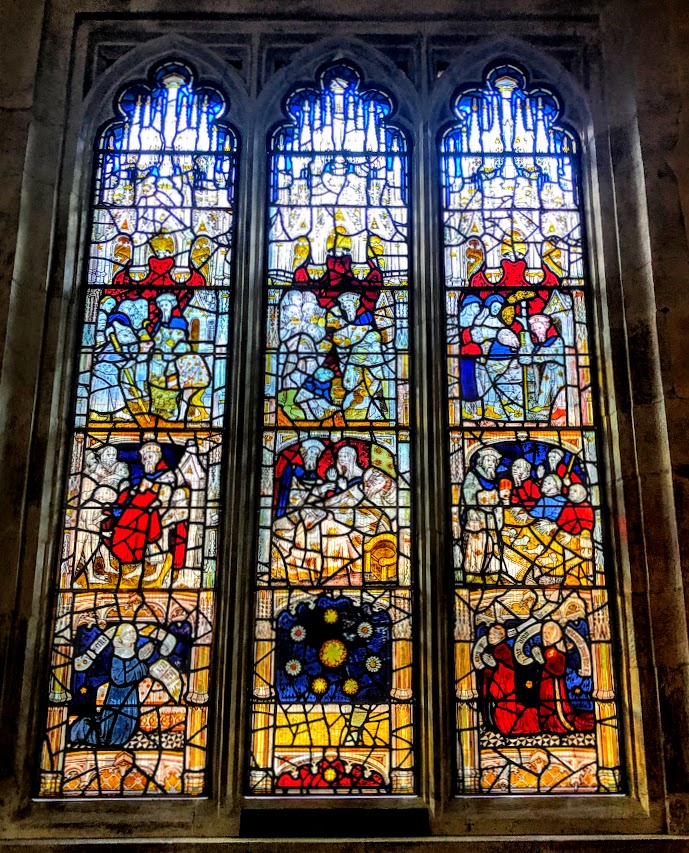
‘The Father raises the dead and gives them life’ (John 5: 21) … ‘Traumatised People come out of the Caves’ and ‘Dead Men’s Bones Rise from their Graves’, two images in ‘The Pricke of Conscience’ window, All Saints’ Church, York (Photographs: Patrick Comerford; click on images for full-screen viewing)
Patrick Comerford
This week began with the Fourth Sunday in Lent (Lent IV) and Mothering Sunday, and the calendar of the Church of England in Common Worship today remembers Saint Cyril (315-386), Bishop of Jerusalem and Teacher of the Faith, who developed catechetical instruction and liturgical observances during Lent, Palm Sunday and Holy Week.
Later this evening, after four-week absence – with two weeks in Kuching and the best part of a week in Walsingham – I hope to return to the choir rehearsals in Saint Mary and Saint Giles Church, Stony Stratford.
Today also marks the fourth anniversary of the stroke I had on 18 March 2022. So, before today begins, I am taking some quiet time this morning to give thanks, to reflect, to pray and to read in these ways:
1, reading today’s Gospel reading;
2, a short reflection;
3, a prayer from the USPG prayer diary;
4, the Collects and Post-Communion prayer of the day.
‘The hour is coming, and is now here, when the dead will hear the voice of the Son of God, and those who hear will live' (John 5: 25) … ‘Day in Truth shall Stars fall from The Heaven’ and ‘The Death of all Living Things’ … the ‘Pricke of Conscience’ window in York (Photographs: Patrick Comerford; click on images for full-screen viewing)
John 5: 17-30 (NRSVA):
17 But Jesus answered them, ‘My Father is still working, and I also am working.’ 18 For this reason the Jews were seeking all the more to kill him, because he was not only breaking the sabbath, but was also calling God his own Father, thereby making himself equal to God.
19 Jesus said to them, ‘Very truly, I tell you, the Son can do nothing on his own, but only what he sees the Father doing; for whatever the Father does, the Son does likewise. 20 The Father loves the Son and shows him all that he himself is doing; and he will show him greater works than these, so that you will be astonished. 21 Indeed, just as the Father raises the dead and gives them life, so also the Son gives life to whomsoever he wishes. 22 The Father judges no one but has given all judgement to the Son, 23 so that all may honour the Son just as they honour the Father. Anyone who does not honour the Son does not honour the Father who sent him. 24 Very truly, I tell you, anyone who hears my word and believes him who sent me has eternal life, and does not come under judgement, but has passed from death to life.
25 ‘Very truly, I tell you, the hour is coming, and is now here, when the dead will hear the voice of the Son of God, and those who hear will live. 26 For just as the Father has life in himself, so he has granted the Son also to have life in himself; 27 and he has given him authority to execute judgement, because he is the Son of Man. 28 Do not be astonished at this; for the hour is coming when all who are in their graves will hear his voice 29 and will come out – those who have done good, to the resurrection of life, and those who have done evil, to the resurrection of condemnation.
30 ‘I can do nothing on my own. As I hear, I judge; and my judgement is just, because I seek to do not my own will but the will of him who sent me.’
‘The hour is coming when all who are in their graves will hear his voice 29 and will come out’ (John 5: 28-29) … ‘The End of the World, Consumed by Fire’ in ‘The Pricke of Conscience’ window in York (Photograph: Patrick Comerford; click on images for full-screen viewing)
Today’s Reflections:
In the Gospel reading at the Eucharist yesterday (John 5: 1-3, 5-16, 17 March 2026), we read about the Third Sign in Saint John’s Gospel. Jesus comes to Jerusalem, visits a pool know as Bethesda, where many sick people come to be healed. There he heals a man who cannot walk, and in doing so is accused of violating two laws: working on the Sabbath; and blasphemy by equating himself to God; both said to be punishable by death.
The third discourse in the Fourth Gospel (John 5:17-47) comes in response to that controversy and is essentially Christ’s response to his accusers. Jesus replies to his accusers that he is appropriating nothing to himself, for he only does what he sees his Father doing. He presents his case almost entirely in the third person. I can imagine those who were listening wondering and asking: ‘Who is this Son of God? Is he talking about himself?’ In the dramatic style of Johannine presentation, Jesus keeps them in suspense until the end, when he removes all doubt by switching to the first person (verse 30).
This passage is crucial in understanding the Fourth Gospel. Here, Jesus does not say ‘Yes, I am equal to God.’ Nor does he say, ‘No, I am not equal to God.’ But with accuracy and clarity, he describes the relationship between the Father and the Son, so that in the light of what he reveals, the word ‘equals’ disappears.
Jesus establishes his union with God and states that he can do nothing independently of God. The Son imitates the Father. And Jesus answers the charge of blasphemy by asserting that he is, in fact, the Son of God.
First, Christ argues that, as the Son of God, his actions are only imitating his Father (verse 19). Where he says ‘Very truly’, or ‘Truly, truly’ (ἀμὴν ἀμὴν, amēn amēn), the Hebrew amen is repeated for emphasis (see also verse 24). This phrase appears only in Saint John’s Gospel, yet in this Gospel it appears 25 times.
Christ solemnly tells his listeners that, as a good Son, he does not act independently, but acts as he sees the Father acting. This could be said of all the persons of the Trinity. The Son does not act independently of the Father; however, the Father does not act independently of the Son; neither does the Holy Spirit act independently of the Son or the Father. There is total harmony within the Trinity.
We see this at Christ’s baptism: And a voice from heaven said, ‘This is my Son, the Beloved, with whom I am well pleased’ (Matthew 3: 17). Later, at the Transfiguration, we are told, ‘a bright cloud overshadowed them, and from the cloud a voice said, “This is my Son, the Beloved; with him I am well pleased; listen to him!”’ (see John 1: 32-34; Matthew 17: 5; see also II Peter 1: 17).
The Greek word translated ‘beloved’ in these places is always a variation on ἀγάπη, agapē (see my additional note on the Four Loves below). However, the love that the Father has for the Son in John 5: 20 is the Greek φιλία, philia, which normally means to consider someone a friend, to have a special interest in someone or something.
In John 3: 35, we read: ‘The Father loves the Son and has given all things into his hand.’ The Greek word there is ἀγαπᾷ (agapa), which means ‘to have a warm regard for and interest in another, cherish, have affection for, love.’
The Father cherishes the Son in a loving relationship of the highest order. Therefore, he has given everything to him. Nonetheless, it is the close association that the Father has with the Son that is the foundation of their co-operative work.
Jesus added that greater works would be forthcoming, works that would amaze. Greater things than the signs that he has already performed are coming, such as his death and resurrection, and even the general resurrection and the final judgment. The Greek word translated as ‘astonished’ or ‘marvel’ (θαυμάζητε) means ‘to be extraordinarily impressed or disturbed by something’ (see also verse 28).
The Son is powerless; he cannot do anything out of himself and, as we shall see later, cannot say anything out of himself. He simply looks at the Father, and whatever he sees the Father doing he does himself. But, on the other hand, the Father so loves the Son that he gives everything to him and reserves no power to himself. He does not hold back anything, but reveals to the Son everything that he is doing, and gives him authority to do it.
The Father, who is the source of everything on heaven and on earth, loves and reveals. In him, there is no holding onto power. And, as the Son lets go of everything, he receives back from the Father his power, his authority and the light of his glory. The Father lets go, and receives back from the Son.
Christ explains that the Son imitates God the Father by giving life. God told Moses: ‘See now that I, even I, am he; there is no god besides me; I kill and I make alive’ (Deuteronomy 32: 39). John told us that in Christ ‘was life, and the life was the light of all people’ (John 1: 4). And Christ says: ‘I am the resurrection and the life. Those who believe in me, even though they die, will live …’ (John 11: 25).
When Jesus speaks of the dead, he uses the word in two senses: at a physical level, those who are dead are corpses buried in graves; at a spiritual level, those who are dead appear to be alive outwardly, but are dead inwardly. But Christ has the power to raise the dead to life.
Similarly, the word judgment has a two-fold meaning: God did not send his son into the κόσμος (kosmos) to judge the κόσμος in the sense of condemning it (John 3: 17), yet judgment inevitably follows from his coming.
The Greek word for judgment, κρίσις (krisis), gives us English words such as crisis, critic, critical, criminal and discriminate. The Son does not condemn anyone, just as the Father does not condemn. But the Father has given him all judgment, in the sense of discrimination, for the coming of the Light in Christ discriminates or distinguishes one thing from another, showing each up for what it really is.
Jesus explains that the Son of God will be the judge at the final judgment. At the final judgment, it will be Christ seated upon the Great White Throne who is the judge (Revelation 20: 11-15). Jesus equates himself directly with God, clearly identifying who he is with the full knowledge that this will infuriate his accusers.
Honouring the Son is honouring the Father. Jesus explains that God the Father’s purpose in ordering things this way was to bring honour to the Son. The word translated ‘honour’ means ‘to show high regard for,’ while the word translated ‘even as’ means ‘just as’ and is used to indicate ‘of extent or degree to which, as, to the degree that.’ God the Father has decreed that the Son is to be revered in the same way and to the same degree as the Father.
Seeing and believing, hearing and believing, are key themes throughout the Fourth Gospel. Jesus implores his accusers to ‘hear’ his truth and that this is the key to salvation.
Jesus claims that judgment and life belong to the Son. Everyone who believes the Son does not come into judgment (verse 24). Then Christ defends his equality with God, claiming that judgment and life are his to give.
The word πιστεύων, translated ‘believes’, means to consider something true and worthy of one’s trust. Faith is not simply about both belief and trust. And so at Baptism, Conformation and at the renewal of baptismal vows, we ask: Do you believe and trust ...?
Verses 26-30 appear to be a variant form of the speech that went before in verses 19-25, with the emphasis on the future judgment and life given on the last day (parousia eschatology). Compare this with how Daniel prophesies about the Son of Man (see Daniel 7: 13-14).
Both eschatological views became a part of later Christian theology, for the life of grace we receive on earth is the beginning of the life of beatific vision to be possessed in heaven. The Son is the source of life, and will be the agent of divine judgment in the resurrection. The Son is the source of life in the resurrection.
Christ then announces solemnly that the Son of God will call the dead back to life in the resurrection. The Greek word θαυμάζητε, translated ‘astonished’ or ‘marvel’, means ‘to be extraordinarily impressed or disturbed by something’ (see also verse 20).
Jesus points to the evidence in the scriptures and of John the Baptist and Moses as proof of who he is. He says that if we do not believe this evidence we are not only denying him but also denying God.
A note on the ‘Four Loves’ by CS Lewis
In his book, The Four Loves, CS Lewis explores the nature of love from a Christian perspective dividing love into four categories, based on the four Greek words for love: affection, friendship, eros, and charity.
Affection (στοργή, storge) is fondness through familiarity, especially between family members or people who have otherwise found themselves together by chance.
Friendship (φιλία, philia) is a strong bond existing between people who share a common interest or activity. Lewis explicitly says that his definition of friendship is narrower than mere companionship; friendship in this sense exists only if there is something for the friendship to be ‘about.’
Eros (ἔρως) is love in the sense of ‘being in love.’ But this love is distinct from sexuality, which Lewis calls Venus, although he does spend time discussing sexual activity and its spiritual significance in a pagan or a Christian sense. He identifies eros as indifferent.
Lewis identifies charity (ἀγάπη, agapē) as the love that brings forth caring regardless of circumstance. This he recognises as the greatest of loves, and this he sees as a specifically Christian virtue. His chapter on agape in The Four Loves focuses on the need of subordinating the natural loves to the love of God, who is full of charitable love.
What can we learn from Jesus response to his accusers and how can we apply this in our own spiritual walk?
Christ does not act independently from the other persons in the Trinity; there is total harmony and co-operation within the Trinity. How do we revere and honour the Son in the same manner and to the same degree as the Father?
Christ is the source of eternal life, both now and in the resurrection. How do you relate that to issues such as death and devastation in Myanmar and Thailand following the recent earthquake, or to the continuing wars and conflicts in Russia and Ukraine, or throughout the Middle East today?
How do we distinguish between different feelings of love?
Christ will be the judge at the final judgment. How do we relate that to corporate and social sin?
‘The Father loves the Son and shows him all that he himself is doing’ (John 5: 20) … an icon of the Holy Trinity in the Church of Saint Nektarios in Tsesmes, near Rethymnon in Crete (Photograph: Patrick Comerford)
Today’s Prayers (Wednesday 18 March 2026):
The theme this week (15-21 March 2026) in ‘Pray With the World Church,’ the Prayer Diary of the Anglican mission agency USPG (United Society Partners in the Gospel), is ‘Lament and Hope’ (pp 38-39). This theme was introduced on Sunday with a programme update by Kennedy Jones, Church Engagement and Fundraising Officer, USPG.
The USPG Prayer Diary today (Wednesday 18 March 2026) invites us to pray:
We pray for courage to speak out against injustice. May our words and actions reflect Christ’s compassion and commitment to truth, mercy, and equality.
The Collect:
Merciful Lord,
absolve your people from their offences,
that through your bountiful goodness
we may all be delivered from the chains of those sins
which by our frailty we have committed;
grant this, heavenly Father,
for Jesus Christ’s sake, our blessed Lord and Saviour,
who is alive and reigns with you,
in the unity of the Holy Spirit,
one God, now and for ever.
The Post Communion Prayer:
Lord God,
whose blessed Son our Saviour
gave his back to the smiters
and did not hide his face from shame:
give us grace to endure the sufferings of this present time
with sure confidence in the glory that shall be revealed;
through Jesus Christ our Lord.
Additional Collect:
Merciful Lord,
you know our struggle to serve you:
when sin spoils our lives
and overshadows our hearts,
come to our aid
and turn us back to you again;
through Jesus Christ our Lord.
Collect on the Eve of Saint Joseph of Nazareth:
God our Father,
who from the family of your servant David
raised up Joseph the carpenter
to be the guardian of your incarnate Son
and husband of the Blessed Virgin Mary:
give us grace to follow him
in faithful obedience to your commands;
through Jesus Christ your Son our Lord,
who is alive and reigns with you,
in the unity of the Holy Spirit,
one God, now and for ever.
Yesterday’s Reflections
Continued Tomorrow
Saint Cyril of Jerusalem (18 March) … developed our liturgical observances of Lent, Palm Sunday and Holy Week
Scripture quotations are from the New Revised Standard Version Bible: Anglicised Edition copyright © 1989, 1995 National Council of the Churches of Christ in the United States of America. Used by permission. All rights reserved worldwide. http://nrsvbibles.org
Patrick Comerford
This week began with the Fourth Sunday in Lent (Lent IV) and Mothering Sunday, and the calendar of the Church of England in Common Worship today remembers Saint Cyril (315-386), Bishop of Jerusalem and Teacher of the Faith, who developed catechetical instruction and liturgical observances during Lent, Palm Sunday and Holy Week.
Later this evening, after four-week absence – with two weeks in Kuching and the best part of a week in Walsingham – I hope to return to the choir rehearsals in Saint Mary and Saint Giles Church, Stony Stratford.
Today also marks the fourth anniversary of the stroke I had on 18 March 2022. So, before today begins, I am taking some quiet time this morning to give thanks, to reflect, to pray and to read in these ways:
1, reading today’s Gospel reading;
2, a short reflection;
3, a prayer from the USPG prayer diary;
4, the Collects and Post-Communion prayer of the day.
‘The hour is coming, and is now here, when the dead will hear the voice of the Son of God, and those who hear will live' (John 5: 25) … ‘Day in Truth shall Stars fall from The Heaven’ and ‘The Death of all Living Things’ … the ‘Pricke of Conscience’ window in York (Photographs: Patrick Comerford; click on images for full-screen viewing)
John 5: 17-30 (NRSVA):
17 But Jesus answered them, ‘My Father is still working, and I also am working.’ 18 For this reason the Jews were seeking all the more to kill him, because he was not only breaking the sabbath, but was also calling God his own Father, thereby making himself equal to God.
19 Jesus said to them, ‘Very truly, I tell you, the Son can do nothing on his own, but only what he sees the Father doing; for whatever the Father does, the Son does likewise. 20 The Father loves the Son and shows him all that he himself is doing; and he will show him greater works than these, so that you will be astonished. 21 Indeed, just as the Father raises the dead and gives them life, so also the Son gives life to whomsoever he wishes. 22 The Father judges no one but has given all judgement to the Son, 23 so that all may honour the Son just as they honour the Father. Anyone who does not honour the Son does not honour the Father who sent him. 24 Very truly, I tell you, anyone who hears my word and believes him who sent me has eternal life, and does not come under judgement, but has passed from death to life.
25 ‘Very truly, I tell you, the hour is coming, and is now here, when the dead will hear the voice of the Son of God, and those who hear will live. 26 For just as the Father has life in himself, so he has granted the Son also to have life in himself; 27 and he has given him authority to execute judgement, because he is the Son of Man. 28 Do not be astonished at this; for the hour is coming when all who are in their graves will hear his voice 29 and will come out – those who have done good, to the resurrection of life, and those who have done evil, to the resurrection of condemnation.
30 ‘I can do nothing on my own. As I hear, I judge; and my judgement is just, because I seek to do not my own will but the will of him who sent me.’
‘The hour is coming when all who are in their graves will hear his voice 29 and will come out’ (John 5: 28-29) … ‘The End of the World, Consumed by Fire’ in ‘The Pricke of Conscience’ window in York (Photograph: Patrick Comerford; click on images for full-screen viewing)
Today’s Reflections:
In the Gospel reading at the Eucharist yesterday (John 5: 1-3, 5-16, 17 March 2026), we read about the Third Sign in Saint John’s Gospel. Jesus comes to Jerusalem, visits a pool know as Bethesda, where many sick people come to be healed. There he heals a man who cannot walk, and in doing so is accused of violating two laws: working on the Sabbath; and blasphemy by equating himself to God; both said to be punishable by death.
The third discourse in the Fourth Gospel (John 5:17-47) comes in response to that controversy and is essentially Christ’s response to his accusers. Jesus replies to his accusers that he is appropriating nothing to himself, for he only does what he sees his Father doing. He presents his case almost entirely in the third person. I can imagine those who were listening wondering and asking: ‘Who is this Son of God? Is he talking about himself?’ In the dramatic style of Johannine presentation, Jesus keeps them in suspense until the end, when he removes all doubt by switching to the first person (verse 30).
This passage is crucial in understanding the Fourth Gospel. Here, Jesus does not say ‘Yes, I am equal to God.’ Nor does he say, ‘No, I am not equal to God.’ But with accuracy and clarity, he describes the relationship between the Father and the Son, so that in the light of what he reveals, the word ‘equals’ disappears.
Jesus establishes his union with God and states that he can do nothing independently of God. The Son imitates the Father. And Jesus answers the charge of blasphemy by asserting that he is, in fact, the Son of God.
First, Christ argues that, as the Son of God, his actions are only imitating his Father (verse 19). Where he says ‘Very truly’, or ‘Truly, truly’ (ἀμὴν ἀμὴν, amēn amēn), the Hebrew amen is repeated for emphasis (see also verse 24). This phrase appears only in Saint John’s Gospel, yet in this Gospel it appears 25 times.
Christ solemnly tells his listeners that, as a good Son, he does not act independently, but acts as he sees the Father acting. This could be said of all the persons of the Trinity. The Son does not act independently of the Father; however, the Father does not act independently of the Son; neither does the Holy Spirit act independently of the Son or the Father. There is total harmony within the Trinity.
We see this at Christ’s baptism: And a voice from heaven said, ‘This is my Son, the Beloved, with whom I am well pleased’ (Matthew 3: 17). Later, at the Transfiguration, we are told, ‘a bright cloud overshadowed them, and from the cloud a voice said, “This is my Son, the Beloved; with him I am well pleased; listen to him!”’ (see John 1: 32-34; Matthew 17: 5; see also II Peter 1: 17).
The Greek word translated ‘beloved’ in these places is always a variation on ἀγάπη, agapē (see my additional note on the Four Loves below). However, the love that the Father has for the Son in John 5: 20 is the Greek φιλία, philia, which normally means to consider someone a friend, to have a special interest in someone or something.
In John 3: 35, we read: ‘The Father loves the Son and has given all things into his hand.’ The Greek word there is ἀγαπᾷ (agapa), which means ‘to have a warm regard for and interest in another, cherish, have affection for, love.’
The Father cherishes the Son in a loving relationship of the highest order. Therefore, he has given everything to him. Nonetheless, it is the close association that the Father has with the Son that is the foundation of their co-operative work.
Jesus added that greater works would be forthcoming, works that would amaze. Greater things than the signs that he has already performed are coming, such as his death and resurrection, and even the general resurrection and the final judgment. The Greek word translated as ‘astonished’ or ‘marvel’ (θαυμάζητε) means ‘to be extraordinarily impressed or disturbed by something’ (see also verse 28).
The Son is powerless; he cannot do anything out of himself and, as we shall see later, cannot say anything out of himself. He simply looks at the Father, and whatever he sees the Father doing he does himself. But, on the other hand, the Father so loves the Son that he gives everything to him and reserves no power to himself. He does not hold back anything, but reveals to the Son everything that he is doing, and gives him authority to do it.
The Father, who is the source of everything on heaven and on earth, loves and reveals. In him, there is no holding onto power. And, as the Son lets go of everything, he receives back from the Father his power, his authority and the light of his glory. The Father lets go, and receives back from the Son.
Christ explains that the Son imitates God the Father by giving life. God told Moses: ‘See now that I, even I, am he; there is no god besides me; I kill and I make alive’ (Deuteronomy 32: 39). John told us that in Christ ‘was life, and the life was the light of all people’ (John 1: 4). And Christ says: ‘I am the resurrection and the life. Those who believe in me, even though they die, will live …’ (John 11: 25).
When Jesus speaks of the dead, he uses the word in two senses: at a physical level, those who are dead are corpses buried in graves; at a spiritual level, those who are dead appear to be alive outwardly, but are dead inwardly. But Christ has the power to raise the dead to life.
Similarly, the word judgment has a two-fold meaning: God did not send his son into the κόσμος (kosmos) to judge the κόσμος in the sense of condemning it (John 3: 17), yet judgment inevitably follows from his coming.
The Greek word for judgment, κρίσις (krisis), gives us English words such as crisis, critic, critical, criminal and discriminate. The Son does not condemn anyone, just as the Father does not condemn. But the Father has given him all judgment, in the sense of discrimination, for the coming of the Light in Christ discriminates or distinguishes one thing from another, showing each up for what it really is.
Jesus explains that the Son of God will be the judge at the final judgment. At the final judgment, it will be Christ seated upon the Great White Throne who is the judge (Revelation 20: 11-15). Jesus equates himself directly with God, clearly identifying who he is with the full knowledge that this will infuriate his accusers.
Honouring the Son is honouring the Father. Jesus explains that God the Father’s purpose in ordering things this way was to bring honour to the Son. The word translated ‘honour’ means ‘to show high regard for,’ while the word translated ‘even as’ means ‘just as’ and is used to indicate ‘of extent or degree to which, as, to the degree that.’ God the Father has decreed that the Son is to be revered in the same way and to the same degree as the Father.
Seeing and believing, hearing and believing, are key themes throughout the Fourth Gospel. Jesus implores his accusers to ‘hear’ his truth and that this is the key to salvation.
Jesus claims that judgment and life belong to the Son. Everyone who believes the Son does not come into judgment (verse 24). Then Christ defends his equality with God, claiming that judgment and life are his to give.
The word πιστεύων, translated ‘believes’, means to consider something true and worthy of one’s trust. Faith is not simply about both belief and trust. And so at Baptism, Conformation and at the renewal of baptismal vows, we ask: Do you believe and trust ...?
Verses 26-30 appear to be a variant form of the speech that went before in verses 19-25, with the emphasis on the future judgment and life given on the last day (parousia eschatology). Compare this with how Daniel prophesies about the Son of Man (see Daniel 7: 13-14).
Both eschatological views became a part of later Christian theology, for the life of grace we receive on earth is the beginning of the life of beatific vision to be possessed in heaven. The Son is the source of life, and will be the agent of divine judgment in the resurrection. The Son is the source of life in the resurrection.
Christ then announces solemnly that the Son of God will call the dead back to life in the resurrection. The Greek word θαυμάζητε, translated ‘astonished’ or ‘marvel’, means ‘to be extraordinarily impressed or disturbed by something’ (see also verse 20).
Jesus points to the evidence in the scriptures and of John the Baptist and Moses as proof of who he is. He says that if we do not believe this evidence we are not only denying him but also denying God.
A note on the ‘Four Loves’ by CS Lewis
In his book, The Four Loves, CS Lewis explores the nature of love from a Christian perspective dividing love into four categories, based on the four Greek words for love: affection, friendship, eros, and charity.Affection (στοργή, storge) is fondness through familiarity, especially between family members or people who have otherwise found themselves together by chance.
Friendship (φιλία, philia) is a strong bond existing between people who share a common interest or activity. Lewis explicitly says that his definition of friendship is narrower than mere companionship; friendship in this sense exists only if there is something for the friendship to be ‘about.’
Eros (ἔρως) is love in the sense of ‘being in love.’ But this love is distinct from sexuality, which Lewis calls Venus, although he does spend time discussing sexual activity and its spiritual significance in a pagan or a Christian sense. He identifies eros as indifferent.
Lewis identifies charity (ἀγάπη, agapē) as the love that brings forth caring regardless of circumstance. This he recognises as the greatest of loves, and this he sees as a specifically Christian virtue. His chapter on agape in The Four Loves focuses on the need of subordinating the natural loves to the love of God, who is full of charitable love.
What can we learn from Jesus response to his accusers and how can we apply this in our own spiritual walk?
Christ does not act independently from the other persons in the Trinity; there is total harmony and co-operation within the Trinity. How do we revere and honour the Son in the same manner and to the same degree as the Father?
Christ is the source of eternal life, both now and in the resurrection. How do you relate that to issues such as death and devastation in Myanmar and Thailand following the recent earthquake, or to the continuing wars and conflicts in Russia and Ukraine, or throughout the Middle East today?
How do we distinguish between different feelings of love?
Christ will be the judge at the final judgment. How do we relate that to corporate and social sin?
‘The Father loves the Son and shows him all that he himself is doing’ (John 5: 20) … an icon of the Holy Trinity in the Church of Saint Nektarios in Tsesmes, near Rethymnon in Crete (Photograph: Patrick Comerford)
Today’s Prayers (Wednesday 18 March 2026):
The theme this week (15-21 March 2026) in ‘Pray With the World Church,’ the Prayer Diary of the Anglican mission agency USPG (United Society Partners in the Gospel), is ‘Lament and Hope’ (pp 38-39). This theme was introduced on Sunday with a programme update by Kennedy Jones, Church Engagement and Fundraising Officer, USPG.
The USPG Prayer Diary today (Wednesday 18 March 2026) invites us to pray:
We pray for courage to speak out against injustice. May our words and actions reflect Christ’s compassion and commitment to truth, mercy, and equality.
The Collect:
Merciful Lord,
absolve your people from their offences,
that through your bountiful goodness
we may all be delivered from the chains of those sins
which by our frailty we have committed;
grant this, heavenly Father,
for Jesus Christ’s sake, our blessed Lord and Saviour,
who is alive and reigns with you,
in the unity of the Holy Spirit,
one God, now and for ever.
The Post Communion Prayer:
Lord God,
whose blessed Son our Saviour
gave his back to the smiters
and did not hide his face from shame:
give us grace to endure the sufferings of this present time
with sure confidence in the glory that shall be revealed;
through Jesus Christ our Lord.
Additional Collect:
Merciful Lord,
you know our struggle to serve you:
when sin spoils our lives
and overshadows our hearts,
come to our aid
and turn us back to you again;
through Jesus Christ our Lord.
Collect on the Eve of Saint Joseph of Nazareth:
God our Father,
who from the family of your servant David
raised up Joseph the carpenter
to be the guardian of your incarnate Son
and husband of the Blessed Virgin Mary:
give us grace to follow him
in faithful obedience to your commands;
through Jesus Christ your Son our Lord,
who is alive and reigns with you,
in the unity of the Holy Spirit,
one God, now and for ever.
Yesterday’s Reflections
Continued Tomorrow
Saint Cyril of Jerusalem (18 March) … developed our liturgical observances of Lent, Palm Sunday and Holy Week
Scripture quotations are from the New Revised Standard Version Bible: Anglicised Edition copyright © 1989, 1995 National Council of the Churches of Christ in the United States of America. Used by permission. All rights reserved worldwide. http://nrsvbibles.org
01 March 2026
Daily prayer in Lent 2026:
13, Monday 2 March 2026,
Saint Chad of Lichfield
‘Forgive, and you will be forgiven’ (Luke 6: 36) … street art off Carpenter Street in Kuching (Photograph: Patrick Comerford, 2026)
Patrick Comerford
Lent began almost two weeks ago on Ash Wednesday (18 February 2026), and yesterday was the Second Sunday in Lent (Lent II). The Diocese of Lichfield and the calendar of the Church of England today (2 March) celebrates the life and mission of Saint Chad of Lichfield (672), Bishop of Lichfield and Missionary. The Jewish holiday of Purim also begins this evening and continues tomorrow (3 March).
But, before today begins, I am taking some quiet time this morning to give thanks, to reflect, to pray and to read in these ways:
1, reading today’s Gospel reading;
2, a short reflection;
3, a prayer from the USPG prayer diary;
4, the Collects and Post-Communion prayer of the day.
‘Be merciful, just as your Father is merciful’ (Luke 6: 36) … the ‘Corporal Works of Mercy’ window in All Saints’ Church, North Street, York (Photograph: Patrick Comerford)
Luke 6: 36-38 (NRSVA):
[Jesus said:] 36 ‘Be merciful, just as your Father is merciful.
37 ‘Do not judge, and you will not be judged; do not condemn, and you will not be condemned. Forgive, and you will be forgiven; 38 give, and it will be given to you. A good measure, pressed down, shaken together, running over, will be put into your lap; for the measure you give will be the measure you get back.’
‘If anyone strikes you on the cheek, offer the other also (Luke 6: 29) … street art in Plaza de la Judería in Malaga (Photograph: Patrick Comerford)
Today’s Reflections:
The Gospel reading at the Eucharist today is Luke 6: 36-38, which is from the ‘Sermon on the Level Place’, Saint Luke’s equivalent of the Sermon on the Mount.
After the blessings and woes of the Beatitudes, Jesus tells us to be merciful as God is merciful. Mercy is one of God’s primary qualities (see Exodus 34: 6-7), and the concept of mercy in Luke 6 has an eschatological frame of reference. God is merciful by offering the possibility of turning away from disobedience through repentance and turning towards him and receiving forgiveness and restoration.
In Mary’s song Magnificat, God is twice identified as merciful (Luke 1: 50, 54). Zechariah too identifies mercy as a sign of God’s faithfulness to God’s promises, creating a people who ‘might serve God without fear in holiness and righteousness (Luke 1: 72-78). In this morning’s reading, Christ shows how to put this mercy into practice.
In the verses immediately before today’s reading, Luke 6: 27-29 presupposes a situation of conflict, in a time when the religious and political leaders of day were seen by many as their enemies. But Christ calls on us to respond and act in ways that seek the good of the other. This form of nonviolence goes beyond non-retaliation and takes positive steps that promote the welfare of the other parties in the conflict.
Luke 6: 30 presupposes an economic situation in which many people are exploited, live in poverty, and seek to survive by begging. The give to those who beg implies that we have an abundance from which to share (see Luke 6: 39).
Luke 6: 31 repeats the ‘Golden Rule’: ‘Do to others as you would have them do to you.’ But the golden rule is not enough for us, the Children of God (see verse 35) in our covenant relationship with God.
Luke 6: 32-34 challenges the widely accepted notion in the Hellenistic world that relationships are reciprocal, and calls on us to go beyond behaviour is guided merely by the expectation of similar responses.
Luke 6: 35 calls on to replace old-age pattens of behaviour with ways that reflect the Kingdom of God, and to imitate God who is kind also to the ungrateful and the wicked. To be kind does not mean to approve but means to seek the best interest. Even the ungrateful and the wicked have the potential and the possibility of becoming part of the Kingdom of God.
Now, Luke 6: 36 sums up how to live a life that reflects the Kingdom of God.
Luke 6: 37 is a reminder that we not have the final say ourselves on who is in and who is outside the Kingdom of God. We do not live in the apocalyptic moment, and when he exclude others from the Church we risk finding we have excluded ourselves too.
Luke 6: 38 reminds us that God’s generosity is overflowing and overwhelming and goes beyond any possibility we have of measuring it.
As Shakespeare reminds us, in the words of Portia in The Merchant of Venice,
The quality of mercy is not strained;
It droppeth as the gentle rain from heaven … (The Merchant of Venice, Act IV, Scene 1).
‘Love Being Awake’ … ‘Love your enemies, do good to those who hate you’ (Luke 6: 26) … a sign in a café in Charleville, Co Cork (Photograph: Patrick Comerford)
Today’s Prayers (Monday 2 March 2026):
The theme this week (1-7 March 2026) in ‘Pray With the World Church,’ the Prayer Diary of the Anglican mission agency USPG (United Society Partners in the Gospel), is: ‘Saint David’s Day’ (pp 34-35). This theme was introduced yesterday with Reflections by the Revd Sarah Rosser, Team Vicar in the Netherwent Ministry Area, Diocese of Monmouth, Church in Wales.
The USPG Prayer Diary today (Monday 2 March 2026) invites us to pray:
We thank you for Saint David, for his love of the Gospel and his passion for sharing it. Renew your Church’s mission, give us wisdom and courage to share your love, and help us ‘do the little things’ that glorify you..
The Collect:
Almighty God,
from the first fruits of the English nation who turned to Christ,
you called your servant Chad
to be an evangelist and bishop of his own people:
give us grace so to follow his peaceable nature,
humble spirit and prayerful life,
that we may truly commend to others
the faith which we ourselves profess;
through Jesus Christ your Son our Lord,
who is alive and reigns with you,
in the unity of the Holy Spirit,
one God, now and for ever.
The Post Communion Prayer:
Holy Father,
who gathered us here around the table of your Son
to share this meal with the whole household of God:
in that new world where you reveal
the fullness of your peace,
gather people of every race and language
to share with Chad and all your saints
in the eternal banquet of Jesus Christ our Lord.
Yesterday’s Reflections
Continued Tomorrow
Peter Walker’s statue of Saint Chad at the south-east side of Lichfield Cathedral (Photograph: Patrick Comerford, 2026)
Scripture quotations are from the New Revised Standard Version Bible: Anglicised Edition copyright © 1989, 1995 National Council of the Churches of Christ in the United States of America. Used by permission. All rights reserved worldwide. http://nrsvbibles.org
Patrick Comerford
Lent began almost two weeks ago on Ash Wednesday (18 February 2026), and yesterday was the Second Sunday in Lent (Lent II). The Diocese of Lichfield and the calendar of the Church of England today (2 March) celebrates the life and mission of Saint Chad of Lichfield (672), Bishop of Lichfield and Missionary. The Jewish holiday of Purim also begins this evening and continues tomorrow (3 March).
But, before today begins, I am taking some quiet time this morning to give thanks, to reflect, to pray and to read in these ways:
1, reading today’s Gospel reading;
2, a short reflection;
3, a prayer from the USPG prayer diary;
4, the Collects and Post-Communion prayer of the day.
‘Be merciful, just as your Father is merciful’ (Luke 6: 36) … the ‘Corporal Works of Mercy’ window in All Saints’ Church, North Street, York (Photograph: Patrick Comerford)
Luke 6: 36-38 (NRSVA):
[Jesus said:] 36 ‘Be merciful, just as your Father is merciful.
37 ‘Do not judge, and you will not be judged; do not condemn, and you will not be condemned. Forgive, and you will be forgiven; 38 give, and it will be given to you. A good measure, pressed down, shaken together, running over, will be put into your lap; for the measure you give will be the measure you get back.’
‘If anyone strikes you on the cheek, offer the other also (Luke 6: 29) … street art in Plaza de la Judería in Malaga (Photograph: Patrick Comerford)
Today’s Reflections:
The Gospel reading at the Eucharist today is Luke 6: 36-38, which is from the ‘Sermon on the Level Place’, Saint Luke’s equivalent of the Sermon on the Mount.
After the blessings and woes of the Beatitudes, Jesus tells us to be merciful as God is merciful. Mercy is one of God’s primary qualities (see Exodus 34: 6-7), and the concept of mercy in Luke 6 has an eschatological frame of reference. God is merciful by offering the possibility of turning away from disobedience through repentance and turning towards him and receiving forgiveness and restoration.
In Mary’s song Magnificat, God is twice identified as merciful (Luke 1: 50, 54). Zechariah too identifies mercy as a sign of God’s faithfulness to God’s promises, creating a people who ‘might serve God without fear in holiness and righteousness (Luke 1: 72-78). In this morning’s reading, Christ shows how to put this mercy into practice.
In the verses immediately before today’s reading, Luke 6: 27-29 presupposes a situation of conflict, in a time when the religious and political leaders of day were seen by many as their enemies. But Christ calls on us to respond and act in ways that seek the good of the other. This form of nonviolence goes beyond non-retaliation and takes positive steps that promote the welfare of the other parties in the conflict.
Luke 6: 30 presupposes an economic situation in which many people are exploited, live in poverty, and seek to survive by begging. The give to those who beg implies that we have an abundance from which to share (see Luke 6: 39).
Luke 6: 31 repeats the ‘Golden Rule’: ‘Do to others as you would have them do to you.’ But the golden rule is not enough for us, the Children of God (see verse 35) in our covenant relationship with God.
Luke 6: 32-34 challenges the widely accepted notion in the Hellenistic world that relationships are reciprocal, and calls on us to go beyond behaviour is guided merely by the expectation of similar responses.
Luke 6: 35 calls on to replace old-age pattens of behaviour with ways that reflect the Kingdom of God, and to imitate God who is kind also to the ungrateful and the wicked. To be kind does not mean to approve but means to seek the best interest. Even the ungrateful and the wicked have the potential and the possibility of becoming part of the Kingdom of God.
Now, Luke 6: 36 sums up how to live a life that reflects the Kingdom of God.
Luke 6: 37 is a reminder that we not have the final say ourselves on who is in and who is outside the Kingdom of God. We do not live in the apocalyptic moment, and when he exclude others from the Church we risk finding we have excluded ourselves too.
Luke 6: 38 reminds us that God’s generosity is overflowing and overwhelming and goes beyond any possibility we have of measuring it.
As Shakespeare reminds us, in the words of Portia in The Merchant of Venice,
The quality of mercy is not strained;
It droppeth as the gentle rain from heaven … (The Merchant of Venice, Act IV, Scene 1).
‘Love Being Awake’ … ‘Love your enemies, do good to those who hate you’ (Luke 6: 26) … a sign in a café in Charleville, Co Cork (Photograph: Patrick Comerford)
Today’s Prayers (Monday 2 March 2026):
The theme this week (1-7 March 2026) in ‘Pray With the World Church,’ the Prayer Diary of the Anglican mission agency USPG (United Society Partners in the Gospel), is: ‘Saint David’s Day’ (pp 34-35). This theme was introduced yesterday with Reflections by the Revd Sarah Rosser, Team Vicar in the Netherwent Ministry Area, Diocese of Monmouth, Church in Wales.
The USPG Prayer Diary today (Monday 2 March 2026) invites us to pray:
We thank you for Saint David, for his love of the Gospel and his passion for sharing it. Renew your Church’s mission, give us wisdom and courage to share your love, and help us ‘do the little things’ that glorify you..
The Collect:
Almighty God,
from the first fruits of the English nation who turned to Christ,
you called your servant Chad
to be an evangelist and bishop of his own people:
give us grace so to follow his peaceable nature,
humble spirit and prayerful life,
that we may truly commend to others
the faith which we ourselves profess;
through Jesus Christ your Son our Lord,
who is alive and reigns with you,
in the unity of the Holy Spirit,
one God, now and for ever.
The Post Communion Prayer:
Holy Father,
who gathered us here around the table of your Son
to share this meal with the whole household of God:
in that new world where you reveal
the fullness of your peace,
gather people of every race and language
to share with Chad and all your saints
in the eternal banquet of Jesus Christ our Lord.
Yesterday’s Reflections
Continued Tomorrow
Peter Walker’s statue of Saint Chad at the south-east side of Lichfield Cathedral (Photograph: Patrick Comerford, 2026)
Scripture quotations are from the New Revised Standard Version Bible: Anglicised Edition copyright © 1989, 1995 National Council of the Churches of Christ in the United States of America. Used by permission. All rights reserved worldwide. http://nrsvbibles.org
02 February 2026
Daily prayer in Christmas 2025-2026:
40, Monday 2 February 2026,
the Presentation (Candlemas)
The Presentation depicted in a window in Saint Olave’s Church, York (Photograph: Patrick Comerford)
Patrick Comerford
Today is the last day in the 40-day season of Christmas, which concludes today with the Feast of the Presentation of Christ in the Temple (Monday 2 February 2026), also known as Candlemas, although most parishes and churches probably transferred this celebration to yesterday, which was also the Fourth Sunday of Epiphany (Epiphany IV, 1 February 2026) and Septuagesima.
Later today, I may visit the exhibition of Icons by the traditional Byzantine iconographer Hanna-Leena Ward in Lichfield Cathedral, which opened on Friday (30 January) and continues for three weeks until 19 February. But, before today begins, I am taking some quiet time this morning to give thanks, to reflect, to pray and to read in these ways:
1, today’s Gospel reading;
2, a short reflection;
3, a prayer from the USPG prayer diary;
4, the Collects and Post-Communion prayer of the day.
The Presentation depicted in a window in Saint Peter’s Church, Kuching (Photograph: Patrick Comerford)
Luke 2: 22-40 (NRSVA):
22 When the time came for their purification according to the law of Moses, they brought him up to Jerusalem to present him to the Lord 23 (as it is written in the law of the Lord, ‘Every firstborn male shall be designated as holy to the Lord’), 24 and they offered a sacrifice according to what is stated in the law of the Lord, ‘a pair of turtle-doves or two young pigeons.’
25 Now there was a man in Jerusalem whose name was Simeon; this man was righteous and devout, looking forward to the consolation of Israel, and the Holy Spirit rested on him. 26 It had been revealed to him by the Holy Spirit that he would not see death before he had seen the Lord’s Messiah. 27 Guided by the Spirit, Simeon came into the temple; and when the parents brought in the child Jesus, to do for him what was customary under the law, 28 Simeon took him in his arms and praised God, saying,
29 ‘Master, now you are dismissing your servant in peace,
according to your word;
30 for my eyes have seen your salvation,
31 which you have prepared in the presence of all peoples,
32 a light for revelation to the Gentiles
and for glory to your people Israel.’
33 And the child’s father and mother were amazed at what was being said about him. 34 Then Simeon blessed them and said to his mother Mary, ‘This child is destined for the falling and the rising of many in Israel, and to be a sign that will be opposed 35 so that the inner thoughts of many will be revealed – and a sword will pierce your own soul too.’
36 There was also a prophet, Anna the daughter of Phanuel, of the tribe of Asher. She was of a great age, having lived with her husband for seven years after her marriage, 37 then as a widow to the age of eighty-four. She never left the temple but worshipped there with fasting and prayer night and day. 38 At that moment she came, and began to praise God and to speak about the child to all who were looking for the redemption of Jerusalem.
39 When they had finished everything required by the law of the Lord, they returned to Galilee, to their own town of Nazareth. 40 The child grew and became strong, filled with wisdom; and the favour of God was upon him.
The Presentation depicted in a window in Saint Mary’s Church, Lichfield (Photograph: Patrick Comerford)
Today’s Reflection:
Today is the Feast of the Presentation of Christ in the Temple, or Candlemas [2 February 2026]. This feast falls 40 days after Christmas when, according to traditional religious law, the Virgin Mary, the mother of the Christ-Child, presents her first-born to the priest in the Temple in Jerusalem. Because the Holy Family was poor, they offered a turtle dove and two pigeons as a submission and a sacrifice.
This is a feast rich in meaning, with several related themes running through it – presentation, purification, meeting, and light for the world. The several names by which this day has been known throughout Christian history illustrate just how much this feast has to teach and to celebrate. These names include the Presentation, and the Purification of the Blessed Virgin Mary, although today we talk more commonly of the Feast of Candlemas.
The true meaning of Candlemas is found in its ‘bitter-sweet’ nature. It is a feast day, and the revelation of the Christ Child in the Temple, greeted by Simeon and Anna, calls for rejoicing. Nevertheless, the prophetic words of Simeon, which speak of the falling and rising of many and the sword that will piece Mary’s heart, lead on to the Passion and Easter, as the Gospel according to Saint Luke makes clear:
‘… This child is destined for the falling and the rising of many in Israel, and to be a sign that will be opposed so that the inner thoughts of many will be revealed – and a sword will pierce your own soul too.’
Candlemas is the climax of the Christmas and Epiphany season, the last great festival of the Christmas cycle. It brings Christmas celebrations to a close, and is a real pivotal day in the Christian year. The focus shifts from the cradle to the cross, from Christmas to Passiontide – Ash Wednesday and the start of Lent are little more than a fortnight away (18 February 2026).
At times, instead of a sermon, I read TS Eliot’s poem, ‘A Song for Simeon’, based on the canticle Nunc Dimittis.
This is one of two poems written about the time of Eliot’s conversion in 1927. He titles his poem ‘A Song for Simeon’ rather than ‘A Song of Simeon’, the English sub-title of the canticle in The Book of Common Prayer, and it is one of four poems he published between 1927 and 1930 known as the Ariel Poems.
A Song for Simeon, by TS Eliot:
Lord, the Roman hyacinths are blooming in bowls and
The winter sun creeps by the snow hills;
The stubborn season had made stand.
My life is light, waiting for the death wind,
Like a feather on the back of my hand.
Dust in sunlight and memory in corners
Wait for the wind that chills towards the dead land.
Grant us thy peace.
I have walked many years in this city,
Kept faith and fast, provided for the poor,
Have given and taken honour and ease.
There went never any rejected from my door.
Who shall remember my house, where shall live my children’s children
When the time of sorrow is come?
They will take to the goat’s path, and the fox’s home,
Fleeing from the foreign faces and the foreign swords.
Before the time of cords and scourges and lamentation
Grant us thy peace.
Before the stations of the mountain of desolation,
Before the certain hour of maternal sorrow,
Now at this birth season of decease,
Let the Infant, the still unspeaking and unspoken Word,
Grant Israel’s consolation
To one who has eighty years and no to-morrow.
According to thy word.
They shall praise Thee and suffer in every generation
With glory and derision,
Light upon light, mounting the saints’ stair.
Not for me the martyrdom, the ecstasy of thought and prayer,
Not for me the ultimate vision.
Grant me thy peace.
(And a sword shall pierce thy heart,
Thine also).
I am tired with my own life and the lives of those after me,
I am dying in my own death and the deaths of those after me.
Let thy servant depart,
Having seen thy salvation.
A hymn often sung on this day is ‘In his temple now behold him’, by Canon Henry John Pye (1827-1903), who was the Rector of Clifton Campville, Staffordshire, where he was also Lord of the Manor, and a canon of Lichfield Cathedral.
Henry John Pye was born Henry James Pye in Chacombe Banbury Priory, Northamptonshire, on 31 January 1827. His father, Henry John Pye (1802-1884), lived at Clifton Hall, Staffordshire, close to Comberford, and 10 miles east of Lichfield and seven miles north of Tamworth. He was the lord of the manor and the patron of the local living; his grandfather was Henry James Pye (1745-1813), the Poet Laureate (1790-1813).
The Pye family was also related to the Willington family of Colehill and Tamworth.
The younger Henry John Pye was educated at Eton and Trinity College Cambridge (BA, 1848; MA 1852). He was ordained deacon in 1850, and priest in 1851. He first served as curate of Cuddesdon, outside Oxford (1850-1851), where Bishop Samuel Wilberforce lived. He married the bishop’s daughter, Emily Charlotte Wilberforce, on 21 October 1851.
Pye’s father appointed him the Rector of Clifton Campville in the Diocese of Lichfield in 1851, and he remained rector until 1868. Pye also became the Prebendary of Handsacre (1865-1868) in Lichfield Cathedral.
While he was the Rector of Clifton Campville, Pye compiled a collection of hymns for use in the parish, including the hymn ‘In his temple now behold him,’ intended for use on the feast of the Presentation or Candlemas today.
Pye also commissioned George Edmund Street, the Gothic Revival architect, to restore Saint Andrew’s, the parish church in Clifton Campville. Street, who is known for his restoration of Christ Church Cathedral, Dublin, and the Law Courts in London, had also designed Wilberforce’s new theological college in Cuddesdon.
Henry, his wife Emily, and his brother and sister joined the Roman Catholic Church in 1868. Pye later turned to the law: he was admitted at the Inner Temple in 1873 and was called to the bar in 1876.
Pye died in Tamworth on 3 January 1903, and the Manor of Clifton Campville and Clifton Hall, which had been in the Pye family since 1700, were sold in 1906.
In his temple now behold him;
See the long-expected Lord!
Ancient prophets had foretold him;
God hath now fulfilled his word.
Now to praise him, his redeemèd
Shall break forth with one accord.
In the arms of her who bore him,
Virgin pure, behold him lie,
While his aged saints adore him,
Ere in perfect faith they die:
Alleluia! Alleluia!
Lo, the incarnate God most high!
Jesus, by thy Presentation,
Thou, who didst for us endure,
Make us see thy great salvation,
Seal us with thy promise sure;
And present us in thy glory
To thy Father cleansed and pure.
Prince and author of salvation,
Be thy boundless love our theme!
Jesus, praise to thee be given
By the world thou didst redeem,
With the Father and the Spirit,
Lord of majesty supreme!
The Presentation depicted in a window in Saint Giles Church, Oxford (Photograph: Patrick Comerford)
Today’s Prayers (Monday 2 February 2025, the Presentation):
The theme this week in ‘Pray With the World Church,’ the Prayer Diary of the Anglican mission agency USPG (United Society Partners in the Gospel), is: ‘Serving the Lord with Dignity’ (pp 24-25). This theme was introduced yesterday with a Programme Update by the Revd Mauricio Mugunhe, Executive Director of Acção Social Anglicana, Igreja Anglicana de Moçambique e Angola.
The USPG Prayer Diary today (Monday 2 February 2026, the Presentation) invites us to pray reflecting on these words:
Lord, as Simeon held the Christ Child, we long to see your promise fulfilled in our lives. Help us to trust in your guidance and walk in faith each day.
The Collect:
Almighty and ever–living God,
clothed in majesty,
whose beloved Son was this day presented in the Temple,
in substance of our flesh:
grant that we may be presented to you
with pure and clean hearts,
by your Son Jesus Christ our Lord,
who is alive and reigns with you,
in the unity of the Holy Spirit,
one God, now and for ever.
The Post-Communion Prayer:
Lord, you fulfilled the hope of Simeon and Anna,
who lived to welcome the Messiah:
may we, who have received these gifts beyond words,
prepare to meet Christ Jesus when he comes
to bring us to eternal life;
for he is alive and reigns, now and for ever.
Additional Collect:
Lord Jesus Christ,
light of the nations and glory of Israel:
make your home among us,
and present us pure and holy
to your heavenly Father,
your God, and our God.
Yesterday’s Reflections
Continued Tomorrow
The Presentation (centre) depicted in a window in Lichfield Cathedral … Henry John Pye was the Prebendary of Handsacre in Lichfield Cathedral (Photograph: Patrick Comerford)
Scripture quotations are from the New Revised Standard Version Bible: Anglicised Edition copyright © 1989, 1995 National Council of the Churches of Christ in the United States of America. Used by permission. All rights reserved worldwide. http://nrsvbibles.org
The Presentation depicted in a window in Peterborough Cathedral (Photograph: Patrick Comerford)
Patrick Comerford
Today is the last day in the 40-day season of Christmas, which concludes today with the Feast of the Presentation of Christ in the Temple (Monday 2 February 2026), also known as Candlemas, although most parishes and churches probably transferred this celebration to yesterday, which was also the Fourth Sunday of Epiphany (Epiphany IV, 1 February 2026) and Septuagesima.
Later today, I may visit the exhibition of Icons by the traditional Byzantine iconographer Hanna-Leena Ward in Lichfield Cathedral, which opened on Friday (30 January) and continues for three weeks until 19 February. But, before today begins, I am taking some quiet time this morning to give thanks, to reflect, to pray and to read in these ways:
1, today’s Gospel reading;
2, a short reflection;
3, a prayer from the USPG prayer diary;
4, the Collects and Post-Communion prayer of the day.
The Presentation depicted in a window in Saint Peter’s Church, Kuching (Photograph: Patrick Comerford)
Luke 2: 22-40 (NRSVA):
22 When the time came for their purification according to the law of Moses, they brought him up to Jerusalem to present him to the Lord 23 (as it is written in the law of the Lord, ‘Every firstborn male shall be designated as holy to the Lord’), 24 and they offered a sacrifice according to what is stated in the law of the Lord, ‘a pair of turtle-doves or two young pigeons.’
25 Now there was a man in Jerusalem whose name was Simeon; this man was righteous and devout, looking forward to the consolation of Israel, and the Holy Spirit rested on him. 26 It had been revealed to him by the Holy Spirit that he would not see death before he had seen the Lord’s Messiah. 27 Guided by the Spirit, Simeon came into the temple; and when the parents brought in the child Jesus, to do for him what was customary under the law, 28 Simeon took him in his arms and praised God, saying,
29 ‘Master, now you are dismissing your servant in peace,
according to your word;
30 for my eyes have seen your salvation,
31 which you have prepared in the presence of all peoples,
32 a light for revelation to the Gentiles
and for glory to your people Israel.’
33 And the child’s father and mother were amazed at what was being said about him. 34 Then Simeon blessed them and said to his mother Mary, ‘This child is destined for the falling and the rising of many in Israel, and to be a sign that will be opposed 35 so that the inner thoughts of many will be revealed – and a sword will pierce your own soul too.’
36 There was also a prophet, Anna the daughter of Phanuel, of the tribe of Asher. She was of a great age, having lived with her husband for seven years after her marriage, 37 then as a widow to the age of eighty-four. She never left the temple but worshipped there with fasting and prayer night and day. 38 At that moment she came, and began to praise God and to speak about the child to all who were looking for the redemption of Jerusalem.
39 When they had finished everything required by the law of the Lord, they returned to Galilee, to their own town of Nazareth. 40 The child grew and became strong, filled with wisdom; and the favour of God was upon him.
The Presentation depicted in a window in Saint Mary’s Church, Lichfield (Photograph: Patrick Comerford)
Today’s Reflection:
Today is the Feast of the Presentation of Christ in the Temple, or Candlemas [2 February 2026]. This feast falls 40 days after Christmas when, according to traditional religious law, the Virgin Mary, the mother of the Christ-Child, presents her first-born to the priest in the Temple in Jerusalem. Because the Holy Family was poor, they offered a turtle dove and two pigeons as a submission and a sacrifice.
This is a feast rich in meaning, with several related themes running through it – presentation, purification, meeting, and light for the world. The several names by which this day has been known throughout Christian history illustrate just how much this feast has to teach and to celebrate. These names include the Presentation, and the Purification of the Blessed Virgin Mary, although today we talk more commonly of the Feast of Candlemas.
The true meaning of Candlemas is found in its ‘bitter-sweet’ nature. It is a feast day, and the revelation of the Christ Child in the Temple, greeted by Simeon and Anna, calls for rejoicing. Nevertheless, the prophetic words of Simeon, which speak of the falling and rising of many and the sword that will piece Mary’s heart, lead on to the Passion and Easter, as the Gospel according to Saint Luke makes clear:
‘… This child is destined for the falling and the rising of many in Israel, and to be a sign that will be opposed so that the inner thoughts of many will be revealed – and a sword will pierce your own soul too.’
Candlemas is the climax of the Christmas and Epiphany season, the last great festival of the Christmas cycle. It brings Christmas celebrations to a close, and is a real pivotal day in the Christian year. The focus shifts from the cradle to the cross, from Christmas to Passiontide – Ash Wednesday and the start of Lent are little more than a fortnight away (18 February 2026).
At times, instead of a sermon, I read TS Eliot’s poem, ‘A Song for Simeon’, based on the canticle Nunc Dimittis.
This is one of two poems written about the time of Eliot’s conversion in 1927. He titles his poem ‘A Song for Simeon’ rather than ‘A Song of Simeon’, the English sub-title of the canticle in The Book of Common Prayer, and it is one of four poems he published between 1927 and 1930 known as the Ariel Poems.
A Song for Simeon, by TS Eliot:
Lord, the Roman hyacinths are blooming in bowls and
The winter sun creeps by the snow hills;
The stubborn season had made stand.
My life is light, waiting for the death wind,
Like a feather on the back of my hand.
Dust in sunlight and memory in corners
Wait for the wind that chills towards the dead land.
Grant us thy peace.
I have walked many years in this city,
Kept faith and fast, provided for the poor,
Have given and taken honour and ease.
There went never any rejected from my door.
Who shall remember my house, where shall live my children’s children
When the time of sorrow is come?
They will take to the goat’s path, and the fox’s home,
Fleeing from the foreign faces and the foreign swords.
Before the time of cords and scourges and lamentation
Grant us thy peace.
Before the stations of the mountain of desolation,
Before the certain hour of maternal sorrow,
Now at this birth season of decease,
Let the Infant, the still unspeaking and unspoken Word,
Grant Israel’s consolation
To one who has eighty years and no to-morrow.
According to thy word.
They shall praise Thee and suffer in every generation
With glory and derision,
Light upon light, mounting the saints’ stair.
Not for me the martyrdom, the ecstasy of thought and prayer,
Not for me the ultimate vision.
Grant me thy peace.
(And a sword shall pierce thy heart,
Thine also).
I am tired with my own life and the lives of those after me,
I am dying in my own death and the deaths of those after me.
Let thy servant depart,
Having seen thy salvation.
A hymn often sung on this day is ‘In his temple now behold him’, by Canon Henry John Pye (1827-1903), who was the Rector of Clifton Campville, Staffordshire, where he was also Lord of the Manor, and a canon of Lichfield Cathedral.
Henry John Pye was born Henry James Pye in Chacombe Banbury Priory, Northamptonshire, on 31 January 1827. His father, Henry John Pye (1802-1884), lived at Clifton Hall, Staffordshire, close to Comberford, and 10 miles east of Lichfield and seven miles north of Tamworth. He was the lord of the manor and the patron of the local living; his grandfather was Henry James Pye (1745-1813), the Poet Laureate (1790-1813).
The Pye family was also related to the Willington family of Colehill and Tamworth.
The younger Henry John Pye was educated at Eton and Trinity College Cambridge (BA, 1848; MA 1852). He was ordained deacon in 1850, and priest in 1851. He first served as curate of Cuddesdon, outside Oxford (1850-1851), where Bishop Samuel Wilberforce lived. He married the bishop’s daughter, Emily Charlotte Wilberforce, on 21 October 1851.
Pye’s father appointed him the Rector of Clifton Campville in the Diocese of Lichfield in 1851, and he remained rector until 1868. Pye also became the Prebendary of Handsacre (1865-1868) in Lichfield Cathedral.
While he was the Rector of Clifton Campville, Pye compiled a collection of hymns for use in the parish, including the hymn ‘In his temple now behold him,’ intended for use on the feast of the Presentation or Candlemas today.
Pye also commissioned George Edmund Street, the Gothic Revival architect, to restore Saint Andrew’s, the parish church in Clifton Campville. Street, who is known for his restoration of Christ Church Cathedral, Dublin, and the Law Courts in London, had also designed Wilberforce’s new theological college in Cuddesdon.
Henry, his wife Emily, and his brother and sister joined the Roman Catholic Church in 1868. Pye later turned to the law: he was admitted at the Inner Temple in 1873 and was called to the bar in 1876.
Pye died in Tamworth on 3 January 1903, and the Manor of Clifton Campville and Clifton Hall, which had been in the Pye family since 1700, were sold in 1906.
In his temple now behold him;
See the long-expected Lord!
Ancient prophets had foretold him;
God hath now fulfilled his word.
Now to praise him, his redeemèd
Shall break forth with one accord.
In the arms of her who bore him,
Virgin pure, behold him lie,
While his aged saints adore him,
Ere in perfect faith they die:
Alleluia! Alleluia!
Lo, the incarnate God most high!
Jesus, by thy Presentation,
Thou, who didst for us endure,
Make us see thy great salvation,
Seal us with thy promise sure;
And present us in thy glory
To thy Father cleansed and pure.
Prince and author of salvation,
Be thy boundless love our theme!
Jesus, praise to thee be given
By the world thou didst redeem,
With the Father and the Spirit,
Lord of majesty supreme!
The Presentation depicted in a window in Saint Giles Church, Oxford (Photograph: Patrick Comerford)
Today’s Prayers (Monday 2 February 2025, the Presentation):
The theme this week in ‘Pray With the World Church,’ the Prayer Diary of the Anglican mission agency USPG (United Society Partners in the Gospel), is: ‘Serving the Lord with Dignity’ (pp 24-25). This theme was introduced yesterday with a Programme Update by the Revd Mauricio Mugunhe, Executive Director of Acção Social Anglicana, Igreja Anglicana de Moçambique e Angola.
The USPG Prayer Diary today (Monday 2 February 2026, the Presentation) invites us to pray reflecting on these words:
Lord, as Simeon held the Christ Child, we long to see your promise fulfilled in our lives. Help us to trust in your guidance and walk in faith each day.
The Collect:
Almighty and ever–living God,
clothed in majesty,
whose beloved Son was this day presented in the Temple,
in substance of our flesh:
grant that we may be presented to you
with pure and clean hearts,
by your Son Jesus Christ our Lord,
who is alive and reigns with you,
in the unity of the Holy Spirit,
one God, now and for ever.
The Post-Communion Prayer:
Lord, you fulfilled the hope of Simeon and Anna,
who lived to welcome the Messiah:
may we, who have received these gifts beyond words,
prepare to meet Christ Jesus when he comes
to bring us to eternal life;
for he is alive and reigns, now and for ever.
Additional Collect:
Lord Jesus Christ,
light of the nations and glory of Israel:
make your home among us,
and present us pure and holy
to your heavenly Father,
your God, and our God.
Yesterday’s Reflections
Continued Tomorrow
The Presentation (centre) depicted in a window in Lichfield Cathedral … Henry John Pye was the Prebendary of Handsacre in Lichfield Cathedral (Photograph: Patrick Comerford)
Scripture quotations are from the New Revised Standard Version Bible: Anglicised Edition copyright © 1989, 1995 National Council of the Churches of Christ in the United States of America. Used by permission. All rights reserved worldwide. http://nrsvbibles.org
The Presentation depicted in a window in Peterborough Cathedral (Photograph: Patrick Comerford)
Labels:
Candlemas,
Canticles,
Hymns,
Icons,
Kuching,
Lichfield,
Lichfield Cathedral,
Mission,
Oxford,
Peterborough,
Poetry,
Prayer,
Presentation,
Saint Luke's Gospel,
Tamworth,
TS Eliot,
USPG,
York
30 January 2026
Daily prayer in Christmas 2025-2026:
37, Friday 30 January 2026
‘The earth produces of itself’ (Mark 4: 28) … fields at Shutlanger Road in Stoke Bruerne, Northamptonshire (Photographs: Patrick Comerford)
Patrick Comerford
This is the last week in the 40-day season of Christmas, which continues until Candlemas or the Feast of the Presentation on Sunday (2 February 2025). This week began with the Third Sunday of Epiphany (Epiphany III, 26 January 2025).
The calendar of the Church of England in Common Worship today remembers Charles, King and Martyr (1649). But, before today begins, I am taking some quiet time this morning to give thanks, to reflect, to pray and to read in these ways:
1, today’s Gospel reading;
2, a short reflection;
3, a prayer from the USPG prayer diary;
4, the Collects and Post-Communion prayer of the day.
‘The seed would sprout and grow’ (Mark 4: 27) … a mulberry tree in Stoke Bruerne, Northamptonshire (Photograph: Patrick Comerford)
Mark 4: 26-34 (NRSVA):
26 He also said, ‘The kingdom of God is as if someone would scatter seed on the ground, 27 and would sleep and rise night and day, and the seed would sprout and grow, he does not know how. 28 The earth produces of itself, first the stalk, then the head, then the full grain in the head. 29 But when the grain is ripe, at once he goes in with his sickle, because the harvest has come.’
30 He also said, ‘With what can we compare the kingdom of God, or what parable will we use for it? 31 It is like a mustard seed, which, when sown upon the ground, is the smallest of all the seeds on earth; 32 yet when it is sown it grows up and becomes the greatest of all shrubs, and puts forth large branches, so that the birds of the air can make nests in its shade.’
Mulberry Street in Whitechapel … welcomed 400 refugees who had been trafficked by boat in 1764 (Photograph: Patrick Comerford)
Today’s Reflections:
Chapter 4 in Saint Mark’s Gospel is the ‘parables chapter,’ recalling parables that make this chapter the central teaching section of this Gospel. Christ is in a boat beside the sea teaching a very large crowd who are listening on the shore (see Mark 4: 1-2). In this morning’s Gospel reading (Mark 4: 26-34) at the Eucharist, Christ describe the ‘kingdom of God’ by explaining the parable of sower scattering seed on the ground, which we read earlier this week, in the hope and expectation of the harvest (verses 26-29) and of the mustard seed that grows into a great tree (verses 30-32).
We may ask why Christ decides to talk about a mustard seed, or in Saint Luke’s Gospel about a mustard seed and a mulberry tree (Luke 17: 5-6), rather than, say, an olive tree. After all, as he was talking in the incident in today’s Gospel reading, he must have been surrounded by grove after grove of olive trees.
But, I can imagine, he is also watching to see if those who are listening have switched off their humour mode, if they have withdrawn their sense of humour. He is talking here with a great sense of humour, using hyperbole to underline his point.
We all know a tiny grain of mustard is incapable of growing to a big tree. So, what is Christ talking about here? Because, he not only caught the disciples off-guard with his hyperbole and sense of humour … he even wrong-footed some of the Reformers and many Bible translators who make mistakes about what sort of trees he is talking about in the Gospels.
The story of how mulberries were reintroduced to England over 400 years is a tale of how investors were wrongfooted, yet also leads to another story of how the churches helped to care refugees in London in the 1760s.
Mulberries were first introduced to England by the Romans and were commonly used for making mediaeval ‘murrey’ (sweet pottage) as well as for medicinal purposes. They were reintroduced in the early 17th century when James tried to establish native silk production in 1607-1609 when around 10,000 saplings were imported and distributed by William Stallenge and François Verton through local officials at six shillings for a hundred plants, less for packets of seeds.
The commercial project failed, black mulberries (morus nigra) being acquired rather than the white (morus alba) that silkworms tend to favour. But one of these mulberry plantations gave its name to Mulberry Street, a short quiet back street in Whitechapel, with the tall bell-tower of Saint Boniface, the German Roman Catholic Church, at one end.
There was a second mulberry garden close by, across Whitechapel Road in Mile End New Town, north of what is now Old Montague Street and east of Greatorex (formerly Great Garden) Street. Land to the east of that south of Old Montague Street appears also to have been similarly planted. Spitalfields was already at the beginning of the 17th century a centre of silk throwing and weaving.
The mulberry garden in Whitechapel became a market garden and then a pleasure ground, and was used of for a few weeks in 1764 as a temporary asylum for refugees. A tented camp was set up for around 400 deceived and destitute refugees from the Palatinate and Bohemia who had been abandoned on what they had thought was a journey to Nova Scotia. With local fundraising and charitable efforts, initiated primarily by local churches and clergy, the refugees eventually left and found homes in South Carolina.
Housing development in the area began in the 1780s and 1790s. The Mulberry Tree public house once stood on the north side of Little Holloway Street, while Union Row later became Mulberry Street.
Why did Christ refer to a mustard seed and a mulberry or sycamine tree, and not, say, an olive tree or an oak tree?
Christ first uses the example of a tiny, miniscule kernel or seed (κόκκος, kokkos), from which the small mustard plant (σίναπι, sinapi) grows. But mustard is an herb, not a tree. Not much of a miracle, you might say: tiny seed, tiny plant.
In Saint Luke’s Gospel, he then mixes his metaphors and refers to another plant. Martin Luther, in his translation of the Bible, turned the tree into a mulberry tree. The mulberry tree – both the black mulberry and the white mulberry – is from the same family as the fig tree.
As children, some of us sang or played to the nursery rhyme or song, Here we go round the mulberry bush. Another version is Here we go gathering nuts in May. The same tune is used for the American rhyme Pop goes the weasel and for the Epiphany carol, I saw three ships.
Of course, mulberries do not grow on bushes, and they do not grow nuts that are gathered in May. Nor is the mulberry a very tall tree – it grows from tiny seeds but only reaches the height of an adult person.
It is not a very big tree at all. It is more like a bush than a tree – and it is easy to uproot too.
However, the tree Christ names in Saint Luke’s Gospel (Greek συκάμινος, sikámeenos) is the sycamine tree, which has the shape and leaves of a mulberry tree but fruit that tastes like the fig, or the sycamore fig (συκόμορος, Ficus Sycomorus).
Others think the tree being referred to there is the sycamore fig (συκόμορος, Ficus Sycomorus), the big tree that little Zacchaeus climbs in Jericho to see Jesus (Luke 19: 1-10).
The sycamine tree is not naturally pollinated. The pollination process is initiated only when a wasp sticks its stinger right into the heart of the fruit. In other words, the tree and its fruit have to be stung in order to reproduce. There is a direct connection between suffering and growth, but also a lesson that everything in creation, including the wasp, has its place in the intricate balance of nature.
Whether it is a small seed like the mustard seed, a small, seemingly useless and annoying creature like the wasp, or a small and despised figure of fun like Zacchaeus, each has value in God’s eyes, and each has a role in the great harvest of gathering in for God’s Kingdom.
Put more simply, it is quality and not quantity that matters when it comes faith and love.
Mulberry Hall at 17-19 Stonegate, York, dates from 1434 (Photograph: Patrick Comerford)
Today’s Prayers (Friday 30 January 2026):
The theme this week (25-31 January 2026) in Pray with the World Church, the prayer diary of the Anglican mission agency USPG (United Society Partners in the Gospel), is ‘Connections That Last’ (pp 22-23). This theme was introduced on Sunday with Reflections from Paula de Mello Alves, a Brazilian lawyer and theologian, Executive Secretary of the Southern Diocese, and former co-leader of the Anglican Communion Youth Network (ACYN).
The USPG Prayer Diary today (Friday 30 January 2026) invites us to pray:
Lord, we celebrate the connections built in ACYN. May these relationships carry encouragement and strength to all corners of the Anglican Communion, near and far.
The Collect:
King of kings and Lord of lords,
whose faithful servant Charles
prayed for those who persecuted him
and died in the living hope of your eternal kingdom:
grant us by your grace so to follow his example
that we may love and bless our enemies,
through the intercession of your Son, our Lord Jesus Christ,
who is alive and reigns with you,
in the unity of the Holy Spirit,
one God, now and for ever.
The Post-Communion Prayer:
Eternal God,
who gave us this holy meal
in which we have celebrated the glory of the cross
and the victory of your martyr Charles:
by our communion with Christ
in his saving death and resurrection,
give us with all your saints the courage to conquer evil
and so to share the fruit of the tree of life;
through Jesus Christ our Lord.
Yesterday’s Reflections
Continued Tomorrow
Willow trees by the Monastery Lakes in Shutlanger, Northamptonshire (Photograph: Patrick Comerford)
Scripture quotations are from the New Revised Standard Version Bible: Anglicised Edition copyright © 1989, 1995 National Council of the Churches of Christ in the United States of America. Used by permission. All rights reserved worldwide. http://nrsvbibles.org
Patrick Comerford
This is the last week in the 40-day season of Christmas, which continues until Candlemas or the Feast of the Presentation on Sunday (2 February 2025). This week began with the Third Sunday of Epiphany (Epiphany III, 26 January 2025).
The calendar of the Church of England in Common Worship today remembers Charles, King and Martyr (1649). But, before today begins, I am taking some quiet time this morning to give thanks, to reflect, to pray and to read in these ways:
1, today’s Gospel reading;
2, a short reflection;
3, a prayer from the USPG prayer diary;
4, the Collects and Post-Communion prayer of the day.
‘The seed would sprout and grow’ (Mark 4: 27) … a mulberry tree in Stoke Bruerne, Northamptonshire (Photograph: Patrick Comerford)
Mark 4: 26-34 (NRSVA):
26 He also said, ‘The kingdom of God is as if someone would scatter seed on the ground, 27 and would sleep and rise night and day, and the seed would sprout and grow, he does not know how. 28 The earth produces of itself, first the stalk, then the head, then the full grain in the head. 29 But when the grain is ripe, at once he goes in with his sickle, because the harvest has come.’
30 He also said, ‘With what can we compare the kingdom of God, or what parable will we use for it? 31 It is like a mustard seed, which, when sown upon the ground, is the smallest of all the seeds on earth; 32 yet when it is sown it grows up and becomes the greatest of all shrubs, and puts forth large branches, so that the birds of the air can make nests in its shade.’
Mulberry Street in Whitechapel … welcomed 400 refugees who had been trafficked by boat in 1764 (Photograph: Patrick Comerford)
Today’s Reflections:
Chapter 4 in Saint Mark’s Gospel is the ‘parables chapter,’ recalling parables that make this chapter the central teaching section of this Gospel. Christ is in a boat beside the sea teaching a very large crowd who are listening on the shore (see Mark 4: 1-2). In this morning’s Gospel reading (Mark 4: 26-34) at the Eucharist, Christ describe the ‘kingdom of God’ by explaining the parable of sower scattering seed on the ground, which we read earlier this week, in the hope and expectation of the harvest (verses 26-29) and of the mustard seed that grows into a great tree (verses 30-32).
We may ask why Christ decides to talk about a mustard seed, or in Saint Luke’s Gospel about a mustard seed and a mulberry tree (Luke 17: 5-6), rather than, say, an olive tree. After all, as he was talking in the incident in today’s Gospel reading, he must have been surrounded by grove after grove of olive trees.
But, I can imagine, he is also watching to see if those who are listening have switched off their humour mode, if they have withdrawn their sense of humour. He is talking here with a great sense of humour, using hyperbole to underline his point.
We all know a tiny grain of mustard is incapable of growing to a big tree. So, what is Christ talking about here? Because, he not only caught the disciples off-guard with his hyperbole and sense of humour … he even wrong-footed some of the Reformers and many Bible translators who make mistakes about what sort of trees he is talking about in the Gospels.
The story of how mulberries were reintroduced to England over 400 years is a tale of how investors were wrongfooted, yet also leads to another story of how the churches helped to care refugees in London in the 1760s.
Mulberries were first introduced to England by the Romans and were commonly used for making mediaeval ‘murrey’ (sweet pottage) as well as for medicinal purposes. They were reintroduced in the early 17th century when James tried to establish native silk production in 1607-1609 when around 10,000 saplings were imported and distributed by William Stallenge and François Verton through local officials at six shillings for a hundred plants, less for packets of seeds.
The commercial project failed, black mulberries (morus nigra) being acquired rather than the white (morus alba) that silkworms tend to favour. But one of these mulberry plantations gave its name to Mulberry Street, a short quiet back street in Whitechapel, with the tall bell-tower of Saint Boniface, the German Roman Catholic Church, at one end.
There was a second mulberry garden close by, across Whitechapel Road in Mile End New Town, north of what is now Old Montague Street and east of Greatorex (formerly Great Garden) Street. Land to the east of that south of Old Montague Street appears also to have been similarly planted. Spitalfields was already at the beginning of the 17th century a centre of silk throwing and weaving.
The mulberry garden in Whitechapel became a market garden and then a pleasure ground, and was used of for a few weeks in 1764 as a temporary asylum for refugees. A tented camp was set up for around 400 deceived and destitute refugees from the Palatinate and Bohemia who had been abandoned on what they had thought was a journey to Nova Scotia. With local fundraising and charitable efforts, initiated primarily by local churches and clergy, the refugees eventually left and found homes in South Carolina.
Housing development in the area began in the 1780s and 1790s. The Mulberry Tree public house once stood on the north side of Little Holloway Street, while Union Row later became Mulberry Street.
Why did Christ refer to a mustard seed and a mulberry or sycamine tree, and not, say, an olive tree or an oak tree?
Christ first uses the example of a tiny, miniscule kernel or seed (κόκκος, kokkos), from which the small mustard plant (σίναπι, sinapi) grows. But mustard is an herb, not a tree. Not much of a miracle, you might say: tiny seed, tiny plant.
In Saint Luke’s Gospel, he then mixes his metaphors and refers to another plant. Martin Luther, in his translation of the Bible, turned the tree into a mulberry tree. The mulberry tree – both the black mulberry and the white mulberry – is from the same family as the fig tree.
As children, some of us sang or played to the nursery rhyme or song, Here we go round the mulberry bush. Another version is Here we go gathering nuts in May. The same tune is used for the American rhyme Pop goes the weasel and for the Epiphany carol, I saw three ships.
Of course, mulberries do not grow on bushes, and they do not grow nuts that are gathered in May. Nor is the mulberry a very tall tree – it grows from tiny seeds but only reaches the height of an adult person.
It is not a very big tree at all. It is more like a bush than a tree – and it is easy to uproot too.
However, the tree Christ names in Saint Luke’s Gospel (Greek συκάμινος, sikámeenos) is the sycamine tree, which has the shape and leaves of a mulberry tree but fruit that tastes like the fig, or the sycamore fig (συκόμορος, Ficus Sycomorus).
Others think the tree being referred to there is the sycamore fig (συκόμορος, Ficus Sycomorus), the big tree that little Zacchaeus climbs in Jericho to see Jesus (Luke 19: 1-10).
The sycamine tree is not naturally pollinated. The pollination process is initiated only when a wasp sticks its stinger right into the heart of the fruit. In other words, the tree and its fruit have to be stung in order to reproduce. There is a direct connection between suffering and growth, but also a lesson that everything in creation, including the wasp, has its place in the intricate balance of nature.
Whether it is a small seed like the mustard seed, a small, seemingly useless and annoying creature like the wasp, or a small and despised figure of fun like Zacchaeus, each has value in God’s eyes, and each has a role in the great harvest of gathering in for God’s Kingdom.
Put more simply, it is quality and not quantity that matters when it comes faith and love.
Mulberry Hall at 17-19 Stonegate, York, dates from 1434 (Photograph: Patrick Comerford)
Today’s Prayers (Friday 30 January 2026):
The theme this week (25-31 January 2026) in Pray with the World Church, the prayer diary of the Anglican mission agency USPG (United Society Partners in the Gospel), is ‘Connections That Last’ (pp 22-23). This theme was introduced on Sunday with Reflections from Paula de Mello Alves, a Brazilian lawyer and theologian, Executive Secretary of the Southern Diocese, and former co-leader of the Anglican Communion Youth Network (ACYN).
The USPG Prayer Diary today (Friday 30 January 2026) invites us to pray:
Lord, we celebrate the connections built in ACYN. May these relationships carry encouragement and strength to all corners of the Anglican Communion, near and far.
The Collect:
King of kings and Lord of lords,
whose faithful servant Charles
prayed for those who persecuted him
and died in the living hope of your eternal kingdom:
grant us by your grace so to follow his example
that we may love and bless our enemies,
through the intercession of your Son, our Lord Jesus Christ,
who is alive and reigns with you,
in the unity of the Holy Spirit,
one God, now and for ever.
The Post-Communion Prayer:
Eternal God,
who gave us this holy meal
in which we have celebrated the glory of the cross
and the victory of your martyr Charles:
by our communion with Christ
in his saving death and resurrection,
give us with all your saints the courage to conquer evil
and so to share the fruit of the tree of life;
through Jesus Christ our Lord.
Yesterday’s Reflections
Continued Tomorrow
Willow trees by the Monastery Lakes in Shutlanger, Northamptonshire (Photograph: Patrick Comerford)
Scripture quotations are from the New Revised Standard Version Bible: Anglicised Edition copyright © 1989, 1995 National Council of the Churches of Christ in the United States of America. Used by permission. All rights reserved worldwide. http://nrsvbibles.org
Subscribe to:
Posts (Atom)