The Comerford Library opened last week at the Center for Politics in the University of Virginia, Charlottesville
Patrick Comerford
The Comerford Library opened last week at the Center for Politics in the University of Virginia, Charlottesville, and honours the memory of a leading lawyer James D (Jim) Comerford of Atlanta, Georgia, who died two years ago (21 April 2024) at the age of 64.
Jim Comerford was vice-chair of the Board of Advisors of the Center for Politics, actively engaging with the development of teaching resources for students at the University of Virginia and working tirelessly to strengthen its programmes and operations.
Because of his philanthropic support of the centre and its building expansion, the centre has named the Comerford Library in his honour and memory. He often described his support of the centre as ‘an act of patriotism,’ supporting it as a means of strengthening democracy and civic institutions.
Jim loved politics and the history of politics, and his recollection of campaign and political history was second to none. He donated his large collections of political and campaign memorabilia, including pamphlets, buttons, stickers and posters, to the centre’s archives.
Inside the Comerford Library at the Center for Politics in the University of Virginia
Jim was born in Ann Arbor, Michigan, on 6 June 1959, the only son of Neil Dexter Comerford Jr and Margaret (née Dower) Comerford (1920-2016), a former navy nurse. He was seven when his father died suddenly. Margaret soon moved them to Atlanta, where Jim grew up. She later married physician Dr Mark Lindsey, who considered Jim a son.
Jim attended Marist High School, Atlanta, where he was President of the Student Council and developed a lifelong Catholic faith. He then attended the University of Virginia. There he was a member of Kappa Sigma fraternity; a Student Council representative; and a guest pundit for student weekly The Declaration, where he predicted the 1980 Reagan landslide state-by-state.
He majored in history and government and graduated with the class of 1981. He counted Professor Boots Mead and Professor Irby Cauthen as his mentors and he remained a life-long friend of the political analyst Professor Larry Sabato.
After earning his law degree at the University of Georgia in 1984, Jim began a legal career with a small law firm in Marietta, Georgia, and went on to practice in some of the south-east’s leading firms, specialising in government affairs. Eventually he went out on his own, creating a group of successful investment partnerships and business ventures.
When we met, he was a practicing lawyer or attorney in Atlanta, Georgia, and a counsel with Hunton and Williams LLP, a law firm with offices in 19 cities across the US, including Atlanta, and in Europe and Asia.
Jim remained close to the University of Virginia throughout his life. He was an early supporter and long-serving board member of Professor Sabato’s nationally renowned Center for Politics. He was also a member of the Atlanta selection board for the Jefferson Scholars Foundation, the most prestigious scholarship at the University of Virginia.
Jim was also involved in the economic development of Sandy Springs, Georgia, and was engaged in the efforts leading to the incorporation of Sandy Springs as a city.
Jim loved being the father of three children and encouraging their successes at Blessed Trinity, Marist, Oglethorpe University, Mercer University Atlanta, Auburn University and Georgia Institute of Technology. He had a love of story-telling and had a passion for his family, his home state of Georgia and his Irish heritage.
On the battlements of Ballybur Castle, Co Kilkenny, with Jim and Camilla Comerford, Jimmy Comerford and Frank Gray
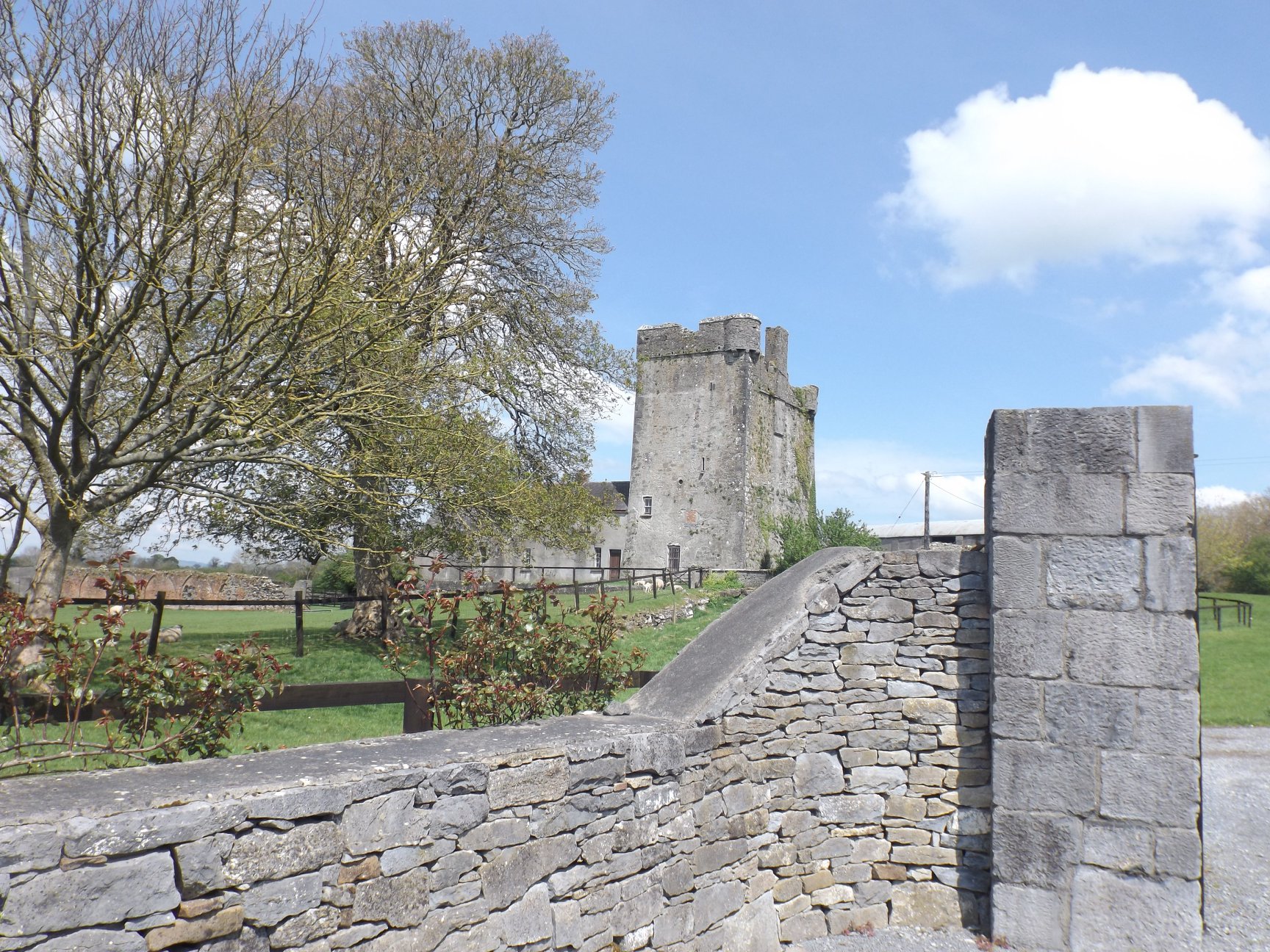
When Camilla and Jim Comerford visited Ireland with their son Jimmy 14 years ago (May 2012), I hosted them on a genealogical tour that brought them to Christ Church Cathedral, Dublin and the Comerford ancestral home at Ballybur Castle at Cuffesgrange, near Callan, Co Kilkenny.
They had been in London and Oxford the previous week. On a warm sunny, early summer afternoon in Dublin, after a thorough tour of the cathedral and the crypt, we sat for an hour or more outside the Bull and Castle on Christchurch Place and had lengthy conversations that ranged from Handel to Pugin, liturgy to architecture, and through politics and music to travel and politics.
We were guests the next day of the late Frank Gray, who bought Ballybur Castle from the Marnell family for £20,000 in 1979 and spent over three decades lovingly restoring the 16th century tower house, bringing it back to its Tudor glory.
In Cuffesgrange, I showed them the remains of a Comerford memorial from the early 17th century, rescued in the 19th century by Bishop Michael Comerford and placed in the corner wall of the parish church. Back in Kilkenny, we visited Kilkenny Castle, had lunch in the Kilkenny Design Centre, and met members of Camilla’s extended family.
Jim Comerford died on 21 April 2024 after a six-year battle with cancer. He is survived by his wife of 36 years, Camilla (Corrigan), their sons James ‘Jimmy’ Dower Comerford Jr and Joseph ‘Joey’ Corrigan Comerford of Atlanta, their daughter Margaret ‘Margeaux’ Eileen Comerford of Seattle, and their granddaughter Abigail Genevieve. His funeral Mass took place in the Cathedral of Christ the King, Atlanta, on 24 April 2024, and he was buried at Arlington Memorial Park.
Jim and Jimmy Comerford visiting the baptistery in Christ Church Cathedral, Dublin, in 2012 (Photograph: Patick Comerford)
Showing posts with label Co Kilkenny. Show all posts
19 May 2026
14 October 2025
Sir William Robinson from
Westmeath is remembered
150 years later in streets and
developments in Singapore
Modern Singapore has been strongly influenced by Irish-born governors, developers and architects (Photograph: Patrick Comerford)
Patrick Comerford
I am sorry to have missed the opportunity to be back in Singapore and Kuching during these weeks. I have missed some family gatherings, including a wedding in Kuching last weekend, and a visit last week to the Marina Bay Sands, a landmark in Singapore and one of the great architectural works by Moshe Safdie, who is one of thes greatest living architects today.
Last year, I looked at the influence of Irish figures and Irish developers and architects on the political life and the landscape of both Singapore and Kuching.
Sir Orfeur Cavenagh (1820-1891), who had family roots in Co Wexford and Co Kildare, lived in Singapore as the Governor of the Straits Settlements in from 1859 to 1867. William Cuppage (1807-1871), who first began to develop Emerald Hill almost 200 years ago, named Erin Lodge, Fern Cottage and Clare Grove after his family’s homes in Ireland.
The architects include including George Drumgoole Coleman (1795-1844) from Drogheda, who designed the original Saint Andrew’s Cathedral and many public buildings, Denis Lane McSwiney (1800-1867) from Cork who designed the Cathedral of the Good Shepherd in Singapore and Denis Santry (1879-1960), also from Cork, who designed many public buildings in both Singapore and Kuching.
I aslo came across a member of the Comerford family, Gerald Francis Commerford, who was held by the Japanese as a prisoner of war in Singapore and Borneo during World War II.
Sir William Cleaver Francis Robinson (1834-1897) was in Singapore as the Governor of the Straits Settlement for almost three yers from 1877 to 1879
Another key Irish-born figure in Singapore was Sir William Cleaver Francis Robinson (1834-1897), a colonial administrator and composer, who wrote several well-known songs. Robinson only spent a short time in Singapore as the Governor of the Straits Settlement, less than three years from 1877 to 1879, and for most of his colonial career he was based in Australia. But he has left his mark in Singapore in street names and property developments.
Despite his name, Robinson was not connected with the well-known business of Robinson and Cleaver on the corner of Donegall Square and Donegall Place in Belfast. Instead, Robinson was descended from distinguished landed families in Ireland, each with a strong presence in the Church of Ireland. His father, Admiral Hercules Robinson (1789-1864), was present with Nelson at the Battle of Trafalgar in 1805 and later was the Sheriff of Westmeath in 1842.
Hercules Robinson took his unusual first name from his maternal grandfather, Sir Hercules Langrishe (1729-1811) of Knocktopher Abbey, Co Kilkenny, an MP for Kilkenny in Grattan’s Parliament and a vocal advocate of Catholic Emancipation.
The admiral’s father, the Revd Christopher Robinson, the Rector of Granard, Co Longford, while his mother, Elizabeth Langrishe, was a sister of James Langrishe (1765-1847), Dean of Achonry and Archdeacon of Glendalough, and a first cousin of both Robert Tottenham (1773-1850), Bishop of Clogher, who lived at Woodstock, Co Wicklow, and John Loftus (1770-1845), 2nd Marquess of Ely, who inherited Loftus Hall, Co Wexford, and Rathfarnham Castle, Dublin.
Rosmead, the Robinson family home near Delvin, Co Westmeath, has been abandoned and derelict since 1940 (Photograph: Willie Forde Photography)
William Robinson was born on 14 January 1834 in Rosmead, his mother’s family home near Delvin, Co Westmeath, halfway between Mullingar and Kells. He was the fourth son of Admiral Hercules Robinson and his wife Frances Elizabeth Wood (1794-1873), the only daughter and heir of Henry Wildman Wood (1720-1795). Rosmead was built in the early 1700s by the Wood family and passed to the Robinson family after Hercules Robinson and Frances Elizabeth Wood married in 1822.
William Robinson was educated at home in Co Westmeath, and at the Royal Naval School, a private boarding in New Cross, Surrey. At the end of his school days, the indebted Robinson family were forced to sell the Rosmead estate in Westmeath in the Encumbered Estates Court. George Charles Mostyn (1804-1883), 6th Lord Vaux of Harrowden, bought the estate in 1852.
The Robinson estate included 1,564 acres at Rosmead, an additional 1,630 acres in Co Westmeath, 1,182 in Co Kilkenny, 677 in Co Meath, and 1,460 in Co Mayo. The sale of the contents alone took three days and included three grand pianofortes, a library with 1,162 books and a painting by Van Dyck.
Meanwhile, William Robinson joined the staff of the Colonial Office in 1858 as a private secretary to his brother, Hercules Robinson, who was Lieutenant Governor of St Kitts, and then accompanied him to Hong Kong in 1859.
William was appointed the President (Viceroy or Governor) of Montserrat in the West Indies in 1862. That same year, he married Olivia Edith Deane Townsend, a daughter of Thomas Stewart Townsend (1800-1852), briefly Dean of Lismore and Dean of Waterford (1850), and then Bishop of Meath (1850-1852).
Robinson was posted to Dominica and then was the Governor of the Falkland Islands (1866-1870), which he described as a ‘remote settlement at the fag end of the world’; Prince Edward Island (1870-1873), where he oversaw the island being incorporated into Canada in 1873; the Leeward Islands (1874); and, for his first time, Governor of Western Australia (1875-1877).
Robinson was appointed governor of the Straits Settlements in 1877. The Straits Settlements came under British control as a crown colony in 1867. It originally consisted of the four individual settlements of Singapore, Penang, Malacca and Dinding; Christmas Island and the Cocos (Keeling) Islands were added in 1886, and the island of Labuan, off the coast of Borneo, was incorporated into the colony in 1907. Most of the territories now form part of Malaysia, from which Singapore was expelled in 1965.
Robinson arrived in Singapore in 1877, ten years after the Straits Settlements had become a British crown colony. The governor was also High Commissioner for the Federated Malay States on the peninsula, and for British North Borneo, the Sultanate of Brunei and Sarawak in Borneo, ruled from Kuching by the Brooke dynasty.
At the time of his appointment to Singapore, Robinson was knighted (KCMG). From Singapore, he oversaw British interests in Bangkok in 1878, and received awards from the King of Siam (Thailand).
Sir William Robinson left Singapore for Australia in 1880
After his time in Singapore, Robinson later served as Governor of Western Australia for a second term (1880-1883) and Governor of South Australia (1883-1889), and was promoted in the knighthood to GCMG in 1887. He found his role as Governor of South Australia was primarily symbolic and social, and was probably bored during that time there. But he was passionate about music, playing the violin and the piano and singing, and he relieved his boredom in South Australia in musical events. He wrote many songs and composed a comic opera that was staged at the Princess Theatre in Melbourne.
He turned down an opportunity to become Governor of Hong Kong, saying he did not want to undergo its harsh climate. He was the acting Governor of Victoria in 1889, and rejected an invitation to become Governor of Mauritius. After an interlude in London, he returned for a third term as the Governor of Western Australia (1890-1895). He managed the transition of the colony to self-rule and chose John Forrest as the first Premier of Western Australia.
He retired from his colonial career in March 1895, at age 61. He moved back to England and became the director of many companies. He died on 2 May 1897 in South Kensington, London. He and his wife Olivia were the parents of two daughters and three sons. He left £84,058 in his will – the equivalent of almost £14 million today.
William Robinson often lived in the shadow of his brother, Hercules Robinson (1824-1897), another Irish-born colonial governor whose career included being Governor of Hong Kong, Governor of Ceylon (Sri Lanka), Governor of New South Wales, the first Governor of Fiji, Governor of New Zealand, two terms as High Commissioner for Southern Africa, and two terms as Governor of the Cape Colony. When Hercules was made a member of the House of Lords in 1896 he chose the title of Baron Rosmead of Rosmead, Co Westmeath.
But by then the Mostyn family had put the Rosmead estate up for sale again in the Landed Estates Court in 1879. There were proposals for its adaptation ‘for religious use’ in 1933. The designs by the Dublin architect Ralph Henry Byrne (1877-1946) including the creation of an oratory.
But these proposals came to nothing. The porch and the roof were removed in 1940, much of the house was dismantled, and some of the stone work used to rebuild Balrath, Co Meath, in 1942. Since then, the house has lain in ruins.
Sir William Robinson is remembered in the names of streets and developments in Singapore, including Robinson Road, Robinson Square, Robinson Centre and Robinson Point
But Sir William Robinson is remembered in the names of streets and developments in Singapore, including Robinson Road, Robinson Square, Robinson Centre and Robinson Point.
Robinson Road is a major trunk road in the Central Area that stretches from Maxwell Road to Finlayson Green. The land on which Robinson Road stands was created through land reclamation that began in 1879. It was a coastal road until more land reclamation from the early 1900s to 1932 shifted the shoreline further east to make room for building Shenton Way.
Today, Robinson Road is flanked by major skyscrapers and several developments, including Robinson Centre and Robinson Point. For years, the headquarters of the Criminal Investigation Department and the Chinese daily Sin Chew Jit Poh were on Robinson Road.
Crosby House, a seven-storey office complex, is a landmark at the corner of Robinson Road and McCallum Street. It was once owned by the Standard Chartered Bank and later by Singtel. Buildings along Robinson Road include architecture built in the 1920s and 1930s, such as the curved Telecoms Building – previously known as the Eastern Extension Telegraph Company (1927) and then Cable and Wireless Building, and later the Ogilvy Centre. The building now houses So Sofitel Singapore, a five-star hotel.
In Australia, Robinson Avenue, Robinson Road and Cleaver Street in central Perth were named after Robinson, as well as Port Robinson, a natural harbour in the Pilbara region of Western Australia.
Of course, there were other colonial governors in Singapore who were born in Ireland or who came from Irish families.
General Sir Andrew Clarke (1824-1902), who was the Governor of the Straits Settlements in 1873-1875, was a son of Colonel Andrew Clarke (1793-1847), another colonial governor, who was born in Lifford, Co Donegal. The younger Andrew Clarke was brought up by his grandfather, Dr Andrew Clarke, and two uncles, James Langton Clarke and William Hislop Clarke at the family home, Belmont, near Lifford. He went to Portora Royal School, Enniskillen, and spent part of his early military career in Fermoy Co Cork.
Belmont was a large country house at Curraghlane in Lifford. The house has since been demolished, and a housing estate named Beechwood is on the grounds of the house.
Peter Benson Maxwell (1817-1893), the chief justice of the Straits Settlements in 1867-1871, was the fourth son of the Revd Peter Benson Maxwell (1780-1867) of Birdstown, Co Donegal, and was educated at Trinity College Dublin. His wife, Frances Dorothea Synge (1813-1896), was a daughter of Francis Synge (1761-1831) of Glanmore Castle, Ashford, Co Wicklow, MP for Swords. Their son, Sir William Edward Maxwell (1846-1897), was Acting Governor of the Straits Settlements in 1893-1894.
So there is much more to explore in these Irish links the next time I am in Singapore.
A walking tour of Robinson Road, Singapore
Patrick Comerford
I am sorry to have missed the opportunity to be back in Singapore and Kuching during these weeks. I have missed some family gatherings, including a wedding in Kuching last weekend, and a visit last week to the Marina Bay Sands, a landmark in Singapore and one of the great architectural works by Moshe Safdie, who is one of thes greatest living architects today.
Last year, I looked at the influence of Irish figures and Irish developers and architects on the political life and the landscape of both Singapore and Kuching.
Sir Orfeur Cavenagh (1820-1891), who had family roots in Co Wexford and Co Kildare, lived in Singapore as the Governor of the Straits Settlements in from 1859 to 1867. William Cuppage (1807-1871), who first began to develop Emerald Hill almost 200 years ago, named Erin Lodge, Fern Cottage and Clare Grove after his family’s homes in Ireland.
The architects include including George Drumgoole Coleman (1795-1844) from Drogheda, who designed the original Saint Andrew’s Cathedral and many public buildings, Denis Lane McSwiney (1800-1867) from Cork who designed the Cathedral of the Good Shepherd in Singapore and Denis Santry (1879-1960), also from Cork, who designed many public buildings in both Singapore and Kuching.
I aslo came across a member of the Comerford family, Gerald Francis Commerford, who was held by the Japanese as a prisoner of war in Singapore and Borneo during World War II.
Sir William Cleaver Francis Robinson (1834-1897) was in Singapore as the Governor of the Straits Settlement for almost three yers from 1877 to 1879
Another key Irish-born figure in Singapore was Sir William Cleaver Francis Robinson (1834-1897), a colonial administrator and composer, who wrote several well-known songs. Robinson only spent a short time in Singapore as the Governor of the Straits Settlement, less than three years from 1877 to 1879, and for most of his colonial career he was based in Australia. But he has left his mark in Singapore in street names and property developments.
Despite his name, Robinson was not connected with the well-known business of Robinson and Cleaver on the corner of Donegall Square and Donegall Place in Belfast. Instead, Robinson was descended from distinguished landed families in Ireland, each with a strong presence in the Church of Ireland. His father, Admiral Hercules Robinson (1789-1864), was present with Nelson at the Battle of Trafalgar in 1805 and later was the Sheriff of Westmeath in 1842.
Hercules Robinson took his unusual first name from his maternal grandfather, Sir Hercules Langrishe (1729-1811) of Knocktopher Abbey, Co Kilkenny, an MP for Kilkenny in Grattan’s Parliament and a vocal advocate of Catholic Emancipation.
The admiral’s father, the Revd Christopher Robinson, the Rector of Granard, Co Longford, while his mother, Elizabeth Langrishe, was a sister of James Langrishe (1765-1847), Dean of Achonry and Archdeacon of Glendalough, and a first cousin of both Robert Tottenham (1773-1850), Bishop of Clogher, who lived at Woodstock, Co Wicklow, and John Loftus (1770-1845), 2nd Marquess of Ely, who inherited Loftus Hall, Co Wexford, and Rathfarnham Castle, Dublin.
Rosmead, the Robinson family home near Delvin, Co Westmeath, has been abandoned and derelict since 1940 (Photograph: Willie Forde Photography)
William Robinson was born on 14 January 1834 in Rosmead, his mother’s family home near Delvin, Co Westmeath, halfway between Mullingar and Kells. He was the fourth son of Admiral Hercules Robinson and his wife Frances Elizabeth Wood (1794-1873), the only daughter and heir of Henry Wildman Wood (1720-1795). Rosmead was built in the early 1700s by the Wood family and passed to the Robinson family after Hercules Robinson and Frances Elizabeth Wood married in 1822.
William Robinson was educated at home in Co Westmeath, and at the Royal Naval School, a private boarding in New Cross, Surrey. At the end of his school days, the indebted Robinson family were forced to sell the Rosmead estate in Westmeath in the Encumbered Estates Court. George Charles Mostyn (1804-1883), 6th Lord Vaux of Harrowden, bought the estate in 1852.
The Robinson estate included 1,564 acres at Rosmead, an additional 1,630 acres in Co Westmeath, 1,182 in Co Kilkenny, 677 in Co Meath, and 1,460 in Co Mayo. The sale of the contents alone took three days and included three grand pianofortes, a library with 1,162 books and a painting by Van Dyck.
Meanwhile, William Robinson joined the staff of the Colonial Office in 1858 as a private secretary to his brother, Hercules Robinson, who was Lieutenant Governor of St Kitts, and then accompanied him to Hong Kong in 1859.
William was appointed the President (Viceroy or Governor) of Montserrat in the West Indies in 1862. That same year, he married Olivia Edith Deane Townsend, a daughter of Thomas Stewart Townsend (1800-1852), briefly Dean of Lismore and Dean of Waterford (1850), and then Bishop of Meath (1850-1852).
Robinson was posted to Dominica and then was the Governor of the Falkland Islands (1866-1870), which he described as a ‘remote settlement at the fag end of the world’; Prince Edward Island (1870-1873), where he oversaw the island being incorporated into Canada in 1873; the Leeward Islands (1874); and, for his first time, Governor of Western Australia (1875-1877).
Robinson was appointed governor of the Straits Settlements in 1877. The Straits Settlements came under British control as a crown colony in 1867. It originally consisted of the four individual settlements of Singapore, Penang, Malacca and Dinding; Christmas Island and the Cocos (Keeling) Islands were added in 1886, and the island of Labuan, off the coast of Borneo, was incorporated into the colony in 1907. Most of the territories now form part of Malaysia, from which Singapore was expelled in 1965.
Robinson arrived in Singapore in 1877, ten years after the Straits Settlements had become a British crown colony. The governor was also High Commissioner for the Federated Malay States on the peninsula, and for British North Borneo, the Sultanate of Brunei and Sarawak in Borneo, ruled from Kuching by the Brooke dynasty.
At the time of his appointment to Singapore, Robinson was knighted (KCMG). From Singapore, he oversaw British interests in Bangkok in 1878, and received awards from the King of Siam (Thailand).
Sir William Robinson left Singapore for Australia in 1880
After his time in Singapore, Robinson later served as Governor of Western Australia for a second term (1880-1883) and Governor of South Australia (1883-1889), and was promoted in the knighthood to GCMG in 1887. He found his role as Governor of South Australia was primarily symbolic and social, and was probably bored during that time there. But he was passionate about music, playing the violin and the piano and singing, and he relieved his boredom in South Australia in musical events. He wrote many songs and composed a comic opera that was staged at the Princess Theatre in Melbourne.
He turned down an opportunity to become Governor of Hong Kong, saying he did not want to undergo its harsh climate. He was the acting Governor of Victoria in 1889, and rejected an invitation to become Governor of Mauritius. After an interlude in London, he returned for a third term as the Governor of Western Australia (1890-1895). He managed the transition of the colony to self-rule and chose John Forrest as the first Premier of Western Australia.
He retired from his colonial career in March 1895, at age 61. He moved back to England and became the director of many companies. He died on 2 May 1897 in South Kensington, London. He and his wife Olivia were the parents of two daughters and three sons. He left £84,058 in his will – the equivalent of almost £14 million today.
William Robinson often lived in the shadow of his brother, Hercules Robinson (1824-1897), another Irish-born colonial governor whose career included being Governor of Hong Kong, Governor of Ceylon (Sri Lanka), Governor of New South Wales, the first Governor of Fiji, Governor of New Zealand, two terms as High Commissioner for Southern Africa, and two terms as Governor of the Cape Colony. When Hercules was made a member of the House of Lords in 1896 he chose the title of Baron Rosmead of Rosmead, Co Westmeath.
But by then the Mostyn family had put the Rosmead estate up for sale again in the Landed Estates Court in 1879. There were proposals for its adaptation ‘for religious use’ in 1933. The designs by the Dublin architect Ralph Henry Byrne (1877-1946) including the creation of an oratory.
But these proposals came to nothing. The porch and the roof were removed in 1940, much of the house was dismantled, and some of the stone work used to rebuild Balrath, Co Meath, in 1942. Since then, the house has lain in ruins.
Sir William Robinson is remembered in the names of streets and developments in Singapore, including Robinson Road, Robinson Square, Robinson Centre and Robinson Point
But Sir William Robinson is remembered in the names of streets and developments in Singapore, including Robinson Road, Robinson Square, Robinson Centre and Robinson Point.
Robinson Road is a major trunk road in the Central Area that stretches from Maxwell Road to Finlayson Green. The land on which Robinson Road stands was created through land reclamation that began in 1879. It was a coastal road until more land reclamation from the early 1900s to 1932 shifted the shoreline further east to make room for building Shenton Way.
Today, Robinson Road is flanked by major skyscrapers and several developments, including Robinson Centre and Robinson Point. For years, the headquarters of the Criminal Investigation Department and the Chinese daily Sin Chew Jit Poh were on Robinson Road.
Crosby House, a seven-storey office complex, is a landmark at the corner of Robinson Road and McCallum Street. It was once owned by the Standard Chartered Bank and later by Singtel. Buildings along Robinson Road include architecture built in the 1920s and 1930s, such as the curved Telecoms Building – previously known as the Eastern Extension Telegraph Company (1927) and then Cable and Wireless Building, and later the Ogilvy Centre. The building now houses So Sofitel Singapore, a five-star hotel.
In Australia, Robinson Avenue, Robinson Road and Cleaver Street in central Perth were named after Robinson, as well as Port Robinson, a natural harbour in the Pilbara region of Western Australia.
Of course, there were other colonial governors in Singapore who were born in Ireland or who came from Irish families.
General Sir Andrew Clarke (1824-1902), who was the Governor of the Straits Settlements in 1873-1875, was a son of Colonel Andrew Clarke (1793-1847), another colonial governor, who was born in Lifford, Co Donegal. The younger Andrew Clarke was brought up by his grandfather, Dr Andrew Clarke, and two uncles, James Langton Clarke and William Hislop Clarke at the family home, Belmont, near Lifford. He went to Portora Royal School, Enniskillen, and spent part of his early military career in Fermoy Co Cork.
Belmont was a large country house at Curraghlane in Lifford. The house has since been demolished, and a housing estate named Beechwood is on the grounds of the house.
Peter Benson Maxwell (1817-1893), the chief justice of the Straits Settlements in 1867-1871, was the fourth son of the Revd Peter Benson Maxwell (1780-1867) of Birdstown, Co Donegal, and was educated at Trinity College Dublin. His wife, Frances Dorothea Synge (1813-1896), was a daughter of Francis Synge (1761-1831) of Glanmore Castle, Ashford, Co Wicklow, MP for Swords. Their son, Sir William Edward Maxwell (1846-1897), was Acting Governor of the Straits Settlements in 1893-1894.
So there is much more to explore in these Irish links the next time I am in Singapore.
A walking tour of Robinson Road, Singapore
27 May 2025
Kilbline Castle, near
Bennetsbridge, built
in the 16th century by
the Comerford family
Kilbline Castle, near Bennettsbridge, Co Kilkenny … built by the Comerford family ca 1539, but confiscated in the 1560s (Photograph © The Irish Antiquarian, 2020)
Patrick Comerford
On a recent question on the Facebook group Comerford Genealogy, after I posted an up-to-date photograph, one member asked: ‘Weren't there initially 4 owned by the Comerford family? Ballybur, Inchohologan, Danganmore, and Kilbline’.
I thought it would be interesting to start a new, occasional series on the castles and ancestral homes of the Comerford family, beginning with the story of Kilbline Castle, Co Kilkenny, although, when this is migrated to the Comerford Genealogy site, it shall eventually become No 4 in the series.
Kilbline Castle is a fortified 16th century tower house in Co Kilkenny. It is set on the Kilbline Estate in the parish of Tullaherin, in the Barony of Gowran, about a mile south-east of Bennettsbridge.
The historian of the Diocese of Ossory, Canon William Carrigan, suggested the name of Kilbline came from Saint Blaan, an early seventh century Irish saint and the first bishop of the See of Dunblane in Scotland.
Kilbline Castle is a typical example of the tower houses that are distinctive features of the Irish landscape. It is estimated that about 3,000 tower houses were built in Ireland between 1400 and 1650. Kilbline Castle is sometimes dated to the 14th or 15th centuries, while other sources say the castle was built in 1539 and was originally owned by the Comerford family.
If the castle was first built by the Comerford family in 1539, then the most likely original proprietor was James Quemerford or Comerford (ca 1493 – post 1560) of Ballymack, Co Kilkenny, a younger brother of Richard ‘Roe’ Comerford, ancestor of the Comerford family of Ballybur.
James Comerford was Attorney for the Earl of Ormond in counties Kilkenny, Wexford, Carlow and Tipperary, from 1531. He was presented with his brother Richard ‘Roe’ Quemerford of Ballybur and the rest of the gentry of Co Kilkenny in 1537 for ‘charging of coyne and livery’.
He was in possession of Ballymartown in 1543, and held Ballymack, immediately south of Ballybur, and halfway between Kilkenny and Callan. On 26 March 1549, he was pardoned along with his brothers, Richard Comerford of Ballybur, and Patrick Quemerford and Nicholas Quemerford, who were living at Ballymack.
James Comerford was the Queen’s Attorney for Waterford in 1558, and the Sheriff of Co Kilkenny in 1549, 1555-1559, and was killed in office. Elizabeth I’s letter to Perrot in January 1585 implies he had been attainted for rebellion, but this may be a mistake for his elder son, Thomas Quemerford (ca 1523-ca 1583).
Thomas Comerford inherited both Ballymack and Kilbline Castle from his father James Comerford ca 1560. In 1566, he had a commission with his cousin, Richard ‘Oge’ Comerford of Ballybur Castle, and others to make war on Piers Grace. However, Thomas Comerford was attainted soon after, and he lost Ballymack briefly to Patrick Sherlock of Waterford, who also acquired Mothel Abbey, near Carrick-on-Suir, and also lost the townland of Kilbline.
Thomas Comerford, who was to become known as a ‘perpetual rebel and traitor,’ was pardoned on 1 March 1569. However, that summer he joined the first Desmond rebellion led by James FitzMaurice FitzGerald. The rebellion lasted for two years, and Thomas Comerford was attainted again in 1571. All his lands were granted to John Prescott in 1575, but in 1580 they were granted to Francis Lovell, and this was confirmed in 1583.
Thomas Comerford married Margaret Cowley, but they had children and his claims and interests passed to his brother, Henry Quemerford or Comerford (ca 1525-1590) of Ballymack. Henry’s family managed to hold on to Ballymack for another century, but never recovered Kilbline Castle.
Henry Comerford’s descendants included: the Revd Thomas Comerford (ca 1596/1598-1635) of Ballymack, his grandson, who was Vicar of Attanagh and Vicar of The Rower, Co Kilkenny; Thomas Comerford (died ca 1627/1629), who is commemorated in Saint Mary’s Church, Callan, with a monument that includes the coat-of-arms of the Comberford family of Comberford, Staffordshire; Edward ‘Ned’ Comerford (ca 1600-(ca1660), MP for Callan; Major-General John Comerford (ca 1665-1725) of Madrid and Badajoz; Enrique Comerfort, Conde de Bryas; and Doña Josefa Eugenia Maria Francisca de Sales (‘Josefina’) de Comerford (1794-1865) of Barcelona and Seville, a femme fatale in the Spanish revolutionary politics of the 19th century.
Kilbline Castle was never recovered by the Comerford family after it was confiscated in the 1560s (Photograph © The Irish Antiquarian, 2020)
As for Kilbline Castle, it was never recovered by the Comerford family, and the subsequent owners were members of the Shortall family who also owned Rathardmore Castle, Co Kilkenny. A large limestone chimneypiece on the first floor carries the date 1580 so it is possible this is when the building was completed, after it had been lost by the Comerford family.
Thomas Shortall of Rathardmore died in 1628 and soon after his son and heir Peter Shortall moved to Kilbline Castle and lived there. His estates, extending to 1,500 acres, were forfeited by the Cromwellians in 1653 and his sons ordered to be sent to Connaught. After the restoration of Charles II in 1660, it is said, one of the sons of Peter Shortall seems to have returned to Kilbline.
William Candler, from Newcastle, Northumberland, was as a colonel in Cromwell’s army in Ireland in 1649-1653. He received grants of land in counties Wexford, Offaly (King’s County) and Kilkenny. His principal grants of land in Co Kilkenny included 620 acres in Dunamaggin Parish, 70 acres in Kilbeacon Parish, near Mullinavat, and Kilbline Castle. He and his wife, the widowed Anne Villiers, were the parents of two sons, and their youngest son, John Candler, lived at Kilbline.
William Candler’s second son, Thomas Candler, was an officer in the Williamite Wars in 1690-1691 and later lived at Callan Castle. He was the father of four sons, the youngest of whom Daniel who left Ireland with his wife Hannah ca 1735. They first moved to North Carolina before moving to Bedford, Virginia. Daniel died in 1765 and is buried in the Quaker cemetery at South River Meeting, near his home; Hanna lived to the age of 105, outliving her husband by 40 years – she died in 1800 and is buried with her husband. Their great, great, great-grandson was Asa Griggs Candler, who in 1888 bought the formula for Coca Cola.
Meanwhile, back in Ireland, William Candler’s two eldest sons were ordained in the Church of Ireland: the eldest, the Ven Henry Candler, became Archdeacon of Ossory; the second son, the Revd Dr William Candler, was Rector of Eirke, lived in Castlecomer and died in 1753. The third son, Thomas Candler, lived in Kilbline Castle until he died in 1740.
Kilbline Castle was owned by the Shortall, Cadler, Ryan and Lannon families (Photograph © The Irish Antiquarian, 2020)
Kilbline Castle continued to be occupied with a Ryan family living in the castle until 1840, before it passed by marriage into the Lannon family, who lived there until 1979. The castle remains in private ownership.
In many ways, Kilbline Castle is a typical Irish tower house. It is five storeys high, with round bartizans or wall-mounted turrets at each corner of the east front and a slender chimney-stack between them.
A chimney-piece in the tower is dated 1580 and there is an oak-panelled room on the south-east corner of the ground floor. However, the most significant feature of Kilbline Castle architecturally is a wonderful panelled room on the south-east corner of the ground floor, with oak that may date from the late 17th or early 18th century. All the wall panelling is intact and in remarkably good condition, although the ceiling is now covered in tongue-and-groove boards. The old chimneypiece is marred only by a shelf added at a later date.
The surrounding bawn wall survives in part, with early brick walls with blank arches. But some sections were demolished as late as the 20th century when modern farm sheds were being erected.
Kilbline Castle continued to be lived in up to a few decades ago. At some point, a two storey three-bay house was added at the west end of the tower house and a further single storey structure adjoining it.
The present owners do not live in the castle and it has been empty for some time, but they are aware of its importance. Although they have are no plans to restore the castle, the interior is said to be relatively intact and in remarkably good condition.
Kilbline Castle is a protected or listed structure with Kilkenny County Council. However, it is not open to or accessible to the public.
Kilbline Castle is about a mile south-east of Bennetsbridge, Co Kilkenny (Photograph © Irish Tower Houses, 2022)
Castles and Houses in this series:
1, Ballybur Castle, Cuffesgrange, Co Kilkenny
2, Ballymack, Co Kilkenny
3, Danganmore Castle, Co Kilkenny
4, Kilbline Castle, Co Kilkenny
5, Castleinch or Inchyolaghan, Co Kilkenny
6, Coolgreany House, near Castlewarren, Co Kilkenny
Kilbline Castle, near Bennettsbridge, Co Kilkenny, is a protected or listed structure but is not open to the public (Photograph: Paddy O’Shea, Irish Castles / Wikipedia CCL)
This illustrated essay was posted on Comerford Way (27 May 2025), and in the occasional series ‘Comerford castles and ancestral homes’ on Comerford Family History (backdated to 18 June 2009)
Patrick Comerford
On a recent question on the Facebook group Comerford Genealogy, after I posted an up-to-date photograph, one member asked: ‘Weren't there initially 4 owned by the Comerford family? Ballybur, Inchohologan, Danganmore, and Kilbline’.
I thought it would be interesting to start a new, occasional series on the castles and ancestral homes of the Comerford family, beginning with the story of Kilbline Castle, Co Kilkenny, although, when this is migrated to the Comerford Genealogy site, it shall eventually become No 4 in the series.
Kilbline Castle is a fortified 16th century tower house in Co Kilkenny. It is set on the Kilbline Estate in the parish of Tullaherin, in the Barony of Gowran, about a mile south-east of Bennettsbridge.
The historian of the Diocese of Ossory, Canon William Carrigan, suggested the name of Kilbline came from Saint Blaan, an early seventh century Irish saint and the first bishop of the See of Dunblane in Scotland.
Kilbline Castle is a typical example of the tower houses that are distinctive features of the Irish landscape. It is estimated that about 3,000 tower houses were built in Ireland between 1400 and 1650. Kilbline Castle is sometimes dated to the 14th or 15th centuries, while other sources say the castle was built in 1539 and was originally owned by the Comerford family.
If the castle was first built by the Comerford family in 1539, then the most likely original proprietor was James Quemerford or Comerford (ca 1493 – post 1560) of Ballymack, Co Kilkenny, a younger brother of Richard ‘Roe’ Comerford, ancestor of the Comerford family of Ballybur.
James Comerford was Attorney for the Earl of Ormond in counties Kilkenny, Wexford, Carlow and Tipperary, from 1531. He was presented with his brother Richard ‘Roe’ Quemerford of Ballybur and the rest of the gentry of Co Kilkenny in 1537 for ‘charging of coyne and livery’.
He was in possession of Ballymartown in 1543, and held Ballymack, immediately south of Ballybur, and halfway between Kilkenny and Callan. On 26 March 1549, he was pardoned along with his brothers, Richard Comerford of Ballybur, and Patrick Quemerford and Nicholas Quemerford, who were living at Ballymack.
James Comerford was the Queen’s Attorney for Waterford in 1558, and the Sheriff of Co Kilkenny in 1549, 1555-1559, and was killed in office. Elizabeth I’s letter to Perrot in January 1585 implies he had been attainted for rebellion, but this may be a mistake for his elder son, Thomas Quemerford (ca 1523-ca 1583).
Thomas Comerford inherited both Ballymack and Kilbline Castle from his father James Comerford ca 1560. In 1566, he had a commission with his cousin, Richard ‘Oge’ Comerford of Ballybur Castle, and others to make war on Piers Grace. However, Thomas Comerford was attainted soon after, and he lost Ballymack briefly to Patrick Sherlock of Waterford, who also acquired Mothel Abbey, near Carrick-on-Suir, and also lost the townland of Kilbline.
Thomas Comerford, who was to become known as a ‘perpetual rebel and traitor,’ was pardoned on 1 March 1569. However, that summer he joined the first Desmond rebellion led by James FitzMaurice FitzGerald. The rebellion lasted for two years, and Thomas Comerford was attainted again in 1571. All his lands were granted to John Prescott in 1575, but in 1580 they were granted to Francis Lovell, and this was confirmed in 1583.
Thomas Comerford married Margaret Cowley, but they had children and his claims and interests passed to his brother, Henry Quemerford or Comerford (ca 1525-1590) of Ballymack. Henry’s family managed to hold on to Ballymack for another century, but never recovered Kilbline Castle.
Henry Comerford’s descendants included: the Revd Thomas Comerford (ca 1596/1598-1635) of Ballymack, his grandson, who was Vicar of Attanagh and Vicar of The Rower, Co Kilkenny; Thomas Comerford (died ca 1627/1629), who is commemorated in Saint Mary’s Church, Callan, with a monument that includes the coat-of-arms of the Comberford family of Comberford, Staffordshire; Edward ‘Ned’ Comerford (ca 1600-(ca1660), MP for Callan; Major-General John Comerford (ca 1665-1725) of Madrid and Badajoz; Enrique Comerfort, Conde de Bryas; and Doña Josefa Eugenia Maria Francisca de Sales (‘Josefina’) de Comerford (1794-1865) of Barcelona and Seville, a femme fatale in the Spanish revolutionary politics of the 19th century.
Kilbline Castle was never recovered by the Comerford family after it was confiscated in the 1560s (Photograph © The Irish Antiquarian, 2020)
As for Kilbline Castle, it was never recovered by the Comerford family, and the subsequent owners were members of the Shortall family who also owned Rathardmore Castle, Co Kilkenny. A large limestone chimneypiece on the first floor carries the date 1580 so it is possible this is when the building was completed, after it had been lost by the Comerford family.
Thomas Shortall of Rathardmore died in 1628 and soon after his son and heir Peter Shortall moved to Kilbline Castle and lived there. His estates, extending to 1,500 acres, were forfeited by the Cromwellians in 1653 and his sons ordered to be sent to Connaught. After the restoration of Charles II in 1660, it is said, one of the sons of Peter Shortall seems to have returned to Kilbline.
William Candler, from Newcastle, Northumberland, was as a colonel in Cromwell’s army in Ireland in 1649-1653. He received grants of land in counties Wexford, Offaly (King’s County) and Kilkenny. His principal grants of land in Co Kilkenny included 620 acres in Dunamaggin Parish, 70 acres in Kilbeacon Parish, near Mullinavat, and Kilbline Castle. He and his wife, the widowed Anne Villiers, were the parents of two sons, and their youngest son, John Candler, lived at Kilbline.
William Candler’s second son, Thomas Candler, was an officer in the Williamite Wars in 1690-1691 and later lived at Callan Castle. He was the father of four sons, the youngest of whom Daniel who left Ireland with his wife Hannah ca 1735. They first moved to North Carolina before moving to Bedford, Virginia. Daniel died in 1765 and is buried in the Quaker cemetery at South River Meeting, near his home; Hanna lived to the age of 105, outliving her husband by 40 years – she died in 1800 and is buried with her husband. Their great, great, great-grandson was Asa Griggs Candler, who in 1888 bought the formula for Coca Cola.
Meanwhile, back in Ireland, William Candler’s two eldest sons were ordained in the Church of Ireland: the eldest, the Ven Henry Candler, became Archdeacon of Ossory; the second son, the Revd Dr William Candler, was Rector of Eirke, lived in Castlecomer and died in 1753. The third son, Thomas Candler, lived in Kilbline Castle until he died in 1740.
Kilbline Castle was owned by the Shortall, Cadler, Ryan and Lannon families (Photograph © The Irish Antiquarian, 2020)
Kilbline Castle continued to be occupied with a Ryan family living in the castle until 1840, before it passed by marriage into the Lannon family, who lived there until 1979. The castle remains in private ownership.
In many ways, Kilbline Castle is a typical Irish tower house. It is five storeys high, with round bartizans or wall-mounted turrets at each corner of the east front and a slender chimney-stack between them.
A chimney-piece in the tower is dated 1580 and there is an oak-panelled room on the south-east corner of the ground floor. However, the most significant feature of Kilbline Castle architecturally is a wonderful panelled room on the south-east corner of the ground floor, with oak that may date from the late 17th or early 18th century. All the wall panelling is intact and in remarkably good condition, although the ceiling is now covered in tongue-and-groove boards. The old chimneypiece is marred only by a shelf added at a later date.
The surrounding bawn wall survives in part, with early brick walls with blank arches. But some sections were demolished as late as the 20th century when modern farm sheds were being erected.
Kilbline Castle continued to be lived in up to a few decades ago. At some point, a two storey three-bay house was added at the west end of the tower house and a further single storey structure adjoining it.
The present owners do not live in the castle and it has been empty for some time, but they are aware of its importance. Although they have are no plans to restore the castle, the interior is said to be relatively intact and in remarkably good condition.
Kilbline Castle is a protected or listed structure with Kilkenny County Council. However, it is not open to or accessible to the public.
Kilbline Castle is about a mile south-east of Bennetsbridge, Co Kilkenny (Photograph © Irish Tower Houses, 2022)
Castles and Houses in this series:
1, Ballybur Castle, Cuffesgrange, Co Kilkenny
2, Ballymack, Co Kilkenny
3, Danganmore Castle, Co Kilkenny
4, Kilbline Castle, Co Kilkenny
5, Castleinch or Inchyolaghan, Co Kilkenny
6, Coolgreany House, near Castlewarren, Co Kilkenny
Kilbline Castle, near Bennettsbridge, Co Kilkenny, is a protected or listed structure but is not open to the public (Photograph: Paddy O’Shea, Irish Castles / Wikipedia CCL)
This illustrated essay was posted on Comerford Way (27 May 2025), and in the occasional series ‘Comerford castles and ancestral homes’ on Comerford Family History (backdated to 18 June 2009)
24 May 2025
Nicholas Comberford’s
maps of the ‘Bay of Mexico’
defy Trump’s delusions
about the ‘Gulf of America’
Manuscript map of North America, ca late 1630s, pen and ink and watercolour on parchment (Yale Center for British Art, Paul Mellon Fund) … Nicholas Comberford was using the name ‘Bay of Mexico’ almost 400 years ago
Patrick Comerford
The Trump regime’s petty insistence on labelling the Gulf of Mexico as the ‘Gulf of America’ is both mendacious and egregious, imposing a name that has been concocted to mollify a petulant man who continues to pursue imperious gestures and to sign egregious edicts for no other reason than to compensate for his inner insecurities and his low self-esteem.
Executive Order 14172 on 20 January tried to the change the name of the Gulf of Mexico to the Gulf of America in US federal government usage, despite the fact that it has been known as the Gulf of Mexico since the 1550s, a name derived from Mexica, the Nahuatl word for the Aztecs.
Associated Press journalists have been banned indefinitely from the Oval Office and Air Force One because AP decided to continue using Gulf of Mexico. The White House accused AP of ‘commitment to misinformation’ and ‘irresponsible and dishonest reporting’, and Trump says AP continues to be barred ‘until such time as they agree that it’s the Gulf of America.’
Historians, geographers and cartographers, as well as journalists, have produced maps that are centuries-old using names such as the Gulf of Mexico, the Great Bay of Mexico, or simply the Bay of Mexico. No historical map names the place the Gulf of America. Why? Simply because there was no USA back then.
The names Gulf of Mexico and Bay of Mexico appear on maps long before Jamestown, before Plymouth Rock, and over 200 years before the Declaration of Independence, and more than 250 years before the Louisiana Purchase, which was the first time the US controlled any land even bordering the Gulf.
The name Mexico refers to the people later referred to as Aztecs, when what is now Mexico was part of Colonial Spain. The name ‘Golfo de Mexico’ first appears in 1550 on a map now in the Bodleian Library in Oxford, and in an historical account in 1552.
Europeans have used the name the Gulf of Mexico, and the corresponding terms in Spanish and French, Golfo Mexicano and Golphe du Mexique, with consistency from the mid-17th century, although Spanish geographers continued for a time to also use the name of Golfo de Nueva España.
In recent days, I have come across two versions of the earliest English-language maps to refer to the Bay of Mexico or Gulf of Mexico. They have been dated to the 1630s or, more likely, the 1640s or the 1650s, and the cartographic historian and antiquarian Philip D Burden has recently identified Nicholas Comberford (ca 1600-1673) of Stepney, the 17th century Kilkenny-born map maker as the creator of these maps.
One version of the map with the name ‘Bay of Mexico’ is a manuscript map of North America in pen and ink and watercolour on parchment. It is in the Yale Center for British Art, thanks to the Paul Mellon Fund, and it has been dated to the late 1630s.
Another version, recently sold by Clive A Burden Ltd of Chalfont St Giles, Buckinghamshire, has been labelled ‘Map of the Bay of Mexico &c’, has been dated to London ca 1650, and has been identified as the work of Nicholas Comberford.
This second map measures 220 x 430 mm on a sheet measuring 250 x 465 mm, and is in ink with green and yellow watercolour wash on parchment. It is in good condition and has an ink notation, ‘This vellam and paper I brought with me out of England as I remember about 18 yeares past the vellam decay’d through the moisture of the place’.
It was sold recently as stock number 9601 by Clive A Burden Ltd rare map dealers. The business was founded by the late Clive A Burden in 1966 and is one of the longest established dealers in antique maps, atlases, books and rare decorative prints, with a particular focus are the British Isles and North America.
Nicholas Comberford’s works have been catalogued in the British Library and are found in the National Maritime Museum, Greenwich, the New York Public Library, the Sterling Memorial Library at Yale University, and some other museums and libraries. He is a widely-acclaimed, leading and important member of the London group of chart-makers, who used similar colours, patterns and techniques, worked on vellum, and lived close to the dockyards at Stepney and Wapping on the Thames. They have come to be called the Thames School.
He was born in Kilkenny ca> 1600, and, according to his own account, his father was Nicholas Comerford, the ‘King’s Gaoler’ at Kilkenny, and his grandfather was Garret Comerford (ca 1550-1604) of Inchiolohan or Castleinch, the Queen’s Attorney-at-Laws for Connaught, MP for Callan, Second Baron of the Exchequer and Chief Justice of Munster.
Nicholas was a life-long member of the Drapers’ Company in London and his maps charted the world from the East Indies and India to Brazil and the coast of North America. He may well have been the first person to create English-language maps that show Borneo, including the area that is now Sarawak and the place where Kuching would later develop.
However, unlike the other members of the Thames School, Nicholas Comberford was not an Englishman, but a Kilkenny-born Irishman, who, as well as being overlooked until recently by cartographers and art historians alike, has been overlooked too in his native county.
The Town Hall in Callan, Co Callan, once held the Civic Mace presented by Edward Comerford … Edward Comerford and Lord Maltravers were MPs for Callan in 1634-1635 (Photograph: Patrick Comerford)
Philip D Burden joined his father in the business in 1979. He wrote and published in 1996 and 2007 a definitive two volume work, The Mapping of North America. It was the first work to list all known printed maps relating to North America up to the year 1700.
Burden argues convincingly that this remarkable English manuscript map of North America was probably prepared ca 1650, in conjunction with a proposal to establish a colony in North Carolina (‘Carolana’). The fact that the manuscript was drawn on costly vellum, as opposed to paper, strongly suggests it was prepared as an official document for a key figure involved in the proposed settlement.
He says the idiosyncratic detail of the map strongly suggests a connection with John Farrah, mapmaker, and former Deputy Treasurer of the Virginia Company, who was very active in ‘Carolana’ affairs at this time.
The English colony of ‘Carolana’ originated in a grant by Charles I in 1629 to Sir Robert Heath, Solicitor General of England (1621), Attorney General (1625) and a member of the council of the Virginia Company.
Charles I named the new territory ‘Carolana’ after himself. Heath had no success in attracting settlers and in 1638, he assigned his rights to Henry Frederick Howard (1608-1652), Lord Maltravers and from 1640 Earl of Arundel, and MP for Callan, Co Kilkenny, Edward Comerford in the Irish Parliament in 1634-1635; Edward Comerford was MP for Callan again in 1639-1649
Lord Maltravers had many interests in the American colonies. He was a member of the New England Company and sought royal support for the English West India Company in 1637. Interest in North Carolina expanded after the trial and execution of Charles I in 1649.
A promotional tract was published in May in a London newspaper, The Moderate Intelligencer, entitled ‘A Description of ‘Carolana’ by a ‘Well-Willer’. A similar tract, William Bullock’s Virginia Impartially Examined, was published a few weeks earlier and was dedicated to Lord Maltravers and Lord Baltimore.
Lord Maltravers, was MP for Callan with Edward Comerford, and planned to colonise Norh Carolina
By far the most important of the ‘Carolana’ promotional tracts came in 1650 as Edward Williams’s Virgo Triumphans, or Virginia richly and truly valued; more especially the South part thereof: viz. The fertile Carolana … (London: John Stevenson, 1650).
Williams’s publication was associated with John Farrar of Geding, Huntingdonshire, formerly Deputy Treasurer for the Virginia Company. He was the author of a number of maps of Virginia at this time, when ‘Carolana’ was often regarded as South Virginia.
Farrar’s map in 1651 uses the name ‘Carolana’ to the region between the Roanoke and the Chowan Rivers. His map is most famous for its inclusion of a great ‘The Sea of China and the Indies’ immediately beyond the Appalachian Mountains. This detail would have been of great interest to Lord Maltravers, who held nominal title to all the land included in the original grant, which extended far beyond those mountains. Farrar’s map claims any successful colony in ‘Carolana’ would have access to ports on this western sea, and with trade with ‘China and the Indies’.
The English manuscript map includes a much vaster area than Farrar’s map – virtually all of North America. However, on the Englishman manuscript, the great trans-Appalachian sea is called ‘The South Sea’, not ‘The Sea of China and the Indies’.
Both the Farrar map and the English manuscript map include the Nansemond River, in Southside Virginia. The Nansemond is one of only four placenames given for Virginia on the English manuscript, along with Chesapeake, Jamestown and ‘Accomack. Burden says all the evidence points to the English manuscript as having been prepared in conjunction with the 1649 proposal to establish a permanent colony in ‘Carolana’.
The fact that there is no sign of the English colonies of New York and New Jersey (founded 1664, and the entire region between the Hudson from the Delaware is labelled the New Netherland helps Burden to be even more precise in dating the map. Fort Orange (founded in 1624), the Hudson River and Helgate are named. Long Island is shown divided by a channel and is similar in form to Sir Robert Dudley’s map of New England (1647), while Delaware (‘De la Warr’) Bay and River are given their present name, first introduced on Lord Baltimore’s map (1635).
He points out too that name ‘Carolana’ was used consistently in England for the region south of Virginia until 1663, when a new grant from Charles II used the spelling Carolina.
In conclusion, Burden suggests the map is no earlier than 1634, the date of the founding of Maryland, and no later than 1664, when the English conquest turned New Netherland into New York.
Burden also believes that the map’s calligraphy was the work of ‘two distinct hands’. He a ‘major chart maker’ would have been a logical choice for such a seemingly important map, and says: ‘A study of the Thames school reveals that it is not uncommon for charts to be unsigned or undated … Chartmakers tended to have geographical areas of expertise and a study of the time frame and region would tend to point to Nicholas Comberford. He was the only map maker identifiable during this time frame who produced charts of North America. There are similarities of lettering also, particularly noticeable with the ‘R’ and ‘A’.’
Nicholas Comberford, however, was known for being decorative, so this would not have been a major production of his, and seems to suggest the map may date ca 1649 to 1651.
‘The South Part of Virginia’ (Nicholas Comberford, 1657)
The connection that Lord Maltravers shared with the Comerford family and with Callan may partly explain the commissions Nicholas Comberford received for maps associated with Carolina, and subsequently he completed two further maps showing Carolina.
His map of the ‘The South Part of Virginia’ was produced in 1657. It is a single sheet of vellum, measuring 38 x 50 cm is mounted on two hinged boards, each 39 x 25 cm.
This chart is in the Heathcote collection. Another copy with slight differences but of the same date is in the New York Public Library.
‘The south part of Virginia now the north part of Carolina’ (Nicholas Comberford, 1657)
Another map of ‘The south part of Virginia now the north part of Carolina’ was made by Nicholas Comberford in 1657. This map in the New York Public Library, is similar to his map, ‘The south part of Virginia’ (1657) and is in the National Maritime Museum in Greenwich, but the signature reads: ‘Nicholas C[o]mberford fe[c]itt anno 1657.’
These two maps record for the first time many names that are still in use. Some of them, such as ‘Battis Ponte’ on Pamlico River, were probably given by Captain Nathaniel Battis, an early explorer, landowner and settler.
In the title of the New York map, the words ‘now the north part of Carolina’ were added in a later hand some time after the grant of Carolina in 1663.
Nicholas Comberford is a key figure in 17th century art in England, but he is also an important figure in explaining how we came to understand the way the world was explored, mapped, charted and named by Europeans and by English-speaking travellers and adventurers in the mid-17th century.
Only the foolhardy ignore the facts of history, and only the deluded ignore the reality of geography. As I continue to learn more about how his work was so influential as a mapmaker, cartographer and geographer, I can only muse if the name ‘Bay of Mexico’ was good enough for Nicholas Comberford and the Comerford family almost 400, thn thee name ‘Gulf of Mexico’ should be good enough today for an upstart like Donald Trump, his acolytes and sychophants in the Oval Office and his MAGA minions.
Nicholas Comberford, ‘Map of the Bay of Mexico &c’, London, ca 1650, 220 x 430 mm on a sheet 250 x 465 mm, ink with green and yellow watercolour wash on parchment
Patrick Comerford
The Trump regime’s petty insistence on labelling the Gulf of Mexico as the ‘Gulf of America’ is both mendacious and egregious, imposing a name that has been concocted to mollify a petulant man who continues to pursue imperious gestures and to sign egregious edicts for no other reason than to compensate for his inner insecurities and his low self-esteem.
Executive Order 14172 on 20 January tried to the change the name of the Gulf of Mexico to the Gulf of America in US federal government usage, despite the fact that it has been known as the Gulf of Mexico since the 1550s, a name derived from Mexica, the Nahuatl word for the Aztecs.
Associated Press journalists have been banned indefinitely from the Oval Office and Air Force One because AP decided to continue using Gulf of Mexico. The White House accused AP of ‘commitment to misinformation’ and ‘irresponsible and dishonest reporting’, and Trump says AP continues to be barred ‘until such time as they agree that it’s the Gulf of America.’
Historians, geographers and cartographers, as well as journalists, have produced maps that are centuries-old using names such as the Gulf of Mexico, the Great Bay of Mexico, or simply the Bay of Mexico. No historical map names the place the Gulf of America. Why? Simply because there was no USA back then.
The names Gulf of Mexico and Bay of Mexico appear on maps long before Jamestown, before Plymouth Rock, and over 200 years before the Declaration of Independence, and more than 250 years before the Louisiana Purchase, which was the first time the US controlled any land even bordering the Gulf.
The name Mexico refers to the people later referred to as Aztecs, when what is now Mexico was part of Colonial Spain. The name ‘Golfo de Mexico’ first appears in 1550 on a map now in the Bodleian Library in Oxford, and in an historical account in 1552.
Europeans have used the name the Gulf of Mexico, and the corresponding terms in Spanish and French, Golfo Mexicano and Golphe du Mexique, with consistency from the mid-17th century, although Spanish geographers continued for a time to also use the name of Golfo de Nueva España.
In recent days, I have come across two versions of the earliest English-language maps to refer to the Bay of Mexico or Gulf of Mexico. They have been dated to the 1630s or, more likely, the 1640s or the 1650s, and the cartographic historian and antiquarian Philip D Burden has recently identified Nicholas Comberford (ca 1600-1673) of Stepney, the 17th century Kilkenny-born map maker as the creator of these maps.
One version of the map with the name ‘Bay of Mexico’ is a manuscript map of North America in pen and ink and watercolour on parchment. It is in the Yale Center for British Art, thanks to the Paul Mellon Fund, and it has been dated to the late 1630s.
Another version, recently sold by Clive A Burden Ltd of Chalfont St Giles, Buckinghamshire, has been labelled ‘Map of the Bay of Mexico &c’, has been dated to London ca 1650, and has been identified as the work of Nicholas Comberford.
This second map measures 220 x 430 mm on a sheet measuring 250 x 465 mm, and is in ink with green and yellow watercolour wash on parchment. It is in good condition and has an ink notation, ‘This vellam and paper I brought with me out of England as I remember about 18 yeares past the vellam decay’d through the moisture of the place’.
It was sold recently as stock number 9601 by Clive A Burden Ltd rare map dealers. The business was founded by the late Clive A Burden in 1966 and is one of the longest established dealers in antique maps, atlases, books and rare decorative prints, with a particular focus are the British Isles and North America.
Nicholas Comberford’s works have been catalogued in the British Library and are found in the National Maritime Museum, Greenwich, the New York Public Library, the Sterling Memorial Library at Yale University, and some other museums and libraries. He is a widely-acclaimed, leading and important member of the London group of chart-makers, who used similar colours, patterns and techniques, worked on vellum, and lived close to the dockyards at Stepney and Wapping on the Thames. They have come to be called the Thames School.
He was born in Kilkenny ca> 1600, and, according to his own account, his father was Nicholas Comerford, the ‘King’s Gaoler’ at Kilkenny, and his grandfather was Garret Comerford (ca 1550-1604) of Inchiolohan or Castleinch, the Queen’s Attorney-at-Laws for Connaught, MP for Callan, Second Baron of the Exchequer and Chief Justice of Munster.
Nicholas was a life-long member of the Drapers’ Company in London and his maps charted the world from the East Indies and India to Brazil and the coast of North America. He may well have been the first person to create English-language maps that show Borneo, including the area that is now Sarawak and the place where Kuching would later develop.
However, unlike the other members of the Thames School, Nicholas Comberford was not an Englishman, but a Kilkenny-born Irishman, who, as well as being overlooked until recently by cartographers and art historians alike, has been overlooked too in his native county.
The Town Hall in Callan, Co Callan, once held the Civic Mace presented by Edward Comerford … Edward Comerford and Lord Maltravers were MPs for Callan in 1634-1635 (Photograph: Patrick Comerford)
Philip D Burden joined his father in the business in 1979. He wrote and published in 1996 and 2007 a definitive two volume work, The Mapping of North America. It was the first work to list all known printed maps relating to North America up to the year 1700.
Burden argues convincingly that this remarkable English manuscript map of North America was probably prepared ca 1650, in conjunction with a proposal to establish a colony in North Carolina (‘Carolana’). The fact that the manuscript was drawn on costly vellum, as opposed to paper, strongly suggests it was prepared as an official document for a key figure involved in the proposed settlement.
He says the idiosyncratic detail of the map strongly suggests a connection with John Farrah, mapmaker, and former Deputy Treasurer of the Virginia Company, who was very active in ‘Carolana’ affairs at this time.
The English colony of ‘Carolana’ originated in a grant by Charles I in 1629 to Sir Robert Heath, Solicitor General of England (1621), Attorney General (1625) and a member of the council of the Virginia Company.
Charles I named the new territory ‘Carolana’ after himself. Heath had no success in attracting settlers and in 1638, he assigned his rights to Henry Frederick Howard (1608-1652), Lord Maltravers and from 1640 Earl of Arundel, and MP for Callan, Co Kilkenny, Edward Comerford in the Irish Parliament in 1634-1635; Edward Comerford was MP for Callan again in 1639-1649
Lord Maltravers had many interests in the American colonies. He was a member of the New England Company and sought royal support for the English West India Company in 1637. Interest in North Carolina expanded after the trial and execution of Charles I in 1649.
A promotional tract was published in May in a London newspaper, The Moderate Intelligencer, entitled ‘A Description of ‘Carolana’ by a ‘Well-Willer’. A similar tract, William Bullock’s Virginia Impartially Examined, was published a few weeks earlier and was dedicated to Lord Maltravers and Lord Baltimore.
Lord Maltravers, was MP for Callan with Edward Comerford, and planned to colonise Norh CarolinaBy far the most important of the ‘Carolana’ promotional tracts came in 1650 as Edward Williams’s Virgo Triumphans, or Virginia richly and truly valued; more especially the South part thereof: viz. The fertile Carolana … (London: John Stevenson, 1650).
Williams’s publication was associated with John Farrar of Geding, Huntingdonshire, formerly Deputy Treasurer for the Virginia Company. He was the author of a number of maps of Virginia at this time, when ‘Carolana’ was often regarded as South Virginia.
Farrar’s map in 1651 uses the name ‘Carolana’ to the region between the Roanoke and the Chowan Rivers. His map is most famous for its inclusion of a great ‘The Sea of China and the Indies’ immediately beyond the Appalachian Mountains. This detail would have been of great interest to Lord Maltravers, who held nominal title to all the land included in the original grant, which extended far beyond those mountains. Farrar’s map claims any successful colony in ‘Carolana’ would have access to ports on this western sea, and with trade with ‘China and the Indies’.
The English manuscript map includes a much vaster area than Farrar’s map – virtually all of North America. However, on the Englishman manuscript, the great trans-Appalachian sea is called ‘The South Sea’, not ‘The Sea of China and the Indies’.
Both the Farrar map and the English manuscript map include the Nansemond River, in Southside Virginia. The Nansemond is one of only four placenames given for Virginia on the English manuscript, along with Chesapeake, Jamestown and ‘Accomack. Burden says all the evidence points to the English manuscript as having been prepared in conjunction with the 1649 proposal to establish a permanent colony in ‘Carolana’.
The fact that there is no sign of the English colonies of New York and New Jersey (founded 1664, and the entire region between the Hudson from the Delaware is labelled the New Netherland helps Burden to be even more precise in dating the map. Fort Orange (founded in 1624), the Hudson River and Helgate are named. Long Island is shown divided by a channel and is similar in form to Sir Robert Dudley’s map of New England (1647), while Delaware (‘De la Warr’) Bay and River are given their present name, first introduced on Lord Baltimore’s map (1635).
He points out too that name ‘Carolana’ was used consistently in England for the region south of Virginia until 1663, when a new grant from Charles II used the spelling Carolina.
In conclusion, Burden suggests the map is no earlier than 1634, the date of the founding of Maryland, and no later than 1664, when the English conquest turned New Netherland into New York.
Burden also believes that the map’s calligraphy was the work of ‘two distinct hands’. He a ‘major chart maker’ would have been a logical choice for such a seemingly important map, and says: ‘A study of the Thames school reveals that it is not uncommon for charts to be unsigned or undated … Chartmakers tended to have geographical areas of expertise and a study of the time frame and region would tend to point to Nicholas Comberford. He was the only map maker identifiable during this time frame who produced charts of North America. There are similarities of lettering also, particularly noticeable with the ‘R’ and ‘A’.’
Nicholas Comberford, however, was known for being decorative, so this would not have been a major production of his, and seems to suggest the map may date ca 1649 to 1651.
‘The South Part of Virginia’ (Nicholas Comberford, 1657)The connection that Lord Maltravers shared with the Comerford family and with Callan may partly explain the commissions Nicholas Comberford received for maps associated with Carolina, and subsequently he completed two further maps showing Carolina.
His map of the ‘The South Part of Virginia’ was produced in 1657. It is a single sheet of vellum, measuring 38 x 50 cm is mounted on two hinged boards, each 39 x 25 cm.
This chart is in the Heathcote collection. Another copy with slight differences but of the same date is in the New York Public Library.
‘The south part of Virginia now the north part of Carolina’ (Nicholas Comberford, 1657)Another map of ‘The south part of Virginia now the north part of Carolina’ was made by Nicholas Comberford in 1657. This map in the New York Public Library, is similar to his map, ‘The south part of Virginia’ (1657) and is in the National Maritime Museum in Greenwich, but the signature reads: ‘Nicholas C[o]mberford fe[c]itt anno 1657.’
These two maps record for the first time many names that are still in use. Some of them, such as ‘Battis Ponte’ on Pamlico River, were probably given by Captain Nathaniel Battis, an early explorer, landowner and settler.
In the title of the New York map, the words ‘now the north part of Carolina’ were added in a later hand some time after the grant of Carolina in 1663.
Nicholas Comberford is a key figure in 17th century art in England, but he is also an important figure in explaining how we came to understand the way the world was explored, mapped, charted and named by Europeans and by English-speaking travellers and adventurers in the mid-17th century.
Only the foolhardy ignore the facts of history, and only the deluded ignore the reality of geography. As I continue to learn more about how his work was so influential as a mapmaker, cartographer and geographer, I can only muse if the name ‘Bay of Mexico’ was good enough for Nicholas Comberford and the Comerford family almost 400, thn thee name ‘Gulf of Mexico’ should be good enough today for an upstart like Donald Trump, his acolytes and sychophants in the Oval Office and his MAGA minions.
Nicholas Comberford, ‘Map of the Bay of Mexico &c’, London, ca 1650, 220 x 430 mm on a sheet 250 x 465 mm, ink with green and yellow watercolour wash on parchment
30 June 2024
Ignacio Comonfort,
President of Mexico,
descended from the
Comerfords of Callan
President Ignacio Comonfort (1812-1863), President of Mexico in 1855-1858 … he was a grandson of Joseph Comerford, born in Callan, Co Kilkenny
Patrick Comerford
President Ignacio Comonfort (1812-1863) was the President of Mexico briefly in 1855-1858. He is seen as a revolutionary and a liberal who sought to introduce major constitutional and political reforms in Mexico, and he challenged the influence and power of the Roman Catholic Church in Mexican life.
However, his search for a political compromise with conservative elements led to his downfall and exile. After his return to Mexico, he was killed in a skirmish in 1863. He was a patriotic and dedicated man, who has given his name to the city where he was buried. But he has also been described as ‘one of the more tragic and unhappy figures of Mexican history.’
His name is intriguing, for it certainly does not sound Spanish, and many Comerford family members have long speculated that his name derived from Comerford. However, this long continued to be mere speculation – perhaps a genealogist’s conjecture or even a ‘good hunch’.
But I remained persistent in my pursuit, and I was keen to either prove or disprove once and for all that this key figure in the history of post-colonial Mexico was a member of the Comerford family.
Now, in recent weeks, trawls through Mexican genealogical sites and records and biographies, mainly in Spanish, have confirmed this speculation and prove that Ignacio Comonfort was, in fact, the grandson of Joseph Comerford, who was born in Callan, Co Kilkenny, in the early decades of the 18th century.
Callan, Co Kilkenny … Ignacio Comonfort was descended from the Comerfords of Callan (Photograph: Patrick Comerford, 2011)
President Ignacio Comonfort was born José Ignacio Gregorio Comonfort de los Ríos on 12 March 1812 in Amozoc, Puebla de los Ángeles, now Puebla de Zaragoza, then the second largest city in the Spanish Colony of New Spain or colonial Mexico.
His father, Mariano José Anselmo de la Santísima Trinidad Comonfort Carricarte, was born in Puebla in 1771. His grandfather, Joseph Comerford, was born in Callan, Co Kilkenny, and emigrated to Mexico, where the surname first became Comoforte but later morphed into Comonfort in an attempt at Hispanicisation. (In a similar way, the name O’Brien later on, became the Spanish Obregón.)
The name Comonfort continued for another few generations through the former President’s grandchildren.
Ignacio Comonfort’s parents were Lieutenant-Colonel Mariano José Anselmo de la Santísima Trinidad Comonfort Carricarte and Maria Guadalupe de los Rios. The name José recalled the future president’s Comerford grandfather, Joseph Comerford. But the name José had been given earlier to another, older child who died in infancy, and as he grew up he was known as Ignacio.
At the age of 14, he began studying at the Carolino College, a Jesuit-run school in Puebla, and went on study law in Puebla. However, his father’s death impoverished the family; he abandoned his law career and enlisted in the army.
Meanwhile, after the collapse of Spanish colonial rule and the Mexican War of Independence, Mexico was eventually proclaimed a federal republic on 4 October 1824, as the United Mexican States (Estados Unidos Mexicanos) with a new constitution.
Ignacio Comonfort was 20 in 1832 when he took part in the liberal revolt that overthrew President Anastasio Bustamante and he fought in action at San Agustin del Palmar and Puebla. During the subsequent siege of Mexico City, he was already a captain of the cavalry and fought at Tacubaya, Casas Blancas, Zumpango, San Lorenzo and Posadas.
When Bustamante was overthrown and the Zavaleta Accords put an end to the revolution, Comonfort became the military commander of Izúcar de Matamoros. He was elected to the presidency of the third ayuntamiento in the capital and became prefect of the western State of Mexico.
Shortly after the United States annexed Texas in 1845, the two nations sent troops to their shared border. The US declared war on Mexico in 1846 and invaded Mexico in 1847. Comonfort took part in the defence of Mexico City and the Battle of Churubusco on 20 August 1847. He became assistant to the commander-in-chief, and after the US army took the capital he was a member of the congress that met at Querétaro. He was elected a senator the following year (1848).
Comonfort’s liberal sympathies, military expertise and presence in the south gave him a key role in the Ayutla Revolution, unifying liberal opposition to Antonio López de Santa Anna and his conservative government in 1854. During the revolution, Comonfort was sent on an important mission abroad to gain war materiel. When he was in charge of the fortress of Acapulco, he resisted a siege by Santa Anna.
Santa Anna resigned in August 1855, but Comonfort refused to recognise his successor Martin Carrera. He entered Guadalajara on 22 August 1855 and demanded the recognition of Juan Álvarez, a veteran insurgent and prominent liberal, as the leader of the revolution.
Ignacio Comonfort became the interim President of the United Mexican States in December 1855, and remained in office until January 1858
Álvarez became President and named Comonfort as Minister of War in his new cabinet. When Álvarez stepped down after only a few months, Comonfort became the interim President of the United Mexican States in December 1855, and remained in office until January 1858.
During those two years, Comonfort began an ambitious liberal project to give the state a secular character and to encourage economic development. He was the leader of the moderate Liberal group, and his government introduced reforms in education, commerce and administration, along with the Juárez Law, aimed at separating church and state and ending ecclesiastical courts.
A new constitution was introduced in February 1857 with new guarantees that included freedom of the press, freedom of expression and freedom of association or assembly. The constitution was opposed by conservatives, who rejected its provisions controlling the economic power and privileged status of the Catholic Church. The Lerdo law stripped the Church of its property and forced the breakup of communal land holdings of indigenous communities, enabling them to resist integration economically and culturally.
The controversy escalated when the government demanded all civil servants took an oath to uphold the new constitution. Catholic public servants were faced with a choice between keeping their jobs or being excommunicated.
In fact, Comonfort considered the anticlerical provisions too radical, and he also objected to the deliberate weakening of the power of the executive branch of government by empowering the legislative branch. He had been dealing with revolts since the beginning of his administration and the new constitution left the president powerless to act.
Hoping to find a compromise with the conservatives and other opponents of the constitution, Comonfort joined the Plan of Tacubaya proclaimed by General Félix María Zuloaga, nullifying the constitution in December 1857.
Comonfort ignored the new constitutional order that he himself had sworn to months before, Congress was dissolved and he remained as president. But he was abandoned by his liberal allies. He backed out of the plan, resigned as President in January 1858, and was succeeded by the president of the Supreme Court, Benito Juárez.
Comonfort left Mexico City on 22 January and headed for the liberal-controlled state of Vera Cruz. On 7 February, he and his family left for Europe on the steamer Tennessee, going into exile as the bloody Reform War broke out.
He was living in Texas in 1861 when he made a risky and dangerous crossing of the Rio Grande and returned to Mexico. He lived with his daughters in Monterey and at first the government ordered his arrest but then accepted his services when the French invaded Mexico.
France invaded Mexico in 1862 on the pretext of collecting debts the Juárez government had defaulted on. In reality, the French plan was to install a ruler under French control, putting Archduke Ferdinand Maximilian of Austria on the throne as Emperor Maximilian I of Mexico, with support from the Catholic Church, conservative elements in the upper class, and some indigenous communities.
Comonfort was defeated by the French at the Battle of San Lorenzo on 8 May 1863. He retreated to Mexico City and then followed the national government when it retreated from the capital on 31 May 1863. He returned to government office and was made Minister of War.
He was heading from San Luis Potosí to Guanajuato on 13 November 1863 when he was killed in a surprise attack between Chamacuero and Celaya at the Soria Mill, by a party under the command of Chief Gonzales Aguirre. His body was taken to San Miguel de Allende.
Ignacio Comonfort was killed on 13 November 1863 in a surprise attack near Chamacuero
Despite repeated Imperial losses to the Republican Army and ever-decreasing support from Napoleon III, Maximilian would chose to remain in Mexico rather than return to Europe. He was captured and executed on 19 June 1867, along with two Mexican supporters. After the republic was restored in 1867, Comonfort’s ashes were taken to the cemetery of San Fernando.
Most historical comment on Comonfort focuses on his role in the initial stages of the Mexican Reform, when he was a hero of the Revolution of Ayutla, became provisional president and made possible the Constitution of 1857. But he has been severely criticised for his support of the coup d’état that overthrew this constitution and set the stage for the disastrous War of the Reform. Nevertheless, he remains a key figure in the development of liberal politics and democracy in Mexico.
The town where he is buried was renamed Comonfort in his honour. Comonfort covers an area of 485.90 sq km and has a population of 67,642. In pre-Columbian times, the area that is now Comonfort was known as Chamacuero, a word of Purépecha origin that means ‘to fall down’ or ‘place of ruins.’ Since 2018, Comonfort has been a ‘Pueblo Mágico’ or tourist town of ‘cultural richness, historical relevance, cuisine, art crafts, and great hospitality.’
The grave of Ignacio Comonfort in Comonfort, previously known as Chamacuero
The genealogy of Ignacio Comonfort:
Peter Comerford from Callan, Co Kilkenny, may have been born ca 1710/1720. He married Elena Rosete (?Rothe) and they were the parents of:
Joseph Comerford was born in Callan, Co Kilkenny, perhaps ca 1740/1750. He moved from Ireland to Puebla in Mexico in the mid-18th century where he became known as José Comonfort and is described as comerciante or a businessman. He married María Gertrudis Josefa Onecífora Carricarte Ortega (1754-?), on 7 January 1770, in Puebla (witness: Ignacio José Javier Carricarte Ortega, her brother). She was a daughter of (Captain) Pedro Carricarte Juanchín and María de los Dolores Ortega-Caballero Angón.
They were the parents of eight children, five sons and three daughters:
1, Pedro José Ignacio Comonfort Carricarte (1771-?), named after his grandfather in Callan, died in infancy.
2, José Miguel Ignacio Comonfort Carricarte (1776-?).
3, Pedro de Jesús Ignacio Comonfort Carricarte (1781-?).
4, Mariano José Anselmo Comonfort Carricarte (1782-post 1815), married María Guadalupe Ríos; see below.
5, María Josefa Atanasia Comonfort Carricarte (1785-post 1808), born 1785, married 1 May 1808 in Puebla, José Ignacio Cuellar Rincón.
6, Manuel José Ignacio Comonfort Carricarte (1786-?).
7, María Antonia Ildefonsa Comonfort Carricarte (1790-?).
8, María Ignacia Juana Comonfort Carricarte (1791-?).
Their fourth son:
Mariano José Anselmo de la Santísima Trinidad Comonfort Carricarte (1782-post 1815) was born 22 April 1782 in Puebla de Zaragoza, México and was baptised that day. He was a subteniente (sub-lieutenant) in the Batallón de Izúcar in 1812, and later a lieutenant-colonel in the Mexican army.
He married María Guadalupe Ríos (1785- ), and they were the parents of two sons and two daughters:
1, José Luis Gonzaga Comonfort Ríos (1809-?), died in infancy.
2, (President) José Ignacio Gregorio Comonfort de los Ríos (1812-1863), of whom next.
3, Juana Comonfort Ríos (1815-1899), born 1815 in Matamoros, Tamaulipas; married 11 June 1837 in Puebla, Miguel María Arrioja Freyre (1807-1867); and died 20 March 1899 in Coyoacán, México. They were the parents of six children, three sons and three daughters, who continued to hold the Comonfort (Comerford) name in the generation that followed:
1a, María de Jesús Josefa Arrioja Comonfort (1838-?).
2a, Ignacio de Jesús Toribio Arrioja Comonfort (1840-?).
3a, María Joaquina Paula Arrioja Comonfort (1843-?).
4a, Guadalupe Felipa de Jesús Arrioja Comonfort (1845).
5a, Miguel Basilio Francisco de Paula del Corazón de Jesús Arrioja Comonfort (1849-?).
6a, Emilio Antonio Arrioja Comonfort (1852-?).
4, Crescencia Comonfort Ríos.
The second but eldest surviving child was:
José Ignacio Gregorio Comonfort de los Ríos (1812-1863) was born 12 March 1812 in Puebla de Zaragoza, Puebla, México, and was baptised that day in Puebla. He died aged 51 on 13 November 1863.
He was the father of two daughters. Through his relationship with María Baamonde, he was the father of:
1, Clara Comonfort Baamonde (1837-1892), she married on 7 April 1865 in México City, Victoriano Octaviano Francisco Alcerreca Villanueva (1838-?), son of General Agustín Alcerreca Leyva (1802-1862). They were the parents of three sons who continued to hold the Comonfort (Comerford) name in the generation that followed:
1a, Ignacio Alcerreca Comonfort (1869-?).
2a, Ricardo Alcerreca Comonfort (1872-?).
3a, Enrique Alcerreca Comonfort, married Guadalupe Priego Ciprés.
Through his relationship with Carmen Lara, he was the father of:
2, Adela Comonfort Lara (1843-1911), born in México City in 1843, died 8 January 1911 in Monterrey, Nuevo León, México, aged 68. She married on 14 September 1865, in México City, Francisco Oliver Soler (1836-1894), son of José Oliver and Bárbara Soler. They were the parents of one son who continued to hold the Comonfort (Comerford) name into the next generation:
1a, José Ignacio Juan Oliver Comonfort (1866-1902), born 9 July 1866, in Monterrey, Nuevo León, México, baptised 22 July 1866; he married Dolores Garza Ayala in Monterrey on 17 April 1901; and he died 3 February 1902 in Monterrey.
The monument to Thomas Comerford in the ruined South Aisle of Saint Mary’s Church, Callan, with the coat-of-arms of the Comberford family … but which branch of the family did Peter and Joseph Comerford belong to? (Photograph: Patrick Comerford)
The role of the Comerford or Comonfort family in the Mexican army and politics needs to be understood within the context of the Irish diaspora in Mexico. Although smaller compared to other diasporas, its contribution has had a lasting impact on many aspects of Mexican life.
William Lamport (1611-1659), who was born in Wexford, was the real-life 17th century adventurer whose escapades and lifestyle inspired the stories of ‘El Zorro.’
Hugh O’Conor (1732-1779) from Dublin, moved to Nueva España in the 18th century. He was governor of the region of Texas and commander of the northern frontier. He was also the founder of the town now known as Tucson, Arizona.
Juan José Rafael Teodomiro de O’Donojú y O’Ryan (1762-1821) was the Viceroy of New Spain (Mexico) from 21 July 1821 to 28 September 1821 during the Mexican War of Independence. He had once been an interpreter to the Duke of Wellington and was the last Viceroy of New Spain.
James Power (1788-1852), from Ballygarrett, Co Wexford, founded a new Irish settlement under Mexican jurisdiction in Texas. Other Irish figures involved in this colonisation included James Hewetson from Thomastown, Co Kilkenny, John McMullen and James McGloin.
During the war between the US and Mexico in the 1840s, the Irish division in the Mexican army, Los San Patricios, led by John Riley, took part in all the major battles and was cited for bravery by General López de Santa Anna. During the war, 85 of the Irish battalion were captured and sentenced to tortures and deaths in what is considered even today as the ‘largest hanging affair in North America.’
The historian Conleth Manning identifies the Comerfords after the Butlers as the most important family in 17th century Callan, and names Edward Comerford (ca 1600-ca 1660) of Westcourt, Callan, MP for Callan, ‘as the most prominent member of the family in the town.’ Edward Comerford was the estate manager and one of the closest confidantes of both Walter Butler, 11th Earl of Ormond, and his grandson, James Butler, 12th Earl of Ormond and first Duke of Ormond. He was Sovereign or Mayor of Callan in 1632, was twice elected MP for Callan.
However, my research has yet to show which family Ignacio Comonfort’s early 18th ancestors in Callan, his grandfather Joseph Comerford and his great-grandfather Peter Comerford, were member of. The family name has been present in that part of south Kilkenny for generations and centuries, and each of the principal branches of the Comerford family, including those of Ballymack and Castleinch, have had strong connections with Callan.
There is more work to do on the Irish background of President Ignacio Comonfort and his genealogy.
The tomb of Judge Gerald Comerford in Saint Mary’s Church, Callan, Co Kilkenny, displays symbols of the passion (Photograph: Patrick Comerford)
Patrick Comerford
President Ignacio Comonfort (1812-1863) was the President of Mexico briefly in 1855-1858. He is seen as a revolutionary and a liberal who sought to introduce major constitutional and political reforms in Mexico, and he challenged the influence and power of the Roman Catholic Church in Mexican life.
However, his search for a political compromise with conservative elements led to his downfall and exile. After his return to Mexico, he was killed in a skirmish in 1863. He was a patriotic and dedicated man, who has given his name to the city where he was buried. But he has also been described as ‘one of the more tragic and unhappy figures of Mexican history.’
His name is intriguing, for it certainly does not sound Spanish, and many Comerford family members have long speculated that his name derived from Comerford. However, this long continued to be mere speculation – perhaps a genealogist’s conjecture or even a ‘good hunch’.
But I remained persistent in my pursuit, and I was keen to either prove or disprove once and for all that this key figure in the history of post-colonial Mexico was a member of the Comerford family.
Now, in recent weeks, trawls through Mexican genealogical sites and records and biographies, mainly in Spanish, have confirmed this speculation and prove that Ignacio Comonfort was, in fact, the grandson of Joseph Comerford, who was born in Callan, Co Kilkenny, in the early decades of the 18th century.
Callan, Co Kilkenny … Ignacio Comonfort was descended from the Comerfords of Callan (Photograph: Patrick Comerford, 2011)
President Ignacio Comonfort was born José Ignacio Gregorio Comonfort de los Ríos on 12 March 1812 in Amozoc, Puebla de los Ángeles, now Puebla de Zaragoza, then the second largest city in the Spanish Colony of New Spain or colonial Mexico.
His father, Mariano José Anselmo de la Santísima Trinidad Comonfort Carricarte, was born in Puebla in 1771. His grandfather, Joseph Comerford, was born in Callan, Co Kilkenny, and emigrated to Mexico, where the surname first became Comoforte but later morphed into Comonfort in an attempt at Hispanicisation. (In a similar way, the name O’Brien later on, became the Spanish Obregón.)
The name Comonfort continued for another few generations through the former President’s grandchildren.
Ignacio Comonfort’s parents were Lieutenant-Colonel Mariano José Anselmo de la Santísima Trinidad Comonfort Carricarte and Maria Guadalupe de los Rios. The name José recalled the future president’s Comerford grandfather, Joseph Comerford. But the name José had been given earlier to another, older child who died in infancy, and as he grew up he was known as Ignacio.
At the age of 14, he began studying at the Carolino College, a Jesuit-run school in Puebla, and went on study law in Puebla. However, his father’s death impoverished the family; he abandoned his law career and enlisted in the army.
Meanwhile, after the collapse of Spanish colonial rule and the Mexican War of Independence, Mexico was eventually proclaimed a federal republic on 4 October 1824, as the United Mexican States (Estados Unidos Mexicanos) with a new constitution.
Ignacio Comonfort was 20 in 1832 when he took part in the liberal revolt that overthrew President Anastasio Bustamante and he fought in action at San Agustin del Palmar and Puebla. During the subsequent siege of Mexico City, he was already a captain of the cavalry and fought at Tacubaya, Casas Blancas, Zumpango, San Lorenzo and Posadas.
When Bustamante was overthrown and the Zavaleta Accords put an end to the revolution, Comonfort became the military commander of Izúcar de Matamoros. He was elected to the presidency of the third ayuntamiento in the capital and became prefect of the western State of Mexico.
Shortly after the United States annexed Texas in 1845, the two nations sent troops to their shared border. The US declared war on Mexico in 1846 and invaded Mexico in 1847. Comonfort took part in the defence of Mexico City and the Battle of Churubusco on 20 August 1847. He became assistant to the commander-in-chief, and after the US army took the capital he was a member of the congress that met at Querétaro. He was elected a senator the following year (1848).
Comonfort’s liberal sympathies, military expertise and presence in the south gave him a key role in the Ayutla Revolution, unifying liberal opposition to Antonio López de Santa Anna and his conservative government in 1854. During the revolution, Comonfort was sent on an important mission abroad to gain war materiel. When he was in charge of the fortress of Acapulco, he resisted a siege by Santa Anna.
Santa Anna resigned in August 1855, but Comonfort refused to recognise his successor Martin Carrera. He entered Guadalajara on 22 August 1855 and demanded the recognition of Juan Álvarez, a veteran insurgent and prominent liberal, as the leader of the revolution.
Ignacio Comonfort became the interim President of the United Mexican States in December 1855, and remained in office until January 1858
Álvarez became President and named Comonfort as Minister of War in his new cabinet. When Álvarez stepped down after only a few months, Comonfort became the interim President of the United Mexican States in December 1855, and remained in office until January 1858.
During those two years, Comonfort began an ambitious liberal project to give the state a secular character and to encourage economic development. He was the leader of the moderate Liberal group, and his government introduced reforms in education, commerce and administration, along with the Juárez Law, aimed at separating church and state and ending ecclesiastical courts.
A new constitution was introduced in February 1857 with new guarantees that included freedom of the press, freedom of expression and freedom of association or assembly. The constitution was opposed by conservatives, who rejected its provisions controlling the economic power and privileged status of the Catholic Church. The Lerdo law stripped the Church of its property and forced the breakup of communal land holdings of indigenous communities, enabling them to resist integration economically and culturally.
The controversy escalated when the government demanded all civil servants took an oath to uphold the new constitution. Catholic public servants were faced with a choice between keeping their jobs or being excommunicated.
In fact, Comonfort considered the anticlerical provisions too radical, and he also objected to the deliberate weakening of the power of the executive branch of government by empowering the legislative branch. He had been dealing with revolts since the beginning of his administration and the new constitution left the president powerless to act.
Hoping to find a compromise with the conservatives and other opponents of the constitution, Comonfort joined the Plan of Tacubaya proclaimed by General Félix María Zuloaga, nullifying the constitution in December 1857.
Comonfort ignored the new constitutional order that he himself had sworn to months before, Congress was dissolved and he remained as president. But he was abandoned by his liberal allies. He backed out of the plan, resigned as President in January 1858, and was succeeded by the president of the Supreme Court, Benito Juárez.
Comonfort left Mexico City on 22 January and headed for the liberal-controlled state of Vera Cruz. On 7 February, he and his family left for Europe on the steamer Tennessee, going into exile as the bloody Reform War broke out.
He was living in Texas in 1861 when he made a risky and dangerous crossing of the Rio Grande and returned to Mexico. He lived with his daughters in Monterey and at first the government ordered his arrest but then accepted his services when the French invaded Mexico.
France invaded Mexico in 1862 on the pretext of collecting debts the Juárez government had defaulted on. In reality, the French plan was to install a ruler under French control, putting Archduke Ferdinand Maximilian of Austria on the throne as Emperor Maximilian I of Mexico, with support from the Catholic Church, conservative elements in the upper class, and some indigenous communities.
Comonfort was defeated by the French at the Battle of San Lorenzo on 8 May 1863. He retreated to Mexico City and then followed the national government when it retreated from the capital on 31 May 1863. He returned to government office and was made Minister of War.
He was heading from San Luis Potosí to Guanajuato on 13 November 1863 when he was killed in a surprise attack between Chamacuero and Celaya at the Soria Mill, by a party under the command of Chief Gonzales Aguirre. His body was taken to San Miguel de Allende.
Ignacio Comonfort was killed on 13 November 1863 in a surprise attack near Chamacuero
Despite repeated Imperial losses to the Republican Army and ever-decreasing support from Napoleon III, Maximilian would chose to remain in Mexico rather than return to Europe. He was captured and executed on 19 June 1867, along with two Mexican supporters. After the republic was restored in 1867, Comonfort’s ashes were taken to the cemetery of San Fernando.
Most historical comment on Comonfort focuses on his role in the initial stages of the Mexican Reform, when he was a hero of the Revolution of Ayutla, became provisional president and made possible the Constitution of 1857. But he has been severely criticised for his support of the coup d’état that overthrew this constitution and set the stage for the disastrous War of the Reform. Nevertheless, he remains a key figure in the development of liberal politics and democracy in Mexico.
The town where he is buried was renamed Comonfort in his honour. Comonfort covers an area of 485.90 sq km and has a population of 67,642. In pre-Columbian times, the area that is now Comonfort was known as Chamacuero, a word of Purépecha origin that means ‘to fall down’ or ‘place of ruins.’ Since 2018, Comonfort has been a ‘Pueblo Mágico’ or tourist town of ‘cultural richness, historical relevance, cuisine, art crafts, and great hospitality.’
The grave of Ignacio Comonfort in Comonfort, previously known as Chamacuero
The genealogy of Ignacio Comonfort:
Peter Comerford from Callan, Co Kilkenny, may have been born ca 1710/1720. He married Elena Rosete (?Rothe) and they were the parents of:
Joseph Comerford was born in Callan, Co Kilkenny, perhaps ca 1740/1750. He moved from Ireland to Puebla in Mexico in the mid-18th century where he became known as José Comonfort and is described as comerciante or a businessman. He married María Gertrudis Josefa Onecífora Carricarte Ortega (1754-?), on 7 January 1770, in Puebla (witness: Ignacio José Javier Carricarte Ortega, her brother). She was a daughter of (Captain) Pedro Carricarte Juanchín and María de los Dolores Ortega-Caballero Angón.
They were the parents of eight children, five sons and three daughters:
1, Pedro José Ignacio Comonfort Carricarte (1771-?), named after his grandfather in Callan, died in infancy.
2, José Miguel Ignacio Comonfort Carricarte (1776-?).
3, Pedro de Jesús Ignacio Comonfort Carricarte (1781-?).
4, Mariano José Anselmo Comonfort Carricarte (1782-post 1815), married María Guadalupe Ríos; see below.
5, María Josefa Atanasia Comonfort Carricarte (1785-post 1808), born 1785, married 1 May 1808 in Puebla, José Ignacio Cuellar Rincón.
6, Manuel José Ignacio Comonfort Carricarte (1786-?).
7, María Antonia Ildefonsa Comonfort Carricarte (1790-?).
8, María Ignacia Juana Comonfort Carricarte (1791-?).
Their fourth son:
Mariano José Anselmo de la Santísima Trinidad Comonfort Carricarte (1782-post 1815) was born 22 April 1782 in Puebla de Zaragoza, México and was baptised that day. He was a subteniente (sub-lieutenant) in the Batallón de Izúcar in 1812, and later a lieutenant-colonel in the Mexican army.
He married María Guadalupe Ríos (1785- ), and they were the parents of two sons and two daughters:
1, José Luis Gonzaga Comonfort Ríos (1809-?), died in infancy.
2, (President) José Ignacio Gregorio Comonfort de los Ríos (1812-1863), of whom next.
3, Juana Comonfort Ríos (1815-1899), born 1815 in Matamoros, Tamaulipas; married 11 June 1837 in Puebla, Miguel María Arrioja Freyre (1807-1867); and died 20 March 1899 in Coyoacán, México. They were the parents of six children, three sons and three daughters, who continued to hold the Comonfort (Comerford) name in the generation that followed:
1a, María de Jesús Josefa Arrioja Comonfort (1838-?).
2a, Ignacio de Jesús Toribio Arrioja Comonfort (1840-?).
3a, María Joaquina Paula Arrioja Comonfort (1843-?).
4a, Guadalupe Felipa de Jesús Arrioja Comonfort (1845).
5a, Miguel Basilio Francisco de Paula del Corazón de Jesús Arrioja Comonfort (1849-?).
6a, Emilio Antonio Arrioja Comonfort (1852-?).
4, Crescencia Comonfort Ríos.
The second but eldest surviving child was:
José Ignacio Gregorio Comonfort de los Ríos (1812-1863) was born 12 March 1812 in Puebla de Zaragoza, Puebla, México, and was baptised that day in Puebla. He died aged 51 on 13 November 1863.
He was the father of two daughters. Through his relationship with María Baamonde, he was the father of:
1, Clara Comonfort Baamonde (1837-1892), she married on 7 April 1865 in México City, Victoriano Octaviano Francisco Alcerreca Villanueva (1838-?), son of General Agustín Alcerreca Leyva (1802-1862). They were the parents of three sons who continued to hold the Comonfort (Comerford) name in the generation that followed:
1a, Ignacio Alcerreca Comonfort (1869-?).
2a, Ricardo Alcerreca Comonfort (1872-?).
3a, Enrique Alcerreca Comonfort, married Guadalupe Priego Ciprés.
Through his relationship with Carmen Lara, he was the father of:
2, Adela Comonfort Lara (1843-1911), born in México City in 1843, died 8 January 1911 in Monterrey, Nuevo León, México, aged 68. She married on 14 September 1865, in México City, Francisco Oliver Soler (1836-1894), son of José Oliver and Bárbara Soler. They were the parents of one son who continued to hold the Comonfort (Comerford) name into the next generation:
1a, José Ignacio Juan Oliver Comonfort (1866-1902), born 9 July 1866, in Monterrey, Nuevo León, México, baptised 22 July 1866; he married Dolores Garza Ayala in Monterrey on 17 April 1901; and he died 3 February 1902 in Monterrey.
The monument to Thomas Comerford in the ruined South Aisle of Saint Mary’s Church, Callan, with the coat-of-arms of the Comberford family … but which branch of the family did Peter and Joseph Comerford belong to? (Photograph: Patrick Comerford)
The role of the Comerford or Comonfort family in the Mexican army and politics needs to be understood within the context of the Irish diaspora in Mexico. Although smaller compared to other diasporas, its contribution has had a lasting impact on many aspects of Mexican life.
William Lamport (1611-1659), who was born in Wexford, was the real-life 17th century adventurer whose escapades and lifestyle inspired the stories of ‘El Zorro.’
Hugh O’Conor (1732-1779) from Dublin, moved to Nueva España in the 18th century. He was governor of the region of Texas and commander of the northern frontier. He was also the founder of the town now known as Tucson, Arizona.
Juan José Rafael Teodomiro de O’Donojú y O’Ryan (1762-1821) was the Viceroy of New Spain (Mexico) from 21 July 1821 to 28 September 1821 during the Mexican War of Independence. He had once been an interpreter to the Duke of Wellington and was the last Viceroy of New Spain.
James Power (1788-1852), from Ballygarrett, Co Wexford, founded a new Irish settlement under Mexican jurisdiction in Texas. Other Irish figures involved in this colonisation included James Hewetson from Thomastown, Co Kilkenny, John McMullen and James McGloin.
During the war between the US and Mexico in the 1840s, the Irish division in the Mexican army, Los San Patricios, led by John Riley, took part in all the major battles and was cited for bravery by General López de Santa Anna. During the war, 85 of the Irish battalion were captured and sentenced to tortures and deaths in what is considered even today as the ‘largest hanging affair in North America.’
The historian Conleth Manning identifies the Comerfords after the Butlers as the most important family in 17th century Callan, and names Edward Comerford (ca 1600-ca 1660) of Westcourt, Callan, MP for Callan, ‘as the most prominent member of the family in the town.’ Edward Comerford was the estate manager and one of the closest confidantes of both Walter Butler, 11th Earl of Ormond, and his grandson, James Butler, 12th Earl of Ormond and first Duke of Ormond. He was Sovereign or Mayor of Callan in 1632, was twice elected MP for Callan.
However, my research has yet to show which family Ignacio Comonfort’s early 18th ancestors in Callan, his grandfather Joseph Comerford and his great-grandfather Peter Comerford, were member of. The family name has been present in that part of south Kilkenny for generations and centuries, and each of the principal branches of the Comerford family, including those of Ballymack and Castleinch, have had strong connections with Callan.
There is more work to do on the Irish background of President Ignacio Comonfort and his genealogy.
The tomb of Judge Gerald Comerford in Saint Mary’s Church, Callan, Co Kilkenny, displays symbols of the passion (Photograph: Patrick Comerford)
18 December 2023
Gerry Commerford,
aerospace engineer
who worked with NASA
on the Space Shuttle
Gerard (Gerry) Lawrence Commerford (1934-2012) was an aerospace engineer who worked on the Space Shuttle
Gerard (Gerry) Lawrence Commerford (1934-2012), who lived in retirement in Irvine, California, was descended from a branch of the family who had emigrated from Kilkenny to New York in the mid-19th century, and both his paternal grandparents, Timothy Commerford and Anna (Comerford) Commerford, were members of this family.
He is often referred to today as the father of Tim Commerford, best known as the bassist and backing vocalist with the rock band Rage Against the Machine. But Gerry Commerford is also remembered as an aerospace engineer who worked on the Space Shuttle.
This branch of the family can be traced back to:
John Commerford of New York, who married Margaret Carboy. Margaret died on 15 January 1899, and John Commerford died on 14 December 1914. They were the parents of:
Timothy Carboy Commerford (1879-1946) of New York. He was born in New York in September 1879, and died in King’s County, Brooklyn, on 2 November 1946. He married Anna (Comerford) Commerford (1875-1962), daughter of Peter Comerford (1825-1902) and Margaret Anna J (Sullivan) Comerford (1833-1911). Her father Peter Comerford was born in Kilkenny on 10 May 1825 and he died in New York on 4 October 1902.
Anna (Comerford) Commerford and Timothy Commerford were the parents of:
Eugene J Commerford ( -1968). He married Charlotte (Meisenheimer), daughter of Charles David Meisenheimer (born 1877) and Charlotte (Dyckman) Meisenheimer (1883-1973), the descendants of families with German ancestry. Charlotte Commerford died in 1973, and Eugene Commerford died in 1968. They were the parents of at least two sons:
1, Eugene Commerford.
2, Gerard (Gerry) Lawrence Commerford (1934-2012).
The second named son:
Gerard (Gerry) Lawrence Commerford (1934-2012) was born on 22 May 1934 in Greenport, Long Island, New York. He graduated from Rensselaer Polytechnic Institute, New York, with a bachelor’s degree in aeronautical engineering. While he was at Rensselaer, he was a member of the Theta Xi fraternity. Later, he received a master’s degree from the University of Southern California (USC) and an MBA from Pepperdine University in Los Angeles.
As an aerospace engineer and manager, Gerry began his career working on the X-15 rocket-propelled experimental plane that reached space. He spent much of his career working on the Space Shuttle programme. His leadership and technical capability played a key role in the successful Return-to-Flight of the Space Shuttle Discovery on 29 September 1988.
Among his many professional awards, he received the 1976 Gas Turbine Award for the Most Outstanding Technical Paper.
Gerry was greatly admired for his integrity and character by his colleagues at Rockwell and by the NASA officials and engineers he worked with. For the many people he supervised, he was not just a boss but ‘a true friend and mentor’, a ‘stand-up guy’, who took immense pride in making himself available to everybody, leaving his office to walk among the workers to visit and to know each person.
Gerry was athletic and enjoyed sports. He and his wife Nancy bowled for years, and Gerry hiked, biked, and played golf. One of his proudest achievements was to hike down the Grand Canyon and back up, eight months after back surgery, at the age of 66.
Gerry and Nancy also took several holidays with a great group of friends. In later years, they discovered the Elderhostel programme and their trips included a 10-day programme to all the national parks in Utah. In Gerry’s last year, he and Nancy also took up duplicate bridge and, with his competitive spirit, consistently racked up master points.
He married Bobbie Ruth (Smith), a teacher and mathematician, from Arkansas on 23 November 1957 in Los Angeles. She was the daughter of Joseph Elgin Smith (1906-1971) and Willie Mae (Murdaugh) Smith. They were divorced on 1 October 1984, and she died in 1988. They were the parents of six children:
1, Sharon, married Tom Ragghianti.
2, Patricia, married Kris Kirk.
3, Joan, married Steve …
4, Dorothy, married Paul Ervin.
5, Larry Commerford married Carrie …
6, Timothy Commerford, born on 26 February 1968, in Irvine, California. He is best known as the bassist and backing vocalist with the rock band Rage Against the Machine. He married Aleece Dimas and they are the parents of two sons, Xavier Commerford and Quentin Commerford.
After his divorce, Gerry married Nancy K Commerford, and was the stepfather of:
1, Laura Crawford
2, Bill Sheline, who married Deborah.
Gerry Commerford died at home on 3 July 2012 at the age of 78, surrounded by his wife Nancy and his children after a courageous battle with lung cancer. He was also survived by 10 grandchildren and one great-grandchild, and his brother-in-law Bob (Olympia). He was predeceased by his first wife, Robbie Ruth (Smith) Commerford (1932-1988), the mother of his children, and by his brother Eugene Commerford.
His funeral services took place in Saint Elizabeth Ann Seton Catholic Church in Irvine on 27 July 2012.
Gerry Commerford played a key role in the successful Return-to-Flight of the Space Shuttle Discovery in 1988
Gerard (Gerry) Lawrence Commerford (1934-2012), who lived in retirement in Irvine, California, was descended from a branch of the family who had emigrated from Kilkenny to New York in the mid-19th century, and both his paternal grandparents, Timothy Commerford and Anna (Comerford) Commerford, were members of this family.
He is often referred to today as the father of Tim Commerford, best known as the bassist and backing vocalist with the rock band Rage Against the Machine. But Gerry Commerford is also remembered as an aerospace engineer who worked on the Space Shuttle.
This branch of the family can be traced back to:
John Commerford of New York, who married Margaret Carboy. Margaret died on 15 January 1899, and John Commerford died on 14 December 1914. They were the parents of:
Timothy Carboy Commerford (1879-1946) of New York. He was born in New York in September 1879, and died in King’s County, Brooklyn, on 2 November 1946. He married Anna (Comerford) Commerford (1875-1962), daughter of Peter Comerford (1825-1902) and Margaret Anna J (Sullivan) Comerford (1833-1911). Her father Peter Comerford was born in Kilkenny on 10 May 1825 and he died in New York on 4 October 1902.
Anna (Comerford) Commerford and Timothy Commerford were the parents of:
Eugene J Commerford ( -1968). He married Charlotte (Meisenheimer), daughter of Charles David Meisenheimer (born 1877) and Charlotte (Dyckman) Meisenheimer (1883-1973), the descendants of families with German ancestry. Charlotte Commerford died in 1973, and Eugene Commerford died in 1968. They were the parents of at least two sons:
1, Eugene Commerford.
2, Gerard (Gerry) Lawrence Commerford (1934-2012).
The second named son:
Gerard (Gerry) Lawrence Commerford (1934-2012) was born on 22 May 1934 in Greenport, Long Island, New York. He graduated from Rensselaer Polytechnic Institute, New York, with a bachelor’s degree in aeronautical engineering. While he was at Rensselaer, he was a member of the Theta Xi fraternity. Later, he received a master’s degree from the University of Southern California (USC) and an MBA from Pepperdine University in Los Angeles.
As an aerospace engineer and manager, Gerry began his career working on the X-15 rocket-propelled experimental plane that reached space. He spent much of his career working on the Space Shuttle programme. His leadership and technical capability played a key role in the successful Return-to-Flight of the Space Shuttle Discovery on 29 September 1988.
Among his many professional awards, he received the 1976 Gas Turbine Award for the Most Outstanding Technical Paper.
Gerry was greatly admired for his integrity and character by his colleagues at Rockwell and by the NASA officials and engineers he worked with. For the many people he supervised, he was not just a boss but ‘a true friend and mentor’, a ‘stand-up guy’, who took immense pride in making himself available to everybody, leaving his office to walk among the workers to visit and to know each person.
Gerry was athletic and enjoyed sports. He and his wife Nancy bowled for years, and Gerry hiked, biked, and played golf. One of his proudest achievements was to hike down the Grand Canyon and back up, eight months after back surgery, at the age of 66.
Gerry and Nancy also took several holidays with a great group of friends. In later years, they discovered the Elderhostel programme and their trips included a 10-day programme to all the national parks in Utah. In Gerry’s last year, he and Nancy also took up duplicate bridge and, with his competitive spirit, consistently racked up master points.
He married Bobbie Ruth (Smith), a teacher and mathematician, from Arkansas on 23 November 1957 in Los Angeles. She was the daughter of Joseph Elgin Smith (1906-1971) and Willie Mae (Murdaugh) Smith. They were divorced on 1 October 1984, and she died in 1988. They were the parents of six children:
1, Sharon, married Tom Ragghianti.
2, Patricia, married Kris Kirk.
3, Joan, married Steve …
4, Dorothy, married Paul Ervin.
5, Larry Commerford married Carrie …
6, Timothy Commerford, born on 26 February 1968, in Irvine, California. He is best known as the bassist and backing vocalist with the rock band Rage Against the Machine. He married Aleece Dimas and they are the parents of two sons, Xavier Commerford and Quentin Commerford.
After his divorce, Gerry married Nancy K Commerford, and was the stepfather of:
1, Laura Crawford
2, Bill Sheline, who married Deborah.
Gerry Commerford died at home on 3 July 2012 at the age of 78, surrounded by his wife Nancy and his children after a courageous battle with lung cancer. He was also survived by 10 grandchildren and one great-grandchild, and his brother-in-law Bob (Olympia). He was predeceased by his first wife, Robbie Ruth (Smith) Commerford (1932-1988), the mother of his children, and by his brother Eugene Commerford.
His funeral services took place in Saint Elizabeth Ann Seton Catholic Church in Irvine on 27 July 2012.
Gerry Commerford played a key role in the successful Return-to-Flight of the Space Shuttle Discovery in 1988
04 February 2023
Pierce Comerford: the Irish
missionary who sent bones
of a Dodo back to Dublin
Monsignor Pierce Michael Comerford (1818-1905) … while he was living in Mauritius, he donated parts of a Dodo to the RDS Museum in Dublin There are reports this week that the dodo, a Mauritian bird last seen in the 17th century, could be brought back to at least a semblance of life if attempts by a gene editing company are successful. The Guradian reports that gene editing techniques now exist that allow scientists to mine the dodo genome for key traits that they believe they can then effectively reassemble within the body of a living relative.
The Dodo was a non-flying bird that lived on the island of Mauritius, east of Madagascar in the Indian Ocean. It became extinct in the mid-17th century during the colonisation of the island by the Dutch.
There are hundreds of Dodos or parts of Dodos in collections around the world, making it possible to sequence the dead bird’s genome. Some of those collections include D0do bones in the Natural History Museum in Dublin, known to generations of Dublin children as the ‘Dead Zoo Museum.’
They ended up in Dublin thanks to donations from Monsignor Pierce Comerford from Kilkenny in 1865, the same year as the first major find of Dodo bones in Mauritius and the same year the Dodo entered popular culture with the publication of Alice in Wonderland.
Pierce Comerford’s Dodo fragments, labelled with his name in the Natural History Museum in Dublin
The Revd Dr Pierce Michael Comerford (1818-1905) worked in Mauritius for 30 years before joining his sisters in California. Some Dodo bones he sent back to Dublin from Mauritius in 1865 became part of the collection in the Royal Dublin Society Museum and are now in the Natural History Museum – the ‘Dead Zoo’ – on Merrion Square in Dublin.
Monsignor Pierce Michael Comerford was a son of Nicholas Comerford (1780-ca 1870), of Coolgreany House near Castlewarren, Co Kilkenny, and his wife Margaret Hanrahan, of Thomastown, Co Kilkenny, who were married in 1817. There is some confusion, but it seems the Coolgreany branch of the family was descended from the Comerfords of Ballybur and the Butterslip, and closely related to the Comerfords of Bunclody, Co Wexford.
Nicholas Comerford’s children included the missionary priest Monsignor Pierce Comerford (1818-1905), and two sisters who were two missionary nuns: Bridget (Mother Mary Teresa) Comerford (1821-1881) and Kate (Mother Mary Bernard) Comerford (1830-1911).
Pierce Michael Comerford was born Peter Michael Comerford in Coolgreany in October 1818, and he studied at Saint Kieran’s College, Kilkenny.
Pierce was in his 20s when he went to Mauritius in the Indian Ocean. There he was ordained priest in 1845 by Bishop William Bernard Allen Collier, Bishop of Mauritius and Titular Bishop of Milevum. He would spend over 30 years working a missionary, mostly in Mauritius, with his cousin, Father Cornelius Hogan.
Pierce Comerford almost became a missionary bishop. He was nominated as the Auxiliary Bishop of Port Louis, Mauritius, and Titular Bishop of Megara on 7 January 1862. But he was never consecrated bishop, apparently for reasons of ill-health, although he continued to work as Vicar General of Mauritius. At the same time, another Irish-born missionary, Vincent William Ryan (1816-1888), who was born in Cork, was the first Anglican Bishop of Mauritius from 1854 to 1869.
Both Monsignor Comerford and Bishop Ryan were interested in the search for the Dodo on Mauritius. Until 1860, the only known Dodo remains were the four incomplete 17th-century specimens. Philip Burnard Ayres found the first subfossil bones in 1860, which were sent to Richard Owen at the British Museum, who did not publish the findings. In 1863, Owen asked Bishop Vincent Ryan to spread word that he should be informed if any dodo bones were found.
After a 30-year search, George Clark, the government schoolmaster at Mahébourg, finally found an abundance of subfossil dodo bones in 1865 in the swamp in Mare aux Songes in Southern Mauritius.
That same year, Dr Comerford gifted three leg bones and a small portion of the Lower Mandible of the Dodo (Didus ineptus), from Mahébourg, Mauritius, to the Royal Dublin Society Museum in Dublin on 17 November 1865.
John Tenniel’s illustration of the Dodo in ‘Alice’s Adventures in Wonderland’
That year, the Dodo entered popular culture as a character in Alice’s Adventures in Wonderland by Lewis Carroll (Charles Lutwidge Dodgson). The Dodo is a caricature of the author. A popular but unsubstantiated belief is that Dodgson chose the particular animal to represent himself because of his stammer, and thus would accidentally introduce himself as ‘Do-do-dodgson’.
Dr Comerford’s donation is labelled as from ‘Mahbourd’, Mauritius, although the locality ‘Mahbourd’ is not given in the RDS register entry. His Dodo bones are now part of the collection of the Natural History Museum in Dublin.
Dr Comerford remained Vicar-General of Mauritius until 1876, when he returned home to Ireland to retire, to rest and to restore his health. However, his sister, Mother Mary Teresa Comerford, soon called him out of retirement, inviting him to leave Ireland for California and to be the pastor for a newly-established church linked with her school in Berkeley. She persuaded him to move to Berkeley in late 1878, arguing that ‘the wonderful climate of Berkeley would be more beneficial to his health than the cold of Ireland.’
Until his arrival, there had only been an itinerant priest serving the predominantly Irish Roman Catholics in Berkeley. Using his own money, Dr Comerford built himself a rectory facing Addison Street on lands donated by James McGee. A school for boys, Saint Peter’s, was built 100 ft south of the convent, facing Jefferson Avenue. With a school and chaplain in place, Archbishop Joseph Alemany of San Francisco created Saint Joseph’s Parish on 29 April 1879.
When Mother Mary Teresa returned to Ireland in 1879 to establish a novitiate for the California foundation in Kilcock, Co Kildare, her brother remained in Berkeley. When Dr Comerford was given permission to build a new school for boys, again James McGee donated the land for the school, and Saint Peter’s Boys’ School, financed by Dr Comerford, opened on 1 January 1881. There is a tradition that Dr Comerford sold his horse in order to furnish the school.
His sister returned to California in May 1881, but she died that August. Soon after, Dr Comerford next decided to build a church for the Catholics of Berkeley. Bryan Clinch, who had designed several small wooden Gothic churches in Northern California, was chosen as the architect. The site for the church was partially on land that McGee had given to Mother Teresa and partly on land that he gave to the church.
Saint Joseph’s Catholic Church was begun in 1883 but, due to lack of funds, was not completed until 1886. The church was paid for by a series of annual fairs that attracted the interest of people as far away as San Francisco.
Monsignor Comerford retired from Saint Joseph’s in 1899, but he remained active as a chaplain at O’Connor Hospital in San Jose. He died there on 19 December 1905, having been a priest for almost 61 years. He was buried in Santa Clara Mission Cemetery in Santa Clara. It was said: ‘Though ascetic in frame, Dr Comerford remained erect and vivacious to the end.’
The church he had built was torn down in 1913 to make room for a new wing of the convent, which stood until 1966.
His sister, Mother Mary Teresa Comerford (1821-1881), was a member of the pioneer group of Presentation Sisters sent from Ireland to begin missionary work in San Francisco in 19th century, was born Bridget Comerford in 1821. Their younger sister, Mother Mary Bernard Comerford (1830-1911), was born Catherine Comerford in Co Kilkenny in 1830. She too joined the Presentation Sisters, and travelled to San Francisco to join her sister in 1861. She remained in Berkeley until her death in 1911.
Mother Mary Teresa Comerford … persuaded her brother to move from Ireland to California
Subscribe to:
Posts (Atom)