Fritz Steller’s ‘Communication and Documentation’ at the entrance to Tamworth Library (Photograph: Patrick Comerford, 2024)
Patrick Comerford
The German-born sculptor Fritz Steller (1941-2015) produced some of the most dramatic and innovative post-war architectural ceramics in post-war Britain in 1969-1975. including 10 massive stoneware panels for Queensgate Markert in Huddersfield (1970-1972).
The ceramics historian and conservation campaigner Christopher Marsden says Steller’s work was innovative but was unappreciated for 30 years and much of it has been lost or is threatened. His surviving few sculptures include his mural at the entrance to Tamworth Library, ‘Communication and Documentation.’ It was completed over half a century ago, in 1973, when the new library was designed by the architects John Tetlow and Partners of Tamworth and Lichfield.
Fritz Steller was a German-born refugee architect who was working from Stratford-upon-Avon when he designed the sculpture in Tamworth Library. He was born in Dresden in 1941, and while was still in his childhood, his family moved from East Germany to West Germany. He arrived in England as a student in 1959, and he studied sculpture and architecture at Birmingham College of Art in 1959-1964, specialising in sculpture.
Steller was the head of art at Sebright School, Wolverley, near Kidderminster, Worcestershire, until 1969, when he established and led the Square One Design Workshop and Transform Ceramic Company in Snitterfield, near Stratford-Upon-Avon.
He moved from the English Midlands in 1977 to South Africa, where he established and led ceramic production in Isithebe-Mandini in KwaZulu-Natal. But he left South Africa in 1980 because of his opposition to the apartheid regime, and moved to Swaziland (now Eswatini), where he and set up and led an art centre and gallery in Ewzulwini Valley near Mbabane.
His art centre and gallery was destroyed in 1992, and he moved to Germany. But he returned to South Africa the following year and in 1993 he set up a new business in Empangeni, KwaZulu-Natal. He continued to live between in South Africa and Germany, working as an internationally recognised artist. He died in 2015.
Tamworth Library was designed by John Tetlow and Partners of Lichfield and Tamworth and was opened by Margaret Thatcher in 1973 (Photograph: Patrick Comerford, 2024)
One of Steller’s most acclaimed works in England was his panels for Queensgate Markert, Huddersfield (1970-1972). Clifford Stephenson, an enthusiast for public art, was then a borough councillor in Huddersfield with a particular interest in modern ceramic sculpture. At the time, Steller was pioneering the production of large-scale ceramic art, and he was interested in the use of a wide variety of materials in sculpture.
This combination led to Steller’s commission to produce designs for the new Market Hall in Huddersfield. The development company Murrayfield had a policy of incorporating public art into their schemes, and Gwyn Roberts, the project manager of J Seymour Harris, the architects for the Huddersfield development, was a friend of Steller.
Steller produced a number of ceramic and other artworks between 1969 to 1975, including his now-lost ‘People of God’ surrounding the altar in Saint John the Evangelist Roman Catholic Cathedral in Portsmouth, with the ‘Crown of Light’ above. He also worked on the now-lost interior of the Trustee Savings Bank in Wigan and other private commissions. However, very little of his work survives.
His outstanding, surviving works include his panels in Queensgate Markert, Huddersfield, and his mural in Tamworth Library on Corporation Street. Christopher Marsden started a study of the Huddersfield ceramics in 2004, and this led to him uncovering works by Steller across the country, including Birmingham, Bromsgrove, Leeds, Luton, Portsmouth, Sheffield, Southend, Tamworth, Wigan and Wokingham.
Fritz Steller’s mural elebrates ‘the art of writing and the development of a phonetic alphabet’ (Photograph: Patrick Comerford, 2024)
The library in Tamworth was opened and Steller’s tableaux was unveiled on 8 June 1973 by Margaret Thatcher, then the Secretary of State for of Education and Science. The library was designed for Tamworth Borough Council by John Tetlow and Partners of Lichfield and Tamworth, and built by A&R Astbury of Cannock.
Tamworth Borough Council also commissioned Steller to design his mural in the library. It includes 200 cm figures in ciment fondu and free-standing ceramic. Steller intended his pairs of naked figures to outline ‘the art of writing and the development of a phonetic alphabet.’
Steller’s explanatory plaque says: ‘This work outlines the most decisive achievement ever to affect mankind – the art of writing and the development of a phonetic alphabet.
‘One of the first forms of communication was by means of handsigns as indicated by the figures. The tableaux show different types of record keeping and finally the phonetic stages are indicated in the background of the books.’
Christopher Marsden’s research has identified two other works by Steller in the Tamworth, completed shortly after his library sculptures.’ He has published his research as ‘The Architectural Ceramics of Fritz Steller’ in the Journal of the Tiles & Architectural Ceramics Society (Vol 13, 2007, pp 3-14).
When the architects John Tetlow designed the council offices in Tamworth a year later in 1974, Steller was invited to design external and internal door handles and an internal ceramic partition wall, measuring 260 cm X 520 cm X 18 cm. Marsden presumes this has since been lost.
When Tetlow designed the Kerria Centre in Amington, Tamworth, in 1977, Steller was commissioned to design a 1.5 times life-size bronze figure of a nude girl on a concrete anvil. Nearby, a relief, reminiscent of Steller’s Commerce in Huddersfield, was incised into a brickwork wall. It was Steller’s last major work in England before moving to South Africa.
Steller’s bronze figure and anvil were moved to a brick plinth in 1990, according to Marsden. In 2004, the bronze, damaged anvil and plinth were surrounded by a 1.8 metre high steel spiked cage, and the bronze and anvil were coated in black – perhaps as an anti-graffiti measure.
Tamworth Library celebrated its 50th anniversary last year (2023) with a series of special events, a ‘Tamworth Then and Now’ photography exhibition, including photographs from the Tamworth Castle Archives alongside recent photographs of Tamworth by members of the public.
The library has also had a significant refurbishment with new shelving and furniture. However, Steller’s sculpture is partly damaged and partly obscured behind a couple of screens at the entrance to the Library in Tamworth.
While Steller described himself as a sculptor, he denied he was a ceramicist or potter, yet he was responsible for what was described as ‘the largest ceramic sculpture in the world.’
As Marsden points out, only one of Steller’s public art installations, his mural Communication and Documentation in Tamworth Library, has received any academic interpretation, ‘and even then the materials, ceramic and ciment fondu, were incorrectly identified as fibreglass.’
Tamworth Library celebrated its 50th anniversary in 2023 (Photograph: Patrick Comerford, 2024)
Showing posts with label Swaziland. Show all posts
02 November 2021
Reflecting on 12 years with USPG,
the oldest Anglican mission agency
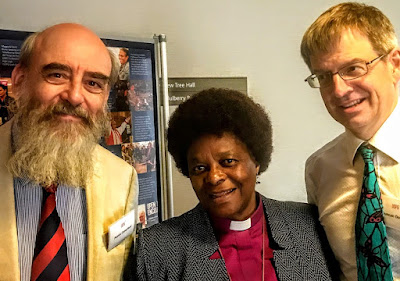
Canon Patrick Comerford with Bishop Elinah Wamukoya of Swaziland and the Revd Duncan Dormor of USPG at a recent USPG conference … the Diocese of Limerick has centuries-old links with SPG and USPG
Patrick Comerford
My time as a trustee of the Anglican mission agency USPG (United Society Partners in the Gospel) has come to an end after six years.
I have served two three-year terms as a trustee of USPG. Before that, I spent six years as a member of the council of USPG, which is one of the oldest mission agencies in the Anglican Communion.
During those 12 years, my commitments to USPG included engaging with the Anglican churches in Korea, Egypt and Pakistan. However, Covid-19 restrictions put an end to plans to an extensive visit on behalf of USPG to the Anglican Church in Myanmar, which was celebrating its 50th anniversary last year.
I have spoken at USPG conferences, led conference workshops, chaired conference sessions and presided at the conference Eucharist, and taken part in USPG events throughout Ireland and England.
The Diocese of Limerick and Killaloe has a long link with the USPG, and those links were expressed in recent years in the close links with the Diocese of Swaziland in Eswatini and Bishop Elinah Wamukoya, who died earlier this year (21 January 2021) due to complications caused by Covid-19.
During this year’s diocesan synod, Bishop Kenneth Kearon pointed out that the links between this diocese and USPG were in place when he came to the diocese. He suggested those links had been developed by Bishop Michael Mayes, a former USPG missionary, who was Bishop of Limerick and Killaloe (2000-2008).
Bishop Michael worked with USPG in Japan in 1968-1974, and when he returned to Ireland he was USPG Area Secretary for Ireland (1974-1975) and USPG Area Secretary for Cashel, Cork, Limerick and Tuam (1975-1993).
However, the links between these dioceses and USPG and its predecessor SPG date back long before that.
Harry Vere White (1853-1941) was elected Bishop of Limerick, Ardfert and Aghadoe 100 years ago on 29 September 1921. He was an SPG missionary in New Zealand (1880-1875), and when he returned to Ireland he was the organising secretary of SPG in Ireland (1894-1900).
He was the Dean of Christ Church Cathedral, Dublin (1918-1921), when he was elected Bishop of Limerick in 1921. His short history of SPG in Ireland, Children of Saint Columba, is an interesting account of Irish missionaries who worked with SPG, including many from these dioceses.
Some of my predecessors in the Rathkeale and Kilnaughtin Group of Parishes had strong family links with SPG and USPG. The Revd Willoughby William Townley Balfour (1801-1888), Vicar of Askeaton in 1833-1837, was the uncle of Francis Richard Townley Balfour (1846-1923), an SPG missionary in Southern Africa.
Balfour worked with miners on the diamond diggings in Kimberley, translated the Bible and the Book of Common Prayer into Sesotho, and was Archdeacon of Bloemfontein and of Basutoland (1908-1922). When he was consecrated an Assistant Bishop for the Diocese of Bloemfontein in 1911, he was effectively the first Anglican Bishop of Lesotho.
The Revd James Napier Clarke (1870-1934) was the curate of Kilnaughtin (Tarbert), Co Kerry, in 1905-1908, served with SPG in Honduras and Southern Africa for seven years.
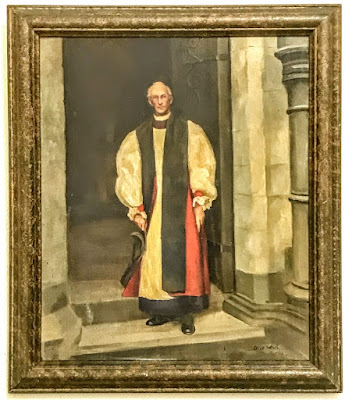
A portrait of Bishop Harry Vere White in Saint Mary’s Cathedral, Limerick (Photograph: Patrick Comerford)
This feature was first published in the November 2021 edition of ‘Newslink’, the Limerick and Killaloe diocesan magazine (pp 5-6).
Patrick Comerford
My time as a trustee of the Anglican mission agency USPG (United Society Partners in the Gospel) has come to an end after six years.
I have served two three-year terms as a trustee of USPG. Before that, I spent six years as a member of the council of USPG, which is one of the oldest mission agencies in the Anglican Communion.
During those 12 years, my commitments to USPG included engaging with the Anglican churches in Korea, Egypt and Pakistan. However, Covid-19 restrictions put an end to plans to an extensive visit on behalf of USPG to the Anglican Church in Myanmar, which was celebrating its 50th anniversary last year.
I have spoken at USPG conferences, led conference workshops, chaired conference sessions and presided at the conference Eucharist, and taken part in USPG events throughout Ireland and England.
The Diocese of Limerick and Killaloe has a long link with the USPG, and those links were expressed in recent years in the close links with the Diocese of Swaziland in Eswatini and Bishop Elinah Wamukoya, who died earlier this year (21 January 2021) due to complications caused by Covid-19.
During this year’s diocesan synod, Bishop Kenneth Kearon pointed out that the links between this diocese and USPG were in place when he came to the diocese. He suggested those links had been developed by Bishop Michael Mayes, a former USPG missionary, who was Bishop of Limerick and Killaloe (2000-2008).
Bishop Michael worked with USPG in Japan in 1968-1974, and when he returned to Ireland he was USPG Area Secretary for Ireland (1974-1975) and USPG Area Secretary for Cashel, Cork, Limerick and Tuam (1975-1993).
However, the links between these dioceses and USPG and its predecessor SPG date back long before that.
Harry Vere White (1853-1941) was elected Bishop of Limerick, Ardfert and Aghadoe 100 years ago on 29 September 1921. He was an SPG missionary in New Zealand (1880-1875), and when he returned to Ireland he was the organising secretary of SPG in Ireland (1894-1900).
He was the Dean of Christ Church Cathedral, Dublin (1918-1921), when he was elected Bishop of Limerick in 1921. His short history of SPG in Ireland, Children of Saint Columba, is an interesting account of Irish missionaries who worked with SPG, including many from these dioceses.
Some of my predecessors in the Rathkeale and Kilnaughtin Group of Parishes had strong family links with SPG and USPG. The Revd Willoughby William Townley Balfour (1801-1888), Vicar of Askeaton in 1833-1837, was the uncle of Francis Richard Townley Balfour (1846-1923), an SPG missionary in Southern Africa.
Balfour worked with miners on the diamond diggings in Kimberley, translated the Bible and the Book of Common Prayer into Sesotho, and was Archdeacon of Bloemfontein and of Basutoland (1908-1922). When he was consecrated an Assistant Bishop for the Diocese of Bloemfontein in 1911, he was effectively the first Anglican Bishop of Lesotho.
The Revd James Napier Clarke (1870-1934) was the curate of Kilnaughtin (Tarbert), Co Kerry, in 1905-1908, served with SPG in Honduras and Southern Africa for seven years.
A portrait of Bishop Harry Vere White in Saint Mary’s Cathedral, Limerick (Photograph: Patrick Comerford)
This feature was first published in the November 2021 edition of ‘Newslink’, the Limerick and Killaloe diocesan magazine (pp 5-6).
29 September 2021
The centuries-old links
between USPG and
the Diocese of Limerick
With Bishop Ellinah Wamukoya of Swaziland and the Revd Duncan Dormor of USPG at a recent USPG conference … the Diocese of Limerick has centuries-old links with SPG and USPG
Patrick Comerford
The Diocese of Limerick and Killaloe has a long link with the Anglican mission agency USPG (United Society Partners in the Gospel). I found this one of the attractive parts of diocesan life when I was invited to move to this diocese in 2017, and those links were expressed for some years in the close links with the Diocese of Swaziland in Eswatini and Bishop Elinah Wamukoya, who died earlier this year (21 January 2021) due to complications caused by Covid-19.
I have just completed a six-year term as a trustee of USPG, and was a member of the USPG council for about five years before that. During the diocesan synod last weekend, Bishop Kenneth Kearon pointed out that the links between this diocese and USPG were in place when he came to the diocese. He suggested those links had been developed by Bishop Michael Mayes, a former USPG missionary, who was Bishop of Limerick and Killaloe in 2000-2008.
Bishop Michael worked with USPG in Japan in 1968-1974, and when he returned to Ireland he was USPG Area Secretary for Ireland (1974-1975) and USPG Area Secretary for Cashel, Cork, Limerick and Tuam (1975-1993), until he was elected Bishop of Kilmore in 1993.
However, the links between USPG and this diocese date back long before that.
Harry Vere White (1853-1941) was elected Bishop of Limerick, Ardfert and Aghadoe 100 years ago on this day, 29 September 1921. He was an SPG missionary in New Zealand in 1880-1875. When he returned to Ireland, he was the organising secretary of SPG in Ireland for six years (1894-1900). During those years, he lived at 3 Belgrave Road, Rathmines, later known as Overseas House when I worked there in 2002-2006.
He later became Vicar of Saint Bartholomew’s, Ballsbridge (1905-1918), where he conducted the marriage of Philip Henry Comerford and Mary Harvey on 5 October 1907. Their children included the Revd Philip Henry Comerford (1909-2006), a missionary in Paraguay who later moved to Canada and was the father of Archdeacon Henry Comerford.
Harry Vere White was the Dean of Christ Church Cathedral (1918-1921), when he was elected Bishop of Limerick in 1921. He was consecrated in Christ Church on 18 October 1921 and was enthroned in Saint Mary’s Cathedral, Limerick, two days later on 20 October.
Bishop Vere White’s short history of SPG in Ireland, Children of Saint Columba, provides an interesting account of many of the early Irish missionaries who worked with SPG, including many from these dioceses.
One of my predecessors in Askeaton had strongly family links with USPG when it was SPG (the Society for the Propagation of the Gospel) in the 19th century, and another predecessor in Kilnaughtin was an SPG missionary in Central America for two years and then spent seven years in Southern Africa as an SPG missionary.
The Revd Willoughby William Townley Balfour (1801-1888) was Vicar of Askeaton from 1833 to 1837. He was the second son of Blayney Townley-Balfour or Blayney Townley Balfour (1769–1856), who came from a long line of politicians, and who was MP for Belturbet when the Act of Union was passed in 1800. Blayney Townley-Balfour owned a large flour mill near Slane, Co Meath, and he who commissioned the architect Francis Johnston to rebuild Townley Hall, the family seat on the banks of the Boyne, between Drogheda and Slane.
Blayney Townley-Balfour married Florence Cole, and they had 10 children. Their eldest son, also Blayney Townley-Balfour (1799-1882), was Governor of the Bahamas from 1833 to 1835, while their second son was the Revd Willoughby William Townley Balfour. Willoughby was born in 1801 at Townley Hall and went to school at Harrow before entering Trinity College Dublin in 1819. He graduated BA in 1823 and was ordained deacon in 1829 and priest in 1832.
Willoughby Balfour became Vicar of Askeaton in May 1833, and held that post until 1837, when his successor was the Revd George Maxwell, who worked tirelessly and ceaselessly in the parish during the Great Famine.
Balfour became Vicar of Stone Flanville, Leicestershire, where he remained until 1878. When he retired, he returned to Ireland and died in Rostrevor, Co Down, on 29 June 1888.
His elder brother, Blayney Townley-Balfour (1799-1882), was Lieutenant Governor of the Bahamas (1833-1835). He too was born in Townley Hall, and later inherited the family home.
His first son, Blayney Reynell Townley Balfour, was born in Townley Hall on 15 April 1845. But the family found the climate in the Bay of Naples was more amenable than the Irish climate, and they moved to Sorrento, where their second son, Francis Richard Townley Balfour, was born ion 21 June 1846.
Like their uncle Willoughby, the two Balfour brothers went to school in Harrow, where their younger contemporaries included a future Archbishop of Canterbury, Randall Thomas Davidson (1848-1903), a future secretary of SPG, Bishop Henry Hutchinson Montgomery (1847-1932) from Co Donegal, the slum priest Father Robert Dolling (1851-1902) from Co Down, and a much younger Bishop Charles Gore (1853-1932), whose parents were from Ireland.
From Harrow, Francis Balfour went on to Trinity College Cambridge, graduating BA in 1869, and trained for ordination at Cuddesdon College, Oxford. In 1872, the year he received his MA from Cambridge, he was ordained deacon, and he was ordained priest in 1874 by the Bishop of Oxford.
He was a curate in Buckingham for three years until 1875, and then moved to Southern Africa as a missionary with SPG. He first worked in the Orange Free State, as a bishop’s chaplain on the diamond diggings with the miners in Kimberley, lecturing in a theological college in Bloemfontein, and as a parish rector and cathedral canon. He then went to Mashonaland in Rhodesia (now Zimbabwe), where he built the first Anglican church in Fort Salisbury (now Harare).
He later moved to Basutoland (present-day Lesotho), where he was the Director of the Mission of the Epiphany in Sekuba (1894-1898). Throughout all this time he preached in Sesotho and translated the Bible and the Book of Common Prayer into Sesotho.
He regularly returned home to Ireland when he was on leave, and when ill-health forced him to return home in 1900-1901, he acted as an honorary curate in All Saints’ Parish in Raheny, Dublin, where the rector, the Revd Francis Carlile Harper (1838-1931), was known for his missionary interests and was father-in-law of Herbert Packenham Walsh, the Irish missionary bishop in Assam.
In Raheny, Balfour had a profound influence on the rector’s daughter, Dr Marie Elizabeth Hayes, who went to work with the Dublin University Mission in Chota Nagpur in 1905, and died as a medical missionary in Saint Stephen’s Hospital, Delhi, in 1908.
When Balfour returned to South Africa from Raheny in 1901, he became the Archdeacon of Bloemfontein (1901-1906) and then Archdeacon of Basutoland (1908-1922). When he was consecrated in Cape Town as an Assistant Bishop for the Diocese of Bloemfontein in 1911, he was effectively the first Anglican Bishop of Lesotho.
He was proud of his Irish identity and heritage, and there is a wonderful photograph of him from 1914 in a mitre and cope decorated in shamrocks and ‘Celtic’ designs.
When Balfour retired in 1923, there was no question of going back to Sorrento. He returned to Ireland, but died shortly afterwards in Shankill, Co Dublin, on 3 February 1924. He is buried in the grounds of Mellifont Abbey, Co Louth – the ruins of Mellifont had been owned by his family for generations.
In this group of parishes too, the Revd James Napier Clarke (1870-1934) was the curate of Kilnaughtin (Tarbert), Co Kerry, in 1905-1908. He had previously served with SPG in Southern Africa for about seven years. He was born in 1870, the son of the Revd Dr JW Clarke, and His father, grandfather, great-grandfather, uncle and great-uncle were priests in the Church of Ireland.
Clarke was a missionary in the Diocese of Honduras (1896-1897) and in Belize (1897-1898), before going to Southern Africa with SPG in 1898. There he was a missionary in Kaffraria (1898-1905), where he worked as a chaplain in Saint John’s College (1893-1903), Headmaster of Saint Cuthbert’s School, Tsolo (1904), and Rector of Port Saint John’s (1904-1905). When he returned to Ireland, he worked first as Curate of Kilnaughtin (1905-1908), and later worked in parishes in the dioceses of Ardfert, Ferns, Glendalough and Kildare until his death on 13 April 1934.
Another SPG missionary in Southern Africa with connections with the Diocese of Ardfert and Aghadoe was Nurse Rosanna (Rose) Blennerhassett (ca 1840-1907). She was a daughter of Sir Arthur Blennerhassett (1794-1849) of Churchtown, near Killarney, Co Kerry. Her uncle and great-uncle were priests in the Church of Ireland, and her brother, Sir Rowland Blennerhassett (1839-1909), was MP for Galway and Co Kerry.
She was a nurse with SPG in the Diocese of Mashonaland (1891-1893), and she was the co-author, with Lucy Sleeman, of Adventures in Mashonaland by two hospital nurses (London, Macmillan, 1893). She died in 1907, 14 years before Bishop Harry Vere White came to this diocese.
A portrait of Bishop Harry Vere White has a place of prominence in Saint Mary’s Cathedral, Limerick, among the portraits of bishops and deans in the Chapter Room and the dean’s office.
Bishop Harry Vere White … worked for SPG before becoming Bishop of Limerick on this day 100 years ago (Photograph: Patrick Comerford)
Patrick Comerford
The Diocese of Limerick and Killaloe has a long link with the Anglican mission agency USPG (United Society Partners in the Gospel). I found this one of the attractive parts of diocesan life when I was invited to move to this diocese in 2017, and those links were expressed for some years in the close links with the Diocese of Swaziland in Eswatini and Bishop Elinah Wamukoya, who died earlier this year (21 January 2021) due to complications caused by Covid-19.
I have just completed a six-year term as a trustee of USPG, and was a member of the USPG council for about five years before that. During the diocesan synod last weekend, Bishop Kenneth Kearon pointed out that the links between this diocese and USPG were in place when he came to the diocese. He suggested those links had been developed by Bishop Michael Mayes, a former USPG missionary, who was Bishop of Limerick and Killaloe in 2000-2008.
Bishop Michael worked with USPG in Japan in 1968-1974, and when he returned to Ireland he was USPG Area Secretary for Ireland (1974-1975) and USPG Area Secretary for Cashel, Cork, Limerick and Tuam (1975-1993), until he was elected Bishop of Kilmore in 1993.
However, the links between USPG and this diocese date back long before that.
Harry Vere White (1853-1941) was elected Bishop of Limerick, Ardfert and Aghadoe 100 years ago on this day, 29 September 1921. He was an SPG missionary in New Zealand in 1880-1875. When he returned to Ireland, he was the organising secretary of SPG in Ireland for six years (1894-1900). During those years, he lived at 3 Belgrave Road, Rathmines, later known as Overseas House when I worked there in 2002-2006.
He later became Vicar of Saint Bartholomew’s, Ballsbridge (1905-1918), where he conducted the marriage of Philip Henry Comerford and Mary Harvey on 5 October 1907. Their children included the Revd Philip Henry Comerford (1909-2006), a missionary in Paraguay who later moved to Canada and was the father of Archdeacon Henry Comerford.
Harry Vere White was the Dean of Christ Church Cathedral (1918-1921), when he was elected Bishop of Limerick in 1921. He was consecrated in Christ Church on 18 October 1921 and was enthroned in Saint Mary’s Cathedral, Limerick, two days later on 20 October.
Bishop Vere White’s short history of SPG in Ireland, Children of Saint Columba, provides an interesting account of many of the early Irish missionaries who worked with SPG, including many from these dioceses.
One of my predecessors in Askeaton had strongly family links with USPG when it was SPG (the Society for the Propagation of the Gospel) in the 19th century, and another predecessor in Kilnaughtin was an SPG missionary in Central America for two years and then spent seven years in Southern Africa as an SPG missionary.
The Revd Willoughby William Townley Balfour (1801-1888) was Vicar of Askeaton from 1833 to 1837. He was the second son of Blayney Townley-Balfour or Blayney Townley Balfour (1769–1856), who came from a long line of politicians, and who was MP for Belturbet when the Act of Union was passed in 1800. Blayney Townley-Balfour owned a large flour mill near Slane, Co Meath, and he who commissioned the architect Francis Johnston to rebuild Townley Hall, the family seat on the banks of the Boyne, between Drogheda and Slane.
Blayney Townley-Balfour married Florence Cole, and they had 10 children. Their eldest son, also Blayney Townley-Balfour (1799-1882), was Governor of the Bahamas from 1833 to 1835, while their second son was the Revd Willoughby William Townley Balfour. Willoughby was born in 1801 at Townley Hall and went to school at Harrow before entering Trinity College Dublin in 1819. He graduated BA in 1823 and was ordained deacon in 1829 and priest in 1832.
Willoughby Balfour became Vicar of Askeaton in May 1833, and held that post until 1837, when his successor was the Revd George Maxwell, who worked tirelessly and ceaselessly in the parish during the Great Famine.
Balfour became Vicar of Stone Flanville, Leicestershire, where he remained until 1878. When he retired, he returned to Ireland and died in Rostrevor, Co Down, on 29 June 1888.
His elder brother, Blayney Townley-Balfour (1799-1882), was Lieutenant Governor of the Bahamas (1833-1835). He too was born in Townley Hall, and later inherited the family home.
His first son, Blayney Reynell Townley Balfour, was born in Townley Hall on 15 April 1845. But the family found the climate in the Bay of Naples was more amenable than the Irish climate, and they moved to Sorrento, where their second son, Francis Richard Townley Balfour, was born ion 21 June 1846.
Like their uncle Willoughby, the two Balfour brothers went to school in Harrow, where their younger contemporaries included a future Archbishop of Canterbury, Randall Thomas Davidson (1848-1903), a future secretary of SPG, Bishop Henry Hutchinson Montgomery (1847-1932) from Co Donegal, the slum priest Father Robert Dolling (1851-1902) from Co Down, and a much younger Bishop Charles Gore (1853-1932), whose parents were from Ireland.
From Harrow, Francis Balfour went on to Trinity College Cambridge, graduating BA in 1869, and trained for ordination at Cuddesdon College, Oxford. In 1872, the year he received his MA from Cambridge, he was ordained deacon, and he was ordained priest in 1874 by the Bishop of Oxford.
He was a curate in Buckingham for three years until 1875, and then moved to Southern Africa as a missionary with SPG. He first worked in the Orange Free State, as a bishop’s chaplain on the diamond diggings with the miners in Kimberley, lecturing in a theological college in Bloemfontein, and as a parish rector and cathedral canon. He then went to Mashonaland in Rhodesia (now Zimbabwe), where he built the first Anglican church in Fort Salisbury (now Harare).
He later moved to Basutoland (present-day Lesotho), where he was the Director of the Mission of the Epiphany in Sekuba (1894-1898). Throughout all this time he preached in Sesotho and translated the Bible and the Book of Common Prayer into Sesotho.
He regularly returned home to Ireland when he was on leave, and when ill-health forced him to return home in 1900-1901, he acted as an honorary curate in All Saints’ Parish in Raheny, Dublin, where the rector, the Revd Francis Carlile Harper (1838-1931), was known for his missionary interests and was father-in-law of Herbert Packenham Walsh, the Irish missionary bishop in Assam.
In Raheny, Balfour had a profound influence on the rector’s daughter, Dr Marie Elizabeth Hayes, who went to work with the Dublin University Mission in Chota Nagpur in 1905, and died as a medical missionary in Saint Stephen’s Hospital, Delhi, in 1908.
When Balfour returned to South Africa from Raheny in 1901, he became the Archdeacon of Bloemfontein (1901-1906) and then Archdeacon of Basutoland (1908-1922). When he was consecrated in Cape Town as an Assistant Bishop for the Diocese of Bloemfontein in 1911, he was effectively the first Anglican Bishop of Lesotho.
He was proud of his Irish identity and heritage, and there is a wonderful photograph of him from 1914 in a mitre and cope decorated in shamrocks and ‘Celtic’ designs.
When Balfour retired in 1923, there was no question of going back to Sorrento. He returned to Ireland, but died shortly afterwards in Shankill, Co Dublin, on 3 February 1924. He is buried in the grounds of Mellifont Abbey, Co Louth – the ruins of Mellifont had been owned by his family for generations.
In this group of parishes too, the Revd James Napier Clarke (1870-1934) was the curate of Kilnaughtin (Tarbert), Co Kerry, in 1905-1908. He had previously served with SPG in Southern Africa for about seven years. He was born in 1870, the son of the Revd Dr JW Clarke, and His father, grandfather, great-grandfather, uncle and great-uncle were priests in the Church of Ireland.
Clarke was a missionary in the Diocese of Honduras (1896-1897) and in Belize (1897-1898), before going to Southern Africa with SPG in 1898. There he was a missionary in Kaffraria (1898-1905), where he worked as a chaplain in Saint John’s College (1893-1903), Headmaster of Saint Cuthbert’s School, Tsolo (1904), and Rector of Port Saint John’s (1904-1905). When he returned to Ireland, he worked first as Curate of Kilnaughtin (1905-1908), and later worked in parishes in the dioceses of Ardfert, Ferns, Glendalough and Kildare until his death on 13 April 1934.
Another SPG missionary in Southern Africa with connections with the Diocese of Ardfert and Aghadoe was Nurse Rosanna (Rose) Blennerhassett (ca 1840-1907). She was a daughter of Sir Arthur Blennerhassett (1794-1849) of Churchtown, near Killarney, Co Kerry. Her uncle and great-uncle were priests in the Church of Ireland, and her brother, Sir Rowland Blennerhassett (1839-1909), was MP for Galway and Co Kerry.
She was a nurse with SPG in the Diocese of Mashonaland (1891-1893), and she was the co-author, with Lucy Sleeman, of Adventures in Mashonaland by two hospital nurses (London, Macmillan, 1893). She died in 1907, 14 years before Bishop Harry Vere White came to this diocese.
A portrait of Bishop Harry Vere White has a place of prominence in Saint Mary’s Cathedral, Limerick, among the portraits of bishops and deans in the Chapter Room and the dean’s office.
Bishop Harry Vere White … worked for SPG before becoming Bishop of Limerick on this day 100 years ago (Photograph: Patrick Comerford)
19 January 2021
The first Anglican woman
bishop in Africa had links
with USPG and Limerick
With Bishop Ellinah Wamukoya of Swaziland and the Revd Duncan Dormor of USPG at the USPG conference in 2019 … first woman Anglican bishop in Africa died this morning
Patrick Comerford
I was saddened to hear today that the Bishop of Swaziland, Ellinah Wamukoya, died this morning after contracting Covid-19. Her death was announced by Archbishop Thabo Makgoba of Cape Town, Primate of the Anglican Church of Southern Africa.
I last met Bishop Ellinah in 2019 when she was the preacher at the closing service at the USPG annual conference in High Leigh in Hoddesdon.
Bishop Ellinah, who was known around the world for her advocacy on environmental issues, who had close links with both the Diocese of Limerick and Killaloe and with the Anglican mission agency USPG (United Society Partners in the Gospel). She was admitted to hospital late last week and put on Oxygen therapy after contracting Covid-19. She was 69.
‘It is with profound sorrow that I have to announce the devastating news that the Bishop of Swaziland in eSwatini, the Right Revd Ellinah Wamukoya, died today,’ Archbishop Thabo said. ‘We express our deepest condolences to her husband, Okwaro Henry Wamukoya, their children and grandchildren. May her soul rest in peace.’
The Anglican Communion’s Permanent Representative to the United Nations, Jack Palmer-White, paid tribute, saying: ‘She was wonderfully dedicated to so many causes – particularly demonstrated through her leadership of the Anglican Communion Environmental Network for a number of years.’
Bishop Ellinah Ntfombi Wamukoya was elected Bishop of Swaziland in 2012, becoming the first woman Anglican bishop in Africa. She was consecrated in November 2012, and her first visit to Ireland was her first official trip overseas.
She was ordained priest in 2005. At the time she was elected bishop, she was Anglican chaplain to the University of eSwatini.
She was previously the Town Clerk of Manzini, eSwatini’s commercial hub, having earlier served as the City Planner. She held a master’s degree in Town and Regional Planning.
BBC News named her in 2016 as one of the 100 most inspirational and influential women in the world.
Bishop Ellinah took part in a panel discussion at the Commonwealth Heads of Government Meeting (CHOGM) in London in 2018, to discuss the role faith communities can play in tackling gender-based violence.
Bishop Ellinah Wamukoya of Swaziland with Bishop Kenneth Kearon at his consecration (Photograph: Patrick Comerford)
Bishop Ellinah was one of the consecrating bishops at the consecration of the Right Revd Kenneth Kearon as the Bishop of Limerick and Killaloe in Christ Church Cathedral, Dublin, on 24 January 2015.
During that visit to Ireland, Bishop Ellinah took part in the Community Eucharist in the Church of Ireland Theological Institute, preached in Rathfarnham Parish in Dublin, and in Saint Macartin’s Cathedral, Enniskillen, visited Kilkenny College, met the bishops of the Church of Ireland, and met the directors of USPG Ireland.
She gave first-hand accounts of the problems and opportunities facing Anglicans in the Diocese of Swaziland before leaving for Canterbury and an intensive course designed for new bishops in the Anglican Communion.
She first visited Ireland in May 2013 to meet USPG directors and supporters, preached at a special Eucharist in Saint Michan’s Church, Dublin, at which Archbishop Richard Clarke of Armagh presided.
We last met when she the preacher at the closing service at the USPG conference in High Leigh in Hoddesdon in 2019.
The Anglican Church in Swaziland works to respond to the huge difficulties faced by the country. However, the Church there has few resources and currently relies on overseas donations to run its programmes that include local care points and feeding stations for the many child-headed households. Training in life skills is also provided for young people.
In a statement earlier today, USPG said: ‘It is with profound sadness that USPG has heard of the untimely death of the Bishop of Swaziland, the Right Reverend Ellinah Wamukoya. We hold her husband, children and grandchildren and Swaziland in our prayers and invite USPG supporters to pray for the family and the region that she loved and ministered to with such profound care.’
With Bishop Ellinah Wamukoya, during her visit to Ireland in 2015
Patrick Comerford
I was saddened to hear today that the Bishop of Swaziland, Ellinah Wamukoya, died this morning after contracting Covid-19. Her death was announced by Archbishop Thabo Makgoba of Cape Town, Primate of the Anglican Church of Southern Africa.
I last met Bishop Ellinah in 2019 when she was the preacher at the closing service at the USPG annual conference in High Leigh in Hoddesdon.
Bishop Ellinah, who was known around the world for her advocacy on environmental issues, who had close links with both the Diocese of Limerick and Killaloe and with the Anglican mission agency USPG (United Society Partners in the Gospel). She was admitted to hospital late last week and put on Oxygen therapy after contracting Covid-19. She was 69.
‘It is with profound sorrow that I have to announce the devastating news that the Bishop of Swaziland in eSwatini, the Right Revd Ellinah Wamukoya, died today,’ Archbishop Thabo said. ‘We express our deepest condolences to her husband, Okwaro Henry Wamukoya, their children and grandchildren. May her soul rest in peace.’
The Anglican Communion’s Permanent Representative to the United Nations, Jack Palmer-White, paid tribute, saying: ‘She was wonderfully dedicated to so many causes – particularly demonstrated through her leadership of the Anglican Communion Environmental Network for a number of years.’
Bishop Ellinah Ntfombi Wamukoya was elected Bishop of Swaziland in 2012, becoming the first woman Anglican bishop in Africa. She was consecrated in November 2012, and her first visit to Ireland was her first official trip overseas.
She was ordained priest in 2005. At the time she was elected bishop, she was Anglican chaplain to the University of eSwatini.
She was previously the Town Clerk of Manzini, eSwatini’s commercial hub, having earlier served as the City Planner. She held a master’s degree in Town and Regional Planning.
BBC News named her in 2016 as one of the 100 most inspirational and influential women in the world.
Bishop Ellinah took part in a panel discussion at the Commonwealth Heads of Government Meeting (CHOGM) in London in 2018, to discuss the role faith communities can play in tackling gender-based violence.
Bishop Ellinah Wamukoya of Swaziland with Bishop Kenneth Kearon at his consecration (Photograph: Patrick Comerford)
Bishop Ellinah was one of the consecrating bishops at the consecration of the Right Revd Kenneth Kearon as the Bishop of Limerick and Killaloe in Christ Church Cathedral, Dublin, on 24 January 2015.
During that visit to Ireland, Bishop Ellinah took part in the Community Eucharist in the Church of Ireland Theological Institute, preached in Rathfarnham Parish in Dublin, and in Saint Macartin’s Cathedral, Enniskillen, visited Kilkenny College, met the bishops of the Church of Ireland, and met the directors of USPG Ireland.
She gave first-hand accounts of the problems and opportunities facing Anglicans in the Diocese of Swaziland before leaving for Canterbury and an intensive course designed for new bishops in the Anglican Communion.
She first visited Ireland in May 2013 to meet USPG directors and supporters, preached at a special Eucharist in Saint Michan’s Church, Dublin, at which Archbishop Richard Clarke of Armagh presided.
We last met when she the preacher at the closing service at the USPG conference in High Leigh in Hoddesdon in 2019.
The Anglican Church in Swaziland works to respond to the huge difficulties faced by the country. However, the Church there has few resources and currently relies on overseas donations to run its programmes that include local care points and feeding stations for the many child-headed households. Training in life skills is also provided for young people.
In a statement earlier today, USPG said: ‘It is with profound sadness that USPG has heard of the untimely death of the Bishop of Swaziland, the Right Reverend Ellinah Wamukoya. We hold her husband, children and grandchildren and Swaziland in our prayers and invite USPG supporters to pray for the family and the region that she loved and ministered to with such profound care.’
With Bishop Ellinah Wamukoya, during her visit to Ireland in 2015
14 March 2020
Praying through Lent with
USPG (18): 14 March 2020
‘Mother and Child’ by Anna Raynoch-Brzozowska (1914-1985), a sculpture in artificial stone in Auschwitz (Photograph: Patrick Comerford)
Patrick Comerford
During Lent this year, I am using the USPG Prayer Diary, Pray with the World Church, for my morning prayers and reflections. This year marks the 75th anniversary of the liberation of Auschwitz and the end of the Holocaust, so I am illustrating my reflections each morning with images that emphasise this theme.
USPG (United Society Partners in the Gospel) is the Anglican mission agency that partners churches and communities worldwide in God’s mission to enliven faith, strengthen relationships, unlock potential, and champion justice. It was founded in 1701.
Sunday was International Women’s Day, and this week (8-14 March) the USPG Prayer Diary is focussing on women’s rights and gender-based violence.
Last Sunday [8 March 2020], the USPG Prayer Diary published ‘Thoughts on International Women’s Day’ by Yvonne Barrow of the Human Rights and Social Justice Commission in the Diocese of Guyana.
Saturday 14 March 2020:
Give thanks for all the women bishops in the Anglican Communion worldwide.
Readings: Micah 7: 14-15, 18-20; Psalm 103: 1-4, 9-12; Luke 15: 1-3, 11-32.
The Collect of the Day:
Almighty God,
you show to those who are in error the light of your truth
that they may return to the way of righteousness:
Grant to all those who are admitted
into the fellowship of Christ’s religion,
that they may reject those things
that are contrary to their profession,
and follow all such things
as are agreeable to the same;
through our Lord Jesus Christ.
The Lenten Collect:
Almighty and everlasting God,
you hate nothing that you have made
and forgive the sins of all those who are penitent:
Create and make in us new and contrite hearts
that we, worthily lamenting our sins
and acknowledging our wretchedness,
may receive from you, the God of all mercy,
perfect remission and forgiveness;
through Jesus Christ our Lord.
‘Give thanks for all the women bishops in the Anglican Communion worldwide’ … with Bishop Ellinah Wamukoya of Swaziland and the Revd Duncan Dormor, General Secretary of USPG, at the USPG conference in High Leigh last year
Continued tomorrow
Yesterday’s reflection
Patrick Comerford
During Lent this year, I am using the USPG Prayer Diary, Pray with the World Church, for my morning prayers and reflections. This year marks the 75th anniversary of the liberation of Auschwitz and the end of the Holocaust, so I am illustrating my reflections each morning with images that emphasise this theme.
USPG (United Society Partners in the Gospel) is the Anglican mission agency that partners churches and communities worldwide in God’s mission to enliven faith, strengthen relationships, unlock potential, and champion justice. It was founded in 1701.
Sunday was International Women’s Day, and this week (8-14 March) the USPG Prayer Diary is focussing on women’s rights and gender-based violence.
Last Sunday [8 March 2020], the USPG Prayer Diary published ‘Thoughts on International Women’s Day’ by Yvonne Barrow of the Human Rights and Social Justice Commission in the Diocese of Guyana.
Saturday 14 March 2020:
Give thanks for all the women bishops in the Anglican Communion worldwide.
Readings: Micah 7: 14-15, 18-20; Psalm 103: 1-4, 9-12; Luke 15: 1-3, 11-32.
The Collect of the Day:
Almighty God,
you show to those who are in error the light of your truth
that they may return to the way of righteousness:
Grant to all those who are admitted
into the fellowship of Christ’s religion,
that they may reject those things
that are contrary to their profession,
and follow all such things
as are agreeable to the same;
through our Lord Jesus Christ.
The Lenten Collect:
Almighty and everlasting God,
you hate nothing that you have made
and forgive the sins of all those who are penitent:
Create and make in us new and contrite hearts
that we, worthily lamenting our sins
and acknowledging our wretchedness,
may receive from you, the God of all mercy,
perfect remission and forgiveness;
through Jesus Christ our Lord.
‘Give thanks for all the women bishops in the Anglican Communion worldwide’ … with Bishop Ellinah Wamukoya of Swaziland and the Revd Duncan Dormor, General Secretary of USPG, at the USPG conference in High Leigh last year
Continued tomorrow
Yesterday’s reflection
26 June 2019
Where do we hear the voice
of prophecy in a world of
oppression and injustice?
With Bishop Ellinah Wamukoya of Swaziland and the Revd Duncan Dormor, General Secretary of USPG, at High Leigh on the closing day of the USPG conference
Patrick Comerford
Who are the oppressed, the oppressors in our societies today? And where is the Prophetic Voice of the Church to be heard today in the midst of oppression and injustice?
The Very Revd Gloria Mapangdol from the Philippines was leading the Bible discussion this morning at the High Leigh Conference Centre, on the last day of the annual conference of the Anglican mission agency USPG (United Society Partners in the Gospel).
The conference theme this year is The Prophetic Voice of the Church, and this is linked to the USPG Bible study course with the same name.
Our Bible studies each morning have been led by Gloria Mapangdol. Her passage this morning [26 June 2019] was Amos 4: 1-3:
1 Hear this word, you cows of Bashan
who are on Mount Samaria,
who oppress the poor, who crush the needy,
who say to their husbands, ‘Bring something to drink!’
2 The Lord God has sworn by his holiness:
The time is surely coming upon you,
when they shall take you away with hooks,
even the last of you with fish-hooks.
3 Through breaches in the wall you shall leave,
each one straight ahead;
and you shall be flung out into Harmon,
says the Lord.
She introduced us to how the Prophet Amos talks first about Israel’s neighbours and what they are doing, before pointing his arrows at Israel. Bashan was known for its fertile land, great oaks, and its livestock. But the poor were oppressed there, the rich were the oppressor, and the families of the rich abetted in the oppression, gaining from it.
Who are the cows of Bashan? Are they cult worshippers of the mighty bull of Samaria? Are they the greedy and the wealthy and pampered women? Gloria Mapangdol suggested they are all who exploit the poor, both men and women, and presented this passage a warning to all who would exploit the poor, both men and women.
Amos condemns them for putting economic prosperity above justice, preferring wealth to justice, ignoring their covenant obligations in pursuit of their own greed.
He spoke of the consequences, with people being led away as prisoners and captives, dragged out alive, and expelled to an unknown destination. But hope is found later in Chapter 9, with the promises of the Lord restoring the fortunes of his people.
She insisted our spirituality cannot be disconnected from the surrounding social circumstances. It must be incarnational, and the church must be faithful to its mission.
This is a challenge not only to clergy and church leaders, but to all of us, she said, as she left us with three questions for discussion:
● Who are the ‘cows of Bashan’ in your community?
● How does your government or church treat the poor and the marginalised?
● How can you become the modern Amos in your given context?
Later this morning, there was a moving presentation on ‘Speaking Truth to Power’ from Cathrine Fungai Ngangira from Zimbabwe, an ordinand at Cranmer Hall, Durham University.
She too asked where the prophetic voice of the Church is to be heard today. Who speaks truth to power today? Perhaps it is time for the church to speak the truth with power, she suggested.
The prophetic voice of the Church is not just in words, but in deeds too, she said. Action speaks louder than words.
Looking forward, Canon Richard Bartlett introduced USPG resources, planned events, including the USPG celebration at All Saints’ Church, Margaret Street, when the preacher is Bishop Michael Burrows of Cashel and Ossory (21 September), regional days this year and next year, next year’s ‘Rethinking Mission’ conference in Saint John’s Church, Waterloo (21 March 2020), and next year’s USPG conference in Swanwick, Derbyshire (20-22 July 2020).
We also discussed hospitality and USPG’s involvement in next year’s Lambeth Conference at Canterbury.
The celebrant at our closing Eucharist in the early afternoon was Bishop Calvert Leopold Friday from the Windward Islands. The preacher was Bishop Ellinah Wamukoya of Swaziland, who has had close links with USPG in Ireland and with the Diocese of Limerick and Killaloe.
These have been three days with inspiring speakers, interactive workshops and opportunities to meet old friends and hear new voices engaged in mission.
The weather has been hot and sultry since I arrived on Monday morning, with a heavy rainstorm throughout Monday night and early Tuesday. But it stayed dry today, and in the afternoon I decided to return to Cambridge to browse in some of my favourite bookshops.
I am booked on a flight from Stansted to Dublin later this evening, and I have a busy round of meetings tomorrow in Saint Mary’s Cathedral, Limerick.
At the High Leigh Conference Centre at Hoddesdon, Hertfordshire, this morning (Photograph: Patrick Comerford, 2019)
Patrick Comerford
Who are the oppressed, the oppressors in our societies today? And where is the Prophetic Voice of the Church to be heard today in the midst of oppression and injustice?
The Very Revd Gloria Mapangdol from the Philippines was leading the Bible discussion this morning at the High Leigh Conference Centre, on the last day of the annual conference of the Anglican mission agency USPG (United Society Partners in the Gospel).
The conference theme this year is The Prophetic Voice of the Church, and this is linked to the USPG Bible study course with the same name.
Our Bible studies each morning have been led by Gloria Mapangdol. Her passage this morning [26 June 2019] was Amos 4: 1-3:
1 Hear this word, you cows of Bashan
who are on Mount Samaria,
who oppress the poor, who crush the needy,
who say to their husbands, ‘Bring something to drink!’
2 The Lord God has sworn by his holiness:
The time is surely coming upon you,
when they shall take you away with hooks,
even the last of you with fish-hooks.
3 Through breaches in the wall you shall leave,
each one straight ahead;
and you shall be flung out into Harmon,
says the Lord.
She introduced us to how the Prophet Amos talks first about Israel’s neighbours and what they are doing, before pointing his arrows at Israel. Bashan was known for its fertile land, great oaks, and its livestock. But the poor were oppressed there, the rich were the oppressor, and the families of the rich abetted in the oppression, gaining from it.
Who are the cows of Bashan? Are they cult worshippers of the mighty bull of Samaria? Are they the greedy and the wealthy and pampered women? Gloria Mapangdol suggested they are all who exploit the poor, both men and women, and presented this passage a warning to all who would exploit the poor, both men and women.
Amos condemns them for putting economic prosperity above justice, preferring wealth to justice, ignoring their covenant obligations in pursuit of their own greed.
He spoke of the consequences, with people being led away as prisoners and captives, dragged out alive, and expelled to an unknown destination. But hope is found later in Chapter 9, with the promises of the Lord restoring the fortunes of his people.
She insisted our spirituality cannot be disconnected from the surrounding social circumstances. It must be incarnational, and the church must be faithful to its mission.
This is a challenge not only to clergy and church leaders, but to all of us, she said, as she left us with three questions for discussion:
● Who are the ‘cows of Bashan’ in your community?
● How does your government or church treat the poor and the marginalised?
● How can you become the modern Amos in your given context?
Later this morning, there was a moving presentation on ‘Speaking Truth to Power’ from Cathrine Fungai Ngangira from Zimbabwe, an ordinand at Cranmer Hall, Durham University.
She too asked where the prophetic voice of the Church is to be heard today. Who speaks truth to power today? Perhaps it is time for the church to speak the truth with power, she suggested.
The prophetic voice of the Church is not just in words, but in deeds too, she said. Action speaks louder than words.
Looking forward, Canon Richard Bartlett introduced USPG resources, planned events, including the USPG celebration at All Saints’ Church, Margaret Street, when the preacher is Bishop Michael Burrows of Cashel and Ossory (21 September), regional days this year and next year, next year’s ‘Rethinking Mission’ conference in Saint John’s Church, Waterloo (21 March 2020), and next year’s USPG conference in Swanwick, Derbyshire (20-22 July 2020).
We also discussed hospitality and USPG’s involvement in next year’s Lambeth Conference at Canterbury.
The celebrant at our closing Eucharist in the early afternoon was Bishop Calvert Leopold Friday from the Windward Islands. The preacher was Bishop Ellinah Wamukoya of Swaziland, who has had close links with USPG in Ireland and with the Diocese of Limerick and Killaloe.
These have been three days with inspiring speakers, interactive workshops and opportunities to meet old friends and hear new voices engaged in mission.
The weather has been hot and sultry since I arrived on Monday morning, with a heavy rainstorm throughout Monday night and early Tuesday. But it stayed dry today, and in the afternoon I decided to return to Cambridge to browse in some of my favourite bookshops.
I am booked on a flight from Stansted to Dublin later this evening, and I have a busy round of meetings tomorrow in Saint Mary’s Cathedral, Limerick.
At the High Leigh Conference Centre at Hoddesdon, Hertfordshire, this morning (Photograph: Patrick Comerford, 2019)
24 June 2019
Listening to the ‘Prophetic
Voice of the Church’ at
High Leigh with USPG
The High Leigh Conference Centre near Hoddeson … the venue for the annual USPG Conference this week (Photograph: Patrick Comerford, 2019)
Patrick Comerford
I am staying at the High Leigh Conference Centre on the edges of Hoddesdon in Hertfordshire for three days, taking part in the annual conference of the Anglican mission agency USPG (United Society Partners in the Gospel).
The conference theme this year is The Prophetic Voice of the Church, and this is linked to the USPG Bible study course with the same name.
I arrived on early morning flight from Dublin to Stansted, in time for breakfast in Cambridge, and visits to Sidney Sussex College to see the last of this summer's wisteria and to some of the bookshops in the heart of Cambridge for a little browsing.
After a meeting of trustees and with volunteers, the conference opened this afternoon [24 June 2019] with welcomes and introductions from the chair of the USPG trustees, John Neilson, who spoke about exciting developments this year, including the move to new offices at 5 Trinity Street, the Rethinking Mission conference in Birmingham Cathedral in March and the international consultation two week ago in Barbados.
We marked the Feastday of the Birth of Saint John the Baptist in our opening worship this afternoon, which was led by the Archdeacon of Worcester, the Ven Robert Jones. Today’s feast and celebration had added meaning for me, for on this day 18 years ago [24 June 2001] I was ordained priest by Archbishop Walton Empey of Dublin in Christ Church Cathedral, Dublin.
Later in the afternoon, the general secretary of USPG, the Revd Duncan Dormor, presented a review of the past year, challenging us to ask ourselves, ‘What does it really mean to be the body of Christ?’ and the deeper meaning of the Greek concept of φῐλοξενῐ́ᾱ (philoxenia), which goes beyond hospitality to delight and openness to encounter. He highlighted USPG’s participation in Greenbelt last year, partnership with the Independent Philippine Church in the face of human rights abuses, a celebration at All Saints’ Church, Margaret Street, London, a major Anglican East Asia regional meeting in Korea, promoting the UN Sustainable Development Goals, the Bray Day celebrations this year, the discussions at the Rethinking Mission conference in Birmingham, the international consultation in Barbados, and next year’s Lambeth Conference.
Our speaker after dinner this evening is the Right Revd Dr Probal Kanto Dutta, Bishop of Calcutta and Deputy Moderator of the Church of North India, who is offering a North Indian perspective on the Prophetic Voice of the Church, and we end the day with night prayer.
We begin the day tomorrow [25 June 2019] with the Morning Eucharist celebrated by the Very Revd Dr Gloria Lita D Mapangdol, President and Dean of Saint Andrew's Theological Seminary in the Philippines, who is leading the Bible studies at the conference this week.
Tuesday also takes the form of a one-day conference, and the principal speaker tomorrow morning is the Right Revd Dr Victor Attae-Baffoe, Bishop of Cape Coast.
Later in the morning, we have a migration panel, presented by Nadine Daniel, the National Refugee Welcome Co-ordinator at the Archbishops’ Council in the Church of England. The speakers and guests include:
● the Revd Canon St Obed Arist Kojo Baiden of the Anglican Diocese of The Gambia;
● the Revd Dennis Obidiegwu, chaplain of Saint Andrew’s Church, Morocco;
● the Revd Canon Kirilee Reid, chaplain and refugee officer in Calais.
We also hope to hear snippets and stories from people who have returned from ‘Journey with Us’ programmes in Tanzania, St Vincent and elsewhere.
The trustees and the senior management team meet after lunch, and in the first afternoon session our speakers include the Right Revd Calvert Leopold Friday, Bishop of the Windward Islands in the Church of the Province of the West Indies, and the Right Revd Dickson Chilongani, Bishop of Central Tanganyika in Tanzania.
Later in the afternoon, there is a choice from five workshops to choose from:
● Mission stories from North India (with Bishop Probal Kanto Dutta of Calcutta);
● Going back, going forward, what is home? (with a Migration Panel);
● Engaging Church and Community in Global Mission (with Davidson Solanki and Fran Mate);
● The Prophetic Voice in the UK and Ireland (with the Revd Duncan Dormor and the Revd Evie Vernon O’Brien).
● Journey with Us (with Habib Nader).
Before the end of the day, there is also a meeting of the USPG Council, closing with night prayer.
On Wednesday, the day begins again with a Bible study led by Gloria Mapangdol from the Philippines, and morning discussions on Speaking Truth to Power, led by Cathrine Fungai Ngangira from Zimbabwe, who is an ordinand at Cranmer Hall, Durham University, and on the 2020 Lambeth Conference, led by Canon Richard Bartlett.
The celebrant at our closing Eucharist is Bishop Calvert Leopold Friday from the Windward Islands. The preacher was supposed to be Bishop Ossie Swartz from South Africa, but instead Bishop Ellinah Wamukoya of Swaziland has been invited to preach.
These are three days with inspiring speakers, interactive workshops and opportunities to meet old friends and hear new voices engaged in mission. Join me over the next three days as I reflect on this conference with USPG in High Leigh.
The weather is hot and sultry, but if it remains dry I may be back in Cambridge on Wednesday evening to return to those bookshops.
The last of the summer wisteria in Hall Court, Sidney Sussex College, Cambridge, this morning (Photograph: Patrick Comerford, 2019)
Patrick Comerford
I am staying at the High Leigh Conference Centre on the edges of Hoddesdon in Hertfordshire for three days, taking part in the annual conference of the Anglican mission agency USPG (United Society Partners in the Gospel).
The conference theme this year is The Prophetic Voice of the Church, and this is linked to the USPG Bible study course with the same name.
I arrived on early morning flight from Dublin to Stansted, in time for breakfast in Cambridge, and visits to Sidney Sussex College to see the last of this summer's wisteria and to some of the bookshops in the heart of Cambridge for a little browsing.
After a meeting of trustees and with volunteers, the conference opened this afternoon [24 June 2019] with welcomes and introductions from the chair of the USPG trustees, John Neilson, who spoke about exciting developments this year, including the move to new offices at 5 Trinity Street, the Rethinking Mission conference in Birmingham Cathedral in March and the international consultation two week ago in Barbados.
We marked the Feastday of the Birth of Saint John the Baptist in our opening worship this afternoon, which was led by the Archdeacon of Worcester, the Ven Robert Jones. Today’s feast and celebration had added meaning for me, for on this day 18 years ago [24 June 2001] I was ordained priest by Archbishop Walton Empey of Dublin in Christ Church Cathedral, Dublin.
Later in the afternoon, the general secretary of USPG, the Revd Duncan Dormor, presented a review of the past year, challenging us to ask ourselves, ‘What does it really mean to be the body of Christ?’ and the deeper meaning of the Greek concept of φῐλοξενῐ́ᾱ (philoxenia), which goes beyond hospitality to delight and openness to encounter. He highlighted USPG’s participation in Greenbelt last year, partnership with the Independent Philippine Church in the face of human rights abuses, a celebration at All Saints’ Church, Margaret Street, London, a major Anglican East Asia regional meeting in Korea, promoting the UN Sustainable Development Goals, the Bray Day celebrations this year, the discussions at the Rethinking Mission conference in Birmingham, the international consultation in Barbados, and next year’s Lambeth Conference.
Our speaker after dinner this evening is the Right Revd Dr Probal Kanto Dutta, Bishop of Calcutta and Deputy Moderator of the Church of North India, who is offering a North Indian perspective on the Prophetic Voice of the Church, and we end the day with night prayer.
We begin the day tomorrow [25 June 2019] with the Morning Eucharist celebrated by the Very Revd Dr Gloria Lita D Mapangdol, President and Dean of Saint Andrew's Theological Seminary in the Philippines, who is leading the Bible studies at the conference this week.
Tuesday also takes the form of a one-day conference, and the principal speaker tomorrow morning is the Right Revd Dr Victor Attae-Baffoe, Bishop of Cape Coast.
Later in the morning, we have a migration panel, presented by Nadine Daniel, the National Refugee Welcome Co-ordinator at the Archbishops’ Council in the Church of England. The speakers and guests include:
● the Revd Canon St Obed Arist Kojo Baiden of the Anglican Diocese of The Gambia;
● the Revd Dennis Obidiegwu, chaplain of Saint Andrew’s Church, Morocco;
● the Revd Canon Kirilee Reid, chaplain and refugee officer in Calais.
We also hope to hear snippets and stories from people who have returned from ‘Journey with Us’ programmes in Tanzania, St Vincent and elsewhere.
The trustees and the senior management team meet after lunch, and in the first afternoon session our speakers include the Right Revd Calvert Leopold Friday, Bishop of the Windward Islands in the Church of the Province of the West Indies, and the Right Revd Dickson Chilongani, Bishop of Central Tanganyika in Tanzania.
Later in the afternoon, there is a choice from five workshops to choose from:
● Mission stories from North India (with Bishop Probal Kanto Dutta of Calcutta);
● Going back, going forward, what is home? (with a Migration Panel);
● Engaging Church and Community in Global Mission (with Davidson Solanki and Fran Mate);
● The Prophetic Voice in the UK and Ireland (with the Revd Duncan Dormor and the Revd Evie Vernon O’Brien).
● Journey with Us (with Habib Nader).
Before the end of the day, there is also a meeting of the USPG Council, closing with night prayer.
On Wednesday, the day begins again with a Bible study led by Gloria Mapangdol from the Philippines, and morning discussions on Speaking Truth to Power, led by Cathrine Fungai Ngangira from Zimbabwe, who is an ordinand at Cranmer Hall, Durham University, and on the 2020 Lambeth Conference, led by Canon Richard Bartlett.
The celebrant at our closing Eucharist is Bishop Calvert Leopold Friday from the Windward Islands. The preacher was supposed to be Bishop Ossie Swartz from South Africa, but instead Bishop Ellinah Wamukoya of Swaziland has been invited to preach.
These are three days with inspiring speakers, interactive workshops and opportunities to meet old friends and hear new voices engaged in mission. Join me over the next three days as I reflect on this conference with USPG in High Leigh.
The weather is hot and sultry, but if it remains dry I may be back in Cambridge on Wednesday evening to return to those bookshops.
The last of the summer wisteria in Hall Court, Sidney Sussex College, Cambridge, this morning (Photograph: Patrick Comerford, 2019)
23 June 2018
Limerick and Killlaoe
Diocesan Synod 2018:
the work of USPG
The Diocese of Swaziland celebrates the Season of Creation by cleaning the Mbabane River ... there has been close relationship with the Diocese of Limerick through USPG
Patrick Comerford
Bishop, members of Synod
I have been asked by the chair (Archdeacon Wayne Carney) and the secretary (David Frizelle) to speak to the report of the Council for Mission (pp 35-39). I am not a member of the Council for Mission, but I am a trustee of USPG (the United Society Partners in Gospel), which has a close working relationship with this diocese over the years, particularly to the benefit of the Diocese of Swaziland, which is part of the Anglican Church of Southern Africa (ACNA).
I am also a former director of USPG in the Republic of Ireland and Northern Ireland. Both agencies or companies – which have been chaired in the past by Bishop Michael Burrowes and then by Bishop John McDowell – have been wound up over the past two years as part of the restructuring of USPG. One organisation will now work in facilitating Anglican dioceses and parishes through these islands to work in partnership with Anglican churches throughout the world in their needs.
So, today I would just like to:
1, Outline what funding from and partnership with this diocese has made a real difference in the past in the Diocese of Swaziland.
2, Update us what is happening today in the Diocese of Swaziland.
3, Update us on USPG in Ireland and in the Anglican Communion.
In conclusion, I would like to explore some of the options that are available for this diocese to explore as we look at options for Partnership in Mission in the future.
Luyengo Farm vegetables arriving at Saint Francis Primary School in Mbabane with Samson Mthupha, Principal, and Busi Matsebula, Secretary of the Board of Education
1, The past links between this diocese and Swaziland:
Swaziland is one of the poorest countries in the world. It is a tiny, landlocked African kingdom surrounded by South Africa and Mozambique. It has a population of just one million, but it has possibly the highest level of HIV/AIDS in the world: 40 per cent of the people there are HIV+, many children are born HIV+, and 20,000 new HIV cases are reported or diagnosed each year.
But there are only 2,000 hospital beds in Swaziland. This means most of the people are left to die at home. To compound these problems, 40 per cent of the people are unemployed, and 69 per cent of people live below the poverty line.
But for many people, the biggest problem is not HIV – it is the problem of what they are going to eat.
With the support of this diocese and the Bishops’ Appeal, USPG Ireland worked to provide feeding programmes and training in horticulture and market gardening so that the diet of people and the ability of families to be self-sufficient can be improved significantly.
To help this work, it was possible too to make use of previously under-used church lands. One of the major projects you have supported through USPG was the Luyengo Farm project. This was important as a teaching aid for local people and a source of employment, and it also became an income generator for the Diocese of Swaziland, helping to support many HIV/AIDs programmes, schools and care of the sick and orphaned.
In 2014, ‘Bikers with a Mission’ – the Revd Andrew McCroskery and Canon Nigel Kirkpatrick – began from Saint Brendan’s Cathedral, Clonfert, on their ten-day bikers’ tour of the 30 cathedrals of the Church of Ireland raising awareness of and funds for USPG’s work in Swaziland. Their tour also marked the 300th anniversary of USPG in Ireland in 1714.
Bishop Ellinah Wamukoya, who became the first woman bishop in Africa in 2012, has visited this diocese, and was also one of the assisting bishops at the consecration of Bishop Kenneth Kearon in Christ Church Cathedral, Dublin, in 2015.
Students from the Institute of Technology in Tralee have been particularly generous in helping the Luyengo Farm Project. The farm came to employ 30 people and went on to have a reasonable prospect of a sustainable commercial future.
Bishop Ellinah Wamukoya became the first woman bishop in Africa in 2012
2, The Diocese of Swaziland today:
The Diocese of Swaziland consists of three archdeaconries, 16 parishes, three parochial districts and two chapelries, served by the bishop and 40 clergy, and with about 8,000 regular attending church members.
Diocesan staff and volunteers work tirelessly and in extremely challenges circumstances, especially since a long drought has devastated large areas of already vulnerable countryside. Let me share three positive points about the diocese today:
1, The Diocese of Swaziland is committed to the Green Anglican movement, which promotes environmental conservation and development work across Southern Africa. The diocese has been recognised as a leader in that work. Young people in the Anglican Diocese of Swaziland recently completed a 450 km challenge to raise environmental awareness. They donated shoes, school uniforms and toiletries to schools along their route.
2, The diocese has about 15 Neighbourhood Care Points in the country where children are fed daily. The Bishop recently visited Mbava to see the start of building a new kitchen structure where she laid the foundation stone. The church also distributed maize bags and beans to over 100 families in the most affected communities in the Shiselweni and Lubombo regions of the country.
This work, possible through assistance from the Church of Ireland and other companion dioceses, has responded to the nutritional needs of children who are orphaned and vulnerable. In the face of the drought, there were increasing demands on these resources.
3, Schools, especially in Mbabane, were affected by water shortage. The diocese, through help from Hope Africa and USPG Ireland, donated tanks and distributed water in four primary schools and one pre-school as an emergency relief and water harvesting solution for future use.
The Diocese is drilling boreholes to harvest ground water for two parishes, and has erected three 10,000 litre water tanks to help the Mbava community with water harvesting, where fencing has also been donated to start a community garden that will supply vegetables to the care point.
3, Looking at the future:
USPG is the oldest Anglican mission agency working overseas. It dates back to 1701, and is taking new steps forward to work in new and more meaningful partnerships, that are less about giving and receiving, both money and ideas, but more about empowerment, two-way relationships and building partnerships.
Now USPG is taking a fresh look at its work and we are looking to new opportunities to develop these commitments. The work of USPG Ireland and USPG Northern Ireland is being integrated into the main work of USPG, and this promises to deliver wider engagement in mission for partner dioceses and parishes in the Church of Ireland.
To share some idea of the breadth and scope of our work, USPG was recently named by the Diocese of Europe as the mission agency to support its work with refugees in Greece and southern Europe. Meanwhile, USPG produces Harvest, Advent and Lenten resources, which I have used successfully in my own parish.
As USPG restructures in Ireland, these resources are being made available to dioceses and parishes throughout the Church of Ireland.
USPG arranges placements for volunteers through placement programmes
Conclusions:
USPG and the Diocese of Swaziland have been working together for some years to create a new development programme. Last year, USPG staff members visited Swaziland to meet Bishop Ellinah Wamukoyah and her colleagues, and Fran Mate, USPG Programmes Manager for Africa, was back there again in the past week.
The discussions are still active, but it looks likely now that USPG’s future engagement in Swaziland will focus on community development, education, support for women, and protecting the environment.
In these areas, USPG will be working in partnership with HOPE Africa, the development arm of the Anglican Church of Southern Africa (ACSA).
Davidson Solanki, USPG International Programmes Manager, says: ‘The diocese has a particular concern to improve food security and provide communities with better access to healthcare and education. To this end, the dioceses will be working in selected parishes to pilot a new approach to development that focuses on local skills and resources to tackle local challenges.’
USPG is also continuing to support leadership development in Swaziland and throughout the Anglican Church of Southern Africa.
Positively, because of these new partnerships, but sadly, because of some past personnel problems, the Diocese of Swaziland is not in a position at the moment to receive funding from Ireland for the water tanks projects.
So, while as a diocese we have had a very successful and positive relationship, with fantastic results from all contributions, circumstances beyond our control mean the Diocesan Council for Mission is going to have to re-examine ways of supporting mission work overseas in the future.
For example, there is the possibility of supporting similar work through the Partners In Mission (PIM) Programme, which includes a number of costed programmes.
Partners In Mission offers a variety of programmes from USPG partners within the Anglican Communion. They address different contexts, but each programme will empower a community to release its God-given potential to achieve a fuller life. These include:
Bangladesh, Health; North India, Health; North India, Tackling Slavery; South India, Justice; North India, Women’s Helpline; South India, Green Schools; Malawi, Community Development; Sri Lanka, Education; Tanzania, Children and Babies; Zambia, Justice; Zimbabwe, Tackling Stigma; South Africa, Livelihoods.
Each parish or diocese commits to praying and giving. USPG is encouraging a minimum pledge from churches of £1,000 per year for their chosen programme. However, USPG realises that this is beyond the reach of some parishes and will welcome any commitment they are able to make.
USPG guarantees that 100% of the giving will be dedicated to the chosen programme. Regular updates will enable prayers to be informed. With inspiring stories and pictures from its chosen programme, a church or parish will see the meaningful impact its giving is having on the community where the programme is based.
Becoming a Partner In Mission will give the satisfaction of knowing this support has a major impact on lives and communities through the Anglican Churches.
But that is me speaking as a Trustee of USPG and I am not a member of the Council for Mission. I am sure whatever the Council decides can bring about a fruitful three-way partnership between this diocese, USPG, and a programme in an Anglican diocese or province.
Canon Patrick Comerford was speaking at the Diocesan Synod, the United Dioceses of Limerick, Killaloe and Ardfert, in Villiers School, Limerick, on 23 June 2018.
Patrick Comerford
Bishop, members of Synod
I have been asked by the chair (Archdeacon Wayne Carney) and the secretary (David Frizelle) to speak to the report of the Council for Mission (pp 35-39). I am not a member of the Council for Mission, but I am a trustee of USPG (the United Society Partners in Gospel), which has a close working relationship with this diocese over the years, particularly to the benefit of the Diocese of Swaziland, which is part of the Anglican Church of Southern Africa (ACNA).
I am also a former director of USPG in the Republic of Ireland and Northern Ireland. Both agencies or companies – which have been chaired in the past by Bishop Michael Burrowes and then by Bishop John McDowell – have been wound up over the past two years as part of the restructuring of USPG. One organisation will now work in facilitating Anglican dioceses and parishes through these islands to work in partnership with Anglican churches throughout the world in their needs.
So, today I would just like to:
1, Outline what funding from and partnership with this diocese has made a real difference in the past in the Diocese of Swaziland.
2, Update us what is happening today in the Diocese of Swaziland.
3, Update us on USPG in Ireland and in the Anglican Communion.
In conclusion, I would like to explore some of the options that are available for this diocese to explore as we look at options for Partnership in Mission in the future.
Luyengo Farm vegetables arriving at Saint Francis Primary School in Mbabane with Samson Mthupha, Principal, and Busi Matsebula, Secretary of the Board of Education
1, The past links between this diocese and Swaziland:
Swaziland is one of the poorest countries in the world. It is a tiny, landlocked African kingdom surrounded by South Africa and Mozambique. It has a population of just one million, but it has possibly the highest level of HIV/AIDS in the world: 40 per cent of the people there are HIV+, many children are born HIV+, and 20,000 new HIV cases are reported or diagnosed each year.
But there are only 2,000 hospital beds in Swaziland. This means most of the people are left to die at home. To compound these problems, 40 per cent of the people are unemployed, and 69 per cent of people live below the poverty line.
But for many people, the biggest problem is not HIV – it is the problem of what they are going to eat.
With the support of this diocese and the Bishops’ Appeal, USPG Ireland worked to provide feeding programmes and training in horticulture and market gardening so that the diet of people and the ability of families to be self-sufficient can be improved significantly.
To help this work, it was possible too to make use of previously under-used church lands. One of the major projects you have supported through USPG was the Luyengo Farm project. This was important as a teaching aid for local people and a source of employment, and it also became an income generator for the Diocese of Swaziland, helping to support many HIV/AIDs programmes, schools and care of the sick and orphaned.
In 2014, ‘Bikers with a Mission’ – the Revd Andrew McCroskery and Canon Nigel Kirkpatrick – began from Saint Brendan’s Cathedral, Clonfert, on their ten-day bikers’ tour of the 30 cathedrals of the Church of Ireland raising awareness of and funds for USPG’s work in Swaziland. Their tour also marked the 300th anniversary of USPG in Ireland in 1714.
Bishop Ellinah Wamukoya, who became the first woman bishop in Africa in 2012, has visited this diocese, and was also one of the assisting bishops at the consecration of Bishop Kenneth Kearon in Christ Church Cathedral, Dublin, in 2015.
Students from the Institute of Technology in Tralee have been particularly generous in helping the Luyengo Farm Project. The farm came to employ 30 people and went on to have a reasonable prospect of a sustainable commercial future.
Bishop Ellinah Wamukoya became the first woman bishop in Africa in 2012
2, The Diocese of Swaziland today:
The Diocese of Swaziland consists of three archdeaconries, 16 parishes, three parochial districts and two chapelries, served by the bishop and 40 clergy, and with about 8,000 regular attending church members.
Diocesan staff and volunteers work tirelessly and in extremely challenges circumstances, especially since a long drought has devastated large areas of already vulnerable countryside. Let me share three positive points about the diocese today:
1, The Diocese of Swaziland is committed to the Green Anglican movement, which promotes environmental conservation and development work across Southern Africa. The diocese has been recognised as a leader in that work. Young people in the Anglican Diocese of Swaziland recently completed a 450 km challenge to raise environmental awareness. They donated shoes, school uniforms and toiletries to schools along their route.
2, The diocese has about 15 Neighbourhood Care Points in the country where children are fed daily. The Bishop recently visited Mbava to see the start of building a new kitchen structure where she laid the foundation stone. The church also distributed maize bags and beans to over 100 families in the most affected communities in the Shiselweni and Lubombo regions of the country.
This work, possible through assistance from the Church of Ireland and other companion dioceses, has responded to the nutritional needs of children who are orphaned and vulnerable. In the face of the drought, there were increasing demands on these resources.
3, Schools, especially in Mbabane, were affected by water shortage. The diocese, through help from Hope Africa and USPG Ireland, donated tanks and distributed water in four primary schools and one pre-school as an emergency relief and water harvesting solution for future use.
The Diocese is drilling boreholes to harvest ground water for two parishes, and has erected three 10,000 litre water tanks to help the Mbava community with water harvesting, where fencing has also been donated to start a community garden that will supply vegetables to the care point.
3, Looking at the future:
USPG is the oldest Anglican mission agency working overseas. It dates back to 1701, and is taking new steps forward to work in new and more meaningful partnerships, that are less about giving and receiving, both money and ideas, but more about empowerment, two-way relationships and building partnerships.
Now USPG is taking a fresh look at its work and we are looking to new opportunities to develop these commitments. The work of USPG Ireland and USPG Northern Ireland is being integrated into the main work of USPG, and this promises to deliver wider engagement in mission for partner dioceses and parishes in the Church of Ireland.
To share some idea of the breadth and scope of our work, USPG was recently named by the Diocese of Europe as the mission agency to support its work with refugees in Greece and southern Europe. Meanwhile, USPG produces Harvest, Advent and Lenten resources, which I have used successfully in my own parish.
As USPG restructures in Ireland, these resources are being made available to dioceses and parishes throughout the Church of Ireland.
USPG arranges placements for volunteers through placement programmes
Conclusions:
USPG and the Diocese of Swaziland have been working together for some years to create a new development programme. Last year, USPG staff members visited Swaziland to meet Bishop Ellinah Wamukoyah and her colleagues, and Fran Mate, USPG Programmes Manager for Africa, was back there again in the past week.
The discussions are still active, but it looks likely now that USPG’s future engagement in Swaziland will focus on community development, education, support for women, and protecting the environment.
In these areas, USPG will be working in partnership with HOPE Africa, the development arm of the Anglican Church of Southern Africa (ACSA).
Davidson Solanki, USPG International Programmes Manager, says: ‘The diocese has a particular concern to improve food security and provide communities with better access to healthcare and education. To this end, the dioceses will be working in selected parishes to pilot a new approach to development that focuses on local skills and resources to tackle local challenges.’
USPG is also continuing to support leadership development in Swaziland and throughout the Anglican Church of Southern Africa.
Positively, because of these new partnerships, but sadly, because of some past personnel problems, the Diocese of Swaziland is not in a position at the moment to receive funding from Ireland for the water tanks projects.
So, while as a diocese we have had a very successful and positive relationship, with fantastic results from all contributions, circumstances beyond our control mean the Diocesan Council for Mission is going to have to re-examine ways of supporting mission work overseas in the future.
For example, there is the possibility of supporting similar work through the Partners In Mission (PIM) Programme, which includes a number of costed programmes.
Partners In Mission offers a variety of programmes from USPG partners within the Anglican Communion. They address different contexts, but each programme will empower a community to release its God-given potential to achieve a fuller life. These include:
Bangladesh, Health; North India, Health; North India, Tackling Slavery; South India, Justice; North India, Women’s Helpline; South India, Green Schools; Malawi, Community Development; Sri Lanka, Education; Tanzania, Children and Babies; Zambia, Justice; Zimbabwe, Tackling Stigma; South Africa, Livelihoods.
Each parish or diocese commits to praying and giving. USPG is encouraging a minimum pledge from churches of £1,000 per year for their chosen programme. However, USPG realises that this is beyond the reach of some parishes and will welcome any commitment they are able to make.
USPG guarantees that 100% of the giving will be dedicated to the chosen programme. Regular updates will enable prayers to be informed. With inspiring stories and pictures from its chosen programme, a church or parish will see the meaningful impact its giving is having on the community where the programme is based.
Becoming a Partner In Mission will give the satisfaction of knowing this support has a major impact on lives and communities through the Anglican Churches.
But that is me speaking as a Trustee of USPG and I am not a member of the Council for Mission. I am sure whatever the Council decides can bring about a fruitful three-way partnership between this diocese, USPG, and a programme in an Anglican diocese or province.
Canon Patrick Comerford was speaking at the Diocesan Synod, the United Dioceses of Limerick, Killaloe and Ardfert, in Villiers School, Limerick, on 23 June 2018.
04 April 2017
Praying in Lent 2017 with USPG,
(38) Tuesday 4 April 2017
Bishop Margaret Vertue of False Bay and Bishop Ellinah Ntombi Wamukoya of Swaziland … ‘Pray that churches around the world might be anchored in the love of Christ so that they might be able to both comfort the broken-hearted and challenge the oppressors’
Patrick Comerford
We are now in Passiontide, the last two weeks in Lent.
The Lent 2017 edition of the prayer diary of the Anglican mission agency USPG (United Society Partners in the Gospel) follows the theme of the USPG Lent study course, ‘Living an Authentic Life.’
Throughout Lent, I am using this Prayer Diary for my prayers and reflections each morning, inviting you to join me in these prayers and reflections, for just a few moments each morning.
In the articles and prayers in the prayer diary, USPG invites us to investigate what it means to be a disciple of Christ. The Lent study course, ‘Living an Authentic Life’ (available online or to order at www.uspg.org.uk/lent), explores the idea that discipleship and authenticity are connected.
This week, from Passion Sunday (2 April) until Saturday (8 April), the USPG Lent Prayer Diary is following the topic ‘Counting the Cost.’ The topic was introduced on Sunday in an article in the Prayer Diary by the Right Revd Margaret B Vertue, Bishop of False Bay Diocese in South Africa.
Tuesday 4 April 2017:
Pray that churches around the world might be anchored in the love of Christ so that they might be able to both comfort the broken-hearted and challenge the oppressors.
Continued tomorrow.
Yesterday’s reflection.
Patrick Comerford
We are now in Passiontide, the last two weeks in Lent.
The Lent 2017 edition of the prayer diary of the Anglican mission agency USPG (United Society Partners in the Gospel) follows the theme of the USPG Lent study course, ‘Living an Authentic Life.’
Throughout Lent, I am using this Prayer Diary for my prayers and reflections each morning, inviting you to join me in these prayers and reflections, for just a few moments each morning.
In the articles and prayers in the prayer diary, USPG invites us to investigate what it means to be a disciple of Christ. The Lent study course, ‘Living an Authentic Life’ (available online or to order at www.uspg.org.uk/lent), explores the idea that discipleship and authenticity are connected.
This week, from Passion Sunday (2 April) until Saturday (8 April), the USPG Lent Prayer Diary is following the topic ‘Counting the Cost.’ The topic was introduced on Sunday in an article in the Prayer Diary by the Right Revd Margaret B Vertue, Bishop of False Bay Diocese in South Africa.
Tuesday 4 April 2017:
Pray that churches around the world might be anchored in the love of Christ so that they might be able to both comfort the broken-hearted and challenge the oppressors.
Continued tomorrow.
Yesterday’s reflection.
30 January 2015
Africa’s first woman bishop
pays return visit to Ireland
With the Bishop of Swaziland, the Right Revd Ellinah Wamukoya, in Dublin this week
Patrick Comerford
The first woman bishop in Africa, the Bishop of Swaziland, the Right Revd Ellinah Wamukoya, was in Dublin this week. This was the same week that saw the first woman bishop consecrated in the Church of England. But Bishop Ellinah was in Dublin for the consecration of the Right Revd Kenneth Kearon as the new Bishop of Limerick and Kilaloe in Christ Church Cathedral, Dublin, last Saturday.
Many sections of the English media reported from York Minster on the consecration of the Right Revd Libby Lane as Bishop of Stockport as though she were the first woman bishop anywhere. If they had looked a little further, they would have seen first woman bishop in the Church of Ireland, Bishop Pat Storey of Meath and Kildare, among the consecrating bishops.
Bishop Pat was one of the three principal consecrators of Bishop Kenneth on Saturday afternoon. But Bishop Ellinah was there too as a consecrating bishop.
Since then, Bishop Ellinah has preached in Rathfarnham Parish in Dublin, and in Saint Macartin’s Cathedral, Enniskillen, visited Kilkenny College, and met the bishops of the Church of Ireland. She was back in Dublin on Wednesday, when she took part in the Community Eucharist in the Church of Ireland Theological Institute.
This has been her second visit to Dublin, and this morning [30 January 2015] she met the directors of the boards of Us Ireland and Us Ireland, formerly the United Society for the Propagation of the Gospel (USPG) before our board meetings in CITI.
She gave us first-hand accounts of the problems and opportunities facing Anglicans in the Diocese of Swaziland before she headed off to Canterbury for an intensive course designed for new bishops in the Anglican Communion.
The Anglican Church in Swaziland works to respond to the huge difficulties faced by the country. However, the Church there has few resources and currently relies on overseas donations to run its programmes which include local care points and feeding stations for the many child-headed households.
Africa’s first Anglican woman bishop was in Ireland for the first time in 2013 to join the celebrations marking the rebranding of USPG as the United Society (Us), when she preached at a special Eucharist in Saint Michan’s Church, Dublin, on 29 May 2013.
Bishop Ellinah is a former mayor of Swaziland’s economic capital, Manzini, and has worked as town planner. She was consecrated in November 2012, and her first visit to Ireland was her first official trip overseas.
Patrick Comerford
The first woman bishop in Africa, the Bishop of Swaziland, the Right Revd Ellinah Wamukoya, was in Dublin this week. This was the same week that saw the first woman bishop consecrated in the Church of England. But Bishop Ellinah was in Dublin for the consecration of the Right Revd Kenneth Kearon as the new Bishop of Limerick and Kilaloe in Christ Church Cathedral, Dublin, last Saturday.
Many sections of the English media reported from York Minster on the consecration of the Right Revd Libby Lane as Bishop of Stockport as though she were the first woman bishop anywhere. If they had looked a little further, they would have seen first woman bishop in the Church of Ireland, Bishop Pat Storey of Meath and Kildare, among the consecrating bishops.
Bishop Pat was one of the three principal consecrators of Bishop Kenneth on Saturday afternoon. But Bishop Ellinah was there too as a consecrating bishop.
Since then, Bishop Ellinah has preached in Rathfarnham Parish in Dublin, and in Saint Macartin’s Cathedral, Enniskillen, visited Kilkenny College, and met the bishops of the Church of Ireland. She was back in Dublin on Wednesday, when she took part in the Community Eucharist in the Church of Ireland Theological Institute.
This has been her second visit to Dublin, and this morning [30 January 2015] she met the directors of the boards of Us Ireland and Us Ireland, formerly the United Society for the Propagation of the Gospel (USPG) before our board meetings in CITI.
She gave us first-hand accounts of the problems and opportunities facing Anglicans in the Diocese of Swaziland before she headed off to Canterbury for an intensive course designed for new bishops in the Anglican Communion.
The Anglican Church in Swaziland works to respond to the huge difficulties faced by the country. However, the Church there has few resources and currently relies on overseas donations to run its programmes which include local care points and feeding stations for the many child-headed households.
Africa’s first Anglican woman bishop was in Ireland for the first time in 2013 to join the celebrations marking the rebranding of USPG as the United Society (Us), when she preached at a special Eucharist in Saint Michan’s Church, Dublin, on 29 May 2013.
Bishop Ellinah is a former mayor of Swaziland’s economic capital, Manzini, and has worked as town planner. She was consecrated in November 2012, and her first visit to Ireland was her first official trip overseas.
10 August 2014
A new take on Eleanor Roosevelt’s advice
to ‘do one thing every day that scares you’
The slipway on the beach at Bray, close to Bray Rowing Club at sunset this evening (Photograph: Patrick Comerford, 2014)
Patrick Comerford
There is a viral project on social media in which people nominate friends to name three positive experiences each day for five successive days.
All the lifestyle coaches and manuals tell you that doing one new positive thing each day can be as life-enhancing as, say, taking a brisk walk, eating a healthy meal or having a hearty laugh.
Many websites on lifestyle and healthy living recommend make it a point to learn at least one new thing each day: the name of a flower that grows in your garden, the capital of another country, or the name of a piece of classical music you hear while shopping. By the end of the day, if you cannot identify something new you have learned during the day, take out a dictionary and learn a new word.
It is a lot less daunting than taking up Eleanor Roosevelt’s advice: “Do one thing every day that scares you.”
But I have done three new things over these past three days, and each has been enriching.
The Basiani Ensemble from Georgia in Saint Canice’s Cathedral, Kilkenny on Friday evening (Photograph: Patrick Comerford, 2014)
Late on Friday afternoon [8 August 2014], two of us strolled through Kilkenny, including looking at the restored Shee mausoleums in Saint Mary’s Churchyard, before having dinner with two dear friends in the Café Sol Bistro in William Street.
Later, we strolled through Kilkenny to Saint Canice’s Cathedral, where we were guests in the “Dean’s Pew” for the opening concert of this year’s Kilkenny Arts Festival.
The concert by the Basiani Ensemble from Georgia was a mixed programme of folk songs from Georgia and sacred songs from the Georgian Orthodox liturgical tradition.
Georgian song is rooted in ancient traditions described by the Greek philosopher Xenophanes of Colophon. Church hymnody developed from the 4th century and reached its zenith in the 10th and 11th centuries, with Georgian drawing on Greek hymns but also developing hymns of their own.
The Basiani Ensemble is the folk ensemble of the Georgian Patriarchate, based in Holy Trinity Cathedral in Tbilisi and supported by the Patriarch or Catholicos of Georgia and the President of Georgia.
The moon was almost full as we left saint Canice’s Cathedral on Friday night (Photograph: Patrick Comerford, 2014)
On our way to Kilkenny on Friday afternoon, through the countryside of the three counties of Kildare, Carlow and Kilkenny, the countryside, the fields were green and golden, with people working hard at the harvest. As we stepped out of Saint Canice’s on Friday night, the moon was almost full, shining through the arch of the south-west porch of the Cathedral.
Rothe House on a bright summer night in Kilkenny (Photograph: Patrick Comerford, 2014)
As we strolled back through the Kilkenny, the night sky was bright and there was festive feeling on the streets.
Bikers on a Mission arrive in Christ Church Cathedral on Saturday morning (Photograph: Patrick Comerford, 2014)
On Saturday morning, I went into Christ Church Cathedral, Dublin, to meet the Bikers on a Mission – the Revd Andrew McCroskery and the Revd Nigel McCroskery – who were on one of the last legs of their ten-day round-Ireland tour of the 30 cathedrals of the Church of Ireland to raise awareness of and funds for the work in Swaziland supported from Ireland by the Anglican mission agency Us (the new name for USPG).
There was a good turnout for Andrew and Nigel before they continued on to Saint Brigid’s Cathedral, Kildare, and Saint Patrick’s Cathedral, Trim, and about 20 of us took part in a simple prayer service with the two bikers in the choir stalls in Christ Church.
One of the prayers we used was adapted from a prayer written by Lancelot Andrewes before he died in 1626:
Blessed are you, creator of all, to you be praise and glory for ever. As your dawn renews the face of the earth, bringing light and life to all creation, may we rejoice in this day you have made; as we wake refreshed from the depths of sleep, open our eyes to behold your presence and strengthen our hands to do your will, that the world may rejoice and give you praise. Blessed be God, Father, Son and Holy Spirit.
Hanover Square … the smallest square in Dublin? (Photograph: Patrick Comerford, 2014)
I had arrived in the city centre earlier and decided to take a look inside the Church of Saint Nicholas of Myra in Francis Street.
Having found Dublin’s shortest street, Cross Kevin Street, in this area, I wondered whether Hanover Square beside the church is the smallest and narrowest square in Dublin. The square and some of the other side-streets around here were named after the House of Hanover who came to the throne in Britain 300 years ago in 1714. Among the creative Germans they brought with them was George Frideric Handel, whose Messiah was first performed on 13 April 1742 a few streets away in Fishamble Street, below Christ Church Cathedral.
Inside the Church of Saint Nicholas of Myra, Francis Street, Dublin (Photograph: Patrick Comerford, 2014)
I had never been in Saint Nicholas Church before, and was interested in visiting it since I recently discovered by great-grandmother, Anne (Doyle) Comerford, was baptised there in 1834. However, each time I have arrived at the church in recent weeks I have found it closed and the gates locked.
Archbishop Patrick Russell (1683-1692) designated an earlier church on this site as the Metropolitan Church for the Roman Catholic Archbishops of Dublin.
The last archbishop to use the Francis Street Chapel as his Pro-Cathedral was John Thomas Troy (1787-1797), who was solemnly enthroned there on 15 February 1788 in a public ceremony attended by leading figures from state and society. But when Archbishop Troy moved from his residence from Francis Street to North King Street, the Pro-Cathedral status of the chapel in Francis Street came to an end.
The present church was designed by John Leeson, who was also the architect of Russborough House, near Blessington, Co Wicklow. Building work began in the late Georgian period in 1829 and the church was opened in 1834 and dedicated in 1835.
Saint Nicholas is depicted in a stained-glass window with three golden balls or bags and an anchor lie at his feet.
The church is so strikingly beautiful that it is worth a separate essay on this site later in the week.
Later in the evening, I spent a few hours finishing a feature article on the future of English identity following next month’s referendum in Scotland, and assembling and captioning photographs for this essay which is planned for next month’s editions of the Church Review and the Diocesan Magazine [September 2014].
Inside Saint Bartholomew’s Church, Ballsbridge, this morning (Photograph: Patrick Comerford, 2014)
The highlight of this morning [Sunday 10 August 2014] was presiding at the Solemn Eucharist and preaching in Saint Bartholomew’s Church, Ballsbridge.
Later, after coffee, two of drove south to Blackrock in south Co Dublin, and parked on Idrone Terrace, close to the Dart Station and Blackrock Baths, and looking out to the sea towards Howth Head to the north.
I have been through Blackrock many times, but this was the first time in recent years to stroll through the Main Street, and my first time ever to visit the Blackrock Market, with its labyrinth of stalls.
A stall on the Blackrock Market (Photograph: Patrick Comerford, 2014)
Blackrock Market, which is open on Saturday and Sundays, was set up in 1996 and has a range of independent sellers, selling antiques, second-hand books, bean bags, hand-made candles, antiques, stamps and coins, crepes, home-made cakes and ethnic food.
We had a light lunch across the street in Insomnia, and while we sipping our double espressos outside on the street we noticed the cross at the south end of Main Street.
The cross on Main Street, Blackrock, Co Dublin (Photograph: Patrick Comerford, 2014)
Although the cross head is carved with a relief face of Christ, some local opinion suggests that the stone is much older than its Christian form suggests, and argues that the face represents an earlier pagan god. It was once used as a boundary marker for the City of Dublin, and while it stands today on an ugly modern concrete base it has become an important part of Blackrock’s heritage.
Beside the cross, Raven Books on 34 South Main Street was irresistible. It is a true delight to find a small independent bookshop like this, offering a mix of new and second hand books.
I ended up with The World’s Wife, a collection of poems by the Poet Laureate, Carol Ann Duffy, who grew up in Stafford; The Mind of God by Paul Davies, looking at science and the search for ultimate meaning; and In the Spirit of Happiness: Wuisdom for Living, by the Monks of the New Skete. Theology, poetry, science and spirituality – a vivid combination to find on the shelves of any bookshop.
From Blackrock we returned home to a strong thunderstorm with heavy rains that made the street outside look like a small but fast-flowing river.
Later in the evening, four of us returned to the area south of Dublin, for dinner in El Greco, a Greek restaurant on the Main Street in Bray, Co Dublin.
Yesterday, was the birthday of the English poet Philip Larkin (1922-1985), who declined the position of Poet Laureate in 1984 following the death of John Betjeman. Although Larkin was born in Coventry [9 August 1922], I am planning at some stage to research a paper on his links with Lichfield. However, there was a family birthday this weekend, and El Greco was an appropriate Greek location for celebrating this.
Later, as the sun was setting, we strolled along the Promenade and the beach in Bray. It was a fitting end to the weekend, but I think that may have been doing at least three new things each day for three days rather than experiencing one new thing a day.
Sunset in Bray, Co Wicklow, this evening (Photograph: Patrick Comerford, 2014)
Patrick Comerford
There is a viral project on social media in which people nominate friends to name three positive experiences each day for five successive days.
All the lifestyle coaches and manuals tell you that doing one new positive thing each day can be as life-enhancing as, say, taking a brisk walk, eating a healthy meal or having a hearty laugh.
Many websites on lifestyle and healthy living recommend make it a point to learn at least one new thing each day: the name of a flower that grows in your garden, the capital of another country, or the name of a piece of classical music you hear while shopping. By the end of the day, if you cannot identify something new you have learned during the day, take out a dictionary and learn a new word.
It is a lot less daunting than taking up Eleanor Roosevelt’s advice: “Do one thing every day that scares you.”
But I have done three new things over these past three days, and each has been enriching.
The Basiani Ensemble from Georgia in Saint Canice’s Cathedral, Kilkenny on Friday evening (Photograph: Patrick Comerford, 2014)
Late on Friday afternoon [8 August 2014], two of us strolled through Kilkenny, including looking at the restored Shee mausoleums in Saint Mary’s Churchyard, before having dinner with two dear friends in the Café Sol Bistro in William Street.
Later, we strolled through Kilkenny to Saint Canice’s Cathedral, where we were guests in the “Dean’s Pew” for the opening concert of this year’s Kilkenny Arts Festival.
The concert by the Basiani Ensemble from Georgia was a mixed programme of folk songs from Georgia and sacred songs from the Georgian Orthodox liturgical tradition.
Georgian song is rooted in ancient traditions described by the Greek philosopher Xenophanes of Colophon. Church hymnody developed from the 4th century and reached its zenith in the 10th and 11th centuries, with Georgian drawing on Greek hymns but also developing hymns of their own.
The Basiani Ensemble is the folk ensemble of the Georgian Patriarchate, based in Holy Trinity Cathedral in Tbilisi and supported by the Patriarch or Catholicos of Georgia and the President of Georgia.
The moon was almost full as we left saint Canice’s Cathedral on Friday night (Photograph: Patrick Comerford, 2014)
On our way to Kilkenny on Friday afternoon, through the countryside of the three counties of Kildare, Carlow and Kilkenny, the countryside, the fields were green and golden, with people working hard at the harvest. As we stepped out of Saint Canice’s on Friday night, the moon was almost full, shining through the arch of the south-west porch of the Cathedral.
Rothe House on a bright summer night in Kilkenny (Photograph: Patrick Comerford, 2014)
As we strolled back through the Kilkenny, the night sky was bright and there was festive feeling on the streets.
Bikers on a Mission arrive in Christ Church Cathedral on Saturday morning (Photograph: Patrick Comerford, 2014)
On Saturday morning, I went into Christ Church Cathedral, Dublin, to meet the Bikers on a Mission – the Revd Andrew McCroskery and the Revd Nigel McCroskery – who were on one of the last legs of their ten-day round-Ireland tour of the 30 cathedrals of the Church of Ireland to raise awareness of and funds for the work in Swaziland supported from Ireland by the Anglican mission agency Us (the new name for USPG).
There was a good turnout for Andrew and Nigel before they continued on to Saint Brigid’s Cathedral, Kildare, and Saint Patrick’s Cathedral, Trim, and about 20 of us took part in a simple prayer service with the two bikers in the choir stalls in Christ Church.
One of the prayers we used was adapted from a prayer written by Lancelot Andrewes before he died in 1626:
Blessed are you, creator of all, to you be praise and glory for ever. As your dawn renews the face of the earth, bringing light and life to all creation, may we rejoice in this day you have made; as we wake refreshed from the depths of sleep, open our eyes to behold your presence and strengthen our hands to do your will, that the world may rejoice and give you praise. Blessed be God, Father, Son and Holy Spirit.
Hanover Square … the smallest square in Dublin? (Photograph: Patrick Comerford, 2014)
I had arrived in the city centre earlier and decided to take a look inside the Church of Saint Nicholas of Myra in Francis Street.
Having found Dublin’s shortest street, Cross Kevin Street, in this area, I wondered whether Hanover Square beside the church is the smallest and narrowest square in Dublin. The square and some of the other side-streets around here were named after the House of Hanover who came to the throne in Britain 300 years ago in 1714. Among the creative Germans they brought with them was George Frideric Handel, whose Messiah was first performed on 13 April 1742 a few streets away in Fishamble Street, below Christ Church Cathedral.
Inside the Church of Saint Nicholas of Myra, Francis Street, Dublin (Photograph: Patrick Comerford, 2014)
I had never been in Saint Nicholas Church before, and was interested in visiting it since I recently discovered by great-grandmother, Anne (Doyle) Comerford, was baptised there in 1834. However, each time I have arrived at the church in recent weeks I have found it closed and the gates locked.
Archbishop Patrick Russell (1683-1692) designated an earlier church on this site as the Metropolitan Church for the Roman Catholic Archbishops of Dublin.
The last archbishop to use the Francis Street Chapel as his Pro-Cathedral was John Thomas Troy (1787-1797), who was solemnly enthroned there on 15 February 1788 in a public ceremony attended by leading figures from state and society. But when Archbishop Troy moved from his residence from Francis Street to North King Street, the Pro-Cathedral status of the chapel in Francis Street came to an end.
The present church was designed by John Leeson, who was also the architect of Russborough House, near Blessington, Co Wicklow. Building work began in the late Georgian period in 1829 and the church was opened in 1834 and dedicated in 1835.
Saint Nicholas is depicted in a stained-glass window with three golden balls or bags and an anchor lie at his feet.
The church is so strikingly beautiful that it is worth a separate essay on this site later in the week.
Later in the evening, I spent a few hours finishing a feature article on the future of English identity following next month’s referendum in Scotland, and assembling and captioning photographs for this essay which is planned for next month’s editions of the Church Review and the Diocesan Magazine [September 2014].
Inside Saint Bartholomew’s Church, Ballsbridge, this morning (Photograph: Patrick Comerford, 2014)
The highlight of this morning [Sunday 10 August 2014] was presiding at the Solemn Eucharist and preaching in Saint Bartholomew’s Church, Ballsbridge.
Later, after coffee, two of drove south to Blackrock in south Co Dublin, and parked on Idrone Terrace, close to the Dart Station and Blackrock Baths, and looking out to the sea towards Howth Head to the north.
I have been through Blackrock many times, but this was the first time in recent years to stroll through the Main Street, and my first time ever to visit the Blackrock Market, with its labyrinth of stalls.
A stall on the Blackrock Market (Photograph: Patrick Comerford, 2014)
Blackrock Market, which is open on Saturday and Sundays, was set up in 1996 and has a range of independent sellers, selling antiques, second-hand books, bean bags, hand-made candles, antiques, stamps and coins, crepes, home-made cakes and ethnic food.
We had a light lunch across the street in Insomnia, and while we sipping our double espressos outside on the street we noticed the cross at the south end of Main Street.
The cross on Main Street, Blackrock, Co Dublin (Photograph: Patrick Comerford, 2014)
Although the cross head is carved with a relief face of Christ, some local opinion suggests that the stone is much older than its Christian form suggests, and argues that the face represents an earlier pagan god. It was once used as a boundary marker for the City of Dublin, and while it stands today on an ugly modern concrete base it has become an important part of Blackrock’s heritage.
Beside the cross, Raven Books on 34 South Main Street was irresistible. It is a true delight to find a small independent bookshop like this, offering a mix of new and second hand books.
I ended up with The World’s Wife, a collection of poems by the Poet Laureate, Carol Ann Duffy, who grew up in Stafford; The Mind of God by Paul Davies, looking at science and the search for ultimate meaning; and In the Spirit of Happiness: Wuisdom for Living, by the Monks of the New Skete. Theology, poetry, science and spirituality – a vivid combination to find on the shelves of any bookshop.
From Blackrock we returned home to a strong thunderstorm with heavy rains that made the street outside look like a small but fast-flowing river.
Later in the evening, four of us returned to the area south of Dublin, for dinner in El Greco, a Greek restaurant on the Main Street in Bray, Co Dublin.
Yesterday, was the birthday of the English poet Philip Larkin (1922-1985), who declined the position of Poet Laureate in 1984 following the death of John Betjeman. Although Larkin was born in Coventry [9 August 1922], I am planning at some stage to research a paper on his links with Lichfield. However, there was a family birthday this weekend, and El Greco was an appropriate Greek location for celebrating this.
Later, as the sun was setting, we strolled along the Promenade and the beach in Bray. It was a fitting end to the weekend, but I think that may have been doing at least three new things each day for three days rather than experiencing one new thing a day.
Sunset in Bray, Co Wicklow, this evening (Photograph: Patrick Comerford, 2014)
Labels:
Architecture,
Ballsbridge,
Beach Walks,
Blackrock,
Bray,
Cathedrals,
Christ Church Cathedral,
Dublin Streets,
Eating Out,
Georgia,
John Betjeman,
Kilkenny,
Local History,
Mission,
Music,
Poetry,
Swaziland,
Us
27 July 2014
Finding little snatches of heaven,
meeting Bikers on a Mission,
inviting others into the kingdom
Evening lights at Stowe Pool and Lichfield Cathedral ... “a little snatch of heaven” (Photograph: Patrick Comerford, 2013)
Patrick Comerford
Saint Bartholomew’s Church,
Clyde Road, Ballsbridge, Dublin
30 July 2014
The Sixth Sunday after Trinity
11 a.m.: The Solemn Eucharist
Readings: Genesis 29: 15-28; Psalm 105: 1-11, 45b or Psalm 128; Romans 8: 26-39; Matthew 13: 31-33, 44-52.
May I speak to you in the name of + the Father, and the Son, and the Holy Spirit, Amen.
Have you ever found yourself lost for words when it comes to describing a beautiful place you have visited?
If you have ever been to the Bay of Naples or Sorrento, how would you describe what you have seen to someone who has never travelled outside a 30 km radius from Dublin?
You might try comparing the first glimpse of Vesuvius with looking at the Great Sugarloaf … but that hardly describes the experience of climbing the rocky path, looking into the caldera, or the experience of the sulphuric smell.
You might want to compare the Bay of Naples with the vista in Dalkey or Killiney … but that hardly catches the majestic scope of the view.
You might want to compare the church domes with the great copper dome in Rathmines … but that goes nowhere near describing the intricate artwork on those Italian domes.
You might compare the inside of the duomo in Amalfi with the inside of your favourite parish church … but you know you are getting nowhere near what you want to say.
And as for Capri … you are hardly going to write a romantic song about Dalkey Island, Ireland’s Eye or Lambay.
Comparisons never match the beauty of any place that offers us a snatch or glimpse of heaven.
And yet, we know that the photographs on our phones, no matter how good they seem to be when we are taking them, never do justice to the places we have been when we get home.
We risk becoming bores either by trying to use inadequate words or inadequate images to describe experiences that we can never truly share with people unless they go there, unless they have been there too.
I suppose that helps to a degree to understand why Jesus keeps on trying to grasp at images that might help the Disciples and help us to understand what the Kingdom of God is like.
He tries to offer us a taste of the kingdom with a number of parables in this morning’s Gospel reading:
● The kingdom of heaven is like a mustard seed … (verse 31).
● The kingdom of heaven is like yeast … (verse 33).
● The kingdom of heaven is like treasure hidden in a field … (verse 44).
● The kingdom of heaven is like a merchant in search of fine pearls … (verse 45).
● The kingdom of heaven is like a net in the sea … (verse 47).
Do they understand?’ They answer, ‘Yes.’ But how can they really understand, fully understand?
After leaving here last Sunday, I had a late lunch in Mount Usher and posted some photographs of the gardens on my site. An American reader I have never met commented: “A little piece of heaven.”
We have a romantic imagination that confuses gardens with Paradise, and Paradise with the Kingdom of Heaven. But perhaps that is a good starting point, because I have a number of places where I find myself saying constantly: “This is a little snatch of heaven.” They include:
● The road from Cappoquin out to my grandmother’s farm in West Waterford.
● The train journey from outside Ferns to Wexford, along the banks of the River Slaney.
● The view from the east end of Stowe Pool across to Lichfield Cathedral at sunset on a Spring evening.
● The Backs in Cambridge.
● Sunset at the Fortezza in Rethymnon on the Greek island of Crete.
● The sights and sounds on some of the many beaches I like to walk on regularly … Bettystown, Skerries, Loughshinny, Portrane, Donabate, Malahide, Bray, Greystones, Wexford, Achill, Crete … I could go on.
The Kingdom of Heaven must be so like so many of these places where I find myself constantly praising God and thanking God for creation.
But … but it’s not just that. And I start thinking that Christ does more than just paint a scene when he describes the kingdom of heaven. Looking at the Gospel reading again, I realise he is doing more than offering holiday snapshots or painting the scenery.
He tries to describe the Kingdom of Heaven in terms of doing, and not just in terms of being:
● Sowing a seed (verse 31);
● Giving a nest to the birds of the air (verse 32);
● Mixing yeast (verse 33);
● Turning small amounts of flour into generous portions of bread (verse 34);
● Finding hidden treasure (verse 44);
● Rushing out in joy (verse 44);
● Selling all that I have because something I have found is worth more – much, much more, again and again (verse 44, 46);
● Searching for pearls (verse 45);
● Finding just one pearl (verse 46);
● Casting a net into the sea (verse 47);
● Catching an abundance of fish (verse 47);
● Drawing the abundance of fish ashore, and realising there is too much there for personal needs (verse 48);
● Writing about it so that others can enjoy the benefit and rewards of treasures new and old (verse 52).
So there are, perhaps, four or five times as many active images of the kingdom than there are passive images.
The kingdom is more about doing than being.
Father Andrew (McCroskery) and Father Nigel (Kirkpatrick) are “Bikers on a Mission.” During their 10-day tour of Ireland, starting later this week and visiting every one of the 30 cathedrals in the Church of Ireland, they are going to see many beautiful places that I have no doubt are little snatches of heaven.
But there is a greater image of heaven in what they are pointing to rather than what they are going to be looking at.
The purposes of their trip from Friday next [1 August 2014] to 10 August are:
● To celebrate 300 years of the work of the United Society (Us, the new name for USPG);
● To highlight the work of the United Society among the people of Swaziland, one of the smallest and poorest countries in Africa, where life expectancy is just 50 because of the high rate of HIV and TB infection;
● To raise much-needed funds for this work.
Through the Luyengo Farm Project, the Usuthu Mission Primary School, the Mpandesane feeding station and similar work, Us is supporting health, education, training, leadership and farming projects in Swaziland – not because it hopes to transform the economy of Swaziland with a few quick-fix solutions, but because these projects are sacramental signs of the Kingdom.
Christ’s life on earth is marked by teaching, healing, caring for children and the marginalised, feeding the hungry, proclaiming the Kingdom.
In supporting these Us projects in Swaziland, Andrew and Nigel are offering signs of the ministry of Christ as he invites us to the banquet, as he invites us into the Kingdom – works that are little glimpses of what the Kingdom of Heaven is like.
There is a viral project on social media, particularly on Facebook, challenging people over five days to list three positive experiences they have had each day.
This afternoon, when you go home, I challenge you to think of three places, three gifts in God’s creation, that offer you glimpses of the Kingdom of Heaven, and to think of three actions that for you symbolise Christ’s invitation into the Kingdom of Heaven.
Give thanks for these pearls beyond price, and share them with someone you love and cherish.
And so, may all we think, say and do be to the praise, honour and glory of God, + Father, Son and Holy Spirit, Amen.
Supporting the work of Us in Usuthu Mission Primary School ... offering signs of the Kingdom of Heaven in the Kingdom of Swaziland (Photograph Us Ireland)
Collect:
Merciful God,
you have prepared for those who love you
such good things as pass our understanding:
Pour into our hearts such love toward you
that we, loving you above all things,
may obtain your promises,
which exceed all that we can desire;
through Jesus Christ our Lord.
Post-Communion Prayer:
God of our pilgrimage,
you have led us to the living water.
Refresh and sustain us
as we go forward on our journey,
in the name of Jesus Christ our Lord.
Canon Patrick Comerford is lecturer in Anglicanism, Liturgy and Church History, the Church of Ireland Theological Institute, and a canon of Christ Church Cathedral, Dublin. This reflection was shared at the Solemn Eucharist in Saint Bartholomew’s Church, Ballsbridge, on Sunday 30 July 2014.
Patrick Comerford
Saint Bartholomew’s Church,
Clyde Road, Ballsbridge, Dublin
30 July 2014
The Sixth Sunday after Trinity
11 a.m.: The Solemn Eucharist
Readings: Genesis 29: 15-28; Psalm 105: 1-11, 45b or Psalm 128; Romans 8: 26-39; Matthew 13: 31-33, 44-52.
May I speak to you in the name of + the Father, and the Son, and the Holy Spirit, Amen.
Have you ever found yourself lost for words when it comes to describing a beautiful place you have visited?
If you have ever been to the Bay of Naples or Sorrento, how would you describe what you have seen to someone who has never travelled outside a 30 km radius from Dublin?
You might try comparing the first glimpse of Vesuvius with looking at the Great Sugarloaf … but that hardly describes the experience of climbing the rocky path, looking into the caldera, or the experience of the sulphuric smell.
You might want to compare the Bay of Naples with the vista in Dalkey or Killiney … but that hardly catches the majestic scope of the view.
You might want to compare the church domes with the great copper dome in Rathmines … but that goes nowhere near describing the intricate artwork on those Italian domes.
You might compare the inside of the duomo in Amalfi with the inside of your favourite parish church … but you know you are getting nowhere near what you want to say.
And as for Capri … you are hardly going to write a romantic song about Dalkey Island, Ireland’s Eye or Lambay.
Comparisons never match the beauty of any place that offers us a snatch or glimpse of heaven.
And yet, we know that the photographs on our phones, no matter how good they seem to be when we are taking them, never do justice to the places we have been when we get home.
We risk becoming bores either by trying to use inadequate words or inadequate images to describe experiences that we can never truly share with people unless they go there, unless they have been there too.
I suppose that helps to a degree to understand why Jesus keeps on trying to grasp at images that might help the Disciples and help us to understand what the Kingdom of God is like.
He tries to offer us a taste of the kingdom with a number of parables in this morning’s Gospel reading:
● The kingdom of heaven is like a mustard seed … (verse 31).
● The kingdom of heaven is like yeast … (verse 33).
● The kingdom of heaven is like treasure hidden in a field … (verse 44).
● The kingdom of heaven is like a merchant in search of fine pearls … (verse 45).
● The kingdom of heaven is like a net in the sea … (verse 47).
Do they understand?’ They answer, ‘Yes.’ But how can they really understand, fully understand?
After leaving here last Sunday, I had a late lunch in Mount Usher and posted some photographs of the gardens on my site. An American reader I have never met commented: “A little piece of heaven.”
We have a romantic imagination that confuses gardens with Paradise, and Paradise with the Kingdom of Heaven. But perhaps that is a good starting point, because I have a number of places where I find myself saying constantly: “This is a little snatch of heaven.” They include:
● The road from Cappoquin out to my grandmother’s farm in West Waterford.
● The train journey from outside Ferns to Wexford, along the banks of the River Slaney.
● The view from the east end of Stowe Pool across to Lichfield Cathedral at sunset on a Spring evening.
● The Backs in Cambridge.
● Sunset at the Fortezza in Rethymnon on the Greek island of Crete.
● The sights and sounds on some of the many beaches I like to walk on regularly … Bettystown, Skerries, Loughshinny, Portrane, Donabate, Malahide, Bray, Greystones, Wexford, Achill, Crete … I could go on.
The Kingdom of Heaven must be so like so many of these places where I find myself constantly praising God and thanking God for creation.
But … but it’s not just that. And I start thinking that Christ does more than just paint a scene when he describes the kingdom of heaven. Looking at the Gospel reading again, I realise he is doing more than offering holiday snapshots or painting the scenery.
He tries to describe the Kingdom of Heaven in terms of doing, and not just in terms of being:
● Sowing a seed (verse 31);
● Giving a nest to the birds of the air (verse 32);
● Mixing yeast (verse 33);
● Turning small amounts of flour into generous portions of bread (verse 34);
● Finding hidden treasure (verse 44);
● Rushing out in joy (verse 44);
● Selling all that I have because something I have found is worth more – much, much more, again and again (verse 44, 46);
● Searching for pearls (verse 45);
● Finding just one pearl (verse 46);
● Casting a net into the sea (verse 47);
● Catching an abundance of fish (verse 47);
● Drawing the abundance of fish ashore, and realising there is too much there for personal needs (verse 48);
● Writing about it so that others can enjoy the benefit and rewards of treasures new and old (verse 52).
So there are, perhaps, four or five times as many active images of the kingdom than there are passive images.
The kingdom is more about doing than being.
Father Andrew (McCroskery) and Father Nigel (Kirkpatrick) are “Bikers on a Mission.” During their 10-day tour of Ireland, starting later this week and visiting every one of the 30 cathedrals in the Church of Ireland, they are going to see many beautiful places that I have no doubt are little snatches of heaven.
But there is a greater image of heaven in what they are pointing to rather than what they are going to be looking at.
The purposes of their trip from Friday next [1 August 2014] to 10 August are:
● To celebrate 300 years of the work of the United Society (Us, the new name for USPG);
● To highlight the work of the United Society among the people of Swaziland, one of the smallest and poorest countries in Africa, where life expectancy is just 50 because of the high rate of HIV and TB infection;
● To raise much-needed funds for this work.
Through the Luyengo Farm Project, the Usuthu Mission Primary School, the Mpandesane feeding station and similar work, Us is supporting health, education, training, leadership and farming projects in Swaziland – not because it hopes to transform the economy of Swaziland with a few quick-fix solutions, but because these projects are sacramental signs of the Kingdom.
Christ’s life on earth is marked by teaching, healing, caring for children and the marginalised, feeding the hungry, proclaiming the Kingdom.
In supporting these Us projects in Swaziland, Andrew and Nigel are offering signs of the ministry of Christ as he invites us to the banquet, as he invites us into the Kingdom – works that are little glimpses of what the Kingdom of Heaven is like.
There is a viral project on social media, particularly on Facebook, challenging people over five days to list three positive experiences they have had each day.
This afternoon, when you go home, I challenge you to think of three places, three gifts in God’s creation, that offer you glimpses of the Kingdom of Heaven, and to think of three actions that for you symbolise Christ’s invitation into the Kingdom of Heaven.
Give thanks for these pearls beyond price, and share them with someone you love and cherish.
And so, may all we think, say and do be to the praise, honour and glory of God, + Father, Son and Holy Spirit, Amen.
Supporting the work of Us in Usuthu Mission Primary School ... offering signs of the Kingdom of Heaven in the Kingdom of Swaziland (Photograph Us Ireland)
Collect:
Merciful God,
you have prepared for those who love you
such good things as pass our understanding:
Pour into our hearts such love toward you
that we, loving you above all things,
may obtain your promises,
which exceed all that we can desire;
through Jesus Christ our Lord.
Post-Communion Prayer:
God of our pilgrimage,
you have led us to the living water.
Refresh and sustain us
as we go forward on our journey,
in the name of Jesus Christ our Lord.
Canon Patrick Comerford is lecturer in Anglicanism, Liturgy and Church History, the Church of Ireland Theological Institute, and a canon of Christ Church Cathedral, Dublin. This reflection was shared at the Solemn Eucharist in Saint Bartholomew’s Church, Ballsbridge, on Sunday 30 July 2014.
Subscribe to:
Posts (Atom)