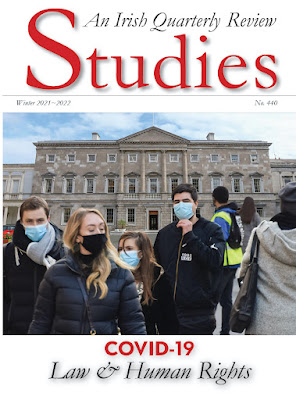
The Winter 2021 edition of ‘Studies: An Irish Quarterly Review’(Vol 110, No 440) , Winter 2021) included my paper, ‘A Reflection on the Crises in Afghanistan following the Fall of Kabul’ (pp 458-469)
Patrick Comerford
Introduction
The fall of Kabul in recent months and the completion of the Taliban takeover of Afghanistan in August have created a multiplicity of crises and have had repercussions in many areas of life in Ireland. The responses in Ireland have included knee-jerk and prejudiced reactions from people who object to accepting Afghan refugees. Paradoxically they are also among the people who point vocally to the forms of Islam expounded by the Taliban, yet have exercised little or no effort to understand Afghanistan, its history, its people, and the complexity and diversity of its religious cultures.
For many too, the Taliban confirm all their fears and prejudices of an expanding, militant Islam, and they are unwilling to concede that Islam is as diverse as Christianity and other religions, if not more so. The Taliban represents an extreme expression of Islam that has arisen only comparatively recently. Indeed, the Taliban expression of Islam cannot easily be labelled ‘conservative’ – for it is not conserving anything that is traditional in many streams of Islamic culture and thinking, nor is it rooted in traditions in Afghanistan.
Fears about the rights of women, for the education of children, and for freedom of expression in Afghanistan are well-founded. But there are genuine fears too for the loss of religious and cultural diversity and pluralism in Afghanistan under Taliban rule.
It is difficult too, for many of us, to understand and accept that Afghanistan is not a distant and remote part of Asia, but that for many centuries it came within the ambit of the ‘Euro-Mediterranean’ world, that it has long had close links with the classical and Hellenistic worlds, and that its history has been intimately interconnected with the history of Europe, including the history of Ireland.
Childhood reminders
As a child in Cappoquin, Co. Waterford, I was regaled with stories of General Sir John Keane (1781–1844), who eventually become Baron Keane of Ghuznee and Cappoquin. Those derring-do stories of Keane’s escapades and adventures in Afghanistan were as gripping as the stories of ‘the Wolf of Kabul’, which featured in my childhood days in The Hotspur, a popular British boy’s comic in the 1960s.
Keane played the key role in the capture of Ghuznee (Ghazni) during the First Anglo-Afghan War in 1839, following the fall of Kabul. I was reminded of this link between Ireland and past conflicts in Afghanistan during a recent visit to Cappoquin House, when Sir Charles Keane showed me many family mementoes of Lord Keane, including a portrait, a painting of Ghunzee Fort, and a ceremonial sword.
John Keane was born in Belmont, Cappoquin, on 6 February 1781, the second son of Sir John Keane, 1st baronet. He joined the army as an ensign at the age of 11 in 1792, rose to the rank of lieutenant-colonel and commanded a brigade in the Peninsular War, and he was promoted to major-general when he commanded a brigade at the Battle of New Orleans. Later, he was the British commander-in-chief in the West Indies and administered the colonial government of Jamaica.
Keane was commander-in-chief of the Bombay Army in 1834–1840, and he commanded the combined British and Indian army (‘The Army of the Indus’) during the opening campaign of the First Anglo-Afghan War. He and his forces seized Karachi in February 1839. He then commanded an expeditionary force that entered Afghanistan from India to forestall an expected, imminent Russian invasion, and commanded the victorious British and Indian army at the Battle of Ghazni on 23 July 1839.
Because of severe shortages of supplies and the lack of draft horses, Keane’s forces had to leave heavy siege equipment behind them in Kandahar. The defence of the city was led by Hyder Khan, the son of Dost Muhammad, then the ruler of Afghanistan. All the gates into Ghazni were sealed with rocks and debris, with the sole exception of the Kabul Gate, which was lightly guarded and poorly defended. Keane’s forces went around the city, camped on the north side facing the Kabul gate, and attacked early on the morning of 23 July. By dawn, Keane’s force had captured the city.
The British forces suffered 200 men killed and wounded while the Afghans lost almost 500 men and 1,600 were taken prisoner. Keane left a small garrison in Ghazni and began to march his forces towards Kabul on 30 July. When Dost Muhammad heard of the fall of Ghazni, he fled Kabul towards Western Afghanistan and the Afghan army surrendered. The
British then installed Shuja Shah Durrani of Kandahar as the new ruler of Afghanistan.
Keane retired without being engaged in further fighting. He was honoured with the peerage title of Baron Keane, of Ghuznee and of Cappoquin, Co. Waterford, on 23 December 1839, and received a pension of £2,000 a year for his and two successive lives.
Lord Keane died on 24 August 1844, and his title died out in 1901. But his remaining mementoes in Cappoquin House are a reminder that events in Afghanistan were never remote from the lives of people in Ireland.1
The reaches of ‘Euro-Med’ civilisation
From Keane’s adventures to recent events in Afghanistan, we are reminded throughout wars and history why Afghanistan has been known to military and diplomatic figures as the ‘graveyard of empires.’ But modern Afghanistan, as we know it, dates from 1747, when Ahmad Shah Durrani captured territory from Nader Shah’s descendants in Persia, from the Mughals, and the Uzbeks to his north. Although the name Afghanistan, meaning the land of the Afghans or Pashtuns, only came into general use during the wars of the 19th century, it can be traced to some time between the eighth and the 14th centuries.
Afghanistan is not a new country, nor is it culturally Asian. Traditionally, it has been seen as part of the ‘Euro-Med’ world. In classical times, the area was regarded as within the ambit of the Persian Empire, one of the great classical civilisations, and was known to both Greek and Roman writers as Ariana (Ἀριανή), from an Old Persian word (Ariyanem) meaning ‘the Land of the Aryans.’
In Rudyard Kipling’s short story ‘The Man Who Would Be King’ (1888), two British venturers, Peachy Carnehan and Danny Dravot, played by Michael Caine and Sean Connery in John Huston’s film of the same name (1975), set out to become kings of Kafiristan, a mountainous, isolated country beyond the Hindu Kush in north-east Afghanistan. They confide in their plans to Rudyard Kipling (Christopher Plummer), who tells them they
are mad. No man, he says, has made it to Kafiristan since Alexander the Great, to which Peachy replies, ‘If a Greek can do it, we can do it’. In north-east Afghanistan, they find the last remnants of the empire of Alexander the Great, and a local culture and religion that are part-Greek, part-Kafiri.2
The story is fiction, but aspects of its historical content are true. Alexander the Great spent most of the years 330–325 BCE campaigning in Afghanistan, Pakistan and India, and left behind Greek kingdoms and culture that flourished throughout the Hellenistic period and even later.3
Alexander the Great and his Macedonian forces crossed the Euphrates, marched through Mesopotamia, defeated Darius III of Persia in 331 BCE, and dismantled the Achaemenid empire. Alexander arrived in Afghanistan in 330 BCE, and the Seleucid Empire held on to the area for 15 years.
Later, there was a second Hellenistic conquest of the area by the Greco-Bactrians. Until the Taliban first took over Afghanistan, traces of these Greek kingdoms came to light continually, and the archaeological, artistic and epigraphic evidence from Afghanistan revealed a prosperous and culturally diverse kingdom.
Kandahar, the second city of Afghanistan and the de facto capital of the Taliban until the fall of Kabul, dates from the conquests of Alexander the Great, who laid out the foundation of what is now Old Kandahar in 330 BCE and gave it the Greek name Ἀλεξάνδρεια Ἀραχωσίας (Alexandria of Arachosia).
Alexander the Great is also said to have founded the city of Alexandria on the Oxus, at present-day Ai-Khanoum in Takhar Province, northern Afghanistan, in 327 BCE. It had a magnificent royal palace, a large amphitheatre, several Hellenic temples, a gymnasium, stoas and mosaics. For almost two centuries, this was a focal point of Hellenism in the East, and the centre of Hellenistic culture at the doorstep of India.4
This area was the most easterly reach of Greek civilisation and the Hellenistic world, and the Greek influence survived until at least the year 10 CE. This was the access point for the Classical World to the east, and when the Silk Road opened in the first century BCE, Afghanistan flourished thanks to trade along the routes from the Greek and Roman world through Persia to China and India. Ideas as well as goods were bartered, traded and exchanged at this centre point, so that Afghanistan was at the ultimate reach of our European-Mediterranean or ‘Euro-Med’ world.
The Kalash people in the Hindu Kush mountains are unique, with a distinctive cultural and religious identity; they are light-skinned, have blonde hair and blue eyes. To this day, traditions and myths persist that they are the descendants of Alexander the Great’s army.5
But how diverse is Afghanistan and its people in terms of religious heritage and identity?
Diversity in Afghanistan
The Taliban, or ‘students’ in the Pashto language, emerged as recently as the early 1990s in northern Pakistan, following the withdrawal of Soviet troops from Afghanistan. The predominantly Pashtun movement first appeared in religious seminaries, mostly financed from Saudi Arabia, and preached an extreme form of Salafism within Sunni Islam, with their own austere version of sharia, or Islamic law.6
One of the principal objectives of the Taliban is to impose a uniform practice of Islam throughout Afghanistan that forces all Muslims to conform to their own interpretation of Salafism.
Within weeks of the fall of Kabul, Muslim minorities became the first religious groupings to feel the impact of this religious intolerance. Yet, in the past, Afghanistan was known for its diversity among Muslims, once embracing a variety of expressions of Islam, among Shia minorities and Sufi orders.
Shia Islam
Shia Muslims form Afghanistan’s largest religious minority, and they are the religious group facing immediate threats and fears today. Estimates vary, but Shia Muslims make up from 7 to 20 per cent of the population of Afghanistan. They are mainly divided into two groupings, the Twelvers, who look to Iran for spiritual leadership, and the Ismailis, most of whom recognise the leadership of the Aga Khan. Both groups are regarded as heretical by the Sunni majority, and there is no doubt that the Taliban and Isis seek to eliminate their presence in Afghanistan and throughout the Islamic world.
The association of Twelver Shia Muslims with Iran also makes them politically vulnerable under the Taliban, and Shia Muslims are additionally vulnerable because they are mainly members of ethnic and linguistic minorities, including the Hazaras, Farsiwan (who are Persian speakers), Qizilbash and Pamir people.7
Two recent attacks on mosques in Afghanistan serve to illustrate not only the diversity of Islam in Afghanistan, but that the first target of Islamists in any religious purge is the country’s Muslim minorities.
At least 65 people were killed when the Imambargah in Kandahar, the equivalent of a Shia mosque, was attacked by a suicide bomber during Friday prayers on 15 October. The attack came a week after a similar bomb attack on a Shia mosque in northern Kunduz province, in which at least 50 people were killed.
Following the fall of Kabul, the Taliban has disarmed all security guards at Shia buildings, leaving them vulnerable to attacks by the even more extreme Isis. Kandahar is in the Taliban heartland, and the attack sent the clear message that Afghanistan’s Shia minority is no longer safe in a Taliban-ruled Afghanistan. ‘Life is becoming difficult and risky in Afghanistan for every Afghan, especially for Shias as Isis are only targeting Shia Muslims in Afghanistan. The world communities must help Afghanistan and Afghans in this terrible time’, one social activist who asked not to be named told The Guardian.8
Rumi, poet and Sufi mystic
Perhaps the most influential Muslim figure to emerge from what is today’s Afghanistan was Jalāl ad-Dīn Mohammad Rūmī, also known as Jalāl ad-Dīn Mohammad Balkhī or Mevlânâ and known more popularly and more simply as Rumi. Although this Sufi mystic was born to Persian-speaking parents in 1207 and was buried in Konya in present-day Turkey when he died in 1273, he was born, as his name indicates, in Balkh, then part of the Khwareziman Empire and now in present-day Afghanistan.
At the time, Greater Balkh was a major centre of Persian culture, and Sufism had developed there for several centuries, and Rumi’s father, Bahā ud-Dīn Walad, was a theologian, jurist and mystic from Balkh. For several generations, the family were preachers of the relatively liberal Hanafi Maturidi school. Rumi’s influence transcends national borders and ethnic and religious divisions, and he has been described as the ‘most popular poet’ and the ‘best-selling poet’ in the United States.9
Later, in the sixteenth century, Ahmad al Faruqi Kabuli, who was born near Kabul, was renowned for his teachings in India.
Three Sufi orders are prominent in Afghanistan: the Naqshbandiya, founded in Bukhara; the Qadiriya, founded in Baghdad; and the Cheshtiya, found mainly at Chesht-i-Sharif, east of Herat.
Afghan religious minorities
Buddhism first arrived in what we now know as Afghanistan with the expansion and conquests of the Maurya Empire throughout the Hindu Kush region during the reign of King Ashoka (268-232 BCE). In the following century, the Buddhist monk Lokakṣema travelled to China, and his translations of Mahayana Buddhist scriptures contributed significantly to the development of Buddhism in China.
His near contemporary, Mahadhammarakkhita, was a Greek Buddhist master in the reign of the Indo-Greek king Menander in the 2nd century BCE. His birth name Yona means ‘Ionian,’ and he travelled from ‘Alasandra’ – Alexandria of the Caucasus, about 150 km north of Kabul, or Alexandria of the Arachosians – with 30,000 monks for the dedication of the Great Stupa in Sri Lanka.10
Buddhism began to fall into decline in Afghanistan with the Muslim conquest in the seventh century, but finally came to an end under the Ghaznavid dynasty in the eleventh century.
The last great, surviving monuments to the presence of Buddhism in Afghanistan were the massive Buddha of Bamiyan, carved in the sixth and seventh centuries, and destroyed by rocket and guns in March 2001 after the Taliban decreed they were idolatrous.
The region of Arachosia, around Kandahar in southern Afghanistan, was once primarily Zoroastrian and is sometimes described as the ‘second homeland of Zoroastrianism.’ Until half a century ago, 2,000 Zoroastrians or Parsees were living in Afghanistan. There may still be small pockets of Bahais, Sikhs, Jains and Hindus in the country.
Christianity in Afghanistan
A legend in the apocryphal Gospel of Thomas and other traditions suggests that Saint Thomas the Apostle once preached in Bactria. By the fifth century, the Nestorian Church had a number of dioceses in Afghanistan, and there was a Christian presence in Herat until at least the early fourteenth century.
But Christianity has always had a small presence in Afghanistan. Until recently, the total number of Christians in Afghanistan was put at 10,000–12,000, almost all of them converts from Islam, although the law has not allowed Afghans to convert to Christianity, and only expatriates may be recognised as Christians.
Perhaps the best-known expatriate Christian living in Afghanistan until this year was Rula Ghani, a Maronite Christian from Lebanon, whose husband, Ashraf Ghani, was President of Afghanistan from 2014 until they fled Kabul as it fell to the Taliban earlier this year.
The only legally recognised Christian church building in Afghanistan is the Catholic chapel in the Italian embassy, which existed from the 1930s. The only Protestant church in Kabul was destroyed on 17 June 1973.
The last Jew of Kabul
Legends claim that Balkh, the home of Rumi, was also the burial place of the prophet Ezekiel and was once home to the prophet Jeremiah. There is a tradition among the Pashtuns of Afghanistan that they are descended from the exiled lost tribes of Israel. Interest in the topic was revived recently by a Jerusalem anthropologist, Professor Shalva Weil, who was quoted in the popular press as claiming the ‘Taliban may be descended from Jews’.11
Legends aside, a Jewish presence flourished in eastern Afghanistan from about the seventh century CE. An estimated 40,000 Jews once lived in the area of Herat. That number dwindled to fewer than 5,000 by the mid-twentieth century, as the community faced persecution from successive regimes that, influenced partly by Nazi propaganda and beliefs that Jews were ‘Bolshevik agents,’ restricted where they could live and work.
The Jewish presence in Afghanistan virtually disappeared from the 1950s, with emigration to Israel, India, Britain, and the US. When the Taliban first came to power in 1996, the Jewish population had dwindled to single-digit numbers.
Afghanistan’s last known surviving Jew, Zabulon Simantov (62), was finally evacuated from Kabul after spurning a number of rescue attempts in the days immediately after the city fell to the Taliban. Earlier this year, he told Arab News he would leave Afghanistan after the High Holy Days, which began on Rosh Hashanah (6 September 2021). Simantov had stayed on in Afghanistan to look after the last remaining synagogue in Kabul, through decades of violence and turmoil.
Simantov is a carpet and jewellery merchant who was born in Herat, once home to hundreds of Jews. He moved to Kabul but fled to Tajikistan in 1992, before returning to Kabul. Since then, he had lived the synagogue – which he has renovated– in the heart of Kabul’s flower district.
He became the country’s last Jew when Yitzhak Levi died in 2005. The pair famously did not get along, and in 1998 Levi wrote to the Taliban interior minister to accuse Simantov of the theft of Jewish relics. Simantov retorted by telling the Taliban that Levi ran a secret brothel where he sold alcohol. The Taliban jailed both men, but eventually released them when they
continued to fight in prison.
Their story inspired Michael J Flexer’s play My Brother’s Keeper, staged by the Apikoros Theatre Company at the Edinburgh Fringe Festival in 2006. The play tells the tale of the last two remaining Jews in Afghanistan under Taliban rule. They harbour a bitter hatred for one another, born out of their enforced co-habitation in a small, dilapidated synagogue, and spend the duration of the play feuding in fiery fashion.
Flexer told interviewers at the time that he had ‘tried to infuse the play with that feisty yet phlegmatic Jewish gallows humour’, and that he wanted the play to get across the idiocy of religious intolerance: ‘The comedy comes from the fact that, in this case, there was only one religion involved!’
However, in the past few months, comedy has given way to disturbing reality, and fears grow for everyone with the return of Taliban rule. Simantov’s departure means the future of the synagogue in Kabul is perilous and brings to an end Jewish life in Afghanistan after 1,500 to 2,000 years, or more.12
Conclusions
The ‘Wolf of Kabul’ in the Hotspur was supposed to be the moniker of Second Lieutenant Bill Sampson, a British intelligence agent in the North-West Frontier, and he first appeared in the Wizard in 1922. But, apart from Keane of Cappoquin, there have been other real-life ‘wolves of Kabul’ in Irish history.
Michael Mallin (1874–1916), chief of staff of the Irish Citizen Army garrison at the Royal College of Surgeons during the 1916 Rising in Dublin, spent 14 years in the British army, mainly in Afghanistan and India. He was decorated with the India Medal of 1895, and with the Punjab Frontier and Tirah clasps in 1897-1898. But it is also said that he was radicalised during his years in Afghanistan.
Before him, Lieutenant Walter Hamilton (1856-1879) from Inistioge, Co. Kilkenny, was posthumously decorated with the Victoria Cross for his part in the second Afghan War (1878–1880). He was part of the guard on duty when British headquarters in Kabul were overwhelmed and their guns seized in 1879. Other Irish recipients of awards and decorations during that war in Afghanistan include Sir Reginald Clare Hart (1848–1931) from Scarriff, Co. Clare, but Hamilton is remembered too for his appearance in M.M. Kaye’s epic novel The Far Pavilions (1978), which later became a British television mini-series.
Rudyard Kipling made popular the label ‘The Great Game’ as a description of the wars between Britain and Russia for control of Afghanistan – although the phrase was probably first used by the explorer Arthur Conolly (1807–1842), born in London of Irish parents. Kipling was so intrigued by the story of the disappearance and possible survival after the Battle of Balaclava of an Irish heir that it provided the basis for another of his short stories, ‘The Man Who Was’.
John Charles Henry Fitzgibbon (1829–1854), Viscount Fitzgibbon of Mountshannon House in Castleconnell, Co. Limerick, disappeared during the Crimean War and his body was never found. However, there were persistent rumours in his native Co. Limerick and in army lore that he had survived and escaped through Russia and Siberia to Afghanistan.
During the second Afghan War, Fitzgibbon’s regiment, the 8th Hussars, was stationed near the North-West frontier. One night, a dishevelled-looking man who spoke English was brought into the officers’ mess and was invited to stay for dinner. There he surprised all with his uncannily good knowledge of the regimental customs, indicating he was an ex-officer of the regiment. He was not asked to identify himself, but rumours developed and persisted that he was, in reality, the missing Fitzgibbon heir from Co. Limerick.
Kipling adapted the story in 1890 to tell of a man arrested for gun-stealing and who is believed to be an Afghan. He turns out to be an ex-officer, Austin Limmason – perhaps a verbal play on ‘Limerick’s son’ – who had been a Russian prisoner for many decades before making good his escape and finding his way back to his regiment in Afghanistan.
Kipling heads his 1891 version of this short story in his collection Life’s Handicap with a short ballad:
The Earth gave up her dead that tide,
Into our camp he came,
And said his say, and went his way,
And left our hearts aflame.
Keep tally – on the gun-butt score
The vengeance we must take,
When God shall bring full reckoning,
For our dead comrade’s sake.13
But the fall of Kabul and the conquest of Afghanistan cannot be regarded as part of God’s reckoning, nor can we continue to seek the ‘vengeance we must take’. In a geopolitical understanding of the present crises in Afghanistan, we are seeing yet another working out of the internal power struggles in the Islamic world between Saudi Arabia, seeking to assert its place as the major power among Sunni Muslims, and Iran, equally assertive of its place as the major power among Shia Muslims. It is a power struggle that has already had disastrous consequences for the people of Yemen and Syria, and Afghanistan serves to let the Iranians know that the Saudis have now opened another front on the eastern borders of Iran.
Western concerns for the future of Afghanistan cease being a continuing playout of ‘The Great Game’ in the ‘Graveyard of Empires’ when we begin to grasp that Afghanistan is – and has always been – an integral part of our ‘Euro-Med’ world; and condemnations of the Taliban and their expressions of Salafism can only gain legitimacy when we start to appreciate the pluralism and diversity within Islam and the religious, cultural and ethnic diversity that is part of the heritage of Afghanistan.
(Canon) Patrick Comerford is a priest in the Church of Ireland Diocese of Limerick and canon precentor of Saint Mary’s Cathedral, Limerick. He is a former adjunct assistant professor in Trinity College Dublin, a former lecturer in Church History and Liturgy in the Church of Ireland Theological Institute, and a former foreign desk editor at The Irish Times. He has written and lectured widely on Christian-Muslim affairs, and blogs daily at www.patrickcomerford.com.
Notes
1 Glacott Symes, Sir John Keane and Cappoquin House in Time of War and Revolution (Dublin: Four Courts Press, 2016), passim; the author’s visits to Cappoquin House, last visited 28 August 2020.
2 Rudyard Kipling, ‘The Man Who Would Be King,’ in The Man Who Would Be King: Selected Stories of Rudyard Kipling (Oxford: Oxford World’s Classics, 1999); Rachel Meirs, The Archaeology of the Hellenistic Far East, BAR International Series 2196 (2011), 13.
3 Shane Wallace, ‘Greek Culture in Afghanistan and India: Old Evidence and New Discoveries,’ 205–226 in Greece & Rome, 63.2 (The Classical Association, 2016), p 209. Meirs (2011), 8.
4 Meirs (2011), 16.
5 Barbara A West, Encyclopedia of the Peoples of Asia and Oceania (New York: Infobase Publishing, 2009), 357–358.
6 Malise Ruthven, Islam in the World (London: Penguin, 2000), 393–394; Sayed Hassan Akhlaq, ‘Taliban and Salafism: a historical and theological exploration,’ Open Democracy, 1 December 2013, https://www.opendemocracy.net/en/taliban-and-salafism-historical-and-theological-exploration/, accessed 22 October 2021.
7 Ruthven, Islam in the World, 211–21.
8 ‘Dozens dead in mosque bombing as doubt cast on Taliban security’, Guardian, 16 October 2021; ‘Islamic State Bombing Kills at Least 65 people in Southern Afghanistan’, Washington Post, 16 October 2021.
9 John Baldock, The Essence of Sufism (Royston, Herts: Eagle Editions, 2004); William C Chittick, Sufism (London: Oneworld, 2013), 76.
10 Meirs (2011), 12.
11 Rory McCarthy, ‘Pashtun clue to lost tribes of Israel’, The Observer, 17 January 2010; Michael Freund, ‘Are the Taliban descendants of Israel?’ Jerusalem Post, 9 September 2021.
12 Josef Federman, ‘Rescuers: Last Jew of Kabul making his way to Israel, AP News, 17 October 2021, https://apnews.com/article/afghanistan-middle-east-religion-israel-turkey-c701c38308bbd81c8f69b32315ee3393, accessed 22 October 2021.
13 Rudyard Kipling, ‘The Man Who Was’ in Life’s Handicap (London: Macmillan, 1891), 84.
● Patrick Comerford, ‘A Reflection on the Crises in Afghanistan following the Fall of Kabul,’ Studies: An Irish Quarterly Review (Vol 110, No 440, Winter 2021, pp 458-469)
Showing posts with label ‘Studies’. Show all posts
12 December 2022
A Reflection on the Crises in Afghanistan
following the Fall of Kabul
Labels:
‘Studies’,
Afghanistan,
archaeology,
Buddhism,
Cappoquin,
Castleconnell,
Church History,
Classics,
Guardian,
Inistioge,
Inter-Faith Dialogue,
Islam,
Judaism,
Konya,
Rumi,
Sufism,
Talking about 1916,
War and peace
09 December 2022
Are the Taliban going to
fund the restoration of
a synagogue in Afghanistan?
Yu Aw Synagogue in Herat has been given protected status
Patrick Comerford
In recent months, I have written in Studies about the loss of diversity and pluralism in Afghanistan since the Taliban stormed into Kabul, and I have also written about the loss of the centuries-old Jewish community following the departure of the last Jewish resident of Kabul.
However, reports in recent weeks suggest the Taliban has approved conservation work on an historic synagogue in the city of Herat in western Afghanistan, although no Jews have lived in the area for decades.
Yu Aw synagogue in Herat’s old city is thought to have been built around the turn of the 20th century. The reports say a 16-month restoration project is being planned to save the synagogue from further decay and possible collapse. It is being planned by the Herat municipality and other local organisations, with almost $500,000 in funding from the Aliph Foundation, a Swiss group seeking to protect cultural heritage sites in conflict areas.
The project also includes repairs to the community mikvah or ritual Jewish bath, known as Hammam-e Mosaie. It was once used by Herat’s Jewish residents, who in the past numbered tens of thousands.
The Jewish buildings are in the Mahalla-yi Musahiya area of the city, known by local people as the ‘Neighbourhood of the Jews.’
It will be one of the first cultural conservation projects in the province since US troops were withdrawn and the Taliban overthrew the Western-supported government last year (2021). The synagogue last underwent restoration efforts in 2009, with funding from another Swiss organisation.
The head of Herat’s department for safeguarding historic monuments, Zalmay Safa, told The Art Newspaper, which first reported the story: ‘We want to prove that we are tolerant and accepting of one another, we seek peace, and we are not extremists. Despite the change in government, our historic sites remain protected and they are not in any way connected to religious matters.’
The Yu Aw synagogue, and three other synagogues were built around the same time. They are among the last remaining physical reminders of the presence of a Jewish community in Herat and its vibrant cultural life.
Herat once had tens of thousands of Jewish residents. But they began moving to Israel and the US after World War II. By the 1970s, the Jewish community had completely left.
Reports say there are four synagogues, a bath, and a cemetery in Herat, but so far only the Yu Aw Synagogue has been given protected status. Another synagogue was converted into a mosque, one is used as a school, and a third was heavily damaged in recent conflicts.
Although the latest project has not explicitly been presented as a ‘Jewish Heritage’ project, everyone is aware of the history of the building, and it is not seen as controversial, according to Jolyon Lesie, an adviser, the Afghan Cultural Heritage Consulting Organisation (ACHCO), a non-profit, apolitical, cultural organisation, an ACHCO, who spoke to The Art Newspaper.
Zalmay Safa, director of Herat’s department for the safeguarding of historic monuments, says: ‘This is a cultural and historic site, which is not used as a place of worship, and the local government will support its preservation. Despite the change in government our historic sites remain protected, and they are not in any way connected to religious matters.’
The last two Jewish people living in Afghanistan left a month after the Taliban took over last year. Zablon Simintov, also known as Zebulon Simentov, a former carpet trader and restaurateur, was born into an Orthodox Jewish family in Herat in 1959, and he spent most of his early life there until he moved to Kabul, where he was also the caretaker of the country’s only remaining synagogue.
After the death of Ishaq Levin at the age of 80 in 2005, Zablon Simintov was widely known as the only Jew still living in Afghanistan. However, when he left he left for Israel in September 2021, it was discovered that his distant cousin, Tova Moradi, was actually the last Jew living in Afghanistan. She too fled Afghanistan last year with 20 or so grandchildren, leaving for Albania in October 2021.
Shabbat Shalom
Patrick Comerford
In recent months, I have written in Studies about the loss of diversity and pluralism in Afghanistan since the Taliban stormed into Kabul, and I have also written about the loss of the centuries-old Jewish community following the departure of the last Jewish resident of Kabul.
However, reports in recent weeks suggest the Taliban has approved conservation work on an historic synagogue in the city of Herat in western Afghanistan, although no Jews have lived in the area for decades.
Yu Aw synagogue in Herat’s old city is thought to have been built around the turn of the 20th century. The reports say a 16-month restoration project is being planned to save the synagogue from further decay and possible collapse. It is being planned by the Herat municipality and other local organisations, with almost $500,000 in funding from the Aliph Foundation, a Swiss group seeking to protect cultural heritage sites in conflict areas.
The project also includes repairs to the community mikvah or ritual Jewish bath, known as Hammam-e Mosaie. It was once used by Herat’s Jewish residents, who in the past numbered tens of thousands.
The Jewish buildings are in the Mahalla-yi Musahiya area of the city, known by local people as the ‘Neighbourhood of the Jews.’
It will be one of the first cultural conservation projects in the province since US troops were withdrawn and the Taliban overthrew the Western-supported government last year (2021). The synagogue last underwent restoration efforts in 2009, with funding from another Swiss organisation.
The head of Herat’s department for safeguarding historic monuments, Zalmay Safa, told The Art Newspaper, which first reported the story: ‘We want to prove that we are tolerant and accepting of one another, we seek peace, and we are not extremists. Despite the change in government, our historic sites remain protected and they are not in any way connected to religious matters.’
The Yu Aw synagogue, and three other synagogues were built around the same time. They are among the last remaining physical reminders of the presence of a Jewish community in Herat and its vibrant cultural life.
Herat once had tens of thousands of Jewish residents. But they began moving to Israel and the US after World War II. By the 1970s, the Jewish community had completely left.
Reports say there are four synagogues, a bath, and a cemetery in Herat, but so far only the Yu Aw Synagogue has been given protected status. Another synagogue was converted into a mosque, one is used as a school, and a third was heavily damaged in recent conflicts.
Although the latest project has not explicitly been presented as a ‘Jewish Heritage’ project, everyone is aware of the history of the building, and it is not seen as controversial, according to Jolyon Lesie, an adviser, the Afghan Cultural Heritage Consulting Organisation (ACHCO), a non-profit, apolitical, cultural organisation, an ACHCO, who spoke to The Art Newspaper.
Zalmay Safa, director of Herat’s department for the safeguarding of historic monuments, says: ‘This is a cultural and historic site, which is not used as a place of worship, and the local government will support its preservation. Despite the change in government our historic sites remain protected, and they are not in any way connected to religious matters.’
The last two Jewish people living in Afghanistan left a month after the Taliban took over last year. Zablon Simintov, also known as Zebulon Simentov, a former carpet trader and restaurateur, was born into an Orthodox Jewish family in Herat in 1959, and he spent most of his early life there until he moved to Kabul, where he was also the caretaker of the country’s only remaining synagogue.
After the death of Ishaq Levin at the age of 80 in 2005, Zablon Simintov was widely known as the only Jew still living in Afghanistan. However, when he left he left for Israel in September 2021, it was discovered that his distant cousin, Tova Moradi, was actually the last Jew living in Afghanistan. She too fled Afghanistan last year with 20 or so grandchildren, leaving for Albania in October 2021.
Shabbat Shalom
13 December 2021
A reflection in ‘Studies’ on
the crises in Afghanistan
following the fall of Kabul
The current edition of ‘Studies’ includes my paper, ‘A Reflection on the Crises in Afghanistan following the Fall of Kabul’
Patrick Comerford
I am honoured to find that my paper reflecting on the fall of Kabul and the Taliban takeover of Afghanistan is published in the current issue of Studies: An Irish Quarterly Review (Vol 110, No 440, Winter 2021, pp 458-469).
Studies is a scholarly quarterly Irish journal published by the Irish Jesuits through Messenger Publications. It was founded in 1912, and examines Irish social, political, cultural and economic issues in the light of Christian values and explores the Irish dimension in literature, history, philosophy and religion.
My paper in the current edition of Studies is ‘A Reflection on the Crises in Afghanistan following the Fall of Kabul.’
The fall of Kabul in recent months and the completion of the Taliban takeover of Afghanistan in August have created a multiplicity of crises and have had repercussions in many areas of life in Ireland.
In his editorial, the new editor of Studies, Dermot Roantree describes this as a ‘wide-ranging reflection on Afghanistan in the aftermath of the fall of Kabul.’ He adds: ‘What his fascinating stories, anecdotes, and historical explanations all serve to impress is that Afghanistan is very much more pluralist, complex, and culturally rich than people may imagine, and that it has always been part of the greater ‘Euro-Med’ world.’
This issue of Studies also includes a series of essays by the ‘COVID-19 Law and Human Rights Observatory,’ established by the Law School of Trinity College Dublin to analyse and explain Ireland’s legal response to the pandemic. These essays focus on some of the challenges that were navigated and the principle lessons to be learnt for the future, whether for a future public health crisis or more generally.
Alan Brady and James Rooney look at ‘Lockdowns and the Right to Education in Ireland’; Conor Casey and Oran Doyle examine ‘Law and Human Rights’; and Conor Casey, Oran Doyle and David Kenny write on ‘The Irish State’s COVID-19 Response and the Rule of Law: Causes for Concern.’ Professor Oran Doyle and Dr Conor Casey, provide a separate introduction to their work.
In her paper, Patricia Brazil looks at ‘Direct Provision in a Time of Pandemic.’ There are papers too by Hilary Hogan, Mark Bell, and Romy Dawson (‘Rural and Pastoral Themes in Heaney’s Poetry’). In his essay on ‘The ‘rapidification’ of modern life’, Professor Mark Bell draws attention to Pope Francis’s promotion of ‘integral ecology’ in Laudato Si’, specifically with respect to the need for rest and for creating quiet space for dialogue and ‘serene reflection’.
Father Bruce Bradley was the editor of Studies for 10 years, from 2011 until just a few months ago. Dermot Roantree is the first lay person to hold the post.
Studies was launched by the Irish Jesuits in March 1912, intended to reach as wide a readership as possible. Its first Foreword said its objective was to be ‘a Review which would give publicity to work of a scholarly type, extending over many important branches of study, and appealing to a wider circle of cultured readers than strictly specialist journals could be expected to reach’.
The journal had a distinctive Irish and religious viewpoint but the subjects it covered ranged widely, comprising – to cite the original prospectus once more – literature, history, philosophy, sociology, education and science. As Professor Bryan Fanning wrote in his recently published anthology of the best of Studies over its first century of publication, ‘In 1912 Catholic intentions hardly needed to be advertised’. It was to be ‘catholic’ in both senses.
The survival of Studies into a second century of existence makes it almost unique among Irish publications. Today, it describes its purpose as examining ‘Irish social, political, cultural and economic issues in the light of Christian values’ and exploring ‘the Irish dimension in literature, history, philosophy and religion.’
● Patrick Comerford, ‘A Reflection on the Crises in Afghanistan following the Fall of Kabul,’ Studies: An Irish Quarterly Review (Vol 110, No 440, Winter 2021, pp 458-469)
Patrick Comerford
I am honoured to find that my paper reflecting on the fall of Kabul and the Taliban takeover of Afghanistan is published in the current issue of Studies: An Irish Quarterly Review (Vol 110, No 440, Winter 2021, pp 458-469).
Studies is a scholarly quarterly Irish journal published by the Irish Jesuits through Messenger Publications. It was founded in 1912, and examines Irish social, political, cultural and economic issues in the light of Christian values and explores the Irish dimension in literature, history, philosophy and religion.
My paper in the current edition of Studies is ‘A Reflection on the Crises in Afghanistan following the Fall of Kabul.’
The fall of Kabul in recent months and the completion of the Taliban takeover of Afghanistan in August have created a multiplicity of crises and have had repercussions in many areas of life in Ireland.
In his editorial, the new editor of Studies, Dermot Roantree describes this as a ‘wide-ranging reflection on Afghanistan in the aftermath of the fall of Kabul.’ He adds: ‘What his fascinating stories, anecdotes, and historical explanations all serve to impress is that Afghanistan is very much more pluralist, complex, and culturally rich than people may imagine, and that it has always been part of the greater ‘Euro-Med’ world.’
This issue of Studies also includes a series of essays by the ‘COVID-19 Law and Human Rights Observatory,’ established by the Law School of Trinity College Dublin to analyse and explain Ireland’s legal response to the pandemic. These essays focus on some of the challenges that were navigated and the principle lessons to be learnt for the future, whether for a future public health crisis or more generally.
Alan Brady and James Rooney look at ‘Lockdowns and the Right to Education in Ireland’; Conor Casey and Oran Doyle examine ‘Law and Human Rights’; and Conor Casey, Oran Doyle and David Kenny write on ‘The Irish State’s COVID-19 Response and the Rule of Law: Causes for Concern.’ Professor Oran Doyle and Dr Conor Casey, provide a separate introduction to their work.
In her paper, Patricia Brazil looks at ‘Direct Provision in a Time of Pandemic.’ There are papers too by Hilary Hogan, Mark Bell, and Romy Dawson (‘Rural and Pastoral Themes in Heaney’s Poetry’). In his essay on ‘The ‘rapidification’ of modern life’, Professor Mark Bell draws attention to Pope Francis’s promotion of ‘integral ecology’ in Laudato Si’, specifically with respect to the need for rest and for creating quiet space for dialogue and ‘serene reflection’.
Father Bruce Bradley was the editor of Studies for 10 years, from 2011 until just a few months ago. Dermot Roantree is the first lay person to hold the post.
Studies was launched by the Irish Jesuits in March 1912, intended to reach as wide a readership as possible. Its first Foreword said its objective was to be ‘a Review which would give publicity to work of a scholarly type, extending over many important branches of study, and appealing to a wider circle of cultured readers than strictly specialist journals could be expected to reach’.
The journal had a distinctive Irish and religious viewpoint but the subjects it covered ranged widely, comprising – to cite the original prospectus once more – literature, history, philosophy, sociology, education and science. As Professor Bryan Fanning wrote in his recently published anthology of the best of Studies over its first century of publication, ‘In 1912 Catholic intentions hardly needed to be advertised’. It was to be ‘catholic’ in both senses.
The survival of Studies into a second century of existence makes it almost unique among Irish publications. Today, it describes its purpose as examining ‘Irish social, political, cultural and economic issues in the light of Christian values’ and exploring ‘the Irish dimension in literature, history, philosophy and religion.’
● Patrick Comerford, ‘A Reflection on the Crises in Afghanistan following the Fall of Kabul,’ Studies: An Irish Quarterly Review (Vol 110, No 440, Winter 2021, pp 458-469)
04 October 2018
The diplomat from Charleville
who warned of the evils of Hitler
The former Binchy shop on Main Street, Charleville … the birthplace of Irish diplomat Daniel Binchy (Photograph Patrick Comerford, 2018)
Patrick Comerford
In my tour of the architectural heritage and legacy found in the shopfronts and houses of Charleville, Co Cork, I skipped over Brúdair’s Coffee Shop and its traditional shopfront on the Main Street. This is not because I ignored or missed this shopfront, but because it such a significant landmark in the town and also the birthplace of Daniel A Binchy, the first Irish Minister or ambassador to Germany from 1929 to 1932.
This is a terraced single-bay, three-storey house, and on the ground floor there is a limestone and marble shopfront with the carved name Binchy and the date 1849.
The arcaded three-bay shopfront has engaged polished red stone columns with moulded bases and ornate composite capitals, over square-plan carved limestone plinths and a supporting central elliptical arch and flanking round arches, all with moulded archivolts.
Above, there is a limestone facing and fascia with a moulded limestone cornice above and string course below. The raised limestone lettering ends with foliate motifs.
This carved stone shopfront is a fine example of the quality of 19th century stone carving, with an interesting and colourful combination of red columns and grey stone. The timber six-panelled door is original. The contrasting style of the upper floors adds to the character of the building, which is a local landmark and forms a significant part of the streetscape of Charleville.
Daniel Anthony Binchy (1899-1989), an academic, diplomat, polyglot and lawyer, has been described as ‘a man ahead of his time’ and ‘a public intellectual,’ and he was a life-long friend of the writers Seán O’Faolain and Frank O’Connor.
The Binchys were an affluent, shop-keeping family with a tradition in medicine and the law. They are thought to have originally come to Ireland with Cromwell but became Roman Catholics in the dying days of the penal laws. The Binchys were committed Anglophiles, and conservative and Catholic in the Redmondite tradition.
Daniel Bincy was born in the Binchy house on the Main Street in Charleville in 1899, a son of William Patrick Binchy, shopkeeper, and his wife Annie (nee Browne). William Binchy took the pro-Treaty side in the Irish Civil War in the early 1920s, and dismissed and refused to rehire workers who had taken the anti-Treaty side. One of those dismissed John Higgins. For the rest of his life, John Higgins lived in hardship, and he was the father of President Michael D Higgins (and here).
Daniel Binchy went to school in Charleville and Banagher, and then to the Jesuit-run Clongowes Wood, where one of his teachers was Joseph Walshe, later the first head of the new Department of External Affairs – as the Department of Foreign Affairs was then known – and a major influence on Binchy’s later career.
At University College Dublin, Binchy was the Auditor of the Literary and Historical Society in 1919-1920. He collected a number of first-class honours at UCD, graduated with a BA in legal and political science and completed an MA in history. He won a National University of Ireland travelling studentship, and studied at the University of Munich in 1921, where he became fluent in German.
During his student days in Munich, Binchy became a first-hand observer of Hitler and on a murky November evening in 1921,’ when he was invited by a Bavarian fellow student to a meeting of ‘a new freak party’ in a beer cellar.’ It was his first – but not his last – encounter with Hitler, and he was not impressed.
He was struck by Hitler’s ‘strange mixture of intellectual inferiority, slatternly appearance and rhetorical genius.’ He remarked to his friend that Hitler was ‘a harmless lunatic with the gift of oratory.’ His German friend, with rather more prescience, retorted: ‘No lunatic with the gift of oratory is harmless.’
He later recalled: ‘His countenance was opaque, his complexion pasty, his hair plastered down with some glistening unguent, and – as if to accentuate the impression of insignificance – he wore a carefully docked ‘toothbrush’ moustache. I felt willing to bet he was a plumber: a whispered query to my friend brought the information that he was a housepainter.’
Binchy returned to Dublin and his studies of mediaeval history, and his doctoral thesis was a study of the Irish Benedictine monastery of Ratisbon. He was appointed Professor of Roman Law and Jurisprudence at UCD in 1925, and soon became one of the great Celtic Studies scholars of his day. Later, he would hold senior positions in UCD, Corpus Christi College Oxford, Harvard and the Dublin Institute for Advanced Studies.
But his academic career was diverted in 1929 when he was appointed by WT Cosgrave’s government as the first Irish minister to Germany, and until 1932 he was the equivalent of Ireland’s ambassador to Germany.
Binchy never really wanted to be an ambassador, but his reports from Berlin show his acute grasp of the unfolding events and personalities in the critical last days of the Weimar republic, combined with an ability to make important contacts, including a good relationship with President Paul von Hindenberg.
However, Binchy had little time for the round of social engagements, the dinners and the formalities of diplomatic life. Binchy promoted a modernising and independent Irish Free State while experiencing at first hand the disconcerting rise of Nazism and fascism.
He had a second encounter with Hitler in Berlin in 1930, when the Nazis were on the brink of power. Hitler delivered a near-replica version of the speech Binchy had heard in Munich almost a decade earlier, and realised Hitler simply recycled his speeches throughout his career. While his delivery had improved – Hitler practised his gestures in front of a mirror – and his words were tailored to his audience, he always said much the same thing.
‘In his speech I found no change at all. Allowing for the altered place and circumstances, it was substantially the same address which I had heard in the Bürgerbräukeller. There were the same denunciations, the same digressions – and the same enthusiasm. At the conclusion of his speech, the vast throng cheered itself hoarse. The obscure housepainter was now the leader of the second largest party in Germany.’
His reports to Dublin were sharp and prescient. He predicted the consequences of the failure of the democratic parties to work together and had no illusions about the brutality, cynicism, anti-Semitism and murderous racism of the new regime. Binchy reported all of this to Dublin with great clarity.
He returned to Dublin and academic life in 1932 and was followed in Berlin by Leo T McCauley (1932-1933), who failed to grasp the dangers Hitler posed and who actually suggested the Jews brought on themselves their persecution in Germany. McCauley was followed from 1933 to 1939 by the anti-Semite and Nazi admirer Charles Bewley (1888-1969), who persistently thwarted efforts to obtain visas for Jews wanting to flee Nazi Germany in the 1930s and to move to the safety of the Irish Free State.
Back in Dublin, in March 1933, just weeks before Hitler accessed absolute power in Germany, Binchy published an analysis of Hitler and the Nazis in a 20-page paper in Studies, the Jesuit journal published in Dublin, drawing on his student days in Munich and his experiences as the Irish diplomat in Berlin.
He described Hitler as ‘a born natural orator,’ and described his style of speech: ‘He began slowly, almost hesitatingly, stumbling over the construction of his sentences, correcting his dialect pronunciation. Then all at once he seemed to take fire. His voice rose victorious over falterings, his eyes blazed with conviction, his whole body became an instrument of rude eloquence. As his exaltation increased, his voice rose almost to a scream, his gesticulation became a pantomime, and I noticed traces of foam at the corners of his mouth.
‘He spoke so quickly and in such a pronounced dialect that I had great difficulty in following him, but the same phrases kept recurring all through his address like motifs in a symphony: the Marxist traitors, the criminals who caused the revolution, the German army which was stabbed in the back, and – most insistent of all – the Jews.’
Bincy recalled how Hitler stayed in control of most of the audience, despite some heckles. ‘His purple passages were greeted with roars of applause, and when finally he sank back exhausted into his chair, there was a scene of hysterical enthusiasm which baffles description.’
In his assessment of Hitler, Binchy refers to his ‘fanatical belief’ and writes, ‘there are only two barriers to megalomania in public life: intelligence and a sense of humour. Either of these qualities would suffice to prevent it, but I believe Hitler to be lacking in both.’
In the 1930s, Binchy warned Fine Gael against ‘any flirtations with fascism in any guise.’ This was at a time when, in Tom Garvin’s words, ‘such ideas enjoyed a certain cachet in parts of the Irish civil service, the teaching professions and in both Fine Gael and de Valera’s Fianna Fáil.’
In 1937, Binchy spent time in Italy, despised Mussolini, and wrote a scholarly analysis of Italian fascism.
After World War II, in 1946, Binchy was awarded a senior fellowship at Corpus Christi College, Oxford, where he and Myles Dillon, a brother of the Fine Gael politician James Dillon, became the two resident Irish Celtic scholars.
Binchy returned to Ireland in 1950 to take up a fellowship at the Dublin Institute of Advanced Studies, but he continued to spend much time abroad, and was a visiting professor in Harvard in 1954.
His article on the old name of Charleville, first published in 1963, discussed the relative merits of the names of Rathgoggin, Charleville, Rath Luirc and An Ráth for the town of his birth.
Until his death in 1989, Binchy remained a major figure in Irish academic and intellectual life. Myles na gCopaleen acidly observed that after years of study Binchy and his contemporaries had established that ‘there was no God, but there were two St. Patricks.’
Binchy is famously the subject of a comic verse by Flann O’Brien. His academic pursuits at the Dublin Institute for Advanced Studies are satirised affectionately in Brian O’Nolan’s poem Binchy and Bergin and Best, originally printed in the ‘Cruiskeen Lawn’ column in The Irish Times and later included in The Best of Myles.
Binchy’s life story is the subject of Professor Tom Garvin’s definitive biographical study, The Lives of Daniel Binchy: Irish Scholar, Diplomat, Public Intellectual (Dublin: Irish Academic Press, 2016).
Today, Daniel Binchy’s main claim to fame may be that he was a rather remote and awesome uncle of the author and The Irish Times writer Maeve Binchy (1939-2012), William Binchy, Regius Professor of Laws at Trinity College (1992-2012), and other remarkable members of the Binchy family.
Binchy was a perceptive assessor of European Fascism. He judged at a very early stage that Hitler’s regime would prove far more evil and murderous than its allies. In the case of Italy, he recognised Mussolini for the buffoonish thug that he was, but also suspected that the Italian regime would ultimately prove far less steely than its German ally.
His meeting with Adolf Hitler and his insightful paper in Studies were a brave warning against the dangers of totalitarianism. Perhaps today we need someone with his perceptive insights to warn us of the dangers of born natural orators, who rehearse their gestures and gesticulations before speaking, who seek to blame all their nation’s woes on identifiable but marginalised groups, and who promise to make their nation great again.
As Binchy’s friend warned him almost a century ago, ‘No lunatic with the gift of oratory is harmless.’
‘Binchy and Bergin and Best’ by Flann O’Brien (Myles na gCopaleen, Brian O’Nolan)
My song is concernin’
Three sons of great learnin’
Binchy and Bergin and Best.
They worked out that riddle
Old Irish and Middle,
Binchy and Bergin and Best.
They studied far higher
Than ould Kuno Meyer
And fanned up the glimmer
Bequeathed by Zimmer,
Binchy and Bergin and Best.
They rose in their nightshift
To write for the Zeitschrift,
Binchy and Bergin and Best.
They proved they were bosses
At wrestling the glosses,
Binchy and Bergin and Best.
They made good recensions
Of ancient declensions,
And careful redactions
To their three satisfactions,
Binchy and Bergin and Best.
They went for a dander
With Charlie Marstrander,
Binchy and Bergin and Best.
They added their voices
(Though younger) to Zeuss’s,
Binchy and Bergin and Best.
Stout chase the three gave
Through the Táin for Queen Maeve
And played ‘Find the Lady’
With Standish O’Grady,
Binchy and Bergin and Best.
They sang in the choir
Of the Institute (Higher),
Binchy and Bergin and Best.
And when they saw fit
The former two quit,
Binchy and Bergin and Best.
But the three will remain
To try to regain
At whatever cost
Our paradigms lost,
Binchy and Bergin and Best.
So forte con brio
Three cheers for the trio,
Binchy and Bergin and Best.
These friends of Pokorny
Let’s toast in Grand Marnier,
Binchy and Bergin and Best.
These justly high-rated,
Advanced, educated,
And far from facetious
Three sons of Melesius,
Binchy and Bergin and Best.
Patrick Comerford
In my tour of the architectural heritage and legacy found in the shopfronts and houses of Charleville, Co Cork, I skipped over Brúdair’s Coffee Shop and its traditional shopfront on the Main Street. This is not because I ignored or missed this shopfront, but because it such a significant landmark in the town and also the birthplace of Daniel A Binchy, the first Irish Minister or ambassador to Germany from 1929 to 1932.
This is a terraced single-bay, three-storey house, and on the ground floor there is a limestone and marble shopfront with the carved name Binchy and the date 1849.
The arcaded three-bay shopfront has engaged polished red stone columns with moulded bases and ornate composite capitals, over square-plan carved limestone plinths and a supporting central elliptical arch and flanking round arches, all with moulded archivolts.
Above, there is a limestone facing and fascia with a moulded limestone cornice above and string course below. The raised limestone lettering ends with foliate motifs.
This carved stone shopfront is a fine example of the quality of 19th century stone carving, with an interesting and colourful combination of red columns and grey stone. The timber six-panelled door is original. The contrasting style of the upper floors adds to the character of the building, which is a local landmark and forms a significant part of the streetscape of Charleville.
Daniel Anthony Binchy (1899-1989), an academic, diplomat, polyglot and lawyer, has been described as ‘a man ahead of his time’ and ‘a public intellectual,’ and he was a life-long friend of the writers Seán O’Faolain and Frank O’Connor.
The Binchys were an affluent, shop-keeping family with a tradition in medicine and the law. They are thought to have originally come to Ireland with Cromwell but became Roman Catholics in the dying days of the penal laws. The Binchys were committed Anglophiles, and conservative and Catholic in the Redmondite tradition.
Daniel Bincy was born in the Binchy house on the Main Street in Charleville in 1899, a son of William Patrick Binchy, shopkeeper, and his wife Annie (nee Browne). William Binchy took the pro-Treaty side in the Irish Civil War in the early 1920s, and dismissed and refused to rehire workers who had taken the anti-Treaty side. One of those dismissed John Higgins. For the rest of his life, John Higgins lived in hardship, and he was the father of President Michael D Higgins (and here).
Daniel Binchy went to school in Charleville and Banagher, and then to the Jesuit-run Clongowes Wood, where one of his teachers was Joseph Walshe, later the first head of the new Department of External Affairs – as the Department of Foreign Affairs was then known – and a major influence on Binchy’s later career.
At University College Dublin, Binchy was the Auditor of the Literary and Historical Society in 1919-1920. He collected a number of first-class honours at UCD, graduated with a BA in legal and political science and completed an MA in history. He won a National University of Ireland travelling studentship, and studied at the University of Munich in 1921, where he became fluent in German.
During his student days in Munich, Binchy became a first-hand observer of Hitler and on a murky November evening in 1921,’ when he was invited by a Bavarian fellow student to a meeting of ‘a new freak party’ in a beer cellar.’ It was his first – but not his last – encounter with Hitler, and he was not impressed.
He was struck by Hitler’s ‘strange mixture of intellectual inferiority, slatternly appearance and rhetorical genius.’ He remarked to his friend that Hitler was ‘a harmless lunatic with the gift of oratory.’ His German friend, with rather more prescience, retorted: ‘No lunatic with the gift of oratory is harmless.’
He later recalled: ‘His countenance was opaque, his complexion pasty, his hair plastered down with some glistening unguent, and – as if to accentuate the impression of insignificance – he wore a carefully docked ‘toothbrush’ moustache. I felt willing to bet he was a plumber: a whispered query to my friend brought the information that he was a housepainter.’
Binchy returned to Dublin and his studies of mediaeval history, and his doctoral thesis was a study of the Irish Benedictine monastery of Ratisbon. He was appointed Professor of Roman Law and Jurisprudence at UCD in 1925, and soon became one of the great Celtic Studies scholars of his day. Later, he would hold senior positions in UCD, Corpus Christi College Oxford, Harvard and the Dublin Institute for Advanced Studies.
But his academic career was diverted in 1929 when he was appointed by WT Cosgrave’s government as the first Irish minister to Germany, and until 1932 he was the equivalent of Ireland’s ambassador to Germany.
Binchy never really wanted to be an ambassador, but his reports from Berlin show his acute grasp of the unfolding events and personalities in the critical last days of the Weimar republic, combined with an ability to make important contacts, including a good relationship with President Paul von Hindenberg.
However, Binchy had little time for the round of social engagements, the dinners and the formalities of diplomatic life. Binchy promoted a modernising and independent Irish Free State while experiencing at first hand the disconcerting rise of Nazism and fascism.
He had a second encounter with Hitler in Berlin in 1930, when the Nazis were on the brink of power. Hitler delivered a near-replica version of the speech Binchy had heard in Munich almost a decade earlier, and realised Hitler simply recycled his speeches throughout his career. While his delivery had improved – Hitler practised his gestures in front of a mirror – and his words were tailored to his audience, he always said much the same thing.
‘In his speech I found no change at all. Allowing for the altered place and circumstances, it was substantially the same address which I had heard in the Bürgerbräukeller. There were the same denunciations, the same digressions – and the same enthusiasm. At the conclusion of his speech, the vast throng cheered itself hoarse. The obscure housepainter was now the leader of the second largest party in Germany.’
His reports to Dublin were sharp and prescient. He predicted the consequences of the failure of the democratic parties to work together and had no illusions about the brutality, cynicism, anti-Semitism and murderous racism of the new regime. Binchy reported all of this to Dublin with great clarity.
He returned to Dublin and academic life in 1932 and was followed in Berlin by Leo T McCauley (1932-1933), who failed to grasp the dangers Hitler posed and who actually suggested the Jews brought on themselves their persecution in Germany. McCauley was followed from 1933 to 1939 by the anti-Semite and Nazi admirer Charles Bewley (1888-1969), who persistently thwarted efforts to obtain visas for Jews wanting to flee Nazi Germany in the 1930s and to move to the safety of the Irish Free State.
Back in Dublin, in March 1933, just weeks before Hitler accessed absolute power in Germany, Binchy published an analysis of Hitler and the Nazis in a 20-page paper in Studies, the Jesuit journal published in Dublin, drawing on his student days in Munich and his experiences as the Irish diplomat in Berlin.
He described Hitler as ‘a born natural orator,’ and described his style of speech: ‘He began slowly, almost hesitatingly, stumbling over the construction of his sentences, correcting his dialect pronunciation. Then all at once he seemed to take fire. His voice rose victorious over falterings, his eyes blazed with conviction, his whole body became an instrument of rude eloquence. As his exaltation increased, his voice rose almost to a scream, his gesticulation became a pantomime, and I noticed traces of foam at the corners of his mouth.
‘He spoke so quickly and in such a pronounced dialect that I had great difficulty in following him, but the same phrases kept recurring all through his address like motifs in a symphony: the Marxist traitors, the criminals who caused the revolution, the German army which was stabbed in the back, and – most insistent of all – the Jews.’
Bincy recalled how Hitler stayed in control of most of the audience, despite some heckles. ‘His purple passages were greeted with roars of applause, and when finally he sank back exhausted into his chair, there was a scene of hysterical enthusiasm which baffles description.’
In his assessment of Hitler, Binchy refers to his ‘fanatical belief’ and writes, ‘there are only two barriers to megalomania in public life: intelligence and a sense of humour. Either of these qualities would suffice to prevent it, but I believe Hitler to be lacking in both.’
In the 1930s, Binchy warned Fine Gael against ‘any flirtations with fascism in any guise.’ This was at a time when, in Tom Garvin’s words, ‘such ideas enjoyed a certain cachet in parts of the Irish civil service, the teaching professions and in both Fine Gael and de Valera’s Fianna Fáil.’
In 1937, Binchy spent time in Italy, despised Mussolini, and wrote a scholarly analysis of Italian fascism.
After World War II, in 1946, Binchy was awarded a senior fellowship at Corpus Christi College, Oxford, where he and Myles Dillon, a brother of the Fine Gael politician James Dillon, became the two resident Irish Celtic scholars.
Binchy returned to Ireland in 1950 to take up a fellowship at the Dublin Institute of Advanced Studies, but he continued to spend much time abroad, and was a visiting professor in Harvard in 1954.
His article on the old name of Charleville, first published in 1963, discussed the relative merits of the names of Rathgoggin, Charleville, Rath Luirc and An Ráth for the town of his birth.
Until his death in 1989, Binchy remained a major figure in Irish academic and intellectual life. Myles na gCopaleen acidly observed that after years of study Binchy and his contemporaries had established that ‘there was no God, but there were two St. Patricks.’
Binchy is famously the subject of a comic verse by Flann O’Brien. His academic pursuits at the Dublin Institute for Advanced Studies are satirised affectionately in Brian O’Nolan’s poem Binchy and Bergin and Best, originally printed in the ‘Cruiskeen Lawn’ column in The Irish Times and later included in The Best of Myles.
Binchy’s life story is the subject of Professor Tom Garvin’s definitive biographical study, The Lives of Daniel Binchy: Irish Scholar, Diplomat, Public Intellectual (Dublin: Irish Academic Press, 2016).
Today, Daniel Binchy’s main claim to fame may be that he was a rather remote and awesome uncle of the author and The Irish Times writer Maeve Binchy (1939-2012), William Binchy, Regius Professor of Laws at Trinity College (1992-2012), and other remarkable members of the Binchy family.
Binchy was a perceptive assessor of European Fascism. He judged at a very early stage that Hitler’s regime would prove far more evil and murderous than its allies. In the case of Italy, he recognised Mussolini for the buffoonish thug that he was, but also suspected that the Italian regime would ultimately prove far less steely than its German ally.
His meeting with Adolf Hitler and his insightful paper in Studies were a brave warning against the dangers of totalitarianism. Perhaps today we need someone with his perceptive insights to warn us of the dangers of born natural orators, who rehearse their gestures and gesticulations before speaking, who seek to blame all their nation’s woes on identifiable but marginalised groups, and who promise to make their nation great again.
As Binchy’s friend warned him almost a century ago, ‘No lunatic with the gift of oratory is harmless.’
‘Binchy and Bergin and Best’ by Flann O’Brien (Myles na gCopaleen, Brian O’Nolan)
My song is concernin’
Three sons of great learnin’
Binchy and Bergin and Best.
They worked out that riddle
Old Irish and Middle,
Binchy and Bergin and Best.
They studied far higher
Than ould Kuno Meyer
And fanned up the glimmer
Bequeathed by Zimmer,
Binchy and Bergin and Best.
They rose in their nightshift
To write for the Zeitschrift,
Binchy and Bergin and Best.
They proved they were bosses
At wrestling the glosses,
Binchy and Bergin and Best.
They made good recensions
Of ancient declensions,
And careful redactions
To their three satisfactions,
Binchy and Bergin and Best.
They went for a dander
With Charlie Marstrander,
Binchy and Bergin and Best.
They added their voices
(Though younger) to Zeuss’s,
Binchy and Bergin and Best.
Stout chase the three gave
Through the Táin for Queen Maeve
And played ‘Find the Lady’
With Standish O’Grady,
Binchy and Bergin and Best.
They sang in the choir
Of the Institute (Higher),
Binchy and Bergin and Best.
And when they saw fit
The former two quit,
Binchy and Bergin and Best.
But the three will remain
To try to regain
At whatever cost
Our paradigms lost,
Binchy and Bergin and Best.
So forte con brio
Three cheers for the trio,
Binchy and Bergin and Best.
These friends of Pokorny
Let’s toast in Grand Marnier,
Binchy and Bergin and Best.
These justly high-rated,
Advanced, educated,
And far from facetious
Three sons of Melesius,
Binchy and Bergin and Best.
Subscribe to:
Posts (Atom)


